Category Archives: Medium Format Cameras

Neighborhood Walkabout

It “snowed” here in DC on Tuesday, and we got the day off for what amounted to a little more than a dusting that rapidly turned into slush and never really interfered with traffic or public transportation or anything. But, since I had the day off, I took a walkabout in my neighborhood to burn some film.

I’m always looking for images of things to add to my “Portraits of Everyday Objects” series. This mailbox, outside the Industrial Bank building on U Street fits the bill, looking somewhat forlorn with all its graffiti.
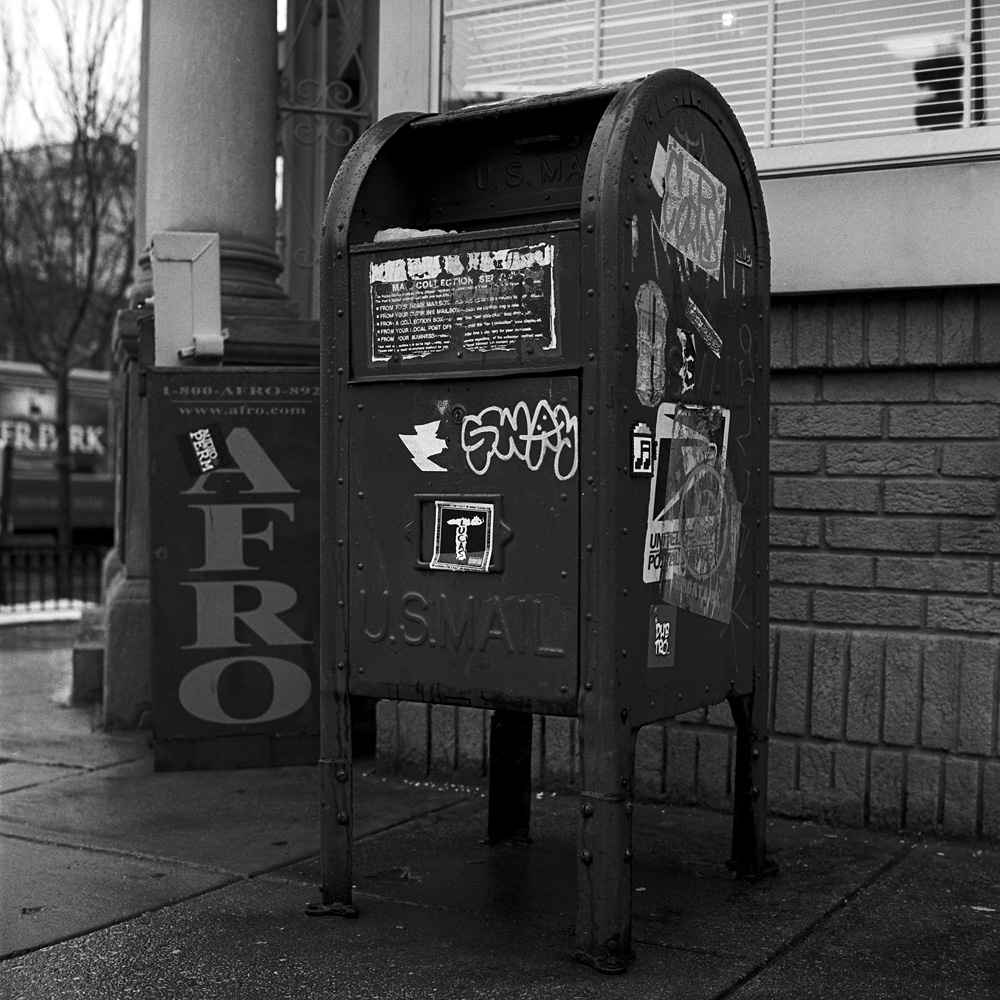
Mailbox
Mailbox

Industrial Bank was started at the beginning of the 20th century by African-Americans to cater to the African-American community. Their main branch is at the corner of 11th and U Streets, and has this really cool metal and neon clock sign out front. Alas they have allowed the sign to lapse into disrepair – I THINK the clock functions but it is not accurate, and either they just never turn on the neon or it no longer works. I really wish they’d fix it up so it would work, as it would make a very nice neighborhood landmark and a visual counterpoint to the yellow saxophone sign across the street outside the Bohemian Cavern nightclub.
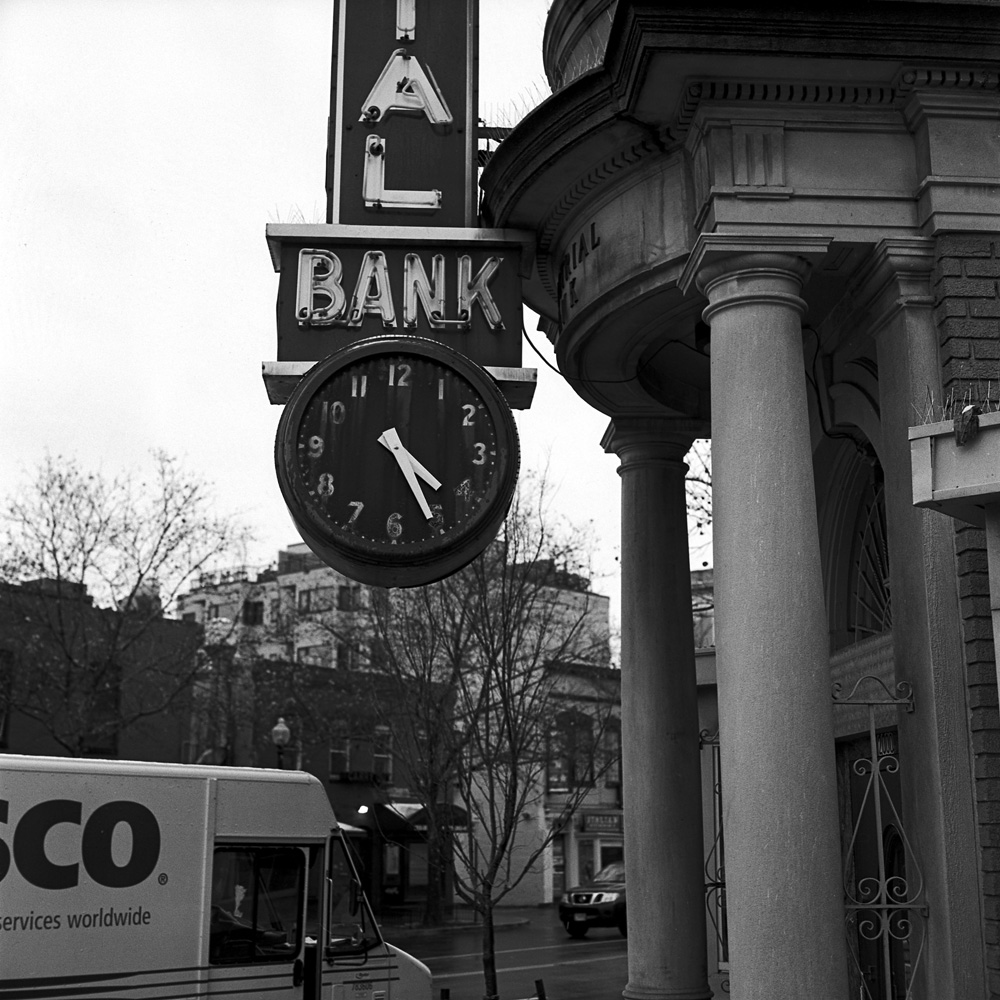
Clock, Industrial Bank

Up the street there is the Soul-Saving Center Church of God – a storefront community church with a primarily if not exclusively African-American congregation. It’s a sign of the gentrification and transformation of the neighborhood – across the street from them is a brand-new condo building with units selling for up to $1.2 Million.
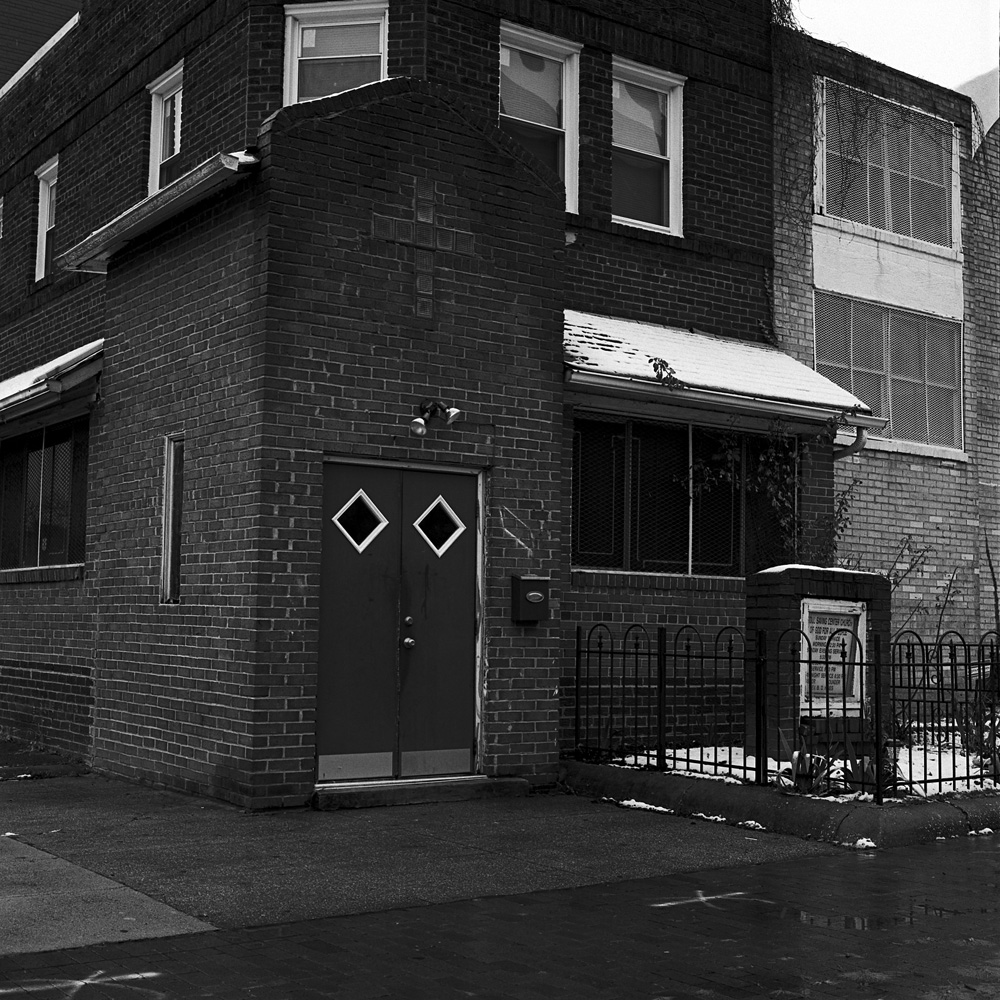
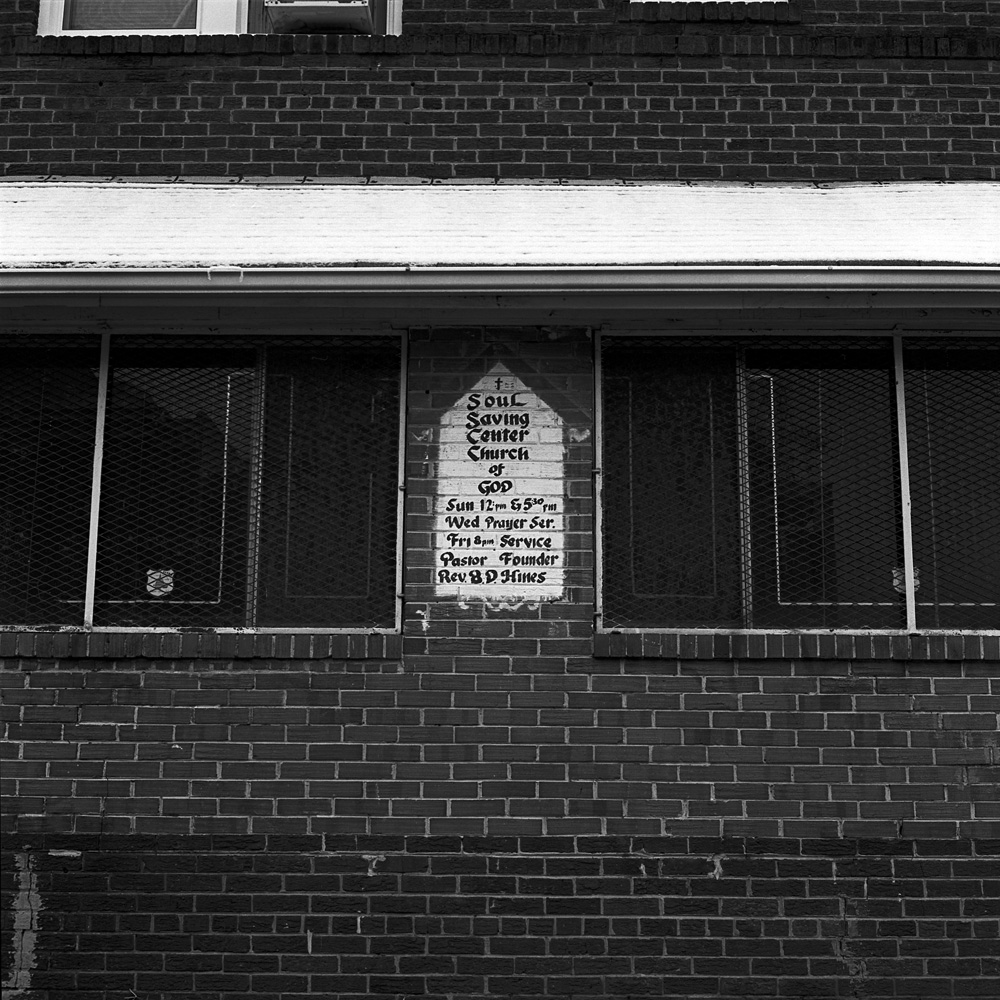
Soul Saving Center Church Door
Soul Saving Center Church

You can see the real estate bonanza still happening in the neighborhood – small row houses are being converted and expanded into multi-story multi-unit condominium buildings. Here is one with a “Fabulous Interio”- the agent broke off the “r” to get the sign to fit inside the fence. I wonder how long it will be before the Soul-Saving Center Church decides to sell their buildings plus the adjacent lot they have – they’ve got perhaps $10 Million in land alone now.
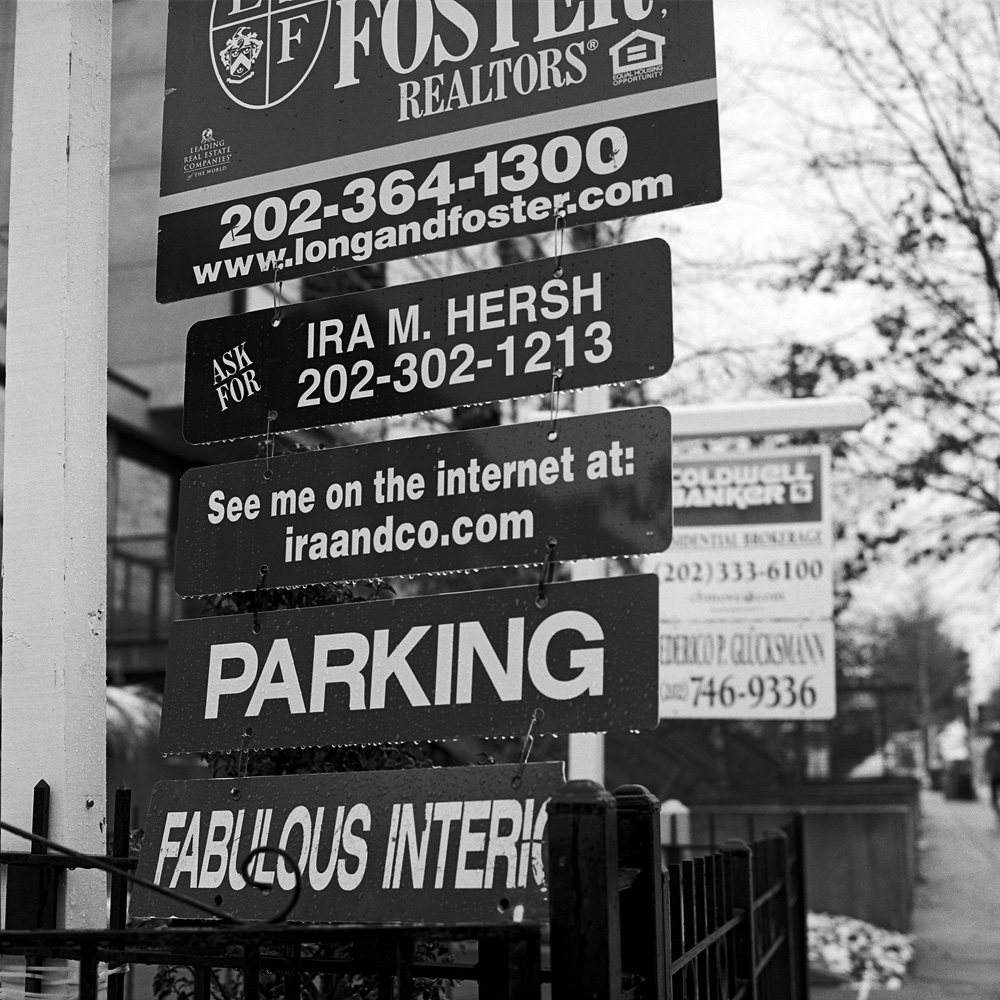
Fabulous Interio
Fabulous Interio

Up the street is another landmark of the neighborhood, almost as famous as Ben’s Chili Bowl. The Florida Avenue Grill has been around since 1944, serving up good old-fashioned soul food to locals and celebrities alike. The Florida Avenue Grill once owned a large empty lot next door, which served as their parking lot. About five years ago the family that owns the grill sold the empty lot and now a five story condo building has filled it. The average unit in that building sold for north of $500,000 each.
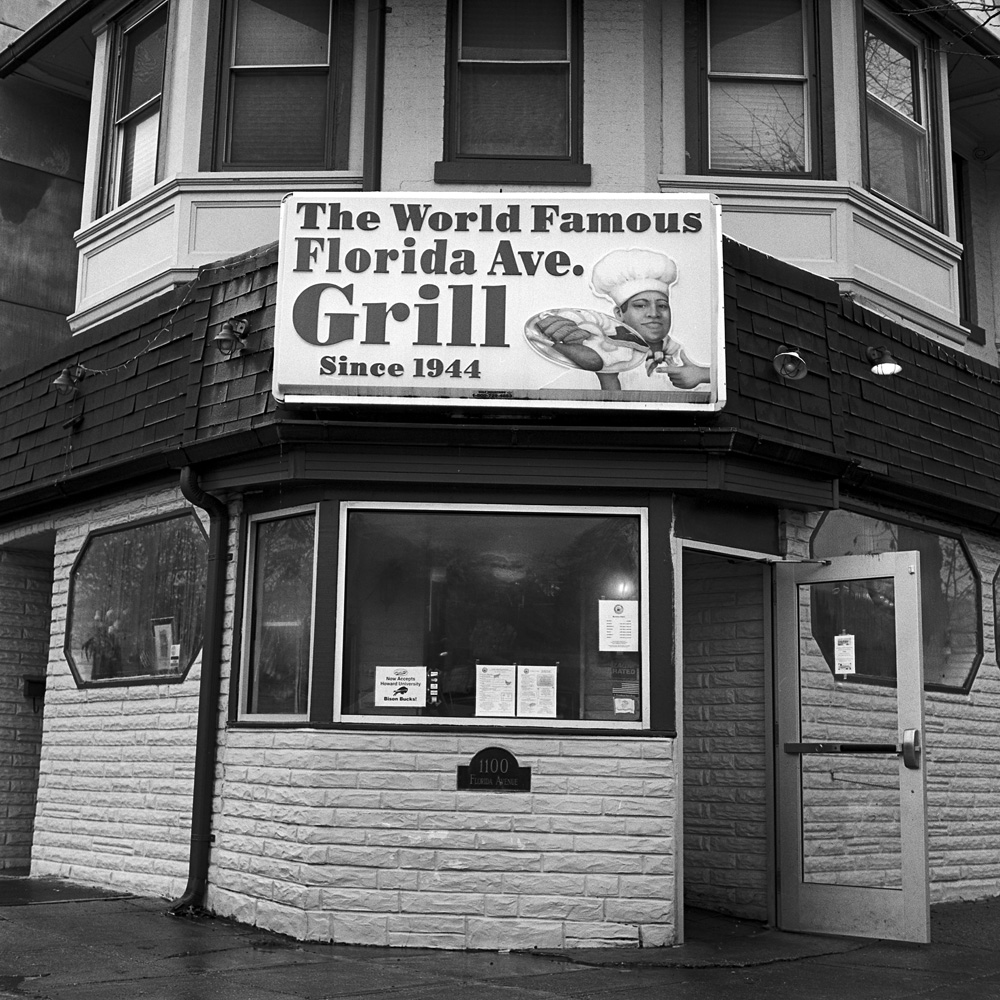
Florida Avenue Grill

Paris in October – part 32 – Notre Dame in Color

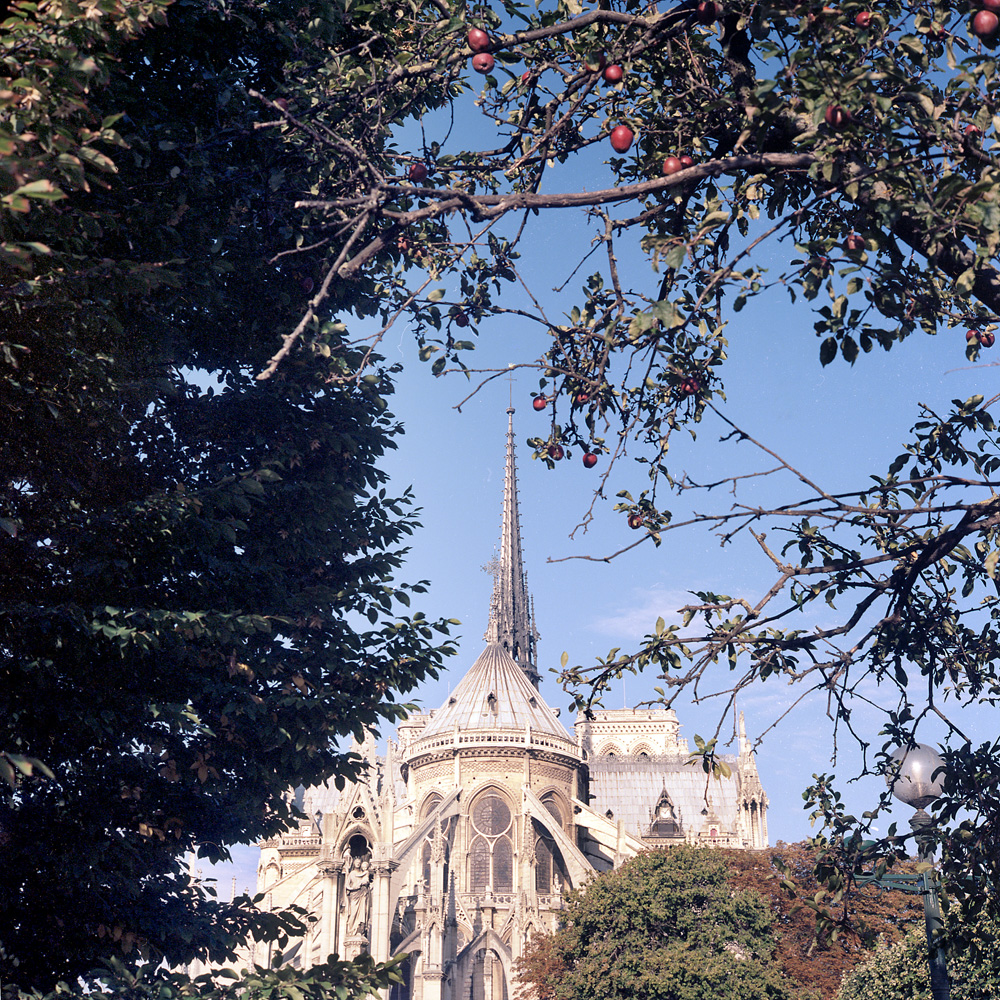
Notre Dame looks very different in color than in black-and-white. The stone takes on a different texture, the shapes of the arches and buttresses are somehow different, and I think you feel the age of the place much more. This is, after all, a 900 year old building.

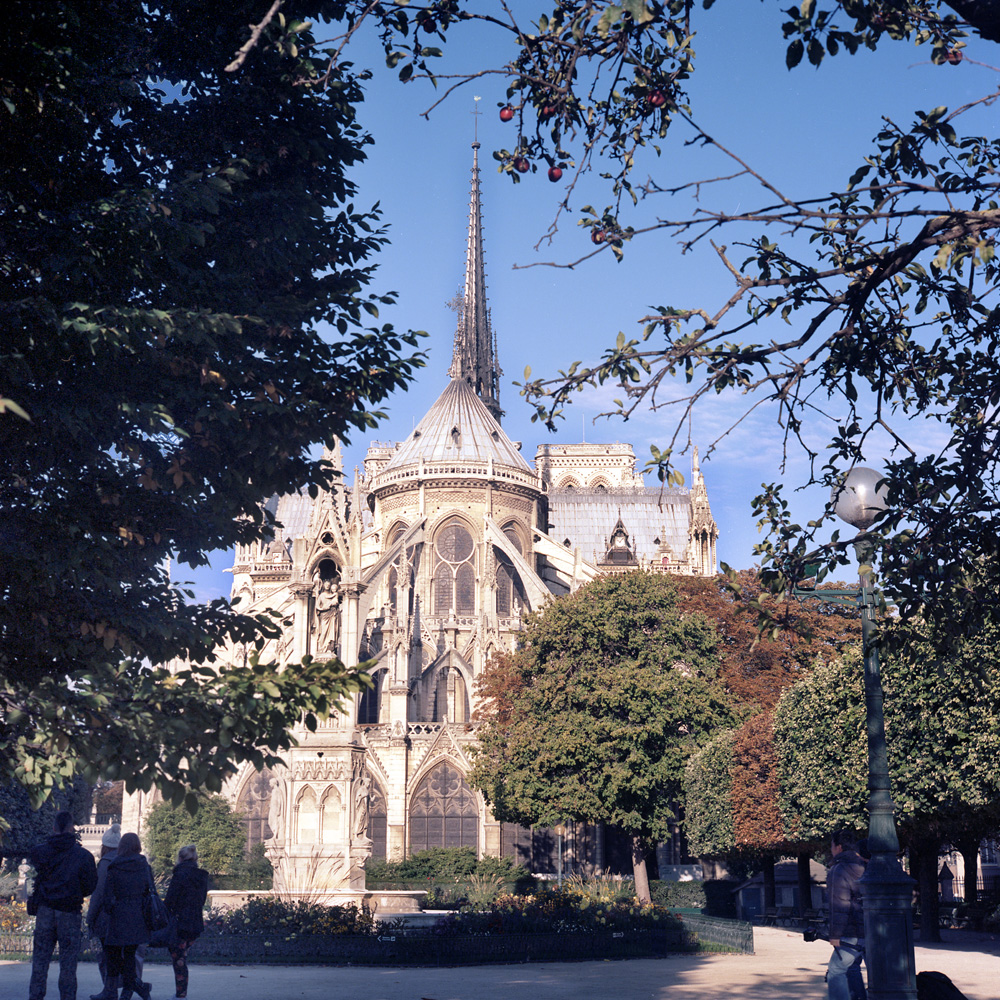
In the garden behind the cathedral, there is an apple tree. The groundskeepers must zealously patrol for fallen fruit, as I never saw one on the ground in a week of passing through. I was talking with someone at work about this apple tree and he observed an irony of having an apple tree in the garden of a cathedral, if you’re into Christian symbolism.
Notre Dame, Apple Tree

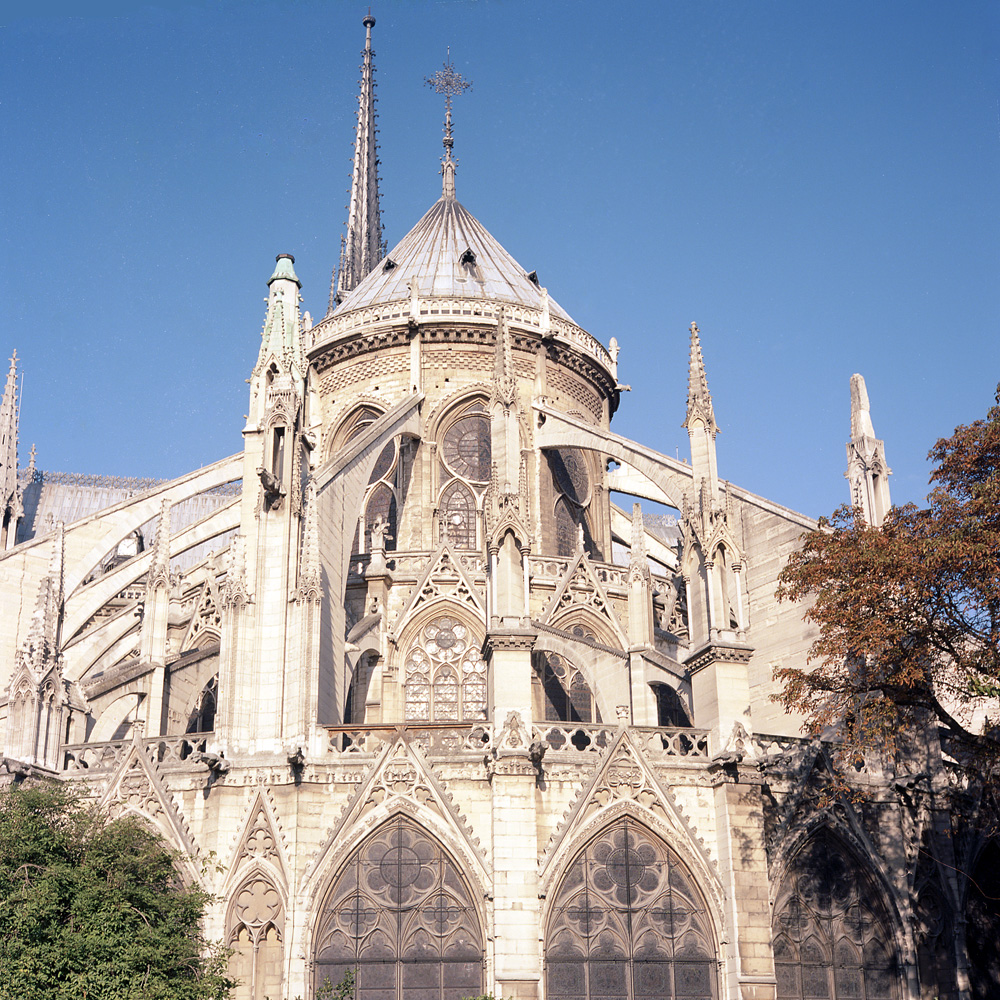
A closer-in view of the rear of the cathedral, including the spire. The towers top out at 226 feet, but the spire and its weather-vane go on to 300 feet tall. I don’t think you realize that when looking at the building because of the relative mass of the towers, and the perspective you have when viewing either spire or towers – you’re always looking up, and at the distances required to see both, the height differential is erased by perspective. You can clearly see in this photo the stacked wedding-cake structure of the building – the lower floor with its side chapels spreads out much wider than the center aisle.

Notre Dame, Rear
Notre Dame, Rear

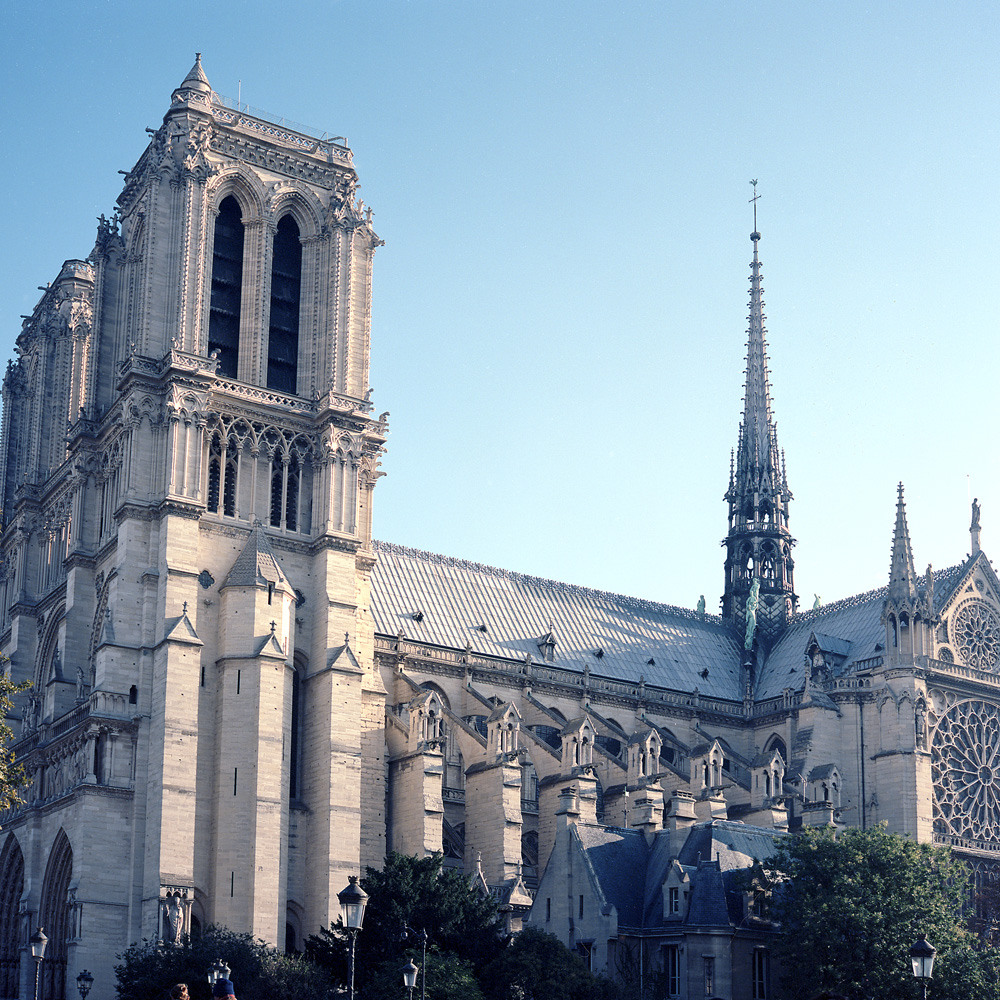
A side view of the cathedral, showing both the towers and the spire. Even from this view it’s hard to see an extra 75 feet of height on the spire.

Notre Dame, Side View

Another view of the rear, with the apple tree. This one includes people in the garden for perspective.

Notre Dame, Apples
Notre Dame, Apples

Paris in October – part 31 – More Notre Dame in B/W

These are a few more from that last remaining roll of b/w I didn’t develop until yesterday. Just some additional looks at Notre Dame cathedral in black and white.

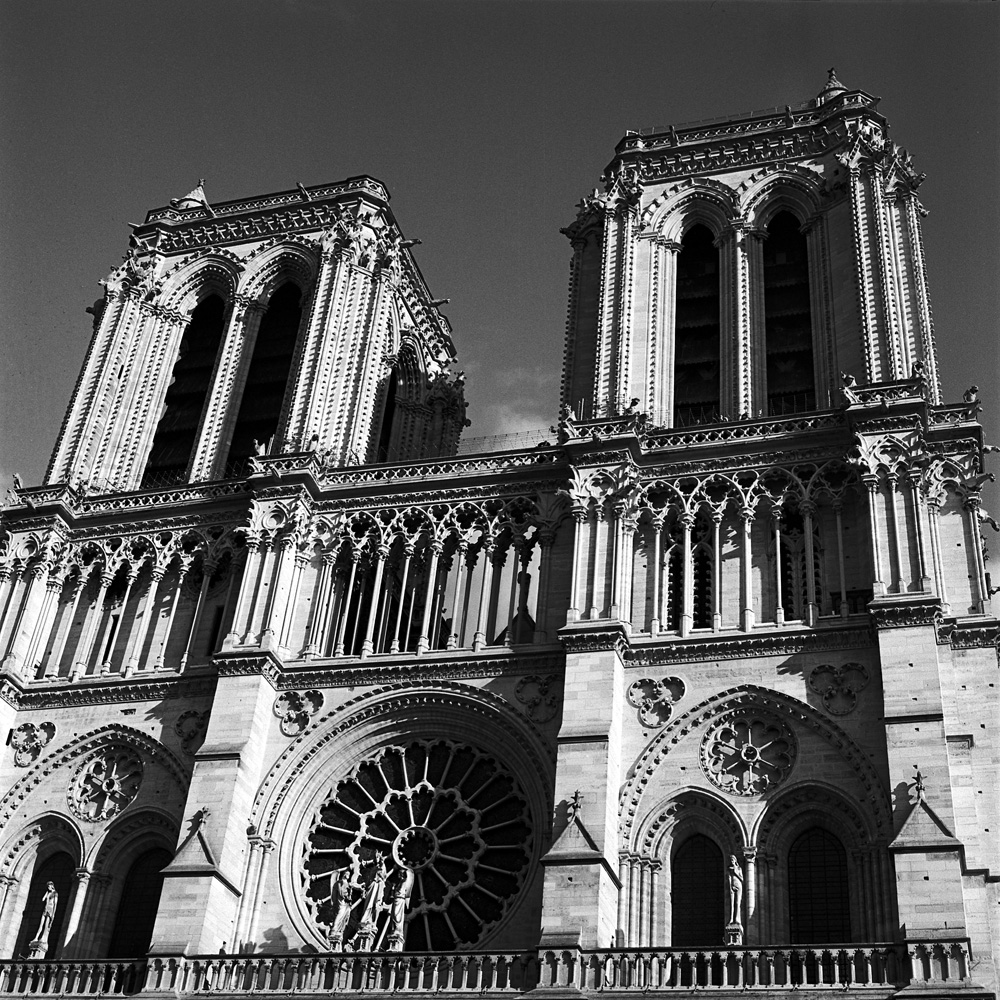
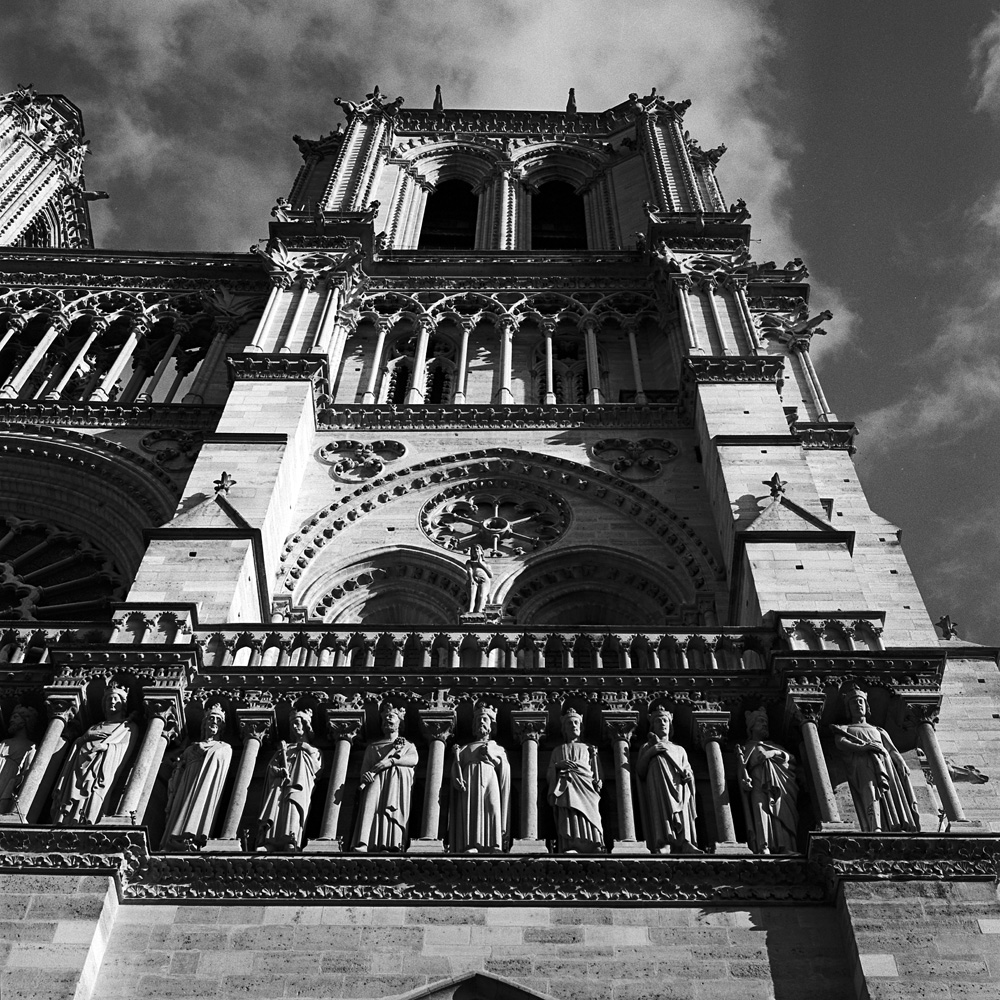
It’s hard to view the cathedral without trying to interpret the towers as a graphical element. They’re the most recognizable element to the church, perhaps other than the rose window. The main body of the church is actually rather narrow and delicate, relative to its perception. All those flying buttresses make it seem much more massive than it is. The tower facade, though, really establishes that perception because when viewing it straight on, it seems like a solid wall, and that the church behind it must be equally as massive.

Twin Towers, Notre Dame

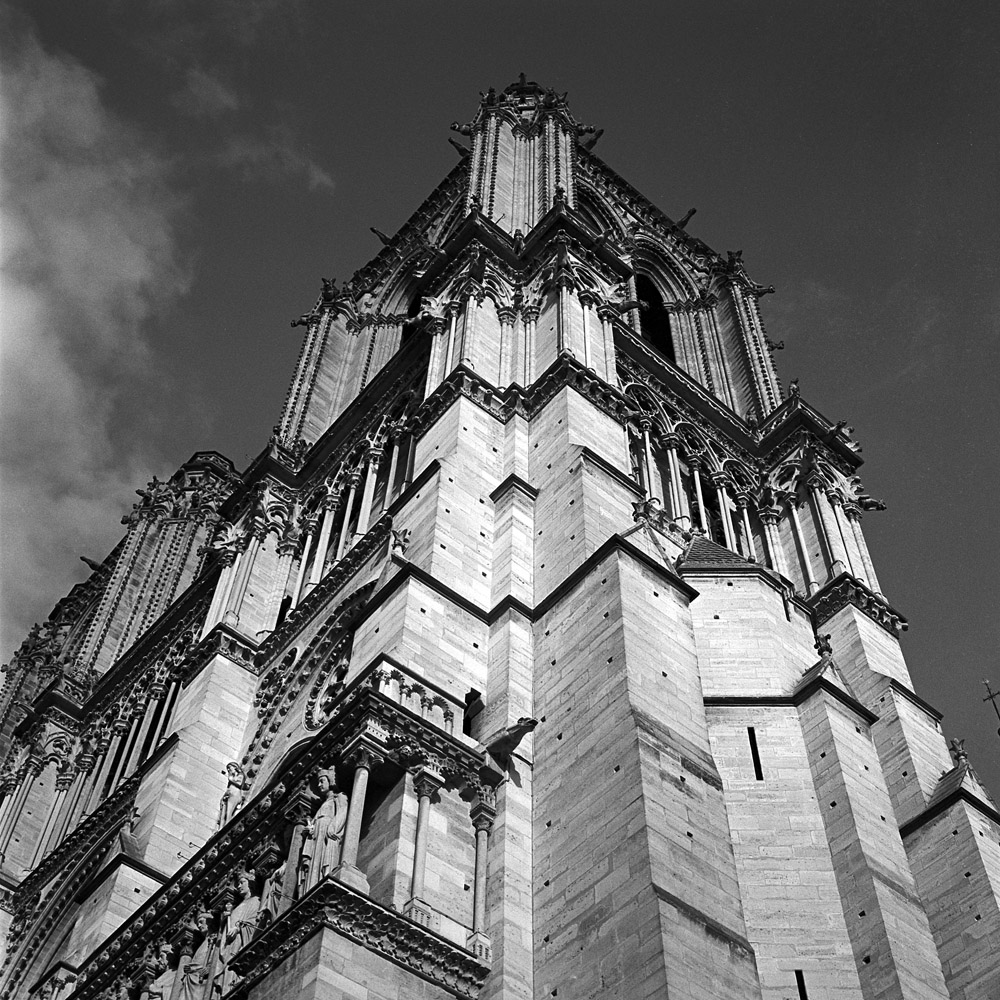
Trying to look at the towers is a vertigo-inducing experience. They are quite tall, and the nature of the decorations make you keep looking up to see all the details to the very last set of gargoyles some 226 feet in the air. Getting up in the towers to view them up close and personal is vertigo-inducing as well – it’s a nearly 400-stair climb to the top of the tower (which I did NOT do – I’m too out-of-shape to attempt something so heart-stressing). At one point in time, Notre Dame was the largest building in the western world – you can still easily spot it from the 2nd tier of the Eiffel Tower, despite the intervening buildings, several miles and the bend in the river between the two landmarks.

Tower, Notre Dame, Looking Up

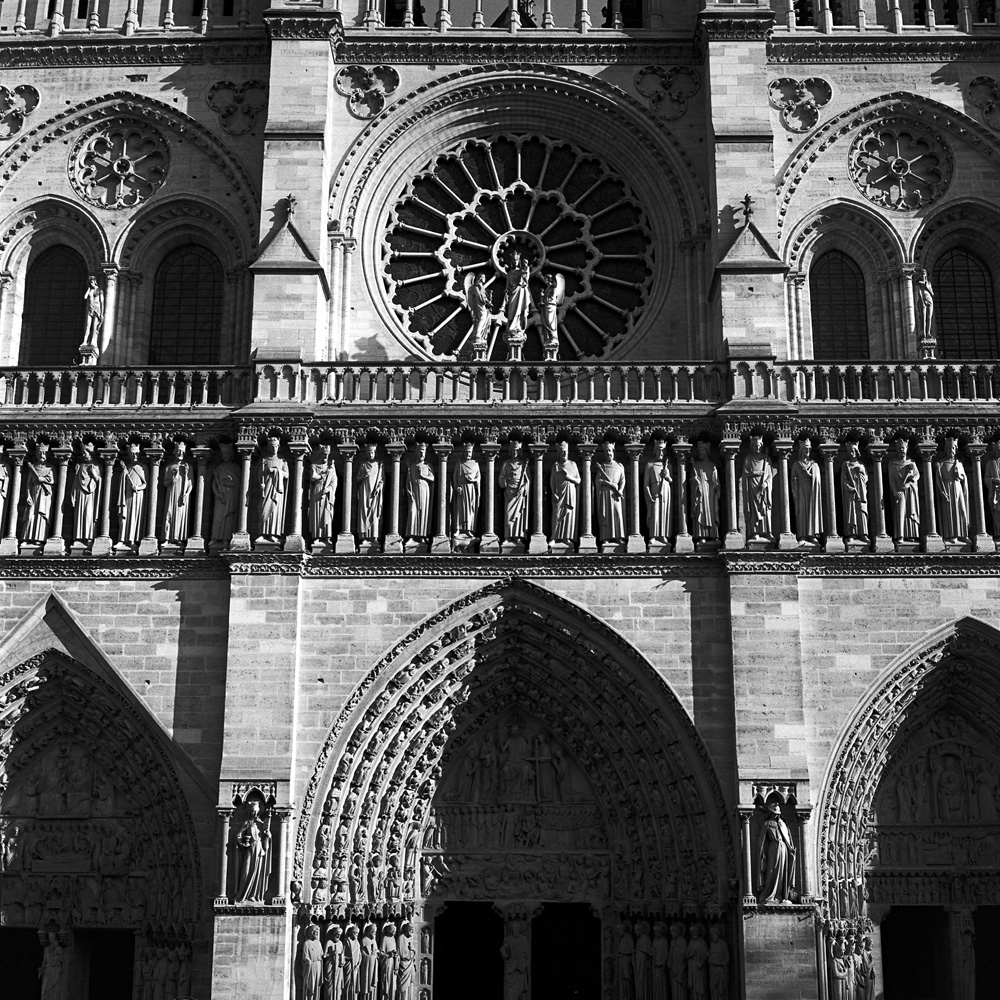
Here is a view of the incredibly detailed facade. One thing I did not realize until looking at this photo is the fact that all three main doorways are different. I always assumed that the left/right halves of the facade would be symmetrical. If you look carefully, the archway over the left hand door is a little smaller, and crowned by the angular, peaked molding. The right arch is larger and lacks the angular molding. Another detail that often gets forgotten – we assume that these cathedrals were all bare stone, and that the way we see them today is how they were intended. Au contraire – most cathedrals of the Romanesque and Gothic periods (the 7th-15th centuries) were brightly painted, inside and out. The statues on the exterior would all have been polychrome, as would the interior walls have been. Time, weather, wear and neglect have conspired to strip the coloring off the buildings. They did find some early medieval frescoes inside the old cathedral in Salamanca that had been covered up for centuries after an earthquake damaged both cathedrals (they’re kind of conjoined twins and share a wall).

Notre Dame Facade, Afternoon

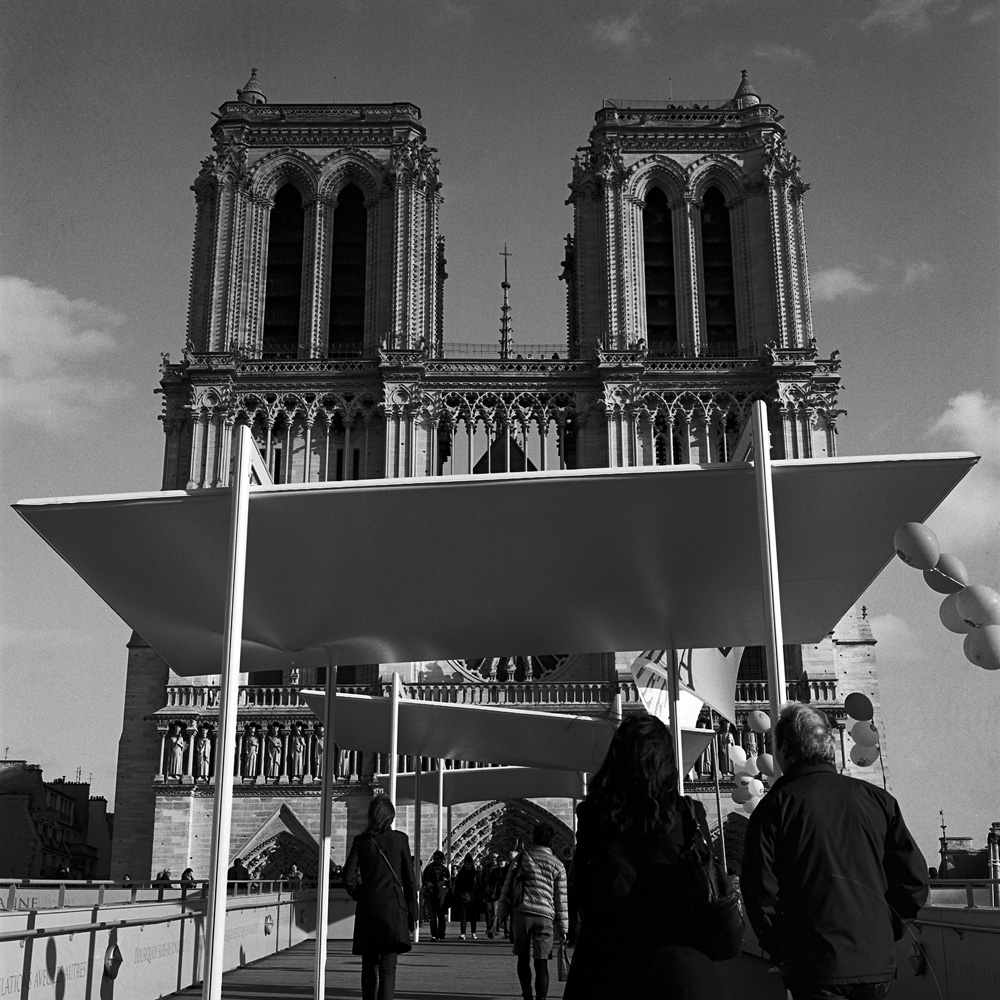
I really don’t know why they built this mammoth viewing/reviewing stand in the plaza in front of the cathedral. You can ascend the steps on the front face, or you can climb the ramp up the back. This is the view of the towers from the ramp – the tarp-like covers on the ramp provide a starkly modern contrast to the gothic stonework of the cathedral.

Notre Dame Towers, from Ramp
Towers, Notre Dame Cathedral

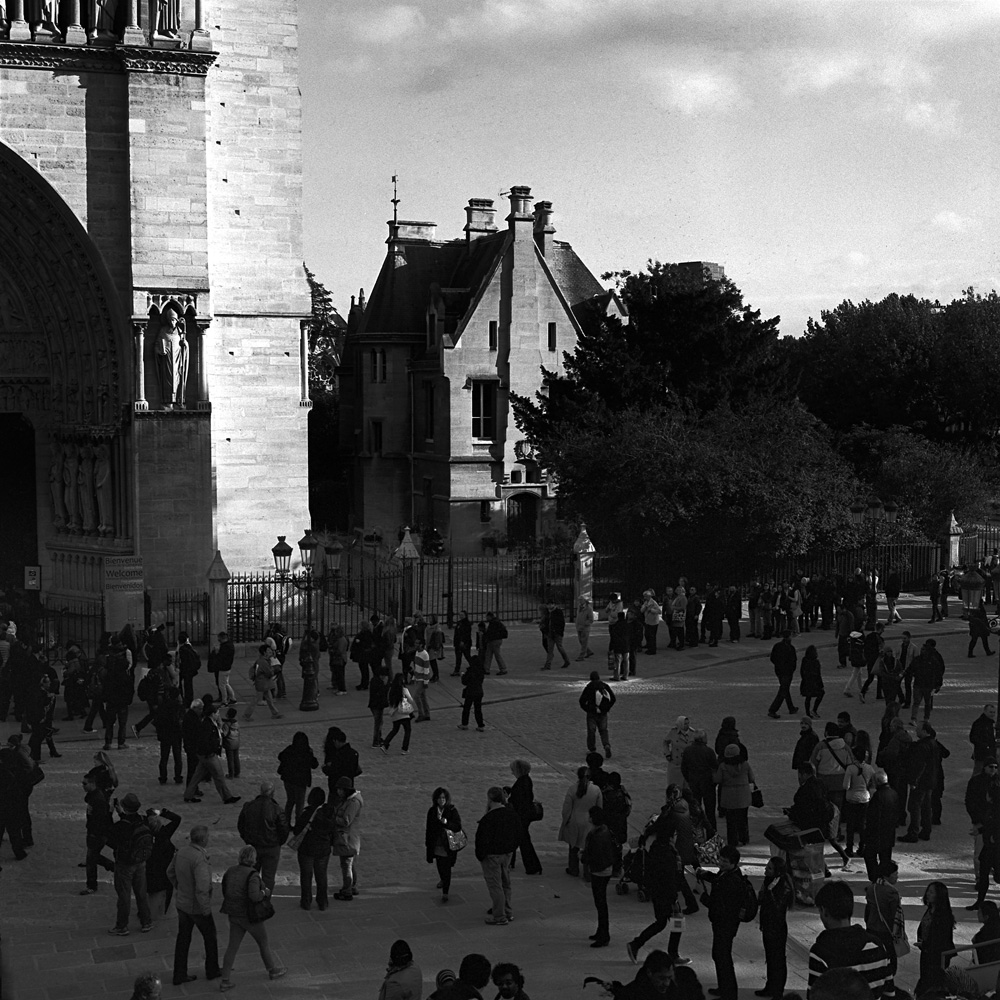
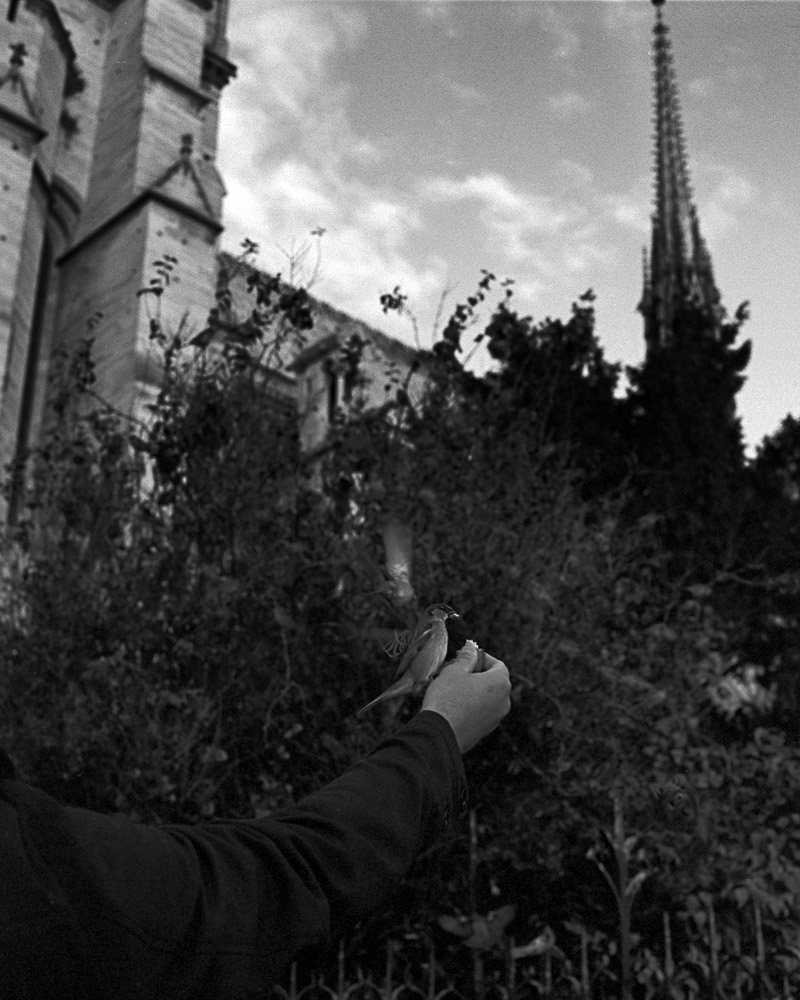
The crowds at Notre Dame are non-stop, even at night after the cathedral is closed. This is a typical weekday afternoon on the plaza out front. The little house to the right is the rectory for the cathedral. Along the fence surrounding the rectory is where you will find the bird feeders – people who will sell you a scrap of day old bread or a stale churro that you can hold up in your outstretched hand to attract the sparrows who will hover over to get a bite.

Crowds, Square, Notre Dame
Feeding Sparrows, Notre Dame

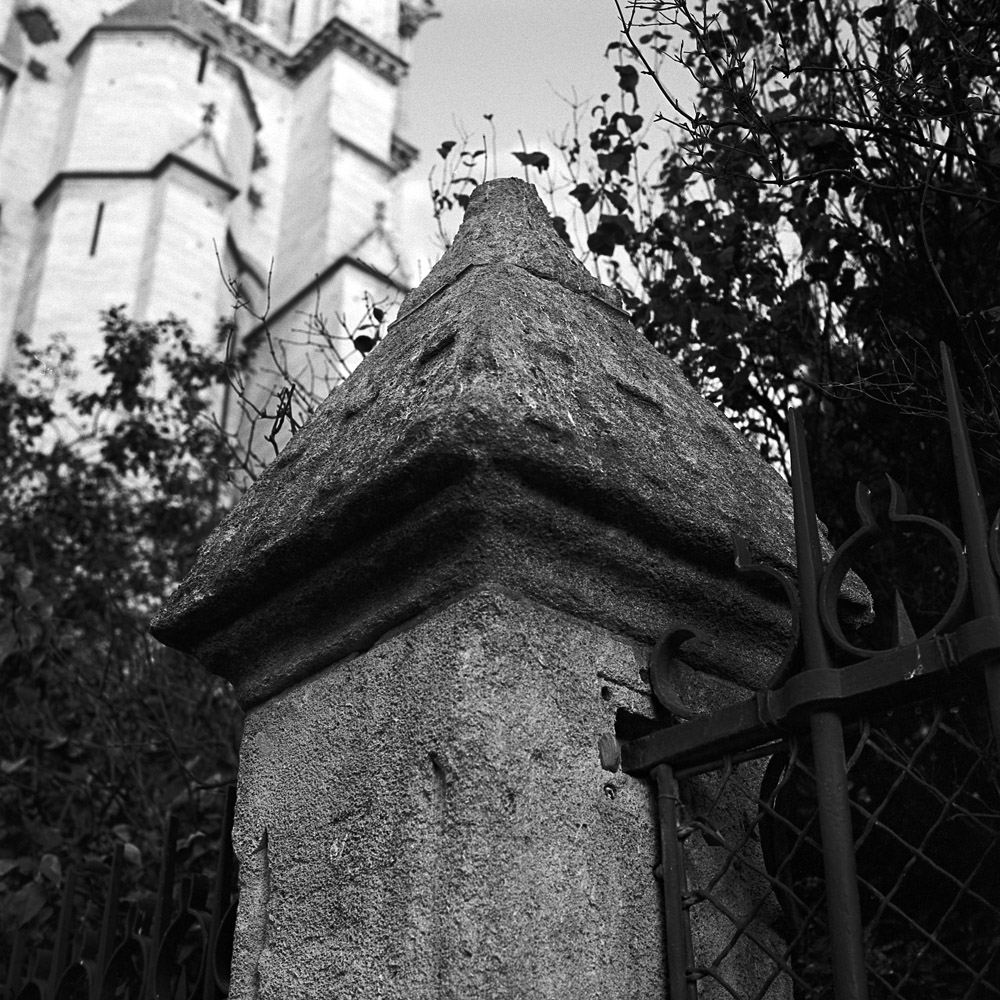
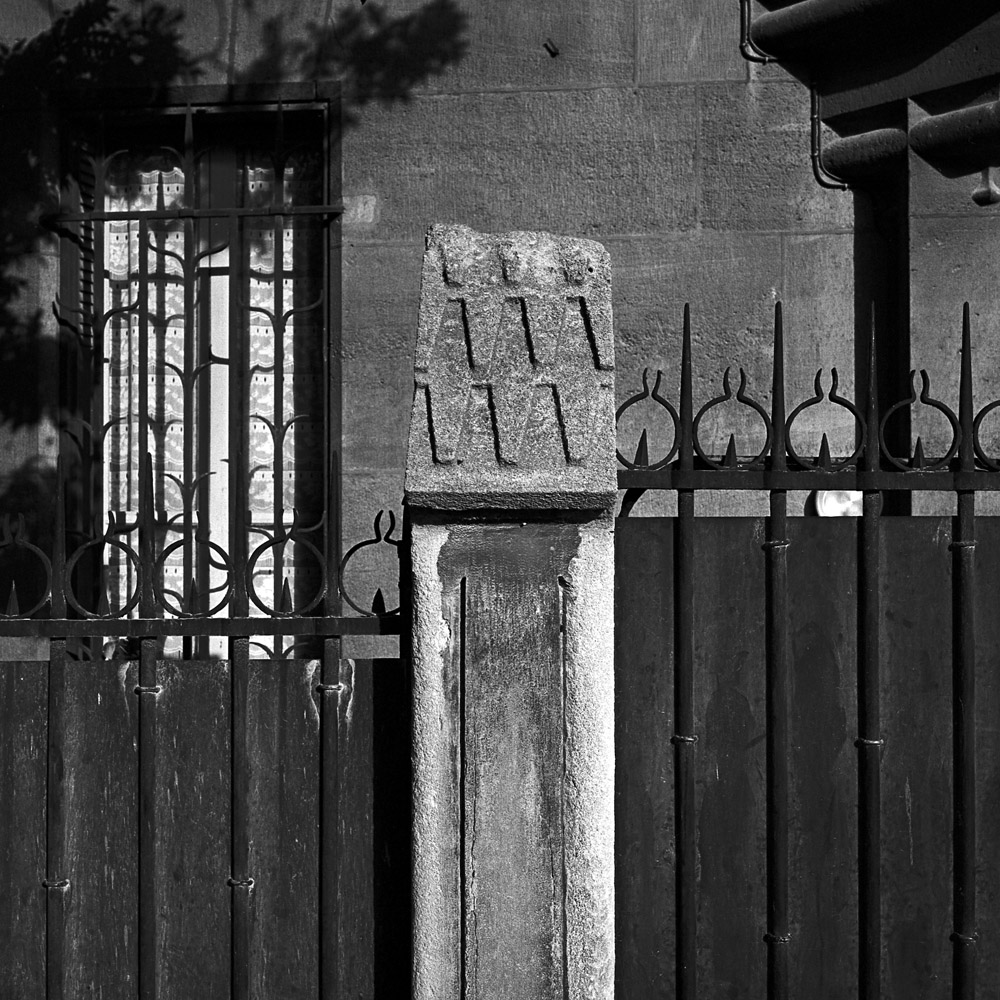
Some architectural details of the fence around the rectory:

Capital, Fence Column, Notre Dame
Fence Capital, Notre Dame

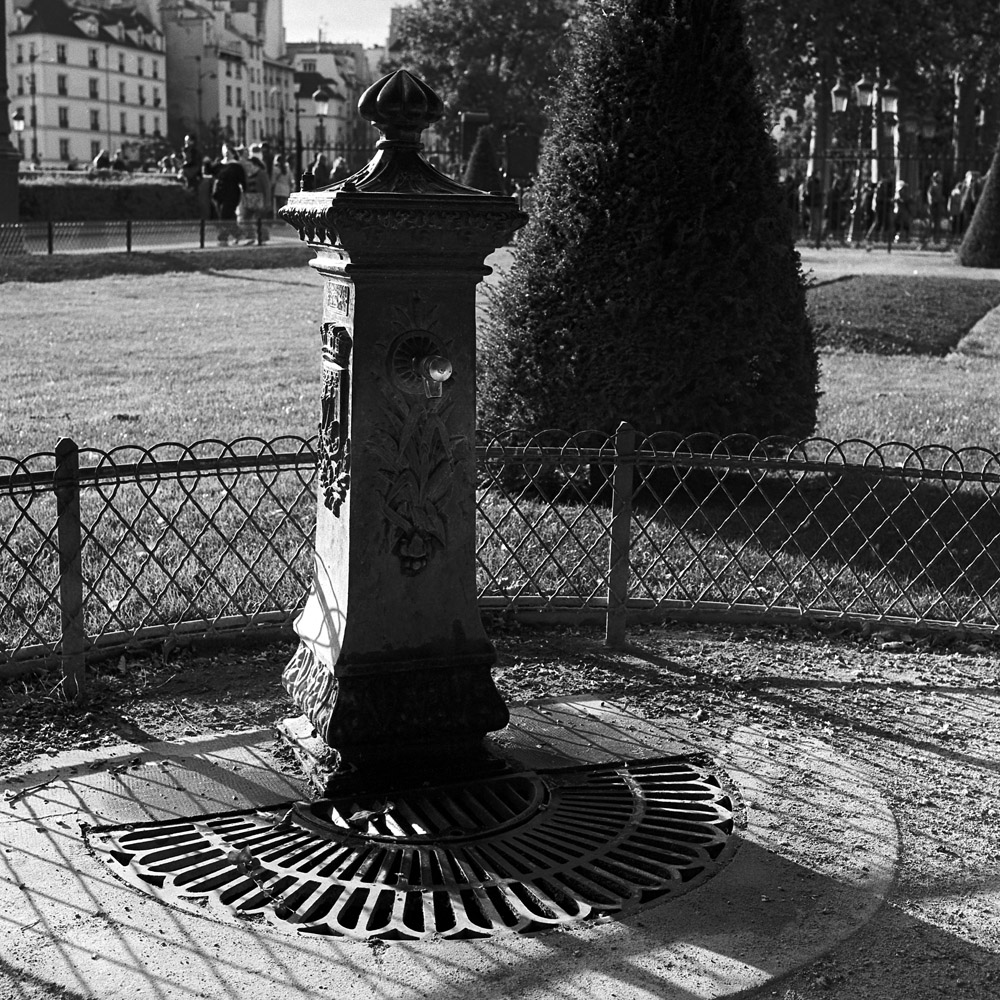
Beside the cathedral there is a park with views of the Seine, replete with benches, gardens and, as part of Haussmann’s renovations, public drinking fountains. I loved the way this looked backlit with the evening light. Consider it another one of my portraits of everyday objects.

Drinking Fountain, Notre Dame

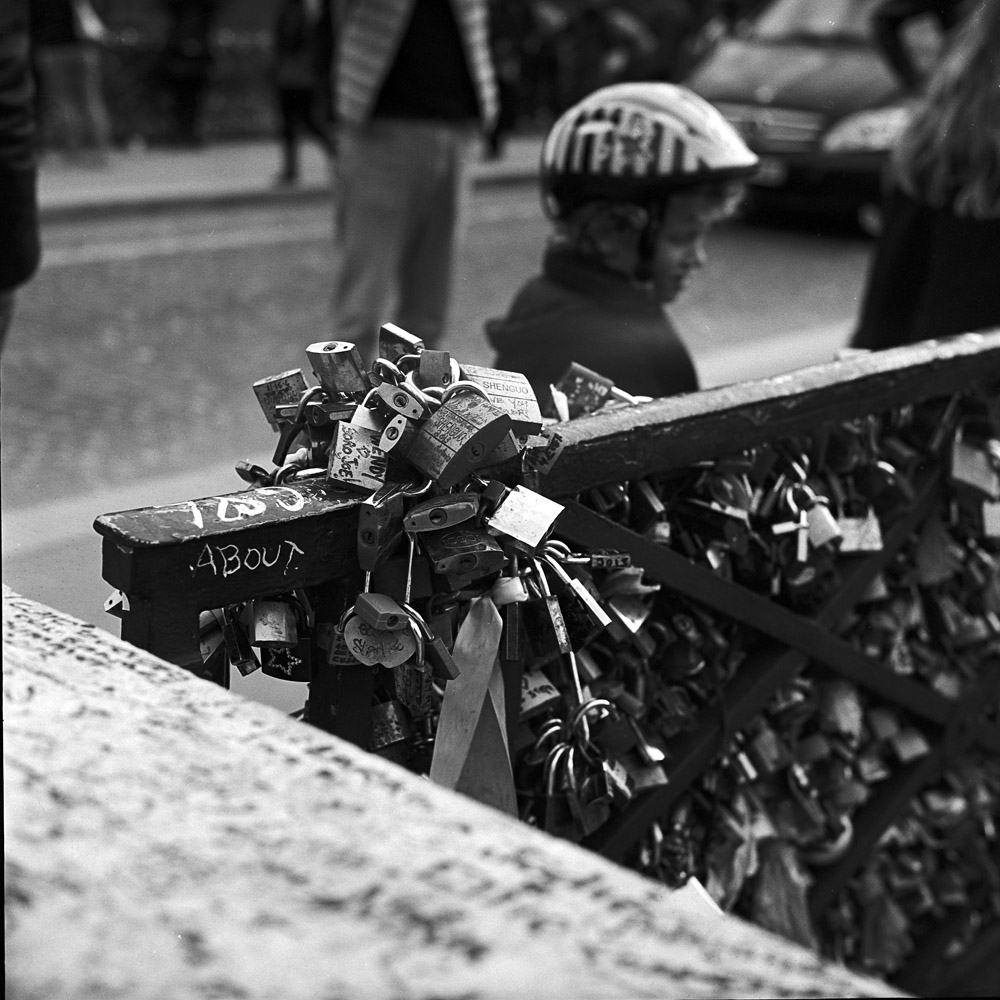
And last but not least, the tradition that began in Rome of young couples buying a padlock, writing their initials on it, locking it to the railing of a bridge, and tossing the keys in the river as a symbol of how their love cannot be undone has come to Paris. It is so popular that it has infested three or four bridges across the Seine now, and the boquinistes with bookstalls along the Rive Gauche nearest the Ile de la Cité sell a variety of padlocks and permanent markers. It seems only natural that people would do this on the bridges closest to Notre Dame, as it is one of the most romantic, inspiring buildings in a city full of romantic inspiration.

Love Locks, Notre Dame

(see, I told you you wouldn’t have to wait long for the next Paris post!)

Paris in October – part 30 –

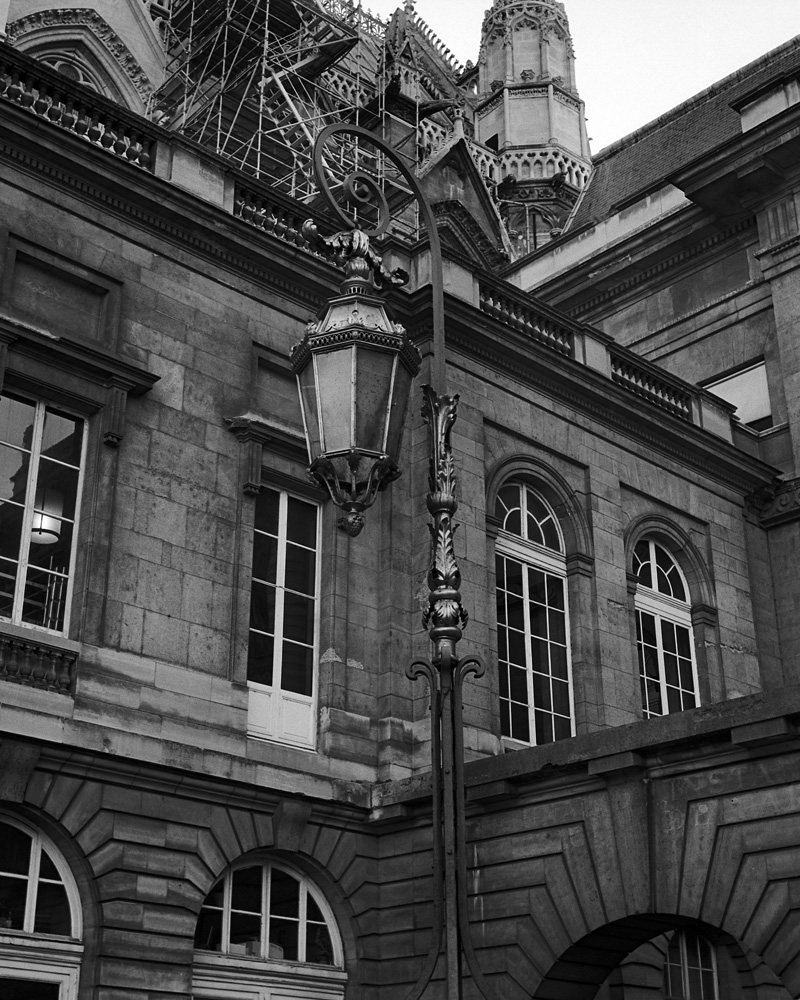
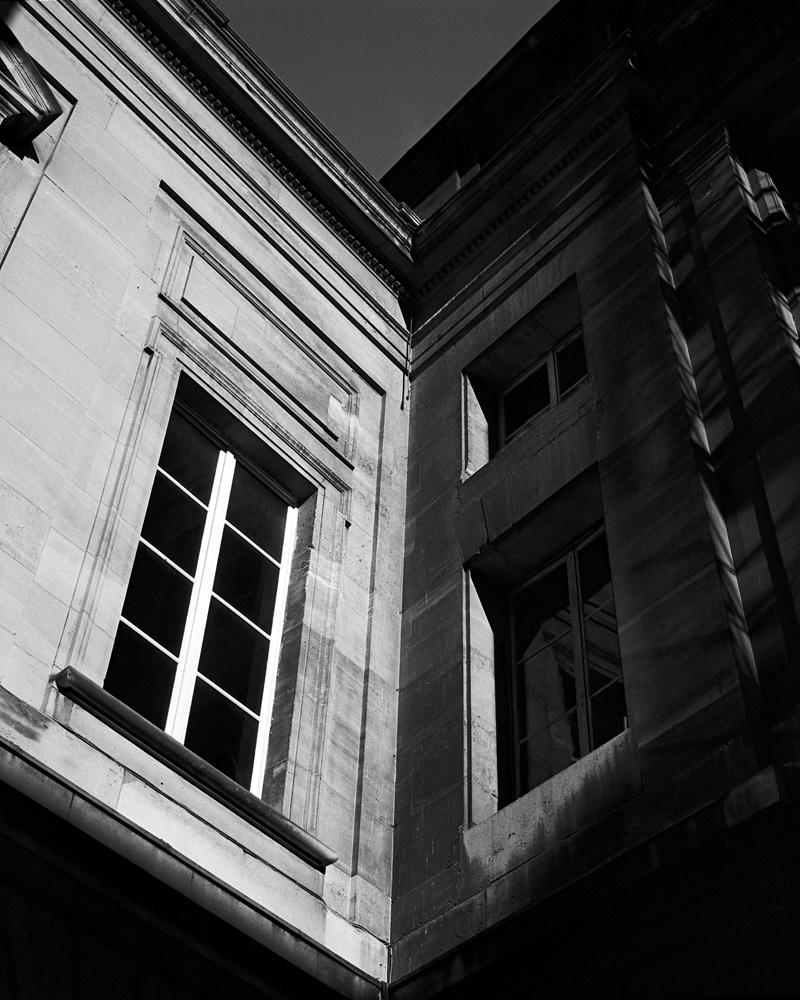
So I FINALLY got around to developing the last roll of black-and-white from the trip today. Here are some odds-n-ends from the Palais de Justice. These are from the courtyard through which you exit after you visit Sainte Chapelle (you can see the spire of the chapel in the background of the lantern photo).

Not only did the lantern appeal to me, but the absolutely crazy Escher-esque layers of the building behind it just begged to be photographed. It’s like many different buildings collided and transformed into another entirely new one.

Lantern, Courtyard, Palais de Justice

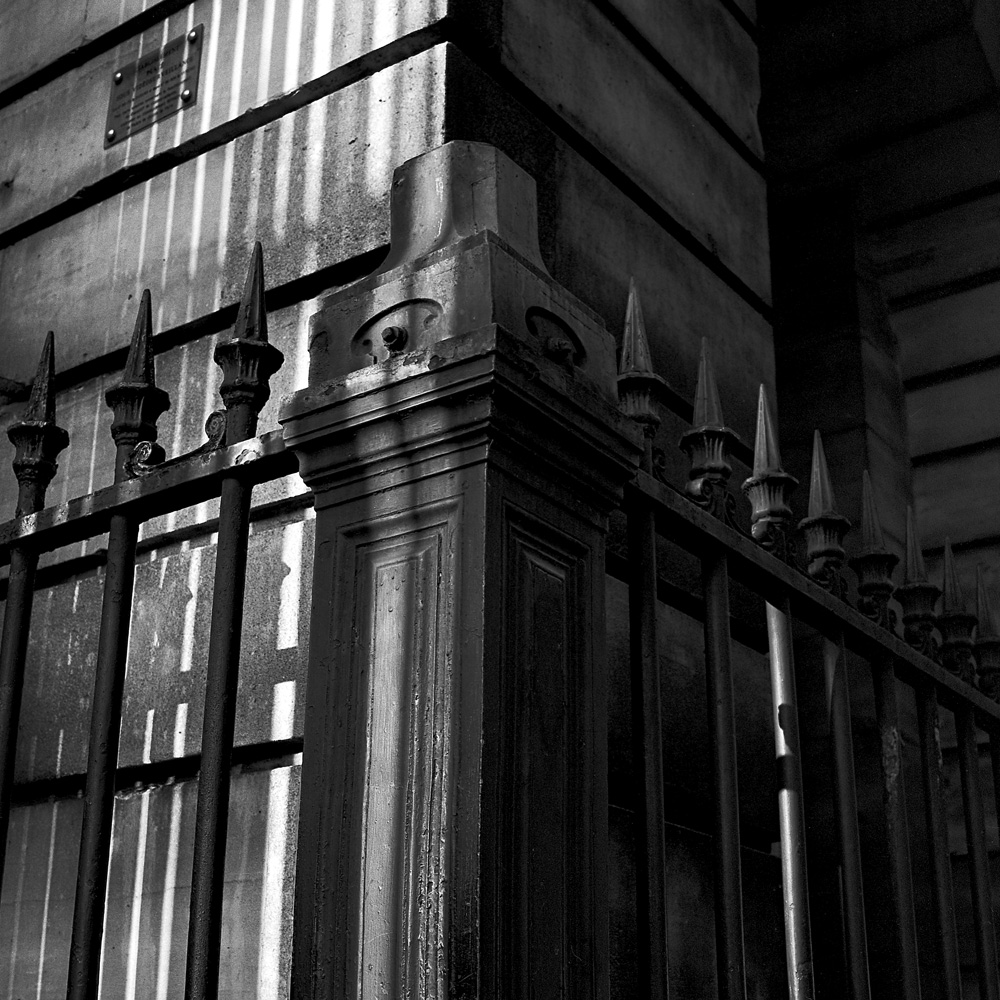
This is a fencepost on an iron railing around the Palais de Justice building. I thought the sunlight passing through the outer fence casting a striped shadow on the wall behind this iron fence had an ironic feeling of multiple layers of prison at a place of justice.

Fence, Palais de Justice

These windows also had an Escher-esque quality to them because they have balance but not symmetry – again lots of angles that mimic and overlap without being truly parallel.

Windows, Palais de Justice

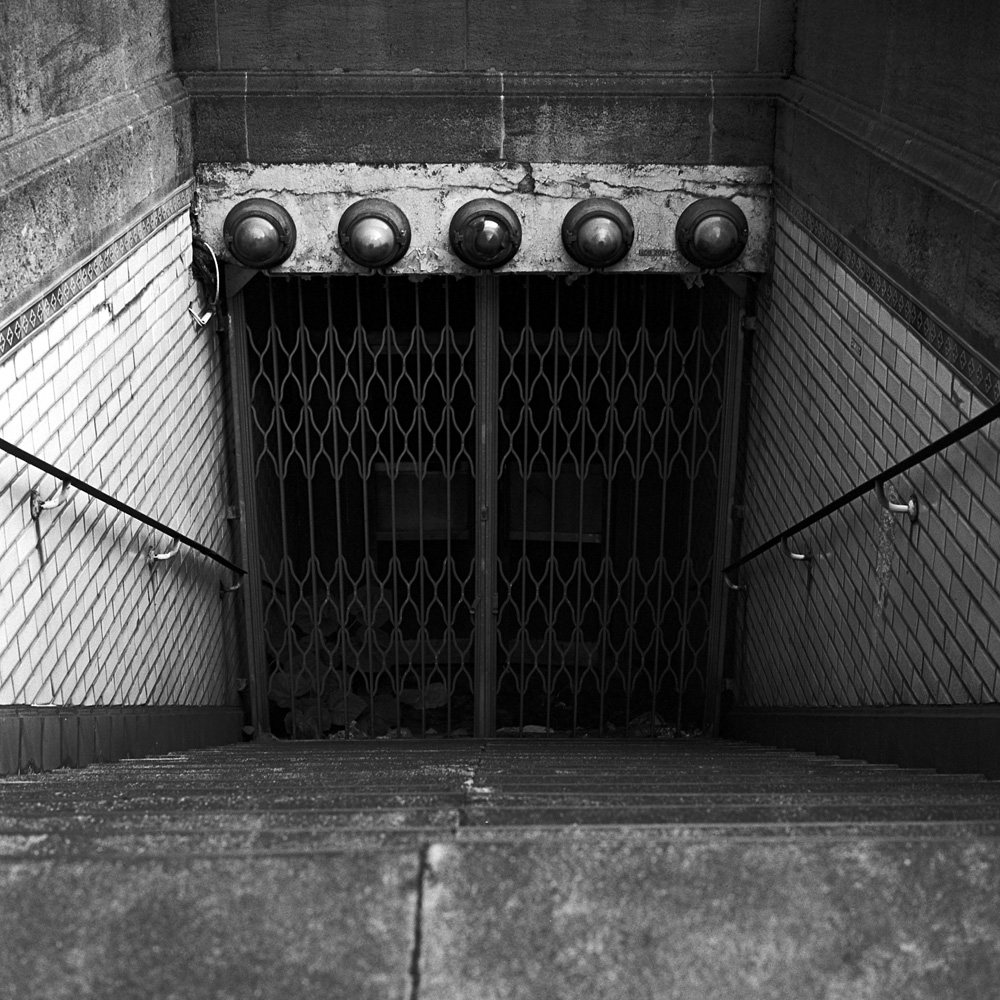
On the way out of the courtyard you pass by what seems to be an entrance to the Metro, all closed up. This is a block and a bit from the main entrance to the Cité metro, so it is possible this was a direct entrance to enable workers at the Palais de Justice to go directly to and from their offices. Or it could just be an underpass or an entrance to a tunnel system connecting multiple buildings in the neighborhood. I’m voting for subway entrance even though it doesn’t have the nifty bronze art nouveau surround because the lamps above the gates look like the lamps over the Cité station entrance. Any Parisian readers are more than welcome to chime in and correct me.

Abandoned Subway Entrance, Palais de Justice

Paris in October – part 29 – Opera Garnier

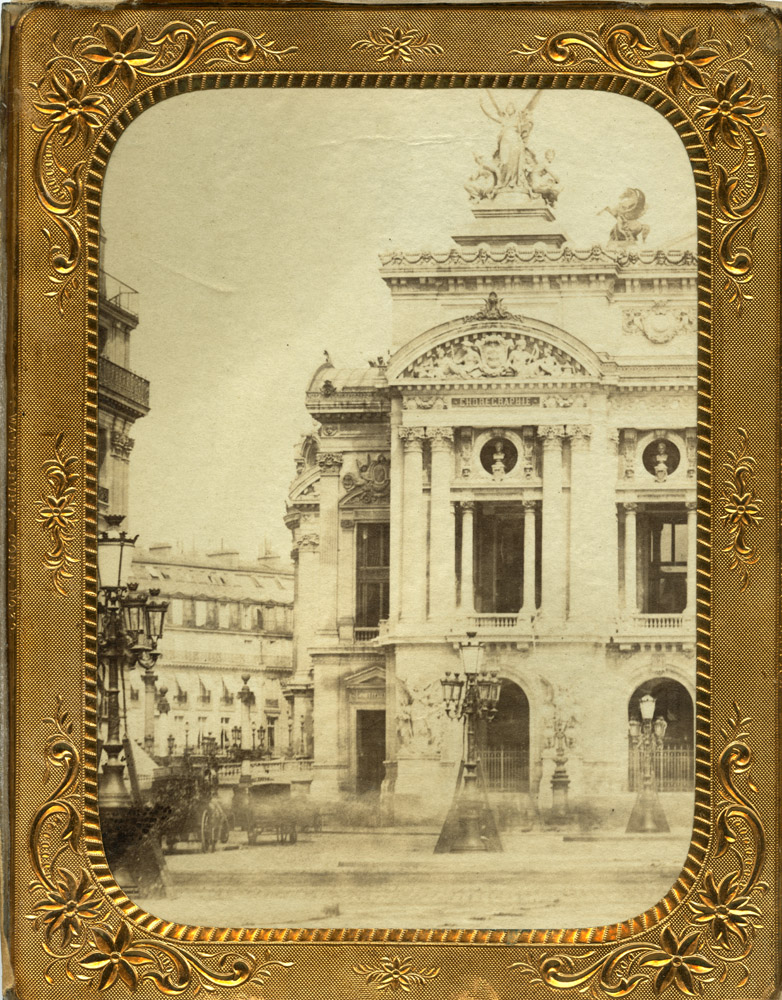
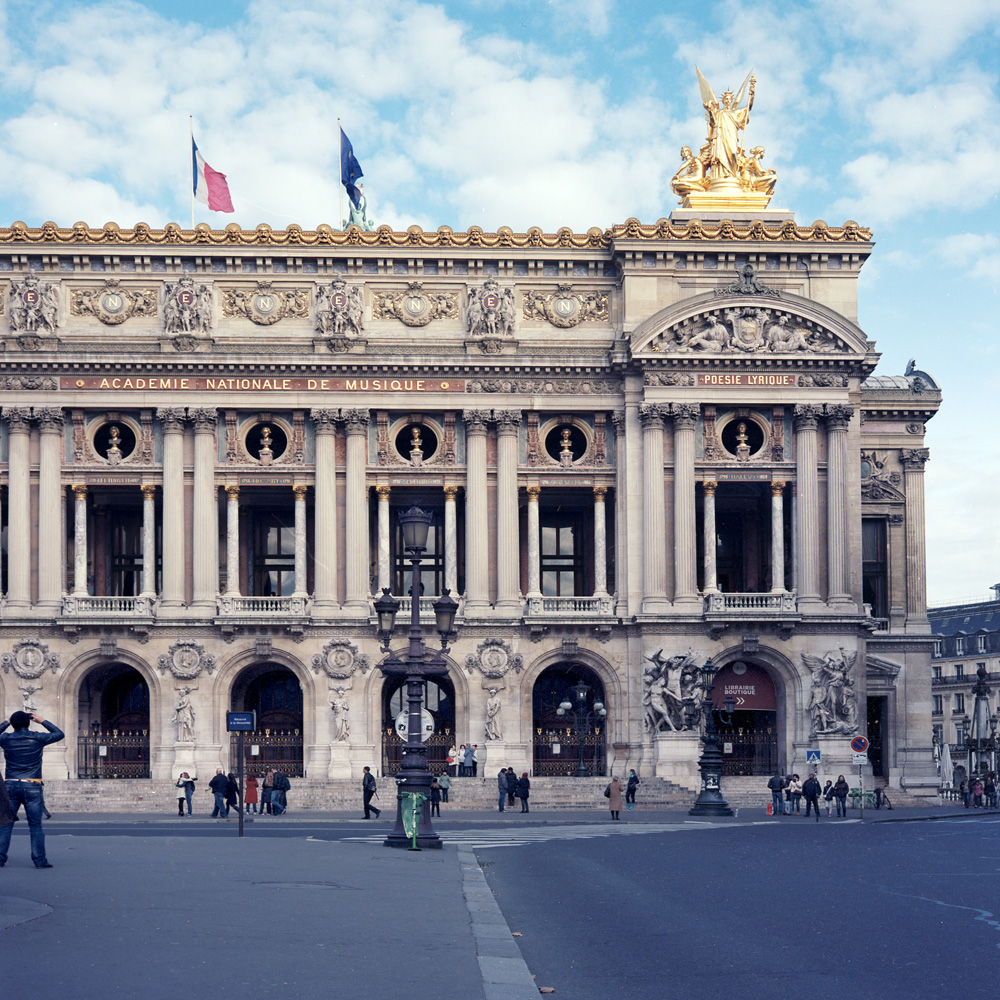
I thought I’d start this post off with a comparison of my 1870s photo of the Opera Garnier with the photo I took this year in 2013. Not exactly the same shot (the antique is of the left side of the facade whereas mine is of the right and middle) but I did manage to include several of the same elements.

Paris Opera albumen print
Facade, Opera Garnier

I don’t know when my vintage photo was taken, but it could be as early as 1867 when the facade was unveiled. Alas, the lampposts have changed, and significantly decreased in number. I can only imagine what the plaza in front would have looked like with all those lamps lit.

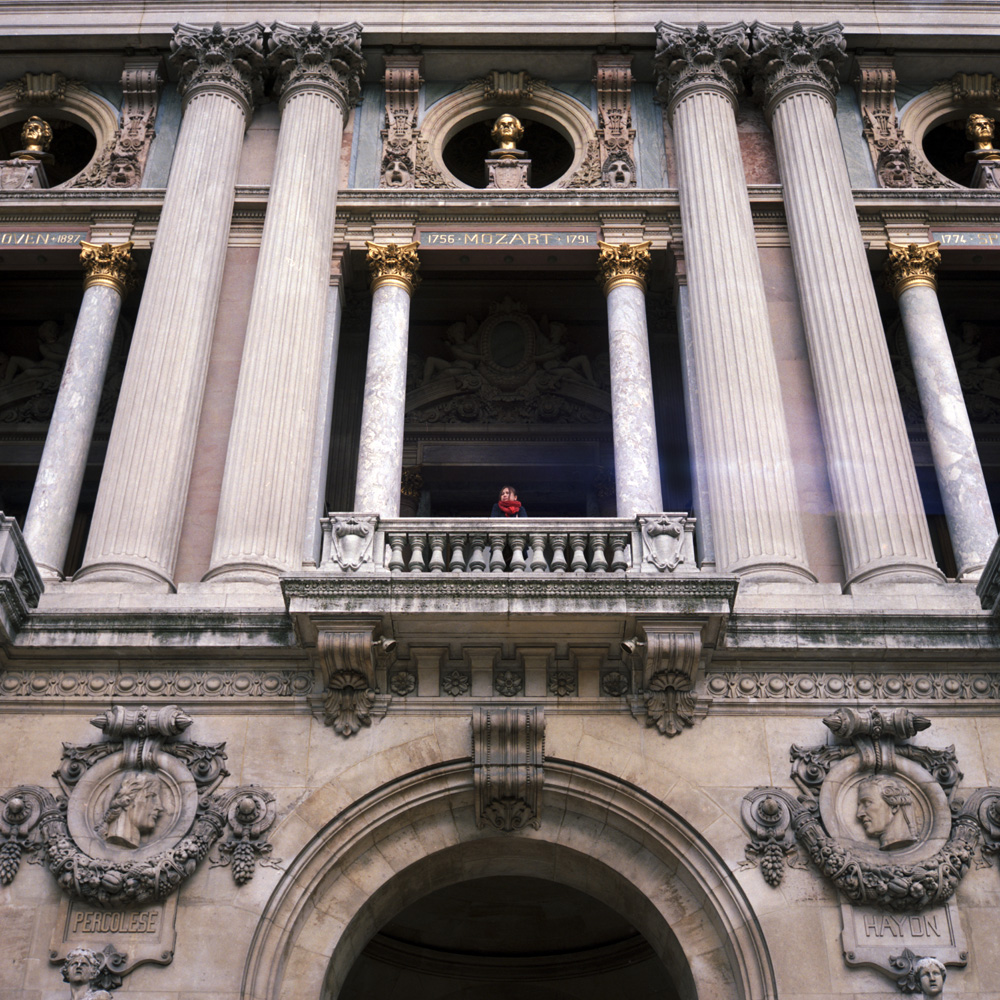
This was a lucky grab of the arcaded balcony on the front when the woman wearing the red scarf just happened to be looking out.

Front Balcony, Opera Garnier

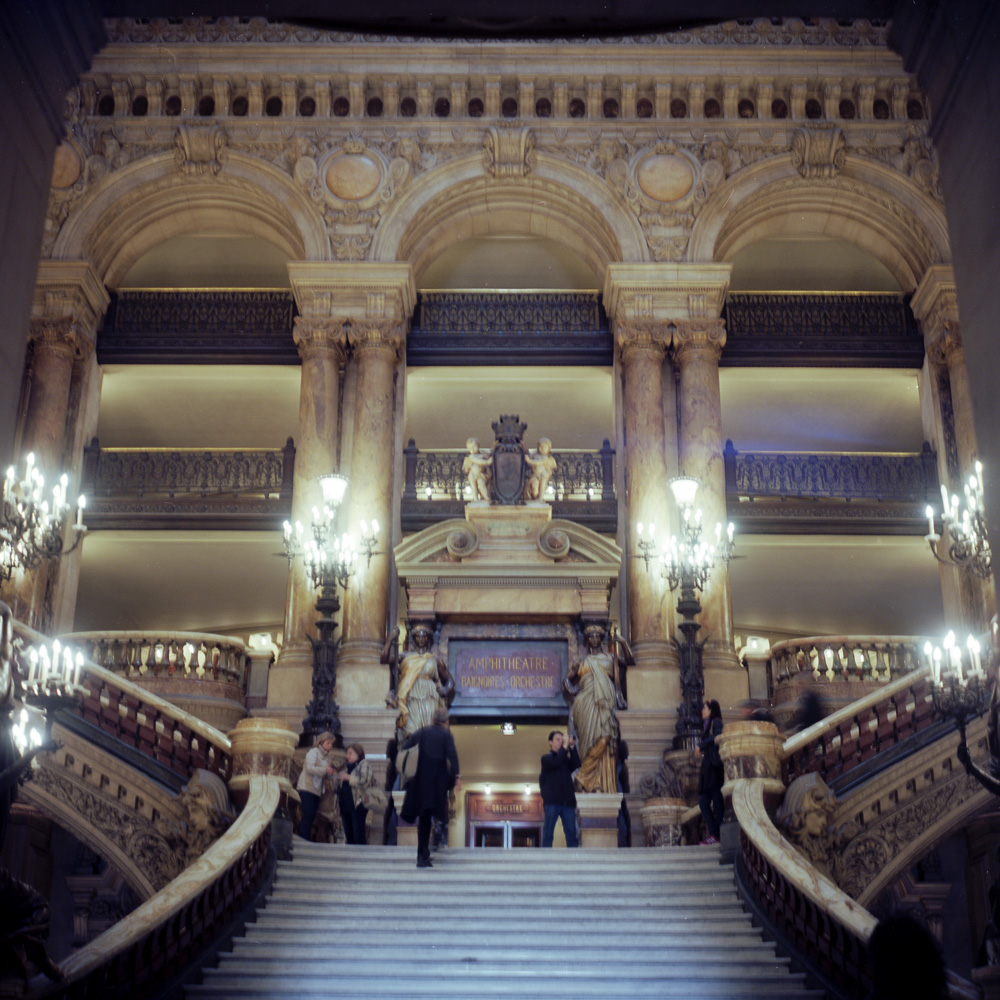
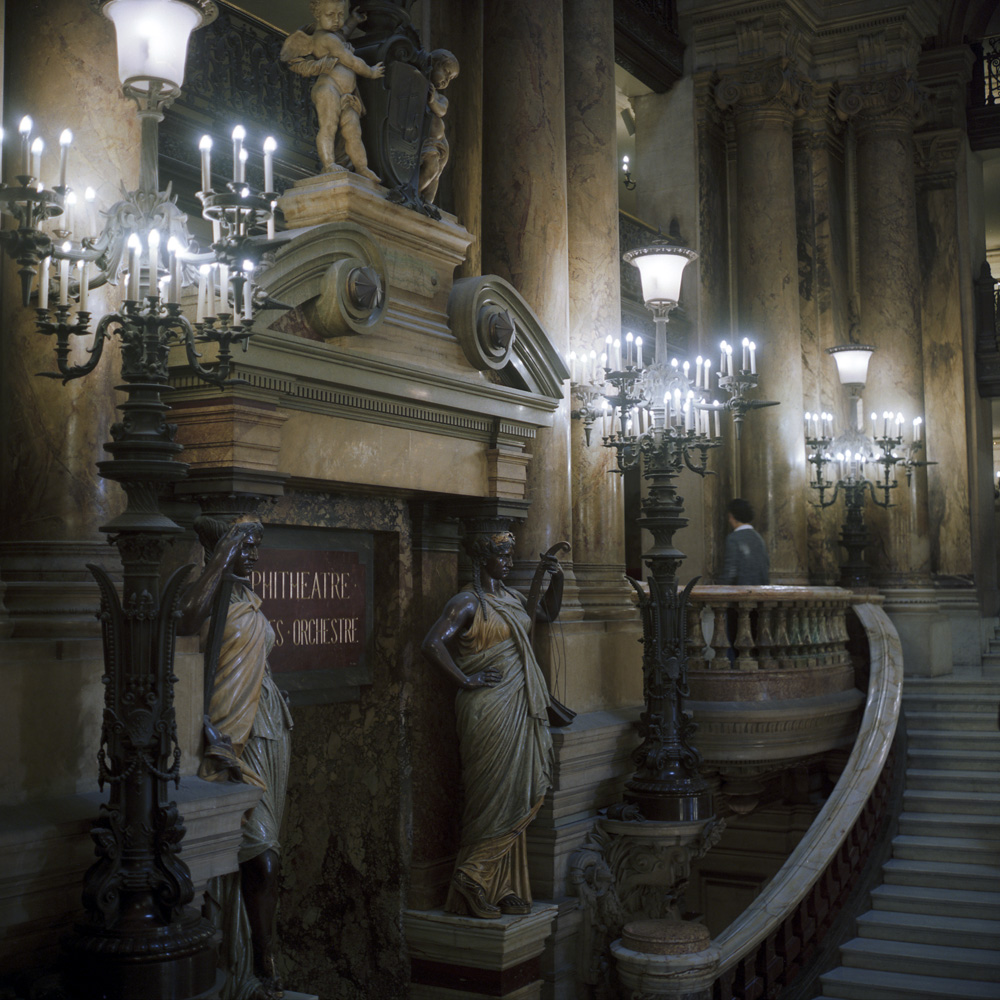
The grand staircase at the Opera Garnier was one of the highlights of the building, and considered a major attraction from the moment it opened. It has been much copied around the world. Photos of the space do not do it justice – this IS truly one of the great public rooms of the world.

Grand Stair Hall, Opera Garnier
Grand Staircase, Opera Garnier

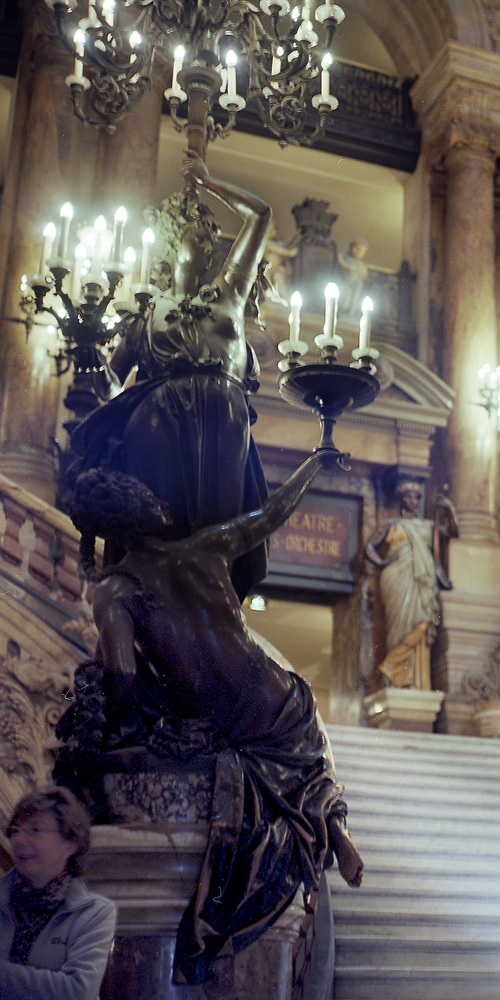
I did something a little different with this shot – I cropped it very tall and vertical. It was in part because I wanted to focus the attention on the bronze candelabra, and also to deal with some horrible flare in the right-hand side of the image coming from one of the other light fixtures in the hall.

Candelabra, Stairs, Opera Garnier

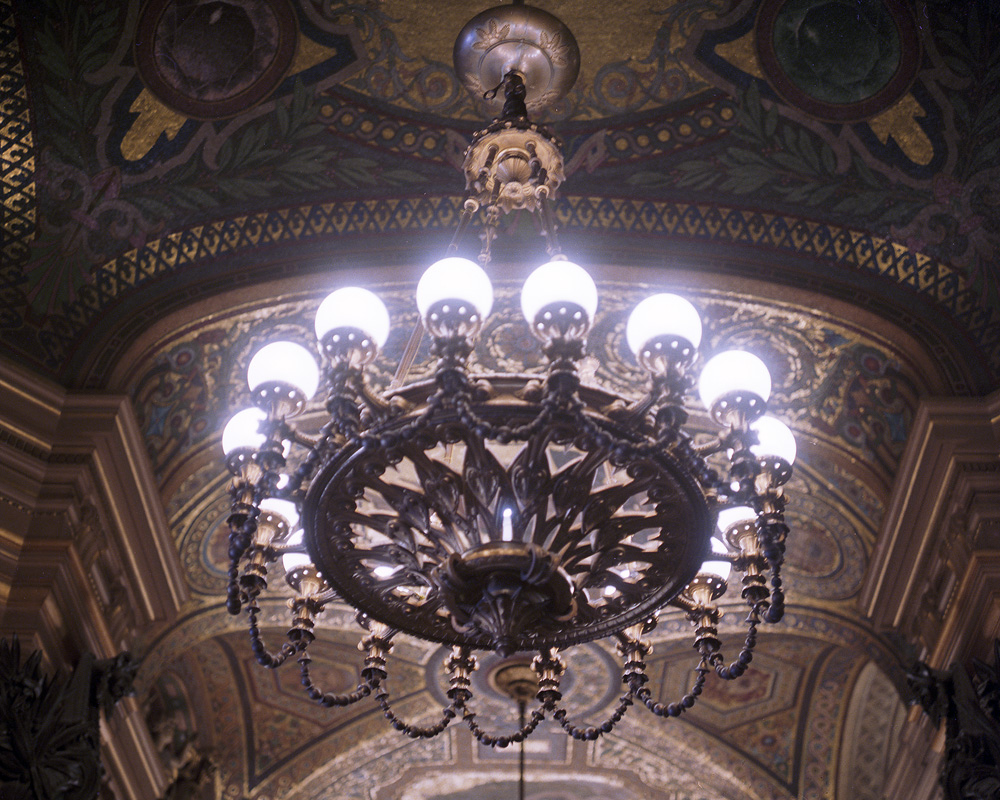
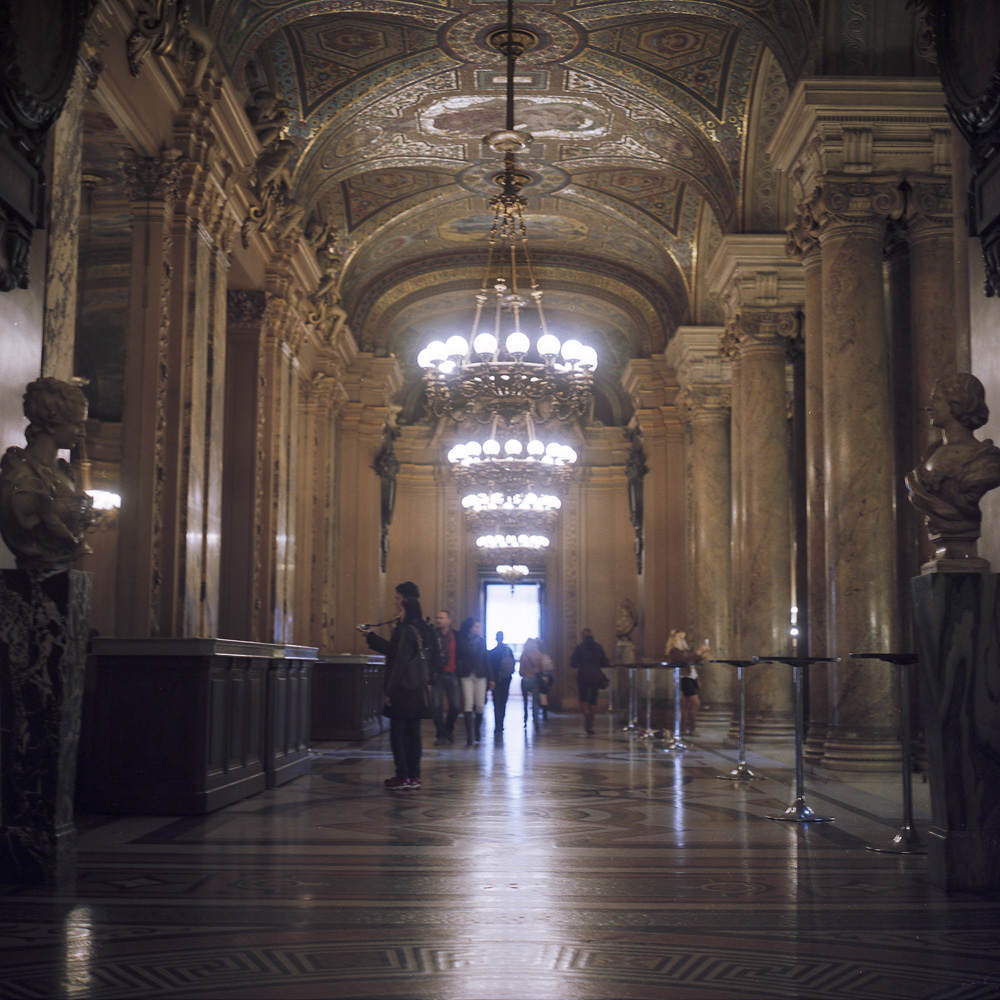
The Opera Garnier is famous for one particular chandelier (and we’ll get to that), but it houses a multiplicity of beautiful light fixtures. Here are some samples of the variety of chandeliers at the opera:

Hall Chandelier, Opera Garnier
Reception Hall, Opera Garnier

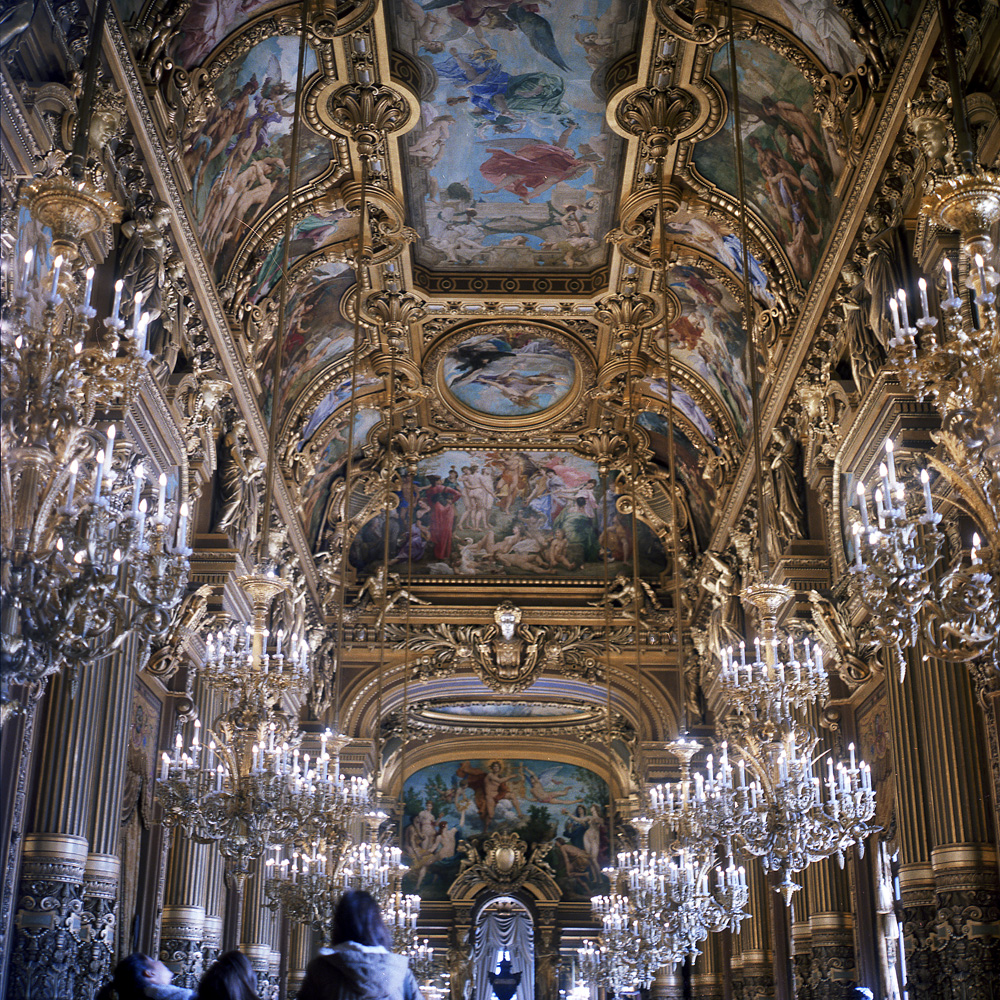
The salon is reminiscent of the Hall of Mirrors at Versailles, but if it is possible, it is even MORE over-the-top ornate than that palatial room, ceding to it only in length.

Salon, Opera Garnier

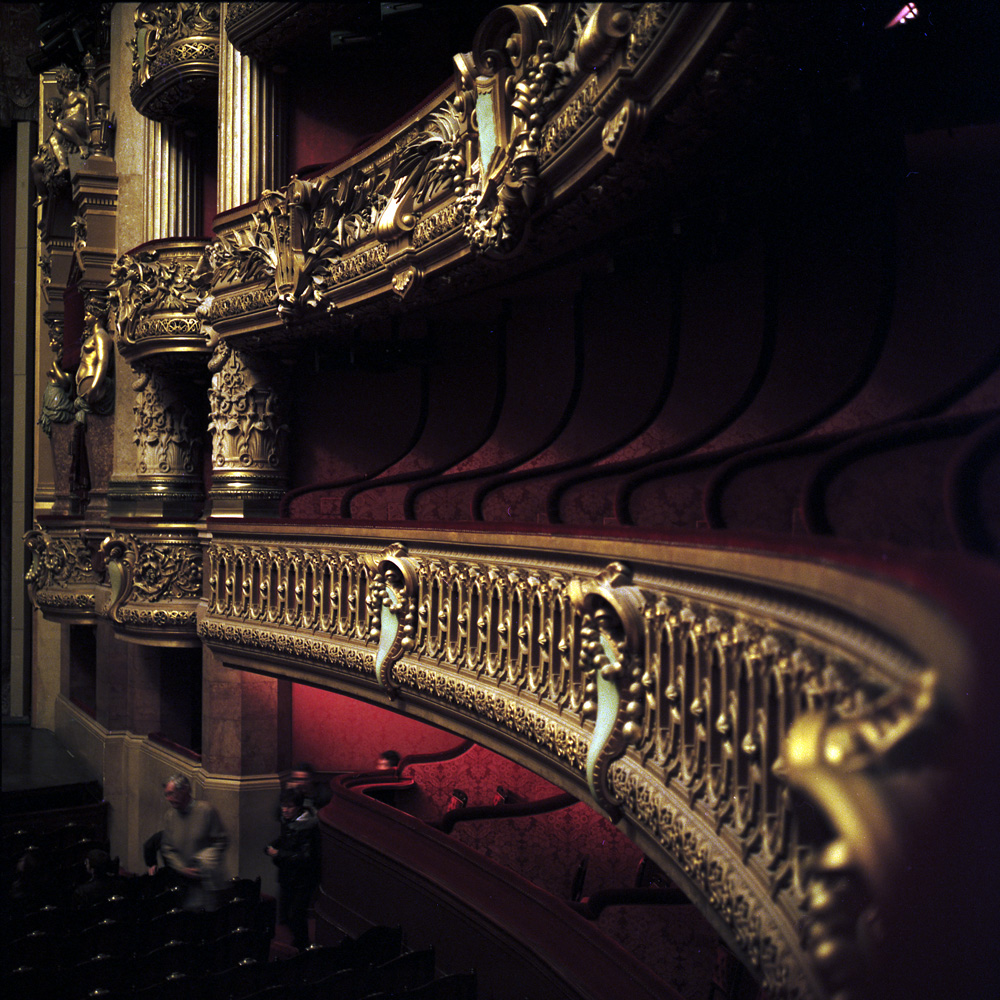
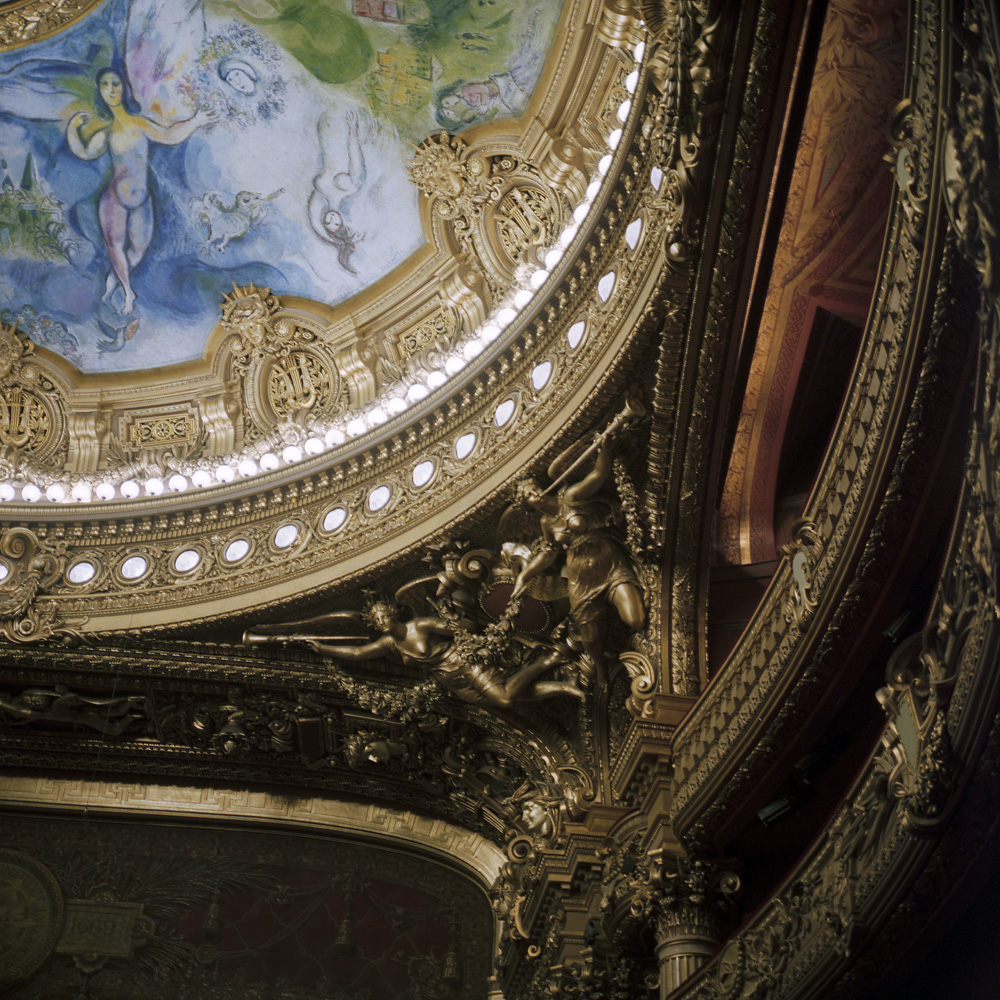
The hall itself is a candy confection of red velvet, gold leaf, and frescoed ceiling. Attending a concert here would be quite the experience – I would think you could easily be distracted from the performance by just trying to take in all the architectural details! I don’t know that this would be more sublime than my experience of the concert at the Palau de la Musica in Barcelona, but it would certainly be a feast for the senses.

Box Seats, Opera Garnier Auditorium
Giltwork, Ceiling, Opera Garnier

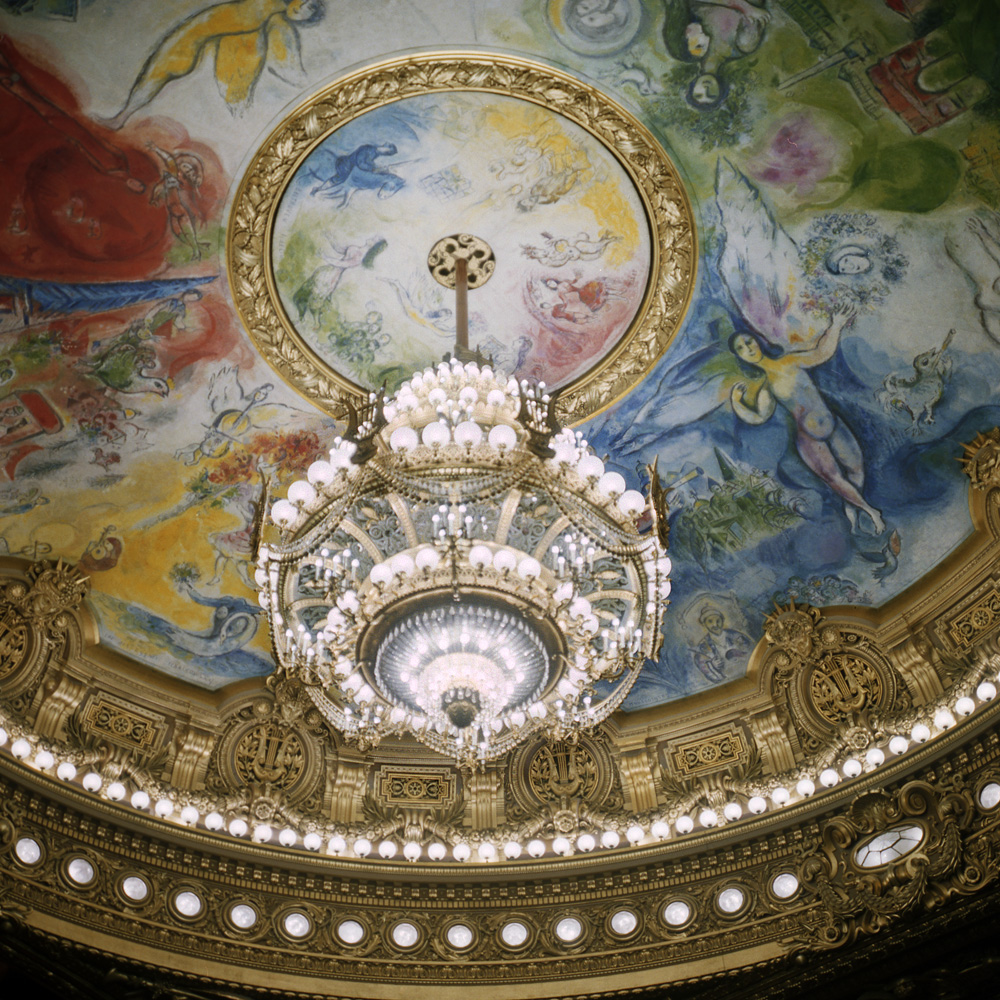
And last but not least, we get to the infamous chandelier. Perhaps the best known chandelier on the planet, this is the one around which the “Phantom of the Opera” story revolves. The ceiling, hinted at in the previous photo, is not the original ceiling design for the hall, but was painted in 1964 by Marc Chagall. It brings a modern touch to an otherwise very baroque space and the colors enliven and lighten the otherwise heavy and serious room. The chandelier weighs 7 tons. Originally it was raised through the cupola for cleaning, but now it is lowered. One of the counterweights for the chandelier crashed through the ceiling in 1896, killing an audience member, thus inspiring that part of the Phantom story. The other bit about the underground lake beneath the opera comes from the fact that there is a man-made cistern under the foundations because the ground water is so high that they needed to relieve water pressure on the foundations. It had the added benefit of providing an ample supply of water in case of fire.

Grand Chandelier, Opera Garnier

The Opera Garnier has been used for concerts and the ballet since it opened, and today it serves first and foremost as a dance space, although classical music continues to have a place in the schedule.

Paris in October – part 28 – The Pompidou Centre

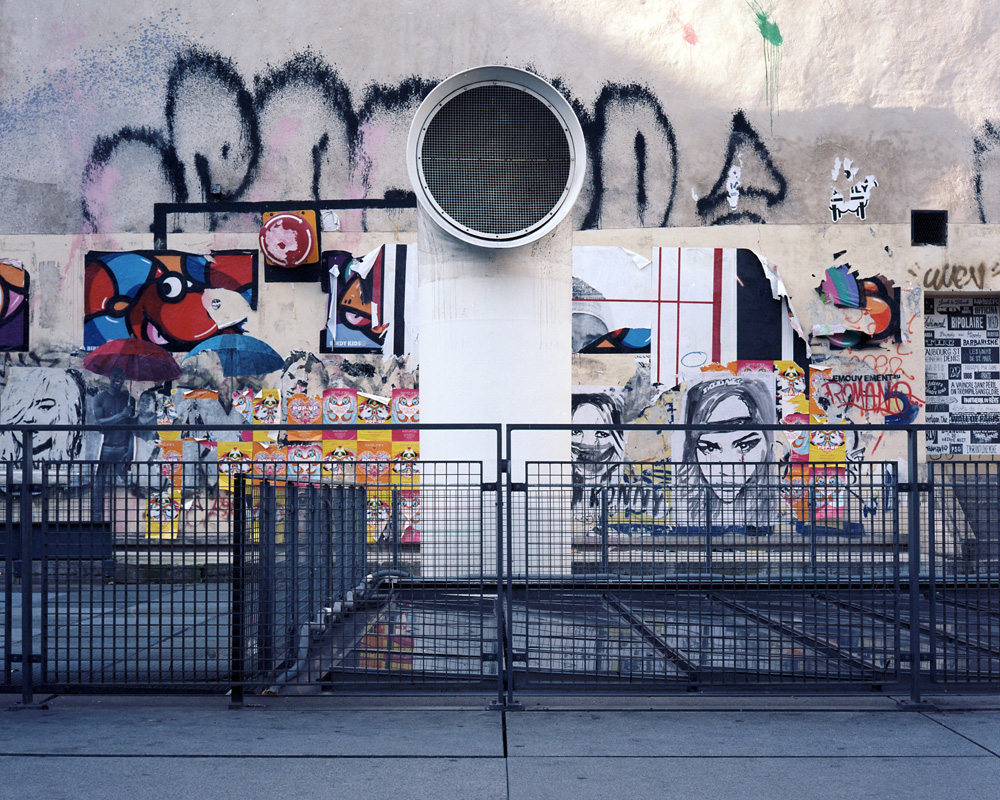
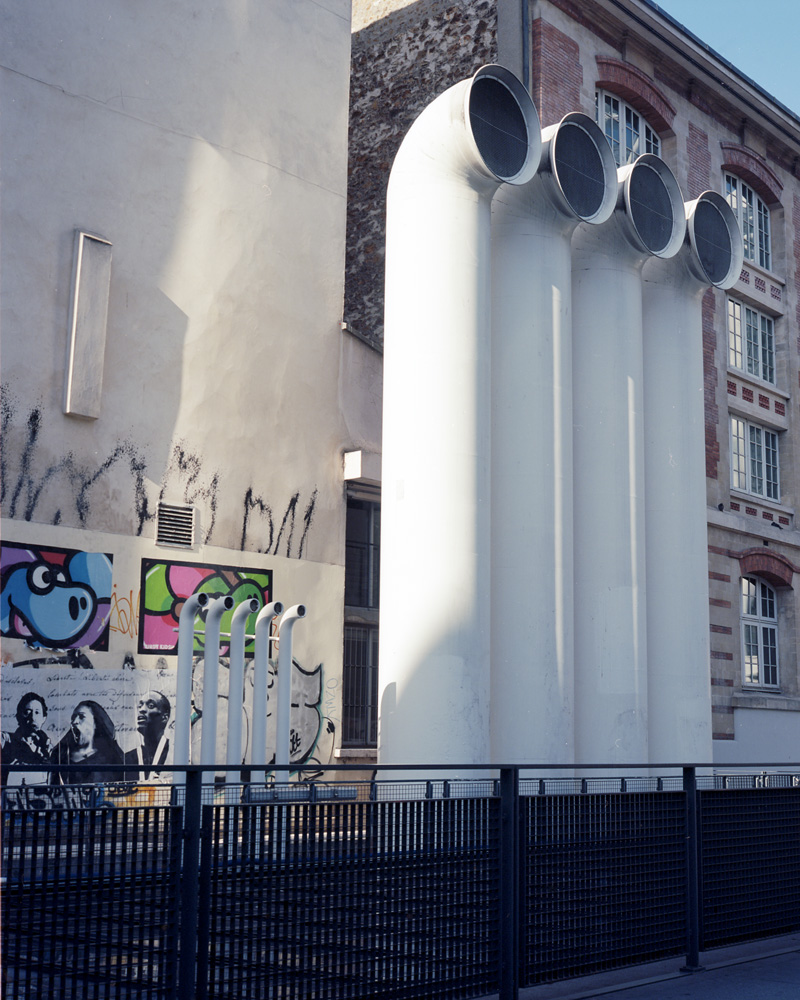
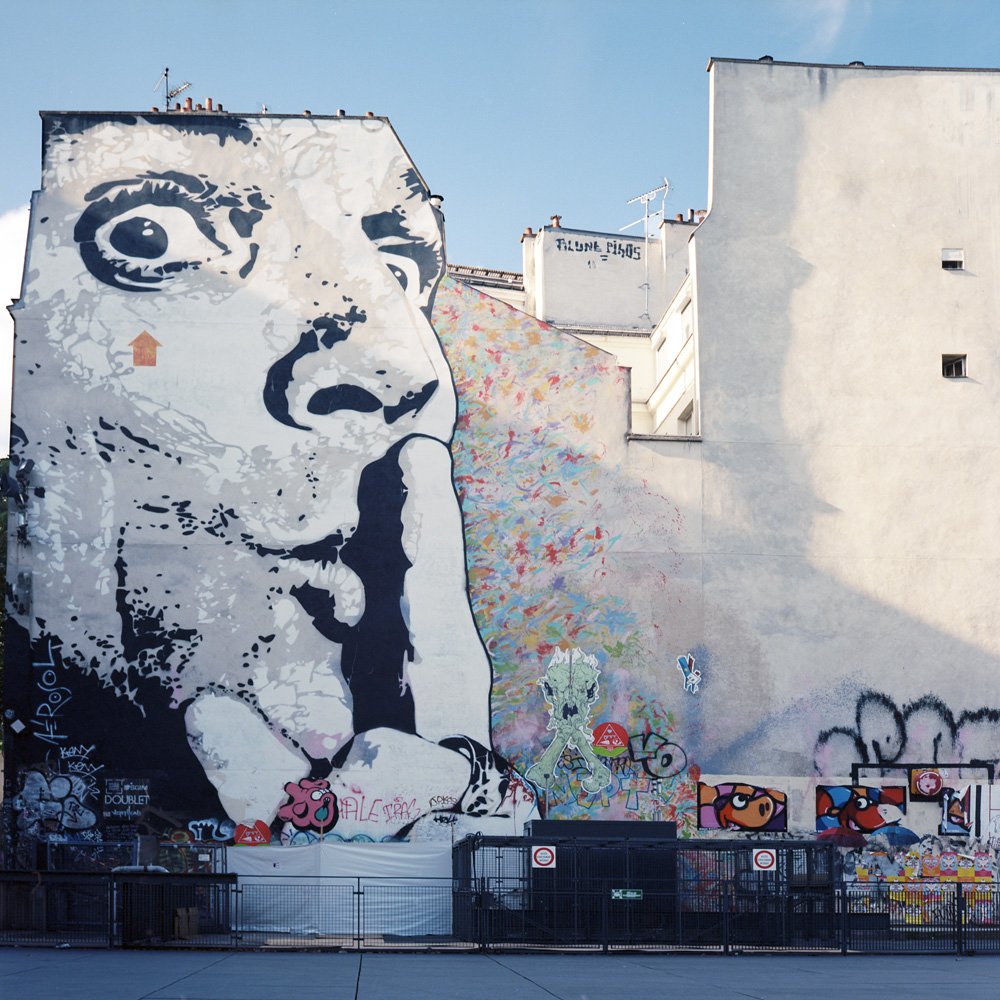
The Pompidou Centre is a massive modern art and culture facility in central Paris, on the western edge of the Marais district. Its architectural claim to fame is that it was designed with all its systems (heating, cooling, plumbing, visitor circulation, etc) exposed on the outside of the building, a sort of deconstruction of the notion of architecture. This, in addition to being an interesting concept, gives it another claim to fame: being perhaps the single ugliest piece of modern civic architecture known to man. And in a world where Brutalist architecture exists, this is no mean feat. What this does do positively, however, is provide a venue in which urban street art has a genuine, appropriate, sanctioned environment in which to exist. The wild vibrant gestural organic nature of street art contrasts with the highly composed, almost abstract structure of the ventilation and exhaust pipes and the security fencing around their access points.

Lone Exhaust, Pompidou Centre
Exhaust Stacks, Pompidou Centre

Street art has even been allowed to take over the stuccoed side of an existing 18th century building in what appears to be an homage to Salvador Dali.

Street Art, Pompidou Centre

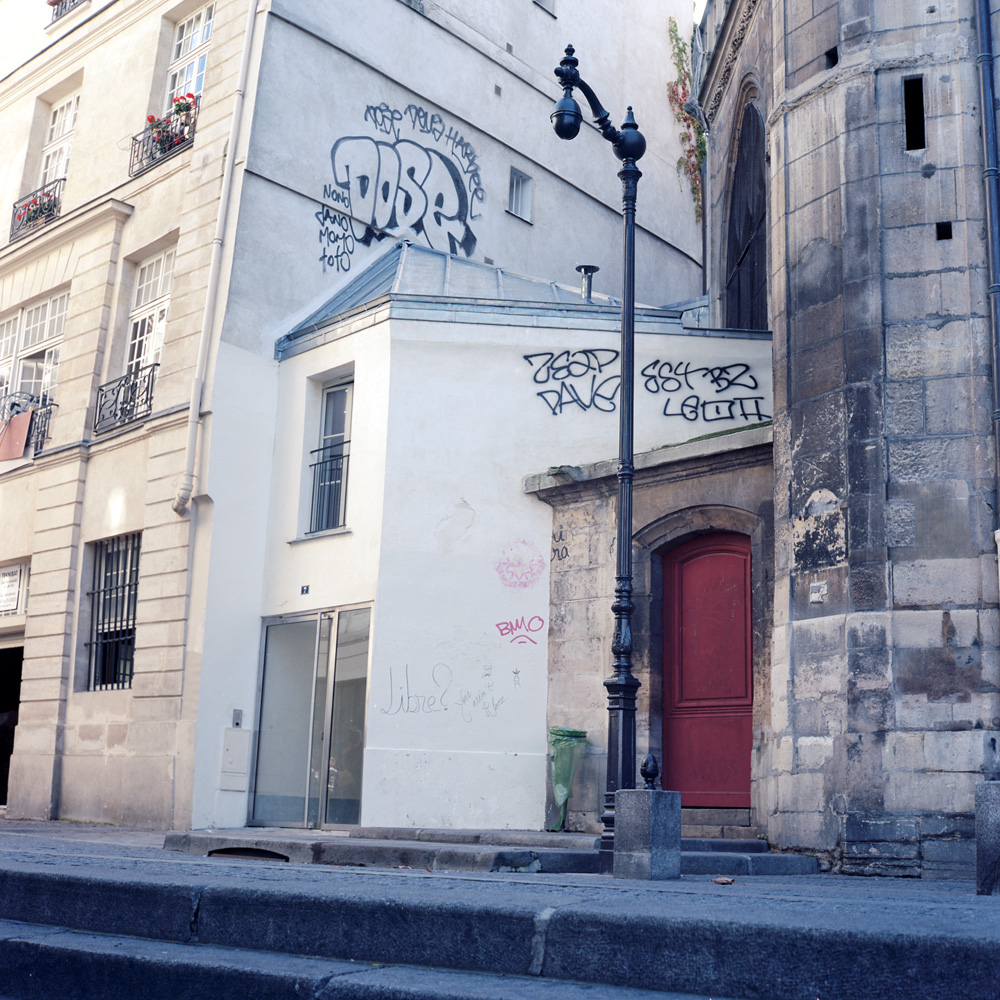
Of course this doesn’t entirely stop unsanctioned street art or even just flat-out graffiti of a very pedestrian variety from cropping up around it. Graffiti aside, I thought this little house squeezed in between the gothic church and the later townhouse was fascinating – I could actually see setting up a small studio on the ground floor and living in the room above it.

Little House, by Pompidou Centre

Paris in October – Part 27 – Things

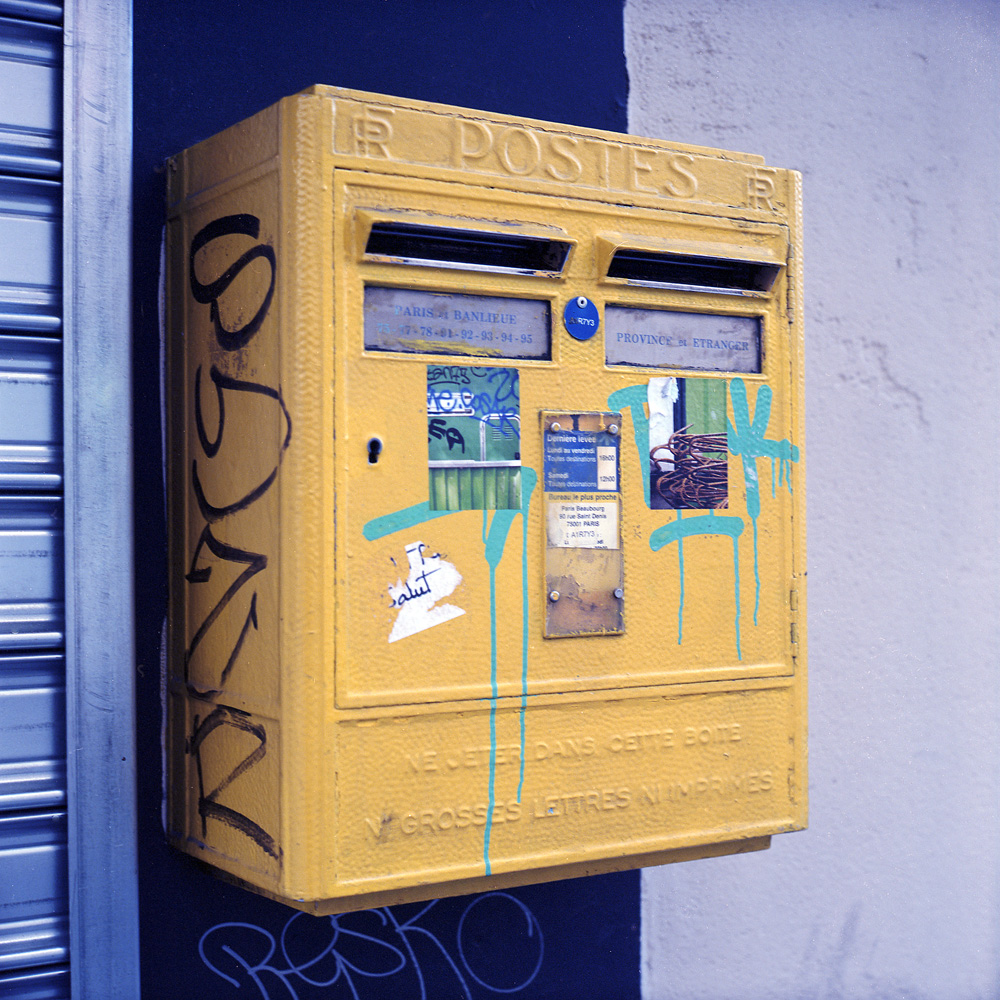
I’ve been making a habit of photographing things we see every day but take for granted, like mailboxes and fire hydrants. I couldn’t pass up the bright yellow mailboxes of Paris, and especially not this one that has been so overtly decorated with graffiti. I think I got lucky that this one was on a dark blue background at least in part, to set it off and compliment it.

Yellow Postbox, Paris

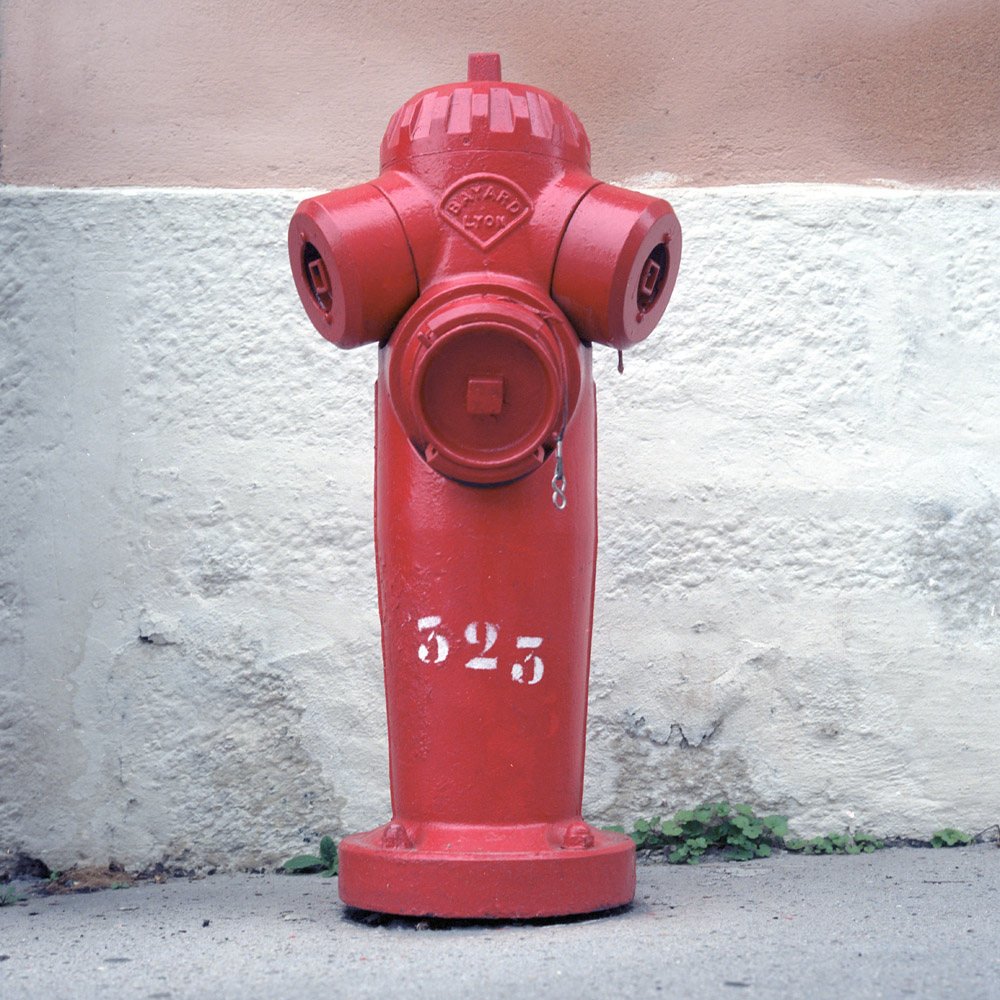
I know, I know, the hydrant from Chalon already made an appearance, but it was soooo long ago I figured you all had forgotten it, and it also fits the theme of “things”, especially brightly-colored things that we see but take for granted. So here it is.

Hydrant, Chalon
Hydrant, Chalon

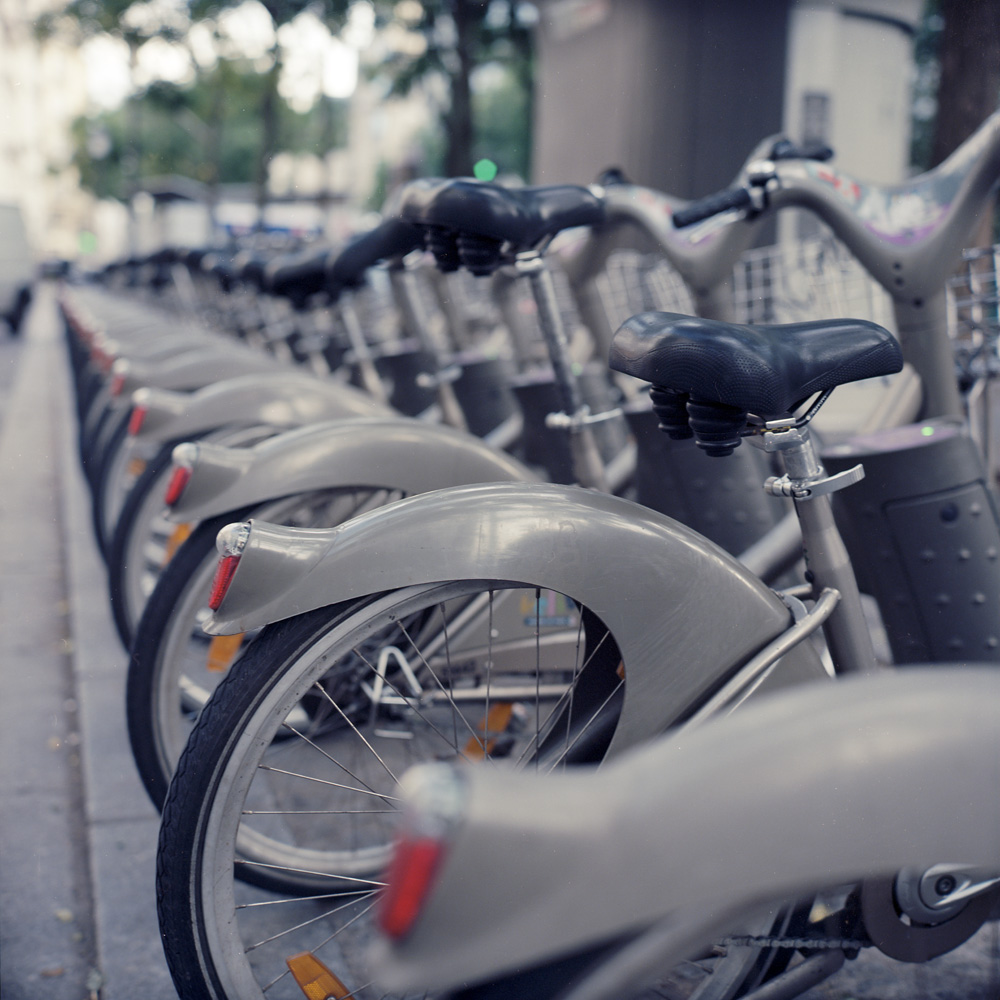
I’ve also been photographing the bikeshare bikes in DC, so I had to take a crack at interpreting their French cousins. Unlike here in the US, the bikeshare bikes seem to be of a single universal design in France. In Paris and in Chalon they are the same design, with the same colors, the prime difference being in the logos on the rear wheel cover and the local advertising. Frankly I could have done an entire photo-essay on the bikeshare bikes but I had other things on my agenda.

Ve'Lib Bikeshare
Ve’Lib Bikeshare

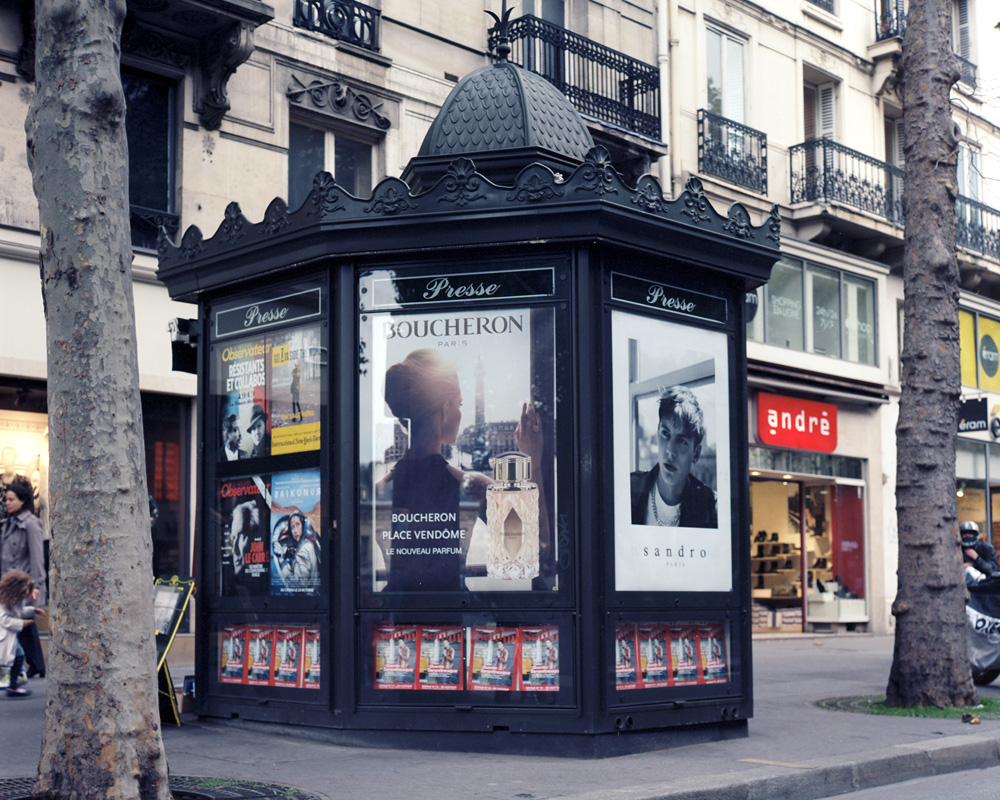
Newsstands fall into that category as well, I think, of things we see but ignore. They’re very functional, and in places that have them, we tend to notice their presence/absence more than we do their form. This one is very Parisian, but with a modern twist – instead of having static broadsides plastered to the outside, now the ads are LED displays or at least rotating banners so in the span of a minute, you can see three to five different ads scrolling past.

Newsstand, Boulevard St. Michel, Paris

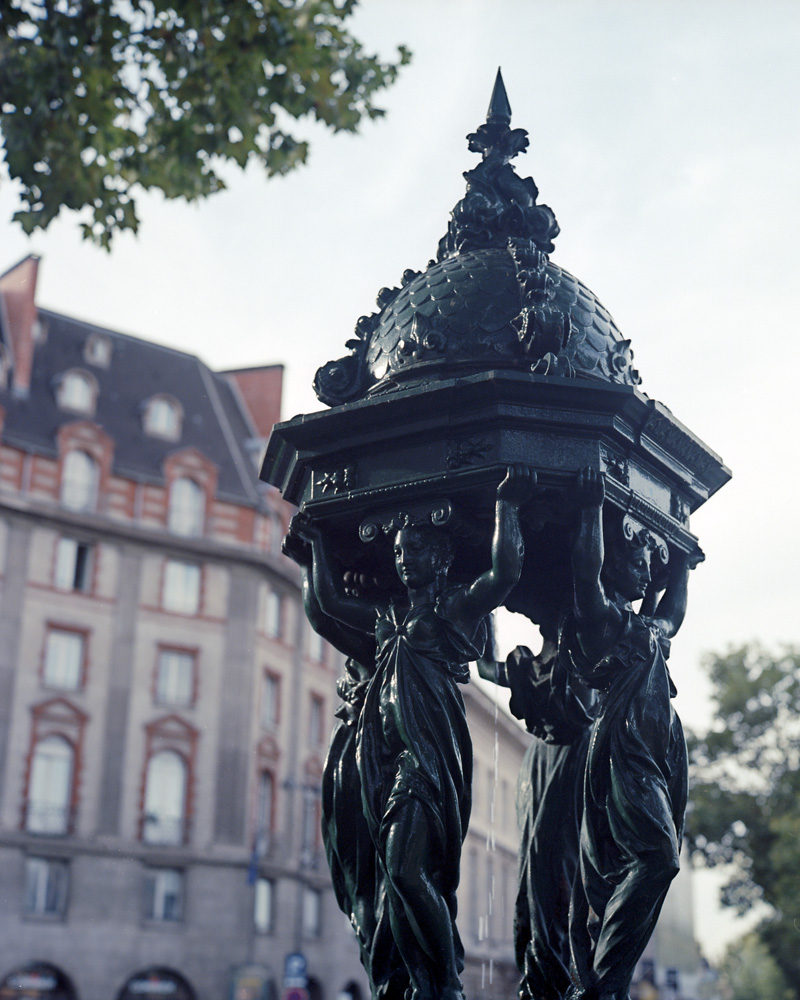
Last but not least, here is a public drinking fountain. I tend to notice them because here in DC for the most part if they exist at all they don’t work. In the 1870s, Baron Haussmann installed public drinking fountains across the city as part of a sanitation campaign, bringing fresh, clean drinking water to everyone. The design of the fountains was suitably ornate, bringing beautification along with safety.

Fountain, Caryatids, Paris

Paris in October – part 26 – more miscellany – people and streets.

Some more random Parisian street scenes.

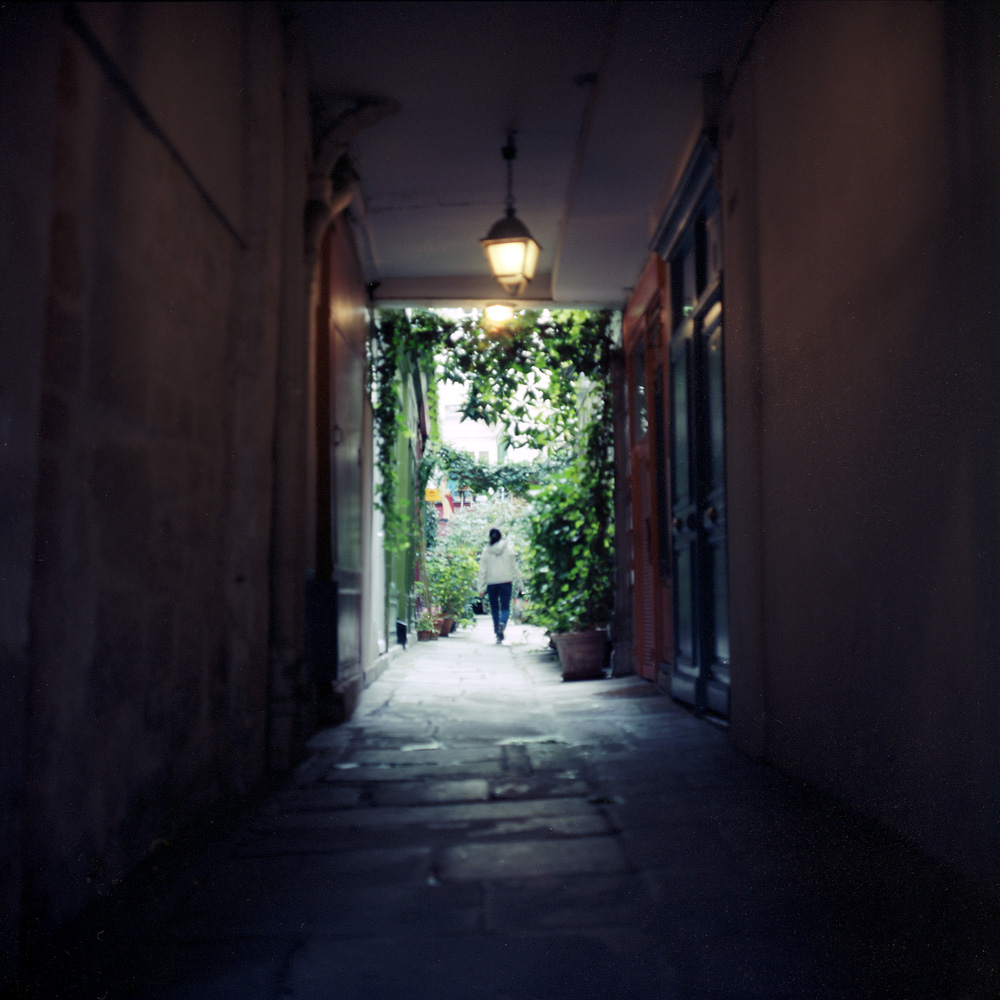
This one is a bit soft because it was a long exposure, hand-held. I think it works, though, because it has a rather dreamy, painterly quality to it. You’re walking through a stone tunnel (in this case the carriageway) and emerging on the other end into a leafy green jungle. It conjures up imaginary adventure stories – where is this place? What awaits in the forest outside the cave? Who is the girl? Where is she going? No matter, I want to follow and find out!

Girl, Courtyard, Marais

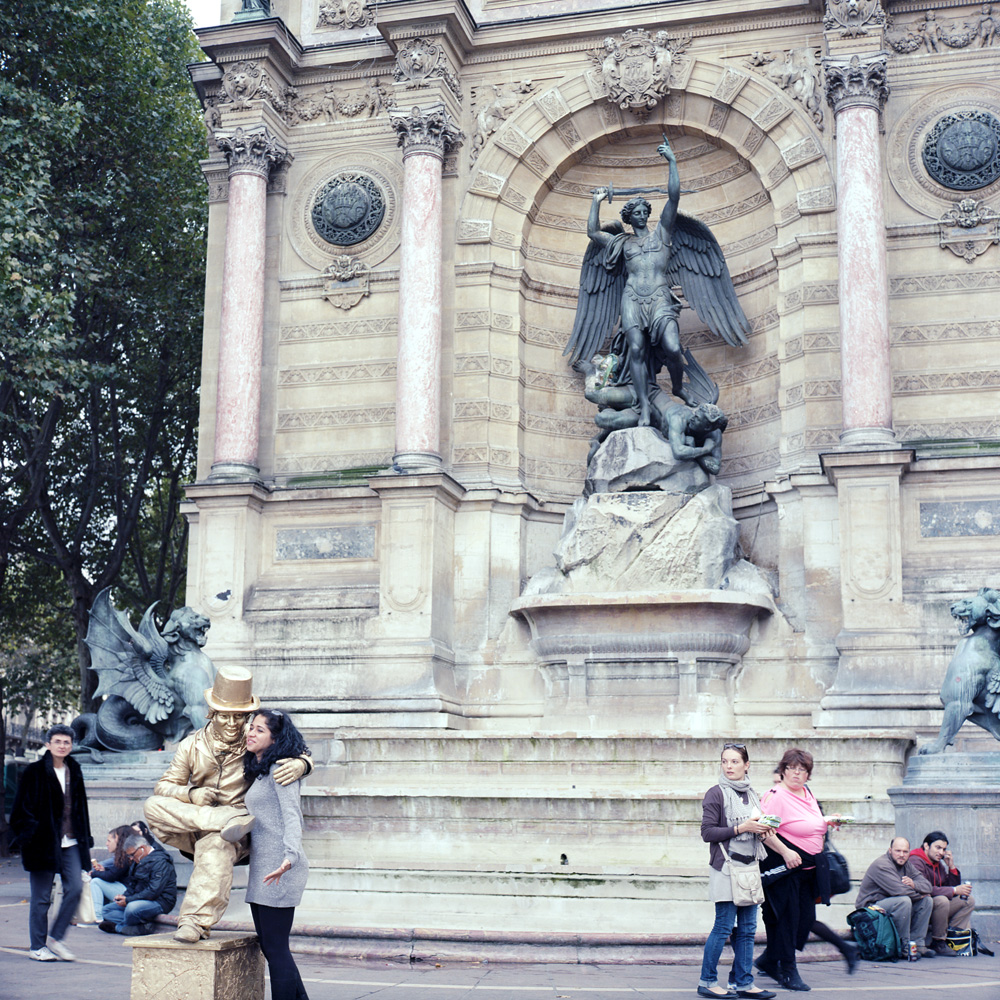
Here is one of the seemingly omnipresent human statues that you find in major european cities. I love the dynamic going on in the picture. The woman posing with him is having her picture taken, but with the photographer outside the frame, the expressions of the passersby take on an entirely different meaning. And Saint Michel on his perch above the fountain looks like he too is about to pronounce judgment with his sword on the entire affair.

Human Statue, St. Michel Fountain

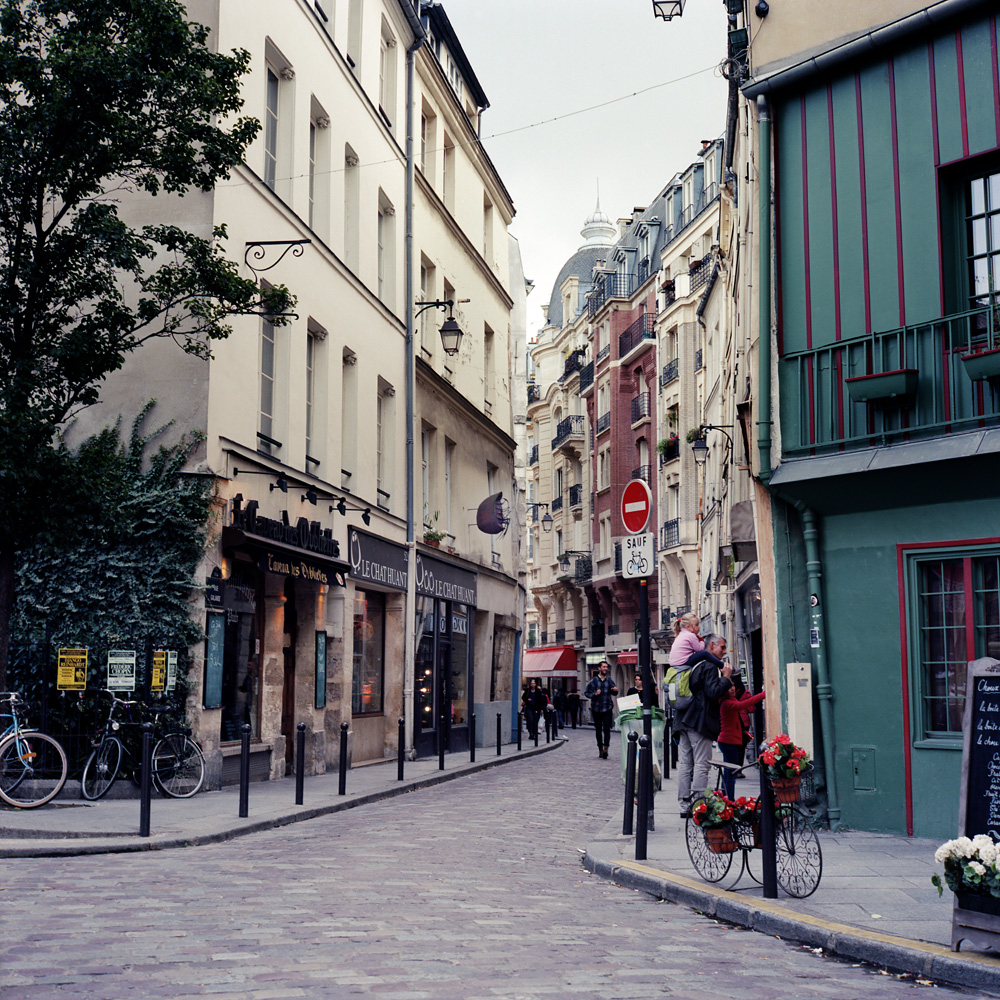
The Rue Galande is an alley that runs behind the block where Shakespeare & Co. bookstore is located. It is one of the old medieval streets that survived Haussmannization – the street itself bends and winds, and the building facades seem to mimic the street, teetering back and forth at unsteady angles.

Rue Galande, Paris
Rue Galande, Paris

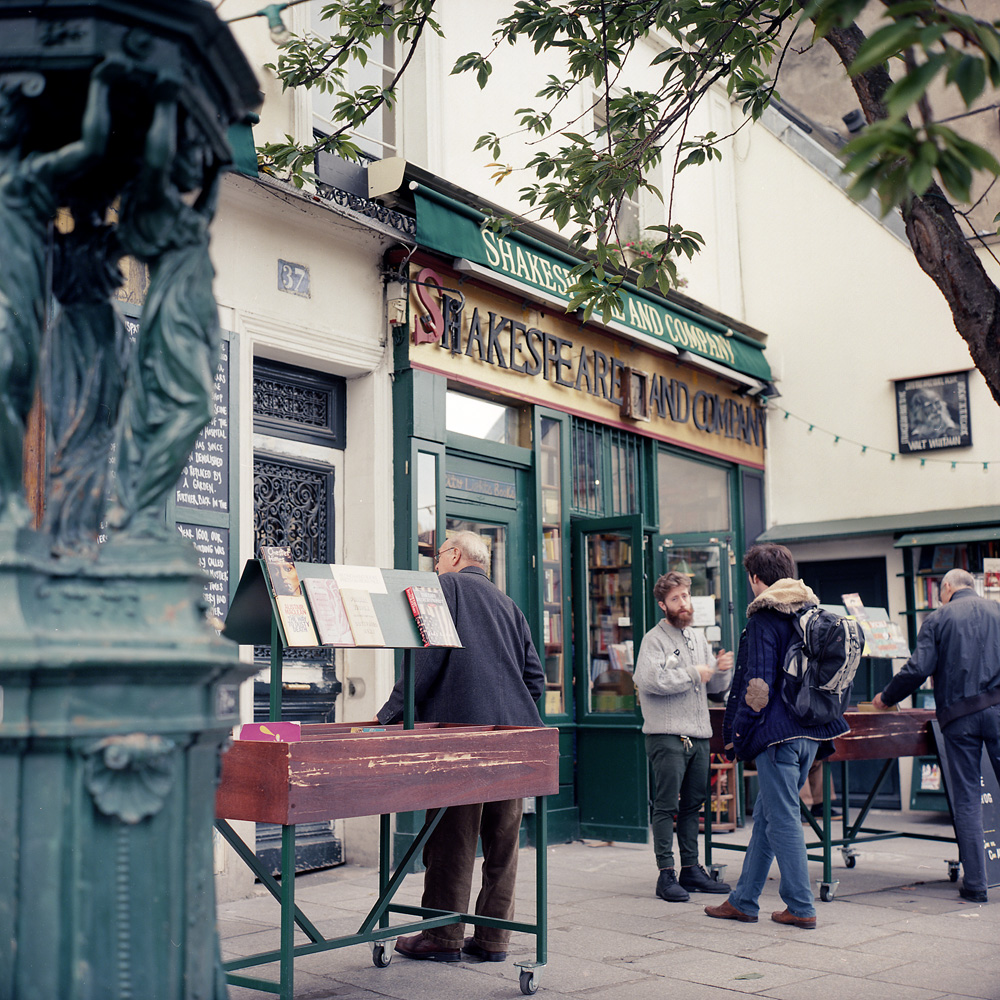
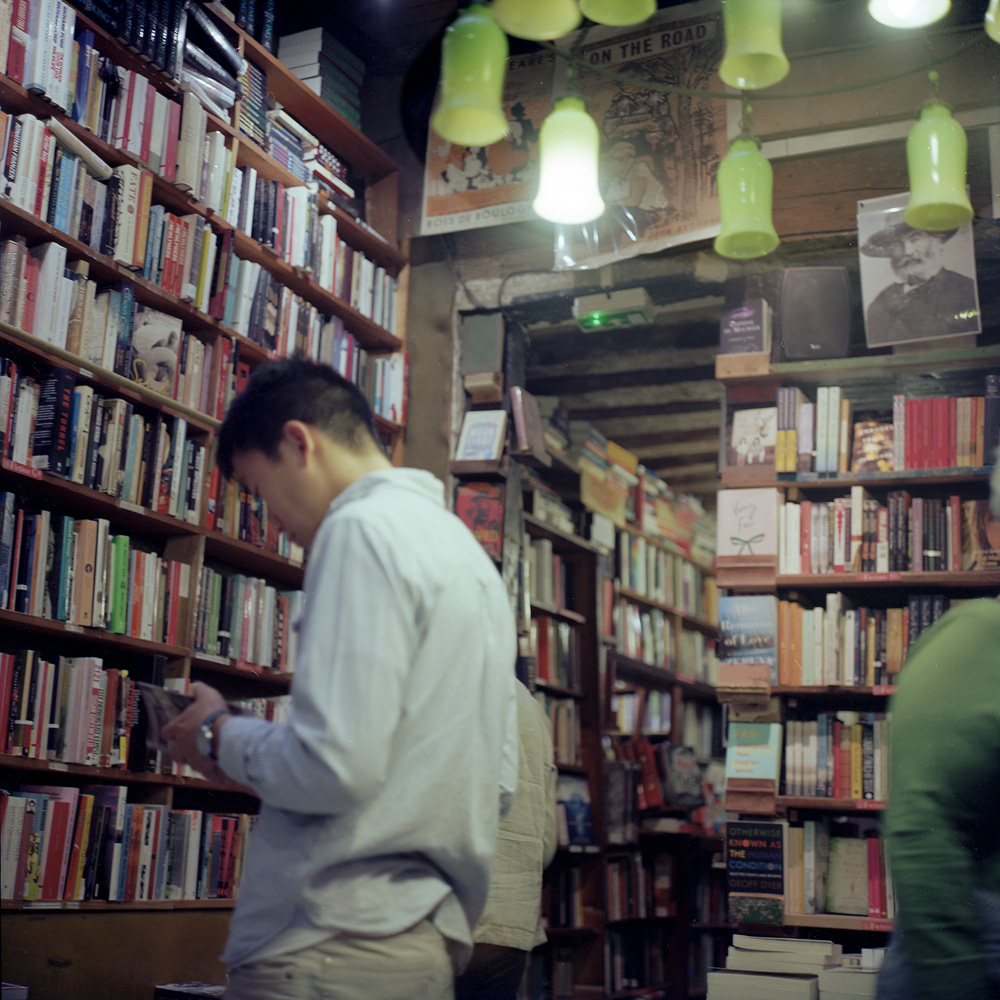
Shakespeare & Co. is a world-famous bookstore featuring english-language books and catering to the expat community. They have regularly scheduled readings, book signings, and social events in the store, and major literary luminaries stop by when passing through Paris. I love a good bookstore and if I lived in Paris I could see myself spending lots of time in here.

Shakespeare & Co. Bookstore
Interior, Shakespeare & Co. Bookstore

Paris in October – part 24 – Ile de la Cité

I apologize for the randomness again. It kind of reflects my own state of mind at the moment anyway. But here’s a few more scenes from the Ile de la Cité.

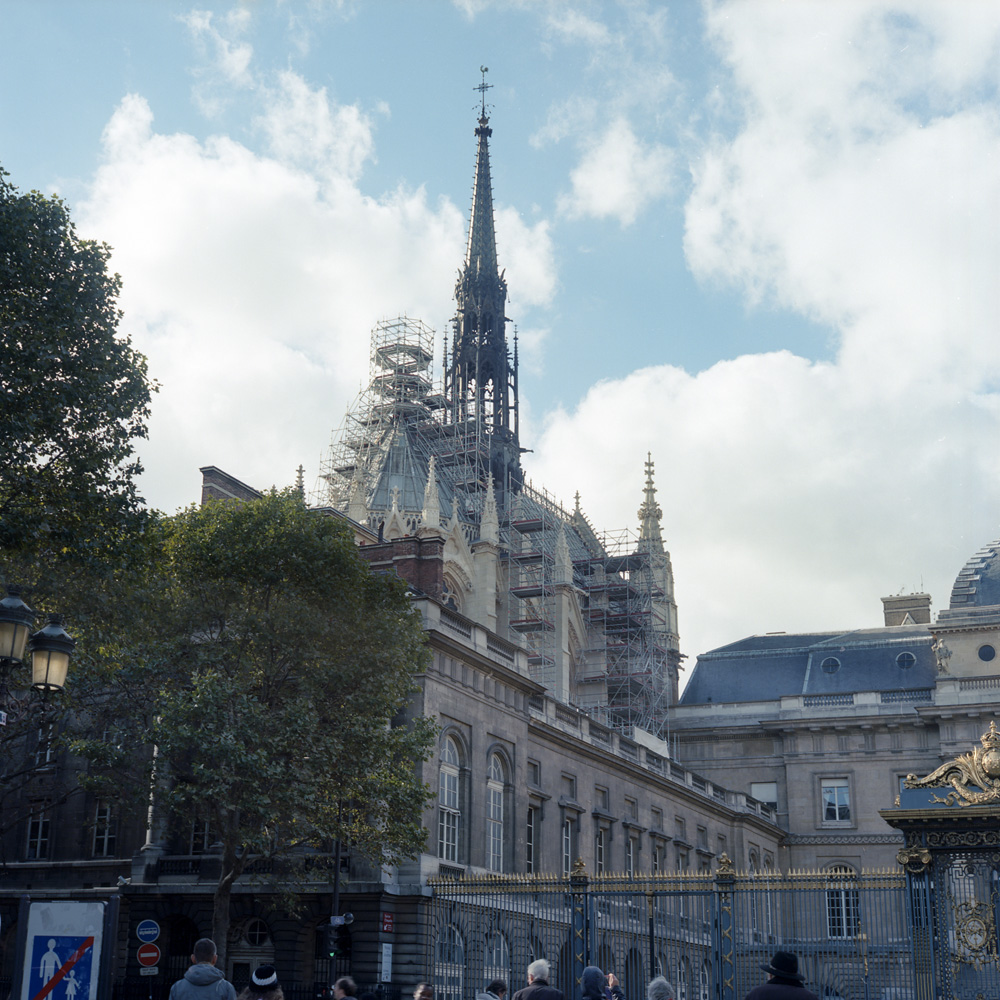
The Sainte Chapelle is inside the compound of the Conciergerie (the prison where Marie Antoinette and Louis were held prior to their execution) and the modern day Palais de Justice. Here you can see the Sainte Chapelle from outside the gates of the Palais de Justice. The spire is a later 19th century re-creation of the original which was torn down during the French Revolution.

Sainte Chapelle Exterior

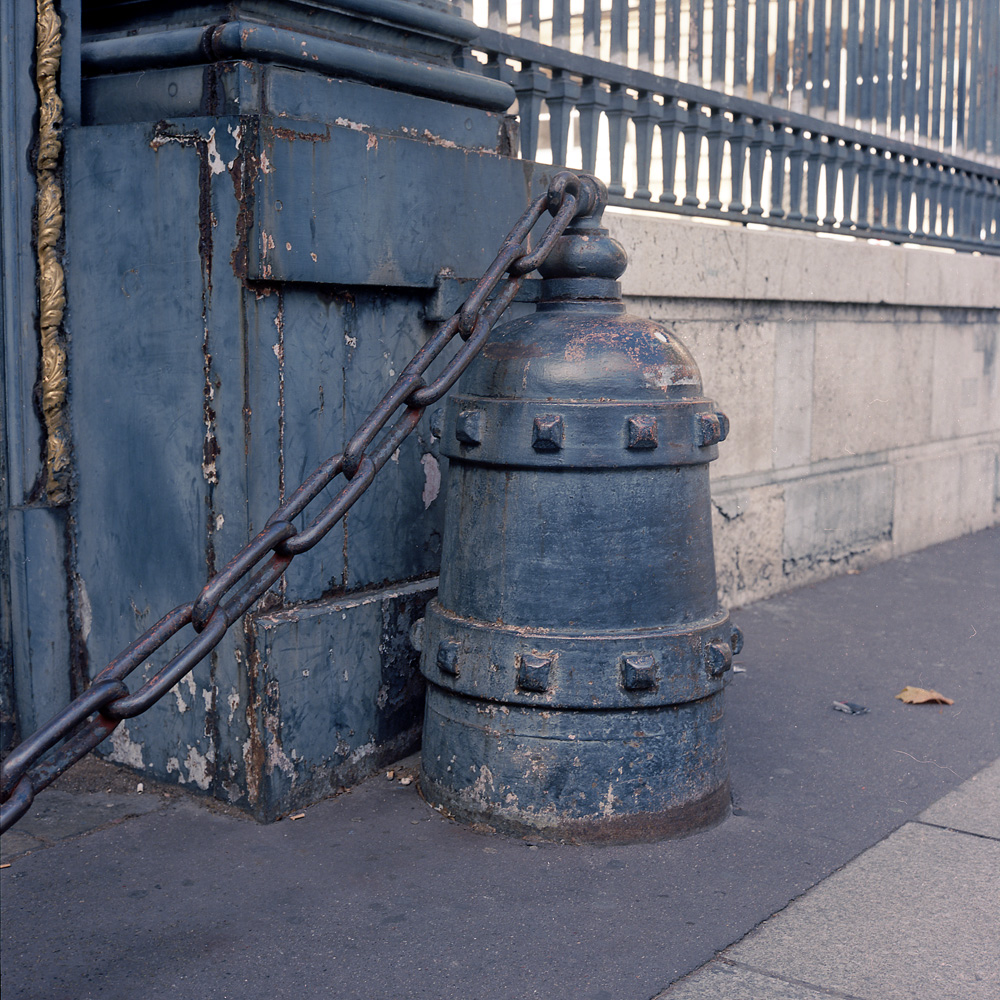
I don’t know the source of my fascination with safety bollards as photographic subjects. Maybe its because they’re such ordinary things with a very important purpose that we tend to ignore. I guess I empathize with the bollards.

Bollard, Palais De Justice

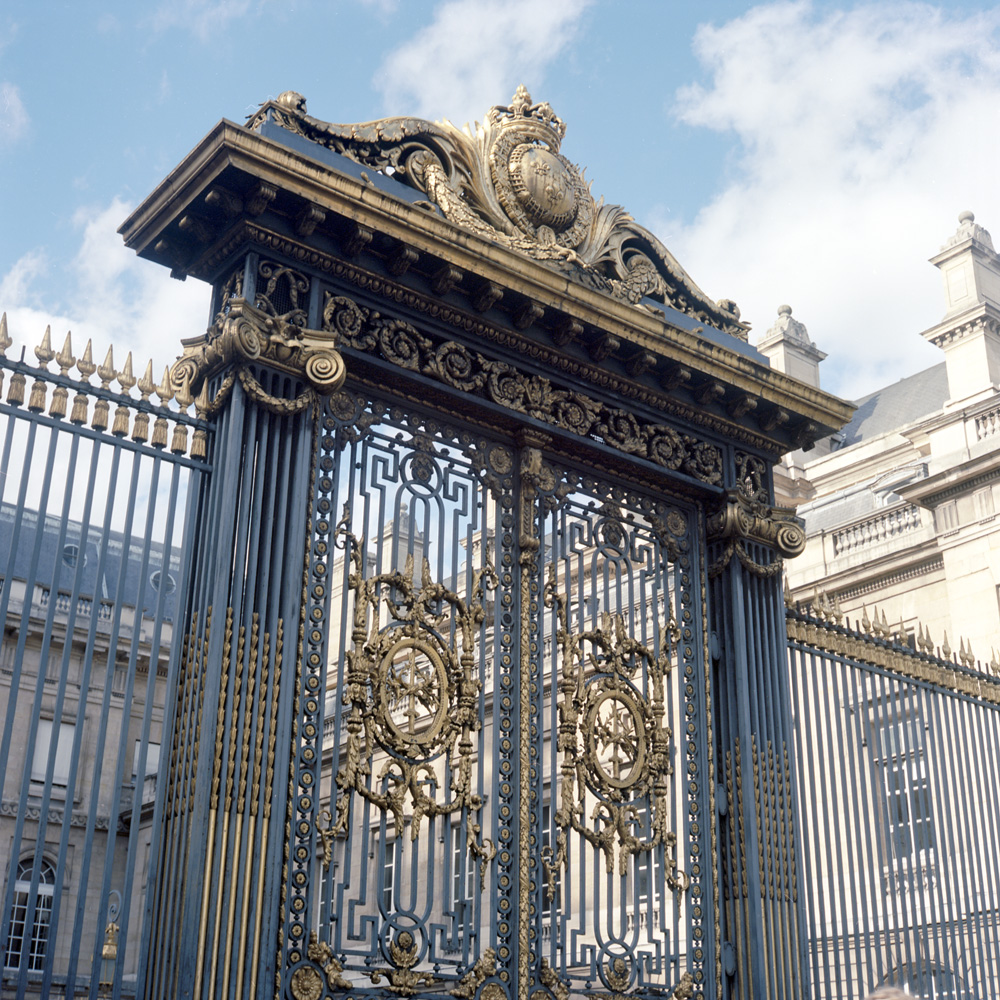
The gates to the Palais de Justice. When I was there, unfortunately, the Conciergerie museum was closed for renovations. This seemed to be an unfortunately frequent occurrence in Paris – a number of museums were closed for renovation work: the Conciergerie, the Musee Chatelet, and the Picasso, to name the most notable.

Gates, Palais De Justice

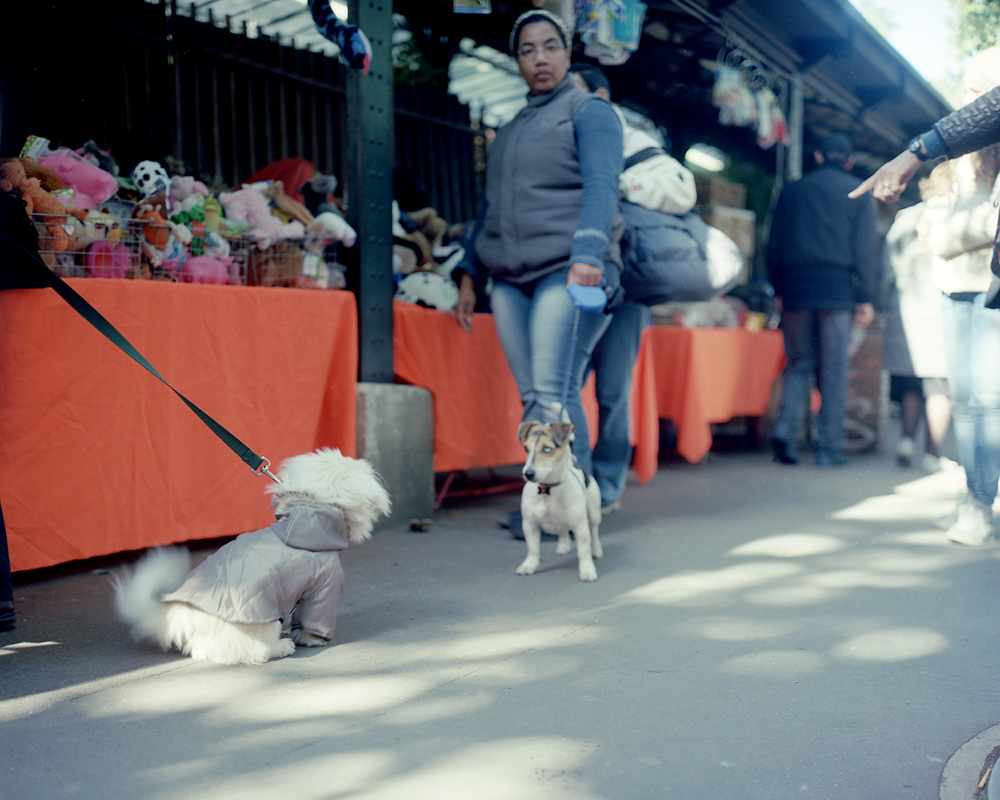
Here are the photos I mentioned a couple posts ago when talking about the Metro stop for Ile de la Cité. There’s a little open-air market they have set up right across from the exit where they sell pet supplies, flowers, and other various and sundry items. Here are two little dogs out for a walk in the pets section who were straining to take a look at one another.

Parisian Puppy Confrontation

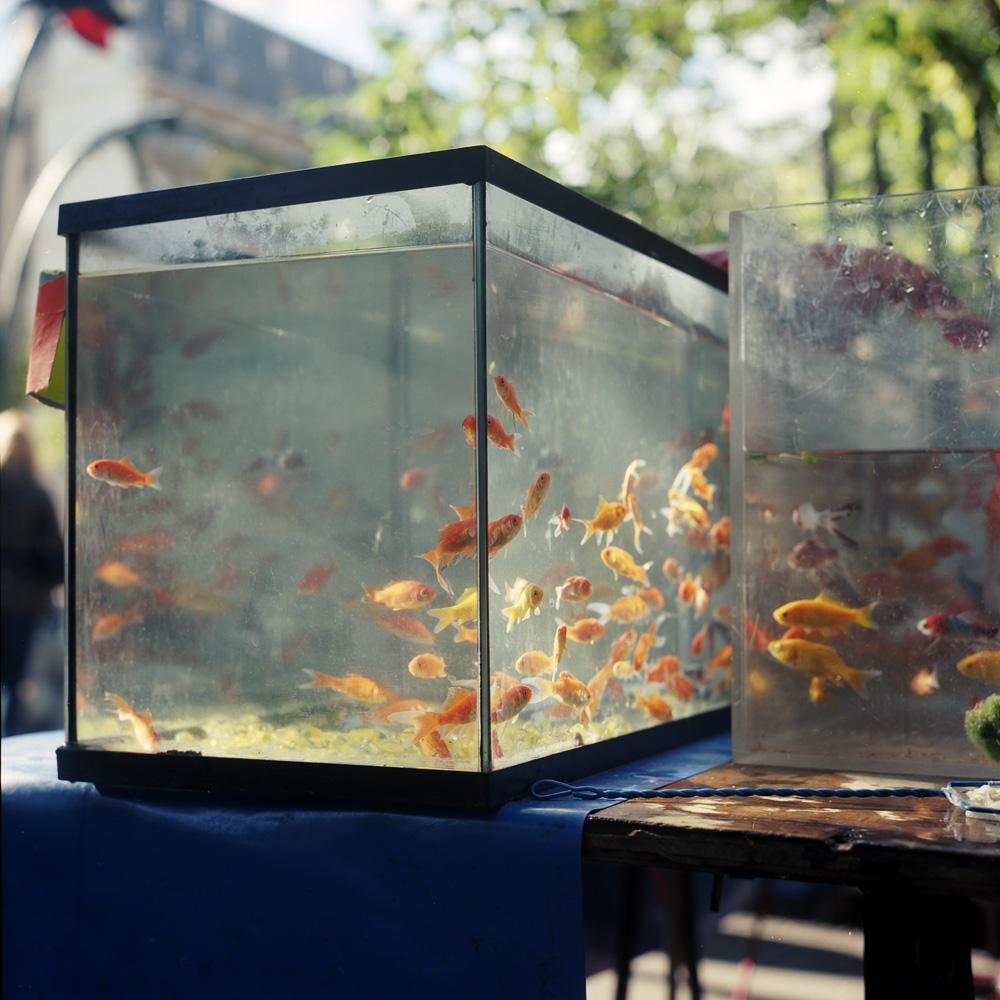
And last but not least, I just loved the way the light was making the goldfish in the tanks glow.

Fishtank, Marche, Ile de la Cité

Paris in October – part 23 – The Metropolitain (Subway)

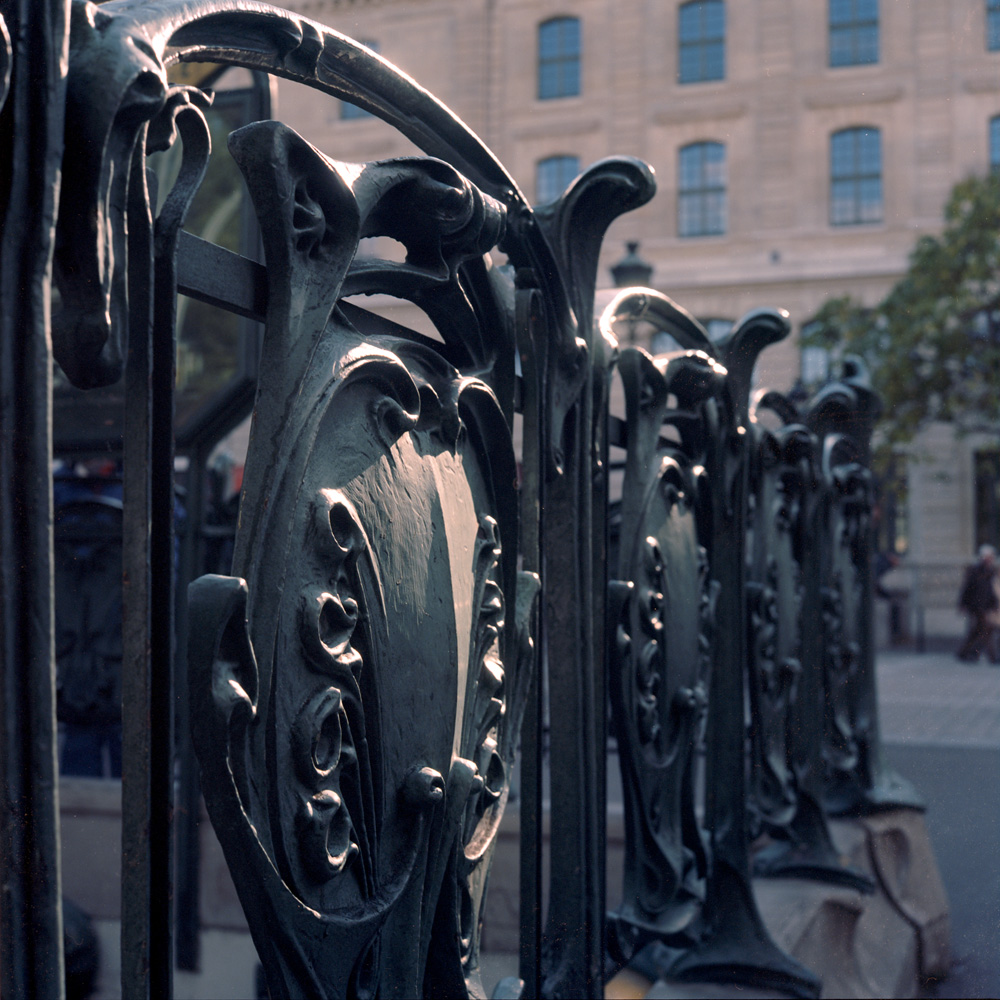
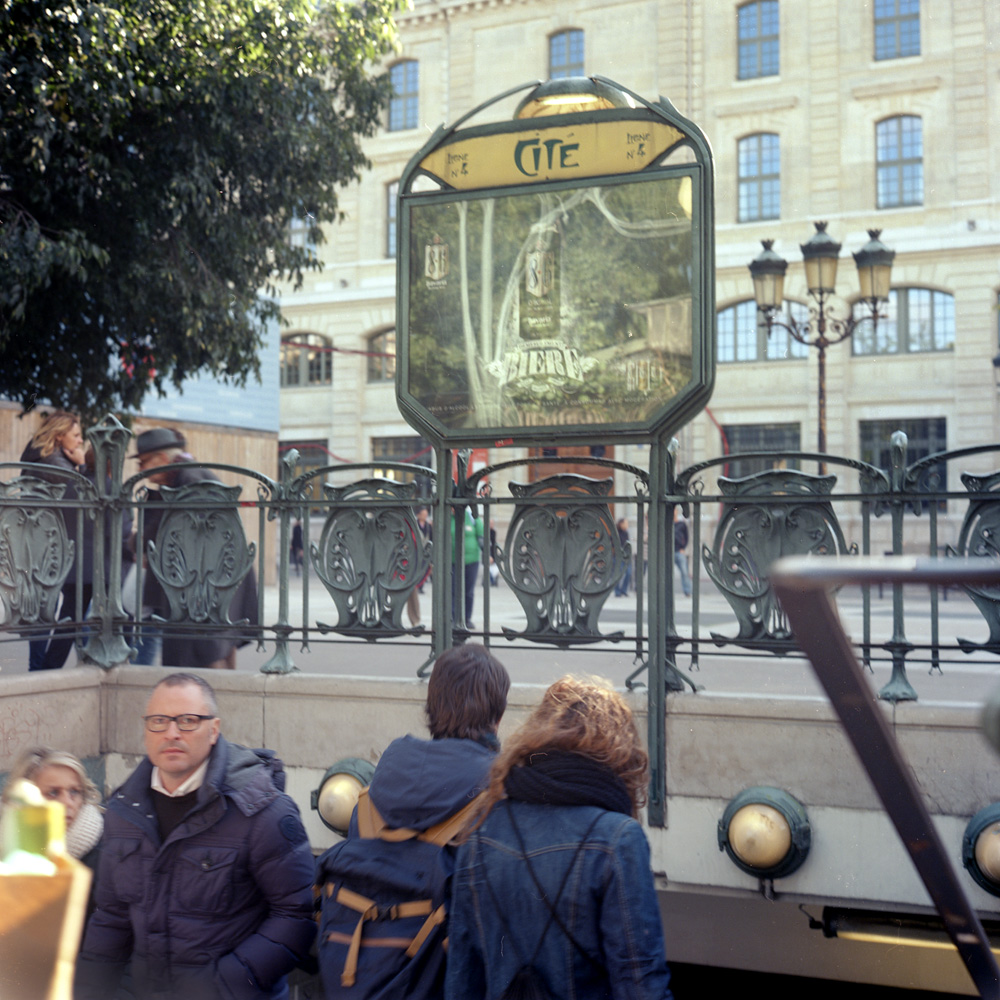
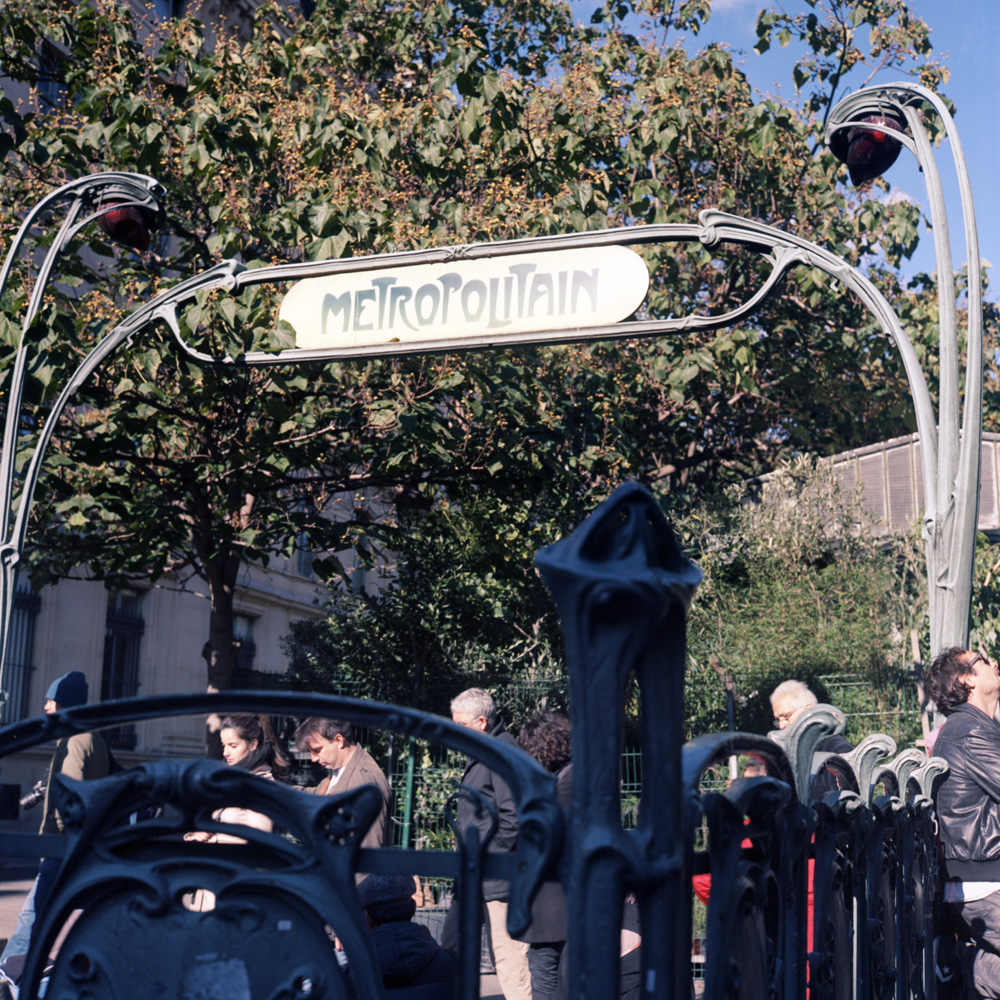
The old part of the Metropolitain subway system in the city center of Paris is famous for the art nouveau railings and signs at the station entrances. I know I put a couple of photos in an earlier post about Transportation, but these three are specifically about the entrance railings and signs.

Art Nouveau Rail, Cité Metro

The railings LOOK to be bronze, from the patina, but I would suspect that they’re iron that has been painted. Bronze would make them extremely expensive, but then again, when you look at how lavish the French were in their public buildings in the late 19th century, it’s not inconceivable.

The entrance to the Ile De La Cité metro stop. This is where you get off the train to go see Notre Dame and Sainte Chapelle. Immediately across from it is a little open-air market which has flowers and pet supplies. I have two pictures from the market of two little dogs staring each other down and goldfish in a tank from the market, going into another post.

Cité Metro Entrance
Cité Metro Entrance

The most famous sight of all – the Metropolitain sign. There is a replica of one of these in the sculpture garden on the National Mall between the National Gallery of Art and the Natural History Museum here in Washington DC.

Metropolitain Sign
Metropolitain Sign