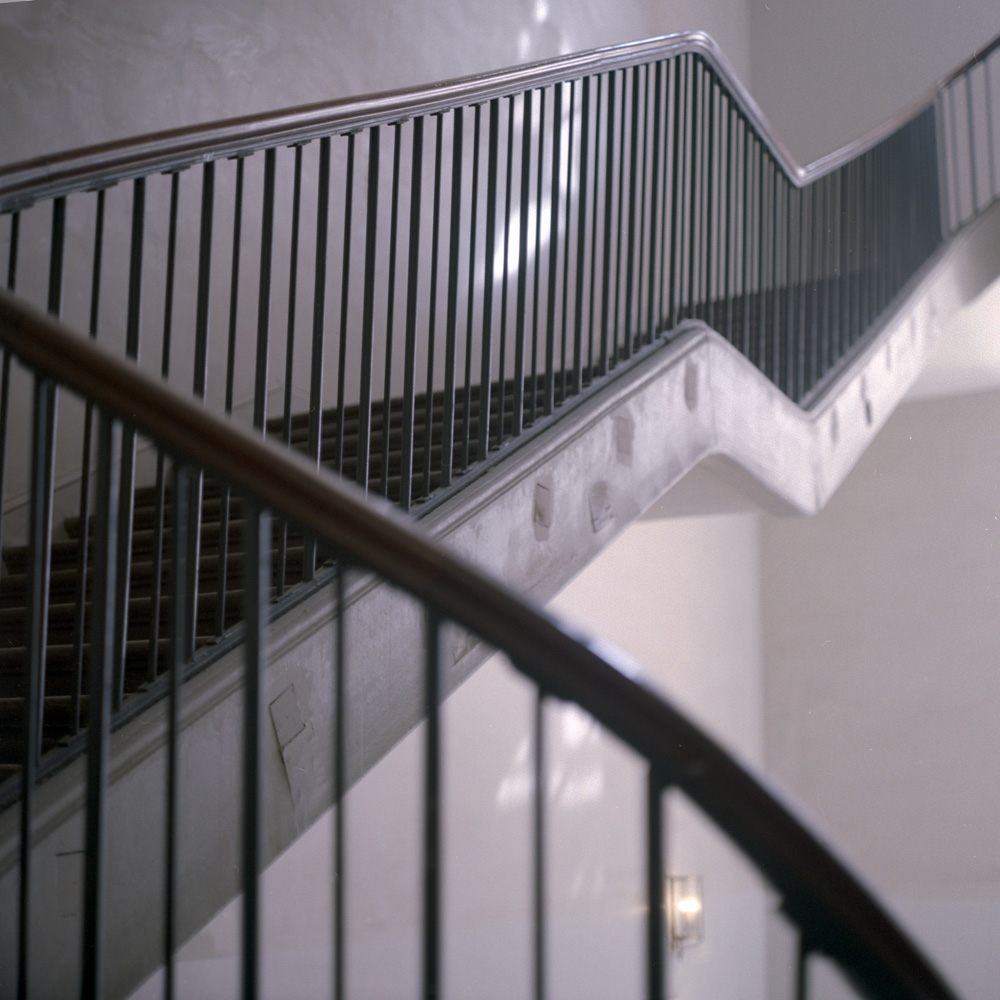
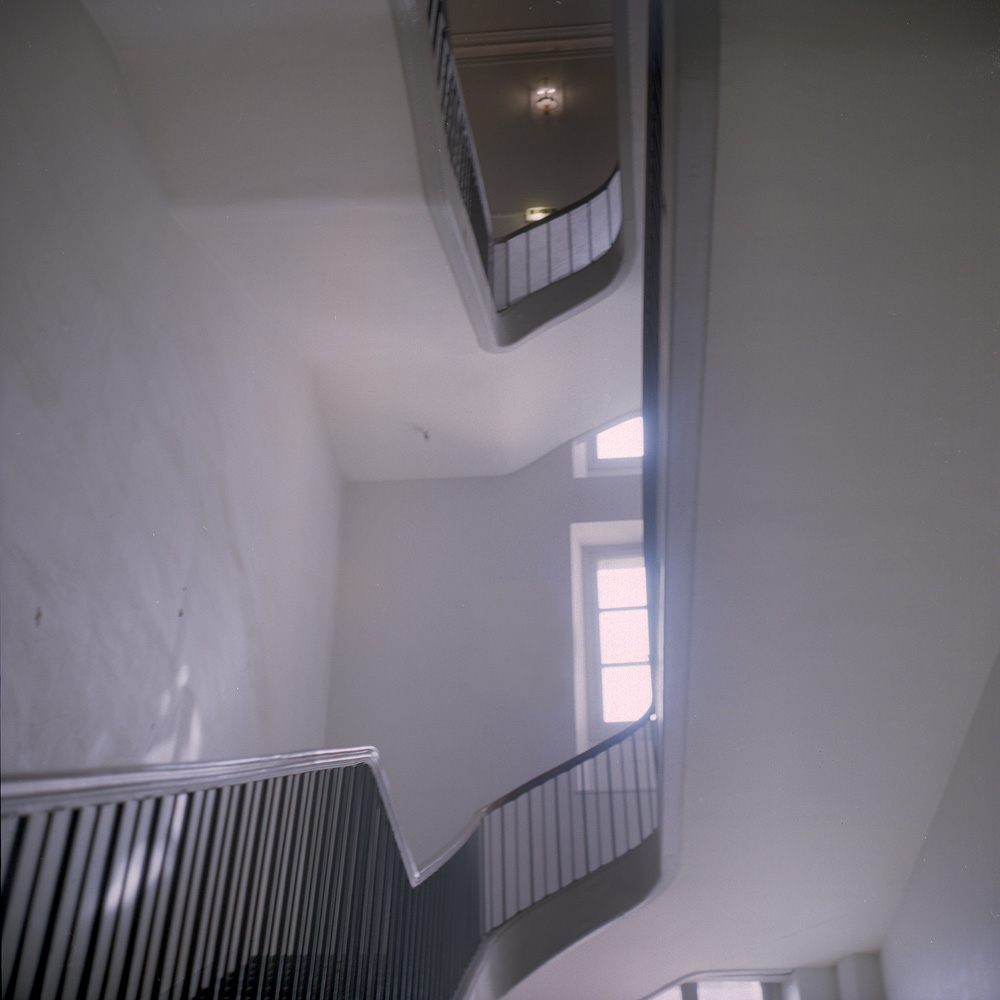
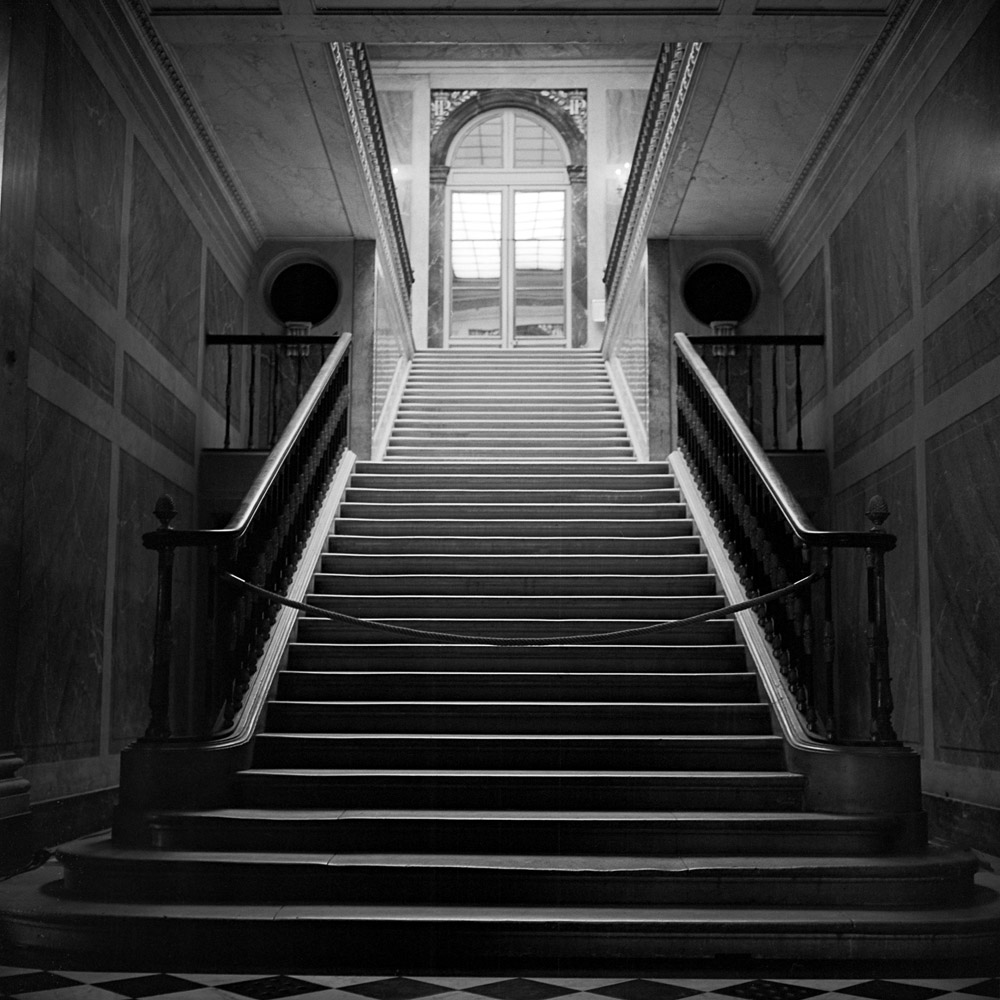
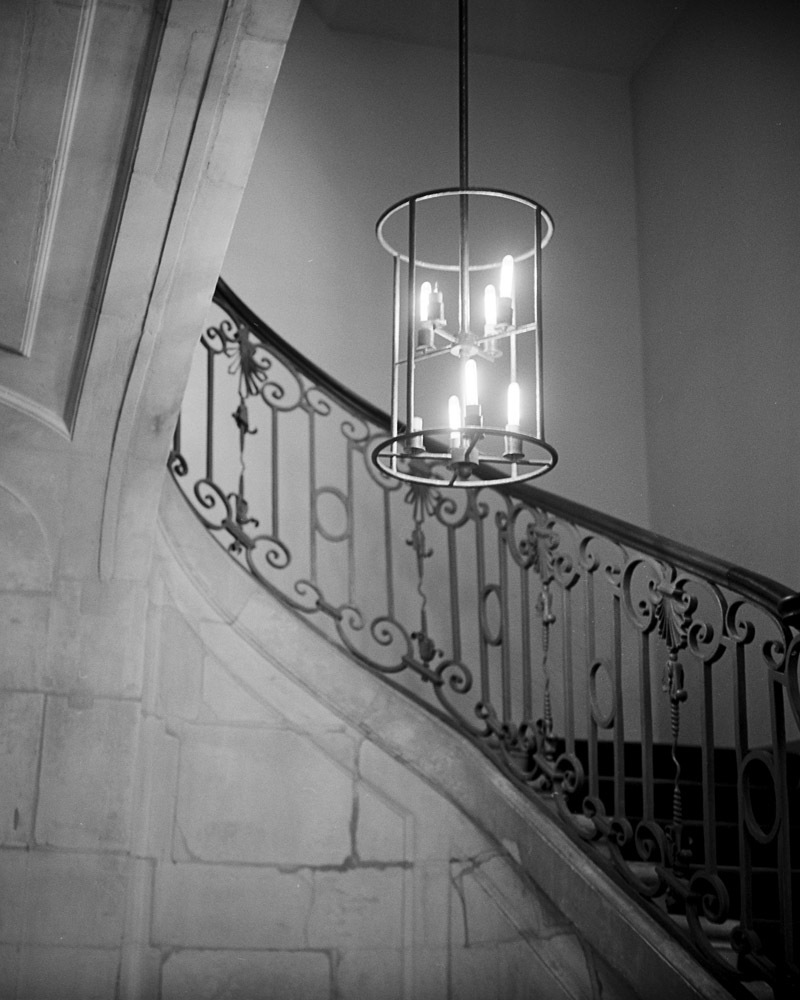
These first two are of the service stairs that lead from today’s restaurant and snack bar to the ground floor and the exit to the gardens. By the time I got to the dining room, my feet were screaming at me from all the continuous marching through the palace and across the cobbled courtyards. I did not eat in the main dining room but instead got a sandwich from the cafe. There was no place to sit (the only available tables were the stand-up kind, every chair was taken). Leaving the cafe to be faced with this staircase, then, was suddenly a daunting task. What to do, then, but photograph it?
Balustrade, Service Stairs, Versailles
To proof the images I wanted to scan and print bigger, I had a set of 5×5 inch proof prints made at the time of developing the film. Sometimes, the minilab prints looked better than my final scan results, but more often, they look worse. Based on the minilab prints, I excluded these two from my rough edit. Going back over the film while scanning everything else, I looked at the negatives and they looked good, so I took a whirl and scanned the first one. As it turned out, they were much better than I thought they would be based on the proof prints.
Service Stairs, Versailles
These next two are a memory refresher from an earlier post. With the exception of the last photo in this post, the only staircases I photographed at Versailles, it seems, were service stairs. I guess everyone is content to ignore them and only pay attention to (and mob) the Queen’s Stairs. Their loss, my gain.
When I originally posted this staircase, I mistakenly labeled it “The Queen’s Staircase”. It is not. The Queen’s staircase is far more opulent and magnificent than this, although I wouldn’t complain about having this be the main stairs in my house…
It “snowed” here in DC on Tuesday, and we got the day off for what amounted to a little more than a dusting that rapidly turned into slush and never really interfered with traffic or public transportation or anything. But, since I had the day off, I took a walkabout in my neighborhood to burn some film.
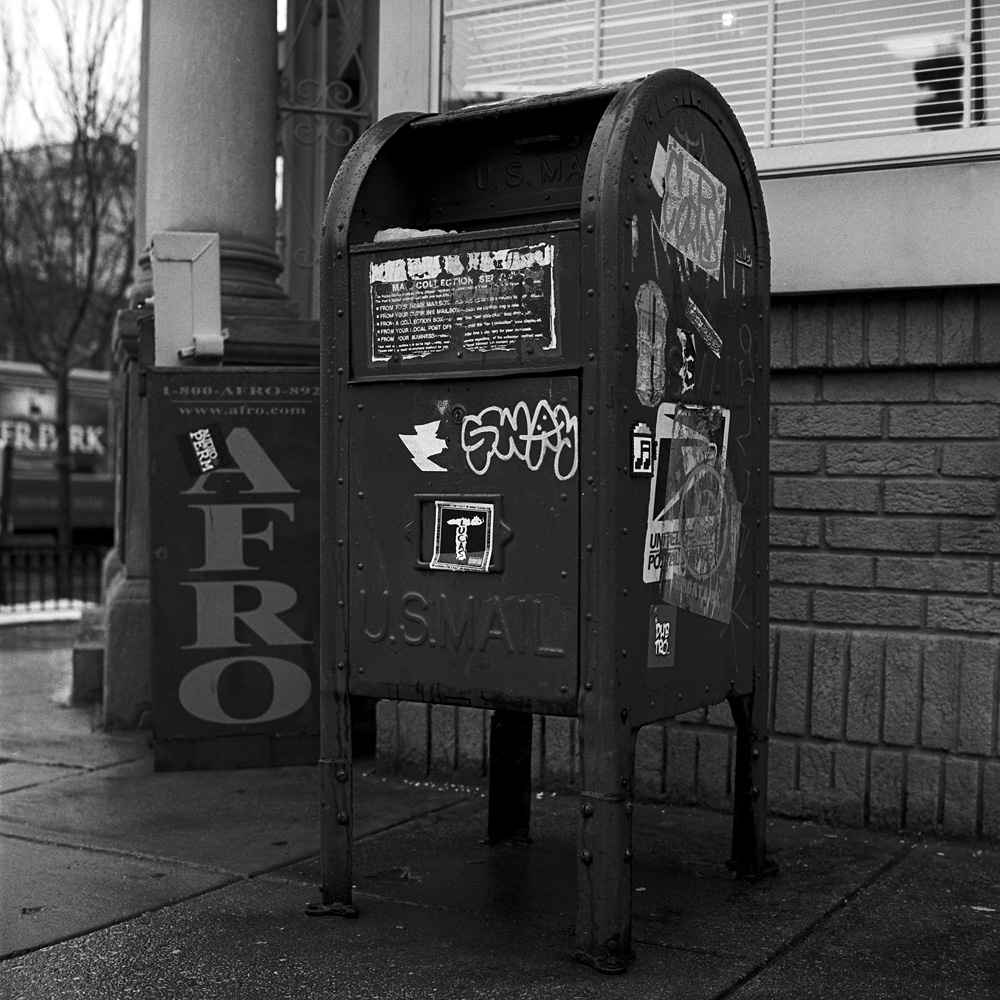
I’m always looking for images of things to add to my “Portraits of Everyday Objects” series. This mailbox, outside the Industrial Bank building on U Street fits the bill, looking somewhat forlorn with all its graffiti.
Mailbox
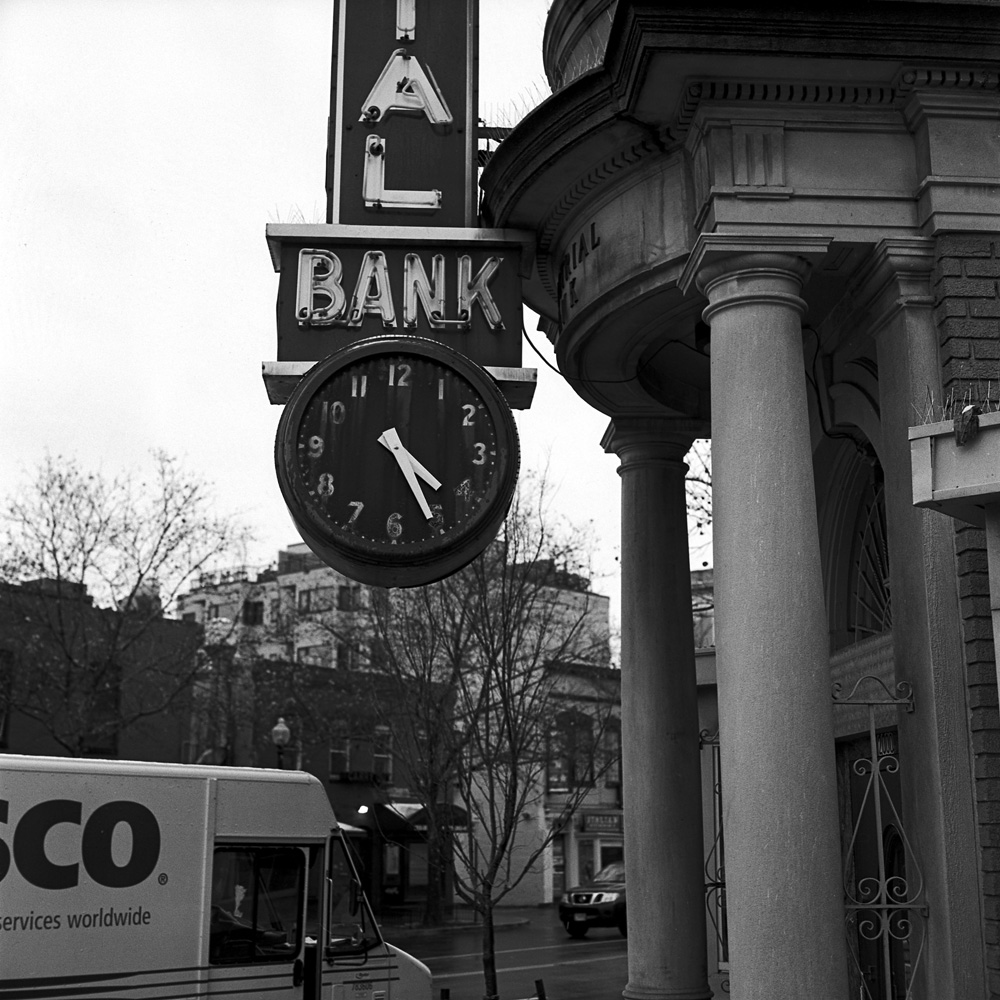
Industrial Bank was started at the beginning of the 20th century by African-Americans to cater to the African-American community. Their main branch is at the corner of 11th and U Streets, and has this really cool metal and neon clock sign out front. Alas they have allowed the sign to lapse into disrepair – I THINK the clock functions but it is not accurate, and either they just never turn on the neon or it no longer works. I really wish they’d fix it up so it would work, as it would make a very nice neighborhood landmark and a visual counterpoint to the yellow saxophone sign across the street outside the Bohemian Cavern nightclub.
Clock, Industrial Bank
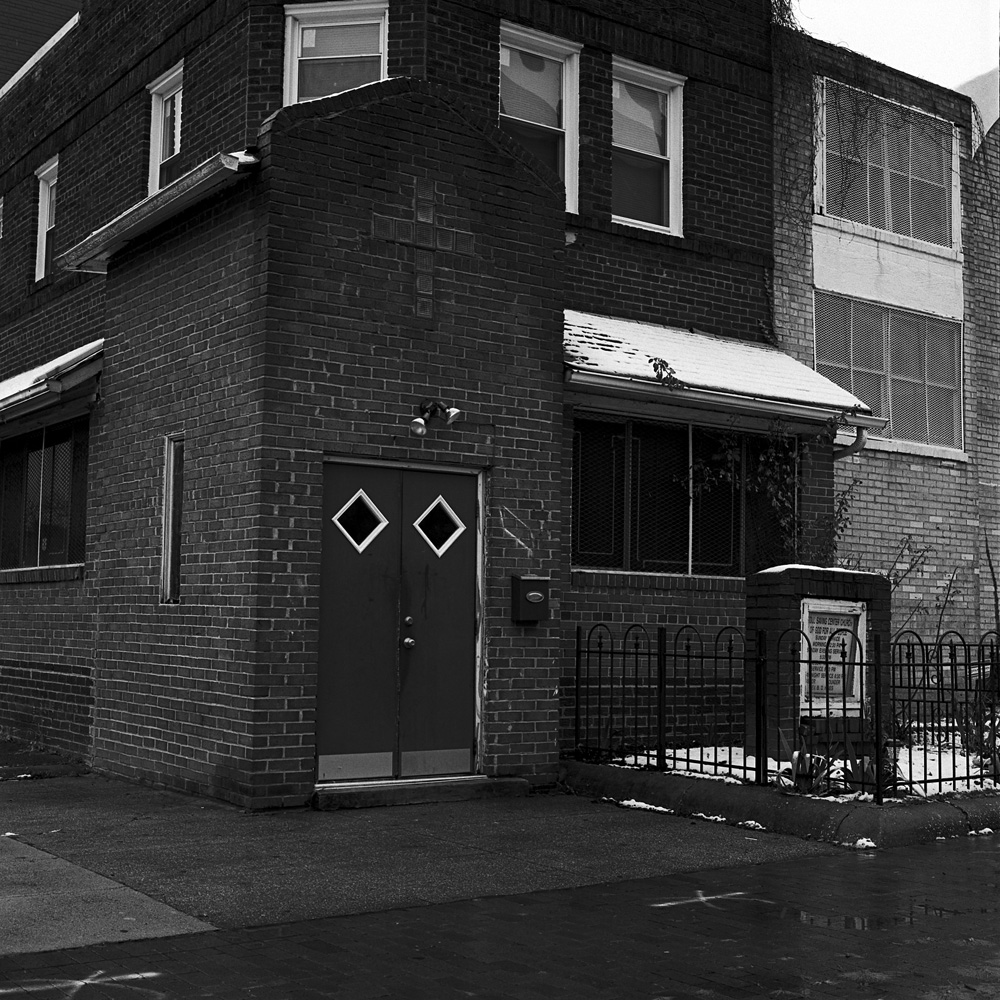
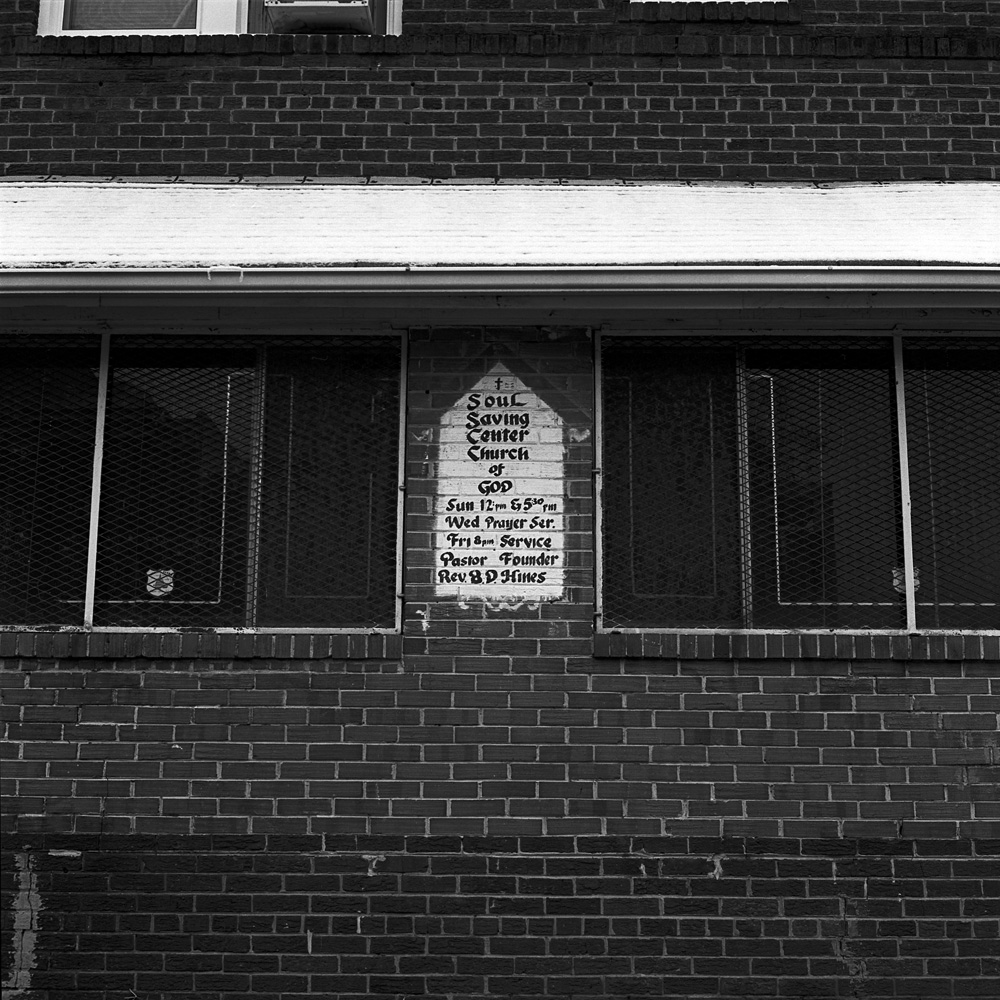
Up the street there is the Soul-Saving Center Church of God – a storefront community church with a primarily if not exclusively African-American congregation. It’s a sign of the gentrification and transformation of the neighborhood – across the street from them is a brand-new condo building with units selling for up to $1.2 Million.
Soul Saving Center Church DoorSoul Saving Center Church
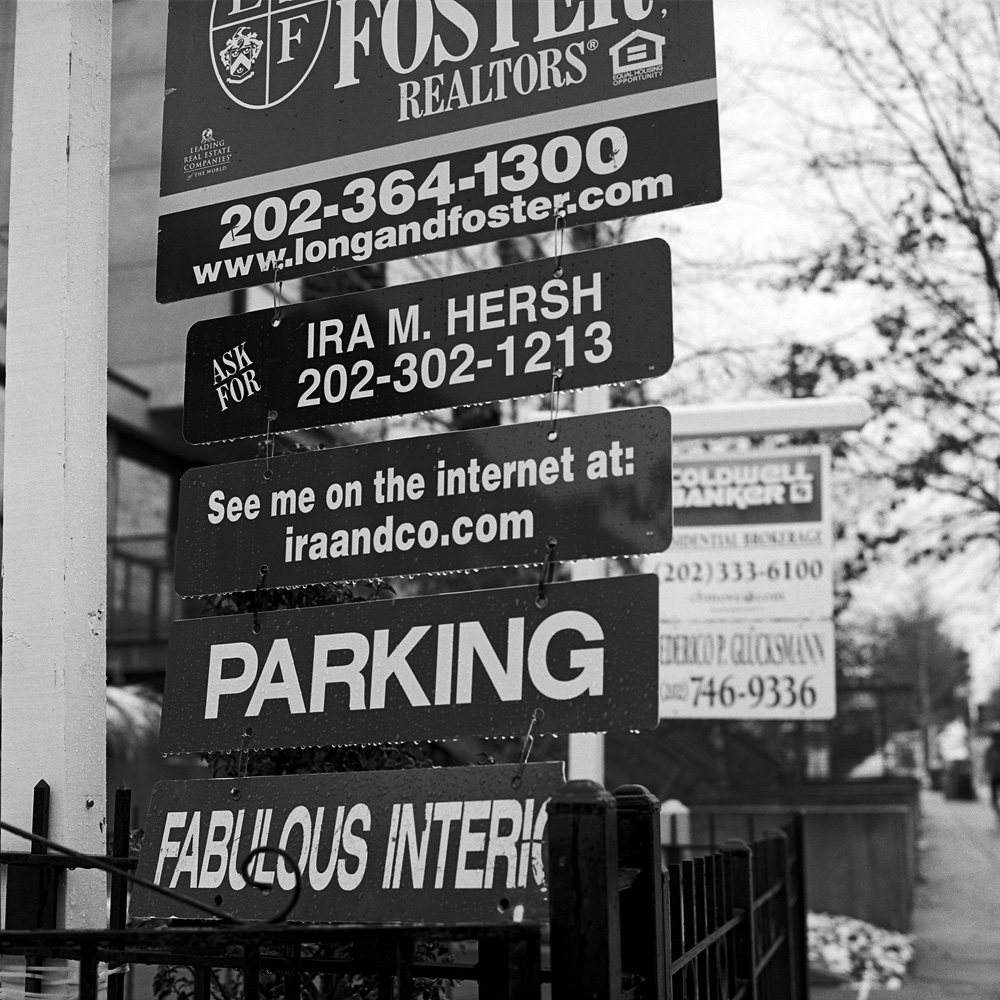
You can see the real estate bonanza still happening in the neighborhood – small row houses are being converted and expanded into multi-story multi-unit condominium buildings. Here is one with a “Fabulous Interio”- the agent broke off the “r” to get the sign to fit inside the fence. I wonder how long it will be before the Soul-Saving Center Church decides to sell their buildings plus the adjacent lot they have – they’ve got perhaps $10 Million in land alone now.
Fabulous Interio
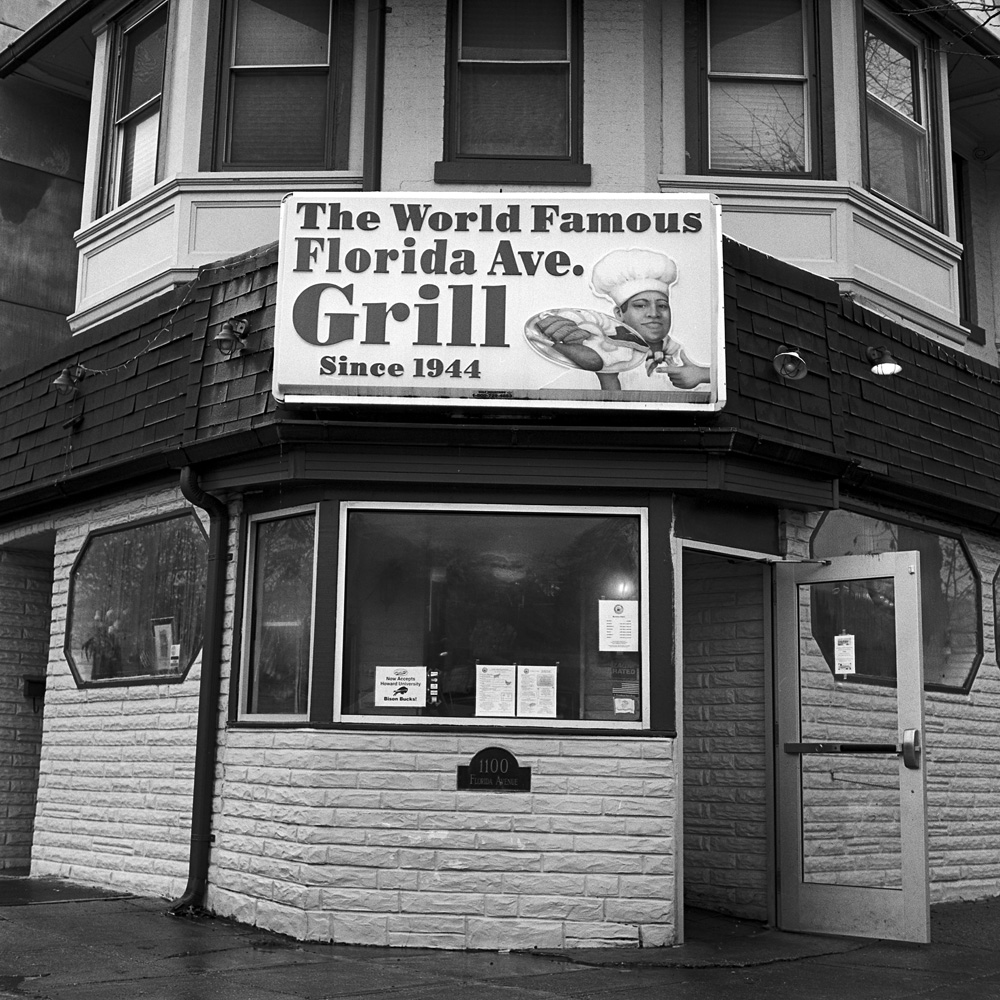
Up the street is another landmark of the neighborhood, almost as famous as Ben’s Chili Bowl. The Florida Avenue Grill has been around since 1944, serving up good old-fashioned soul food to locals and celebrities alike. The Florida Avenue Grill once owned a large empty lot next door, which served as their parking lot. About five years ago the family that owns the grill sold the empty lot and now a five story condo building has filled it. The average unit in that building sold for north of $500,000 each.
These are a few more from that last remaining roll of b/w I didn’t develop until yesterday. Just some additional looks at Notre Dame cathedral in black and white.
It’s hard to view the cathedral without trying to interpret the towers as a graphical element. They’re the most recognizable element to the church, perhaps other than the rose window. The main body of the church is actually rather narrow and delicate, relative to its perception. All those flying buttresses make it seem much more massive than it is. The tower facade, though, really establishes that perception because when viewing it straight on, it seems like a solid wall, and that the church behind it must be equally as massive.
Twin Towers, Notre Dame
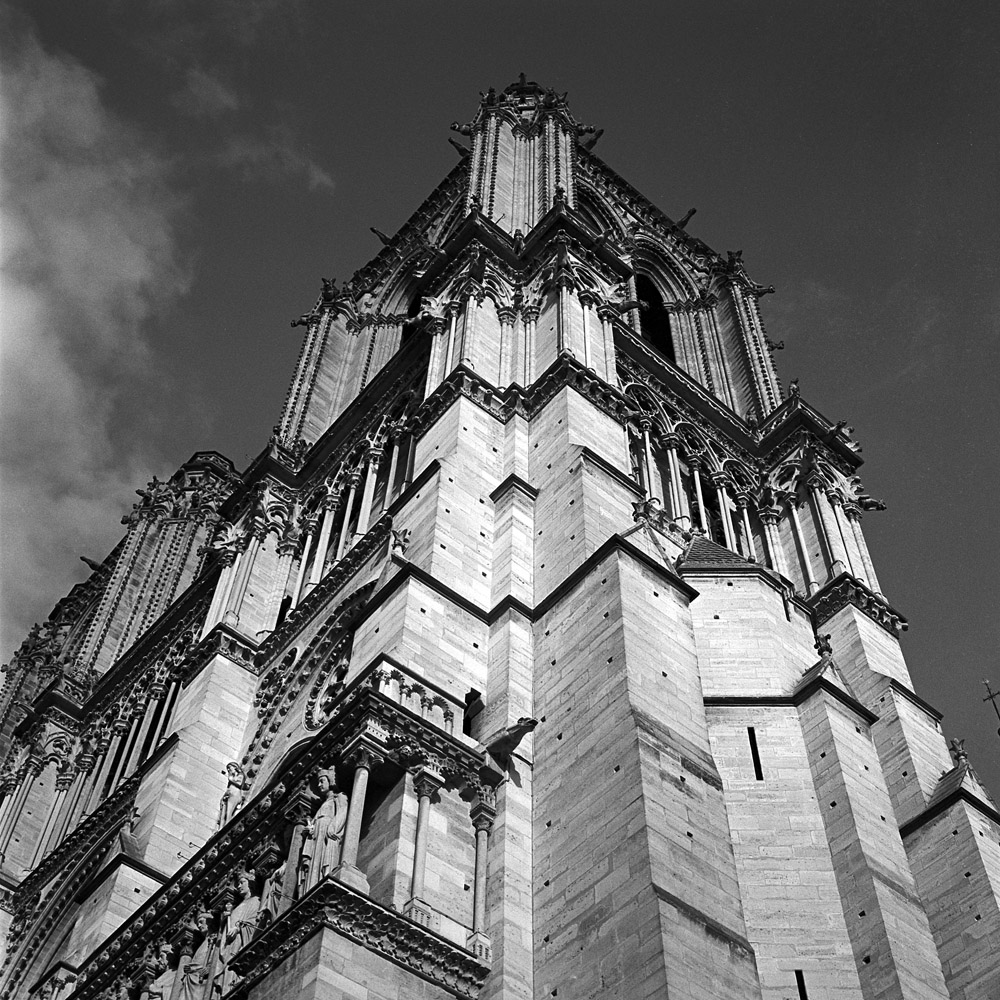
Trying to look at the towers is a vertigo-inducing experience. They are quite tall, and the nature of the decorations make you keep looking up to see all the details to the very last set of gargoyles some 226 feet in the air. Getting up in the towers to view them up close and personal is vertigo-inducing as well – it’s a nearly 400-stair climb to the top of the tower (which I did NOT do – I’m too out-of-shape to attempt something so heart-stressing). At one point in time, Notre Dame was the largest building in the western world – you can still easily spot it from the 2nd tier of the Eiffel Tower, despite the intervening buildings, several miles and the bend in the river between the two landmarks.
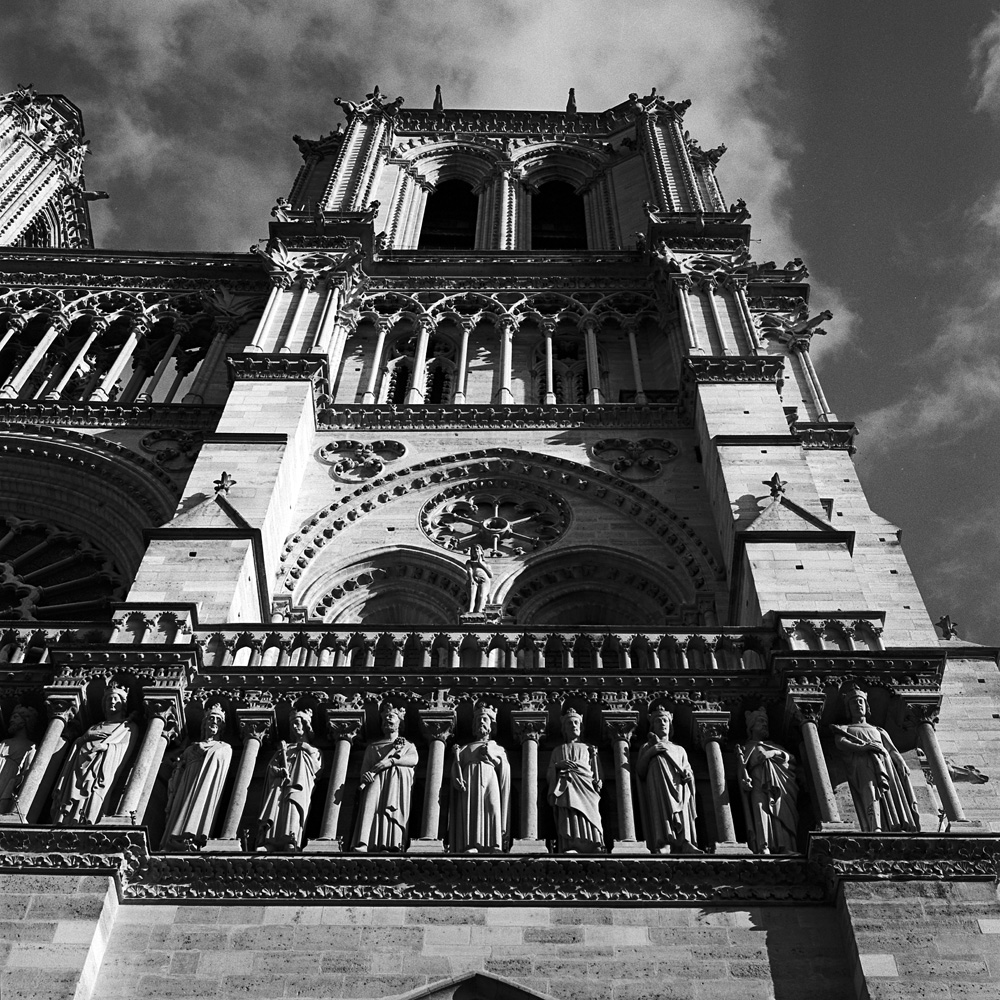
Tower, Notre Dame, Looking Up
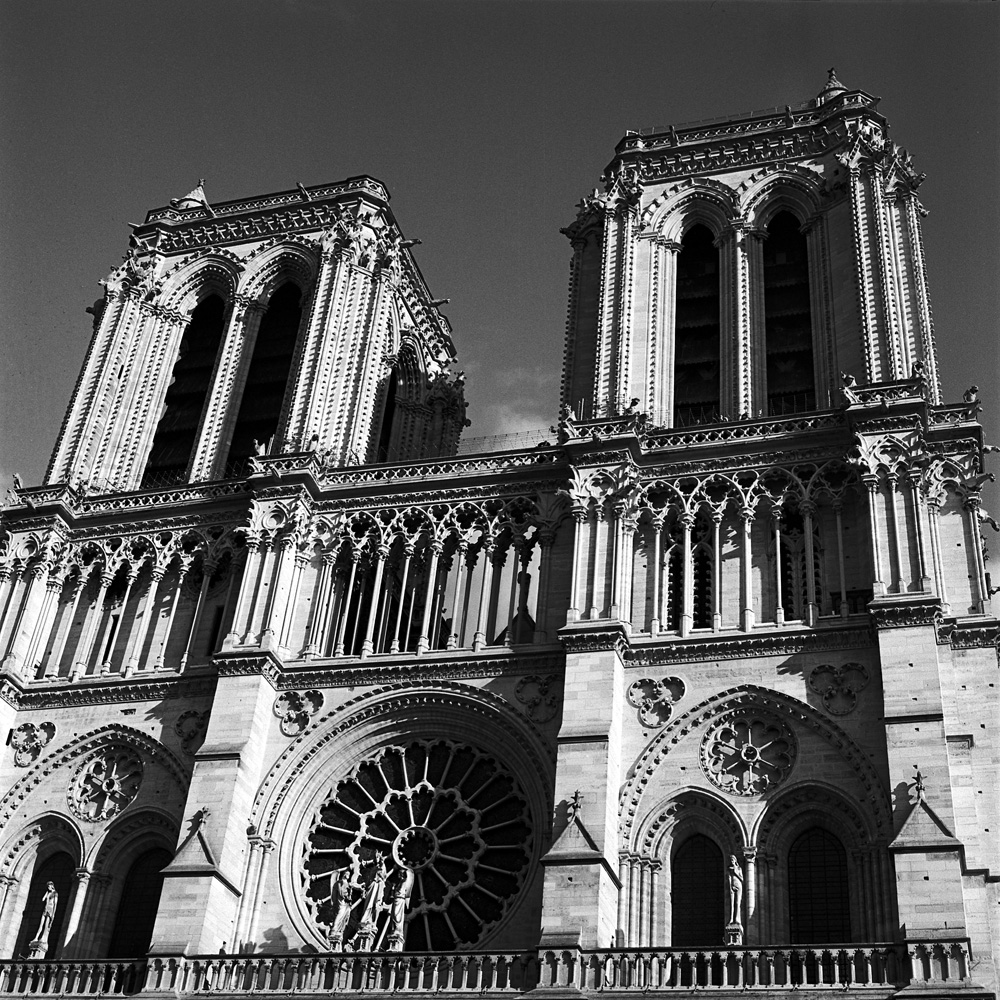
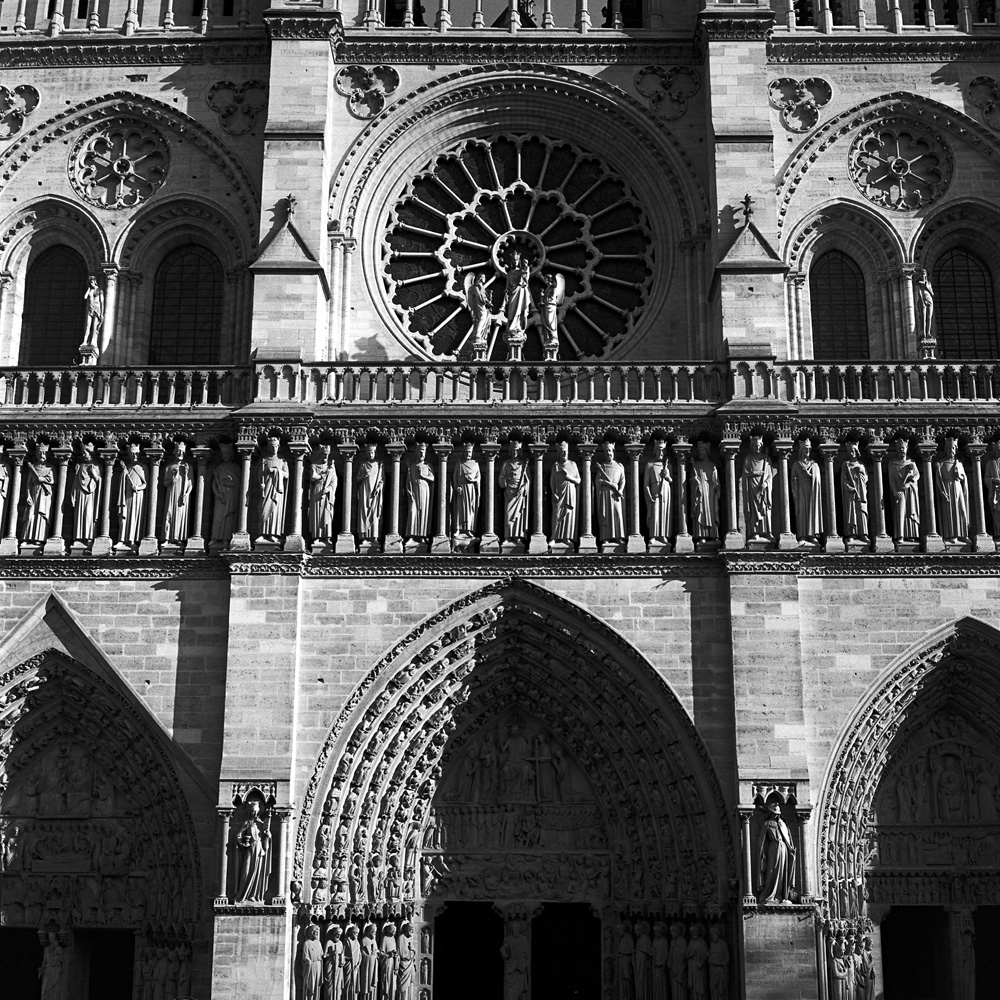
Here is a view of the incredibly detailed facade. One thing I did not realize until looking at this photo is the fact that all three main doorways are different. I always assumed that the left/right halves of the facade would be symmetrical. If you look carefully, the archway over the left hand door is a little smaller, and crowned by the angular, peaked molding. The right arch is larger and lacks the angular molding. Another detail that often gets forgotten – we assume that these cathedrals were all bare stone, and that the way we see them today is how they were intended. Au contraire – most cathedrals of the Romanesque and Gothic periods (the 7th-15th centuries) were brightly painted, inside and out. The statues on the exterior would all have been polychrome, as would the interior walls have been. Time, weather, wear and neglect have conspired to strip the coloring off the buildings. They did find some early medieval frescoes inside the old cathedral in Salamanca that had been covered up for centuries after an earthquake damaged both cathedrals (they’re kind of conjoined twins and share a wall).
Notre Dame Facade, Afternoon
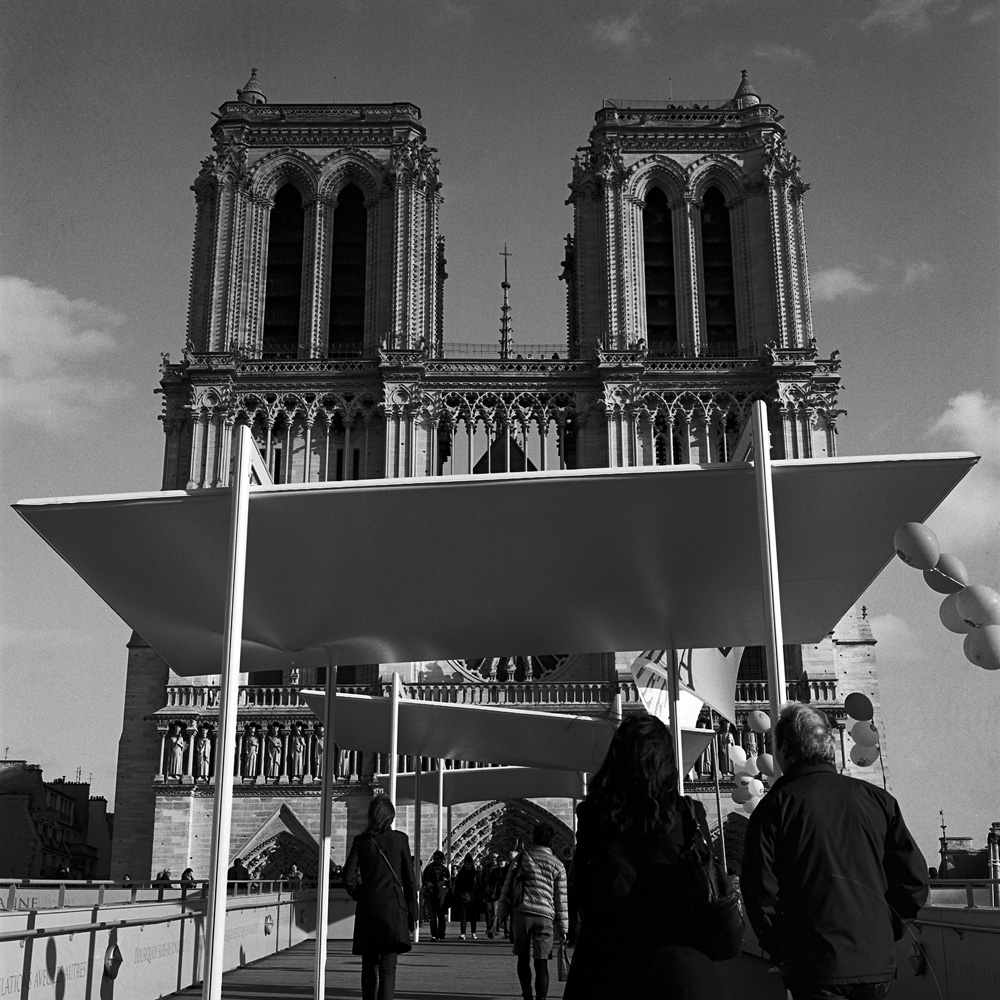
I really don’t know why they built this mammoth viewing/reviewing stand in the plaza in front of the cathedral. You can ascend the steps on the front face, or you can climb the ramp up the back. This is the view of the towers from the ramp – the tarp-like covers on the ramp provide a starkly modern contrast to the gothic stonework of the cathedral.
Notre Dame Towers, from RampTowers, Notre Dame Cathedral
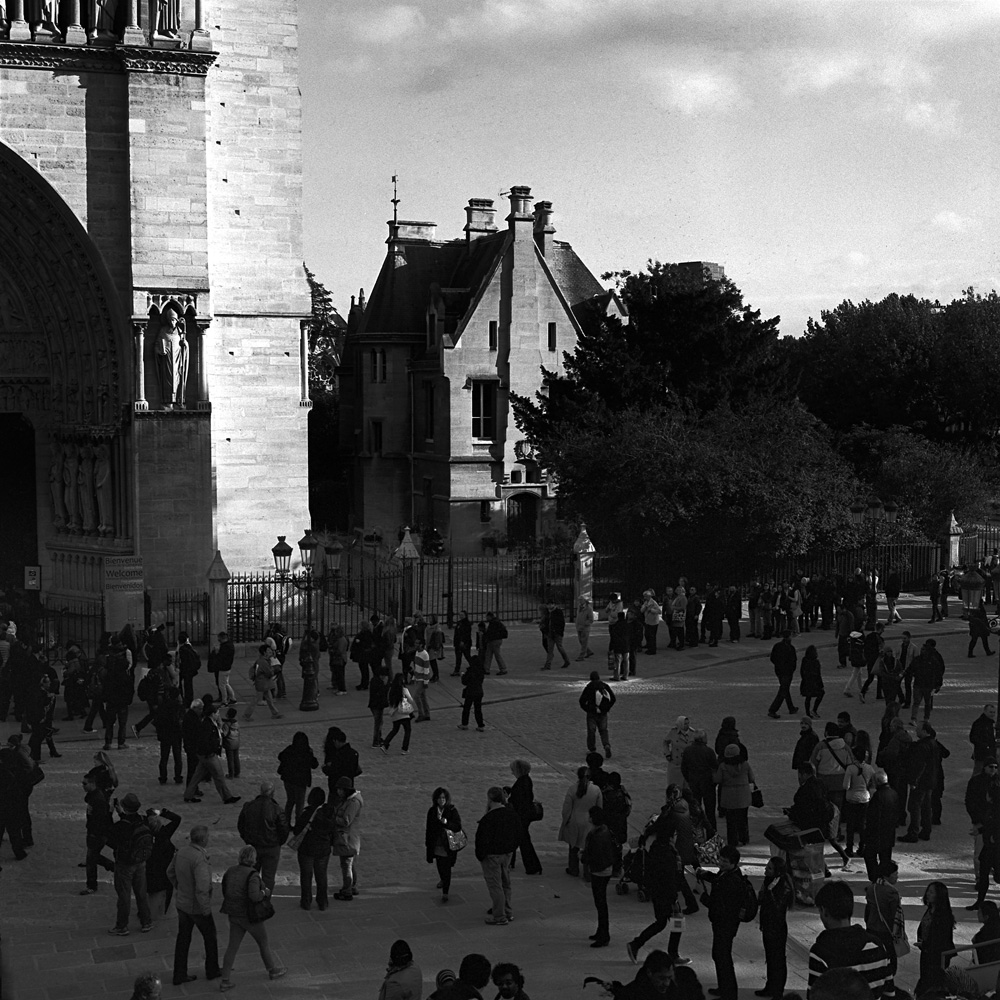
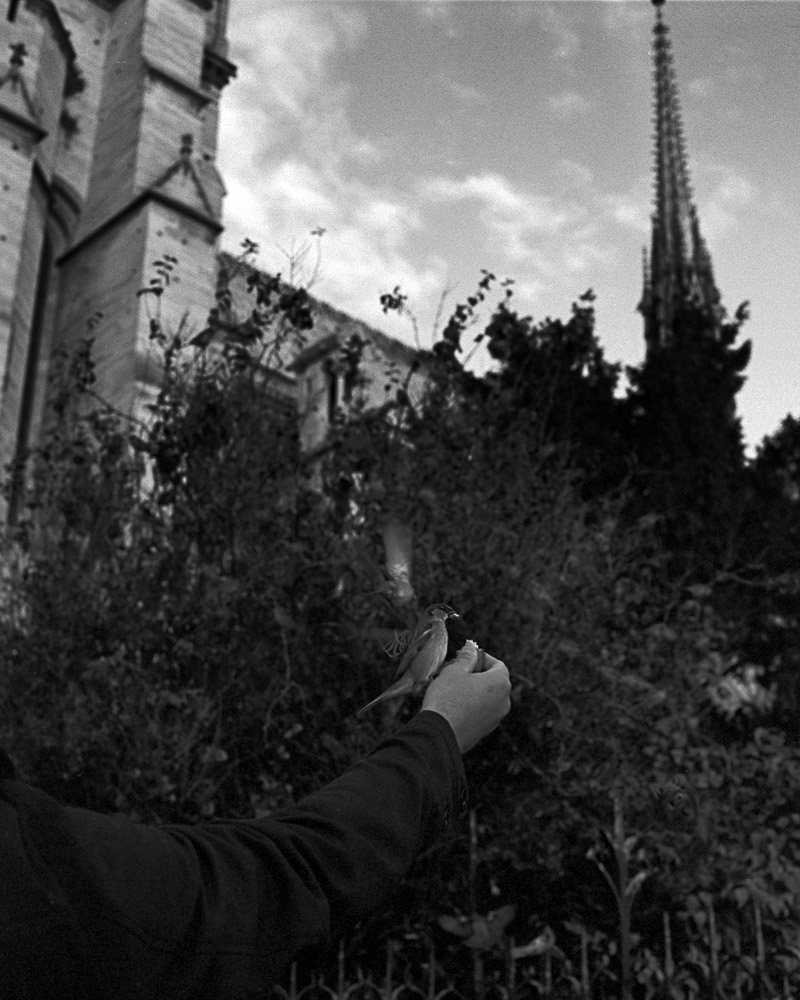
The crowds at Notre Dame are non-stop, even at night after the cathedral is closed. This is a typical weekday afternoon on the plaza out front. The little house to the right is the rectory for the cathedral. Along the fence surrounding the rectory is where you will find the bird feeders – people who will sell you a scrap of day old bread or a stale churro that you can hold up in your outstretched hand to attract the sparrows who will hover over to get a bite.
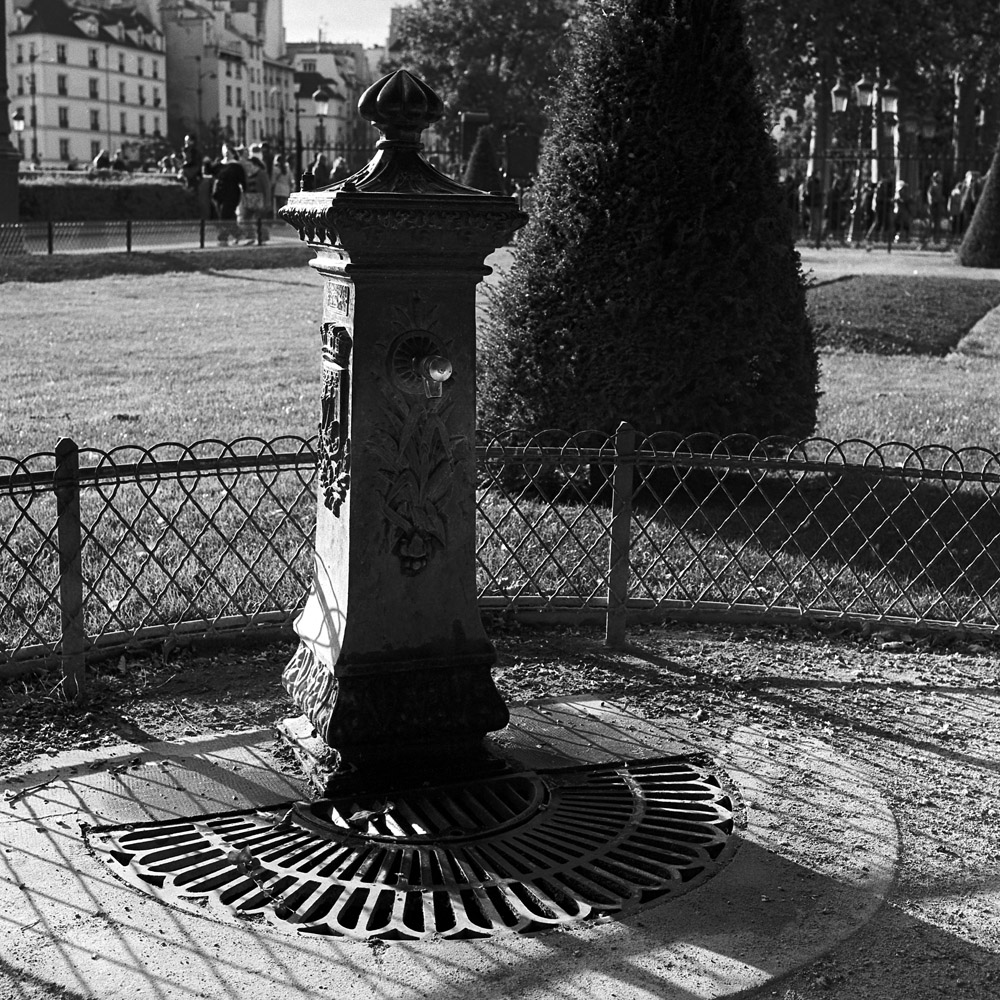
Beside the cathedral there is a park with views of the Seine, replete with benches, gardens and, as part of Haussmann’s renovations, public drinking fountains. I loved the way this looked backlit with the evening light. Consider it another one of my portraits of everyday objects.
Drinking Fountain, Notre Dame
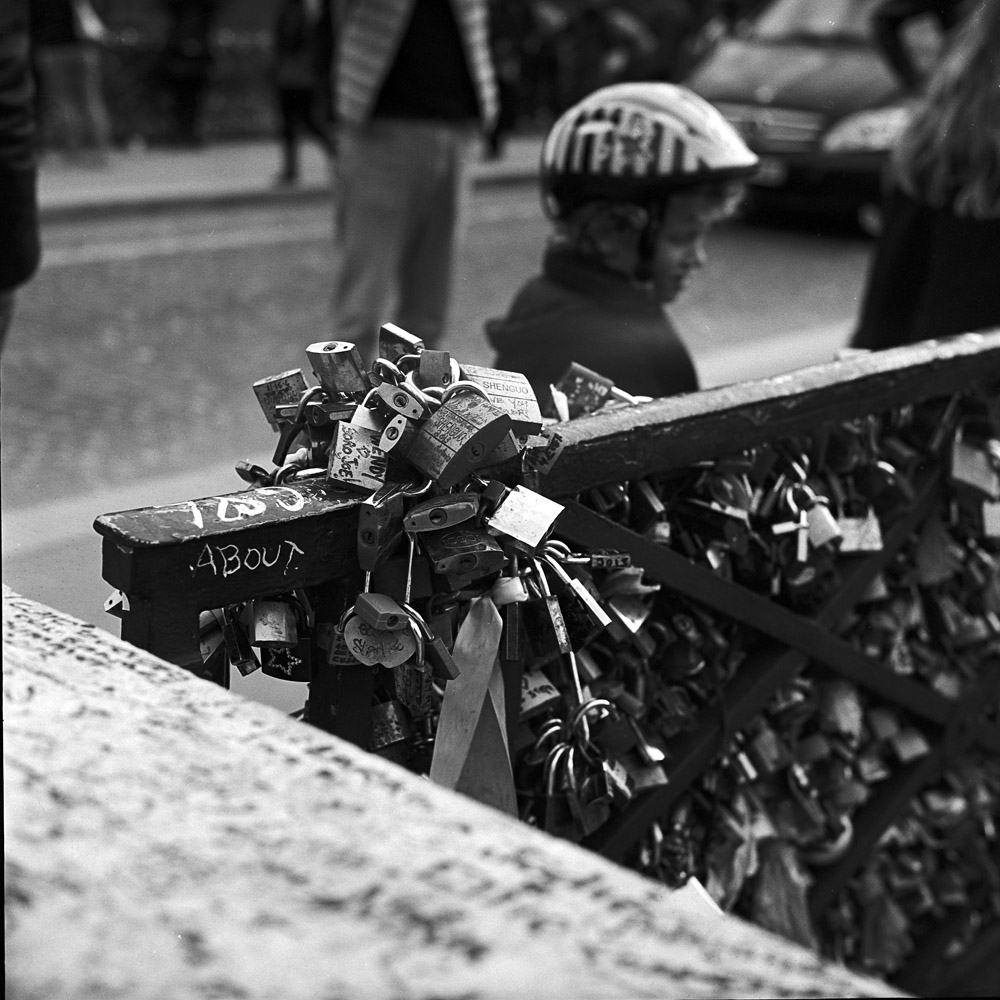
And last but not least, the tradition that began in Rome of young couples buying a padlock, writing their initials on it, locking it to the railing of a bridge, and tossing the keys in the river as a symbol of how their love cannot be undone has come to Paris. It is so popular that it has infested three or four bridges across the Seine now, and the boquinistes with bookstalls along the Rive Gauche nearest the Ile de la Cité sell a variety of padlocks and permanent markers. It seems only natural that people would do this on the bridges closest to Notre Dame, as it is one of the most romantic, inspiring buildings in a city full of romantic inspiration.
Love Locks, Notre Dame
(see, I told you you wouldn’t have to wait long for the next Paris post!)
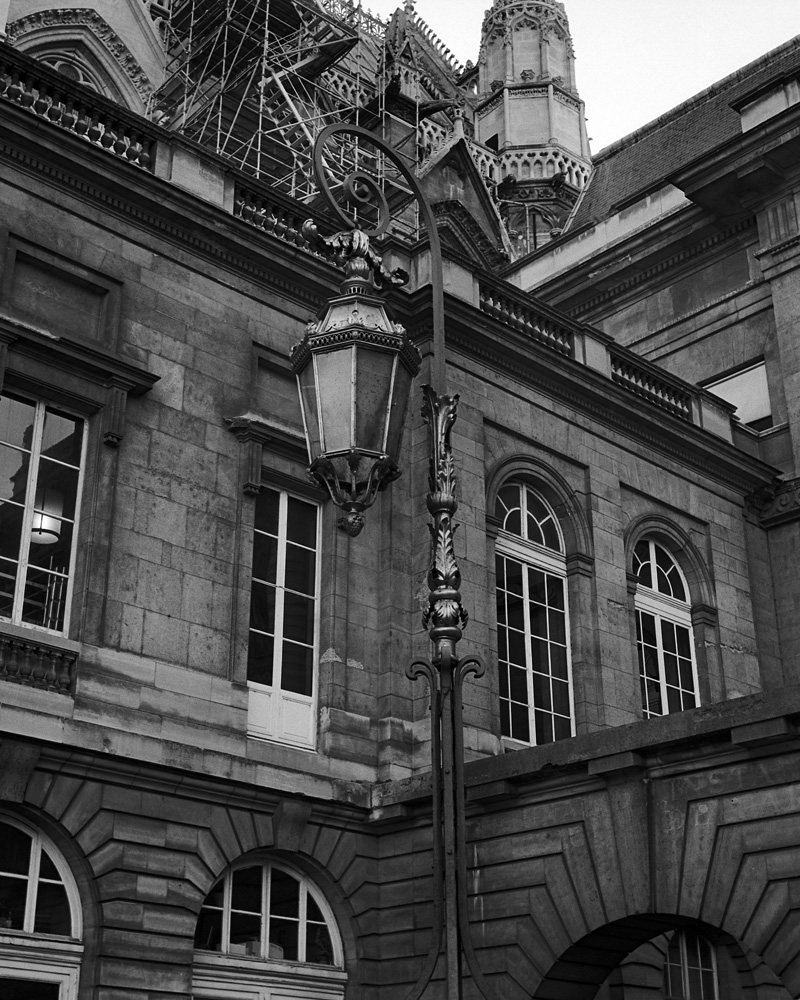
So I FINALLY got around to developing the last roll of black-and-white from the trip today. Here are some odds-n-ends from the Palais de Justice. These are from the courtyard through which you exit after you visit Sainte Chapelle (you can see the spire of the chapel in the background of the lantern photo).
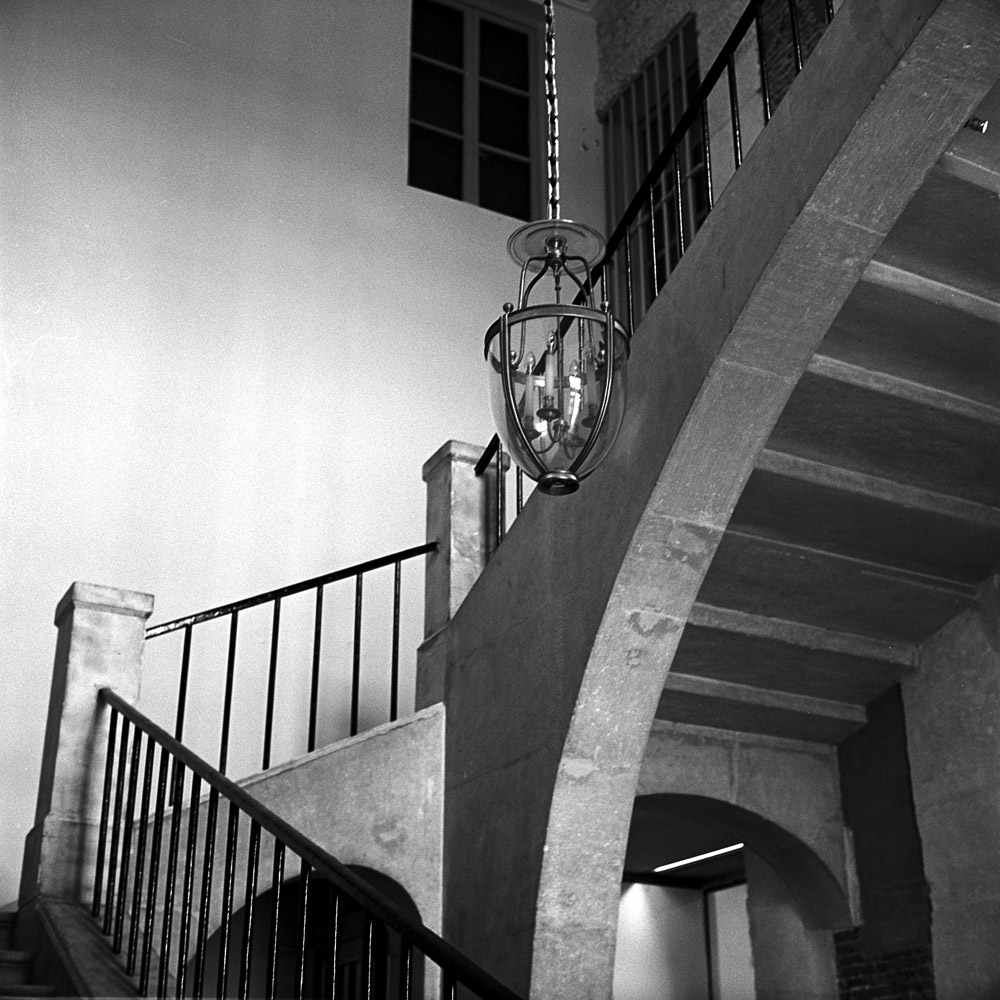
Not only did the lantern appeal to me, but the absolutely crazy Escher-esque layers of the building behind it just begged to be photographed. It’s like many different buildings collided and transformed into another entirely new one.
Lantern, Courtyard, Palais de Justice
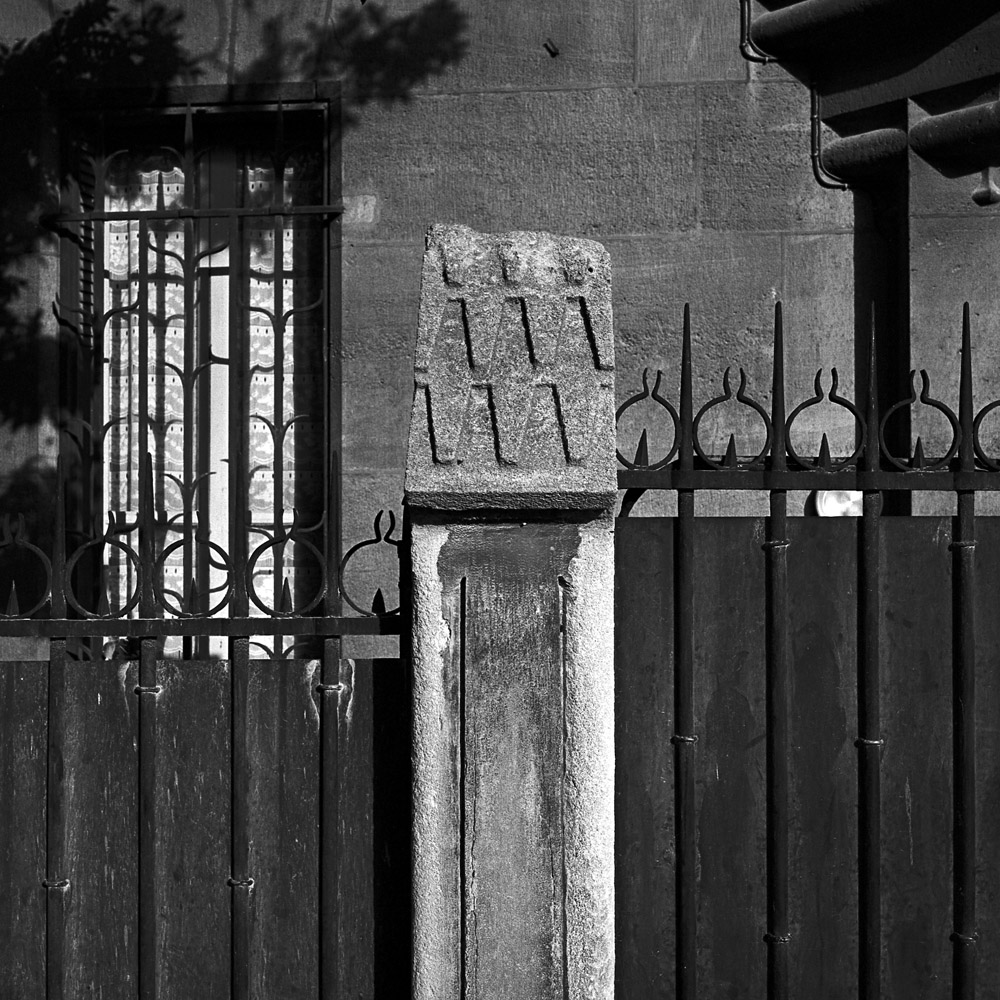
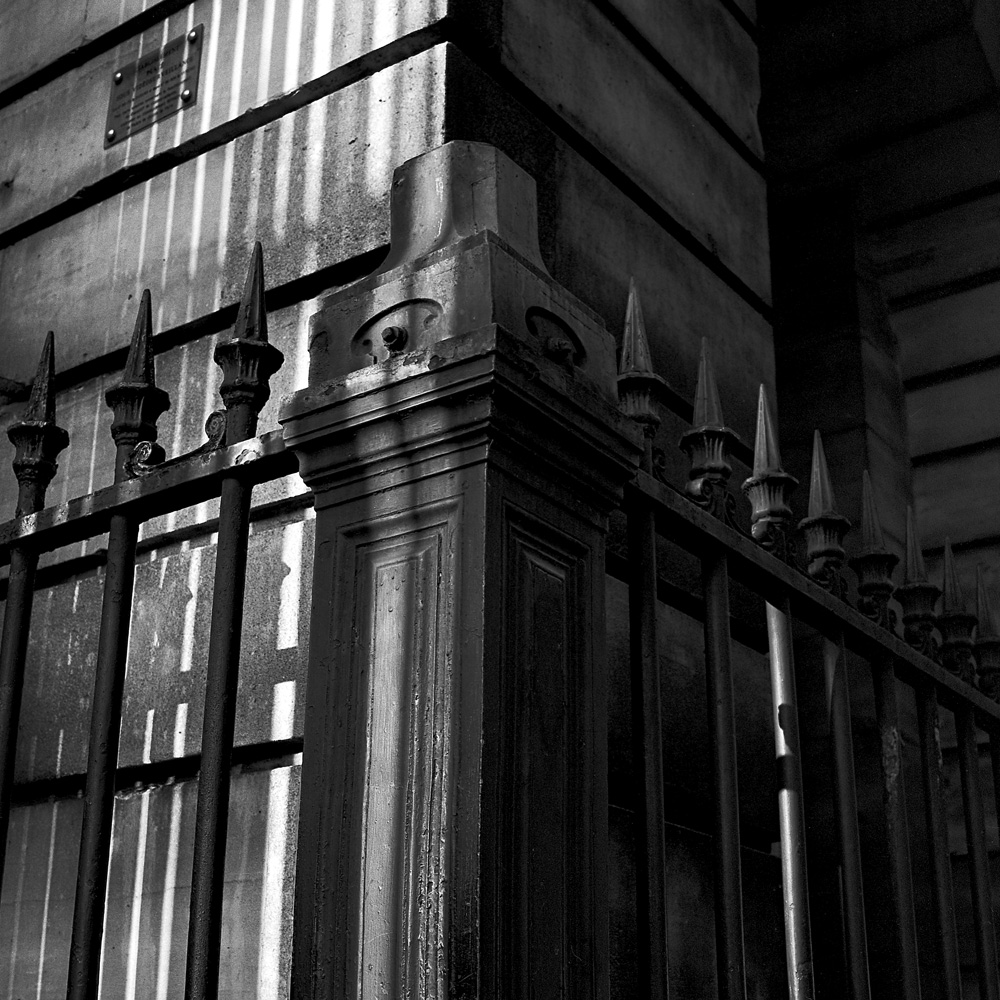
This is a fencepost on an iron railing around the Palais de Justice building. I thought the sunlight passing through the outer fence casting a striped shadow on the wall behind this iron fence had an ironic feeling of multiple layers of prison at a place of justice.
Fence, Palais de Justice
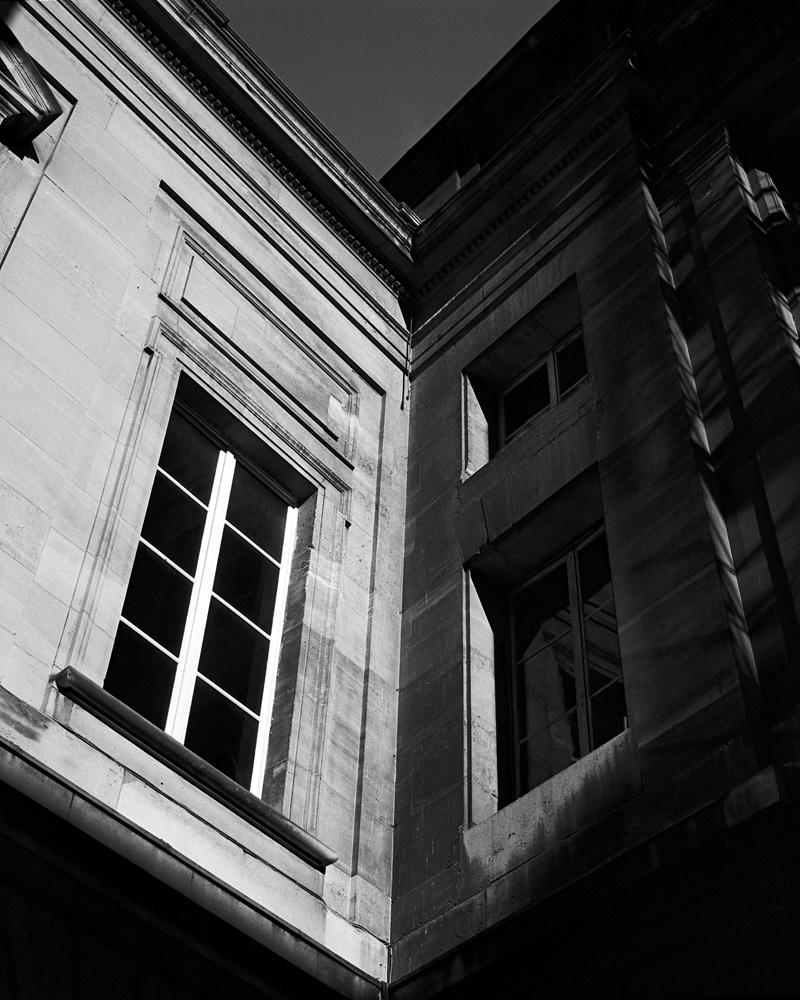
These windows also had an Escher-esque quality to them because they have balance but not symmetry – again lots of angles that mimic and overlap without being truly parallel.
Windows, Palais de Justice
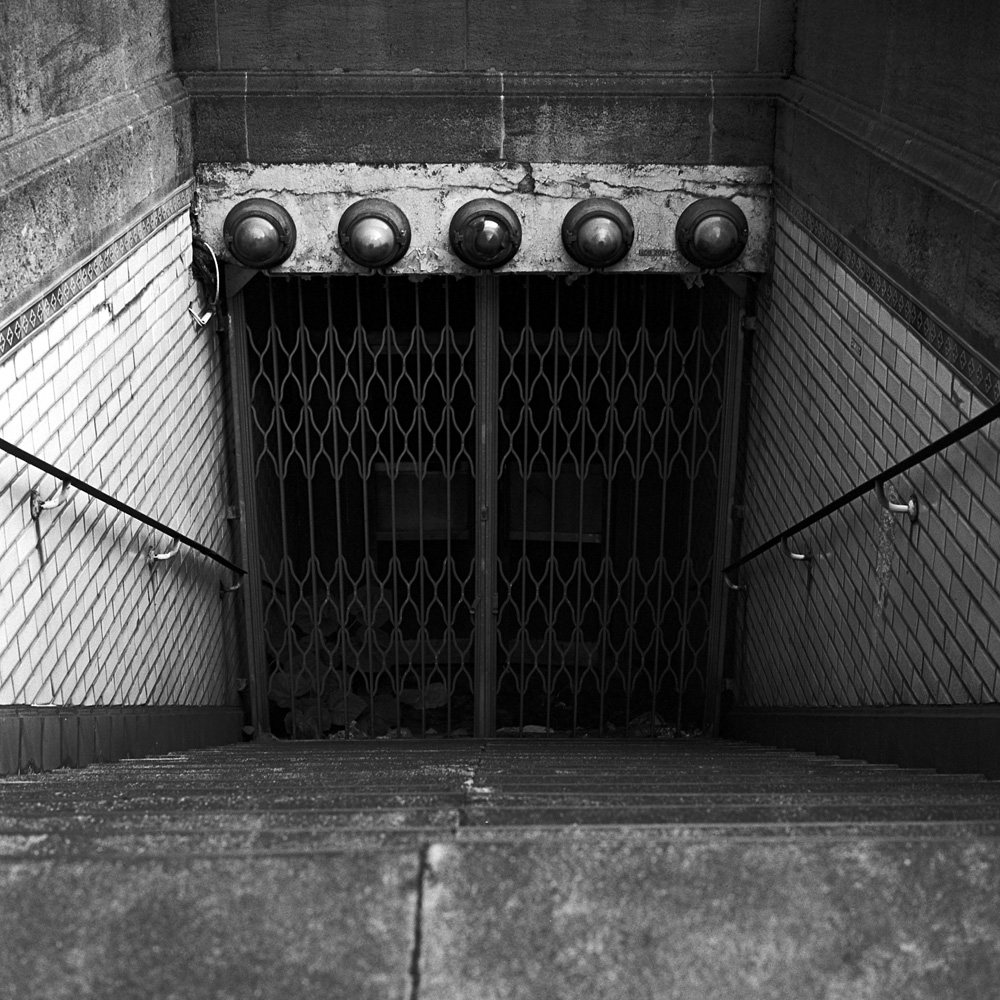
On the way out of the courtyard you pass by what seems to be an entrance to the Metro, all closed up. This is a block and a bit from the main entrance to the Cité metro, so it is possible this was a direct entrance to enable workers at the Palais de Justice to go directly to and from their offices. Or it could just be an underpass or an entrance to a tunnel system connecting multiple buildings in the neighborhood. I’m voting for subway entrance even though it doesn’t have the nifty bronze art nouveau surround because the lamps above the gates look like the lamps over the Cité station entrance. Any Parisian readers are more than welcome to chime in and correct me.
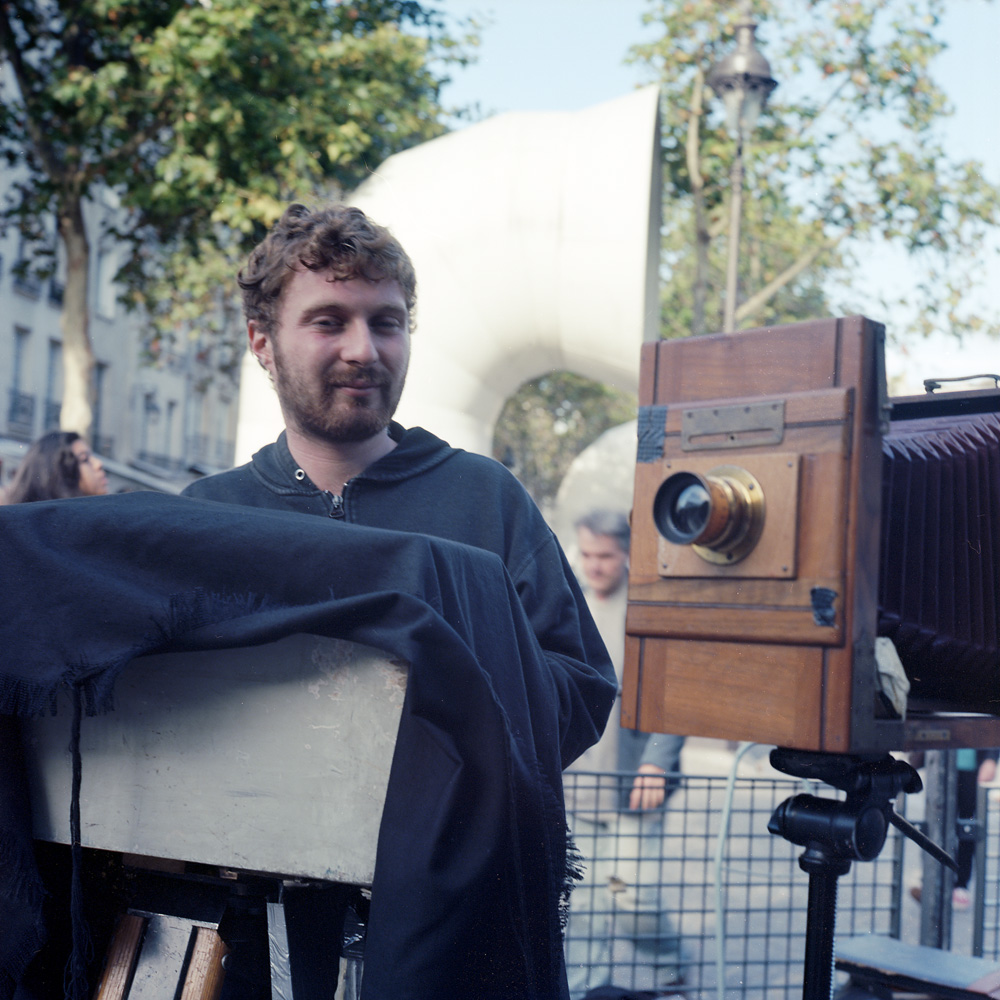
Meet Hans Zeeldieb, the street photographer working outside the Pompidou Centre. He was set up with his vintage 5×7, paper negatives, and portable darkbox doing portraits for 15 Euros a pop. He shot and developed them on the spot in 15 minutes. We struck up a friendly conversation when I saw his camera and he saw mine and talked a lot about photography. He sent me down the street a few blocks to the Centre Iris to go see an exhibit of wet plate collodion images by Jacques Cousin and several of his students, as well as some work by my friend Quinn Jacobson. Several years ago, I was involved in a gallery space in Hyattsville, Maryland called Art Reactor, where I curated a show of photographs made using the whole plate format*, and Quinn was one of the artists I selected. I think I made Hans a little nervous, as he overexposed the image of me. He did capture a good expression of me though, so I was happy to support a fellow working photographer.
In the first photo, I caught Hans with his hands in the darkbox, processing a print. The way it works, he exposes a paper negative in the camera, then develops it in the box. After the negative is developed, he sandwiches it with another piece of paper, opens a window in the dark box to expose it again, and processes the second paper, which now has a positive image. There are several advantages to this process – by working with paper, the development and fixing is much faster than with film, and you can use the same chemistry for both your negative and your finished print. I’ve seen or read about other itinerant photographers using much the same technique around the world, from Madrid to Kabul.
Hans with his camera, processing a photo
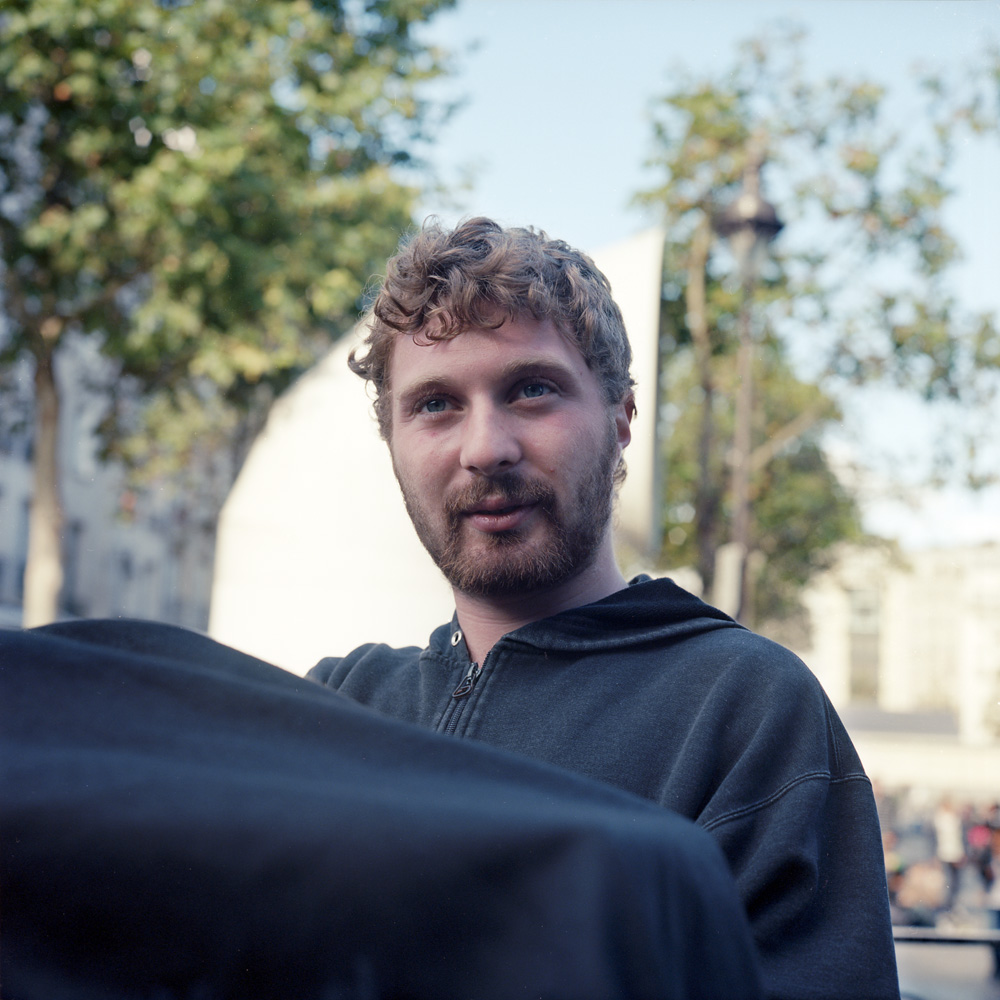
Here is a portrait of Hans outside the Pompidou Centre, just a close-up this time without the camera in the frame. He seems a little lost in thought – I think he was counting time for the print he was developing.
Hans, at the Pompidou Centre
* Whole Plate format is the original photographic format, defined today as 6 1/2 x 8 1/2 inches. It is not entirely certain how this size was chosen by Daguerre as the plate size he wanted to use, but reasonable speculation ties it to book printer’s printing plates. It has varied in its specification over time, but it settled on the 6 1/2 by 8 1/2 size by the late 19th century.
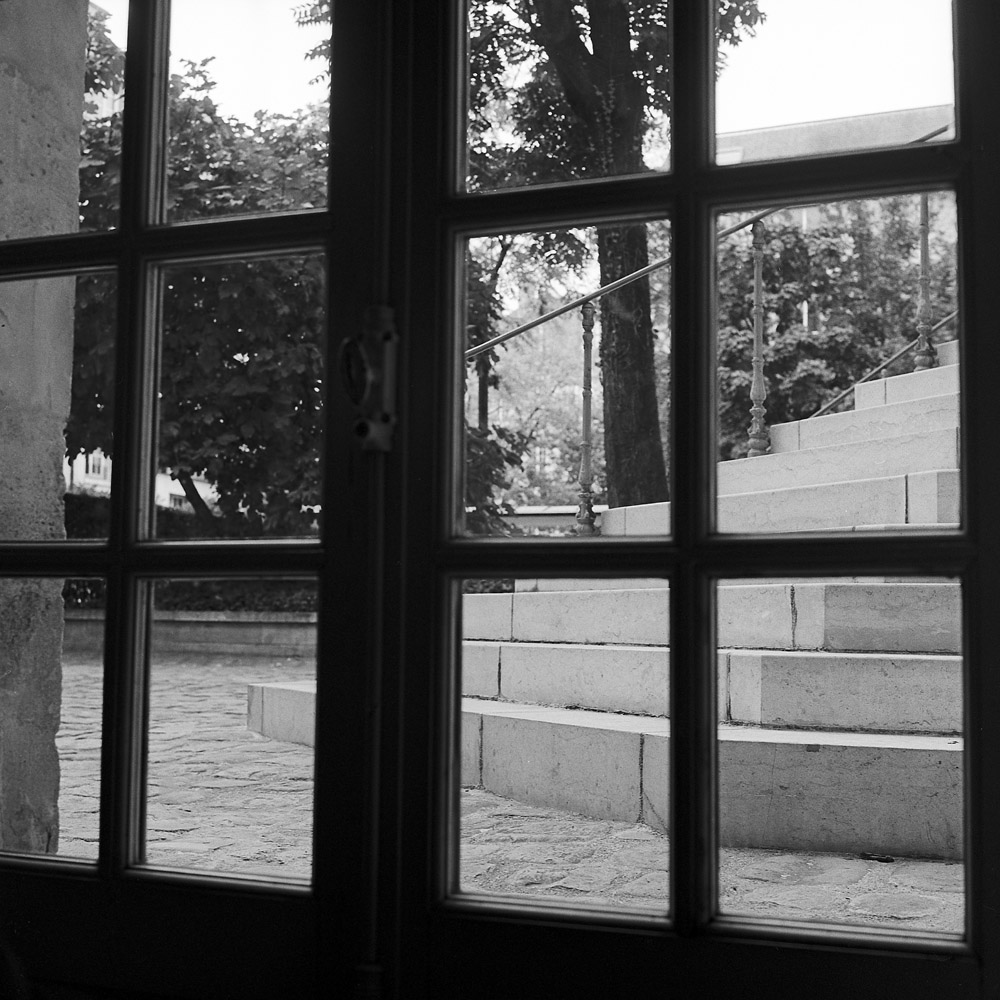
A photographer’s visit to Paris would not be complete without a trip to the Maison Europienne de la Photographie. The primary exhibit was Sebastiao Salgado’s current body of work documenting indigenous ways of life and remote places around the world. It would have been very hard to photograph the exhibit itself as it was VERY crowded, so I turned my lens toward the building. The entrance is a very modern looking (read 1960s style) wing, but the main block of the facility is housed in another one of those 18th century Parisian hotels that once belonged to some noble family.
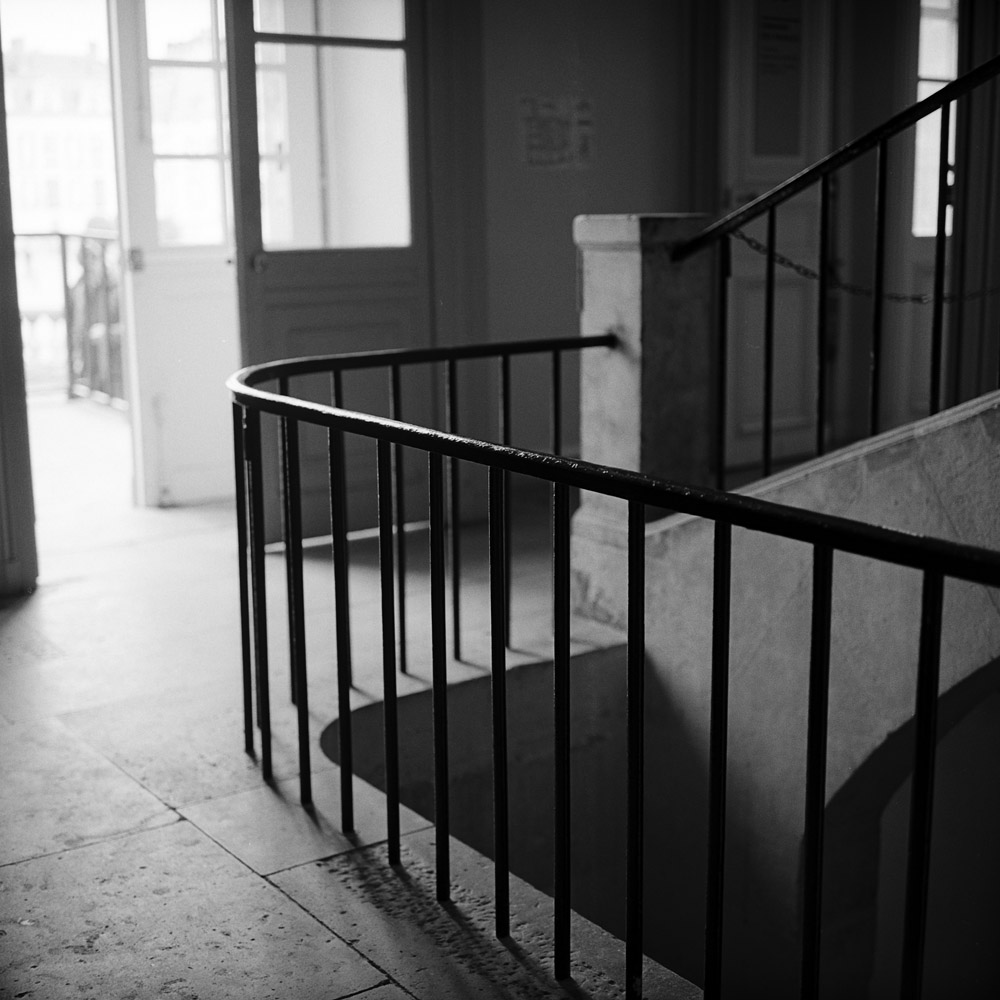
Staircase, La Maison Europienne de La PhotographieWindow, Courtyard, La Maison Europienne de La Photographie
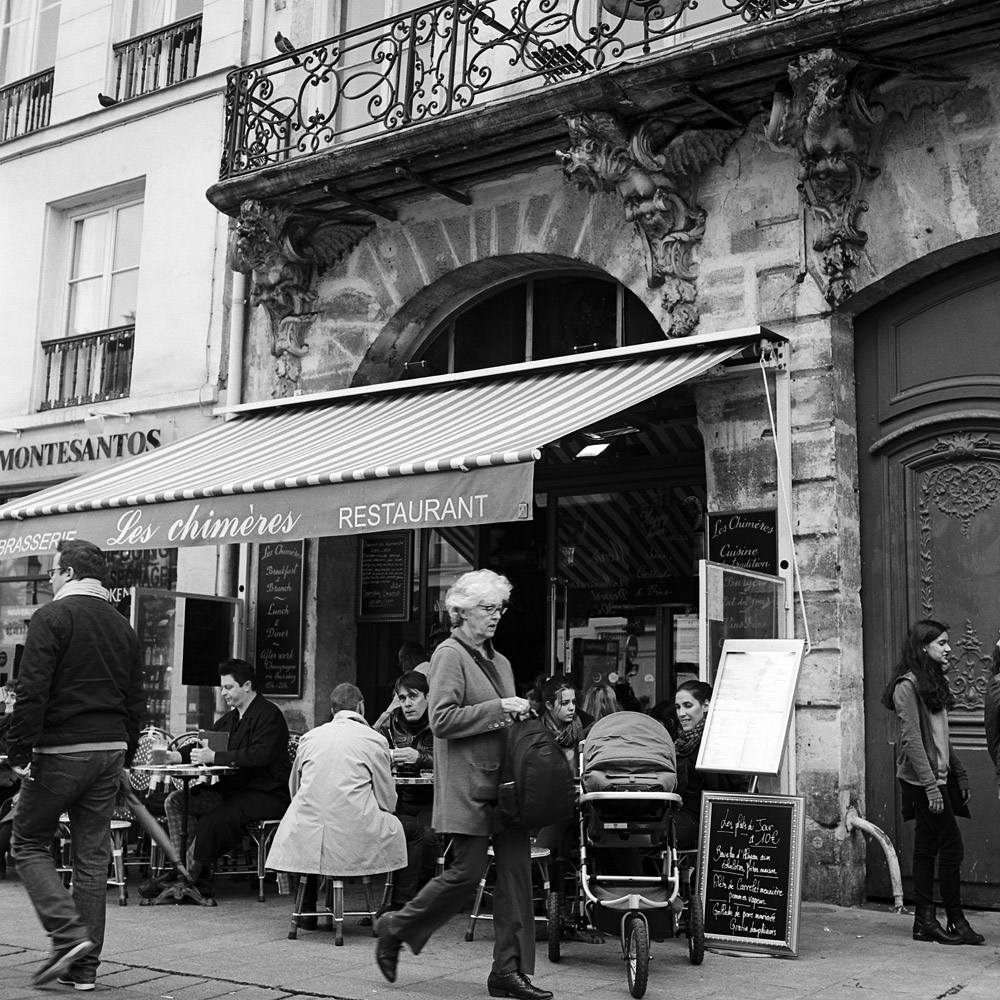
After visiting La Maison, my father and I ate here at Les Chimeres for lunch. It was a fairly chilly (for October) day, and you can see Parisian cafe culture at work – despite the chill, people were sitting outside of their own free will. This was true across the city, and in all weather (it took a brisk rain to drive people inside completely).
Les Chimeres Restaurant, Marais
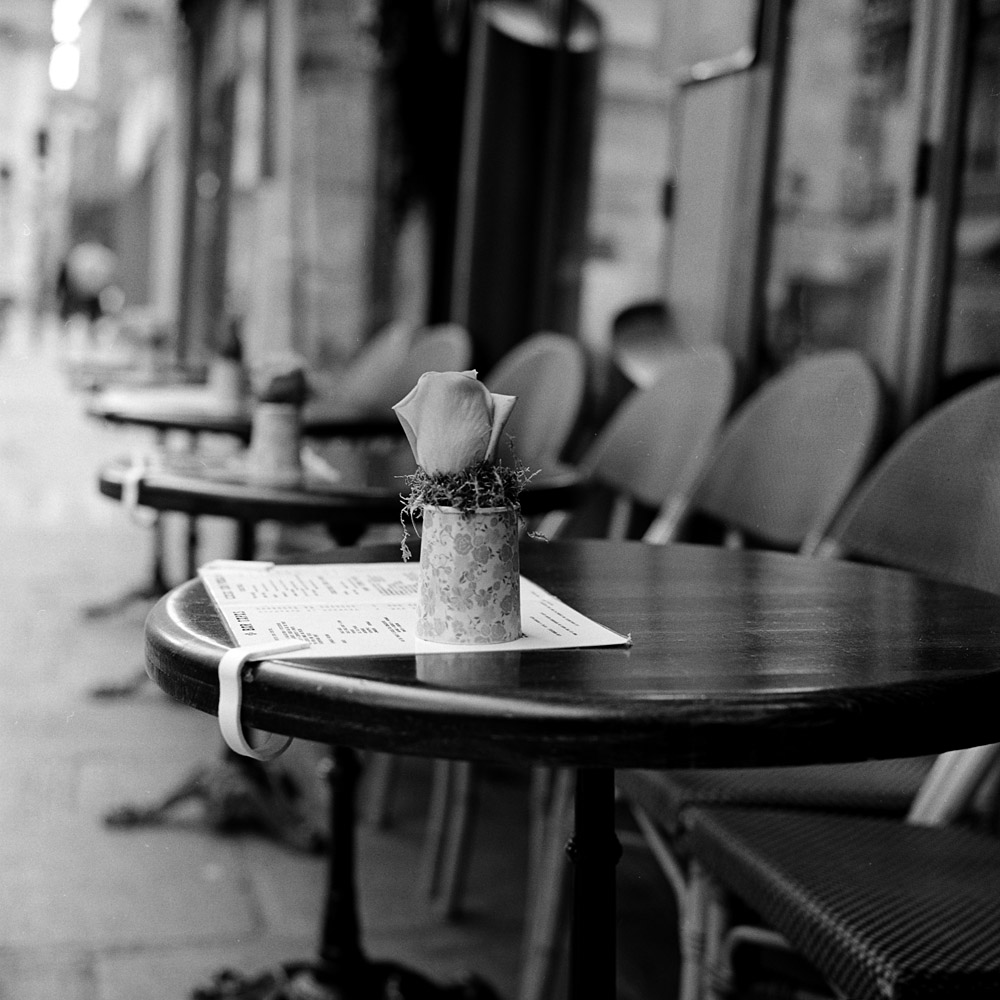
Near the Pompidou Centre, I came upon this row of cafe tables set up and waiting for patrons. I know it’s a bit treacly and cliché as photos go, but it’s representative of the place and the atmosphere.
Cafe Tables, Pompidou Centre
Around the corner from La Maison and Les Chimeres was this scene. Number 43, Rue Francois Miron. I have no idea if anyone famous or noteworthy lived (or lives) there, but the weathered texture and the irregular symmetry and repeating patterns of the building cried out to be photographed.
43 Rue Francois Miron
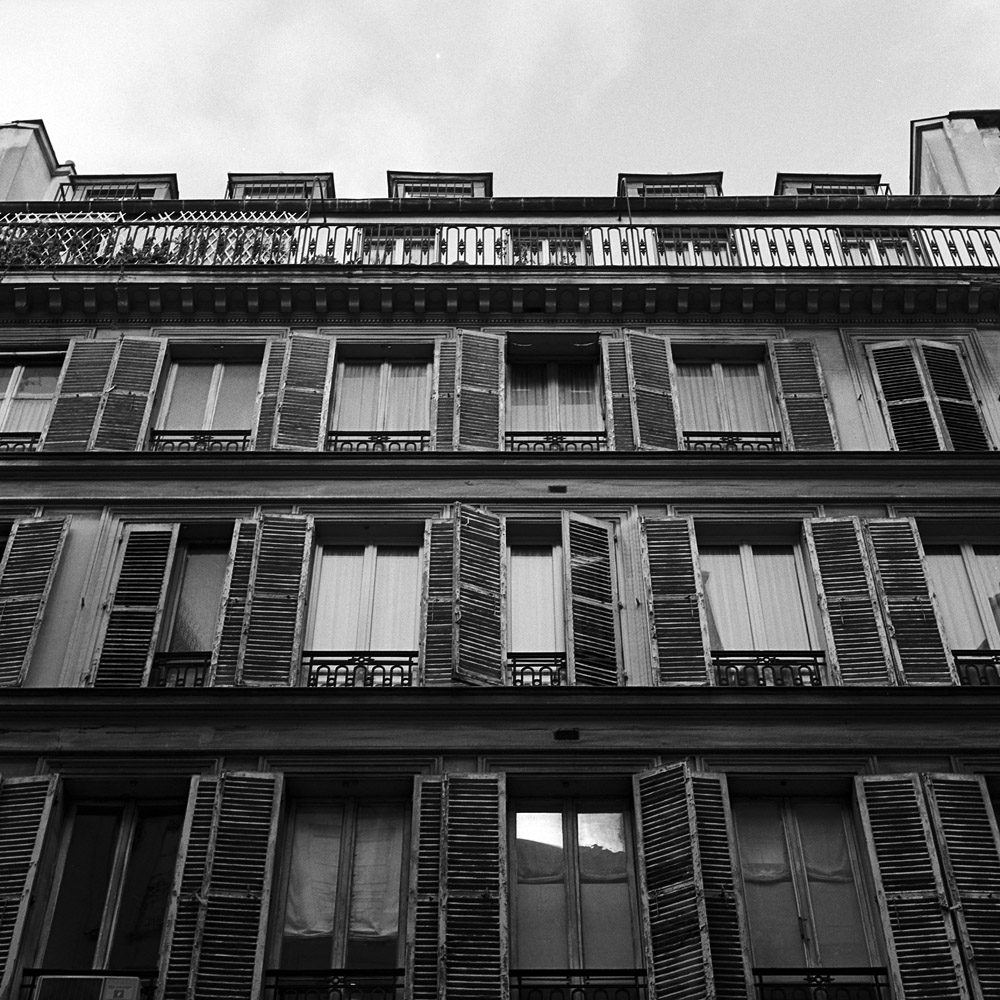
I love looking up at buildings – it’s sometimes hard to do, and it forces you to break out of your street-level perspective. In places like New York, where the buildings are so tall, it can almost induce a sort of negative vertigo, but it still behooves us to stop and re-think how we see the world. Plus, you might miss something interesting if you don’t.
Upstairs, 43 Rue Francois Miron
Again, everything was shot with a Rolleiflex 2.8E, on Kodak Tri-X film.
Le Marais is one of the few neighborhoods in the city center of Paris that retains its medieval core of narrow wandering streets. It is home to a diverse population from Orthodox Jews to gay pubs and nightclubs. It is full of little art galleries, boutiques, shops and restaurants, where cutting-edge cohabits with the ancient.
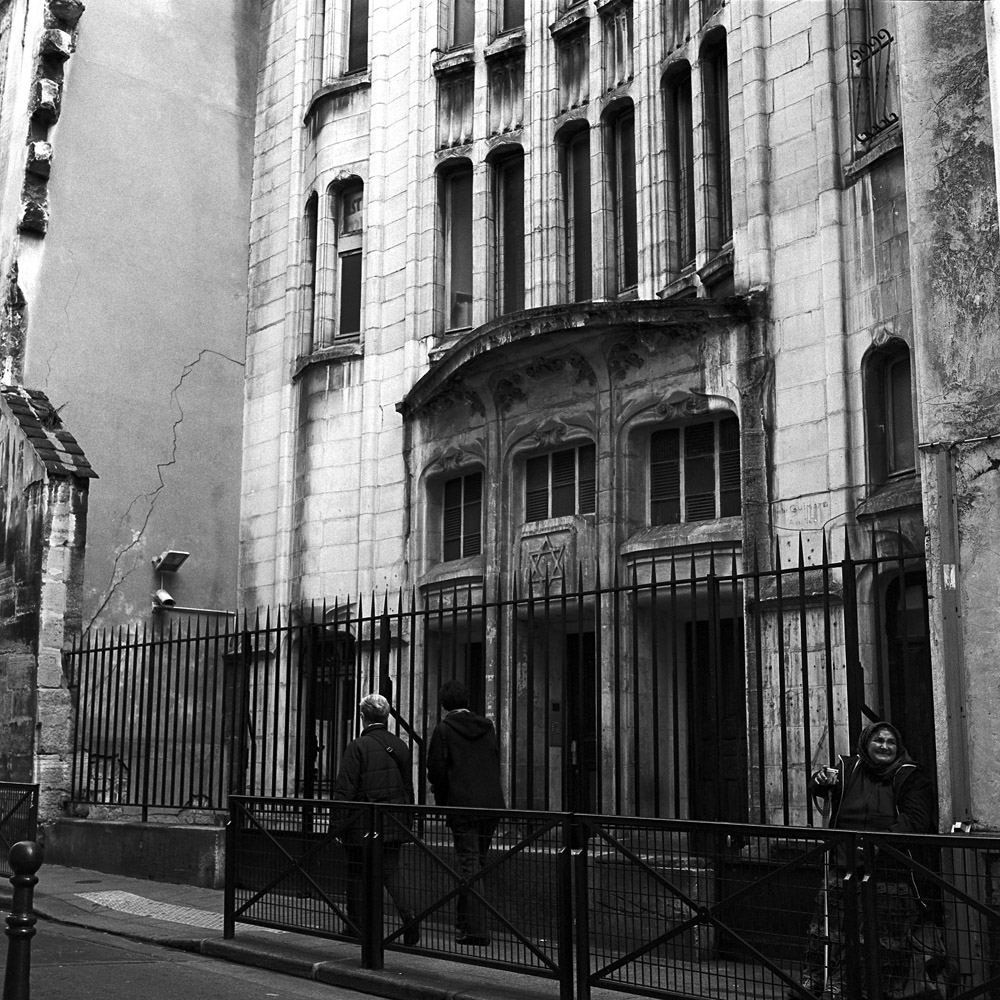
The look of the Orthodox Jewish center appears to be late 19th century/early 20th century Art Nouveau, which surprises a bit that it survived the Nazi occupation.
Orthodox Jewish Center, Le Marais
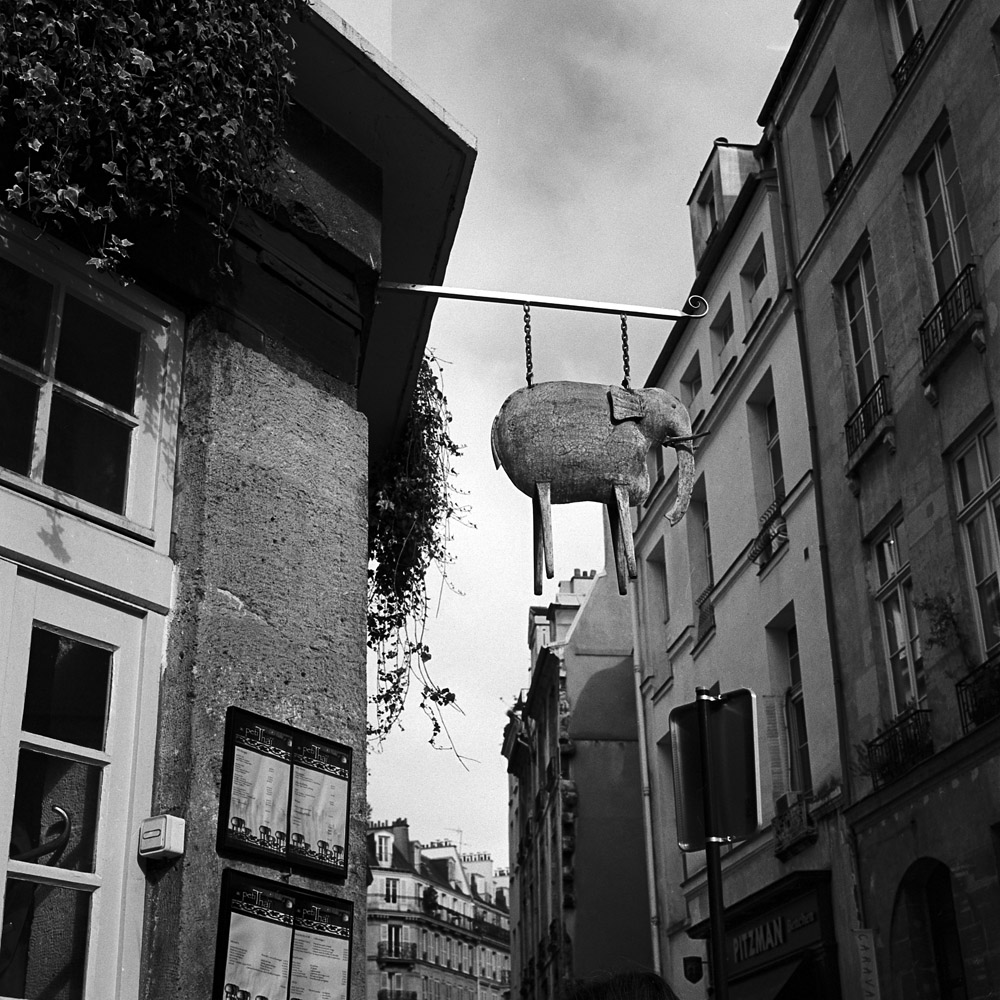
Just across the street and down a half a block is Le Petit Thai restaurant, with its cute elephant sign. I don’t yet know the significance if there is any, to why it seems there are always Thai restaurants in gay neighborhoods.
Le Petit Thai, Le Marais
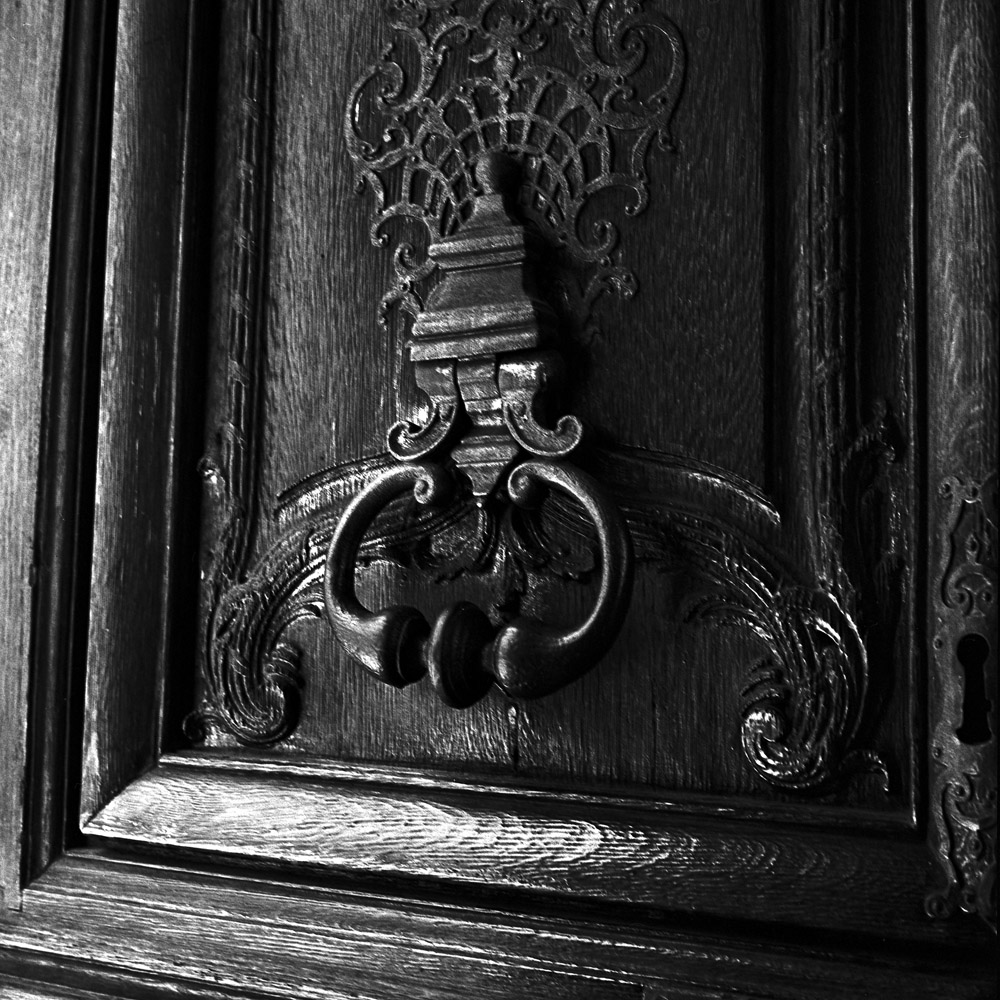
A beautiful wrought-iron door knocker on a weathered wooden door in the Marais:
Door Knocker, Le Marais
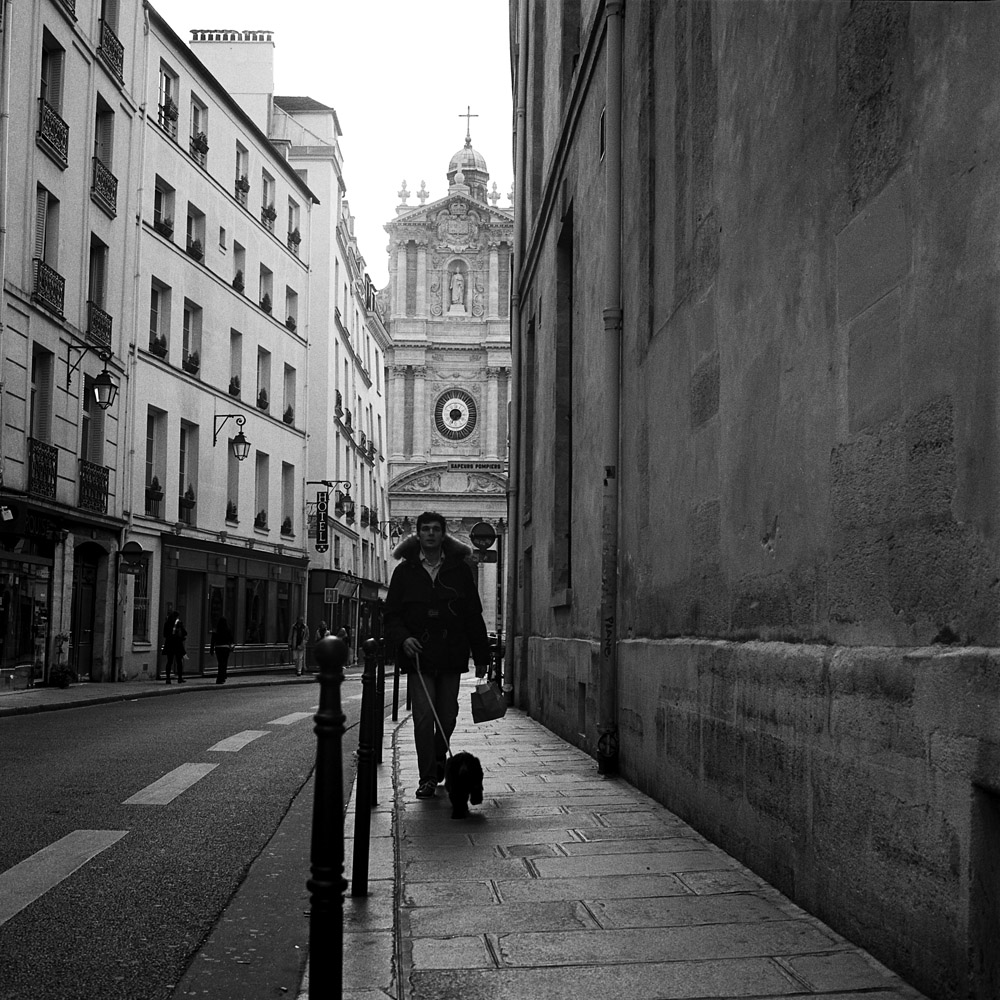
A man out walking his dog on the Rue Sevigne. The church in the background is the Eglise St. Paul-St. Louis, which housed the hearts of Louis XIII and XIV (after they were dead, of course) until the French Revolution. The current structure dates back to the 17th century.
Dog Walker, Rue Sevigne, Le Marais
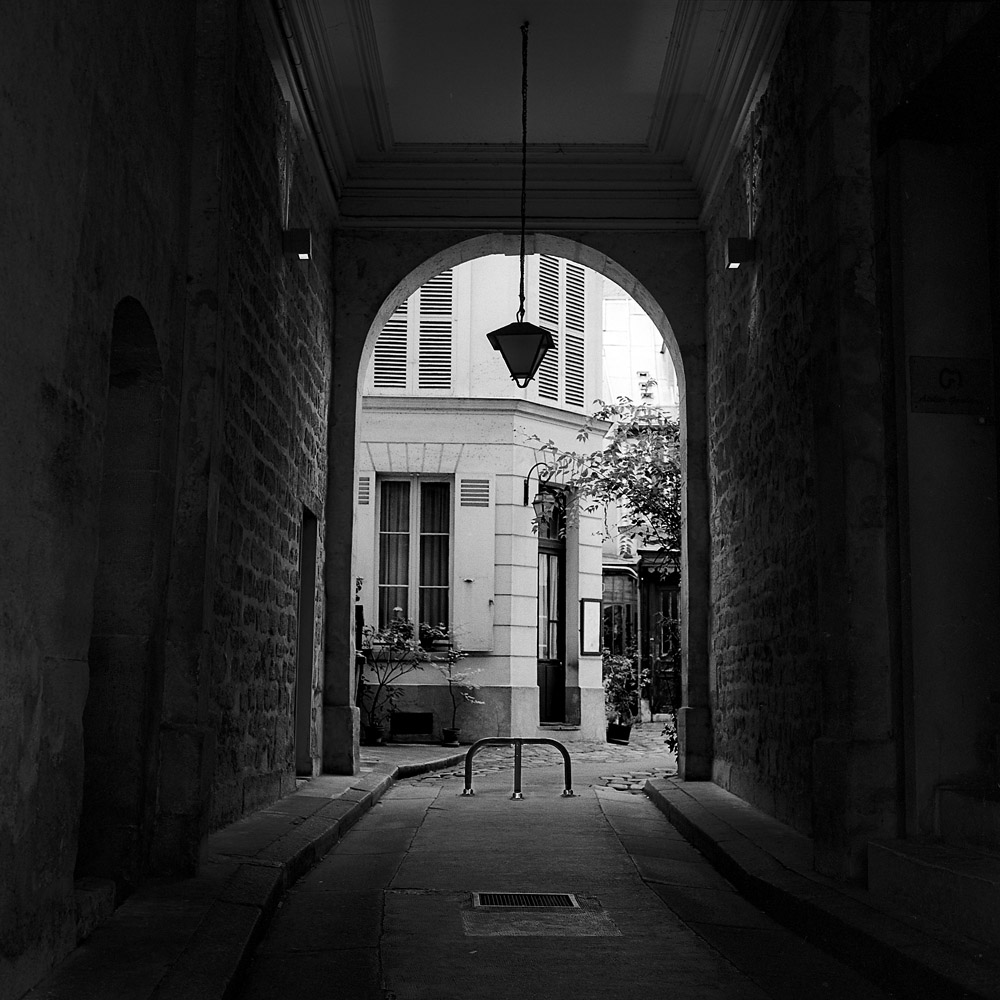
The Marais is perforated with a profusion of residential courtyards which remain invisible to the passer-by unless the massive doors at the street are open. Here is a view into one of these courtyards. They retain a very distinct feel of Old Paris where things are quieter and slower-paced. Entering one feels like stepping back in time, a peaceful oasis utterly cut off from the hustle and bustle of the city outside.
Courtyard Near The Bibliotheque de Paris
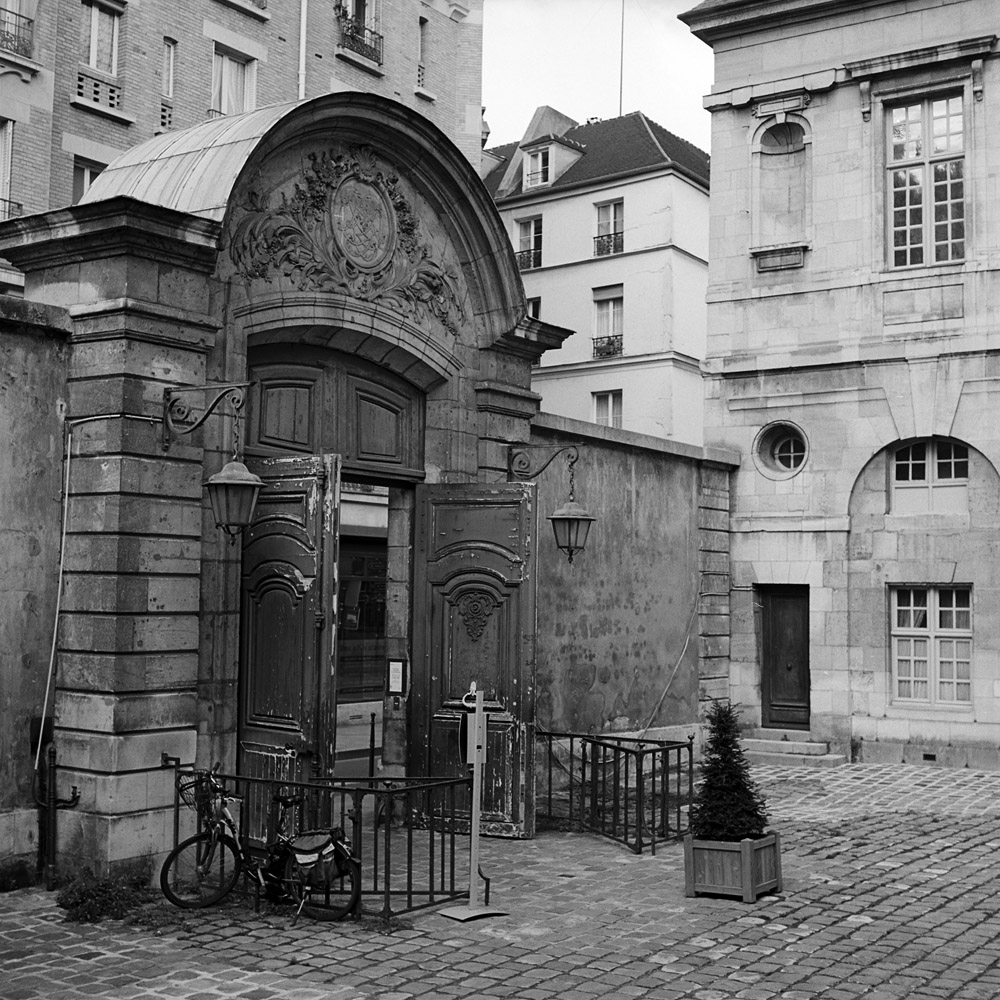
Eugene Atget took many of his most famous images in and around the Marais as the city was being surrendered to Haussmannization during the Second Empire/Third Republic periods. One of his regular subjects was the Bibliotheque de Paris, originally built as a hotel (town-house for a noble family) in the 17th century. Today it houses the city library. This view is of the entrance gates to the courtyard.
Le Porte du La Bibliotheque de Paris
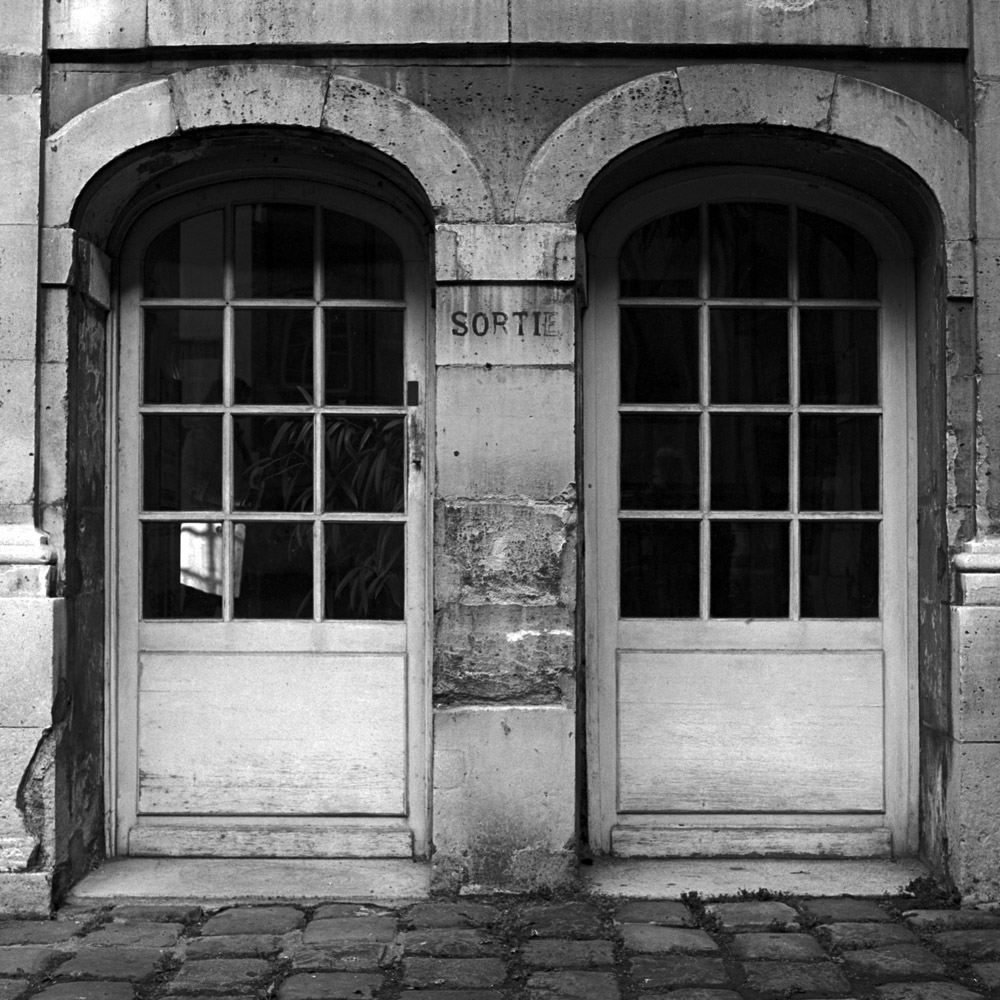
A door into the courtyard, marked Sortie (exit). Not too much exiting going on through this door, though, if the giant potted palm visible in the left-hand window has anything to say about it.
Sortie, Bibliotheque de Paris
All images shot with my Rolleiflex 2.8E, using Kodak Tri-X film.
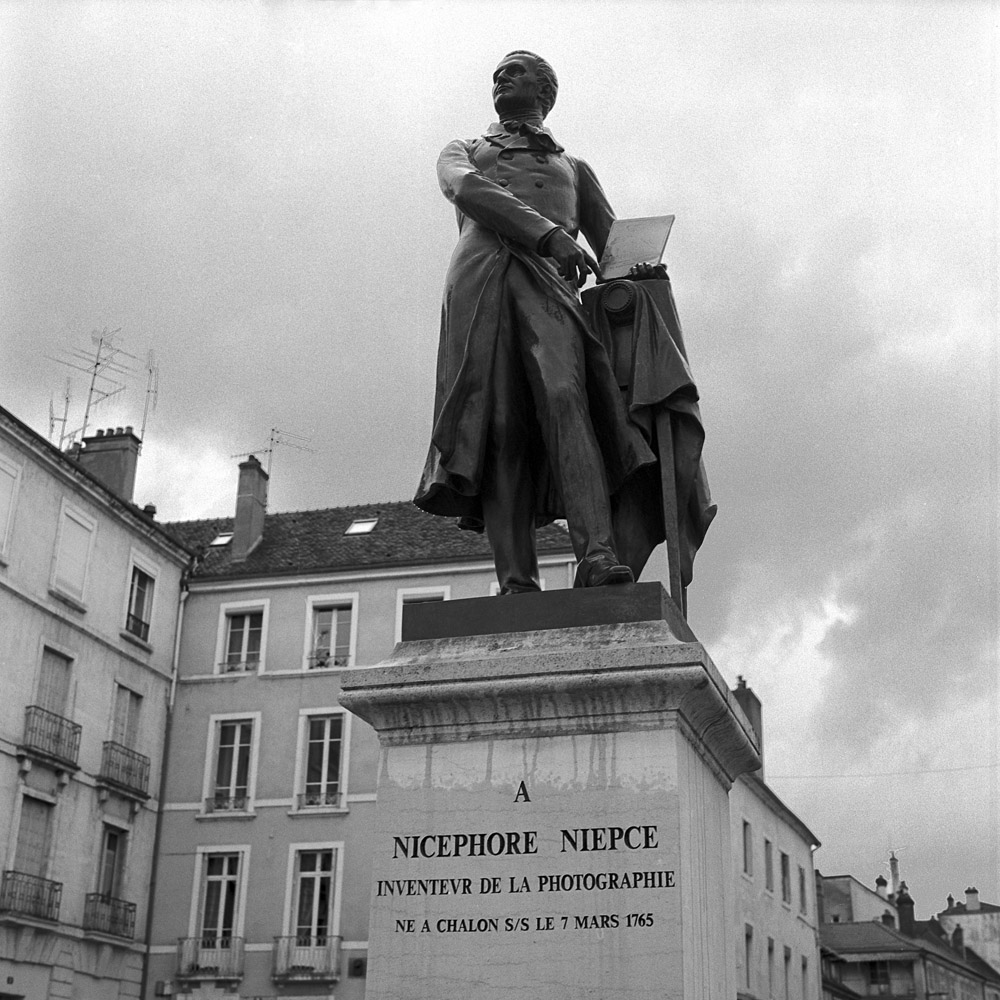
Here are a few more photos from Chalon-sur-Saone. The Niepce monument is the marker of the reason I took the trip in the first place – to visit the birthplace of photography. Nicephore Niepce invented the first successful photographic process, Heliography, in the mid 1820s. One reason most people haven’t heard of it and have never seen a photograph made by this process is that due to the extreme insensitivity to light of the chemicals, a single exposure required HOURS to record an image which ruled it out for photographing any non-static subject, like people, animals, or even plants, and it made photographing buildings difficult as well. In the early 1830s up until his death in 1833, he collaborated with Louis Daguerre, the net result of which was the publication of the Daguerreotype process in 1839.
Niepce Monument, Chalon
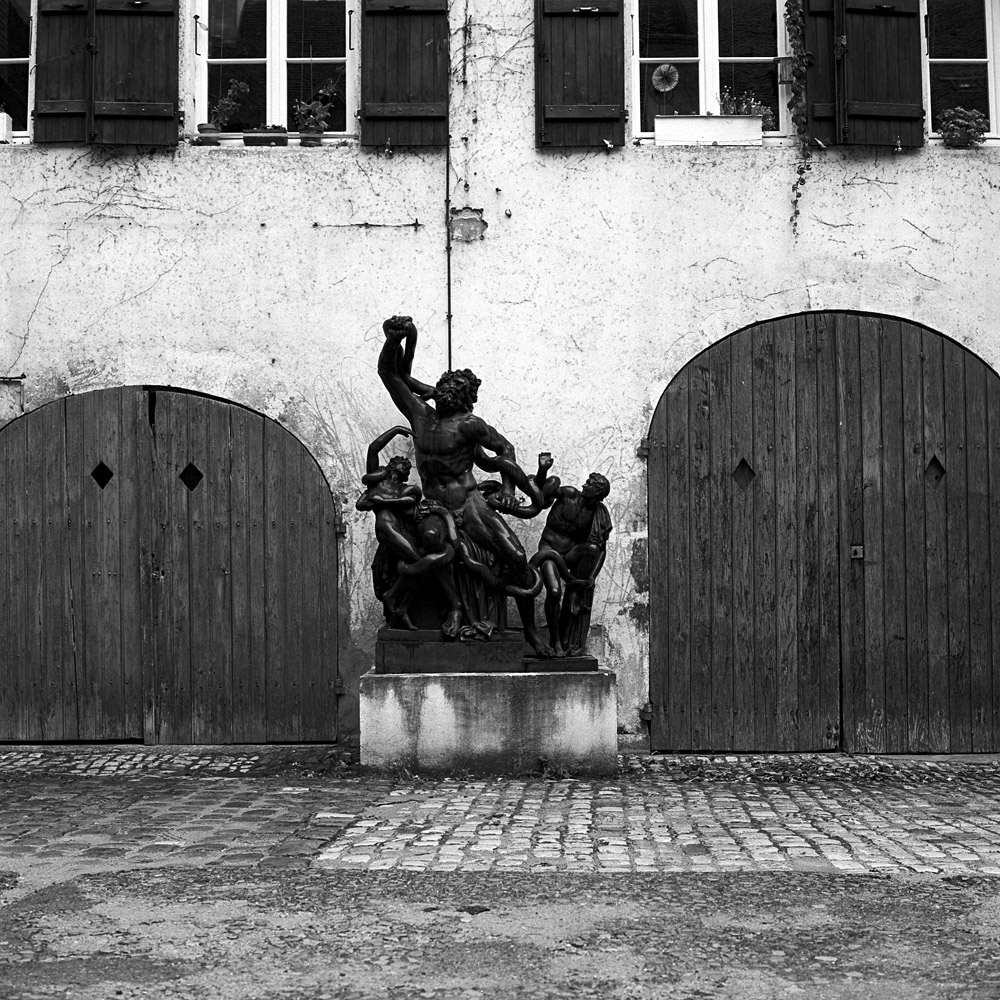
This statue of Laocoon, an ancient Greek mythological figure of a priest who warned the Trojans against admitting the wooden horse into the city, and was punished by he and his sons being devoured by sea serpents (for various reasons by various deities, depending on which version of his story you read). He’s also credited with the phrase “beware of Greeks, bearing gifts”. It’s a bit of odd statuary to find in a random courtyard around the corner from the Niepce Museum in Chalon, but there it is.
Laocoon, Courtyard, Chalon
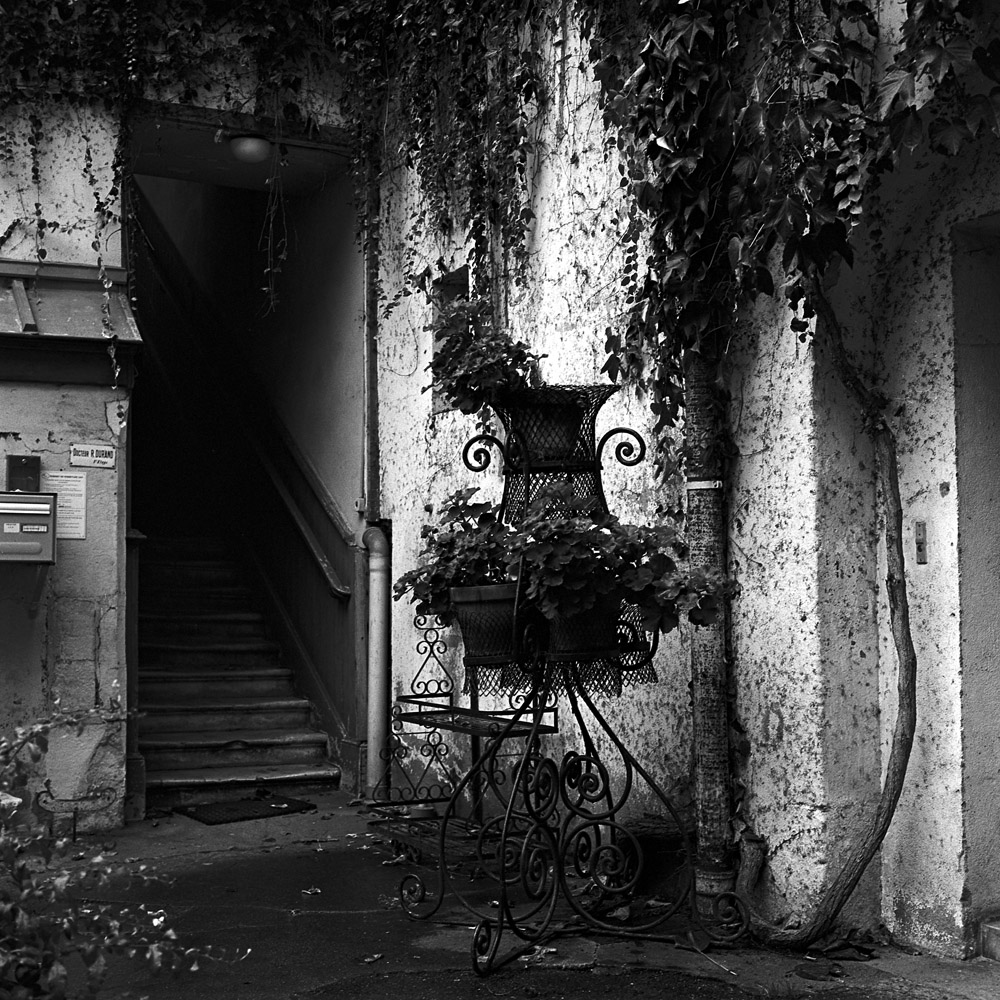
In the same courtyard as the Laocoon statue, there was this iron plant stand in front of the stairs to a second-floor doctor’s office.
Stairs, Planter, Courtyard, Chalon
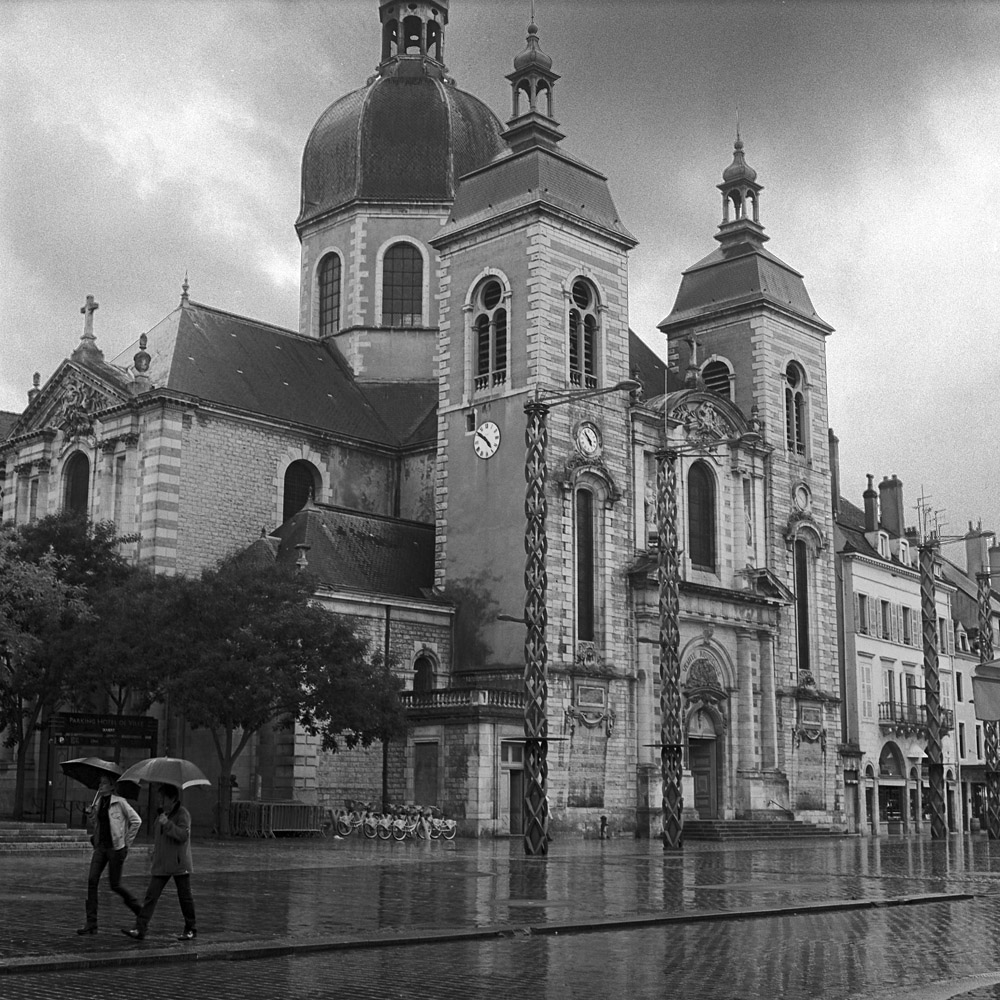
This is the basilica in Chalon. In significant architectural contrast to the old cathedral (which has parts dating back to the 7th century, and abuts the Roman walls of the town), this is clearly a 17th century structure. I peeked inside and the stained glass is very modern, like the lower windows at Notre Dame, but even more drab – greens and yellows and clear glass, and in desperate need of a cleaning from the outside. The light fixtures on the plaza are quite new and part of an effort to reinvigorate the downtown area. If you look carefully at them, at around the 12 foot mark, you’ll see metal disks protruding that serve as anti-climbing devices.
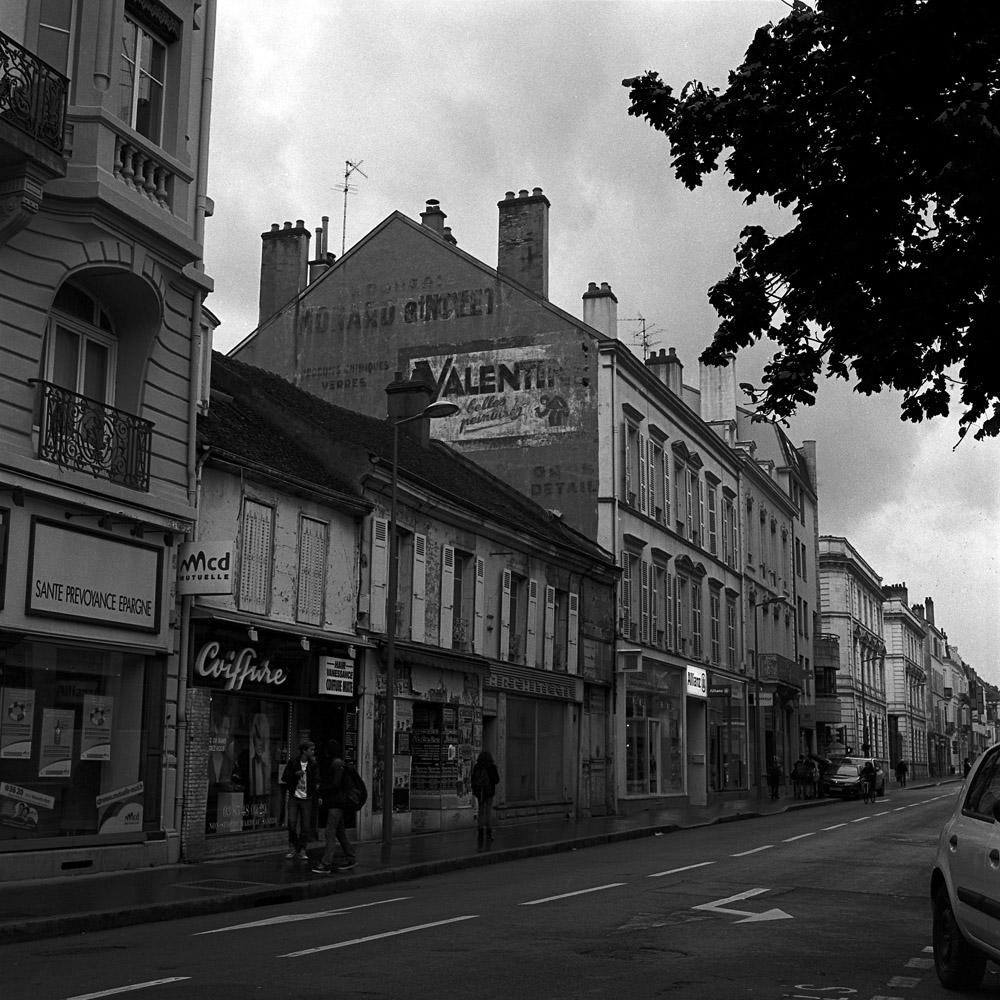
Here are businesses and storefronts in Chalon-sur-Saone.
The old advertisement still visible on the wall of the building is on a street leading away from the old (2nd-16th Century) core of the town. Just around the corner is a McDonalds, with view camera designs etched in the windows. Even if the rest of the world doesn’t know it, the Chalonnais certainly remember what portion of their heritage is related to photography.
Old Advertisements, Chalon
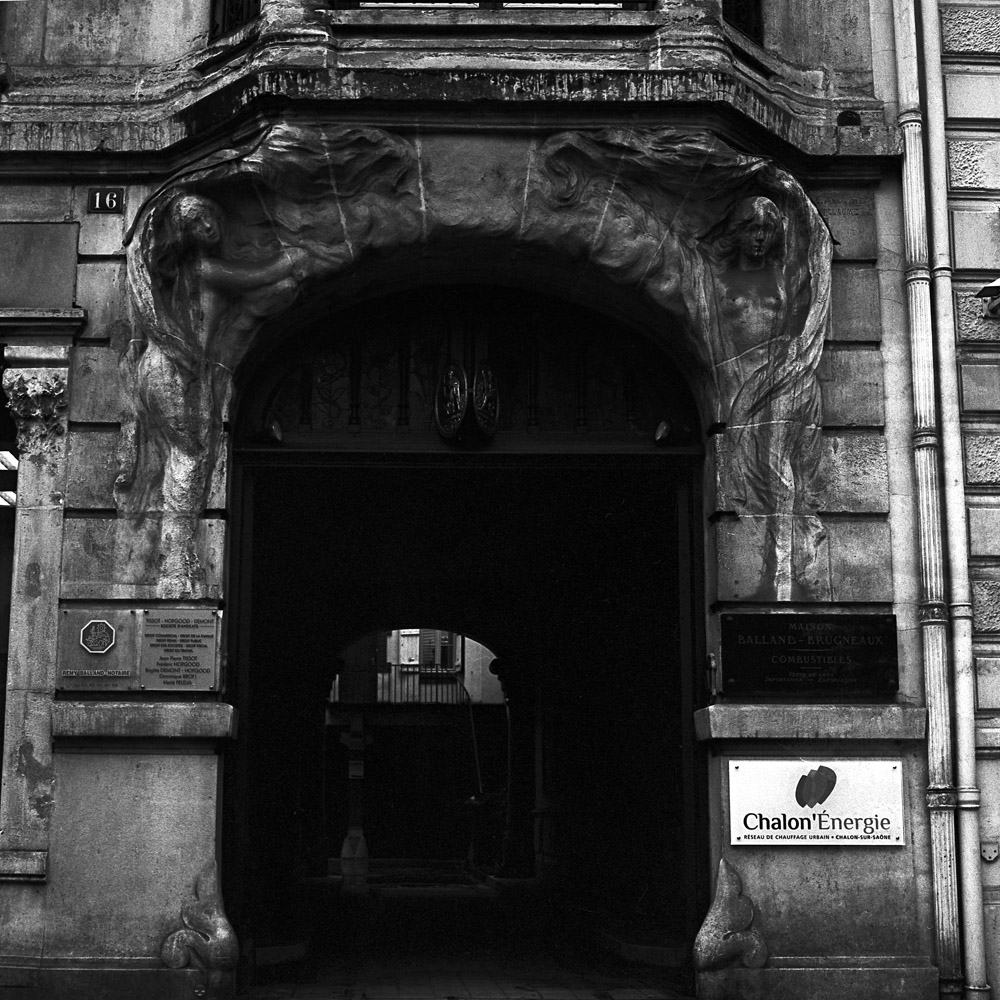
After spending ten days in Barcelona a few years ago, I became highly attuned to Art Nouveau architecture. Although Chalon is not particularly close to Barcelona (or Paris or any other major center for European architecture in the 19th century) the facade of this building is a particularly striking example of Noucentisme.
16 Blvd de la Republique, Chalon
Walking the streets of Chalon, you can tell that the town has had better days, but it is by no means a dying town, as can be seen from the businesses on the streets of the city center.
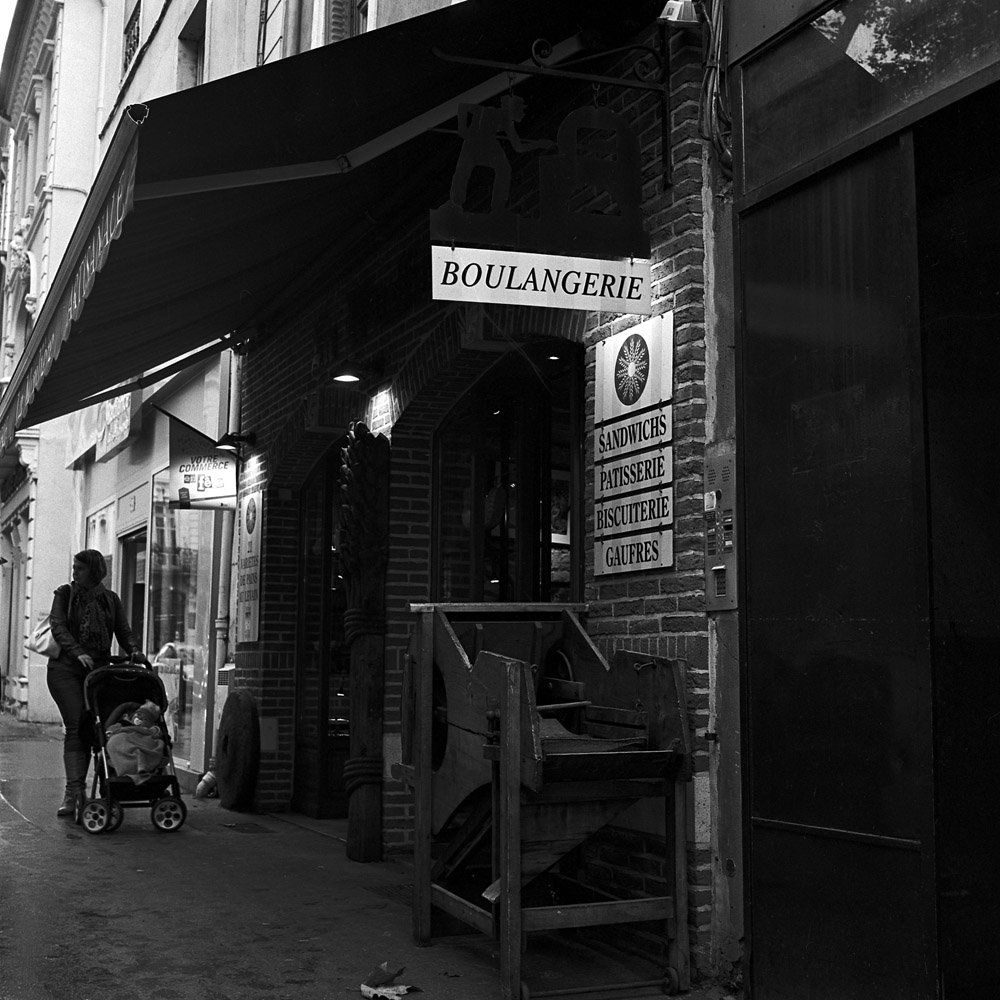
This boulangerie (bakery) was always busy whenever I walked past.
Boulangerie, Chalon
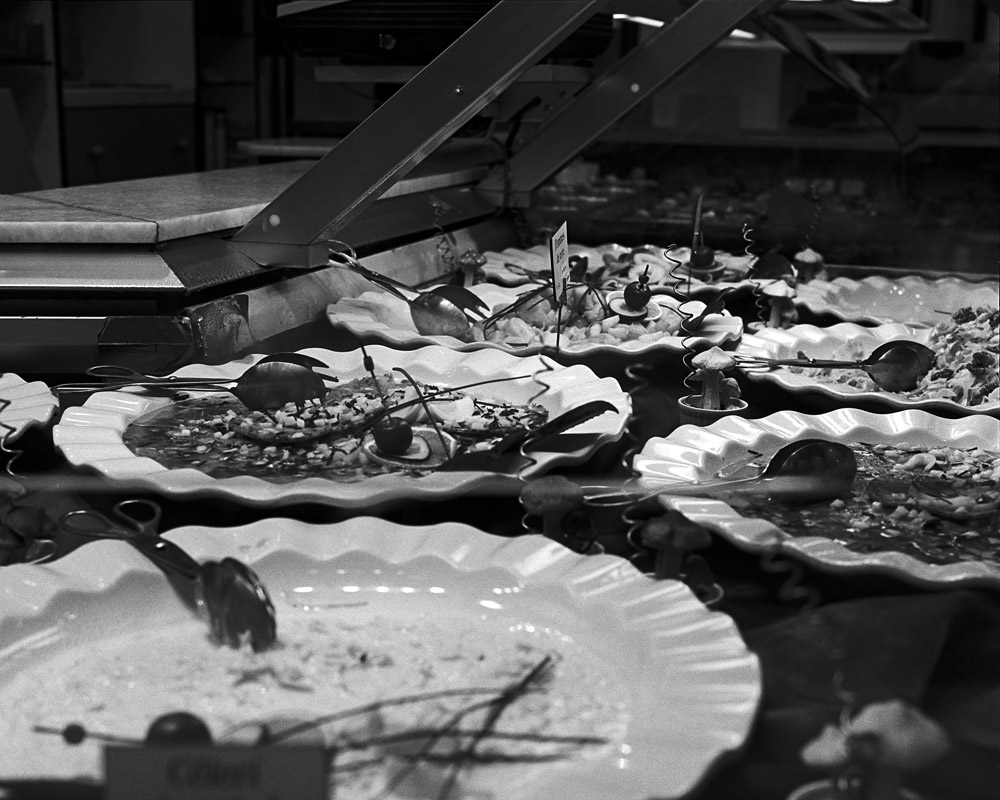
This fishmongers’ had particularly appealing plates of fresh seafood in their display cases.
Poissonierre, Chalon
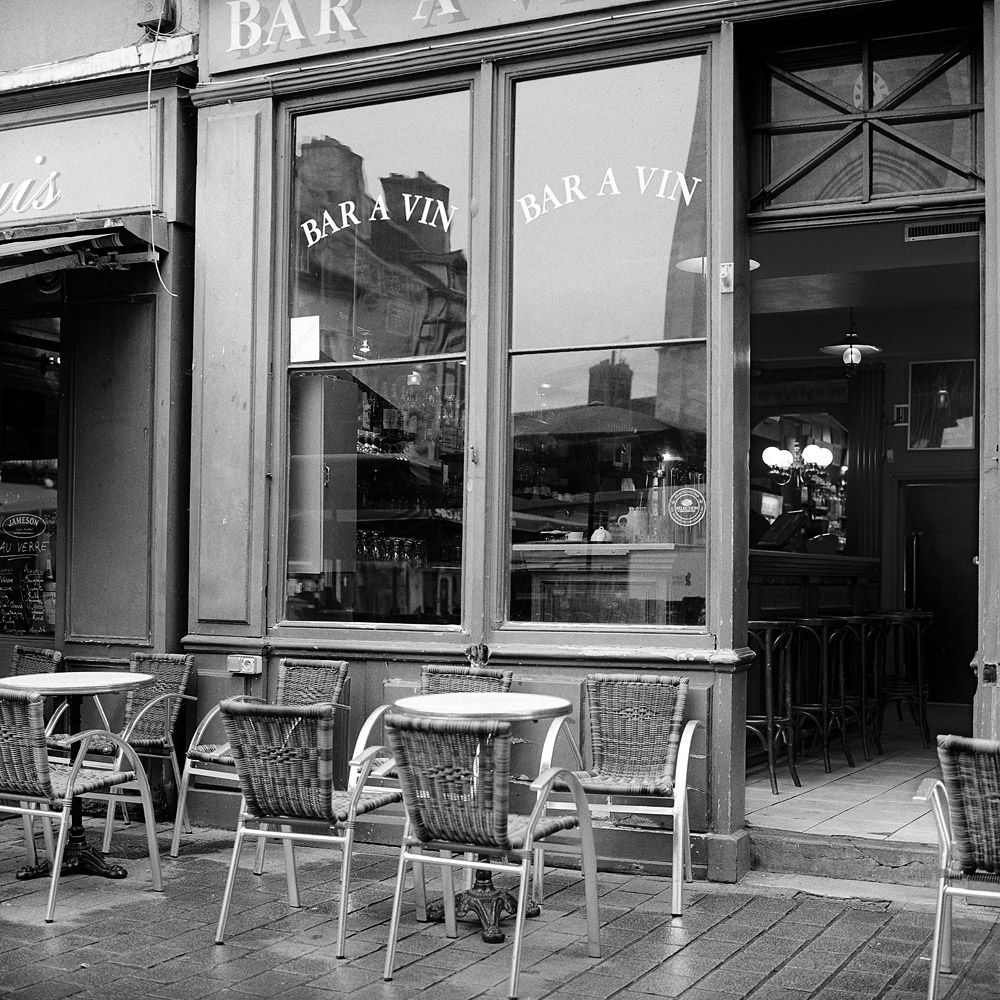
The Bar A Vin is located on the main square across from the cathedral. If things look particularly quiet, bear in mind I was there on a weekday, in the middle of the afternoon between lunch and dinner, and it was raining.
Bar A Vin, Chalon
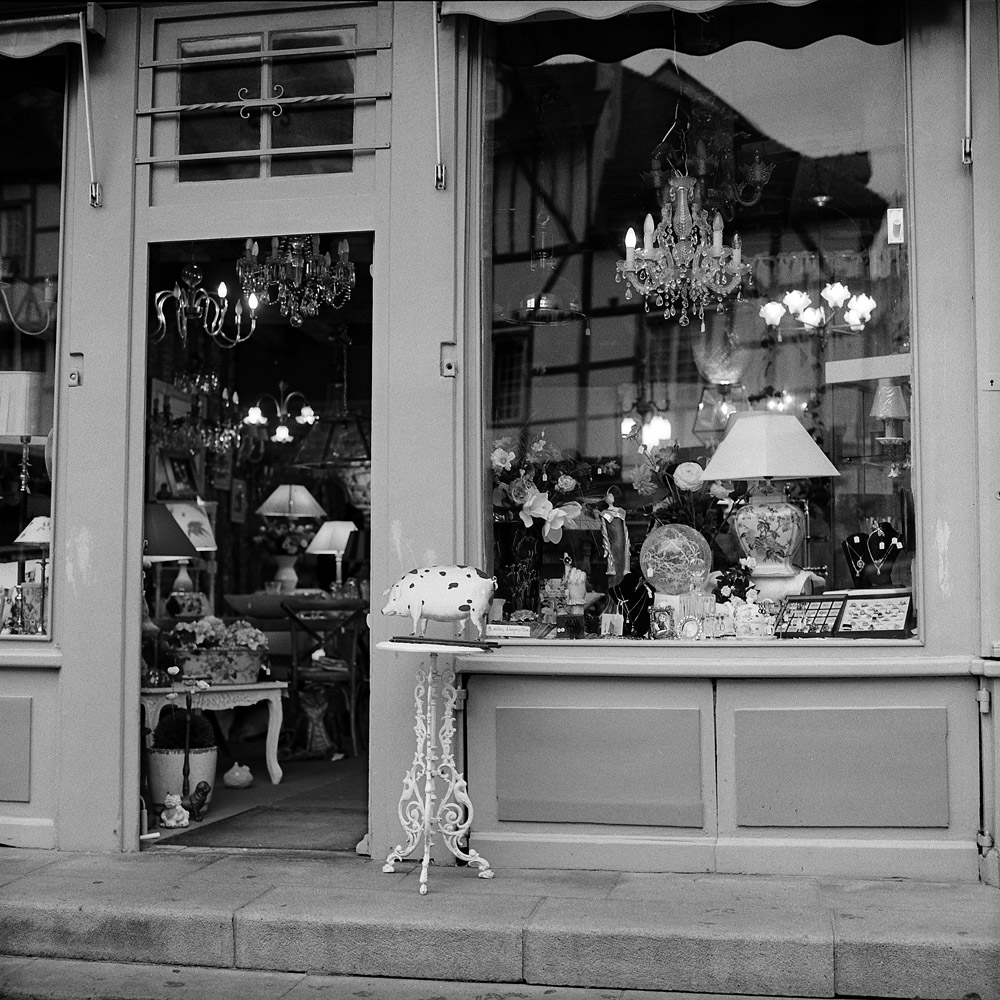
The lamp store was on another corner of the square and had the cutest little pig sign out front. The glow from all the lamps inside was enough to make it easy to balance the exposure between inside and outside.
Lamp Store, Chalon
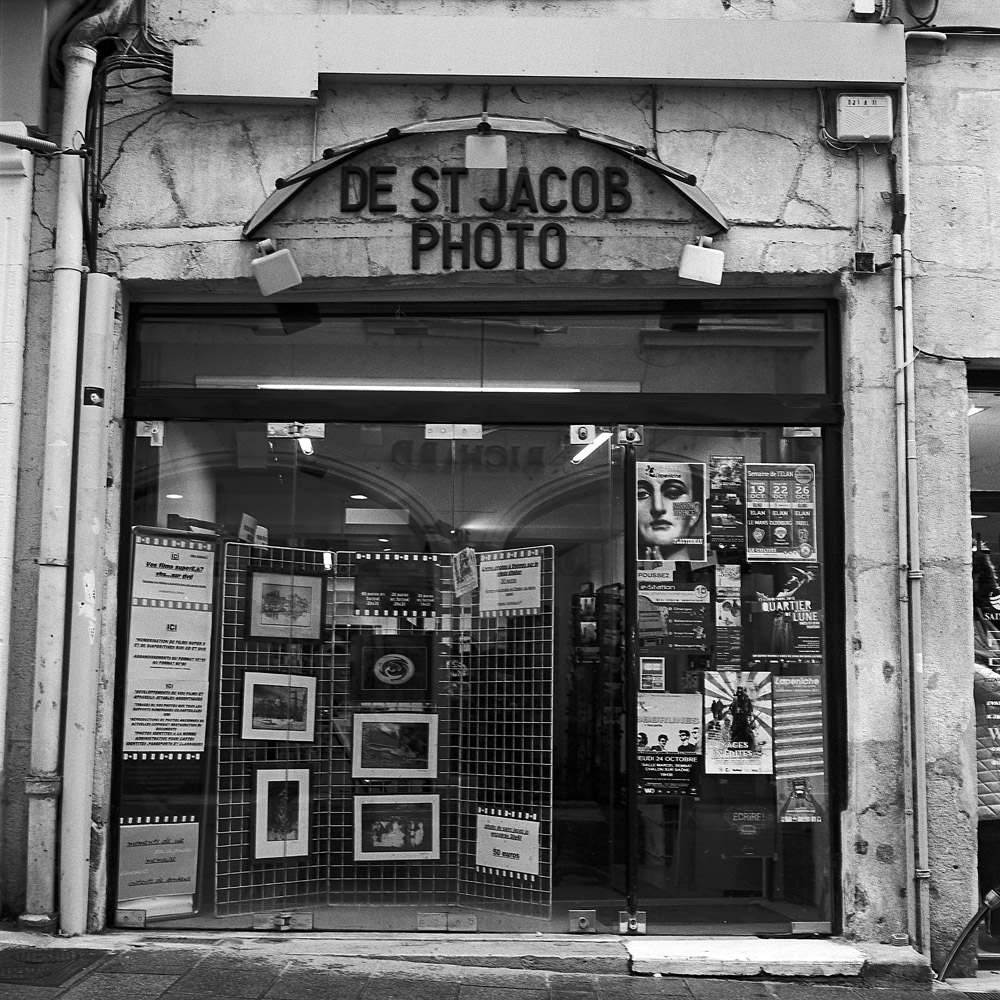
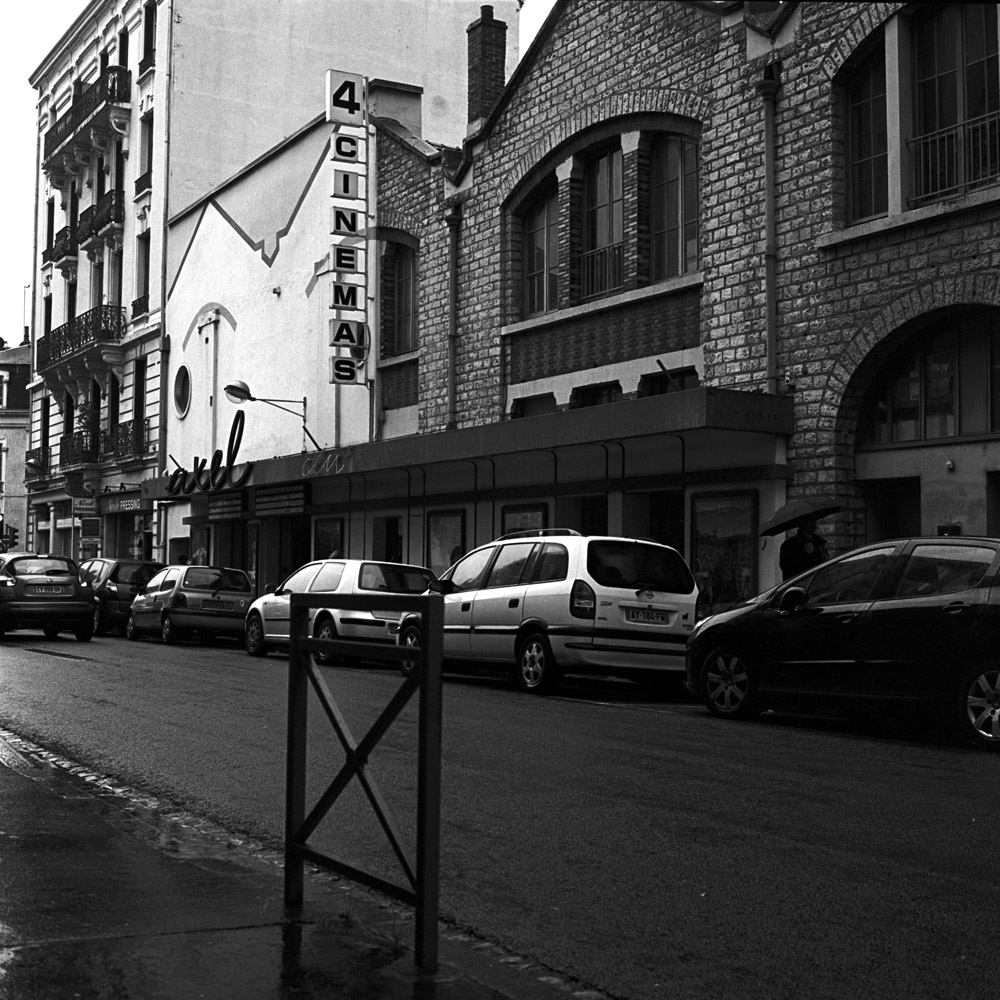
What photo essay about Chalon-sur-Saone could be complete without photos of things related to photography? Here is a photo studio in the center of the medieval district, and the 4-screen movie theater.
 dcphotoartist