Just a quick recap of the Native American images I have in my collection.
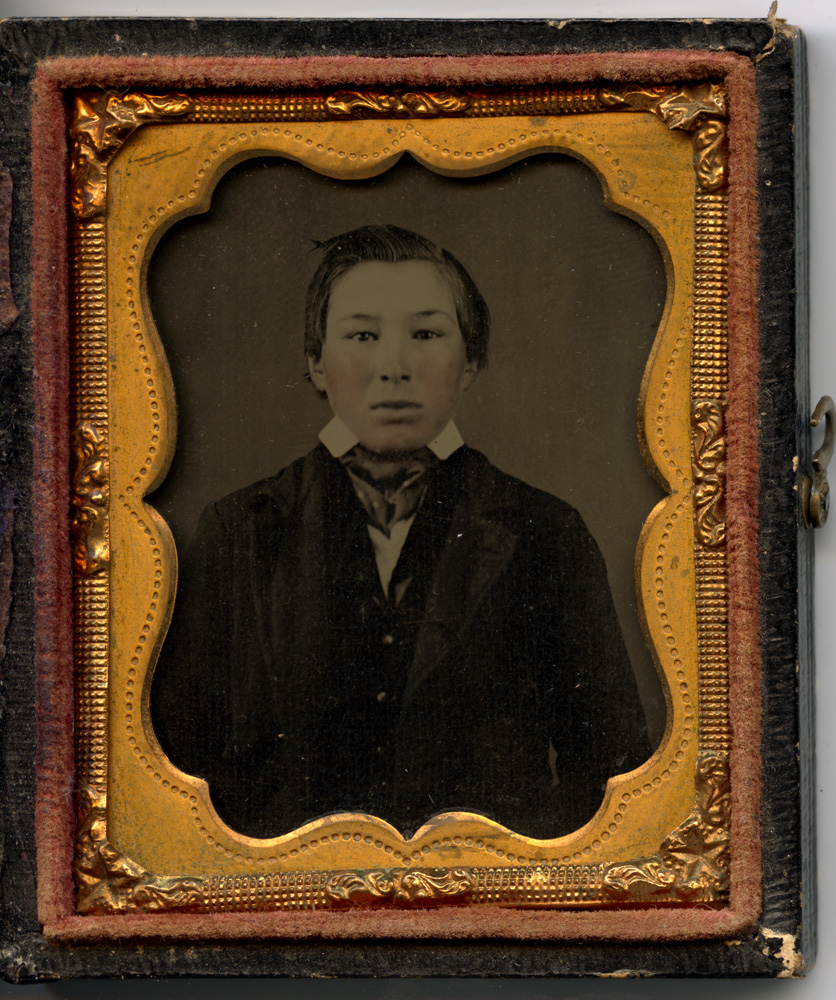
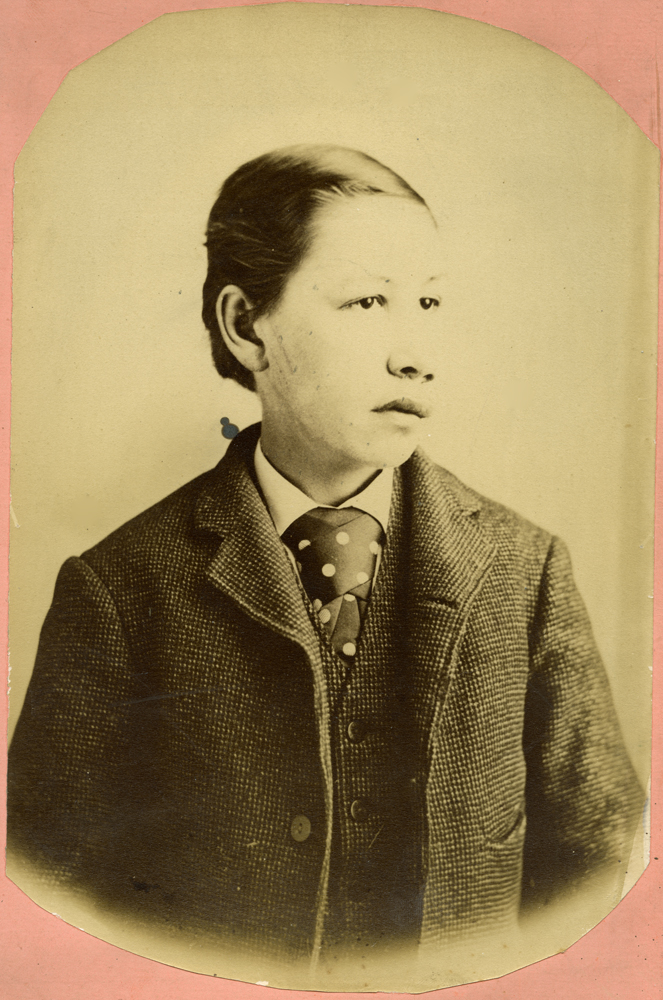
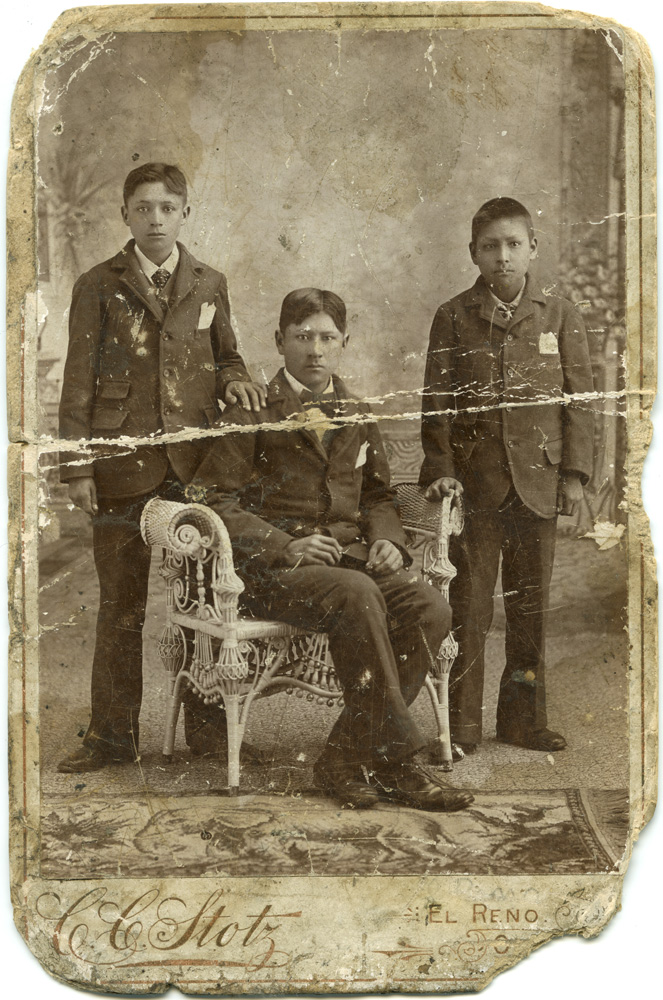
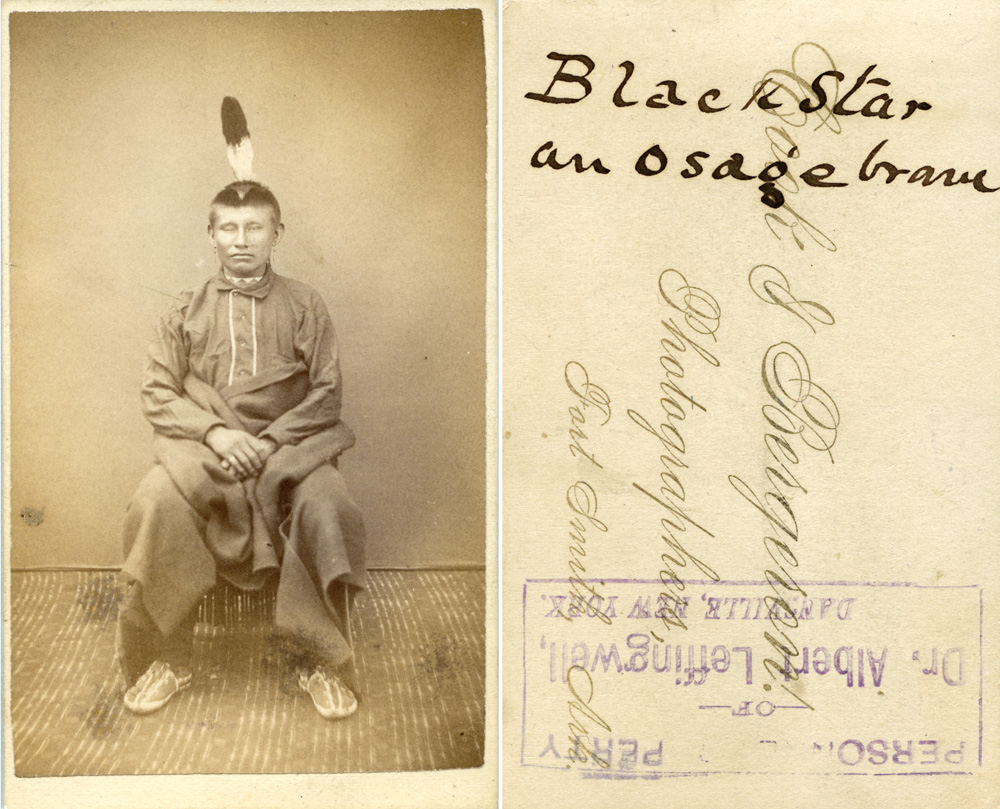
Ambrotype, Penobscot Boy, 1857Anonymous Asian-, Native-, or African-American boyNative American trio, El Reno, OklahomaNavajo Brave, Grand Canyon, attributed to Karl MoonBlack Star, an Osage Brave
There’s one more I’ll have to scan, but it is NOT an original image, rather a halftone reproduction pasted onto a vintage cabinet card stock. The image is of two southwest Indians of indeterminate tribal origin and quite honestly of indeterminate gender. It MAY be a vintage print, but it most certainly is not an original photograph. It’s a good illustration of the risks and pitfalls of antiques hunting – I found it in a little antiques mall in Delaware. The space was, while not poorly lit, definitely on the dim side. Enough so that I did not recognize the halftone dots. I paid $40 for the image, thinking at the time I was getting a great deal. I discovered the halftoning when I went to scan the image to email it to the National Museum of the American Indian to see if they could identify it better for me. When I zoomed in on the hi-res scan, the halftone dots popped off the screen! I was dismayed to discover this – I probably paid about $35 too much for it, given the fact it was a reproduction, but in the long run, I came out ahead. At the same time I bought it, I also bought another CDV of Lydia Thompson, a Victorian era actress, showing her in costume from a role she played in 1872. That one? I want to say I paid $5, but it was definitely less than $10. In the process of researching who she was I found a similar CDV of the same image on ebay, selling for $100. The object lesson here? Take a loupe with you when you go photo hunting. It could make the difference between paying original art prices for a poster-quality reproduction, or getting a good deal on an original image. It’s a variation on the old carpenters’ adage: Examine twice, pay once.
Here is a circa 1882 image of Black Star, a member of the Osage tribe, taken in Fort Smith, Arkansas. This was an incredible find, for me, and the back marks on the CDV are fortunate in that they facilitate a discussion about provenance, something that unlike say artistic style or means of production comparatively little has been written academically. Provenance, the history of ownership of an art object, is of considerable importance when the object is rare, quite possibly unique, and of considerable value. A documented provenance can help prove authenticity, and adds to the cachet of ownership – to have a Michelangelo drawing on ones’ wall, for example, is to share ownership of that drawing with kings and clergy, princes and museums.
In this case, the provenance is incomplete, but there is more to it than is usually found with such objects. Only with the rise of art photography in the late 19th/early 20th century do you have much in the way of documentation of provenance for photographs. It is comparatively easy to trace the ownership history of an Ansel Adams print, where oftentimes the gallery that originally sold the print is still in business, and the past owners or their immediate heirs are still alive. But tracing that provenance for something like one of my Mathew Brady daguerreotypes, where even the sitter’s identity is unknown, is a near impossibility.
However, this image, with the subject’s identity hand-written on the back, and the photographers’ studio back stamp, presents the beginnings of possibility. There is a known moment in time and space where this was created – I found the studio of Cook & Bergeron to be operating in Fort Smith for only a few brief years, 1881-1884. At some point, this image was consciously collected, by a Dr. Albert Leffingwell of Dansville, New York, who felt it was important enough to stamp the back of the CDV with his library stamp. Dr. Leffingwell was a famous physician and author, champion of vivisection reform. When it made it into his hands, and for how long, is undocumented, as is what happened to it after his passing.
I acquired it from a dealer in Paris, France. So the CDV has travelled a long and circuitous route from Fort Smith, Arkansas to Dansville, New York, to Paris to Washington, DC with unknown stops in-between. I hope this blog post will some day serve as documentation of the provenance of this image for a future owner.
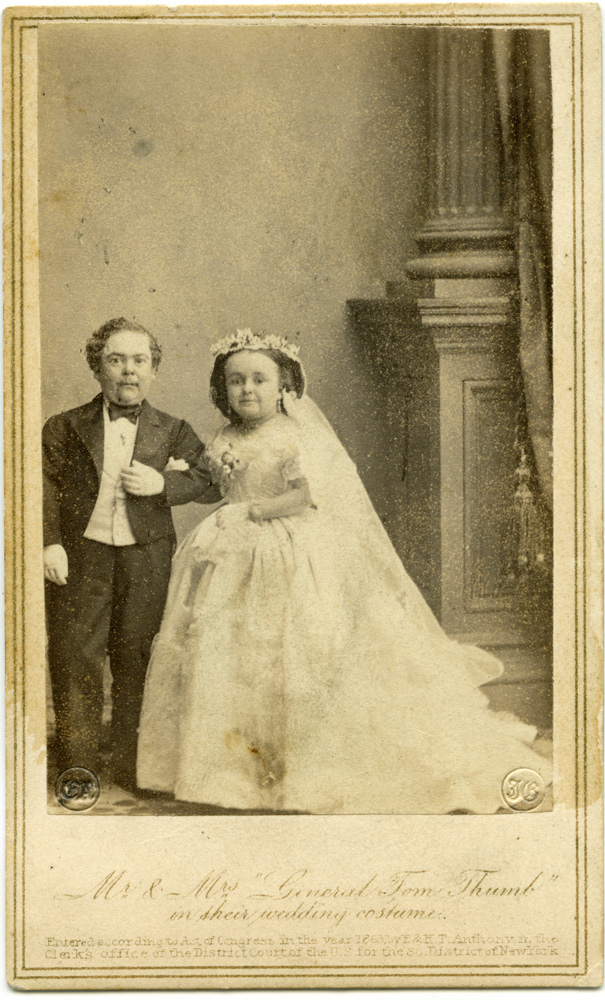
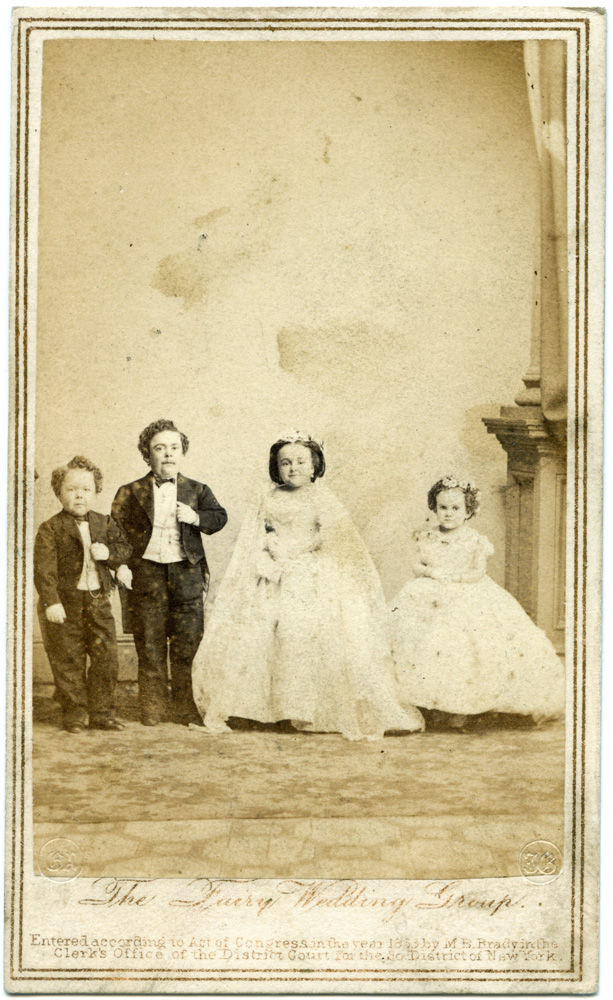
I admit it – I got the Fairy Wedding bug. No, not the Charles & Diana wedding bug, or the more recent William & Kate or the Kim & Kris wedding bug (I’d pay YOU to remove the People magazine footage of that debacle from my sight! Celebrity whores have you no shame???). But I digress – I’m fixated on the ORIGINAL celebrity wedding photos: the marriage of Tom Thumb and Lavinia Warren, photographed by THE American celebrity photographer, Mathew Brady (yes, Mathew with one T), and stage managed for maximum publicity by P.T. Barnum, the original master promoter and co-creator of the circus that still bears his name.
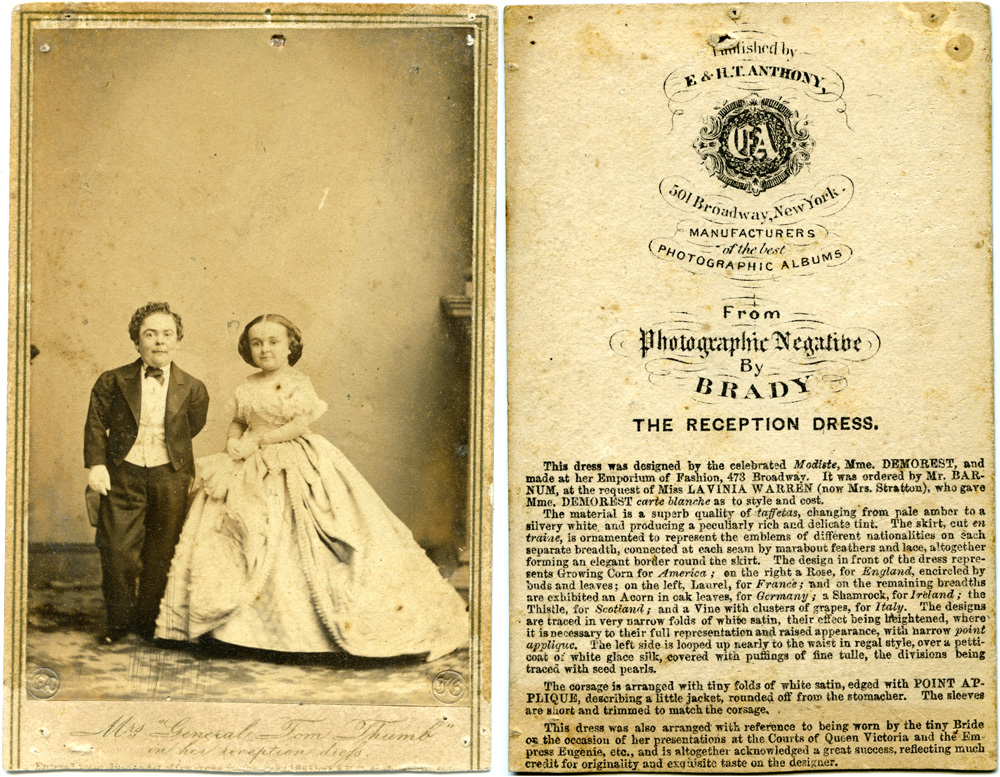
The Reception Dress, The Fairy Wedding
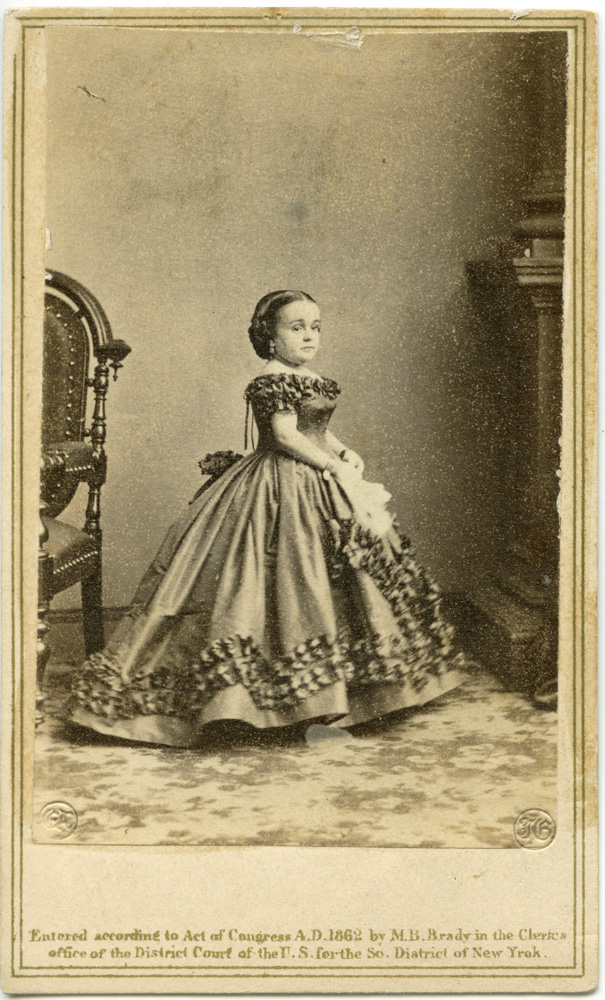
Here is the follow-up to one of my earlier images of Tom and Lavinia in their wedding ceremony outfits. This one is the dress she wore to their reception with the 2000 guest receiving line where they stood atop a grand piano at the Metropolitan Hotel.
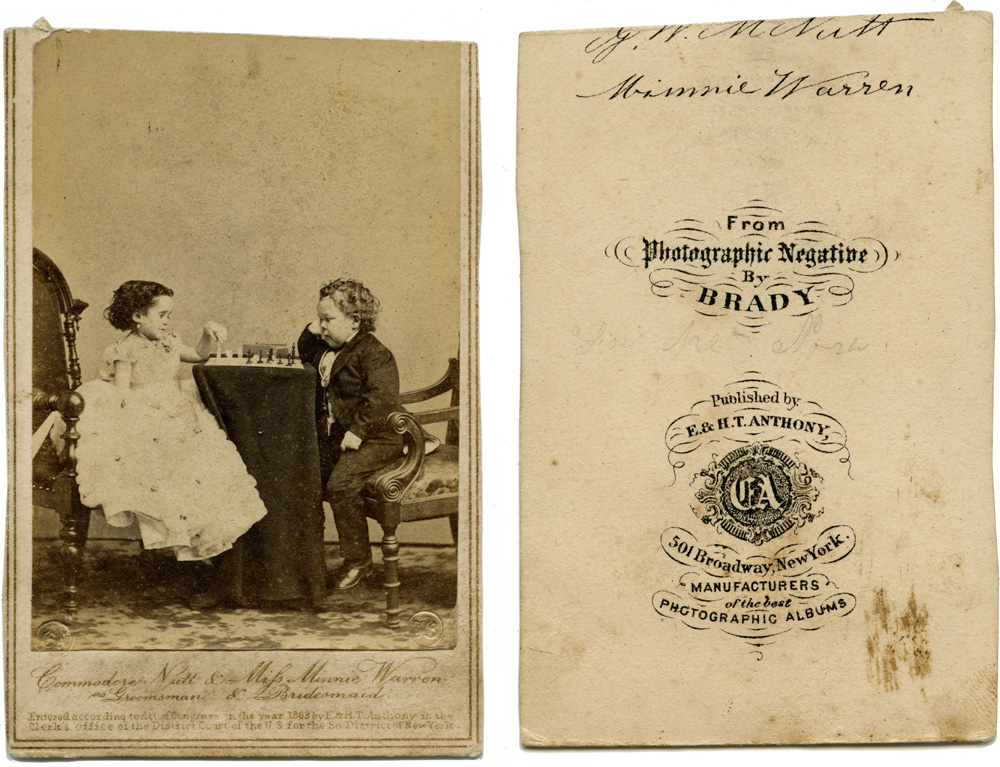
George Nutt & Minnie Warren, Groomsman & Bridesmaid
Another, odder wedding souvenir card. This one features George Nutt and Minnie Warren, Lavinia Warren (Mrs. Tom Thumb)’s sister and later George’s wife, playing chess. What this had to do with the wedding is beyond me, but it obviously catered to some 19th century sensibility – perhaps the suggestion was that they had outsized brains in their diminutive bodies, further exaggerating the curiosity/freakish attraction to a customer looking for a spot of distraction from the civil war raging around them in 1863.
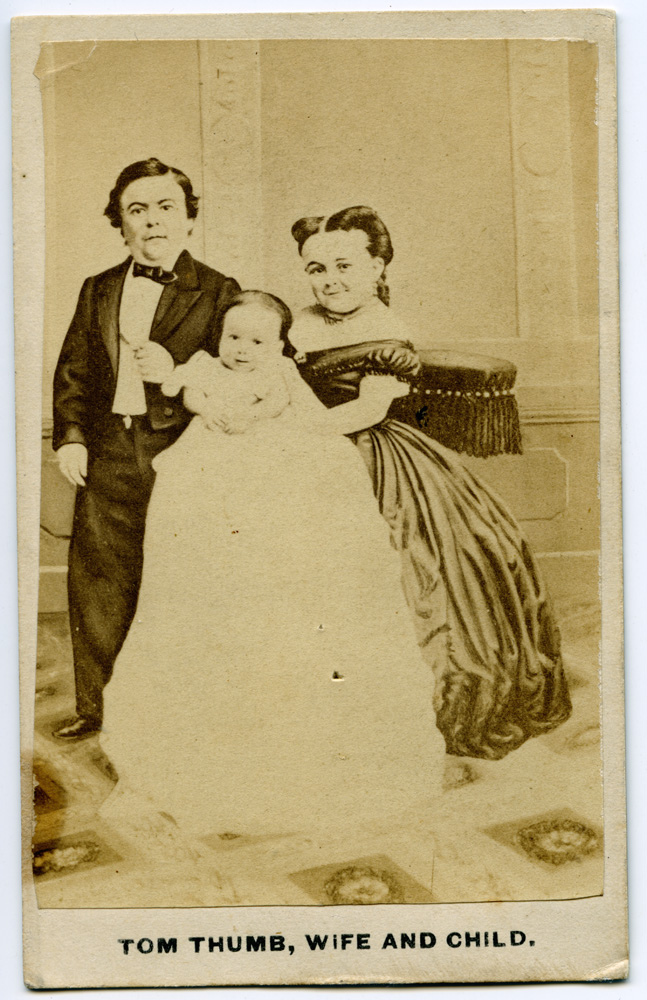
Tom Thumb, Wife and "child"
This image, undated and uncredited, is from some time later, possibly in the 1870s. Charles and Lavinia Stratton were not able to have children of their own, so P.T. Barnum, ever the showman, would acquire an orphan baby and give it to them to portray as their own, and when the baby got too big, he would find another one. Apparently, as a result, they “had” a one-year old baby for the better part of a decade.
As a memory refresher, here’s the rest of the gang in thumbnails.
Bride & Groom, The Fairy WeddingLavinia Warren Stratton, Mrs. Tom ThumbFairy Wedding Group #3 Commodore Nutt and unknown little woman, Anonymous CDV (probably Brady)Commodore Nutt, Mrs. and Mr. Tom ThumbThe Fairy Wedding, 1863 E&HT Anthony print, Obverse
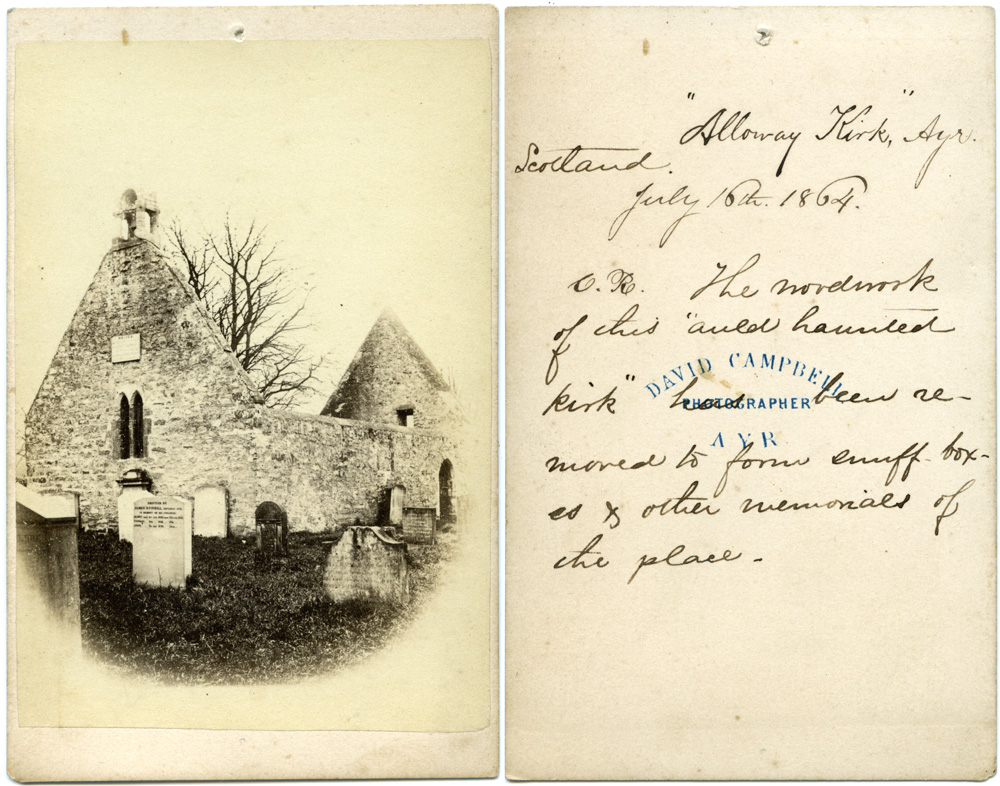
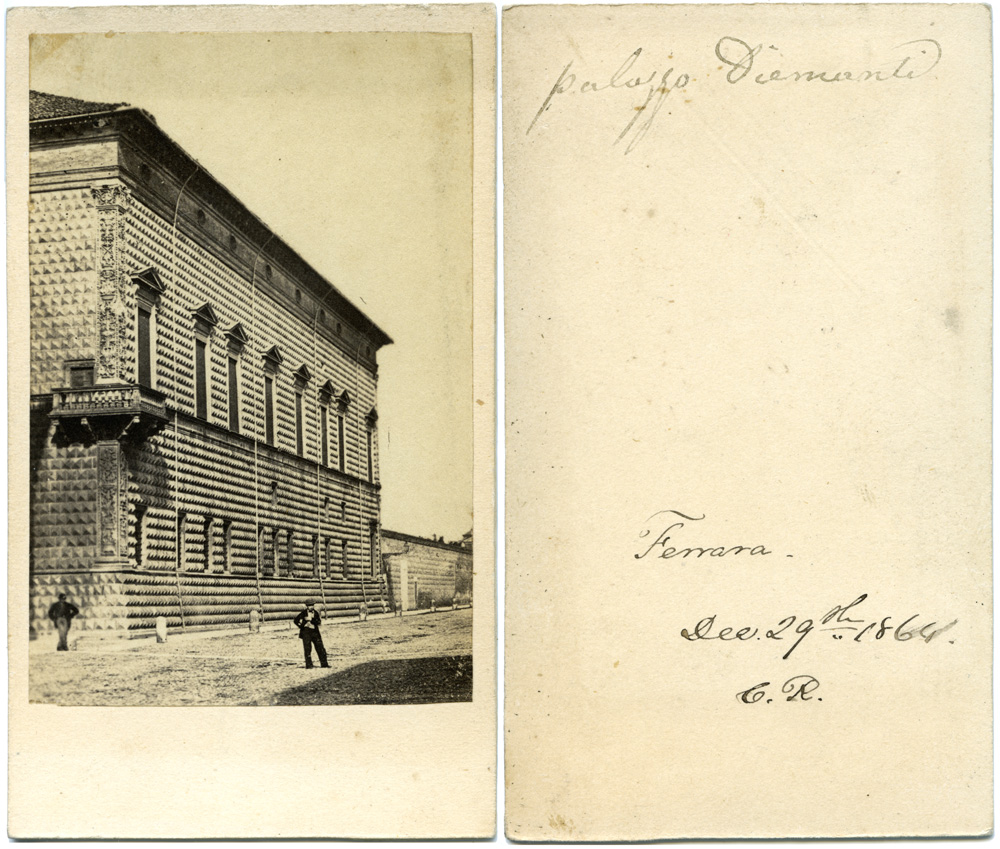
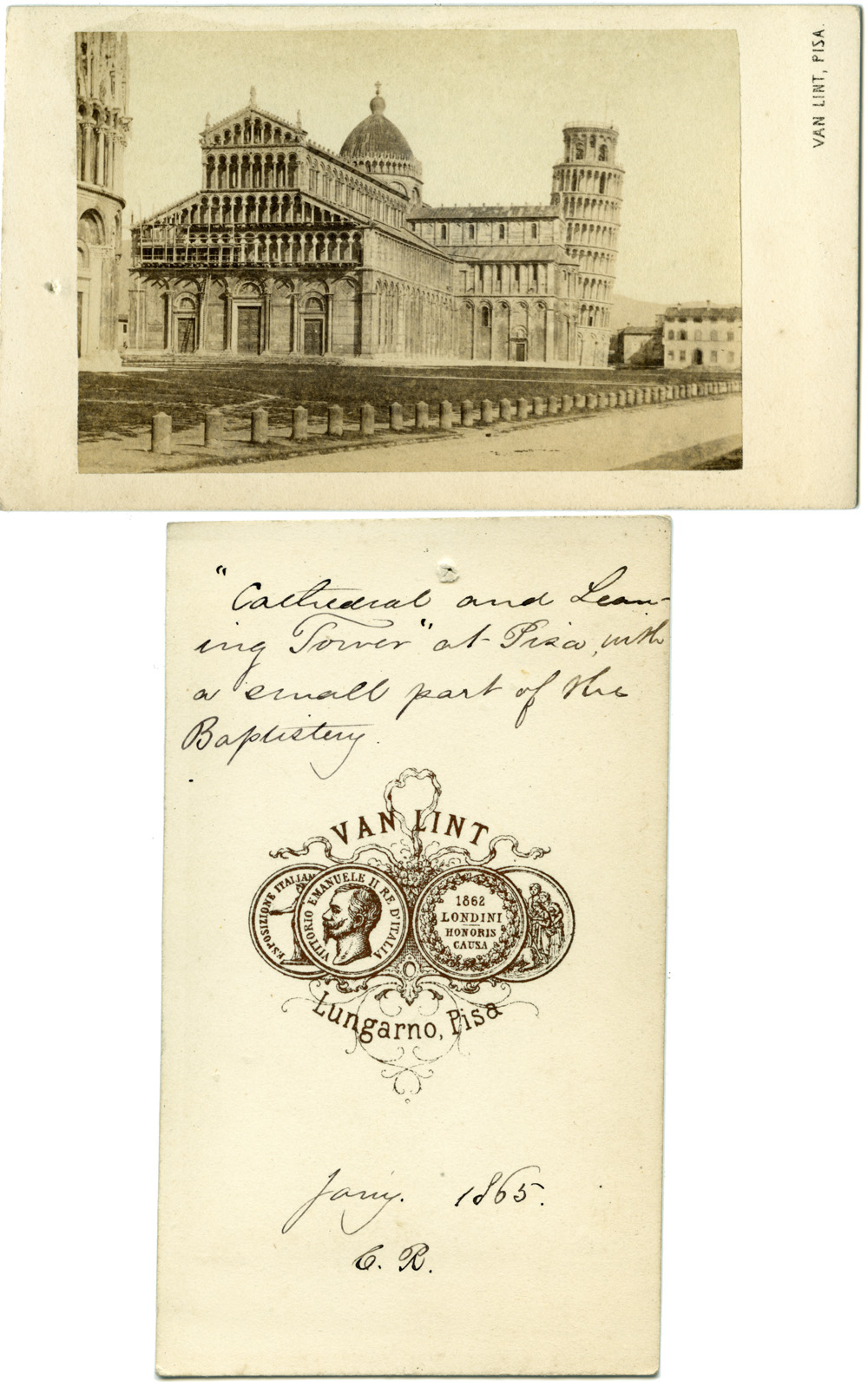
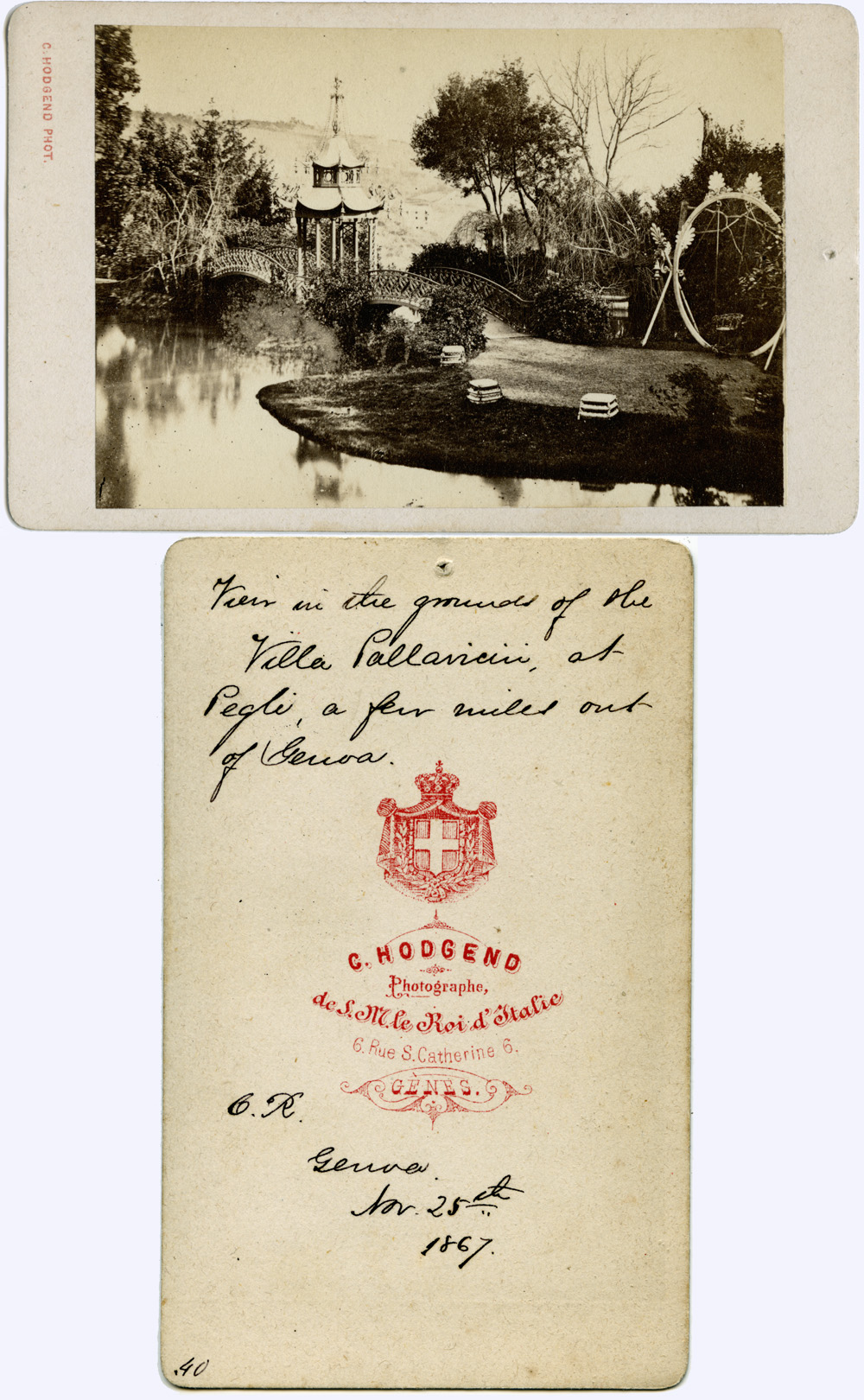
Trolling around on eBay (something I do WAY too much of), I came across this group of CDVs. They represent a form of travelogue by an American in the 1860s, bopping around Europe during and after the Civil War. How do I know he (assuming the gender here) was an American? The way he writes the dates – July 16, 1864 – is the Yankee way of writing dates – had it been a European, the date would have been 16 July 1864. I felt compelled to buy them because not only did I feel an affinity for this person’s being an American in foreign countries, but I had been to several of the same places. There were more images that I could have bought, but good fiscal sense called me back from the brink and I chose only those images from places I had been to (or at least near).
In chronological order- AllowayKirk, Ayr, Scotland, July 16, 1864
I love how C.R. (the collector of these images) wrote his notes on the back – the haunted church with the pews that had the wood reclaimed to sell as souvenirs. I’ve not been to Scotland yet, but when I was a teenager, I spent a month with my parents living in London, and we took an extended driving trip through Wales, so I’ve seen many a ruin like this on the side of a winding country road.
Palazzo Diamanti, Ferrara, December 29, 1864
Now we’re off to Italy, and the Palazzo Diamanti in Ferrara. I’ve not been to Ferrara myself yet, but I have been to Italy twice, and I loved the inclusion of people in the photo for scale, and for the fact that they’re pretty sharp and clear, something not easy to achieve when shooting wet plate collodion images of subjects who don’t know they need to sit still.
The Cathedral of Pisa, January 1865
The world famous Cathedral of Pisa, from a less famous view. Most images of the Cathedral show it from the bell tower side. You can see the cathedral and the tower from the rail station at Pisa, where I changed trains en route from Genoa to Florence. C.R.’s note: ” ‘Cathedral and leaning tower’ at Pisa, with a small part of the Baptistery”.
Villa Pallavicini, Genoa, November 25, 1867
A sight I missed out on in Genoa when I was there. The Villa Pallavicini is now home to the Archaeological Museum, and the gardens are open to the public as well. The scan on eBay did not do the image justice – the original card is in pristine condition, minus the pin-hole. The albumen print is incredibly sharp and clear, with minimal discoloration and foxing.
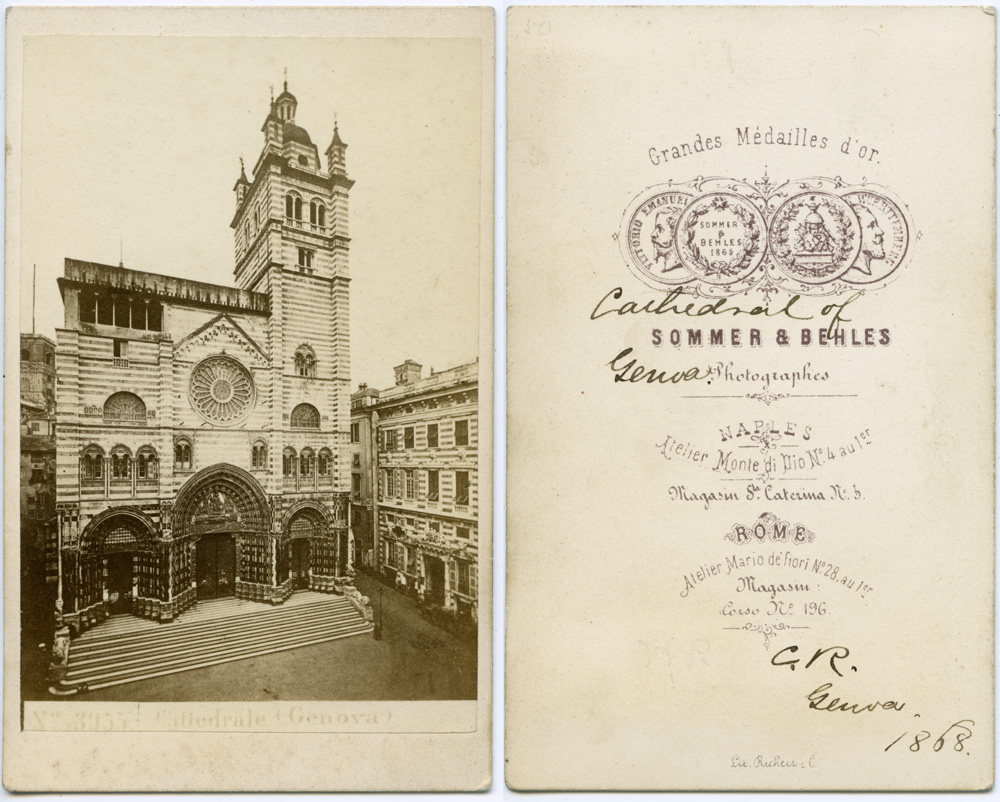
Genova Cathedral, 1868
And here we come to the image that started my interest in this set – the “old” cathedral of Genoa. When I went to Genoa, I stayed with a friend of mine who lives all of six blocks from the cathedral, so it was a daily sight on our excursions. On this one, C.R. is rather terse, simply noting “Cathedral of Genoa”, his initials, and the year, 1868. This is another card in the group that is far better than the scan would suggest. Truly pristine.
The great and the sad thing about these cards is that they again provoke my personal wanderlust, and I’ve got a serious itch to hit the road to Italy again. And to Scotland for the first time, and to half a dozen other places! I’d love to bring one of my big cameras, say my 5×7 or the whole plate camera, and try and re-create these same images, or at the very least capture some very modern interpretations of the same scenes as they would be found today. NOT like the recent Annie Liebowitz show of her super-privileged travel photos of famous people’s homes (Freud’s office, Eleanor Roosevelt’s bedroom in ways you and I could NEVER photograph them).
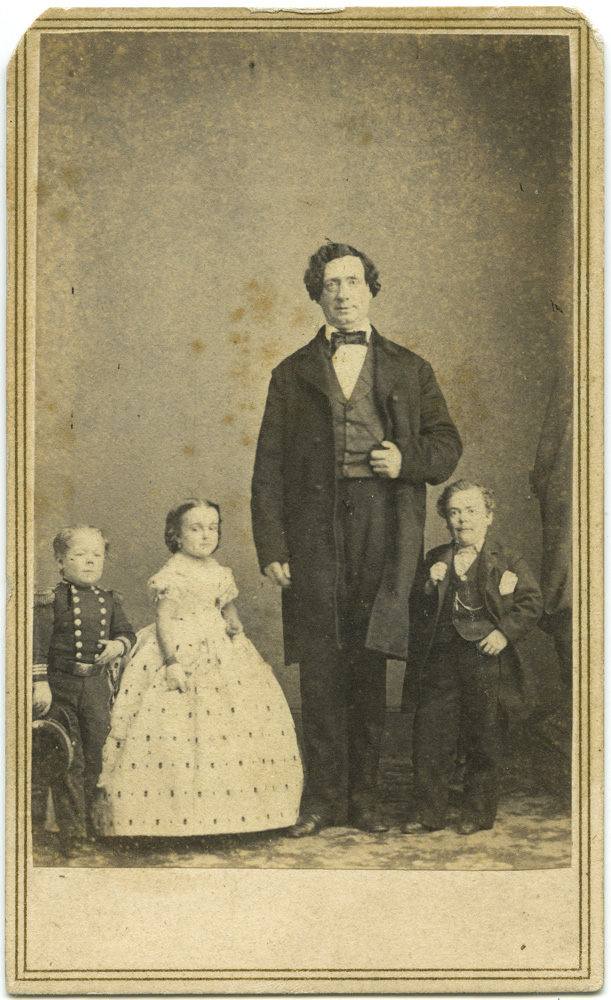
I’ve been fascinated by the Tom Thumb “Fairy Wedding” photos since I found the first one. Now that I’ve discovered that there were multiple poses sold, I’m building a collection of them, trying to see if I can find them all. So far, I have four Brady images from the wedding, an unsigned image of Commodore Nutt and what appears to be a regular girl child without back-stamp, and another Brady image of Tom Thumb, his wife, Commodore Nutt and what I’m guessing is a circus giant (he appears to be twice the size of Charles Stratton – Tom Thumb – who was 3 feet 4 inches tall at his death, making the giant next to him in the neighborhood of 7 feet tall).
Here are the new ones:
Lavinia Warren Stratton, Mrs. Tom ThumbBride & Groom, The Fairy Wedding
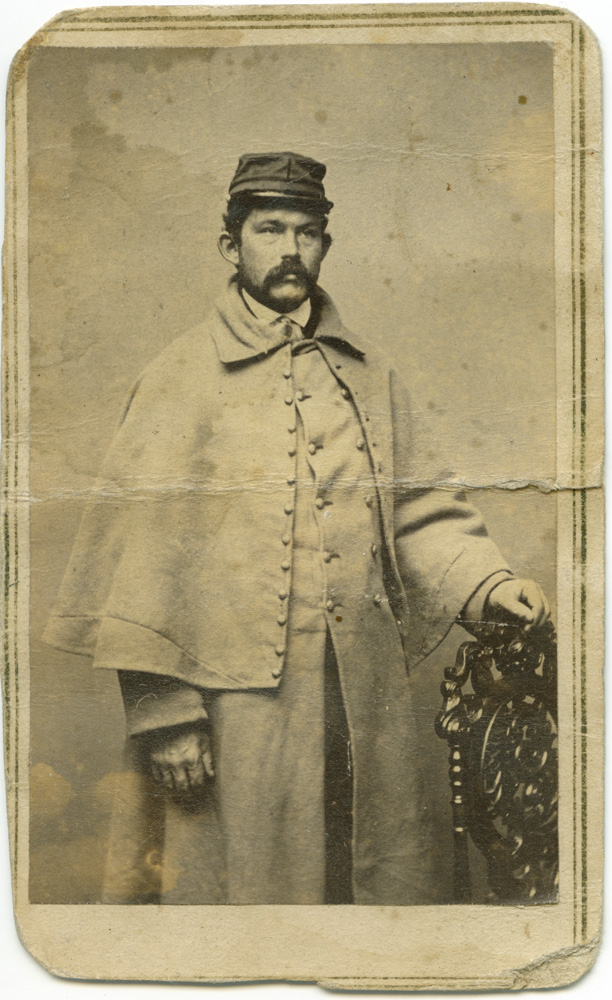
Here’s a Union soldier, identity unknown, from the William J. Tait studio. This may well have been taken immediately prior to shipping out to battlefields unknown – the studio address is Courtlandt Street and Greenwich Street in lower Manhattan – basically in the site of the modern World Trade Center. Back then it would have been only two or three blocks from the waterfront piers. It’s another image that obviously meant a lot to someone as it has a fold across the middle – someone was carrying it around with them in a pocket. Did the sitter die in combat, or was it just a fond memory of a critical time in US history that inspired the owner to keep it at hand?
Union Soldier, Wm. J. Tait studio, NY
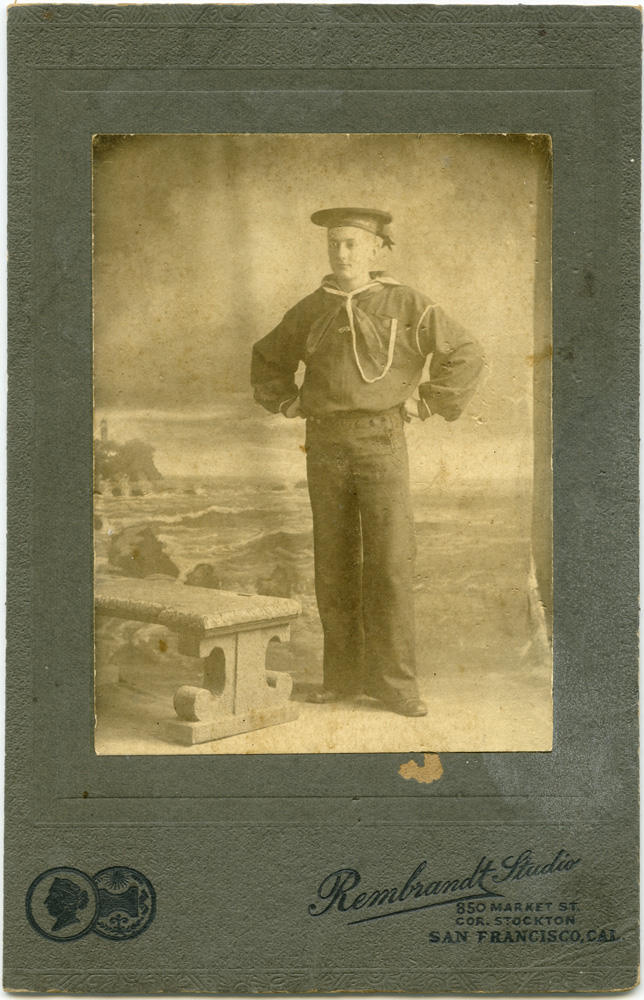
In a totally different light, here’s a west coast sailor. This time, most likely the 1890s, on a cabinet card. The original card is a little bit bigger than 3.5″ by 5″. I did a very mild clean-up of the scan in Photoshop to make the image more readable online. The original card is slightly lower in contrast and has a couple very minor spots in the background that do not interfere with the subject. I tried to scan his hat at high resolution to see if I could read the ship’s name he was assigned to, but it couldn’t be resolved (at least not with my scanner).
Sailor, 1890s, Rembrandt Studio, San Francisco
There’s a noticeable difference between the two photos, and I don’t think it is just attributable to the changes in photo technology between 1860 and 1890. The Civil War sitter has a far more somber expression on his face and in his body language – it’s as if he knows he is going to die, and this is a reminder to send back to his family so they won’t forget him when he’s gone. The 1890s sailor, on the other hand, is having a lark, getting his portrait done while in port perhaps as much a souvenir of the location as anything else. Later I’ll re-scan and post my Hong Kong sailor photos to provide a comparison.
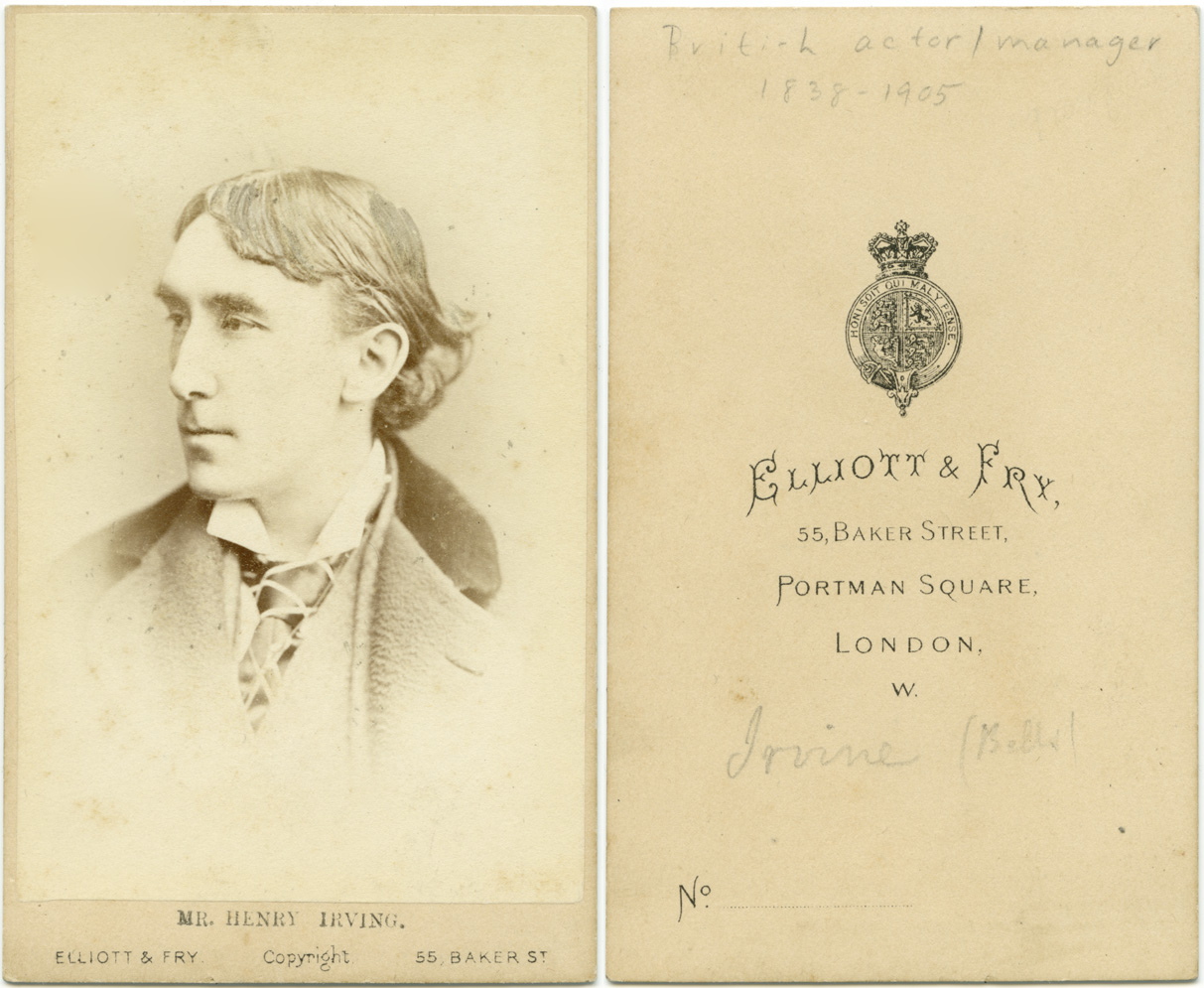
Carte De Visite, Henry Irving, British Actor, by Elliot & Fry
Here is Henry Irving, the celebrated English thespian, who owned and operated the Lyceum Theater in London. He was the first actor ever to receive knighthood. He hired Bram Stoker to be his stage manager at the Lyceum, and is allegedly the inspiration for the stage manager character in Stoker’s Dracula novel (a character notably absent from all the Dracula movies).
You’ll notice on the verso of the carte the coat-of-arms for the Order of the Garter. From my biographical research on Mr’s Elliot & Fry, they ran a very successful high-end studio in London, doing portraits of public and social, artistic, scientific and political eminences of the Victorian era. The studio operated for over 100 years before being bought out by another notable photographic firm. Most of their negatives were lost during the bombings of London in WW II. Neither Mr. Elliot or Mr. Fry were members of the Order, so the logo on their card must have been a sales pitch to their clientele to suggest the status by association. For those not in the know, the Order of the Garter is the highest possible social honor one can receive from the Queen of England. At any moment in time there are no more than 24 members of the order plus the Queen/King and the Prince of Wales. Membership is by nomination from current members, and at a minimum qualification you must already be knighted by the Queen.
I was adding some more photographers to my maps (two more New York and one more DC), and I was re-thinking the addresses of some of the DC photographers. If I take as legitimate the KC Woodly studio address as ” 181 Pennsylvania Avenue, between 17th and 18th Streets”, then there was another studio that I had, Henry Ulke, at 278 Pennsylvania Avenue, that would make much more sense being between 18th and 19th Streets instead of more-or-less on the grounds of the US Capitol. I’ll have to do some research and see when the addresses on Pennsylvania Avenue stopped being split east/west of 16th Street. My guess is that it was sometime shortly after the Civil War, if my CDVs are anything to go by.
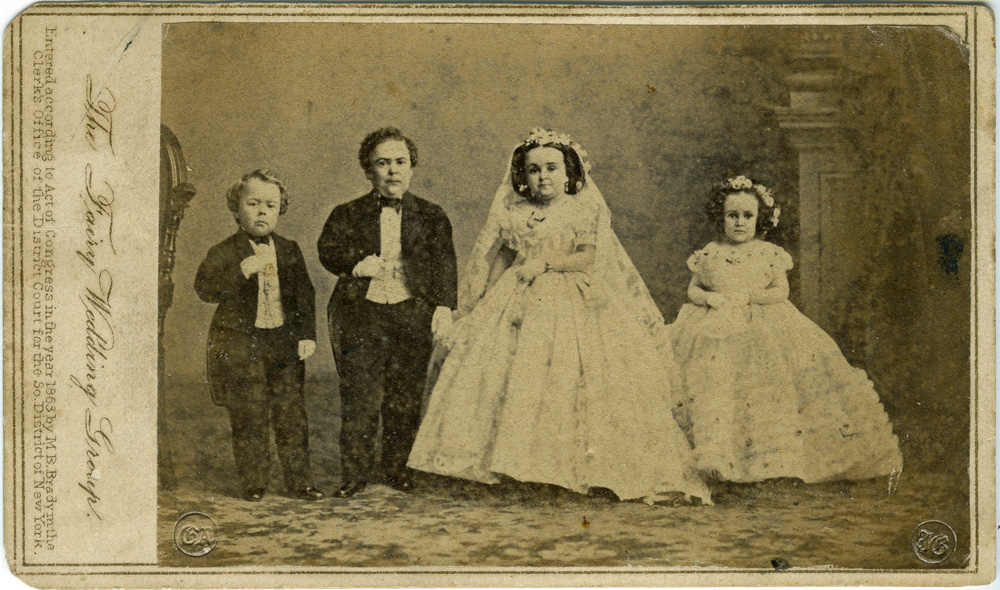
I just added another “fairy wedding” photo from the Brady group. It’s fun to see how many different poses were taken, and how widely distributed they are. This latest one arrived from the UK. I’m going to put them all together here so they can be seen at the same time without flipping through my blog to find the others.
Fairy Wedding Group #3The Fairy Wedding, 1863 E&HT Anthony print, ObverseCommodore Nutt, Mrs. and Mr. Tom Thumb Commodore Nutt and unknown little woman, Anonymous CDV (probably Brady)
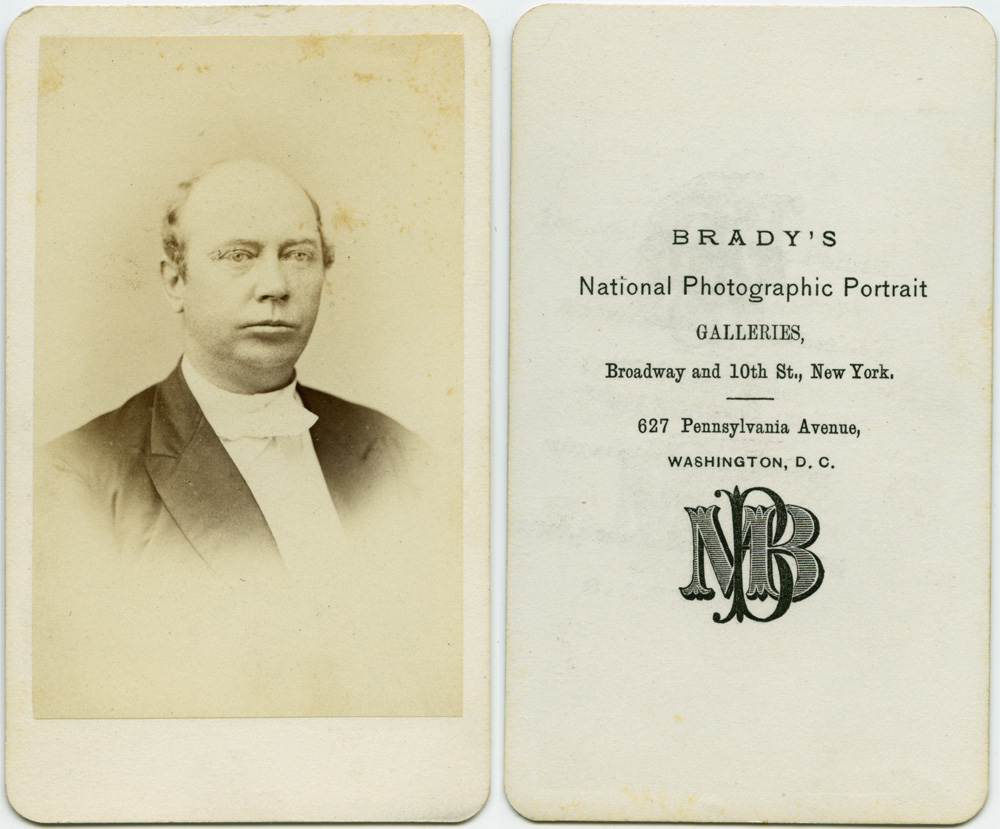
Here’s another Mathew Brady CDV I got recently. Totally anonymous subject, and certainly not his best work. The reason I bought it was that it marks an example of his later work (post- Civil War), and because of the different back stamp – it still has both the New York and Washington DC studios listed, but there is no marking on the front of the card at all. Anyone out there who can give me a better ID on the time period for the card would be much appreciated. Later Brady CDV


 dcphotoartist