Unknown Little Person, H.B. Gerncore’s Temple of Art
I’ve had a devil of a time trying to decipher the photographer’s name on the back – the best I can tell is it’s either H.B. Gerncore or H.L. Ger-something-something. In any case, it’s a beautiful photo of a strikingly proportionate little person. I’m frankly not even entirely sure he’s a little person and not just a pre-teen in a well-tailored suit. But the top hat and tails make it more likely he’s an adult sideshow or circus performer.
The Strattons, George Nutt and Minnie Warren in their Tuilieries outfits
Here’s yet another photo of Tom Thumb and company, this time in the outfits they wore to meet Napoleon III. Also an Anthony print, with the facsimile signatures on the back. Again no attribution of the photographer, so while it is possible it’s a Brady, it’s likely not. Notice the hand-coloring of the women’s garlands and the men’s watch chains.
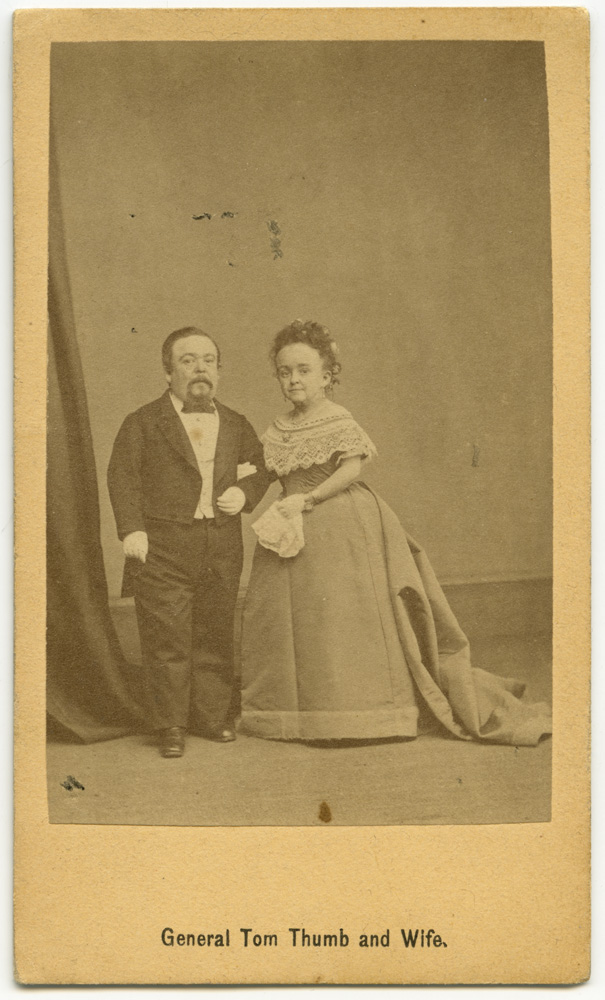
Here’s a CDV of Tom Thumb and Lavinia Warren, in middle age. This is an E&HT Anthony CDV, with the facsimile dedication on the verso. The studio that took the photo is unknown, as it is not credited. It is possible that it is a Brady image, as Anthony owned the Brady negatives in later years, but it is also very possible that it is by someone else who sold the negative to Anthony, or was commissioned by Tom Thumb and/or P.T. Barnum to take the photo.
Three little people, by CD Fredricks
This image is NOT Tom Thumb and Lavinia Warren. The little man on the left may be Commodore Nutt, but the woman is definitely not Lavinia Warren OR her sister Minnie, and the little man on the right is definitely not Tom Thumb either. I have seen his image before on other CDVs where it is just him, but I don’t have one of them and I can’t recall the name either. He’s a big name in the 19th century little people sideshow circuit, but I’m drawing a blank (if memory serves, I’ve seen his solo CDVs sell for upwards of $150 each). This CDV is in overall outstanding condition, pinholes at the top of the card mount excepted – the albumen print still looks new.
These were bought as a pair, and were owned by the same individual in the past – it is the same handwriting on the verso that identifies the little people as Tom Thumb and Lavinia Warren (correctly on the one card, wrongly on the other).
While there is no evidence that they were ever sexually intimate, some time after the war, General Elwell wrote to her that he loved her “all the law allows (and a little more perhaps)”. What exactly that meant remains the realm of speculation, as it is certainly cryptic by intent; General Elwell was a married man. Given that he was married at the time of his association with Clara Barton, this photograph becomes an act of bravery and defiance (or brazenness depending on your take of Victorian social mores), although perhaps it could have been passed off as innocent as Ms. Barton and General Elwell both served together in South Carolina at the assault on Fort Wagner, he with the Quartermaster’s Corps, she as a civilian nurse. Certainly at the time she was already famous, and he would have been so as well by the time the photo was taken in 1865, so it may have been at Mathew Brady’s urging that they posed together or it may have been of their own choosing.
Here is an image of General Elwell:
and Clara Barton:
And my photo for comparison: John J. Elwell and Clara Barton, Washington DC
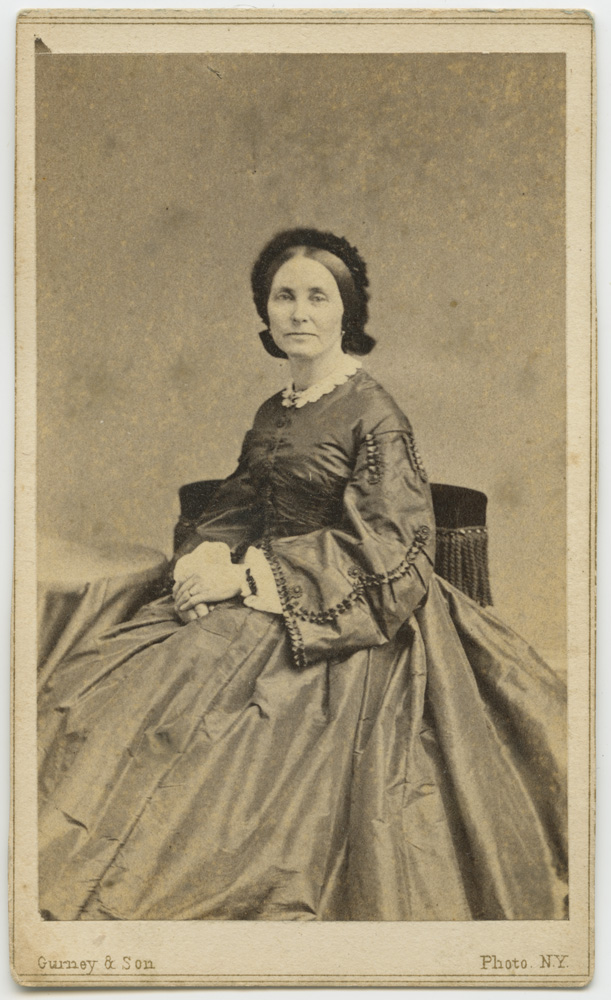
Two new additions to the collection, and what may well be a collecting coup – a potentially previously unknown image of Harriet Beecher Stowe, by Gurney of New York. Harriet Beecher Stowe
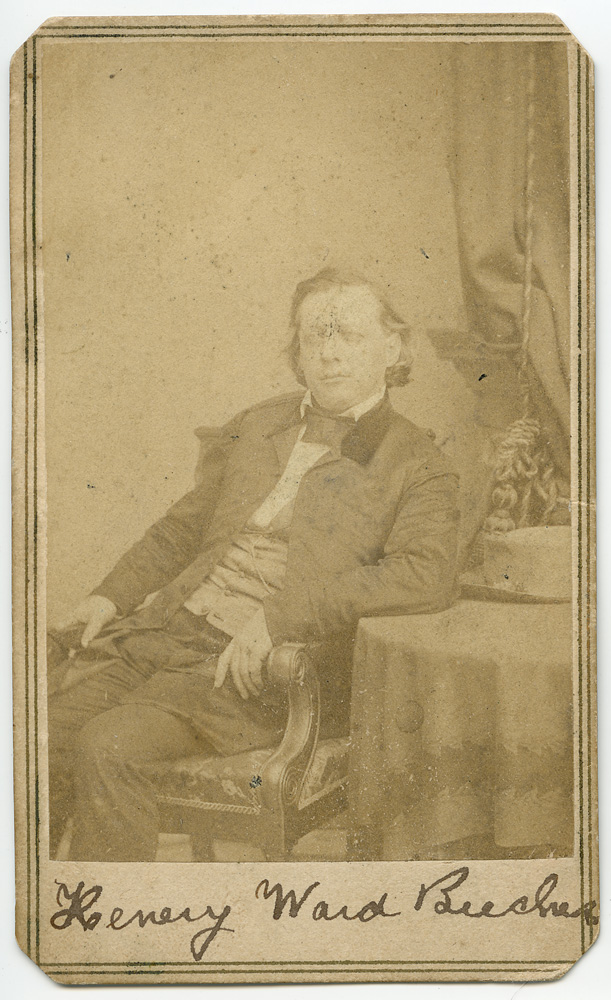
For those unfamiliar with who Harriet Beecher Stowe was, she was the daughter of a deeply intellectual preacher and abolitionist, Lyman Beecher. Her brother, Henry Ward Beecher, would become a leading figure in the abolition movement of his own, and a major intellectual light in Victorian-era America.Henry Ward Beecher, from the New York Times
Even though Henry was an oratorical and political powerhouse in his day, famous (or infamous, depending on your Union or Confederate sympathies), Harriet Beecher Stowe eclipsed him in his fame as a result of a book she wrote, “Uncle Tom’s Cabin”.
It is reported that upon being introduced to Harriet Beecher Stowe in 1862, Abraham Lincoln fondly commented she was “the little woman who wrote the book that started this great war.”
Although President Lincoln’s comment was certainly made in jest, in truth, Stowe’s novel was indeed instrumental in awakening the abolitionist cause, which was a major factor in turning a nation against itself for four arduous years.
Here is a photo of Henry and Harriet together, from Wikipedia-
This photo of Henry Ward Beecher, my other acquisition in this pair, is one by Mathew Brady, published by E&HT Anthony and as such is a common image in average condition.
Henry Ward Beecher, by Brady
Acquiring this image of Harriet Beecher Stowe in many ways closes a circle for me as I now have a face to go with the book, of which I own a rather tatty copy of the 1852 first printing of the first British edition of the book.
P.T. Barnum never passed up an opportunity to promote himself. So, when the top star in his showbiz empire, the midget performer Charles Stratton, announced plans to marry his fellow midget stage star Lavinia Warren in January 1863, Barnum celebrated the news by immediately starting a public-relations blitz.
The reading public’s celebrity mania and the media’s zeal to sell newspapers proved a huge boon for business to the attention-hungry Barnum. In return, the happy buzz which Barnum created for Stratton’s impending marriage provided war-weary Northerners a momentary diversion from the unrelenting march of bad news, even knocking war reports off the front pages for a while.
Barnum plucked Stratton, a poor carpenter’s son from Bridgeport, Conn., from obscurity at the age of 4 in 1842 because of his remarkable size. The boy’s growth had halted between the ages of 6 months and 9 years; he measured only 32 inches tall at the time of his death in 1883. Performing under the stage name General Tom Thumb, Stratton immediately hit it big with New York audiences at Barnum’s American Museum with his song and dance routines and costumed impersonations of Napoleon, Cupid and a Scottish Highlander. A European tour followed these early successes in 1844, during which he gave public appearances, as well as private command performances before European royalty, including a young Queen Victoria.
Over the next two decades, Stratton’s showbiz career made him one of the most famous and fabulously wealthy celebrities of his generation. Far from feeling exploited by Barnum, Stratton and his boss became fast friends, and later, he even partnered in business with the showman.
In January 1863, Barnum signed on a new performer, Lavinia Warren, a midget also 32 inches tall whom he billed as “The Little Queen of Beauty” and “The Smallest Woman Alive.” Stratton was immediately smitten, and within a matter of weeks, he popped the question.
Once the news hit the New York papers, attendance at Warren’s appearances at the museum became, in Barnum’s words, “crowded to suffocation.” Profits from ticket and memorabilia sales soared to over $3,000 a day for weeks, further enhanced as Barnum began selling $75 tickets for the wedding reception (he decided not to sell tickets to the ceremony itself).
Despite the breathlessly enthusiastic tone of media coverage, some onlookers openly cast suspicion on Barnum’s motives. “When Mr. Barnum brings the church and its solemn rites into his show business, he outrages public decency,” intoned The Brooklyn Eagle. “We are surprised that the clergy, or representatives of so respectable a body as the Episcopal Church should, for a moment, allow themselves to be used by this Yankee showman to advertise his business.”
The Rev. Morgan Dix agreed. Rector of the hoped-for wedding site, Trinity Parish in New York, he vetoed the plan, so wedding planners moved the event to Grace Church farther up Broadway instead.
On the eagerly awaited day — Feb. 10, 1863 — 2,000 invited guests, a who’s who of governors, business tycoons and generals, gathered in Grace Church, vastly outnumbered by the crowds waiting in the streets outside in hopes of catching a glimpse of the pair. Battalions of police officers lined the processional route along Broadway, which the city had closed to traffic for the duration of the event.
The wedding party’s arrival outside the church at half past noon touched off a stampede among combatants fighting for a close-up view. The police restrained them only with extreme exertion. Inside, “an instantaneous uprising ensued,” The New York Times reported the following day. “All looked, few saw. Many stood upon the seats, others stood upon stools placed on the seats. By many, good breeding was forgotten. By very many the sanctity of the occasion and the sacredness of the ceremonies were entirely ignored. As the little party toddled up the aisle, a sense of the ludicrous seemed to hit many a bump of fun, and irrepressible and unpleasantly audible giggles ran through the church.”
After the ceremony, the hordes chased the couple’s carriage on foot to the Metropolitan Hotel, the reception site, where there awaited a treasury of lavish jewelry, furs and fine watches from the likes of the Vanderbilts, the Astors, the Lincolns and even Edwin Booth, the Shakespearean actor and brother of future Lincoln assassin, John Wilkes Booth.
Then it was time to hit the road, with stops in Philadelphia and finally Washington, where Abraham Lincoln hosted a reception at the White House for the Strattons, the president’s family and his cabinet.
Coming out to greet the couple, Lincoln shook hands with the two gingerly, almost as if he was afraid of breaking them. Lincoln told Stratton that he had been placed “completely in the shade,” for, since his arrival in the capital, Stratton had been “the greater center of attraction.”
As the president’s 9-year-old son Tad stood beside his mother, Mary Todd Lincoln, he gazed awestruck at the sight, saying quietly at last, “Mother, isn’t it funny that father is so tall, and Mr. and Mrs. Stratton are so little?” Lincoln, overhearing the remark, replied, “My boy, it is because Dame Nature sometimes delights in doing funny things. You need not seek for any other reason, for here you have the short and the long of it,” pointing to Stratton and himself.
The next day the Strattons and Benjamin Warren, brother of the bride and a soldier on leave from the 40th Massachusetts Regiment, toured an Army encampment on Arlington Heights across the Potomac. Long afterward , Lavinia Warren reminisced, “As we rode through the vast camp, we were greeted with cheers, throwing up of caps, and shouts from all sides, such as, ‘General, I saw you last down in Maine!’ — ‘I saw you in Boston!’ — ‘Three cheers for General Tom Thumb and his little wife!’ It seemed a joy to them to see a face which recalled to their minds memories of happy days at home.”
The marriage lasted until Stratton’s sudden death by stroke in 1883. Lavinia Warren soon remarried, and died in 1919.
Sources: The New York Times, Feb. 11, 1863; “Mrs. Tom Thumb’s Autobiography,” New York Tribune Sunday Magazine, Sept. 16, 1906; “Some Recollections: the Story of My Marriage and Honeymoon,” New York Tribune Sunday Magazine, Oct. 7, 1906; “Tom Thumb and His Wife,” Harper’s Weekly, Feb. 21, 1863; P.T. Barnum, The Life of P.T. Barnum”; The Brooklyn Eagle, Jan. 26, 1863; “Sketch Of The Life, Personal Appearance, Character And Manners Of Charles S. Stratton, The Man In Miniature, Known As General Tom Thumb, And His Wife, Lavinia Warren Stratton; Including The History Of Their Courtship And Marriage, With Some Account Of Remarkable Dwarfs, Giants, & Other Human Phenomena, Of Ancient And Modern Times, And Songs Given At Their Public Levees.”
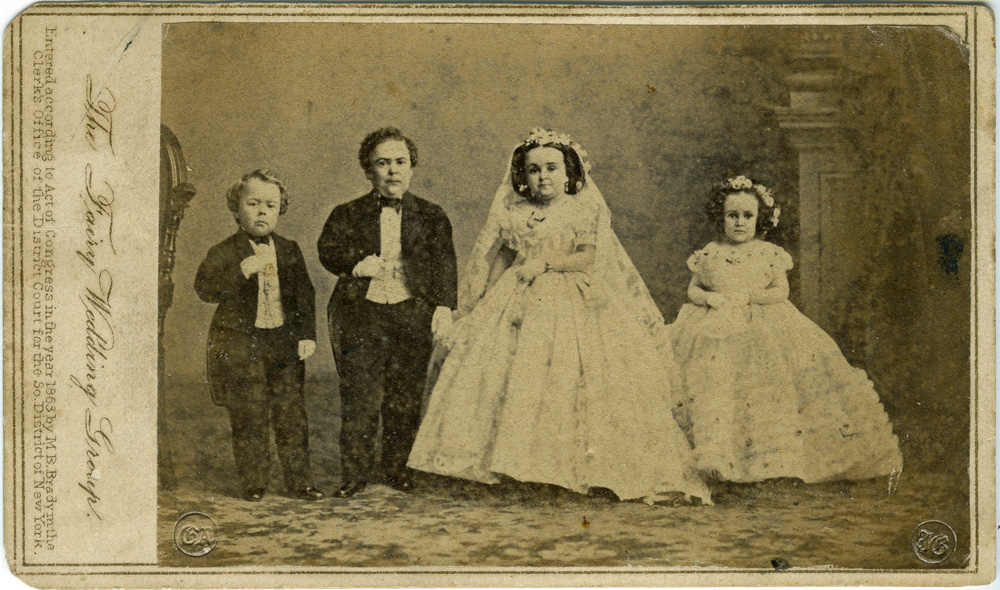
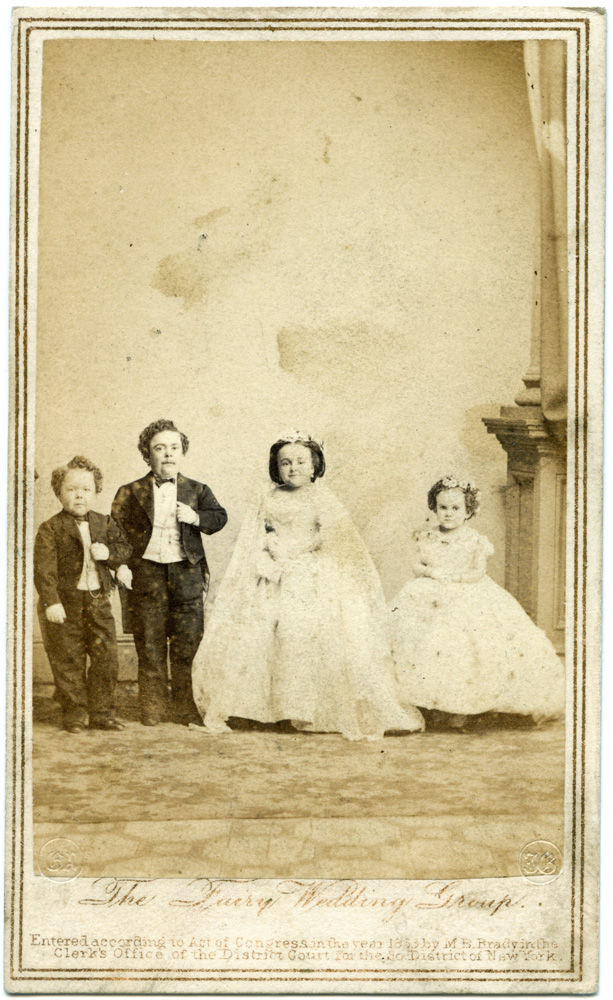
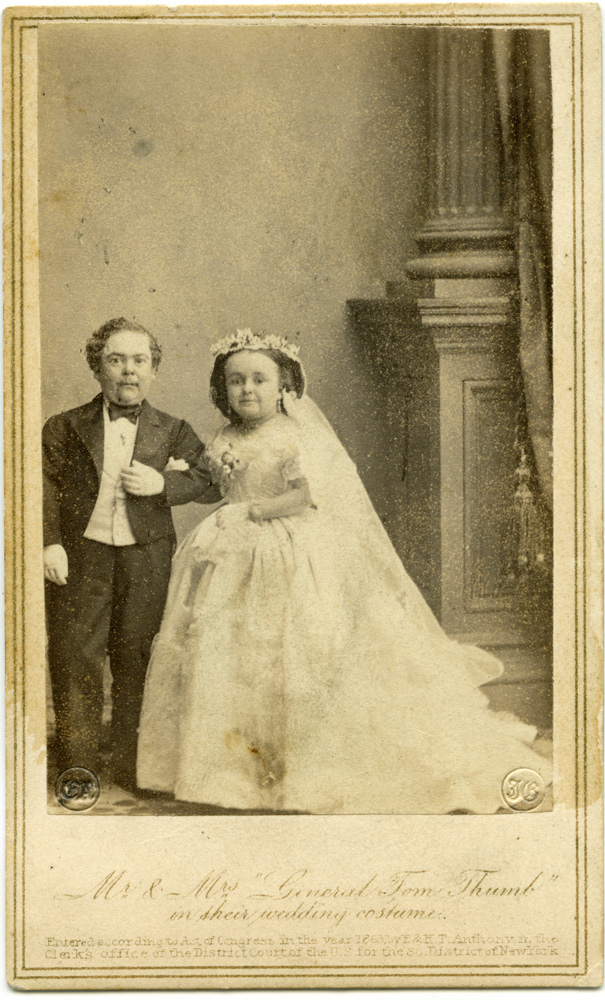
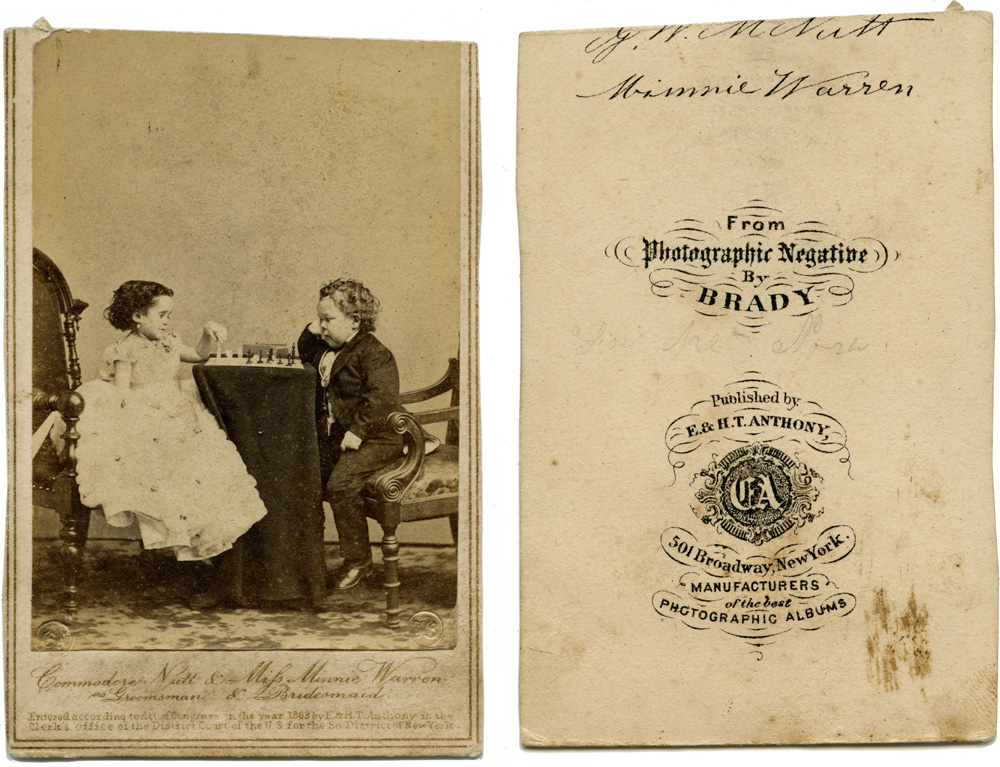
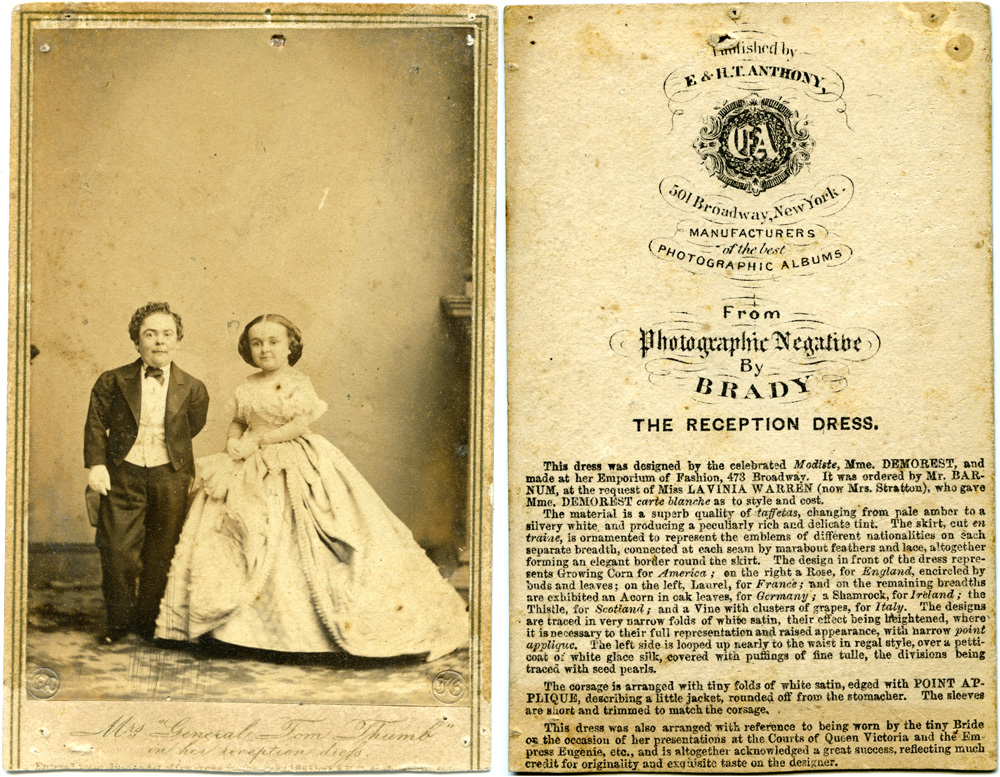
The original story in the NY Times was illustrated by an engraving owned by the Library of Congress depicting the Fairy Wedding. I’ll recap my collection of their photos here to provide better illustrations.
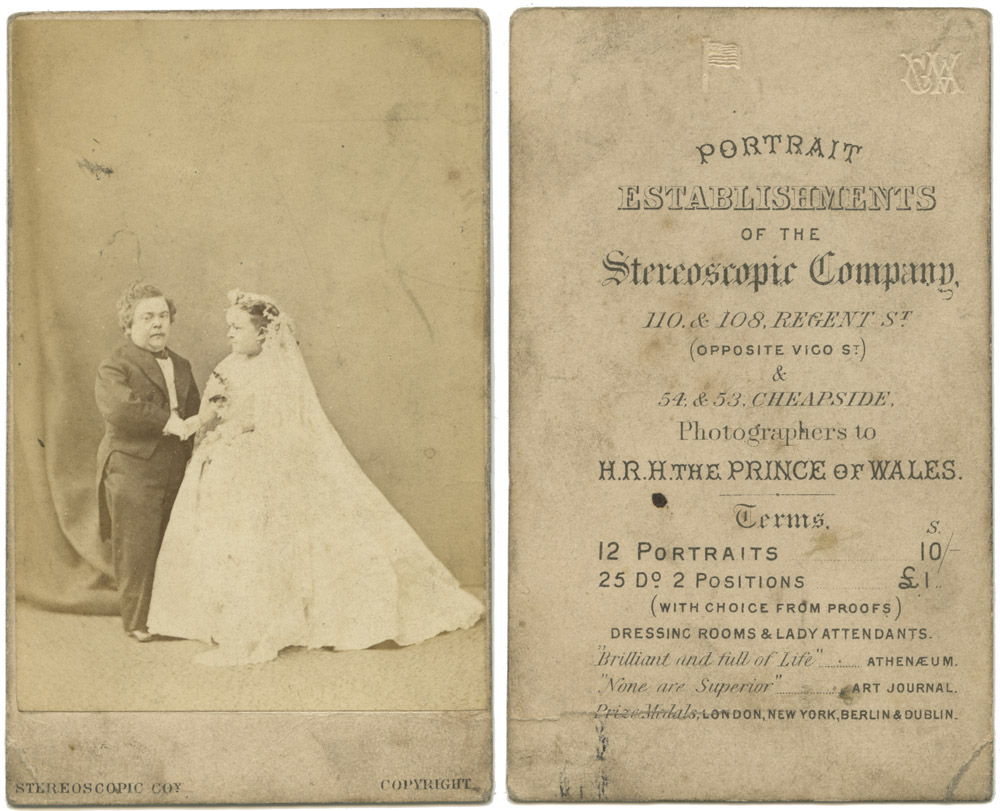
The Fairy Wedding, 1863 E&HT Anthony print, ObverseFairy Wedding Group #3Bride & Groom, The Fairy WeddingGeorge Nutt & Minnie Warren, Groomsman & BridesmaidThe Reception Dress, The Fairy WeddingThe Thumbs, by the Stereoscopic Co of London
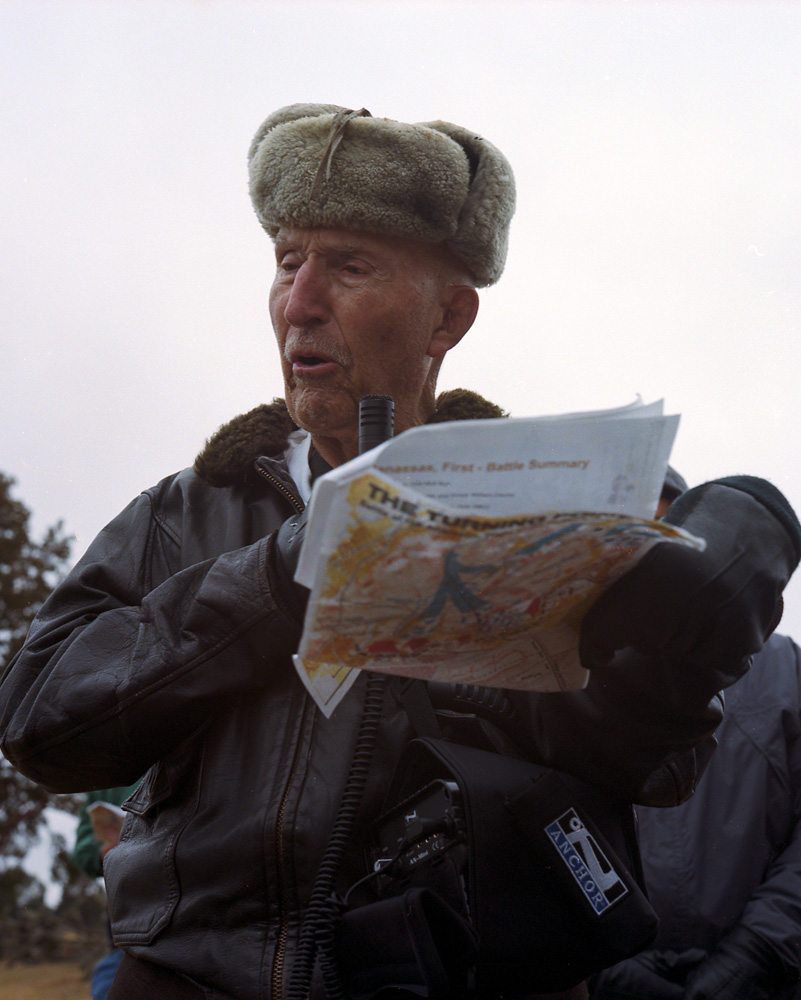
I’m a member of the Smithsonian Resident Associates program – its a whole collection of educational and entertaining activities offered throughout the year ranging from evening lectures to hands-on arts and crafts courses to day tours and even week-long study trips, as well as a certificate program in Art History taught in conjunction with The Corcoran School of Art and George Washington University. A couple weekends ago I went on one of their history tours to Manassas Battlefield for the battle of First Manassas, with Ed Bearss as the tour leader. For those who don’t know, Ed is an underappreciated national treasure. He turns 90 in a month and a bit, was combat wounded in WW II (hit five times by a Japanese machine gun), is the Chief Historian Emeritus of the US Park Service, and appeared in Ken Burns’ The Civil War documentary as well as a regular on the History Channel’s Civil War Journal. He has forgotten more about the Civil War than any of us will ever know. Ed, at 90, still leads tours over 250 days a year. I’ve taken five of his tours now (maybe six?), but he has some die-hard groupies out there that make me look like a slacker wanna-be fan (I’ve been on tours before where other folks have proudly announced they’ve taken every tour he offers through the Smithsonian, sometimes more than once).
Ed Bearss talking in front of the Stone House, Manassas Battlefield
Ed is a marvelous story-teller. He recounted the tale of how Stonewall Jackson got his nom-de-guerre:
“And General Bee, upon seeing Thomas Jonathan Jackson with his troops in the edge of the woods, called out to his men “There stands Jackson like a stone wall; rally behind the Virginians”. He may not have meant it as a compliment, however. It all depends, you see, on whether or not he said those two phrases in the same breath. Bee, you see, was a South Carolinian, and may not have held Jackson in particularly high regard. One version has it that he said the two comments an hour apart – if he said them together, it’s a compliment. But if he said them separately, “there stands Jackson like a stone wall” comes off as rather a put-down. The only way we’ll know for sure what General Bee meant is if one of us dies and goes to heaven or hell, and meets General Bee and asks him which it was”
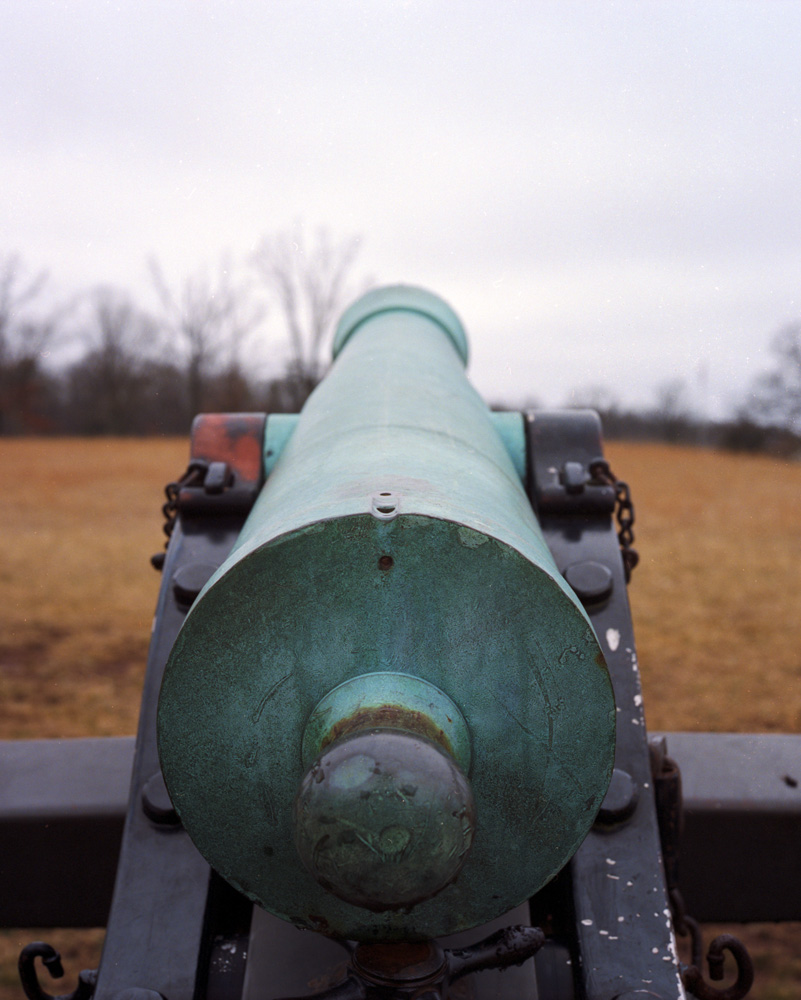
Ed Bearss with Battlefield MapConfederate Cannon, Manassas
This cannon, although NOT original to the battlefield, is in the relative position of Stonewall Jackson’s unit. One remarkable feature when you see the battlefield is how close the units were- one battery of Union cannon traded hands five times over the course of the day, and they were not more than 100 yards from the Confederate lines.
Henry House
The Henry House that you see in the above photo was the home of the widow Henry, one of the first civilian casualties of the Civil War. The house that you see standing now is not her house, but a replacement. Her house was of similar footprint but only one and a half stories tall. It was destroyed when those Union cannons I mentioned previously were turned and fired point-blank into the house where Confederate infantry had concealed themselves and were firing on the Union gunners. One cannonball tore through the house and removed widow Henry’s foot on its way through as she lay in bed.
Within eyesight of the Henry House was the home of “Gentleman” Jim Robinson. Jim was a mulatto man, and the half-brother of widow Henry. Their father was “King” Carter, the tidewater plantation owner and one of the wealthiest men in America at the time of the Revolution. Jim was born a slave but manumitted by his father upon Mr. Carter’s death.
The monument immediately beside the Henry House was erected by Union soldiers immediately after the war, and is one of the oldest Civil War memorials. Perhaps THE oldest is also at Manassas, but is not much more than a pedestal today. It was erected during the war by Confederate soldiers to commemorate one of their generals who was killed at 1st Manassas, but torn down by Union soldiers some time after 2nd Manassas.
Stone House with cannonball, Manassas
Here is the door to the Stone House, with the cleverly placed cannonball embedded in the wall. Note I said cleverly placed – there are a total of five cannonballs stuck in the stonework of the house, but none of them are there as a result of either the first or second battles of Manassas. Rather, they were added to the house at a much later date (some time in the early 20th century) by the owner, to boost the tourist appeal. How do we know? well, for one thing, all of them are neatly embedded, with no flaking, chipping or fracturing of the stone as would have been the case if the wall had been struck by the cannonball at high velocity. For another, one of the cannonballs is of a type not invented or used until some time in the 1870s.
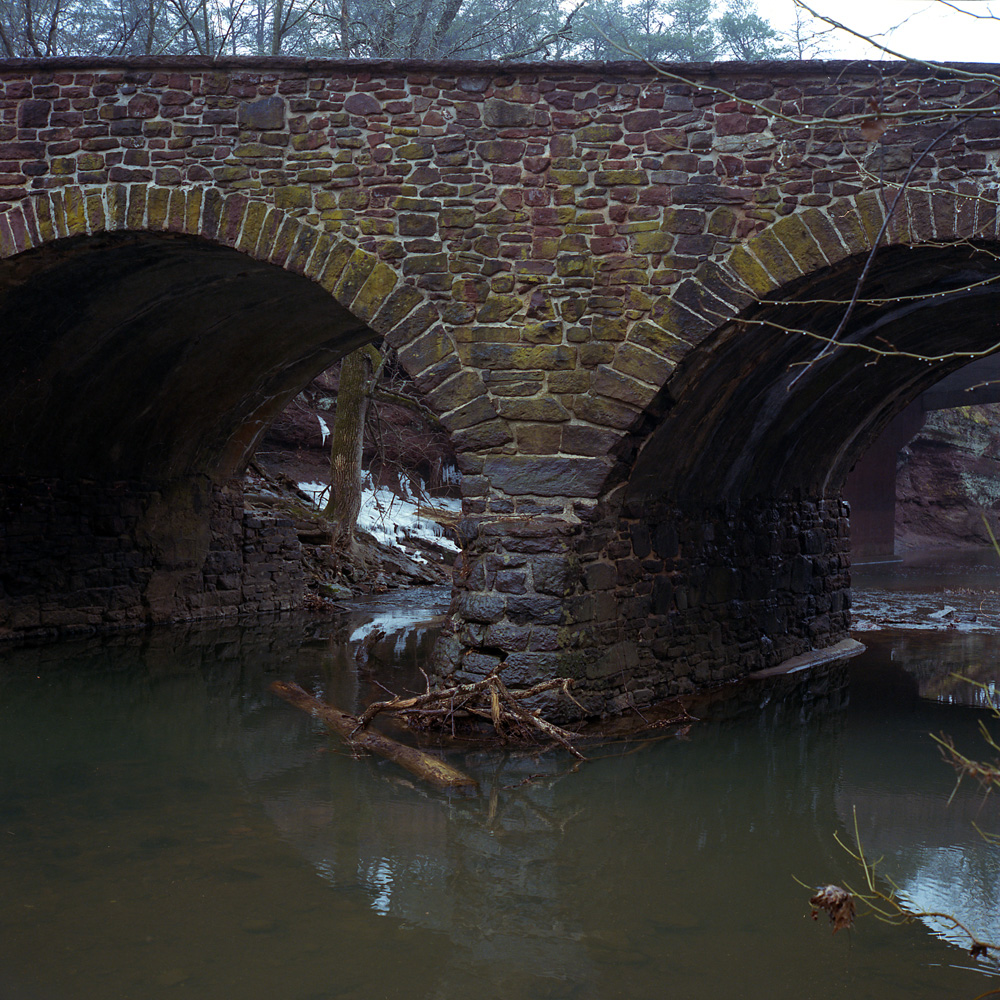
Under the Stone BridgeBull Run from the Stone BridgeStone Bridge over Bull Run
Here is the stone bridge, around which much of the early fighting of the day took place. The bridge spans Bull Run, and although the bridge you see here today is of the same stone as the one that stood there at the battle, it is not the original bridge but rather a reconstruction – during the war, the Confederates demolished the central arch of the bridge to deny Union forces access to the other side. This did not stop them of course, but instead Union engineers built a wooden span on the existing foundations, and then it was rebuilt in the 1884 as you see it today. This was the original course of the Warrenton Turnpike (today’s Route 29, the Lee Highway) and all traffic on that route crossed this bridge until the route was straightened and a new two-lane bridge was built adjacent in the 1960s.
I’ll close with another portrait of Ed, with his swagger stick made from a .50 caliber machine gun bullet. Ed at the Stone Bridge
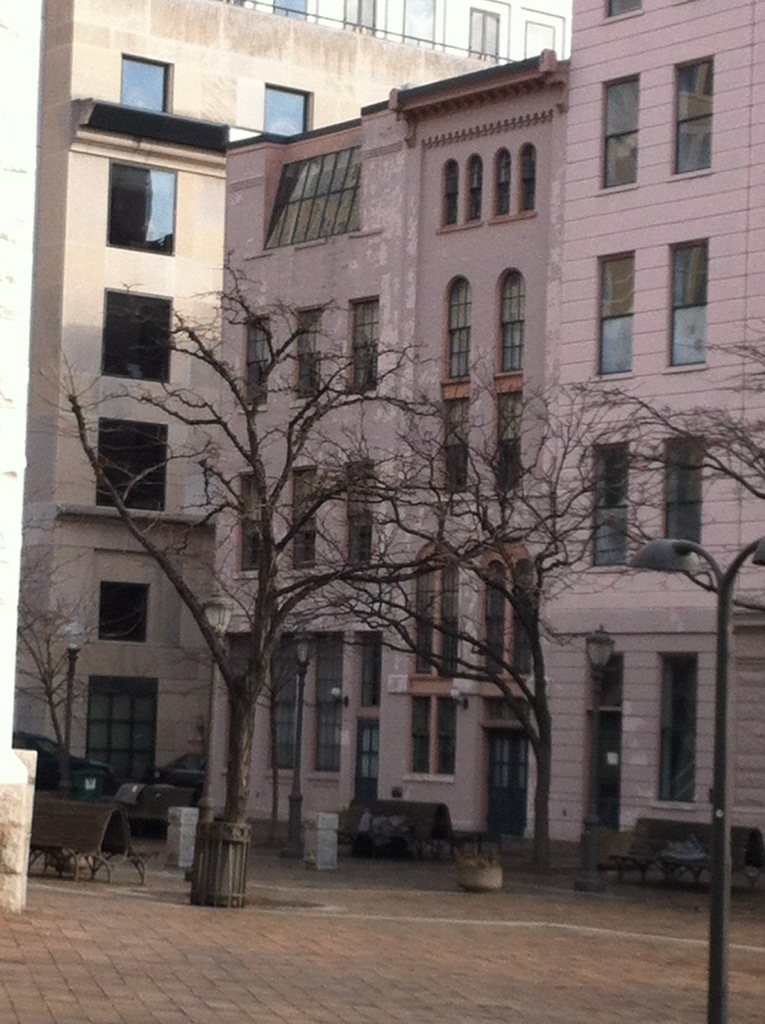
Here is the skylight of Mathew Brady’s Washington studio. Today the space is occupied by the National Council of Negro Women. The studio itself today is nought but a storage room full of filing cabinets. But still being able to see the skylight Brady used to illuminate his subjects helps one imagine Abraham Lincoln and U.S. Grant sitting in that loft for the portraits we know them best by.
The skylight is on the top floor of the pink building at the left of the photo.
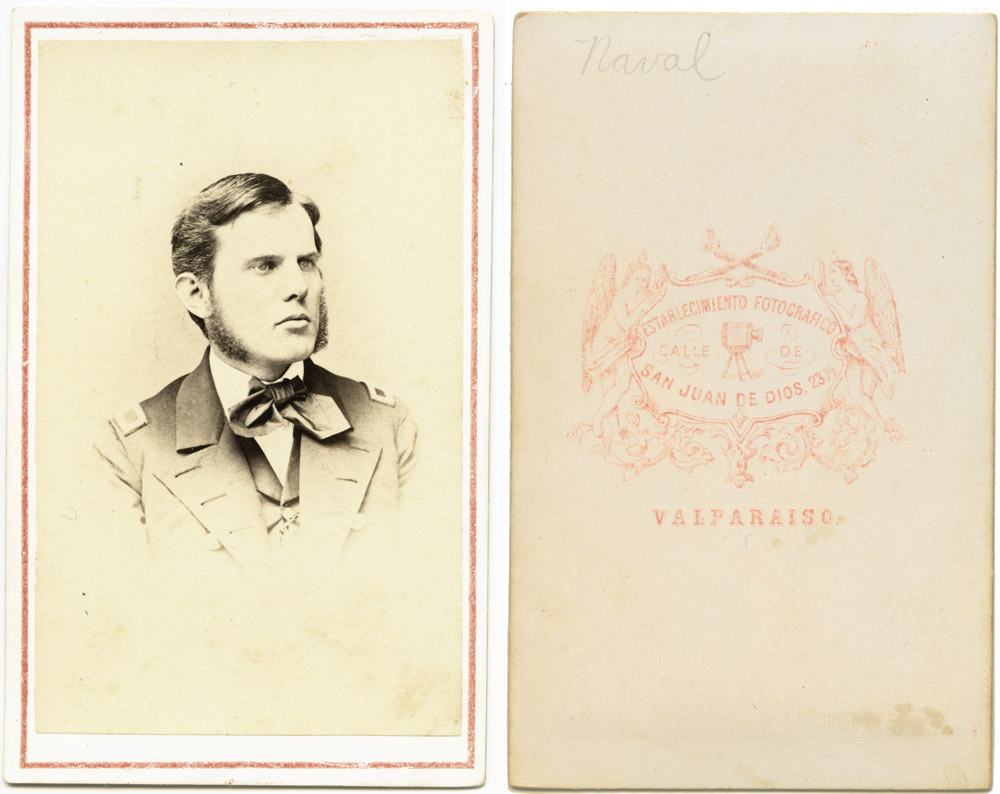
Another find from my Gettysburg excursion. He’s a US Navy Officer. I’m not sure of the dating – the jacket looks possibly post- Civil War, but the shoulder boards suggest he’s a Master (a rank no longer used, but the equivalent of a Lieutenant, Junior Grade today) circa 1861. They changed the Master’s insignia in 1862 from the blank bar to include a gold bar at each end and an anchor in the middle, and introduced the rank of Ensign to replace the previous rank of Passed Midshipman as the most junior commissioned officer rank. This is another records quest – I would suspect there were only one or two ships at most that would have docked in Valparaiso in 1861, and ship’s crews being significantly smaller in 1861 than they are now, there’s a good chance he was the only Master (or one of two) on the ship.
Here is a CDV of a Union solider from Chambersburg, Pennsylvania, my hometown. I found it on an excursion up to Gettysburg this weekend. Judging from his overall appearance of health and cleanliness, this was probably taken at the beginning of the war when he enlisted. When I saw the image in the display case, I felt a need to acquire it just because it was from Chambersburg. After doing a little collecting, I’m getting the impression that there was only one, or perhaps two photo studios in Chambersburg for most of the 19th century, as this H. Bishop seems to be the most frequent studio back mark by far. I’m starting a records search to try and identify the young man, as there weren’t THAT many sergeants in the units from the Chambersburg area. I’m thinking a trip to the Kittochtinny Historical Society offices is in order when the weather is warmer and they’re back to full hours (I think they close up for the most part in the wintertime as their archives are in the Old Jail and are not heated). The Old Jail, by the way, is well worth a visit if you’re ever passing through Chambersburg – the main part of the jail is a Georgian structure dating to at least 1818, and was in use as a prison at least into the 1960s, when one of my father’s partners in his medical practice would take calls to see patients being held there.
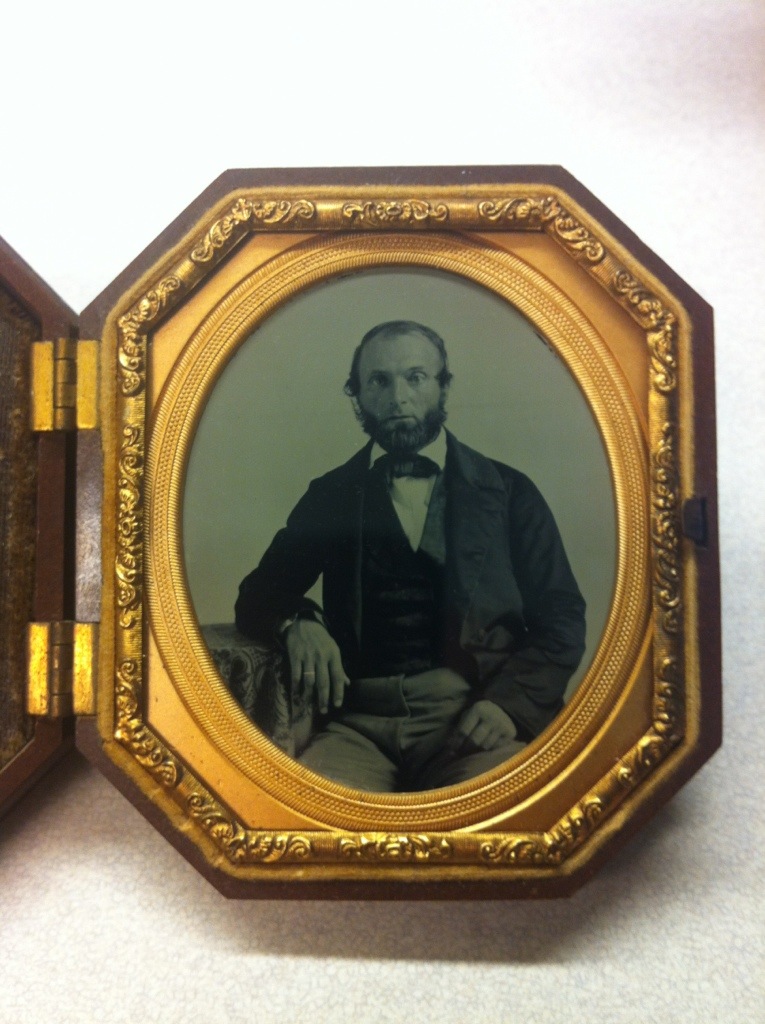
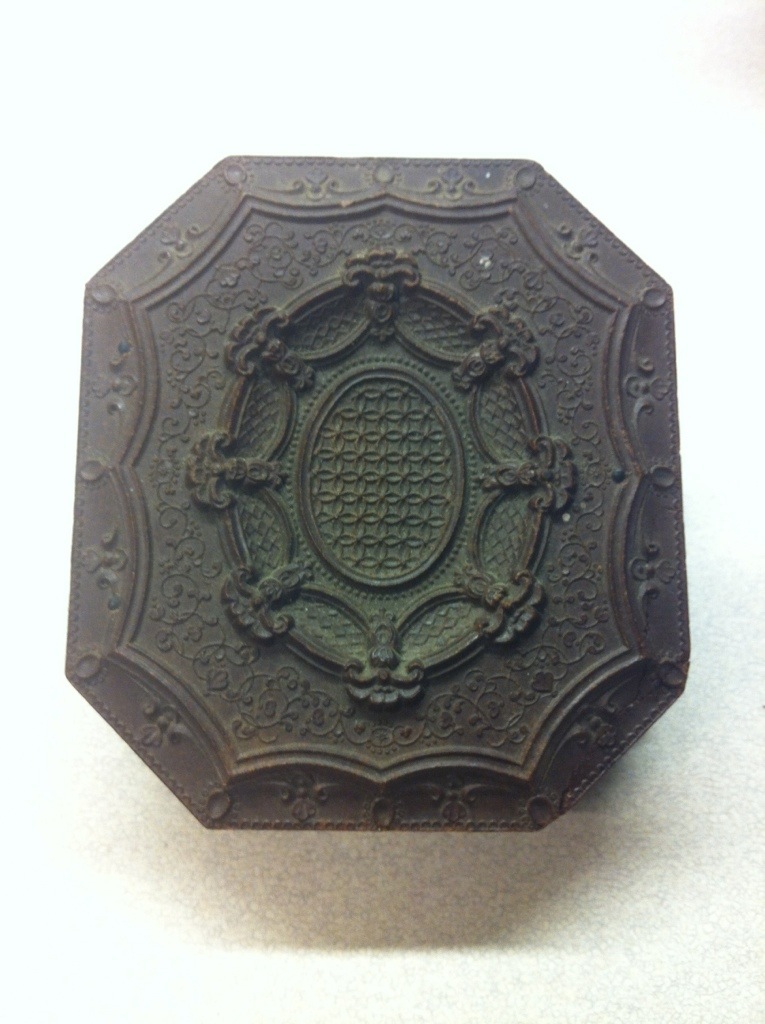
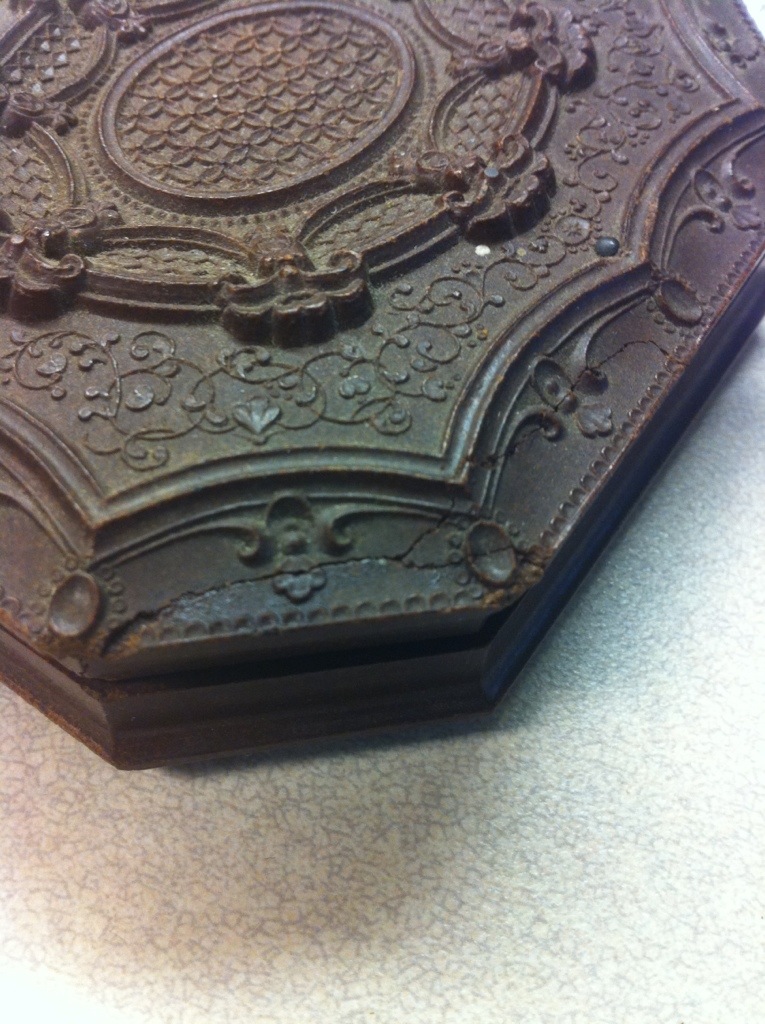
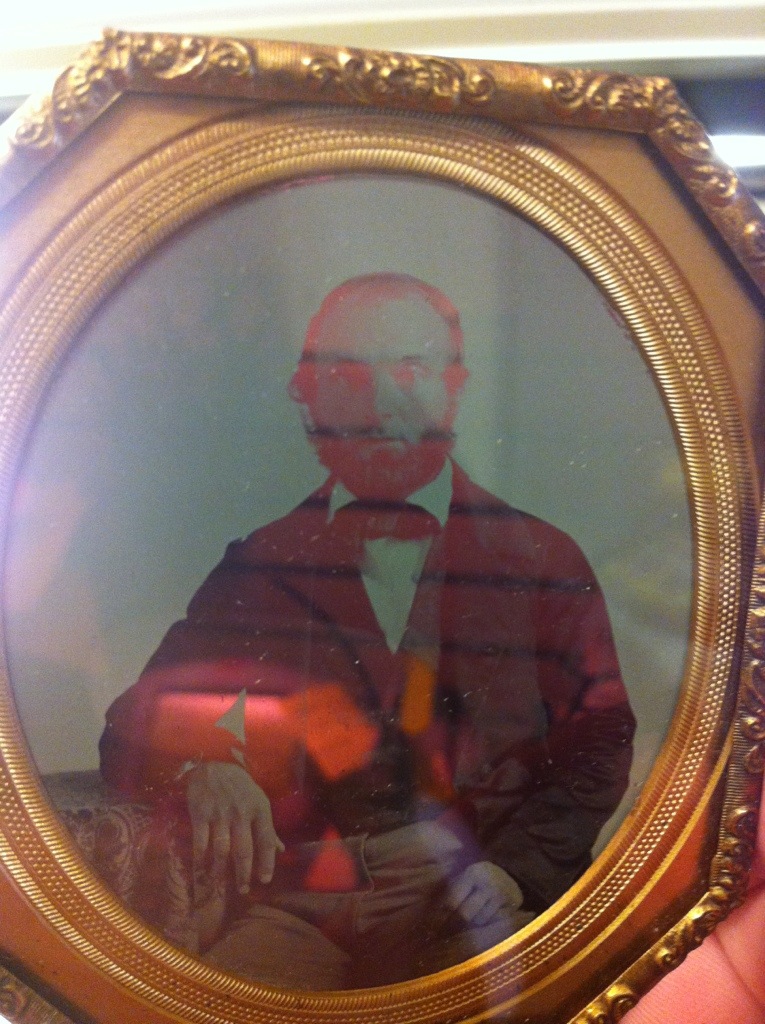
Here is my latest acquisition, a ruby glass Ambrotype in an octagonal Union case. The funny thing about the Union cases is that the name has nothing to do with the Civil War – in fact they were losing popularity by the time the war started, as were cased images in general. They got the name Union cases in the 1850s, well before the question of Union vs. Confederacy existed. It helps to confuse the issue that many were made before and during the Civil War with patriotic themes, lending credence to the notion that the name had to do with the war. I’m not going to say that no Confederate-themed Union cases were ever made, but in my limited experience of collecting, I’ve not seen one. I have seen leather/papier-mâché cases with Confederate themes embossed, so I suppose it’s possible, although I believe most Union case makers were located in New England.
I bought this image over the weekend at the Photorama show in Tysons Corner, Virginia. The Photorama shows used to be big deal swap meets and sales, with dozens of dealers filling multiple ballrooms at the Best Western. Now, they’re relegated to a single room in the basement, with maybe ten dealers, mostly peddling castoffs and junk. Bargains can be had, if you’re looking for random odds and ends – I got a Stroboframe flash bracket that retails new for around $60 for $5. And I found this image in a box of stuff. It was dusty and dirty, and didn’t look like much. There was no price tag on it, so I had to find the dealer who had it to get the price. As I was walking up to him, I dropped it, it hit the floor, and one corner of the case cracked off. I told him I was buying it, as I had just broken it. Perhaps out of sympathy or as an acknowledgment of my honesty, he sold it to me for $40. I brought it home, saved the broken pieces, repaired and cleaned it.
You can see the repaired crack in the case in the first picture, and the second one illustrates the ruby glass. I’m not sure the reason for using red glass instead of black glass, unless red glass was cheaper, or perhaps it was believed the red imparted a warmer, more lifelike color to flesh tones.












 dcphotoartist