I have had eight images published at Eastern Sierra Center for Photography’s website in their “Paradigmatic Nudes” gallery online. Most of these images you’ve seen here before on my blog. The images featured are my whole-plate sized gum bichromate prints of Philip, a model I’ve worked with and my Type 55 Polaroid 4×5 format shots of my friend Jose. I’d like to give a big shout-out to Laura Campbell, their curator and director, for repeatedly selecting my work and having faith in my creative vision. Please go check out their website and see the entire gallery.
Jose, Legs Large format Nudes at Eastern Sierra Center for Photography
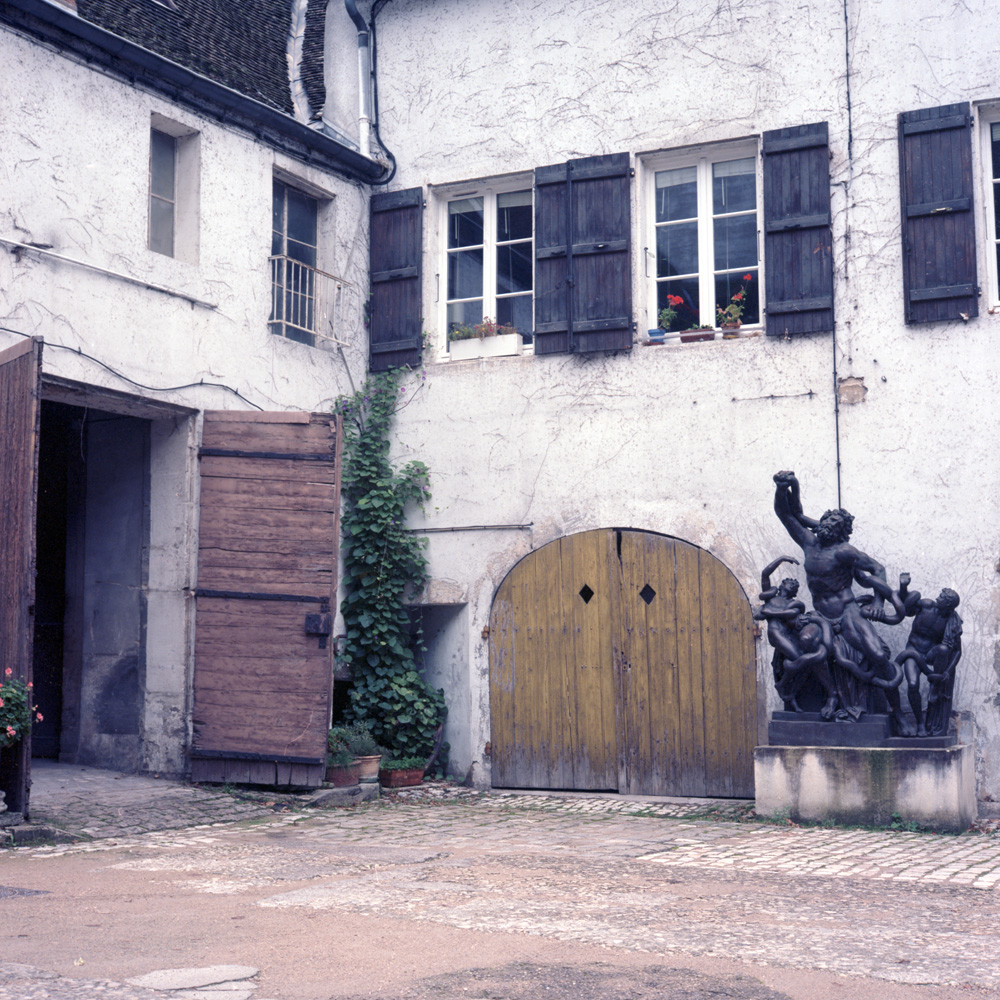
Around the corner from the Musee Niepce and the Chalon tourism office, I encountered this fascinating courtyard. Perhaps the single most surprising element was the massive bronze Laocoon statue in an otherwise ordinary if picturesque courtyard. Why and how the statue ended up there is a mystery.
Laocoon Courtyard, Chalon
If you remember your mythology, Laocoon was a Trojan priest who predicted the Greek gift of the Trojan horse but was not believed. There are multiple versions of why the gods sent serpents to strangle him and his sons, ranging from dishonesty to defiling temple virgins. Regardless of the why, his story became famous, and has been commemorated in art from ancient times. There is a Roman marble of this scene, probably modeled after a Greek one, which was then emulated multiple times in stone and metal during the Renaissance.
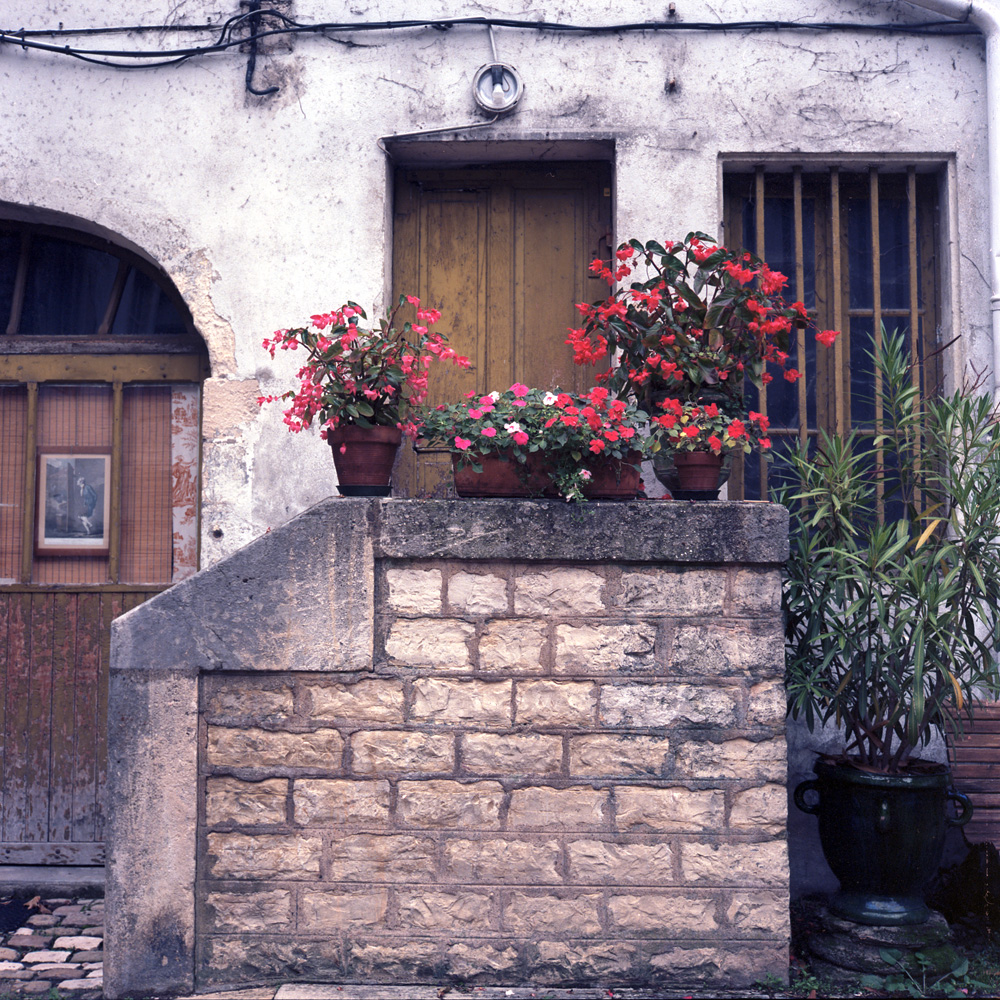
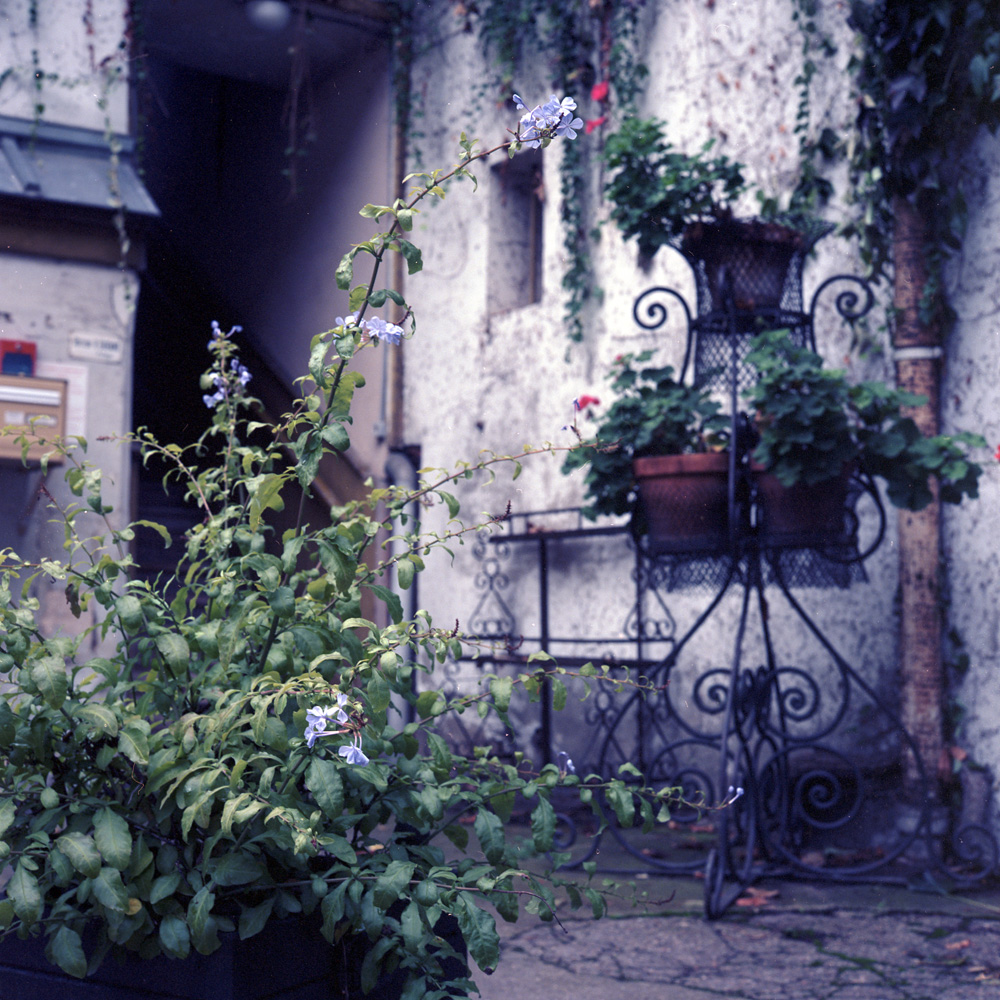
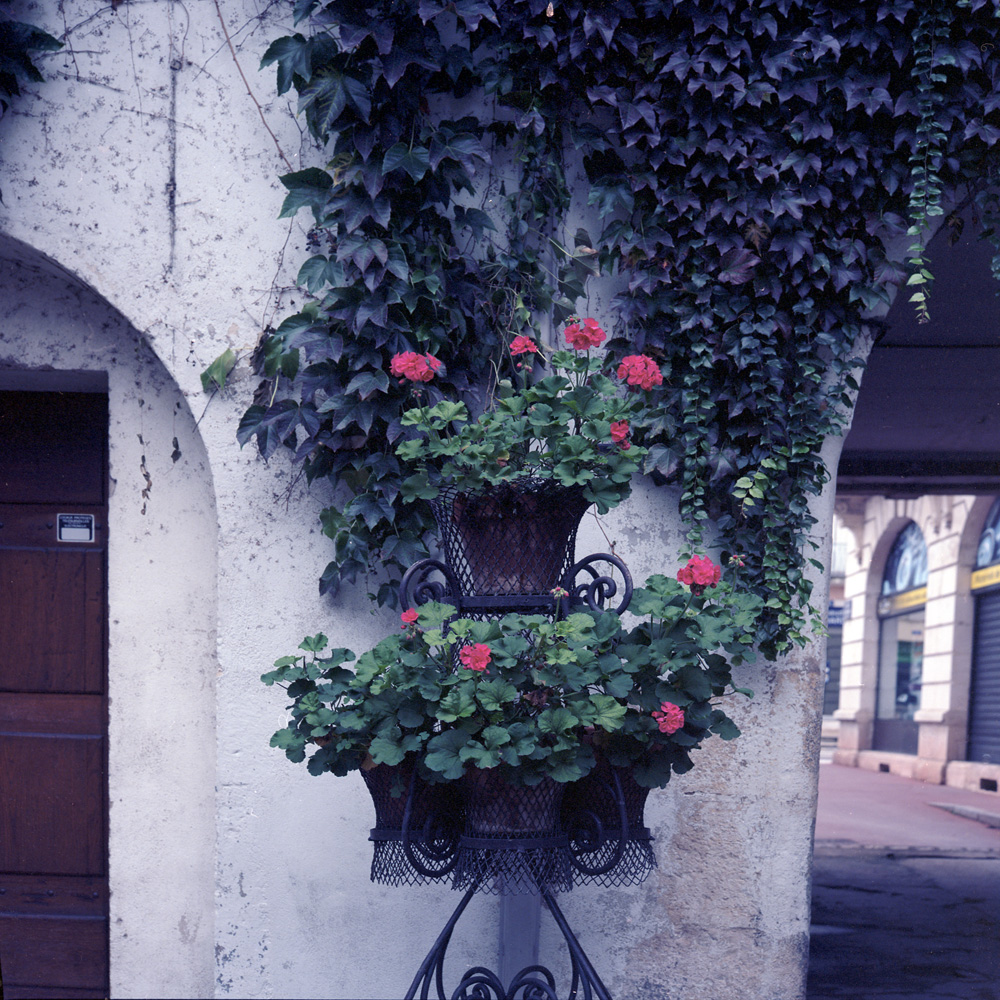
Someone who lives in this courtyard favors geraniums.
Courtyard residences seem to be extremely popular in France. I suppose it’s for the relative privacy you have compared to facing the street, especially in older urban areas where stepping out your front door puts you literally a sidewalks’ breadth away from traffic. And it provides opportunities for parking that you wouldn’t get elsewhere. I think I’d like to live on a courtyard if I lived in Paris, or even in a town like Chalon. Who wouldn’t enjoy walking down the stairs every morning to be greeted by your own classical Greek statue?
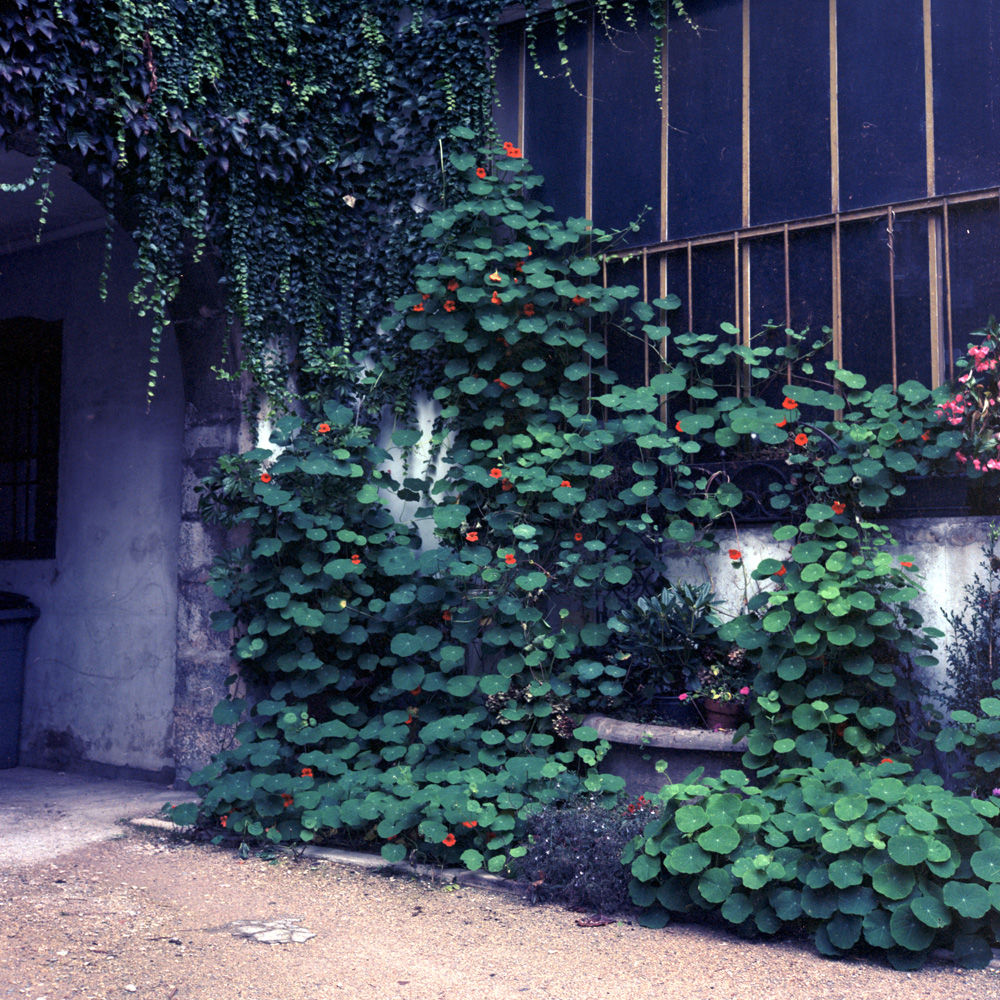
Greenery of all kinds, in fact, is a hallmark of the space. These flowering vines had taken over the wall and partially obscured the window into the workshop. If my understanding of French is any good, the workshop behind these windows was a specialist in antiques and restoration. I couldn’t tell if they were open at the time so I didn’t try to venture in.
Vines, Windows, Courtyard, Chalon
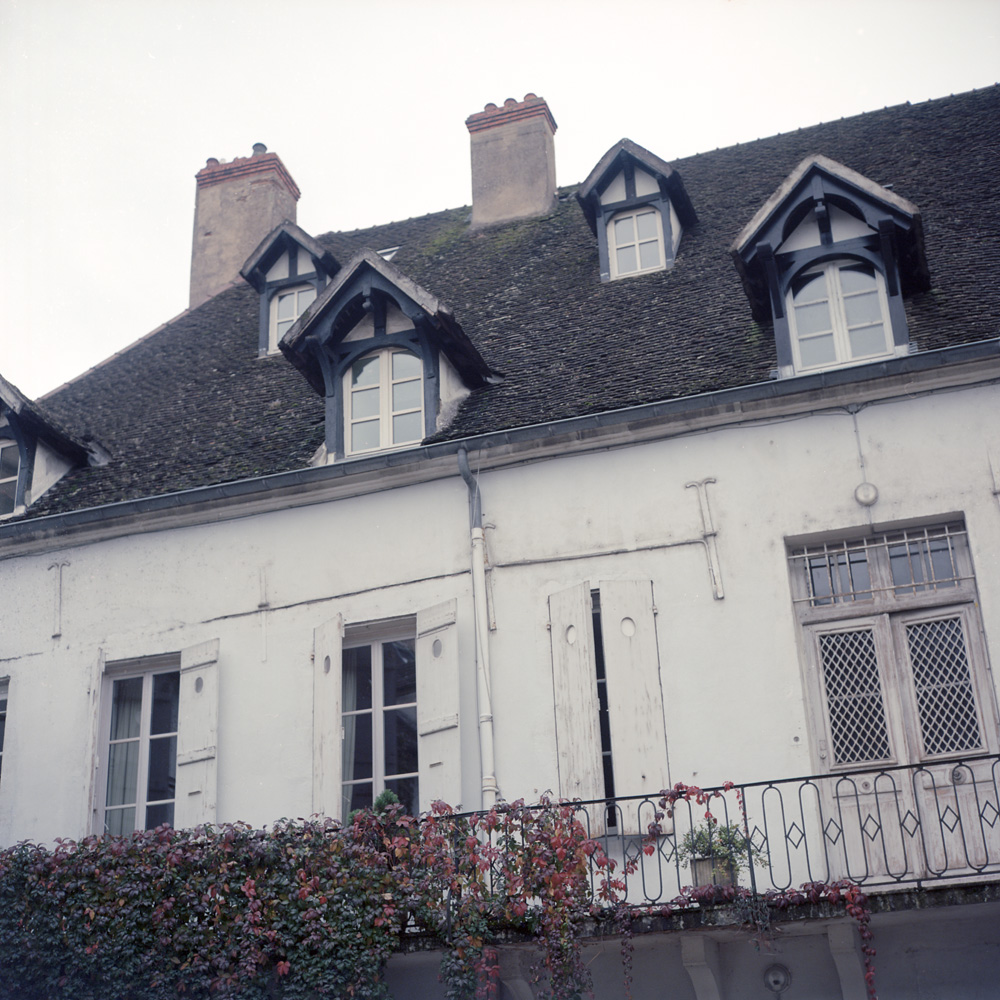
Another somewhat Swiss-looking architectural element, the peaked gabled windows in the roof:
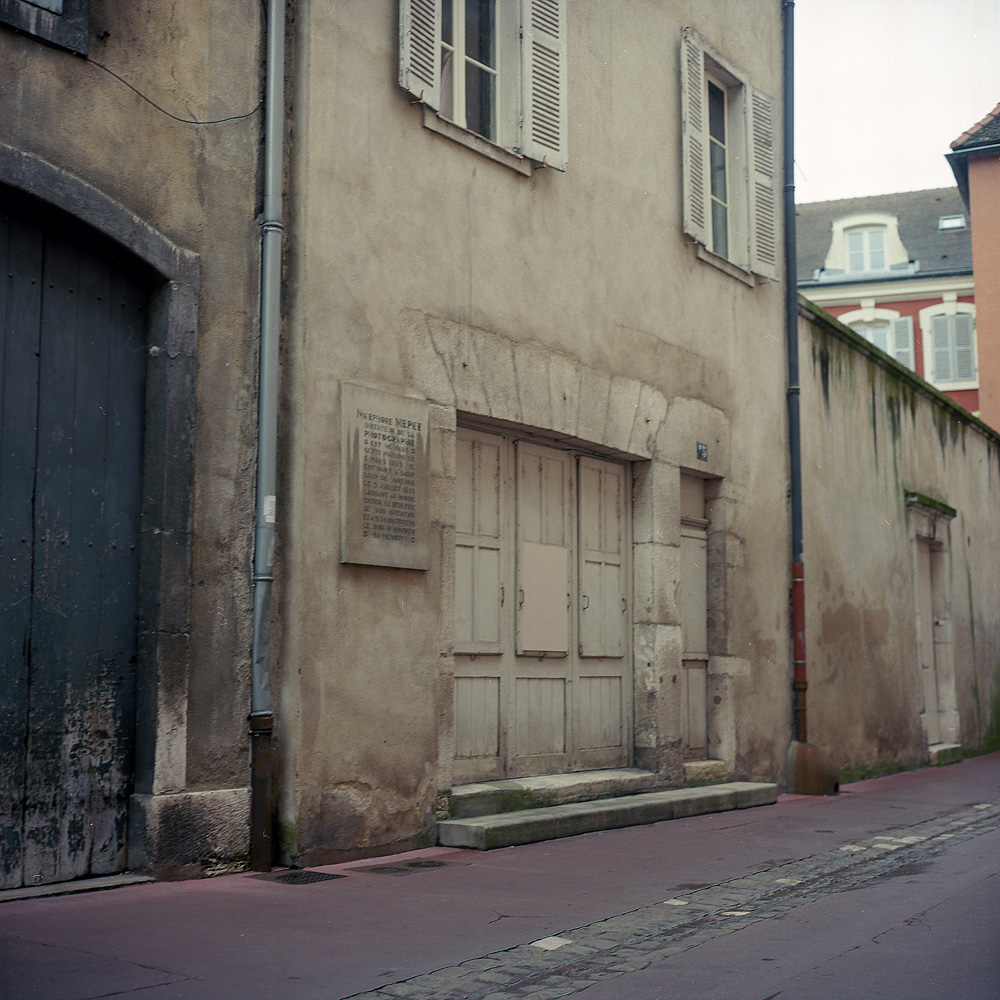
Joseph Nicephore Niepce was born in Chalon-sur-Saone on March 7, 1765 in a house at 9 (now 15 in the new address scheme) Rue De L’Oratoire. The house as it stands today is rather nondescript and gives no clue as to the inspiration behind the man who would invent photography. Rue De L’Oratoire is really more of an alley, closed in on one end, and the other opens to a pedestrian-only street.
In this view of number 15, Rue De L’Oratoire, you can see the plaque on the wall indicating the house where Niepce was born.
Niepce’s Birthplace, 15 Rue de L’Oratoire
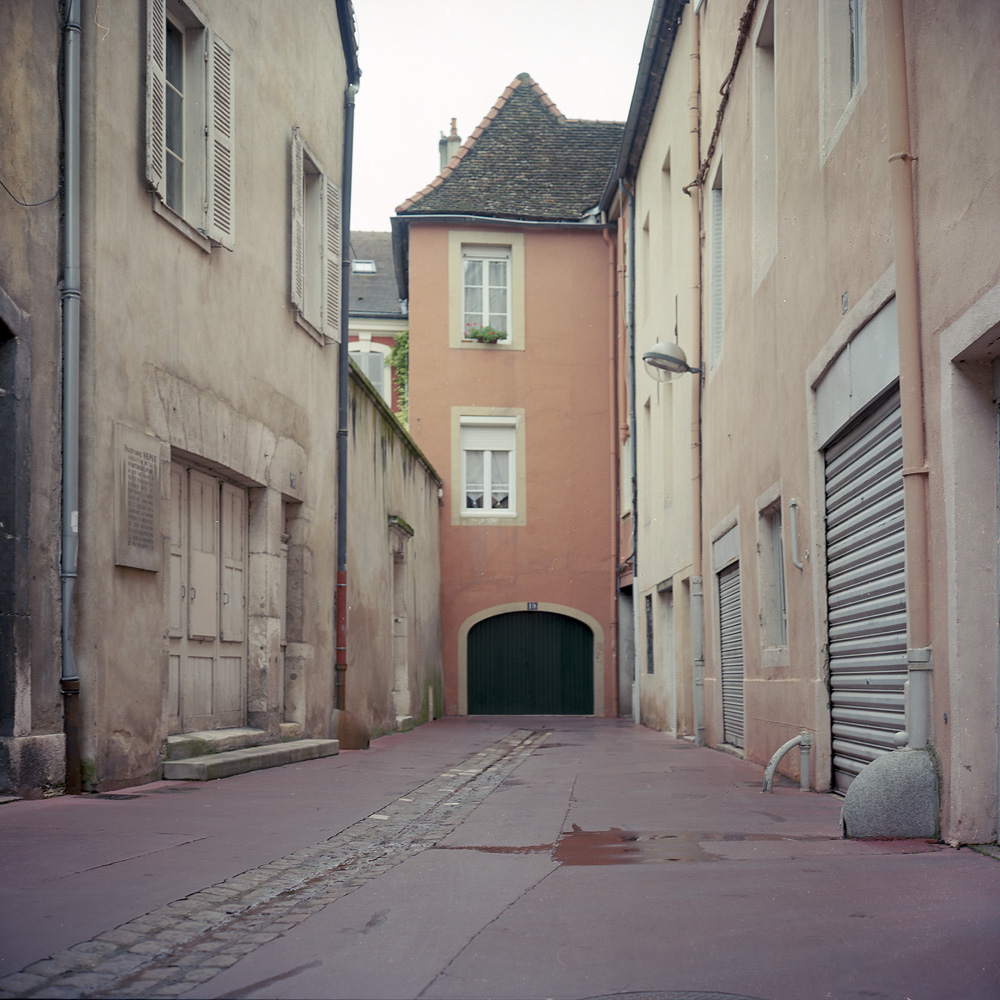
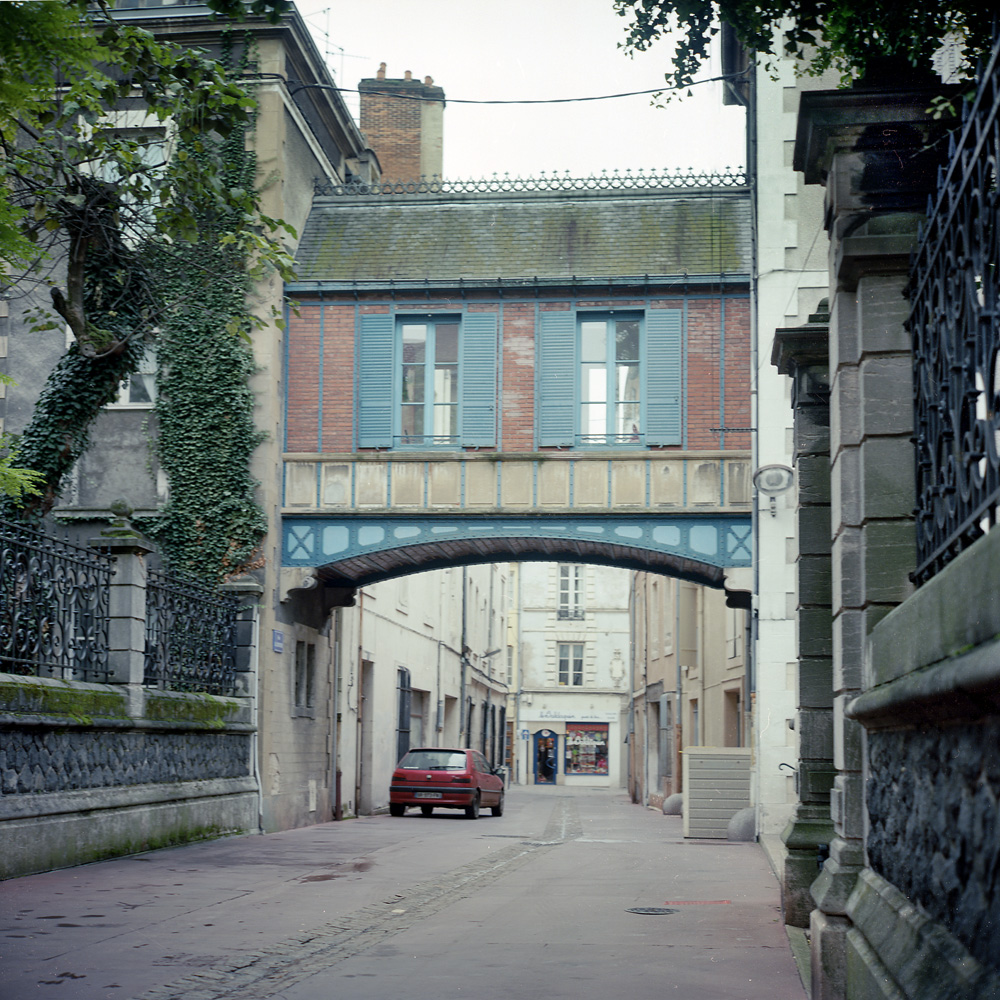
A view of the street, including the house:
Niepce’s Birthplace, Rue De L’Oratoire
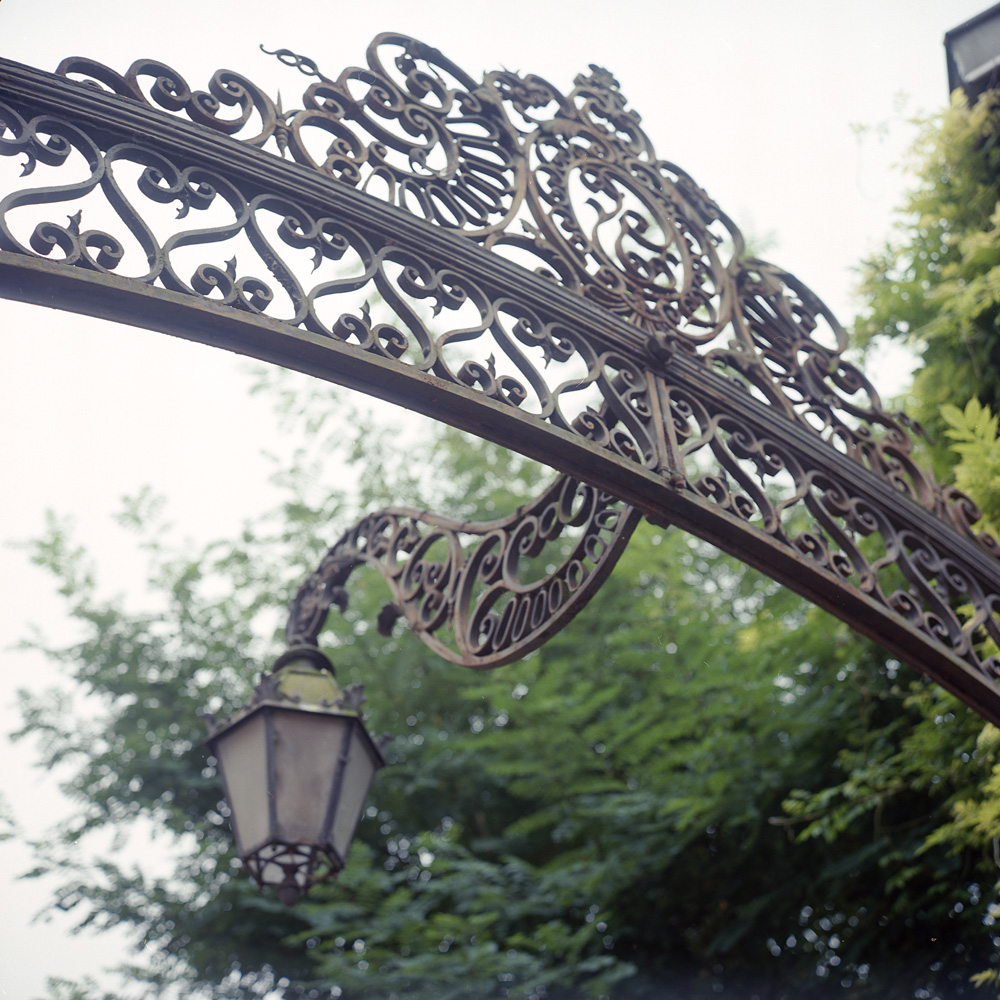
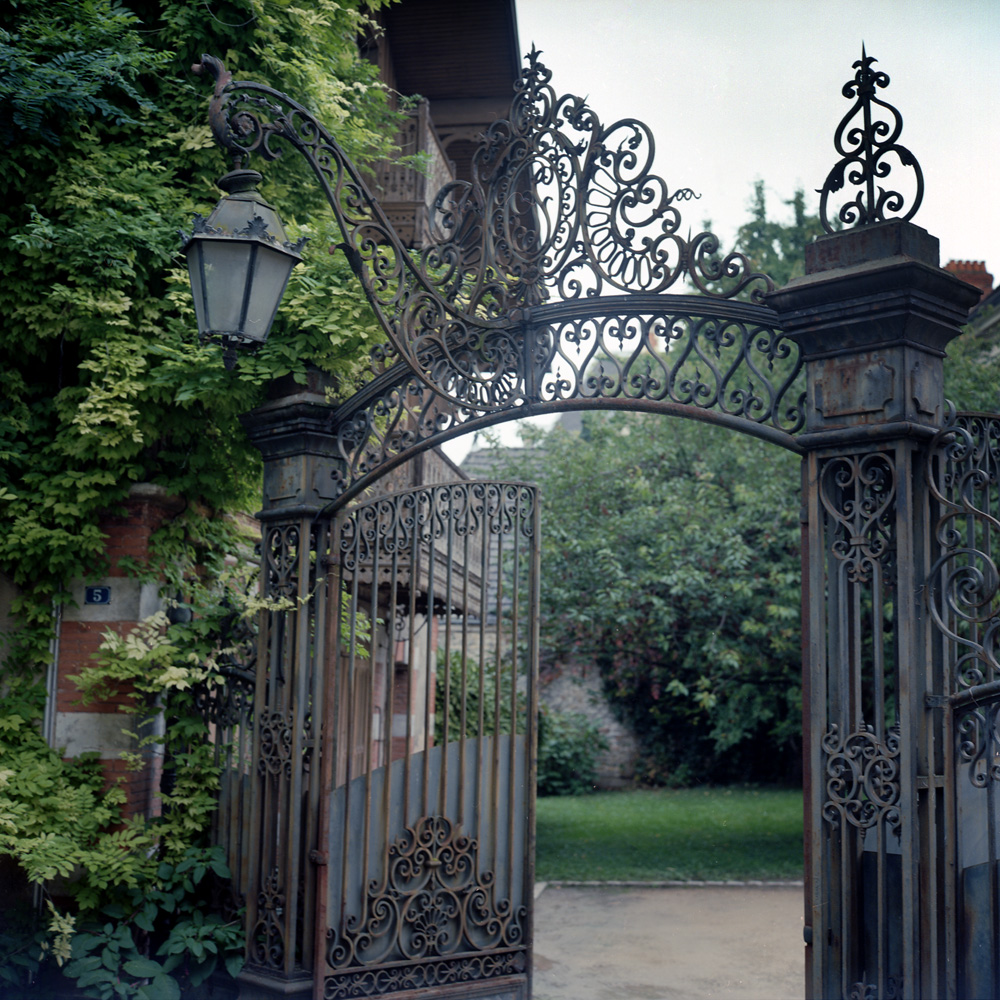
If you are approaching Rue de L’Oratoire on foot from Rue General Leclerc, there is a driveway into which you can turn, at the end of which is this very ornate iron gate and lamp, guarding a private courtyard. I could not confirm but I believe the front of Niepce’s house faces this courtyard, which is infinitely more appealing than the Rue de L’Oratoire side. I did not photograph the house itself as it is currently lived in by private citizens.
Lamp, Iron Gate, ChalonIron Gate, Chalon
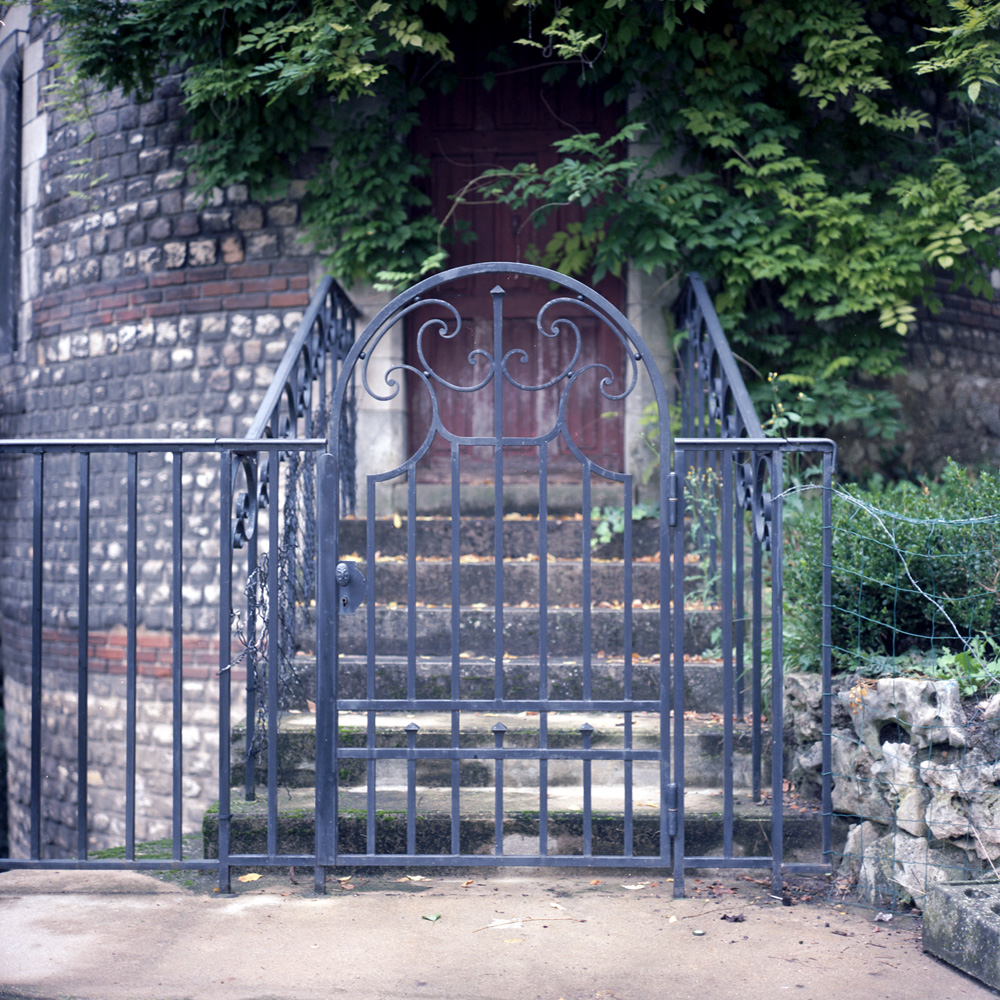
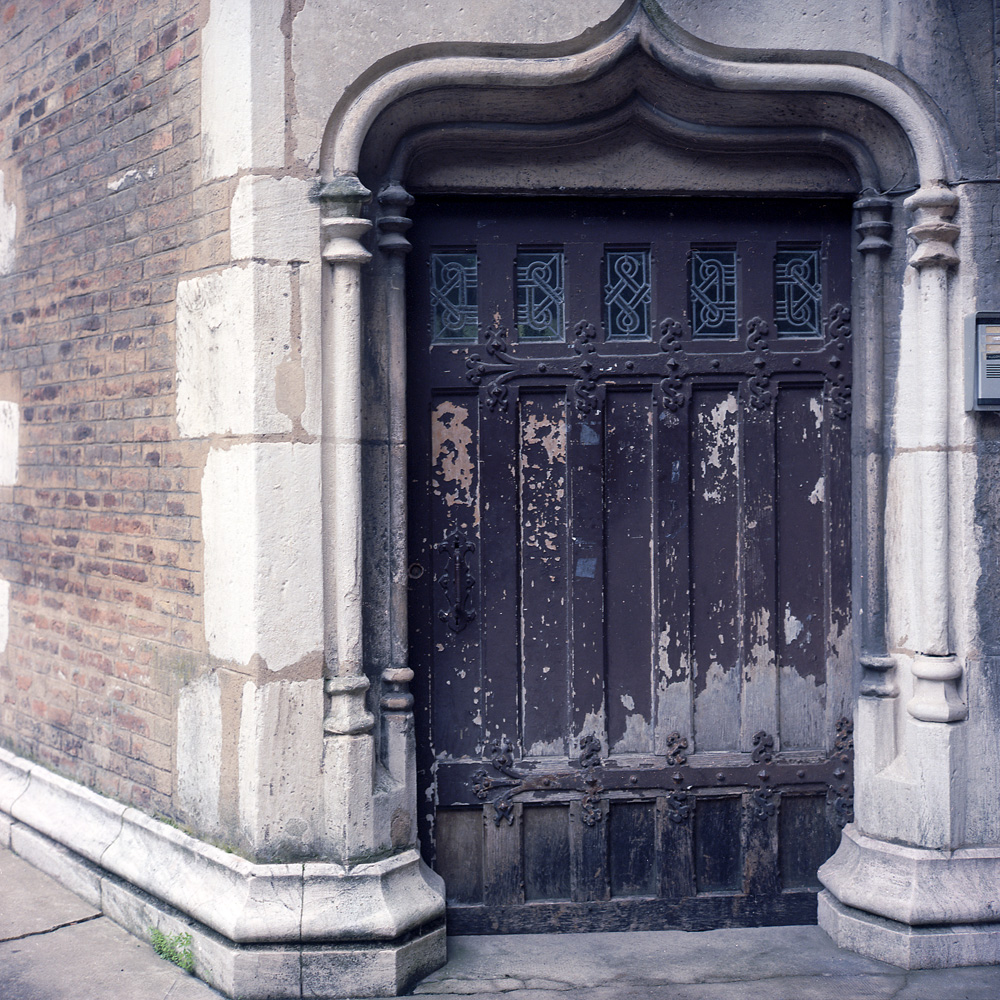
The approach to the Rue de L’Oratoire from Rue General Leclerc is through what is now a car park, at the back of which can be found the Tour Saudon, a medieval tower. I assume the car park was once gardens for the tower. This is a close-up of the iron gate and door to the tower, which again, to the best of my ability to determine, is not open to the public.
Gate, Door, Tour Saudon
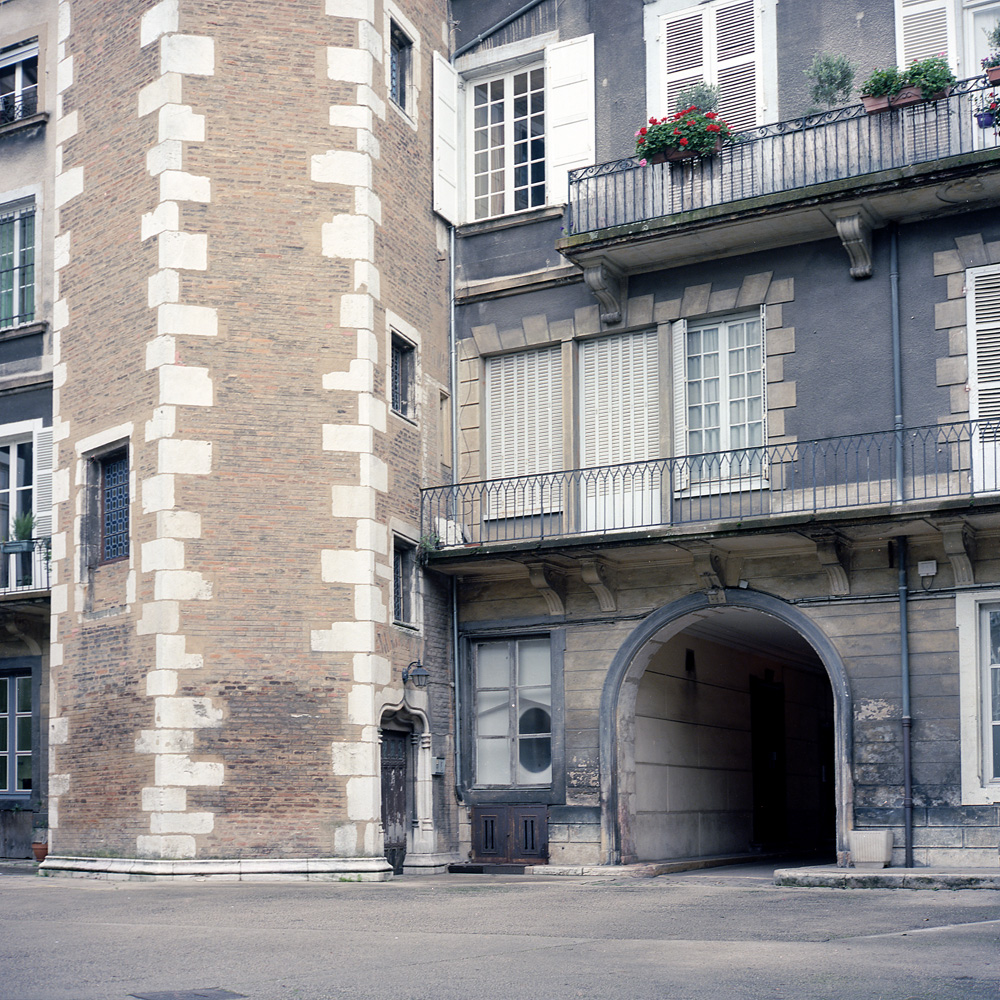
Across Rue de L’Oratoire from the Tour Saudon, there is a 17th century courtyard apartment building. I could have spent an entire day just doing a photo essay on this courtyard. I would have loved to have seen inside some of the apartments – what would they look like now, and how would the layers of history be exposed/concealed in such a space?
17th Century Courtyard
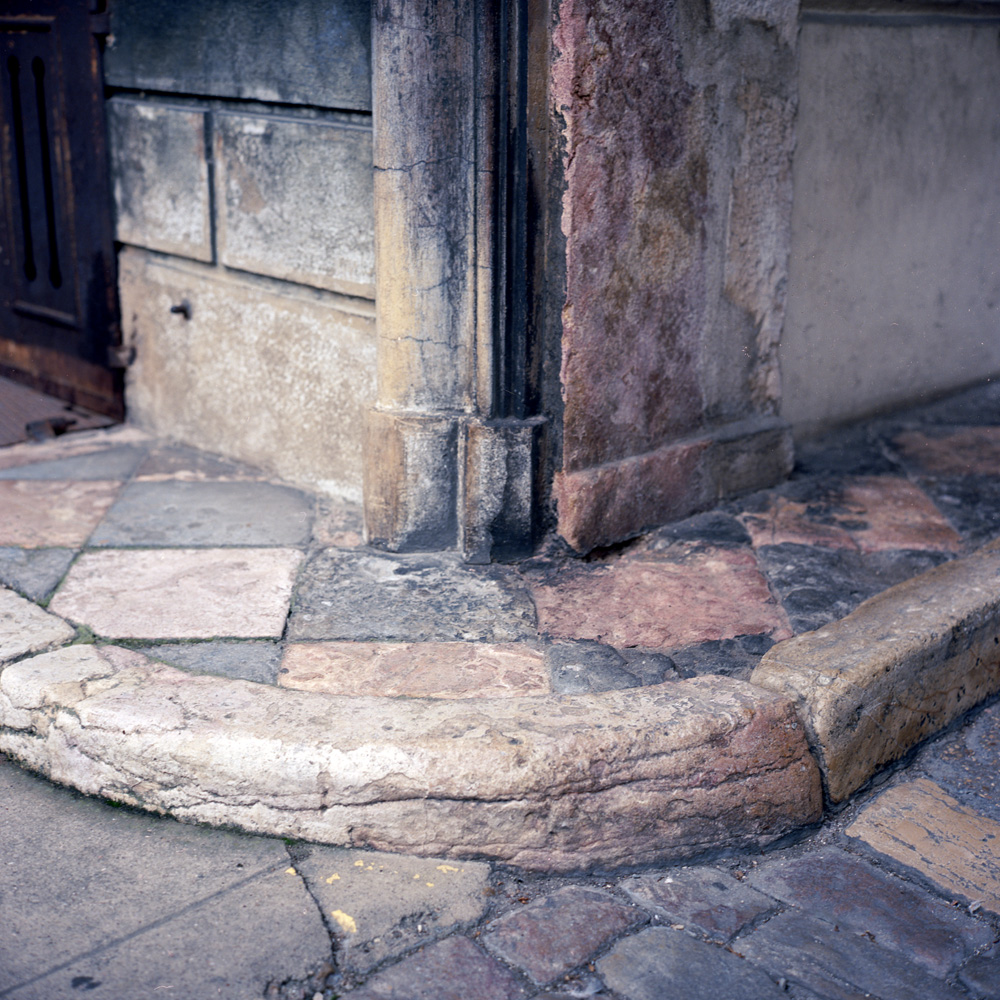
The red-and-black marble tile paving on the sidewalk inside the carriageway is an enchanting detail to the space, and a very clear sign of its age. It almost feels like you’re looking at a painting, and not the actual stone.
Red and Black Marble Sidewalk, 17th Century Courtyard
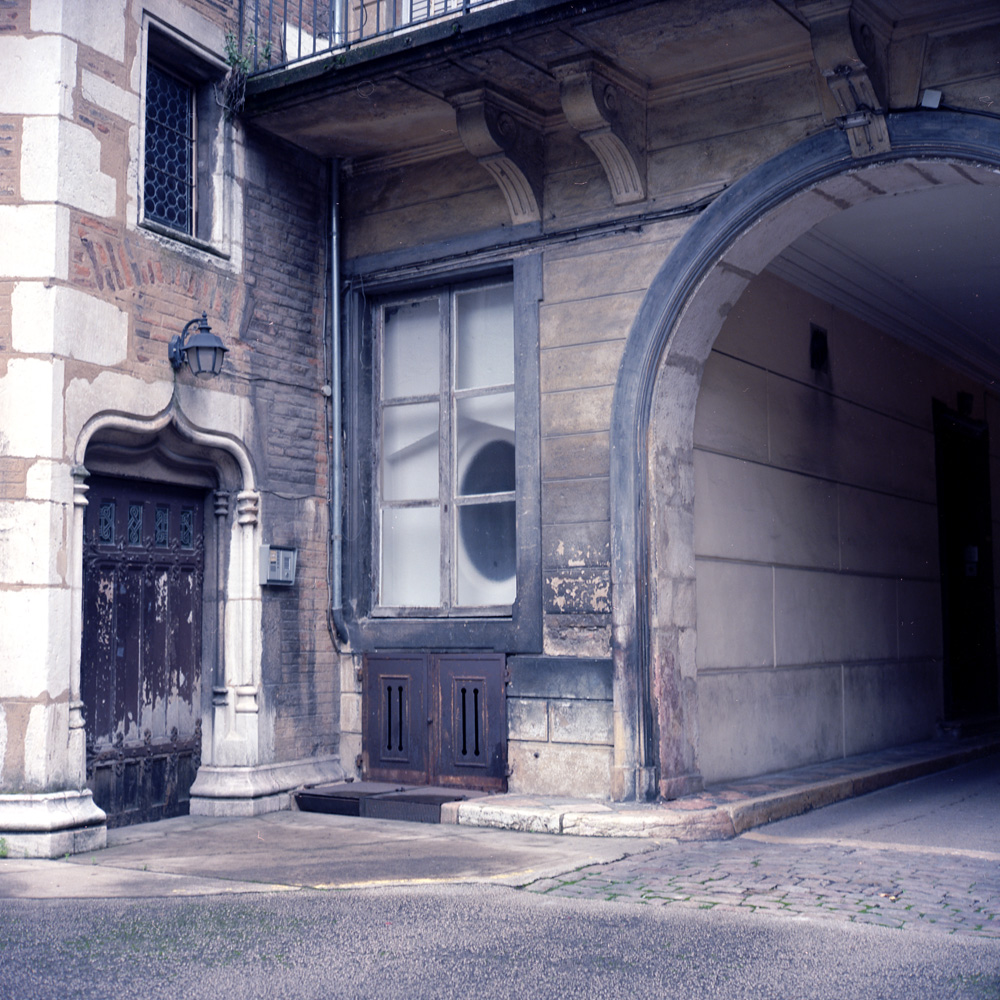
The carriageway into the courtyard is, I suspect, the primary means of vehicular ingress and egress to the Rue de L’Oratoire, as the intersecting street at the bottom of the Rue is a pedestrian-only thoroughfare.
Door, Window, Carriageway, 17th Century CourtyardStaircase Tower Door, 17th Century Courtyard
If you look through the archway over the Rue de L’Oratoire, you can see the pedestrian street, the Rue au Change. If the overpass connecting the apartment building with the building across the street looks Swiss, it should not be surprising in Chalon- it is about 70 miles (120km) to Geneva from Chalon. The building in the courtyard to which the iron gate and lamp at the top of this post is attached on the left looks just like a traditional Swiss chalet that you’d expect to see on an alpine meadow, not in the middle of a French town.
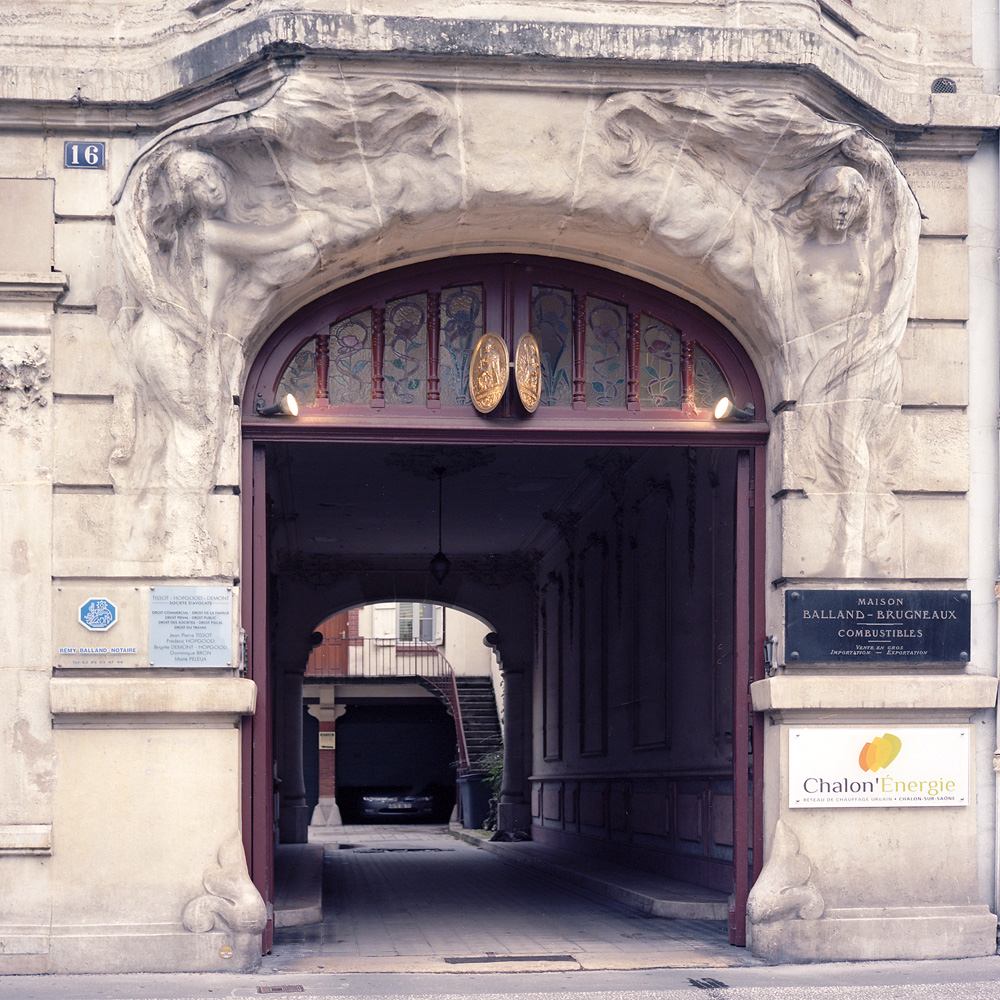
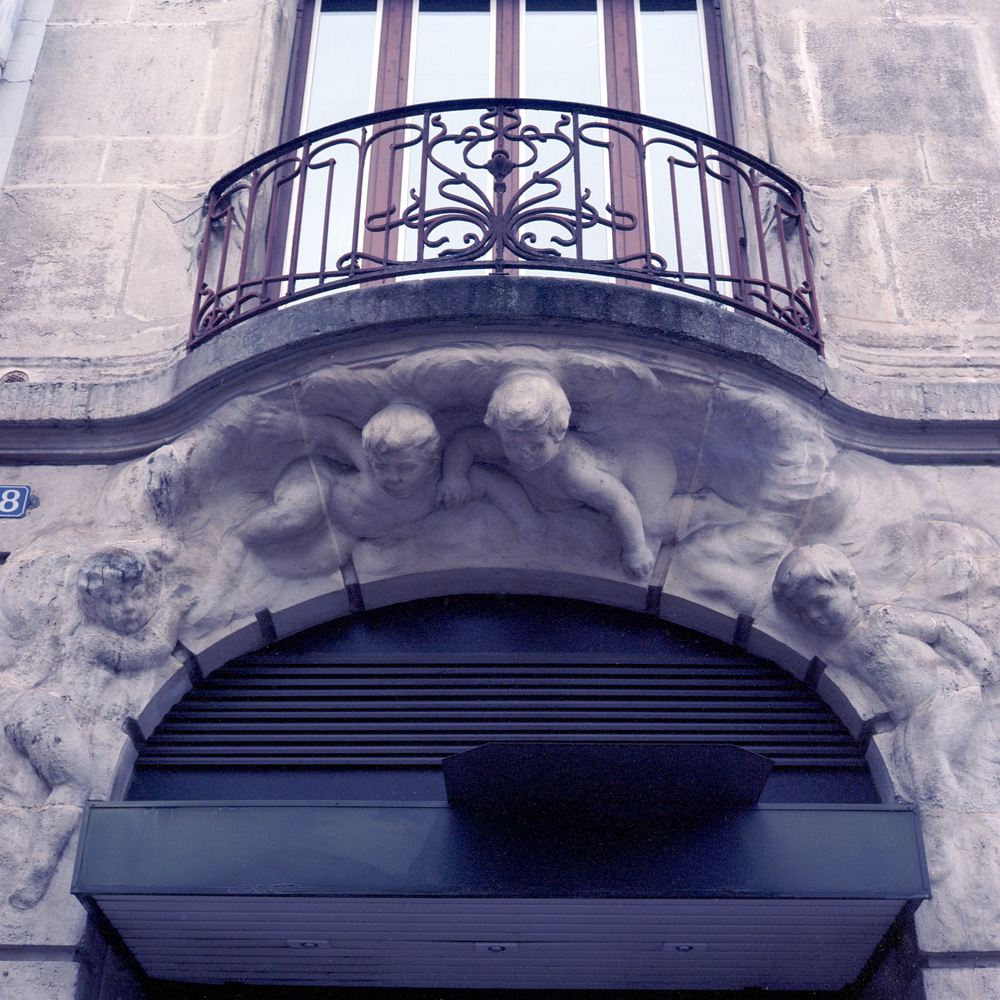
On the Boulevard de la Republique there is this fascinating Art Nouveau building that stands out amidst its neighbors. Having spent 10 days in Barcelona, perhaps the global epicenter of Art Nouveau, it’s hard not to be sensitive to it. A Gaudi building this isn’t, but the sculptures over the doors that support the first floor balconies are particularly notable – they look like they’re organically emerging from the stone, or perhaps swirling in and out of a magical smoke from some genie’s lamp.
Entrance, 16 Boulevard de la République
The archway over the building entrance (#18) is obviously stylistically linked to the entrance archway to the courtyard behind the building (#16 Blvd de la Republique), but in no way a mirror.
Entrance, 18 Boulevard de la Republique, Chalon-sur-Saone
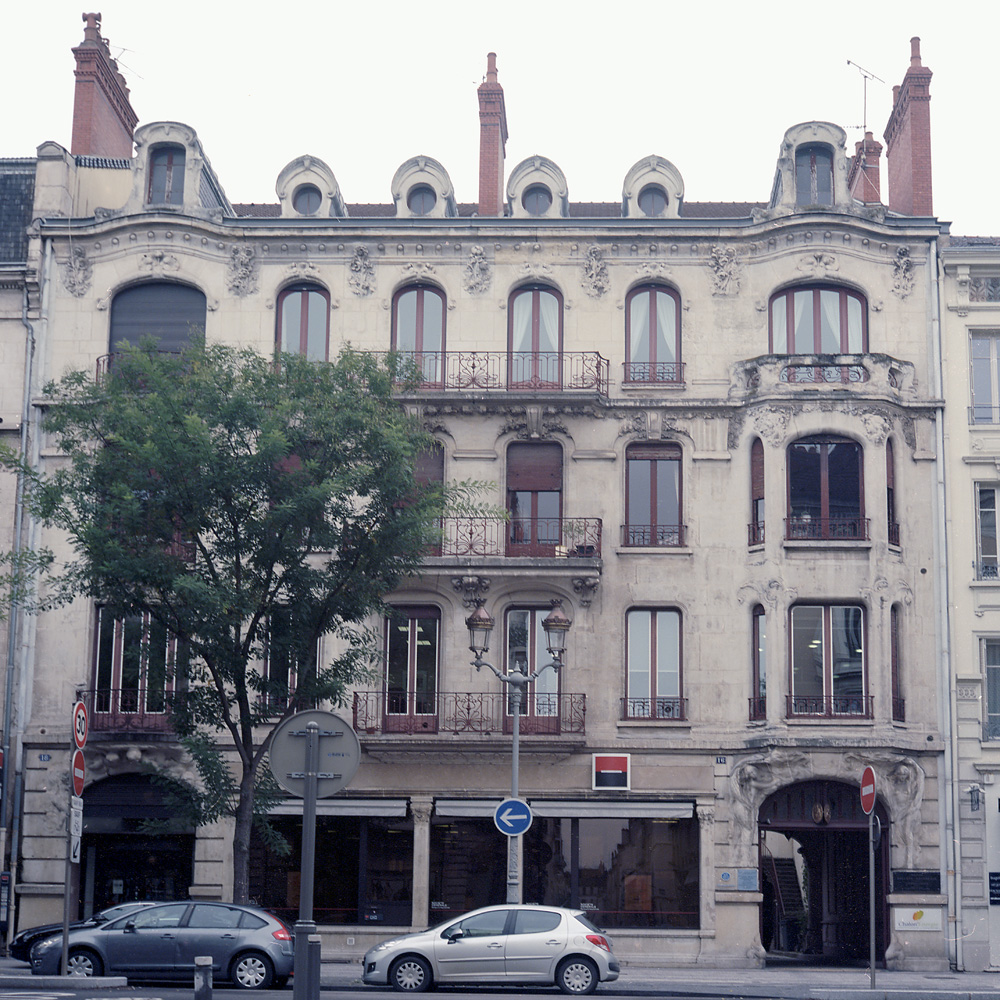
Here is the full facade, so you can appreciate the context of the doorways. I wonder what it housed in the past, and for what purpose it was built. Today there appear to be offices in the building on the lower levels, and possibly apartments on the upper floor.
Facade, Number 16-18 Boulevard de la Republique, Chalon-sur-Saone
I did not see anything else like it in town, in my admittedly extremely brief survey of Chalon, which makes me wonder all the more about the motivation for building it. How did this come to be? It’s obviously prior to the (now gone) Kodak presence in Chalon. It also doesn’t have the feel of being the residence of a single wealthy family, like the Gaudi commissions in Barcelona.
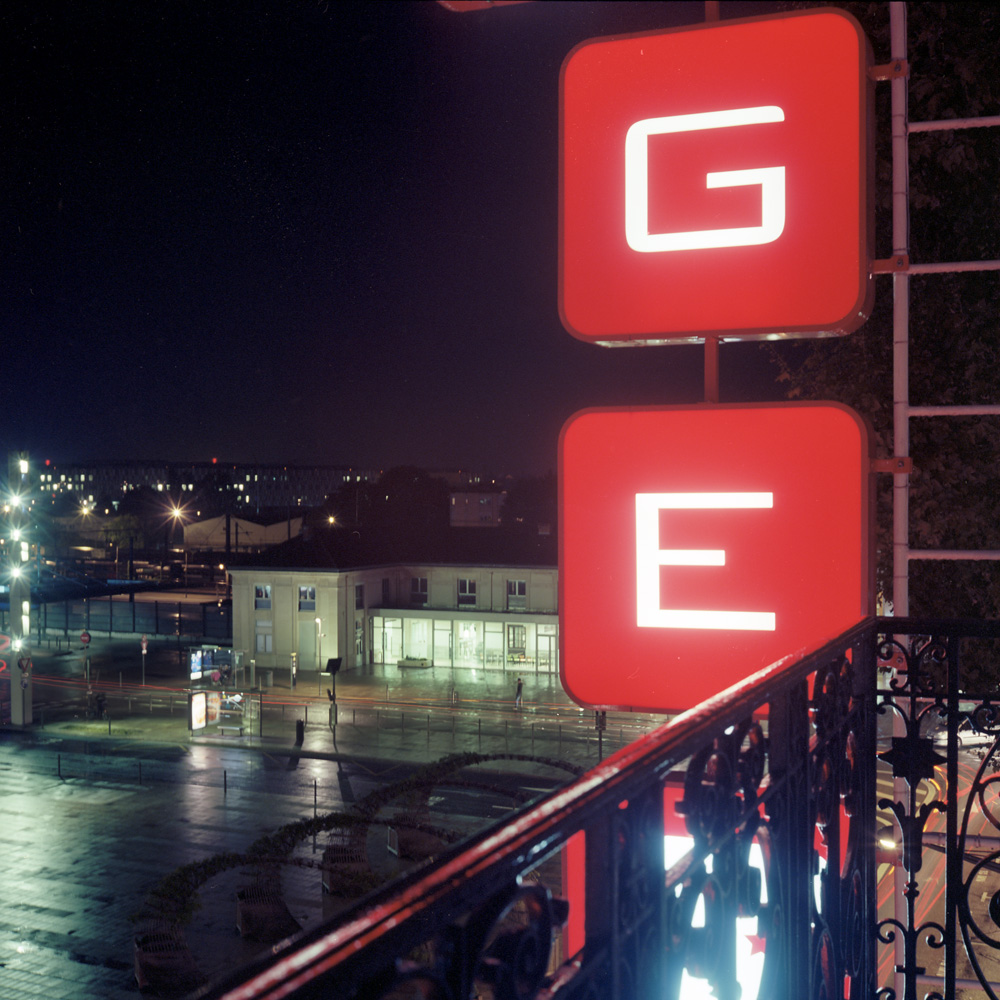
I know, Chalon-sur-Saone is NOT in Paris. It is in fact several hundred kilometers from Paris, and about 120 kilometers from the Swiss border, on the river Saone, which feeds the Rhone. I stayed at the Hotel St.Georges, which is immediately adjacent to the train station. It was the perfect location in town for me because of my travel schedule. It had been rainy off and on the duration of my visit to Chalon. I got lucky when it stopped raining after dinner long enough for me to step out on my balcony and take some night photos. If you’ve been following my blog for any length of time you know I like taking night photos- I think they’re particularly poetic with their distorted colors and blurred motion.
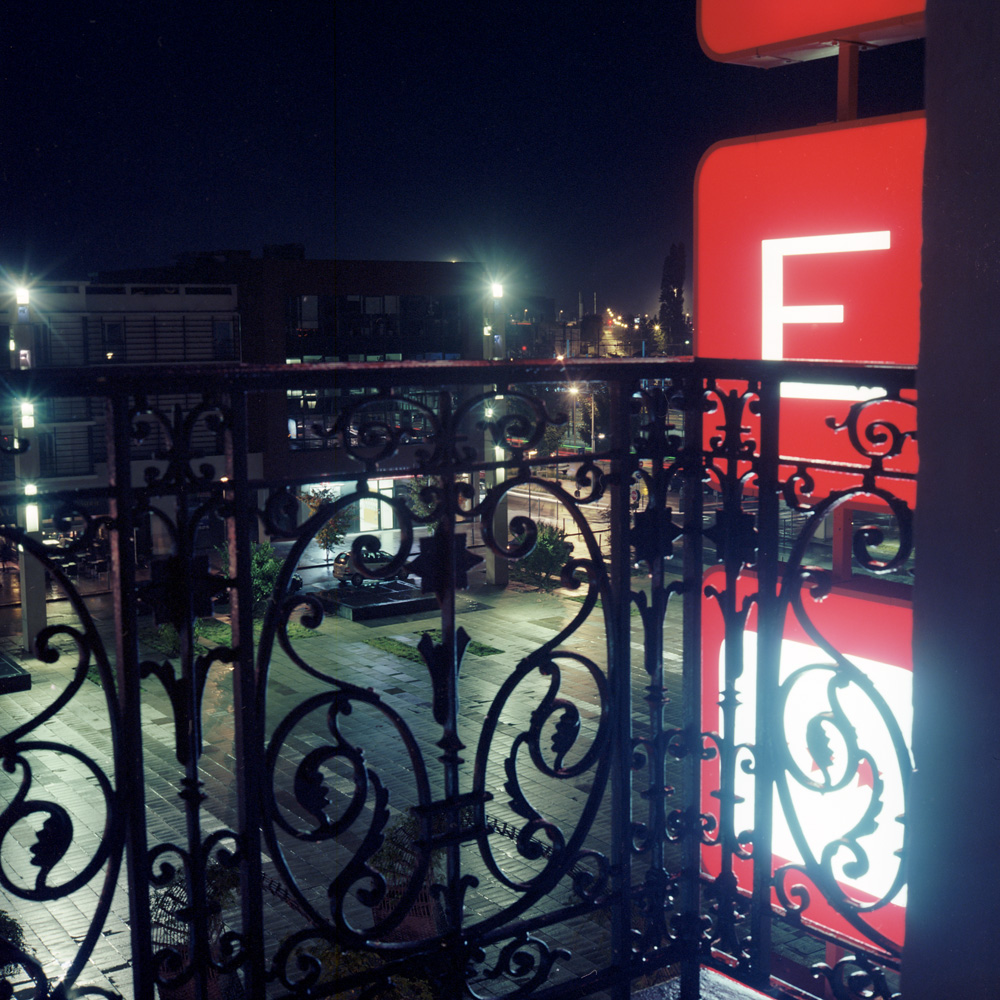
Here is the view of the hotel marquee from the balcony of my room. The train station is in the background.
St Georges Hotel Marquee, Railway Station
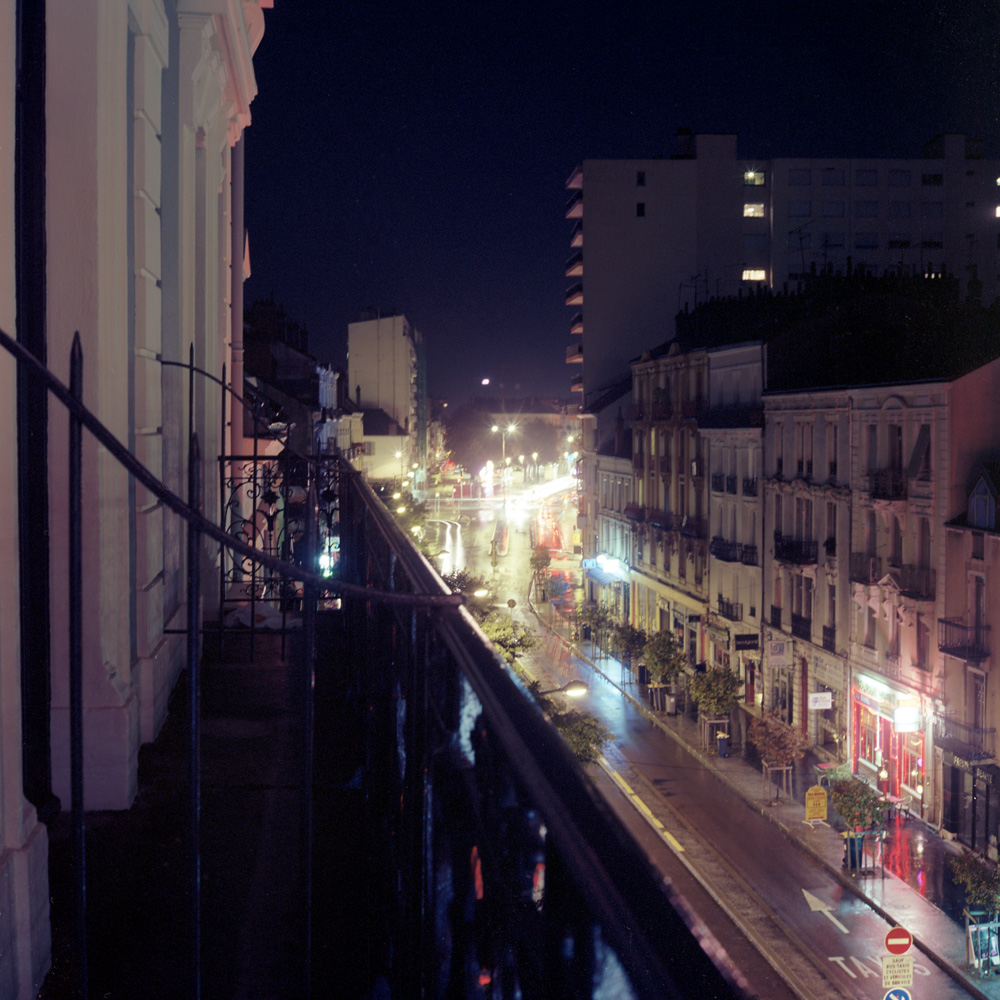
A view up the Avenue Jean Jaures from my balcony. In the far background on the avenue you can start to see the lights of a traveling carnival that was set up in town.
Avenue Jean Jaures, St. Georges Hotel, Night
A different view of the plaza in front of the hotel. Across the plaza is the British Pub-style restaurant where I had lunch right after my arrival. The food was excellent and cheap (10 euros for a 3-course lunch!), but it cemented in my mind that the French don’t quite know what to do with pasta – the veal cutlet was delicious, but the pasta that accompanied it was bare, and the marinara sauce came in a dipping cup more appropriate for salad dressing on the side rather than an integral part of a pasta dish.
Balcony Rail, Plaza, Hotel St. Georges
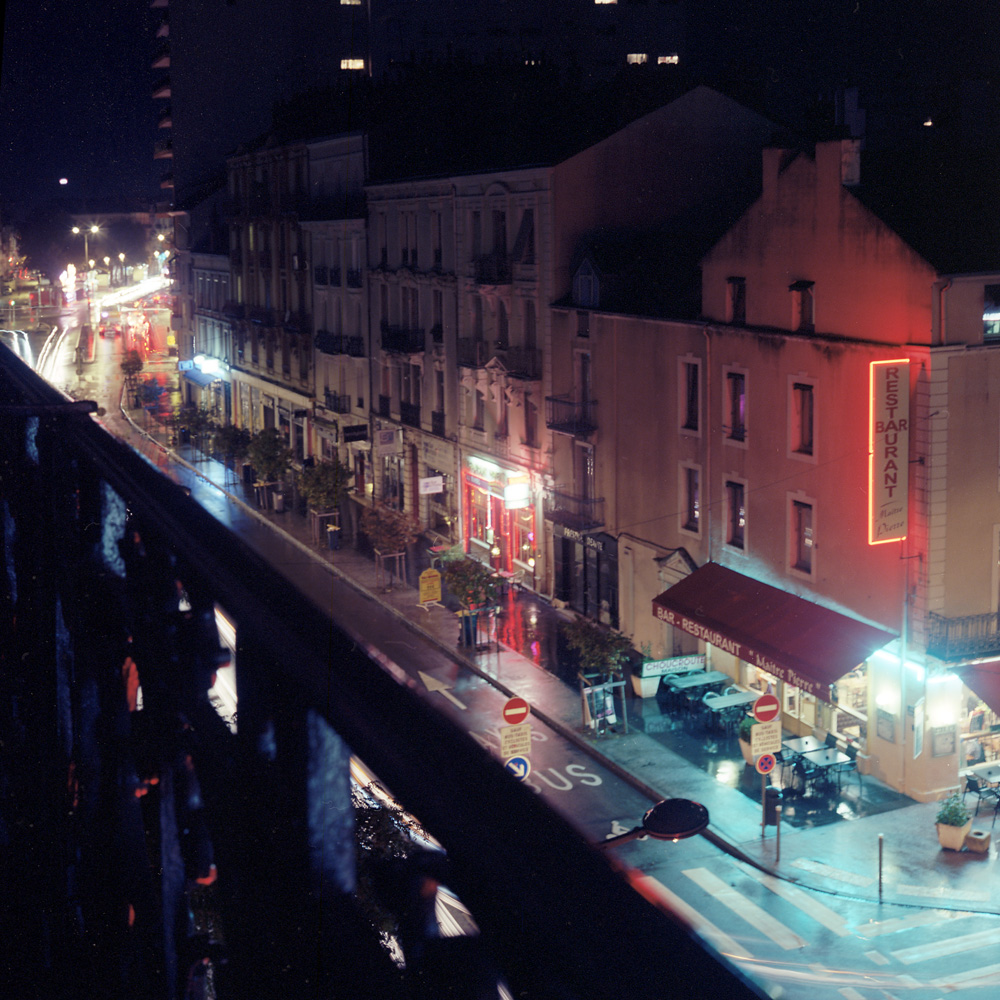
The corner across the street is the Maitre Pierre restaurant, which never seemed busy, and two doors up the Avenue Jean Jaures is an Indian restaurant.
Avenue Jean Jaures, Night
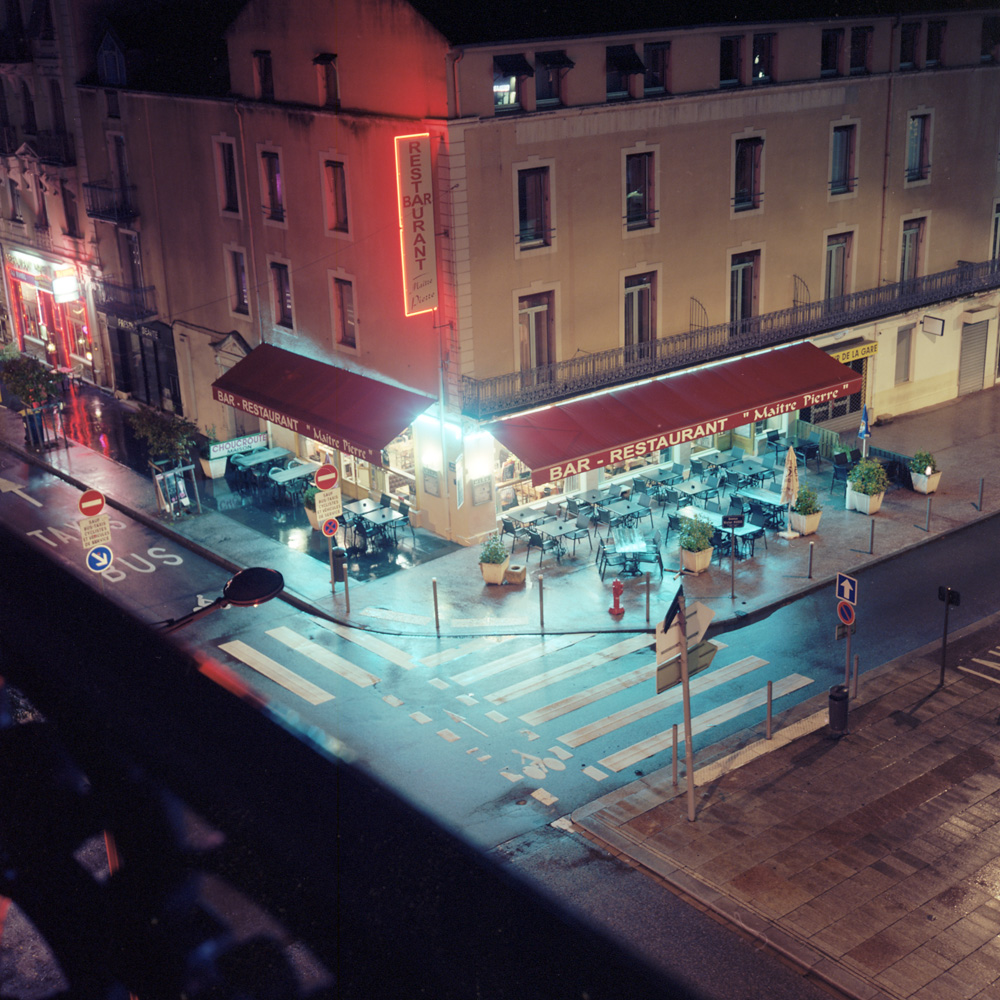
A close-up view of the Maitre Pierre restaurant.
Maitre Pierre Restaurant, Night
Photo-geek techie note, for those who care: shot with my Rolleiflex 2.8E, using Kodak Ektar 100. I may have said this before, but my favorite film for night photography is Portra 160. I love the way it handles mixed lighting and the extreme contrast you get at night. When I came to Chalon, I wasn’t expecting to do any night photography, so I left all the Portra in Paris, and all I had for color was Ektar 100. You can see from these photos that if that suddenly became my only option for color night photography, I wouldn’t be mad. It’s not a case of not liking Ektar for night photography, just liking Portra more.
Yes, you read the title right- I intentionally twisted the title of the film. This is not going to be a positive review.
I had seen the first Hobbit film, and though the film was a bit slow and brought in some new story elements not found in the original (Orcs, Sauron), it was generally unobjectionable.
This second part, however, is an abomination. There are three, count em, three! added plot lines that were never in the original story, the most egregious of which is the entirely invented interracial love story between Taurien, a female elf who never appears in the original book, and Killi, one of the thirteen dwarves. Let me be clear- I have no issue with interracial romances, even between imaginary races. But I do have an issue with inserting an inorganic plot element that was not in the original story. The romance they invented between Arwen and Aragorn in The Lord of the Rings movies at least made sense from a plot perspective. This, however, is just a romance for the sake of romance. Actually, it’s more a love triangle between Legolas, Killi and Taurien. No matter, it doesn’t belong.
The overworking of the conflict between Gandalf and Sauron also has no place in this story. I understand the logic behind it – Peter Jackson wants to draw the connection between The Hobbit and LoTR for an audience unfamiliar with the books. For that, I still call BS- everyone who read the books for the first time could put the two together just fine without a ham-handed rehash of events that haven’t happened yet in the Hobbit/LoTR world. It also betrays the spirit of the book, which was decidedly less dark than LoTR.
The Orc plot line is the least inorganic, but it is still un-necessary. The dwarves had motivation aplenty to pursue their quest- fear of and revenge on Azog are not needed- if anything, the original motivator of pride corrupted by greed was more compelling.
Perhaps the biggest disappointment, though, has to be the conversation between Bilbo and Smaug. In the original, it was a duel of wits with nearly poetic language. Only a pale shadow of that dialogue remains, and the scene is turned into a promo for an as-yet unbuilt amusement park ride- Universal Studios: Escape from Smaug.
In summary, what could have been a triumph of a single three-hour movie was instead turned into a travesty of a trilogy.
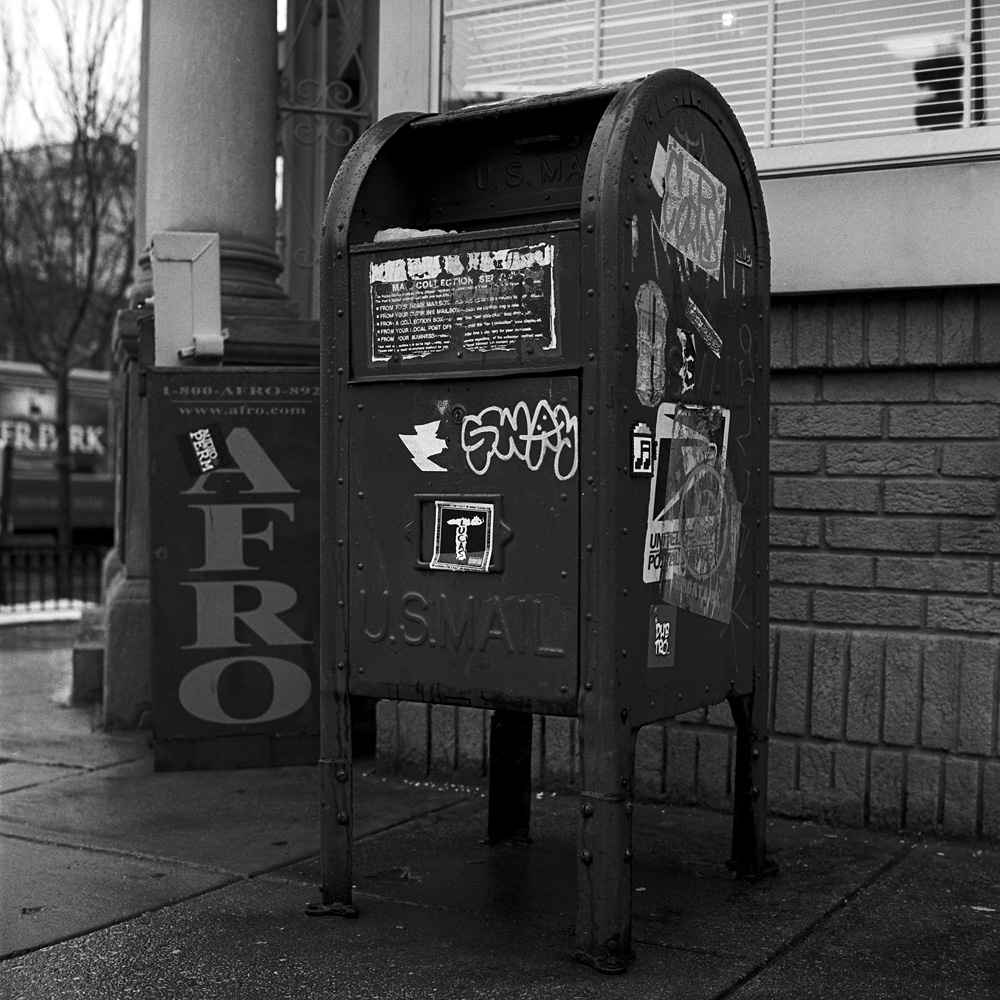
It “snowed” here in DC on Tuesday, and we got the day off for what amounted to a little more than a dusting that rapidly turned into slush and never really interfered with traffic or public transportation or anything. But, since I had the day off, I took a walkabout in my neighborhood to burn some film.
I’m always looking for images of things to add to my “Portraits of Everyday Objects” series. This mailbox, outside the Industrial Bank building on U Street fits the bill, looking somewhat forlorn with all its graffiti.
Mailbox
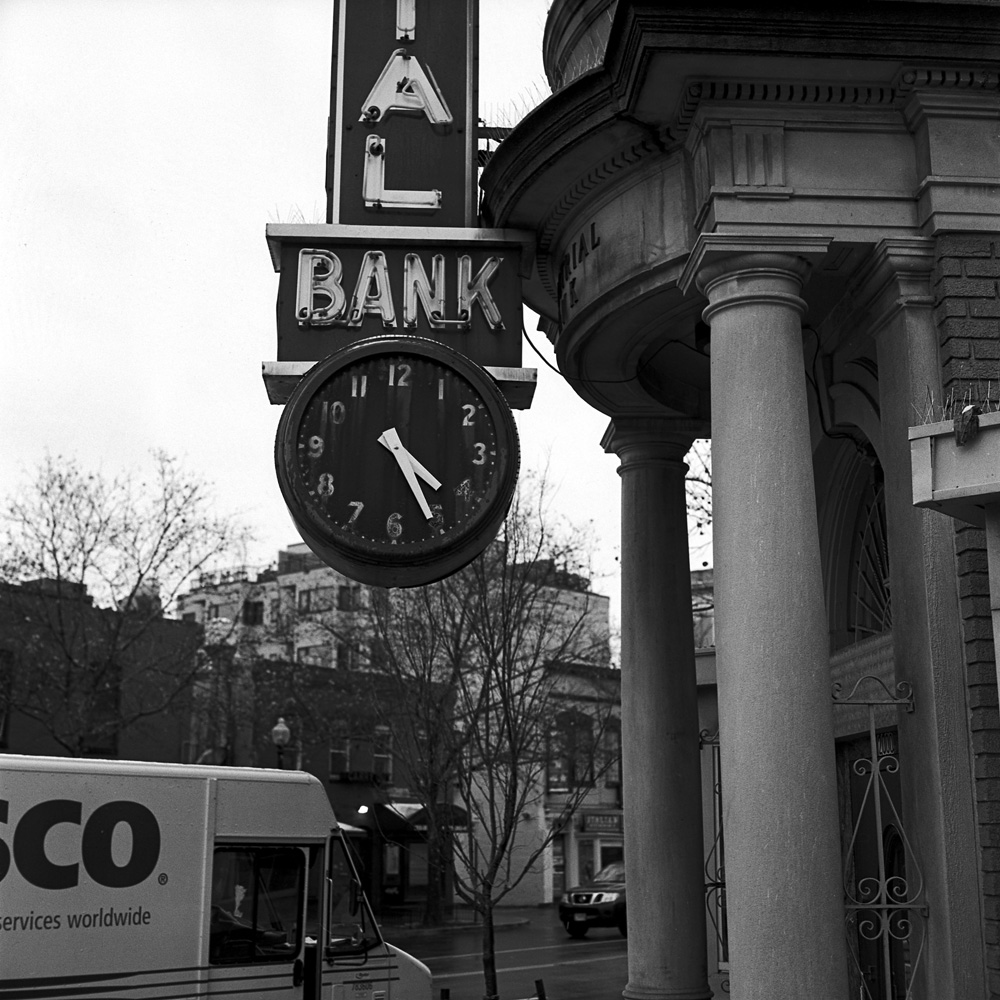
Industrial Bank was started at the beginning of the 20th century by African-Americans to cater to the African-American community. Their main branch is at the corner of 11th and U Streets, and has this really cool metal and neon clock sign out front. Alas they have allowed the sign to lapse into disrepair – I THINK the clock functions but it is not accurate, and either they just never turn on the neon or it no longer works. I really wish they’d fix it up so it would work, as it would make a very nice neighborhood landmark and a visual counterpoint to the yellow saxophone sign across the street outside the Bohemian Cavern nightclub.
Clock, Industrial Bank
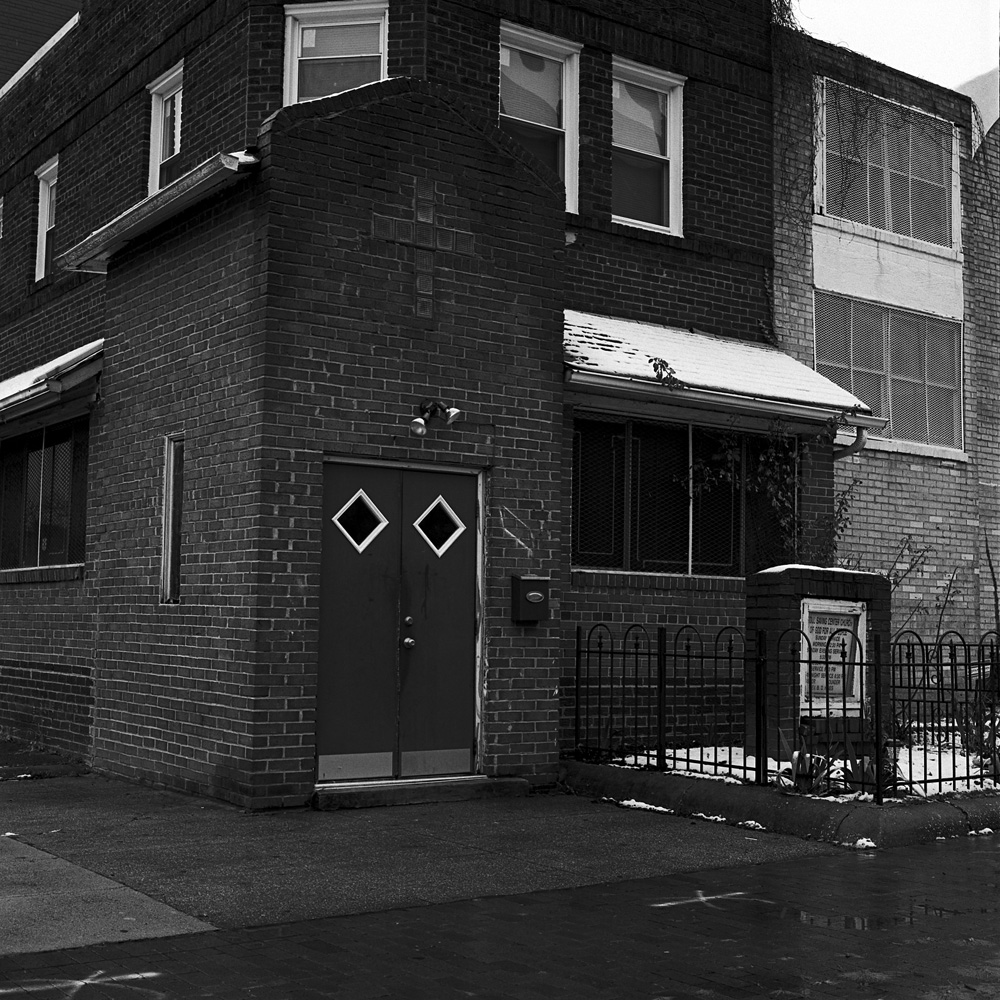
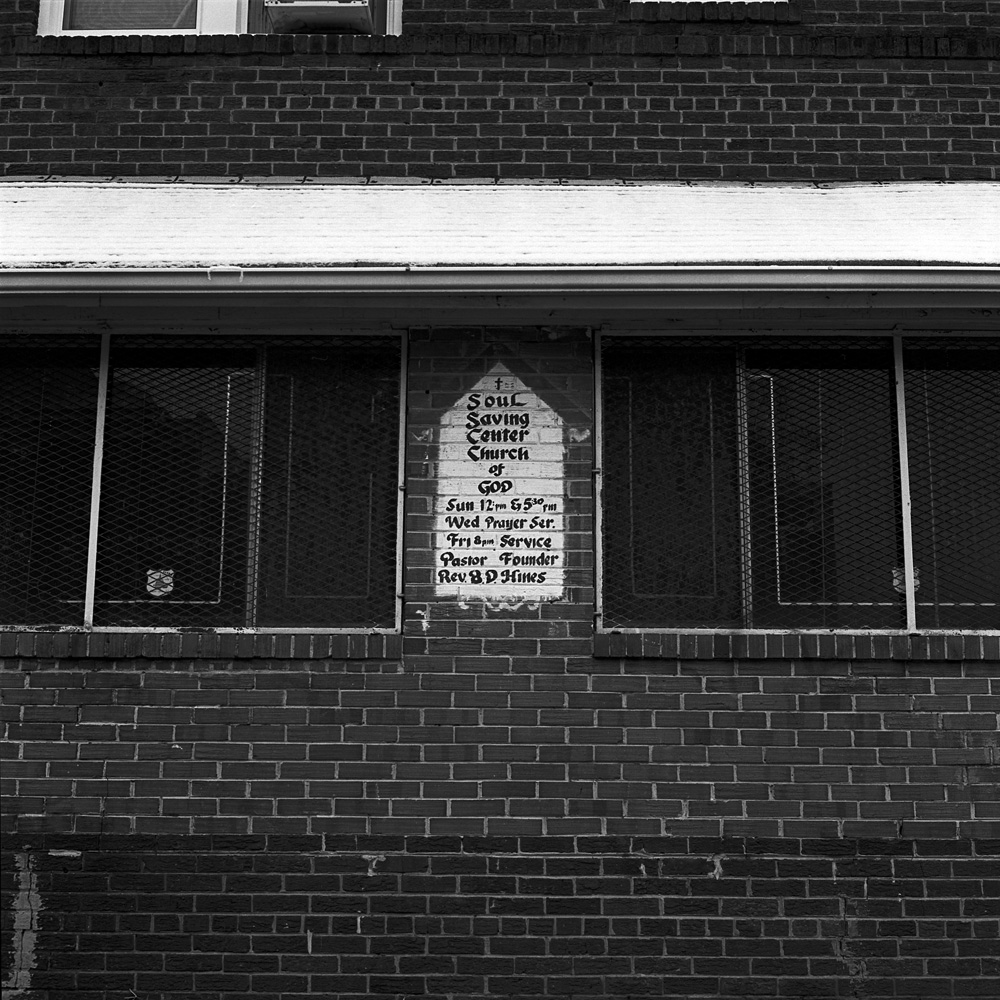
Up the street there is the Soul-Saving Center Church of God – a storefront community church with a primarily if not exclusively African-American congregation. It’s a sign of the gentrification and transformation of the neighborhood – across the street from them is a brand-new condo building with units selling for up to $1.2 Million.
Soul Saving Center Church DoorSoul Saving Center Church
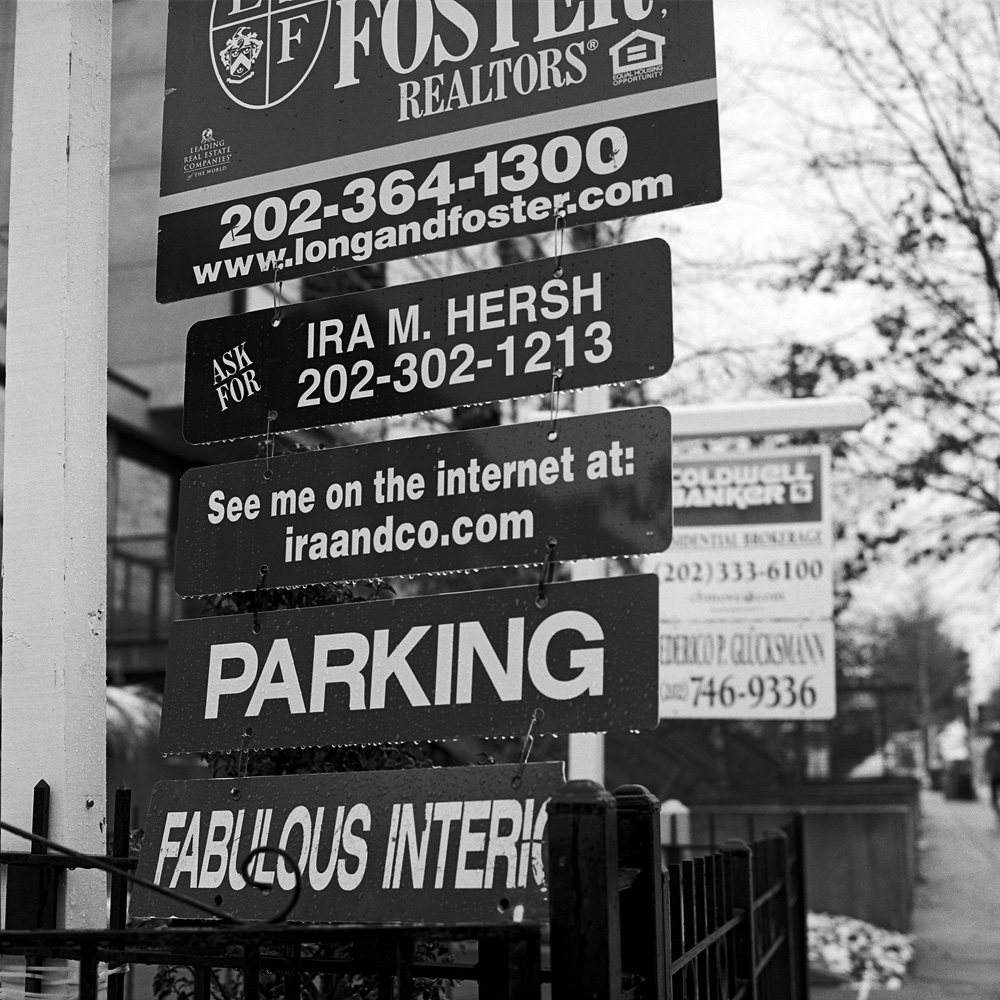
You can see the real estate bonanza still happening in the neighborhood – small row houses are being converted and expanded into multi-story multi-unit condominium buildings. Here is one with a “Fabulous Interio”- the agent broke off the “r” to get the sign to fit inside the fence. I wonder how long it will be before the Soul-Saving Center Church decides to sell their buildings plus the adjacent lot they have – they’ve got perhaps $10 Million in land alone now.
Fabulous Interio
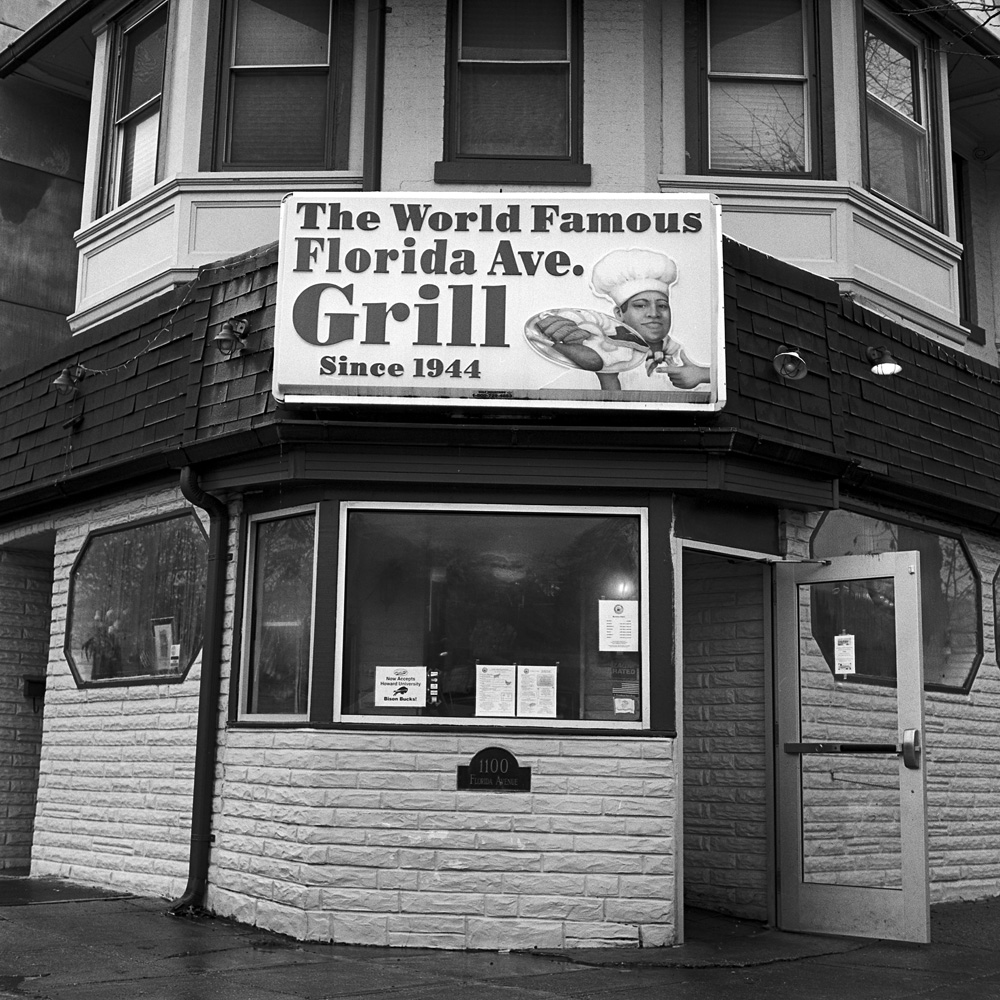
Up the street is another landmark of the neighborhood, almost as famous as Ben’s Chili Bowl. The Florida Avenue Grill has been around since 1944, serving up good old-fashioned soul food to locals and celebrities alike. The Florida Avenue Grill once owned a large empty lot next door, which served as their parking lot. About five years ago the family that owns the grill sold the empty lot and now a five story condo building has filled it. The average unit in that building sold for north of $500,000 each.
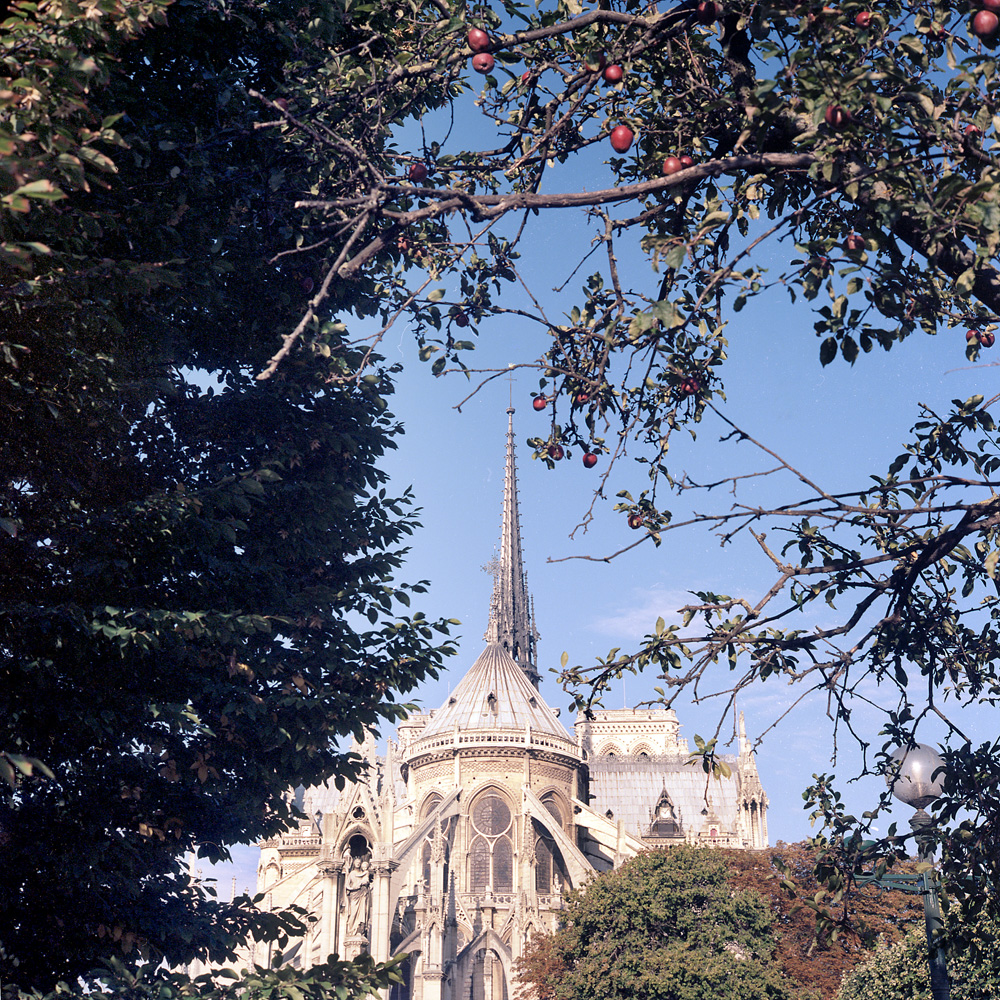
Notre Dame looks very different in color than in black-and-white. The stone takes on a different texture, the shapes of the arches and buttresses are somehow different, and I think you feel the age of the place much more. This is, after all, a 900 year old building.
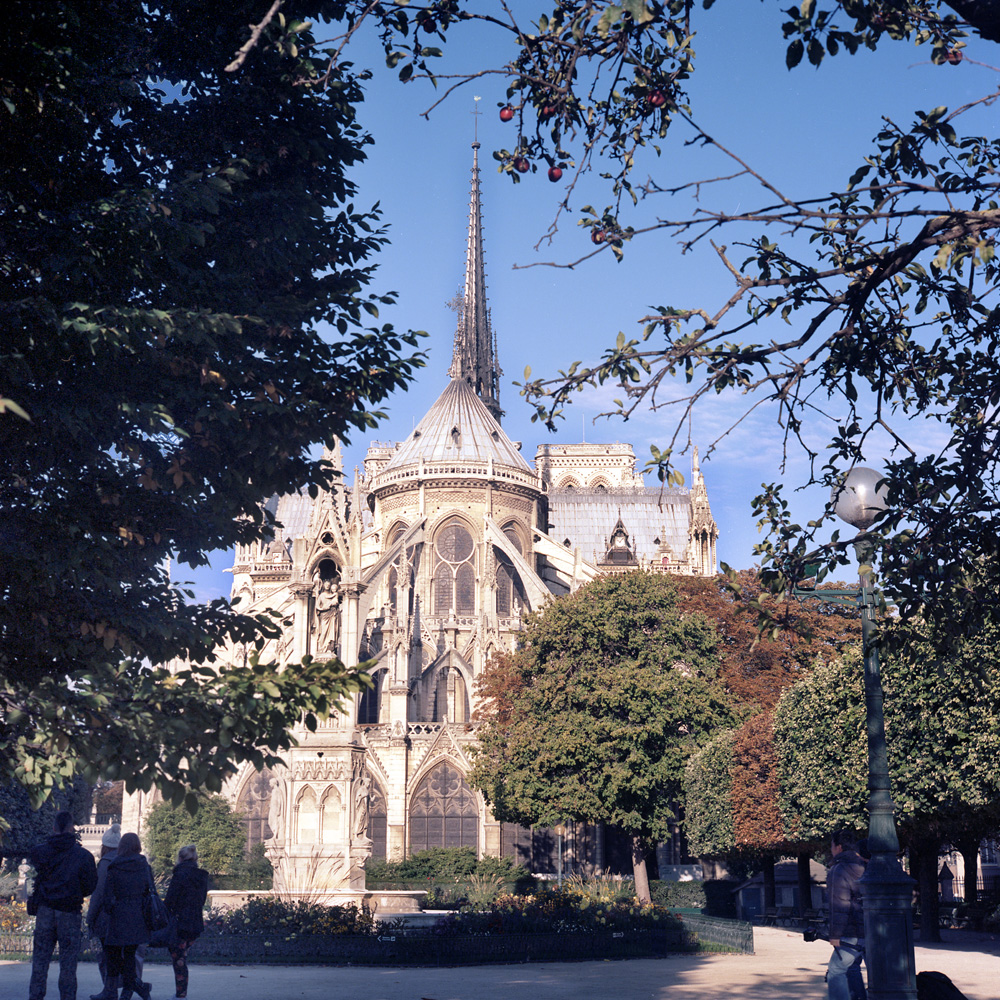
In the garden behind the cathedral, there is an apple tree. The groundskeepers must zealously patrol for fallen fruit, as I never saw one on the ground in a week of passing through. I was talking with someone at work about this apple tree and he observed an irony of having an apple tree in the garden of a cathedral, if you’re into Christian symbolism.
Notre Dame, Apple Tree
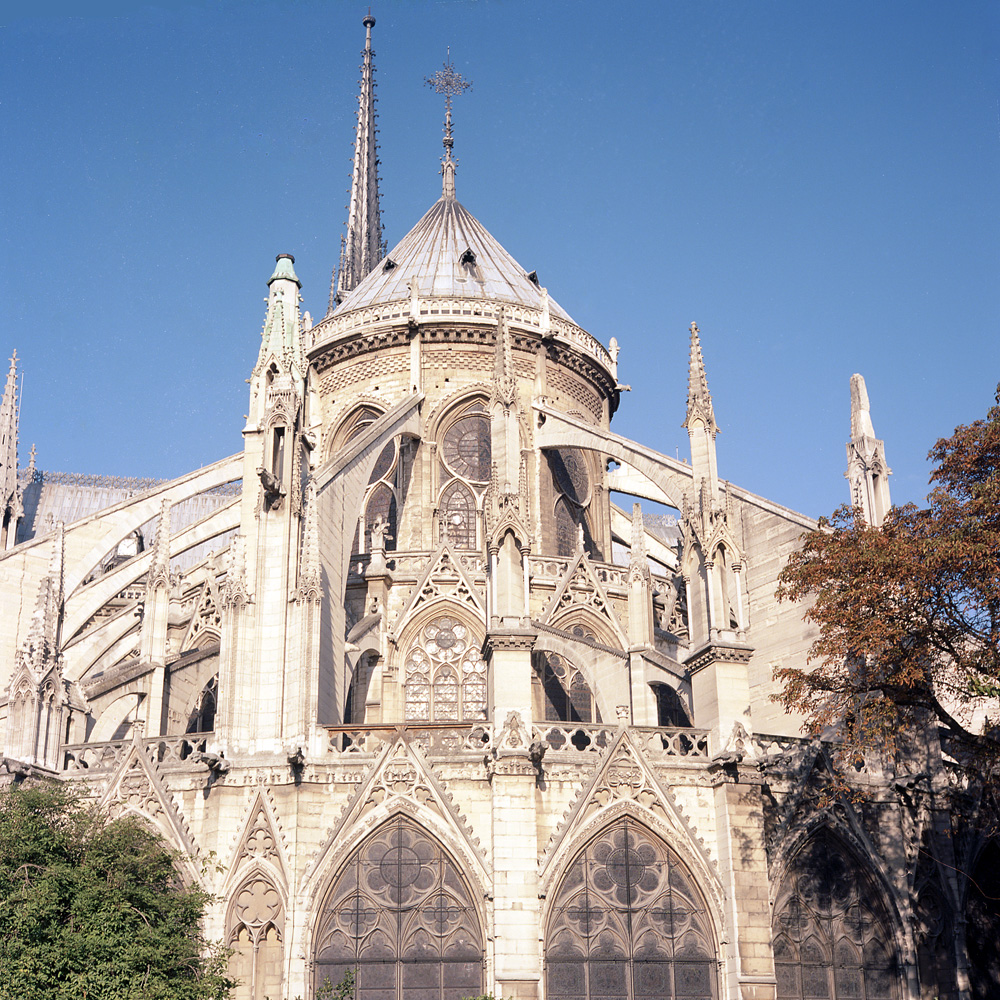
A closer-in view of the rear of the cathedral, including the spire. The towers top out at 226 feet, but the spire and its weather-vane go on to 300 feet tall. I don’t think you realize that when looking at the building because of the relative mass of the towers, and the perspective you have when viewing either spire or towers – you’re always looking up, and at the distances required to see both, the height differential is erased by perspective. You can clearly see in this photo the stacked wedding-cake structure of the building – the lower floor with its side chapels spreads out much wider than the center aisle.
Notre Dame, Rear
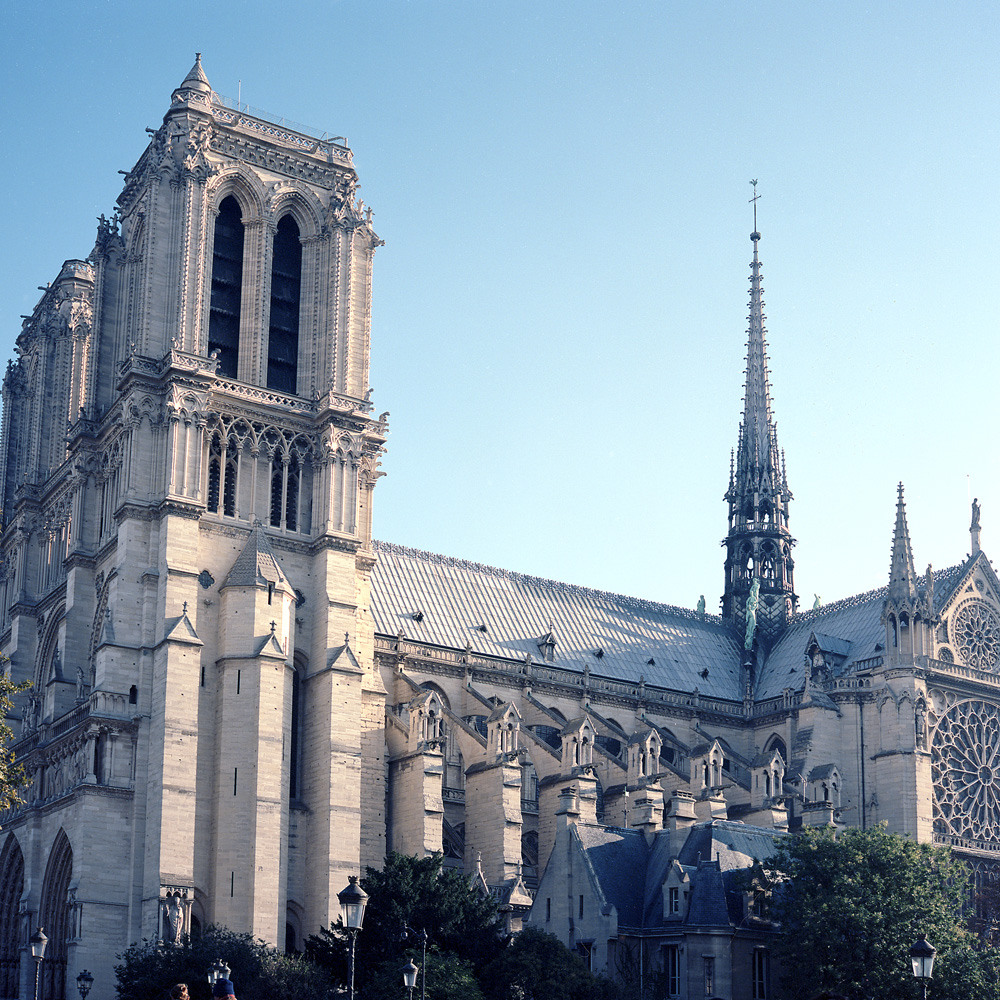
A side view of the cathedral, showing both the towers and the spire. Even from this view it’s hard to see an extra 75 feet of height on the spire.
Notre Dame, Side View
Another view of the rear, with the apple tree. This one includes people in the garden for perspective.
These are a few more from that last remaining roll of b/w I didn’t develop until yesterday. Just some additional looks at Notre Dame cathedral in black and white.
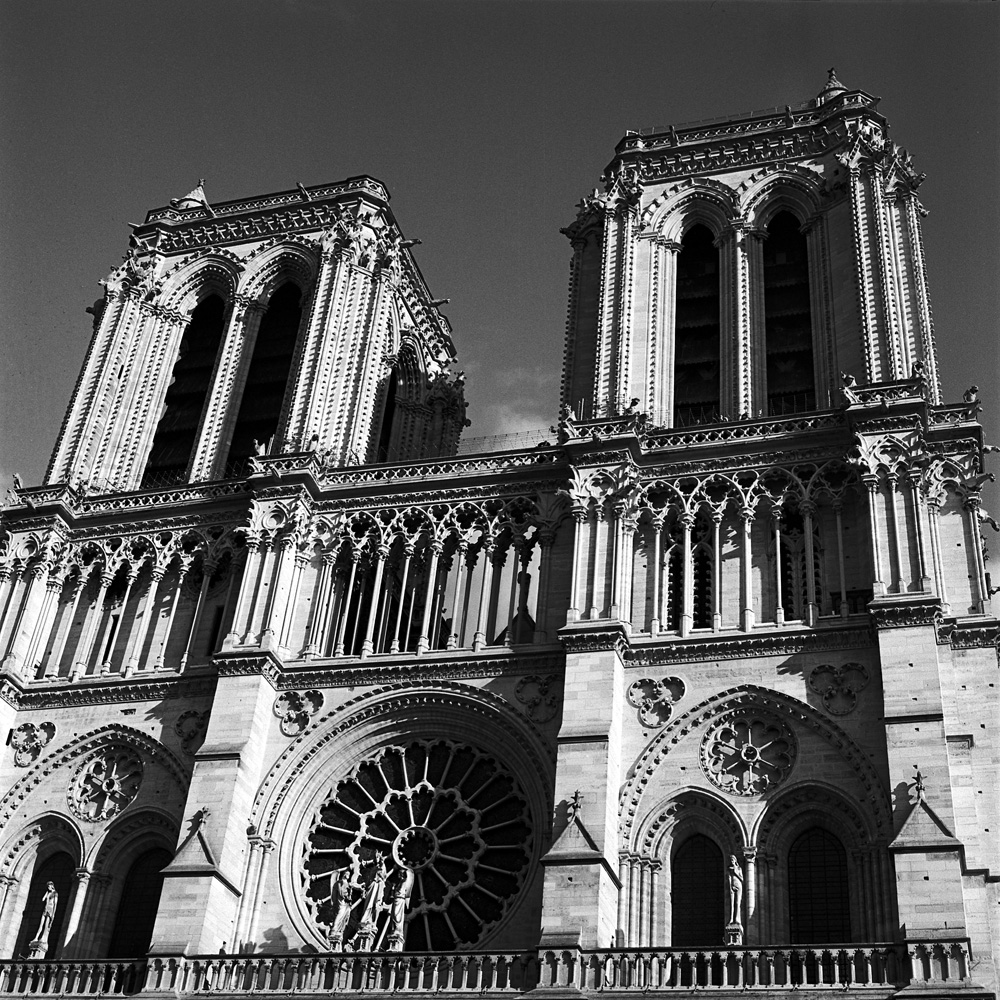
It’s hard to view the cathedral without trying to interpret the towers as a graphical element. They’re the most recognizable element to the church, perhaps other than the rose window. The main body of the church is actually rather narrow and delicate, relative to its perception. All those flying buttresses make it seem much more massive than it is. The tower facade, though, really establishes that perception because when viewing it straight on, it seems like a solid wall, and that the church behind it must be equally as massive.
Twin Towers, Notre Dame
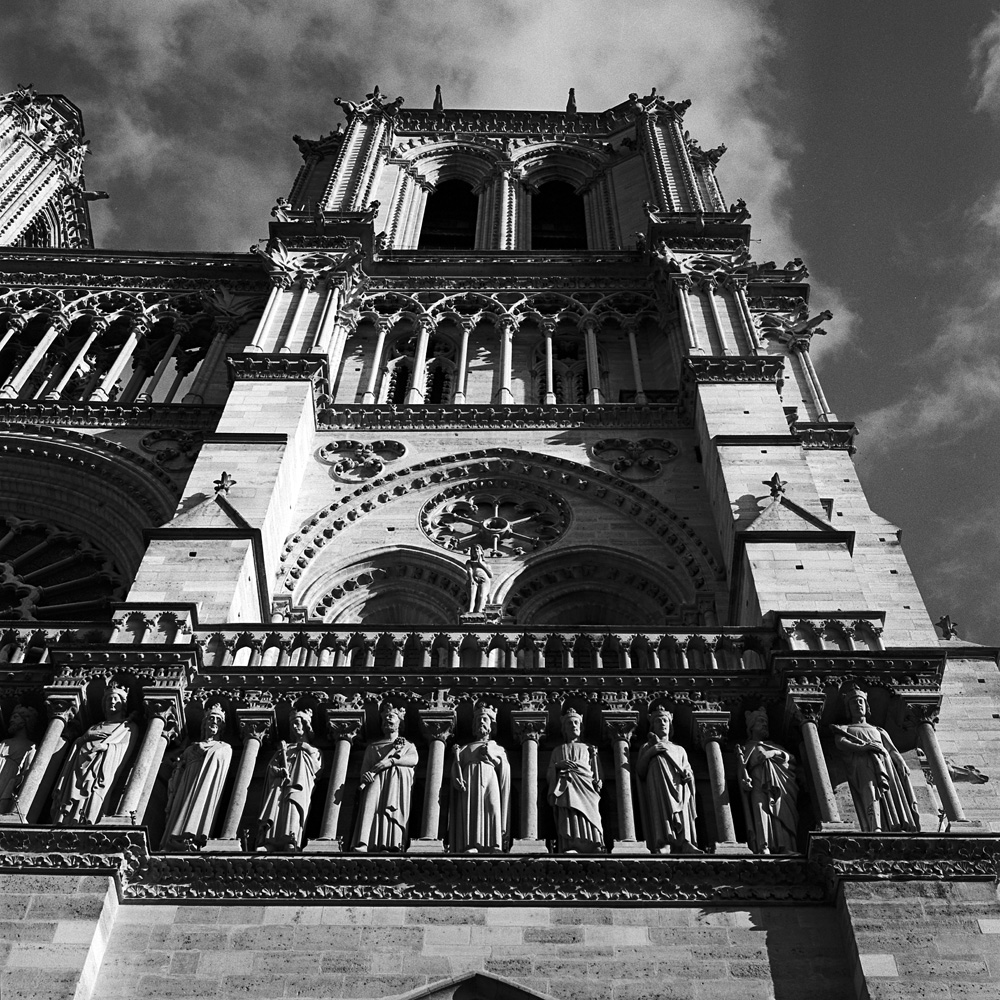
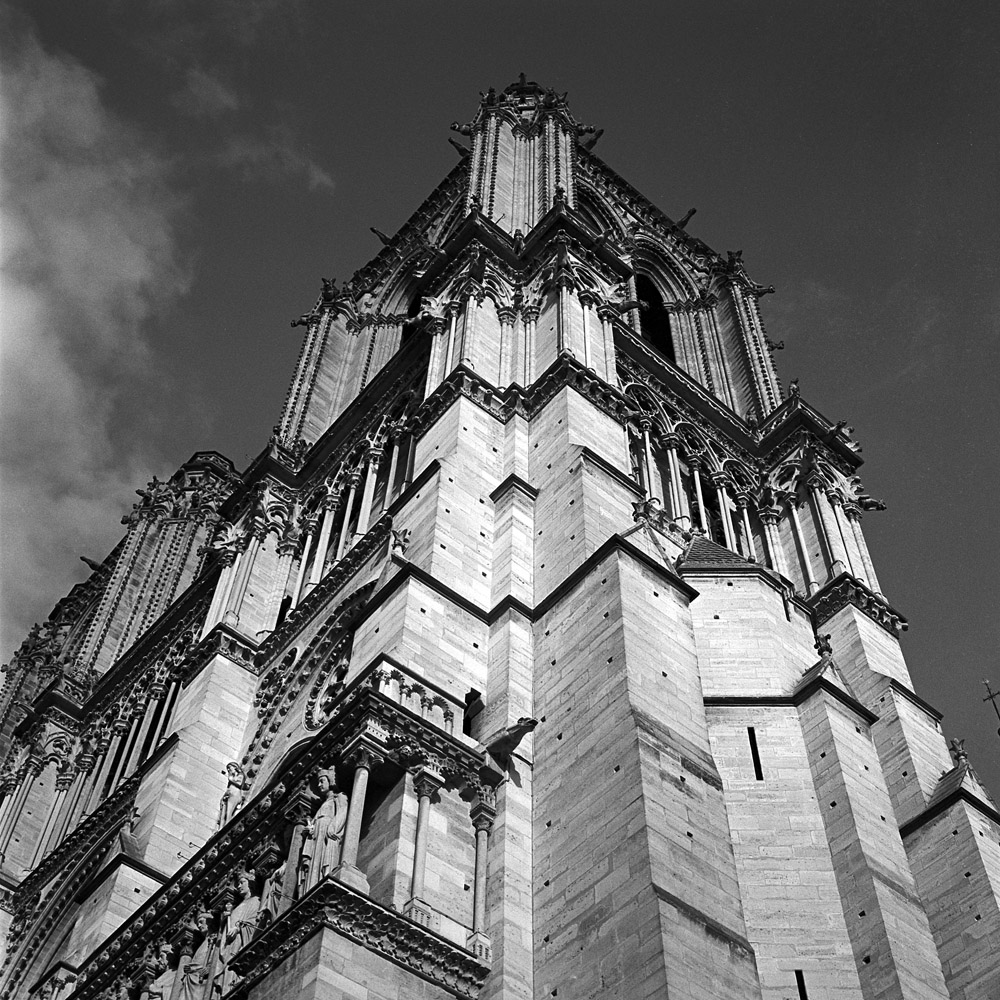
Trying to look at the towers is a vertigo-inducing experience. They are quite tall, and the nature of the decorations make you keep looking up to see all the details to the very last set of gargoyles some 226 feet in the air. Getting up in the towers to view them up close and personal is vertigo-inducing as well – it’s a nearly 400-stair climb to the top of the tower (which I did NOT do – I’m too out-of-shape to attempt something so heart-stressing). At one point in time, Notre Dame was the largest building in the western world – you can still easily spot it from the 2nd tier of the Eiffel Tower, despite the intervening buildings, several miles and the bend in the river between the two landmarks.
Tower, Notre Dame, Looking Up
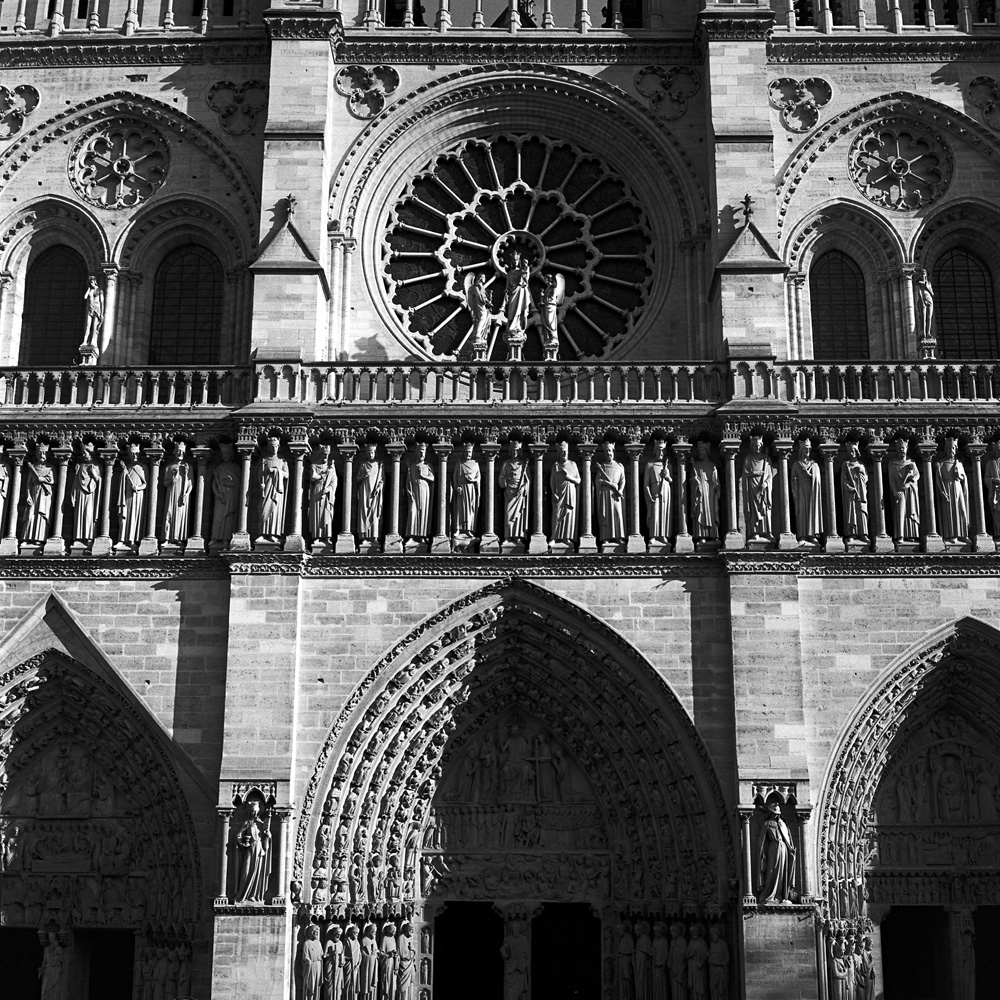
Here is a view of the incredibly detailed facade. One thing I did not realize until looking at this photo is the fact that all three main doorways are different. I always assumed that the left/right halves of the facade would be symmetrical. If you look carefully, the archway over the left hand door is a little smaller, and crowned by the angular, peaked molding. The right arch is larger and lacks the angular molding. Another detail that often gets forgotten – we assume that these cathedrals were all bare stone, and that the way we see them today is how they were intended. Au contraire – most cathedrals of the Romanesque and Gothic periods (the 7th-15th centuries) were brightly painted, inside and out. The statues on the exterior would all have been polychrome, as would the interior walls have been. Time, weather, wear and neglect have conspired to strip the coloring off the buildings. They did find some early medieval frescoes inside the old cathedral in Salamanca that had been covered up for centuries after an earthquake damaged both cathedrals (they’re kind of conjoined twins and share a wall).
Notre Dame Facade, Afternoon
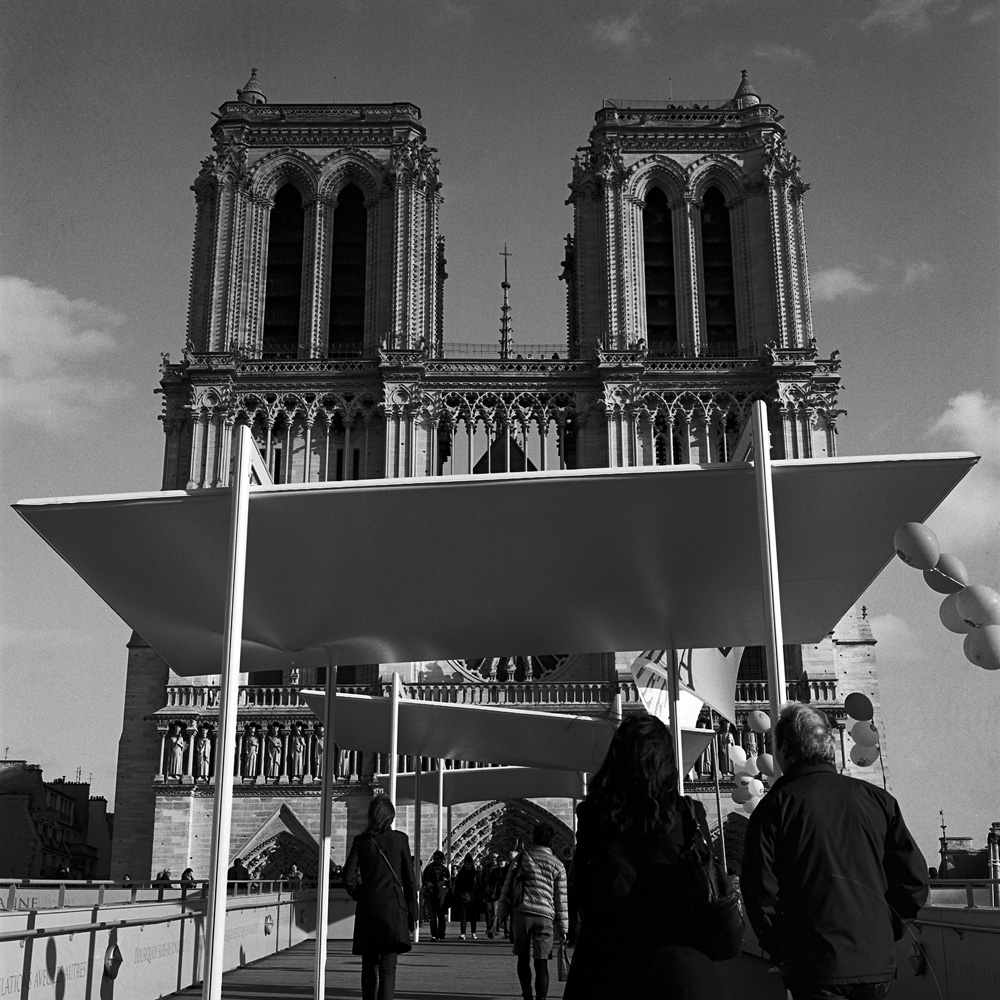
I really don’t know why they built this mammoth viewing/reviewing stand in the plaza in front of the cathedral. You can ascend the steps on the front face, or you can climb the ramp up the back. This is the view of the towers from the ramp – the tarp-like covers on the ramp provide a starkly modern contrast to the gothic stonework of the cathedral.
Notre Dame Towers, from RampTowers, Notre Dame Cathedral
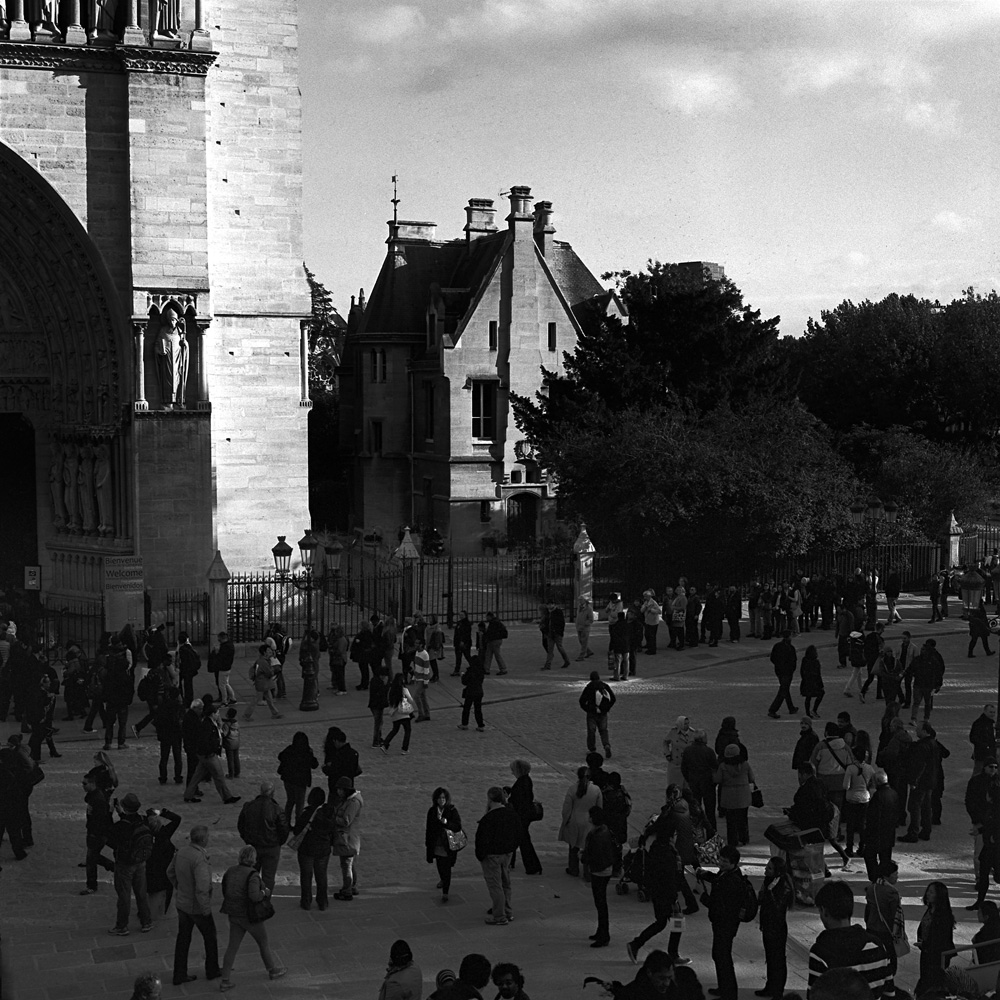
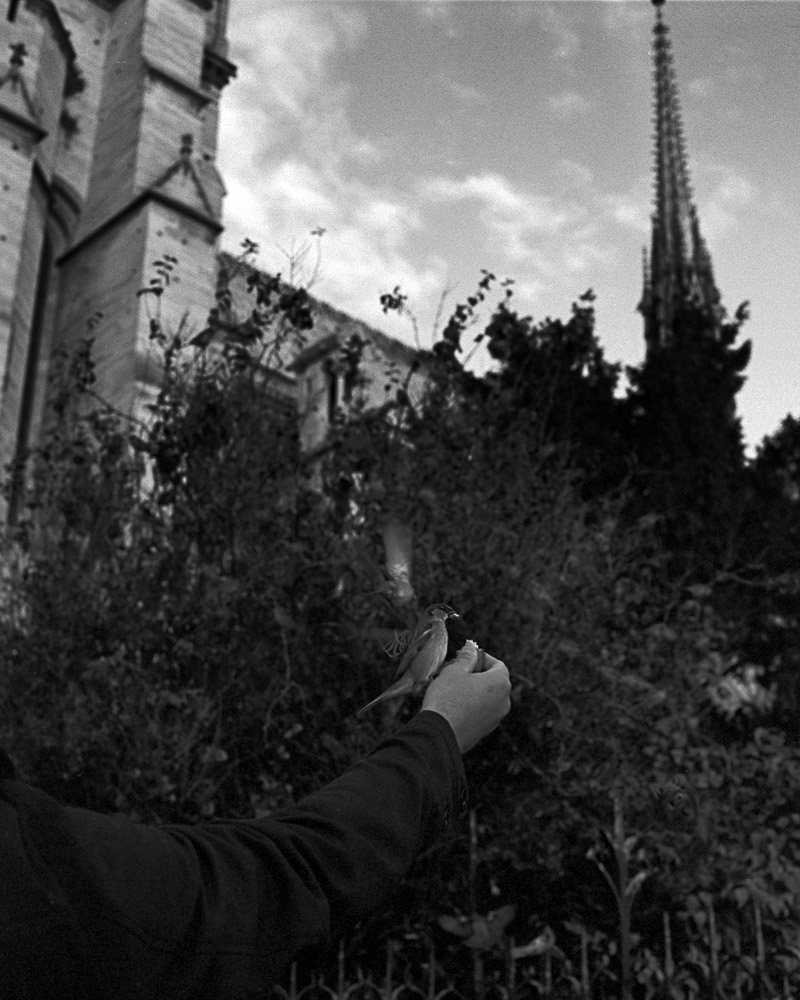
The crowds at Notre Dame are non-stop, even at night after the cathedral is closed. This is a typical weekday afternoon on the plaza out front. The little house to the right is the rectory for the cathedral. Along the fence surrounding the rectory is where you will find the bird feeders – people who will sell you a scrap of day old bread or a stale churro that you can hold up in your outstretched hand to attract the sparrows who will hover over to get a bite.
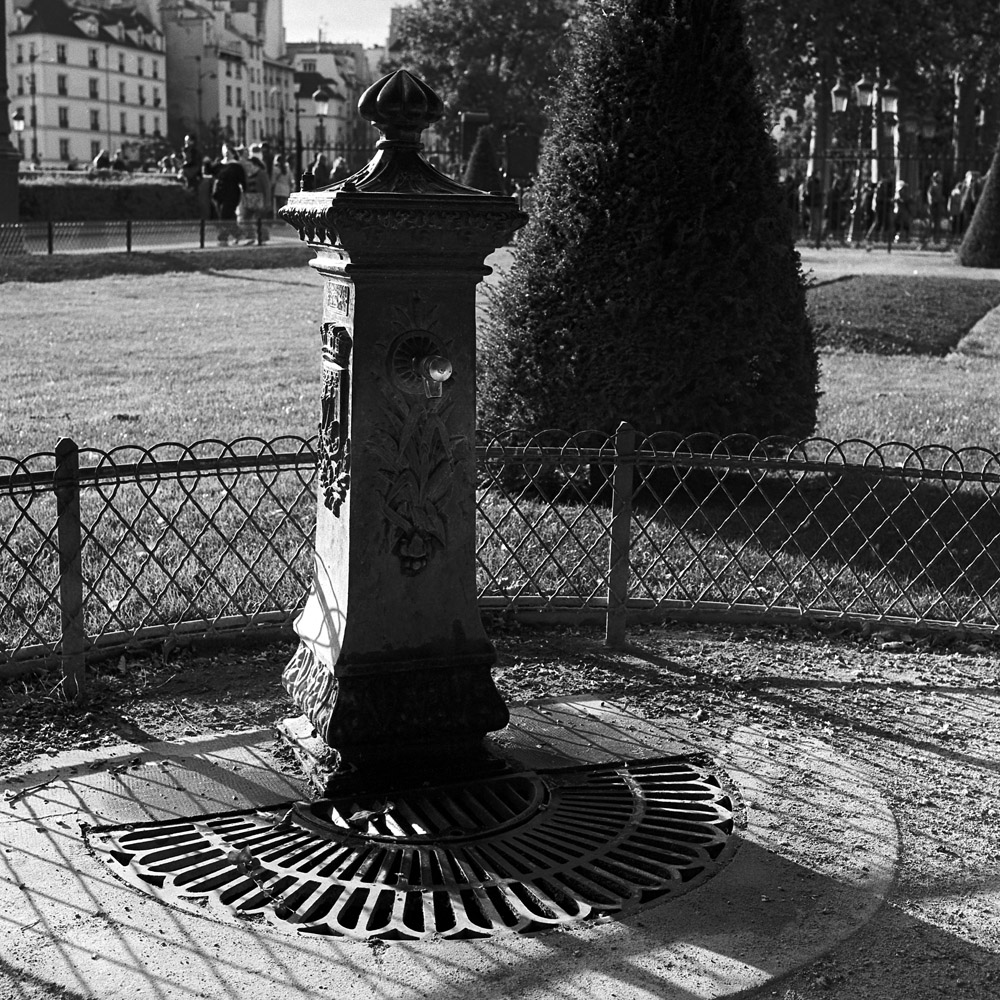
Beside the cathedral there is a park with views of the Seine, replete with benches, gardens and, as part of Haussmann’s renovations, public drinking fountains. I loved the way this looked backlit with the evening light. Consider it another one of my portraits of everyday objects.
Drinking Fountain, Notre Dame
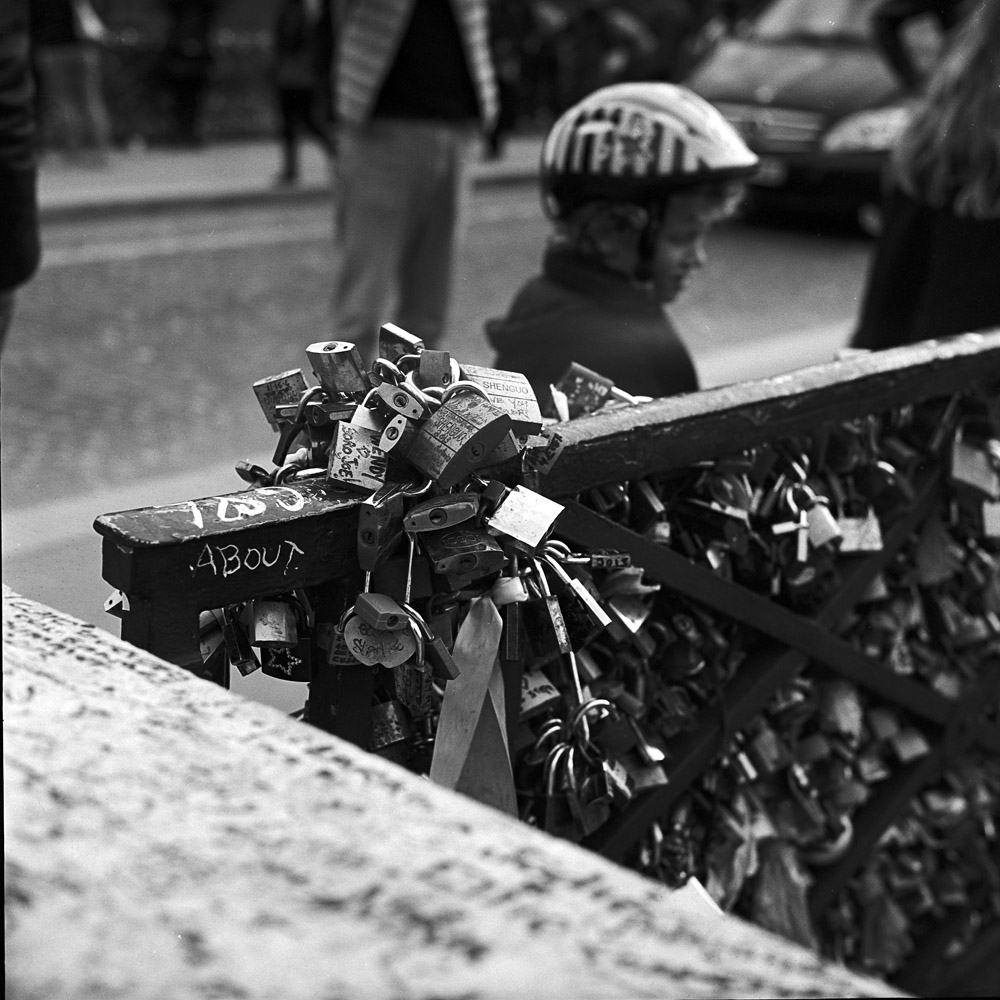
And last but not least, the tradition that began in Rome of young couples buying a padlock, writing their initials on it, locking it to the railing of a bridge, and tossing the keys in the river as a symbol of how their love cannot be undone has come to Paris. It is so popular that it has infested three or four bridges across the Seine now, and the boquinistes with bookstalls along the Rive Gauche nearest the Ile de la Cité sell a variety of padlocks and permanent markers. It seems only natural that people would do this on the bridges closest to Notre Dame, as it is one of the most romantic, inspiring buildings in a city full of romantic inspiration.
Love Locks, Notre Dame
(see, I told you you wouldn’t have to wait long for the next Paris post!)
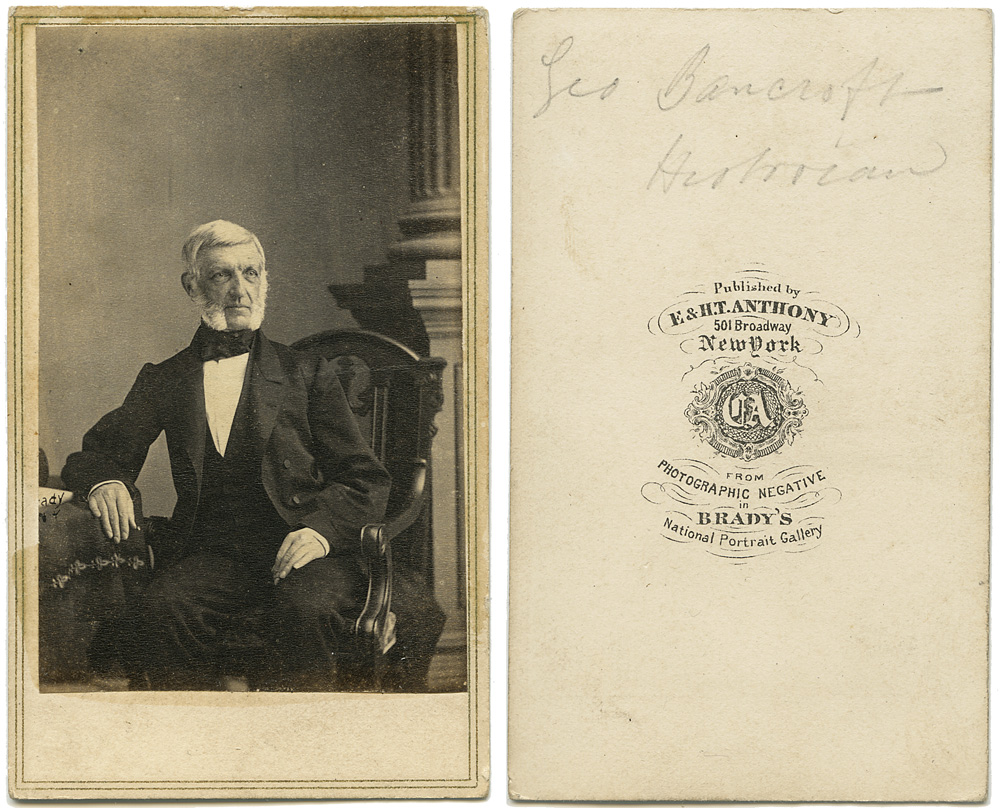
At first I was wondering why a CDV of an American historian would have ended up in the United Kingdom (the seller I bought this from is in England). After reading up on who George Bancroft was, now it makes sense. George Bancroft, in addition to being an historian, was Secretary of the US Navy, founder of the United States Naval Academy in Annapolis, and served as the US Minister to the United Kingdom from 1846-49. After the Civil War, he also did a stint as minister to Berlin from 1867-1874. He lived to the ripe old age of 91, dying in 1891.
George Bancroft, by Brady
His political life should not be seen to overshadow his academic life – he entered Harvard at age 13 and graduated at 17, and went on to study in Europe under some of the greatest academics and philosophers of the day. He authored a ten-volume set on the history of the United States, entitled, humbly enough “A History of the United States, from the Discovery of the American Continent to the Present Day”.
I also thought you, my loyal readers, could stand a break from all the Paris photos. They’ll resume soon enough.

 dcphotoartist