Tag Archives: Paris

Paris in October – Part 27 – Things

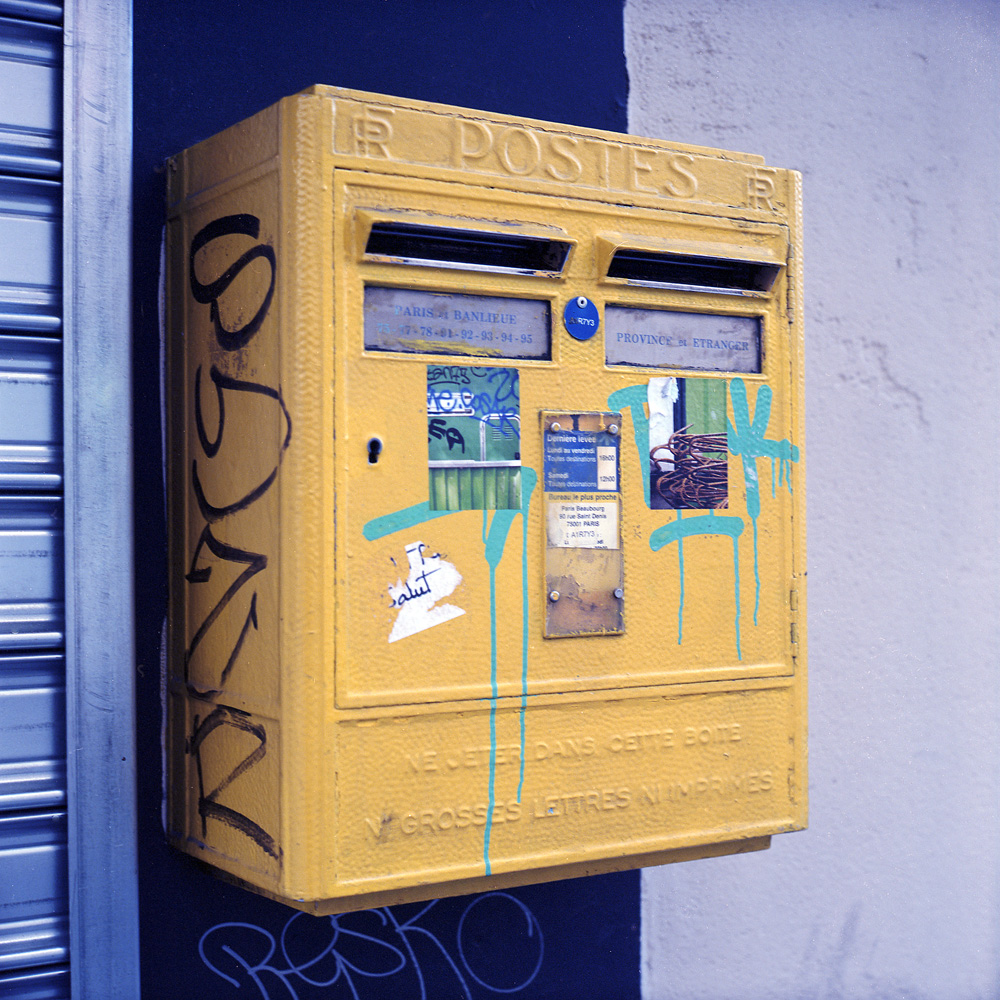
I’ve been making a habit of photographing things we see every day but take for granted, like mailboxes and fire hydrants. I couldn’t pass up the bright yellow mailboxes of Paris, and especially not this one that has been so overtly decorated with graffiti. I think I got lucky that this one was on a dark blue background at least in part, to set it off and compliment it.

Yellow Postbox, Paris

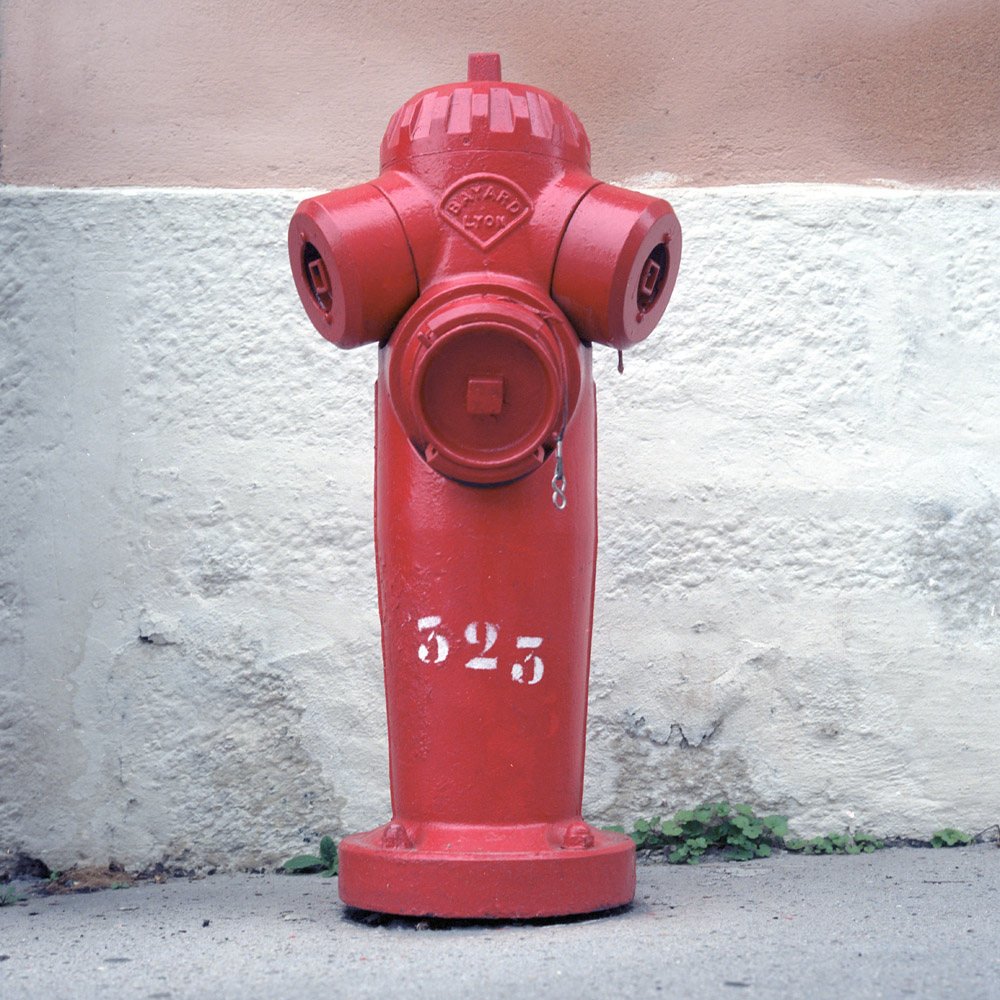
I know, I know, the hydrant from Chalon already made an appearance, but it was soooo long ago I figured you all had forgotten it, and it also fits the theme of “things”, especially brightly-colored things that we see but take for granted. So here it is.

Hydrant, Chalon
Hydrant, Chalon

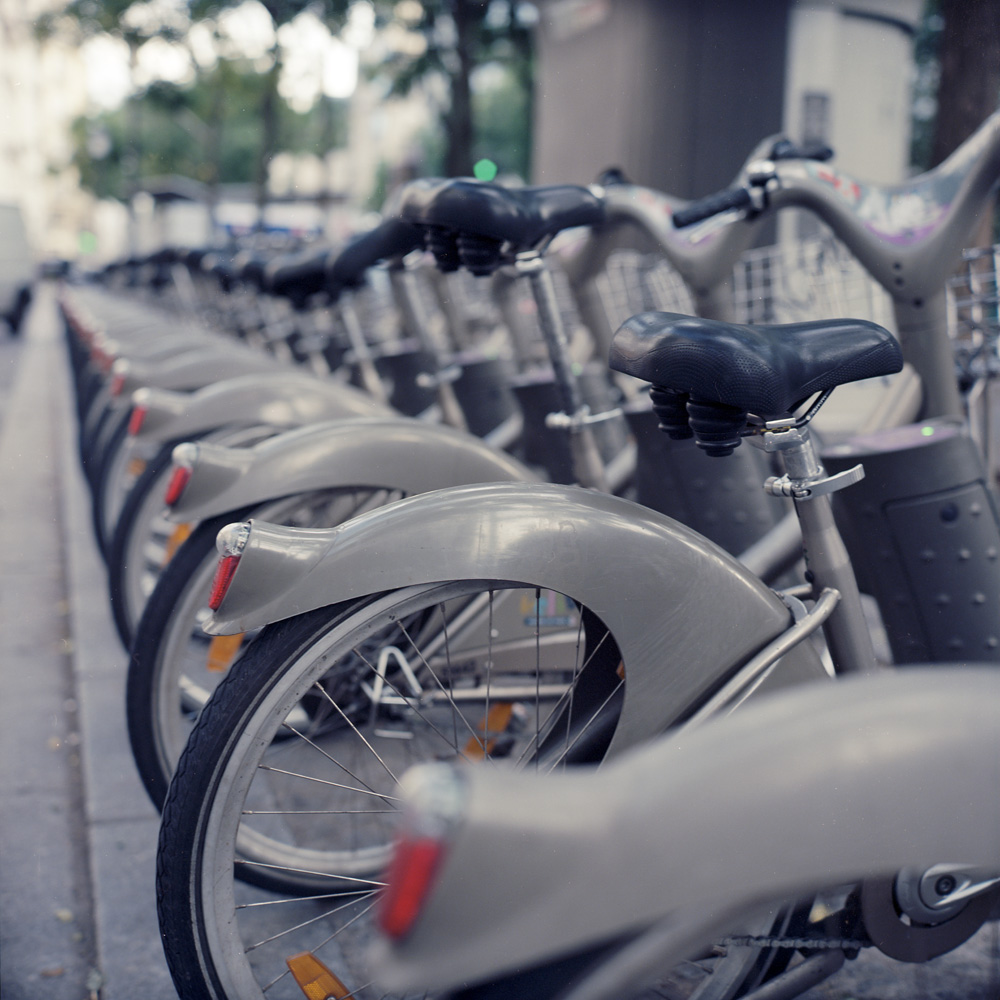
I’ve also been photographing the bikeshare bikes in DC, so I had to take a crack at interpreting their French cousins. Unlike here in the US, the bikeshare bikes seem to be of a single universal design in France. In Paris and in Chalon they are the same design, with the same colors, the prime difference being in the logos on the rear wheel cover and the local advertising. Frankly I could have done an entire photo-essay on the bikeshare bikes but I had other things on my agenda.

Ve'Lib Bikeshare
Ve’Lib Bikeshare

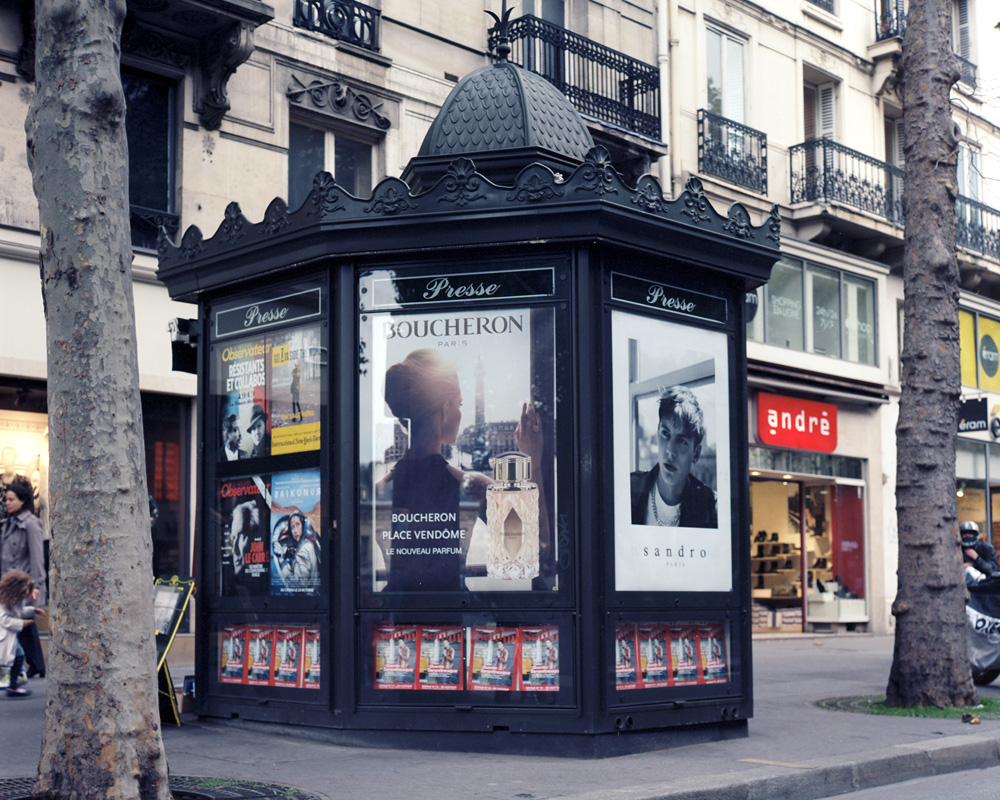
Newsstands fall into that category as well, I think, of things we see but ignore. They’re very functional, and in places that have them, we tend to notice their presence/absence more than we do their form. This one is very Parisian, but with a modern twist – instead of having static broadsides plastered to the outside, now the ads are LED displays or at least rotating banners so in the span of a minute, you can see three to five different ads scrolling past.

Newsstand, Boulevard St. Michel, Paris

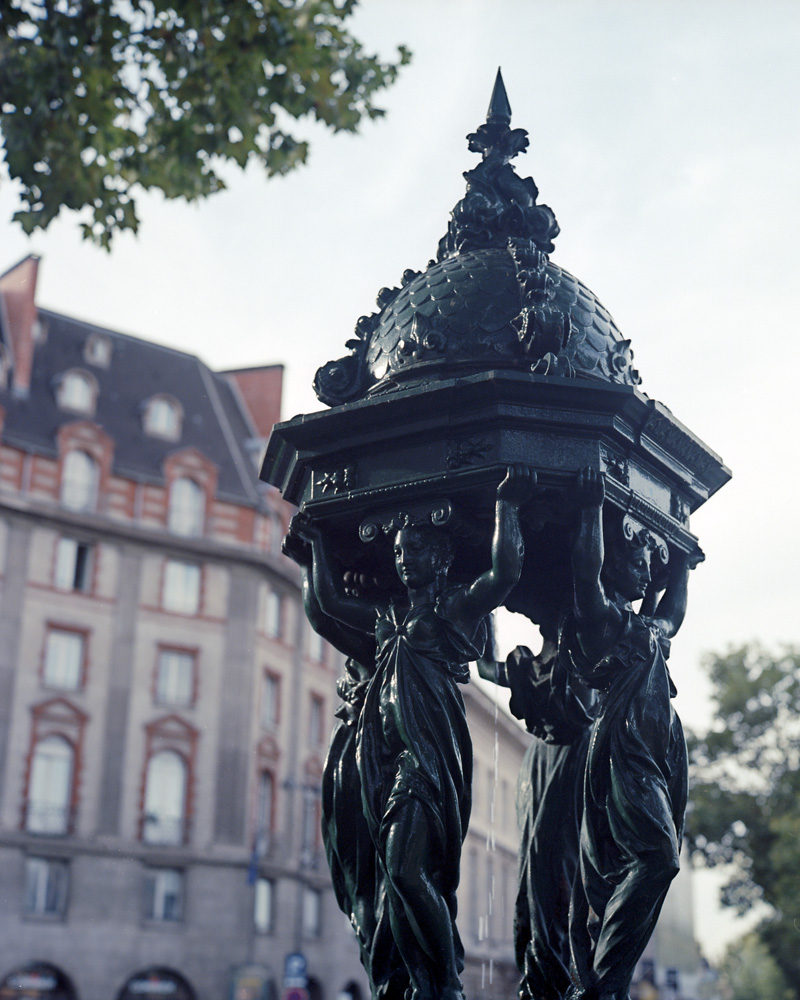
Last but not least, here is a public drinking fountain. I tend to notice them because here in DC for the most part if they exist at all they don’t work. In the 1870s, Baron Haussmann installed public drinking fountains across the city as part of a sanitation campaign, bringing fresh, clean drinking water to everyone. The design of the fountains was suitably ornate, bringing beautification along with safety.

Fountain, Caryatids, Paris

Paris in October – part 26 – more miscellany – people and streets.

Some more random Parisian street scenes.

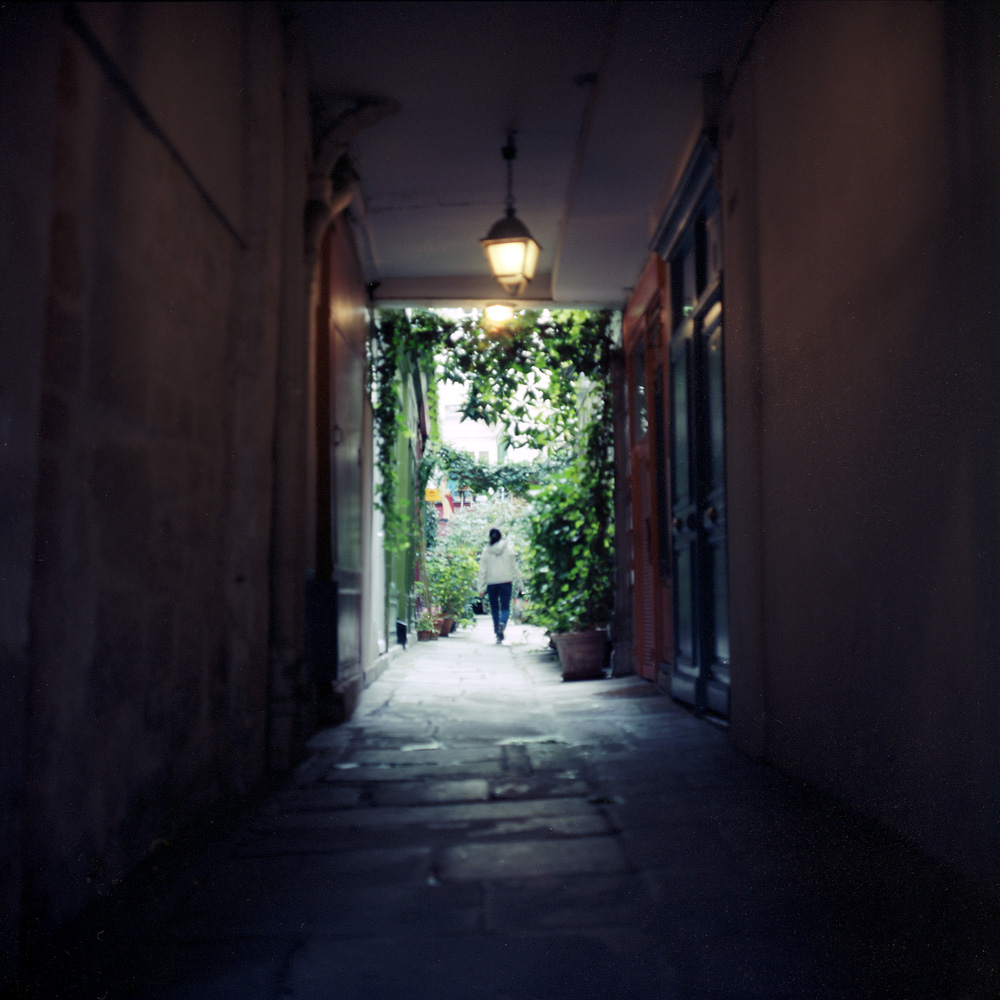
This one is a bit soft because it was a long exposure, hand-held. I think it works, though, because it has a rather dreamy, painterly quality to it. You’re walking through a stone tunnel (in this case the carriageway) and emerging on the other end into a leafy green jungle. It conjures up imaginary adventure stories – where is this place? What awaits in the forest outside the cave? Who is the girl? Where is she going? No matter, I want to follow and find out!

Girl, Courtyard, Marais

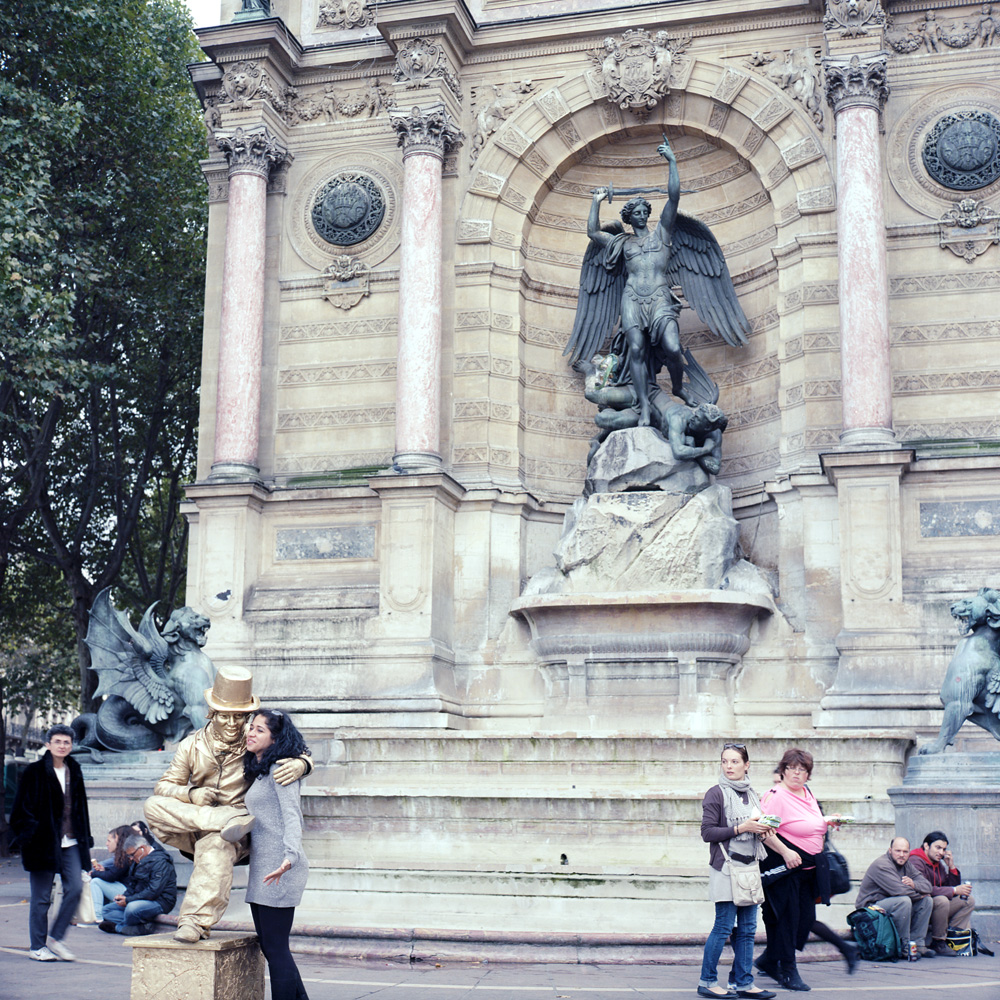
Here is one of the seemingly omnipresent human statues that you find in major european cities. I love the dynamic going on in the picture. The woman posing with him is having her picture taken, but with the photographer outside the frame, the expressions of the passersby take on an entirely different meaning. And Saint Michel on his perch above the fountain looks like he too is about to pronounce judgment with his sword on the entire affair.

Human Statue, St. Michel Fountain

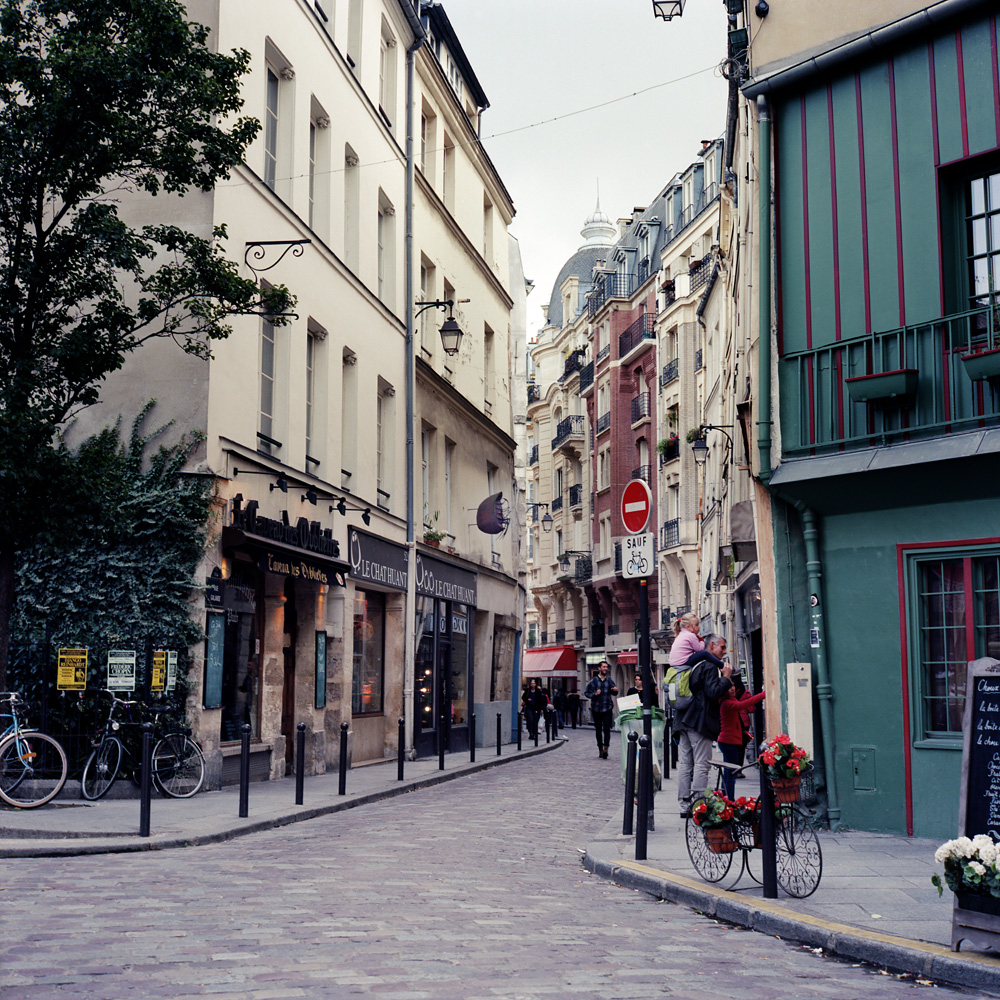
The Rue Galande is an alley that runs behind the block where Shakespeare & Co. bookstore is located. It is one of the old medieval streets that survived Haussmannization – the street itself bends and winds, and the building facades seem to mimic the street, teetering back and forth at unsteady angles.

Rue Galande, Paris
Rue Galande, Paris

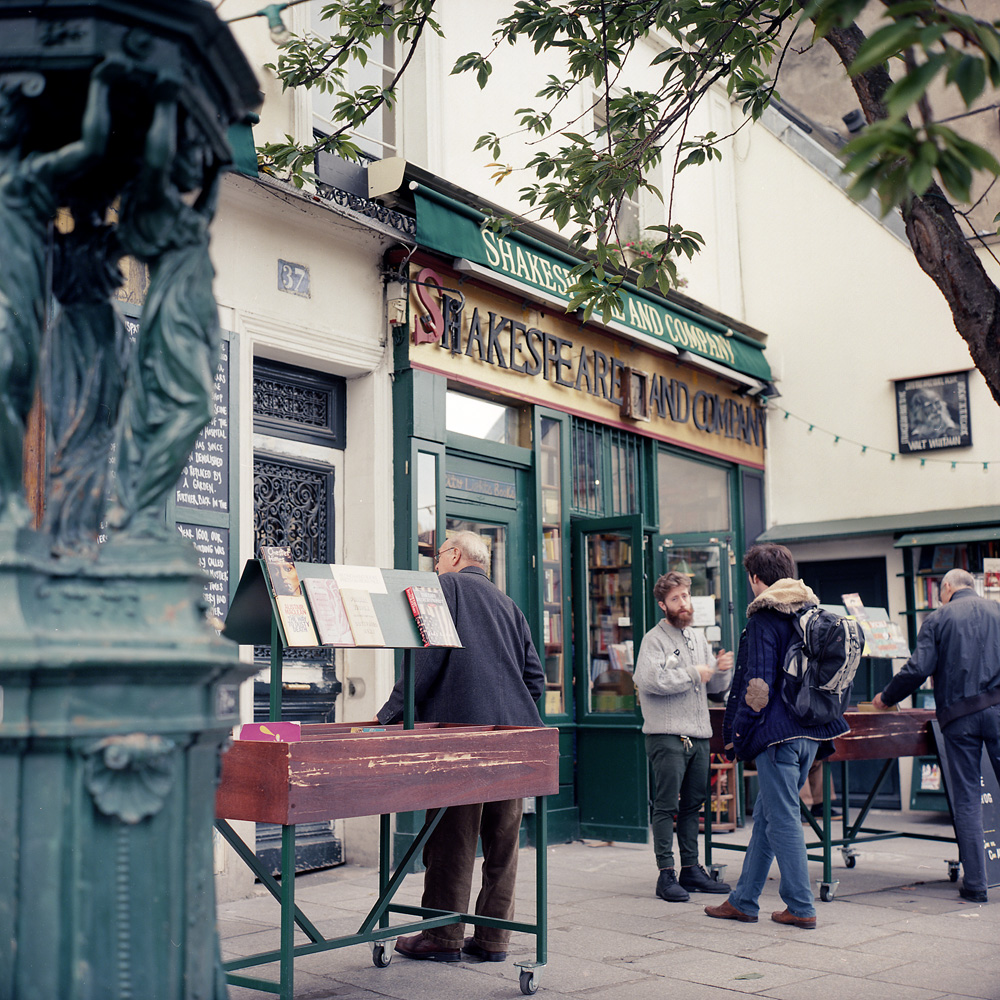
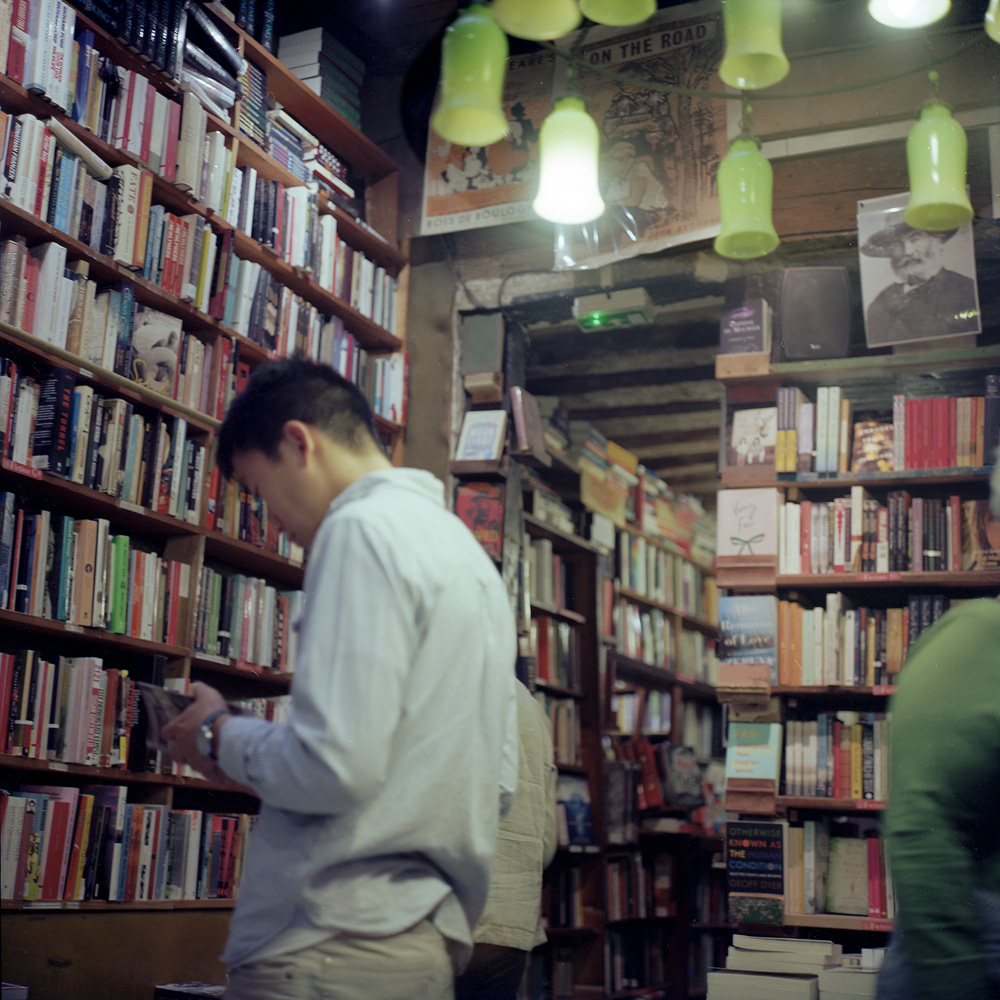
Shakespeare & Co. is a world-famous bookstore featuring english-language books and catering to the expat community. They have regularly scheduled readings, book signings, and social events in the store, and major literary luminaries stop by when passing through Paris. I love a good bookstore and if I lived in Paris I could see myself spending lots of time in here.

Shakespeare & Co. Bookstore
Interior, Shakespeare & Co. Bookstore

Paris in October – part 25 – Hans Z, Street Photographer

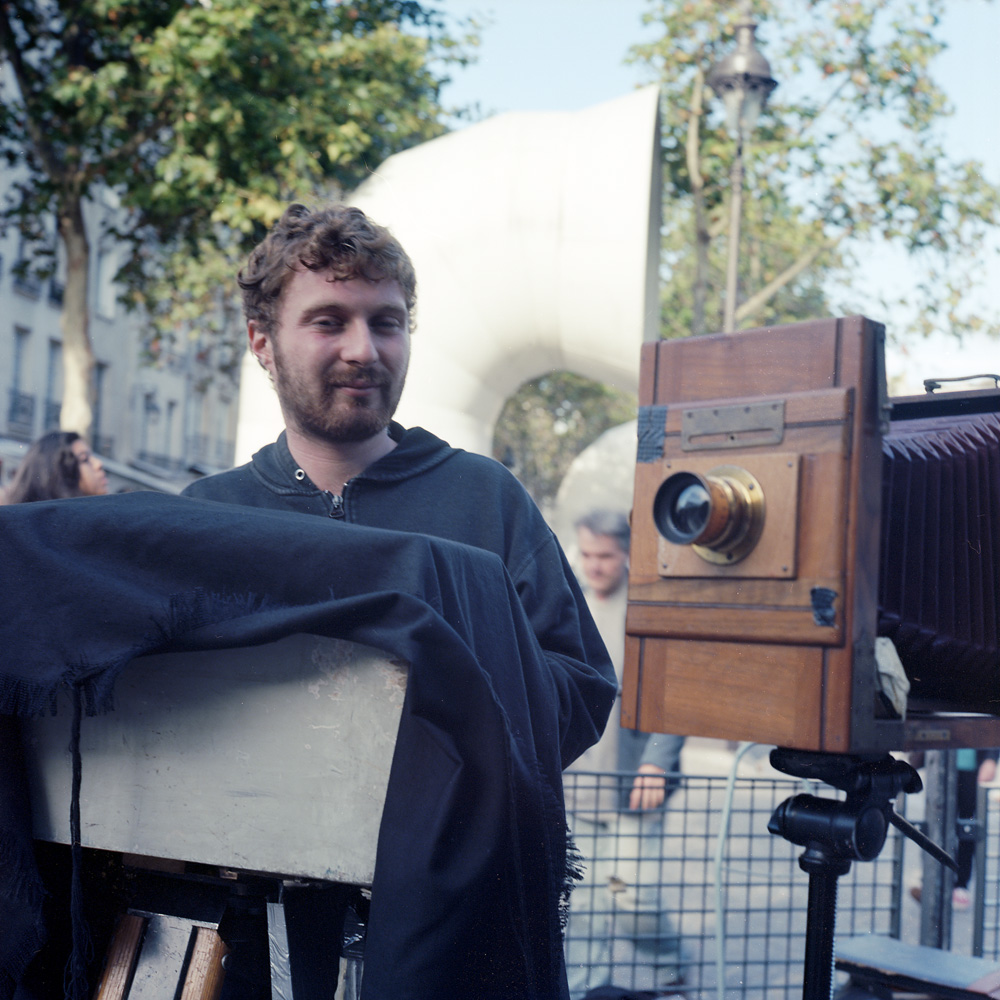
Meet Hans Zeeldieb, the street photographer working outside the Pompidou Centre. He was set up with his vintage 5×7, paper negatives, and portable darkbox doing portraits for 15 Euros a pop. He shot and developed them on the spot in 15 minutes. We struck up a friendly conversation when I saw his camera and he saw mine and talked a lot about photography. He sent me down the street a few blocks to the Centre Iris to go see an exhibit of wet plate collodion images by Jacques Cousin and several of his students, as well as some work by my friend Quinn Jacobson. Several years ago, I was involved in a gallery space in Hyattsville, Maryland called Art Reactor, where I curated a show of photographs made using the whole plate format*, and Quinn was one of the artists I selected. I think I made Hans a little nervous, as he overexposed the image of me. He did capture a good expression of me though, so I was happy to support a fellow working photographer.

In the first photo, I caught Hans with his hands in the darkbox, processing a print. The way it works, he exposes a paper negative in the camera, then develops it in the box. After the negative is developed, he sandwiches it with another piece of paper, opens a window in the dark box to expose it again, and processes the second paper, which now has a positive image. There are several advantages to this process – by working with paper, the development and fixing is much faster than with film, and you can use the same chemistry for both your negative and your finished print. I’ve seen or read about other itinerant photographers using much the same technique around the world, from Madrid to Kabul.

Hans with his camera, processing a photo

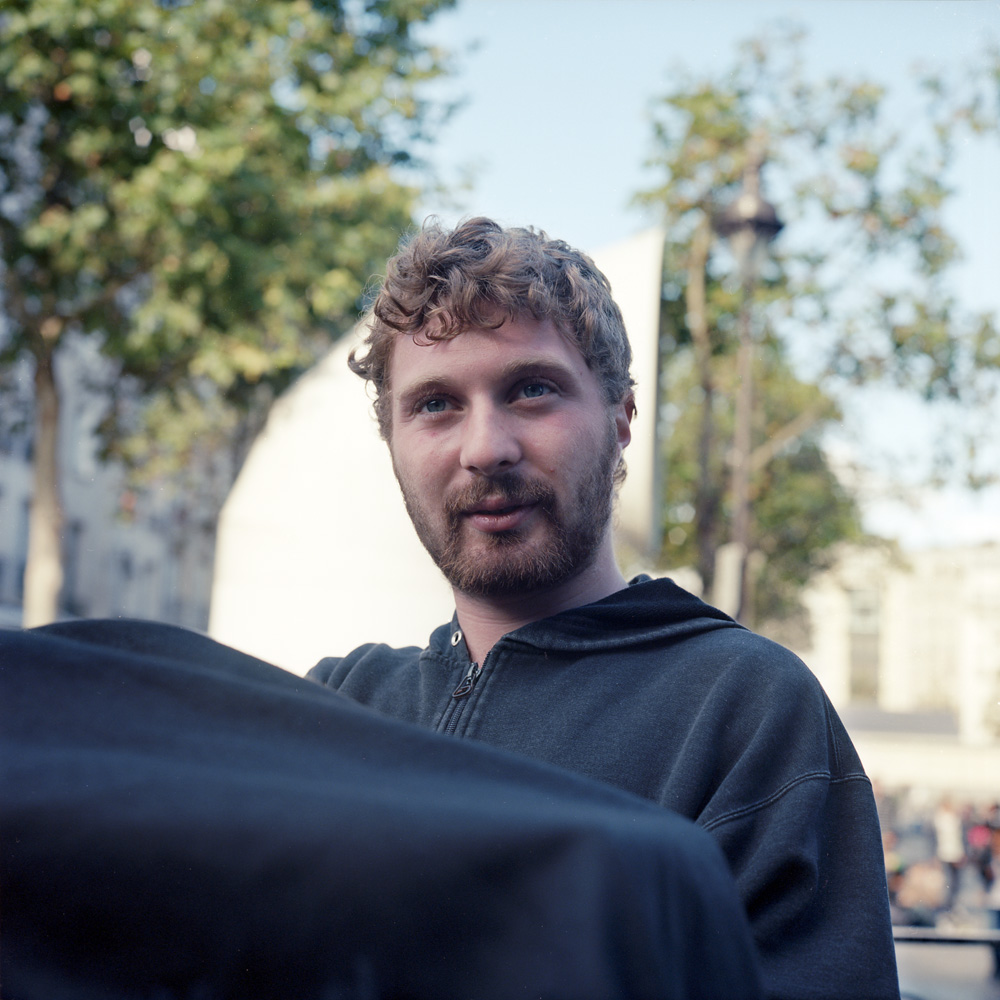
Here is a portrait of Hans outside the Pompidou Centre, just a close-up this time without the camera in the frame. He seems a little lost in thought – I think he was counting time for the print he was developing.

Hans, at the Pompidou Centre

* Whole Plate format is the original photographic format, defined today as 6 1/2 x 8 1/2 inches. It is not entirely certain how this size was chosen by Daguerre as the plate size he wanted to use, but reasonable speculation ties it to book printer’s printing plates. It has varied in its specification over time, but it settled on the 6 1/2 by 8 1/2 size by the late 19th century.

Paris in October – part 24 – Ile de la Cité
I apologize for the randomness again. It kind of reflects my own state of mind at the moment anyway. But here’s a few more scenes from the Ile de la Cité.

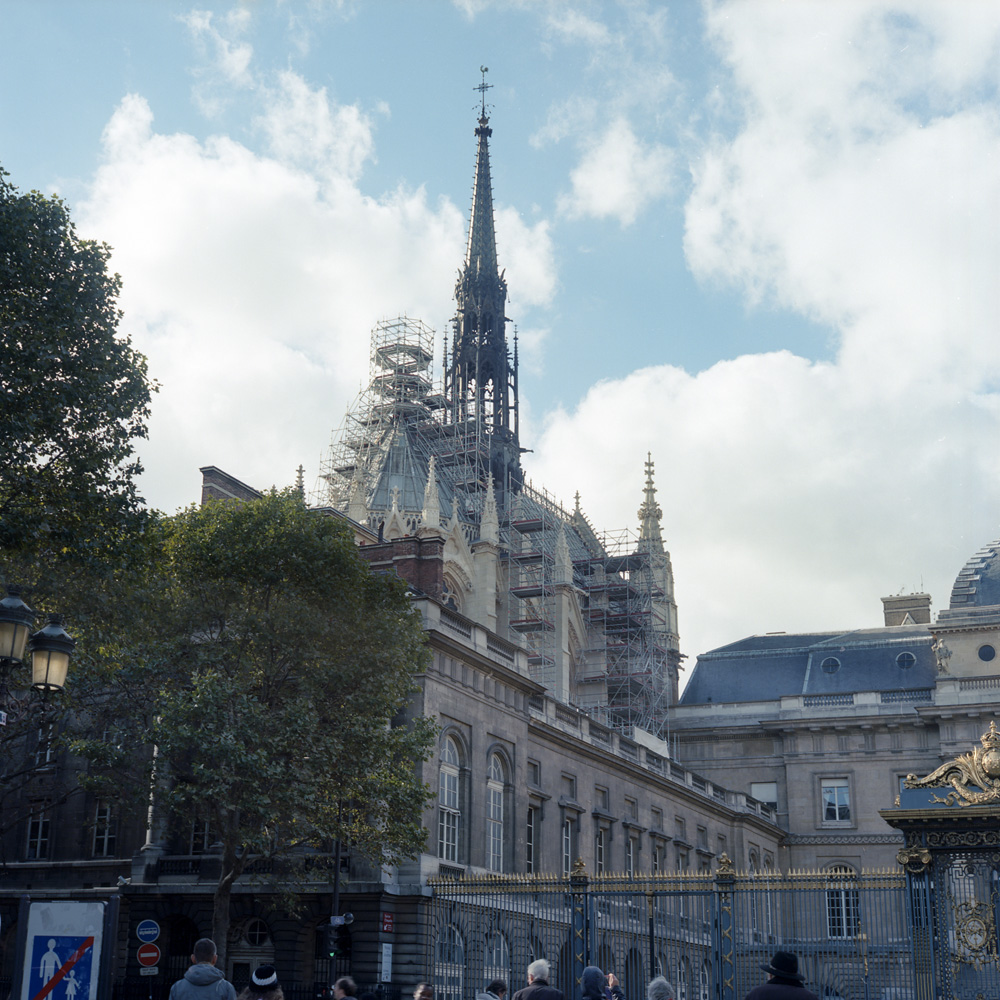
The Sainte Chapelle is inside the compound of the Conciergerie (the prison where Marie Antoinette and Louis were held prior to their execution) and the modern day Palais de Justice. Here you can see the Sainte Chapelle from outside the gates of the Palais de Justice. The spire is a later 19th century re-creation of the original which was torn down during the French Revolution.

Sainte Chapelle Exterior

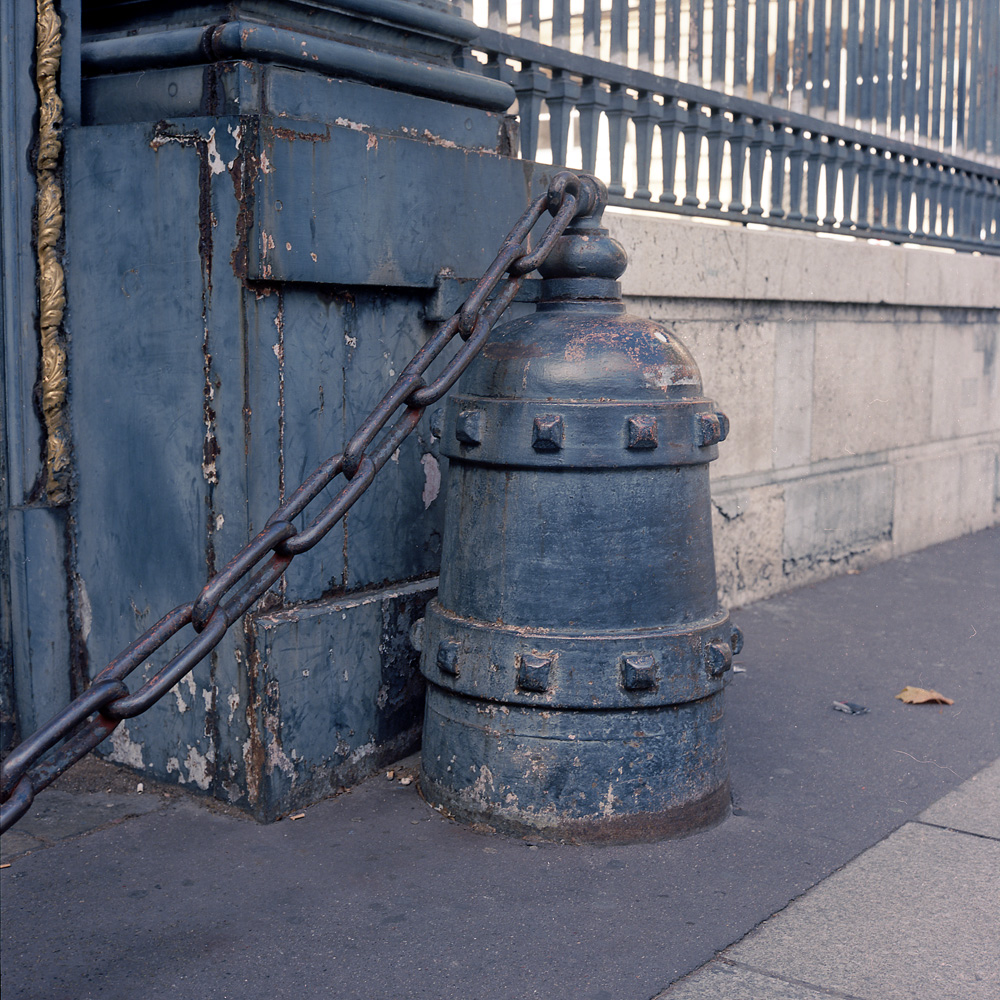
I don’t know the source of my fascination with safety bollards as photographic subjects. Maybe its because they’re such ordinary things with a very important purpose that we tend to ignore. I guess I empathize with the bollards.

Bollard, Palais De Justice

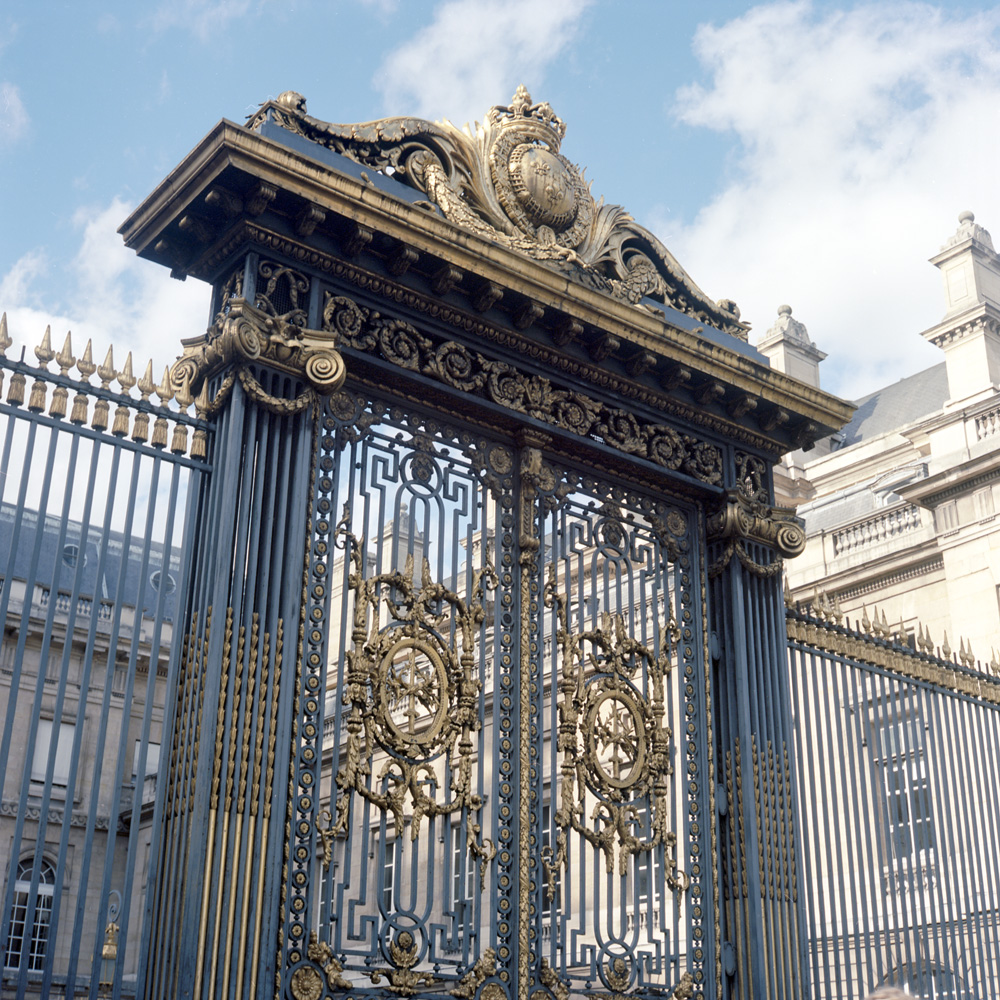
The gates to the Palais de Justice. When I was there, unfortunately, the Conciergerie museum was closed for renovations. This seemed to be an unfortunately frequent occurrence in Paris – a number of museums were closed for renovation work: the Conciergerie, the Musee Chatelet, and the Picasso, to name the most notable.

Gates, Palais De Justice

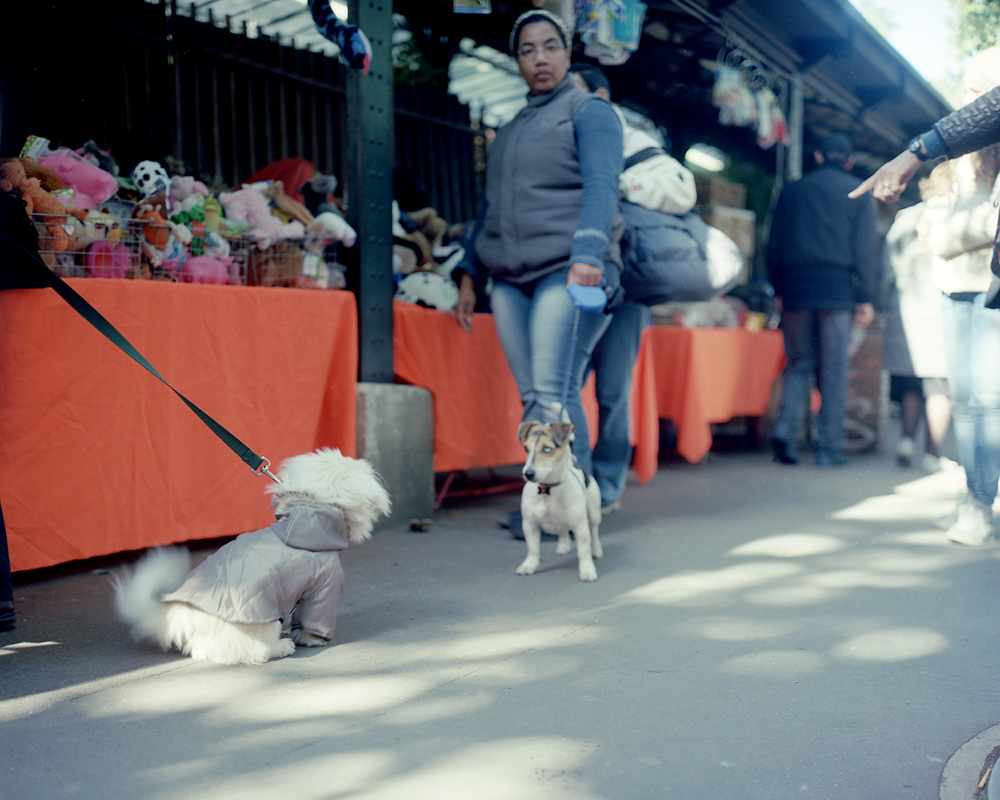
Here are the photos I mentioned a couple posts ago when talking about the Metro stop for Ile de la Cité. There’s a little open-air market they have set up right across from the exit where they sell pet supplies, flowers, and other various and sundry items. Here are two little dogs out for a walk in the pets section who were straining to take a look at one another.

Parisian Puppy Confrontation

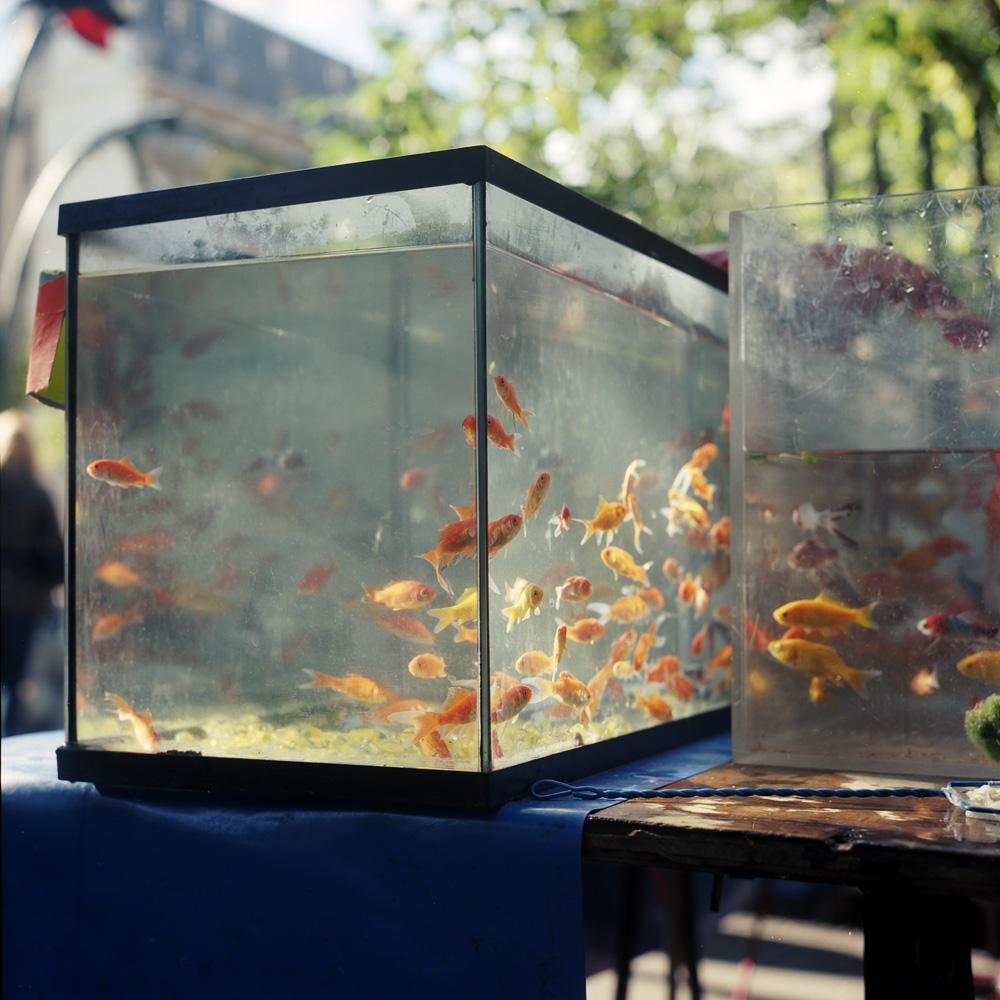
And last but not least, I just loved the way the light was making the goldfish in the tanks glow.

Fishtank, Marche, Ile de la Cité

Paris in October – part 23 – The Metropolitain (Subway)

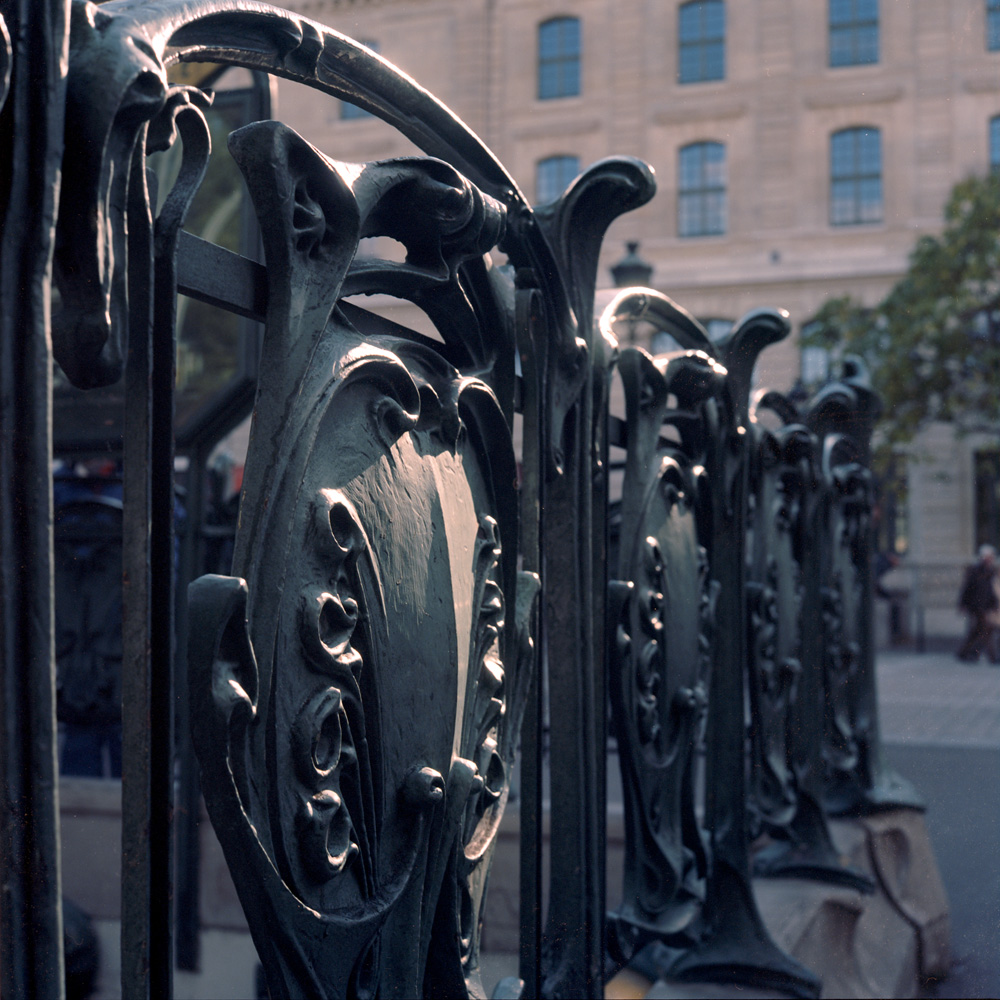
The old part of the Metropolitain subway system in the city center of Paris is famous for the art nouveau railings and signs at the station entrances. I know I put a couple of photos in an earlier post about Transportation, but these three are specifically about the entrance railings and signs.

Art Nouveau Rail, Cité Metro

The railings LOOK to be bronze, from the patina, but I would suspect that they’re iron that has been painted. Bronze would make them extremely expensive, but then again, when you look at how lavish the French were in their public buildings in the late 19th century, it’s not inconceivable.

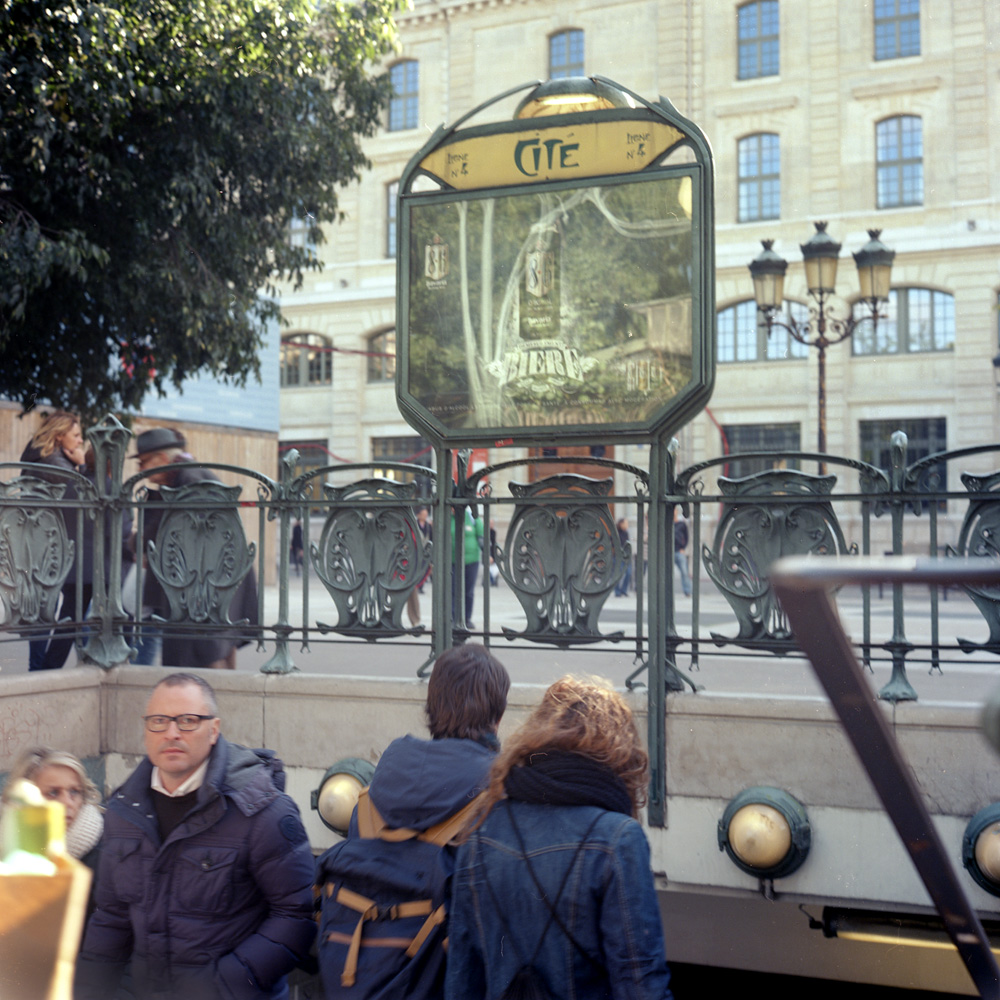
The entrance to the Ile De La Cité metro stop. This is where you get off the train to go see Notre Dame and Sainte Chapelle. Immediately across from it is a little open-air market which has flowers and pet supplies. I have two pictures from the market of two little dogs staring each other down and goldfish in a tank from the market, going into another post.

Cité Metro Entrance
Cité Metro Entrance

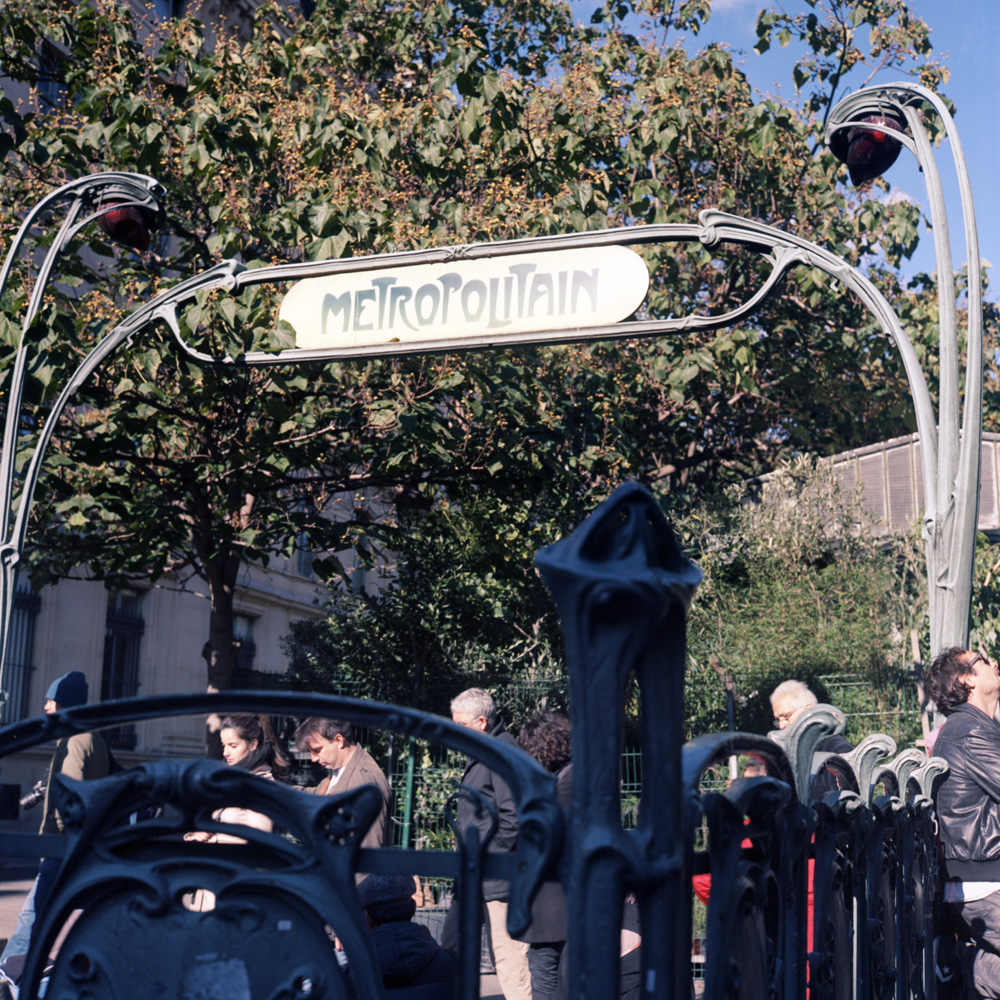
The most famous sight of all – the Metropolitain sign. There is a replica of one of these in the sculpture garden on the National Mall between the National Gallery of Art and the Natural History Museum here in Washington DC.

Metropolitain Sign
Metropolitain Sign

Paris in October – part 22 – odds-n-ends

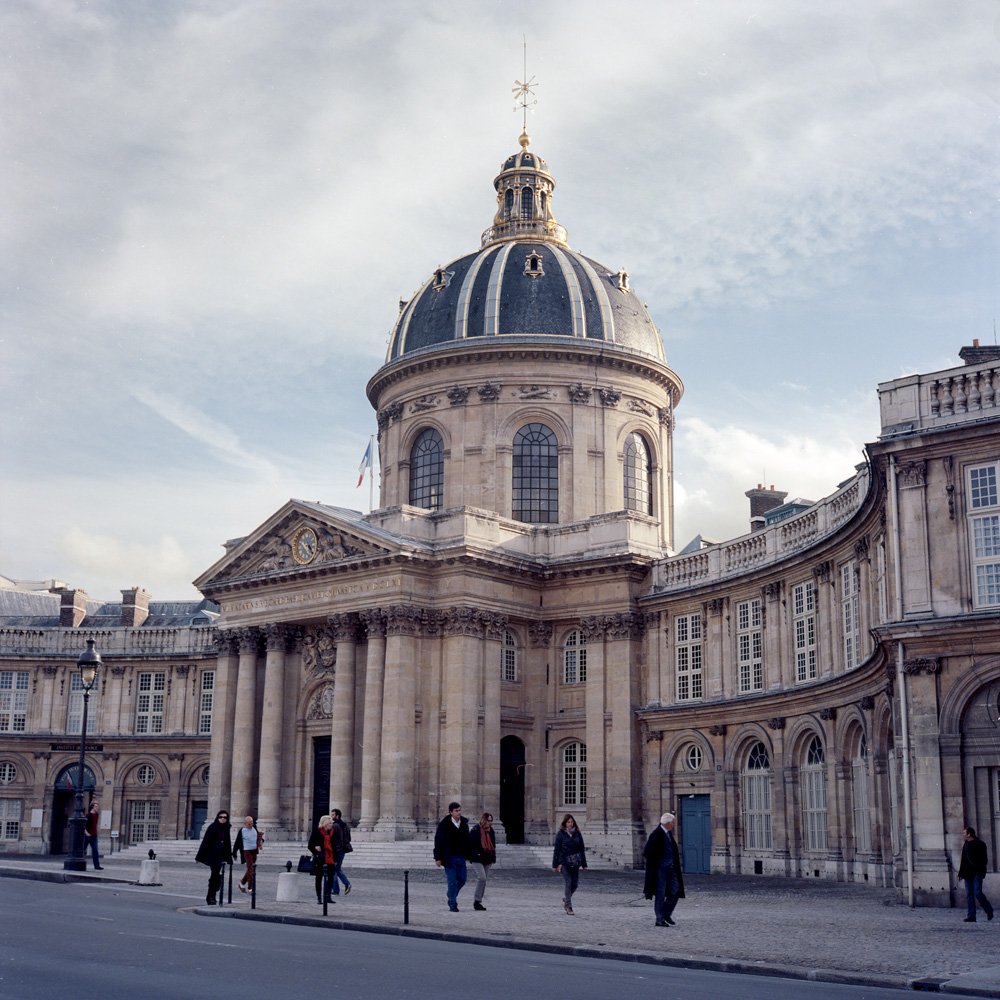
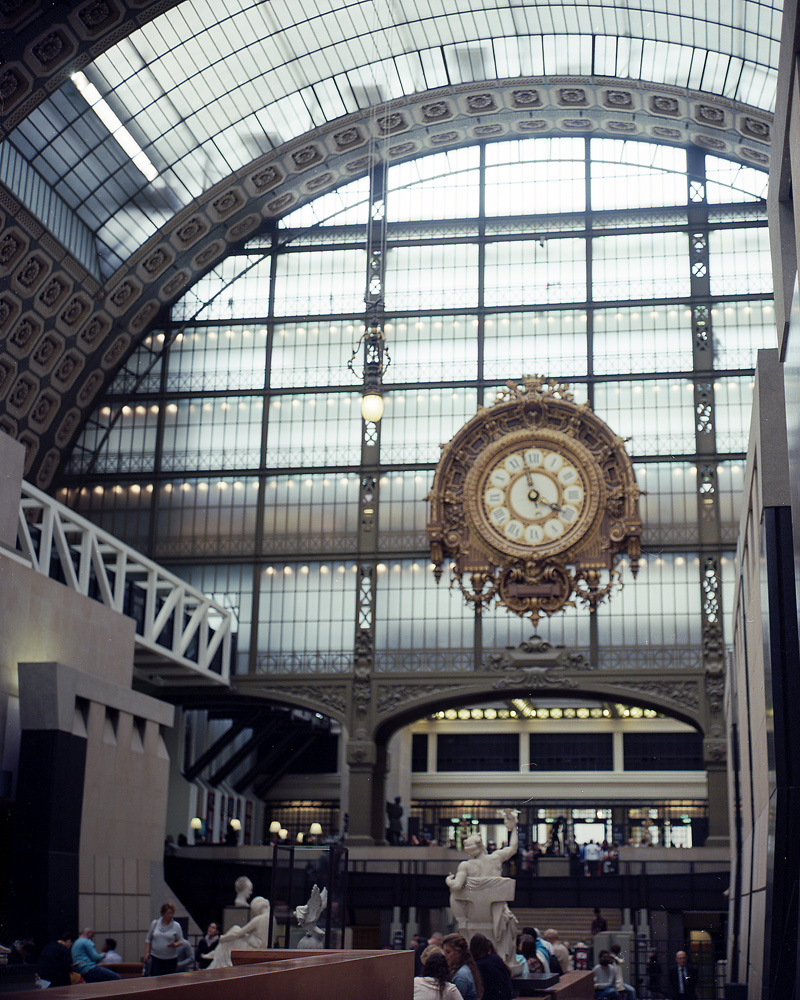
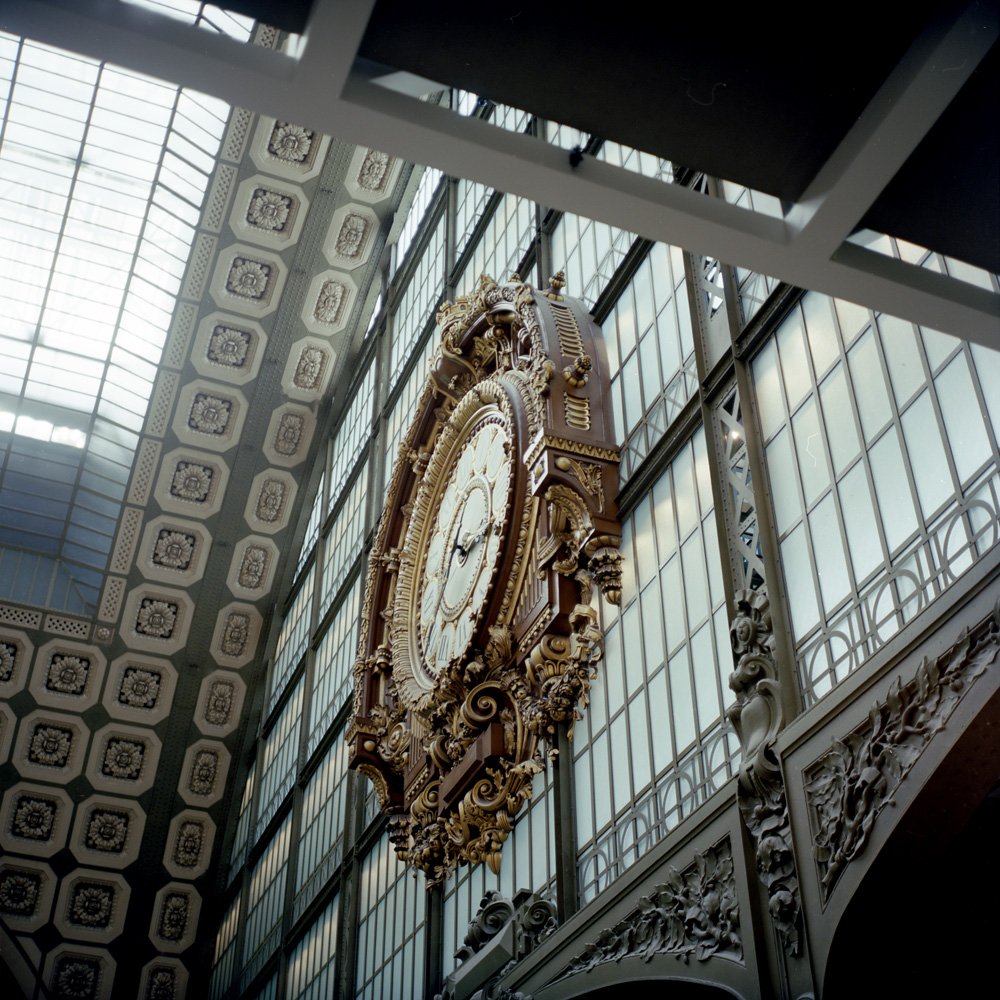
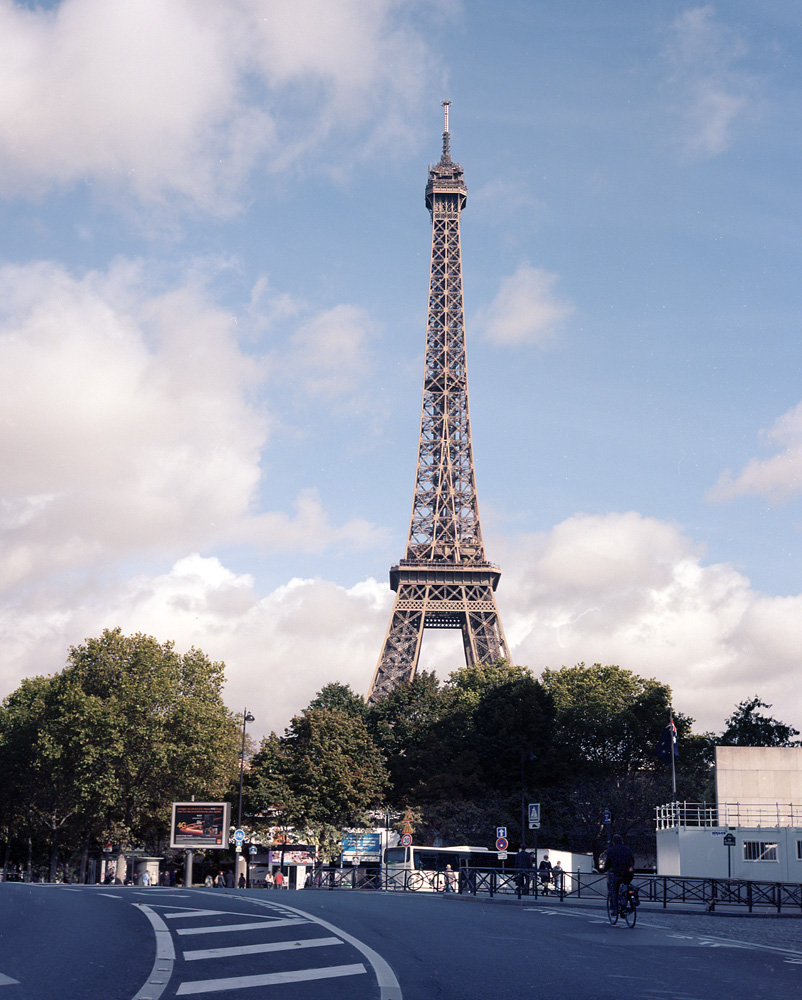
Here are four loose assorted images. I forgot I had the Eiffel Tower shot when I was posting the Eiffel Tower images because it was on a different roll. The Musee D’Orsay shots don’t have enough of a group to make a complete post of their own because technically you’re not supposed to take photos inside the museum in the first place, and it’s very crowded so it’s hard to take good photos of the building without lots of out-of-focus heads in the lower foreground. The Academie Francais building was a one-off, taken on my walk back to the apartment from the Musee D’Orsay. It was late enough in the day, and my feet were tired enough, that I couldn’t be bothered to try and see if the Academie was open and if they had any exhibits to visit. But it was lovely light and the building needed photographing.

Academie Francais
Academie Francais
Clock Hall, Musee D'Orsay
Clock Hall, Musee D’Orsay
Clock, Musee D'Orsay
Clock, Musee D’Orsay
Eiffel Tower
Eiffel Tower

All shots taken with my Rolleiflex 2.8E using Kodak Ektar 100. I include this little tidbit because people (read: photographers) want to know what gear was used, and what film. I don’t include aperture/shutter combinations as I A: don’t usually remember them, and B: that’s getting to geeky level of detail – most of the time if you want to re-create something you’ve seen of someone else’s, you don’t need that information unless there’s a special effect (very blurred motion or completely frozen, or extremely shallow depth-of-field). In any case as I’ve matured as a photographer, I care far more about the image itself and less about the mechanics of how it was made. You see photographers all the time geeking out about lenses and cameras, this film vs. that film vs. digital, CMOS vs CCD, but if DaVinci and Michelangelo ever had a debate about which paintbrush was better, it has not been recorded (or art historians aren’t publishing it!).

Paris in October – part 21 – More Le Marais

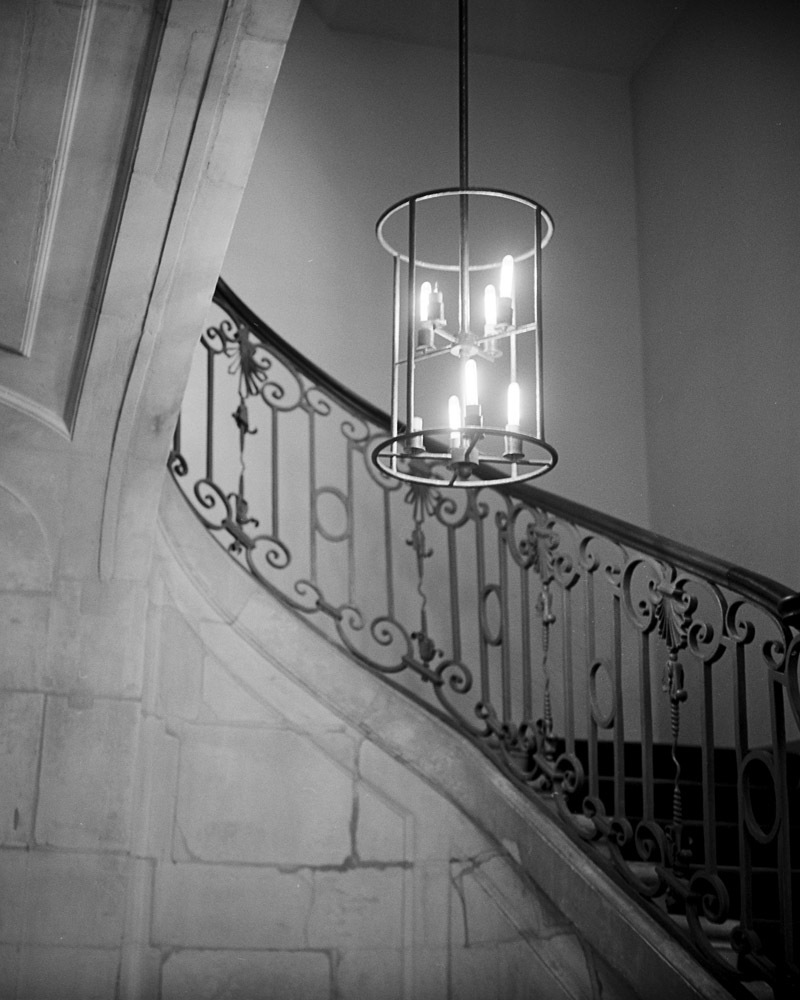
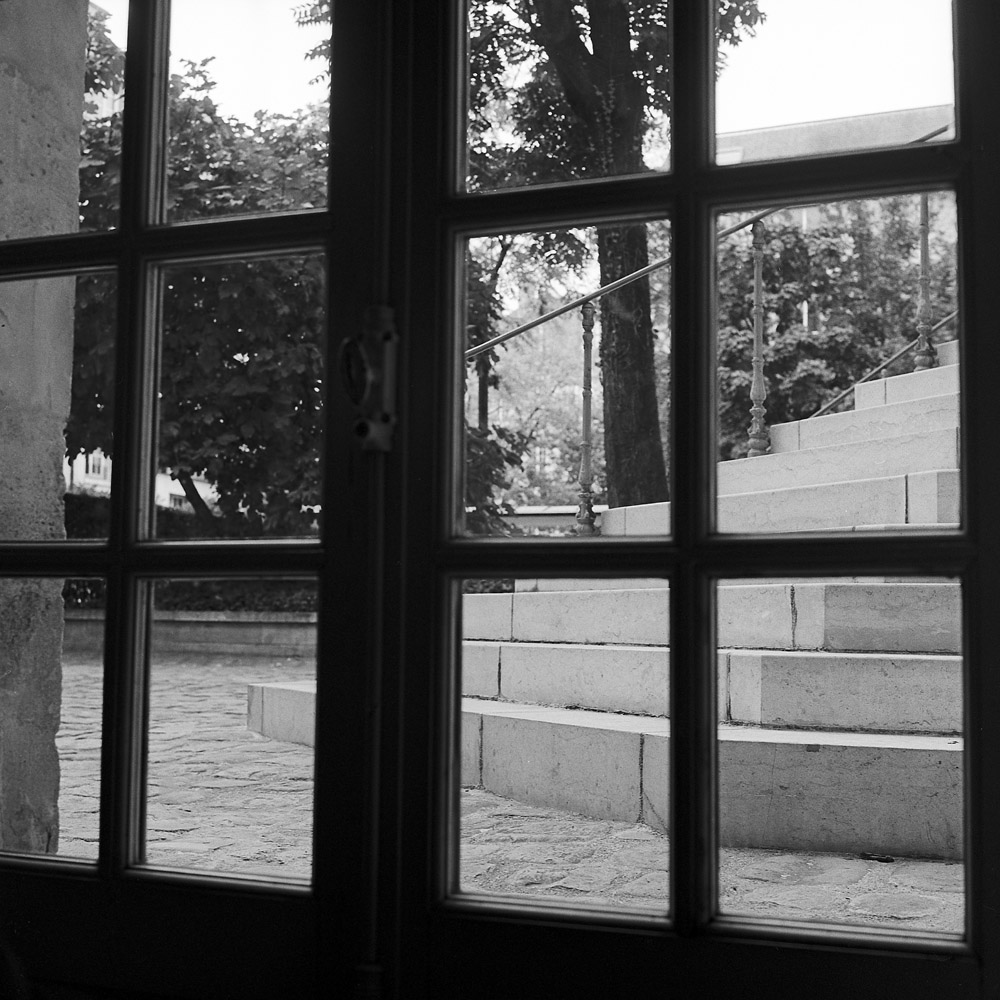
A photographer’s visit to Paris would not be complete without a trip to the Maison Europienne de la Photographie. The primary exhibit was Sebastiao Salgado’s current body of work documenting indigenous ways of life and remote places around the world. It would have been very hard to photograph the exhibit itself as it was VERY crowded, so I turned my lens toward the building. The entrance is a very modern looking (read 1960s style) wing, but the main block of the facility is housed in another one of those 18th century Parisian hotels that once belonged to some noble family.

Staircase, La Maison Europienne de La Photographie
Window, Courtyard, La Maison Europienne de La Photographie

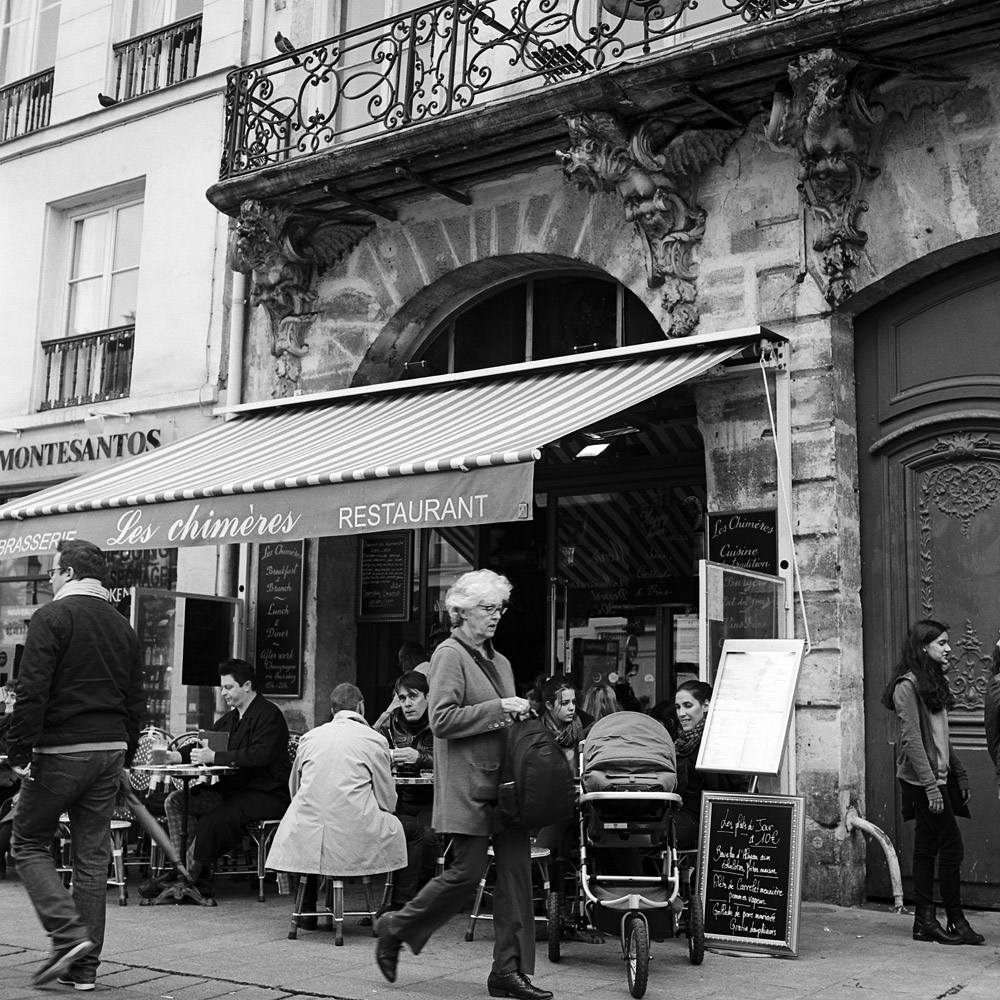
After visiting La Maison, my father and I ate here at Les Chimeres for lunch. It was a fairly chilly (for October) day, and you can see Parisian cafe culture at work – despite the chill, people were sitting outside of their own free will. This was true across the city, and in all weather (it took a brisk rain to drive people inside completely).

Les Chimeres Restaurant, Marais

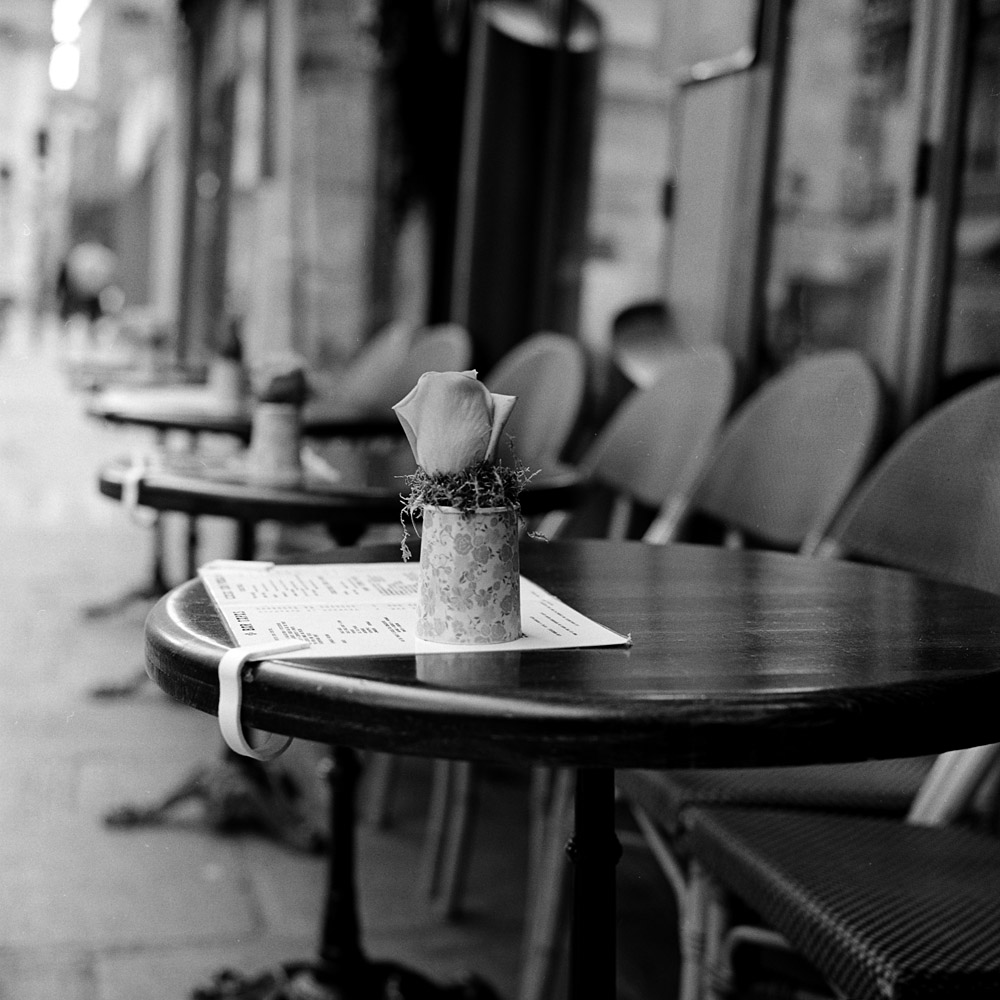
Near the Pompidou Centre, I came upon this row of cafe tables set up and waiting for patrons. I know it’s a bit treacly and cliché as photos go, but it’s representative of the place and the atmosphere.

Cafe Tables, Pompidou Centre

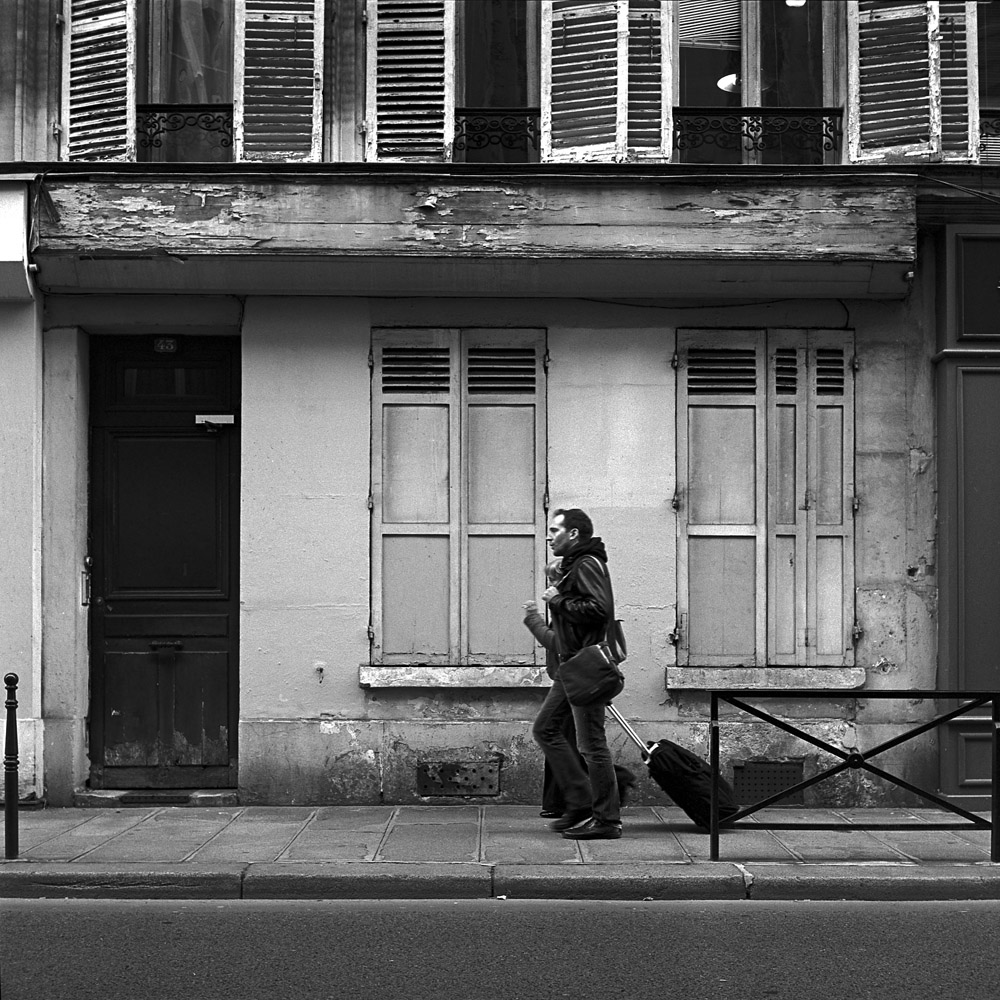
Around the corner from La Maison and Les Chimeres was this scene. Number 43, Rue Francois Miron. I have no idea if anyone famous or noteworthy lived (or lives) there, but the weathered texture and the irregular symmetry and repeating patterns of the building cried out to be photographed.

43 Rue Francois Miron

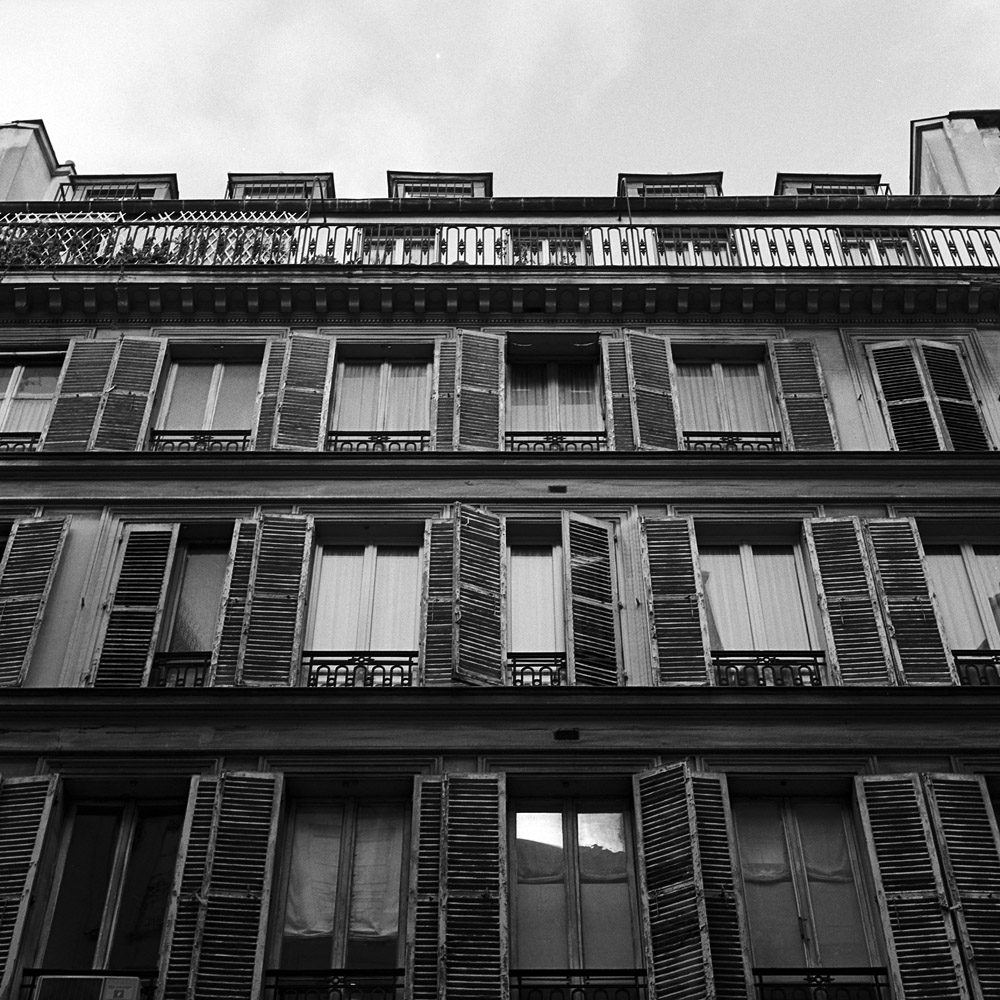
I love looking up at buildings – it’s sometimes hard to do, and it forces you to break out of your street-level perspective. In places like New York, where the buildings are so tall, it can almost induce a sort of negative vertigo, but it still behooves us to stop and re-think how we see the world. Plus, you might miss something interesting if you don’t.

Upstairs, 43 Rue Francois Miron

Again, everything was shot with a Rolleiflex 2.8E, on Kodak Tri-X film.

Charles Marville exhibit at the National Gallery of Art

The River Seine by Charles Marville

Charles Marville: Photographer of Paris

Around 1832 Parisian-born Charles-François Bossu (1813–1879) shed his unfortunate last name (bossu means hunchback in French) and adopted the pseudonym Marville. After achieving moderate success as an illustrator of books and magazines, Marville shifted course in 1850 and took up photography, a medium that had been introduced 11 years earlier. His poetic urban views, detailed architectural studies, and picturesque landscapes quickly garnered praise. Although he made photographs throughout France, Germany, and Italy, it was his native city—especially its monuments, churches, bridges, and gardens—that provided the artist with his greatest and most enduring source of inspiration.

By the end of the 1850s, Marville had established a reputation as an accomplished and versatile photographer. From 1862, as official photographer for the city of Paris, he documented aspects of the radical modernization program that had been launched by Emperor Napoleon III and his chief urban planner, Baron Georges-Eugène Haussmann. In this capacity, Marville photographed the city’s oldest quarters, and especially the narrow, winding streets slated for demolition. Even as he recorded the disappearance of Old Paris, Marville turned his camera on the new city that had begun to emerge. Many of his photographs celebrate its glamour and comforts, while other views of the city’s desolate outskirts attest to the unsettling social and physical changes wrought by rapid modernization. Taken as a whole, Marville’s photographs of Paris stand as one of the earliest and most powerful explorations of urban transformation on a grand scale.

By the time of his death, Marville had fallen into relative obscurity, with much of his work stored in municipal or state archives. This exhibition, which marks the bicentennial of Marville’s birth, explores the full trajectory of the artist’s photographic career and brings to light the extraordinary beauty and historical significance of his art.

I went this weekend with my parents to see this exhibit. It is a wonderfully presented exhibition, and proof positive that when the National Gallery tries hard to do a good photography show, they can. The exhibition had special resonance for my father and I as we have just been to Paris, and trod the same streets documented in these photographs.

The exhibition has over 100 prints of Charles Marville’s work on display, ranging from early salt-paper portraits made from calotype negatives (negatives made on paper) to large albumen prints of architectural studies from glass collodion negatives. His architectural works have a significant sociological aspect as they document neighborhoods in transition from medieval warrens of twisted streets and cantering buildings flung up haphazard against one another, populated by the Parisian working class, to the modern, wide boulevarded, sanitized, luxurious Paris created by Baron Haussmann that we think of today.

Among the modernizations he documented were the new gas street lamps being installed, and the public urinals Haussmann designed to improve public sanitation (a major obsession of his). While many of the street lamps were preserved with electrification and can still be seen today, only one of Haussmann’s urnials still stands on Parisian streets.

Marville even includes himself in this transition, as he frequently used himself or an assistant as a stand-in for scale and emotional impact amidst the tumult and construction/destruction he photographed. He even photographed his prospering studio in a location that a scant few years later would also fall victim to Haussmann’s ‘modernizations’.

At the peak of his career he was the official photographer of Paris, but by the time of his death, he had faded into obscurity, his work ending up stored in state and city archives, and not a single obituary was published to mark his passing. He may have died in obscurity, but his work survived and preserved the city in transition, sometimes with his images being the sole record of the city that was.

The exhibit will be traveling to the Metropolitan Museum of Art in New York in January. If you can make it, it will be well worth your while.

Paris in October – Part 20 – Le Marais in Black and White

Le Marais is one of the few neighborhoods in the city center of Paris that retains its medieval core of narrow wandering streets. It is home to a diverse population from Orthodox Jews to gay pubs and nightclubs. It is full of little art galleries, boutiques, shops and restaurants, where cutting-edge cohabits with the ancient.

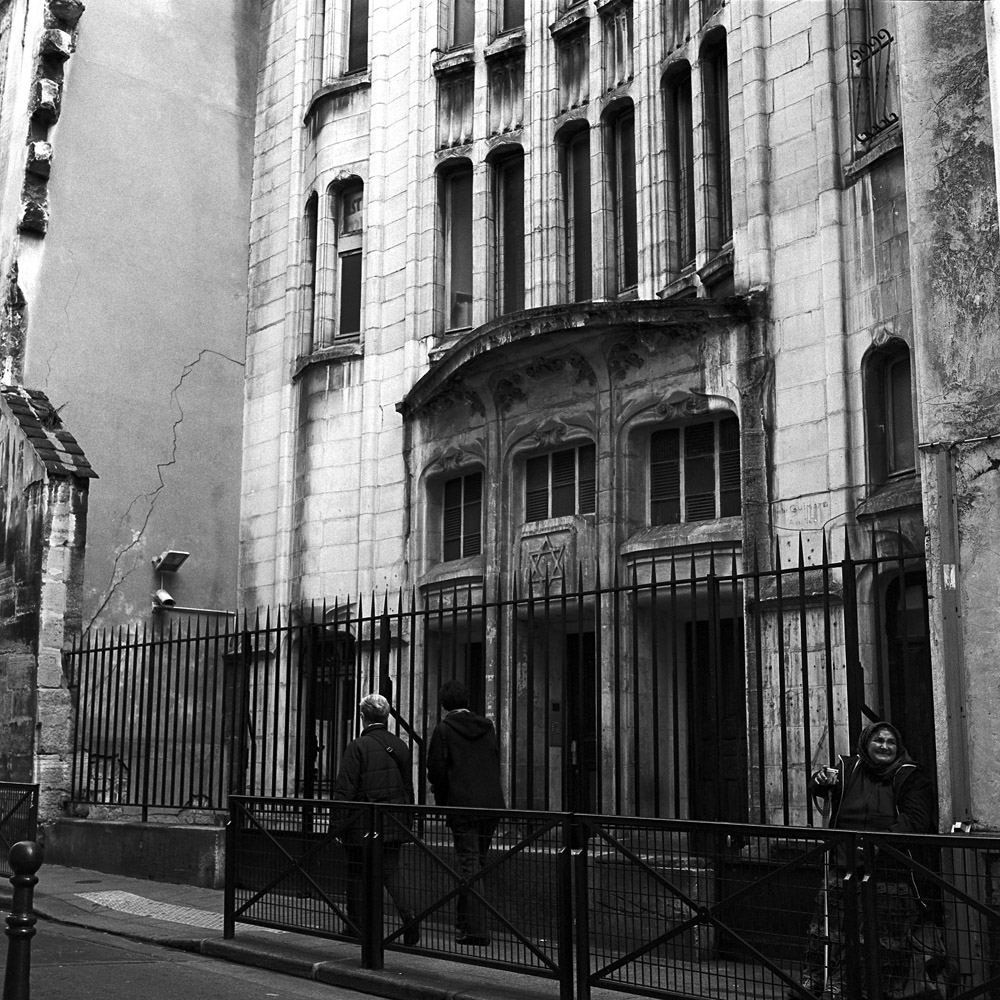
The look of the Orthodox Jewish center appears to be late 19th century/early 20th century Art Nouveau, which surprises a bit that it survived the Nazi occupation.

Orthodox Jewish Center, Le Marais

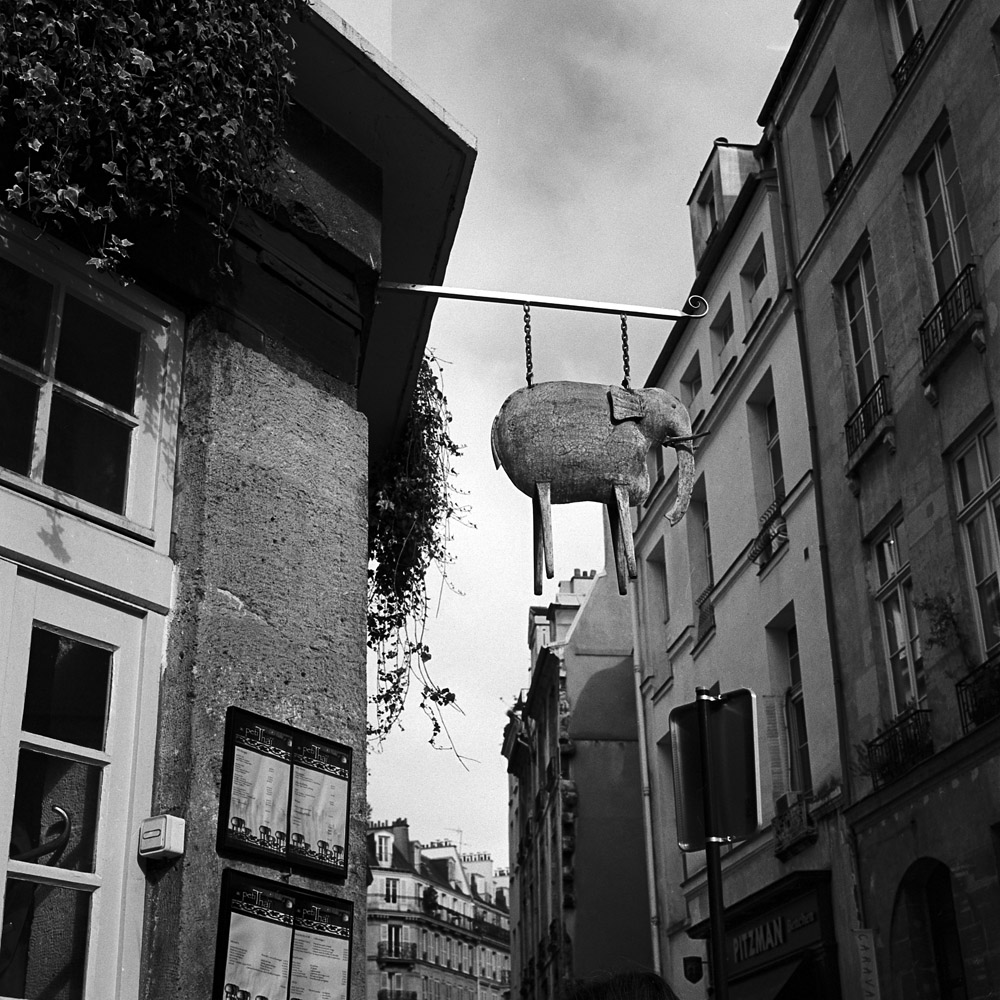
Just across the street and down a half a block is Le Petit Thai restaurant, with its cute elephant sign. I don’t yet know the significance if there is any, to why it seems there are always Thai restaurants in gay neighborhoods.

Le Petit Thai, Le Marais

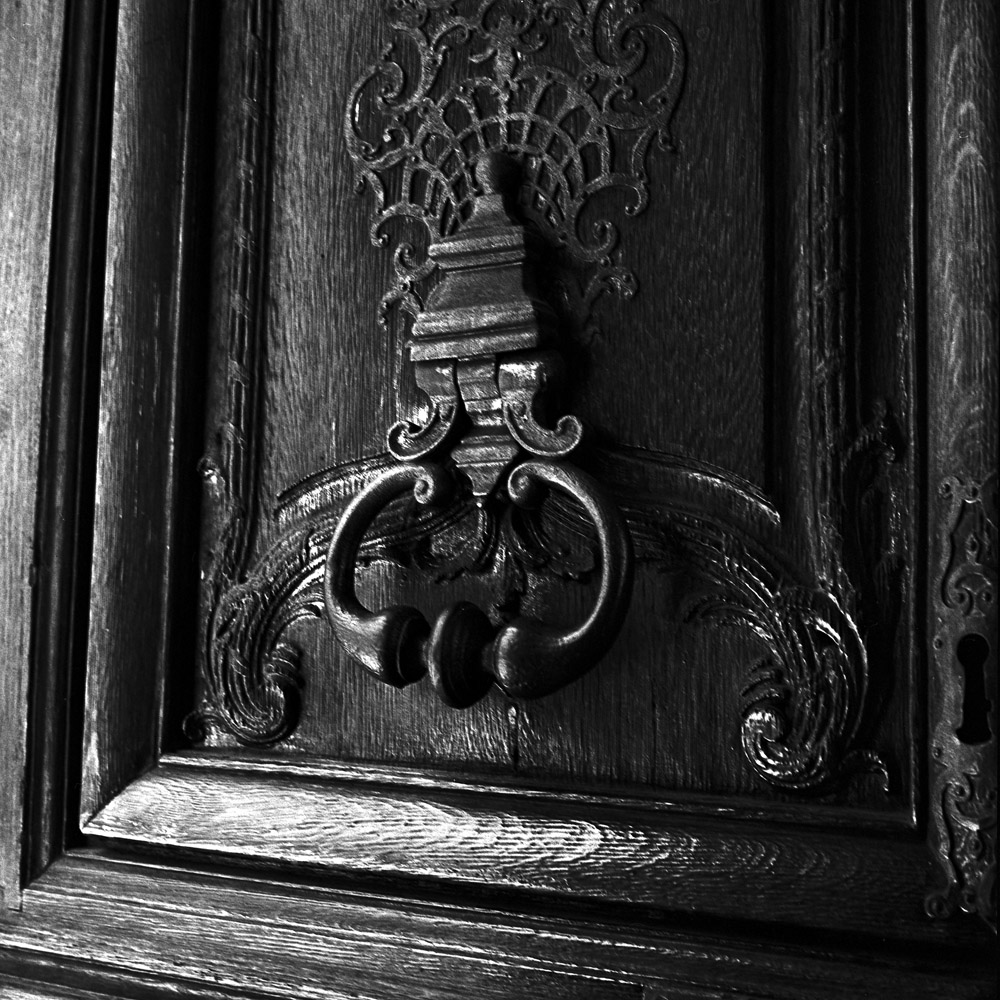
A beautiful wrought-iron door knocker on a weathered wooden door in the Marais:

Door Knocker, Le Marais

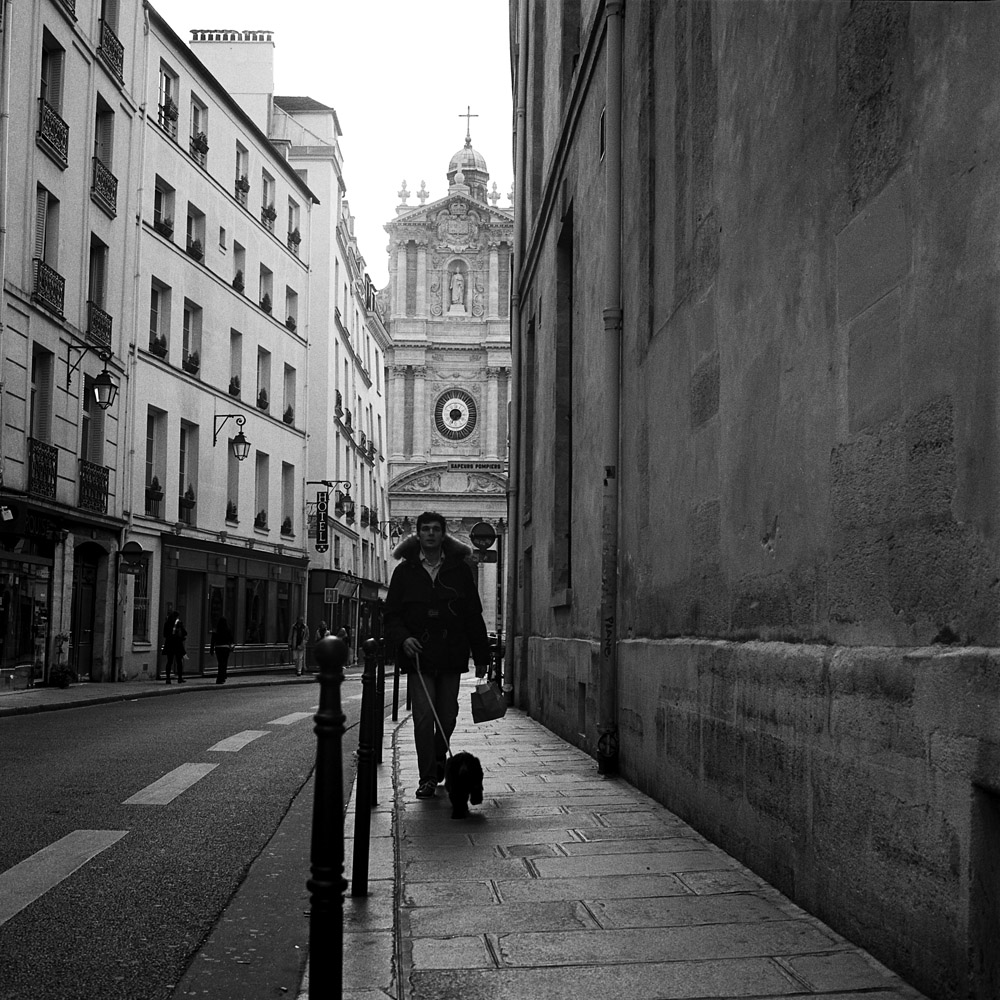
A man out walking his dog on the Rue Sevigne. The church in the background is the Eglise St. Paul-St. Louis, which housed the hearts of Louis XIII and XIV (after they were dead, of course) until the French Revolution. The current structure dates back to the 17th century.

Dog Walker, Rue Sevigne, Le Marais

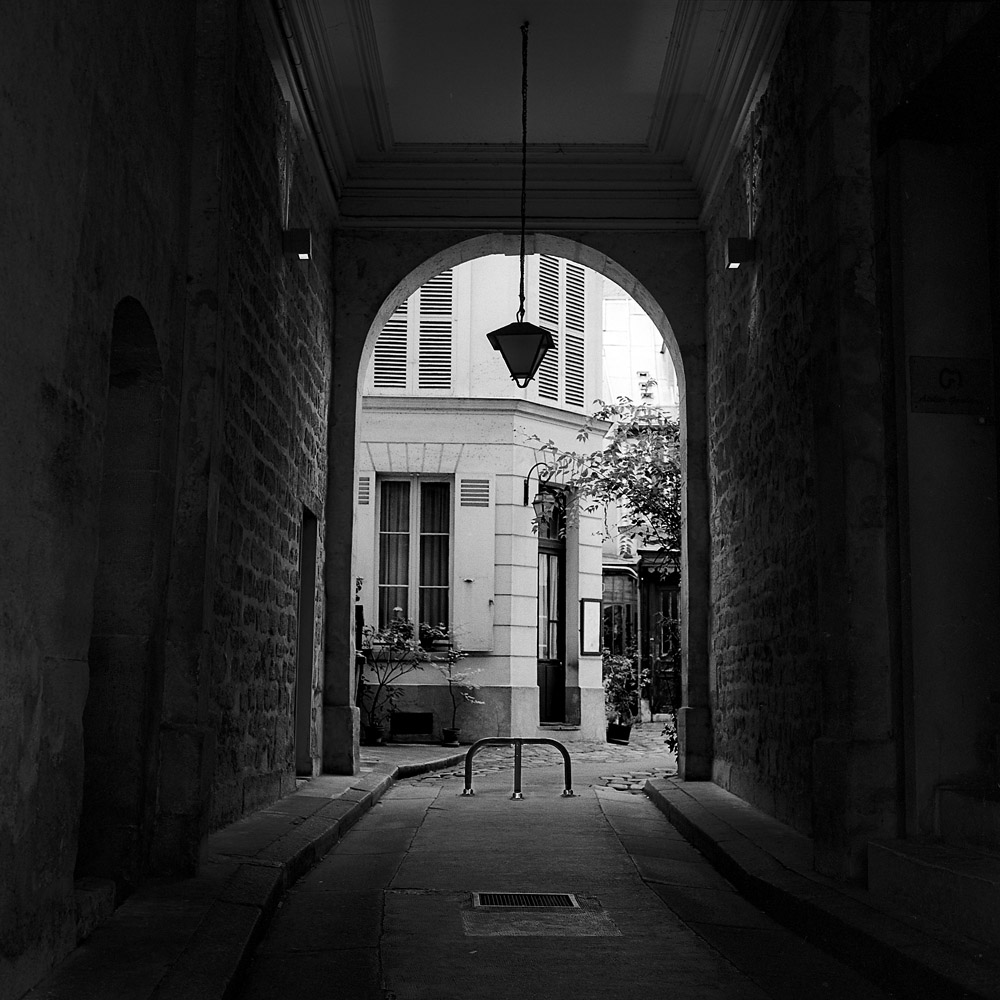
The Marais is perforated with a profusion of residential courtyards which remain invisible to the passer-by unless the massive doors at the street are open. Here is a view into one of these courtyards. They retain a very distinct feel of Old Paris where things are quieter and slower-paced. Entering one feels like stepping back in time, a peaceful oasis utterly cut off from the hustle and bustle of the city outside.

Courtyard Near The Bibliotheque de Paris

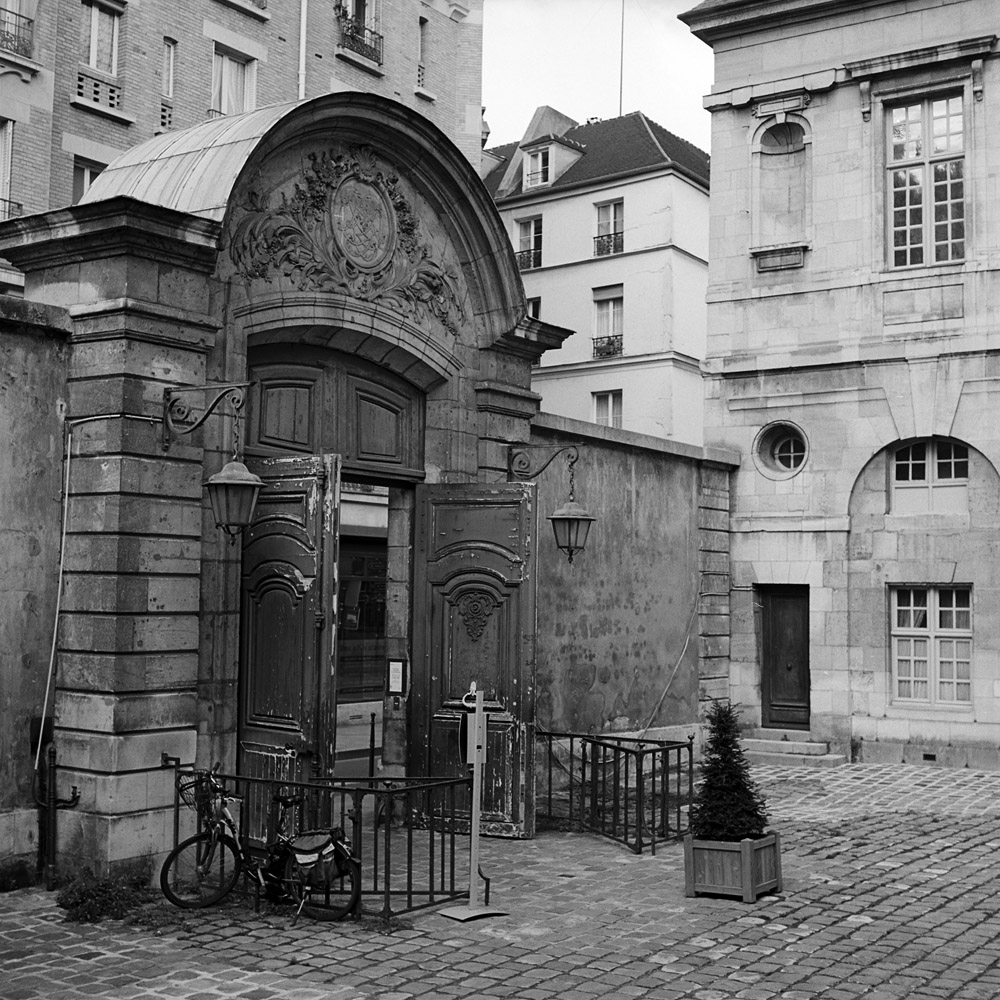
Eugene Atget took many of his most famous images in and around the Marais as the city was being surrendered to Haussmannization during the Second Empire/Third Republic periods. One of his regular subjects was the Bibliotheque de Paris, originally built as a hotel (town-house for a noble family) in the 17th century. Today it houses the city library. This view is of the entrance gates to the courtyard.

Le Porte du La Bibliotheque de Paris

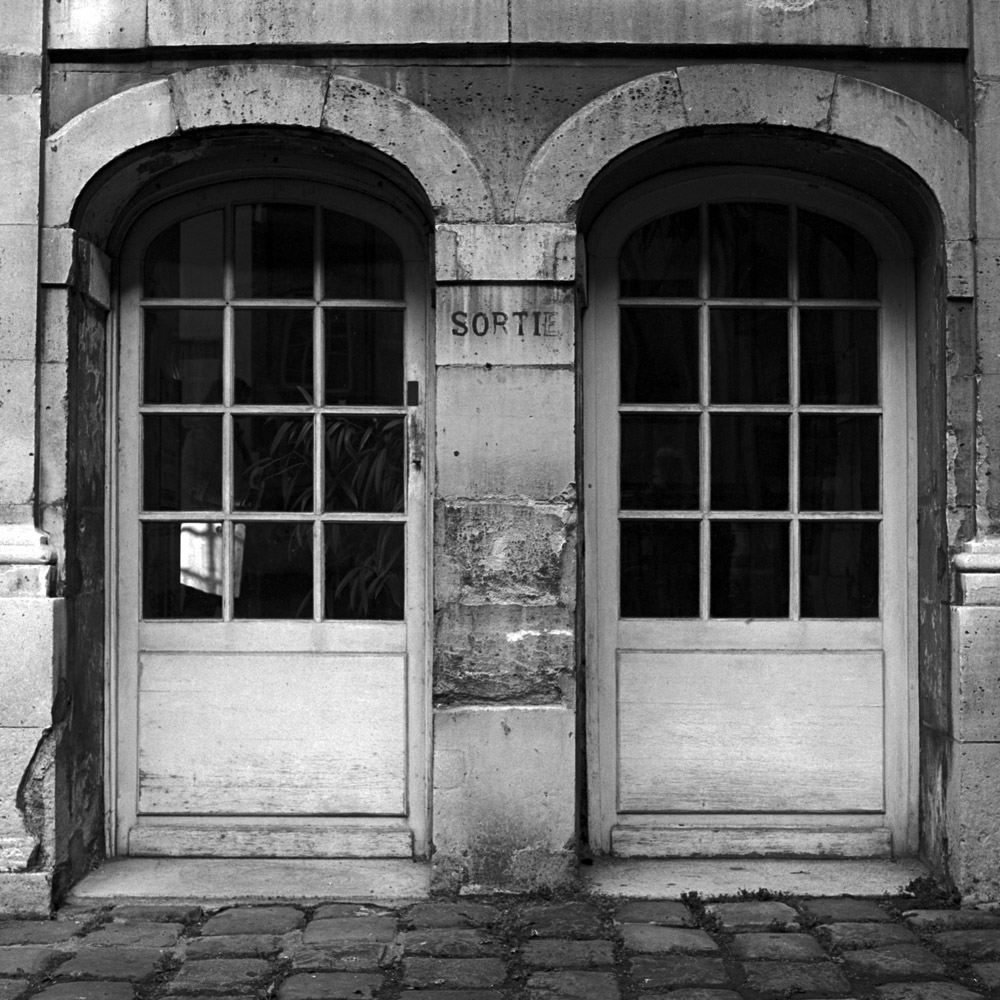
A door into the courtyard, marked Sortie (exit). Not too much exiting going on through this door, though, if the giant potted palm visible in the left-hand window has anything to say about it.

Sortie, Bibliotheque de Paris

All images shot with my Rolleiflex 2.8E, using Kodak Tri-X film.

Paris in October – part 19 – The Eiffel Tower

Does the Eiffel Tower really need any text description? The one really cool thing I can think of about it you probably don’t know is that when it was built, it generated polarizing opinions among Parisians – they either loved it or loathed it. One famous French writer was known to detest it as an eyesore, yet he would go there to have lunch every day in the restaurant. When asked why he would do such a thing since he hated it so much, he remarked, “because it is the one place in Paris I can be where I can’t SEE it”. I’ll leave it to you to judge its beauty, but it has endured for over 120 years despite the fact it was only originally intended to last for 20 and has become an internationally recognized and beloved symbol of the city of Paris.

Eiffel Tower Silhouette
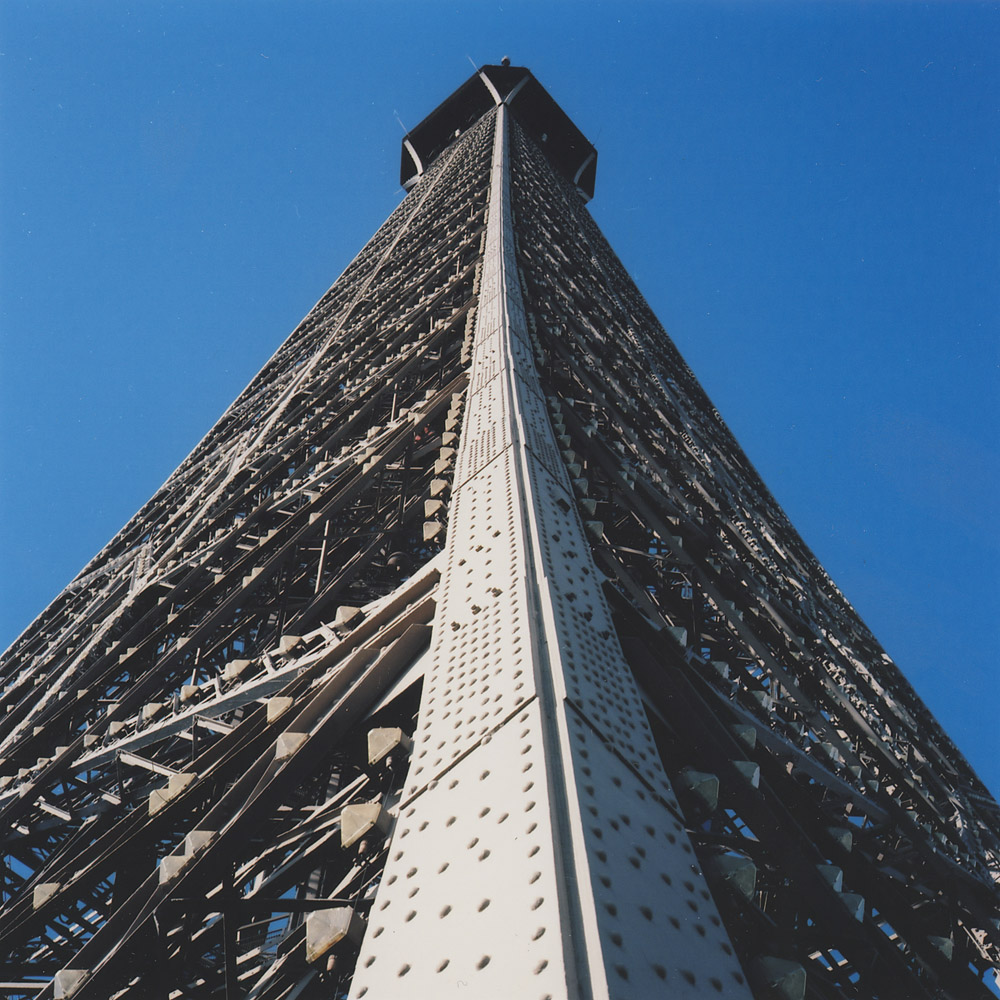
Eiffel Tower, Blue Sky

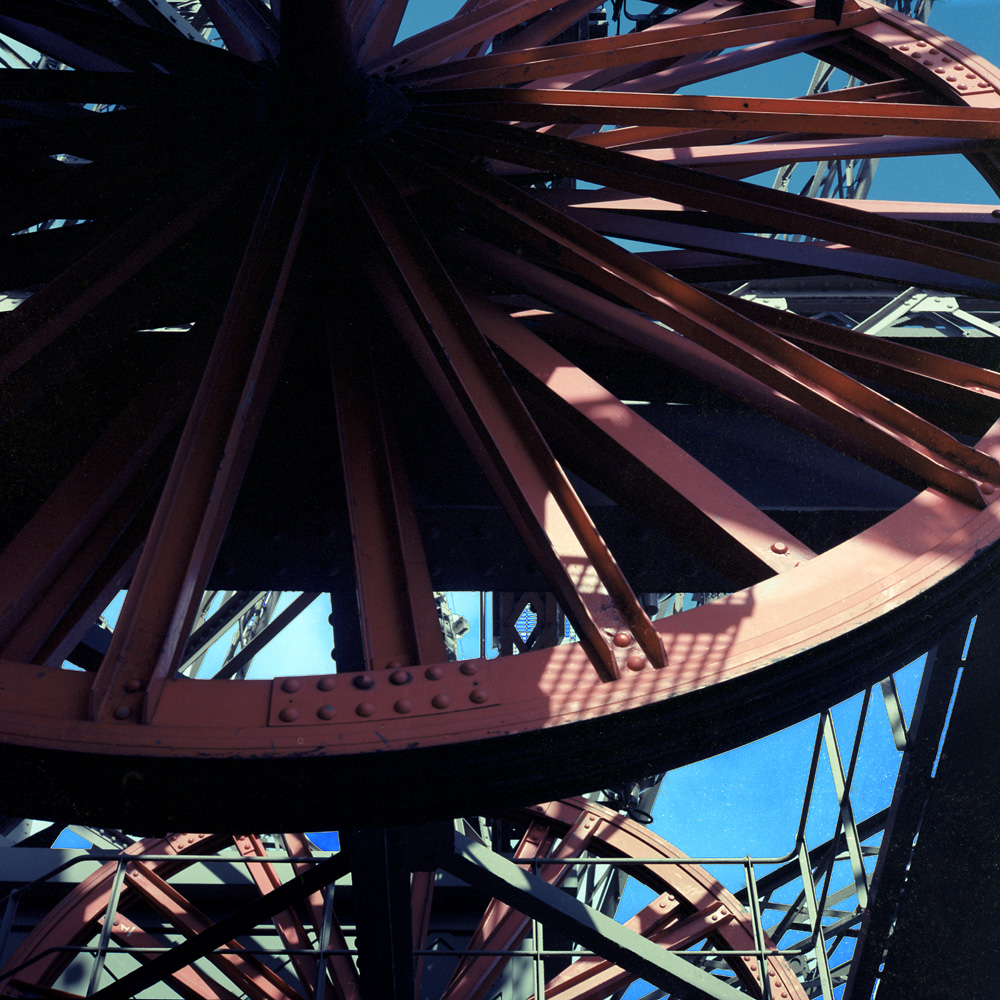
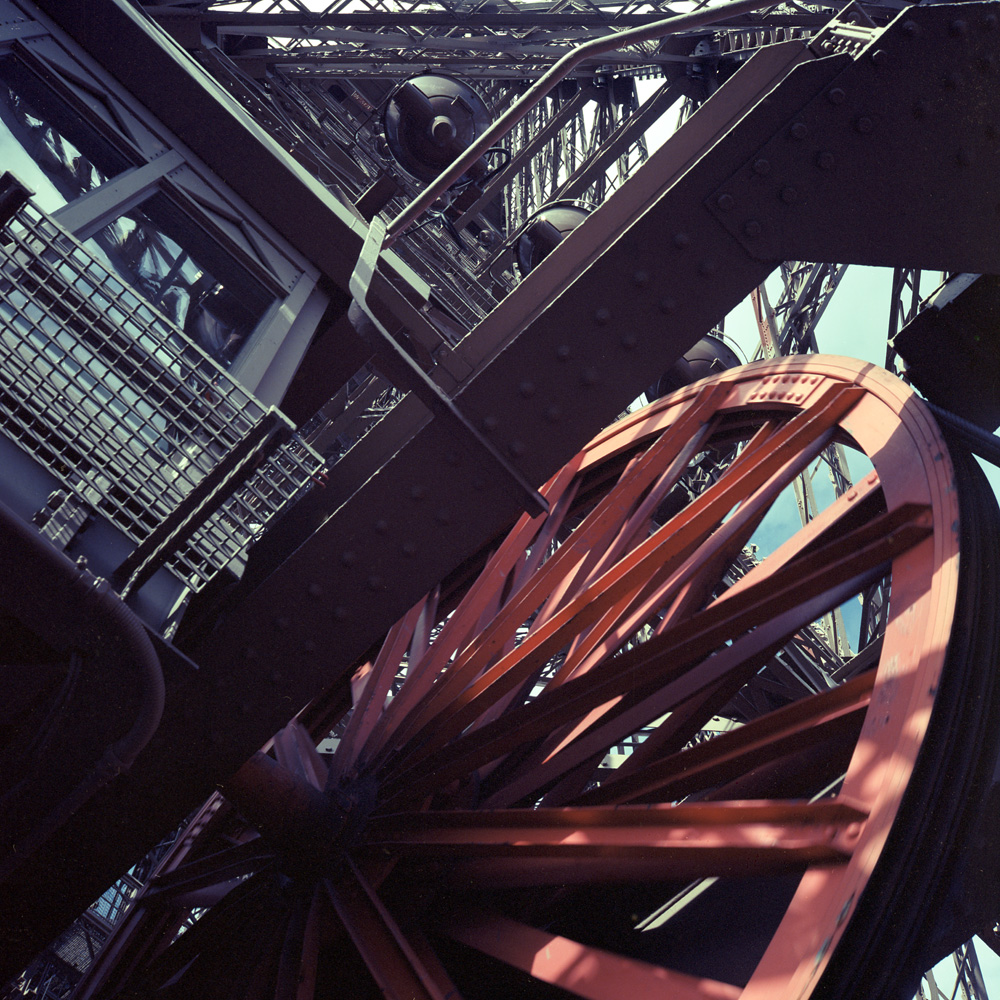
Riding up to the 2nd tier in the elevator, you can see the giant wheels that run the cables to raise and lower the elevators that ride in the leg piers. The elevators themselves are double-deckers, and halfway up the transit from the ground to the second tier, they actually change angle of ascent as the leg angle changes.

Elevator Wheels
Elevator Wheels
Elevator Wheels, Looking Up

The view to the east from the second deck includes the Seine river, the Louvre (just beginning to intrude into the frame at the far right middle ground), and in the distant far left background is the Sacre Coeur church on top of Montmartre.

East View, 2nd Tier
East View, 2nd Tier

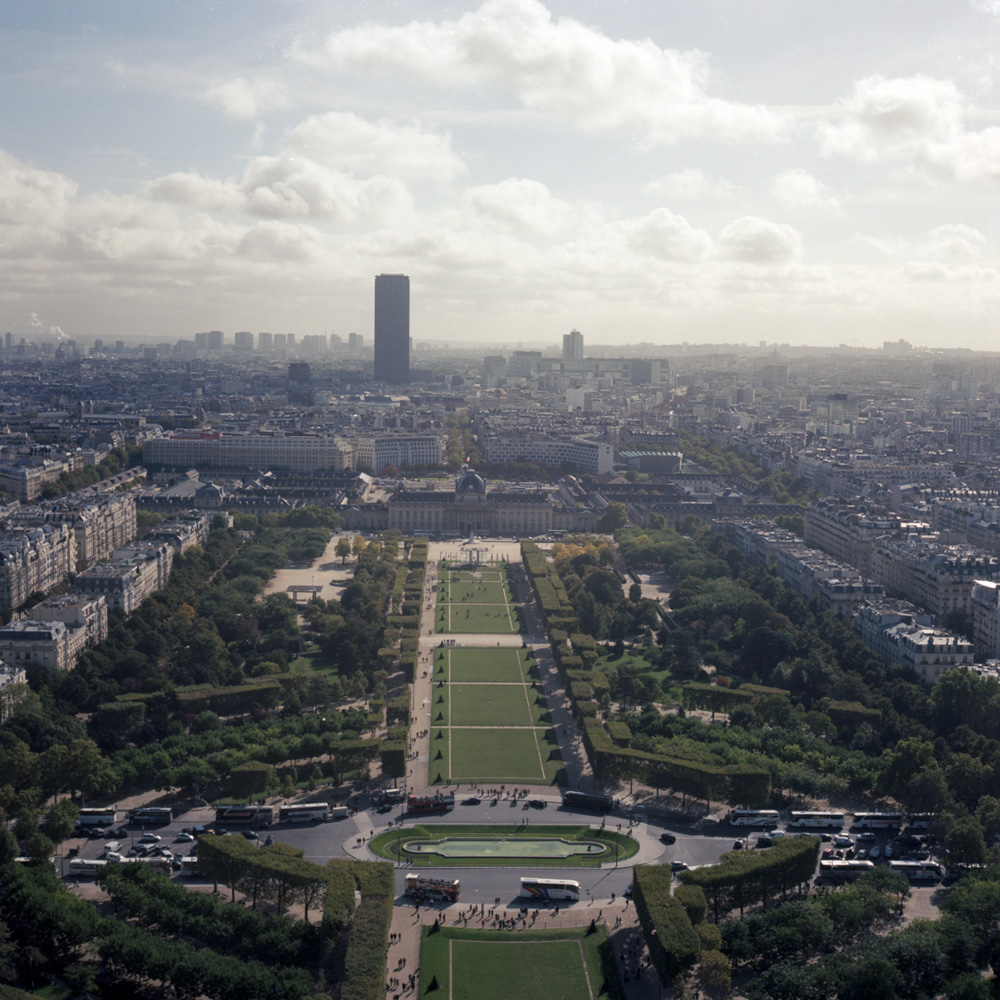
Looking south, the view encompasses the Champ De Mars and the French Military Academy, and in the distant background, the Tour Montparnasse. I did not ascend the Tour Montparnasse even though it has an observation deck some 50 stories up, but I did pass below it through the Gare Montparnasse on my trip to Versailles.

Champ De Mars, 2nd Tier View

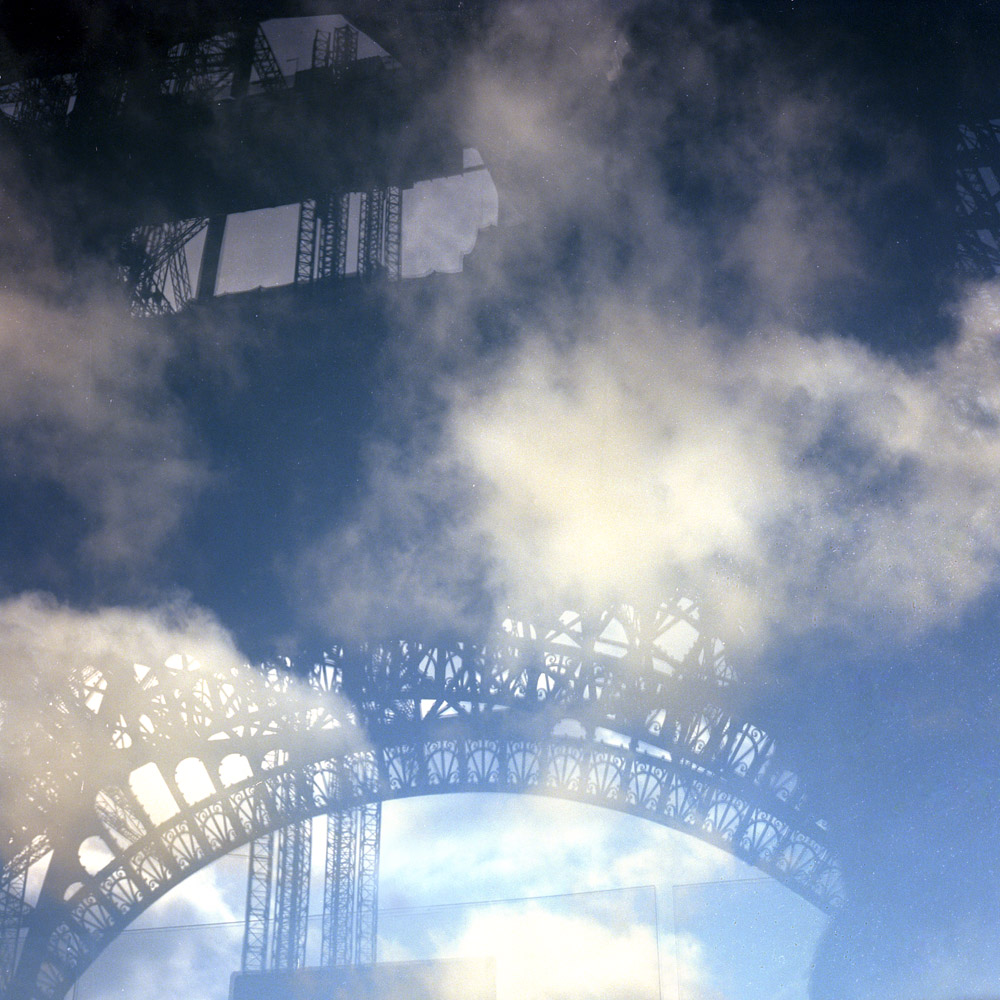
I know I posted this image before as a bit of a one-off, but I’ll re-include it here because it belongs as part of this grouping. While waiting in line for the elevator, I looked at the security glass in the partition that controlled the line and saw the shadow of the tower under the reflection of the clouds on the other side. I had to chance the photo, even though the coating on the safety glass can cause strange color casts in the image. I think it paid off – what do you think?

Eiffel Tower Shadow, Clouds

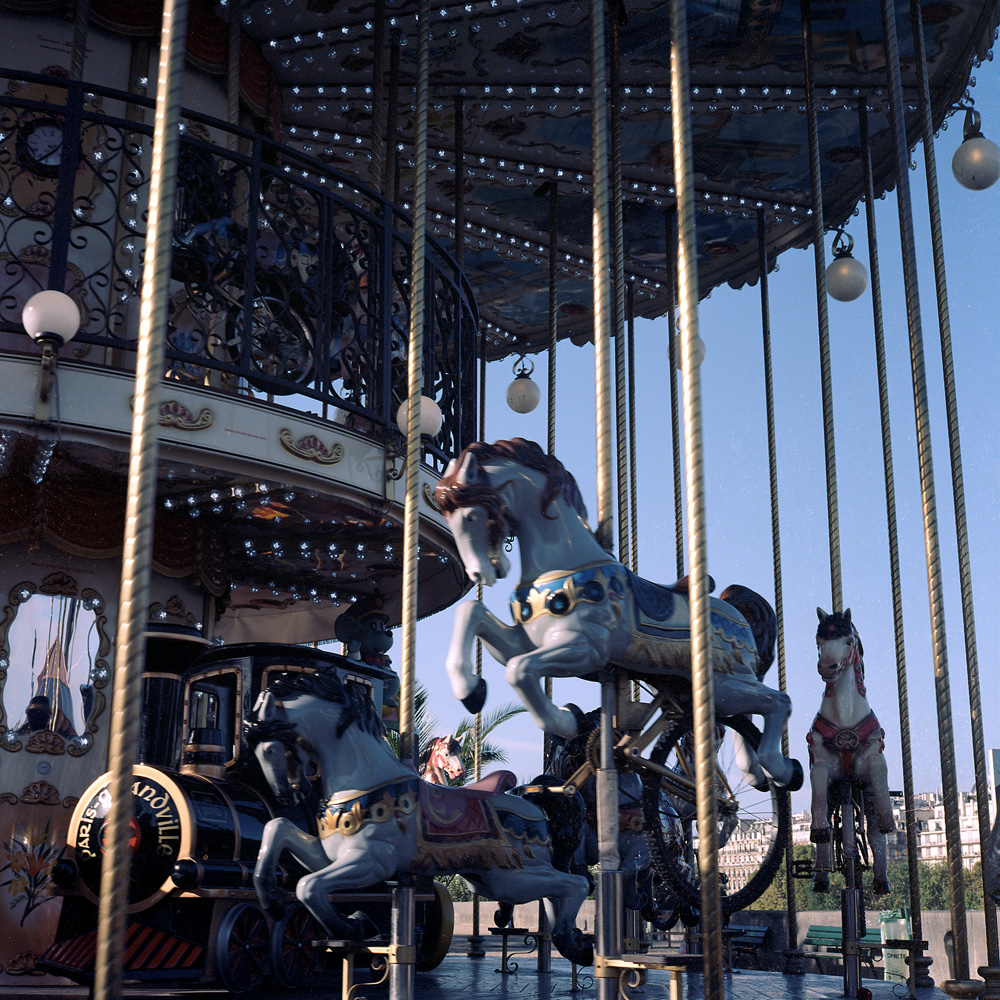
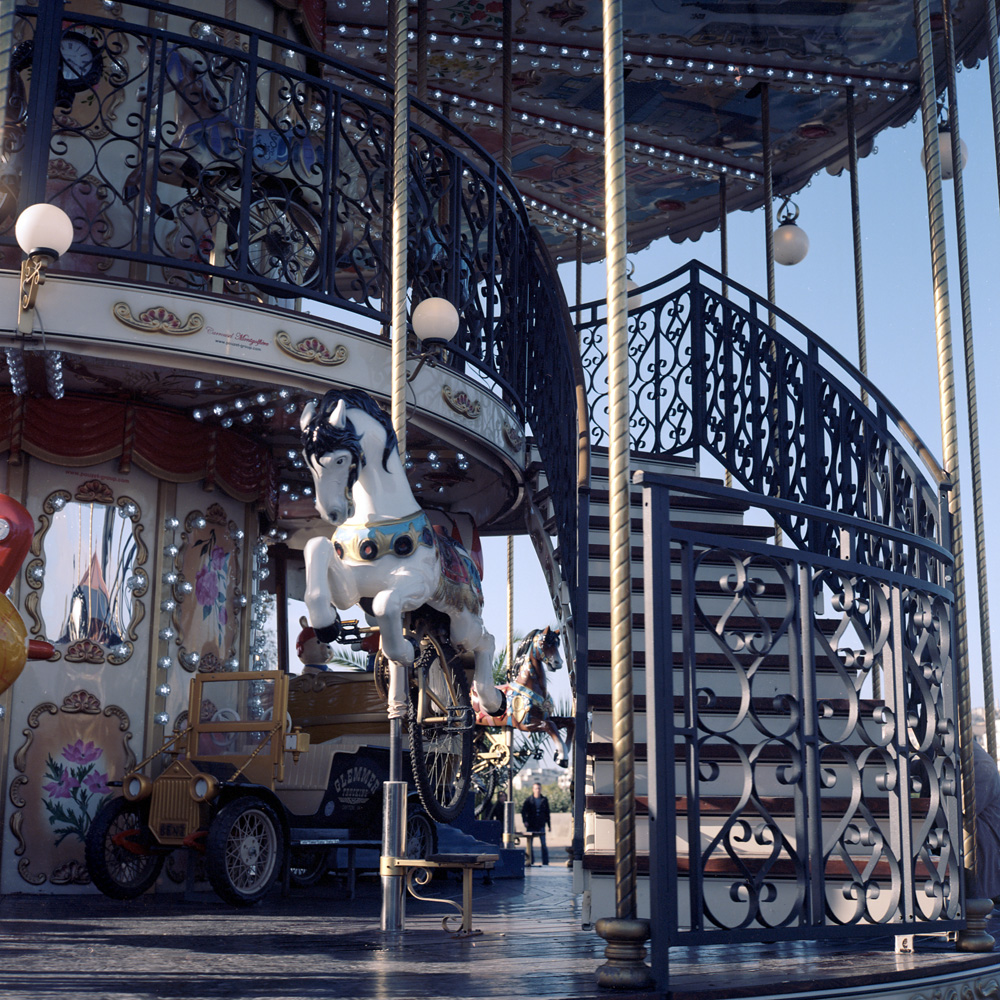
Not really apropos of anything other than geographic proximity: across the street from the Eiffel Tower, at the foot of the bridge that spans the Seine and leads to the old Trocadero Palace, there is a charming double-decker carousel.

Double Deck Carousel

What can I say, I like carousels. We have two very nice ones here in DC – one at Glen Echo where I teach and another one on the National Mall in front of the Smithsonian Castle. I’ve photographed both of them in very different ways- Glen Echo I’ve shot in color numerous times, and the Smithsonian one I’ve shot with my 5×12 in black-and-white and printed in palladium. Some day soon I’ll get up to New York and photograph the one at the foot of the Brooklyn Bridge in Brooklyn. I think I sense a new project coming on!