This was a simple exercise with my iPhone in seeing. I photographed the same things at two different times of day, from different points of view. In many ways they are extremely similar: they’re both studies in form and abstraction, with the shadows of the things as the main subject rather than the things themselves (more so of the lamp post than the bike rack, but you get the idea). Can you guess which ones were taken in the morning and which in the evening?
Notice the color, texture and angle of light in each shot. See how the changing light transforms the shapes and makes them look different.
This was just a quick and dirty exercise, but something I recommend for anyone interested in improving their vision and technique.
Rock Creek Park is a large urban park that runs from where Rock Creek enters the Potomac River to its headwaters some 30 miles away in central Maryland. Part of that park is owned and operated by the United States Park Service, and part is a regional park operated by Montgomery County, Maryland. The park dates to the 1890s and was surveyed by Frederick Law Olmsted, the famous landscape designer. In one of the greenest cities (Washington DC has more tree coverage than any other major US city, earning it the nickname “the tree capital of the US” and making it a living hell twice a year for allergy sufferers), it is a natural oasis of wild landscape. It was not always so, as Rock Creek provided the power to dozens of mills that functioned as the industrial engine such as it was for Washington and its surrounding farmland. Today, Pierce Mill is one of the few remaining complete structures to commemorate that industrial heritage. If you take a wander up the trails that parallel the stream, though, you can find signs of some of the other mills that dotted the landscape.
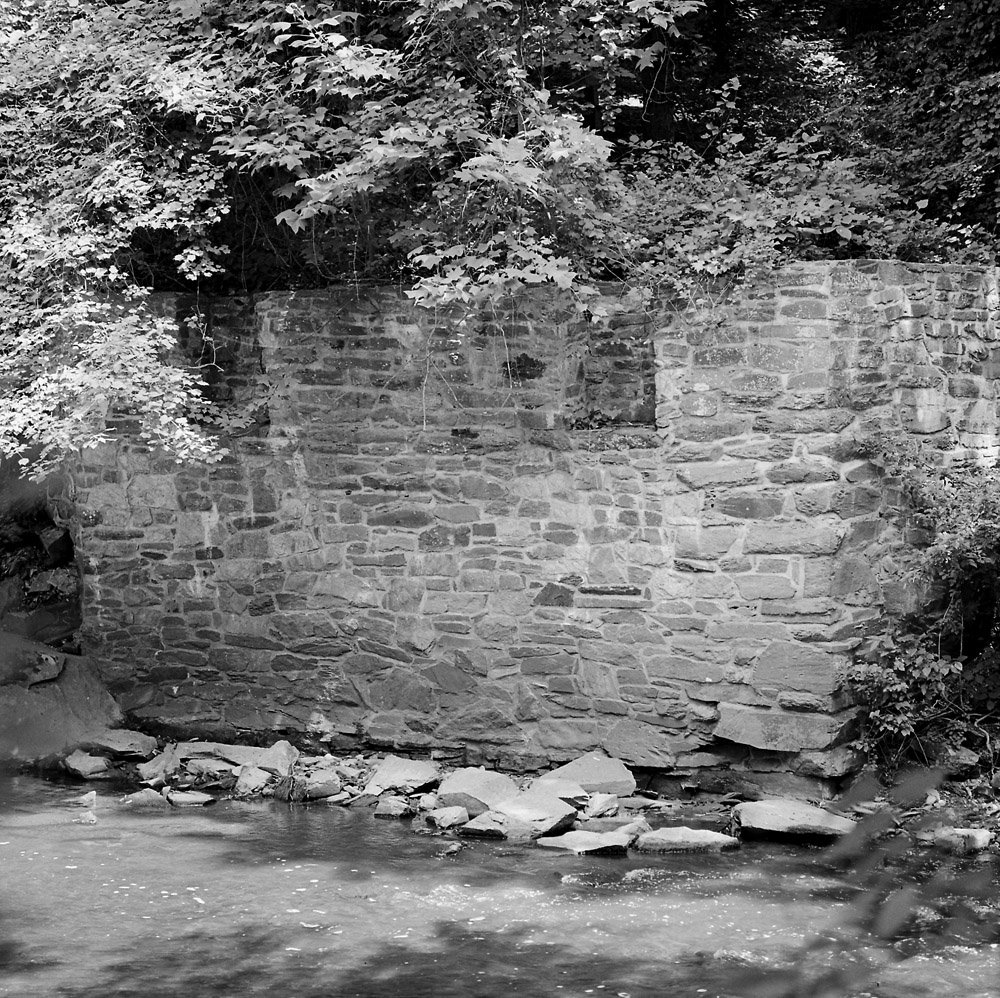
This structure marks the remnants of one of the larger mills along Rock Creek. I’d have to go back and take notes on the signage along the path that indicates what this mill produced and who owned it and when it operated, but most likely it ceased to function in the 19th century. To require such large foundations, it must have been a substantial operation, though.
Mill Foundations, Rock Creek
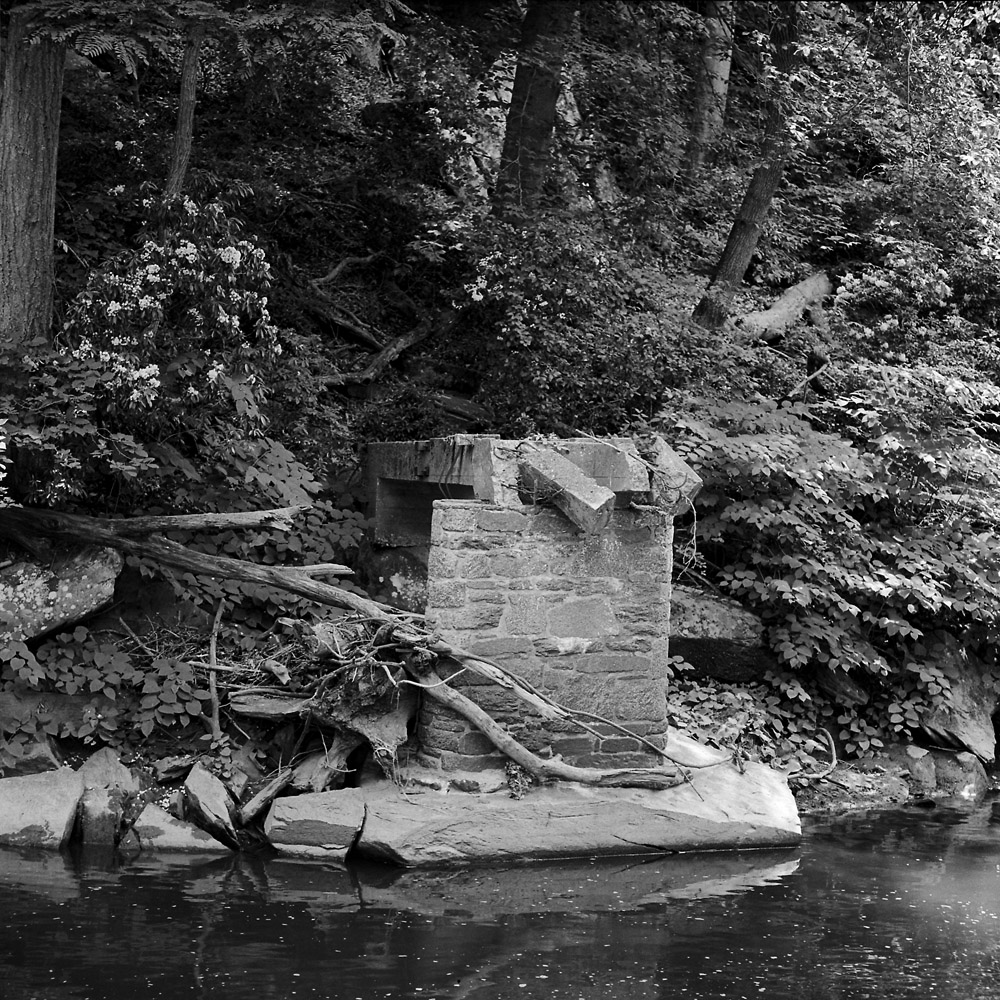
Here is the footing for a small bridge that spanned the creek.
Bridge Footing, Rock Creek
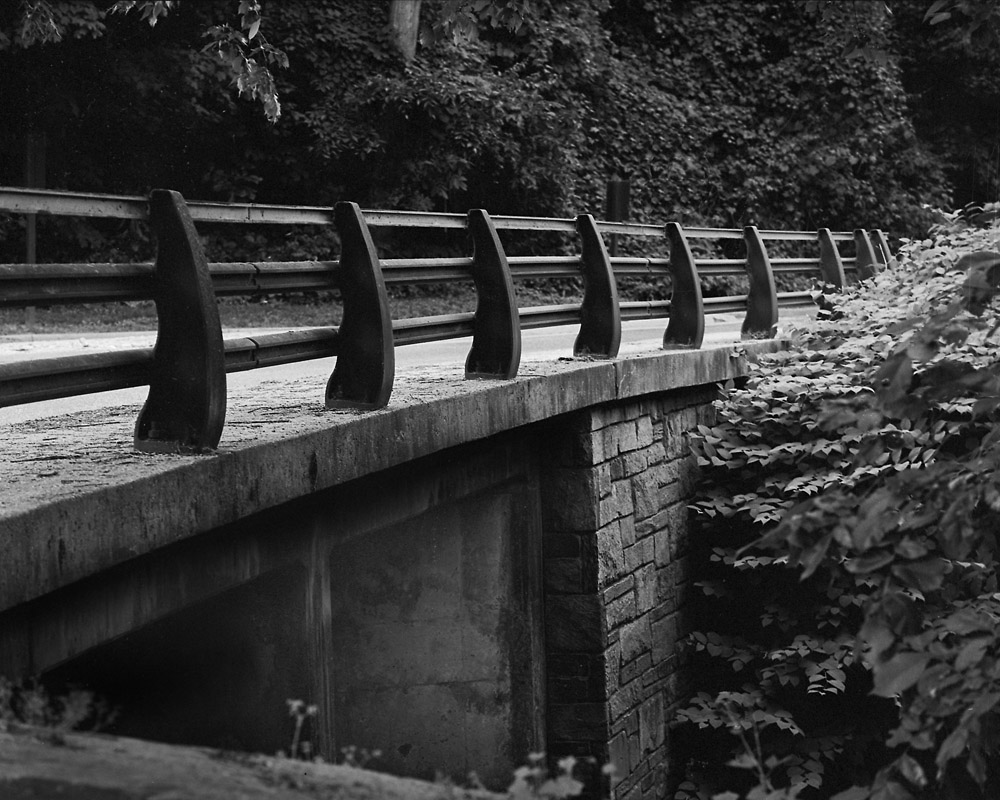
Somewhat more modern evidence of the urbanization of Rock Creek, a road bridge that spans the creek and provides access to the park from the neighborhoods around it.
Bridge over Rock Creek
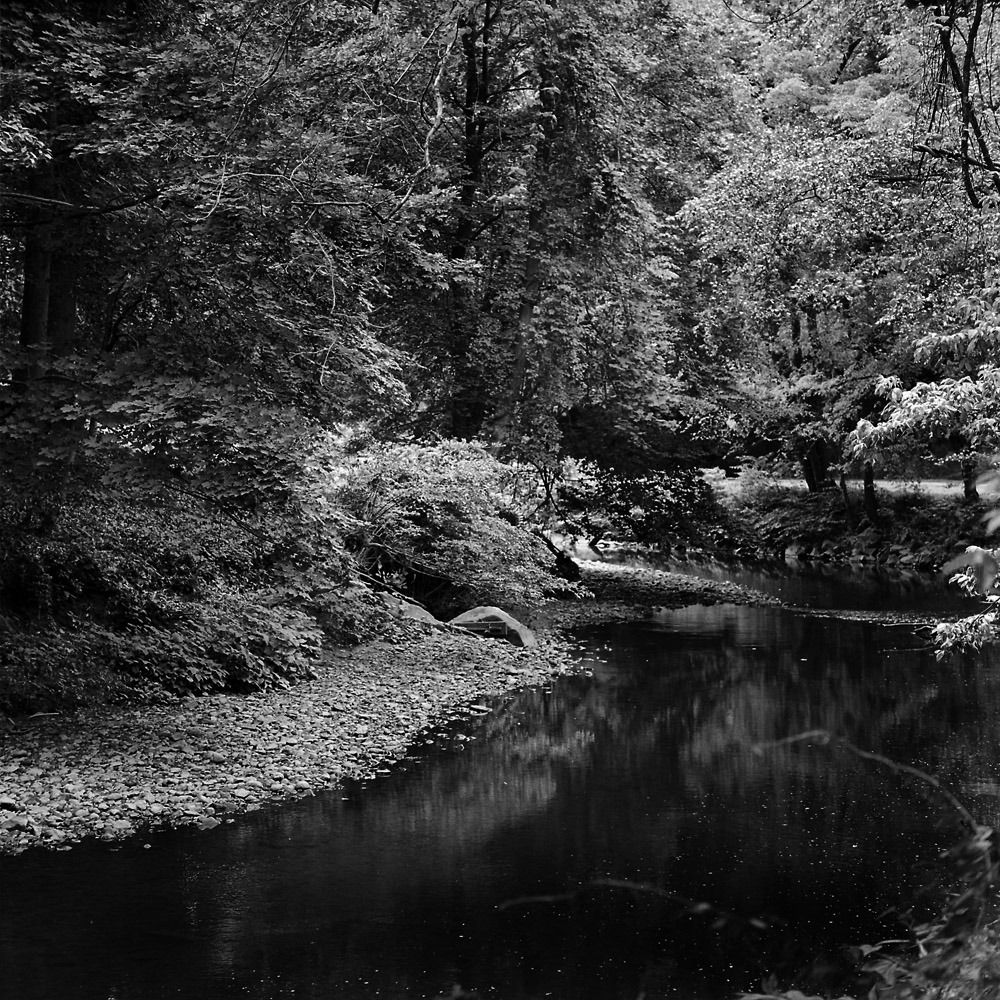
A gravelly bend in the creek, dappled with sunlight. Hard to imagine that within 200 yards of either side of this stream there are roads, houses, cars and businesses.
Gravelly Bend, Rock Creek
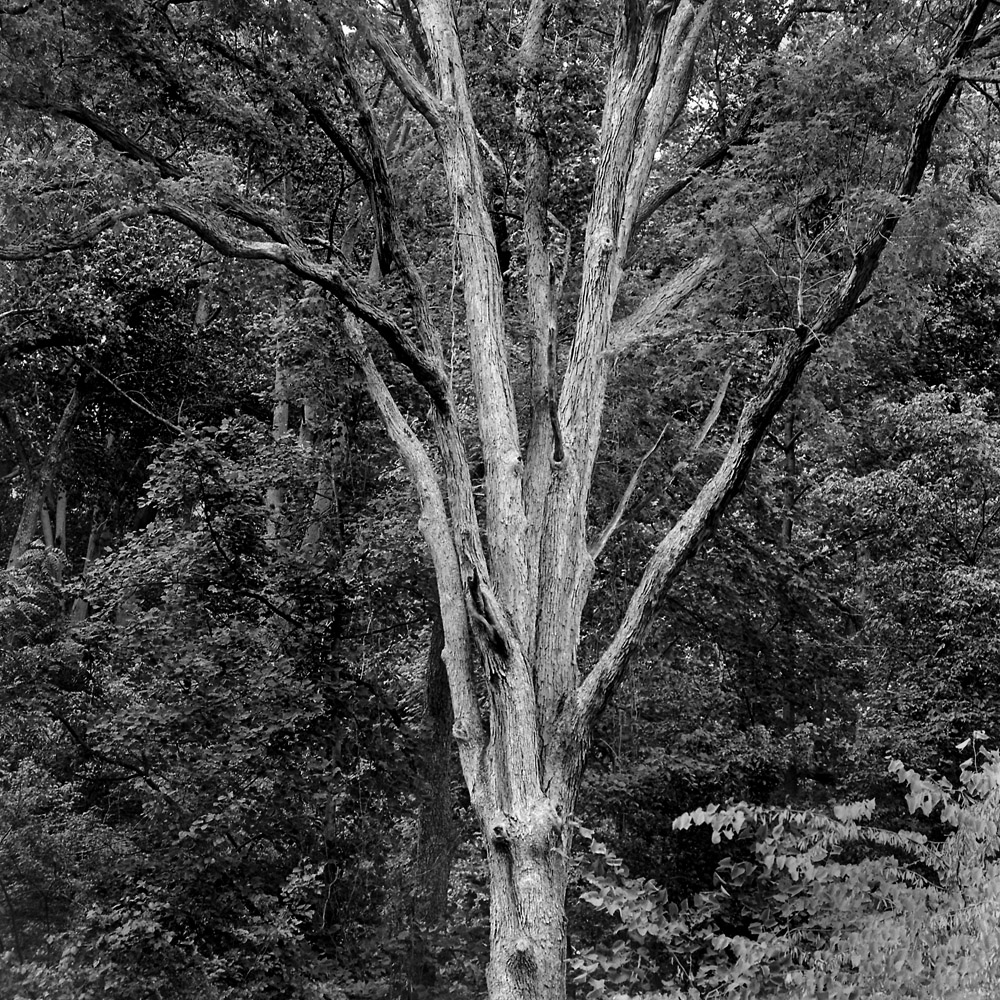
A tree along the trail that follows the stream.
Shaggy Bark, Rock Creek
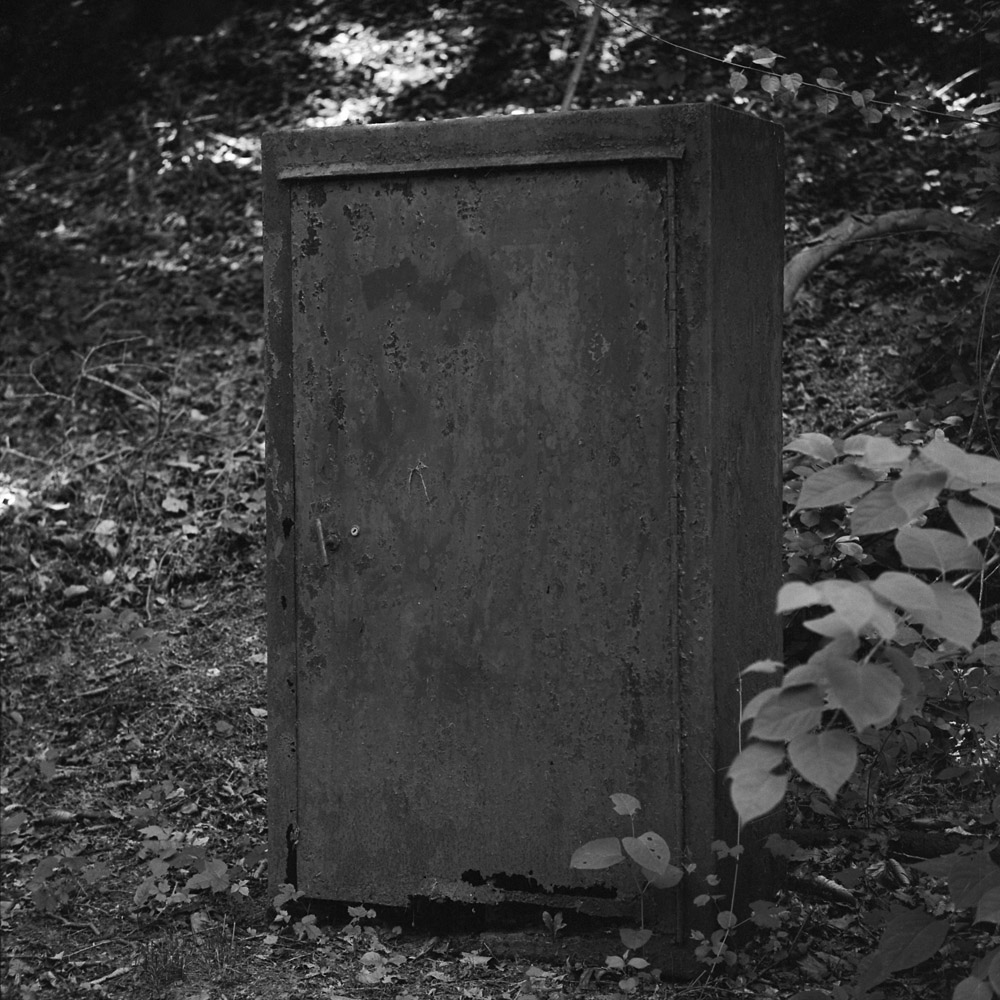
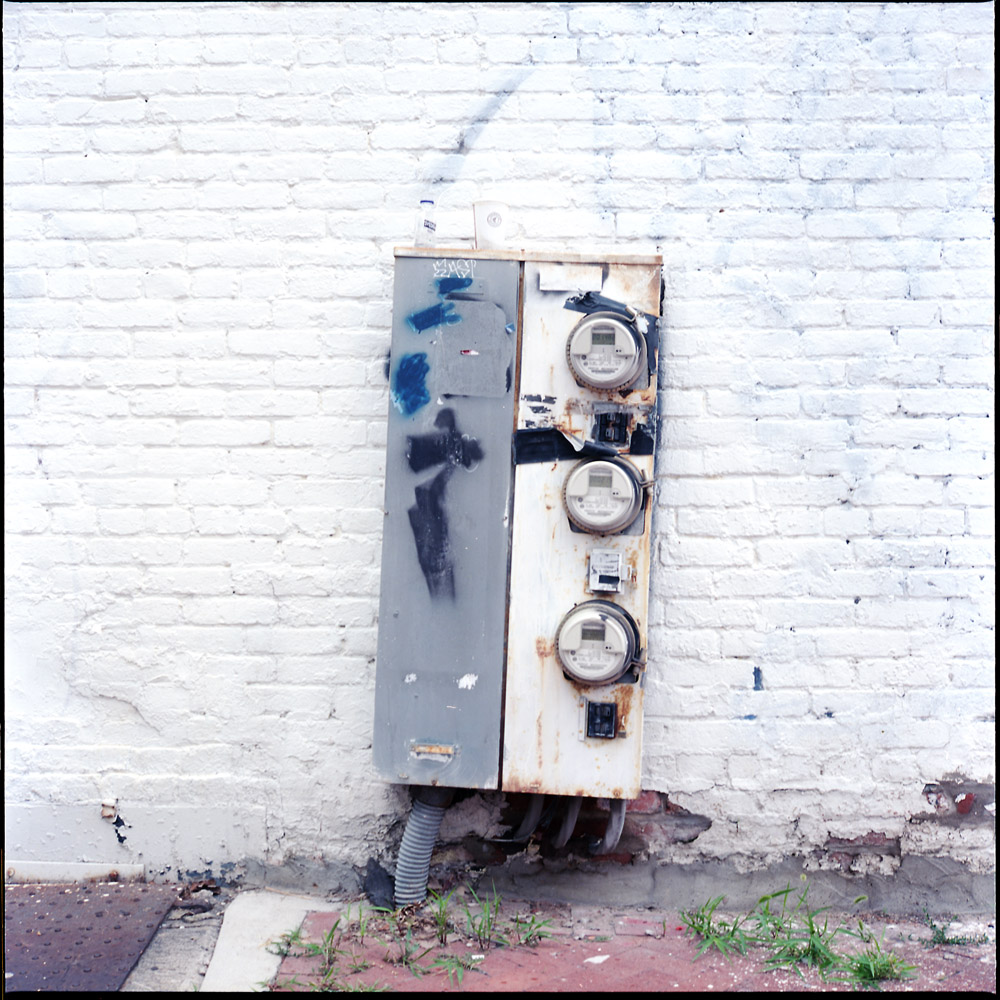
And a final reminder of man’s presence – an electrical junction box. It has the feel of being a monolith, left behind by an alien civilization, purpose unknown, long abandoned, or a portal to another place and time like the wardrobe portal to Narnia.
Just a few more shots of the fountains at the Watergate apartment complex. Today, it sits in a prestigious location with beautiful river views. It was sited on former industrial land – it sits now where the Washington Gas Light plant used to be, and next door, where the Kennedy Center now sits, was a brewery. The complex was designed in part to harmonize with the Kennedy Center, which was originally envisioned to be curvilinear and organic. Later, due to construction costs, it was redesigned into the sharp-edged rectangle that it is today.
There is debate over the origin of the name Watergate – there are multiple possible referents. Part of the land the complex was built on belonged to the C&O Canal, and overlooks the water gate that marks the eastern terminus of the canal and where its water rejoined the Potomac. A second candidate is the “water gate” from the Potomac to the Tidal Basin that regulates the flow of water into the basin at high tide. The third candidate is the steps down to the Potomac from the Lincoln Memorial beside Memorial Bridge, which was used from the 1930s to the 1960s as an outdoor concert venue, with performers located on a barge in the river. Concerts ended in 1965 with the advent of jet aircraft service into National Airport. I vote for the C&O Canal as the source of the name – the other two features are obscured from view of the complex by the Kennedy Center and the natural curve of the river.
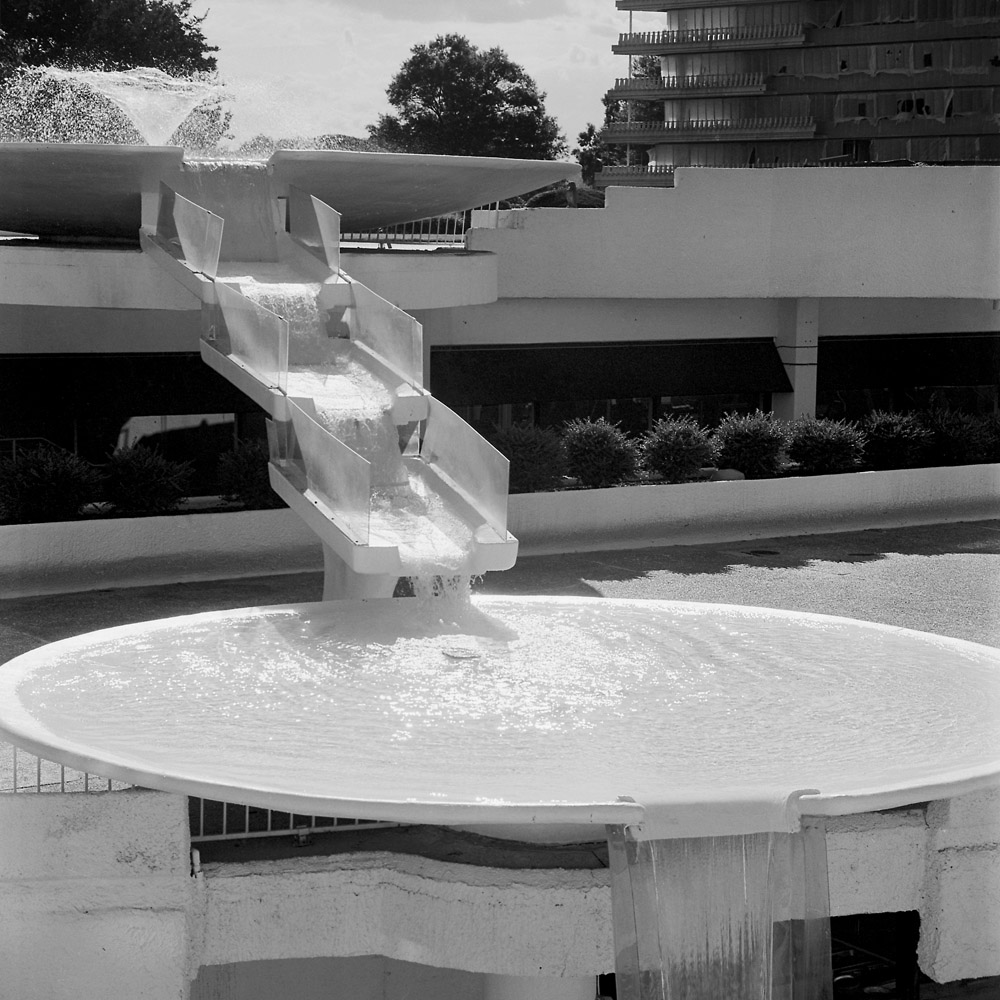
Twin Fountains, Watergate
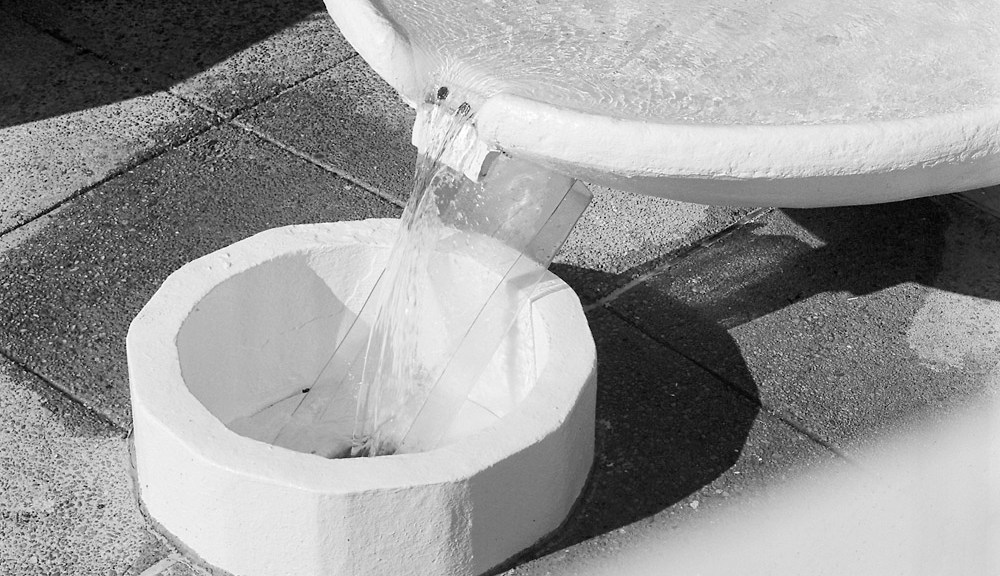
The fountains in the complex were specifically designed to create not only a visually pleasing effect, but to also simulate the sound of a natural waterfall.
Fountain, Hole, Watergate
I don’t know how successful the auditory engineering was (the fountains are pretty quiet, and they sound like fountains to me), but they certainly do create a visually pleasing space as well as a moderating effect on the temperature around the courtyard.
Fountain, Center Courtyard, Watergate
The Watergate complex was the first mixed-use development in the District. It had shops, restaurants, doctors’ and dentists’ offices, commercial office space, and even a hotel, in addition to luxury condominium residences. As originally planned, it was even supposed to have 19 “villas” (read townhouses), be 16 stories tall, and in all occupy 1.9 million square feet. After wrangling with codes, design commissions, and budgetary constraints, it was reduced in height to today’s 13 stories, the villas were eliminated, and the total square footage was cut back to 1.7 million square feet.
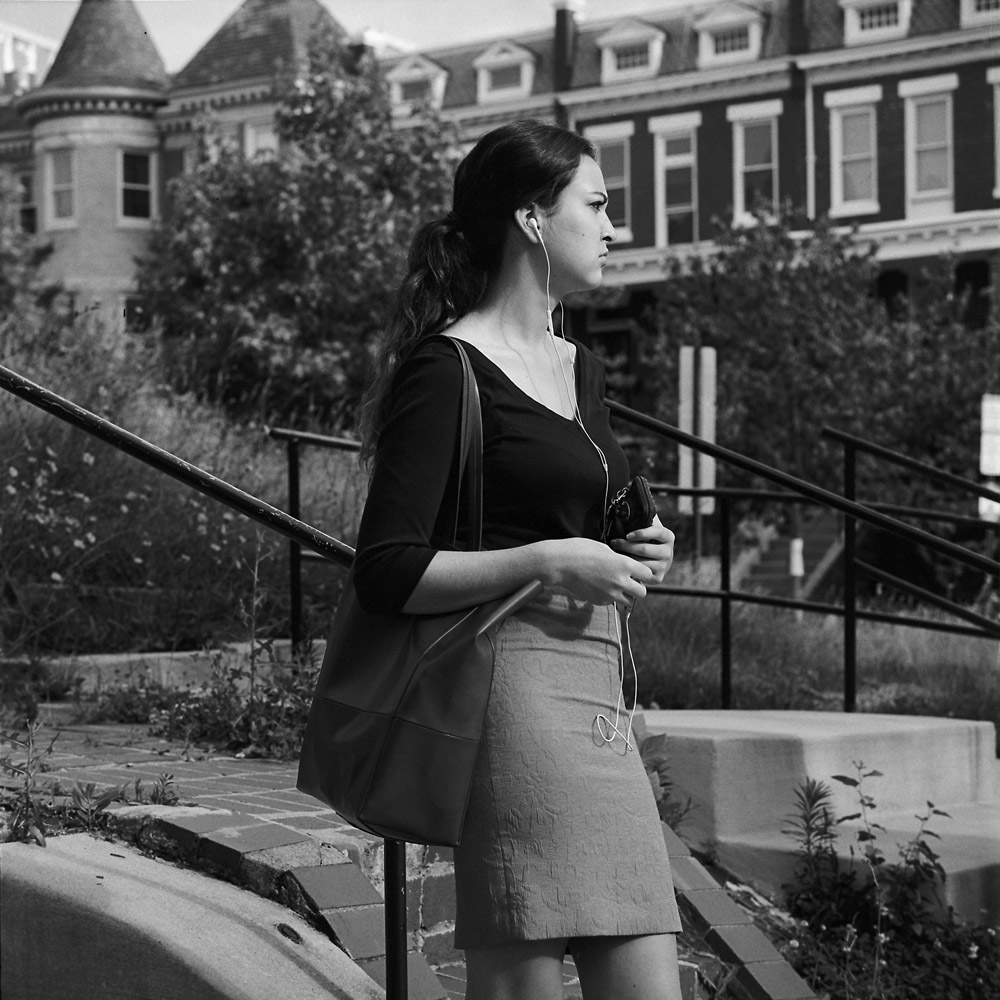
I know I was being very abstract or at least impressionistic with my earlier Commuter Diaries images, so in that sense these are a break from that line, and don’t quite fit. But they are about the commuting experience, so they have the potential to belong, if I develop enough images for them to blend in and make sense, and aren’t just outliers.
The first one is a woman waiting for the bus at my origin bus stop. Early morning, headphones on, anticipating the impending arrival.
Waiting For The Bus
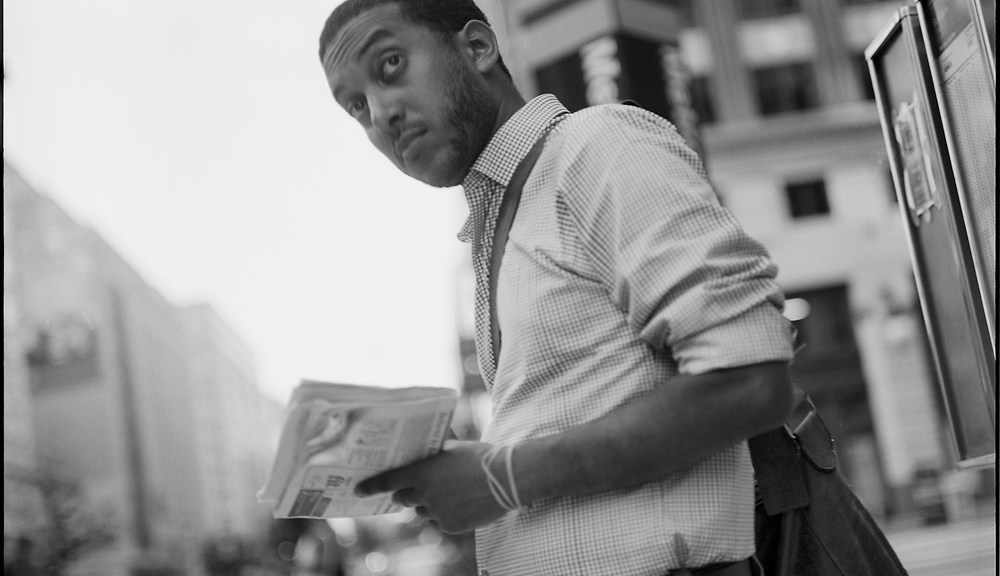
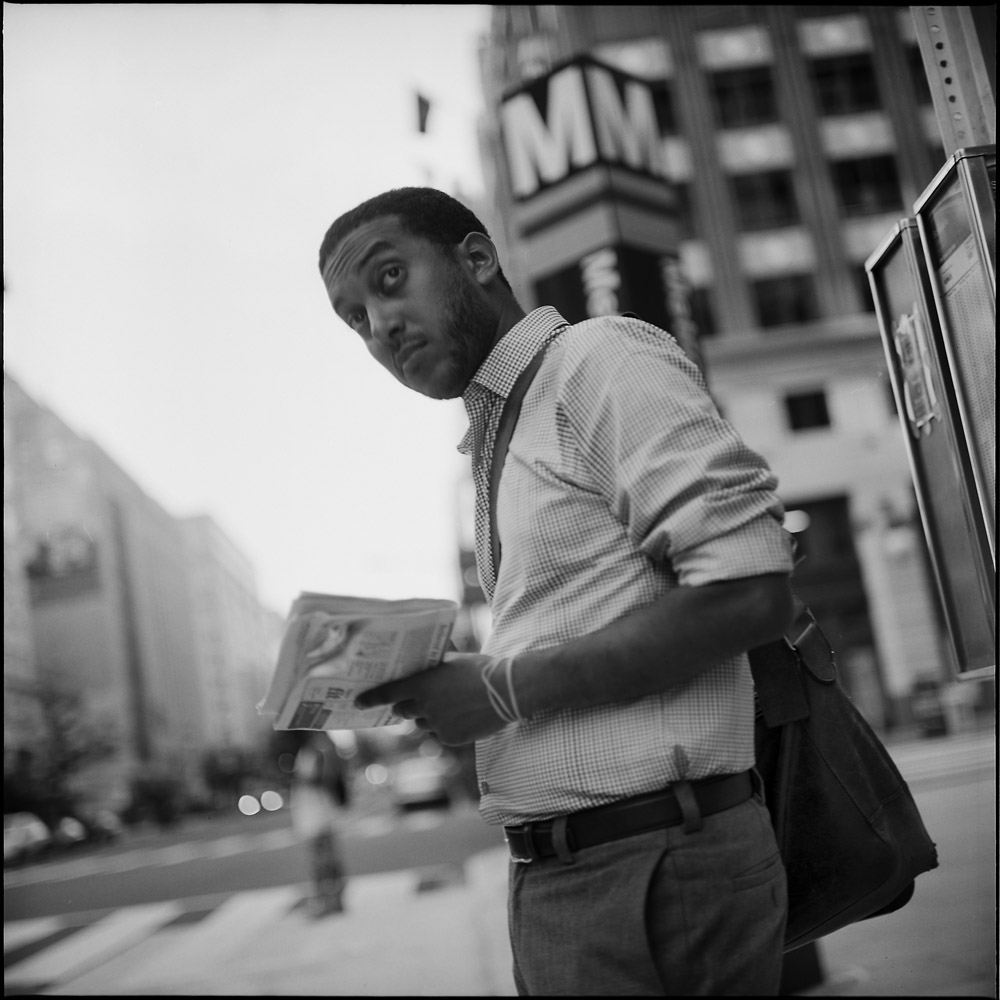
This second one is a gentleman waiting downtown at Metro Center, peering down the street in hopes of spotting which bus is arriving next, anxious for the final leg of his journey home.
At Metro Center Bus Stop
I think the latter is more successful because of the stilted angle, which makes it more dynamic and tense. I snuck that one by pointing the Rollei sideways, and had to live with what I got.
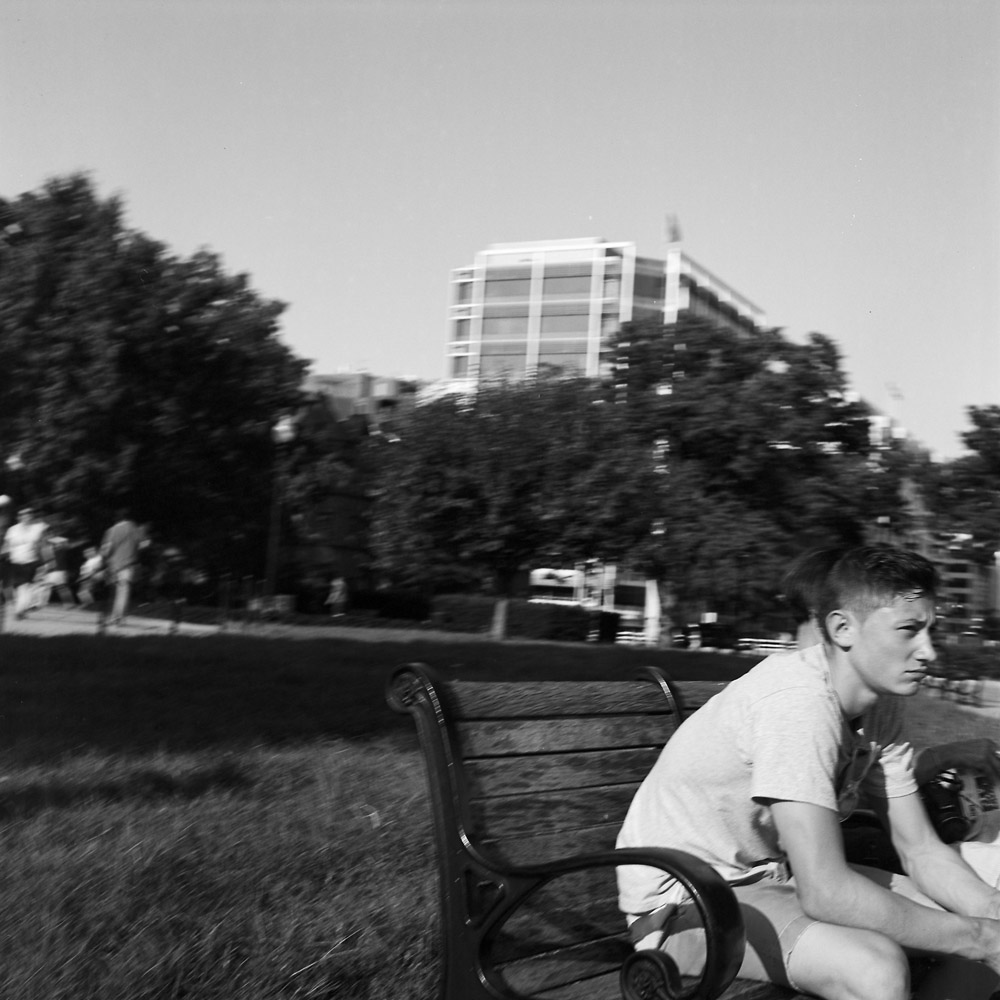
I have to keep reminding myself that sometimes it’s good to be loose and free with things, and that not all images have to be tack sharp and perfectly focused to be successful. I’ve been ruminating about this one because the composition is a bit unbalanced, and there’s a little motion blur to it, because it was another grab shot as I walked by and I didn’t have time to perfectly compose and focus it.
Boy On Bench
I think it’s a good object lesson from the original purpose of the series – taking long exposures that were not planned or structured in any way to free me up from being too formal. Even if this isn’t a fully successful image in some sense, it’s useful as a reminder to be relaxed and open to possibilities.
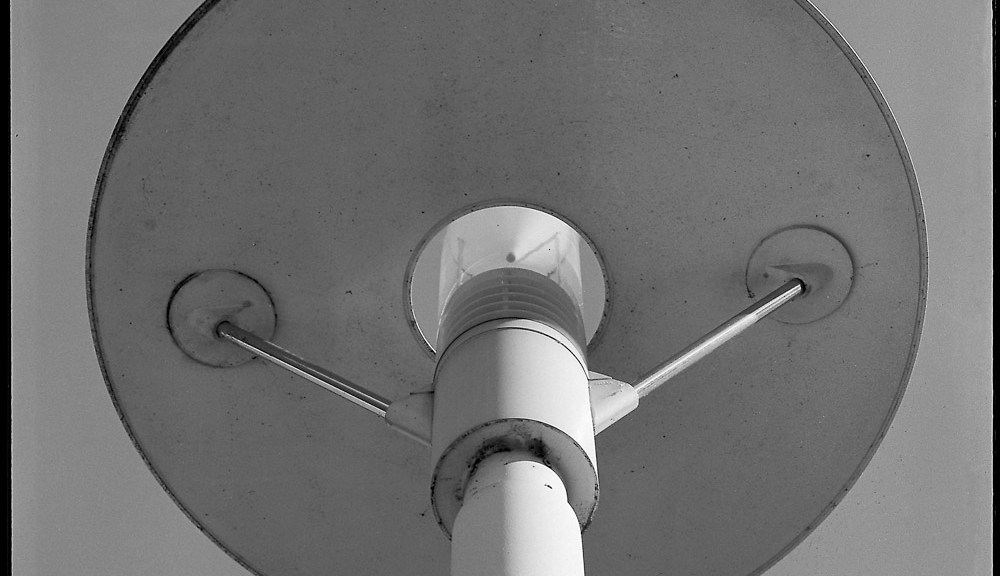
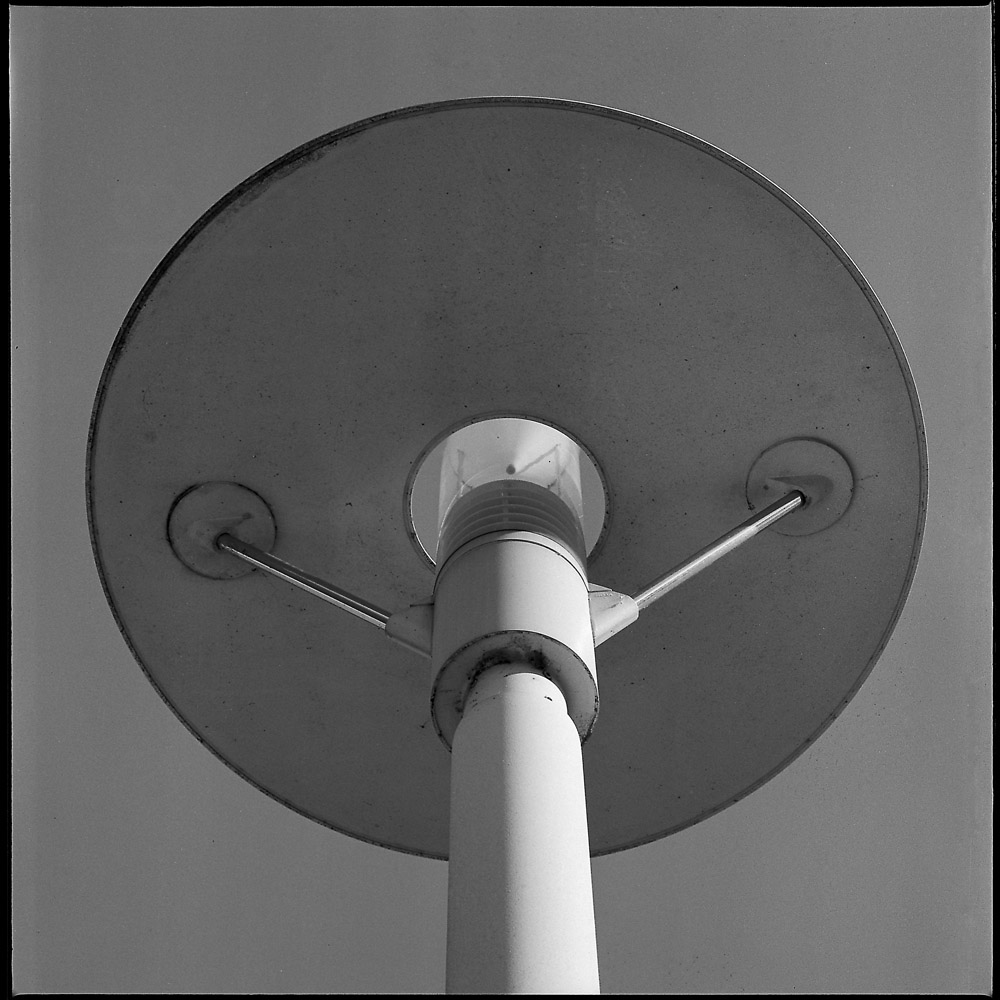
Yet more in my series of everyday objects. This time, it’s a lamppost, a safety cone (I’m not calling it a traffic cone because in this context, it’s being used to warn pedestrians of an uneven paver), parking meters again, and a police call box. You may have wondered at seeing some of my images with a black border and others without. I generally try to compose full-frame, and I like including the black border to show that. I also feel that in some cases, the black border helps define the image especially if the background is predominantly bright. I don’t ever add one to make it look as if what you see is full frame if in fact it is cropped, or to make you think it was made in a different format than presented. The images I post online for the most part are scanned from the negative, and given the nature of film, sometimes the backing paper leaks light along the edge, or other things happen during processing that require me to crop a little. Sometimes, I have to crop a lot because the composition just wasn’t right in the full square of the 120 image size. In those cases, I leave the edges alone and don’t put a black border on.
Twin MetersSafety ConePolice Call BoxLamppost, Kennedy Center
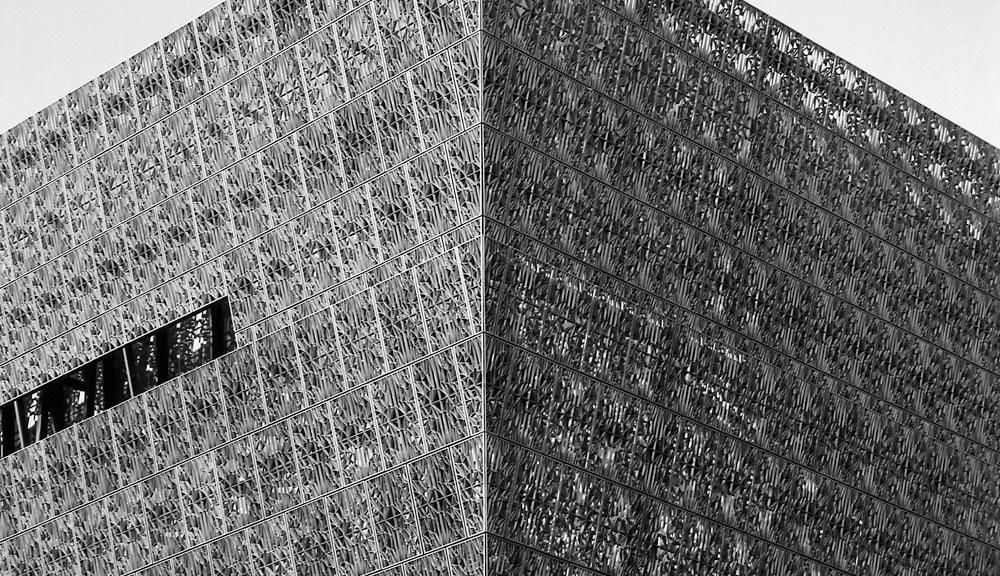
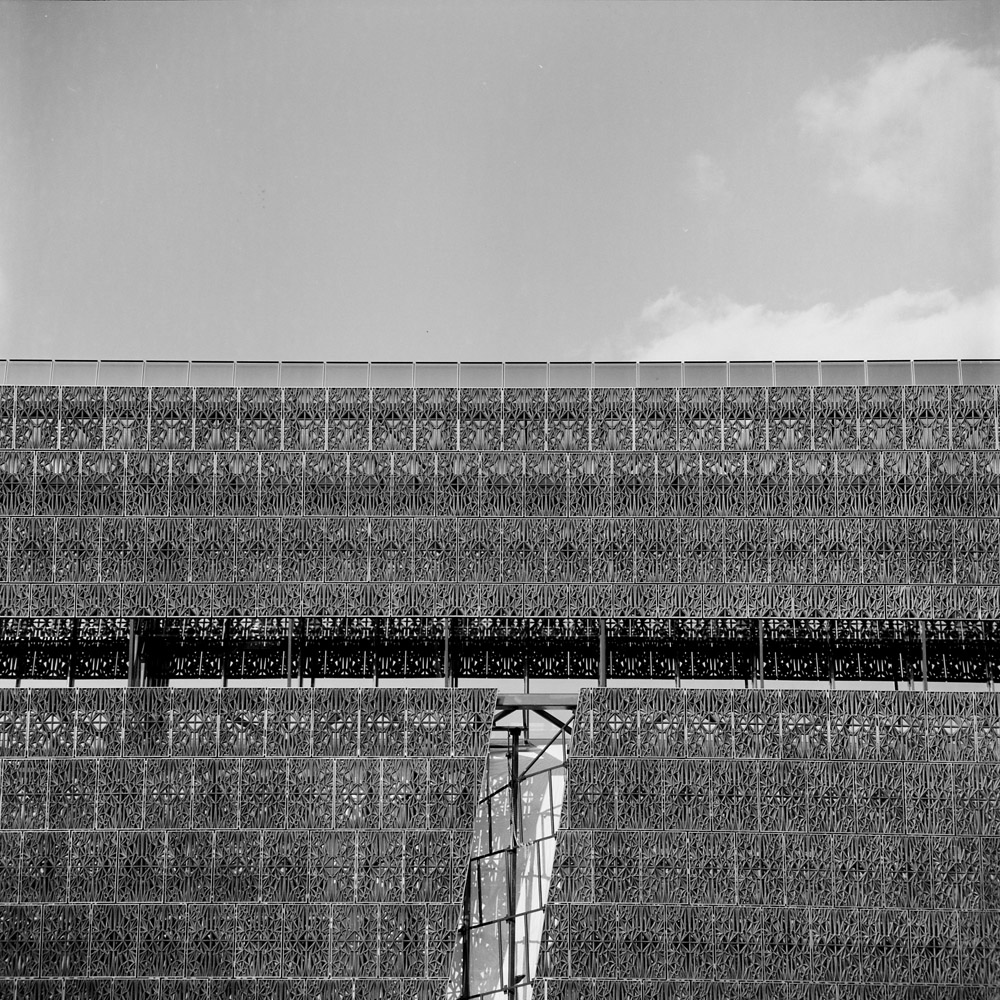
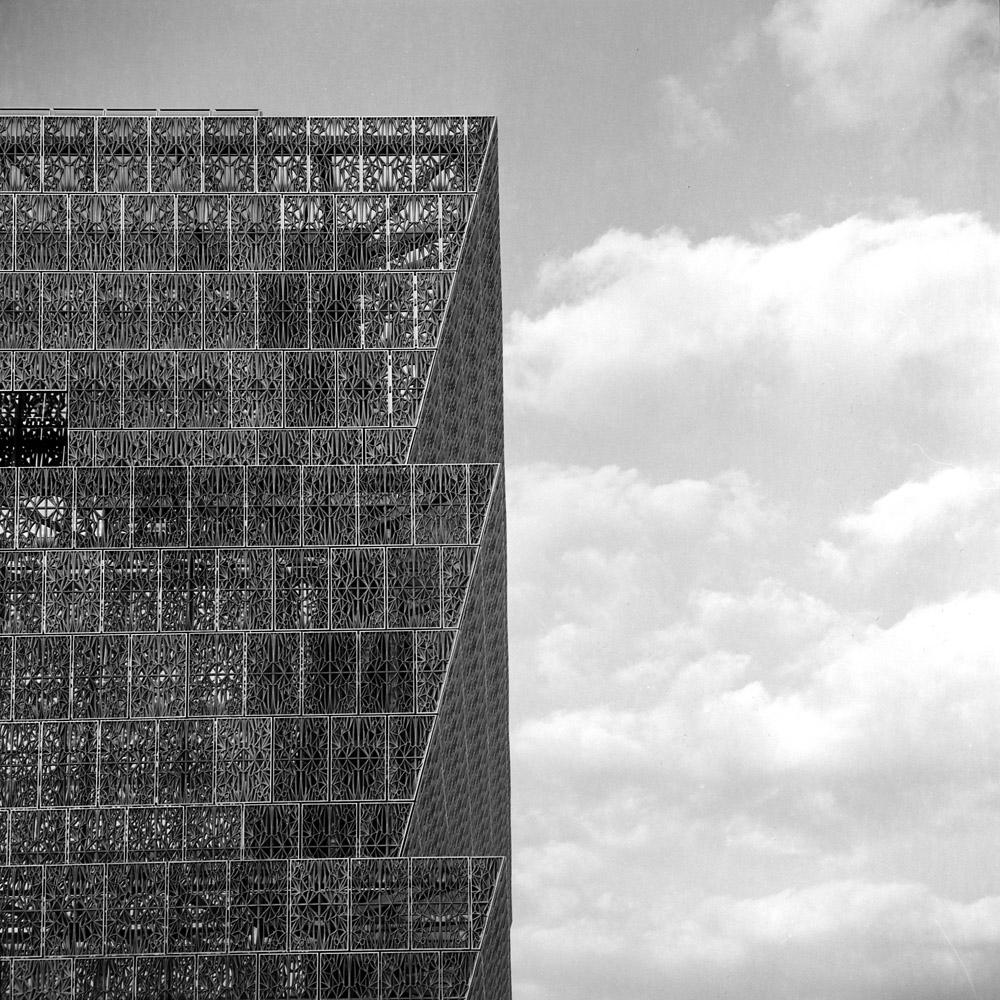
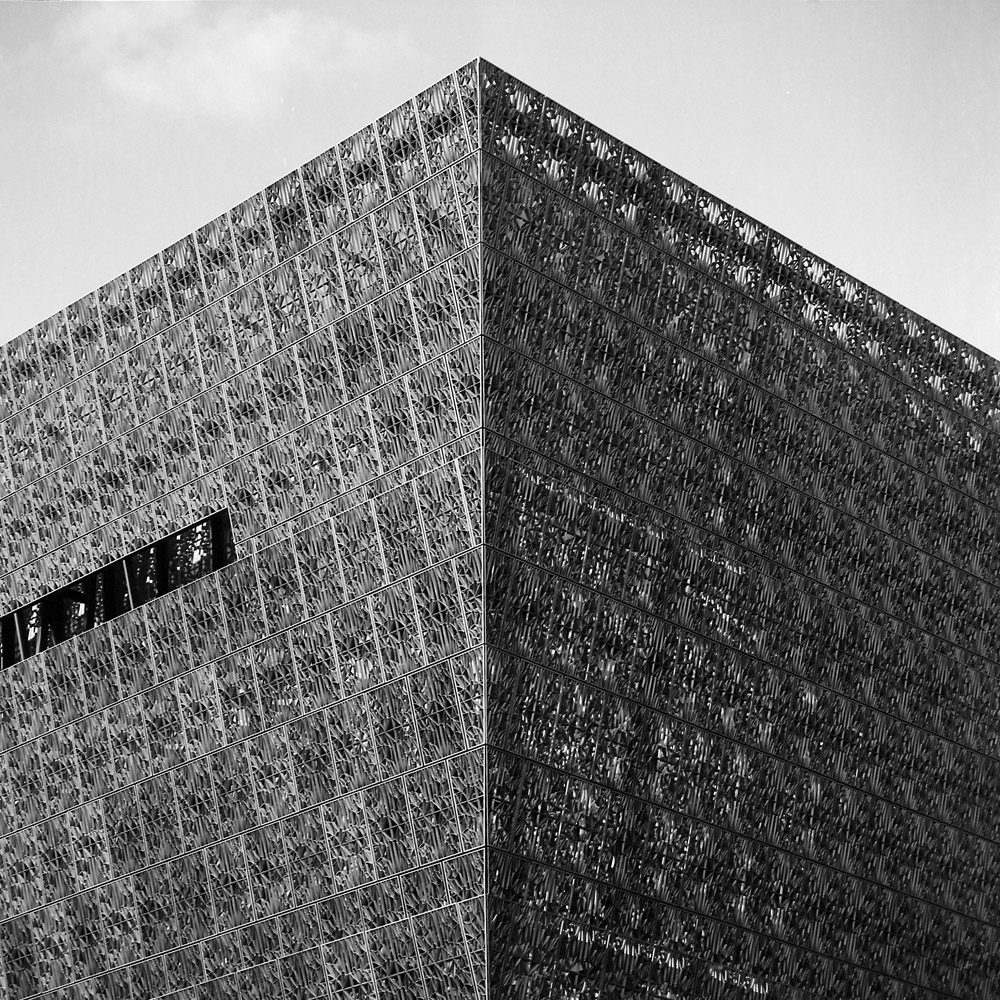
If you recall an earlier post, I had some shots of the new National Museum of African-American History and Culture (I’ll call it the African-American History Museum for short) in color, taken as architectural abstracts. Here are a few in black-and-white. The building shape lends itself extremely well to these kinds of geometric abstract studies. I think the architect nailed the design prospectus,making references to the cross-cultural influences of Africa on the American experience.
Seen here against the sky it feels like a seascape, a reminder of the trans-Atlantic voyage that brought three centuries worth of slaves to the New World.
African-American History Museum
The bronze-colored metal screening on the outside has a tropical botanical motif. It is both protective screen and mask, concealing and revealing, ancient and modern. The patterning is reminiscent of Kente cloth batik designs.
African-American History Museum
The overall shape of the structure is that of a three-tiered African crown, but viewed from different angles, it can be a monolith or a pyramid, or the prow of a ship.
Here are a few architectural details on the Brewmaster’s Castle, just off Dupont Circle. The house is so named because it was built by Christian Heurich, the founder of Heurich Brewing Company, which operated in Washington DC from the 1880s to 1956. Mr. Heurich ran the company until his death at the age of 102 in 1945. The original company and their brewery are no more, although it has been resurrected under the moniker Olde Heurich Brewing by the great grandson of Christian Heurich, and now produces craft beers under the brand Foggy Bottom. Due to a lack of facilities in Washington, the beers are brewed in upstate New York. The original brewery itself was located where the Kennedy Center now sits.
The house is now a museum and retains an extraordinary amount of the original furnishings and decorations from the period of its creation in 1892-94. The house was bleeding-edge technologically at the time – it had electric and gas lighting, central radiator heating, ventilating skylights for cooling, a pneumatic communication system, an elevator, and even a central vacuum for cleaning. The structure is made of steel and reinforced concrete to be fireproof, and although it has 15 fireplaces, due to the central heating systems, none have ever been used.
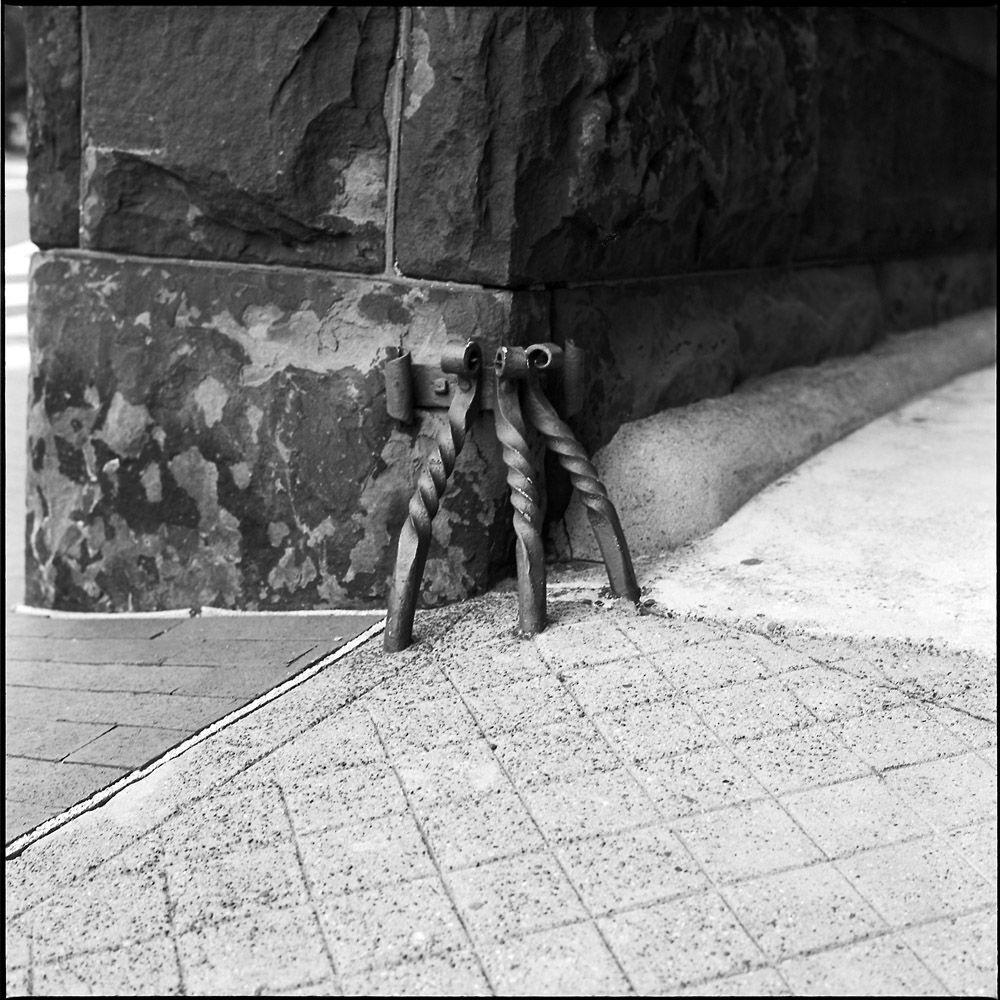
The house looms large over the neighborhood, as it is one of the last remaining mansions of the era around the circle (some have been converted to embassies, one is now the Scientology headquarters in DC, and the rest have been demolished and replaced by apartment and office buildings) and it stands out as a period piece quite in contrast to its neighboring structures from the 1950s through the 1970s. I’m fascinated by the decorative ornamental detailing on the house, as well as some of the functional bits, like this bootscrape-
Bootscrape, Brewmaster’s Castle
It is built into the base of the column supporting the porte cochere over the carriageway in front of the house. It is, of course, on the outside, and not on the house side of the porte cochere.
The bootscrape is out of view to your left in this scene – this is the entrance portico under the porte cochere. I was drawn to this composition by the repeating and converging curves of the stairs, the carriageway, and the arches of the porte cochere.
Portico, Brewmaster’s Castle
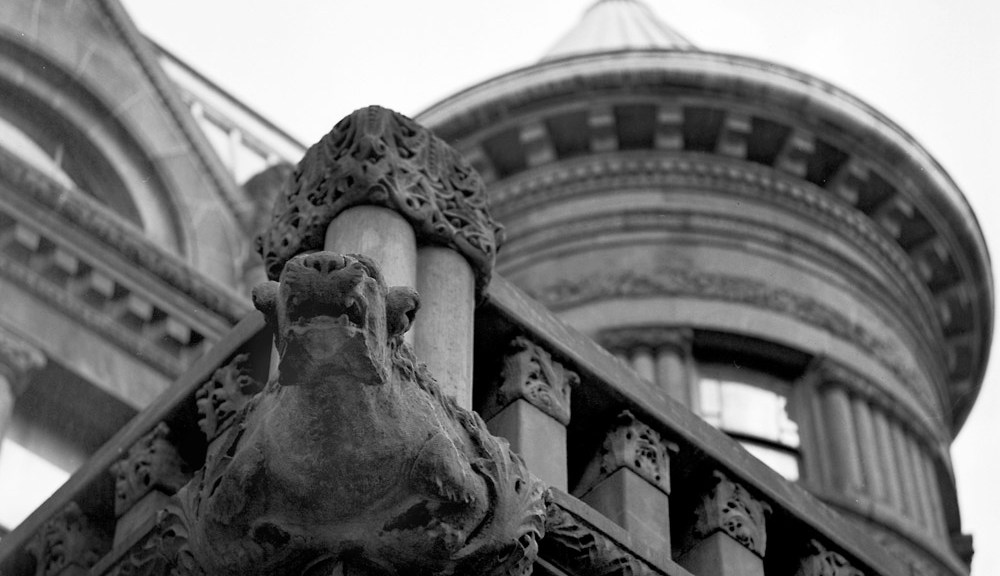
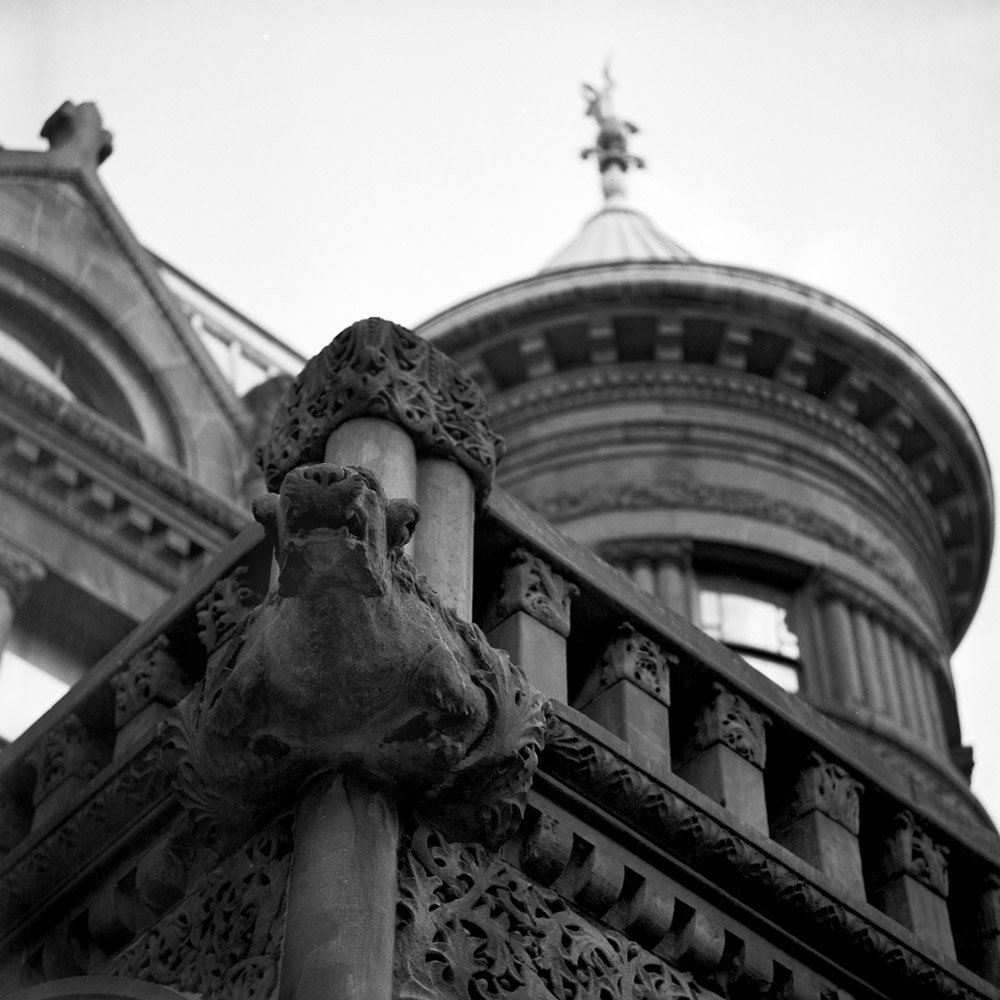
Looking up, this is one of the gargoyles on the outer edge of the porte cochere, and behind it the ornamental spire on the turret that inspired the house’s nickname, Brewmaster’s Castle.
Gargoyle, Turret, Brewmaster’s Castle
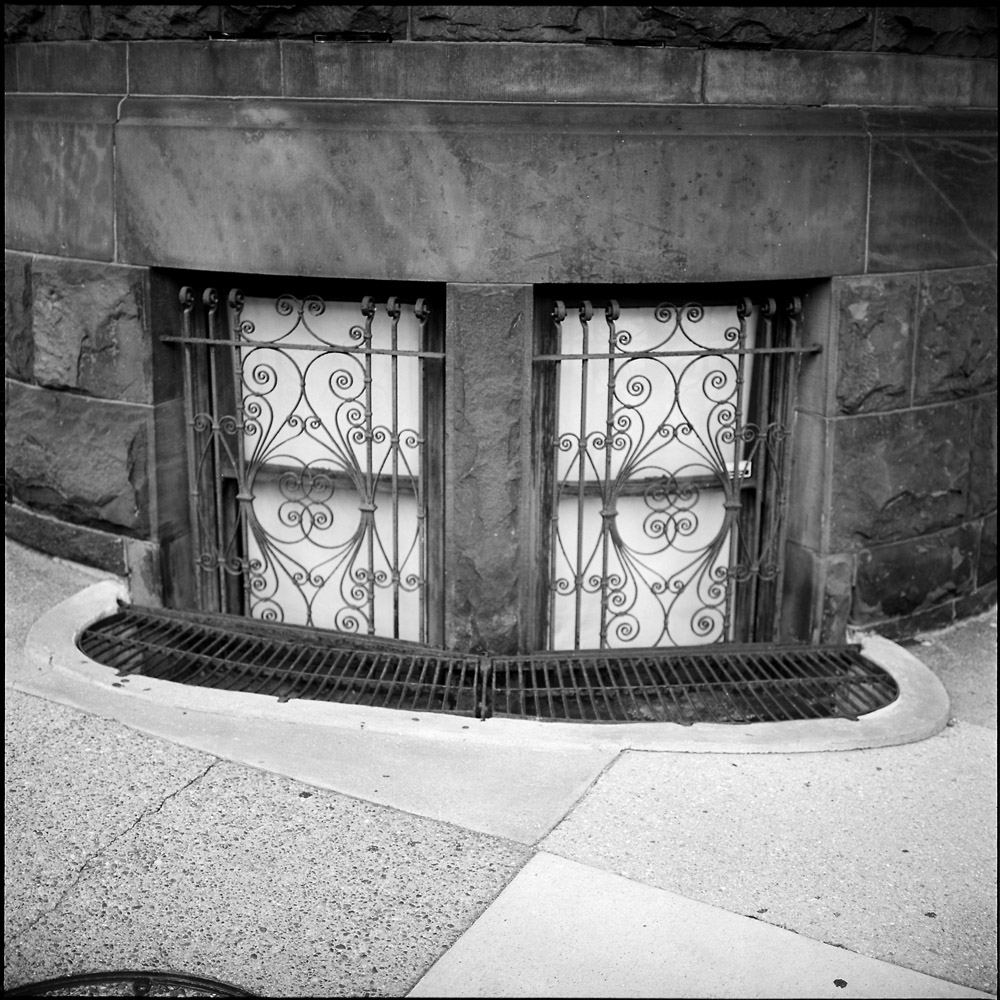
Turning around and looking down, the service spaces are equally detailed, and the innovative thought behind the construction is in evidence.
Windows, Brewmaster’s Castle
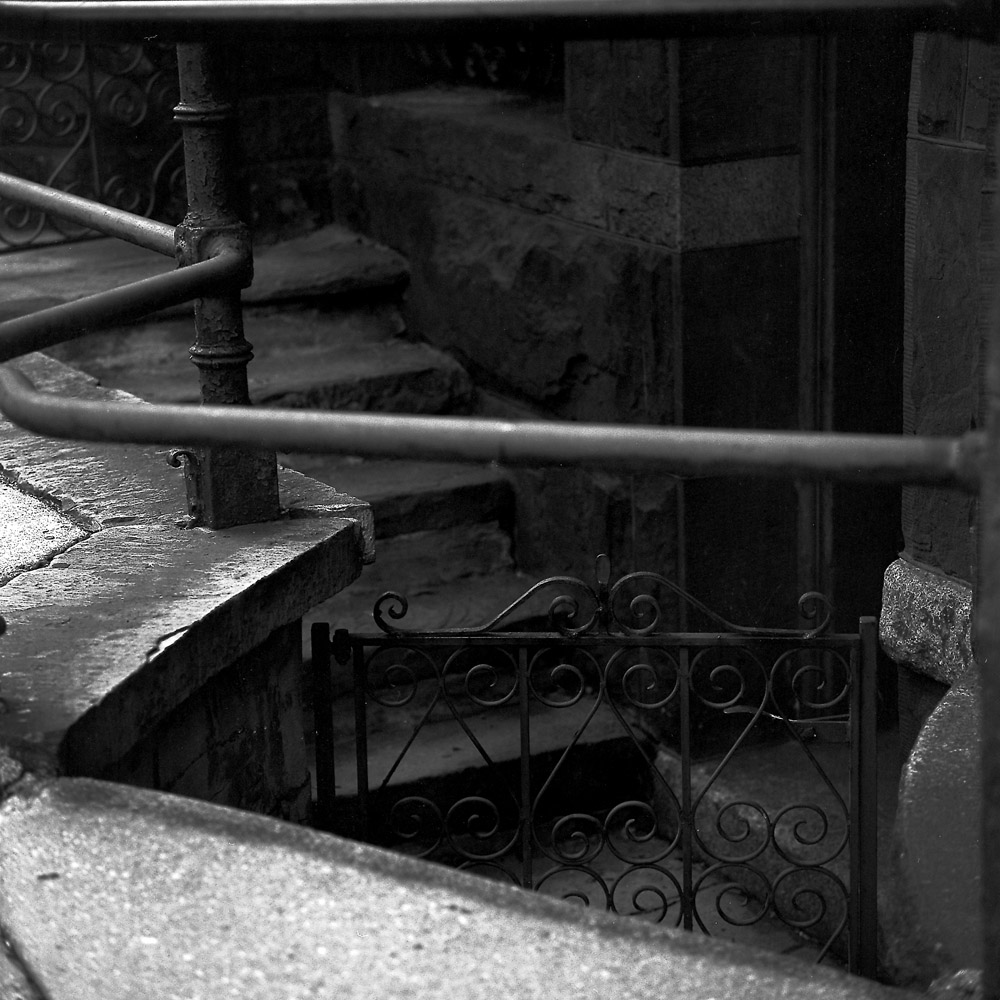
The trade entrance has TWO wrought-iron gates, one at the top and another at the bottom of the stairs.
Trade Entrance, Brewmaster’s Castle
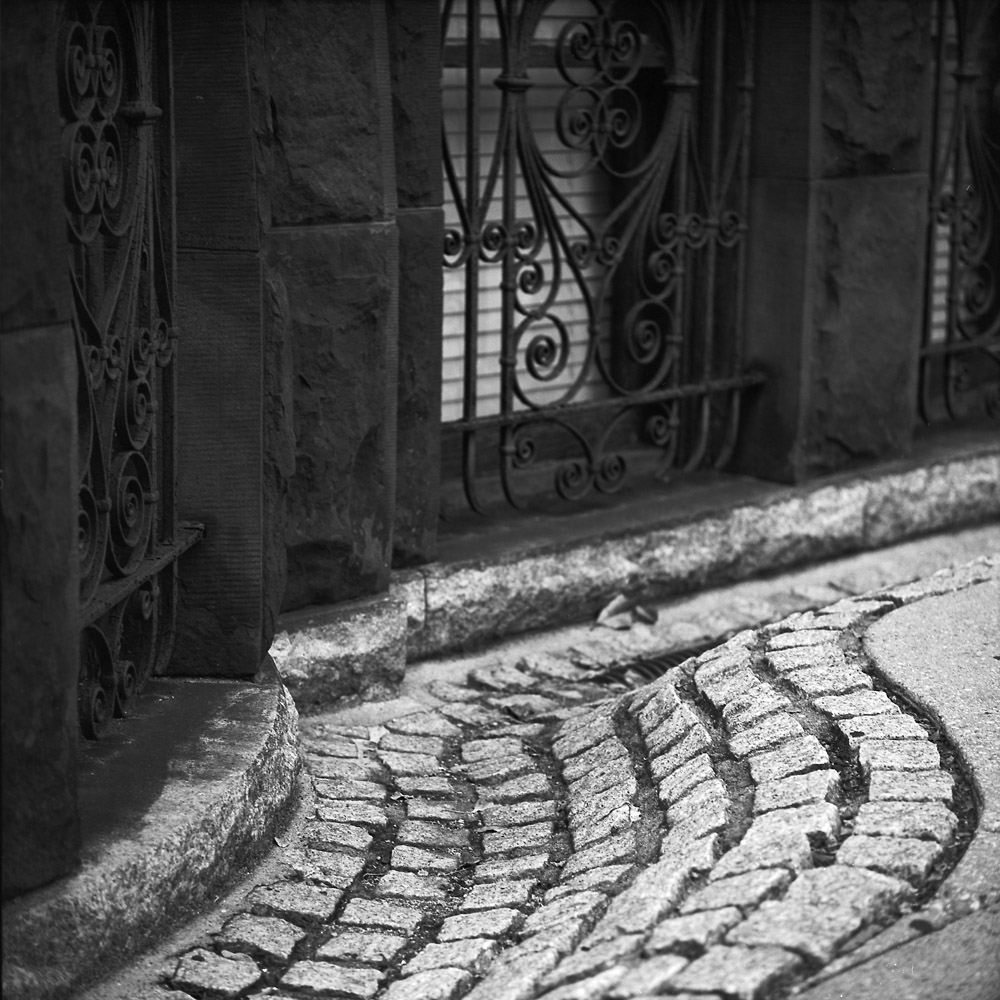
The sidewalk doesn’t pull right up to the foundations, but rather a sinuous cobblestone gutter system surrounds the house, providing adequate drainage so the basement doesn’t flood in a storm.
Gutters, Brewmaster’s Castle
The house is open for tours several days a week. While I haven’t been inside yet, I’m planning a visit soon.
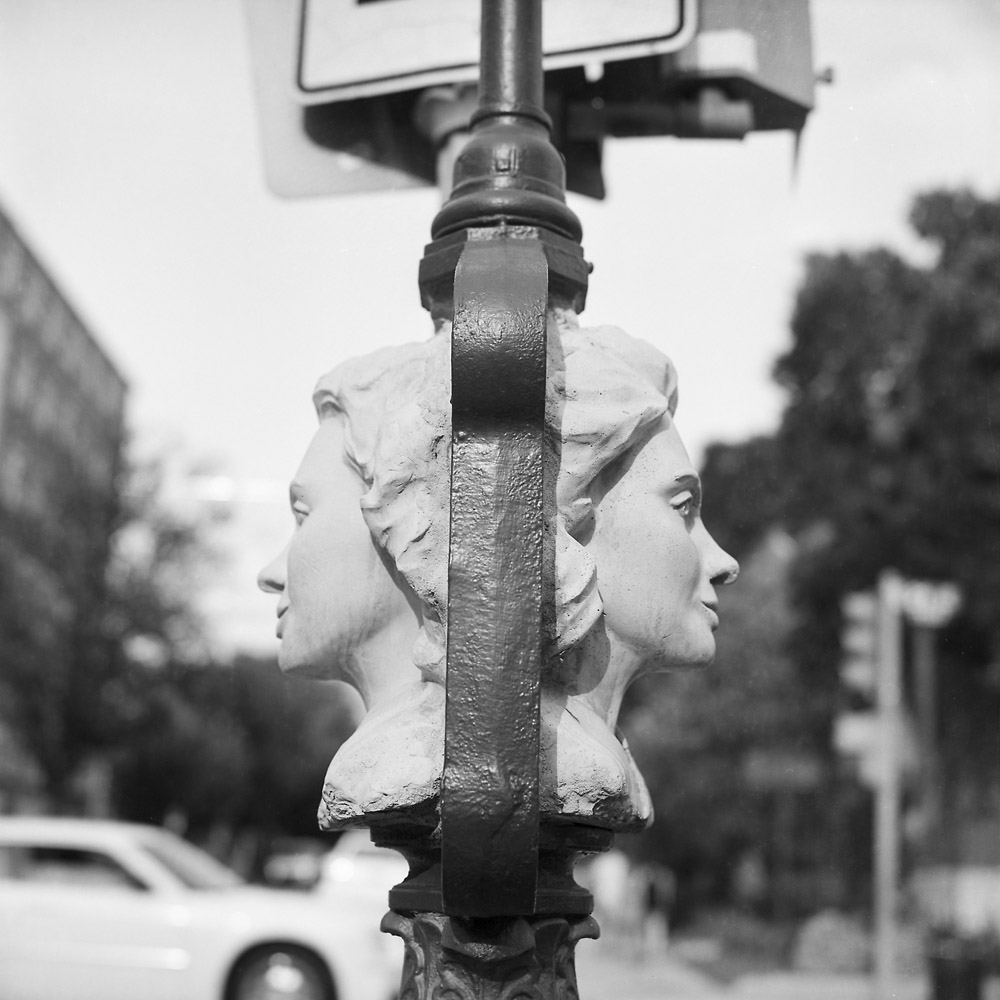
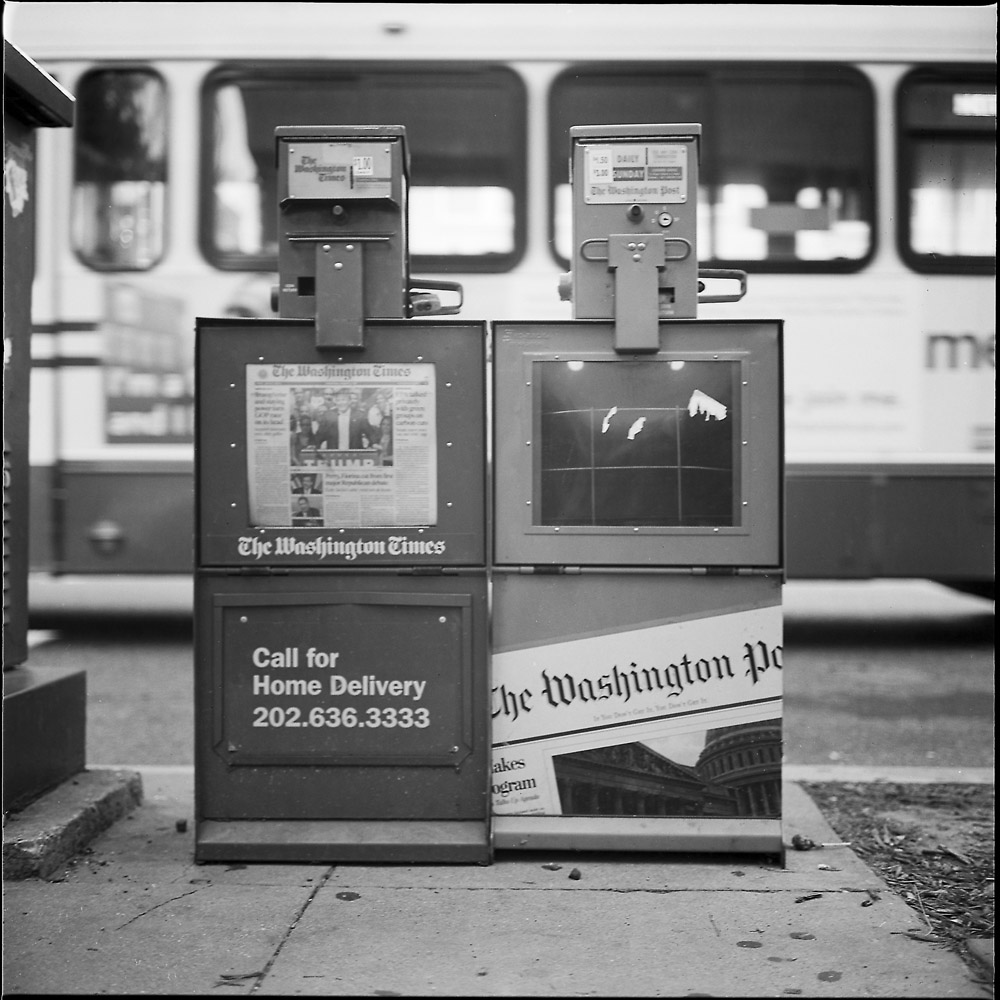
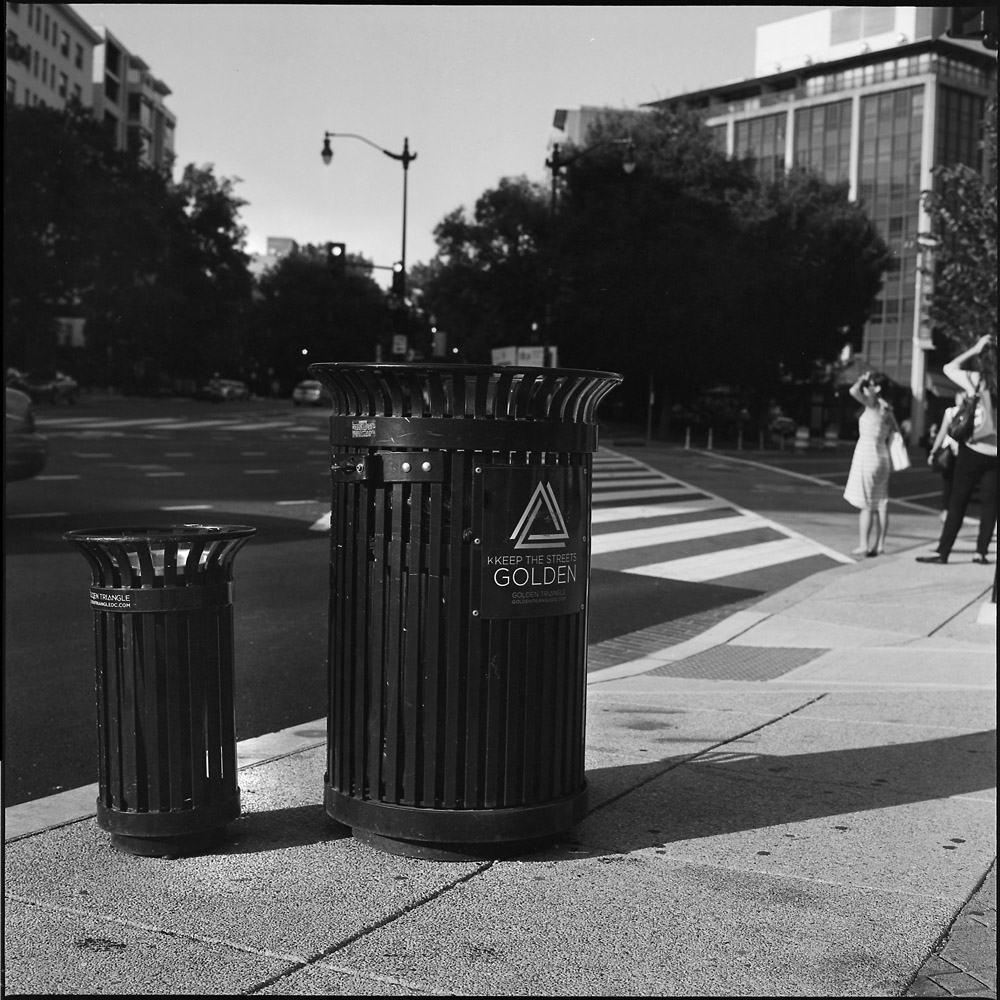
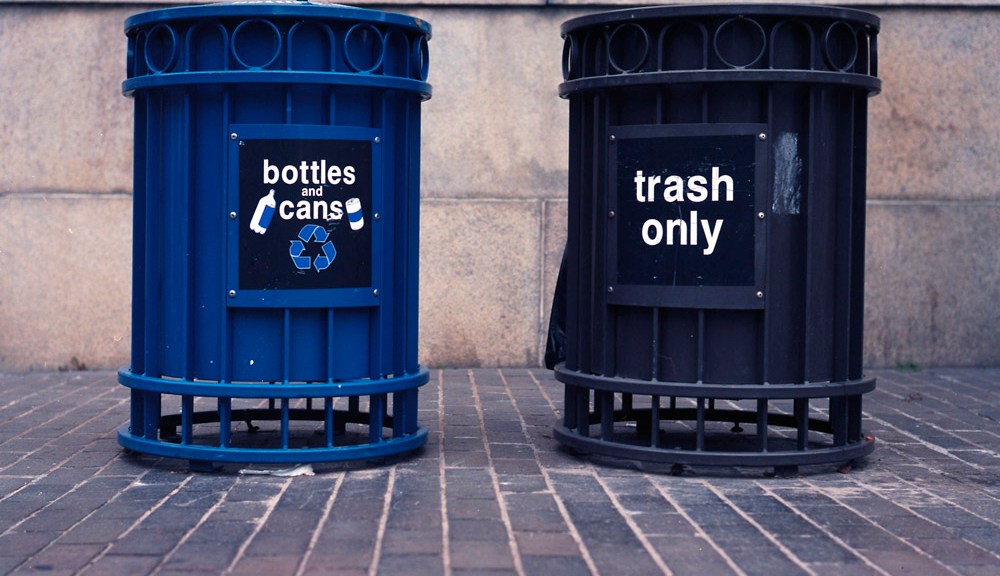
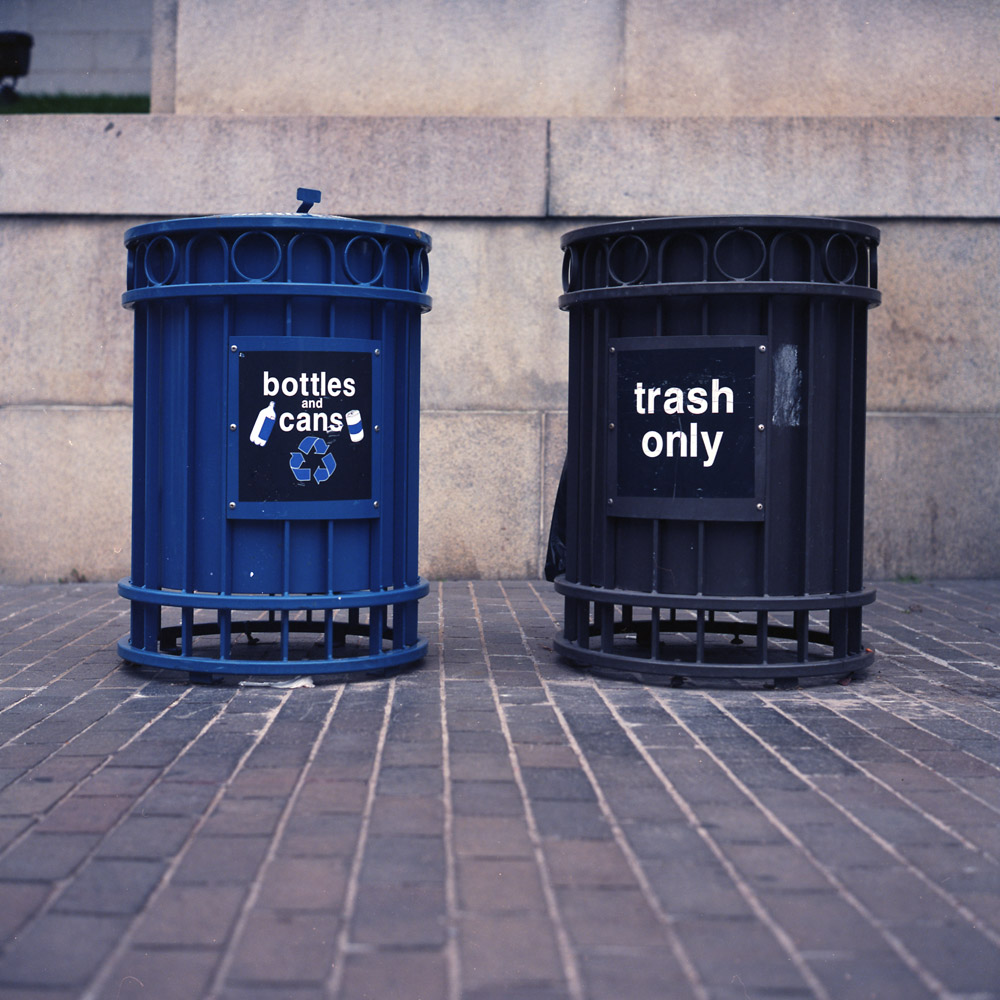
More things from my everyday objects series. These are all things I found around DC in my peregrinations on my way to and from work. They all have a theme of “two” in them – two faces, two paper boxes, two trash cans.
Two Heads
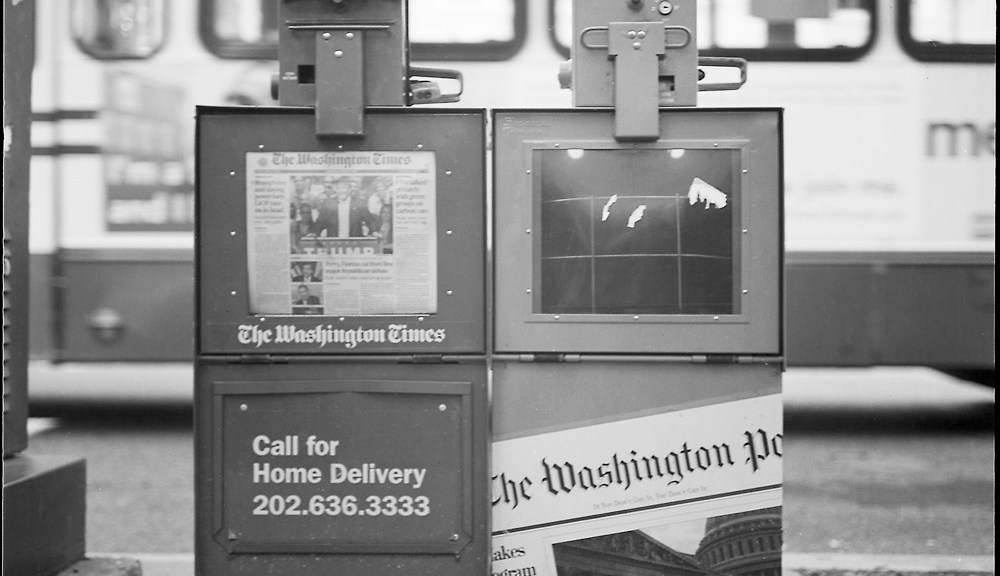
The sibling rivalry is in the two newspapers themselves represented in the two boxes – the Post and the Times. The Post is considered by many to be the “paper of record” for Washington DC, whereas the Times is a partisan hack with an extremely conservative bent, owned by a highly suspect organization (the Unification Church aka the Moonies). Depending on your political bent, the Post is a liberal shill and the Times a bastion of integrity. Either way, they co-exist in a shrinking market and both are struggling to find their feet in the post-internet age.
Sibling Rivalry – Two Paper Boxes
I call this last one two twins because there was by happy accident two people of parallel size to the trash cans, both striking the same pose in the background. It made for a serendipitous symmetry.
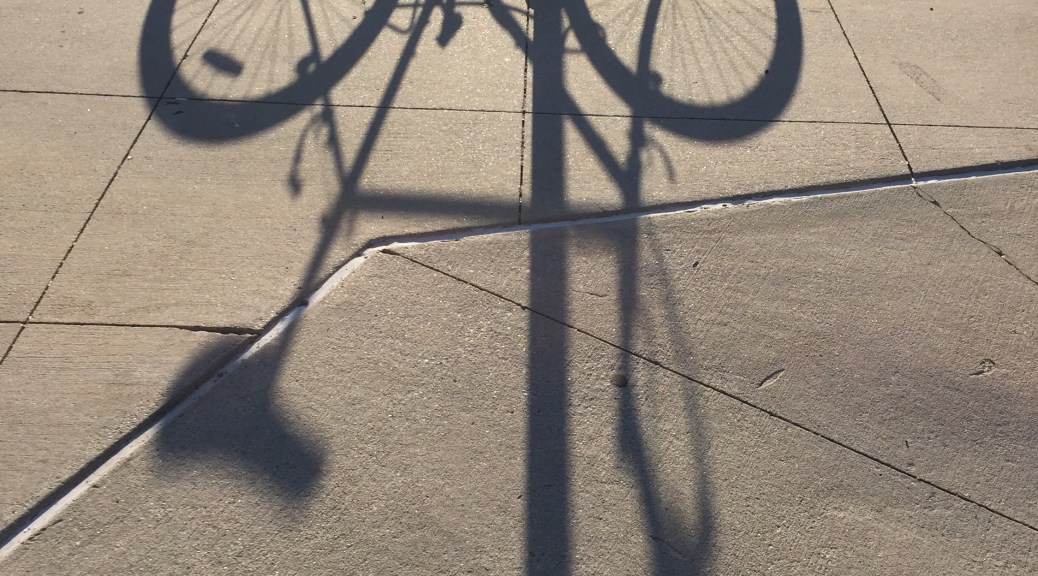
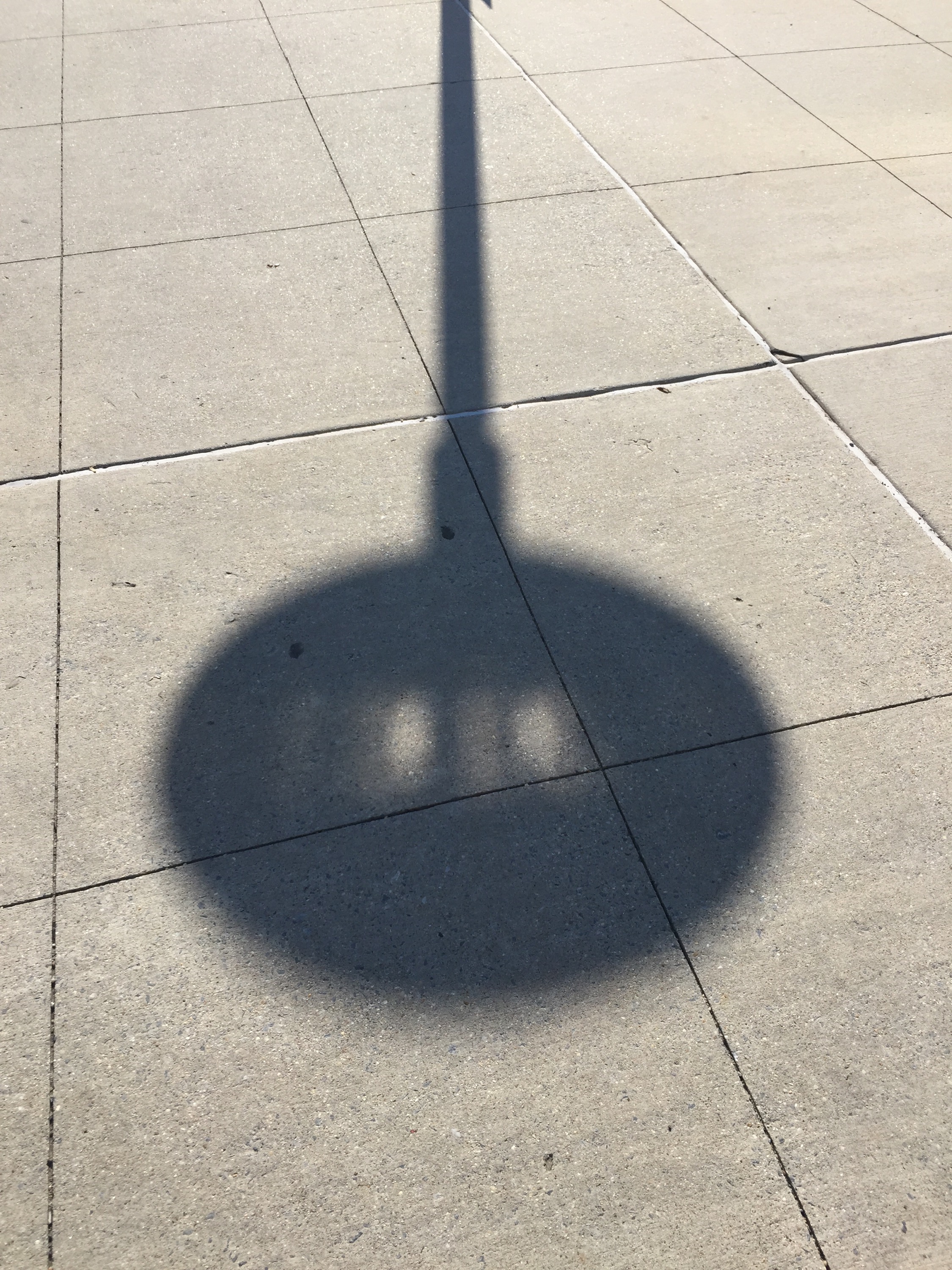
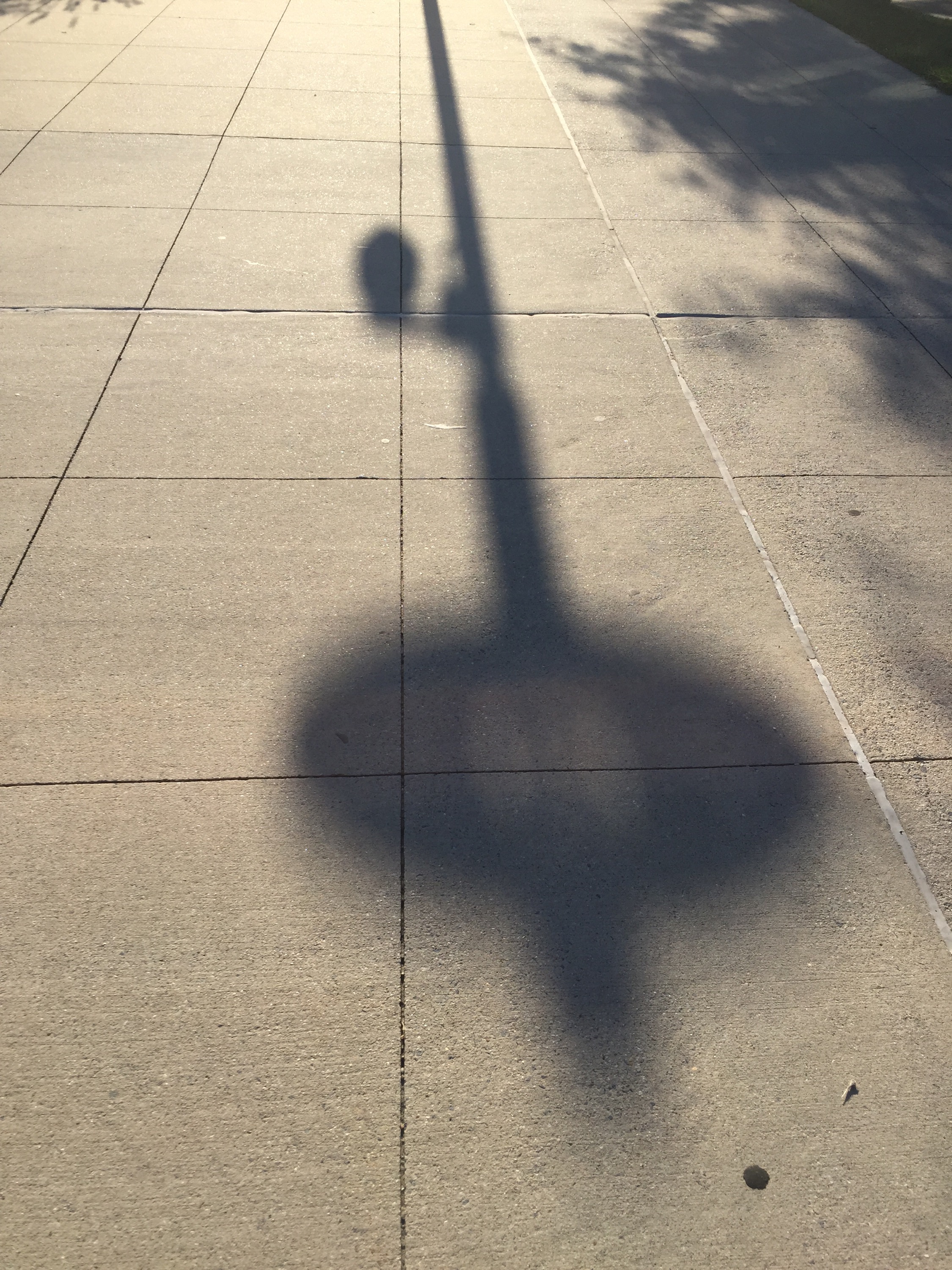 In many ways they are extremely similar: they’re both studies in form and abstraction, with the shadows of the things as the main subject rather than the things themselves (more so of the lamp post than the bike rack, but you get the idea).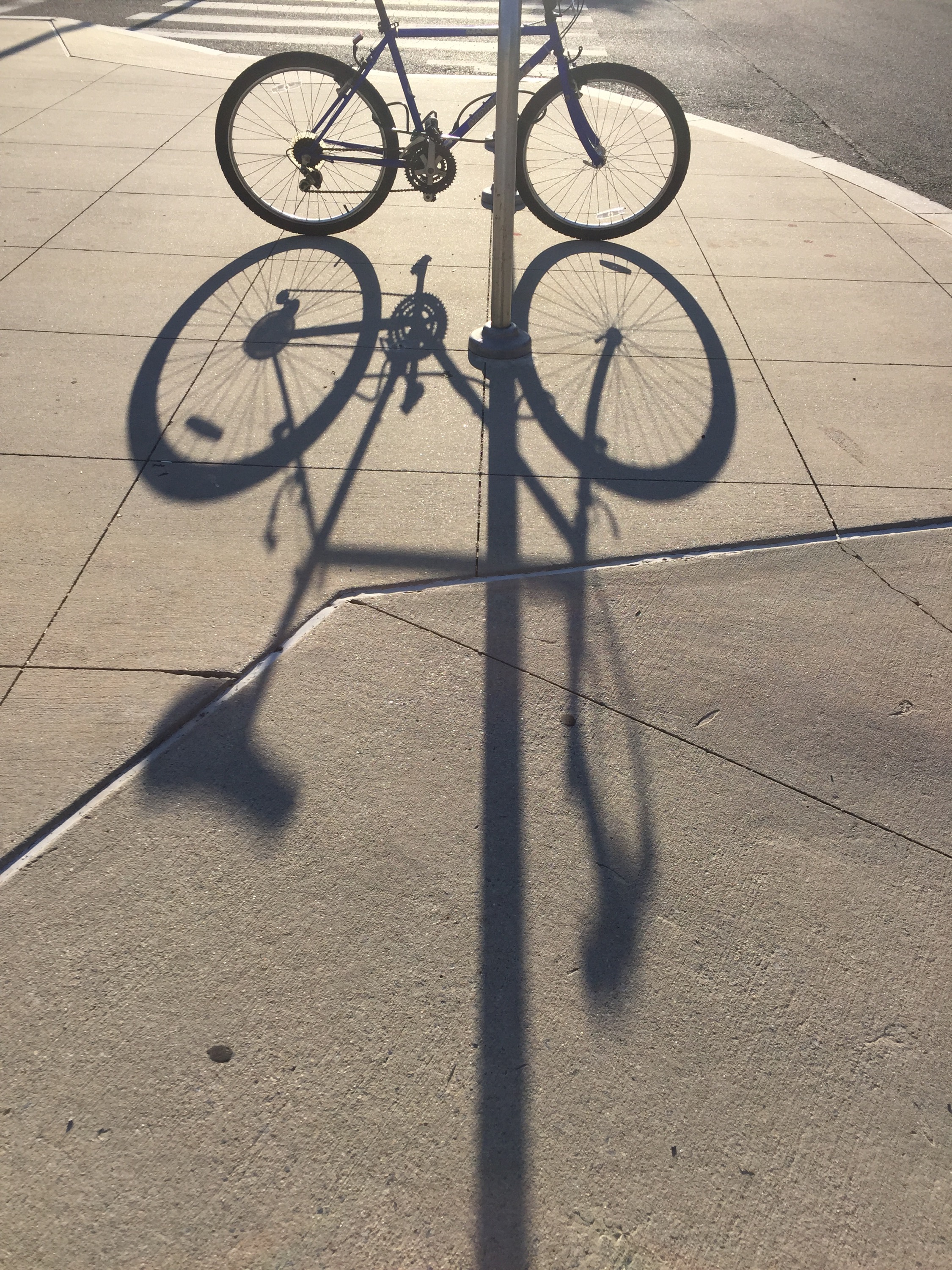
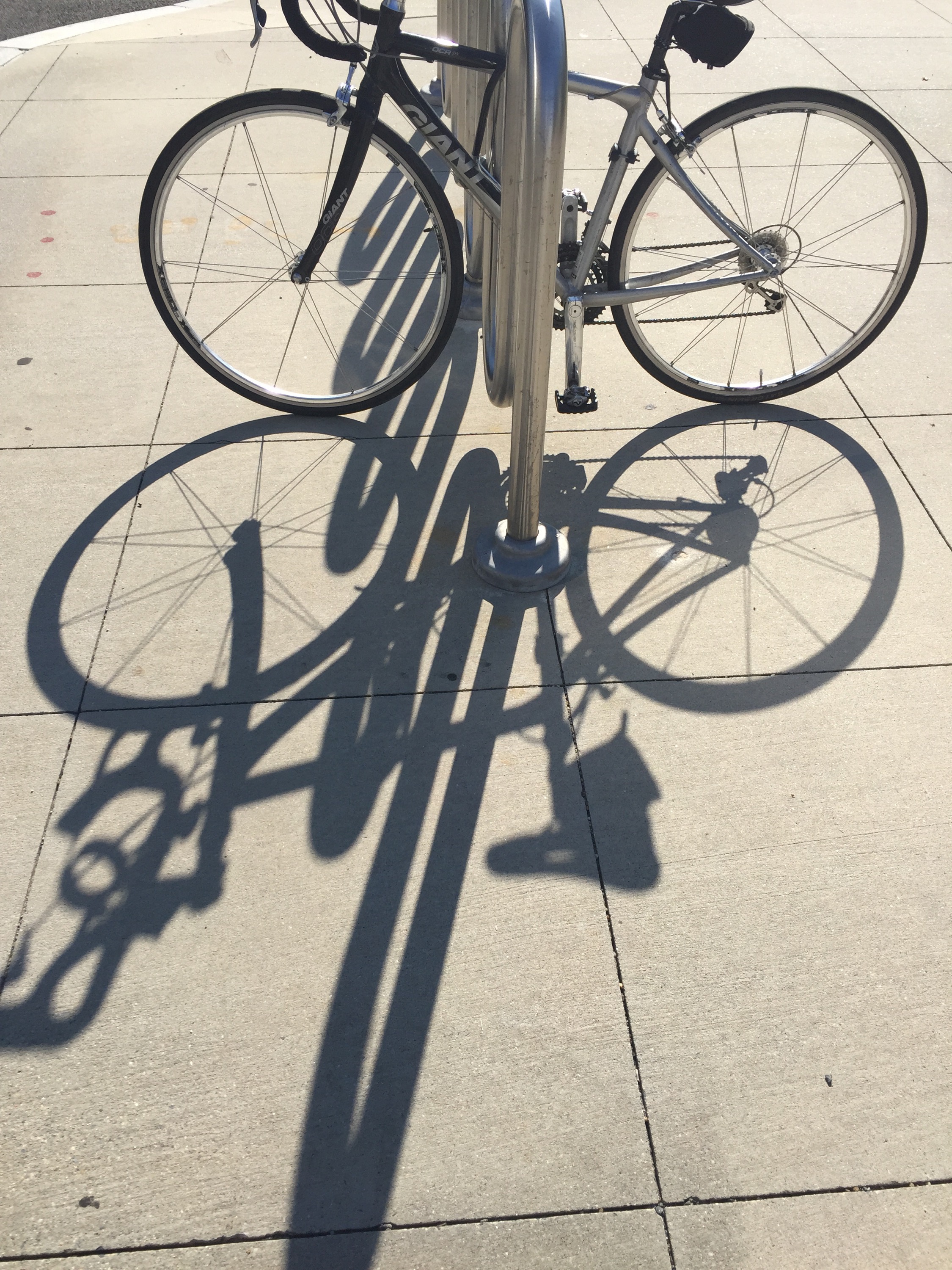 Can you guess which ones were taken in the morning and which in the evening?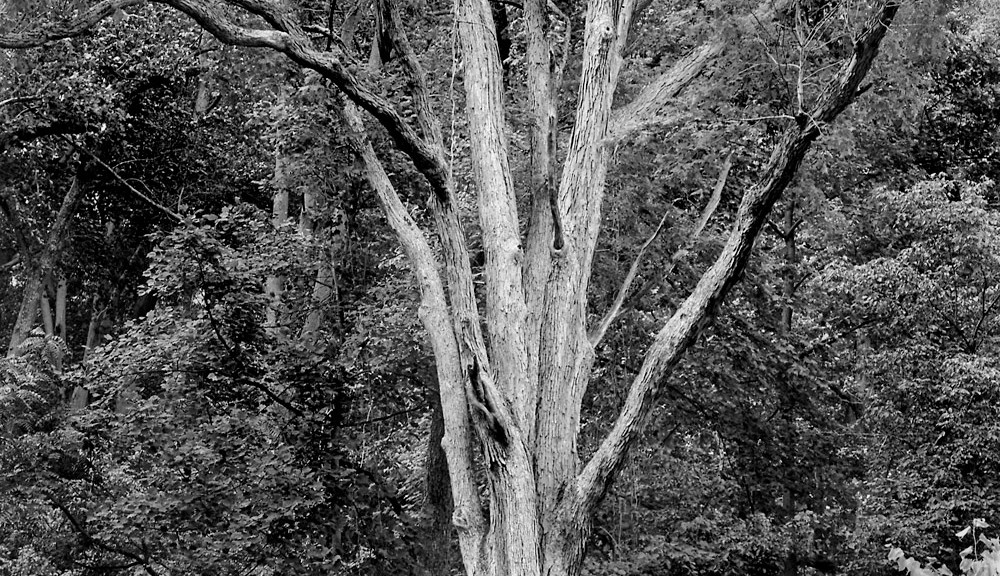





 dcphotoartist