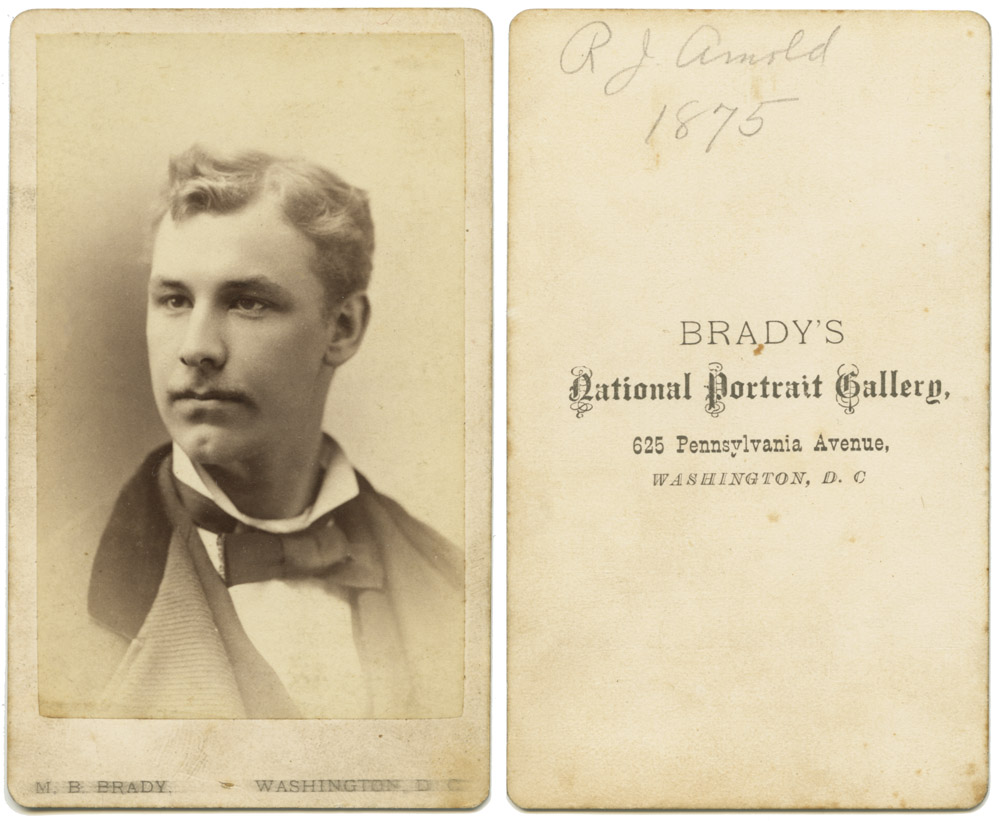
Here is a CDV by Brady from his later years at his Washington DC studio. The subject is R.J. Arnold, who went on to have a career as a photographer in California. Brady CDV, R.J. Arnold
For more information about Mr. Arnold, there is a very nice website about California photographers from the 1870s-1990s at CAViews.com.
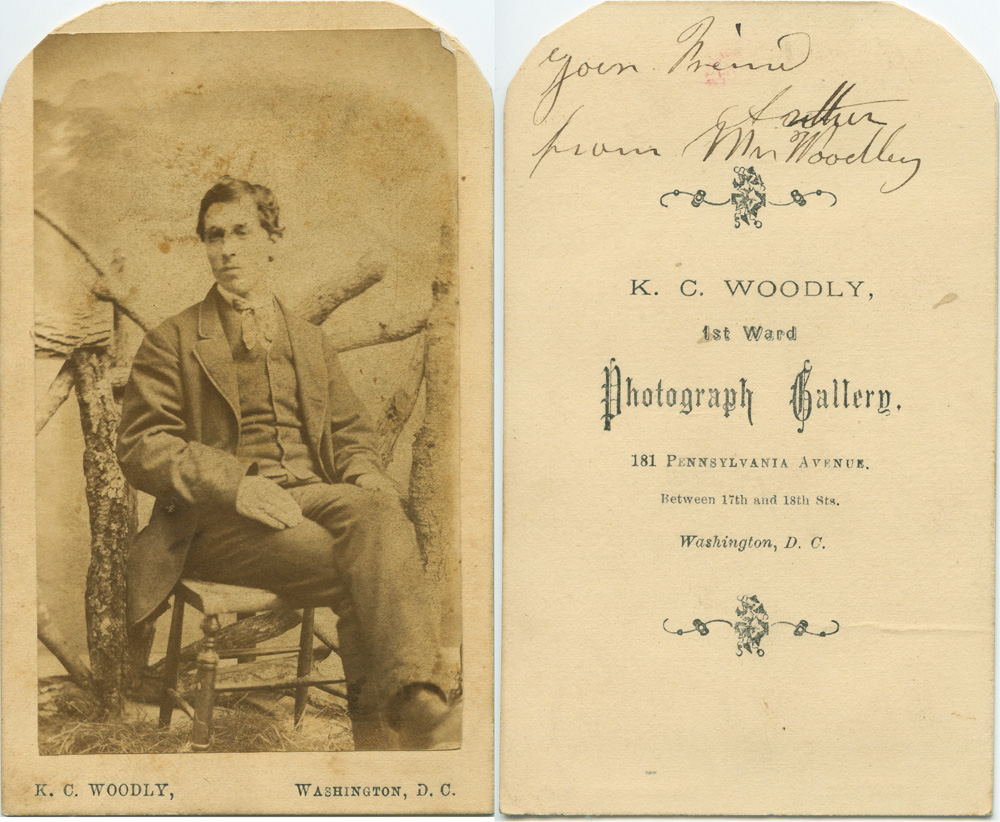
It is seldom that you find photographs of early photographers, so this was a neat acquisition for me. I have one other image that I believe is of a photographer (the label is vague – it could be the photographer himself or it could be merely inscribed by the photographer to the sitter).
K.C. Woodly CDV, Washington DC
Images of photographers with the tools of their trade are, unfortunately, extremely collectible and therefore out of my budget. But this photo of Mr. Arnold as a young man fills a nice niche as a stepping-stone to the goal of a cdv or tintype of a photographer with his camera.
Here’s another rather rare image – a portrait of what appears to be an actor by Camille Silvy. Camille Silvy was a French photographer who moved to London in 1858 and opened a studio at 38 Porchester Terrace, Bayswater. He photographed society clients, including many members of the British royal family, as well as royals of other nations (the queen of Hawaii among others). According to Wikipedia,
He closed his studio and returned to France in 1868. He himself believed that his nervous system had been damaged by exposure to potassium cyanide in the darkroom but it more likely that he suffered from manic depression. The last thirty years of his life were spent in a succession of hospitals, sanatoria and convalescent homes.
So he had a working career in London of approximately 10 years, in which he made over 17,000 sittings – rather productive for a short career. That’s about six portraits a day, 300+ days a year. According to the Wikipedia entry, the National Portrait Gallery in London has his daybooks, which include 12,000 photo illustrations to accompany the records of sittings. I’d love to visit them and see if I could find out who this actor was. Maybe next year when I return the favor to visit my friends Peter and Mirza who came to see me in Paris.
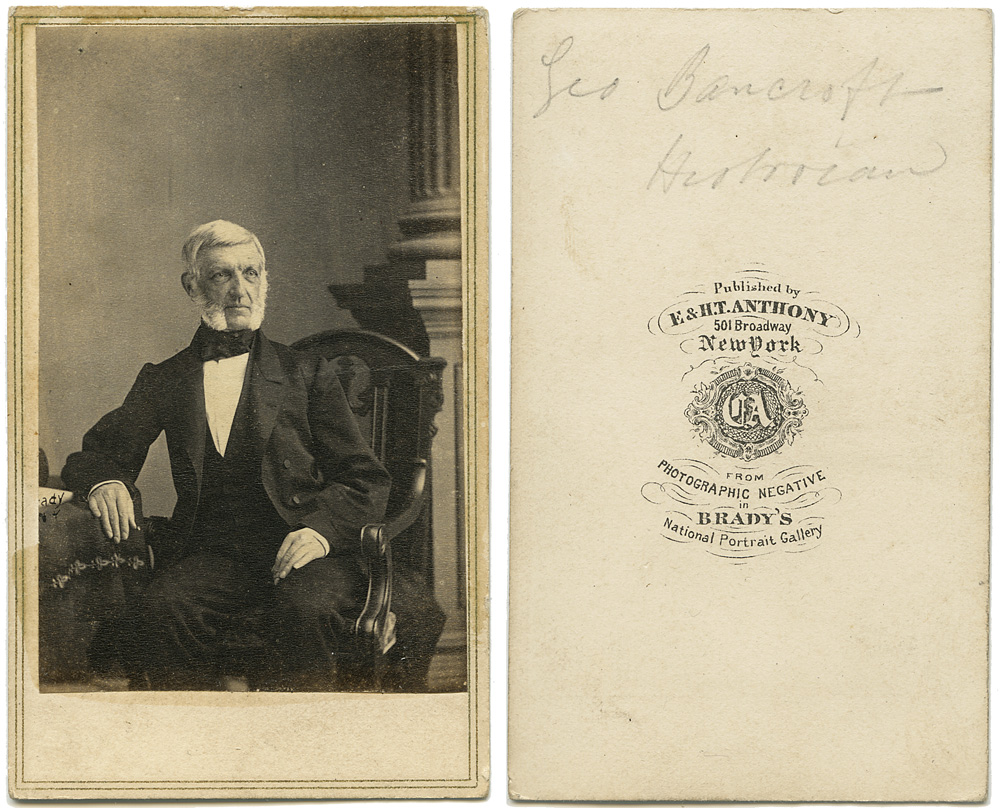
At first I was wondering why a CDV of an American historian would have ended up in the United Kingdom (the seller I bought this from is in England). After reading up on who George Bancroft was, now it makes sense. George Bancroft, in addition to being an historian, was Secretary of the US Navy, founder of the United States Naval Academy in Annapolis, and served as the US Minister to the United Kingdom from 1846-49. After the Civil War, he also did a stint as minister to Berlin from 1867-1874. He lived to the ripe old age of 91, dying in 1891.
George Bancroft, by Brady
His political life should not be seen to overshadow his academic life – he entered Harvard at age 13 and graduated at 17, and went on to study in Europe under some of the greatest academics and philosophers of the day. He authored a ten-volume set on the history of the United States, entitled, humbly enough “A History of the United States, from the Discovery of the American Continent to the Present Day”.
I also thought you, my loyal readers, could stand a break from all the Paris photos. They’ll resume soon enough.
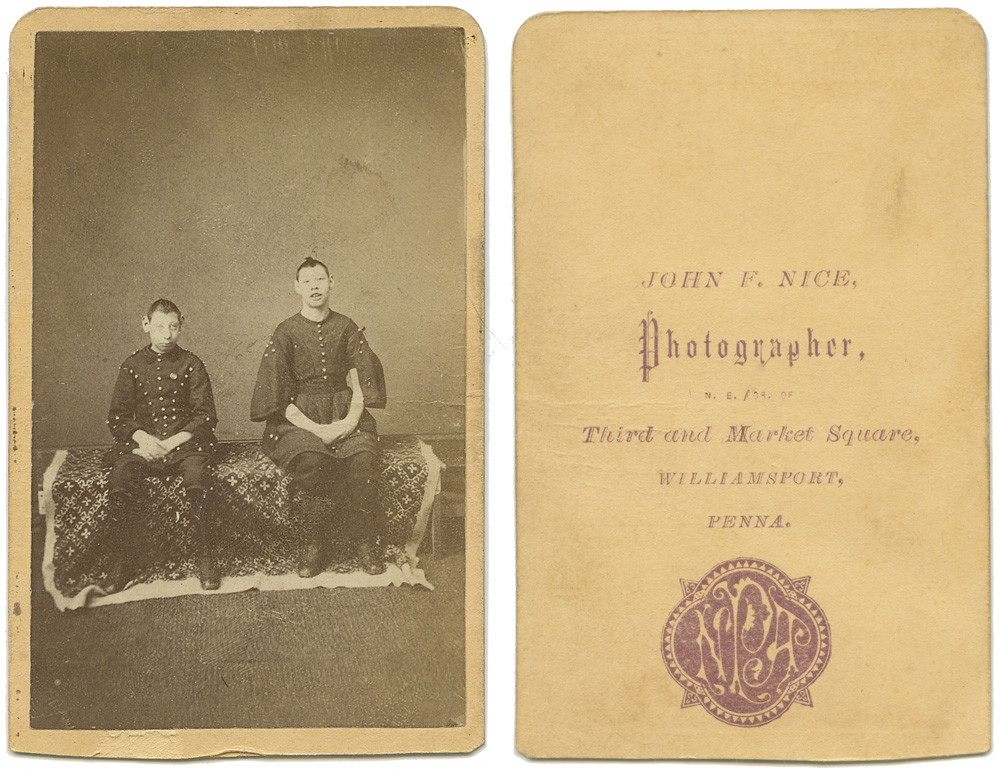
Another addition to my collection – a pair of so-called pinheads who were part of the circus freak circuit in the United States during the 1870s. These two gentlemen are at the present time unknown to me. I’ll do some research and see if their identity can be determined. While I love collecting images of circus freaks (or even just anonymous vernacular images) from the famous photographers of the era, I think the obscure, little-known or unknown photographers in small American towns are just as cool if not cooler, because they truly represent a slice of American culture, largely vanished today. I like the unpolished-ness of the image – two men sitting on a bench of some sort, covered with a rug or blanket. The posing is straightforward and unsophisticated, yet it does have a certain aesthetic sensitivity that makes it appealing.
Two Asian Pinheads, by John Nice, Williamsport, PA
Pinheads suffer from Microcephaly – a genetically-influenced condition where their brain cavity does not grow at a normal rate and their head ends up being abnormally small. They usually suffer from mental retardation and may also have motor dysfunction and seizures. They were a popular sideshow attraction and often were portrayed as “the missing link” between man and ape, and in the case of Zip the Pinhead (perhaps the most famous pinhead of all, although it is debatable that he was a true microcephalic – he displayed normal or near-normal intelligence and did not suffer seizures or motor dysfunction), he would come out on stage in a cage like an animal and make shrieks and howls. Zip had a 67-year career in the circus and sideshow entertaining, dying in 1926 at or about the age of 80.
Pardon the completely coincidental and generally inappropriate reference to the first two atomic bombs. Today for your viewing pleasure we have Frank Williams, professional sideshow fat man, who according to his bio data on the back of the CDV weighed in at 487 lbs at just 18 years of age.
Frank Williams
According to the Circus Historical Society, he was touring with the King & Franklin New Colossal Shows and Great Wild West in 1888-1890 as part of their sideshow. On a side note, in doing some quick research on Frank, I saw a lot of threads pop up using an image of Frank to start a nasty, snarky discussion of modern-day obesity. It may be true that there are more obese people today than there were 120 years ago, but it’s no excuse for nastiness to those alive today or those long dead. To me it’s victimizing Frank as a sideshow freak all over again, but I wonder how he’d feel about it as exhibition as a sideshow freak was his chosen profession.
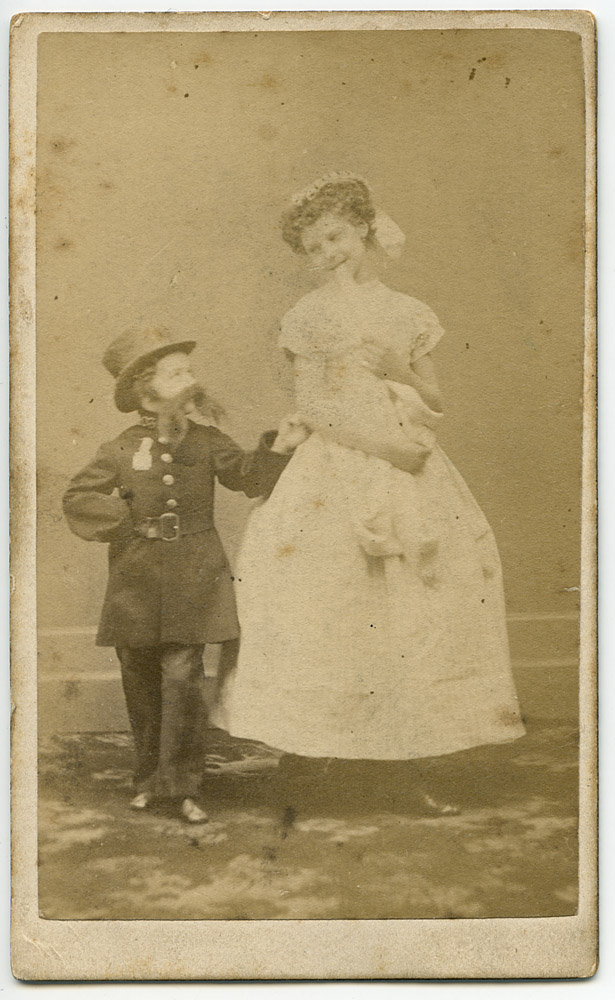
Next up, a more pleasant note, is an anonymous CDV of a little person in policeman’s costume with a gigantic fake mustache escorting a pretty girl in a frilly dress. Nothing more is known about it, as there is nothing on the verso either printed to identify the photographer or handwritten to identify the subjects.
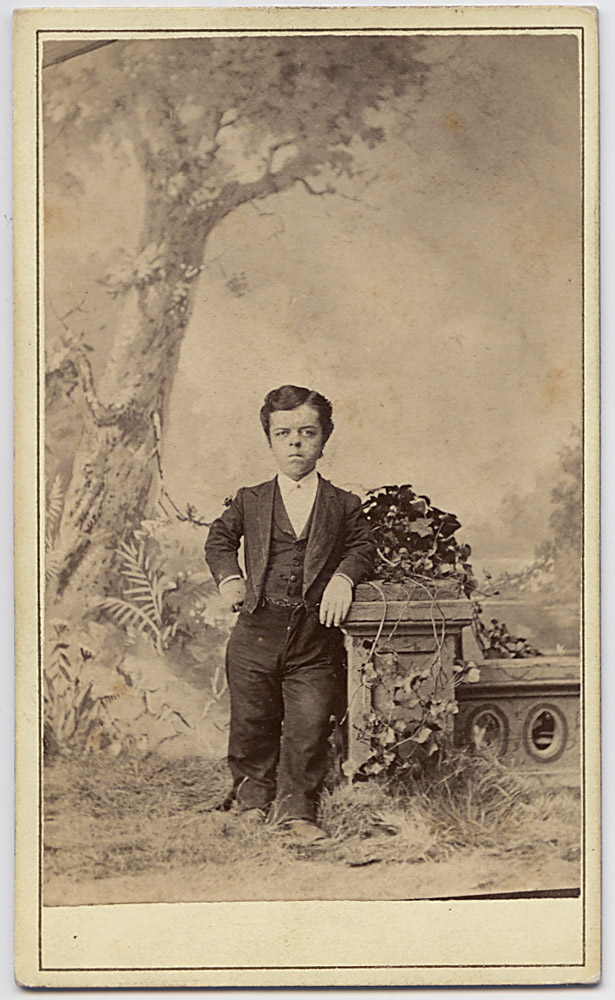
Another addition to the collection of 19th century “freaks”. This one is totally anonymous – no label of who the subject is, or blind stamp on the verso from the photographer. But it’s clearly an original image from the overall quality – not a copy made from someone else’s CDV or stereo view, which makes it a little surprising to see. Oftentimes when photographers were stealing images of another photographer to reprint and sell, they would leave the back of the carte blank so if the copyright holder tried to track them down it would be much harder, and provide them with a degree of plausible deniability “I was merely selling these on consignment – I didn’t illegally copy them! And by the way, I don’t know who it was that sold me the copies…I think he said his name was Smith… yeah, that’s the ticket”. The subject looks familiar to me but I’m not sure – I bet he can be identified though. He’s quite handsome, bordering on just unusually short, and very well proportioned, unlike some of the circus freak little people performers of the day.
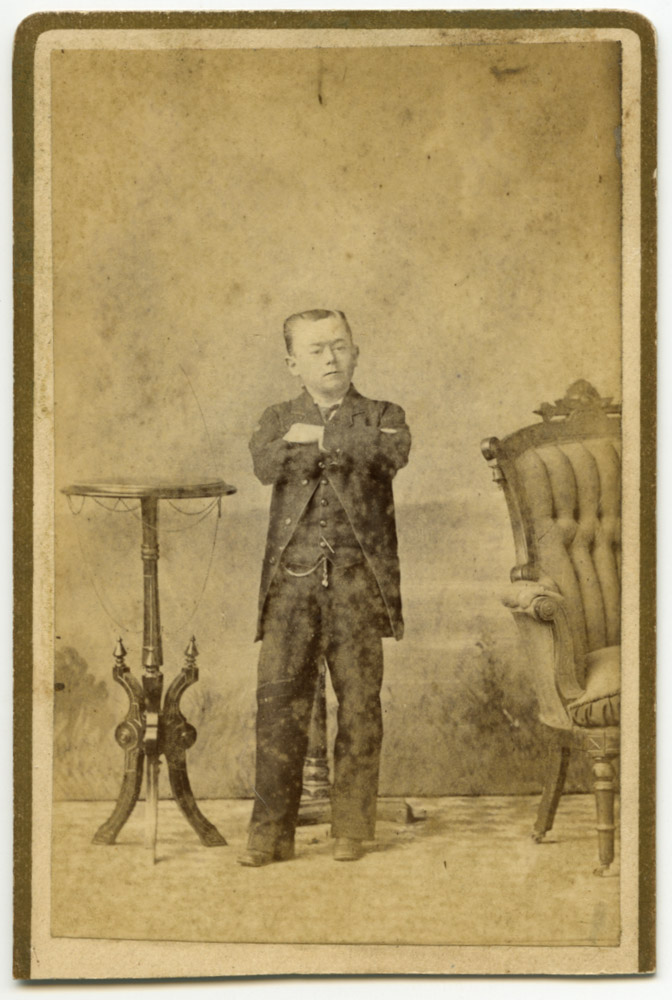
Apologies for the long delay in posting. I just needed a bit of a break from blogging. I’ve been on a bit of a collecting hiatus, but this was a good deal that I didn’t want to pass up. It’s a nice CDV of a circus midget, whose identity, while at the moment remains undetermined, I’m sure I can figure out- I think I’ve seen him before, and I’m sure others would know.
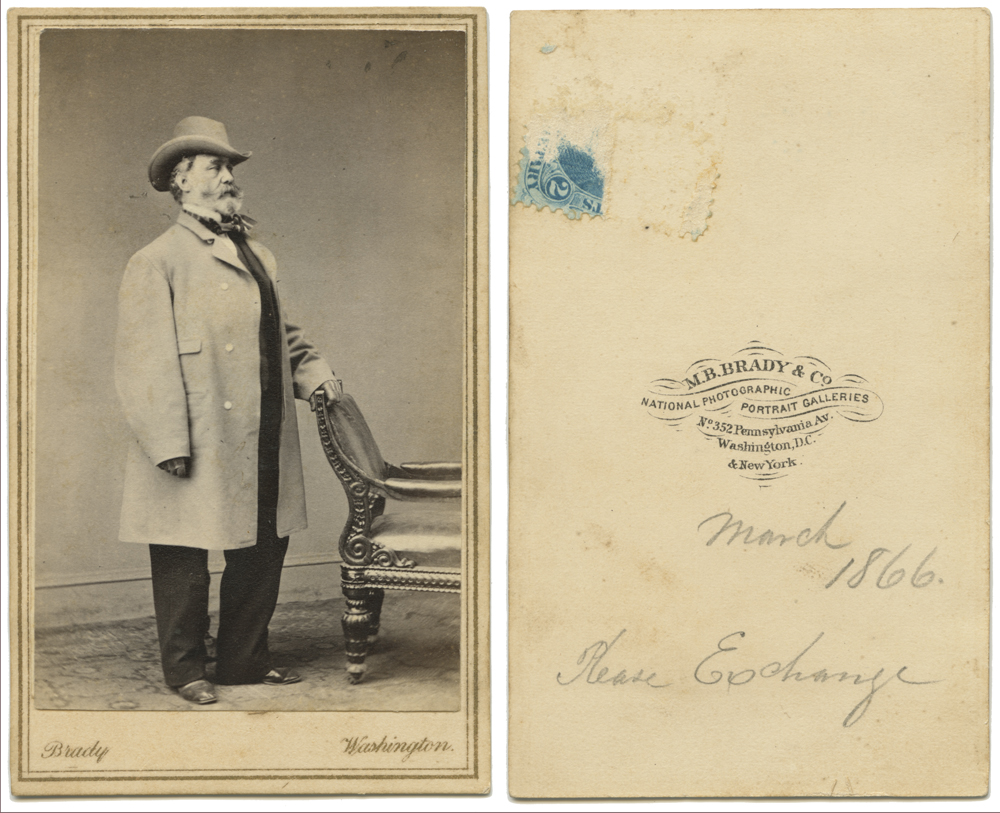
The inscription on the back is a bit cryptic – “Please Exchange”. Exchange for what? Unless they didn’t like the pose, I can’t see what’s wrong with it to want to exchange it. The CDV is actually in excellent condition, with no creases, bent corners, or overall flaws to the print. I’m certainly happy with it!
Gentleman, March 1866, Mathew Brady Studio, Washington DC
He looks “western” with that hat and coat, but that’s not saying much – although the outfit has a cowboy feel to it, he’s obviously a very rich cowboy, as that’s a very fine coat. Brooks Brothers would be proud to hang such a coat in their showroom today.
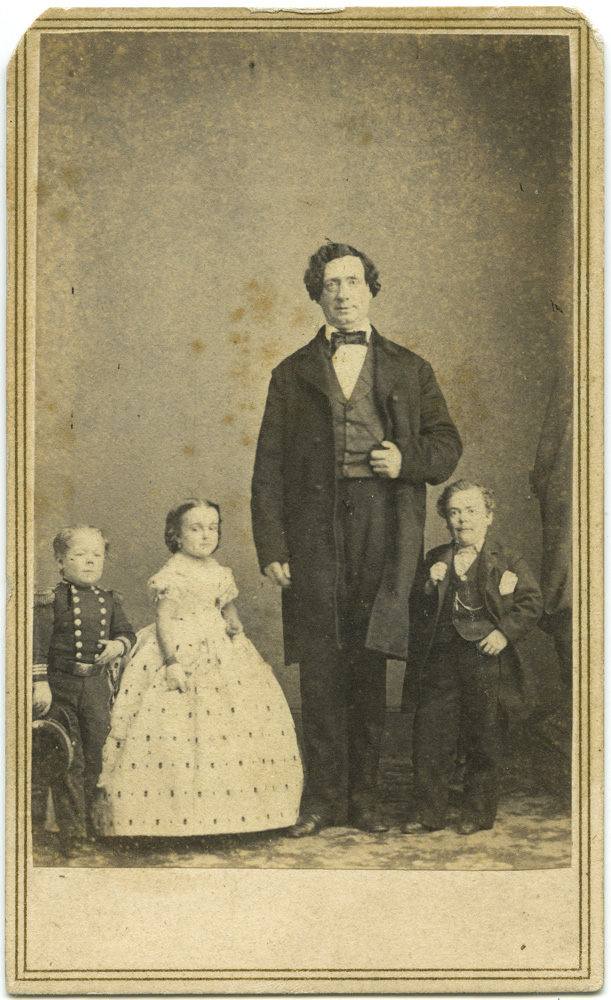
When I had previously posted this image, I stated that I didn’t know the identities of everyone, especially the little person on the right, although I had seen him before somewhere. Well, troll Ebay long enough and another image will show up. He’s Colonel Small. The other little man is Commodore Foote. I’m not certain of the identity of the little woman in the middle, but all three were Barnum performers.
I’m feeling a little bit like doing a review of the little people in my collection, so here goes nothing:
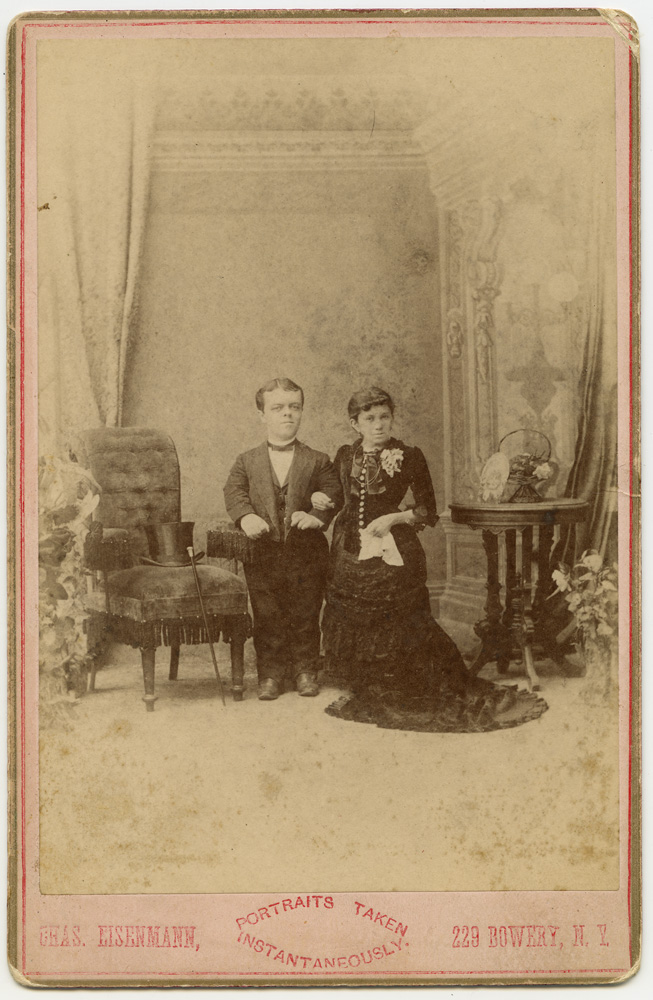
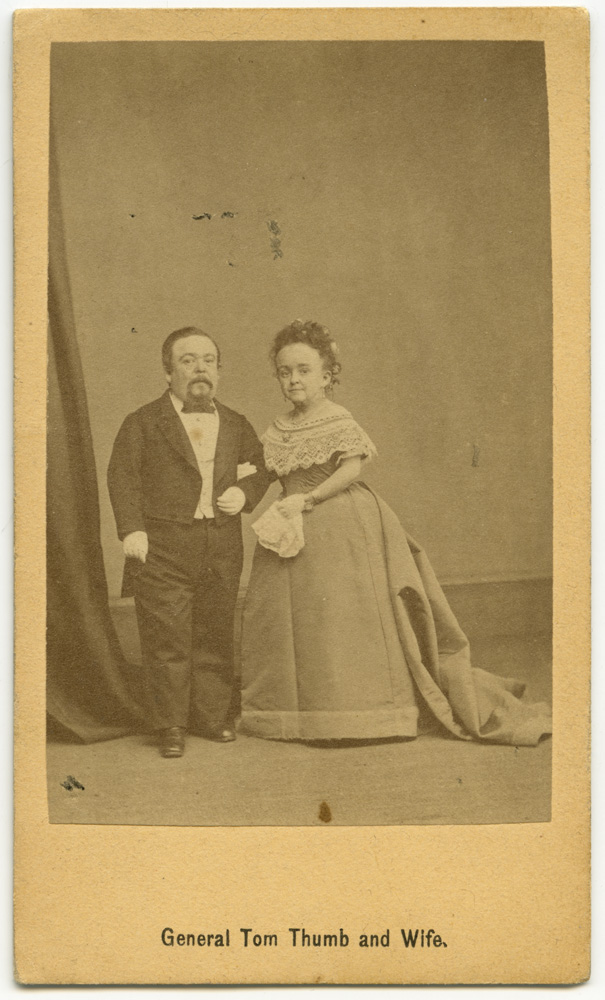
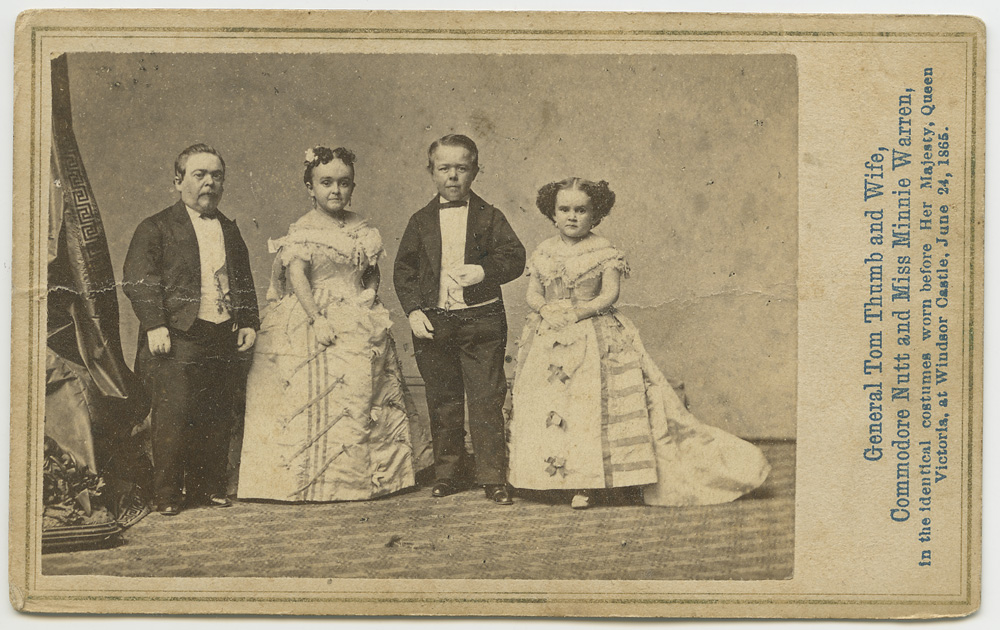
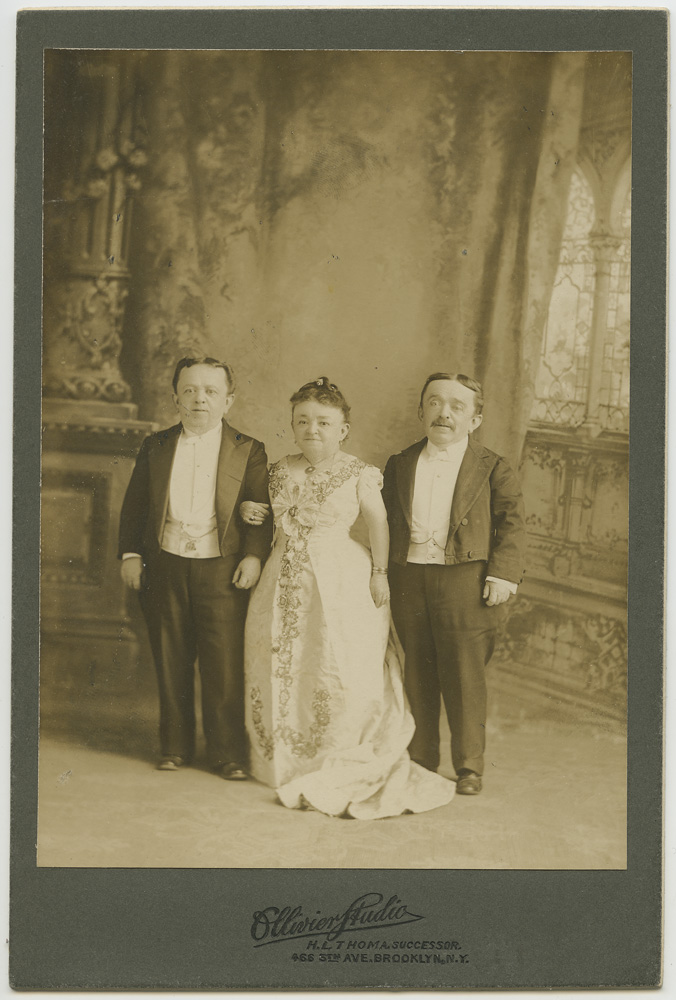
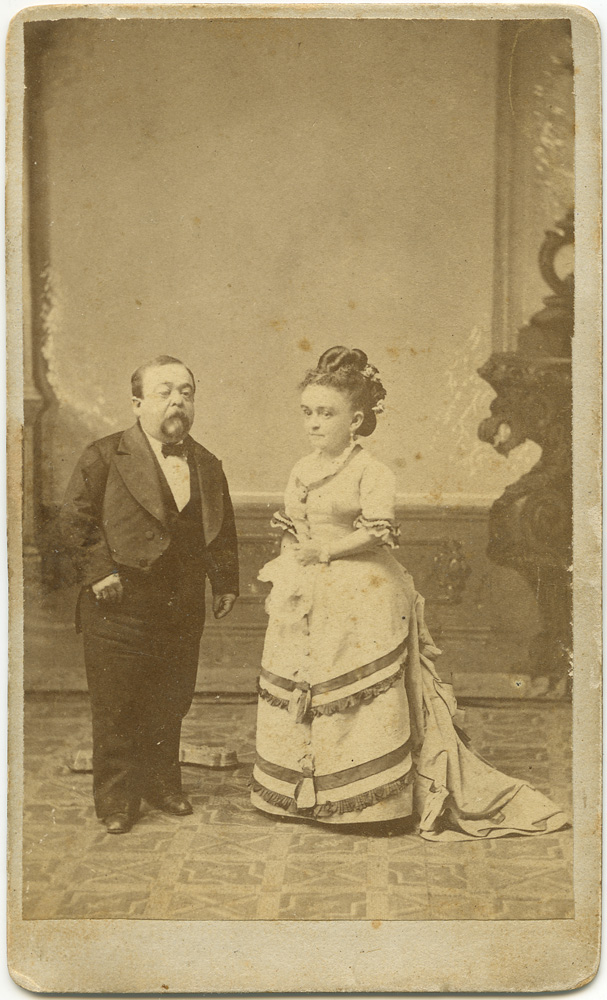
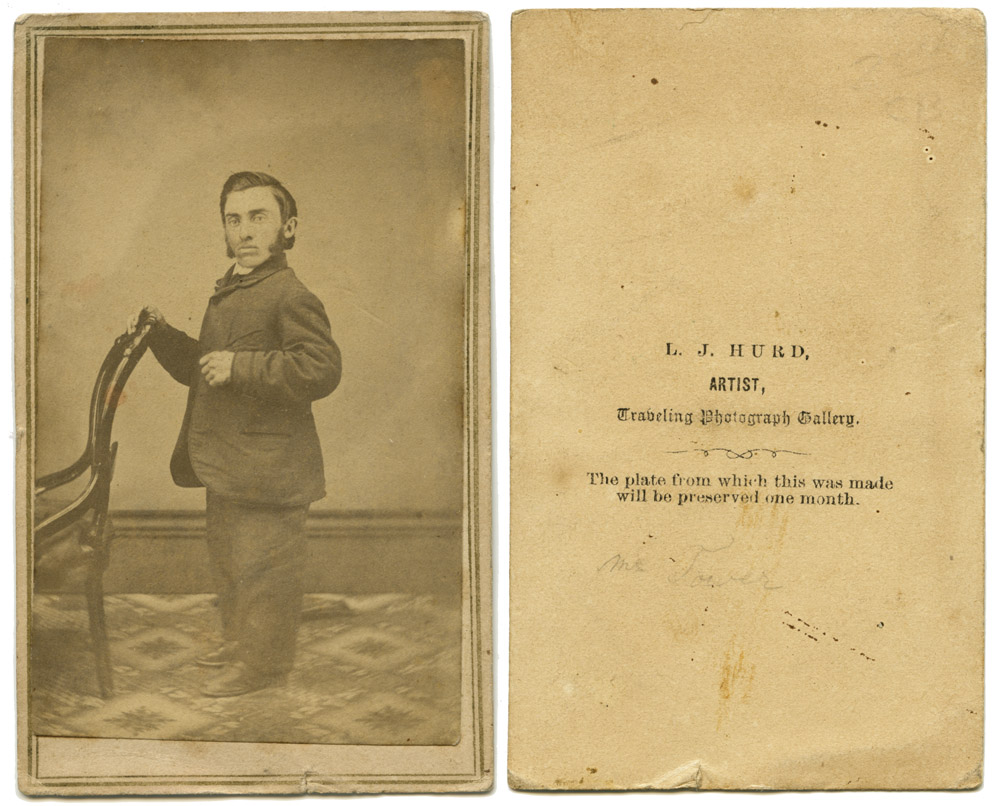
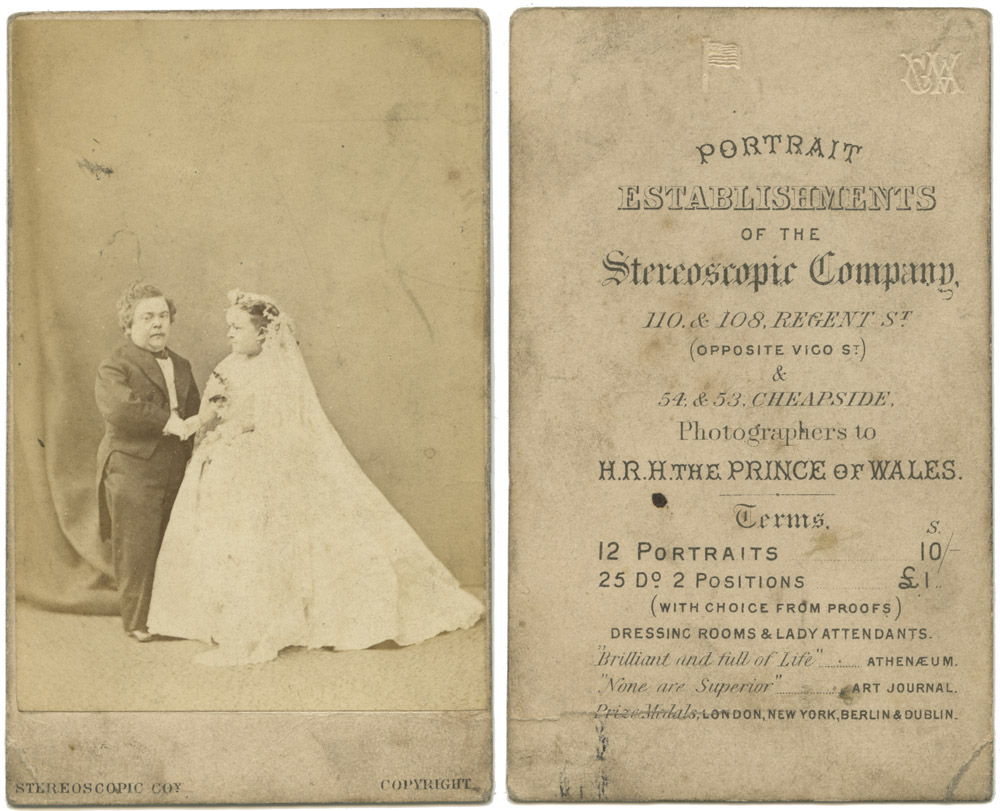
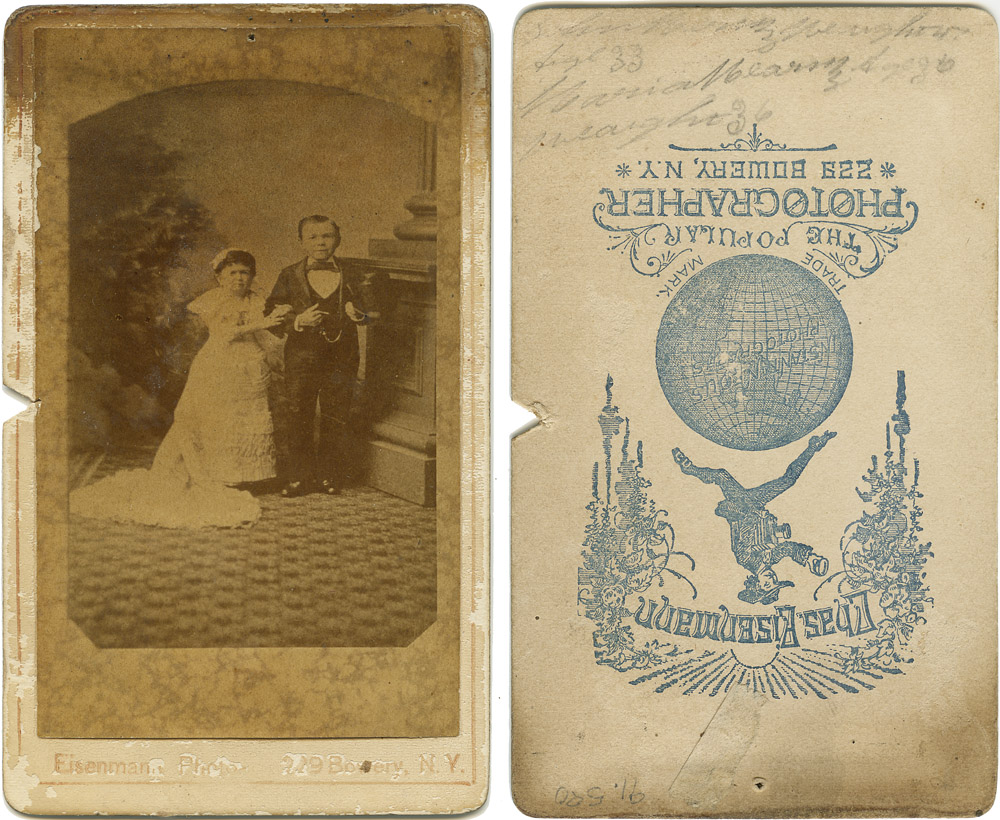
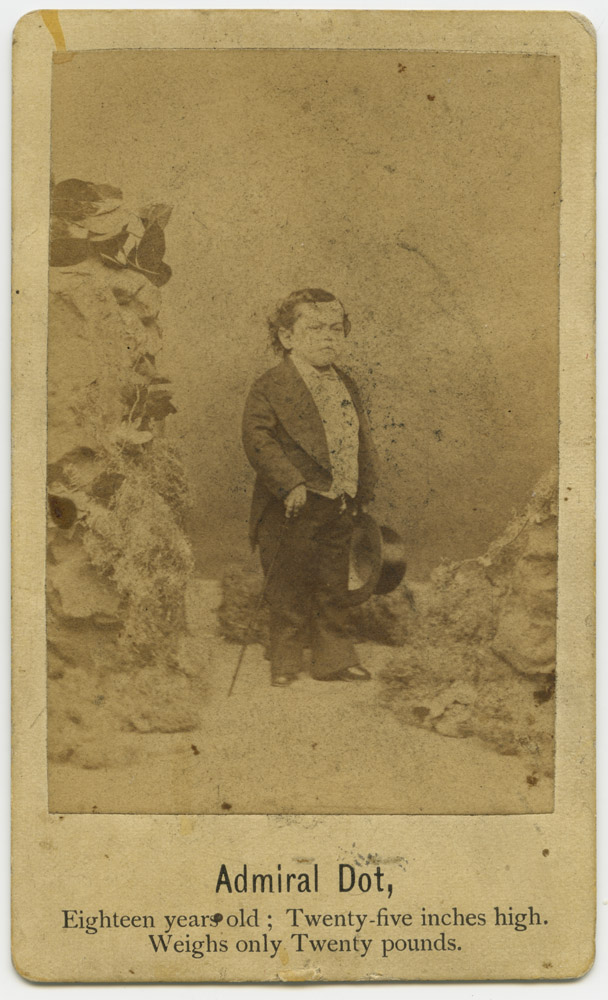
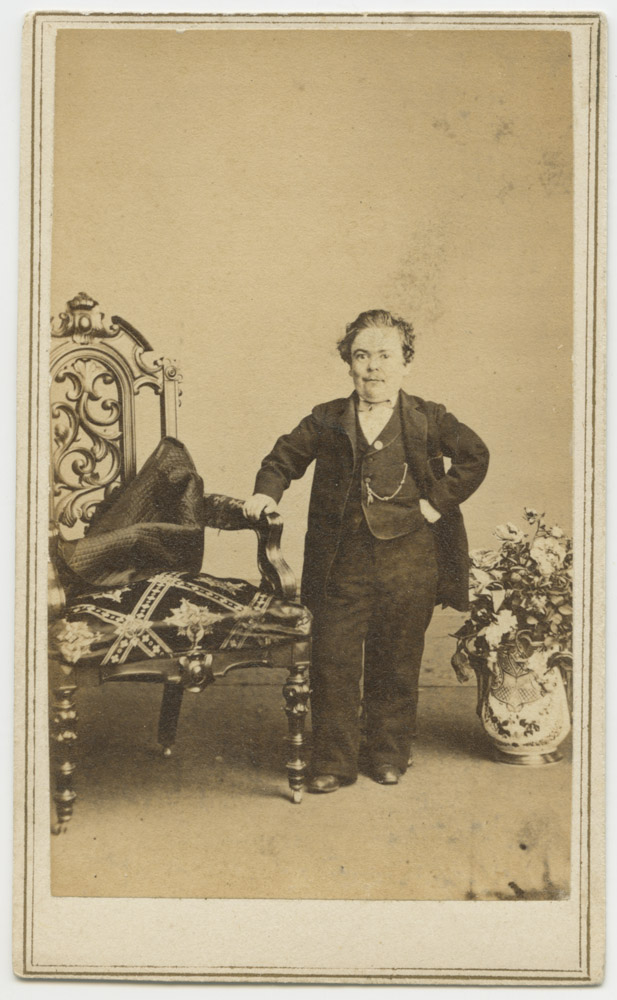
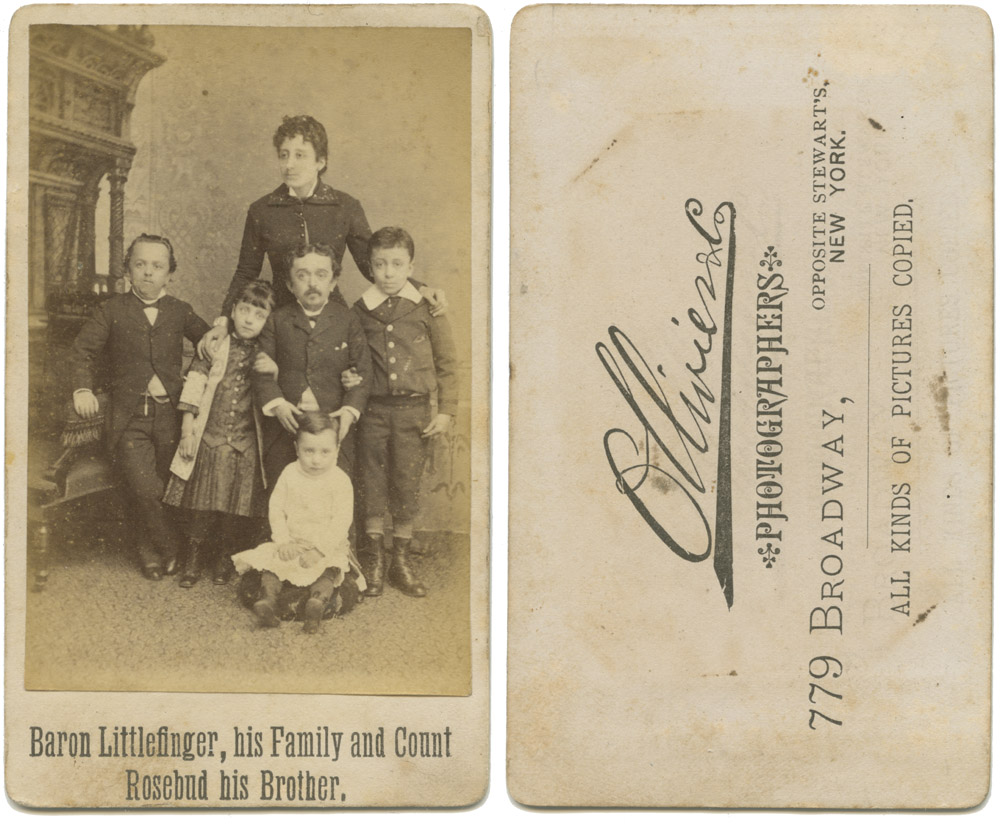
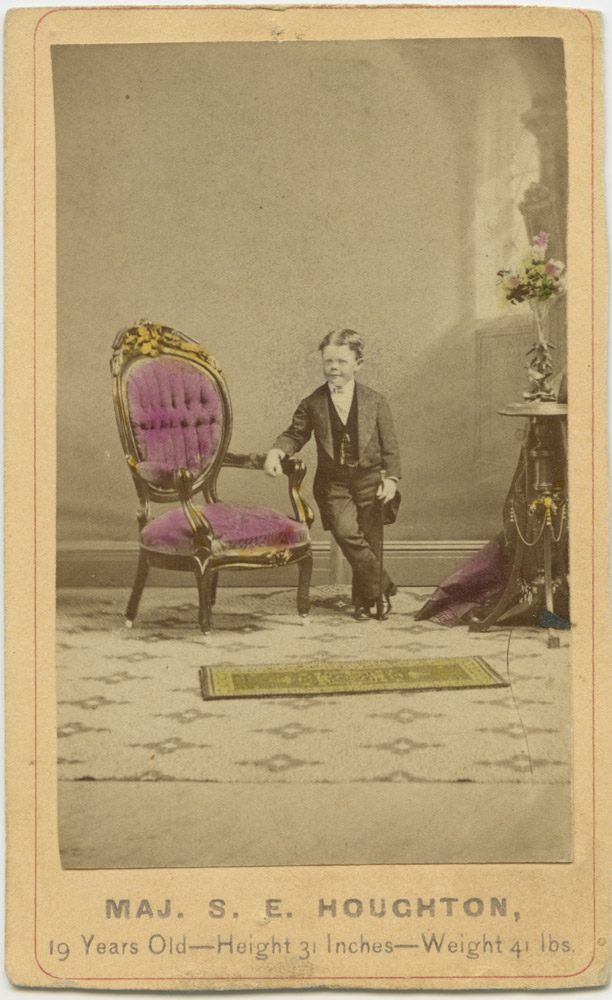
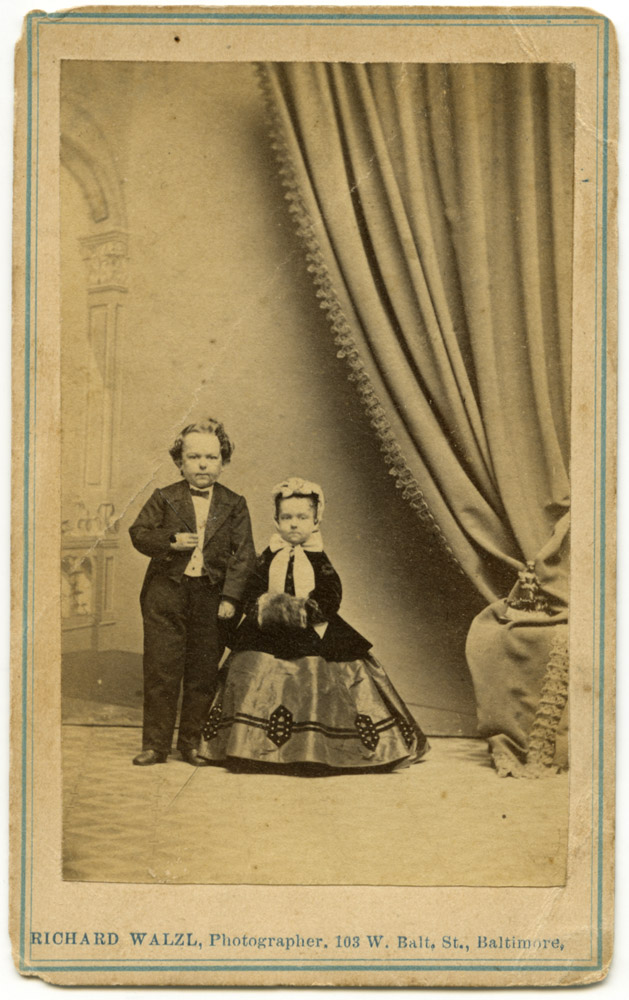
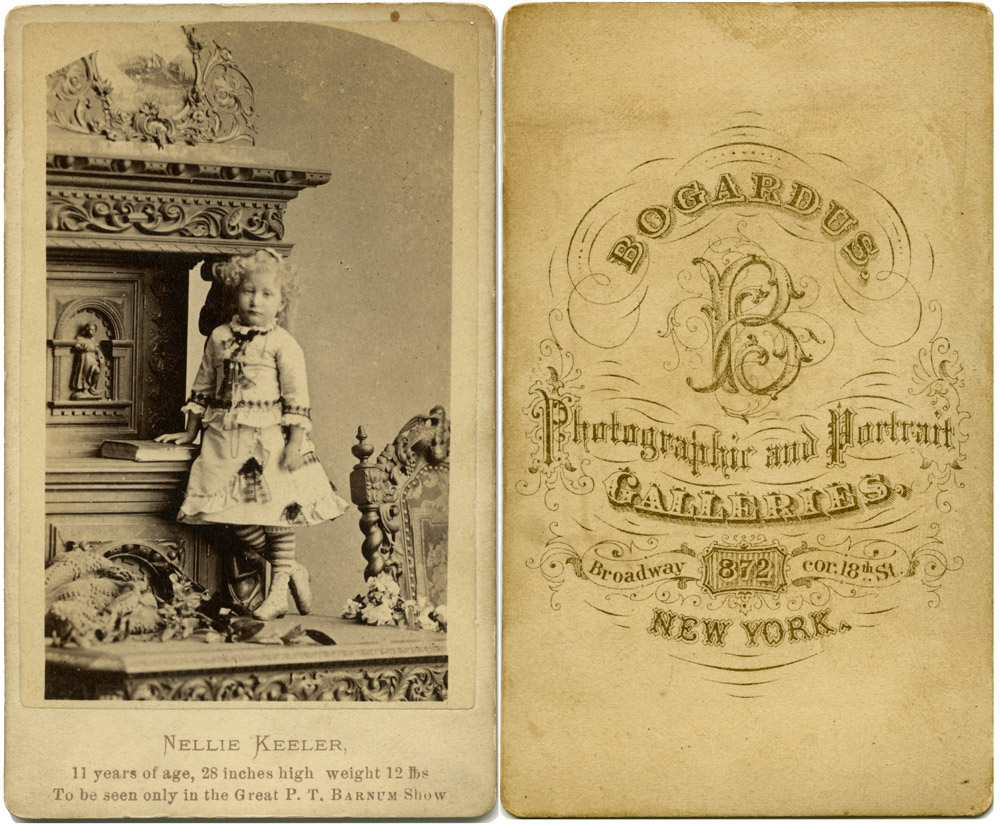
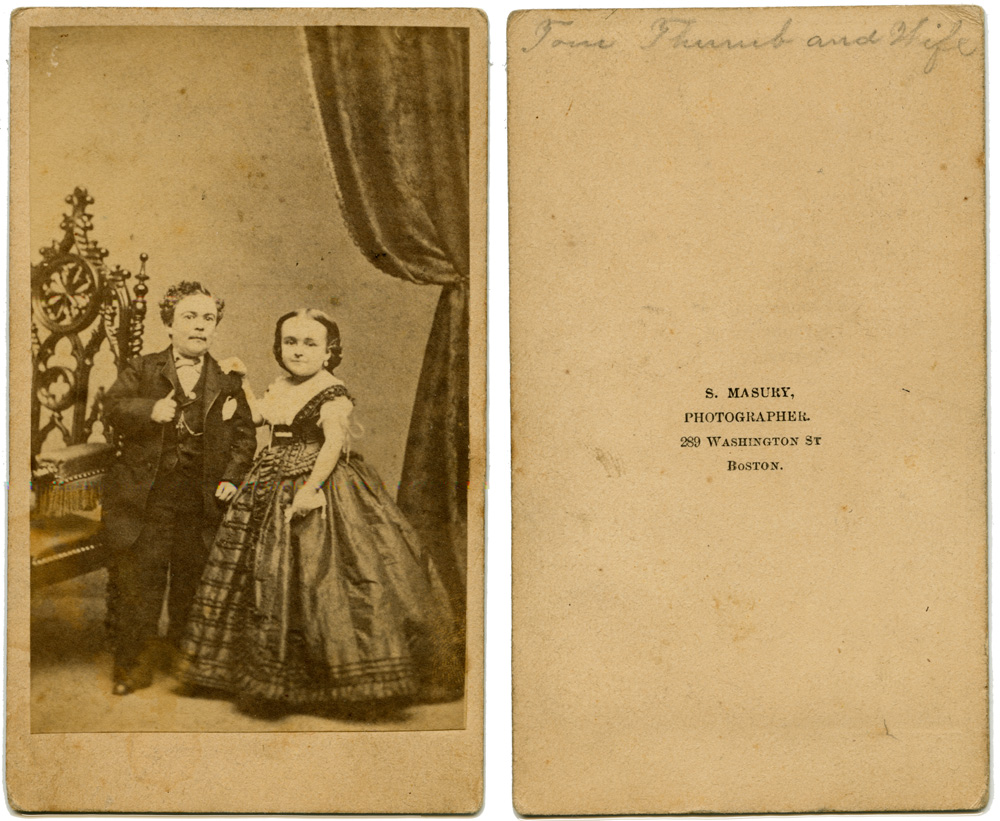
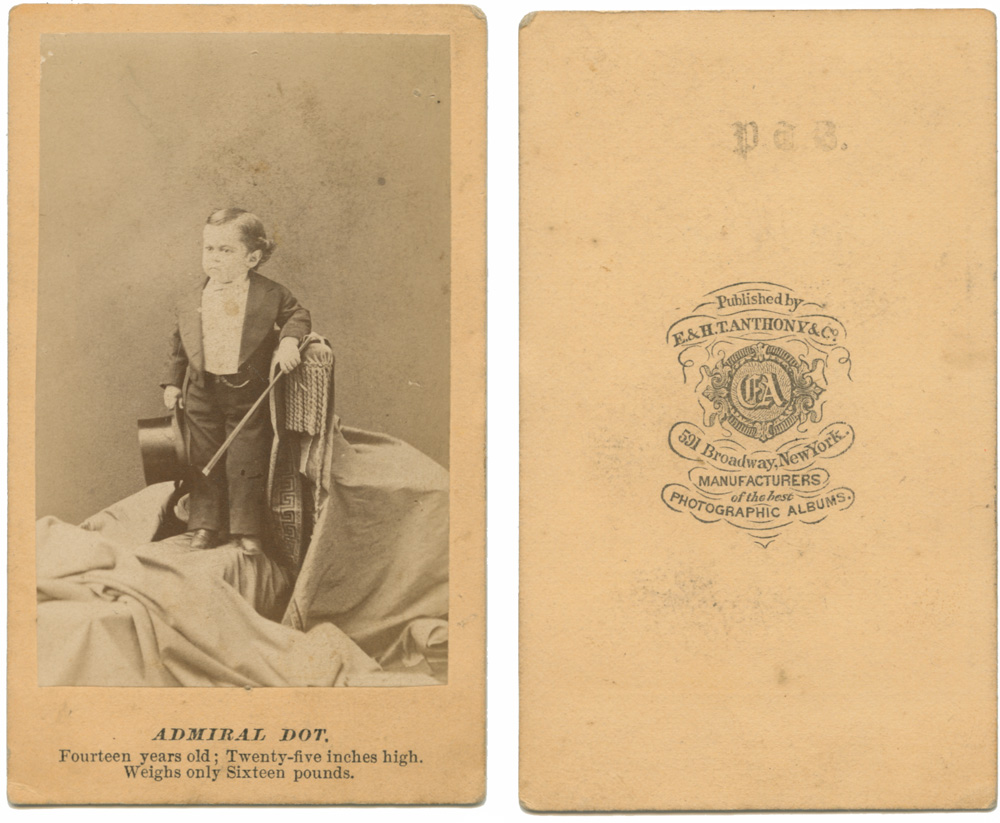
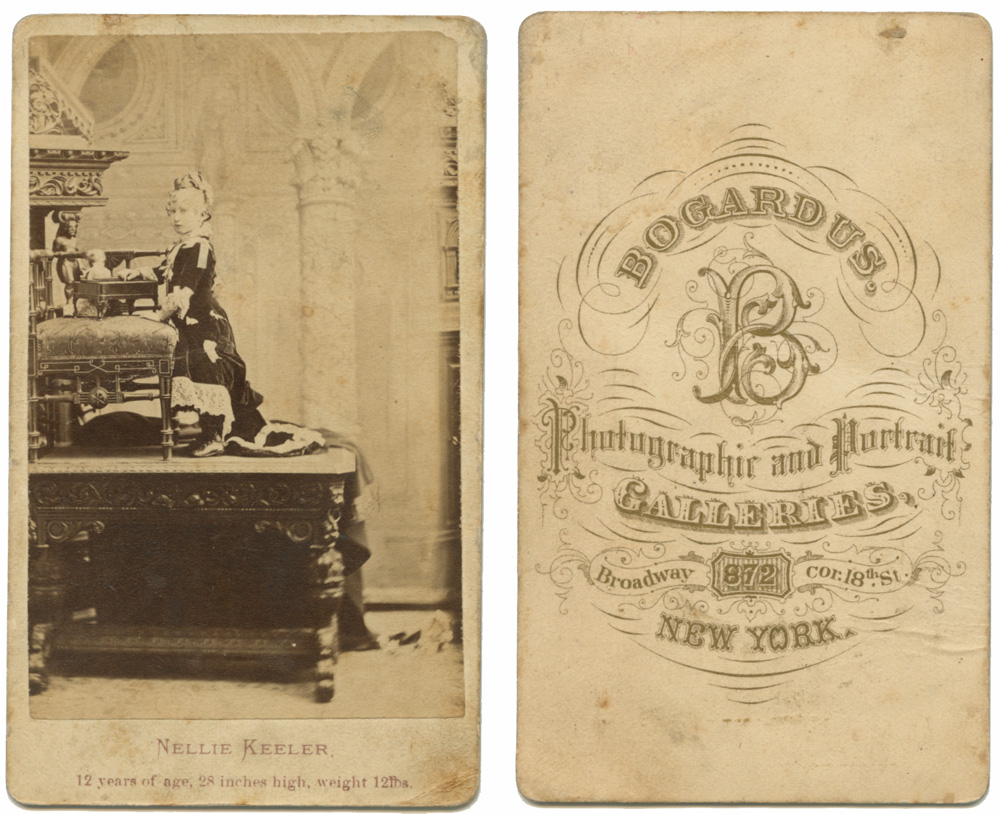
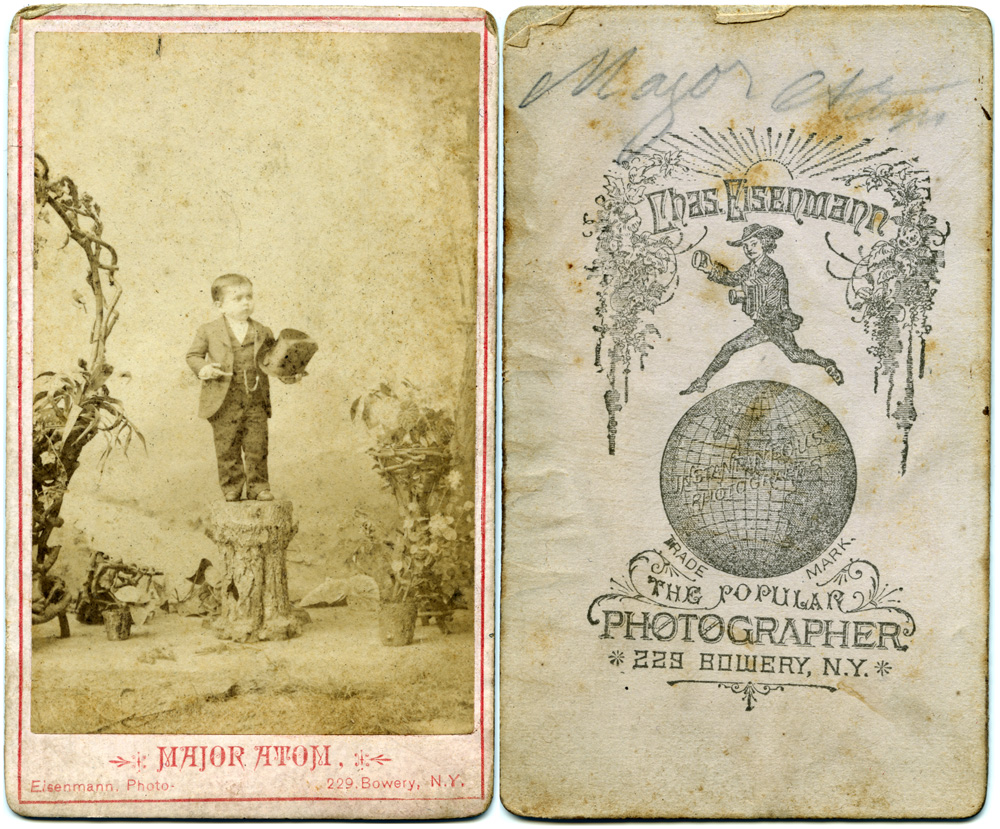
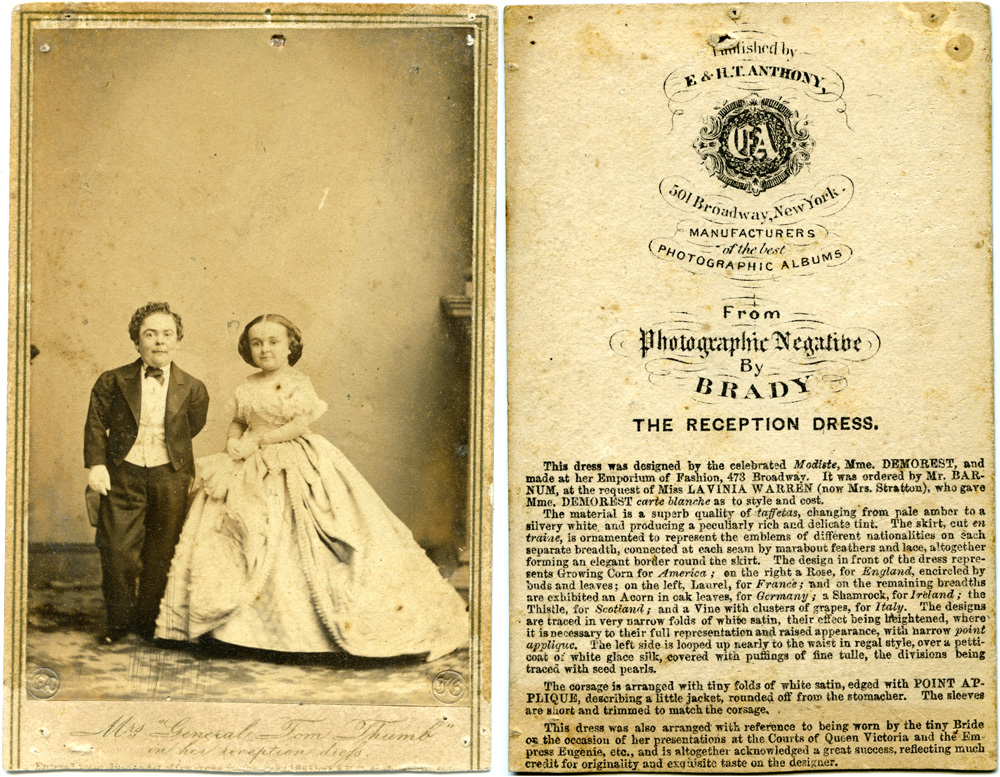
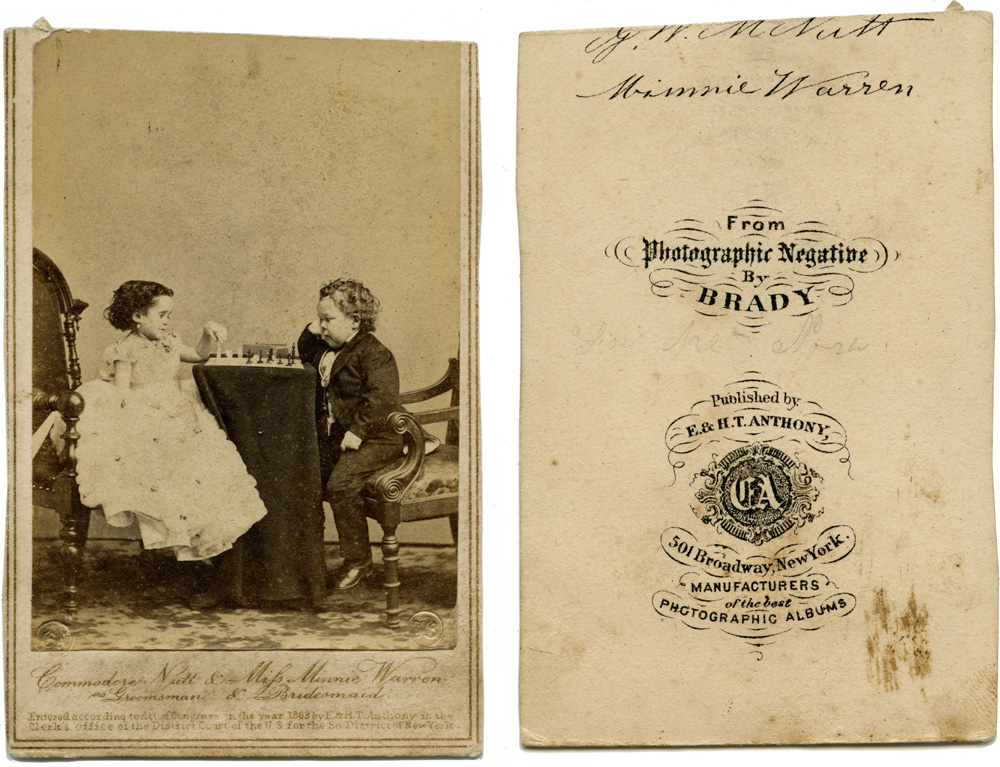
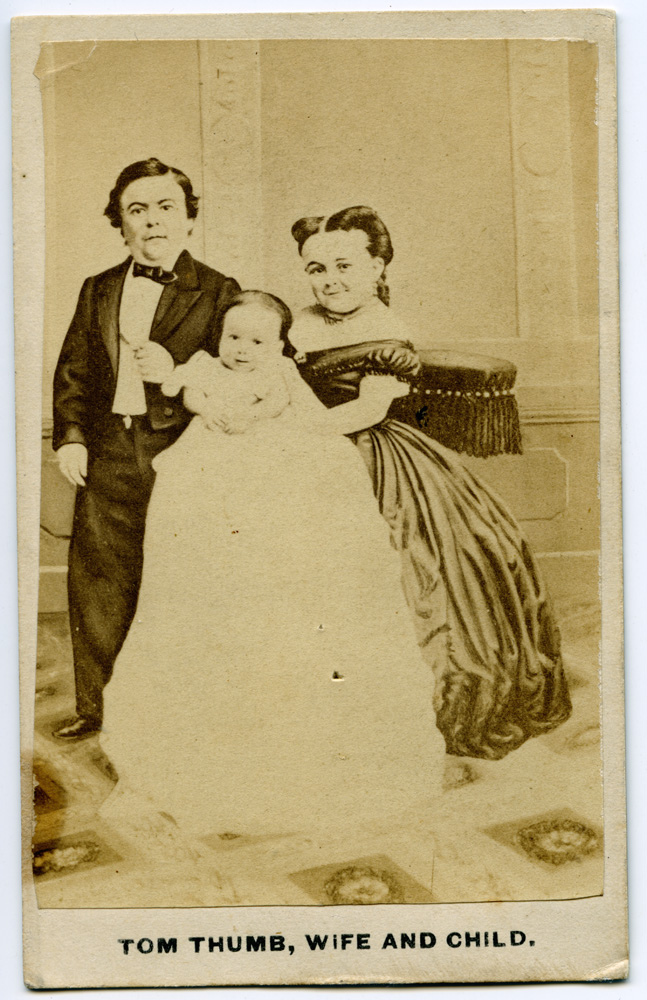
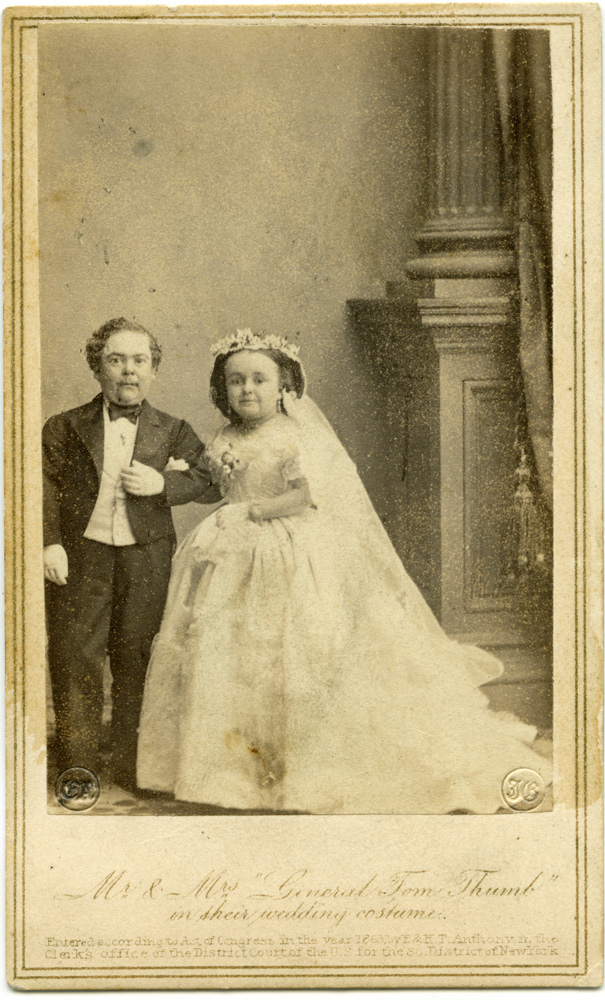
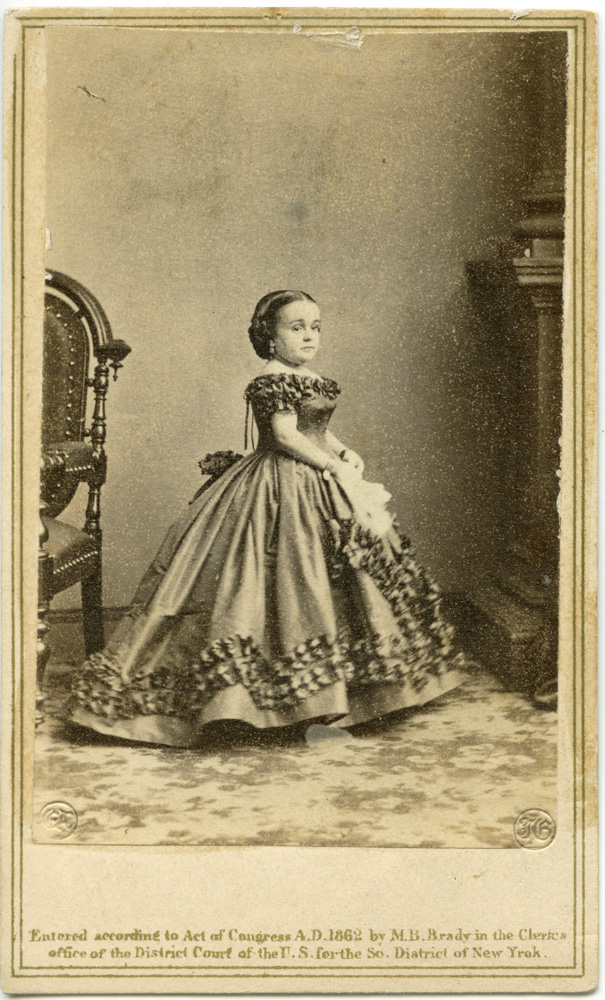
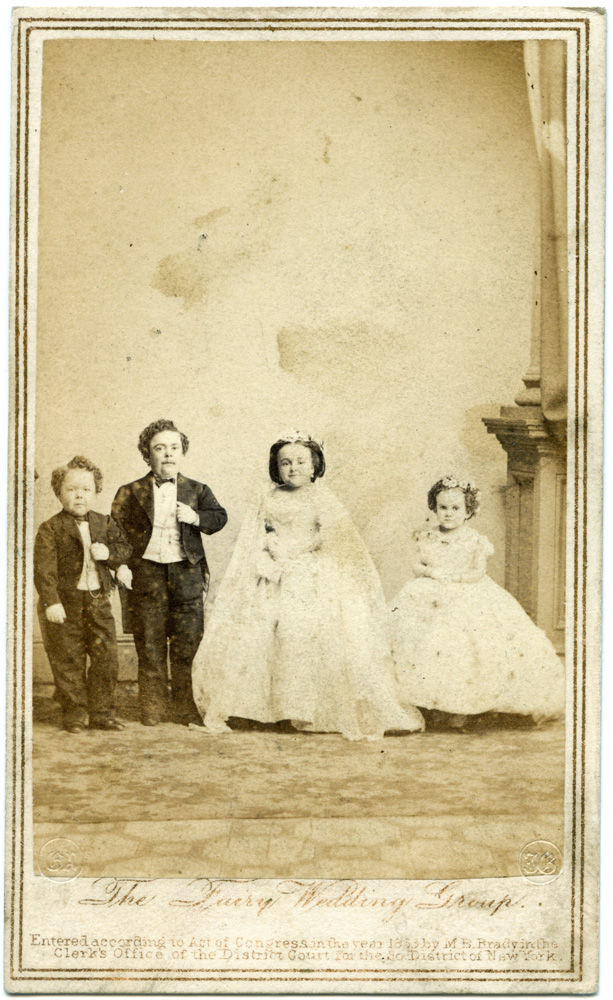
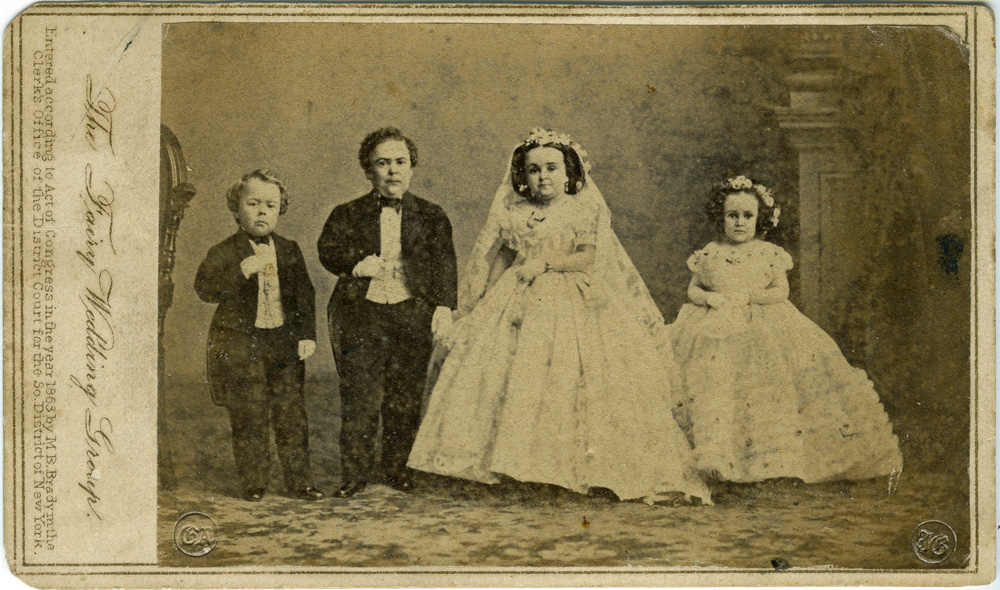
Miss Suzie Reed, by BradyMajor Littlefinger & Wife, by EisenmannThe Strattons, George Nutt and Minnie Warren in their Tuilieries outfitsUnknown Little Person, H.B. Gerncore’s Temple of ArtThree little people, by CD FredricksTom Thumb and Lavinia Warren, in middle ageThe Thumbs, Commodore Nutt and Minnie Warren, as presented to the QueenLavinia Warren Stratton Magri and the Magri Brothers, by OllivierAnonymous CDV, The Thumbs, at middle ageMr. Tower, by L.J. HurdMr. Chas. Decker, by Henry HeydeThe Thumbs, by the Stereoscopic Co of LondonMinnie Warren, by BradyAdmiral Dot & Lottie Swartwood By Chas EisenmannGeneral Cardenas, Anonymous PhotographerAdmiral Dot, published by Anthony, photographer unnamedTom Thumb by C.D. FredricksThe Magri Brothers with Lavinia Warren, ca. 1895Baron Littlefinger & FamilyMajor S.E. HoughtonLavinia Warren Stratton, by C.D. FredricksTom Thumb & Lavinia Warren – Walzl, Photographer, BaltimoreComic Actor by GurneyThe Rice Family, by J. Wood, The BoweryNellie Keeler, on Bogardus’ SideboardTom Thumb and Minnie Warren, in their advancing yearsTom Thumb and Lavinia Warren, by Masury of BostonAdmiral Dot, published by E&HT AnthonyNellie Keeler, by BogardusSideshow Family, Aledo, IllinoisWaino and Plutano, The Wild Men of Borneo, by EisenmannMajor Atom, by Chas. EisenmannThe Reception Dress, The Fairy WeddingGeorge Nutt & Minnie Warren, Groomsman & BridesmaidTom Thumb, Wife and “child”Bride & Groom, The Fairy WeddingLavinia Warren Stratton, Mrs. Tom ThumbFairy Wedding Group #3Commodore Nutt and unknown little woman, Anonymous CDV (probably Brady)Commodore Nutt, Mrs. and Mr. Tom ThumbThe Fairy Wedding, 1863 E&HT Anthony print, ObverseNellie Keeler- by Bogardus


















 dcphotoartist