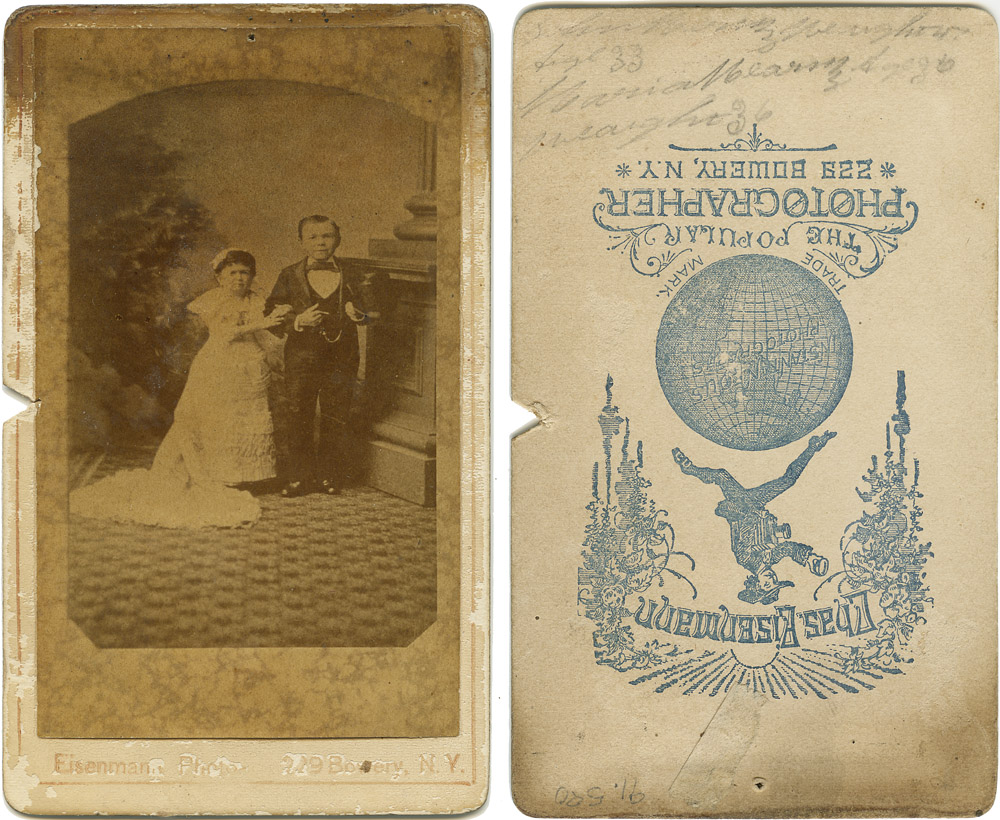
Here is another CDV for your consideration, in rather poorer condition than I normally like to buy, but I hadn’t seen this one before. This is Admiral Dot and his wife, Lottie Swartwood. I’ve inverted the image of the verso so you can at least try to make out the handwriting. From what I can read, it says, “…height 33… age 36…weight 36” (the ellipsis are where I can’t make out for sure what it says).
Admiral Dot & Lottie Swartwood By Chas Eisenmann
If you’ve been following my blog you know that Chas Eisenmann was quite the celebrity photographer specializing in people of the theater, which included the circus and vaudeville. I suppose photographing the Dots would have been a way to compete with Mathew Brady and the Anthonys, who had the Tom Thumb wedding photos in their portfolio.
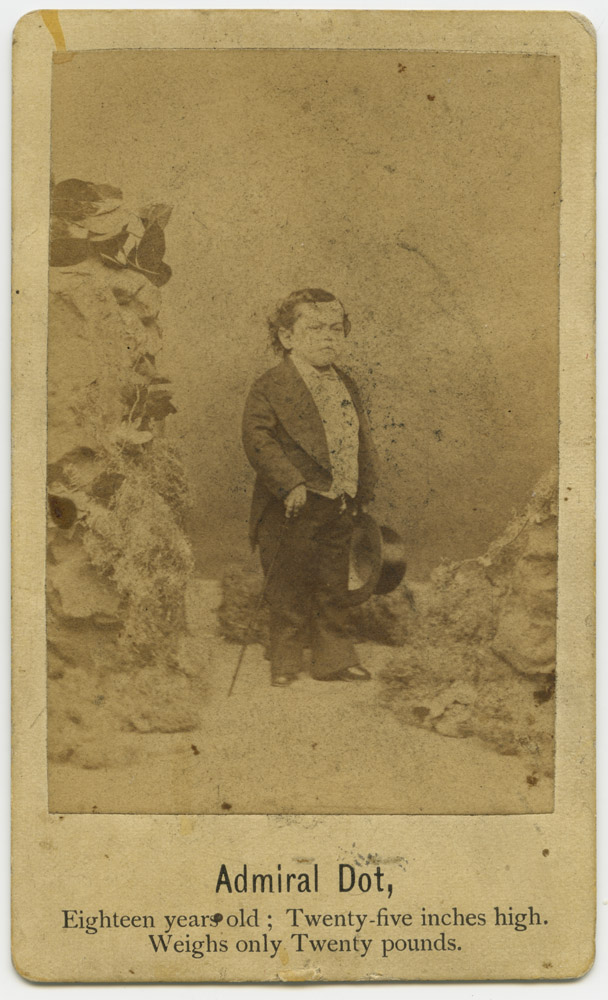
A newly arrived pair of circus midgets – Admiral Dot and General Cardenas. The Admiral Dot image is not in the best of condition, but it’s a different photo than the one I already have, and for some reason there are certain little people images that are much more expensive than others – Admiral Dot and Che Mah the Chinese Dwarf being two among them. I have yet to find a Che Mah in a condition I’d like to have it in for less than $150, and I’ve been outbid twice now on nice ones. Dudly Foster is another one that seems to command high prices for some reason.
Admiral Dot, was born Leopold Kahn in 1857(?). He was uncle of Samuel Kahn, “Major Atom”. In 1870, Phineas Taylor Barnum traveled with friends by train across the western United States. In San Francisco, a German named Gabriel Kahn offered the showman his dwarf son, Leopold. Barnum was quite taken with the little fellow, whom he said was “a dwarf more diminutive in stature than General Tom Thumb was when I found him.” Barnum promptly signed up Leopold under the new name of Admiral Dot, otherwise known as the the El Dorado Elf because he was such “a valuable nugget”.
As early as 1872, Barnum had already coined the phrase “The Greatest Show on Earth”, and now referrred to his circus as “P. T. Barnum’s Great Traveling World’s Fair”. At the time, Admiral Dot was touted as being sixteen years old, twenty-five inches tall, and a mere nineteen pounds. At least initially, Dot appeared on stage with his mother.
Admiral Dot’s career lasted for approximately the next twenty years, despite the fact that as he aged and grew taller he was soon eclipsed in size by smaller performers such as Major Atom, with whom he occasionally performed. Not one to rest on his laurels, Dot developed a stage persona that at one time saw him billed as “The Smallest Character Actor in the World”. During the 1880’s, Dot traveled with the Locke & Davis Royal Lilliputian Opera Company, which was populated by other famous little people such as the Magri Brothers and and Colonel Speck.
By the turn of the century, Leopold Kahn had settled in White Plains, New York, with his twenty-six-inch-tall wife Lottie Swartwood (a fellow performer in the opera company) and their two normal-sized children. Seeking respectability, Dot joined the Elks, sang with the town choir, and opened the Admiral Dot Hotel. The citizens of White Plains named the admiral honorary chief of the fire department, but unkindly referred to his business establishment as the Hotel Pee Wee (which, ironically, burned to the ground in 1911). Admiral Dot died of influenza in his home in White Plains on 28 October 1918, aged 54 years.
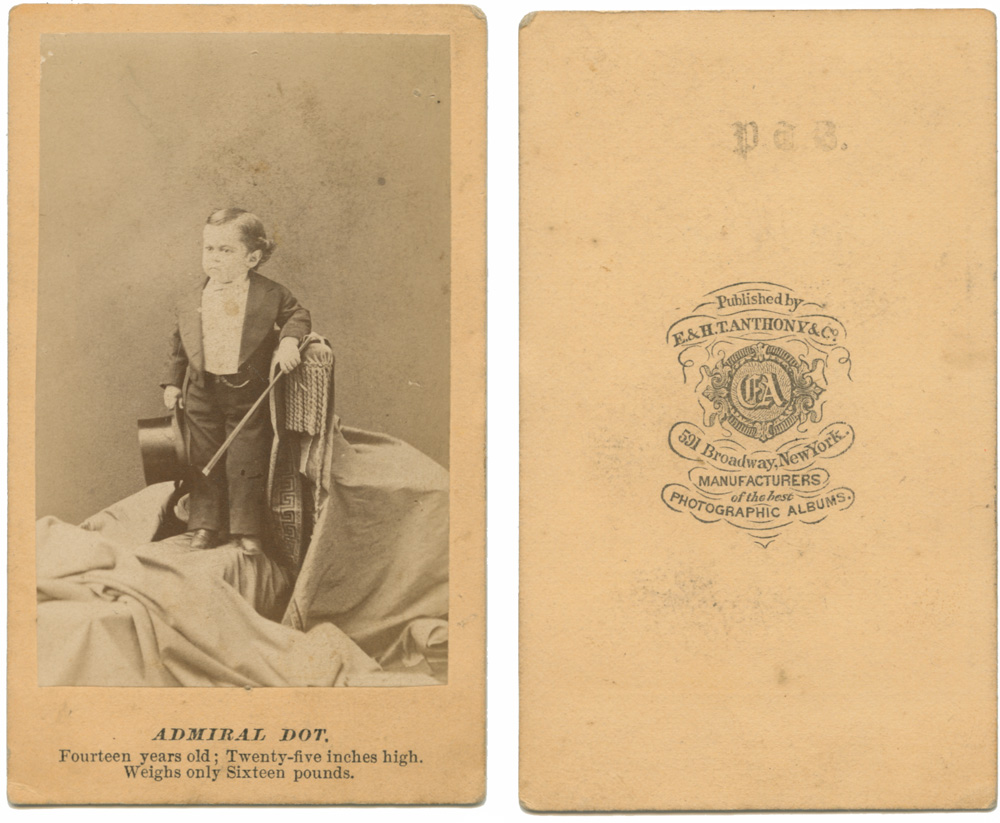
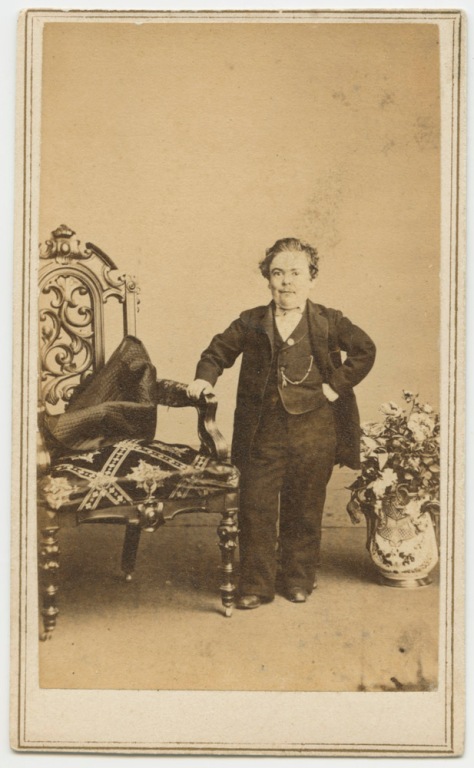
Admiral Dot, published by Anthony, photographer unnamed
I couldn’t find any biographical references for General Cardenas – for all I know even the last name is fake and he was a Swede from Minneapolis and not hispanic at all. I’ll keep digging and see if I can find more about him. I did find a different photo of him on the Syracuse University online image library that looks like it was taken at the same time because his outfit is identical and the chair next to him appears the same, but its set in a faux-outdoors scene with a bunch of tufted grass around the chair.
General Cardenas, Anonymous Photographer
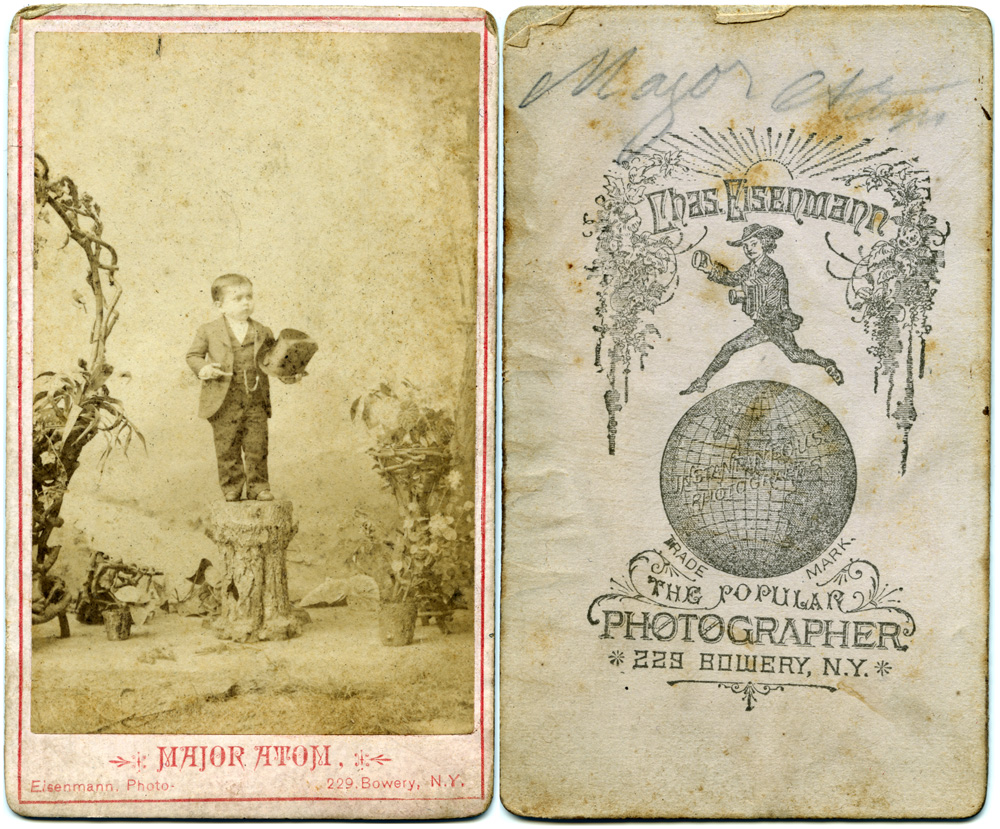
I’ll include some of my other little people with faux-military titles for reference, starting with Major Atom.
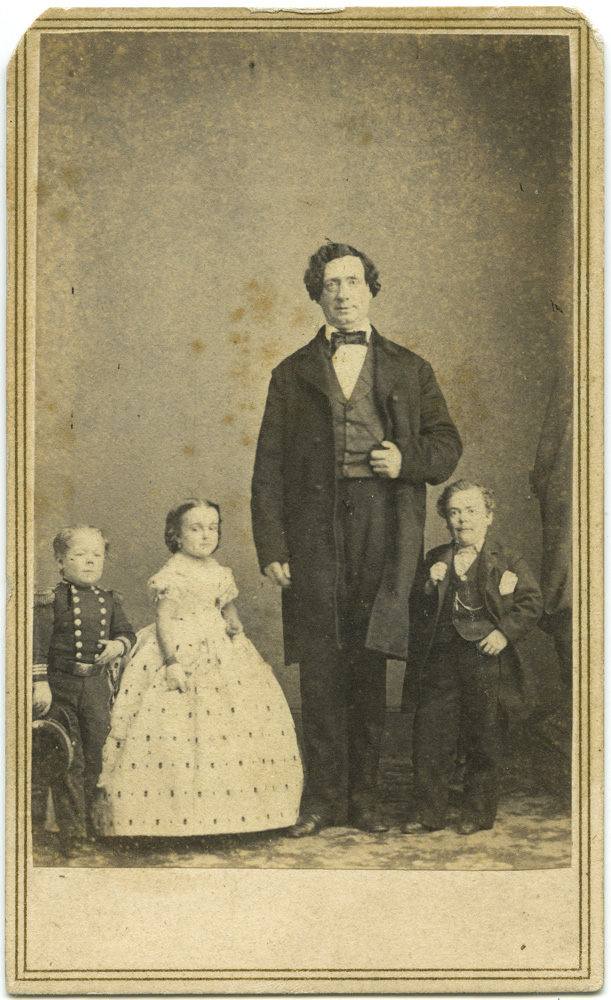
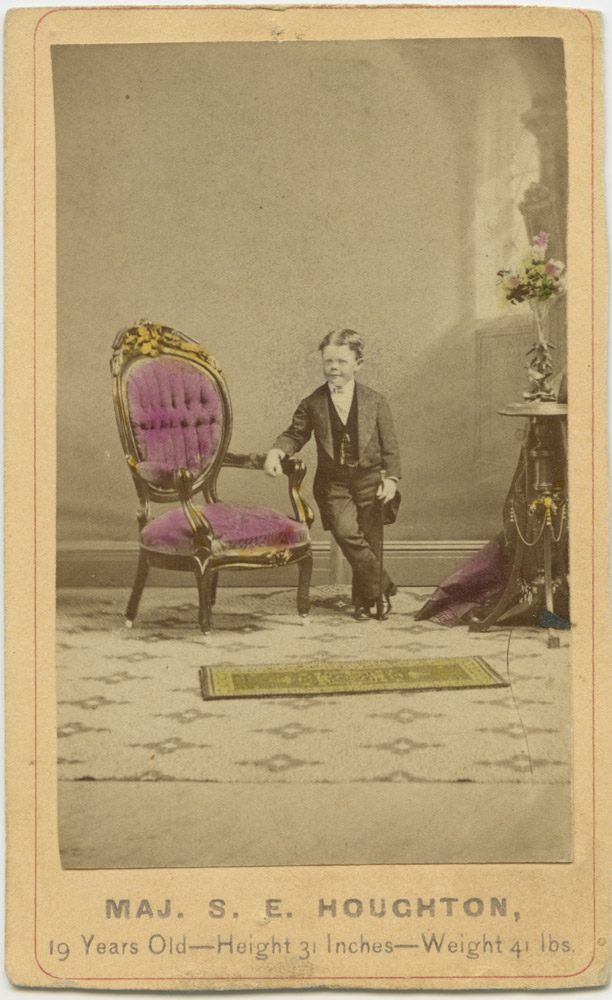
Admiral Dot, published by E&HT AnthonyMajor Atom, by Chas. EisenmannCommodore Nutt and unknown little woman, Anonymous CDV (probably Brady)Commodore Nutt, Mrs. and Mr. Tom ThumbMajor S.E. Houghton
Here’s another Tom Thumb, this time by C.D. Fredricks. Proof positive that even when at home in New York, Tom Thumb was photographer agnostic, but still selective – if not posing for Brady, he was still going to the best names in town to get his photos done.
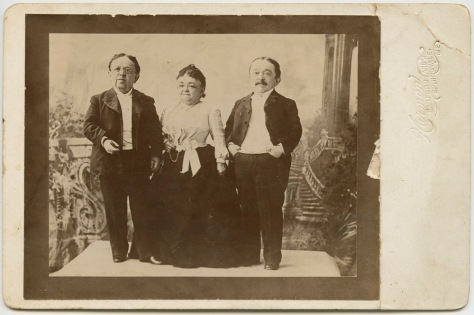
Here is a cabinet card from the mid 1890s of Lavinia Warren and the Magri Brothers (Baron Littlefinger and Count Rosebud). After Tom Thumb passed away in 1883, the widow Thumb met the Count and (his alleged twin brother) Baron Littlefinger. His real name was Primo Magri. She went on to marry him in July, 1885. They continued performing into old age to the point of appearing in a silent movie in 1915, five years before the Count’s death. Lavinia Warren died in 1919 at the approximate age of 77 (her birth date is unrecorded, so it is possible she was 78 at the time of her passing).
Circassian beauties is a phrase used to refer to an idealized image of the women of the Circassian people of the Northern Caucasus. A fairly extensive literary history suggests that Circassian women were thought to be unusually beautiful, spirited, and elegant, and as such were desirable as concubines. This reputation dates back to the later Middle Ages, when the Circassian coast was frequented by Italian traders from Genoa, and the founder of the Medici dynasty, Cosimo I de Medici, had a well-known affair with a Circassian slave girl. During the Ottoman Empire. Circassian women living as slaves in the Sultan’s Imperial Harem started to build their reputation as extremely beautiful and genteel, which then became a common trope in Western Orientalism.
As a result of this reputation, in Europe and America Circassians were regularly characterised as the ideal of feminine beauty in poetry, novels, and art. Cosmetic products were advertised, from the 18th century on, using the word “Circassian” in the title, or claiming that the product was based on substances used by the women of Circassia.
In the 1860s the showman P. T. Barnum exhibited women whom he claimed were Circassian beauties. They wore a distinctive Afro-like hair style, which had no precedent in earlier portrayals of Circassians, but which was soon copied by other female performers, who became known as “moss haired girls”. These were typically presented as victims of sexual enslavement among the Turks, who had escaped from the harem to achieve freedom in America.
The combination of the popular issues of slavery, the Orient, racial ideology, and sexual titillation gave the reports of Circassian women sufficient notoriety at the time that the circus leader P. T. Barnum decided to capitalize on this interest. He displayed a “Circassian Beauty” at his American Museum in 1865. Barnum’s Circassian beauties were young women with tall, teased hairstyles, rather like the Afro style of the 1970s. Actual Circassian hairstyles bore no resemblance to Barnum’s fantasy. Barnum’s first “Circassian” was marketed under the name “Zalumma Agra” and was exhibited at his American Museum in New York from 1864. Barnum had written to John Greenwood, his agent in Europe, asking him to purchase a beautiful Circassian girl to exhibit, or at least to hire a girl who could “pass for” one. However, it seems that “Zalumma Agra” was probably a local girl hired by the show, as were later “Circassians”.Barnum also produced a booklet about another of his Circassians, Zoe Meleke, who was portrayed as an ideally beautiful and refined woman who had escaped a life of sexual slavery.
The portrayal of a white woman as a rescued slave at the time of the American Civil War played on the racial connotations of slavery at the time. It has been argued that the distinctive hairstyle affiliates the side-show Circassian with African identity, and thus,
resonates oddly yet resoundingly with the rest of her identifying significations: her racial purity, her sexual enslavement, her position as colonial subject; her beauty. The Circassian blended elements of white Victorian True Womanhood with traits of the enslaved African American woman in one curiosity.
The trend spread, with supposedly Circassian women featured in dime museums and travelling medicine shows, sometimes known as “Moss-haired girls”. They were typically identified by the distinctive hairstyle, which was held in place by the use of beer. They also often performed in pseudo-oriental costume. Many postcards of Circassians also circulated. Though Barnum’s original women were portrayed as proud and genteel, later images of Circassians often emphasised erotic poses and revealing costumes. As the original fad faded, the “Circassians” started to add to their appeal by performing traditional circus tricks such as sword swallowing.
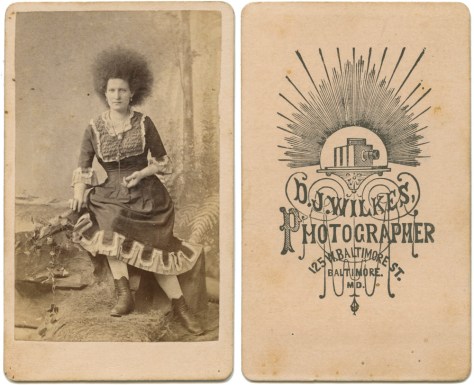
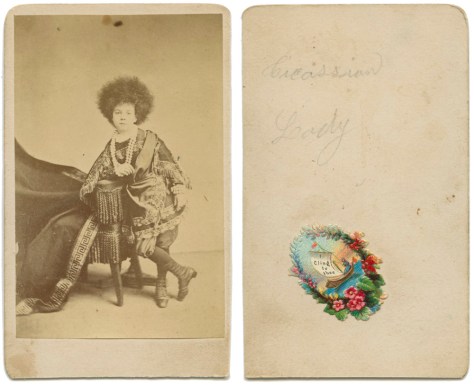
I had been hunting for a CDV of the Circassian Beauty for a while, and then found two images of “Circassian Beauties” on CDV recently. The one is fascinating because she’s obviously just a teenager. The other is an adult woman. I have seen other CDVs of Barnum’s Circassian, although I’ve seen a different name associated with her – Zenobia. It’s highly likely that there was more than one associated with Barnum’s Museum and later the traveling circus. I find the showman mentality of Barnum and his contemporaries utterly fascinating that they would have no qualms about not only faking someone supposedly from the Ottoman Empire, but that they would indulge in the exploitation of the specific mores and fears of their time that they did – enslaved white women as concubines of “the Oriental” was only one step removed from the notion of white women being sexually used by black men, especially in the immediate aftermath of the Civil War. And that Barnum would try to buy an actual Circassian woman speaks volumes to his mindset – while he would display her as liberated from slavery, in fact, he would acquire her as if she were still property.
Circassian Beauty, by D. Wilkes, BaltimoreCircassian Girl
I’d love if anyone out there knows anything about the sticker on the back of the second card – thematically it could be contemporary to the card, but it could also be as recent as the 1930s.
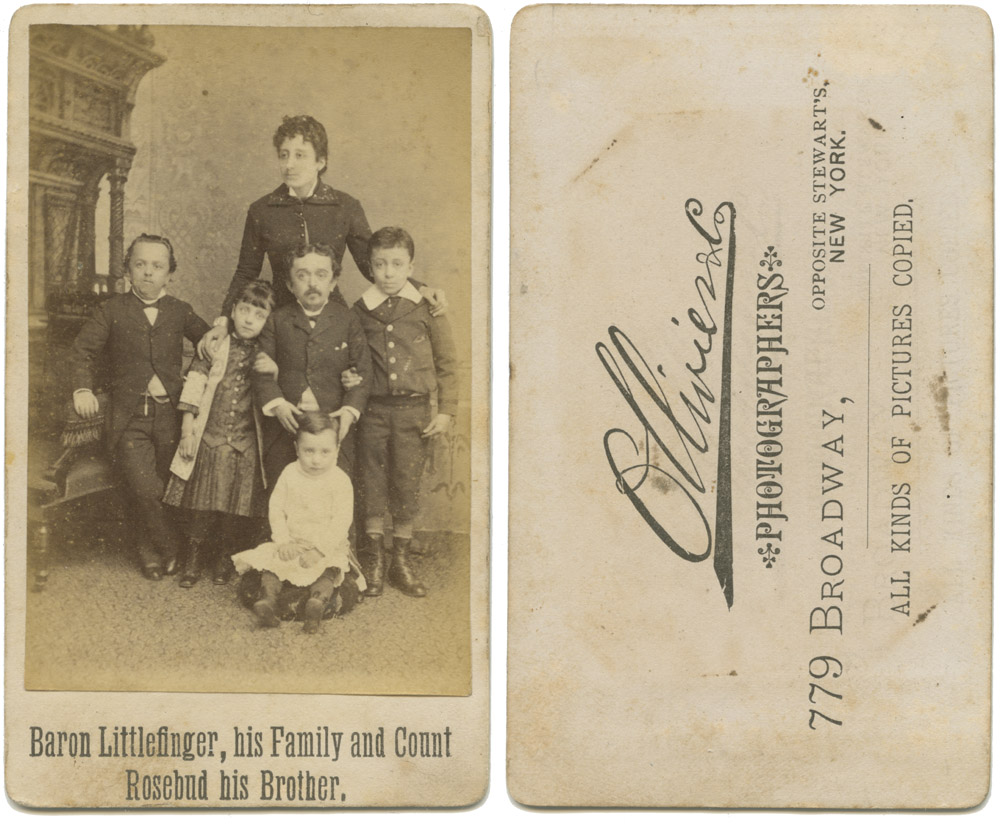
I realize I just posted this image in my previous entry, but I think it’s worthy of a separate post. Frankly, I’ve had it in my collection for a while but for some reason I didn’t post it at the time I added it. So I’m making up for the past omission. I think it’s worthy of adding a separate entry because their story is interesting. Count Rosebud was an Italian named Primo Magri. He and his brother Giuseppe (or according to some accounts, Ernesto), Baron Littlefinger, were allegedly given actual titles by Pope Pius IX. They toured as performers. In 1885, Count Rosebud married the widow Thumb, Mrs. Lavinia Warren. They had to perform into old age because they supposedly had very lavish tastes and could not afford to retire. I haven’t seen any back story on the rest of the family referenced in this photo – who were they, were they really the Count’s family or just props like the Thumbs’ baby, did he divorce this woman at some point before marrying Lavinia, or was he a widower?
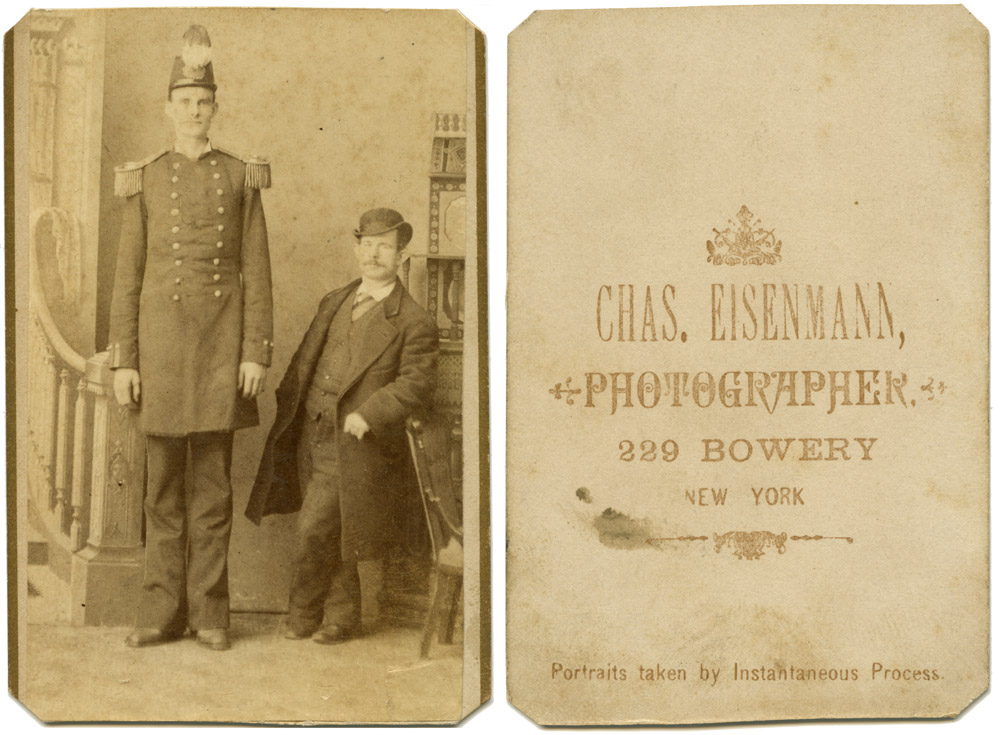
My latest CDV of a circus sideshow midget. What was it with the circus and fake military ranks or titles? Major Houghton, Admiral Dot, Major Atom (although there’s a wee (pardon the pun) bit of irony in that one), Commodore Nutt, General Tom Thumb, Baron Littlefinger and Count Rosebud and just to name a few. Even when folks weren’t given fake titles, they often got dressed up in military-esque uniforms, like my photo of Landon Middlecoff, or some of the other giants I’ve seen.
Major S.E. HoughtonMajor Atom, by Chas. EisenmannAdmiral Dot, published by E&HT AnthonyCommodore Nutt and unknown little woman, Anonymous CDV (probably Brady)Baron Littlefinger & FamilyLandon Middlecoff, the ‘Kentucky Giant’, by Eisenmann
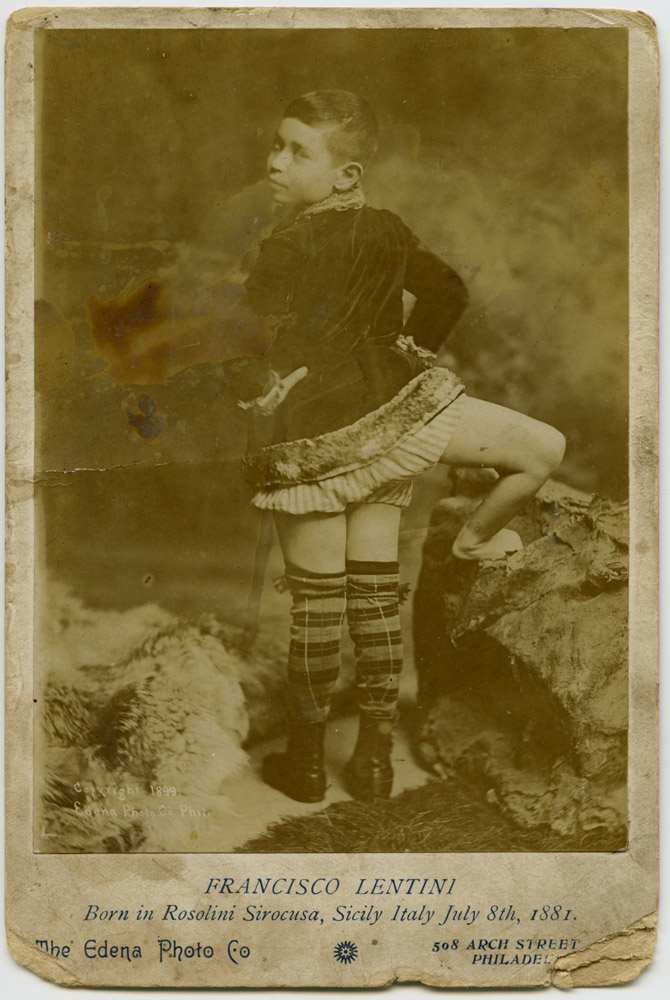
Frank (Francesco, Francisco) Lentini (May 18, 1881 – September 22, 1966) was born at Rosolini, near Syracuse, Sicily into a family of twelve children, seven sisters and five brothers.
He was born with three legs, two sets of genitals and one rudimentary foot growing from the knee of his third leg. So, in total, he had three legs, four feet, sixteen toes, and two sets of functioning male genitals, which were all that existed of a conjoined twin and jutted from the right side of his body. The doctors determined that since his twin was connected to his spine, removal could have resulted in paralysis. When his parents refused to acknowledge him, his aunt raised him but eventually handed him over to a home for disabled children. As a child Lentini had hated his extra body parts until he spent time at the home. There, he met children who were deaf, blind, and mute. He also learned to walk, ice skate, and jump rope.
At the age of eight, Lentini moved to the U.S. and entered the sideshow business as The Great Lentini, joining the Ringling Brothers Circus act. He gained US citizenship at the age of 30. His career spanned over forty years and he worked with every major circus and sideshow including Barnum and Bailey and Buffalo Bill’s Wild West Show. Lentini was so respected among his peers that he was often simply called “The King”.
In his youth, Lentini used his extraordinary third leg to kick a soccer ball across the stage, hence his show name, the Three-Legged Football Player. By the time he was six, Lentini’s normal legs were slightly different in length–one was 39 inches, the other 38 inches–but the third leg was only 36 inches, and the foot on it was clubbed.[1] Even more as an adult, while his extra leg was several inches shorter than the others, his primary legs were also two different lengths. He was heard to complain that even with three legs, he still didn’t have a pair. He married Theresa Murray, three years younger than him, and they had four children: Josephine, Natale, Frank and James. Frank Lentini died in Jacksonville, Florida on 22 September 1966.
Over on The Human Marvels, there’s a wonderful discussion thread below a photo of Frank in which a number of his descendants/probable descendants have chimed in with questions and reminiscences. It’s well worth a read.
Another CDV by C.D. Fredricks, of Lavinia Warren Stratton, Mrs. Tom Thumb. It’s an interesting addition to the Tom Thumb collection, as it shows they (the Thumbs) were very much the same as 21st century celebrities, getting photographed by all the fashionable photographers and trying to capitalize on their fame while it lasted. They seem to have had a particular loyalty to Brady, as this is the first definitive non-Brady I own of them. Can’t wait to find more
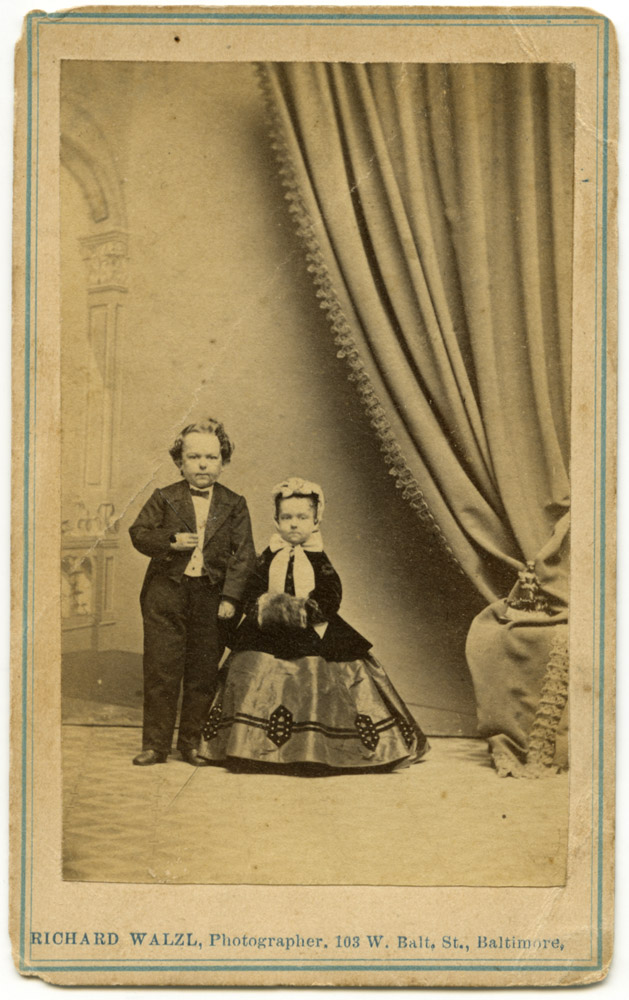
Tom Thumb & Lavinia Warren – Walzl, Photographer, Baltimore
Here’s a photo of Tom Thumb and Lavinia Warren, NOT by Mathew Brady, Gurney & Sons, Eisenmann or C.D. Fredericks. I’ve seen a few by the other photographers, but the Brady ones are the most common. This is cool to me as it shows them being photographed in other cities as they toured – celebrity culture is not a new thing, but at least back in that day, technology largely excluded the possibility of ambush paparazzi.
Funny story about that though – back when the White House did not have a secure perimeter with heavily armed guards, one of Abraham Lincoln’s boys was out playing in the yard. An enterprising and rather self-assured photographer approached the boy and talked him in to sitting for some pictures, and then sent him inside to get his dad to pay. Needless to say, Mr. Lincoln was NOT happy about this, and came out to confront the photographer. The photographer consented to not charge Mr. Lincoln if he would sit for a few himself, which he grudgingly did. Try doing that to the first family today!



 dcphotoartist