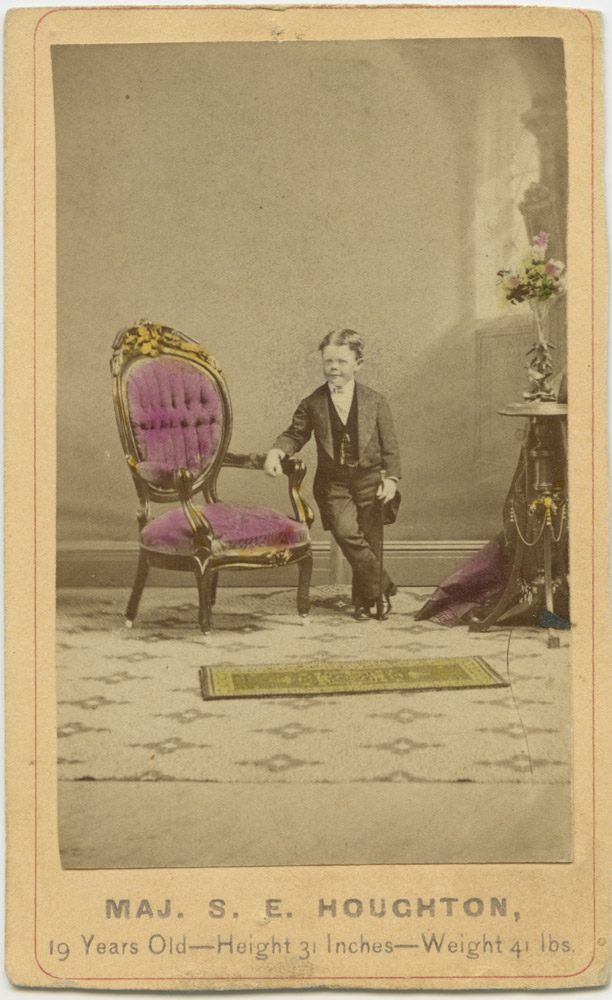
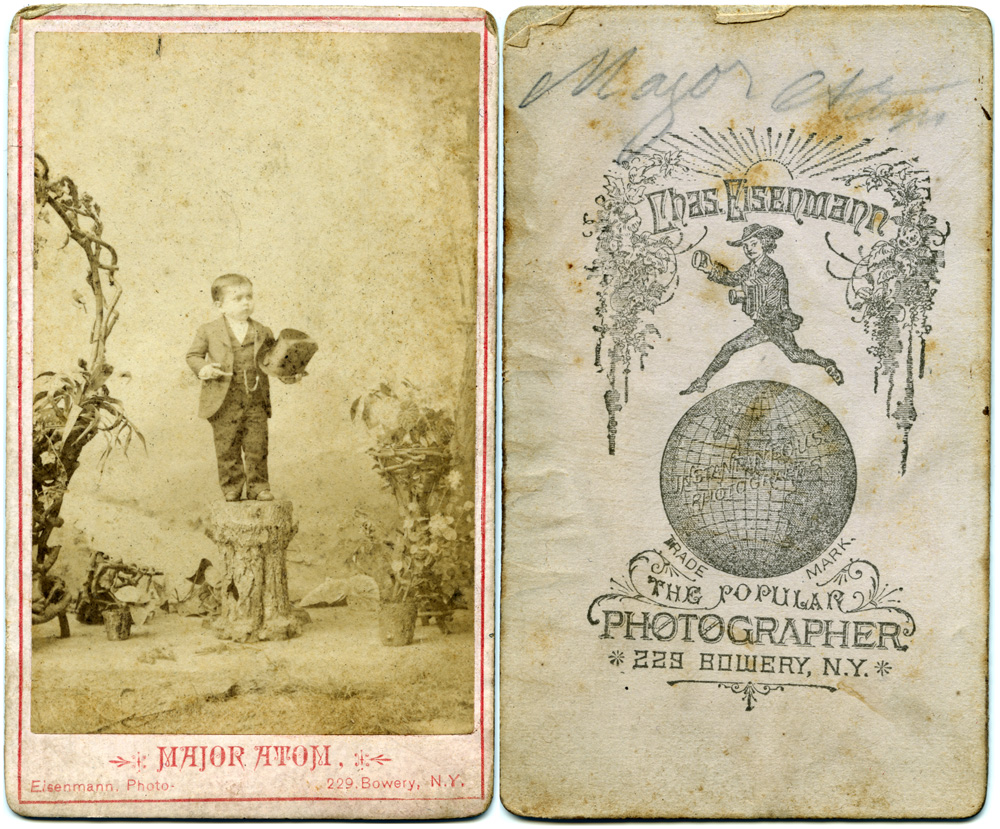
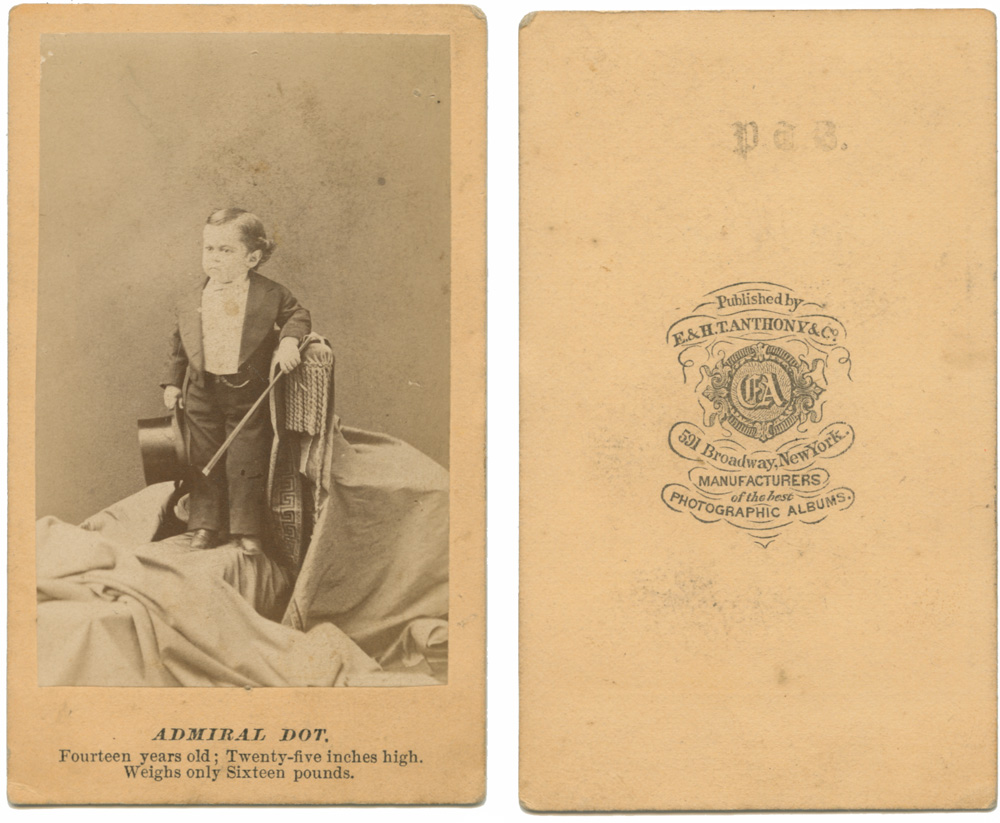
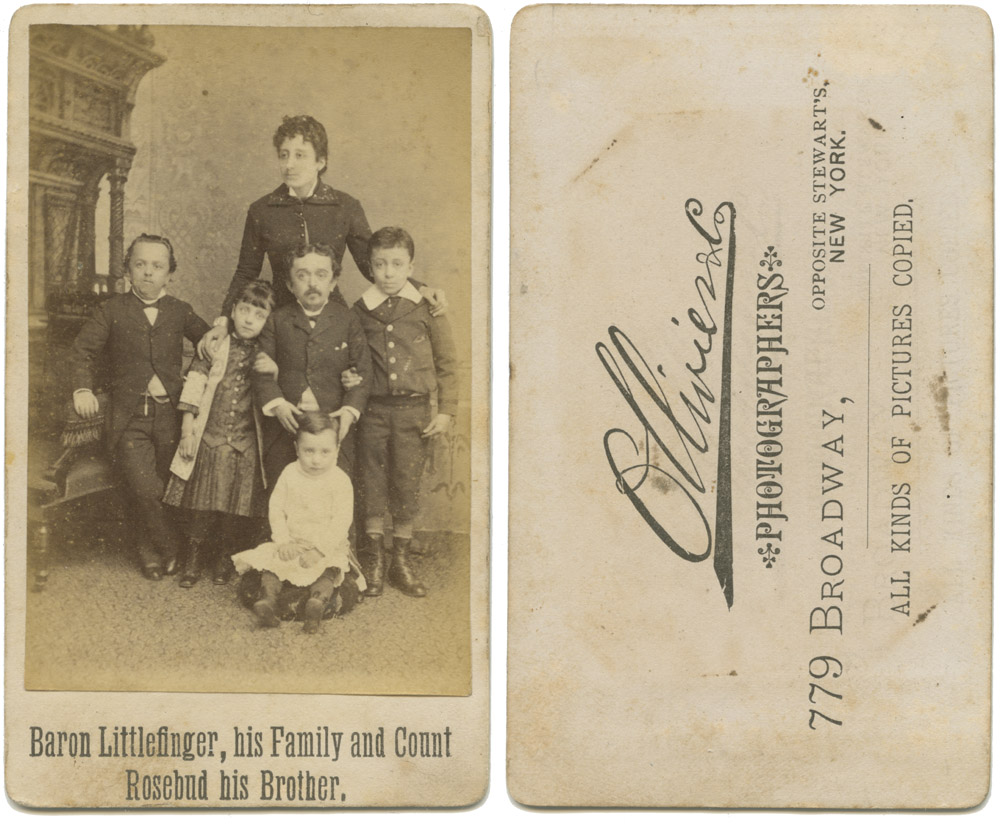
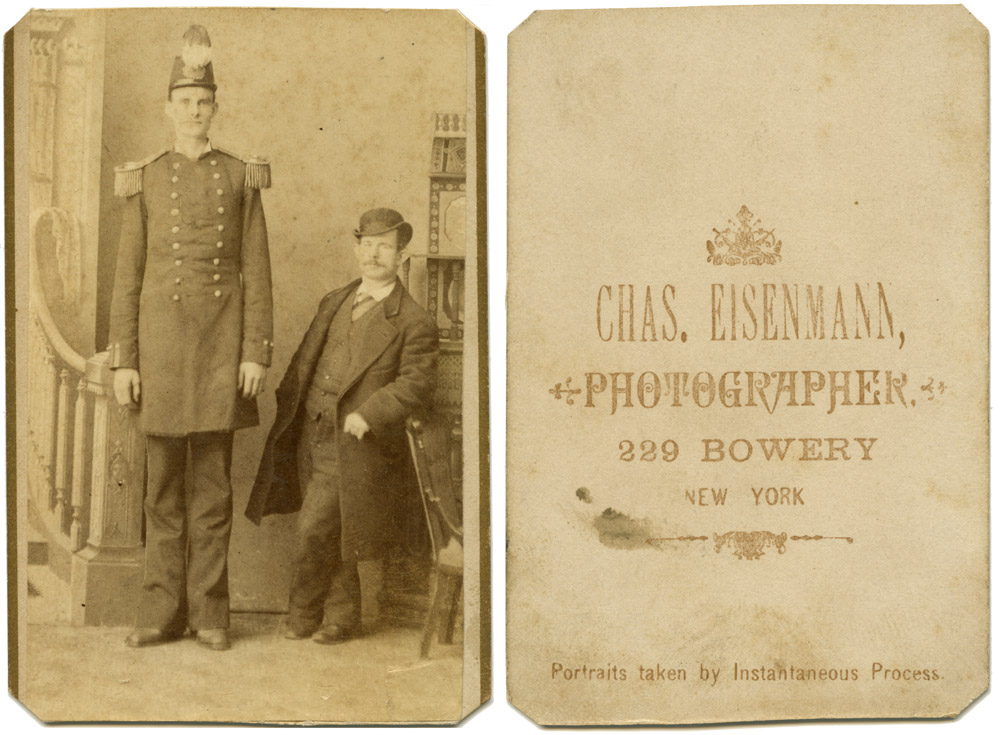
My latest CDV of a circus sideshow midget. What was it with the circus and fake military ranks or titles? Major Houghton, Admiral Dot, Major Atom (although there’s a wee (pardon the pun) bit of irony in that one), Commodore Nutt, General Tom Thumb, Baron Littlefinger and Count Rosebud and just to name a few. Even when folks weren’t given fake titles, they often got dressed up in military-esque uniforms, like my photo of Landon Middlecoff, or some of the other giants I’ve seen.
Major S.E. HoughtonMajor Atom, by Chas. EisenmannAdmiral Dot, published by E&HT AnthonyCommodore Nutt and unknown little woman, Anonymous CDV (probably Brady)Baron Littlefinger & FamilyLandon Middlecoff, the ‘Kentucky Giant’, by Eisenmann
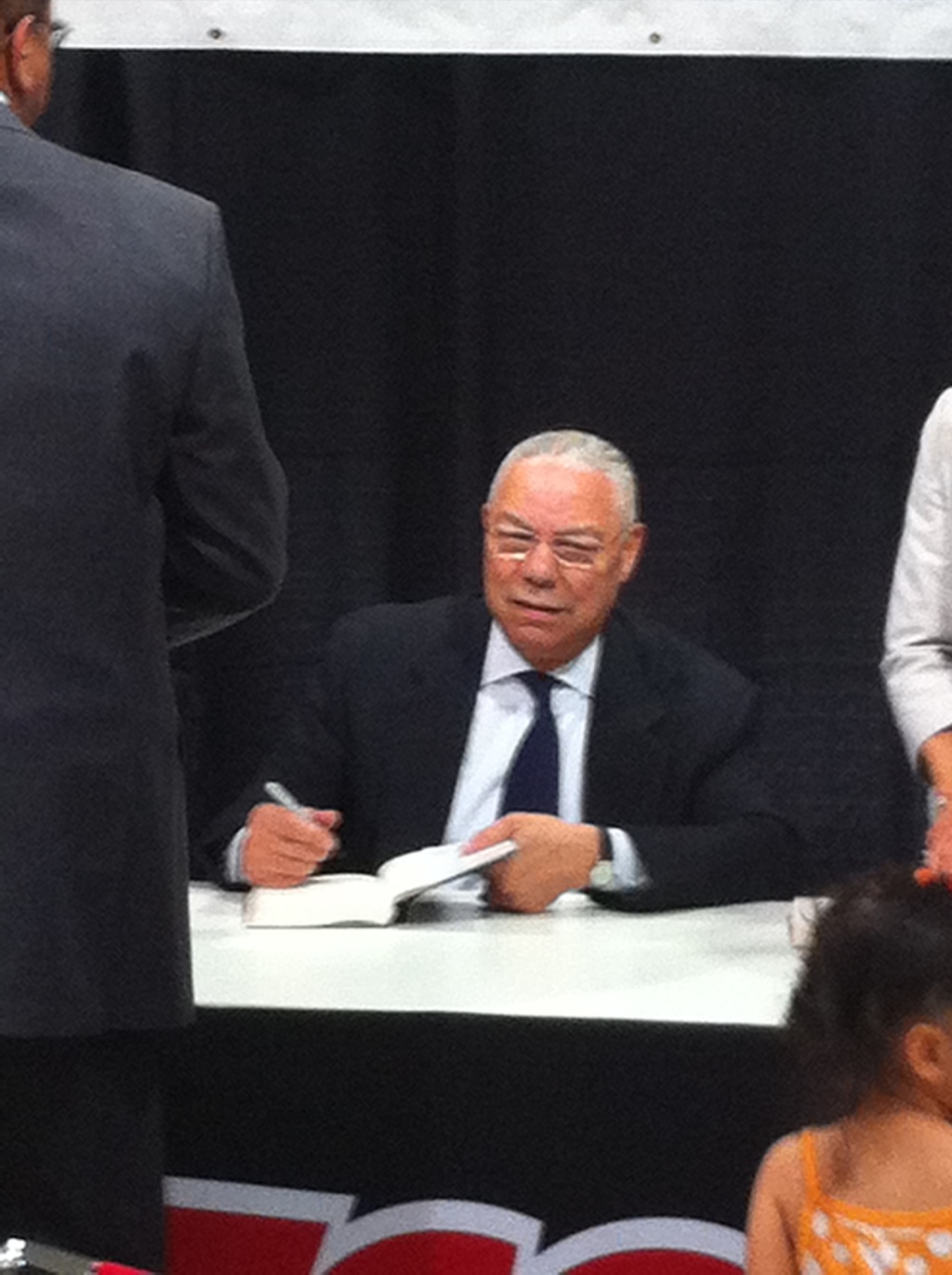
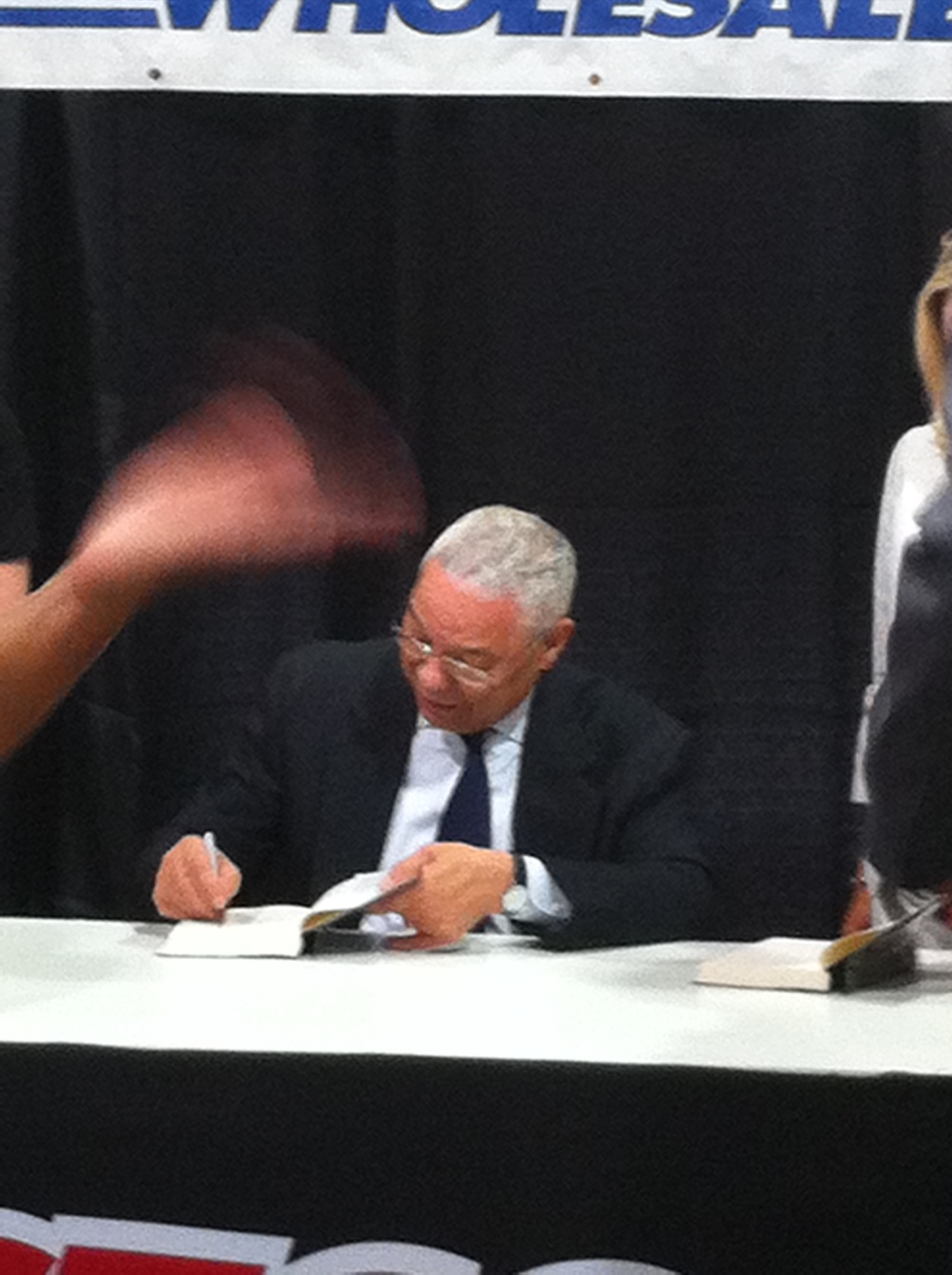
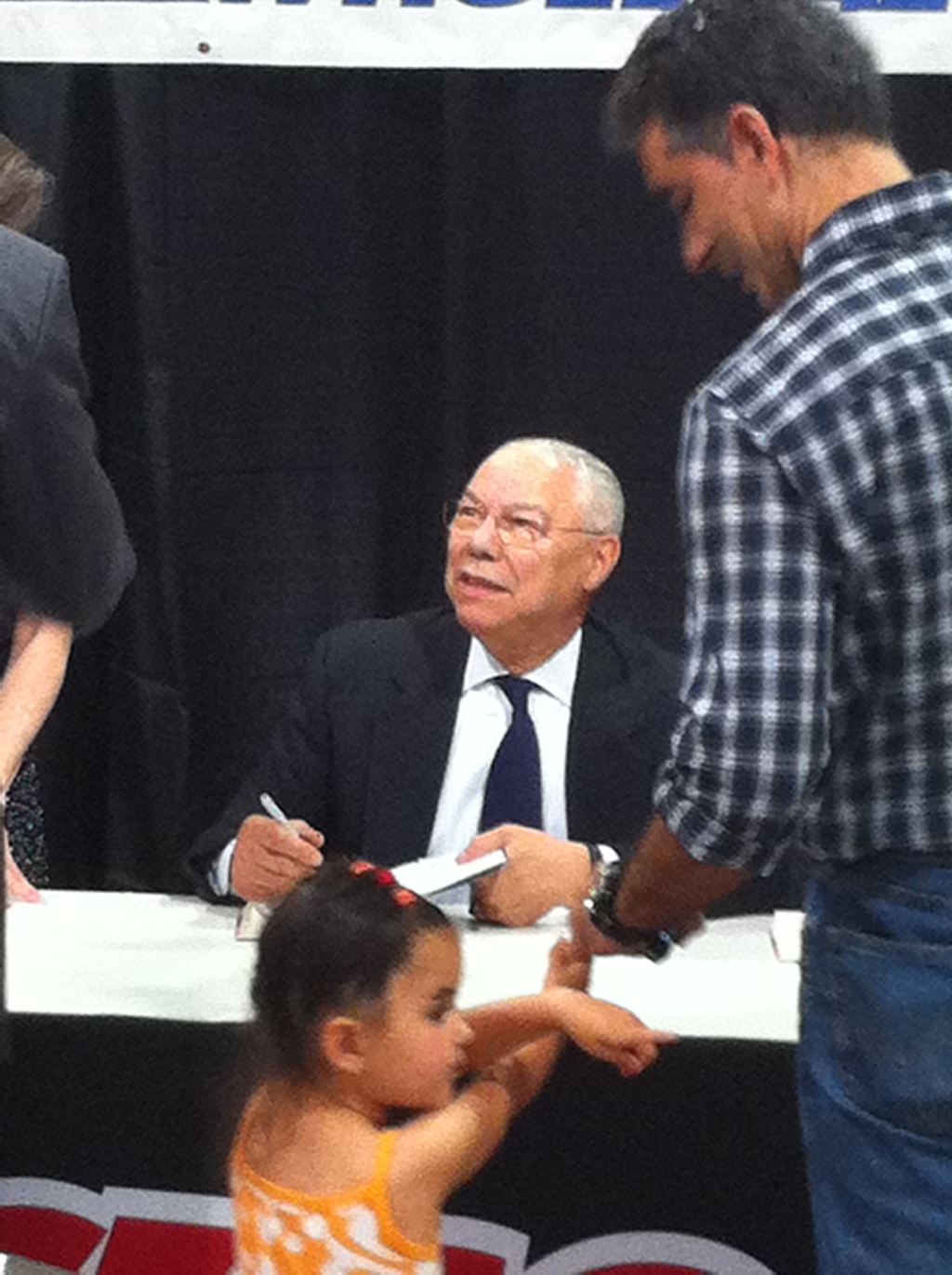
Here I was, just minding my own business doing a little shopping for me and the cats, when what do I see but the retired general and former Secretary of State, Colin Powell, signing copies of his new book.
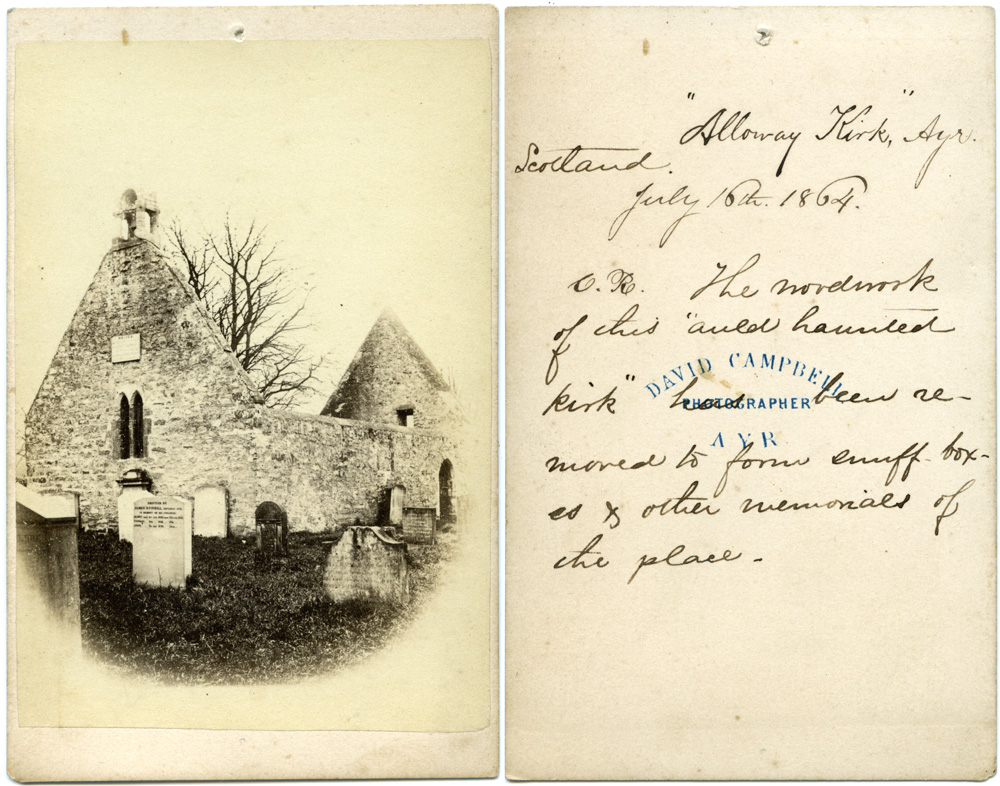
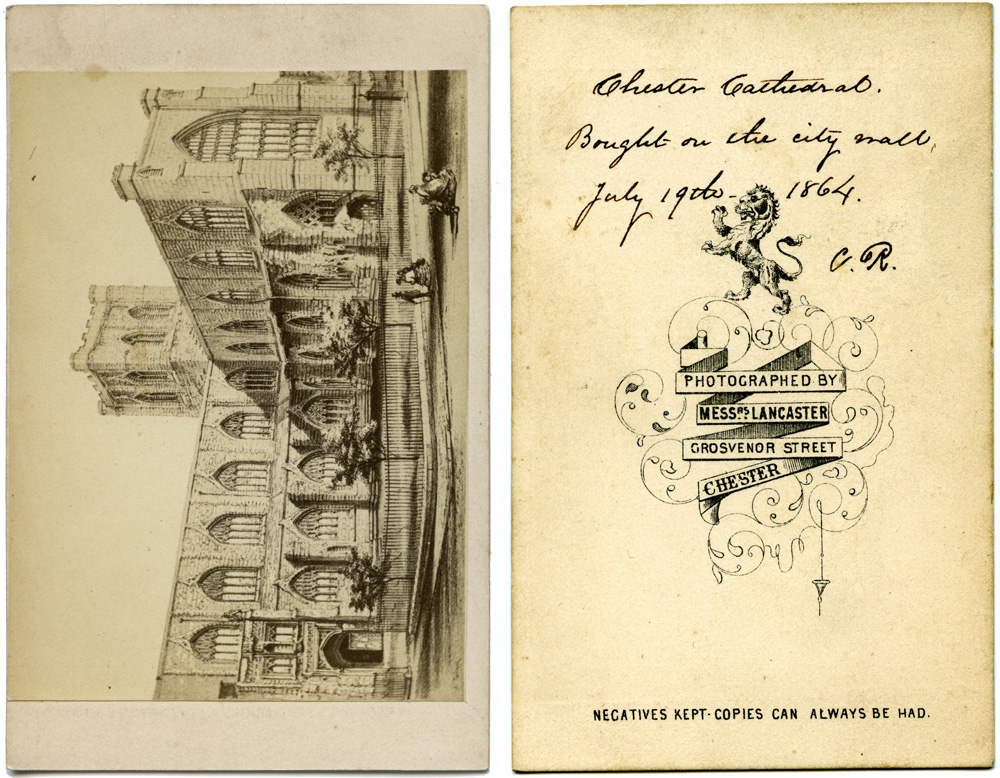
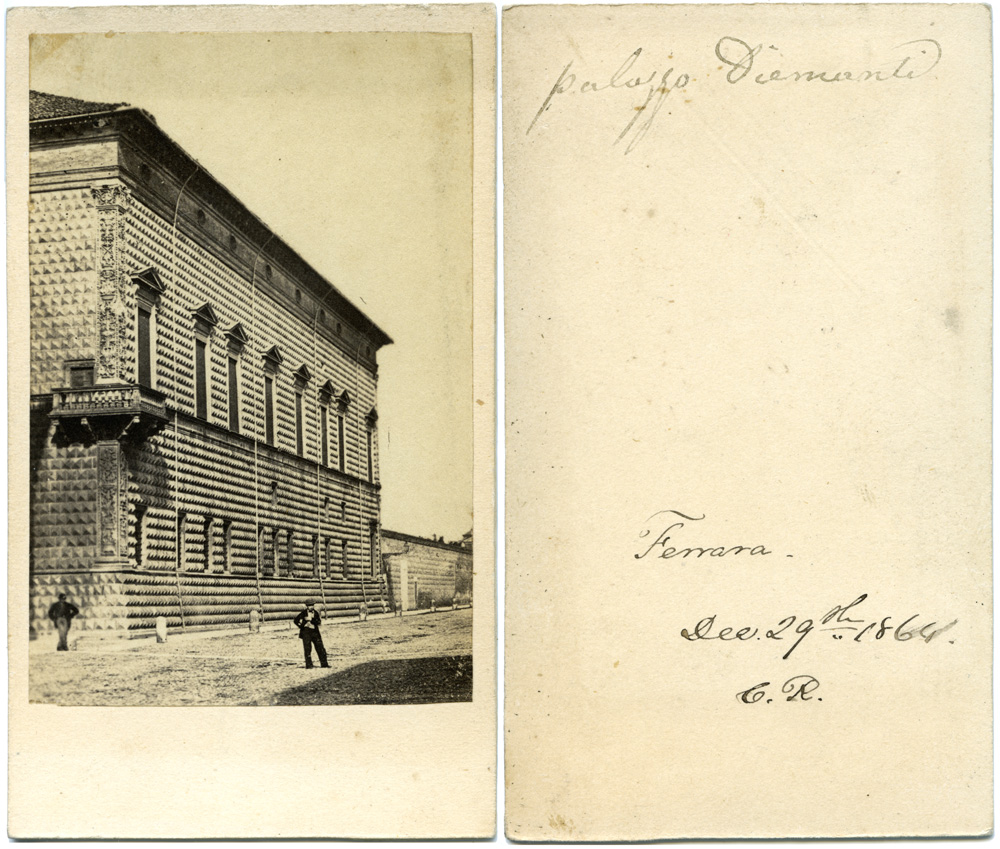
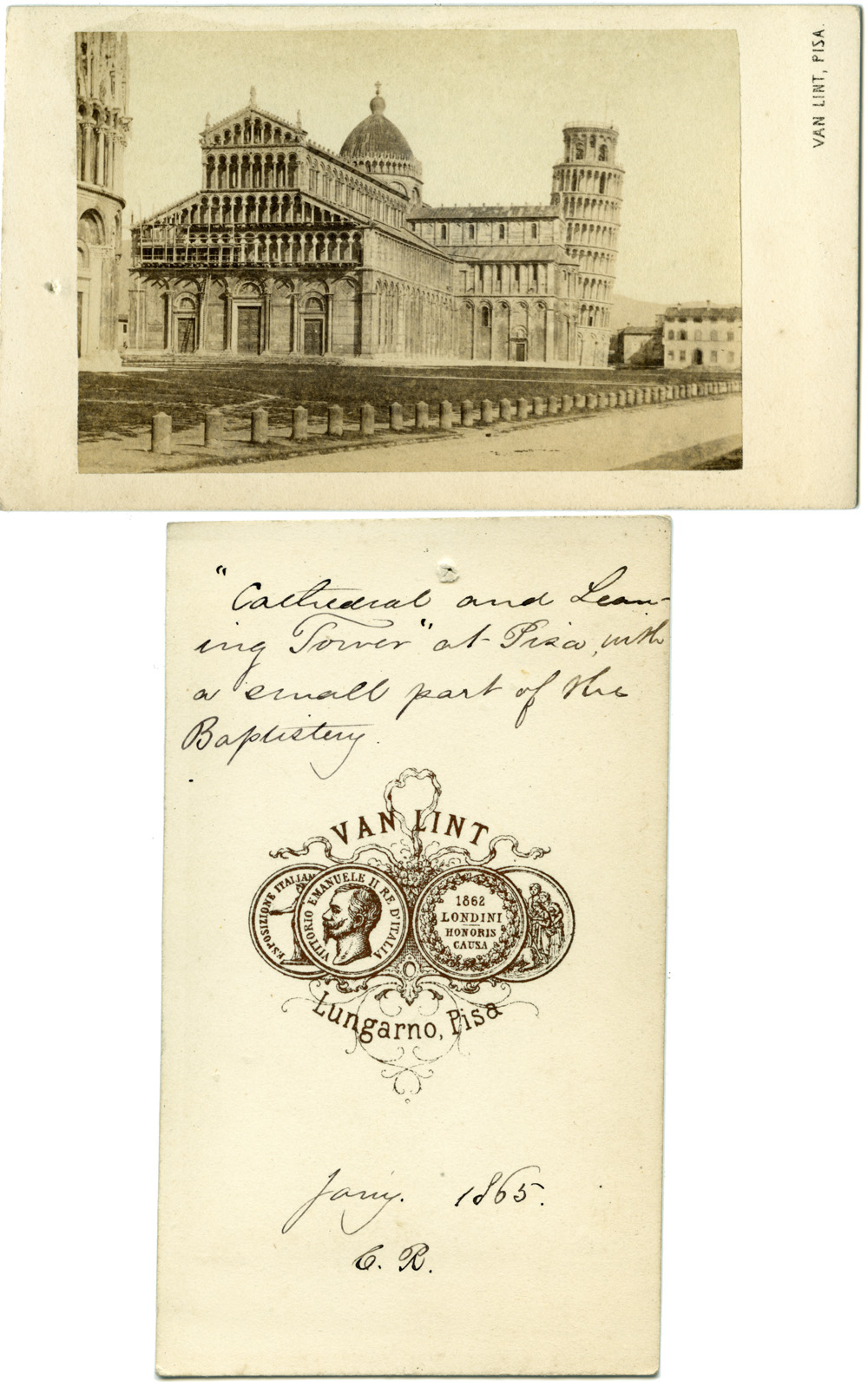
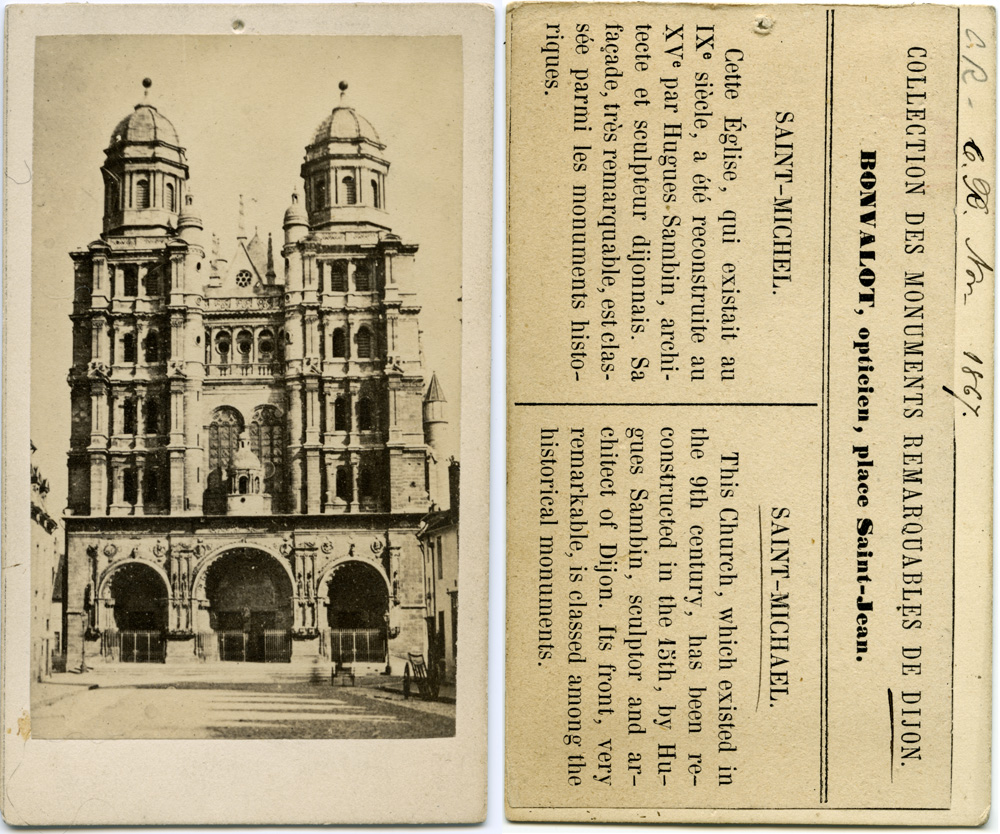
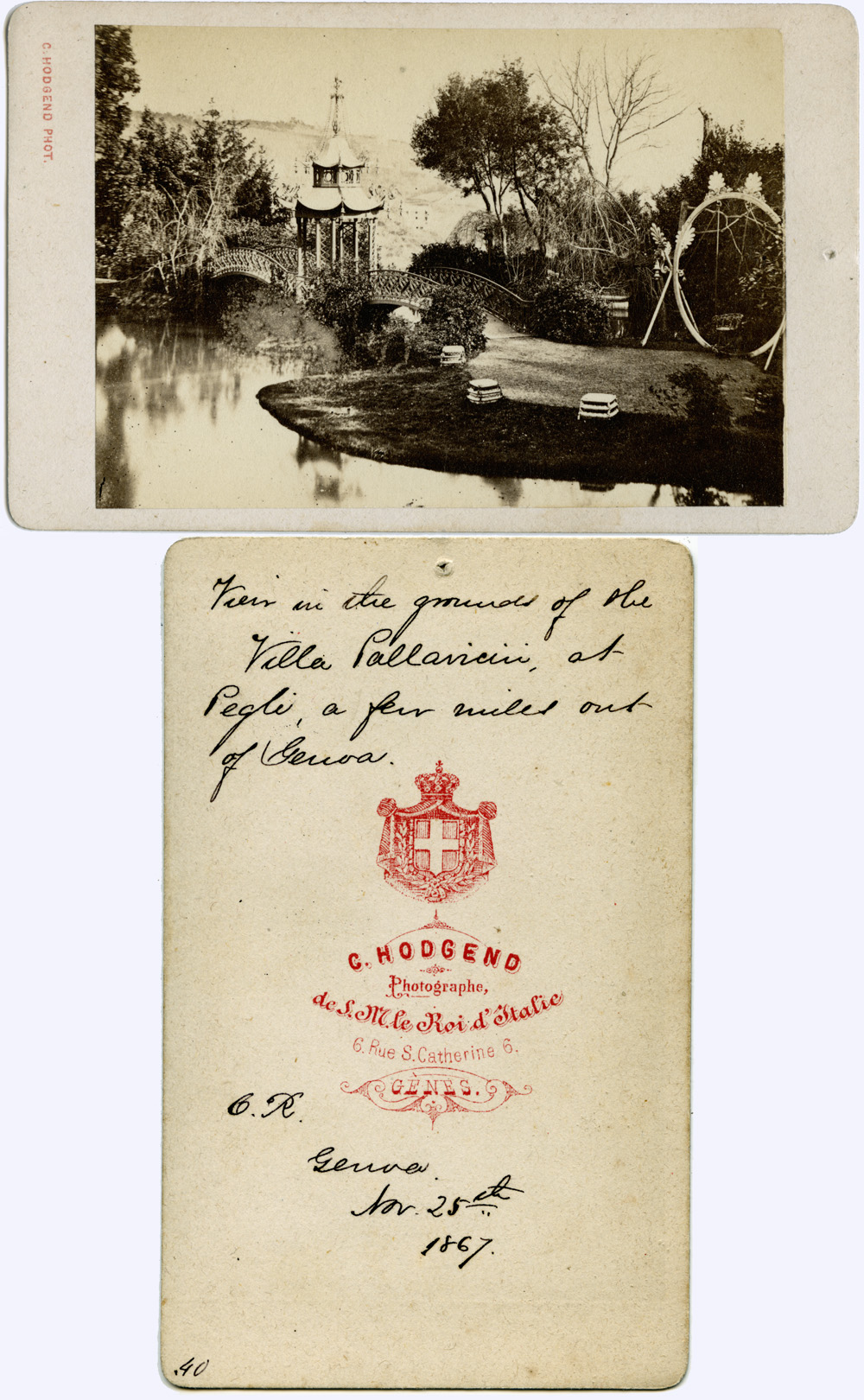
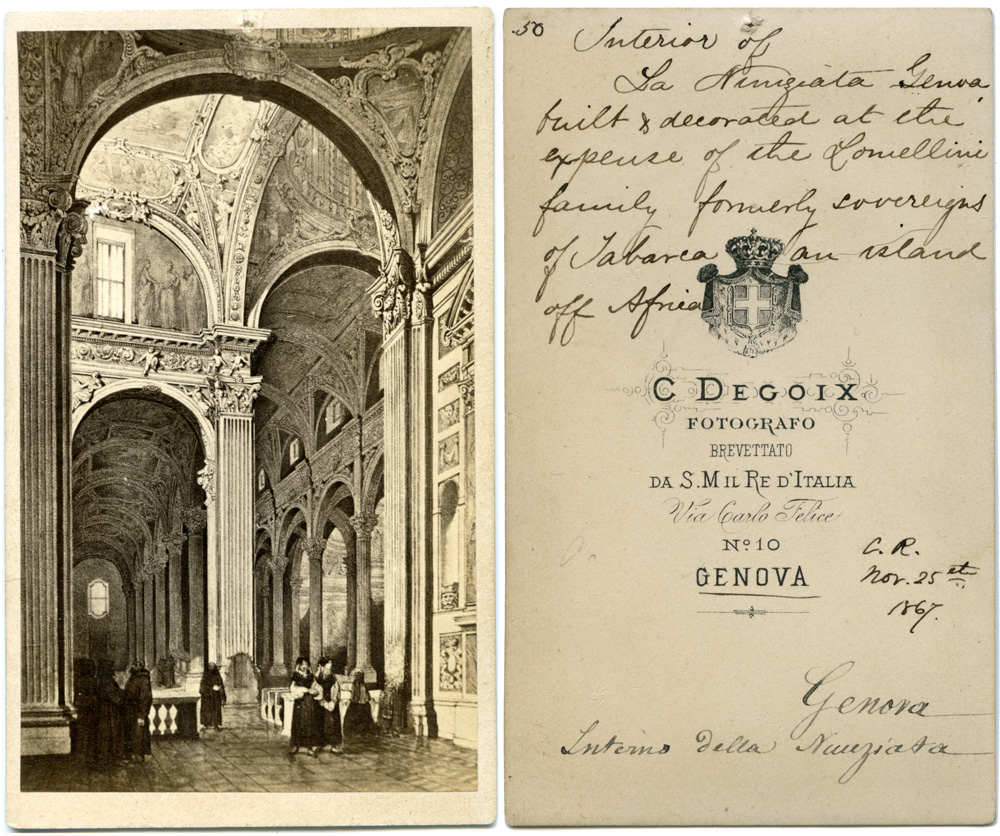
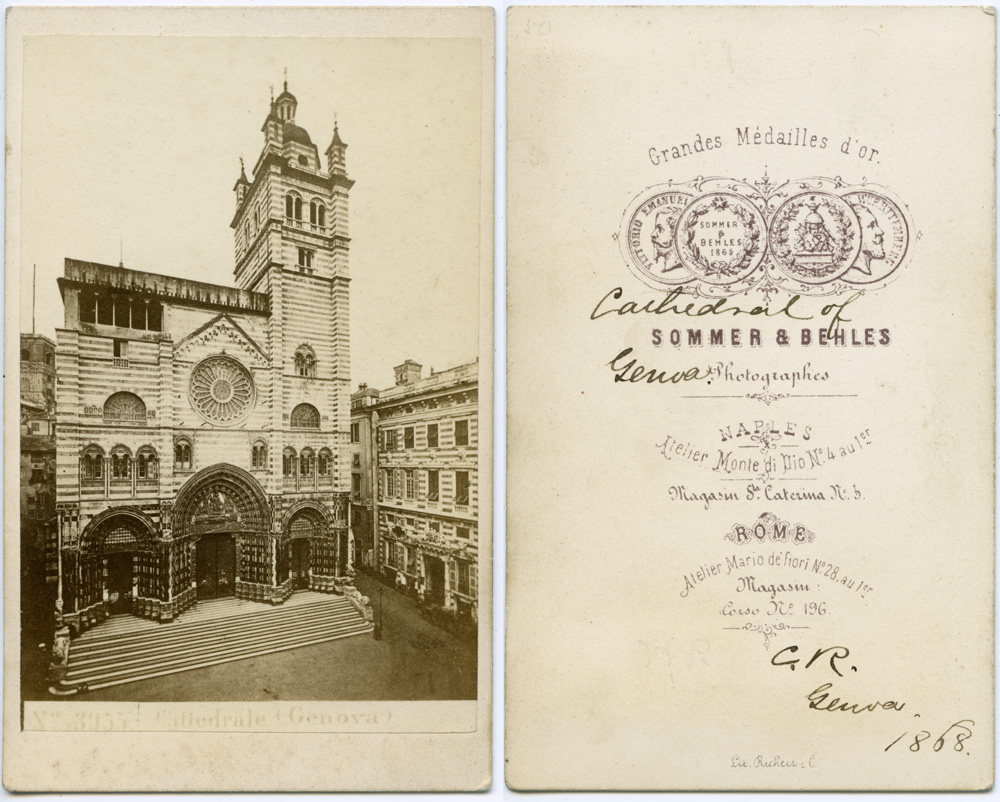
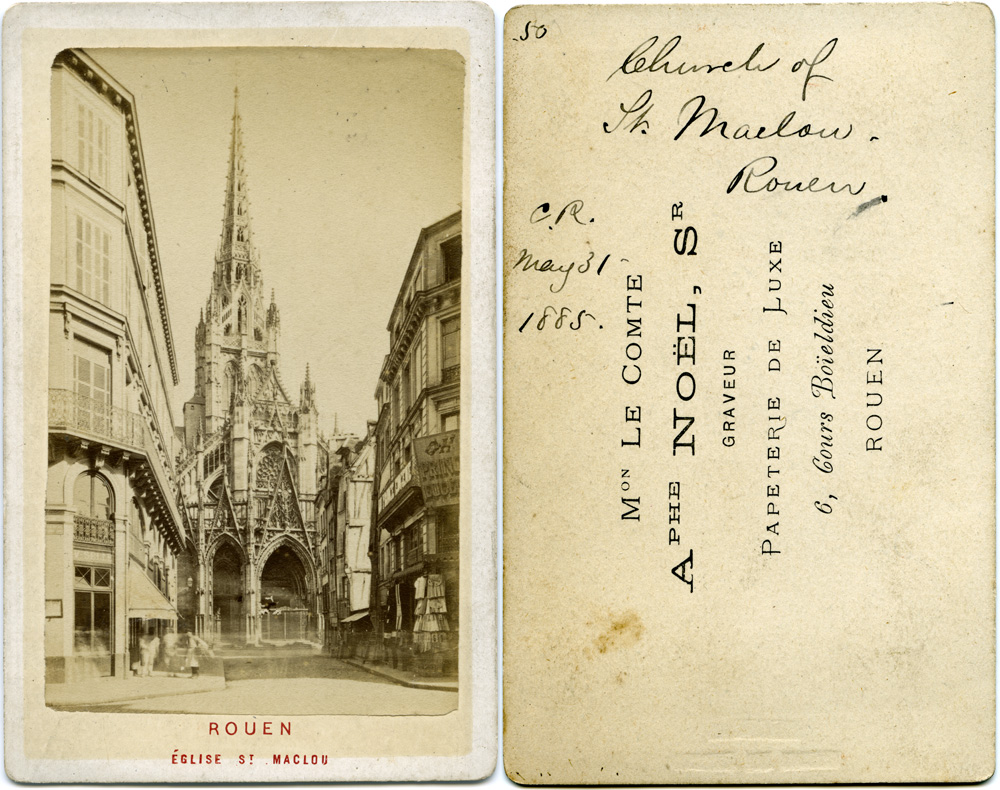
Ok- I managed to succumb to indiscretion and bought the rest of the “C.R.” cartes-de-visite. If you’re new to my blog, I posted earlier about this set of cartes-de-visite a “C.R.” purchased and collected during what I assume was his (not hers) journeys across Europe during and after the US Civil War. It’s a fascinating travelogue spanning three countries and twenty-one years. Two of the images in this second set are in fact photo reproductions of sketches. Given the dates and locations of the earliest ones in the set, one can’t help but wonder if “C.R.” was a Union or Confederate supporter, perhaps even a Confederate agent sent to the U.K. to try and purchase arms and ships for the Confederacy. Or was “C.R.” just a Northern businessperson whose work frequently took him to England, Scotland, France, Italy and Germany (there were one or two more in the set that I was unable to acquire that showed German churches) and had a soft spot for ecclesiastical architecture?
The oldest one in the complete set of nine CDVs dates from July 1864, and the last one is May 1885. Here’s the complete set, in chronological order.
AllowayKirk, Ayr, Scotland, July 16, 1864Chester Cathedral, July 19, 1864Palazzo Diamantini, Ferrara, December 29, 1864The Cathedral of Pisa, January 1865Church of St. Michael, Dijon, France, November 1867Villa Pallavicini, Genoa, November 25, 1867Interior of La Nunziata, Genova, November 25, 1867Genova Cathedral, 1868The Cathedral of Rouen, France, May 31, 1885
Someone who shall remain unidentified was selling a tintype on eBay. I won’t describe the image in detail, except to say that the subject matter was of sailors. There was a unique identifying feature in the photo that had the potential to point either to World War I or the Civil War. In doing a tiny tiny bit of basic (wikipedia) searching, the more logical conclusion is WW I. The seller had it labeled as a civil war image. I emailed him and pointed out the reasons why the image was WW I. His response back was “I know of no WW I era tintypes as the process was obsolete by the 20th century”. The tintype was around as a souvenir photo at carnivals and fairs into the 1930s. I have some tintypes in my collection that show people with cars. I know I shouldn’t pick fights with people on stuff like this- I don’t care about what it sells for and I don’t want to disrupt this guy’s business, but inaccuracy with something like this rankles me, moreso when it’s caused by unwillingness to do basic research, and even moreso when it’s done out of greed. A WW I tintype of sailors is probably worth $20-50. A Civil War tintype of sailors, tack at least another zero on those numbers, and depending on condition and quality, possibly two more zeros.
Here’s a good simple reference on the history of the tintype, if anyone is interested:
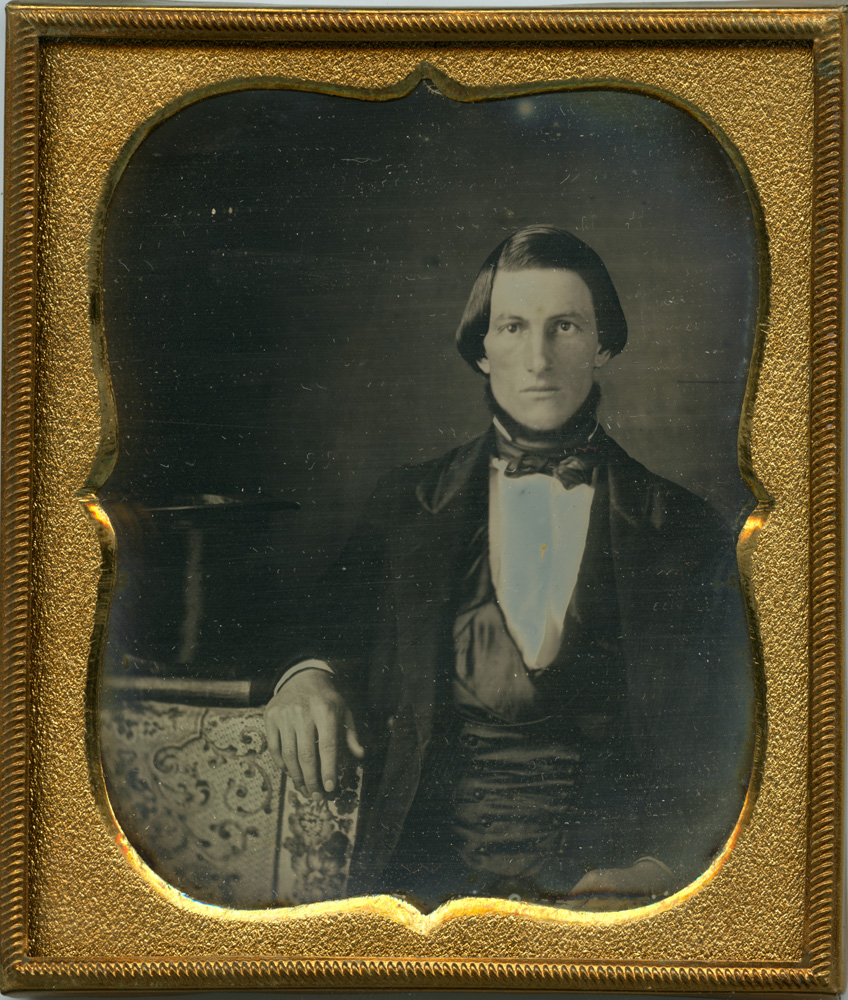
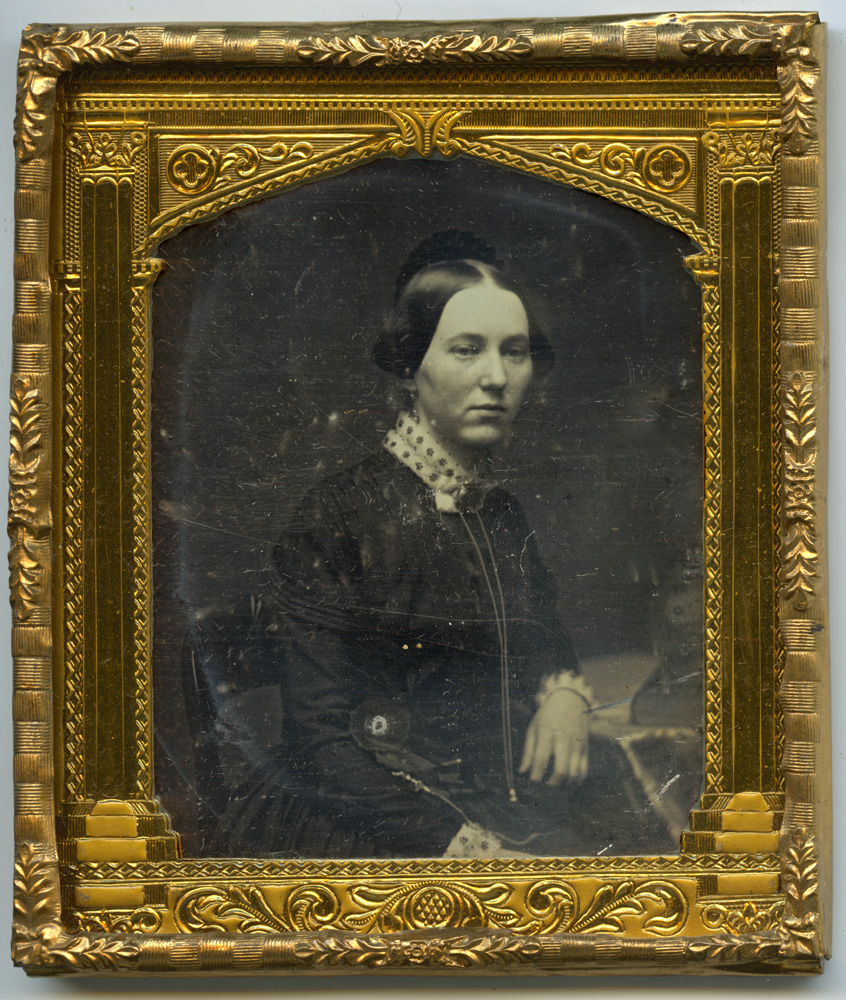
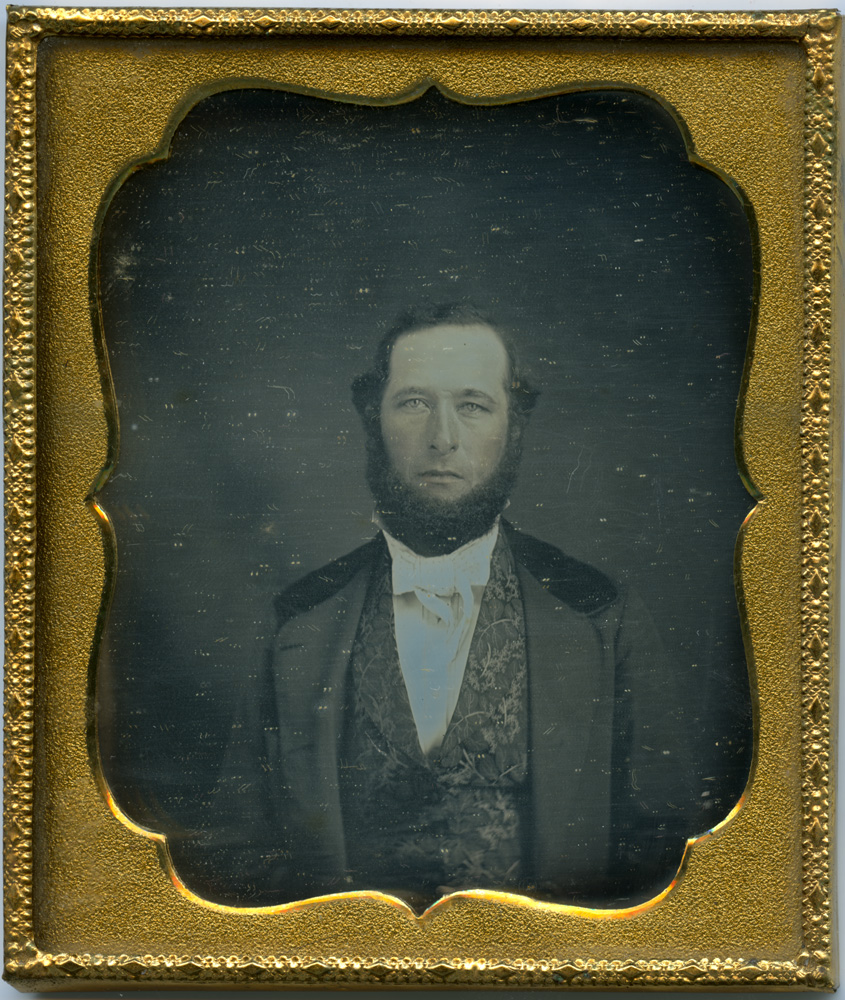
Here are the three new daguerreotypes that arrived yesterday. The scans do not do them justice, as they pick up every fleck of dust and scratch and magnify them, plus the images themselves are slightly soft due to being just out of the scanner’s focusing range. They’re all 1/6 plate daguerreotypes in full leather cases. Mrs. A.A. Hill and the gentleman with the top hat have had their seals replaced and glass and mats cleaned recently. The anonymous gentleman in the fancy vest still has his original seals on the packet. Given that the cases of the two gentlemen’s photos are almost identical (same style of mat and packet frame, same style of case lining – plain red silk), the odds are in favor of them both having been made within a year or two of each other – the gent in the fancy vest would have been photographed sometime between 1847 and 1851.
Gentleman With Top Hat, dated October 15, 1849Mrs. A.A. Hill, DaguerreotypeAnonymous Gentleman in Fancy Vest
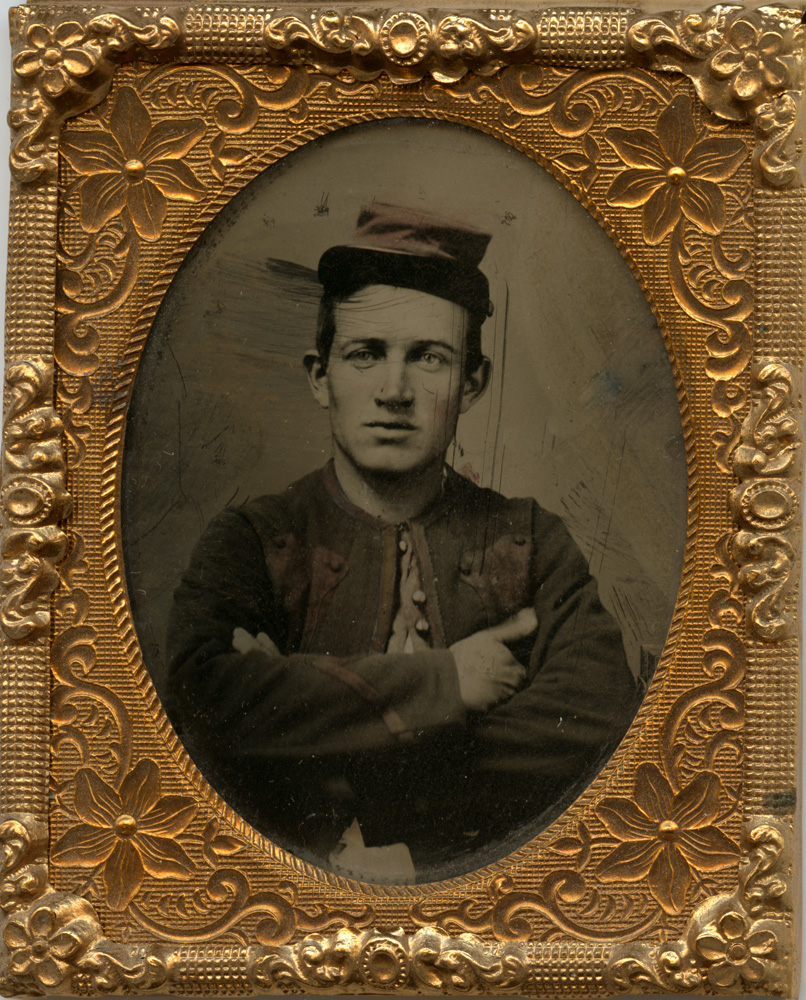
And last but certainly not least, is the photo that started it all. This was the first image I ever “collected” – it was an inheritance from my grandmother. Alas she did not get to tell me what if anything she knew about him, as it came to me shortly before she passed away. Thanks to a friend who is a serious civil war buff and re-enactor, I have been able to put some information together about who he might be. The soldier was a member of the 76th Pennsylvania Zouaves, who trained and fought in Moroccan-style uniforms adopted from French Zouave units. Zouaves (pronounced zoo-ahh-vah), patterned after the French Zouaves, were elite units especially popular in the Union Army. They were known for their precision on the drill field and for their colorful uniforms consisting of gaiters, baggy pants, short red jackets with trim, and turbans or fezzes.* Given the area of Pennsylvania in which my family lived, he was probably a member of Company B, D or E of the 76th Pennsylvania. The 76th Pennsylvania was involved in a number of major conflicts during the Civil War, including the assault on Fort Wagner (made famous in the movie Glory where the 54th Massachussetts (the first authorized all African-American unit) won their honor in the assault on the ramparts), Drewry’s Bluff, Cold Harbor, the siege of Petersburg, the battle of Fair Oaks, and the surrender of Johnston’s army. As typical, they lost more men to disease than to combat – 161 killed vs 192 laid low by disease. The officers fared better- 9 killed vs. 2 lost to illness. I don’t know for certain, but I believe my ancestor was one of the survivors.
According to my friend, this image was made in late 1861 or early 1862, as the uniform changed over the course of the war to more closely resemble the standard Union blue uniforms. Also, in this picture he looks to be in the peak of health. Most veterans by late in the war were looking rather thin, and on the Confederate side, downright malnourished.
The photo is a 1/9th plate tintype in a half-case – the case is designed to look like a miniature book, but now the front cover has gone AWOL.
If anyone can help identify him more specifically, your assistance would be GREATLY appreciated. The last name would most likely be Berger (or a spelling variation on the same) or Riley. Davies is also possible, but less likely as I think the Davies branch didn’t immigrate to the US until the 1870s, but that could be wrong.
It COULD be George W. Reilly of Company E, but according to the records I found, he entered service in 1865, as a substitute for someone else who was drafted, so the early uniform date would not make sense.
It could also be James D. Davis or George Davis, who were Corporals in Company C, but the spelling of the name is wrong for the time period.
Another possibility is James P. Davis of Company K. Again, the spelling is wrong, but the location is a fit – Company K was organized in Schuykill County, which is where the Davies branch of the family lived. Two other Davises, Robert and Isaac, are listed as privates in Company K, but both were killed in action. So I’m a bit confused as to who he might have been. He’s got some kind of rank insignia on his sleeve, but it is only one stripe, and Union corporals had two stripes. In the modern Marine Corps, lance corporals get a single stripe, but this is not a Marine uniform. So herein lies a giant mystery.
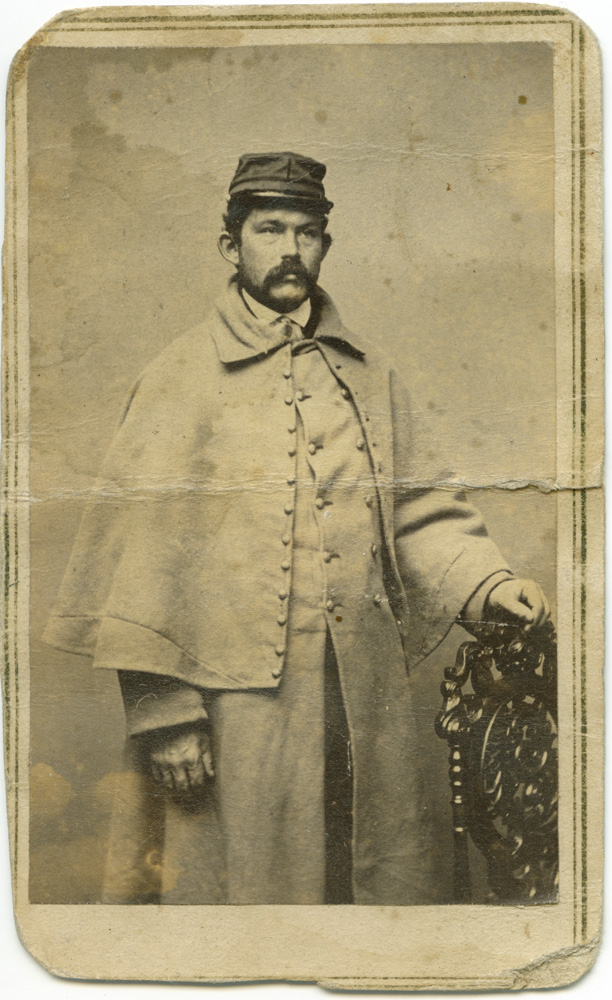
Here’s a Union soldier, identity unknown, from the William J. Tait studio. This may well have been taken immediately prior to shipping out to battlefields unknown – the studio address is Courtlandt Street and Greenwich Street in lower Manhattan – basically in the site of the modern World Trade Center. Back then it would have been only two or three blocks from the waterfront piers. It’s another image that obviously meant a lot to someone as it has a fold across the middle – someone was carrying it around with them in a pocket. Did the sitter die in combat, or was it just a fond memory of a critical time in US history that inspired the owner to keep it at hand?
Union Soldier, Wm. J. Tait studio, NY
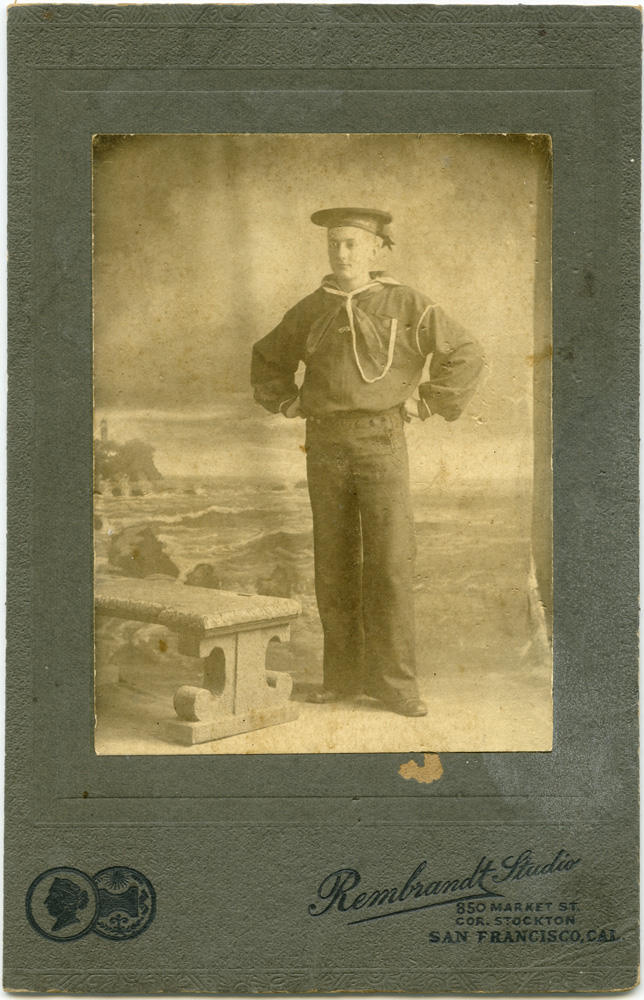
In a totally different light, here’s a west coast sailor. This time, most likely the 1890s, on a cabinet card. The original card is a little bit bigger than 3.5″ by 5″. I did a very mild clean-up of the scan in Photoshop to make the image more readable online. The original card is slightly lower in contrast and has a couple very minor spots in the background that do not interfere with the subject. I tried to scan his hat at high resolution to see if I could read the ship’s name he was assigned to, but it couldn’t be resolved (at least not with my scanner).
Sailor, 1890s, Rembrandt Studio, San Francisco
There’s a noticeable difference between the two photos, and I don’t think it is just attributable to the changes in photo technology between 1860 and 1890. The Civil War sitter has a far more somber expression on his face and in his body language – it’s as if he knows he is going to die, and this is a reminder to send back to his family so they won’t forget him when he’s gone. The 1890s sailor, on the other hand, is having a lark, getting his portrait done while in port perhaps as much a souvenir of the location as anything else. Later I’ll re-scan and post my Hong Kong sailor photos to provide a comparison.

 dcphotoartist