Here is a cdv of a sideshow family. Father has an extraordinarily long beard, mother is a dwarf, and daughter seems relatively normal except her hands look HUGE in comparison to the rest of her (and even compared to dad’s hands).
Sideshow Family, Aledo, Illinois
The scrap of paper at the bottom of the scan is from the album page that once held this image. It appears to suggest that this sideshow family was part of an extended family and not a trio of social outcasts, as circus folk are often portrayed.
The photograph is marked on the back “Strong & Root, Aledo, Ills”. This may have been where the family was from, or it may have been just another stop along the circus circuit. One wonders what it must have been like to be a family of sideshow freaks, and if the daughter did not have any distinguishing trait that would have qualified her to perform alongside her parents, what that must have been like – a tougher branch of an already tough road to follow.
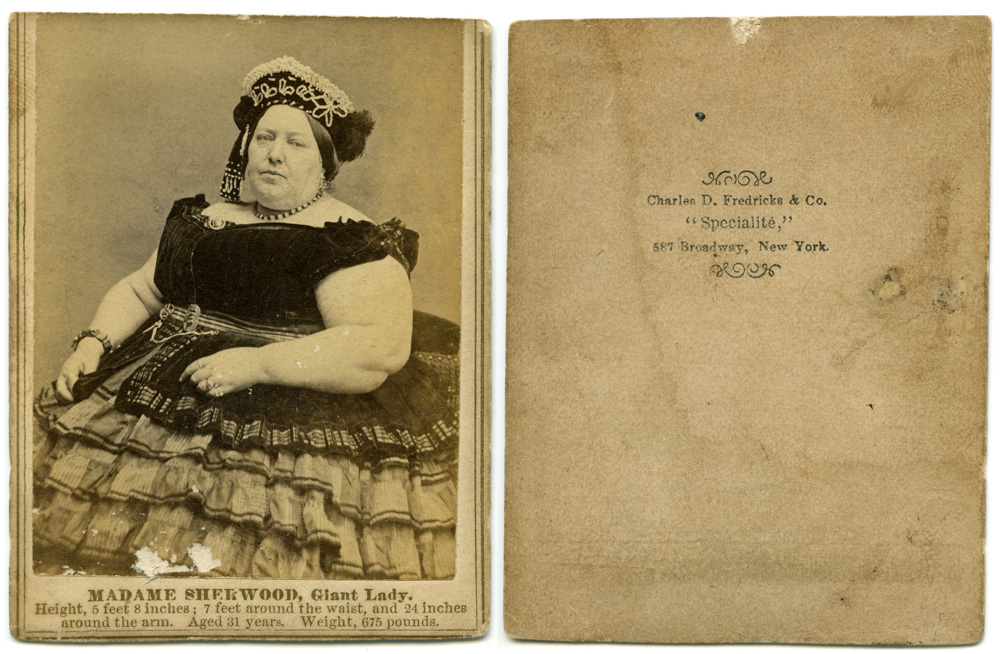
Well, I don’t know if she ever sang, or if she had any kind of performance at all. But her name was Madame Sherwood, and according to the bio on her CDV, she had an 84″ waist and was 675 lbs. Given the Victorian (and specifically Barnum-esque) penchant for exaggeration, I wouldn’t be surprised if she was more like a 60″ waist and 400 lbs but you never know. This CDV has been trimmed, rather significantly, but again this doesn’t detract from the image so I don’t find it terribly objectionable. It definitely impacted the value of the card, but I was not unhappy with the price paid. This is another C.D. Fredericks image. The simplicity of the backstamp not only in terms of the design but also the pomposity (or lack thereof) of the advertising slogan leads to some confusing dating for the image, as “Specialité” was his slogan in the 1850s and 60s, but the subject would have this date from the early to mid 1870s. Fredericks was another New York photographer who, like Gurney (whom he studied under and worked for for a time) and Eisenmann, did significant trade with the theatrical and performing professions.
For more information about C.D. Fredericks, there is a succinct but interesting blurb at Historic Camera
MadameSherwood, by C.D. Fredericks
I suppose in a way you could term all these circus freak photos as also being occupationals in that they do show the sitters enacting their profession, which in a way was merely existing as who they were. It’s not like it mattered what outfit Tom Thumb or Madame Sherwood or Isaac Sprague (the Human Skeleton) wore, they were not performing a role, and even if they did, their audience was not coming to see them be Hamlet or Viola or Caliban, but to see the midget/fat lady/human skeleton.
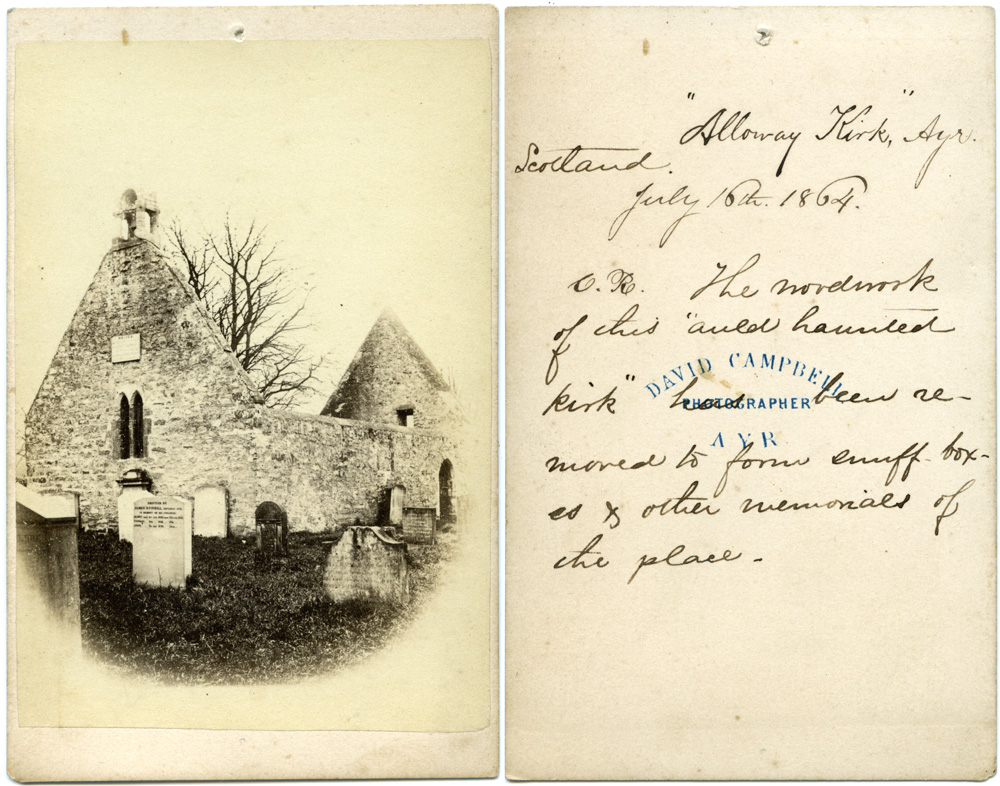
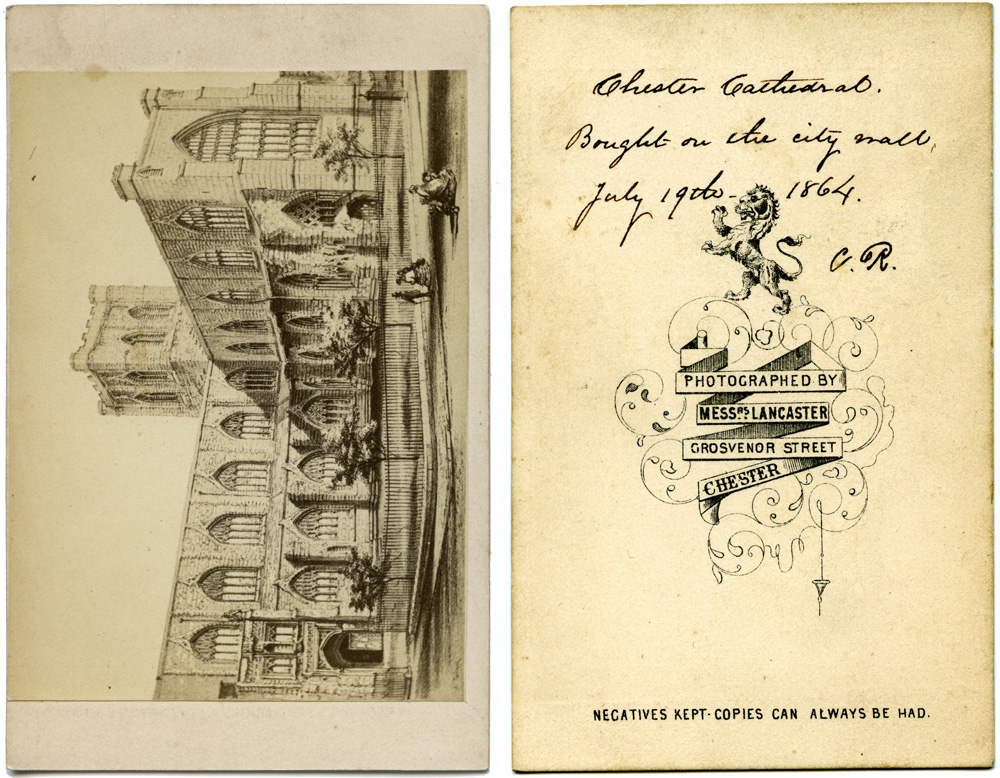
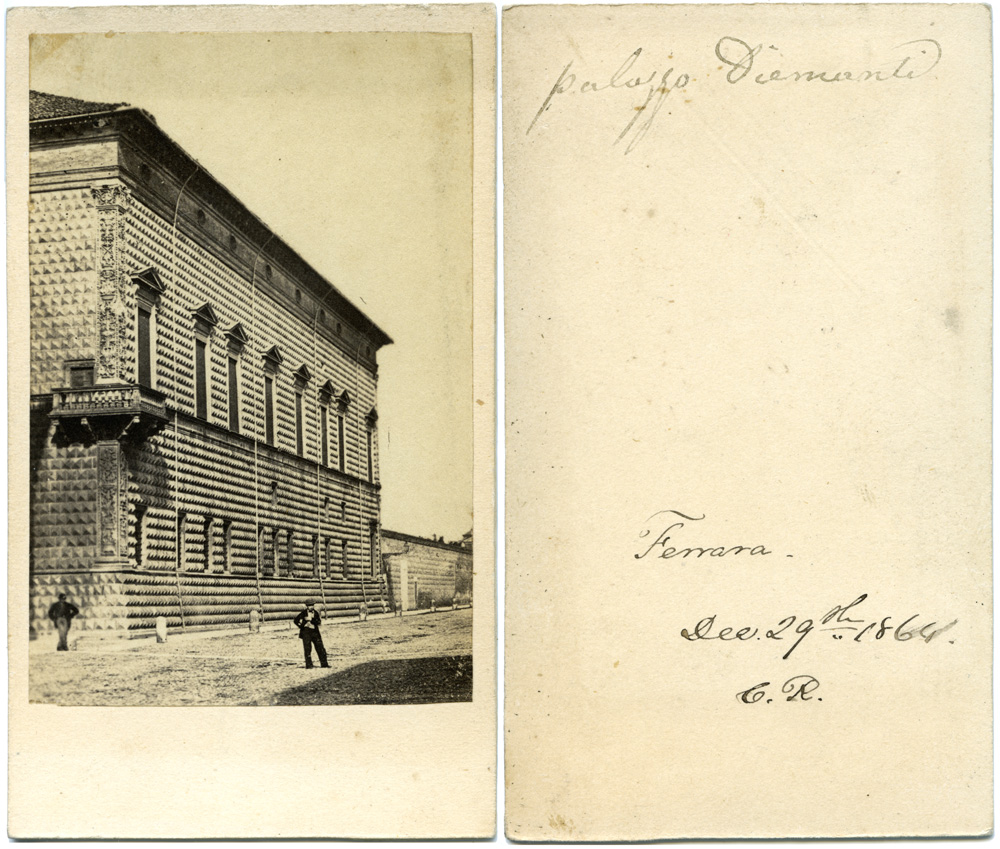
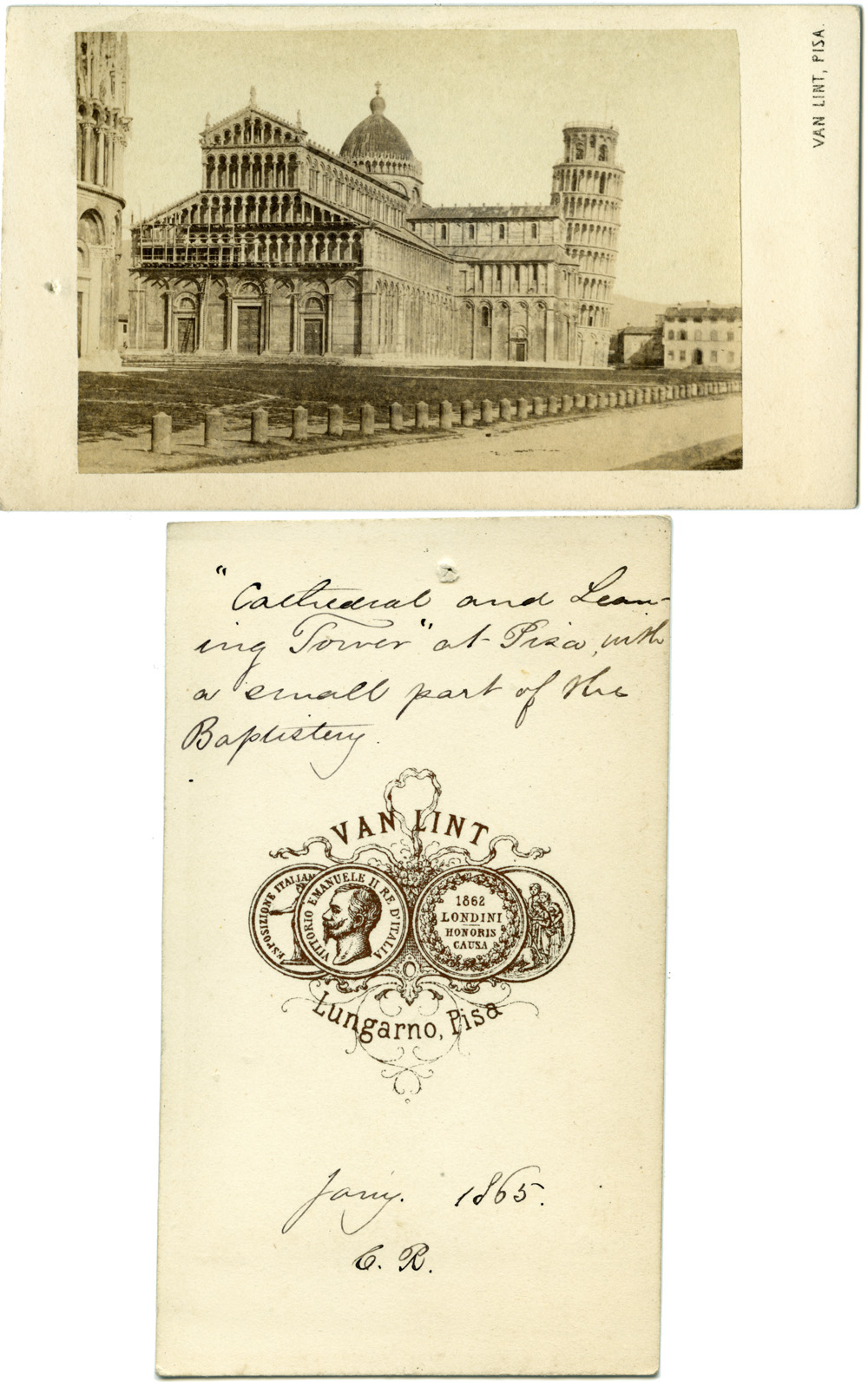
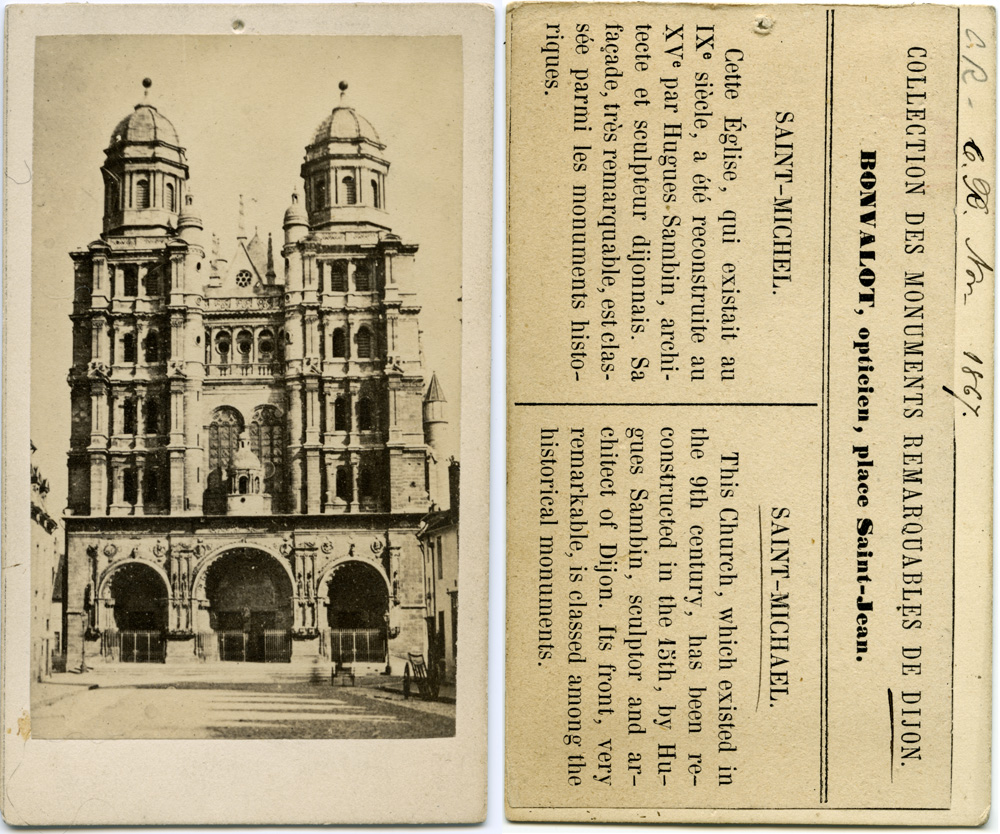
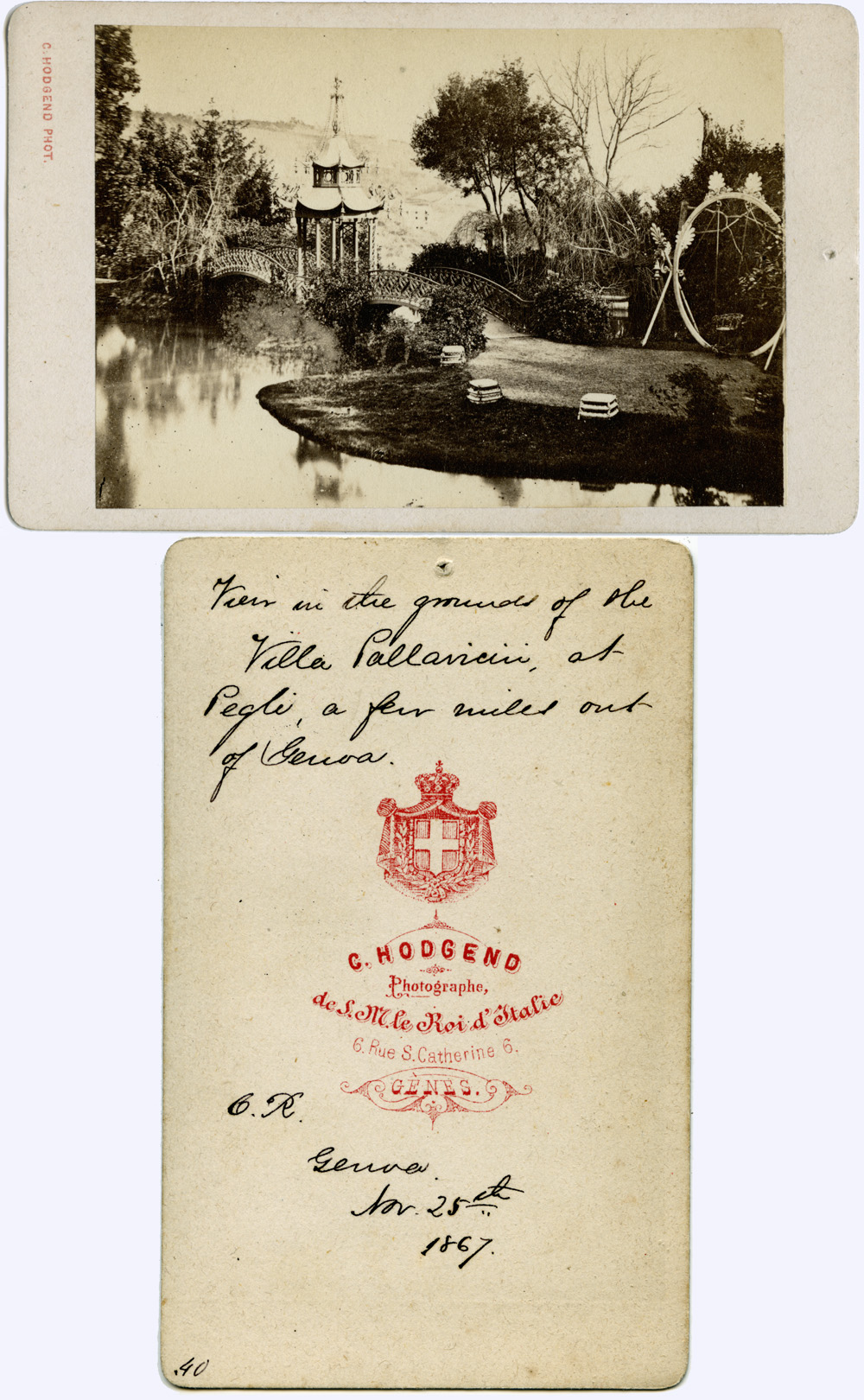
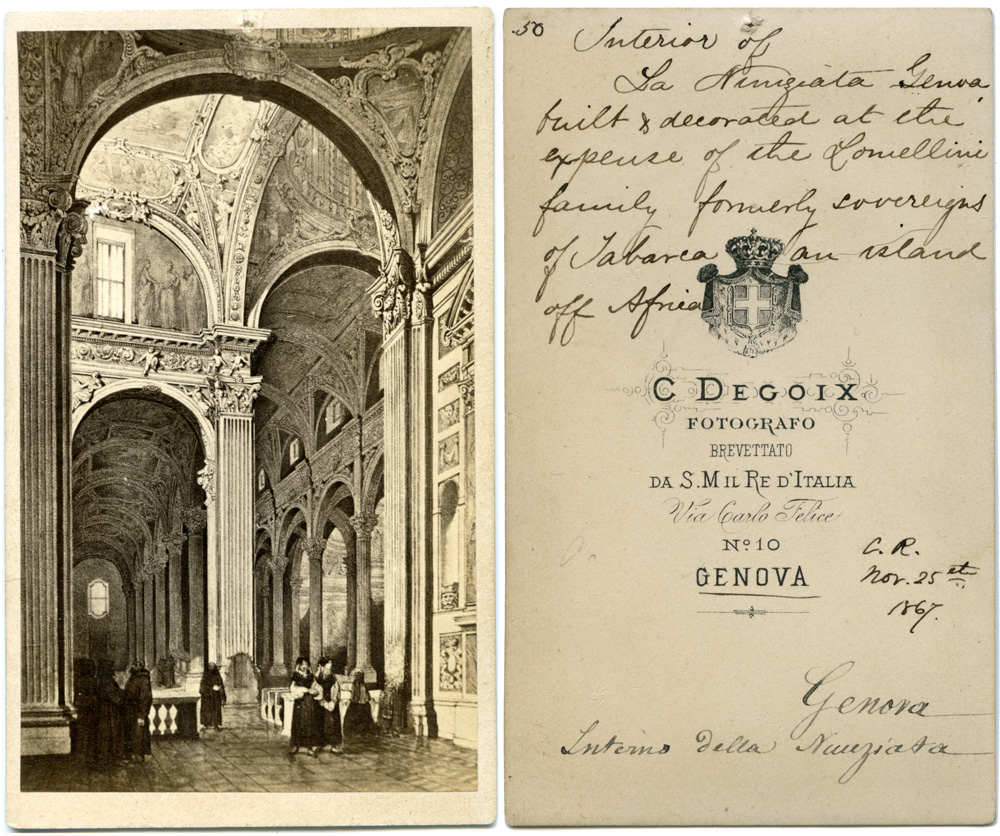
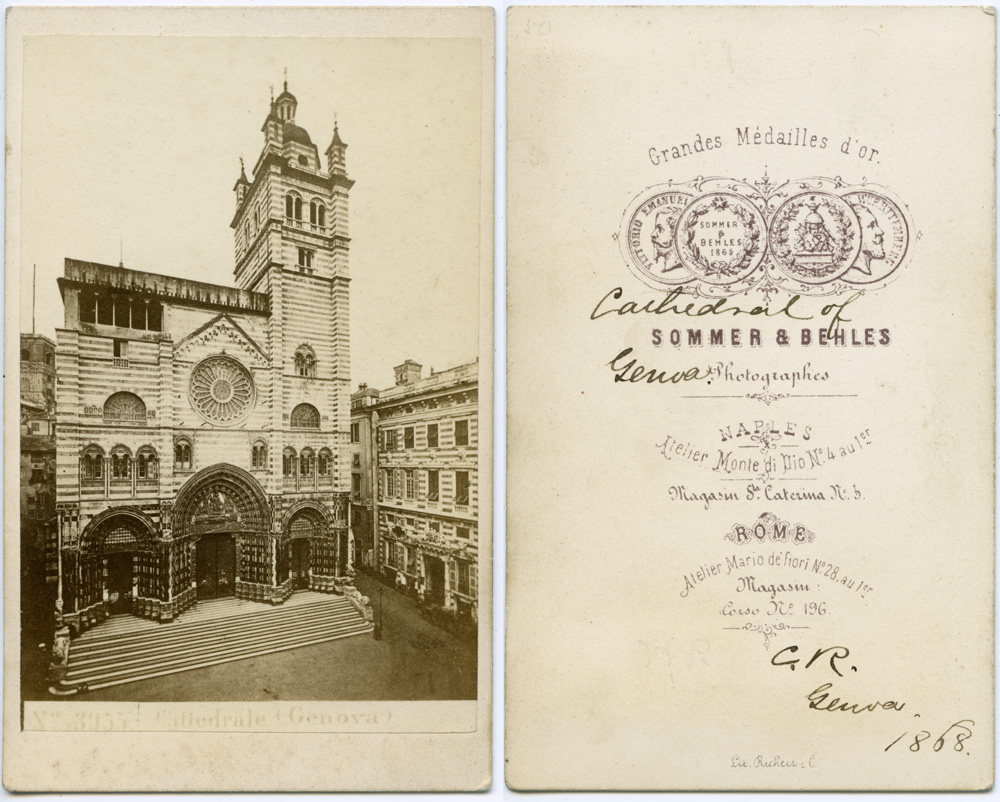
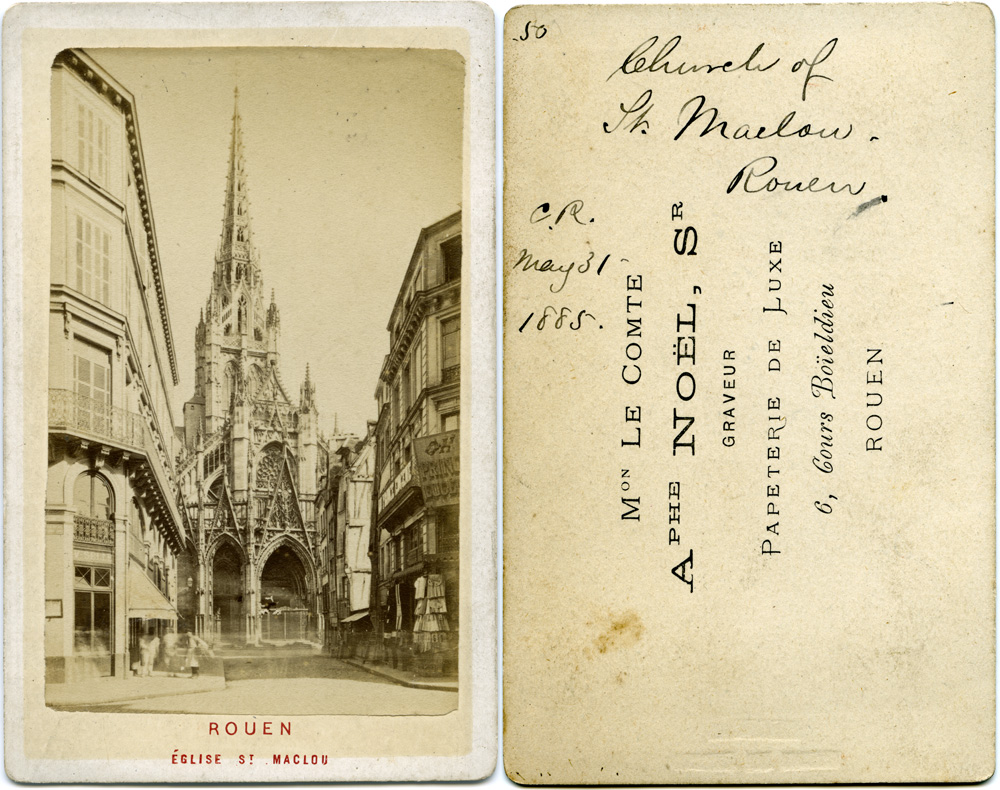
Ok- I managed to succumb to indiscretion and bought the rest of the “C.R.” cartes-de-visite. If you’re new to my blog, I posted earlier about this set of cartes-de-visite a “C.R.” purchased and collected during what I assume was his (not hers) journeys across Europe during and after the US Civil War. It’s a fascinating travelogue spanning three countries and twenty-one years. Two of the images in this second set are in fact photo reproductions of sketches. Given the dates and locations of the earliest ones in the set, one can’t help but wonder if “C.R.” was a Union or Confederate supporter, perhaps even a Confederate agent sent to the U.K. to try and purchase arms and ships for the Confederacy. Or was “C.R.” just a Northern businessperson whose work frequently took him to England, Scotland, France, Italy and Germany (there were one or two more in the set that I was unable to acquire that showed German churches) and had a soft spot for ecclesiastical architecture?
The oldest one in the complete set of nine CDVs dates from July 1864, and the last one is May 1885. Here’s the complete set, in chronological order.
AllowayKirk, Ayr, Scotland, July 16, 1864Chester Cathedral, July 19, 1864Palazzo Diamantini, Ferrara, December 29, 1864The Cathedral of Pisa, January 1865Church of St. Michael, Dijon, France, November 1867Villa Pallavicini, Genoa, November 25, 1867Interior of La Nunziata, Genova, November 25, 1867Genova Cathedral, 1868The Cathedral of Rouen, France, May 31, 1885
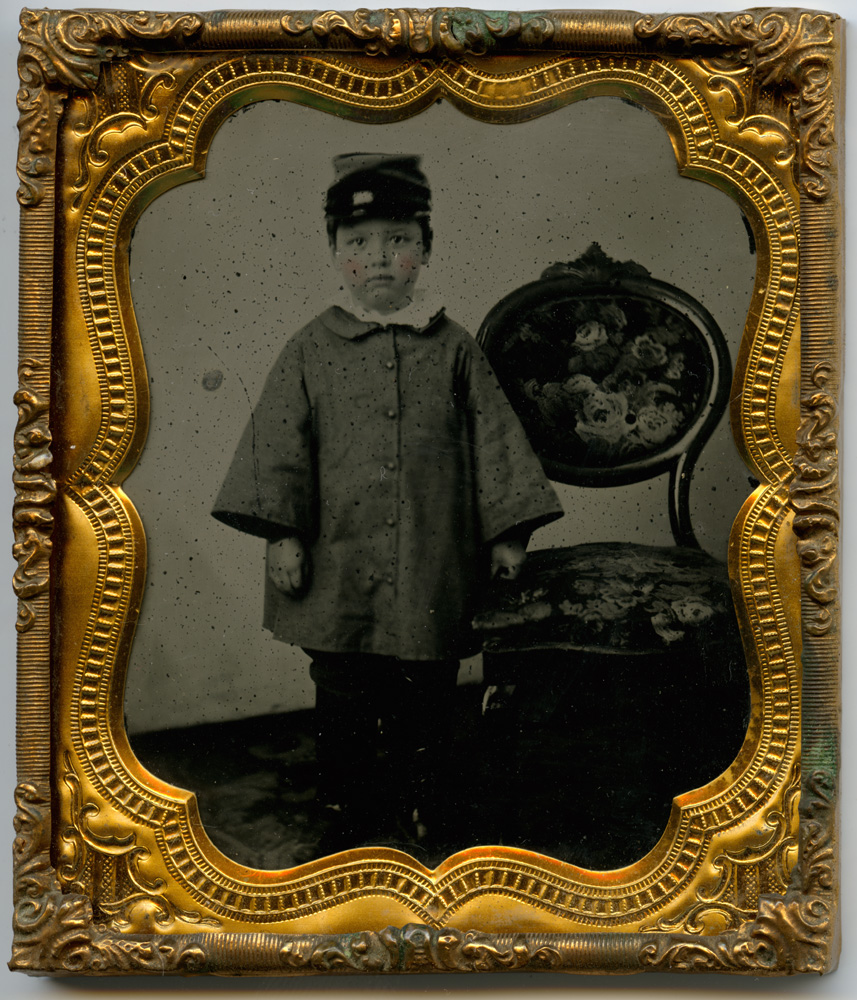
Fred Jones, born June 15, 1855, ca. 1861, Concord, New Hampshire. Here’s a photo of a little boy dressed up as a soldier. I haven’t done any further research into the Jones family of Concord, but I’d suspect that little Fred’s dad went off to war and Fred was just playing his part and being patriotic, imitating dad.
Fred Jones, 1861, framed black glass Ambrotype
The image is a black glass ambrotype in a thermoplastic/gutta percha frame, suited to hang on a wall. I acquired this one from a descendant of the subject, so it came with more biographical data than is usual. While I’m glad I was able to buy it, I can’t imagine how anyone could let such a piece of family history be sold out of the family. My apologies in advance to my Facebook friends who have already seen this image, but it was so neat that when it arrived, I couldn’t resist posting it with my iPhone immediately.
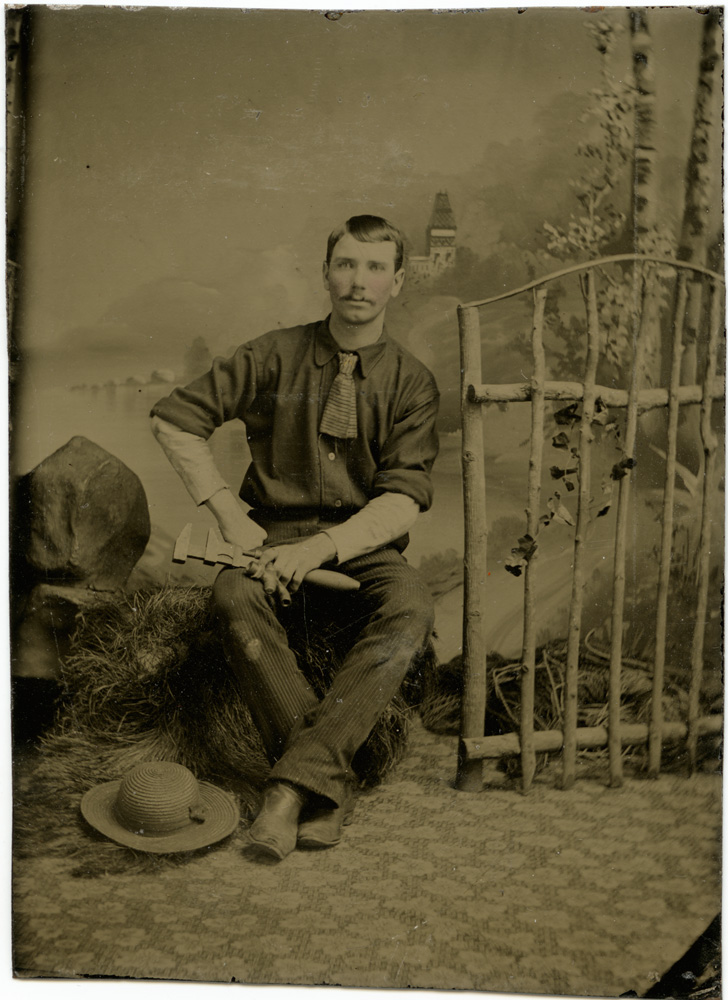
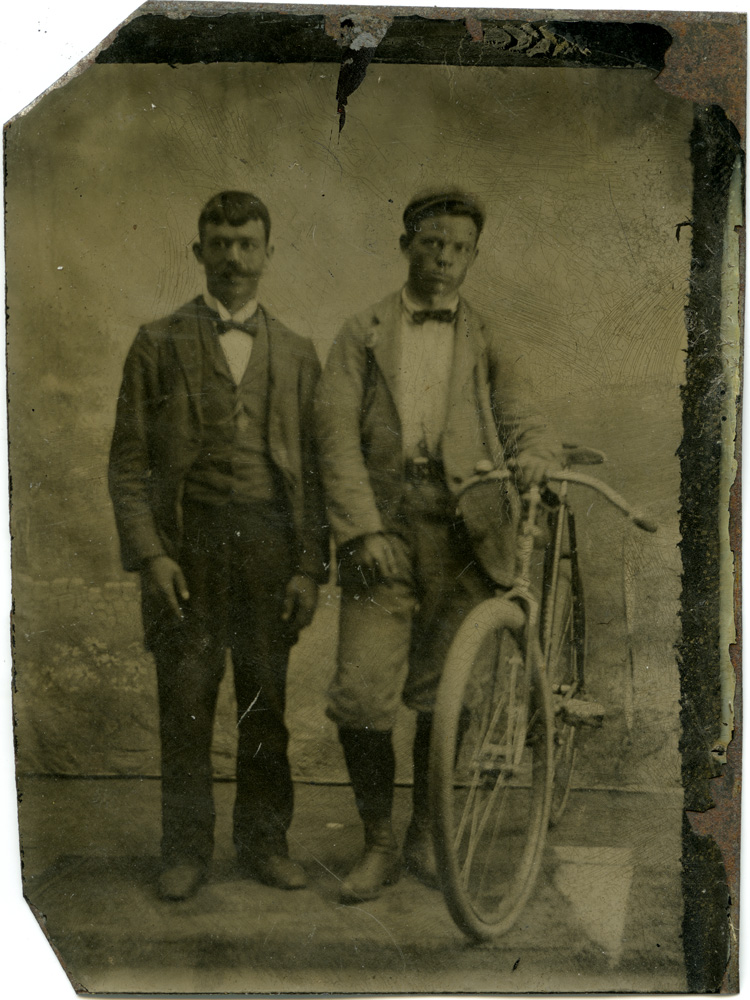
This next image is an “occupational” tintype. A popular genre in its day, the occupational photograph shows ordinary working-class people with tools of their trade and/or professional attire that showed who and what they were (railroad conductors, butchers, carpenters etc). This has become a very popular genre to collect, and certain professions are much more collectible than others (anything to do with photography is highly sought after, for example).
Tintype, Occupational, Plumber
Two men and a bicycle. This was inspired by a friend of mine who collects images of men with facial hair and images of bicycles – killing two birds with one stone here. My guess on the age of the image, based on the bike tires, would be sometime between 1890-1910. Pneumatic bike tires were invented in 1889, and first commercially produced in 1890.
Tintype, Two Men and a Bicycle
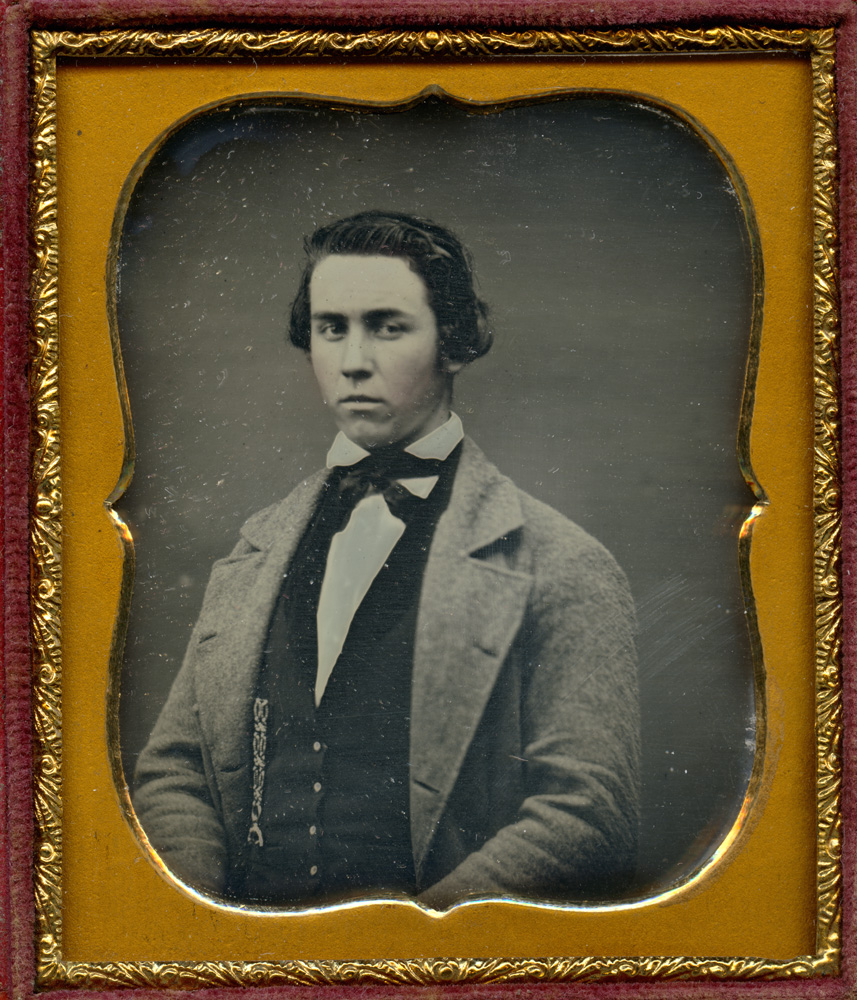
And last but certainly not least, a nice 1/6 plate daguerreotype. Because the scanner picks up every little dust particle, it’s hard to tell from the scan that this is actually one of the most lovely daguerreotypes in my collection. Virtually free of imperfections, from wipe marks to polishing scratches, this image of a young man in a rich wool coat is truly striking. It is in a very red leather case (most cases are brown), complete. The hinge has been replaced with modern tape, but otherwise the whole is quite original.
Daguerreotype, Anonymous Young Man, 1/6th Plate
I’m still trying to figure out how to post my Brady clear glass ambro – when I can get a little table-top studio set configured in my dining room, I’ll take photos of it to post here. The trick with it is that the image is viewable from both sides. There is no black backing paper, and the case is in three pieces – a front cover, a center panel with the image, and a rear cover, all hinged together like a little book. I’ll have to do some creative posing of the piece to demonstrate this and to display the image clearly. I’ve seen very few ambrotypes presented this way, and the few I have were also Mathew Brady images. I’m far from a fount of knowledge on this subject, so I don’t know if this was a uniquely Brady thing to do, or if I just haven’t seen enough images yet to know how widespread the practice actually was.
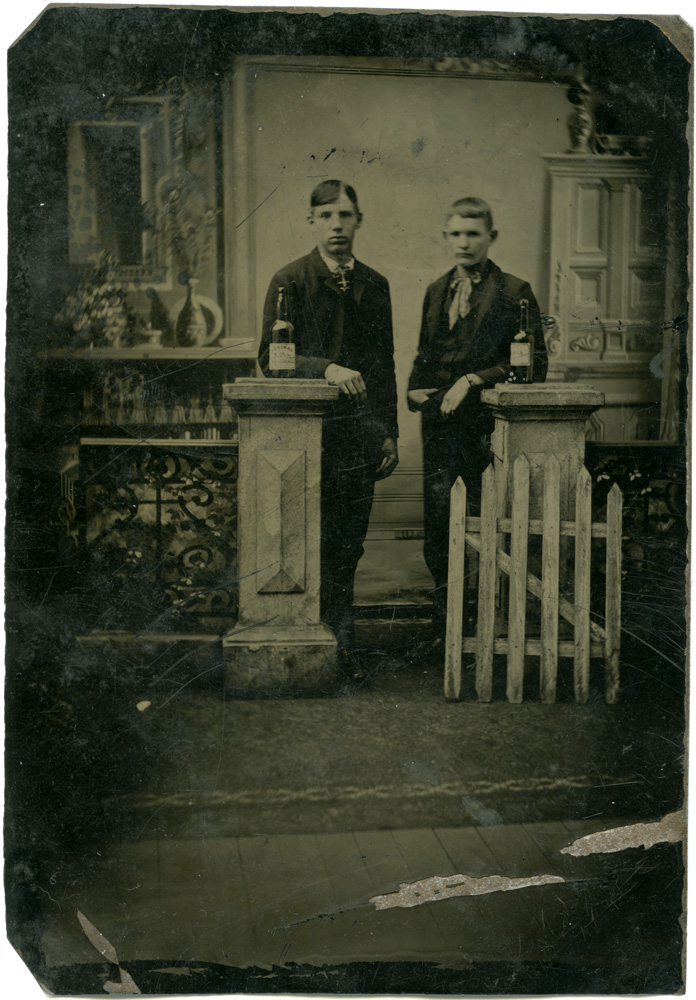
Tintype, Two Brewers, Keystone Cabinet Export Beer
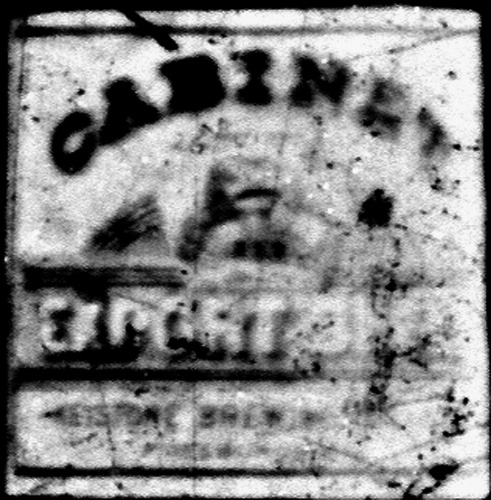
Here is another occupational tintype – this one is a bit unusual, not rare, just unusual, in that most of the unmounted tintypes you find are approximately CDV sized or 1/6 plate. This is roughly 1/4 plate size – a little larger than average. Interesting that if you look carefully, you can see that the photographer pre-focused on the set, so the beer bottles and the gate are in focus, but the two men are not completely sharp. This was sold to me as wine-makers as the subject – thanks to the magic of a good scanner, I was able to read the label on one bottle. It says Cabinet Export Beer, Keystone Brewing. I can’t make out the line that has the location. In doing my own simple web searching, most of the references I get are to Keystone Beer, the Coors subsidiary. If anyone out there knows a good reference to historic brewing in the US (or outside the US – I did see some mention of a Keystone Brewing in the UK). In any case, here’s a close-up of the label, in case anyone recognizes this. Bottle Label, Keystone Brewing Cabinet Export Beer
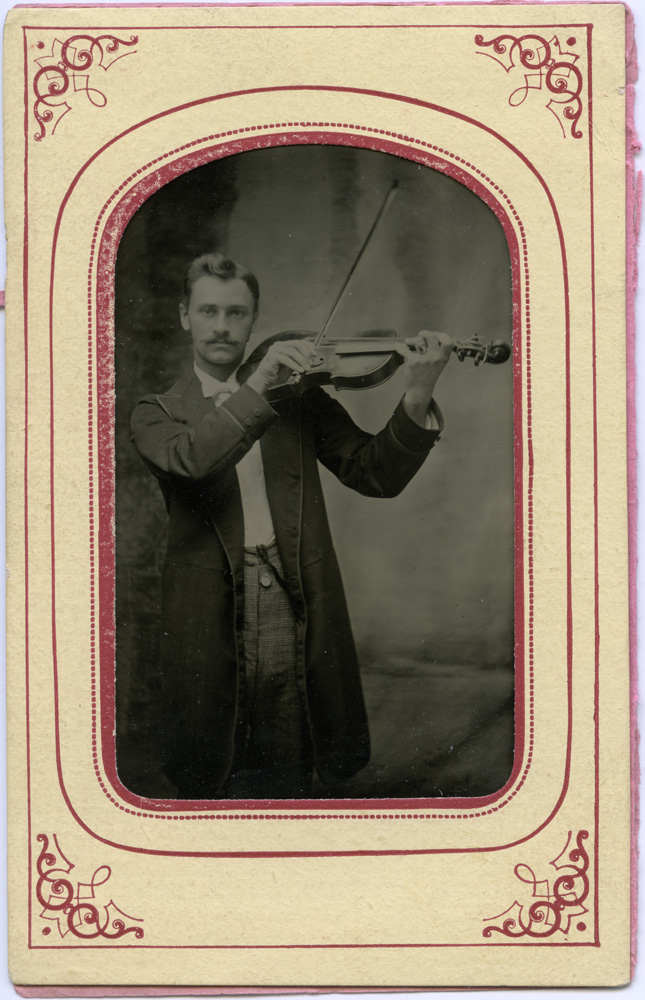
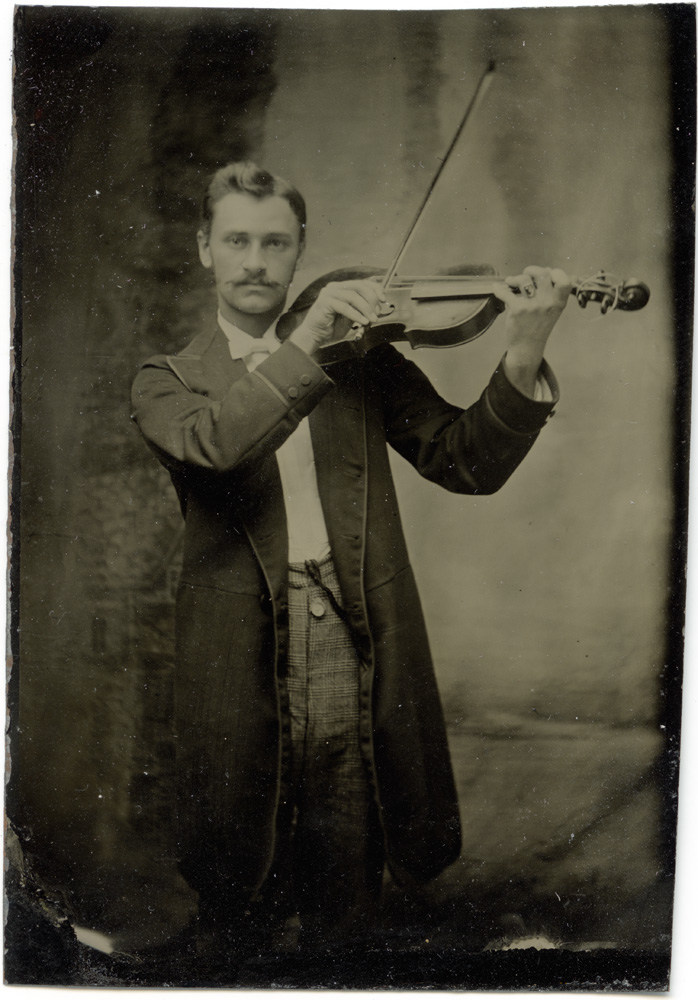
I think this is becoming another theme I’m collecting – this makes for the third image of a musician or group of musicians in my collection. It’s also, condition-wise, one of the most lovely tintypes I’ve found so far. As you can see, it came in this darling little paper slip-cover which has a fold-over cover to it made of the same pink paper as the backing. I love the overall quality of the image – you can certainly see quite distinctly the characteristics of a wet-plate image taken with a Petzval lens that would have been used at the time – the shallow depth of field and obvious field curvature (look how distorted the backdrop behind the subject is). I’d even be tempted to attribute the blur on the violin bow to the lens characteristics but knowing that this was at least a one second exposure, if not ten or fifteen, simple movement is a much more likely explanation. I’ve scanned the image both in and out of the paper sleeve to provide historical context for the image as well as display the entire image as made and seen by the photographer. Tintype, Violinist, in presentation matTintype, Violinist, entire plate

 dcphotoartist