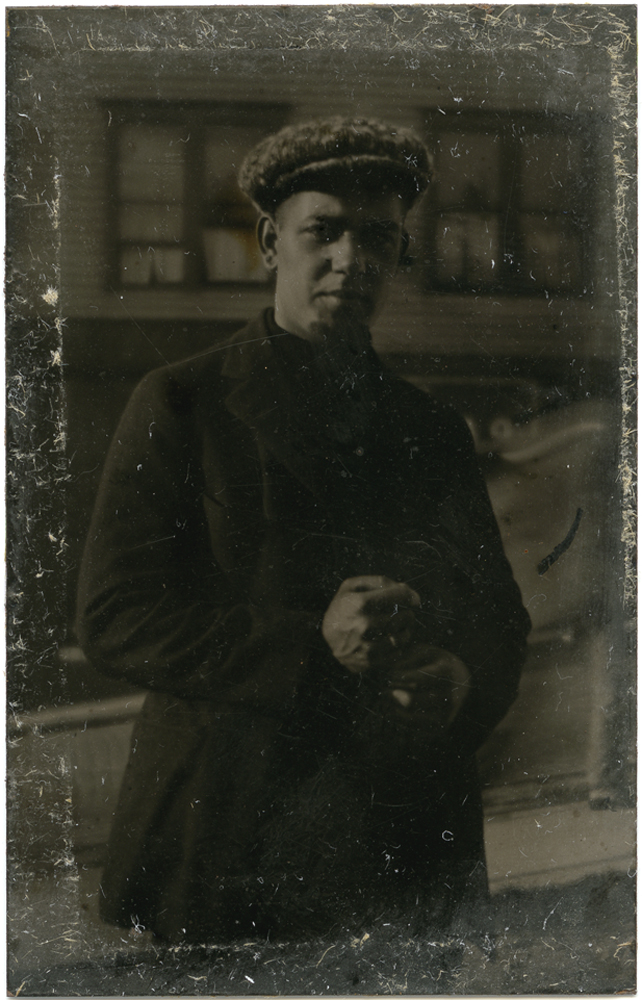
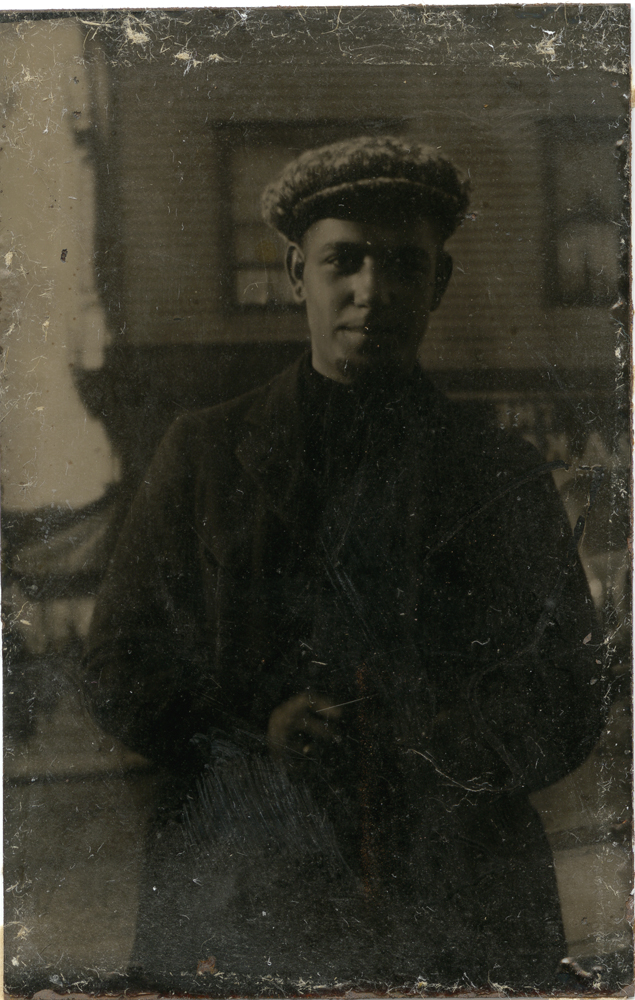
I got these two tintypes on an online auction (NOT ebay). They finally arrived today, but I had bought them so long ago I almost forgot I bought them. They still need a bit of cleaning up. From the clothes and what looks to be a car in the background of the one photo, they’re from the first decade of the 20th century, or maybe into the early part of the 1910s. The subject looks like he might be African-American. What’s interesting about these is they seem to be amateur snapshots, but they came matted, and at this point in time, amateur tintypes would have been relatively rare, because rollfilm already existed and cameras like the Kodak Brownie (as well as far more sophisticated roll-film cameras, not to mention dry plate cameras) were widespread. They came to me from Portland, Oregon, but who knows where they were taken. I’m planning on doing a bit of cleaning to remove the tape residue and dust, and I’ll re-scan and post them when they’re tidied up a bit.
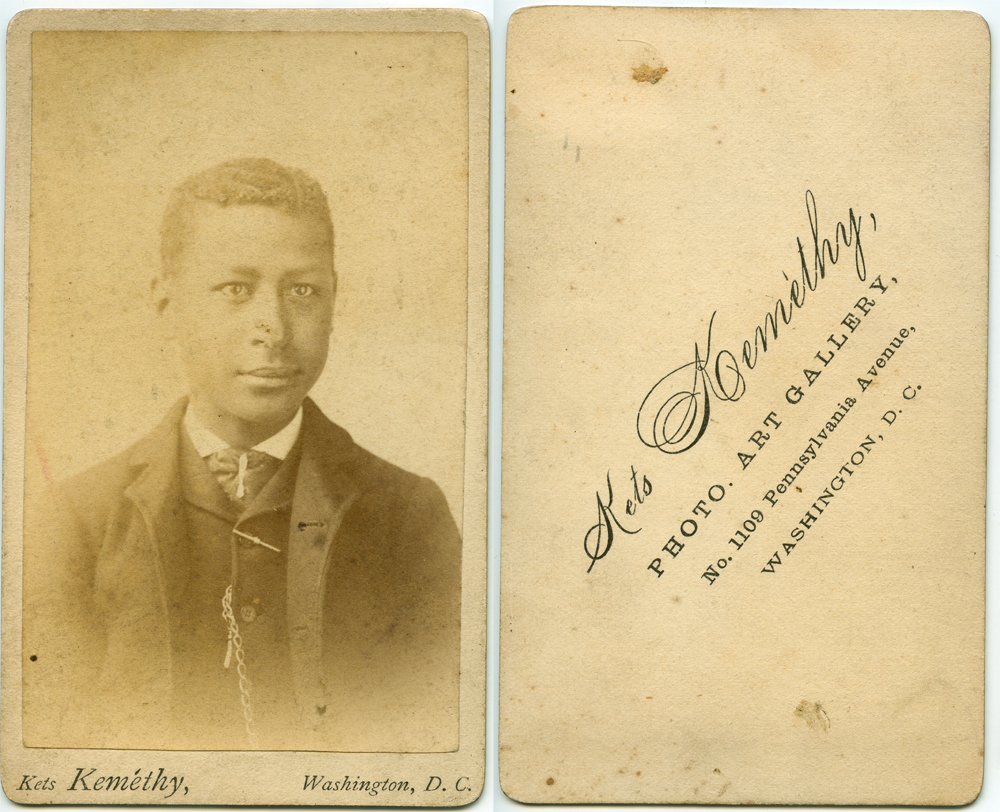
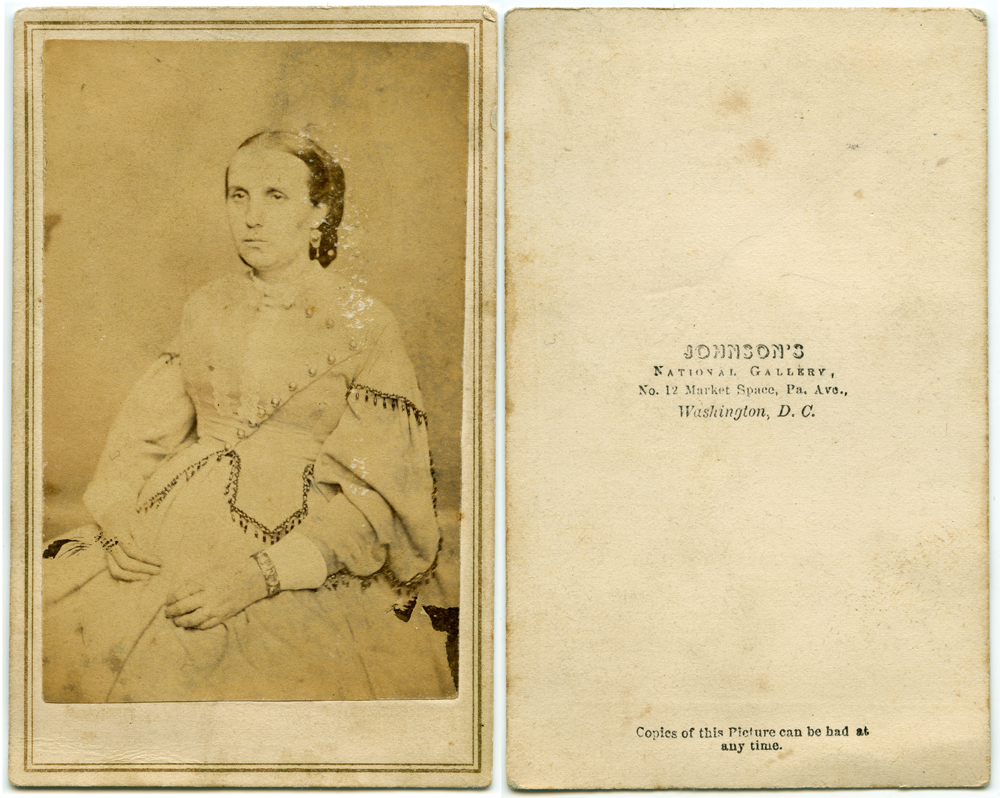
African-American Gentleman, Washington DCAnonymous Lady, Johnson's National Gallery
Two new DC portrait studio pictures from the 1860s-1870s. The African-American gentleman photo is quite interesting because it shows the relative prosperity that was possible so shortly after the Civil War for African-Americans in Washington DC. It is all the more remarkable because it exists in spite of segregation. It’s probably a window into the period of Reconstruction, before the southern states began instituting Jim Crow laws designed to economically suppress African Americans.
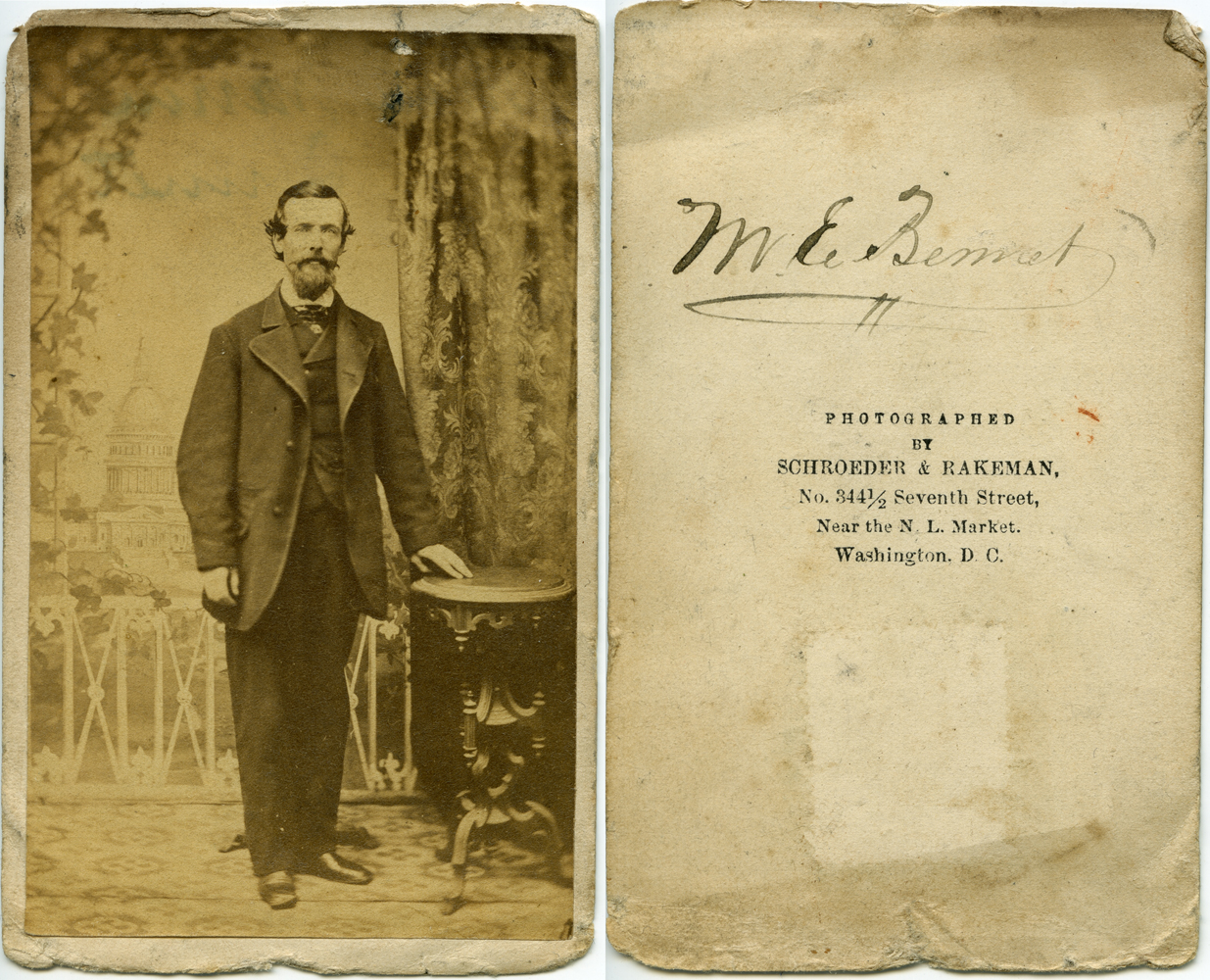
The woman is rather unremarkable, but the photographer’s back-stamp is what interests me – particularly the street address. When I first saw this, the address description helped clarify where another DC photo studio was located – The Schroeder & Rakeman studio. Of course the “Market” referred to no longer exists, but where it was is now a complex of buildings called “Market Square”, and is in immediate proximity to most of the other photo studios in Washington at that time.
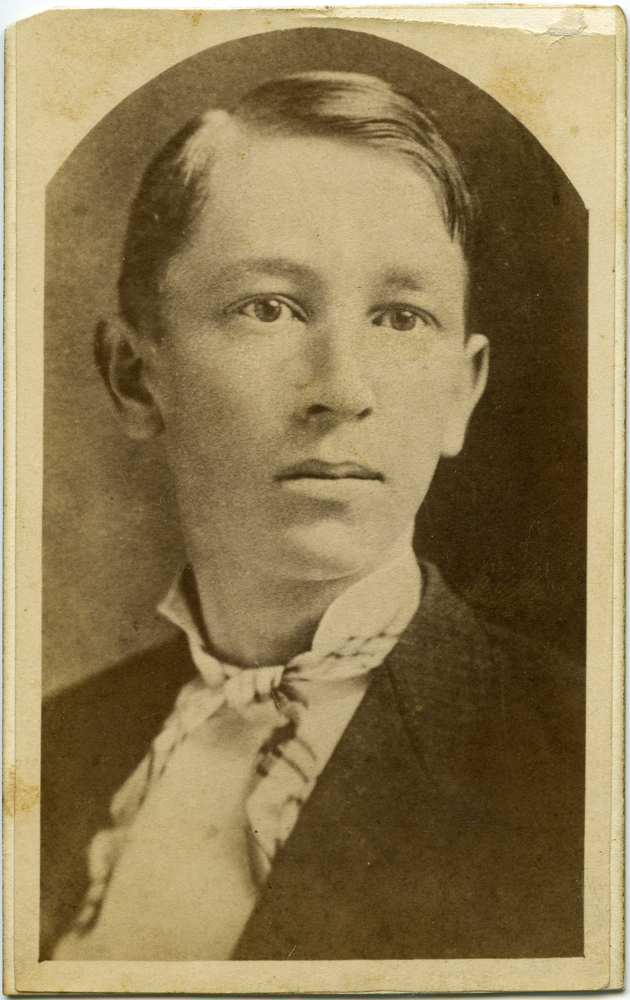
Sometimes a CDV comes along that’s interesting enough even with no ID of the sitter and no ID of the photographer that they’re worth buying (to me). Here’s an example. Anonymous handsome young man, 1870s/1880s CDV
As the seller noted, this is somewhat unusual for a CDV because it’s a frame-filling headshot. Most CDVs show full-length figures, or when they do show a headshot, they are heavily vignetted and the sitter’s face is relatively small in the image. Unlike the seller’s claim, though, I think the reason for this was not a limitation of the camera’s ability to focus closely – the studio portrait cameras used to shoot CDVs were more than capable of doing extremely tight headshots if so desired. The lenses were more the limiting factor, as earlier portrait lenses (usually of the Petzval configuration) had very shallow depth of field and produced a curved field of focus. This meant that anything out of the plane of focus (which was not a plane, but a hemispherical region) would be swirled and distorted. Not very flattering to a portrait subject – Salvador Dali and Picasso were still the better part of a century in the future. With the rise of the Rapid Rectilinear lens design, a much flatter field of focus could be achieved, thus making it possible to produce portraits that were close up yet still flattering.
Over the weekend I went to a camera swap meet in Tyson’s Corner, Virginia. You know, one of those things they hold in a hotel ballroom where dealers in used gear set up tables and put out all kinds of odds and ends for sale, and some will actively buy your used cameras too. I can remember not so many years ago when these things were huge, attracting 75+ vendors in some pretty big spaces in some pretty decent hotels.
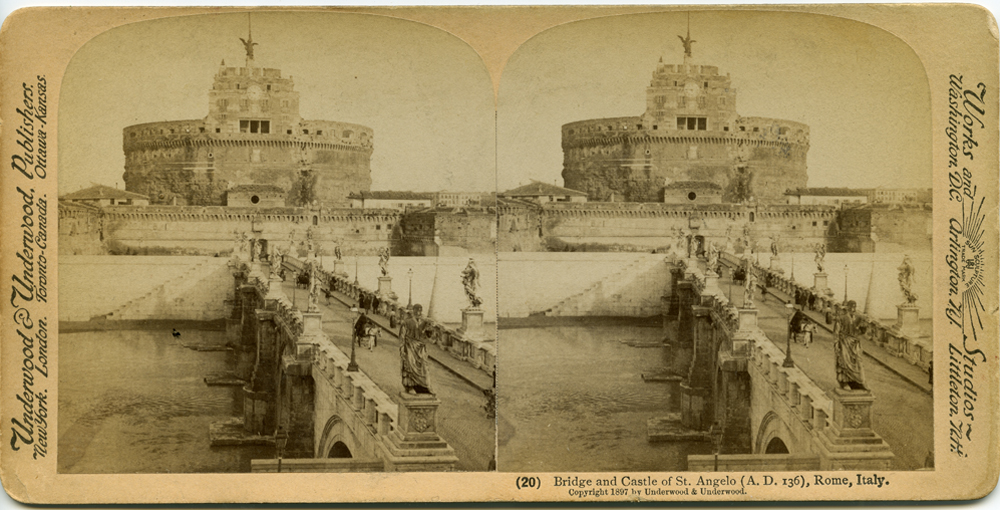
Now, though, not so much. This show is now in the basement ballroom of what is quite possibly the lowest-rent hotel in Tyson’s Corner (it hasn’t been redecorated since the 60’s). I would guess that there were not more than 20 vendors. To describe it as a flea market would be verging on charitable. There were some nice items, for sure, but most of it was glorified (and some not even glorified) junk. I did see a few momentary temptations (a beautifully preserved Nikon F with the non-metered prism, but it was so nice it looked to be a collector piece not a user), but nothing to compel my wallet to open, camera-wise. I did find some stereoviews, including this one, for $2 each. Castell Sant'Angelo, The Vatican
I know, here I was saying I’m not collecting stereoviews, which is not entirely accurate, nor is it entirely inaccurate either. I pick up a few here and there when I see one that tickles my fancy. I’m sure that 99% of them when I die will still be worth what I paid for them, in large part because I don’t actively collect. Stereoviews were made in series, much like this one. Underwood & Underwood was one of the largest publishers of stereoviews, and they printed thousands upon thousands of them, with themes like “The Grand Tour of Europe” or “The Seven Wonders of the Ancient World” or “Vignettes from Oriental Life” showing pictures of the peoples and customs of Asia. They were the 1860s to 1910s equivalent of newsreels and National Geographic movies before motion pictures and television existed, and served to bring the world in all its variety into the homes of the working classes who could not travel and see these things, and perhaps were illiterate and unable to read about them in books and newspapers.
Each stereoview is numbered, and within individual sets, there are always some rare ones. Chasing down the rare numbers reminds me too much of collecting baseball cards, so that’s why I don’t get into it – the image is more important to me than the rarity of the paper behind it. Not that I’d ever turn down a set of Alexander Gardner’s stereoviews of the Lincoln Assassin’s execution. I’m just not going out looking for them.
Here is a link to the DC photographers’ map. I’ve got some more photographers written down somewhere that I’ll be adding to the map soon. I found addresses on a CDV for Alexander Gardner’s studio, but oddly enough there were A: two addresses not adjacent but still proximate to each other, and B: neither one was the address I thought it was. There is still the remains of a wet-plate era portrait studio that you can see from the alley behind the National Council of Negro Women’s headquarters in the 800 block of Pennsylvania Avenue. Even though it’s not a portrait studio, I’m including Clara Barton’s Missing Soldiers Office on the map as a point of interest because it, like so many of these studios, was presumed lost for decades but only recently re-discovered, and is chronologically and geographically contemporaneous with the studios I’m tracking. At some point I’m sure either the patrons or the staff of her bureau availed themselves of the photographic archives of the studios in the neighborhood to help in finding missing soldiers after the war.
Also interesting – Alexander Gardner began his career in Washington working as Mathew Brady’s studio manager. At some point they had a falling out and Gardner opened his own studio. I didn’t realize it was literally next door to Brady’s.
I can also now definitively place Schroeder & Rakeman’s studio in Northwest DC, having found another photographer making reference to the “Market” at Pennsylvania Avenue, which is where the Navy Memorial is currently located.
M.E. Bennet, by Schroeder & Rakeman, Washington DC
Another little CDV added to the collection, from Schroeder & Rakeman, 344 1/2 Seventh Street. It’s nice to find an image that is identified, even if the subject remains anonymous after the naming. I’ll have to do some digging around to find out who this might have been. Obviously the photo was made post- civil war, as it shows the dome of the US Capitol completed in the painted backdrop. I did look up a map of Washington DC from the 1850s to see if I could find the ‘N.L. Market’ referenced in the photographers’ back stamp. While the building (or place – the market could have been a permanent outdoor location), the address is part of what is now called the “Market Square” office/condo complex, including the Navy Memorial. Another option for the studio would be at 344 1/2 Seventh Street, SE. Which ironically enough puts it within a block of Eastern Market. I can find no reference to Eastern Market as anything other than Eastern Market, however, which throws this location for the studio into doubt.
I’ve found some more photographers to add to the map of New York. Again, you’ve got to love some of these self-descriptions of their businesses. Also interesting is the case of C.D. Fredericks, who ran studios in New York, Paris and Havana. Makes you wonder how he managed three studios in such far-flung cities at a time where steam-powered trans-atlantic crossings were just coming in to being, there was no telephone, and the airplane was still an opium-smoker’s dream.
I’ve reorganized the list in geographic order, with the assorted Lower Manhattan addresses first, then the ascent of Broadway, followed by the odds and outliers, including one in Brooklyn.
STUDIO NAME
ADDRESS
DATES OF OPERATION
R.A. Lewis
152 Chatham Street *
unknown
R.A. Lord
164 Chatham Street *
unknown
K.W. Beniczky
#2 New Chambers Street, corner of Chatham *
unknown
Vaughan’s Gallery
228 Bowery
unknown
H. Merz
E. Houston & Essex Streets
unknown
Bailey’s Photograph Gallery
371 Canal Street
unknown
O.O. Roorbach, Publisher of Dramatic Photographs
122 Nassau Street
unknown
Mathew Brady
643 Bleeker Street
(1859-1860)
Jaquith, Daguerrian Parlor
98 Broadway
unknown
S.A. Holmes, Daguerreotype Studio
289 Broadway
unknown
Josiah Thompson, Daguerreotypist
315 Broadway
1849-1853
J. Gurney & Sons, Daguerreotype Studio
349 Broadway
unknown – early
Mathew Brady
359 Broadway
(1853-1859)
Bogardus
363 Broadway
1860s
E. Anthony, Publisher, Brady’s National Portrait Gallery
501 Broadway
unknown
W.C. Wemyss, Dealer in Photographs, Books, &c.
575 Broadway
unknown
C.D. Fredericks & Co 587 Broadway, New York 31 Passage du Havre, Paris 108 Calle de la Habana, Havana
587 Broadway
unknown
Anson’s Daguerreotype Gallery
589 Broadway
unknown – 1850s
Chas. K. Bill
603 Broadway
unknown
J. Gurney & Sons
707 Broadway
unknown – mid
Mathew Brady
785 Broadway
(1860-)
Glosser
827 Broadway
unknown
Bogardus
872 Broadway
late 1870s
T.J. Maujer, Passepartout & Carved Walnut frame manufacturer, Dealer in Photographs, Artist’s Materials, &c.
953 Broadway & 183 5th Avenue
unknown
J. Gurney & Sons
5th Avenue & 16th Street
unknown – late
Loud’s Celebrated Album Cards
unknown
unknown
Fernando Dessaur
145 8th Avenue
unknown
Estabrook’s Ferrotypes
379 Fulton Street, Brooklyn
unknown
* addresses no longer exist. New Chambers Street & Chatham Street are now approximately where New York City Civic Center and Police Headquarters are now located.
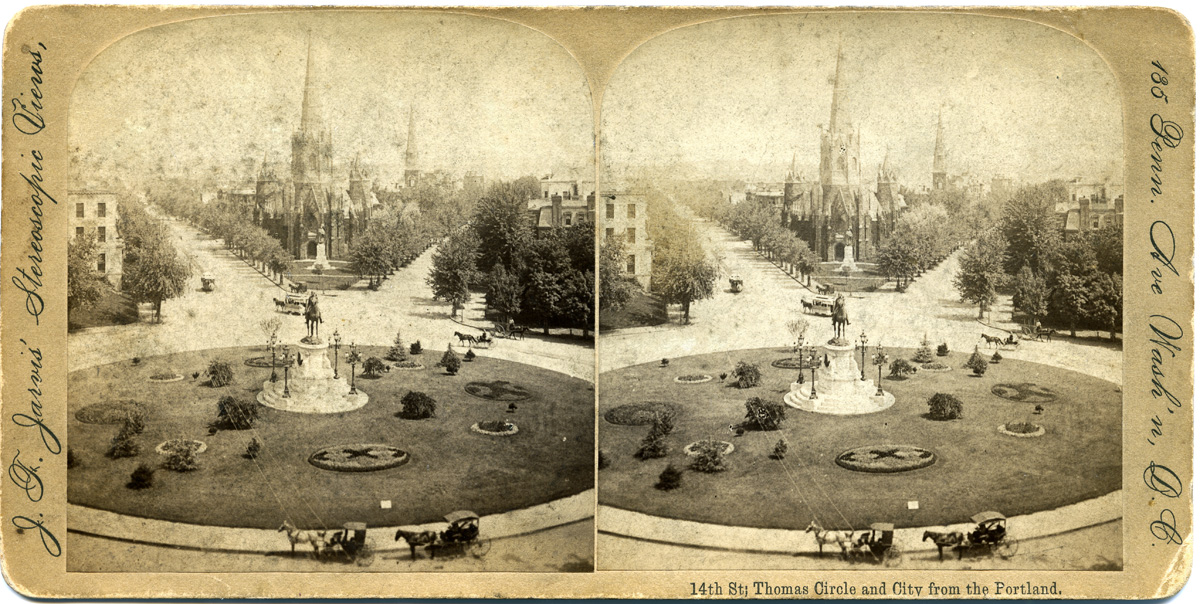
Stereoviews are not something I routinely collect, because there’s gazillions of them out there (I know, gazillion is such a technical term) and they’re already by themselves a hot collectible. I couldn’t resist this one though because I see pretty much the same view from my office’s conference room window every day. The Lutheran church with the statue in front hasn’t changed, but on the left is now the National City Christian Church, and on the right, the trees are gone and replaced by the Washington Plaza hotel. The landscaping in the circle is completely different, as is the traffic pattern around the circle. I think the land area of the circle island is much smaller, to accommodate additional traffic lanes.
I have done a bit of digital restoration on this scan because the original stereoview has seen better days. Stereoview, Thomas Circle circa 1880
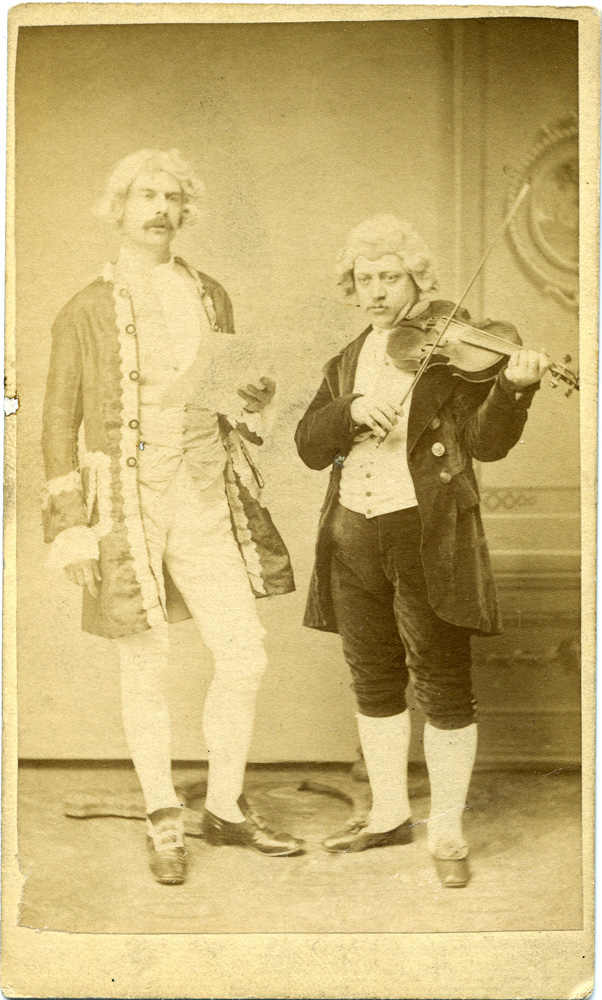
Two actors by Chas. H. Spieler, 722 Chestnut Street, Philadelphia, PA. Note the feet of the braces used to keep the actors still during the possibly half-minute exposure. You can tell I’m a real historic photo geek when I get excited over something like the presence of posing stand feet in a CDV.
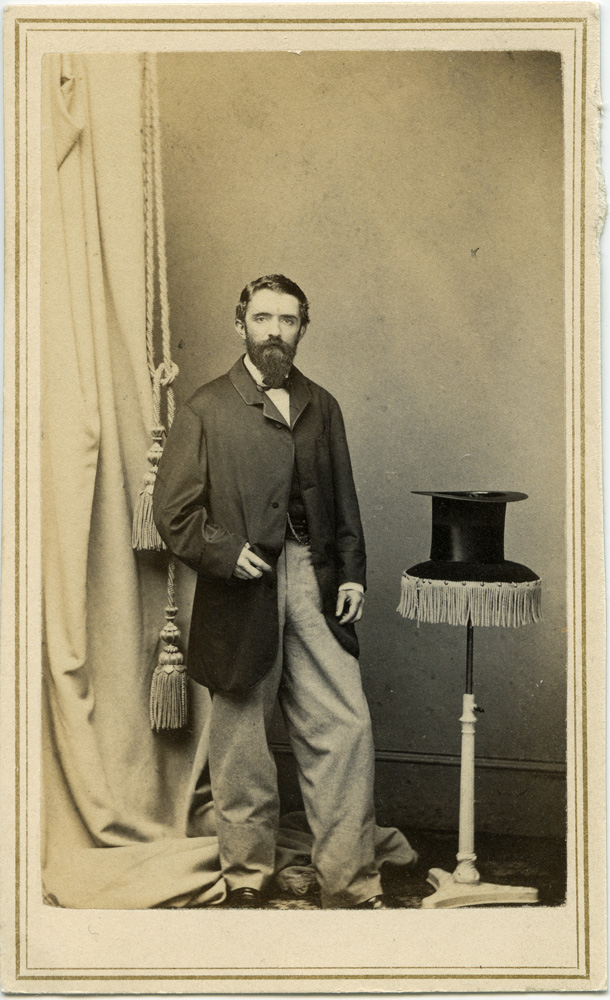
Anonymous gentleman with top hat, by Bogardus, 363 Broadway, New York. This image has actually inspired some studio design ideas for my own studio – I’m now hunting for rope and tassels like the ones in the backdrop here.
Two actors in costume by Chas. H. Spieler, PhiladelphiaAnonymous gentleman by Bogardus, New York
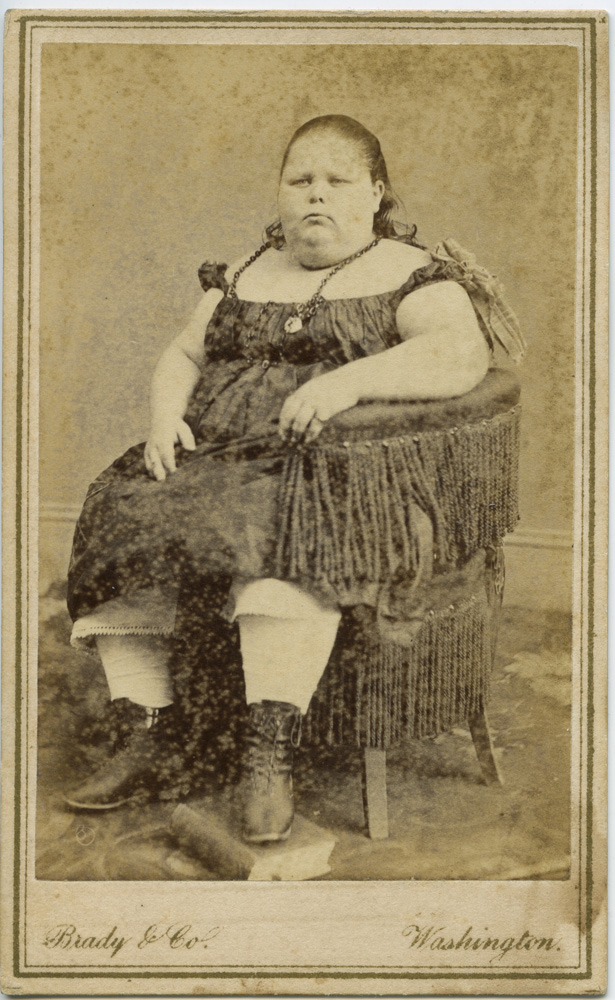
Another CDV added to the collection. My first Mathew Brady CDV with the Washington DC studio imprint. I suspect that she was a circus sideshow performer, because even in the Victorian era when zaftig women were more popular, she is not the kind of zaftig that the Victorians found sexy.
Also note the book under her foot. I suspect it was just a posing prop to give her body some form and dynamic, but it would be interesting to know if there were something meaningful to the book underfoot. Books were a very common studio prop, usually held in the hand, to indicate that the subject was literate and had some kind of intellectual accomplishment. By extension, stepping on a book would seem to imply a deliberately and blatantly anti-intellectual attitude, which would have been at extreme odds with the contemporary ethos, and would seem out of character for a studio like Mathew Brady’s – he went out of his way to cultivate associations with the best and the brightest of his day. So it’s probably just a posing device, no meaning implied.
 dcphotoartist