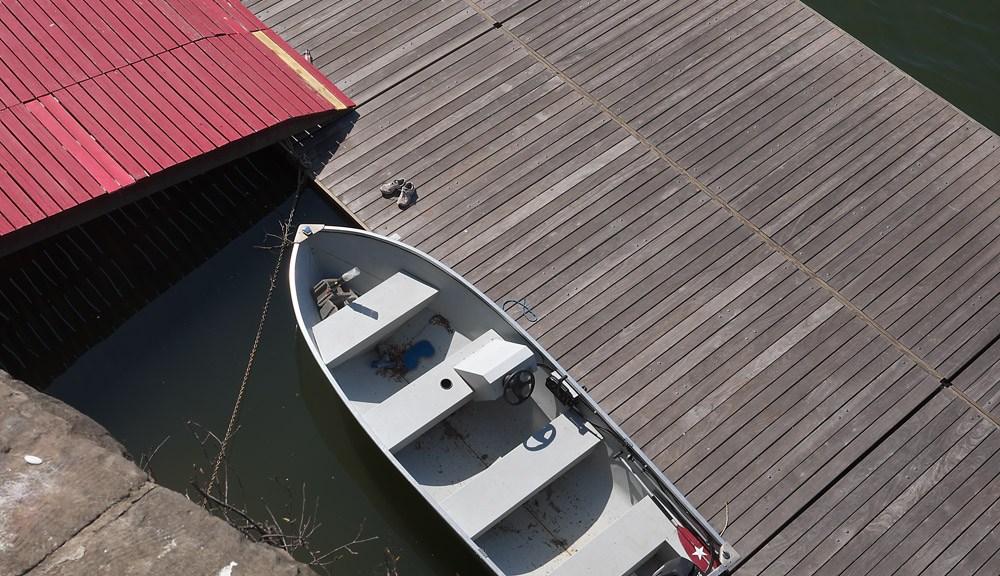
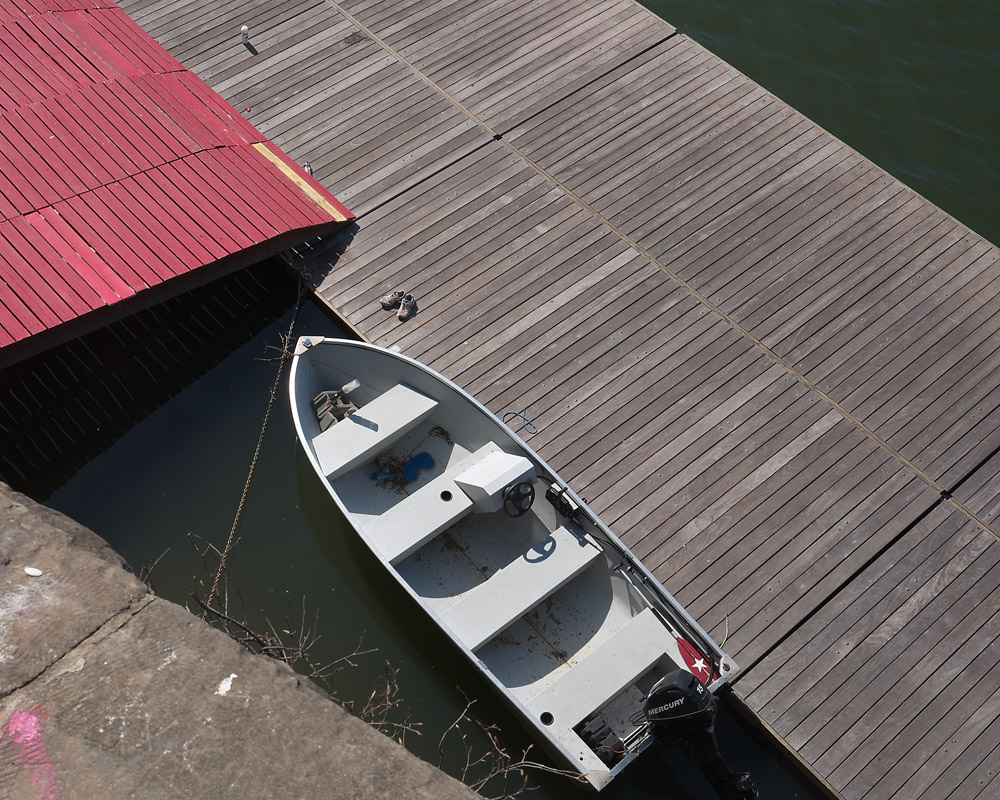
This is a view I’ve seen a number of times but wasn’t ever sure how to capture it until yesterday. I’ve always had the wrong camera with me, either from the focal length, the aspect ratio, or both, perspective. This is an outtake in the sense that I was doing a model shoot with a friend of mine on the pier of the old C&O Canal bridge that used to cross the Potomac River in Georgetown, so taking this photo was not the purpose of the shoot. This is the view looking straight down at the dock for the boathouse.
Boathouse Dock, Georgetown
I was particularly drawn to the geometry and angles formed by the decking on the boat dock, with the red decking running perpendicular to the unpainted deck, and all the triangles formed by the perspective you have to take to see the scene in the first place. Even the boat, which has a totally different shape and texture to the decking, creates more triangles with its prow, and provides visual tension running the opposite direction so you move your eye around the image.
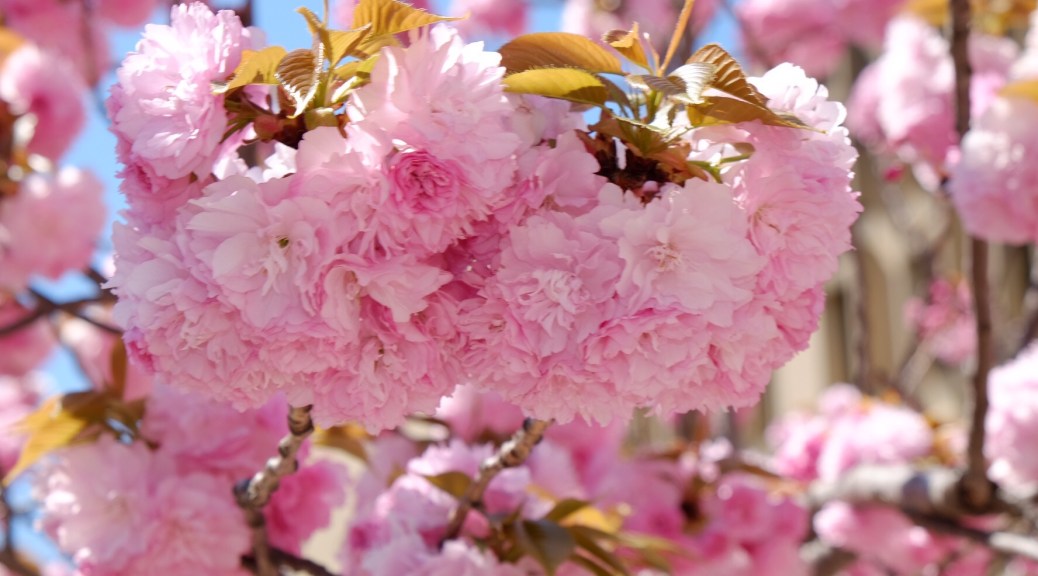
There are times when you want to capture something delicate in backlit lighting – a translucent flower for example. Going strictly with the natural light you end up with either the translucent parts blown out to get detail into the front, or you have a dark blob in the middle to keep the delicate highlights under control. This is where fill flash comes in handy.
Normally I loathe little pop-up or shoe-mounted flashes because they’re about useless when trying to light anything more than a couple feet away, and they’re so close to the lens that they give people red eye and make pets look like demons. But as a fill flash, they really shine (shine, get it? pun!). They put out just enough light to take the edge off backlit shadows and add a little catchlight into people’s eyes. When used this way redeye isn’t a problem because in daylight people’s pupils are closed down enough that their retinas don’t reflect (the cause of red eye in photos).
Fortunately, flowers don’t have retinas, so we can dismiss the concern altogether.
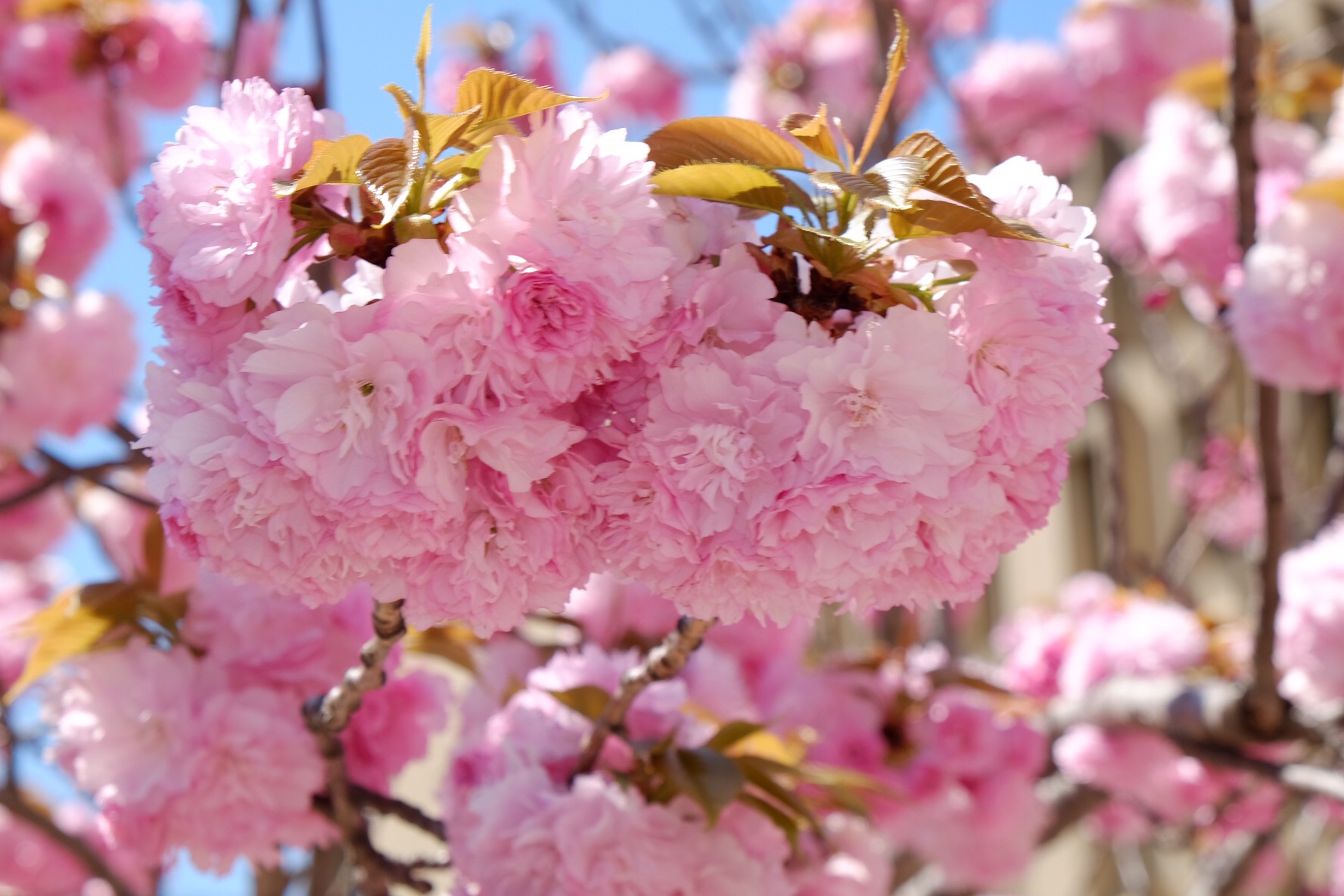
Pink Blossoms
I was using my Fuji X-T1 and had the tiny little toy-like pop-up flash that comes with the camera as an accessory. I took one shot of the blossoms without the flash. I knew right away that the blossoms would be too dark and not have detail; the little flash was exactly what I needed. I popped it up and let it put in a little kick. Voila!
In this set I’m including some black-and-white shots along with the color ones to show what the Fuji can do. I used the b/w+R setting (the equivalent of using a red filter when shooting black and white film). I don’t know that this is as extreme as actually shooting black-and-white film with a red filter in terms of the contrast and look, but I like it.
MustafaMustafa
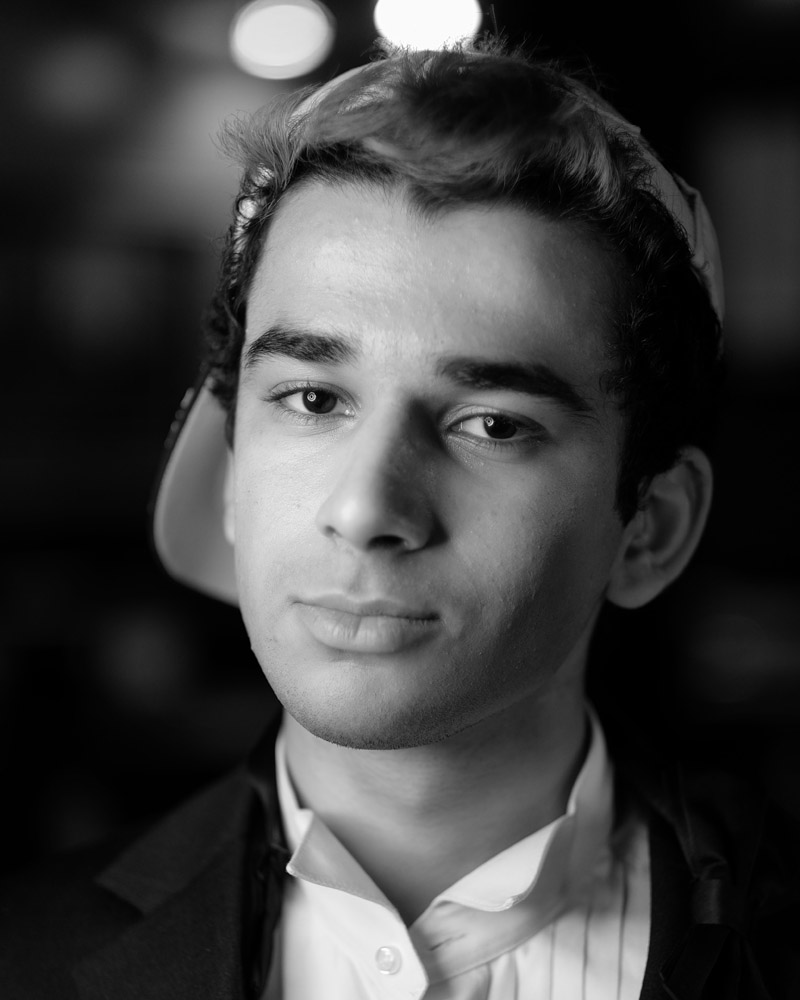
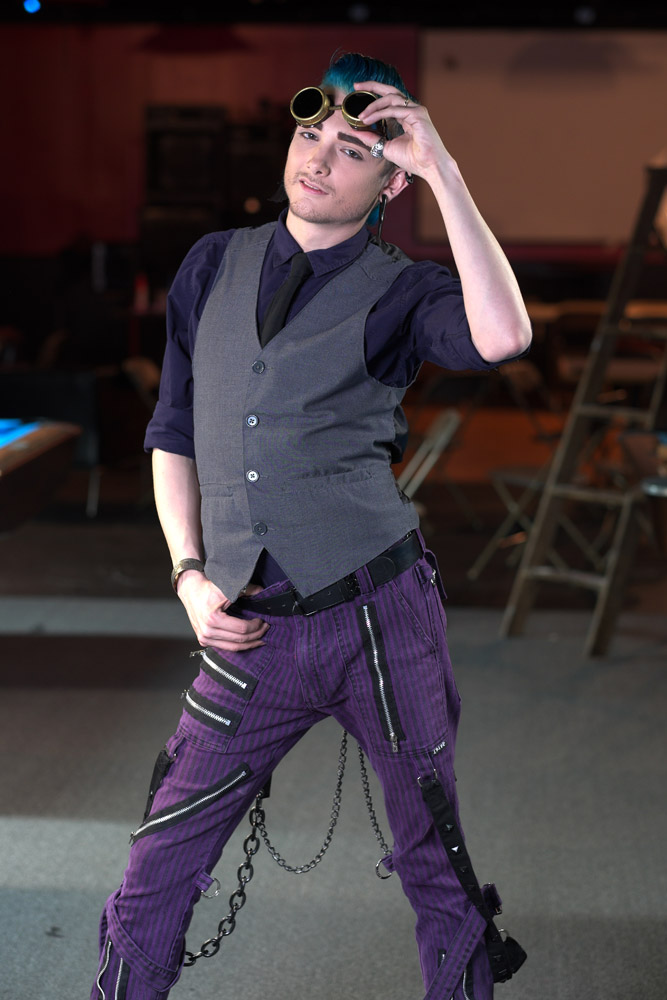
Mustafa showed up to the shoot in a tux, which is hard to work around if that’s not what you’re aiming for. It’s a good look, and a very elegant one, but not necessarily fitting a pool hall. I tried to shake things up a bit with the kaleidoscope glasses, the steampunk welder’s goggles and my own vintage leather jacket. Tip to models – unless you are told wardrobe will be provided, always bring at least two different looks to a test shoot with you so you don’t get stuck looking out-of-place on the shoot.
MustafaMustafa
Mustafa has a great face – he looks good from lots of angles. When posing a model or a portrait subject, you want to make sure that you’re not doing anything un-flattering. If you’re turning the head away from front-on, you want the nose to either obviously stand back from or break the contour of the cheek so you don’t inadvertently flatten it by having it by having the tip of the nose meet the outline of the cheek. At the same time, pay attention to the eyes – you want to see whites on both sides of the iris. If you turn someone’s head in part profile and then have them look back at the camera with their eyes, the irises in the corner of the eye make them look like a psycho-killer. In these shots it works because he’s looking the same direction with his eyes as his face is pointing.
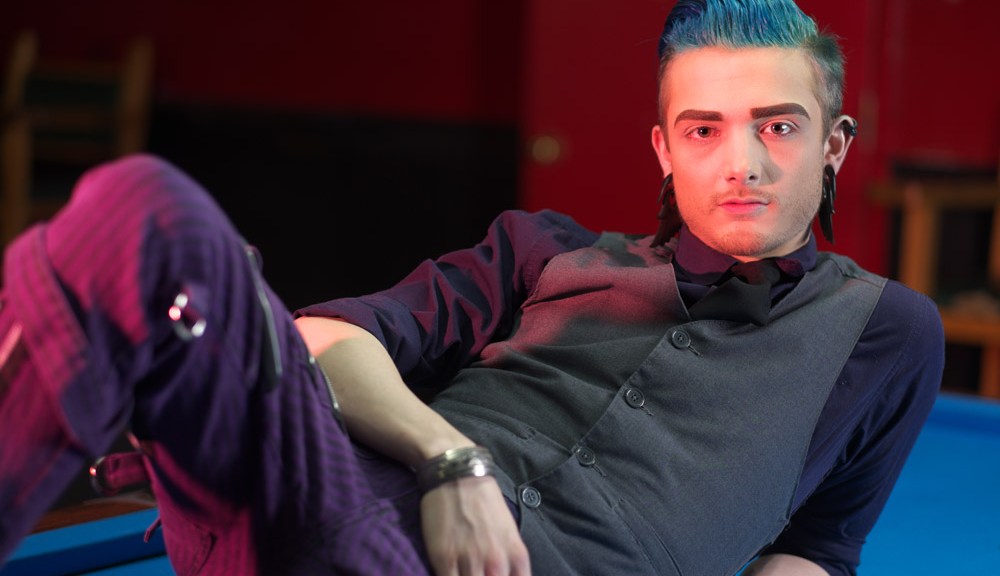
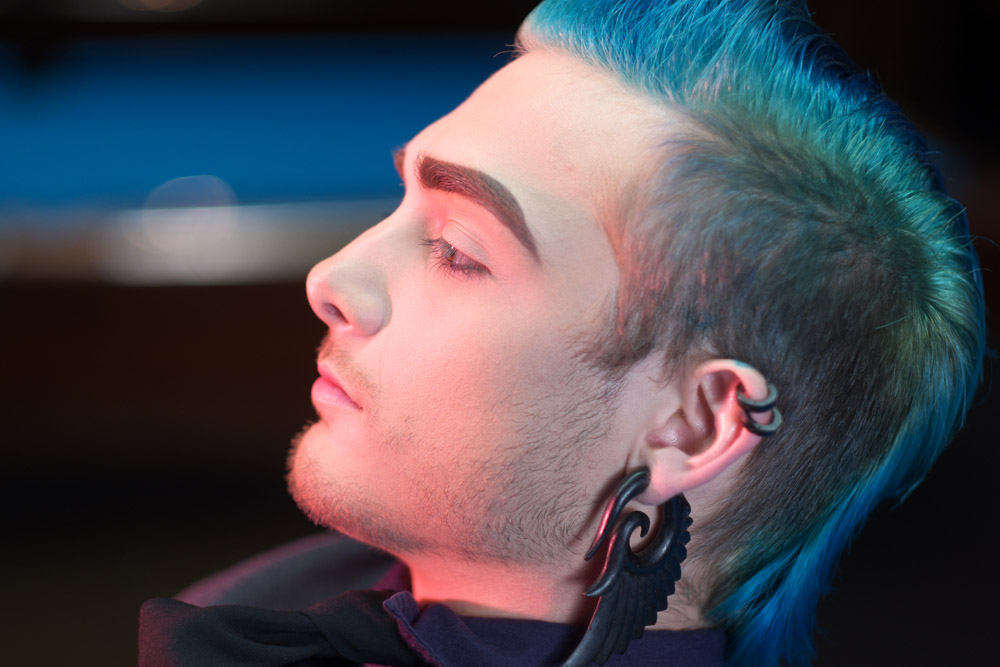
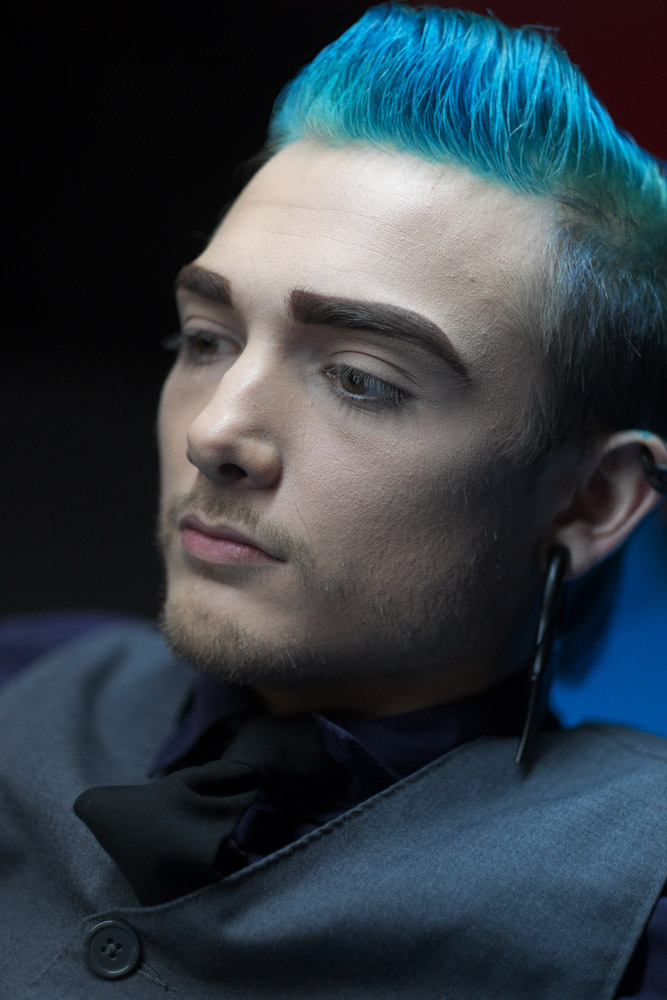
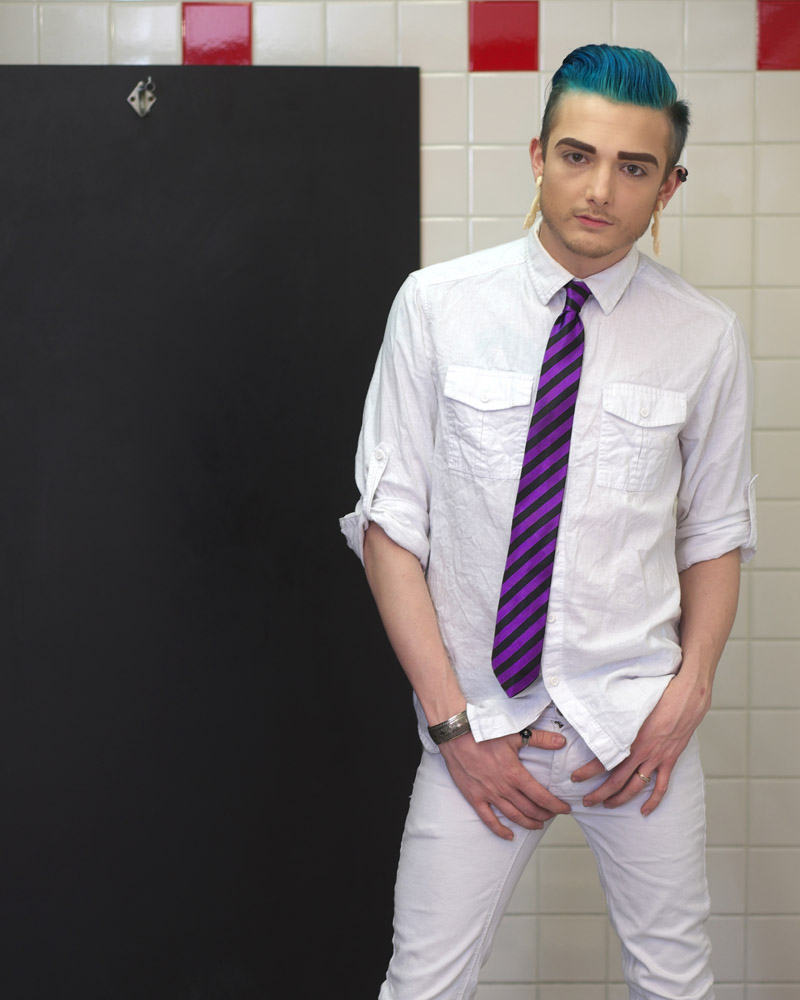
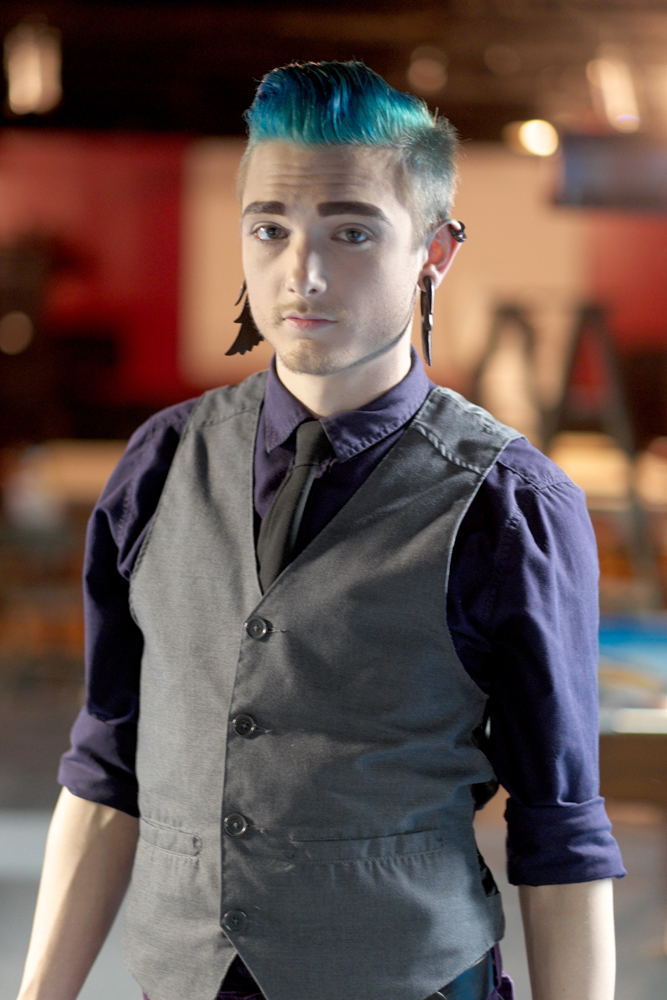
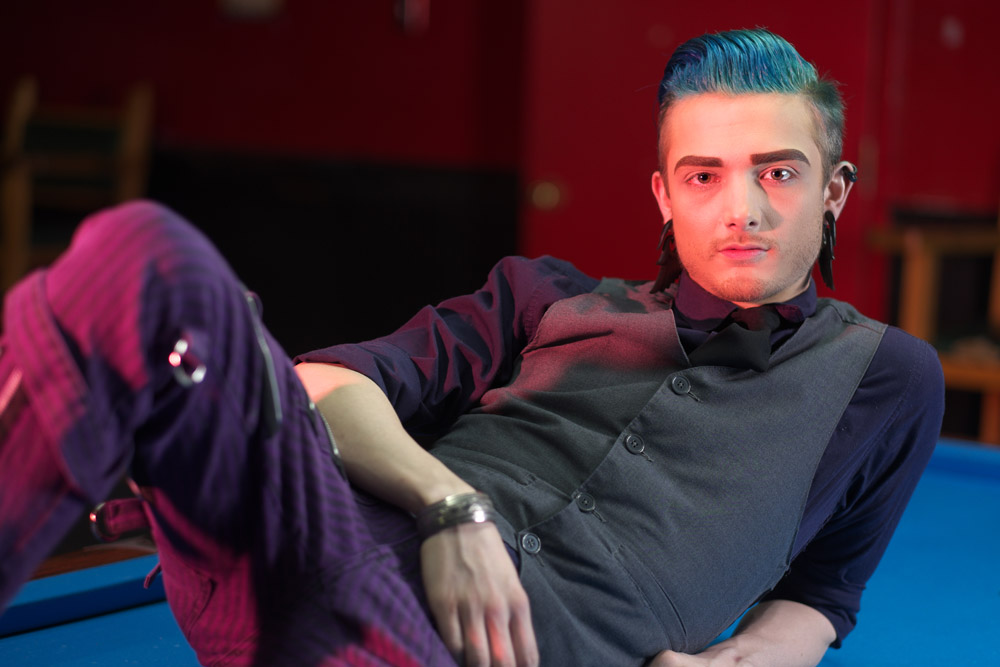
Here’s the set I did with Jayy Ruger (his professional name). While it definitely pays to add the colored gel to the fill light to add a touch of drama and character to a scene, it also pays to give it a light touch. In this first profile shot, if his face had gone totally red, it would have looked freakish or just poorly exposed/lit. Instead, the red on his cheek gives the image depth, and makes his otherwise flat makeup look more alive. Compare to the second image which was lit entirely with the overhead fluorescent light above the pool table where he looks almost corpse-like (entirely appropriate if you’re going Goth but maybe not the best look if you’re doing a family portrait).
Jayy RugerJayy Ruger
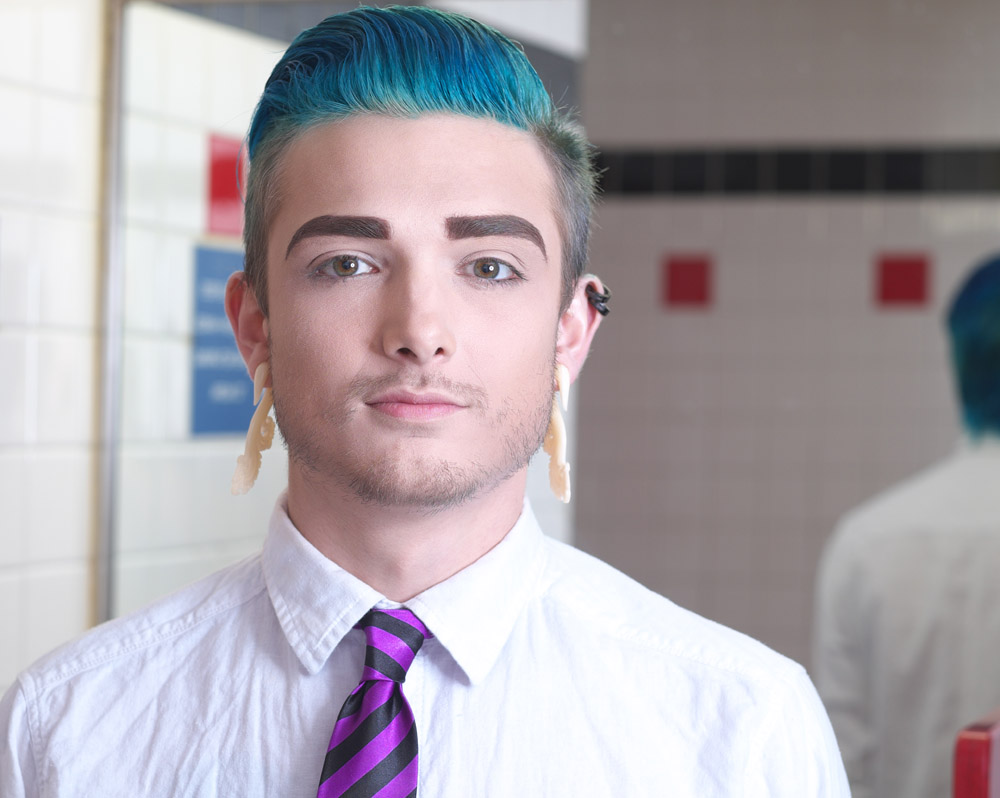
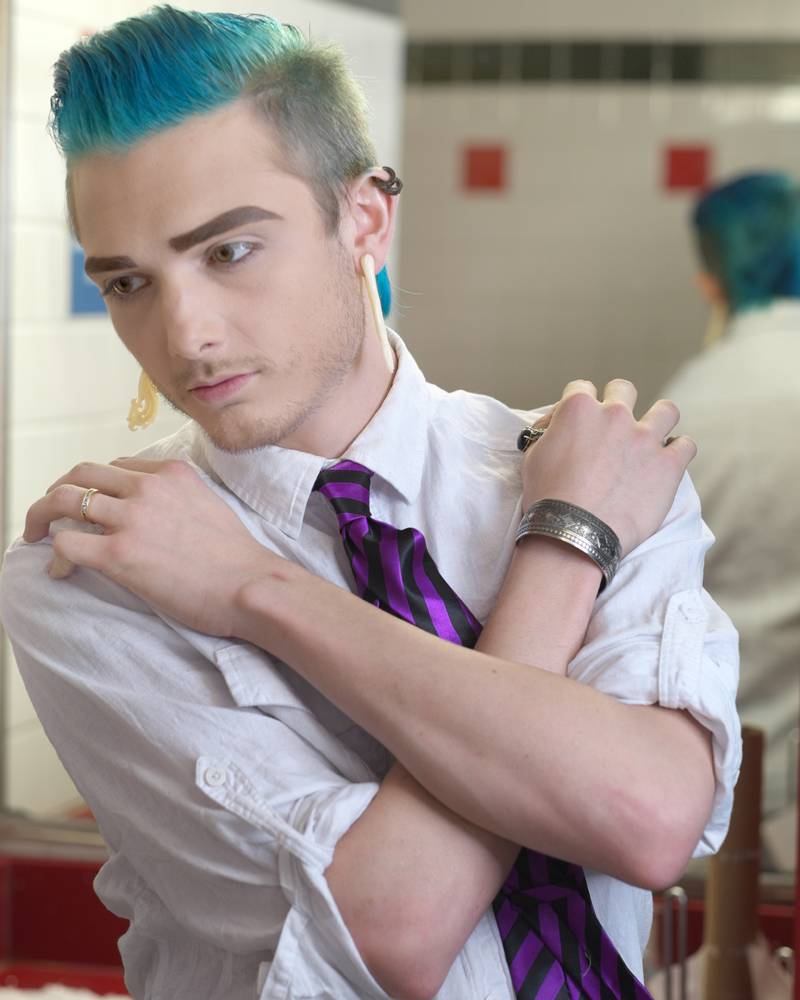
Late last year I went on a lighting binge, and one of the light modifiers I bought was a beauty dish. I had this specialized one from Bowens I really wanted to try out because the dish has a hybrid diffuser with a center grid. In the bathroom interior shots, it was the only light source I brought to the scene. The rest of the light is from the existing bathroom lights and the fill created by the white walls acting as reflectors.
Jayy RugerJayy Ruger
One of the great strengths of the Fuji (and one of the reasons I bought it) is its incredibly good handling of mixed color temperature lighting. You can see the color of light in the next several shots does vary, but regardless of what I threw at it, the Fuji did a terrific job of keeping skin tones natural and not shifting fabrics off in some wild direction in response to a mix of light sources.
Jayy RugerJayy Ruger
Back to using a red gel again – it adds a bit of a sinister note to the shot, which creates an interesting tension between that look and the suggestive pose.
Jayy Ruger
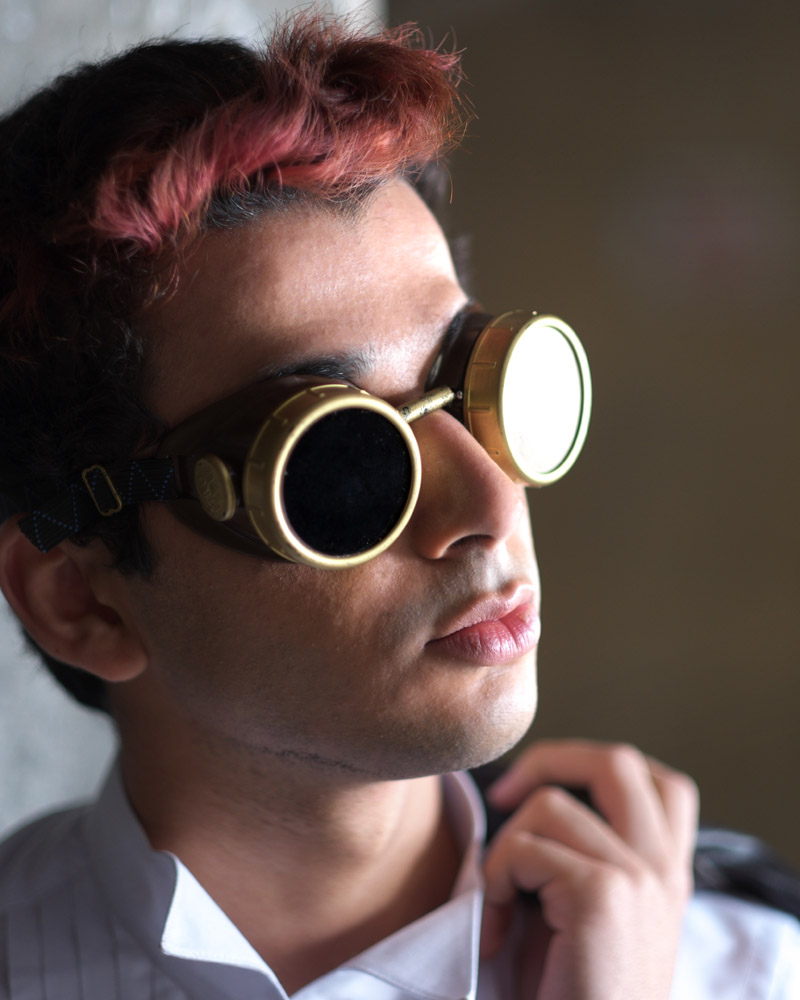
And we’ll close on a fun note – Jayy was being a great model and got into the whole steampunk thing with the goggles (he was already halfway there with his outfit!)
Jayy Ruger
These are the same kaleidoscope glasses you saw in the previous model set with Alex. This shot was lit solely with an umbrella softbox. It’s like an umbrella, but more of a tight parabolic shape instead of the broad surface umbrella you normally think of. There’s a slit in the side of the fabric that allows the flash unit to sit inside the umbrella’s body, and then you can close it inside entirely with the diffuser (if you remember to bring it!). I wanted to focus your attention on Jayy in this shot so I moved in super tight and used a relatively fast shutter speed to let the background go completely dark. In the full length shot immediately previous to this one, I dragged the shutter to give a lot of background light, allowing you to sense the quality of the space behind him.
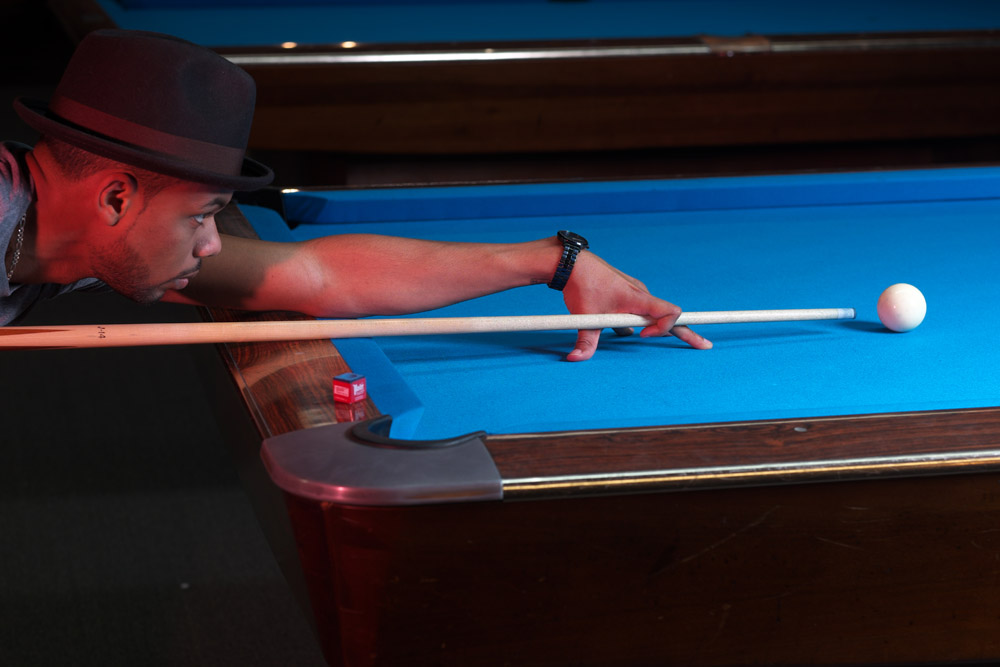
Yesterday I had a model shoot with three aspiring models who needed to build their portfolios. We went to a billiards parlor for the afternoon and I put them and the Fuji through its paces. It was also the first test in the field for my new 400 w/s bare-bulb strobes. The new strobes are battery-powered via external rechargeable batteries. They can be configured to sit on-camera and be triggered via hot shoe, take a wireless remote trigger like a PocketWizard, be triggered via sync cord, or be triggered by a proprietary wireless trigger system that also allows you to remotely adjust the power level from the camera position. The first one I bought was a Calumet-labeled version. When Calumet was still in business in the US, these were quite expensive – a single head unit plus the required but not included battery pack would have set you back a cool $1000. Nowadays, they’re on clearance on Amazon for $300 or so. They are also now being sold with the NEEWER, Flashpoint and Godox labels, at a much more reasonable price – I got a NEEWER version with the external rechargeable battery pack for $400 as a second unit for doing fill flash or background lighting.
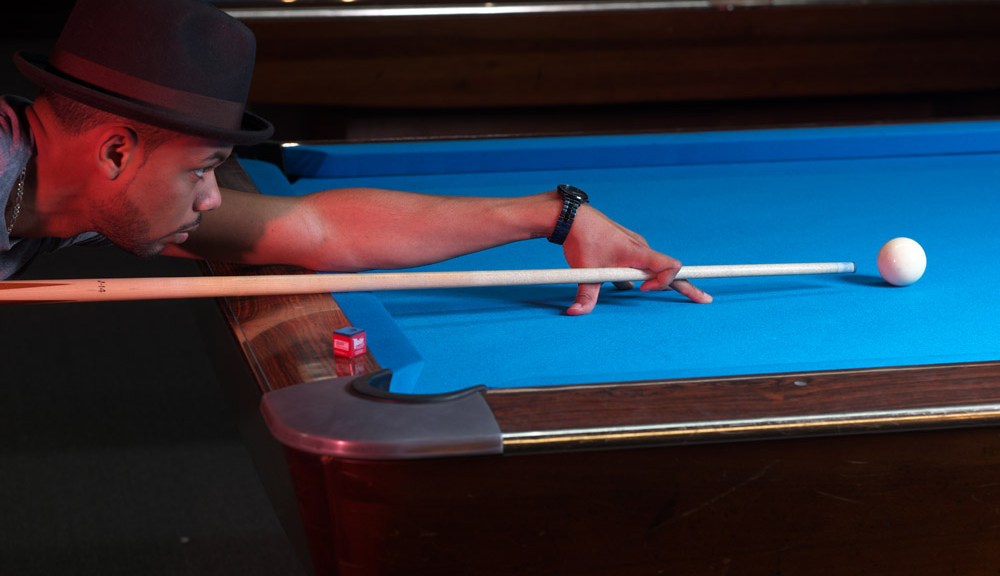
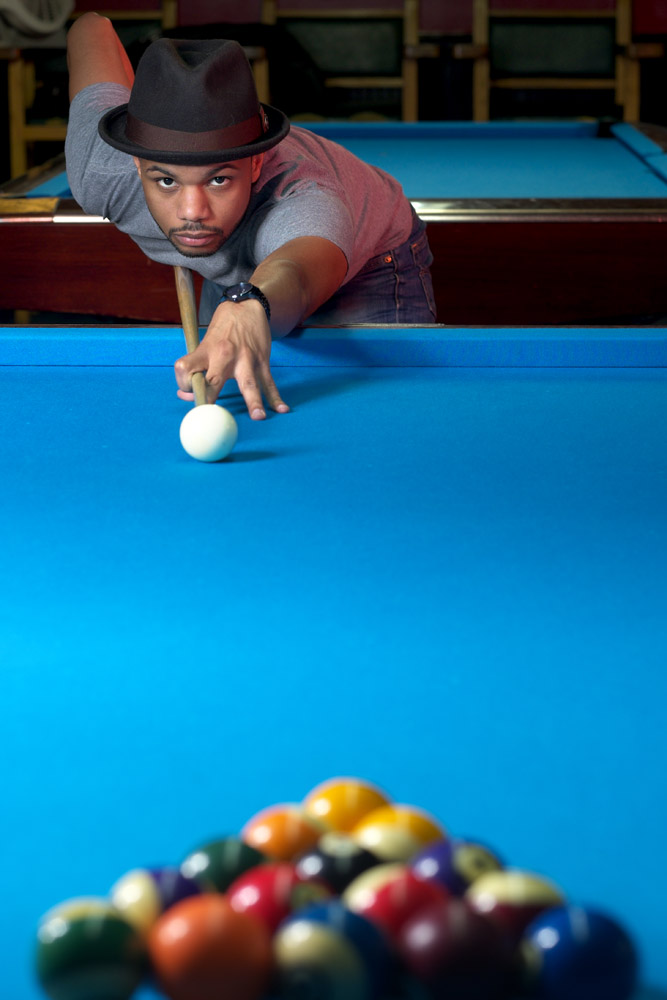
These first two shots were taken with Alex shooting pool. In the first shot, I set him up taking the break shot. Don’t let the fact that he’s a model fool you- he’s also a pool shark – right after this shot, his break dropped three balls. I wouldn’t bet against him. This was taken with the Fuji 56 f1.2. My main light was the Calumet Genesis in an umbrella softbox, and the fill was the NEEWER with a gridded reflector and a red gel in it. Having the ability to both color gel and grid the fill is really handy, as the color adds a touch of drama to the scene, and the grid keeps it from spraying all over the place and coloring things you don’t want it to, like the table felt.
Alex
For this shot, I kept the lights the same but switched to the 23mm f1.4 so I could get in close and still get the extension of his shoulder, arm, cue, and the ball on the table, as this table was in the middle of the room with other tables behind me, and I only had about four or five feet to work in. The red gel adds a touch of drama and energy to the shot without overwhelming, and is a good way to deal with the very mixed light in a pool hall where you can have fluorescent (the over-the-table lights), halogen/tungsten (lights in the bar area and on the walls) and LED (accent lights like rope lights around partition walls and the like, or under the bar) all in the same area.
Alex
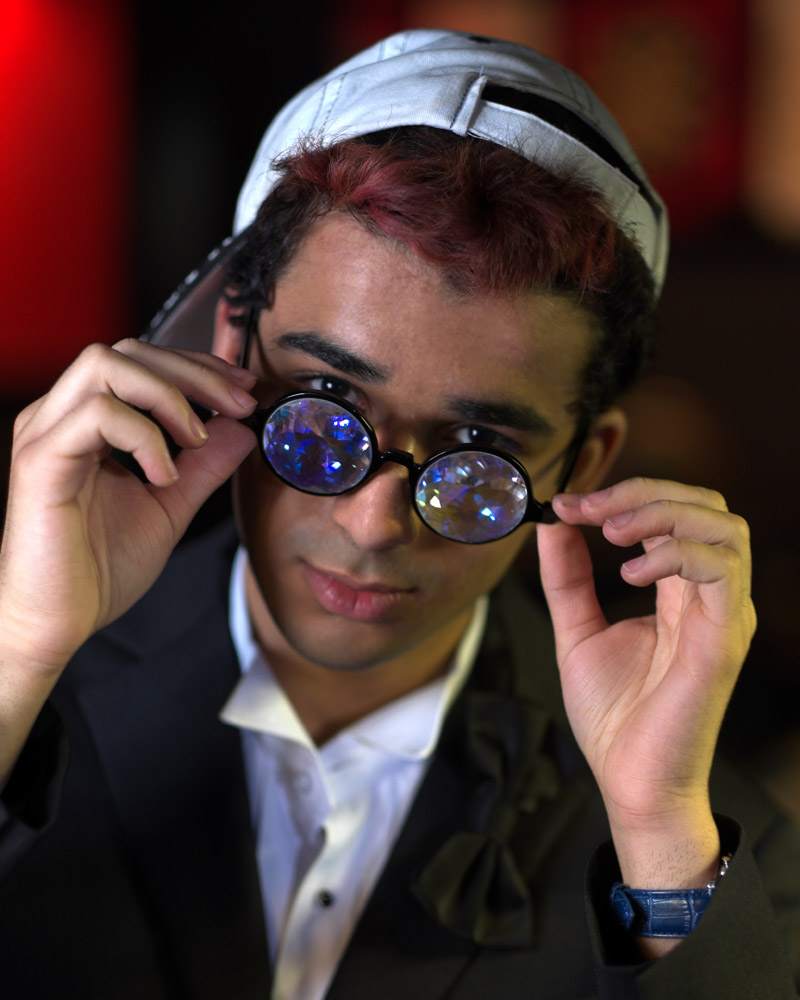
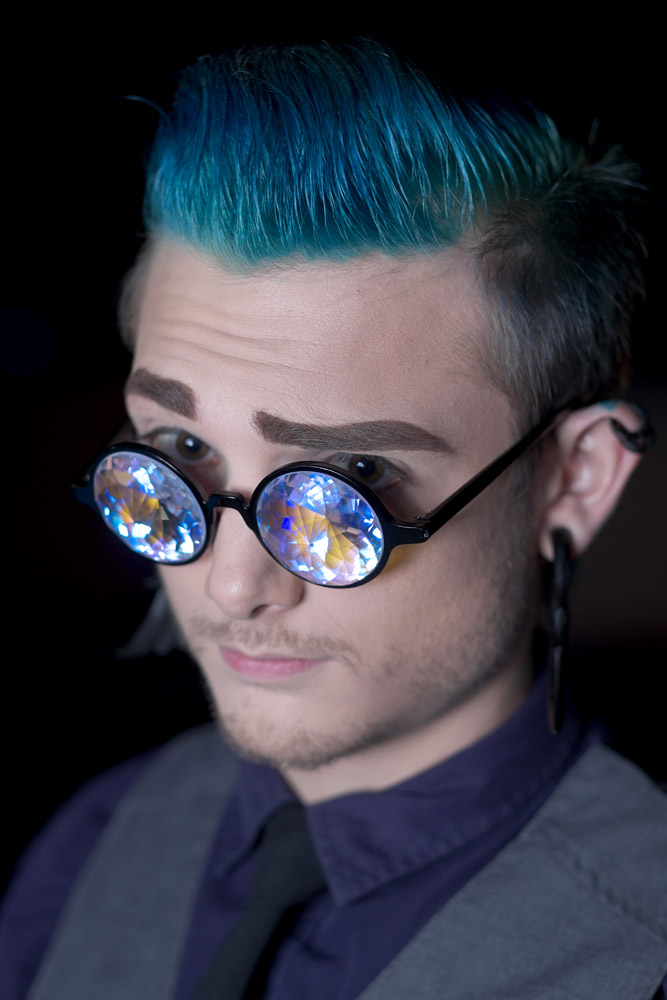
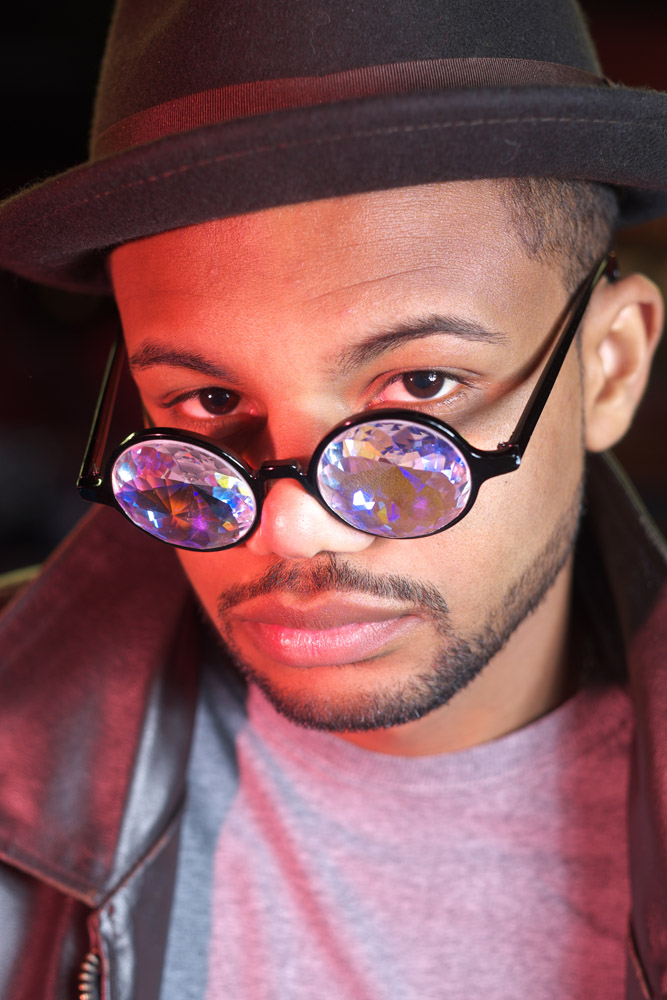
I also did some head shots with Alex (who is an easy, professional model to work with). I backed this indie film called Hallucinaut on Kickstarter last year and as my reward, I got these kaleidoscope-lensed glasses that appear in the film as a prop. I chose them specifically as my reward as something that would make a really cool prop for photo shoots. This was their first appearance in one of my shoots. They really pick up and reflect colors well, and make for a dramatic statement.
Alex, with Hallucinaut glasses
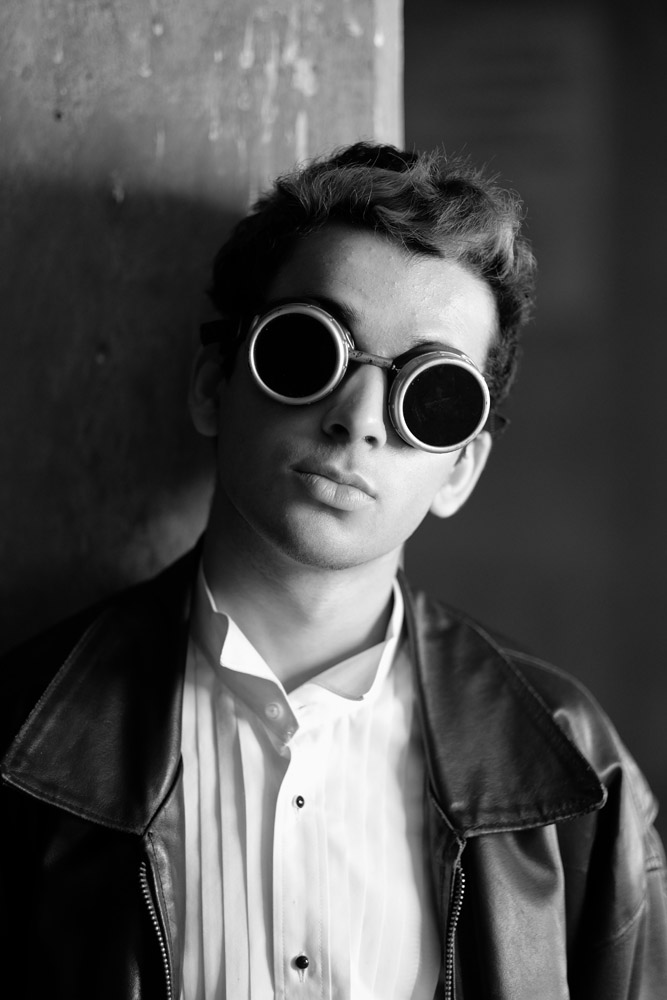
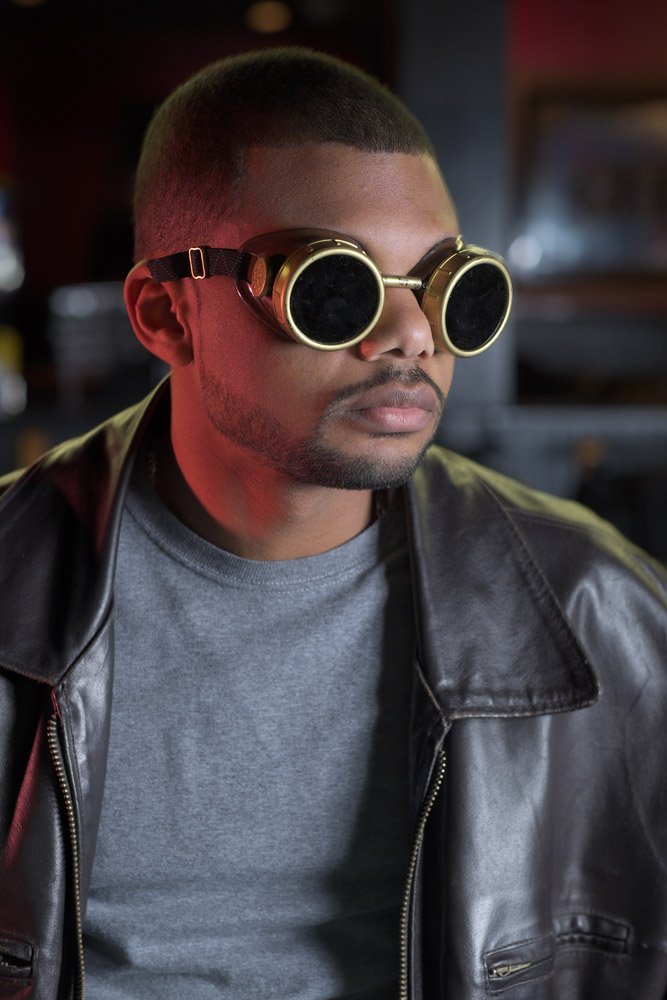
A variation on the theme, I broke out my welder’s goggles and matched them up with a vintage leather jacket for a steampunk look. Alex’s short-cropped hair adds to the look by letting the goggles really stand out against the shape of his head.
Alex, going Steampunk
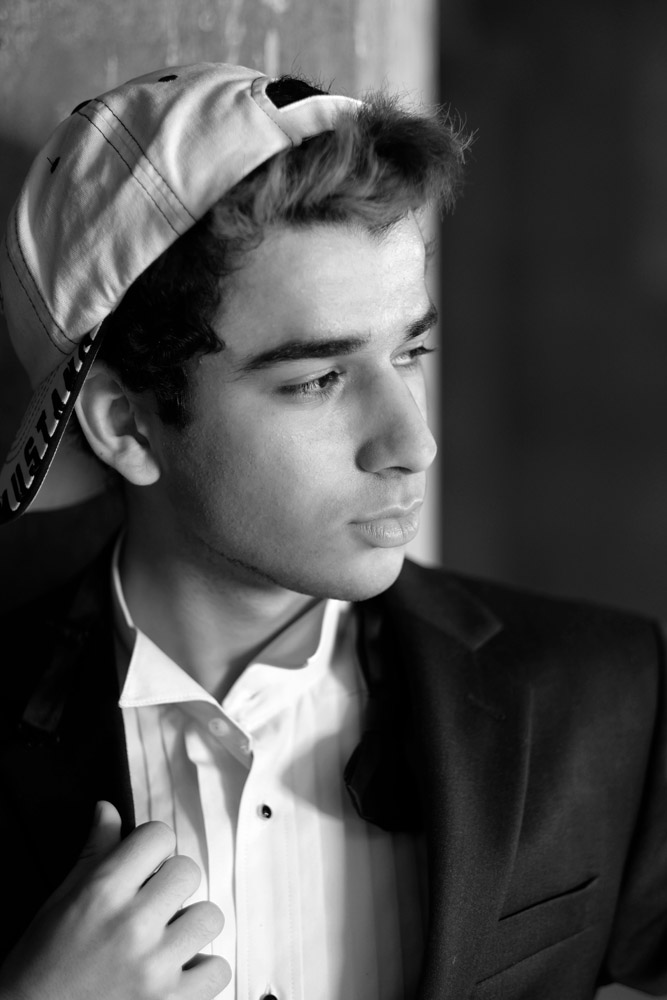
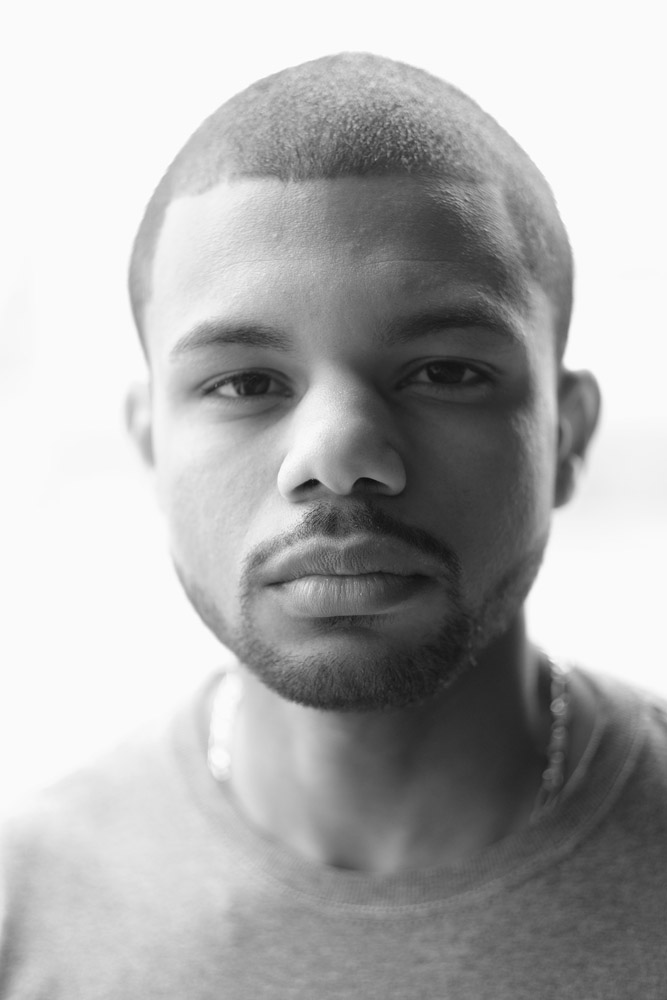
In the last look for Alex, I did two versions of this really clean, minimal portrait. When I showed it to him on screen he commented “I have a really long neck!” as if that was a bad thing. I reminded him of what you’ll hear on every season of the now-ended America’s Next Top Model – it’s a really good thing to have a long neck. Tyra Banks and her photographers were always reminding the contestants to elongate their bodies and gestures, to create drama and elegance. If you have a short neck, stretch it out, otherwise the camera can make it look like you’re neckless and just have a head glued directly to your torso.
Alex
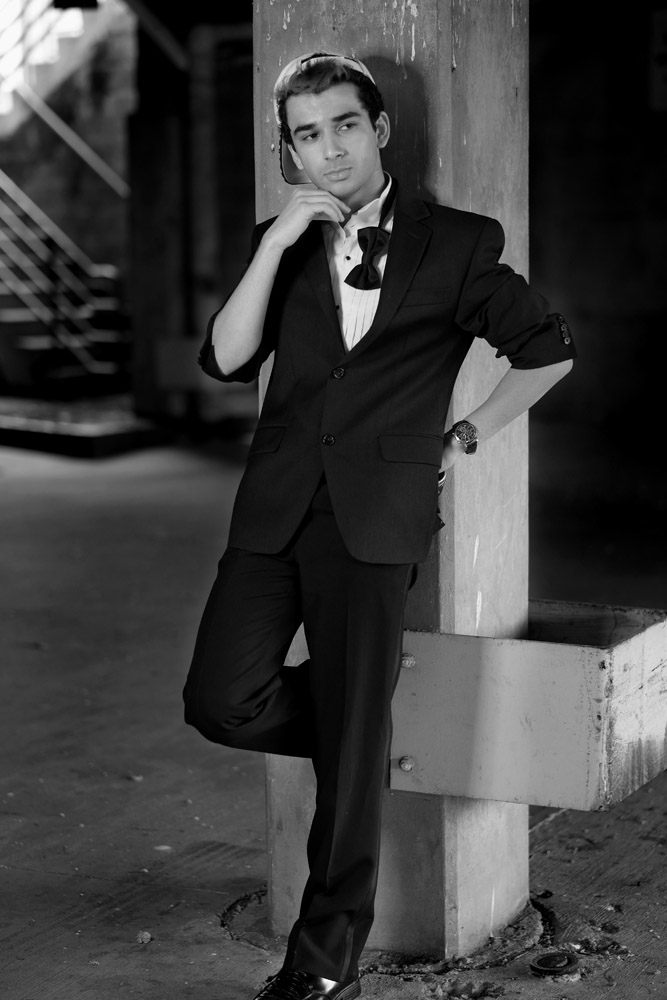
These were both shot outdoors under the eave of a parking garage, and combining the flash in a beauty dish as a fill with the backlight of the street behind made it easy to completely blow out the background into a nice even white. Handy trick when you’re going studio-less and need an even background.
Alex
I shot all these images in RAW, then converted afterward to JPEG. I like working this way because it feels more like traditional darkroom photography, where I’m working from the in-camera negative. Working from in-camera JPEGs, while still very good, to me is not as good because it’s like making a copy of a print – changes have been made and nuances have been degraded.
Not that there should be any doubt, but the Fuji 56mm is a knockout lens (Fuji has always made some top-grade glass, especially for their medium-format cameras). The falloff in sharpness at wide-open or near wide-open is creamy-smooth, and the rendering of out-of-focus highlights is never harsh or jagged.
Takeaways from this shoot:
-Work with good models. Not everyone is a good model, and not all good models start out that way, but if you’re new to the process of working with models, hire folks (and I do mean hire, as in pay for with cash, not just trade-for-prints/CD) who have experience working with photographers.
-know your equipment. If I were not as experienced with studio lighting, figuring out what was going on with my Calumet/NEEWER flashes could have been a pain, as they don’t have modeling lights (to save on battery life) and are not TTL because they’re made to be universal and are not dedicated to any one system.
-have fun. Be loose, work with your environment, take advantage of the opportunities it presents, and challenge yourself to overcome its obstacles. You’ll make much better pictures that way.
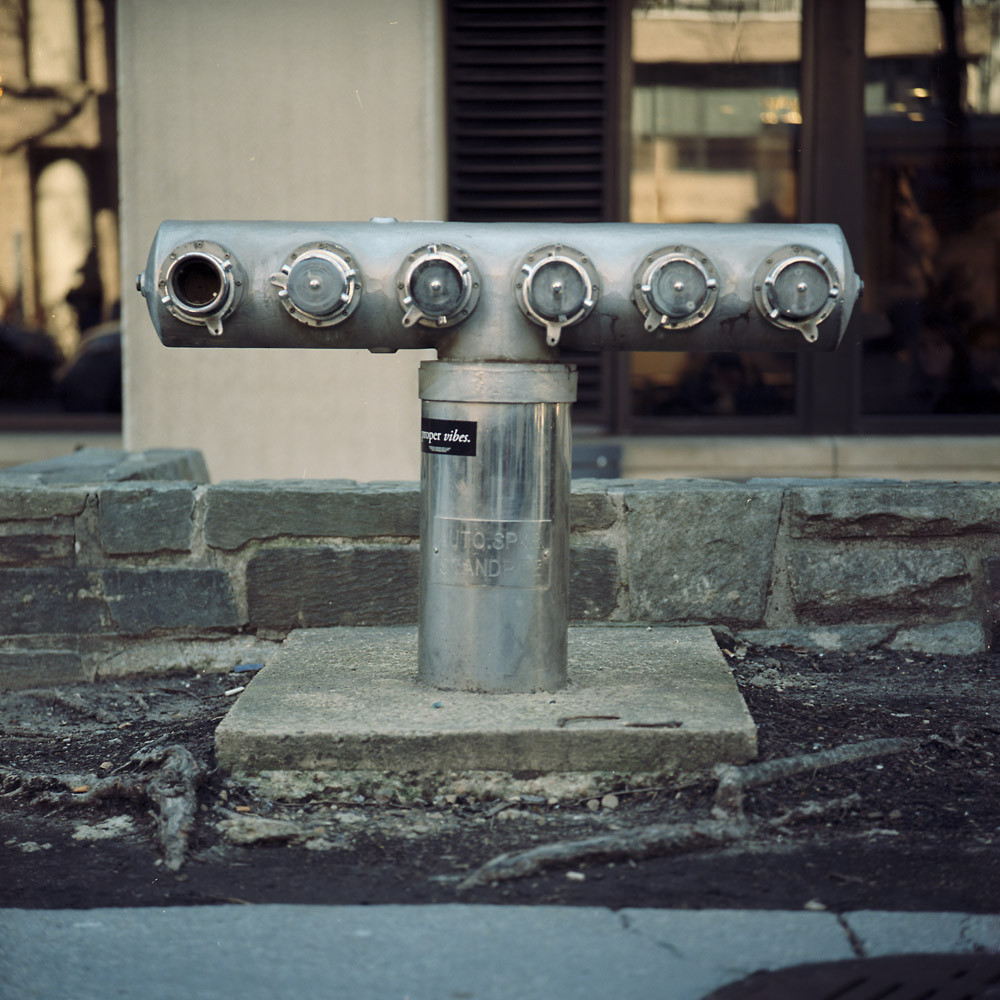
I don’t know if I’ve ever seen a fire hose connector with more connections on it than this one, outside the George Washington University library. The location may be key – if the library ever catches fire, that much paper will require a lot of water to keep it all from going up in a ball of flame.
Multi-Hose Connector
Either that or it’s some kind of arcane commentary on the Starbucks Coffee in the library basement immediately behind it.
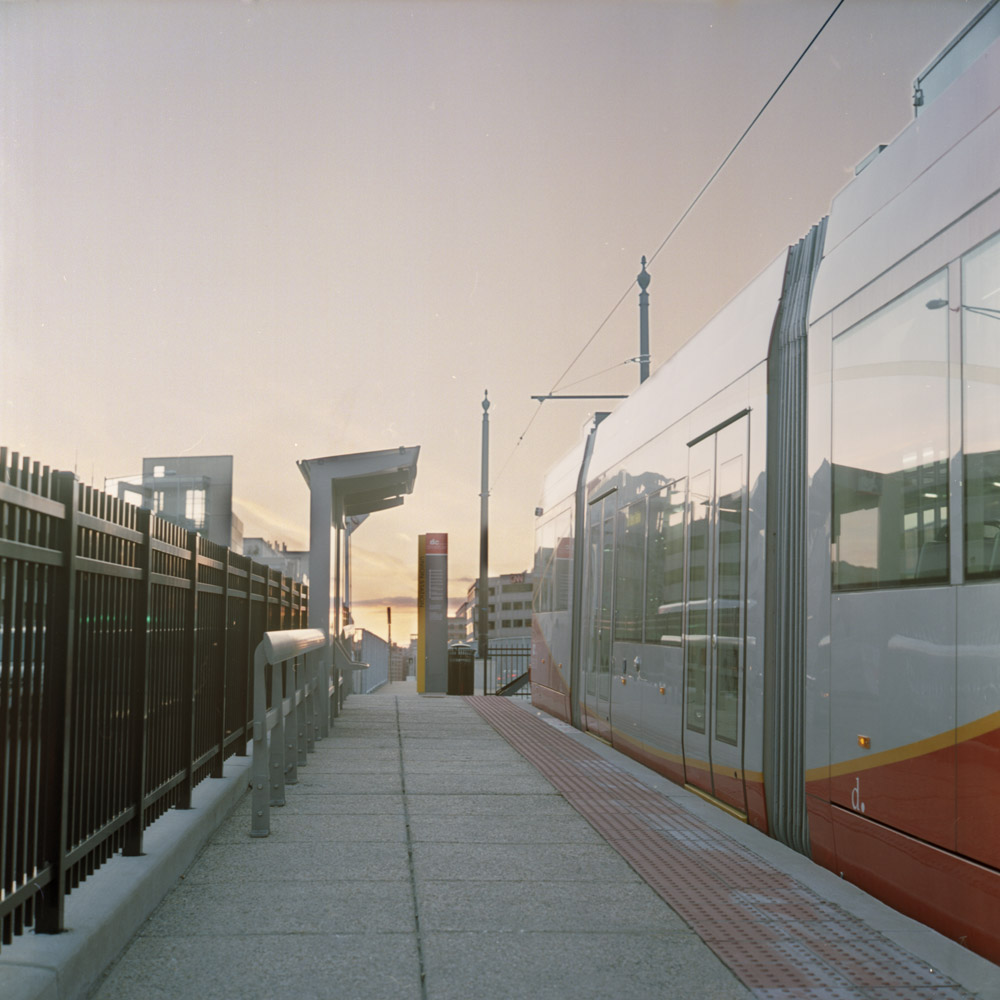
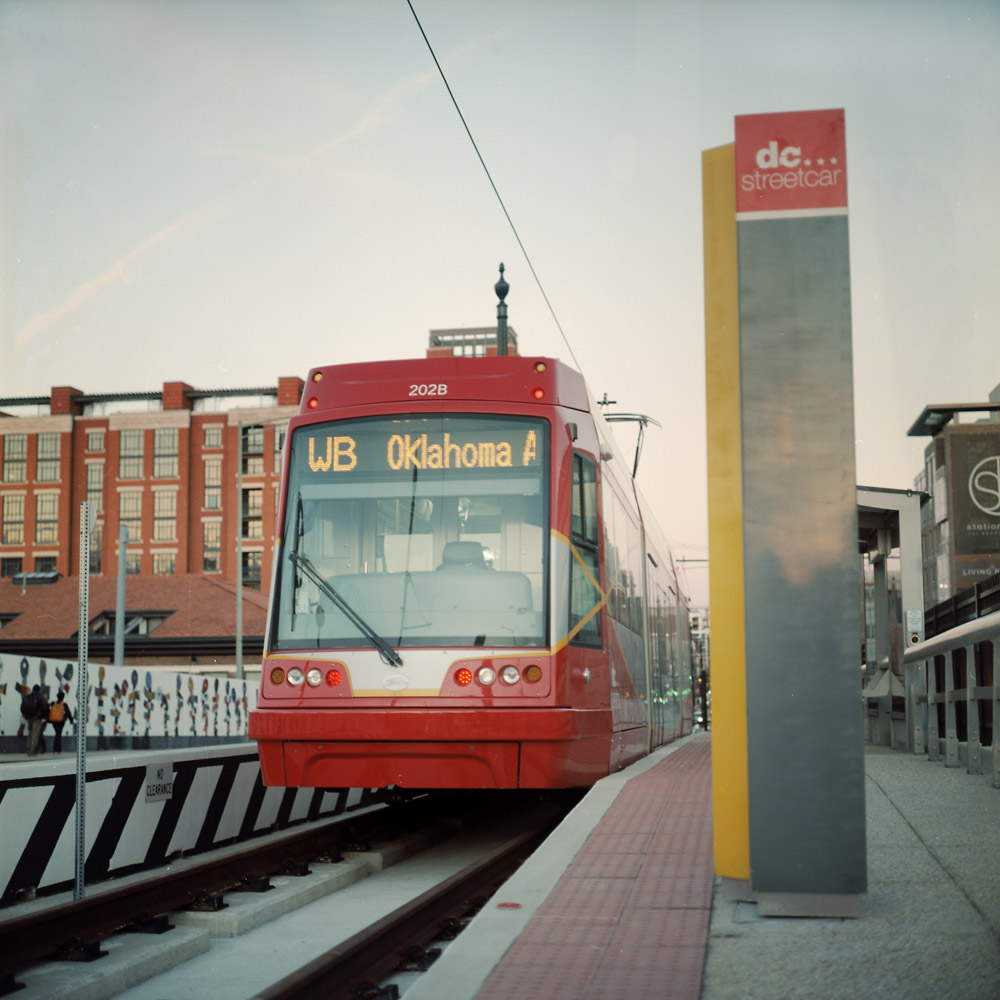
I’m a big public transportation junkie, so when I heard they were finally launching the DC Streetcar on H Street Northeast (a public works project over a decade in the making and long overdue – the tracks have been in place for two or three years now), I was so excited I ran over after work last Friday to see it and ride it only to find out I was a day early! So I satisfied my urge and photographed the streetcar at the Union Station end of the line, catching it at sunset. The shiny new car reflected not only the setting sun but the buildings across the street, bringing the surrounding urbanscape out of frame back into the picture.
DC Streetcar, Union Station, Sunset
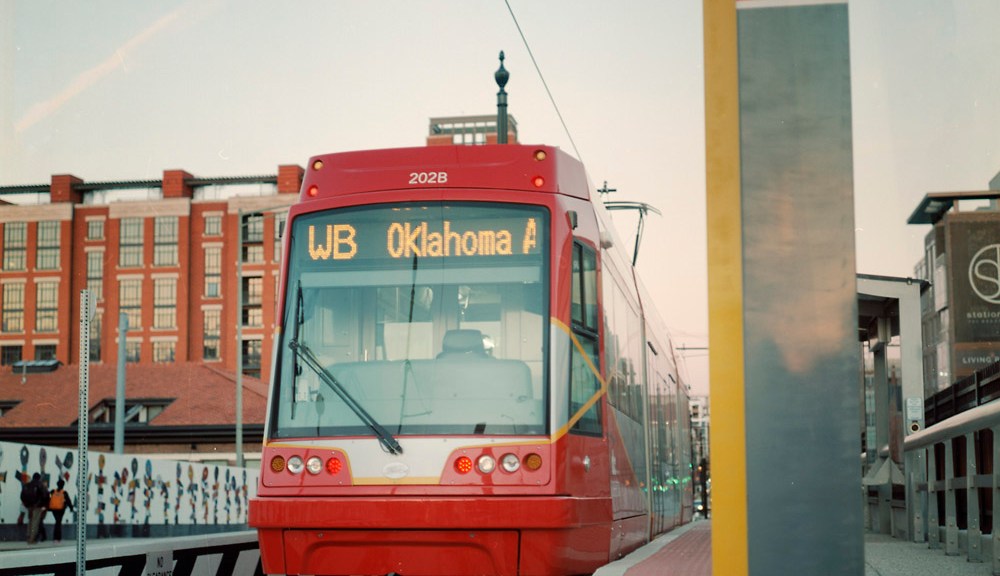
Here is a different view of the streetcar, waiting at the Union Station end of the line, looking down H Street. H Street was, fifty or so years ago, a thriving business district catering mostly to a middle-class African-American clientele. Then along came the riots after the assassination of Martin Luther King Jr., and then with the 1980s, the cocaine and crack epidemics. H Street was devastated.
Westbound Oklahoma Avenue Streetcar
Obviously now, not so much. It has transformed starting in the early 2000s with the real estate boom. Perhaps the turning point was the creation of a large condominium complex, Senate Square, on the grounds of what was originally a Catholic school and later the Capitol Children’s Museum. Now, pawn shops and lake trout joints are being replaced by artisanal coffee roasters, fancy pubs serving British-Indian fusion cuisine, and cultural outlets like the Atlas Theater and the Rock n’ Roll Hotel (which is not a hotel, but a bar and concert venue). Instead of a Murry’s, the neighborhood is now sporting a Whole Foods.
When finally fully operational (at the moment, the streetcar only runs less than half the length of installed track), the streetcar will connect Union Station and the governmental core of the city to east of the Anacostia River, a long-suffering neighborhood where good jobs and access to quality goods and services have been sorely lacking.
As most of you know, I’m a die-hard film shooter. And I’m not about to stop- I seriously love my Rolleiflexes. But there is a real-world place for a good digital camera in my toolkit.
I was using a Canon 5D mk.1 for a long time- perhaps ten years now. It still does a very good job of doing what it does, but it is BIG, it is HEAVY, and the image quality and technical features of newer cameras have really outstripped what it can do.
I’ve been investigating alternate options to replace it. One thought was a Canon 6D, which would give me another full-frame chip with higher resolution, better color rendering and low-light performance, and I could keep all my existing lenses. But that would still have been really outside my budget. Even more so a 5D mk.3. Neither one would have solved my issue with weight, which quickly becomes an obstacle to regular use.
I looked at what I use my camera for- mostly events (as in documentary shooting, not commercial event photography), portraits and travel. I wanted something that would give me improved low-light performance, be much smaller and lighter, and give me the quality of glass I was used to with my Canon L lenses.
I turned to mirrorless cameras, did some looking around, and after getting feedback from some trusted friends, arrived here:
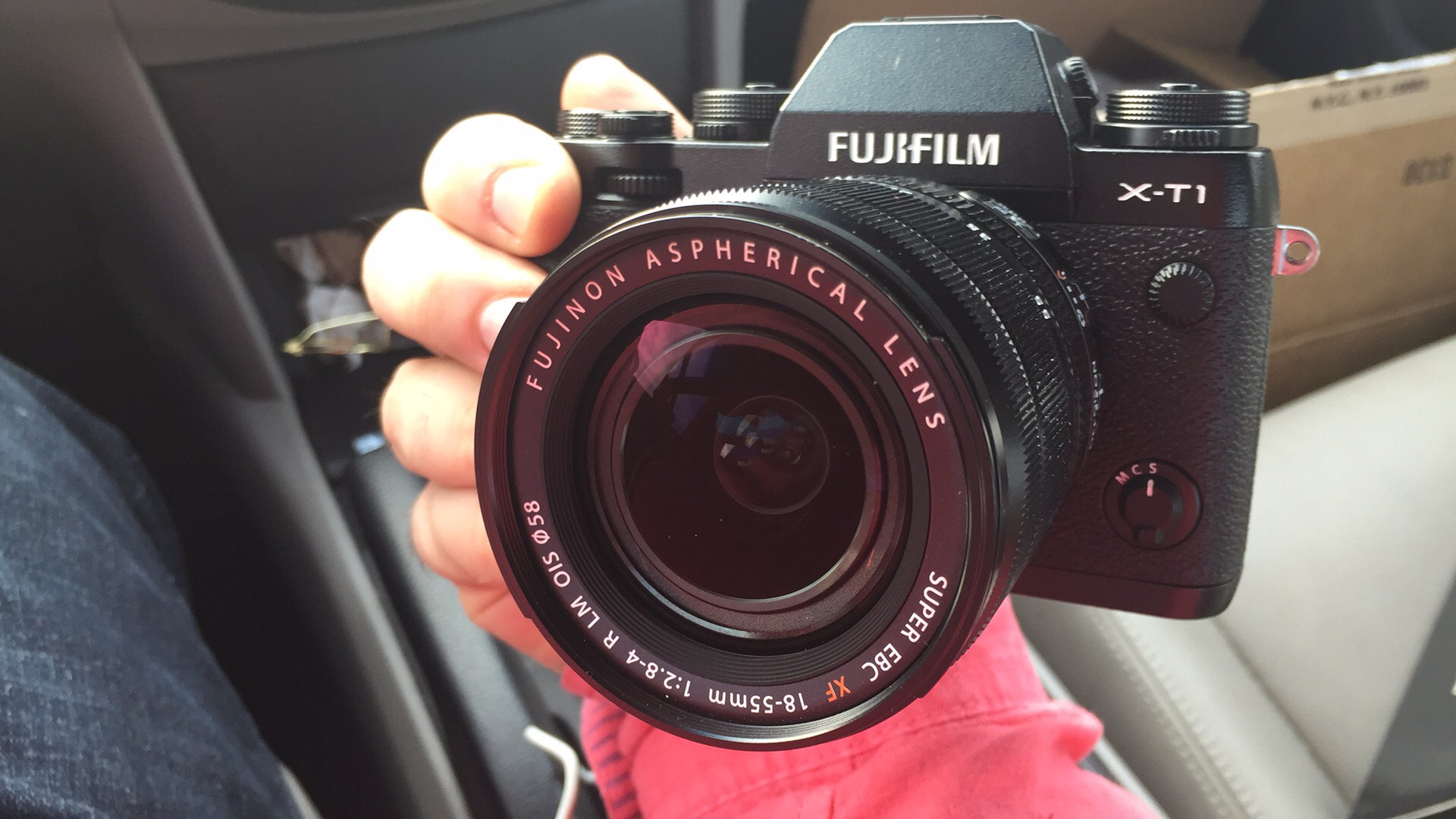
Fuji X-T1
The Fuji X-T1. It has a 16 megapixel APS-C sensor, a line of outstanding lenses in the focal length range I use the most, and as you can see in the photo above, is quite a bit smaller than the 5D. Not to mention quite a bit more affordable.
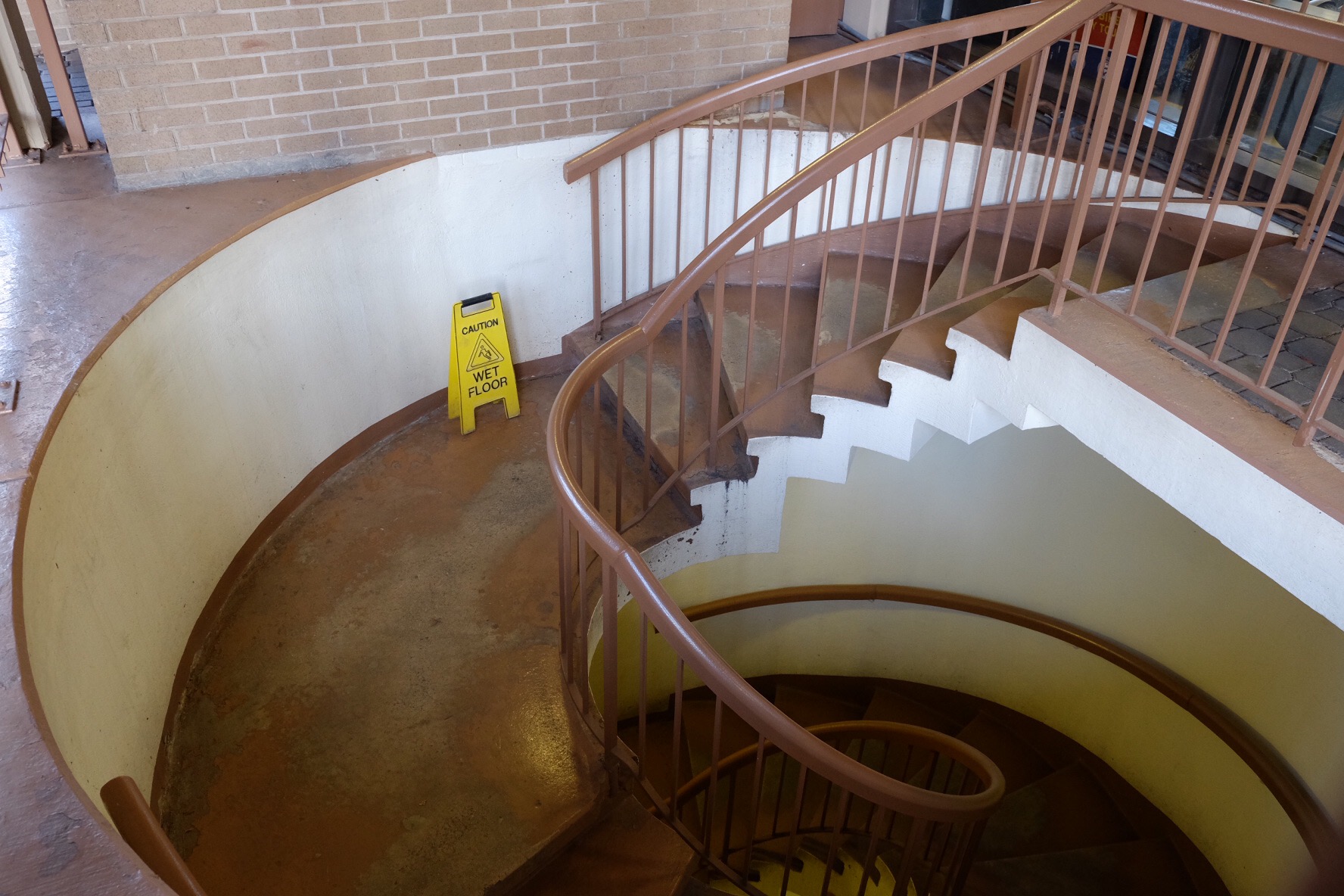
Right now I only have the “kit” zoom lens. Calling this a kit lens is a bit like calling the 24-105 L lens with my 5D a kit lens. It’s an 18-55, or the equivalent of a 27-84 in 35mm/full-frame terms. A maximum aperture of f2.8-f4 means for a compact zoom, it’s quite fast. It also has optical image stabilization, a nice plus when shooting hand-held in low light.
stairwell- hand-held @ 1/8th second
Things I like about the lens: image quality is excellent. The range of focal lengths covered is very useful. It does a great job with both near and distant subjects. The out-of-focus rendering is pleasant.
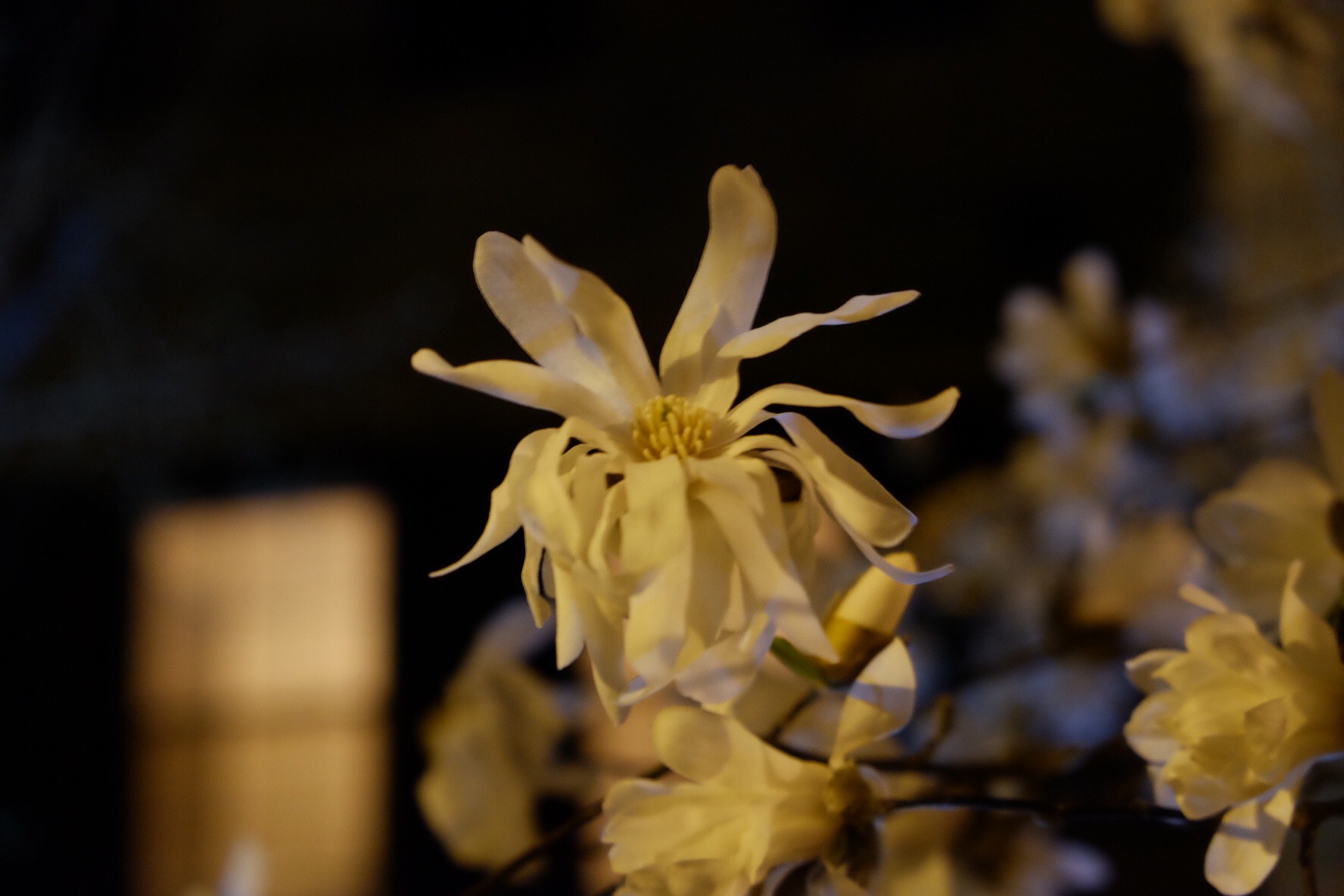
dogwood bloom, night-time
Things I don’t like: switching from autofocus to manual requires a separate switch to be toggled. That switch is small and on the back of the barrel, close to the body, so toggling it requires taking the camera away from your eye. The aperture control ring is not mechanical with defined click-stops, but is instead electronic, making it hard to tell if you’re turning it the right way, and easy to turn it away from your preferred f-stop.
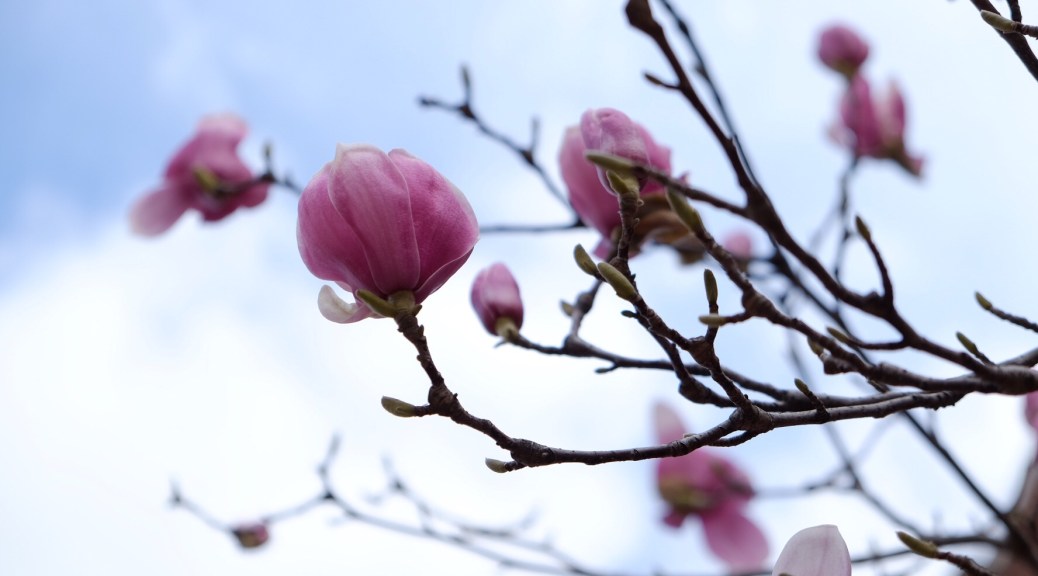
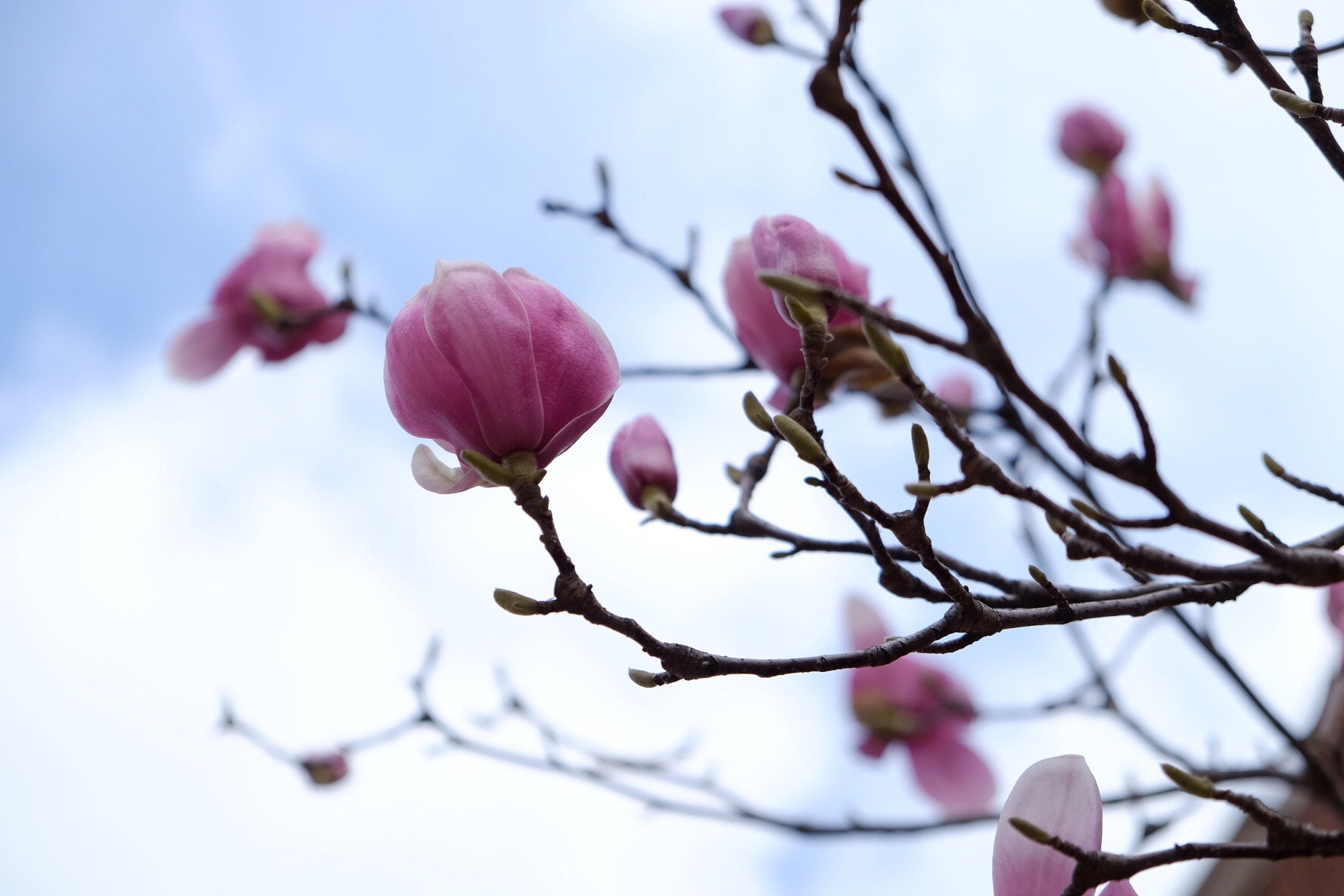
magnolia blooms
This is not a problem with their prime lenses, two of which I will be acquiring soon.
Also, as you can see, the image quality and color rendition of the image chip in the X-T1 leaves nothing to be desired even at relatively high ISO. The dogwood bloom at night was shot at ISO 6400. It has two extended range ISO settings above that, but I have yet to explore those.
The camera has a whole host of other options including film emulsion emulation modes (all of these were shot in Astia simulation, which is a little lower in contrast with a slightly less saturated palette for more pleasing portraits). It also has black and white modes, including red filter and yellow filter simulations.
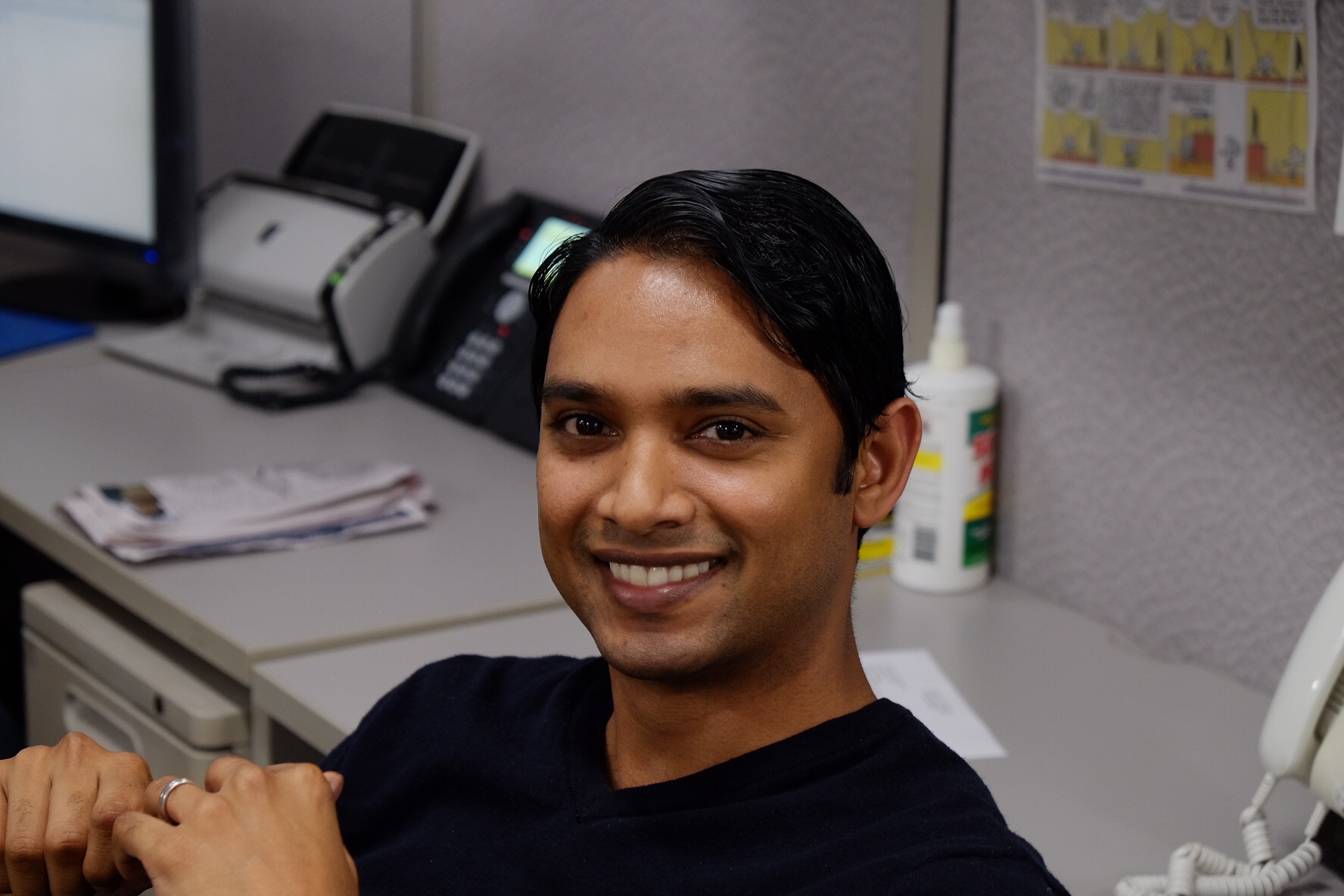
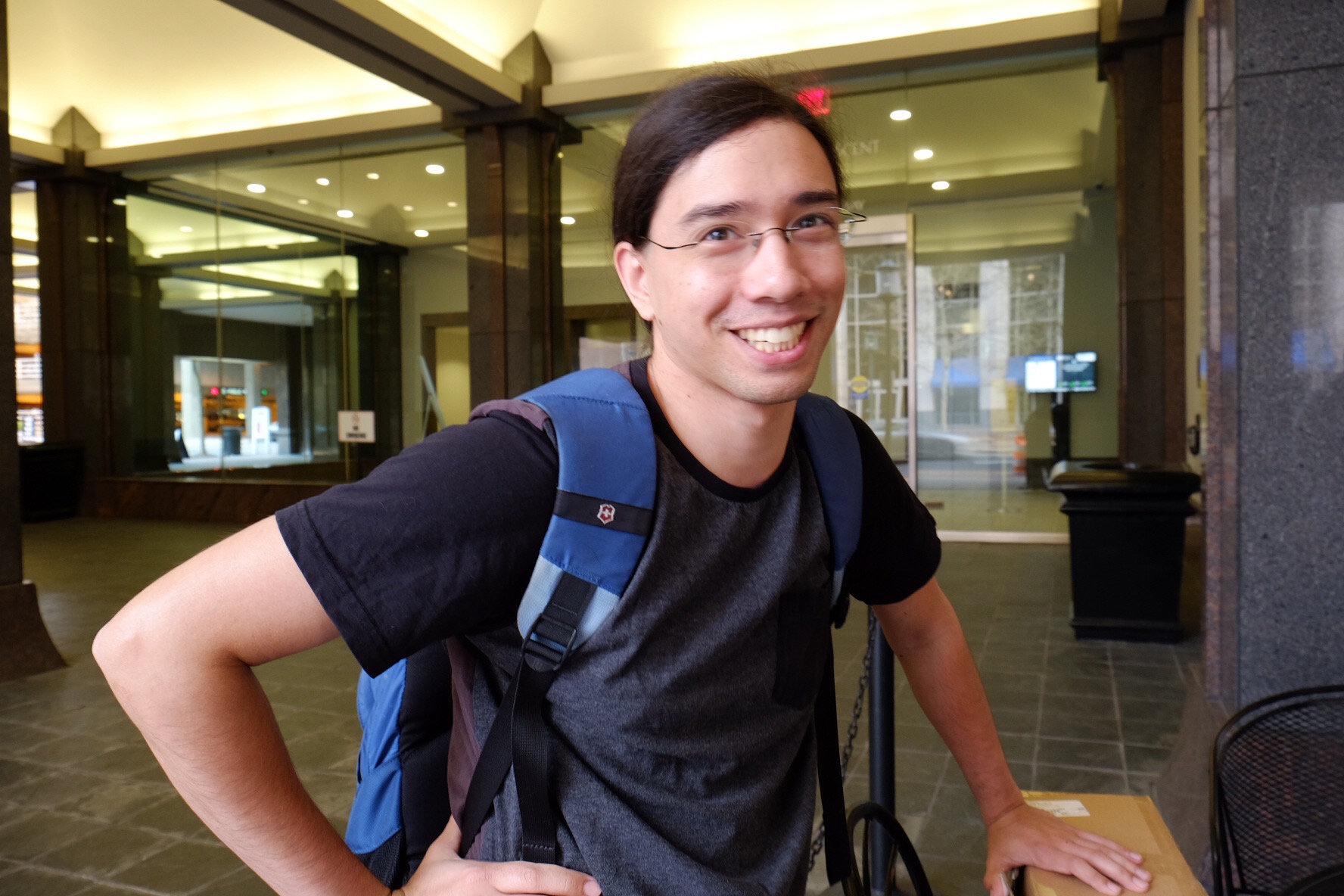
Some environmental portraits:
Julian TanMissy
A black-and-white shot with the red filter mode on:
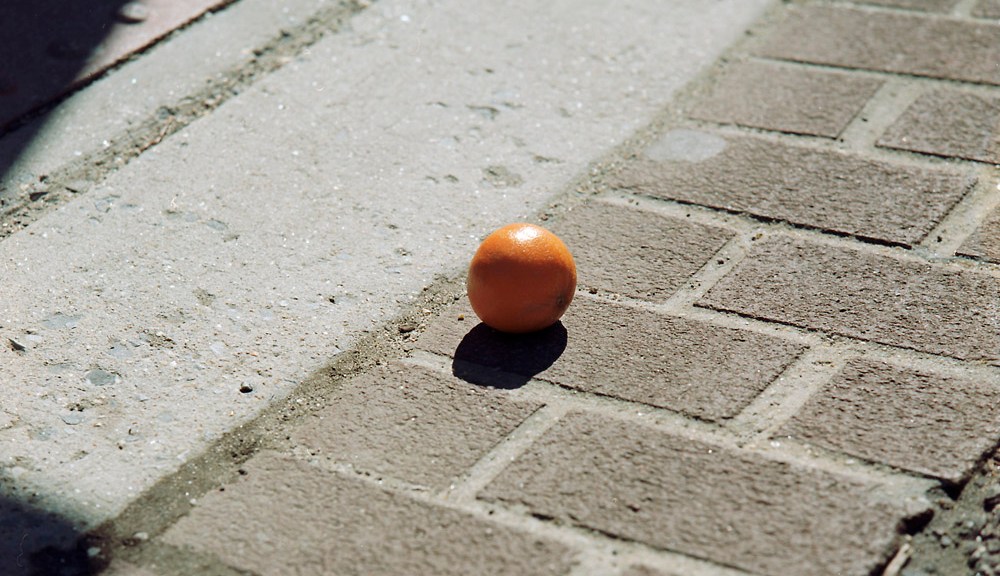
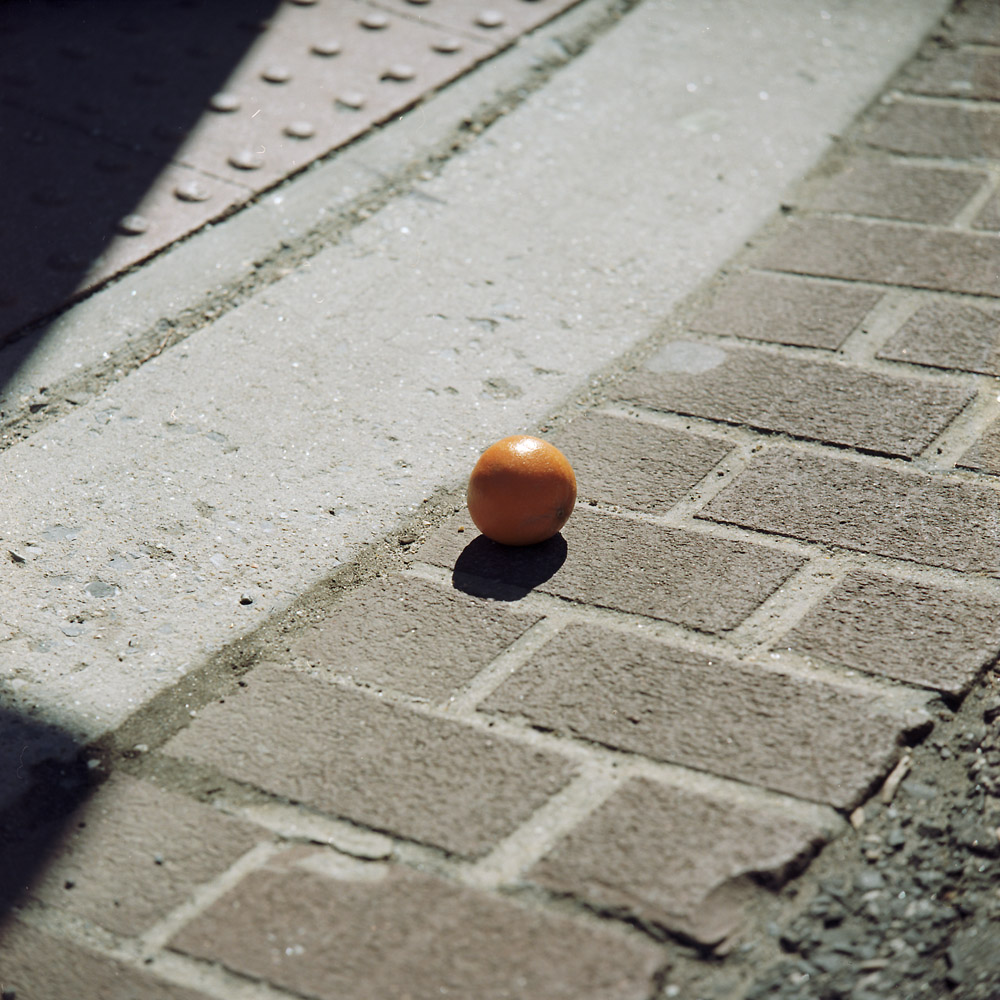
It’s been a while since I’ve posted any of my own images. I was out on a lunch break walkabout near my office and saw this poor little orange (or is it a tangelo?) someone had dropped in the gutter. It cried out to be photographed, so here it is…
 dcphotoartist