Category Archives: Photography

Photography Books – a partial listing

I know folks have asked me about this before, so I thought I’d compile the list of photography books I’ve collected. This is a comprehensive but not complete listing of the photographic monographs and/or compilations in my library. I know I’m missing the vintage Ansel Adams guide to Yosemite that he produced for the Sierra Club back in the 1950s or 60s from this list, but I can’t lay my hands on it at the moment, so it’s missing.  Any exhibition catalogs listed here are listed here because they are catalogs from exhibits I did not see in person, and there are probably a half-dozen others just floating around the house and/or the library.

Title Artist/Author Publisher Publication Date Notes
4 A M Adu Formosa Books 2000
Olympic Portraits Annie Liebowitz Bullfinch 1996
(Don’t) Call Me Shirley Brett M. Cochrane Knopf Australia 1995
Burma: Something Went Wrong Chan Chao Nazareli Press 2000
The Great Wall of China Chen Changfen Yale University Press 2007
Beauty of Darkness Connie Imboden Custom & Limited Editions 1999 1st Edition
The Raw Seduction of Flesh Connie Imboden Silver Arts 1999 softcover, Signed
Piercing Illusions Connie Imboden Foto Book Press 2001 softcover, Signed
Beijing Spring David and Peter Turnley Stewart, Tabori and Chang 1989
All My Lies Are True David Carol Kabloona Press 2009 Signed, personalized to me
Edward Curtis – The Master Prints Edward Curtis Arena Editions 2001 Hardcover
Edward Steichen – The Early Years Edward Steichen Princeton University Press 1999
Edward Weston: The Form of the Nude Edward Weston Phaidon Press 2005
Margarethe Mather and Edward Weston: A Passionate Collaboration Edward Weston, Margarethe Mather W.W. Norton 2001
Suffering The Ideal F. Holland Day Twin Palms 1995 Hardcover, 1st Edition, Limited Edition
F. Holland Day F. Holland Day Van Gogh Museum 2001 Exhibition Catalog
Faces of the Eastern Shore Frank Van Riper Qesada House 1992 Softcover, signed, personalized to me
The Photographs of Frederick H. Evans Frederick Evans Getty 2010 Exhibition Catalog
Foro Italico George Mott Powerhouse Books 2003 1st Edition, slipcovered
Inside Life Greg Gorman Rizzoli 1997 1st Edition, Signed, Slipcovered with signed print
As I See It Greg Gorman Powerhouse Books 2000 1st Edition, signed
Natural Fashion: Tribal Decoration from Africa Hans Silvester Thames & Hudson 2008
Kazu Herb Ritts Parco 1995 1st Edition
Tuscany: Inside the Light Joel Meyerowitz Main Street 2003
Manzanar: Photographs by Ansel Adams John Armor, Peter Wright Times Books 1988
Lengthening Shadows Before Nightfall John Dugdale Twin Palms 1995 Signed, personalized to me, dated 2006
Life’s Evening Hour John Dugdale August Press 2000 Hardcover, Limited Edition
Picturing Men – A Century of Male Relationships in Everyday American Photography John Ibson Smithsonian 2002
The Luminous Years Karl Bissinger Abrams 2003
Passage to Angkor Kenro Izu Friends Without Borders 2005 1st Edition, signed
Homo Sum Konrad Helbig 6×6.com 2010 Not dated – guessing at publication date
Skin Laurent Elie Badessi Edition Stemmle 2000
Red Color News Soldier Li Zhensheng Phaidon Press 2003
Panoramas of the Far East Lois Conner Smithsonian 1993
Photography’s Antiquarian Avant-Garde: The New Wave in Old Processes Lyle Rexer Abrams 2002
American Photographs: The First Century Merry A. Foresta Smithsonian 1996
At First Sight: Photography and the Smithsonian Merry A. Foresta, Jenna K. Foley Smithsonian 2003
The Pre-Raphaelite Camera Michael Bartram Little, Brown & Company 1985
Eye Mind Spirit – the Enduring Legacy of Minor White Minor White Howard Greenberg Gallery 2008
Face to Face: The Art of Portrait Photography Paul Ardenne Flammarion 2004
Collaboration: The Photographs of Paul Cadmus Paul Cadmus Twelvetrees Press 1992 1st Edition, Limited Edition
Physique: Classic Photographs of Naked Athletes Peter Kuhnst Thames & Hudson 2004
Man to Man: A History of Gay Photography Pierre Borhan Vendome Press 2007
The Hyena & Other Men Pieter Hugo Prestel 2007
Shooting Soldiers – Civil War Medical Photographs by R.B. Bontecou R.B. Bontecou Burns Archive Press 2011
Torero Reuven Afanador Edition Stemmle 2001 1st Edition
Sombra Reuven Afanador Merrell 2004 1st Edition
Mil Besos Reuven Afanador Rizzoli 2009 1st Edition
Cuba in the 1850s Through the Lens of Charles DeForest Fredricks Robert M. Levine University of South Florida Press 1990
Robert Mapplethorpe and the Classical Tradition Robert Mapplethorpe Guggenheim Museum 2004 Exhibition Catalog
Hymn to the Earth Ron Rosenstock Silver Strand Press 2003 Signed, Numbered Edition # 597
Maryland’s Civil War Photographs: The Sesquicentennial Collection Ross Kelbaugh Maryland Historical Society 2012 Signed, Numbered Edition # 130, personalized to me
America and the Tintype Steven Kasher ICP/Steidl 2008
Spirit Capture: Photographs from the National Museum of The American Indian Tim Johnson Smithsonian 1998
In Defense of Beauty Tom Bianchi Crown Publishers 1995
Tseng Kwong-Chi Tseng Kwong-Chi Paul Kasmin Gallery 2008
Taormina Wilhelm Von Gloeden Twelvetrees Press 1986

Glen Echo Carousel, Twilight, Fall

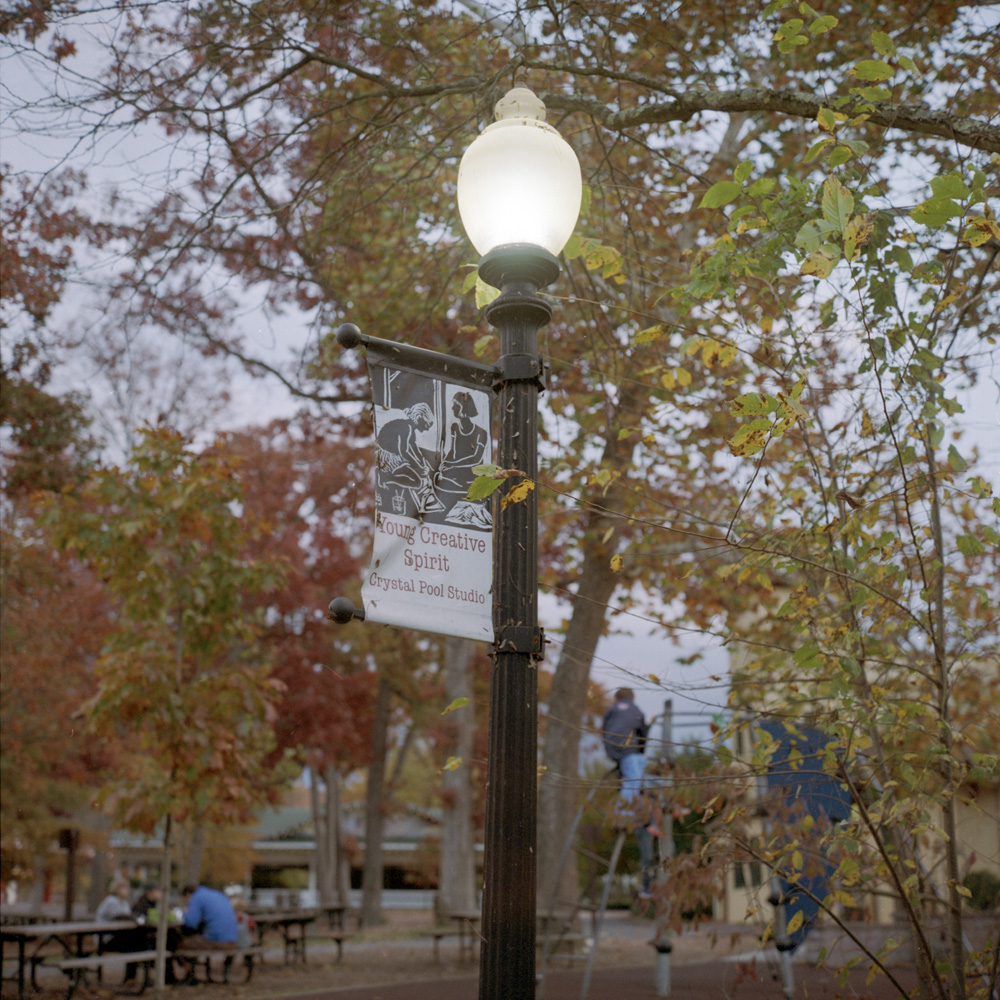
Here are a few loose odds-n-ends I shot back at the end of September, but kept on the shelf until I was all done with the Paris photos. I like playing around as light levels fall – it’s a challenge to balance foreground and sky, but when it works, it’s beautiful. I also like the colors you get when you mix different kinds of lighting.

I was walking around Glen Echo Park in the evening after visiting for (I think) an exhibit opening. I had the Rollei with me, and a roll of Kodak Portra 800 loaded. Portra 800 is another one of those “miracle” emulsions, in my estimation. It is expensive (almost $10/roll), but when you need it, it’s there and it works so well at what it does. Yes, it does have more grain and less contrast than Portra 400, not to mention Portra 160, but the difference compared to what you would have seen in older 800 speed films is almost not worth mentioning. It’s a specialty film, and because of the price, not something I’d shoot every day in lieu of a slower film. But using it is not a sacrifice, like other films used to be.

Here is one of the street lights in the park, glowing in the pre-dusk.

Lantern, Crystal Pool, Twilight

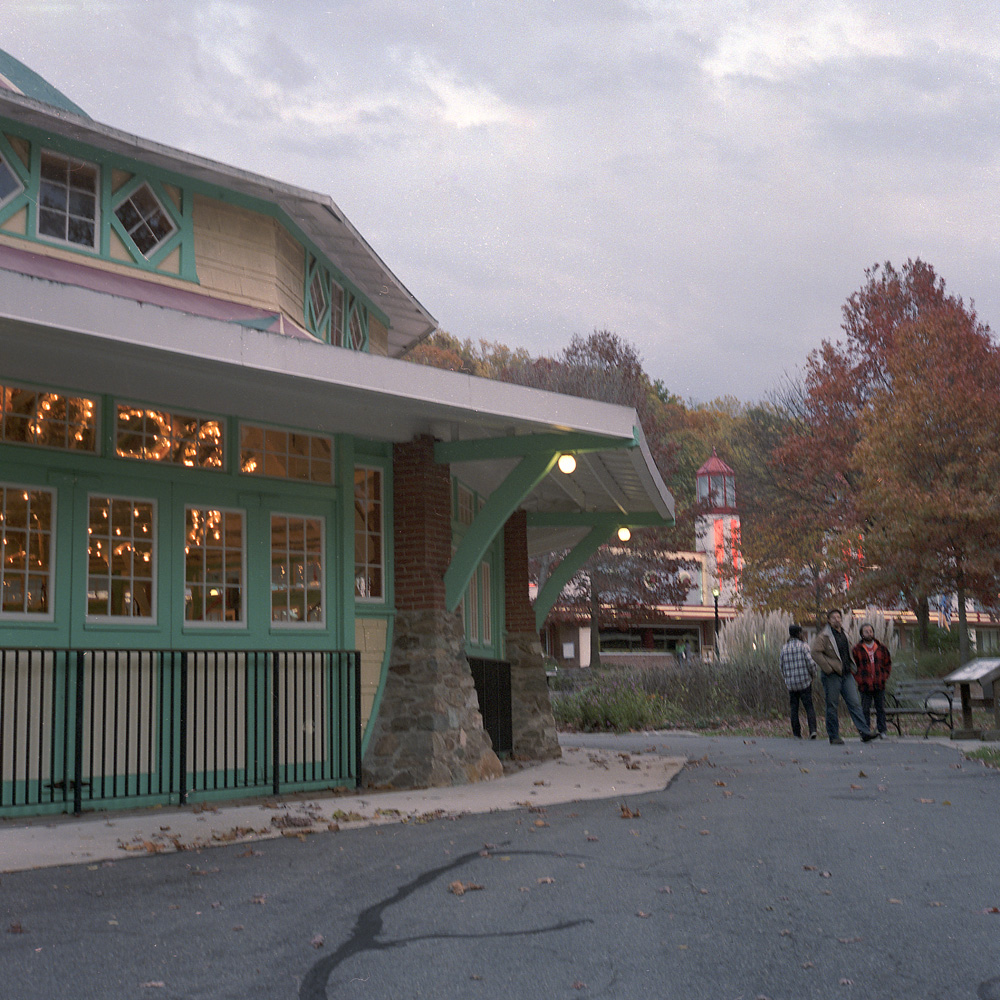
The Dentzel carousel is endlessly fascinating. The bright colors, the lights, the music, the motion – it’s a nostalgic combination that provokes a range of emotions from childish joy to melancholy. Here the lights of the carousel are glowing inside the carousel house, and the neon of the old Midway perks up the background through the trees.

Carousel Lights, Fall

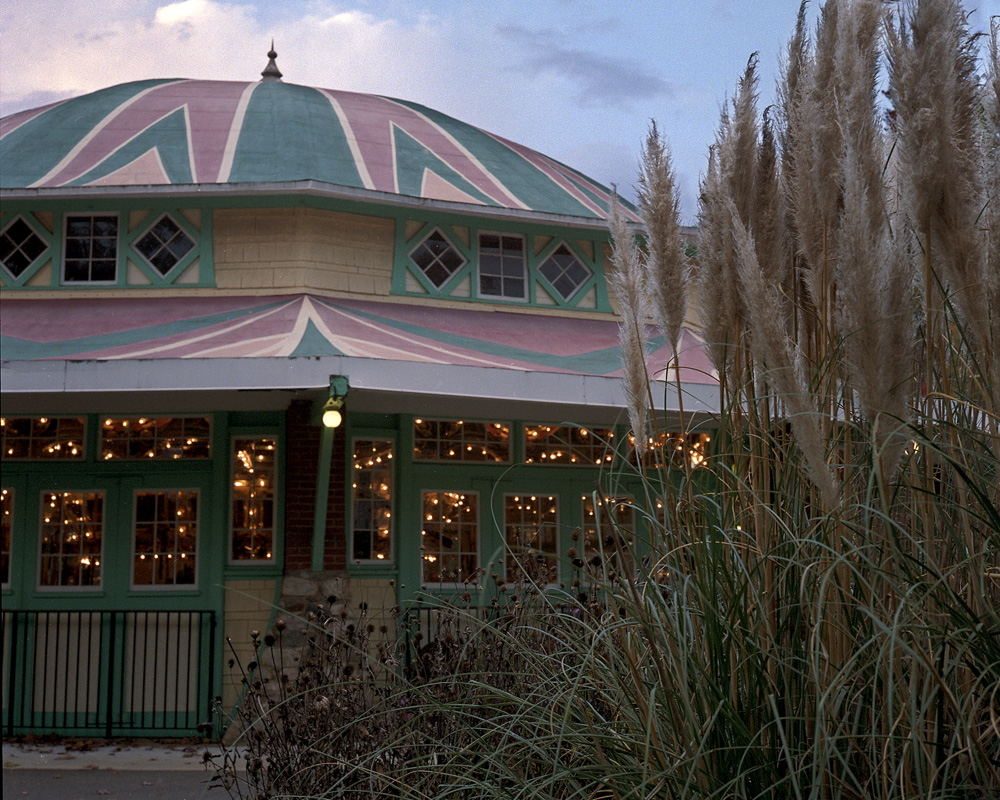
Another view of the carousel house, framed with ornamental grasses. The glow of the lights is particularly inviting – I’d love to go for a ride.

Carousel, Grasses, Twilight

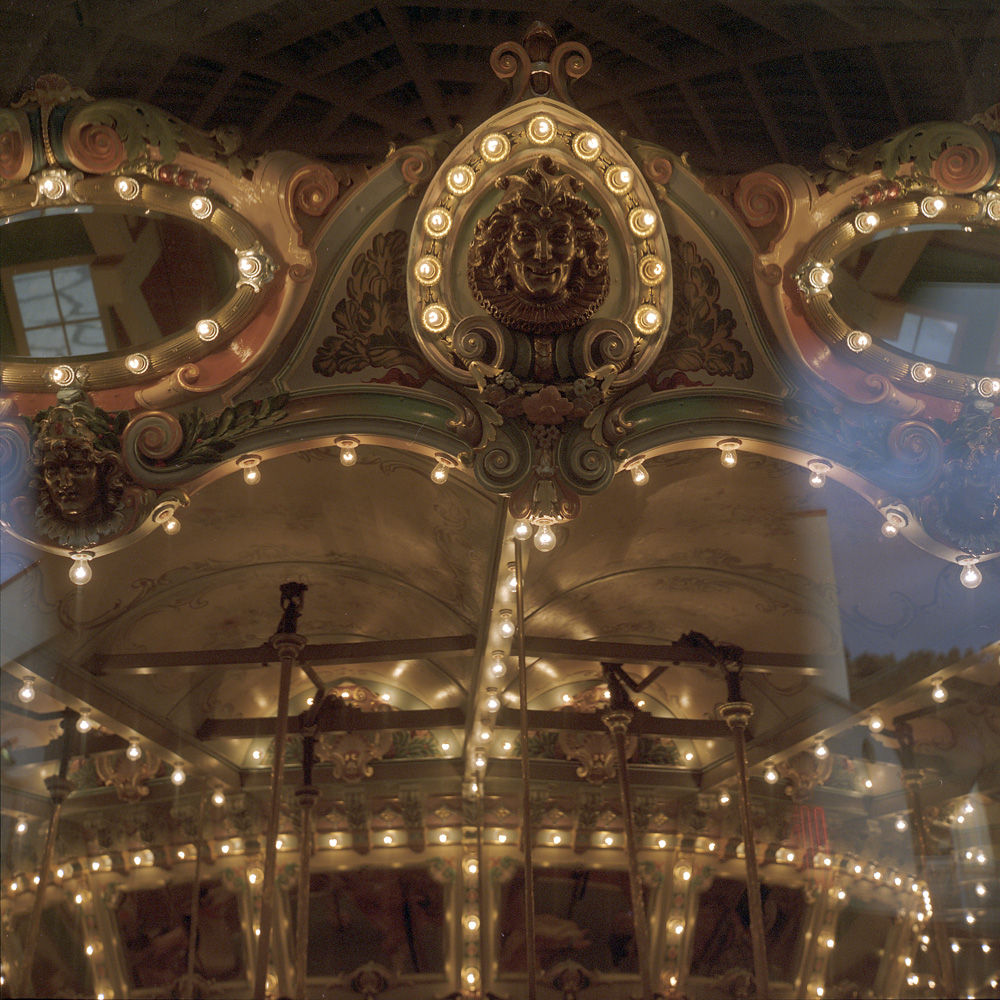
One of the circus masks on the crown of the carousel peers out at you through the reflections on the carousel house window. The lighting and the stillness gives it a slightly sinister air.

Carousel Lights
Carousel Lights

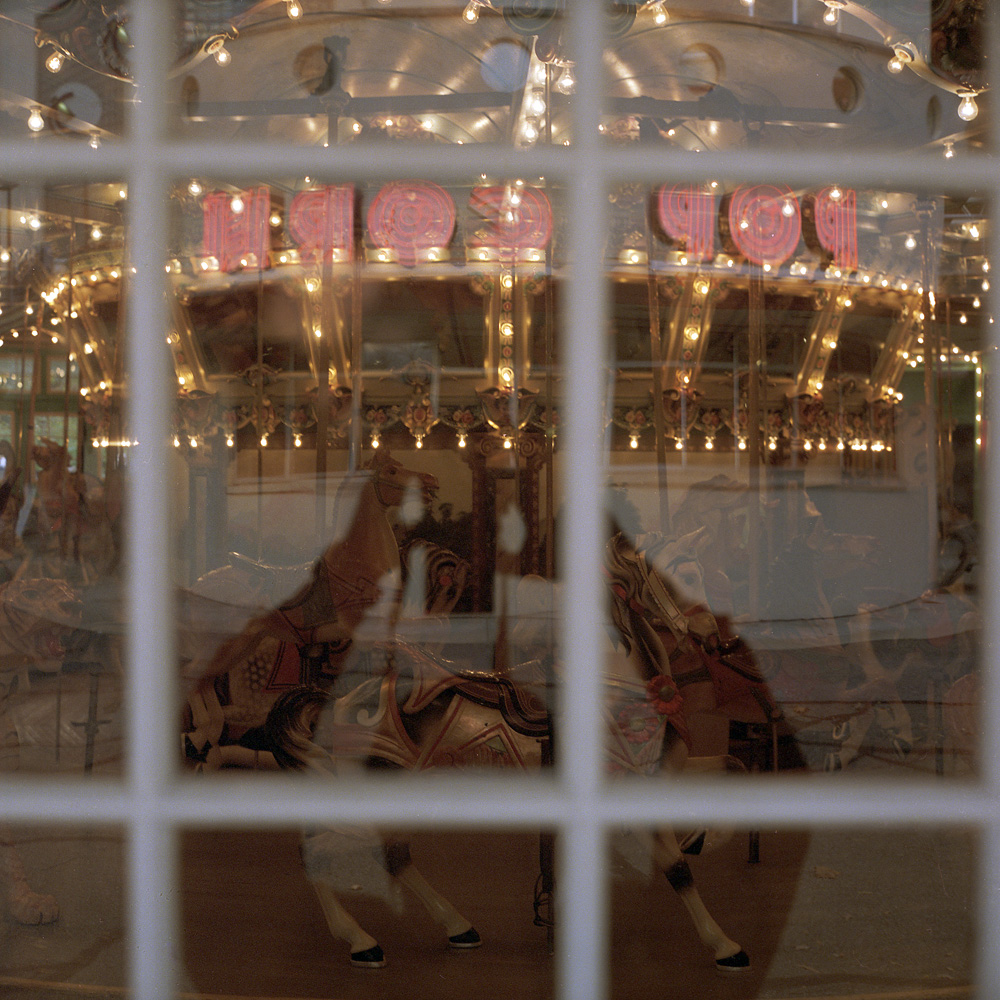
The neon of the arcade reflects in the windows of the carousel house, and I’ve caught myself taking the photo in the reflection as well. The reflected neon gives it a true carnival atmosphere – it almost feels like a real live amusement park, instead of the culture and arts center it has become. Which is not to say that the park lacks vibrancy and vitality, but it has a new character now, a lovable low-key quality that reflects and honors its past while preserving the facility for the future.

Glen Echo Carousel, Neon, Reflections

Museum Exhibition Catalogs

While I was in Paris, I went to see a major exhibition at the Musee D’Orsay, Masculin/Masculin, a retrospective of the male nude in art from 1800 to the present. It was beautifully presented, almost overwhelming in size and scope, and extremely memorable. At the time, I thought about buying the catalog because it had outstanding reproductions of the work in the exhibit, including many works and artists I was unfamiliar with. I decided not to because of the size and weight of the catalog, especially considering that it was only available hardcover and my bags were already close to the weight limit. After I got home, I was kicking myself for not buying it after all. I got a second chance, however, when a friend who lives in New York told me he would be going in early December, and he offered to bring me back a copy. It arrived today, just in time to be a Christmas present to myself.

This got me thinking about museum exhibition catalogs. I generally try to buy them for exhibits I’ve enjoyed when I have the chance, because it serves as a reminder of the work exhibited, and it goes a long way to helping support the museum mounting the exhibit, especially when the museum (like all the galleries of the Smithsonian and the National Gallery of Art) does not charge admission. As a result, I thought I’d list the exhibitions I’ve collected catalogs from.

In rough chronological order, descending, they are:

  • Charles Marville, National Gallery of Art, Washington DC, 2013
  • Masculin/Masculin, Musee D’Orsay, Paris, France 2013
  • Photography and the American Civil War, Metropolitan Museum of Art, New York 2013
  • Faking it: Manipulated Photography Before Photoshop, National Gallery of Art, Washington DC, 2013
  • 40 under 40: Craft Futures, Renwick Gallery, Washington DC, 2012
  • Stieglitz, Steichen, Strand, Metropolitan Museum of Art, New York, 2010
  • Hide/Seek: Difference and Desire in American Portraiture, Smithsonian National Portrait Gallery, Washington DC, 2010
  • Framing the West: The Survey Photographs of Timothy H. O’Sullivan, Smithsonian American Art Museum, Washington DC, 2010
  • Truth/Beauty: Pictorialism and the Photograph as Art – 1845-1945, Phillips Gallery, Washington DC, 2009
  • Faces of the Frontier: Photographic Portraits from the American West, National Portrait Gallery, Washington DC, 2009
  • Titian, Tintoretto, Veronese: Rivals in Renaissance Venice, Boston Museum of Fine Art, Boston, 2009
  • Impressed by Light: British Photographs from Paper Negatives, 1840-1860, National Gallery of Art, Washington DC 2008
  • All the Mighty World: Photographs of Roger Fenton, Metropolitan Museum of Art, New York, 2004
  • Segnali di Fumo: L’avventura del West nella Fotograffia, Castello Sforzesco, Milan, Italy 1994
  • Circa 1492: Art in the Age of Columbus, National Gallery of Art, Washington DC, 1992
  • Treasure Houses of Britain, National Gallery of Art, Washington DC 1985
  • Tutankhamen, National Gallery of Art, Washington DC 1977
  • The Family of Man, Museum of Modern Art, New York, 1955*

*obviously I did NOT attend the Family of Man exhibit, as I wasn’t even a fantasy in my grandparents’ minds in 1955. But I do have the exhibition book.

Also note that I’ve listed where I saw the exhibit, not necessarily who published the catalog.

Perhaps the oddest is the Segnali di Fumo catalog, purely on account of the incongruity of going all the way to Milan, Italy to see photographs of the American West (well, I didn’t GO to Milan to see the exhibit, but happened upon it as I was leaving the Castello Sforzesco), with a significant body from the Amon Carter museum in Texas. Which I haven’t been to yet, but really ought to. It would also help close the loop on my France trip, for it is there that the first known photograph ever is held – Niepce’s first known heliograph of the view out his studio window at his estate near Chalon-sur-Saone (that I couldn’t visit because it was closed for the season). I’m sure I’m missing one or two from my collection, and my collection of catalogs is a pale shadow of the total number of exhibits I’ve been to either because no catalog was produced (producing an exhibition catalog is a major undertaking and not done casually or cheaply) or because I couldn’t afford it at the time.

Another day I’ll put together a catalog of my photography monographs, as I know this is of interest to some. It’s not a huge collection, especially in light of my overall library size, but it is a work in progress.

Paris in October – part 40 – Versailles Exteriors

This is the last post in the Paris in October series – with this, I’ve finished uploading new images from the series. I may go back and revisit a theme or two that span multiple posts, like staircases, but I’m pretty much done. It’s been a long, fun ride – two months worth of postings from a single nine-day trip. A lot of work, but well worth the effort. I hope you all have enjoyed the series as I’ve been posting them.

These are exterior views of Versailles, or at least view of/toward the exterior. I did not go out into the gardens – my feet were worn out at that point and they wanted an additional 9 euros to enter the gardens because they were going to be doing the musical fountain show, so I did not get around to the famous garden facade of the palace.

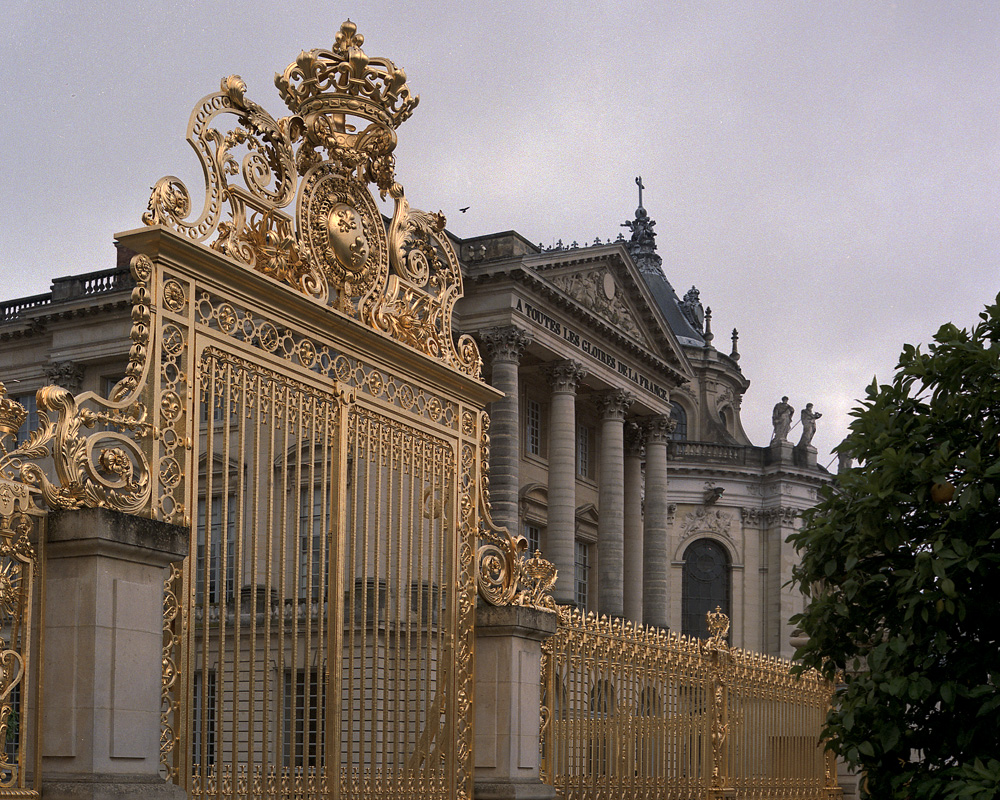
The entrance gates when you first approach are gilded iron. It’s one of the very first things you see, and it certainly makes an impression. Impressive as they are now, can you imagine what it would have been like in the 18th century to walk up to these gates?

Gilded Gates, Versailles

The words on the building portico say, “A Toutes Les Glories De La France” – to all the glories of France. For a shining period, that was literally true of Versailles. It encapsulated the magnificence and power that was the French state in the era of Louis XIV. I don’t know when that phrase was placed on the building – it has much more of a Second Empire or Third Republic feel to it. It doesn’t seem like something one of the kings would have done – the palace itself screamed that sentiment in spades, putting it down in writing on the facade was superfluous and a bit gauche.

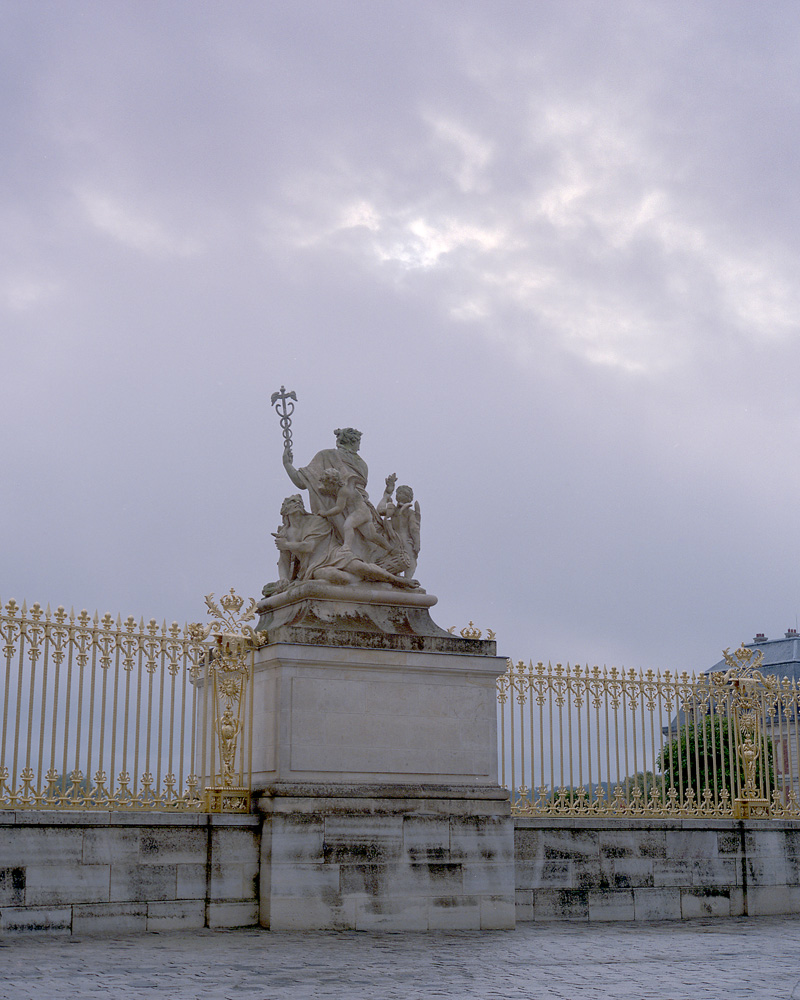
This is a view looking back at the town of Versailles from the palace entrance. The statue is the cousin of the one on the other side that I photographed in black-and-white with the grotesque figure providing a seat with its back for the allegorical female.

Statue, Entrance Gates, Versailles

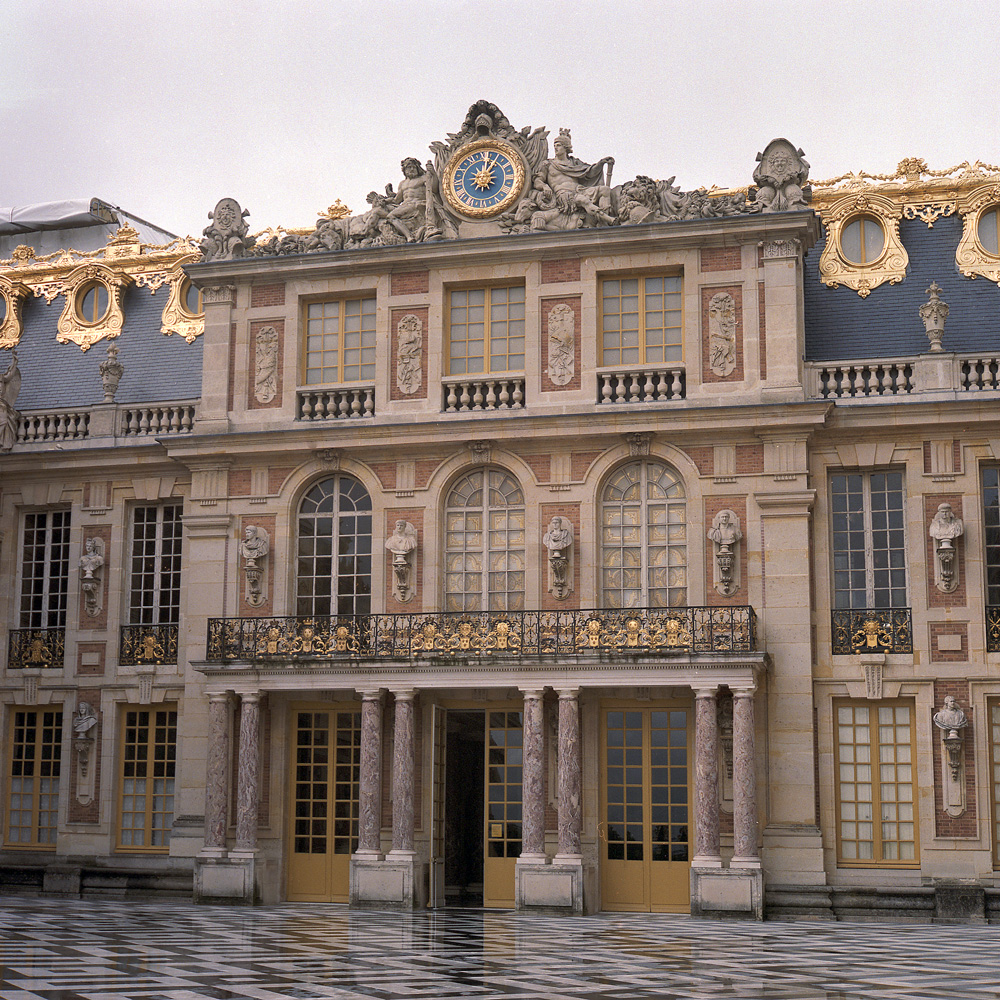
This is the palace’s front door. You can tell this is one of the older parts of the palace by the style – some brick instead of stone, less monumental in appearance. Less monumental, perhaps, but no less ostentatious. It had been raining that morning and so the marble tile courtyard surface was still wet.

Entrance Facade, Versailles, After the Rain

A view of one of the fountains immediately adjacent to the house:

Fountains, Versailles

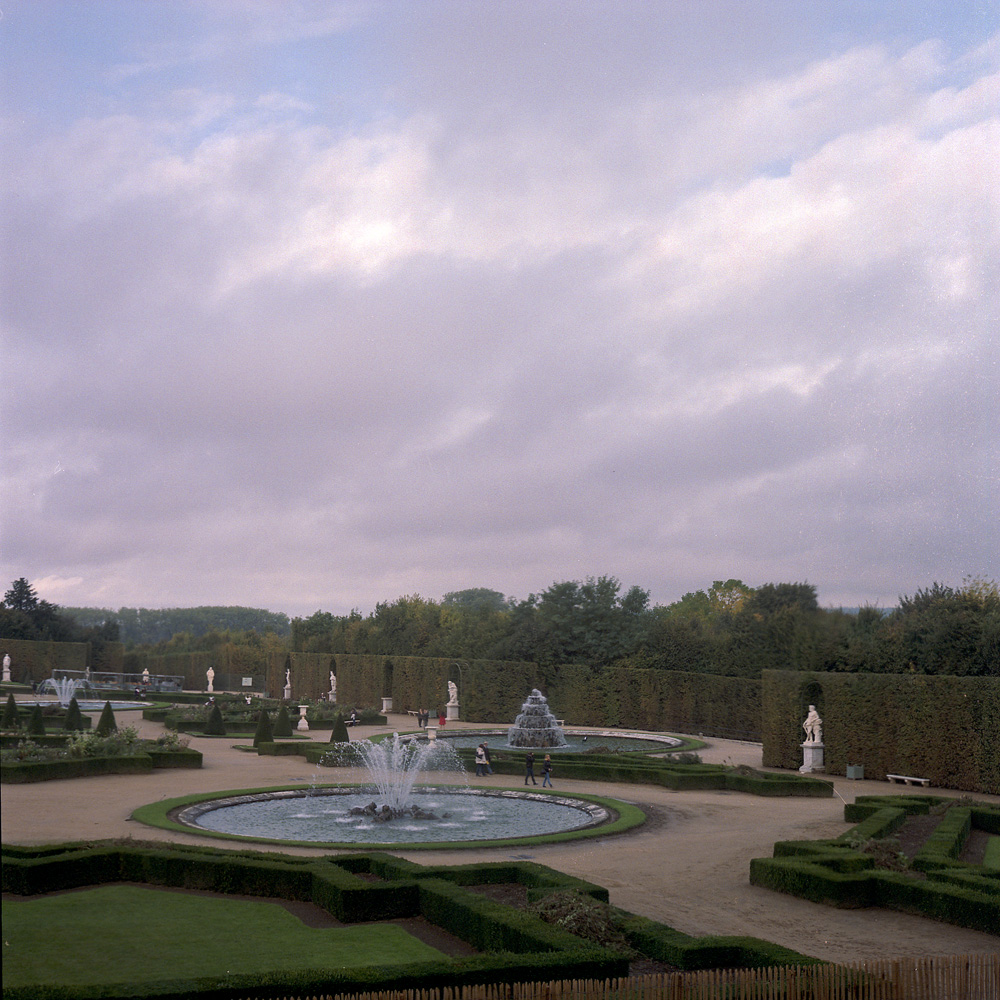
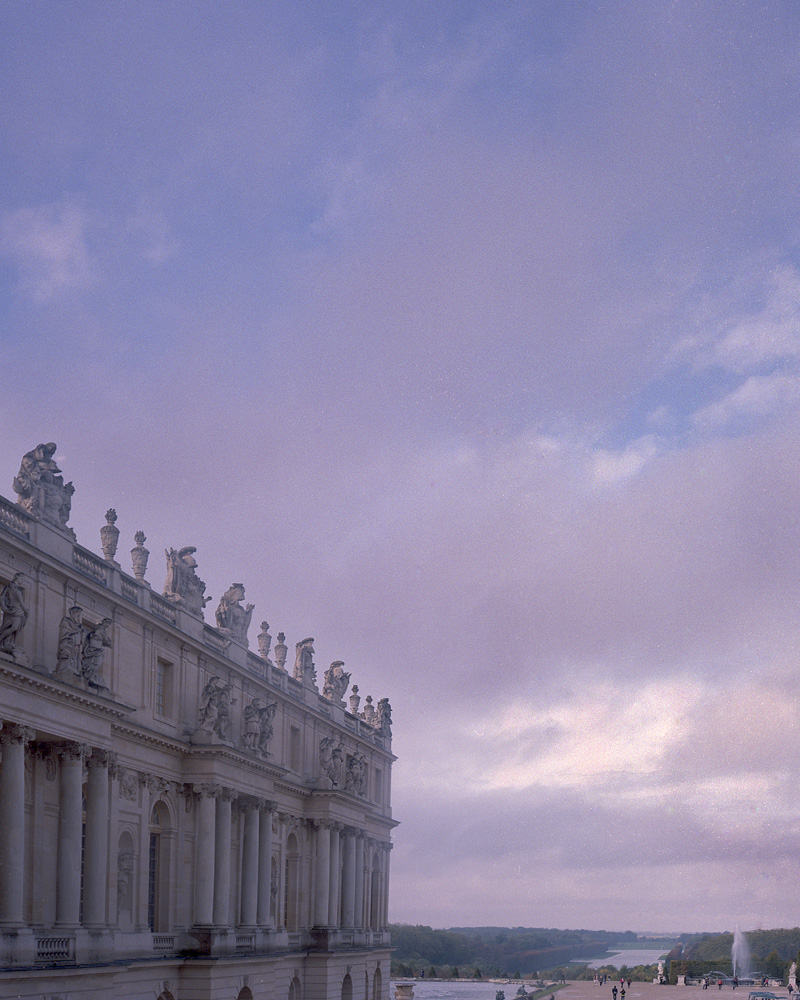
A view of the garden facade through a window of another wing of the building. The colors of the sky were beautiful with all the rainclouds breaking up. You can see down the long walk with the ponds in the middle, how far off the estate stretches.

Versailles, Clouds, Gardens

An Actor in Costume, by Camille Silvy, London, ca. 1860

Actor, by C Silvy
Actor, by C Silvy

Here’s another rather rare image – a portrait of what appears to be an actor by Camille Silvy. Camille Silvy was a French photographer who moved to London in 1858 and opened a studio at 38 Porchester Terrace, Bayswater. He photographed society clients, including many members of the British royal family, as well as royals of other nations (the queen of Hawaii among others). According to Wikipedia,

He closed his studio and returned to France in 1868. He himself believed that his nervous system had been damaged by exposure to potassium cyanide in the darkroom but it more likely that he suffered from manic depression. The last thirty years of his life were spent in a succession of hospitals, sanatoria and convalescent homes.

So he had a working career in London of approximately 10 years, in which he made over 17,000 sittings – rather productive for a short career. That’s about six portraits a day, 300+ days a year. According to the Wikipedia entry, the National Portrait Gallery in London has his daybooks, which include 12,000 photo illustrations to accompany the records of sittings. I’d love to visit them and see if I could find out who this actor was. Maybe next year when I return the favor to visit my friends Peter and Mirza who came to see me in Paris.

Paris in October – part 39 – Staircases at Versailles

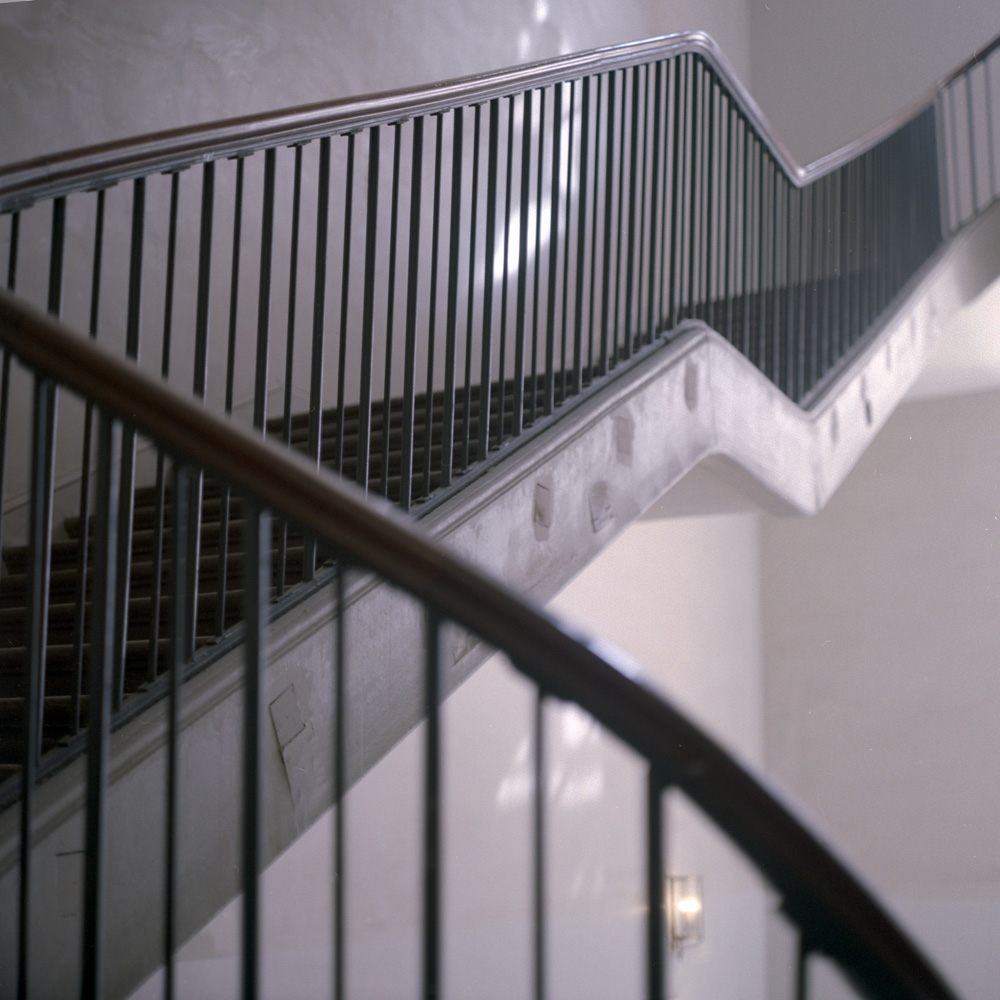
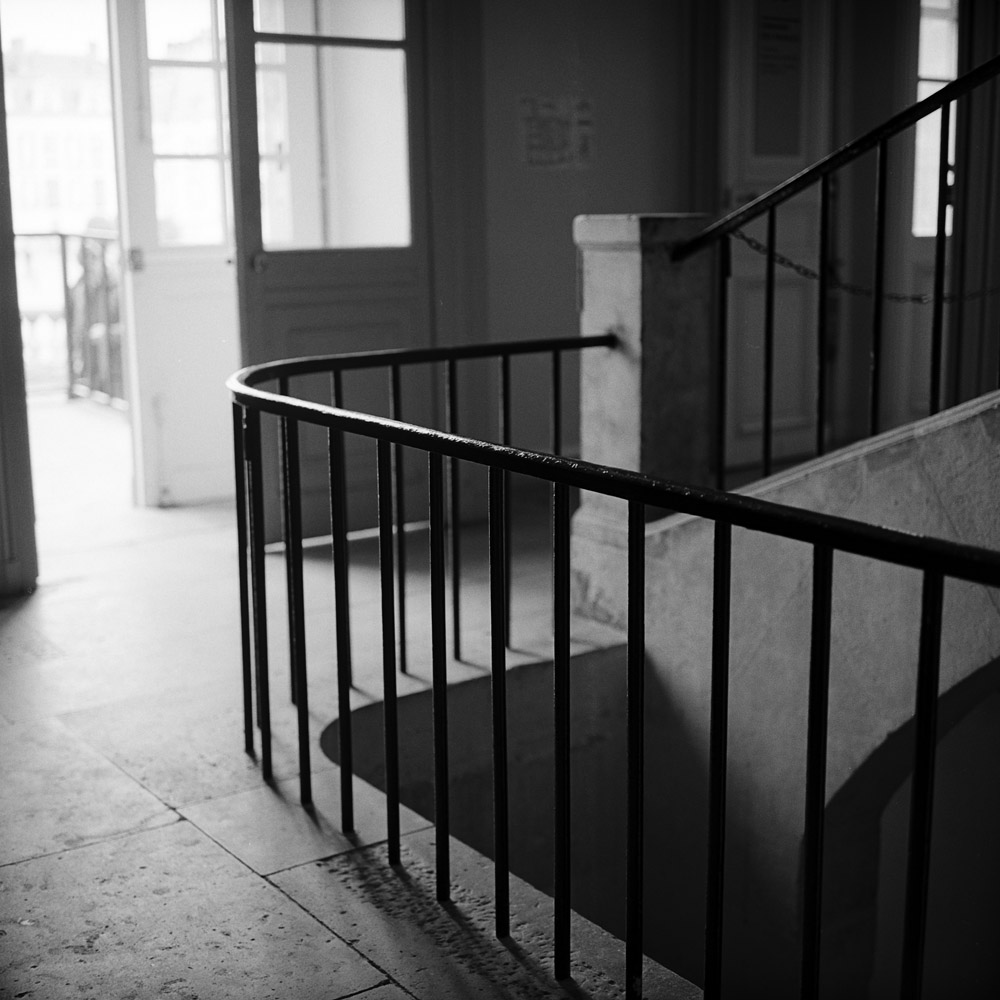
These first two are of the service stairs that lead from today’s restaurant and snack bar to the ground floor and the exit to the gardens. By the time I got to the dining room, my feet were screaming at me from all the continuous marching through the palace and across the cobbled courtyards. I did not eat in the main dining room but instead got a sandwich from the cafe. There was no place to sit (the only available tables were the stand-up kind, every chair was taken). Leaving the cafe to be faced with this staircase, then, was suddenly a daunting task. What to do, then, but photograph it?

Balustrade, Service Stairs, Versailles

To proof the images I wanted to scan and print bigger, I had a set of 5×5 inch proof prints made at the time of developing the film. Sometimes, the minilab prints looked better than my final scan results, but more often, they look worse. Based on the minilab prints, I excluded these two from my rough edit. Going back over the film while scanning everything else, I looked at the negatives and they looked good, so I took a whirl and scanned the first one. As it turned out, they were much better than I thought they would be based on the proof prints.

Service Stairs, Versailles

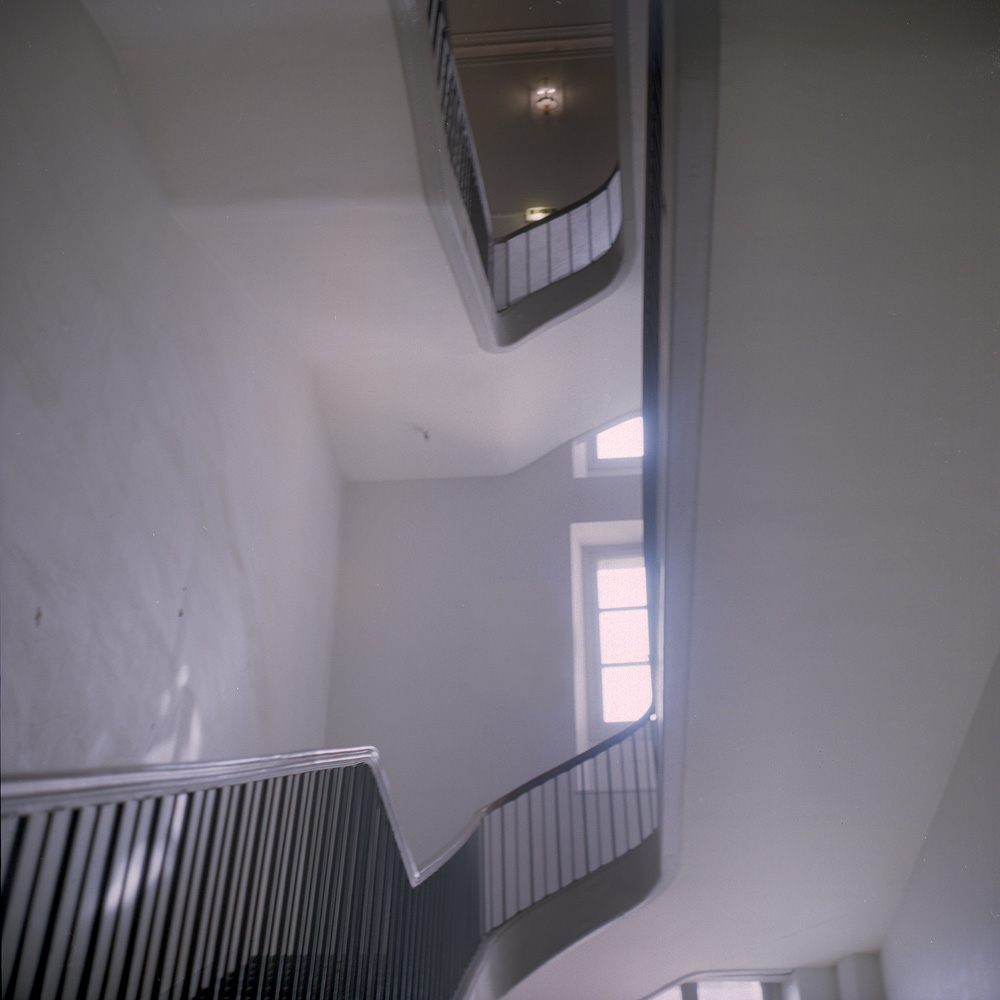
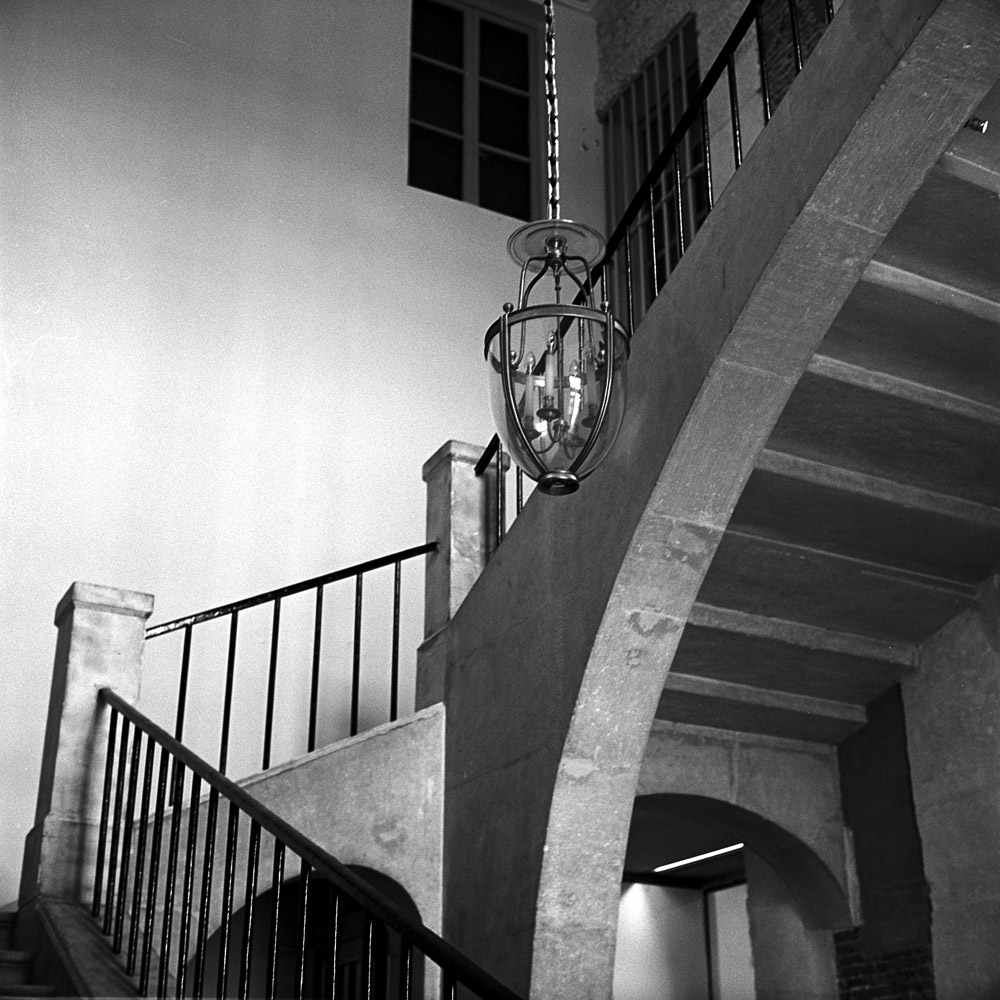
These next two are a memory refresher from an earlier post. With the exception of the last photo in this post, the only staircases I photographed at Versailles, it seems, were service stairs. I guess everyone is content to ignore them and only pay attention to (and mob) the Queen’s Stairs. Their loss, my gain.

Staircase, Outbuilding, Versailles
Stairs, Chandelier, Versailles

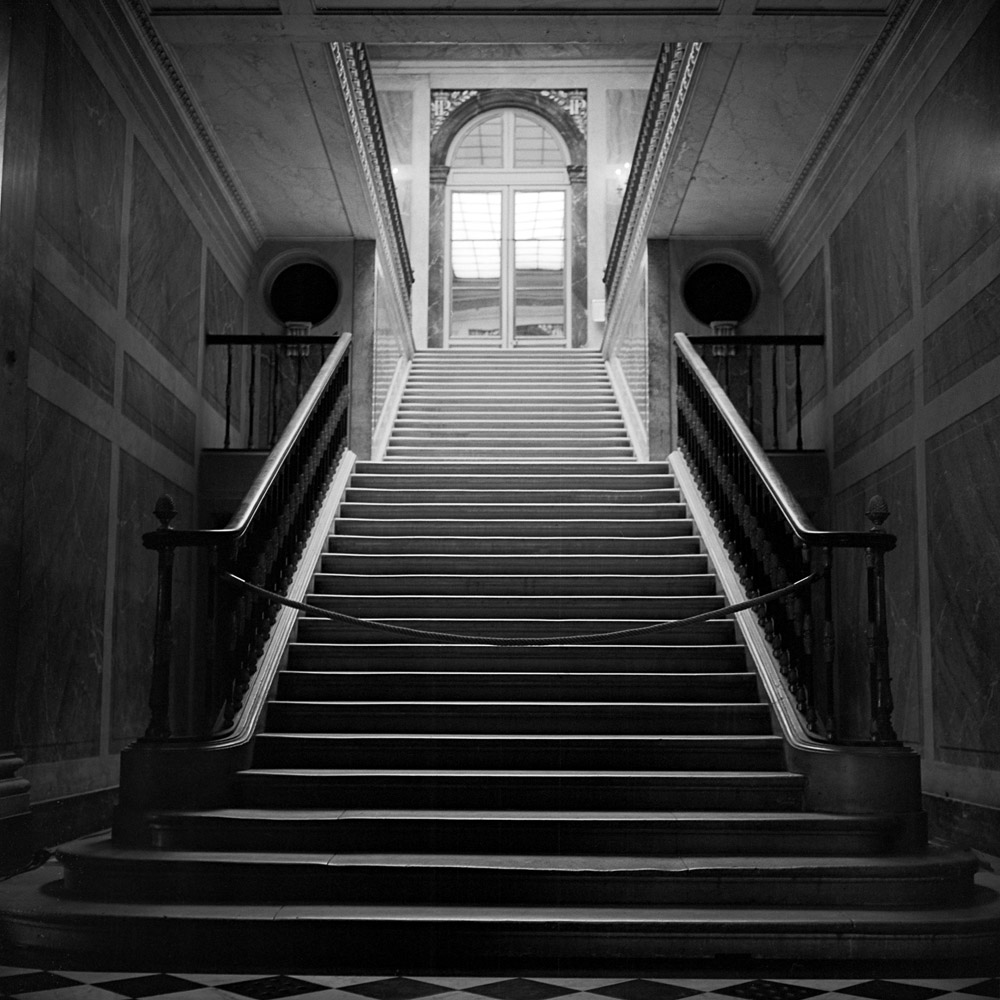
When I originally posted this staircase, I mistakenly labeled it “The Queen’s Staircase”. It is not. The Queen’s staircase is far more opulent and magnificent than this, although I wouldn’t complain about having this be the main stairs in my house…

Side Stairs, Versailles

Paris in October – part 38 – Versailles Interiors in color

I’m sure you’ve read my rant about how crowded Versailles was. It seriously cramped my style trying to photograph any of the spaces on the main circuit of the house, even with my cellphone. That said, the whining ends here. I’m happy with the pictures I did take; I just wish I could have taken more. When I go back, and I WILL go back, sometime, I’ll do things differently – I’ll do the gardens first, then the house, and I’ll go in the dead of winter, on a weekday. Preferably during a snowstorm.

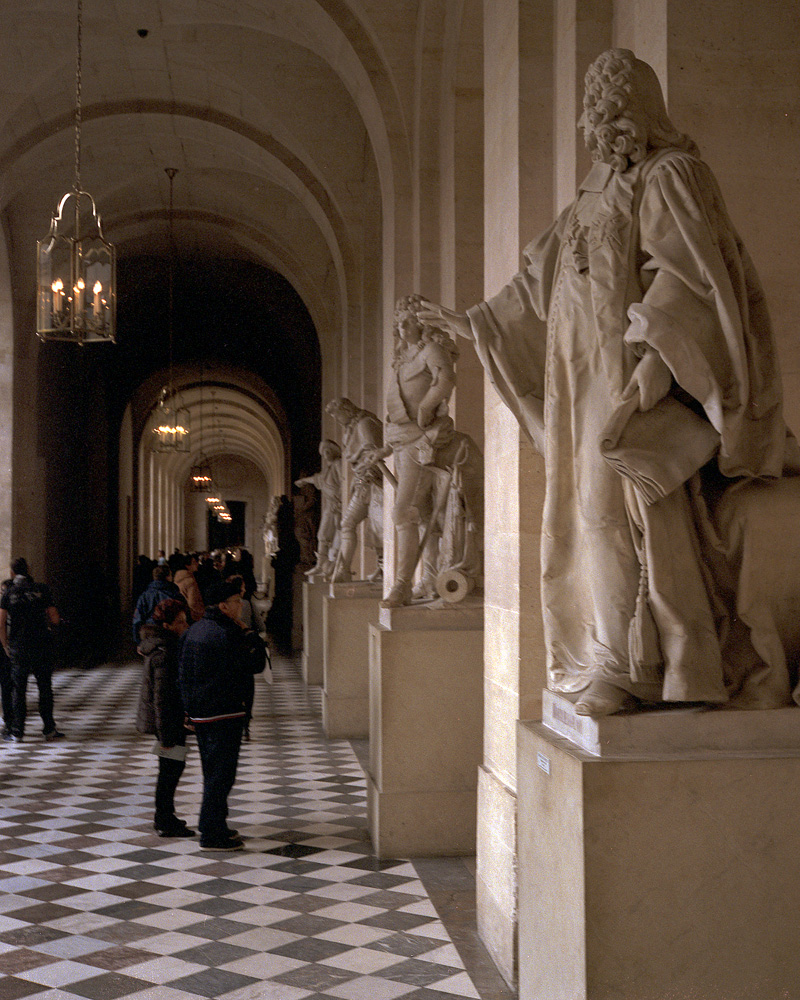
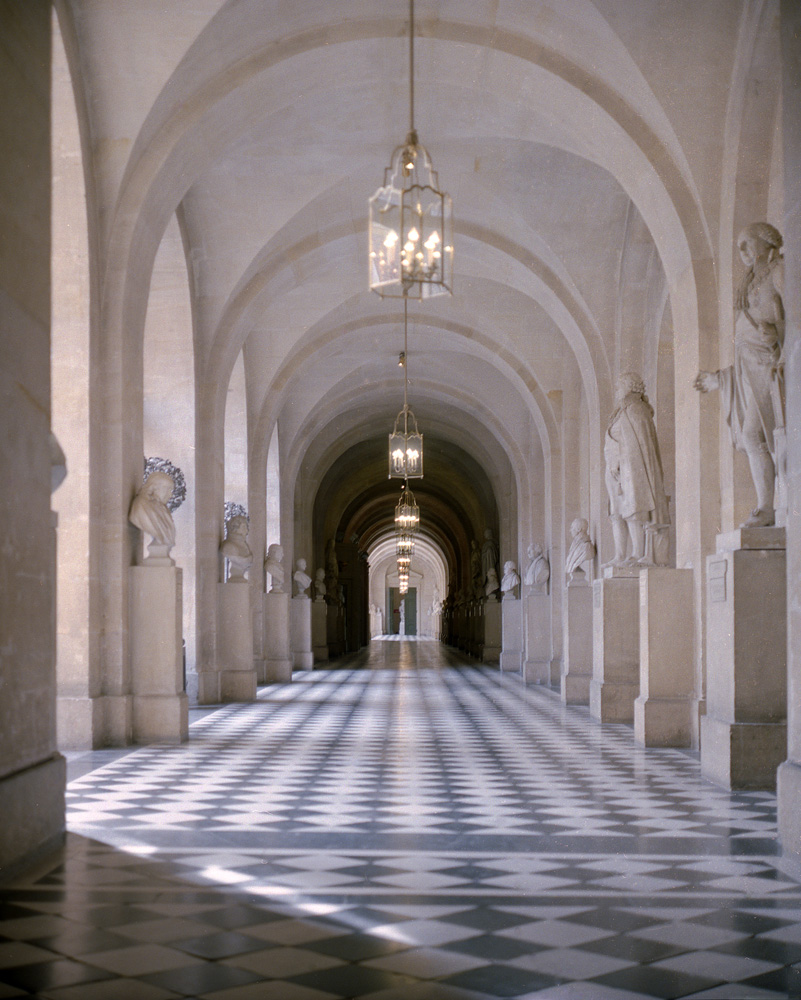
There are multiple halls filled with statues of great Frenchmen. Here are two such passageways, one with and one without tourists. The shot with tourists provides a human scale and a modern reference point for the house. The one without gives an architectural scale.

Tourists, Statuary
Tourists, Statuary
Statuary Hall, Versailles

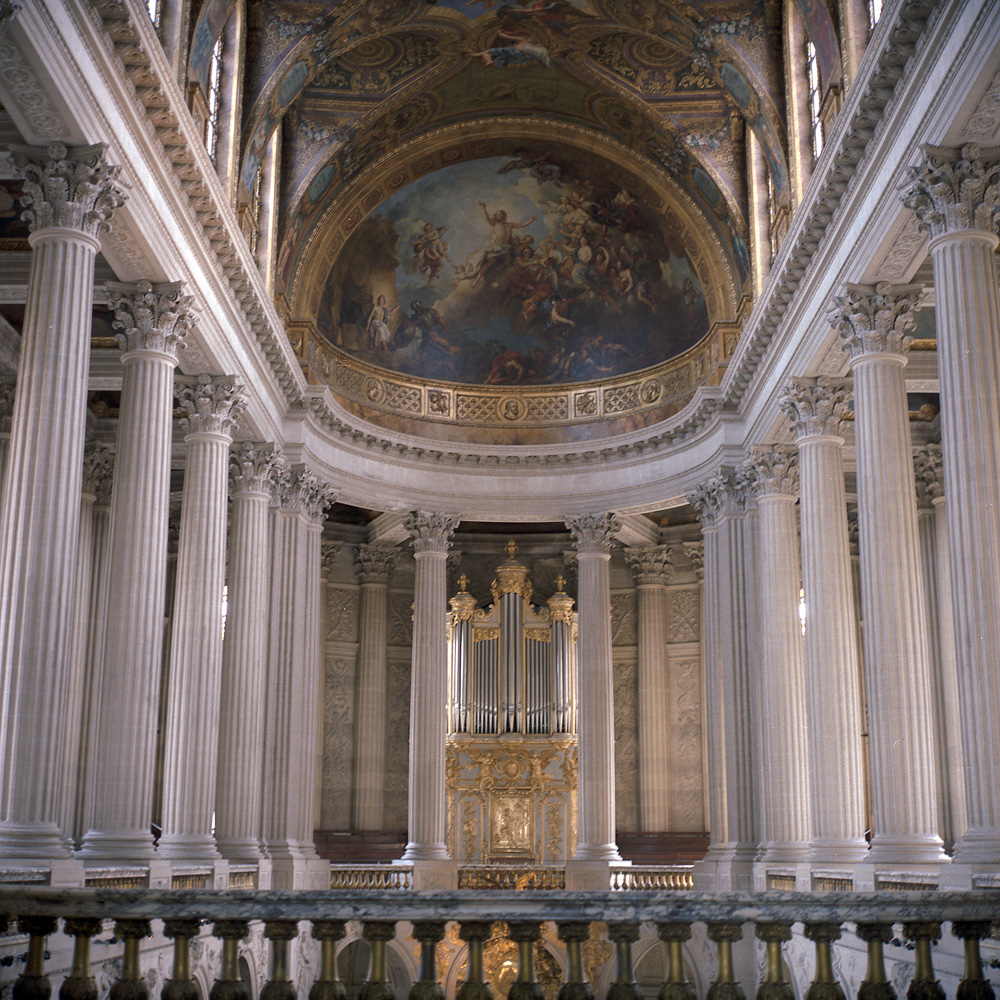
The royal chapel is one space in the palace that truly gives you a sense of not only the grandeur of the palace but also the extreme disparity of wealth between the aristocracy and the peasants.

Royal Chapel, Versailles

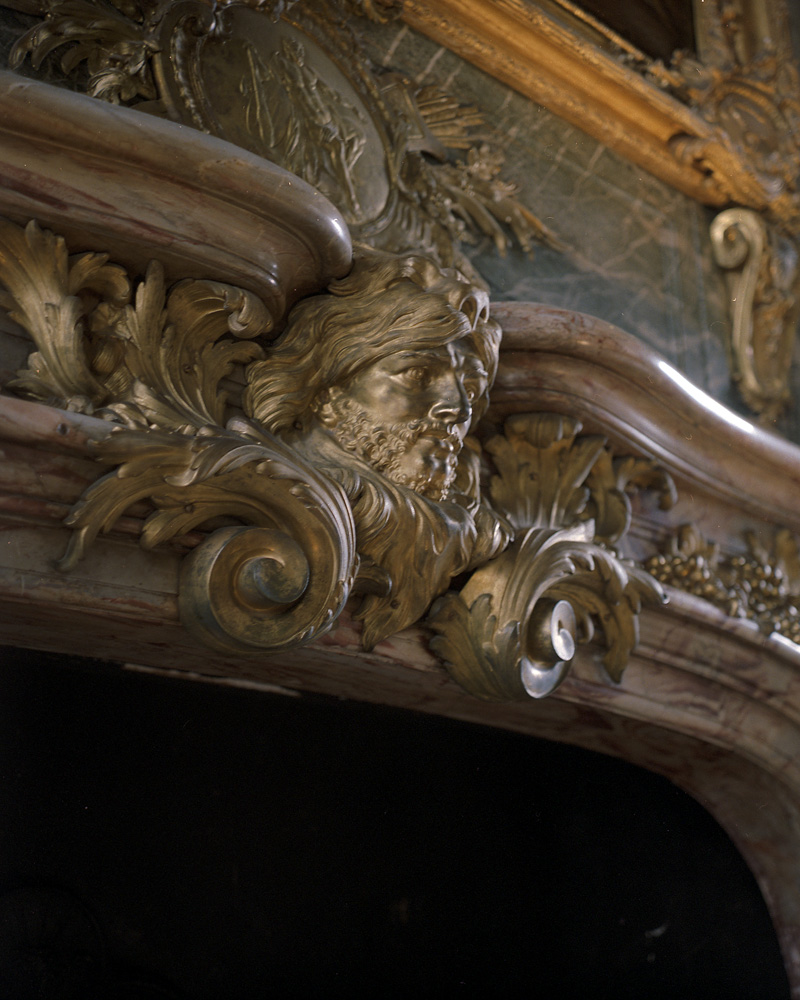
A huge part of the purpose of Versailles was to show off the wealth and power of the state. To that purpose, it lived up to it in spades. This mantlepiece is about level with my shoulders, and the head in the center is about the size of my head. You could actually walk into this fireplace.

Mantlepiece, Head
Mantlepiece, Head

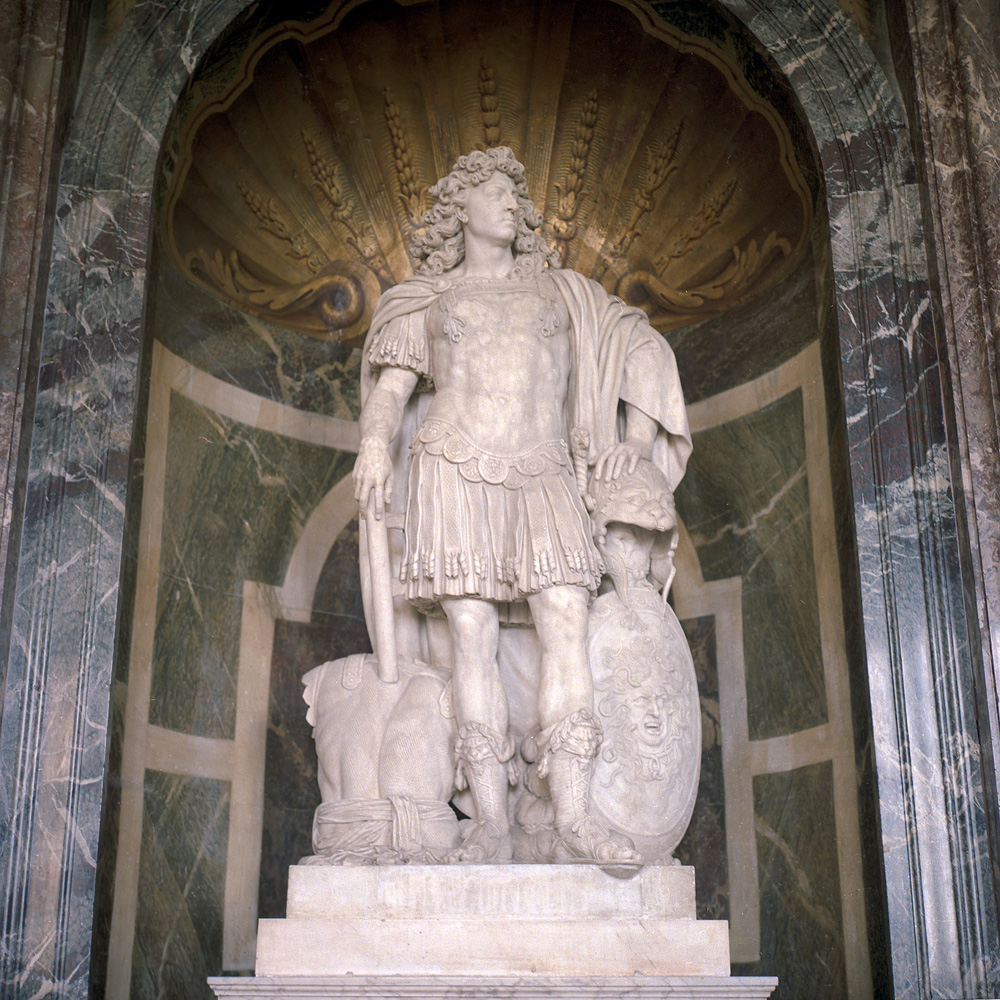
Here is Louis XIV as Mars, the God of War.

Louis XIV as Mars, God of War

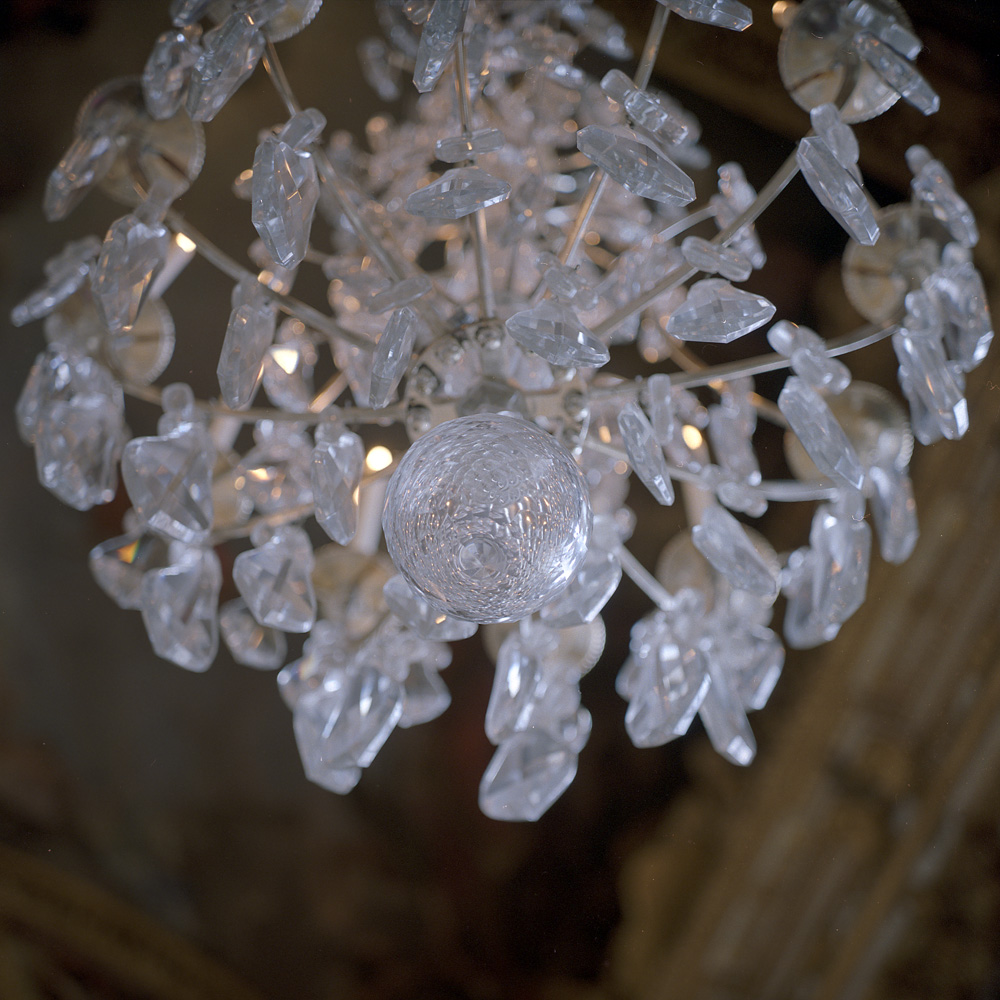
This is the one view of the Hall of Mirrors I was able to take. It’s an atypical view of the room, and as a result I’m particularly proud of it because it is representative without being cliche. Most people when viewing the room are paying attention to the mirrors and never look up, but half the brilliance of the room comes from the crystal chandeliers reflecting and amplifying the light.

Chandelier, Hall of Mirrors

Paris in October – part 37 – Chalon Odds and Ends

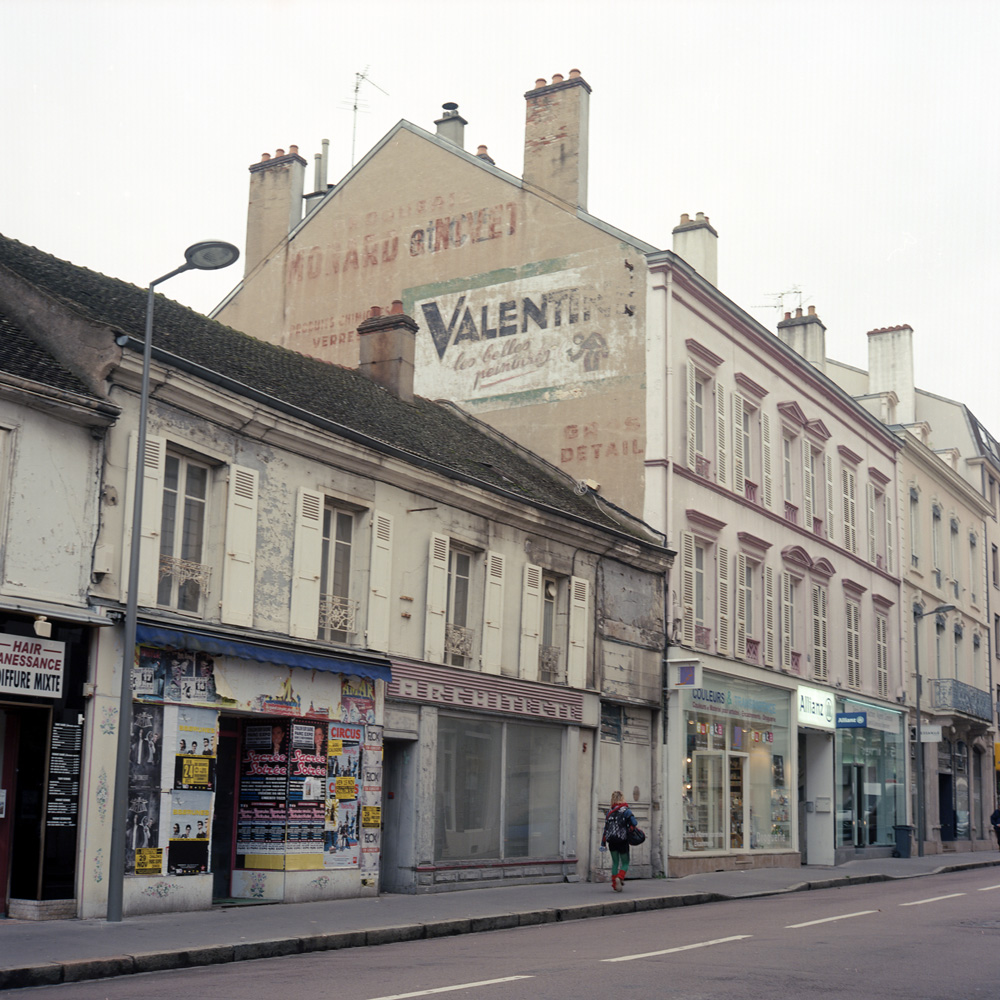
Here are some loose ends from my sojourn in Chalon-sur-Saone. You may remember the Valentin Paint ad in black-and-white – here it is in color.

Valentin Paint Ad, Chalon

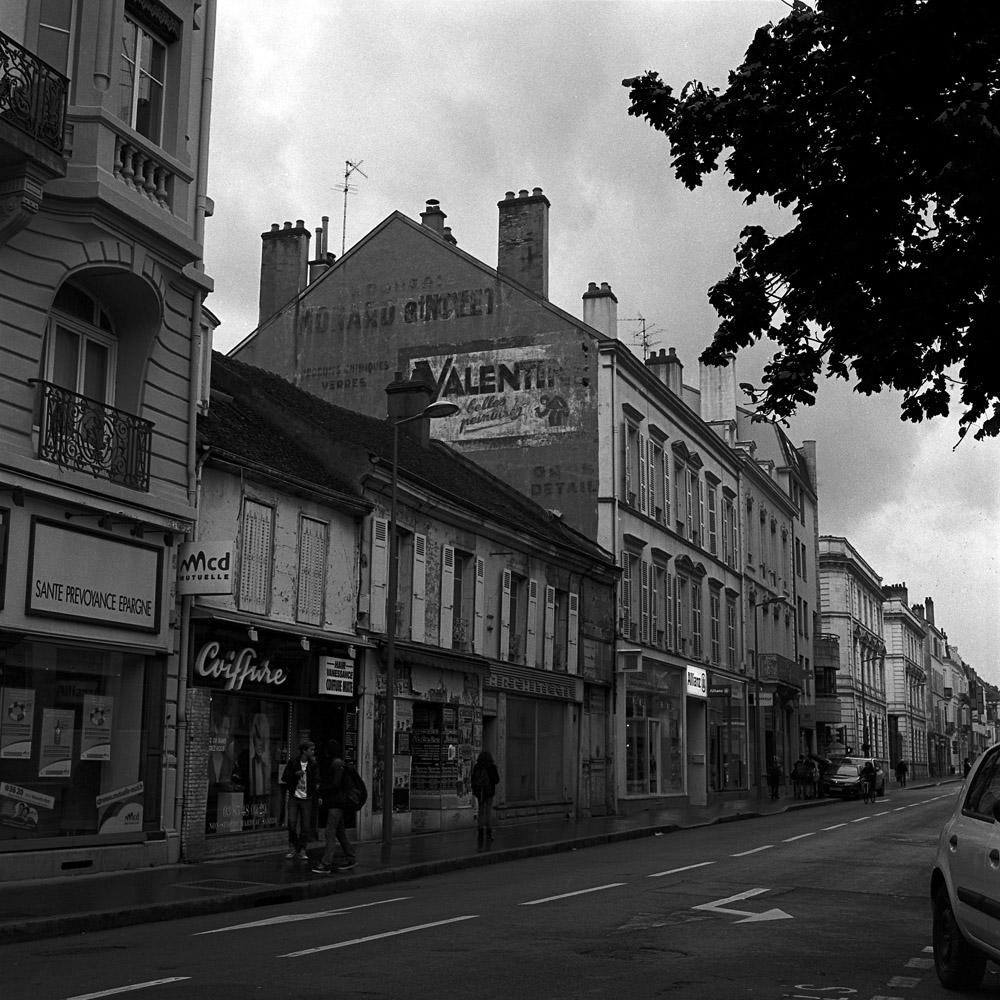
The black-and-white version, as a refresher:

Old Advertisements, Chalon

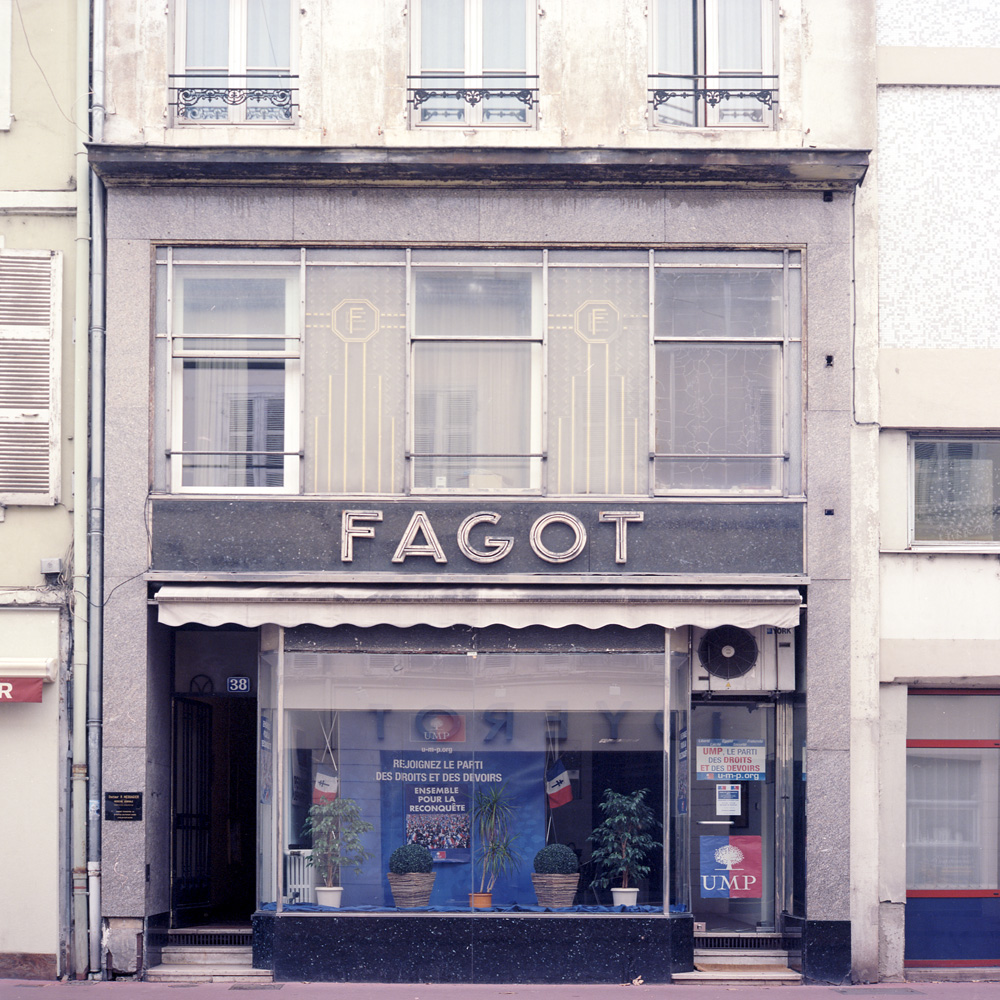
I couldn’t help but photograph this storefront for the combination of the beautiful if faded 1940s Art Deco facade and the psychologically jarring name. Fagot (pronounced Fah-GO) is a family name, not a slur aimed at someones sexual orientation. Today, instead of the original business that built the building, it is occupied by the offices of a political party.

Fagot Storefront, Chalon

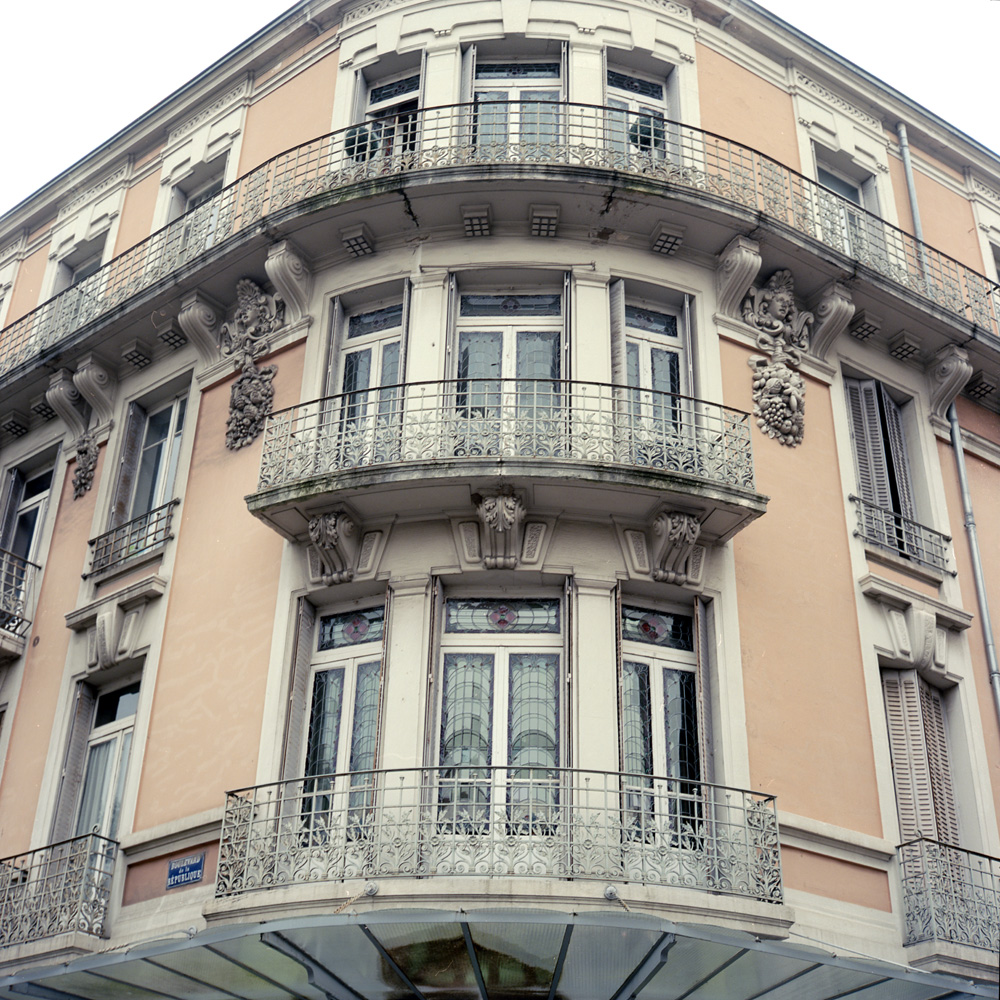
I’m a sucker for Art Nouveau and Art Deco architecture. So when I see a building like this, I have to photograph it.

Apartment Building, Boulevard de la Republique, Chalon

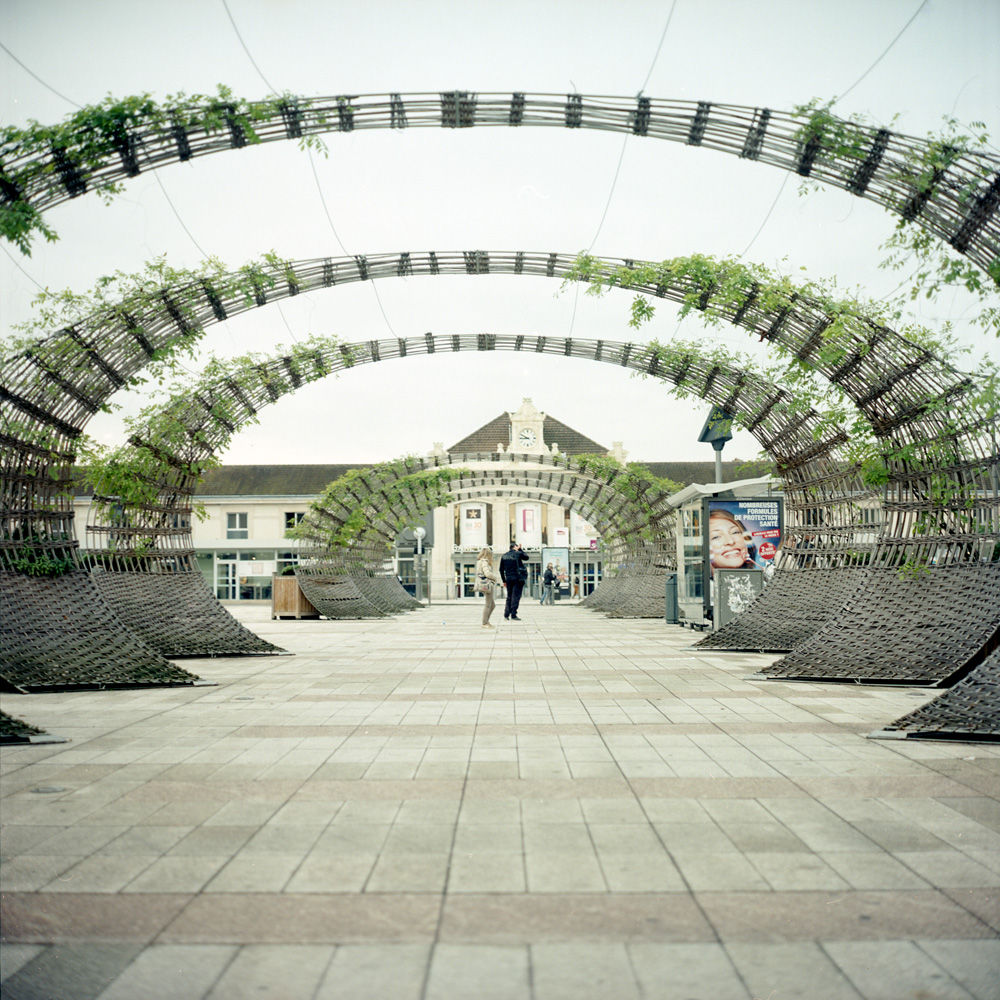
The first and last view you have of Chalon when traveling by rail is of this plaza with the modern arbors forming a tunnel to point you toward the center of town. To camera right is the St. Georges hotel, where I stayed, and to the left across the plaza is the english pub-style restaurant where I had the delicious breaded veal with the pasta the French don’t know quite what to do with. Behind is the Maitre Pierre restaurant you saw in my night photos from the hotel balcony.

Arbors, Chalon Railway Station

More images published at Eastern Sierra Center for Photography – male nudes

I have had eight images published at Eastern Sierra Center for Photography’s website in their “Paradigmatic Nudes” gallery online. Most of these images you’ve seen here before on my blog. The images featured are my whole-plate sized gum bichromate prints of Philip, a model I’ve worked with and my Type 55 Polaroid 4×5 format shots of my friend Jose. I’d like to give a big shout-out to Laura Campbell, their curator and director, for repeatedly selecting my work and having faith in my creative vision. Please go check out their website and see the entire gallery.


Jose, Legs
Jose, Legs

Large format Nudes at Eastern Sierra Center for Photography

Paris in October – part 36 – a Courtyard in Chalon

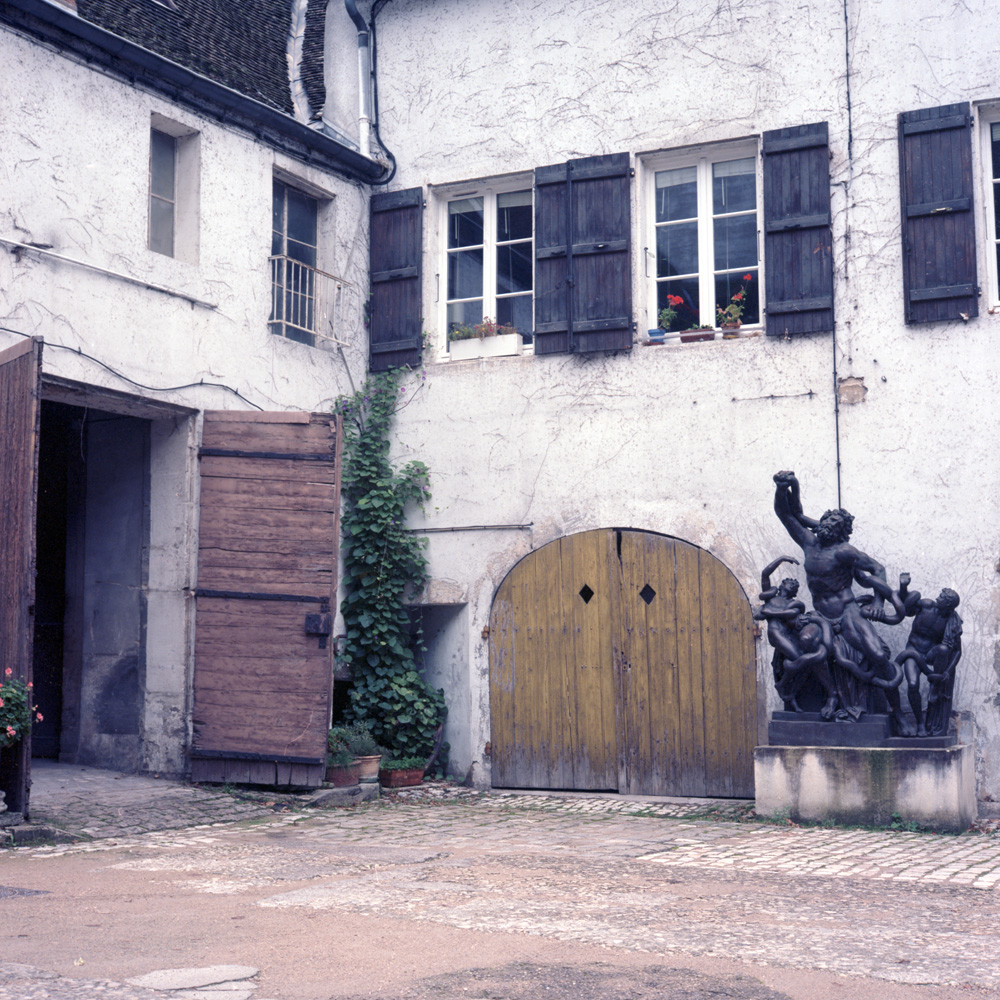
Around the corner from the Musee Niepce and the Chalon tourism office, I encountered this fascinating courtyard. Perhaps the single most surprising element was the massive bronze Laocoon statue in an otherwise ordinary if picturesque courtyard. Why and how the statue ended up there is a mystery.

Laocoon Courtyard, Chalon

If you remember your mythology, Laocoon was a Trojan priest who predicted the Greek gift of the Trojan horse but was not believed. There are multiple versions of why the gods sent serpents to strangle him and his sons, ranging from dishonesty to defiling temple virgins. Regardless of the why, his story became famous, and has been commemorated in art from ancient times. There is a Roman marble of this scene, probably modeled after a Greek one, which was then emulated multiple times in stone and metal during the Renaissance.

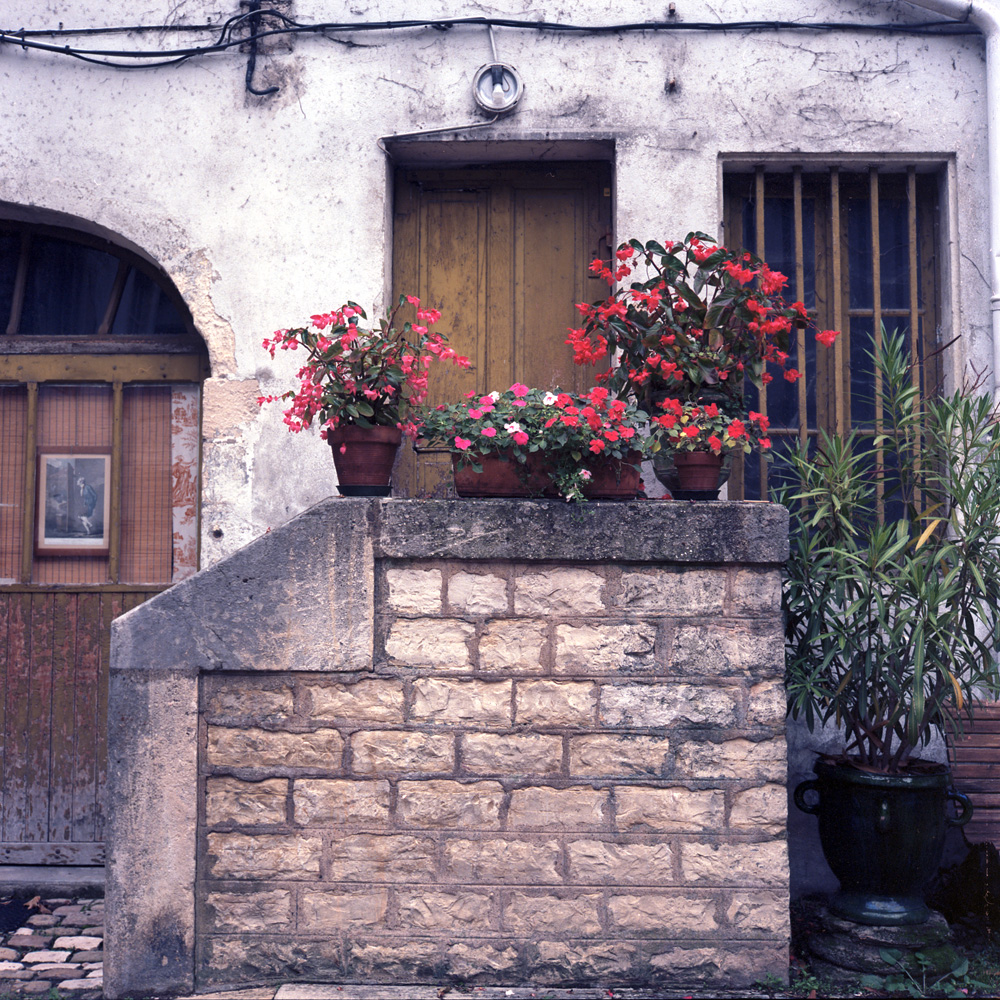
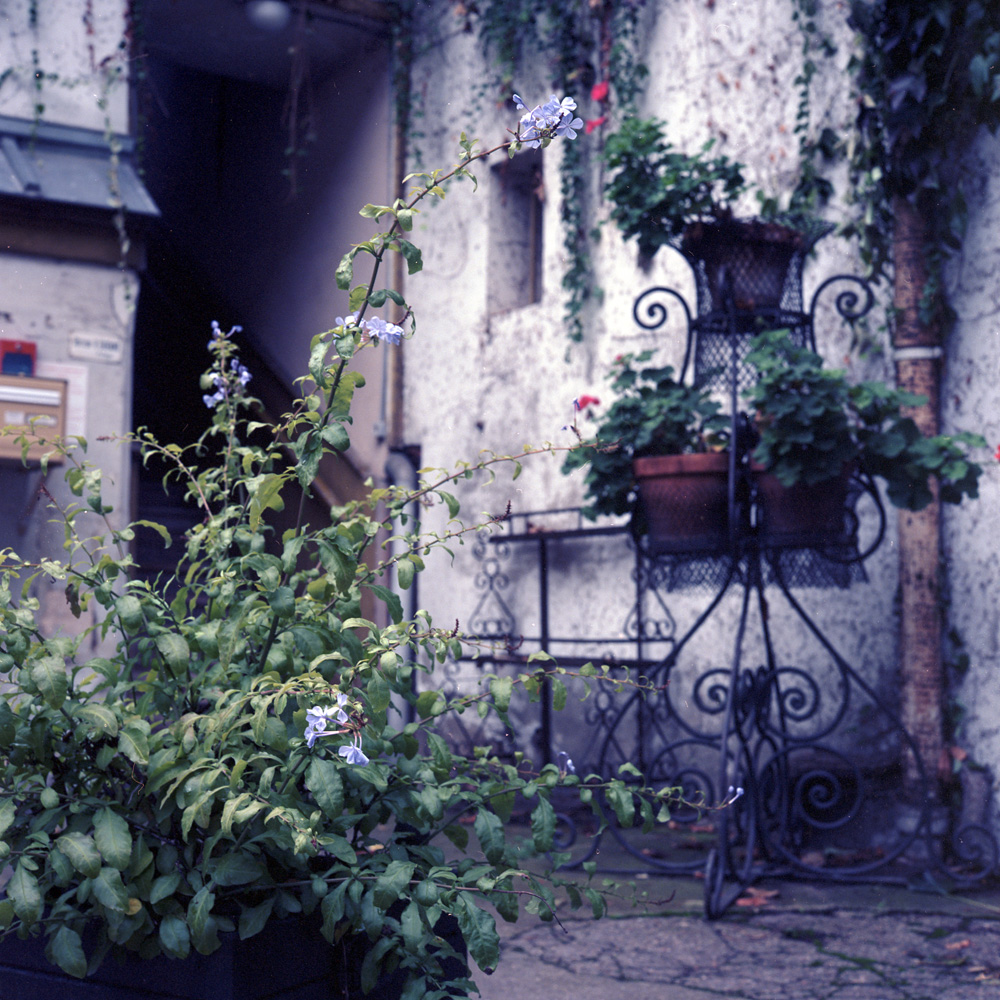
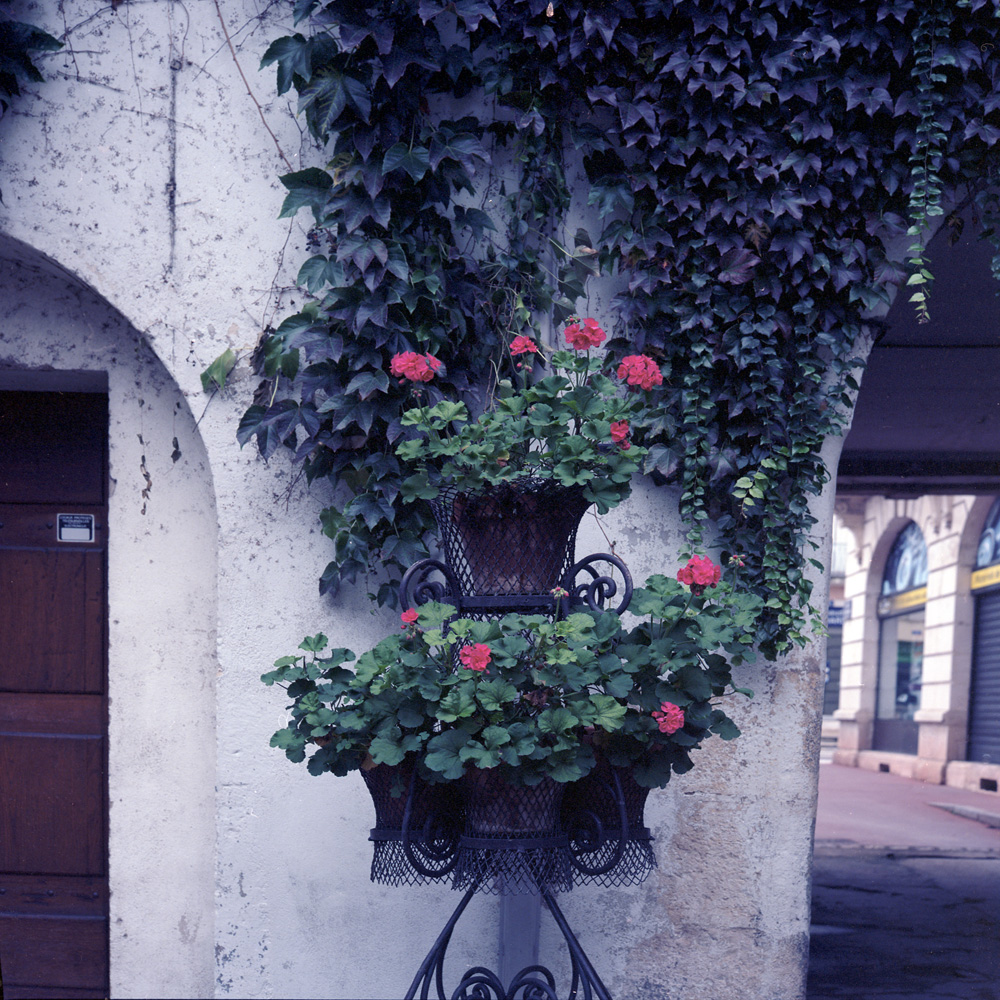
Someone who lives in this courtyard favors geraniums.

Geraniums, Stairs, Courtyard, Chalon
Planters, Courtyard, Chalon
Geraniums, Doors, Courtyard, Chalon

Courtyard residences seem to be extremely popular in France. I suppose it’s for the relative privacy you have compared to facing the street, especially in older urban areas where stepping out your front door puts you literally a sidewalks’ breadth away from traffic. And it provides opportunities for parking that you wouldn’t get elsewhere. I think I’d like to live on a courtyard if I lived in Paris, or even in a town like Chalon. Who wouldn’t enjoy walking down the stairs every morning to be greeted by your own classical Greek statue?

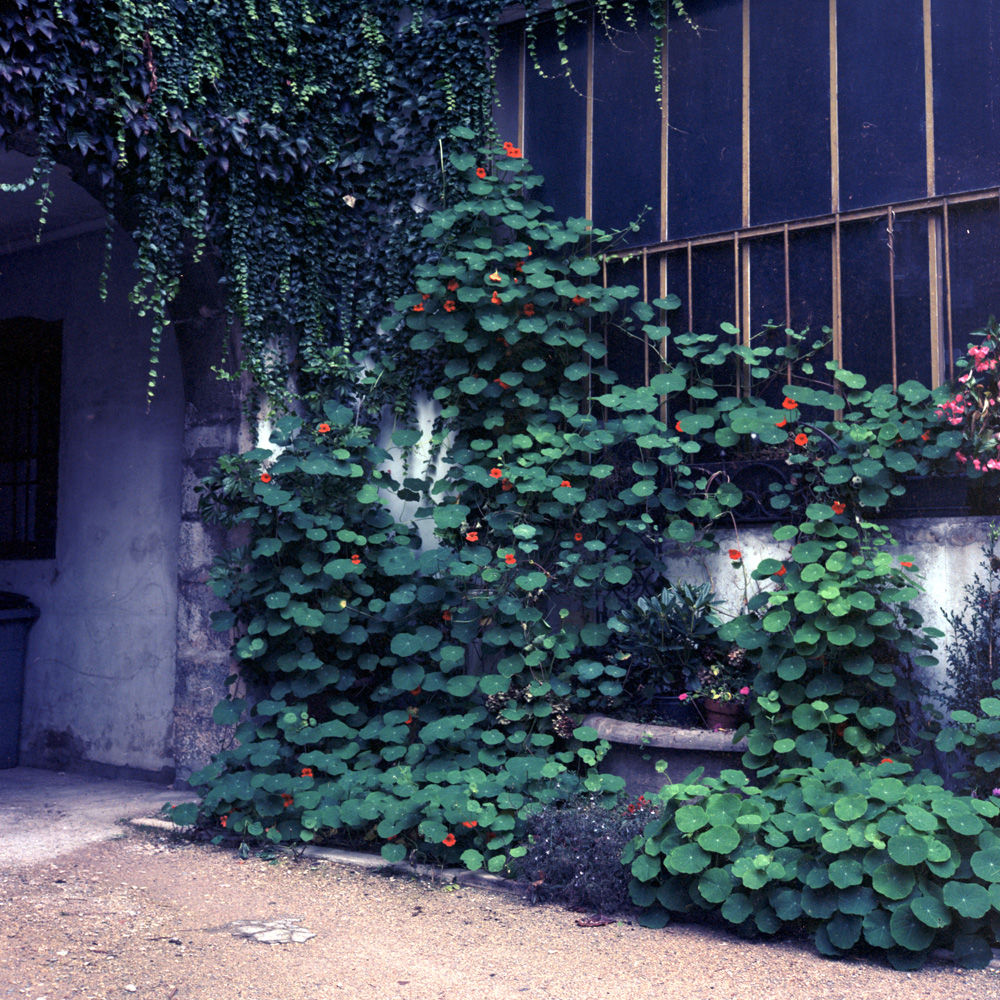
Greenery of all kinds, in fact, is a hallmark of the space. These flowering vines had taken over the wall and partially obscured the window into the workshop. If my understanding of French is any good, the workshop behind these windows was a specialist in antiques and restoration. I couldn’t tell if they were open at the time so I didn’t try to venture in.

Vines, Windows, Courtyard, Chalon

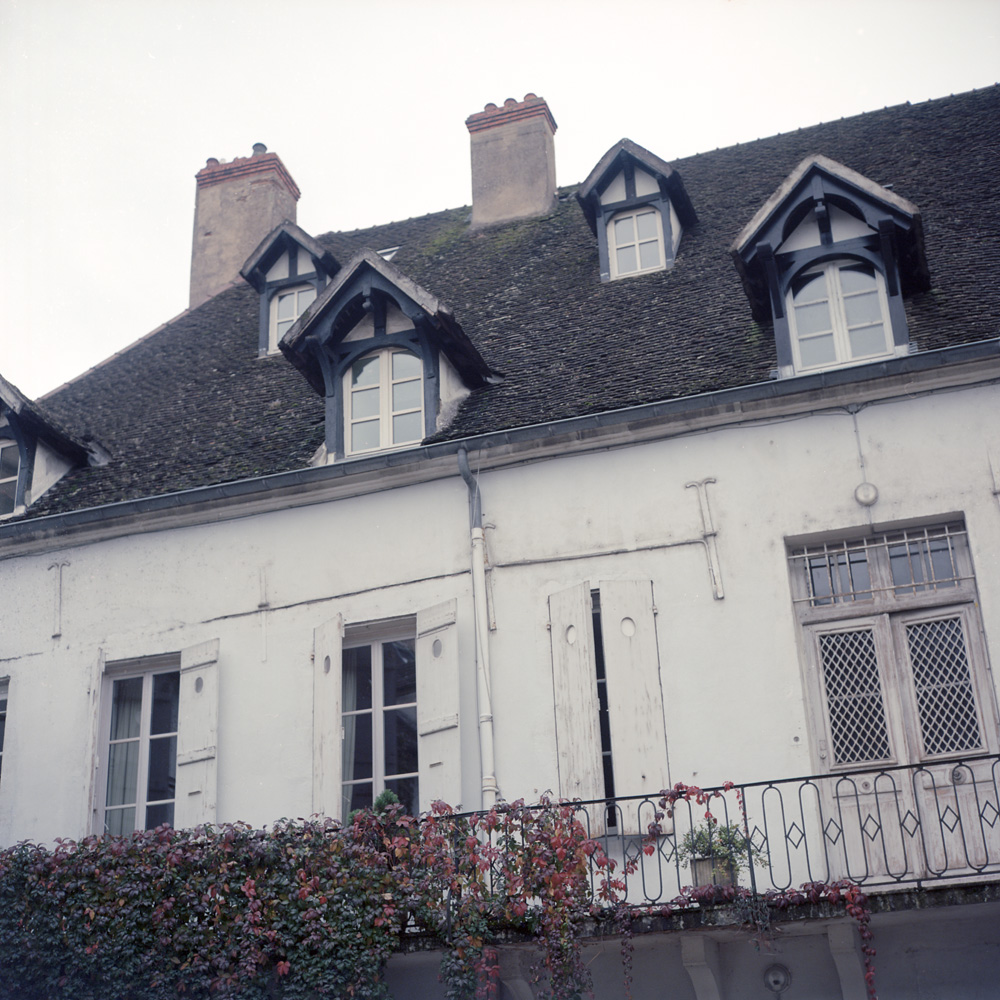
Another somewhat Swiss-looking architectural element, the peaked gabled windows in the roof:

Peaked Windows, Chalon