Category Archives: Photography

Collection summary

I received three more daguerreotypes in the mail yesterday, and that inspired me to do a mini inventory of the daguerreotype and other cased images collection. Don’t take my collection as being statistically accurate as to the population of cased images out there, but the general trend is I think illustrative of the market in general.

1/9th Plate

  • One milk glass ambrotype in oval velvet pushbutton case
  • Two ambrotypes in gutta percha/thermoplastic cases
  • One daguerreotype in leather case
  • Two tintypes in half leather cases

1/6th Plate

  • Three daguerreotypes in half leather cases
  • Four daguerreotypes in gutta percha/thermoplastic cases
  • Twelve daguerreotypes in leather cases
  • Two ambrotypes in leather cases
  • One ambrotype in leather case
  • One ambrotype in gutta percha/thermoplastic frame
  • One ambrotype in brass mat, missing frame or case (most likely frame)
  • Four tintypes in leather cases

1/4 plate

  • One daguerreotype, missing case
  • One daguerreotype, in half leather case
  • Three daguerreotypes in leather cases
  • One ambrotype, in half leather case

1/2 plate

  • Two ambrotypes in leather cases

So, forty-two cased images altogether, with twenty-eight being 1/6th plate. Seventeen ambrotypes/tintypes, twenty-five daguerreotypes. Thirty-four in some form of leather case, seven in gutta percha/thermoplastic. I’m making a distinction between a half leather case and a whole leather case only from a collectors perspective – the half-cases are images whose cover was separated from the image at some point in time and not retained. Daguerreotypes are over-represented in the collection because that’s what I’ve made an effort to collect. There are probably more cased tins/ambros out there than daguerreotypes. 1/6th plate dominates, because that was the most common size produced. 1/9th plate is probably less uncommon than my collecting habit would indicate, again because of personal taste. The 1/4 plate and larger, though, are far less common. Prices have ranged from as little as free (one is an inherited piece) to $300 (which believe it or not was not one of the half plate images). Most have been in the $30-$150 range. Most images are by undocumented photographers of anonymous subjects, but perhaps four have the sitter identified, and I have one by Plumbe, two by Brady (although one of the Bradys may not be, as the case halves are different), one by Judson of Newark, NJ, one by Clark of New Brunswick, NJ, one by Kimball of New York, NY. One is from Argentina, the rest are American. One is allegedly Ulysses S. Grant’s niece. One is definitively dated 1849. Several others are probably older, including the Brady and Plumbe daguerreotypes, but most are from the 1850s.

On another date, at a different time, I’ll inventory the CDV/uncased image collection, which is much larger and more diverse.

Anonymous Daguerreotype

Anonymous Daguerreotype, Young Girl, Hand-colored, in Half Case

Just another random daguerreotype. I was drawn to the image by the hand-coloring which is subtle, unlike some I’ve seen where it can get over-the-top, and the flaw in the hand-coloring – notice that her face was nicely tinted, but they forgot to do her hands!

I’m no fashion expert, so I can’t give you more precise information about dating the image based on the wardrobe of the girl, but from the style of the dag itself, you can tell this one is from the 1850s – the mat itself is ornate and highly tooled, and the packet is wrapped in a gilt brass frame. Early daguerreotypes (1839-mid 1840s) have very simple geometric mats, often with a pebble texture. As the 1840s turned into the 1850s you get the thermoplastic cases and the more stylized mats, and ending with the ornate mats and packet frames. Tooled leather cases continue side-by-side with the thermoplastic cases through the Daguerrian era and on into the end of the cased tintype era, so using the case itself to date the image is not sufficient. If I can find my reference book that has a timeline of the evolution of photographic presentation styles, I’ll amend this to clarify when thermoplastic cases came into being and when they died out, but that could be a while – my library is a bit higglety-pigglety right now as I’ve run out of shelf space (2000+ volumes will do that to you).

Fun with old cars

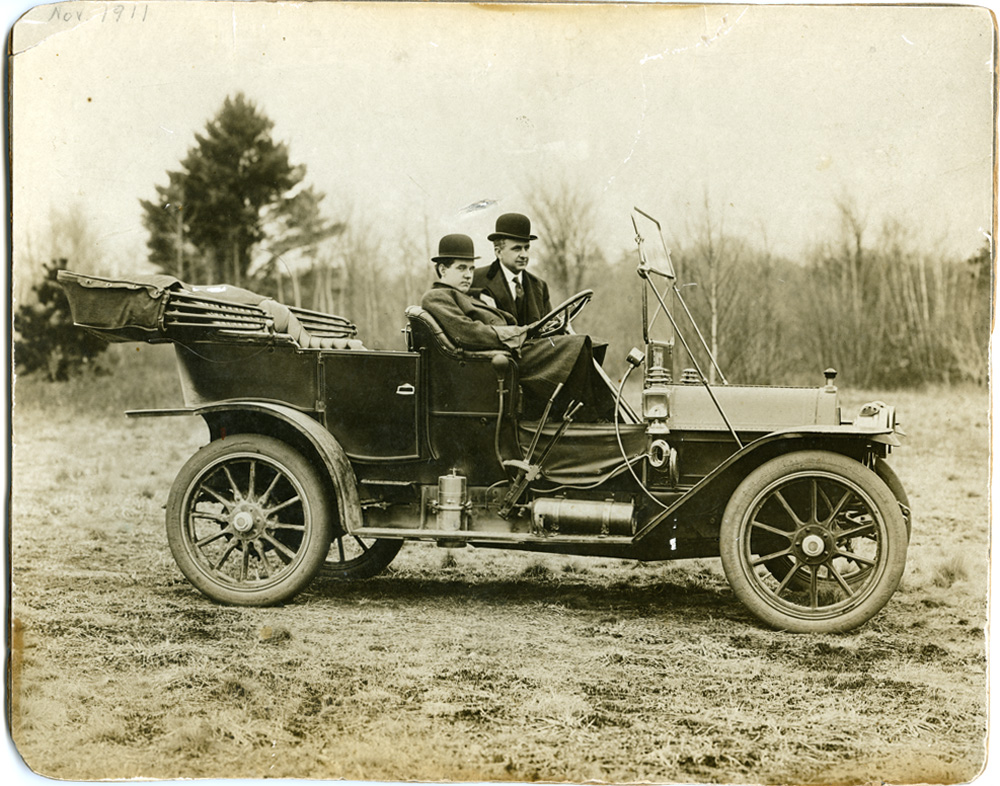
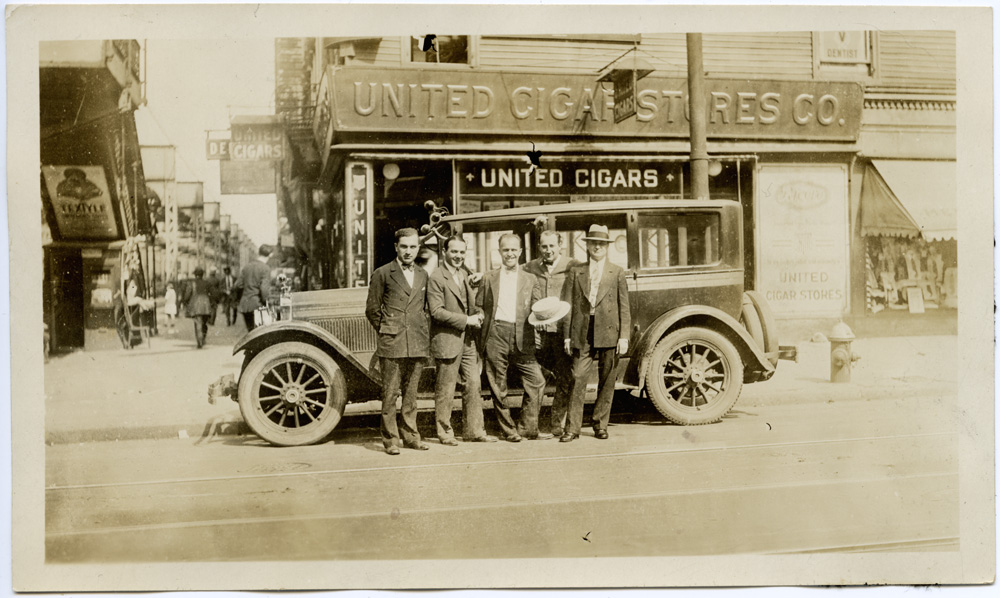
Yet another topic to collect – old car photos. I’ve had an obsession with cars since I was a kid – my dad had a 1955 Ford Thunderbird that he restored, and that sparked the passion. In high school, I drove a 1962 Nash Metropolitan until my parents decided it was unsafe and made me get a used Honda instead. Which turned out to be far more unsafe than the Met, because it was capable of going fast :). For your appreciation, here’s a 1920s Packard, and a 1911 Cadillac.

Early 1920s Packard, at the United Cigars store


1911 Cadillac
1911 Cadillac

The Packard photo is clearly a snapshot, having been made with a smaller camera and printed by machine on thin gaslamp or other silver gelatin paper. The Cadillac photo is more of a formal portrait, contact printed and mounted on heavy card stock, taken with an 8×10 view camera. The owner would have been extremely proud of his car to have taken that photo, as the level of effort and expense to do it were considerable. And in November of 1911, he would have been justifiably proud of that car – Cadillacs have always been expensive luxury cars, but in 1911, a car like that would have been a truly rare thing and extremely expensive. By the early 20s when the Packard photo was taken (the car looks like it is somewhere in the neighborhood of 1923-25), not only was photography more accessible to a mass market, so were cars – even Packards were more commonplace, and they were direct competitors to Cadillac, if not considered superior. Packard was one of the three “P’s” of the great automobile manufacturers of the 1910s and 1920s – Packard, Peerless and Pierce Arrow. By the 1930s, Peerless was gone, and Pierce Arrow was on the ropes, to vanish as a manufacturer by the onset of WW II (although their 12-cylinder engine continued on in production in one form or another into the 1980s as the power plant for fire trucks).

More updates to the Victorian Photographers maps

I’ve added four more studios to the New York and three to the Philadelphia Victorian photography studios maps.

New York:

  • William J. Tait, corner Greenwich & Cortlandt streets
  • John C. Helme – Daguerreotype studio, 111 Bowery
  • Abraham Bogardus – Daguerreotype studio (early), Greenwich & Barclay
  • Mathew Brady – Daguerreotype studio (early), 205-207 Broadway

Philadelphia:

  • D.C.Collins & Co. City Daguerreotype Establishment, 100 Chestnut Street
  • Reimer, 612 N. 2nd Street
  • Van Loan & Ennis – Daguerreotype studio, 118 Chestnut Street

Just a little more fun with the photographers maps compilation.

Here’s a quick link to the maps in case:

Victorian Photo Parlor Maps

Some more food for thought – I think I’ve mentioned this before, about the migration over time of certain studios, moving uptown in New York as their client base moved further uptown – to better illustrate this, I’ve pulled the studio addresses for three of the most prominent portrait studios of the day, and listed them in chronological order as best possible:

Mathew Brady:

  • 205-207 Broadway
  • 359 Broadway
  • 635 Broadway
  • 785 Broadway

Gurney & Sons

  • 349 Broadway
  • 707 Broadway
  • 5th Avenue & E. 16th Street

Abraham Bogardus

  • Greenwich & Barclay Streets
  • 363 Broadway
  • 872 Broadway

Also notice how close they all were to each other. While I don’t have dates per-se for each of the addresses, notice that at one point, all three were in the same block of Broadway (the 300 block), and again later, all three were in a two block span of Broadway, further uptown (700-800 block). Even early on, they were clustered close to each other in Lower Manhattan – 643 Bleecker is not far from Greenwich & Barclay, and another photographer, William J. Tait, was just a block or two away at Greenwich & Cortlandt streets.

The Native Americans

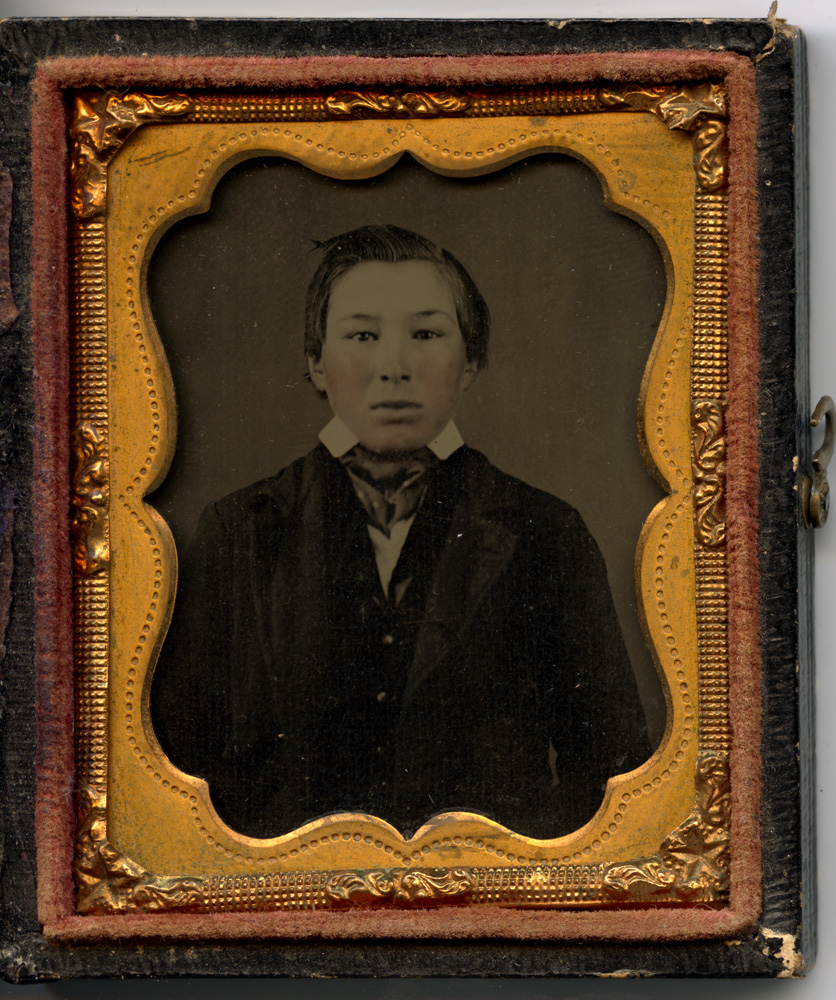
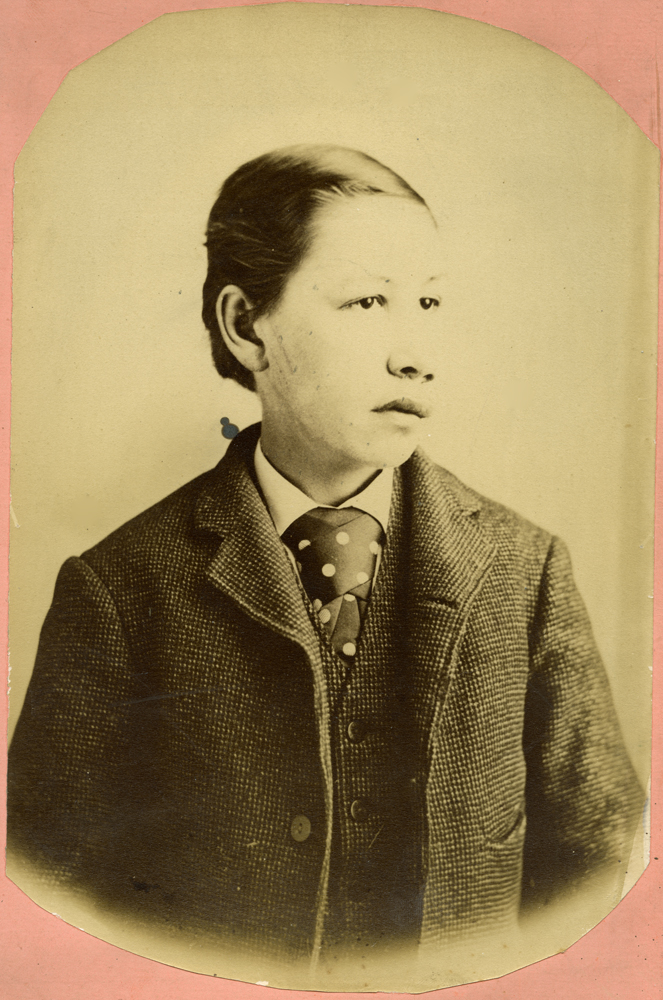
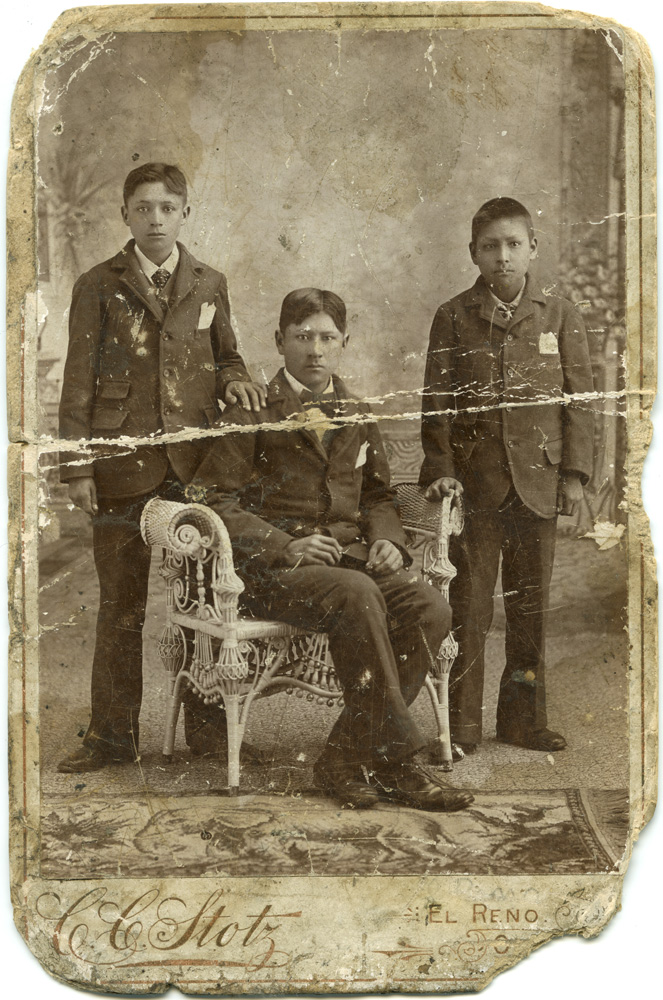
Just a quick recap of the Native American images I have in my collection.

Ambrotype, Penobscot Boy, 1857
Anonymous Asian-, Native-, or African-American boy
Native American trio, El Reno, Oklahoma
Navajo Brave, Grand Canyon, attributed to Karl Moon
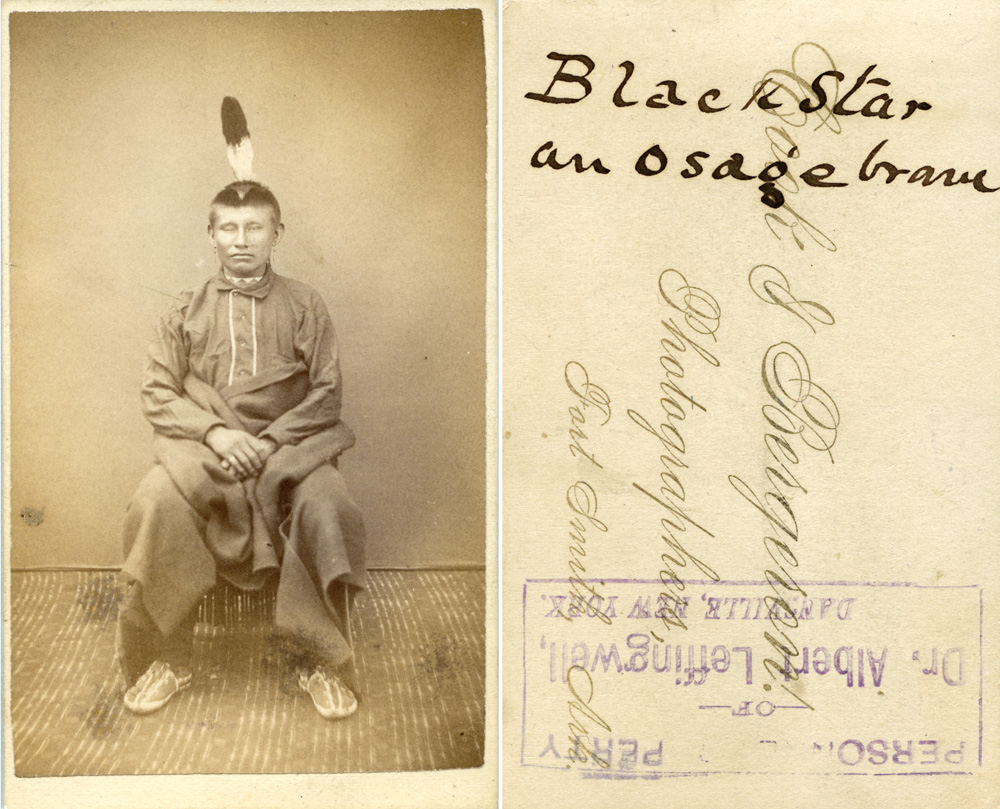
Black Star, an Osage Brave

There’s one more I’ll have to scan, but it is NOT an original image, rather a halftone reproduction pasted onto a vintage cabinet card stock. The image is of two southwest Indians of indeterminate tribal origin and quite honestly of indeterminate gender. It MAY be a vintage print, but it most certainly is not an original photograph. It’s a good illustration of the risks and pitfalls of antiques hunting – I found it in a little antiques mall in Delaware. The space was, while not poorly lit, definitely on the dim side. Enough so that I did not recognize the halftone dots. I paid $40 for the image, thinking at the time I was getting a great deal. I discovered the halftoning when I went to scan the image to email it to the National Museum of the American Indian to see if they could identify it better for me. When I zoomed in on the hi-res scan, the halftone dots popped off the screen! I was dismayed to discover this – I probably paid about $35 too much for it, given the fact it was a reproduction, but in the long run, I came out ahead. At the same time I bought it, I also bought another CDV of Lydia Thompson, a Victorian era actress, showing her in costume from a role she played in 1872. That one? I want to say I paid $5, but it was definitely less than $10. In the process of researching who she was I found a similar CDV of the same image on ebay, selling for $100. The object lesson here? Take a loupe with you when you go photo hunting. It could make the difference between paying original art prices for a poster-quality reproduction, or getting a good deal on an original image. It’s a variation on the old carpenters’ adage: Examine twice, pay once.

Exquisite Native American CDV

Black Star, an Osage Brave ca 1882

Here is a circa 1882 image of Black Star, a member of the Osage tribe, taken in Fort Smith, Arkansas. This was an incredible find, for me, and the back marks on the CDV are fortunate in that they facilitate a discussion about provenance, something that unlike say artistic style or means of production comparatively little has been written academically. Provenance, the history of ownership of an art object, is of considerable importance when the object is rare, quite possibly unique, and of considerable value. A documented provenance can help prove authenticity, and adds to the cachet of ownership – to have a Michelangelo drawing on ones’ wall, for example, is to share ownership of that drawing with kings and clergy, princes and museums.

In this case, the provenance is incomplete, but there is more to it than is usually found with such objects. Only with the rise of art photography in the late 19th/early 20th century do you have much in the way of documentation of provenance for photographs. It is comparatively easy to trace the ownership history of an Ansel Adams print, where oftentimes the gallery that originally sold the print is still in business, and the past owners or their immediate heirs are still alive. But tracing that provenance for something like one of my Mathew Brady daguerreotypes, where even the sitter’s identity is unknown, is a near impossibility.

However, this image, with the subject’s identity hand-written on the back, and the photographers’ studio back stamp, presents the beginnings of possibility. There is a known moment in time and space where this was created – I found the studio of Cook & Bergeron to be operating in Fort Smith for only a few brief years, 1881-1884. At some point, this image was consciously collected, by a Dr. Albert Leffingwell of Dansville, New York, who felt it was important enough to stamp the back of the CDV with his library stamp. Dr. Leffingwell was a famous physician and author, champion of vivisection reform. When it made it into his hands, and for how long, is undocumented, as is what happened to it after his passing.

I acquired it from a dealer in Paris, France. So the CDV has travelled a long and circuitous route from Fort Smith, Arkansas to Dansville, New York, to Paris to Washington, DC with unknown stops in-between. I hope this blog post will some day serve as documentation of the provenance of this image for a future owner.

Crowning Acquisition

From the auction listing:

Very rare and stunningly beautiful, ca1905 large format, sepia tone Photograph of a Native American Navajo Indian seated atop a rock ledge or butte overlooking a vast plain. This outstanding, Art Photo style Photograph measures approx. 13 3/4″ x 18″ and is mounted on its original, photographer’s card mount (overall size of card mount is 14 1/8” by 18 ¼’).

This stunningly beautiful, large format Photograph pictures a young, native American Brave seated atop a rock ledge overlooking an expansive plain. The Brave is bare chested and wears only a loin cloth, numerous strings of bead necklaces and silver bangle bracelets on his right wrist. While the young Navajo Brave is in sharp focus the plain below is seen slightly out of focus creating a wonderful, artistic contrast and composition. The Photo presents the Native American subject in a surrealistic, romanticized manner that was typical of many of the Images produced by Carl Moon.

This Photograph is not signed by the photographer and the only identification is the designation “H88” in the negative at the extreme lower left hand corner. The Photo is in the style of the widely acclaimed Photographer of Native American subjects Karl Moon but we have been unable to confirm Moon as the artist who produced this stunning Photograph. The subject of the image is not identified in any way (as to Tribe or Name) and we are not experts in the identification of Native American Tribal affiliations. We believe the young Brave to be Navajo but are not 100% sure. If anyone can help us to definitively identify the photographer this stunningly beautiful Image or can supply any information regarding the identity or Tribal affiliation of the Photograph‘s subject, the information would be greatly appreciated.

Carl (or “Karl” as he sometimes spelled his name) Everton Moon was born in 1879 at Wilmington, Ohio. He became interested in Native American at an early age. After High School Moon served in the National Guard and decided on photography as a vocation. After apprenticing for 6 years he opened a studio in Albuquerque, New Mexico to begin photographic “art studies” of the Southwestern Indians. Over the next few decades Carl Moon became renowned nation wide and his work was exhibited at The National Museum in Washington, D.C., the American Museum of Natural History, New York and at the invitation of President Theodore Roosevelt, at The White House.

Over the years he formed friendships with his subjects that enabled him to spend weeks at a time in tribal villages, learning about their culture. He set up a photographic studio and began making his first collection of photographs and paintings of the Pueblo Indians. For the next seven years he was in charge of the Fred Harvey Headquarters at the Grand Canyon in Arizona.

This Photograph may be one of Moon’s Grand Canyon Images but we simply have been unable to find any information about this Photo or any other examples in any online data base.

This very rare and stunningly beautiful, large format Carl Moon-style, Native American subject Art Photo is in very good condition. The Photograph exhibits sharp focus, strong contrast and rich tonality – the rich warn tones of this beautiful Image is an example of the very best of the early 20th century Native American Art Photos.

20120224-182138.jpg

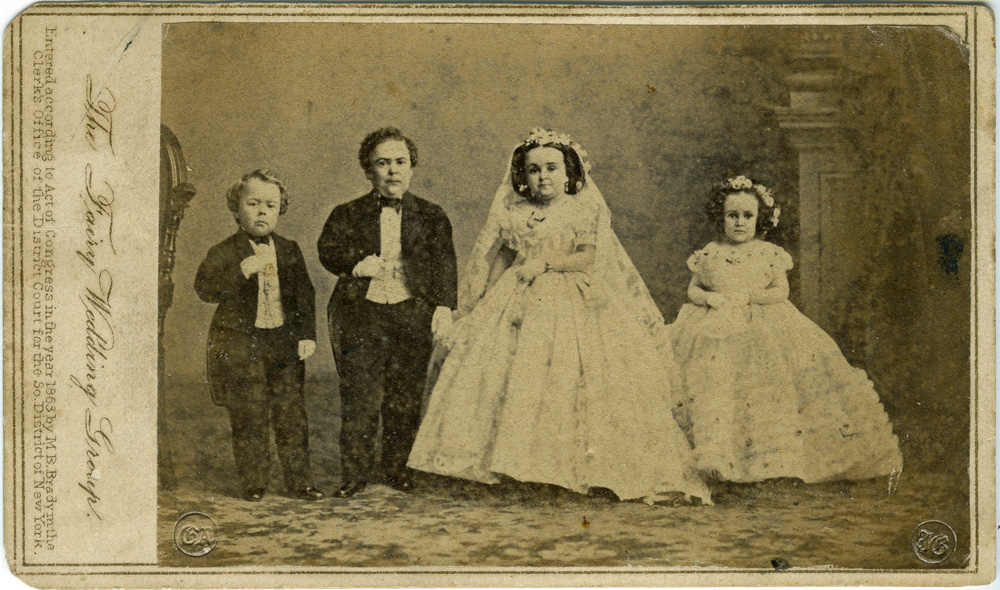
More Fairy Wedding Photos

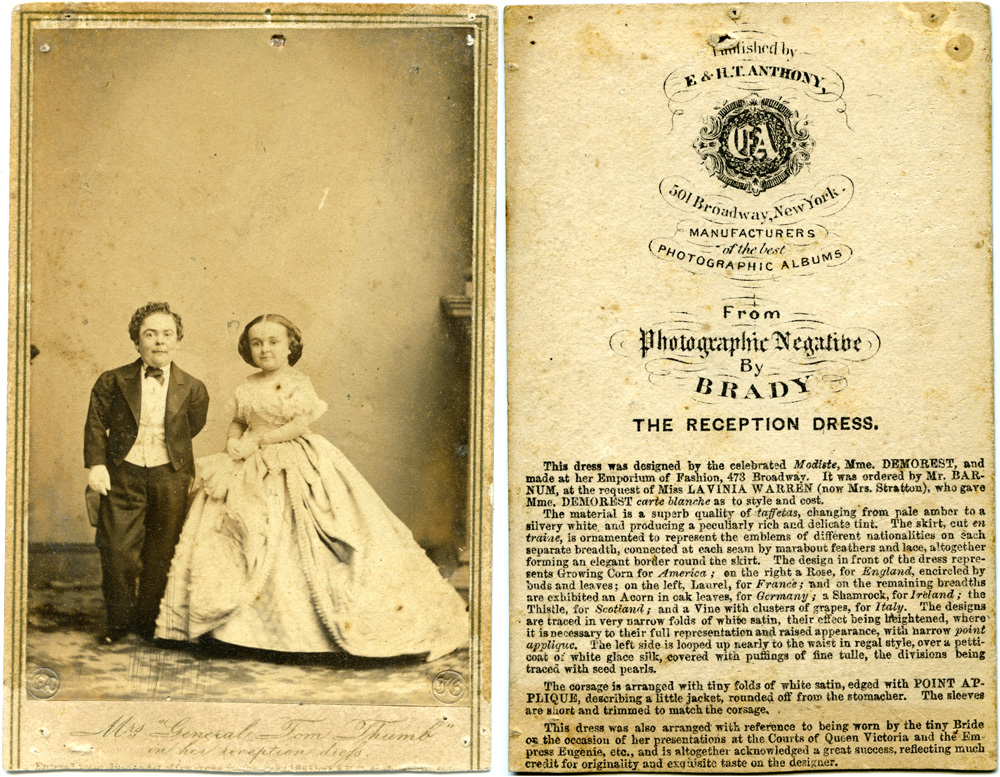
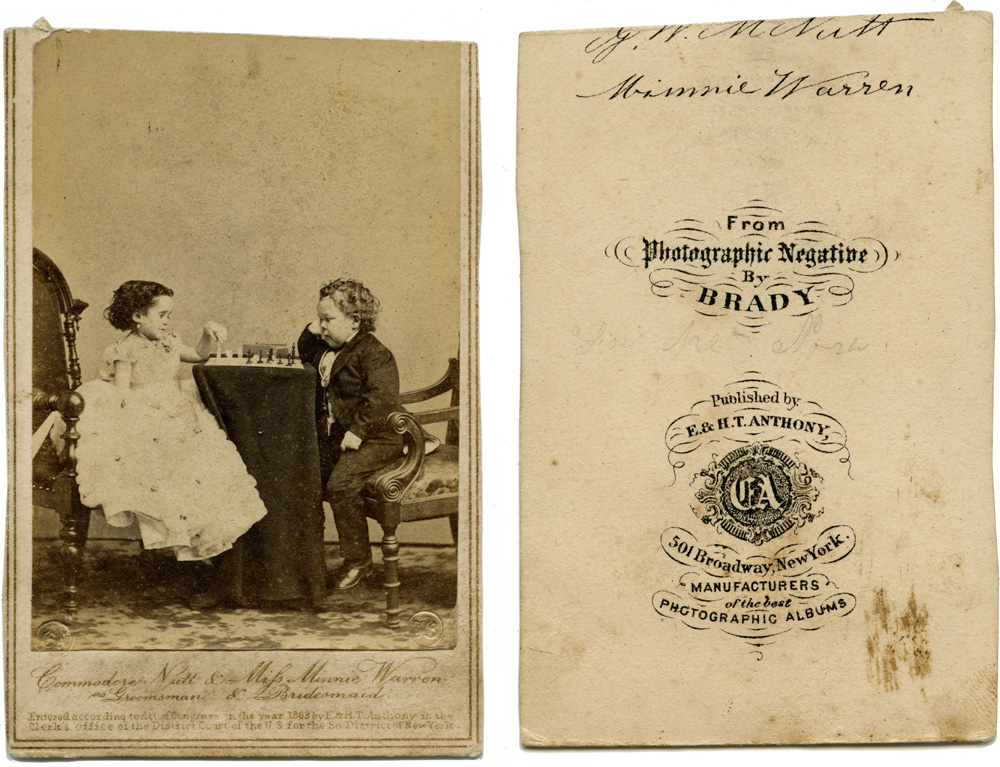
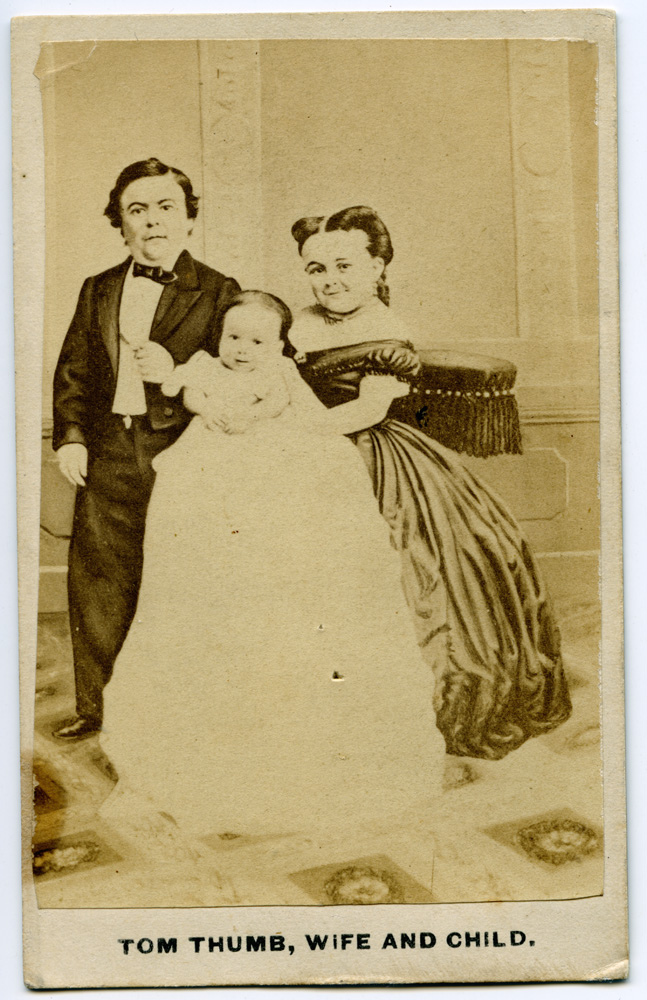
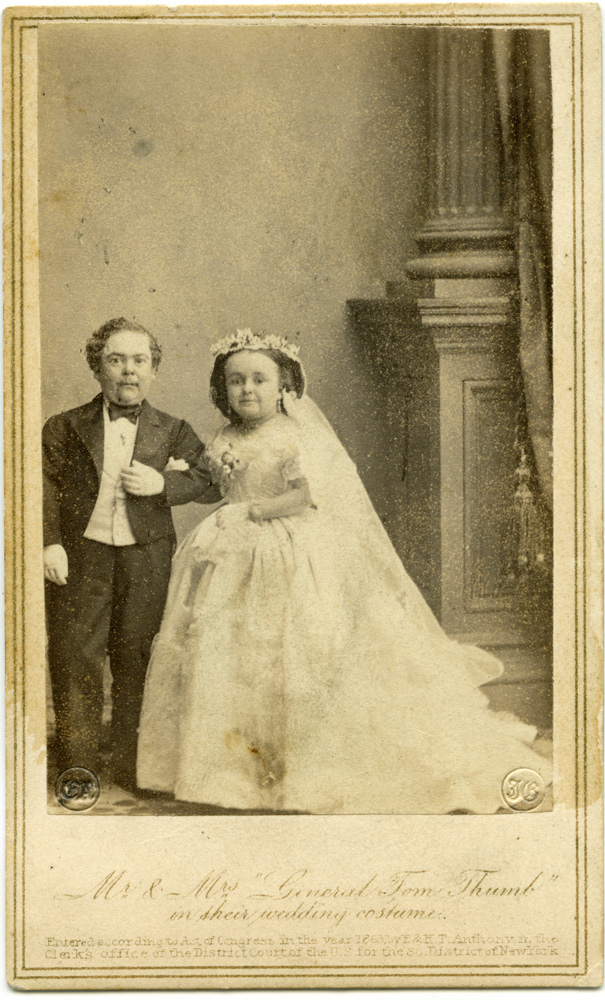
I admit it – I got the Fairy Wedding bug. No, not the Charles & Diana wedding bug, or the more recent William & Kate or the Kim & Kris wedding bug (I’d pay YOU to remove the People magazine footage of that debacle from my sight! Celebrity whores have you no shame???). But I digress – I’m fixated on the ORIGINAL celebrity wedding photos: the marriage of Tom Thumb and Lavinia Warren, photographed by THE American celebrity photographer, Mathew Brady (yes, Mathew with one T), and stage managed for maximum publicity by P.T. Barnum, the original master promoter and co-creator of the circus that still bears his name.

The Reception Dress, The Fairy Wedding

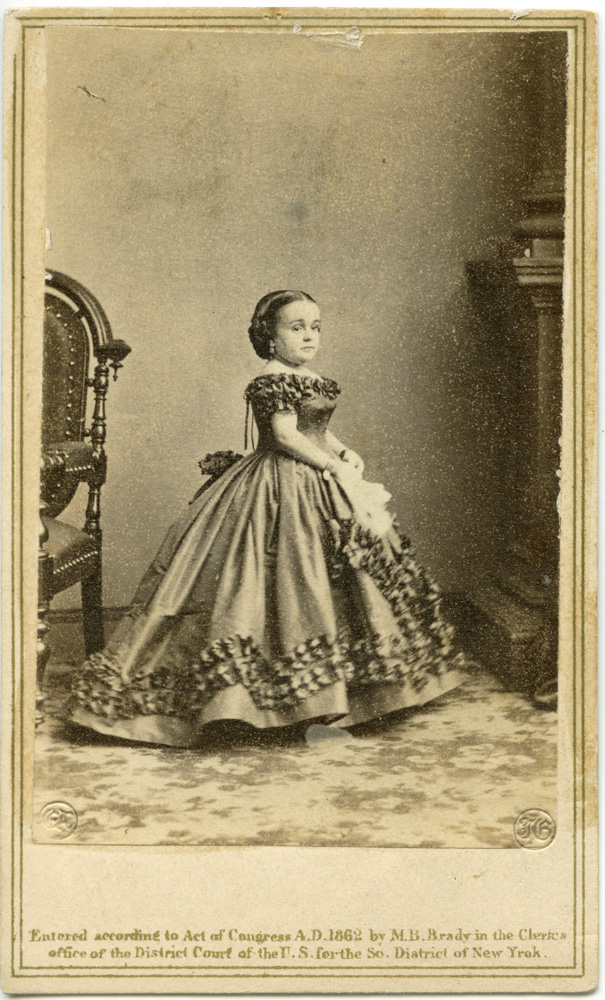
Here is the follow-up to one of my earlier images of Tom and Lavinia in their wedding ceremony outfits. This one is the dress she wore to their reception with the 2000 guest receiving line where they stood atop a grand piano at the Metropolitan Hotel.

George Nutt & Minnie Warren, Groomsman & Bridesmaid

Another, odder wedding souvenir card. This one features George Nutt and Minnie Warren, Lavinia Warren (Mrs. Tom Thumb)’s sister and later George’s wife, playing chess. What this had to do with the wedding is beyond me, but it obviously catered to some 19th century sensibility – perhaps the suggestion was that they had outsized brains in their diminutive bodies, further exaggerating the curiosity/freakish attraction to a customer looking for a spot of distraction from the civil war raging around them in 1863.

Tom Thumb, Wife and "child"

This image, undated and uncredited, is from some time later, possibly in the 1870s. Charles and Lavinia Stratton were not able to have children of their own, so P.T. Barnum, ever the showman, would acquire an orphan baby and give it to them to portray as their own, and when the baby got too big, he would find another one. Apparently, as a result, they “had” a one-year old baby for the better part of a decade.

As a memory refresher, here’s the rest of the gang in thumbnails.

Bride & Groom, The Fairy Wedding
Lavinia Warren Stratton, Mrs. Tom Thumb
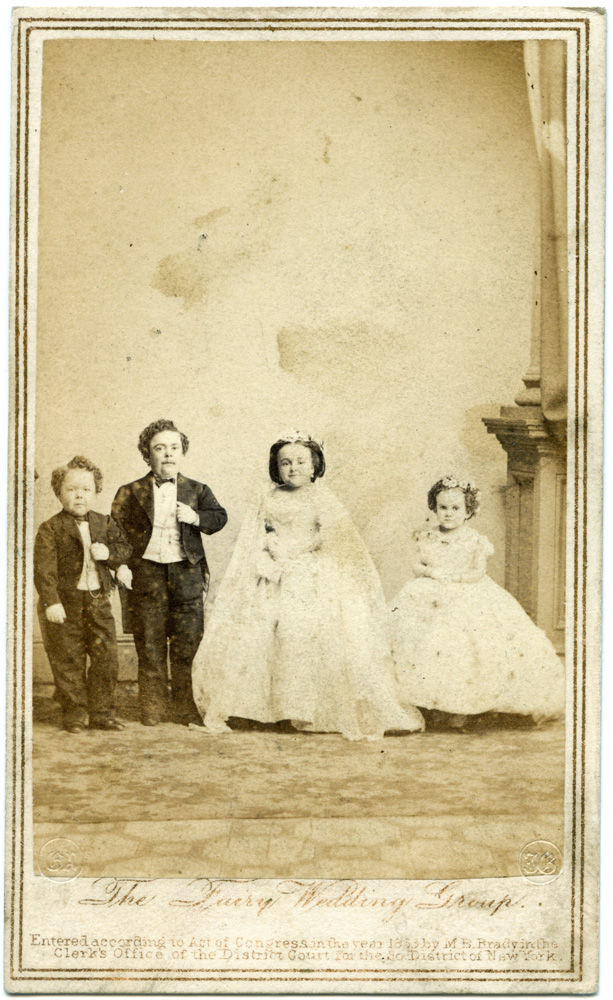
Fairy Wedding Group #3

Commodore Nutt and unknown little woman, Anonymous CDV (probably Brady)
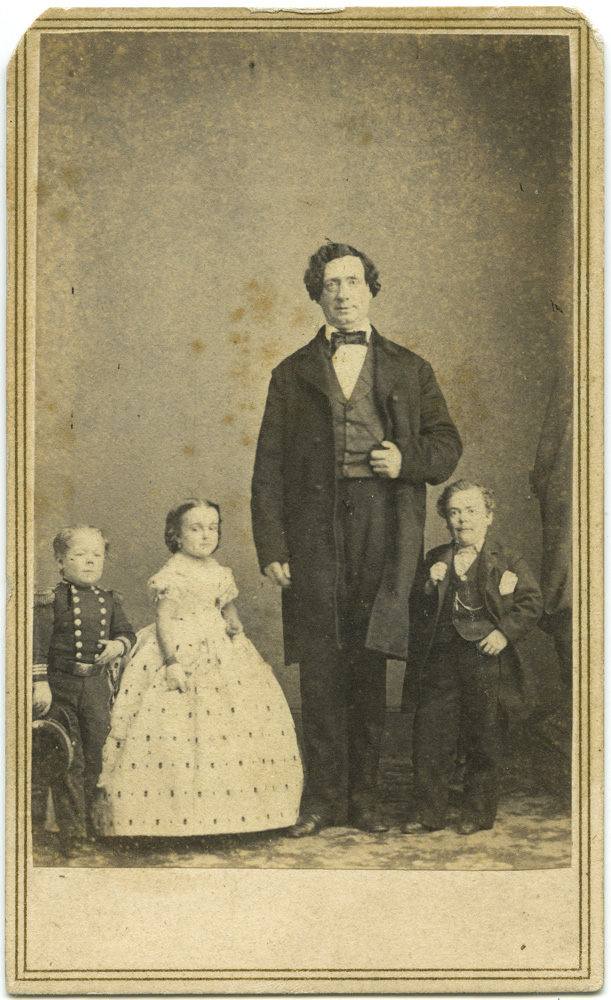
Commodore Nutt, Mrs. and Mr. Tom Thumb
Brady's Fairy Wedding
The Fairy Wedding, 1863 E&HT Anthony print, Obverse

Antique Affinity

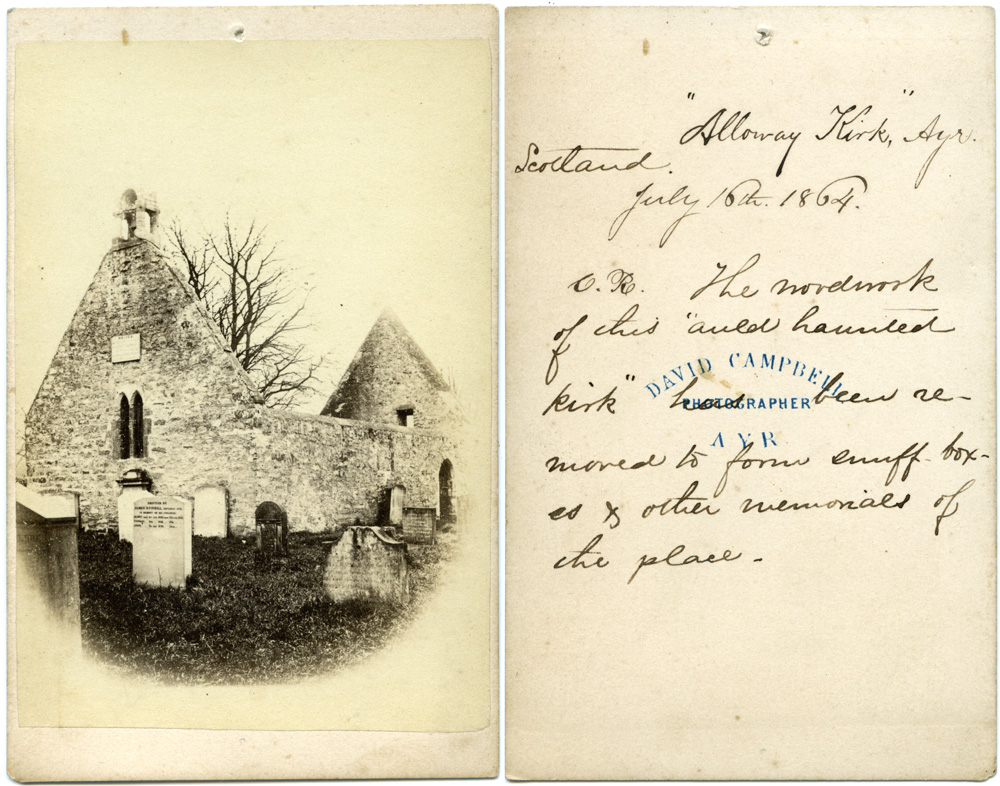
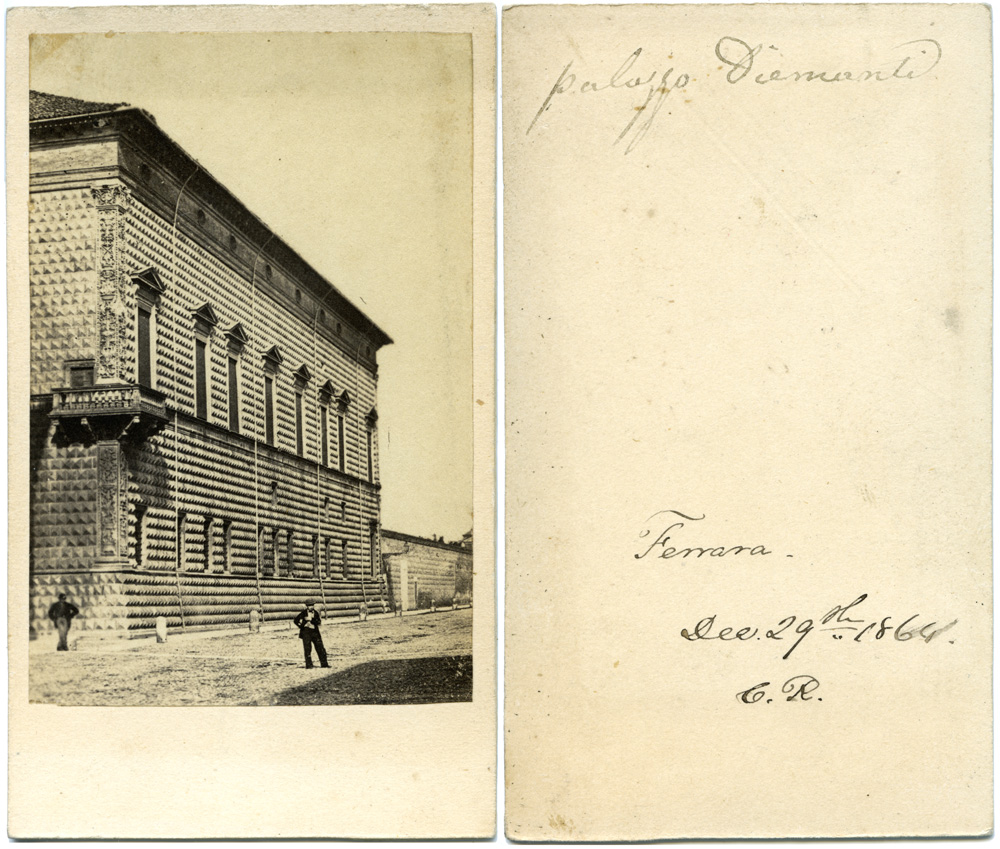
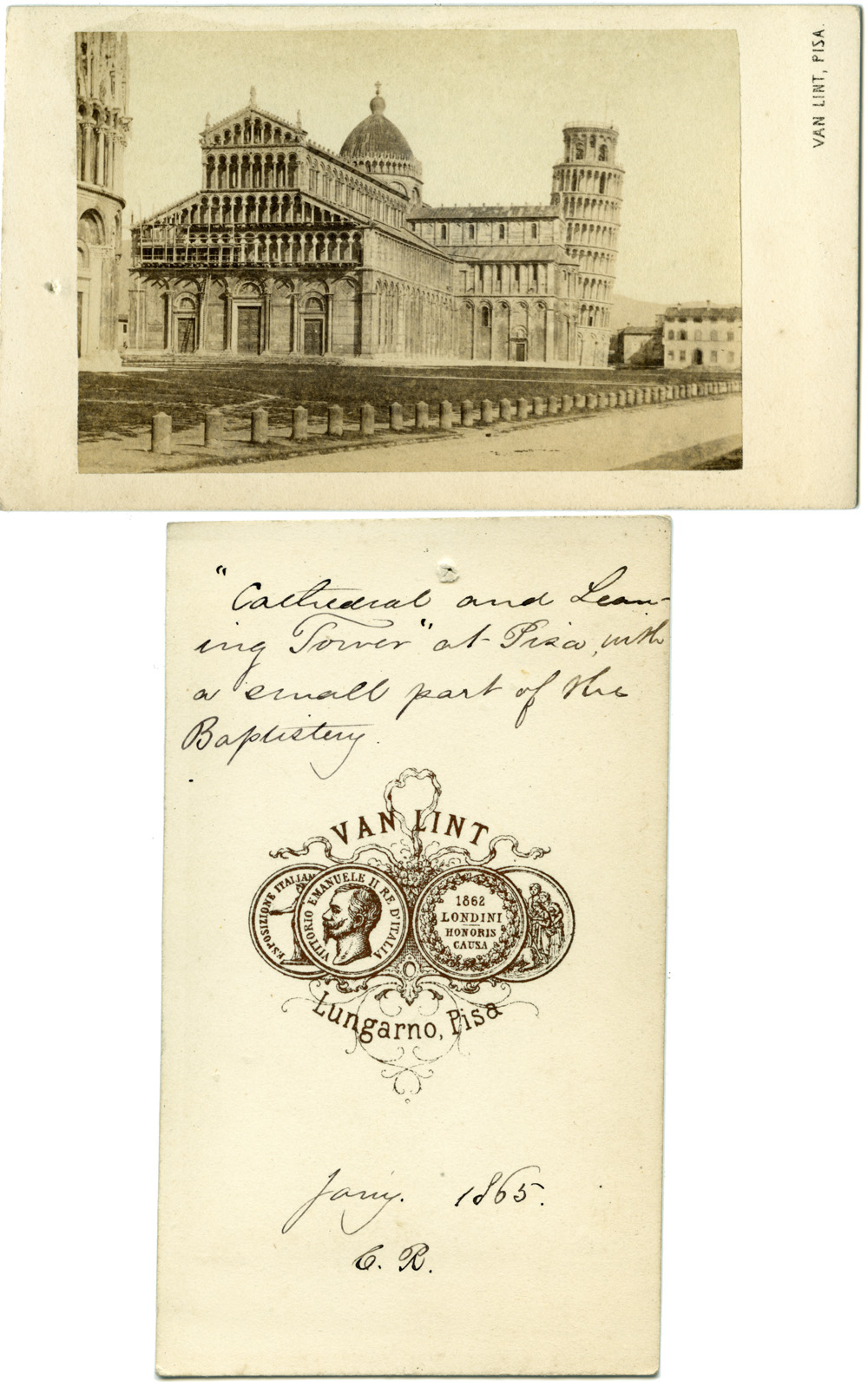
Trolling around on eBay (something I do WAY too much of), I came across this group of CDVs. They represent a form of travelogue by an American in the 1860s, bopping around Europe during and after the Civil War. How do I know he (assuming the gender here) was an American? The way he writes the dates – July 16, 1864 – is the Yankee way of writing dates – had it been a European, the date would have been 16 July 1864. I felt compelled to buy them because not only did I feel an affinity for this person’s being an American in foreign countries, but I had been to several of the same places. There were more images that I could have bought, but good fiscal sense called me back from the brink and I chose only those images from places I had been to (or at least near).

In chronological order-

AllowayKirk, Ayr, Scotland, July 16, 1864

I love how C.R. (the collector of these images) wrote his notes on the back – the haunted church with the pews that had the wood reclaimed to sell as souvenirs. I’ve not been to Scotland yet, but when I was a teenager, I spent a month with my parents living in London, and we took an extended driving trip through Wales, so I’ve seen many a ruin like this on the side of a winding country road.

Palazzo Diamanti, Ferrara, December 29, 1864

Now we’re off to Italy, and the Palazzo Diamanti in Ferrara. I’ve not been to Ferrara myself yet, but I have been to Italy twice, and I loved the inclusion of people in the photo for scale, and for the fact that they’re pretty sharp and clear, something not easy to achieve when shooting wet plate collodion images of subjects who don’t know they need to sit still.

The Cathedral of Pisa, January 1865

The world famous Cathedral of Pisa, from a less famous view. Most images of the Cathedral show it from the bell tower side. You can see the cathedral and the tower from the rail station at Pisa, where I changed trains en route from Genoa to Florence. C.R.’s note: ” ‘Cathedral and leaning tower’ at Pisa, with a small part of the Baptistery”.

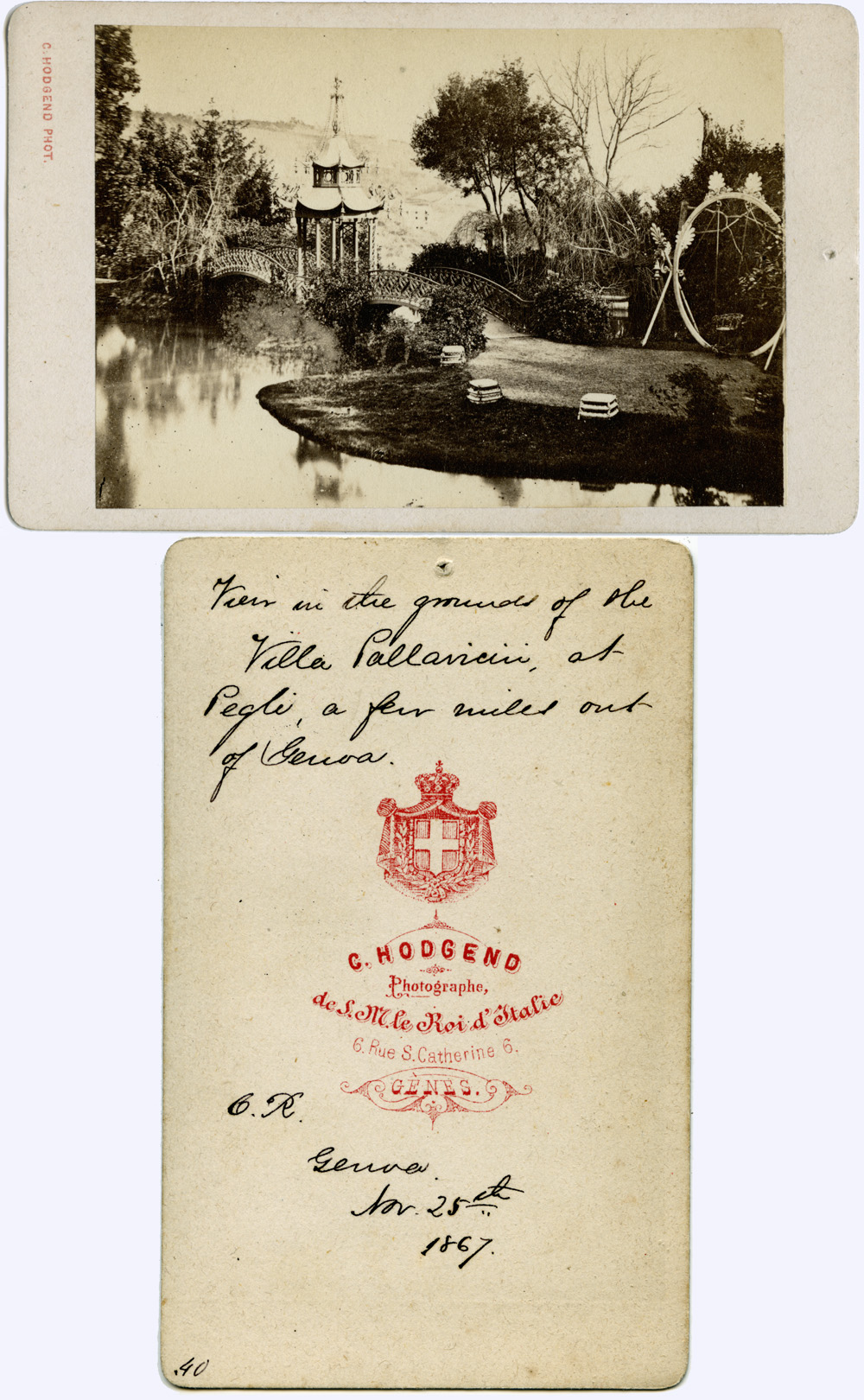
Villa Pallavicini, Genoa, November 25, 1867

A sight I missed out on in Genoa when I was there. The Villa Pallavicini is now home to the Archaeological Museum, and the gardens are open to the public as well. The scan on eBay did not do the image justice – the original card is in pristine condition, minus the pin-hole. The albumen print is incredibly sharp and clear, with minimal discoloration and foxing.

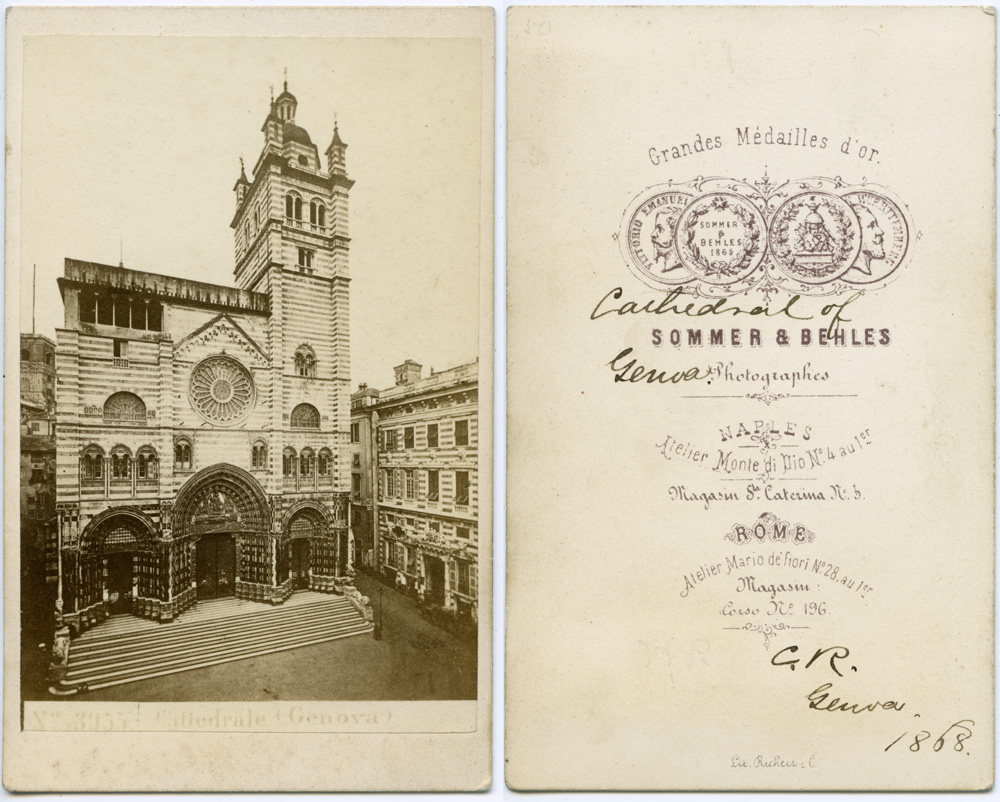
Genova Cathedral, 1868

And here we come to the image that started my interest in this set – the “old” cathedral of Genoa. When I went to Genoa, I stayed with a friend of mine who lives all of six blocks from the cathedral, so it was a daily sight on our excursions. On this one, C.R. is rather terse, simply noting “Cathedral of Genoa”, his initials, and the year, 1868. This is another card in the group that is far better than the scan would suggest. Truly pristine.

The great and the sad thing about these cards is that they again provoke my personal wanderlust, and I’ve got a serious itch to hit the road to Italy again. And to Scotland for the first time, and to half a dozen other places! I’d love to bring one of my big cameras, say my 5×7 or the whole plate camera, and try and re-create these same images, or at the very least capture some very modern interpretations of the same scenes as they would be found today. NOT like the recent Annie Liebowitz show of her super-privileged travel photos of famous people’s homes (Freud’s office, Eleanor Roosevelt’s bedroom in ways you and I could NEVER photograph them).

Cyclists and Athletes

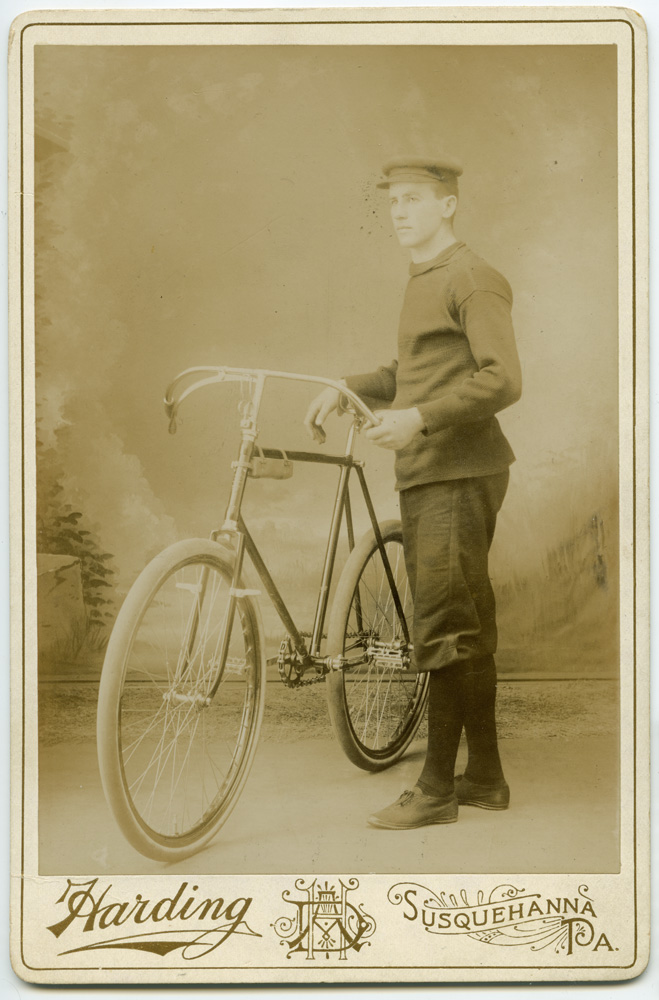
Bicycle Messenger by Harding, Susquehanna PA


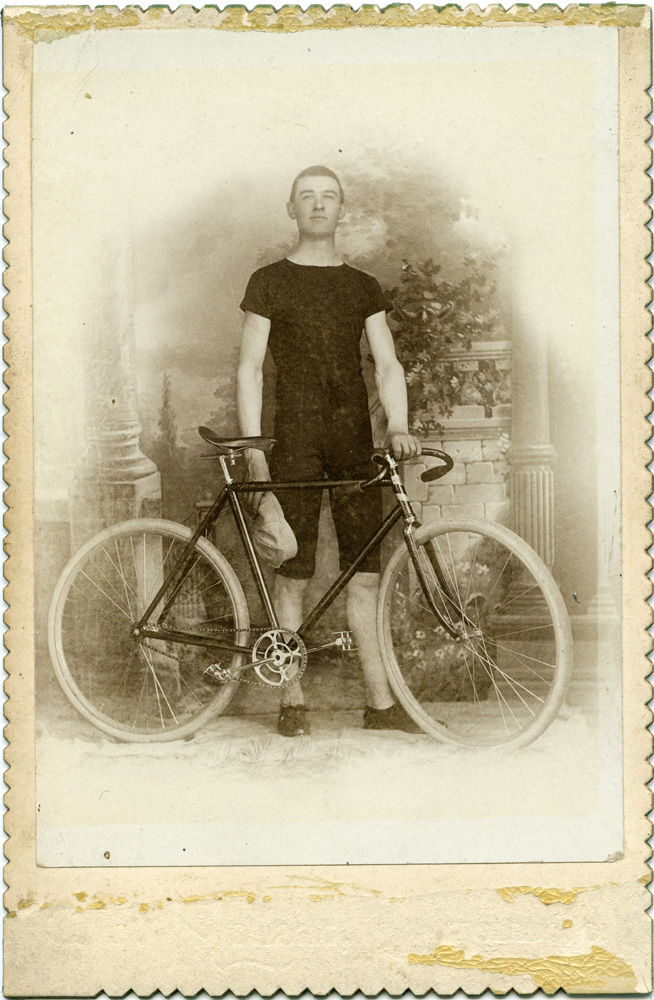
Two more bicyclists in the collection. Both from the same time period – turn of the 20th century. One is a bike messenger, the other a competitive cyclist. Notice the difference in the handlebars of the bikes- the messenger has fairly traditional straight-across handlebars whereas the racing bike has proto- drop handlebars like we see on modern racing bikes. I love the racing cyclist’s cap – it’s the little details that make the image with these kinds of photos.

Competitive Cyclist, Toledo, Ohio

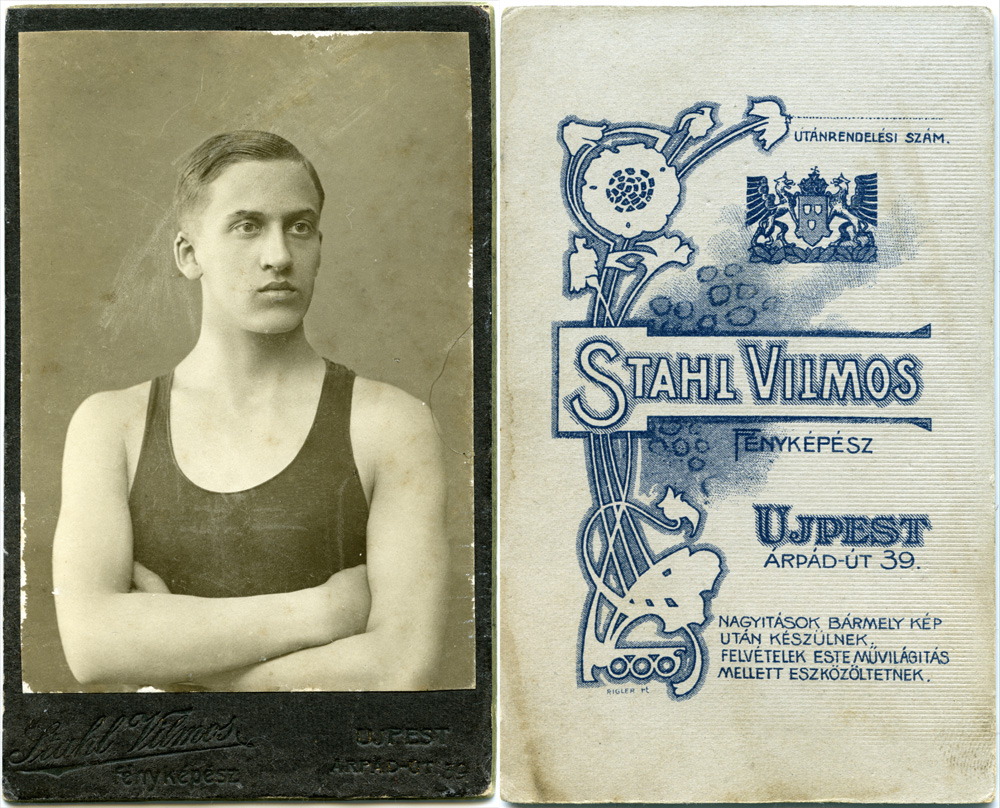
Young Athlete, Ujpest, Hungary

Here’s an interesting one, a portrait of an athlete, but it doesn’t show anything to indicate what sport he partakes in.