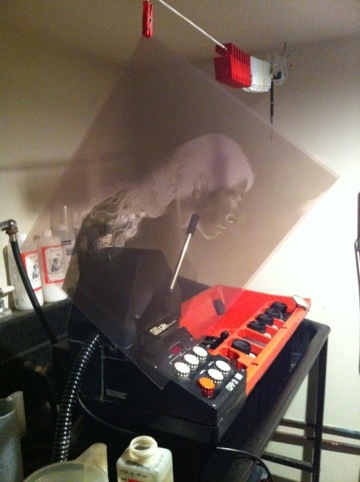
Here’s a 14×17 portrait I shot a while ago and just got around to developing. I love what I can do tonally with FP4+ and platinum/palladium, but when you are shooting this big, the slow speed starts to hurt – its tough getting the f-stops you need when a headshot is also a 1:1 macro and costs you two stops (or MORE) just from the bellows extension.
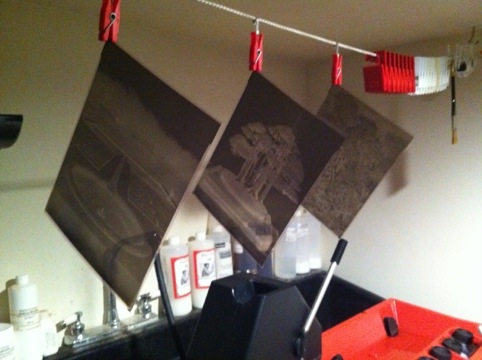
Here are the first few from my outing to the Arboretum with one of the camera clubs I joined recently. These are 6.5×8.5 (whole plate) sized negatives.
I’d been in a bit of a blue funk as far as darkroom work was concerned, but getting ready for Artomatic has helped me find new motivation to get back in there and start working again. That and teaching my class this coming weekend. Can’t wait to finish developing all my film and see the results!
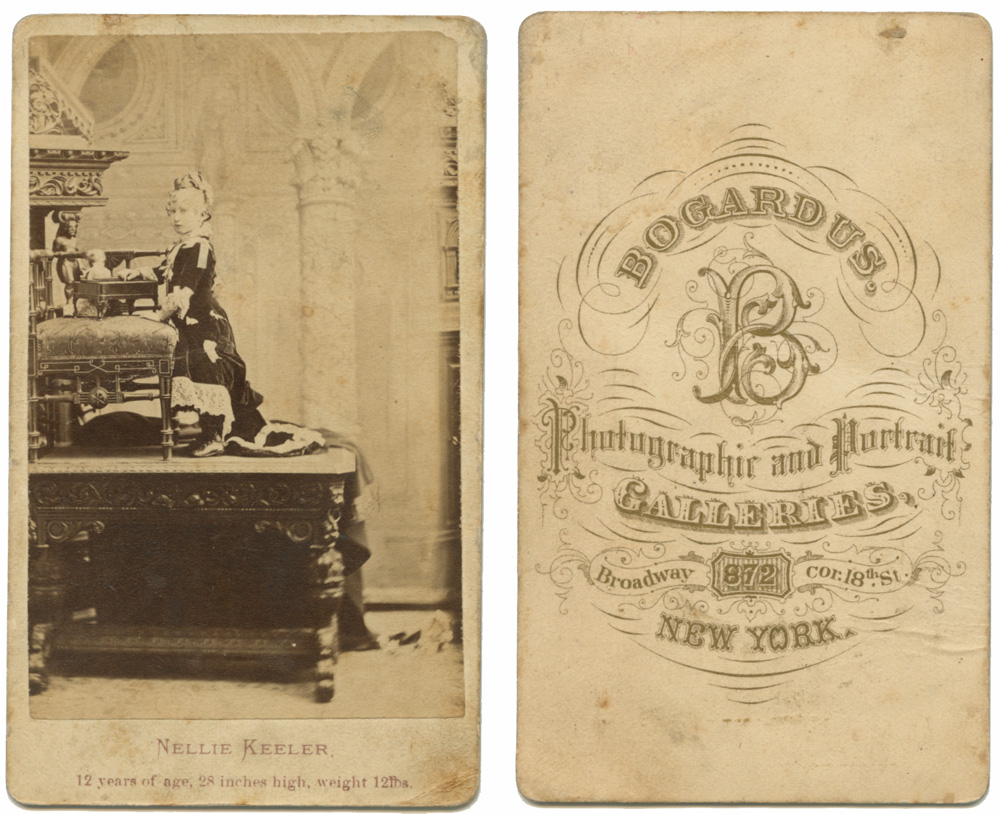
In my online shopping peregrinations, I came across another Nellie Keeler CDV, so of course I had to add the second varietal to my collection. The captions have it that these are one year apart. Who knows the truth of such things, as so many facts about the circus freak sideshow performers were grossly exaggerated for dramatic effect.
Nellie Keeler, by Bogardus
Here is the first one I collected, for comparison:
Nellie Keeler- by Bogardus
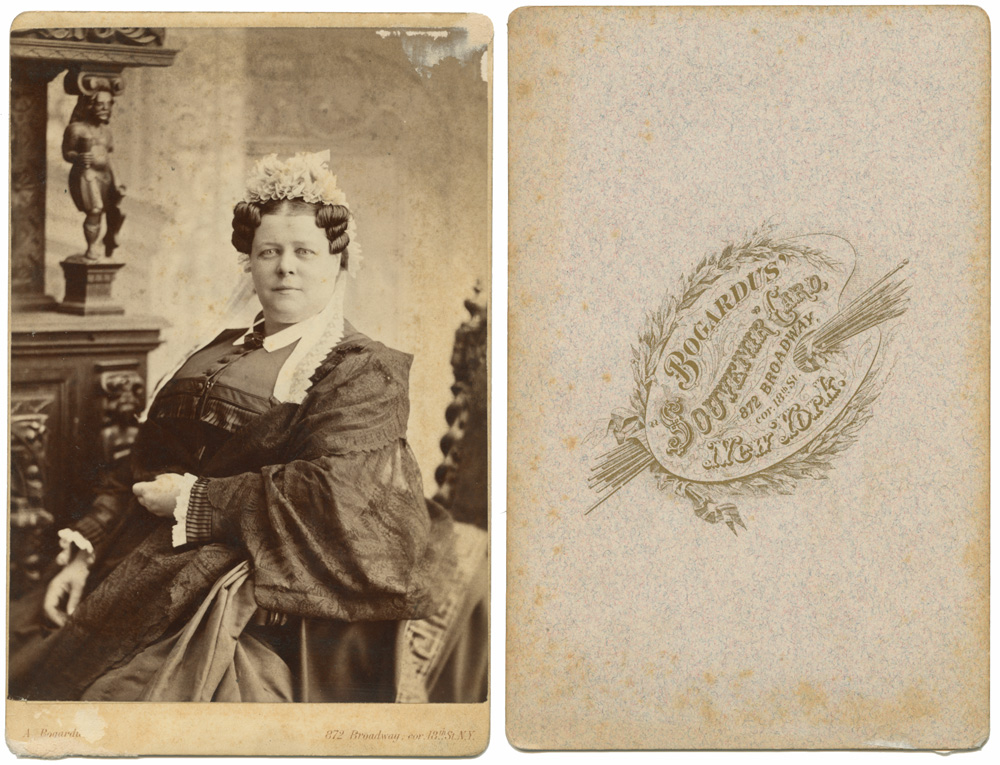
And somewhat ironically, here is a larger size (roughly 5×7) Cabinet Card of a much larger woman, seated in front of the same dining room sideboard on which Nellie Keeler is posing. When I saw that, I had to grab it just for that cool factor of coincidence. I’d read a lot about how work of battlefield photographers could be connected if not identified by the use of the same backdrops, furniture and even prop weapons/uniforms in Civil War tintypes. While not exactly the same thing, this is my first instance of finding the same props in two different photos of two VERY different subjects by the same photographer.
Plump lady cabinet card, Bogardus Studio
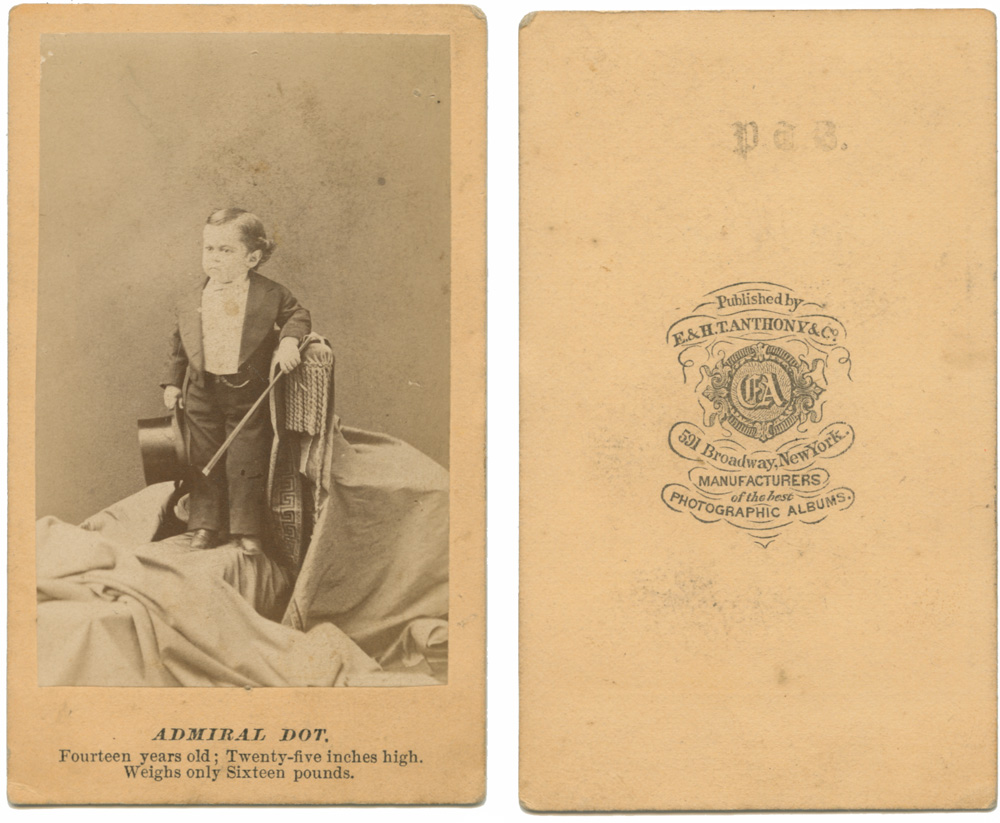
And last but not least (well, maybe least, based on the factoids on the front of the card) is Admiral Dot – yet another Barnum embellishment with an exalted military rank for someone of restrained stature. A contemporary of General Tom Thumb, Commodore Nutt, Major Atom, Count Rosebud and Baron Littlefinger, he also performed in sideshows.
Admiral Dot, published by E&HT Anthony
As the photographer is not credited, it may well have been one of the lesser-known New York studios specializing in the theatrical trade who was able to work a deal with Anthony to distribute their cards.
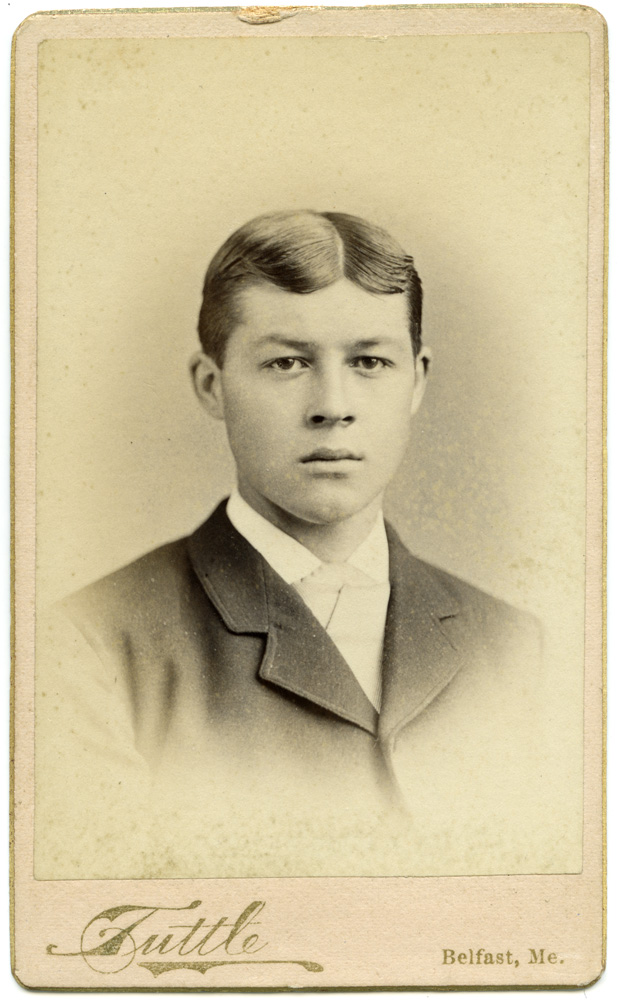
Sometimes the reason you buy something is purely aesthetic – there doesn’t need to be an historical association, famous subject or famous photographer to make an image worth buying. This is an example of just that – a very handsome subject, simply captured, plainly presented. Is he part Native American? Hard to say, but he has a certain look about his nose and jawline.
Handsome Youth, Belfast, Maine
This is an example, as I mentioned, of a carte-sized Cabinet Card. It is the same dimensions (2 1/2 x 4 1/2) as a carte de visite, but is printed on the heavier card stock with the beveled, gilt edges and the larger front imprint of the photographer’s logo typical of the Cabinet Card. Because of the style, I would definitely call this a Cabinet Card, and not a CDV, because the time period of its creation is definitely later, as are the material conditions of its composition.
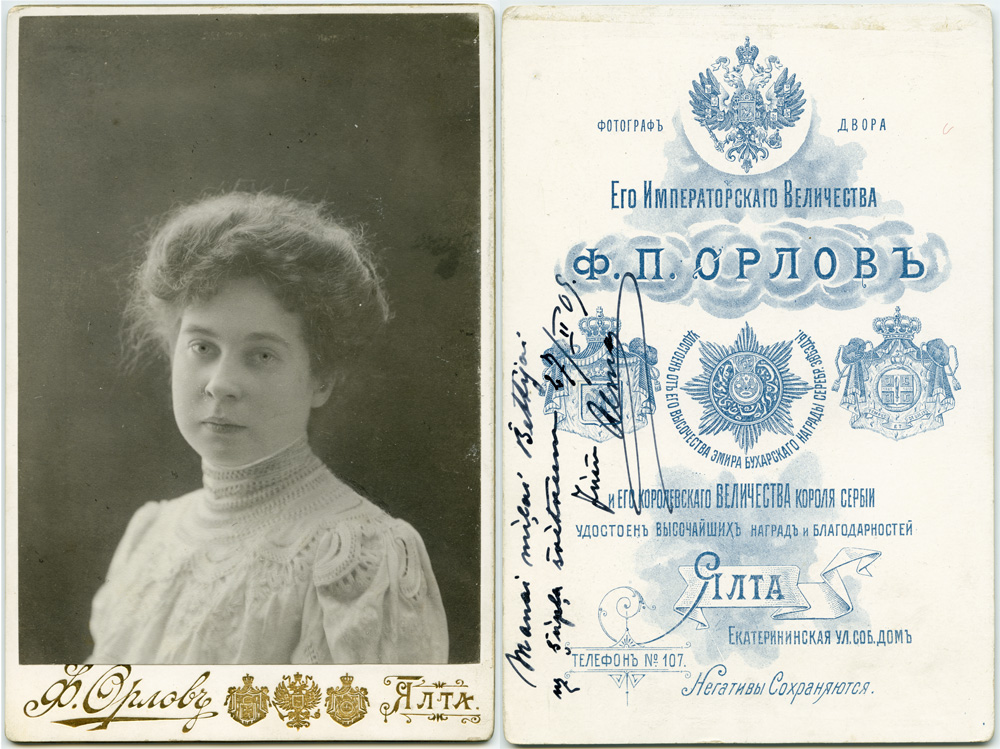
Here’s an Imperial period Russian cabinet card. I got it for the ornate advertising logo printed on the back of the card. Roughly translated, it says (from the top):
Photographer to the Court
His Imperial Majesty
F. P. Orlov
and the royal King series
received awards and acknowledgements
Yalta
Ekaterininskaya Ulitsa
Telephone Number 107
Negatives Saved
So Mr. Orlov was an award winning court photographer to the Emperor and royal family in Yalta.
God help me if I can read the handwriting on the left side of the verso – it’s not cyrillic as far as I can tell, and appears to be relatively modern (looks like a felt-tip pen).
Photo by F.P. Orlov, Imperial Court Photographer
The young lady’s name, if not in the handwriting, is lost. She could be the daughter of an up-and-coming middle class or industrial elite family, or maybe the child of some old aristocratic family.
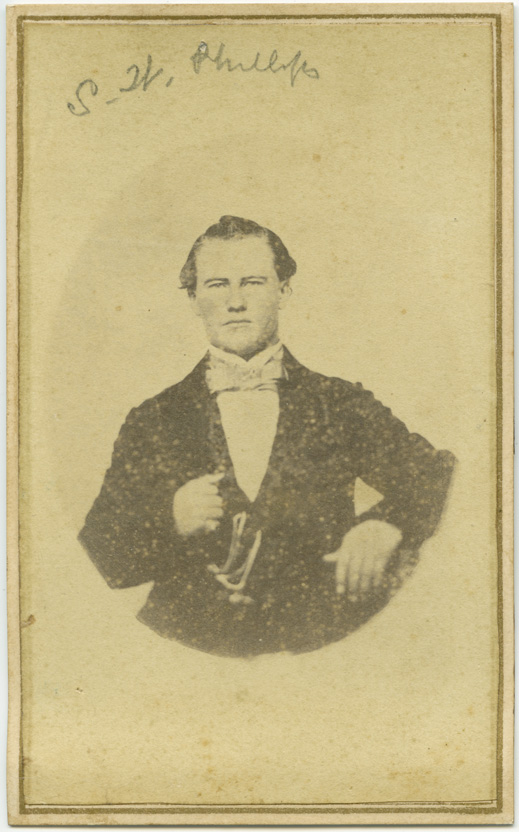
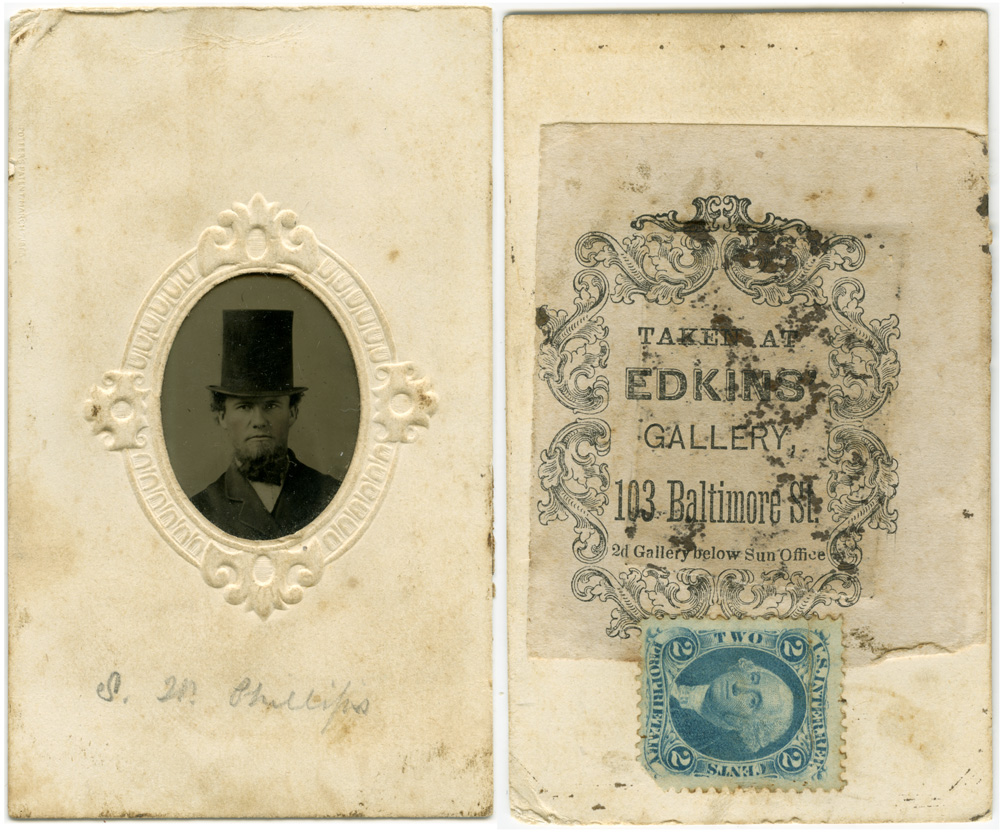
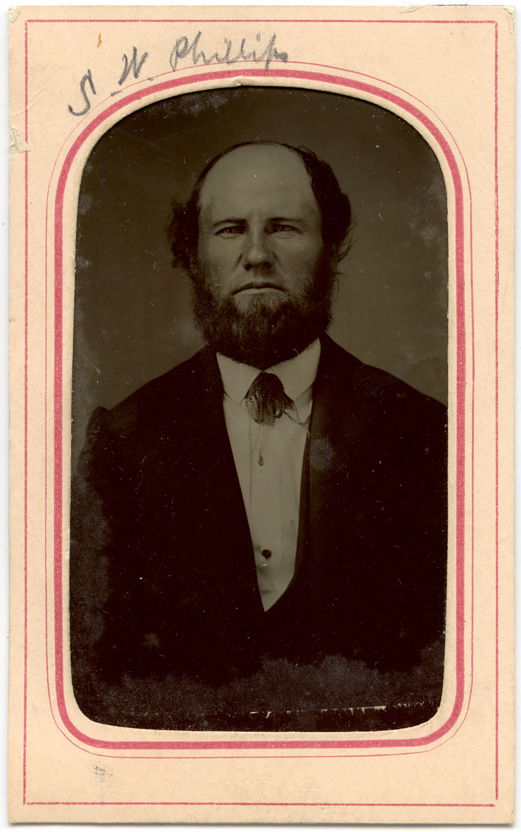
Here’s a fun little trio of cartes-de-visite, showing the same sitter what looks to be covering a span of 20 or more years. In the first one, Mr. S.W. Phillips of Baltimore appears youthful. In the second one, the card-mounted tintype, a bit older, sporting a rather tall top hat. And in the third photo, a definitely older Mr. Phillips has lost not only his hat but his hair.
Young Mr. Phillips
Middle-age Mr. Phillips
Senior Mr. Phillips
I had to fight to keep all three together – the image with the top hat was of much interest to other buyers. I was willing to go a little over what I’d wanted to spend to keep the set, as I thought it would be a real shame for the other two to get separated where they’d linger in someone’s $5 box, unloved, unwanted and without context. As an erstwhile photo historian, all too often these kinds of things get lost because someone removes the context for the sake of the value of a single item.
On a separate note, almost totally unrelated to the rest of this post, sometimes I wish I had enough info to start a Baltimore photo map like my New York, DC and Philadelphia maps. I’m certain that there were many photographers there in the 19th century, as Baltimore was a much more important city at that time and a major hub of commerce and industry. Perhaps this can be a start – the Edkins Gallery at 103 Baltimore Street. If anyone out there in blog-land has studio addresses for Baltimore Victorian photo parlors, I’d love to have them so I can start the map!
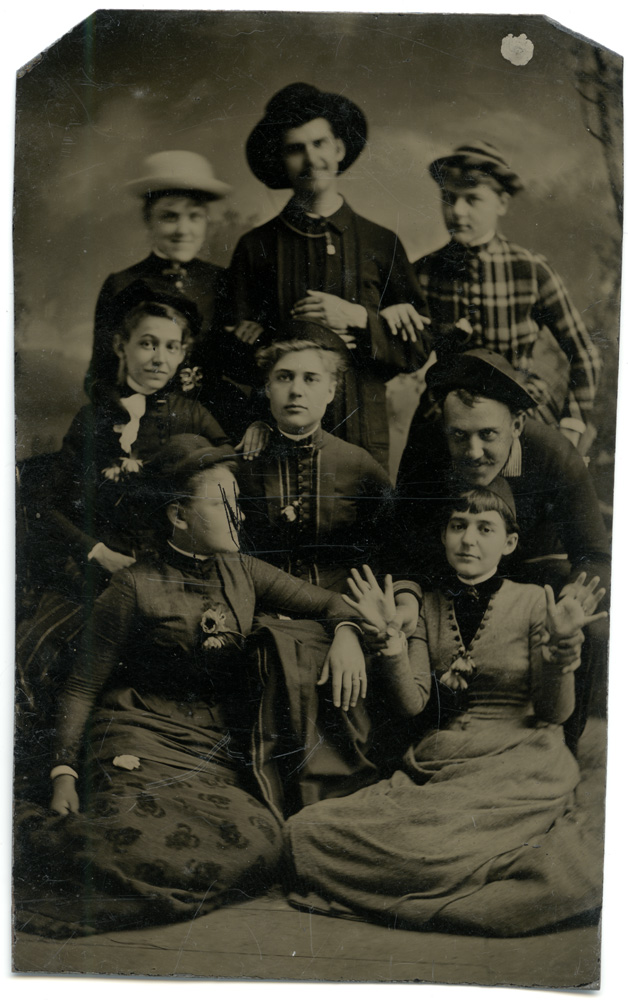
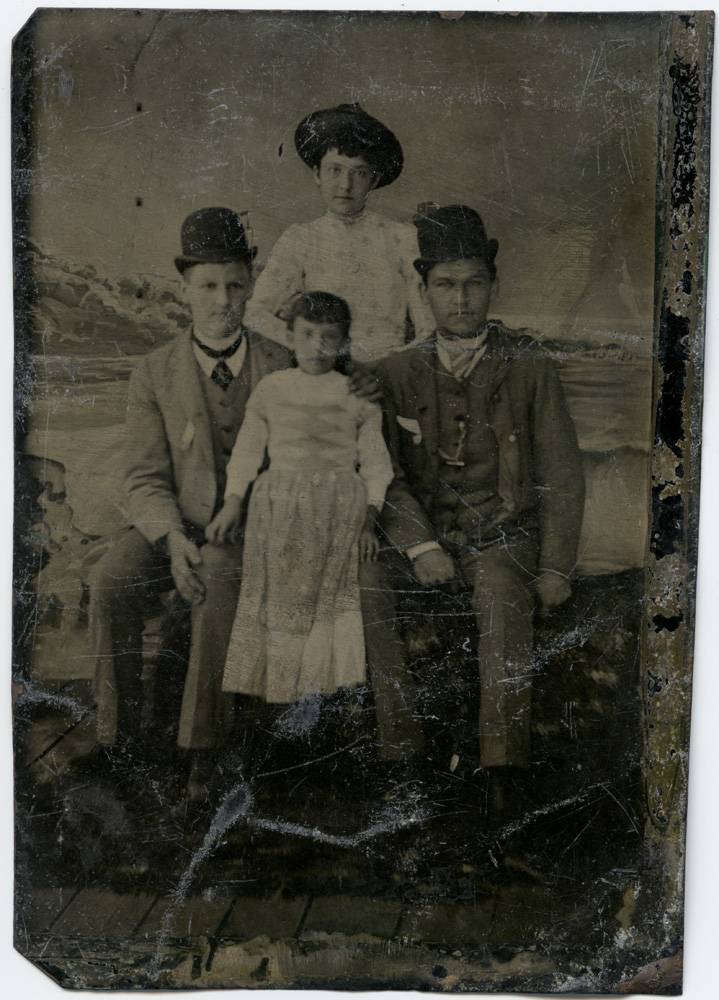
Another genre of tintypes to collect is the “trickster”. These could be anything from examples like these where the photographer switched heads on bodies in the shot (don’t ask me how, my guess is it involved re-photographing a dissected original) or people dressed in drag, to modern-day ones like someone wearing victorian period costumes but sporting a digital watch or an iPod.
Trickster Tintype #1
Trickster Tintype #2
Little loose tintypes like these (approximately 2×3 inches each) are generally a very affordable entree into collecting. These are both probably from the 1890s/early 1900s.
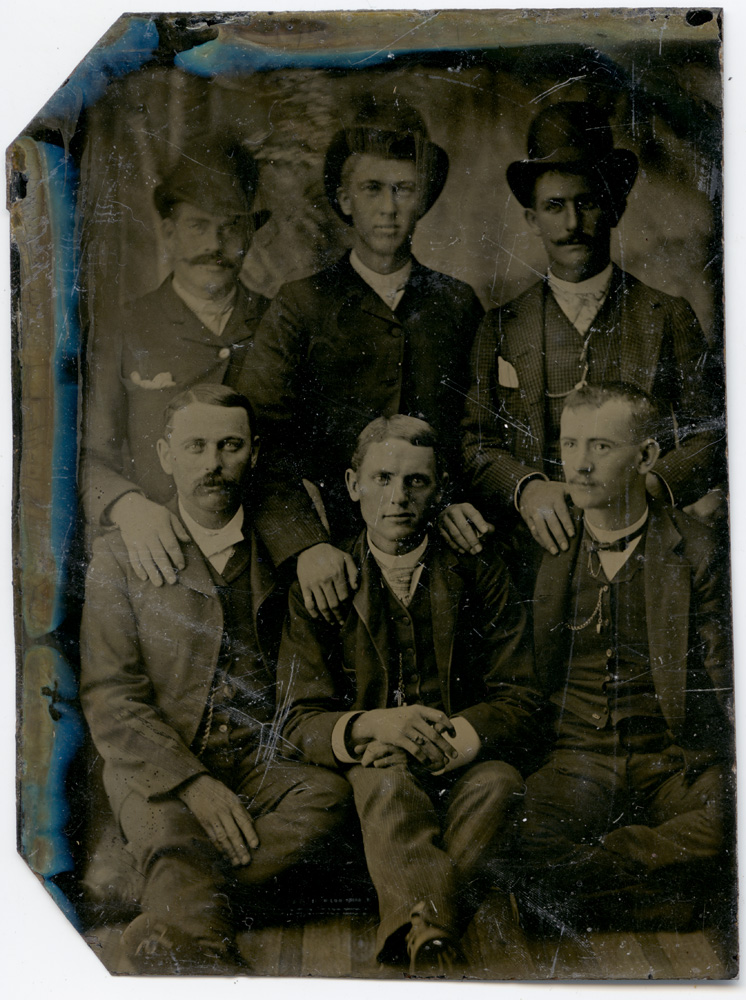
Tintype, Sextet of Gentlemen
Tintype, Father & Son?
Here are two tintypes that would probably get listed on eBay as “gay interest”. The one appears to me to be pretty obviously a father and son posing in formal wear. The other is much more ambiguous – is it a trio of gay couples? Just six friends stopping by the tintype parlor on a lark? One of the men in the front row appears to be clenching a cigar in his fingers, and two of the men in the front row seem to have some kind of numbers chalked on the soles of their shoes (who knows what it is, if anything). Also very odd is the staging- the men in front look like they’re sitting on the floor, but the men behind them appear to be standing upright, not sitting or kneeling. Are the two men in the front row (left and center) brothers? Inquiring minds want to know!
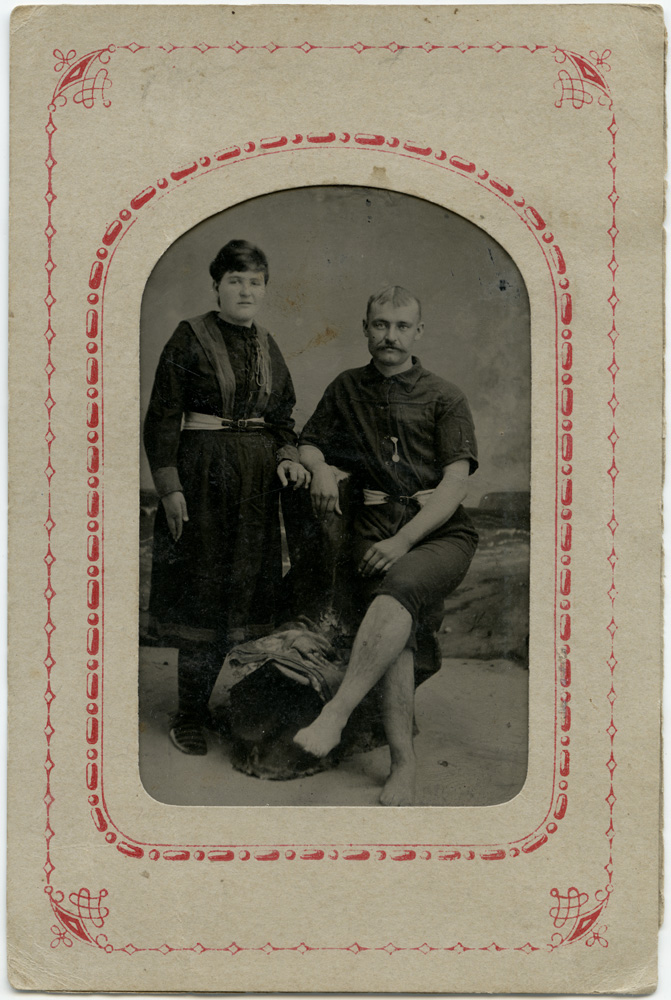
Last but not least, aren’t you glad swimwear has evolved since the 1880s? How’d you like to go for a dip in the ocean and have to wear that stuff? It’s bad enough when your swim trunks dry out and get salty – imagine that feeling all over! And how long would it take for what looks like wool to dry after a thorough immersion in salt water? You’d be as likely to catch pneumonia from the swimsuit!
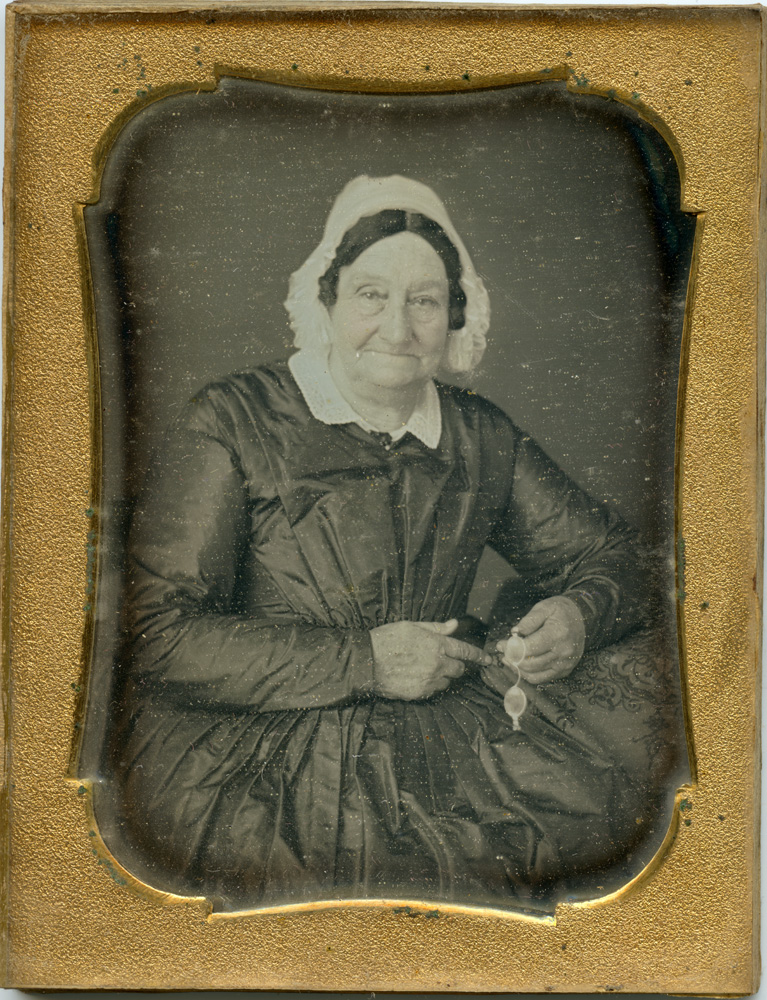
Lady with glasses, Daguerreotype, quarter plate, anonymous
The newest addition to the collection. She arrived today in USPS. I love the simple gesture of pointing to the glasses, as if to indicate a prized possession.
The scan again does not do justice – it picks up and magnifies every little dust fleck. I’m not going to bother cleaning the dust off because this one still has the complete intact original paper seals on the packet. This one is circa 1840-45, closer to ’45 than ’40 based on the style of the mat. The truly early images had very simple mats with just the top corners rounded, or an elongated octagon for the opening, and usually with either a smooth but matt finish or a pebble-grain texture to the mat.
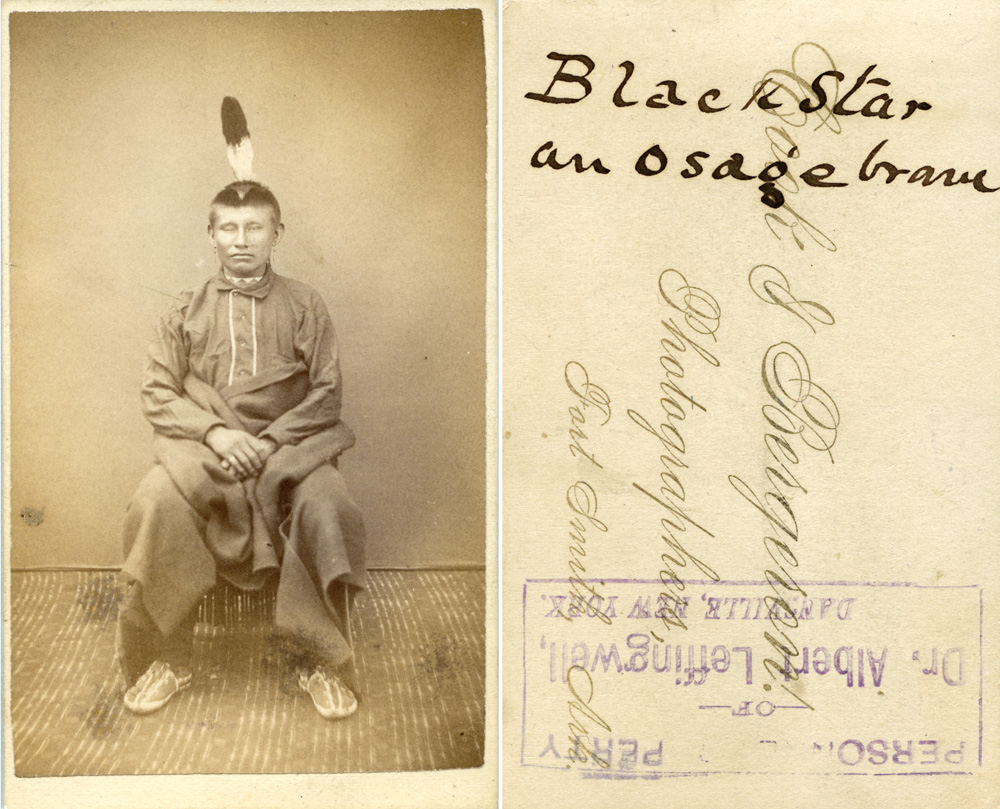
Here is a circa 1882 image of Black Star, a member of the Osage tribe, taken in Fort Smith, Arkansas. This was an incredible find, for me, and the back marks on the CDV are fortunate in that they facilitate a discussion about provenance, something that unlike say artistic style or means of production comparatively little has been written academically. Provenance, the history of ownership of an art object, is of considerable importance when the object is rare, quite possibly unique, and of considerable value. A documented provenance can help prove authenticity, and adds to the cachet of ownership – to have a Michelangelo drawing on ones’ wall, for example, is to share ownership of that drawing with kings and clergy, princes and museums.
In this case, the provenance is incomplete, but there is more to it than is usually found with such objects. Only with the rise of art photography in the late 19th/early 20th century do you have much in the way of documentation of provenance for photographs. It is comparatively easy to trace the ownership history of an Ansel Adams print, where oftentimes the gallery that originally sold the print is still in business, and the past owners or their immediate heirs are still alive. But tracing that provenance for something like one of my Mathew Brady daguerreotypes, where even the sitter’s identity is unknown, is a near impossibility.
However, this image, with the subject’s identity hand-written on the back, and the photographers’ studio back stamp, presents the beginnings of possibility. There is a known moment in time and space where this was created – I found the studio of Cook & Bergeron to be operating in Fort Smith for only a few brief years, 1881-1884. At some point, this image was consciously collected, by a Dr. Albert Leffingwell of Dansville, New York, who felt it was important enough to stamp the back of the CDV with his library stamp. Dr. Leffingwell was a famous physician and author, champion of vivisection reform. When it made it into his hands, and for how long, is undocumented, as is what happened to it after his passing.
I acquired it from a dealer in Paris, France. So the CDV has travelled a long and circuitous route from Fort Smith, Arkansas to Dansville, New York, to Paris to Washington, DC with unknown stops in-between. I hope this blog post will some day serve as documentation of the provenance of this image for a future owner.
Very rare and stunningly beautiful, ca1905 large format, sepia tone Photograph of a Native American Navajo Indian seated atop a rock ledge or butte overlooking a vast plain. This outstanding, Art Photo style Photograph measures approx. 13 3/4″ x 18″ and is mounted on its original, photographer’s card mount (overall size of card mount is 14 1/8” by 18 ¼’).
This stunningly beautiful, large format Photograph pictures a young, native American Brave seated atop a rock ledge overlooking an expansive plain. The Brave is bare chested and wears only a loin cloth, numerous strings of bead necklaces and silver bangle bracelets on his right wrist. While the young Navajo Brave is in sharp focus the plain below is seen slightly out of focus creating a wonderful, artistic contrast and composition. The Photo presents the Native American subject in a surrealistic, romanticized manner that was typical of many of the Images produced by Carl Moon.
This Photograph is not signed by the photographer and the only identification is the designation “H88” in the negative at the extreme lower left hand corner. The Photo is in the style of the widely acclaimed Photographer of Native American subjects Karl Moon but we have been unable to confirm Moon as the artist who produced this stunning Photograph. The subject of the image is not identified in any way (as to Tribe or Name) and we are not experts in the identification of Native American Tribal affiliations. We believe the young Brave to be Navajo but are not 100% sure. If anyone can help us to definitively identify the photographer this stunningly beautiful Image or can supply any information regarding the identity or Tribal affiliation of the Photograph‘s subject, the information would be greatly appreciated.
Carl (or “Karl” as he sometimes spelled his name) Everton Moon was born in 1879 at Wilmington, Ohio. He became interested in Native American at an early age. After High School Moon served in the National Guard and decided on photography as a vocation. After apprenticing for 6 years he opened a studio in Albuquerque, New Mexico to begin photographic “art studies” of the Southwestern Indians. Over the next few decades Carl Moon became renowned nation wide and his work was exhibited at The National Museum in Washington, D.C., the American Museum of Natural History, New York and at the invitation of President Theodore Roosevelt, at The White House.
Over the years he formed friendships with his subjects that enabled him to spend weeks at a time in tribal villages, learning about their culture. He set up a photographic studio and began making his first collection of photographs and paintings of the Pueblo Indians. For the next seven years he was in charge of the Fred Harvey Headquarters at the Grand Canyon in Arizona.
This Photograph may be one of Moon’s Grand Canyon Images but we simply have been unable to find any information about this Photo or any other examples in any online data base.
This very rare and stunningly beautiful, large format Carl Moon-style, Native American subject Art Photo is in very good condition. The Photograph exhibits sharp focus, strong contrast and rich tonality – the rich warn tones of this beautiful Image is an example of the very best of the early 20th century Native American Art Photos.



 dcphotoartist