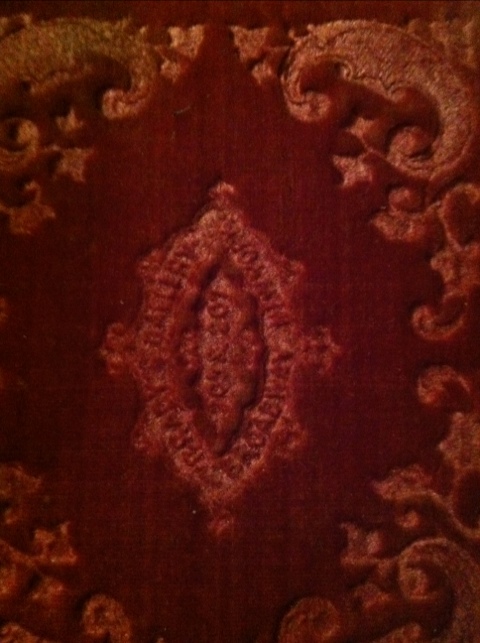
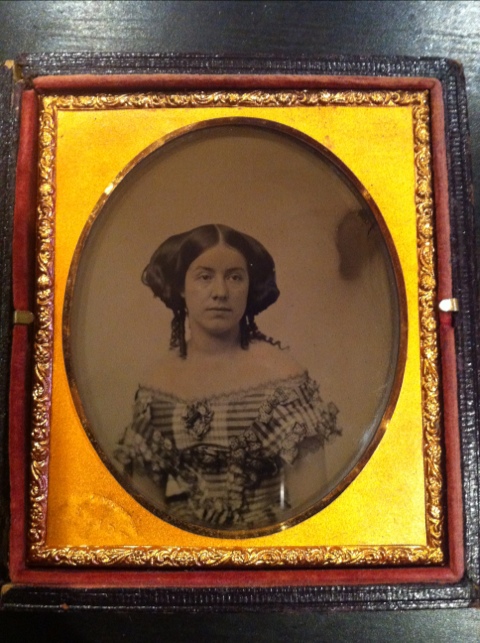
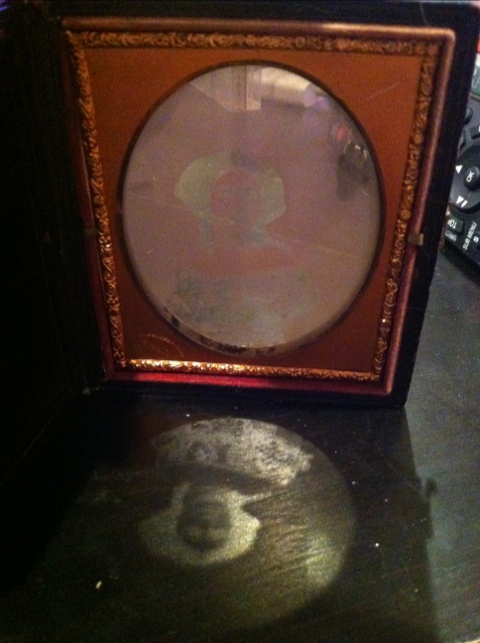
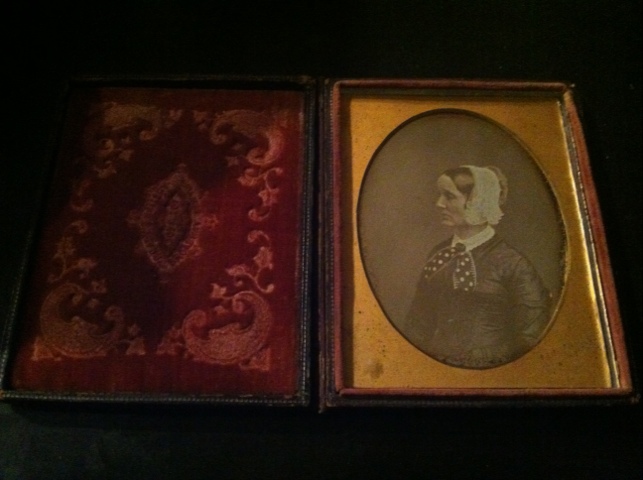
Here are my two early Mathew Brady images. The one is a simple daguerreotype, and based on the mat style, I’d place it as an early dag – pre 1850, maybe as early as 1845. The velvet pad on the dag shows Brady’s New York studio address. I’ve also posted the ambrotype, which is a later image. This is an interesting and unusual presentation, where the image can be viewed from either side.
Category Archives: Portraits
Busy photo weekend ahead
Well, I just got finished loading up film holders in preparation for the next few days’ shooting. I have one shoot scheduled for tomorrow evening after work, and another for Saturday evening. I may well be certifiably crazy for the amount of darkroom work this will have me doing – I’ve got 10 sheets of 14×17, 20 sheets of whole plate (6.5×8.5 inch), and 16 sheets of 5×12 loaded and ready to shoot. I may be even more insane for even considering the jumps between formats. I’ll risk it though because I have so many ideas – I want to try and shoot my three-panel “folding screen” idea on the 14×17 with at least one of my models, I’ve got some more ideas for the “human commodities” series, and I also have ideas for the body panoramas. I’ve got to remember to bring some of my costume pieces from my RenFest outfit tomorrow as well as the shopping bags for the Human Commodities bit. See what I mean about crazy? At least this is a GOOD crazy.
Reinventing the Victorian Portrait Parlor
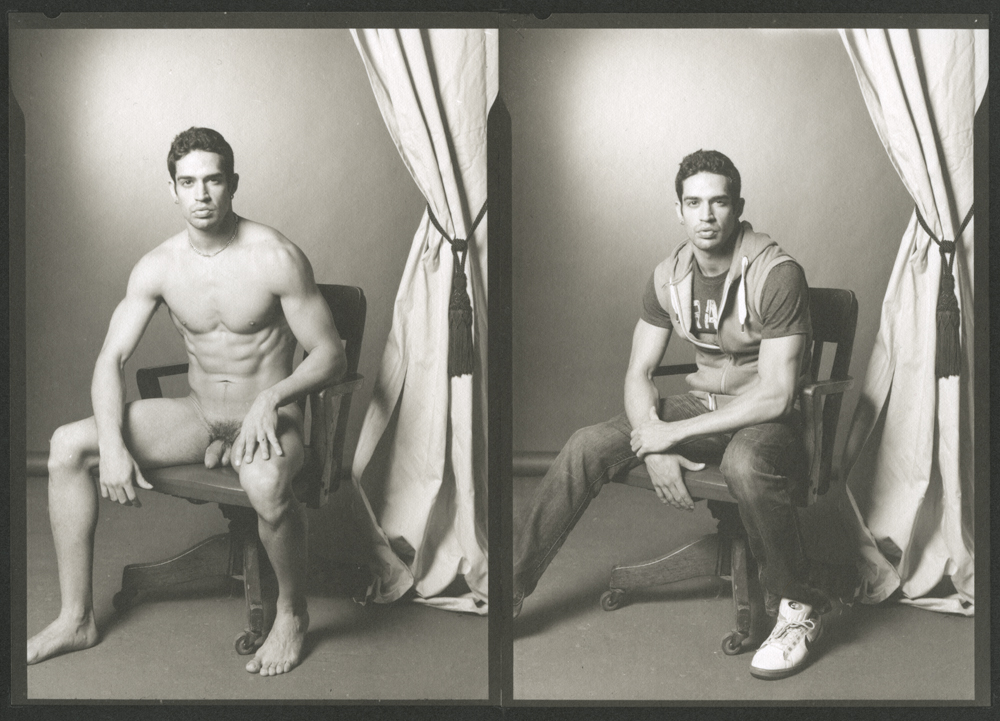
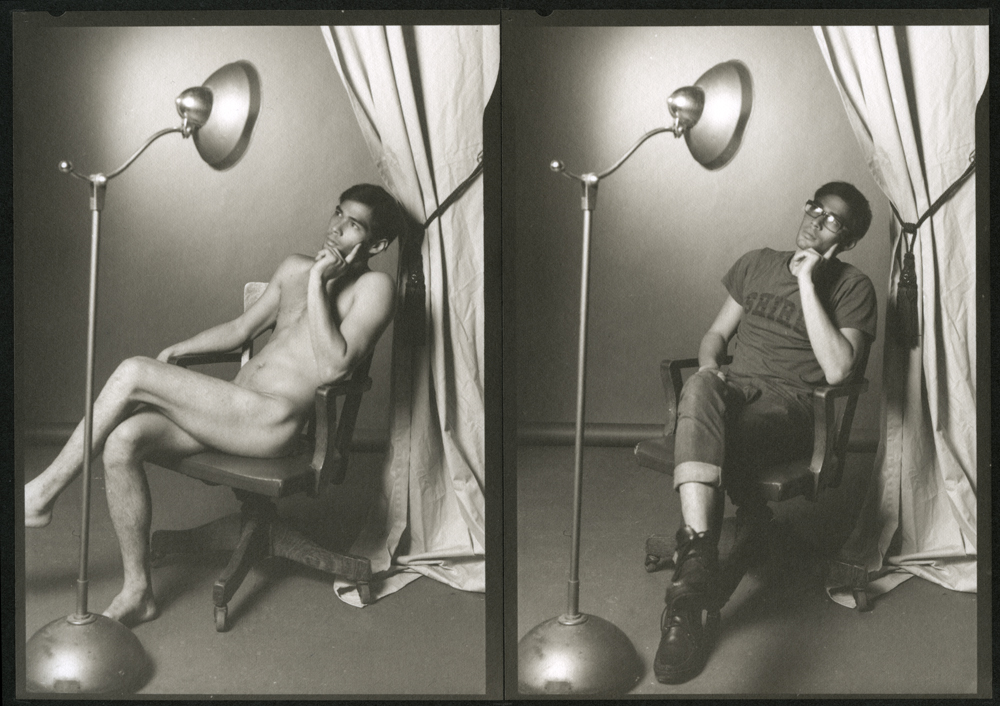
Having been a big collecting fan of 19th century studio portraits, I thought it would be interesting to take on the genre and see if I could manipulate the conventions and subvert them while preserving enough visual continuity that you could visually trace the lineage. Here are my first two efforts. I chose diptychs of my models nude and clothed to inaugurate the series; placing the nude image to the left means the nude reads first in a western left-right reading order, giving primacy of meaning, a naturalness, to the nude, which conflicts with conventional social notions of the nude as an un-natural state. It questions the construction of identity through the construction of the clothed figure. I have printed them in palladium, again, to reinforce the stylistic referent to the Victorian era studio portrait through the look and feel of the image tone. Granted the vintage originals would have been printed in albumen, but this is certainly close enough.


Busy weekend in the studio
This weekend was a really busy weekend in my studio. I was supposed to have a shoot on Saturday. The model I had made arrangements with cancelled on me, but with more than reasonable advance notice, so I’m not pissed off about it – he gave me two days heads up. I’ve had some models flake out two hours ahead, some an hour after the shoot was supposed to start, and some who never bothered to call or cancel (that was the previous weekend, for example). I was talking to my studio-mate who had the studio booked for Sunday, and he said, “I’ve got two models coming in on Sunday, why don’t you work with them before I get there? I need someone to keep them occupied, and it’ll be a big help giving them a chance to work with someone who has a very different style of shooting, because they’re new to the business”. I was more than happy to help out, as it meant free models for me, and I’d be helping out a friend anyway. Since I had the studio booked for Saturday anyway, I went in and did some still life work using a flower I bought whose name escapes me but looks like a cross between a leafy cactus and a gigantic q-tip. I left my stage setup I had created (I took the old curtains I had from the previous studio and made a little ‘stage’ setup for a backdrop) for Sunday, as I thought it would be great to work with the models as well.
WELL, thus go the best laid plans of mice and men. I get in to the studio Sunday morning, meet the first model, Justin, a 6’4″ ex- football player, and get ready to shoot. On the third test pop of my flash, what happens but one of the capacitors in the power pack goes tits up. And I don’t have my own backup. I call my studio mate who is coming later, and he says just use his, which happens to be compatible with my accessories. So another half-hour goes by digging out his flash unit and setting it up. We do get on with the shoot, and once things get moving, it goes well. Justin is a good model and understands how to create dynamism in his body – I had no trouble setting him in poses that accentuated his physique and worked well with the somewhat exotic format I was shooting in – I was trying out the 5×12 for human figure work, mostly shooting verticals. Working with me, from a models’ perspective, is a real challenge and a physical workout because I need them to hold poses for an extended period of time while I compose each shot. I’m not shooting like a typical fashion photographer who likes to ‘run-n-gun’ and fire off hundreds of photos in an hour. I think with Justin, in about 1 1/2 hours, we took 8. I had him holding a pose for sometimes four or five minutes while I played around under the dark cloth.
My studio mate is a good friend (loaning me his strobes is an instant qualification!), but he’s a bit frantic. He’s a fashion photographer and likes to run-n-gun, for one thing, and he’s just a bit keyed up all the time anyway. Fortunately Justin and I wrapped our shoot just before he and the other model got there. The other model is a college student named Peter, (only) 6’2″, and about 2/3 the body mass of Justin. Peter was tragically late because of traffic and poor directional sense. What he lacks in timeliness, he makes up for in facial features. He’s one of those models who looks relatively ordinary when you pass him on the street, but when you see him through the camera lens, his face just screams High Fashion (that’s actually a good thing). They set up and shot while I went to the Nationals game with my father. When I got back, they were still there, and since my set had been taken down, we did a few shots in the air shaft outside the studio, which has a really cool steel security door and lots of exposed brick. Another great thing about shooting in the air shaft is that because it has these nice tall walls, you get beautiful soft indirect light from overhead – like a north light window. It’s very even, very consistent – you can meter once and not have to re-meter for hours. Reflectors are very helpful though because it is a top-down light and makes people into sunken-eyed zombies if you don’t bounce a little fill on their faces.
In talking to Peter about the poses I was looking for, I asked him to do a nude. I knew because he was agency represented that frontal nudity was a no-no, so I explained the pose would keep his intimate parts covered, and he was fine with it, but then he asked if he could cover himself with a sock. I find the whole ‘hide it in a sock’ business to be laughable – I’m not there to stare at your anatomy, and if someone IS nude in real life, do they ever run around with a sock on their penis? NO. We got that out of the way and went on. I did some head-shots of him with the 5×7 Canham, getting to put some film behind the 240mm Heliar I have for the first time with a human subject. The image on the ground-glass positively glowed! The shallow depth-of-field at f5.6 just made the features that were sharp SNAP, and the brick wall in the background looked like a painting seen through running water, it was so smooth. I’m DEFINITELY taking this outfit with me when I go out west for some figure-in-the-landscape shooting!
When I shoot, I’m used to shooting all by myself, no assistants, no “creative input” from other photographers. Sometimes having the helping hand is very welcome (adjusting lights, etc). Other times, not so much. My studio mate was watching the shoot with Peter, and while I was still arranging a pose, he had to jump in and start directing the model because he had this love handle that showed up only when in a certain kind of pose. I would have seen it and adjusted his pose, but I didn’t get the chance. GRRRR. And then, to make matters worse, I wasn’t done shooting before my studio mate mentioned a shot he wanted to do in the air shaft as well, and boom, the two of them were off doing their own shot. Moral lesson here – assistants are fine, but two principal photographers probably shouldn’t share the set – too many chefs end up putting someone’s finger in the chili.
Anonymous Vernacular photographs
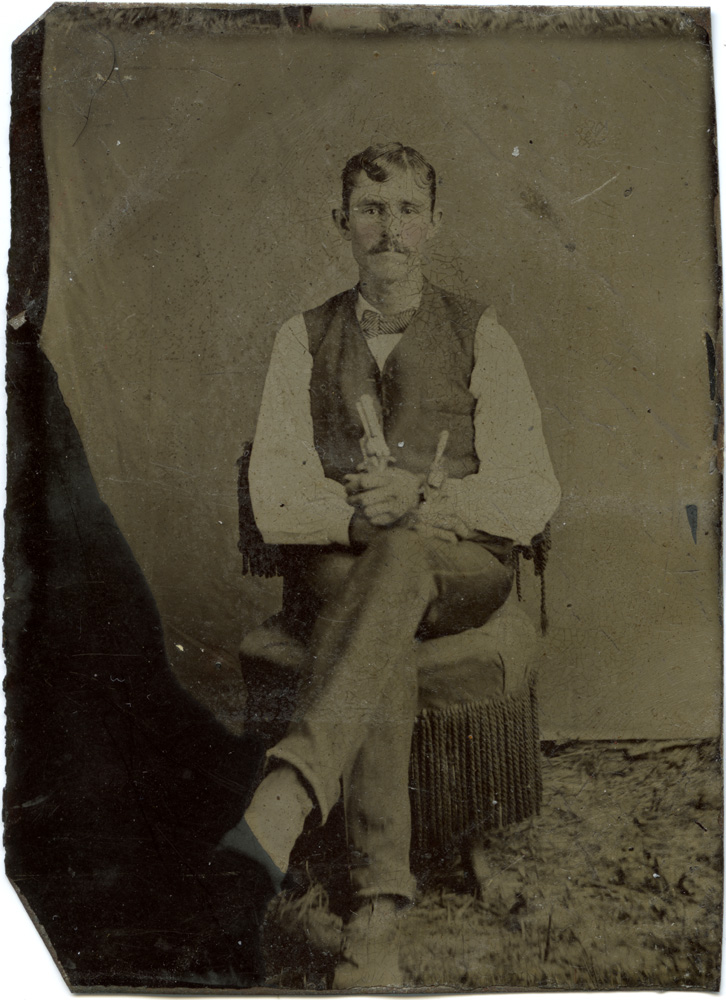
Here’s a little gem I recently uncovered. No date, no attribution, no name of the subject. It’s a little approximately 1/6 plate tintype. Definitely not from a professional studio, as the plate is ragged – the edges appear to have been almost torn from a bigger sheet, and the collodion pour and/or development are uneven. The photo was taken in the field (literally – you can see the grass under the sitter’s chair, and the backdrop looks like it might have been a rug or blanket with some kind of fringe on top, thrown over a hastily erected backdrop stand). Still, the photographer went to the effort to tint the cheeks on the sitter. It brings to mind the civil war soldier portraits with the young men about to march off to war posing with pistols. I wonder, like with those war portraits, if the pistols are indeed property of the subject or if they are merely props he chose to pose with because they looked cool (many of the civil war soldier photos are using prop weapons that belonged to the studios. Many soldiers had not yet been issued firearms when they had their pictures taken, and they often posed with weapons inappropriate to their rank and status – enlisted men with non-government issue pistols, for example). Was he a saloon keeper? A lawman? The guns are kind of dinky, and he’s handling them rather casually. I think it’s the aura of uncertainty that lingers with an image like this that makes it so fascinating.

I’m using the term “Vernacular Photography” to describe this image. A good friend of mine gave me a definition for it (after a rather contentious debate from which I learned some humility): “Vernacular photography is photography by indigenous populations for indigenous consumption”. Meaning photographs that are created with the intent to be consumed by the audience that created them. The photographer does not have to be known or unknown; neither does the sitter. What matters is the intent. So a Mathew Brady portrait of a client off the street, commissioned by that client for their own personal use, even if the client were famous, would be vernacular, but Brady’s civil war documentary, even the camp scenes of soldiers at rest, would not. Diane Arbus’ photos are NOT vernacular, nor are Ansel Adams’. Their work was created for the express purpose of exposing an idea and sharing it with the world at large. Vernacular photography is created for a known, limited audience. Non-vernacular photography (art photography, documentary, etc) is created for an unknown, unlimited audience. The sitter for my tintype here probably had no expectation of the life of his image beyond whoever he gave it to being able to remember a moment in time at some now-unrecorded location. By collecting it, publishing it and categorizing it, though, do I now lift it out of that category of vernacular image by giving it that unknown, infinite audience?
There’s a wonderful book on the American Tintype by Steven Kasher called “America and the Tintype” which catalogs the better part of a century’s worth of mostly anonymous, vernacular photography from the tintype era. If you’re interested in the subject, I highly recommend picking up a copy.
Results from the Canon 135 L f2 lens
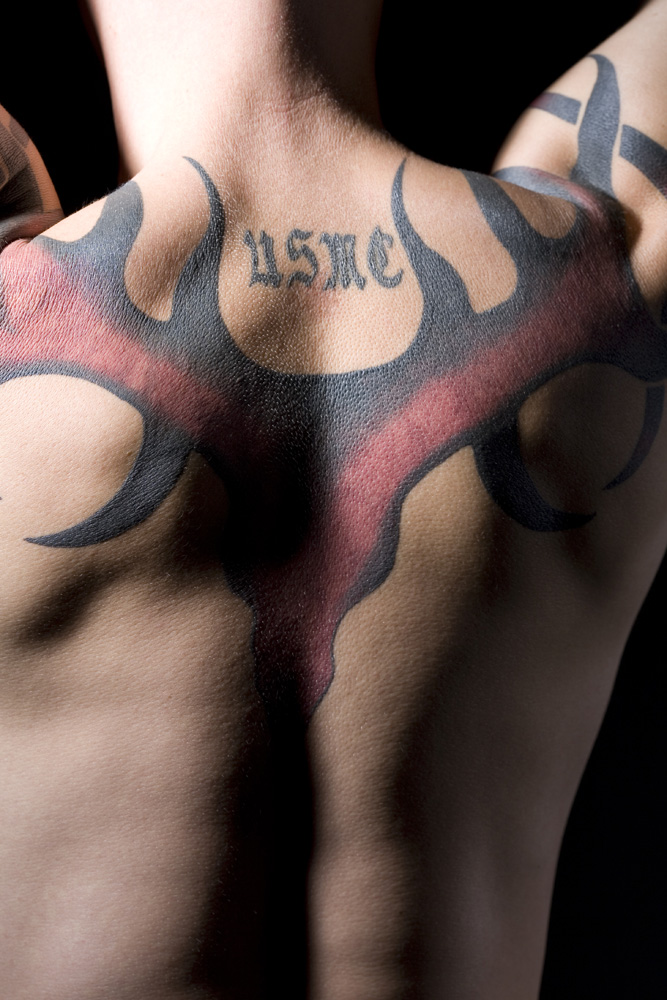
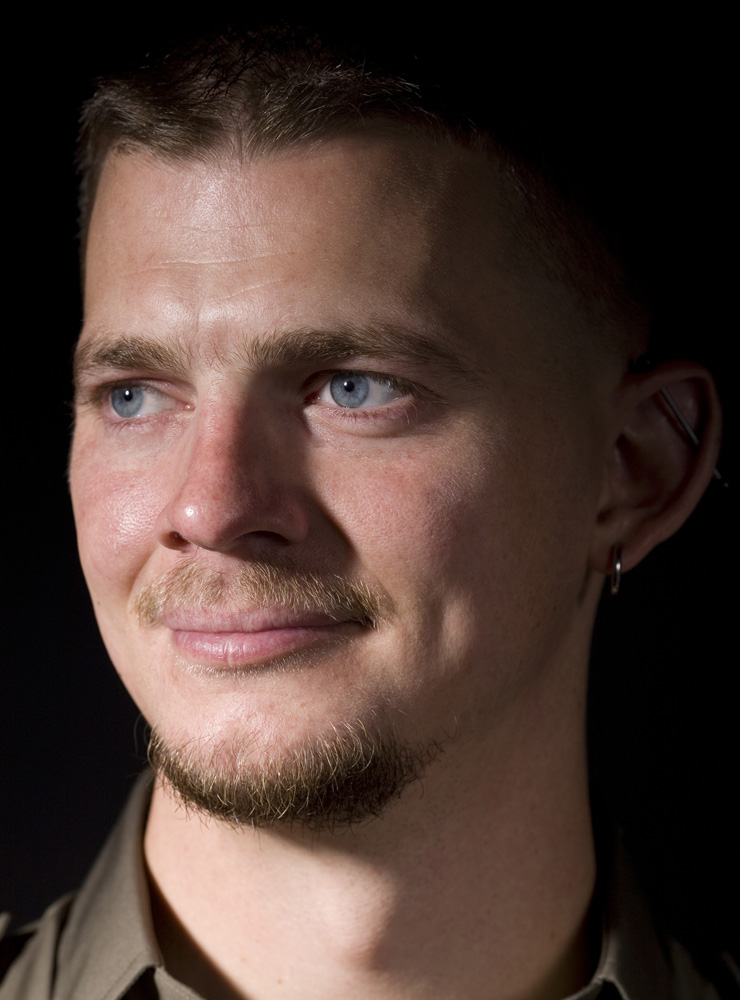
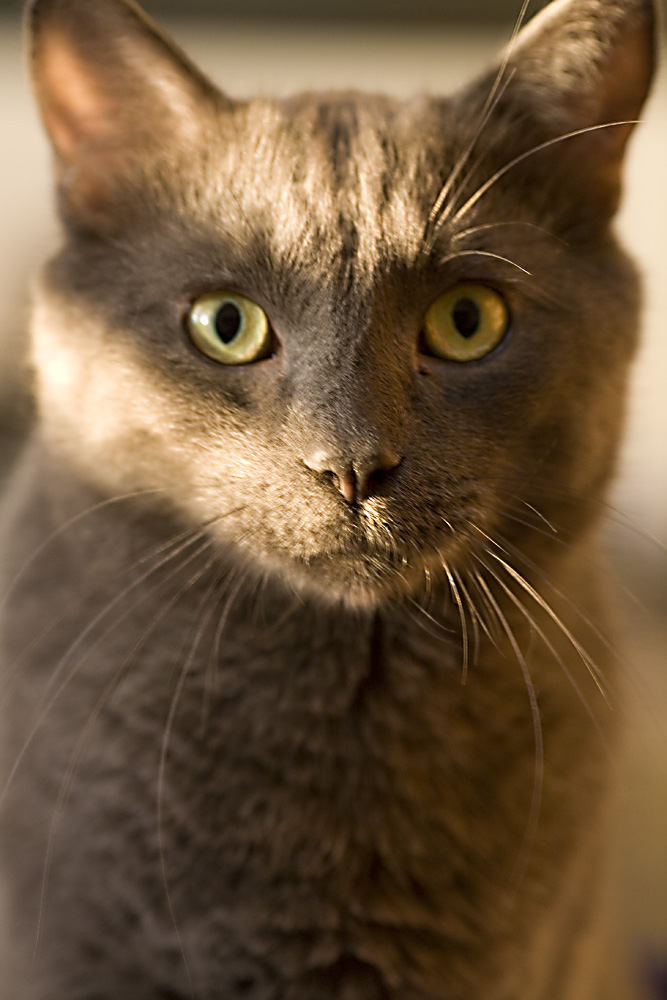
Here are some shots from my new toy, the Canon 135 L f2 lens. I put it to use in my studio last night, doing some portraits of a friend of mine. As you can see, it’s wickedly sharp, but even at f10, it still has pretty shallow depth-of-field. In examining the original camera-RAW file in Photoshop, I swear I could count every hair on his back, and every pore on his face, until the depth-of-field dropped off and then it blends away to creamy-smooth very quickly. You can see in the shot of my cat Chub-Chub (long story behind the name, but when I first got him, he ate like a pig, started gaining weight and would waddle down the steps, belly a-swinging) that at f2, the depth-of-field is whisker-thin. I’m going to love this lens.
Naughty boy!
I was a very naughty boy yesterday – I gave in to gear-itis and snapped up a like-new-in-box Canon L-series 135mm F2 lens for on my Canon 5D. As you can tell from reading this blog, I’ve been an absolute junkie for all things big, old, and film-based. That doesn’t mean I reject the 21st century, however; I have been jonesing for this lens for my Canon though for a while as its quality as a portrait lens is super-famous (I’d say infamous but that would imply something negative about the reputation, which could not be further from the truth). So I’m now the proud owner of a 135 L f2. I was playing around last night photographing the cats last night for lack of a better moving subject. I did use it to record the new acquisitions in the antique image collection – it worked wonderfully for that. I’ll be using the 5D as an ersatz Polaroid tonight in the studio as I have a portrait commission to do tonight. It will make a handy lighting check, and it will be useful to have some portraits of something other than Frosty and Chub-Chub (my furry little pudd’ns).
I’m BAAAACK! To posting that is…
It’s been a while since I added anything here, because I’ve been insanely busy dealing with a whole bunch of personal business (breaking up, evicting my ex, cleaning up the aftermath, starting dating again, reconfiguring my office, building a new home wireless network since the ex took the wireless router, getting nasty bronchitis, recovering from said bronchitis, etc etc you know…). I haven’t had a lot of time for collecting or thinking about it as a result. Well, the dust has settled and I’ve been casually acquiring an odd and end here and there, so I’m back to writing about it again.
One of the things that has interested me, and helped drive me into this whole civil war period image collecting thing, is my hometown – Chambersburg, PA. Chambersburg was perhaps the most trampled ground north of the Mason Dixon line during the Civil War. Prior to the war, John Brown planned his raid on Harpers’ Ferry while living there, and met with Frederick Douglass to discuss the plans (Douglass advised against attacking the federal arsenal). Jeb Stuart’s cavalry raided it for the first time in 1862. Then Lee’s troops passed through on their way to Gettysburg in ’63, and in 1864 General McCausland’s troops demanded a ransom of $500,000 in US currency or $100,000 in gold, which the town refused to pay, so it was put to the torch.
In digging around on Ebay, I found an image of a man who was born a few towns over from Chambersburg. That got me thinking about the old hometown, and I started searching for Chambersburg related stuff. I acquired a group of photos spanning a good 20+ years of work from a single studio, which in further searching on Ebay seems to have been the most prominent if not the only studio in town at the time.
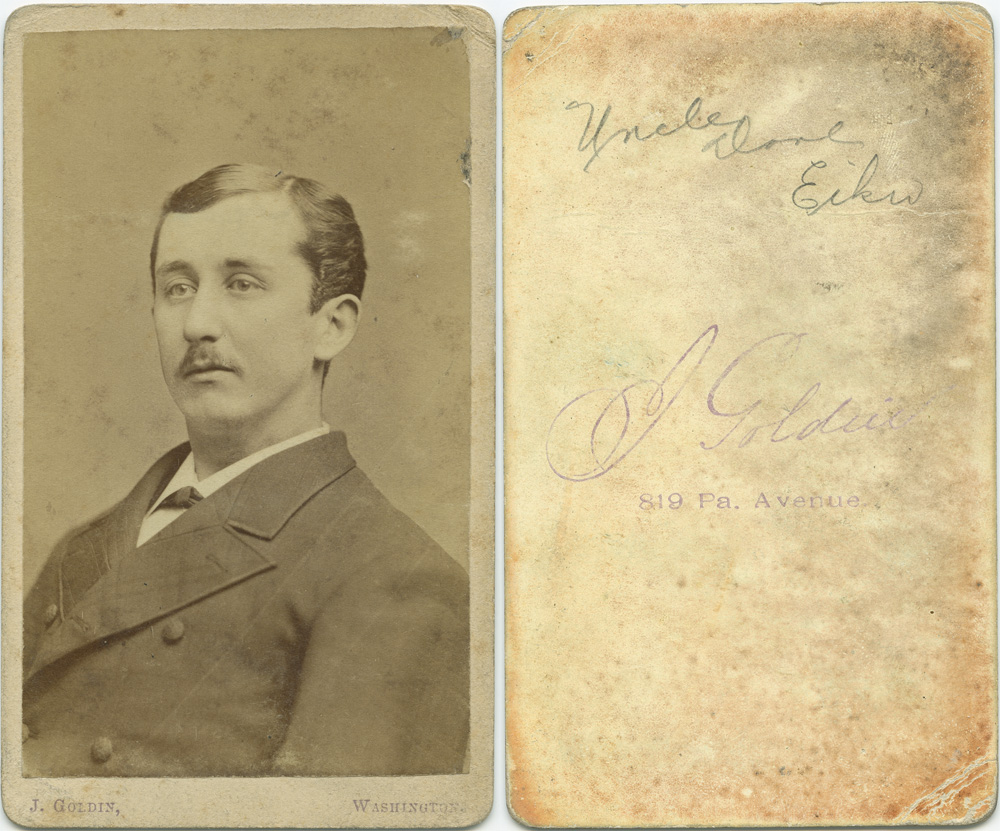
Here is the image that got me thinking about Chambersburg, a photo of David Eiker, born in Quincy, Pennsylvania. Quincy is a tiny one-stoplight town a few miles east of Chambersburg. This photo was taken at the J. Goldin studio in Washington DC.
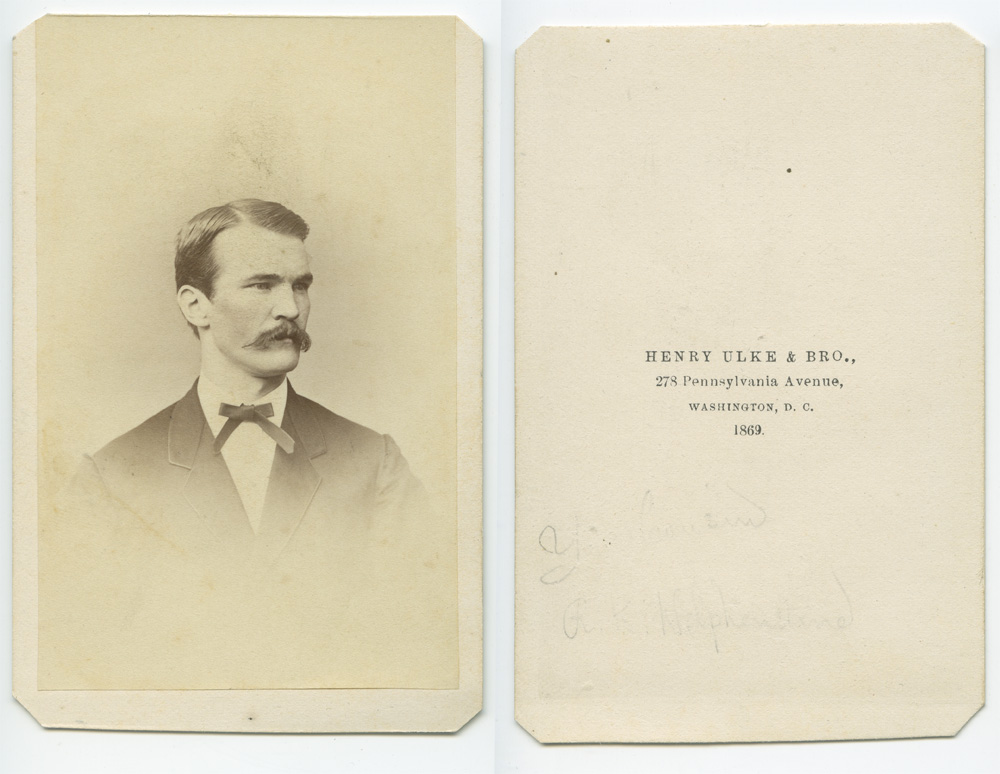
Acquired at the same time was a more-or-less unrelated photo of a Mr. R.K. Hopkinson, taken at the Henry Ulke & Bro. studio in Washington DC. The common thread was the Washington, DC studio. Mr. R.K. Hopkinson Served in Company D of the 3rd Massachusetts Heavy Artillery during the civil war.
Random images
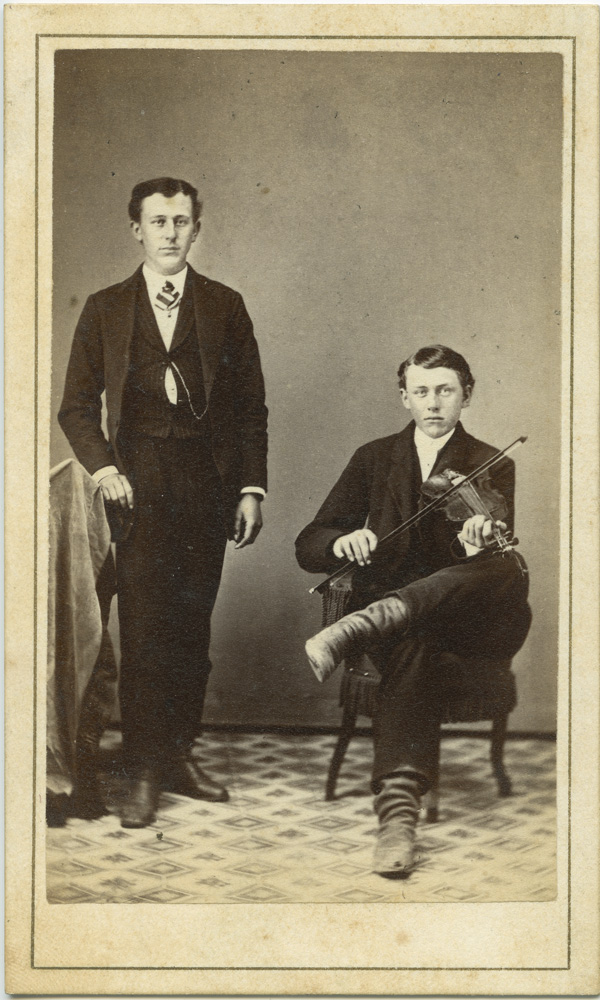
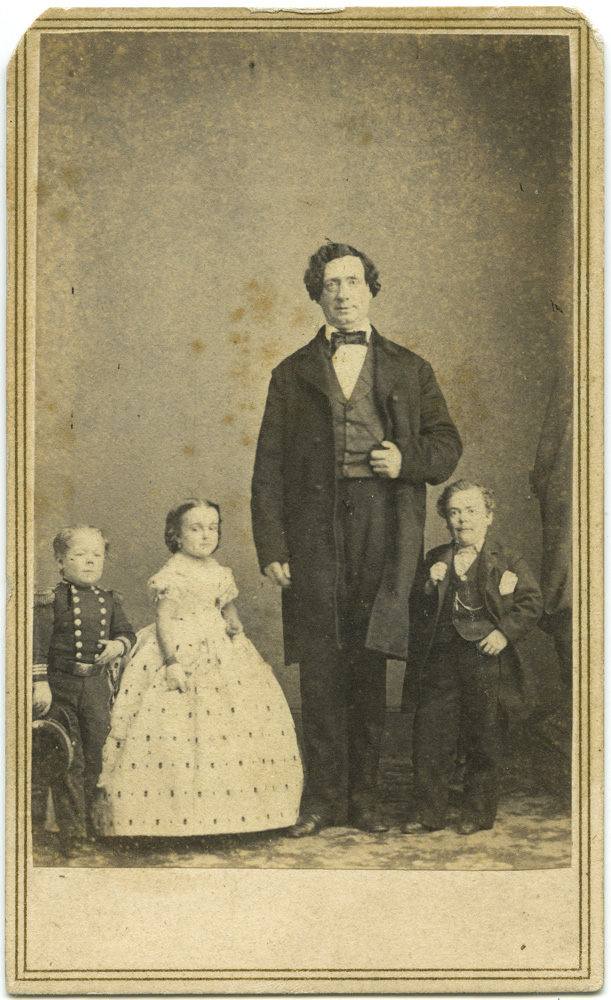
Two new additions to the collection – an anonymous CDV of what appears to be at least brothers if not twins, one standing the other seated playing the violin. Best guess is late 1860s / early 1870s. The other is another Brady image of Tom Thumb, his wife, and Commodore Nutt, this time with an average man for comparison. It’s funny how these things turn up in groups – I first get the Fairy Wedding CDV, then another different image of the same people shows up shortly after, so I had to buy it!
Collection on hiatus, but with a high note
I’ve been a little overzealous in my collecting lately, so it’s going to go on hiatus. Well, unless I come across some nice Washington DC based CDVs at bargain prices. See, collecting is an addiction. Fortunately, unless you get into the realm of hoarding, it’s one addiction that doesn’t require interventions or support groups.
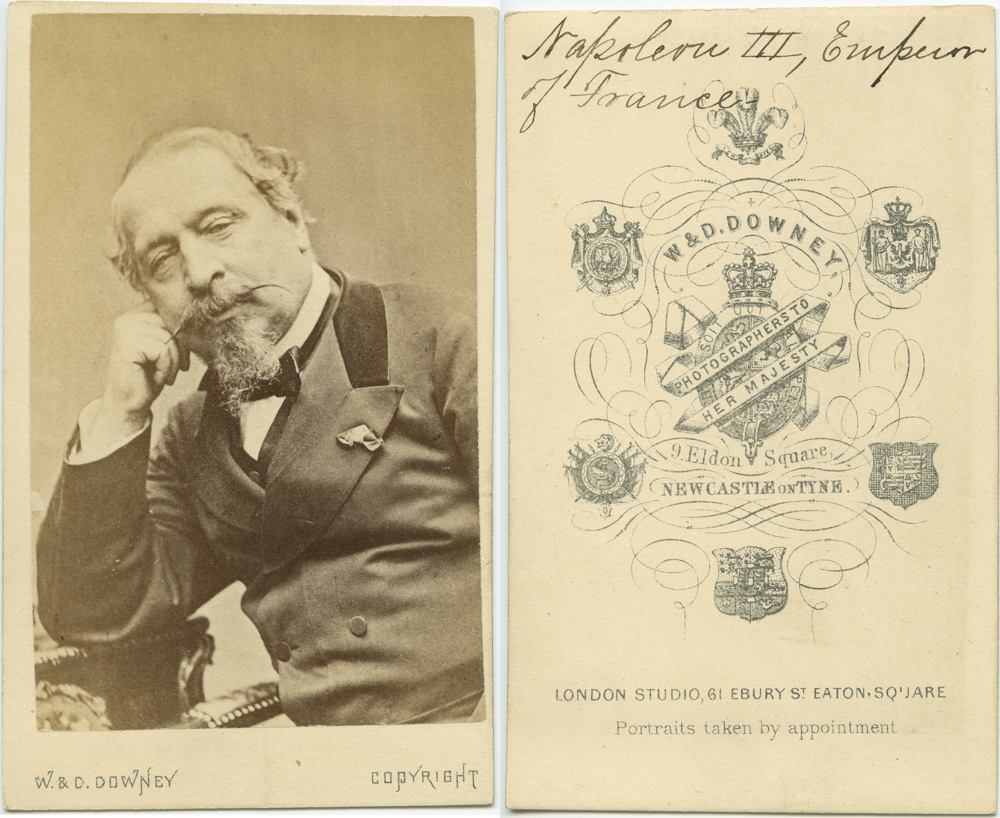
Anyway, back on topic, here’s a rather special CDV worthy of being the pausing point (the pause that refreshes?). Napoleon III, last Emperor of France. Taken in London at the studios of W. & D. Downey, photographers to Her Majesty.