Tag Archives: art

Changing Mural – Black Boy & Garuda

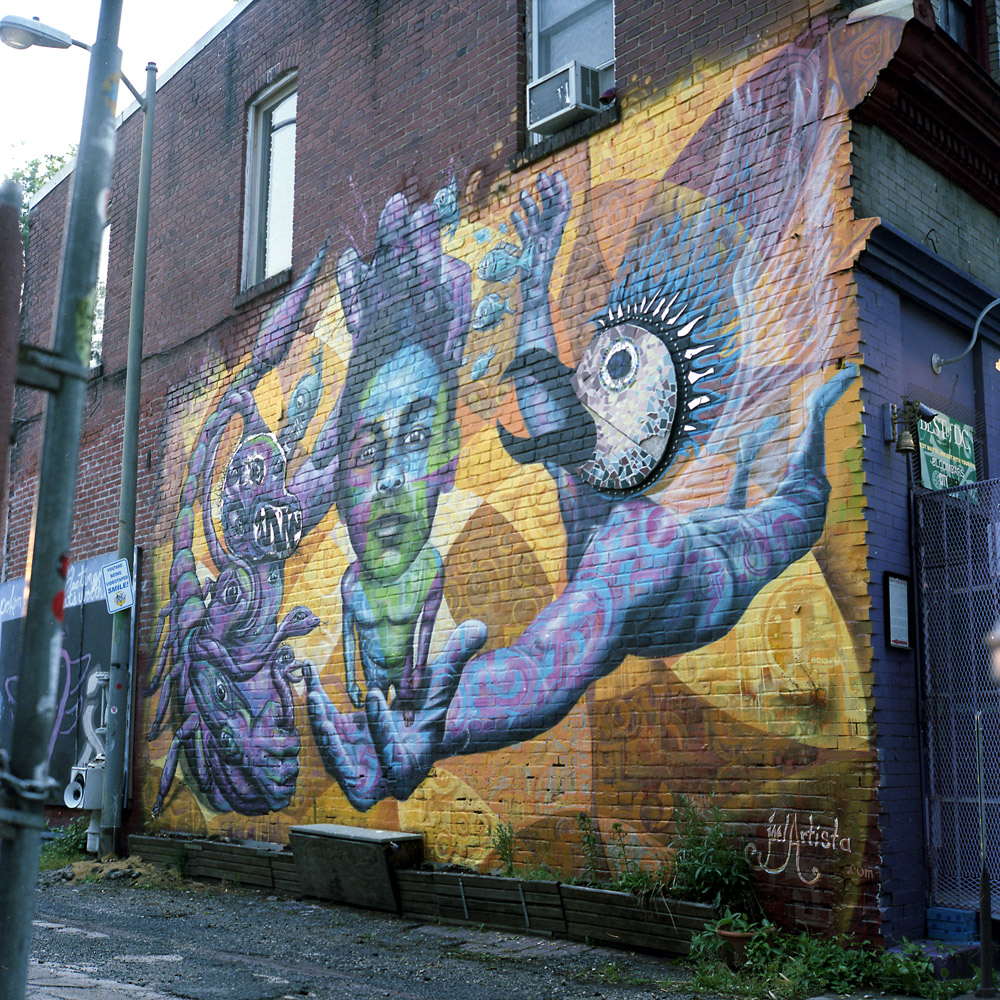
I had photographed this mural before. The other day I was doing a walkabout in my neighborhood and passed it again, to see that the artist had re-worked the mural in new colors with new designs.

here are the original photos I took, in color and black-and-white.

Black Boy, Garuda, Color
Black Boy, Garuda, B/W

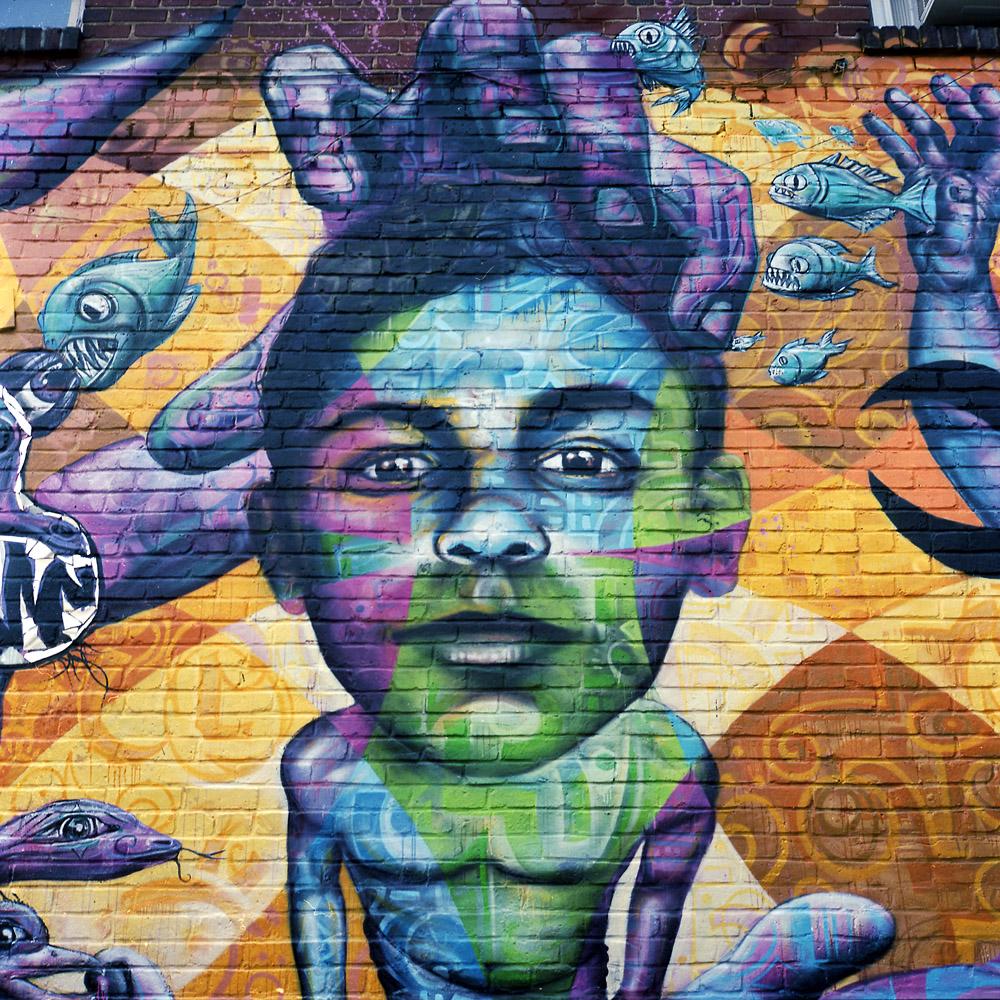
The artist came back and re-worked the piece, keeping only the head of Garuda and the head of the black boy as compositional elements, and completely re-working the color palette.

Black Boy, Garuda
Black Boy, Garuda
Black Boy, Garuda (Detail)

This is one thing a traditional photograph can’t do – it can’t evolve over time being reworked into a totally different yet fundamentally similar image. At the point you transform a photograph this much, it’s no longer a photograph. It’s figurative and not literal. Part of the intrinsic quality of a photograph that makes it valuable and meaningful as a photograph as opposed to a painting is its relative immutability and the appearance of a binary 1:1 relationship with reality. We know of course that photographs CAN lie, and that they have figurative, non-literal properties, but the descriptive quality of a photograph is so powerful that we WANT to view them as purely, literally descriptive and non-figurative – “Photos don’t lie” and the visual equivalent of “if it wasn’t true, they couldn’t print it”.

So the question to you is, is this the same mural, or is it a different mural entirely, now that it’s been reworked?

Toronto Distillery District

Some random photos of the buildings and spaces at the Distillery District in Toronto.

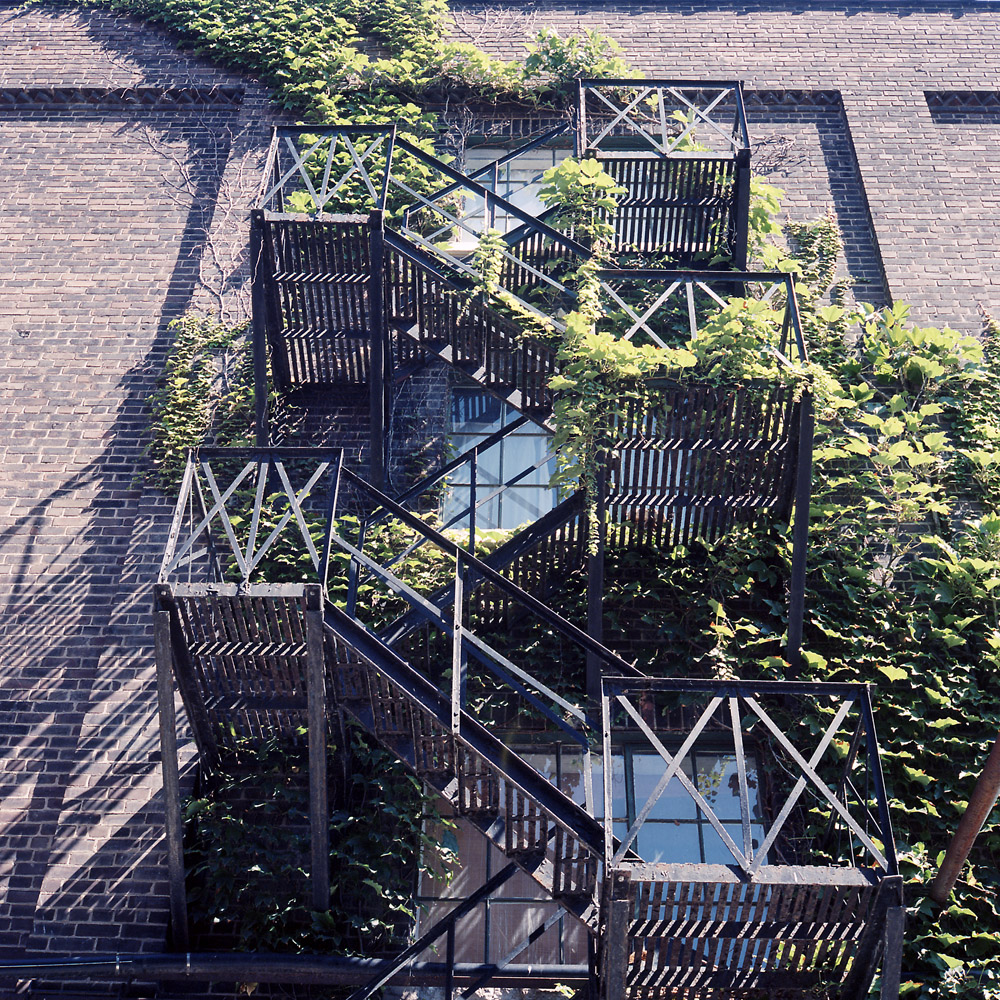
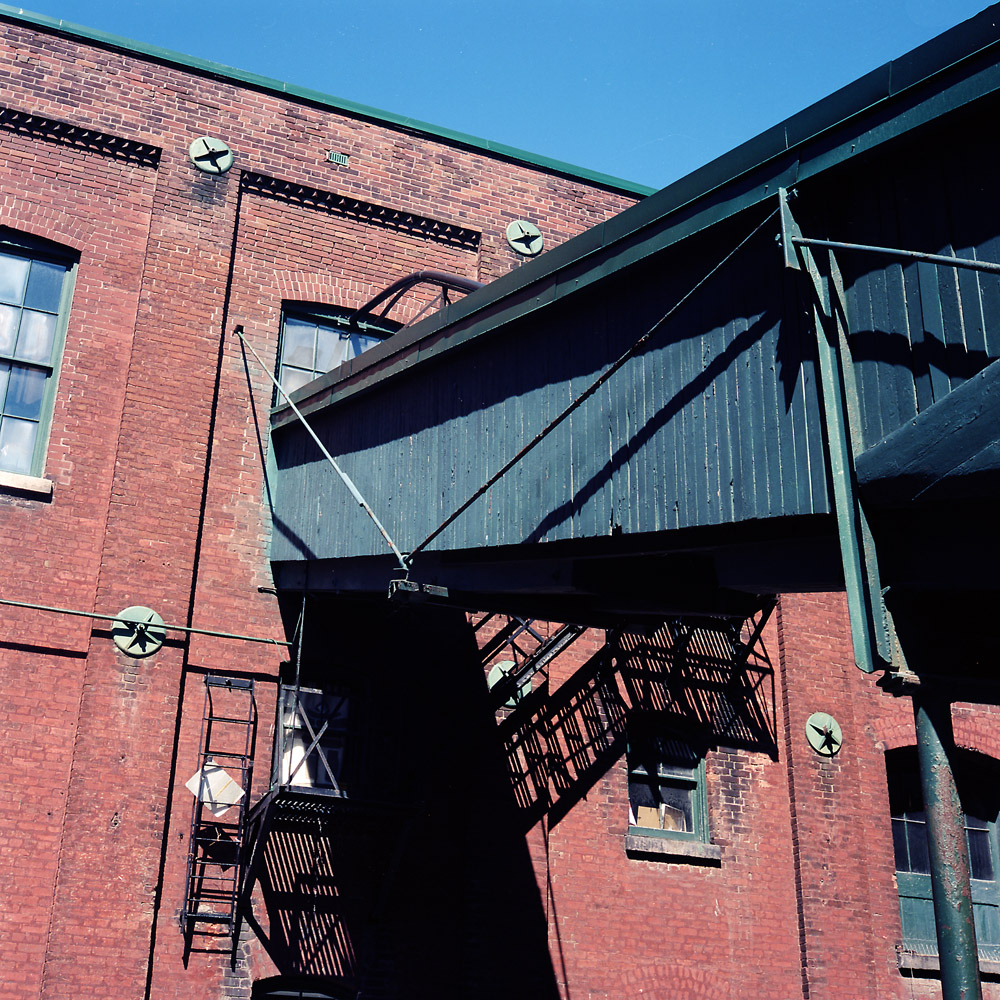
Ivy, Fire Escape, Distillery District

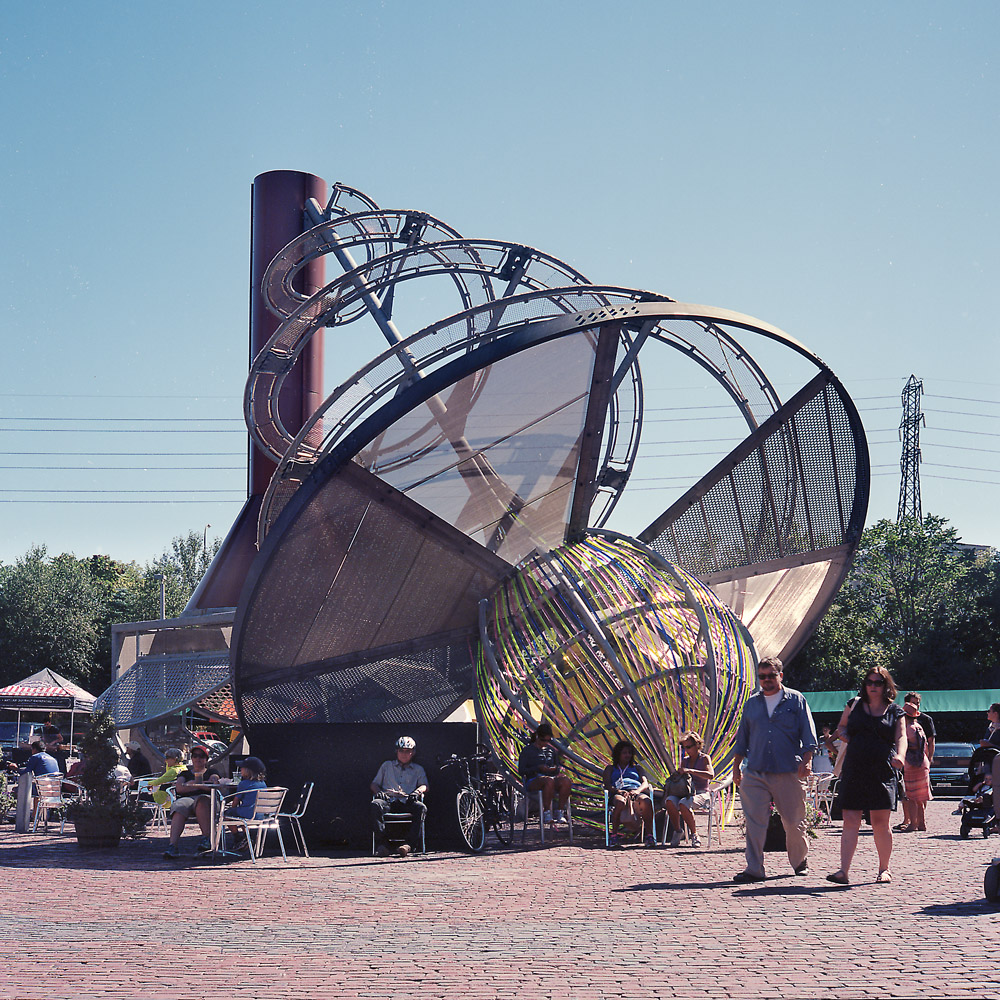
The central plaza in the middle of the distillery district is occupied by this interpretive sculpture designed to reflect the history of the complex, and provide a focal point for people to converge upon. I don’t know how comfortable it would be to sit beneath it; while it certainly provides shade, all that copper would make for a terrific radiator on a summer day.

Distillery Sculpture

I went for a more abstract look with this composition – this is about angles and forms, and visually leading lines. The structure is a chute used to move barrels of liquor from the top floor of the distillery to the waiting trucks to be loaded and sent out.

Distillery Chute
Distillery Chute

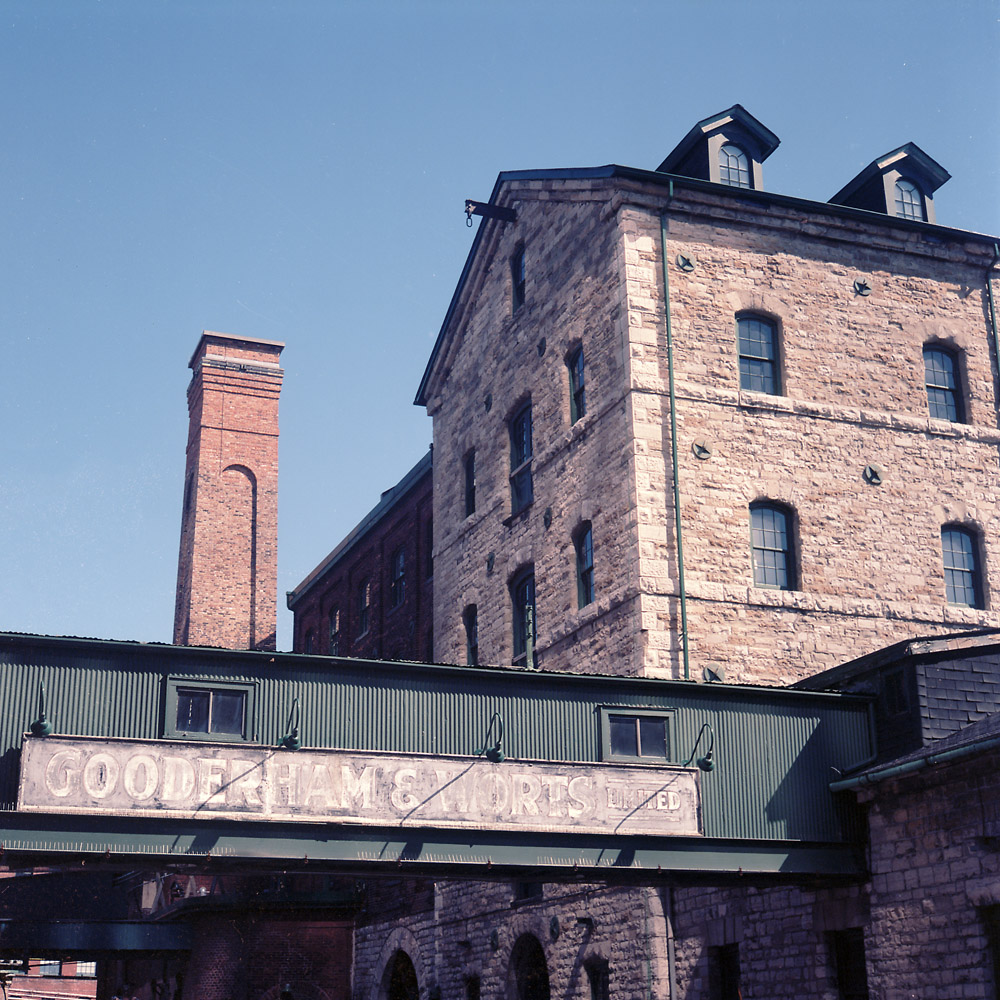
The sign of the distillery still graces the covered walkway between two brick and stone structures in the distillery complex.

Gooderham & Worts Distillery

Museum Exhibition Catalogs

While I was in Paris, I went to see a major exhibition at the Musee D’Orsay, Masculin/Masculin, a retrospective of the male nude in art from 1800 to the present. It was beautifully presented, almost overwhelming in size and scope, and extremely memorable. At the time, I thought about buying the catalog because it had outstanding reproductions of the work in the exhibit, including many works and artists I was unfamiliar with. I decided not to because of the size and weight of the catalog, especially considering that it was only available hardcover and my bags were already close to the weight limit. After I got home, I was kicking myself for not buying it after all. I got a second chance, however, when a friend who lives in New York told me he would be going in early December, and he offered to bring me back a copy. It arrived today, just in time to be a Christmas present to myself.

This got me thinking about museum exhibition catalogs. I generally try to buy them for exhibits I’ve enjoyed when I have the chance, because it serves as a reminder of the work exhibited, and it goes a long way to helping support the museum mounting the exhibit, especially when the museum (like all the galleries of the Smithsonian and the National Gallery of Art) does not charge admission. As a result, I thought I’d list the exhibitions I’ve collected catalogs from.

In rough chronological order, descending, they are:

  • Charles Marville, National Gallery of Art, Washington DC, 2013
  • Masculin/Masculin, Musee D’Orsay, Paris, France 2013
  • Photography and the American Civil War, Metropolitan Museum of Art, New York 2013
  • Faking it: Manipulated Photography Before Photoshop, National Gallery of Art, Washington DC, 2013
  • 40 under 40: Craft Futures, Renwick Gallery, Washington DC, 2012
  • Stieglitz, Steichen, Strand, Metropolitan Museum of Art, New York, 2010
  • Hide/Seek: Difference and Desire in American Portraiture, Smithsonian National Portrait Gallery, Washington DC, 2010
  • Framing the West: The Survey Photographs of Timothy H. O’Sullivan, Smithsonian American Art Museum, Washington DC, 2010
  • Truth/Beauty: Pictorialism and the Photograph as Art – 1845-1945, Phillips Gallery, Washington DC, 2009
  • Faces of the Frontier: Photographic Portraits from the American West, National Portrait Gallery, Washington DC, 2009
  • Titian, Tintoretto, Veronese: Rivals in Renaissance Venice, Boston Museum of Fine Art, Boston, 2009
  • Impressed by Light: British Photographs from Paper Negatives, 1840-1860, National Gallery of Art, Washington DC 2008
  • All the Mighty World: Photographs of Roger Fenton, Metropolitan Museum of Art, New York, 2004
  • Segnali di Fumo: L’avventura del West nella Fotograffia, Castello Sforzesco, Milan, Italy 1994
  • Circa 1492: Art in the Age of Columbus, National Gallery of Art, Washington DC, 1992
  • Treasure Houses of Britain, National Gallery of Art, Washington DC 1985
  • Tutankhamen, National Gallery of Art, Washington DC 1977
  • The Family of Man, Museum of Modern Art, New York, 1955*

*obviously I did NOT attend the Family of Man exhibit, as I wasn’t even a fantasy in my grandparents’ minds in 1955. But I do have the exhibition book.

Also note that I’ve listed where I saw the exhibit, not necessarily who published the catalog.

Perhaps the oddest is the Segnali di Fumo catalog, purely on account of the incongruity of going all the way to Milan, Italy to see photographs of the American West (well, I didn’t GO to Milan to see the exhibit, but happened upon it as I was leaving the Castello Sforzesco), with a significant body from the Amon Carter museum in Texas. Which I haven’t been to yet, but really ought to. It would also help close the loop on my France trip, for it is there that the first known photograph ever is held – Niepce’s first known heliograph of the view out his studio window at his estate near Chalon-sur-Saone (that I couldn’t visit because it was closed for the season). I’m sure I’m missing one or two from my collection, and my collection of catalogs is a pale shadow of the total number of exhibits I’ve been to either because no catalog was produced (producing an exhibition catalog is a major undertaking and not done casually or cheaply) or because I couldn’t afford it at the time.

Another day I’ll put together a catalog of my photography monographs, as I know this is of interest to some. It’s not a huge collection, especially in light of my overall library size, but it is a work in progress.
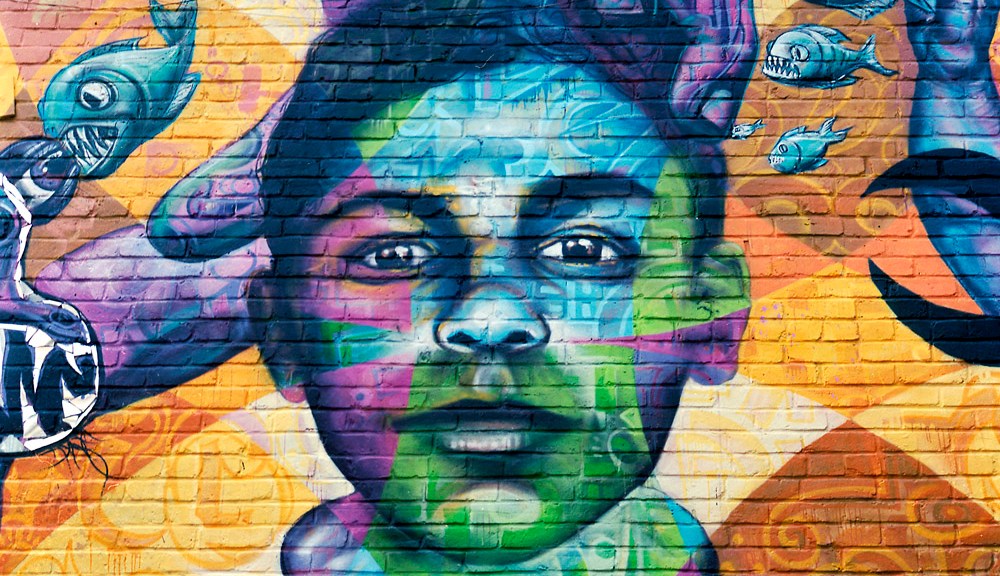
From Anonymous Vernacular by Jeremy Moore

I read this post by my friend Jeremy Moore the other day and wanted to pass it along. I wholeheartedly agree. I still push myself to go to see contemporary shows because I want to see what people are doing, and while it’s not a universal constant, I am disappointed more often than I am delighted by what I’m seeing on the walls. Too often the idea that the concept should take primacy over the craftsmanship has evolved so far that the idea of craftsmanship seems to be not just second-fiddle, but non-existent. Prints that aren’t spotted, contrast corrected, burned/dodged, or color corrected are far too common. I think it’s a symptom of the age that thoughts no matter how unfinished are all given equal value, and he (or she) who can shout their idea the loudest gets credit. Sometimes it feels as if you’re back in high school at the Model UN debate club and the teachers have stepped out of the room – everyone’s still on-focus enough to stick to debating the topic at hand, but all sense of moderation and argument has been thrown out the window – “I think the solution to the Arab-Israeli problem is to give Jerusalem to Tibet and let the Buddhists run it!” “And why do you think that would work?” “Because!” “Nuke em’ all and let God and Allah figure out between themselves which bodies belong to whose faith” and so on…

Good article on Artists’ Statements

I’ve been getting asked for these things more and more recently, and it drives me nuts – it’s not that I’m incapable of writing something thoughtful and relevant about my work, but I’m often submitting different bodies of work to different target audiences, and I have to compose something de novo every time I submit. It’s good to hear that serious gallerists find artists statements somewhere between a distraction and an obstacle to sales.

http://www.huffingtonpost.com/daniel-grant/are-artists-statements-re_b_701604.html

My most recent artist’s statement:

My work is about human relationships and perception. “Human Commodities” uses humor to deal with a critically serious topic – the way in which we categorize, pigeonhole and commodify each other especially when it comes to intimate relationships. Men, especially, and especially by other men, are categorized as desirable or not based on their physical attributes – musculature, age, race, hair or lack thereof. When seeking a partner, we tend to use food analogies to describe the object of desire. This is natural, as sex is surpassed as a primal urge perhaps only by food. However, by objectifying people, especially through a food metaphor, it reduces them and de-humanizes them. I mean to interrogate and trouble this objectifying process by throwing into (comic) relief the process of commodification of men. I mean to challenge the viewer to question the very stereotypes they use to categorize objects of sexual desire – what makes one man qualify for “prime beef” instead of “sausage”, and can those very same criteria be turned on their head situationally to transform the subject?

How does that work for you?