Tag Archives: Civil War

Gettysburg – My Photos

Here are some of MY photos from my Gettysburg excursion, not just the antique images I bought.
Pumpkins
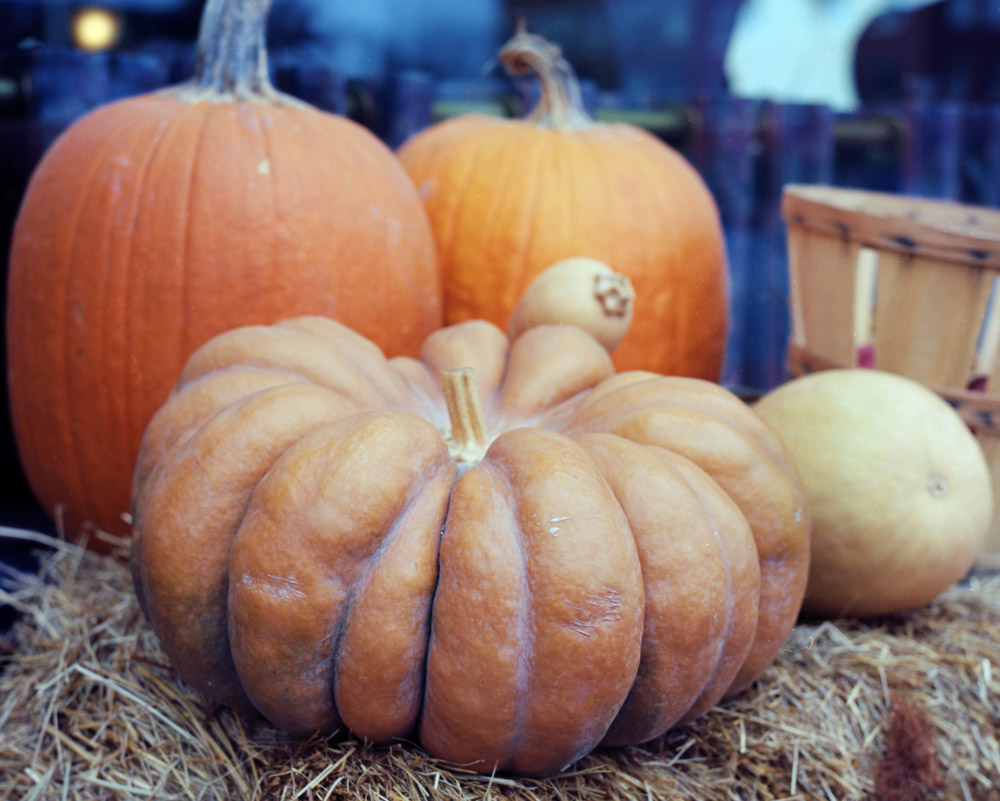
Pumpkins
Number 20, Chambersburg Street
Getty's Hotel Canopy
Getty’s Hotel Canopy

I had just taken this photo and was walking back toward the main square (aka “the diamond” in local parlance – that’s a whole other story) when I ran into someone who recognized my camera as a Rolleiflex, and who had one (actually several) himself. I explained to him that servicing them to get them back into good working order was not actually that expensive, and that he could still easily get film for them. I think (I hope, anyway) I inspired him to get his Rolleis out of the closet and put them back into service.

The “diamond” story:

I grew up just down the road from Gettysburg, in another southern Pennsylvania town storied in Civil War lore: Chambersburg. Like Gettysburg, it has a central town square, where the courthouse, a church, and a couple of banks are located. We always called it “the square”. Then, a couple of years ago, I went on a Civil War themed bus tour led by Ed Bearss, the historian and talking head (Ken Burns’ The Civil War and History Channel’s Civil War Diaries, among others). We were covering JEB Stuart’s raid on Chambersburg. When we arrived in downtown, he explained that the proper term for a town’s main square in that part of Pennsylvania was (and allegedly still is) “the diamond”. The squares are square, per se, formed at the intersection of two roads, which enter the square from the middle of each side, but in a gesture to ease of parking (originally buggies and horses, now cars), inside the square, the corners have been cut off, making a diamond-esque space in the middle. Thus the diamond. But I had never heard it referred to as “the diamond” in the first 39 years of my life until I heard Ed tell that story.
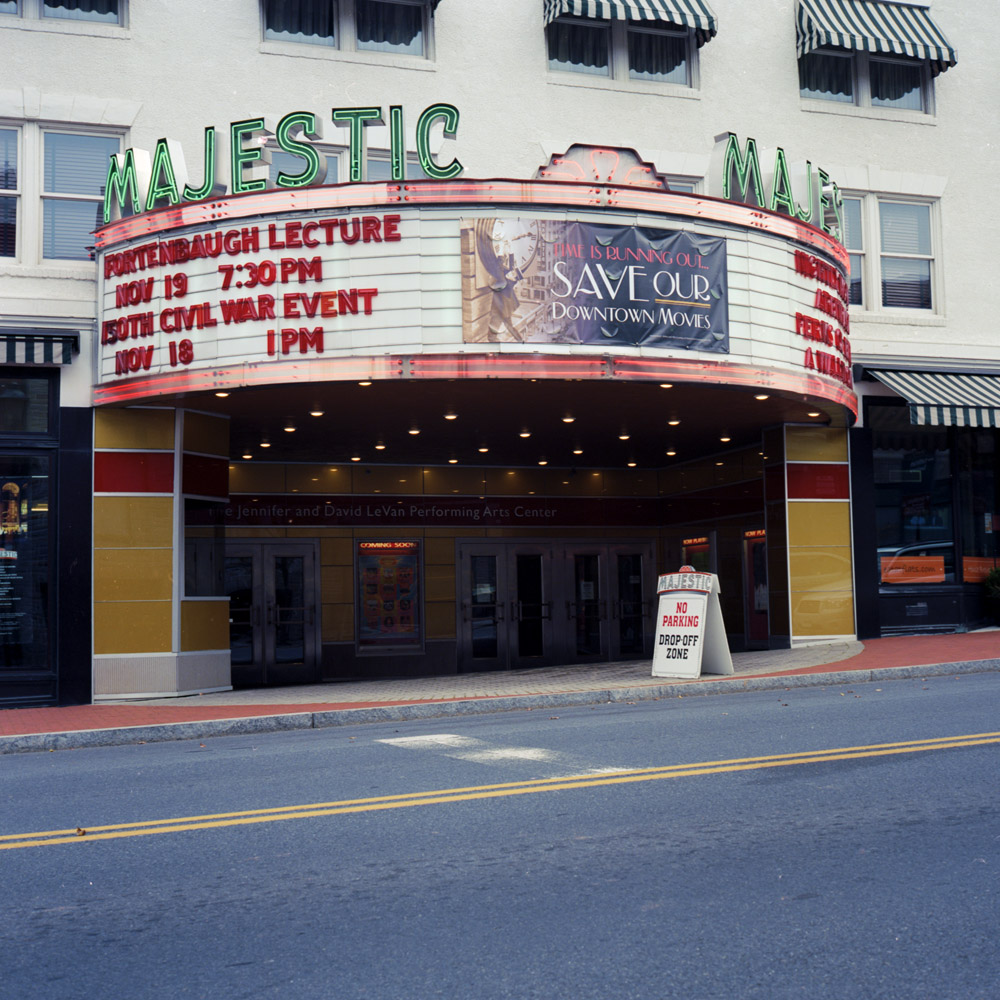
Majestic Theater, Gettysburg
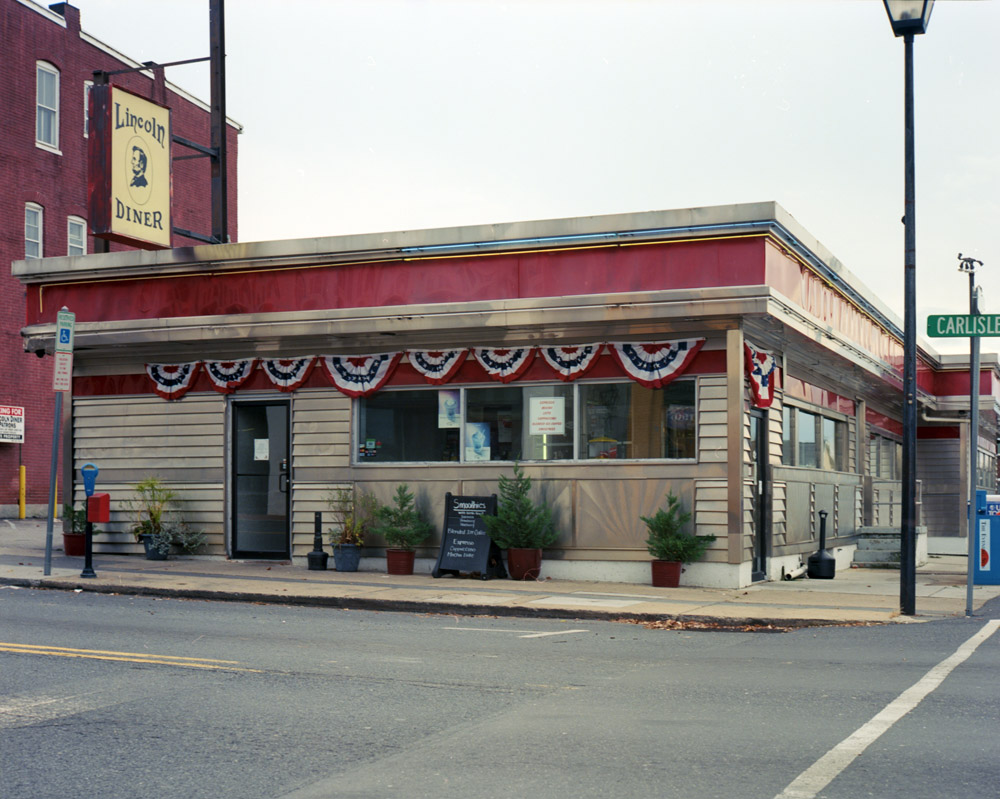
The Lincoln Diner
The Lincoln Diner
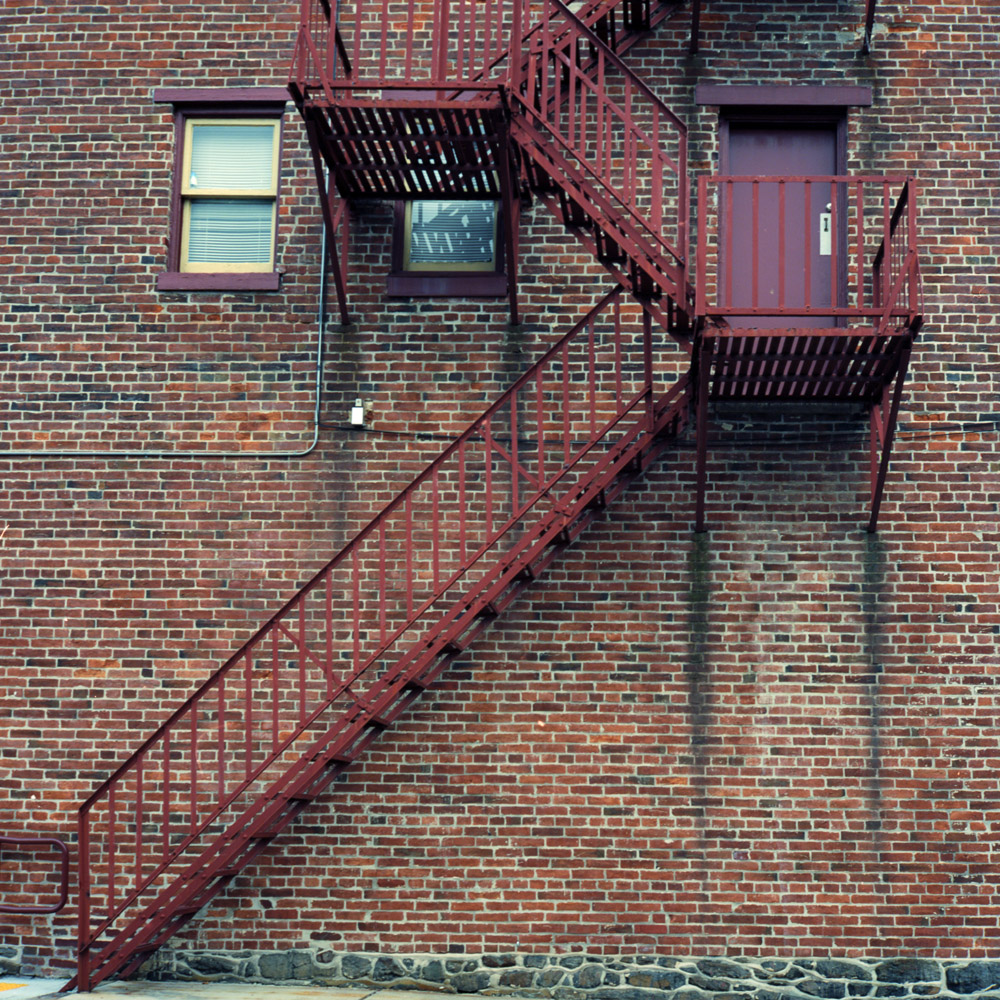
Fire Escape
Fire Escape
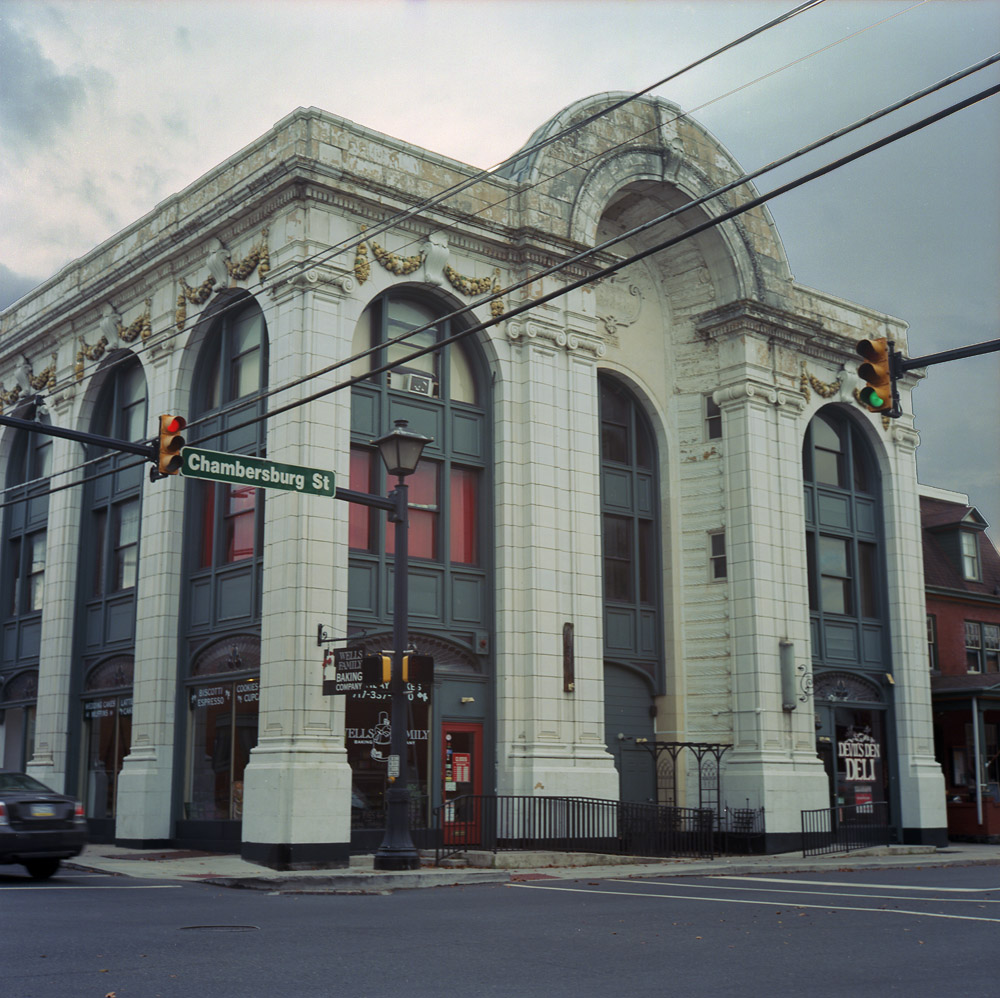
Chambersburg Street
Chambersburg Street
Gettysburg Dive Bar
Gettysburg Dive Bar

This is one of those places you see in so many small towns – the local dive bar, or “bar of shame” as I like to think of them. No windows that you can see in, which I suppose gives patrons an illusion of privacy. The ironic thing is that A: this bar is on the main street, just a block or so off the main square, and B: it’s a small town, so everybody knows everybody. If you enter this bar, the whole world is going to know about it.

Emmittsburg Road, Evening

The Emmittsburg Road, at evening time. I took this picture because it epitomizes Gettysburg, the battlefield, to me as much as any monument or marker or green bronze cannon. This is the gently rolling countryside where over three days in July, 1863, almost 50,000 men gave their lives.

Catoctin Furnace
Catoctin Furnace

Not actually in Gettysburg, but on the way home, is the Catoctin Furnace. This was an early ironworks, in operation from the late 1700s. Catoctin Furnace supplied the Continental army during the American Revolution, and the Union army during the Civil War. They would stack layers of charcoal, limestone and iron ore needed to produce finished iron into the furnace and let it burn, adding additional layers until enough molten iron was produced. Then a clay valve in the bottom of the stack would be opened and the molten iron bled off into sand-filled channels in the ground where it would form into pig iron bars. I’ve seen two explanations for the name, pig iron: one variation has it because of the shape of the bars after pouring, the other because of the sound the molten iron made as it ran into the molds.

All photos were taken with my Rolleiflex 2.8E, using Kodak Ektar 100.
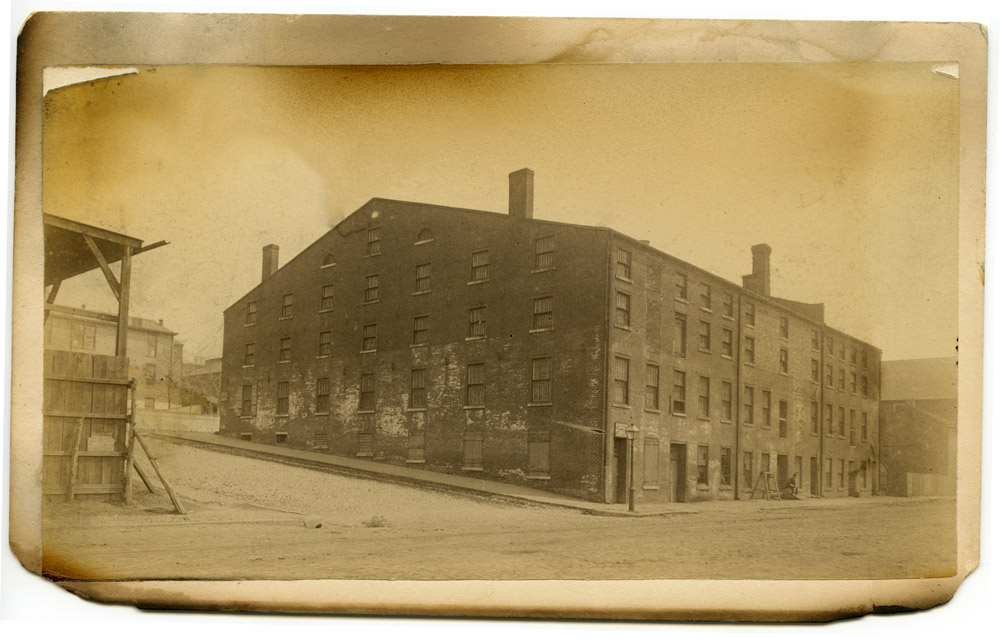
The Infamous Confederate Prison – Libby Prison, Richmond, VA

Here is a previously undocumented photograph of Libby Prison in Richmond, Virginia. The second-most infamous prisoner-of-war camp in the Confederacy (after Andersonville), it housed Union officers and had an appallingly high mortality rate. For more information on the prison and its history, check: Libby Prison.

This view is most probably post-war, as most of the photos of the building even in 1865 show the whitewash on the lower levels as intact, and the Libby Prison sign in place hanging over the downhill sidewalk from the upper street facade.

Libby Prison, Richmond, VA

After the fall of Richmond to Union forces, the prison was used to house Confederate officer prisoners of war, this time with greatly improved physical conditions to include windows with panes in them. Later, it became a museum, and was even dismantled and re-assembled in Chicago, but when it failed as a tourist attraction, the materials of the building were sold off as souvenirs.

As you can see the image was exposed to fire at some point, with scorching around the edges. I’m guessing the age to be between 1870-1880.

Here is a photo from the National Archives that shows the prison in 1865.

Libby Prison, NARA image, from Wikipedia

Washington DC in stereo

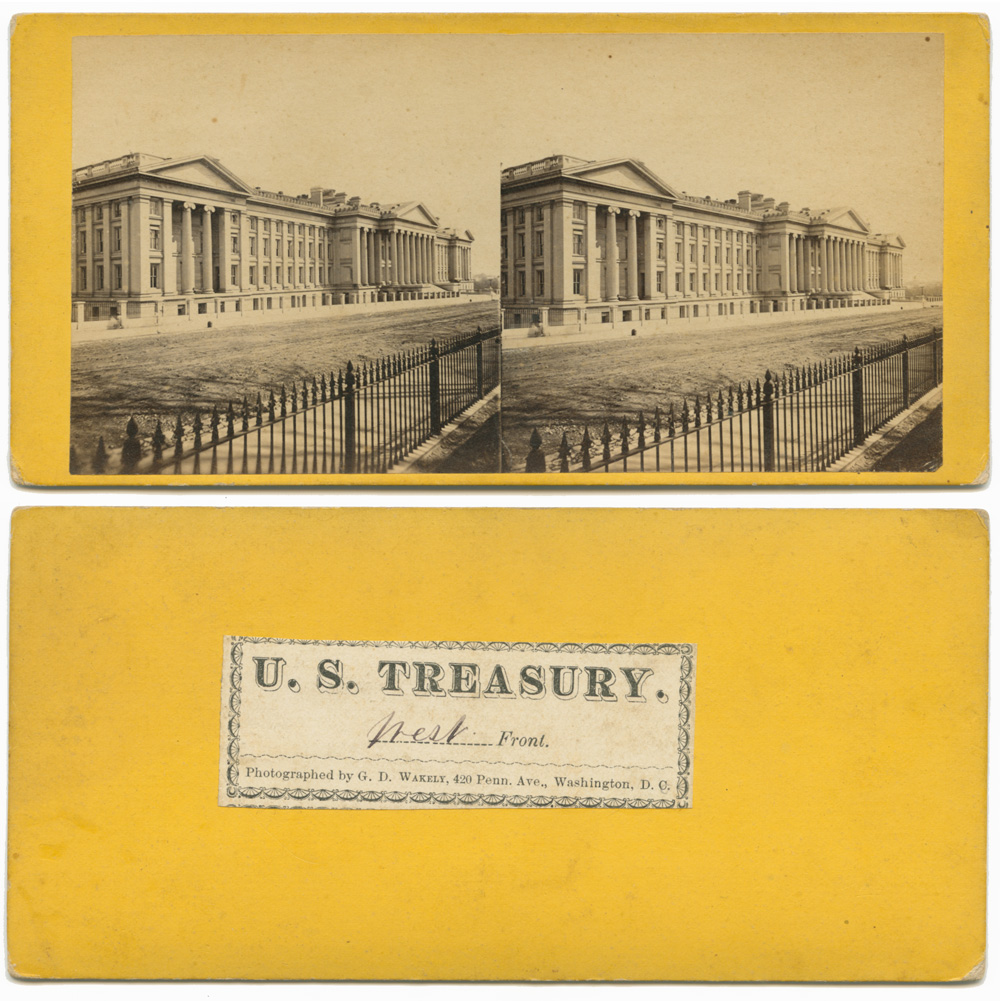
US Treasury Building

Quite possibly the oldest stereoview I have – I’d put this one at no later than 1870. This may have even been taken during the Civil War, although I think you’d have been hard pressed to find Pennsylvania Avenue that empty during the war. The area around the White House was even more the center of government at that time than it is now (now federal agencies are spread throughout the town and into the suburbs). The State Department was across the street to the north, and the War department was the other side of the White House. But Washington was a much smaller town in those days, and when Congress was not in session, half the town was empty.

More about the photo maps

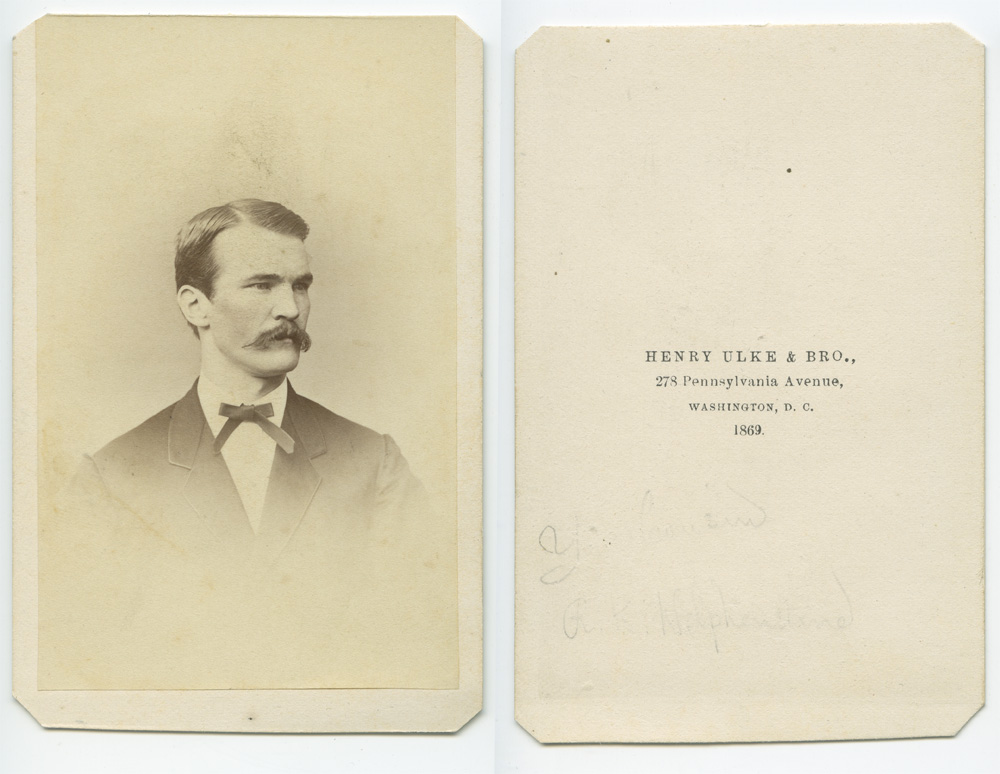
I was adding some more photographers to my maps (two more New York and one more DC), and I was re-thinking the addresses of some of the DC photographers. If I take as legitimate the KC Woodly studio address as ” 181 Pennsylvania Avenue, between 17th and 18th Streets”, then there was another studio that I had, Henry Ulke, at 278 Pennsylvania Avenue, that would make much more sense being between 18th and 19th Streets instead of more-or-less on the grounds of the US Capitol. I’ll have to do some research and see when the addresses on Pennsylvania Avenue stopped being split east/west of 16th Street. My guess is that it was sometime shortly after the Civil War, if my CDVs are anything to go by.

Busy Week in Collecting, Part 2 – various CDVs, including celebrity photos

Here for your viewing pleasure are three random CDVs. The first one I don’t have a lot to say about because the sitter is unknown. The photographer is William Shew, who began his photographic career on the East Coast, then moved out to San Francisco in 1851 to capitalize on the gold rush. He began his career as a Daguerreotypist, and his first studios in San Francisco were a mobile wagon parked in the plaza at Kearny between Clay and Washington streets – now Chinatown (which I hope to photograph the location as it appears today while I’m out in San Francisco on vacation). He was one of only three photographers in San Francisco at the time.

Anonymous CDV by Willam Shew, San Francisco

The next pair of images come from the mid-19th century cult of celebrity. Although both cards are not marked as to their photographer, there is a good probability that they were taken by the Brady studio, which was known for such subjects, and both had been photographed on other occasions by Brady. The first is Henry Ward Beecher, the prominent preacher and abolitionist and brother to Harriet Beecher Stowe, author of Uncle Tom’s Cabin and according to Abraham Lincoln, “this little lady whose book started this great big war”.

CDV of Henry Ward Beecher, photographer unknown (probably Brady)

This one may NOT be Brady’s, because the set is so plain – even the hat stand/support prop is rather simple for Brady’s studio, and oftentimes public figures of Beecher’s status would be invited to sit for their pictures whenever they visited a new town. These cards were the sports trading cards/Tiger Beat posters of their day, and people would collect them in albums to show off when friends came to visit.

The last image is another of Commodore Nutt and a woman who is unidentified, but another little person. It MAY be Minnie Warren, sister of Lavinia Warren, ex-sweetheart of Commodore Nutt who went on to marry General Tom Thumb in the Fairy Wedding (see previous post), but she appears smaller of stature than Minnie. It is also NOT the Commodore’s wife, who while below average height, was not a dwarf. Again, an anonymous image, but very much in the same vein. It may be possible to identify the photographer from the backdrop of the image. The custom backdrops like this were often like fingerprints or signatures for individual photographers’ work – the painted backdrops were often custom-made and very expensive, so they show up over and over again.

Commodore Nutt and unknown little woman, Anonymous CDV (probably Brady)

Note the feet of the posing clamp stand showing from behind the girl/woman. I love finding images that show the stand – it’s a bit of a reminder how the image was made. These would all have been shot in daylight studios on wet plate collodion negatives, which meant that the subjects still had multi-second exposures to hold still for.

I’m BAAAACK! To posting that is…

It’s been a while since I added anything here, because I’ve been insanely busy dealing with a whole bunch of personal business (breaking up, evicting my ex, cleaning up the aftermath, starting dating again, reconfiguring my office, building a new home wireless network since the ex took the wireless router, getting nasty bronchitis, recovering from said bronchitis, etc etc you know…). I haven’t had a lot of time for collecting or thinking about it as a result. Well, the dust has settled and I’ve been casually acquiring an odd and end here and there, so I’m back to writing about it again.

One of the things that has interested me, and helped drive me into this whole civil war period image collecting thing, is my hometown – Chambersburg, PA. Chambersburg was perhaps the most trampled ground north of the Mason Dixon line during the Civil War. Prior to the war, John Brown planned his raid on Harpers’ Ferry while living there, and met with Frederick Douglass to discuss the plans (Douglass advised against attacking the federal arsenal). Jeb Stuart’s cavalry raided it for the first time in 1862. Then Lee’s troops passed through on their way to Gettysburg in ’63, and in 1864 General McCausland’s troops demanded a ransom of $500,000 in US currency or $100,000 in gold, which the town refused to pay, so it was put to the torch.

In digging around on Ebay, I found an image of a man who was born a few towns over from Chambersburg. That got me thinking about the old hometown, and I started searching for Chambersburg related stuff. I acquired a group of photos spanning a good 20+ years of work from a single studio, which in further searching on Ebay seems to have been the most prominent if not the only studio in town at the time.
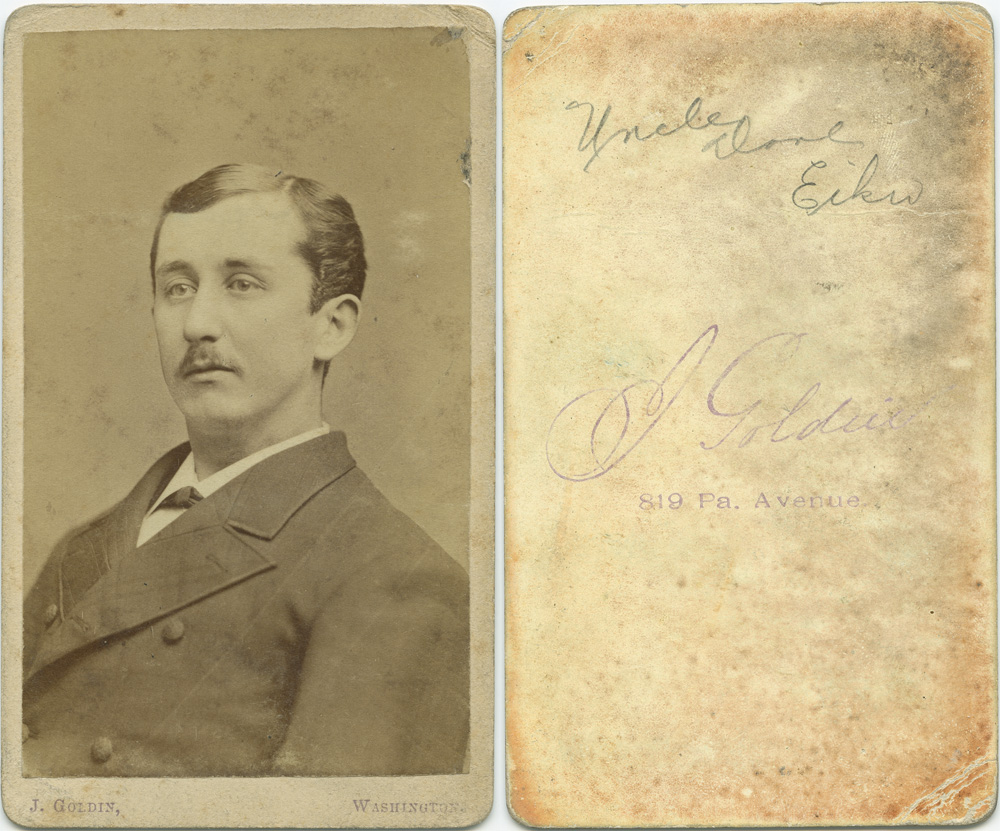
Here is the image that got me thinking about Chambersburg, a photo of David Eiker, born in Quincy, Pennsylvania. Quincy is a tiny one-stoplight town a few miles east of Chambersburg. This photo was taken at the J. Goldin studio in Washington DC.

Acquired at the same time was a more-or-less unrelated photo of a Mr. R.K. Hopkinson, taken at the Henry Ulke & Bro. studio in Washington DC. The common thread was the Washington, DC studio. Mr. R.K. Hopkinson Served in Company D of the 3rd Massachusetts Heavy Artillery during the civil war.

The Last Full Measure: Tintypes/Ambrotypes from the Civil War. Liljenquist Collection at the Library of Congress

For those who haven’t been following this, a few years ago the Liljenquist family (father and three sons) began collecting civil war cased tintypes and ambrotypes. They amassed a collection of over 700 images, of which approximately 10% have been identified. They range in size from 1/9th plate to 1/2 plate, and in subject matter from Union and Confederate soldiers to children, wives, mothers and family members in mourning, officers and enlisted and both slaves and freedmen. The collection is currently on display at the Thomas Jefferson building of the Library of Congress. Although small, the display encompasses some 300 images: some two hundred and fifty Union soldiers and their families and some fifty Confederates. One of the most striking images in the collection is the former slave and his family, a wife and two daughters, posed with him in Union uniform. It makes an interesting parallel that 150 years ago, this man was fighting for his freedom, and today, a very similar man with a very similar family sits in the White House, President of a nation radically remade by the sacrifices of that African-American soldier. Other highlights include the little girl dressed in mourning attire, holding a photo of her father who quite possibly she never knew, and the picture of the confederate soldier accompanied by a letter back home to his family describing how he died on the field of battle. A mourning necklace is also on display: the pendant is an oval gutta-percha case containing the photograph while the chain supporting it is woven of human hair, most likely from the woman who made it and whose husband is depicted inside the case.

The collection is astonishing in its scope and specificity, as well as for the collecting acumen displayed by the Liljenquist family. The family still collects at a furious pace, and so the Library has asked them to make their donations quarterly, instead of weekly as they had been doing, to give the curators time to catalog and preserve their donations. The collection in its entirety will be available online through the Library of Congress’ website in the near future.

Link to the collection: The Last Full Measure: The Liljenquist Collection at the Library of Congress

They also have the collection on display on the LoC Flickr feed entitled “Civil War Faces“. They welcome input from the general public as part of the effort to identify the subjects of the photographs.

General Joseph Hooker, by Mathew Brady

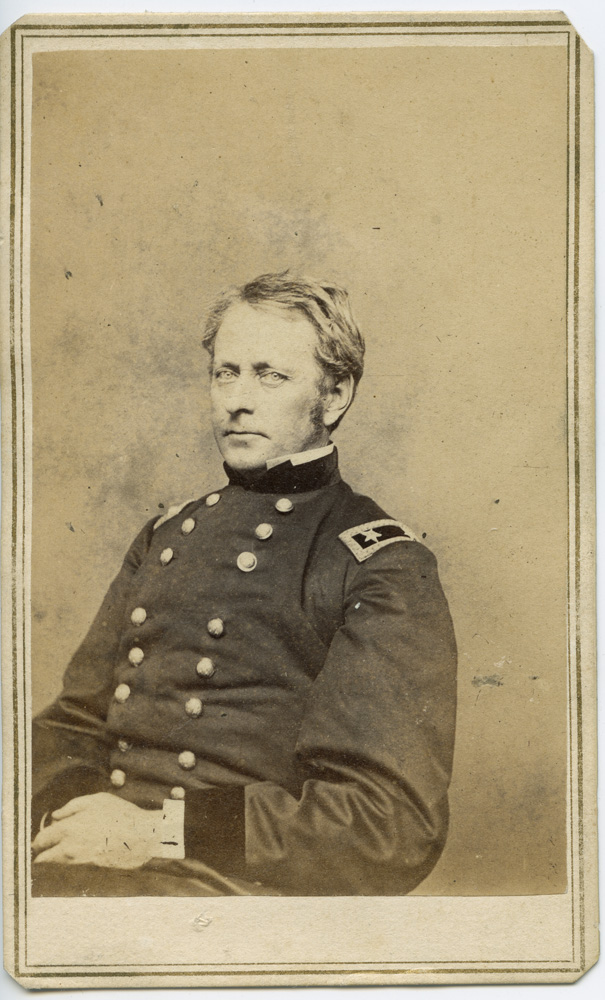
CDV, General Joseph Hooker, by Mathew Brady

This is an E&HT Anthony reprint of a Mathew Brady CDV of “Fightin” Joe Hooker, appointed by Lincoln to lead the Union armies after Burnside’s disaster at Fredericksburg. Hooker didn’t last long after, meeting his tactical doom at Chancellorsville. This is not a rare version of the image, but rather an 1860s equivalent of a celebrity collector card – people would assemble albums featuring the politicians, generals, stars of the stage, and other celebrity types (Barnums’ Circus freaks, writers, poets, and so on). Unlike today where people, mostly teenagers, collect pictures of their favorite stars, in the 19th century it was not uncommon to find these cartes mixed in with the family album, and collected by the senior members of the family, not just star-struck children.

Victorian Era Photography Studios in New York

I’ve begun a project to catalog and map the locations of Victorian-era photography studios in Washington DC, New York and Philadelphia. Using my own collection as a starting point, and skimming back-marks off cartes-de-visite and cased images on Ebay, I’ve come up with some lists, and I’ve begun to put them on a Google Map. Here is my New York list:

STUDIO NAME ADDRESS DATES OF OPERATION
R.A. Lewis 152 Chatham Street * unknown
K.W. Beniczky #2 New Chambers Street, corner of Chatham * unknown
R.A. Lord 164 Chatham Street * unknown
Bogardus 363 Broadway 1860s
Bogardus 872 Broadway late 1870s
Mathew Brady 359 Broadway (1853-1859)
Mathew Brady 643 Bleeker Street (1859-1860)
Mathew Brady 785 Broadway (1860-)
Chas. K. Bill 603 Broadway unknown
J. Gurney & Sons 707 Broadway unknown – early
J. Gurney & Sons 5th Avenue & 16th Street unknown – late
Glosser 827 Broadway unknown
Vaughan’s Gallery 228 Bowery unknown
Bailey’s Photograph Gallery 371 Canal Street unknown
Loud’s Celebrated Album Cards unknown unknown
Fernando Dessaur 145 8th Avenue unknown

* addresses no longer exist. New Chambers Street & Chatham Street are now approximately where New York City Civic Center and Police Headquarters are now located.

I will be doing the same for Washington DC and Philadelphia as I gather more information. These lists are obviously incomplete – if anyone has more information out there on other studios not captured on this list, please pass it along! My interest is in studios operating before 1900, ideally before 1880. If you have information about a given studio during the Daguerrian, wet plate, and the early Dry Plate eras, please include that as well. In my simplistic research, I’ve been finding that along with the change in media, studios moved around a lot – Mathew Brady had four different locations in New York City alone between 1850-1860.