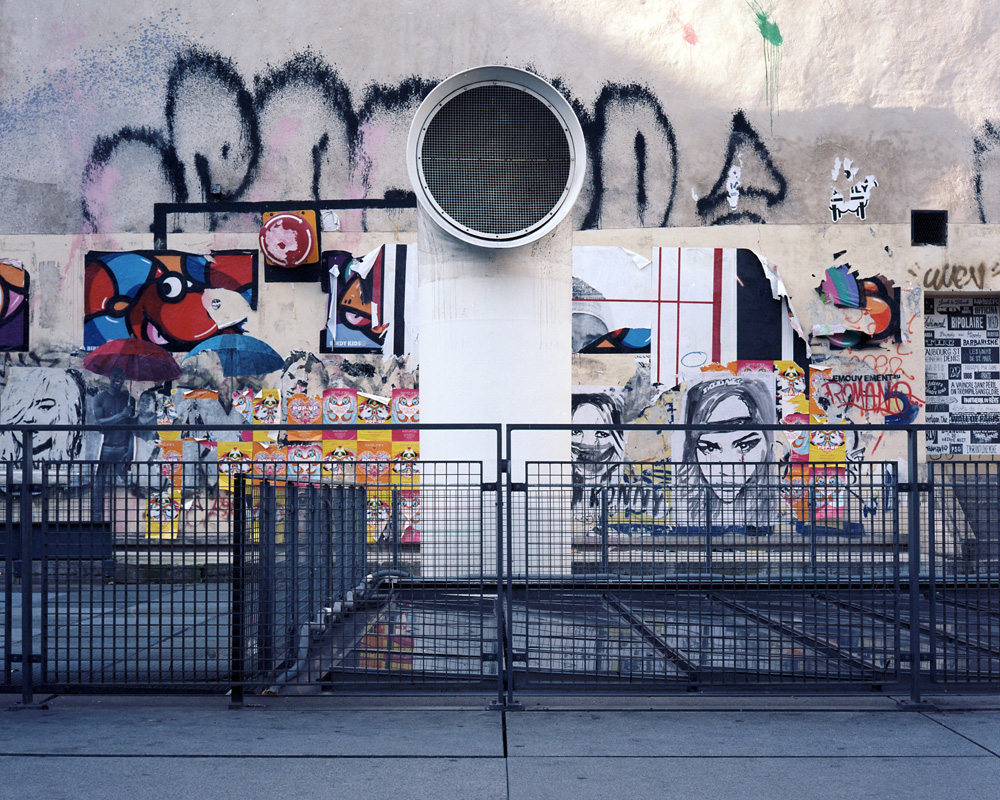
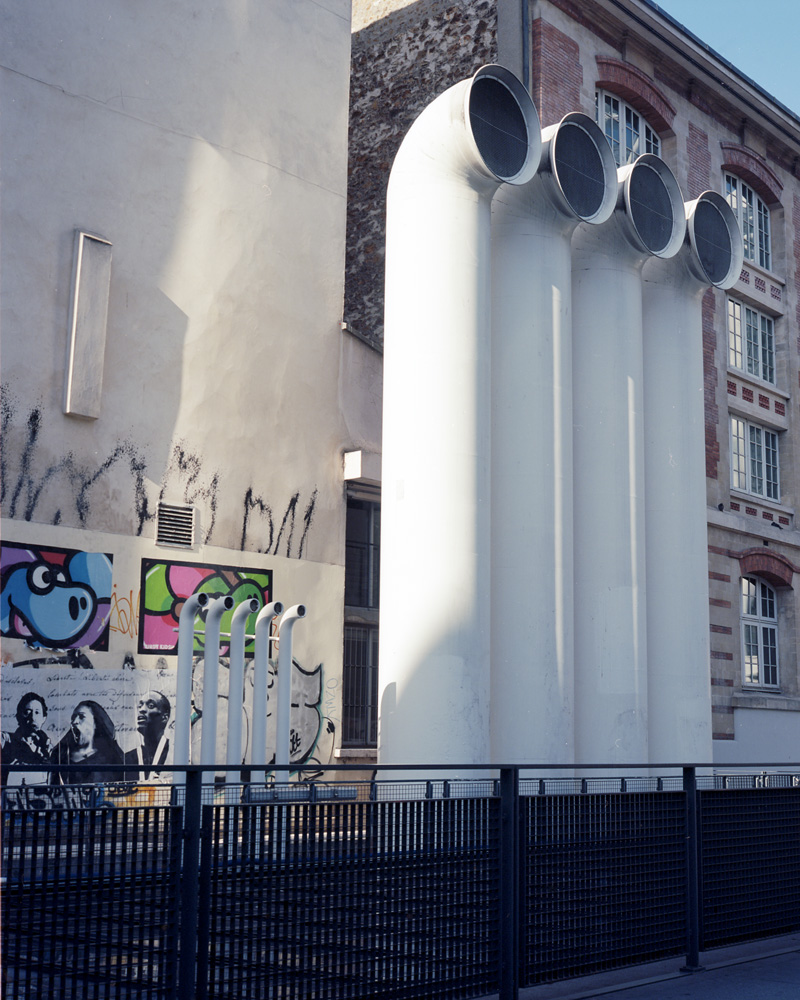
The Pompidou Centre is a massive modern art and culture facility in central Paris, on the western edge of the Marais district. Its architectural claim to fame is that it was designed with all its systems (heating, cooling, plumbing, visitor circulation, etc) exposed on the outside of the building, a sort of deconstruction of the notion of architecture. This, in addition to being an interesting concept, gives it another claim to fame: being perhaps the single ugliest piece of modern civic architecture known to man. And in a world where Brutalist architecture exists, this is no mean feat. What this does do positively, however, is provide a venue in which urban street art has a genuine, appropriate, sanctioned environment in which to exist. The wild vibrant gestural organic nature of street art contrasts with the highly composed, almost abstract structure of the ventilation and exhaust pipes and the security fencing around their access points.
Lone Exhaust, Pompidou CentreExhaust Stacks, Pompidou Centre
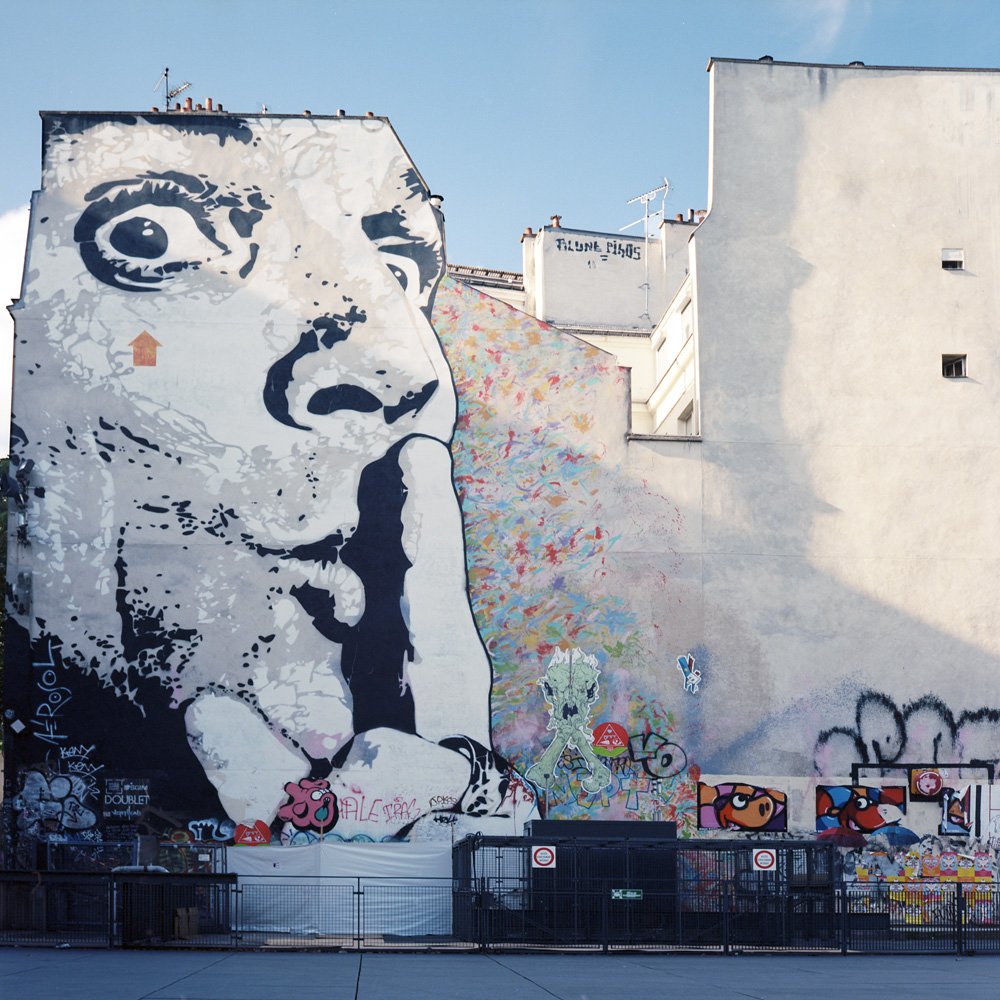
Street art has even been allowed to take over the stuccoed side of an existing 18th century building in what appears to be an homage to Salvador Dali.
Street Art, Pompidou Centre
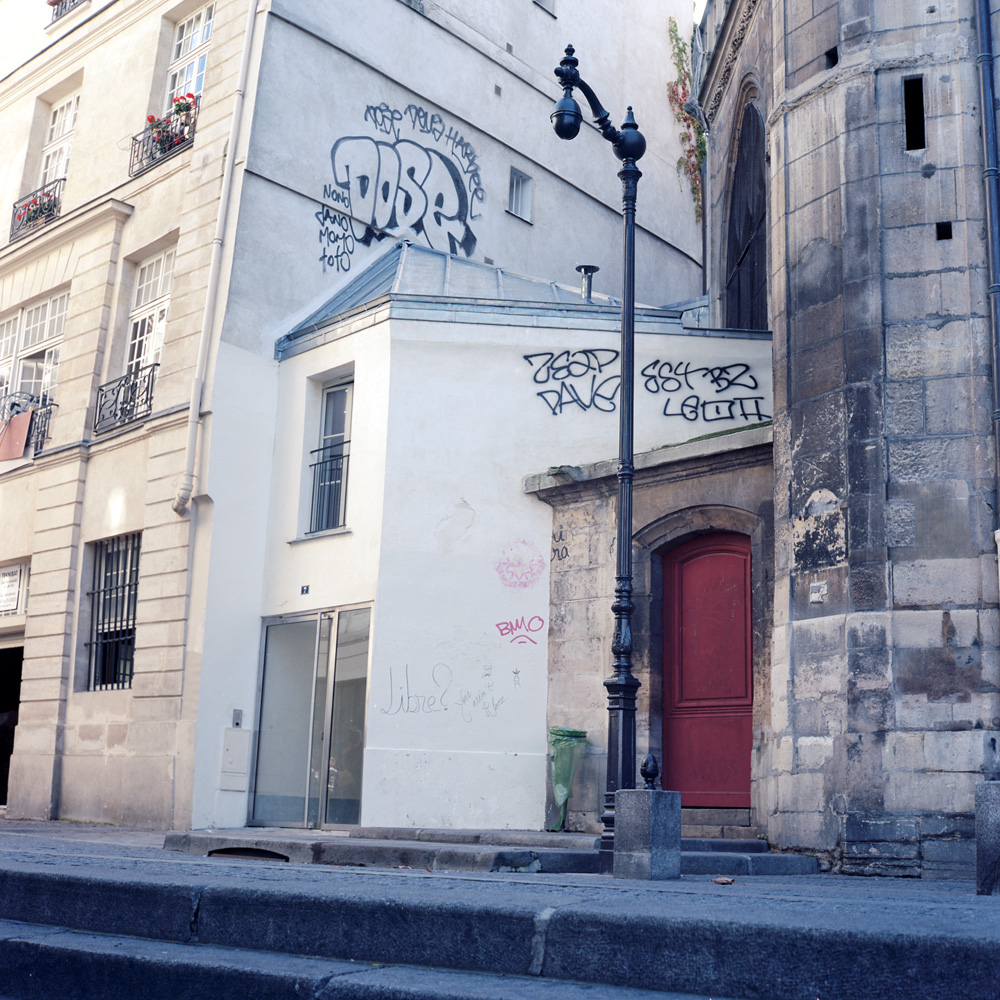
Of course this doesn’t entirely stop unsanctioned street art or even just flat-out graffiti of a very pedestrian variety from cropping up around it. Graffiti aside, I thought this little house squeezed in between the gothic church and the later townhouse was fascinating – I could actually see setting up a small studio on the ground floor and living in the room above it.
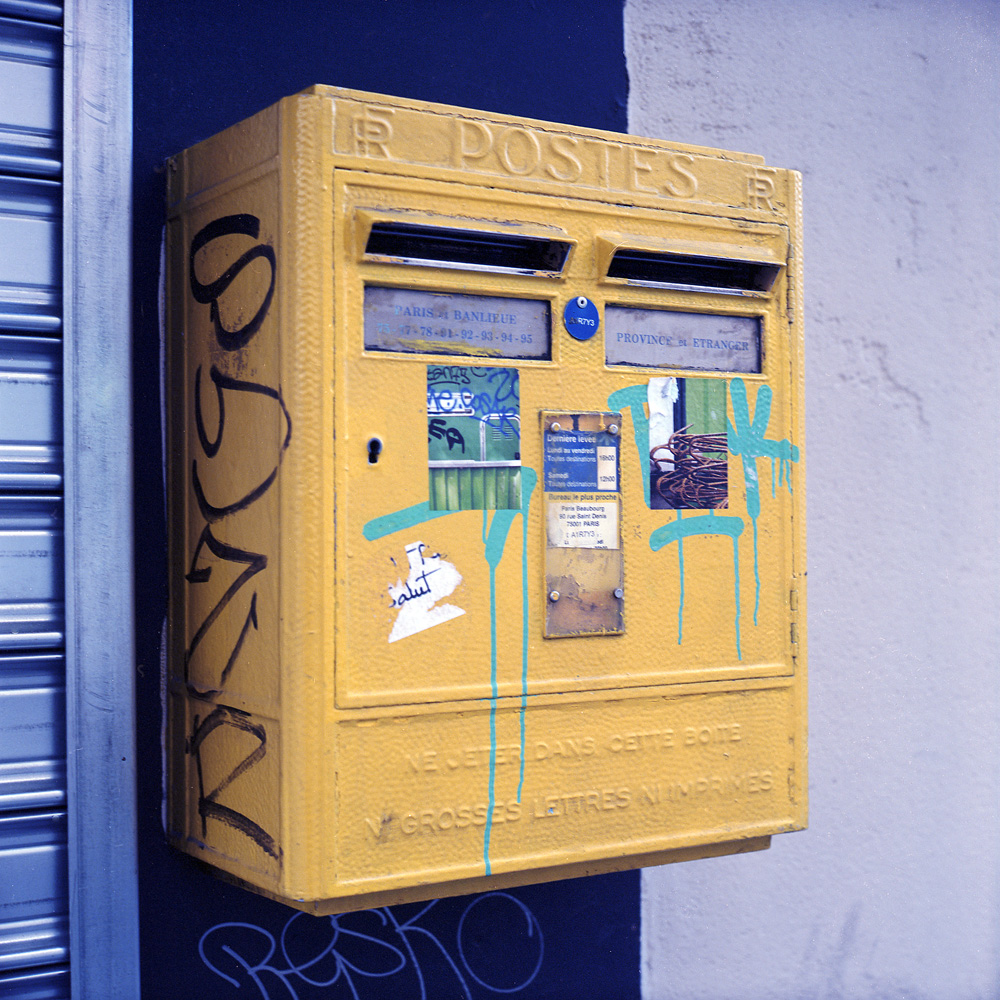
I’ve been making a habit of photographing things we see every day but take for granted, like mailboxes and fire hydrants. I couldn’t pass up the bright yellow mailboxes of Paris, and especially not this one that has been so overtly decorated with graffiti. I think I got lucky that this one was on a dark blue background at least in part, to set it off and compliment it.
Yellow Postbox, Paris
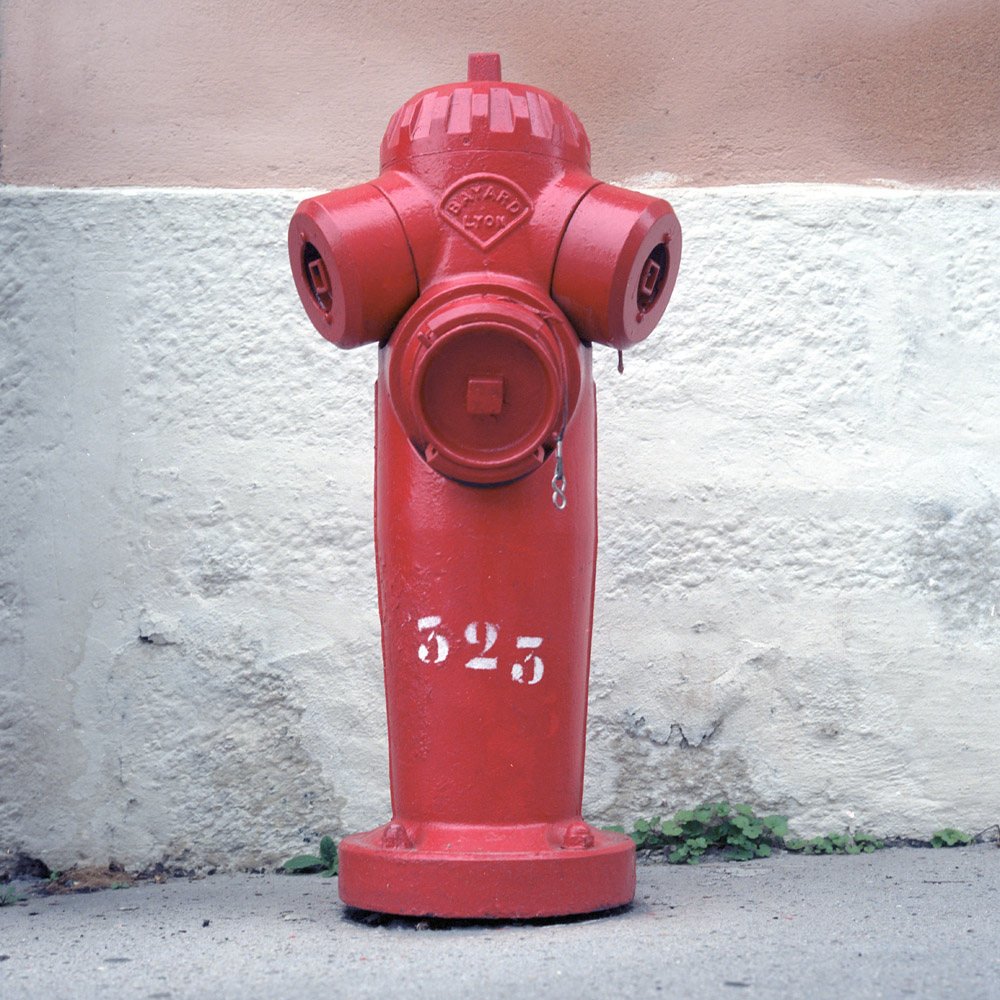
I know, I know, the hydrant from Chalon already made an appearance, but it was soooo long ago I figured you all had forgotten it, and it also fits the theme of “things”, especially brightly-colored things that we see but take for granted. So here it is.
Hydrant, Chalon
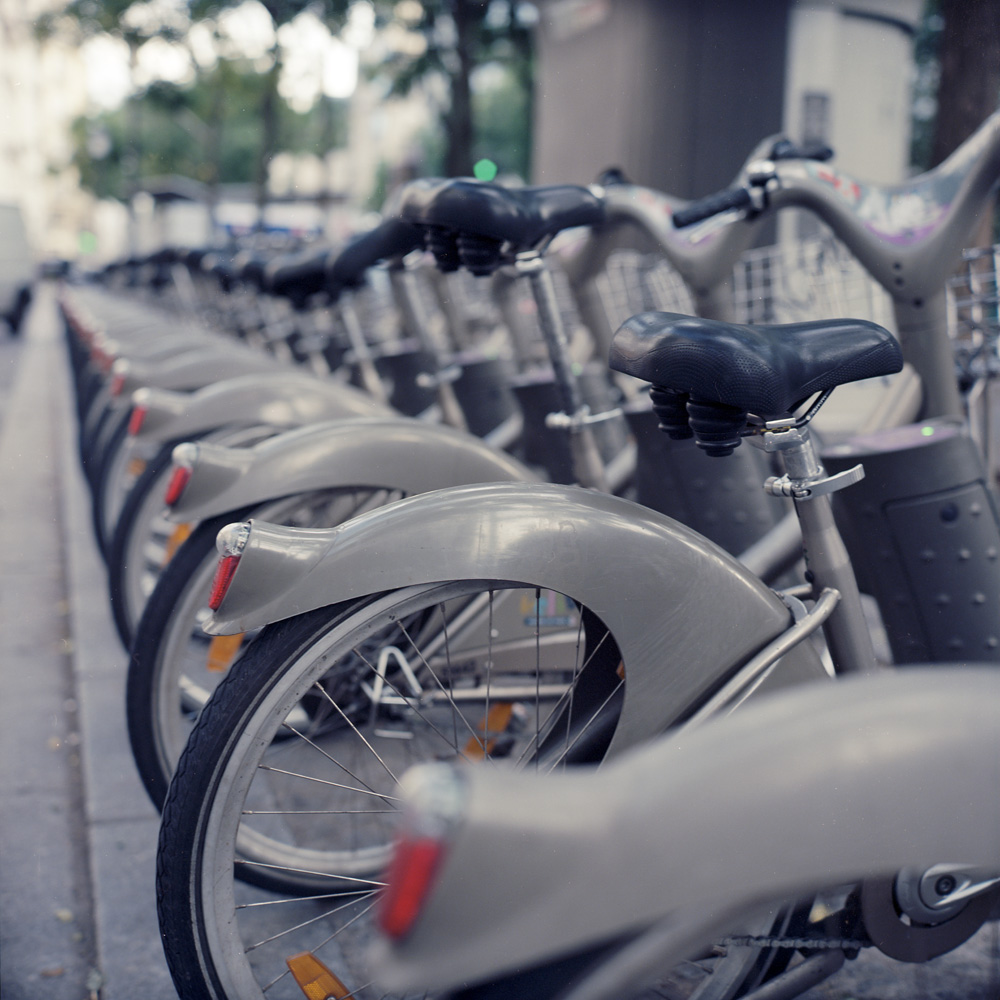
I’ve also been photographing the bikeshare bikes in DC, so I had to take a crack at interpreting their French cousins. Unlike here in the US, the bikeshare bikes seem to be of a single universal design in France. In Paris and in Chalon they are the same design, with the same colors, the prime difference being in the logos on the rear wheel cover and the local advertising. Frankly I could have done an entire photo-essay on the bikeshare bikes but I had other things on my agenda.
Ve’Lib Bikeshare
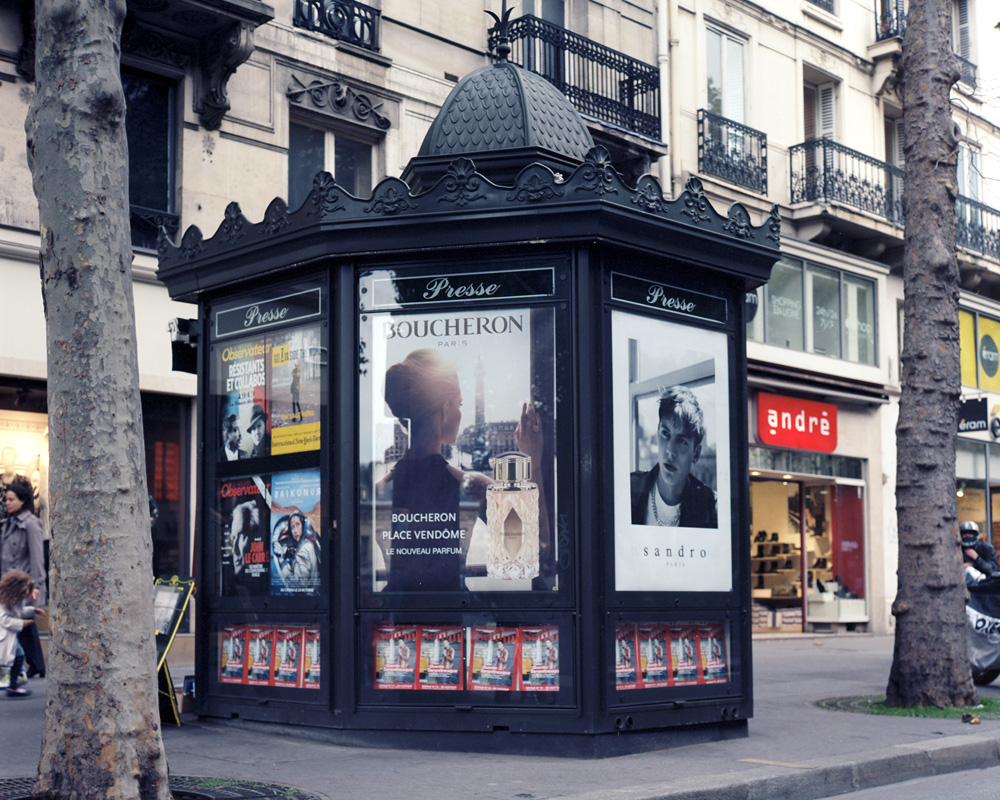
Newsstands fall into that category as well, I think, of things we see but ignore. They’re very functional, and in places that have them, we tend to notice their presence/absence more than we do their form. This one is very Parisian, but with a modern twist – instead of having static broadsides plastered to the outside, now the ads are LED displays or at least rotating banners so in the span of a minute, you can see three to five different ads scrolling past.
Newsstand, Boulevard St. Michel, Paris
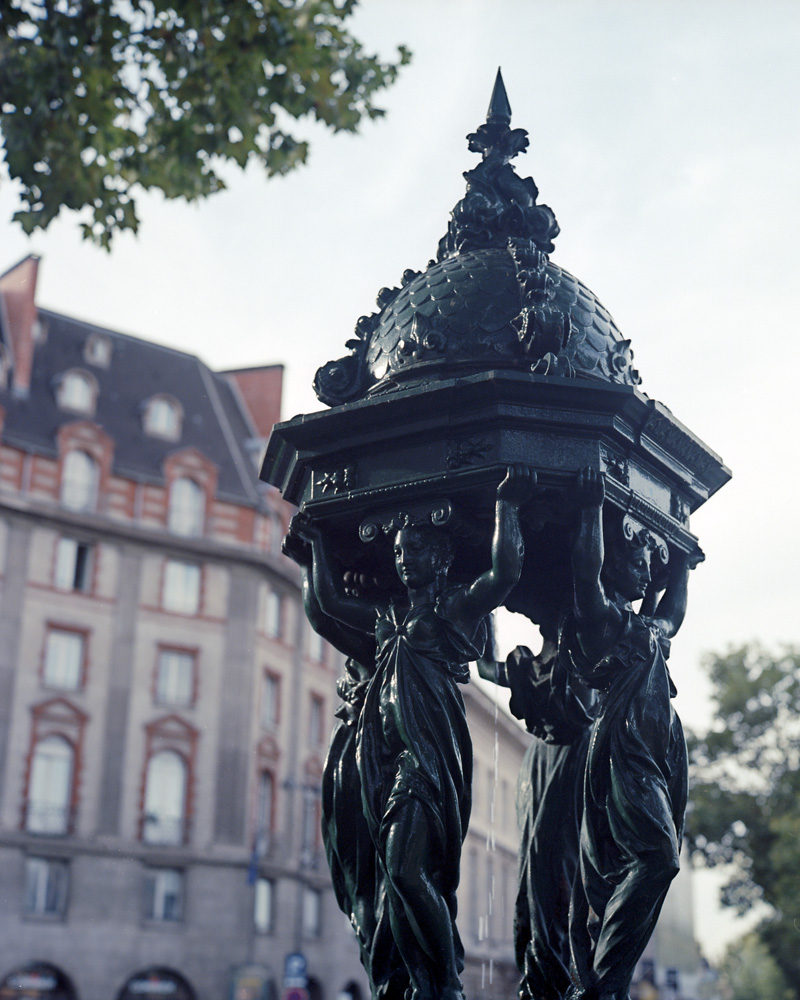
Last but not least, here is a public drinking fountain. I tend to notice them because here in DC for the most part if they exist at all they don’t work. In the 1870s, Baron Haussmann installed public drinking fountains across the city as part of a sanitation campaign, bringing fresh, clean drinking water to everyone. The design of the fountains was suitably ornate, bringing beautification along with safety.
I apologize for the randomness again. It kind of reflects my own state of mind at the moment anyway. But here’s a few more scenes from the Ile de la Cité.
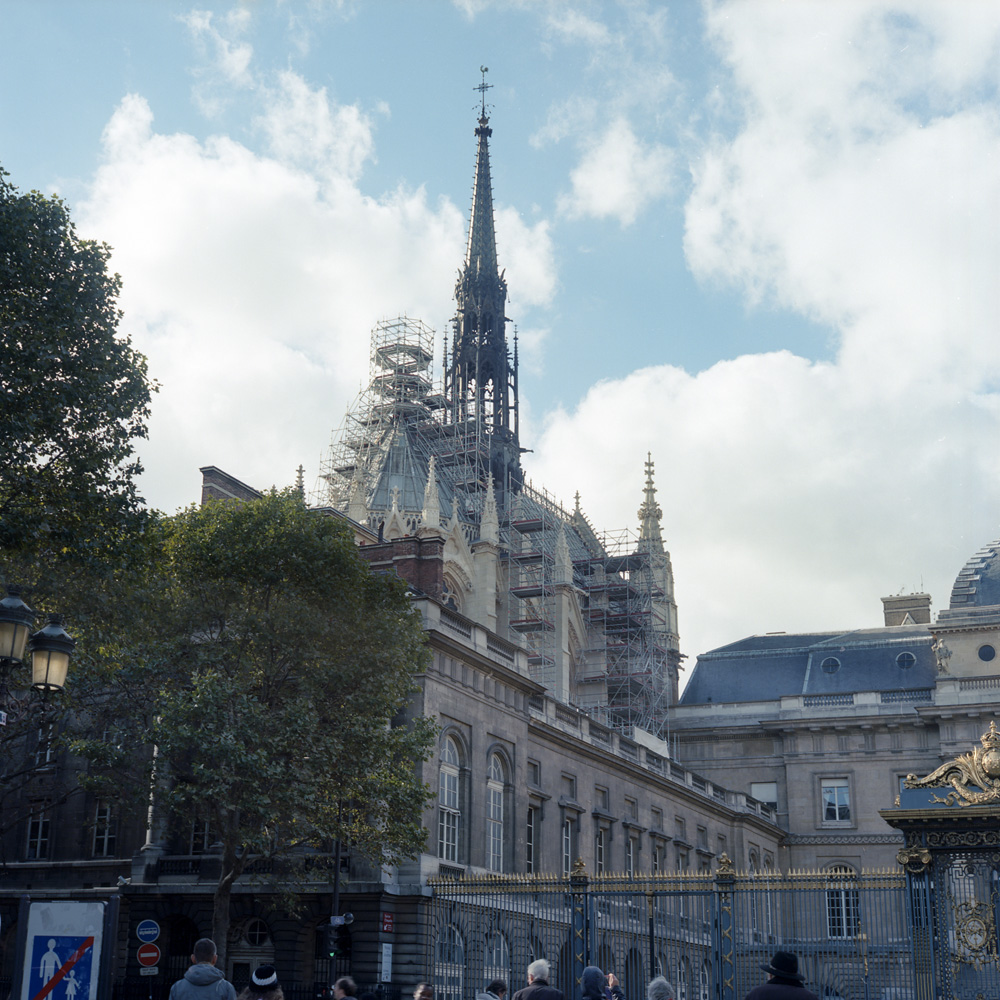
The Sainte Chapelle is inside the compound of the Conciergerie (the prison where Marie Antoinette and Louis were held prior to their execution) and the modern day Palais de Justice. Here you can see the Sainte Chapelle from outside the gates of the Palais de Justice. The spire is a later 19th century re-creation of the original which was torn down during the French Revolution.
Sainte Chapelle Exterior
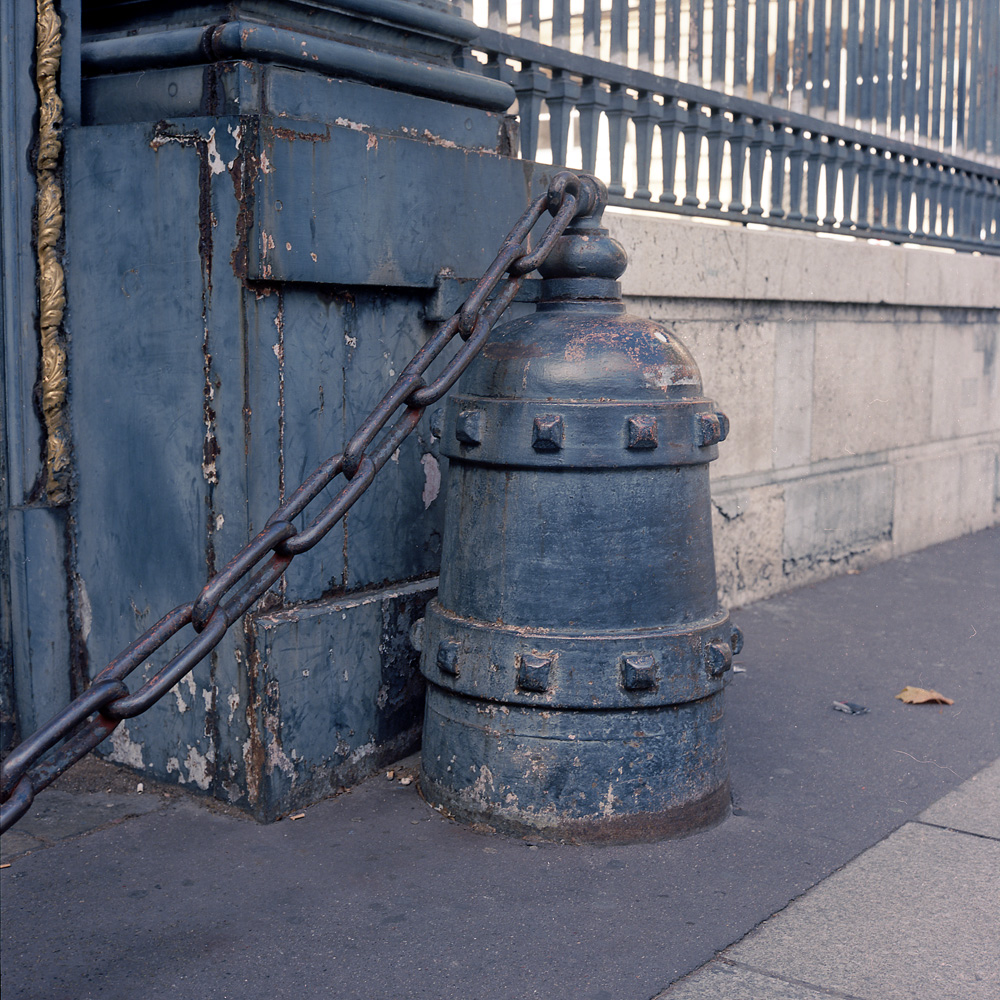
I don’t know the source of my fascination with safety bollards as photographic subjects. Maybe its because they’re such ordinary things with a very important purpose that we tend to ignore. I guess I empathize with the bollards.
Bollard, Palais De Justice
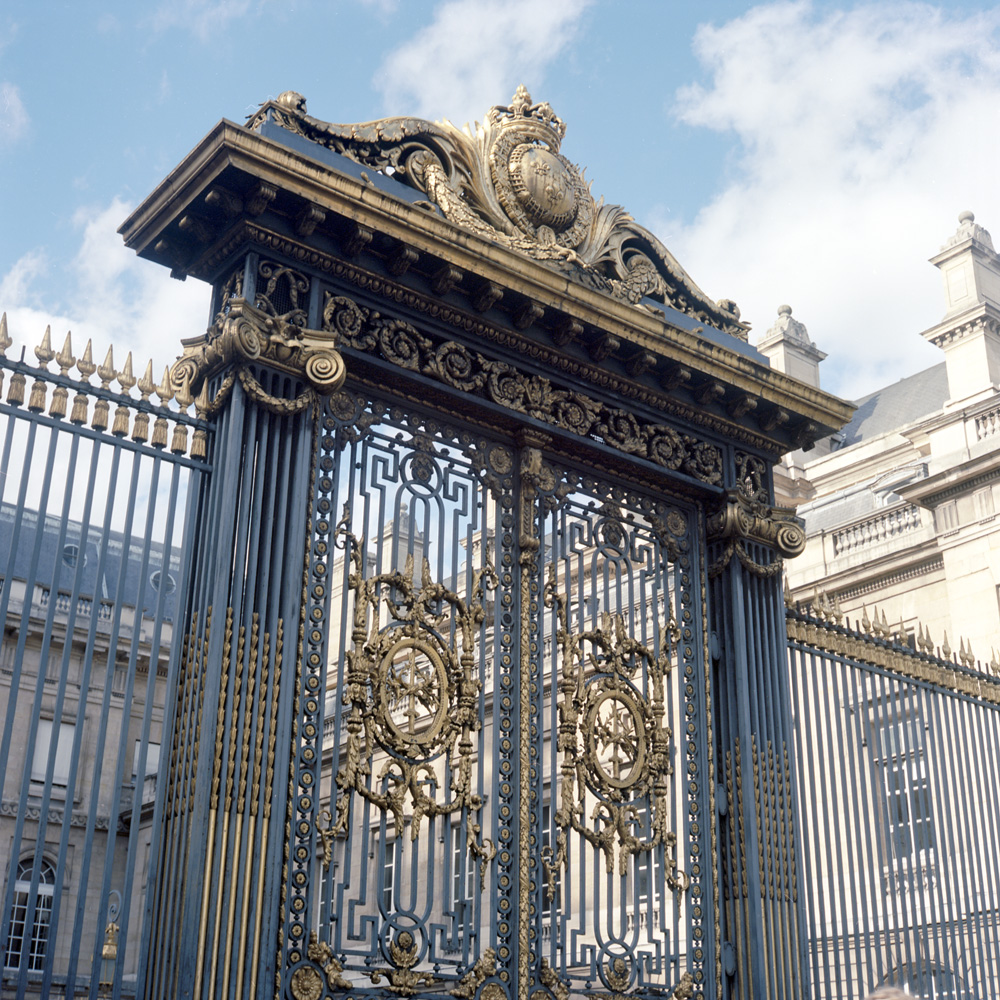
The gates to the Palais de Justice. When I was there, unfortunately, the Conciergerie museum was closed for renovations. This seemed to be an unfortunately frequent occurrence in Paris – a number of museums were closed for renovation work: the Conciergerie, the Musee Chatelet, and the Picasso, to name the most notable.
Gates, Palais De Justice
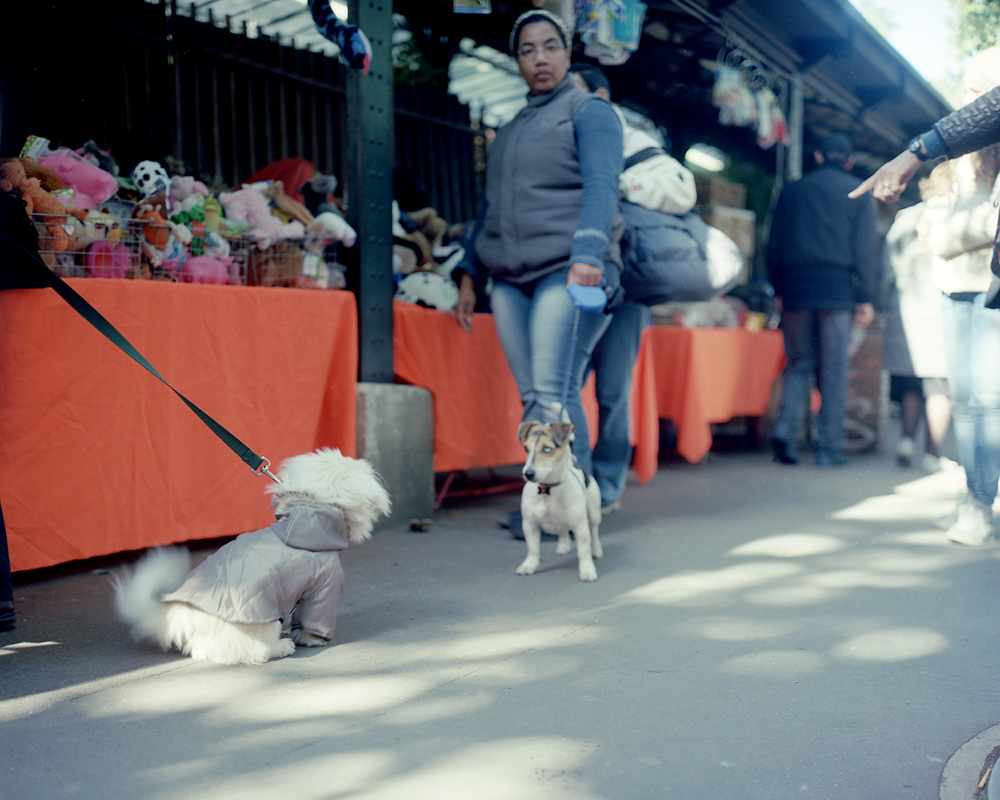
Here are the photos I mentioned a couple posts ago when talking about the Metro stop for Ile de la Cité. There’s a little open-air market they have set up right across from the exit where they sell pet supplies, flowers, and other various and sundry items. Here are two little dogs out for a walk in the pets section who were straining to take a look at one another.
Parisian Puppy Confrontation
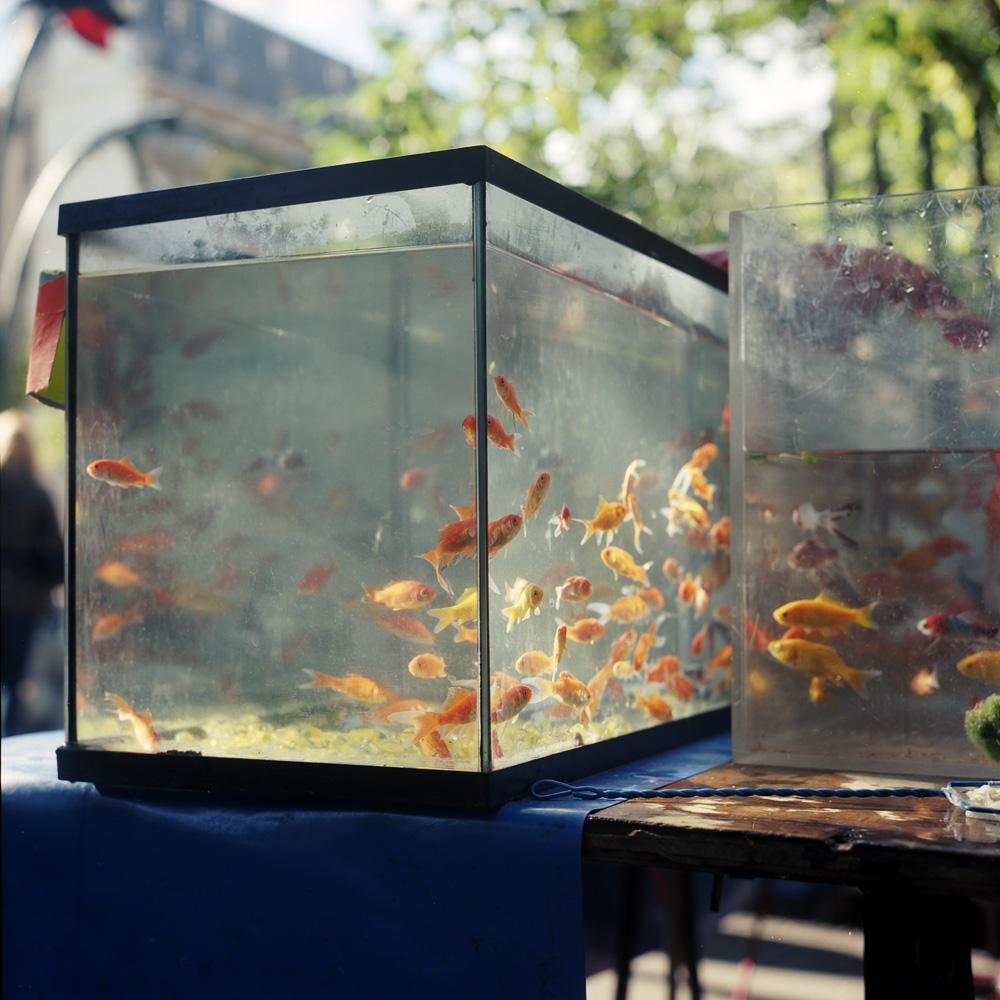
And last but not least, I just loved the way the light was making the goldfish in the tanks glow.
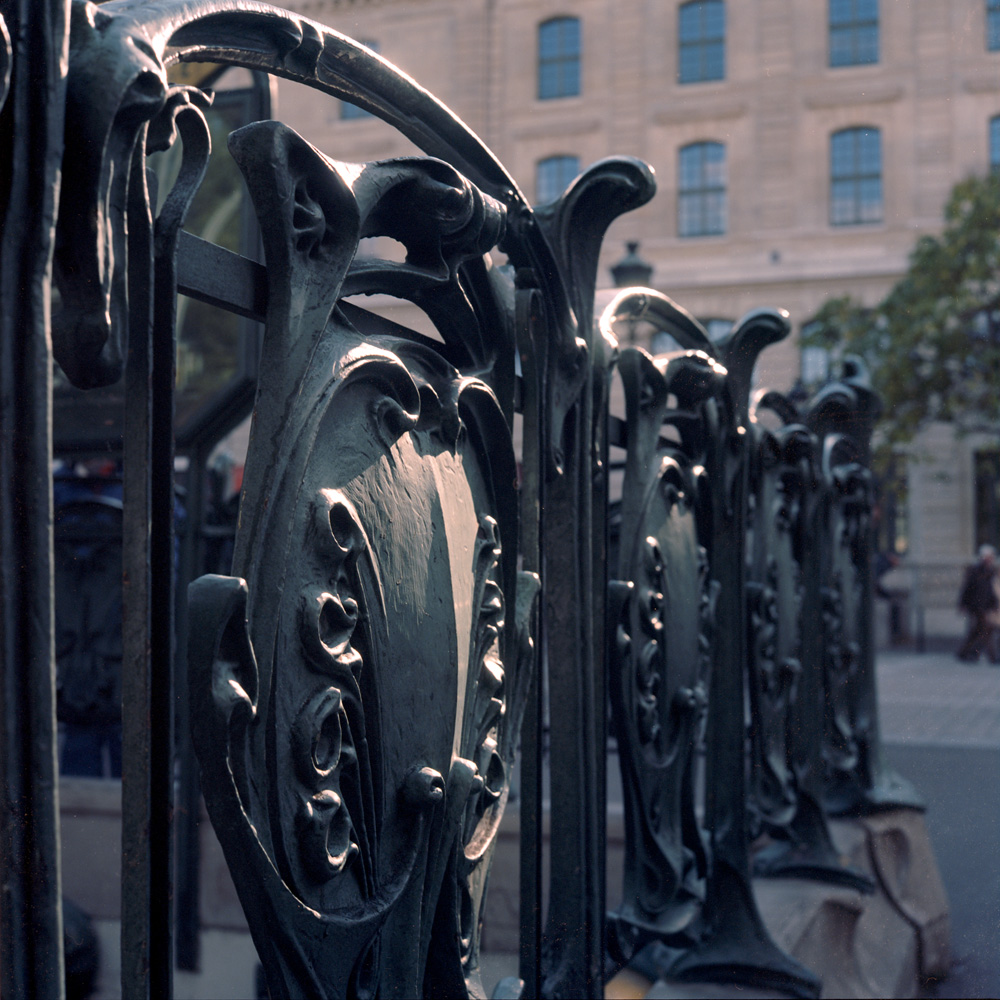
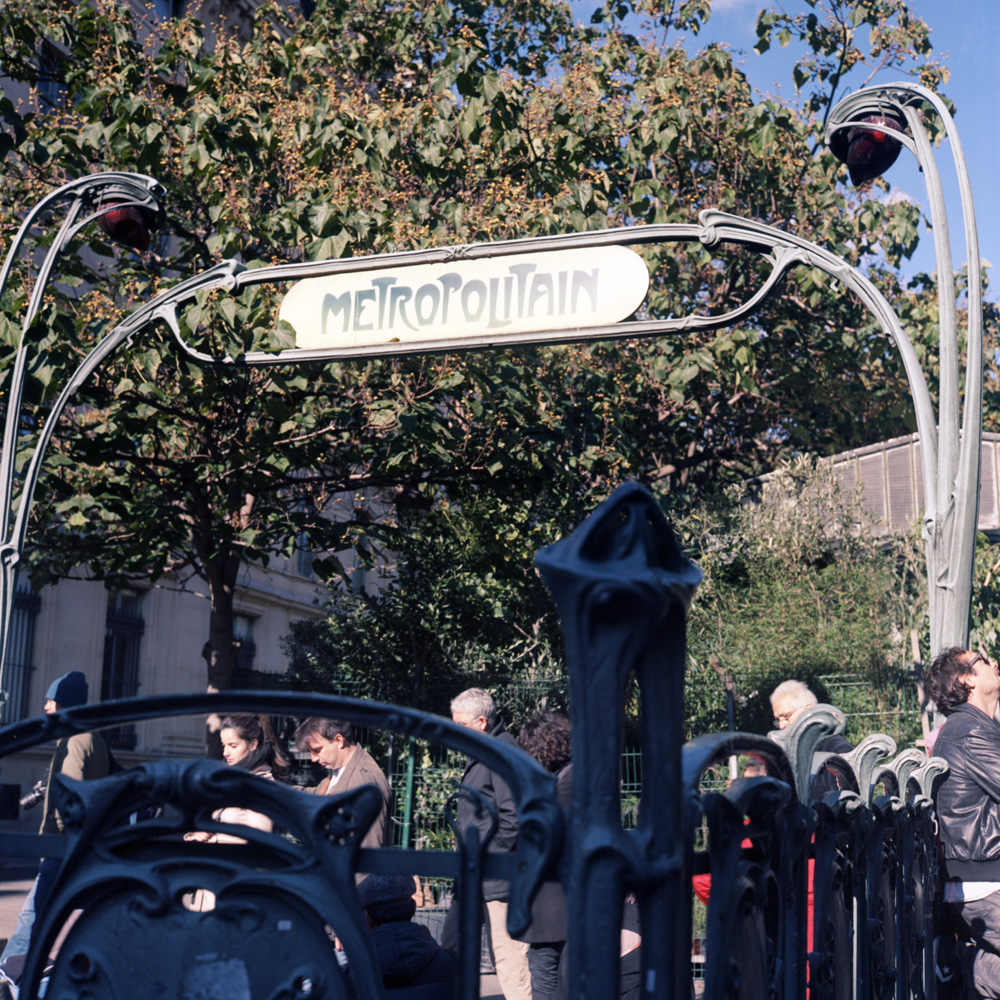
The old part of the Metropolitain subway system in the city center of Paris is famous for the art nouveau railings and signs at the station entrances. I know I put a couple of photos in an earlier post about Transportation, but these three are specifically about the entrance railings and signs.
Art Nouveau Rail, Cité Metro
The railings LOOK to be bronze, from the patina, but I would suspect that they’re iron that has been painted. Bronze would make them extremely expensive, but then again, when you look at how lavish the French were in their public buildings in the late 19th century, it’s not inconceivable.
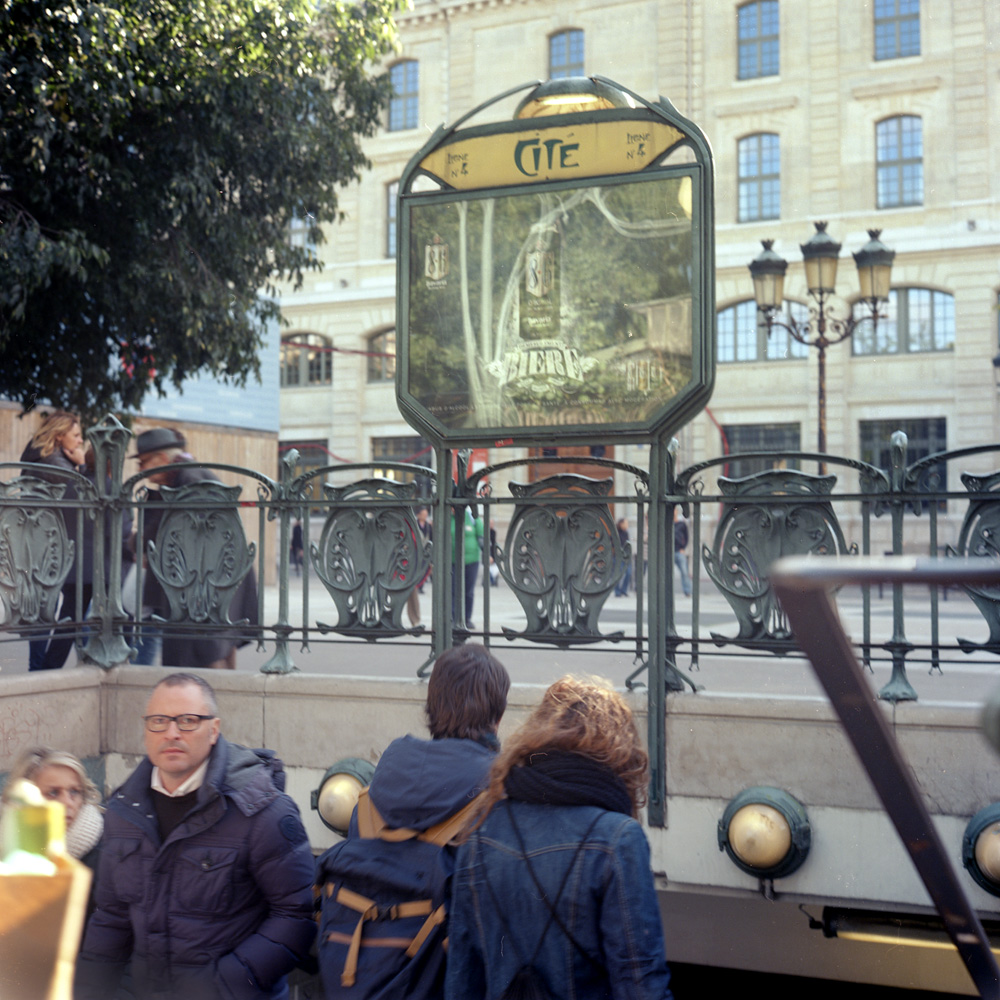
The entrance to the Ile De La Cité metro stop. This is where you get off the train to go see Notre Dame and Sainte Chapelle. Immediately across from it is a little open-air market which has flowers and pet supplies. I have two pictures from the market of two little dogs staring each other down and goldfish in a tank from the market, going into another post.
Cité Metro Entrance
The most famous sight of all – the Metropolitain sign. There is a replica of one of these in the sculpture garden on the National Mall between the National Gallery of Art and the Natural History Museum here in Washington DC.
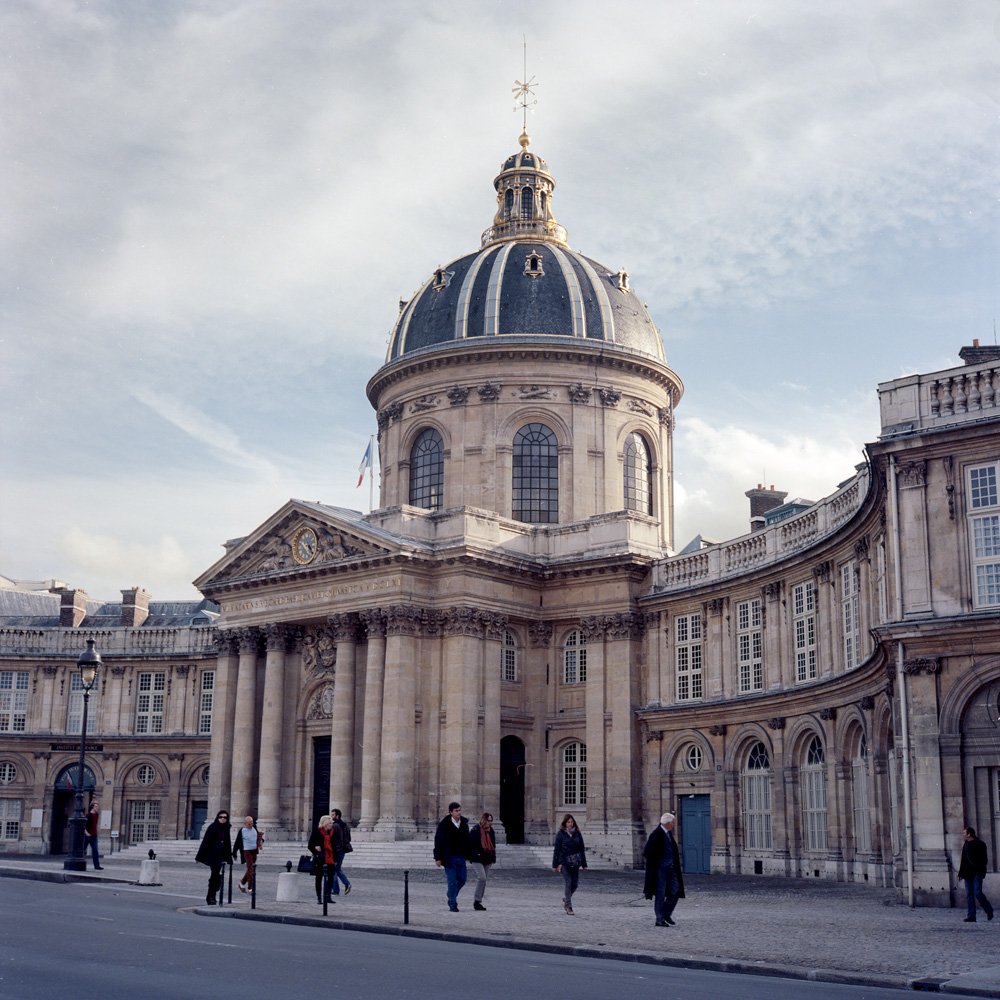
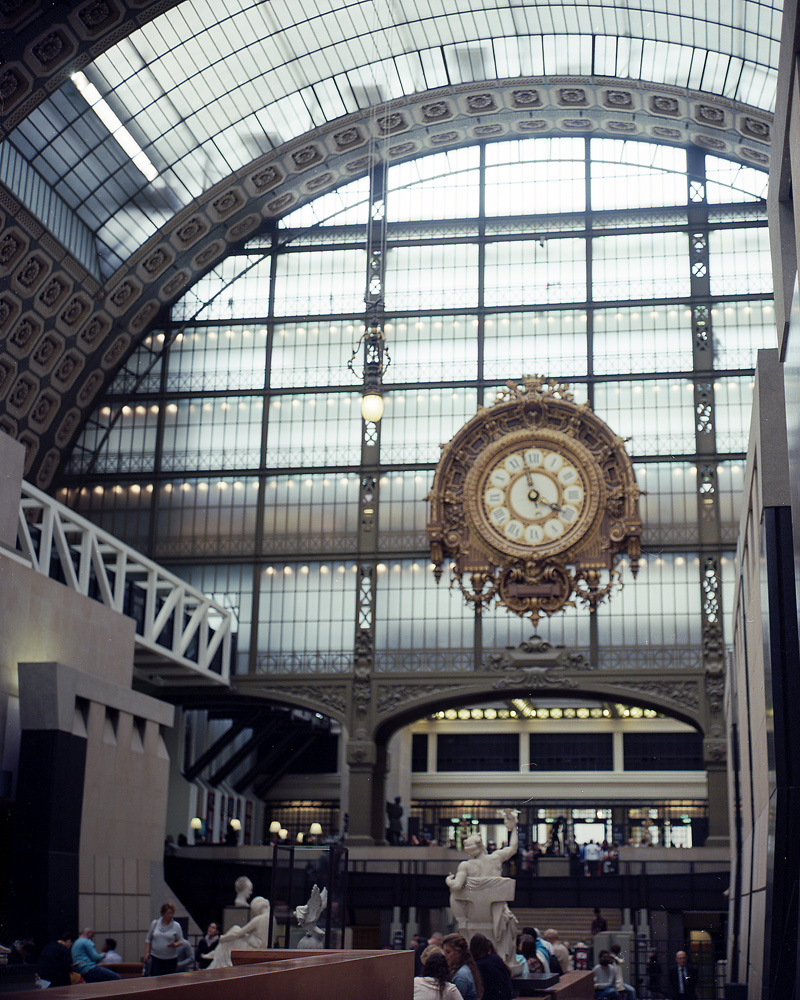
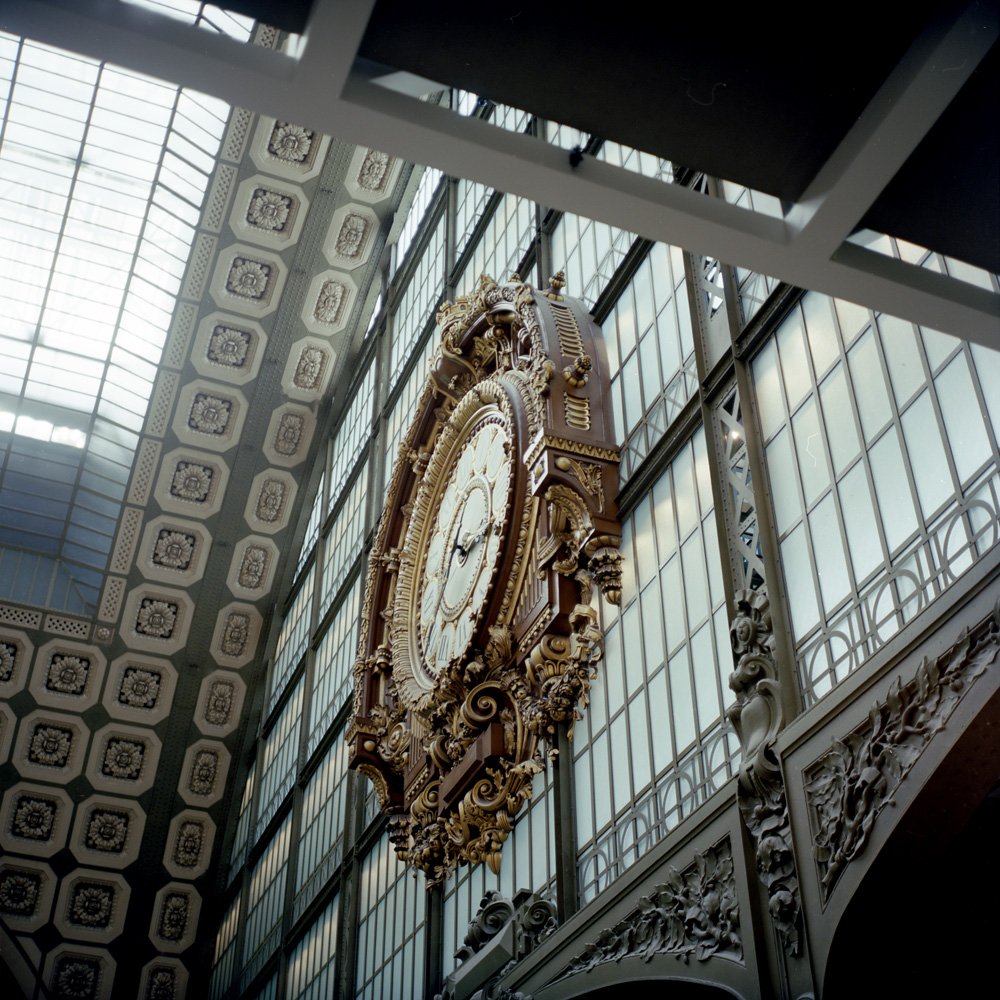
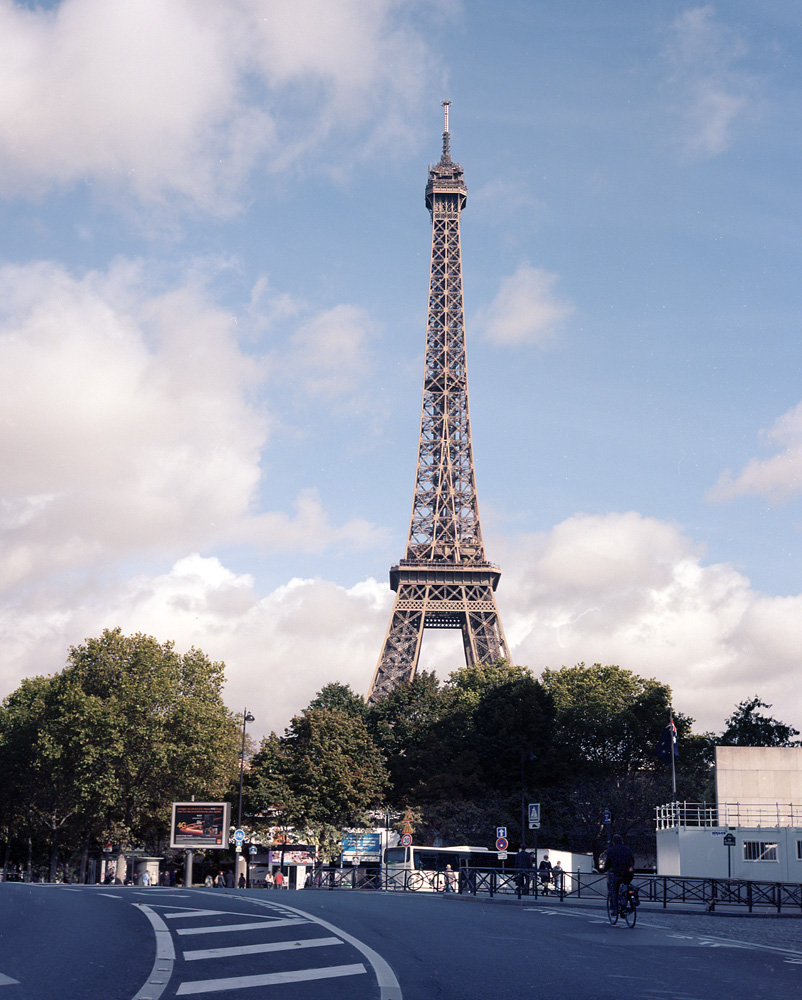
Here are four loose assorted images. I forgot I had the Eiffel Tower shot when I was posting the Eiffel Tower images because it was on a different roll. The Musee D’Orsay shots don’t have enough of a group to make a complete post of their own because technically you’re not supposed to take photos inside the museum in the first place, and it’s very crowded so it’s hard to take good photos of the building without lots of out-of-focus heads in the lower foreground. The Academie Francais building was a one-off, taken on my walk back to the apartment from the Musee D’Orsay. It was late enough in the day, and my feet were tired enough, that I couldn’t be bothered to try and see if the Academie was open and if they had any exhibits to visit. But it was lovely light and the building needed photographing.
All shots taken with my Rolleiflex 2.8E using Kodak Ektar 100. I include this little tidbit because people (read: photographers) want to know what gear was used, and what film. I don’t include aperture/shutter combinations as I A: don’t usually remember them, and B: that’s getting to geeky level of detail – most of the time if you want to re-create something you’ve seen of someone else’s, you don’t need that information unless there’s a special effect (very blurred motion or completely frozen, or extremely shallow depth-of-field). In any case as I’ve matured as a photographer, I care far more about the image itself and less about the mechanics of how it was made. You see photographers all the time geeking out about lenses and cameras, this film vs. that film vs. digital, CMOS vs CCD, but if DaVinci and Michelangelo ever had a debate about which paintbrush was better, it has not been recorded (or art historians aren’t publishing it!).
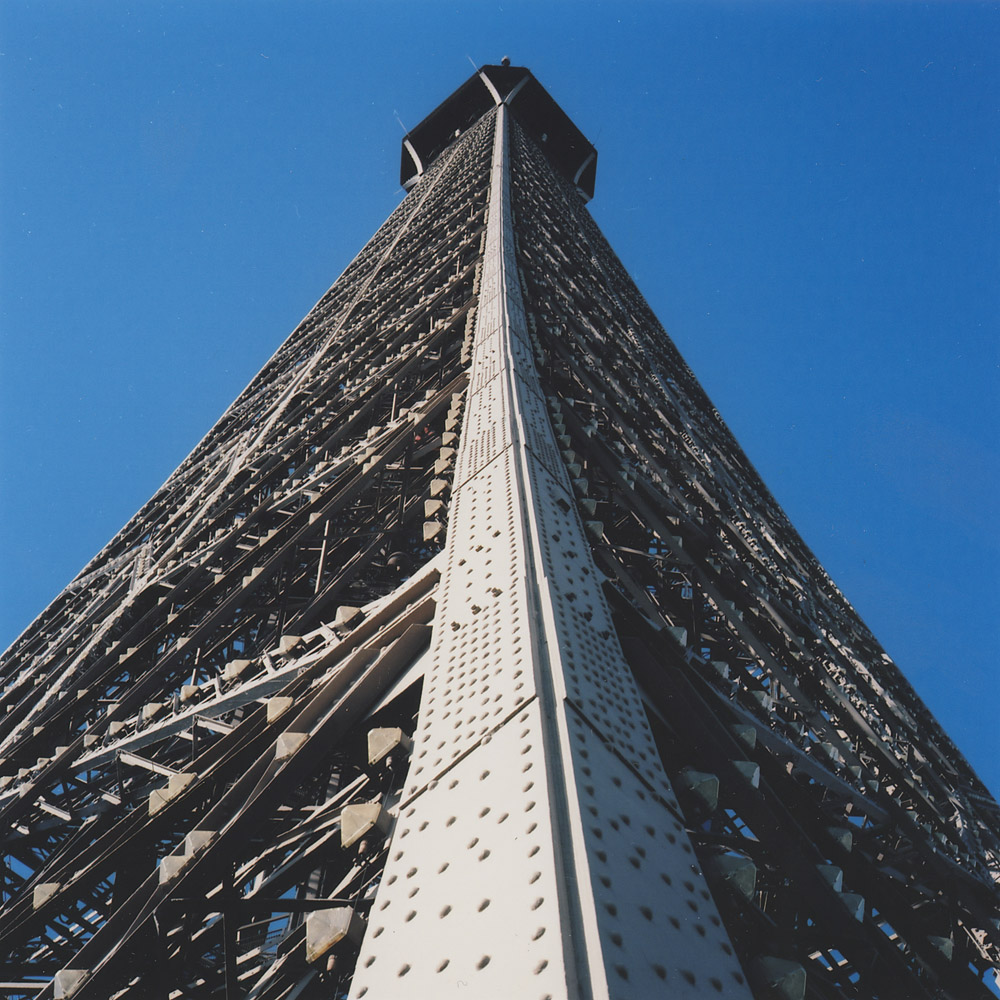
Does the Eiffel Tower really need any text description? The one really cool thing I can think of about it you probably don’t know is that when it was built, it generated polarizing opinions among Parisians – they either loved it or loathed it. One famous French writer was known to detest it as an eyesore, yet he would go there to have lunch every day in the restaurant. When asked why he would do such a thing since he hated it so much, he remarked, “because it is the one place in Paris I can be where I can’t SEE it”. I’ll leave it to you to judge its beauty, but it has endured for over 120 years despite the fact it was only originally intended to last for 20 and has become an internationally recognized and beloved symbol of the city of Paris.
Eiffel Tower SilhouetteEiffel Tower, Blue Sky
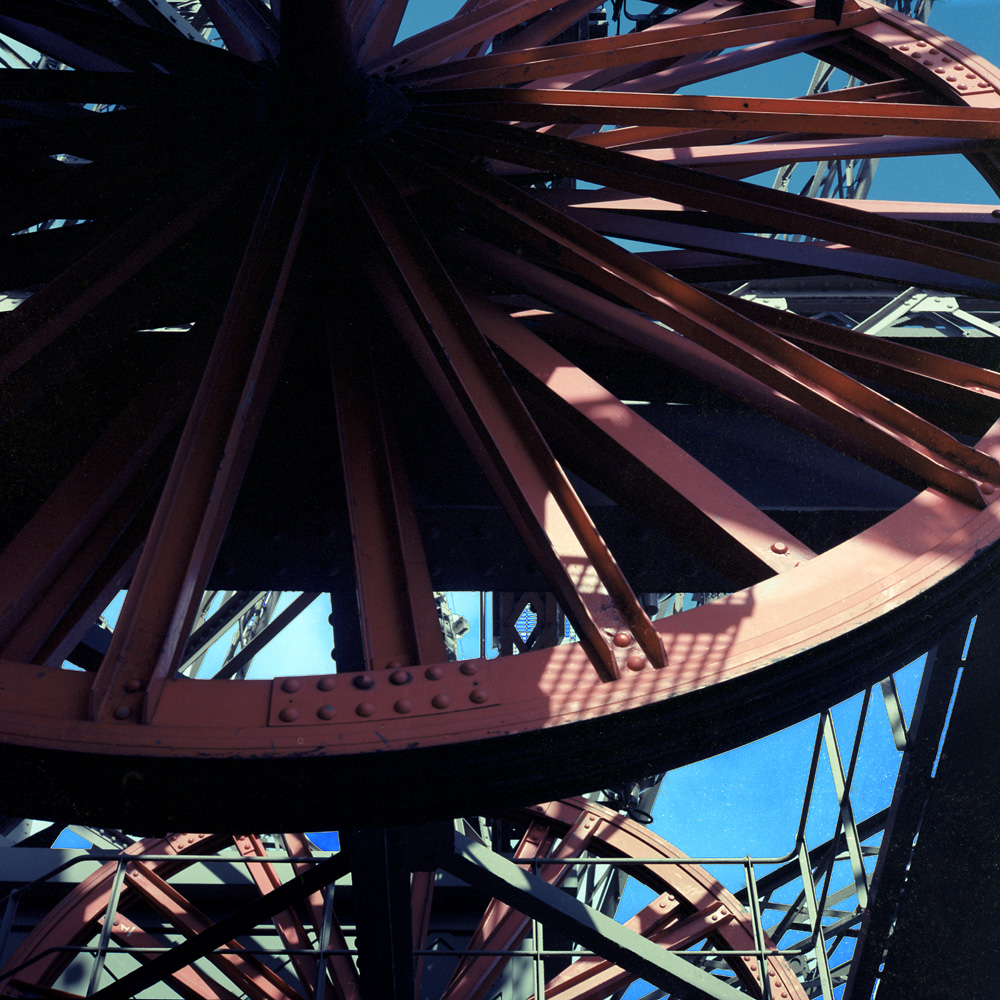
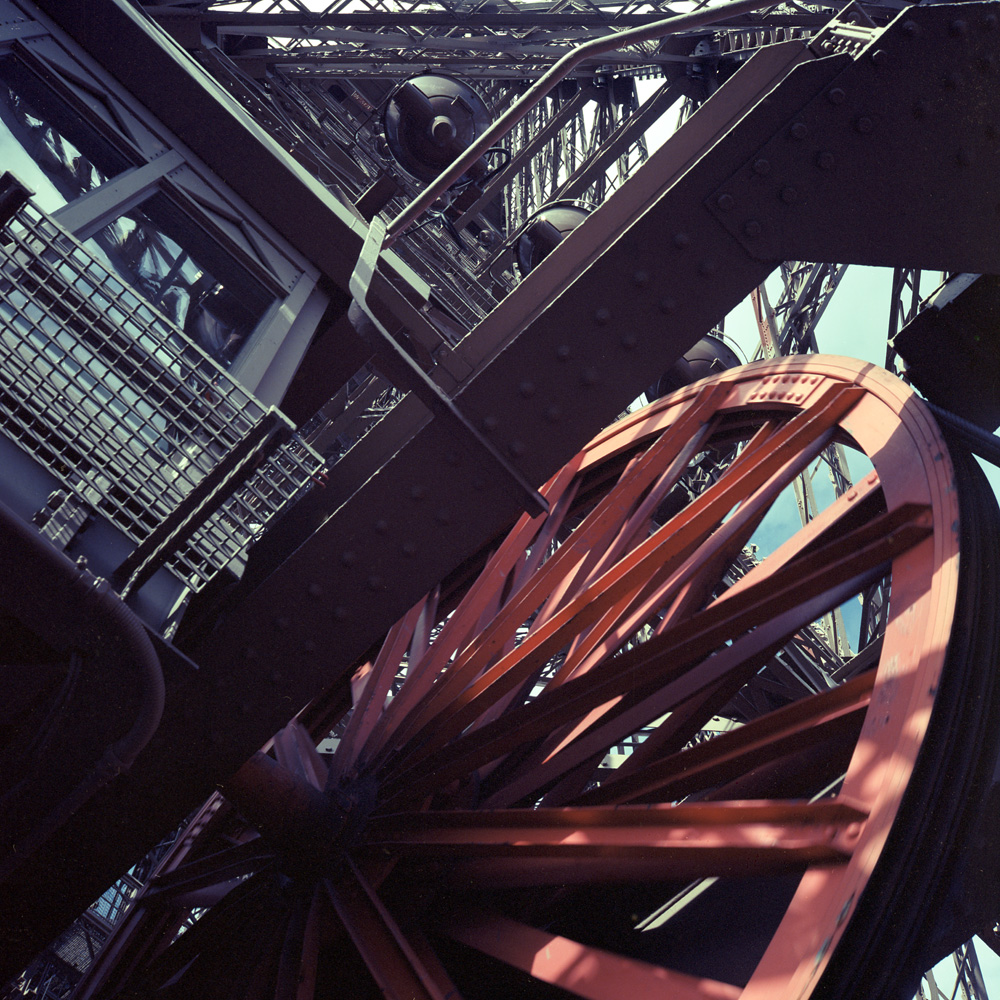
Riding up to the 2nd tier in the elevator, you can see the giant wheels that run the cables to raise and lower the elevators that ride in the leg piers. The elevators themselves are double-deckers, and halfway up the transit from the ground to the second tier, they actually change angle of ascent as the leg angle changes.
Elevator WheelsElevator Wheels, Looking Up
The view to the east from the second deck includes the Seine river, the Louvre (just beginning to intrude into the frame at the far right middle ground), and in the distant far left background is the Sacre Coeur church on top of Montmartre.
East View, 2nd Tier
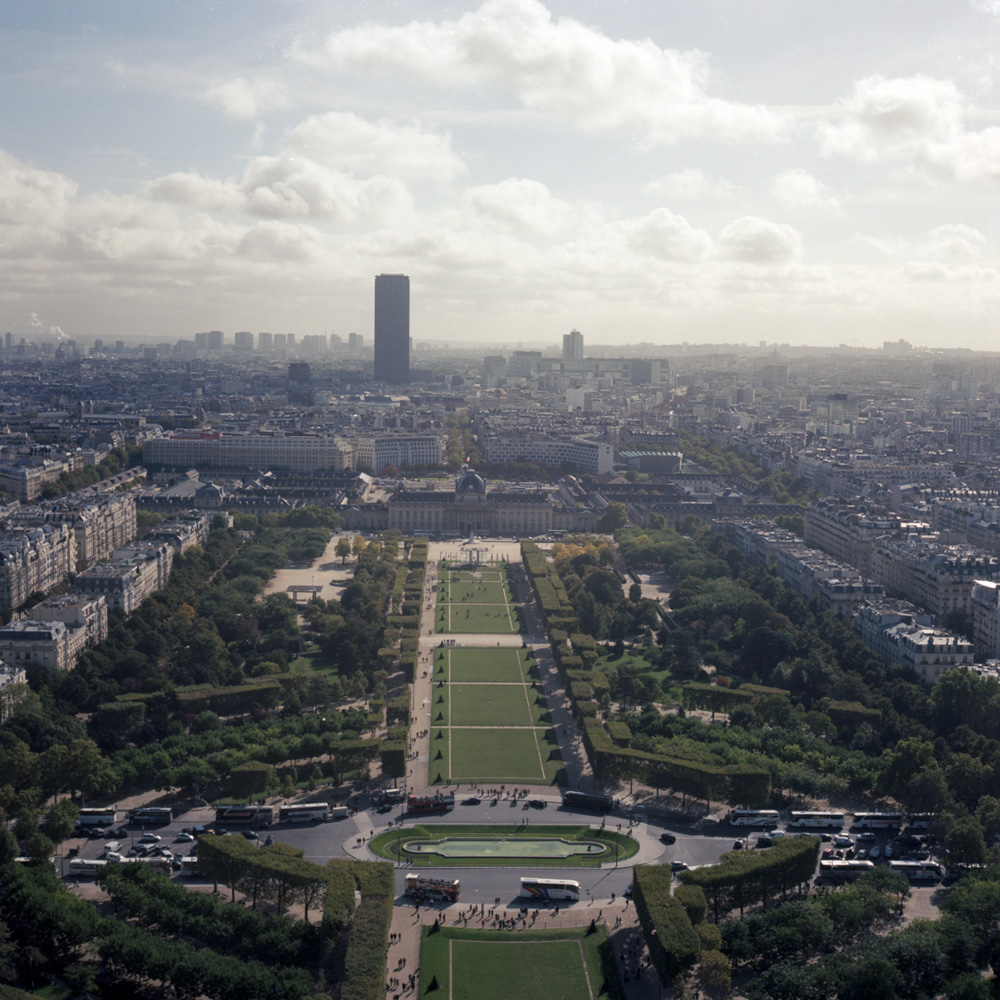
Looking south, the view encompasses the Champ De Mars and the French Military Academy, and in the distant background, the Tour Montparnasse. I did not ascend the Tour Montparnasse even though it has an observation deck some 50 stories up, but I did pass below it through the Gare Montparnasse on my trip to Versailles.
Champ De Mars, 2nd Tier View
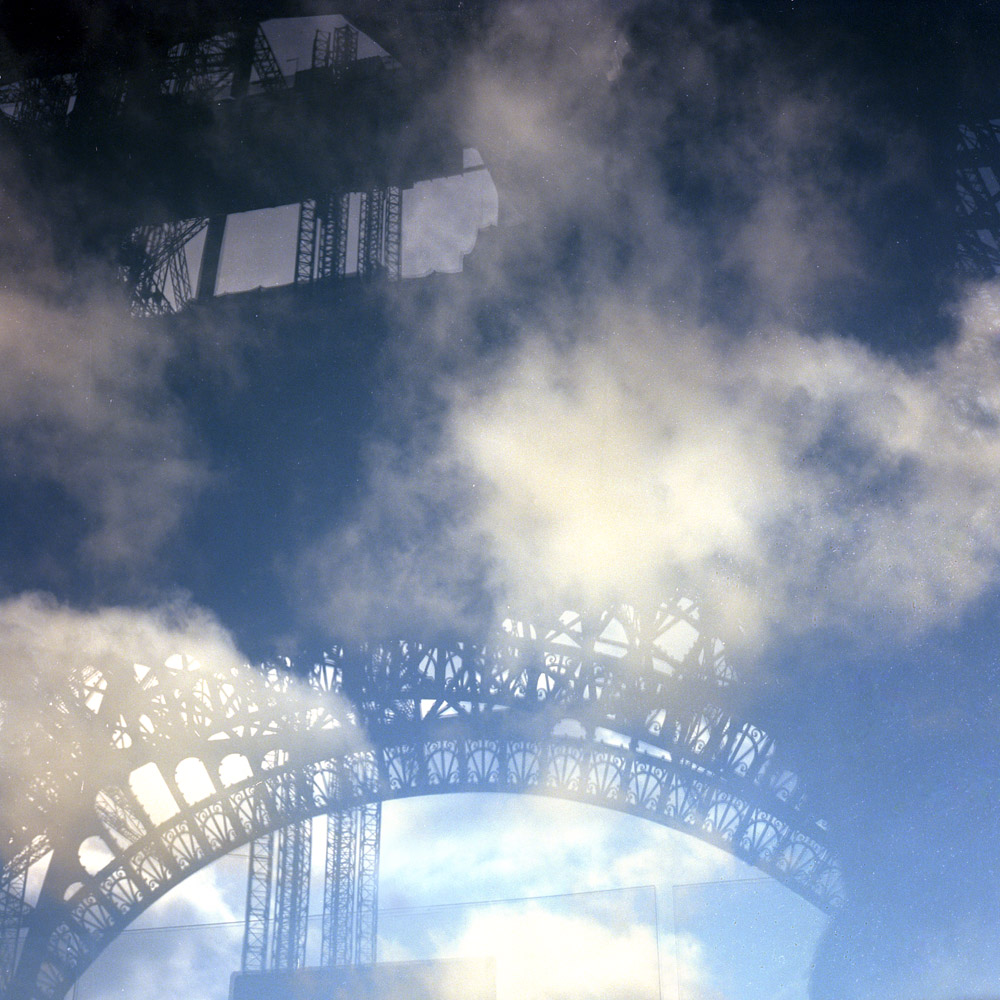
I know I posted this image before as a bit of a one-off, but I’ll re-include it here because it belongs as part of this grouping. While waiting in line for the elevator, I looked at the security glass in the partition that controlled the line and saw the shadow of the tower under the reflection of the clouds on the other side. I had to chance the photo, even though the coating on the safety glass can cause strange color casts in the image. I think it paid off – what do you think?
Eiffel Tower Shadow, Clouds
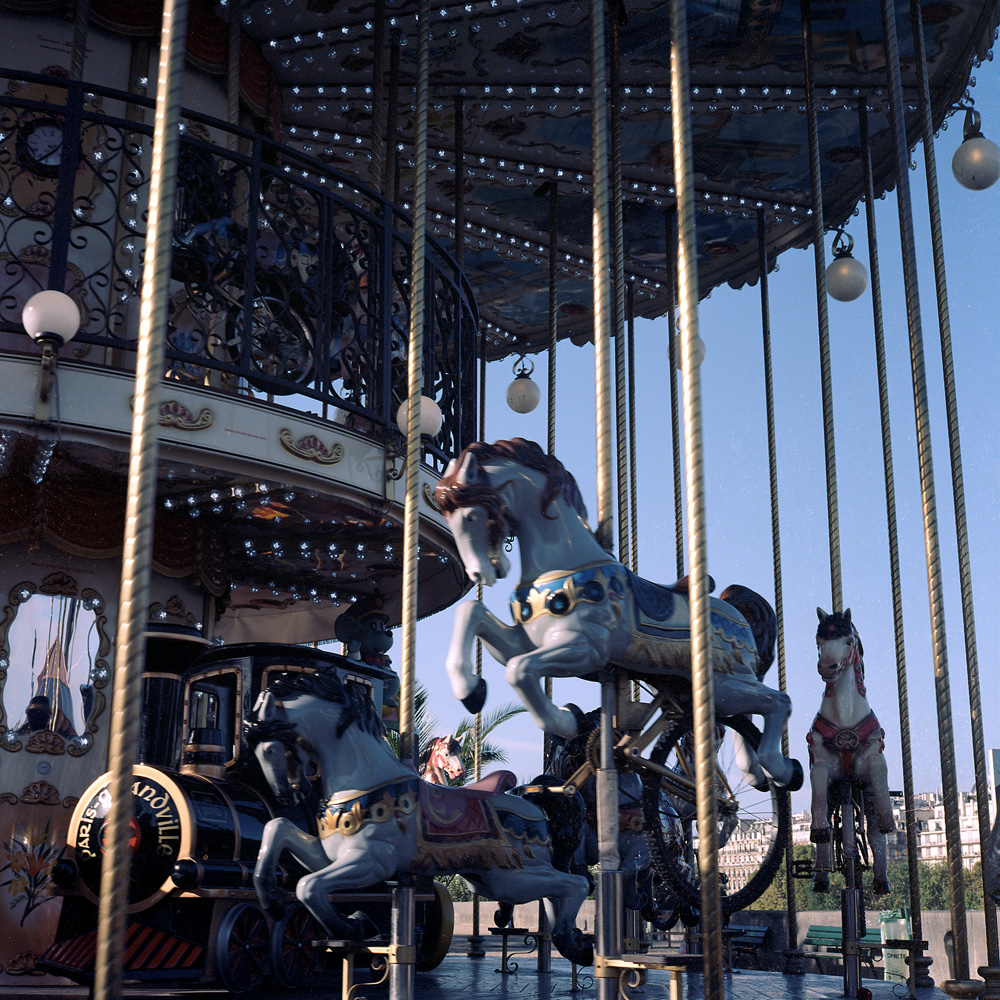
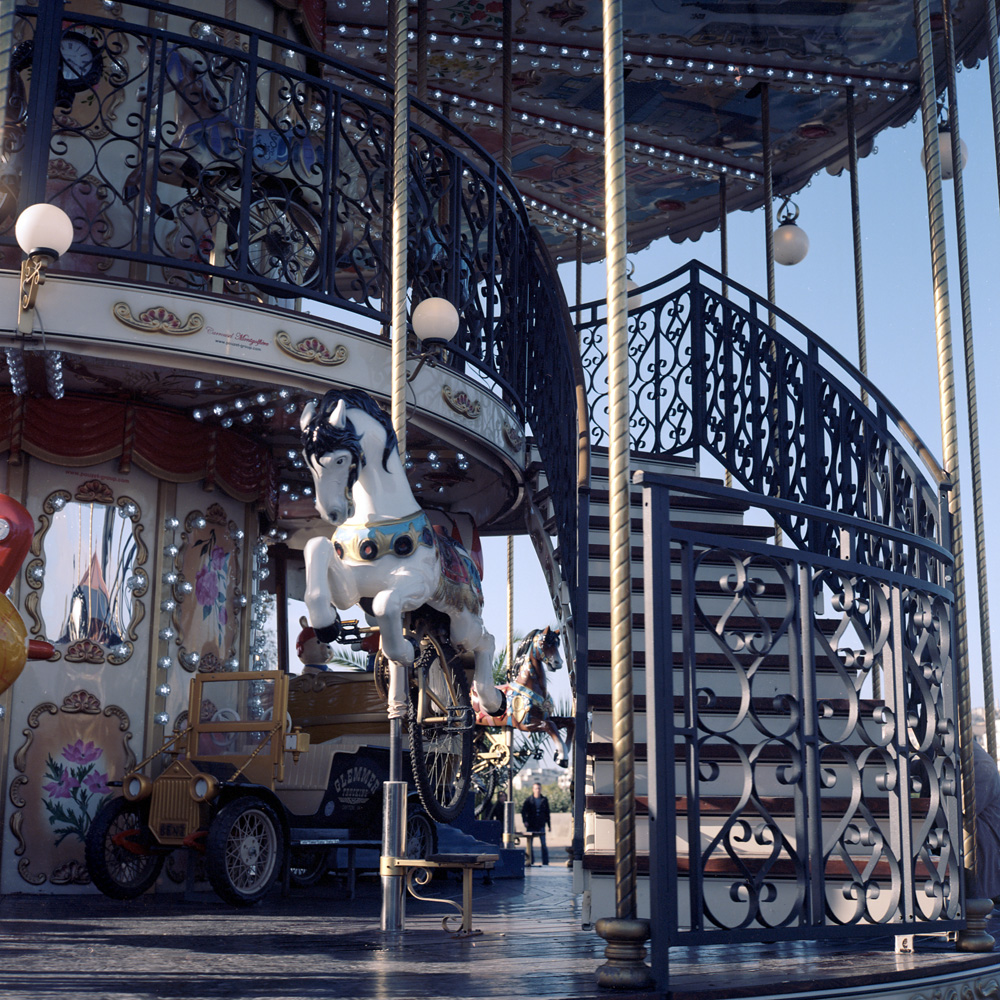
Not really apropos of anything other than geographic proximity: across the street from the Eiffel Tower, at the foot of the bridge that spans the Seine and leads to the old Trocadero Palace, there is a charming double-decker carousel.
Double Deck CarouselDouble Deck Carousel
What can I say, I like carousels. We have two very nice ones here in DC – one at Glen Echo where I teach and another one on the National Mall in front of the Smithsonian Castle. I’ve photographed both of them in very different ways- Glen Echo I’ve shot in color numerous times, and the Smithsonian one I’ve shot with my 5×12 in black-and-white and printed in palladium. Some day soon I’ll get up to New York and photograph the one at the foot of the Brooklyn Bridge in Brooklyn. I think I sense a new project coming on!
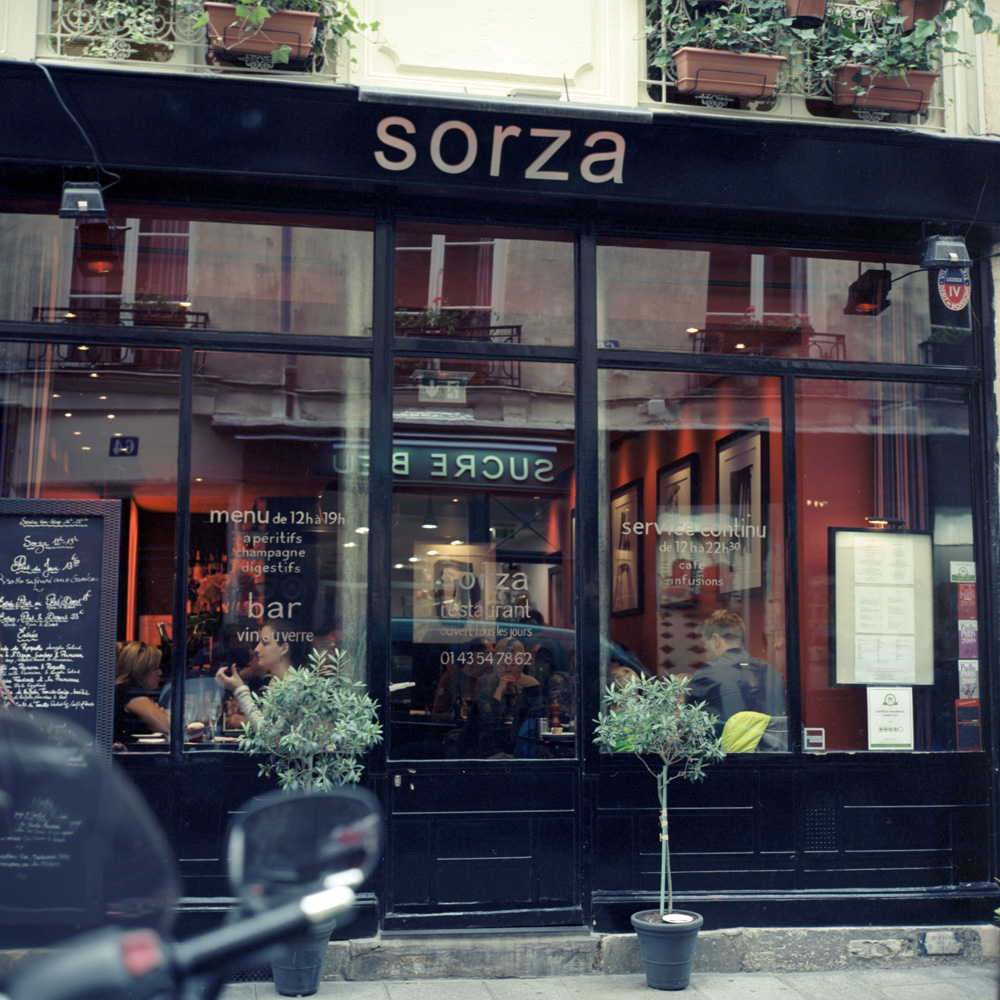
Some street scenes from my neighborhood. In reflection, I wish I had taken an afternoon and just photographed up and down the street. There were so many charming little restaurants and shops along the Rue St. Louis en L’Ile, you could easily make a photo study of just that one street.
Sorza Restaurant, Ile St. Louis
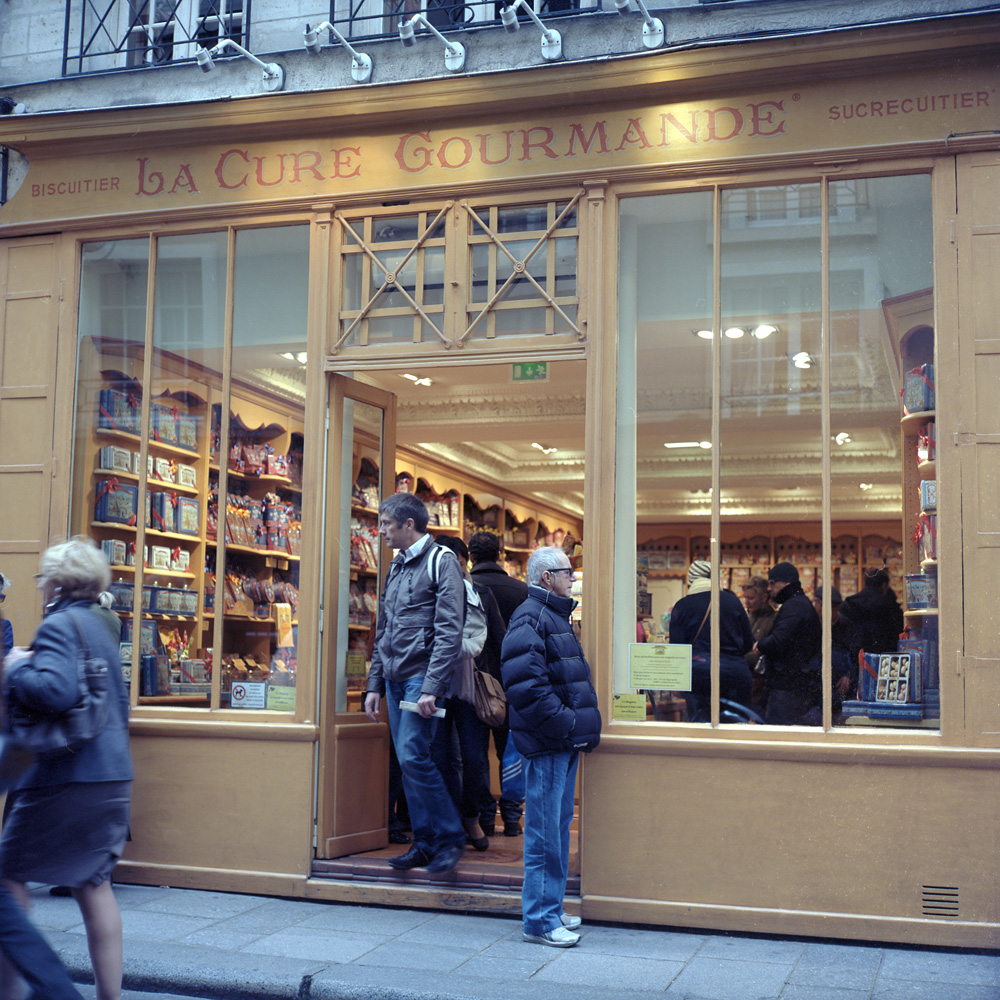
The Cure Gourmande candy shop was ALWAYS busy. Probably as much to do with the bright, cheery interior as it does with the candies and biscuits they sell. Who wouldn’t want to go in and browse, and maybe try a sample or two?
Cure Gorumande sweet shop, Rue St. Louis en L’Ile
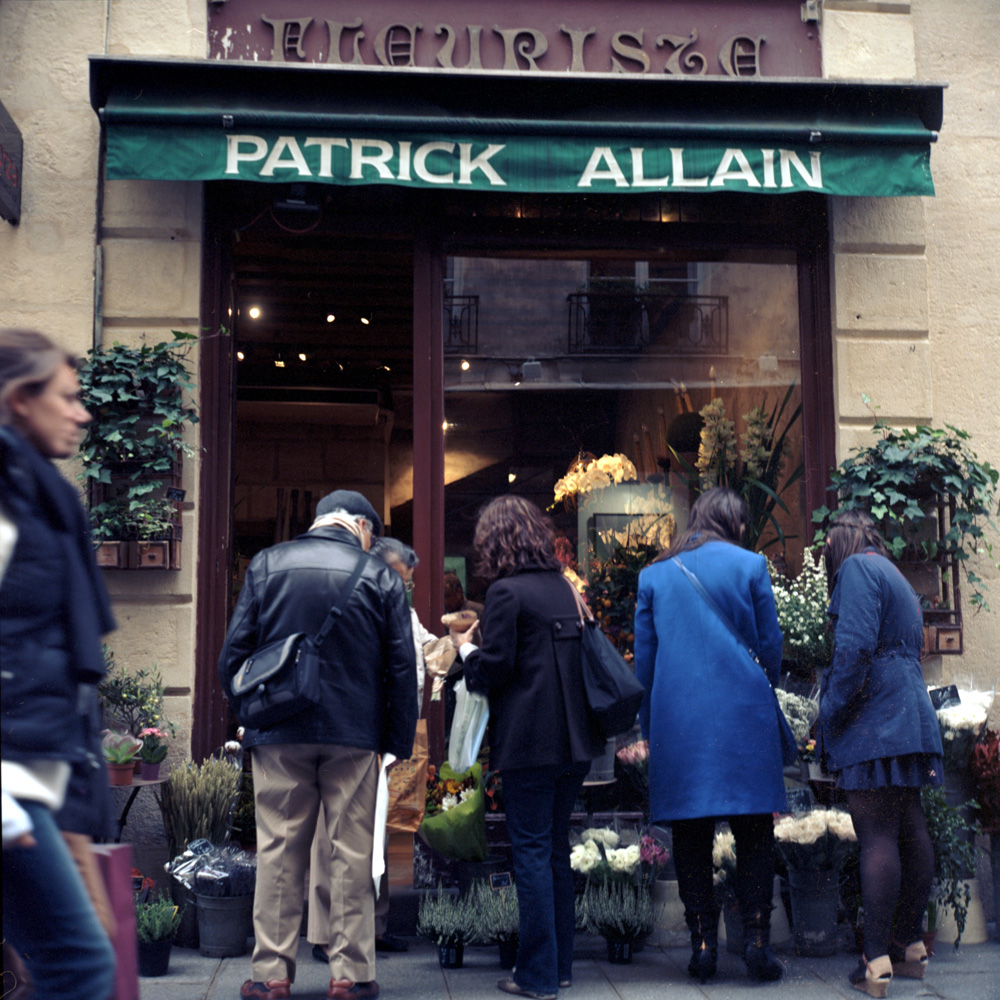
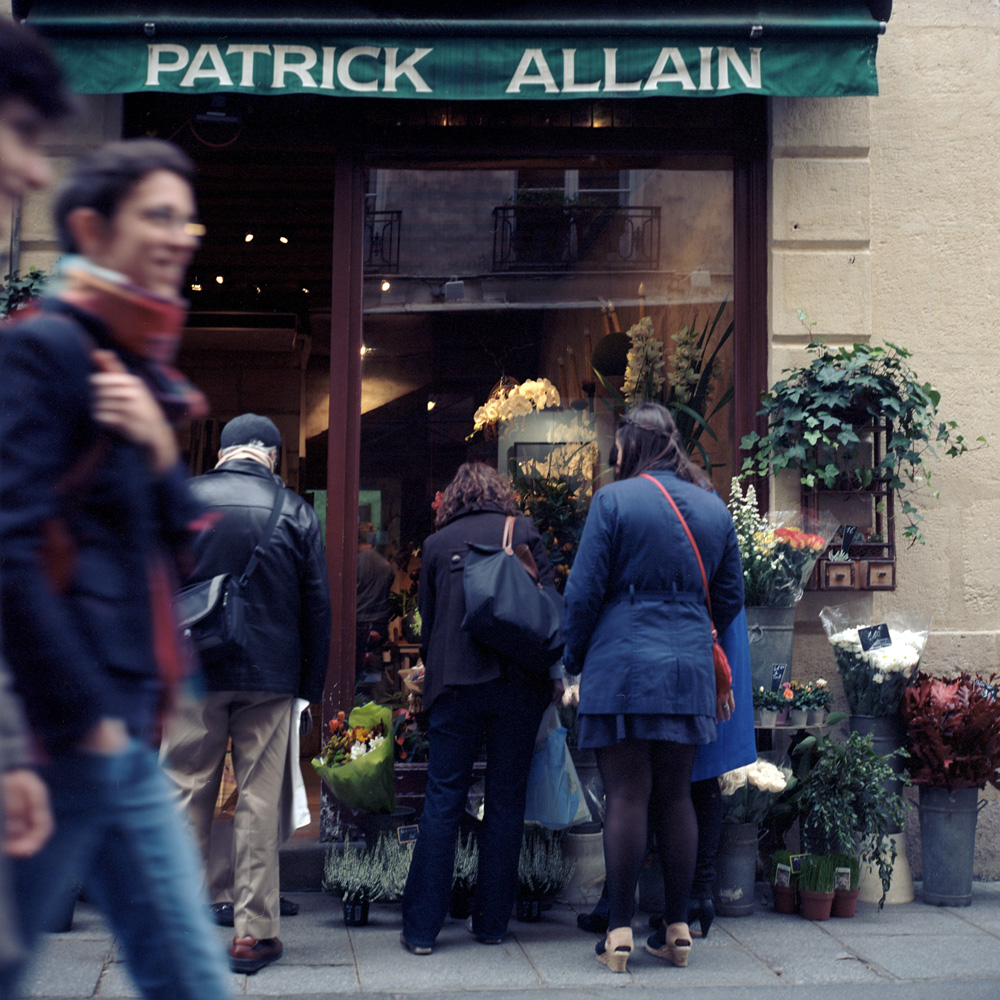
Please give me your feedback on these two – which do you like better? I’m on the fence as to which one works best. Patrick Allain Florist, Rue St. Louis en L’Ile
Patrick Allain Florist
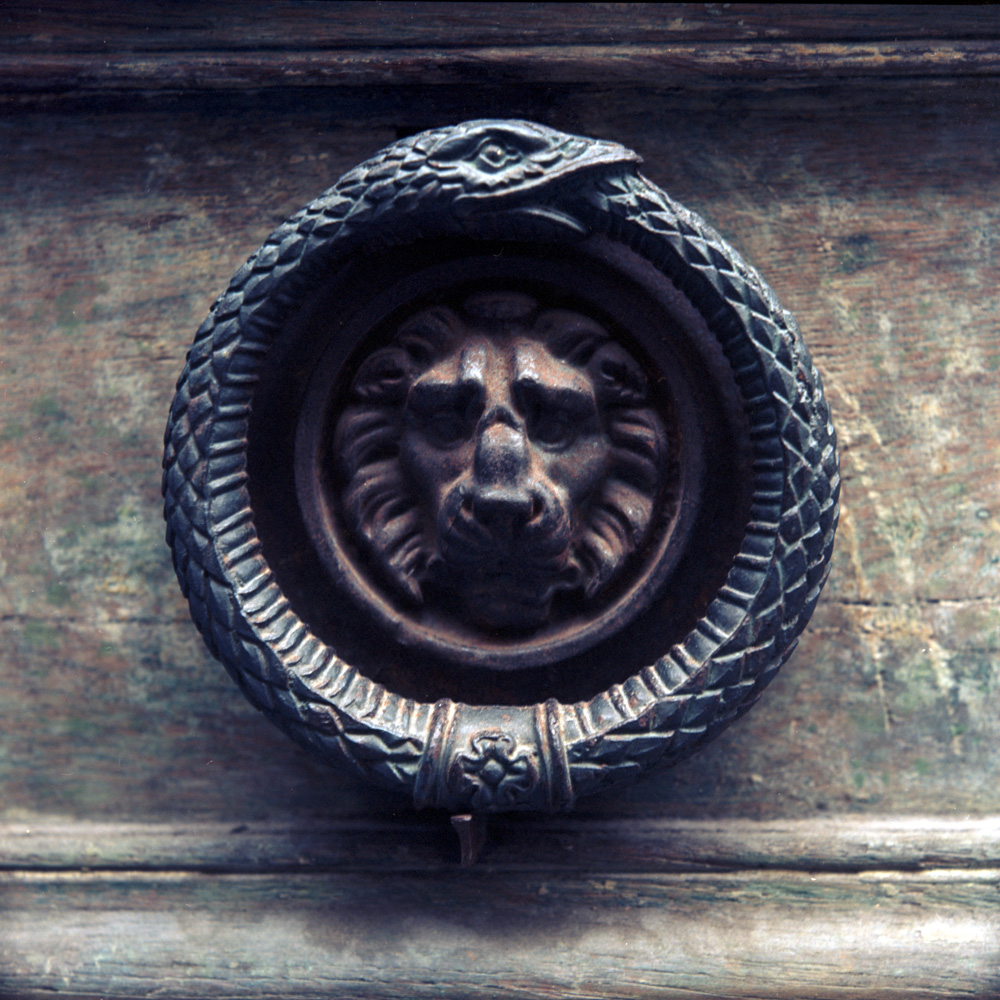
This was one of the few opportunities I had to break out my Rolleinar close-up filter sets and take a picture of something small. Given the size and weight of them, even though I only used them maybe twice on the whole trip, I don’t regret bringing them, especially when you compare them to a dedicated macro lens for an SLR system. I was drawn to the different textures and colors of the wood of the door, the rusty iron of the lion head, and the painted metal of the snake. And believe it or not, this was hand-held!
Door Knocker, Ile St. Louis
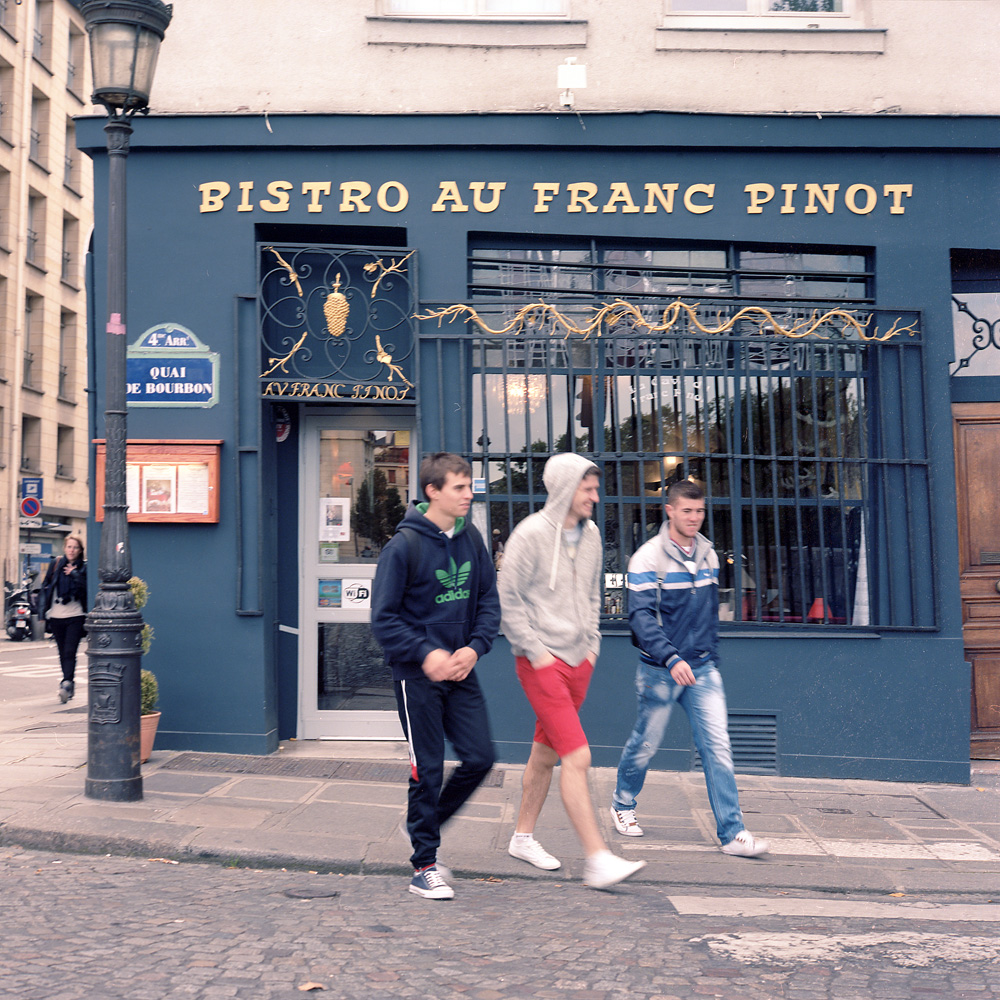
In closing, here’s another restaurant/wine bar in the neighborhood, this one on the Quai de Bourbon, facing the Pont Marie. It really shows the age of the building, as nothing on it is really square or level.
Here are some photos I took of the apartment where we stayed. The apartment was at Number 6, Rue St. Louis en L’Ile. This was an outstanding choice of location and of apartment. It had charm, convenience, and comfort. The bedrooms were a touch petite, but it was never a problem. I would stay there again in a heartbeat. Our landlady, Francoise, was super charming and met us the day we arrived with a bottle of wine and a plate of cheeses she bought down the street at the fromagerie.
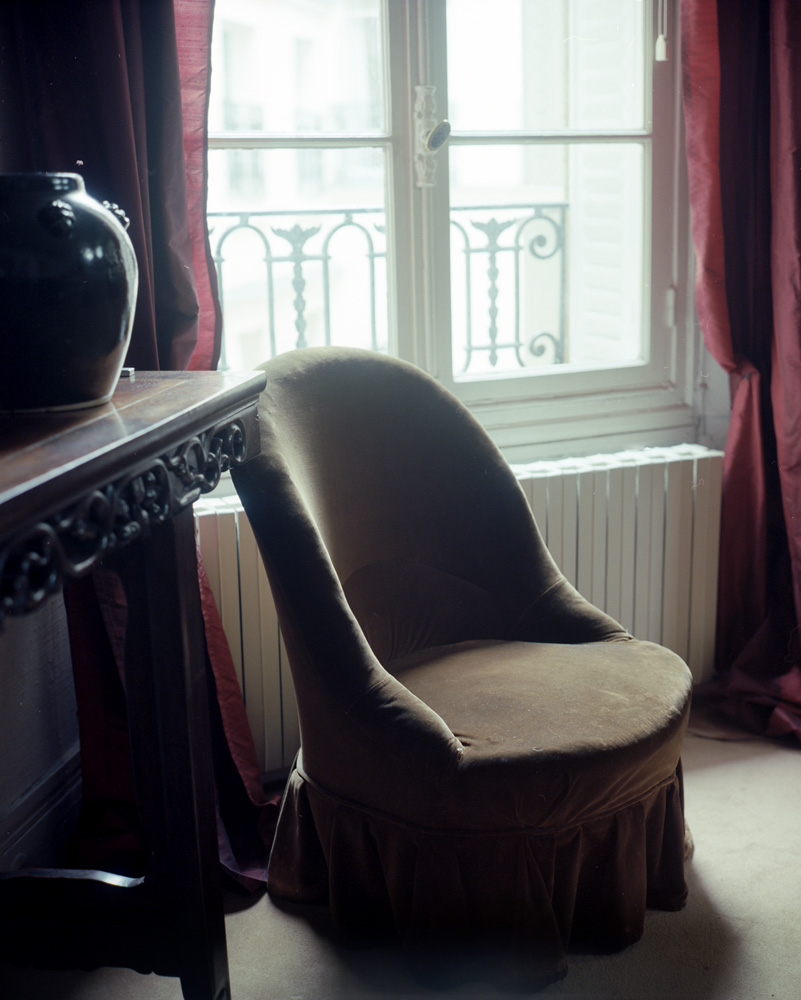
I was utterly charmed by the arrangement of this little velvet-covered chair in the dining room, next to the Chinese style sideboard.
Chair, Dining Room Window
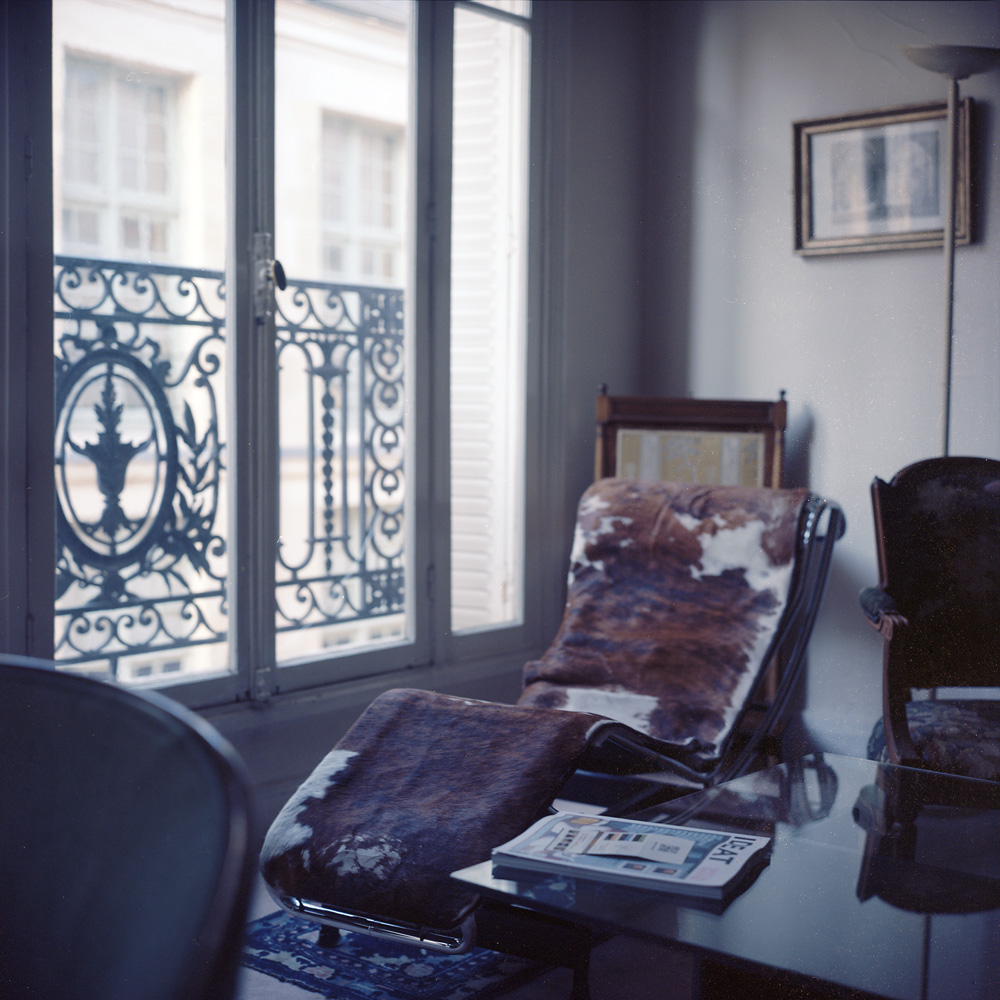
The living room featured a chaise lounge by Le Corbusier. I suspect it is an original, based on the wear on the cowhide cover.
Le Corbusier Chaise, Living Room
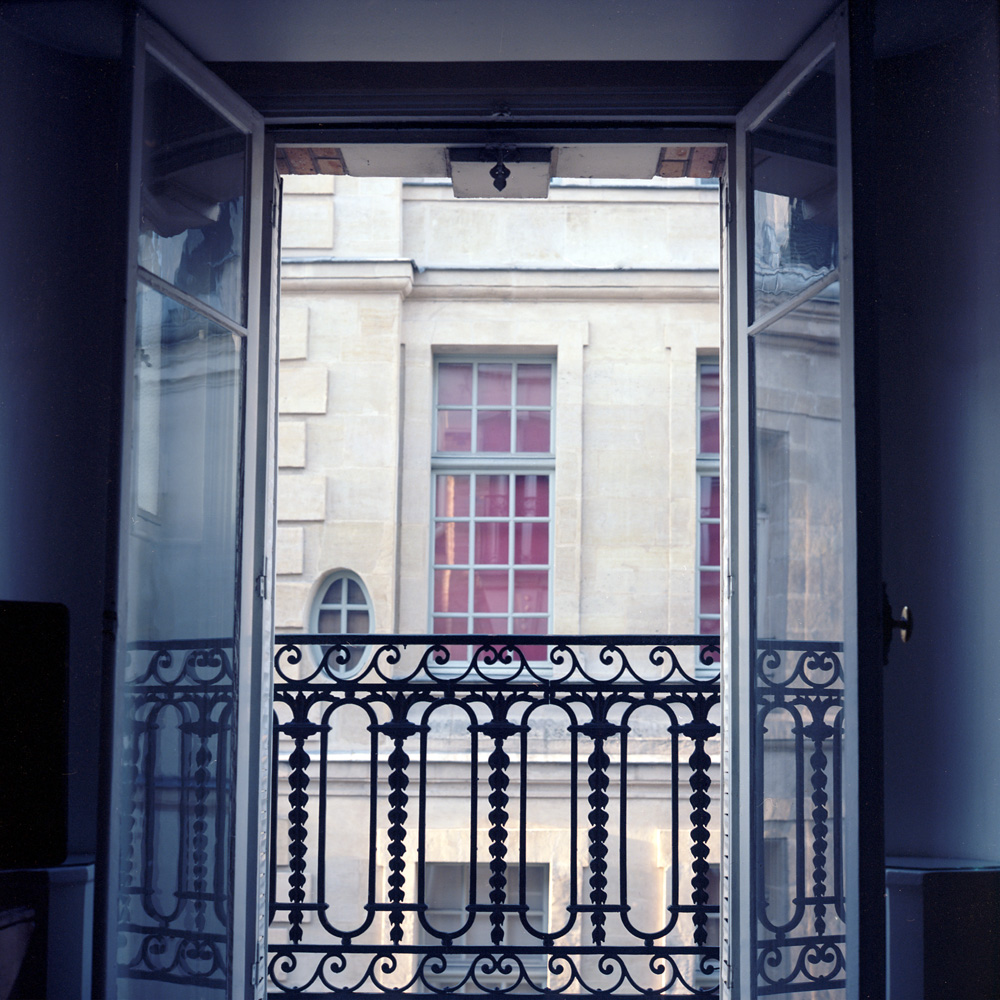
Looking out the living room window, this is the view when you look straight out.
Window, Number 6, Rue St Louis en L’Ile
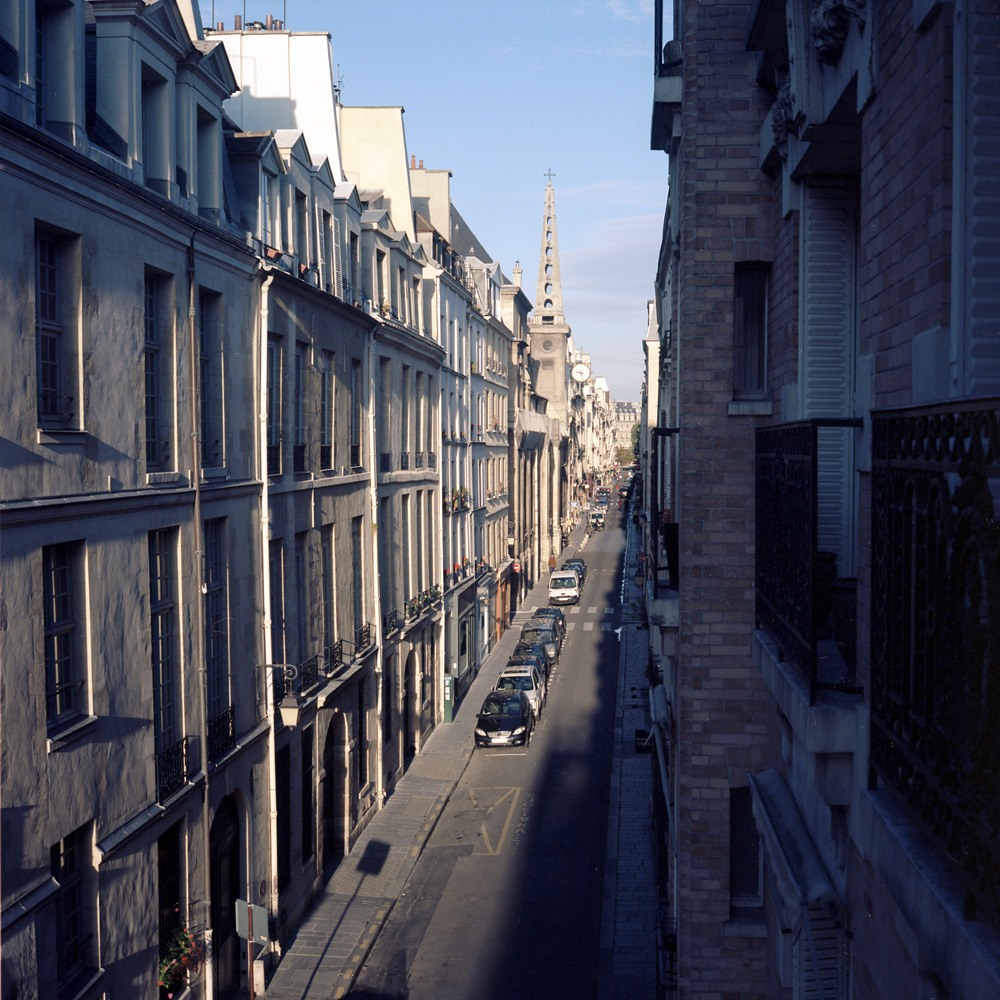
Looking up the street on a sunny day:
Rue St. Louis in the Sun
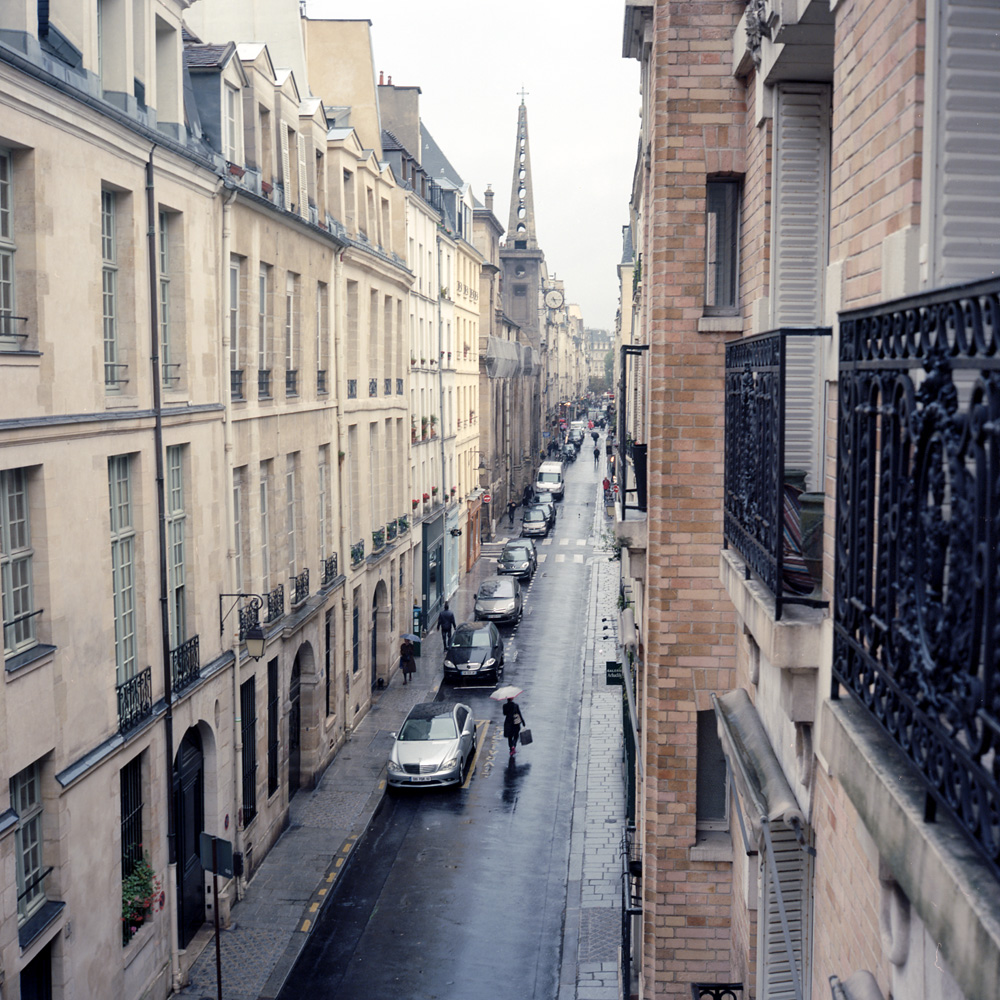
And on a rainy day:
Rue St. Louis in the Rain
The Rue St. Louis is very busy with pedestrians all day, although it may not look as such down at my end of the street. A block further up is where the shops, art galleries, restaurants and food sellers begin.
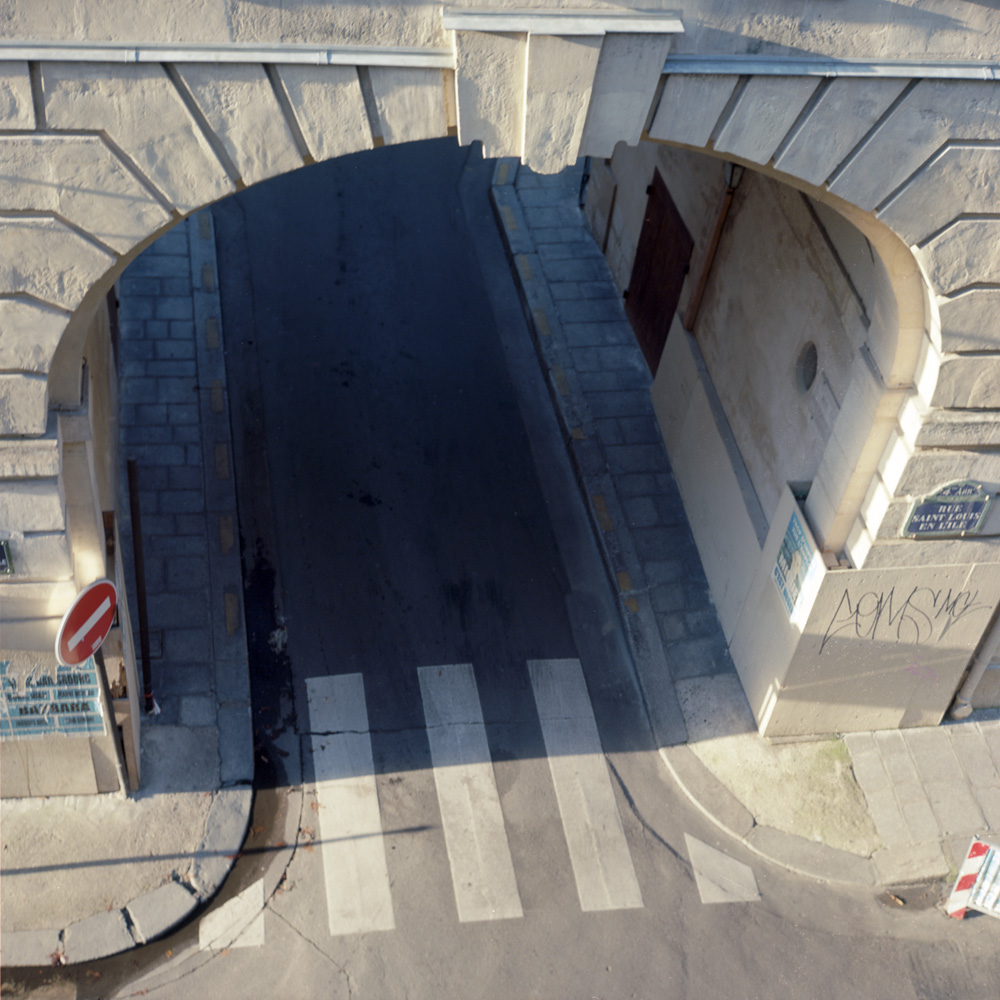
This archway was directly across the street from our apartment, where the Rue St. Louis took a right turn to go out to the quay.
Archway, Rue St. Louis
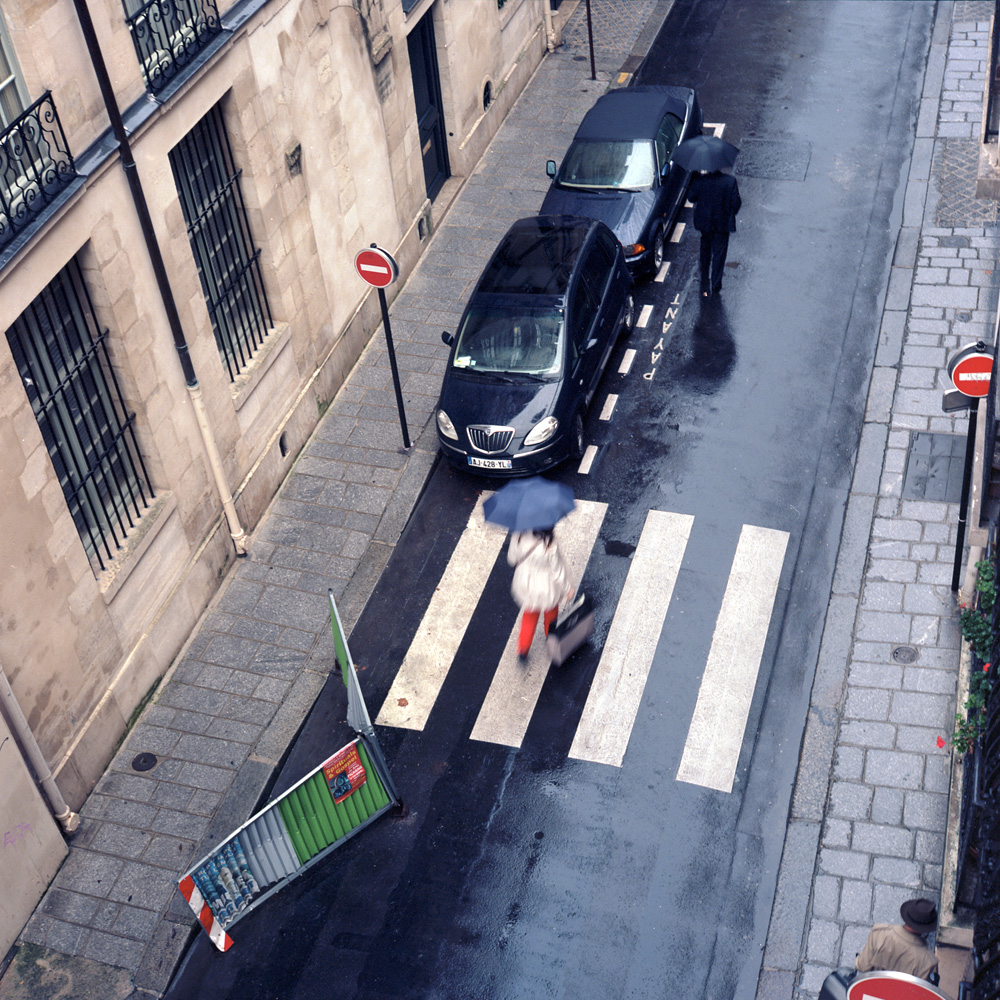
Even though it was raining, I stepped out on the balcony and looked down, to see this scene of the woman with red pants crossing the street:
Woman Crossing Rue St. Louis in the Rain
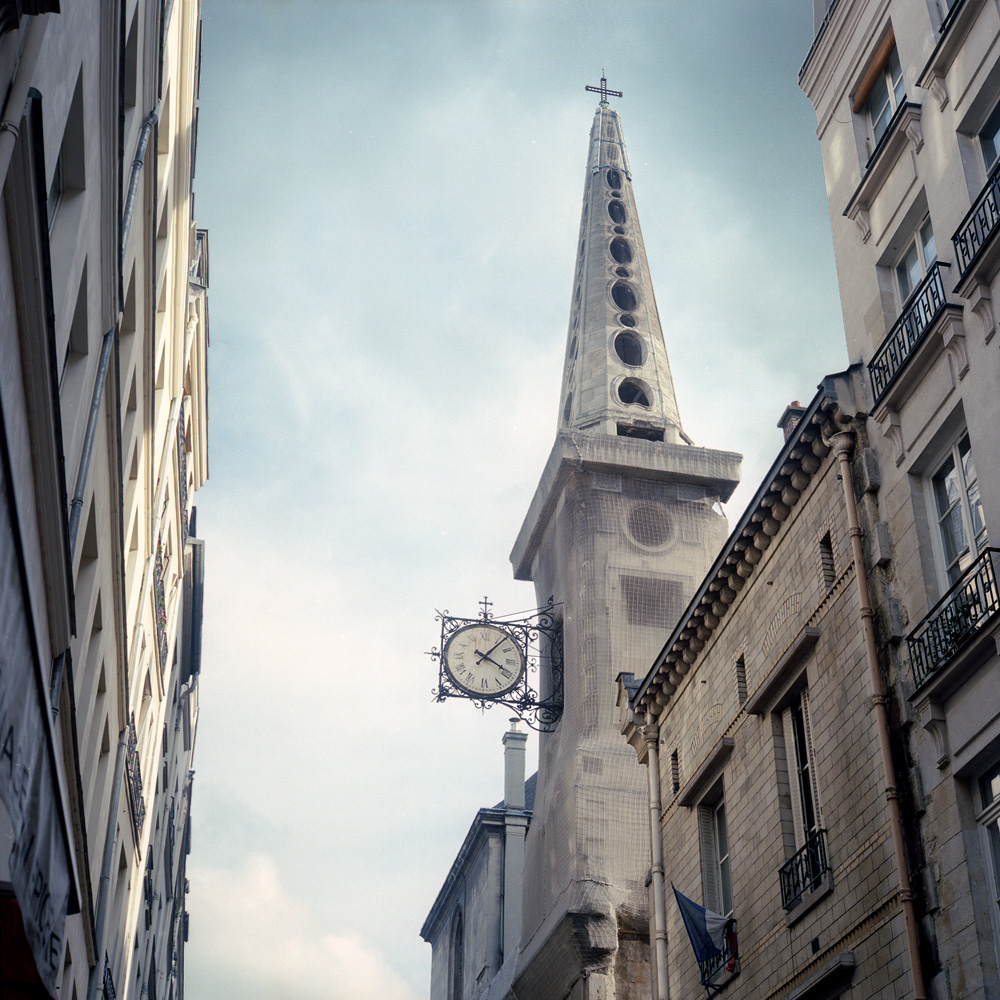
Here is the Eglise St. Louis en L’Ile with its clock, up close, which you can see in the background of the sunny and rainy shots of the Rue St. Louis:
Eglise St Louis En L’Ile
The église St. Louis has a gorgeous baroque interior replete with dark wood paneling, stained glass, and surprisingly enough magnificent altarpieces that somehow managed to survive the upheaval of the French Revolution. They regularly have concerts there as well as services, and it is well worth popping in if you’re passing by.
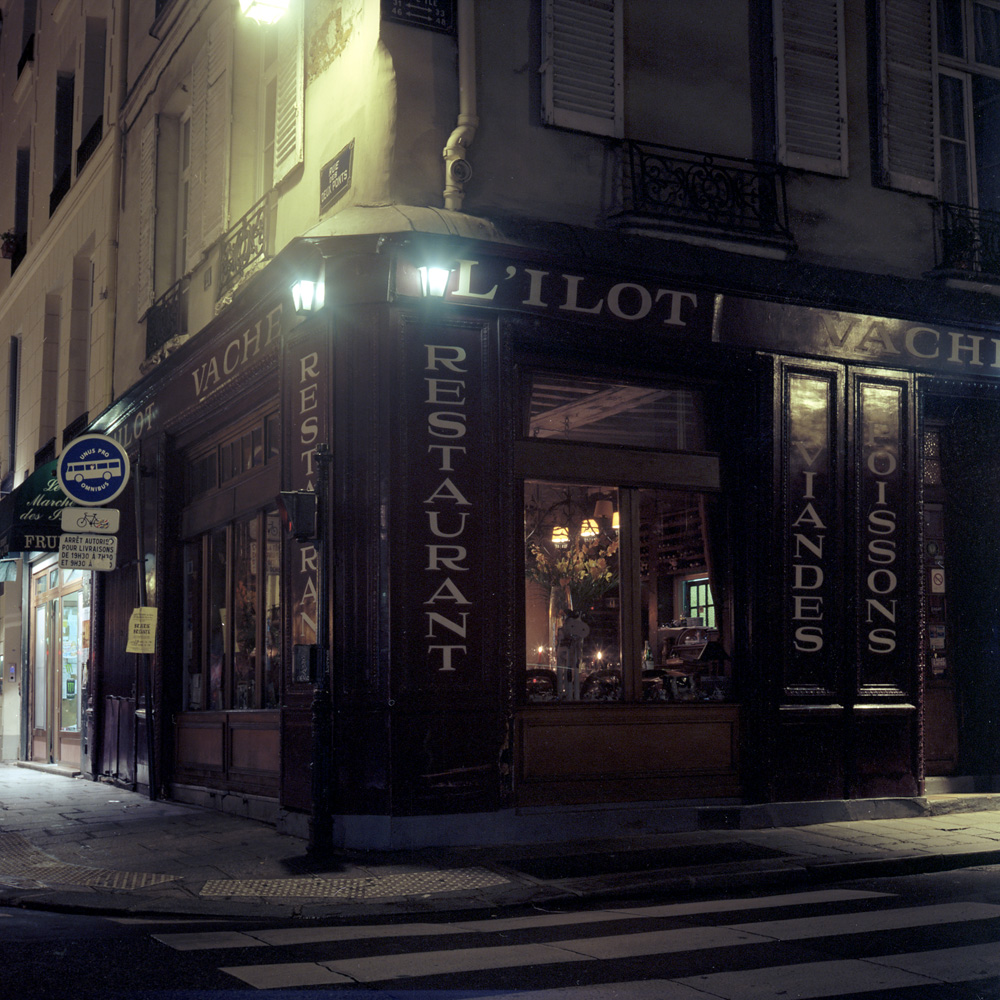
The Ilot Vache restaurant is on the corner of the Rue St.Louis en l’Ile and the Rue des Deux Ponts, which more or less bisects the Ile St. Louis into east and west halves. The Ile St. Louis was once actually two separate islands, one of which was the Ilot Vache (little cow island) because it was used as pastureland for Parisian cows. With the rapid growth of the city’s population in the 15th century, there was such a demand for more prime real estate that the two islands were merged into one and developed as residential space. Thus the name of the restaurant. The Rue des Deux Ponts roughly demarcates where the two islands were split. My dad and I ate dinner at L’Ilot Vache one night, and the food was quite good, even if the dining room was a bit crowded.
L’Ilot Vache Restaurant
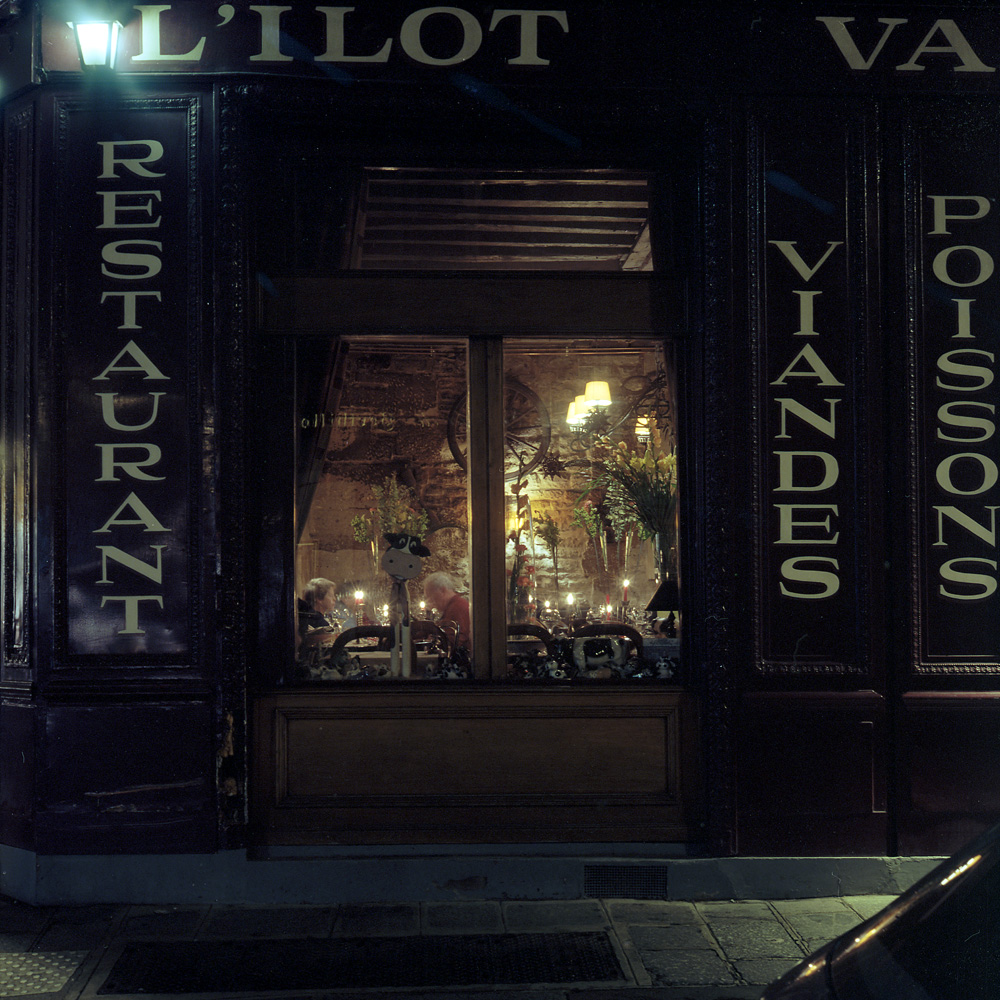
I managed to catch a pair of diners in the window of the restaurant.
Diners, L’Ilot Vache, Night
This is one case where I broke my normal rule of shooting night photos with Portra 160 – these two were done on Ektar 100. I suspect that I had just a couple frames left on the roll of Ektar that was loaded in the camera when I set out to do my night shots, so I finished them off and then switched over to Portra for the rest of the evening.
Just a quick one-off of a very red, vibrant fire hydrant in Chalon-sur-Saone. It fits well within my series of ordinary objects, and it has a very sculptural quality to it.


 dcphotoartist