I was up to New York twice in the span of two weeks and brought along the Rolleiflex both times. I only got to put a roll through each time (I was rather time delimited in both trips, and was not there to photograph but to attend specific functions). Here are some of the shots I took:
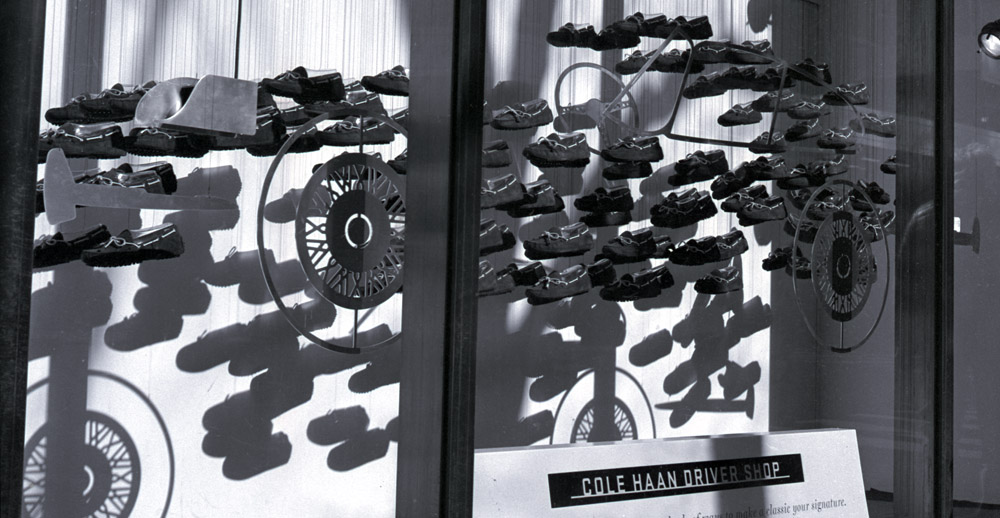
Cole Haan Jaguar
This was a store window in Rockefeller Plaza, facing 5th Avenue. The Cole-Haan store had done up a display made of their driving loafers in the shape of a classic Jaguar E-Type (one of my favorite vintage sports cars).
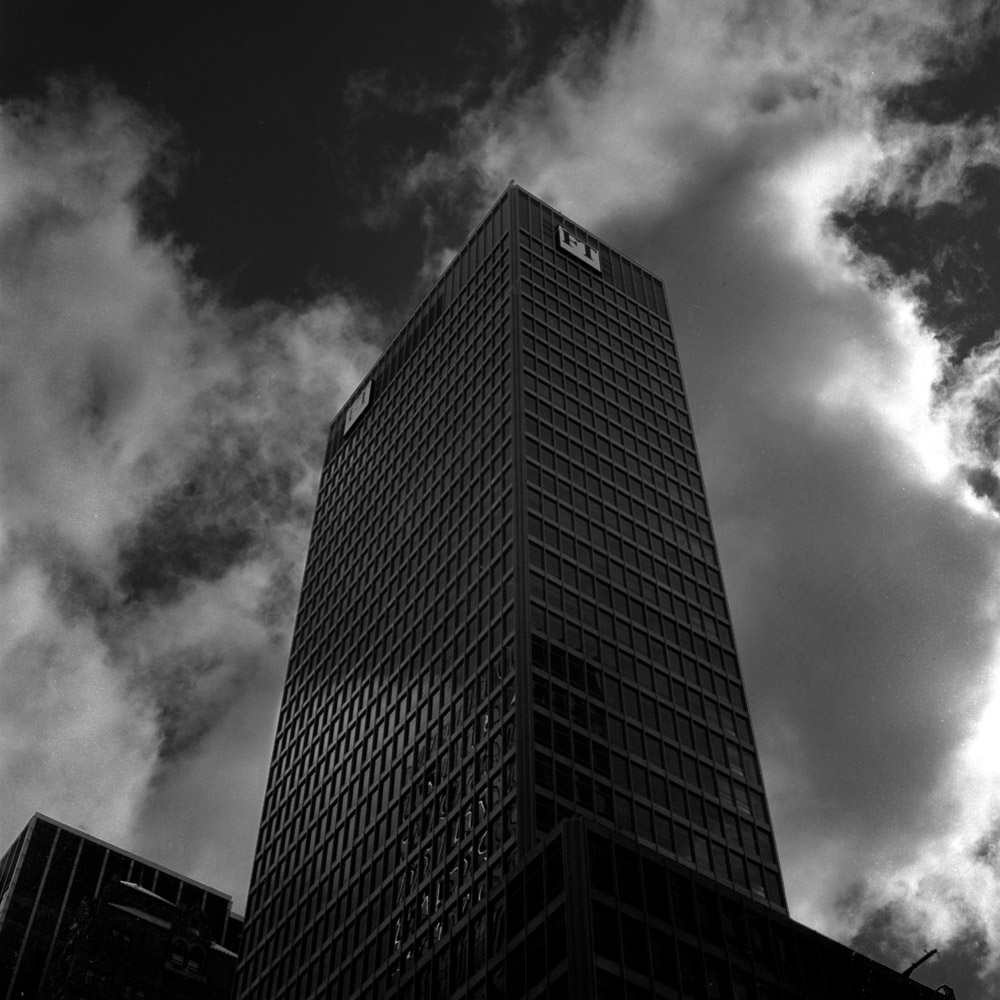
Financial Times Building
The Financial Times building – love the clouds behind it, backlit in the morning sun.
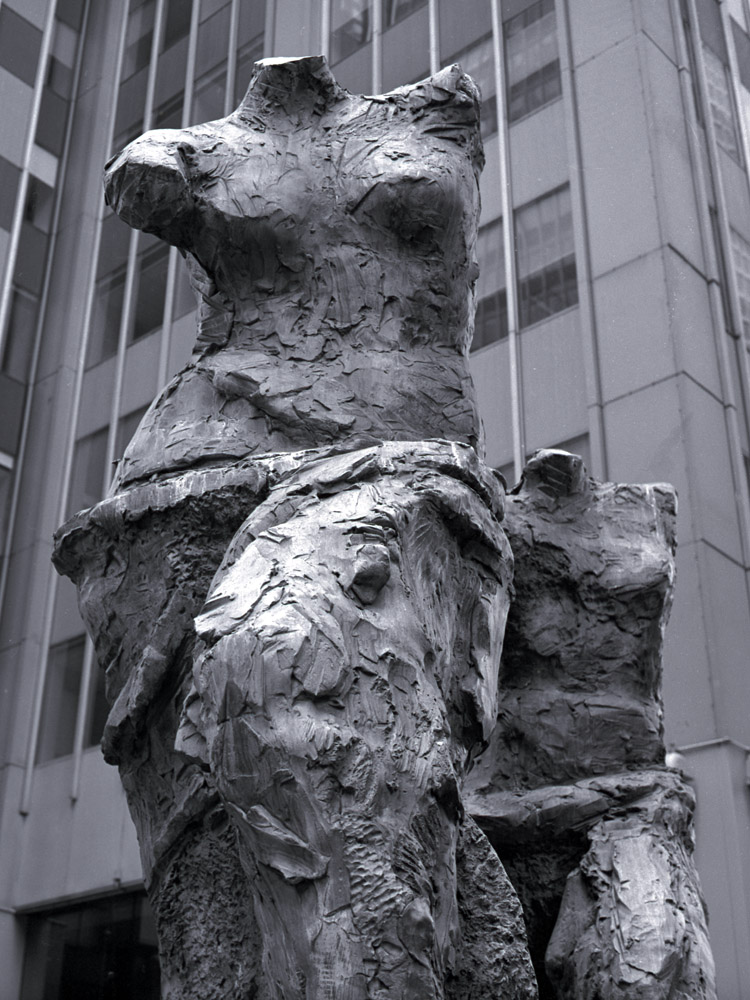
Jim Dine Duo 6th Ave
A pair of female torsos by Jim Dine at 6th Avenue and 52nd Street. Please ignore the file name – I got it completely wrong when saving the file before looking it up.
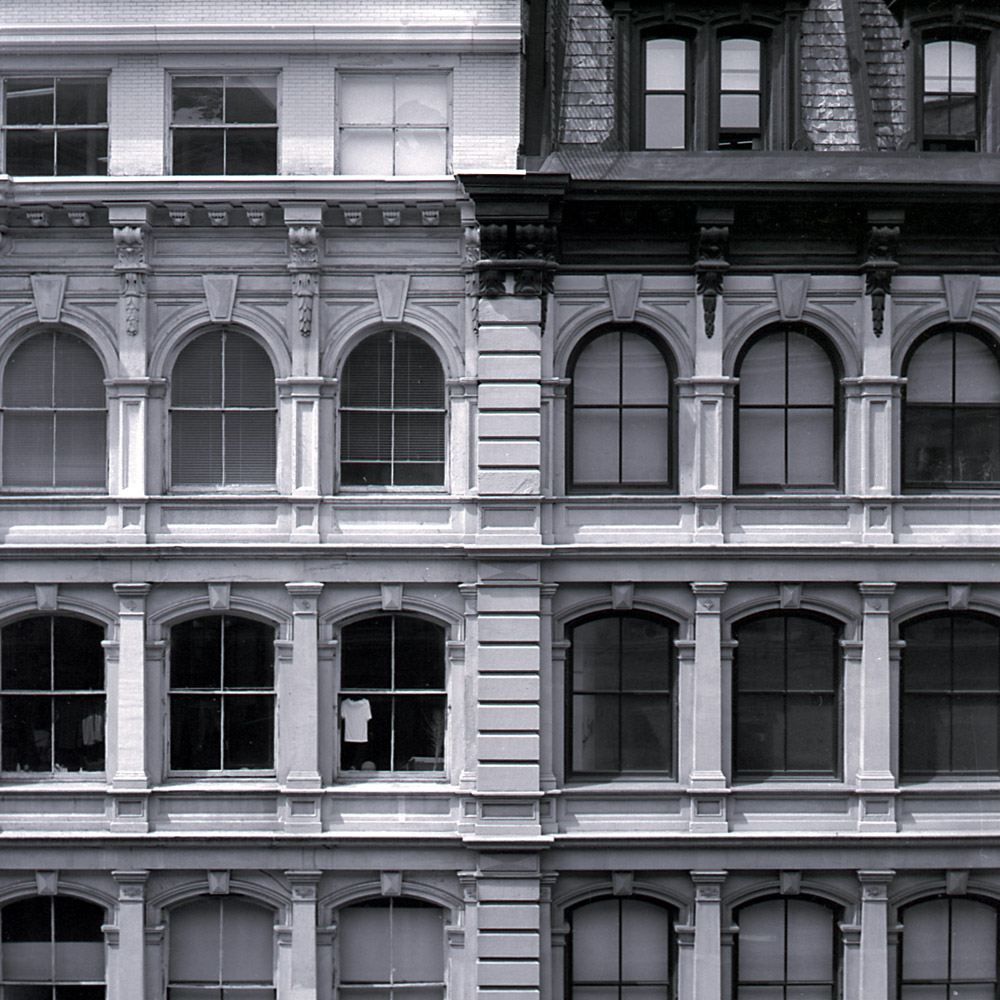
Iron Facade, Broadway
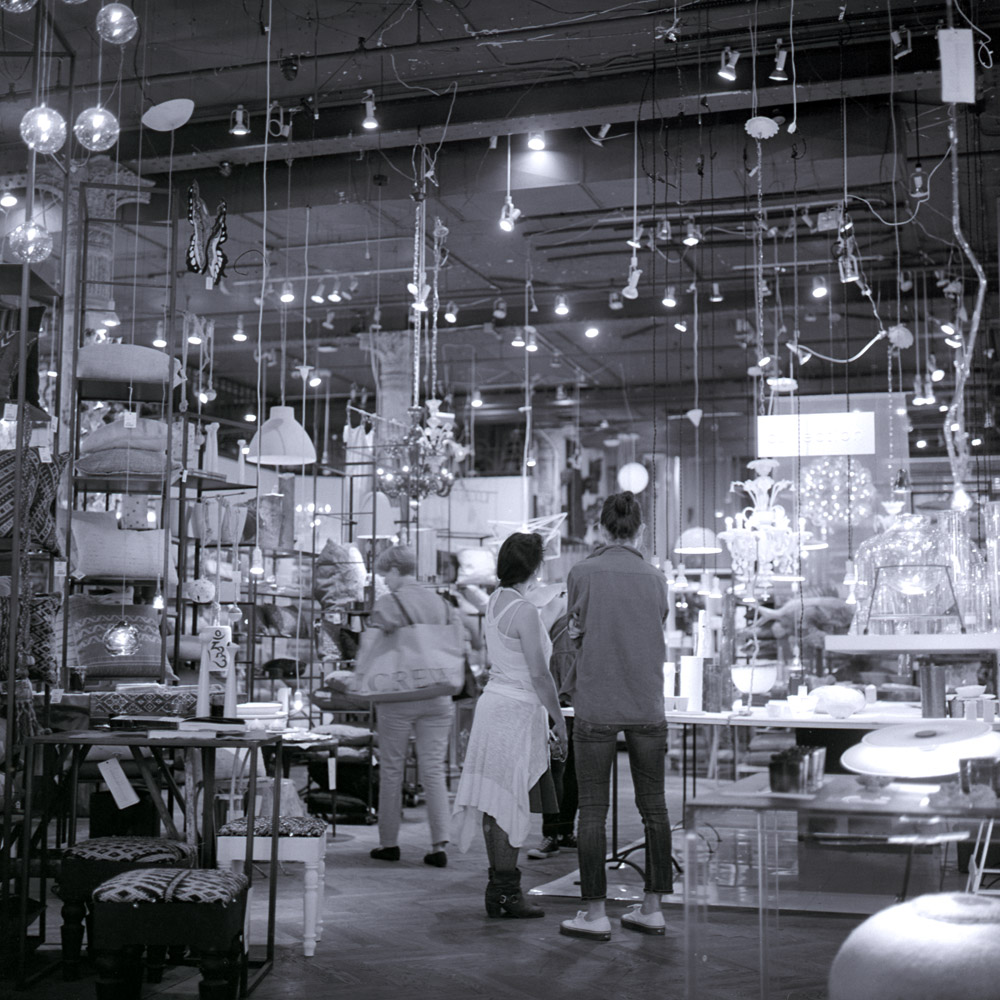
The cast-iron facade of a late 19th Century building on lower Broadway, as seen from the fourth floor window at ABC Carpet & Home. If you’re not familiar with ABC Carpet & Home, it’s a gigantic interior decor store, with four floors of everything from linens and fashion and furniture, from antiques to ultra-modern to Asian-inspired. Not for the faint of wallet – even little decorative tchotchkes are $30. But it’s a cool place to browse for inspiration.
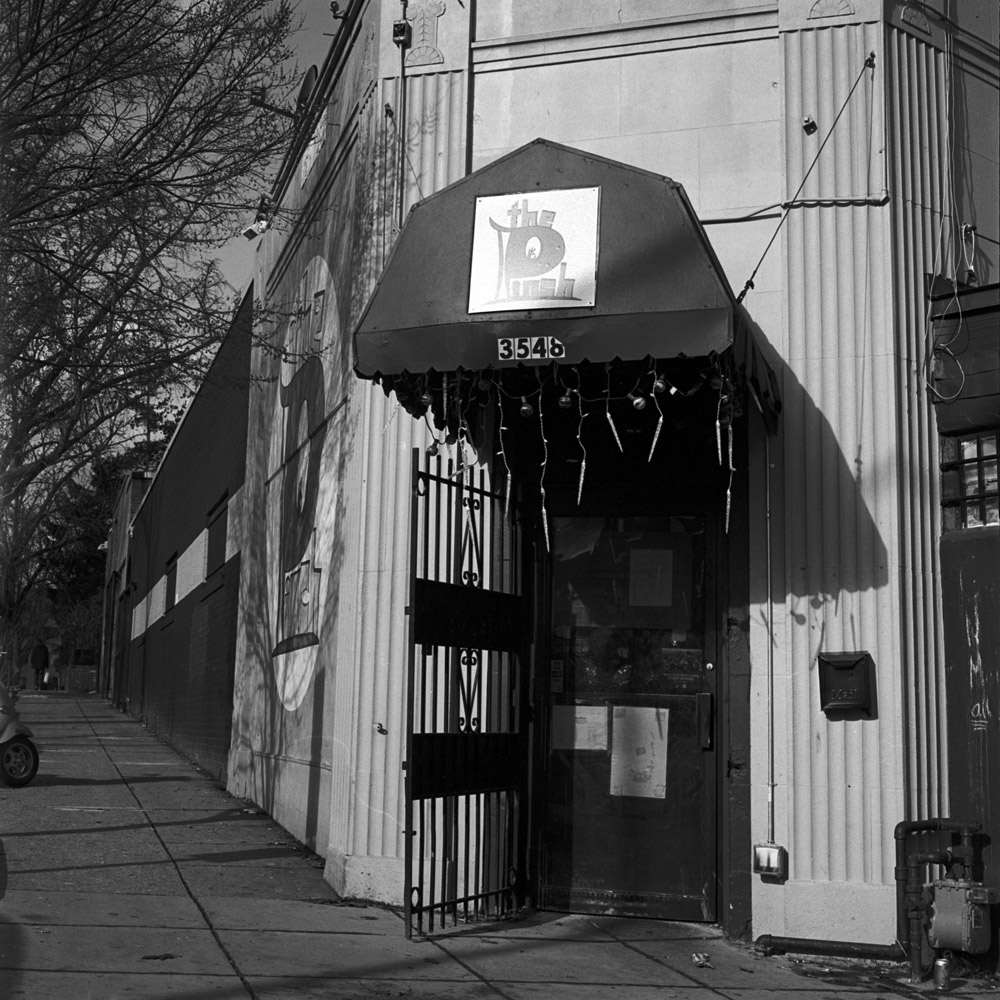
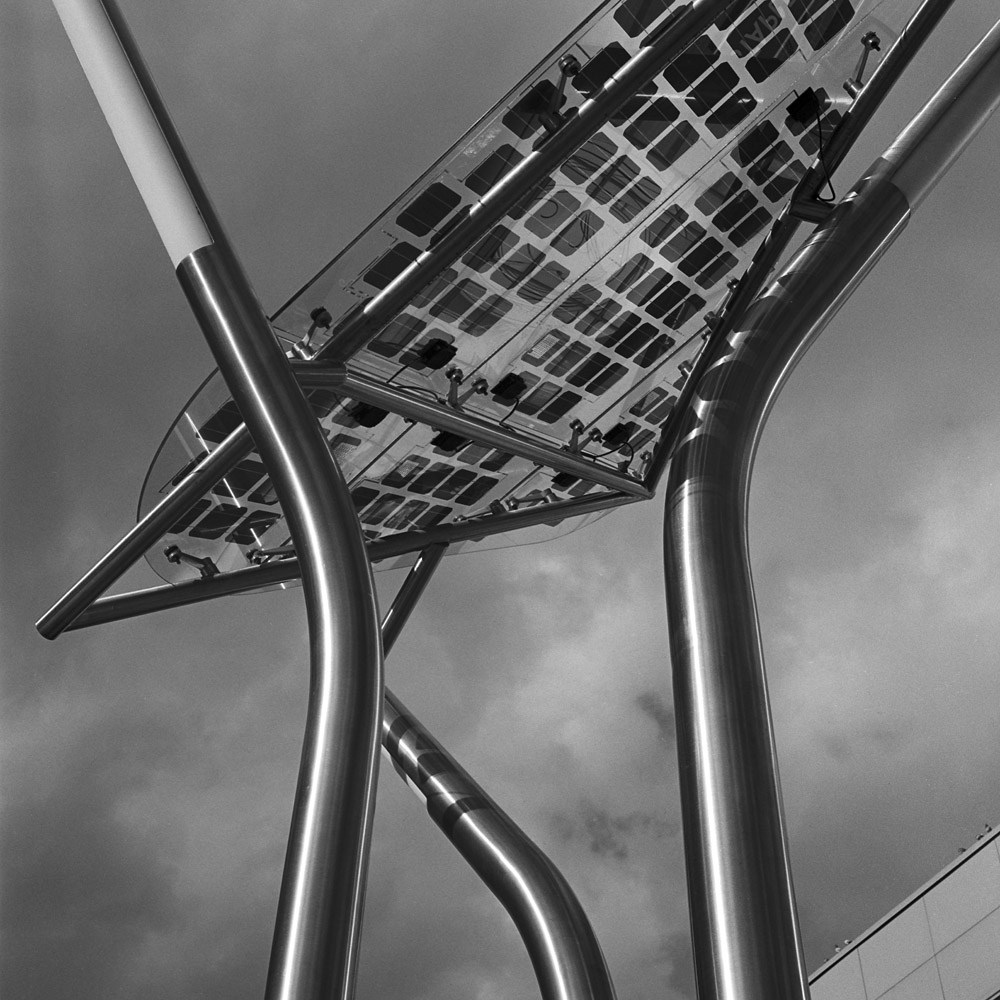
I’m not feeling particularly motivated to crank out my usual essay on the images I post, so today’s post will be more of a no-words posting, other than to say all images come from a wander up and down 14th Street back in early December.
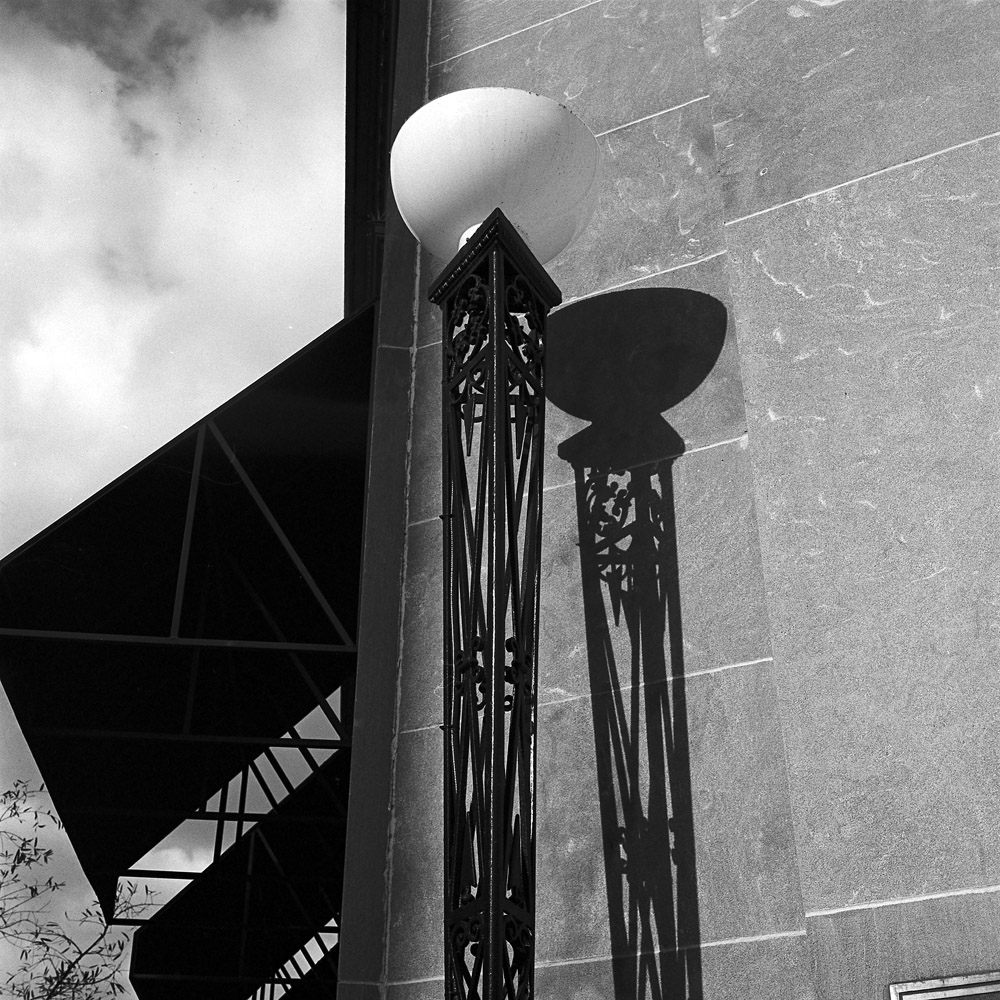
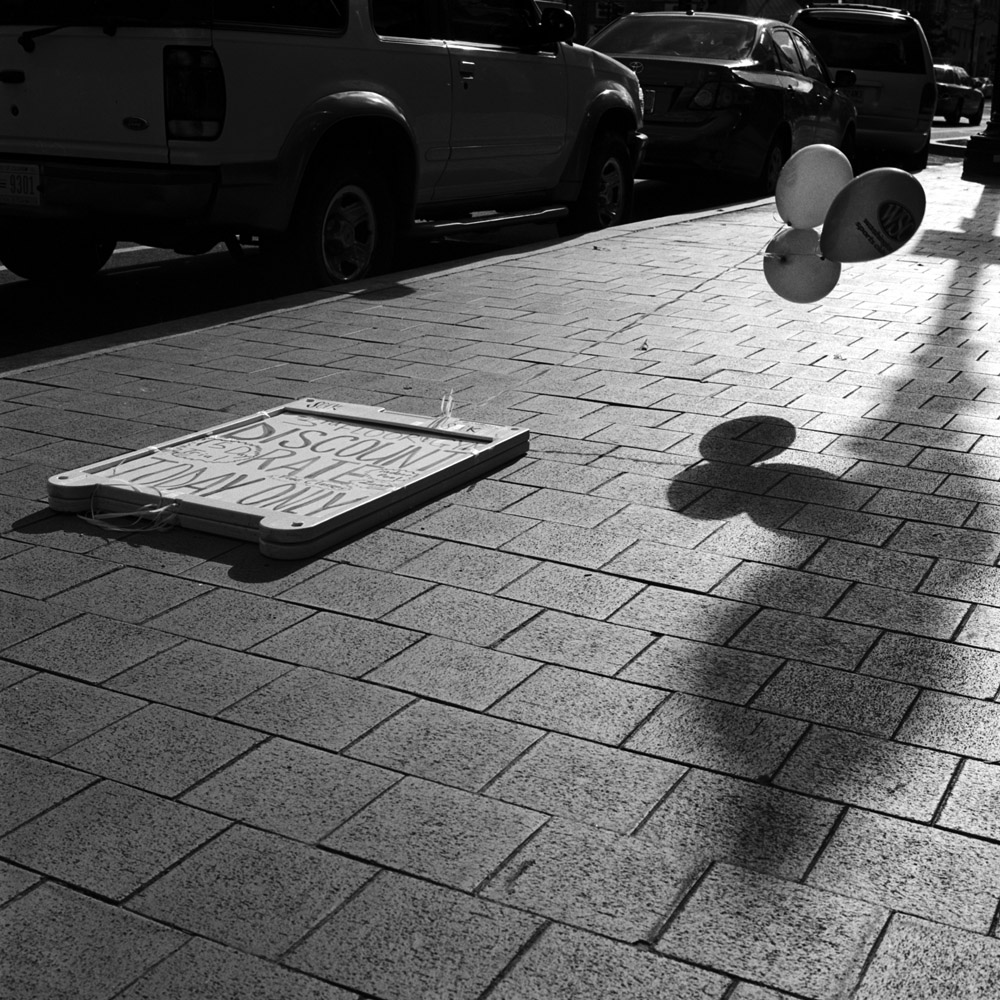
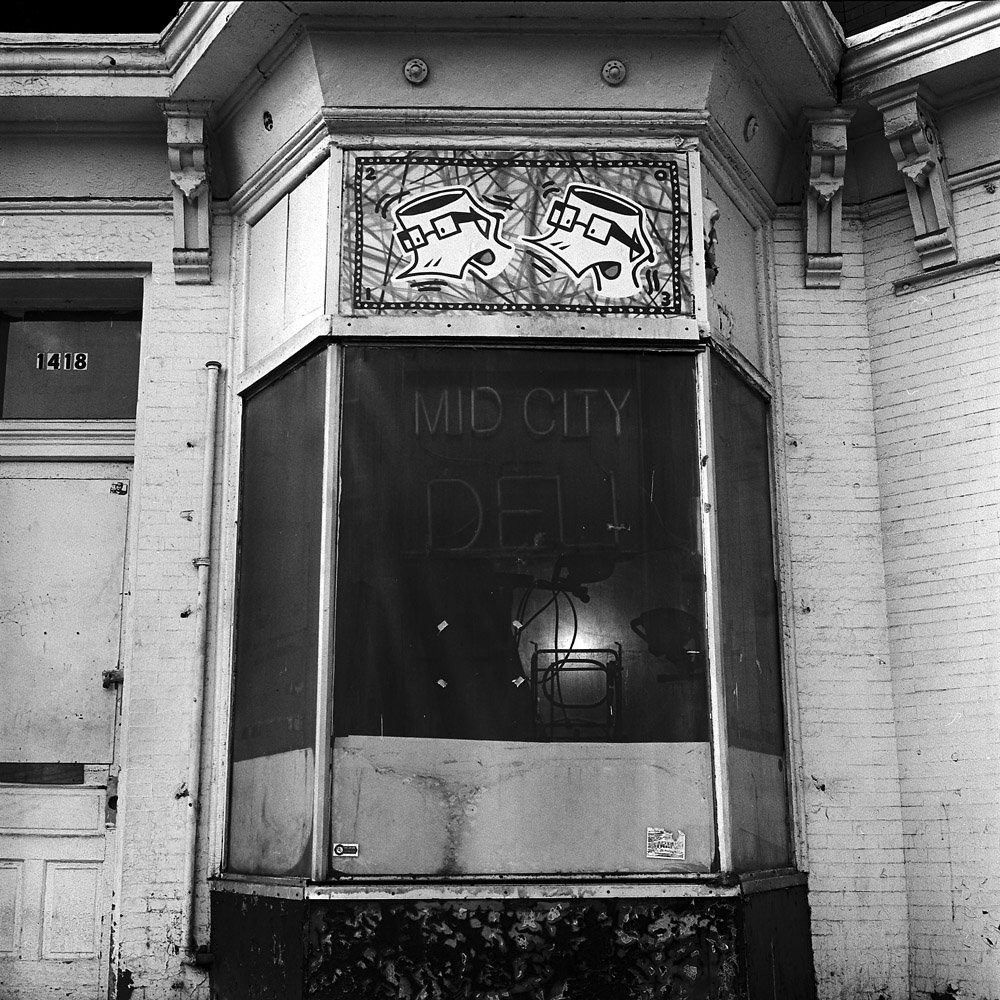
Lamppost, Riggs Bank, 14th StreetDiscount Rate, One Day OnlyMid City DeliThe PinchSolar Powered Streetlight
I’ve probably talked about this before – I have a genealogical as well as spiritual connection to the National Portrait Gallery. An ancestor of mine, Senator John Ruggles of Maine was a big fan of all things patent related. During his tenure as a senator (1830-36), he realized that the US Patent Office was in horrible disarray. They were housed in an old building in poor condition, and as such it was a terrible disservice to patent seekers, patent holders, and the nation as a whole – if it was hard to get or defend a patent, innovators would leave the country and take their industries elsewhere. As a result, he managed to wrestle a patent office reform and the allocation of funds to build a new, fireproof, patent office building out of congress. The building now occupied by the National Portrait Gallery and the American Art Museum is that building. During the civil war, it functioned as a barracks and a hospital, and in 1865 it housed Abraham Lincoln’s second inaugural ball.
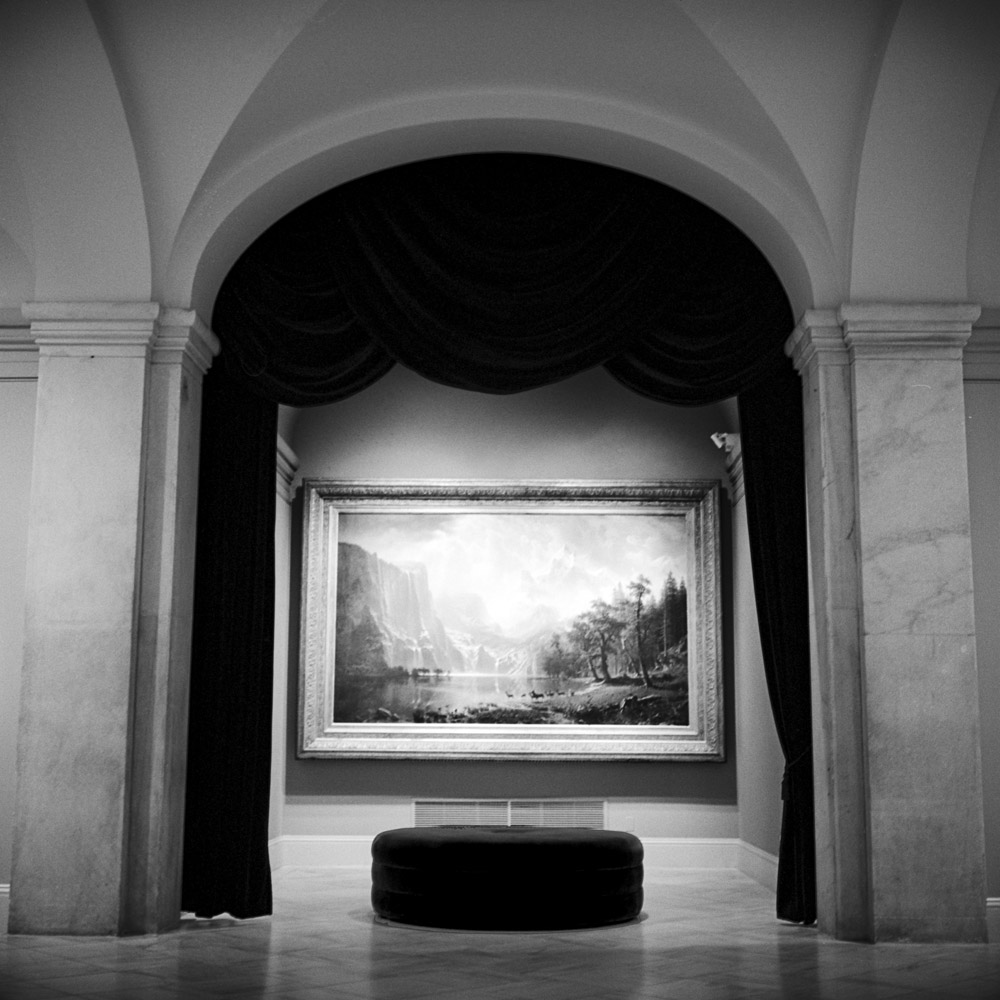
The building was built not only as a warehouse and government office, but from the first it was open to the public as an exhibition space to come see the patent models submitted with patent applications. As such, it makes for a fantastic museum, complete with dramatic display spaces to showcase some sometimes rather large pieces of art. This niche is a perfect example – all it took was some velvet curtains and matching settee.
Theatrical Painting, American Art Museum
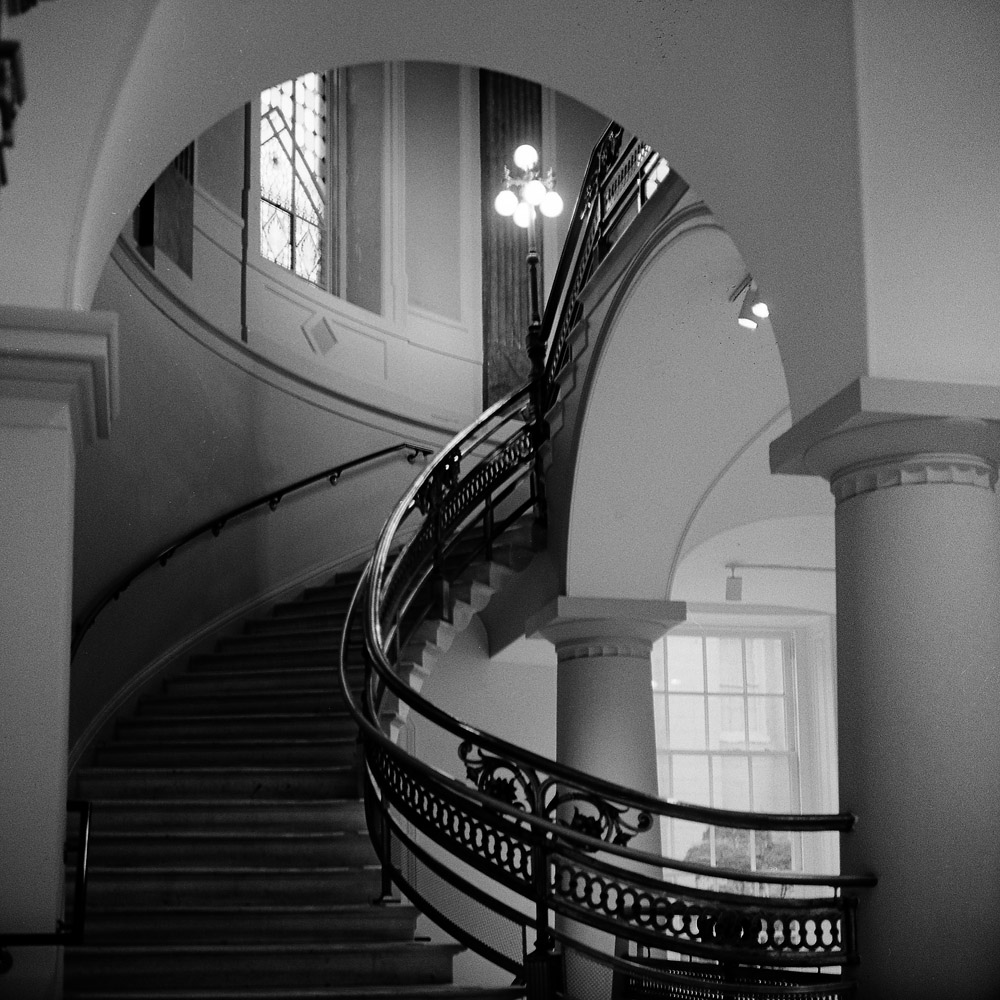
It has several of the most exquisite and dramatic staircases in the city, in my opinion. The following photos are of the main stairs that run from the F Street entrance up to the grand gallery on the third and fourth floors. There is another staircase that I can’t do justice to with the Rollei because it requires a wide-angle lens to show the sweep of the bannister and the giant mural of General Grant and his generals that spans the curved wall behind the stairs.
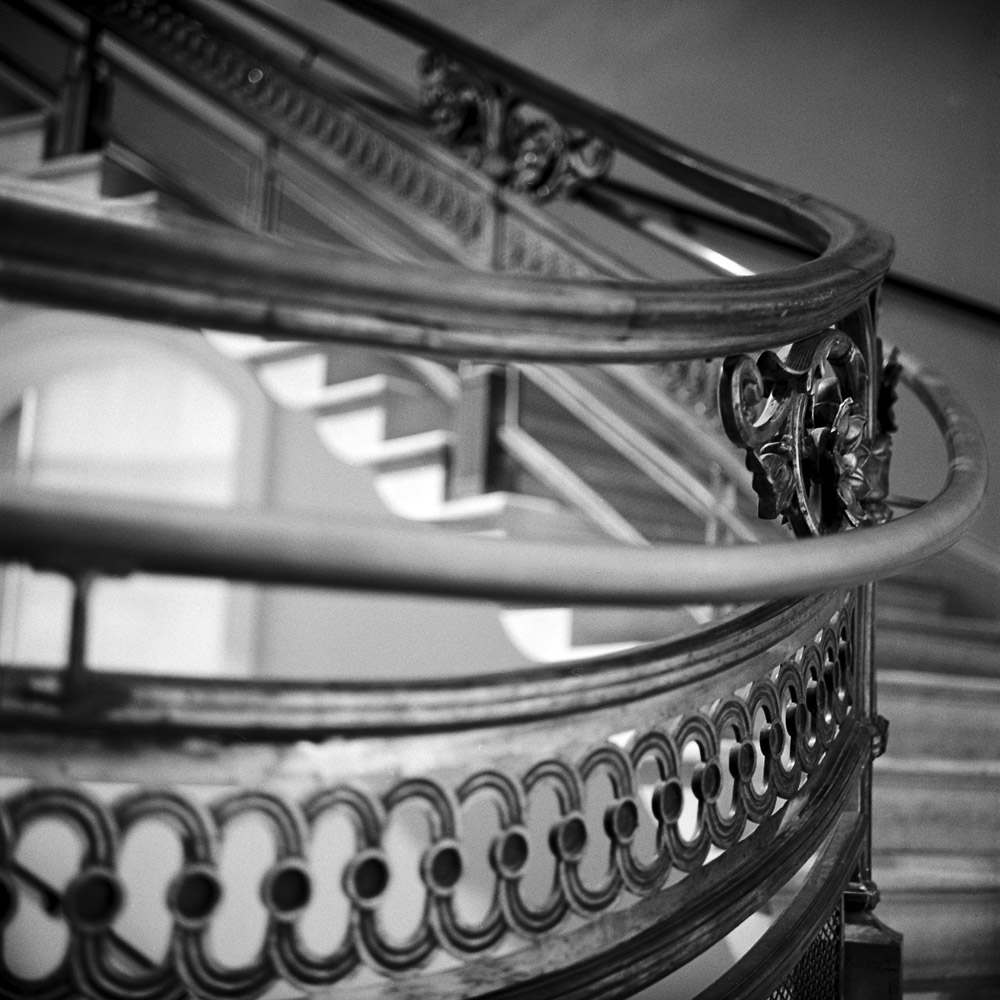
Staircase, National Portrait Gallery
The brass and wood balustrade sweeps around in dramatic fashion. Wouldn’t you love to have a staircase like this in your house?
Rail, Staircase, National Portrait Gallery
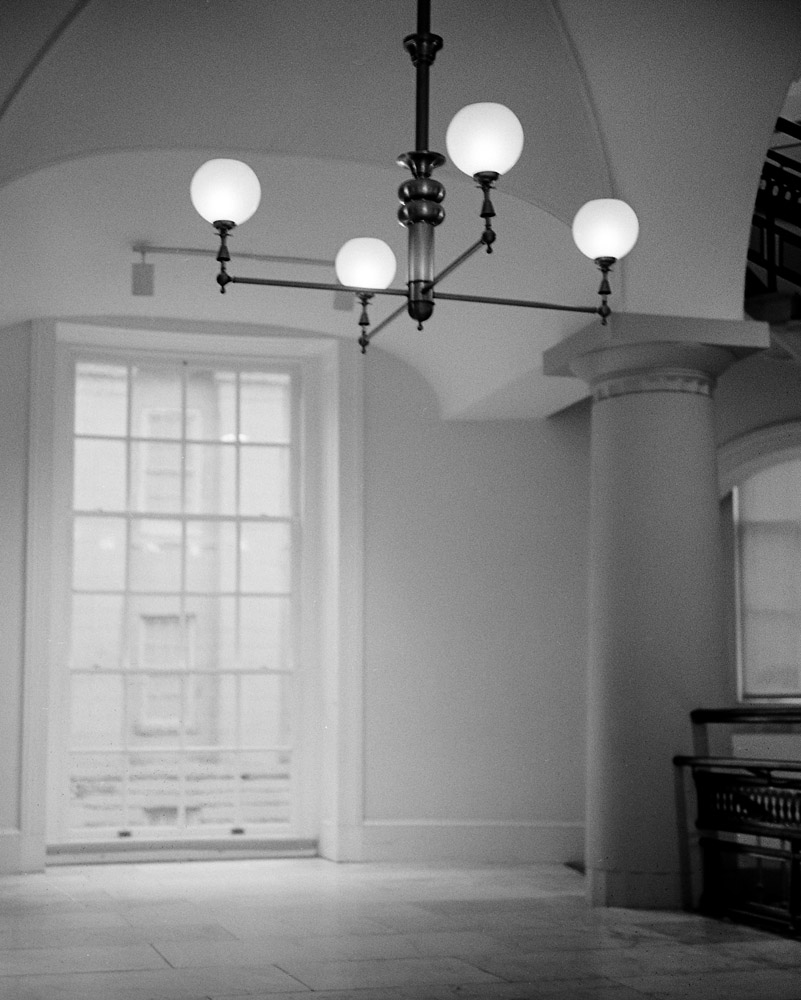
This chandelier is on the second floor landing. The window behind looks out into the courtyard of the dual museums. A few years ago, the courtyard was roofed over with a roof designed by Norman Foster. I was initially opposed to the concept of roofing the courtyard, removing the garden and paving the space with dark gray pavers. However, with time, I’ve come to love the space. They did keep some greenery, and made the space useable 365 days a year.
The chandelier is vintage mid-19th century gas adapted to electricity. It’s always a challenge to balance updating and modernization with historical preservation. I think they did an overall outstanding job with this building, and I’m thrilled to see it maintaining relevance and utility into the 21st century.
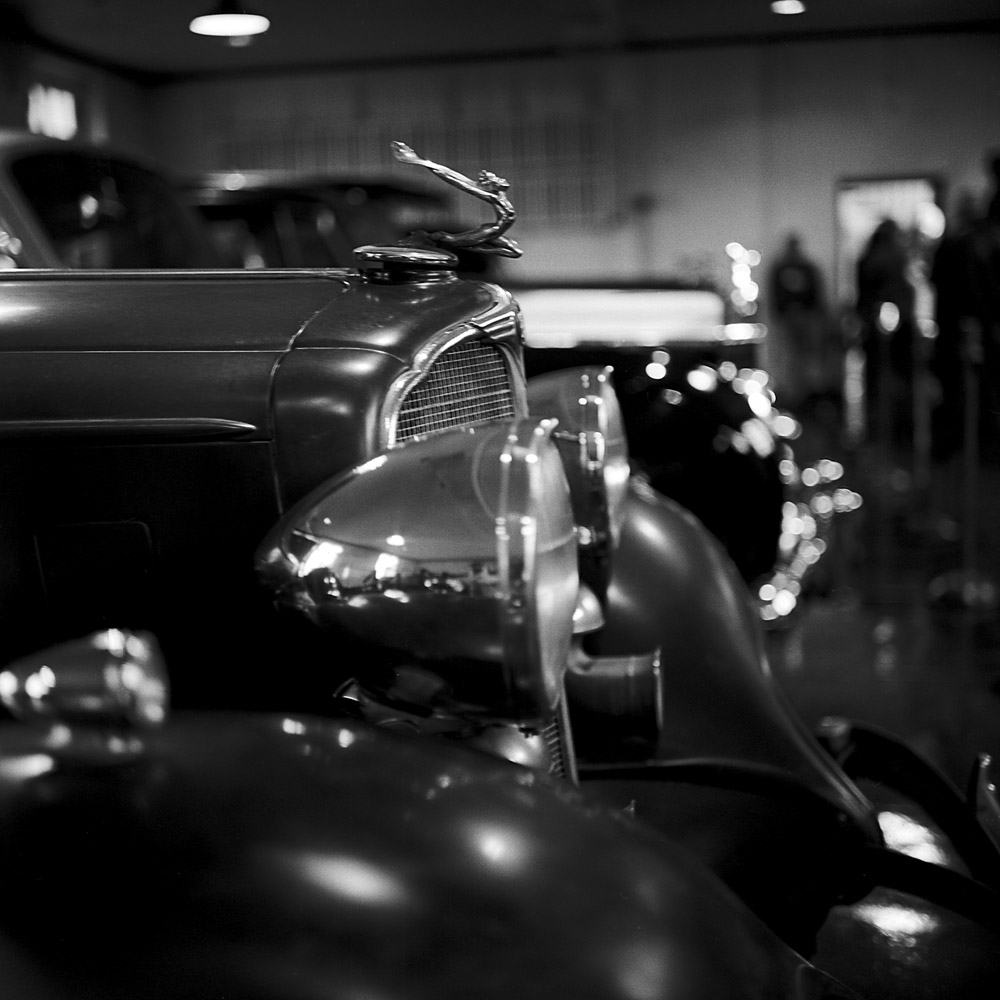
Nemours was the home of Mr. Alfred I. Dupont, one of the wealthiest men in America in the early 20th century. When stripped of his directorship at Dupont, he sought out new business opportunities including investing in Florida real estate. Spending a significant amount of time in Florida, he needed a car, and kept this Buick rumble-seat coupe at his property there. The car, unlike the others garaged at Nemours, is in original, survivor condition, complete with faded paint and dulled chrome. What makes it all the more remarkable is that the car survives without major damage (or blood on the bumpers!) as Mr. Dupont was by the time he owned the car deaf in both ears and blind in one eye.
A.I. Dupont’s Buick
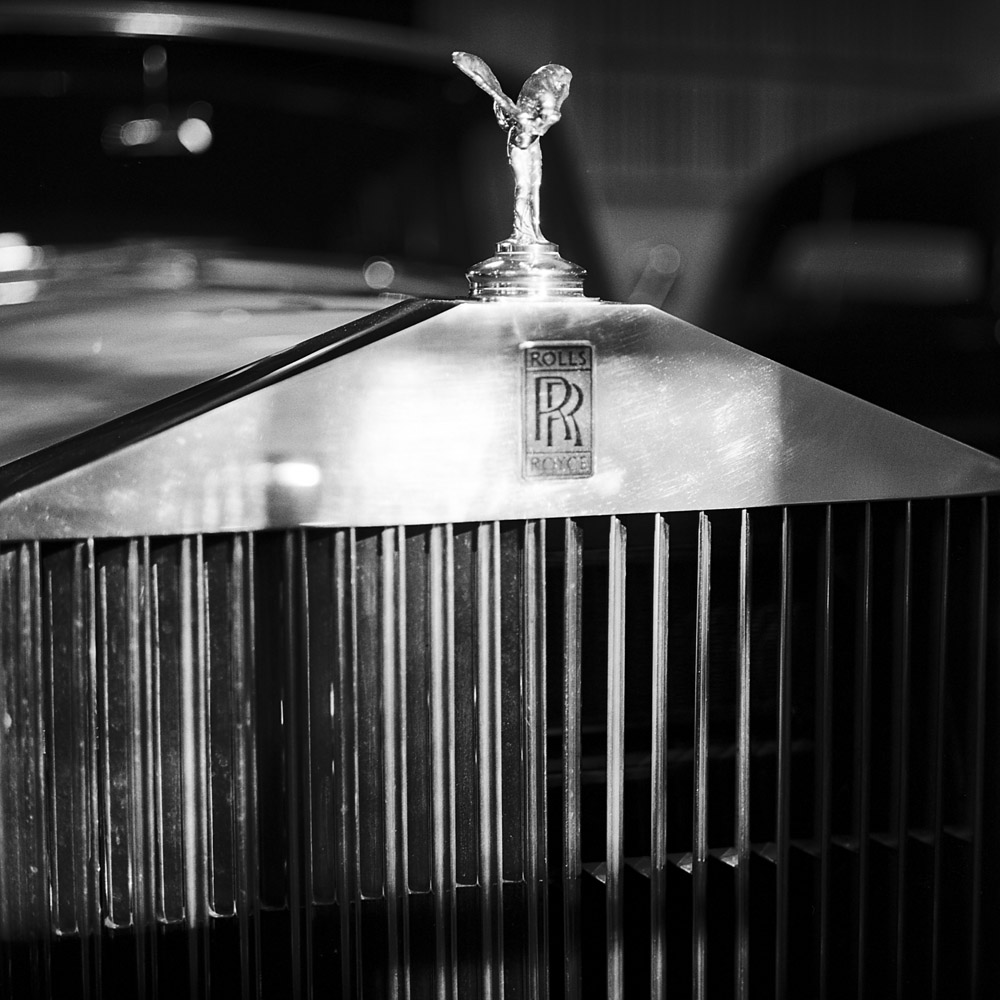
His third wife, the true love of his life, outlived him by nearly 40 years. Her last car was this 1960 Rolls Royce Phantom V. According to the docents, this Phantom V is the #2 production car of that year, with #1 being in possession of Her Royal Britannic Majesty, Queen Elizabeth II.
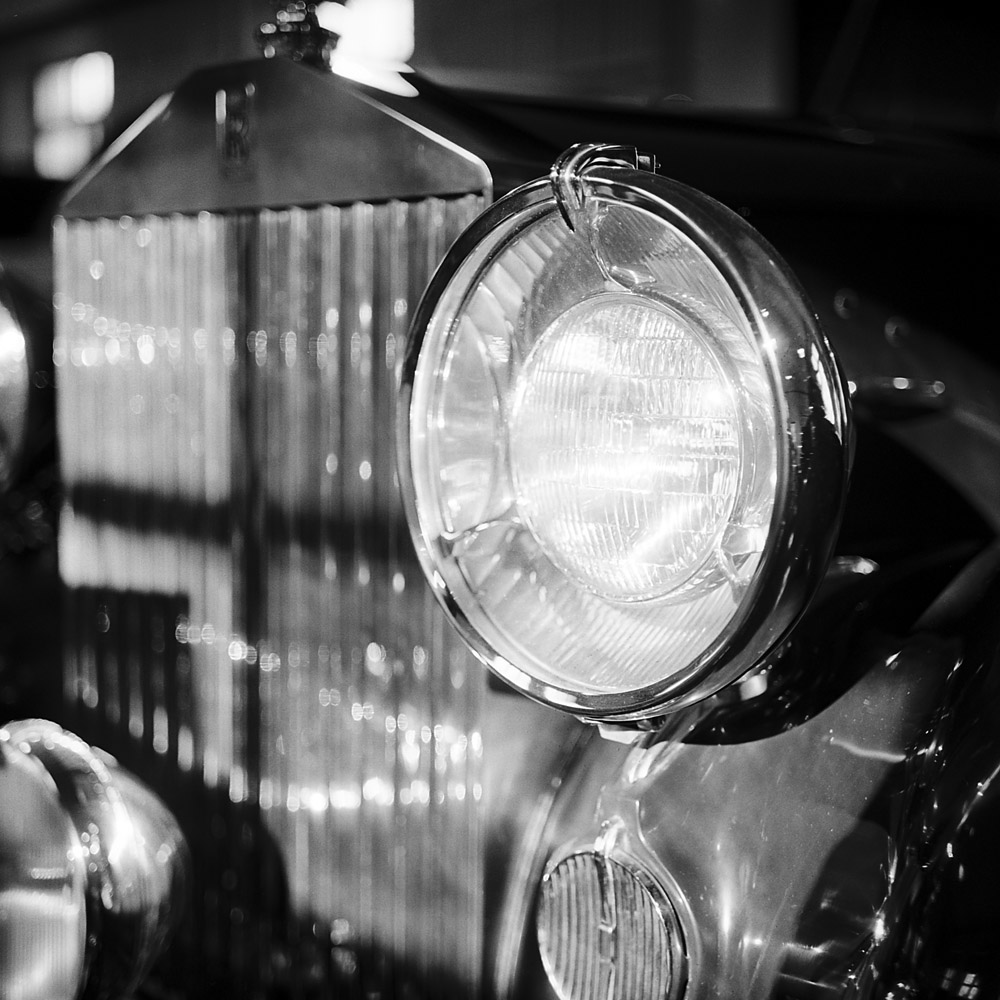
Mrs. Dupont’s Rolls Royce Grille
This headlamp belongs to the second Rolls Royce in the Dupont stable, a 1950 model if memory serves.
From the A.I. Dupont estate, Nemours, outside Wilmington, Delaware. A.I. Dupont, director of the Dupont chemical company, built the house as a gift to his second wife in an attempt to grow her affections for him. The 40,000 square foot house was built in 18 months. The interior features an elevator that runs from the basement to the third floor, a billiard room, bowling alley, an ice factory (the house was built before electric refrigeration, so they needed to be able to produce their own ice to keep the ice boxes cold), and a central vacuum system. The laundry was put in a separate building perhaps 30 yards from the main house so they could say they sent their laundry out.
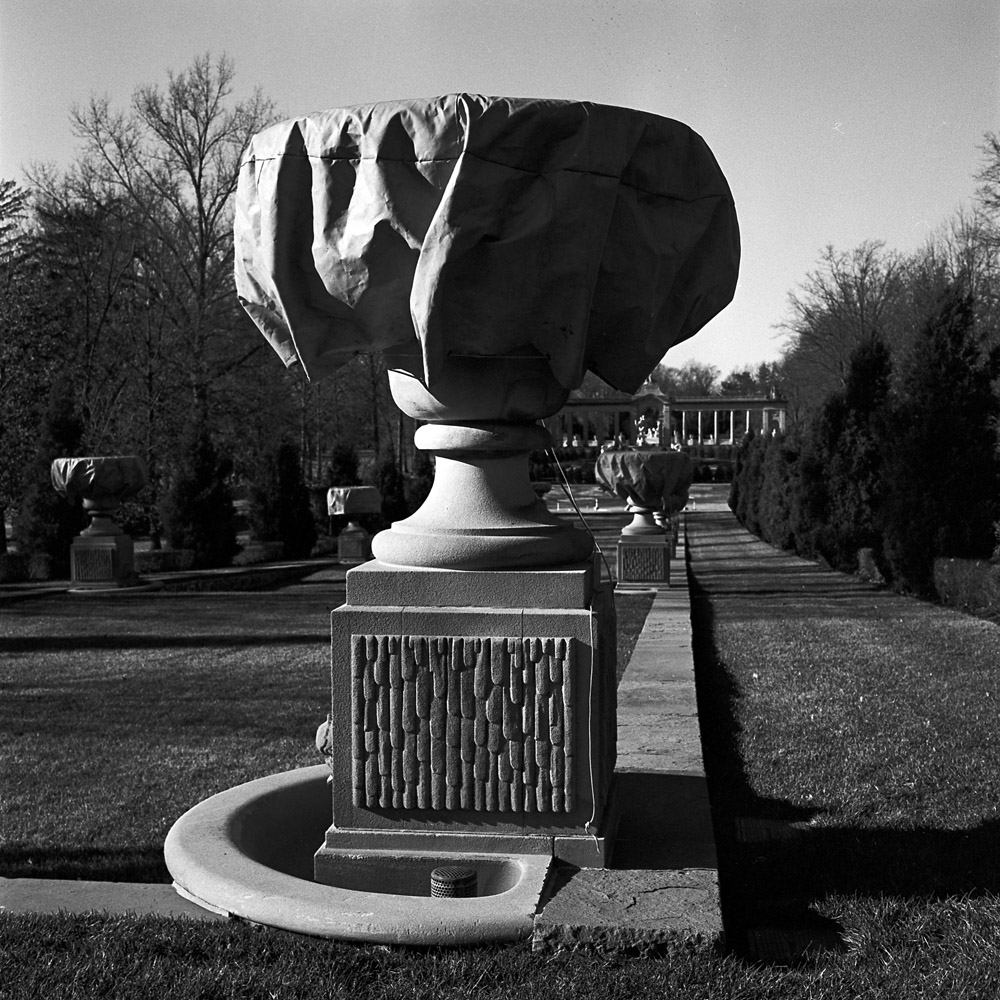
This is a view down the lawn from the mansion front, looking to the colonnade (which crowns a massive fountain on the other side). The garden urns have been prepared for winter with their canvas covers and their fountains drained. Even today, the estate totals some 300 acres, down from the original 3000.
Urn, Prepared for Winter, Nemours
I was at Nemours between Christmas and New Years to see it for the last open weekend of the year (it closes at New Years and re-opens in May). The house interior is decorated as the Duponts would have decorated for the holidays. No photos of the interior are allowed, so I do not have any pictures from inside the house. Photography on the grounds is acceptable, however, so I took these pictures of some of the details outside. In the spring, when garden tours are offered, I’ll have to go back and shoot the gardens in greater detail.
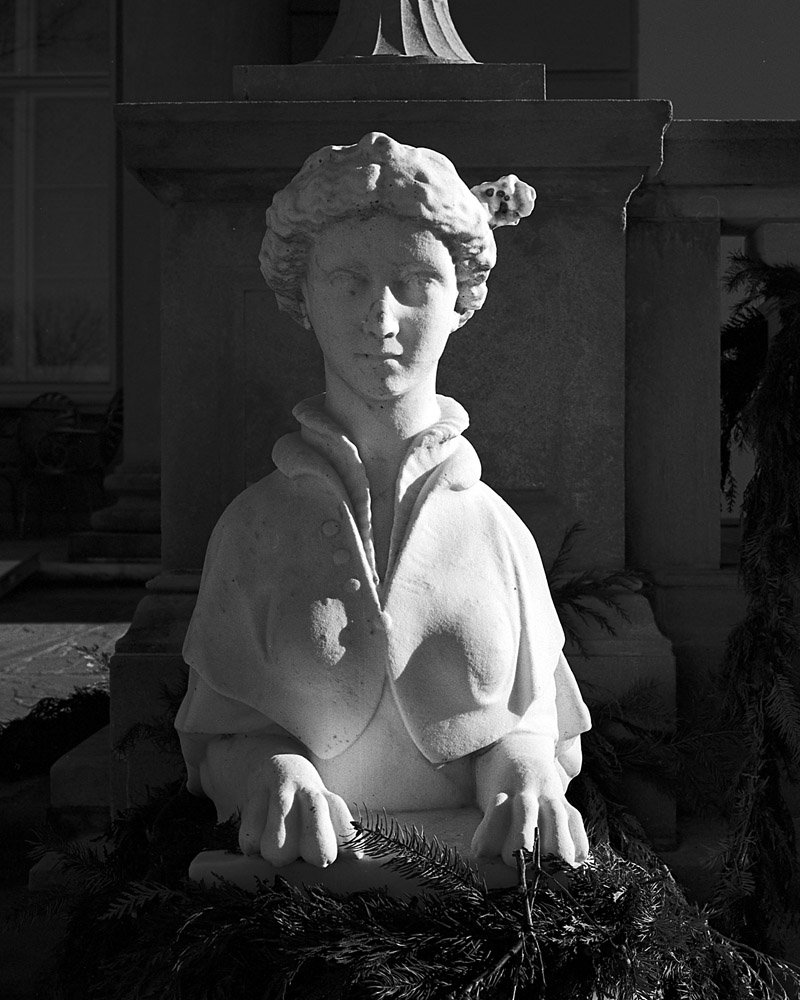
Here is a sphinx, one of a matched pair, guarding the front porch of the house. I loved the way her white marble glowed in the late afternoon winter sun.
We had a snowstorm a couple weeks ago. I know, bad me for taking so long to getting around to developing the pictures. And I have another roll from the snowstorm to go, as part of a batch. In any case, I decided I wanted to take pictures during the snowfall, so I bundled myself up and got out and about with the Rollei. This, and rain, are perhaps the two things the Rollei is less than ideal for, because the waist-level finder does nothing to prevent snow (or rain) from falling on the focusing screen. Unless of course it’s blowing sideways, at which point you have bigger problems.
I took the camera and my Induro carbon-fiber tripod out for a short walk up the street on my way to get dinner. It’s proof of the adage about finding interesting things to photograph in your own backyard. You just have to be willing to see them.
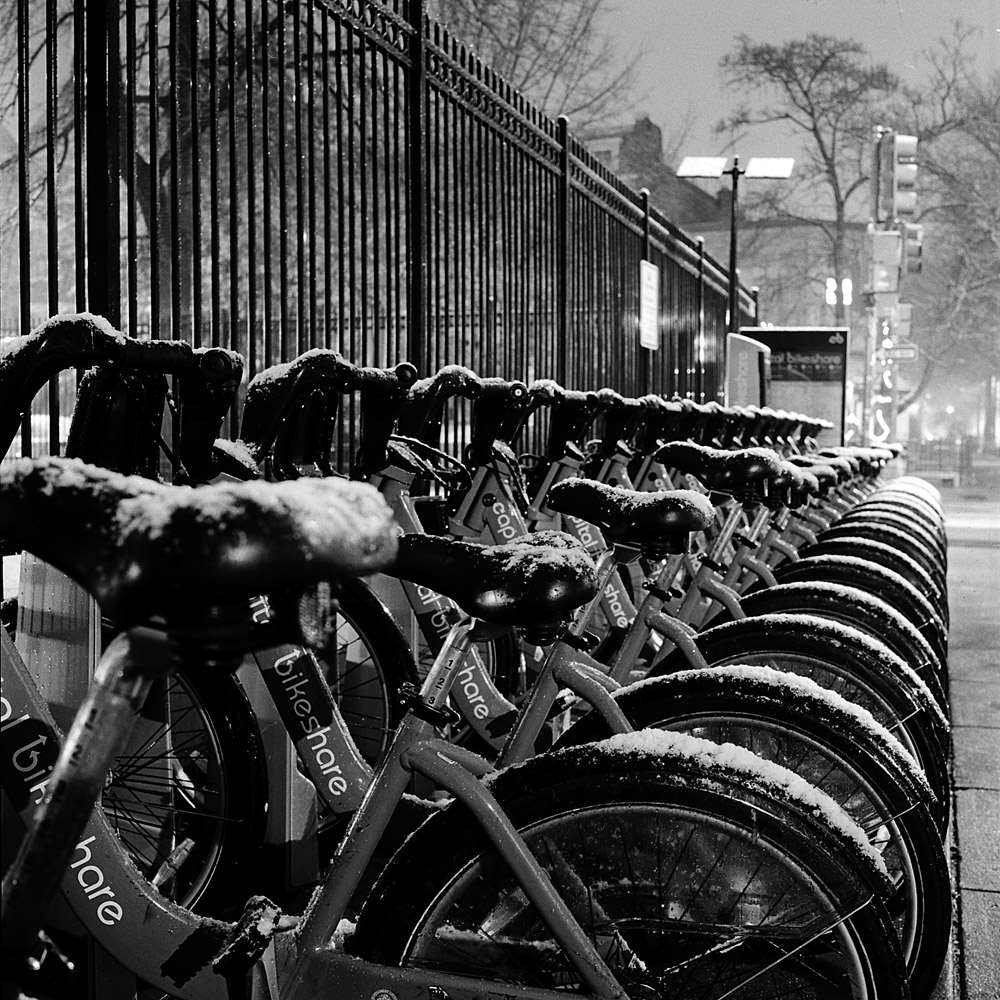
The bikeshare is a great source of material, especially if you like repeating shapes and patterns. The bike seats both break and reinforce the pattern as they are all set to slightly different heights.
Capital Bikeshare 11th Street
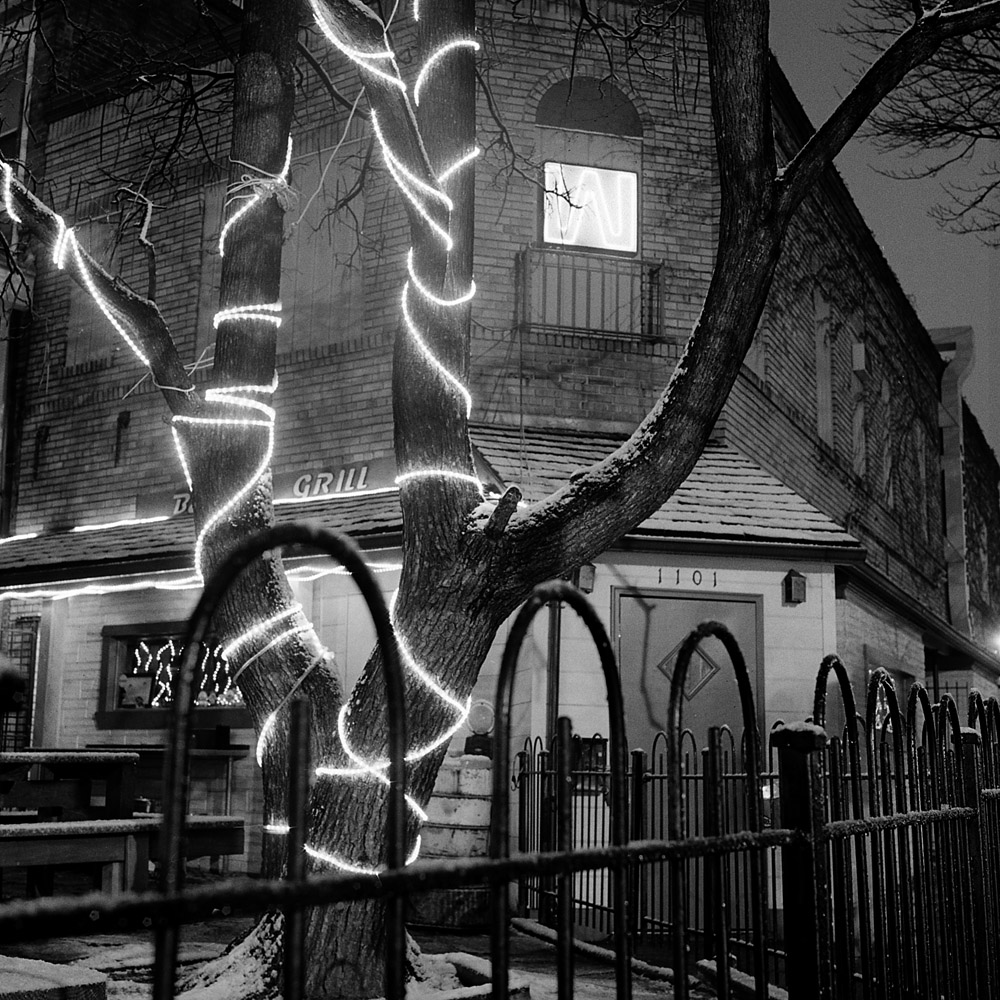
The Wonderland Ballroom is a neighborhood bar and grill. Until 2004, it was the Nob Hill, DC’s oldest continuously operating gay bar (opened in 1954), catering to a primarily African-American (and in the end, elderly) clientele. Now it serves a young, ethnically and sexually diverse crowd of urban hipsters. Plus ca change, as the French say – a side-effect of gentrification.
Wonderland Ballroom
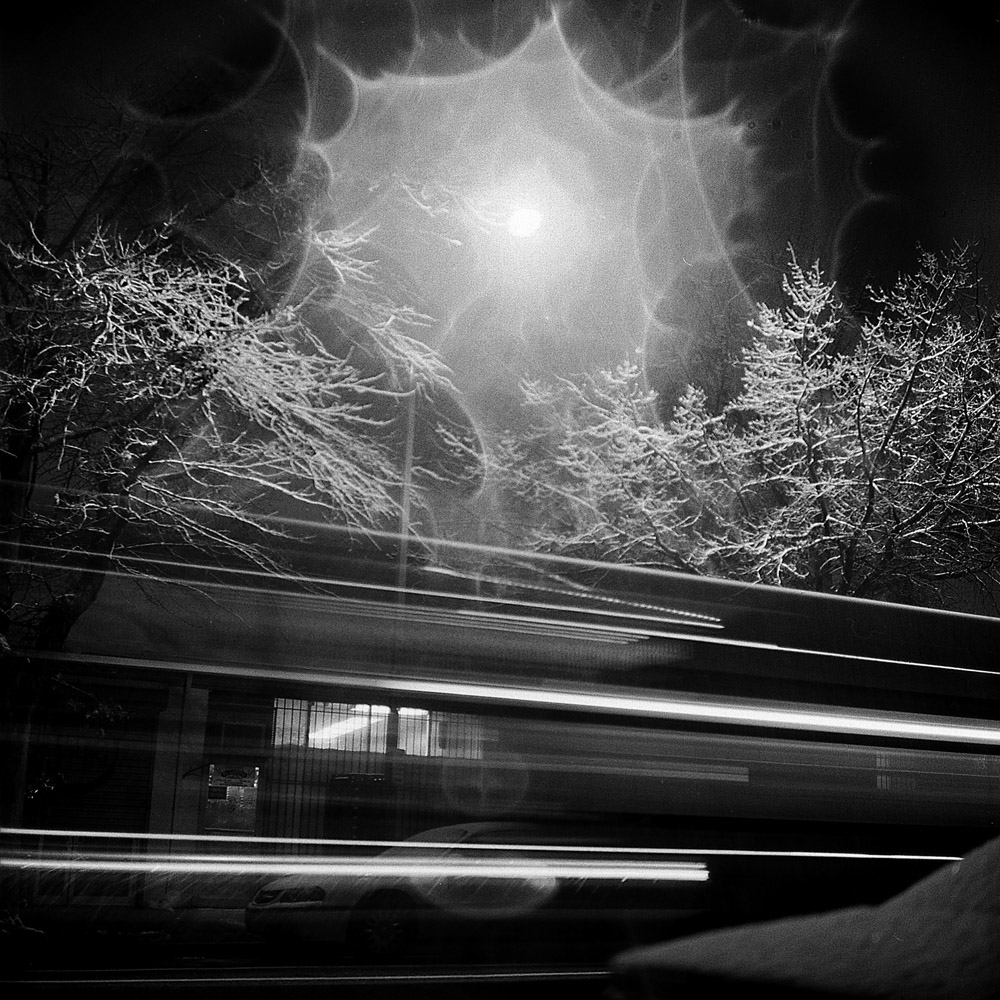
In a long time exposure (somewhere in the region of 30 seconds) I caught the lights of a passing city bus, under the flare of a street lamp. The awesome and dramatic flare from the street lamp is a combination of the lens on my particular camera, which is prone to strange flare artifacts when you put a light source directly in the scene pointed at the lens (due in part to some loss of coating on the front element of the lens) and the specular reflections from the falling snow. In some cases I’d find lens flare like this to be highly objectionable and would consider the shot ruined. In this case, though, I think it makes the image.
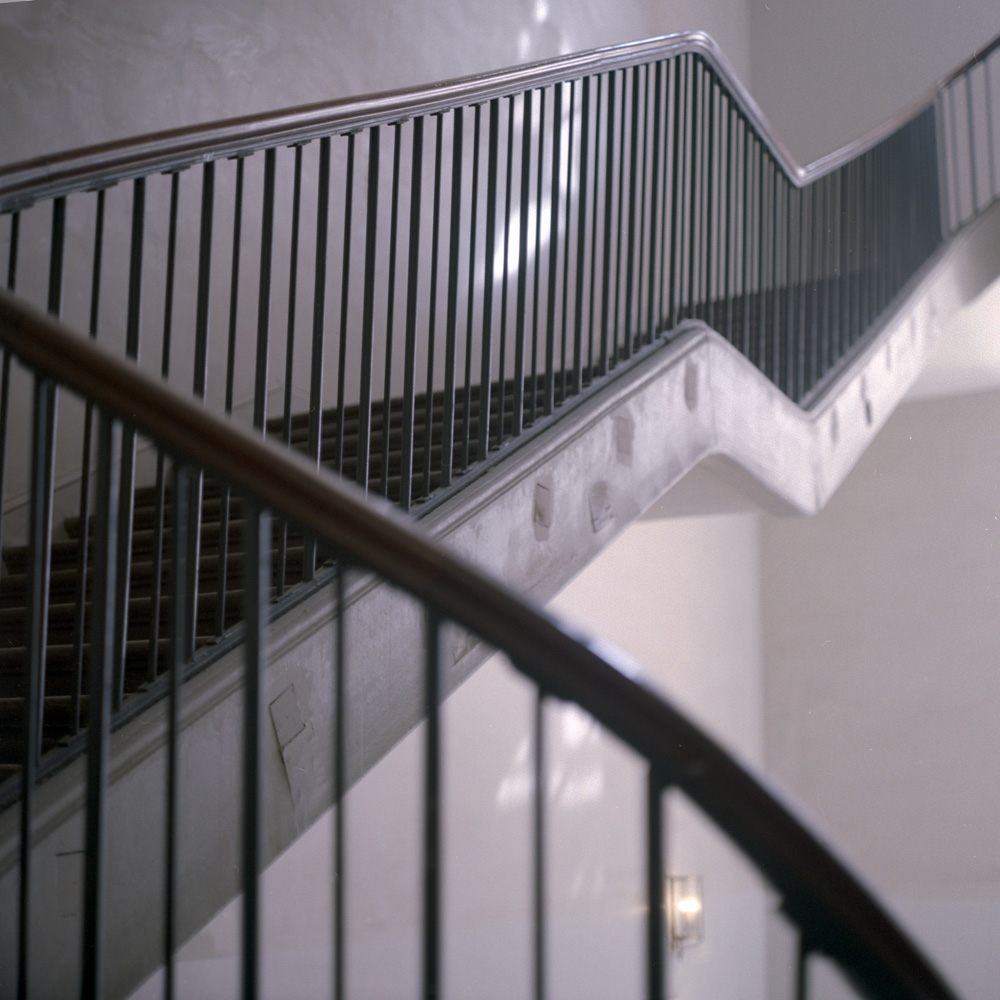
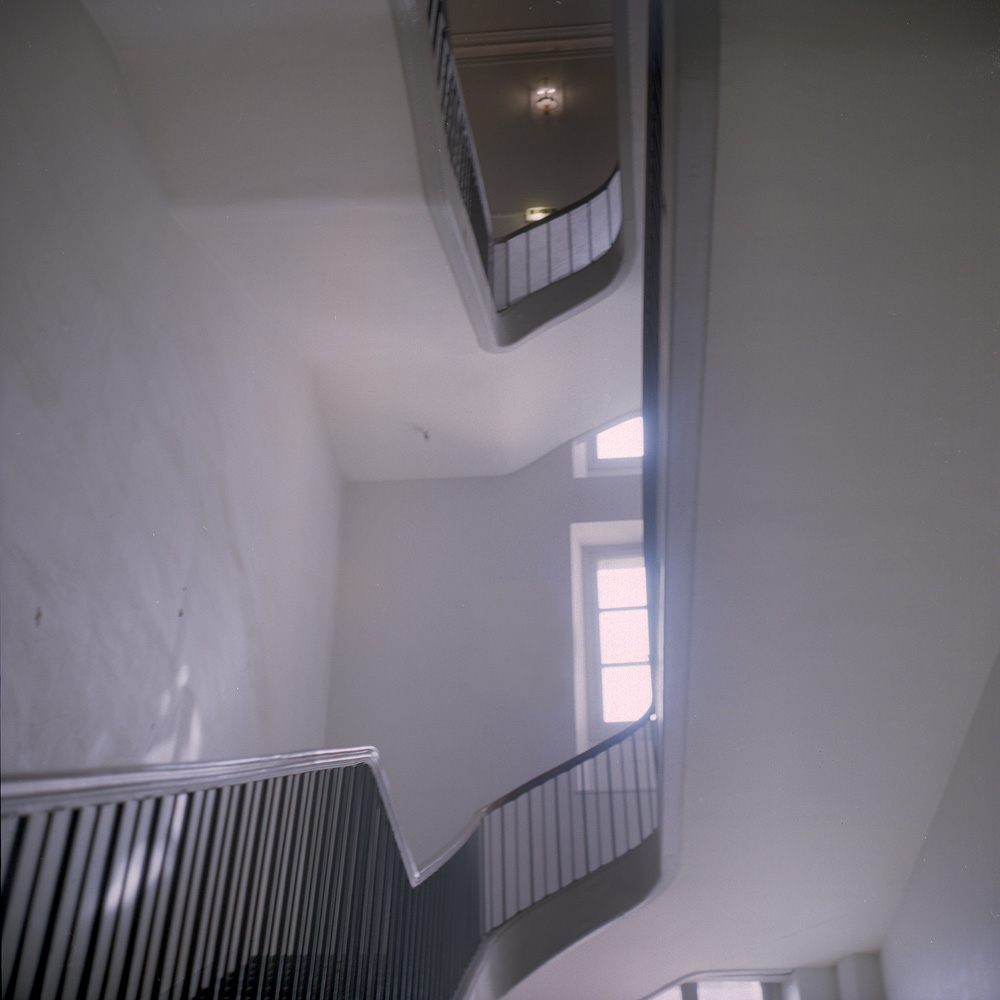
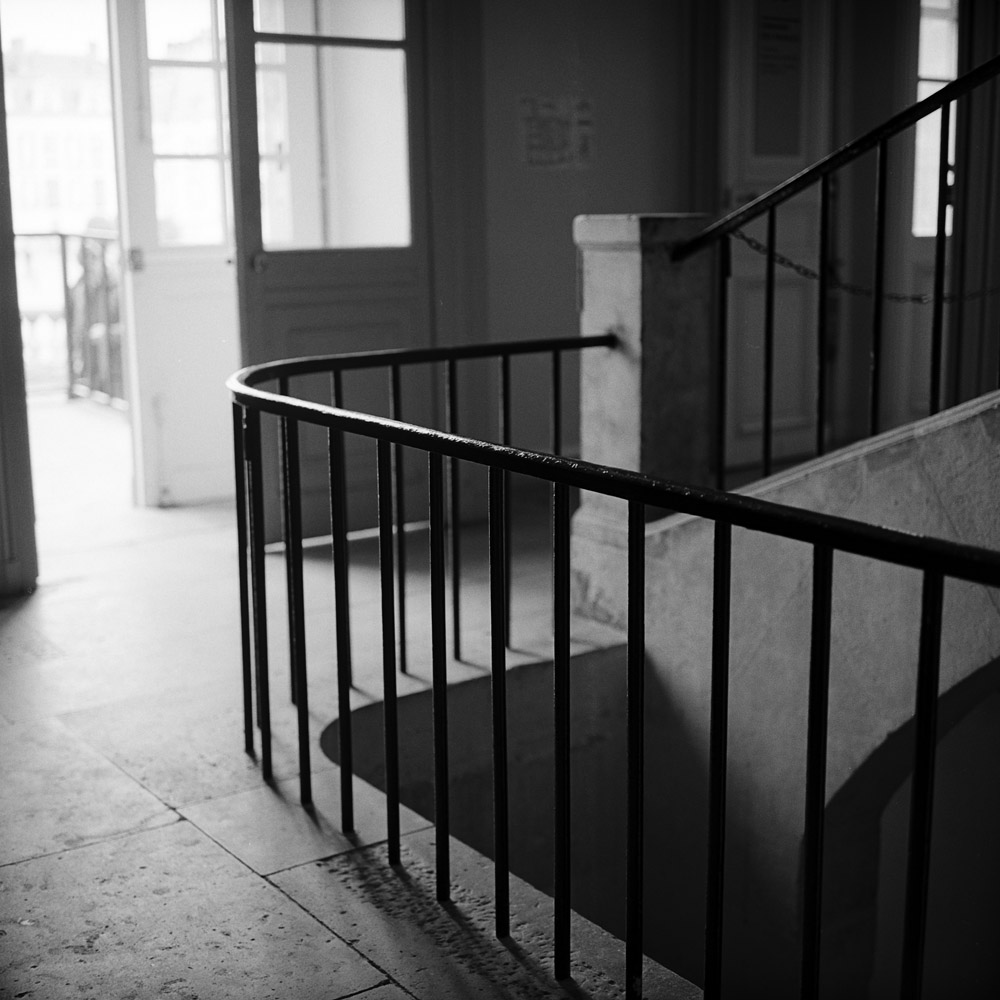
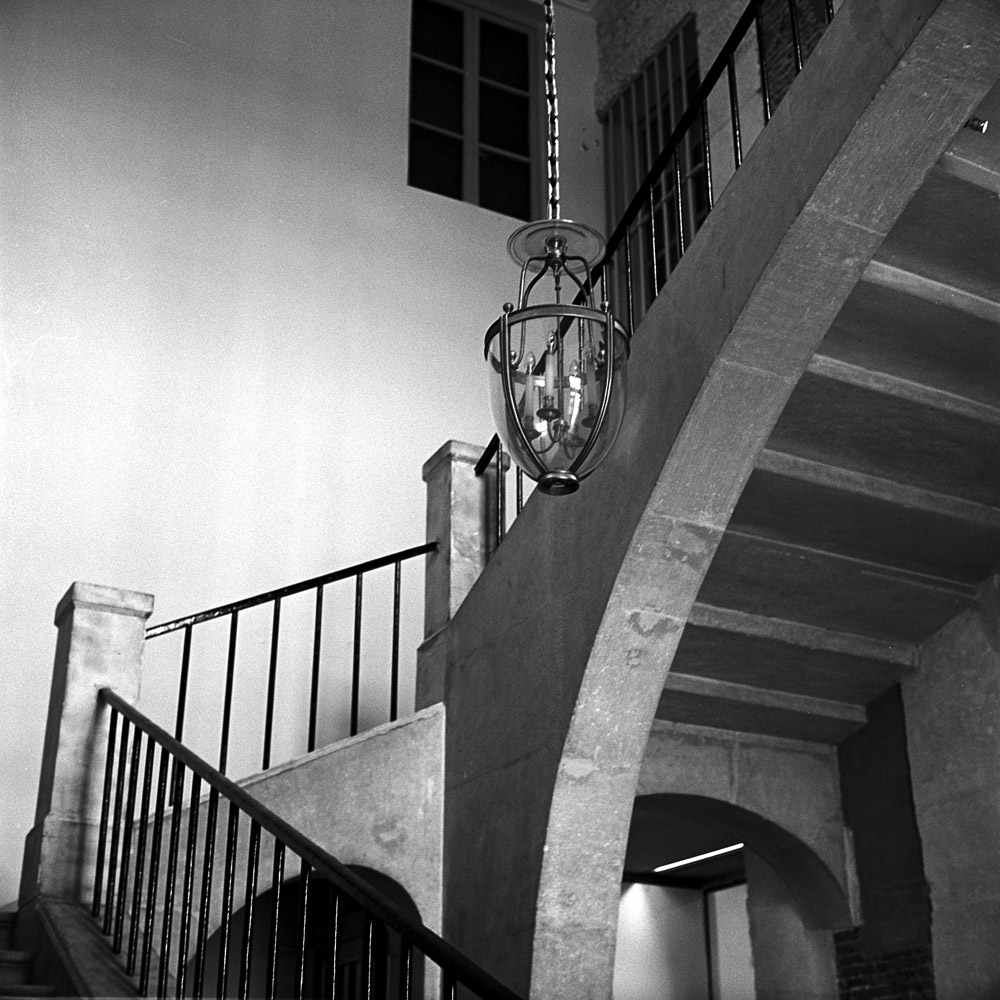
These first two are of the service stairs that lead from today’s restaurant and snack bar to the ground floor and the exit to the gardens. By the time I got to the dining room, my feet were screaming at me from all the continuous marching through the palace and across the cobbled courtyards. I did not eat in the main dining room but instead got a sandwich from the cafe. There was no place to sit (the only available tables were the stand-up kind, every chair was taken). Leaving the cafe to be faced with this staircase, then, was suddenly a daunting task. What to do, then, but photograph it?
Balustrade, Service Stairs, Versailles
To proof the images I wanted to scan and print bigger, I had a set of 5×5 inch proof prints made at the time of developing the film. Sometimes, the minilab prints looked better than my final scan results, but more often, they look worse. Based on the minilab prints, I excluded these two from my rough edit. Going back over the film while scanning everything else, I looked at the negatives and they looked good, so I took a whirl and scanned the first one. As it turned out, they were much better than I thought they would be based on the proof prints.
Service Stairs, Versailles
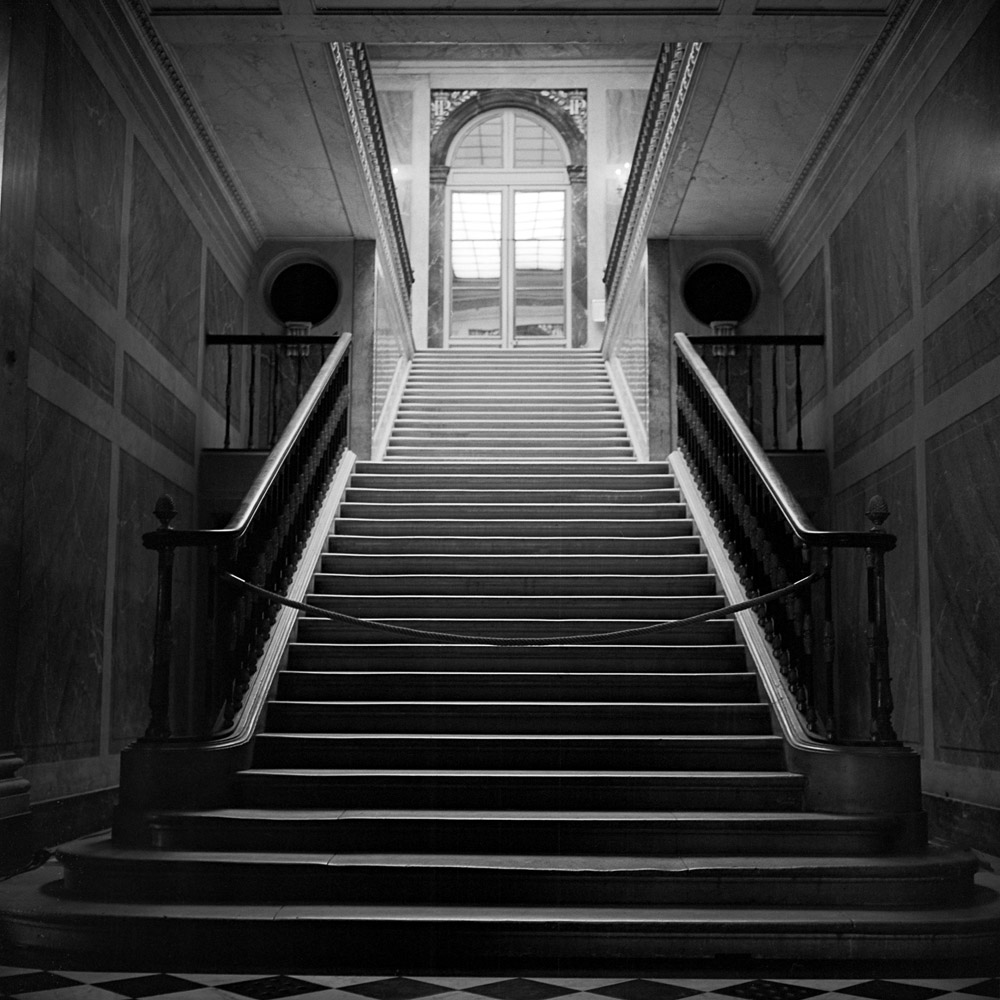
These next two are a memory refresher from an earlier post. With the exception of the last photo in this post, the only staircases I photographed at Versailles, it seems, were service stairs. I guess everyone is content to ignore them and only pay attention to (and mob) the Queen’s Stairs. Their loss, my gain.
When I originally posted this staircase, I mistakenly labeled it “The Queen’s Staircase”. It is not. The Queen’s staircase is far more opulent and magnificent than this, although I wouldn’t complain about having this be the main stairs in my house…
It “snowed” here in DC on Tuesday, and we got the day off for what amounted to a little more than a dusting that rapidly turned into slush and never really interfered with traffic or public transportation or anything. But, since I had the day off, I took a walkabout in my neighborhood to burn some film.
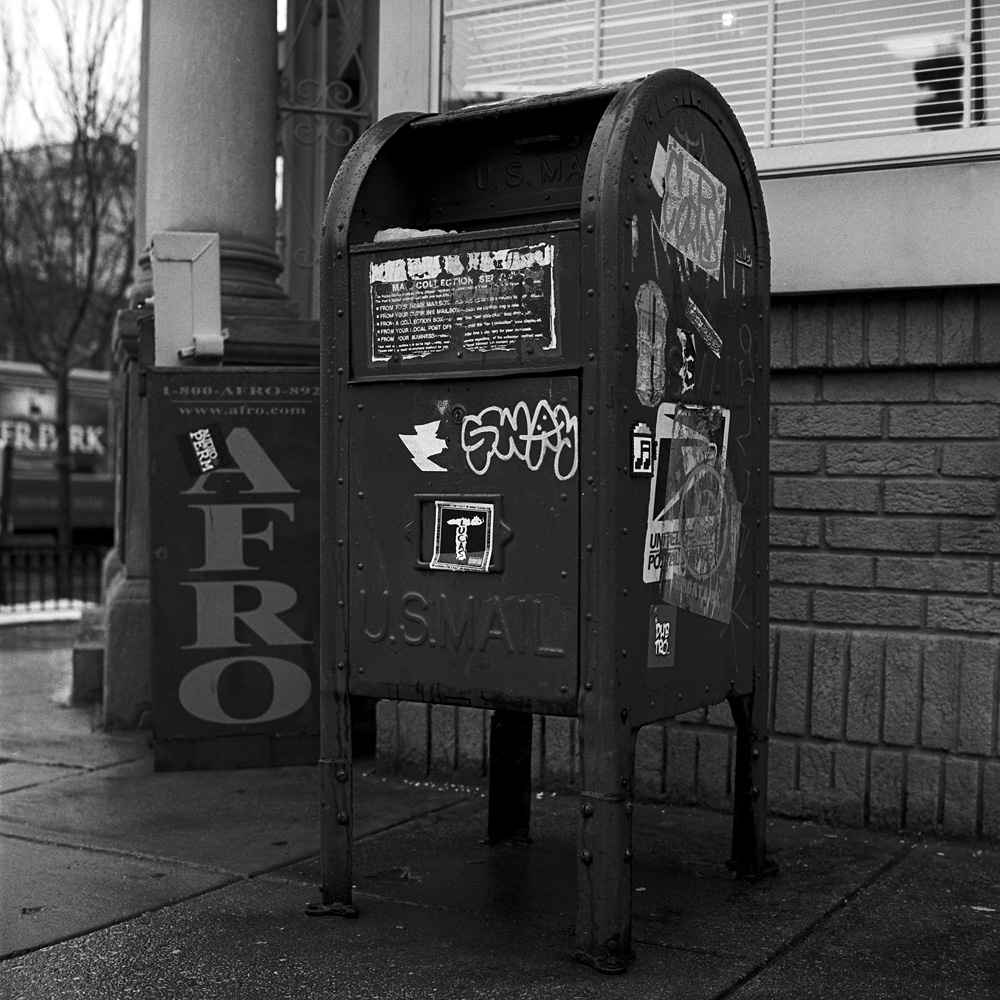
I’m always looking for images of things to add to my “Portraits of Everyday Objects” series. This mailbox, outside the Industrial Bank building on U Street fits the bill, looking somewhat forlorn with all its graffiti.
Mailbox
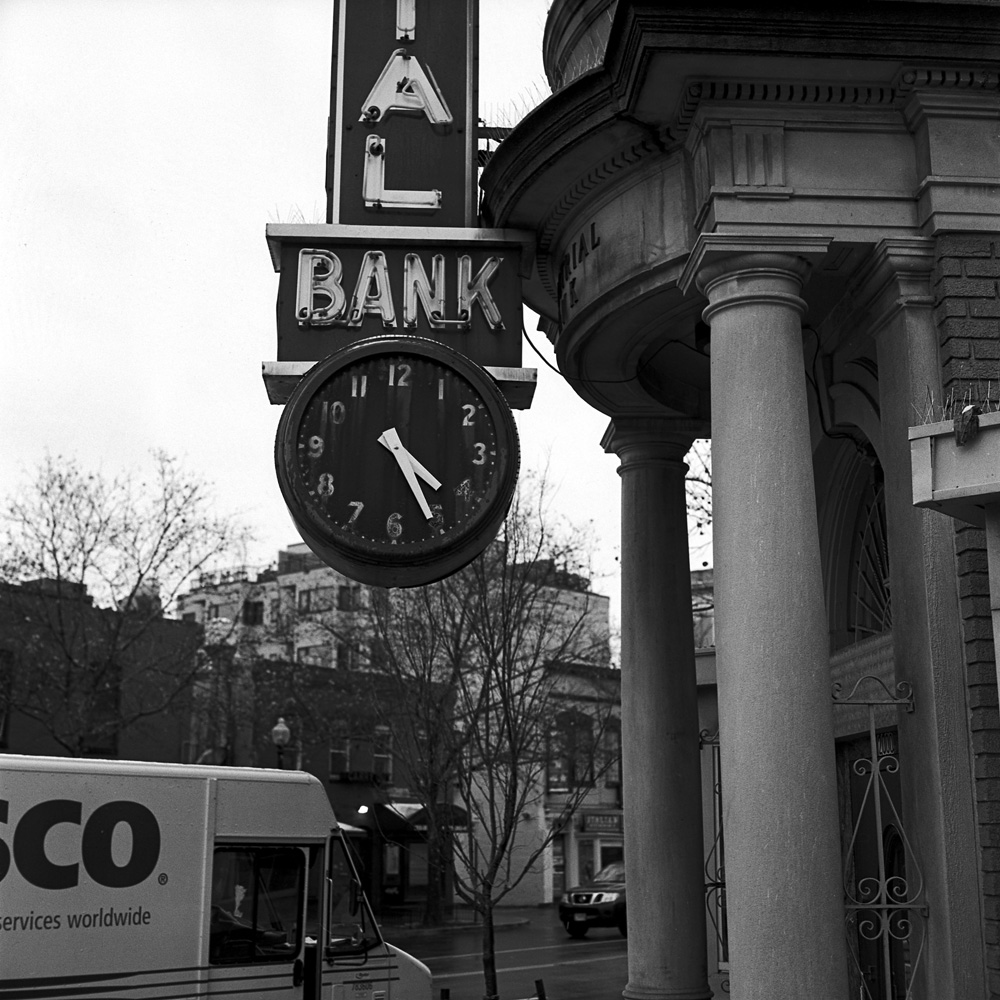
Industrial Bank was started at the beginning of the 20th century by African-Americans to cater to the African-American community. Their main branch is at the corner of 11th and U Streets, and has this really cool metal and neon clock sign out front. Alas they have allowed the sign to lapse into disrepair – I THINK the clock functions but it is not accurate, and either they just never turn on the neon or it no longer works. I really wish they’d fix it up so it would work, as it would make a very nice neighborhood landmark and a visual counterpoint to the yellow saxophone sign across the street outside the Bohemian Cavern nightclub.
Clock, Industrial Bank
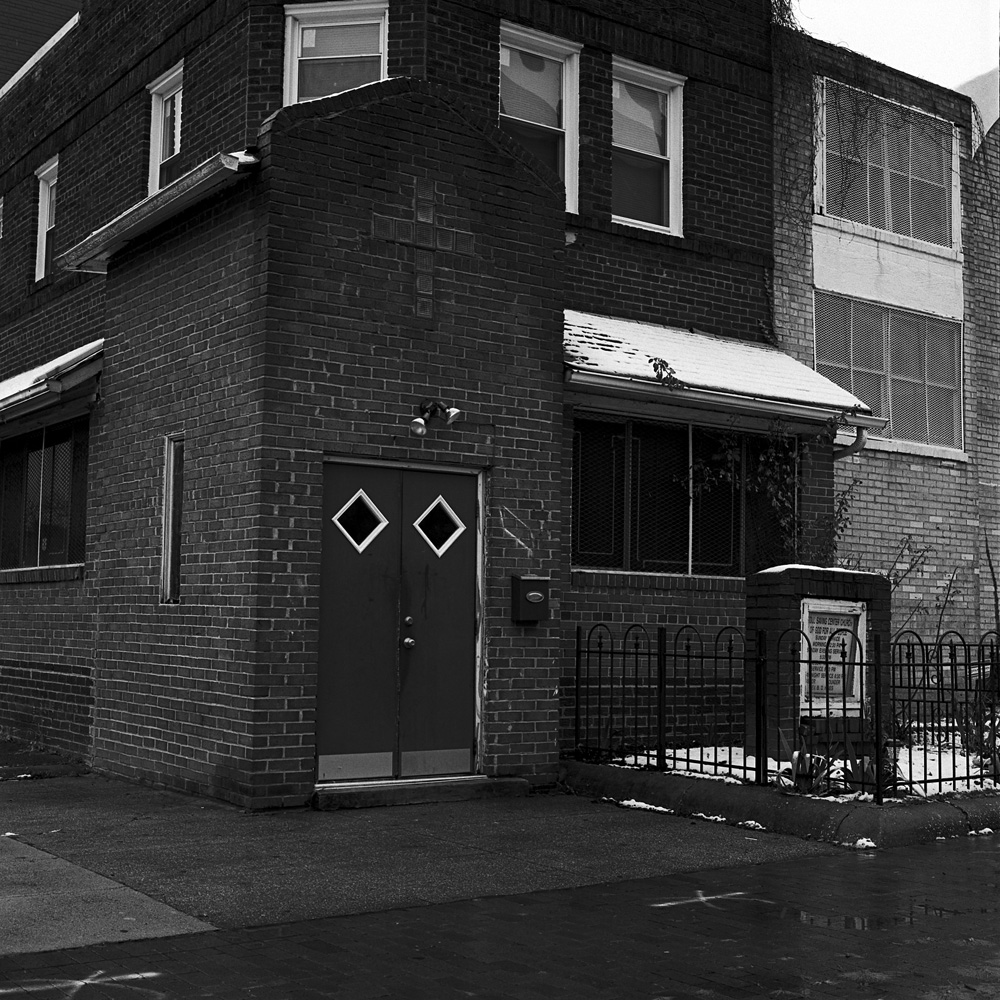
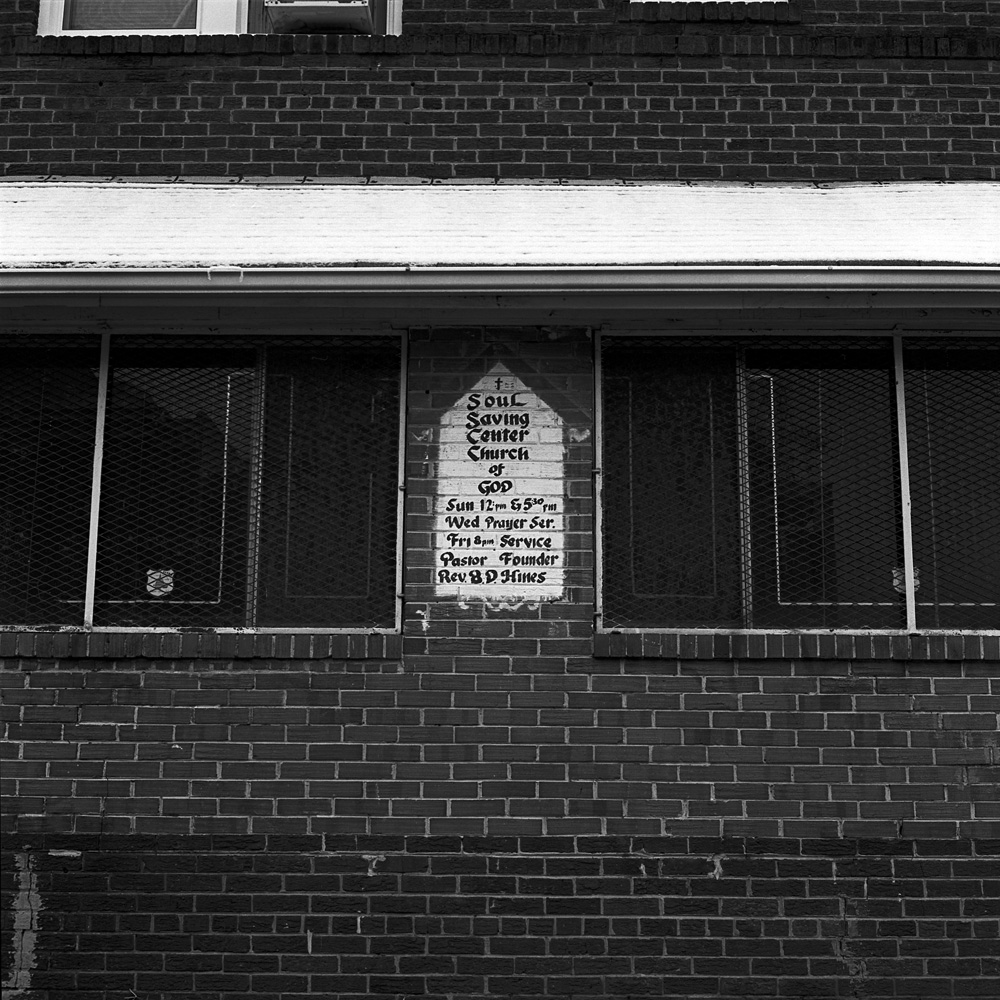
Up the street there is the Soul-Saving Center Church of God – a storefront community church with a primarily if not exclusively African-American congregation. It’s a sign of the gentrification and transformation of the neighborhood – across the street from them is a brand-new condo building with units selling for up to $1.2 Million.
Soul Saving Center Church DoorSoul Saving Center Church
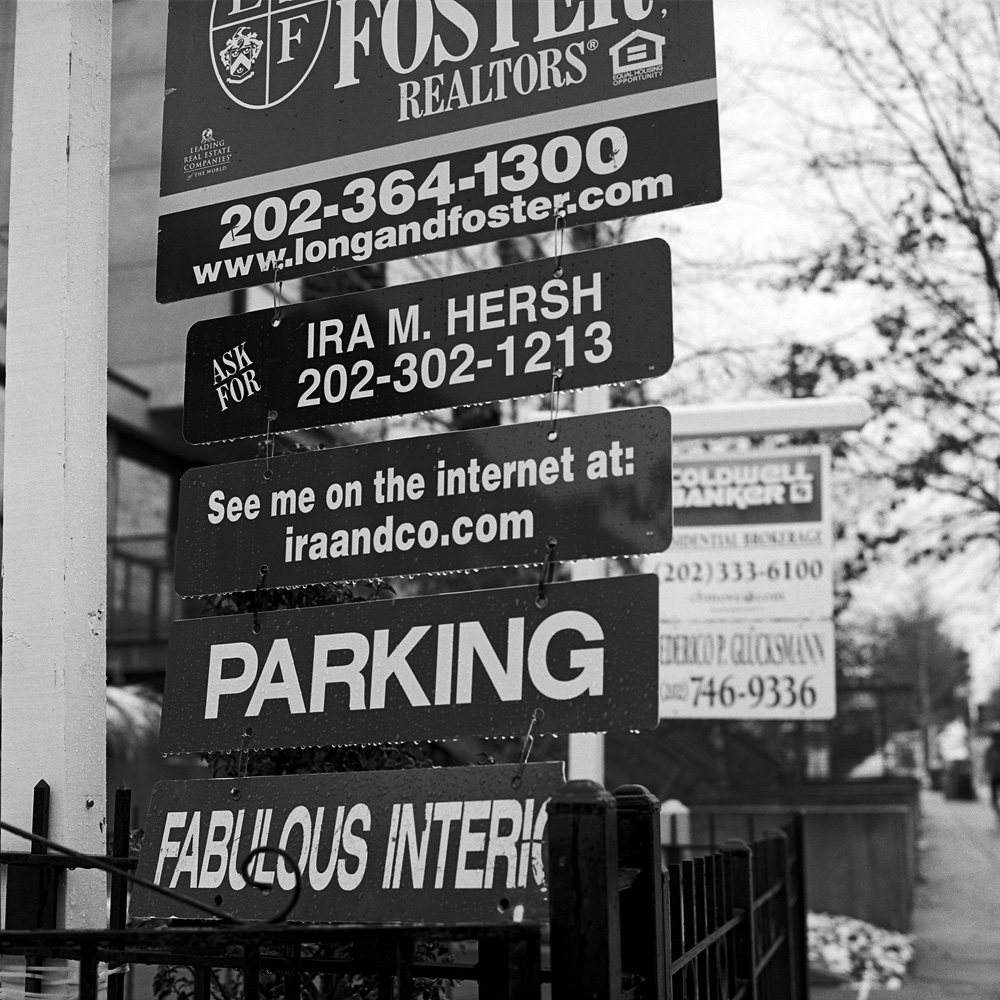
You can see the real estate bonanza still happening in the neighborhood – small row houses are being converted and expanded into multi-story multi-unit condominium buildings. Here is one with a “Fabulous Interio”- the agent broke off the “r” to get the sign to fit inside the fence. I wonder how long it will be before the Soul-Saving Center Church decides to sell their buildings plus the adjacent lot they have – they’ve got perhaps $10 Million in land alone now.
Fabulous Interio
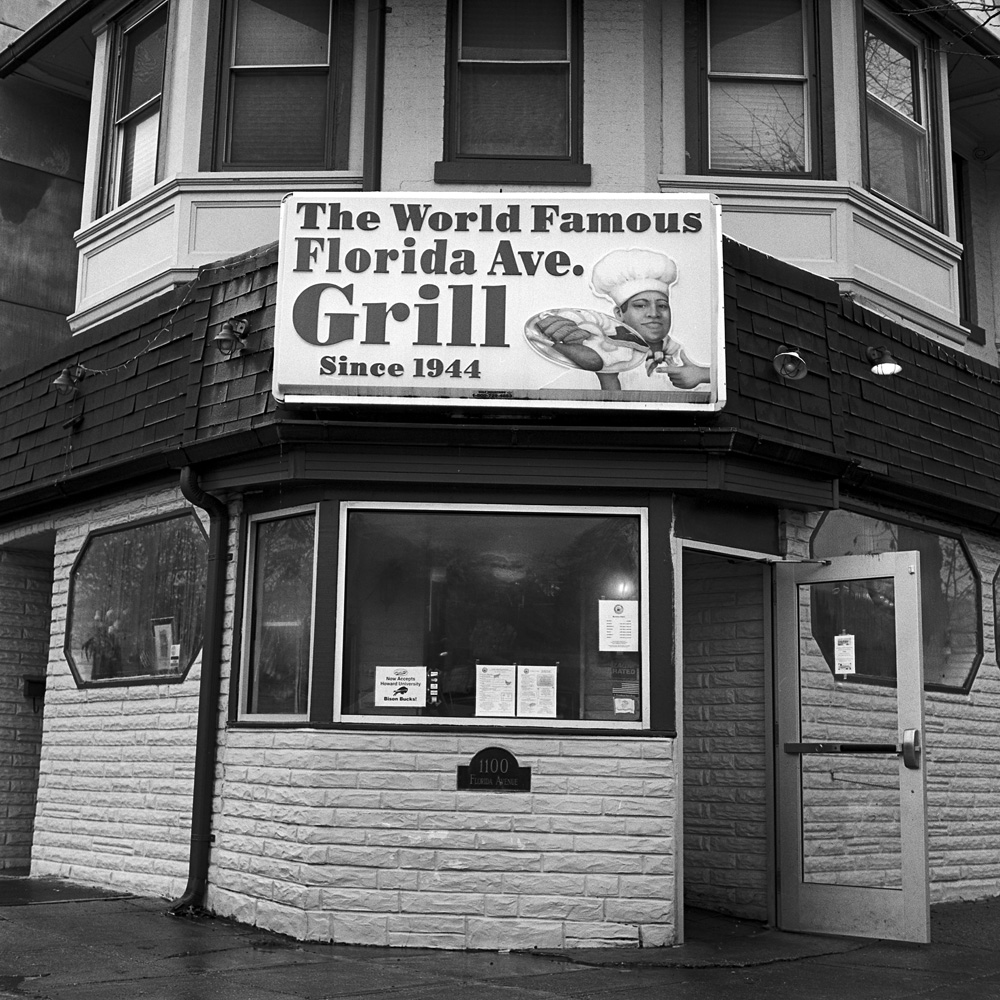
Up the street is another landmark of the neighborhood, almost as famous as Ben’s Chili Bowl. The Florida Avenue Grill has been around since 1944, serving up good old-fashioned soul food to locals and celebrities alike. The Florida Avenue Grill once owned a large empty lot next door, which served as their parking lot. About five years ago the family that owns the grill sold the empty lot and now a five story condo building has filled it. The average unit in that building sold for north of $500,000 each.
These are a few more from that last remaining roll of b/w I didn’t develop until yesterday. Just some additional looks at Notre Dame cathedral in black and white.
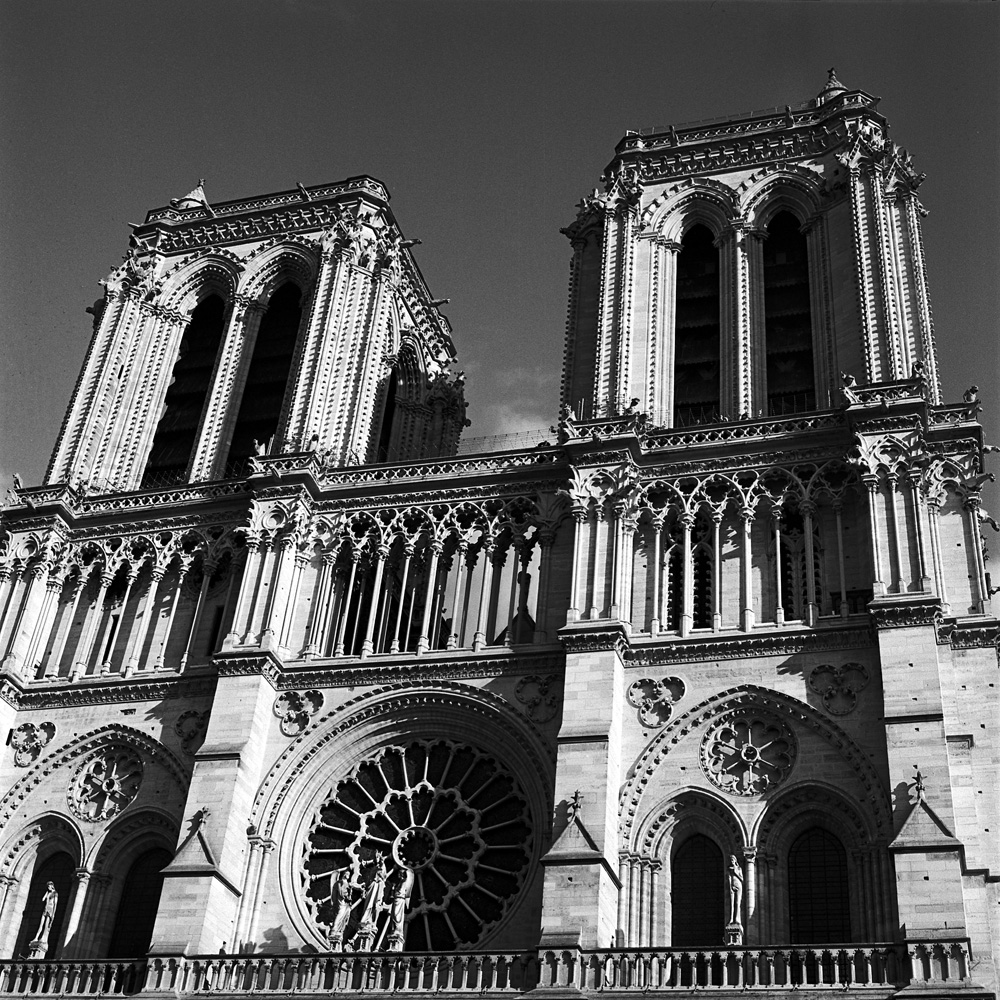
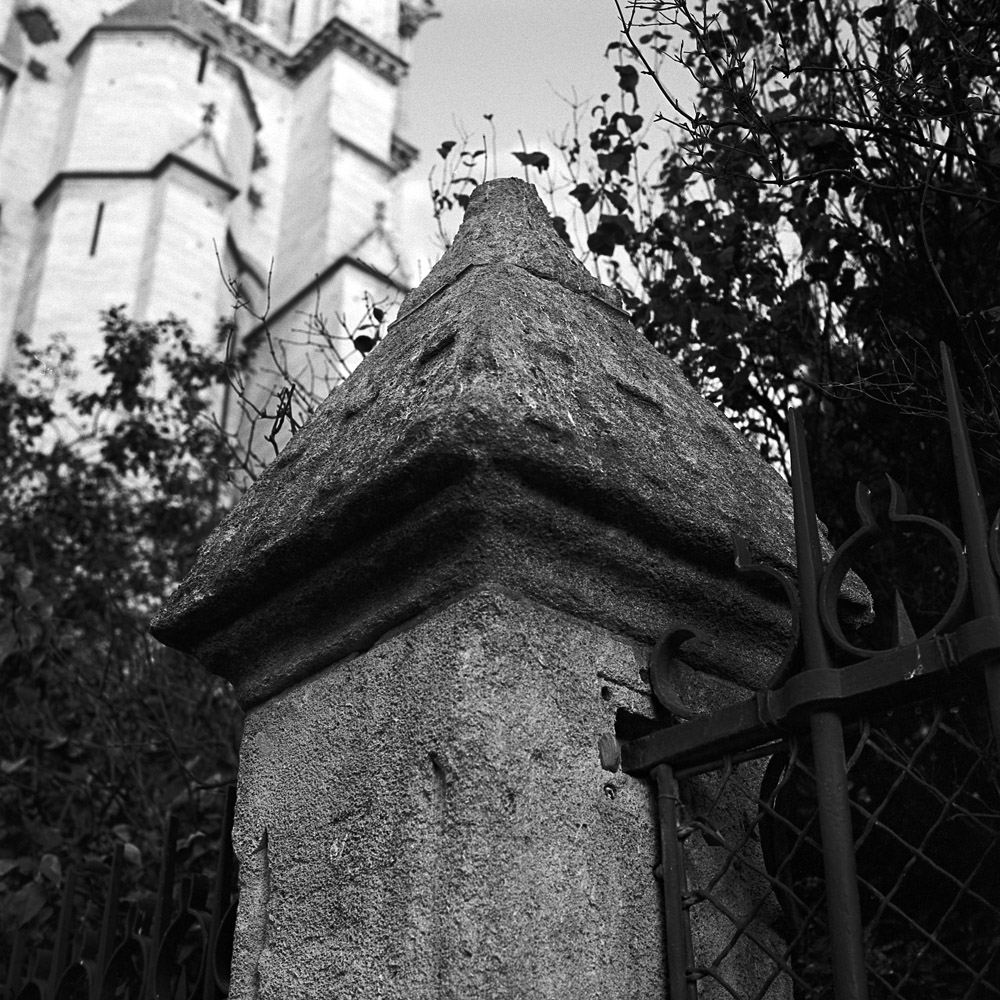
It’s hard to view the cathedral without trying to interpret the towers as a graphical element. They’re the most recognizable element to the church, perhaps other than the rose window. The main body of the church is actually rather narrow and delicate, relative to its perception. All those flying buttresses make it seem much more massive than it is. The tower facade, though, really establishes that perception because when viewing it straight on, it seems like a solid wall, and that the church behind it must be equally as massive.
Twin Towers, Notre Dame
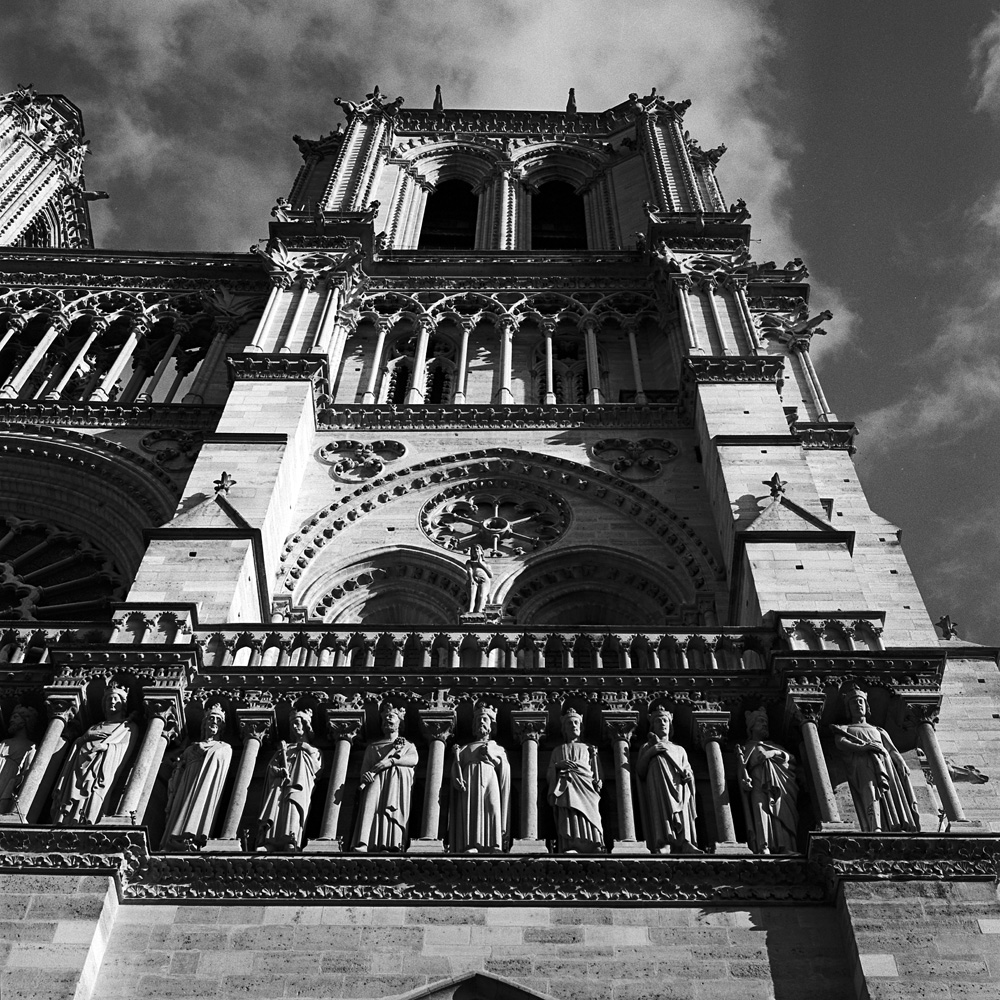
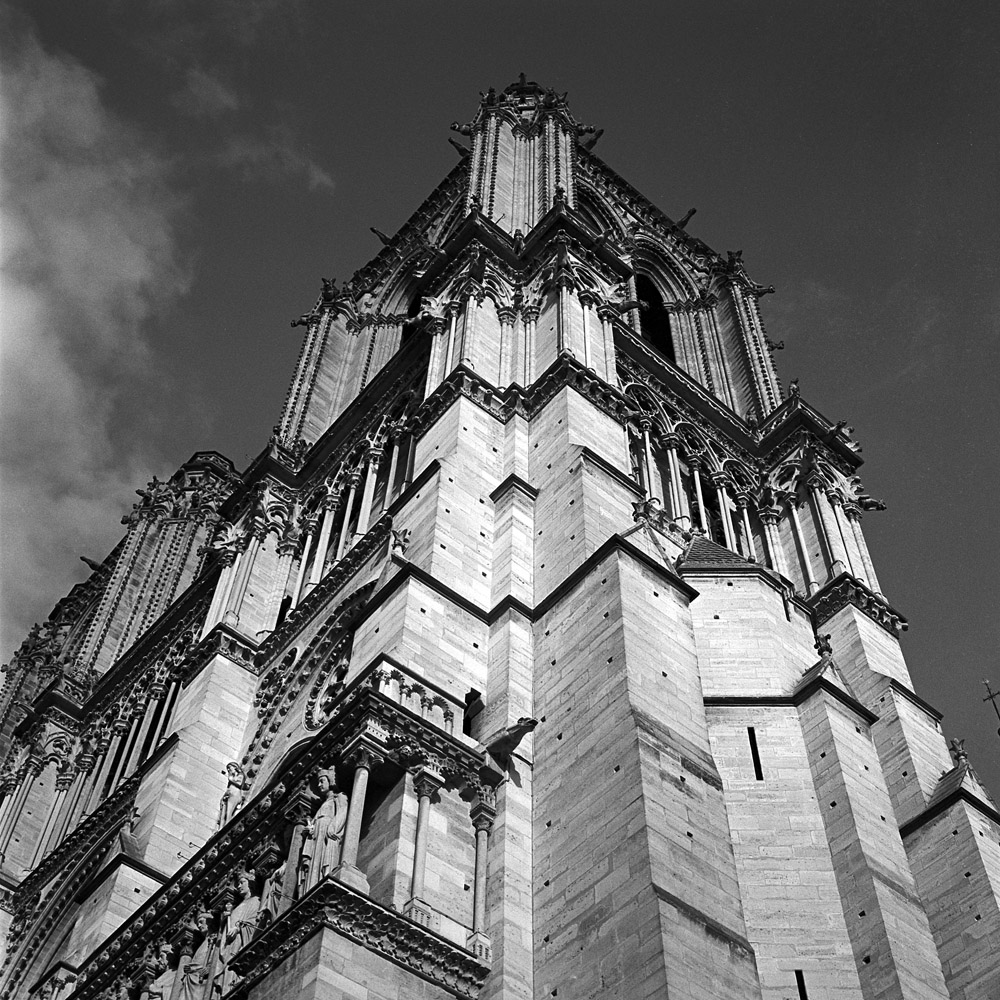
Trying to look at the towers is a vertigo-inducing experience. They are quite tall, and the nature of the decorations make you keep looking up to see all the details to the very last set of gargoyles some 226 feet in the air. Getting up in the towers to view them up close and personal is vertigo-inducing as well – it’s a nearly 400-stair climb to the top of the tower (which I did NOT do – I’m too out-of-shape to attempt something so heart-stressing). At one point in time, Notre Dame was the largest building in the western world – you can still easily spot it from the 2nd tier of the Eiffel Tower, despite the intervening buildings, several miles and the bend in the river between the two landmarks.
Tower, Notre Dame, Looking Up
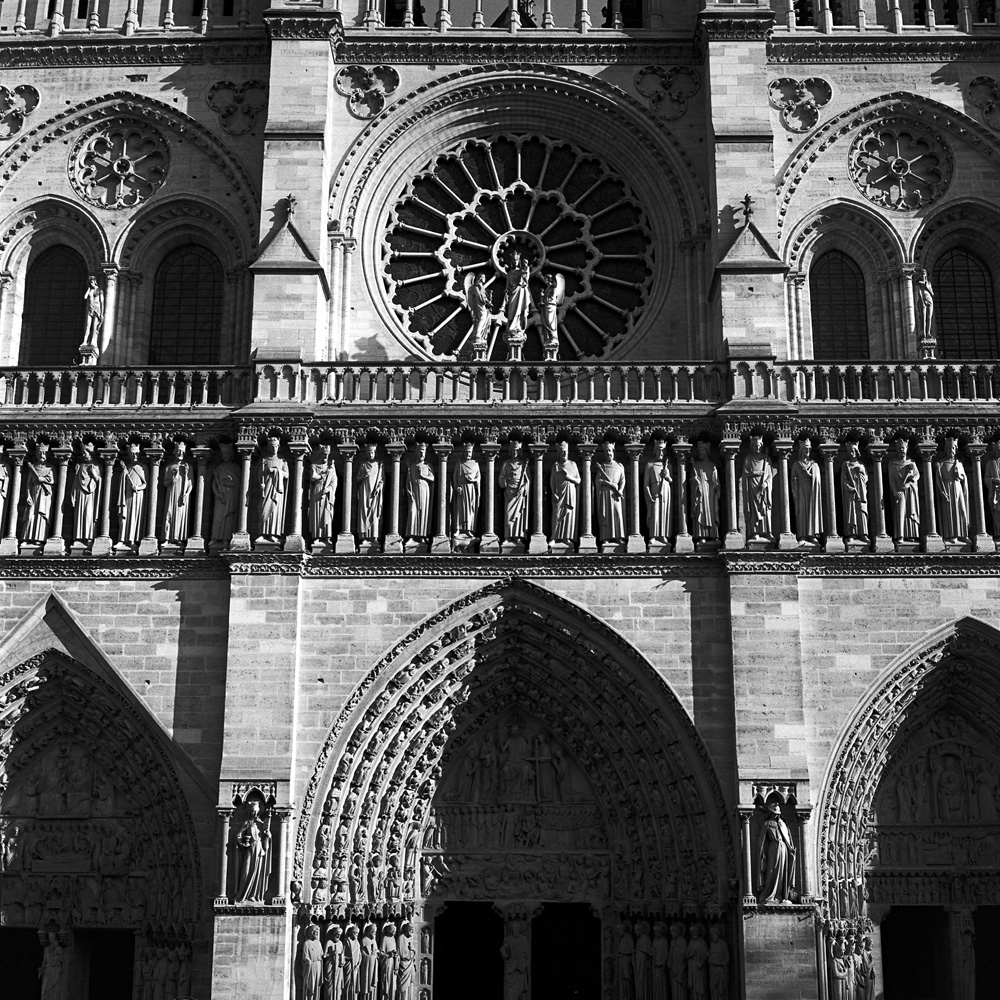
Here is a view of the incredibly detailed facade. One thing I did not realize until looking at this photo is the fact that all three main doorways are different. I always assumed that the left/right halves of the facade would be symmetrical. If you look carefully, the archway over the left hand door is a little smaller, and crowned by the angular, peaked molding. The right arch is larger and lacks the angular molding. Another detail that often gets forgotten – we assume that these cathedrals were all bare stone, and that the way we see them today is how they were intended. Au contraire – most cathedrals of the Romanesque and Gothic periods (the 7th-15th centuries) were brightly painted, inside and out. The statues on the exterior would all have been polychrome, as would the interior walls have been. Time, weather, wear and neglect have conspired to strip the coloring off the buildings. They did find some early medieval frescoes inside the old cathedral in Salamanca that had been covered up for centuries after an earthquake damaged both cathedrals (they’re kind of conjoined twins and share a wall).
Notre Dame Facade, Afternoon
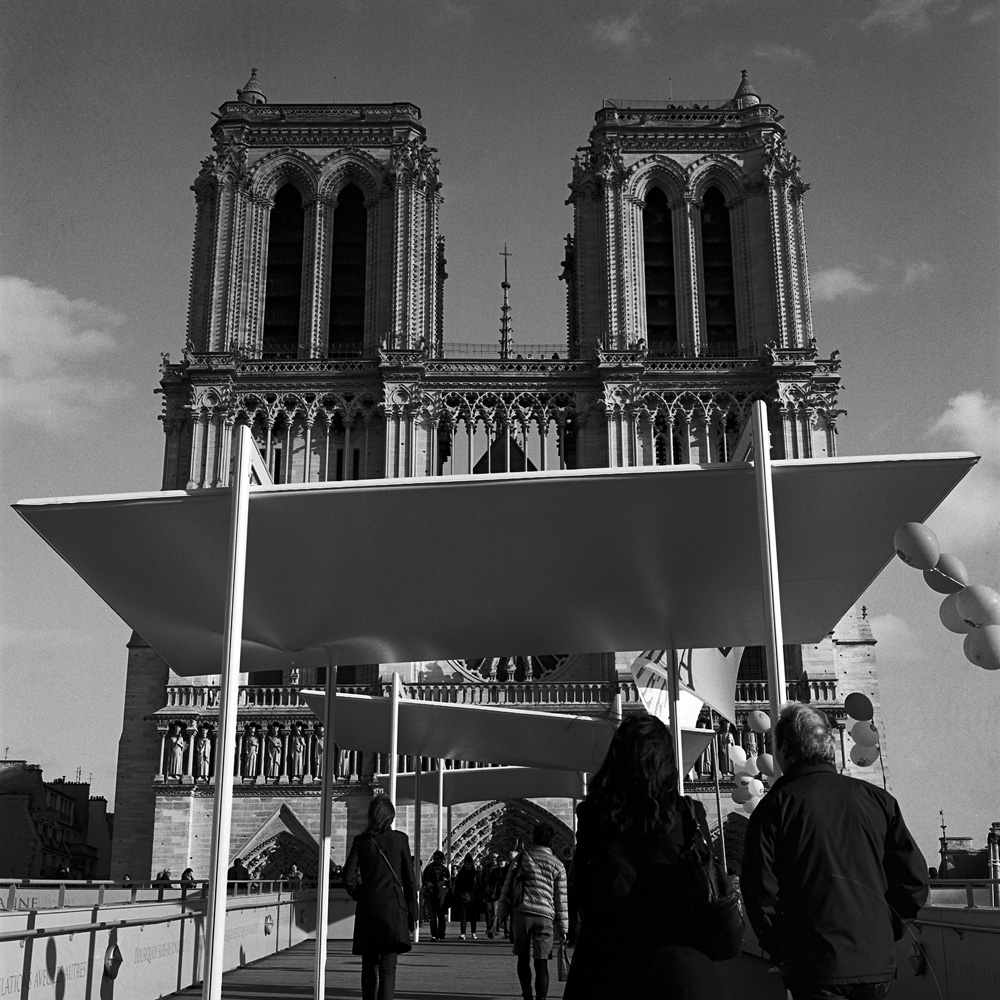
I really don’t know why they built this mammoth viewing/reviewing stand in the plaza in front of the cathedral. You can ascend the steps on the front face, or you can climb the ramp up the back. This is the view of the towers from the ramp – the tarp-like covers on the ramp provide a starkly modern contrast to the gothic stonework of the cathedral.
Notre Dame Towers, from RampTowers, Notre Dame Cathedral
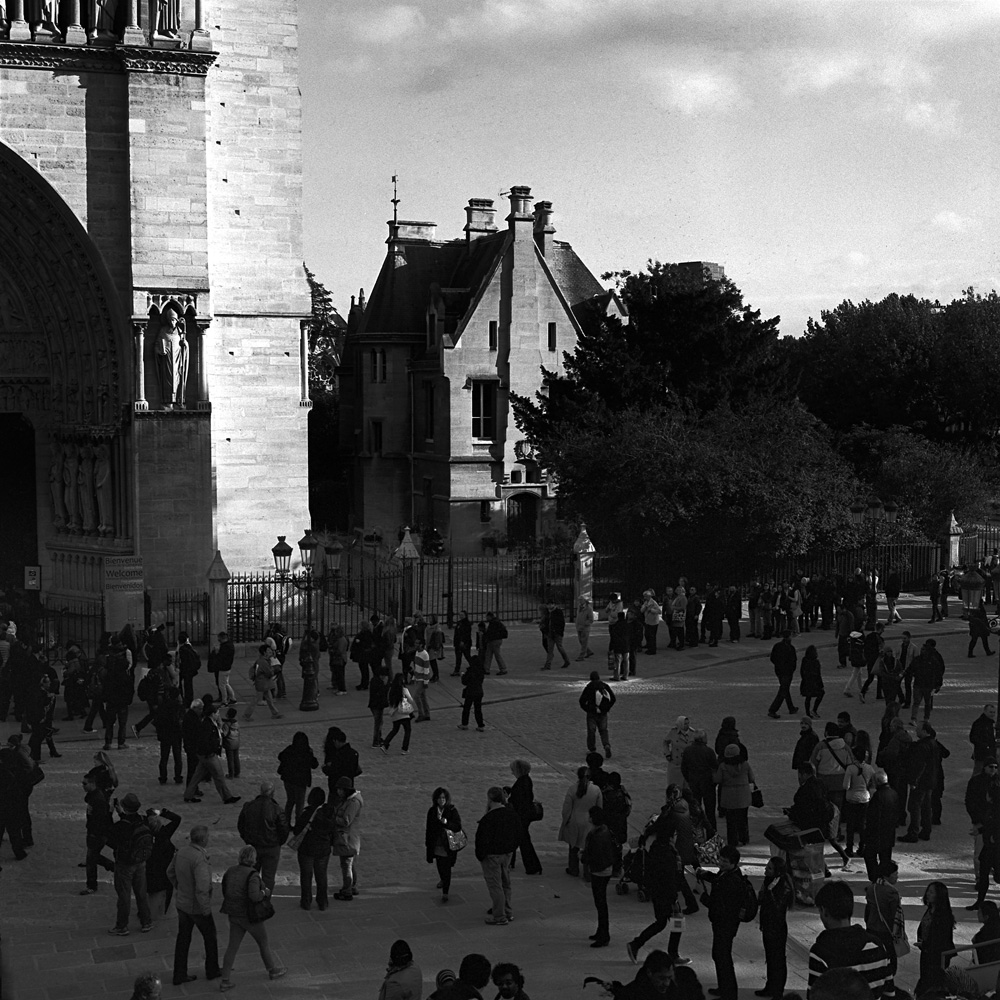
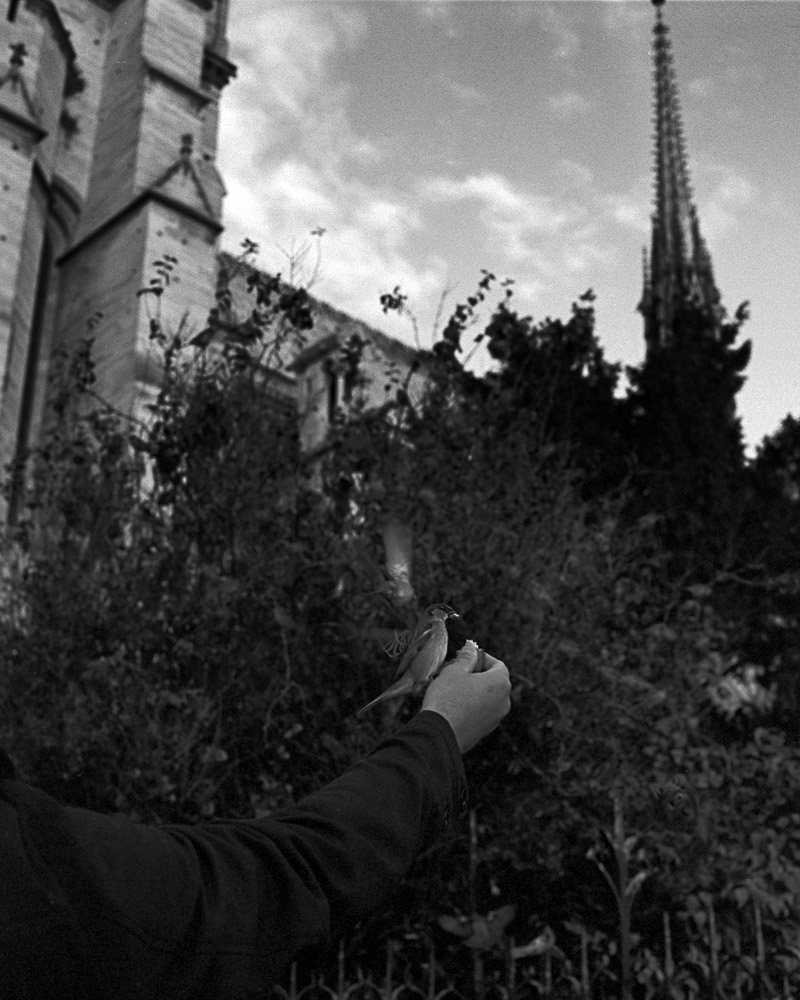
The crowds at Notre Dame are non-stop, even at night after the cathedral is closed. This is a typical weekday afternoon on the plaza out front. The little house to the right is the rectory for the cathedral. Along the fence surrounding the rectory is where you will find the bird feeders – people who will sell you a scrap of day old bread or a stale churro that you can hold up in your outstretched hand to attract the sparrows who will hover over to get a bite.
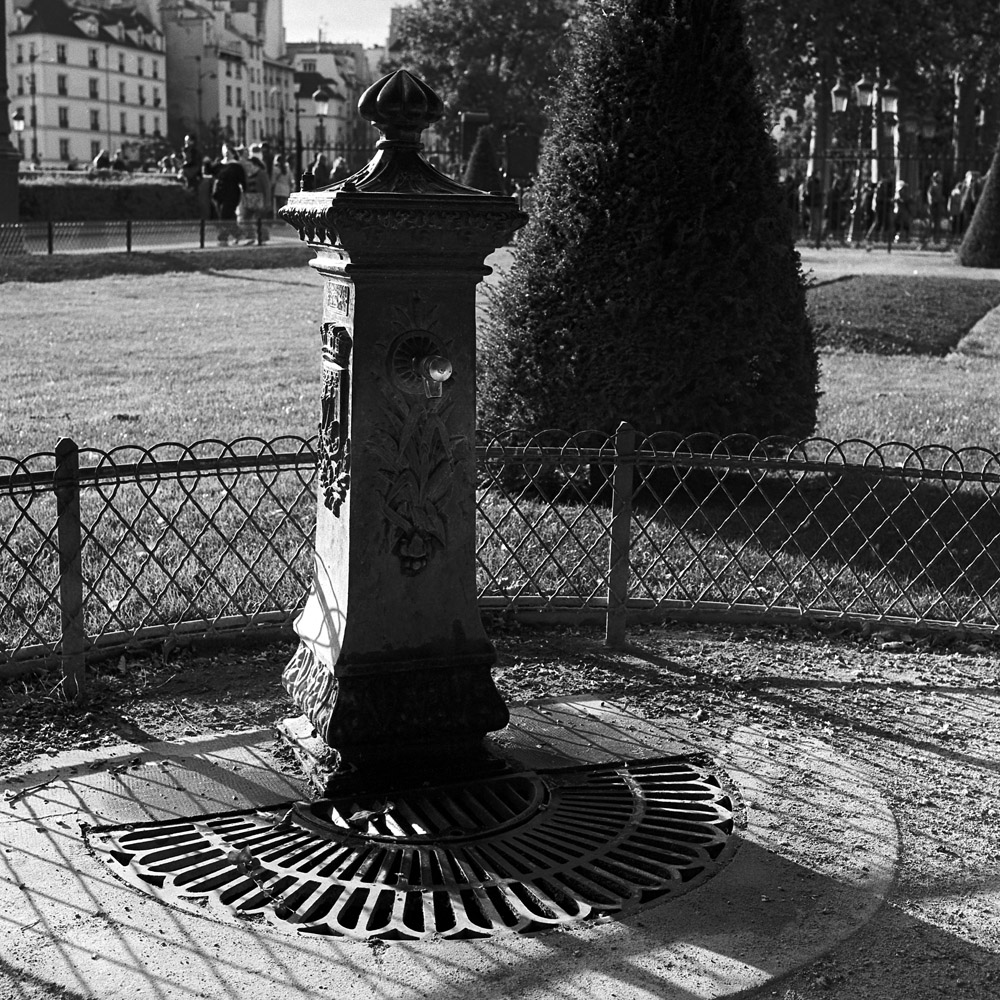
Beside the cathedral there is a park with views of the Seine, replete with benches, gardens and, as part of Haussmann’s renovations, public drinking fountains. I loved the way this looked backlit with the evening light. Consider it another one of my portraits of everyday objects.
Drinking Fountain, Notre Dame
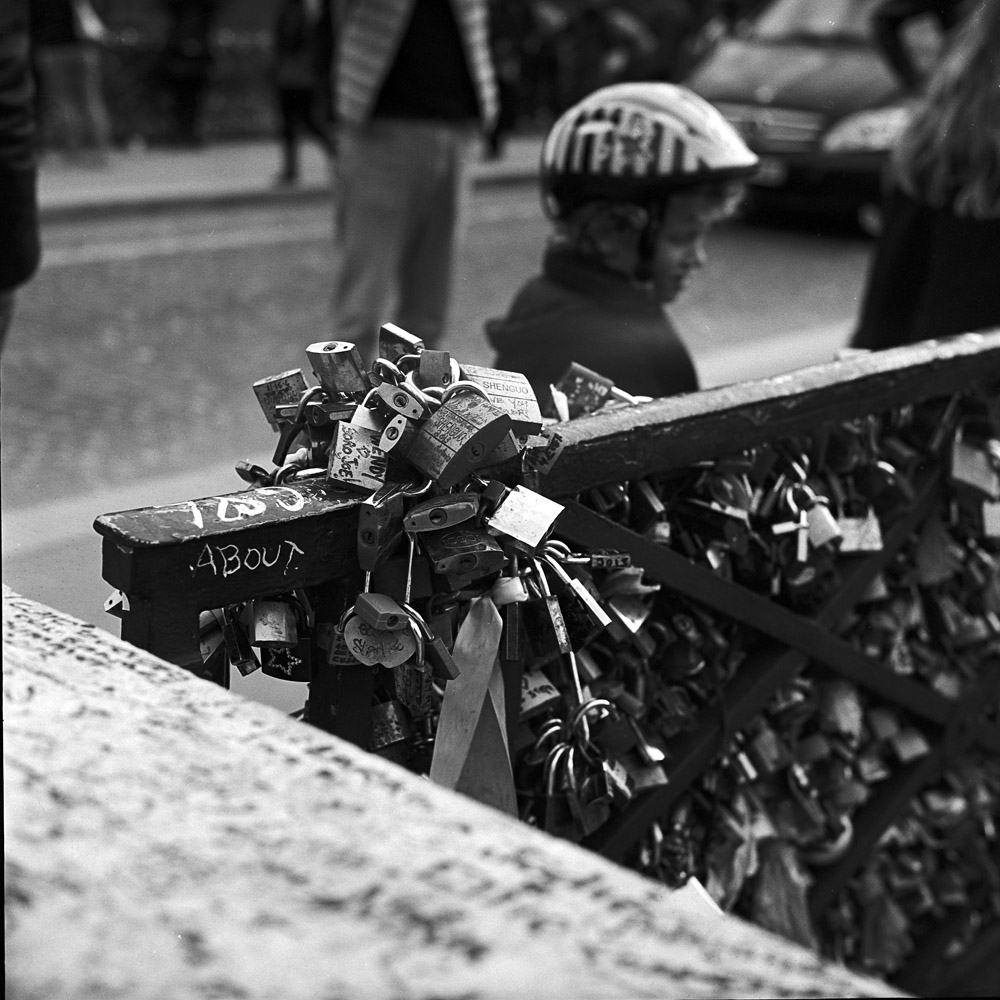
And last but not least, the tradition that began in Rome of young couples buying a padlock, writing their initials on it, locking it to the railing of a bridge, and tossing the keys in the river as a symbol of how their love cannot be undone has come to Paris. It is so popular that it has infested three or four bridges across the Seine now, and the boquinistes with bookstalls along the Rive Gauche nearest the Ile de la Cité sell a variety of padlocks and permanent markers. It seems only natural that people would do this on the bridges closest to Notre Dame, as it is one of the most romantic, inspiring buildings in a city full of romantic inspiration.
Love Locks, Notre Dame
(see, I told you you wouldn’t have to wait long for the next Paris post!)
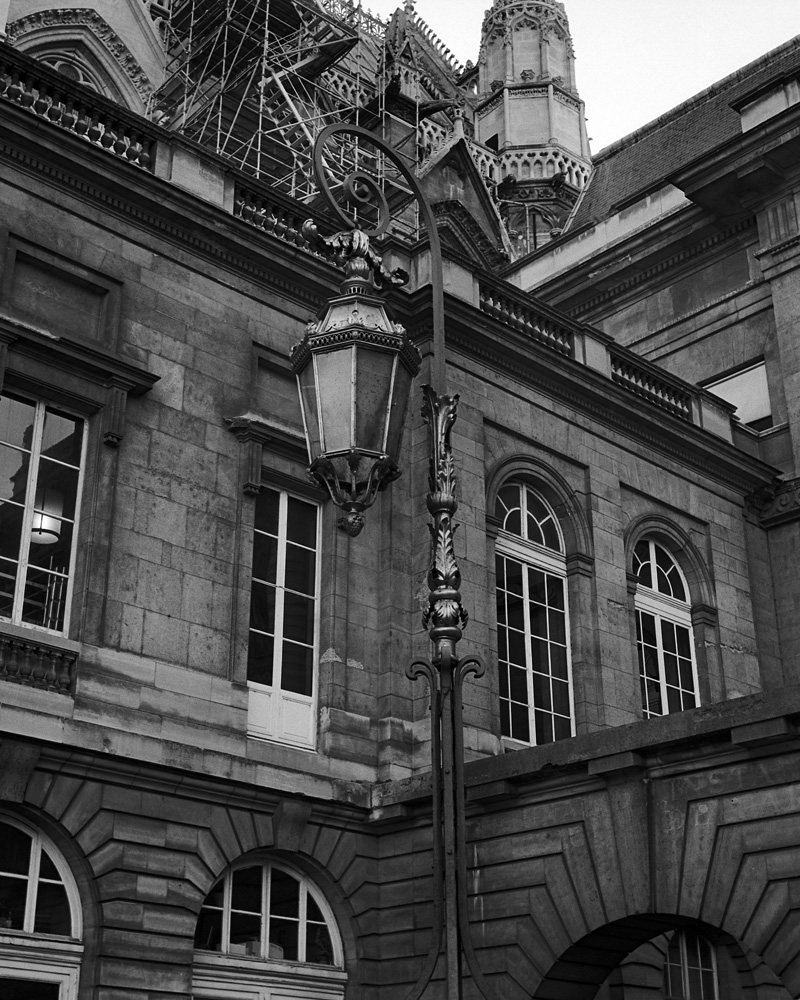
So I FINALLY got around to developing the last roll of black-and-white from the trip today. Here are some odds-n-ends from the Palais de Justice. These are from the courtyard through which you exit after you visit Sainte Chapelle (you can see the spire of the chapel in the background of the lantern photo).
Not only did the lantern appeal to me, but the absolutely crazy Escher-esque layers of the building behind it just begged to be photographed. It’s like many different buildings collided and transformed into another entirely new one.
Lantern, Courtyard, Palais de Justice
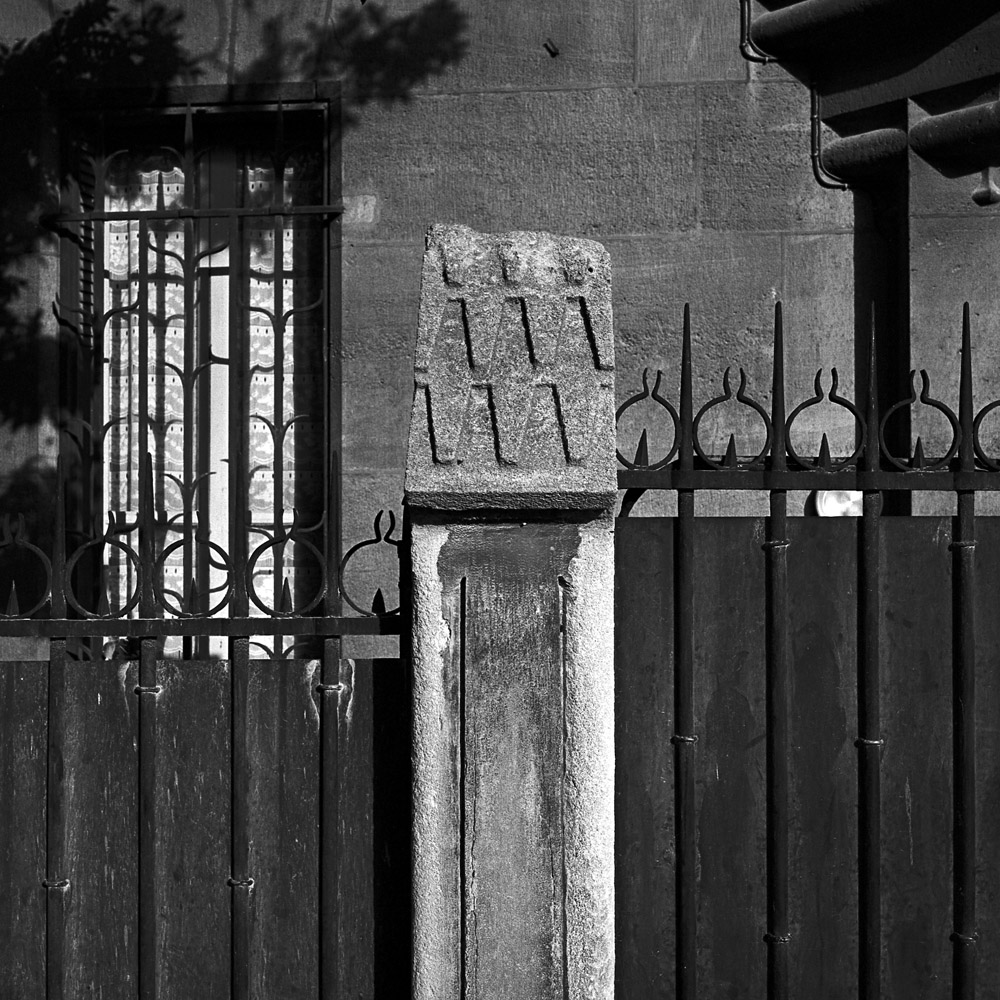
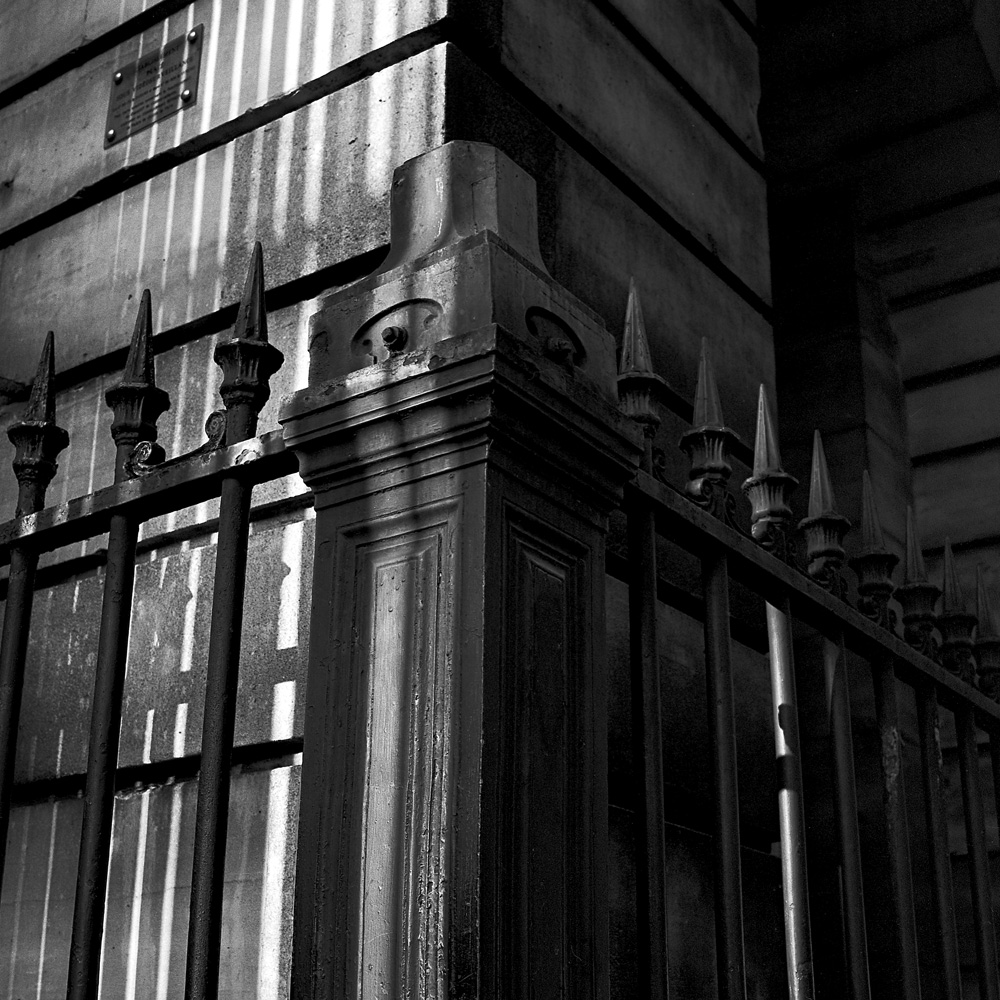
This is a fencepost on an iron railing around the Palais de Justice building. I thought the sunlight passing through the outer fence casting a striped shadow on the wall behind this iron fence had an ironic feeling of multiple layers of prison at a place of justice.
Fence, Palais de Justice
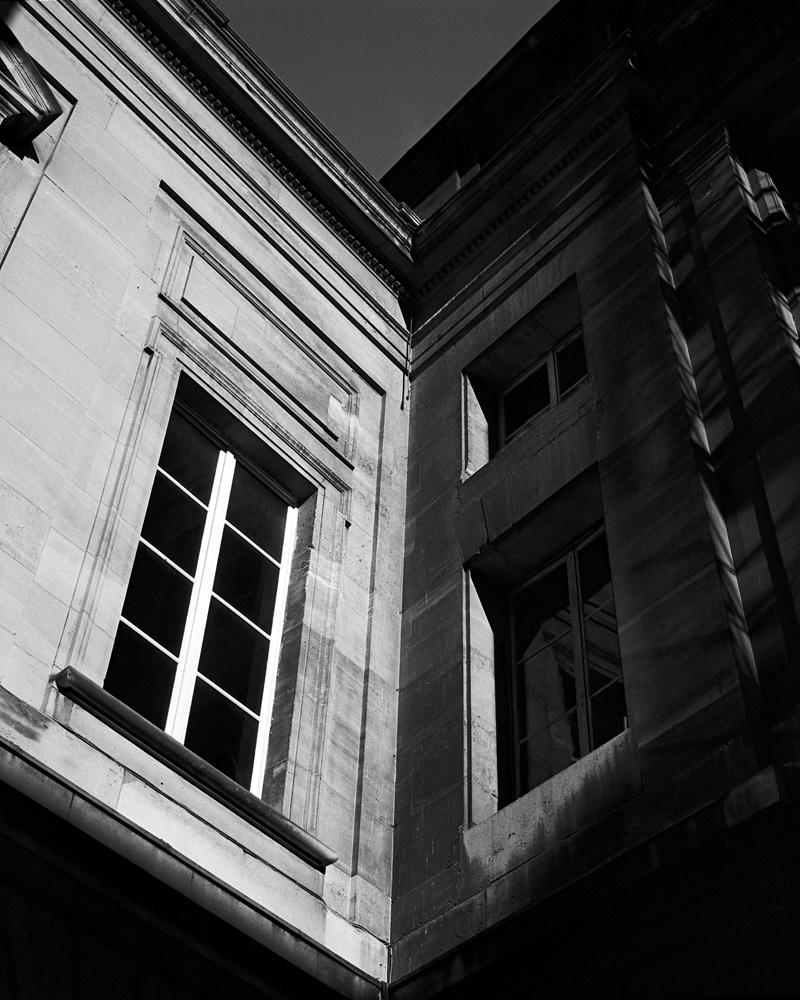
These windows also had an Escher-esque quality to them because they have balance but not symmetry – again lots of angles that mimic and overlap without being truly parallel.
Windows, Palais de Justice
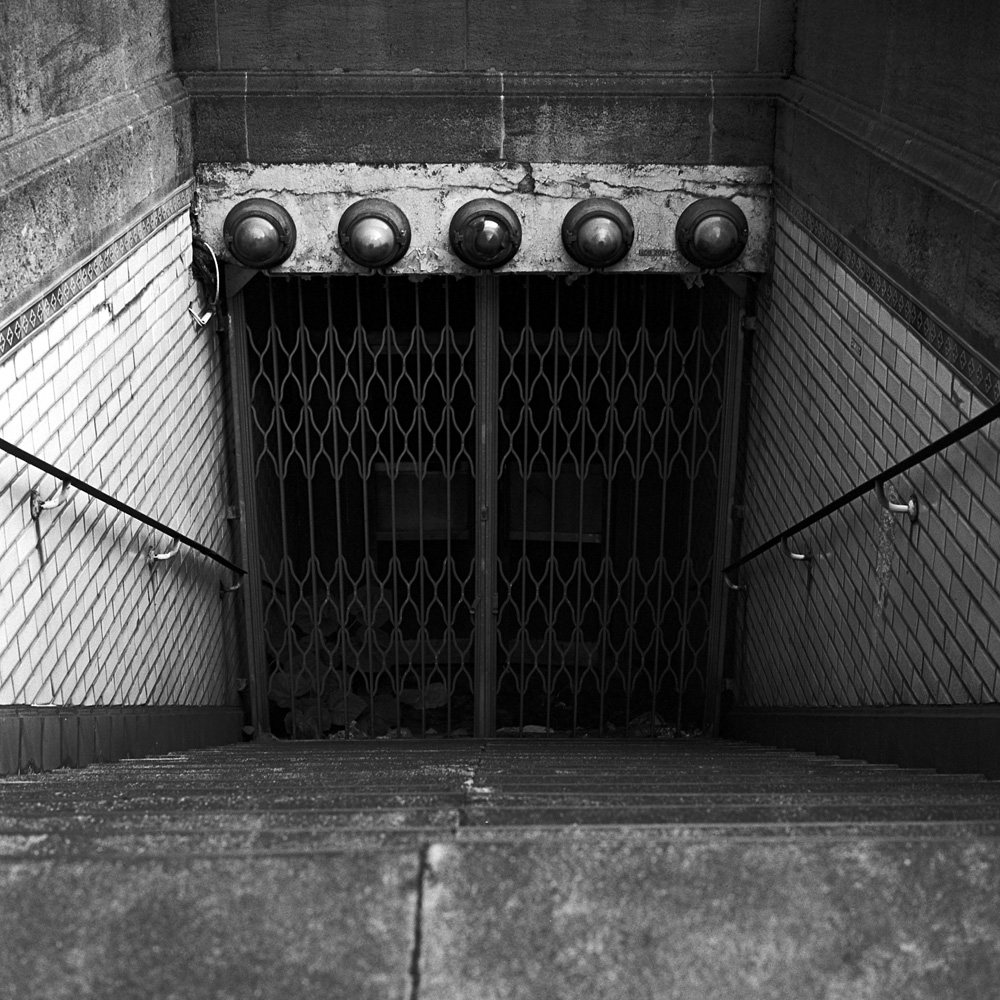
On the way out of the courtyard you pass by what seems to be an entrance to the Metro, all closed up. This is a block and a bit from the main entrance to the Cité metro, so it is possible this was a direct entrance to enable workers at the Palais de Justice to go directly to and from their offices. Or it could just be an underpass or an entrance to a tunnel system connecting multiple buildings in the neighborhood. I’m voting for subway entrance even though it doesn’t have the nifty bronze art nouveau surround because the lamps above the gates look like the lamps over the Cité station entrance. Any Parisian readers are more than welcome to chime in and correct me.
 dcphotoartist