On the same day I went to Fort Foote, I kept on driving south into Maryland until I got to Fort Washington, proper. Fort Washington the fort is located in Fort Washington, the town, and to arrive there you drive through some rambling suburban tracts. Like Fort Foote, Fort Washington sits on the banks of the Potomac River atop a peninsula formed by Piscataway Creek’s entrance into the Potomac River. It, however, was not intended to be a temporary site but rather has been occupied and fortified since before the War of 1812. Its use as an active military base ended after World War II, but most of the structures you see were built between 1800 and 1918.
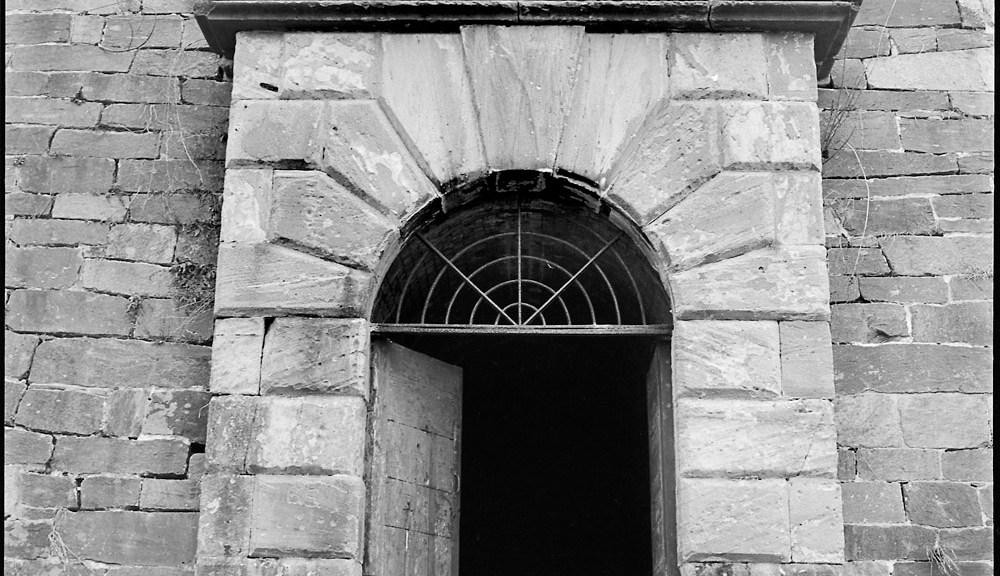
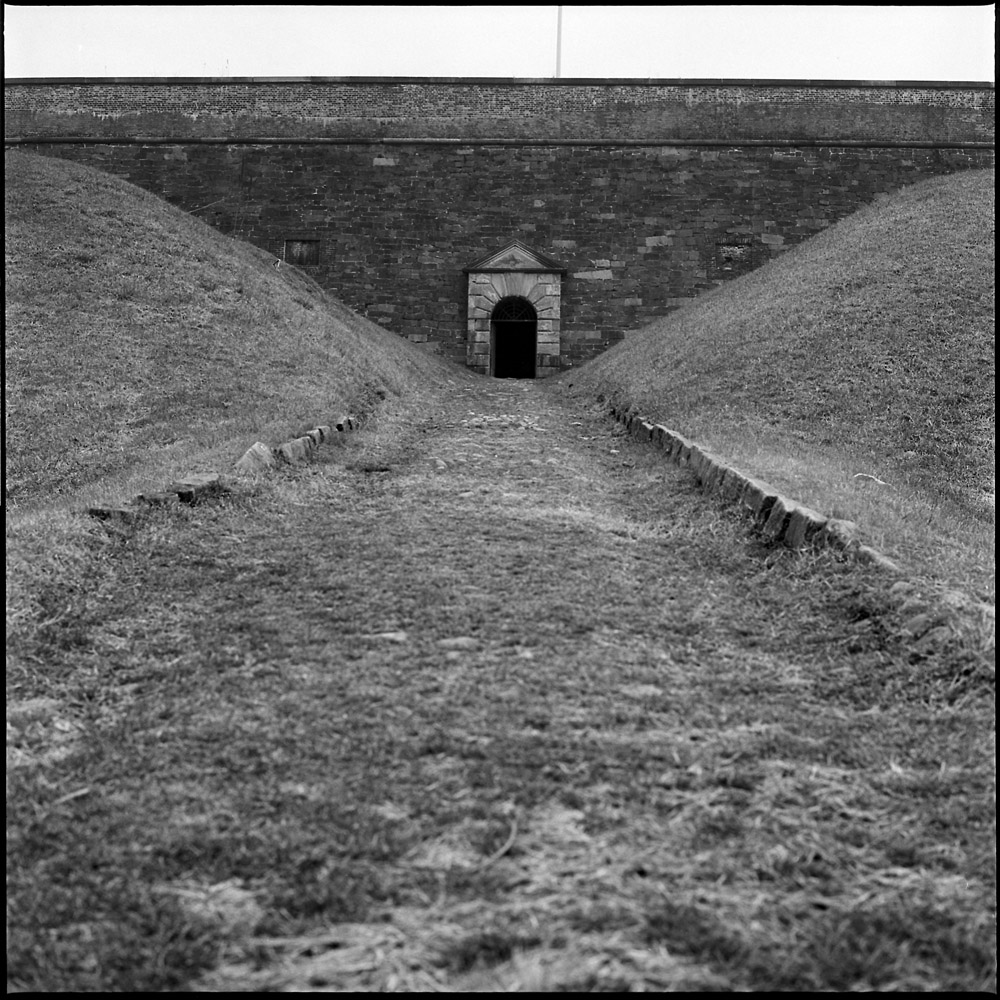
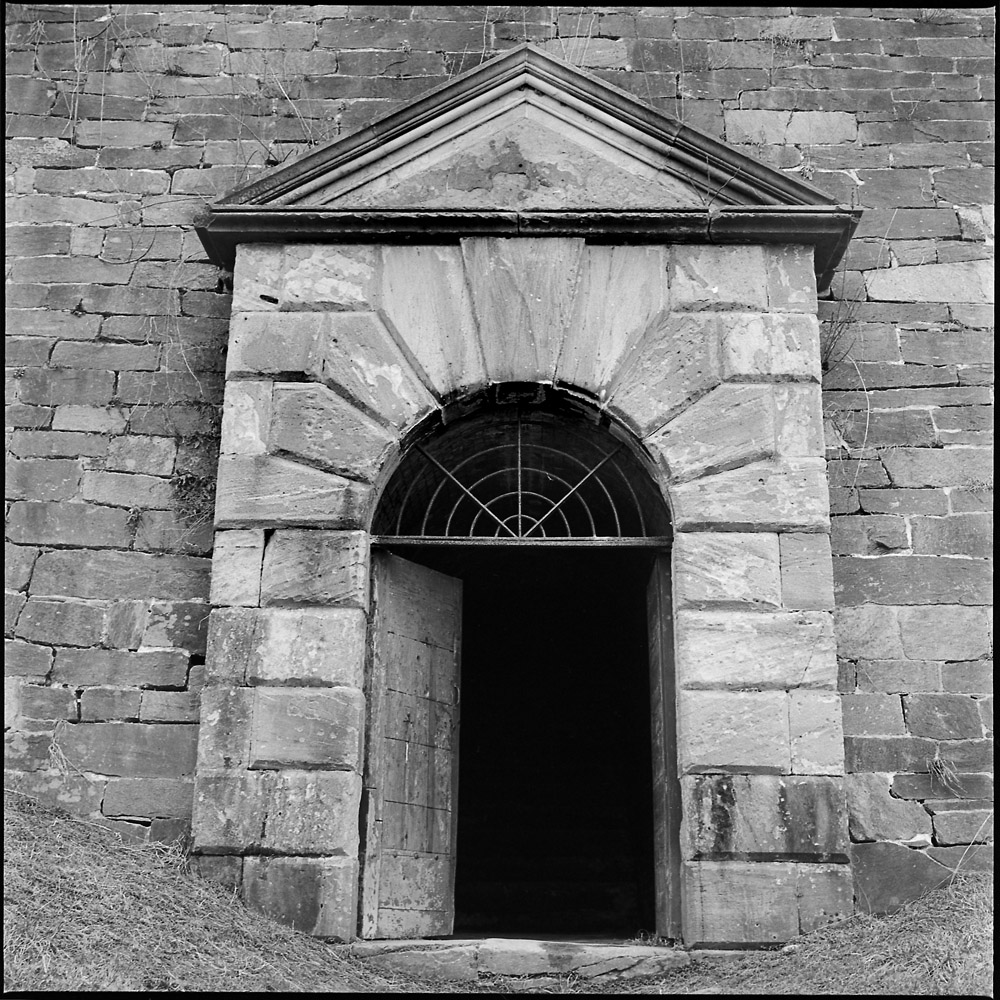
These first two images are of the gate in the early 19th century fortifications. This was the entrance that connects the hilltop fortifications to the water battery at river level.
EarthworksWater Gate
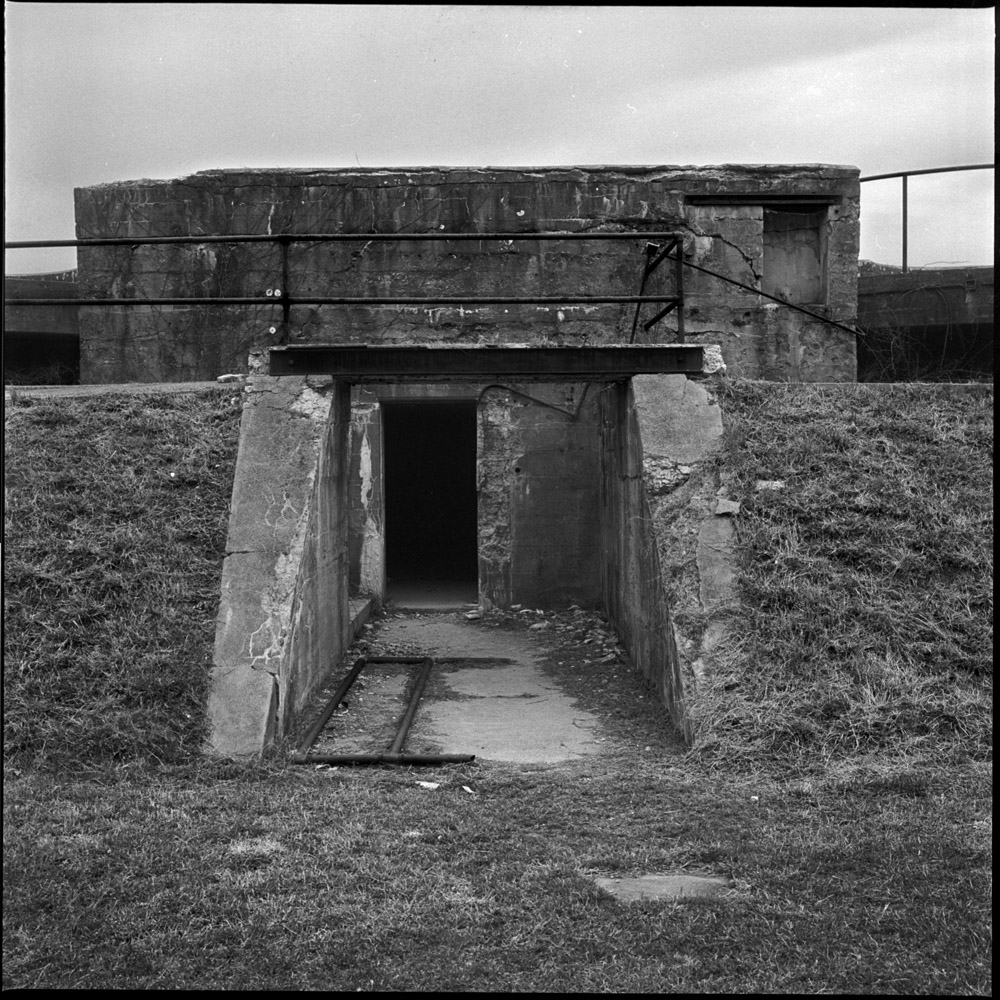
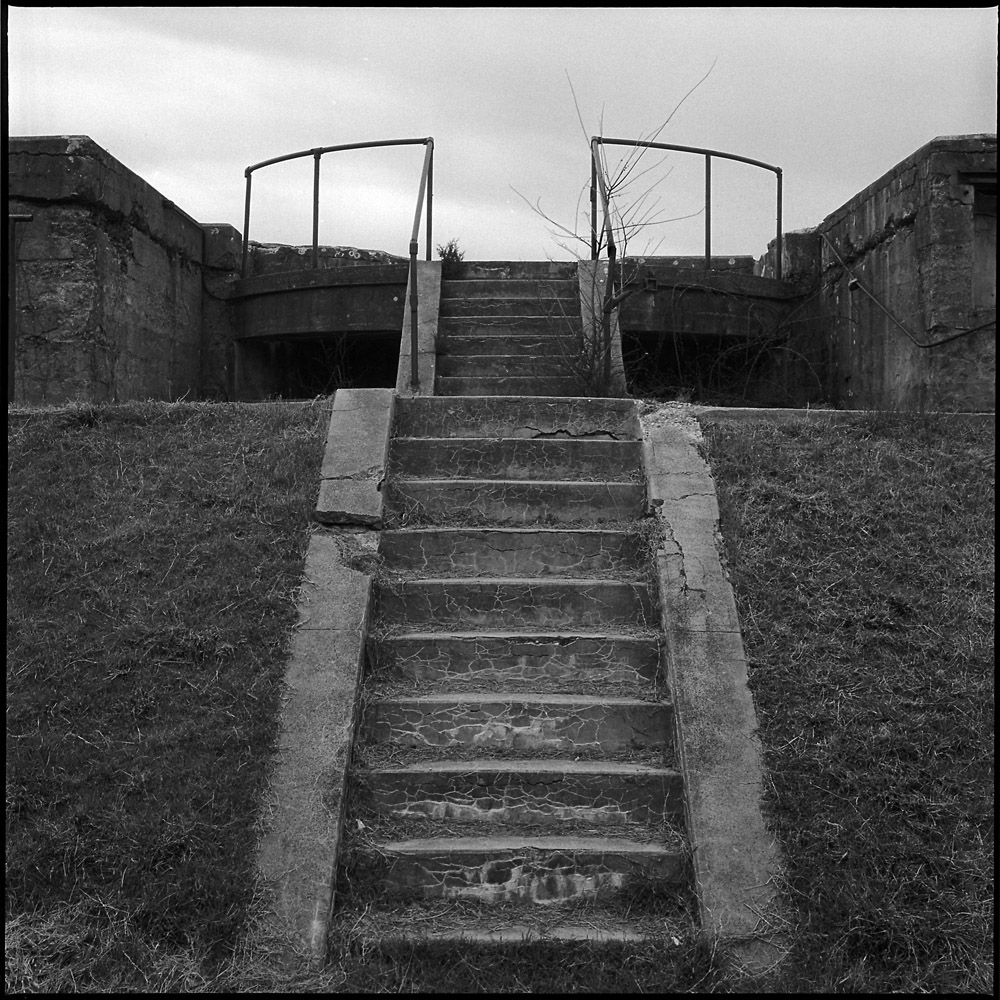
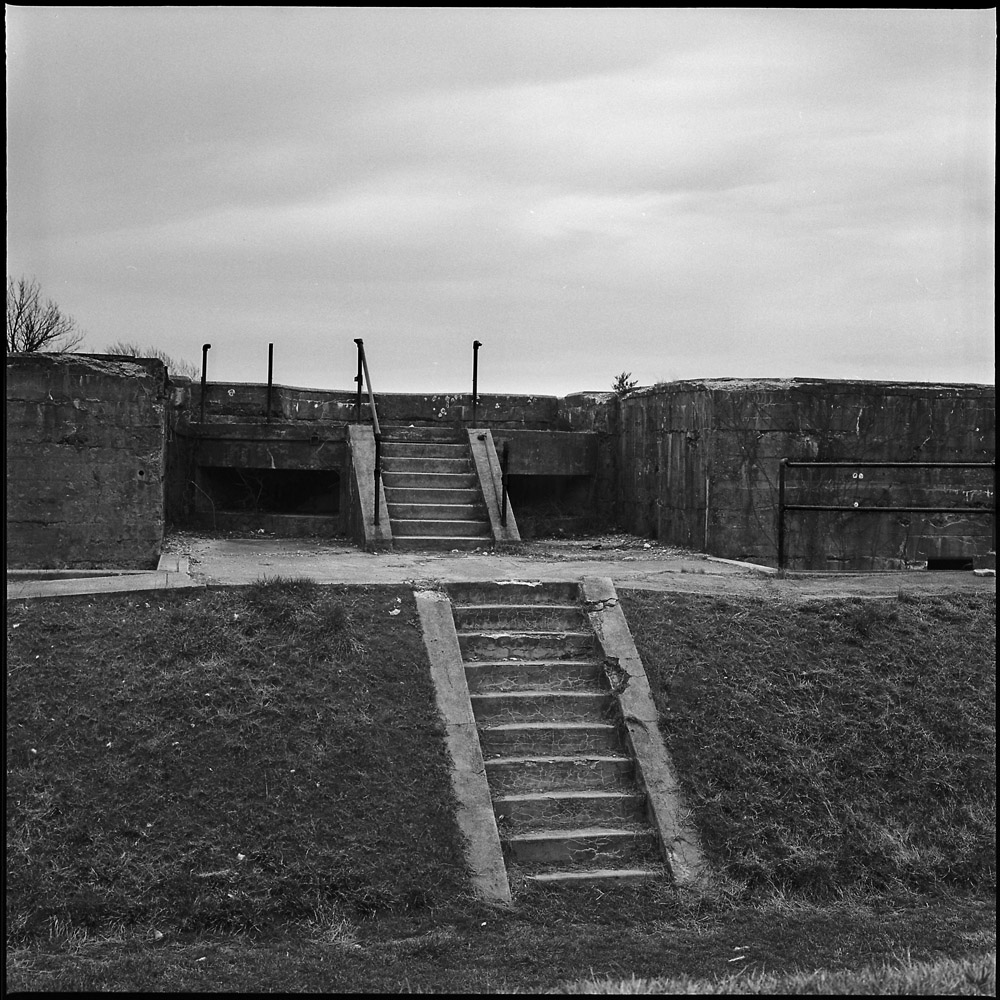
The water battery structures date to the first decades of the 20th century. You can see they are much lower, made of steel and concrete. The front side is protected by an earthen berm. The bunkers would have held the troops manning the now-dismounted cannon and communications equipment to control the batteries from within the fort.
There is something both ominous and at the same time hopeful about these structures, viewed from the land side. The bunker doorway looks like an entrance to the underworld.
Water Battery Entrance
The stairs, however, now stripped of their weaponry, point to an upward journey, facing the unknown. They’re the prow of a ship, a pathway to adventure, or perhaps a Mayan temple at whose top great mysteries will be revealed.
Water Battery Stairs
The clouds above tease the possibility of rain, but it will be a gentle rain, not a thundering downpour. They’re the gateway to the horizon.
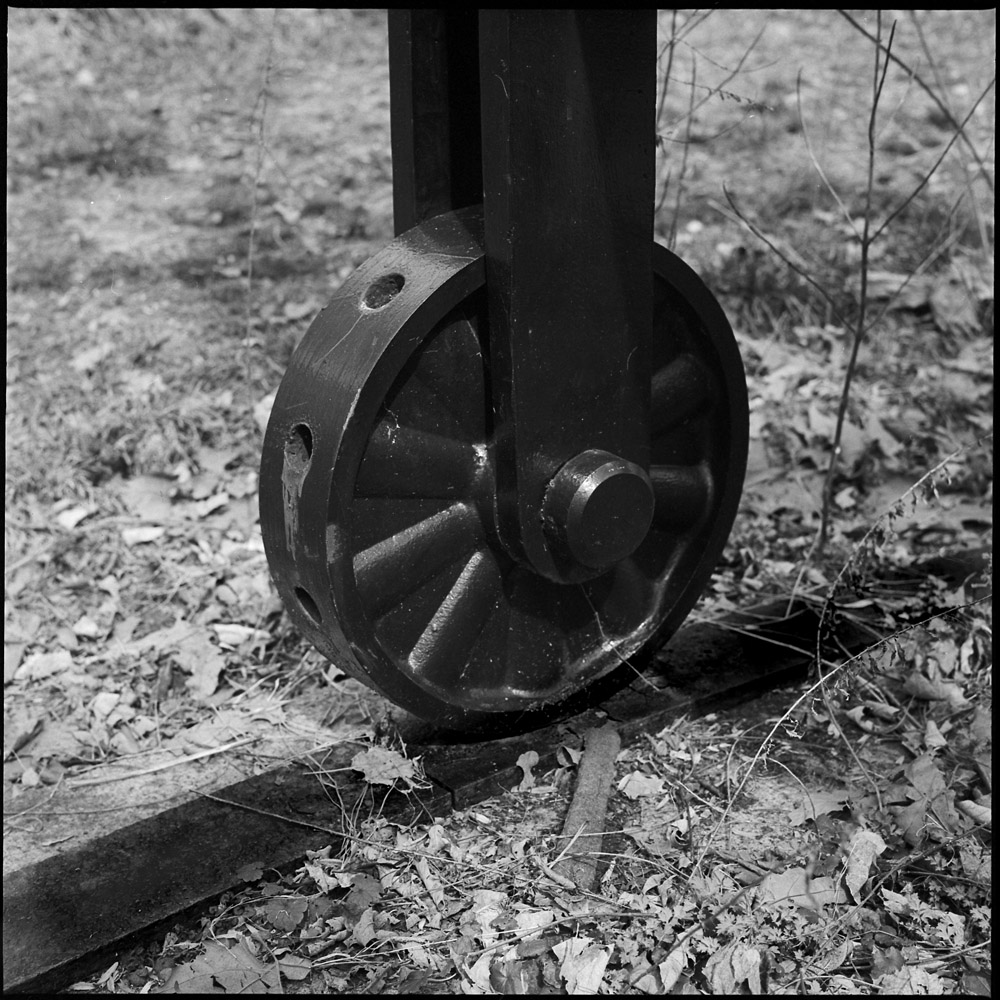
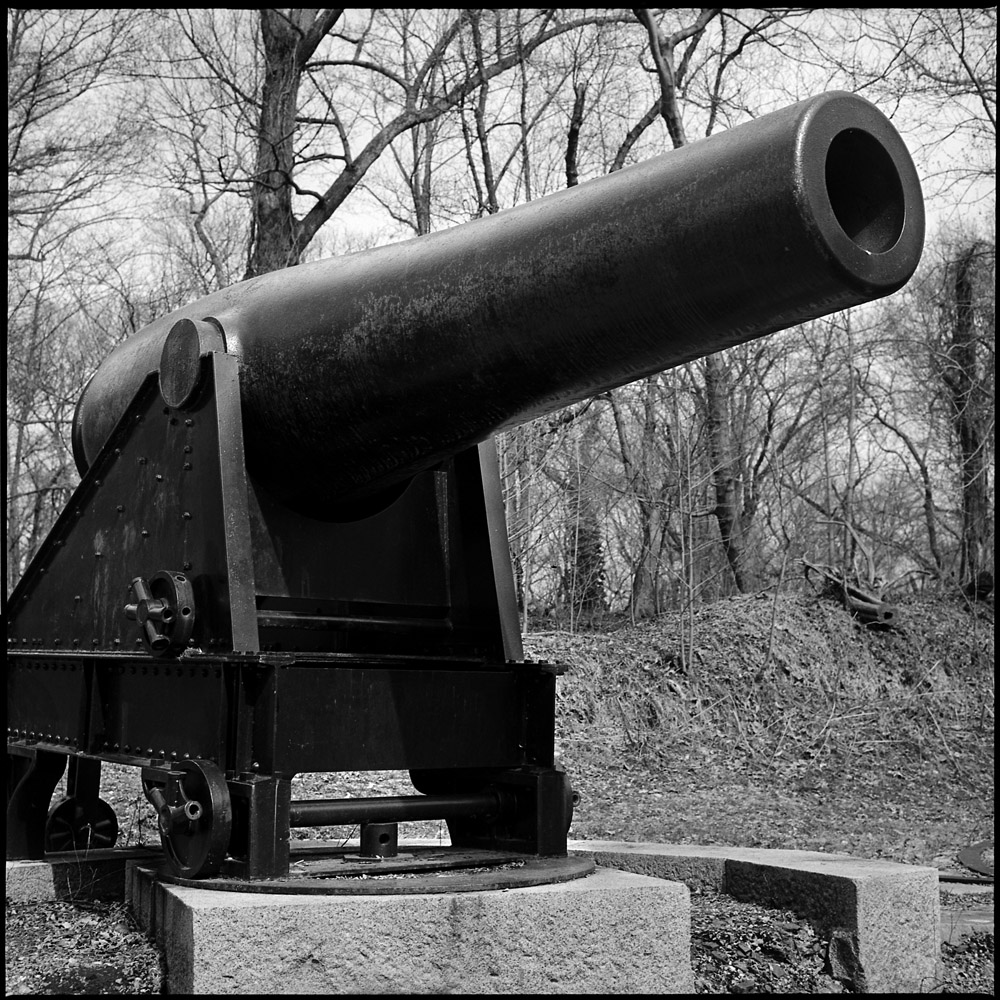
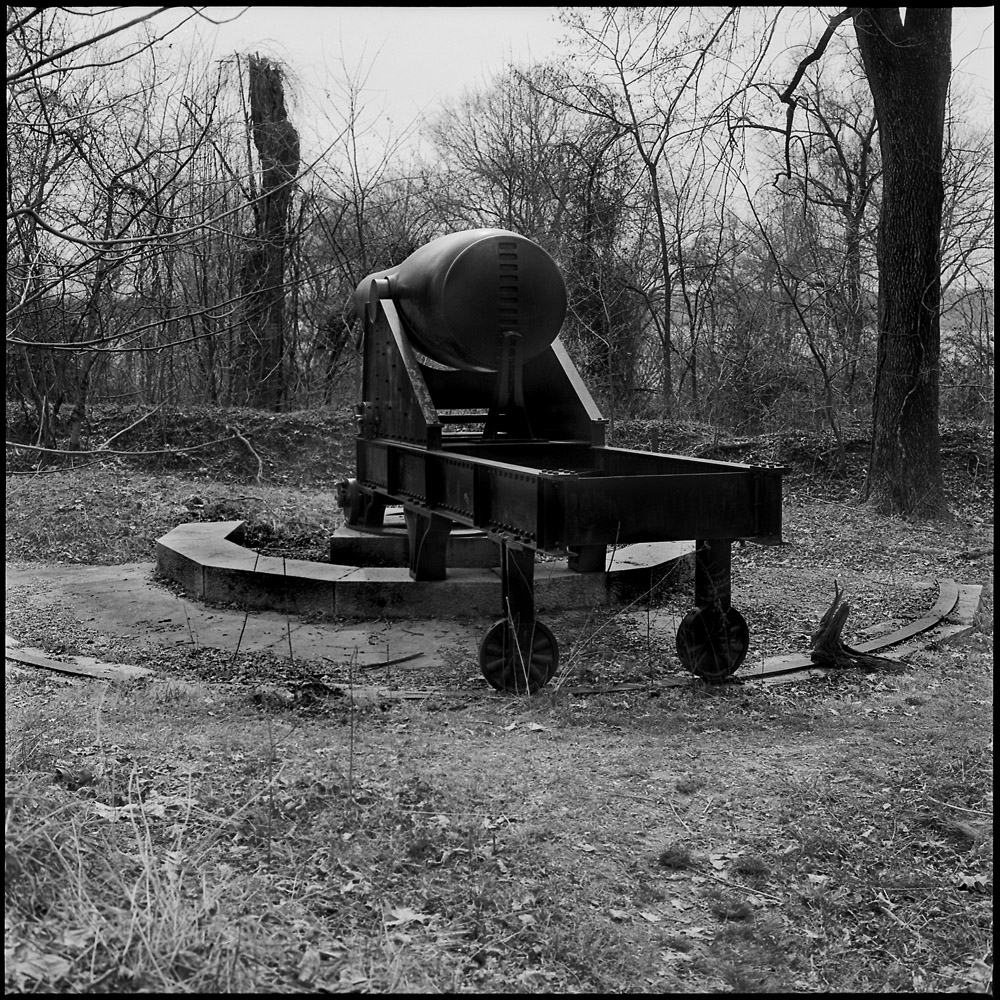
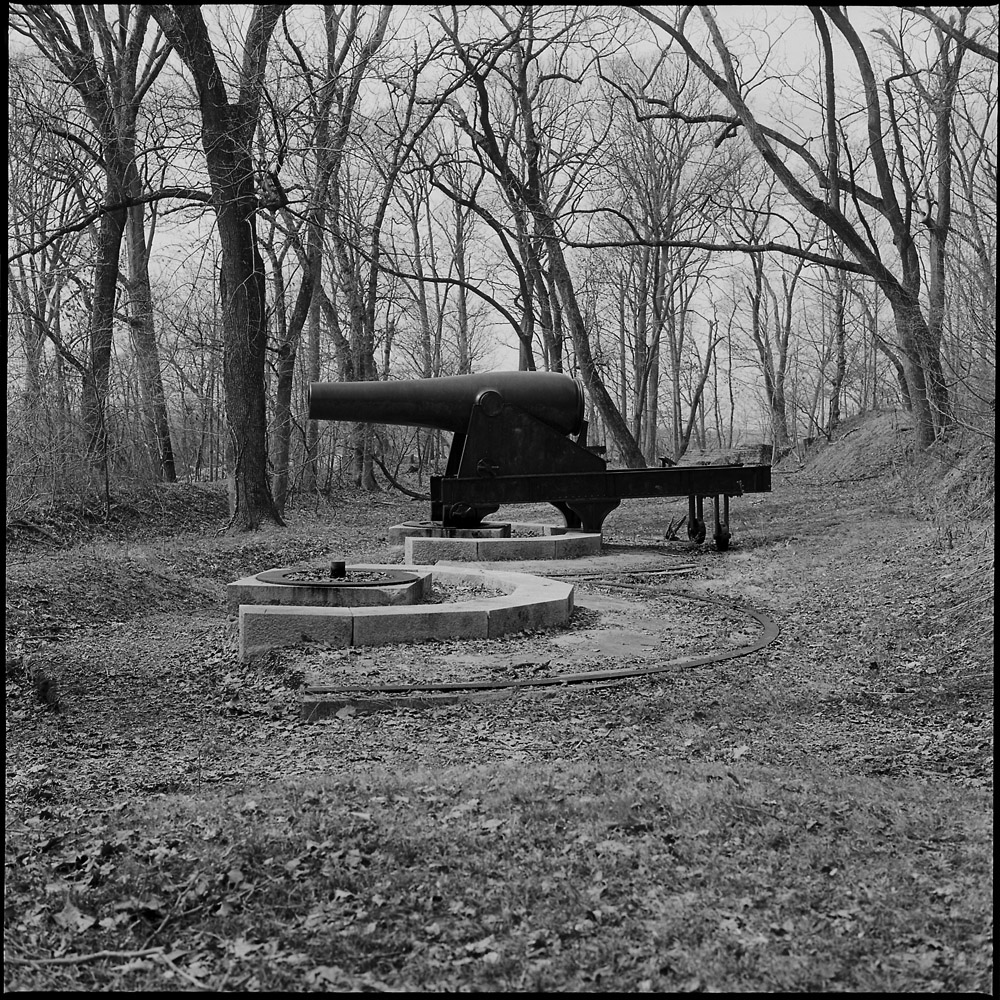
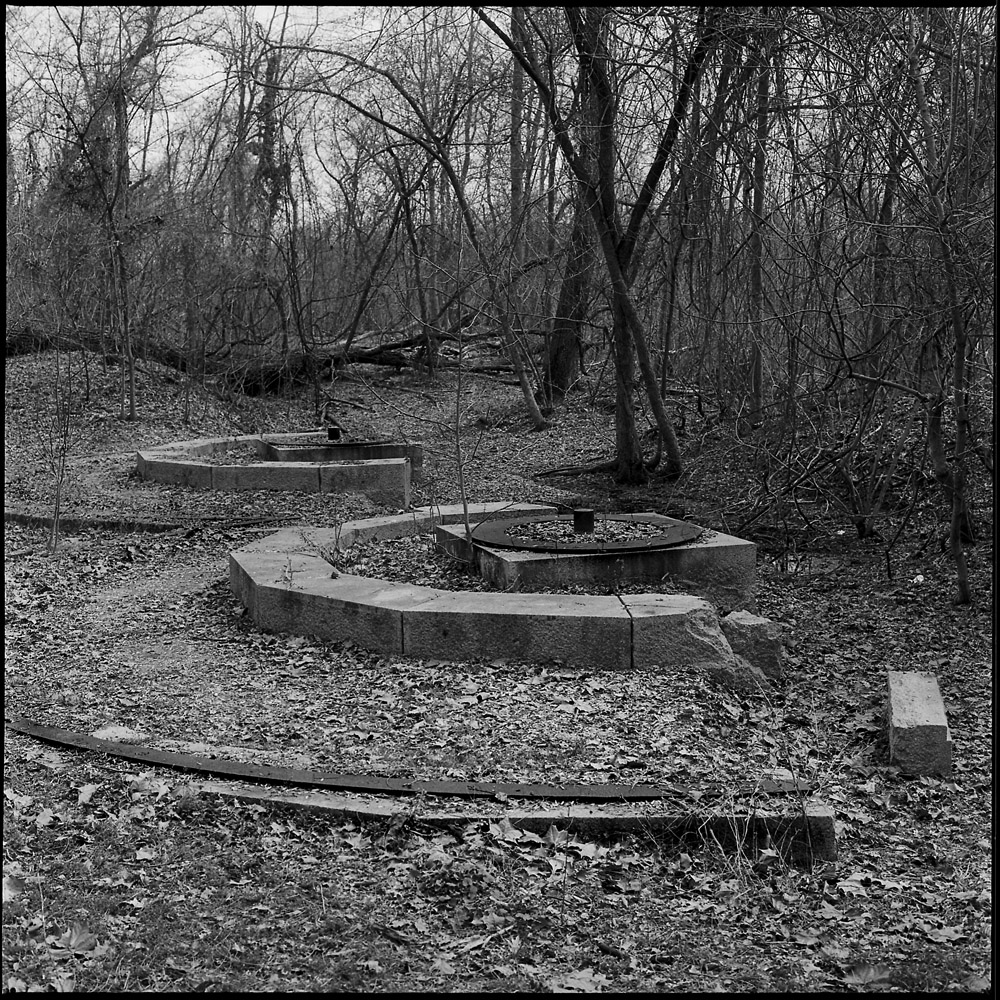
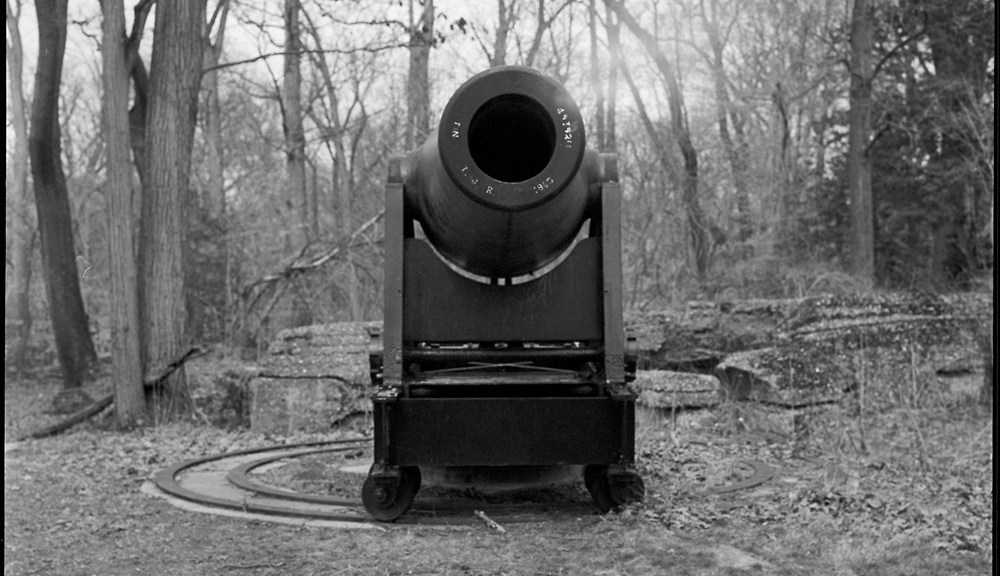
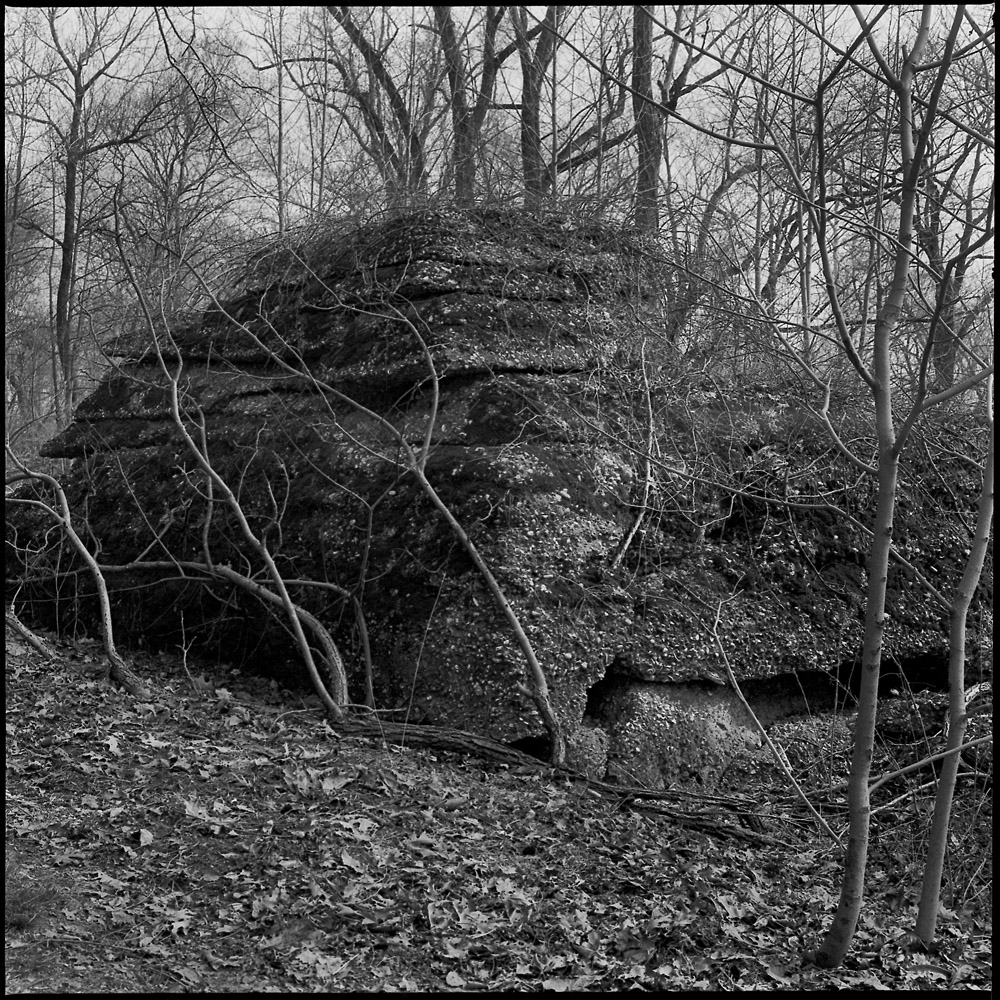
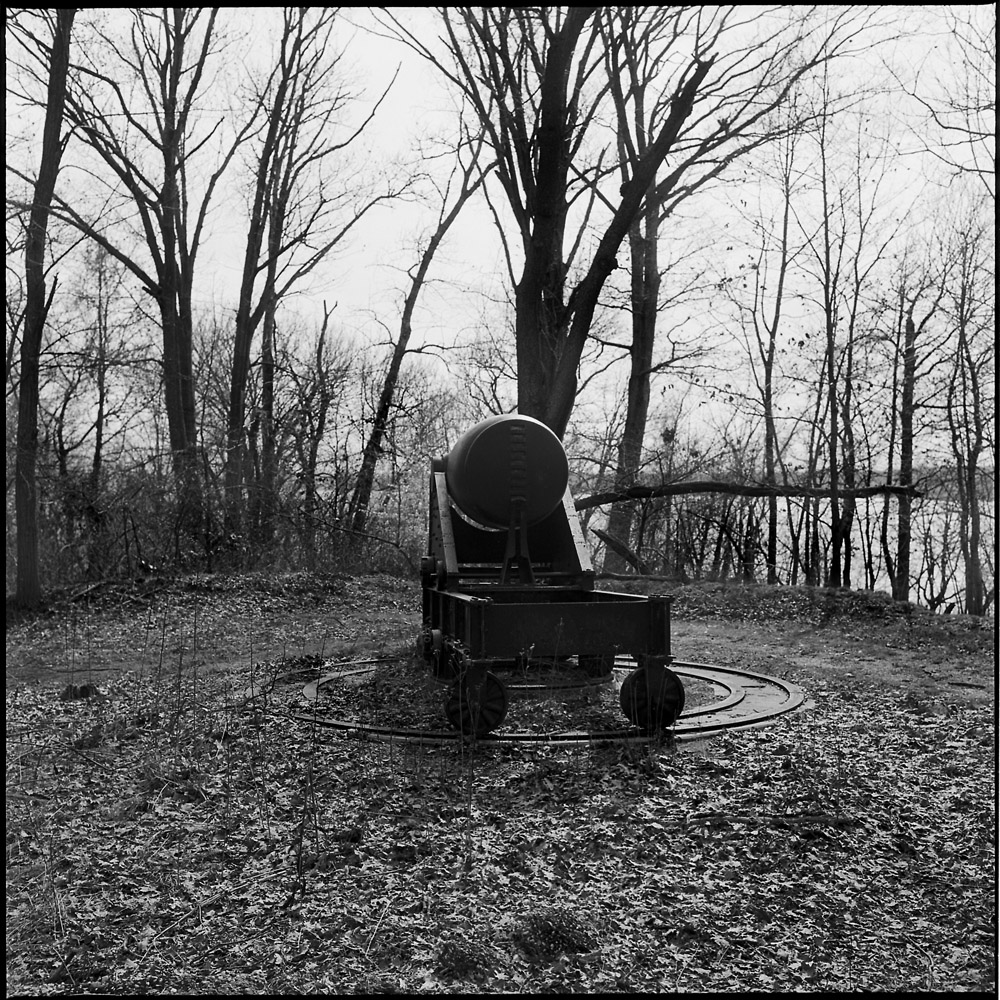
These are details of the fifteen inch Rodman guns and their emplacements at Fort Foote. I apologize for the delay in posting this second round. In this set of images I was focusing on the textures of the ironwork and the geometric patterns and repetition in the gun emplacements. There are endless circles and semi-circles repeating throughout, from the barrel of the gun itself to the wheels to the tracks to guide the traverse. They take on a bit of a crop-circle kind of feel: looking at the remnants makes you wonder if they’re the leftovers of an alien civilization.
Gun Carriage WheelRodman Gun, Fort FooteStanding SentryLone Rodman, Fort FooteGun Placements, Fort Foote
Because these are in the (encroaching) natural environment, I’ll grudgingly classify them as landscapes, but I think of them more as documentary work given the subject matter.
Serendipity plays a major role in my life. A couple weeks ago I took a mental health day mid-week and decided to visit some of our local history. My original intent was to take a short road trip to see some historic houses in northern Virginia, but they (the Woodlawn Plantation and the Pope-Leighy House) were still closed for the season. Instead, I thought I’d take a quick drive down Indian Head Highway into southern Maryland and visit Fort Washington, created to defend the capital city from river attack in the early days of the Republic. The current structures date from the years after the War of 1812 to the first decade of the 20th century. The main fort was designed by Pierre L’Enfant, the man who laid out the design for the streets of Washington DC.
On the drive down Indian Head Highway, after only a mile or so I saw a sign saying “Fort Foote Park”. I decided I’d detour and check it out. I really didn’t know much of anything about Fort Foote other than I presumed it was part of the Civil War-era defenses of Washington DC. My presumption about it was correct, but there’s a lot more to it than you might expect given that description. Most of the 68 defensive forts that ringed DC are now little more than some mounded dirt with a plaque commemorating what they were. They’re overgrown with trees and grass and cross-cut with walking trails, city streets, and even housing developments. Fort Stevens, the location where the only sitting United States President ever came under enemy fire, today is barely a half a square block, hidden behind a post-war church, 20th century homes and shops, and hemmed in by city streets.
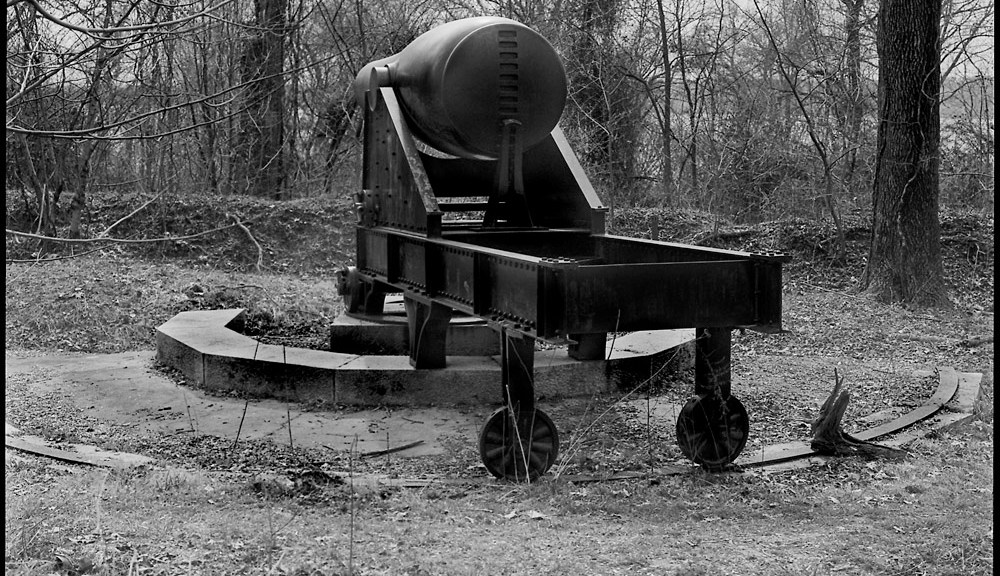
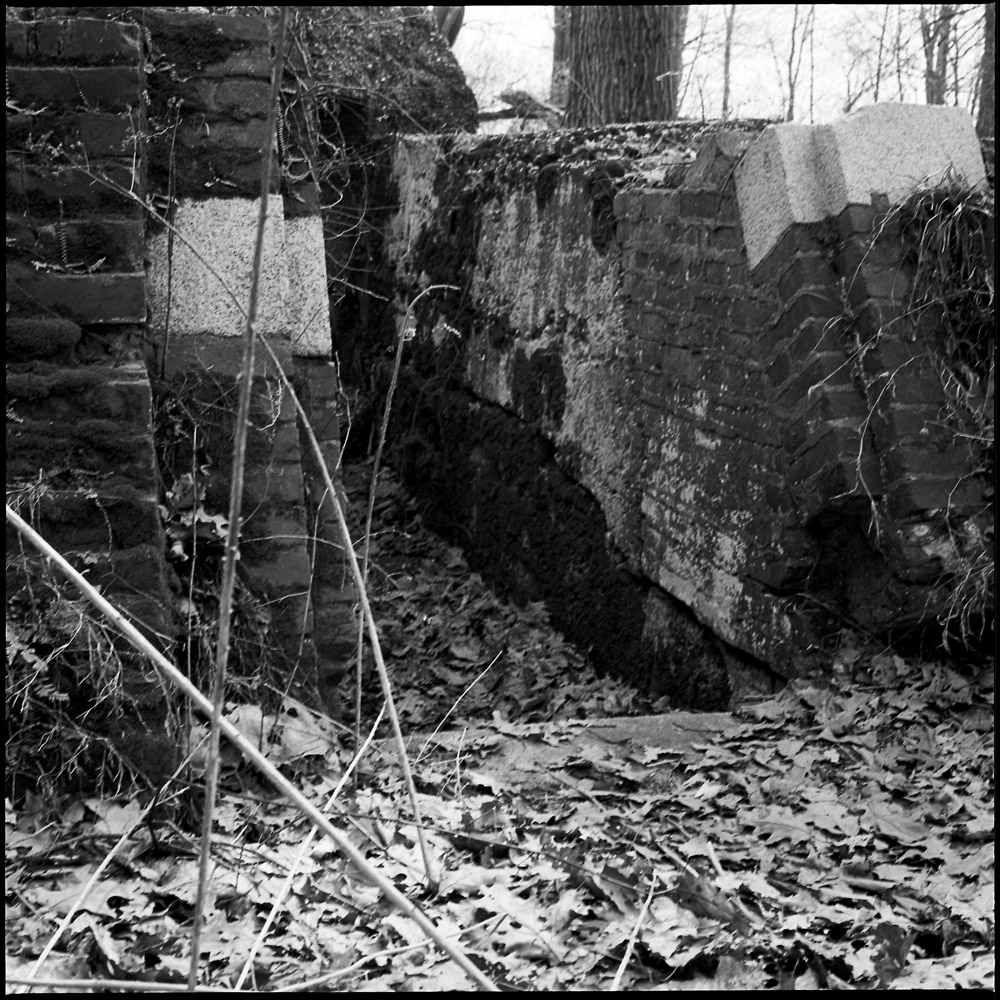
Fort Foote has been spared much of that indignity. Fort Foote (named after a Union admiral who was killed in action in 1863 assaulting Confederate strongholds on the Mississippi river) too is overgrown with forest, but the earthworks remain very much in their original configuration. It owes its survival in part due to the location on a 100 foot tall bluff facing the Potomac river, too awkward a site for proper development. Two of the mighty 15 inch Columbiads (also known as Rodman guns for the man who designed them) remain in situ, and the ammunition vault’s crumbling ruins (also known as a “bombproof”) can be seen and scampered over by enterprising and nimble youth.
Crumbling Bombproof, Fort FooteBombproof Entrance, Fort Foote
The Rodman gun was a major innovation in cannon technology. Due to a radical change in forging technique, they could be made much stronger and safer to be fired repeatedly without risk of the powder charge exploding the gun itself. The design was so successful that eventually the United States had nearly 450 of them providing coastal defense. The 15 inch Columbiad version could fire a 200 pound projectile some 5000 yards and penetrate ten-inch steel armor at that range. The guns at Fort Foote were never fired in anger. The smaller 12 inch and 8 inch cannons that topped the earthworks were removed by the end of the 19th century when the fort was decommissioned. Today, only a handful of the 15 inch Rodman guns remain in existence, the majority having been melted down or in some cases entombed in concrete to add support to the improved fortifications they once defended.
Rodman Gun, Front ViewRodman Gun
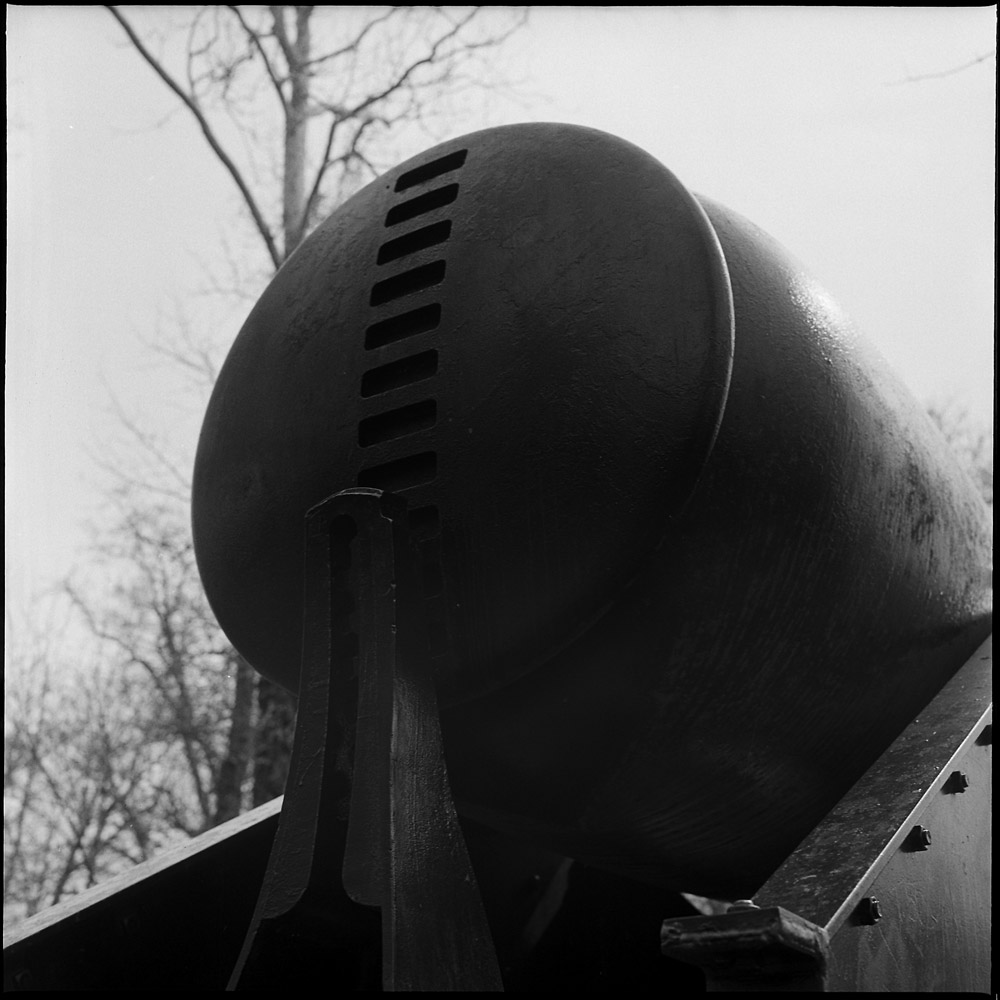
The notches on the back of the Rodman gun, along with the large, relatively flat “knob”, are signatures of the design, and indicative of some of the innovations. By making the “knob” large and flat, it made it much easier to hoist the cannon for moving it and loading and aiming – a common problem with smaller guns that had a much more traditional knob on the rear was that the weight of the gun, when hoisted in the air, would stress the join between the barrel and the knob and it would break, sending the extremely heavy barrel crashing to the ground, crushing anyone below, ruining the gun, and possibly discharging the shot if it were loaded.
Rear, Rodman Gun
The Rodman cannons were mounted on platforms that would enable them to be withdrawn below the earthworks to be loaded, and then raised when ready to aim and fire, reducing the exposure of the gunnery teams to enemy small arms fire. This wheel with its tubes to take wooden levers would have been used to raise and lower the gun on the pop-up mount.
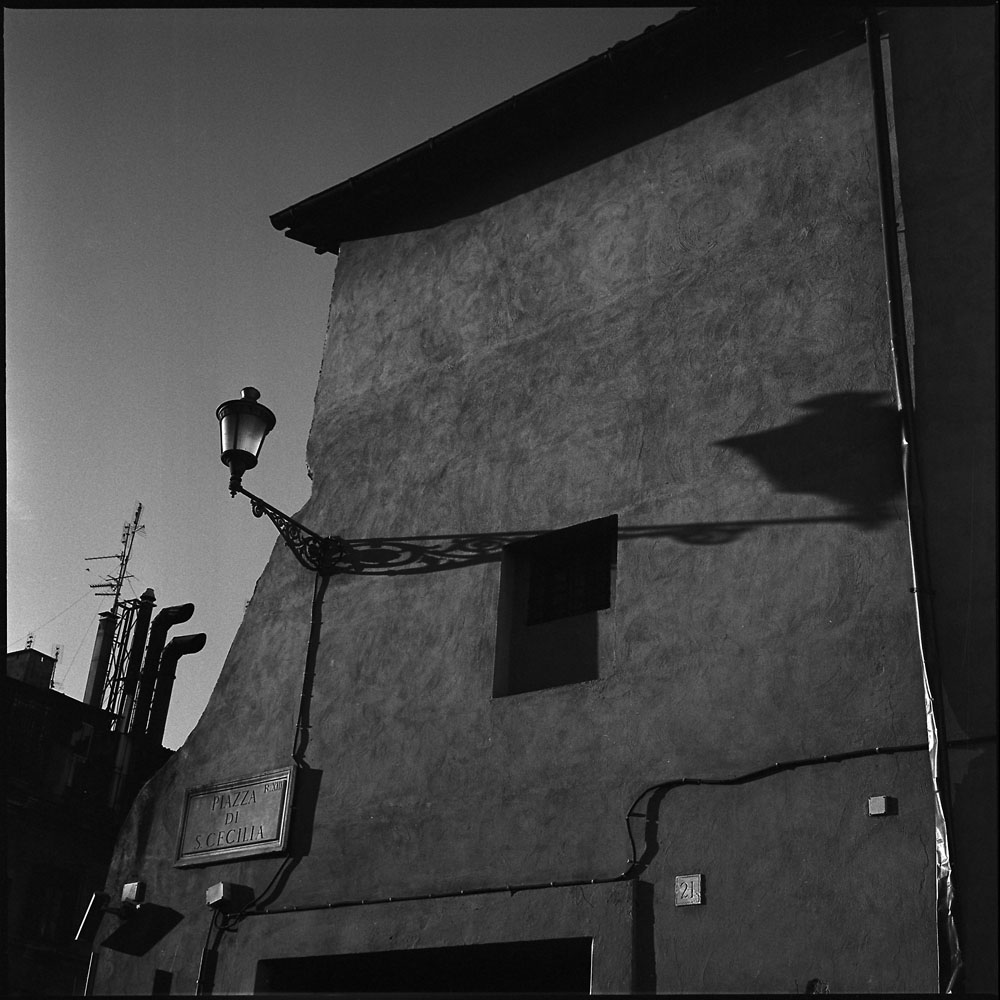
The Piazza Santa Cecilia is one of the focal points of my part of Trastevere. It is named after the eponymous church and convent that borders its west side. The lantern on #21 Piazza Santa Cecilia casts a long shadow in the light of dawn:
21 Piazza Santa Cecilia
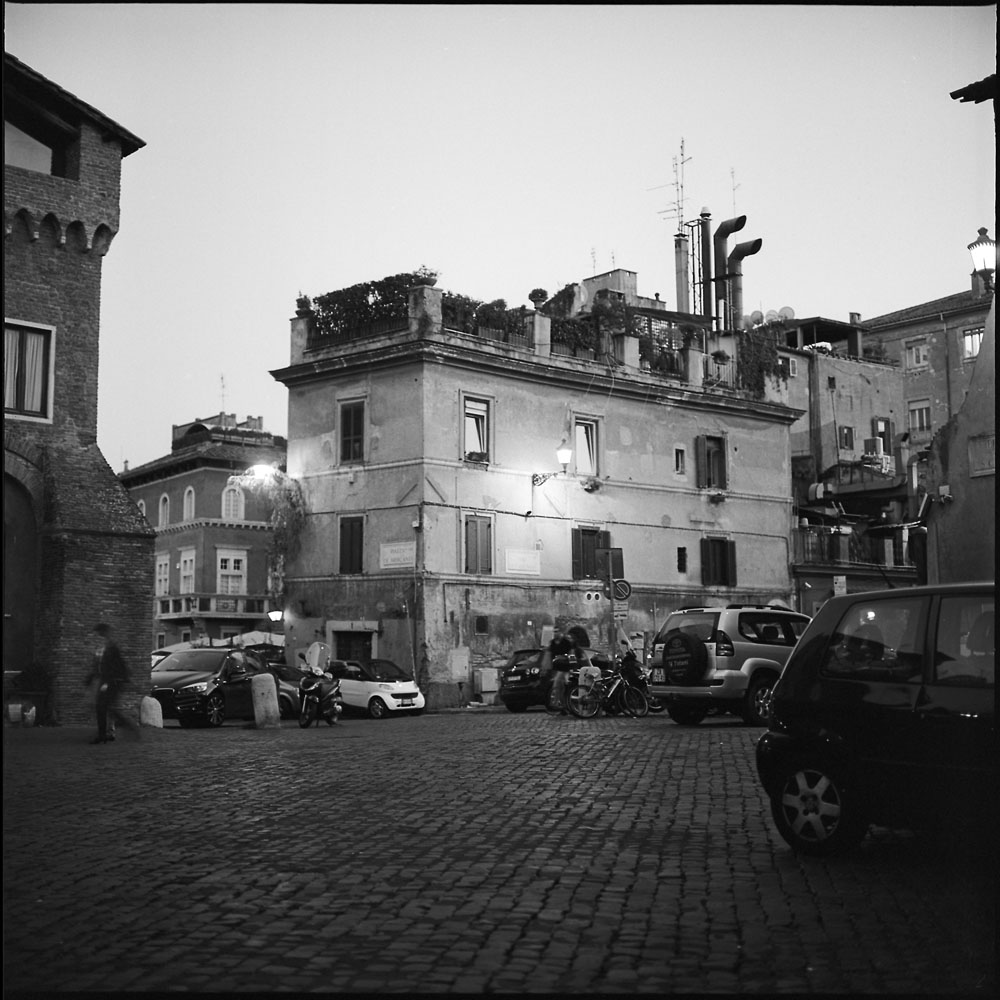
The Piazza dei Mercanti abuts the Piazza Santa Cecilia. In this view as the sun sets and the street lamps come on, there’s not much to see of the piazza itself from all the cars parked in it, but a very large restaurant faces it that does a bustling business on a warm fall evening. A neighborhood resident is out for a stroll, perhaps on their way to the coffee bar up the street.
Piazza dei Mercanti, Evening, from the Piazza Santa Cecilia
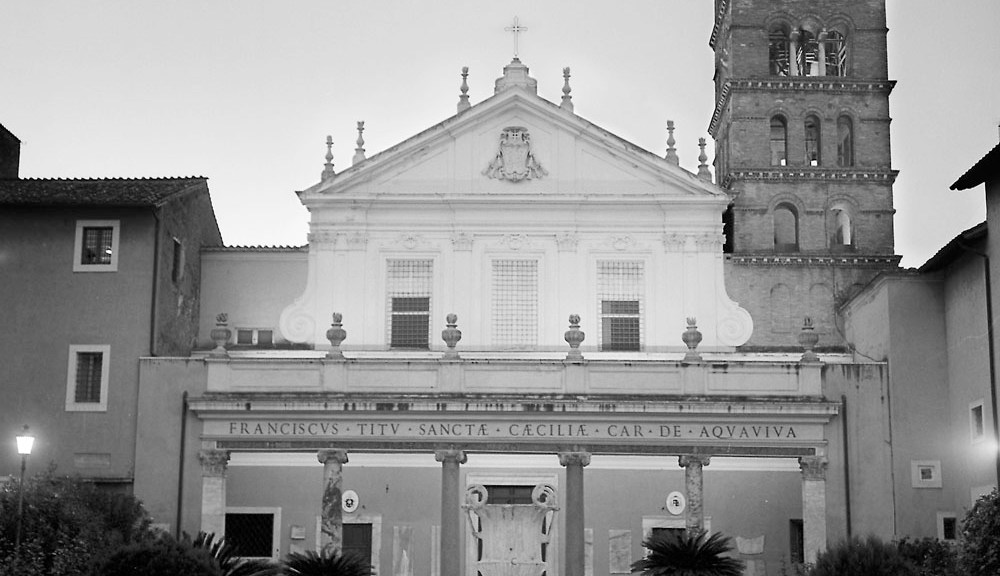
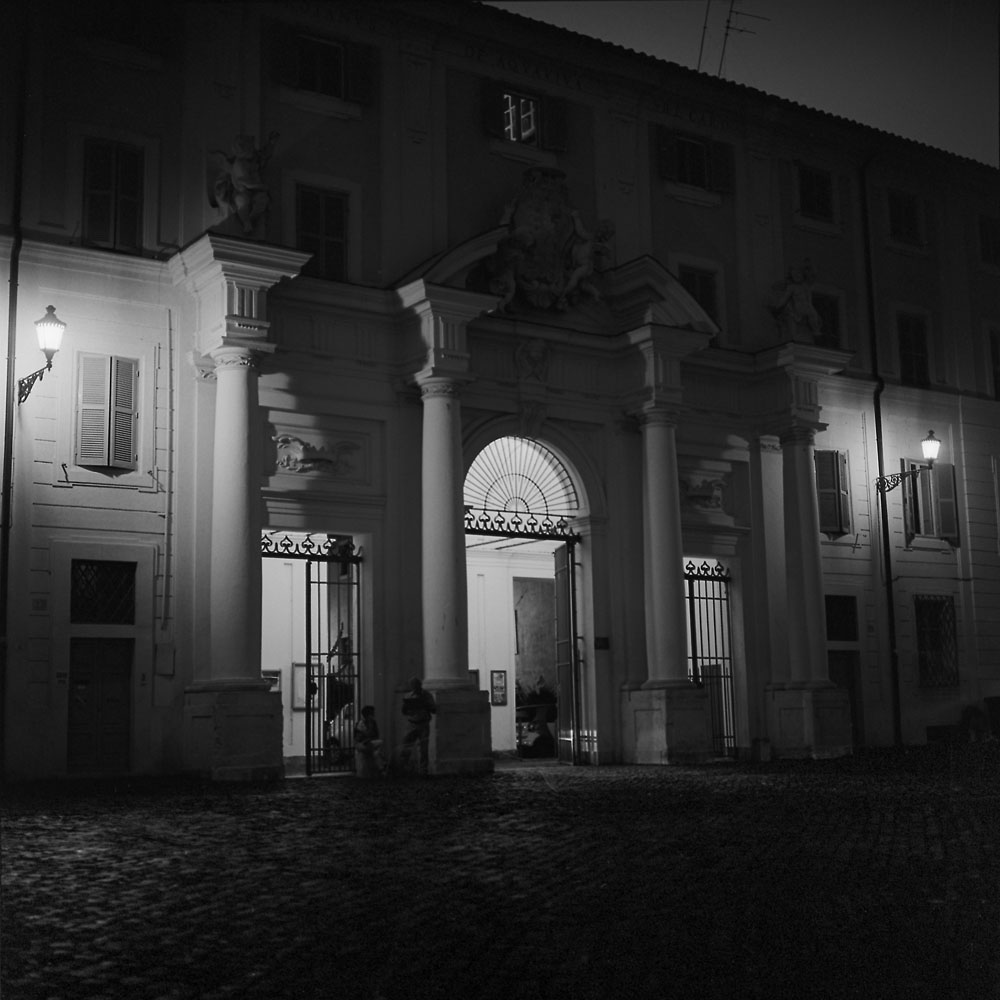
Santa Cecilia’s courtyard remains open quite late into the evening, and the public can come and go through the gates. There has been a church on the site since the 3rd Century AD, when it was built over the location of St. Cecilia’s house. The main body of the church dates to the 13th Century, and some 9th century mosaics are preserved within. The facade and the courtyard are 18th century renovations, however.
Exterior, Gates to Santa Cecilia, Night
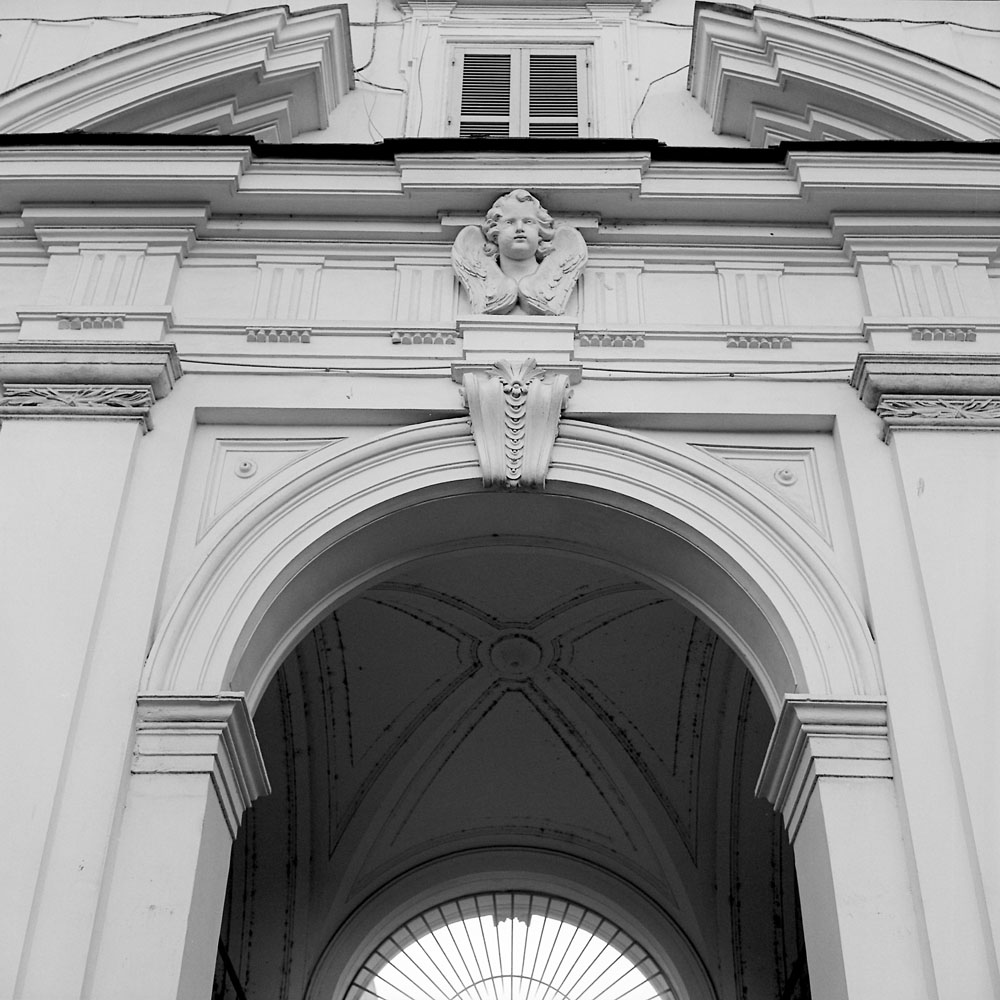
This cherub keystones the arch over the main gate to the courtyard.
Cherub, Santa Cecilia Courtyard
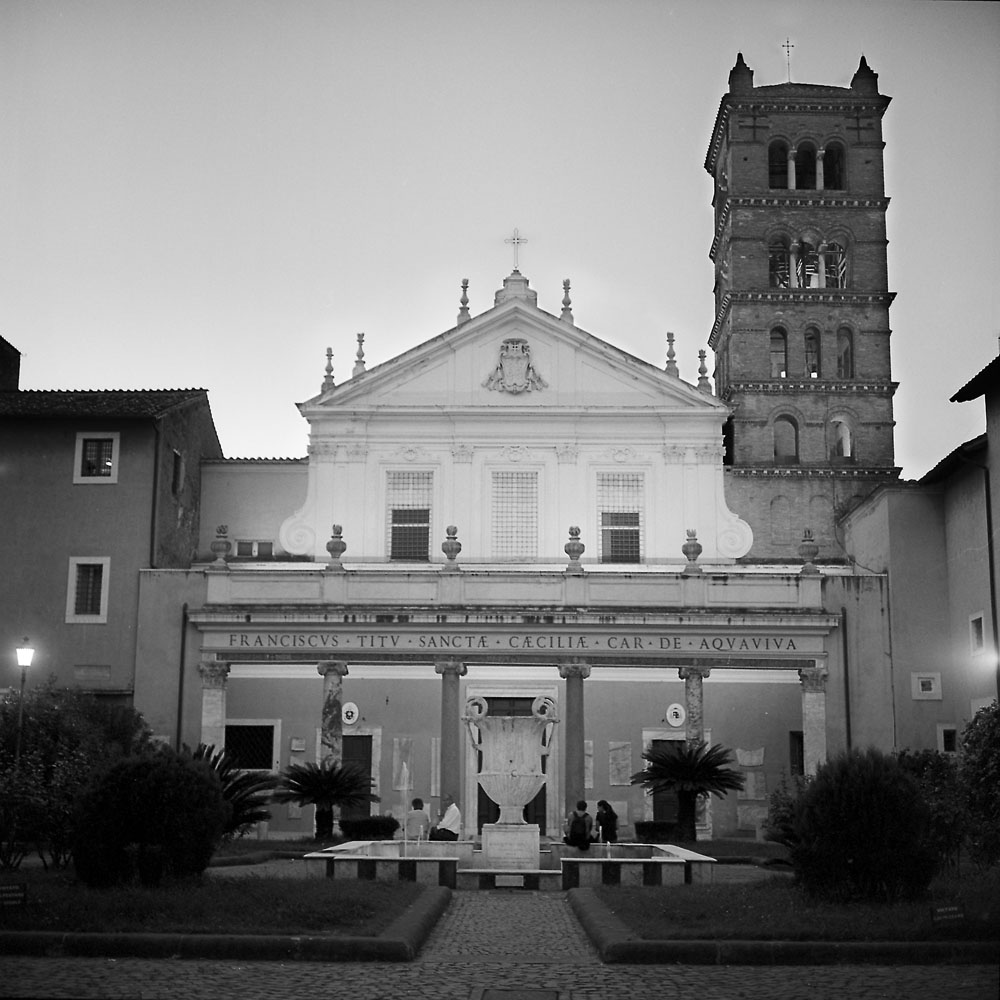
Inside the courtyard you can view the 18th century facade of the church, ancient mosaics and an ancient cantharus or water urn that now is the centerpiece to a fountain. The bell tower dates to the 12th Century, and looms over pretty much the entire neighborhood. Here young couples sit on the edge of the fountain to canoodle while admiring the church before wandering off to dinner or perhaps a more appropriate intimate location.
I rented an apartment at 38 Via Dei Genovesi in Trastevere for my stay in Rome. I wanted to get something of a more authentic Roman living experience rather than stay in a touristy hotel or b&b, without giving up the convenience of a central location. I got that in Trastevere – narrow cobblestone streets, populated with neighborhood restaurants frequented by locals and tourists alike, a little grocery store and bakery across the street, a coffee shop downstairs, and boutiques with interesting merchandise in the alleyways surrounding the apartment. Two blocks away was the street car that would take me to the Piazza Venezia, or the Trastevere train station in the other direction. Dante’s house in Rome was across the street from the street car stop.
The downsides? Well, the first one wasn’t so bad – I was on the fourth floor of what may well have been a 15th century building, so walking up and down it was. I wanted and needed the exercise. The second, that was my downfall, pardon the pun – there were down pillows on my bed, and as it turns out I am hyper-allergic to them. As in couldn’t really be in the same apartment with them, let alone use them. Also, for whatever reason, the apartment despite being four stories above the street, was exceptionally noisy. Pretty much twenty-four hours a day, seven days a week. Trash trucks would come rumbling through at 3 AM. That kind of noisy. I could deal with the people spilling out of the restaurants at midnight – that would be easy enough to sleep through for me. It’s the inorganic noises that get me. I would still highly recommend Trastevere as a fantastic neighborhood to stay in for all the above mentioned reasons – location, ambience, food – just not the apartment I stayed in.
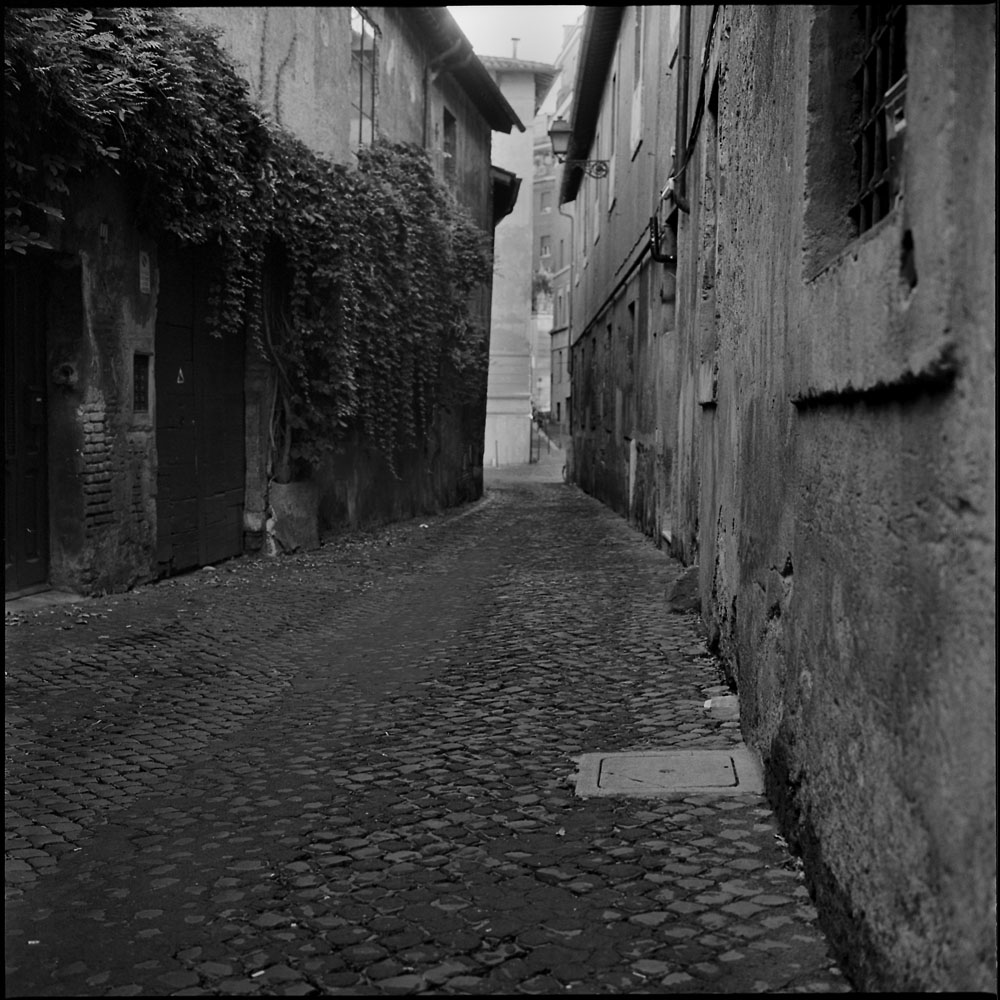
How could you resist the charms of a neighborhood where THIS is a street? It makes you feel like any minute Robert Langdon is going to step out of a doorway and implore your assistance in solving another Renaissance Art code/murder mystery.
Twisty Alley, Trastevere
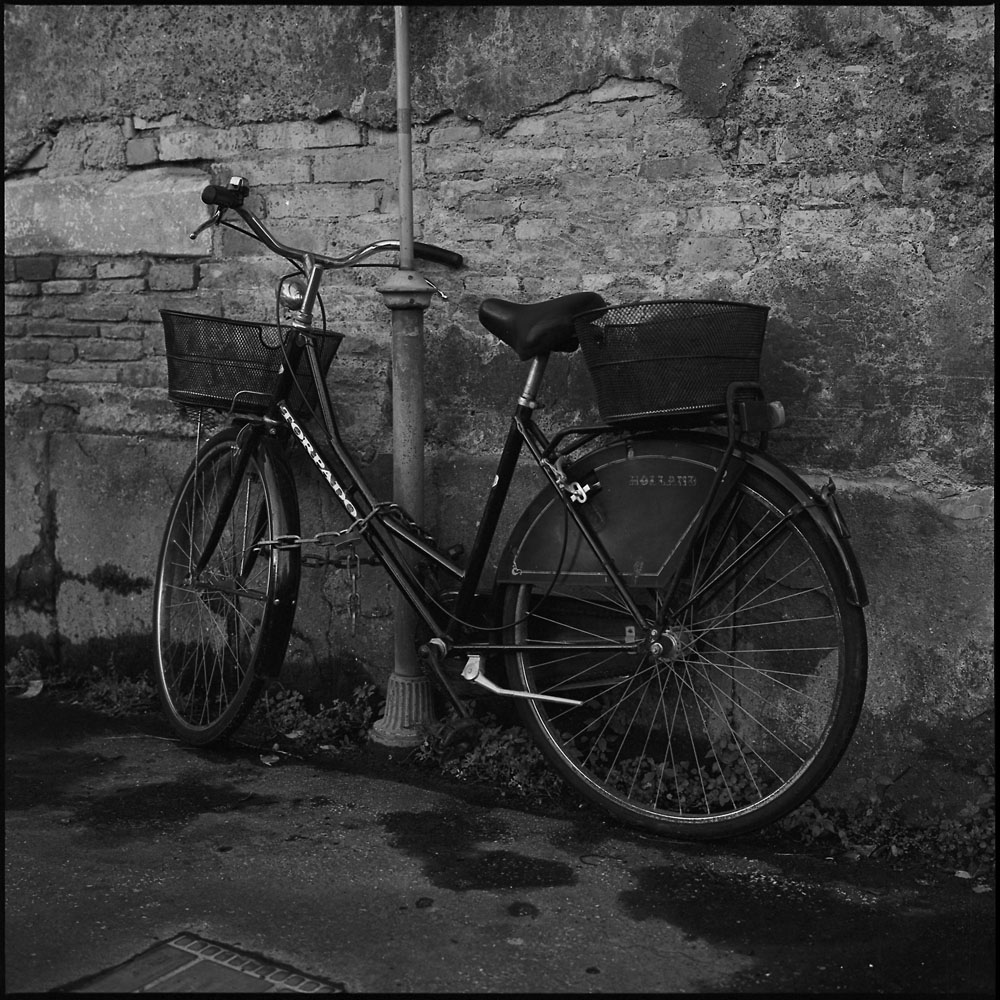
Street parking being somewhat at a premium, and garage parking extremely so, lots of people ride vintage bicycles around the neighborhood. Here’s one that belongs to a neighbor…
Chained Bike, Trastevere Alley
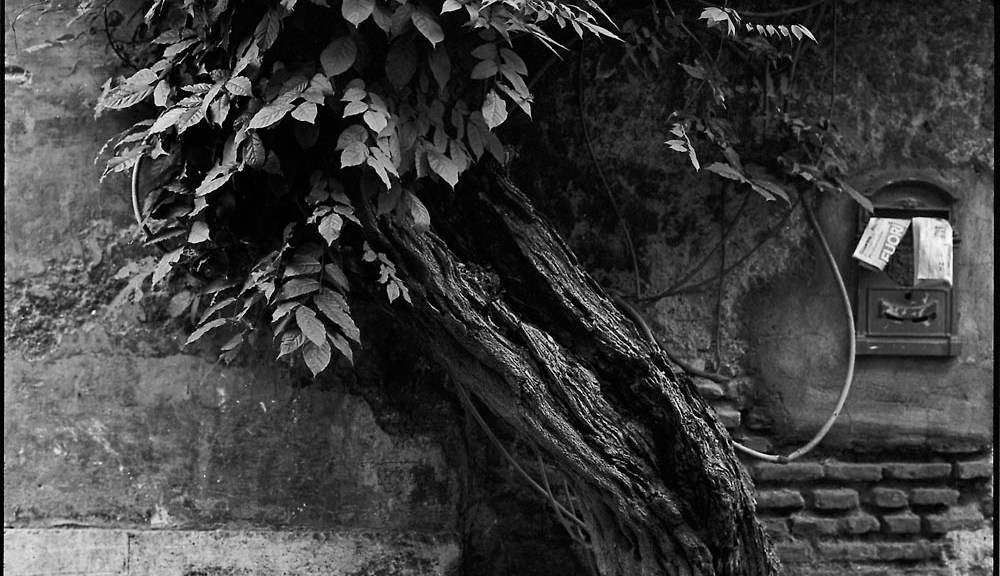
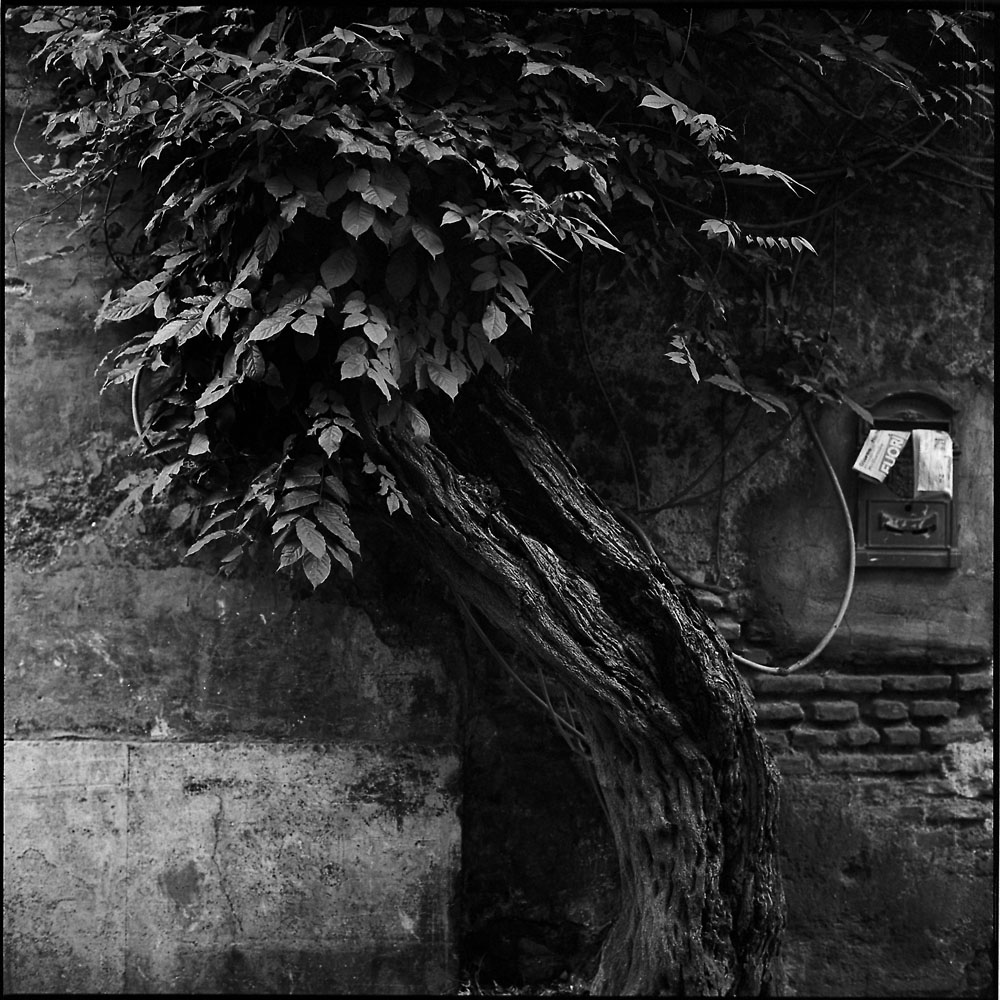
This flowering vine has been allowed to grow for possibly centuries until it has turned into a tree, swallowing the downspout and enveloping the wall, leaving room for the mailbox and its door just beyond.
Tree, Mailbox, Trastevere
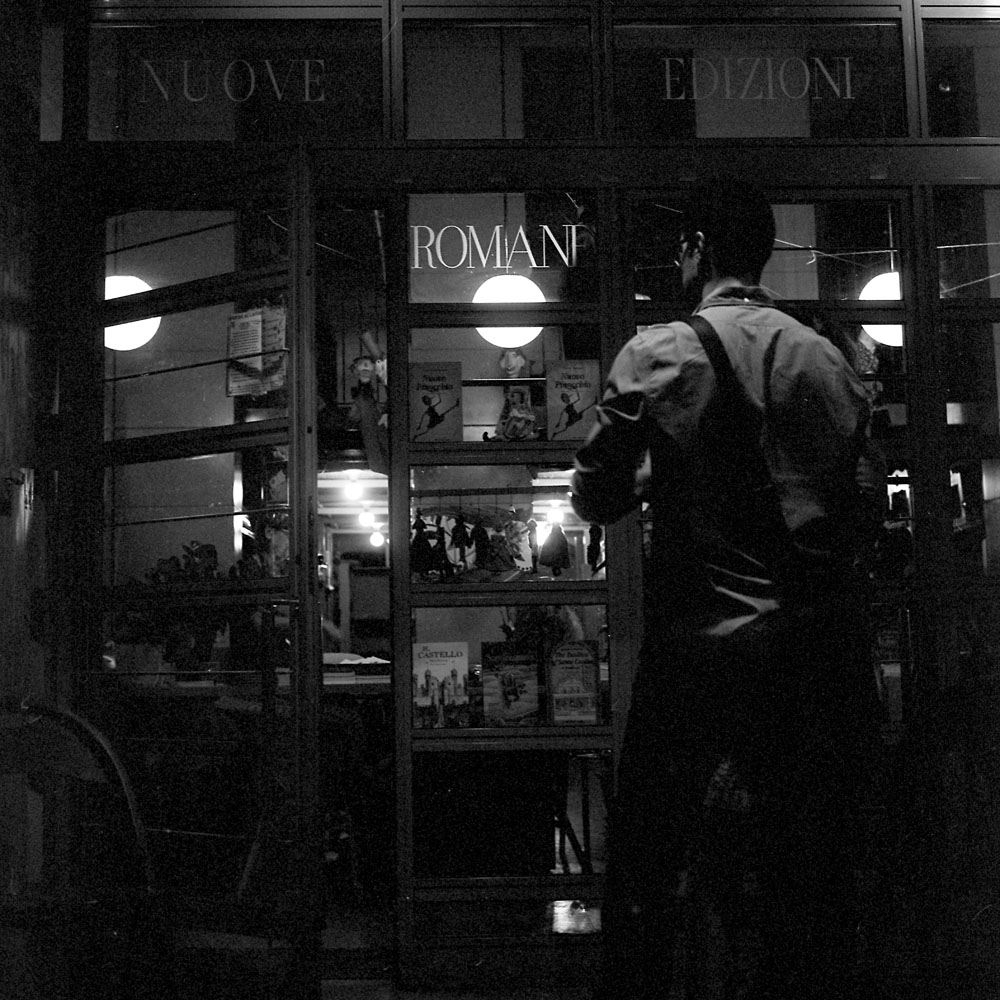
Here a late-opening book shop is perused by a customer as night envelops the neighborhood.
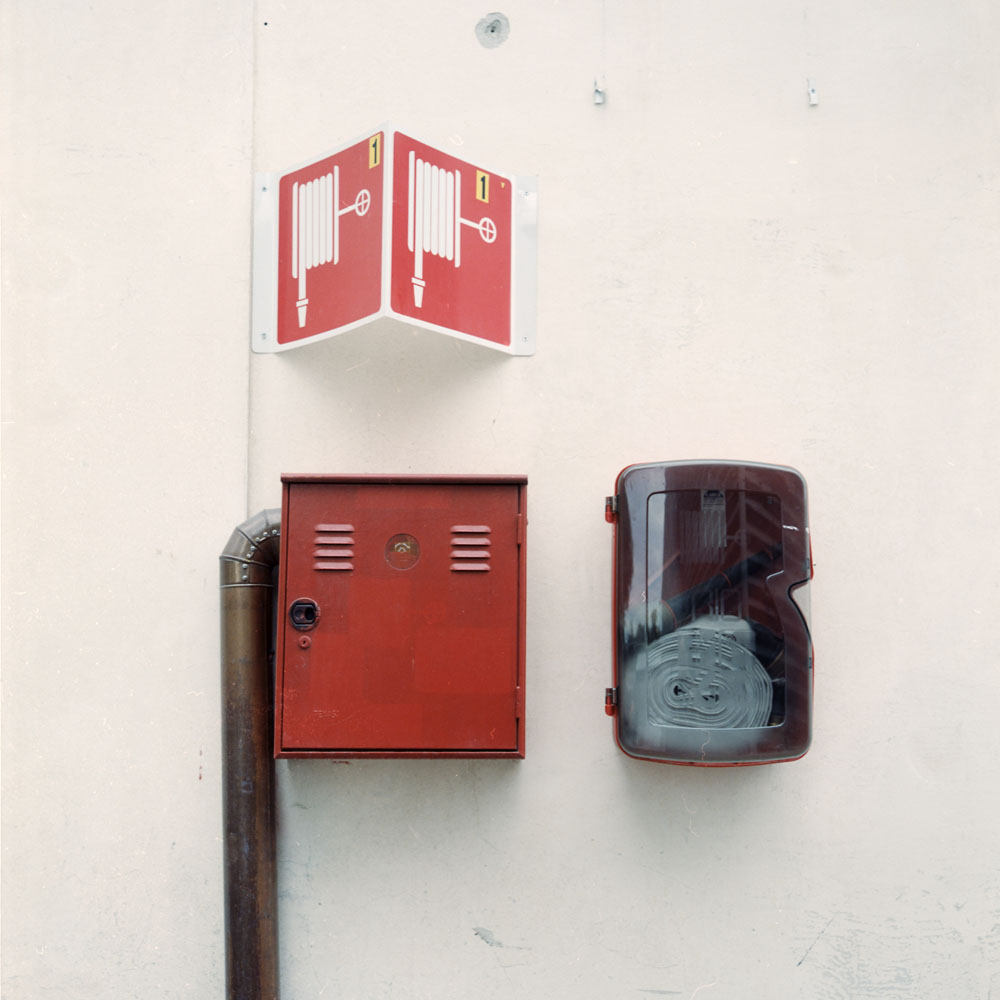
As you may well know if you’ve followed my blog for some length of time, I like taking portraits of ordinary objects- things we see in daily life and ignore and/or take for granted, like pay phones, water fountains, traffic cones, and trash cans. I’ve photographed them in Paris, Toronto, New York, Washington DC and now Rome and Florence. They all have a common denominator of their base functionality. I think though that the Italian ones seem to have just a bit more flair and style to them – take a look and see what you think.
This fire hose connector is probably the newest thing I’ve photographed in this series – the copper connecting pipe has only just begun to oxidize!
Fire Hose Connector
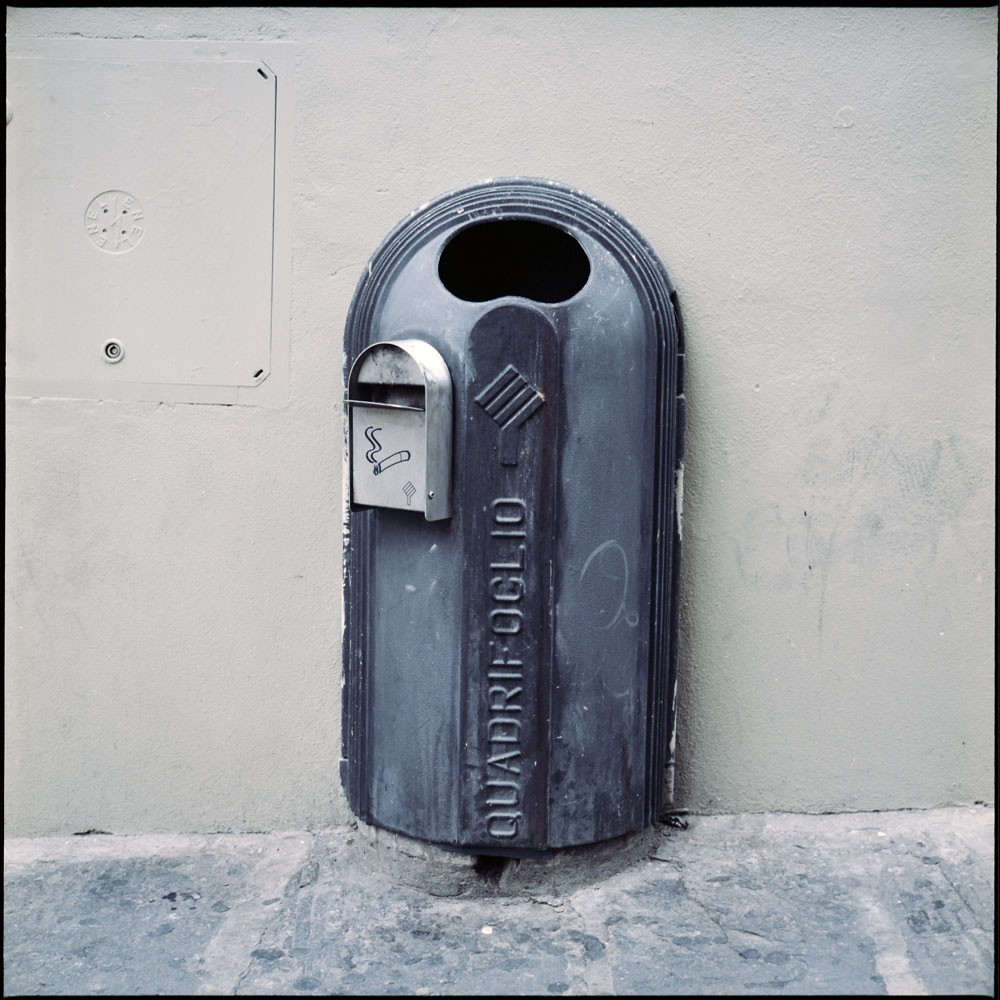
In contrast, this trash can in Florence with cigarette butt receptacle is quite well-used, but still has style.
Quadrifoglio Trash Can, Florence
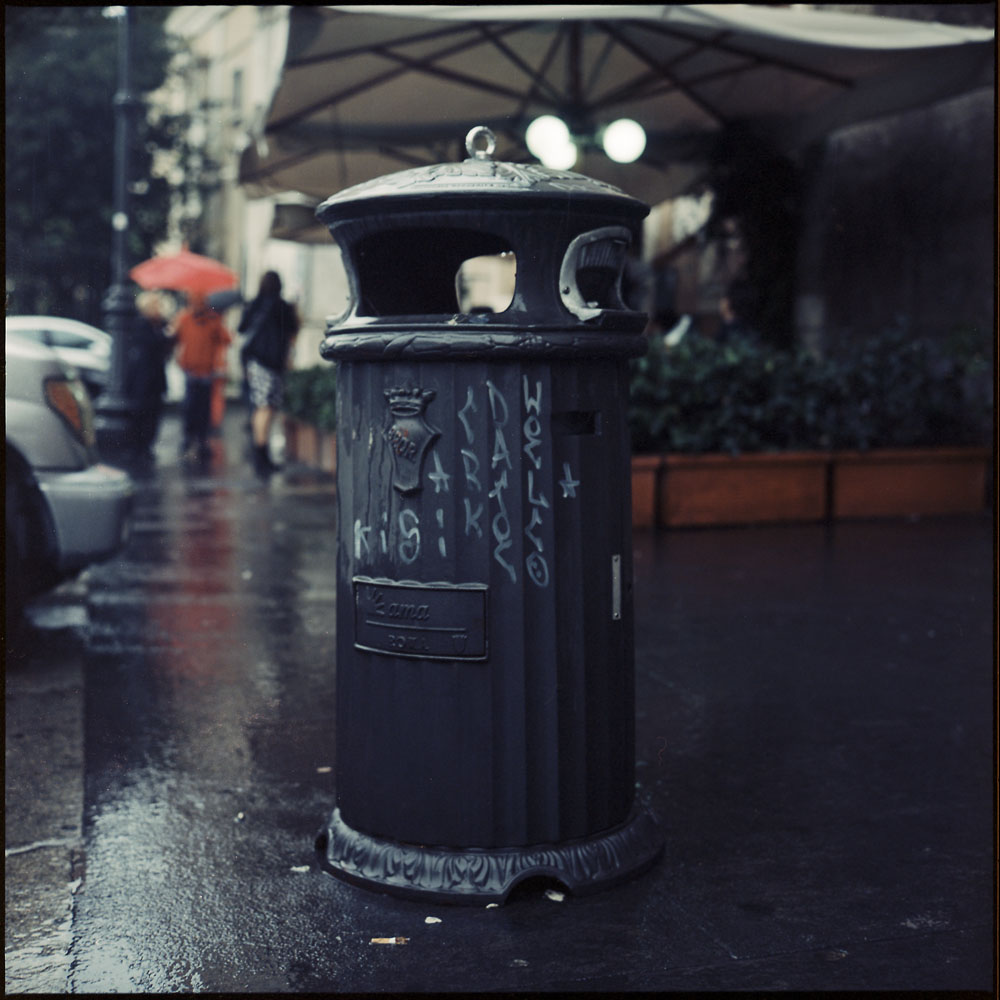
… as does this Roman bin across from the Capitoline hill.
Trashcan in the rain, Rome
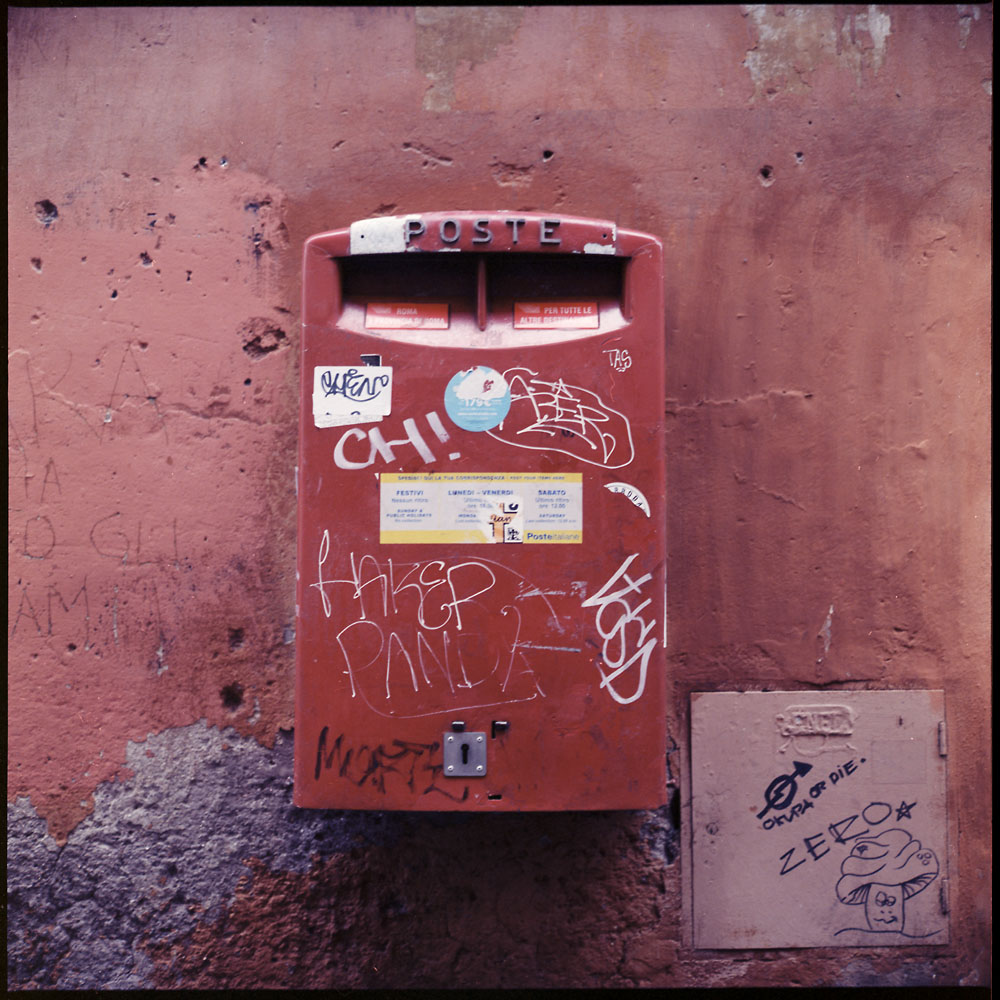
The poor mailbox in Trastevere has been graffiti’d and stickered and it still soldiers on.
Mailbox, Trastevere, Rome
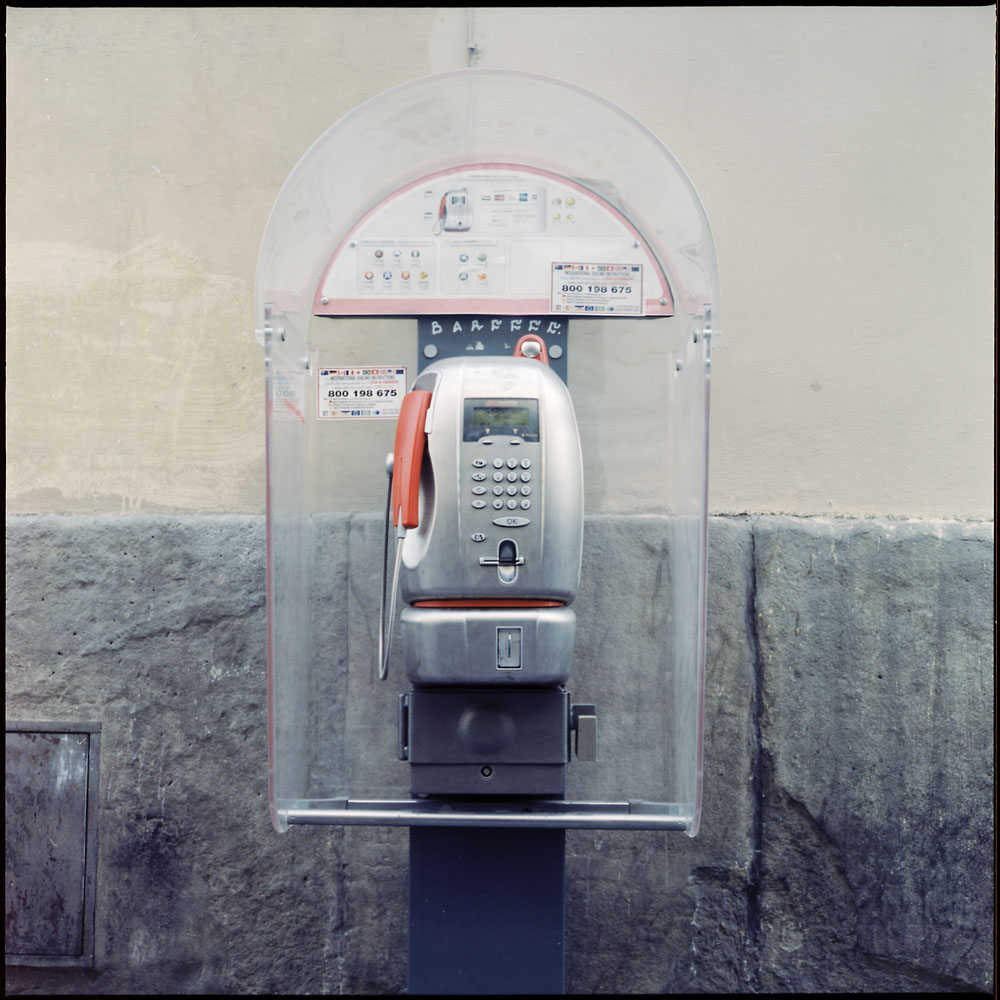
Don’t you wish all payphones were this glamorous (and as easy to find)? Here in DC when I went to find a payphone to photograph, it took me several days of looking before I ran into one. I saw this one on my first day in Florence.
Payphone, Florence
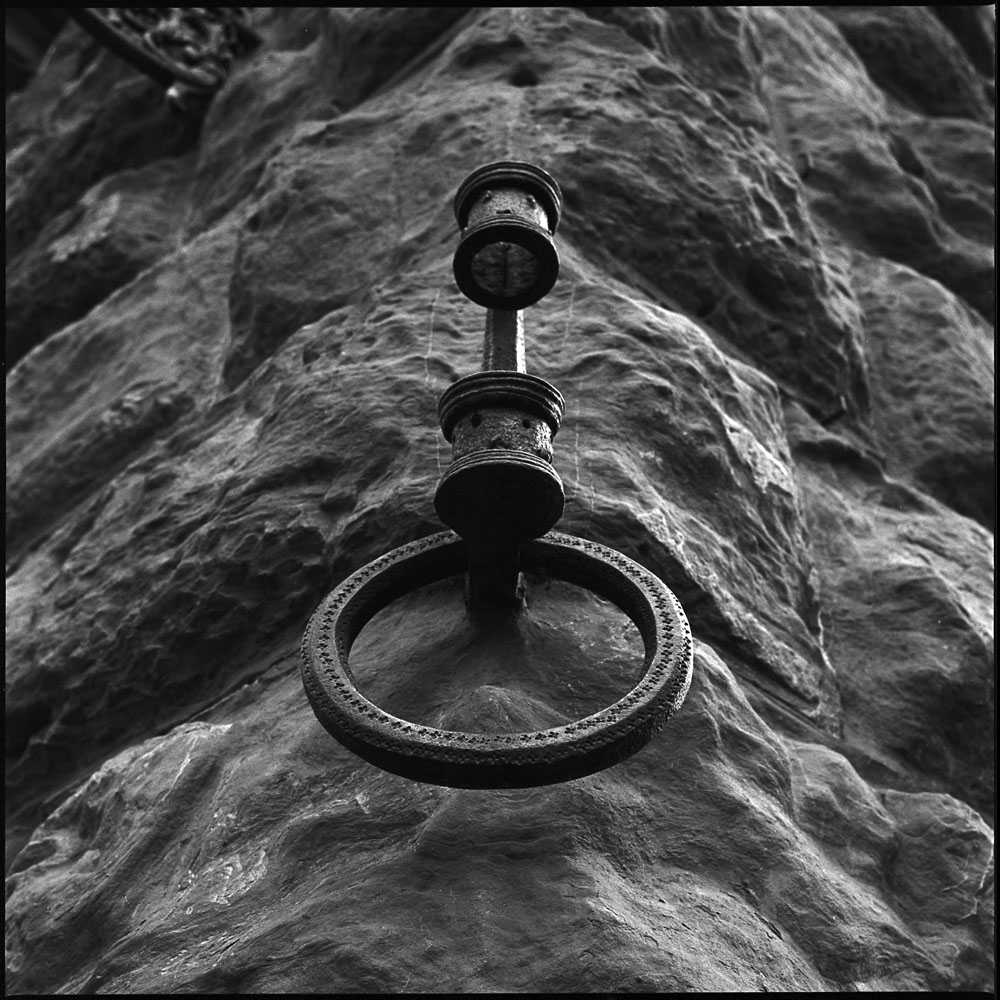
I’ll include this because it has a very utilitarian purpose – it’s a street lamp. Granted, a 15th century street lamp attached to a palace, but a street lamp nonetheless.
Torch Holder, Palazzo Medici-Riccardi
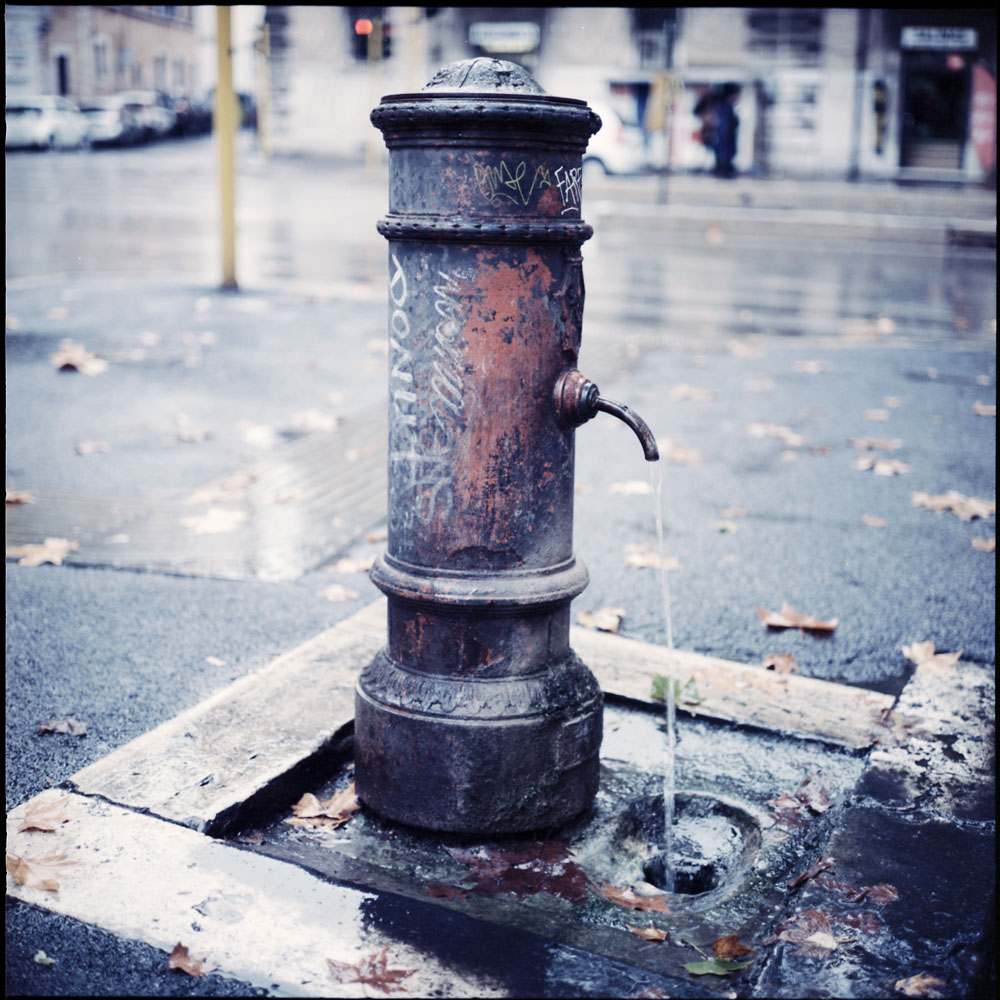
A public drinking fountain. These were ubiquitous across Rome, in very much the same form, some in better and some in worse condition. But they worked, and the water was sweet and clean, always flowing, and free.
Water Fountain, Trastevere, Rome
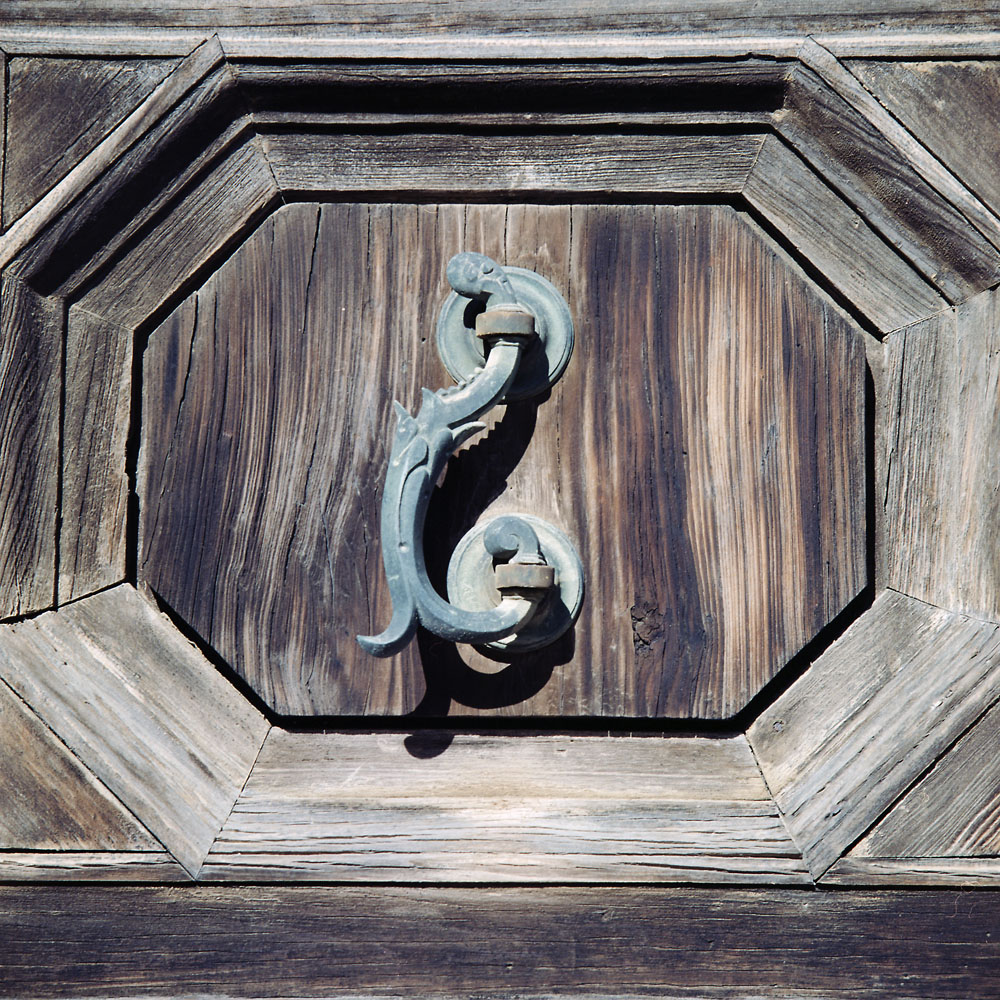
A lowly door handle – this one in particular is attached to a palace, but there were plenty to be found of similar quality on middle-class residences in both Rome and Florence.
Door Handle, Boboli Gardens
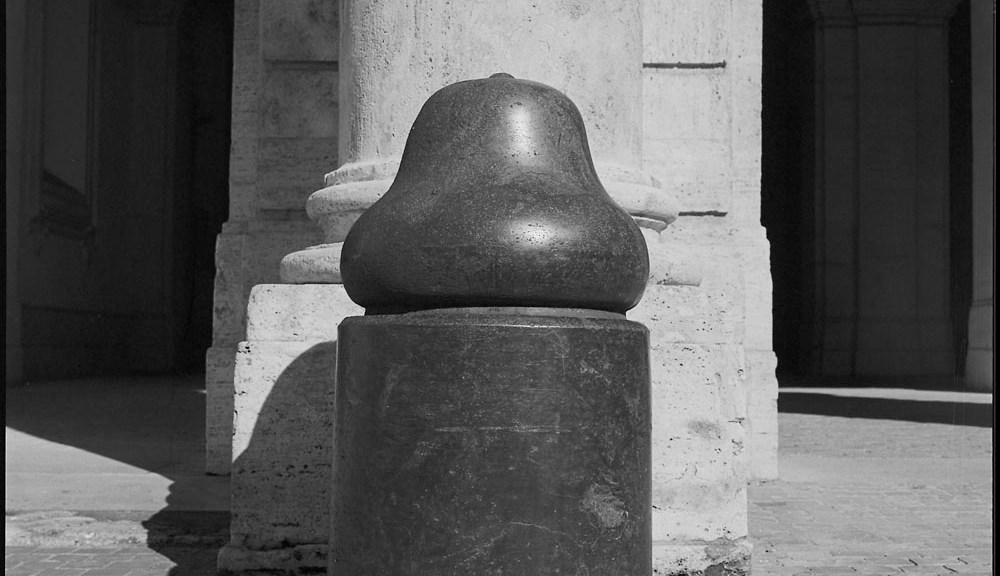
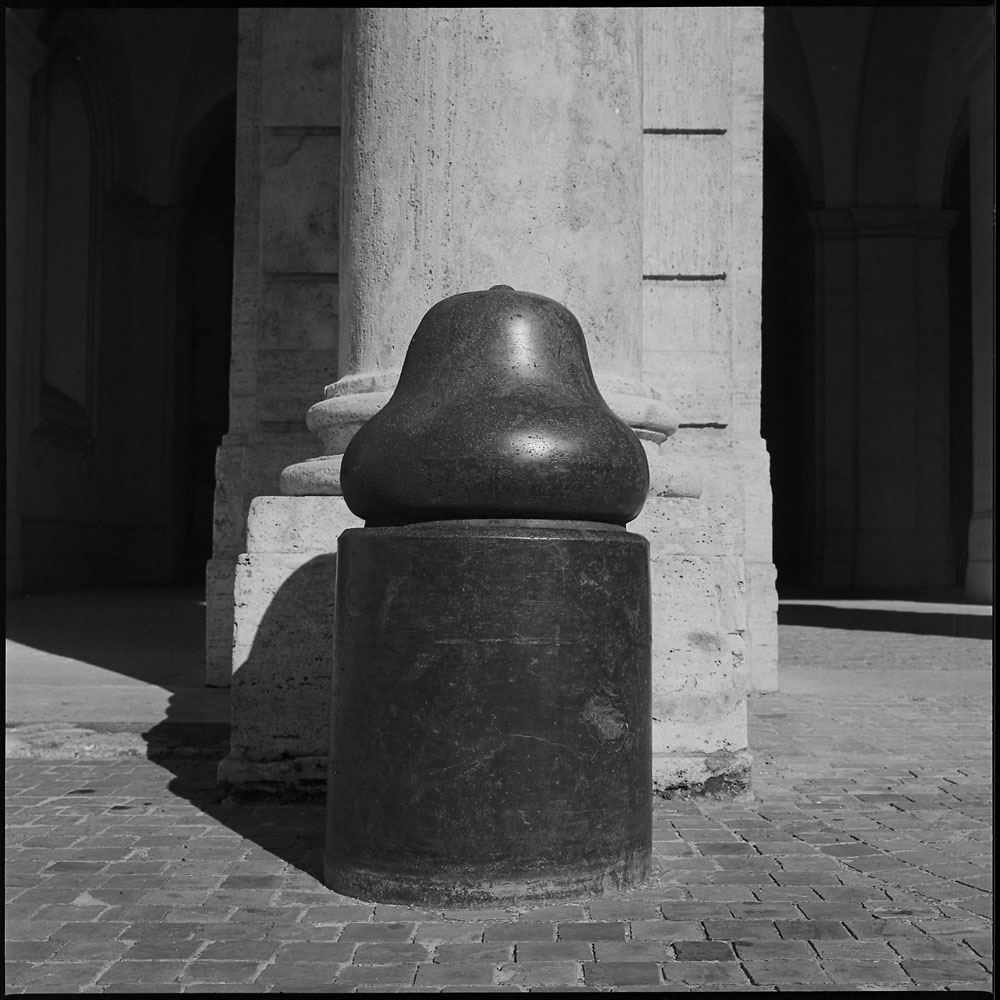
And last but not least, a traffic cone. Well, in this case, a red granite bollard some four feet high and three-ish in diameter, in the entrance courtyard to the Palazzo Barberini.
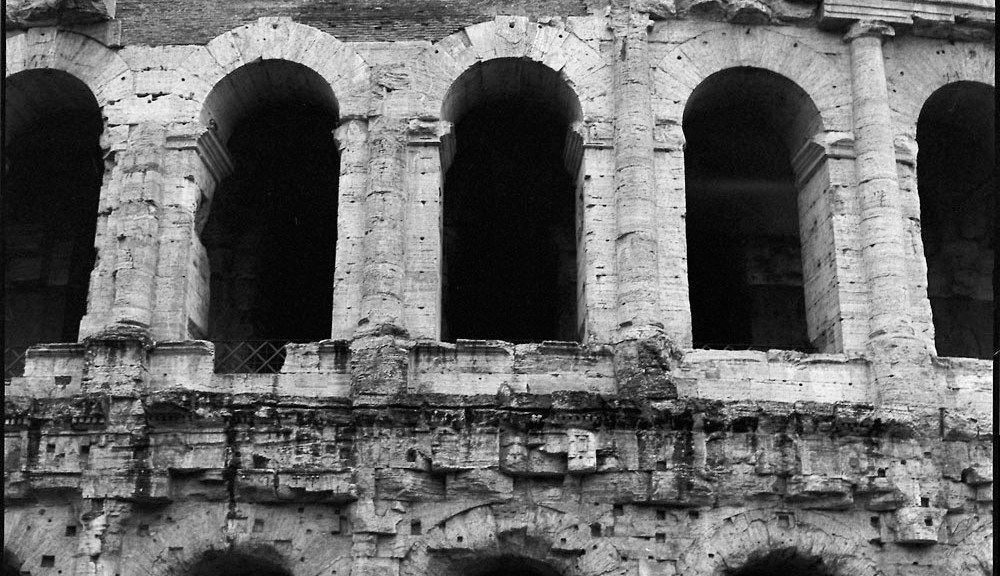
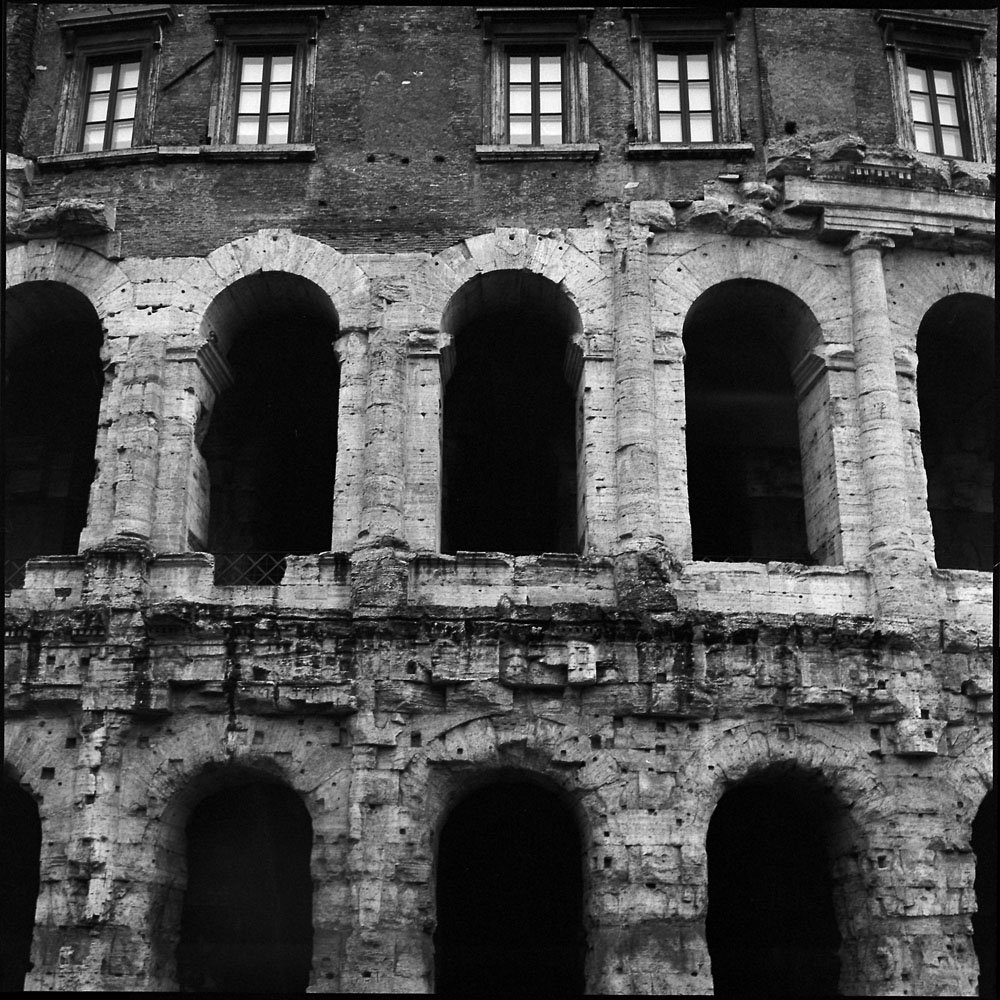
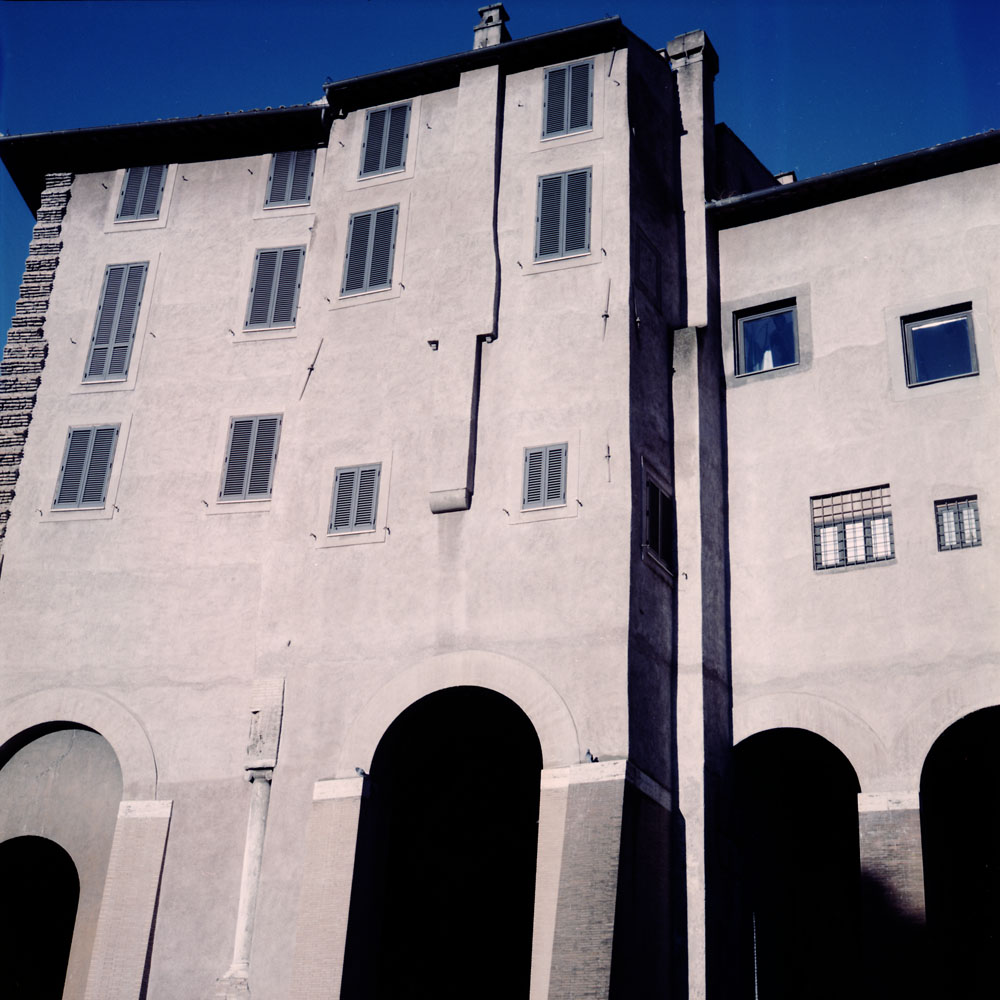
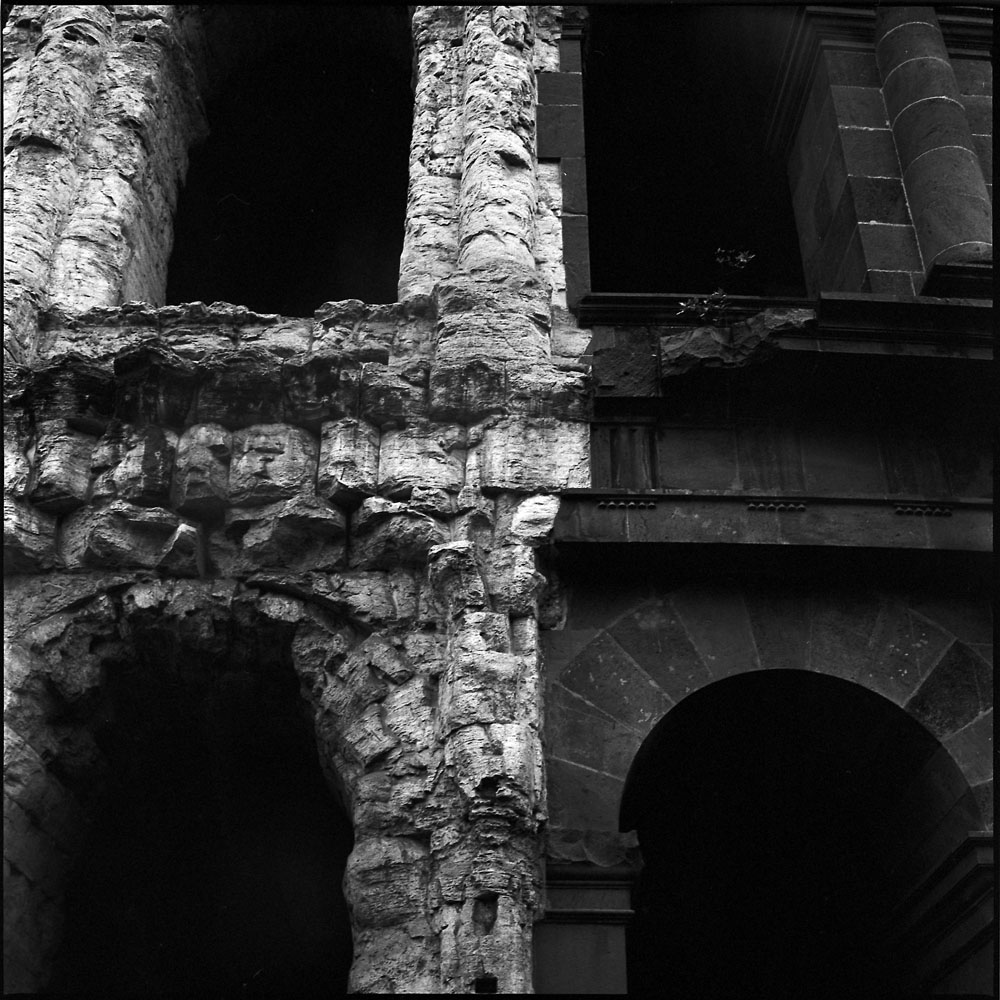
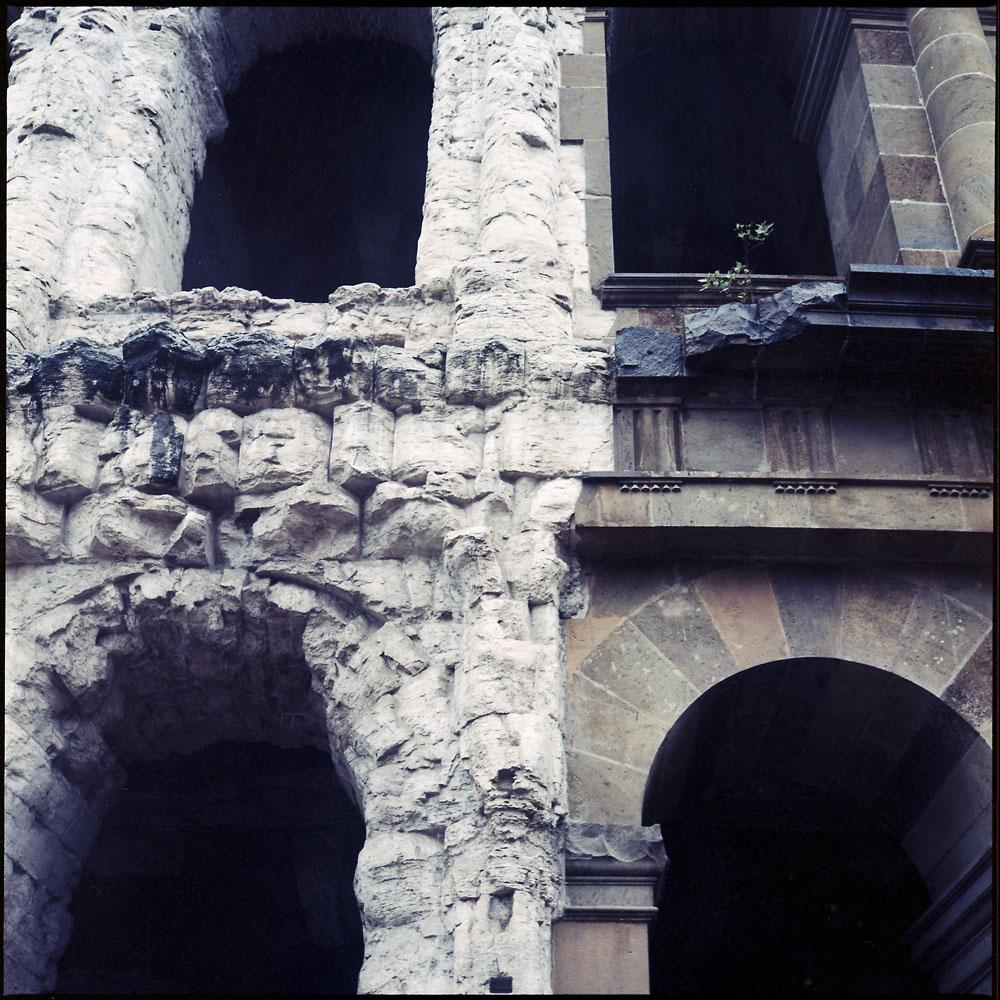
Today, the remains of the Theater of Marcellus are visible beneath the fortified palazzo on top. At the time of its construction in 11 BC, it could hold 14,000 spectators. If the structural design looks familiar, it’s because it inspired the design of the Colosseum some 60 years later.
In the 1300s it was acquired by the Fabii family who turned it into a fortress. Later the Orsini family acquired it in the 16th century and hired an architect to convert it into a palazzo. The residential structure you see on the top three floors is that conversion. Today the palazzo has been divided up into multiple apartments. How cool would that be to live in a 16th century palace built on 1st century BC foundations?
Theater of Marcellus and ApartmentsApartments over the Theater of MarcellusArches, Theater of MarcellusApartments over the Theater of Marcellus
Under the heading of “who wears it better?” – Which works better, the black-and-white or the color?
Theater of Marcellus, Detail, Black-and-WhiteTheater of Marcellus, Detail, Color
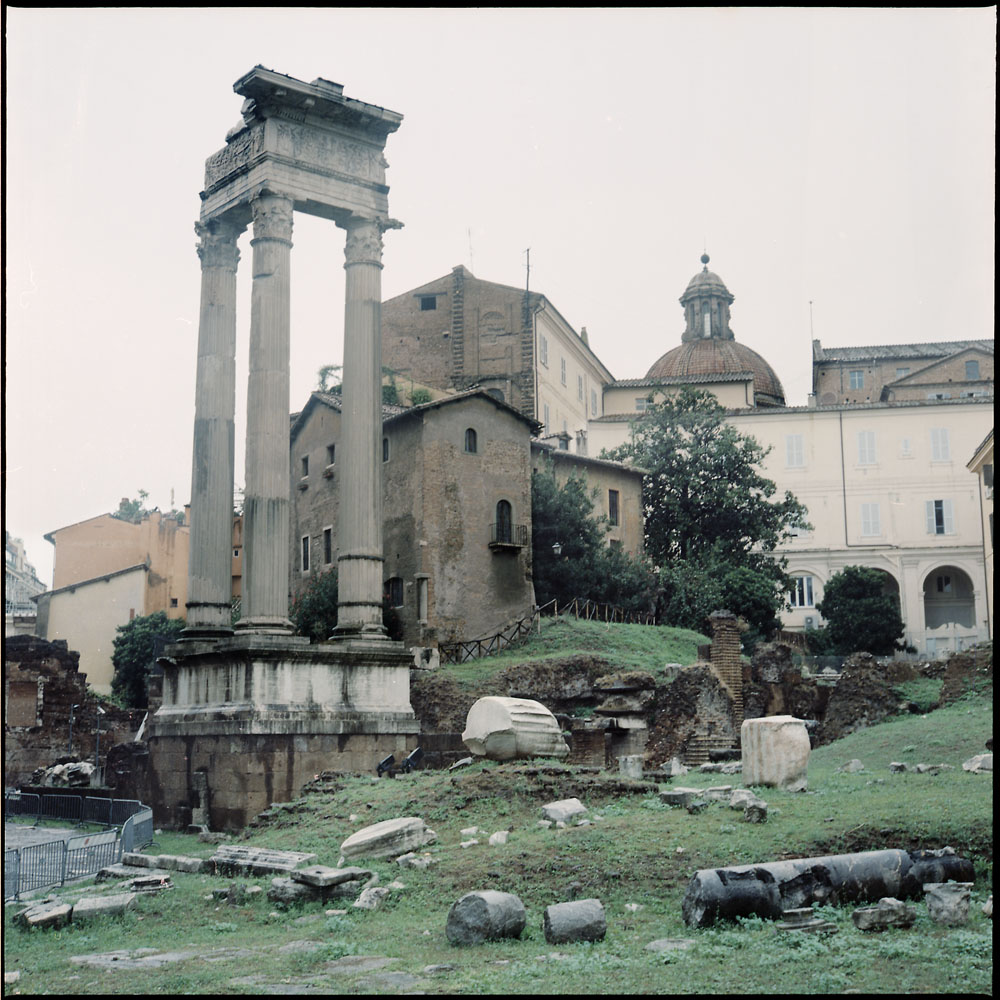
Immediately behind the theater is the ruins of the temple of Apollo Sosianus (so named for the man responsible for reconstructing it in the style we see today). There was a temple to Apollo on this site since the 5th century BC. It was originally outside the main city boundaries because it was a foreign cult, imported from Greece. It sits directly across the Roman street from the Theater of Marcellus. Because of the proximity to the city walls, the Senate chambers and the theater, many backroom political deals were struck in its chambers.
Temple of Apollo Sosiano
The three columns you see today were re-discovered and re-erected in the 1930s after the demolition of an apartment building to re-expose to view the Theater of Marcellus. The columns’ pieces were found in the arcades of the theater. While they have been placed on the pedestal and re-topped with their capitals and frieze, it is highly unlikely that they are in their actual original positions.
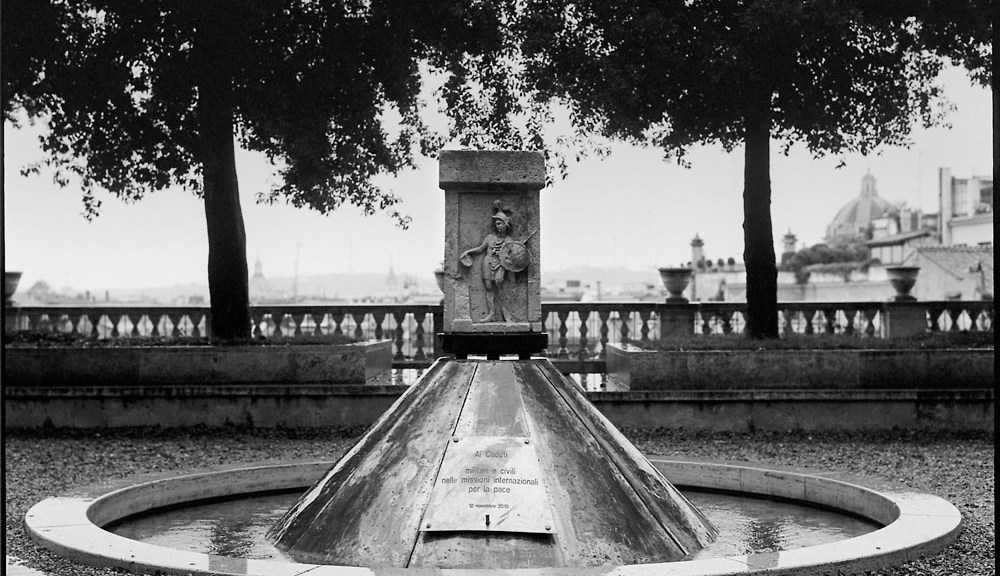
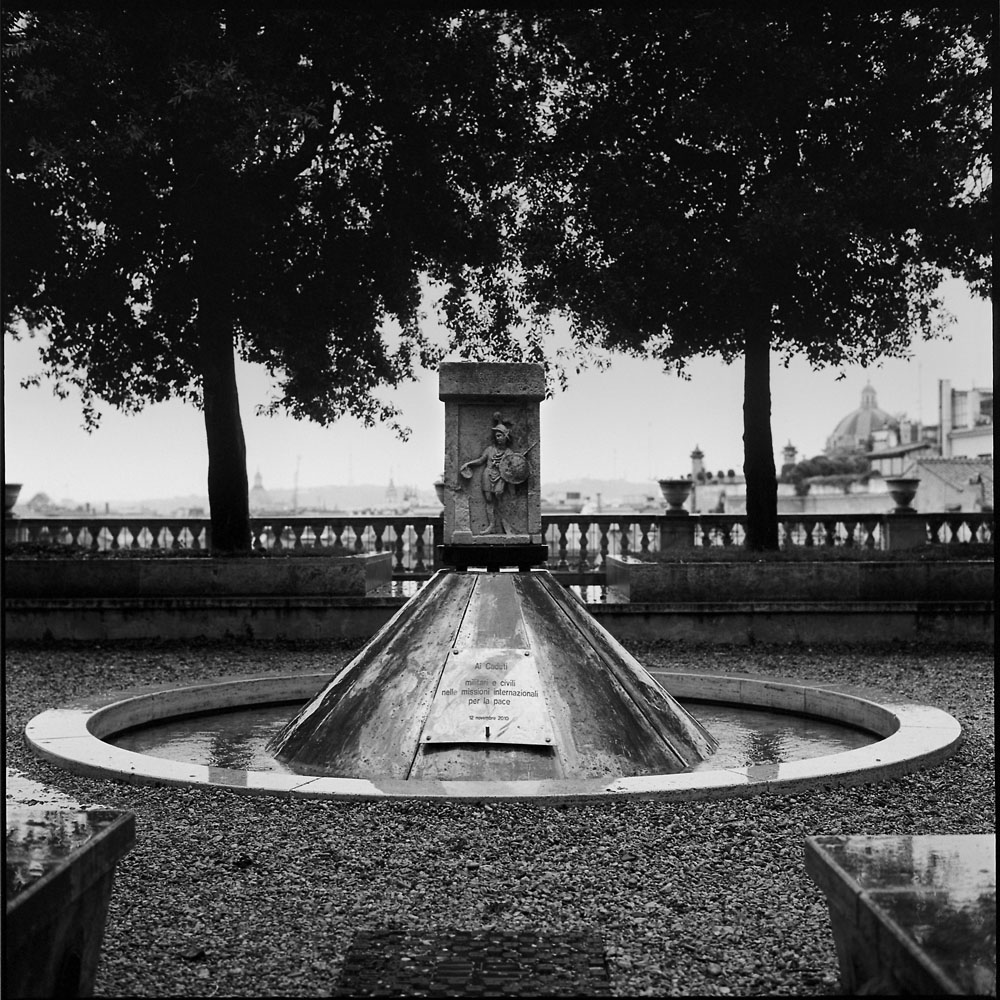
In the Piazzale Caffarelli on the Capitoline Hill, there is this small fountain dedicated to those who have died in the cause of peace, both civilian and military. The little park is a quiet pause from the hustle and bustle of the city of Rome.
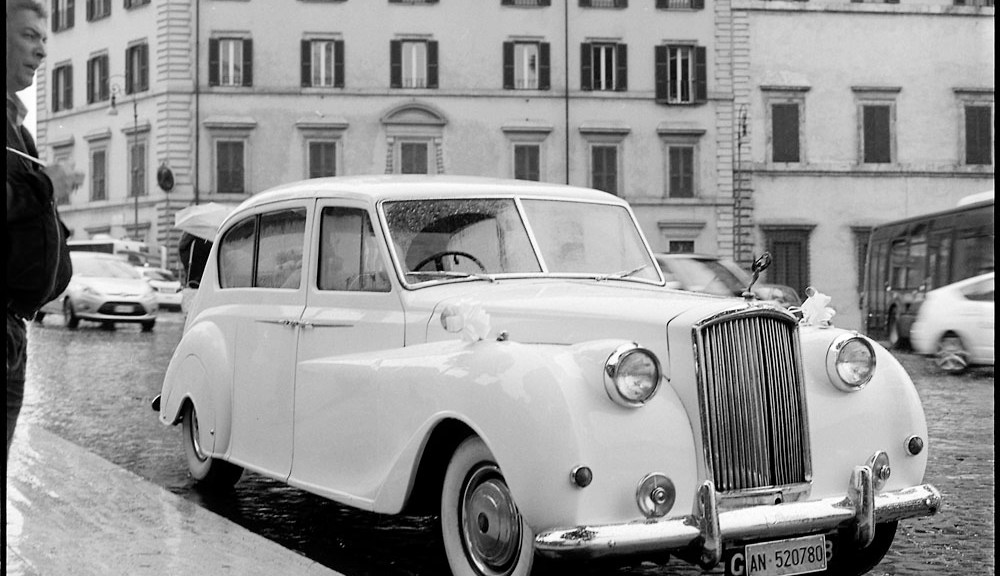
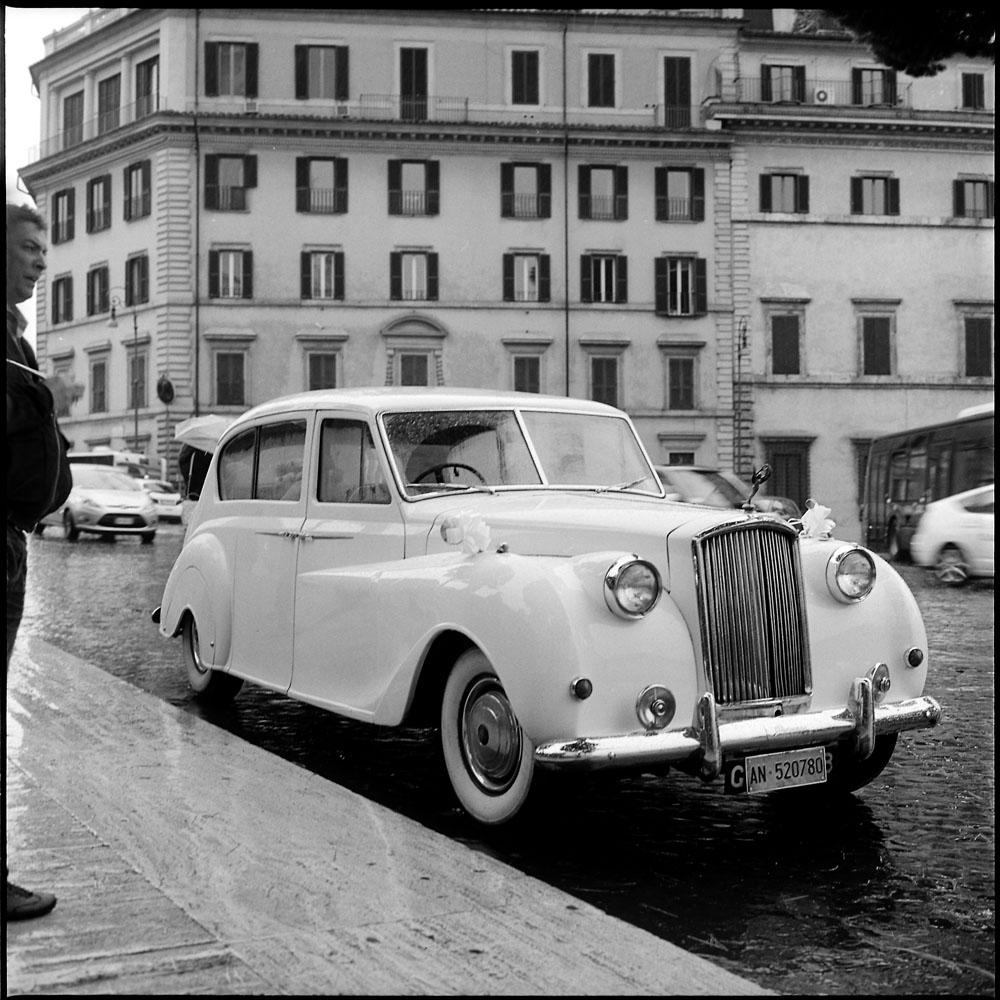
At the foot of the stairs to Santa Maria in Aracoeli, I came upon this vintage Jaguar pressed into wedding limo duty. That it was raining didn’t seem to disturb the old gal – she was still looking magnificent.
I spent almost half a day wandering around the Castel Sant’Angelo, poring over every vista, nook, cranny and fragmented rock. I was in photographic heaven. There’s everything inside it to point your lens at from Roman sculptures to fanciful brickwork to Renaissance paintings. The Castel Sant’Angelo is one of the most recognizable structures in Rome. The foundations of it date back over 2000 years to the reign of emperor Hadrian, who had it built as his mausoleum. In the Christian era, the proximity to St. Peter’s and the Vatican palace made it useful not only as a source of marble for construction of churches and apostolic palaces, but as a fortification. The drum-like structure was originally Hadrian’s tomb, and was covered in white marble. A succession of popes built on top of this, had walls with gun emplacements built around it, corridors cut through it, had palatial apartments added on top of it, and used Hadrian’s burial chamber as a dungeon for their most valuable/most hated prisoners. An elevated, sealed corridor with defensive structures runs atop a wall connecting the Vatican apartments to the Castel, enabling the pope to flee to the safety and security of the castle in times of siege. The castle has wells of its own and storage enough to keep its garrison provisioned for up to six months at a time.
This bastion overlooks the entrance gate of the castle that faces the Tiber river and the Angel bridge. Quite the fearsome looking structure, isn’t it?
Bastion, Castel Sant’Angelo
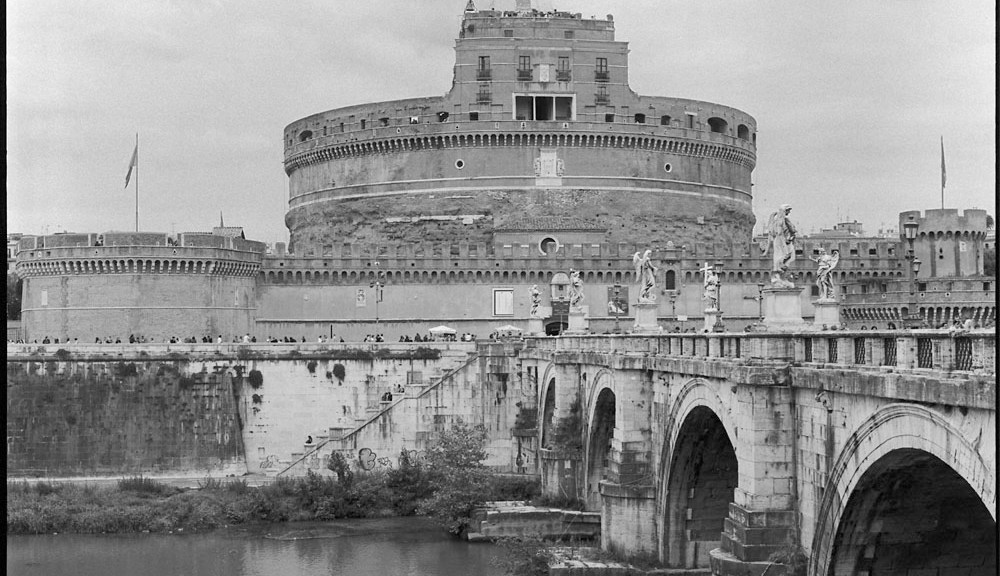
Here is perhaps the most famous view of the castle. The statues of angels were added to the bridge in the 16th and 17th centuries, but three of the five arches of the bridge are contemporary with the original construction of Hadrian’s mausoleum. So you’re crossing a 2000-year old span over the Tiber when you use the bridge.
Castel Sant’Angelo from across the Tiber
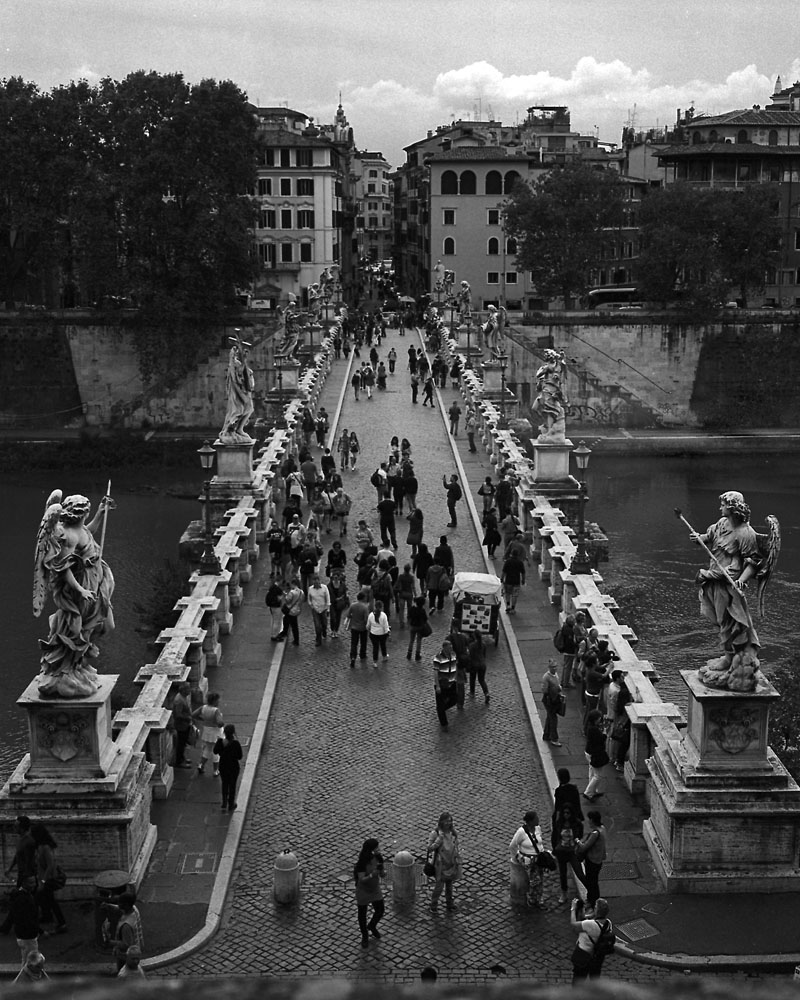
This is a view of the bridge from one of the outer bastions over the main gate to the castle. During the Jubilee year of 1450, so many pilgrims crammed onto the bridge that the railings gave way and many plunged into the river to their deaths. Starting in the 1530s, the angels that adorn the bridge began to be added.
Angel Bridge from the Castel Sant’Angelo
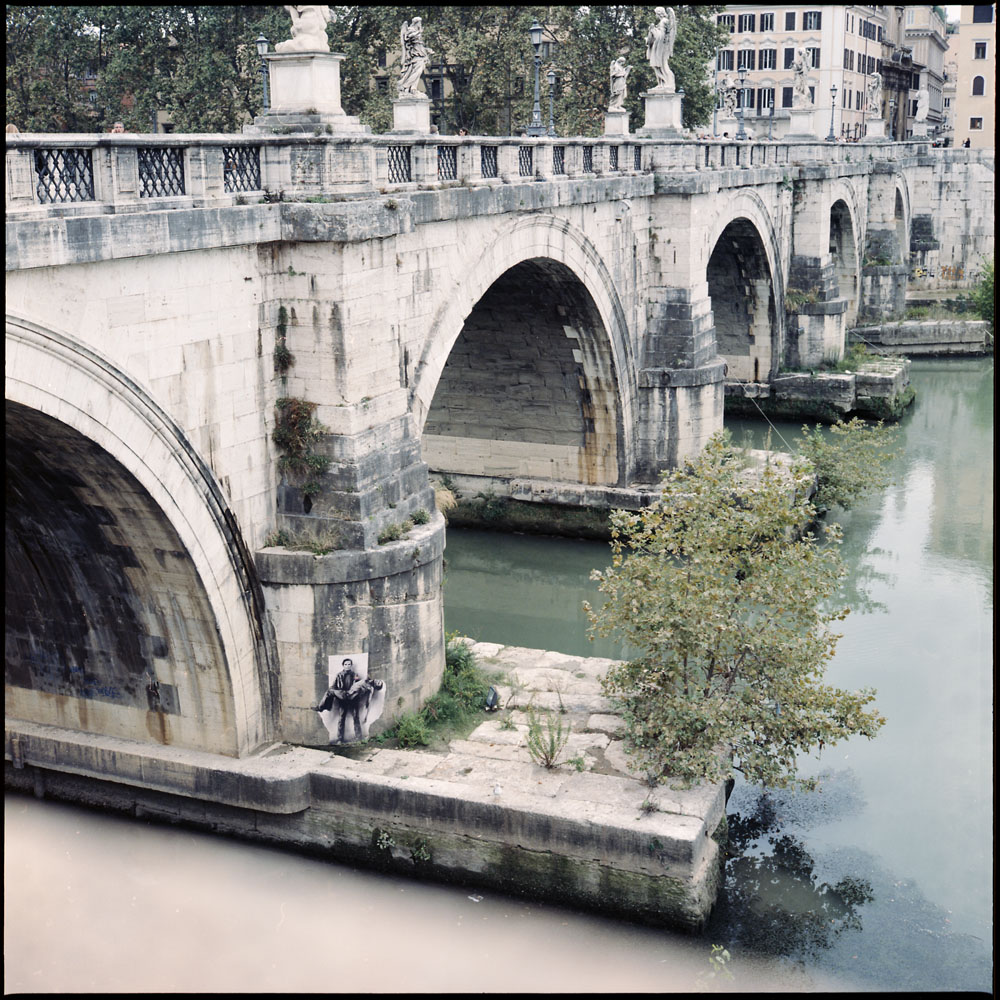
Looking down onto the footings of the bridge in the Tiber, we can see some interesting graffiti, particularly the figure of the man holding a woman’s prone form.
Angel Bridge Footings, Tiber River
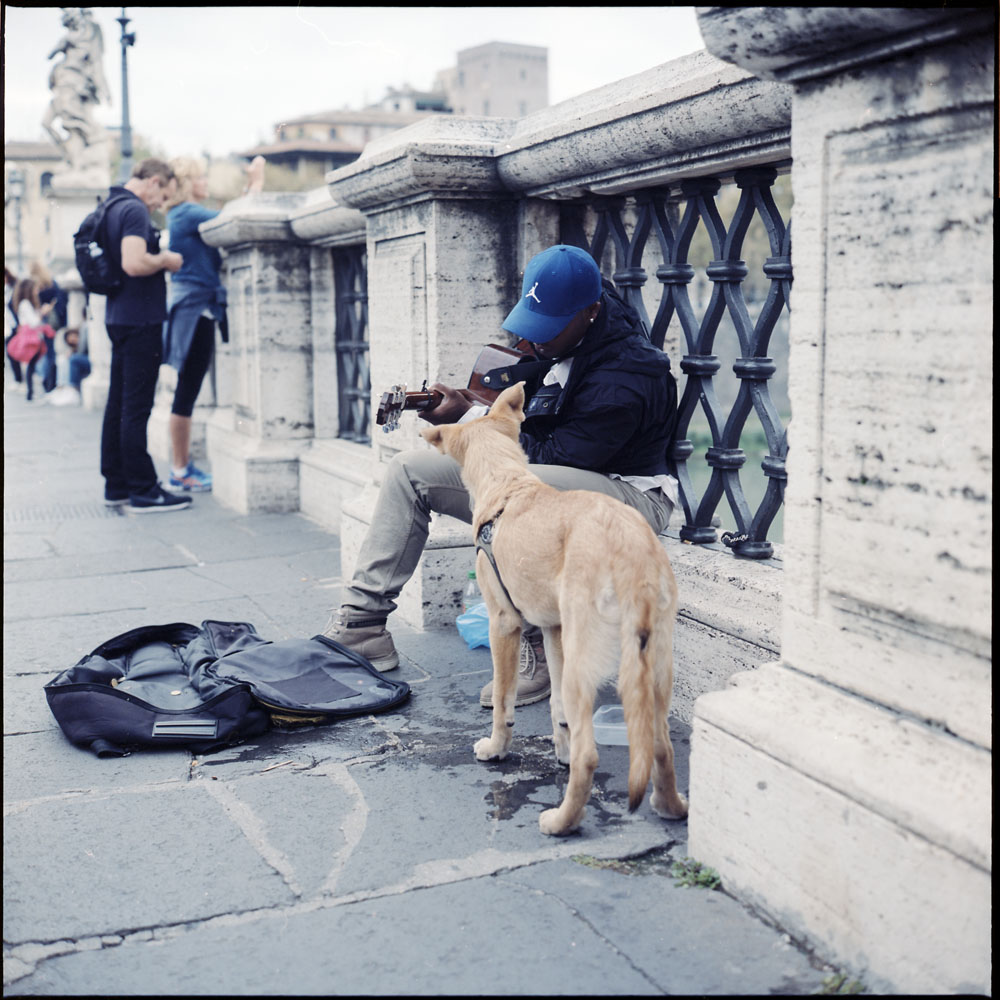
This young man was playing his guitar for tips on the bridge. I think he was consulting his dog as to what to play next.
Busker and dog, Angel Bridge
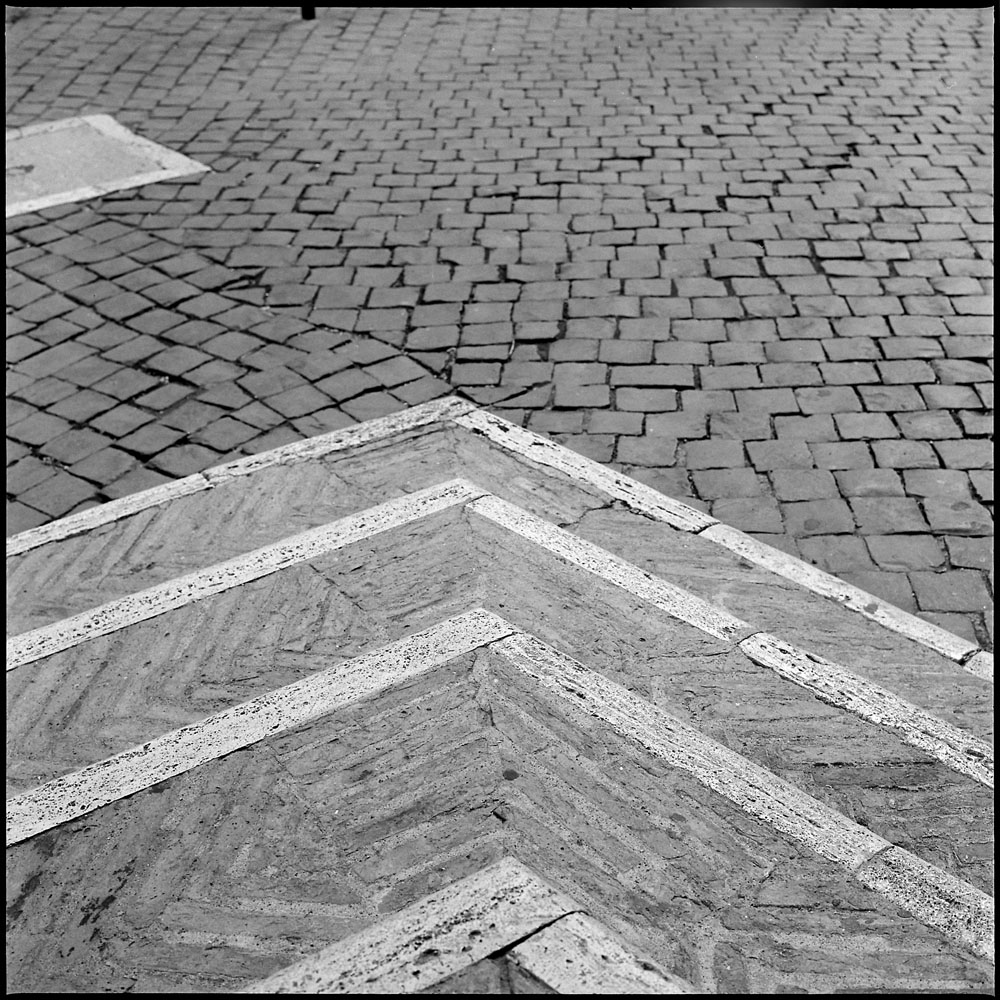
Moving inside the fortification, these steps emerge from one of the bastion towers to the courtyard that encircles the central drum at its base.
Steps, Castel Sant’Angelo
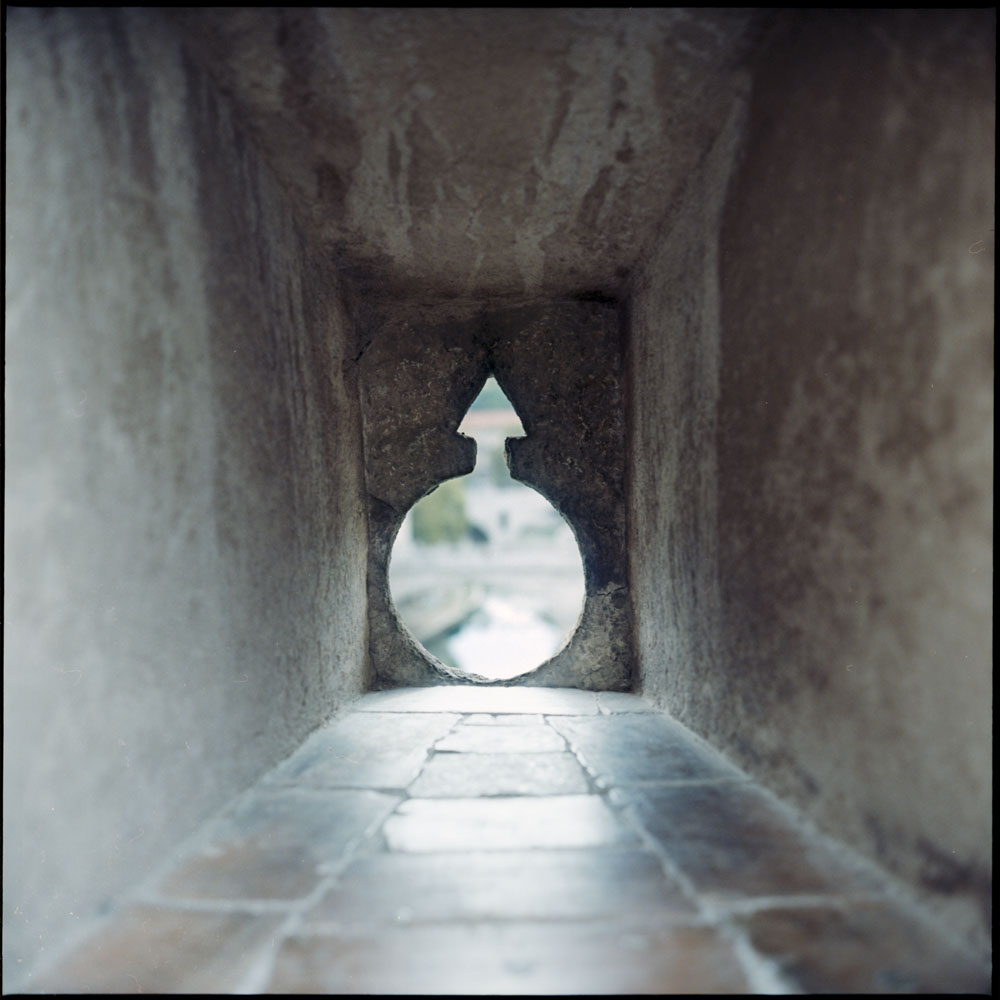
Looking out a gun port in the fortifications of the castle, you can see the bridges over the Tiber in the distance.
Gun Port, Castel Sant’Angelo
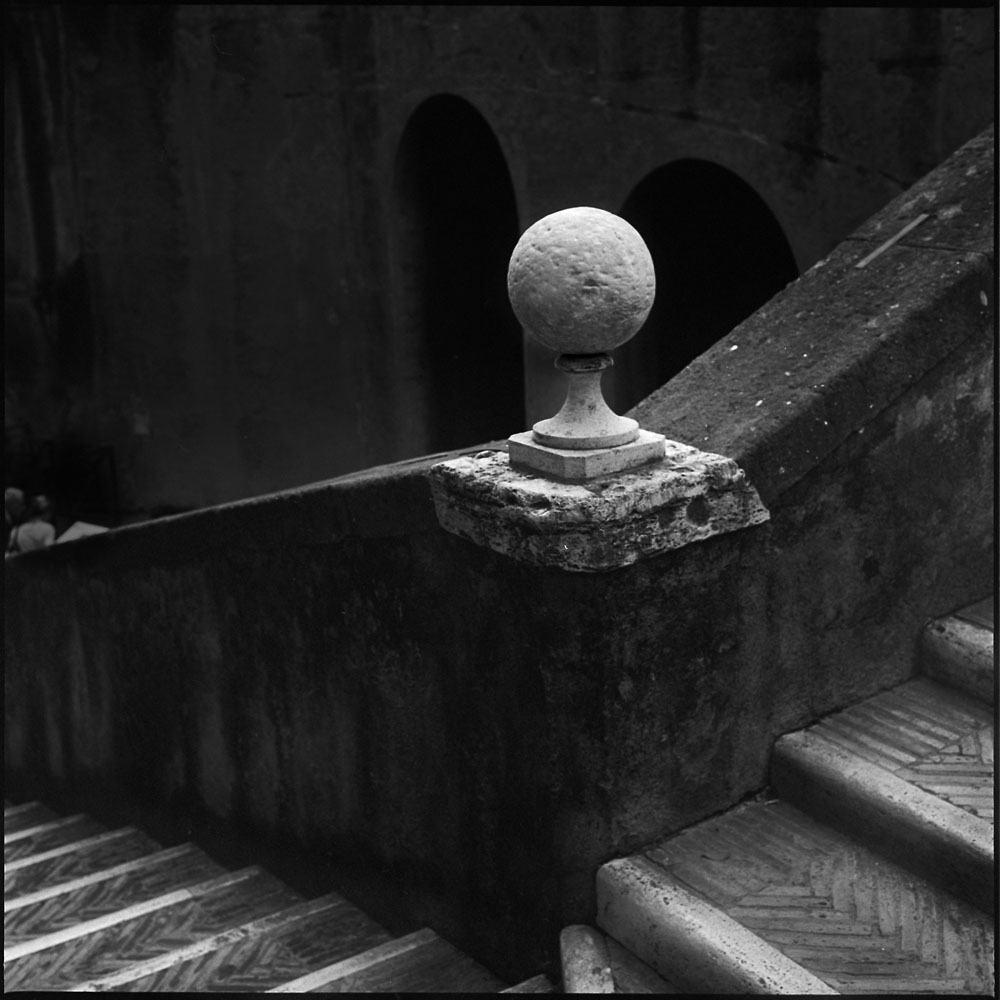
A newel post topped with a stone sphere on the stairs leading from the inner courtyard toward the Papal apartments:
Stairs, Newel Post, Castel Sant’Angelo
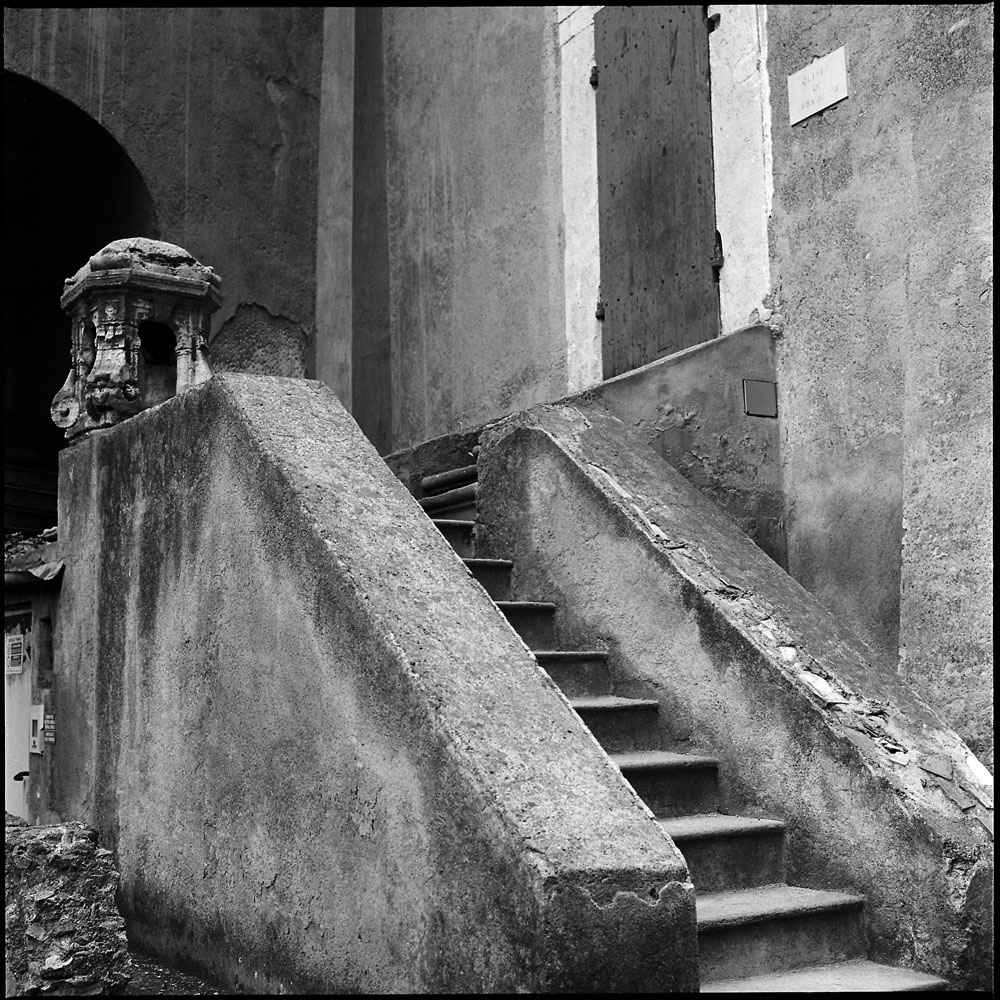
These stairs lead to a structure that probably housed Papal guards. The stone lantern atop them is one of several around the fort.
Stairs, Lantern, Castel Sant’Angelo
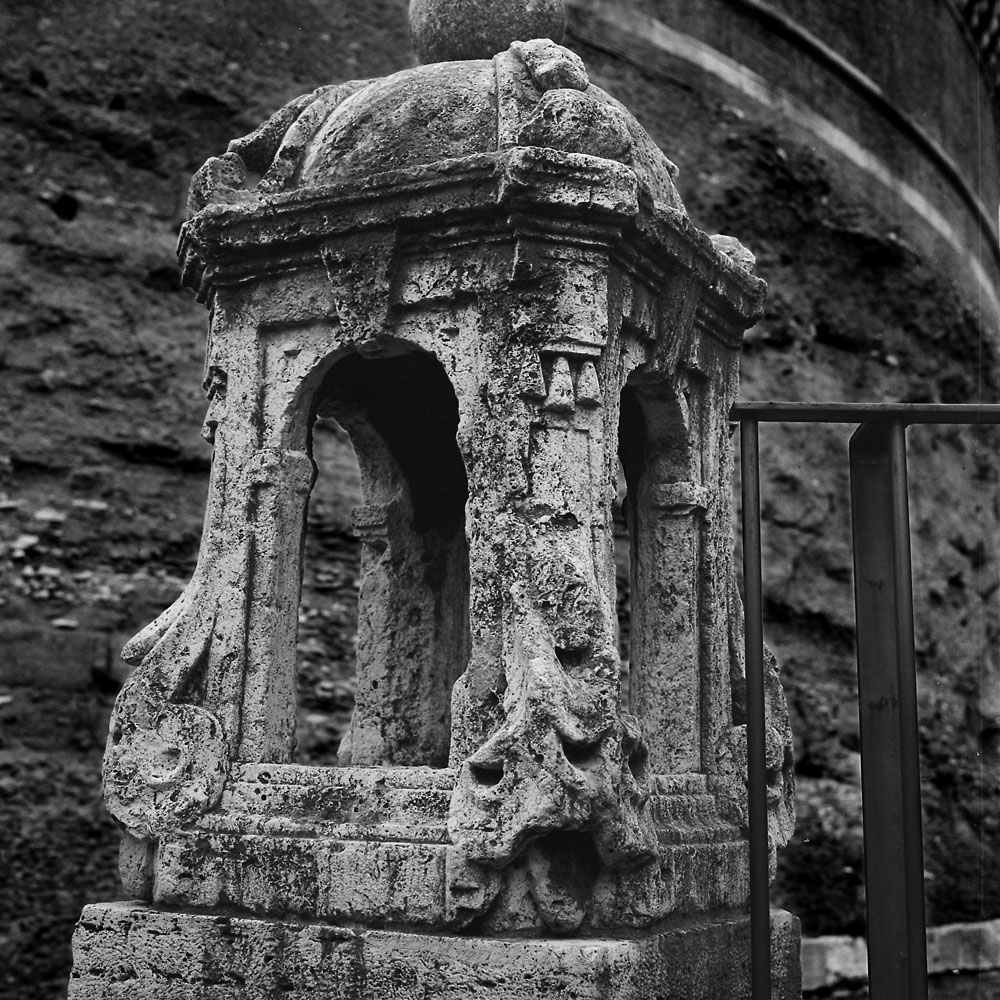
A close-up detail of another one of the stone lanterns:
Stone Lantern, Castel Sant’Angelo
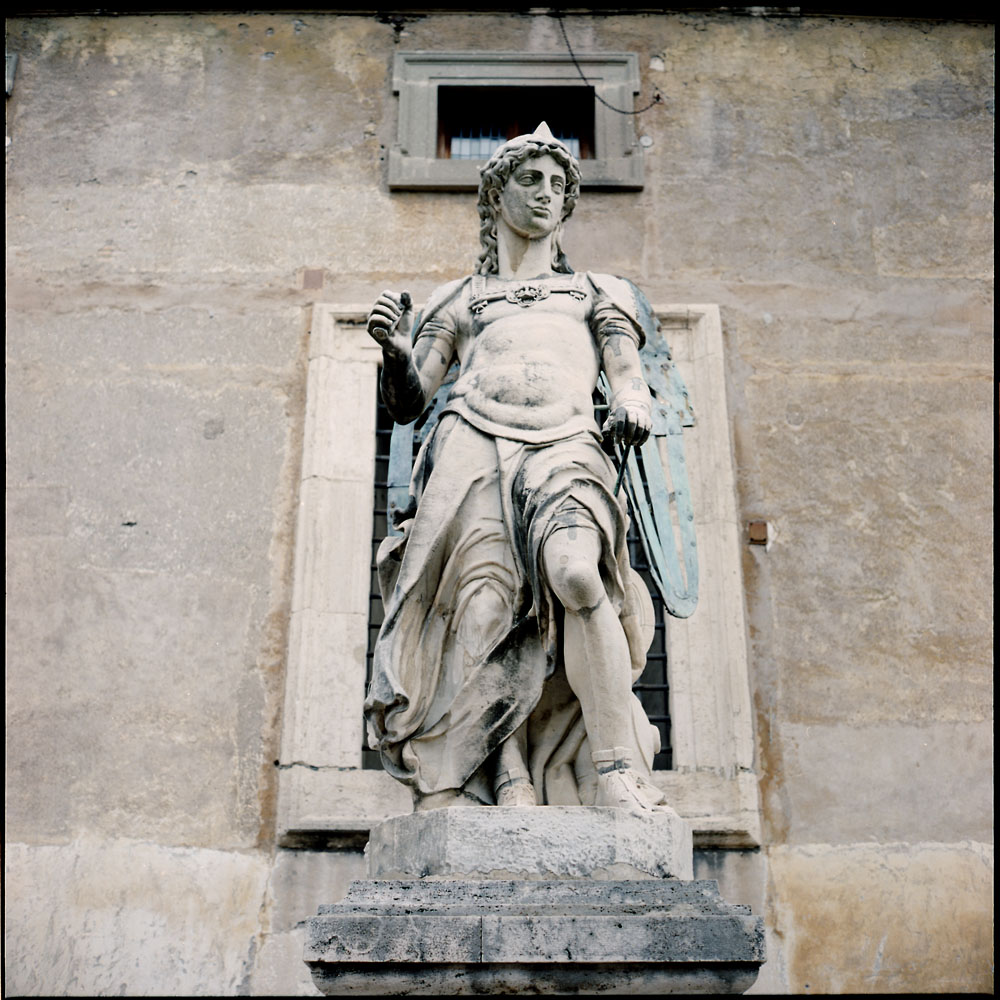
At the level of the upper courtyard, a statue of the Archangel Michael dominates. Opposite is one of several wells that keep the castle in fresh water in case of siege.
Archangel Michael, Castel Sant’Angelo
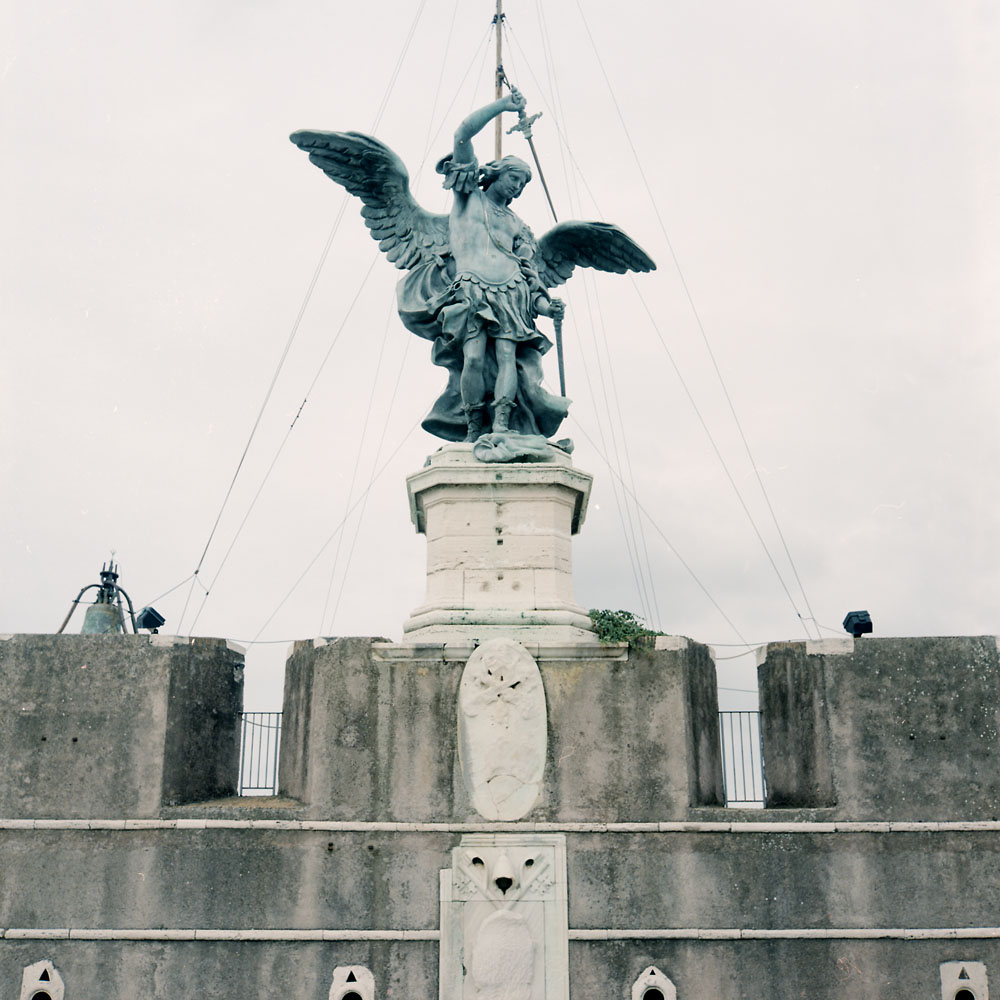
The fortification is crowned by a bronze statue of the Archangel Michael, drawing his sword. Modern additions have also placed radio aerials on the roof, overtopping the archangel. Technologia Omnia Vincit, as it were.






 dcphotoartist