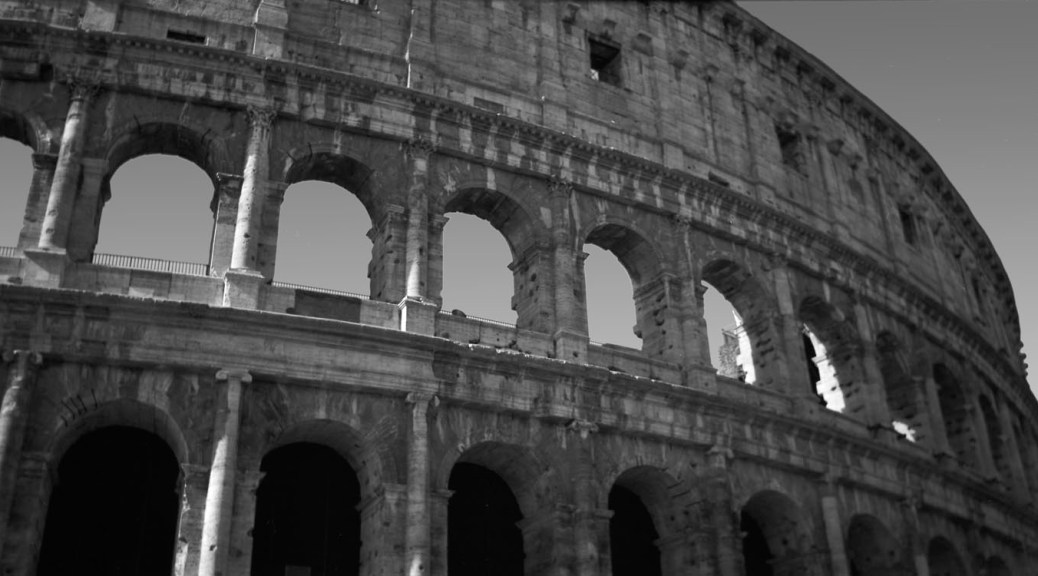
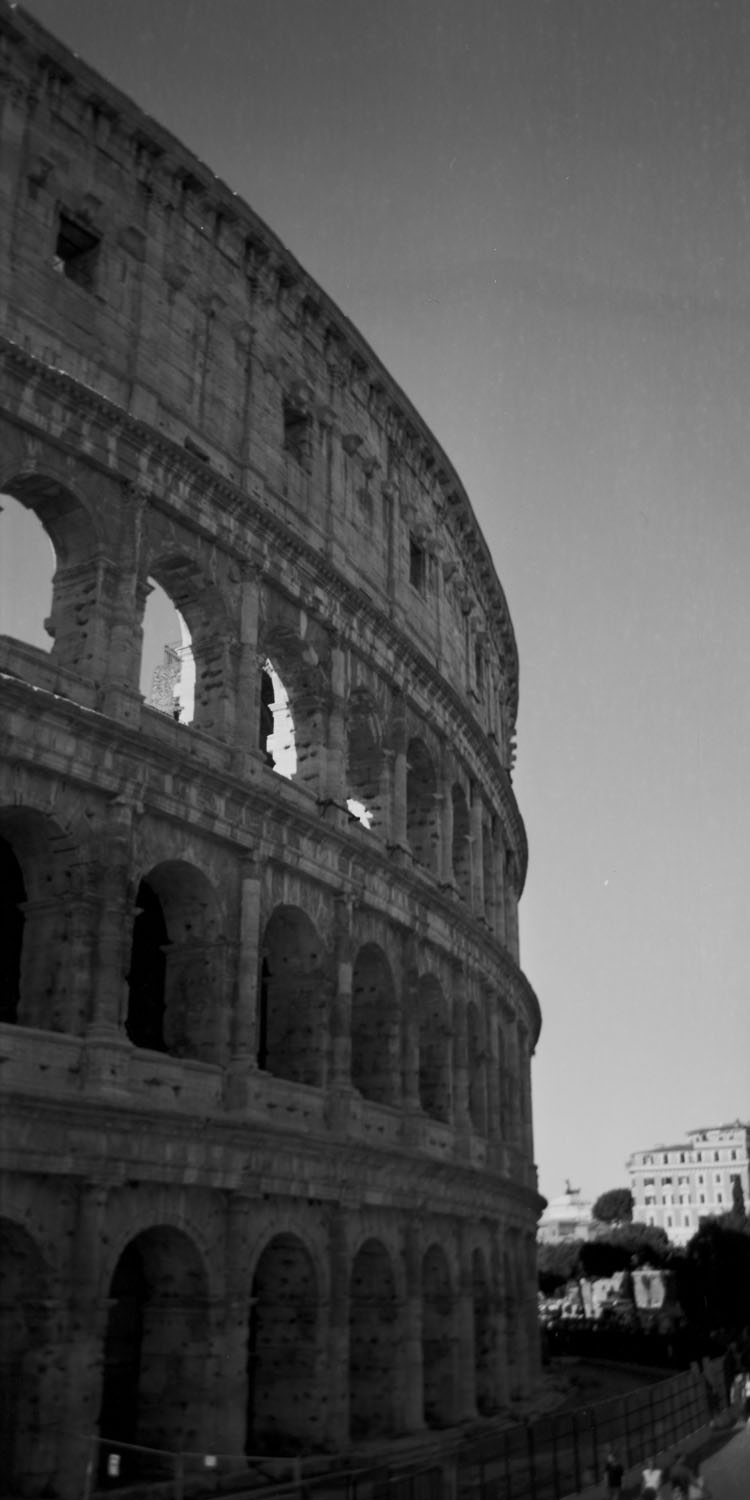
Photographing the Colosseum was one of the primary reasons I brought the Belair X/6-12. I knew already that I wanted to take panoramic shots of the building, as just about anything else aspect ratio-wise was not going to do the place justice. I think (I hope, anyway) that these give you somewhat of a sense of the scale of the building – it sits in a large open plaza and is every bit as large as a modern American Football stadium, seating somewhere in excess of 50,000 people. A testament to its architectural genius is that the entire stadium could be emptied in a matter of minutes.
Colosseum Panorama
These views depict the outer curtain wall, of which only a fraction remains. In fact, almost 2/3 of the original stadium and its decorations are gone – the columns, marble seats, wooden flooring and doors and bronze and gold decorations are all lost to the ravages of earthquakes, vandals, fires, and architectural re-purposing.
Colosseum Panorama
An astounding fact about the outer curtain wall – there is NO mortar used in its construction. The entire edifice was assembled and held together by iron bow-tie shaped clamps interconnecting each block.
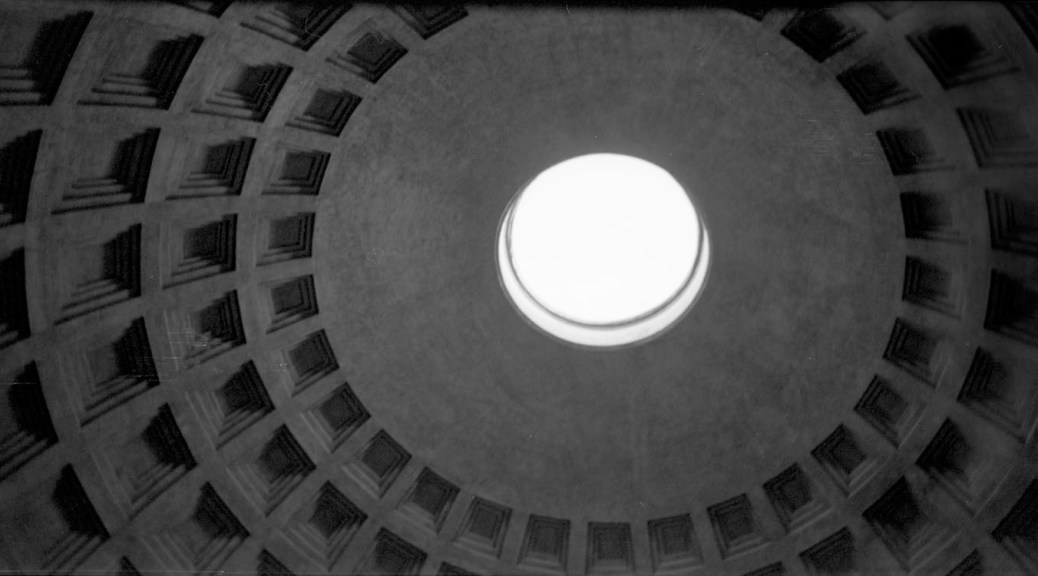
Here’s a shot I took of the oculus of the Pantheon with my Belair X6-12. The camera has its issues, one of which is the relatively low contrast from its plastic lenses. Most of the time. Here’s a circumstance where it works to my advantage- the interior of the Pantheon is so dark, and the main light source being the oculus, it’s very contrasty. The flat lens on the Belair helps bring out shadow detail where there wouldn’t be as much.
I recently acquired a Lomo Belair X 6-12 City Slicker model. It comes with a 58mm and a 90mm lens and the matching viewfinders. The camera is a weird beast, sort of a neither-fish-nor-fowl thing, in that it has multiple film formats (it has masks for 6×6, 6×9 and 6×12 frames), interchangeable lenses (58 and 90mm plastic lenses, and an optional accessory 112mm all glass lens), auto-exposure in aperture-preferred mode, and a hot-shoe flash. However, it is manual film advance completely separate from shutter cocking, there are only two apertures on each lens (f8 and f16), the only sort-of control you have over the shutter is to set the film speed and/or set it to B for long-time exposures), the shutter has a maximum speed of 1/125th of a second, and focusing is zone focusing with indicator marks on the lens for infinity, 3 meters, 1.5 meters, and 1 meter. Oh, and there’s no cable release provision so you have to be extra careful when using B that you don’t shake the camera. The 58mm lens, especially at the 6×12 configuration, is very lo-fi and has gobs of obvious barrel distortion. However, where else are you going to find a 6×12 panoramic camera with a 58mm lens on it with auto-exposure for $250? Your next cheapest option is to put a 6×12 back on a press camera, which is going to run you at least a cool grand to put together. Even a 6×12 back on the new-but-still-effectively-vaporware Travelwide, plus a 65mm lens will run you a good $700-800.
I put a couple rolls through it to test it out last week and weekend. It is wicked wide with the 58, and sharp enough in the center. My example tends to run a bit to the overexposure side, which I think accentuates some of the weaker characteristics of the lens (like the low contrast from the plastic optics), although I’d rather have it overexpose than underexpose. One thing I haven’t figured out yet is if any of the lenses including the glass lens will accept filters. I’d love to try out the camera with a roll of Infrared and see what it does. It could be a great combination, or it could suck dirty dog toes. This spring, I’ll give it a try and find out.
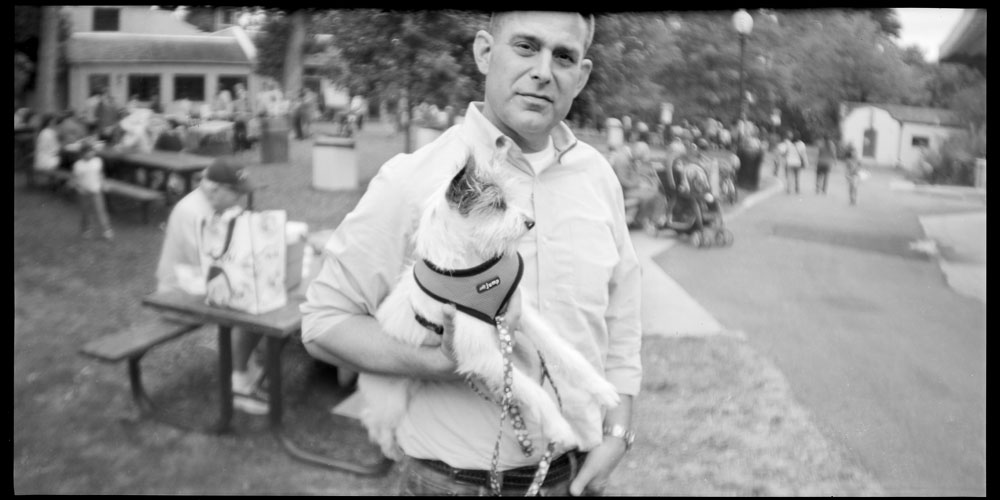
This shot is of my student Todd Walderman from my Intro to Platinum/Palladium Printing class, and his new puppy, Cookie.
Todd with Cookie
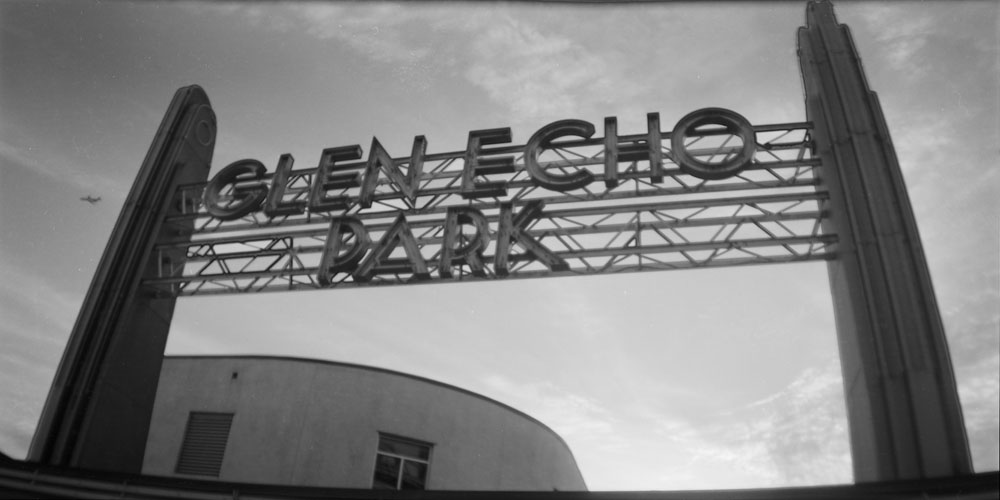
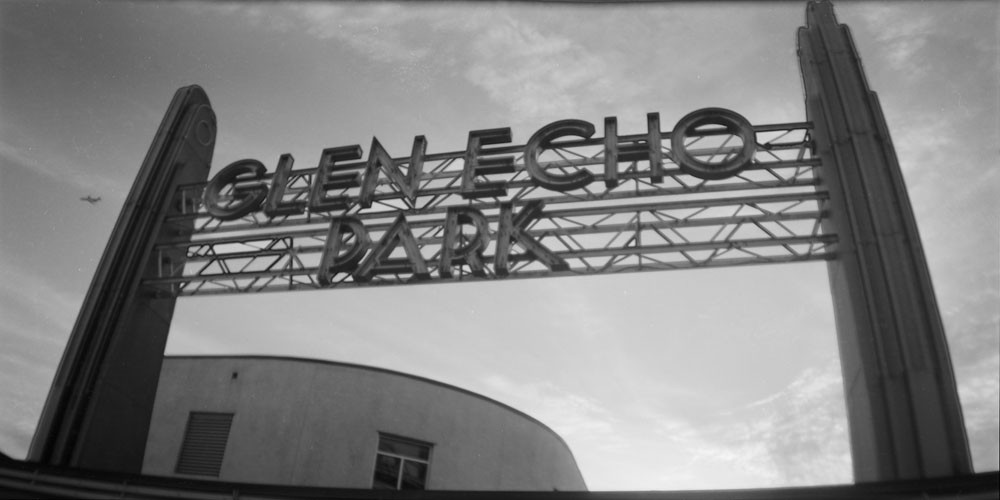
The Glen Echo Park sign, backlit at evening time. This shot as much as anything shows the amount of barrel distortion the 50mm lens has. Used appropriately it can really add to an image. But don’t use it to take pictures of things that need to be plumb and square, because they’ll look terrible. Knowing when to use it and when not is an art form in itself.
Glen Echo Park Sign
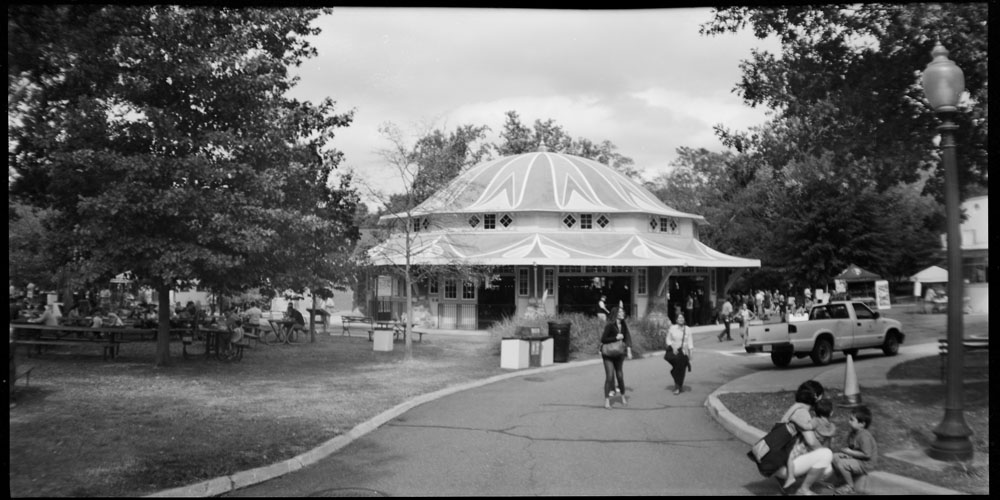
The Glen Echo carousel.
Glen Echo Carousel
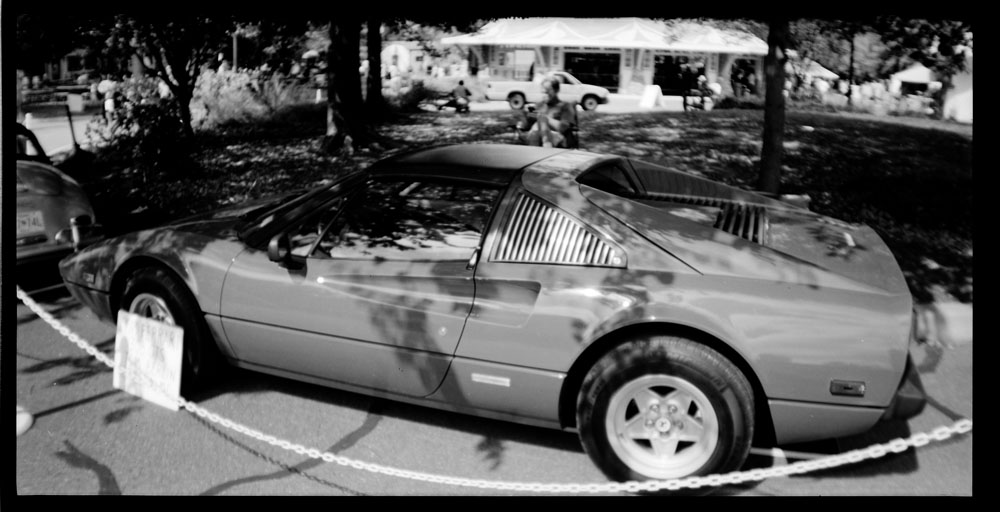
That weekend, they were having an end-of-summer-season festival at Glen Echo, which included a mini antique car show and the final running of the carousel for the year. Among the honored guests was this vintage Ferrari:
1979 Ferrari 308
In keeping with the spirit, sort-of anyway, of the whole Lomography lo-fi movement, I was running 10+ year out-of-date Ilford FP4+ through the camera. I don’t think it really made a difference, though, as you’ve seen shots I’ve taken this year using the exact same film through my Rollei, and if I hadn’t told you it was 10 years out of date you’d never know.



 dcphotoartist