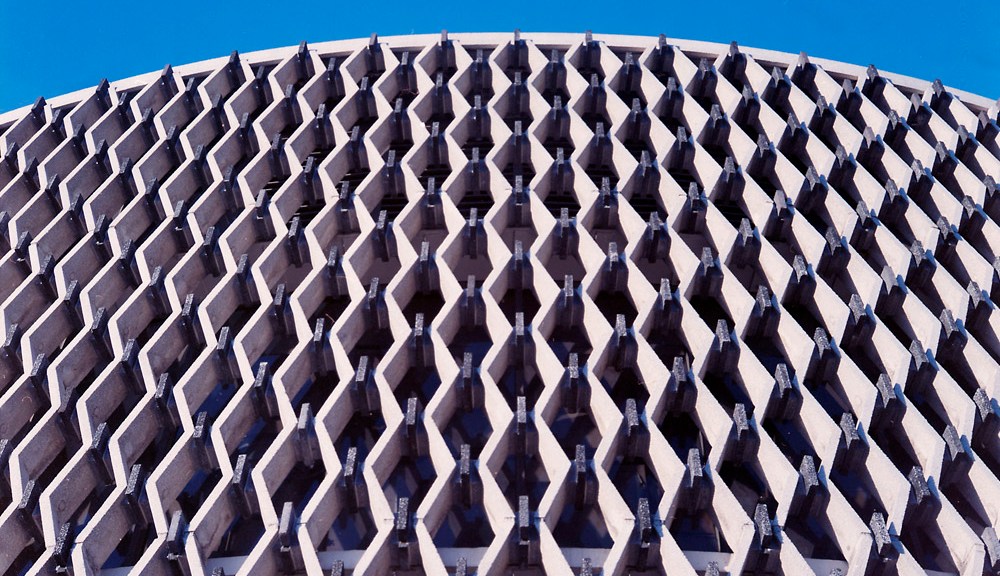
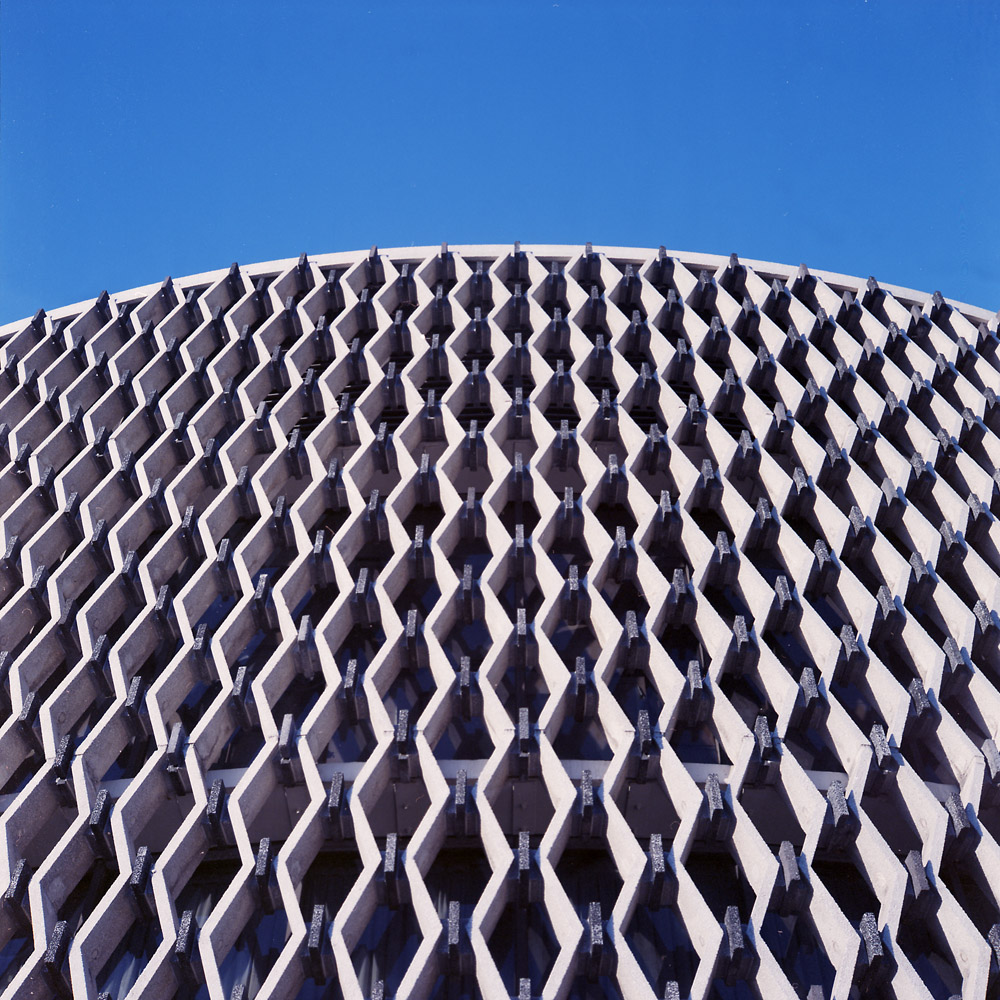
I previously posted some b/w abstracts of this building, taken on a cloudy, rainy day. Here it is on a glorious, cloudless sunny day. Yes, that actually is the color of the sky; no Photoshop trickery was used to create that.
PAHO/WHO Building
I love the dramatic contrast between the clear, textureless blue sky and the geometric dynamism of the brick latticework over the building facade.
A long time ago, I saw this interesting little gadget sitting in the used equipment case at my local camera store. It was a panorama adapter for Rolleiflex cameras that enabled you to shoot up to a 360-degree panorama on a single roll. It has a built-in bubble level (which is absolutely critical). You put the camera on top, then focus and compose as normal. Once you have the focus and exposure set, you don’t change them (this is also critical). Take the first exposure, then push in the little locking lever, rotate the camera to the next increment on the dial, and take the next picture, and so on until you have shot as many frames as you want to shoot. It is critical to maintain focus and exposure as set on the original frame because changing focus will mean that things in one frame will not be in exactly the same proportion as they were in the previous frame,therefore they will not blend seamlessly. Ditto for exposure – if you change the exposure from frame to frame, ESPECIALLY if you are shooting color film, you’ll never be able to match the frames.
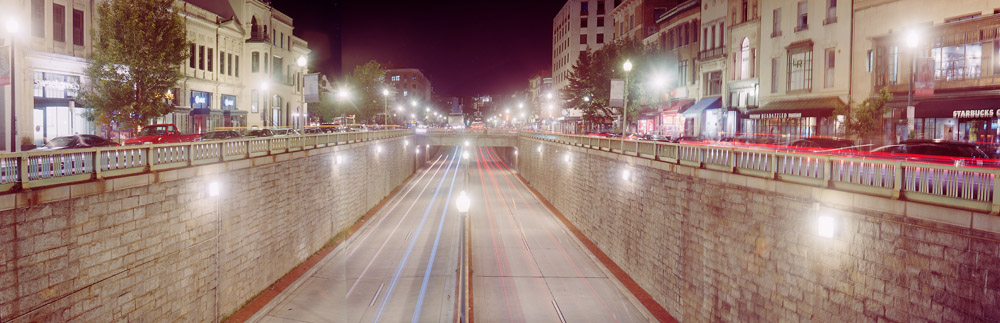
Done right, you get this:
Dupont Circle Underpass
It isn’t perfect because with the long exposures (45-90 seconds each – I forget which I used, but as you can see they’re all exactly the same) traffic patterns don’t flow through the underpass during all three exposures, and the lens flare from the street light in the middle picture doesn’t carry over to the same degree in the left picture, thanks to the lens hood. But you have to look at it to see the three frames separately.
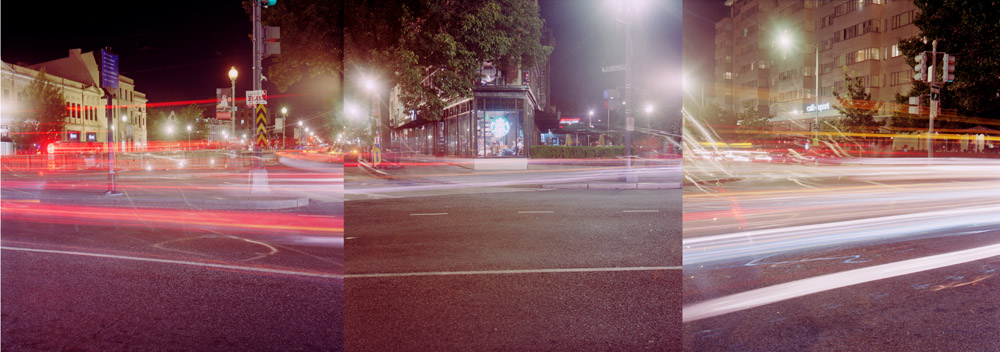
If things aren’t perfect, then you end up with:
Starbucks, Dupont Circle Triptych
While the alignment is pretty close, the color is off a bit on each frame. This took quite a bit of Photoshoppery to get it to match as well as it does. I kind of expected this outcome when trying this shot because I knew the traffic patterns wouldn’t line up from frame to frame, and wanted to see how it would turn out. I think it worked well enough as an effect, but I’m on the fence as to whether I’d try it again.
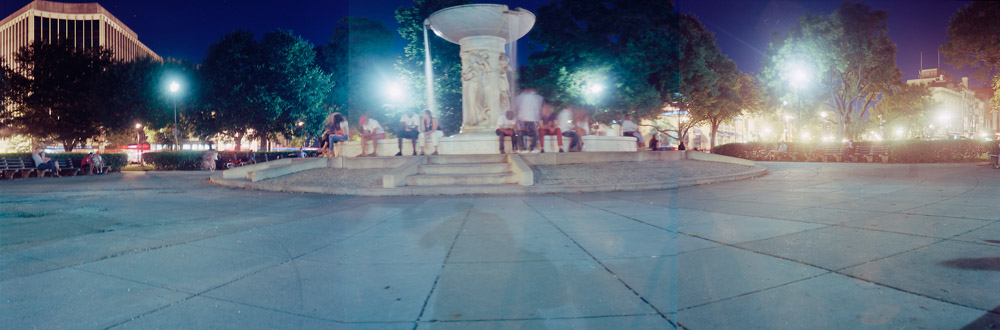
If you don’t have everything perfectly level, you get:
Dupont Circle Fountain
Also lots of Photoshoppery went into getting the colors and density to match from frame to frame. This one has been rotated and cropped to get it MORE level, but you can see between the oval of the fountain and the overall tilt, it wasn’t level and square enough.
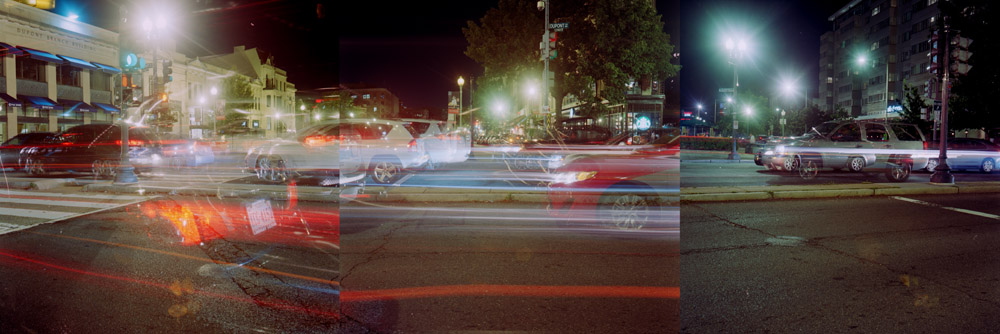
And last but not least, another experiment with disjointed traffic flow around Dupont Circle.
Traffic, Dupont Circle
Another part of this experiment was to see how Kodak Ektar 100 does with long night exposures. My previous (and still) favorite for night photos is Portra 160. While Ektar hasn’t dethroned Portra for this purpose, it proves it can stand on its own and I don’t need to carry multiple emulsions with me when I travel to cover every scenario. I can bring a few rolls of Portra 800 for when I need to shoot hand-held in low light, and the Ektar 100 for everything else.
Over my lunch break today I caught a wonderful exhibit at the National Gallery of Art entitled Faking It: Manipulated Photography Before Photoshop. The exhibition opened in mid-February and runs through May 5th. It moves to Houston in July to October. One of the singular points the exhibit drives home is the fact that photography has always been subject to manipulation even from its earliest days when daguerreotypes were hand-colored to make them more ‘realistic’, and skies were printed in via multiple negatives to compensate for the shortcomings of early emulsion formulas. One of the coups of the exhibition is the inclusion of Steichen’s “The Pond – Moonlight” from the collection of the Metropolitan Museum of Art. Most people familiar with the work know it as a multi-layered gum bichromate over platinum print. What most don’t realize, however, is that the image may in fact be a composite with the moon having been added, and may also never have been photographed by moonlight (a feat that would have been difficult to achieve with the emulsions available even in 1904). The moon in the image may be an addition or otherwise a manipulation of the print, and the nighttime feel of the image merely an effect of the color choices in the gum layers of the print.
Images have been manipulated for a whole host of reasons, from a desire to make them more real (hand-colored daguerreotypes) to conveying an inner reality (surrealist photography) to evoking an emotional resonance (The Pond, Moonlight) to suggesting a reality that could exist (a Zeppelin docking at the docking tower of the Empire State building) to creating something that never existed (giant crickets consuming giant produce on the back of a wagon) to re-shaping reality for political ends (Nazi and Soviet propaganda posters and publicity photos). All of the above are represented in this exhibit, and placed in an historical and artistic continuum.
There has been much controversy lately over questions of photojournalistic integrity with regards to digital manipulation to include/exclude details to tell a story, from the Iranians photoshopping additional rockets into a picture of a missile test to Edgar Martins getting caught claiming his work was unmanipulated when in fact he was heavily altering his images. This is not new, but in fact the question of manipulative ethics is far more unsettled for far longer than most people realize. In 1906, Horace Nichols was photographing the Epsom Derby on a rainy day. There were gaps in the crowd, so to convey the feeling of the event he wanted to convey, he spliced in a whole sea of additional umbrellas. This was common practice for Mr. Nichols, and he rarely cited it in the captions of his images, but he sustained a career as a serious photo-journalist. It makes you think long and hard about your assumptions of photographic verissimilitude and the historical moment in which photography ‘ceased to tell the truth’.
The exhibition is well worth the visit if you have an interest in the history of photography and questions of honesty and integrity of the photographic medium.
I’ll be up in New York in April for a weekend and so I’ll try to catch it then and see the two shows as brackets for one another. The comparison should be very interesting.
Ok- I admit, I love my Mac. I was chugging along pretty happy with my old iMac (1st gen all-in-one with the 24″ screen, in the white case) until I decided I wanted to do some color prints for my show at Artomatic. I had the scanner, had the software, everything was all set, except that when I tried to do some hi-res scans off of color negative film, even just 120 roll film, my computer was choking (it maxed out at 3GB of RAM). Barely enough to run the OS plus Photoshop and the scan software, let alone do manipulations on a 300MB file just to prep it for printing. So it was time to upgrade the computer.
I saved money on the screen size, going for the 21″ monitor, so I could afford to max out the RAM at 16 GB. The computer came with OS X Lion, which is wonderful in many ways, but gave me no end of heartburn with my software – the version of SilverFast AI I had would only run under Rosetta, which is no longer supported with Lion. Same with my monitor and scanner profiling software. So, an ADDITIONAL $300 later, I’ve got my software upgraded/replaced, and Photoshop CS4 installed and working. I was about to pull out what little remains of my hair when I tried to run the updated SilverFast and it wouldn’t see my scanner – (I’m still not HAPPY about this but…) until I switched from Firewire to USB. Why SilverFast AI 8 can’t use Firewire is beyond me. I was so hoping to be able to free up a USB port!
Restoring files from backup was not quite as seamless as they make it out to be – you have to do all this monkeying around with permissions to folders in order to access the backed-up files from the old machine. There is a way to do it from the top-level folder so you don’t have to go file by file, but it’s still not perfect. Anyway, I’m happy as a clam in mud now, with my new FAST computer. A 2400 ppi scan of a 6x7cm negative used to take 30 minutes – now it’s done in less than 5. I can’t wait to re-scan my 5×7 negatives from my San Francisco trip last year.

 dcphotoartist