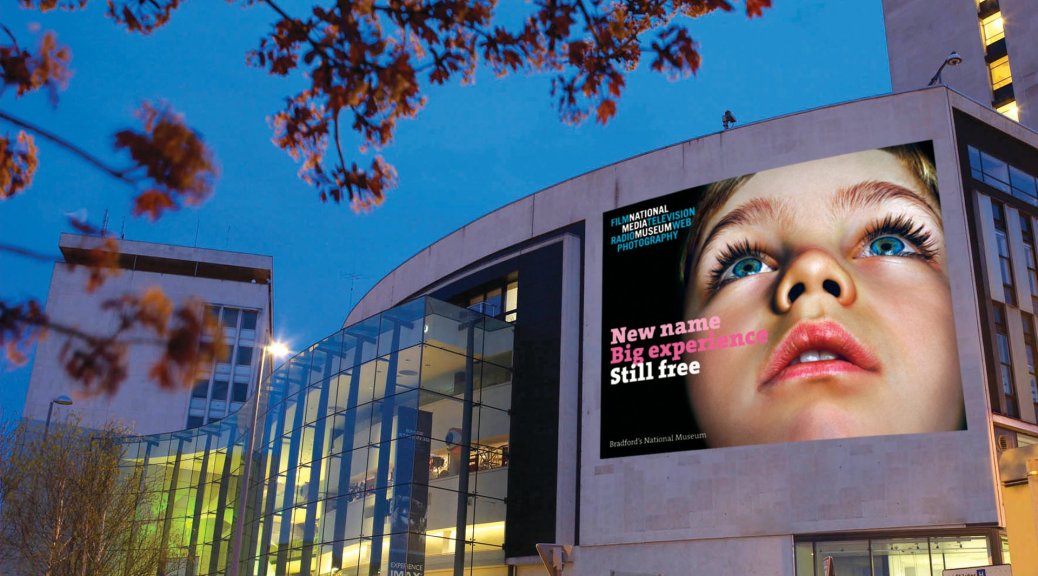
If you haven’t been following this story, I think it’s worth taking a look at. The National Media Museum, located in Bradford, Yorkshire, England, was home to a massive collection of photographs, substantively consisting of the collections of the Royal Photographic Society (RPS), spanning the first two centuries of photography. The trustees of the museum decided to transfer a significant portion of the collection to the Victoria & Albert museum in London, without public comment or debate. This is causing a big stink:
The move to relocate some of the museum’s holdings – the bulk of which is part of a Royal Photographic Society (RPS) collection that charts the development of photography over 200 years – was announced in February, prompting accusations of “cultural vandalism”.
“This is an appalling act of cultural vandalism,” said Simon Cooke, the Conservative leader on Bradford city council. “I know London is a big, grand and fantastic city but to denude my city of these photographs reminds us that you … care not one jot for our heritage and history.
“We don’t have much up here and it fills me with a kind of sad rage that you felt able to visit this act of cultural rape on my city.”
As a result, major figures such as David Hockney, Mike Leigh the film director, photographer Don McCullin and more than eighty other artists working with still and moving images have picked up their pens to add their voices to the protest. Here’s hoping they are heard.
Nowadays I live in Switzerland, but I am originally from England.
How did you get into photography as an art medium (as opposed to casual or professional use)?
I discovered Charlie Waite’s landscapes. These showed me that photography could be a personal statement as much as a documentary record. Charlie opened my eyes and changed my life.
Which alternative processes do you practice?
Platinum/palladium printing. I occasionally dabble with other alt processes, but not for serious work.
What attracted you to alternative processes in general?
As an artist I feel it is important to be involved throughout the creative process. I want what I make to be my creation. You can only truly achieve this when working by hand.
What drew you to the specific media you practice?
I made my first platinum/palladium print in 2005: a close-up of some flowers on a slate embankment. I still have it somewhere. I had seen pictures of platinum/palladium prints online, but the first one I saw in the real-world was that first print I made. It was an epiphany, and I very quickly realised that there was nothing else I wanted to make. Platinum/palladium allows me a depth of emotional engagement that I don’t have with traditional silver gelatin or digital machine-made prints. This emotional engagement is really important. I want what I feel in my studio when working with the model to be conveyed in my finished work. Platinum/palladium allows this.
How does the choice of media influence your choice of subject matter (or vice versa)?
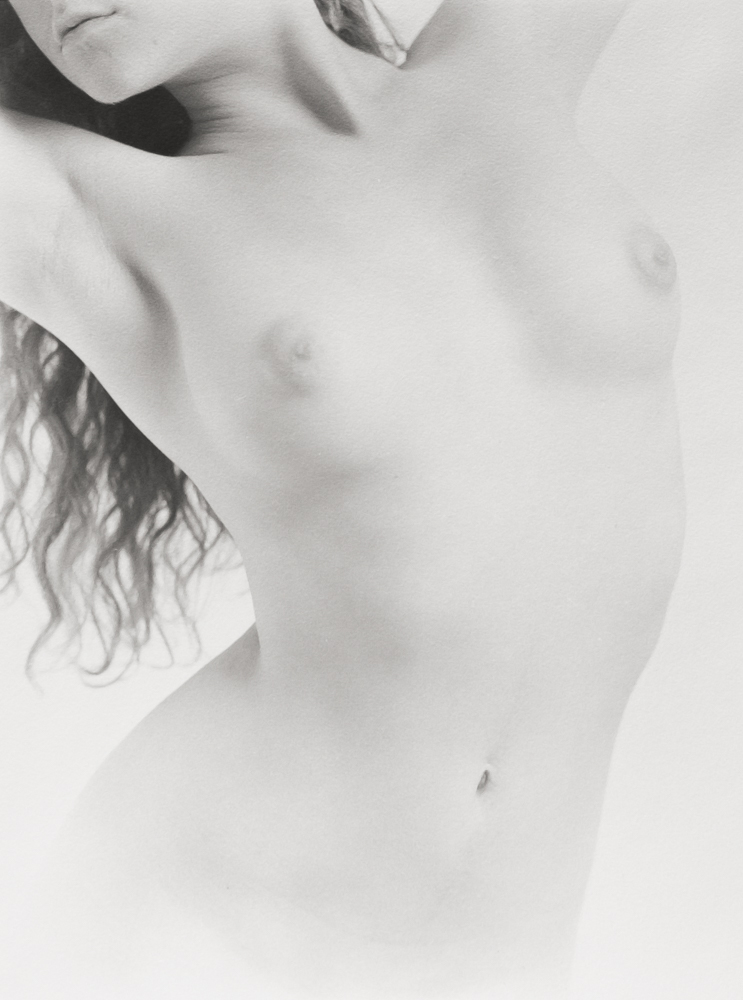
I find platinum/palladium to be the perfect medium for nudes. It renders soft, graceful and beautiful images that are far more subtle than the shouty, high contrast stuff we are routinely bombarded with.
In today’s mobile, electronic world of instant communication and virtual sharing of images, how important is it to you to create hand-made images?
I can’t really see the point in churning out machine-made images. Anyone can do this.
Is your choice to practice alternative, hand-made photography a reaction to, a complement to, or not influenced by the world of digital media?
I was making platinum/palladium before the digital revolution really took off. I use digital cameras, of course, but not for serious work. The workflow is so different and feels so shallow to me.
Do you incorporate digital media into your alternative process work?
In general, I would say no. I do use digital negatives from time to time, but this isn’t a significant part of my creative life.
What role do you see for hand-made/alternative process work in the art world of today? Where do you see yourself in that world?
Most photography collectors want distinctive, exclusive and personal artwork. Small limited editions of hand-made prints made using the finest of materials by a master of the creative process all contribute to this. And of course the enormous lifespan of platinum/palladium prints ensures that these photographs will pass the test of time. A well made platinum/palladium print will last as long as the paper it is printed upon. Many collectors like the fact that their investments will be there to be enjoyed by their grandchildren’s grandchildren.
Ian Leake’s work can also be found at IanLeake.com
Where are you from?
Hard to answer this question. I was born in England, I am Indian, grew up in Ohio but have lived in the DC area for the past 26 years. I currently live in Silver Spring, MD
How did you get into photography as an art medium (as opposed to casual or professional use)?
Since I was in third grade I knew I wanted to have a career in photography. I do all kinds of photography minus commercial work. I am the director of the photography program at American University and one of the classes I have been teaching for the past decade or so has been Fine Art Photography. This class was transformative to me when I was a student and got me interested in alternative processes.
Which alternative processes do you practice?
I work in many alternative processes, Polaroid Transfers/Fuji Transfers, Photograms, Lumen, Liquid Emulsion, Cyanotypes.
What attracted you to alternative processes in general?
It is the unknown that attracts me to these processes. Each piece is unique and the nature of small subtle changes from one exposure to another. You never know what you are going to get and I learn patience from these processes. It reminds me that even though photography is known for its reproducibility, alternative processes allow for diversions from an otherwise known outcome.
What drew you to the specific media you practice?
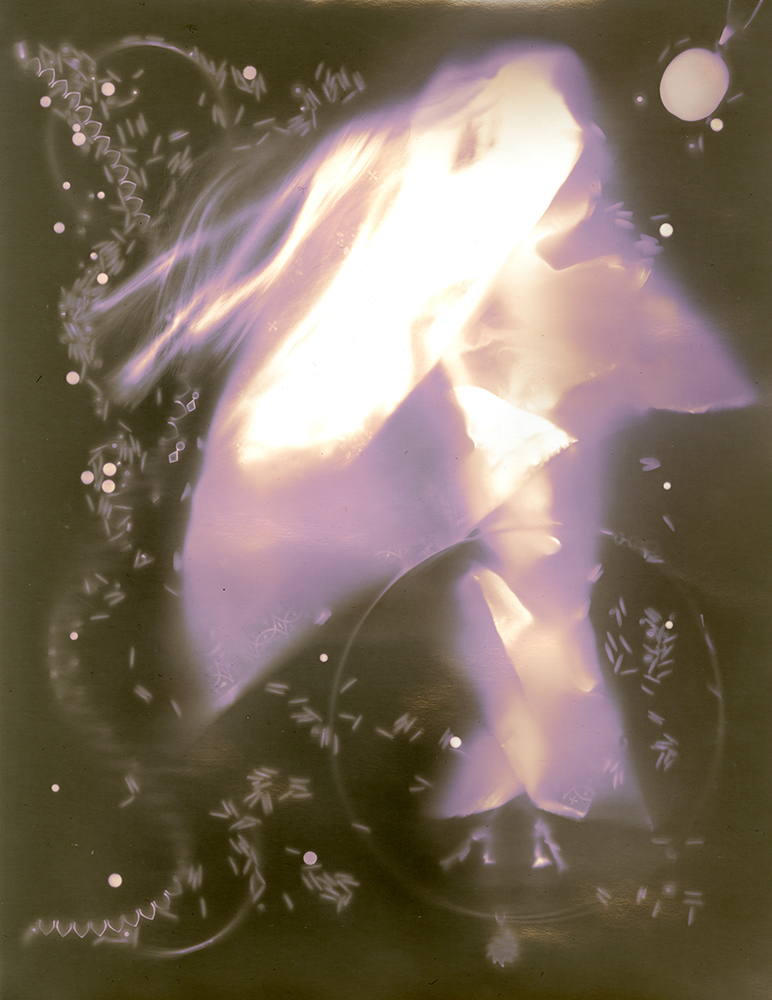
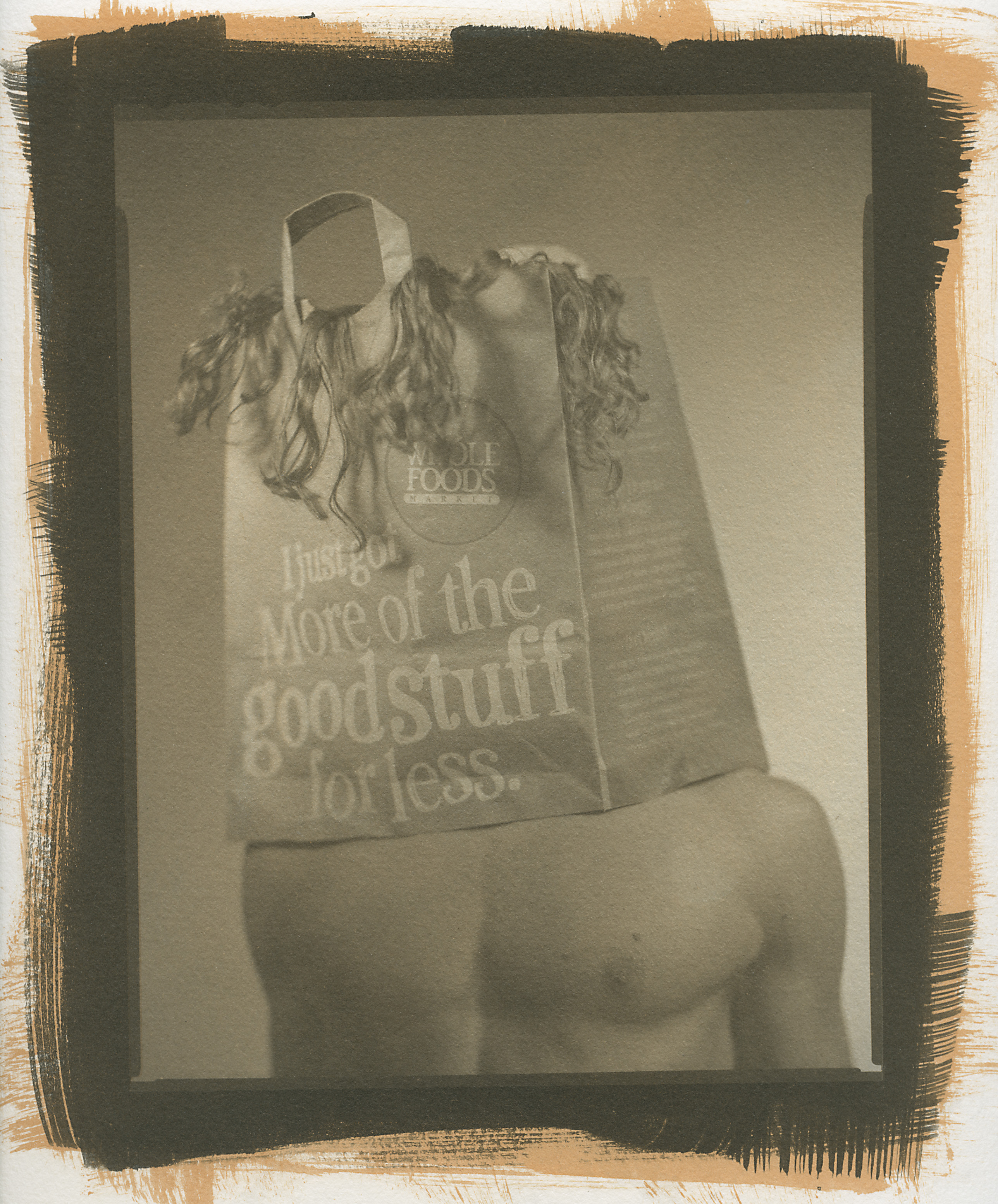
For this series, I tried using photograms and I wasn’t able to get the details on the Indian Barbie’s sari. While I didn’t want the image to be recognizable as a Barbie doll, that carried too much weight as an Icon, I did want the doll to be seen. I loved the colors that were produced with a six-hour exposure in the UV light box. These pastel pinks and purples are reminiscent of Indian wedding colors which are bright and vivid.
How does the choice of media influence your choice of subject matter (or vice versa)?
I often have an idea and will try many approaches or I will re-appropriate my own work into various mediums when a new theme comes into my head. Often I work with issues of race, identity, gender and diaspora, so the work I do can flow from one series to another, with changes.
In today’s mobile, electronic world of instant communication and virtual sharing of images, how important is it to you to create hand-made images?
Hand-made work is vital to my photography practice. While I do a lot of work on the computer, it is this work that seems more personal to me, BECAUSE it is done by my own hand. It becomes personal and when you are doing themes surrounding your identity, it seems to go hand in hand.
Is your choice to practice alternative, hand-made photography a reaction to, a complement to, or not influenced by the world of digital media?
To me the ideas come and I test them in a variety of ways. I’m not wedded to any process, I think the work warrants the process. So often I will test things out before I decide what is working. I often tell my students they need a viable reason for choosing the medium they work in. The image has to warrant the process or why do it that way.
Do you incorporate digital media into your alternative process work?
Yes, I have a series of Polaroid transfers that I have scanned and blown up to 40 x 50”. With Polaroid going under and the Impossible project not being able to take over creating pull apart film, digital is the only way to do this process now. As of last week Fuji announced they are no longer making their pull apart film, so unless some company takes over there will no longer any film that will allow for emulsion transfers or emulsion lifts.
If so, how do you incorporate it? Is it limited to mechanical reproduction technique, or does it inform/shape/influence the content of your work?
I use it to enhance the work and to reproduce it at larger sizes.
What role do you see for hand-made/alternative process work in the art world of today? Where do you see yourself in that world?
I feel that there will always be a place for alternative processes, and new ones will come up that will combine digital. I find it to be a great time to be making work because there are no rules on how to make work that is shown in galleries. I do see my students becoming more attracted to these older processes because of they are learning something new.
I’m very pleased and thrilled to announce the entrants whose work has been accepted into the Rendering The Spirit: The Personal Image in Alternative Media exhibition at Glen Echo Photoworks. We accepted twelve artists showing a very diverse range of subject matter and technique, from wet plate collodion to photogravure to lumen prints. The exhibit is also very geographically diverse – works are coming from Texas, the Washington DC area, Switzerland, Germany and Japan.
The honored artists are:
Atalie Day Brown (Maryland)
Barbara Maloney (Maryland)
Bruce Schultz (Louisiana)
Dan Schlapbach (Maryland)
Erik Larsen (Colorado)
Eddie Hirschfield (Virginia)
Hendrik Faure (Germany)
Ian Leake (Switzerland)
John Sarsgard (New York)
Leena Jayaswal (Maryland)
Marek Matusz (Texas)
Yugo Ito (Japan)
A few featured works from the exhibition:
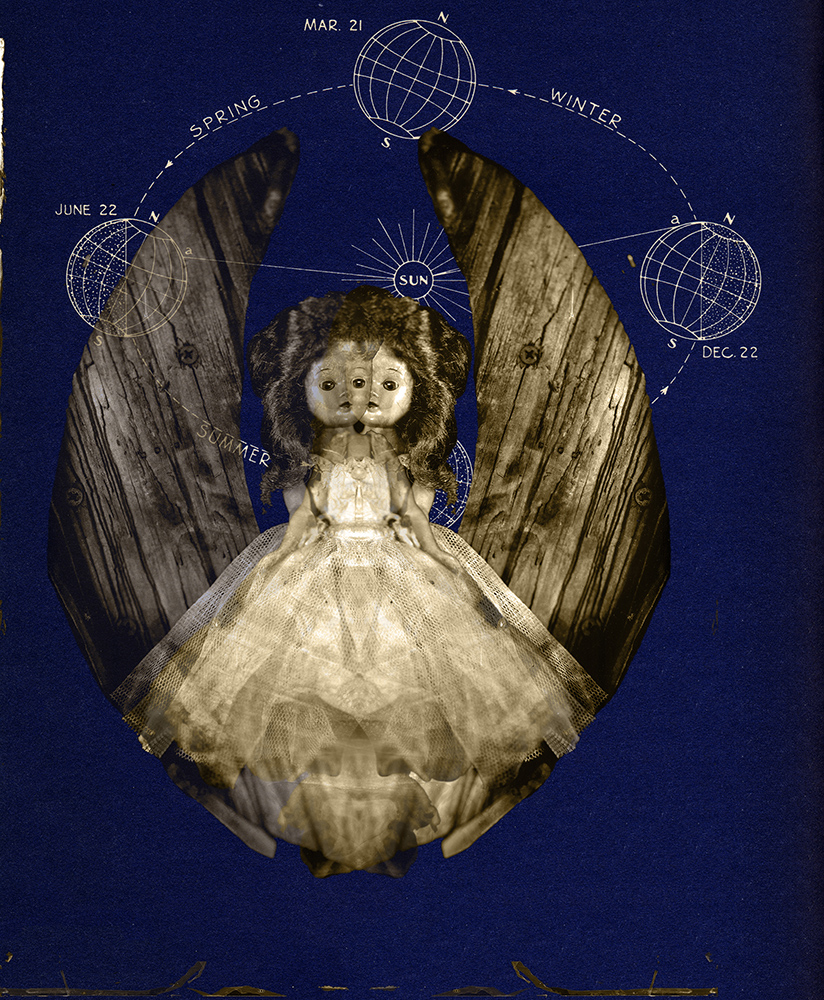
Causes of the Seasons – Dan Schlapbach
14×17 inches, digital relievo wet plate collodion ambrotype. There is a digital print behind the glass ambrotype image, creating a relief like a traditional relievo ambrotype
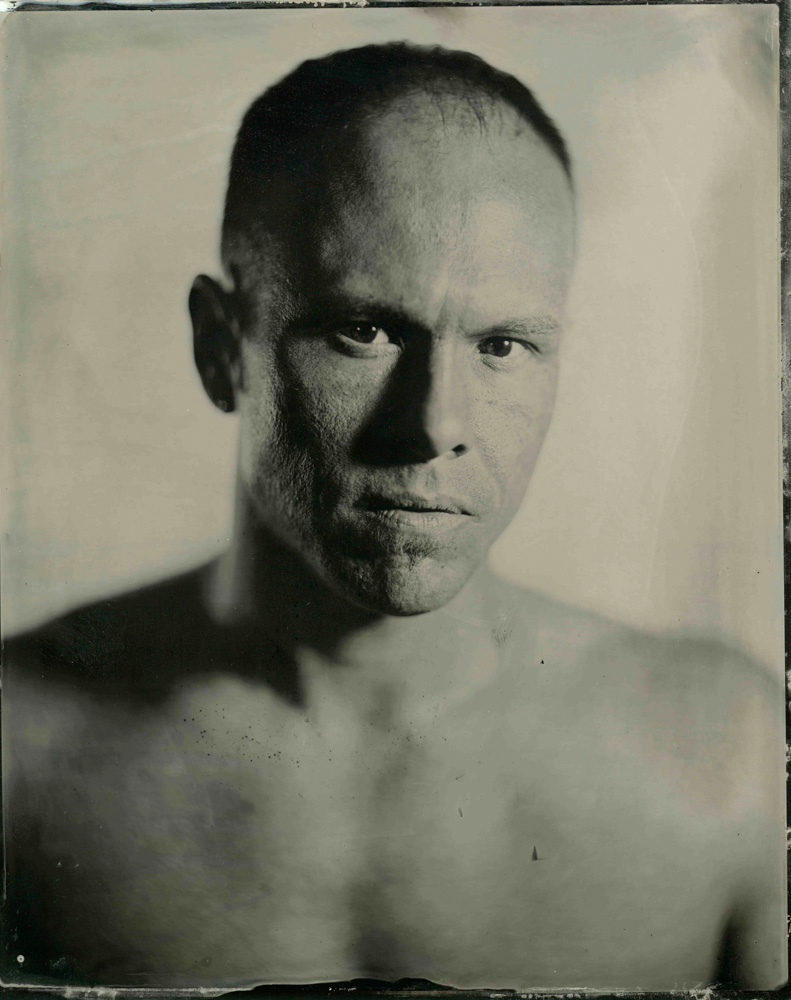
Portrait of Jared – Atalie Brown
8×10 inch tintype (direct-positive, wet-collodion on aluminum plate)
This is a reminder that the submission deadline for Rendering The Spirit: The Personal Image in Alternative Media is less than a week away, on February 21.
Photoworks is a non-profit photographic arts and education center in Glen Echo, Maryland. Last year was their 40th anniversary, and as part of the ongoing celebrations and future vision for Photoworks, we are launching a new program to provide visibility and accessibility to historic/alternative processes and artists working in these media. Rendering The Spirit is the kickoff event to highlight this programming.
Works to be considered must be made using an alternative/historic process, including but not limited to lumen prints, daguerreotypes, gum bichromate, tintypes/ambrotypes/melainotypes, platinum/palladium, kallitypes, Van Dyke Brown, cyanotypes, carbon prints, calotypes, salt prints, albumen prints, bromoil, gumoil or some combination of the above. Silver Gelatin prints on machine-made commercial papers are not accepted. Original capture of the image can be from in-camera negatives or digital capture or some combination thereof, but the final image must be a physical object made using one or more historical processes.
Also include an artists statement, brief bio and an explanation of the work(s). All required documents (JPEGS, Artist statement/bio/explanation of works) should be emailed to photoworks.gallery@gmail.com no later than February 21st. Notifications will be sent by email to all selected artists by March 1. Works must be received by March 14. The opening reception will be held on March 26.
Render (v): to distill, to cook down to its essence, to translate, to represent.
Rendering: an act of bringing into being, of distillation, of translation, of representation.
By aiming our gaze at works created using “alternative” processes, we aim to show the diversity of work being created at this nexus of the 19th and 21st centuries and engage in a dialog about what it means to create work using anachronistic techniques.
Scott Davis is a faculty member at Photoworks where he teaches alternative processes, portraiture and studio lighting. He received formal training at Maryland Institute, College of Art. His specialty is platinum/palladium printing, and he is an avid collector of 19th century photography. He has exhibited his personal work locally, nationally and internationally, and has served as curator at the former Art Reactor Gallery in Hyattsville.
Malcolm Cosgrove-Davies is a self-taught photographer who since 1978 has been practicing historic photographic processes including gum bichromate, cyanotype, VanDyke, palladium, and carbon printing. Mac’s images derive from his extensive travel to developing countries as well as everyday life. Using antique and hand-made film cameras in various large & panoramic formats he seeks to match the image to the beauty and elegance of the selected photographic process. In addition to building the occasional camera, printing frame or other useful photographic gadget, he also creates books and presentation portfolios for his prints. He is represented in various collections such as the Smithsonian American Art Museum, Library of Congress, Maier Museum, and Lehigh University Art Galleries.
It’s all too common for people to ask professional creatives to do work on “spec” – provide me with free samples and if I like them, I’ll pay you in “credits” or something else, or maybe never. This video does a brilliant job of satirizing a very serious problem for creative professionals.
The original article I found it from is on Petapixel, another great photography website and well worth your read. Despite the sound of their name, Petapixel is actually not strictly digitally obsessed and does run articles, including positive ones, about analog photography.
In short, if you’re a creative professional, you’re probably asked on a regular basis to provide not just a portfolio in advance of a contract signing, but actually asked to do the work first. Just say NO to this kind of work – it hurts all of us because it builds the expectation that clients can get creatives to work for free. Would you expect to go into the bakery and get to eat an entire loaf of bread before deciding if you liked it enough to pay for it or not?
Render (v): to distill, to cook down to its essence, to translate, to represent.
Rendering: an act of bringing into being, of distillation, of translation, of representation. By aiming our gaze at works created using “alternative” processes, we aim to show the diversity of work being created at this nexus of the 19th and 21st centuries and engage in a dialog about what it means to create work using anachronistic techniques.
Curators: Scott Davis and Malcolm Cosgrove-Davies
Scott Davis is a faculty member at Photoworks where he teaches alternative processes, portraiture and studio lighting. He received formal training at Maryland Institute, College of Art. His specialty is platinum/palladium printing, and he is an avid collector of 19th century photography. He has exhibited his personal work locally, nationally and internationally, and has served as curator at the former Art Reactor Gallery in Hyattsville.
Malcolm Cosgrove-Davies is a self-taught photographer who since 1978 has been practicing historic photographic processes including gum bichromate, cyanotype, VanDyke, palladium, and carbon printing. Mac’s images derive from his extensive travel to developing countries as well as everyday life. Using antique and hand-made film cameras in various large & panoramic formats he seeks to match the image to the beauty and elegance of the selected photographic process. In addition to building the occasional camera, printing frame or other useful photographic gadget, he also creates books and presentation portfolios for his prints. He is represented in various collections such as the Smithsonian American Art Museum, Library of Congress, Maier Museum, and Lehigh University Art Galleries.
Works to be considered must be made using an alternative/historic process, including but not limited to lumen prints, tintypes/ambrotypes/melainotypes, daguerreotypes, gum bichromate, platinum/palladium, kallitypes, Van Dyke Brown, cyanotypes, carbon prints, calotypes, salt prints, albumen prints, bromoil, gumoil or some combination of the above. Silver Gelatin prints are not accepted. Original capture of the image can be from in-camera negatives or digital capture or some combination thereof, but the final image must be a physical object made using one or more historical processes. For a submission fee of $40, each artist may submit up to five examples. Send jpegs at 72dpi, 1000 pixels on the long axis. JPEGs should be named ArtistName_number (i.e. JohnBrown_1 ).
Also include an artists statement, brief bio and an explanation of the work(s). All required documents (JPEGS, Artist statement/bio/explanation of works) should be emailed to photoworks.gallery@gmail.com no later than February 21st. Notifications will be sent by email to all selected artists by March 1. Works must be received by March 14. The opening reception will be held on March 26.
Explanation:
The explanation should enumerate the title of the work, the file name of the associated JPEG, the size of the piece (including frame dimensions), the year it was made, and any pertinent details about the creation of the work.
Example:
Image Title:
File Name:
Size:
Year Created:
Explanation:
Joseph
JohnBrown_1.jpg
8”X10”
2016
Hand-colored quarter-plate daguerreotype, distressed with fingerprints and acid etching.
All works accepted must be framed/mounted and ready to hang. Outside dimensions should be no greater than 24 inches on the long axis. All works must be available for sale – Photoworks takes a 35% commission on any sales. Artists are 100% responsible for shipping to and from Photoworks.
You must include a pre-paid return shipping label with your work; any work shipped without a return label will be considered a donation to Photoworks, and will not be returned to the artist. Artists are responsible for insuring their work – while Photoworks endeavors to take every precaution to protect and care for works while on display, they will not be liable for any loss or damage.
Artists Statement:
Please send us a one paragraph statement about your work, and in particular describe why you are using the alternative process(es) you are using; what do they mean to you, to the work, how they shape meaning, their aesthetic impact.
Artists Bio:
Please send a one paragraph biography.
Forty years ago, in a derelict building hidden among the abandoned amusement park rides of Glen Echo Park, four young photographers founded Photoworks with little more than a shared passion for the daily work of seeing, shooting, and printing images of lasting beauty and artistic integrity. The day-to-day collaboration, creative dialogue, and informal mentoring that led those artists to successful careers as fine art and commercial photographers established the values of experimentation and collegiality that define Photoworks today. Offering a diverse combination of educational programs, gallery exhibitions, and community initiatives, Photoworks is a vibrant and unique resource for student and professional photographers – an arts community in the very best sense of the word.
For more information about Photoworks, visit their homepage: Glen Echo Photoworks
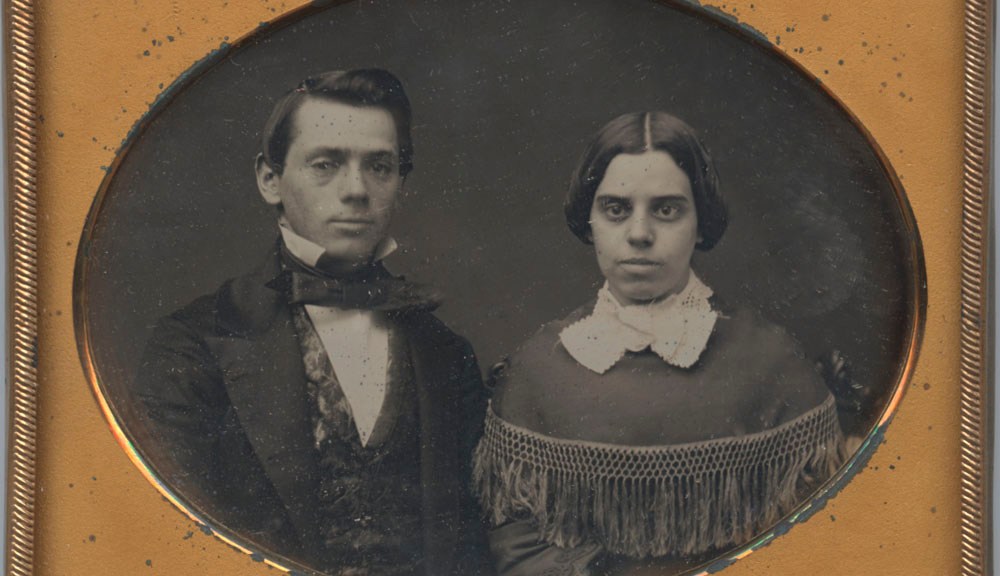
Here is a lovely daguerreotype, the latest addition to my collection. This is a quarter-plate size piece, in a wallet case. I did not have anything in a wallet case before, so I jumped on the opportunity especially since the plate was in such nice condition. The scan does not do it justice, frankly, as the cover glass and the frame put the plate a little out of the focusing range of the scanner lens, making it look a little less sharp, and any dust is only magnified.
Anonymous Couple, 1/4 plate Daguerreotype
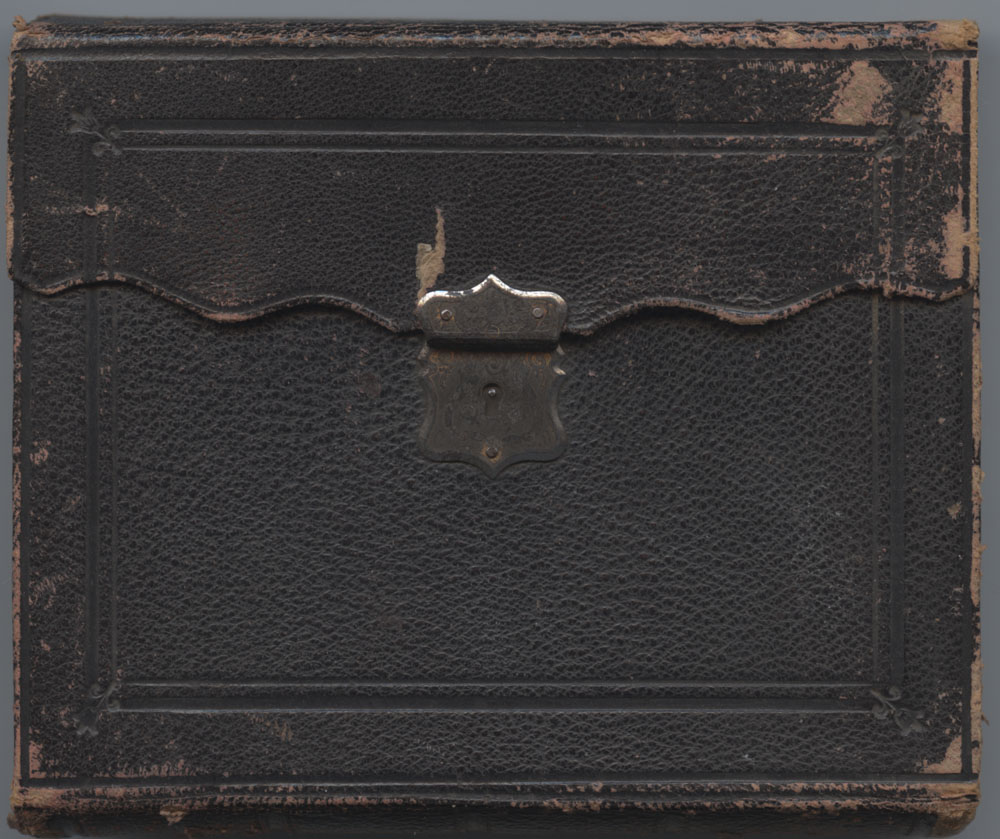
Here is the wallet case itself. The clasp lock in fact works. I suspect there was a better button to operate the clasp at some point in the past and it fell off. This scan again doesn’t do the artifact justice, as the clasp has a lovely pattern etched into it that isn’t coming through.
Wallet Case
I wanted the wallet case to add to my collection because I do exhibit and lecture from these artifacts and the wallet style makes it all the more obvious how these were meant to be carried around as treasured keepsakes to show to friends and family, not put up on a wall or a shelf (although wall frames for daguerreotypes and ambrotypes do exist). It creates an interesting dynamic between public and private – these objects were not reserved for viewing in the privacy of ones home, but rather exhibited wherever and whenever the fancy struck. We’ve come full circle on this today, where now people carry their entire photographic life on a little candy-bar sized device in their pocket, which interestingly enough, is roughly the same size as the quarter-plate daguerreotype, just a little skinnier.
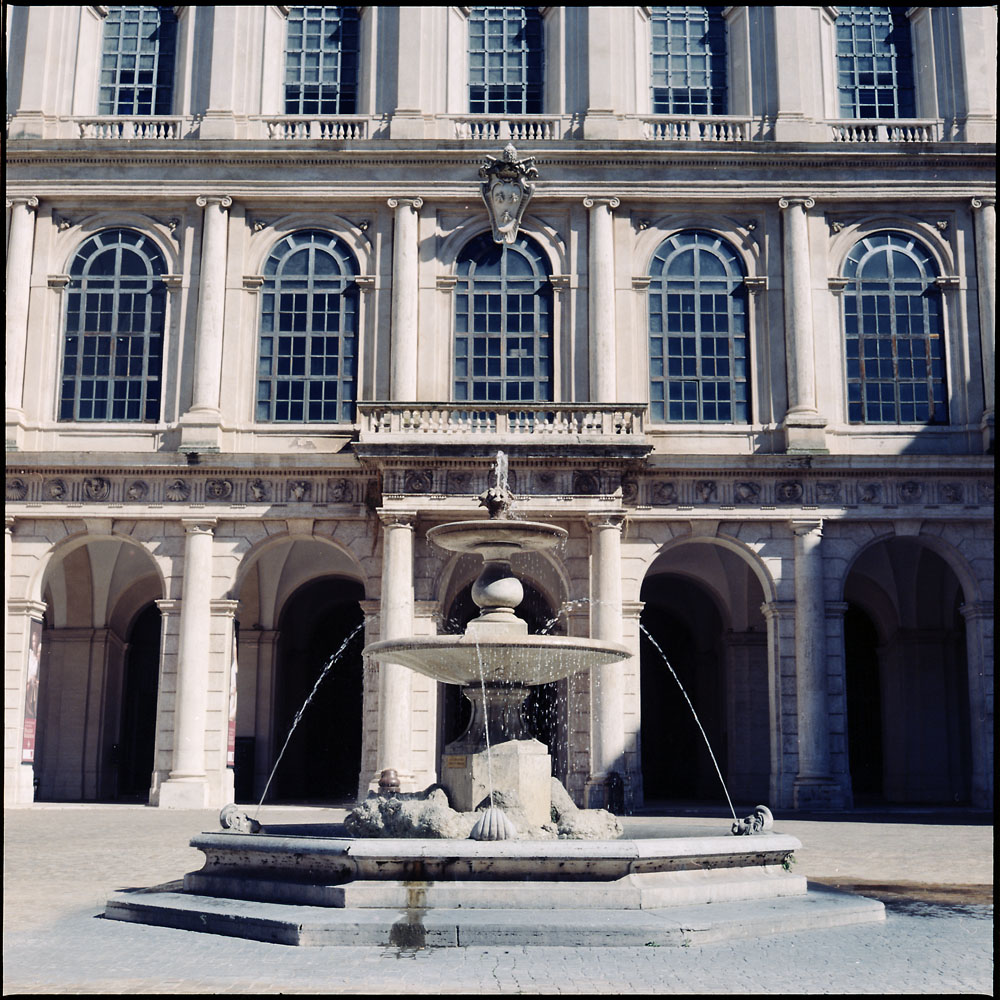
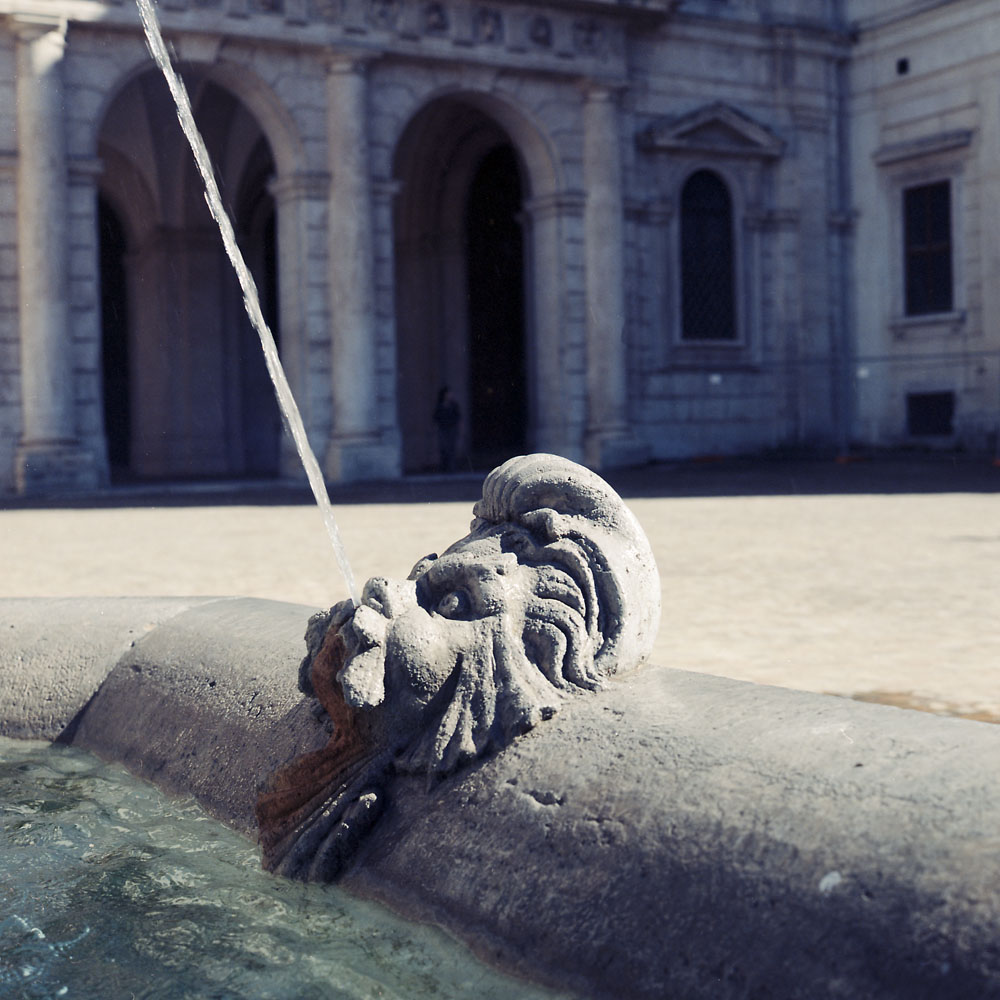
Today the Palazzo Barberini houses another great art museum, home to two Caravaggios, a version of Hans Holbein’s portrait of Henry VIII of England, and Bernini’s bust of Cardinal Barberini among many other masterpieces of Renaissance and Baroque painting. Here is the entrance facade as designed by Bernini, seen from the entrance courtyard with its central fountain.
Facade, Villa Barberini
A detail of one of the water jets in the fountain:
Fountain Detail, Palazzo Barberini
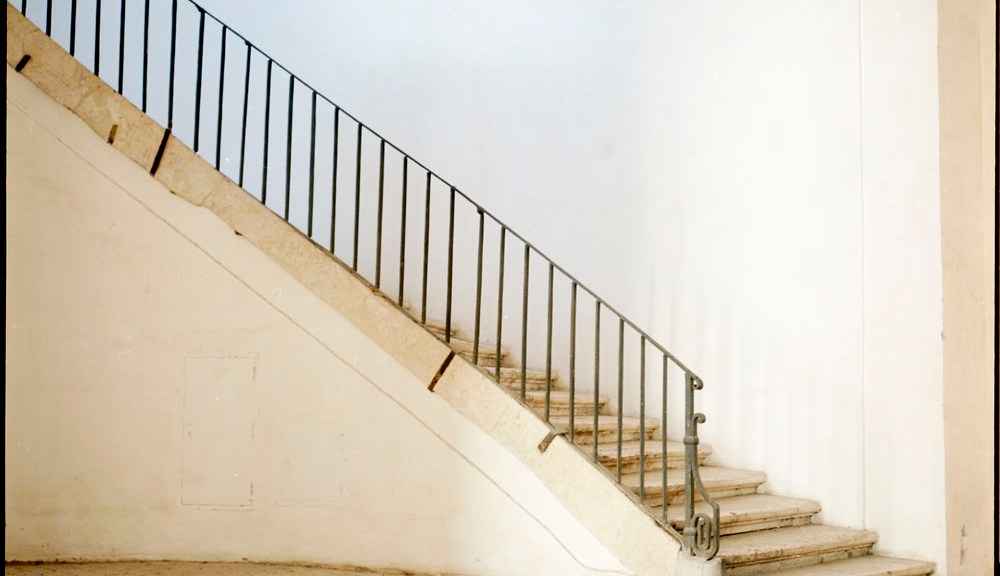
A staircase leading up to the rear gardens from the coachway underneath the palace. To the left out of the frame is the famous stepped ramp to the rear of the garden also designed by Bernini. Sometimes when you’re photographing, you get into this mindset of one type of image or another – for example, I had been shooting black-and-white film, and when composing this, I was still in the black-and-white headspace. I was thinking about the tones of the scene and the gradations from bright to dark. I don’t know if I even realized at the time I was shooting in color. When I was editing through my negatives, I saw this one and thought, “gosh, that’s likely to be a throwaway shot, but I’ll scan it just in case”. I wasn’t sure it would be sharp enough, because my memory of the space was that it was exceedingly dark and I winged it with a handheld exposure, roughly 1/4 of a second.
Well, you can see what happened. Not only was it sharp, but I seem to have mastered serendipity. The colors in the scene are beyond beautiful – the subtle blue from the cold light of the palace shadow seeping down into the stairway from the garden entrance to the rich golden hue of the paving stones and the plaster on the wall.
Inner Courtyard Stair, Palazzzo Barberini
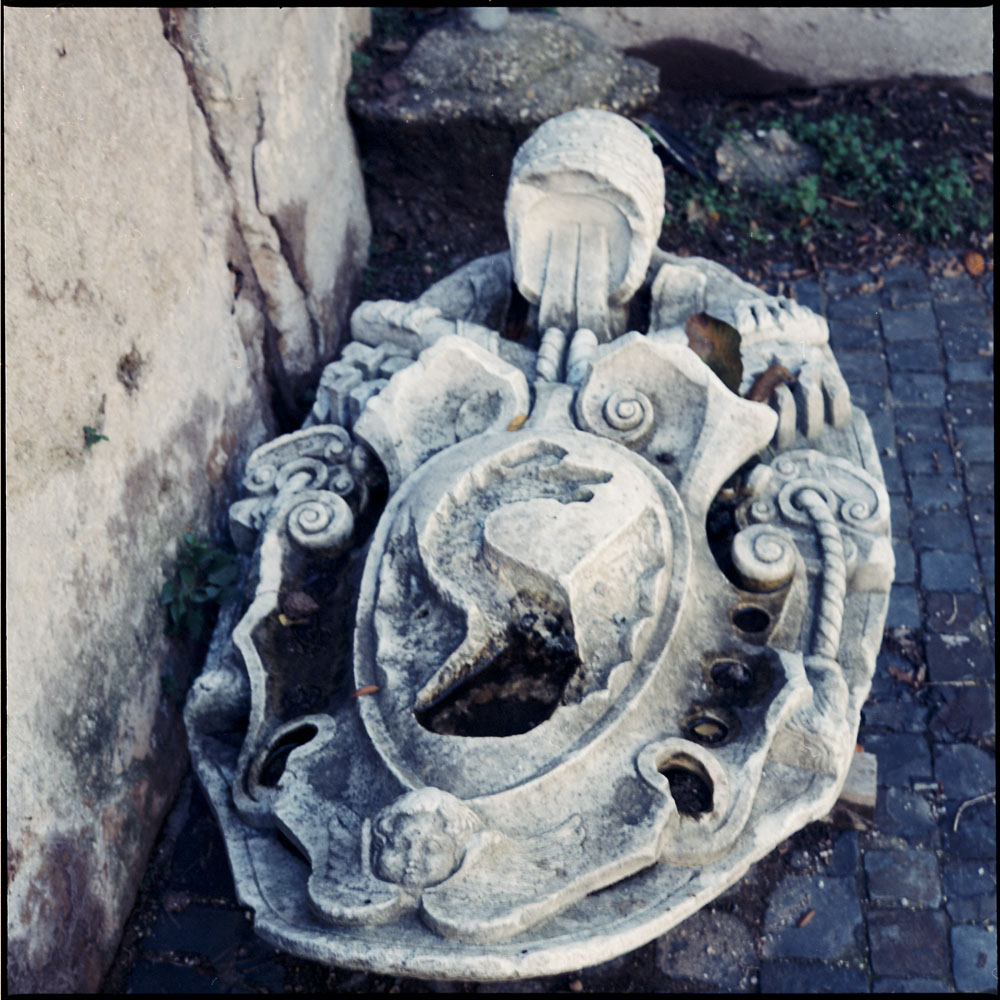
Poking around the grounds of the palazzo, I saw two massive carved stone coats of arms lying on the ground in a side service yard. One was the papal coat of arms of Maffeo Barberini, Pope Urban VIII. To be expected – this was his palace. This one, on the other hand, is a bit surprising – the papal coat of arms for Paul V – Camillo Borghese. During the years of their respective papacies, the Borghese and Barberini estates were neighbors, and Scipione Borghese, the Cardinal Nepotente to Paul V, was a friend and fellow art enthusiast with Maffeo Barberini. After Urban VIII’s death, the Barberini palace was seized and not returned to the Barberini family for some years, but neither the Pope doing the seizing nor the pope who returned it to them were Borghese. Both families (Borghese and Barberini) were one-papacy families, unlike the Medici with four, and the Della Rovere with two.
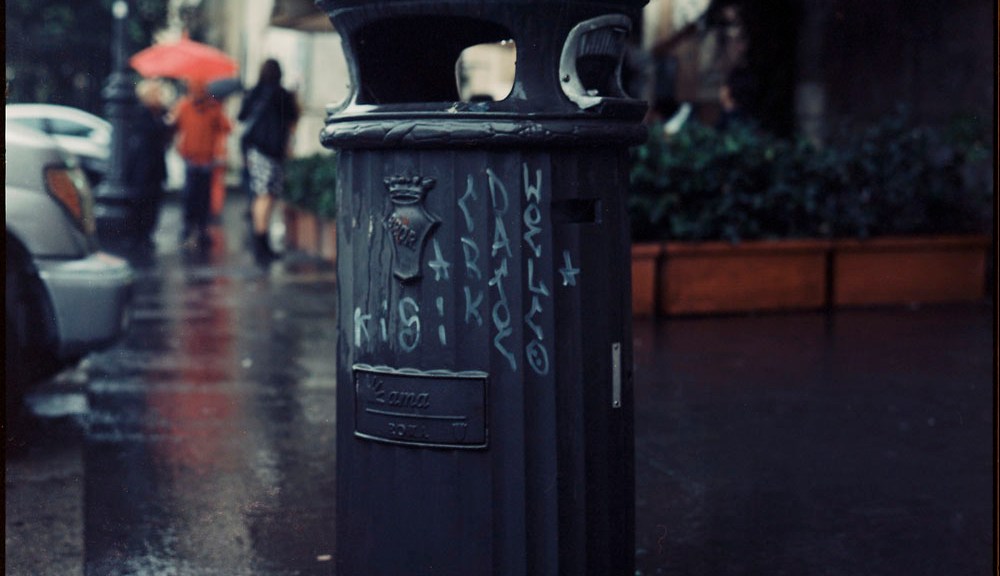
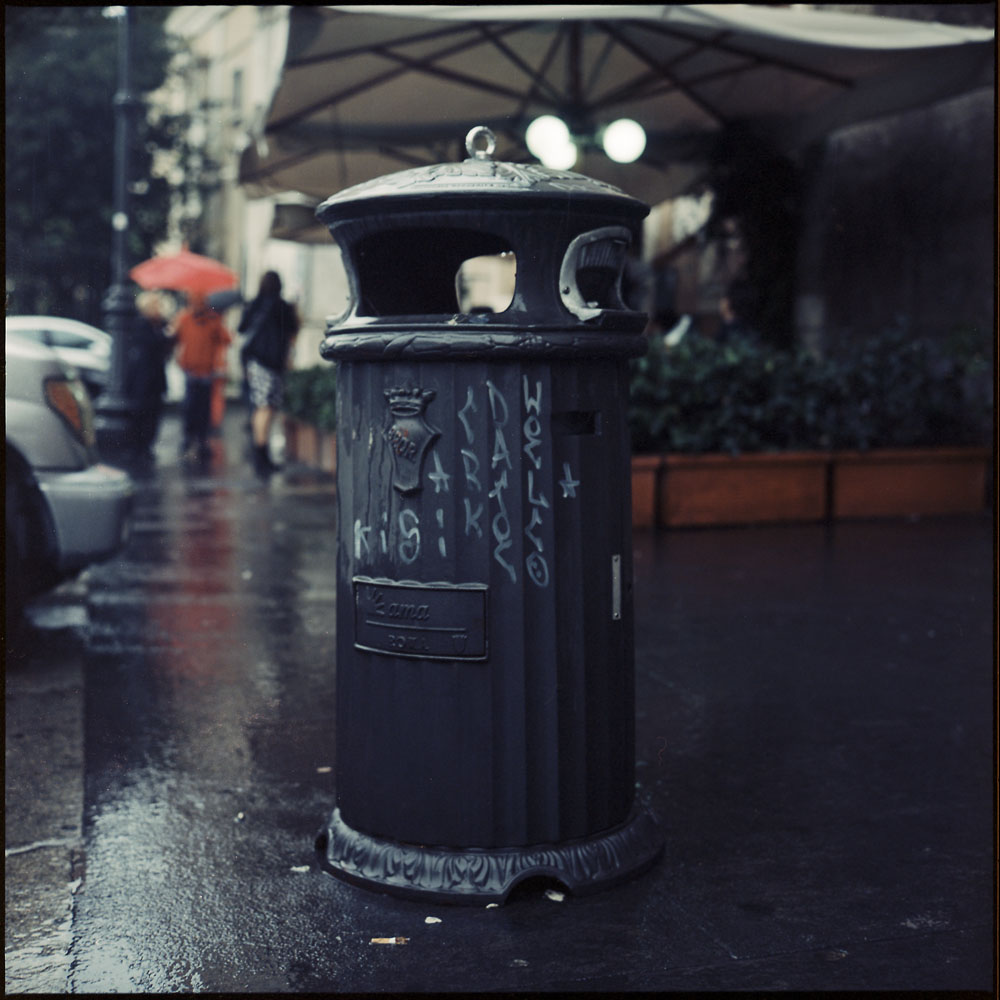
Another of my portraits of ordinary objects – this time a trash can in Rome, outside the Theater of Marcellus, at the foot of the Palatine Hill. The trash can sits at attention, doing its duty exposed to the elements. Neither rain nor snow nor ill-placed cigarette butts deter it from its appointed task.
Trashcan in the rain, Rome
I don’t usually photograph in the rain, but I was so excited to be in Rome, running around and photographing without constraints, I didn’t care if people were staring at me as if I were some kind of freak, photographing a trash can in the rain with a 60 year old camera. This particular composition appealed to me because while the trash can is the center of attention and the star of the show, the background of the cafe umbrellas and the woman in the red coat with matching umbrella convey an extra level of that sense of how people turn their backs on public conveniences like trash cans and ignore them until they need them. Everything else is more important and more deserving of protection/attention.



 dcphotoartist