Category Archives: About Art

Museum Exhibition Catalogs

While I was in Paris, I went to see a major exhibition at the Musee D’Orsay, Masculin/Masculin, a retrospective of the male nude in art from 1800 to the present. It was beautifully presented, almost overwhelming in size and scope, and extremely memorable. At the time, I thought about buying the catalog because it had outstanding reproductions of the work in the exhibit, including many works and artists I was unfamiliar with. I decided not to because of the size and weight of the catalog, especially considering that it was only available hardcover and my bags were already close to the weight limit. After I got home, I was kicking myself for not buying it after all. I got a second chance, however, when a friend who lives in New York told me he would be going in early December, and he offered to bring me back a copy. It arrived today, just in time to be a Christmas present to myself.

This got me thinking about museum exhibition catalogs. I generally try to buy them for exhibits I’ve enjoyed when I have the chance, because it serves as a reminder of the work exhibited, and it goes a long way to helping support the museum mounting the exhibit, especially when the museum (like all the galleries of the Smithsonian and the National Gallery of Art) does not charge admission. As a result, I thought I’d list the exhibitions I’ve collected catalogs from.

In rough chronological order, descending, they are:

  • Charles Marville, National Gallery of Art, Washington DC, 2013
  • Masculin/Masculin, Musee D’Orsay, Paris, France 2013
  • Photography and the American Civil War, Metropolitan Museum of Art, New York 2013
  • Faking it: Manipulated Photography Before Photoshop, National Gallery of Art, Washington DC, 2013
  • 40 under 40: Craft Futures, Renwick Gallery, Washington DC, 2012
  • Stieglitz, Steichen, Strand, Metropolitan Museum of Art, New York, 2010
  • Hide/Seek: Difference and Desire in American Portraiture, Smithsonian National Portrait Gallery, Washington DC, 2010
  • Framing the West: The Survey Photographs of Timothy H. O’Sullivan, Smithsonian American Art Museum, Washington DC, 2010
  • Truth/Beauty: Pictorialism and the Photograph as Art – 1845-1945, Phillips Gallery, Washington DC, 2009
  • Faces of the Frontier: Photographic Portraits from the American West, National Portrait Gallery, Washington DC, 2009
  • Titian, Tintoretto, Veronese: Rivals in Renaissance Venice, Boston Museum of Fine Art, Boston, 2009
  • Impressed by Light: British Photographs from Paper Negatives, 1840-1860, National Gallery of Art, Washington DC 2008
  • All the Mighty World: Photographs of Roger Fenton, Metropolitan Museum of Art, New York, 2004
  • Segnali di Fumo: L’avventura del West nella Fotograffia, Castello Sforzesco, Milan, Italy 1994
  • Circa 1492: Art in the Age of Columbus, National Gallery of Art, Washington DC, 1992
  • Treasure Houses of Britain, National Gallery of Art, Washington DC 1985
  • Tutankhamen, National Gallery of Art, Washington DC 1977
  • The Family of Man, Museum of Modern Art, New York, 1955*

*obviously I did NOT attend the Family of Man exhibit, as I wasn’t even a fantasy in my grandparents’ minds in 1955. But I do have the exhibition book.

Also note that I’ve listed where I saw the exhibit, not necessarily who published the catalog.

Perhaps the oddest is the Segnali di Fumo catalog, purely on account of the incongruity of going all the way to Milan, Italy to see photographs of the American West (well, I didn’t GO to Milan to see the exhibit, but happened upon it as I was leaving the Castello Sforzesco), with a significant body from the Amon Carter museum in Texas. Which I haven’t been to yet, but really ought to. It would also help close the loop on my France trip, for it is there that the first known photograph ever is held – Niepce’s first known heliograph of the view out his studio window at his estate near Chalon-sur-Saone (that I couldn’t visit because it was closed for the season). I’m sure I’m missing one or two from my collection, and my collection of catalogs is a pale shadow of the total number of exhibits I’ve been to either because no catalog was produced (producing an exhibition catalog is a major undertaking and not done casually or cheaply) or because I couldn’t afford it at the time.

Another day I’ll put together a catalog of my photography monographs, as I know this is of interest to some. It’s not a huge collection, especially in light of my overall library size, but it is a work in progress.

More images published at Eastern Sierra Center for Photography – male nudes

I have had eight images published at Eastern Sierra Center for Photography’s website in their “Paradigmatic Nudes” gallery online. Most of these images you’ve seen here before on my blog. The images featured are my whole-plate sized gum bichromate prints of Philip, a model I’ve worked with and my Type 55 Polaroid 4×5 format shots of my friend Jose. I’d like to give a big shout-out to Laura Campbell, their curator and director, for repeatedly selecting my work and having faith in my creative vision. Please go check out their website and see the entire gallery.


Jose, Legs
Jose, Legs

Large format Nudes at Eastern Sierra Center for Photography

The Hobbit: the Desecration of Smaug

Yes, you read the title right- I intentionally twisted the title of the film. This is not going to be a positive review.

I had seen the first Hobbit film, and though the film was a bit slow and brought in some new story elements not found in the original (Orcs, Sauron), it was generally unobjectionable.

This second part, however, is an abomination. There are three, count em, three! added plot lines that were never in the original story, the most egregious of which is the entirely invented interracial love story between Taurien, a female elf who never appears in the original book, and Killi, one of the thirteen dwarves. Let me be clear- I have no issue with interracial romances, even between imaginary races. But I do have an issue with inserting an inorganic plot element that was not in the original story. The romance they invented between Arwen and Aragorn in The Lord of the Rings movies at least made sense from a plot perspective. This, however, is just a romance for the sake of romance. Actually, it’s more a love triangle between Legolas, Killi and Taurien. No matter, it doesn’t belong.

The overworking of the conflict between Gandalf and Sauron also has no place in this story. I understand the logic behind it – Peter Jackson wants to draw the connection between The Hobbit and LoTR for an audience unfamiliar with the books. For that, I still call BS- everyone who read the books for the first time could put the two together just fine without a ham-handed rehash of events that haven’t happened yet in the Hobbit/LoTR world. It also betrays the spirit of the book, which was decidedly less dark than LoTR.

The Orc plot line is the least inorganic, but it is still un-necessary. The dwarves had motivation aplenty to pursue their quest- fear of and revenge on Azog are not needed- if anything, the original motivator of pride corrupted by greed was more compelling.

Perhaps the biggest disappointment, though, has to be the conversation between Bilbo and Smaug. In the original, it was a duel of wits with nearly poetic language. Only a pale shadow of that dialogue remains, and the scene is turned into a promo for an as-yet unbuilt amusement park ride- Universal Studios: Escape from Smaug.

In summary, what could have been a triumph of a single three-hour movie was instead turned into a travesty of a trilogy.

Charles Marville exhibit at the National Gallery of Art

The River Seine by Charles Marville

Charles Marville: Photographer of Paris

Around 1832 Parisian-born Charles-François Bossu (1813–1879) shed his unfortunate last name (bossu means hunchback in French) and adopted the pseudonym Marville. After achieving moderate success as an illustrator of books and magazines, Marville shifted course in 1850 and took up photography, a medium that had been introduced 11 years earlier. His poetic urban views, detailed architectural studies, and picturesque landscapes quickly garnered praise. Although he made photographs throughout France, Germany, and Italy, it was his native city—especially its monuments, churches, bridges, and gardens—that provided the artist with his greatest and most enduring source of inspiration.

By the end of the 1850s, Marville had established a reputation as an accomplished and versatile photographer. From 1862, as official photographer for the city of Paris, he documented aspects of the radical modernization program that had been launched by Emperor Napoleon III and his chief urban planner, Baron Georges-Eugène Haussmann. In this capacity, Marville photographed the city’s oldest quarters, and especially the narrow, winding streets slated for demolition. Even as he recorded the disappearance of Old Paris, Marville turned his camera on the new city that had begun to emerge. Many of his photographs celebrate its glamour and comforts, while other views of the city’s desolate outskirts attest to the unsettling social and physical changes wrought by rapid modernization. Taken as a whole, Marville’s photographs of Paris stand as one of the earliest and most powerful explorations of urban transformation on a grand scale.

By the time of his death, Marville had fallen into relative obscurity, with much of his work stored in municipal or state archives. This exhibition, which marks the bicentennial of Marville’s birth, explores the full trajectory of the artist’s photographic career and brings to light the extraordinary beauty and historical significance of his art.

I went this weekend with my parents to see this exhibit. It is a wonderfully presented exhibition, and proof positive that when the National Gallery tries hard to do a good photography show, they can. The exhibition had special resonance for my father and I as we have just been to Paris, and trod the same streets documented in these photographs.

The exhibition has over 100 prints of Charles Marville’s work on display, ranging from early salt-paper portraits made from calotype negatives (negatives made on paper) to large albumen prints of architectural studies from glass collodion negatives. His architectural works have a significant sociological aspect as they document neighborhoods in transition from medieval warrens of twisted streets and cantering buildings flung up haphazard against one another, populated by the Parisian working class, to the modern, wide boulevarded, sanitized, luxurious Paris created by Baron Haussmann that we think of today.

Among the modernizations he documented were the new gas street lamps being installed, and the public urinals Haussmann designed to improve public sanitation (a major obsession of his). While many of the street lamps were preserved with electrification and can still be seen today, only one of Haussmann’s urnials still stands on Parisian streets.

Marville even includes himself in this transition, as he frequently used himself or an assistant as a stand-in for scale and emotional impact amidst the tumult and construction/destruction he photographed. He even photographed his prospering studio in a location that a scant few years later would also fall victim to Haussmann’s ‘modernizations’.

At the peak of his career he was the official photographer of Paris, but by the time of his death, he had faded into obscurity, his work ending up stored in state and city archives, and not a single obituary was published to mark his passing. He may have died in obscurity, but his work survived and preserved the city in transition, sometimes with his images being the sole record of the city that was.

The exhibit will be traveling to the Metropolitan Museum of Art in New York in January. If you can make it, it will be well worth your while.

Paris Photo 2013: A Selection (NSFW)

Great writeup on some personal highlights from Paris Photo 2013. I wish I could have attended, perhaps next year.

G. W. Bénard's avatarG.Bénard

Here’s a selection of some photographs and photographers that I wouldn’t mind to have in my collection, or that I didn’t know or just caught my attention in the Paris Photo 2013 along with some of the classics and masters. Some were quite interesting as single photographs, others as installations of series of photographs.

Nobuyoshi Araki, had an installation with 162 photographs, right in front of the works by Eikoh Hosoe that I wrote already about in the previous post.

Richard Learoyd, 2 wonderful portraits of Agnes, makes her enchanted human character in her fragility, as if warmed by the tones.

Yes, Vee Speers caught my attention with her technique of hand colouring over photographs. A series that she did some years ago and now picked up to paint: Bulletproof. You can see more of her work in the previous post as well.

And Julie Blackmon

View original post 352 more words

Paris in October – part 10 – Art

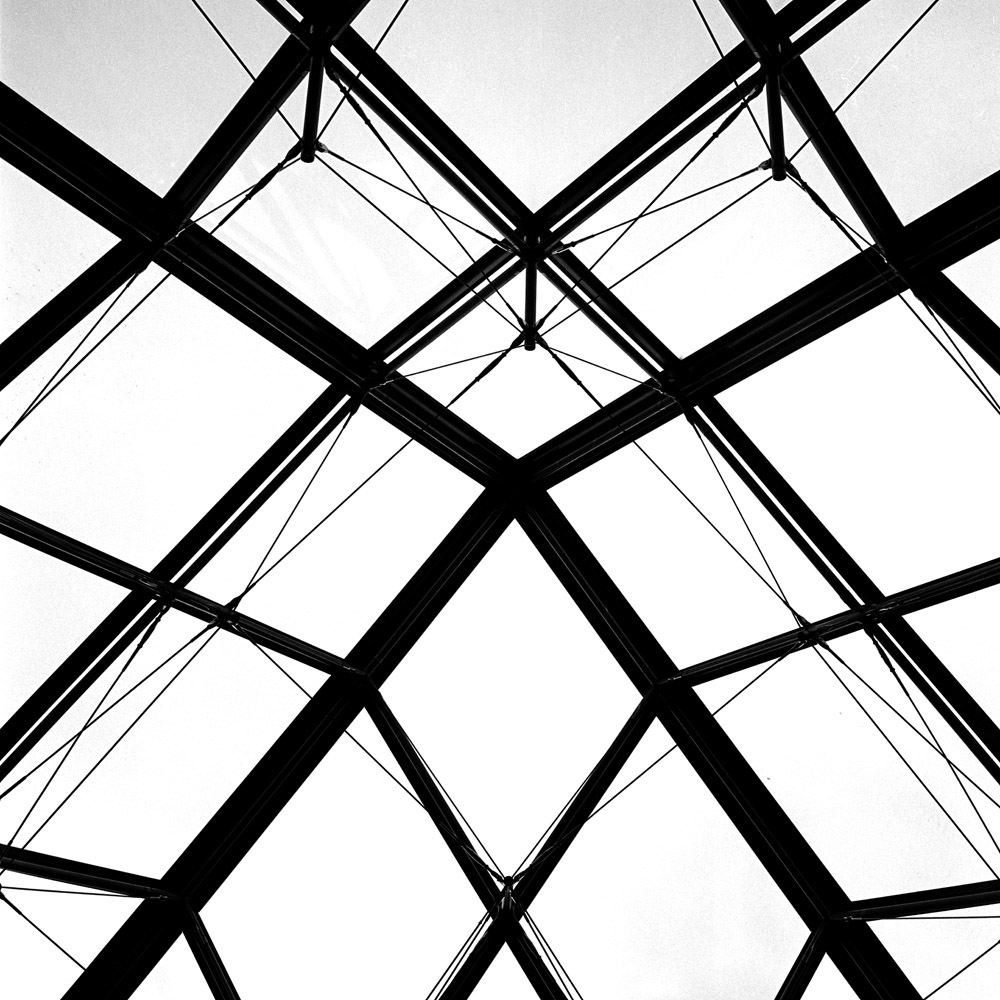
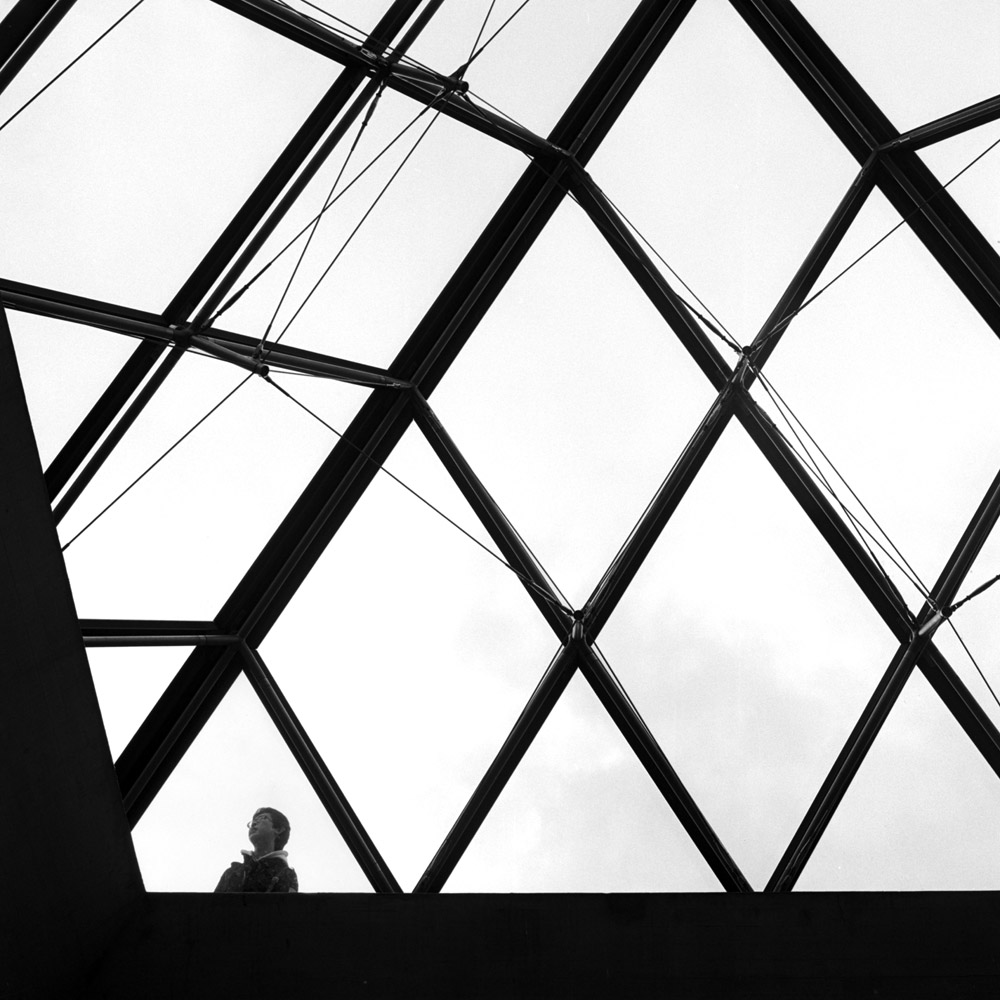
We’ll start with the Louvre museum. Here are some photos of the building itself. The Pyramid, the glass entrance structure that opens to the underground entrance lobby, is fascinating in itself for the geometry it creates and the possibilities for abstraction, and for the clash of modernity against 18th and 19th century architectural sensibilities that hallmark the rest of the building.

The Pyramid, from below
Pyramid, Boy
Pyramid, Boy

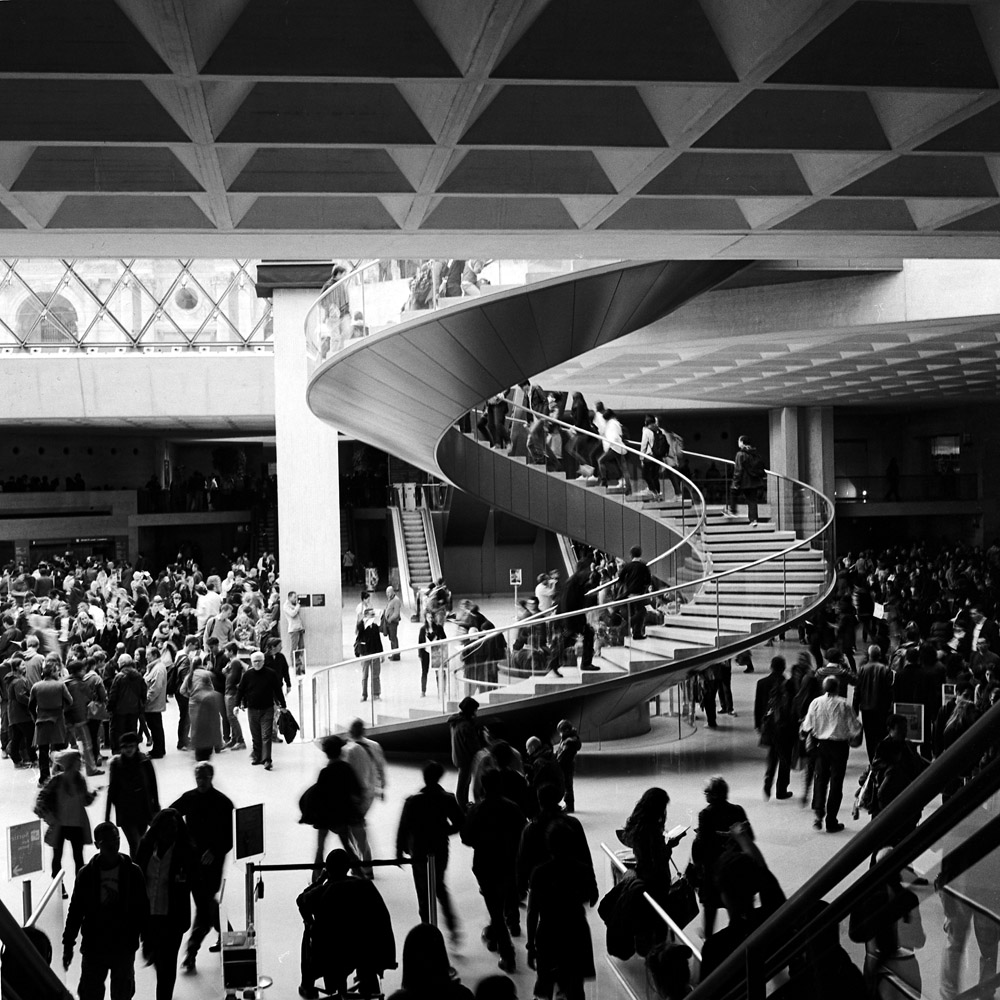
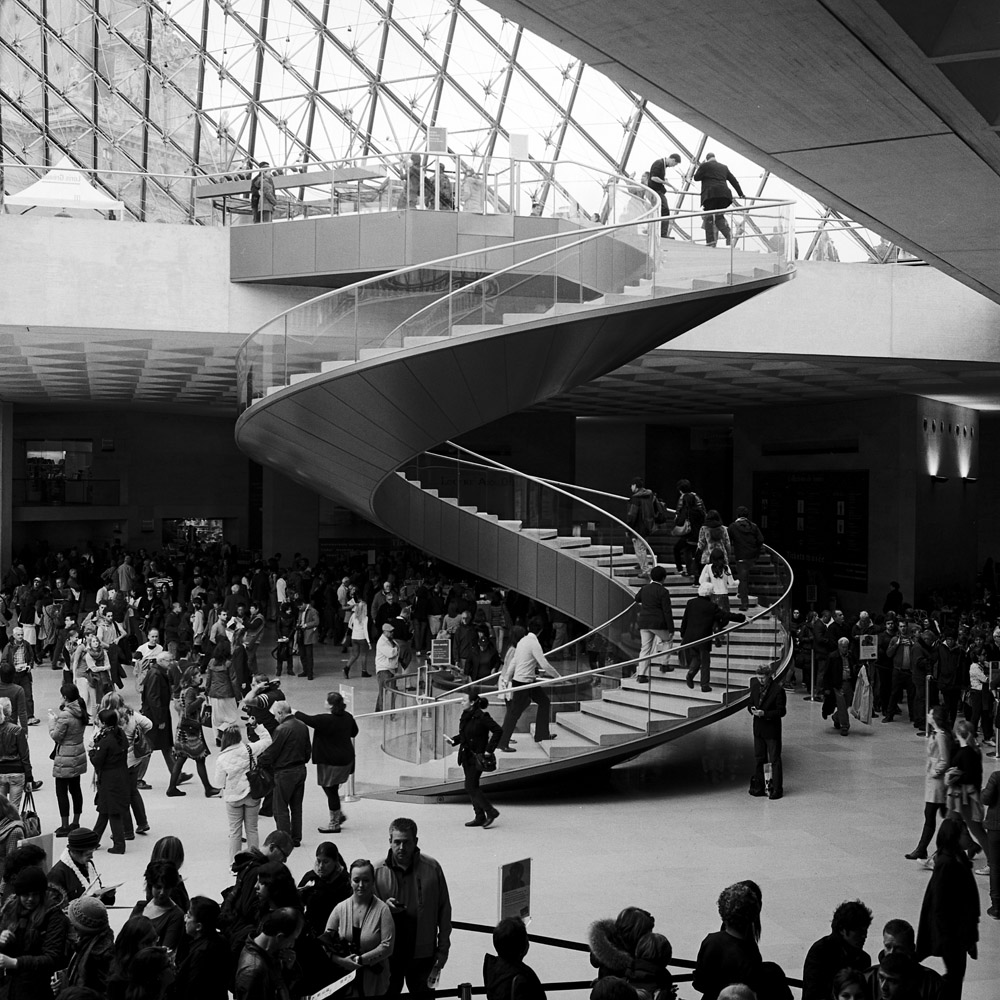
Under the pyramid there is a vast entrance plaza with a huge spiral stairs. In the center of the spiral stairs is the accessibility elevator, a cylinder that rises and falls to transport people to and from the plaza above, and looks like it should be a stage set from 2001: A Space Odyssey.

Spiral Stair, Louvre Entrance

Spiral Stair, Under the Pyramid

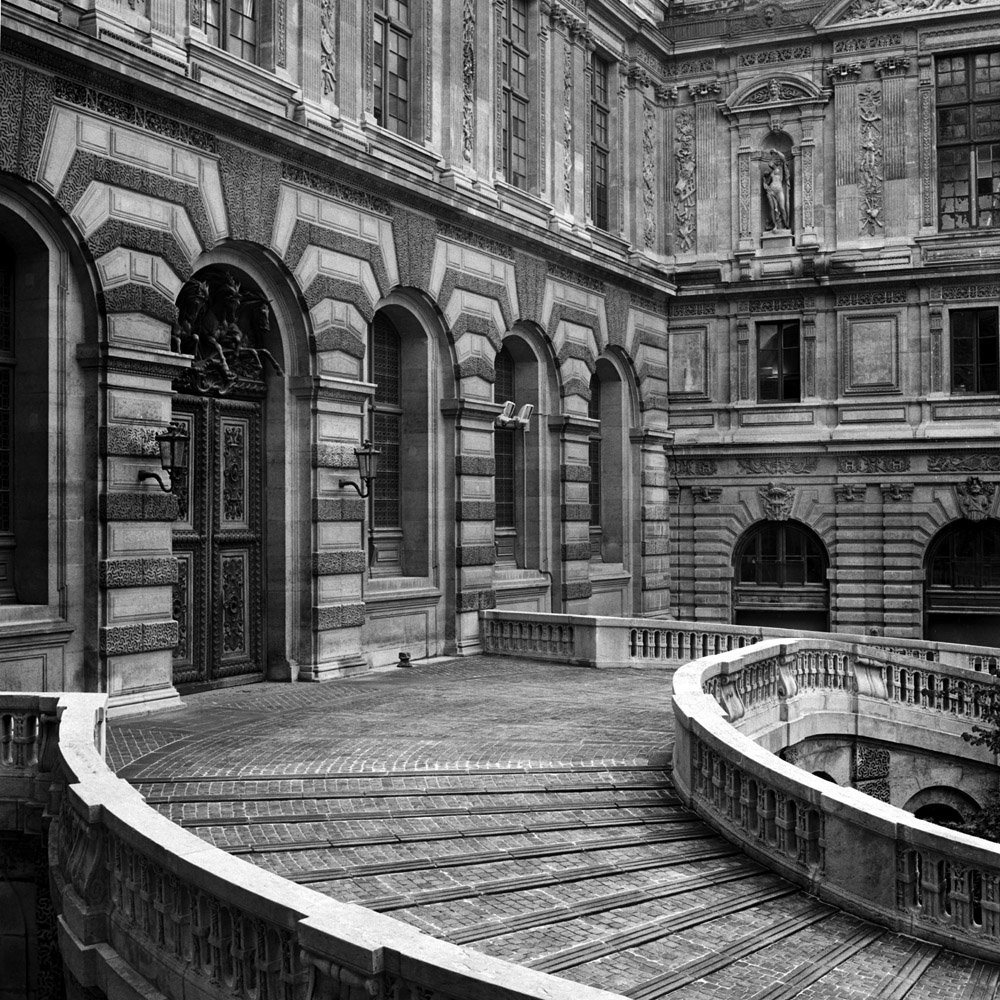
The contrast, a Napoleonic-era entrance ramp and doors (see the N’s in the frieze above the windows and doors). This is empty because the courtyard is closed to the public and filled with construction equipment.

Courtyard, Louvre
Courtyard, Louvre

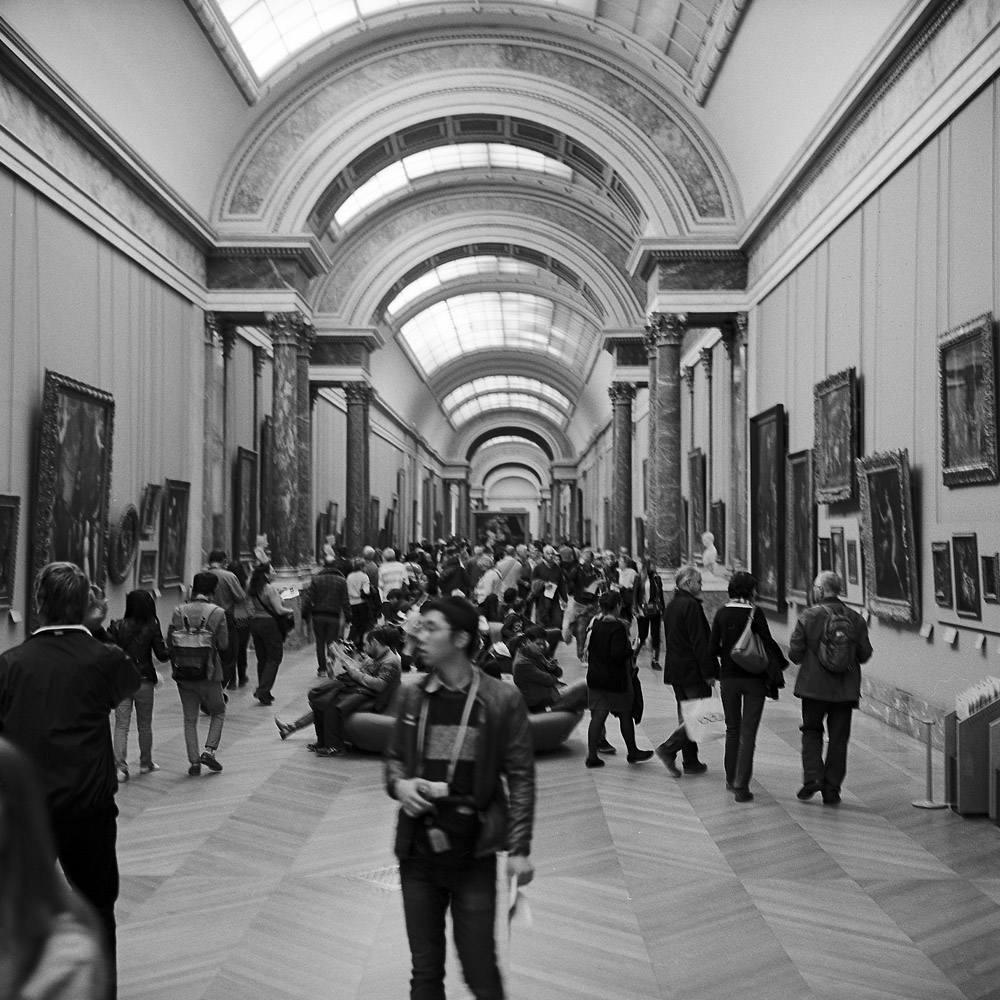
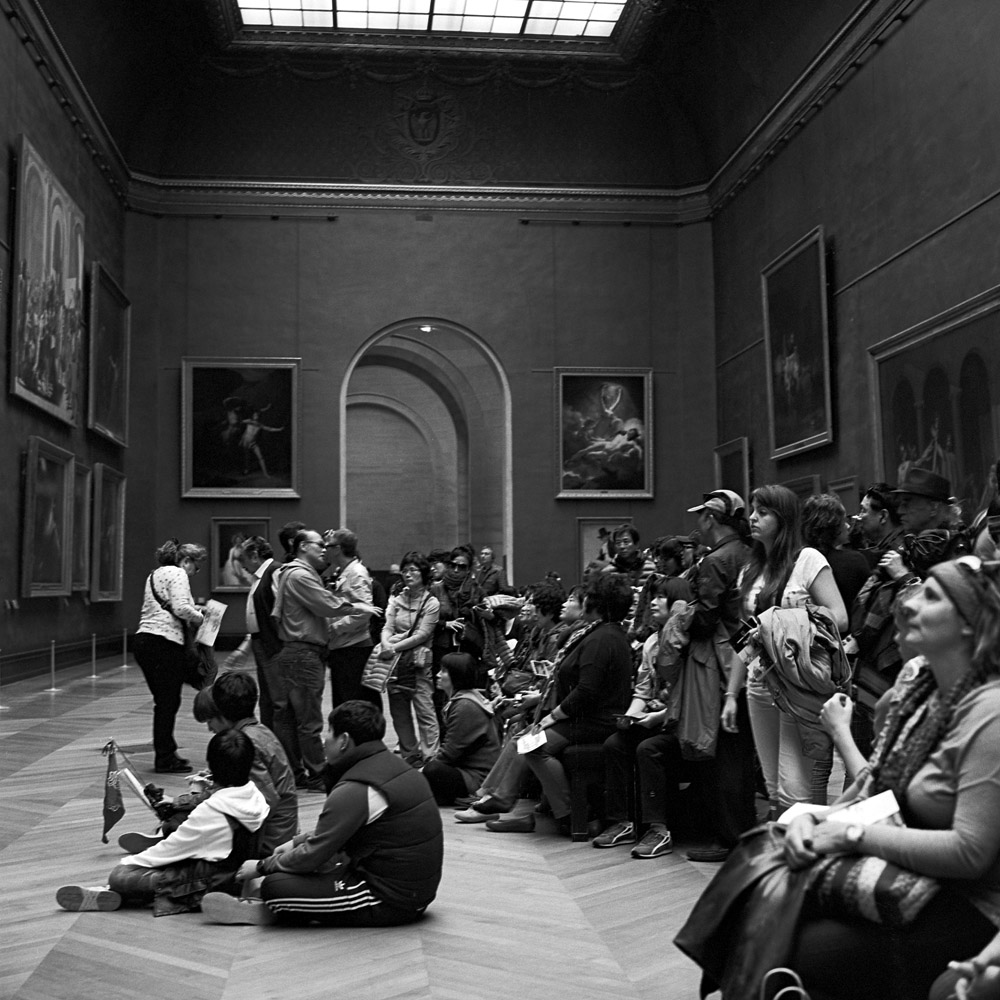
As you can see, the Louvre is a VERY busy museum. I don’t know if it is the most visited art museum in the world or not (I think it is), but it also has to be one of the largest if not the largest. I really only saw parts of one wing of the museum (there are three), and you could easily spend a half a day in there every day for a month and still not see everything.

The Grand Gallery
The Grand Gallery
Visitors, Napoleon crowns Josephine

The grand gallery is where the Italian Renaissance masterworks are held – the three non-Mona Lisa DaVincis are here, along with the Caravaggios – highlights of the collection that most interested me.

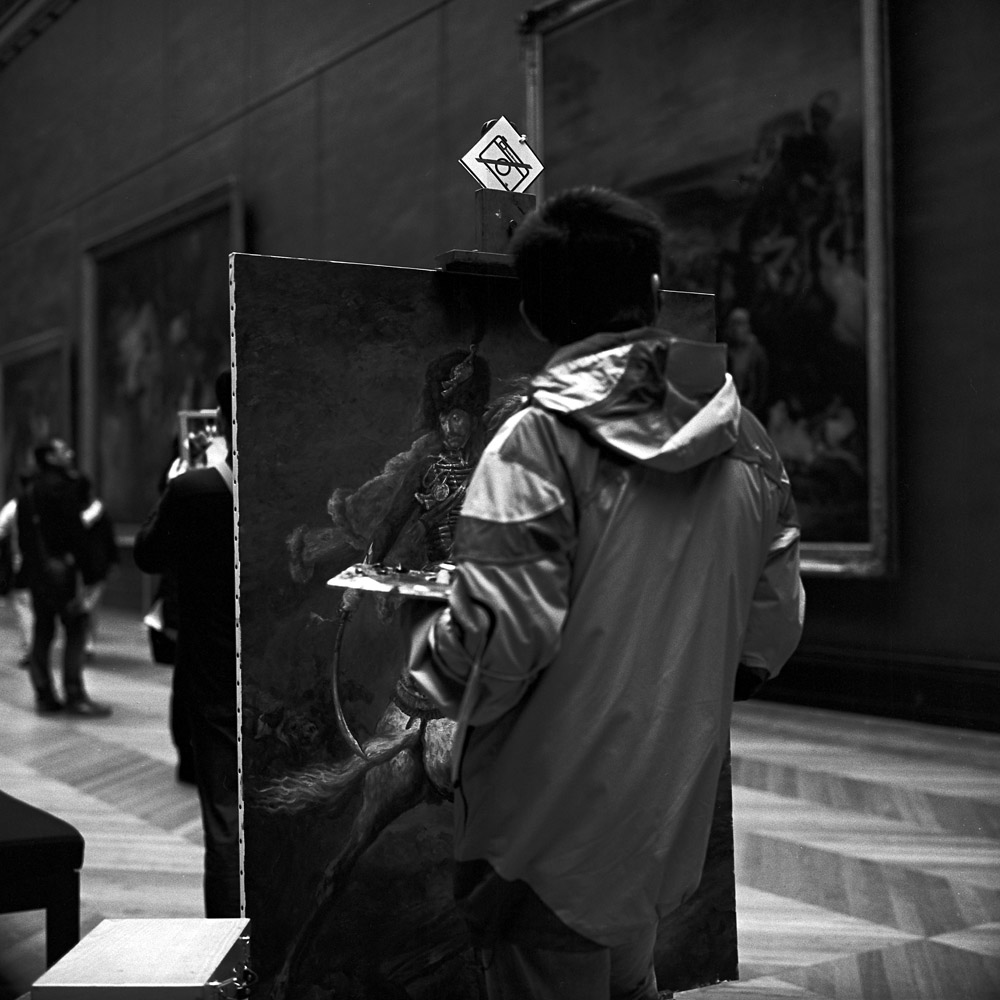
In the section with the 19th century French paintings, there was a painter with his easel set up, copying the famous painting of the cavalryman in the bearskin hat. I couldn’t resist taking this shot as much because of the “no photography” sign he had on his easel. I’ll justify it by saying that I think it had more to do with not wanting to be disturbed by flashes popping than anything else.

Copyist, Louvre
Copyist, Louvre

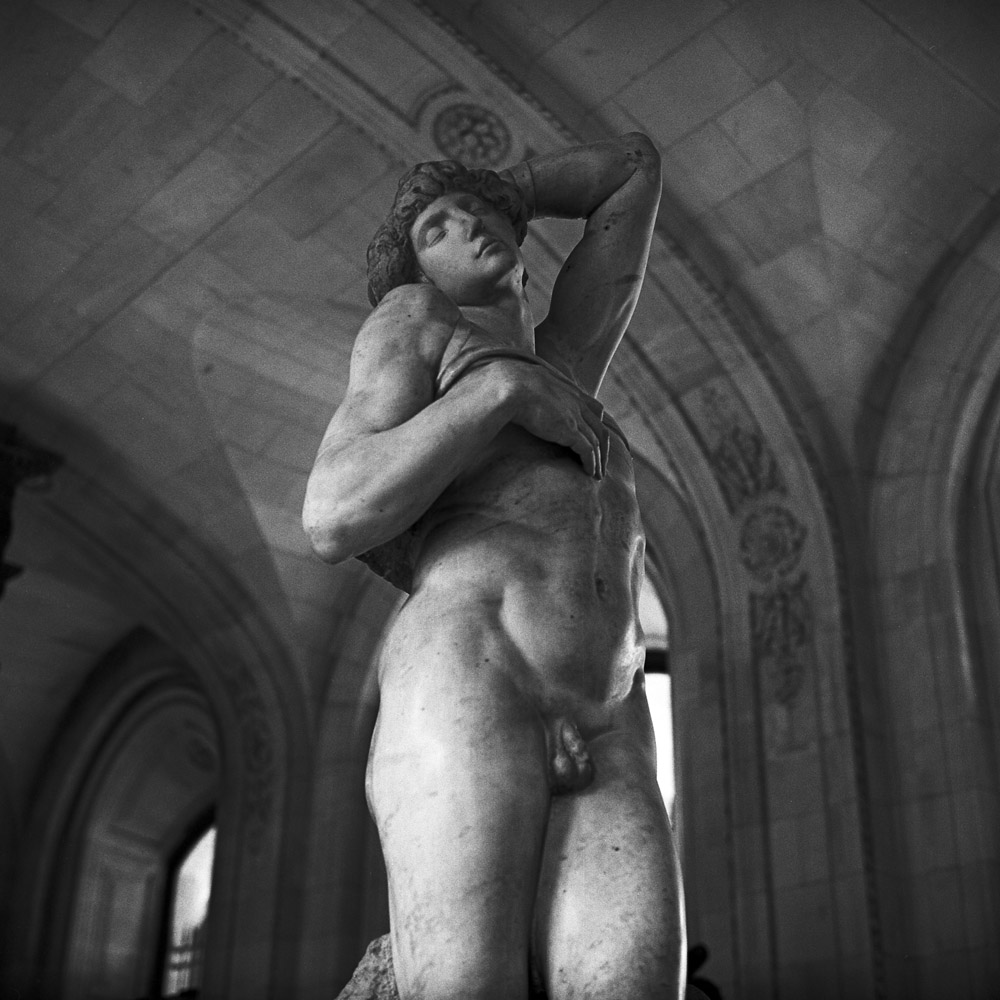
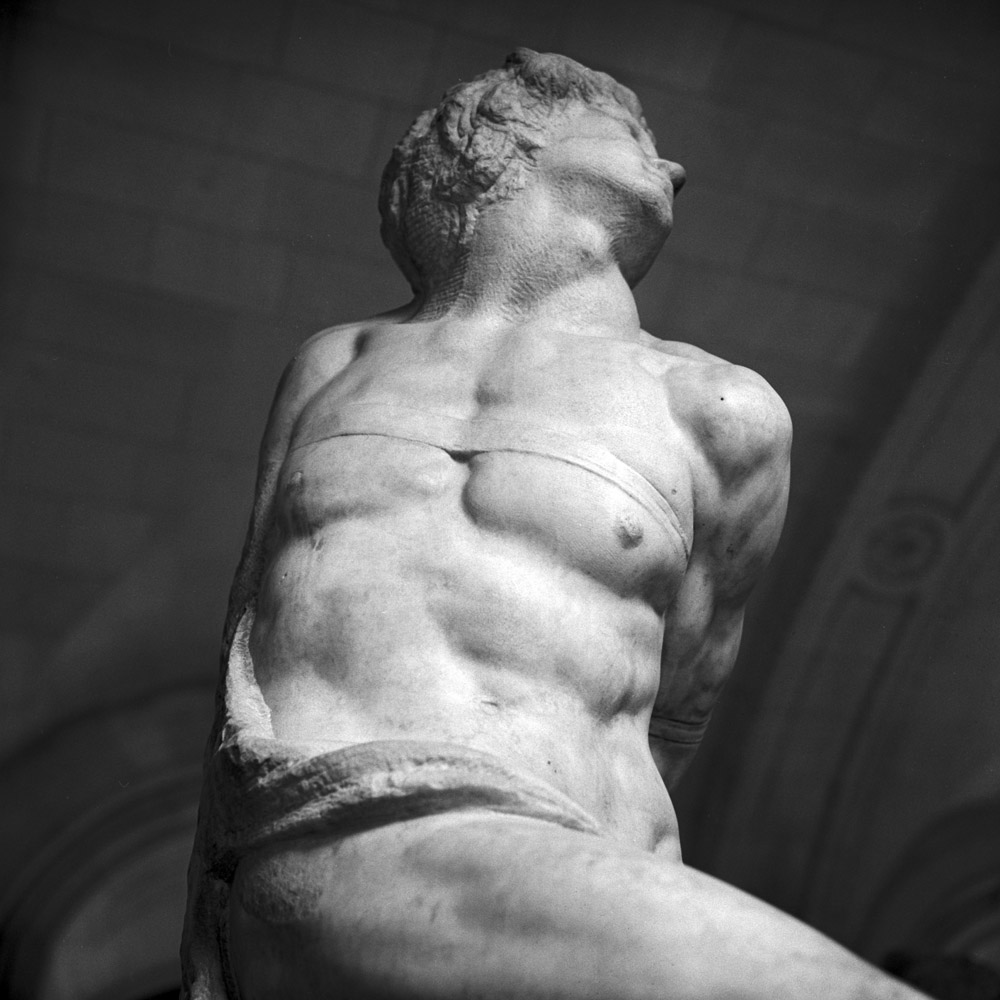
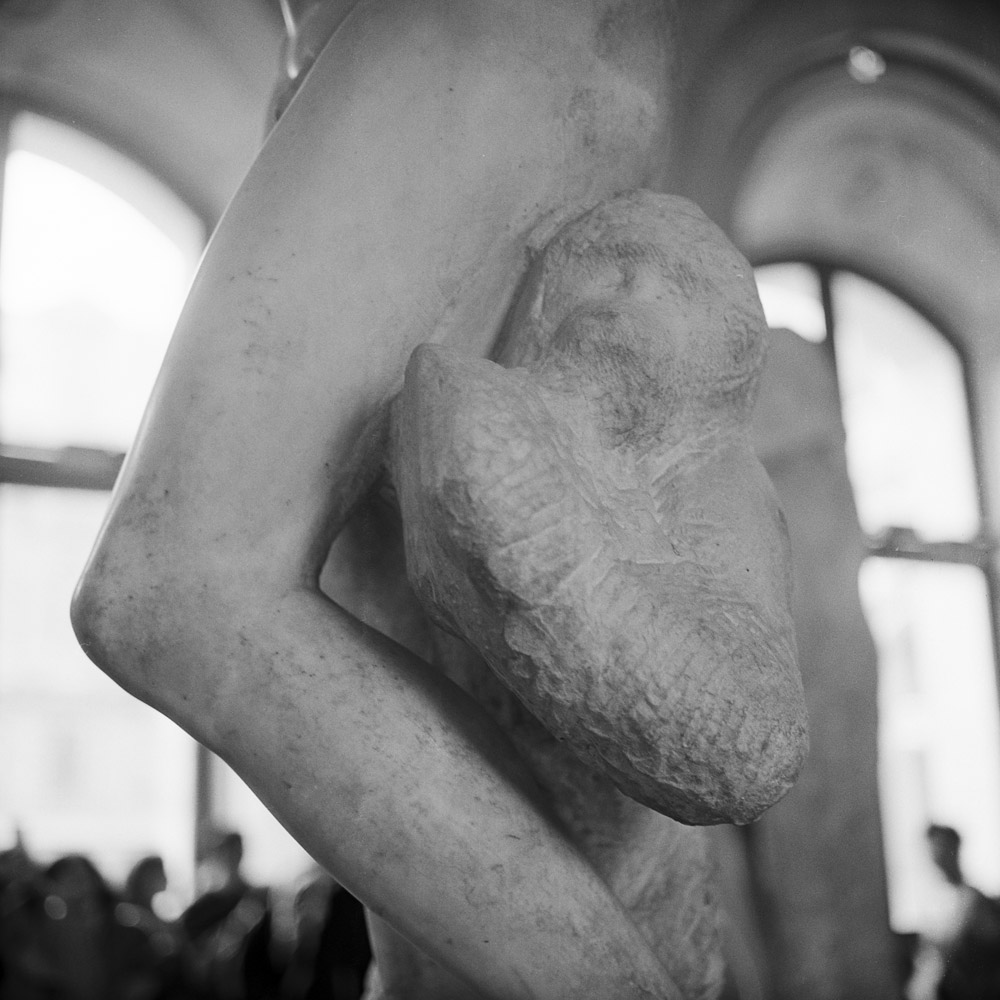
The Louvre has perhaps the very best collection of Michelangelo’s sculpture outside of Italy. Two of the Medici tomb sculptures are in the sculpture gallery, and are of intense interest to me because they are part of the “unfinished” pieces in style. There is still significant debate as to whether the “unfinished” pieces are in fact unfinished or if their appearance is exactly what Michelangelo intended. They are called “unfinished” because they have coarse textures in parts and tool marks are prominent over significant portions of the pieces, to the point that some portions of the pieces are in fact only roughed-in forms without complete features.

Michelangelo, Dying Slave
Michelangelo, Rebellious Slave
Michelangelo, "Unfinished" figure
Michelangelo, “Unfinished” figure

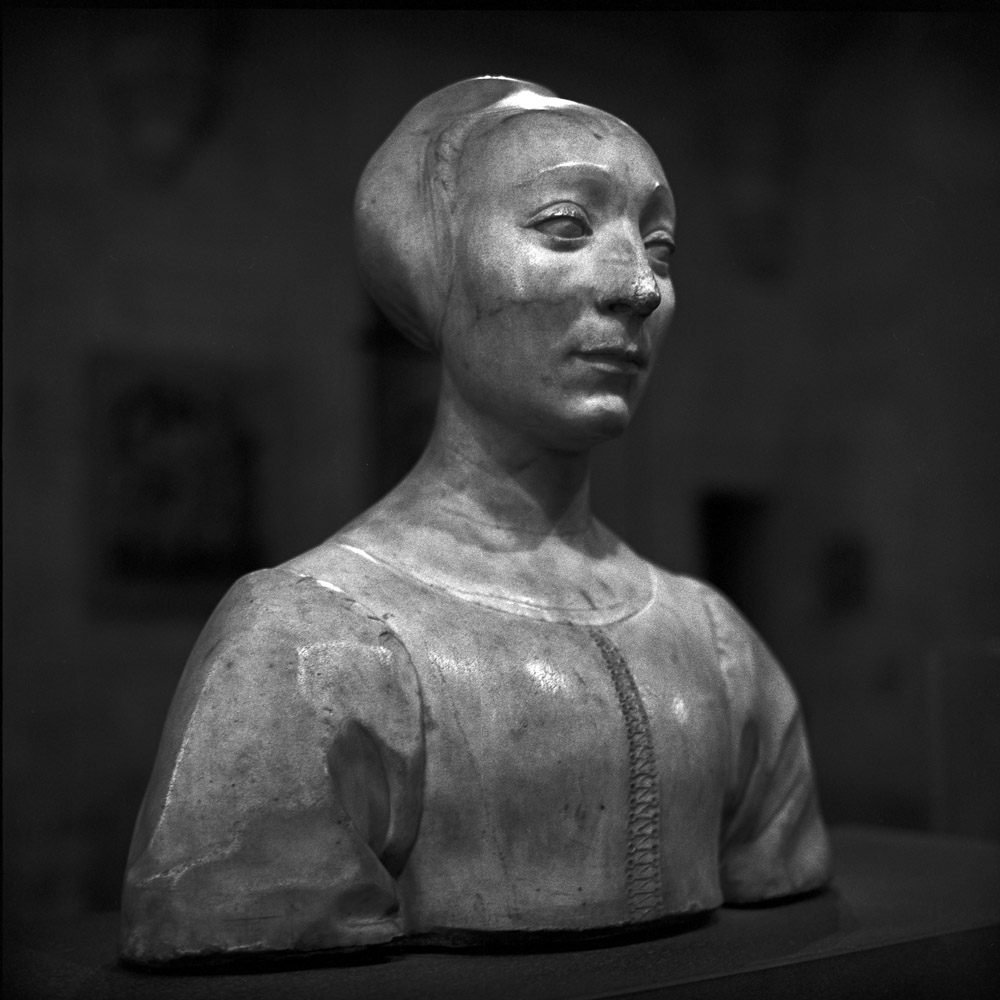
Finally, we have some other sculptural pieces from the Louvre. The Cupid with Butterfly is actually in a side gallery where touching is allowed.

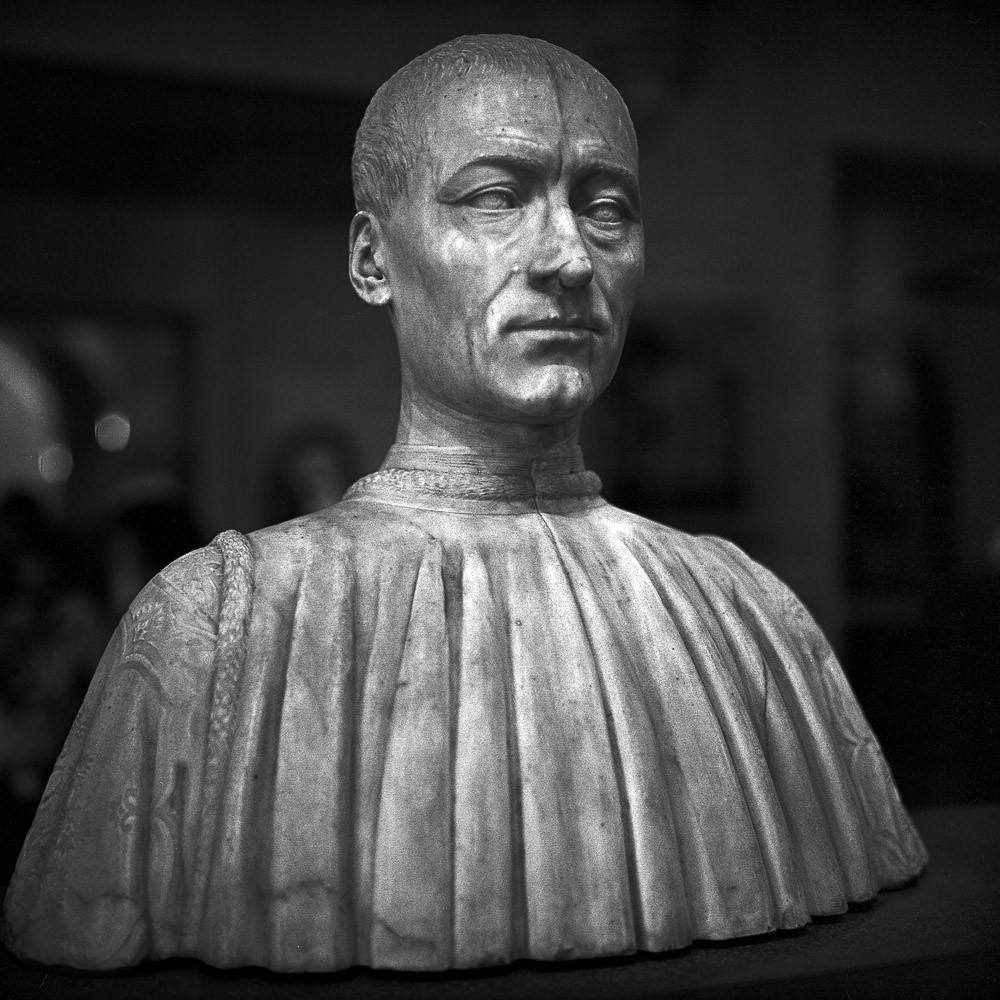
Renaissance Bust, Louvre
Cupid, Butterfly, Louvre
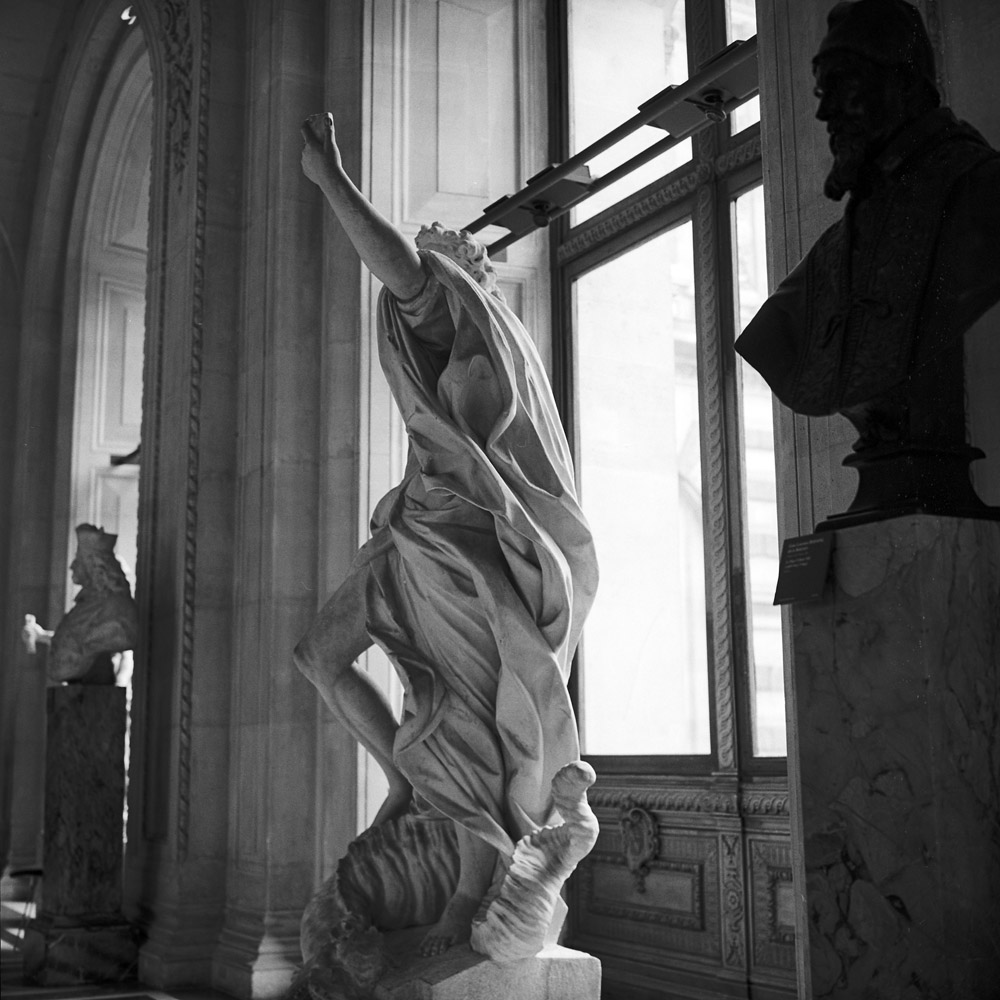
Statue, Sculpture Gallery, Louvre

Submitted work to Onward Compé 2014

Onward Compé 2014 – my work

I submitted three photos to the Onward competition for emerging photographers. Emerging is defined in this case as not having a current ongoing relationship with an art gallery. I’ve had shows, both solo and group, but I’m not represented by any art gallery on an ongoing basis. Perhaps by the time I retire it will happen. In any case, Onward will be good exposure for my work (this time I’m submitting some of my older pieces, male figure studies shot with Polaroid Type 55 back when it was still available).

There are two rounds of judging – the first round, by JPEG only, will be complete and the results announced by December 16. A second round will be judged from actual submitted prints come January, with final results by February 1. The exhibition will take place in March at Project Basho in Philadelphia.

here’s a teaser of one of the images I submitted.

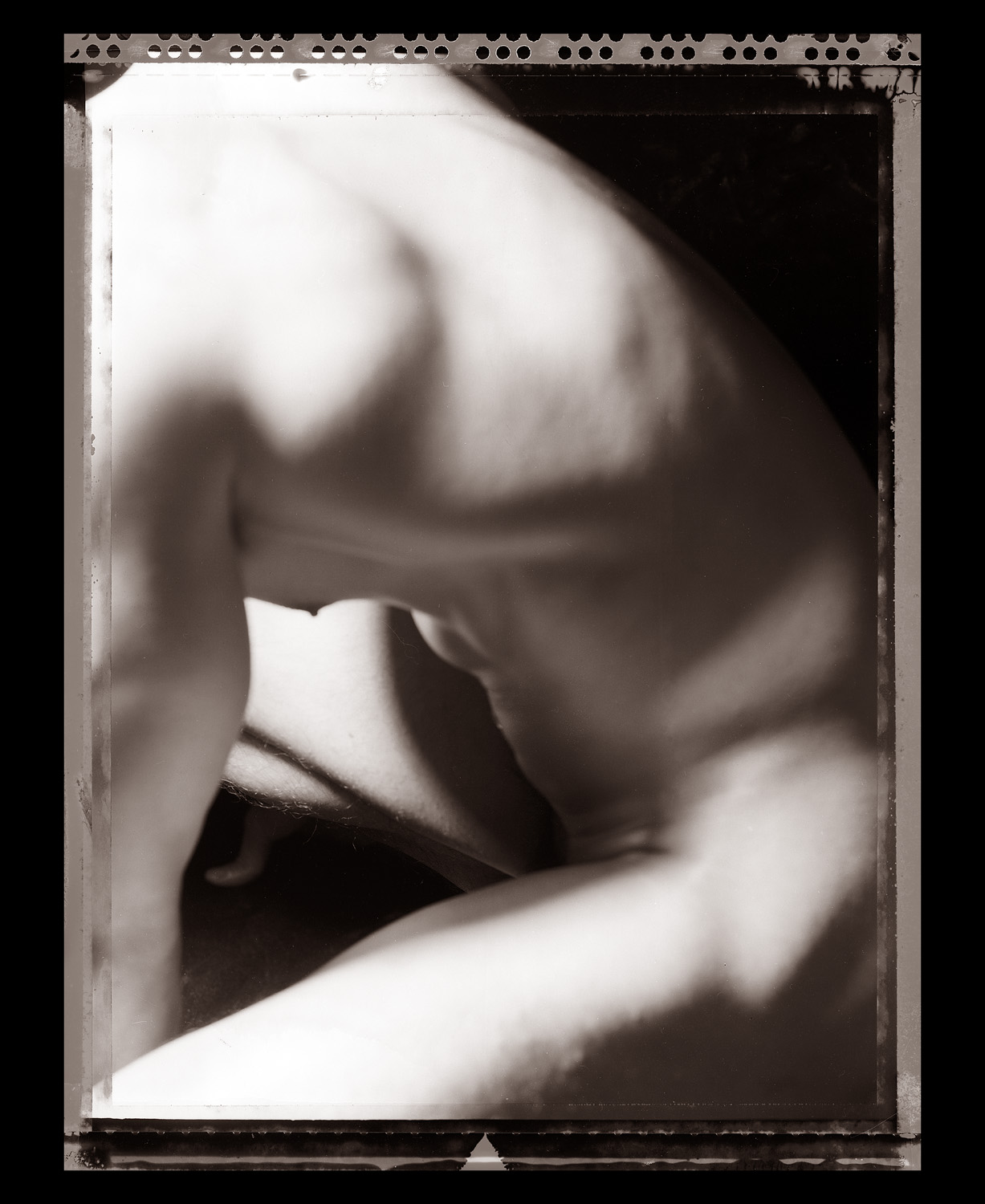
Jose, Torso, Kneeling

Philosophical Musing – Film Development and Physical Experience

I was just developing some film in my darkroom (only two rolls left from Photostock… they will be done tonight!) and while loading the rolls onto the reels in the dark, I thought about the fact that I close my eyes while loading the film, and I picture the movements in my mind’s eye. Never you mind that it is pitch black in the darkroom at that moment, so it makes no difference if my eyes are closed or not. The room’s not getting any darker with my eyes closed. It also made me think about how someone who is blind from birth perceives things like that- I KNOW what my gestures look like because I’ve seen them – I have a definite sense of the space they use and the way they form my body even with my eyes closed. But what is someone who is blind’s perception of such things? I’ve only ever talked with blind folks on a couple of occasions, and I don’t recall them using gestures when talking. If it is something they’ve never experienced, would they even be able to describe it to someone who is sighted?

Two-page spread, Metalsmith Magazine

I got a two page spread in Metalsmith magazine in a feature article about my friend Nick Dong, whose installation piece was part of the “40 under 40” show at the Renwick Gallery here in Washington last year.

Metalsmith, June 2013, p.46
Metalsmith, June 2013, p.47

If you want to get a copy for yourself, you can check it out on their website and order hard copies or PDF copies.
Metalsmith Magazine

I’m also including a video I shot of Nick’s installation. My apologies for the video quality, but it was my first time shooting with that camera and I didn’t know about adjusting the video noise, so the low-light segments are rather grainy looking.

You can see more about Nick and his work on his website – Studio Dong. Nick is originally from Taiwan, and now lives and works in the San Francisco Bay area.