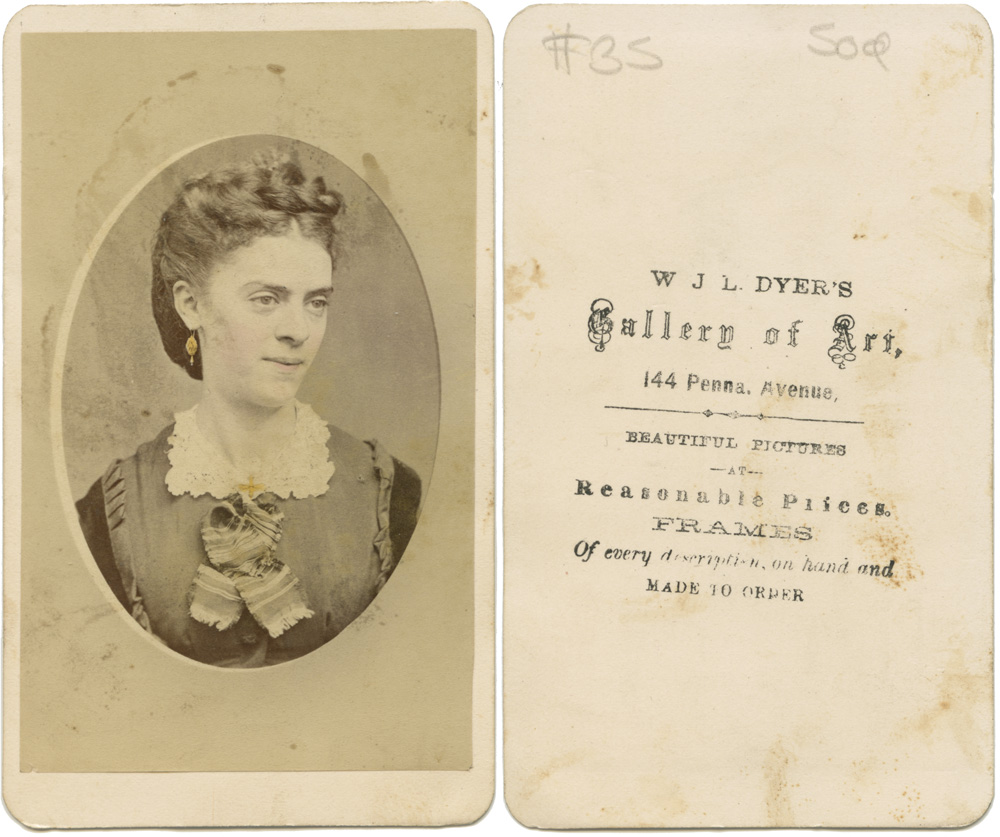
An anonymous CDV by WJL Dyer of Washington DC. Gotta love the advertising pitch on the verso:
W J L Dyer’s Gallery of Art, 144 Pennsylvania Avenue, Beautiful Pictures at Reasonable Prices, Frames of every description, on hand and Made To Order
Also note the hand-coloring of her jewelry and the faintest touch of rouge on her cheek. This is not bad, but I’ve definitely seen better quality hand-coloring on CDVs. Mr. Dyer’s studio, while in the same neighborhood, must not have been a direct competitor to Gardner and Brady. I was reading about the Brady studio in the immediate antebellum years and the first year or two of the Civil War, and it was a highly organized operation employing a wide range and large number of people. Their pay ranged from $8/week for the women who did the finishing work of pasting the photos onto the cartes and other similar tasks up to the specialists who retouched and hand-colored his Imperial prints who got between $11-$16.66 a day (the bonus was paid for working on a Sunday). I doubt Mr. Dyer’s hand-colorists were making that kind of money.
I got this one to add yet another address to my DC photographers’ map collection. I’ll have to look into making the map interactive with representative CDVs from each studio pop up when you mouse over the address. But that’s a programming feat for another day, and something to tackle relative to my day job (believe it or not, I do have a day job to pay for all this insanity – I do software developing). It would actually make a pretty cool portfolio piece for my development career.
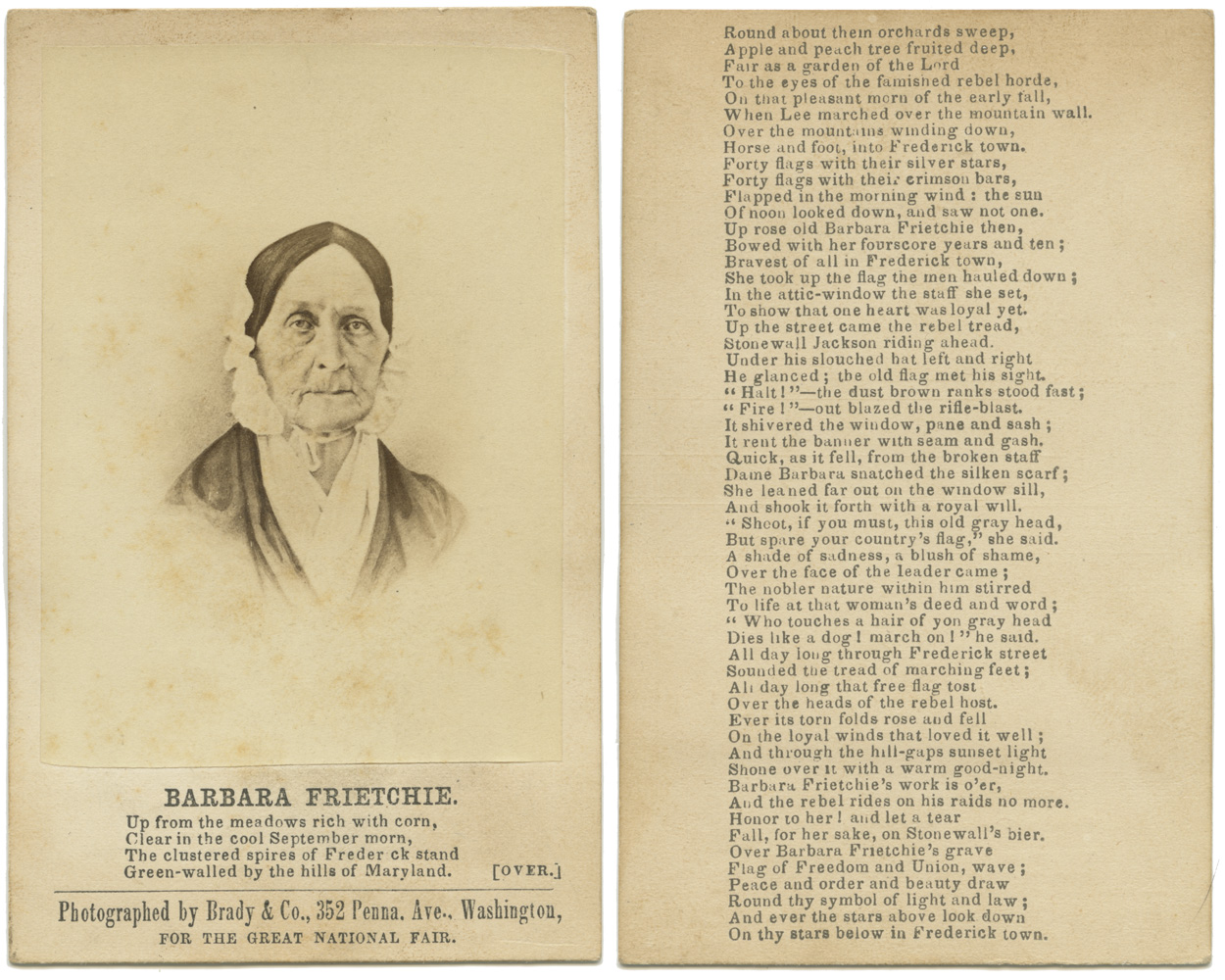
I’ve seen her name spelled Fritchie (there was a local chain of pancake houses in the Northern Maryland/Southern Pennsylvania area called Barbara Fritchie’s Waffle House. We had one on Main Street in Chambersburg, PA when I was growing up. I think it’s still there, and still has a 1930s/40s decor. I need to get up there and photograph it before they renovate and/or close it down and convert it into a Starbucks or something). The story, as rather floridly recounted in the poem on the carte, is that she was a 90 year old widow, living in Frederick, Maryland. Stonewall Jackson’s troops were marching through Frederick and saw the Union flag flying above her house. They shot it down, but she retrieved it and continued to wave it out her window. Stonewall Jackson was so moved by her devoted patriotism (even if for the other side) that he ordered his men to leave it and her alone.
Barbara Freitchie, by Mathew Brady
There are variations on her story – I’ve seen her age listed anywhere between 90 and 95. The spelling of her name is inconsistent.
The photo, by Mathew Brady, was printed up with the John Greenleaf Whittier poem. The photo is not actually by Brady – that is to say, it is a copy of an existing daguerreotype of Barbara Fritchie, made by Brady. She never sat for him, because by the time the poem was written and the carte de visite created, she had been dead over a year. According to Wikipedia, the whole incident that inspired the poem never actually happened, as Jackson’s troops never marched up her street, but in fact were almost a quarter mile away:
The flag incident in the poem likely never occurred, however, as Barbara Fritchie was sick in bed that day. She told the housekeeper to hide all valuables to prevent looting, and to take in the U.S. flag that hung outside, but it was never moved, and as a result was shot up by the Confederate troops. Accounts differ as to how the legend that inspired the poem arose. The flag, a symbol of the need for myth in times of war, may be seen in the Barbara Fritchie House and Museum.
History disproves the poem with the fact that the Confederate troops never passed by her house. Although they were within range of sight, they would only have been heard by Mrs. Fritchie if they had yelled to her at the top of their lungs.
The troops marched south on Bentz Street and turned west on Patrick Street. To have passed Barbara Fritchie’s house, they would have needed to turn east and march a minimum of 1000 feet to have been at her door.
The woman who inspired the poem, and who was brandishing the flag in front of the Confederate troops, was actually Mary Quantrell who lived on Patrick Street.
In 1899, John Greenleaf Whittier was quoted in a New York Times article based on a letter he wrote to the Frederick Examiner shortly before his death, vouching that he had no knowledge that the Barbara Fritchie incident was a hoax. What Whittier Knew
The Brady image was made to sell at the Great Sanitary Fair in Philadelphia in 1864. Sanitary Fairs
…were civilian-organized bazaars and expositions dedicated to raising funds on behalf of the United States Sanitary Commission (USSC) and other charitable relief organizations. Over the course of the Civil War, they became one of the most popular means of fundraising for the Union cause. from Philadelphiaencyclopedia.org
The name sounds somewhat misleading today in that it lends the aura of having something to do with bathing the participants. In fact, they were about protecting the health and welfare of soldiers in the field. the US Sanitary Commission was a relief organization, analagous to the Red Cross, that provided everything from bandages to nurses to food in the camps, and did what they could to enforce healthy living conditions for soldiers and the wounded in hospitals.
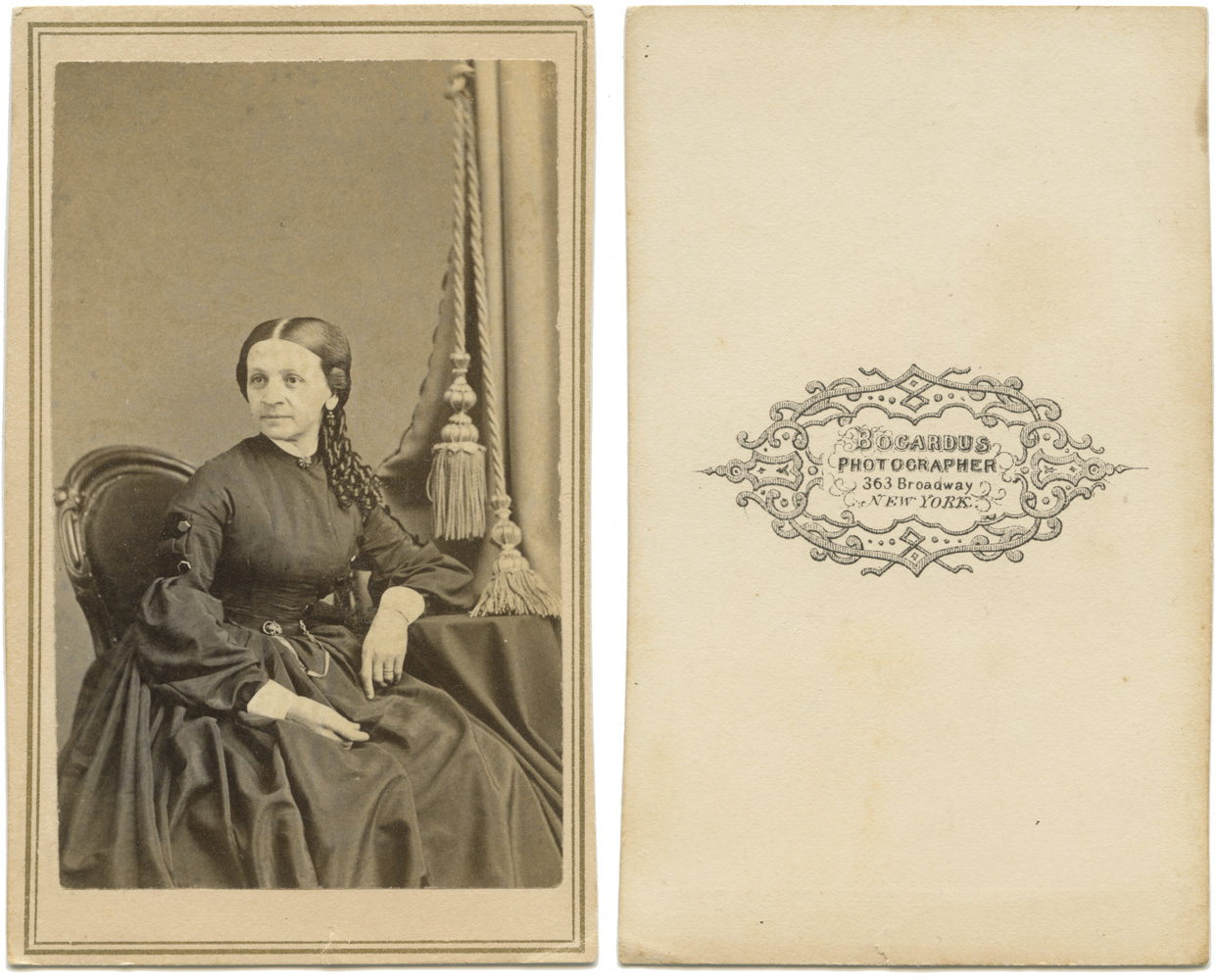
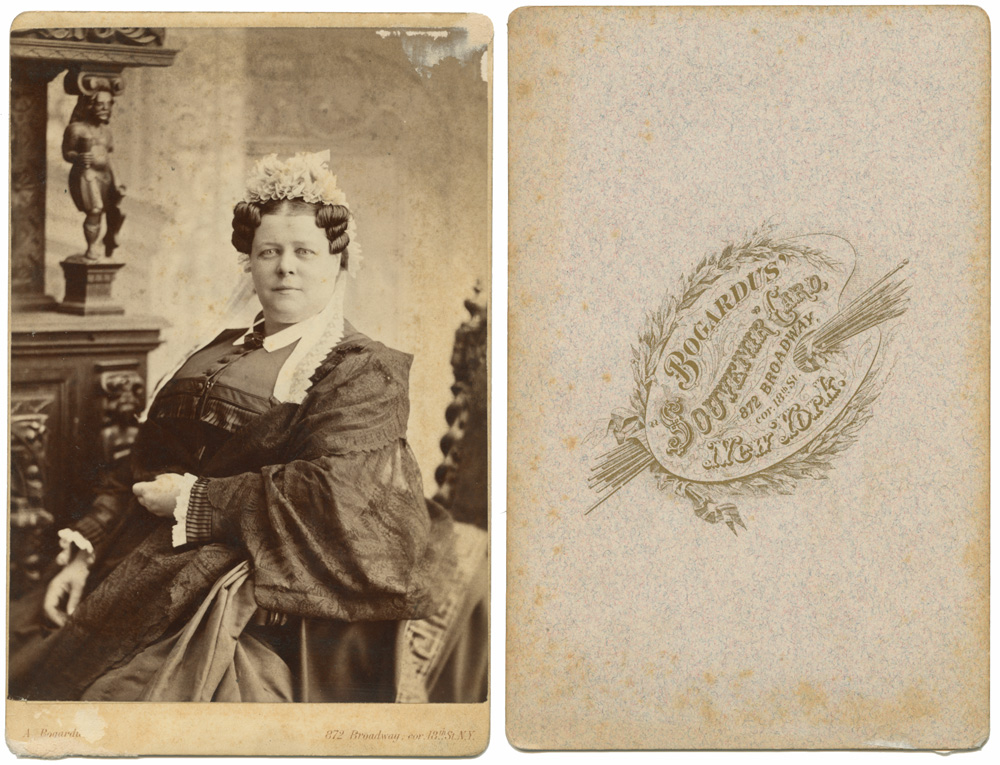
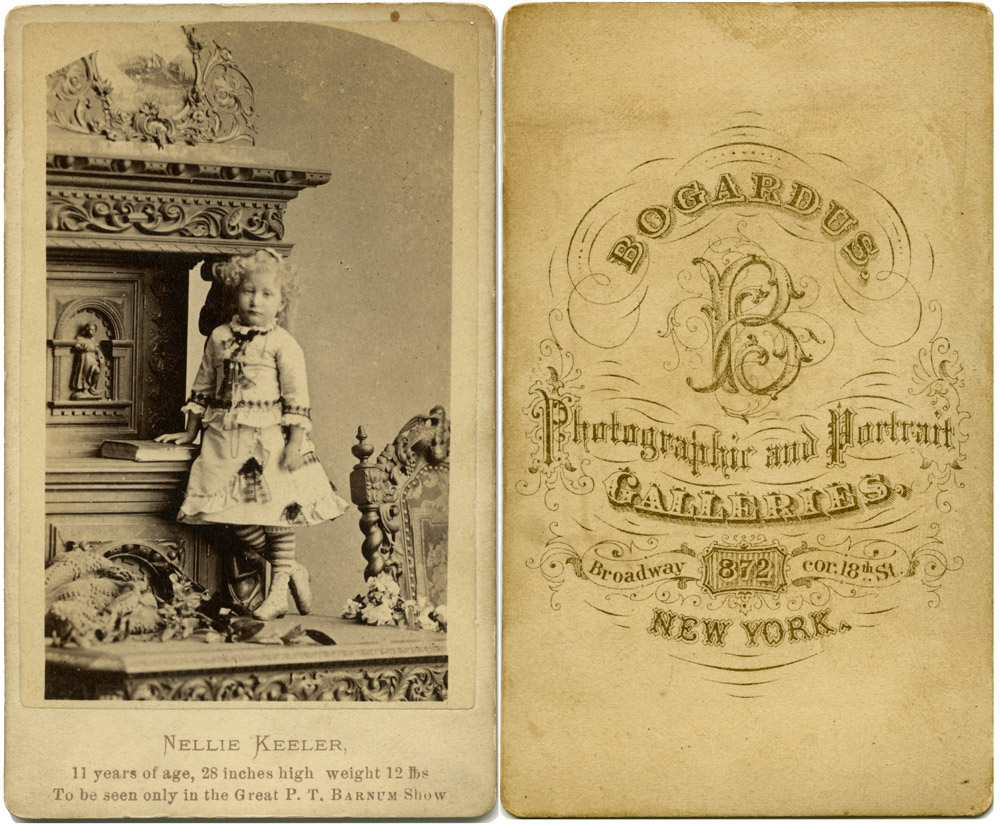
This is an anonymous portrait by Bogardus, one of the “big names” in mid-19th century American portrait photography. The carte itself and the print are in excellent condition, and I love the photographer’s blind stamp on the back. I’m including two more below by Bogardus to show the different blind stamps he used. I’m sure it evolved further over time, but these are the ones I have in my collection.
Plump lady cabinet card, Bogardus StudioNellie Keeler, on Bogardus’ Sideboard
On a parallel but unrelated note, I think the cabinet in the Nellie Keeler and plump lady photos is to Bogardus what the “Reaper” clock is to Brady (as referenced in my previous blog post). The article I linked mentioned that the author found two copies of the Reaper clock like the one Brady had in his studio – it would be very cool to find Bogardus’ sideboard and bring it into a studio.
Here is a CDV of Suzie Reed, another one of Barnum’s Little People. The image is by Brady, even though the backmark just says E. & H.T. Anthony. The image is documented in the Meserve Collection, which was a collection of Brady images assembled by Frederick Hill Meserve that ended up being one of the largest repositories of Brady’s work not held in a museum. Another notable hallmark is the “reaper” clock, which made a regular if infrequent appearance (there are some 60 known images by Brady featuring the clock, but more may exist in the negatives as the clock may have been cropped out of the final prints). There’s a great article about the clock online – Bob Frishman’s Story of the Brady ‘Reaper’ Clock.
In honor of my latest acquisition for my collection (posted immediately below), I’m going to recap my 19th century Native American images collection.
The new image is a school class photo from Springfield, South Dakota. I find the image fascinating and remarkable by virtue of the racial diversity in the school group. Though the class is mostly Native American, there are white and African-American girls in the class as well. I think the teacher who inscribed the card on the verso is the woman in the center of the photograph.
Native American School Group, Springfield, South Dakota
The inscription reads: “With best wishes, Your loving teacher, Mary B. Benedict, North Walton, Delaware Co. New York. Alice & Lucy Cougar”. I’m assuming that Alice & Lucy Cougar are two of the Native American girls in the photo, but which two I’m not sure.
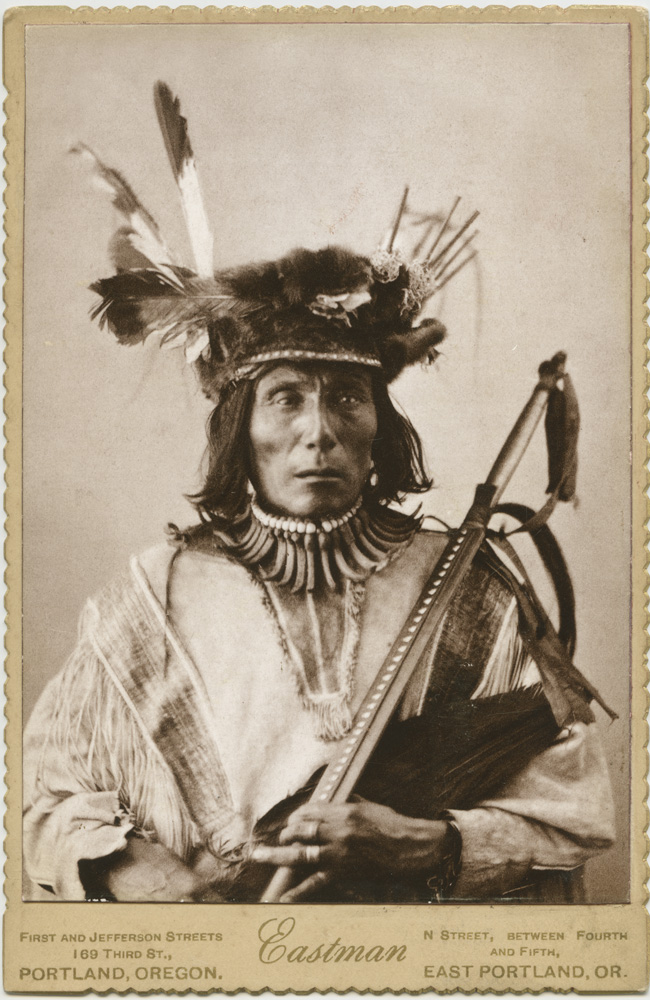
Native American by G.L. EastmanNative American and Friend,Klamath Falls, Oregon
I’m not sure on the date on this one – it could well be early 20th century, but I’m including it because it is non-exploitative. If anything it is similar in spirit to the school class group in depicting interaction between Native and non-Native Americans in apparent social equality.
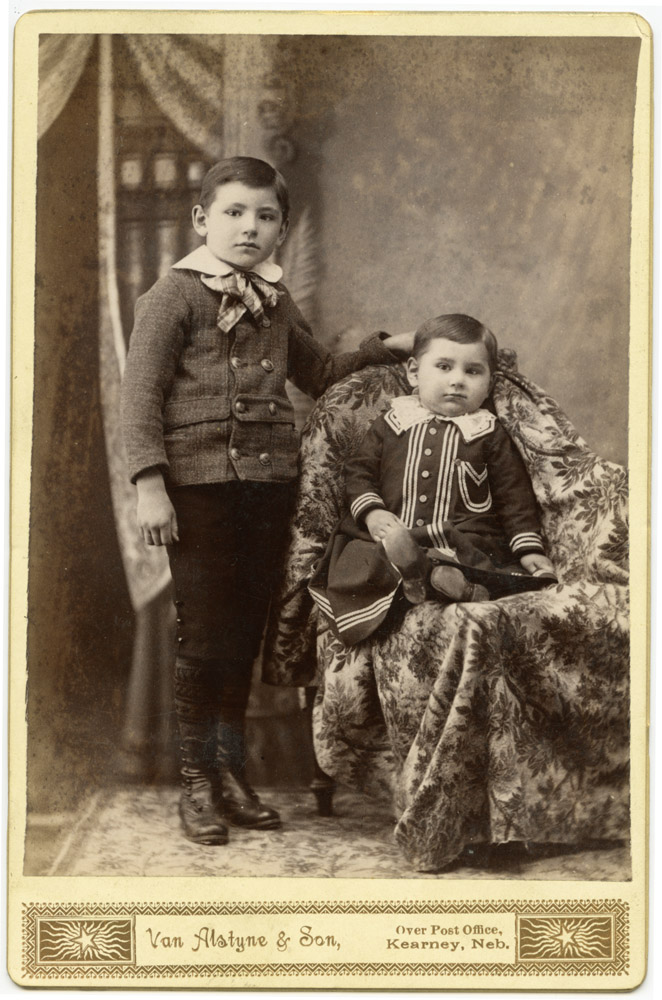
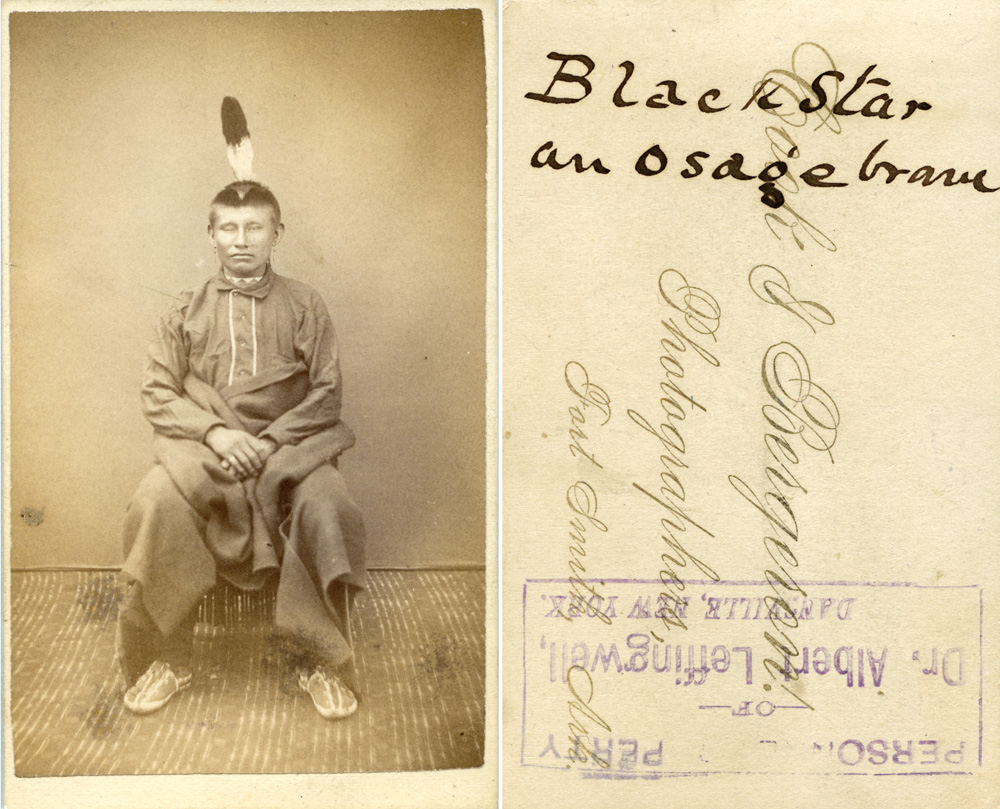
Two Native American Boys, Kearney, NebraskaRain-in-the-face, by Morse, San FranciscoBlack Star, an Osage BraveNew Mexican Native CoupleAmbrotype, Penobscot Boy, 1857
This last one is probably the oldest image of a Native American I own, and will most likely remain so, as images this old are quite rare. Most imagery of Native Americans is from the west and mid-west, as Native populations had been largely subsumed and/or eradicated from the east coast by the time photography arrived.
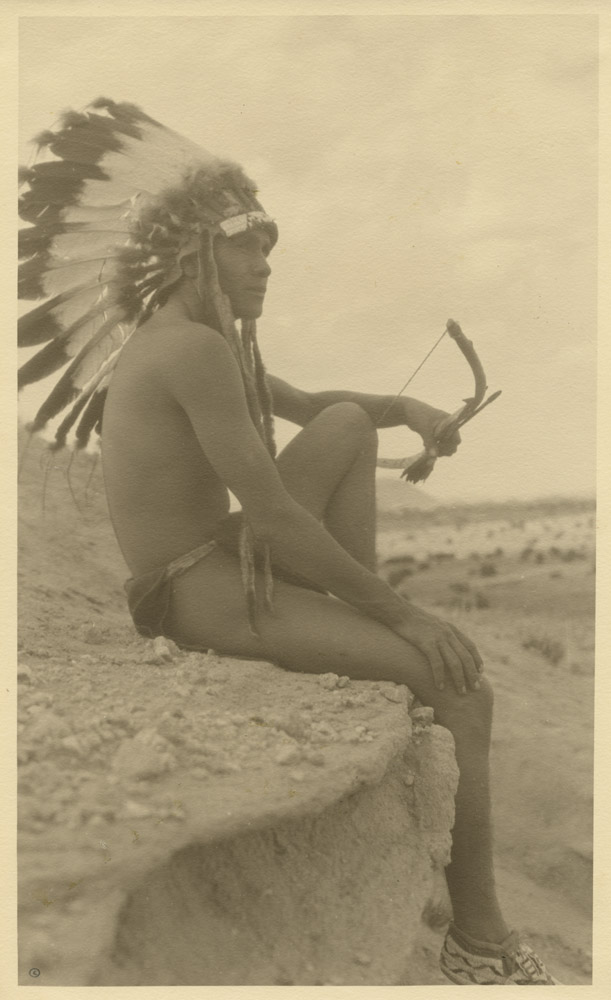
The other two “Art” photos of Native Americans I have are, albeit sympathetic, exploitative portrayals of Native American men in the line of “Noble Savage/Vanishing Tribe” imagery meant to play on the sympathies (and perhaps the subconscious erotic sentiments) of an Eastern, caucasian audience. The reason I say erotic sentiments is that they depict handsome young Native men wearing signals of exotic “nativeness” (headdress, jewelry), but little else. The signs of “nativeness” may or may not be any degree of authentic or relevant to the individual wearing them. The George Eastman photo here is heading that direction in that the costumery the subject wears may not be of any one particular tribe, much as Edward Curtis would do when he felt a photo needed a little something – he would hand his sitter some wardrobe accessory that they might never have otherwise worn and got them to don it for the picture. In that regard, photos like Curtis’ and Eastman’s work are not “documentary” in a strict sense, but they are often the only record that exists of a person or a culture, so they do have record value.
Navajo Brave, Grand Canyon, attributed to Karl MoonA Tewa Bowman, by W. Allen Cushman
While the Carl Moon “Navajo Brave” may be wearing authentic Navajo jewelry, he’s not wearing much else, and the loincloth is not exactly practical daily wear. I could be wrong, but the “New Mexican Native Couple” image shows what I believe would have been far more typical attire for that region of the country. Native Americans may be blessed with a higher melanin content in their skin, but that’s still not a good reason to run around near naked all day at 5000′ elevation under a blazing sun.
The “Tewa Bowman” is another in the same vein – what little accoutrements he wears may be authentic or may not, but to the intended audience for the image it is irrelevant because they neither know nor care; the bow and feathered headdress point to “Indian-ness” and the comeliness and physical condition of the sitter make him “noble” in the same spirit of a Grecian marble nude.
These images leave a complicated, conflicted legacy. They purport to be records of a vanishing culture, yet the record they leave is at best fuzzy and at worst totally inaccurate. The 20th century “save the noble savages” images took the problematic record images one step further. By the dawn of the 20th century, there was a growing awareness in Anglo civilization that Native cultures and peoples were truly vanishing, and the attitude began to shift from approval of that fact to a sense of loss and a desire to intervene in that downward spiral. These “art” images fed a market for Anglos who had no first-hand knowledge of Native culture and felt some degree of racial guilt. Even if the base motivation was in the right place, the images exploited Native subjects to feed a market, wether through distortion of identity, sexual exploitation, or both.
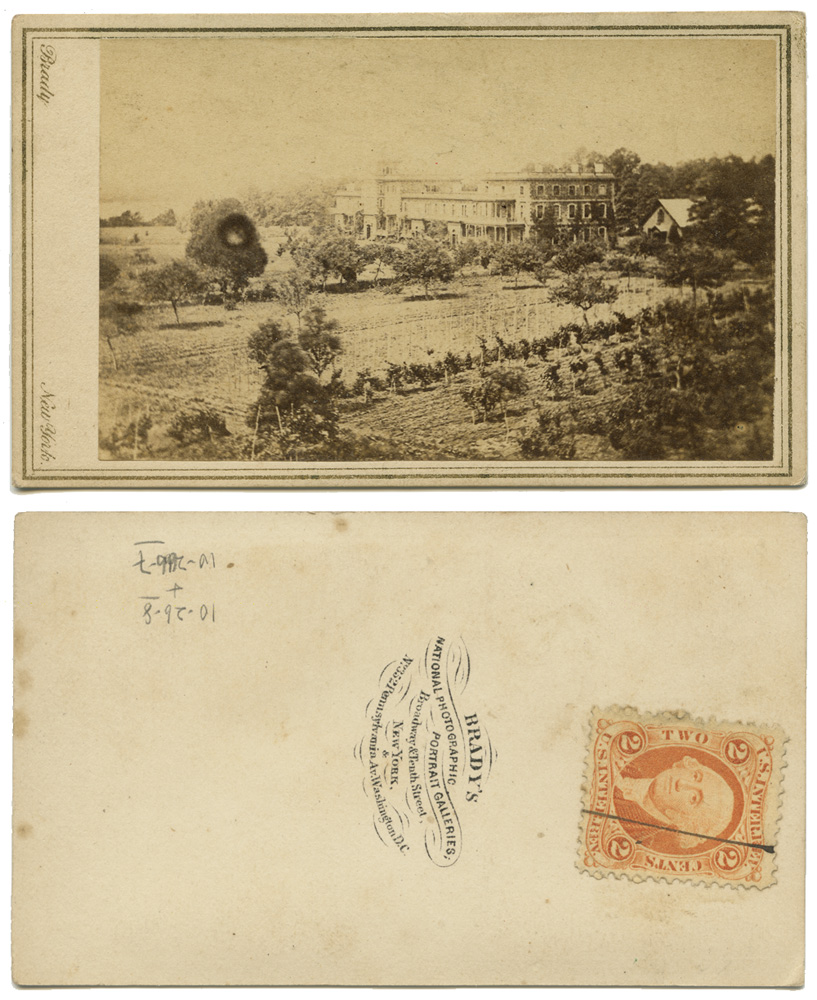
This is not a recent acquisition, but something I’ve had in the collection for a while, before I started blogging about my collection. So here it is – the Pleasant Valley Winery in Hammondsport, NY – the first bonded winery in the US. It’s hard to say if this would have been done by Mathew Brady himself or one of his assistants. The winery opened in 1860, so this would have been done during the Civil War. The client would have been a big enough deal that you’d think Brady would have done it himself, but he was also busy enough with his studios in DC and New York, servicing high-profile clients, and doing some battlefield photography around Washington DC, it would be hard for him to have taken the two to three days it would have required for him to run out there by train (assuming there was a rail connection to Hammondsport from New York City, it would be entirely likely in 1860 that he had to change trains at least once, and quite possibly more, using railroads that topped out at 30-35 miles per hour. Today, following the likely rail route from New York City to Albany, then west to Hammondsport, it is over 375 miles and takes 6 1/4 hours on interstate highways).
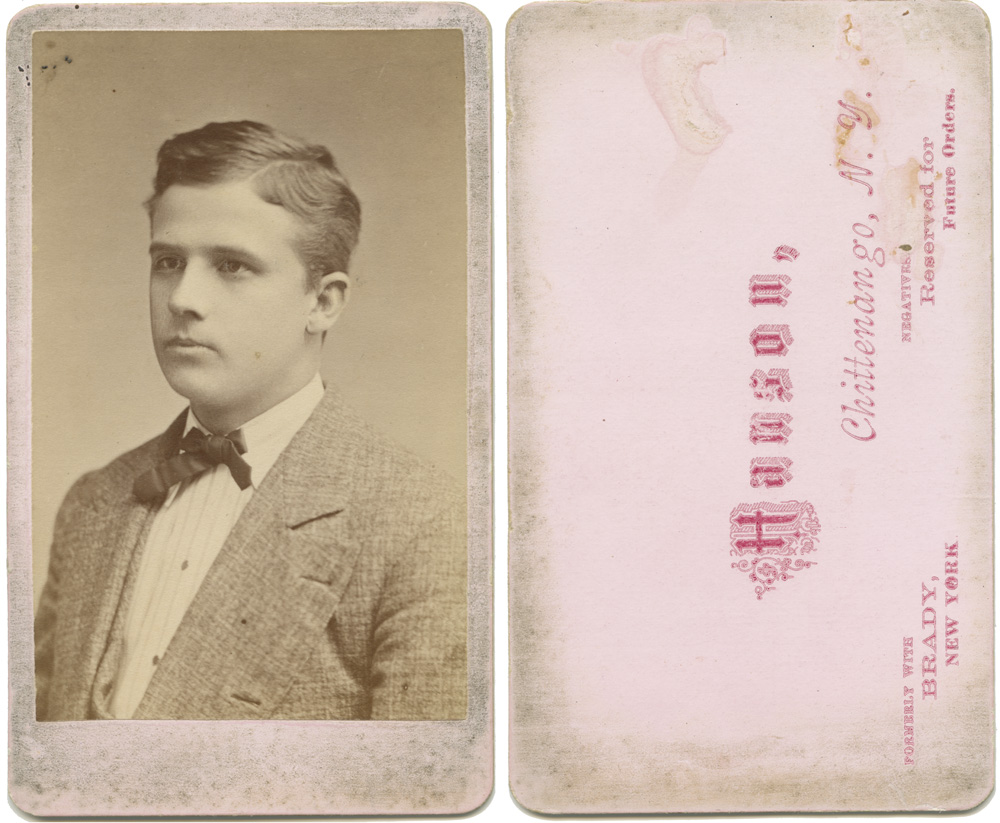
The CDV itself is rather unremarkable – in average condition, anonymous subject. What caught my attention, though, was the notation by Mr. Hanson in the lower left of the verso – “Formerly with Brady, New York”. This is the first CDV I’ve seen where the photographer marketed himself as having worked for the celebrated master, Mathew Brady. I don’t know if any of Brady’s other camera operators/studio assistants ever marketed themselves this way, but it’s a fascinating find.
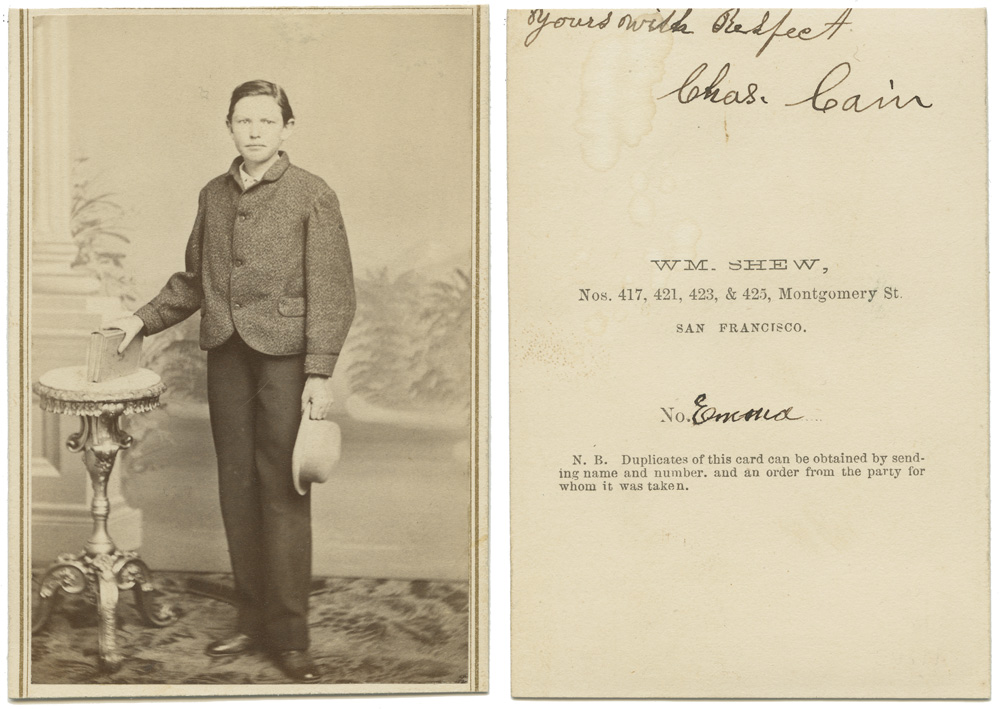
I love the personal touch on this card – “Yours with Respect, Chas. Cain” and “Emma” in the negative number spot. He looks like he’s barely old enough to shave, yet out in the world on his own. The handwriting is somewhat unsteady – teenage nerves at dedicating the card to an intended? At first I thought the phrasing was a bit odd for a teenage boy, but that was the 19th century, now we are in the 21st. A 21st century kid would probably not send a picture of himself in an ill-fitting suit to a girl he liked with the inscription “yours with respect” (he’d probably sext her with a photo of his nether anatomy from his cellphone), but “yours with respect” is VERY much in keeping with a 19th century teenager’s style of expression.
Also note the feet of the posing stand peeking out from behind his legs – because photography is so instantaneous these days, it’s something we never experience today unless you happen to get into alternative process photography, so it stands out as anomalous to a modern viewer.
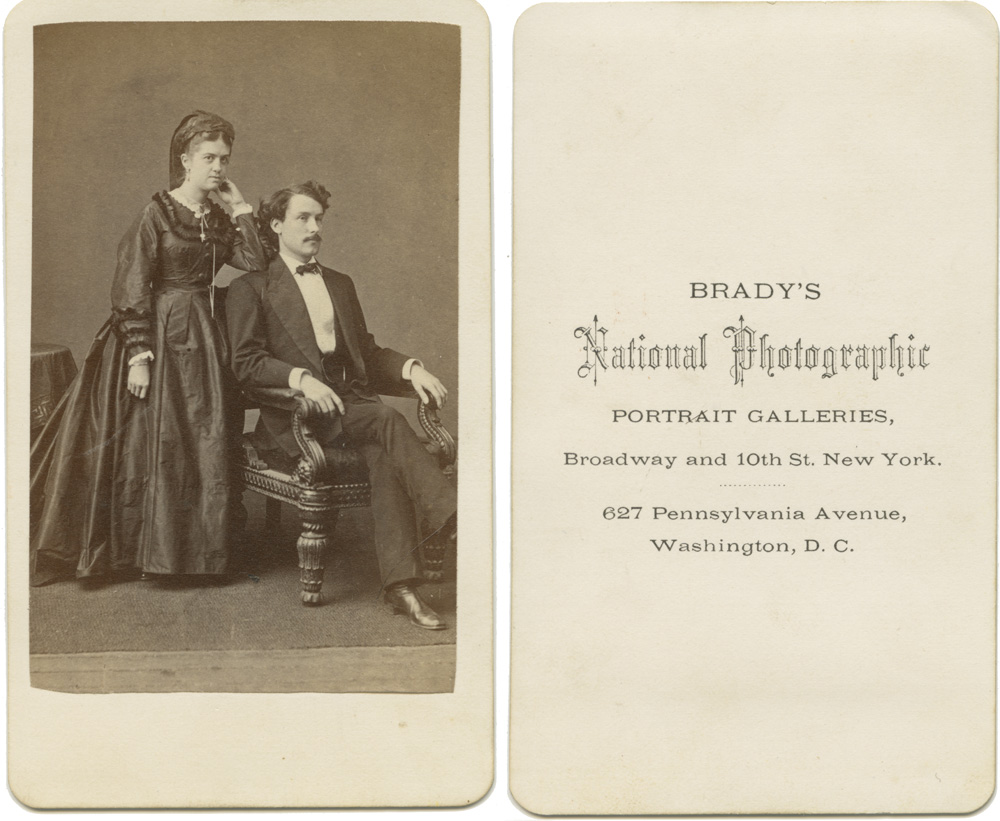
An anonymous couple by Brady’s New York studio (if the backmark follows the formula I’ve interpolated, this is from the NY studio because it is listed first). The carte itself is in immaculate condition, and this is another variation on the studio imprint. Brady seems to have changed his often, unlike others (Fredricks, Gurney, Bogardus, Eisenmann) whose imprints remained largely unchanged throughout their studio operations.
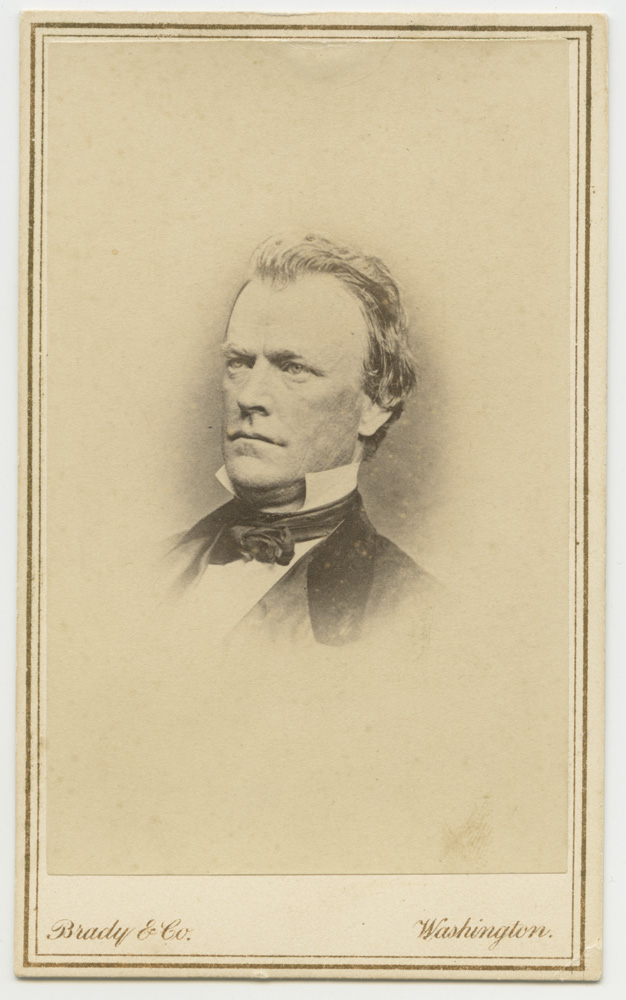
If you’ve been following my blog for any length of time you know by now of my interest in images by Mathew Brady’s Washington DC studio. Here is another gem, in near perfect original condition. The sitter is anonymous.
I’ve seen enough of Brady’s CDVs now that I’ve noticed a pattern in the labeling – if you want to tell which studio produced the image, first look at the front – if it says Washington or New York on the front, that’s a 100 % guarantee of where it was taken. If it is not labeled on the front, look at the photographer’s imprint on the verso. The studio that produced it will be listed first: a Washington DC portrait will say “No. 352 Pennsylvania Av., Washington DC & New York”, whereas a New York portrait will say “Broadway & 10th Street, New York, & 352 Pennsylvania Avenue, Washington DC”. Strangely, the Washington DC ones often list only “New York” as the second address, if they list it at all (I have seen it all three ways,”Broadway & 10th”, “New York” and no second address), but the New York ones seem to always list the full “352 Pennsylvania Avenue” as the second address. This of course does not take into account the E&HT Anthony CDVs, which do not list any Brady studio address, but rather state “Published by E & HT Anthony, 501 Broadway, New York” very prominently, and then include the following variations:
From Photographic Negative by Brady
From Photographic Negative in Brady’s National Portrait Gallery
Manufacturers of Photographic Albums
No Brady attribution or mention of photographic albums
I guess it makes sense for Anthony to plug the albums on the backs of CDVs, but they made a full range of photographic supplies from albums to chemistry and cameras. The name lived on in various forms for well over a century – they merged with Scovill around the turn of the 20th century and formed Ansco (ANthony & SCOvill), which then partnered with Agfa in the US to become Agfa-Ansco.






 dcphotoartist