Here is a cdv of a sideshow family. Father has an extraordinarily long beard, mother is a dwarf, and daughter seems relatively normal except her hands look HUGE in comparison to the rest of her (and even compared to dad’s hands).
Sideshow Family, Aledo, Illinois
The scrap of paper at the bottom of the scan is from the album page that once held this image. It appears to suggest that this sideshow family was part of an extended family and not a trio of social outcasts, as circus folk are often portrayed.
The photograph is marked on the back “Strong & Root, Aledo, Ills”. This may have been where the family was from, or it may have been just another stop along the circus circuit. One wonders what it must have been like to be a family of sideshow freaks, and if the daughter did not have any distinguishing trait that would have qualified her to perform alongside her parents, what that must have been like – a tougher branch of an already tough road to follow.
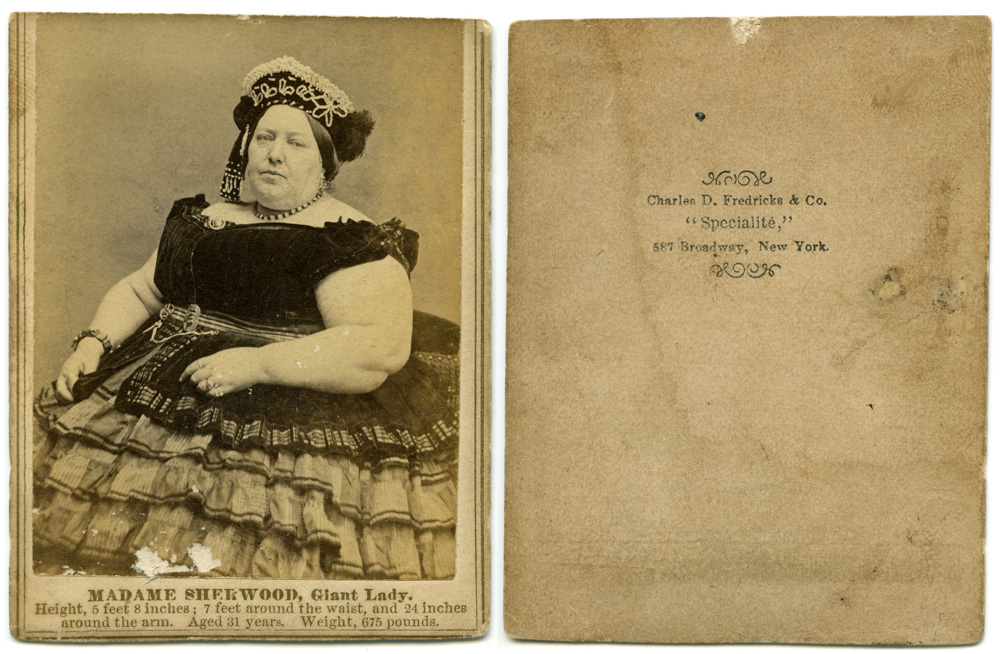
Well, I don’t know if she ever sang, or if she had any kind of performance at all. But her name was Madame Sherwood, and according to the bio on her CDV, she had an 84″ waist and was 675 lbs. Given the Victorian (and specifically Barnum-esque) penchant for exaggeration, I wouldn’t be surprised if she was more like a 60″ waist and 400 lbs but you never know. This CDV has been trimmed, rather significantly, but again this doesn’t detract from the image so I don’t find it terribly objectionable. It definitely impacted the value of the card, but I was not unhappy with the price paid. This is another C.D. Fredericks image. The simplicity of the backstamp not only in terms of the design but also the pomposity (or lack thereof) of the advertising slogan leads to some confusing dating for the image, as “Specialité” was his slogan in the 1850s and 60s, but the subject would have this date from the early to mid 1870s. Fredericks was another New York photographer who, like Gurney (whom he studied under and worked for for a time) and Eisenmann, did significant trade with the theatrical and performing professions.
For more information about C.D. Fredericks, there is a succinct but interesting blurb at Historic Camera
MadameSherwood, by C.D. Fredericks
I suppose in a way you could term all these circus freak photos as also being occupationals in that they do show the sitters enacting their profession, which in a way was merely existing as who they were. It’s not like it mattered what outfit Tom Thumb or Madame Sherwood or Isaac Sprague (the Human Skeleton) wore, they were not performing a role, and even if they did, their audience was not coming to see them be Hamlet or Viola or Caliban, but to see the midget/fat lady/human skeleton.
Here are some more of my circus freaks/performers collection. We’re going to start our tour of the circus in the sideshow, where P.T. Barnum was a busy man – he collected strange people from all over the world, and when he couldn’t find them from afar, he invented foreign origins for them!
Waino and Plutano(r), the Wild Men of Borneo, were actually brothers born in Ohio with physical and mental developmental challenges. As you can see in the photo, even in adulthood, they were pygmy sized. They did however possess considerable strength for their size, and were known to lift up to 300 pounds. Their real names were Hiram and Barney Davis (no relation!). They were a huge success in Barnum’s circus and over a 25 year career in show business spanning from 1880 to 1905, they earned $200,000, a gigantic sum in that day and age.
Waino and Plutano, The Wild Men of Borneo, by Eisenmann
As you can see, this was yet another carte by Chas. Eisenmann, who specialized in photographing theater people and performers. I love the Victorian era advertising slogans – “Portraits taken by Instantaneous Process – Extra Inducements to the Theatrical Profession” on this carte, and on another one I have by him, it shows a photographer striding the globe, with “The Popular Photographer” inscribed below. It’s too bad the carte-de-visite tradition died out; there’s nothing quite like it today in terms of marketing and character.
Next up, also in the sideshow, is the fat lady. Why this particular display was so popular, I’ll never quite understand. I don’t think the fat ladies sang or had any particular performing talent – they were just fat. I think it would have to have been one of the most humiliating experiences in the sideshow, to be looked at that way. At least in the other circus freak cases like the human skeleton or the midgets, they had little or no other viable employment options.
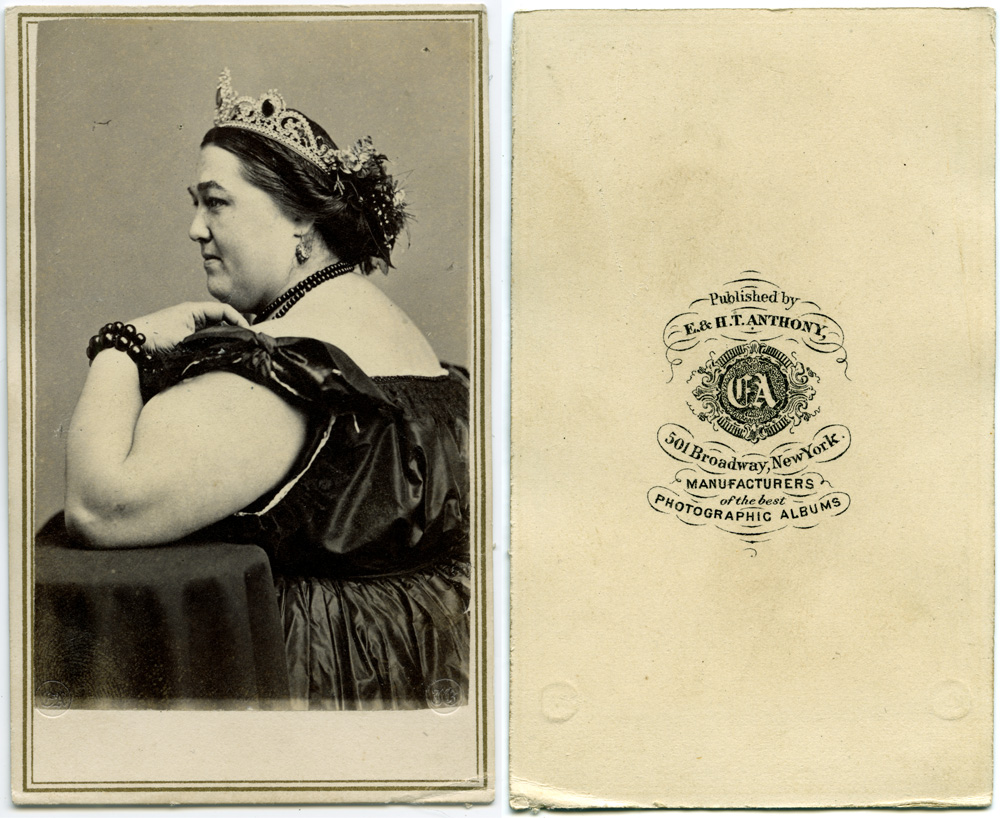
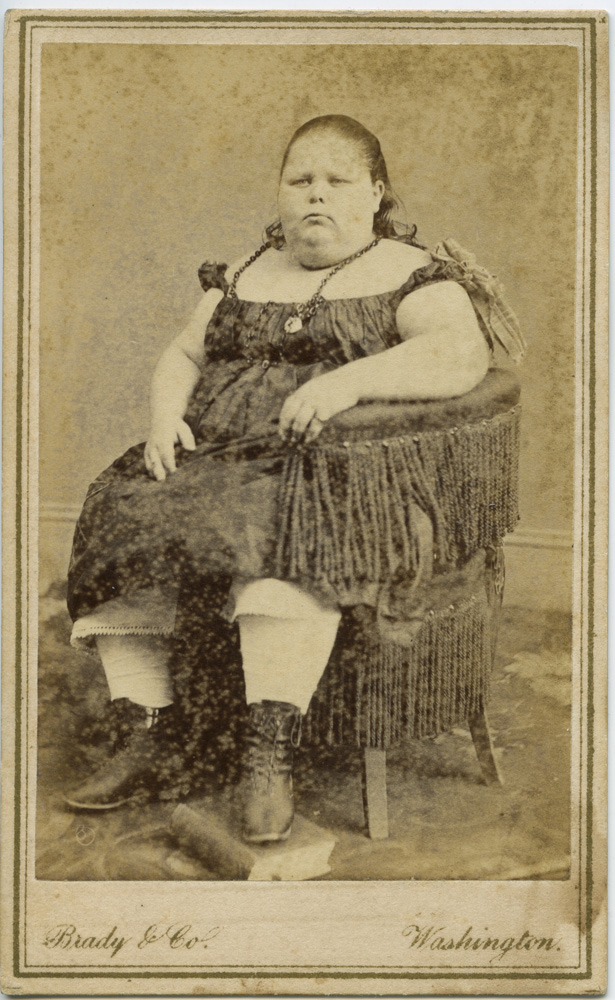
This image is an E&H.T. Anthony publication, with no credit given as to the photographer. The image has the Anthony blind stamps in the corners, and what appears in the scan to even be a fingerprint, possibly of the person who printed and mounted it. It is a breathtakingly beautiful carte in person, and I would suspect that it is probably a Brady carte, given that Anthony owned the Brady negatives for many years, and served as Brady’s publisher/distributor. The lady appears to be Madame Sherwood, a famous fat lady in Barnum’s circus. She also bears a vague resemblance to another fat lady I have, this one from the Brady studio in Washington DC. I don’t think the Brady image is the same woman, but it’s possible.
Madam Sherwood, on an E&H.T. Anthony CDV
The Brady image:
Fat Lady, Matthew Brady Studio, Washington, DC
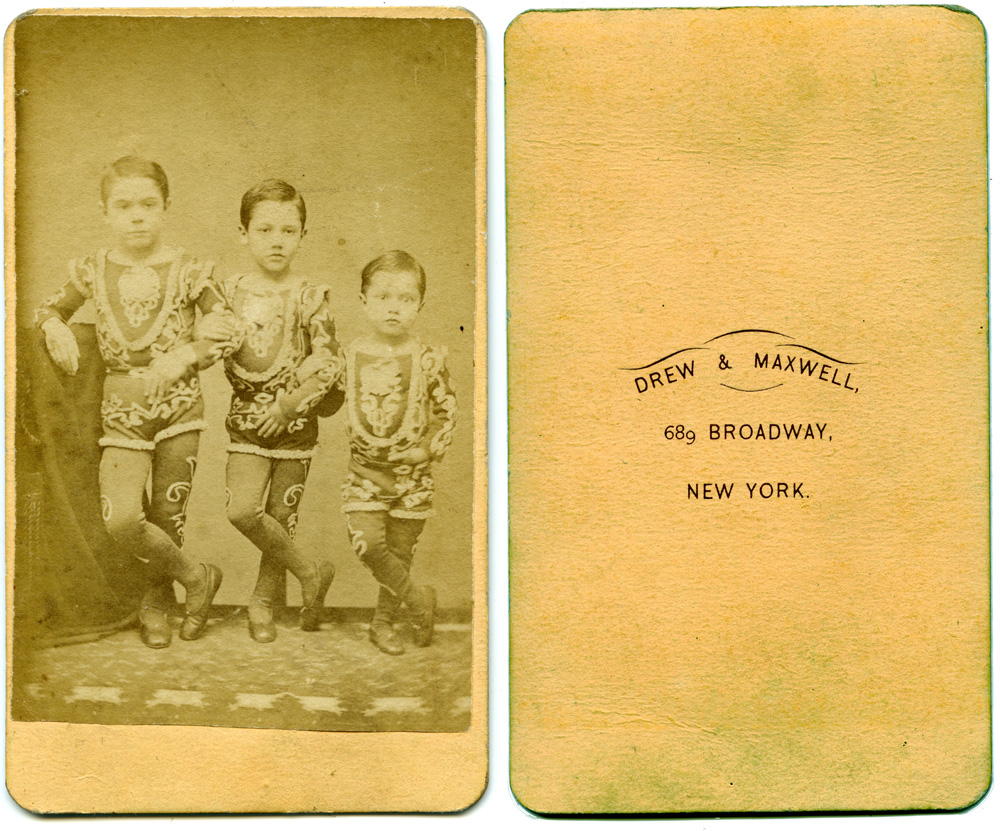
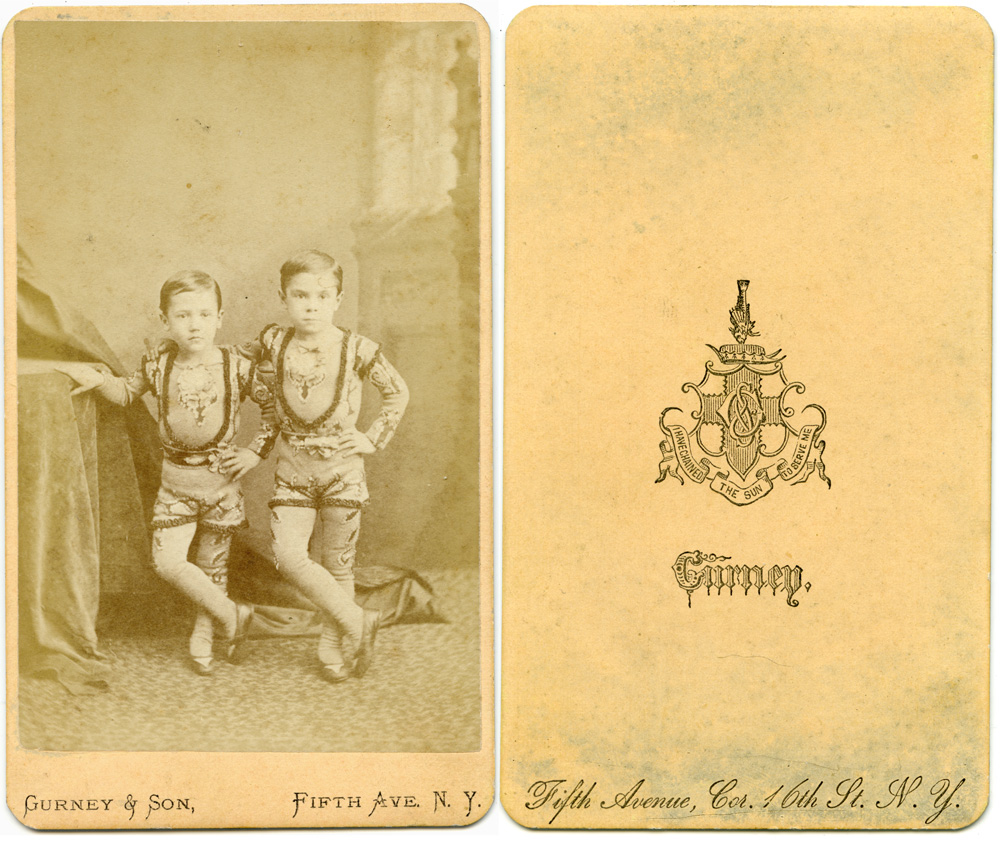
Moving under the big top, we have the acrobats! Here is a trio of boy tumblers/high-wire walkers/trapeeze artists. They look very much like the two I have in another cdv, which I’ll post again here for ease of comparison. If they are the same brothers, then the third one’s name is a mystery to me – the first pair appears to be the O’Brien brothers, but in my research, they were only ever a duo, and their father died fairly young as a result of injuries sustained in a circus accident.
Trio of Boy Acrobats, by Drew & Maxwell - possibly the O'Briens?Circus Siblings, Gurney & Son, New York
I saw another CDV of what appears to be the same brothers, with similar outfits and different hairdos (probably a couple years older). This one is labeled “Willie & Freddie O’Brien”. I did a quick google search on their names and it turns out they were well-known circus performers, part of Barnum & Bailey’s circus, among others. A brief bio of their father (from Olympians of the Sawdust Circle):
O’BRIEN, FRED. (1848-April 28, 1881) Champion leaper. Native of Buffalo, NY. Lake’s, 1869; Dan Rice’s, 1870; Rice’s Paris Pavilion Circus, 1871-72; P. T. Barnum’s, 1872-73; John Wilson’s, San Francisco, January 1874; Cooper, Bailey & Co., 1876; Great London, 1875-77; with wife and sons, Freddie and Willie, Orrin Bros.’, Havana, 1878. Wife was a slack wire artist and his 2 children performed on the trapeze. With P. T. Barnum’s, Madison Square Garden, 1881, was injured in a leaping double-somersault over a number of elephants. Died aboard the steamship England en route to Liverpool as a result of those injuries, age 33. Remains were buried at sea.
O’BRIEN, FRED, JR. Acrobat. The son of leaper Fred O’Brien. Three Melville’s & Co., 1889; general superintendent, Price & James, 1897; principal clown, Cooper & Co., 1897.
O’BRIEN, WILLIAM. Acrobat and leaper. Son of Fred O’Brien. Howes’ London, 1877; Cooper & Bailey, 1880; Howard Bros.’, 1888; Charles Andress’, 1888; Robinson-Franklin, 1897.
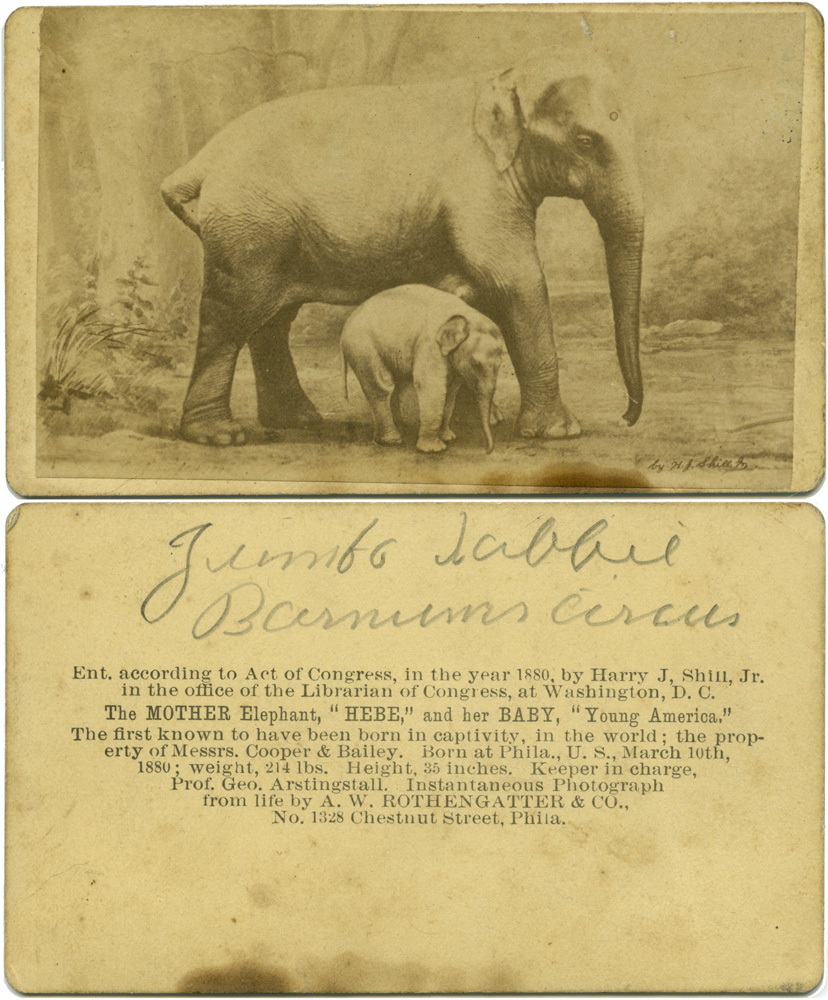
Here’s another new image in the collection, part of my growing circus images segment. The photo is of the mother, Hebe, and her baby, “Young America”, the first elephant born in captivity. They were part of Bailey’s circus, later to be bought by P.T. Barnum to become the Barnum & Bailey’s Circus we know today. This may be a photograph of a painting or drawing, I suspect, as the backdrop is somewhat contrived. There is a signature in the lower right corner of the image, “by H.J. Shill Jr.”, who is indicated on the verso as the copyright holder, but the photograph itself was produced by A.W. Rothengatter of Philadelphia (“Instantaneous Photograph from life… No. 1328 Chestnut Street, Phila.”). It’s theoretically possible they brought the two elephants into Rothengatter’s studio and posed them on a painted backdrop, but that would have been a rather sizeable undertaking! Another possibility is that the elephants were photographed, and then in a feat of photo-manipulation worthy of today’s greatest Photoshop wizards, they were merged onto the “jungle” backdrop. The mother looks very photo-realistic, but the baby, not so much. Alternatively this may have been a merger of multiple photographs, and Mr. Shill is getting the credit for the mash-up, which would have been unusual in that day and age as assistants were rarely credited for any work performed and sold under the studio’s name.
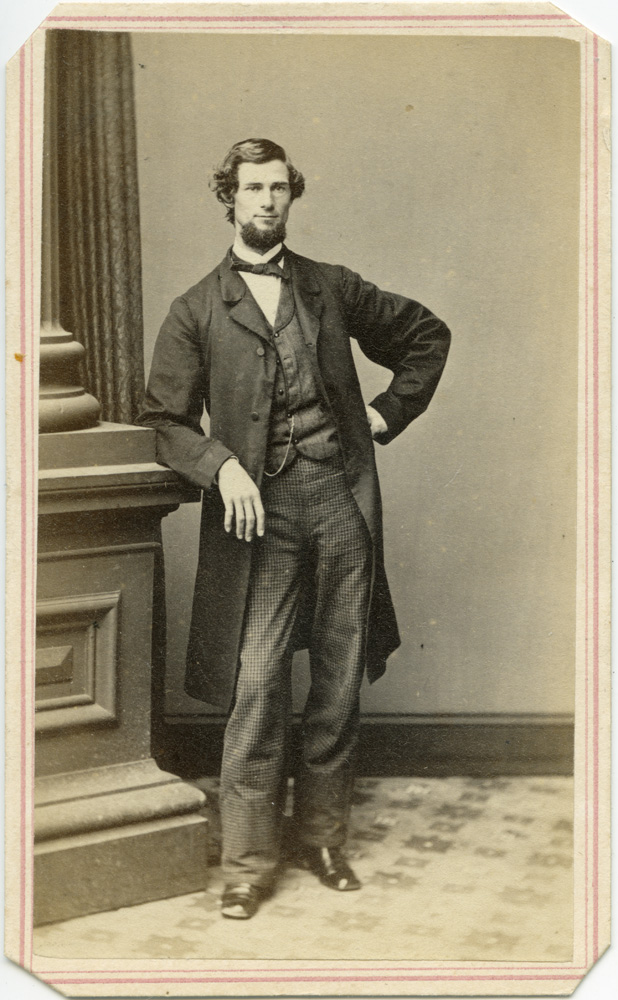
Just a random CDV I acquired, because I have another CDV from the same photographer – R.A. Lewis, at 152 Chatham Street, New York. The address no longer exists – the approximate location is near 1 Police Plaza in lower Manhattan. The street grid was completely ripped up and re-done in that area when 1PP was being built, and so there are numerous streets that either changed names or vanished altogether. This is one of them.
Tall lanky gentleman, R.A. Lewis Studio
I liked the image because the photographer knew how to arrange the gentleman’s pose to show his height in an aesthetically pleasing manner.
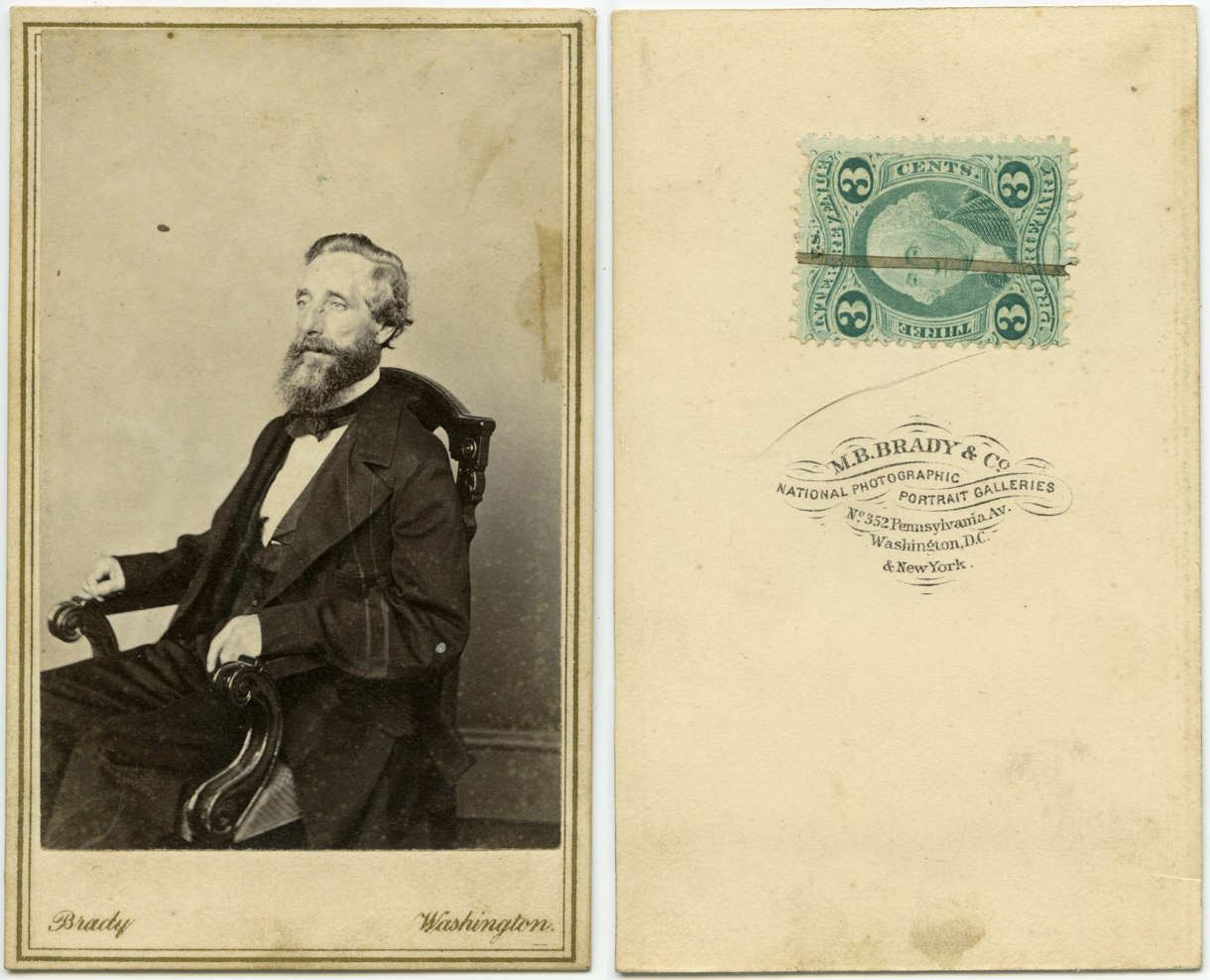
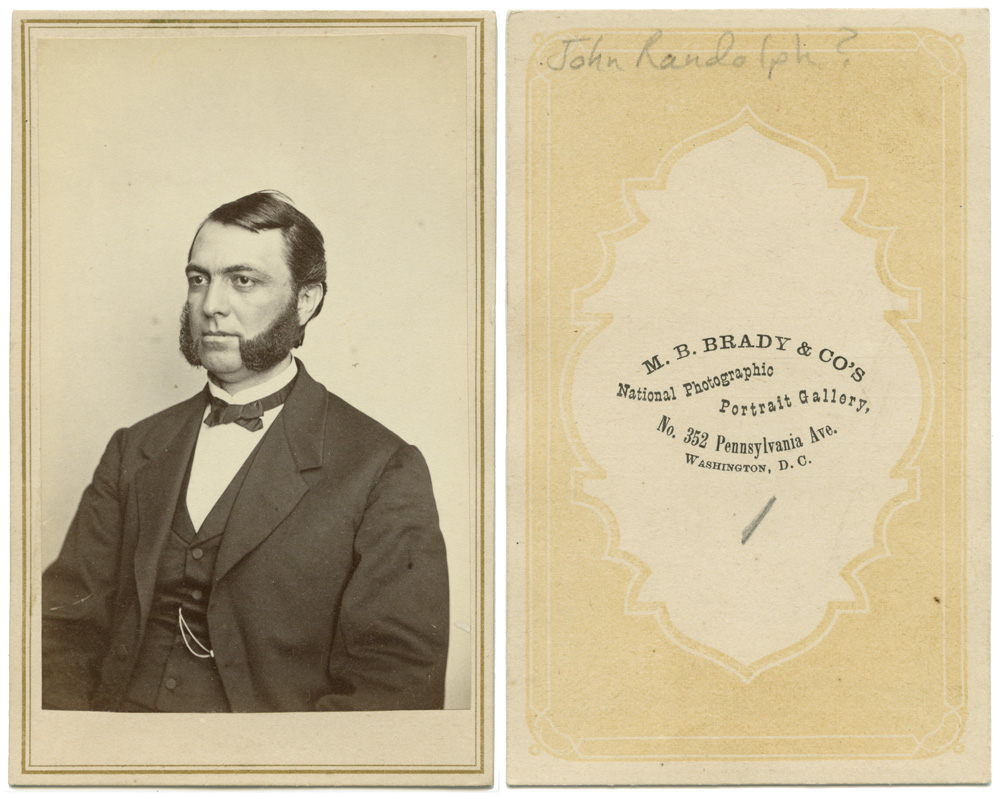
Two more CDVs – a Brady from the DC studio, and judging by the backmark style, a later (post Civil War) image. The sitter is reputed to be named John Randolph, one of the FitzRandolphs of Philadelphia (or could it be the FitzRandolphs who gave the original land grant to found Princeton University?). Evidence is unclear, but the picture is very.
John Randolph, by Mathew Brady
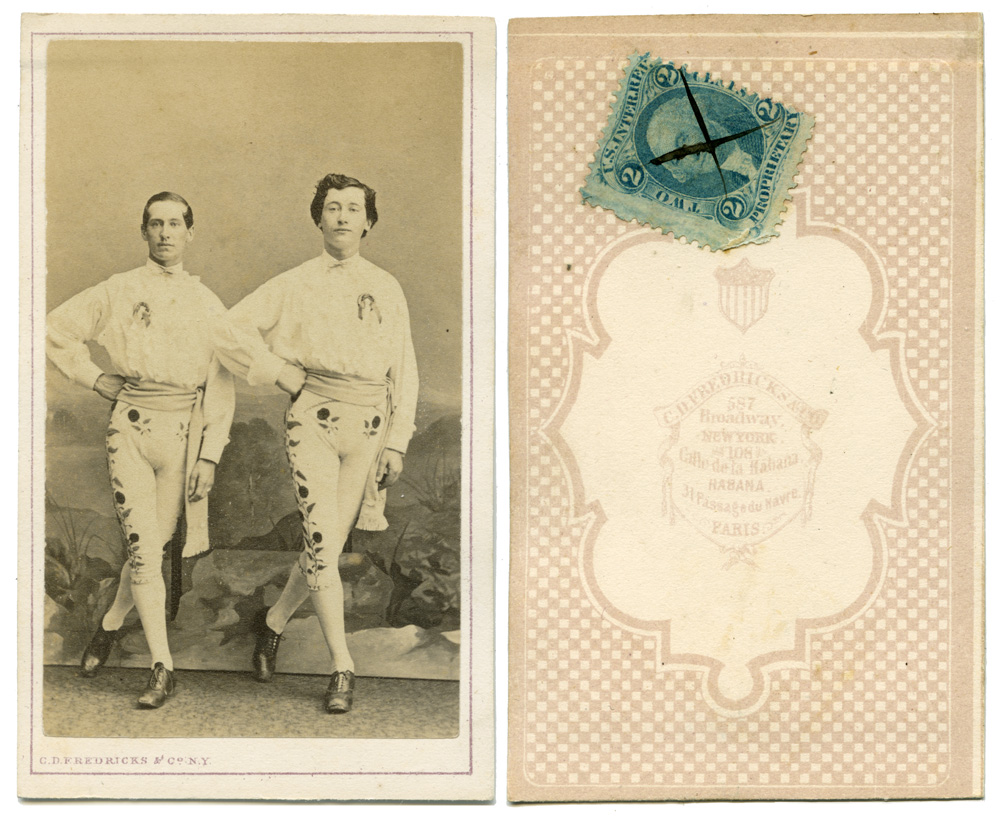
The second CD is from the Fredericks studio, of New York, Havana and Paris. As the subject is toreadors, I’m guessing this was taken at either the Paris or Havana studios. Bullfighting has never had any serious following in the United States, so toreadors would be unlikely to come to New York on a performing tour of the US. I thought I had another Fredericks CDV somewhere in my collection, but I’ll be damned if I can find it – I may have just recorded the address on my New York studio map during a scan of studio backmarks on eBay.
Two Toreadors, by Fredericks of New York, Havana and Paris
This is another image that could have been marketed as “gay interest”, thankfully it wasn’t. Despite their costumes and matching fey poses, there’s nothing about them that shouts (or whispers) 19th century code for gay. Pure 21st century wishful thinking.
I went to the DC Antique Photo Show today. The show took up three meeting rooms at the Holiday Inn Rosslyn. Two smaller rooms were devoted to postcard collectors, and the much larger main room was strictly photographic images. I toured the entire show, but got a bit lost in the detail with the postcard dealers – there’s just way too much material to look through! My intent was to try and hunt down a couple stereoviews for my set of Lehigh Valley Railroad stereoviews, but that thought quickly went out the window when it could have taken the entire day to just sift through the stereoviews of just two or three vendors.
I did find something pretty cute and nifty though – a woman there, the mother of one of the Civil War image vendors, was making and selling (very cheaply) little fabric pouches for storing cased images. I bought four to cover my thermoplastic cased daguerreotypes. The pouches are made of color-fast fabric (it feels like a good-quality felt). The 1/6 plate size are $1.50 each – if you’re interested, let me know and I can send you the lady’s email. I won’t post it here, out of respect for her, so she doesn’t get bombarded by spammers.
In the main room is where I got in trouble. It started with a book – “Shooting Soldiers” by Dr. Stanley Burns. The book is about the history of medical photography during the Civil War. Dr. Burns is a SERIOUS collector of antique images, and has amassed an astounding collection of Civil War period medical images, among other topics. The images in the book are from his collection. He himself was there at the show, and autographed the book for me.
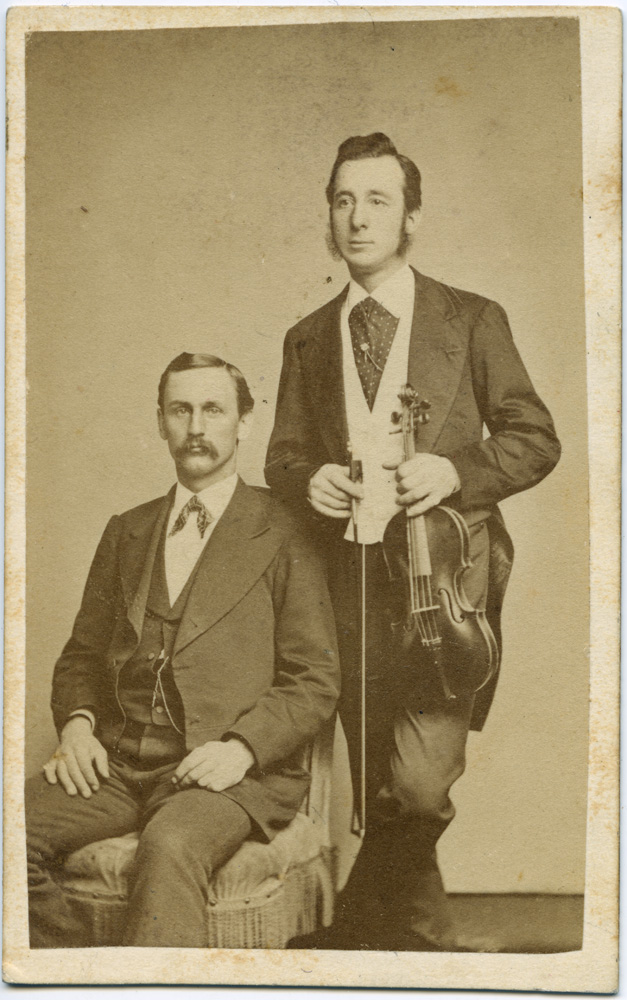
Across the way there was a booth selling native american images, and CDVs. Would that my budget could have stretched this much, but alas, the Alexander Gardner CDV of Vice President (and later President) Andrew Johnson was not to leave the show in my hands. I did acquire a nice period CDV of two musicians, one seated, the other standing, holding his violin.
Musical Duo, Boston
The vendor indicated that the duo was famous in their day. When I asked who they were, he didn’t know either, but acted as if I should somehow know myself! Sorry, but I haven’t kept up on mid-19th century performers. Have you? If someone out there in collector-land does recognize them and can pass it on, it would be much appreciated!
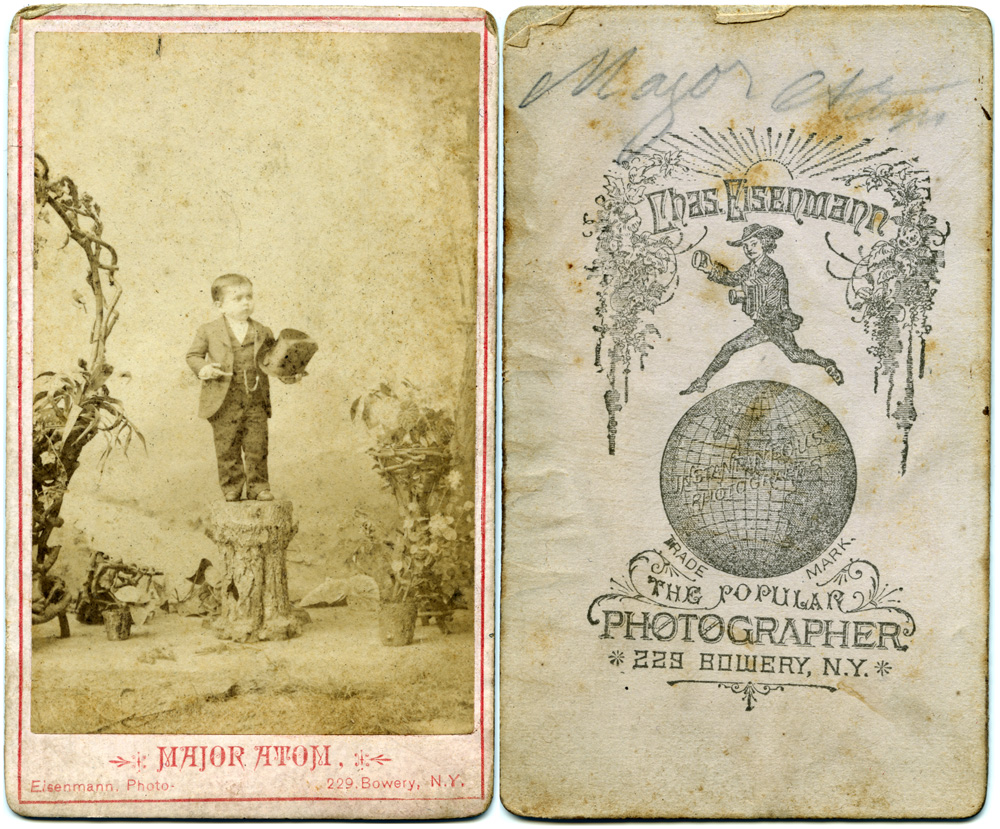
At another booth I found a neat addition to my circus freaks collection – another midget, Major Atom! And it gave me yet another address for one of my New York studios to put on my map – Chas. Eisenmann, “The Popular Photographer”. I love the advertising slogans these photographers came up with – it’s a little window on the Victorian era mindset.
Major Atom, by Chas. Eisenmann
I found a famous Native American cabinet card – “Rain-in-the-face”, taken at Morse’s Palace of Fine Art in San Francisco. Rain-in-the-face was a cohort of Sitting Bull, a war chief of the Hunkpapa Sioux. He was one of the warriors responsible for Custer’s defeat. It’s a beautiful image, and although the card is damaged, the damage doesn’t significantly detract from the quality of the portrait.
Rain-in-the-face, by Morse, San Francisco
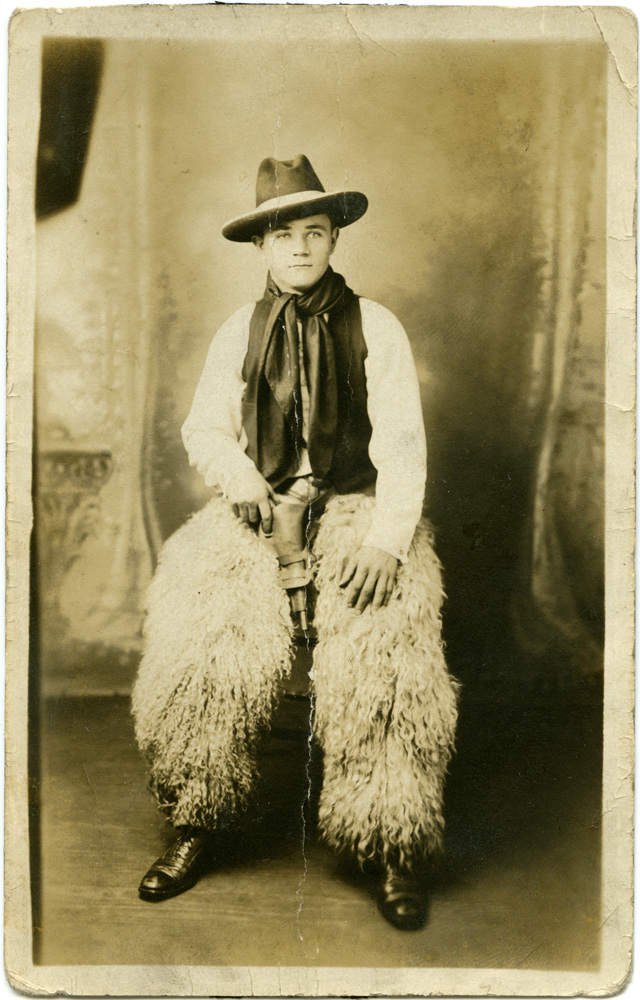
Well, if I got me an Indian, I had to get me a Cowboy! This one is looking just a little bit gay.
The Gay Caballero
I have no idea if in fact he was gay, but by 21st century sensibilities, he’s a little too well put together, he’s gripping his pistol in an oh-so-suggestive manner, and those chaps!
I must put in a plug for someone at the show – he was not only a vendor of antique images, he’s also a modern-day Daguerreotypist himself. Casey Waters does modern daguerreotypes using mercury development, which by itself is cool because it’s the REAL way to make a daguerreotype. But even cooler, among other things, he’s done night-time daguerreotypes – I pity his car’s battery because I can’t imagine how long the headlights had to be on in order to record the image on the plate.
To check out his work, you can visit Casey Waters Daguerreotypes (the night-time daguerreotypes are nine rows down from the top of the page, on the left and center columns).
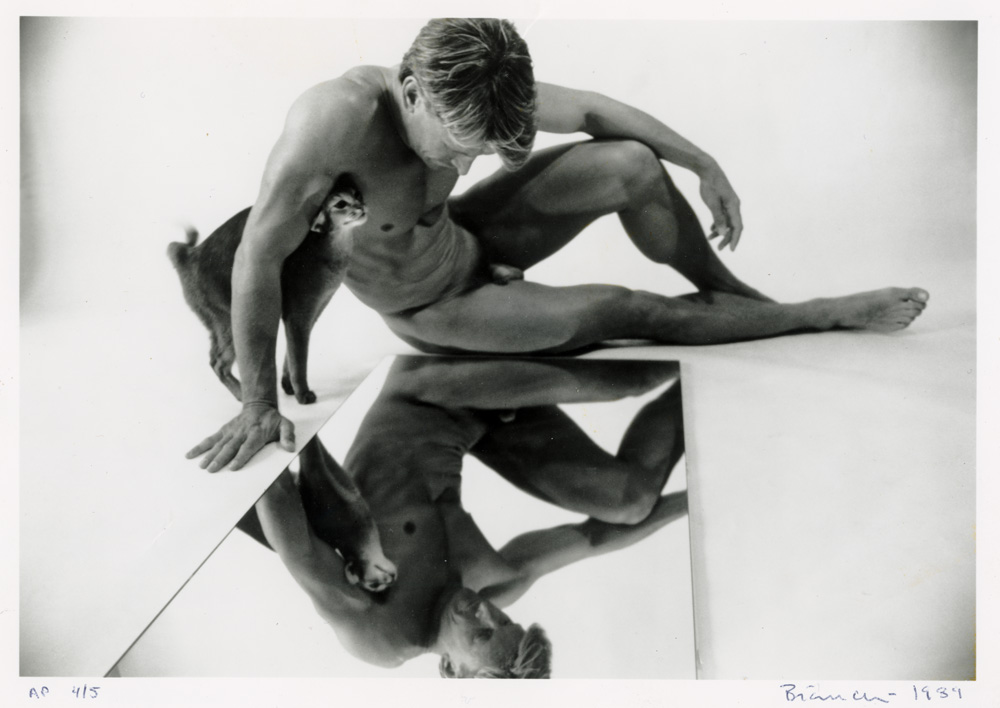
Last but not least, there was a Tom Bianchi print I picked up. There is a little damage to the print (which I touched up in the scan), which is why I was able to get it so cheap. It’s also marked as 4/5 Artists Proofs. Which means that Tom Bianchi gave it away to someone, it wasn’t sold commercially. The damage is minor, and easily repairable, so I may actually try to retouch it myself. Tom Bianchi, Artist's Proof, 1989
Some more food for thought – I think I’ve mentioned this before, about the migration over time of certain studios, moving uptown in New York as their client base moved further uptown – to better illustrate this, I’ve pulled the studio addresses for three of the most prominent portrait studios of the day, and listed them in chronological order as best possible:
Mathew Brady:
205-207 Broadway
359 Broadway
635 Broadway
785 Broadway
Gurney & Sons
349 Broadway
707 Broadway
5th Avenue & E. 16th Street
Abraham Bogardus
Greenwich & Barclay Streets
363 Broadway
872 Broadway
Also notice how close they all were to each other. While I don’t have dates per-se for each of the addresses, notice that at one point, all three were in the same block of Broadway (the 300 block), and again later, all three were in a two block span of Broadway, further uptown (700-800 block). Even early on, they were clustered close to each other in Lower Manhattan – 643 Bleecker is not far from Greenwich & Barclay, and another photographer, William J. Tait, was just a block or two away at Greenwich & Cortlandt streets.



 dcphotoartist