Category Archives: Photography

Damn Software!

Ok – frustration time rears its ugly head again. Got all my software updated and connected together, and I even went out yesterday and splurged (there goes the rest of the tax refund!) on an Epson 3880 printer. Now that everything is wired up, I tried doing some scans with the new SilverFast AI8. Reflective scans at medium and even high res (1200 dpi) worked great. Scans from negatives worked up to 2400 dpi. The software allows you to input resolutions beyond 2400 dpi – I wanted to see what would happen at 4800 dpi because I was scanning a large negative (5×7 inch) to have it reproduced at very large size (30×42-ish, maybe even bigger). Well…… SilverFast AI8 choked on the request. The scan completed in a reasonable amount of time (maybe 5 minutes- SOOO much faster than on my old computer), but then took 20+ minutes to “process”, at the end of which, it failed. Again at 3200 dpi – same thing. At 2400 dpi, it worked just fine, so I’ll live with that, as A: technically that’s the optical resolution maximum of the scanner (anything higher is software interpolation I believe), and B: it’s still big enough a file (about 600mb) for the custom lab to work with.

I LOVE Kodak Portra 160nc film after this exercise though – it is VERY easy to scan (with decent software – with craptastic software no film scans easily) and it handles chaotically mixed lighting conditions with ease and aplomb. In the shot I was scanning last night, I had rainbow-colored neon, sodium-vapor streetlights, and fluorescent and incandescent interior lighting, at night, all in the same scene. The only thing I had to color correct for was a minor overall tint caused by sloppy processing at the lab I used at the time. Pretty amazing stuff. Now if they’d only charge less than $350 for a 50 sheet box of the stuff, I’d shoot it more often!

I do have to give SilverFast its props – I tried scanning the same negative with the EpsonScan software that came with the scanner – I had to do MAJOR color correction and density correction with the EpsonScan file. The SilverFast scan was almost dead-on on the first try, and I’ll just need to tweak to my taste, along with some dust and hair removal via the Healing brush. Figuring out how to do this myself saves $80-90 per image in scanning fees at the custom lab every time I want to make a print. Now, to figure out which paper surface(s) and brand(s) I want to use. I got a pack of Epson’s top-of-the-line premium glossy, along with a pack of the Calumet heavy-weight glossy paper to compare; the Calumet paper is dramatically cheaper than the Epson.
Invasion of the little people!

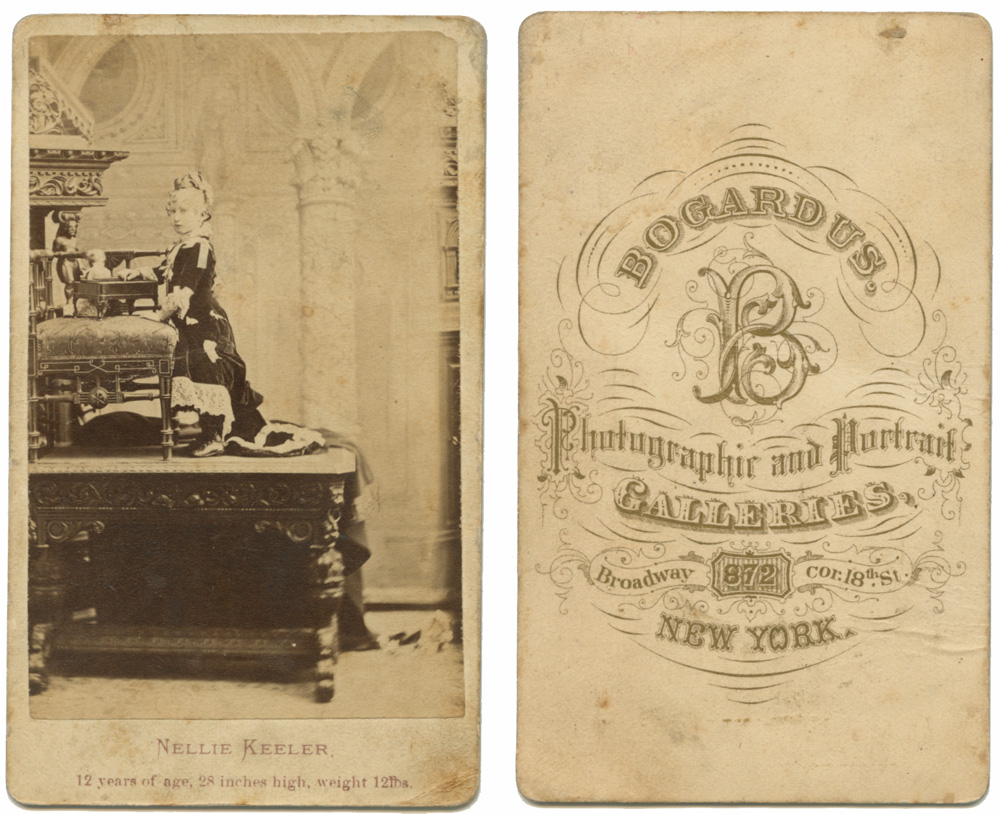
In my online shopping peregrinations, I came across another Nellie Keeler CDV, so of course I had to add the second varietal to my collection. The captions have it that these are one year apart. Who knows the truth of such things, as so many facts about the circus freak sideshow performers were grossly exaggerated for dramatic effect.

Nellie Keeler, by Bogardus

Here is the first one I collected, for comparison:

Nellie Keeler, by Bogardus
Nellie Keeler- by Bogardus

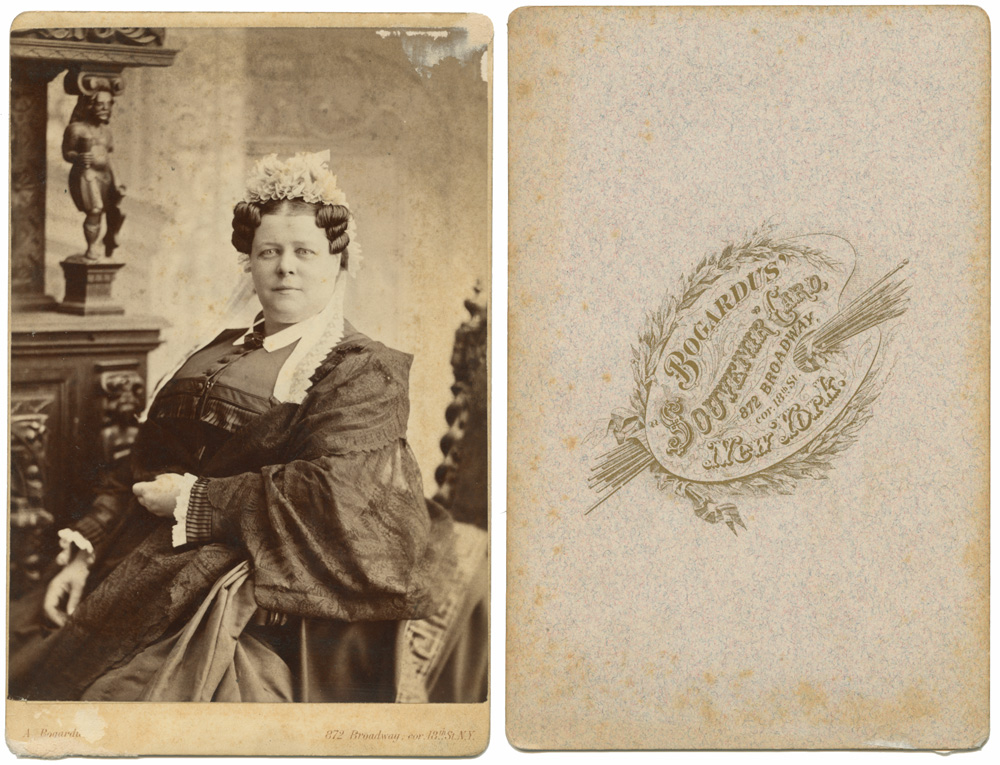
And somewhat ironically, here is a larger size (roughly 5×7) Cabinet Card of a much larger woman, seated in front of the same dining room sideboard on which Nellie Keeler is posing. When I saw that, I had to grab it just for that cool factor of coincidence. I’d read a lot about how work of battlefield photographers could be connected if not identified by the use of the same backdrops, furniture and even prop weapons/uniforms in Civil War tintypes. While not exactly the same thing, this is my first instance of finding the same props in two different photos of two VERY different subjects by the same photographer.

Plump lady cabinet card, Bogardus Studio

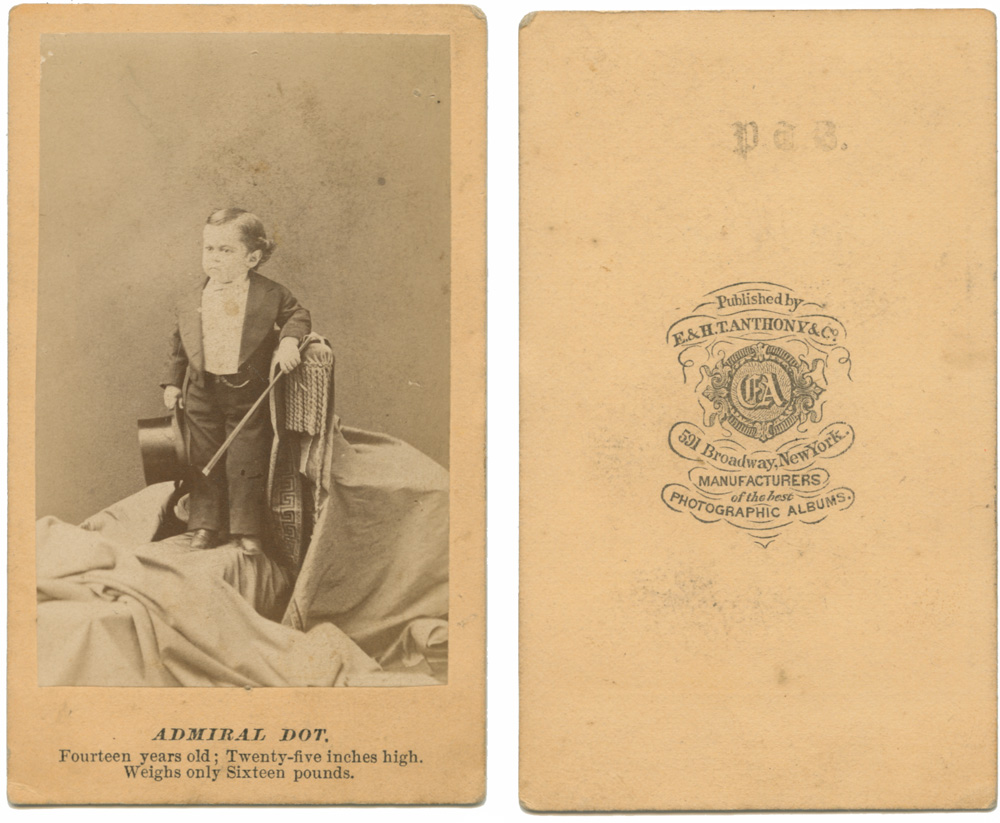
And last but not least (well, maybe least, based on the factoids on the front of the card) is Admiral Dot – yet another Barnum embellishment with an exalted military rank for someone of restrained stature. A contemporary of General Tom Thumb, Commodore Nutt, Major Atom, Count Rosebud and Baron Littlefinger, he also performed in sideshows.

Admiral Dot, published by E&HT Anthony

As the photographer is not credited, it may well have been one of the lesser-known New York studios specializing in the theatrical trade who was able to work a deal with Anthony to distribute their cards.

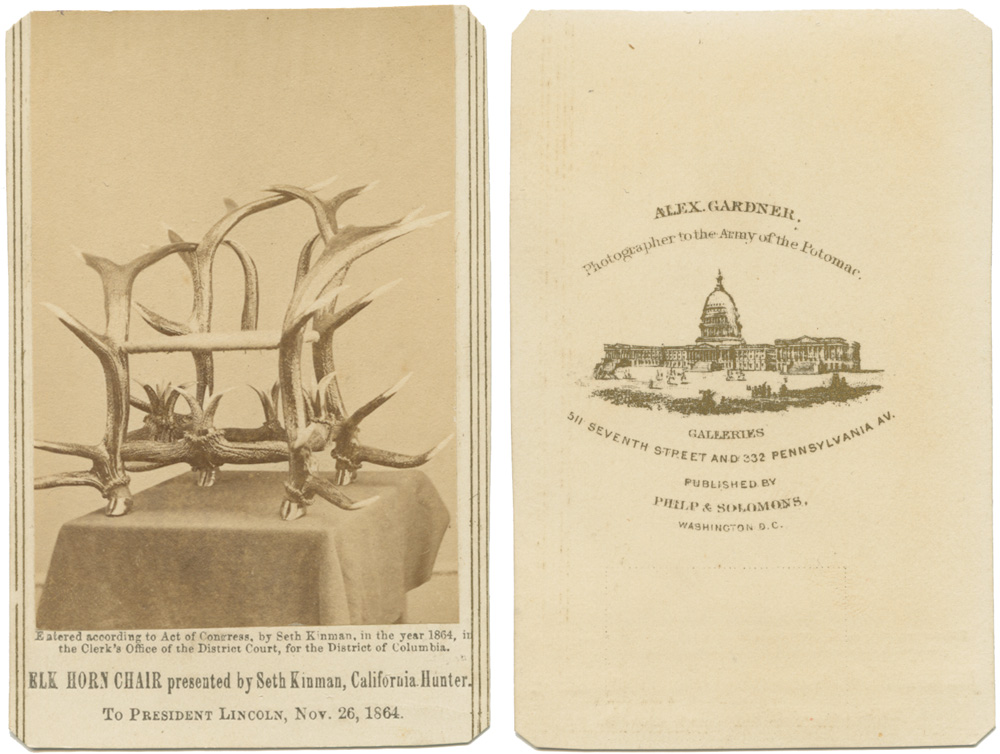
Seth Kinman’s Elk Horn Chair, Presented to Abraham Lincoln, November 26, 1864

Seth Kinman's Elkhorn Chair, Presented to A. Lincoln, November 26, 1864

I was able to kill two birds with one stone on this image – I found an Alexander Gardner CDV (which is rare in itself!) and an image nearly identical to a Mathew Brady version I had seen, but in better overall condition, for the same money as the Brady. So now I have two official Gardners.

Artomatic Returns (and I’m in it!!)

For those who don’t live in the Washington DC metropolitan area, Artomatic is this HUGE “art happening”, by artists for artists, with no jury or curation, just pick a 12′ wall and hang your work to your heart’s desire. It encompasses just about every conceivable artistic means of expression, from painting, photography, drawing, sculpture to music, theater, dance, performance art, video, poetry and the just plain incomprehensible. Artomatic strives to be a bi-annual event, but that doesn’t always happen, as it has no permanent home and is dependent on property owners of large empty spaces being interested in making those spaces available. The last few Artomatics have featured something on the order of 1000+ 2-d/3-d artists and 600 performers of some kind. The whole thing is produced on a volunteer basis, which makes it all the more amazing that it even happens at all.

For more information about Artomatic in general, the history of the event, and schedules for this year’s event, go to Artomatic.org

Important dates relating to this year’s Artomatic:

  • May 18 – Artomatic Opens
  • June 2 – Meet the Artist Night (I will be there, with wine and cheese if allowed)
  • June 23 – Artomatic Closes

The show is open Wednesday and Thursday from 12 noon to 10 pm, Fridays and Saturdays 12 noon to 1 AM, and Sundays 12 noon to 5 PM. It is closed Mondays and Tuesdays. There is a recommended $5 donation for admission, but it is pay what you can. Despite the fact that over 75,000 people attended, Artomatic did not make a profit – this is a very expensive, labor intensive effort to produce a show of this size and scope.

I have NOT yet decided what work I will be putting in the show. It’s a toss-up between doing some really large color prints of my night-time work, or making some new platinum/palladium/gum male nude images inspired by Japanese landscape screens. The $64,000 question is will I have enough time to produce that work before installation is over.

The Family that Works Together, Stays Together…

Here is a cdv of a sideshow family. Father has an extraordinarily long beard, mother is a dwarf, and daughter seems relatively normal except her hands look HUGE in comparison to the rest of her (and even compared to dad’s hands).

Sideshow Family, Aledo, Illinois

The scrap of paper at the bottom of the scan is from the album page that once held this image. It appears to suggest that this sideshow family was part of an extended family and not a trio of social outcasts, as circus folk are often portrayed.

The photograph is marked on the back “Strong & Root, Aledo, Ills”. This may have been where the family was from, or it may have been just another stop along the circus circuit. One wonders what it must have been like to be a family of sideshow freaks, and if the daughter did not have any distinguishing trait that would have qualified her to perform alongside her parents, what that must have been like – a tougher branch of an already tough road to follow.

Stereoviews of China, circa 1900-1905

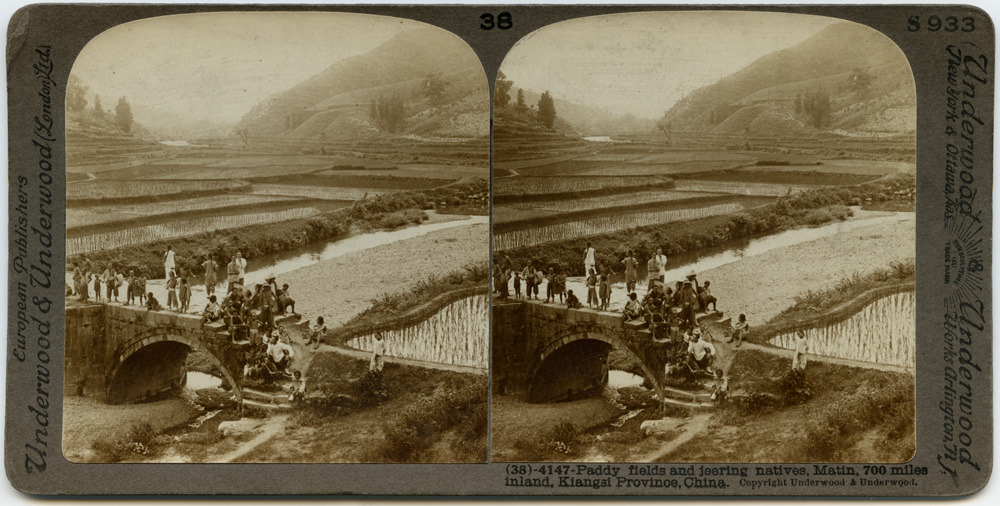
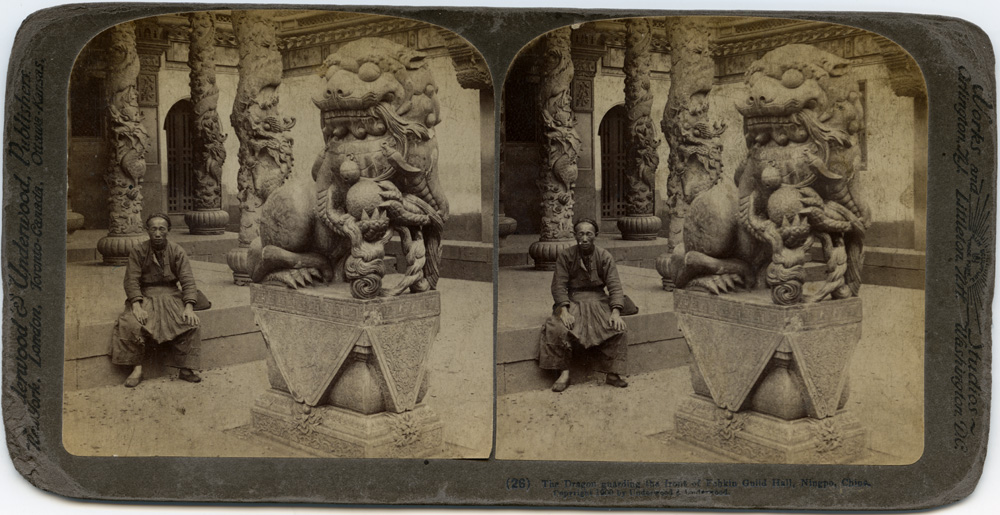
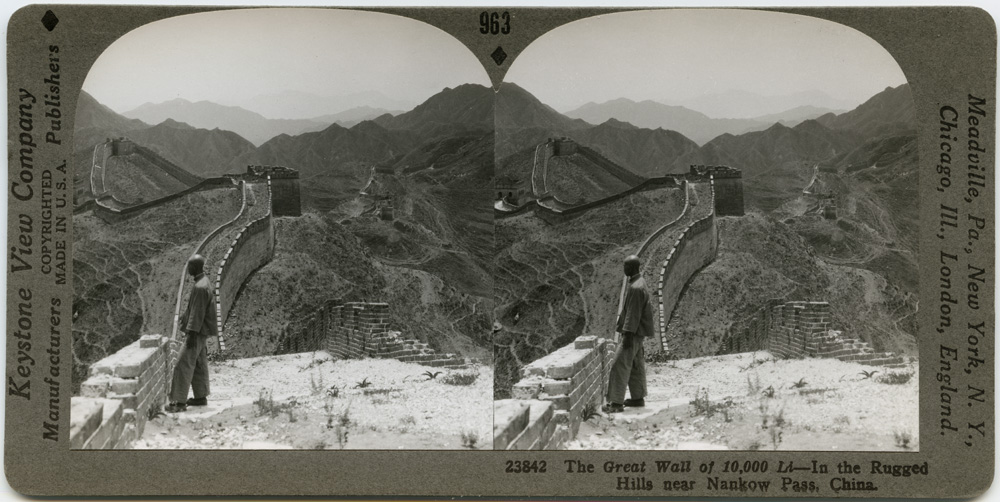
Here are three stereoviews of China, taken in the first half-decade of the 20th century. These were produced by Keystone and Underwood & Underwood, two of the biggest producers of stereoviews. They both churned out thousands of these cards as fast as they could be supplied with new images of exotic locales, exotic being very broadly defined. This was foreign travel on the cheap, when it was not only more expensive but more time-consuming and more dangerous. The stereoview both broadened the horizons of their consumer and reinforced existing stereotypes of the day – note that the crowd on the steps in the rice paddy is “jeering natives” – they’re probably all wondering what that idiot gweiloh (white man) is doing putting his head under a blanket on the back of that funny box on the hill across the way.

Rice Paddies, Kiangsi
Ningpo Guild Hall
Ningpo Guild Hall
The Great Wall of China, Nankow Pass

Stereoviews of Washington DC

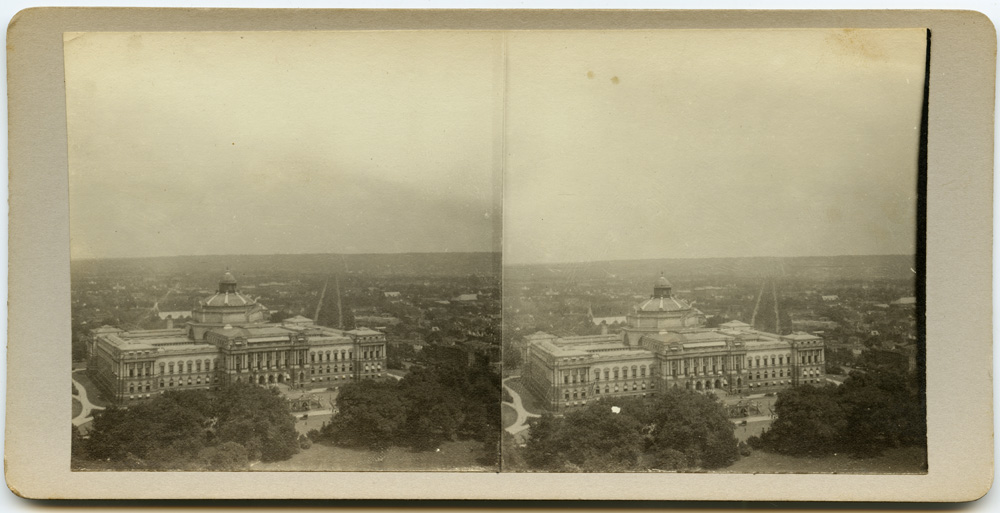
I was out to my parents’ house this weekend for Easter dinner, and I found my stash of stereoviews I had been keeping there. I thought I’d scan in a few of them to add to the online collection here. These are from Washington DC, my guess is mostly from the 1920s and 1930s, although the one of the Library of Congress as viewed from the Capitol dome could be as old as the 1890s.

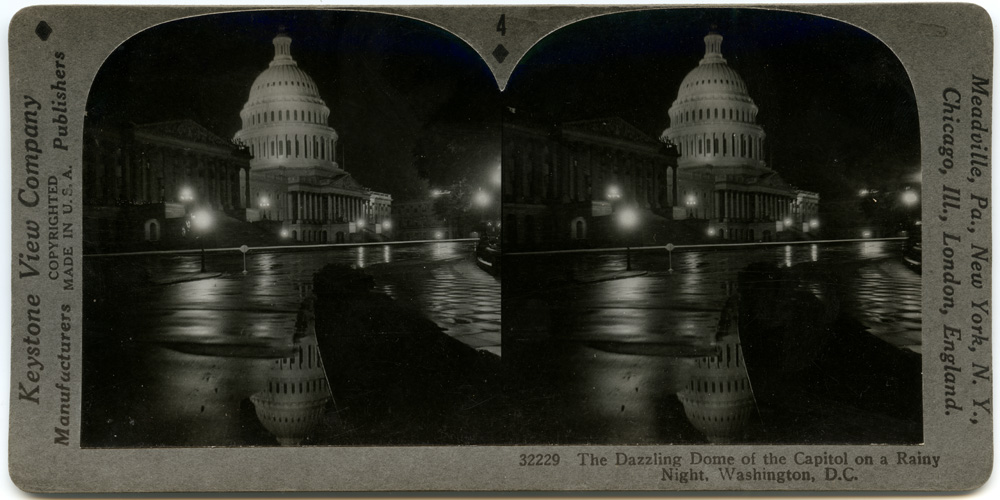
The US Capitol Dome reflected in the rain

I love this shot because it represents a personal passion when photographing- nighttime photography. It’s just a great shot of the Capitol dome all illuminated, reflecting in the wet street.

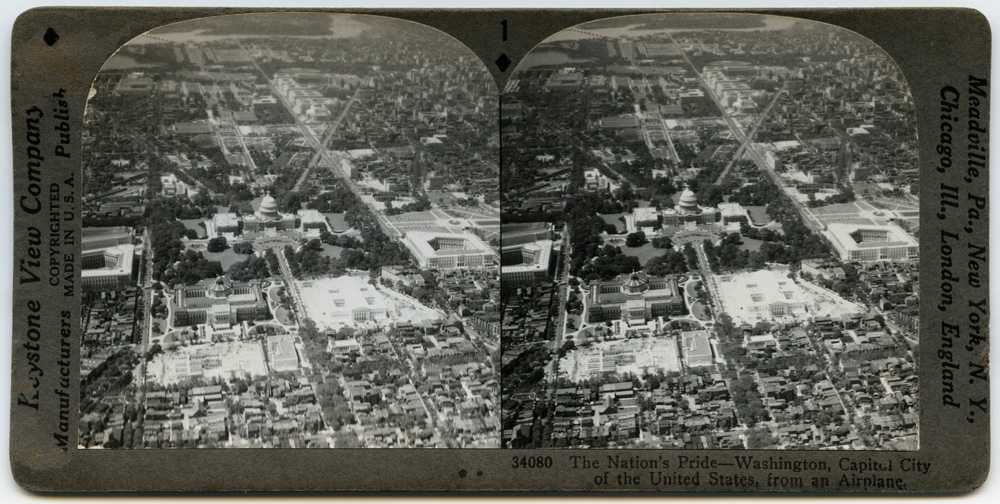
Capitol Hill Aerial View

Here’s an aerial view of Capitol Hill, looking west. In the immediate foreground, starting with the US Capitol as the 12 O’clock position, going clockwise, is the US Senate offices, the US Supreme Court (the very bright white building, which stands today on the grounds of the former Old Brick Capitol Prison, home to civil war spies among others), across the street and a little more to the foreground is the Folger Shakespeare Library, and then continuing on is the Library of Congress, and finishing up to the left and slightly into the background/west of the US Capitol are two of the US Congress office buildings. On the right, far in the distance, is the Natural History Museum, and the big gulf between it and the Capitol shows these to have been taken before 1937, as the National Gallery of Art building was begun at that time and opened to the public in 1941.

Library of Congress, as seen from the Capitol dome

Last but not least, we have the Library of Congress, as seen from the top of the US Capitol dome. The view is looking east down Pennsylvania Avenue toward the Anacostia River. This, the main building of the Library of Congress (LoC) is one of the most spectacular buildings in Washington DC, and if you are ever here, well worth the visit for the architecture alone, if not for one of the special exhibits they routinely have on display. When I went in last year to see a photography exhibit (and yes, the LoC is one of the great photography museums of the world, but much of their collection is viewable by appointment only), they had the reconstruction of Thomas Jefferson’s personal library that he donated upon his death to form the nucleus of the LoC collection. In comparison to today’s LoC, which has a copy of every book, magazine and newspaper published since the 1870s, and a healthy selection of those before as well, Jefferson’s collection was a meager 6500 books, what he lacked in quantity he made up for in quality. He had his own organizational scheme for his library, arranged by topic. It’s a fascinating display and worthwhile for any bibliophile. For more information about the exhibit, see the LOC Website

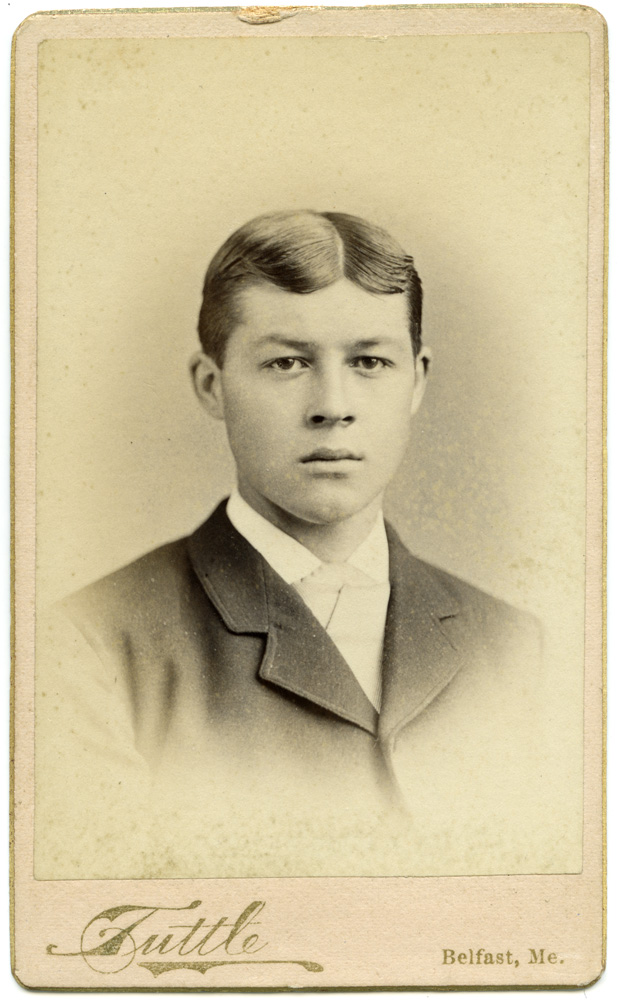
Anonymous Carte-Sized Portrait Cabinet Card

Sometimes the reason you buy something is purely aesthetic – there doesn’t need to be an historical association, famous subject or famous photographer to make an image worth buying. This is an example of just that – a very handsome subject, simply captured, plainly presented. Is he part Native American? Hard to say, but he has a certain look about his nose and jawline.

Handsome Youth, Belfast, Maine

This is an example, as I mentioned, of a carte-sized Cabinet Card. It is the same dimensions (2 1/2 x 4 1/2) as a carte de visite, but is printed on the heavier card stock with the beveled, gilt edges and the larger front imprint of the photographer’s logo typical of the Cabinet Card. Because of the style, I would definitely call this a Cabinet Card, and not a CDV, because the time period of its creation is definitely later, as are the material conditions of its composition.

And the Fat Lady Sings

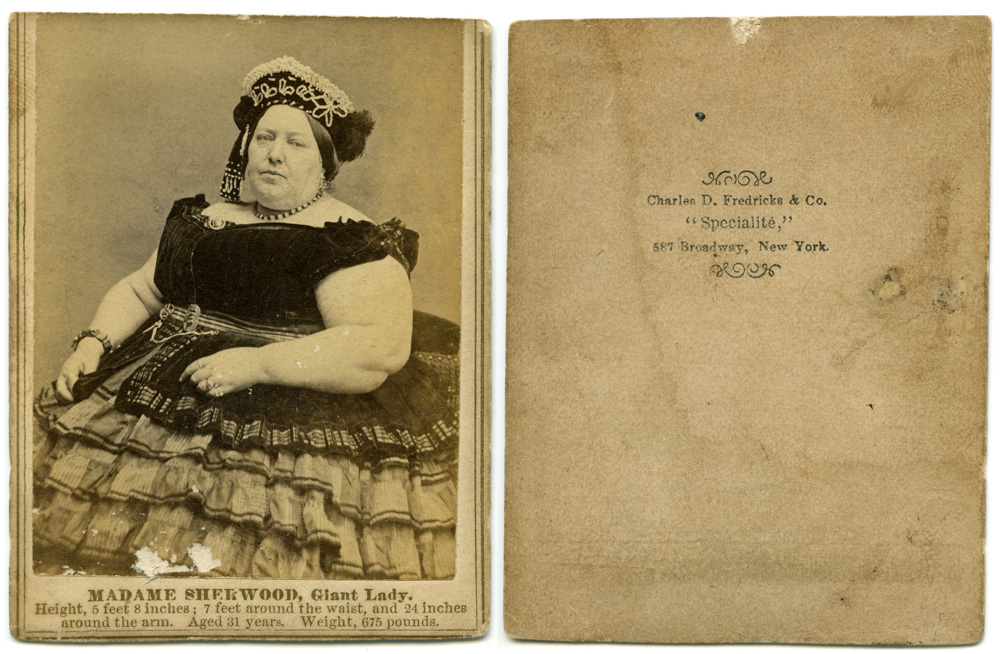
Well, I don’t know if she ever sang, or if she had any kind of performance at all. But her name was Madame Sherwood, and according to the bio on her CDV, she had an 84″ waist and was 675 lbs. Given the Victorian (and specifically Barnum-esque) penchant for exaggeration, I wouldn’t be surprised if she was more like a 60″ waist and 400 lbs but you never know. This CDV has been trimmed, rather significantly, but again this doesn’t detract from the image so I don’t find it terribly objectionable. It definitely impacted the value of the card, but I was not unhappy with the price paid. This is another C.D. Fredericks image. The simplicity of the backstamp not only in terms of the design but also the pomposity (or lack thereof) of the advertising slogan leads to some confusing dating for the image, as “Specialité” was his slogan in the 1850s and 60s, but the subject would have this date from the early to mid 1870s. Fredericks was another New York photographer who, like Gurney (whom he studied under and worked for for a time) and Eisenmann, did significant trade with the theatrical and performing professions.

For more information about C.D. Fredericks, there is a succinct but interesting blurb at Historic Camera

MadameSherwood, by C.D. Fredericks

I suppose in a way you could term all these circus freak photos as also being occupationals in that they do show the sitters enacting their profession, which in a way was merely existing as who they were. It’s not like it mattered what outfit Tom Thumb or Madame Sherwood or Isaac Sprague (the Human Skeleton) wore, they were not performing a role, and even if they did, their audience was not coming to see them be Hamlet or Viola or Caliban, but to see the midget/fat lady/human skeleton.

A Night at the (Peking) Opera

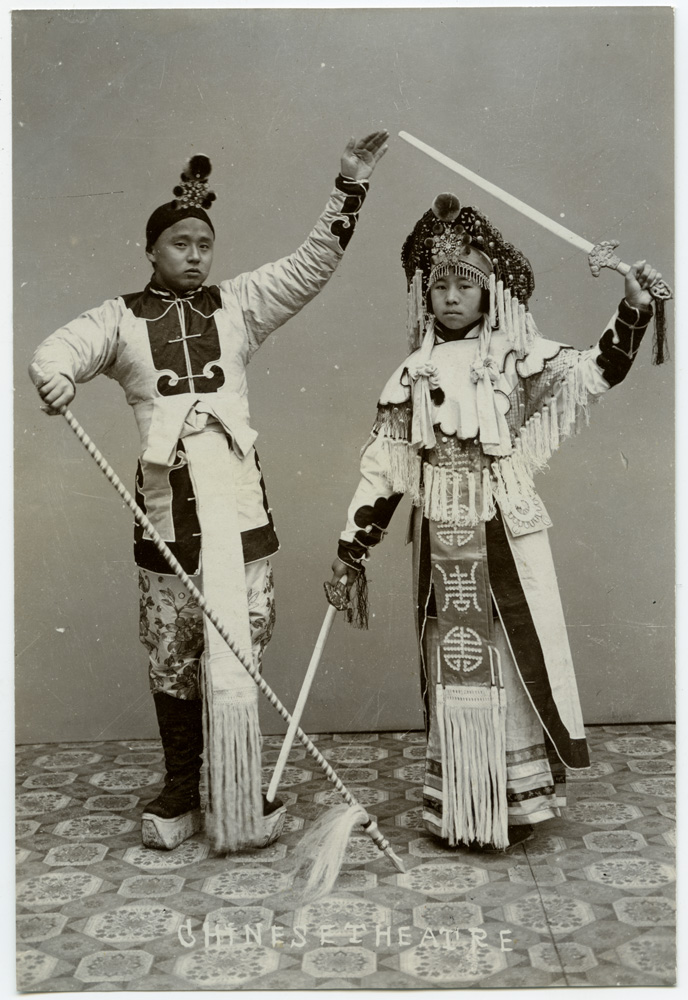
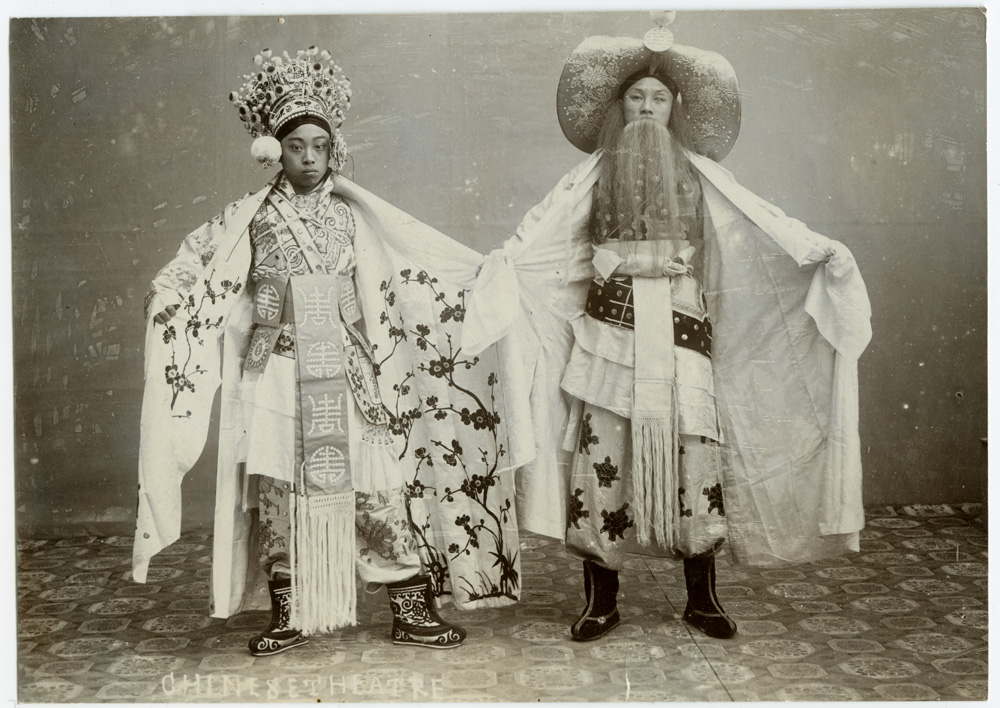
here are two turn-of-the-20th century souvenir photos from China. They depict performers in the Peking Opera. They come from the period marking the end of single-sex performers, when all roles both male and female would be played by male performers. Gender segregation of the opera began to phase out in the 1920s. For much the same reasons as in the West, Chinese theater was single sex because being an itinerant actor was seen as very much akin to being a prostitute. And despite the attempt to preserve the honor and virtue of women by banning them from performing on stage, the boys who played female roles on the stage themselves became prostitutes. Can’t win for trying, I guess.

Peking Opera Performers

I would classify these as genuine “gay interest” images because they represent a moment in history where the enactment of same-sex desire was sanctioned, even if in masquerade. It’s a rarity photographically because in the West, same-sex drama had largely been eliminated well before the photographic era, lingering on symbolically into the 19th century in the operatic tradition of castrati. If anyone out there recognizes the roles these actors are portraying, and the name(s) of the opera(s) they are from, the feedback would be most welcome.