If you haven’t yet read the book, Photo Work: 40 Photographers on Process and Practice, I highly recommend it. In the course of interviewing 40 different photographers with an identical set of questions about their creative process and how they conceive and execute long-term photographic projects, the book outlines several common approaches. It serves as a useful tool for self-reflection on how you as a photographer can approach your own projects, and encourages you to analyze your own working methods to better understand not only how but why you undertake a long-term photo project.
There has been over the course of the last 50 or so years a mythologizing of the photographer as a lone wolf, stalking the ever elusive Cartier-Bresson-esque magical ‘decisive moment’ image and somehow creating a body of work that will wow galleries and collectors and art historians through a catalog of utterly disjointed found moments on the street. While there certainly is potential to create a body of work this way, and there are a few famous photographers who have done this, to say that it is an uphill struggle would be putting it mildly.
Where the book Photo Work comes in is in pointing the reader to taking a more methodical, structured approach to creating images, especially a cohesive body of work that has a message. While it does not try to draw any definitive conclusions on photographic methodology, one observable trend amongst the artists interviewed is that they start out with a concept, work to produce images that support that concept, and if in the course of making those images, the images tell them that their original concept was flawed, or in need of refinement, or that the way they were making the images does not support the concept, they revise and adapt either the concept or the image-making process to refine the project.
This does not mean that they stop shooting images that don’t fit – in fact, the act of going out and photographing, of seeing through a camera, often informs the genesis of a project.
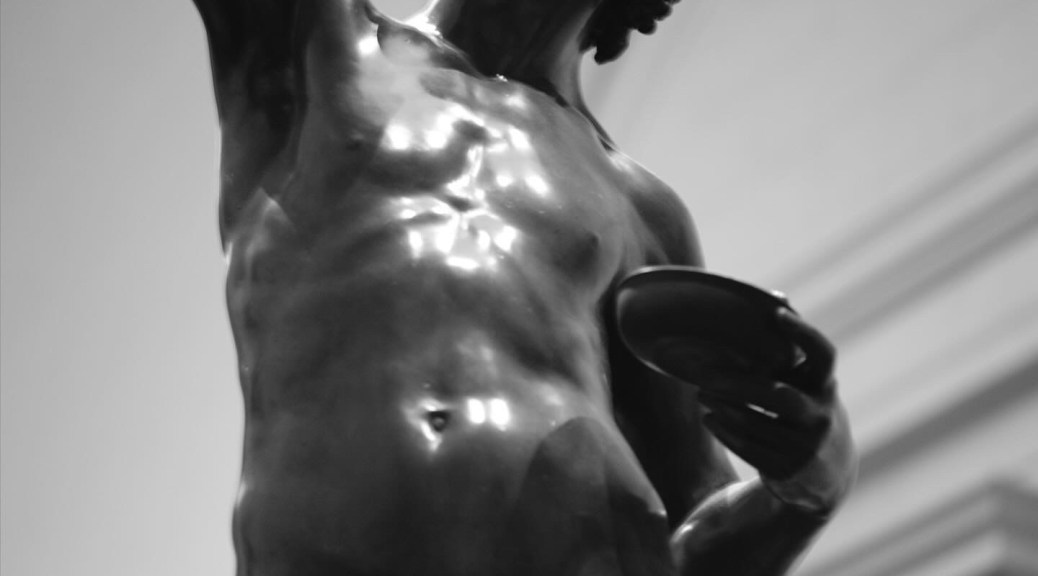
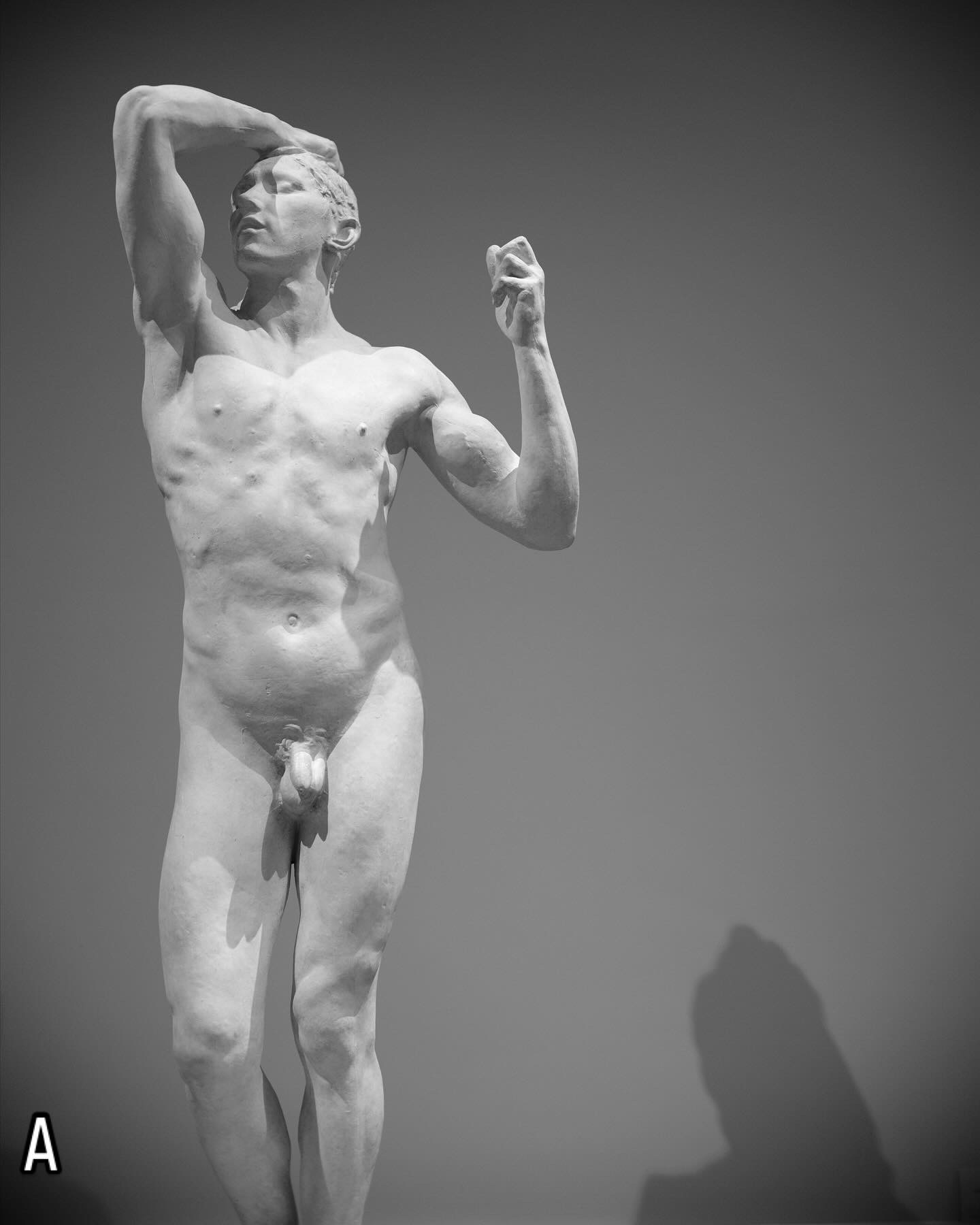
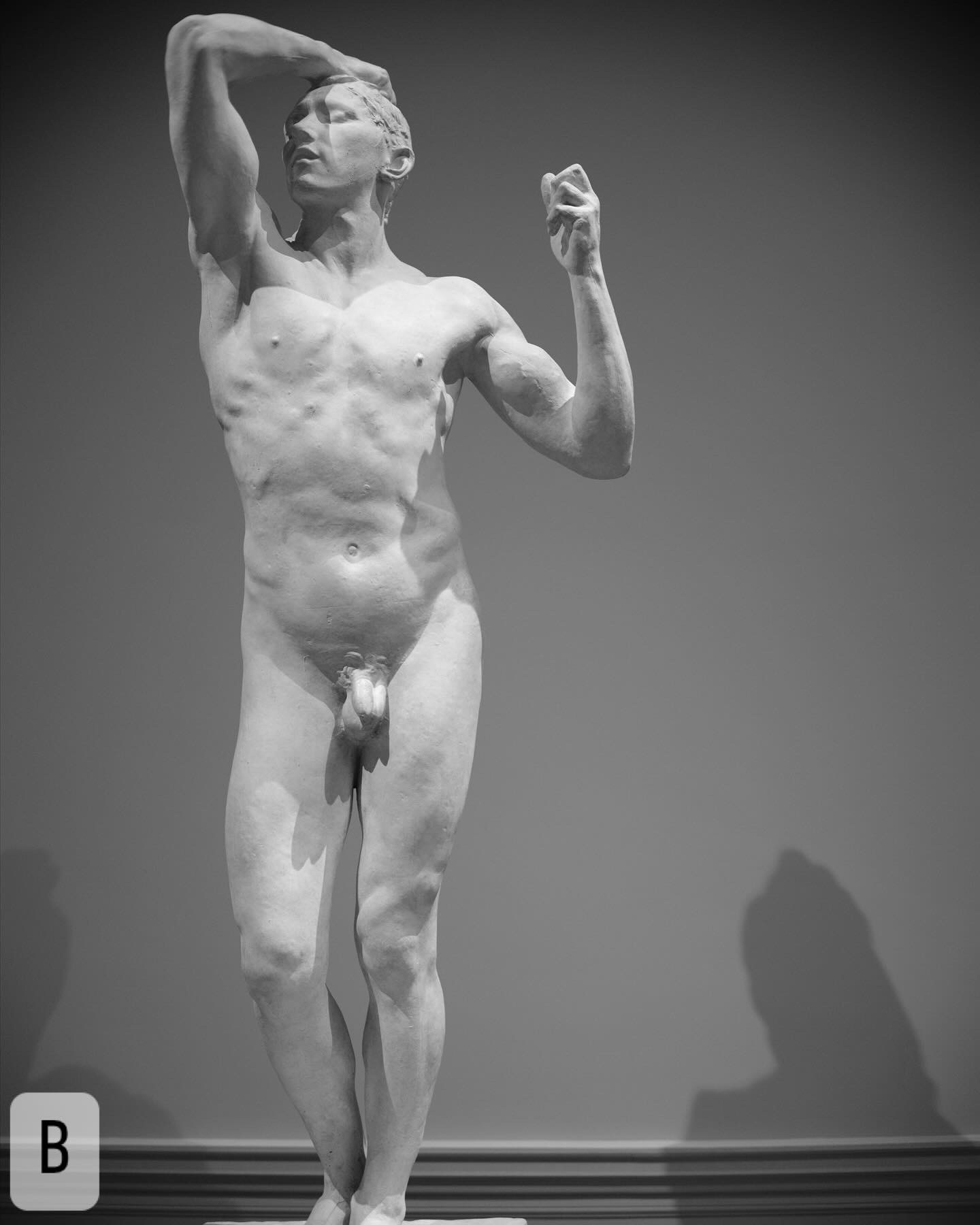
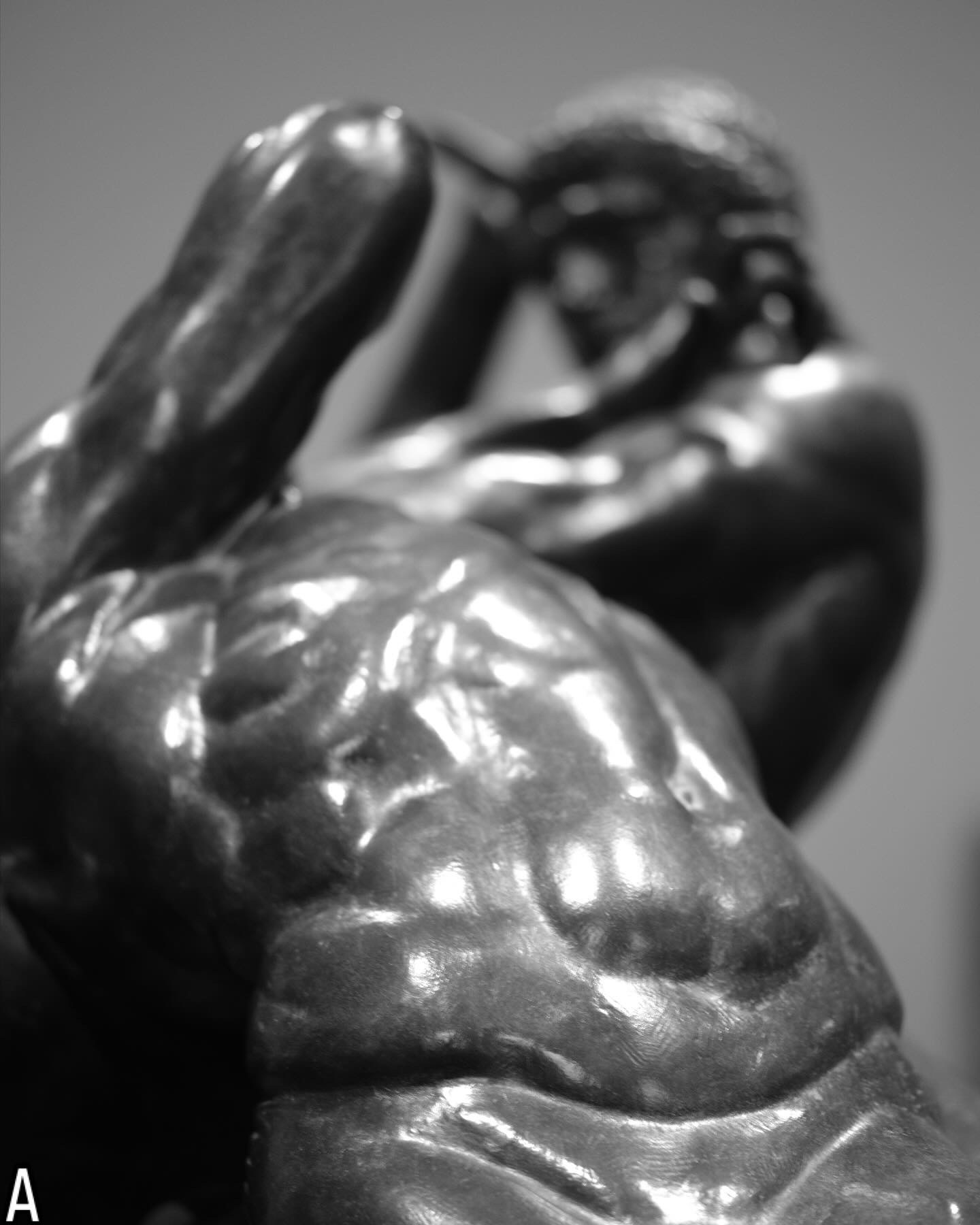
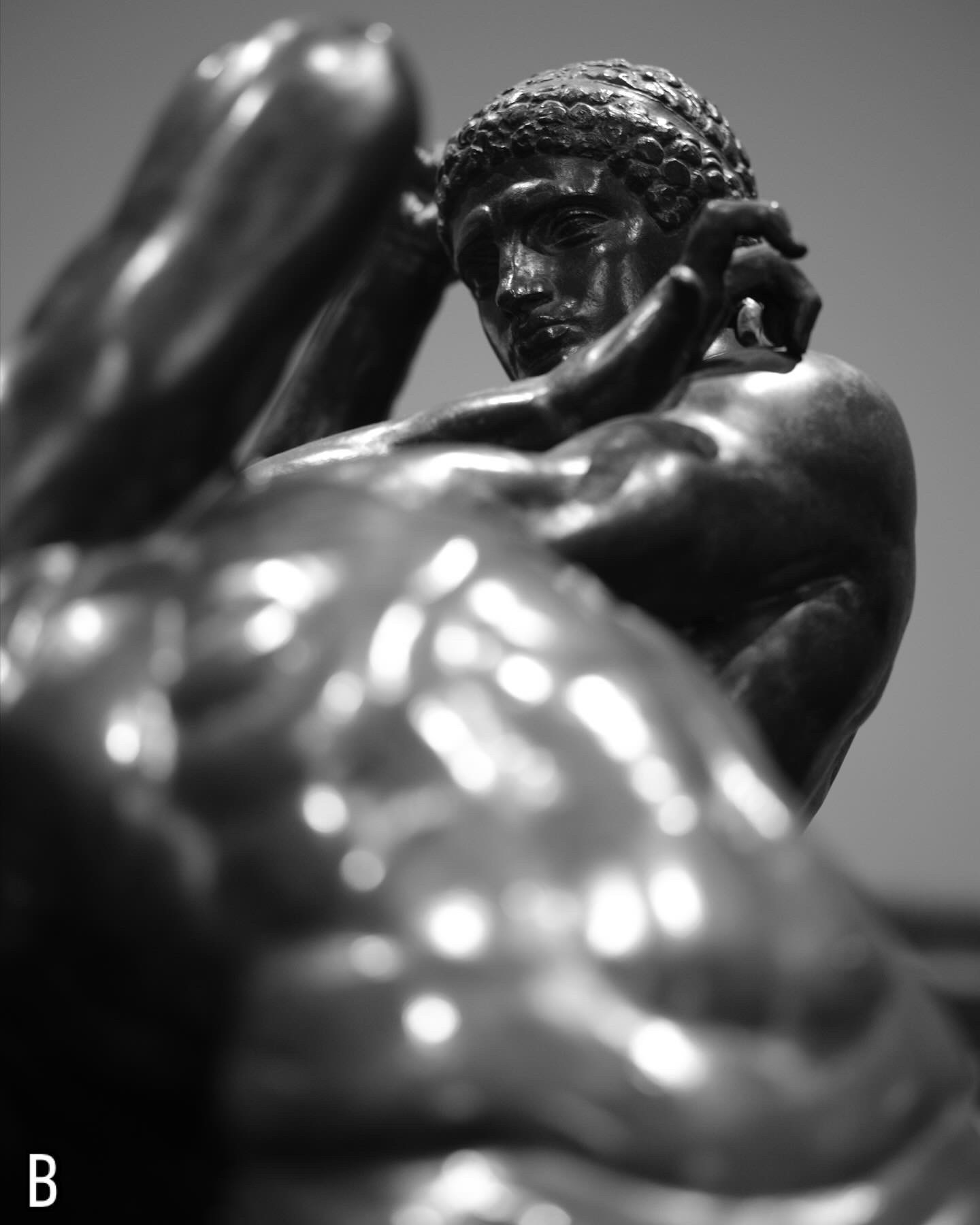
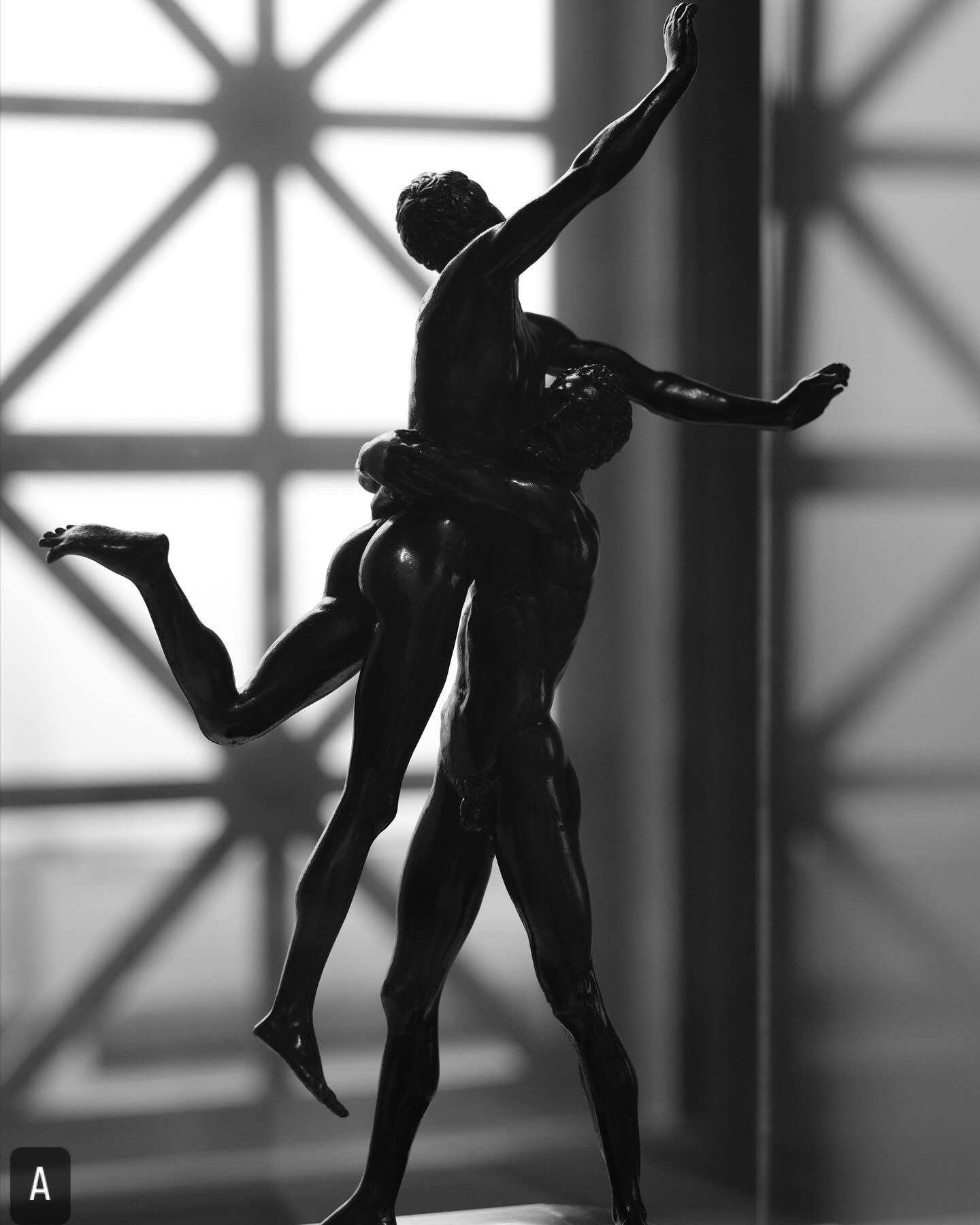
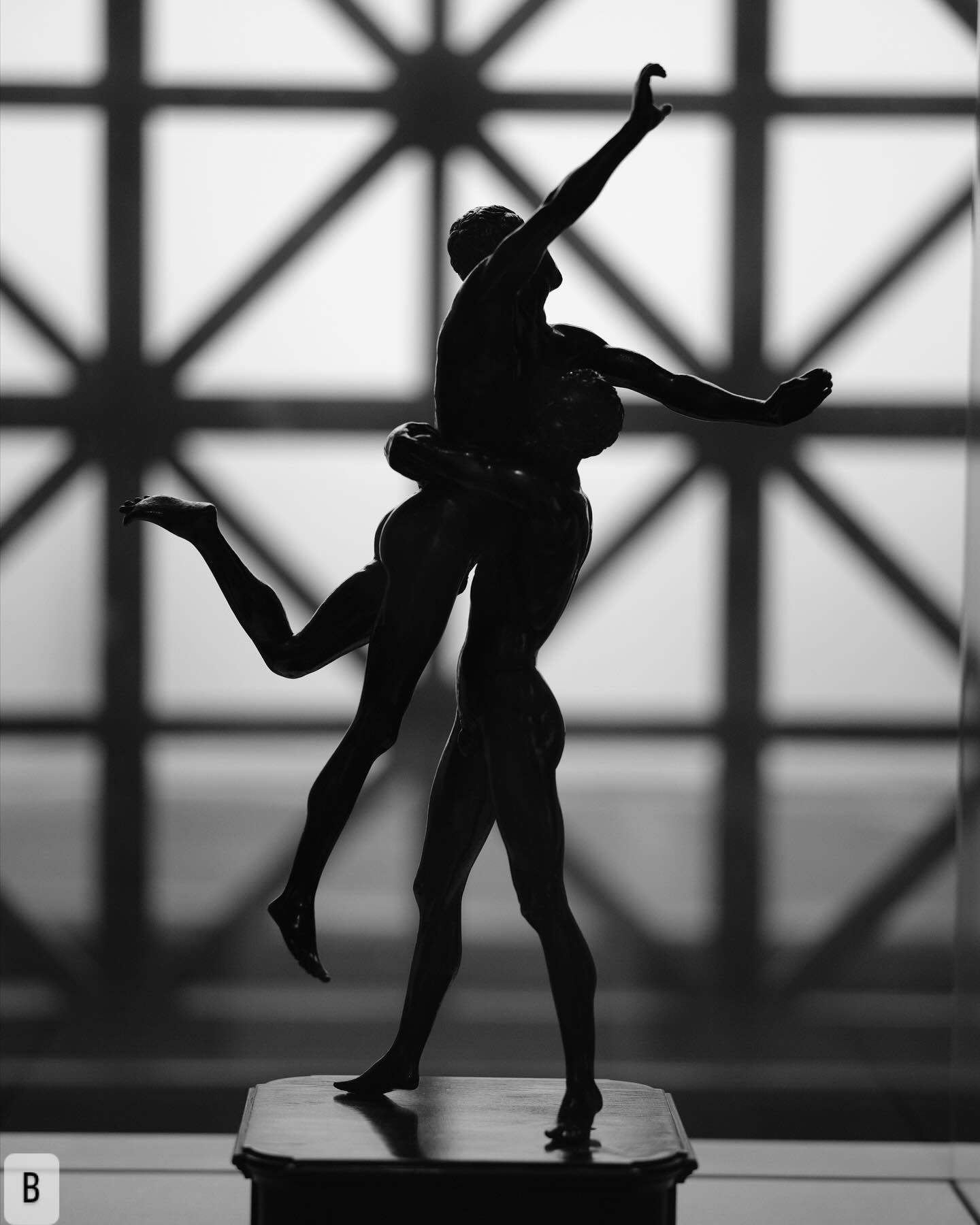
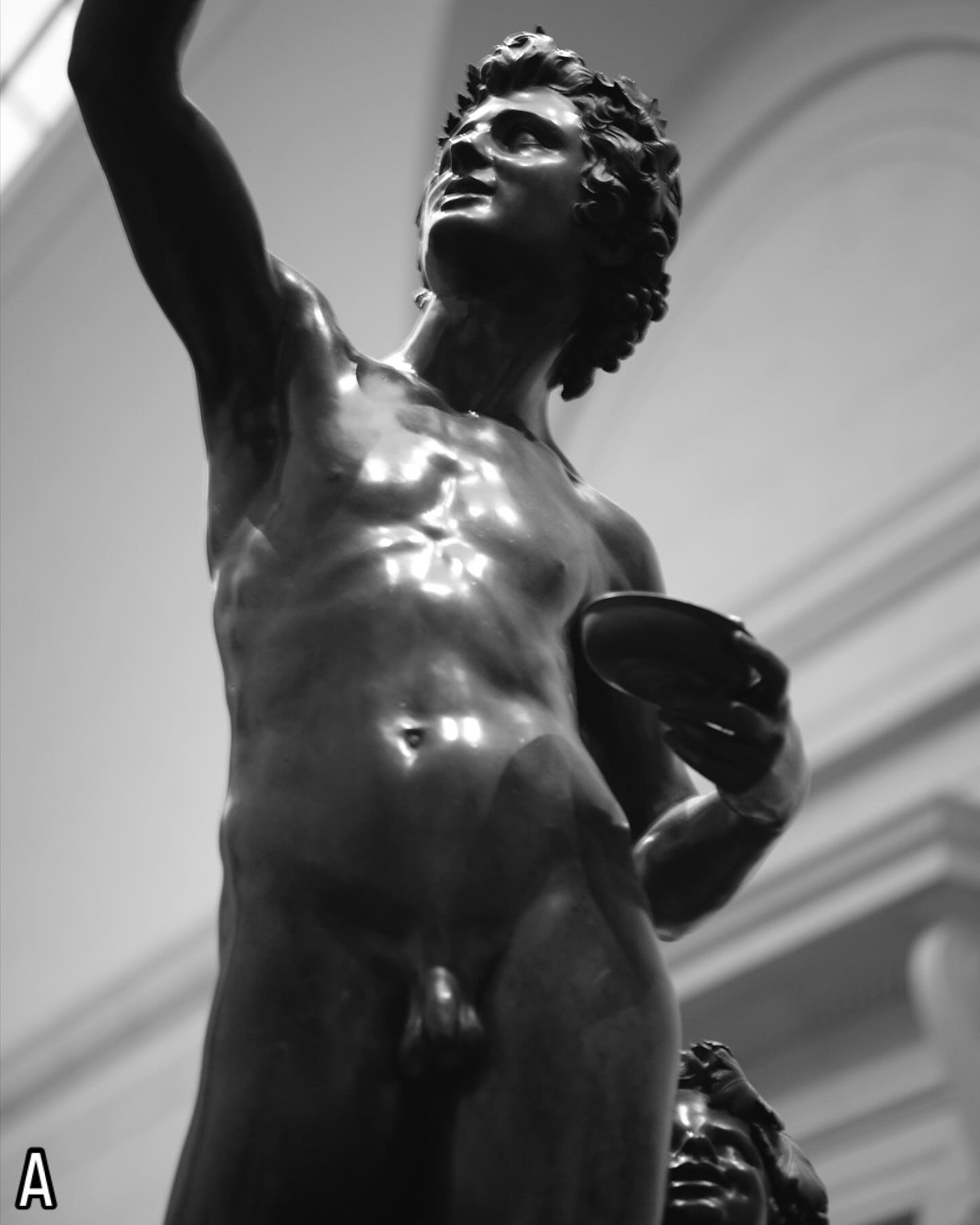
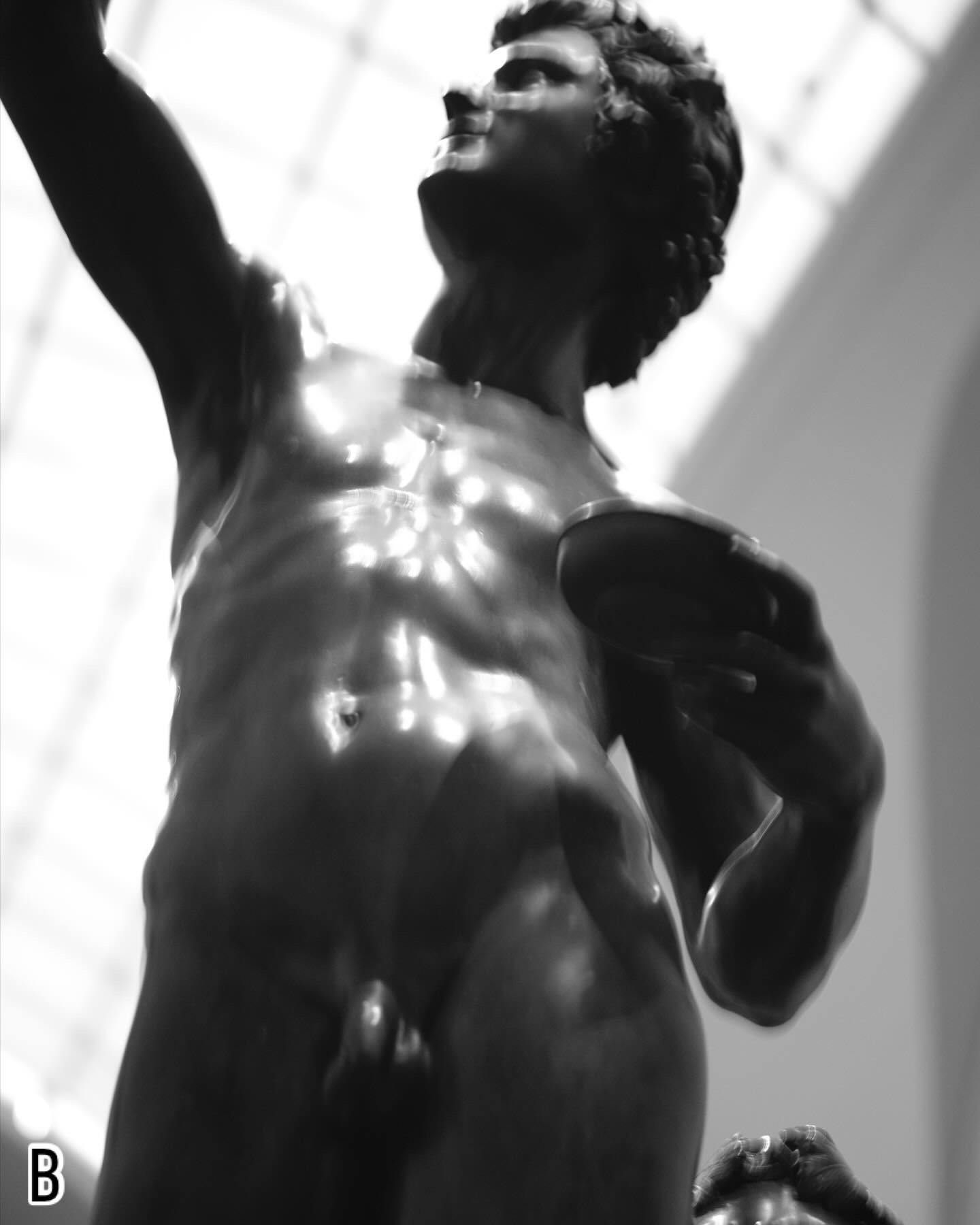
I’ve had a project idea burbling around in the back of my brain for a year now – I got started thinking about this after a trip to Richmond, Virginia to the Virginia Museum of Fine Art, and looking at the ancient bronze and marble sculptures, the Greek pottery, and even more modern artwork that carries an erotic subtext (or even overt eroticism). I wanted to do something that speaks to the role museums play in simultaneously preserving that and in whitewashing it – having work that has queer context in a museum permits the preservation and transmission of the queer gaze AND allows non-queer viewers to dismiss that quality of the work.
I have several theories as to how I am approaching this concept, so I’m going to just put some images out there for you all to respond to, if anyone is so inclined. I’m not going to articulate those concepts because I don’t want to prejudice the jury pool – just react to the A-B pairings and let me know your thoughts on them. There is no right or wrong answer, just react. I will block/delete any homophobic/hateful comments.
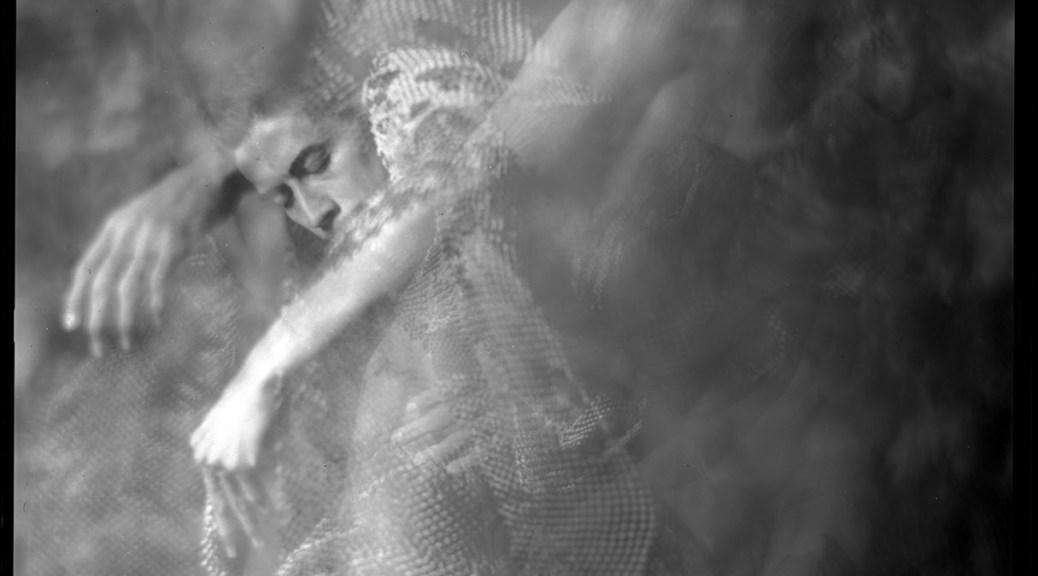
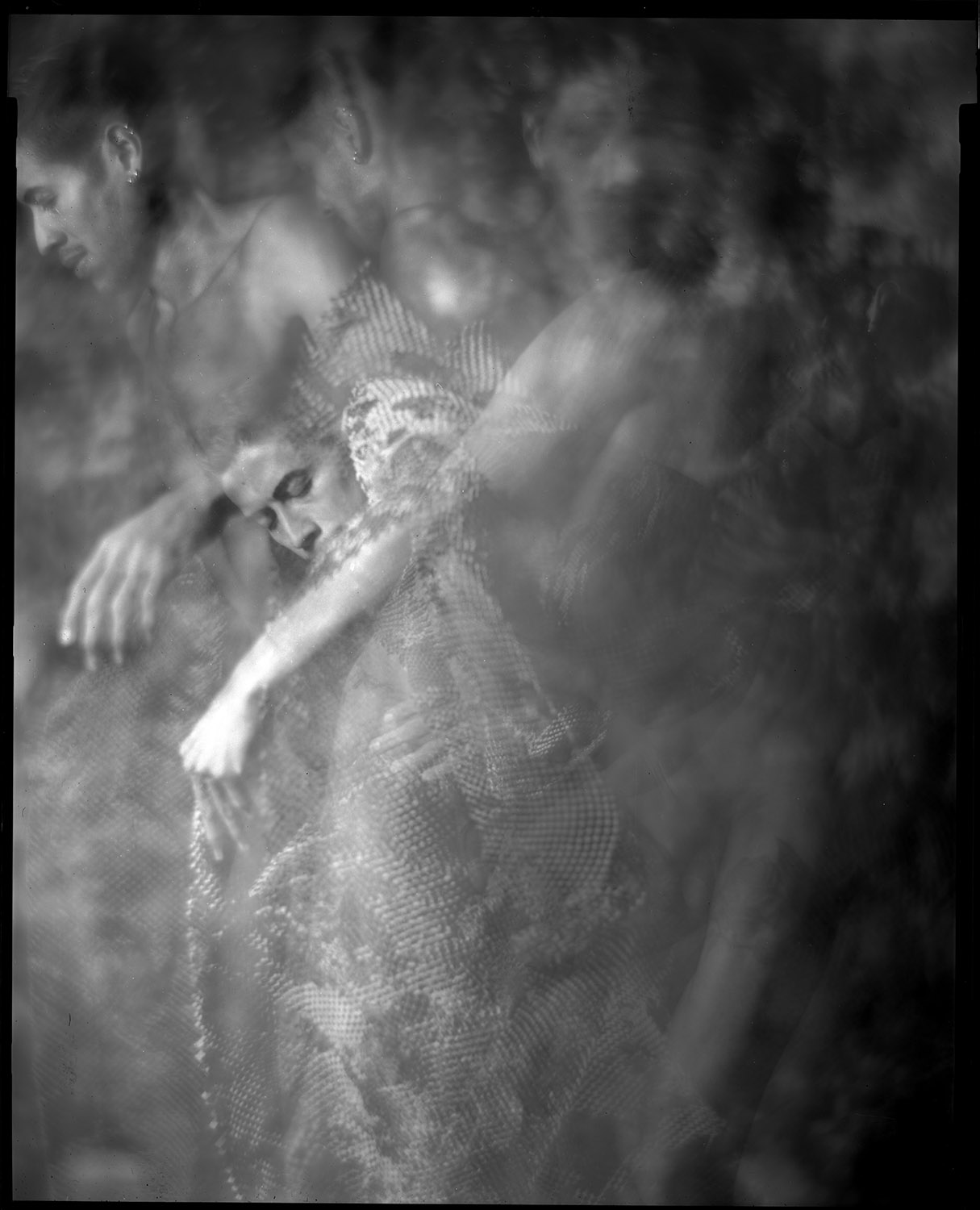
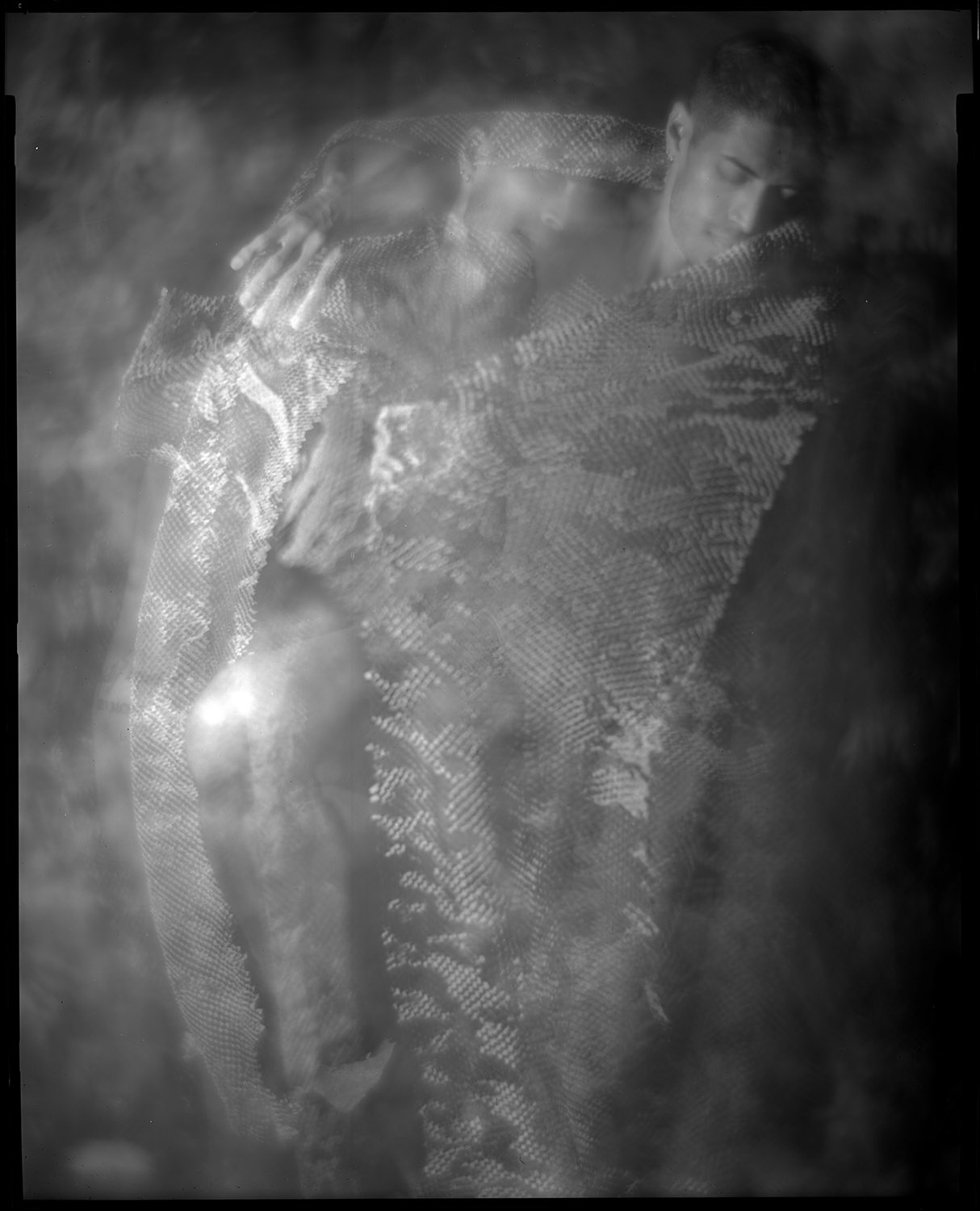
I’m getting started on a new series of human figure studies to go along with still life images. I arranged with a friend who is a professional dancer to be my model. One of the things he wanted to do was to try some movement studies. I had some pre-conceived shots I wanted to make, but I thought it would be good to push my comfort zone and try to do something different. I’m very much a collaborative photographer when it comes to working with models – I know I do NOT have all the ideas, and I love being inspired by and learning from the people I work with to create images.
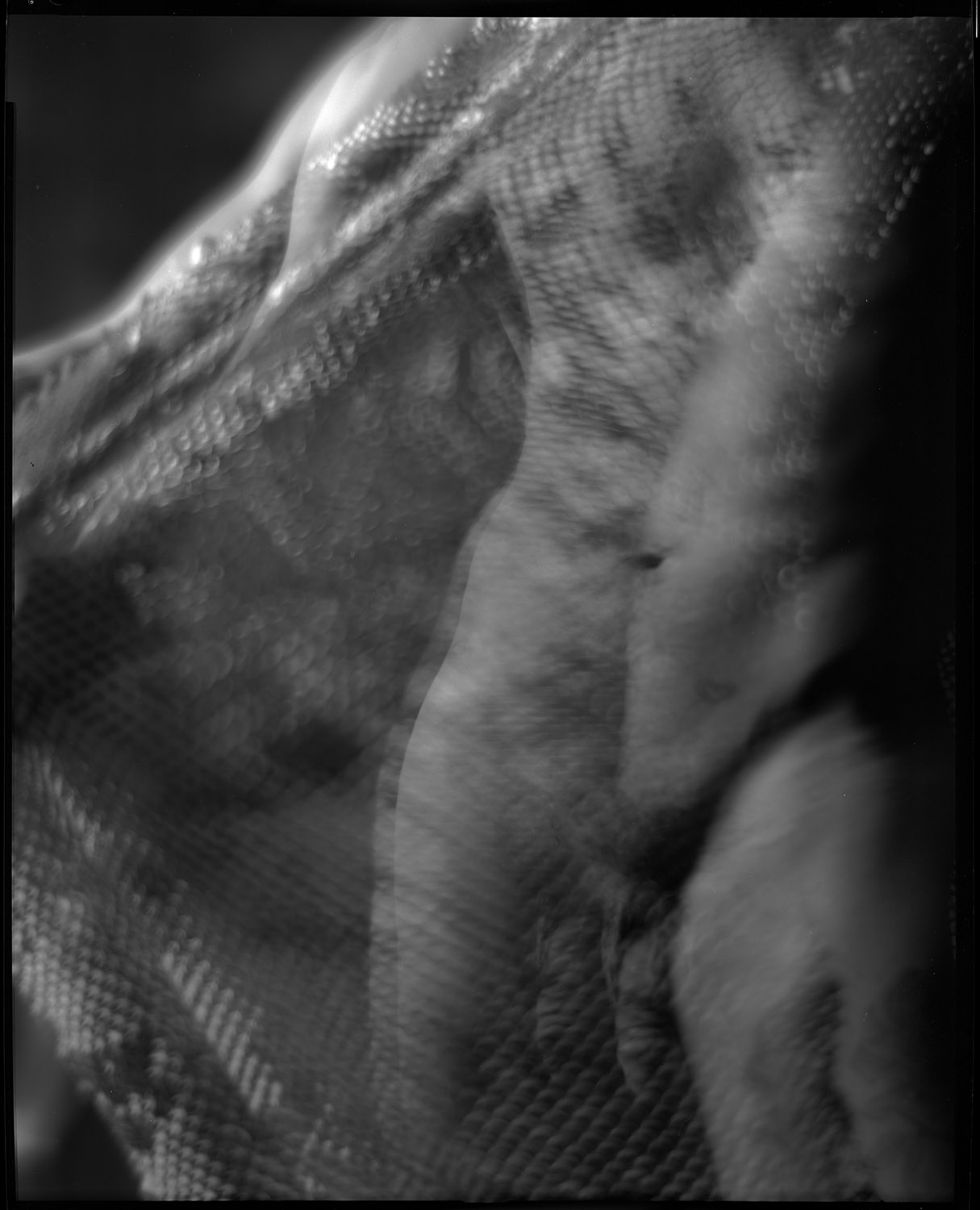
I also enjoy using the limitations of my tools creatively and making them do things they aren’t necessarily intended for. We did this series with my 8×10 inch studio portrait camera, which is a big, heavy, relatively immobile beast. It has a Packard shutter to control exposure, which is a fairly crude, imprecise device (top speed is 1/30th-ish of a second). But what it does do is allow me to keep the shutter open for an extended period with the pneumatic squeeze bulb. So for these motion study shots, I opened the shutter, let Gabriel my model dance, and randomly popped my flash multiple times during the exposure. Very imprecise, very guesstimate, very subject to the whims of serendipity or disaster.
To make things more interesting, I had him dance with a piece of perforated craft paper that came in a box as packing material for something I bought online. The combination of the paper plus the swirly backdrop we worked in front of plus the use of a soft-focus lens on the camera gave the images an etherial, smoky look.
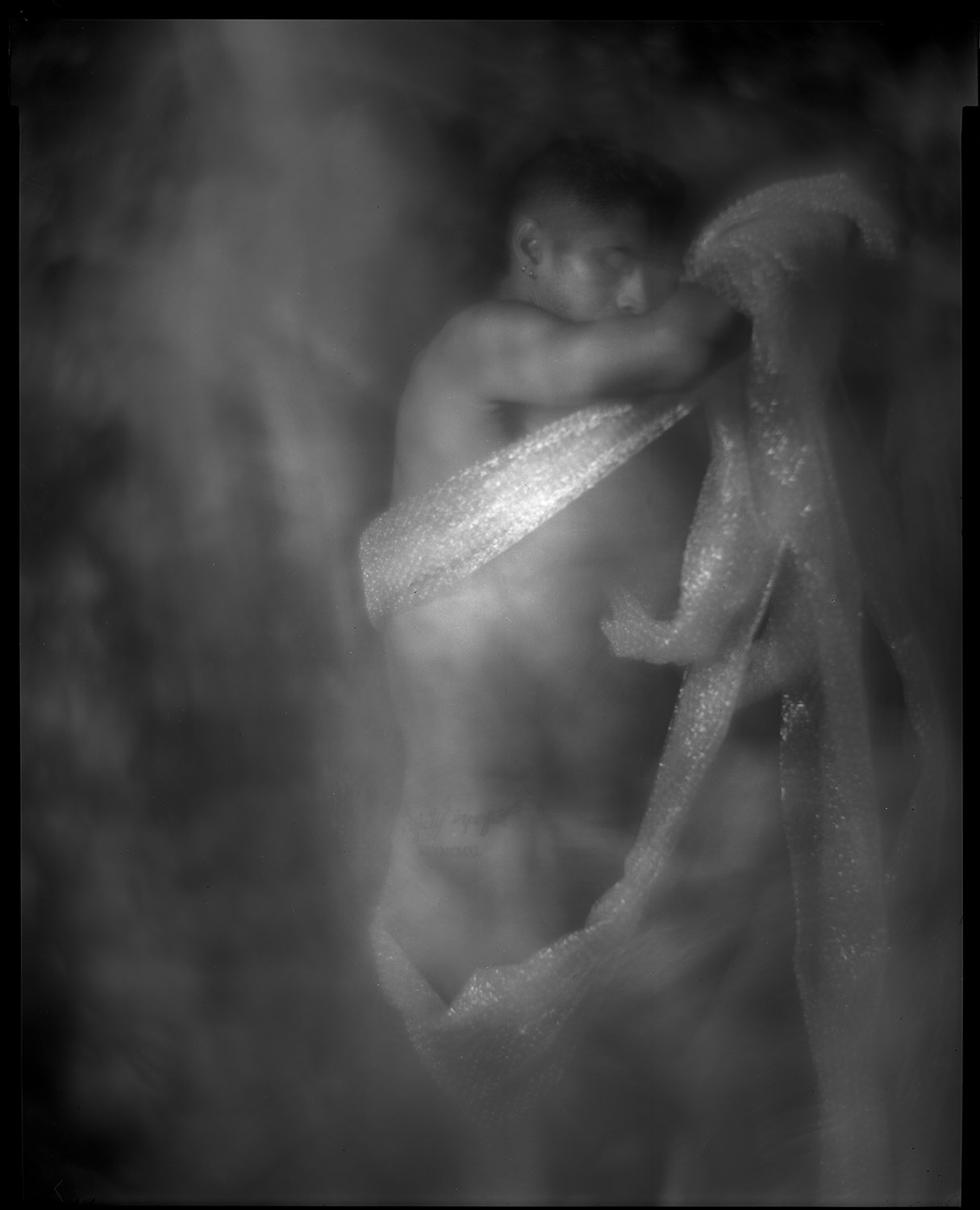
We also did some with bubble wrap.
We only did a few shots like this as it was experimental and I had no clear idea how it was going to come out. Having seen these, now I wish we had shot a whole bunch more of them! But that is the clarity of hindsight. Now, at least, I am inspired to try more of the same, and have a foundation of what to expect.
The great risk of course is, now that I have these shots, in trying to replicate them I will end up dissatisfied with the results because they will be too thought out and the element of serendipity will be lost, or I’ll go too far the other direction in trying to compensate for the serendipity loss and make a godawful mushy mess. But these are the risks we take when we make art – connecting with something emotionally is always risky.
I have a class coming up from March 4 to April 29, Understanding Your Practice – The Photo Project, at Glen Echo Photoworks. This course is about thinking about how we approach and execute photographic projects. The foundational text for the class is Photo Work: Forty Photographers on Process and Practice., edited by Sasha Wolf. The book consists of interviews with forty different photographers who work in long-term projects, asking each of them the same twelve questions.
We will use the text as a guide to introspection into our own process of working on projects – how we come up with projects, how we shoot those projects, how we decide when they’re done, how we edit those projects, and how we think of them as a body of work – will they be prints on a wall, a book, a website, or some combination thereof.
We will execute our own mini-project over the duration of the class, using the ideas we discuss to help us guide our project and get a better understanding of our own working methods. There are no “right” answers here – this is just an exercise to help bring clarity to your own working techniques, to refine them and hopefully bring success to your ongoing long-term projects (or help you get started on them!).
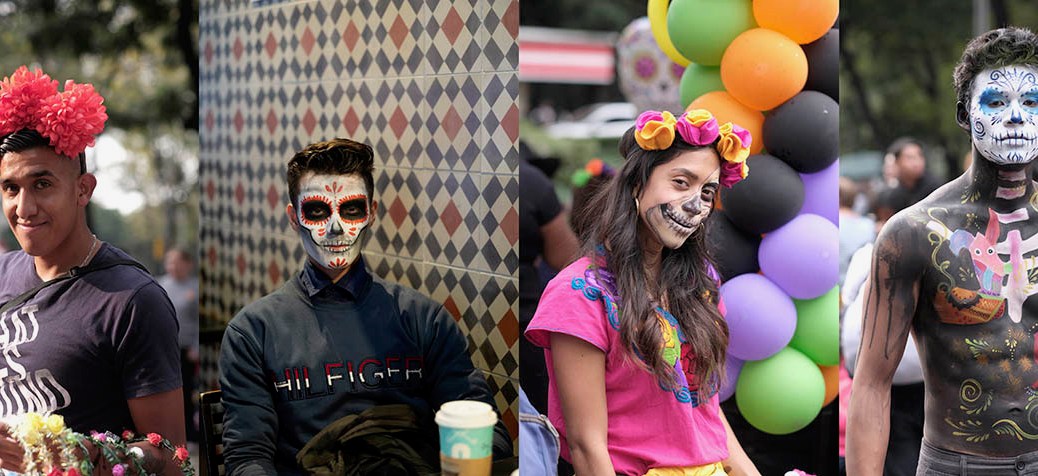
The images following here are illustrations from my ongoing project about The Day of the Dead in Mexico City. Day of the Dead is a far-reaching cultural institution across not just Mexico but much of Latin America. It has regional and even local variations – Mexico City was, until very recently, somewhat blasé about the event, with celebrations being held more on the personal level. Thanks to the 2015 James Bond film Spectre, Mexico City decided that they needed to have the big public parade (desfile in Spanish) depicted in the film.
The event has its roots in traditions predating the arrival of the Spanish conquistadors, which were co-opted by the Catholic church. Today, the tradition adapts with the times and competes with Halloween (and its Hollywood inspirations), but also serves as a mirror of contemporary cultural and political events.
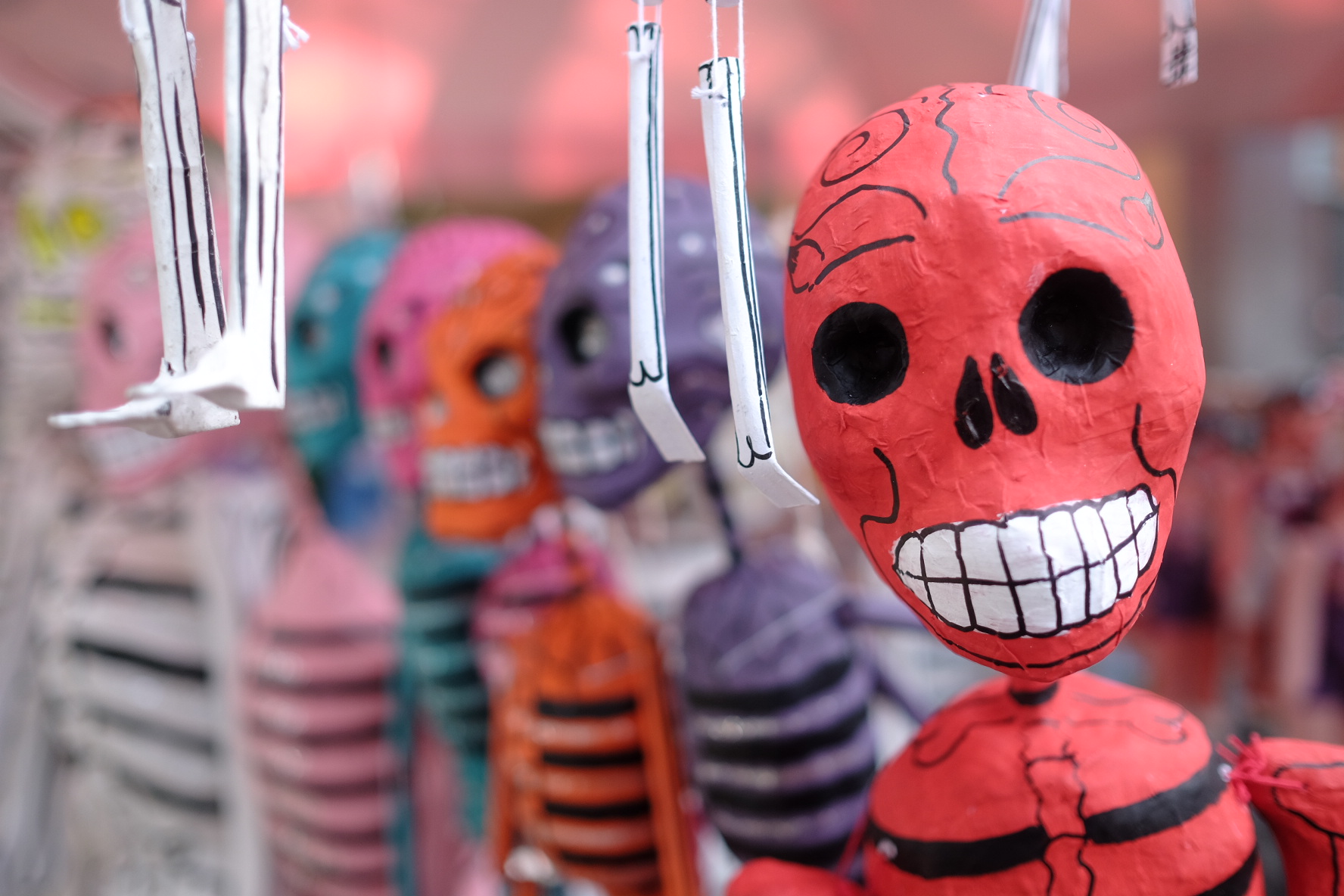
Papier-mache skeletons for sale from a street vendor.
More papier-mache skeletons for sale on the sidewalk in Coyoacan, an historic neighborhood in Mexico City
Businesses getting into the spirit – El Moro Churreria, one of the most famous churro shops in Mexico City, has their own mesero (waiter) ready to serve the spirits of the dead!
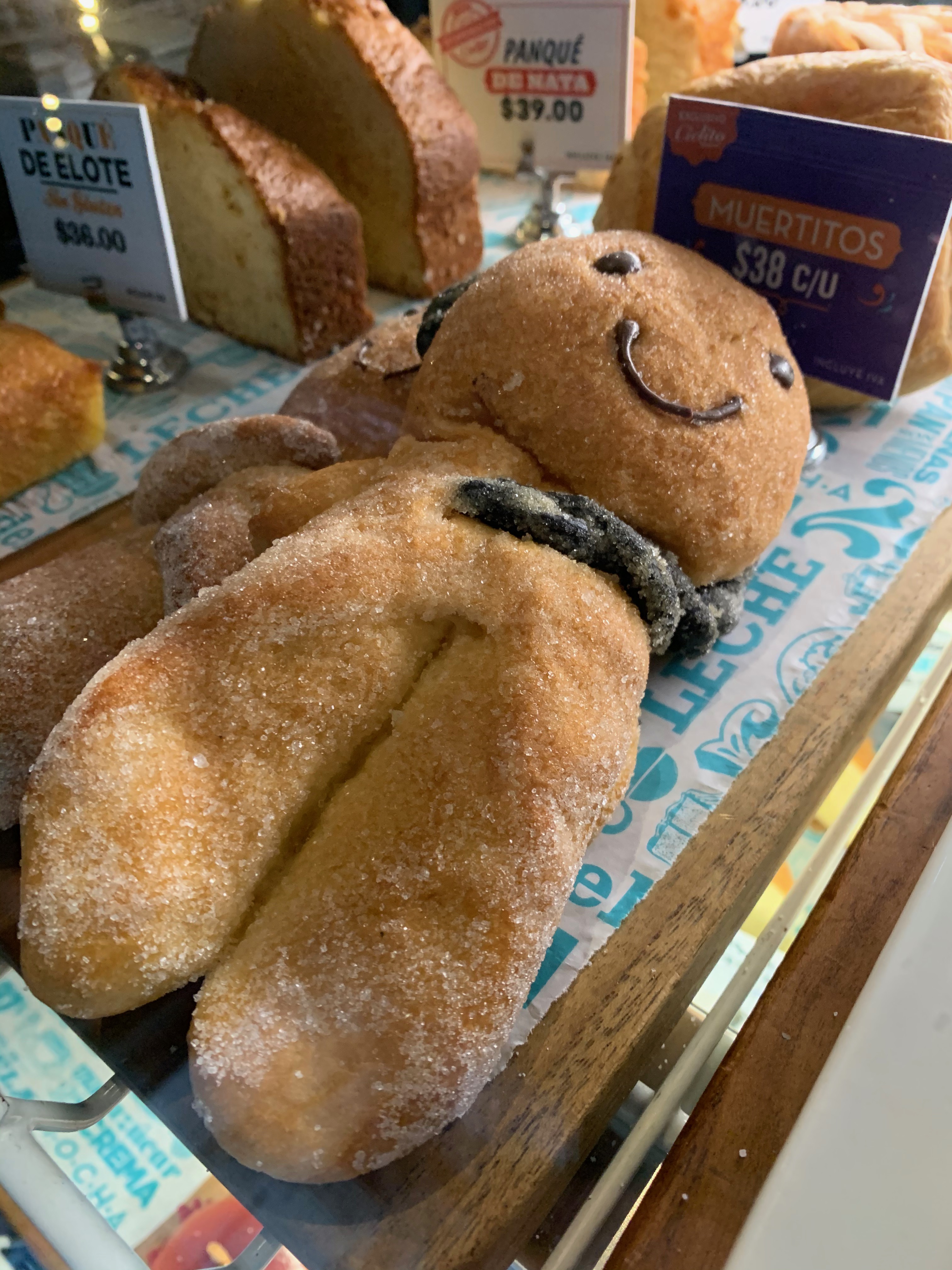
Muertitos – pastry for day of the dead in the shape of boy and girl dead.
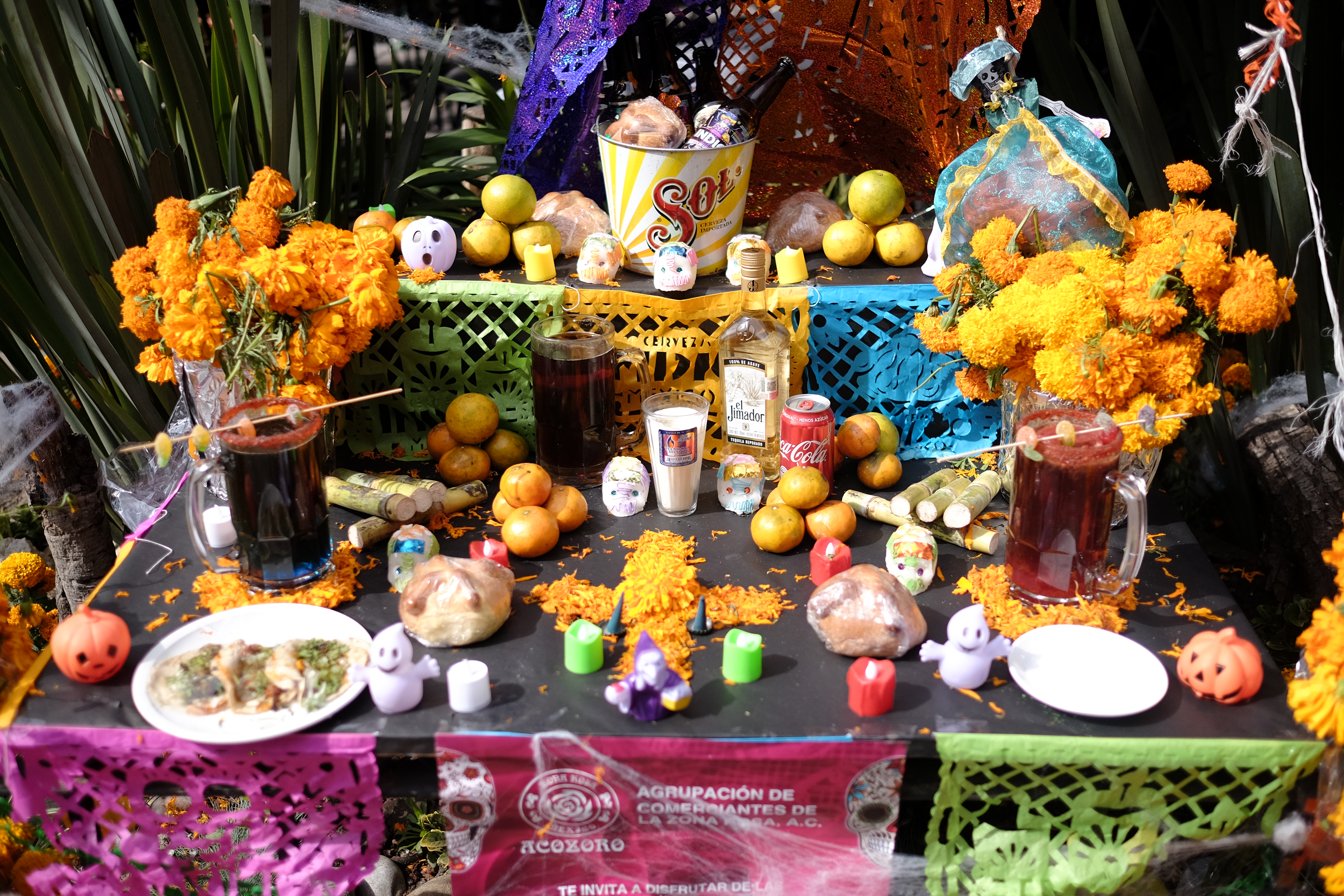
a typical offend altar set up outside a bar in the Zona Rosa
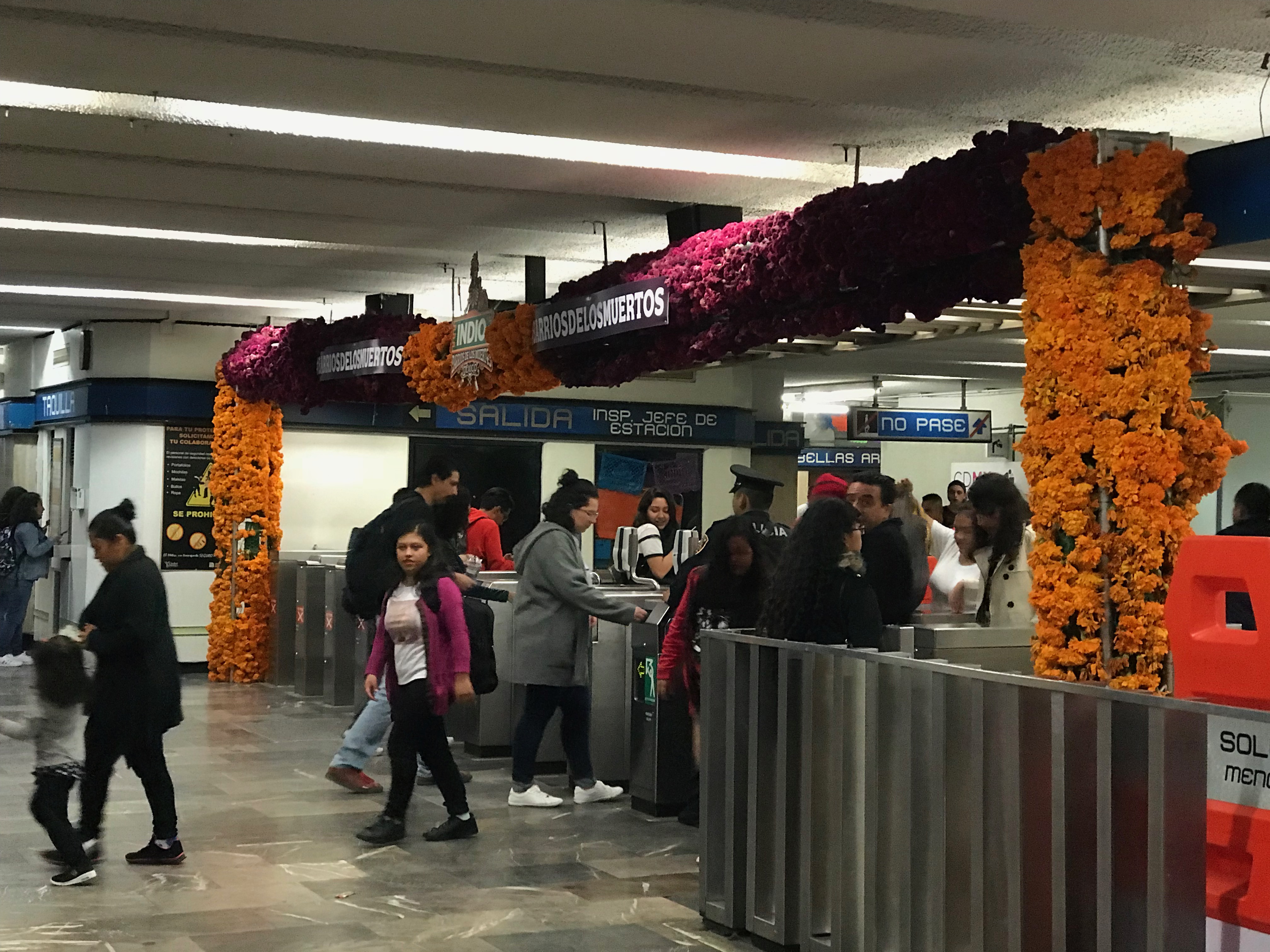
Even the Mexico City metro system gets into the spirit. Turnstiles decorated with the traditional orange cempasuchitl (marigolds).
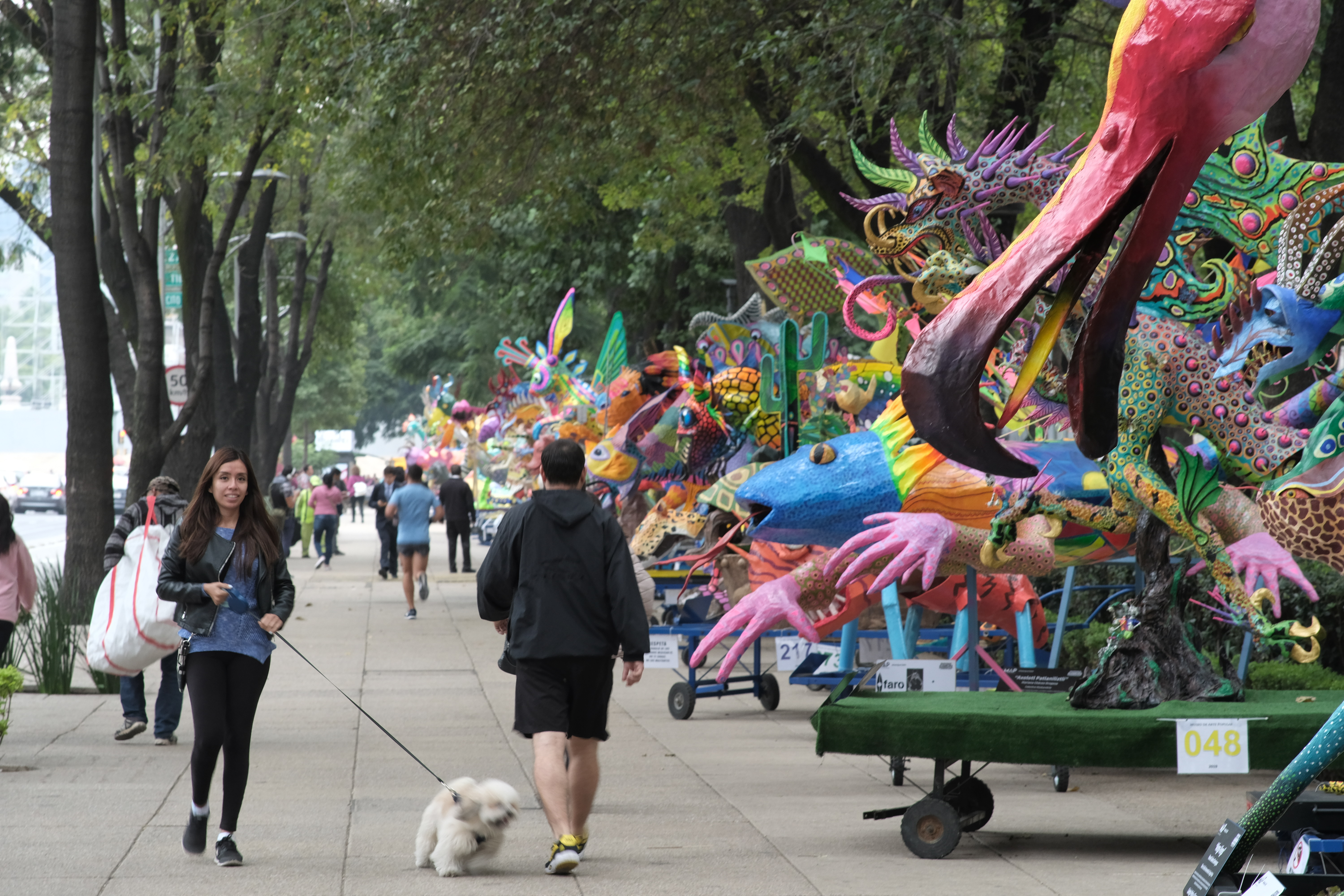
The avenue of Alebrijes (fantastical spirit animals) along Reforma, each one commemorating a person who has passed on. These Alebrijes line both sides of Avenida Reforma for over a mile.
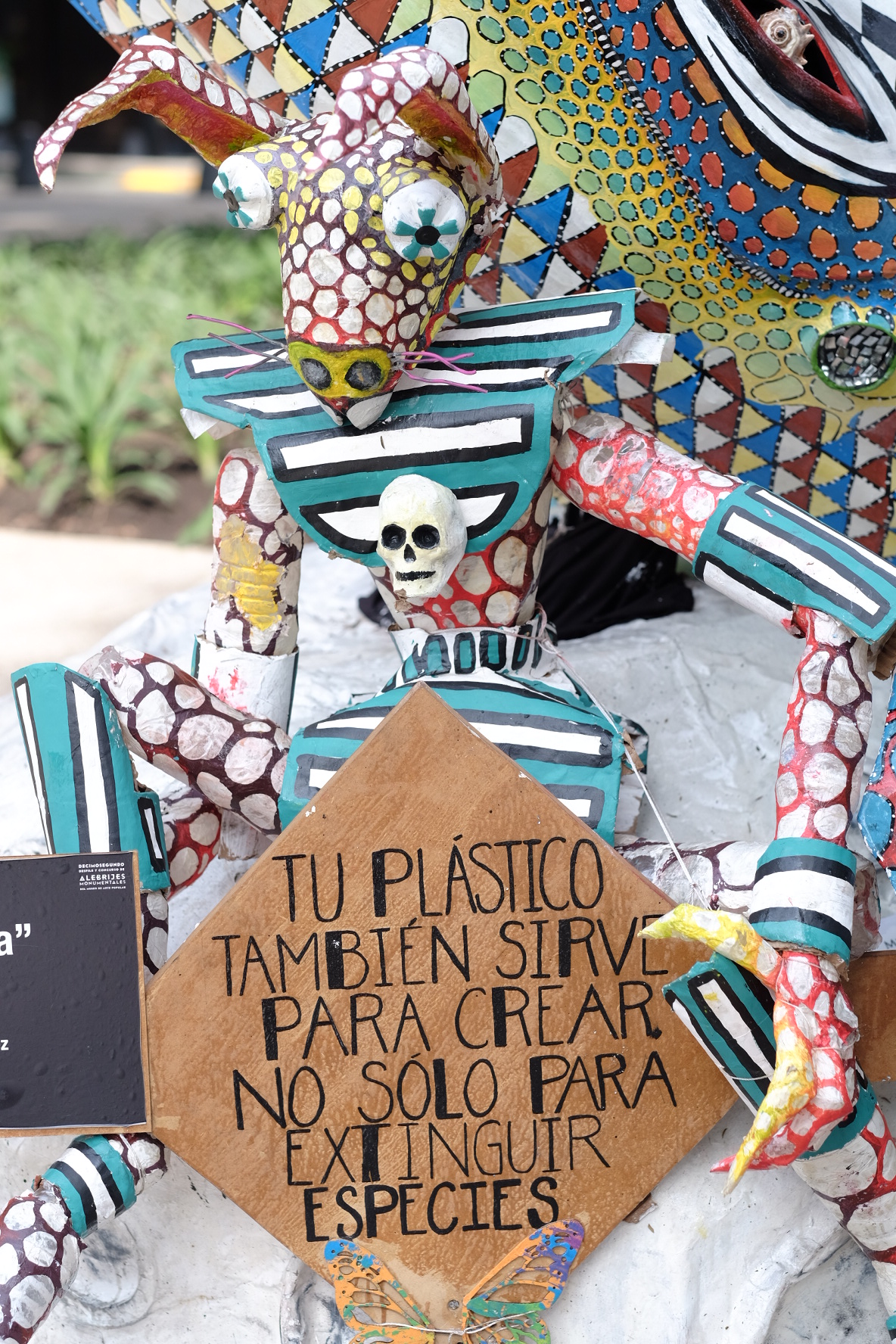
The cultural is political – an Alebrije on Avenida Reforma reminding us that plastic can create and it can destroy.
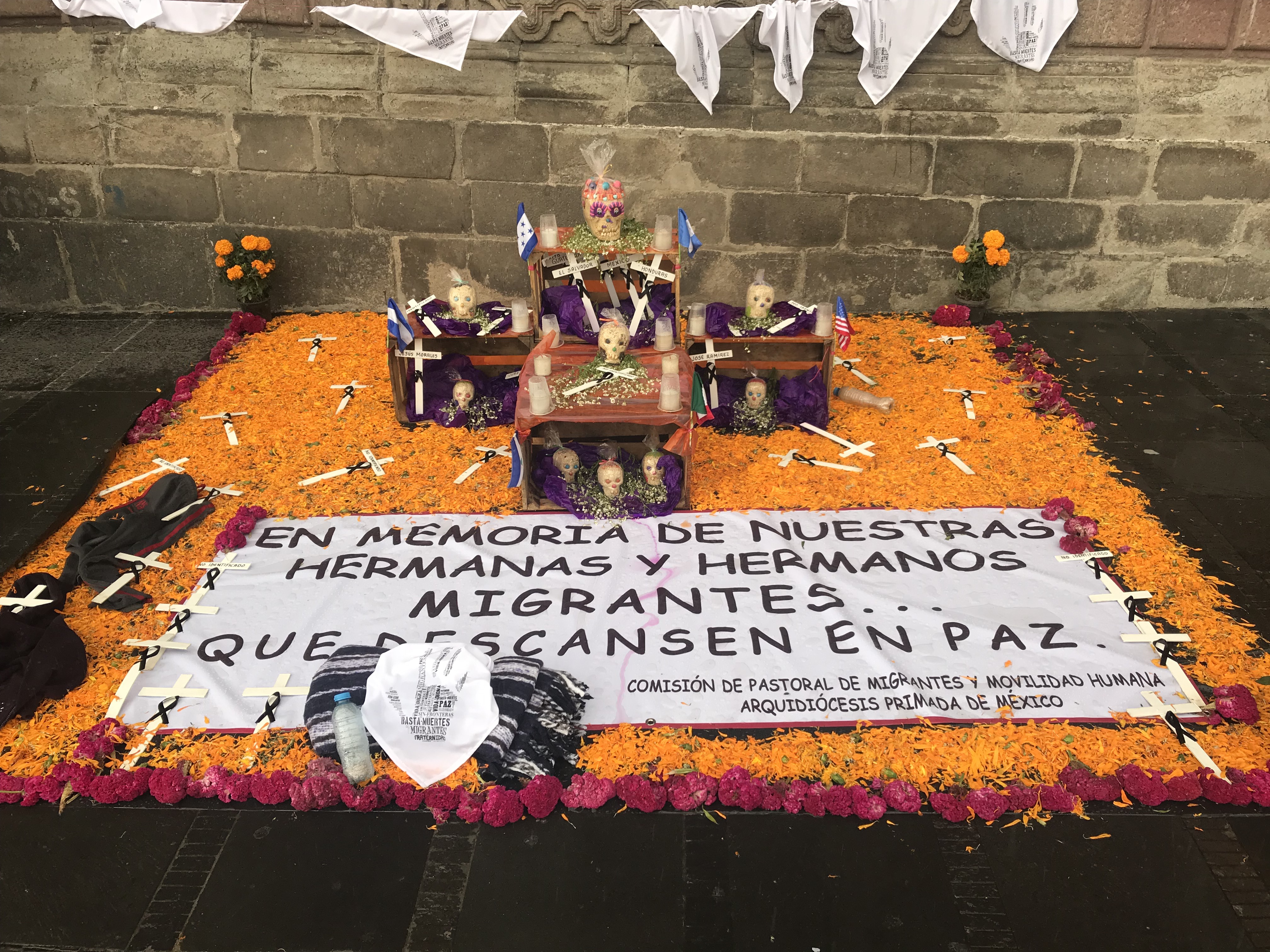
A memorial altar or ofrenda at the front wall of the Metropolitan Cathedral in Mexico City in memory of migrants who died fleeing violence and poverty in Central America.
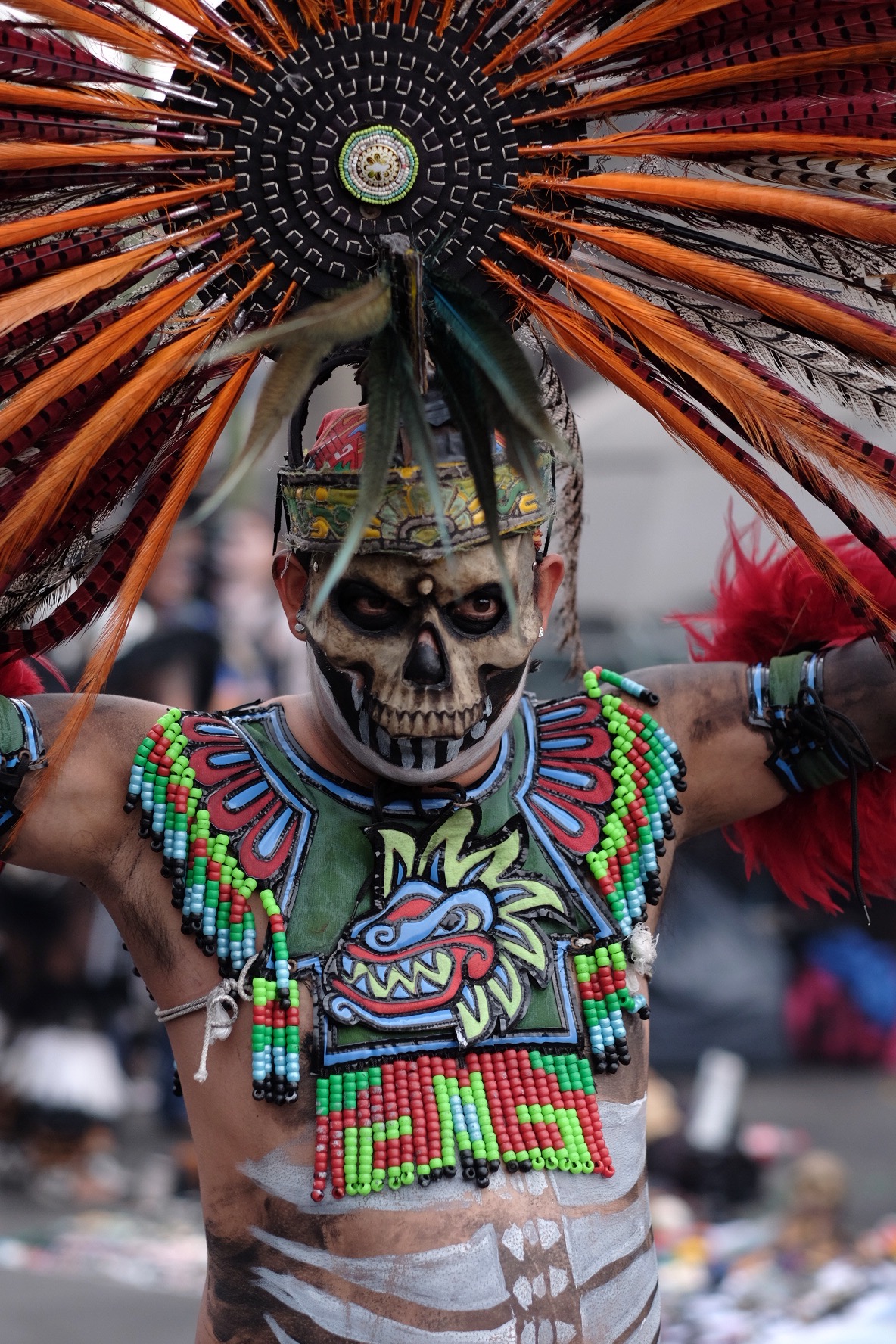
Traditional Aztec dancer performing on the plaza in front of the Metropolitan Cathedral
A painted Catrina accompanied by the abuelita Coco from the Disney movie of the same name.
Young woman with face painted.
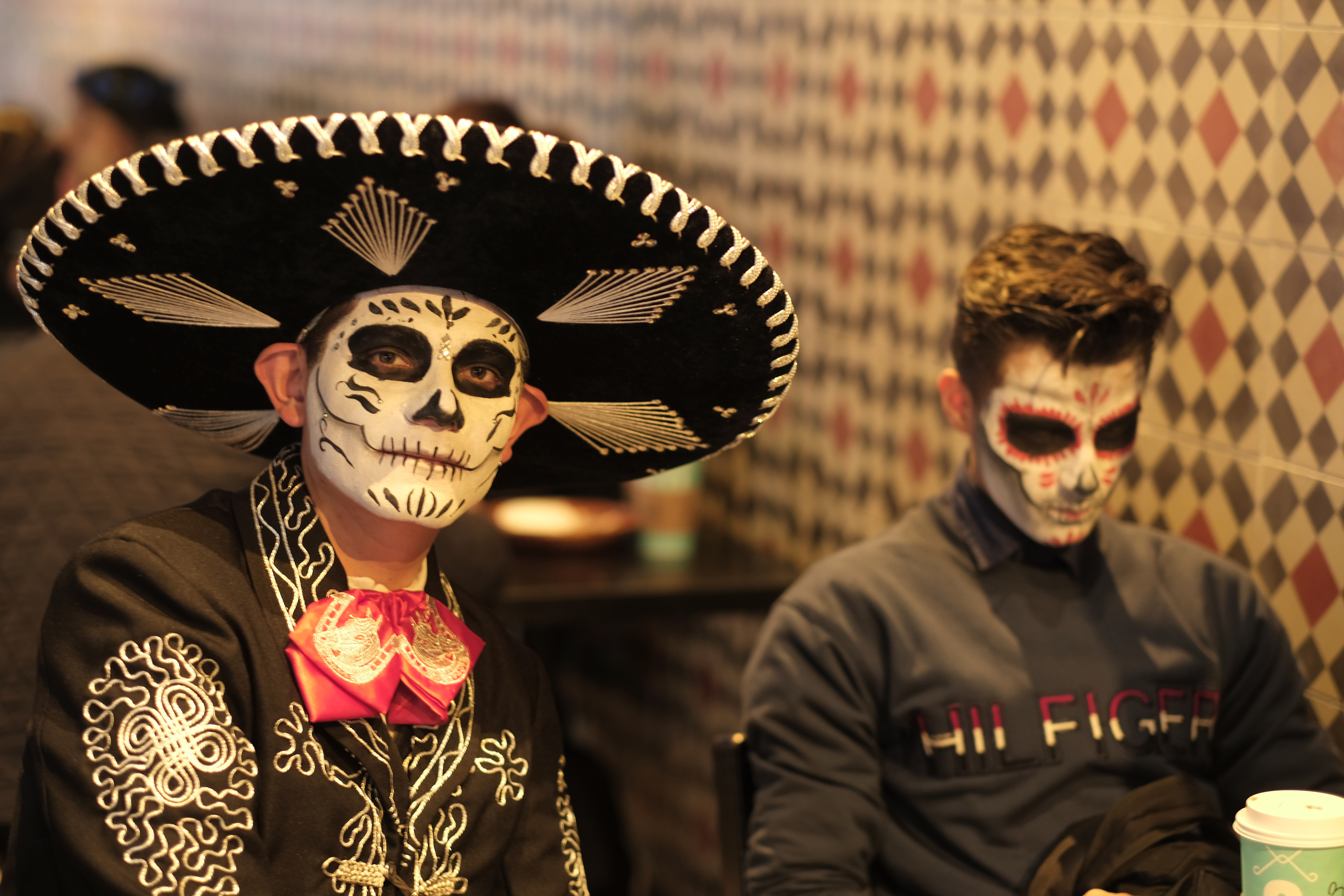
Mariachi and friend in the Cielito Querido Cafe on Avenida Reforma.
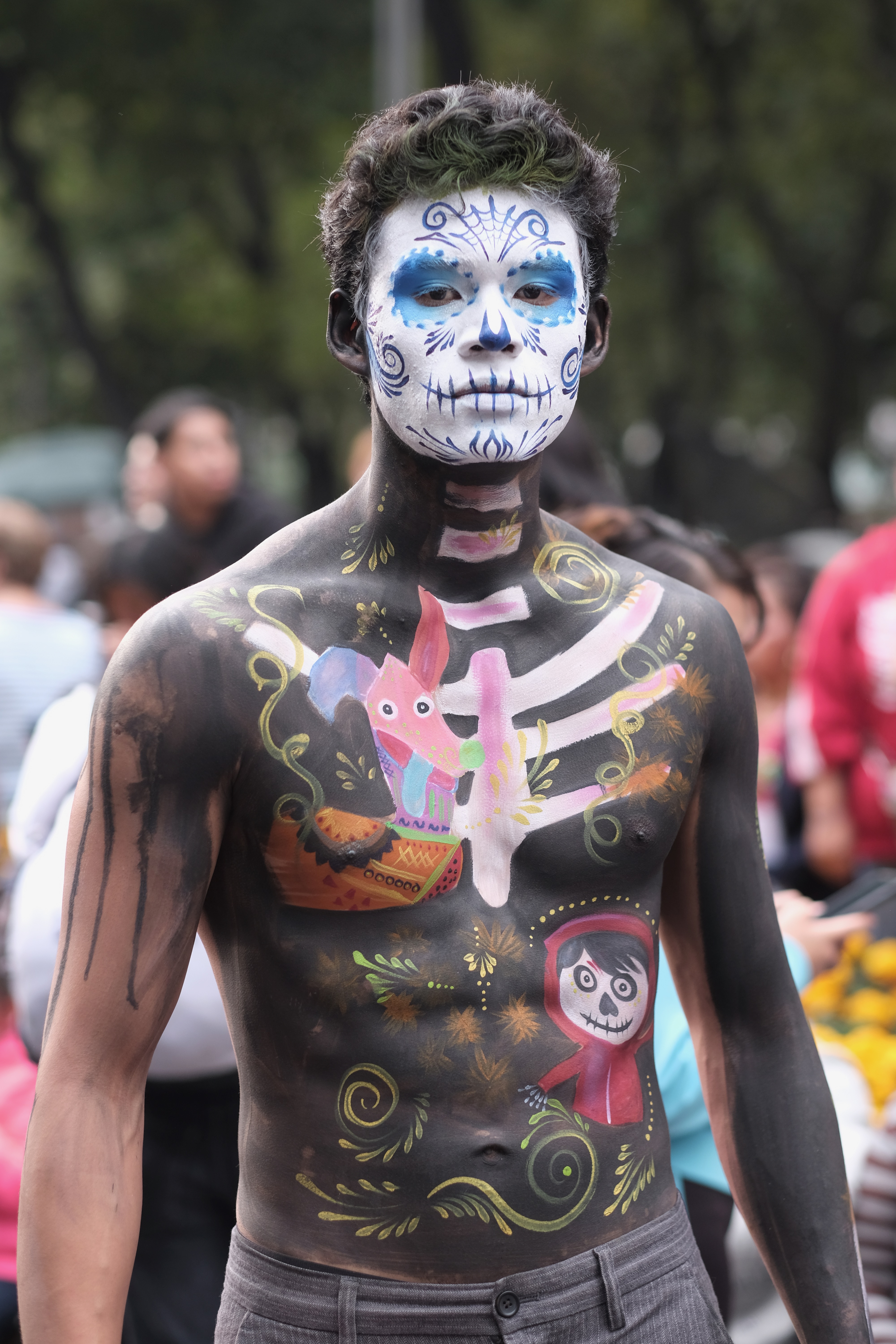
The traditional meets pop culture meets artistic expression. Full body paint that shows not only the huesos (bones) of a skeleton to remind us we are all mortal, but interconnected with the little boy and his dog from Coco, the Disney movie.
To sign up for the course, click on the link below. Tuition is $350 for 8 sessions. No class will be held on April 1.
(I’m calling this Part 1 because I’m sure I will want to revisit and/or expand upon this at a later date, perhaps multiple times)
Perhaps surprisingly, there are still debates to this day as to what exactly photography IS – is it art, is it a mechanical reproduction tool, is it truth, is it false? And this debate continues to roil without conclusion one hundred eighty-one years after its public debut.
Today I would like to tackle the question of photography and its relationship with truth. I would lay claim to the statement that photography now, and historically, has never really been about truth. It is barely about facts.
To define some terms before we go farther – there is a great deal of confusion about the difference between truth and facts. The use of the Boolean binary of True or False (positive or negative) leads many people to believe that Truth is equally binary – something is True, or it is not. Quite the opposite – Truth is very closely tied to faith. Truth is an absolute belief in the correctness of something, either without proof or even in the face of proof to the contrary. An example of this is that many contemporary practitioners of religion will argue that even if the historical facts surrounding the founding of their religion fall somewhere between muddy and non-existent, there is a greater Truth to the writings of their religious texts that extends beyond any need for factual accuracy. Facts are things that are provable – there is a rock on my desk. I own one hundred daguerreotypes. I live in Washington DC.
So what does this have to do with photography? I read many discussions among people with passionate feelings regarding the nature of photography. Many will assert that there is such a thing as “pure”, “true” photography, and that the specialness of photography as a medium is its fundamental relationship with truth. They make statements such as photographs are accurate, true representations of the things photographed, they cannot lie because the objects photographed had to be in the same place at the same time in the same light in order to appear in the frame together. They make this argument especially when arguing for an analog, chemical-based photography and against digitally generated photographs. They claim a superiority of the analog, chemical photograph because it is un-manipulated and therefore demonstrably “true”, whereas digitally generated photographs are untrustworthy because they can be easily manipulated into appearing to be true but in fact the things depicted never appeared in the same place at the same time in the same light when the exposure was made.
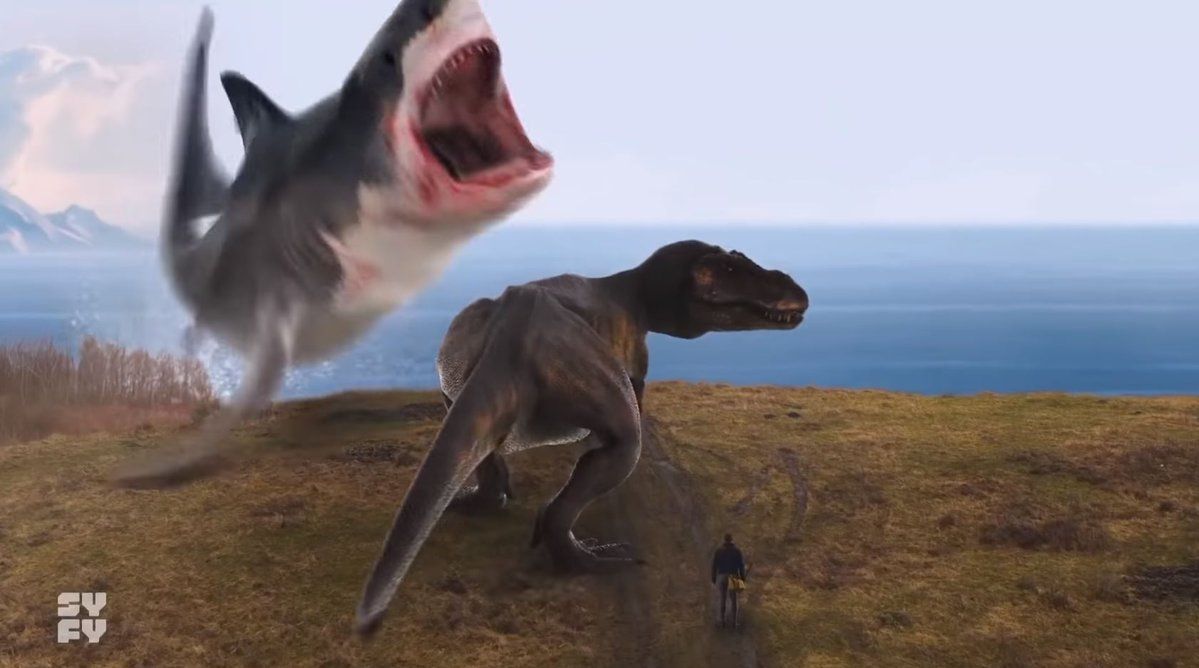
Bad Photoshop- sharks, T-rex, and man…
The Great White, the T-Rex, and the man at the edge of the cliff certainly never existed in the same space at the same time. It’s a ridiculous example, to make an exaggerated point. It is a photograph, but a heavily manipulated one that bears only the most tangential relationship to reality.
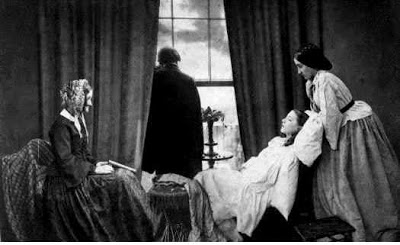
Fading Away, Henry Peach Robinson, 1858
But what about this image? “Fading Away” by Henry Peach Robinson, is far more emotionally “true” than the shark and the T-Rex, but as a photograph, it is no more true- this 1858 image is every bit as manipulated as the photoshop fantasy. None of the people in the photograph were in the same room at the same time. It is a hand-assembled collage of at least six different images (each of the people, the room, and the view out the window were all distinct exposures on different plates). It is every bit as factually false, yet the scene, a young woman being comforted by her family as she dies of tuberculosis, is so emotionally resonant that we WANT to believe in the truth of it.
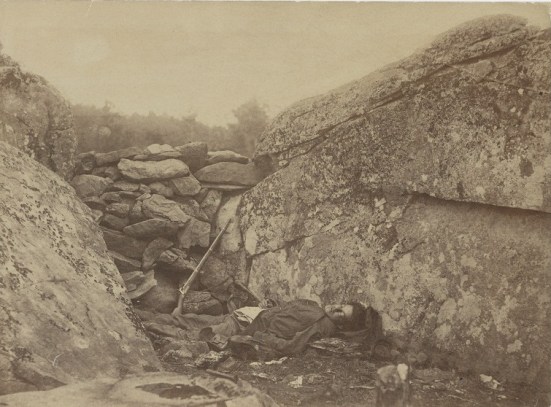
The Home of a Rebel Sharpshooter, by Alexander Gardner, Gettysburg, PA 1863
What about this image? While everything in this photograph was in the same location at the same time in the same light when the single exposure was taken, the entire scene is manipulated. Alexander Gardner and Timothy O’Sullivan were walking the battlefield at Gettysburg on July 6, 1863. They saw the body of a Rebel sharpshooter, and photographed it where they found it. As they continued walking, they came across this spot and felt it was where the sharpshooter must have been positioned earlier, so they picked up his gun and his body and moved it 40 yards to this location, in the name of making a more emotionally resonant photograph. They certainly succeeded, as this is one of the most recognizable photographs of the entire Civil War. But there is not an ounce of factual accuracy in the scene. As journalism or documentary photography, it is a fraud and would have no value as evidence in a court of law.
Yes, photographs can be taken for the purposes of showing evidence, be it to an engineer troubleshooting a part failure, a court determining guilt or innocence in a trial, or even more prosaically, that I in fact did visit Niagara Falls on June 17, 2013. But the fact that a photograph CAN have evidentiary value does not mean that all photographs MUST have evidentiary value, and that in order to make a photograph, one is required to have a one-to-one correspondence between representations of objects within the frame of the image at the time of making a single exposure. Just as a tea kettle can also be an object of art, and it can also be functional. Neither art nor functional object have exclusive domain over a tea kettle.
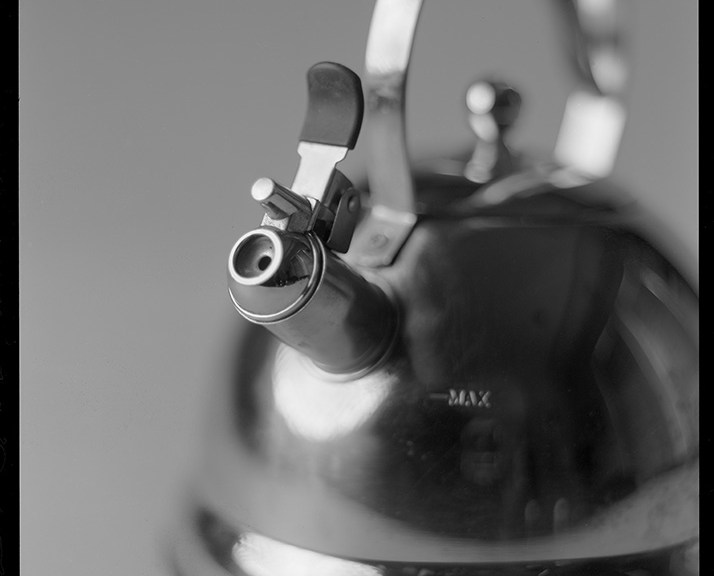
And even within the confines of “straight” photography, there is not a literal absolute truth to a photograph. The tea kettle above, as photographed, is absolutely unmanipulated via software. But I doubt anyone looking at the image would say that that kettle looks just like that – with a basic understanding of the mechanics of photography, a viewer knows that the lens used to make the recording was operated at a large aperture that created a shallow depth of field, rendering only the spigot sharp. While this looks LIKE the tea kettle, nobody would argue that it is a 1:1 representation of the actual kettle, or that they could be deceived into thinking there was a kettle before them that they could pick up.
It is an illusion of an illusion – we know it is a distorted representation, but it bears minimally sufficient verisimilitude that we imagine that we can interpret the actual object from the photograph.





 dcphotoartist