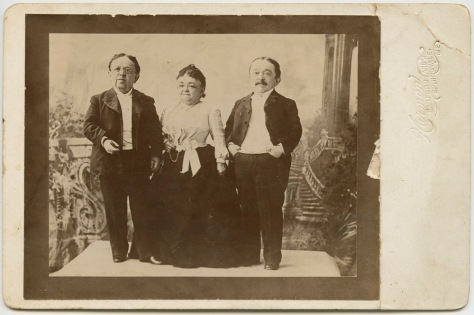
Here is a cabinet card from the mid 1890s of Lavinia Warren and the Magri Brothers (Baron Littlefinger and Count Rosebud). After Tom Thumb passed away in 1883, the widow Thumb met the Count and (his alleged twin brother) Baron Littlefinger. His real name was Primo Magri. She went on to marry him in July, 1885. They continued performing into old age to the point of appearing in a silent movie in 1915, five years before the Count’s death. Lavinia Warren died in 1919 at the approximate age of 77 (her birth date is unrecorded, so it is possible she was 78 at the time of her passing).
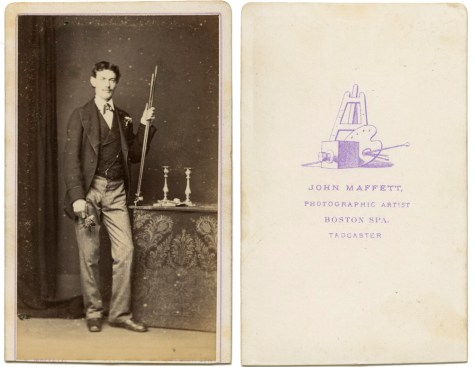
Here’s another fun one – really quite bizarre, actually when you think about it. The sitter is posing with a corsage in one hand, a fishing rod in the other, wearing formal attire, standing next to a table with silver candlesticks, that looks like it might be an altar. In a photographers’ studio. Was he on vacation? A hobbyist fisherman? It’s certainly not an occupational because this is definitely a gentleman of leisure, not a working fisherman. And what’s with the corsage?
In keeping with my recent backmark/blind stamp post, I like this one a lot, as it tries to connect portrait photography with painting, or at least bridge the gap. There are quite a few in a similar vein, a definite response to the notion that photography was merely a mechanical, technical operation and not a true fine art.
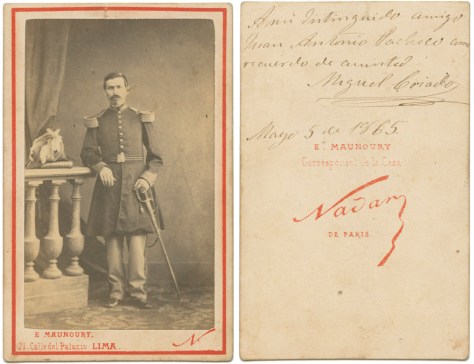
I bought this image because it has so much interesting history to it. Not only is the sitter known, but so is the date of the card, and the photographer, and the recipient of the card. Señor Maunoury was a franchisee of Nadar’s studio in Paris, operating in Lima, Peru. The handwritten note says “To my distinguished friend Juan Antonio Pacheco as a token of friendship, Miguel Criado”. So here we have a photograph that has traveled halfway around the world, just a few years shy of its 150th birthday, created by a French-trained photographer, collected by an American. What a fascinating nexus of connections. I wonder what the provenance of the image was before I bought it. I think it’s very important especially in the globalized world of today to contemplate these peregrinations through space and time that allow items like this to come into our hands, much like my Black Star, Osage Brave image that began life in Fort Smith, Arkansas, was collected in New York State, then went to Paris before arriving in my collection, or the Paris Opera image that spent time in Bulgaria before being auctioned off on Ebay by another French dealer, and now resides in Washington DC. In some ways, this is really the purpose of photography – to connect people across space and time, allowing someone dead and gone more than a century past to live on in the minds of people in a place they never would have been to.
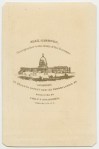
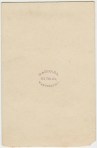
We’ll start this one with two of the most famous Victorian era photographers, Alexander Gardner and Mathew Brady. The Gardner blind stamp changes, but the only thing I can say for certain is that the stamp with the US Capitol building on it was during or shortly after the Civil War, as it touts his association with the Union army.
Alex Gardner, Version 1
Alex Gardner, Version 2
Alex Gardner, Version 3
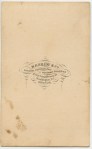
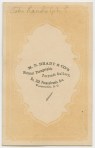
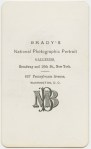
The Brady evolution is more obvious. The simple, plain version is his blind stamp from early in the Civil War period. The more ornate, shield-like design would be the 1870s, and the final version is the large letters.
Mathew Brady, Early
Mathew Brady, Middle
Mathew Brady, Late
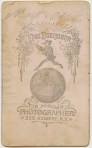
Note the similar evolution in Chas Eisenmann’s blind stamp design. I don’t have a good idea of how long a span of time it took for his design to evolve – it may have been as little as a few years, or it may have been a decade or more separating them. I think though that once he changed it, he stuck with the globetrotter logo for an extended period, perhaps 20 years or more.
Chas Eisenmann, Early
Chas Eisenmann, Late
C.D. Fredricks bind stamp. I know I have another one of his that would be the “middle” design, but I haven’t hunted it down in the CDV album I have – it would be the “middle” in that it no longer says, “specialité”, but also lists Paris and Havana as studio locations, but the design is not as fancy as the late one.
CD Fredricks, Early
CD Fredricks, Late
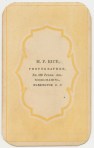
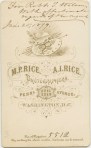
M.P. Rice. Note the change also includes the addition of (most likely) his son to the masthead of the business. Using the date on the verso, this style had arrived by the late 1870s, so the shield designs would have been late 1860s to early 1870s.
M.P. Rice, Early
M.P. Rice, Late
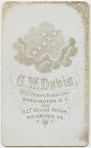
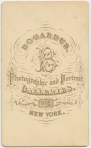
Finally some others for which I don’t have early/late pairings. These are just a few of the others I have, but I like looking at them just for the art.
Circassian beauties is a phrase used to refer to an idealized image of the women of the Circassian people of the Northern Caucasus. A fairly extensive literary history suggests that Circassian women were thought to be unusually beautiful, spirited, and elegant, and as such were desirable as concubines. This reputation dates back to the later Middle Ages, when the Circassian coast was frequented by Italian traders from Genoa, and the founder of the Medici dynasty, Cosimo I de Medici, had a well-known affair with a Circassian slave girl. During the Ottoman Empire. Circassian women living as slaves in the Sultan’s Imperial Harem started to build their reputation as extremely beautiful and genteel, which then became a common trope in Western Orientalism.
As a result of this reputation, in Europe and America Circassians were regularly characterised as the ideal of feminine beauty in poetry, novels, and art. Cosmetic products were advertised, from the 18th century on, using the word “Circassian” in the title, or claiming that the product was based on substances used by the women of Circassia.
In the 1860s the showman P. T. Barnum exhibited women whom he claimed were Circassian beauties. They wore a distinctive Afro-like hair style, which had no precedent in earlier portrayals of Circassians, but which was soon copied by other female performers, who became known as “moss haired girls”. These were typically presented as victims of sexual enslavement among the Turks, who had escaped from the harem to achieve freedom in America.
The combination of the popular issues of slavery, the Orient, racial ideology, and sexual titillation gave the reports of Circassian women sufficient notoriety at the time that the circus leader P. T. Barnum decided to capitalize on this interest. He displayed a “Circassian Beauty” at his American Museum in 1865. Barnum’s Circassian beauties were young women with tall, teased hairstyles, rather like the Afro style of the 1970s. Actual Circassian hairstyles bore no resemblance to Barnum’s fantasy. Barnum’s first “Circassian” was marketed under the name “Zalumma Agra” and was exhibited at his American Museum in New York from 1864. Barnum had written to John Greenwood, his agent in Europe, asking him to purchase a beautiful Circassian girl to exhibit, or at least to hire a girl who could “pass for” one. However, it seems that “Zalumma Agra” was probably a local girl hired by the show, as were later “Circassians”.Barnum also produced a booklet about another of his Circassians, Zoe Meleke, who was portrayed as an ideally beautiful and refined woman who had escaped a life of sexual slavery.
The portrayal of a white woman as a rescued slave at the time of the American Civil War played on the racial connotations of slavery at the time. It has been argued that the distinctive hairstyle affiliates the side-show Circassian with African identity, and thus,
resonates oddly yet resoundingly with the rest of her identifying significations: her racial purity, her sexual enslavement, her position as colonial subject; her beauty. The Circassian blended elements of white Victorian True Womanhood with traits of the enslaved African American woman in one curiosity.
The trend spread, with supposedly Circassian women featured in dime museums and travelling medicine shows, sometimes known as “Moss-haired girls”. They were typically identified by the distinctive hairstyle, which was held in place by the use of beer. They also often performed in pseudo-oriental costume. Many postcards of Circassians also circulated. Though Barnum’s original women were portrayed as proud and genteel, later images of Circassians often emphasised erotic poses and revealing costumes. As the original fad faded, the “Circassians” started to add to their appeal by performing traditional circus tricks such as sword swallowing.
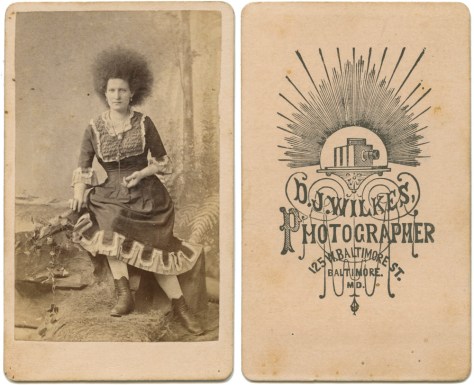
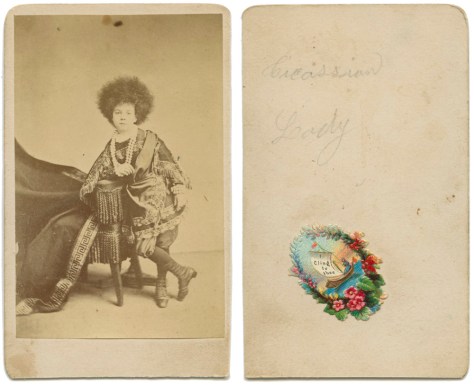
I had been hunting for a CDV of the Circassian Beauty for a while, and then found two images of “Circassian Beauties” on CDV recently. The one is fascinating because she’s obviously just a teenager. The other is an adult woman. I have seen other CDVs of Barnum’s Circassian, although I’ve seen a different name associated with her – Zenobia. It’s highly likely that there was more than one associated with Barnum’s Museum and later the traveling circus. I find the showman mentality of Barnum and his contemporaries utterly fascinating that they would have no qualms about not only faking someone supposedly from the Ottoman Empire, but that they would indulge in the exploitation of the specific mores and fears of their time that they did – enslaved white women as concubines of “the Oriental” was only one step removed from the notion of white women being sexually used by black men, especially in the immediate aftermath of the Civil War. And that Barnum would try to buy an actual Circassian woman speaks volumes to his mindset – while he would display her as liberated from slavery, in fact, he would acquire her as if she were still property.
Circassian Beauty, by D. Wilkes, BaltimoreCircassian Girl
I’d love if anyone out there knows anything about the sticker on the back of the second card – thematically it could be contemporary to the card, but it could also be as recent as the 1930s.
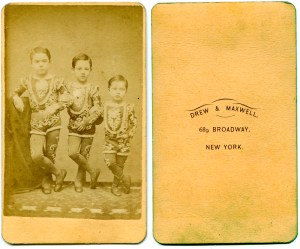
Trio of Boy Acrobats, by Drew & Maxwell – possibly the O’Briens?
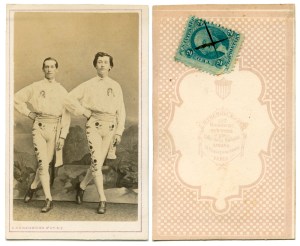
Two Toreadors, by Fredericks of New York, Havana and Paris
Gullie & Lottie Tarkinton
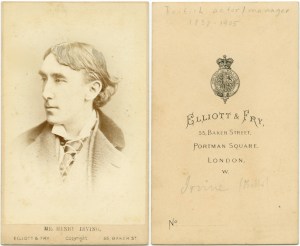
Carte De Visite, Henry Irving, British Actor, by Elliot & Fry
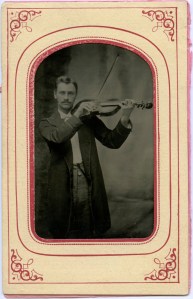
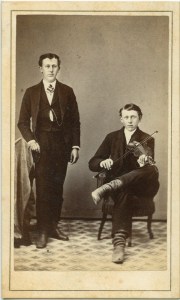
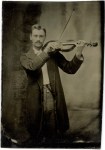
Tintype, Violinist, in presentation mat
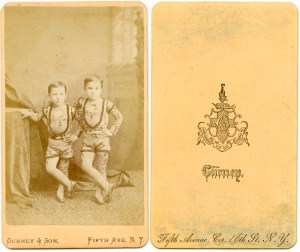
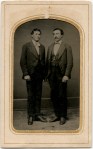
Anonymous, Twin(?) brothers, ca. 1870
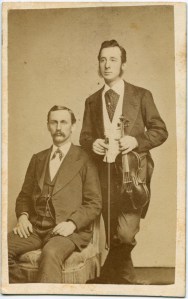
Musical Duo, Boston
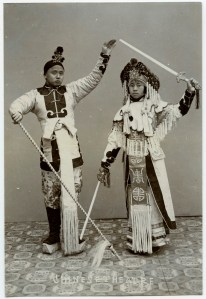
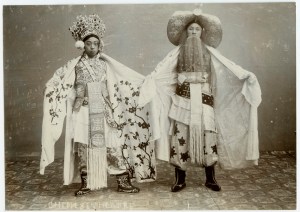
Two actors in costume by Chas. H. Spieler, Philadelphia
C.T. Parsloe, Jr, Actor- by Brady. “Important if true”
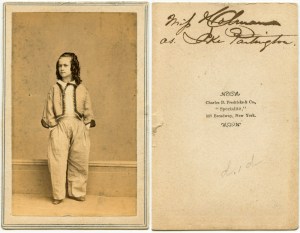
Sallie Holman as Ike Pantington, by Fredricks
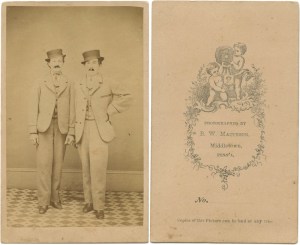
Cross-dressed Women by Mattheson
I’ve selected this batch to group based on them being people of the theater or in theatrical performances of some kind. I excluded the circus freaks even though many of them were theatrical as well (Tom Thumb was a comic actor as well as a star of Barnum’s circus). I’m grouping the cross-dressed women in this because it may well have been a theatrical role they were playing, like Sallie Holman as Ike Partington. There are also acrobats in this grouping, as many of them performed in vaudeville halls as well as in circuses, so they count as theatricals in a way.
Take a look at the two violinists in the fifth row – I’m wondering if they aren’t in fact two pictures of the same duo, at different times.
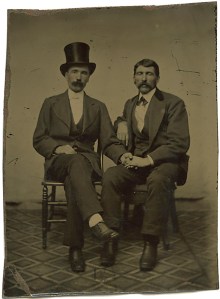
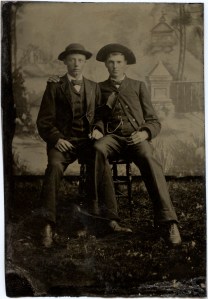
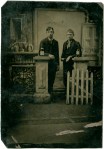
Two Affectionate Gentlemen, TintypeCross-dressed Women by MatthesonTintype, Two Affectionate Pals (Brothers?)
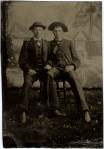
After my recent find of that tintype showing two men holding hands, I thought I’d pull together a series of same-sex affection pictures. Turns out I have fewer than I thought. Thus the title, in part, and in part for the fact that the photos are more rare than you’d think on the one hand, and not as rare as you’d think on the other. In an era where same-sex attraction was only beginning to be named and understood as anything other than a moral failing to be treated as a crime, it would seem reasonable to assume images of affection between two people of the same sex would be virtually non-existent. Because, however, there was no concept of a homosexual person, the idea that expressions of affection between two people of the same sex would mean something other than friendship would have been alien and never enter into the mind of the average Victorian. And in an era where physical expressions of affection between the genders, in public anyway, would have been profoundly frowned upon even for a married couple, it is not surprising that there are few images of an affection that would not have been considered unmanly.
Tintype, Two Brewers, Keystone Cabinet Export Beer
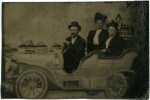
Family in Novelty Car, Cliff House, San Francisco
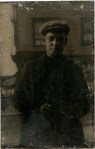
1900s Tintype, possibly African-American
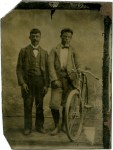
Tintype, Two Men and a Bicycle
Tintype, Father & Son?
Tintype, Violinist, entire plate
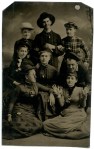
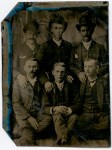
Tintype, Sextet of Gentlemen
Tintype, Three Dandys
Trickster Tintype #2
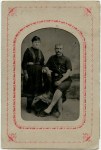
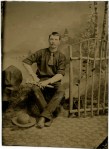
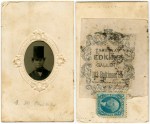
I thought it would be fun to review my loose tintypes. These are only the ones I’ve previously posted to the blog, not the entire collection. They run the range from tiny gemtype size (the one of Mr. Phillips in the top hat) to quarter-plate size (almost 5×7). They span a time period from the 1860s to the 1920s. Assembled they present a fascinating if incomplete snapshot of daily life in Victorian America. Showing everything from affectionate friends to unconventional family groups to people on vacation to working people with the tools of their trades, they portray a slice of life otherwise undocumented in literature or historical narrative. This is one of the great joys of collecting images like this – not just the traditional studio portraits, but the images that express meaning and personality beyond a marker that someone existed.
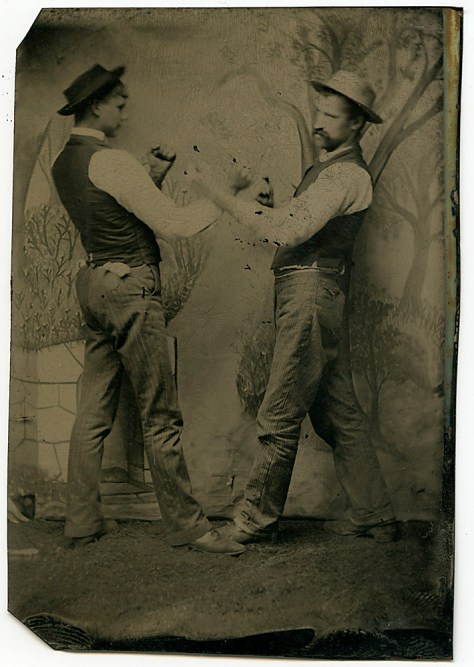
A tintype of two men boxing, for your consideration.
Tintype, Pugilists
I’m attracted to this image by virtue of the slight motion blur captured in their pose – their hands and faces are a little soft from the 1+ second exposure. I suppose this could theoretically be an occupational tintype in that they may be boxers, although they’re rather formally dressed for athletes. I suspect this is just another case of two friends having a lark in the photographers’ studio. There’s probably a lost backstory to the picture – perhaps an inside joke about friends or siblings who were always fighting? Or perhaps it was a photographers’ study.
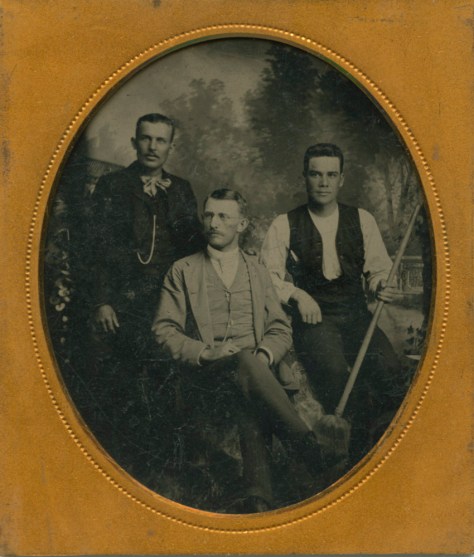
This is an unusually packaged tintype of three shopkeepers, one with a broom. I have more than good reason to suspect that the image is not original to the packet in which it resides – the packet itself is very oddly assembled, with the brass frame in four separate sections held together by a strangely still elastic string.The packet itself consists of the cover glass, the brass passepartout, the tintype, and a very thick backing glass that appears to have been blackened at one point with some kind of varnish that has faded and flaked off in spots over the intervening century and a half. The varnished back glass would suggest that it had been originally paired with a clear glass ambrotype. However, a clear glass ambrotype would have been thicker than the tintype, and the packet as is barely fits inside the brass frame. Altogether, a mystery of how this particular ensemble came to be assembled as it currently stands.



 dcphotoartist