Just a quick note – today marks the 172nd birthday of the Daguerreotype. It was on this day in 1839 that the French government declared the Daguerreotype process “free to the world” (after buying the patent rights from Daguerre in exchange for a life pension). Vive la France!!!
All posts by dcphotoartist
New Daguerreotypes coming!
Well, new to me that is…
I’ve been off the collecting kick lately because I had some more gear and supplies to buy for my own photography. I found a pair of 14×17 inch film holders that fit my Canham 14×17, and although they’re not a color match for the other three, they’re more than good enough – the external dimensions are identical, so they
re an exact fit, which is the most critical factor when looking for such things. Oh, and they’re less than half the price of new ones that do match my existing holders.
So, with that holdup out of the way, it’s on to more collecting. Two daguerreotypes and a milk glass ambrotype are en route. Daguerreotypes are much more familiar to most people, so I’ll save further commentary until I have them to show. A milk glass ambrotype though- you might wonder what is it? Simply, it’s an ambrotype on a piece of white, opaque glass. Not so simply, to get the image to show, you create a collodion negative the same way you would if you were planning to make albumen or salt prints. You coat a second wet plate onto a piece of milk glass (a white/opalescent glass), then separate the negative from the milk glass with a thin wire or shim or anything that will keep the collodion original very close to but not in contact with the new wet plate. Expose and process as normal for collodion. You end up with a positive on the milk glass (a negative of a negative is a positive). Because of the extra labor involved, they’re somewhat rare. The one I’ve got coming is a very small (1/9th plate size) oval portrait of a young woman, done with a very attractively executed vignette, in a red velvet case. I’ll post pictures as soon as I get it in my own hands. I have no idea who she is or what she did for a living, but something about the outfit feels like a nurse’s habit. Maybe it’s the vignette giving a subliminal halo to the woman adding to the impression – who knows? It probably is a civil war era image, but if that’s true, she’s probably not a nurse, as most of the official requirements for nurses during the civil war requested that they be doughy, extremely plain of looks, and past marriageable age. This girl is none of the above.
A Non-Silver Manual now available for free
I just needed to put in a good plug for this book. It’s what I learned gum printing from, and contains some very useful information on other alt processes. The book is “A Non-Silver Manual: Cyanotype, Vandyke Brown, Palladium & Gum Bichromate with instructions for making light-resists including pinhole photography”. It was available for sale for many years in a soft-cover spiral bound edition directly from the author, Sarah Van Keuren. Mrs. Van Keuren has decided that she no longer wants to maintain the book and deal with the printing and shipping, so she is making it available chapter by chapter for free to download on www.alternativephotography.com If you want a hard copy, you can contact the publisher of AlternativePhotography.com and see about remaining stock.
Upcoming classes/exhibits/jurying
I’ve gotten some further confirmation, so I can post more information about this now:
I’ll be showing work at PhotoWorks in Glen Echo, Maryland as part of PhotoWeek DC 2011. I’ll be displaying my platinum/palladium prints and talking about the process as part of a show-and-tell event on Sunday, November 6. I’ll update with links when they have a schedule of events published. I’ll also probably be doing a process demo some evening that week or the following weekend, November 12-13, and a full-fledged workshop in the spring of 2012.
On a separate note, I’ve been asked to be a judge next weekend at the Howard County Fair’s Home Arts department photography contest. If you’re going to be in the neighborhood, stop by and say hello and see the entries in the contest.
From Anonymous Vernacular by Jeremy Moore
I read this post by my friend Jeremy Moore the other day and wanted to pass it along. I wholeheartedly agree. I still push myself to go to see contemporary shows because I want to see what people are doing, and while it’s not a universal constant, I am disappointed more often than I am delighted by what I’m seeing on the walls. Too often the idea that the concept should take primacy over the craftsmanship has evolved so far that the idea of craftsmanship seems to be not just second-fiddle, but non-existent. Prints that aren’t spotted, contrast corrected, burned/dodged, or color corrected are far too common. I think it’s a symptom of the age that thoughts no matter how unfinished are all given equal value, and he (or she) who can shout their idea the loudest gets credit. Sometimes it feels as if you’re back in high school at the Model UN debate club and the teachers have stepped out of the room – everyone’s still on-focus enough to stick to debating the topic at hand, but all sense of moderation and argument has been thrown out the window – “I think the solution to the Arab-Israeli problem is to give Jerusalem to Tibet and let the Buddhists run it!” “And why do you think that would work?” “Because!” “Nuke em’ all and let God and Allah figure out between themselves which bodies belong to whose faith” and so on…
I’m BAAAACK! To posting that is…
It’s been a while since I added anything here, because I’ve been insanely busy dealing with a whole bunch of personal business (breaking up, evicting my ex, cleaning up the aftermath, starting dating again, reconfiguring my office, building a new home wireless network since the ex took the wireless router, getting nasty bronchitis, recovering from said bronchitis, etc etc you know…). I haven’t had a lot of time for collecting or thinking about it as a result. Well, the dust has settled and I’ve been casually acquiring an odd and end here and there, so I’m back to writing about it again.
One of the things that has interested me, and helped drive me into this whole civil war period image collecting thing, is my hometown – Chambersburg, PA. Chambersburg was perhaps the most trampled ground north of the Mason Dixon line during the Civil War. Prior to the war, John Brown planned his raid on Harpers’ Ferry while living there, and met with Frederick Douglass to discuss the plans (Douglass advised against attacking the federal arsenal). Jeb Stuart’s cavalry raided it for the first time in 1862. Then Lee’s troops passed through on their way to Gettysburg in ’63, and in 1864 General McCausland’s troops demanded a ransom of $500,000 in US currency or $100,000 in gold, which the town refused to pay, so it was put to the torch.
In digging around on Ebay, I found an image of a man who was born a few towns over from Chambersburg. That got me thinking about the old hometown, and I started searching for Chambersburg related stuff. I acquired a group of photos spanning a good 20+ years of work from a single studio, which in further searching on Ebay seems to have been the most prominent if not the only studio in town at the time.
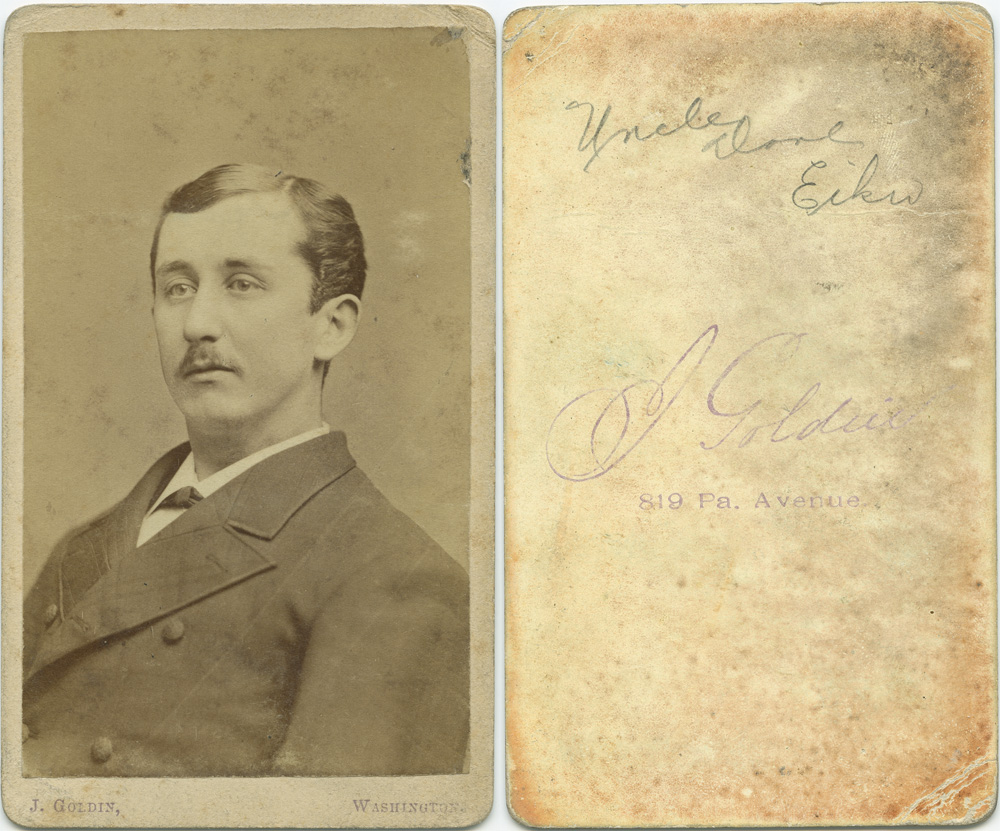
Here is the image that got me thinking about Chambersburg, a photo of David Eiker, born in Quincy, Pennsylvania. Quincy is a tiny one-stoplight town a few miles east of Chambersburg. This photo was taken at the J. Goldin studio in Washington DC.
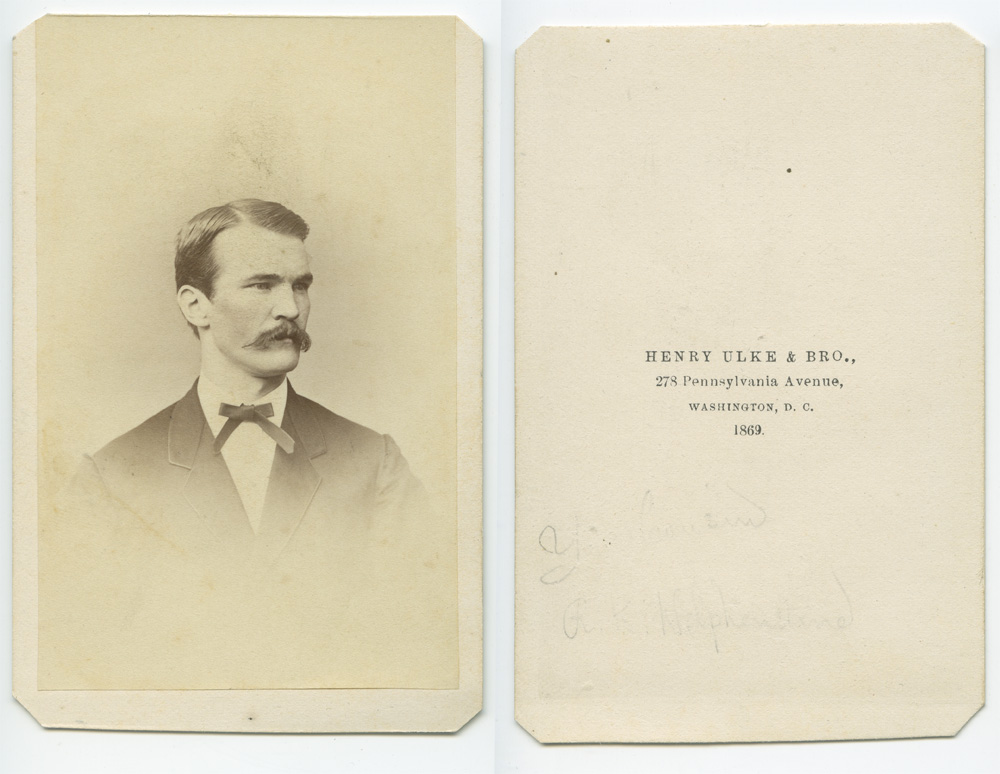
Acquired at the same time was a more-or-less unrelated photo of a Mr. R.K. Hopkinson, taken at the Henry Ulke & Bro. studio in Washington DC. The common thread was the Washington, DC studio. Mr. R.K. Hopkinson Served in Company D of the 3rd Massachusetts Heavy Artillery during the civil war.
Productive Morning!
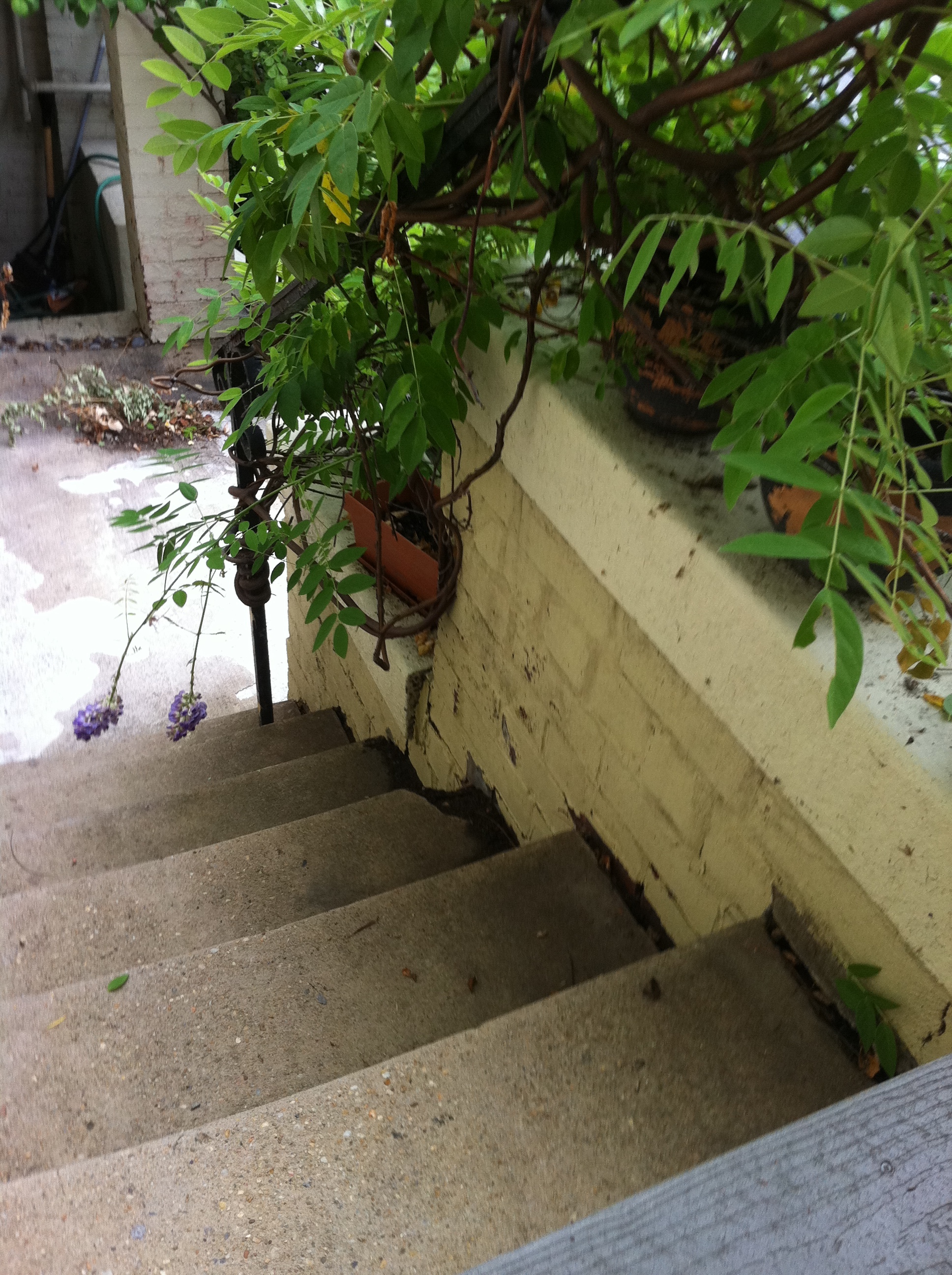
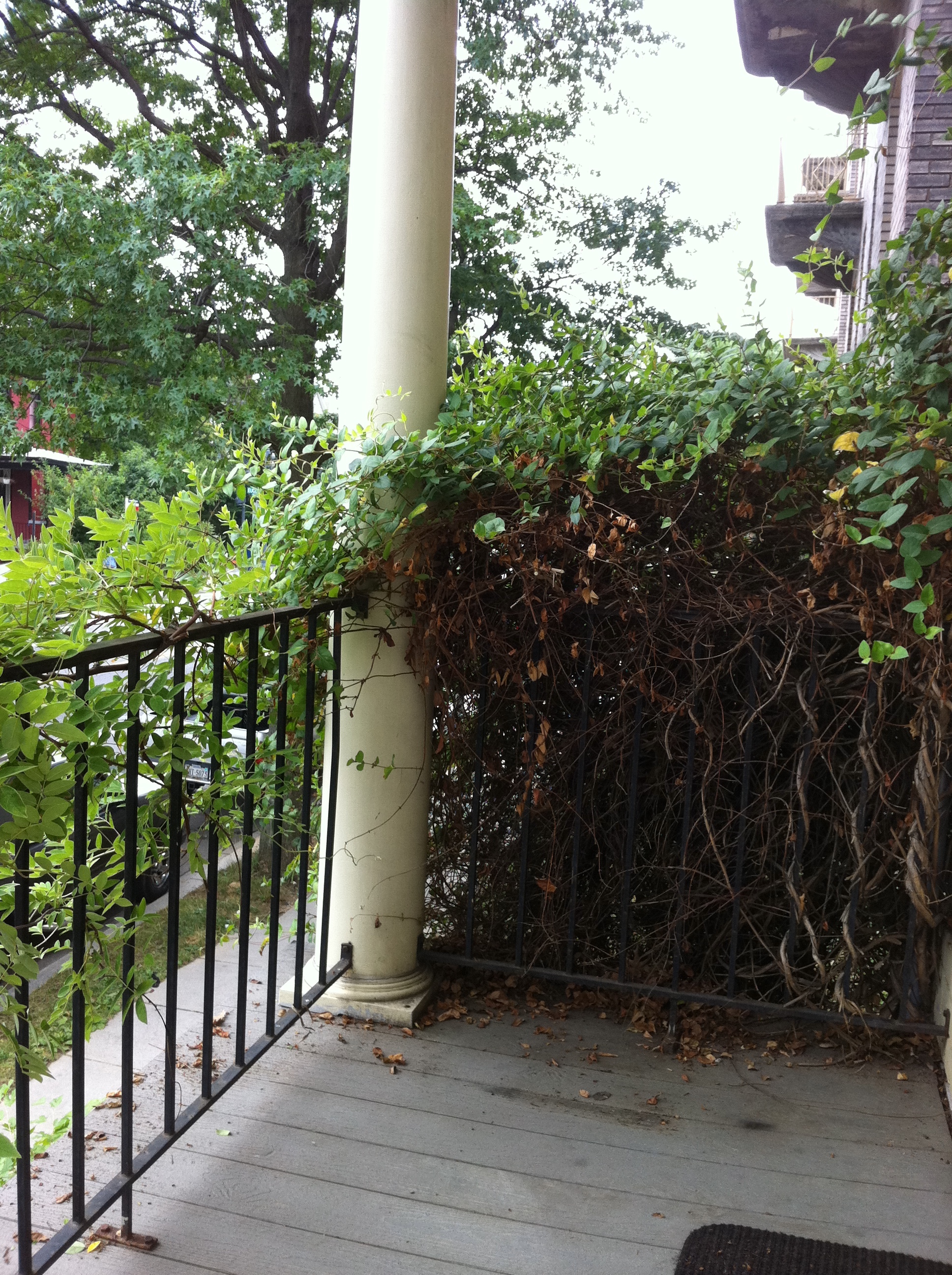
Well, I wasn’t expecting to be this productive today, but it’s 10am and I’ve already cleaned the patio (after getting the water turned on – no mean feat when you know where the shutoff valve is under my sink), hacked back the honeysuckle bush, got the wisteria back under control (I did refuse to trim off the sprig with blooms on it, despite hanging halfway across the front steps), and chop the Rose of Sharon shrub back to a shrub from the small tree it was turning into. And swept up the debris. And washed dishes and fed the cats.
Now it’s time to go do the real work and head in to the studio to work on my commission project, which is way overdue.
Random images
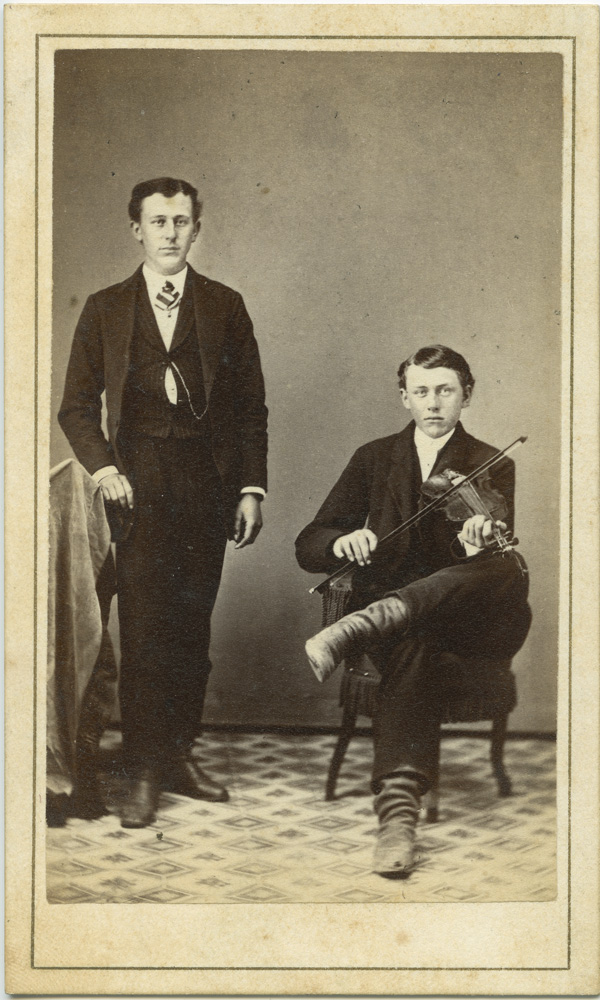
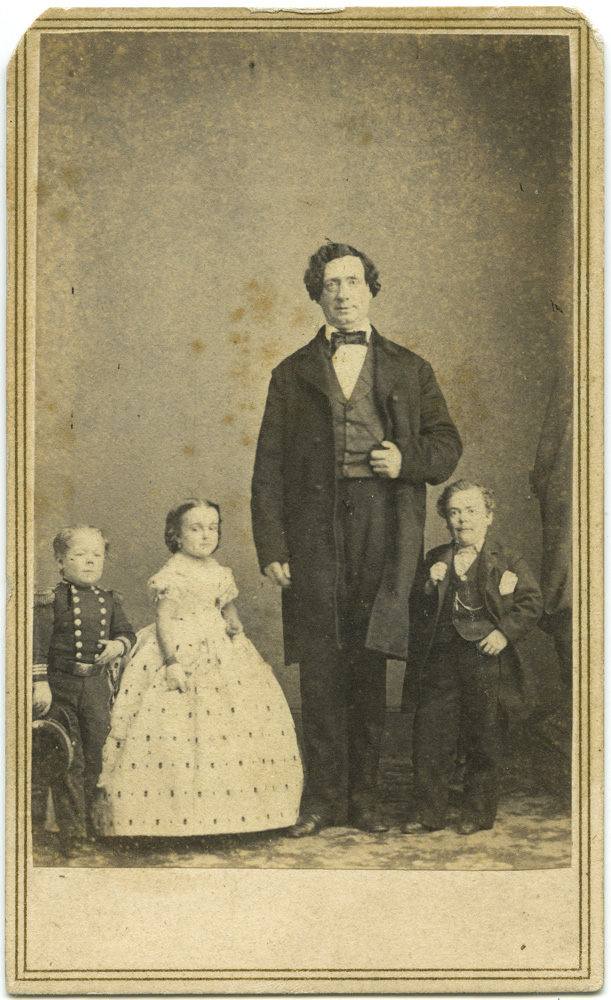
Two new additions to the collection – an anonymous CDV of what appears to be at least brothers if not twins, one standing the other seated playing the violin. Best guess is late 1860s / early 1870s. The other is another Brady image of Tom Thumb, his wife, and Commodore Nutt, this time with an average man for comparison. It’s funny how these things turn up in groups – I first get the Fairy Wedding CDV, then another different image of the same people shows up shortly after, so I had to buy it!
The Last Full Measure: Tintypes/Ambrotypes from the Civil War. Liljenquist Collection at the Library of Congress
For those who haven’t been following this, a few years ago the Liljenquist family (father and three sons) began collecting civil war cased tintypes and ambrotypes. They amassed a collection of over 700 images, of which approximately 10% have been identified. They range in size from 1/9th plate to 1/2 plate, and in subject matter from Union and Confederate soldiers to children, wives, mothers and family members in mourning, officers and enlisted and both slaves and freedmen. The collection is currently on display at the Thomas Jefferson building of the Library of Congress. Although small, the display encompasses some 300 images: some two hundred and fifty Union soldiers and their families and some fifty Confederates. One of the most striking images in the collection is the former slave and his family, a wife and two daughters, posed with him in Union uniform. It makes an interesting parallel that 150 years ago, this man was fighting for his freedom, and today, a very similar man with a very similar family sits in the White House, President of a nation radically remade by the sacrifices of that African-American soldier. Other highlights include the little girl dressed in mourning attire, holding a photo of her father who quite possibly she never knew, and the picture of the confederate soldier accompanied by a letter back home to his family describing how he died on the field of battle. A mourning necklace is also on display: the pendant is an oval gutta-percha case containing the photograph while the chain supporting it is woven of human hair, most likely from the woman who made it and whose husband is depicted inside the case.
The collection is astonishing in its scope and specificity, as well as for the collecting acumen displayed by the Liljenquist family. The family still collects at a furious pace, and so the Library has asked them to make their donations quarterly, instead of weekly as they had been doing, to give the curators time to catalog and preserve their donations. The collection in its entirety will be available online through the Library of Congress’ website in the near future.
Link to the collection: The Last Full Measure: The Liljenquist Collection at the Library of Congress
They also have the collection on display on the LoC Flickr feed entitled “Civil War Faces“. They welcome input from the general public as part of the effort to identify the subjects of the photographs.
Three new Victorian photo parlors to add…
I’ve found two more Washington DC parlors and one New York Daguerrian studio:
J. Golden – 819 Pennsylvania Avenue
Henry Ulke & Bro. – 278 Pennsylvania Avenue
The New York Daguerrian parlor is:
A.J. Beals – 156 Broadway
The address for Henry Ulke’s studio would put him today squarely on the grounds of the US Capitol, not far from the Spring Grotto, if the address is correct. Either they had a different street numbering scheme, the address is in Southeast DC instead of Northwest DC (which would put him at an even more unlikely location, a tiny triangle park just beside the Library of Congress building), or the Capitol grounds were greatly enlarged sometime between the 1870s and 1900. Given how so far so many of these studios’ locations can be accurately pinpointed today, even though the streetscape has changed a lot, I’m liking the probability that the address is correct, and that the streetscape has changed, rather than the location being inaccurate.