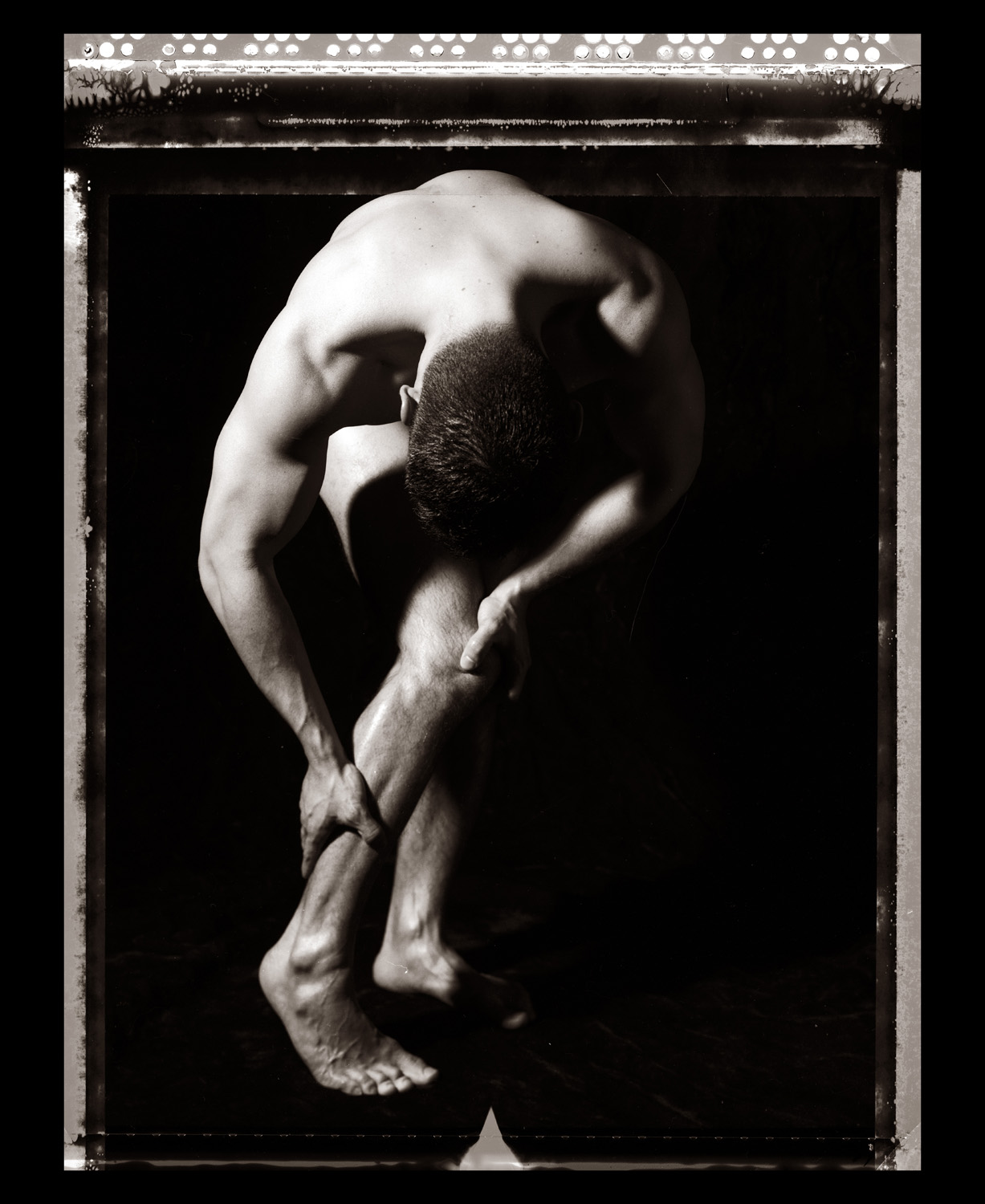
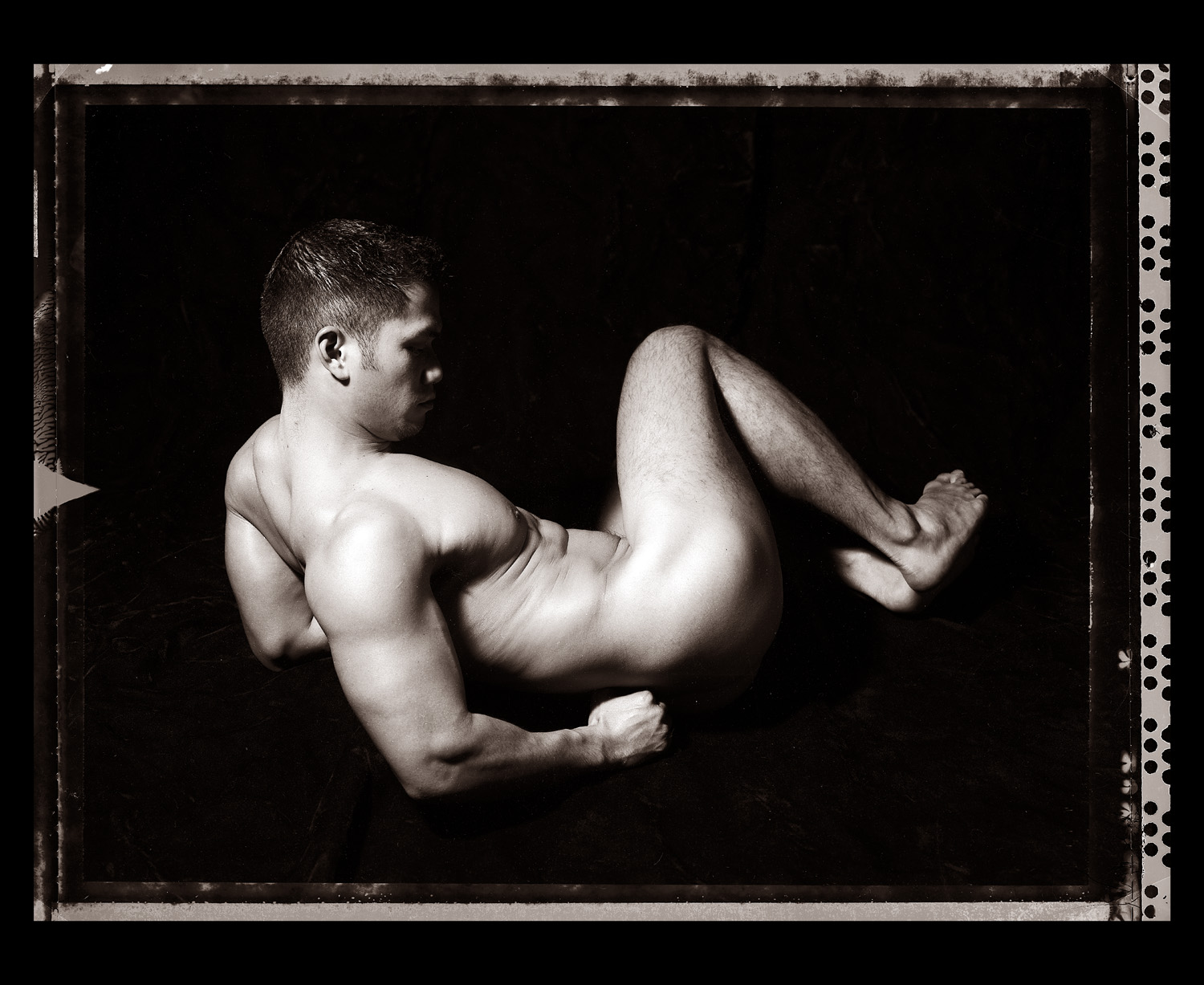
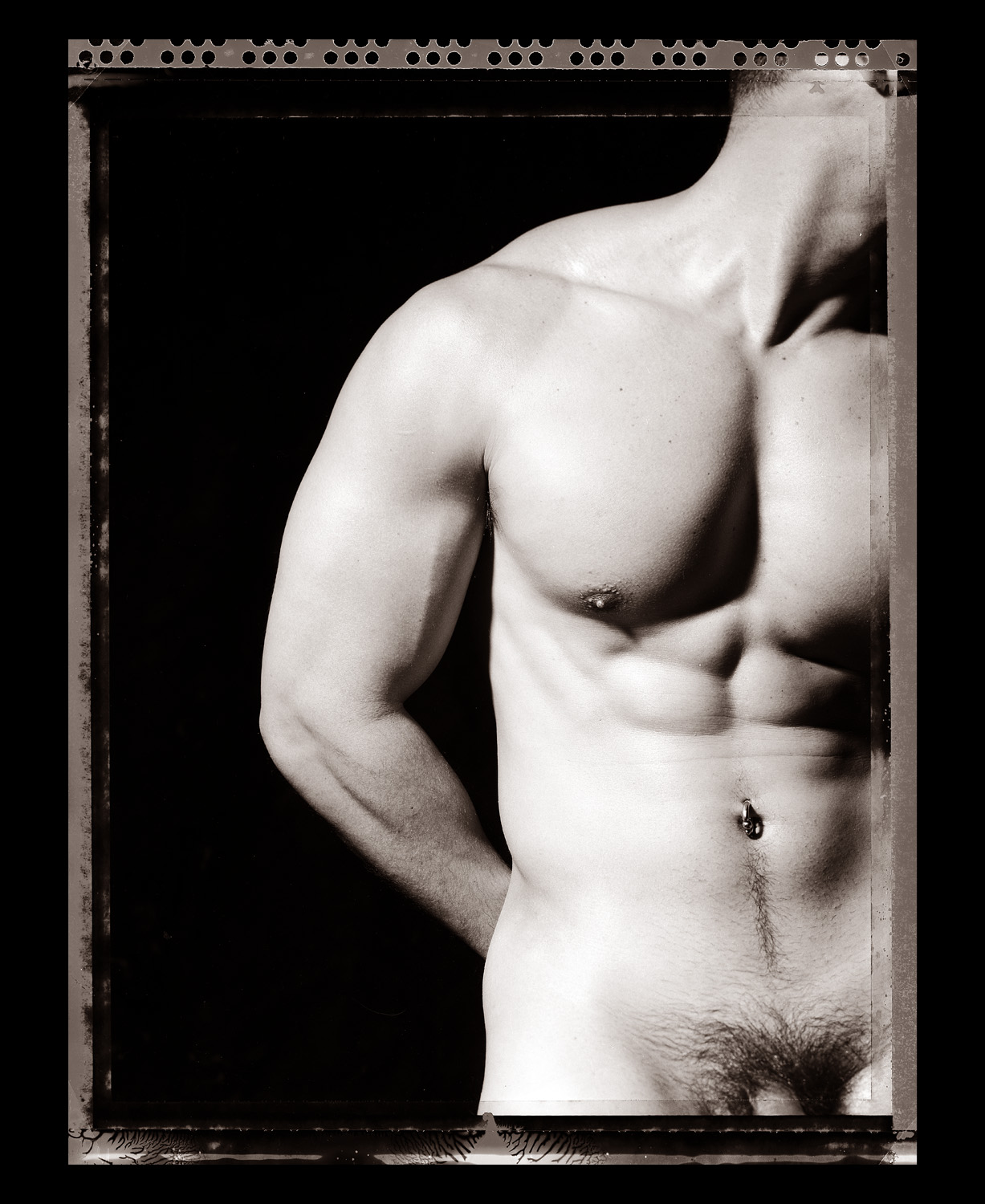
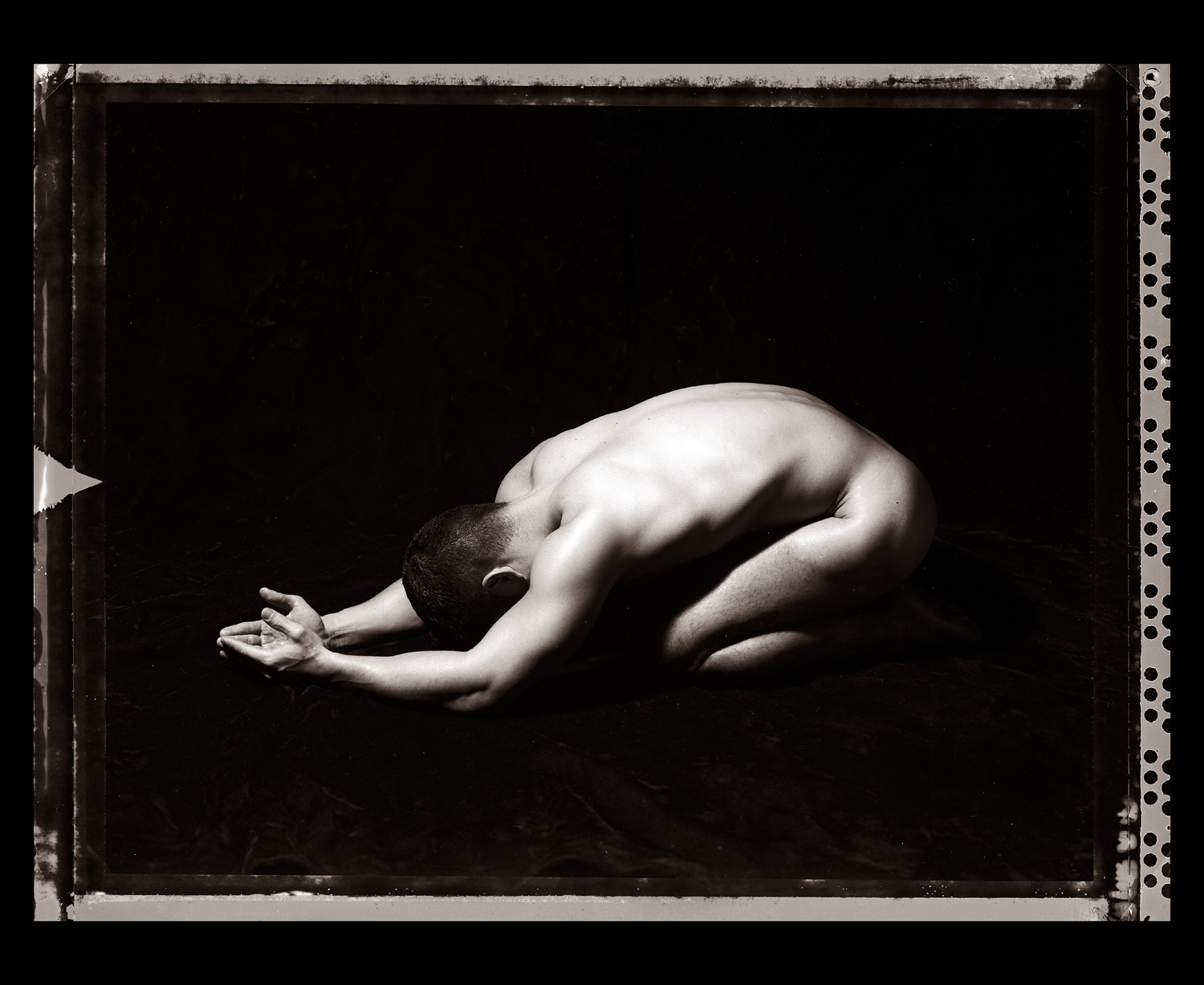
I have had eight images published at Eastern Sierra Center for Photography’s website in their “Paradigmatic Nudes” gallery online. Most of these images you’ve seen here before on my blog. The images featured are my whole-plate sized gum bichromate prints of Philip, a model I’ve worked with and my Type 55 Polaroid 4×5 format shots of my friend Jose. I’d like to give a big shout-out to Laura Campbell, their curator and director, for repeatedly selecting my work and having faith in my creative vision. Please go check out their website and see the entire gallery.
Jose, Legs Large format Nudes at Eastern Sierra Center for Photography
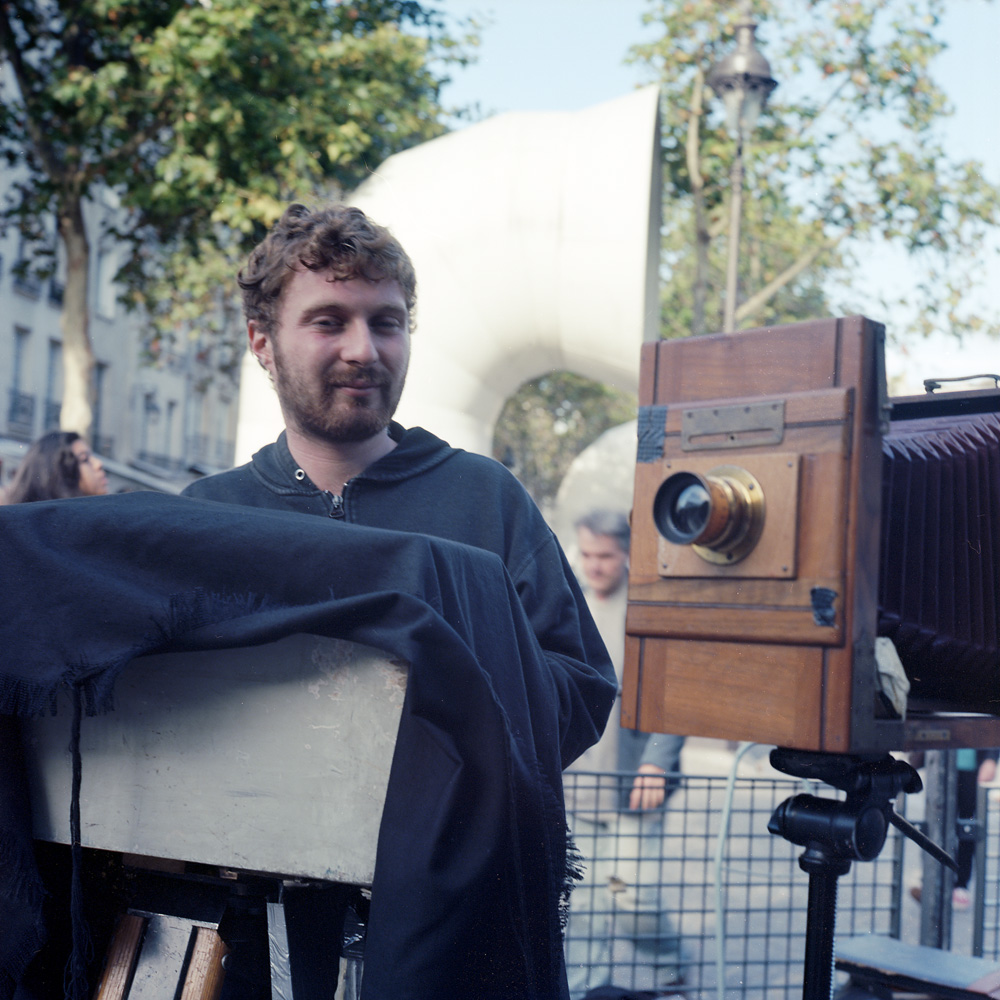
Meet Hans Zeeldieb, the street photographer working outside the Pompidou Centre. He was set up with his vintage 5×7, paper negatives, and portable darkbox doing portraits for 15 Euros a pop. He shot and developed them on the spot in 15 minutes. We struck up a friendly conversation when I saw his camera and he saw mine and talked a lot about photography. He sent me down the street a few blocks to the Centre Iris to go see an exhibit of wet plate collodion images by Jacques Cousin and several of his students, as well as some work by my friend Quinn Jacobson. Several years ago, I was involved in a gallery space in Hyattsville, Maryland called Art Reactor, where I curated a show of photographs made using the whole plate format*, and Quinn was one of the artists I selected. I think I made Hans a little nervous, as he overexposed the image of me. He did capture a good expression of me though, so I was happy to support a fellow working photographer.
In the first photo, I caught Hans with his hands in the darkbox, processing a print. The way it works, he exposes a paper negative in the camera, then develops it in the box. After the negative is developed, he sandwiches it with another piece of paper, opens a window in the dark box to expose it again, and processes the second paper, which now has a positive image. There are several advantages to this process – by working with paper, the development and fixing is much faster than with film, and you can use the same chemistry for both your negative and your finished print. I’ve seen or read about other itinerant photographers using much the same technique around the world, from Madrid to Kabul.
Hans with his camera, processing a photo
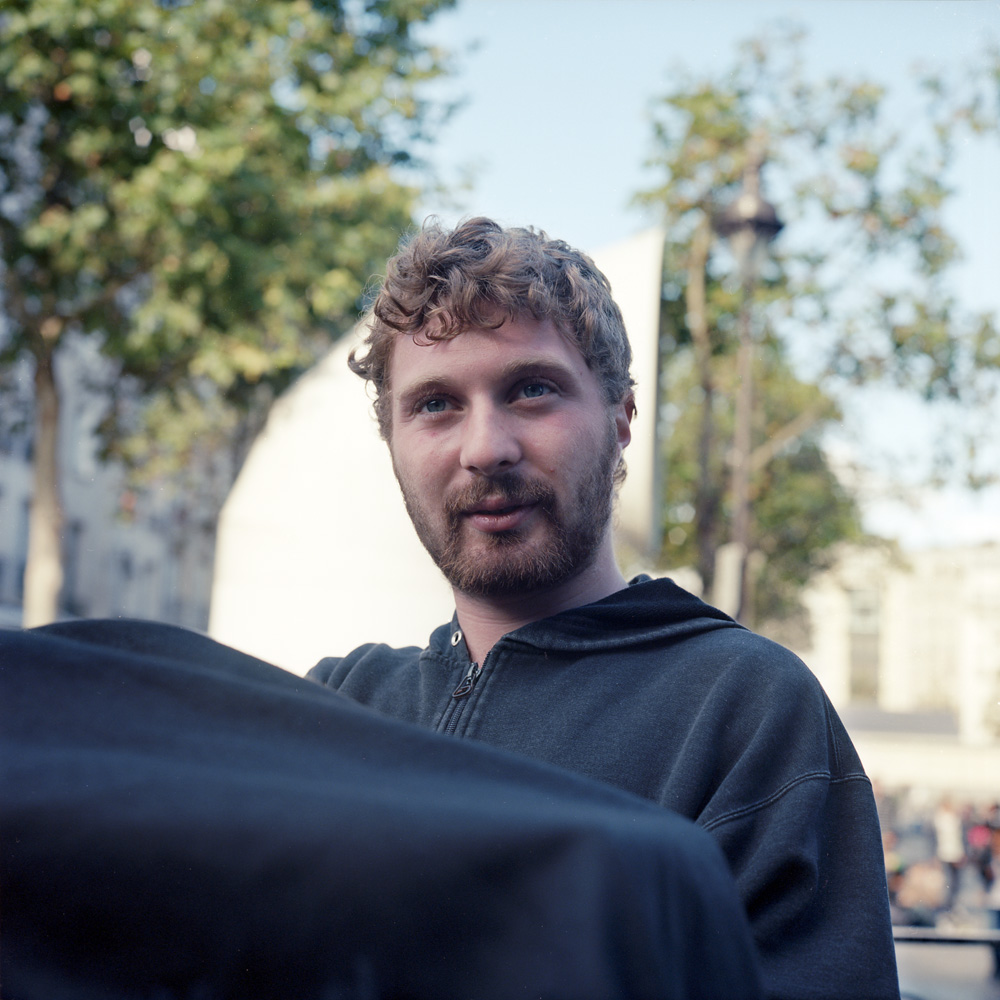
Here is a portrait of Hans outside the Pompidou Centre, just a close-up this time without the camera in the frame. He seems a little lost in thought – I think he was counting time for the print he was developing.
Hans, at the Pompidou Centre
* Whole Plate format is the original photographic format, defined today as 6 1/2 x 8 1/2 inches. It is not entirely certain how this size was chosen by Daguerre as the plate size he wanted to use, but reasonable speculation ties it to book printer’s printing plates. It has varied in its specification over time, but it settled on the 6 1/2 by 8 1/2 size by the late 19th century.
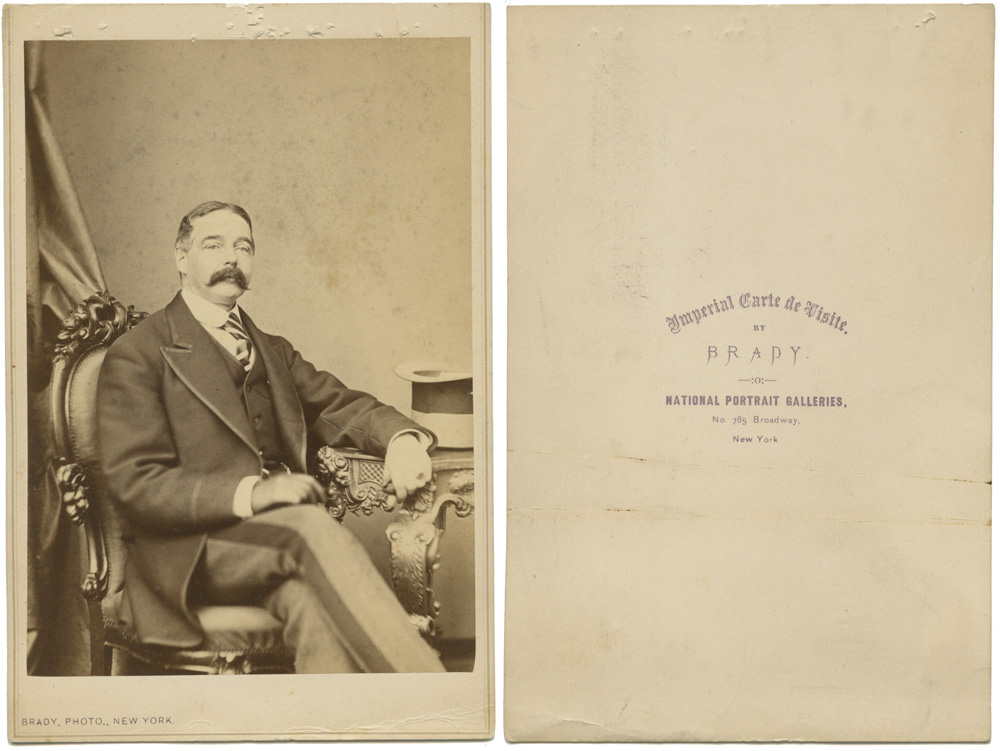
Here is an “Imperial” Carte-de-visite by Mathew Brady’s New York studio. It’s called an “imperial” because it is the size of what later came to be called a cabinet card (roughly 4 1/2 x 6 inches), whereas typical carte-de-visites are 2 1/2 x 4-ish (roughly the size of a modern business card).
Anonymous Gentleman, Imperial CDV by Brady
Whoever this gentleman was, he’s obviously quite dapper and very fashionable. I’m sure he’s someone famous and important, but I don’t know Victorian American personalities as well as I should. As a photographer, I’m wondering if either this was made with the same camera and lens as was used for the smaller images, or if this was shot by Brady himself instead of one of his assistants, because the depth of field is so shallow that at this size, his hand and leg closest to the camera are obviously out of focus. If this was shot by Brady himself, perhaps his eyesight was bad enough at this point that he didn’t realize the hand and knee were out of focus. If that was not the case, then it’s possible the fault lies with the lens – when you focus anything closer, the depth of what is in sharp focus in the image decreases. In order to project an image roughly 4 times the size using the same lens, you have to focus much closer and the depth of field will be noticeably shallower.
If anyone out there has an opinion or better yet some historical fact to prove/disprove either or both possibilities, I’d greatly appreciate hearing from you.
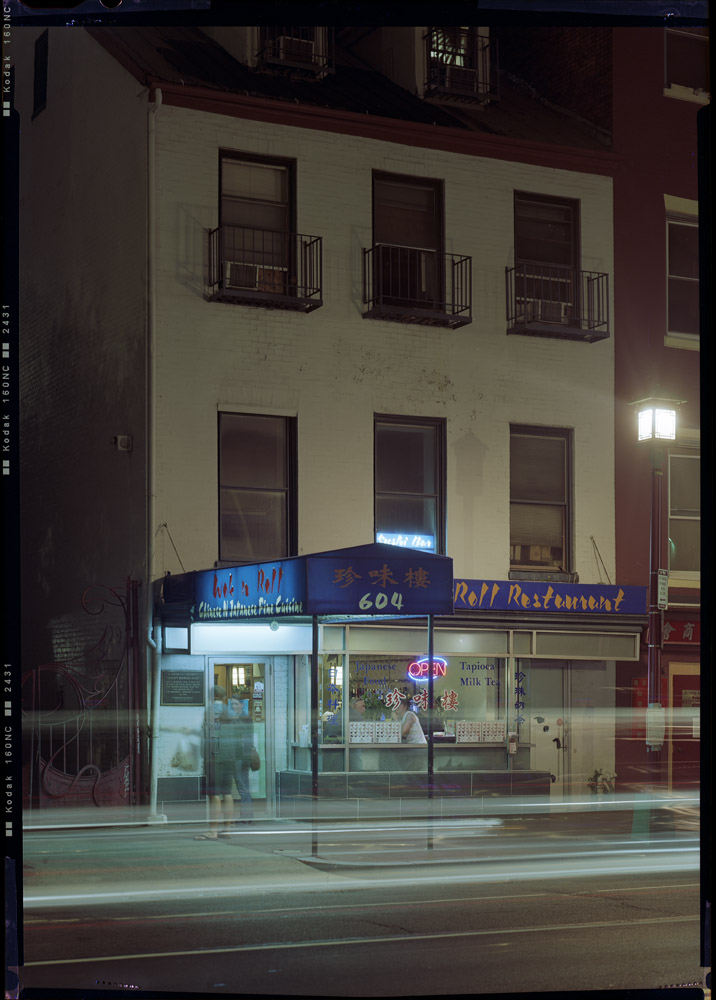
I submitted a photo to a call for entries from the Eastern Sierra Center for Photography the other day, and the photo was accepted! It’s even #1 in the series. The photo is one I took a while back of the Surratt house in Washington DC. The theme of the photos was “Motels”, based on a quote by William Borroughs –
“Motel, motel, motel, broken neon arabesque, loneliness moans across the continent like fog horns over still oily water of oily rivers.”
The motel connection in my image is a little tenuous, but Mrs. Surratt took in boarders to her home to help pay the bills before she was hanged for her alleged role in the Lincoln assassination (she was the first woman ever executed in the United States for a crime she may have only ever been tangentially involved in). I also felt the mood of the scene put into image the words in the Burroughs quote.
There was a requirement that the image be made with a large format camera (one of the primary missions of the Eastern Sierra Center for Photography is the promulgation of large format photography).
Secession Sushi – The Wok ‘n Roll in the Surratt House
The photo was shot on Kodak Portra 160 with a Canham 5×7 wood field camera using a Kodak Commercial Ektar 12″ lens.
Please go visit the Eastern Sierra Center’s website and read about their very worthwhile mission – supporting the continued use of view cameras for contemporary (and future – they have a program to expose kids to view cameras!) photography.
I should have been doing this all along through the class, but we’ve had bad luck with scheduling and are as of now still three weeks behind schedule because of holidays, work schedule conflicts and the like.
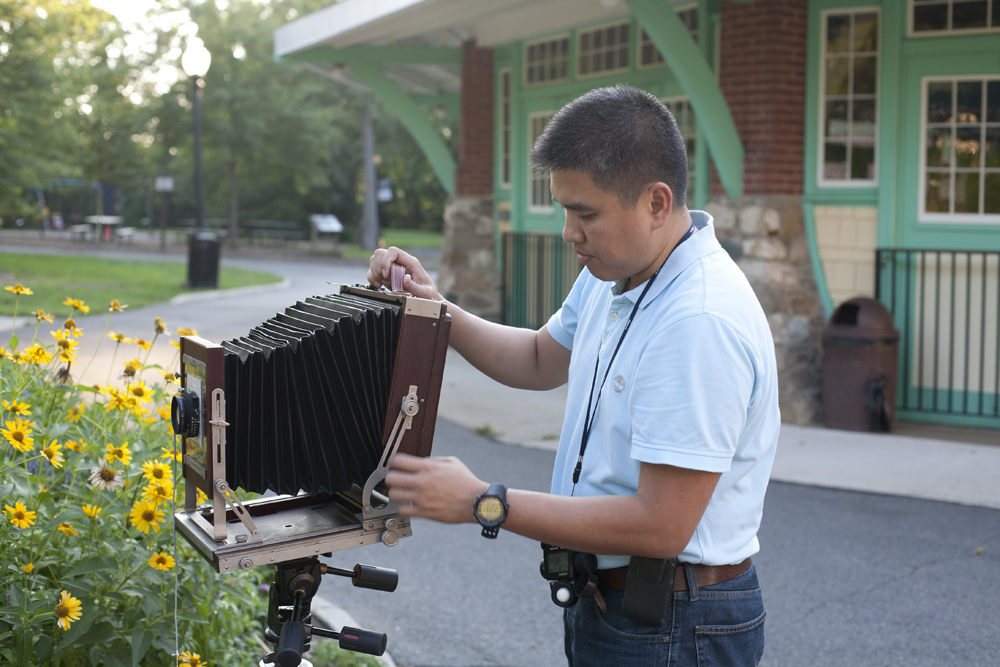
My student brought his 8×10 Deardorff to class, and we went out and shot a few frames around the park. Here he is with the ‘Dorff. Isn’t it a beautiful camera?
Shooting with the Deardorff
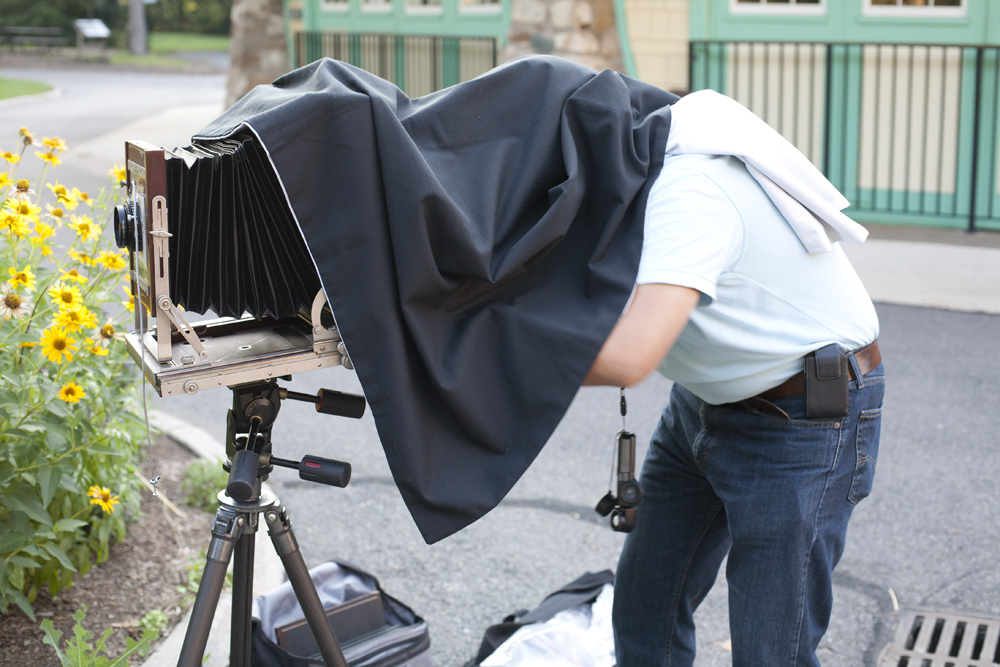
And here he is under the darkcloth. I don’t know why he used it white side in, but it’s his camera, he knows how to use it, so as long as he can focus, I’m not complaining.
Under the Darkcloth
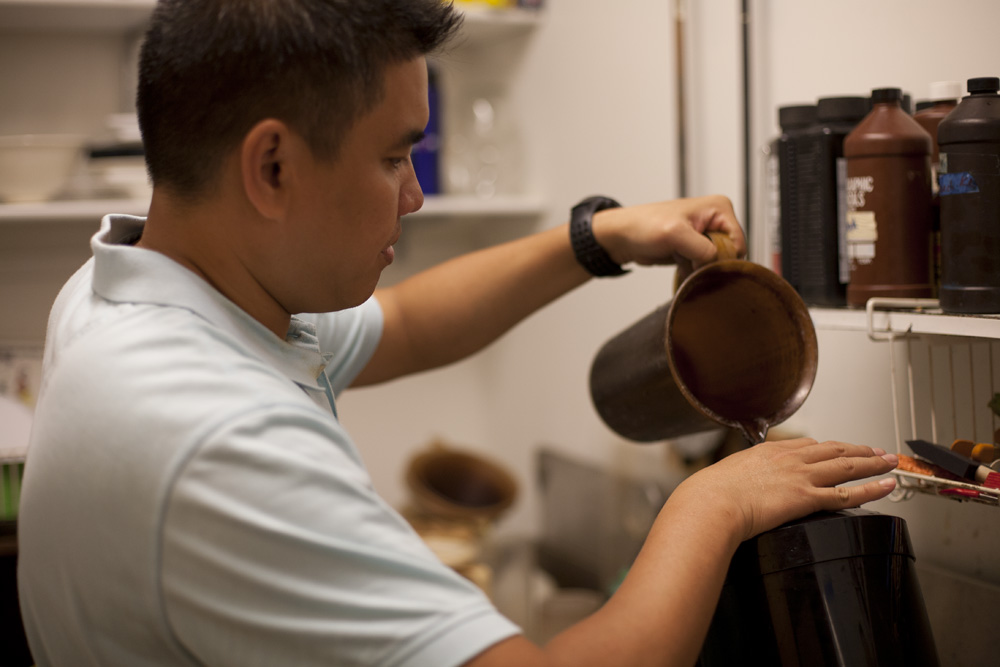
Here he is pouring a water stop bath into the Jobo drum I brought. We used the Jobo free-standing and not on a processor or roller base – I just ran a water bath for it in a regular developing tray and rolled it by hand. This technique works, but it’s much easier on a proper roller system, and infinitely better on the Jobo processor.
Developing Film
Despite the challenges of processing the film with the Jobo tank by hand, we were able to produce some useable frames. Here he is holding one of the negatives, a portrait of me. Every year he goes back to Vietnam for vacation, and while there he does a fundraising project with photography for a charitable organization. This year, his project is to take portraits of the clients of a clinic that provides healthcare to people exposed to Agent Orange, and sell the prints to raise money for the clinic. It feels really good to me to know I’m having a small part in helping his project.
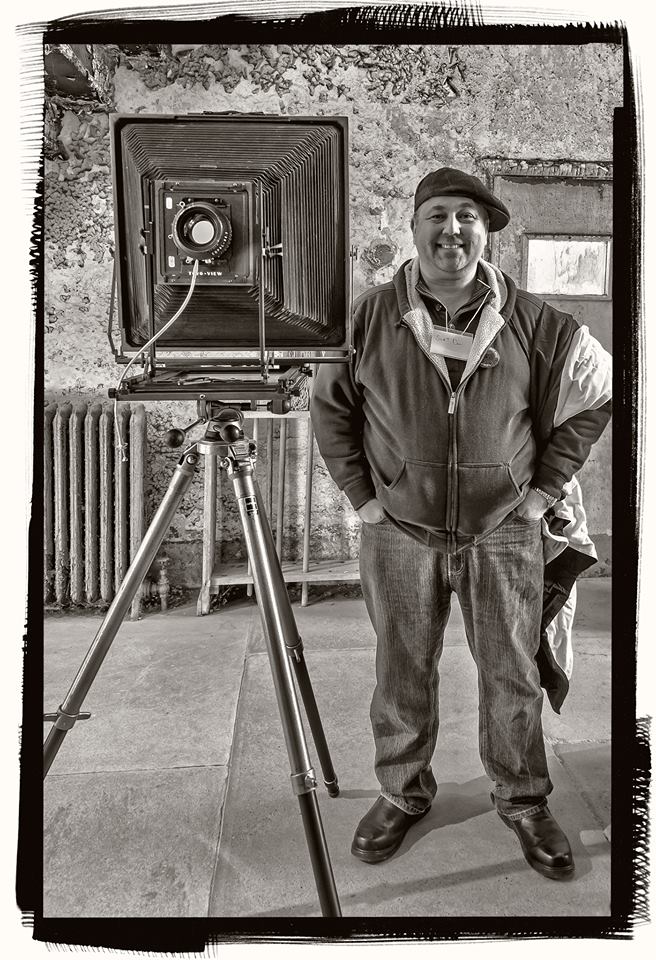
Here’s a photo of me at Eastern State Penitentiary with my Canham 14×17, courtesy my friend, Tom Finzel. He does a lot of HDR stuff and does it with subtlety (well, most of the time 🙂 ). I really like the image he made – I look good in this shot, which is all the more amazing since I smiled and held steady through about 15 seconds worth of HDR multiple exposures. I would have made a good model for a daguerreotypist!
Tom was trying to make an image that looked like platinum/palladium. While the color’s too neutral, it’s not a bad likeness.
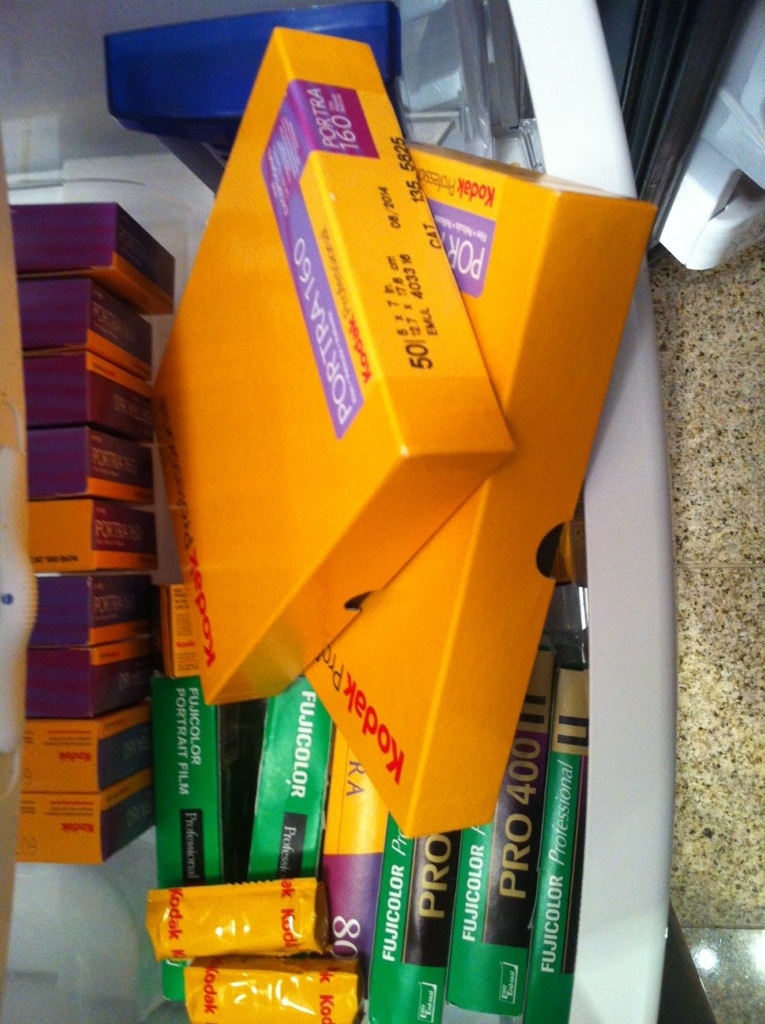
My new batch of Kodak Portra 160 just arrived today. For a long while I thought it would remain a pipe dream to get to shoot this film again in this size, as the price had more than doubled since I first purchased it. But B&H Photo, the ultimate camera superstore, had a batch on sale, so I snapped up two boxes, hopefully enough to complete a project.
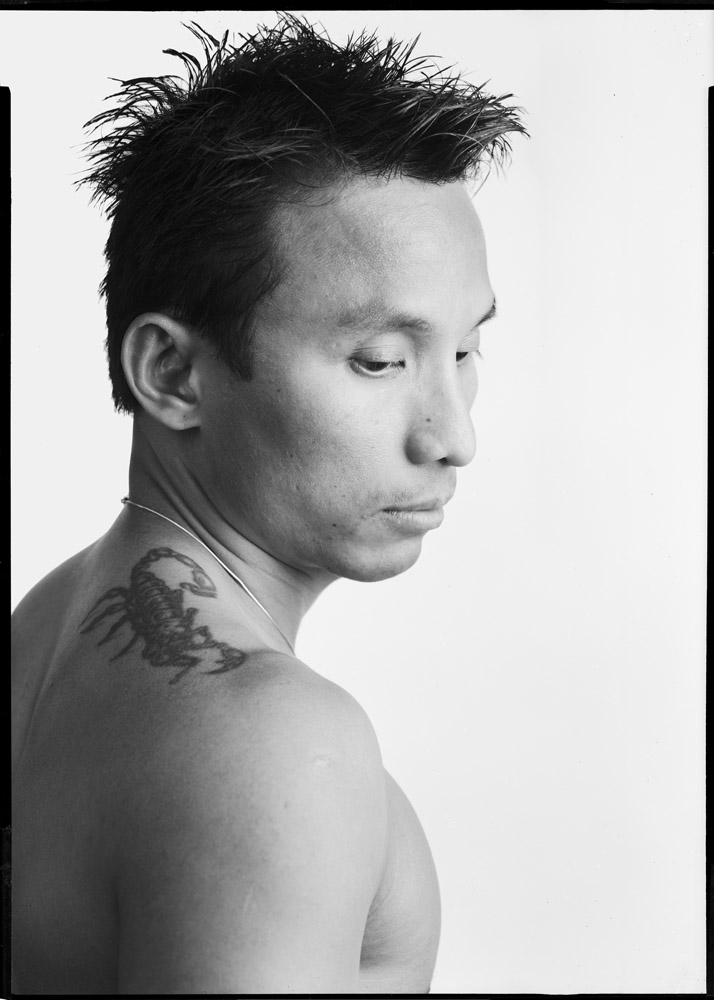
Another friend’s portrait. 5×7, Ilford FP4+, Kodak 14″ Commercial Ektar lens. I had him stand in front of white seamless paper, and then lit him from the right with a large softbox, reflector on his left, and a second light on the backdrop to bring the white up. Developed in PMK Pyro developer.
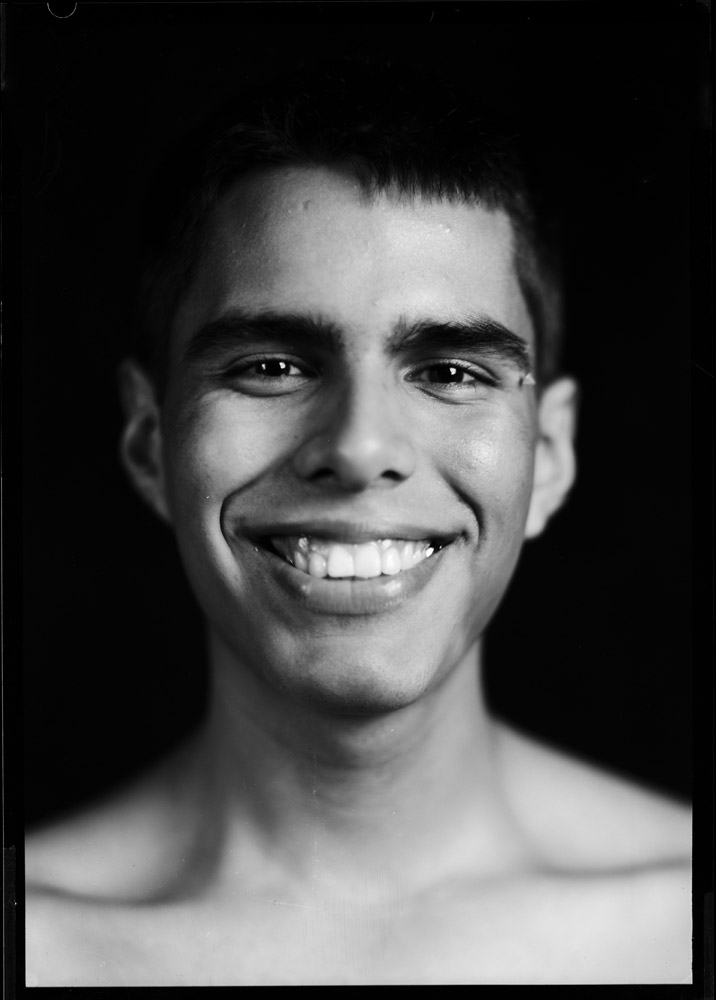
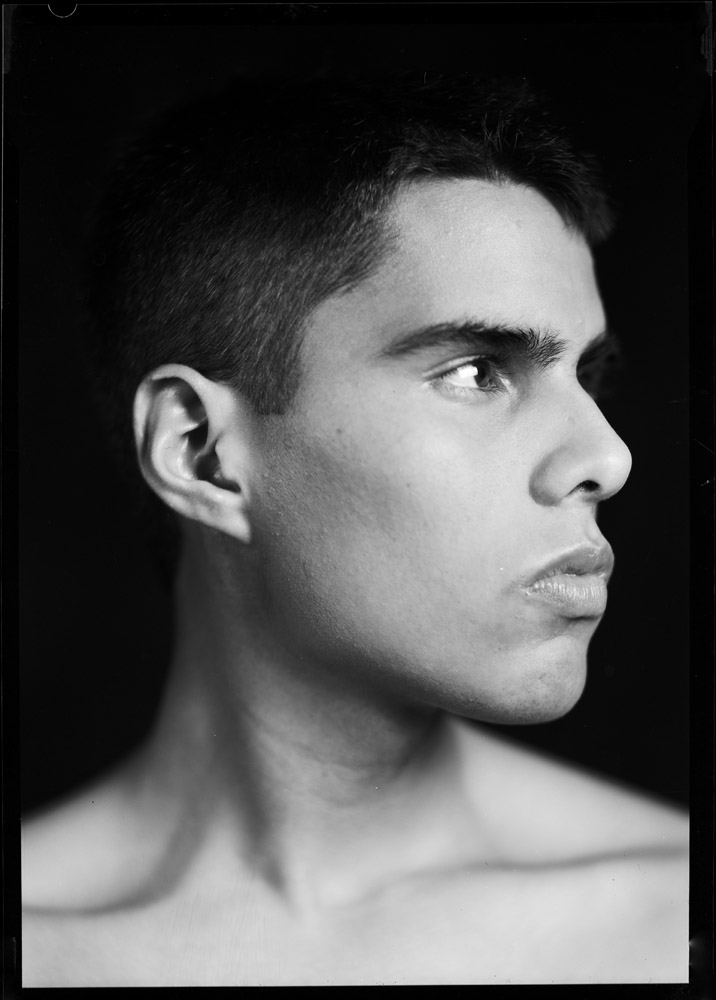
Just wanted to share a pair of portraits I shot a while ago of a young man who sat for a personal project of mine. They show two very different perspectives on him – his smile is particularly radiant, but the profile is terribly serious. These were shot with my antique Century Studio Master portrait camera and a 14″ Seneca Whole Plate Portrait f5 lens. These used my typical lighting setup of one main light in a giant softbox with a fill reflector on the opposite side.


 dcphotoartist