Category Archives: Cameras

DC Pride Parade 2015 – The Marchers

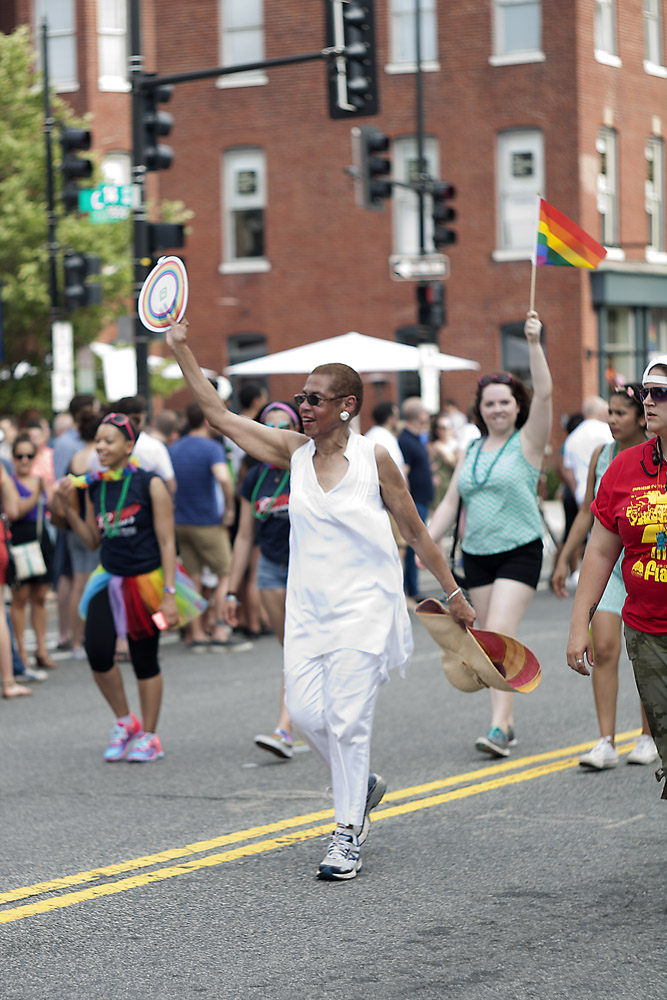
The DC Gay Pride Parade always features a political contingent. This year being an off-year for elections, we saw fewer than usual (last time it seemed like there were an interminable array of political contingents – virtually everyone running for office in DC, suburban Maryland and suburban Virginia was in the parade). I captured two notable entries – V. Gene Robinson, the Episcopal Bishop of Vermont and the first openly gay Episcopal Bishop, and Eleanor Holmes Norton, DC’s representative in Congress (who can’t vote on anything because DC isn’t a state). She’s always at the Pride march every single year, and has been for as long as I can remember (and I’ve been attending these things for close on 25 years now).
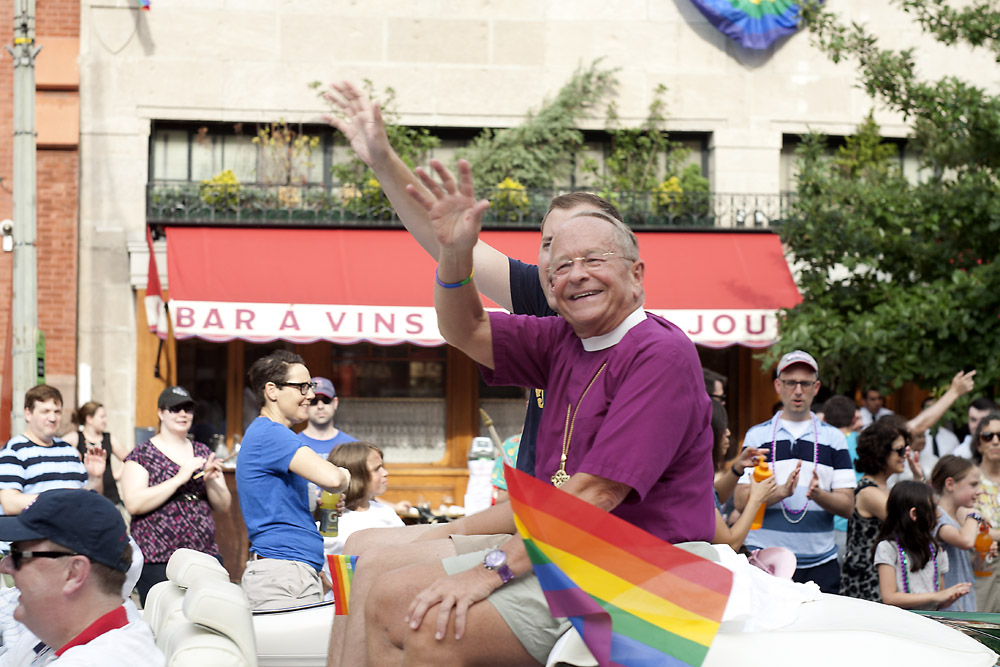
V. Gene Robinson
V. Gene Robinson
Eleanor Holmes Norton

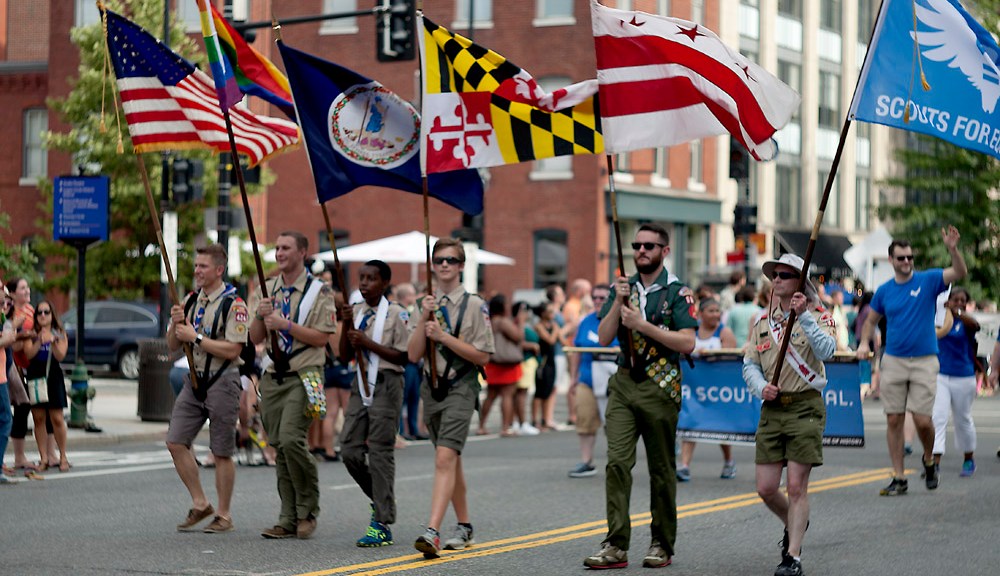
I’ll put the Boy Scouts under the political banner only because of the ongoing controversy surrounding gay scouting that has dragged on far too long.
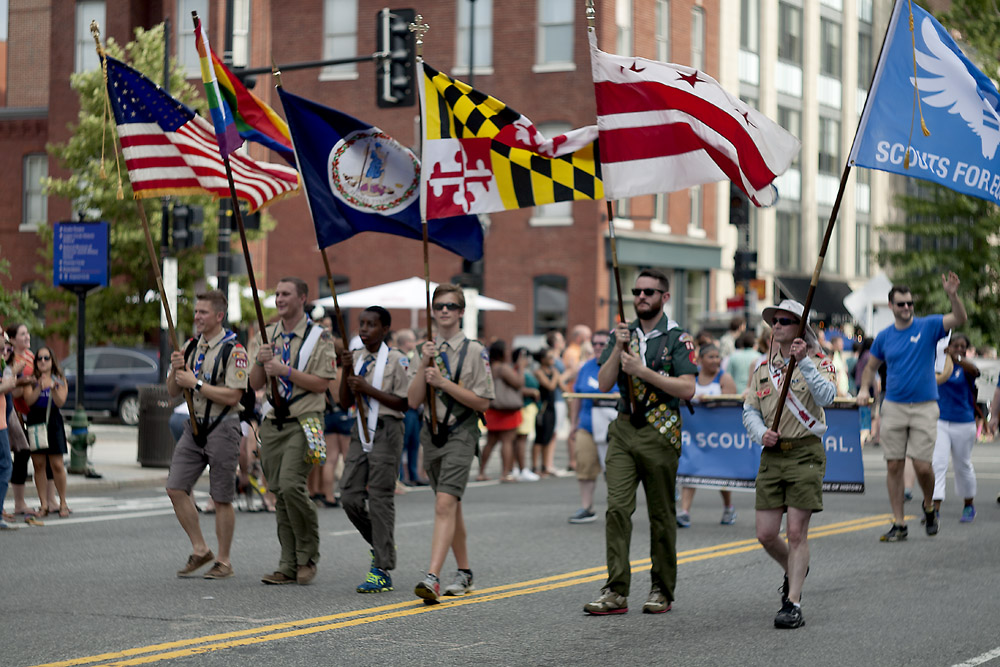
Boy Scouts for Equality

What a sign of change in the parade – when I first started attending, there were virtually no children to be seen anywhere, either in the parade itself or even in the audience. Now, not only do you have married gay couples marching, you have married gay couples with kids, and the friends of their kids and the parents of the friends of their kids marching with them. This was I believe the PFLAG (Parents & Friends of Lesbians And Gays) contingent, with parents and kids just being parents and kids.
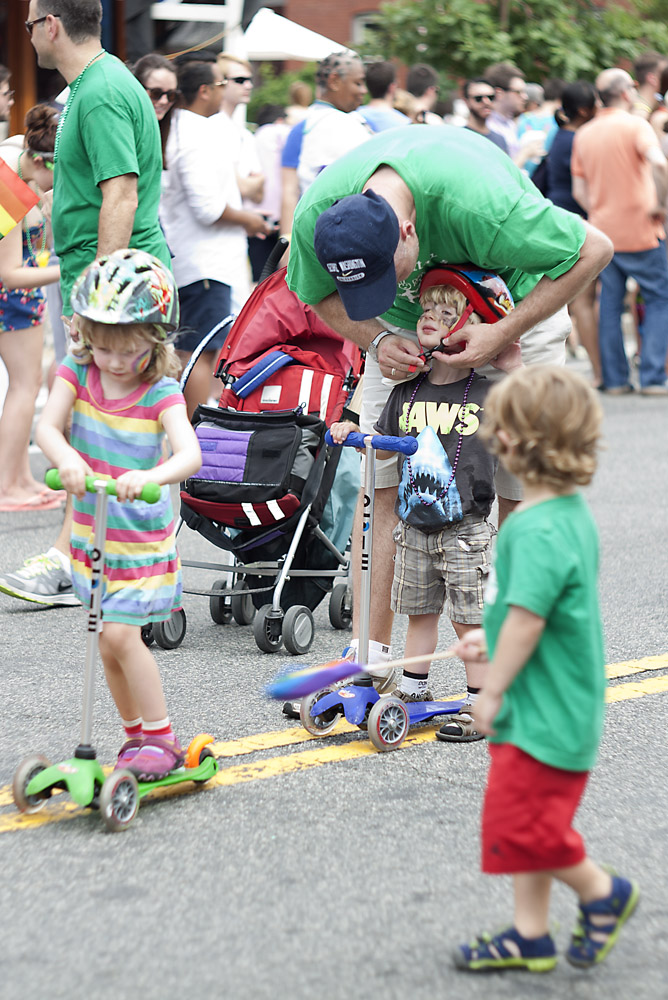
Kids with Scooters
Kids with Scooters

Many city agencies march in the parade. It’s not quite San Francisco, where the Fire, Police, and even the Sanitation departments have contingents (the sanitation workers ride those little ride-behind sidewalk sweepers that look kind of like lobsters with brushes for claws). But hey, this year we had the DC Public Library giving out beads!
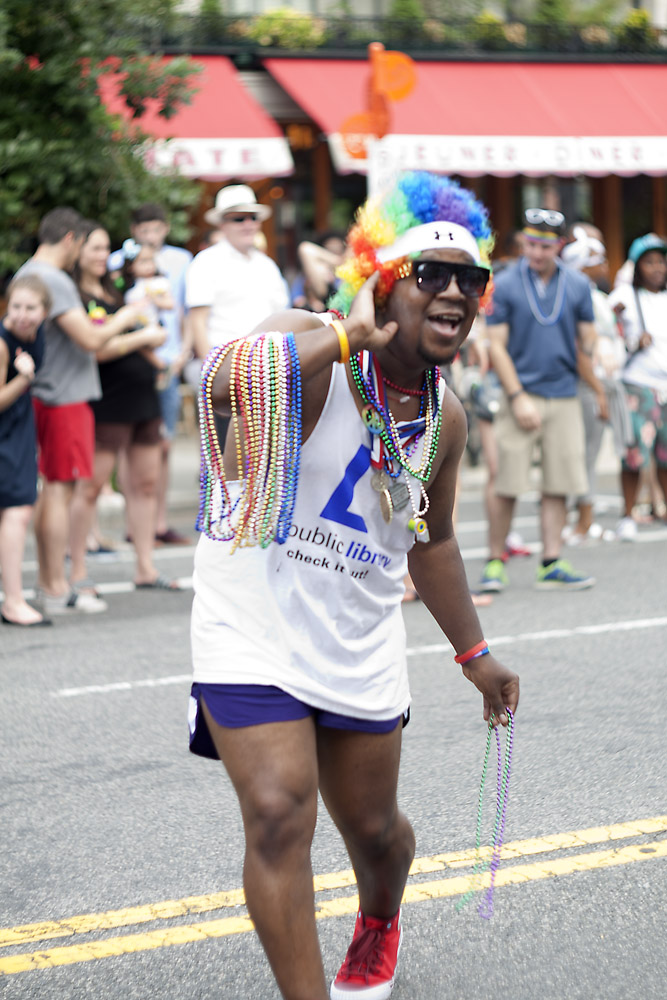
The Public Library...Beads?
The Public Library…Beads?

And the DC Public Schools had a very large contingent of kids of all genders, gender expressions and sexual orientations marching with their gay and ally teachers. I think it’s terrific when kids are allowed to express themselves and be who they are with pride – marching in the parade means that they’re less likely to end up on the street, homeless, addicted and practicing survival prostitution.
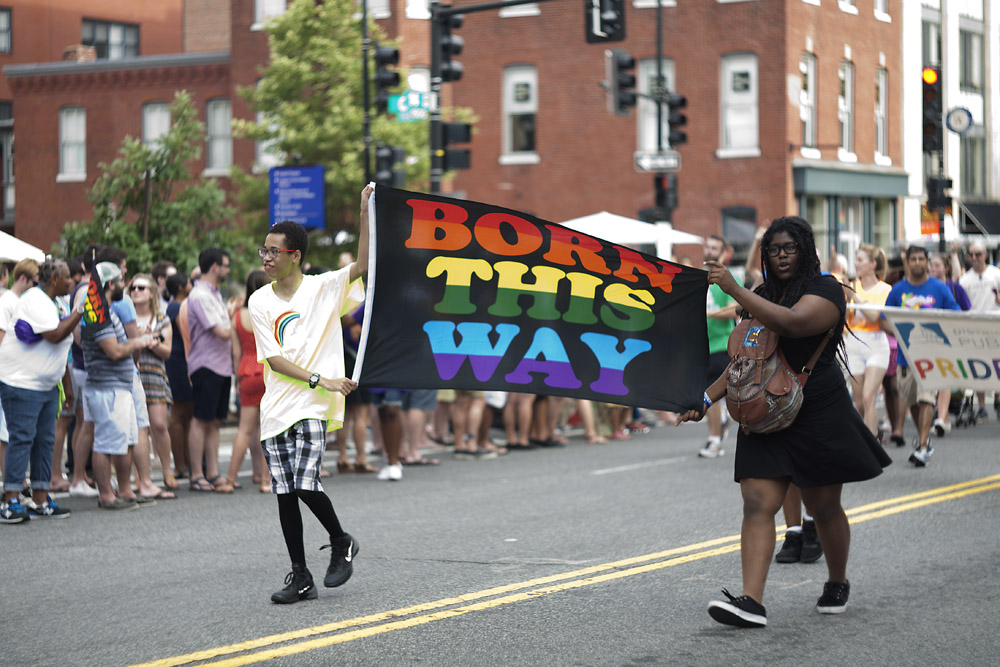
DCPS, Born This Way
DCPS, Born This Way

The United States Military had a very strong presence – each major branch of the service marched, and the grouping was led by a uniformed color guard. Here are some very cute sailors in sailor suits.
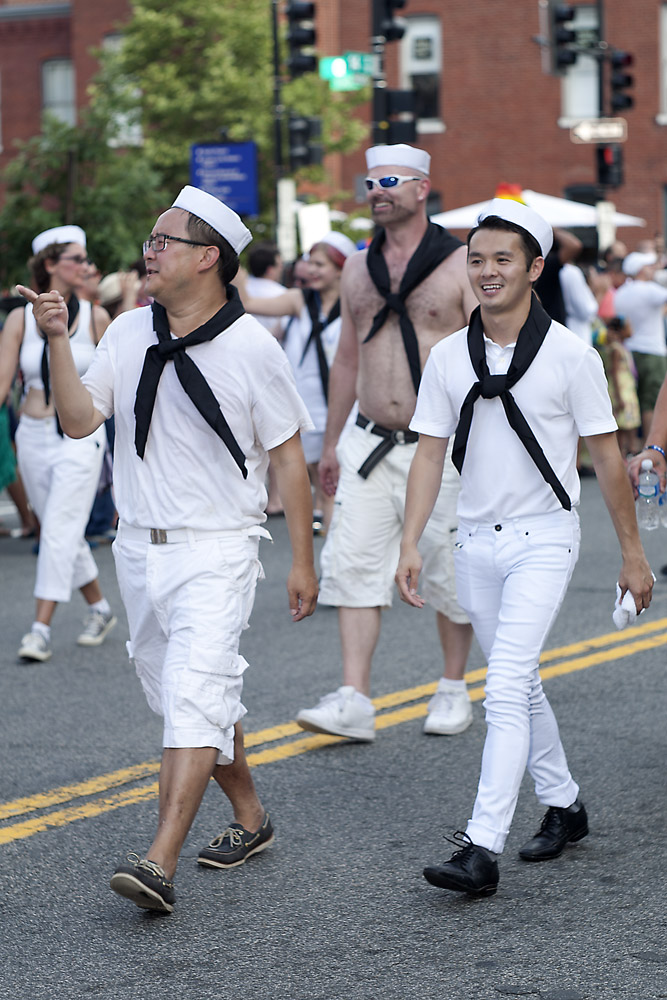
In The Navy...
In The Navy…

What gay pride parade would be complete without a float (or ten) of scantily clad go-go boys drenched in glitter, gyrating to a disco beat? Pride has moved upscale with corporate presences from Fortune 500 companies (Lockheed Martin, Booz Allen Hamilton, and here, Hilton Hotels), and they’re not afraid to get their sexy on. Twenty years ago, you’d not have seen any of these groups.
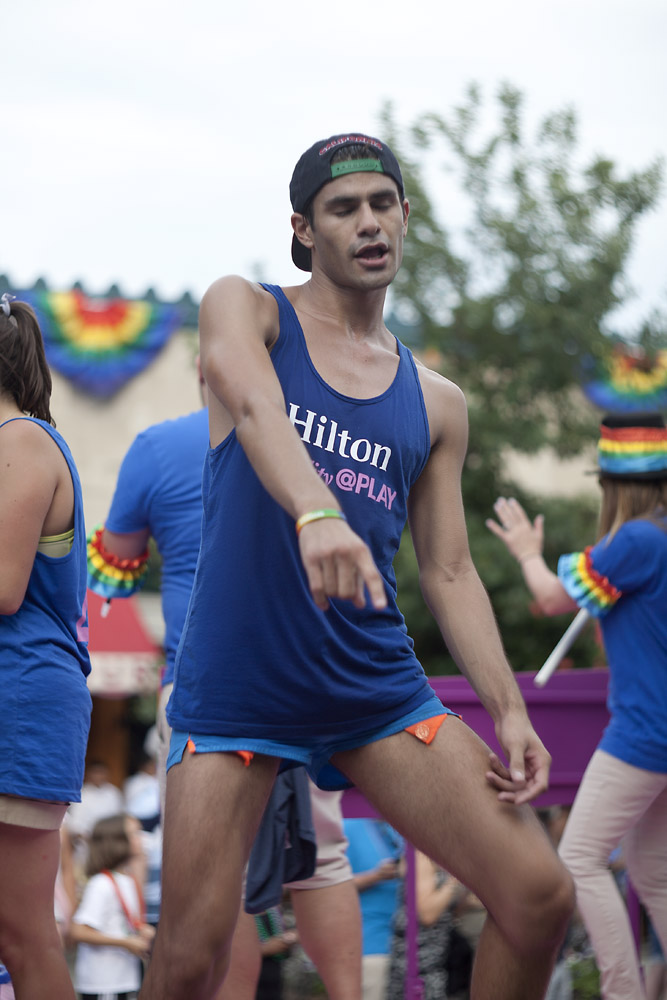
Party at the Hilton!

Of course, it’s the local businesses that are willing to go all-out in the just-slightly-naughty department. Nellie’s Sports Bar had quite the collection of go-go boys.
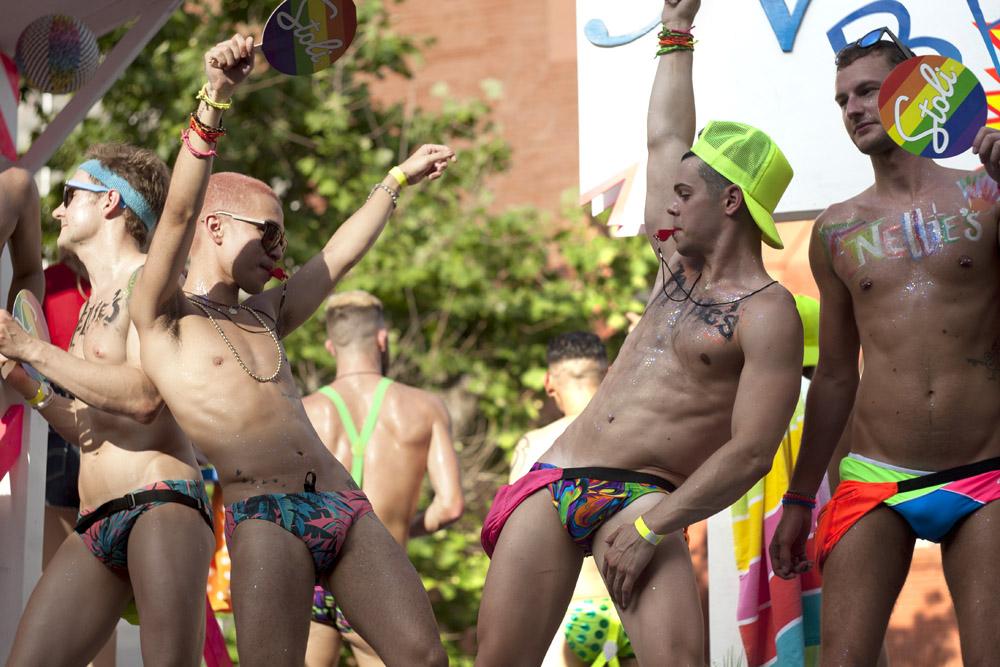
Nellies Beach Boys
Nellies Beach Boys

Another thing a Pride parade wouldn’t be complete without: the Leather contingent. Here are four leathermen hanging out in front of the West Elm furniture store by the “Twinks and Otters and Bears, oh my!” sign, tempting passersby to shop for a chair and a sling…
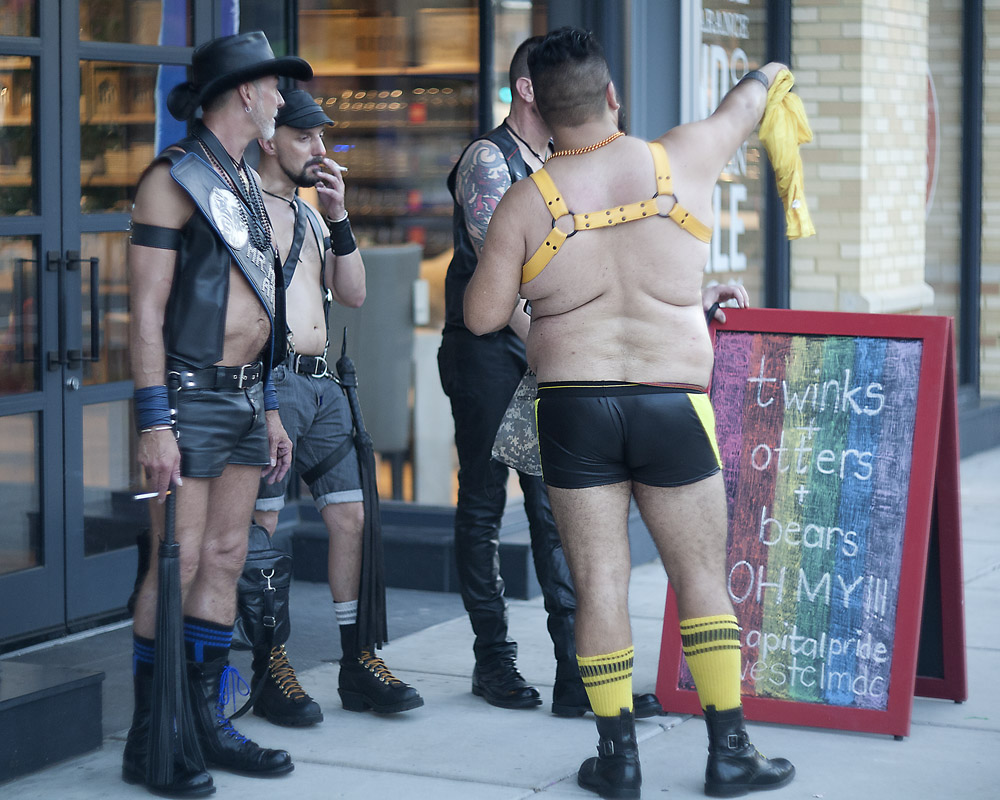
Twinks, Otters and Bears, oh my!

And the perennial favorite, always the first contingent in the parade, Dykes on Bikes.

Boy (I don’t know her real name, but Boy is what she goes by) is a multiple sash winner in leather contests, and has been a fixture around the DC area for a very long time. She’s the one driving the bike.
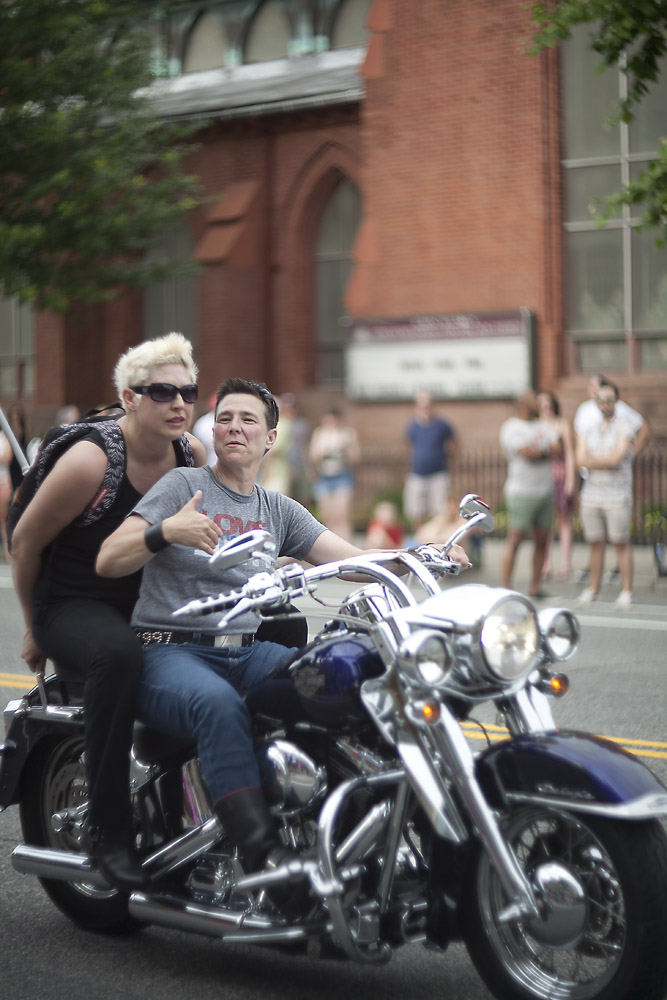
Boy, Bike
Boy, Bike

Another lesbian couple (I’m assuming, they could be just friends) riding in the parade:
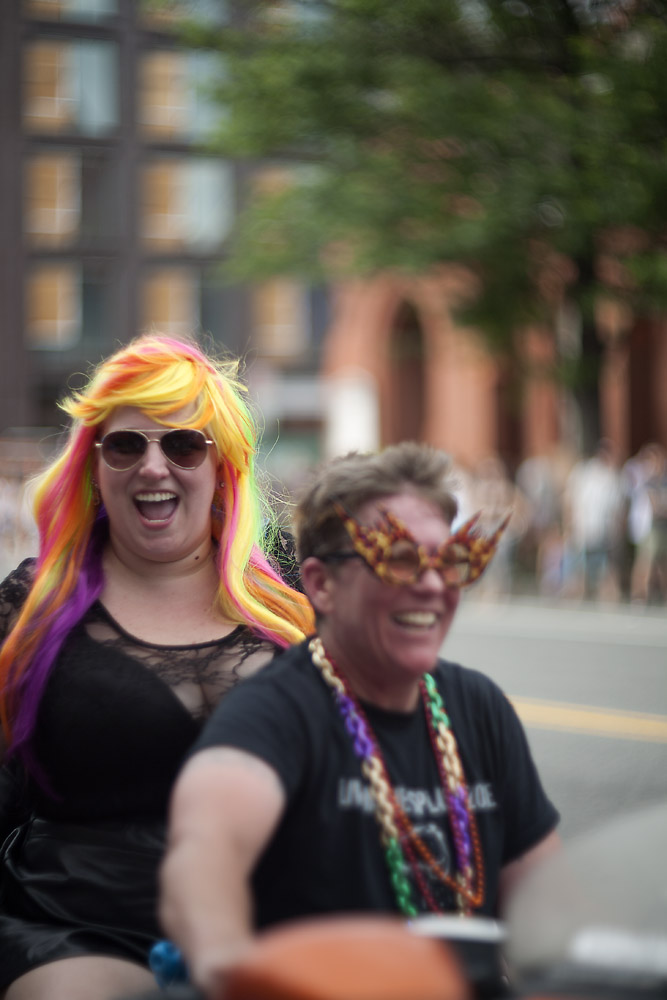
Bright Wig, Bike
Bright Wig, Bike

And to cap it off, a row of Bykes (Dykes, Bikes… Bykes, get it?) parked outside a restaurant on 14th Street at the end of the parade route.
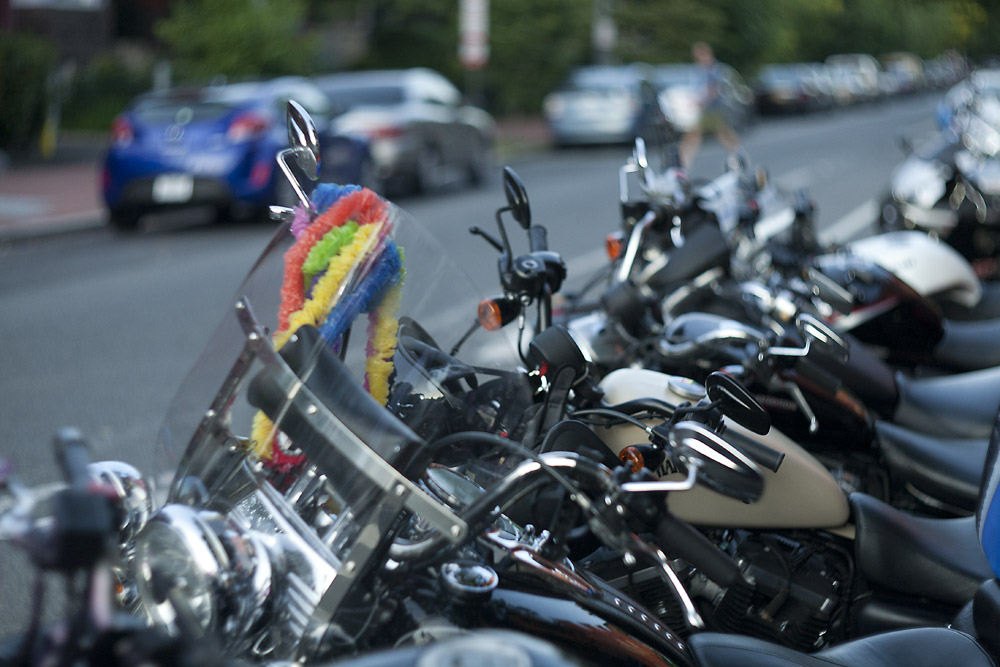
Rainbow Lei, Harleys

DC Pride Parade 2015 – On the Sidelines

Here are some photos from yesterday’s Gay Pride Parade. These were faces in the crowd of people watching the parade.
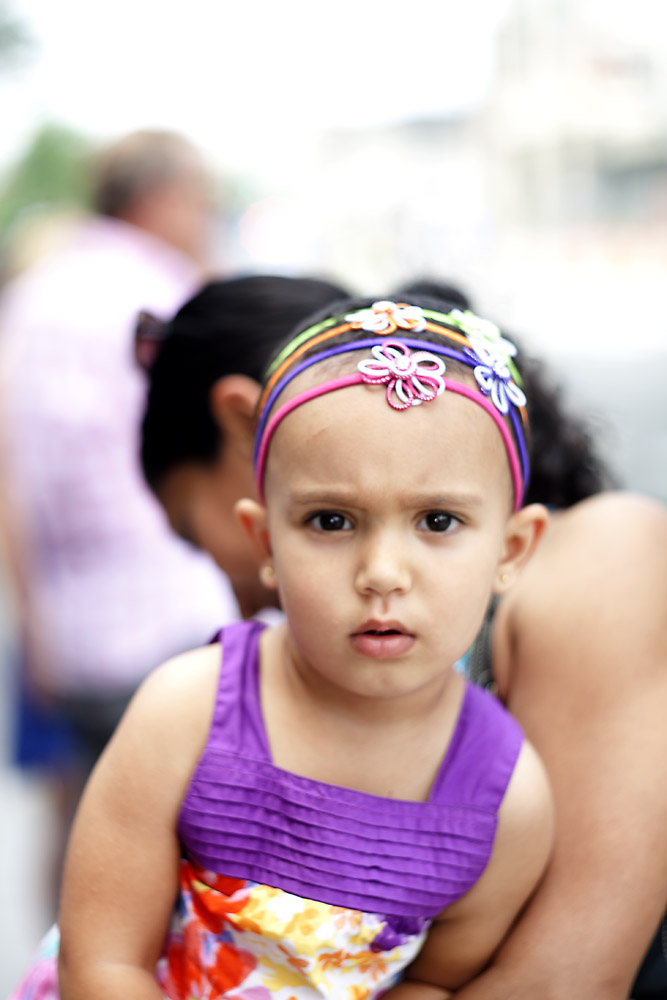
This first picture is the reason why we need gay pride parades still – I was standing on the curb, waiting for the parade to arrive, and this woman carrying this sweet little girl came up to me and said, “She’s a Pride baby – she needs her picture taken! Take her picture, she’s a Pride baby!”. When I put the camera to my eye to compose the photo, the mother turned her head so her face would not appear in the photo, only the little girl’s.

Pride Baby
Pride Baby

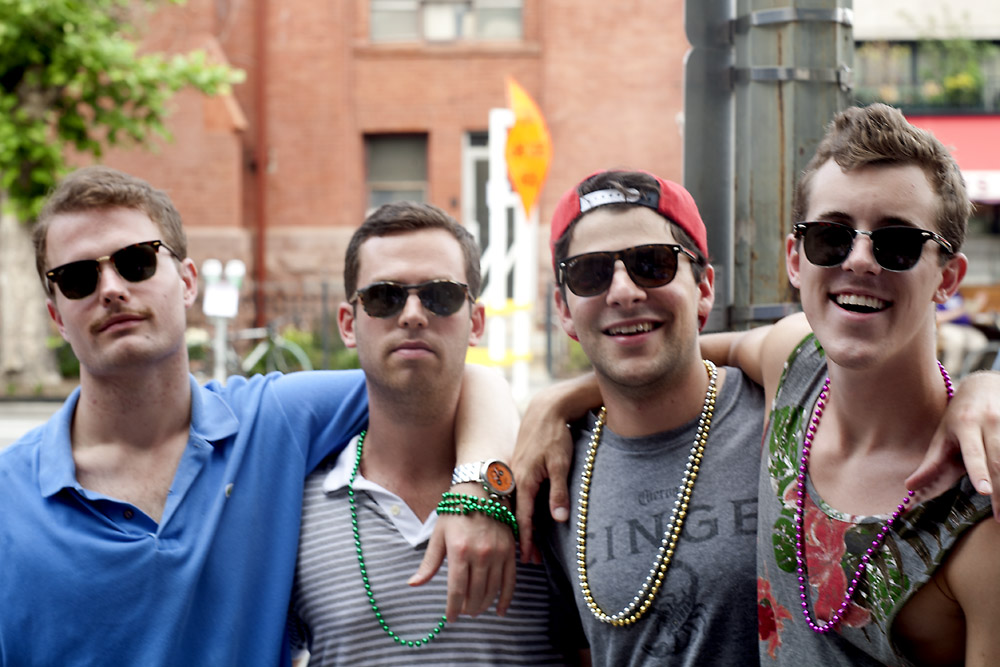
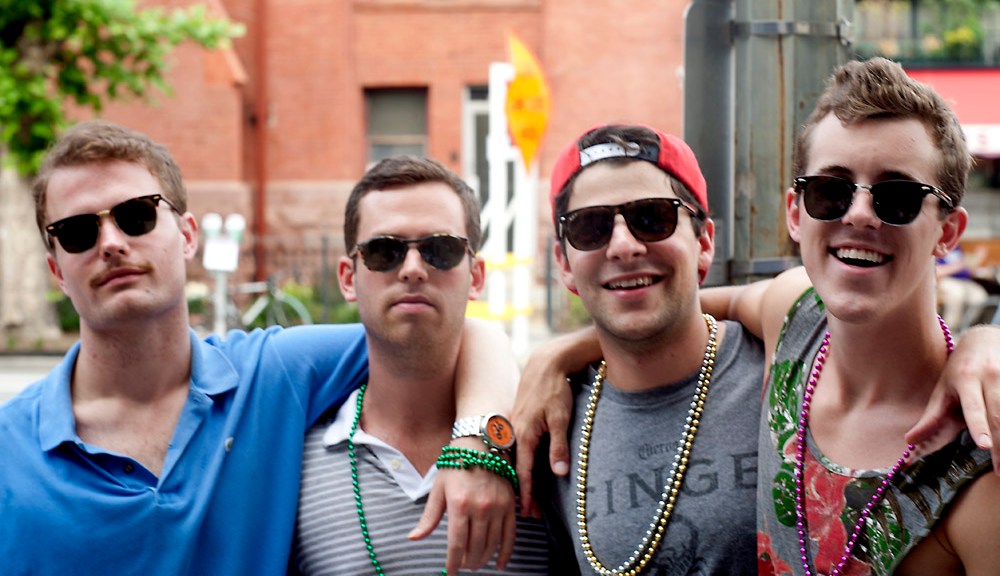
These guys saw me standing with my camera and approached, asking to be photographed. They asked me where the photos were going to be used – “Will these be in the New York Times?” I told them I’m shooting for this blog, and they said “you can use our photos anywhere!”. I hope they find this photo and enjoy it!

Besties
Besties

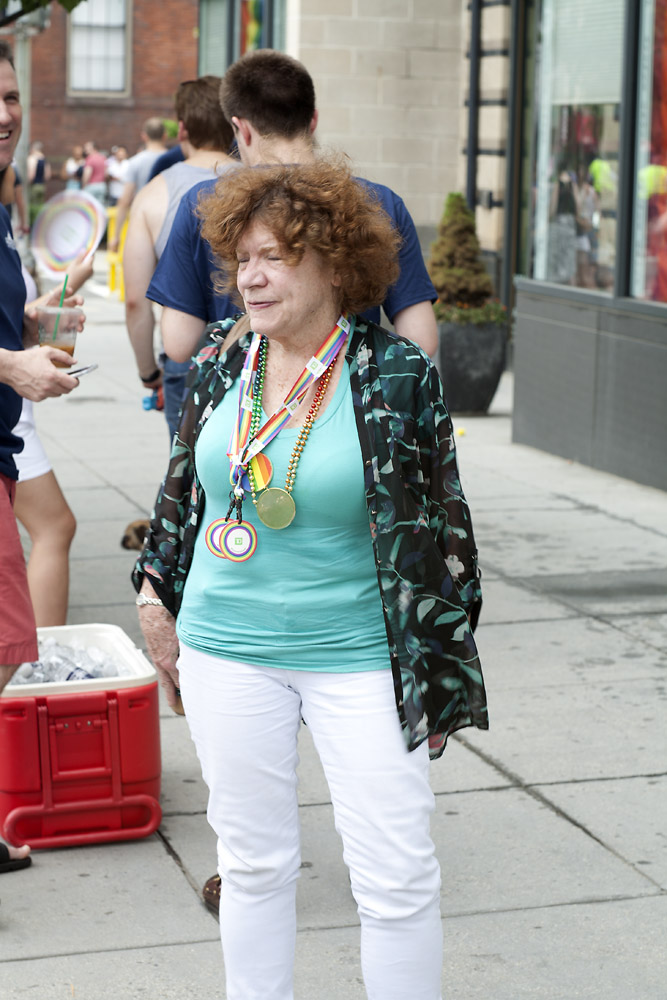
I don’t know her name or if she is in fact a mother, but I’m calling her Pride Mama for all her ribbons and beads.

Pride Mama
Pride Mama

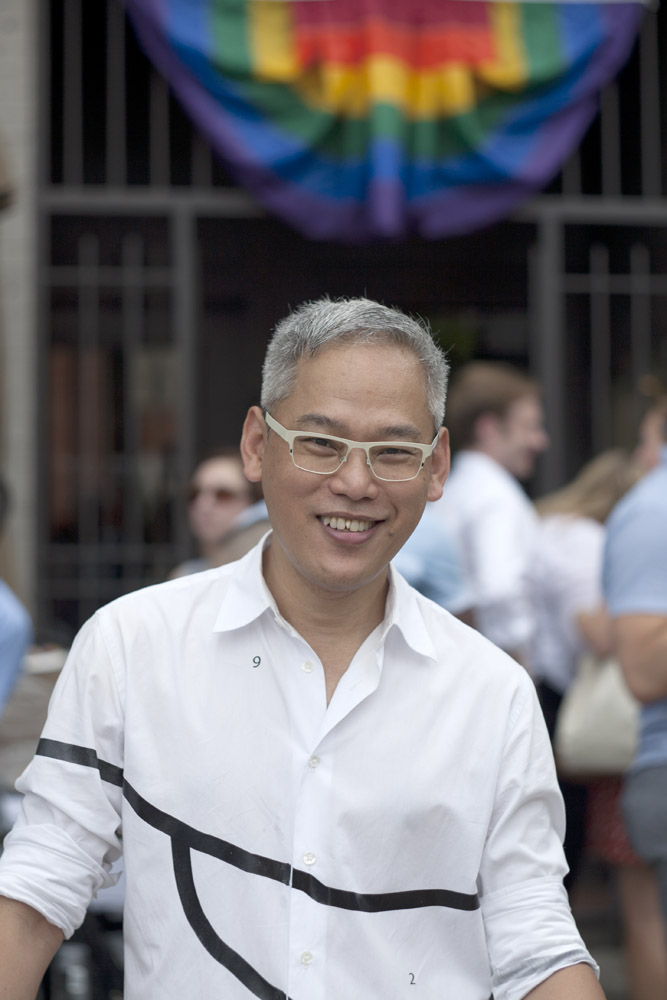
This is my friend, Sak Pollert, who owns Rice restaurant on 14th Street (where I parked myself to watch the parade, as the restaurant is on the shady side of the street in the afternoon when the parade is passing).

Sak P.
Sak P.

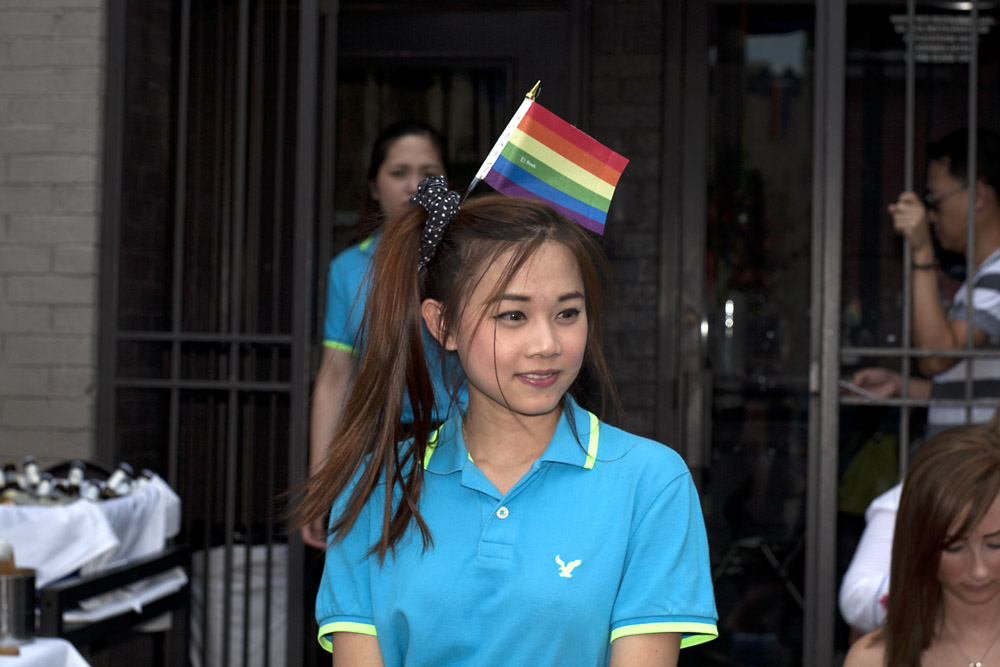
One of the waitresses at Rice – she put a rainbow flag in her hair like a chopstick.

Rainbow Waitress
Rainbow Waitress

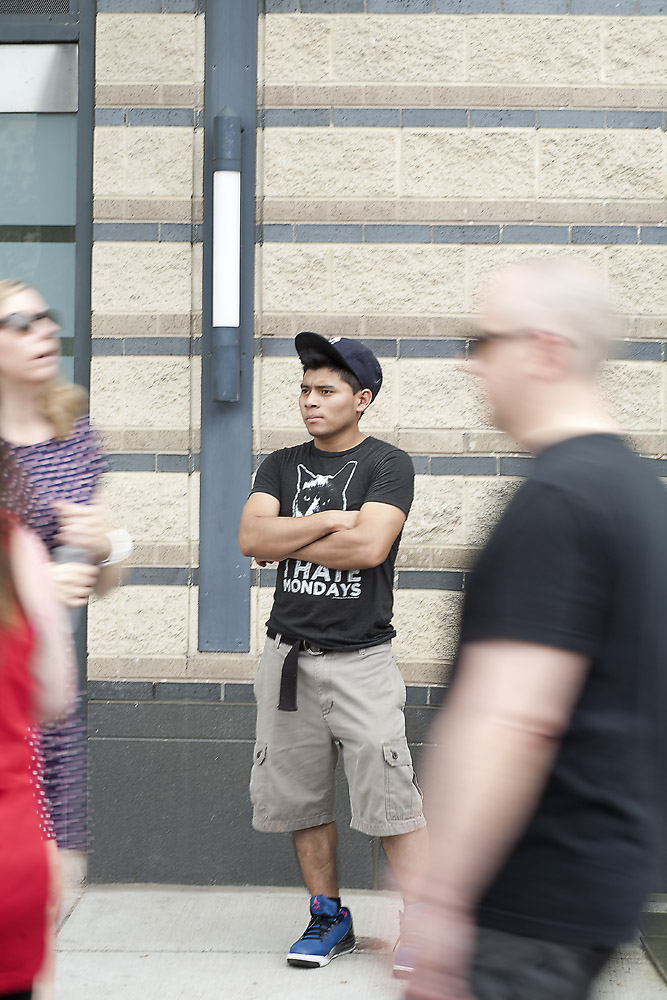
I think this guy is one of the busboys/kitchen staff at Rice, out to watch the parade. I loved his Grumpy Cat T-shirt.

I Hate Mondays
I Hate Mondays

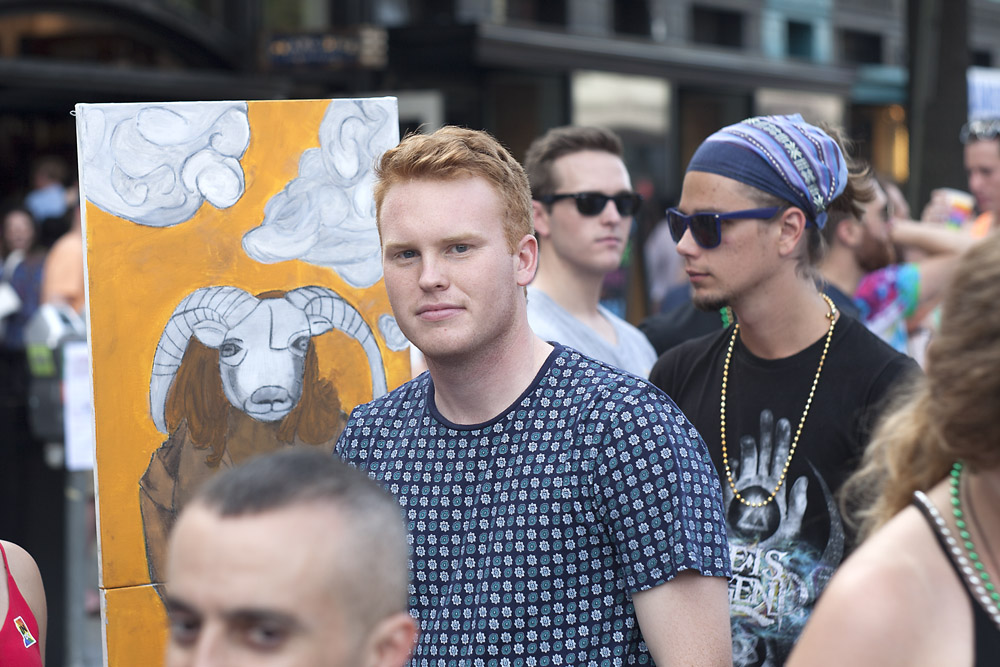
I don’t think this guy actually had anything to do with the goat in a trench coat sign behind him (I think it belongs to the guy in the black t-shirt to his left). When he saw me composing the image, he straightened up, made eye contact, and posed.

Boy, Goat Sign
Boy, Goat Sign

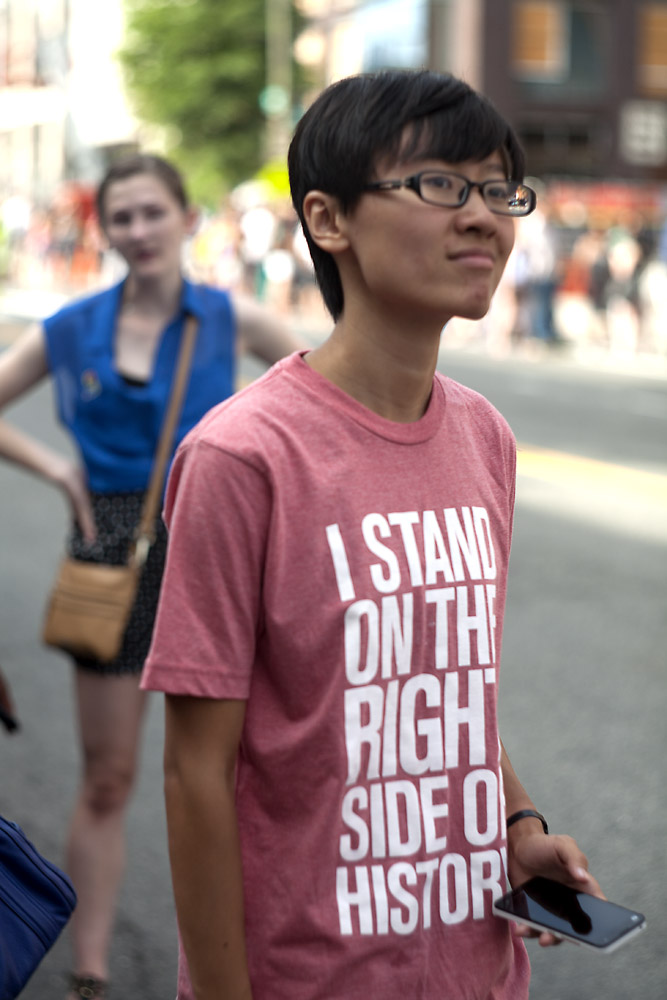
This young lady was standing next to me for a while, and I wanted to get a photo of the shirt with that caption.

Right Side of History

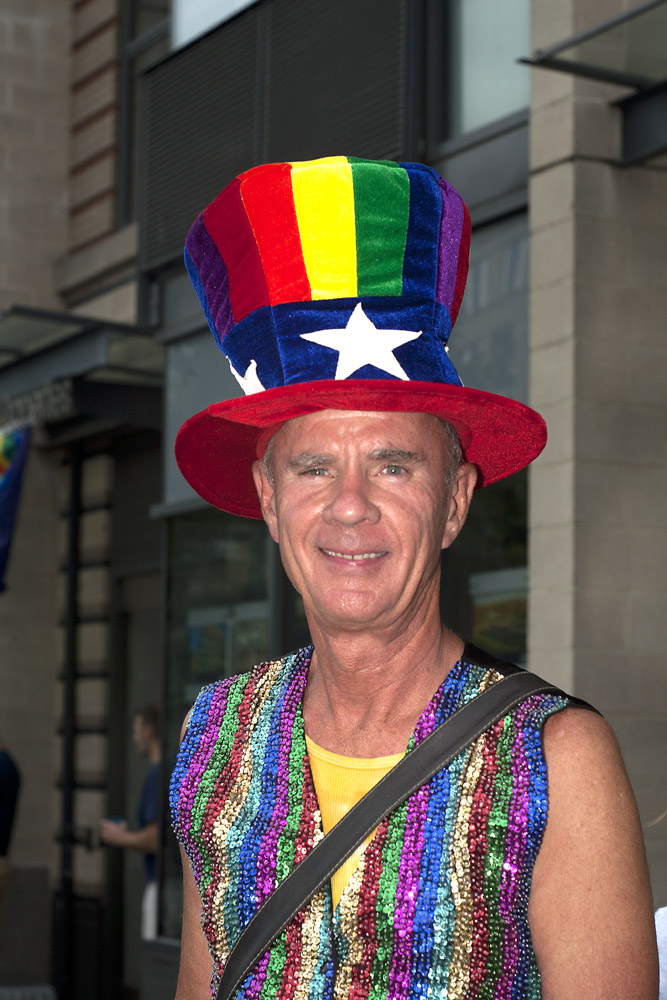
This gentleman was all decked out in rainbow finery (if you call tons of sequins ‘finery’). He was certainly in the spirit of the day! Not visible except by interpolation were his six-inch platform heels.

Rainbow Top Hat
Rainbow Top Hat

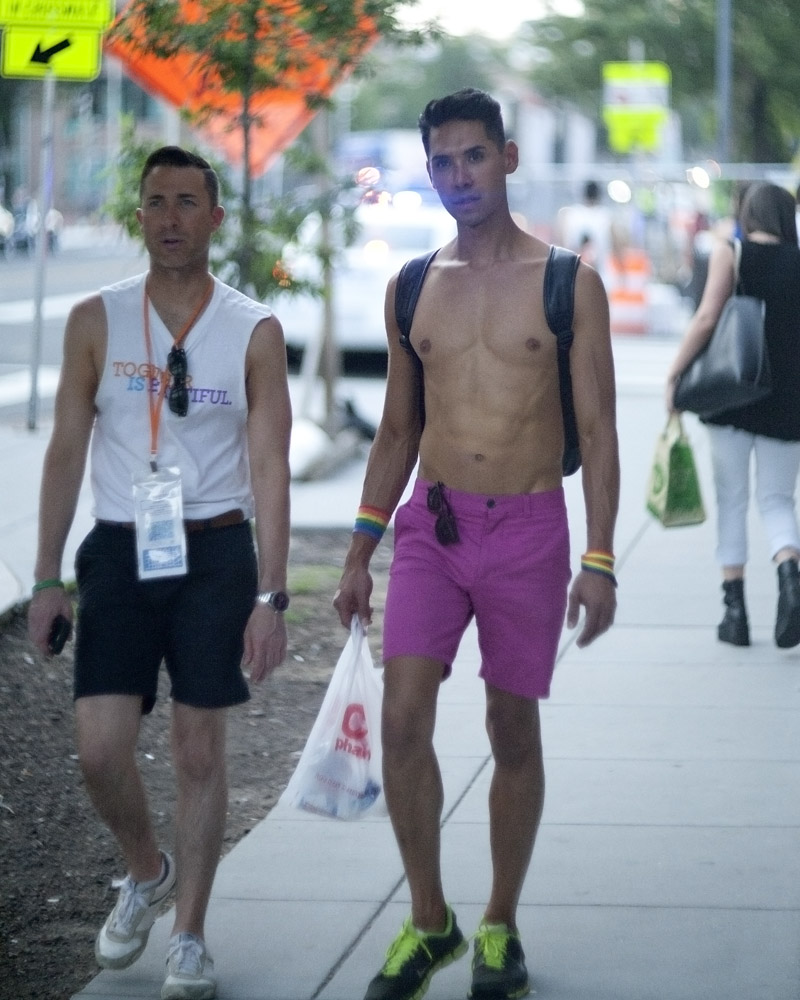
I titled this one “Apres Parade” because I caught these two as we were all leaving the parade, heading home after a long, hot, fun day.

Apres Parade
Apres Parade

This was another experiment photographically. I shot the whole parade using my Helios 85mm f1.5 lens. This is the second time I’ve shot the parade with this lens – I did it for the first time the last time I photographed the Pride parade, and the lens was brand new to me then. It’s a bit of an oddity because it’s manual focus and it uses a pre-set aperture – unlike modern all-automatic lenses, this one you have to tell it to stop down the aperture on the lens by turning a separate ring. The lens has a particular signature to its look – when focused and configured properly, it produces a “swirly” background (most visible in the “Apres Parade” image in this post, and several others (Bright Wig, Bike and Miss Gay Virginia) in an upcoming post. The lens is big, heavy, a bit slow to use, especially because of the aperture mechanism, and exposures are sometimes a little off because there is no communication between the lens, camera, and flash. The “swirl” is something I’m still debating if I like. I might need to just shoot more with it to decide.

Intro To Large Format Class – Portraiture Session

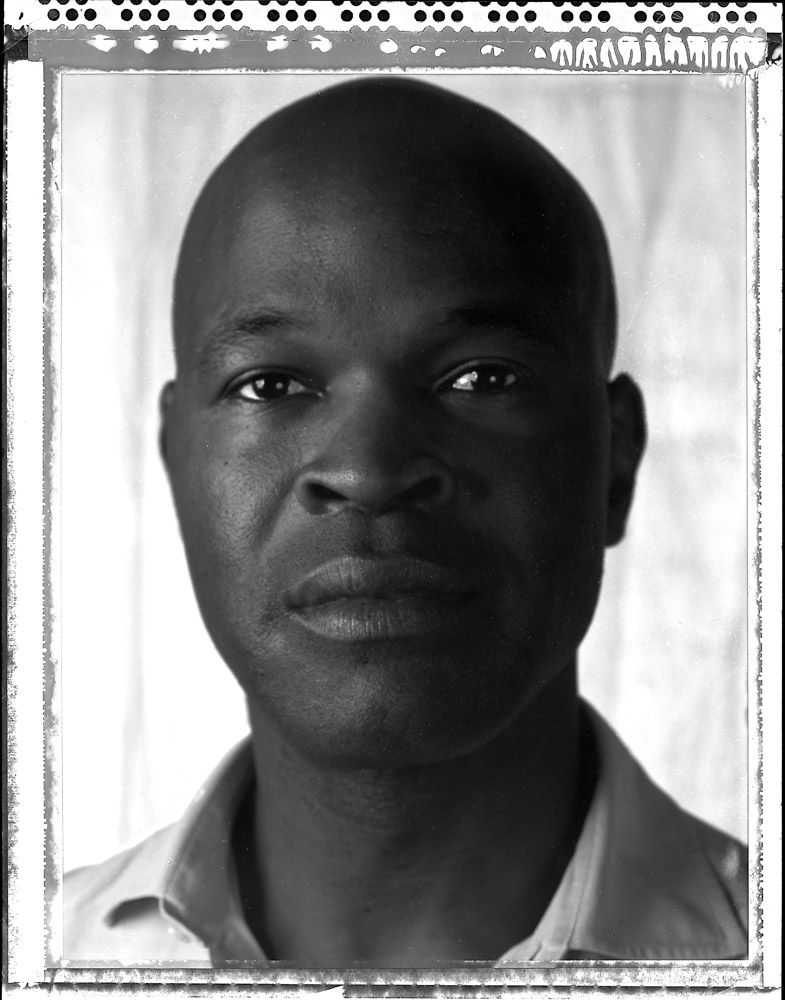
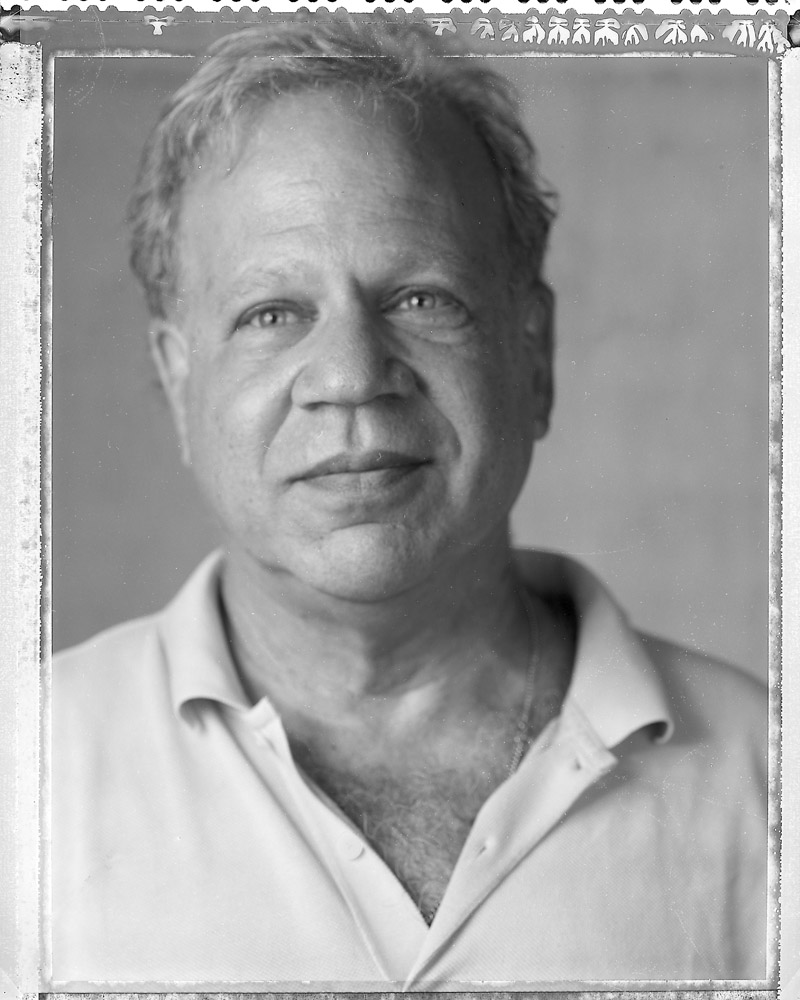
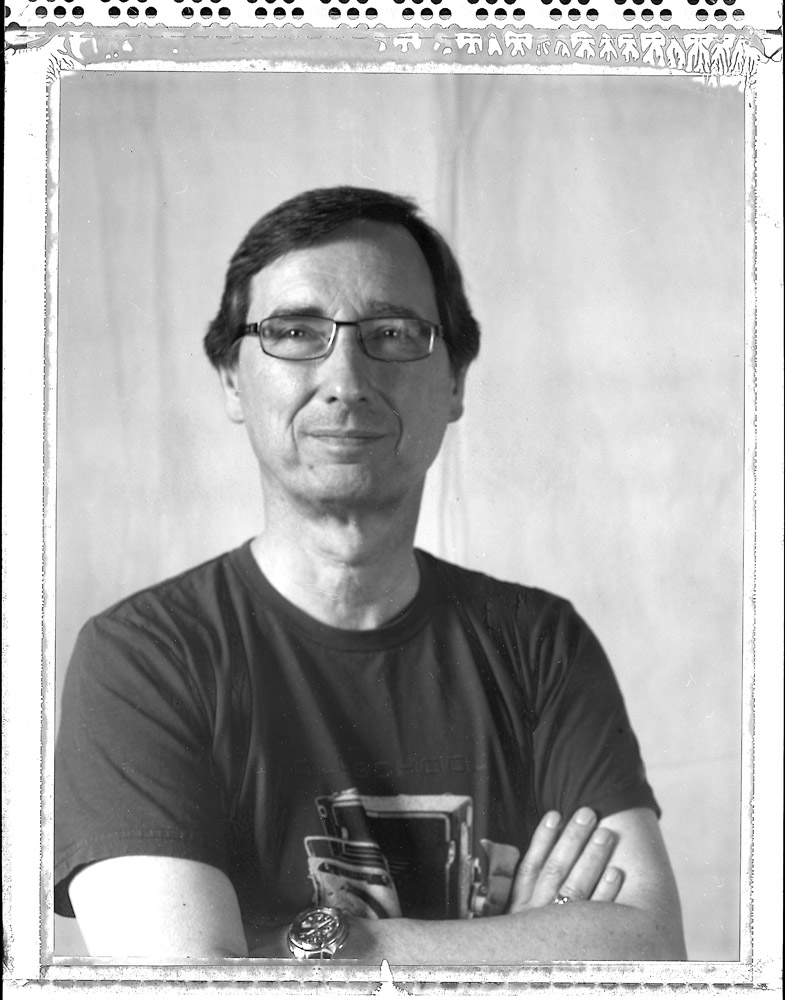
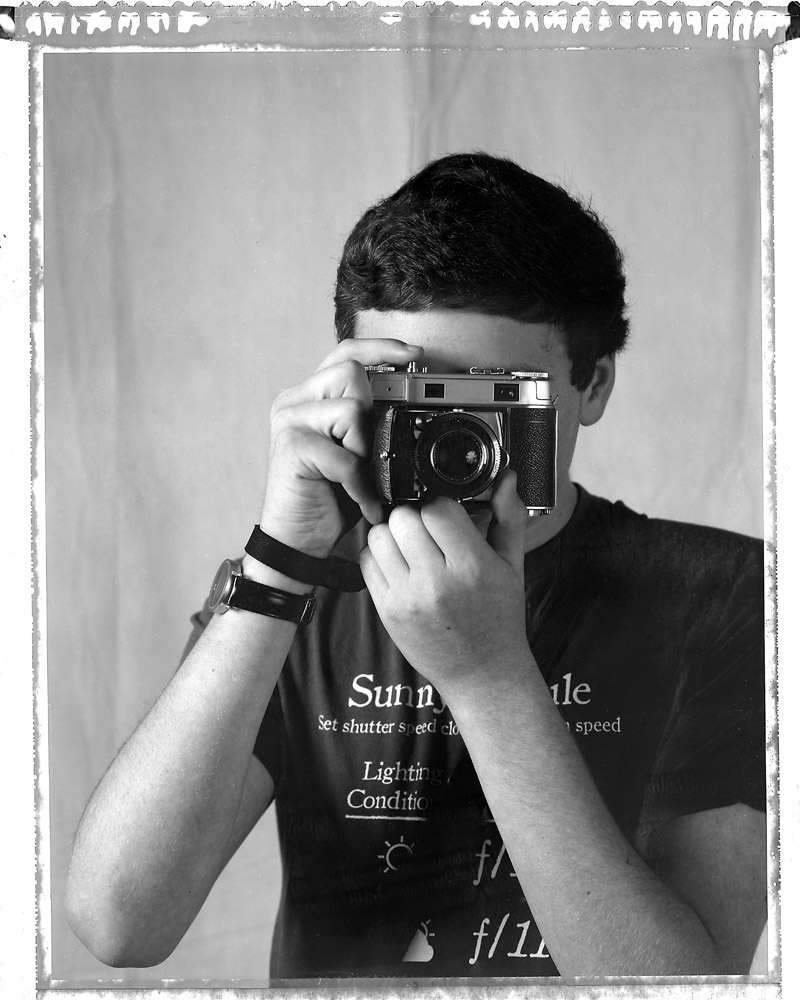
This weekend was the next-to-last session of the Intro to Large Format Photography class I’m teaching at Glen Echo. As a treat, I broke out some of the last remaining sheets of Polaroid Type 55 I have in my personal stash. We had a lot of fun setting up portraits and posing for each other. One of my students even brought along his 6×17 panoramic camera and took a couple frames of all of us in the studio together – a couple were serious, and one was very silly (I gave someone next to me bunny-ears).

Sean L.
Sean L.

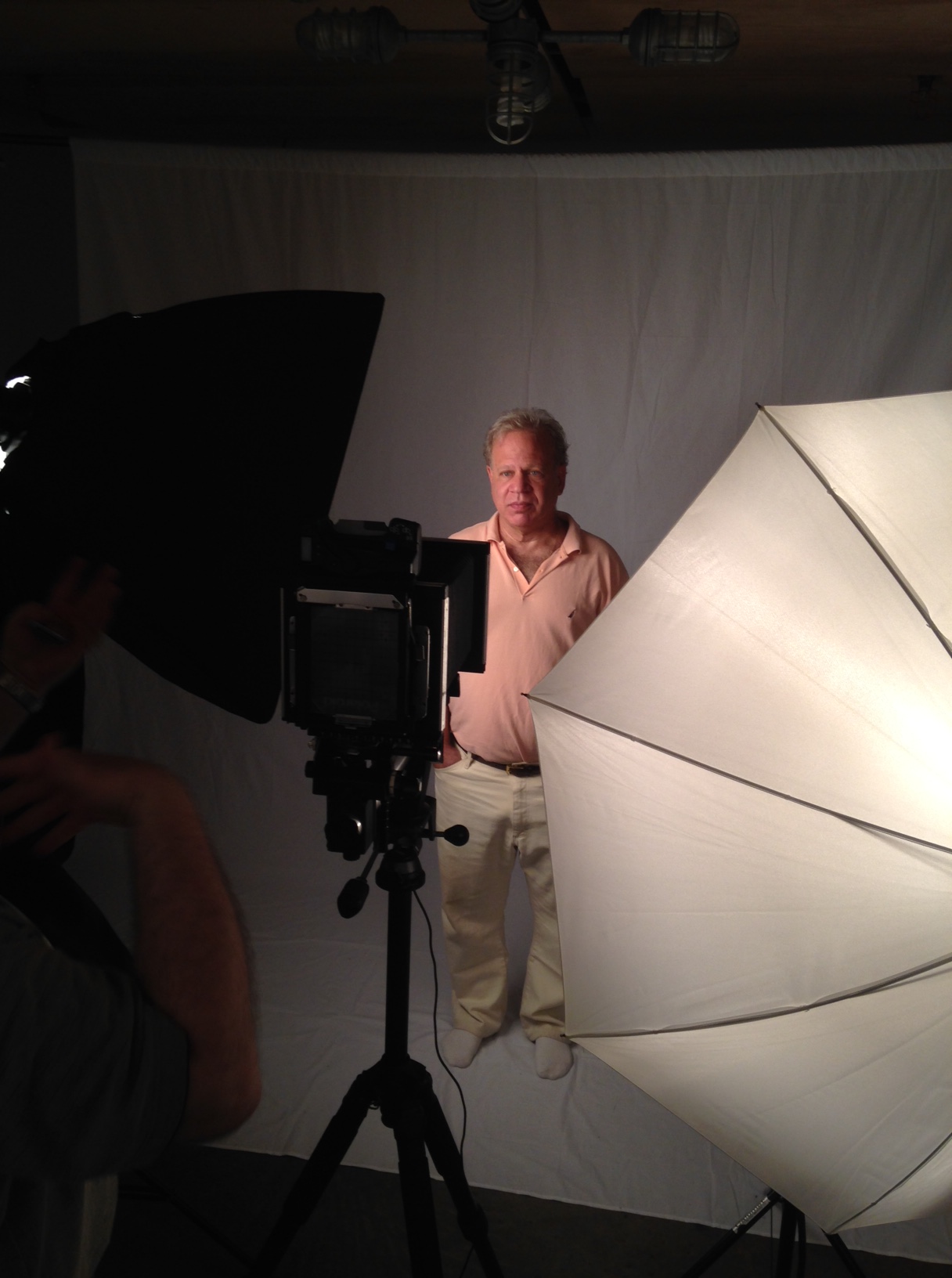
We covered the fundamentals of not only how to use a view camera for portraiture (movements – not many – focusing, bellows extension factor, lens selection) but also basic studio lighting. Given that we were limited on time and had lesson objectives to cover, I dictated the lighting setup with just a main and a fill, driven off my Calumet Elite 2400 W/S unit. It’s a lot of power for just 4×5, but I wanted to give people a real studio experience (that and the moonlights I would have used that are at the school are at the moment buried in the storage closet under dozens of boxes from the exhibits currently hanging in the gallery space).

Dean M.
Dean M.

We rigged a softbox on the main light and an umbrella on the fill. The softbox was camera left, and the fill was beside the camera. I used a 240mm Docter Optics f9 Apo-Germinar as my lens because the focal length is a nice one for studio portraiture (not too long, but not too wide either), it’s mounted on a lens board to fit my Sinar (some of my other portrait lenses are on different lens boards), and the shutter has good working flash sync (some of my other portrait lenses are in archaic shutters that don’t have reliable flash syncs – and yes, I’ve had them overhauled but they still don’t work 100% of the time). f9 is a bit dim for a traditional portrait lens, but I think this one produced outstanding results (further confirmation that that lens was a phenomenal buy and well worth every penny).

Anthony R.
Anthony R.

Polaroid Type 55, for those who are unfamiliar, was an instant film that produced both a positive print and a re-useable negative. Artists have loved the negatives not only for the incredibly fine grain and sharp detail, but for the artifacts at the edges that the Polaroid process produced. It hasn’t been made since 2008, so any Type 55 anyone is using is old stock. There is hope on the horizon for a replacement as a group called “New55” is creating their own improved version. One of the challenges of the original Polaroid Type 55 was that the negative film and the print were not equally sensitive, so you had to decide if you wanted a good print or a good negative – a good print gave you an underexposed negative and a good negative gave you a washed-out print. New55 will have one advantage over the old stuff – the instant print and the negative will be speed-matched so you won’t have to expose for either a good print or a good negative.

Ari G.
Ari G.

I can tell from the negatives that my Type 55, which outdated in 2006, is starting to get a little long in the tooth, as they have begun to lose some contrast. I’ve tweaked it a fair bit in Photoshop to get these negative scans to look good. I’ll try printing them in the darkroom and see what I can do with them – they may print much better than they scan.

Glen Echo Intern
Glen Echo Intern

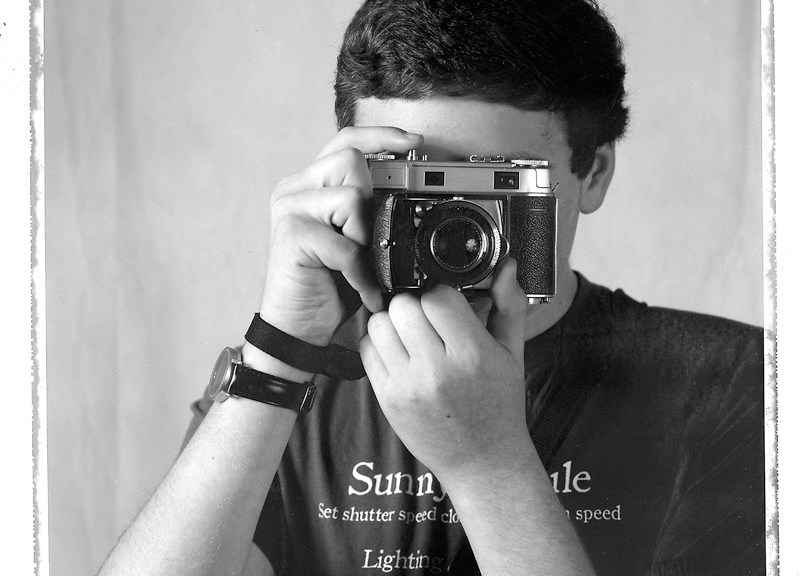
Here are some behind-the-scenes shots, taken by one of my students.

Dean M, Posing
Dean M, Posing
Sean L, Polaroid Print

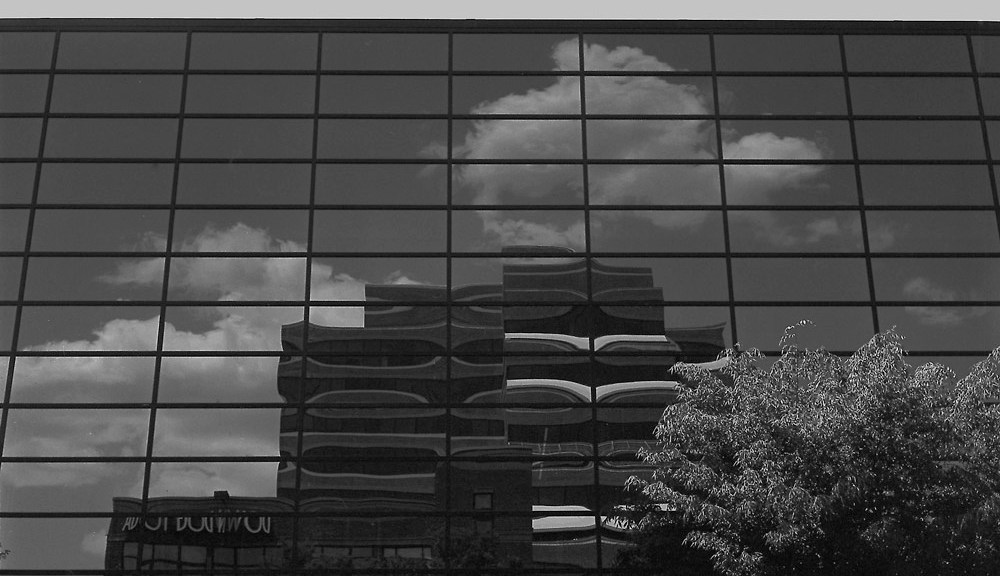
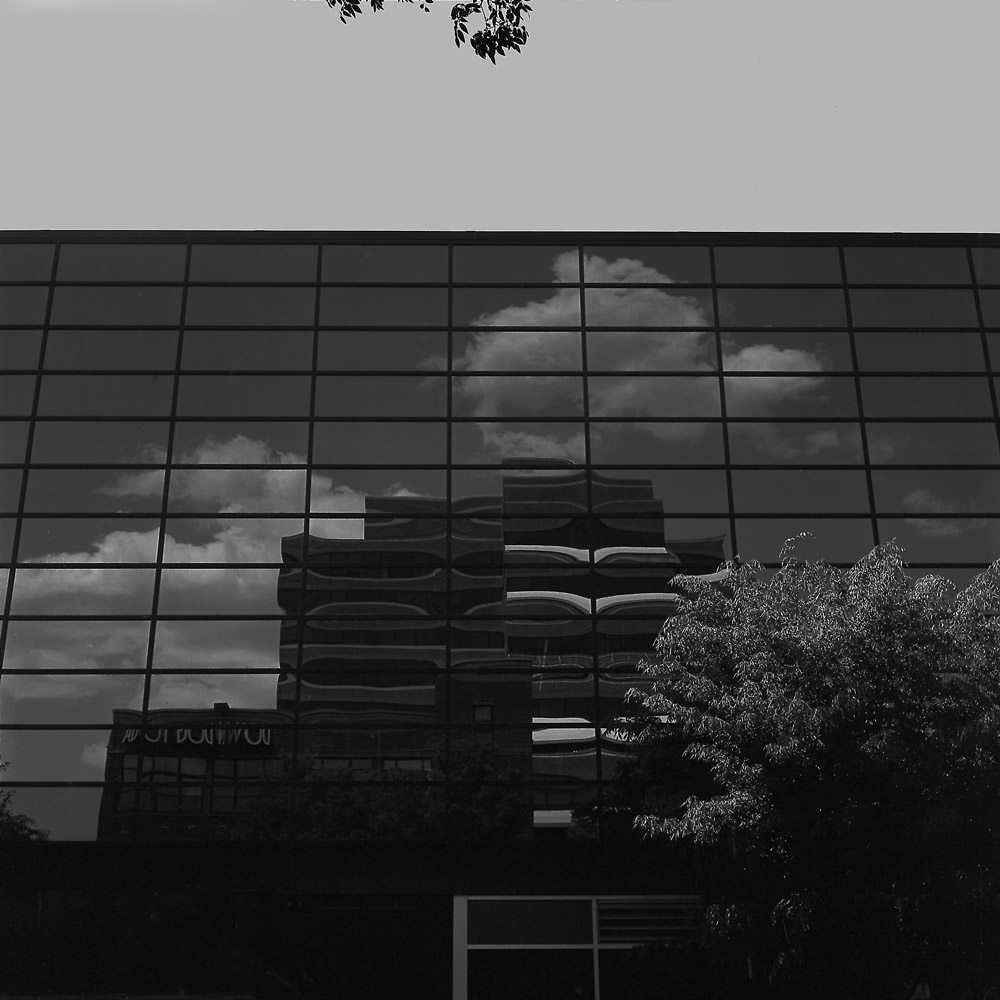
Reflections

Bethesda Reflection
Bethesda Reflection

This has a very Japanese aesthetic to it, don’t you think?

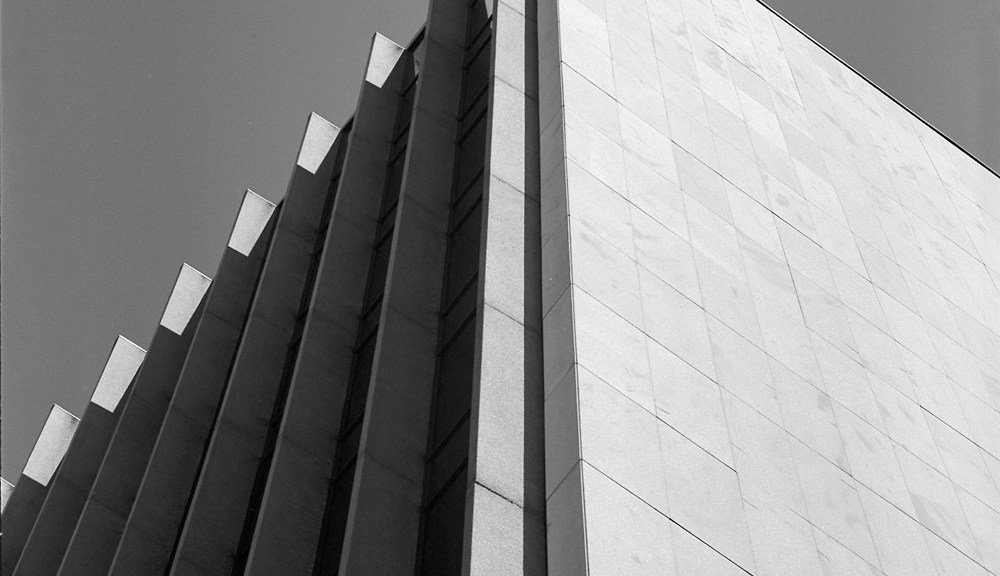
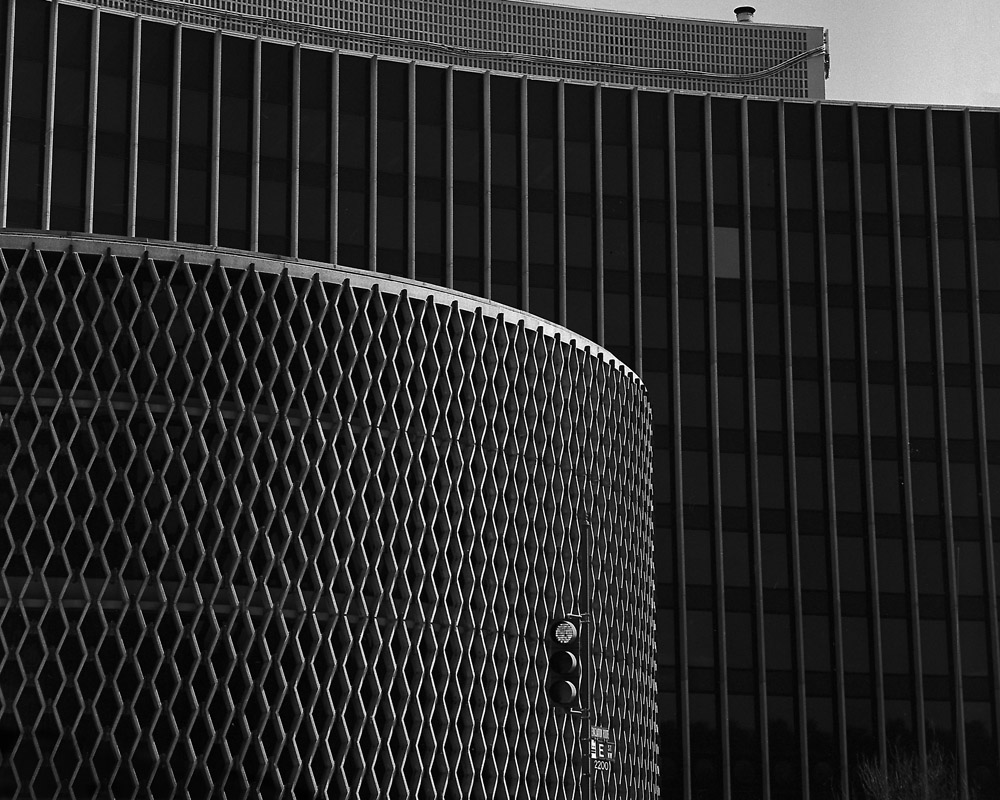
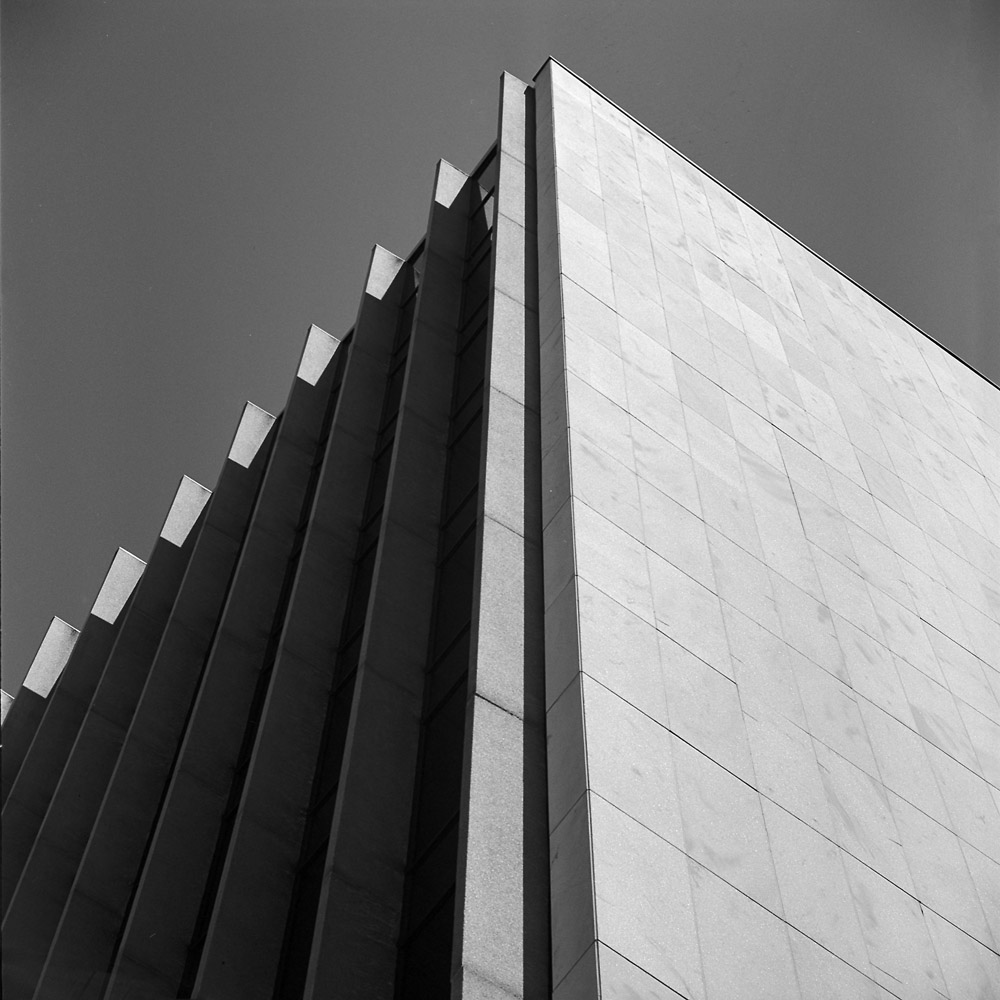
World Health Organization – More Abstracts

World Health Organization - Tower and Drum, E Street Lamp
World Health Organization – Tower and Drum, E Street Lamp
Corner, WHO building

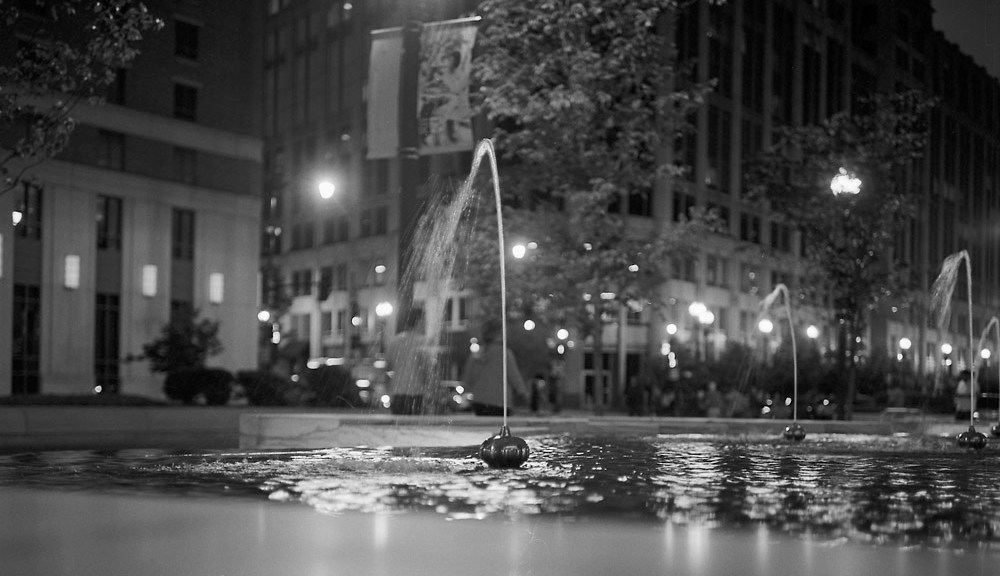
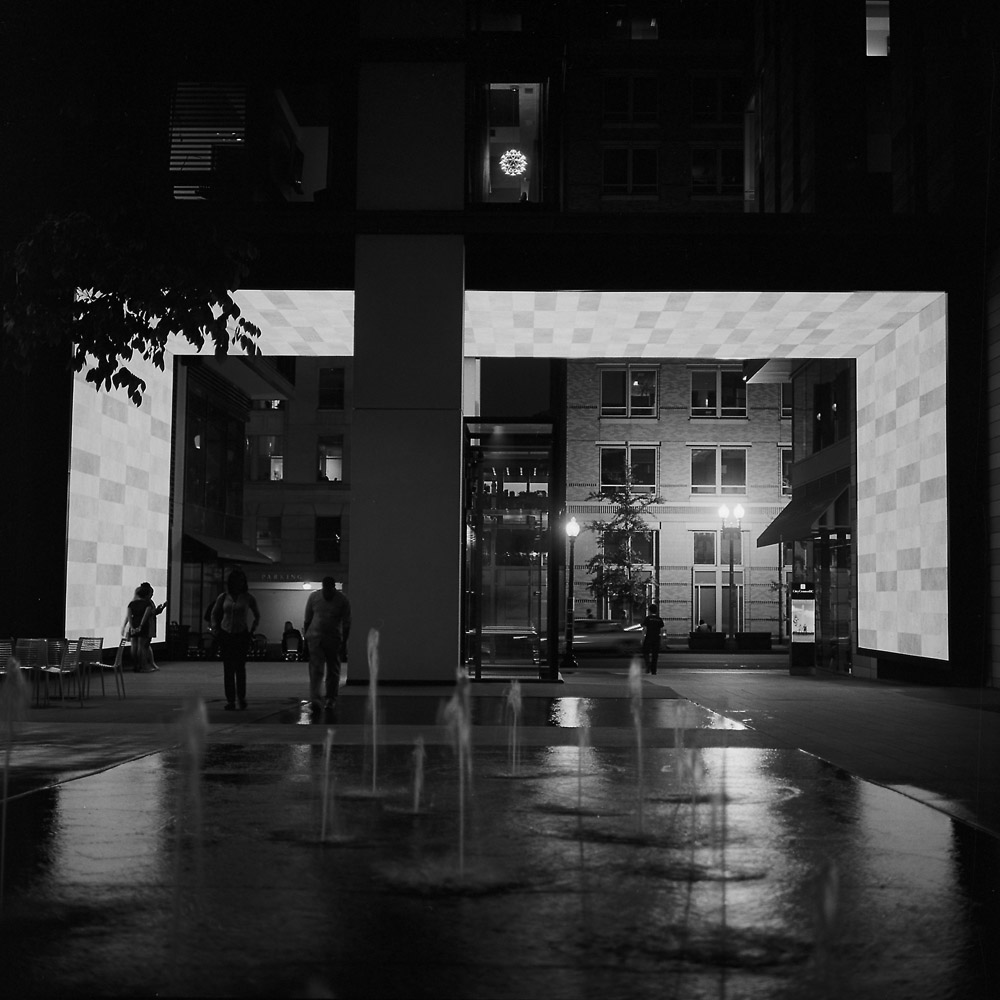
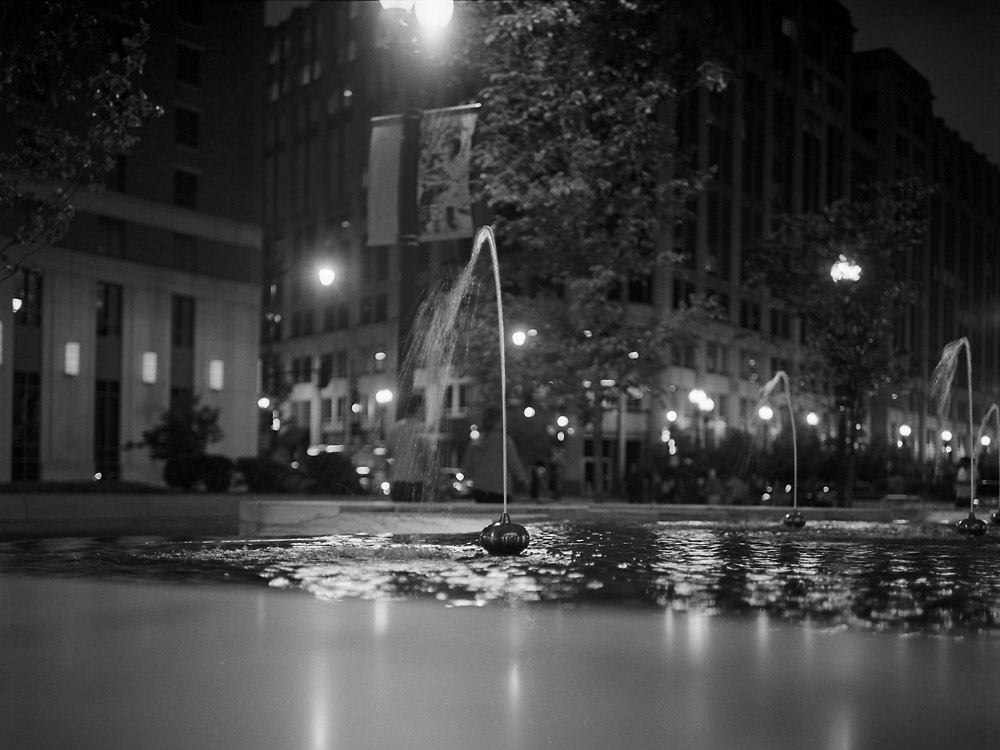
Fountains Day and Night

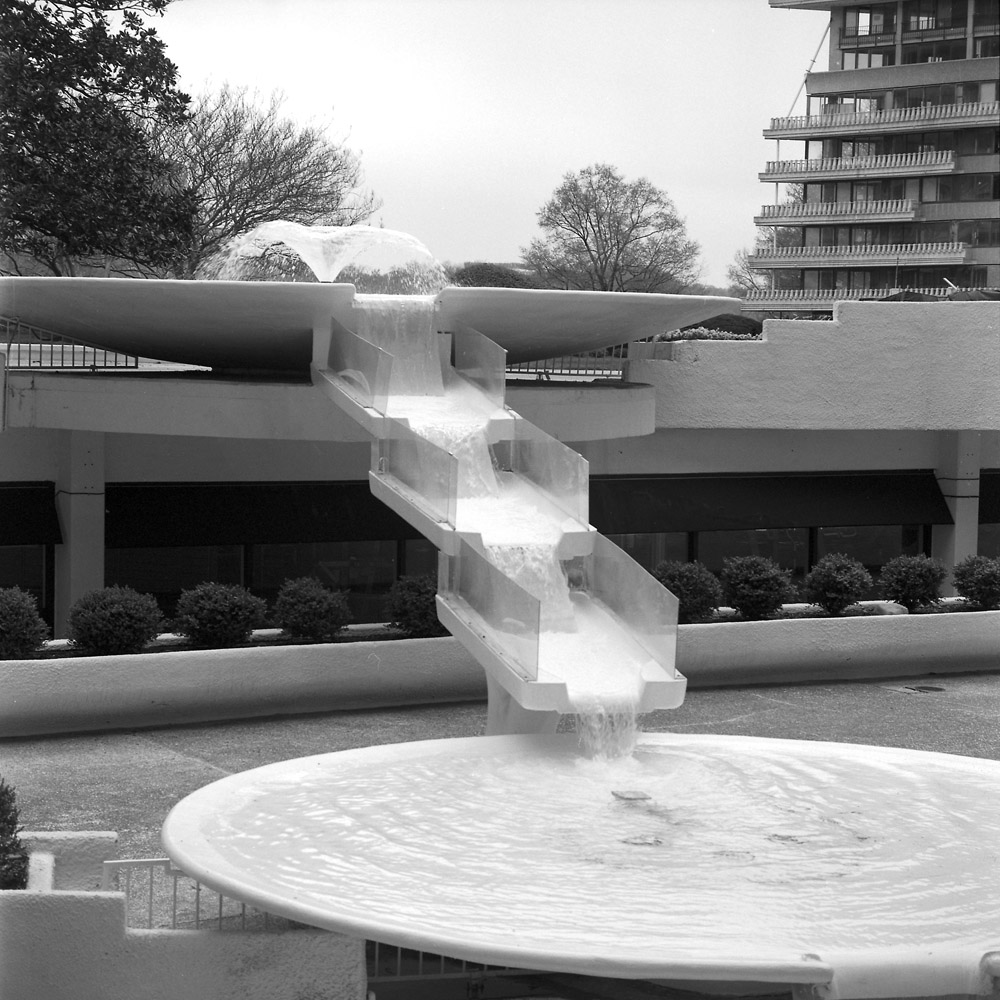
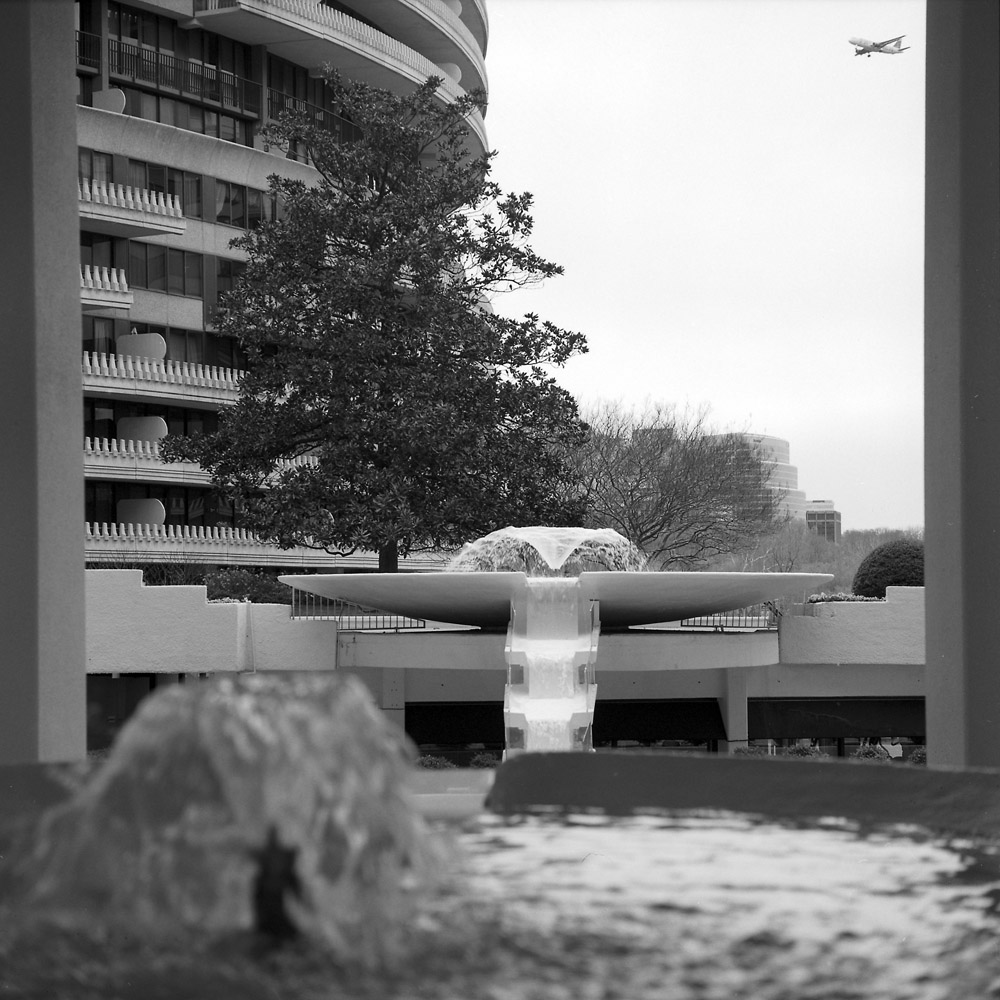
I don’t think a whole lot of words need be said about these fountains – I just like the juxtaposition of day and night with the common theme of moving water.

City Center Fountain
New York Avenue Fountain
Watergate Fountain
Watergate Fountain
Watergate Fountain
Watergate Fountain

Bikes Around Town

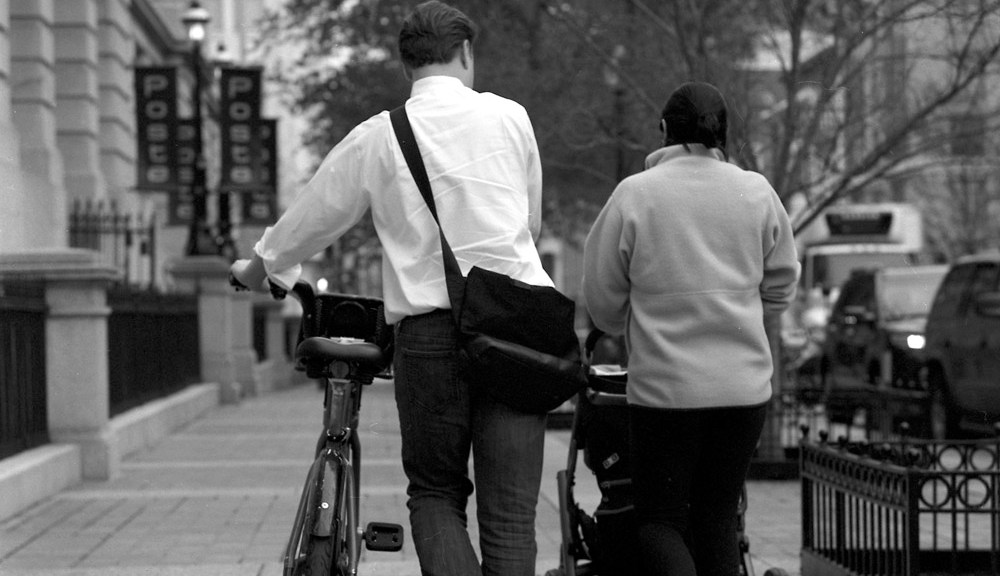
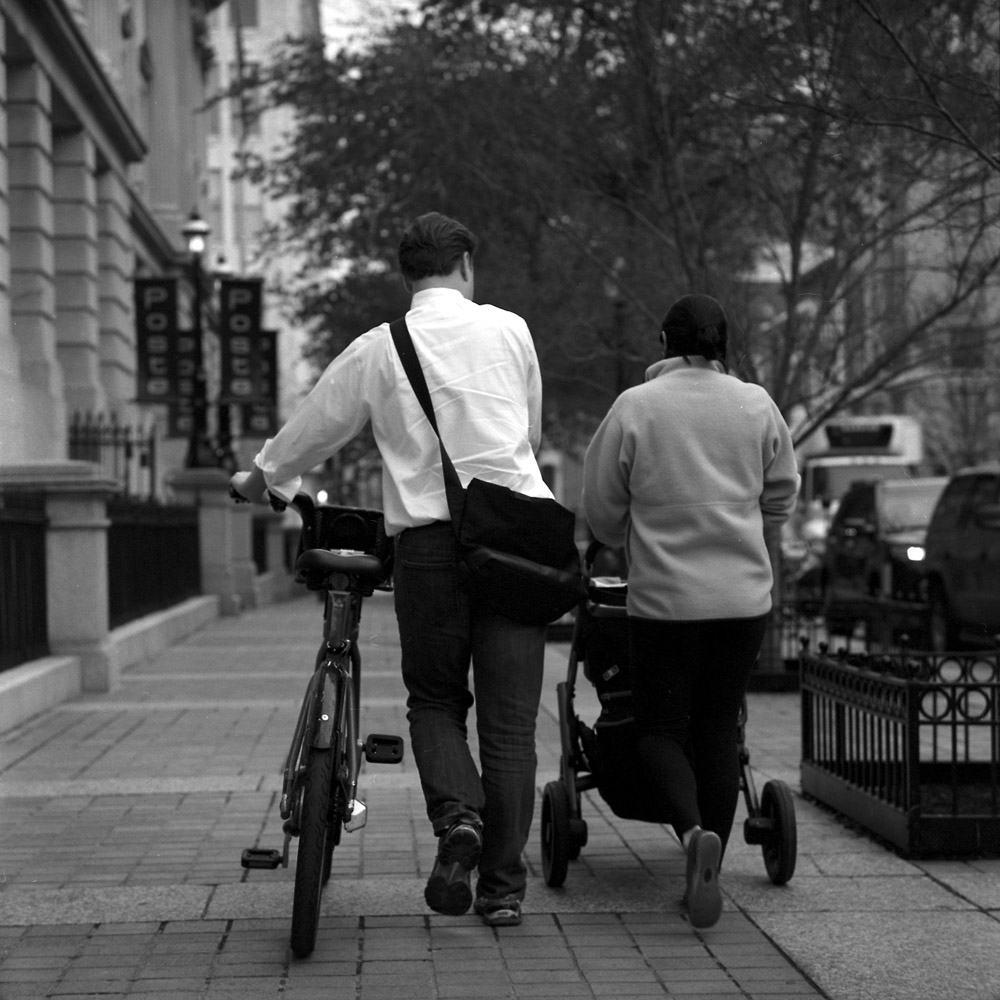
Another regular subject for me is bicycles and public transportation. Here are four more bicycle photos seen around town.

A couple walking home together. He’s using a Bikeshare bike, which is a pretty positive commentary on their adoption by more than just tourists.

Walking Home
Walking Home

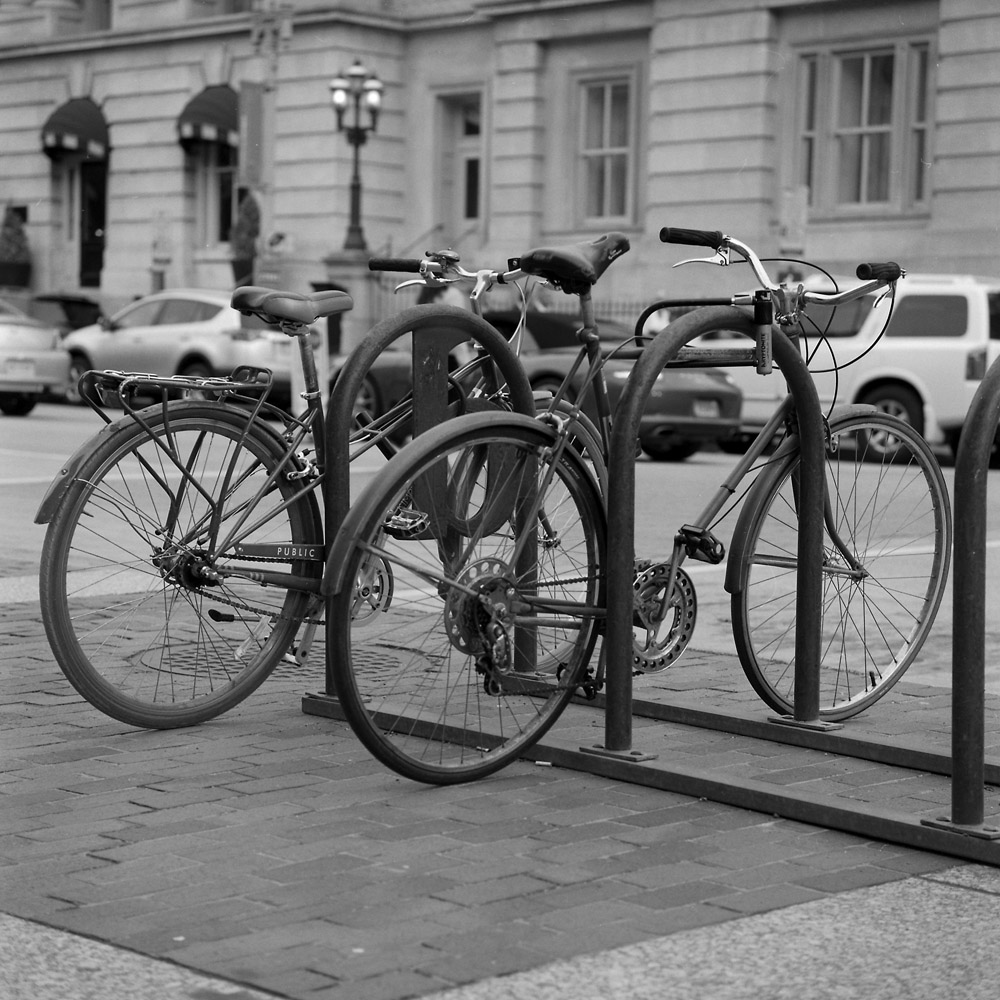
A pair of interesting old bikes locked up on the rack outside the National Portrait Gallery/American Art Museum.

Bikes, National Portrait Gallery

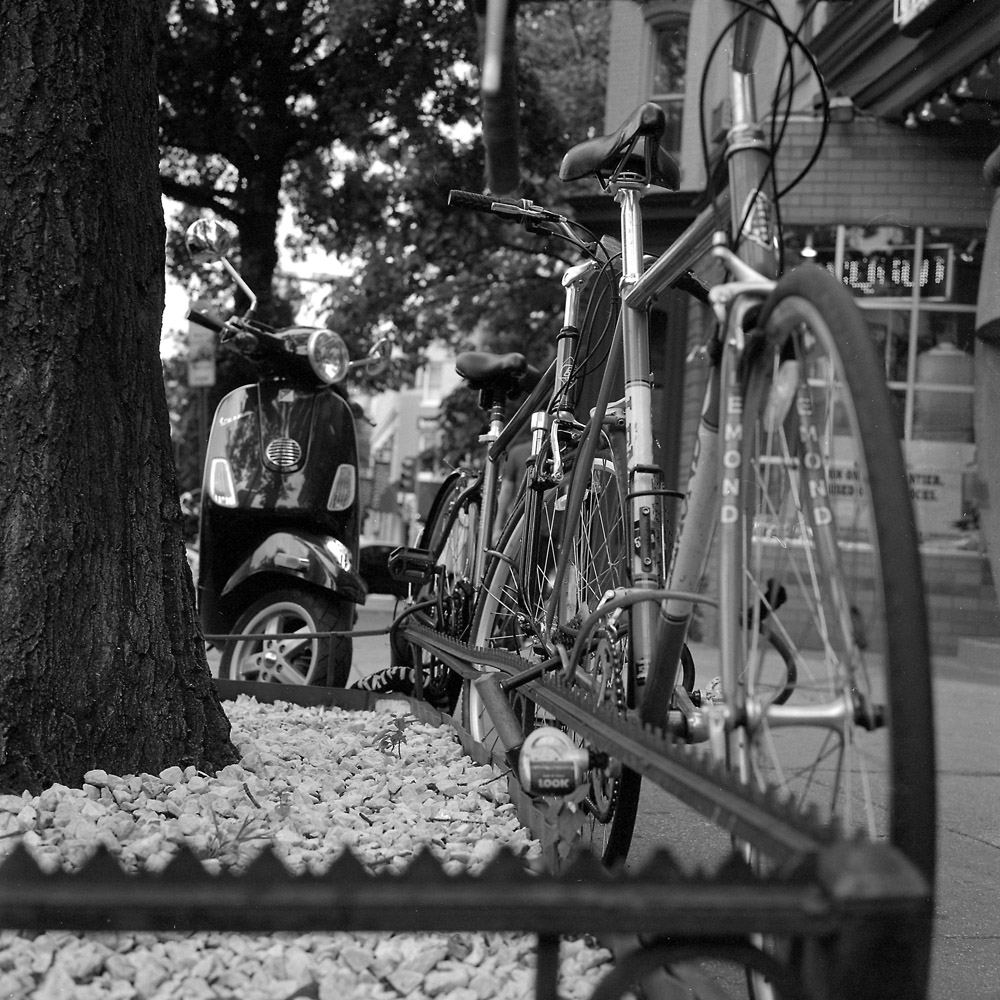
I’m on the fence about how much I really like this image, but it’s bikes, so I’m including it for now. Let me know what you think – does the composition work well? Placement of depth-of-field?

Bikes, Planter Box, Scooter

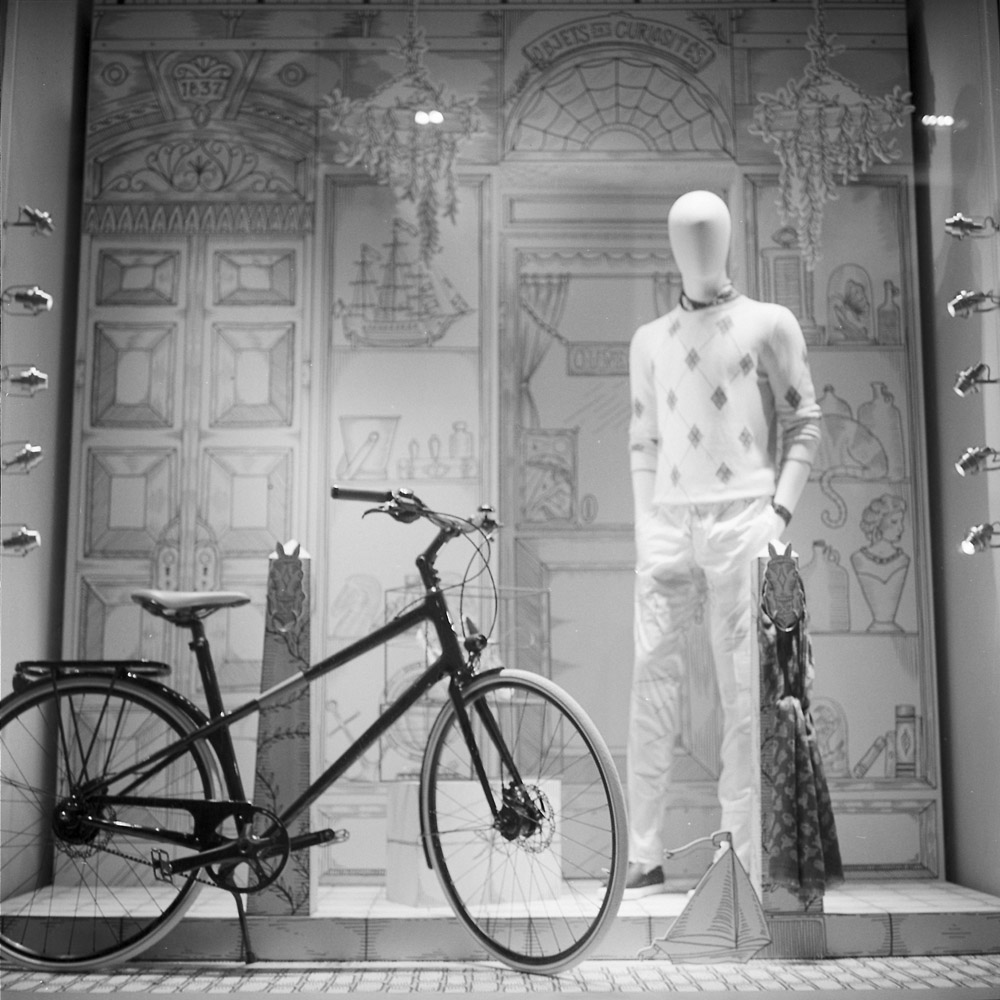
Finally, the bike in the Hermes window. While it’s not in use for its intended purpose, it’s a nice looking bike, and it’s in the Hermes store window, very cleverly employed in the window design. I forget if it was red or dark blue (I think red), but it was a splash of color that popped out against the white backdrop of the window, pulling your eye around the display.

Bike, Hermes Window
Bike, Hermes Window

Ball’s Bluff – Ed Bearss

Here’s another photo of Ed Bearss I took on the Ball’s Bluff tour, as he’s describing the battle in front of the sign at the park entrance, armed with one of his US Marine Corps- themed swagger sticks.

Ed At Balls Bluff
Ed At Balls Bluff

He’s always carrying one to point and gesture with while he talks, for emphasis.

Ball’s Bluff Battlefield

Another stop on the tour I did with Ed Bearss earlier this month was the battlefield of Ball’s Bluff. Ball’s Bluff was a very significant early battle in the Civil War – while in the grand scheme of things a minor engagement with a total of three hundred or so Union casualties (including drowning deaths of soldiers trying to escape the Rebel onslaught across the Potomac River, swollen with recent rainwater), the Union loss and its aftermath (bodies of soldiers who drowned fleeing the battle washed up in Washington DC and as far south as Fort Washington, some 60 miles downriver) were shocking enough that they triggered the formation of a joint committee comprised of senators and congressmen, the Committee on the Conduct of the War. This oversight committee was empowered to investigate not only the military but the executive branch up to and including the President himself.

Today, while the cemetery itself is administered by the Veterans’ Administration and is a National Military Cemetery, the parkland surrounding it is not US Park Service property but instead is a joint program of local and regional governments and non-profits. There is a 1970s subdivision built right up against its southern edge, which you have to drive through to get to the park.

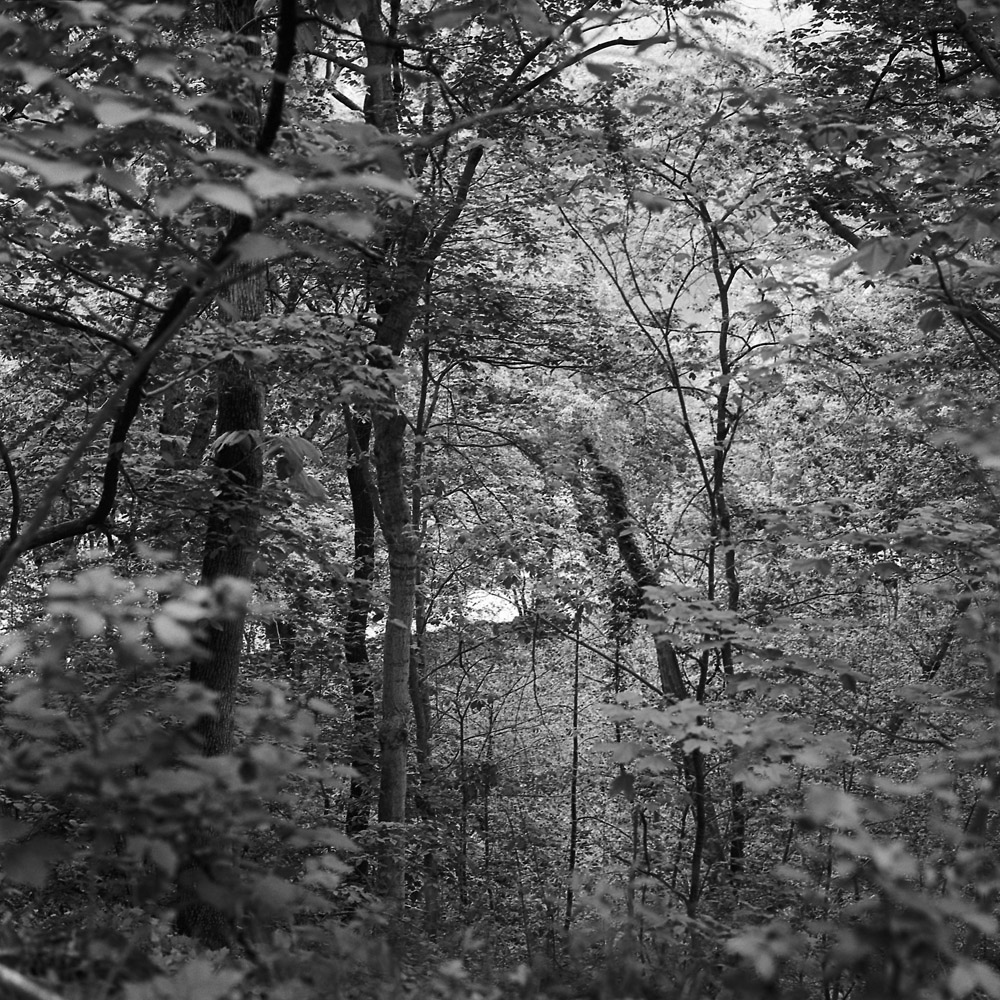
This is a view down Ball’s Bluff – some three hundred feet tall, you can see the river as a bright patch in the lower center of the image. Many of the Union casualties were chased down this cliff face by charging Rebel soldiers and plunged to their deaths. The photo doesn’t do justice to the steepness of the cliff face – that would be a truly terrifying predicament – leap or fall over the edge to break your neck if you’re lucky, or get shot.

Balls Bluff
Balls Bluff

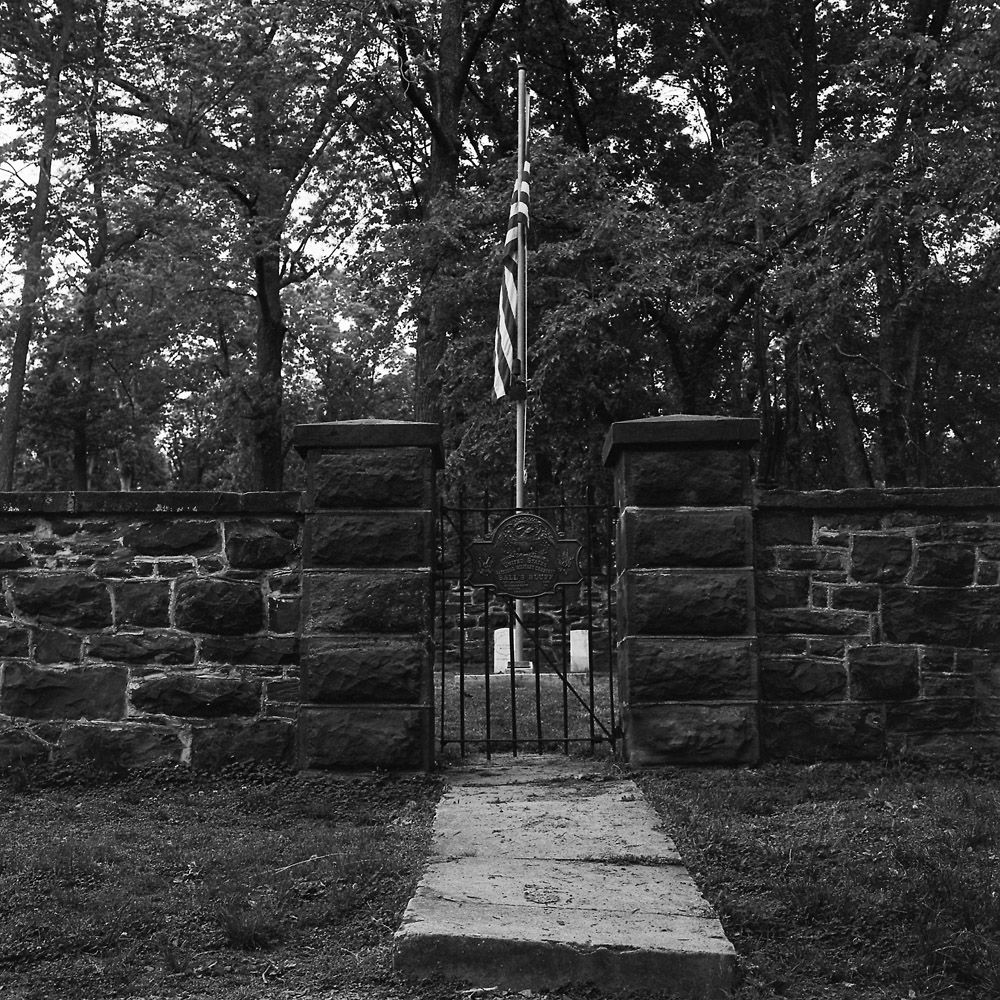
Here is the gate to the cemetery – one of the smallest in the National Military Cemetery system. Fifty-four are buried, with twenty-five markers. Only one is known. The cemetery is closed to new burials, for rather obvious reasons. There are two markers outside the cemetery where a Union commander, Col. Edward Baker, and a Southern infantryman, Clinton Hatcher, were killed, but neither are interred in the cemetery or within the park.

Balls Bluff Cemetery Gate

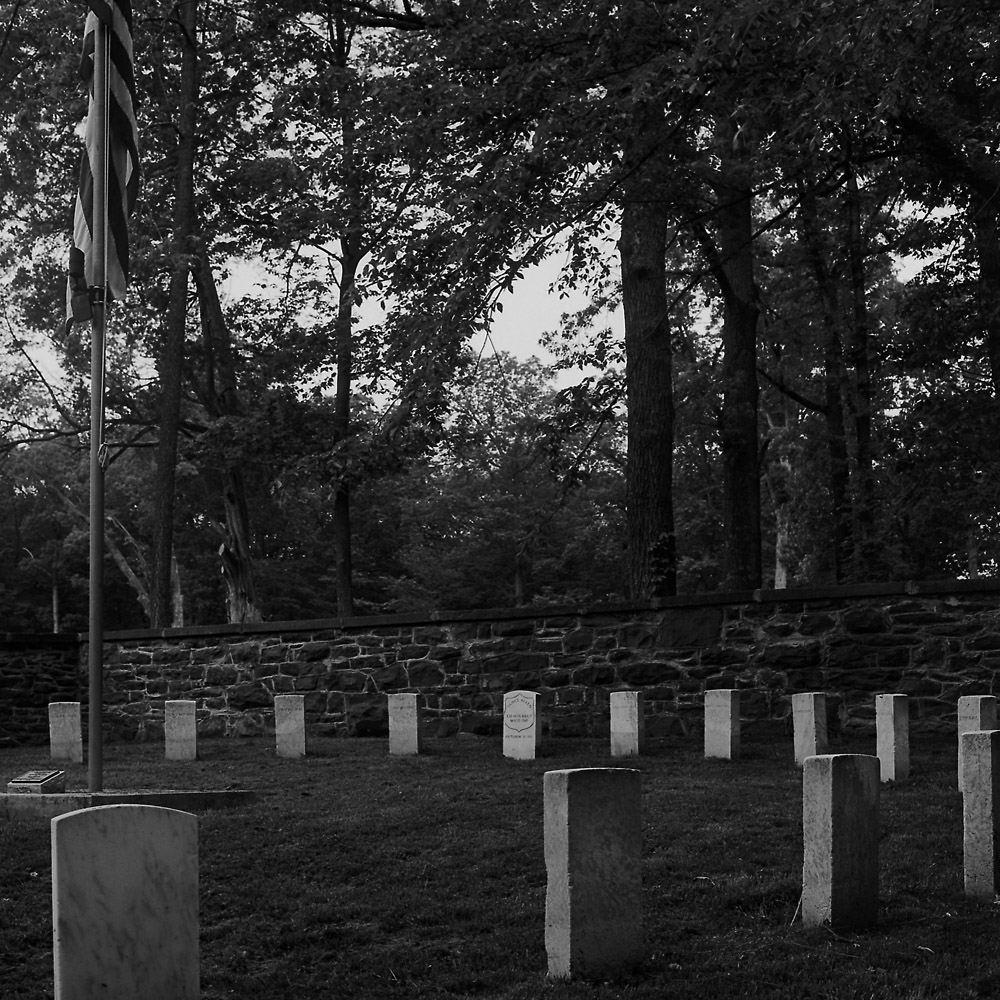
The cemetery itself is a very simple design, with the headstones laid out in a semi-circle around a flagpole, enclosed by a wall of Seneca sandstone, the same stone used to build the Smithsonian Castle.

Balls Bluff Cemetery

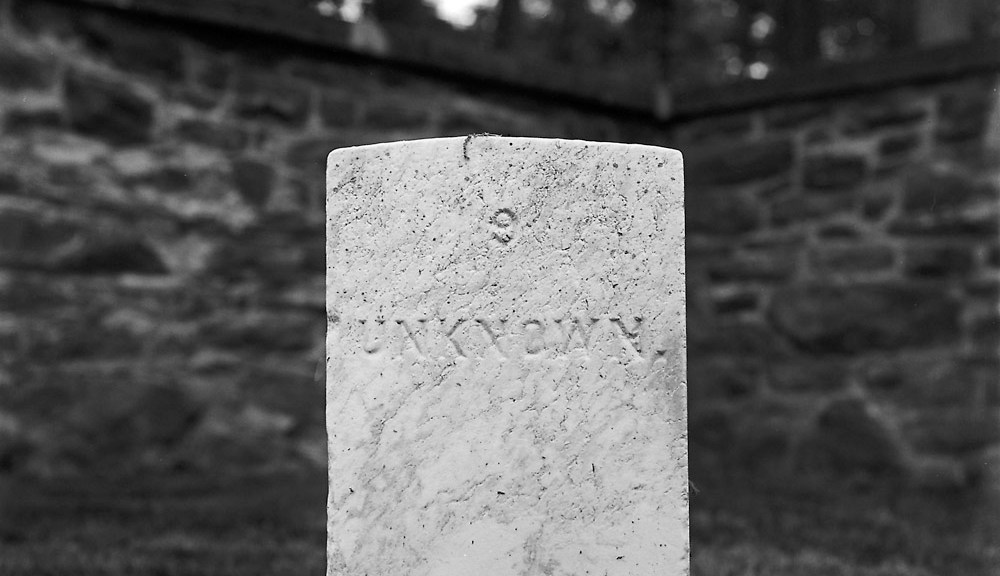
A close-up of one of the headstones for the unknown dead buried within.

Balls Bluff Unknown Headstone

This in a way closes a loop in my antique image collecting. While I don’t actively seek out Civil War soldier images, as they are highly sought after and very expensive, especially when the subject is identified, the graves of the unknown soldiers are a reminder of why so many soldiers at the time had their portraits made. Not only to send home to loved ones out of pride in their profession, but to help provide a means of identification should they be killed in battle, in a day when the dog tag had not been invented, nor DNA profiling or even dental records. Today, the unknown soldier is almost impossible, but back then, an all too frequent reality. When you were killed on the battlefield without any form of ID, and the battle lasted for several days, and your body lay in the sun as it ripened and rotted, and maybe there was no good way to get your body back to civilization at the time of the battle, you could end up not buried, or just dumped in a shallow grave for sometimes years. There are photos of burial parties at Cold Harbor where formerly enslaved black men are collecting remains for inclusion in the cemetery, and they have a cart full of skeletons.

Monocacy Battlefield – The Farms – Best Farm

The Best farm is the largest remaining property on the battlefield at Monocacy. The original property was 750 acres, today it retains 270-some. The property was owned by a white family who immigrated from Santo Domingo (now Haiti) at the beginning of the 19th century, fleeing political and social unrest after the slave rebellion on the island. They re-established their plantation outside Frederick, Maryland, which they named L’Hermitage. The landowners who established the farm had 90 slaves, an unusually large number for a property of its size, and they were the second-largest holding of slaves in the county. According to the Park Service website, one theory has it that they were trying to replicate the slave-labor system they were used to in Haiti, and had that many slaves as part of a rental scheme where they would rent them out to neighboring farmers. On my tour, it was mentioned several times that recent evidence has come to light that the farm operation included the breeding of slaves like racehorses for sale.

The main house is quite large, bigger even than the Thomas farm house. Like the Thomas and Worthington homes, it is not open for tours. The interior is in quite rough shape, but stable. Perhaps one day they will be able to restore it and re-open the home for interpretive tours. The farm was privately operated until 1993 when the park service acquired it. The house was not occupied during the later years of farm operation, though, judging from the condition visible through the windows. If I recall correctly the last occupant of the home was a relative of former Senator Mac Mathias. I wonder if she knew the full history of her property – I don’t know how comfortable I would feel living in a house, no matter how lovely, that was built on the profits from the sale of human beings.

Big House, Best Farm

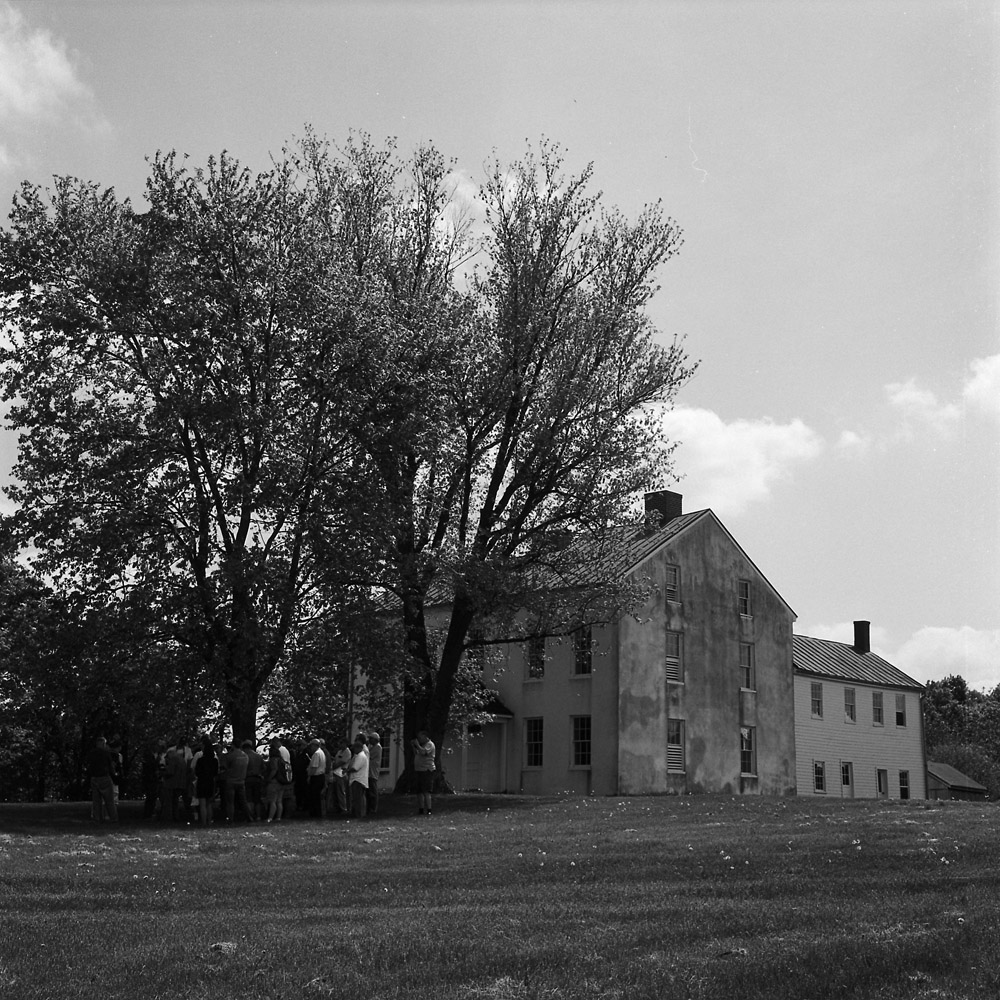
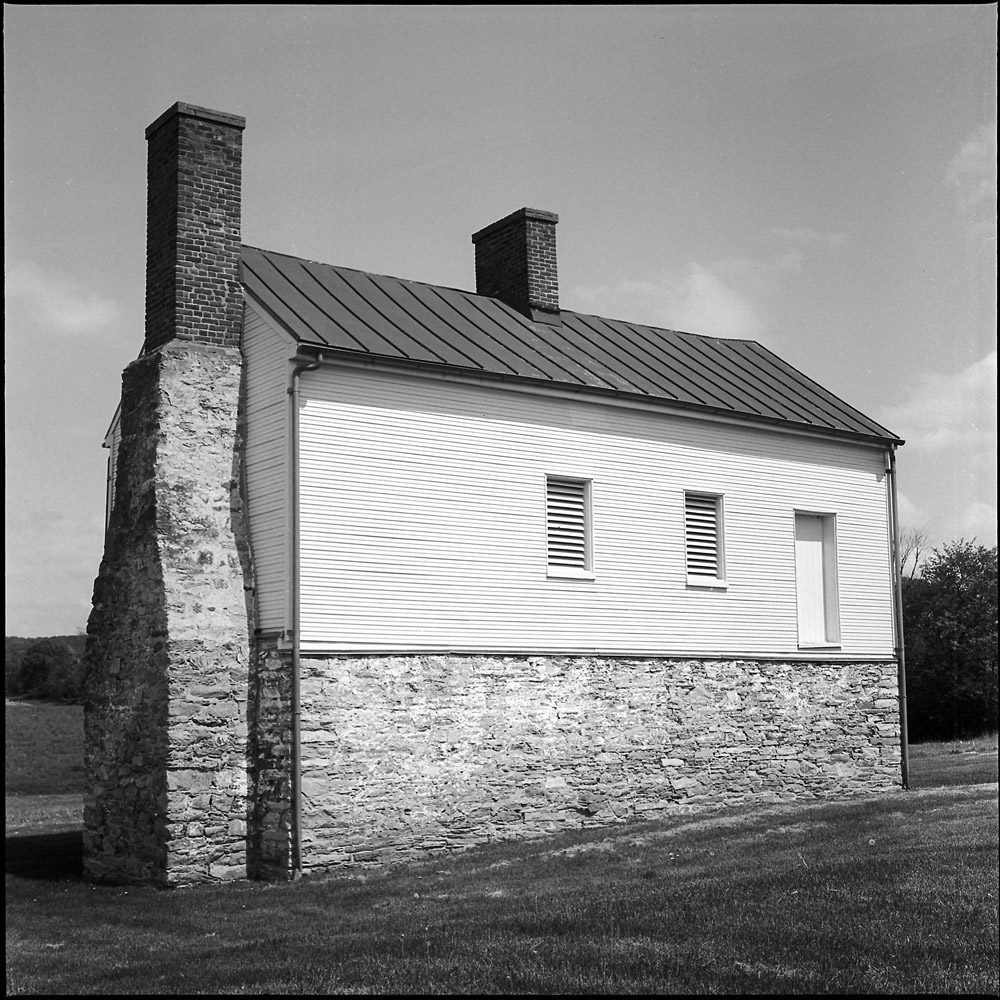
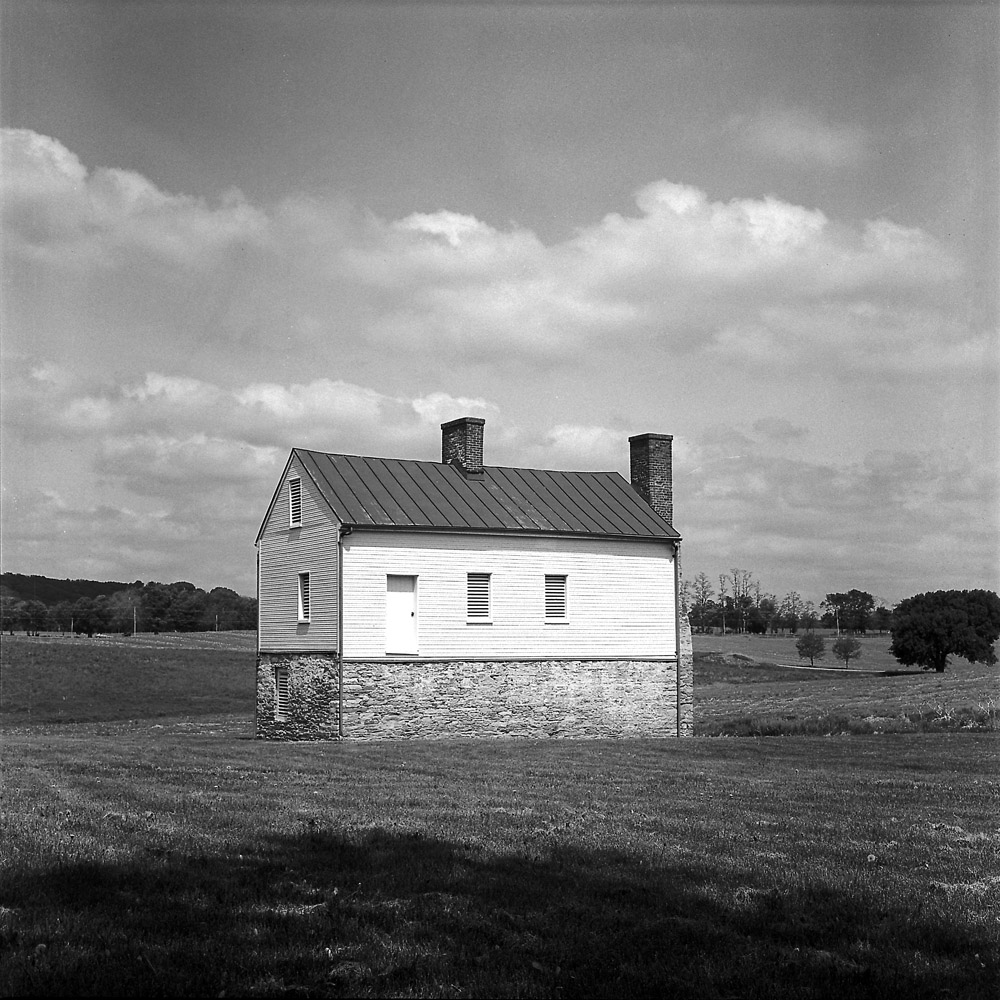
I originally thought this structure was the summer kitchen. In fact, it was a secondary home on the property. It was furnished with plaster walls with decorative motifs, much to the same standard as the main house. It is thought that the structure was built to support other French refugees from Haiti and the French Revolution who were relatives or friends of the family. There would have been a porch with stairs on this side facing the house to provide access. The row of slave cabins would have been between this structure and the main road. If they were still standing, they would be visible in the background of this scene.

Secondary House, Best Farm

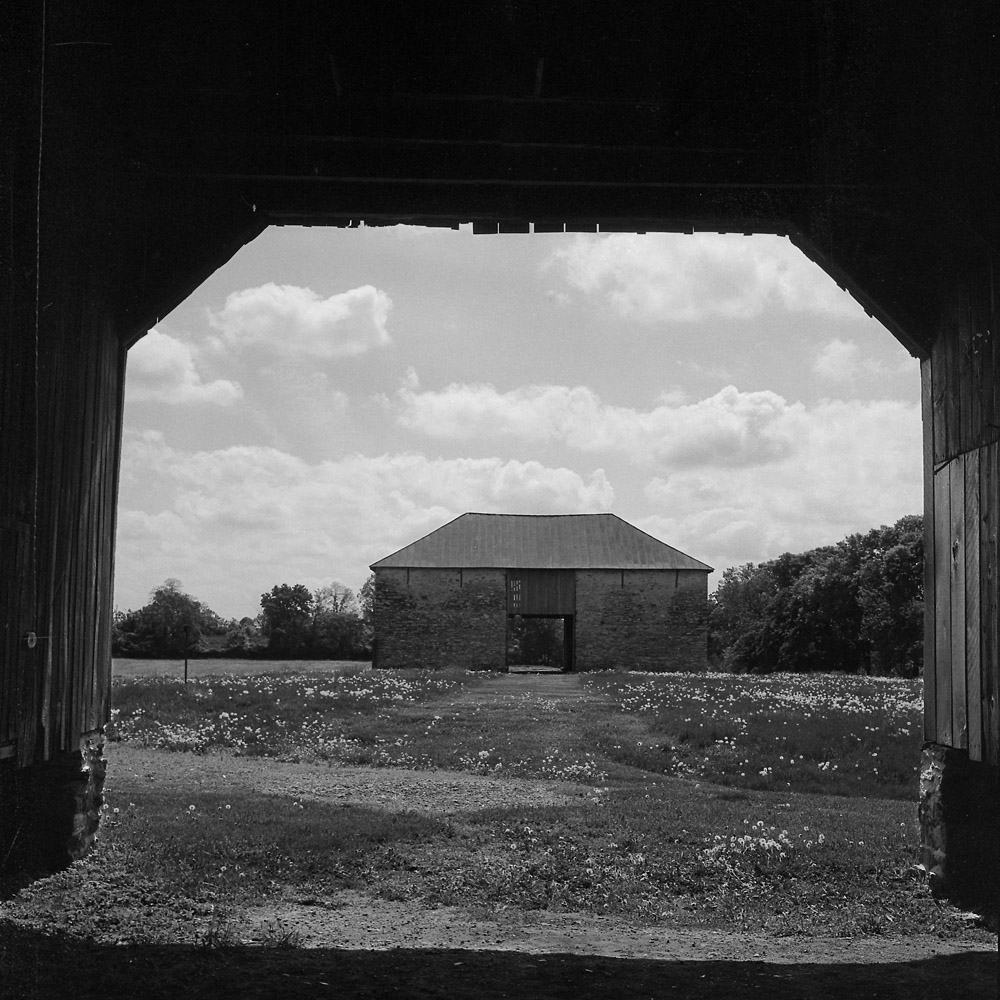
Here is a view of the stone barn as seen from inside the corn crib. I remember seeing this barn from the interstate highway as we would drive past every weekend when I was a child, and wanting to go see it up close. I had no idea then of the history of the property. The roof of the barn is of course not original, but the stone walls themselves date to 1798 when they were mentioned in the tax assessment. It is an unusual structure in its design, and looks and feels more like a French or English country barn from the 18th century than an American barn structure.

Stone Barn, Best Farm

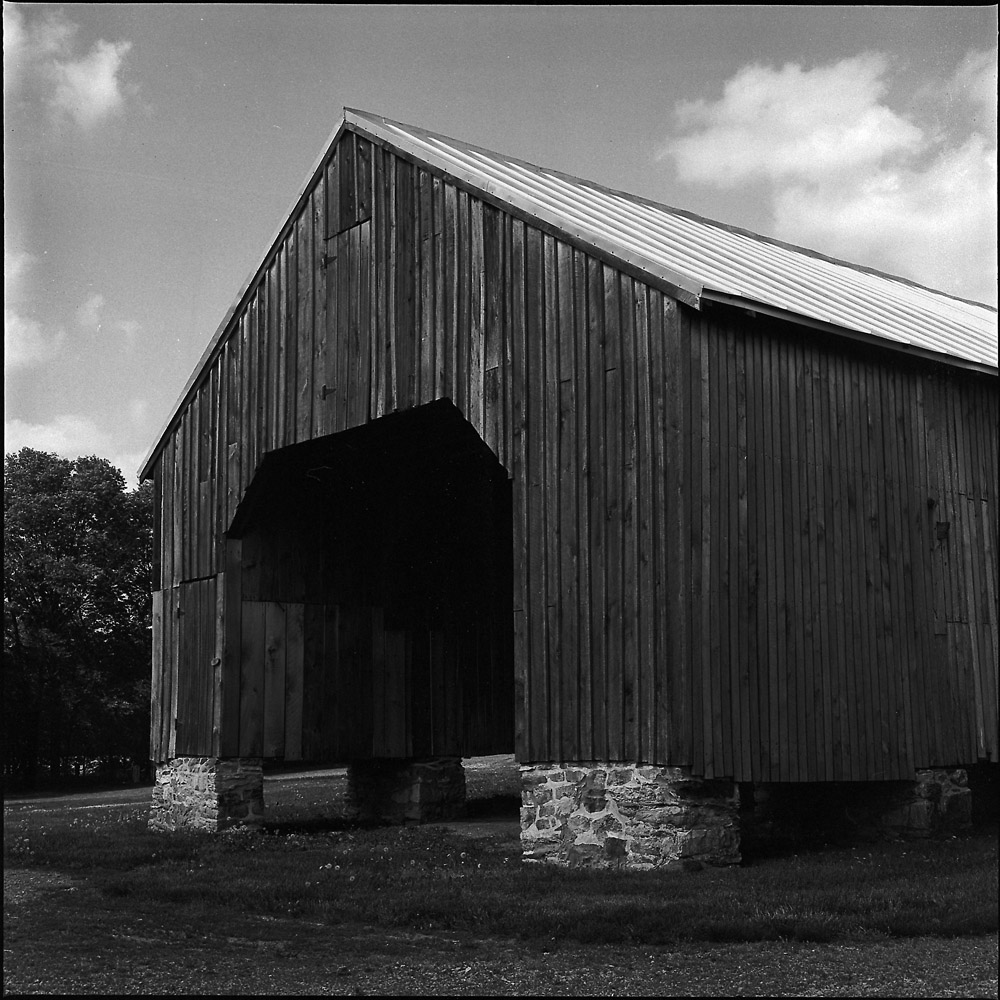
A view of the corn crib.

Best Farm Corn Crib End

The reason the farm is called the Best farm is that it was leased for operation by the Best family from 1864 until 1993. It was owned, however, by the Trail family, which has provoked a friendly dispute between Ed Bearss and the Park Service staff because he still wants them to call it the Trail farm, not the Best farm.