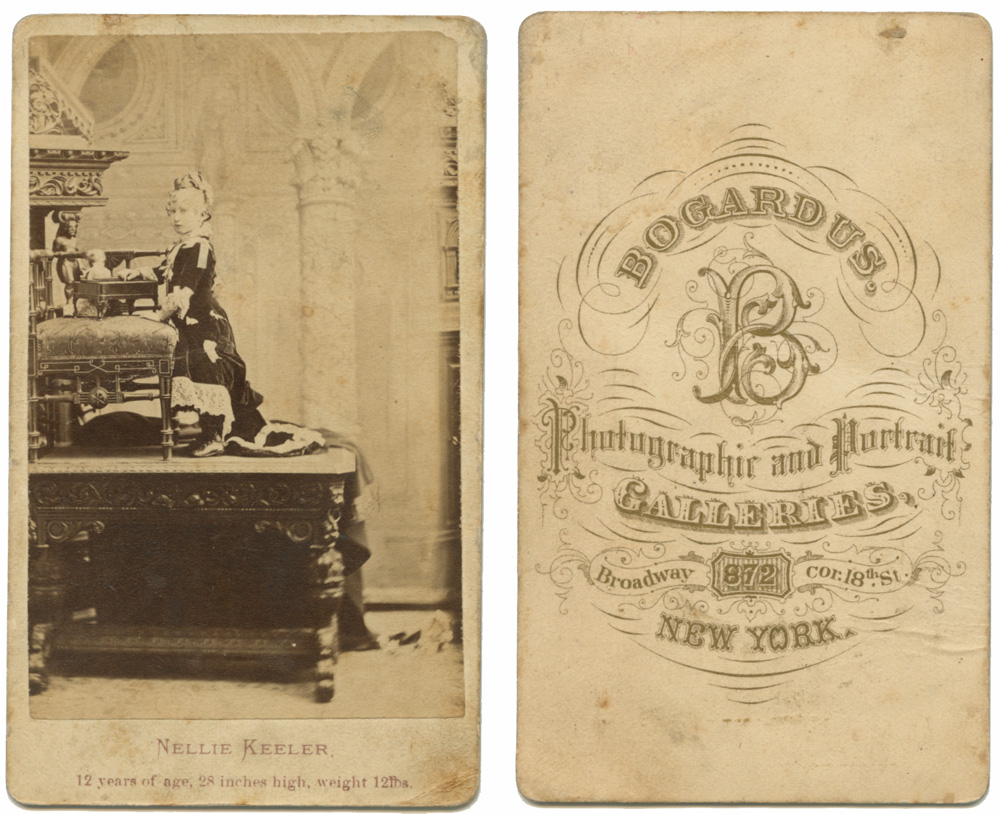
In my online shopping peregrinations, I came across another Nellie Keeler CDV, so of course I had to add the second varietal to my collection. The captions have it that these are one year apart. Who knows the truth of such things, as so many facts about the circus freak sideshow performers were grossly exaggerated for dramatic effect.
Nellie Keeler, by Bogardus
Here is the first one I collected, for comparison:
Nellie Keeler- by Bogardus
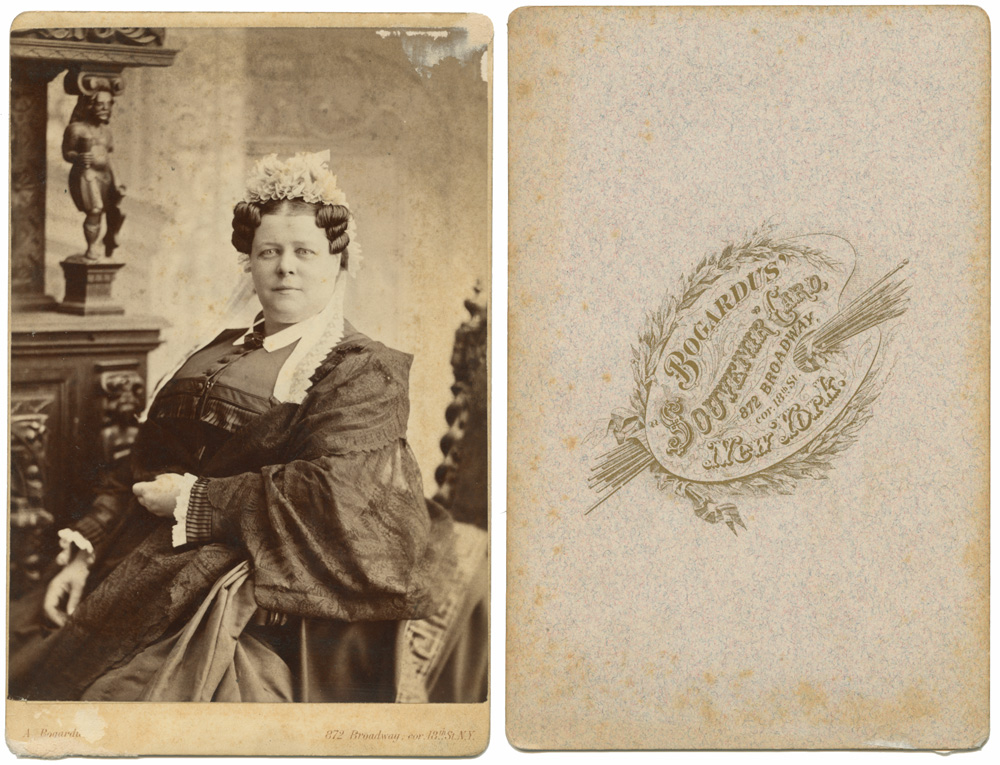
And somewhat ironically, here is a larger size (roughly 5×7) Cabinet Card of a much larger woman, seated in front of the same dining room sideboard on which Nellie Keeler is posing. When I saw that, I had to grab it just for that cool factor of coincidence. I’d read a lot about how work of battlefield photographers could be connected if not identified by the use of the same backdrops, furniture and even prop weapons/uniforms in Civil War tintypes. While not exactly the same thing, this is my first instance of finding the same props in two different photos of two VERY different subjects by the same photographer.
Plump lady cabinet card, Bogardus Studio
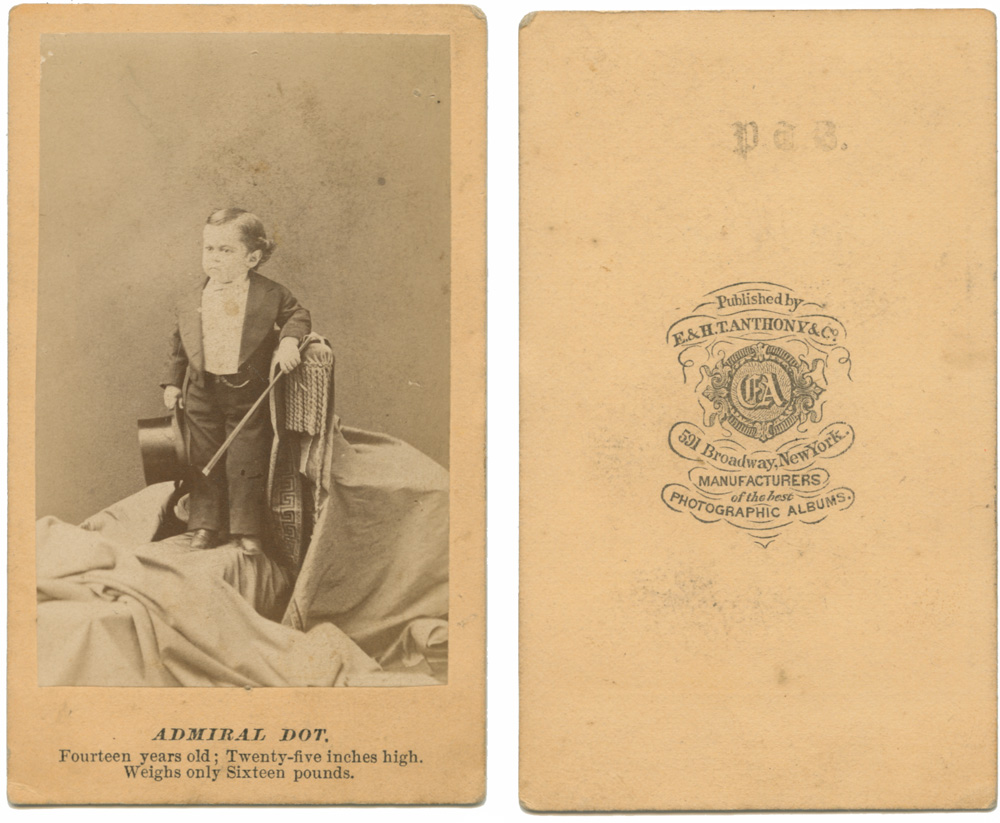
And last but not least (well, maybe least, based on the factoids on the front of the card) is Admiral Dot – yet another Barnum embellishment with an exalted military rank for someone of restrained stature. A contemporary of General Tom Thumb, Commodore Nutt, Major Atom, Count Rosebud and Baron Littlefinger, he also performed in sideshows.
Admiral Dot, published by E&HT Anthony
As the photographer is not credited, it may well have been one of the lesser-known New York studios specializing in the theatrical trade who was able to work a deal with Anthony to distribute their cards.
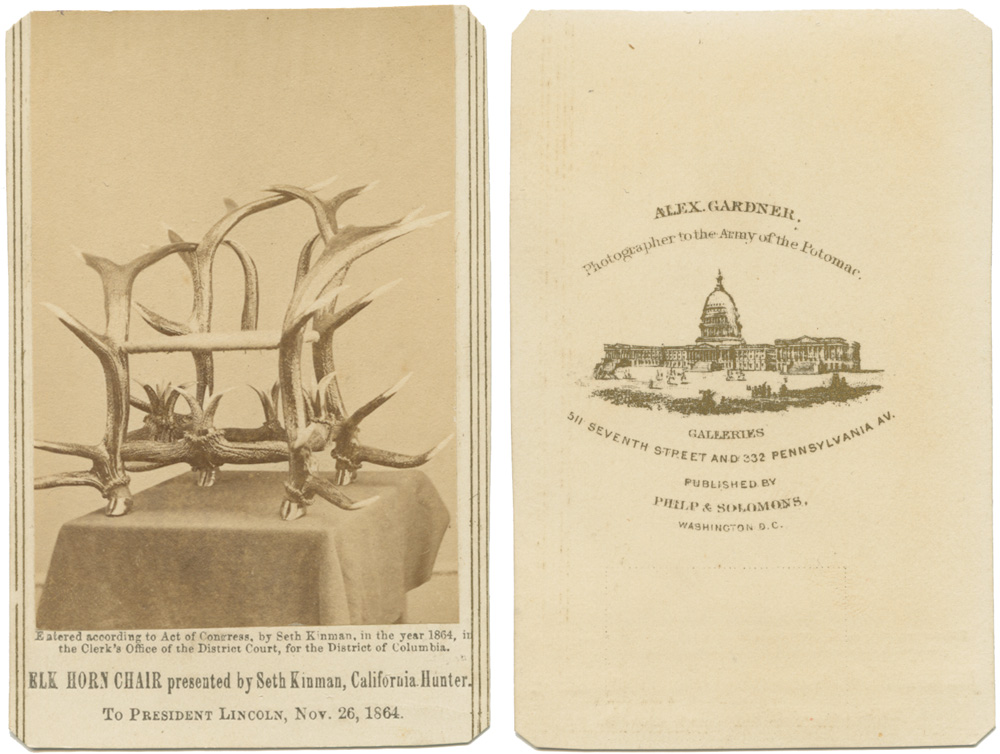
Seth Kinman's Elkhorn Chair, Presented to A. Lincoln, November 26, 1864
I was able to kill two birds with one stone on this image – I found an Alexander Gardner CDV (which is rare in itself!) and an image nearly identical to a Mathew Brady version I had seen, but in better overall condition, for the same money as the Brady. So now I have two official Gardners.
Here is a cdv of a sideshow family. Father has an extraordinarily long beard, mother is a dwarf, and daughter seems relatively normal except her hands look HUGE in comparison to the rest of her (and even compared to dad’s hands).
Sideshow Family, Aledo, Illinois
The scrap of paper at the bottom of the scan is from the album page that once held this image. It appears to suggest that this sideshow family was part of an extended family and not a trio of social outcasts, as circus folk are often portrayed.
The photograph is marked on the back “Strong & Root, Aledo, Ills”. This may have been where the family was from, or it may have been just another stop along the circus circuit. One wonders what it must have been like to be a family of sideshow freaks, and if the daughter did not have any distinguishing trait that would have qualified her to perform alongside her parents, what that must have been like – a tougher branch of an already tough road to follow.
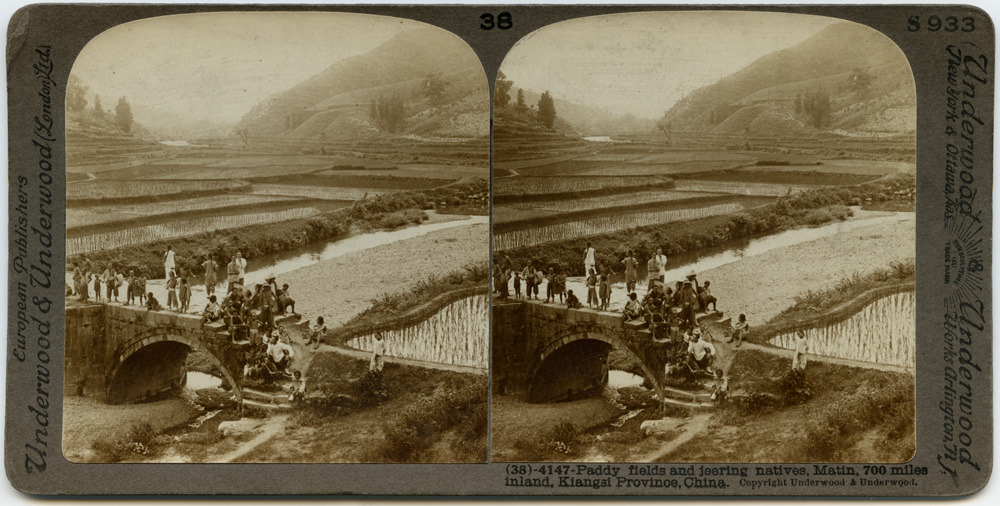
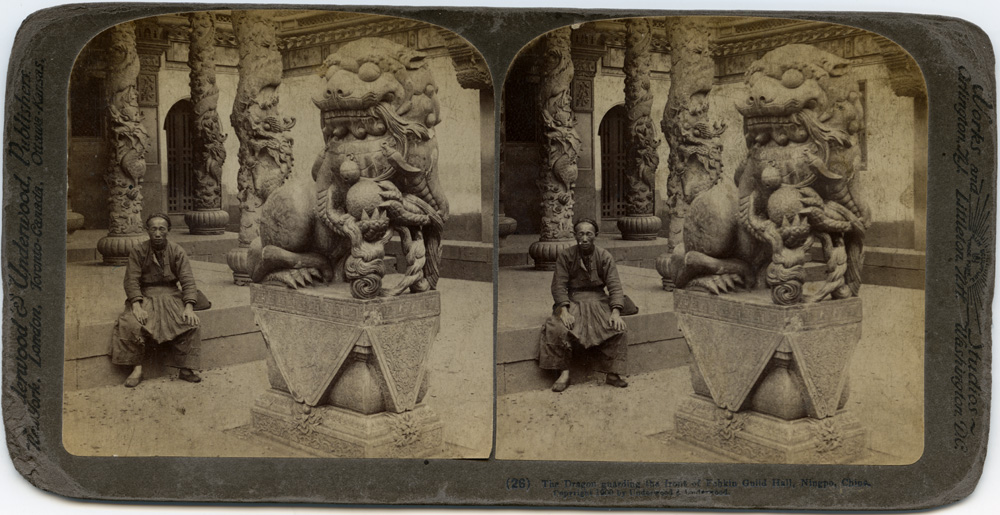
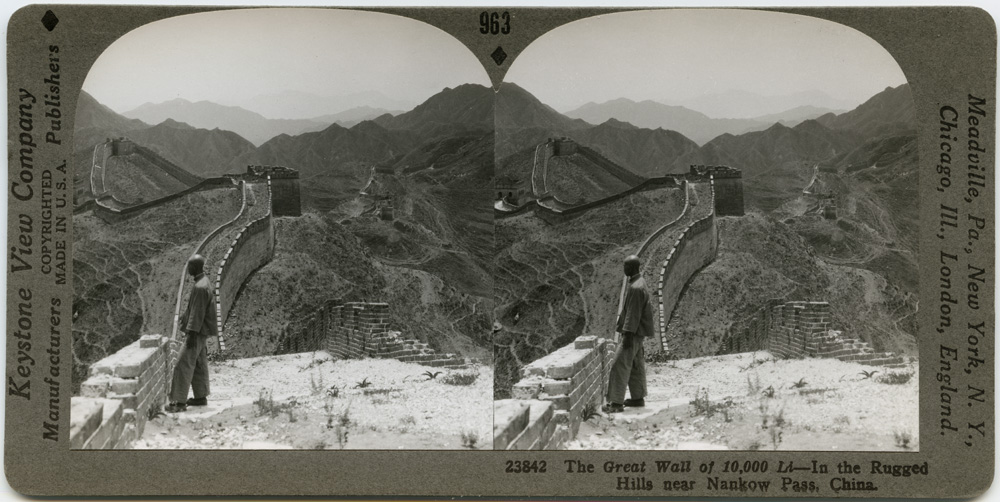
Here are three stereoviews of China, taken in the first half-decade of the 20th century. These were produced by Keystone and Underwood & Underwood, two of the biggest producers of stereoviews. They both churned out thousands of these cards as fast as they could be supplied with new images of exotic locales, exotic being very broadly defined. This was foreign travel on the cheap, when it was not only more expensive but more time-consuming and more dangerous. The stereoview both broadened the horizons of their consumer and reinforced existing stereotypes of the day – note that the crowd on the steps in the rice paddy is “jeering natives” – they’re probably all wondering what that idiot gweiloh (white man) is doing putting his head under a blanket on the back of that funny box on the hill across the way.
Rice Paddies, KiangsiNingpo Guild HallThe Great Wall of China, Nankow Pass
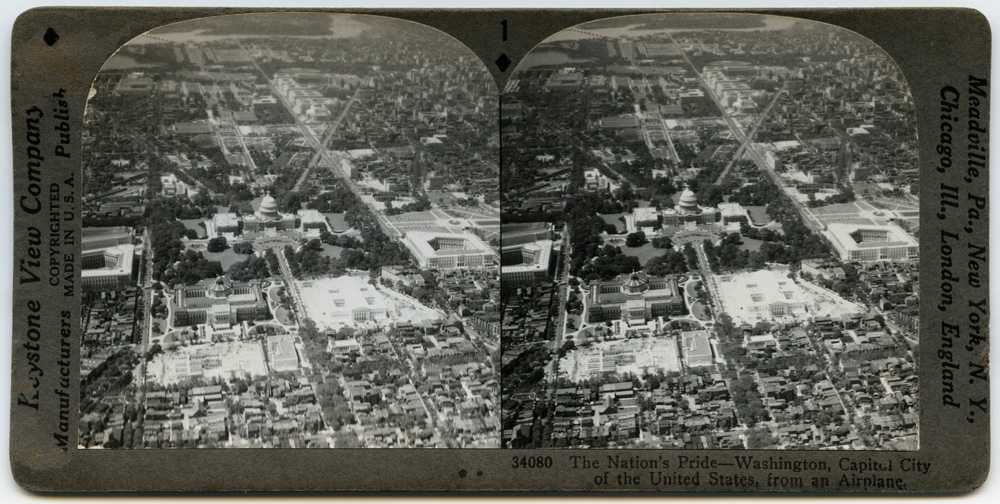
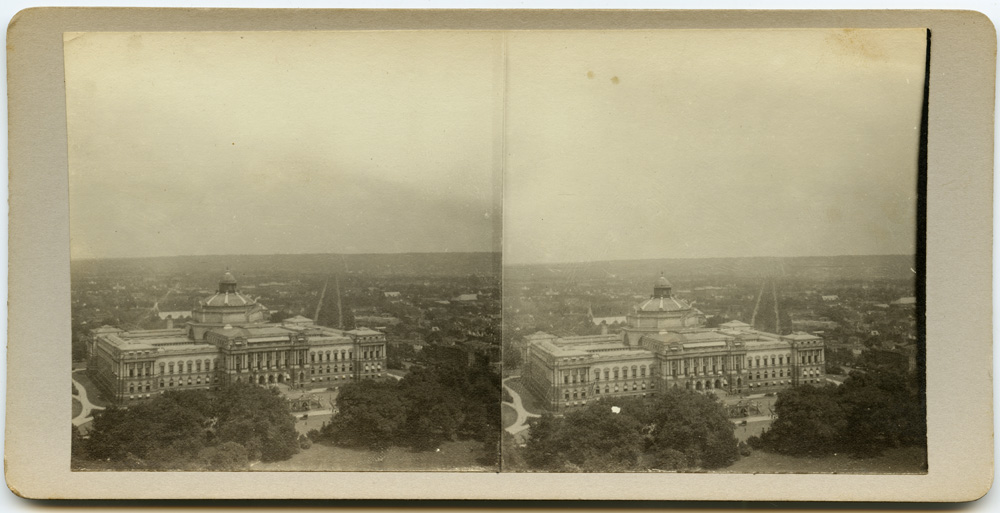
I was out to my parents’ house this weekend for Easter dinner, and I found my stash of stereoviews I had been keeping there. I thought I’d scan in a few of them to add to the online collection here. These are from Washington DC, my guess is mostly from the 1920s and 1930s, although the one of the Library of Congress as viewed from the Capitol dome could be as old as the 1890s.
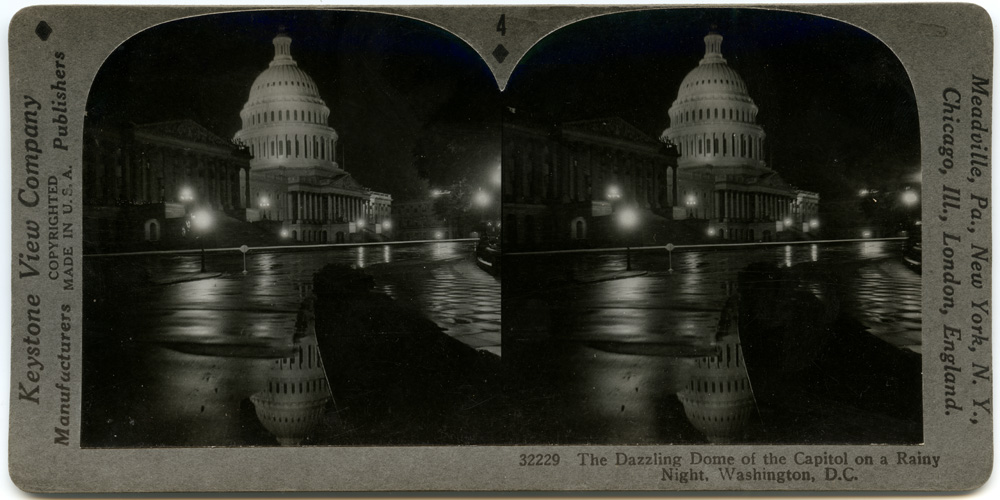
The US Capitol Dome reflected in the rain
I love this shot because it represents a personal passion when photographing- nighttime photography. It’s just a great shot of the Capitol dome all illuminated, reflecting in the wet street.
Capitol Hill Aerial View
Here’s an aerial view of Capitol Hill, looking west. In the immediate foreground, starting with the US Capitol as the 12 O’clock position, going clockwise, is the US Senate offices, the US Supreme Court (the very bright white building, which stands today on the grounds of the former Old Brick Capitol Prison, home to civil war spies among others), across the street and a little more to the foreground is the Folger Shakespeare Library, and then continuing on is the Library of Congress, and finishing up to the left and slightly into the background/west of the US Capitol are two of the US Congress office buildings. On the right, far in the distance, is the Natural History Museum, and the big gulf between it and the Capitol shows these to have been taken before 1937, as the National Gallery of Art building was begun at that time and opened to the public in 1941.
Library of Congress, as seen from the Capitol dome
Last but not least, we have the Library of Congress, as seen from the top of the US Capitol dome. The view is looking east down Pennsylvania Avenue toward the Anacostia River. This, the main building of the Library of Congress (LoC) is one of the most spectacular buildings in Washington DC, and if you are ever here, well worth the visit for the architecture alone, if not for one of the special exhibits they routinely have on display. When I went in last year to see a photography exhibit (and yes, the LoC is one of the great photography museums of the world, but much of their collection is viewable by appointment only), they had the reconstruction of Thomas Jefferson’s personal library that he donated upon his death to form the nucleus of the LoC collection. In comparison to today’s LoC, which has a copy of every book, magazine and newspaper published since the 1870s, and a healthy selection of those before as well, Jefferson’s collection was a meager 6500 books, what he lacked in quantity he made up for in quality. He had his own organizational scheme for his library, arranged by topic. It’s a fascinating display and worthwhile for any bibliophile. For more information about the exhibit, see the LOC Website
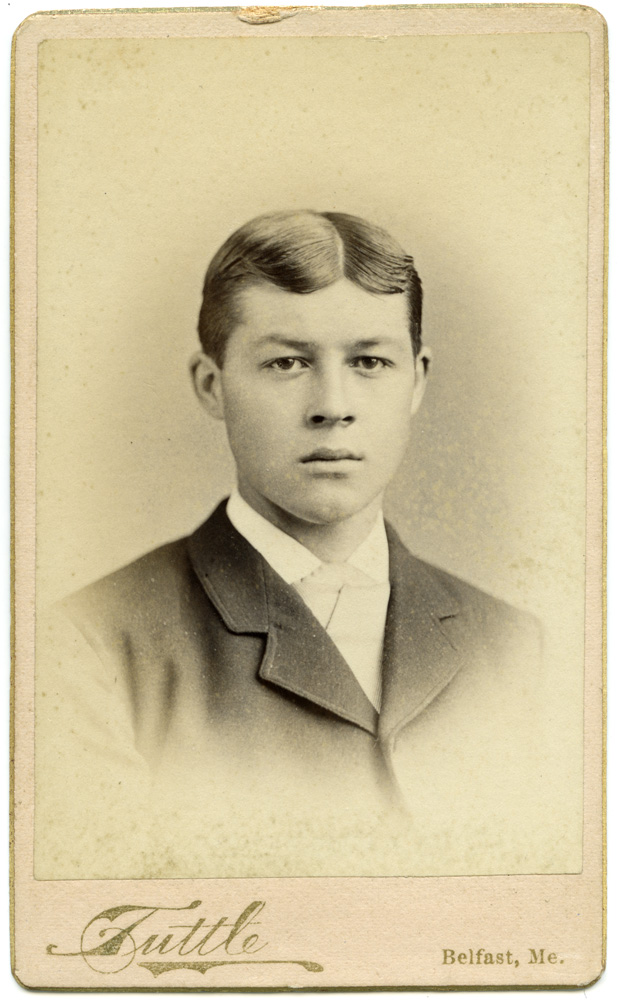
Sometimes the reason you buy something is purely aesthetic – there doesn’t need to be an historical association, famous subject or famous photographer to make an image worth buying. This is an example of just that – a very handsome subject, simply captured, plainly presented. Is he part Native American? Hard to say, but he has a certain look about his nose and jawline.
Handsome Youth, Belfast, Maine
This is an example, as I mentioned, of a carte-sized Cabinet Card. It is the same dimensions (2 1/2 x 4 1/2) as a carte de visite, but is printed on the heavier card stock with the beveled, gilt edges and the larger front imprint of the photographer’s logo typical of the Cabinet Card. Because of the style, I would definitely call this a Cabinet Card, and not a CDV, because the time period of its creation is definitely later, as are the material conditions of its composition.
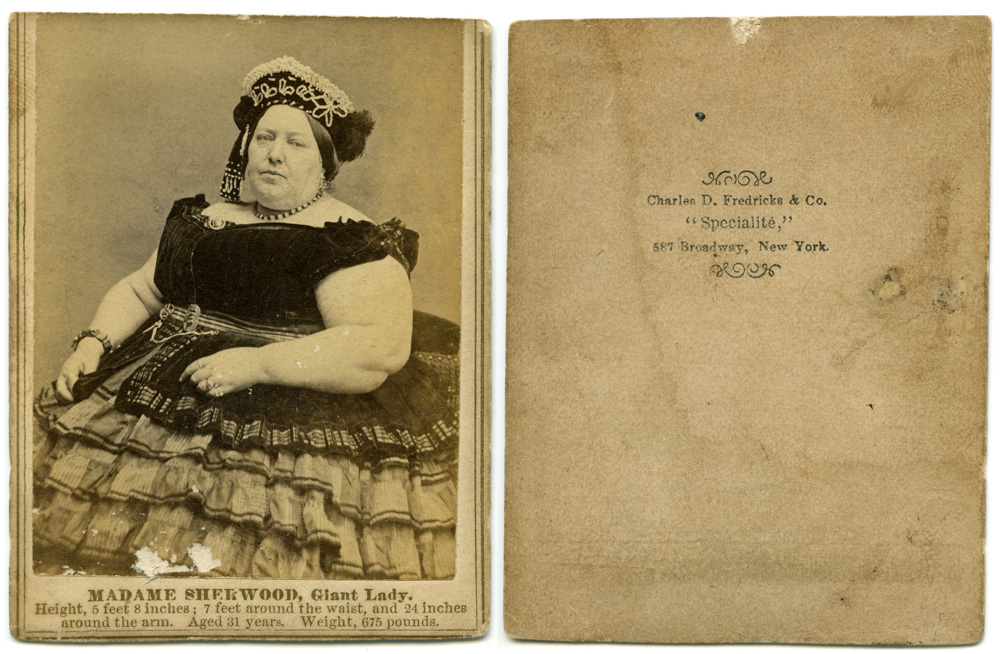
Well, I don’t know if she ever sang, or if she had any kind of performance at all. But her name was Madame Sherwood, and according to the bio on her CDV, she had an 84″ waist and was 675 lbs. Given the Victorian (and specifically Barnum-esque) penchant for exaggeration, I wouldn’t be surprised if she was more like a 60″ waist and 400 lbs but you never know. This CDV has been trimmed, rather significantly, but again this doesn’t detract from the image so I don’t find it terribly objectionable. It definitely impacted the value of the card, but I was not unhappy with the price paid. This is another C.D. Fredericks image. The simplicity of the backstamp not only in terms of the design but also the pomposity (or lack thereof) of the advertising slogan leads to some confusing dating for the image, as “Specialité” was his slogan in the 1850s and 60s, but the subject would have this date from the early to mid 1870s. Fredericks was another New York photographer who, like Gurney (whom he studied under and worked for for a time) and Eisenmann, did significant trade with the theatrical and performing professions.
For more information about C.D. Fredericks, there is a succinct but interesting blurb at Historic Camera
MadameSherwood, by C.D. Fredericks
I suppose in a way you could term all these circus freak photos as also being occupationals in that they do show the sitters enacting their profession, which in a way was merely existing as who they were. It’s not like it mattered what outfit Tom Thumb or Madame Sherwood or Isaac Sprague (the Human Skeleton) wore, they were not performing a role, and even if they did, their audience was not coming to see them be Hamlet or Viola or Caliban, but to see the midget/fat lady/human skeleton.
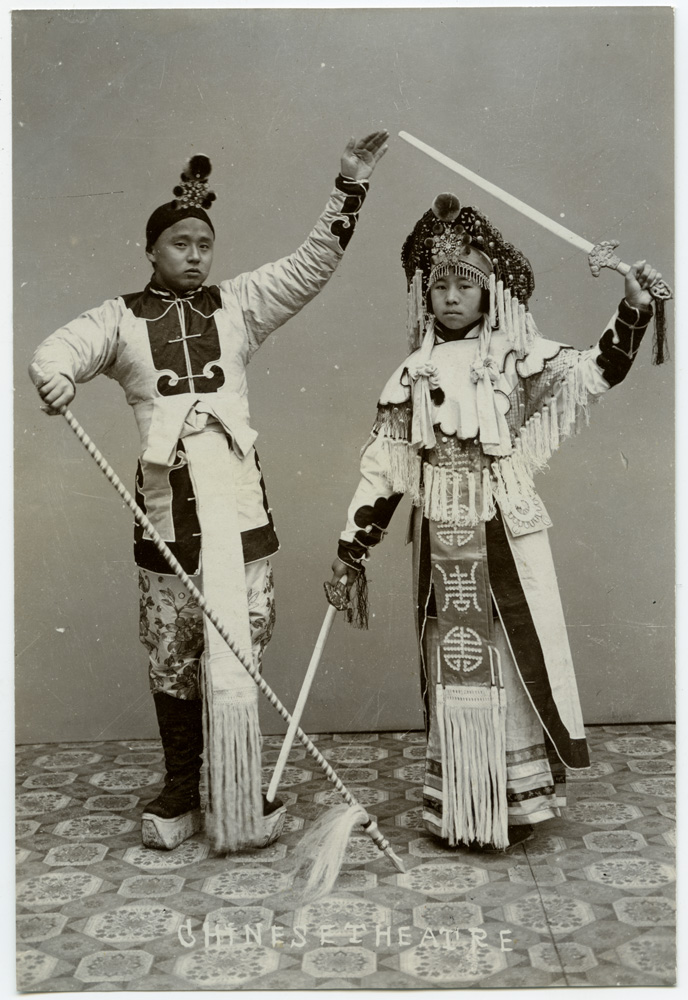
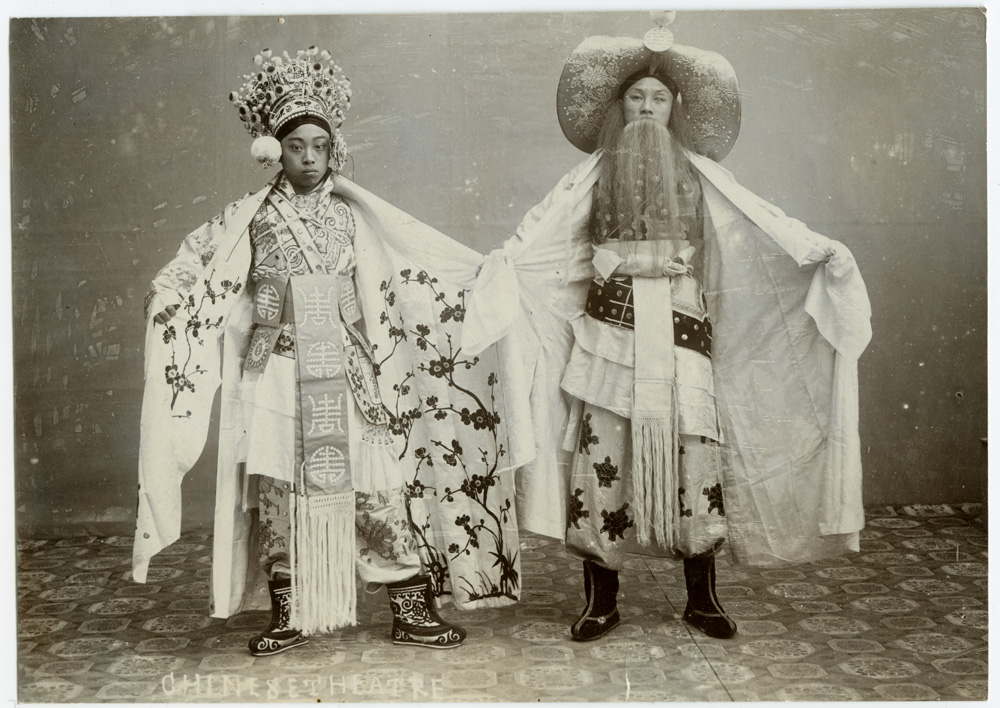
here are two turn-of-the-20th century souvenir photos from China. They depict performers in the Peking Opera. They come from the period marking the end of single-sex performers, when all roles both male and female would be played by male performers. Gender segregation of the opera began to phase out in the 1920s. For much the same reasons as in the West, Chinese theater was single sex because being an itinerant actor was seen as very much akin to being a prostitute. And despite the attempt to preserve the honor and virtue of women by banning them from performing on stage, the boys who played female roles on the stage themselves became prostitutes. Can’t win for trying, I guess.
Peking Opera PerformersPeking Opera Performers
I would classify these as genuine “gay interest” images because they represent a moment in history where the enactment of same-sex desire was sanctioned, even if in masquerade. It’s a rarity photographically because in the West, same-sex drama had largely been eliminated well before the photographic era, lingering on symbolically into the 19th century in the operatic tradition of castrati. If anyone out there recognizes the roles these actors are portraying, and the name(s) of the opera(s) they are from, the feedback would be most welcome.
Here are some more of my circus freaks/performers collection. We’re going to start our tour of the circus in the sideshow, where P.T. Barnum was a busy man – he collected strange people from all over the world, and when he couldn’t find them from afar, he invented foreign origins for them!
Waino and Plutano(r), the Wild Men of Borneo, were actually brothers born in Ohio with physical and mental developmental challenges. As you can see in the photo, even in adulthood, they were pygmy sized. They did however possess considerable strength for their size, and were known to lift up to 300 pounds. Their real names were Hiram and Barney Davis (no relation!). They were a huge success in Barnum’s circus and over a 25 year career in show business spanning from 1880 to 1905, they earned $200,000, a gigantic sum in that day and age.
Waino and Plutano, The Wild Men of Borneo, by Eisenmann
As you can see, this was yet another carte by Chas. Eisenmann, who specialized in photographing theater people and performers. I love the Victorian era advertising slogans – “Portraits taken by Instantaneous Process – Extra Inducements to the Theatrical Profession” on this carte, and on another one I have by him, it shows a photographer striding the globe, with “The Popular Photographer” inscribed below. It’s too bad the carte-de-visite tradition died out; there’s nothing quite like it today in terms of marketing and character.
Next up, also in the sideshow, is the fat lady. Why this particular display was so popular, I’ll never quite understand. I don’t think the fat ladies sang or had any particular performing talent – they were just fat. I think it would have to have been one of the most humiliating experiences in the sideshow, to be looked at that way. At least in the other circus freak cases like the human skeleton or the midgets, they had little or no other viable employment options.
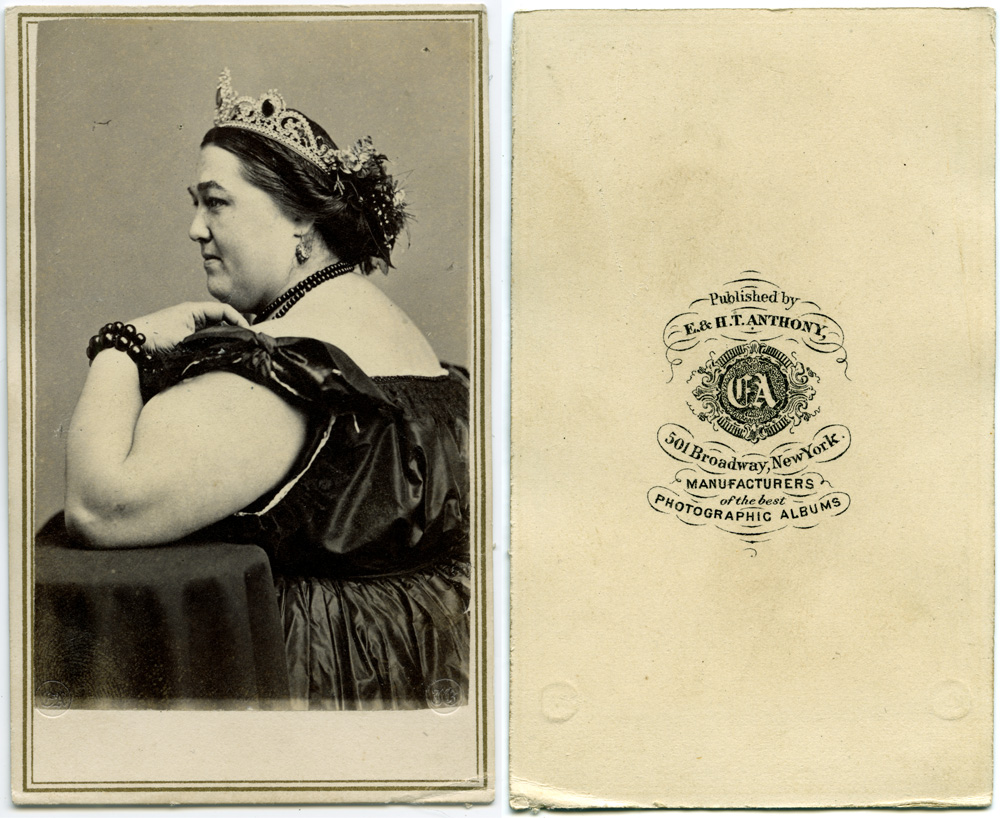
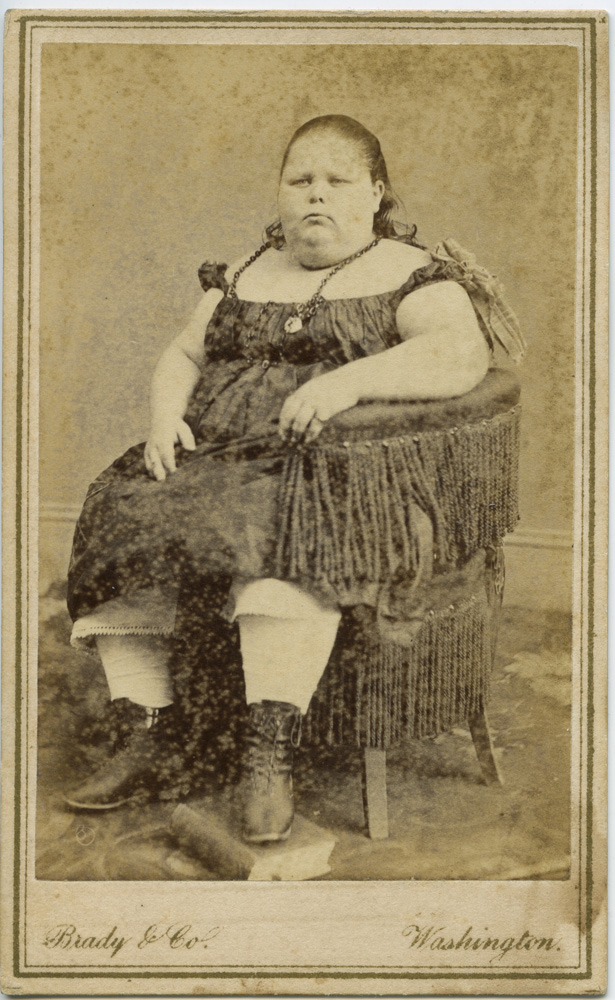
This image is an E&H.T. Anthony publication, with no credit given as to the photographer. The image has the Anthony blind stamps in the corners, and what appears in the scan to even be a fingerprint, possibly of the person who printed and mounted it. It is a breathtakingly beautiful carte in person, and I would suspect that it is probably a Brady carte, given that Anthony owned the Brady negatives for many years, and served as Brady’s publisher/distributor. The lady appears to be Madame Sherwood, a famous fat lady in Barnum’s circus. She also bears a vague resemblance to another fat lady I have, this one from the Brady studio in Washington DC. I don’t think the Brady image is the same woman, but it’s possible.
Madam Sherwood, on an E&H.T. Anthony CDV
The Brady image:
Fat Lady, Matthew Brady Studio, Washington, DC
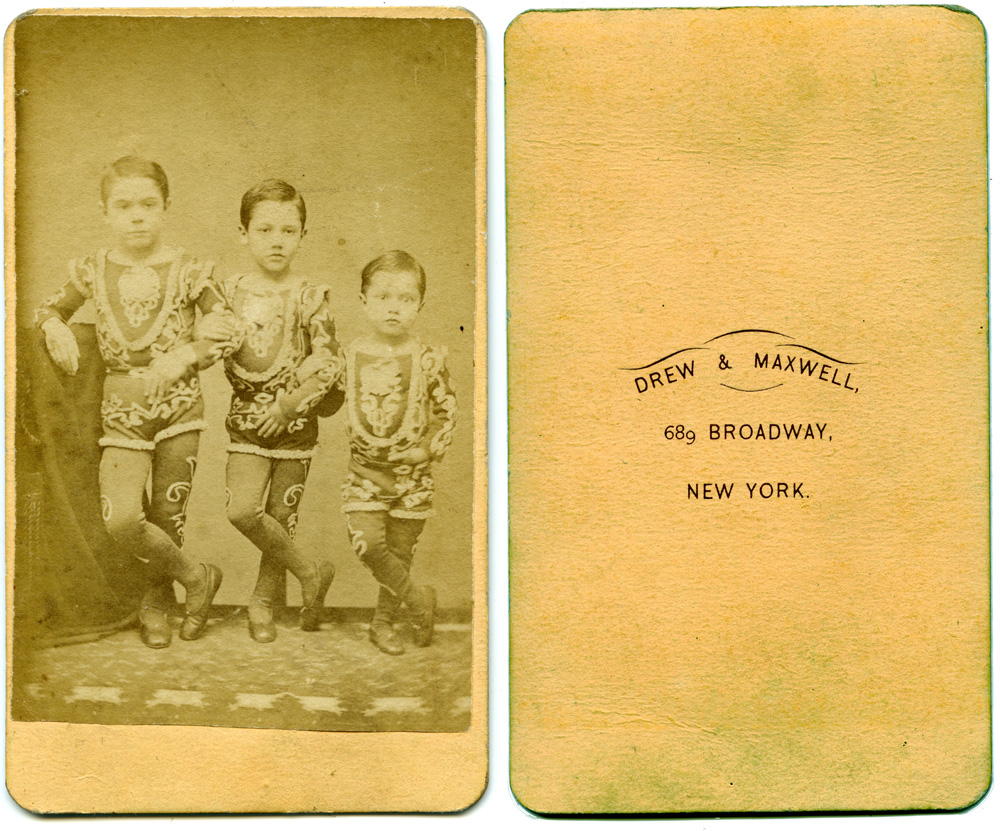
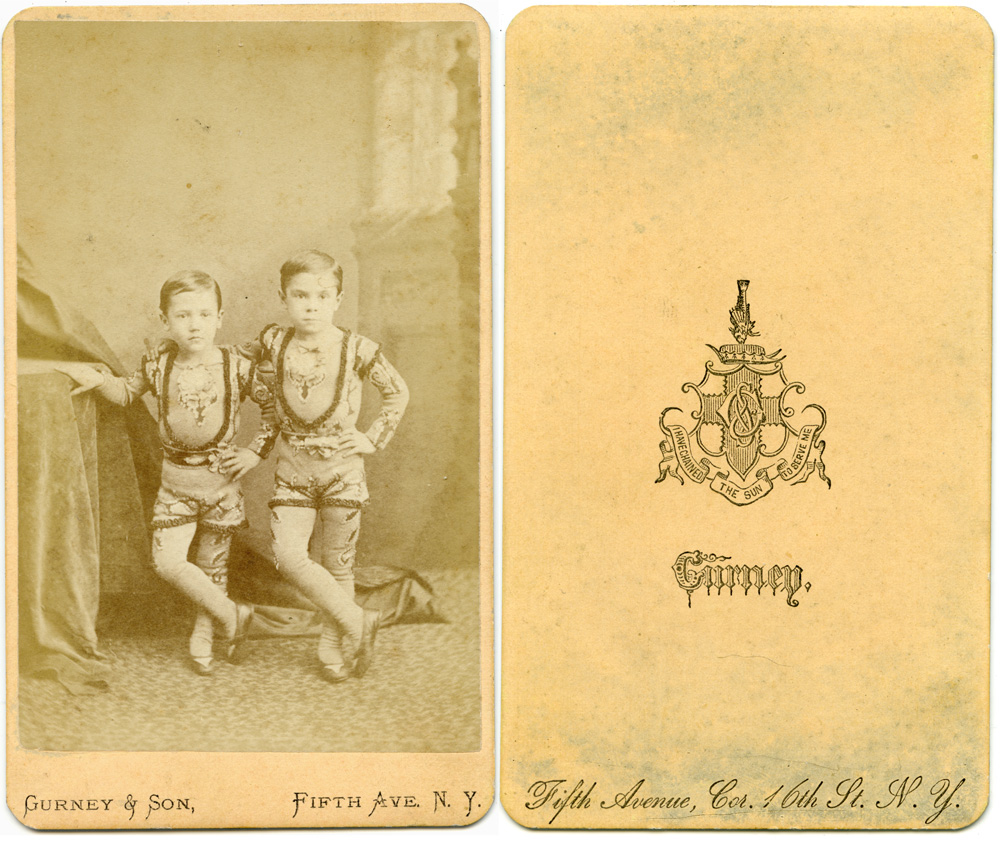
Moving under the big top, we have the acrobats! Here is a trio of boy tumblers/high-wire walkers/trapeeze artists. They look very much like the two I have in another cdv, which I’ll post again here for ease of comparison. If they are the same brothers, then the third one’s name is a mystery to me – the first pair appears to be the O’Brien brothers, but in my research, they were only ever a duo, and their father died fairly young as a result of injuries sustained in a circus accident.
Trio of Boy Acrobats, by Drew & Maxwell - possibly the O'Briens?Circus Siblings, Gurney & Son, New York
I saw another CDV of what appears to be the same brothers, with similar outfits and different hairdos (probably a couple years older). This one is labeled “Willie & Freddie O’Brien”. I did a quick google search on their names and it turns out they were well-known circus performers, part of Barnum & Bailey’s circus, among others. A brief bio of their father (from Olympians of the Sawdust Circle):
O’BRIEN, FRED. (1848-April 28, 1881) Champion leaper. Native of Buffalo, NY. Lake’s, 1869; Dan Rice’s, 1870; Rice’s Paris Pavilion Circus, 1871-72; P. T. Barnum’s, 1872-73; John Wilson’s, San Francisco, January 1874; Cooper, Bailey & Co., 1876; Great London, 1875-77; with wife and sons, Freddie and Willie, Orrin Bros.’, Havana, 1878. Wife was a slack wire artist and his 2 children performed on the trapeze. With P. T. Barnum’s, Madison Square Garden, 1881, was injured in a leaping double-somersault over a number of elephants. Died aboard the steamship England en route to Liverpool as a result of those injuries, age 33. Remains were buried at sea.
O’BRIEN, FRED, JR. Acrobat. The son of leaper Fred O’Brien. Three Melville’s & Co., 1889; general superintendent, Price & James, 1897; principal clown, Cooper & Co., 1897.
O’BRIEN, WILLIAM. Acrobat and leaper. Son of Fred O’Brien. Howes’ London, 1877; Cooper & Bailey, 1880; Howard Bros.’, 1888; Charles Andress’, 1888; Robinson-Franklin, 1897.



 dcphotoartist