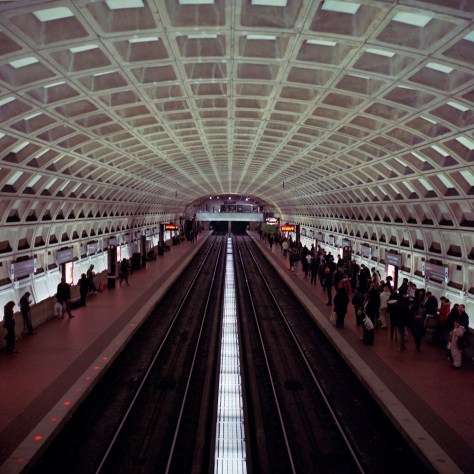
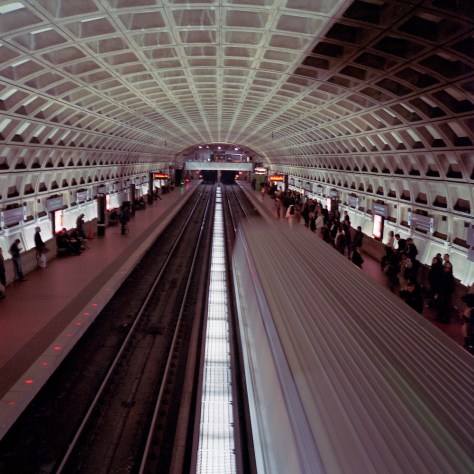
Two shots of the Gallery Place Metro station, looking down on the Red Line platform from the mezzanine. Taken with the Rolleiflex 2.8E, hand-held, with Portra 800. Exposure times were 1/2 second or 1 second @ f2.8.
Two shots of the Gallery Place Metro station, looking down on the Red Line platform from the mezzanine. Taken with the Rolleiflex 2.8E, hand-held, with Portra 800. Exposure times were 1/2 second or 1 second @ f2.8.


Here are some views of the Kogod Courtyard of the National Portrait Gallery. The blue lighting in the nighttime shots of the courtyard was for an after-hours reception being held at the museum. The courtyard used to be a fairly typical Victorian-era affair with a pair of fountains and some scraggly looking shrubbery, open to the air and more importantly, the weather. A few years ago they undertook a multi-million dollar renovation, ripping out the old landscaping and (non-working) fountains and enclosing it with a Norman Foster designed undulating glass roof. At first I found the interior design rather stark. It has grown on me, though, with the modern interpretations of fountains being just a thin sheet of water flowing in a rectangle across the floor. Of course the roof is the masterwork – it bends and twists like a piece of origami paper. The courtyard is now a very pleasant place to sit and just pass the time, reading a book or eating something from the museum cafe.
All photos were taken with my Rolleiflex 2.8E, on Kodak Portra 800 film. Also, for the die-hard photo geeks out there, I’ve been using the free light meter app for my iPhone to do the metering. I’d say it works pretty darned well 🙂
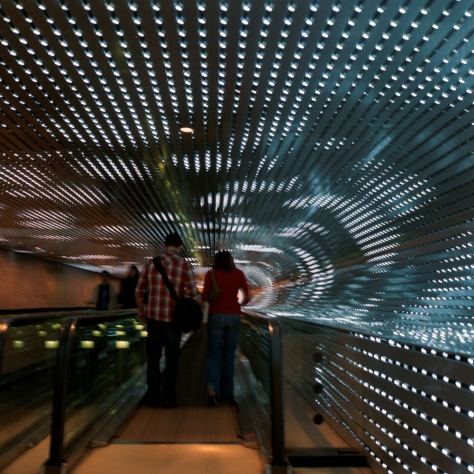


Three shots of the light sculpture in operation, taken with the Rolleiflex, hand-held, using Kodak Portra 800. I thought it would make for a different take on the piece compared to the video (which was shot on my iPhone, thus the shakiness). The light sculpture has been set so that it will never in fact repeat itself exactly.
National Gallery Light Sculpture
Here’s my first video post- I went to the National Gallery of Art today and shot this little video clip of the light sculpture between the underground cafe and the East Wing of the National Gallery. This is one of the pleasures and benefits of living in Washington DC – virtually all museums are free admission, and open 7 days a week. I’d be hard pressed to move elsewhere and give up this perk. Do note that the National Gallery of Art is NOT part of the Smithsonian, although it is co-located with the other Smithsonian museums on the National Mall. I actually made it a three museum day – I started off with the African-American Civil War Museum, which is located in my neighborhood. For a small, privately funded museum without the visibility or the location of the big name museums downtown, they did an impressive job of displaying and interpreting the storyline and the supporting artifacts in their collection.
African American Civil War Museum
I knew they were there, but in more than a decade of living near them, I had never made it in. Today I decided to stop by and see, since they were open (a past problem due to their former facilities). I’m very glad I did. Because I’m a civil war nut, there wasn’t a LOT new to me, but there was enough to make it worthwhile. They do a great job contextualizing the African-American experience from the beginnings of European colonization in the Americas through the Civil War, and beyond to the Civil Rights era. I highly recommend the visit.
To bracket the experience, I stopped in the National Portrait Gallery/Museum of American Art (which IS part of the Smithsonian, and has awesome opening hours, from 11 am to 7 pm every day except Christmas). This is one of the very best museums in DC, in my opinion, not only because they’re in a beautiful Greek Revival building originally designed to house the US Patent Office (which I have a personal connection to the building – an ancestor of mine was a US Senator from Maine who commissioned the construction of the building), but they also have some of the very best photography (and non-photographic art) exhibits. They have some daring younger curators putting together brilliant exhibits that include painting, photography, prints, and sculpture, keeping the underlying theme of the American experience to unify sometimes very disparate artworks and objects. Today I saw “The Civil War and American Art“, rather a contrast to the African-American museum because it was filled with big-ticket paintings and original photographs. At least it was not neglectful of the African-American experience, including multiple paintings on the question of slavery and its impact on the American psyche and the Civil War.
Then it was on to the National Gallery of Art. Yes, I know, whirlwind day. The NGA had a photography show in their basement gallery on the subject of “Serial Portraiture”. Serial Portraiture is defined as works of portraiture that span an extended period of time and/or depict multiple aspects of a person’s character or moods. The exhibit featured works by Alfred Stieglitz, Paul Strand, Andre Kertesz, Harry Callahan, Emmet Gowin, Milton Rogovin, and a handful of contemporary photographers like Francesca Woodman and Ann Hamilton. The show itself is interesting, depicting classic as well as contemporary takes on the serial portrait and its use to explore contemporary concerns with identity and expression. The exhibition catalog (available as a PDF) is a failure, as it excludes more than half the material in the show. This is where the NGA is a consistent disappointment – they mount some potentially interesting exhibits of photography, but they hide them away in the basement, and then if they produce an exhibition catalog at all, they produce some half-hearted flimsy pamphlet. The Portrait Gallery/American Art Museum, on the other hand, when they produce a catalog, like the Civil War Art exhibit, they go all out with a hardcover volume with supplemental materials beyond what is presented in the exhibit.
To cleanse the palate after that, I stopped by the Michelangelo “David-Apollo” display upstairs. This is the kind of thing the NGA does get right (although they wouldn’t allow photos!!! BOO HISS) – classical art by dead white men. I really wish a piece like this was on display when I was taking my stone carving classes, as studying photos of Michelangelo’s carving technique is radically insufficient. If you have the opportunity, please come and see the piece while it is here – it returns to Italy at the end of March, 2013.
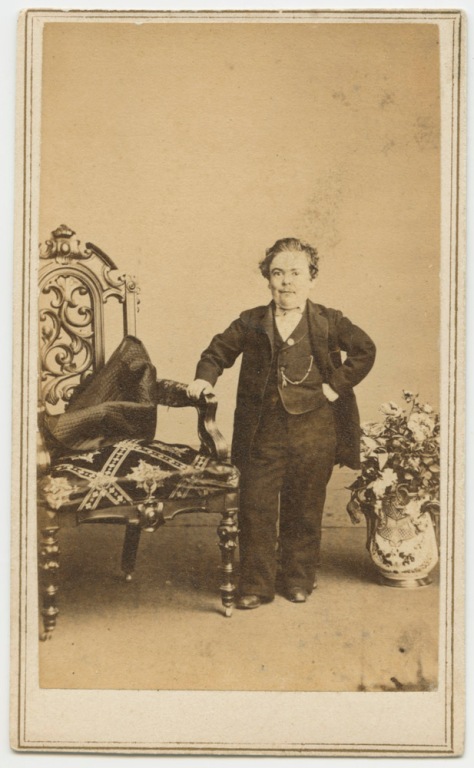
Here’s another Tom Thumb, this time by C.D. Fredricks. Proof positive that even when at home in New York, Tom Thumb was photographer agnostic, but still selective – if not posing for Brady, he was still going to the best names in town to get his photos done.
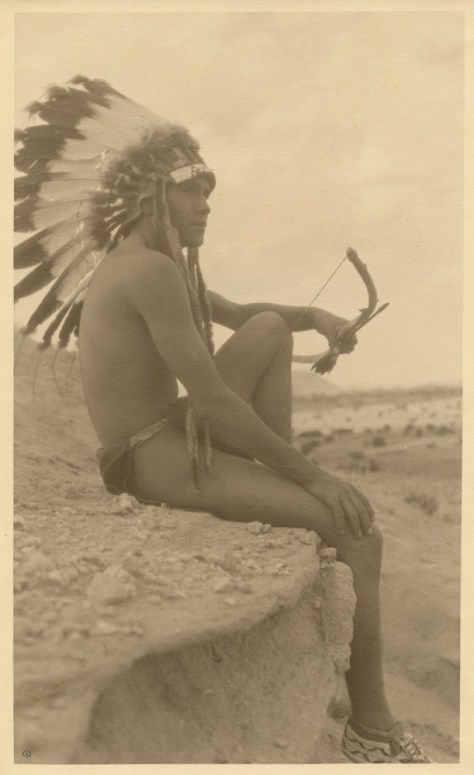
Here is a circa 1920 image, entitled “A Tewa Bowman” by W. Allen Cushman, a noted photographer based in Santa Fe, New Mexico. In keeping with the Edward Curtis tradition of tarting up his models with inauthentic costume bits to make a “better” photograph, Mr. Cushman put a plains Indian headdress on a southwest tribe member. And while the Tewas may have run around in loincloths on occasion (ceremonies or religious rituals), like their neighbors the Navajo and Hopi, they tended to wear shirts and leggings – the sun can be brutal when it’s out, and the cold can be equally so in wintertime – New Mexico is at similar altitude to parts of Colorado, so they get snow at higher elevations.
The image serves as a historic landmark in understanding the evolution of white man’s attitude toward native Americans. For the first several centuries of contact, the primary attitude ranged from indifference to hostility to downright genocide. By the beginnings of the 20th century, a new romanticized view of the ‘noble savage’ was taking hold, along with the growing realization that native peoples were truly dying out and vanishing altogether. In addition to the general romanticization, there is an obvious homoerotic undertone to the image. Note the smooth skin and the taut physique of the model. It’s a form of sublty emasculating the subject, making him at a time both sexually charged and non-threatening. All you’d have to do to turn this into an F. Holland Day photo would be to swap the feather headdress for a turban, and substitute an African model, and bingo.
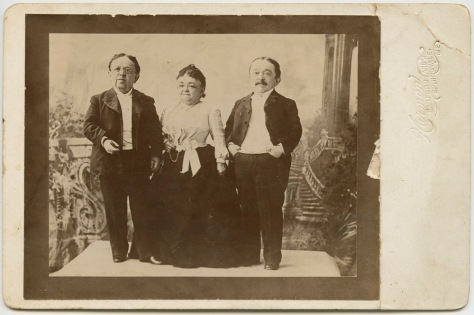
Here is a cabinet card from the mid 1890s of Lavinia Warren and the Magri Brothers (Baron Littlefinger and Count Rosebud). After Tom Thumb passed away in 1883, the widow Thumb met the Count and (his alleged twin brother) Baron Littlefinger. His real name was Primo Magri. She went on to marry him in July, 1885. They continued performing into old age to the point of appearing in a silent movie in 1915, five years before the Count’s death. Lavinia Warren died in 1919 at the approximate age of 77 (her birth date is unrecorded, so it is possible she was 78 at the time of her passing).
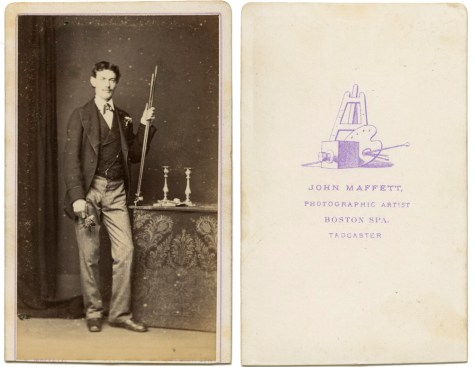
Here’s another fun one – really quite bizarre, actually when you think about it. The sitter is posing with a corsage in one hand, a fishing rod in the other, wearing formal attire, standing next to a table with silver candlesticks, that looks like it might be an altar. In a photographers’ studio. Was he on vacation? A hobbyist fisherman? It’s certainly not an occupational because this is definitely a gentleman of leisure, not a working fisherman. And what’s with the corsage?
In keeping with my recent backmark/blind stamp post, I like this one a lot, as it tries to connect portrait photography with painting, or at least bridge the gap. There are quite a few in a similar vein, a definite response to the notion that photography was merely a mechanical, technical operation and not a true fine art.
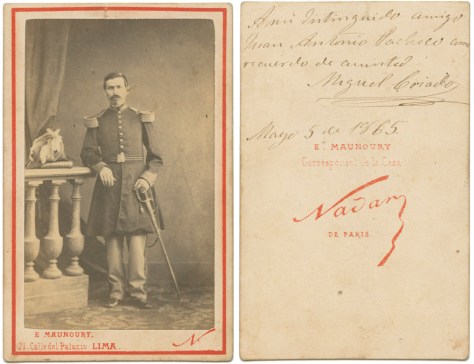
I bought this image because it has so much interesting history to it. Not only is the sitter known, but so is the date of the card, and the photographer, and the recipient of the card. Señor Maunoury was a franchisee of Nadar’s studio in Paris, operating in Lima, Peru. The handwritten note says “To my distinguished friend Juan Antonio Pacheco as a token of friendship, Miguel Criado”. So here we have a photograph that has traveled halfway around the world, just a few years shy of its 150th birthday, created by a French-trained photographer, collected by an American. What a fascinating nexus of connections. I wonder what the provenance of the image was before I bought it. I think it’s very important especially in the globalized world of today to contemplate these peregrinations through space and time that allow items like this to come into our hands, much like my Black Star, Osage Brave image that began life in Fort Smith, Arkansas, was collected in New York State, then went to Paris before arriving in my collection, or the Paris Opera image that spent time in Bulgaria before being auctioned off on Ebay by another French dealer, and now resides in Washington DC. In some ways, this is really the purpose of photography – to connect people across space and time, allowing someone dead and gone more than a century past to live on in the minds of people in a place they never would have been to.
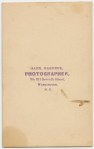
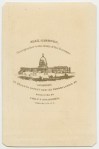
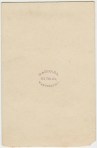
We’ll start this one with two of the most famous Victorian era photographers, Alexander Gardner and Mathew Brady. The Gardner blind stamp changes, but the only thing I can say for certain is that the stamp with the US Capitol building on it was during or shortly after the Civil War, as it touts his association with the Union army.
 |
 |
 |
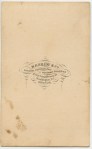
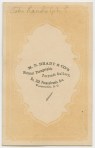
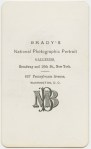
| The Brady evolution is more obvious. The simple, plain version is his blind stamp from early in the Civil War period. The more ornate, shield-like design would be the 1870s, and the final version is the large letters. | ||
 |
 |
 |
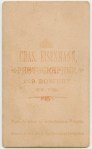
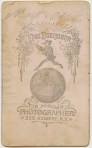
| Note the similar evolution in Chas Eisenmann’s blind stamp design. I don’t have a good idea of how long a span of time it took for his design to evolve – it may have been as little as a few years, or it may have been a decade or more separating them. I think though that once he changed it, he stuck with the globetrotter logo for an extended period, perhaps 20 years or more. | |
 |
 |
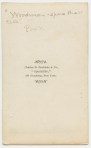
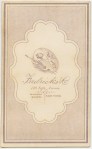
| C.D. Fredricks bind stamp. I know I have another one of his that would be the “middle” design, but I haven’t hunted it down in the CDV album I have – it would be the “middle” in that it no longer says, “specialité”, but also lists Paris and Havana as studio locations, but the design is not as fancy as the late one. | |
 |
 |
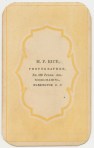
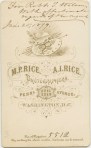
| M.P. Rice. Note the change also includes the addition of (most likely) his son to the masthead of the business. Using the date on the verso, this style had arrived by the late 1870s, so the shield designs would have been late 1860s to early 1870s. | |
 |
 |
| Finally some others for which I don’t have early/late pairings. These are just a few of the others I have, but I like looking at them just for the art. | |
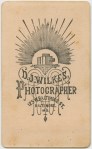 |
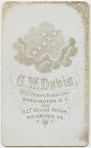 |
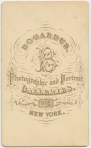 |
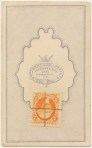 |
 dcphotoartist