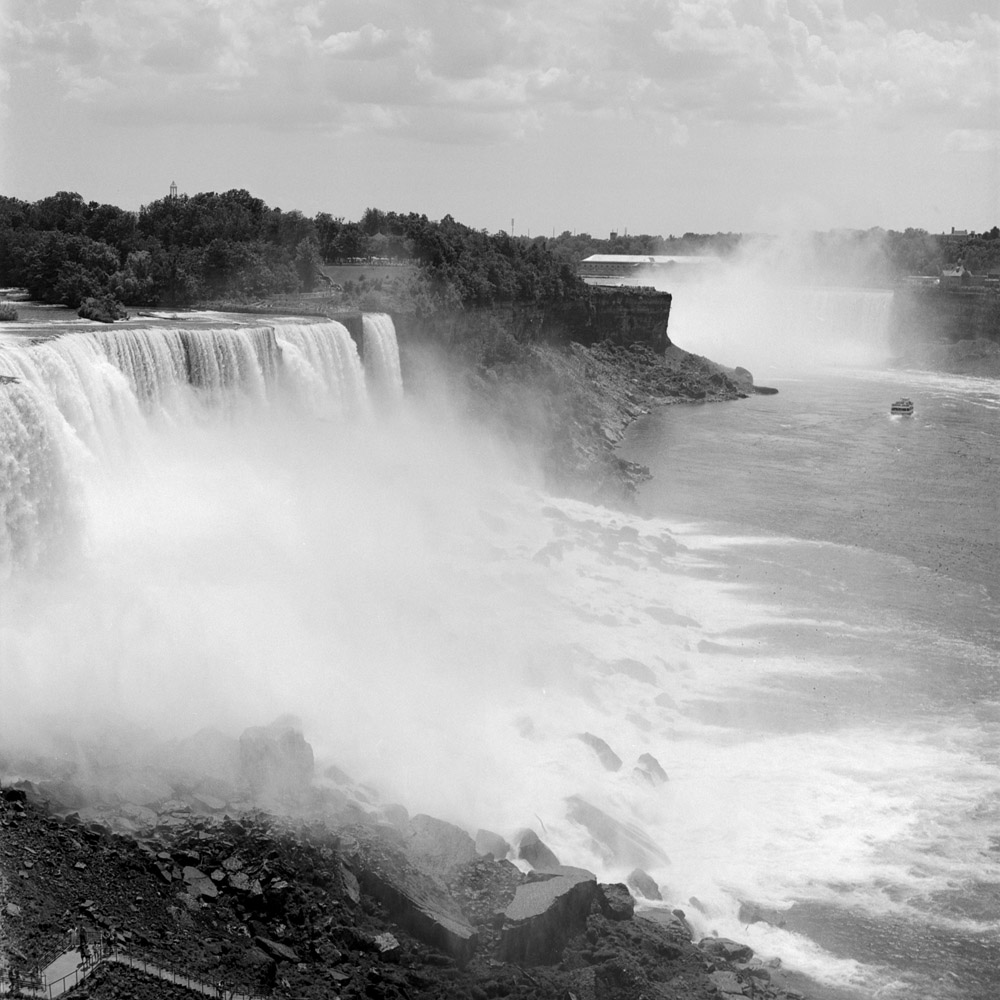
On the way up to Toronto, we stopped off at Niagara Falls to take in the view.
Niagara Falls, from the American Side
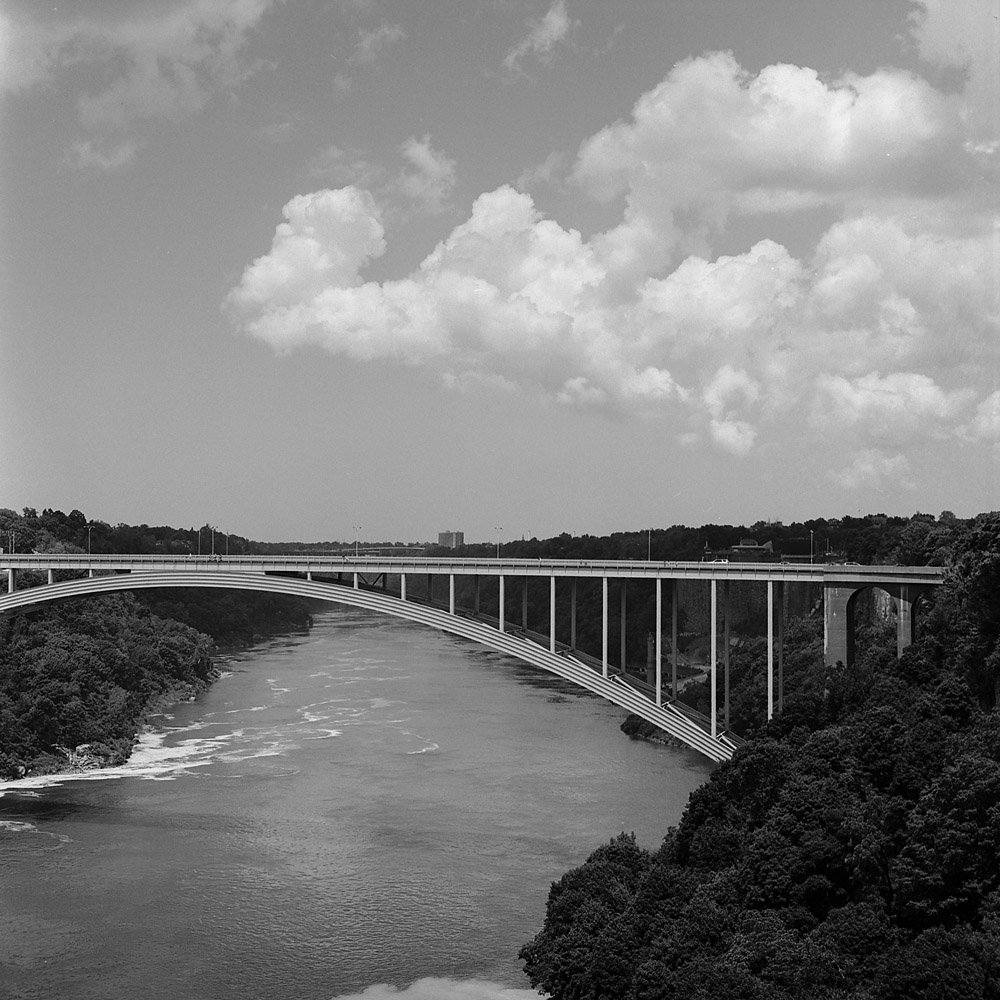
This is the Rainbow Bridge over the Niagara River, as seen from the observation deck on the American side.
Rainbow Bridge, Niagara Falls
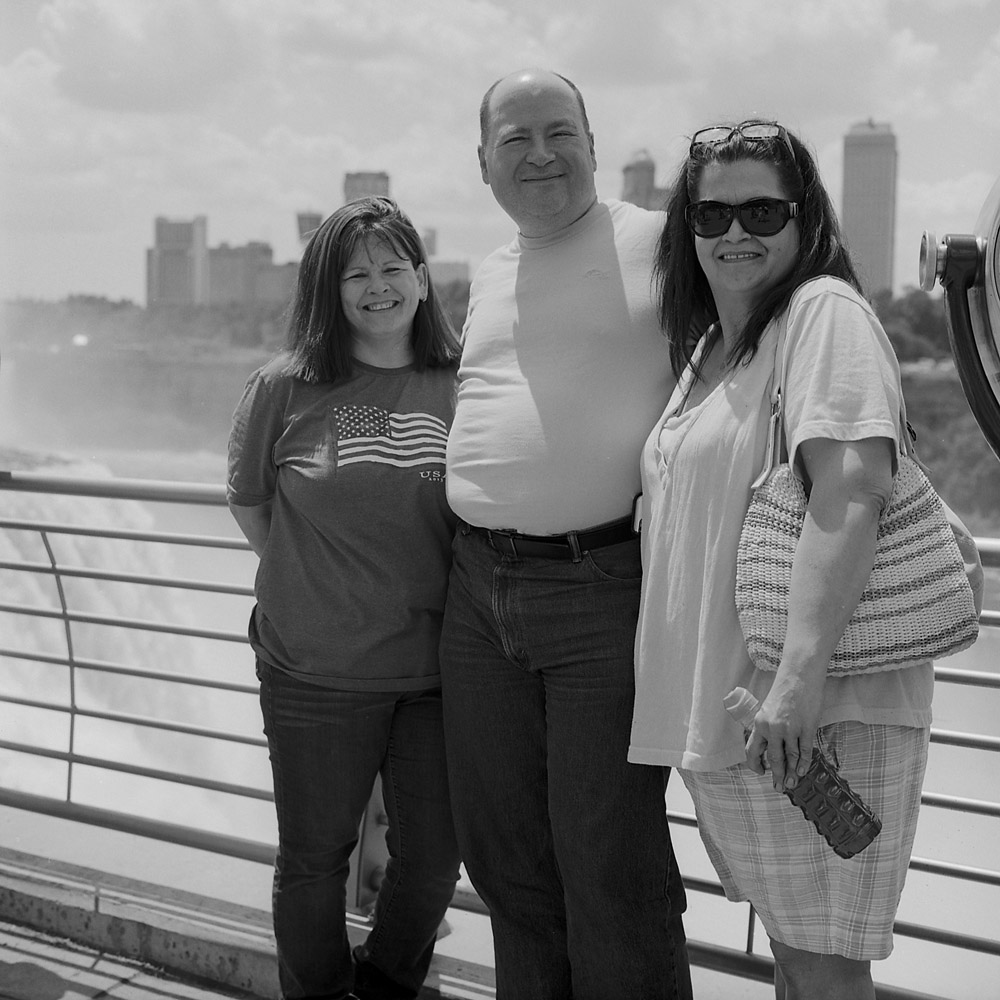
The “we” is my best friend Steve, his wife Missy, and her sister Marybeth.
Missy, Steve and Marybeth
Missy had never been to Niagara before so it was a must-stop. I think Steve and Missy are going to come back for a long weekend when they’re by themselves and not rushed to just enjoy the place.
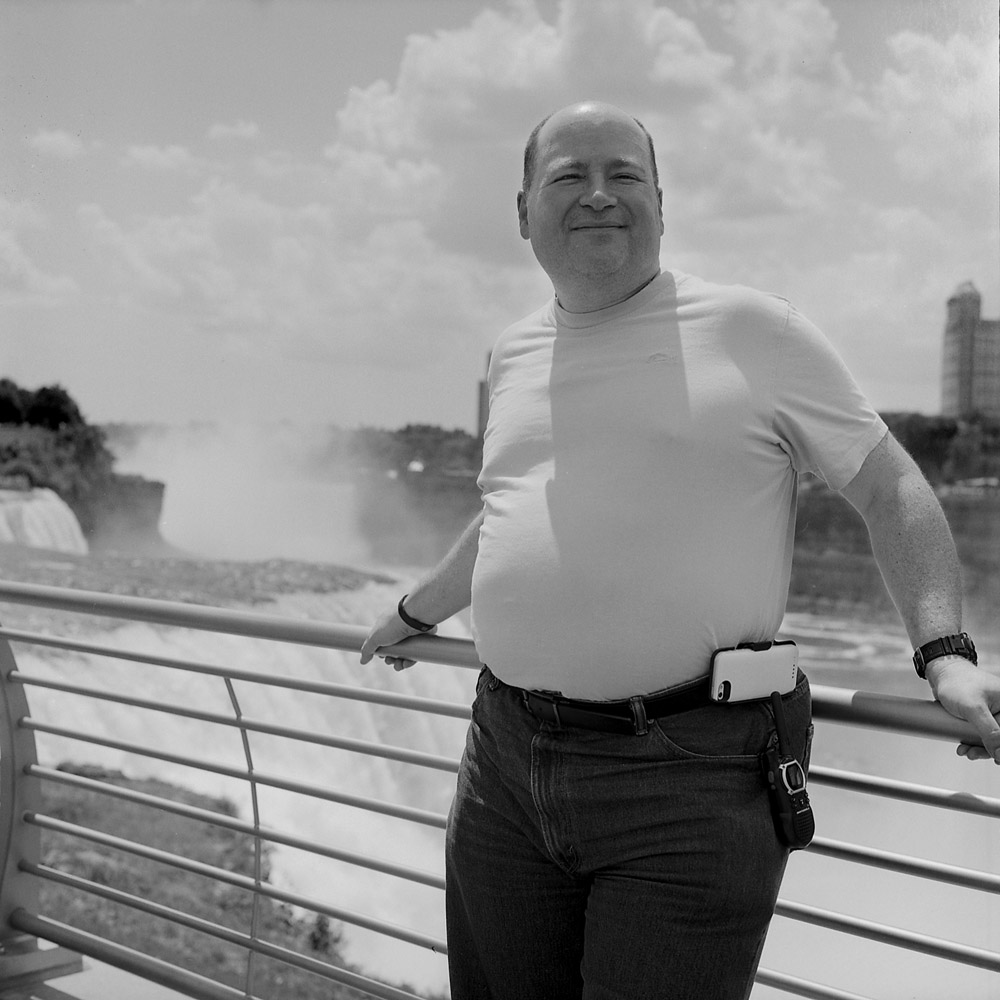
The shots are a little gray looking because we were severely backlit – we were at the falls around 2:30 PM and the sun was still very high in the sky, and the falls were west/southwest of where we were standing. Can’t change geography, so we just had to compensate for what we had to work with. Next time if we want photos with the falls as a backdrop, either I’ll bring a flash for fill or we’ll just take them in the morning when the sun is coming from the east.
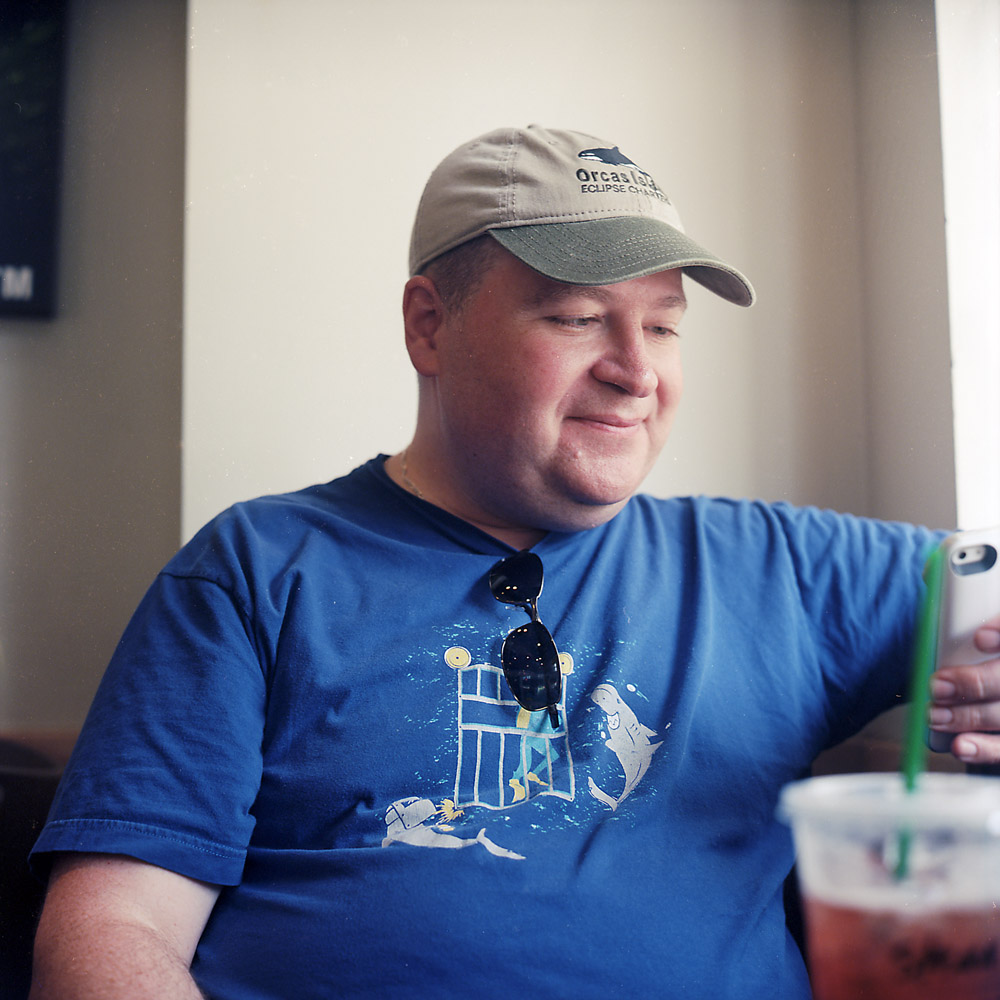
Steve
All images once again care of my trusty Rolleiflex 2.8E on Ilford FP4+.
I went to Toronto with some friends for the last weekend in June to attend World Pride. Unfortunately due to some awkward circumstances we had to leave early and never made it to the parade, which to hear tell was just as well because Toronto was a veritable oven that weekend and we would have suffered more than enjoying the festivities. I did take pictures, though (what, me go somewhere and NOT take pictures?). It whet my appetite for going back – there’s a lot going on there and I want to explore it more.
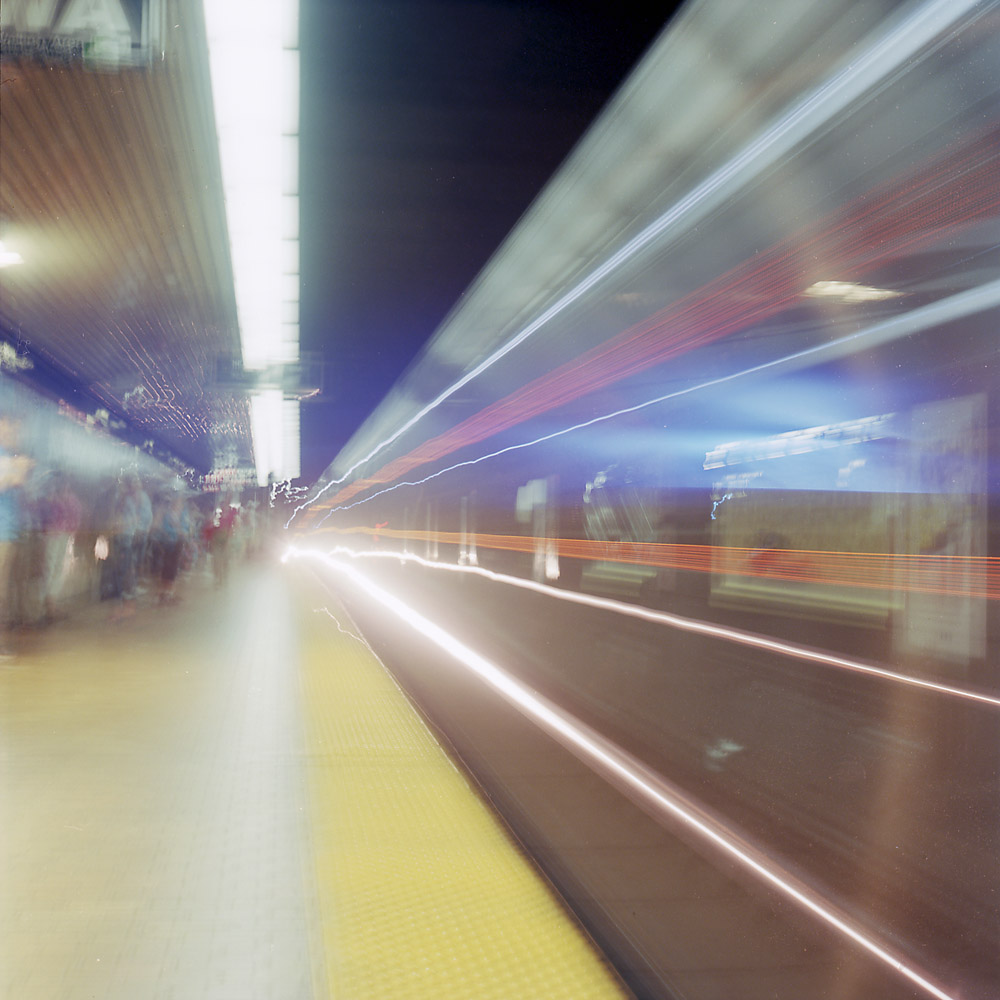
I’ve developed a “thing” for photographs of public transit. I started doing it here in DC, shooting Metro trains in motion at various stations. I’ve done it in New York and in Paris, and now Toronto as well. I think this was at the Spadina station, but I could be off. It’s funny how after doing this same shot in various places how different they look, despite the trains doing the exact same thing.
Toronto Subway
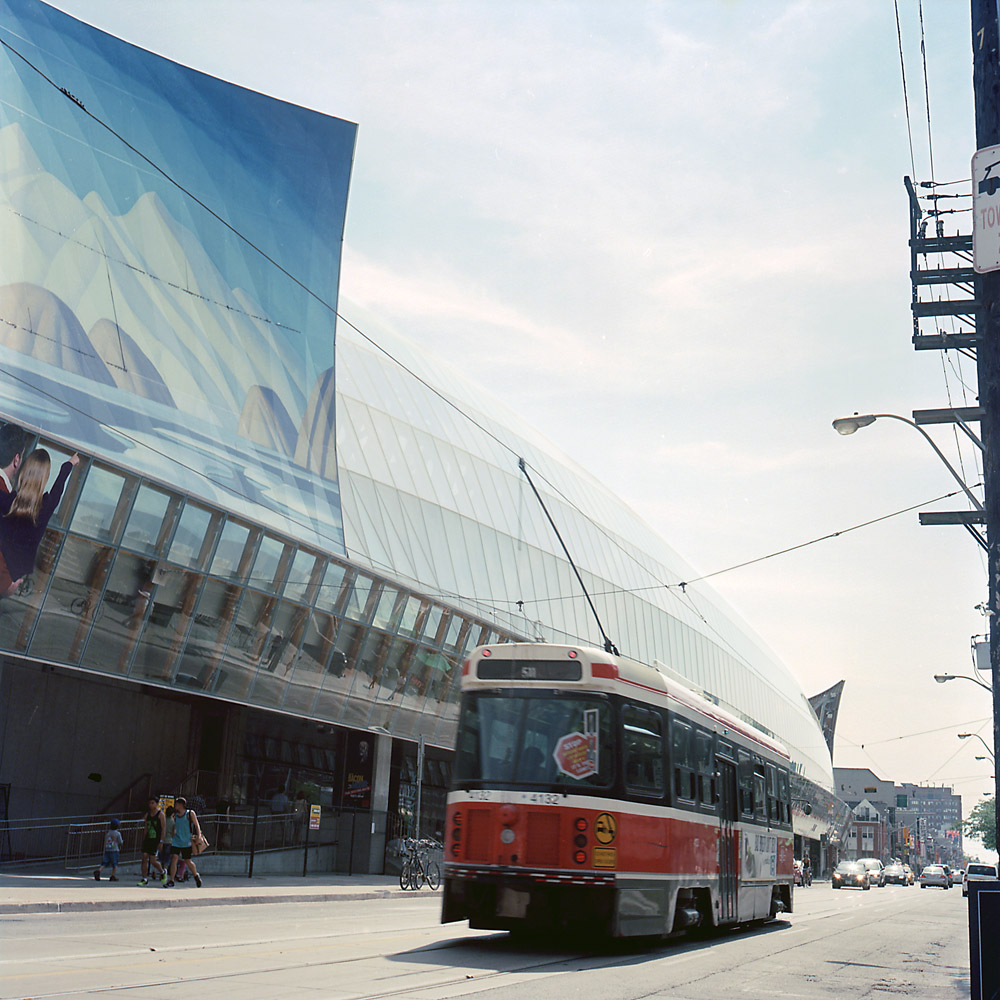
To stick with the public transit theme, here’s a streetcar in Toronto. They have LOTS of streetcars and unlike other cities, they seem to have kept them going instead of ripping them out/paving them over in favor of buses, only to have to put them back at obscene expense (ahem, Washington DC and Baltimore). This one is passing in front of the Art Gallery of Ontario, which looks like some kind of glass zeppelin.
Streetcar, Art Gallery of Ontario
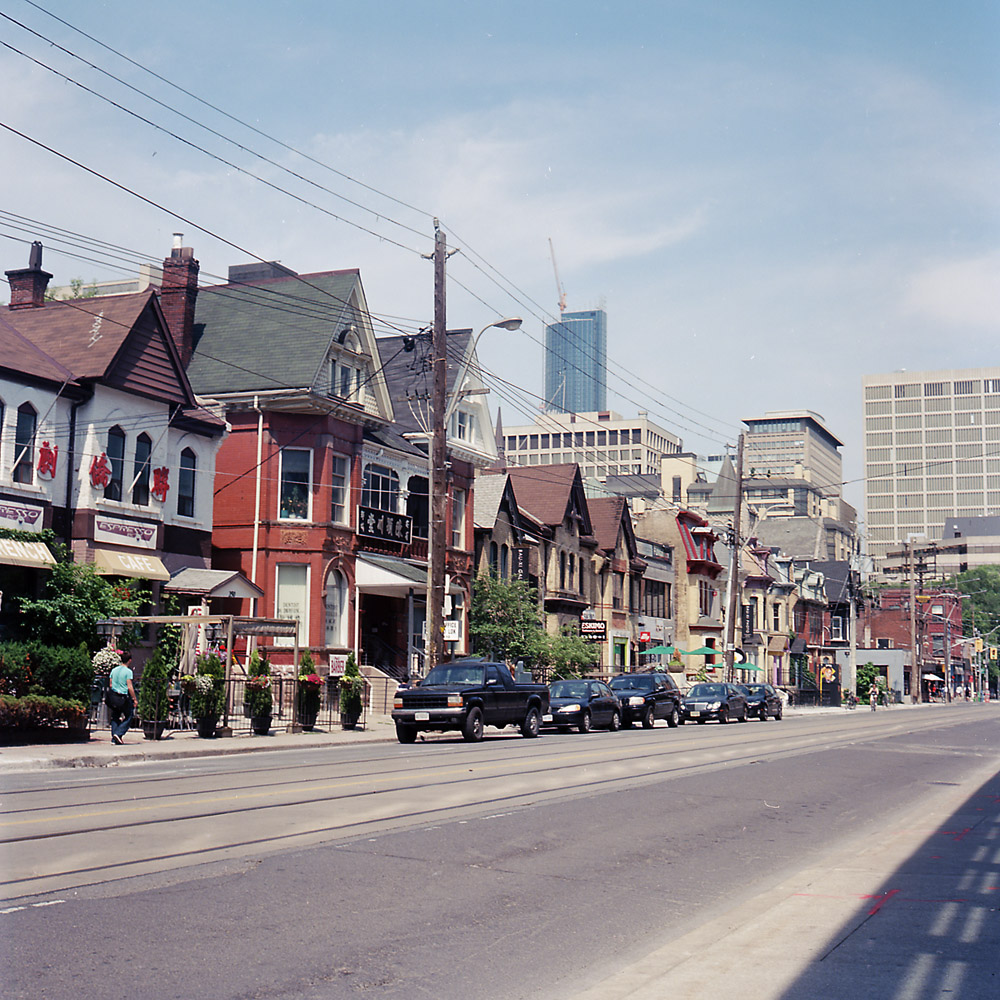
The streetscape across from the art museum is quite the contrast. A row of 19th century rowhouses has been turned into galleries and restaurants. It’s a highlight of the contrasts of Toronto, as you can see the business district skyscrapers in the background.
Toronto Art Gallery Row
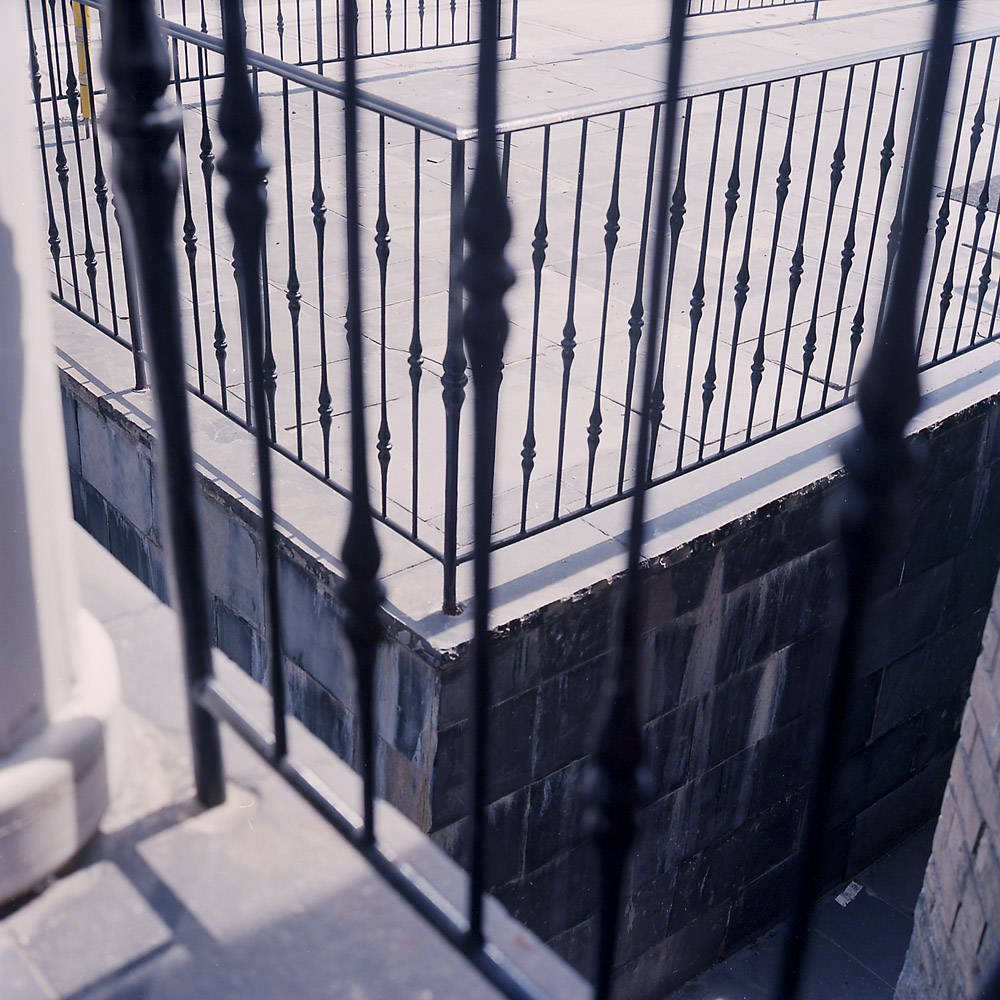
This railing fronted one of the galleries on Queen Street (the street that runs in front of the art museum). I just liked the layering of geometry happening here.
Railings, Queen Street
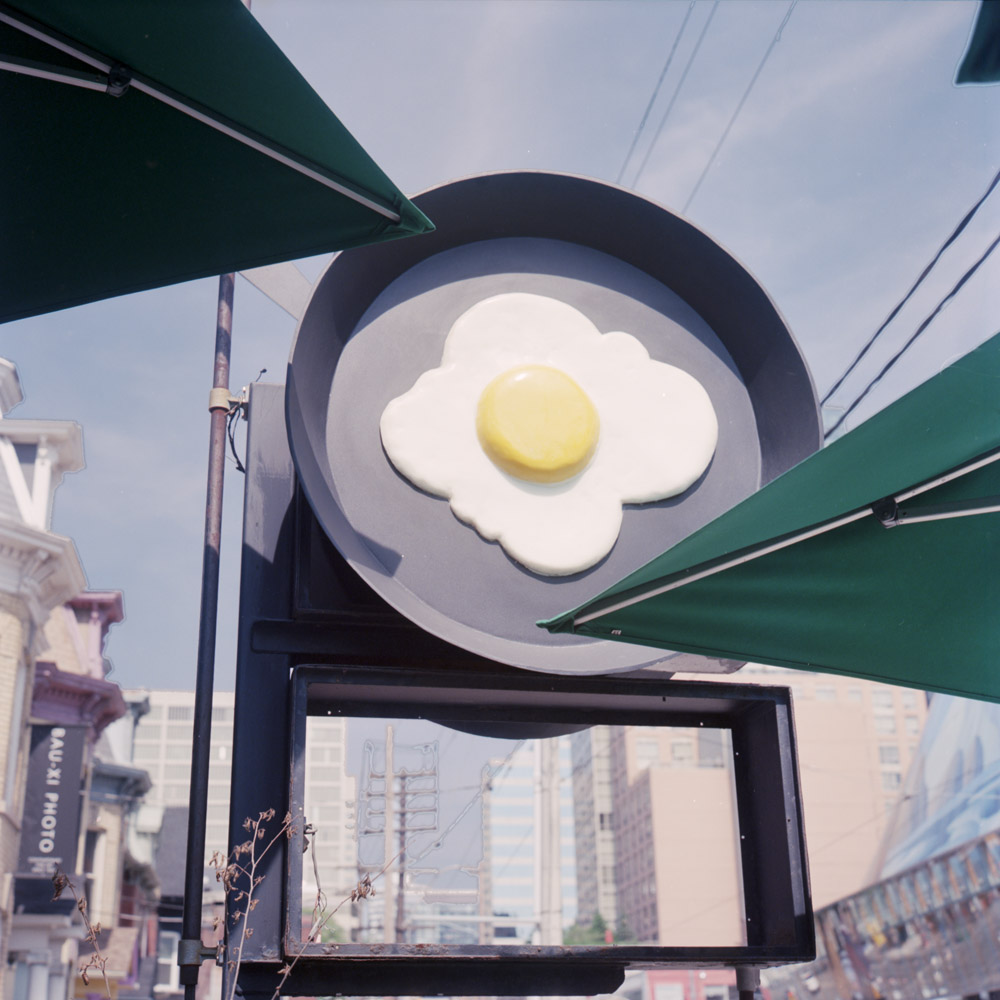
For lack of a better memory of the restaurant’s name, and in honor of Canada’s multilingual heritage, I’m titling this one “Oeufs Torontonnaise”. In reality it’s just a clever sign for a restaurant across from the art gallery. The pan must be really NOT non-stick for the egg to stay up there like that!
Oeufs Torontonnaise
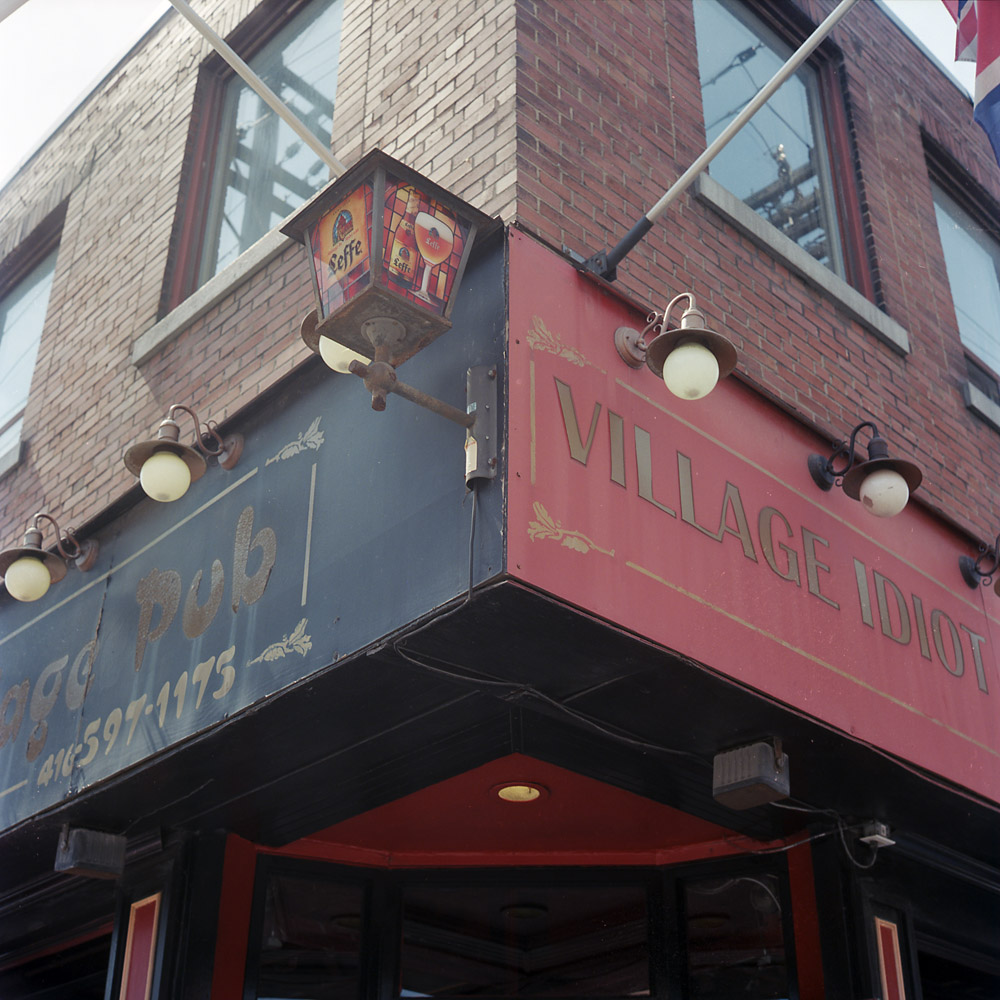
You’ve gotta love a pub called “The Village Idiot”. I’ve been told that down the street from it there is another bar with the best beer selection in Toronto.
Village Idiot Pub
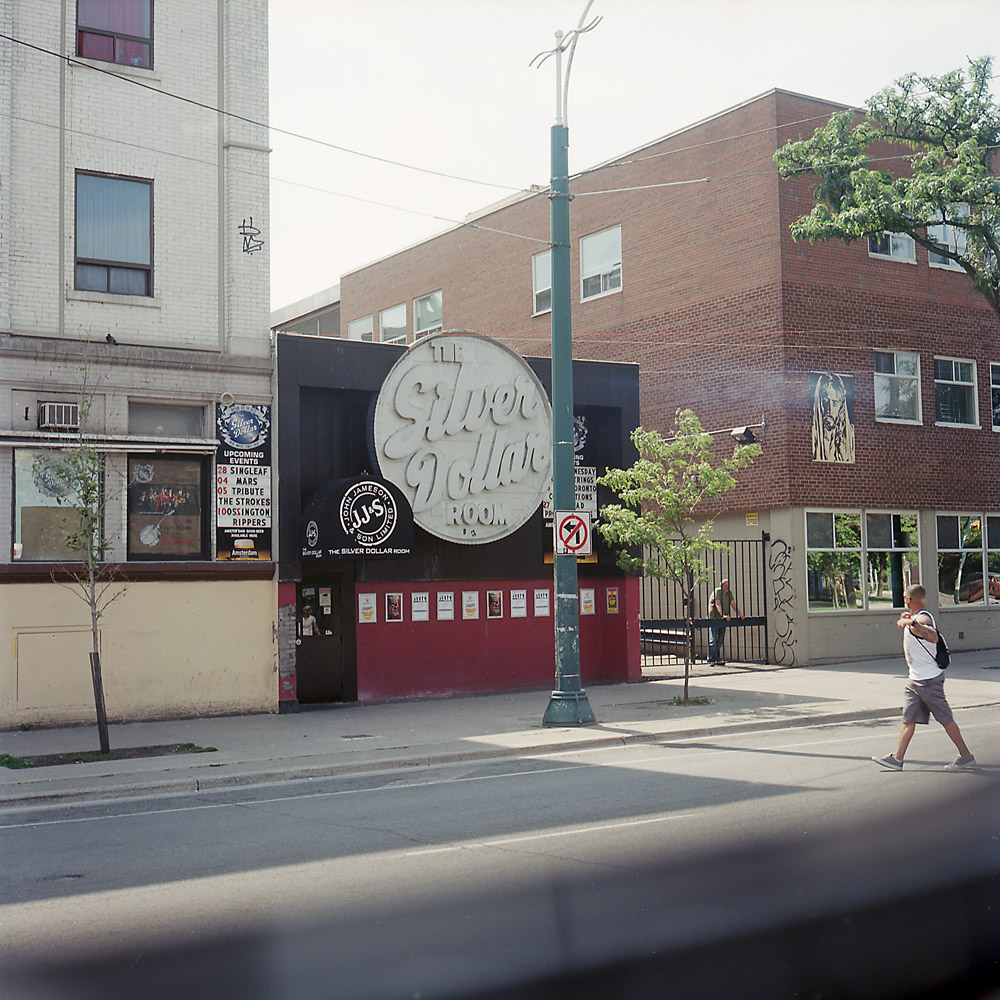
I spotted this place on my way back from Chinatown, through the streetcar window.
Silver Dollar Room
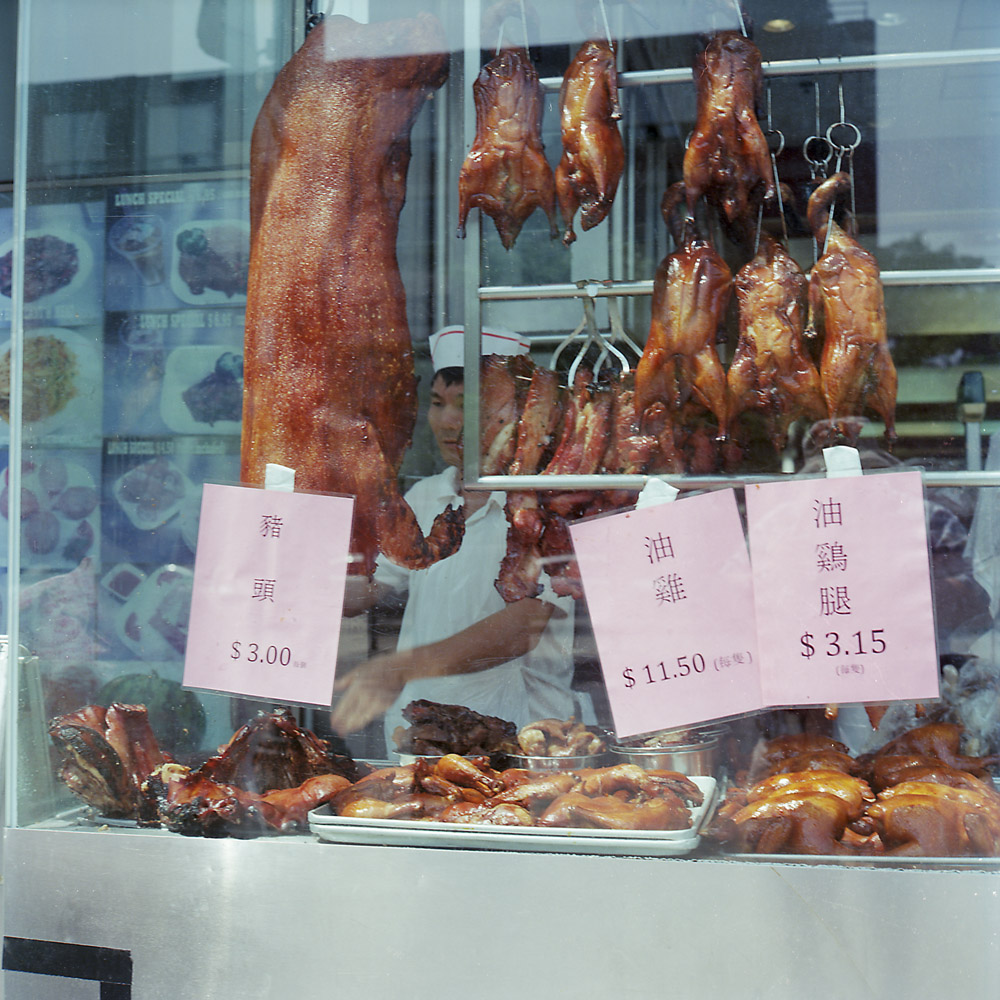
The art museum is just a couple blocks outside Toronto’s Chinatown, which is very busy and vibrant. I spotted this scene shortly after stepping off the streetcar. Passing by an hour later, half the pig was gone.
Chinese Restaurant Window, Toronto
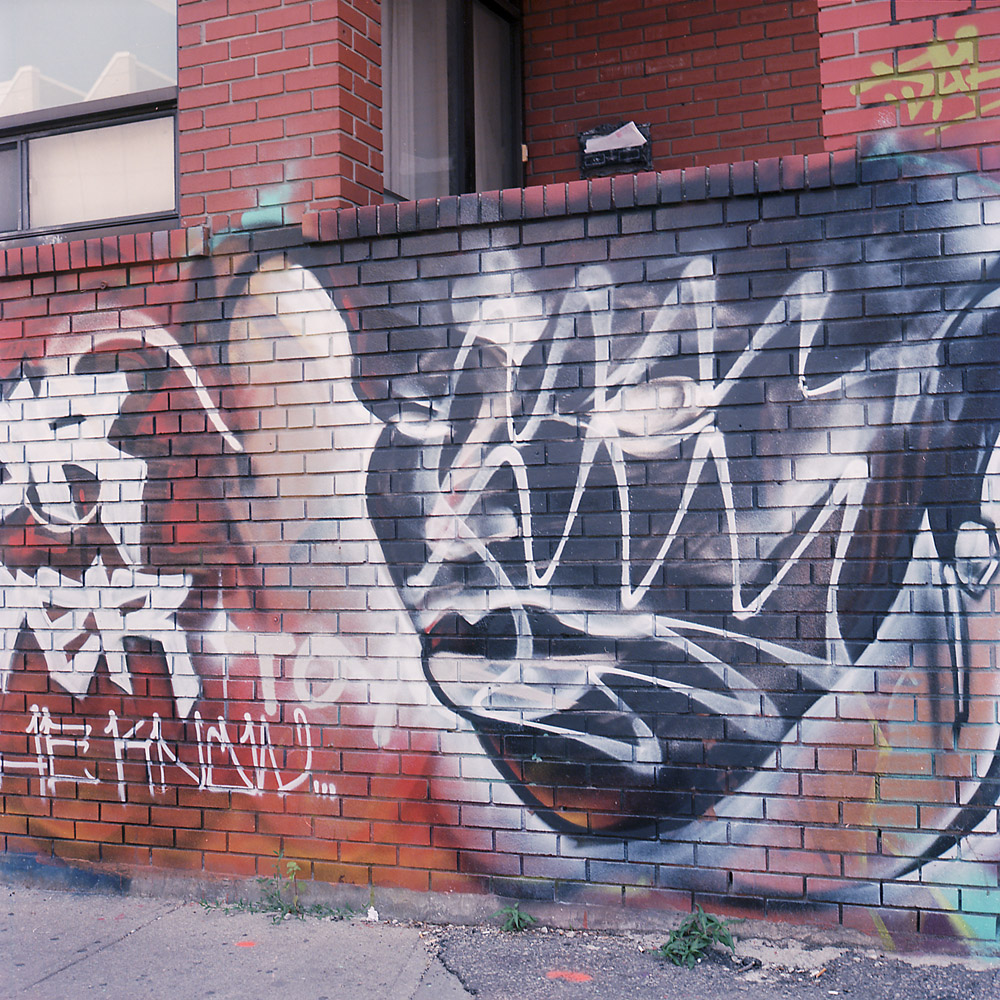
Some very cool graffiti art on a wall near the art museum, at the edge of Chinatown.
Graffiti
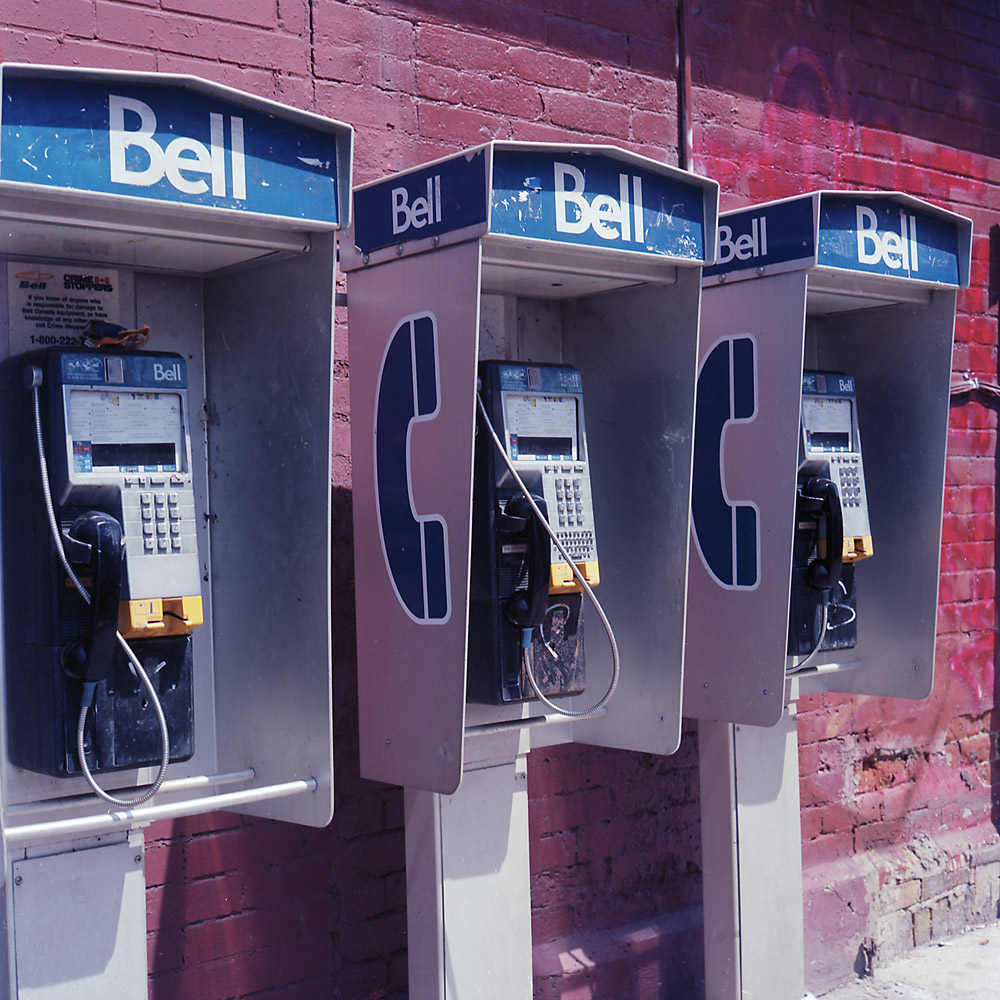
In closing, another one of my ‘things’ – pay phones. I was shocked to see how many were still in service in Toronto.
Payphones
I was hanging out with my best friend since my college days, Steve. I snapped this one of him while we were staying cool in the Starbucks waiting for another friend of mine, Mirza, to join us.
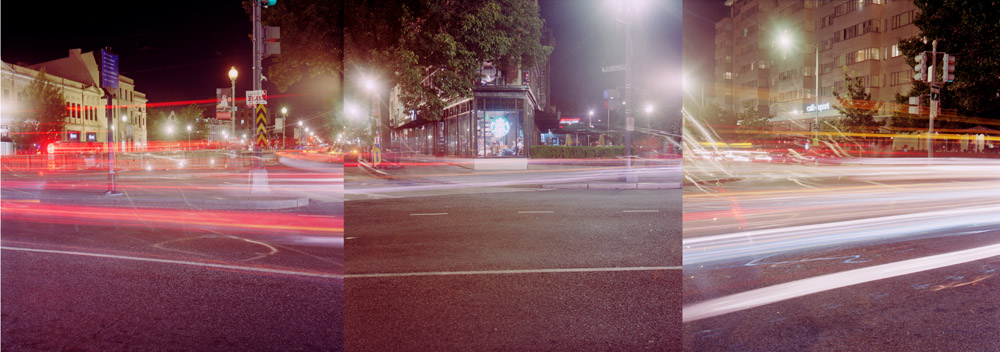
A long time ago, I saw this interesting little gadget sitting in the used equipment case at my local camera store. It was a panorama adapter for Rolleiflex cameras that enabled you to shoot up to a 360-degree panorama on a single roll. It has a built-in bubble level (which is absolutely critical). You put the camera on top, then focus and compose as normal. Once you have the focus and exposure set, you don’t change them (this is also critical). Take the first exposure, then push in the little locking lever, rotate the camera to the next increment on the dial, and take the next picture, and so on until you have shot as many frames as you want to shoot. It is critical to maintain focus and exposure as set on the original frame because changing focus will mean that things in one frame will not be in exactly the same proportion as they were in the previous frame,therefore they will not blend seamlessly. Ditto for exposure – if you change the exposure from frame to frame, ESPECIALLY if you are shooting color film, you’ll never be able to match the frames.
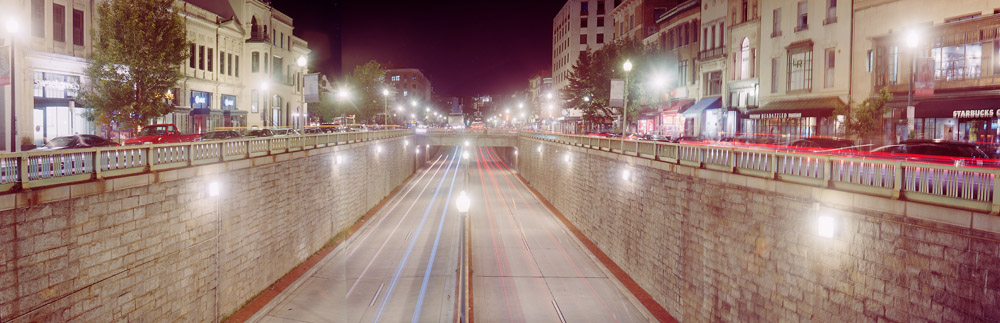
Done right, you get this:
Dupont Circle Underpass
It isn’t perfect because with the long exposures (45-90 seconds each – I forget which I used, but as you can see they’re all exactly the same) traffic patterns don’t flow through the underpass during all three exposures, and the lens flare from the street light in the middle picture doesn’t carry over to the same degree in the left picture, thanks to the lens hood. But you have to look at it to see the three frames separately.
If things aren’t perfect, then you end up with:
Starbucks, Dupont Circle Triptych
While the alignment is pretty close, the color is off a bit on each frame. This took quite a bit of Photoshoppery to get it to match as well as it does. I kind of expected this outcome when trying this shot because I knew the traffic patterns wouldn’t line up from frame to frame, and wanted to see how it would turn out. I think it worked well enough as an effect, but I’m on the fence as to whether I’d try it again.
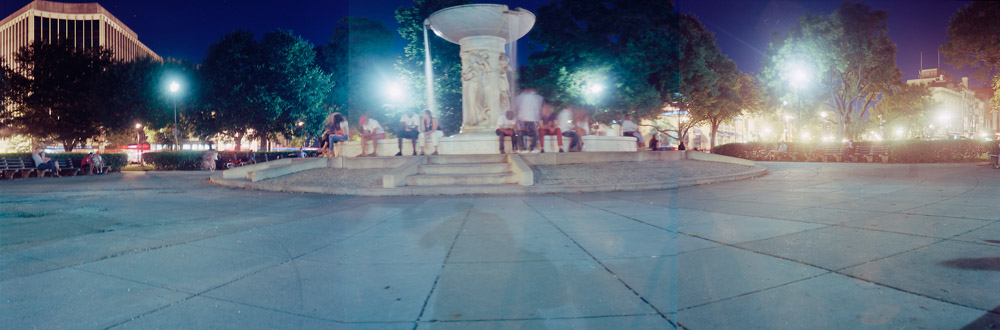
If you don’t have everything perfectly level, you get:
Dupont Circle Fountain
Also lots of Photoshoppery went into getting the colors and density to match from frame to frame. This one has been rotated and cropped to get it MORE level, but you can see between the oval of the fountain and the overall tilt, it wasn’t level and square enough.
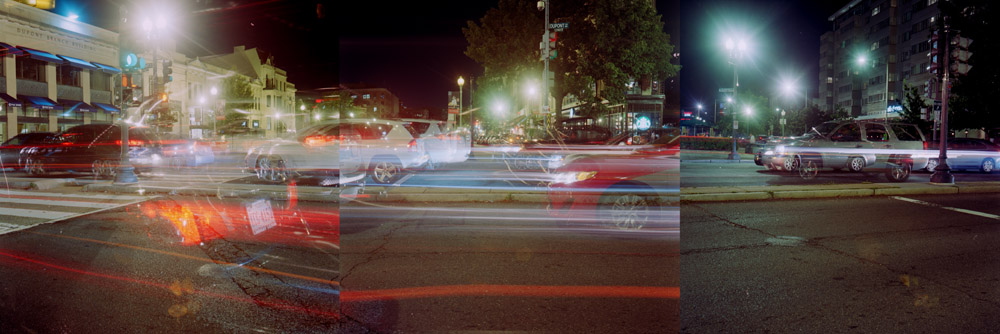
And last but not least, another experiment with disjointed traffic flow around Dupont Circle.
Traffic, Dupont Circle
Another part of this experiment was to see how Kodak Ektar 100 does with long night exposures. My previous (and still) favorite for night photos is Portra 160. While Ektar hasn’t dethroned Portra for this purpose, it proves it can stand on its own and I don’t need to carry multiple emulsions with me when I travel to cover every scenario. I can bring a few rolls of Portra 800 for when I need to shoot hand-held in low light, and the Ektar 100 for everything else.
While I’m on the topic of military themed images, I thought I’d do a (for the most part) no-words review of the military images in my collection.
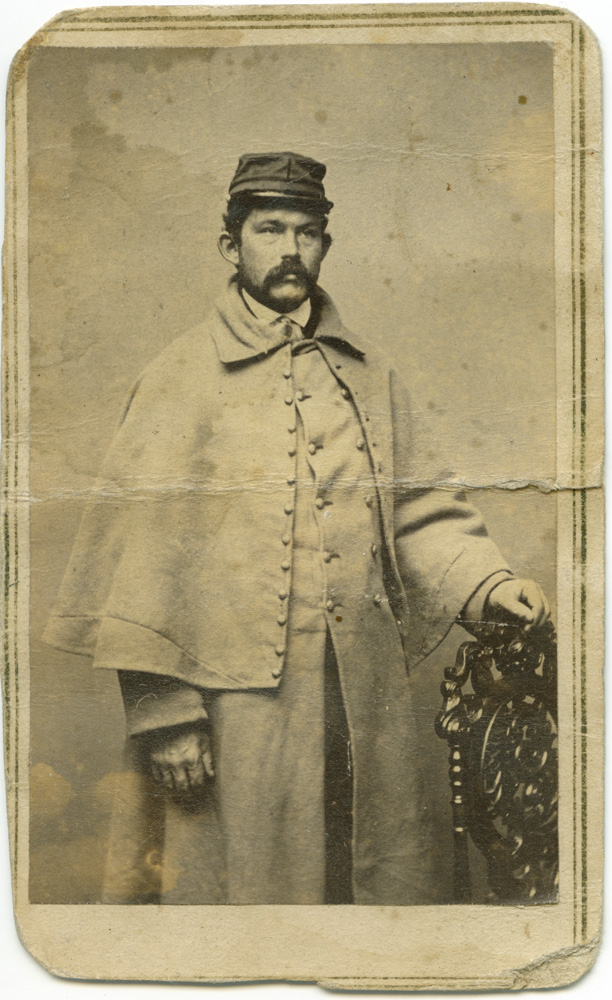
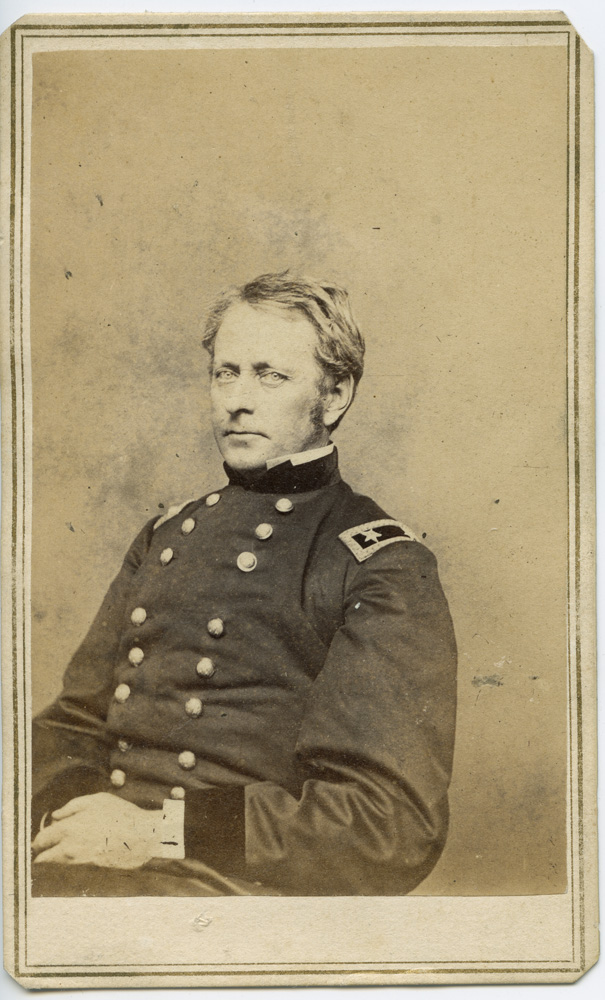
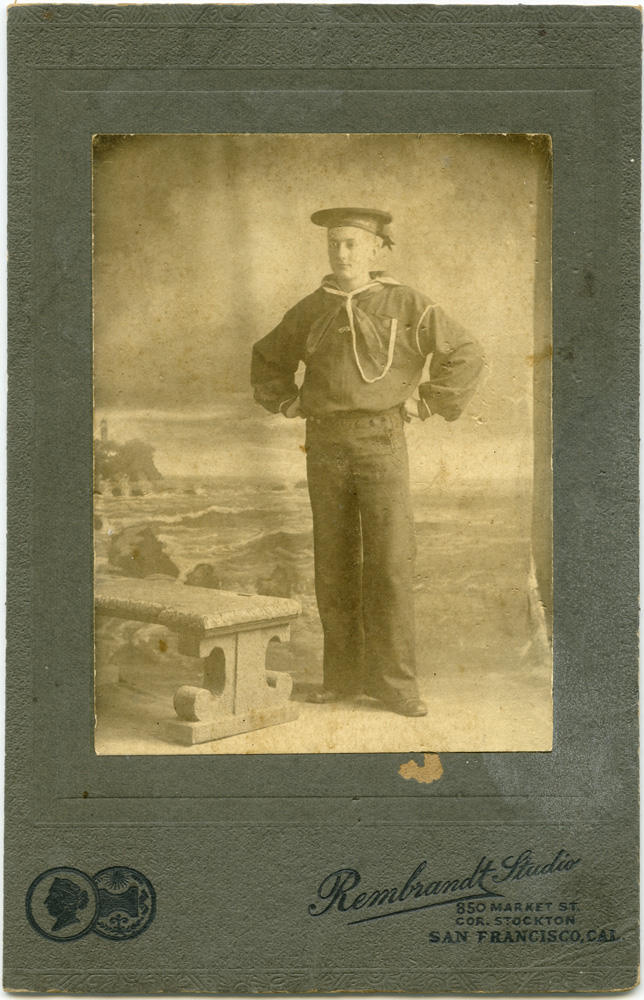
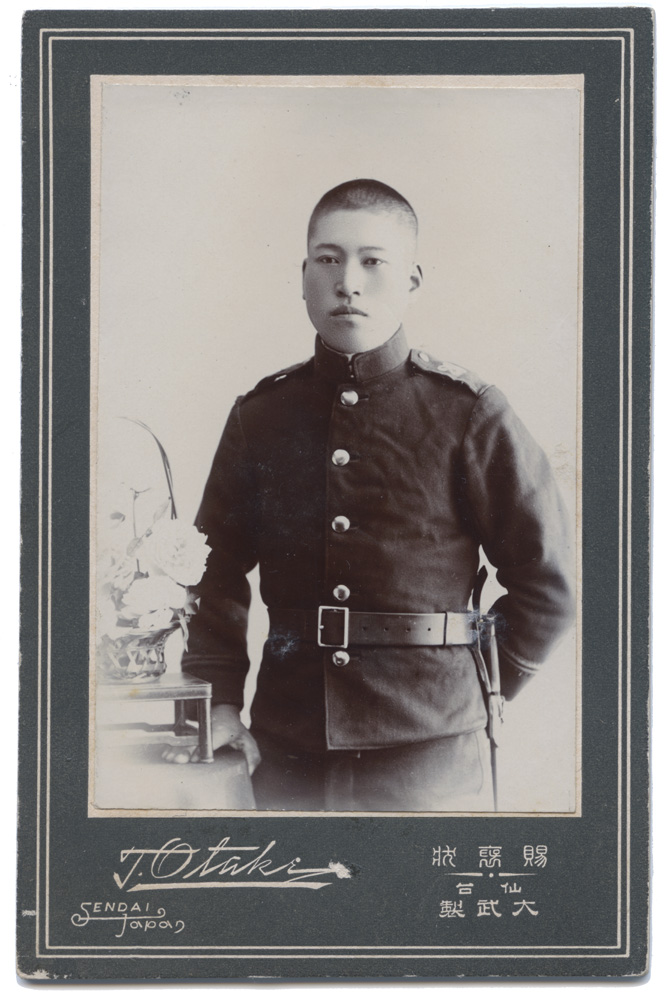
Affectionate Confederates – 1/6 plateSoldier in Pith Helmet Tintype, out of packet76th Pennsylvania Zouaves, ca. 1862, my ancestorUnknown Sergeant, Chambersburg, PA ca. 1861-62Union Soldier, Wm. J. Tait studio, NYCDV, General Joseph Hooker, by Mathew BradyHoratio B. Buck, MD – 1st Lt. 11th Volunteers.Miguel Criado by Maunoury of Lima, PeruTwo British Soldiers, Chunk RestoredSailor, 1890s, Rembrandt Studio, San FranciscoSailor, Hong Kong Cabinet CardSailor, Hong Kong cabinet cardSailors Trio, Hong KongJapanese Soldier, Sendai, J. Otaki Studio
My latest acquisition. This is probably in a three-way tie for the best piece (by my own accounting, not on a financial basis) in my cased images collection, and still in the top 5 if you include my CDVs. Quite the rarity, it depicts a pair of Confederate soldiers arm-in-arm, smoking cigars. The case is a sought-after Union case (the Union in Union Case has nothing to do with the Union vs. the Confederacy, but rather it was a term for the case style, coined in the mid-1850s) depicting crossed cannon. As the Civil War encroached, patriotic designs became increasingly popular, and I can see how and why a pair of Confederate soldiers would want such a case design for their image.
Crossed Cannon Thermoplastic Case
Here is the image in its brass mat –
Affectionate Confederates – Plate in brass mat
And a scan of the bare plate without the mat. I have done some dust removal for the purpose of clarifying the image, and applied a little unsharp mask to the image to bring out detail that would be softened in the scanning process, but otherwise this is an accurate representation of the plate and its condition. The image and the case have condition issues, but it’s an unique piece – where are you ever going to find another copy of this image? Despite the plate condition, you can clearly see the hand-coloring of the uniforms, the flesh-tones, and even the lit ends of the cigars have been tinted red!
The case as a whole is generally in good shape, but the lid is missing the velvet pad. This isn’t such a horrible problem, as the velvet pad can always be replaced, but it would have been terrific if it had remained, as the pad might well have had identifying information about the photographer and his location.
Affectionate Confederates – 1/6 plate
I know I’ve harped on the topic of Victorian-era images of affectionate men before, but I’ll do it again, especially since an image like this can be so fraught with meaning mis-applied by modern sensibilities.
Here we have a pair of Confederate soldiers. They are arm-in-arm, casually smoking cigars. I read the gesture as being purely affectionate, bonding between two soldiers who may be not only deep friends but it also reads to me as reassurance in the face of potential mortality. This one lacks any suggestion of sexuality, but I love the way it humanizes two soldiers that it would be easy for us 150 years after the fact to pigeonhole for their support of a cause we today condemn.
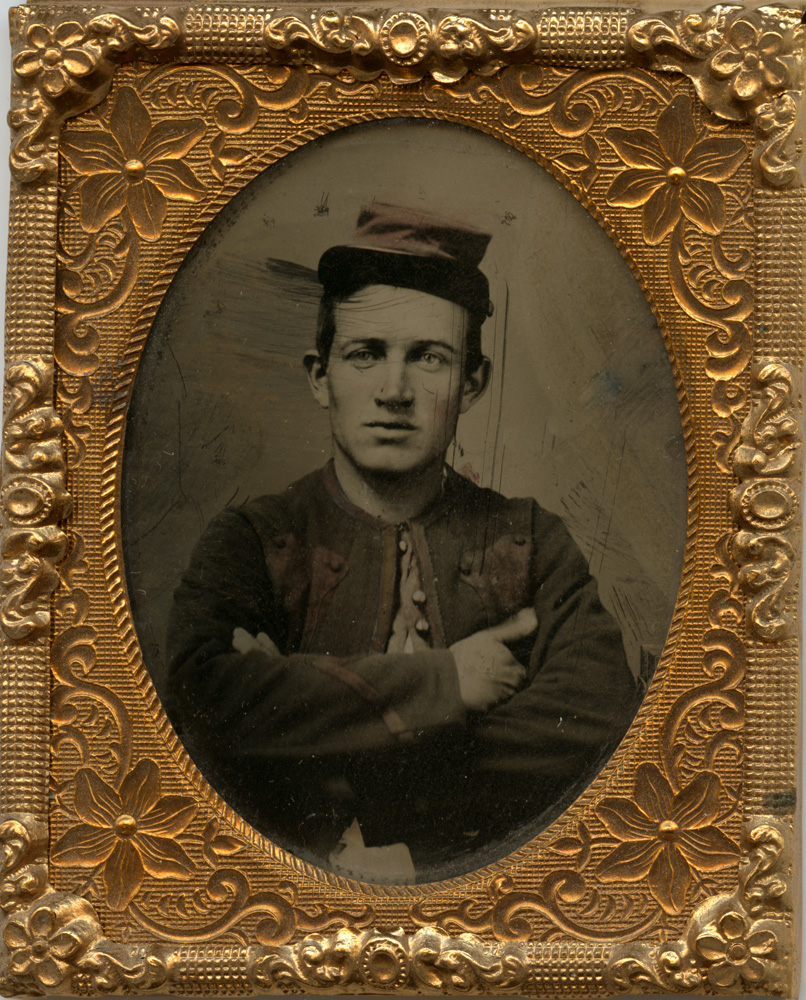
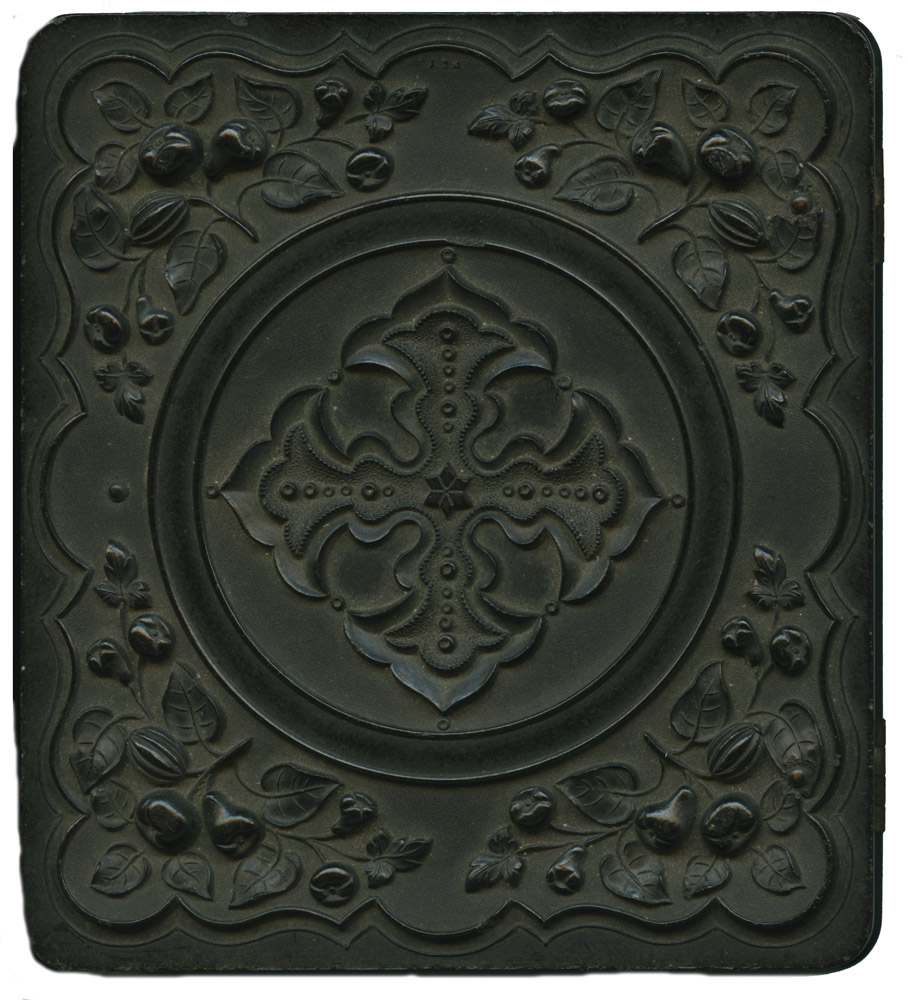
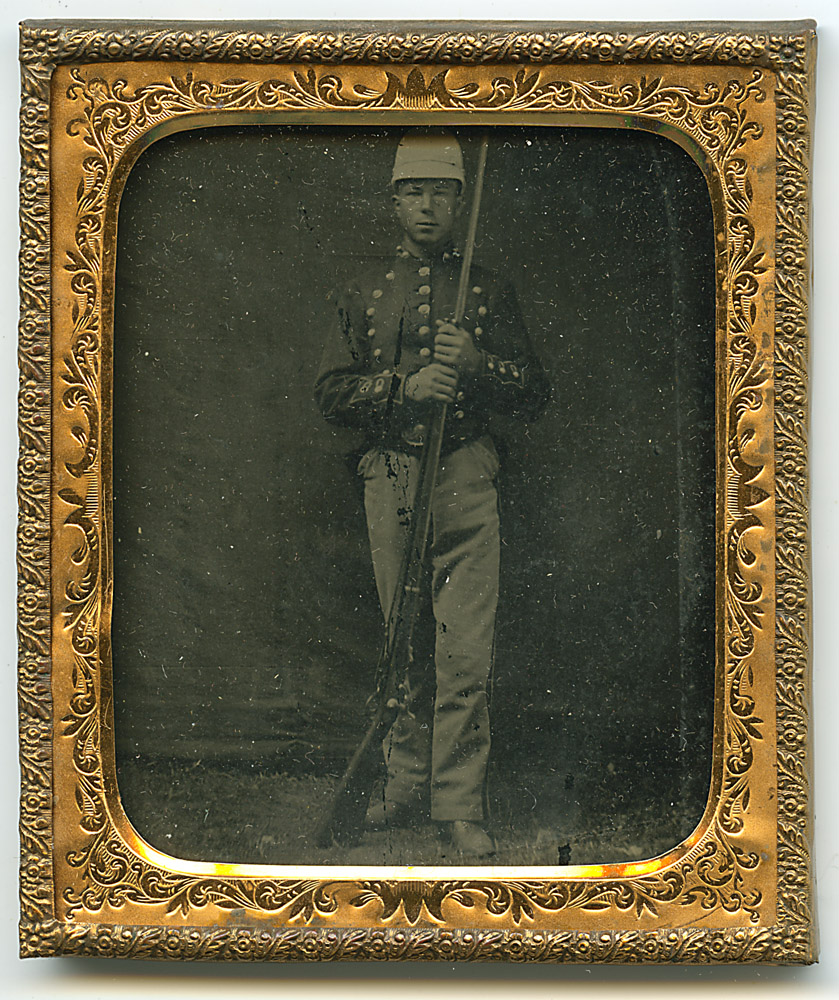
My latest cased image acquisition. In contrast to the daguerreotype pair I just purchased, this is a tintype in a brass mat and frame in a gutta-percha (thermoplastic) case.
Case in Gutta-percha
The case on this was even lovelier than I expected – there are no major chips or cracks, and the lock is in good working order. Oftentimes the clasping mechanism has become bent over the last 150 years and either tries to form a hermetic seal or refuses to hold the two halves together at all.
When you buy something like this, you never know entirely what you’re getting. Sellers don’t always describe everything with 100% accuracy, as much out of ignorance as anything else (rarely is it ill-will – lots of people just don’t know a lot about what they’re selling). This was described as of a post-Civil War US Army soldier. The fact that it is a tintype and not an ambrotype or a CDV would lend credence to that theory, as tintypes were immensely popular after the war, and although not exclusively an American phenomenon, their greatest popularity was in the United States. However, several things about the uniform suggest that A: it is not American, and B: it is potentially pre- or inter-war. In researching US Army uniforms, I found several uniform stylings from the 1840s-50s that bear a resemblance to the jacket he is wearing. But in my understanding of US Army uniforms (hardly encyclopedic) there was never a pith helmet issued. The rifle appears to be a percussion-cap rifle, which if American, could be an 1840s Harpers Ferry Arsenal product.
Another possibility is that this is a cadet at one of the private military academies. I can rule out The Citadel, VMI, and West Point as possibilities as their uniforms are sufficiently different, particularly in the cuffs of the sleeves.
Soldier Tintype, mat, frame and glass packet
This photo was taken out-of-doors as can be seen from the grass in the foreground stopping at the canvas backdrop.
You can also see on the scan of the tintype out of its packet that there are scuff marks from the mat. They appear to match the mat, but this is not definitive. The case just feels wrong for the image – it seems to be earlier than the image, and much fancier than you would associate with a tintype. My instinct tells me that sometime after the image was made, someone decided to do a case-ectomy and swap the original case, be it leather or a paper sleeve, for this one. The scratches to the emulsion also seem to suggest that this image was not in a case for its entire life.
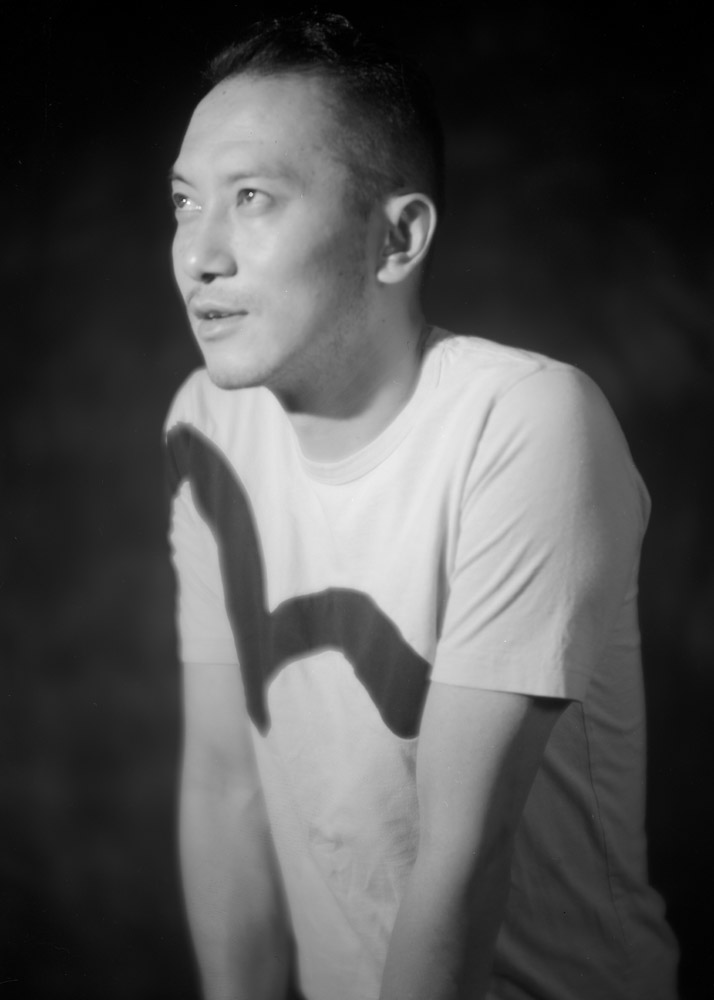
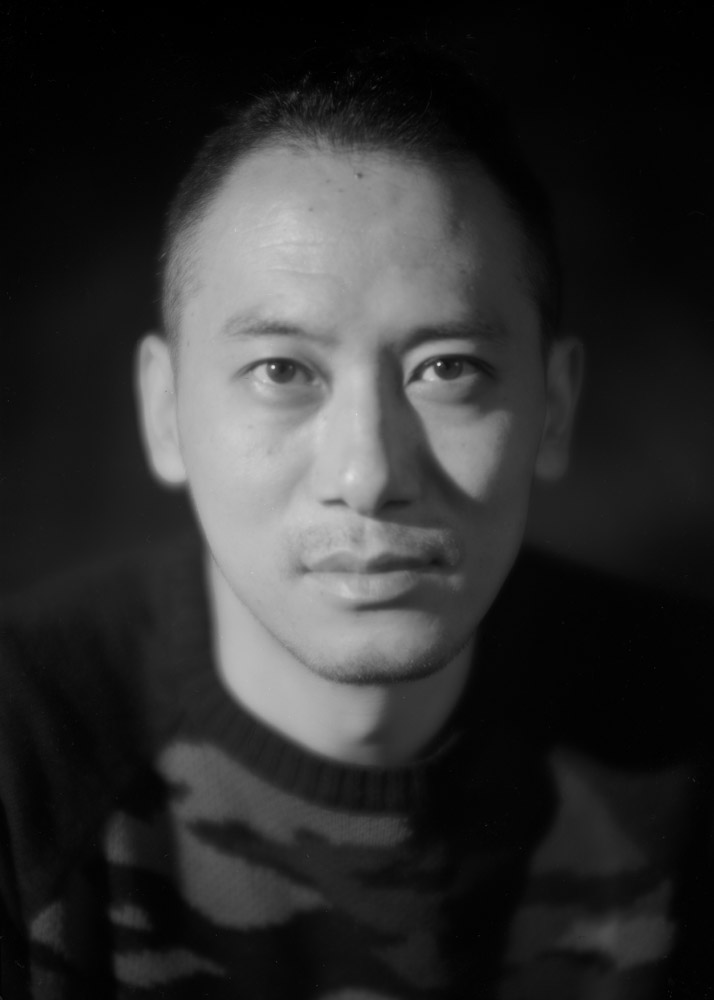
Five more from the shoot. Wanchuk is a fun subject because he always brings a creative energy to a shoot that brings out the best in both photographer and subject.
Wanchuk, T-shirtWanchuk, Profile“Girl With a Pearl Earring” Pose
I call that last one “Girl With a Pearl Earring” because the pose reminds me a bit of the Vermeer painting.
After doing a series of more serious poses, we decided to get a little funky and play around with faces and gestures.
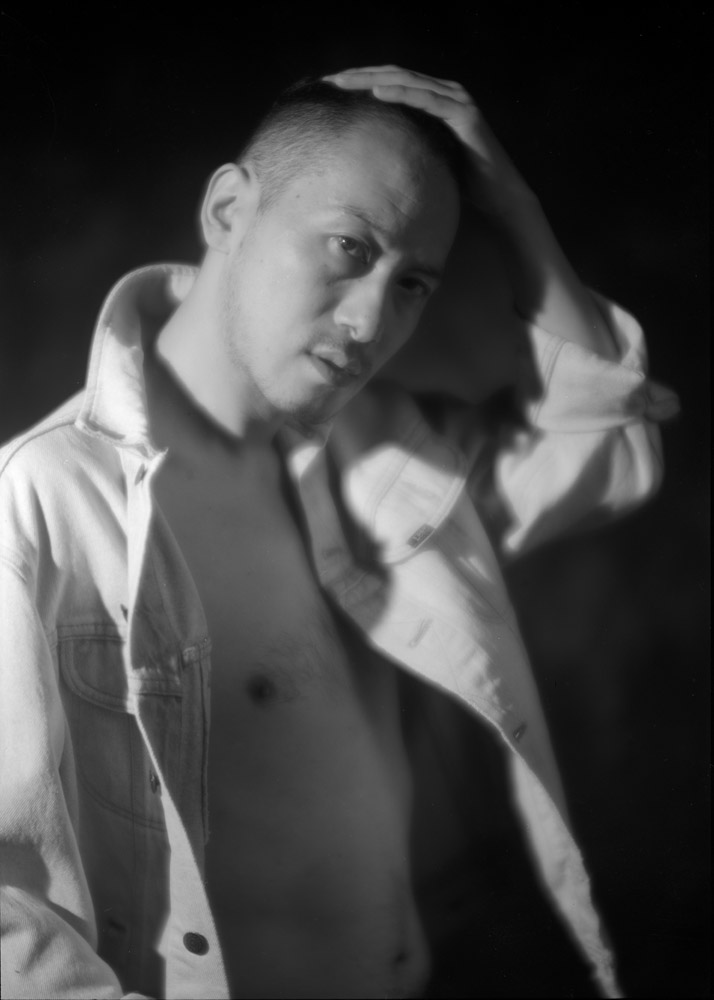
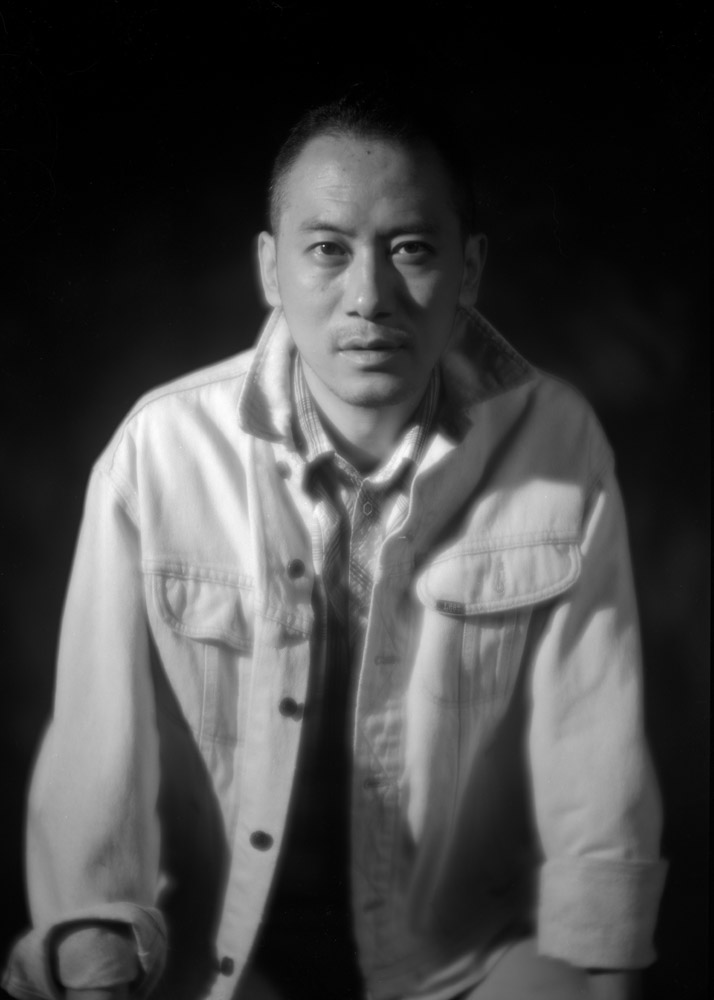
Wanchuk, Denim Jacket
This last one is not typical of what I’d expect someone to use a soft-focus lens to shoot, expression-wise. I think it works, in spite of or perhaps because of the contrast between the content and the image style.
I think I wrote previously about the Hermagis Eidoscope soft-focus portrait lens I have on loan. Here are some results from it. As the lens is on loan to me and not mine, I have not sent it off to have replacement waterhouse stops made for it. It was expensive enough modifying my camera to fit the lens – I don’t want to spend more money on accessories for a lens I’ll have to return. That said, as the only waterhouse stop I have for the lens is the wide-open f5 stop, that’s the only one I’ve been using. It’s not only the maximum amount of light but also the maximum soft-focus effect. I’ve been told that if you stop the Eidoscope down past f8, it becomes a much more regular, sharp lens. But this is what you want to see with this lens anyway – the soft-and-fuzzies.
Wanchuk, close-up
I know the lens is flattering to women – I did not know if it would be too much for male portraiture though. I think my example here bears out the fact that it works well for both genders. Here is another portrait of my friend Wanchuk, this time a half-length shot with a different outfit. The soft-focus glow is especially apparent in this image, with the bright denim jacket giving lots of flare around the cuffs of the sleeves.
Wanchuk, denim jacket
These were shot on Ilford FP4+, with the lighting being just one 1000w Fresnel tungsten lamp and a silver reflector. I bought a pair of these cheap Chinese knockoffs of ARRI fresnel lights ($125/ea as opposed to more like $600/ea for the ARRI lights) for the purpose of teaching my large format photography class. Since I had a need for something that would work without needing electronic synchronization (the Hermagis has no shutter, therefore no flash sync), I broke the fresnels out again for this lens test. Proof positive that you don’t have to have massive, fancy, expensive strobe lighting setups to create great portraits. That said, I wouldn’t try this with my 14×17 using hot lights – there’s just not enough light to be had without literally cooking both subject and photographer.
As I mentioned previously, the Hermagis Eidoscope does not have a shutter in addition to not having an iris diaphragm for the aperture control, so I used a pair of spare dark slides from an old 5×7 film holder, held in a V configuration, as the shutter. I was able to pull off a roughly 1/30th second shutter speed by keeping the gap between the dark slides relatively modest (about a 20 degree wedge). Eventually I’ll print these in platinum/palladium.
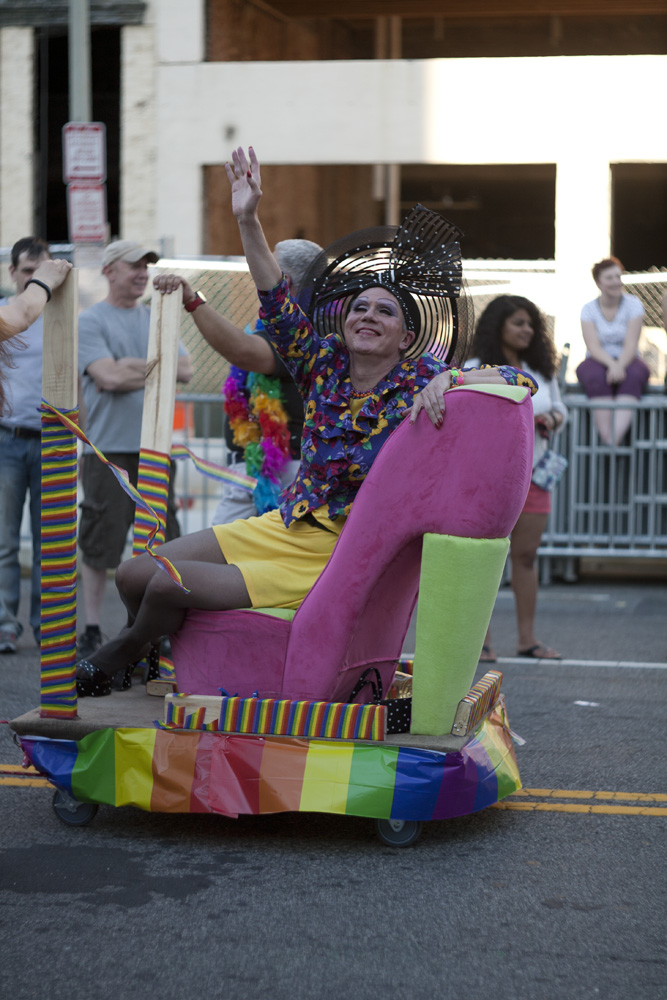
I completely forget what group this “float” was with. I’ll just call it “Riding in Style”. Who wouldn’t want a size 200 Jimmy Choo stiletto?
Riding in Style
One of the go-go dancers from Secrets, the all-male strip bar.
Dancer, Secrets
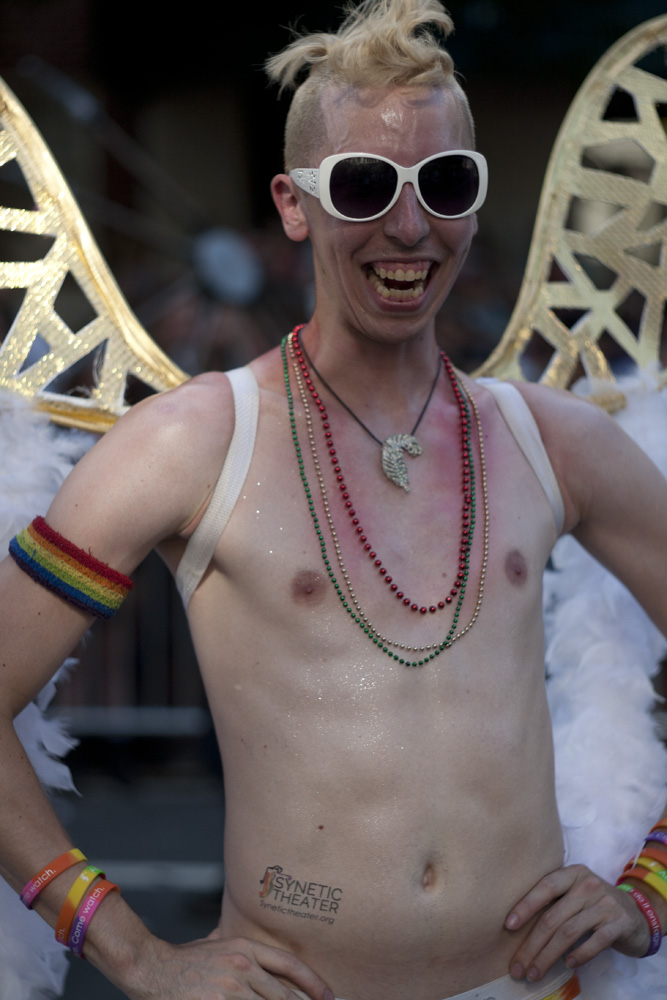
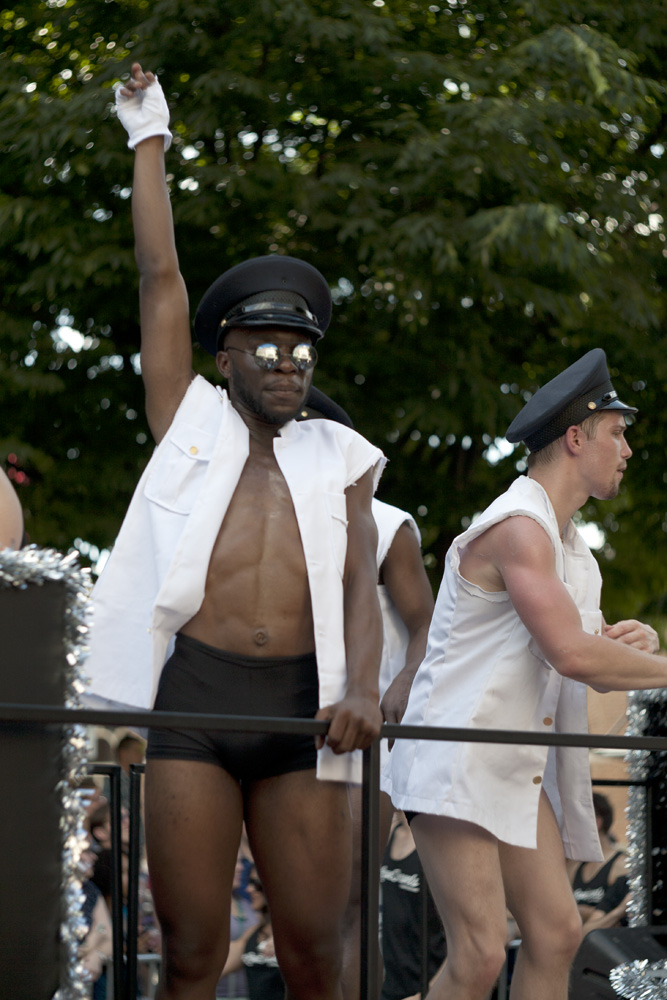
Synetic Theater company had a large contingent in the parade. I couldn’t tell if they were trying to show off their costume-making skills or if they were advertising a specific show. They were definitely showing off their bodies, though. Here are three for your consideration.
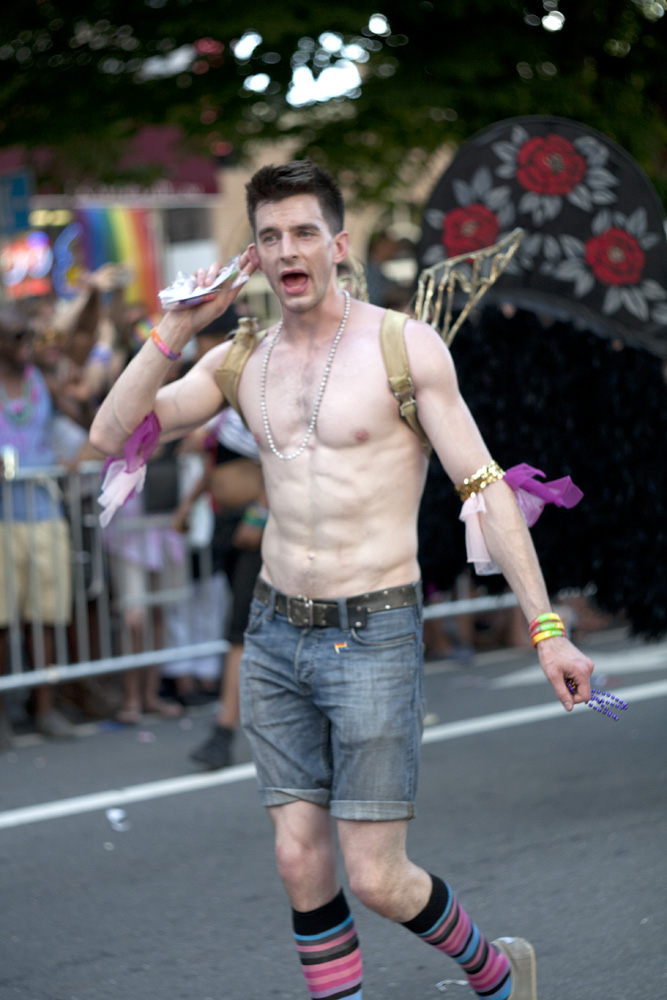
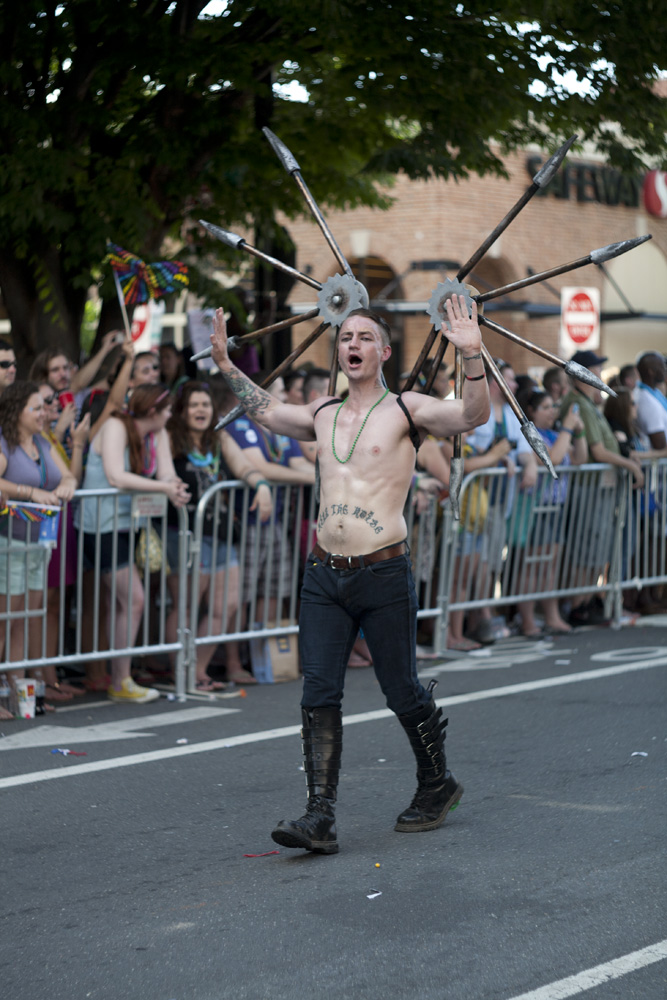
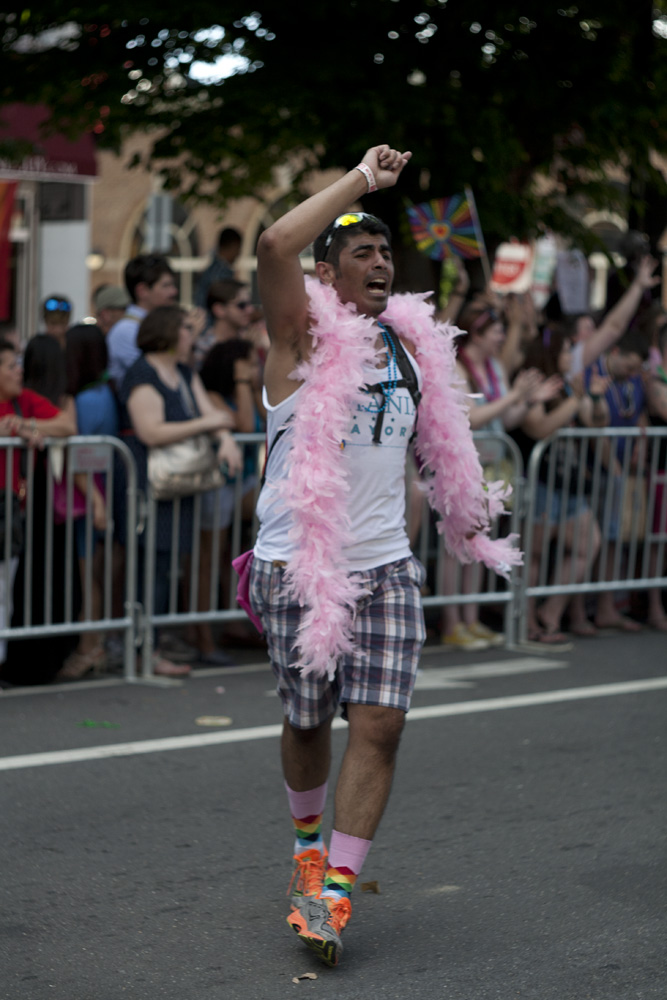
Another “I don’t know what contingent he is with” shot. But pink feather boas are a sure-fire attention getter.
Pink Feather Boa
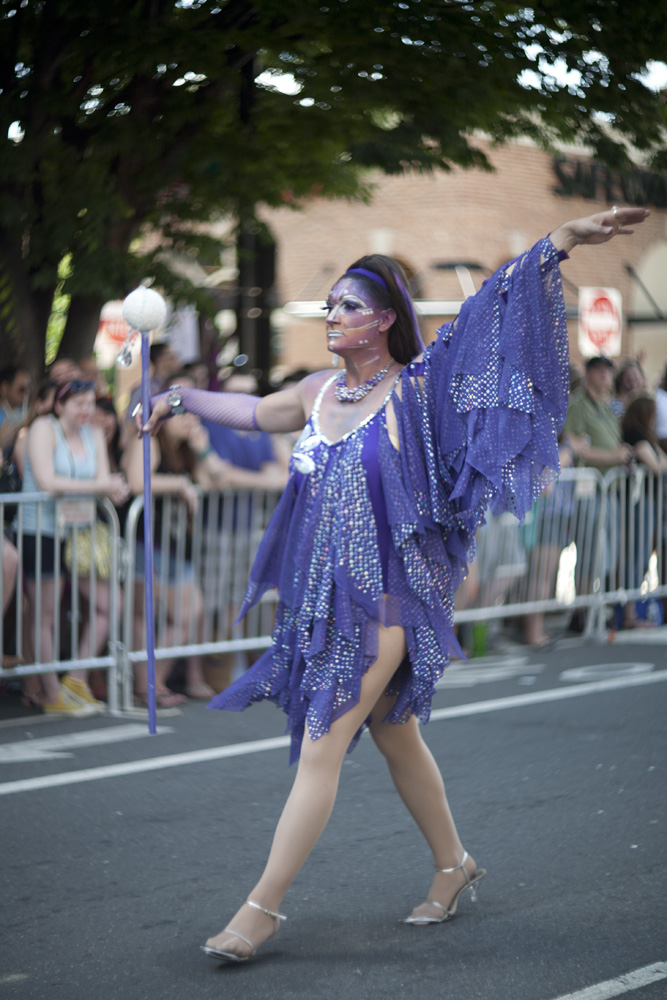
The majorette for DC Different Drummers, the gay marching band.
Majorette, Different Drummers
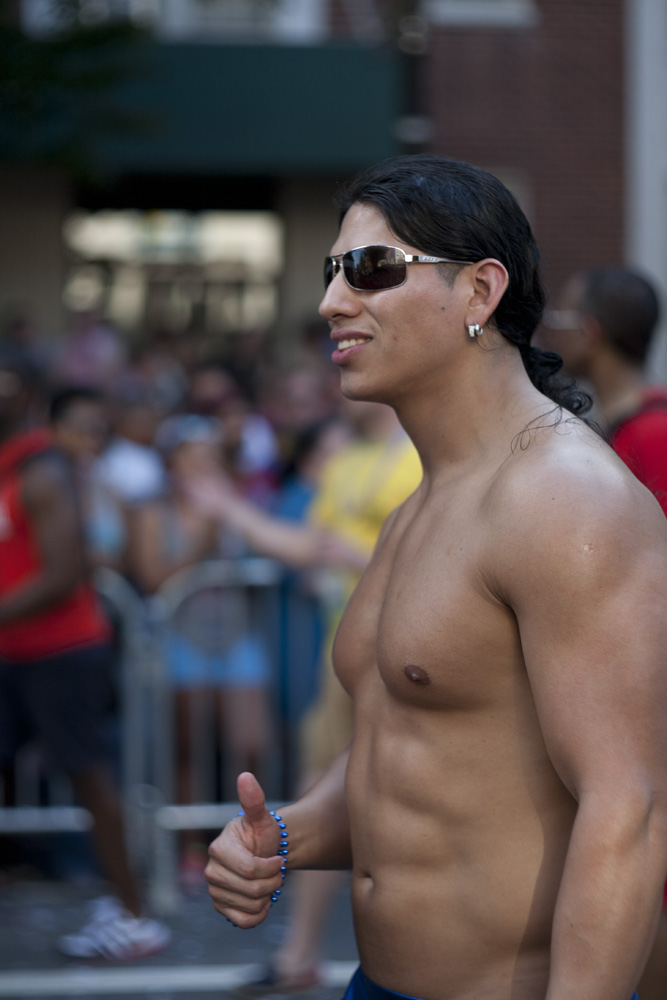
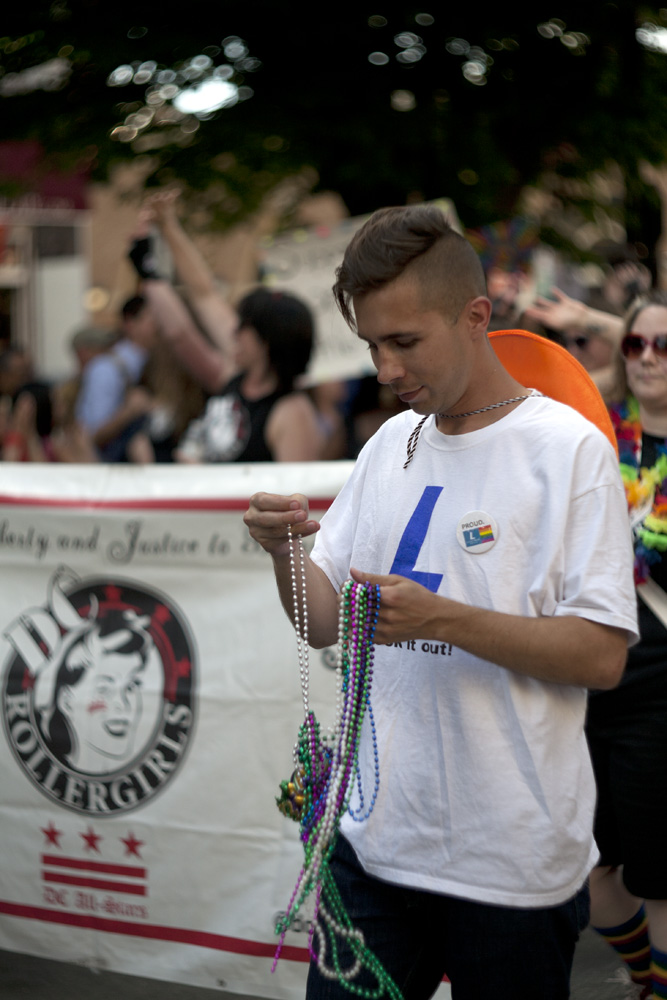
I think he was with the contingent in front of DC Rollergirls, the roller derby team, and not with them. Many of the political contingents were tossing out beads to the crowd, so he could have been with one of them. I thought he was cute, anyway.
Handing out Beads
I think this float was for an entertainment venue here in town. But it could have been part of the Whitman-Walker Clinic contingent. This confusion is understandable – fake cocktail glasses being carried on platters by guys in waiter-esque costumes doesn’t exactly scream “health screenings”.
Village People
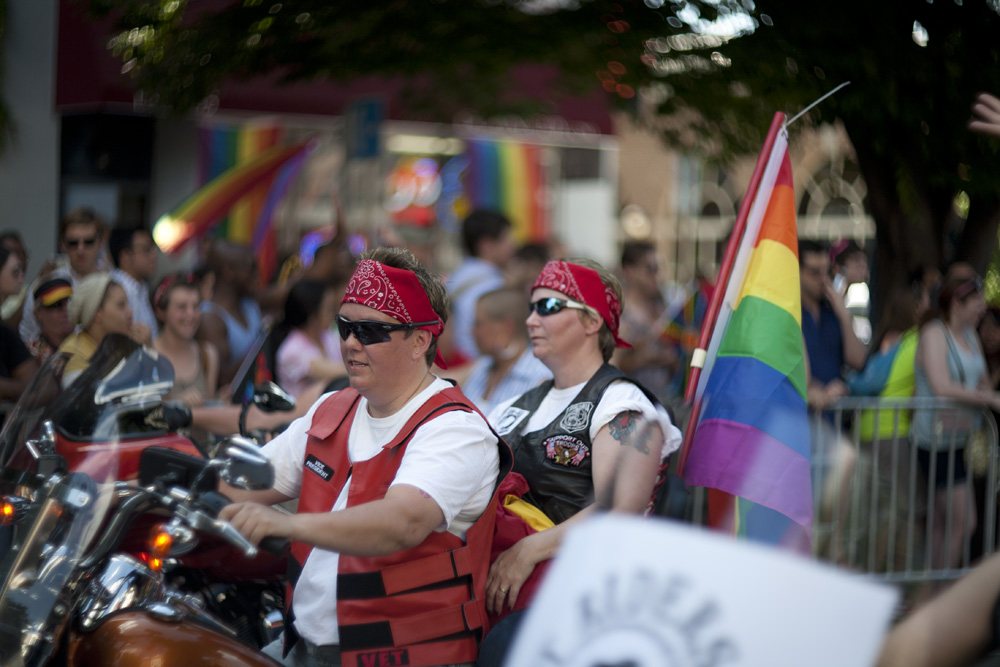
Aah, part of the perennial favorites at the parade, Dykes on Bikes. They’re always the lead-off contingent in the parade.
Dykes on Bikes
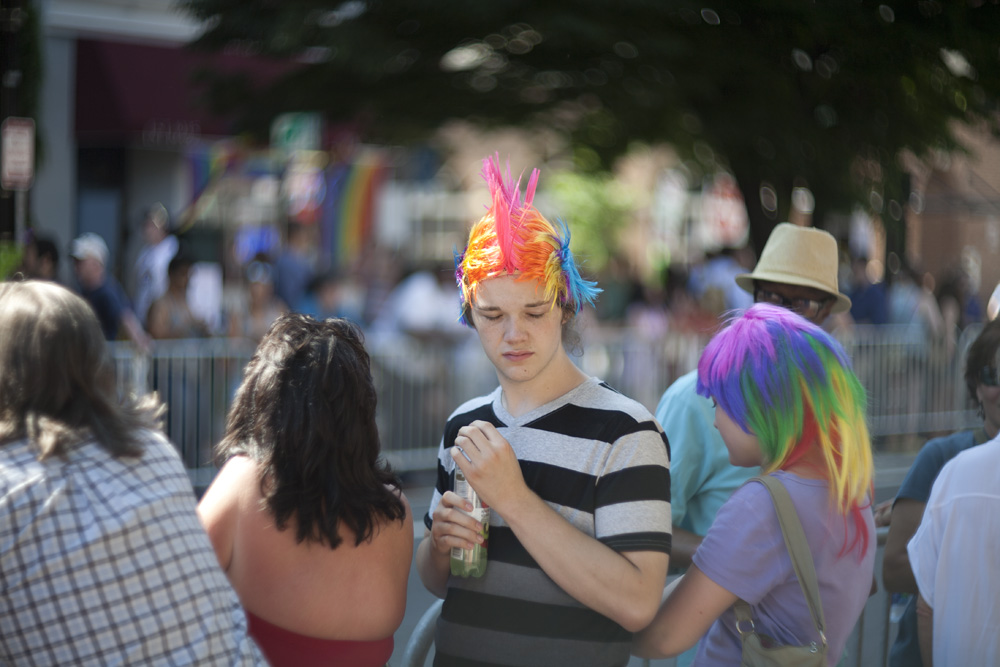
A young boy in a rainbow faux-hawk wig, watching the parade. Here is a shot that plays to the strength of that lens that I was talking about in the previous post. The background swirl really helps to concentrate focus on the boy’s face.
Youth Pride
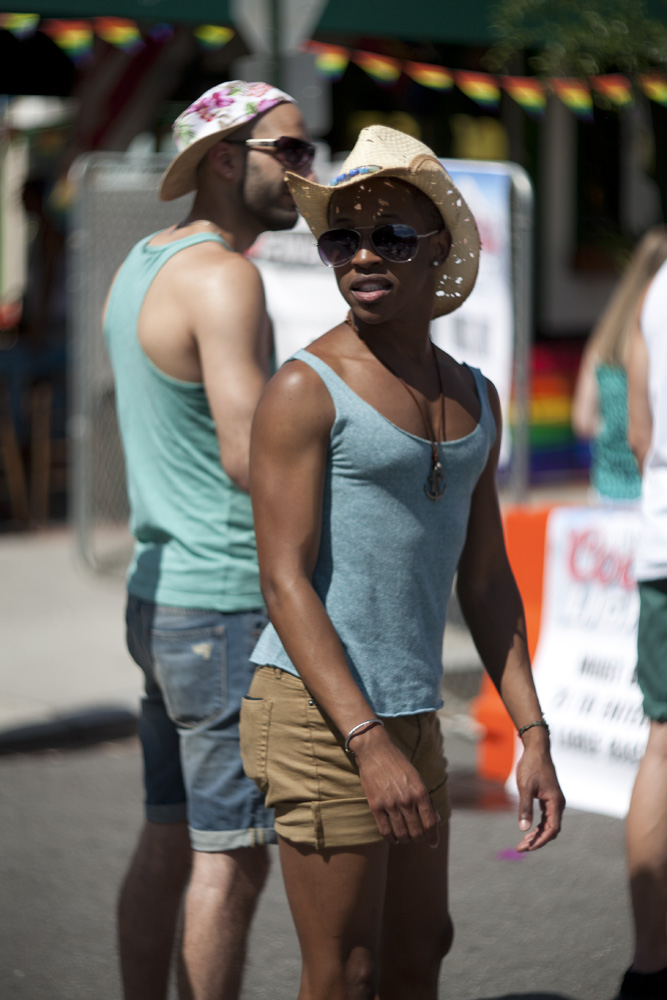
And finally, I close this one out with the cowboy (spiritual cowboy, anyway) in line for the JR’s bar outdoor beer garden.
Sorry for being a week late with posting these. Life gets in the way of blogging at times. If you remember the last time I photographed the parade, I gave myself a little project to shoot the whole thing with just one lens, the 135 f2 L lens for my Canon 5D. This year I did something similar, but with the 85mm Helios f1.5 Russian-made manual focus lens that I have for my Canon. The Helios has a rather unique character to its out-of-focus areas, which you’ll see quite clearly in these shots. The lens is an odd bird in today’s world in that it is a pre-set aperture lens. You focus wide-open, then turn a manual ring on the barrel to set the aperture to the one you have pre-selected before taking the picture. It’s a holdover from the days when lenses had no mechanical interaction with the camera beyond mounting to the body. The upside is that it makes it easy to adapt the lens to any camera. The downside is, you have to remember to re-set the aperture after focusing.
When the lens is properly focused, it gives a unique signature look – the subject is tack sharp, and really pops out from the background because the background has a “swirl” to it reminiscent of but not the same as you would get with a vintage Petzval-design lens. I chose this lens as my one-and-only for the day not only for the out-of-focus effect but also because it is a shorter lens, therefore a little more intimate than the 135. Take a look and let me know what you think.
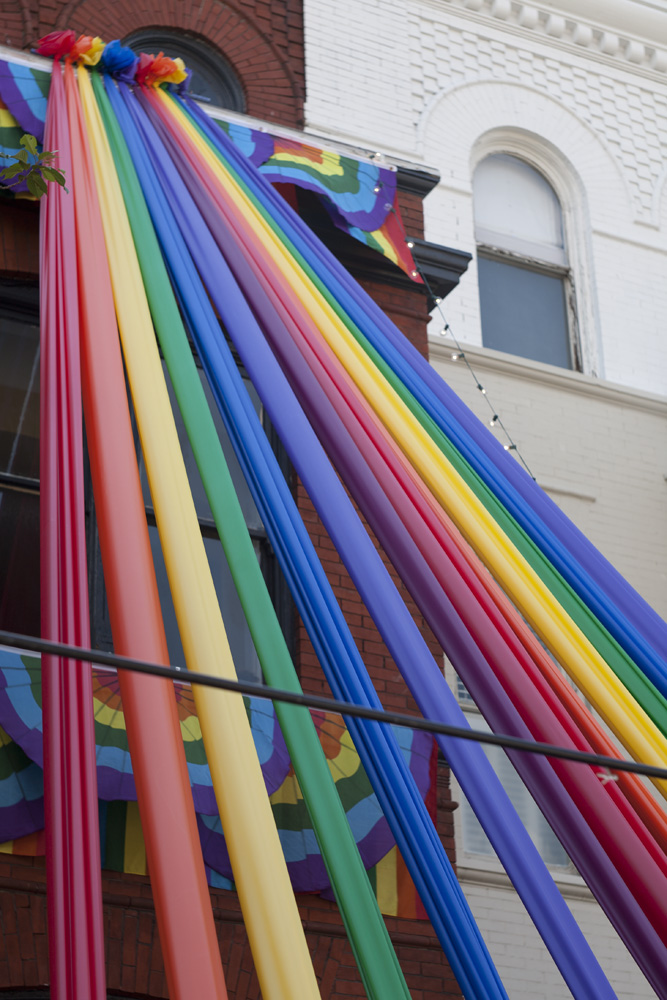
Rainbow Streamers, 17th Street
Politics:
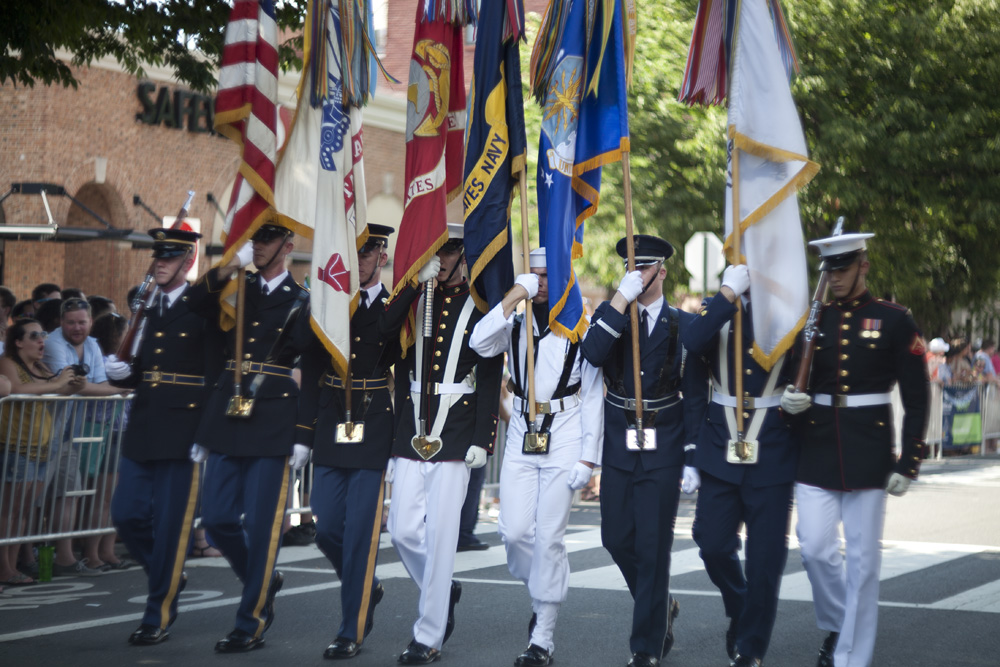
DC Pride would not be complete without a major political section. Actually, in some way, shape or form, most of the parade is political (especially if you include the religious groups that march under that heading). This year marks the first time an official US Military Color Guard contingent was able to march openly in the parade thanks to the end of Don’t Ask, Don’t Tell. Watching them march in the parade was a very emotional moment for many people.
US Military Color Guard
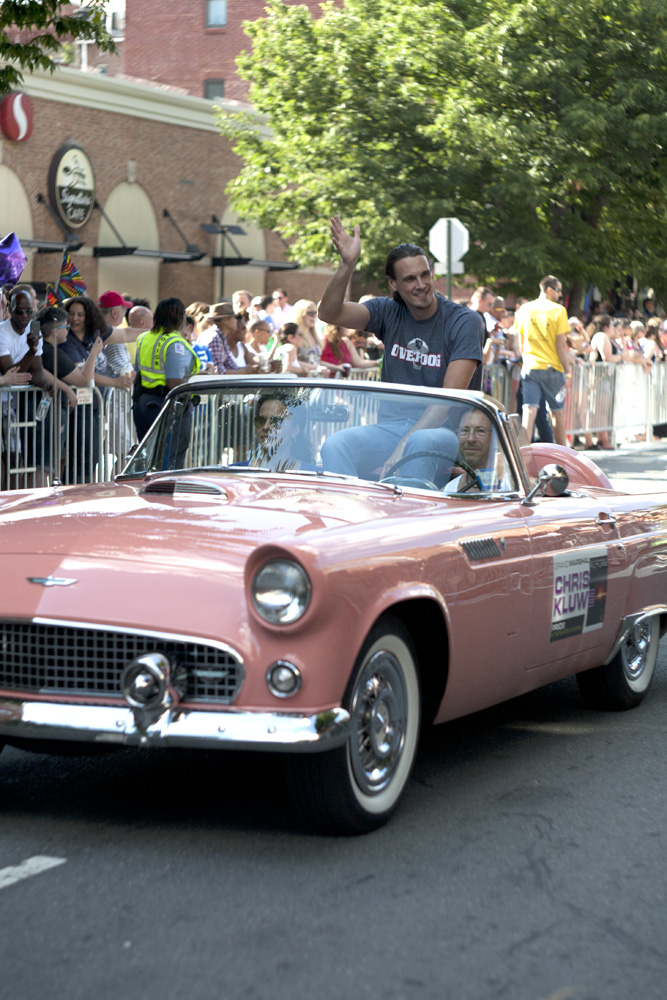
This year’s honorary grand marshall was Chris Kluwe, the straight former kicker for the Minnesota Vikings who took a very vocal pro-gay, pro- same-sex marriage stance, replete with some very memorable if not entirely polite turns of phrase. It was an extremely brave stance for him to take, and ultimately it cost him his job. He was honored for being a relentless ally.
Chris Kluwe, Grand Marshall
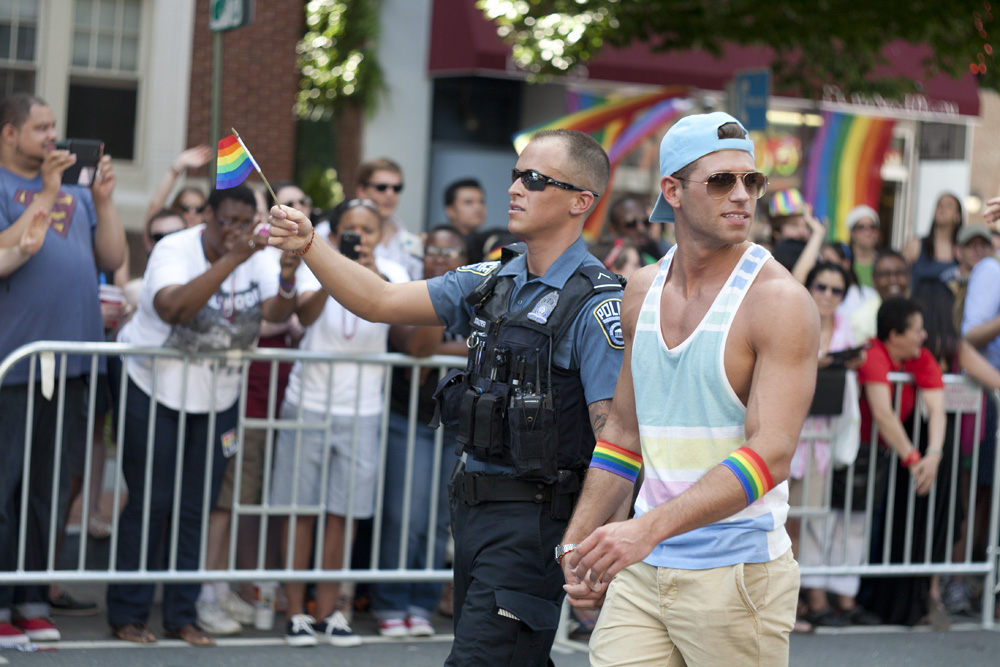
This couple marching in the parade with the police contingent showed up at the counter-protest to the Westboro Baptist Church looney-tunes protest of DC Pride, giving silent rebuke to the Westboro clan with a passionate kiss.
Police Officer Couple
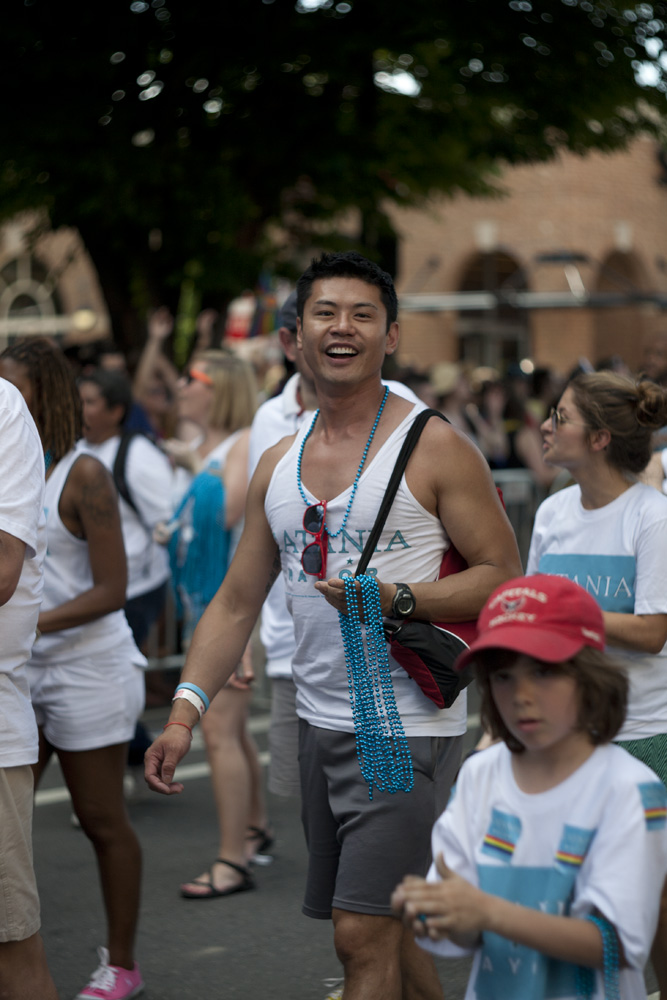
David Catania is running for DC Mayor as an independent. It is almost impossible to run for city-wide office anymore without participating in DC Pride – pretty much the entire city council was in the parade, and even several former-candidates who lost their primary elections had marching contingents.
David Catania Supporters
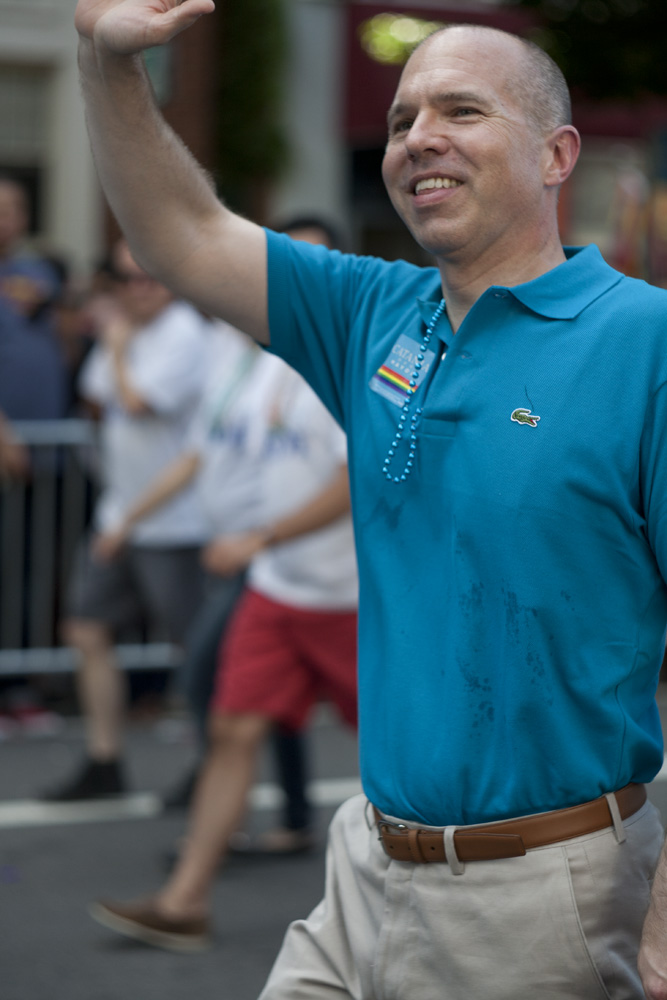
My apologies to David for this photo, but it’s not my fault that he’d been hit by a super-soaker prior to marching past where I was taking photos.
David Catania
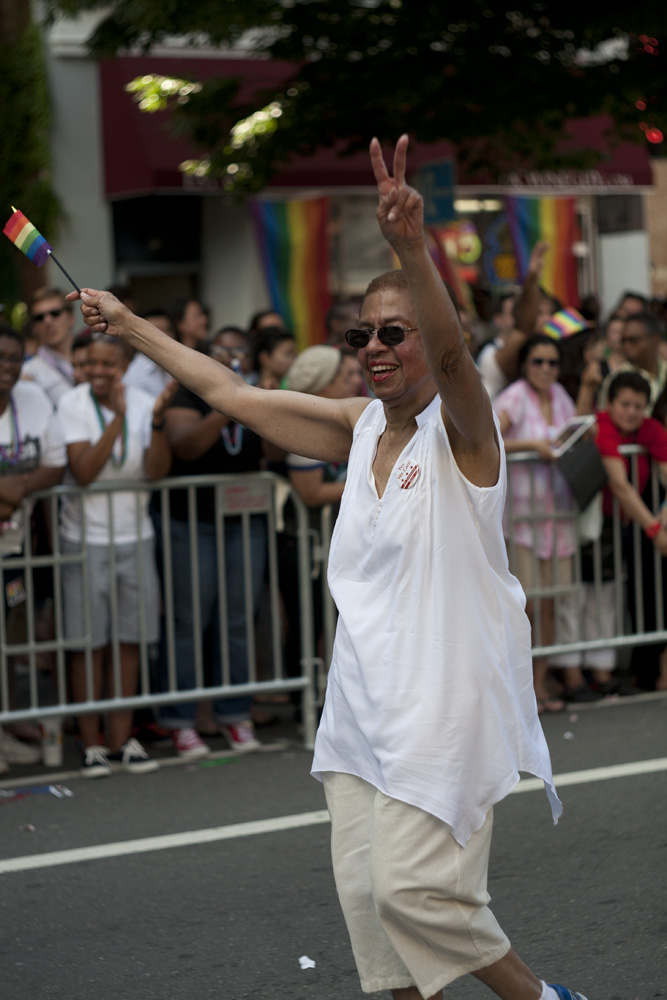
This is Eleanor Holmes Norton, DC’s Congressional Delegate. She sits in the US House of Representatives but does not have the same rights and authority that a full congressperson has because DC isn’t a state. She’s a regular at Pride, though – I don’t think I’ve been to a single Pride parade in the last 20 or so years that she hasn’t participated in.












 dcphotoartist