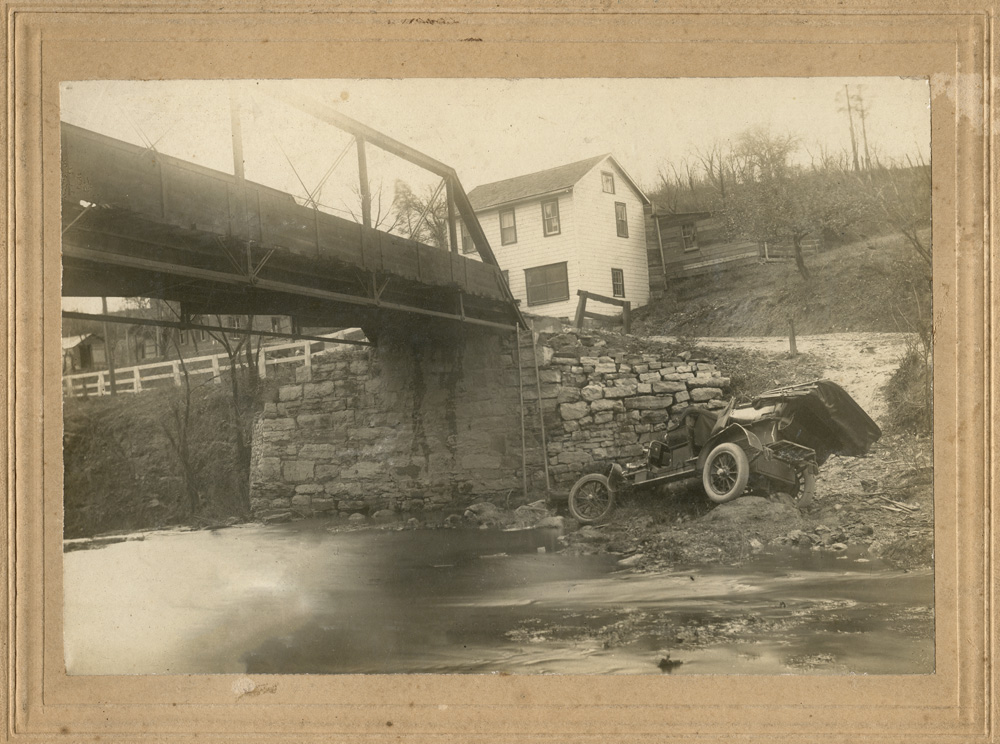
Here’s a photo I bought of an early car accident, circa 1905. I’ve done some modest restoration work on the image – there was some severe damage to the water under the bridge. It was a quick and dirty repair job, so it should be easy to spot, but I wanted to clean it up to make the image more readable and remove the distraction.
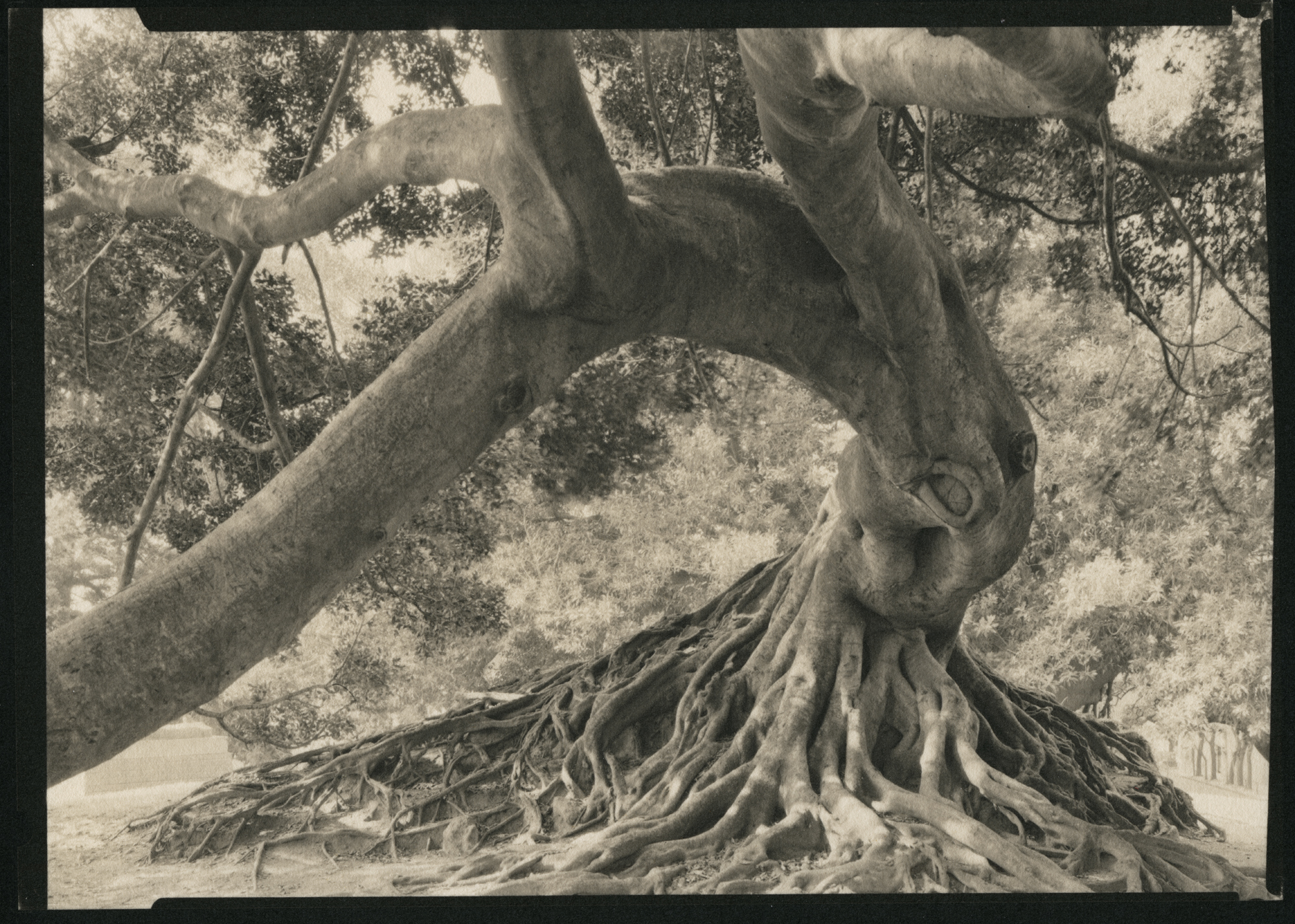
Well, the results were announced today, and my Ficus, Recoleta was awarded 2nd Prize in the contest overall. You can see the results here – April 2013 Issue, Rangefinder Magazine.
While there is no evidence that they were ever sexually intimate, some time after the war, General Elwell wrote to her that he loved her “all the law allows (and a little more perhaps)”. What exactly that meant remains the realm of speculation, as it is certainly cryptic by intent; General Elwell was a married man. Given that he was married at the time of his association with Clara Barton, this photograph becomes an act of bravery and defiance (or brazenness depending on your take of Victorian social mores), although perhaps it could have been passed off as innocent as Ms. Barton and General Elwell both served together in South Carolina at the assault on Fort Wagner, he with the Quartermaster’s Corps, she as a civilian nurse. Certainly at the time she was already famous, and he would have been so as well by the time the photo was taken in 1865, so it may have been at Mathew Brady’s urging that they posed together or it may have been of their own choosing.
Here is an image of General Elwell:
and Clara Barton:
And my photo for comparison: John J. Elwell and Clara Barton, Washington DC
here is a young couple who posed at Mathew Brady’s Washington DC studio. They must have been “somebodys” because Brady bothered to copyright the image. I’ve seen enough of his images to notice that the copyright notice is used inconsistently, which leads me to think it was either to protect specific images because of the subject matter, or it may have been time-delimited as a result of a copyright dispute between himself and Alexander Gardner arising out of Gardner’s work for Brady during the Civil War. I’ve noticed it most often on the Fairy Wedding images, but also on the Brady version of the Seth Kinman elkhorn chair (I don’t have the Brady version, just the Alex Gardner version, which has Gardner’s studio stamp on the back, but Seth Kinman’s copyright notice on the front. I don’t recall if the Brady one has Brady’s copyright or Kinman’s).
If any of you Civil War buffs or Victorian America historians recognize this couple, any information would be greatly appreciated.
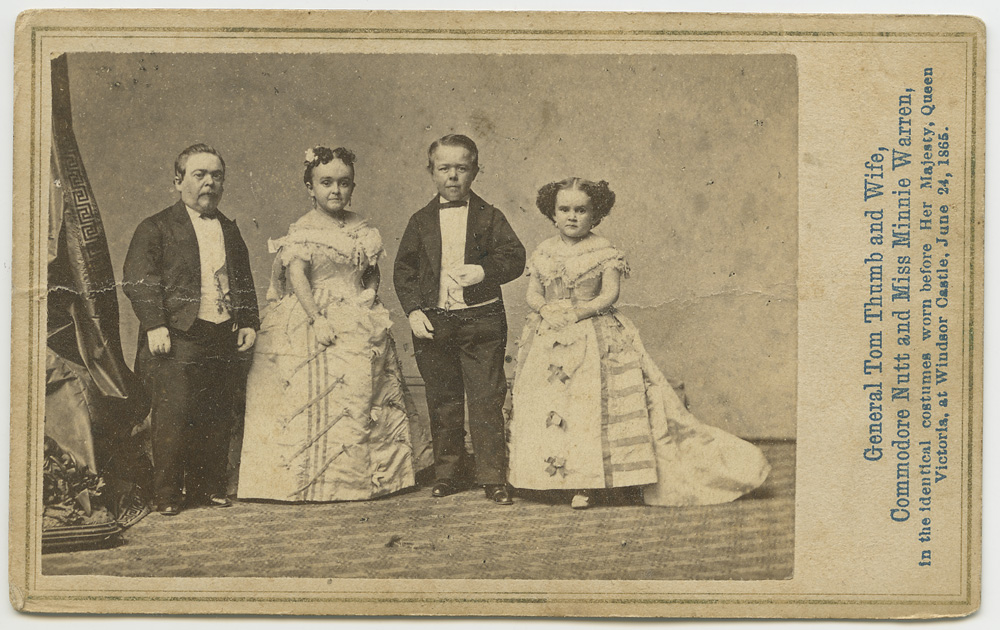
Here are the Thumbs, Commodore Nutt and Minnie Warren in the outfits they wore when presented to Queen Victoria and Prince Albert. Given that the image was produced by E&HT Anthony, in all likelihood it was taken by Mathew Brady in New York upon their return to the US after meeting the Queen. The verso contains the usual “Compliments of …” facsimile signatures of the four subjects. This probably was commissioned by P.T. Barnum to sell at his American Museum.
The Thumbs, Commodore Nutt and Minnie Warren, as presented to the Queen
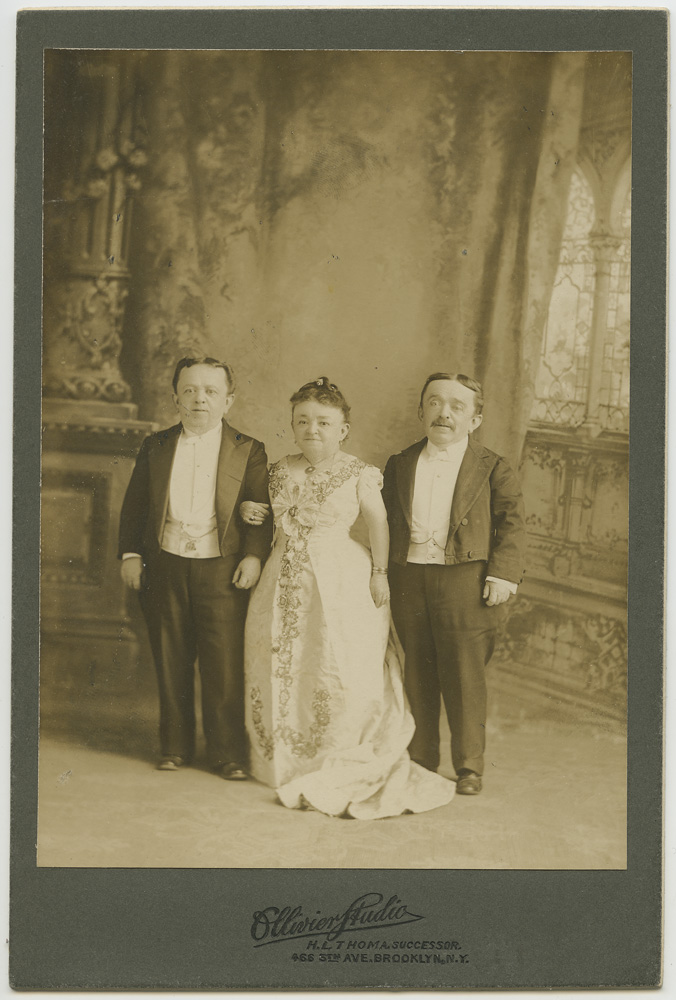
Lavinia Warren Stratton Magri and the Magri Brothers, by Ollivier
Another cabinet card of Lavinia Warren Stratton Magri and the Magri brothers, Baron Littlefinger and Count Rosebud. I don’t know why I find them so fascinating, but they are. Just the notion of the cult of celebrity going back that far when we think of it as being a modern (at least a 20th century) thing.
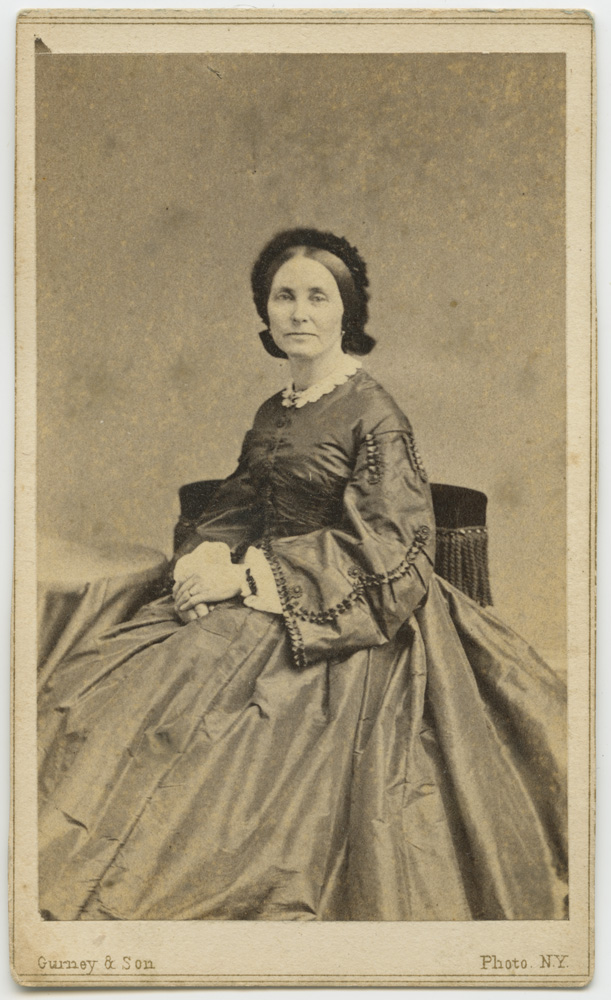
Two new additions to the collection, and what may well be a collecting coup – a potentially previously unknown image of Harriet Beecher Stowe, by Gurney of New York. Harriet Beecher Stowe
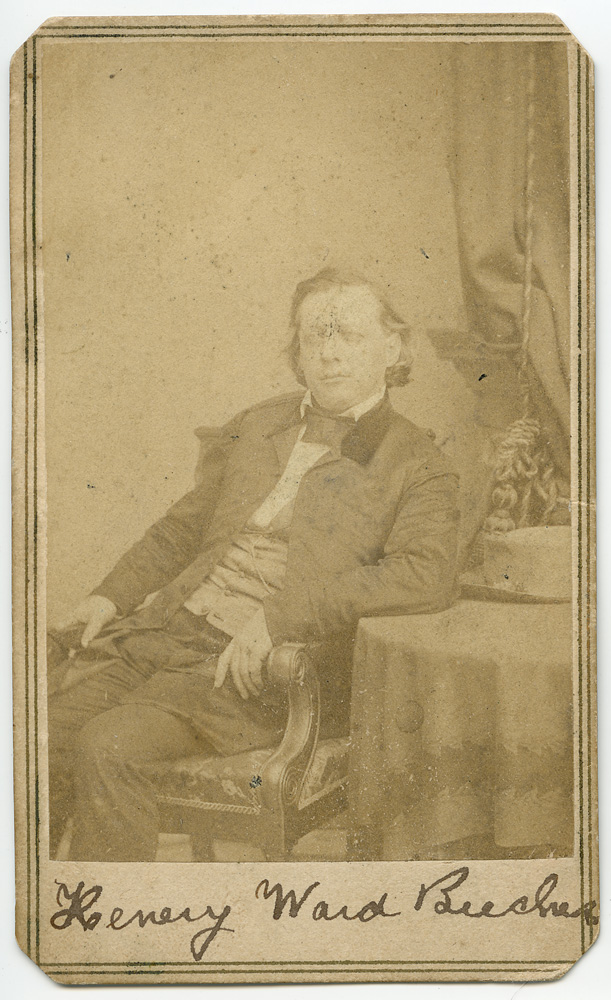
For those unfamiliar with who Harriet Beecher Stowe was, she was the daughter of a deeply intellectual preacher and abolitionist, Lyman Beecher. Her brother, Henry Ward Beecher, would become a leading figure in the abolition movement of his own, and a major intellectual light in Victorian-era America.Henry Ward Beecher, from the New York Times
Even though Henry was an oratorical and political powerhouse in his day, famous (or infamous, depending on your Union or Confederate sympathies), Harriet Beecher Stowe eclipsed him in his fame as a result of a book she wrote, “Uncle Tom’s Cabin”.
It is reported that upon being introduced to Harriet Beecher Stowe in 1862, Abraham Lincoln fondly commented she was “the little woman who wrote the book that started this great war.”
Although President Lincoln’s comment was certainly made in jest, in truth, Stowe’s novel was indeed instrumental in awakening the abolitionist cause, which was a major factor in turning a nation against itself for four arduous years.
Here is a photo of Henry and Harriet together, from Wikipedia-
This photo of Henry Ward Beecher, my other acquisition in this pair, is one by Mathew Brady, published by E&HT Anthony and as such is a common image in average condition.
Henry Ward Beecher, by Brady
Acquiring this image of Harriet Beecher Stowe in many ways closes a circle for me as I now have a face to go with the book, of which I own a rather tatty copy of the 1852 first printing of the first British edition of the book.
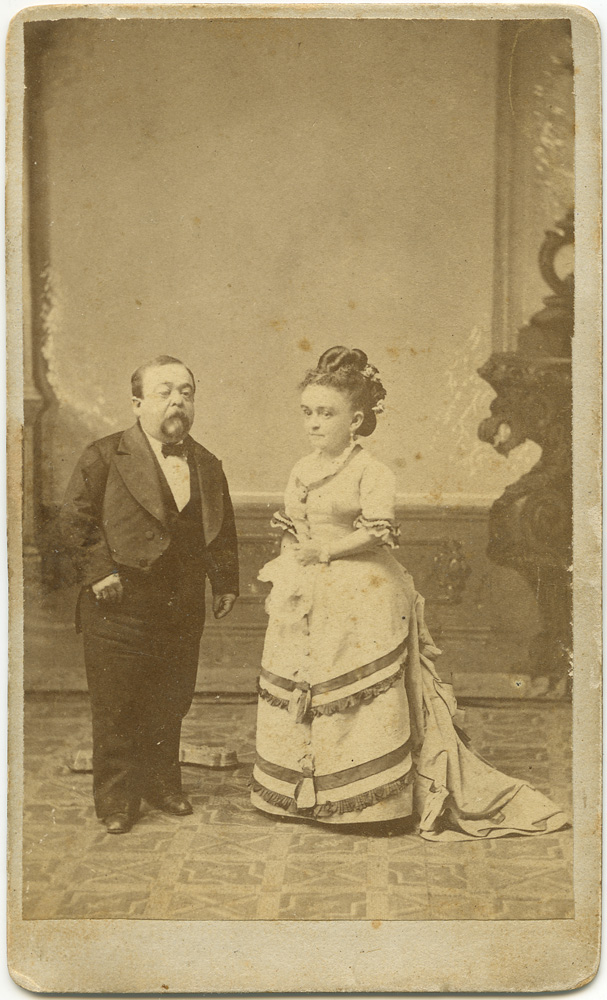
I bet you didn’t realize what paparazzi-junkies the Thumbs were. Charles Stratton and Lavinia Warren were frequently photographed, throughout their life. I don’t know if they profited from the sale of their photographs or not – I would hope they did, but given the general state of intellectual property ethics in the later half of the 19th century, I highly doubt it. Often the photographers themselves didn’t, as others would buy one copy of their image, re-photograph it and sell it themselves at a cheaper price!
Anonymous CDV, The Thumbs, at middle age
Here they are, at middle age, in an anonymous CDV. I think this may be a copy of someone else’s photo, although if it is it’s a very good one, because it has no photographer’s stamp on the verso (and because it is such a good image, it strikes me as odd that there is no stamp taking credit).
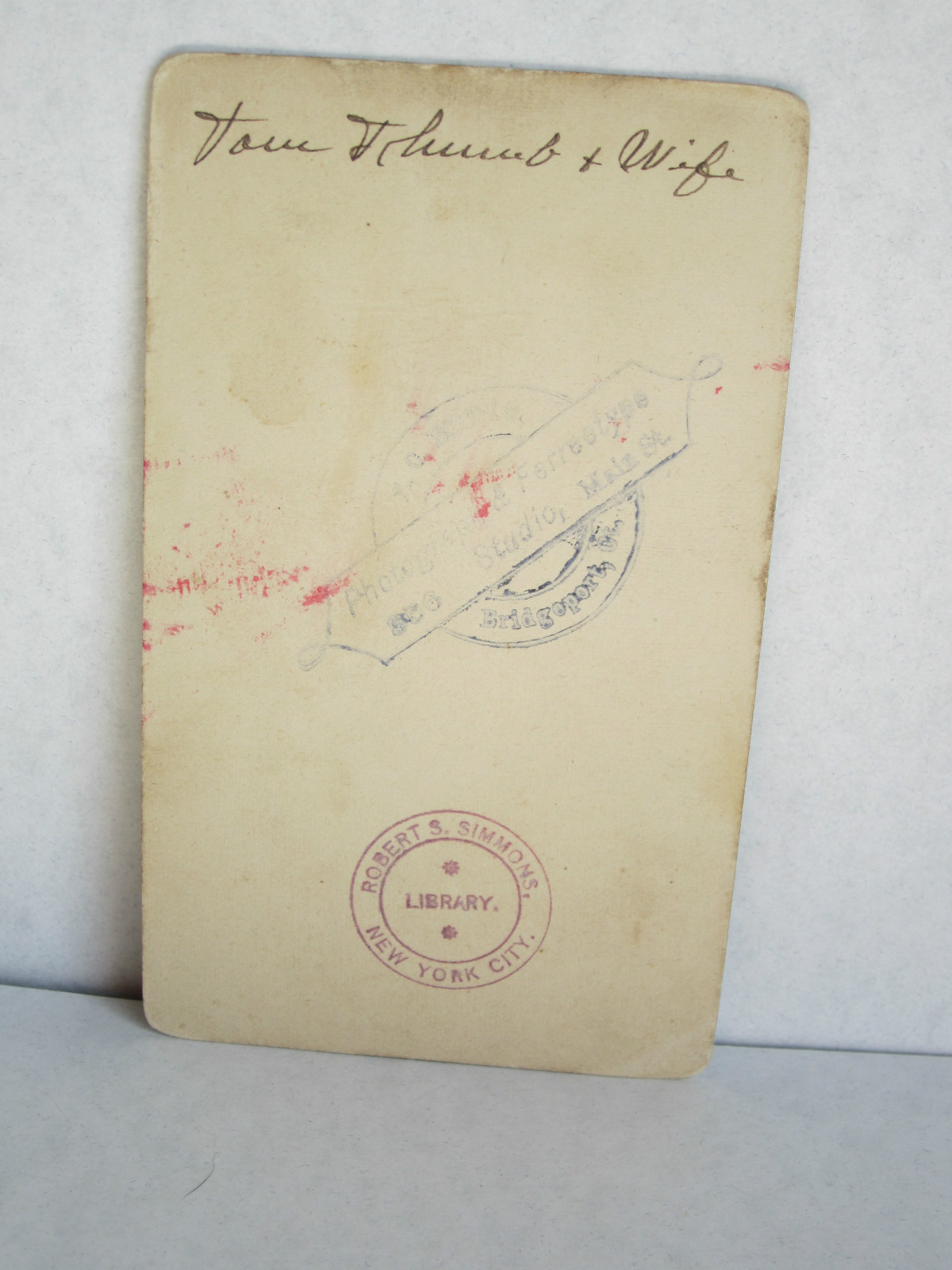
In doing some more digging around, I found another copy of the same image. This one had a stamp on the bac from the photographer – a K(?).C. ????, Photographs and Ferrotypes, ??? Main Street, Bridgeport, CT. The Thumbs resided in Connecticut in their later years, so this is entirely reasonable.
Verso, Tom Thumb & Lavinia Warren, Bridgeport, CT
Also, the blotchy mottling at the margins of the image is present in both copies, so I assume it is actually in the original negative, which is a relief.
Regular readers of my blog will probably remember the notice I posted last year about Katherine Thayer’s passing. Katherine was a tremendous gum bichromate printer and an extremely generous teacher of the process. Lightbox gallery in Astoria, Oregon is organizing a commemorative exhibit and has put out a call for entries for the show (link above).
To reprint the notice on the LightBox web page,
LIGHTBOX PHOTOGRAPHIC GALLERY CALL FOR ENTRIES
Two Friends Who Never Met
An Exhibit of Gum Bichromate Prints
In Memory and in Honor of Katharine Thayer
featuring the work of Katharine Thayer and Diana Bloomfield
with a juried exhibit of Gum Bichromate Prints
Juror – Diana Bloomfield Diana’s bio
We welcome you to share in the beauty of the hand-made print, and specifically, the gum bichromate print,
with a juried exhibit as part of this memoriam for Katherine.
This exhibit serves to illuminate Katharine’s artistry— her admiration for, dedication to, and mastery of gum printing.
This exhibit also celebrates her legacy and her years-long friendship with Diana.
I had a mental picture of the kind of photograph I wanted to make. I had never seen any photographs like them, but I was determined to find a way to make them, these pictures I saw in my head. Their colors were soft and relatively unsaturated, but with a kind of glow about them . . . I set out first to teach myself to print in gum, then to adapt the method to produce the kinds of pictures I wanted to make, and have been making them ever since – Katharine Thayer – katharinethayer.com
Katherine Thayer was a long-time resident of Oregon and a masterful gum bichromate printer. She was also a generous teacher to those who struggled to learn this ultimately rewarding, yet often challenging, 19th century printing process. In Katharine’s words, “learning gum printing involves some trial and error, and there’s no short cut to mastery; a person successful in mastering the process will have some staying power and possess a sense of humor and some tolerance for failure.”
Katharine was also a decades-long member of “The List” , an Alternative Process listserv— a free and open online discussion list related to all things ‘alternative’ in the photographic printing world. For Katharine, of course, this meant gum printing. Currently, over 600 people world-wide are members of this List, and this is where Diana Bloomfield, a native North Carolinian, photographer and printer, first met Katharine. In the middle of teaching herself to make gum prints, Diana gleaned invaluable bits of information from those on the List, but she learned the most from Katharine and from her website (KatharineThayer.com). In the midst of all the questions, and in-between Katharine’s tireless mentoring, the two became good friends. They corresponded via email almost daily, and they were once in a group pinhole exhibit together in the Seattle area. Diana was also in a group exhibit at LightBox, where Katharine was a frequent visitor. Still, they never met.





 dcphotoartist