I’m having an opening reception for my exhibit, “The Colors of Night” on Friday, August 2, from 7-10pm at Mad Momos Restaurant, 3605 14th Street NW. The exhibit runs from August 2 to the end of October.
From the Mad Momos invite:
Mad Momos is proud to present photographs by DC area photographer, Scott Davis. Please join us for the opening reception to enjoy the photos, meet the photogrpaher and sip on complimentary California Champagne.
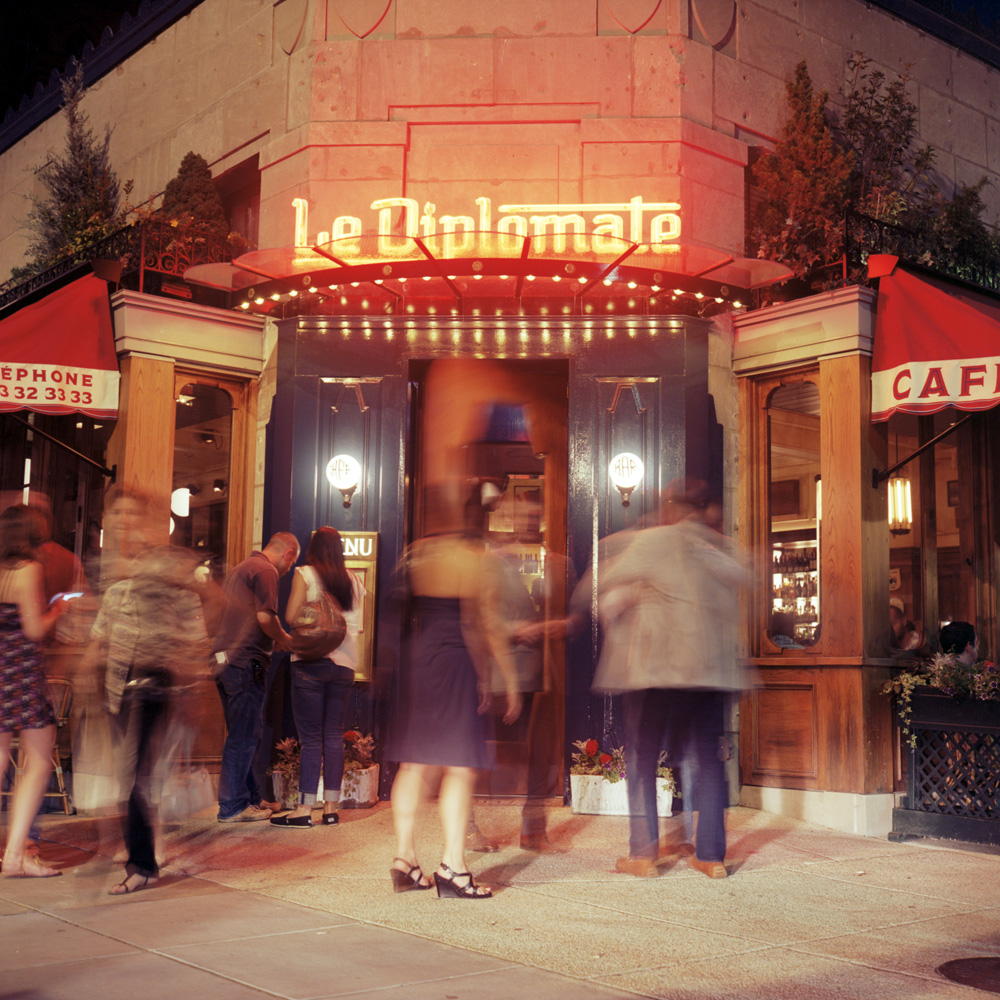
What is the color of night? It is indigo, it is fluorescent cyan, it is neon reds, yellows and blues. It is sodium-vapor pink, and glowing incandescent orange. It is all of the above, filled in with the colors of your imagination. It is the color of time slowed down, motion blurred, things and people half-seen through their background, perceptions distorted.
Le Diplomate
I have been shooting a lot of night-time work both in black-and-white and color, for several years now. Photographing long exposures at night gives you a creative freedom to accept serendipitous happenstance in your work that you would reject if caught in 1/60th of a second. Blurred motion becomes a good thing. People become icons. Cars are ghostly, their tail lights and headlights reduced to abstractions and records of things that were, like handwriting on paper. Colors become incredibly rich and even more important, since sometimes it is only by color that you can define and understand an object. The mixed lighting you find in a photograph of a night scene changes our perception of mood in a way you aren’t aware of when you are there – your brain color-corrects light sources automatically so things look “right”, but capturing them on film, which can only record what’s actually there without interpretation, reminds us that we do in a manner of fashion walk through the world with rose-colored glasses.
Here are some color shots I took on my neighborhood walk around, last weekend. I noticed a theme of small businesses in the shots I was taking, so I decided to make a grouping out of them for this post. The areas I was photographing are actually very bustling and vibrant, but A: this was on a Sunday afternoon, and B: it was about 93 degrees Farenheit outside, so it looks far more desolate than it actually is, but that allowed me to focus on the appearances of the businesses themselves. My interest in photographing them without people is not to portray an economic state that may or may not be true, but rather the overall feel of small businesses that are in a neighborhood in transition – these are businesses, mostly minority-owned, that have not yet been gentrified in an area experiencing rapid gentrification.
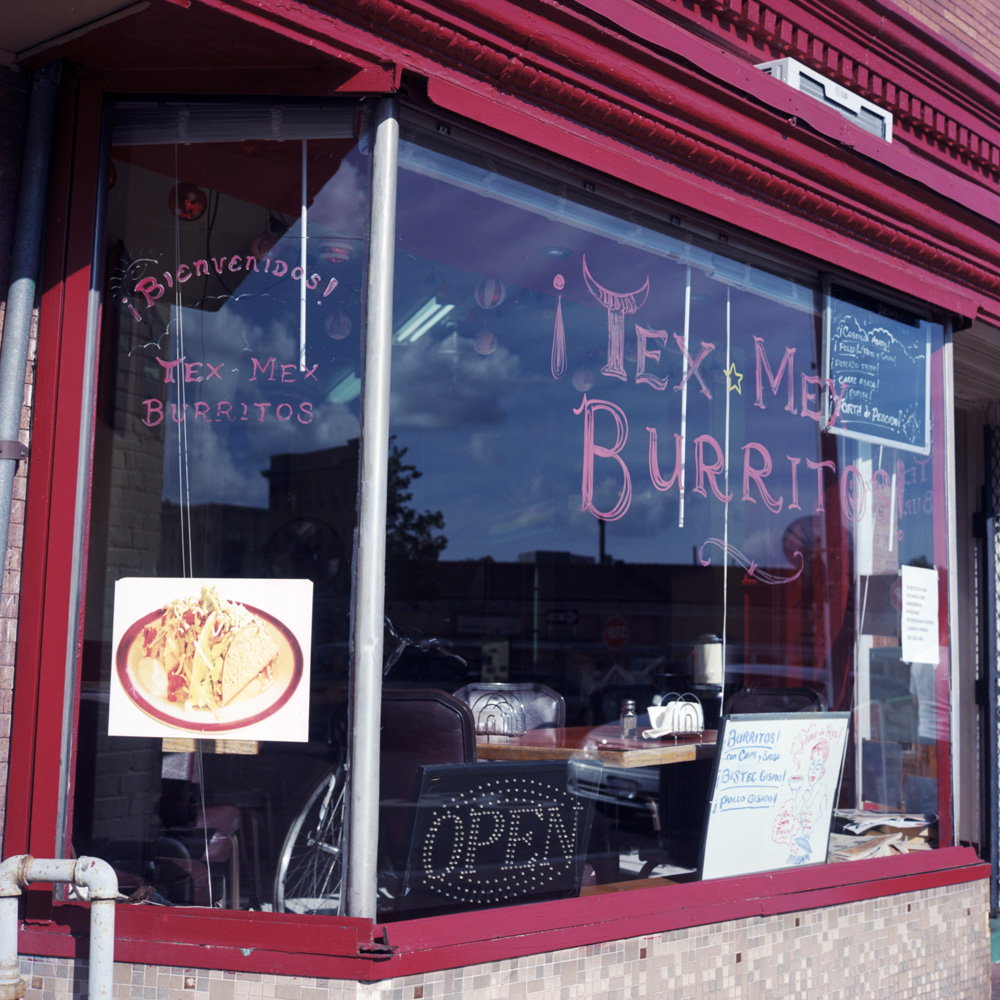
To me, the loss of these businesses to gentrification is the biggest downside to the process. They are what makes up the character of the neighborhood, and why all those gentrifiers moved there in the first place. I will be very sad when Tex-Mex Burritos is displaced for yet another Chipotle.
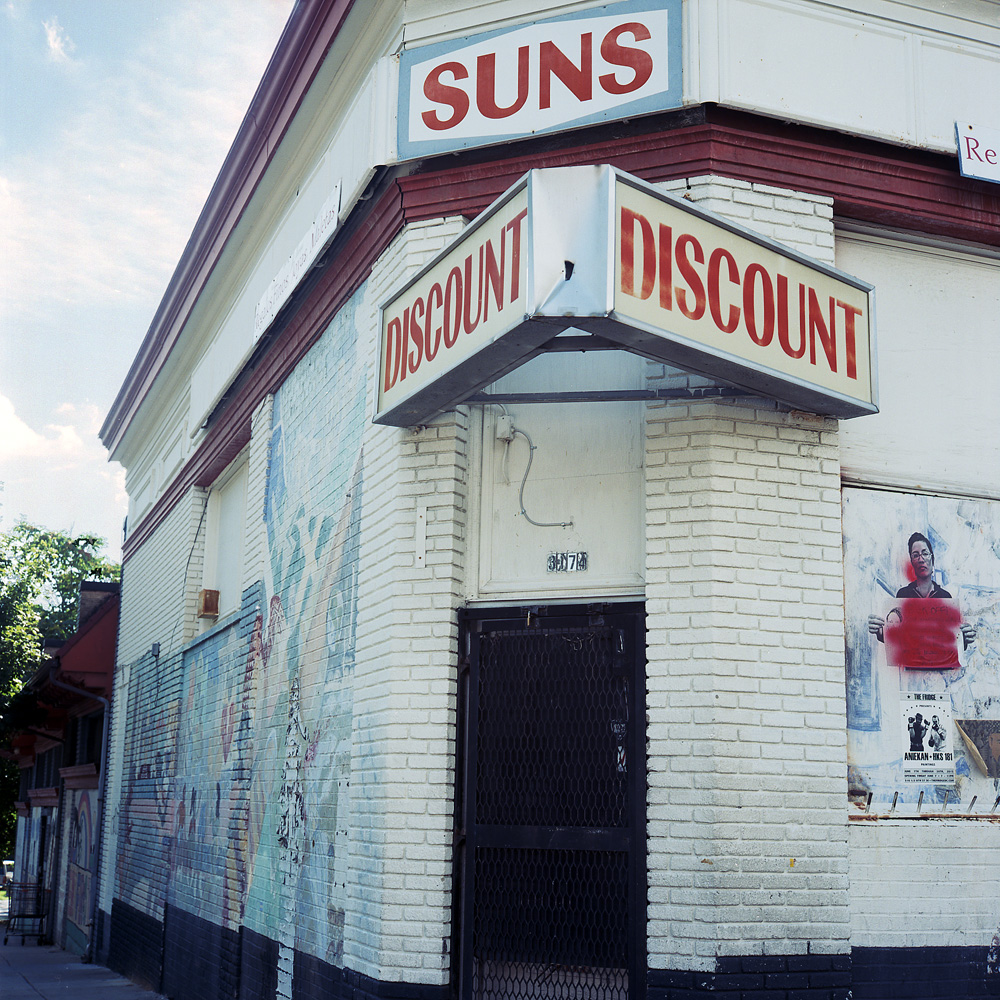
Suns Discount
Sun’s Discount is obviously shuttered. I don’t know how big a space it is on the inside, or what kind of (probably insane) rent the landlord is asking for, but I love the murals on the wall and the protest/message posters plastered on the whitewashed windows. It reflects the character of the neighborhood, and particularly its past – the small ethnic “discount” store that would have carried a hodge-podge of inexpensive products, primarily catering to the Latino community, which has adopted the small business strip along Mount Pleasant Street. Historically a mixed race, upper-middle class neighborhood, after the 1968 Martin Luther King riots, the neighborhood experienced a significant turnover and transformed into a poor Latino barrio in the 1970s. It is in the process of changing back into a largely white, upper-middle class neighborhood, as the housing stock off the business district consists of large, elegant rowhomes and single familys that are being snatched up, fixed up and turned into two and three unit condos.
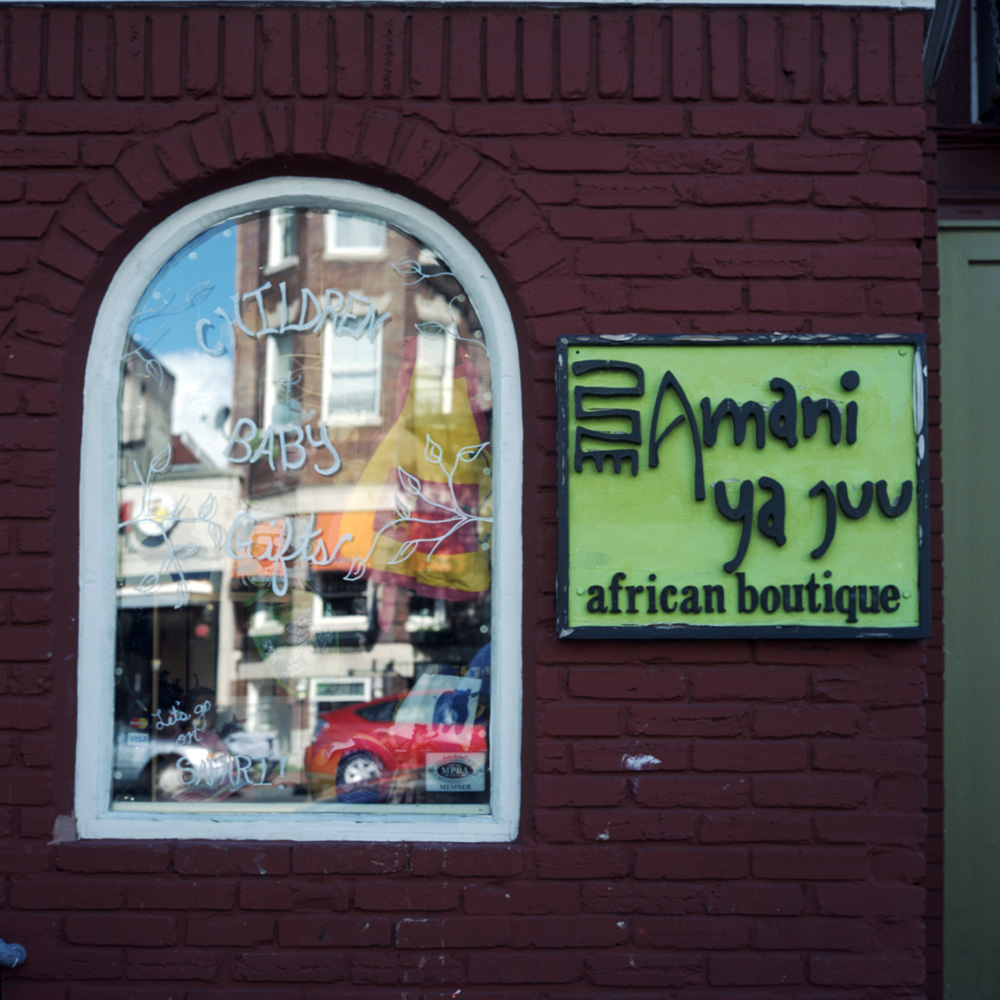
Amani African Boutique
There is still an African-American presence in the neighborhood – a touch of soul remains amidst the sazón. The neighborhood was always multi-ethnic, but the blend has changed over the years.
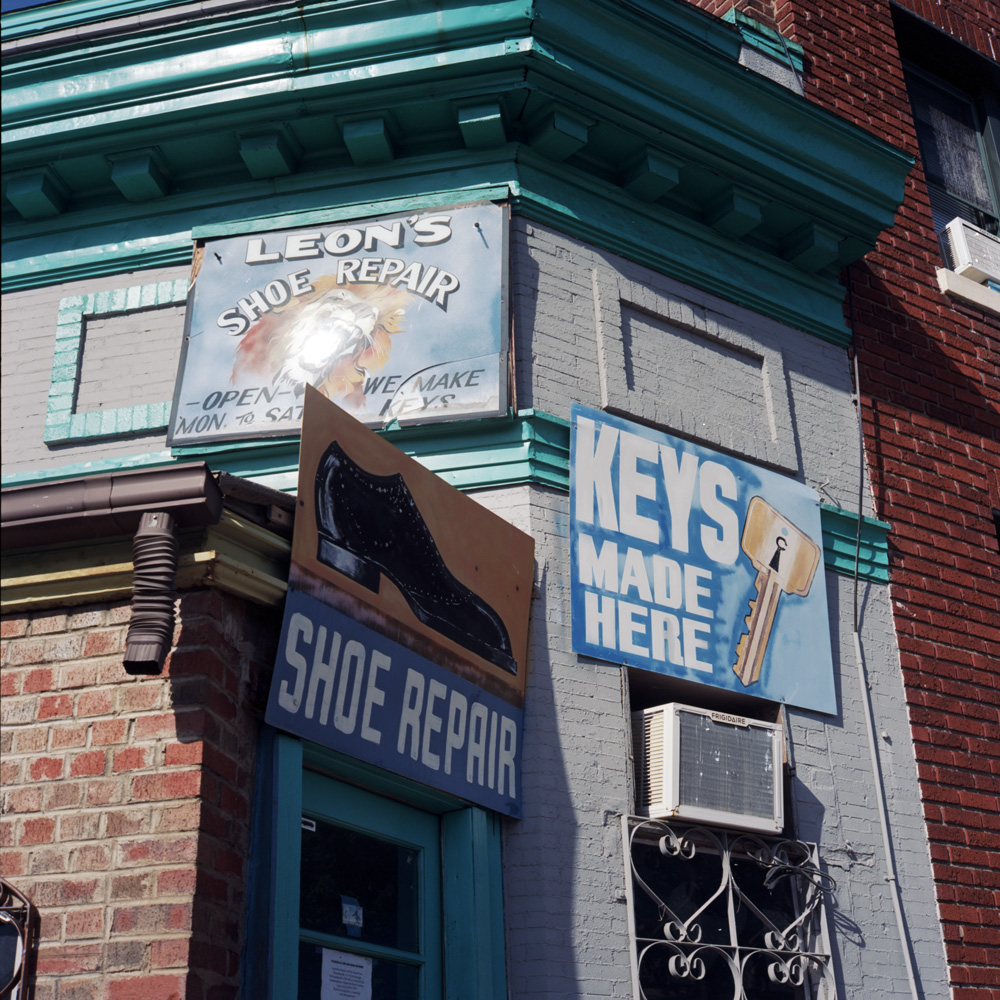
Leons Shoe Repair
Another one of those small businesses that when a real estate developer sets their sights on the block will be one of the first to go. Leon’s operates out of a space not much bigger than a coat closet. In the land of big-box stores and franchises, there’s no room for a 200-sq ft retail operation. And signage like that would never fly in a homogenized shopping mall.
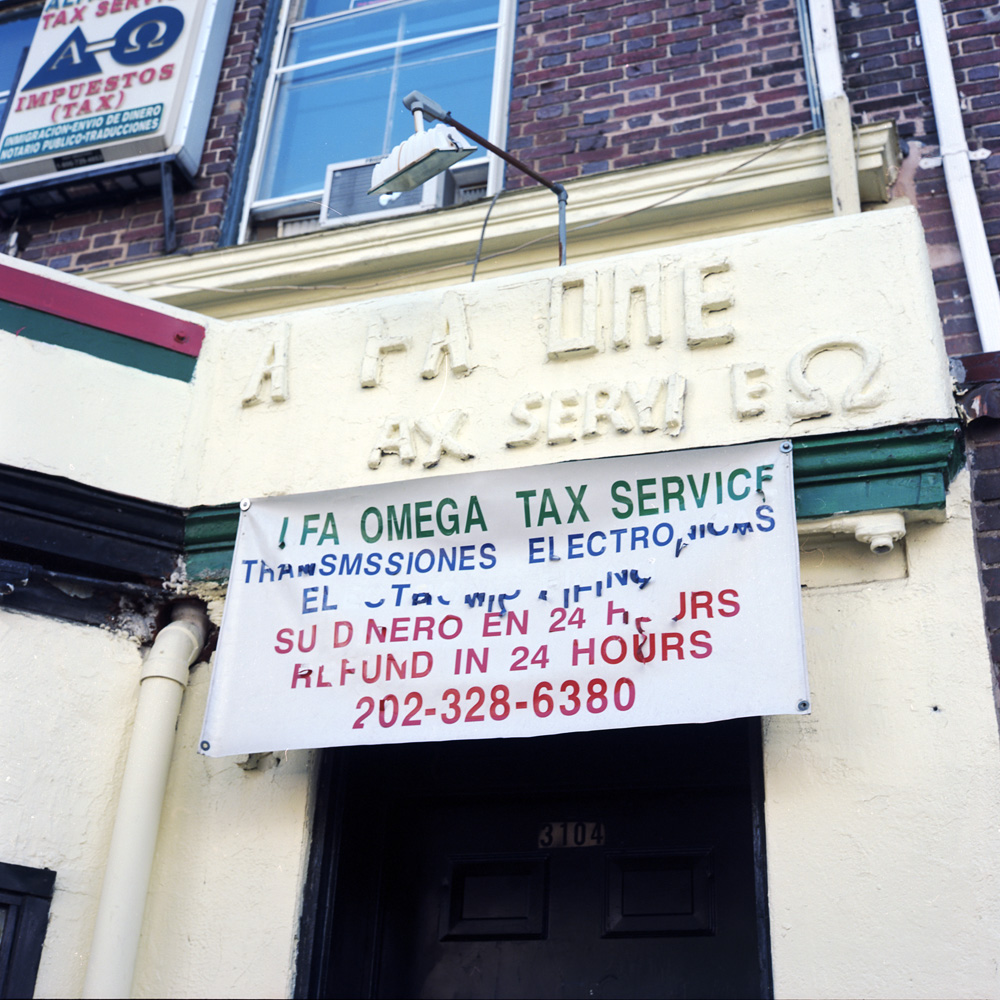
Alfa Omega Tax Services
Here’s one that has been around for decades – witness the missing letters and the layers of paint applied to the original Alfa Omega Tax Service on the wall. Having them there in the 1970s and 80s when this was one of the police patrol beats officers dreaded to be assigned would have been a huge deal to the residents, as there would have been few legitimate businesses willing to provide quality services of any kind in the area.
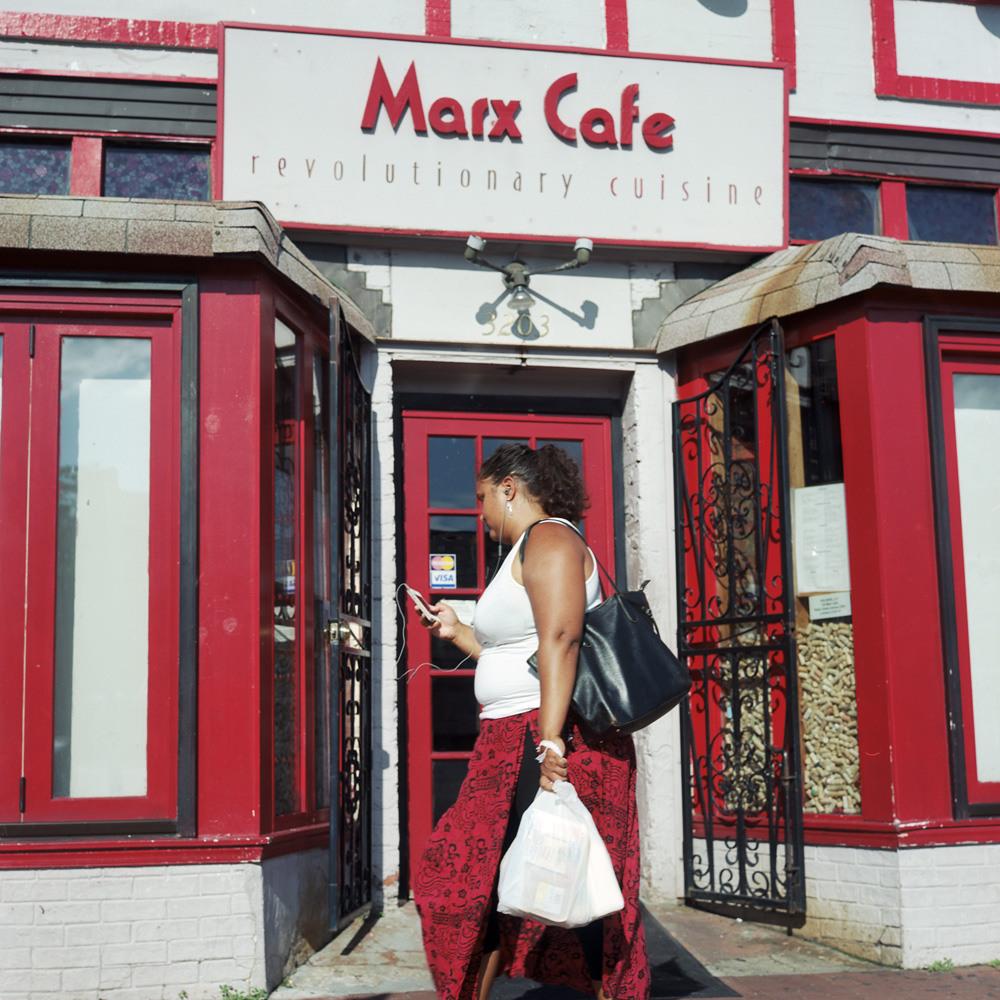
Marx Cafe
The bohemian precursor to gentrification – Marx Cafe (“Revolutionary Cuisine”) brought a little touch of culture and chic.
Tex-Mex Burritos
A typical neighborhood mom-and-pop eatery. This one is newer, keeping within the theme of the neighborhood but brightened up and appealing to the incoming Anglos as well as the long-time residents.
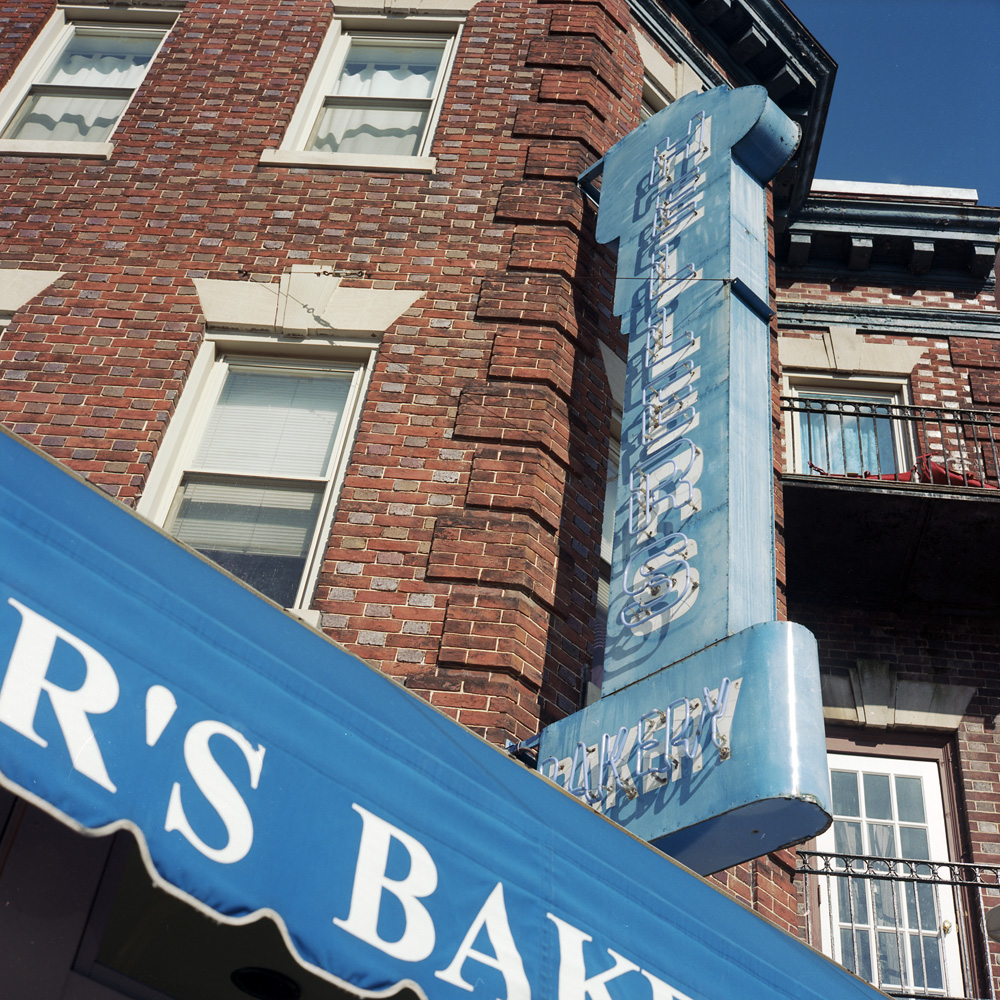
Hellers Bakery
Heller’s Bakery has been here forever, witness the neon sign, from back when the neighborhood was originally an upper-middle-class, white/jewish/African-American neighborhood. It stuck around through the hard times. If you saw the movie, State of Play, starring Russell Crowe, you’ll recognize this as being from outside his apartment.
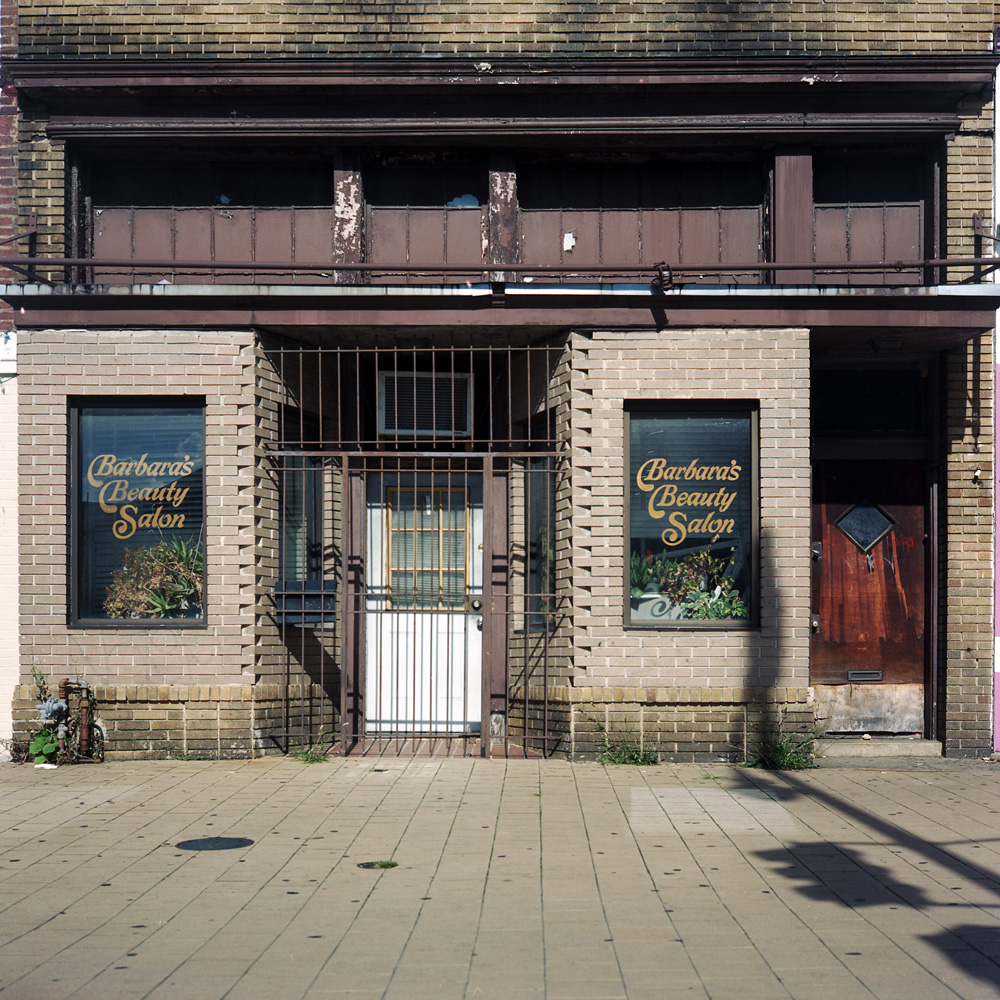
Barbaras Beauty Salon
I’m not sure Barbara’s is still in business – granted I usually never walk by it during the work day mid-week, so it might in fact operate then, but whenever I see it, it’s shuttered, blinds pulled, and half-dead plants in the window. I don’t know if they were a victim of shifting demographics, or just sloppy management – I don’t know that I’d want to trust what little hair I have left to someone whose plants look like that!
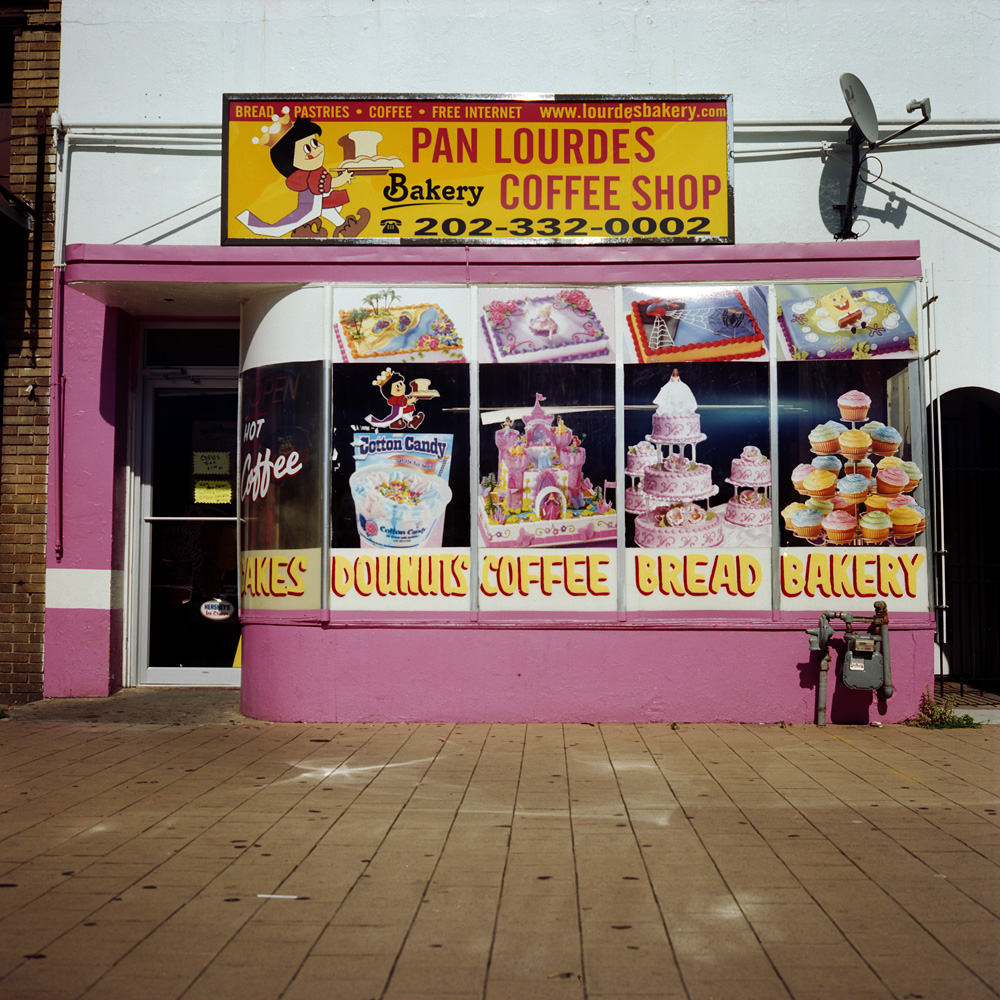
Pan Lourdes, Afternoon
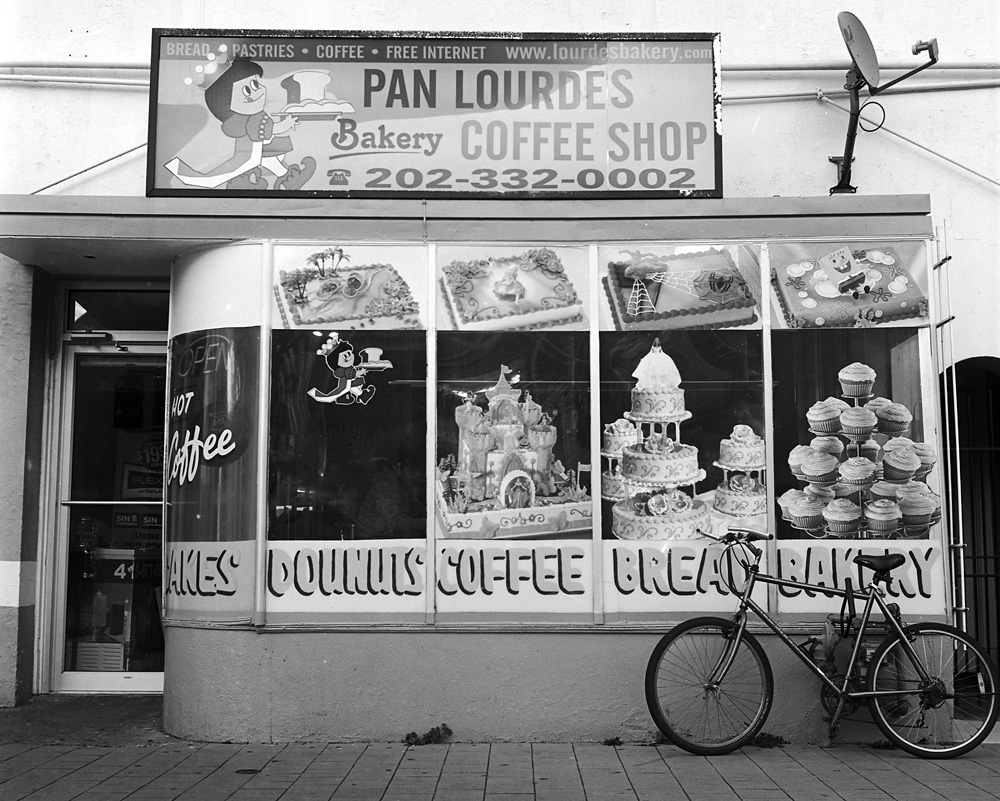
Another small business that will probably be driven out by gentrification in the next ten years. Massive re-development of the neighborhood has happened a few short blocks down the street, with upscale restaurants and pubs, a shopping center with Target, Best Buy, Marshalls, Staples, Radio Shack, GNC, a Washington Sports Club gym, and across the street is Chipotle, a wine store (not a liquor store, but a WINE store), and a FedEx outlet. Like I said earlier, no room in that for a riot of pink selling Central American baked goods. And the neighborhood will be poorer for it.
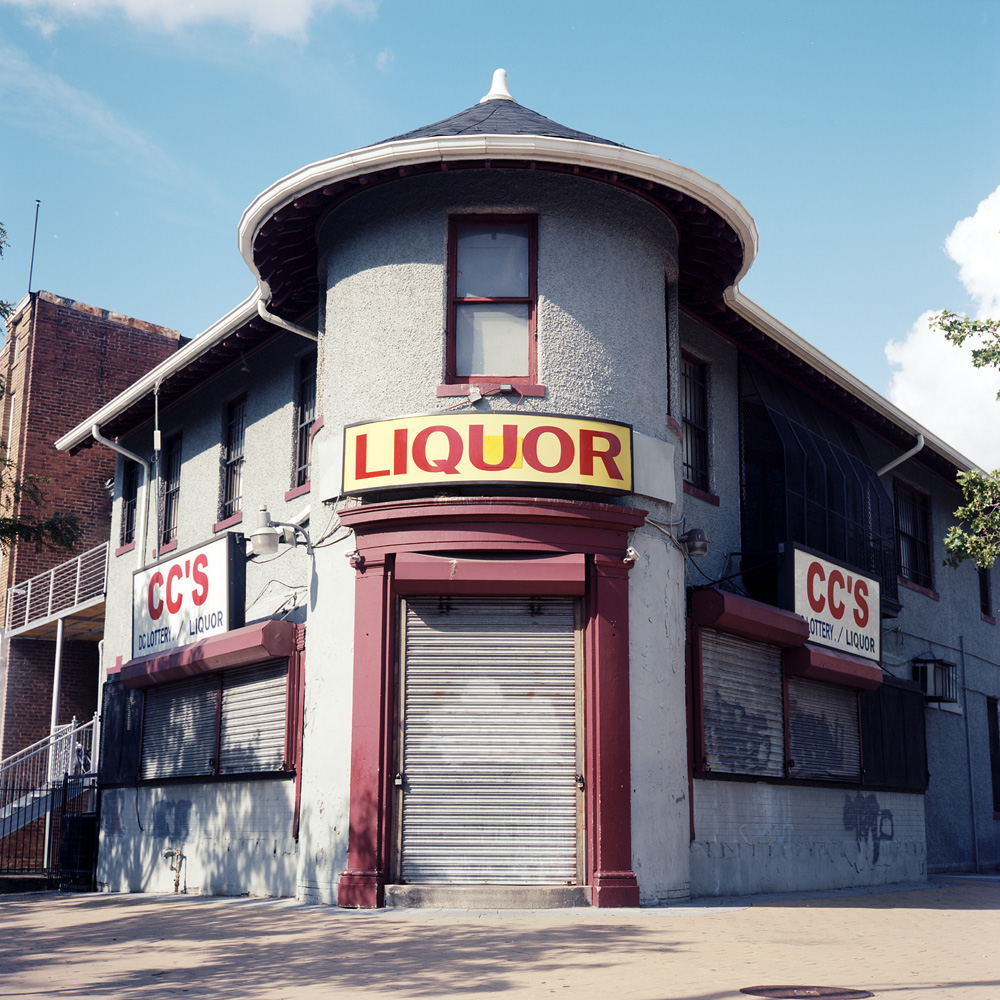
CCs Liquor
In contrast to the wine store down the street, this is a good old-fashioned ghetto liquor store. This one, I could let go, but the Colony Liquor up the street I’d like to see stay around if for no other reason than the fantastic Deco facade and neon sign (see previous posts of mine for pictures).
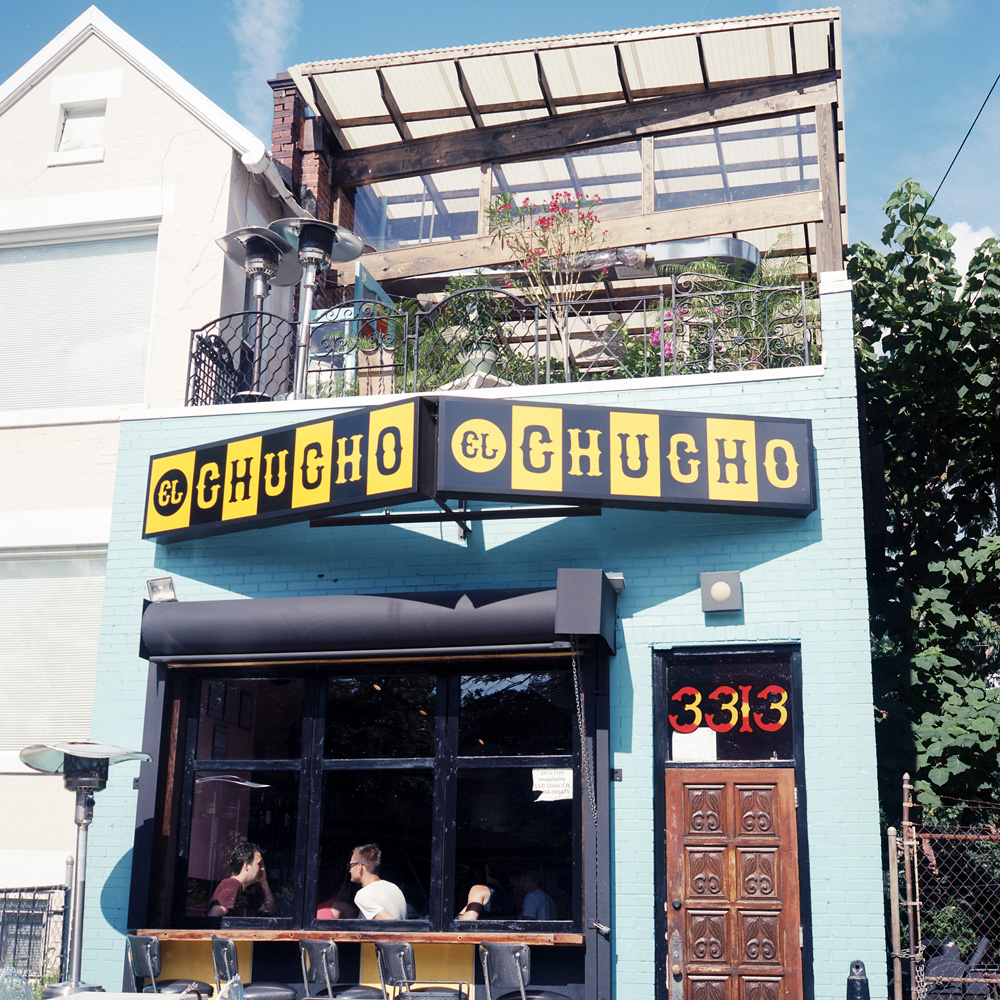
El Chucho Roof Deck
Part of the gentrification wave in my own segment of the neighborhood- its ethnic cuisine by hipsters. Don’t get me wrong, they have very delicious and authentic tacos (and insanely cheap happy hour prices – you can get three tacos and a beer for $10-11!!!), but the truly authentic taquerias don’t have roof decks, bar seating reclaimed from former diners, and waiters wearing plaid flannel, sporting a well-maintained three-days stubble.
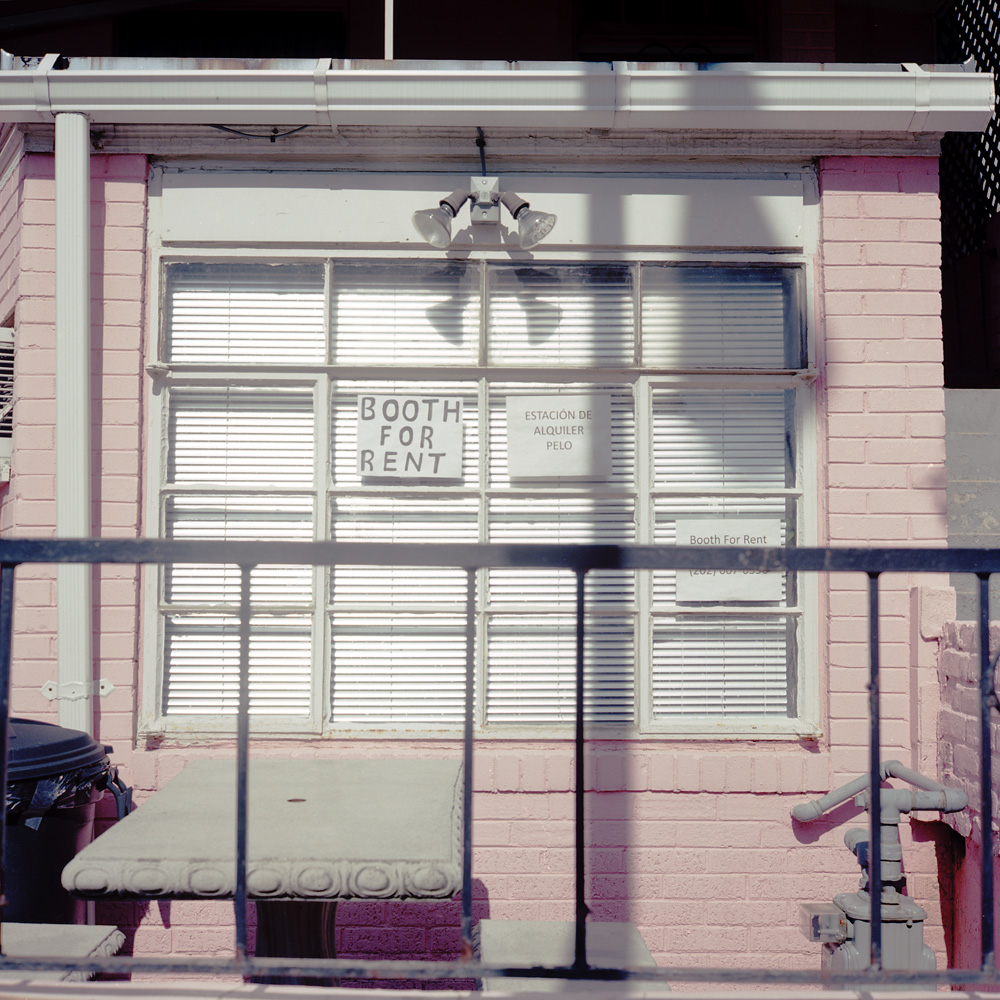
Booth For Rent
Alongside the hipster taqueria you have the basement beauty parlor, which you’d never know was a beauty parlor if not for the booth for rent sign in the window.
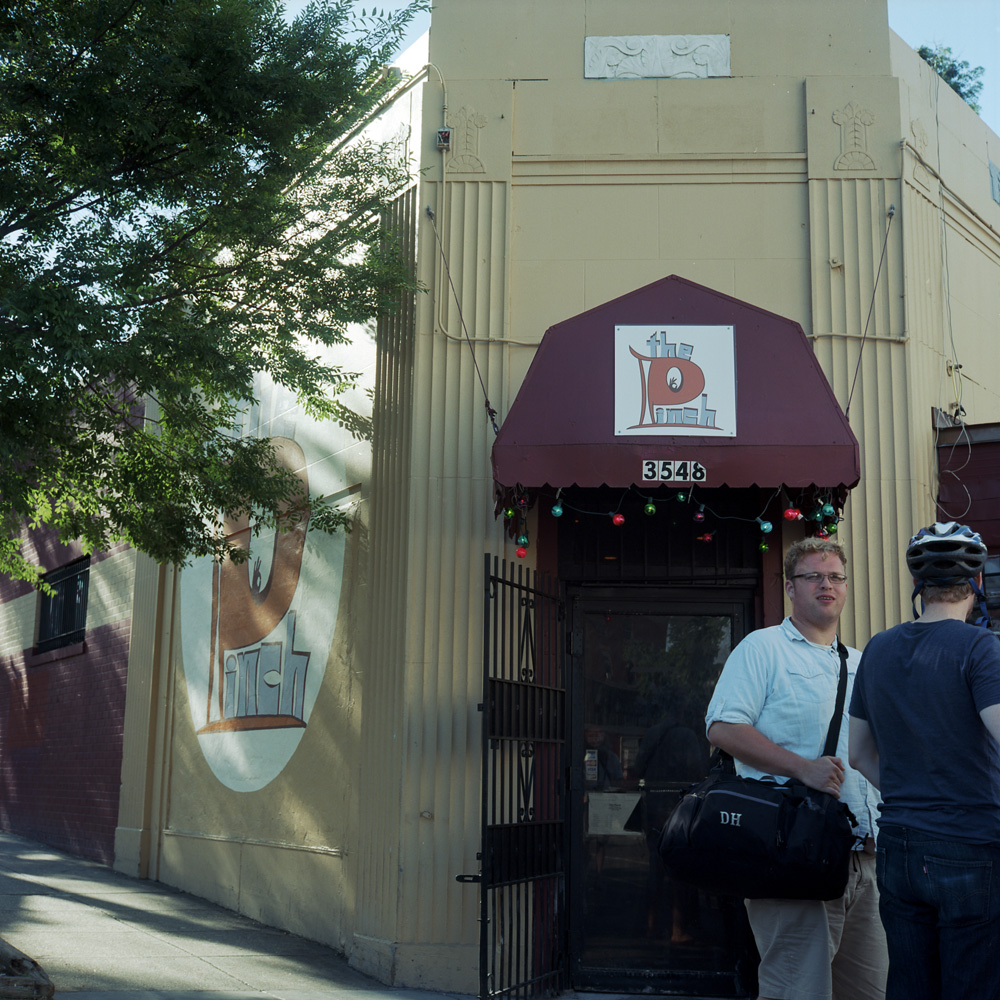
The Pinch Front Door
The Pinch is a neighborhood dive bar featuring live music on the lower level. The graphics outside scream 1970s blaxploitation movie, the patrons now scream suburban white kids who moved to the city to have an “authentic” experience. But it’s good to have a venue that provides space for local live music, where up-and-coming bands needing a break can perform, as there are definitely not enough performance spaces in this town to adequately support the creative talent here.
For wont of anything better to do on Sunday afternoon, I went out for a stroll in the 90+ degree heat (what was I thinking!!!) with the Rolleis for company. I wanted to do a little film and development test to see how well my results would come out. I’d say I nailed it based on these shots. The film I was testing is Ilford PanF, a very slow, fine-grained emulsion. The film speed Ilford recommends for this film is ISO 50. Quite a few folks I know recommend giving it a more generous exposure and rating it at EI 12. I shot some before at EI 25 and got good but not knock-your-socks-off results, so I thought I’d try the 12 and see what difference it makes. I took a risk and changed two variables at once – film speed and development technique. Normally I use Rodinal at a 1:50 dilution and develop for 14 minutes, agitating the chemistry for five seconds out of every 30 seconds. This time, I used Pyrocat HD for my developer, gave it twice the normal dilution (I usually use it diluted 1:1:100, but this time I used 1:1:200) for 45 minutes, with 5 seconds of agitation every 15 minutes.
This development technique is known as semi-stand development. Semi-stand uses highly dilute developers for greatly extended periods of time, with minimal agitation. What this does is it allows micro-contrast areas to form on the film where byproducts of the development process accumulate on the edges of light and shadow. These byproducts serve as a mask and lead to a boost in contrast at that edge, increasing the appearance of sharpness. If you look at the emulsion side of a negative that was developed using semi-stand, stand, or extreme minimal agitation technique (variations on a theme), the emulsion will actually appear in relief as if it had been etched.
This technique is also useful for managing high contrast situations because it allows for greater adjustment of the length of development to manage highlights. When you develop a roll of film, the shadow areas develop first, and once they have reached their maximum recorded density, they stop. Highlights will continue to develop long after the shadows have finished. This is one of the primary means for controlling contrast in an image- if the highlights are known to be too bright before developing the film, you can simply reduce total development time to keep the highlights from becoming unprintable.
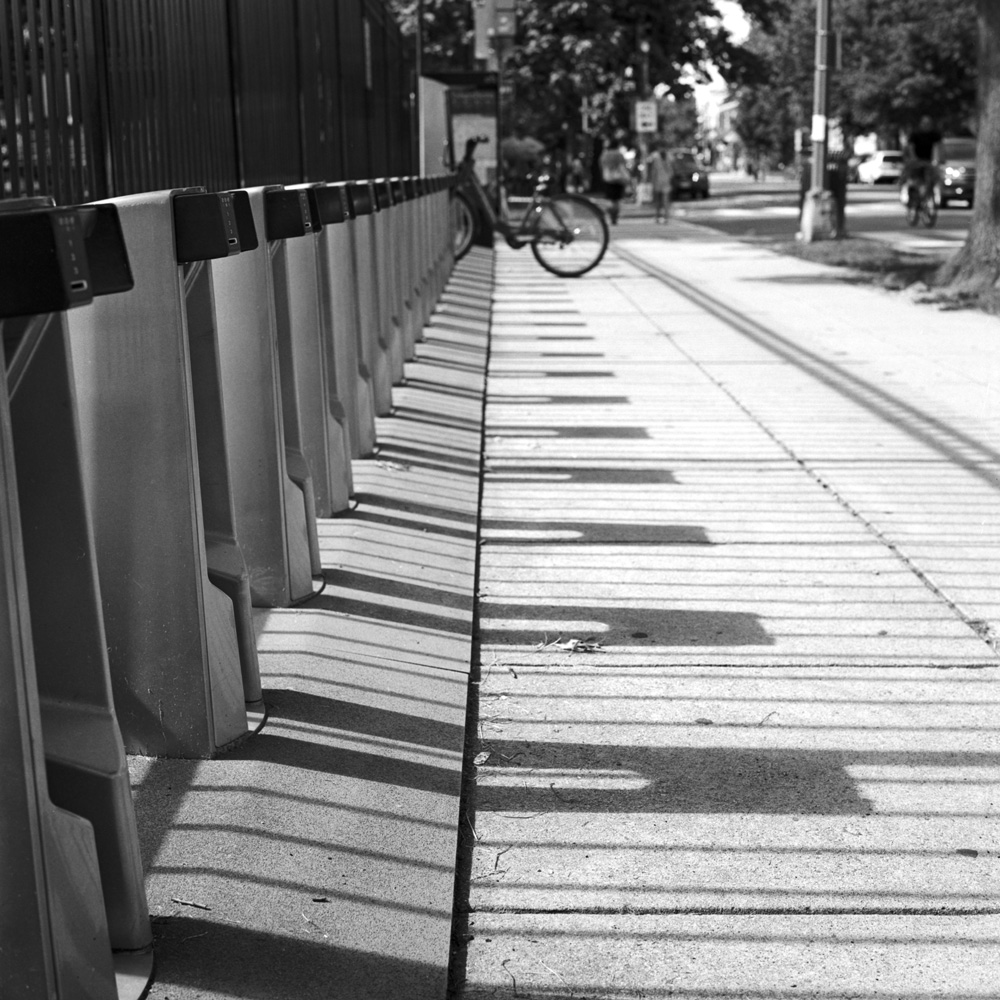
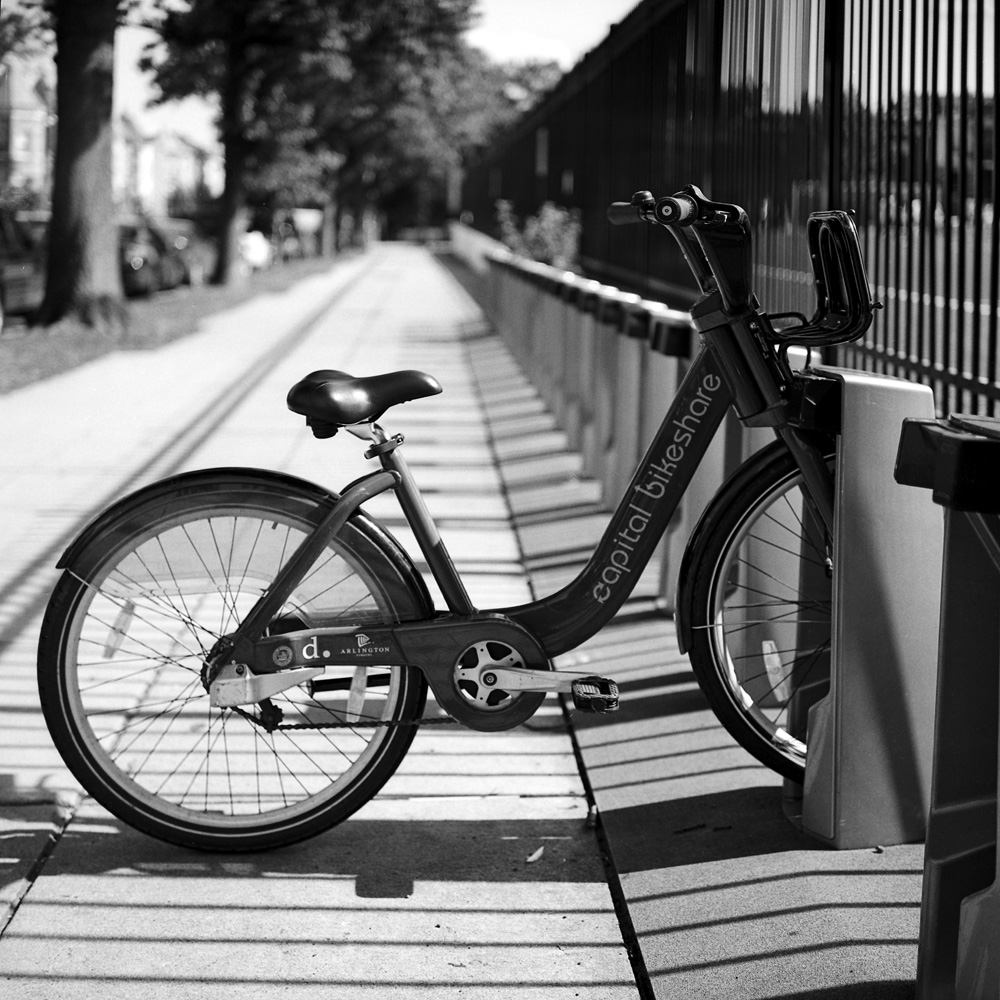
Bike Rack, 11th St. NorthboundBike Share Rack, 11th Street
These first two images are of the Capitol Bikeshare rental rack near my house. I’ve photographed the Bikeshare racks before, with full racks of bikes, to capture the receding perspective of the bike wheels. This time, I shot the bike rack with only one bike in it, to work with the late afternoon shadows created by the rack itself, and also to demonstrate the popularity of the Bikeshare, at least in my neighborhood. As you can see, on a Sunday afternoon, with the heat rising to over 90 degrees F, all but one of the bikes from this rack are in use.
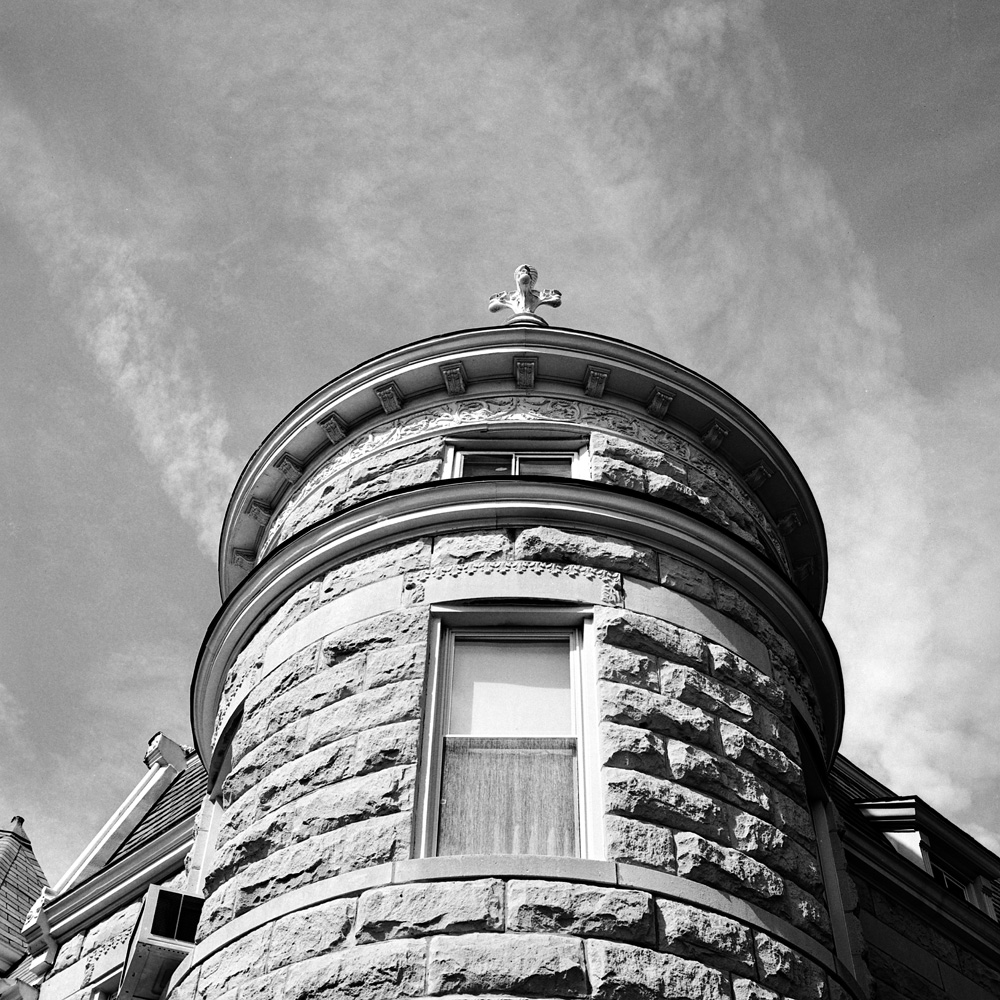
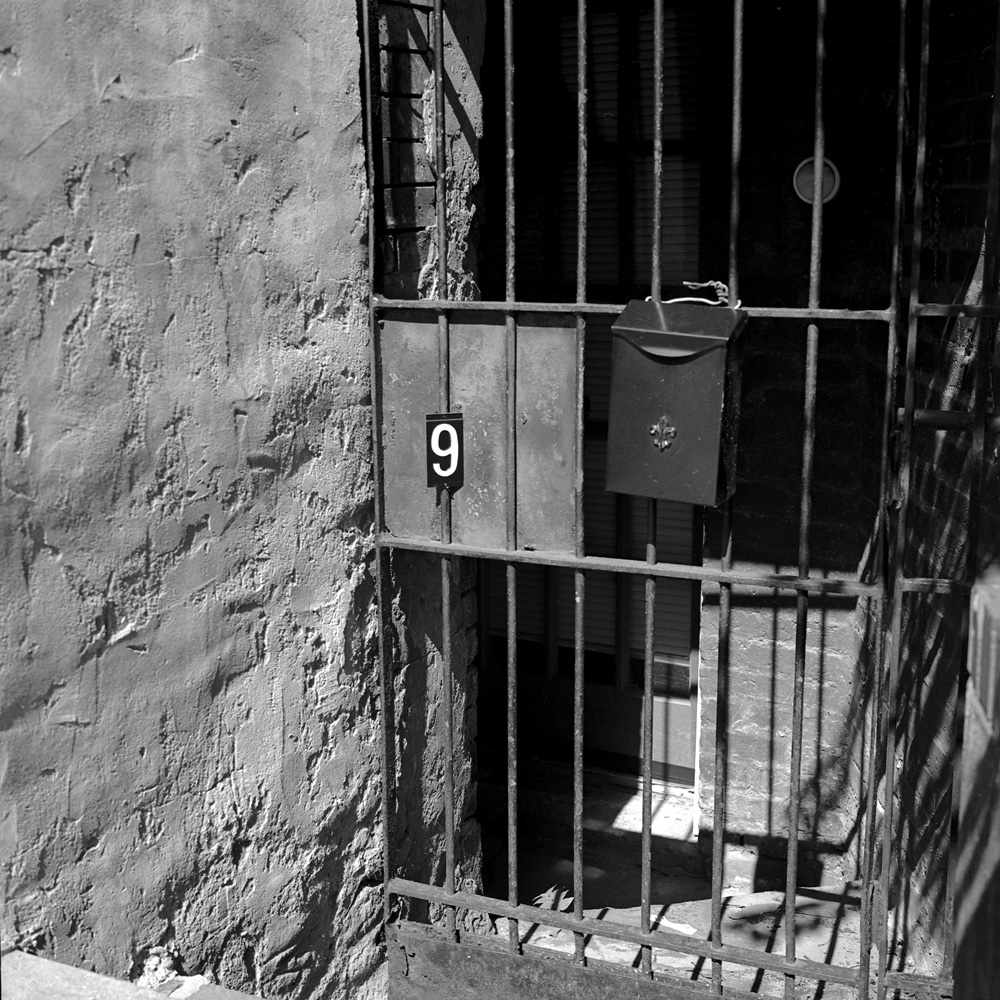
Stone Turret, 11th StreetNumber 9, Basement Door
Very much in the same stretch of 11th Street as the bike rack is where these two scenes can be found. The stone house is a bit of a neighborhood landmark – there are maybe half a dozen or less in the neighborhood with similar facades, and the rest (hundreds of houses) are varying types of brick or stucco over brick. The basement door photo was taken as part of this exercise, not only because I like wrought iron, but because the scene had extremes of contrast that I wanted to see if I could tame with the semi-stand development.
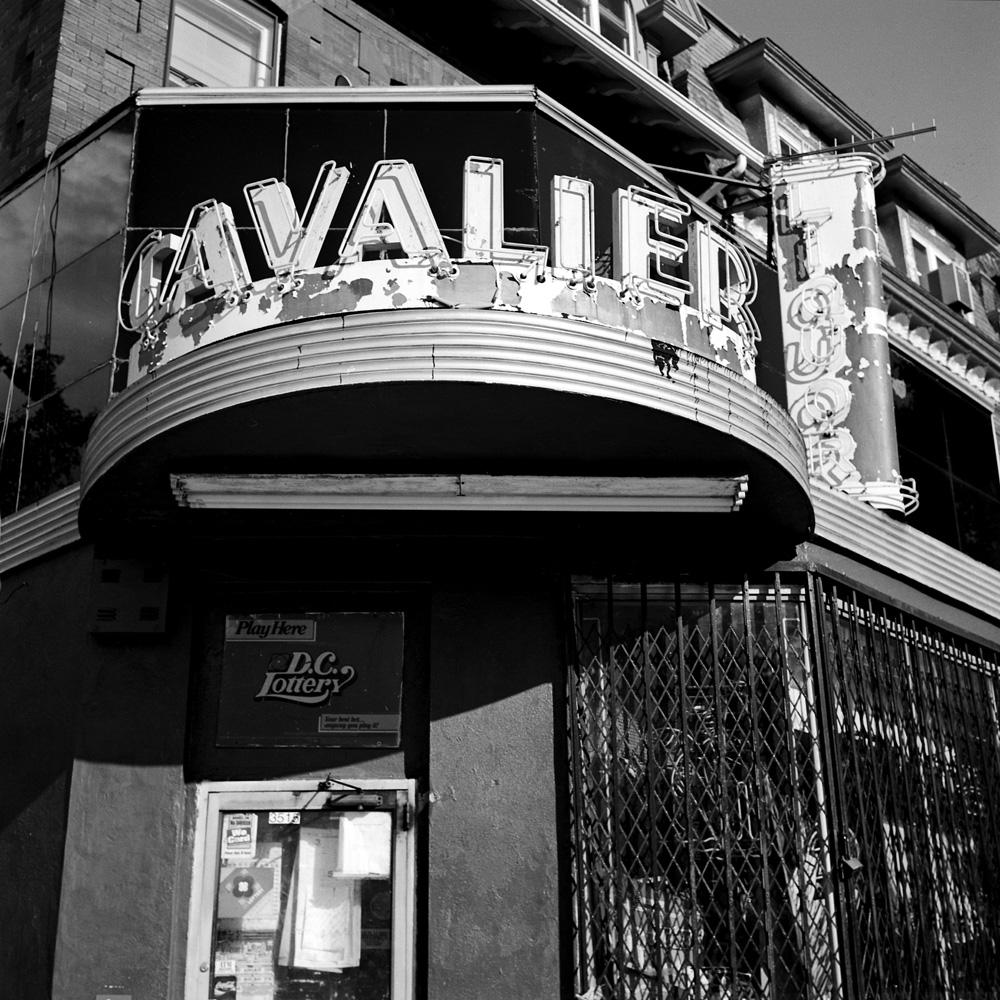
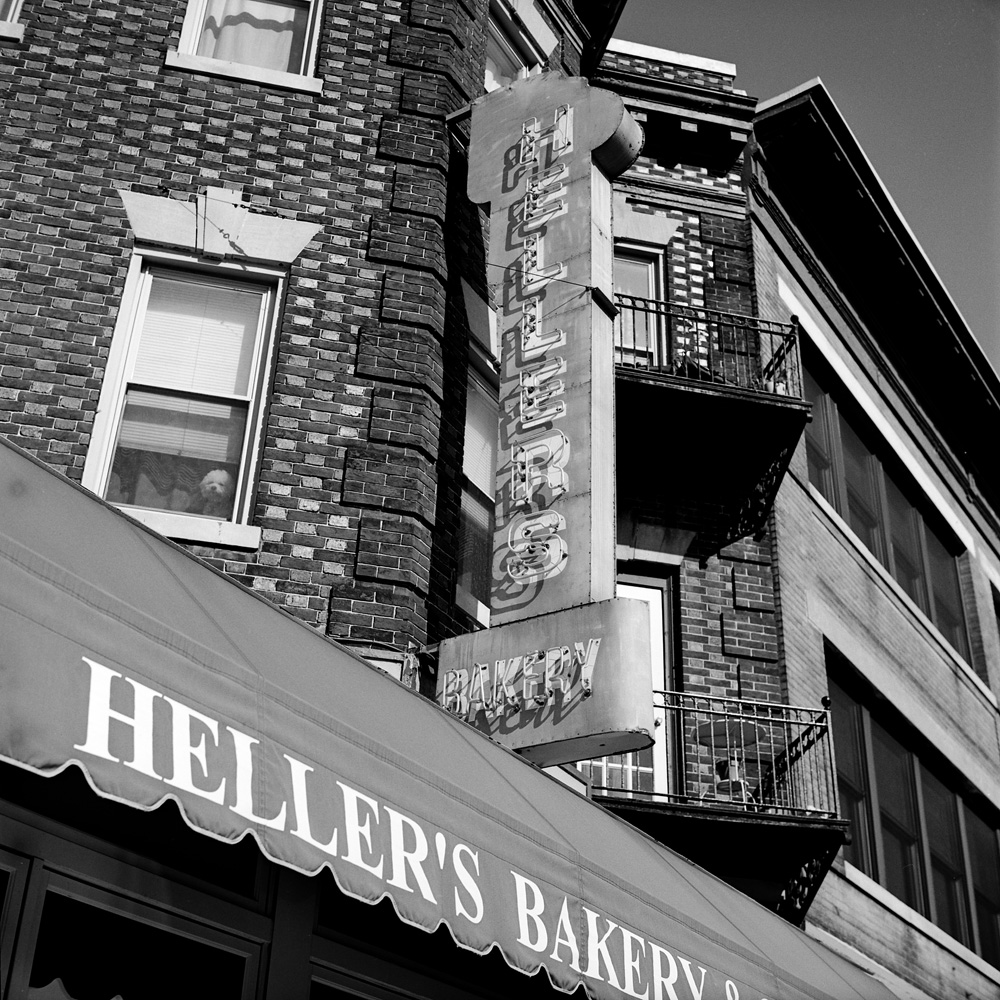
Cavalier Liquor Sunday AfternoonHellers Bakery
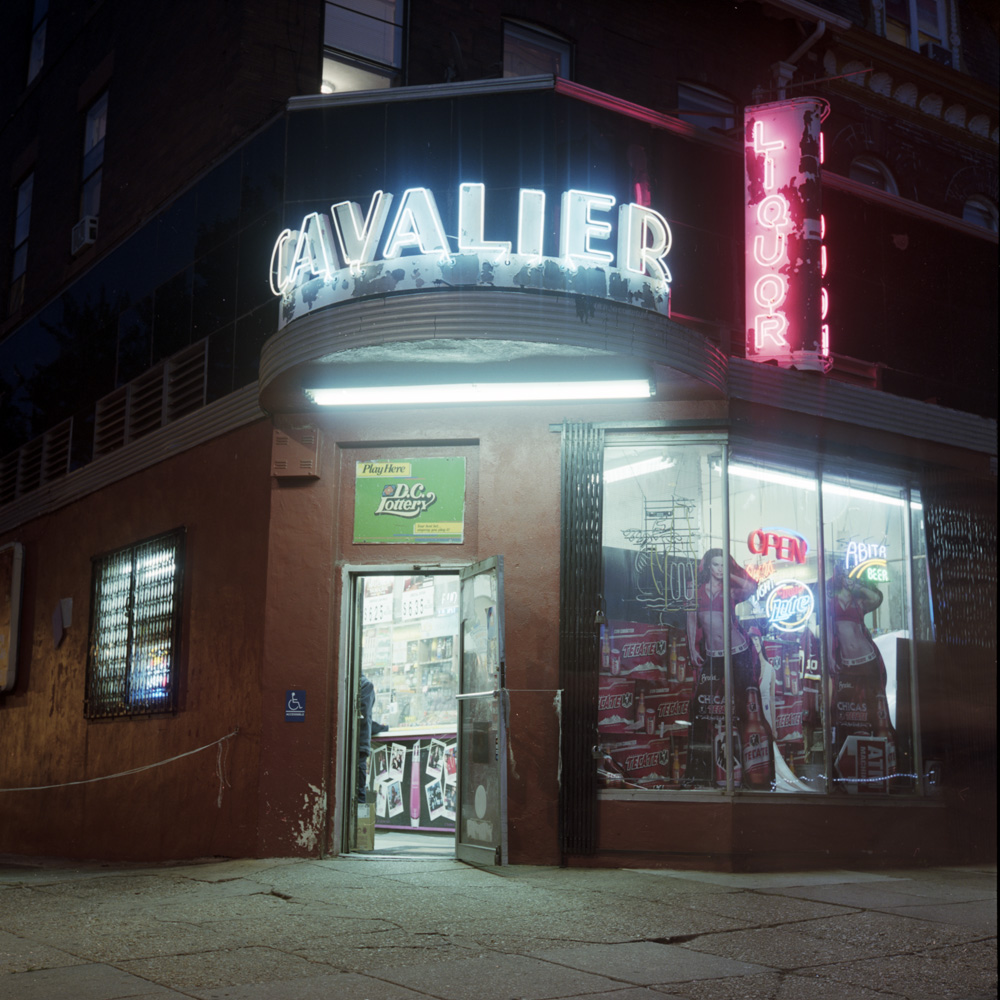
These two photos are of neighborhood icons – you’ve seen my color photo of Cavalier Liquor at night before. It has been the subject of many a photograph by fans of urban texture, neon, and Deco architecture. Hellers Bakery has been in their current location for many many years, and if you saw the movie “State of Play” starring Russell Crowe as Cal McAffery, a hard-luck, hard-boiled reporter who uncovers a Washington conspiracy, you’ll recognize their neon sign from below his apartment window. I’m very annoyed with Hellers that they don’t illuminate their sign very often, so it makes it very hard to get a good photo of it after dark!
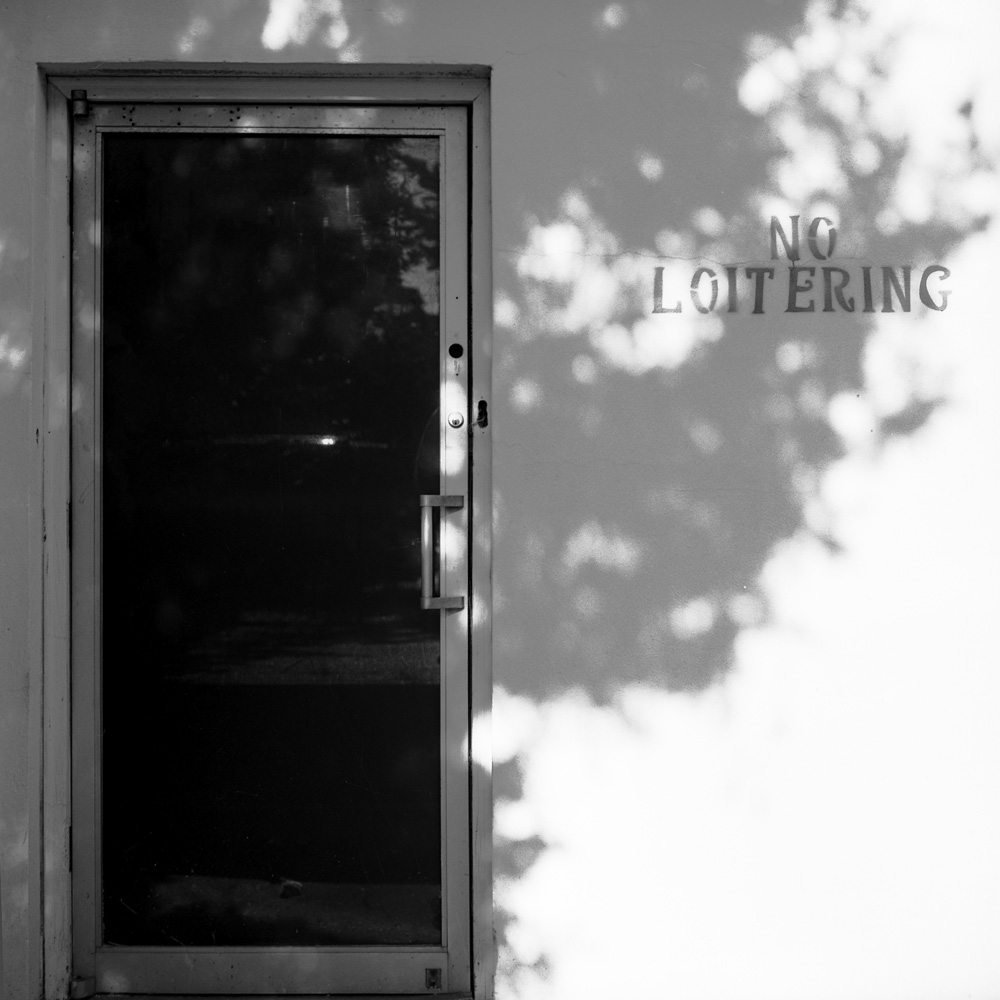
And last but not least, an appropriate sign to end the post with:
Here are the outside shots of Mad Momos Restaurant and Beer Deck.
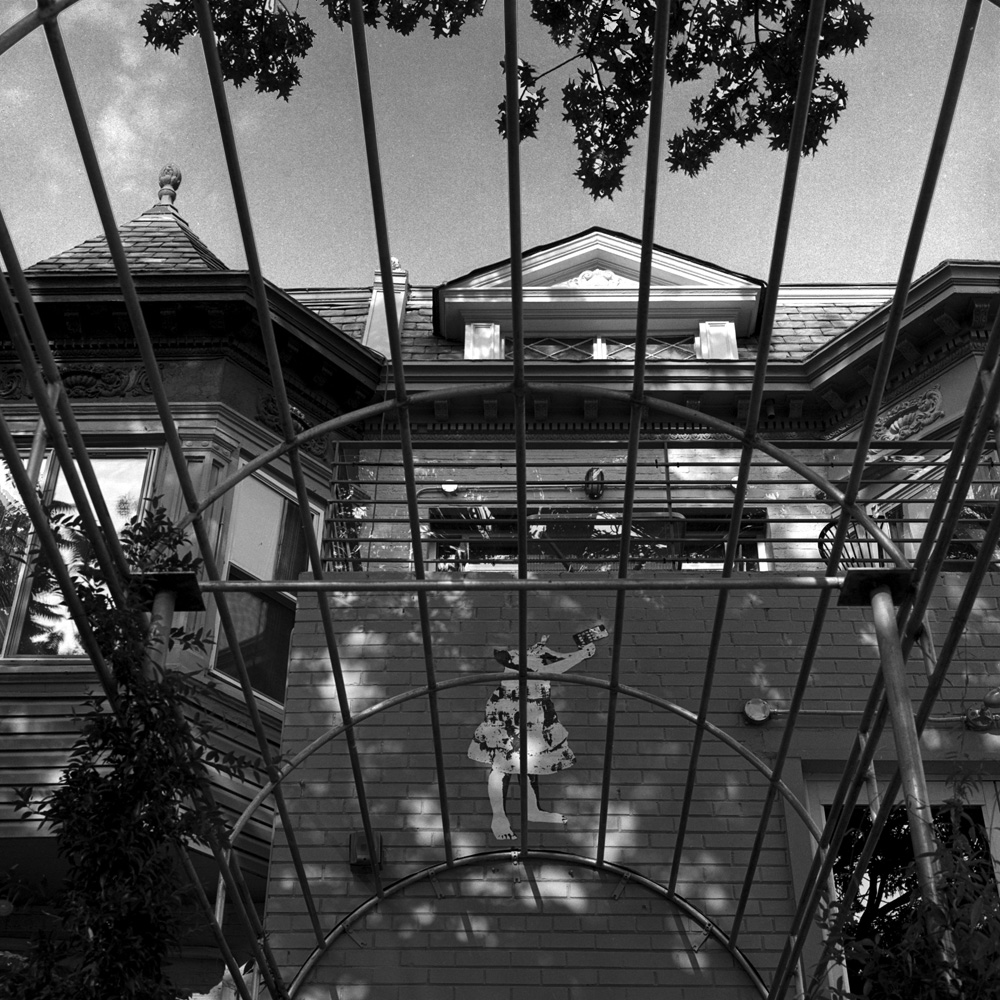
This is the entrance, as viewed from under the awning. When they bought the building, the structure was partially renovated with the intent to turn it into a restaurant. They followed through and finished it out, leaving the awning frame up but not getting a canvas/vinyl cover. Instead, they are training a vining plant in barrels, which will take a couple years to fill in (visible in the second photo of the awning). I just liked the structure of the awning and thought it would be an interesting frame to contrast its geometric structure against the decoration of the building behind it.
Mad Momos Entrance
I don’t recall if the paper cutout figure over the door ever had a head or not, but in any case, it’s a little girl holding an iPhone like a handgun.
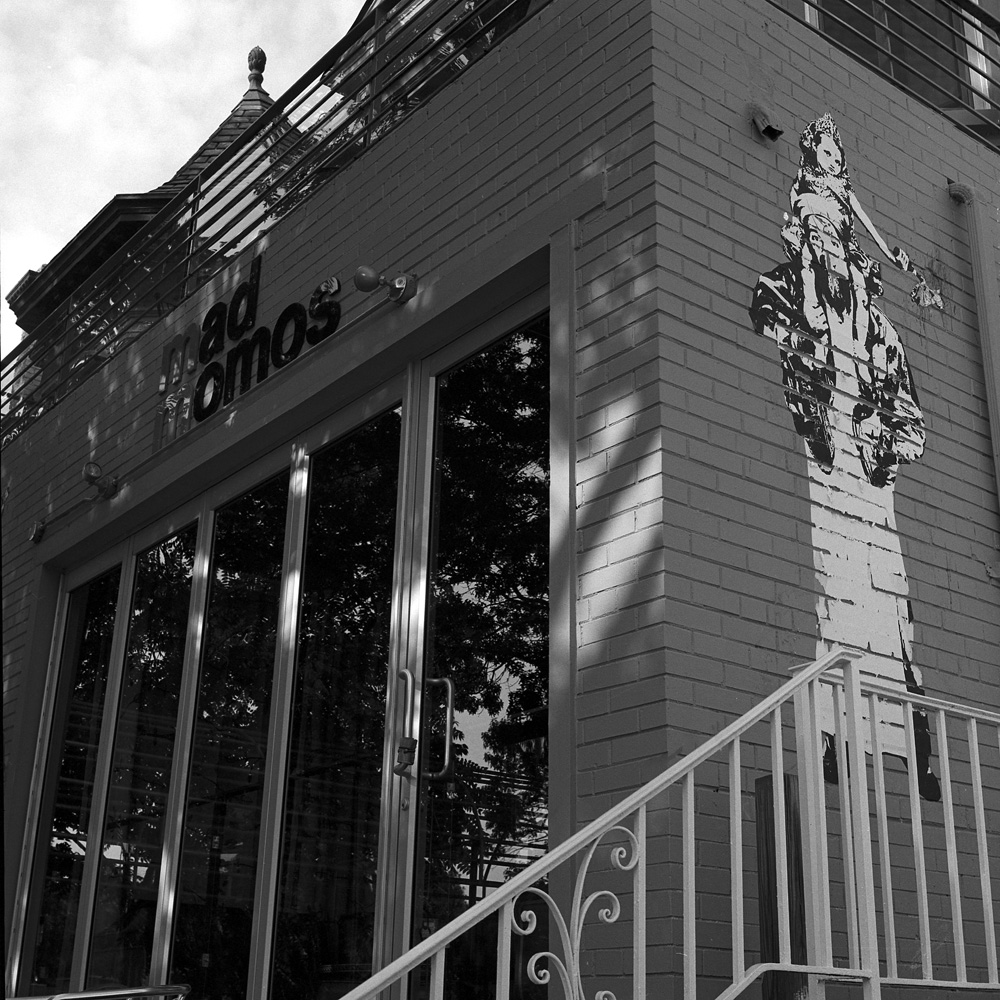
Here is the facade of the building. In case you’re wondering, the paper figures plastered to the wall are Osama Bin Laden giving Honey Boo-Boo a piggy back ride, whilst she’s holding a molotov cocktail. Yeah, the guys have a quirky sense of humor.
Mad Momos
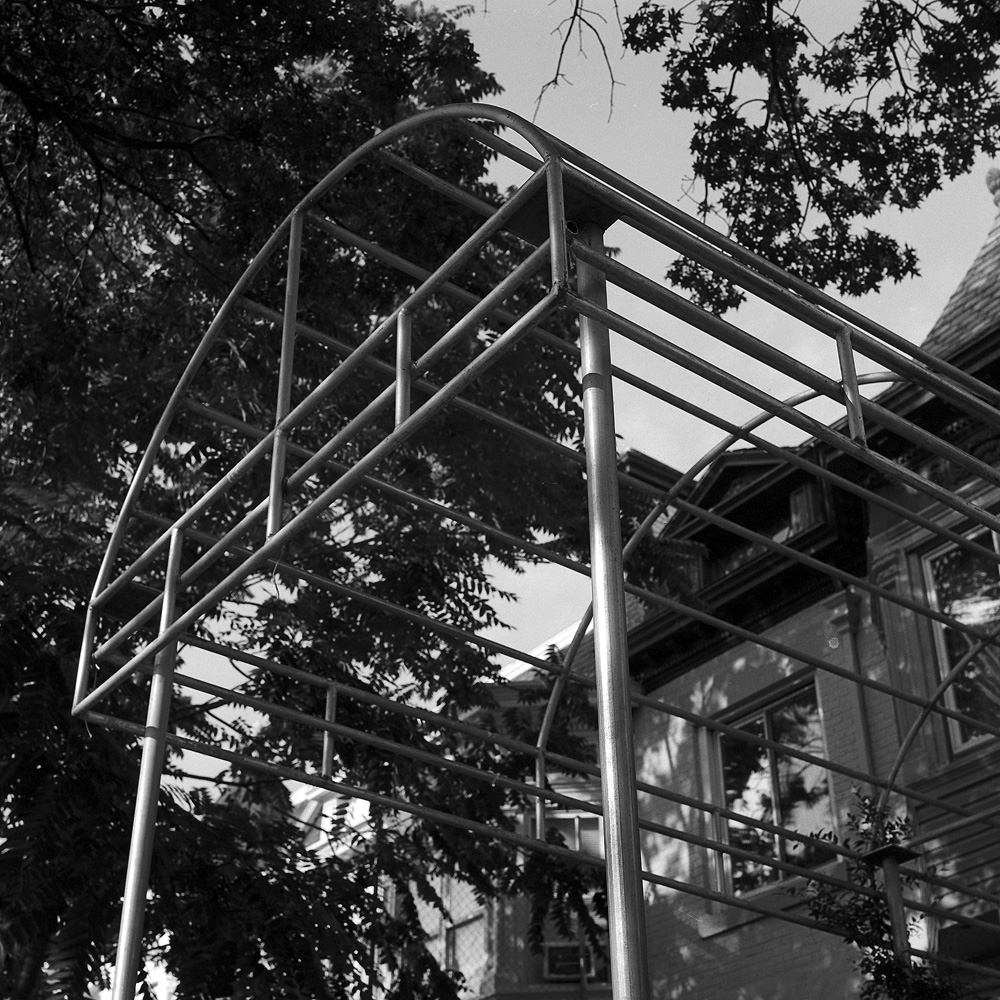
Another view of the awning structure, dappled with sunlight filtered through the tree above.
Awning, Mad Momos
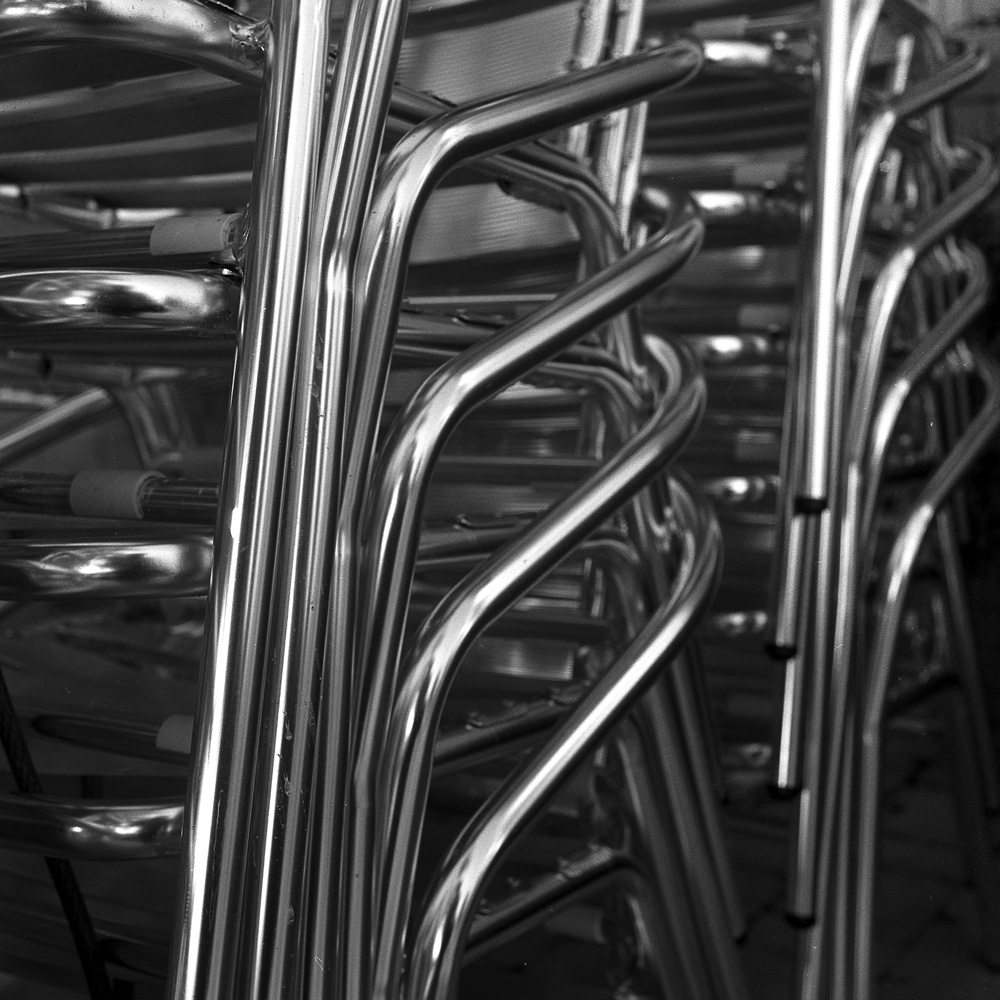
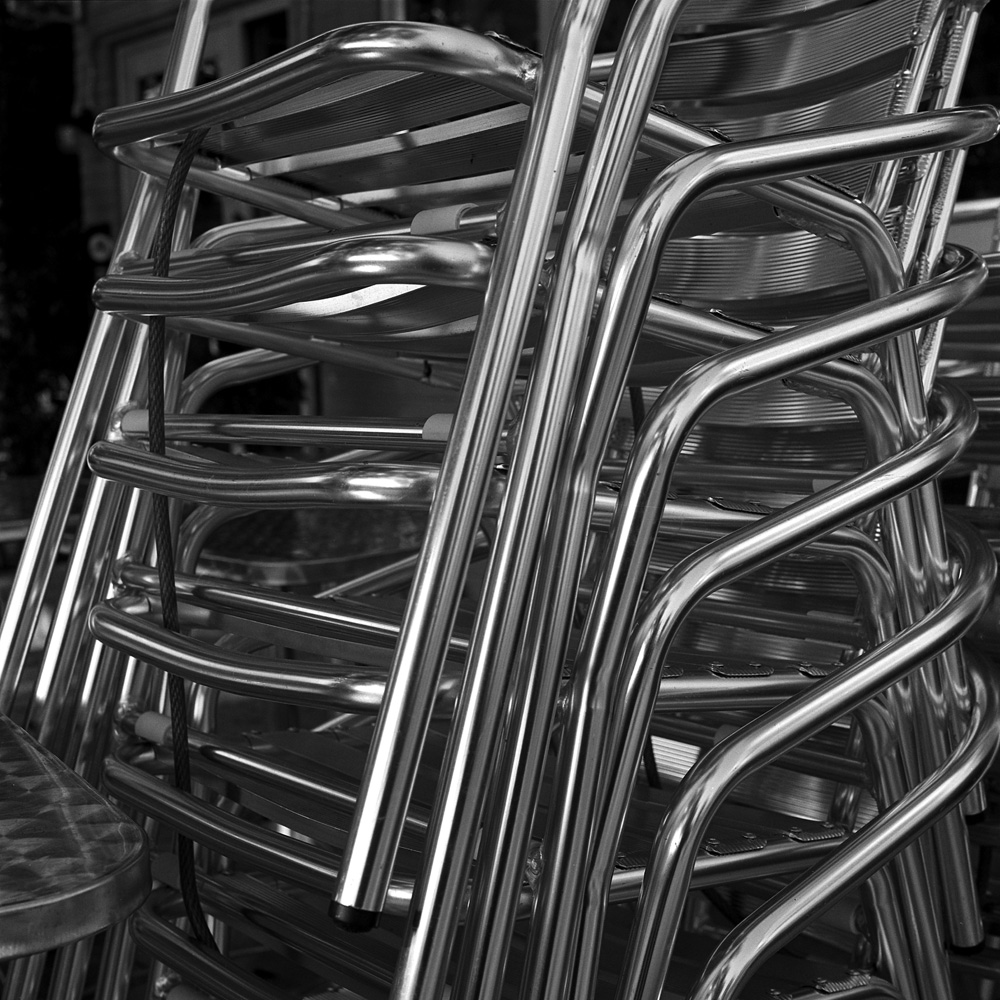
Chrome chairs on the patio at Mad Momos:
Patio Chairs, Mad MomosPatio Chairs #2
The chairs were still stacked from having been stored the night before. I loved the repetition of the shapes of the chairs.
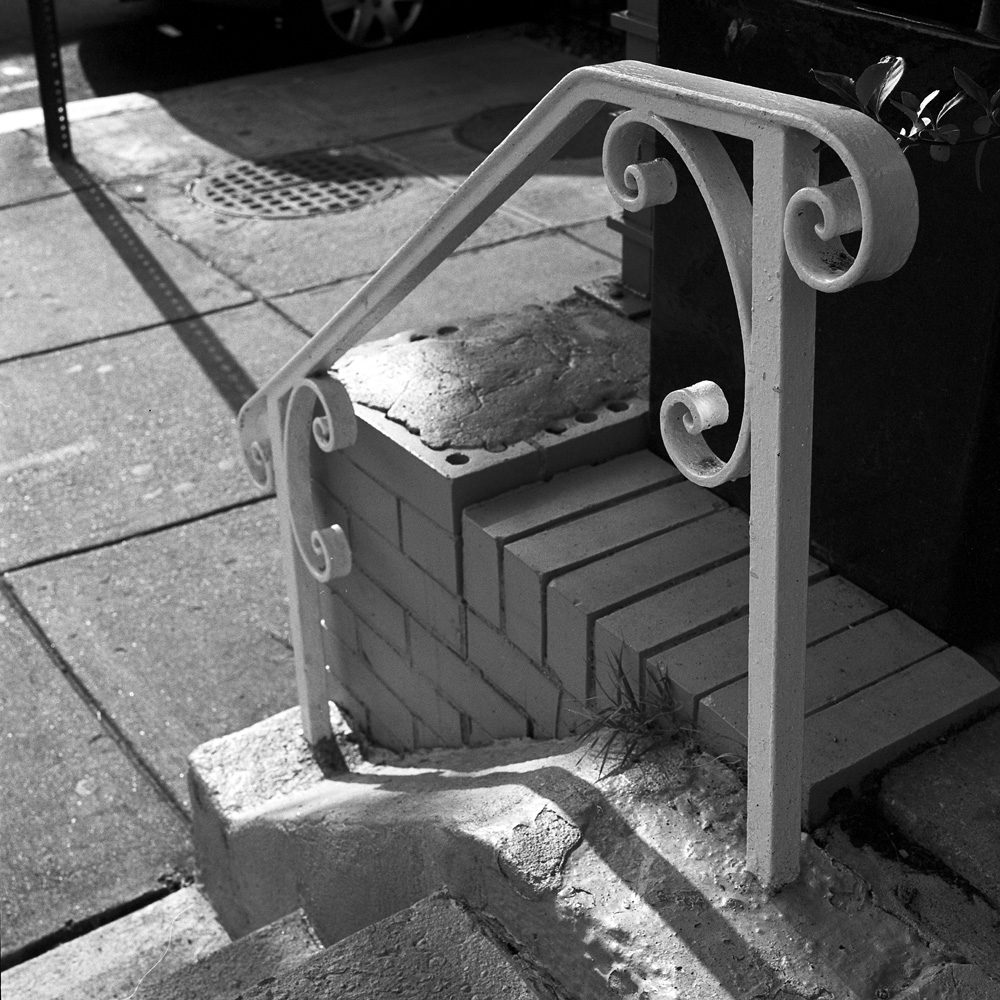
In contrast to the modern awning frame and handrail around the front patio, this 1910s/20s wrought iron hand rail frames the steps on the house next door to their building.
All these photos were taken on a Tuesday – the slowest day of the week, thus the absence of customers. I’m going back there tomorrow after work with some color film to take some night shots – the place gets packed!
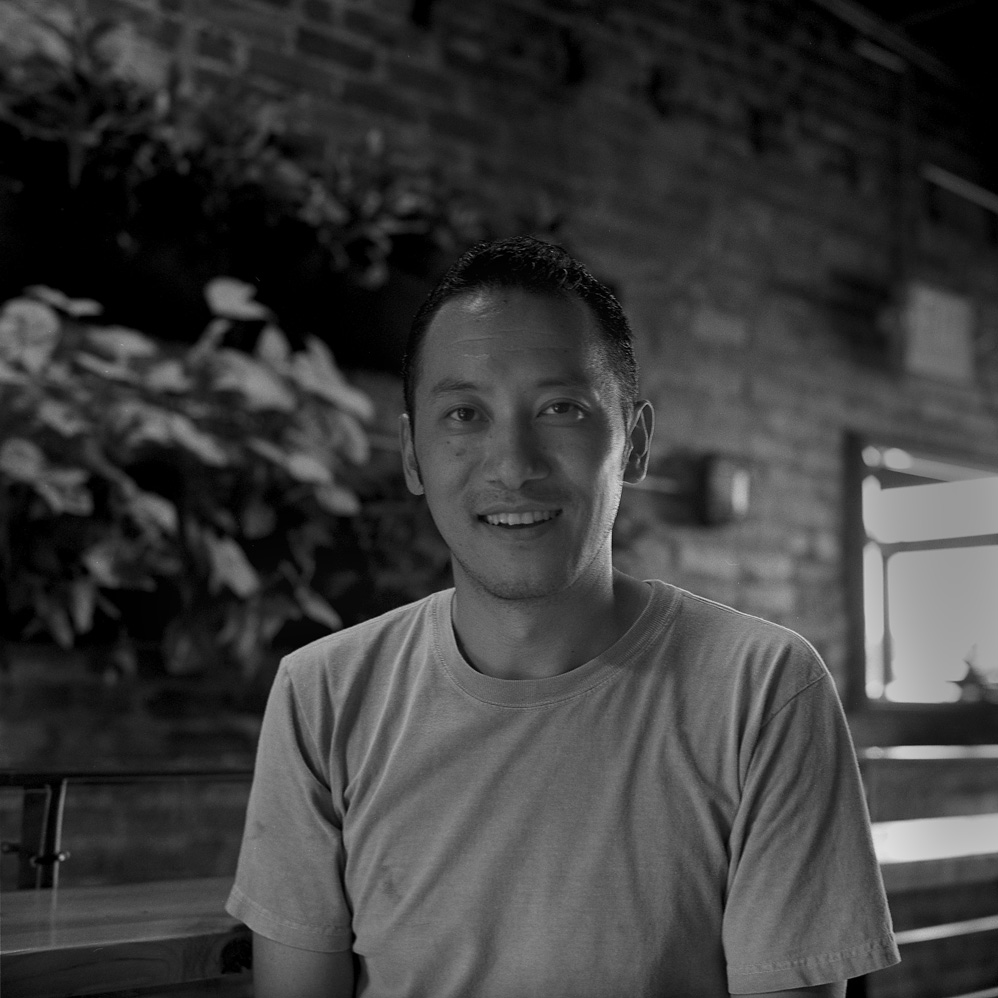
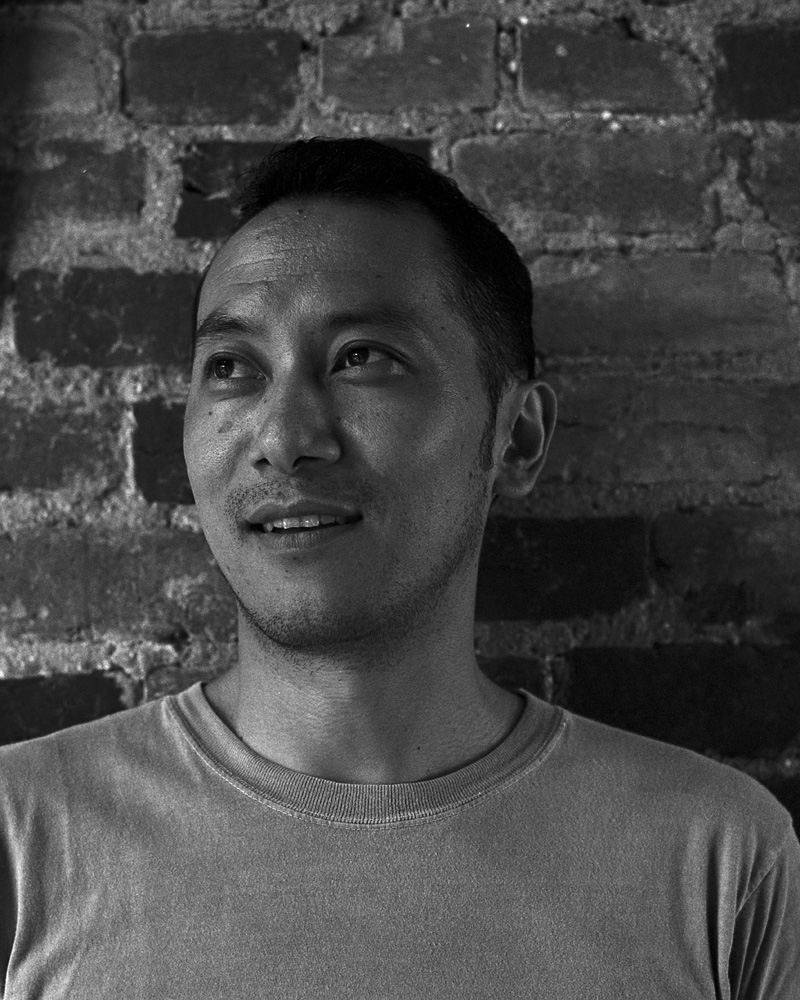
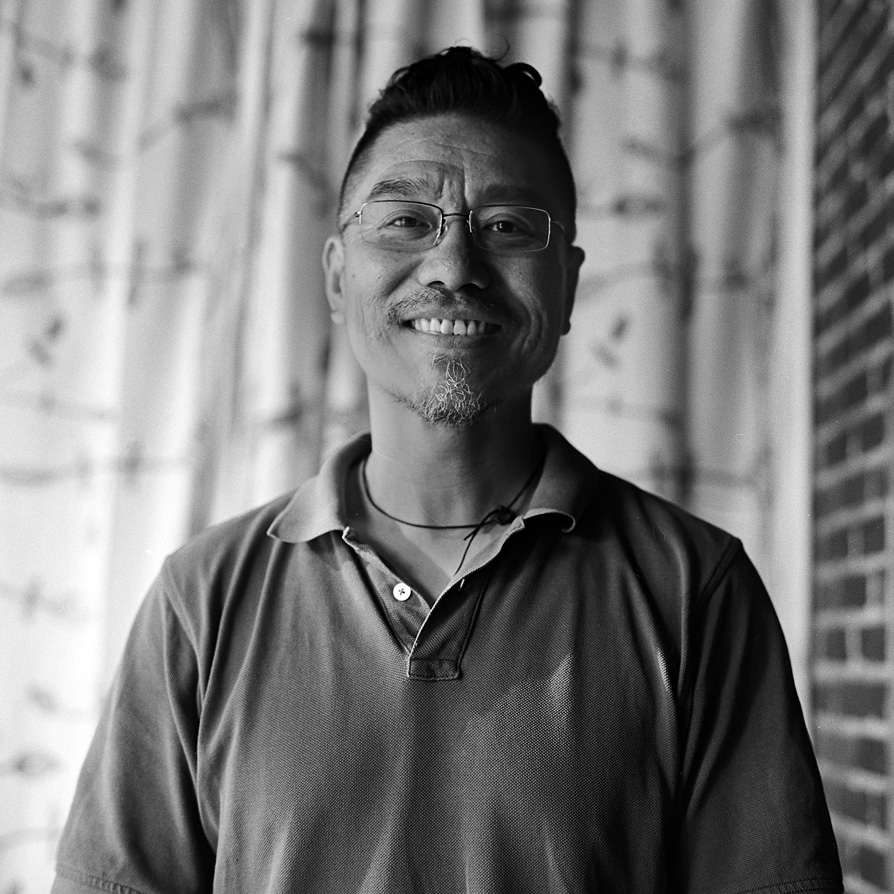
Here are two portraits I took of my friend Wanchuk, who is co-owner with Sam Huang (photo posted previously) of Mad Momos Restaurant & Beer Deck. I’ve known Wanchuk for nearly a decade. He’s from Sikkim, which is now a province of India in the Himalayas between Nepal and Bhutan, but used to be an independent kingdom with close ties to Bhutan.
Wanchuk T., at Mad MomosWanchuk T., Close-up
We met through a common love of photography – at the time he was still in post-college bum-around-the-world mode, and wanted advice on how to take better pictures in the places he was going. Now he’s running a restaurant and giving me a show of my photos. The exhibit will open on August 2nd and run through the end of October. Details about the opening reception will be posted separately.
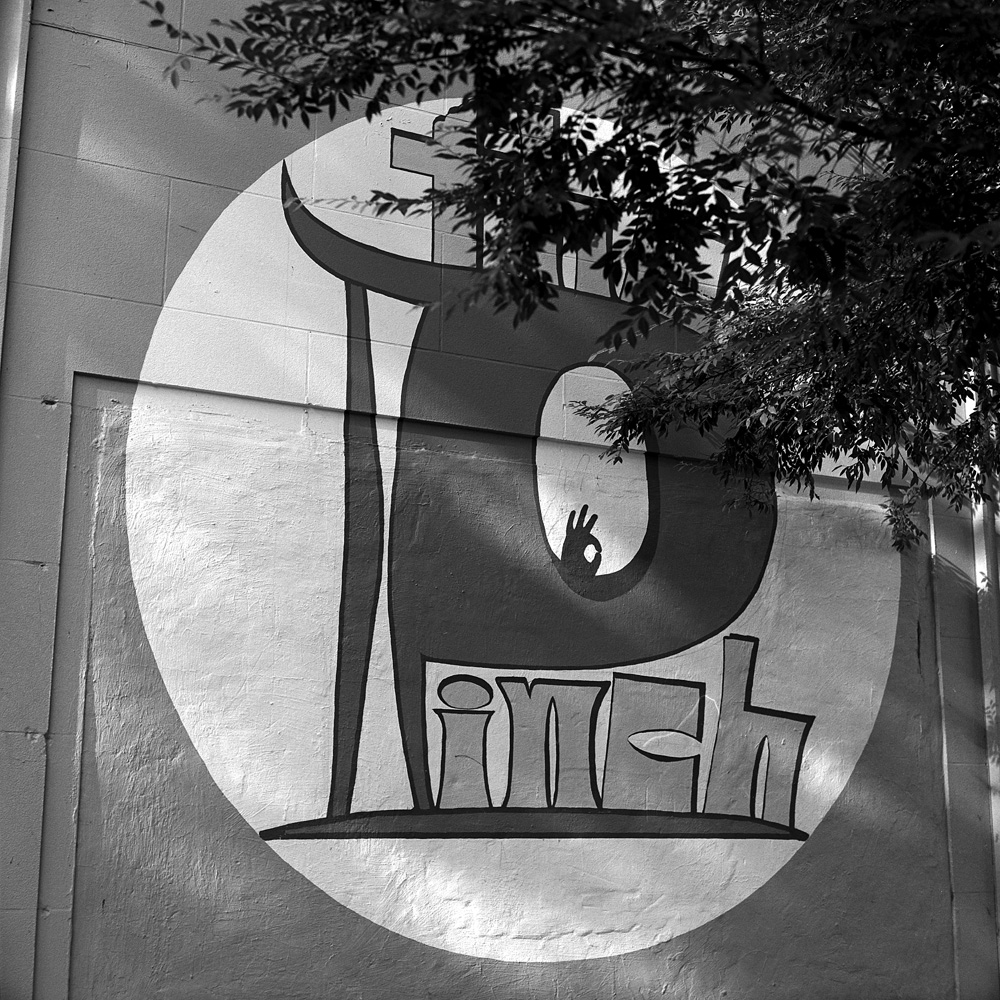
I took those photos of him after we finished a meeting about the exhibit, then went for a 15 minute walkabout in the neighborhood around the restaurant to see what I could find. There’s an old bar/club across the street called “The Pinch” – I so want to photograph the front door because it has cool architectural detailing and some nifty graffiti, but from the looks of the folks hanging out by the front door, I may have to come back and shoot that early in the morning when they’re closed -their patrons may not take too kindly to being photographed.
Here’s their logo on the wall facing the side street – it has a very 70’s look to it, but the paint seems very recent.
The Pinch
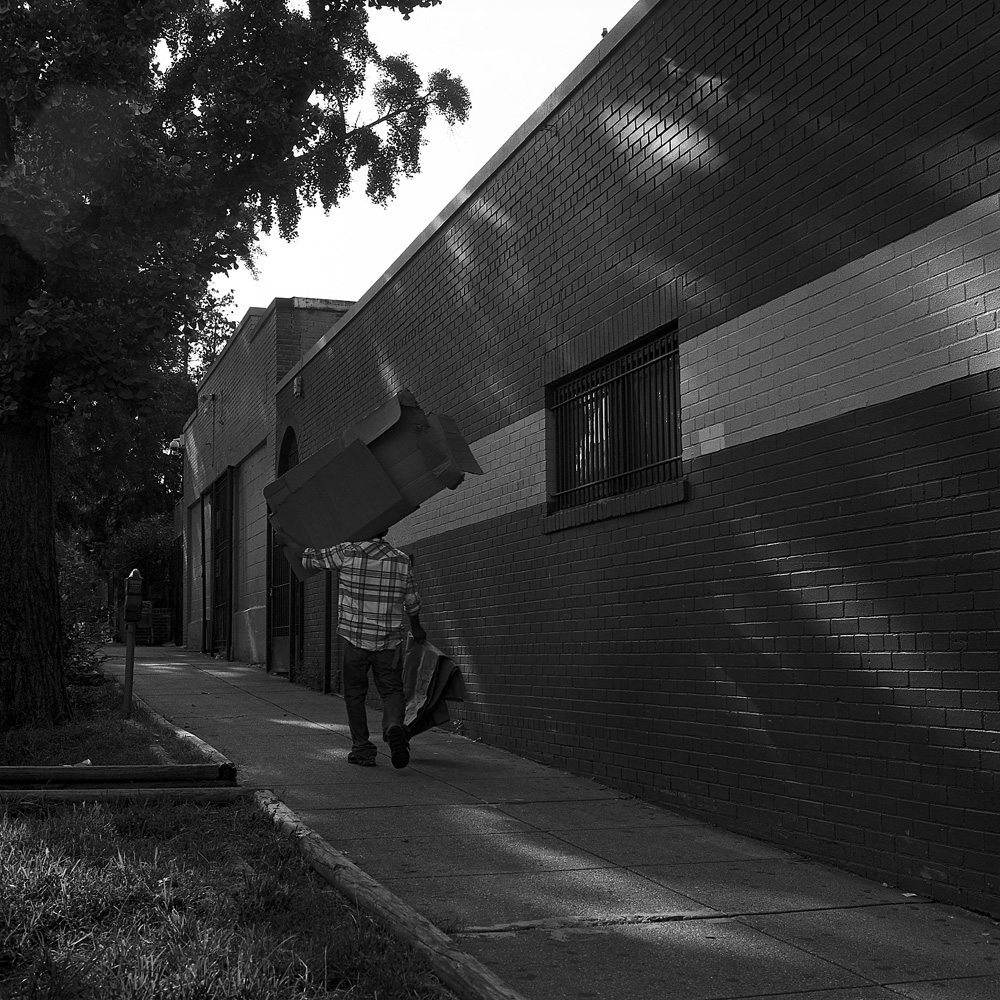
Pivoting to the left of the Pinch logo, I saw this lovely vanishing-point perspective of the building walls, dappled in evening sunlight. As I was composing the shot, this man hauling a gigantic cardboard box over his shoulder walked into the frame. Taking advantage of the serendipitous perspective-giving presence of the man, I waited until he was about 2/3 of the way in the frame before shooting.
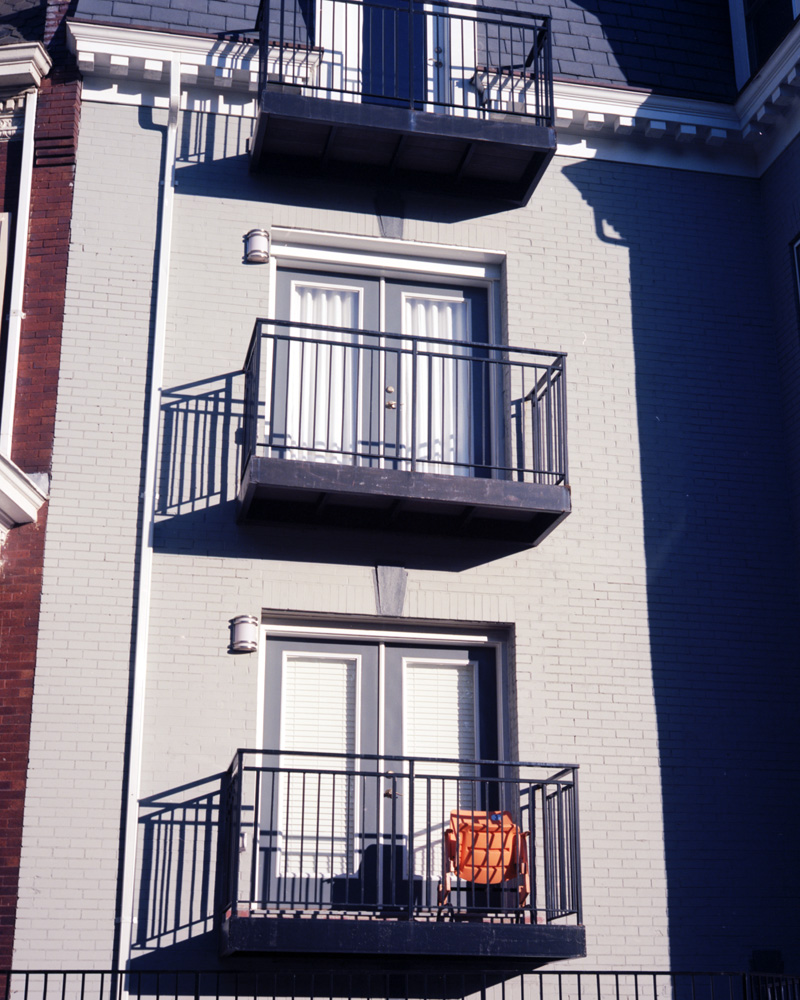
I came across this while walking around my neighborhood. It’s a balcony on a rowhouse converted to condominium apartments. The sun was getting low in the evening sky, casting long shadows. The scene is almost monochromatic, with the exception of the orange chair. Yet the chair is subtle – it doesn’t pop out and smack you in the face. It may have actually been more intense in real life, but I like it as just a touch – too often you see people de-saturating a color image except for one object (usually red), which they then proceed to hyper-saturate in contrast to the scene around it.
This is my friend Sam Huang, one of the owners of Mad Momo’s, a Himalayan/fusion cuisine restaurant and beer deck in the Columbia Heights neighborhood here in Washington DC. He and another friend of mine took over a partially renovated space, finished the build-out, and turned it into this really cool restaurant with sidewalk seating, a dining room, lounge space, two bars, and front and rear roof decks. The food is inspired by traditional Himalayan dumplings, called momos, thus the name of the restaurant. I took this portrait of him in the front window of the main room using my Rolleiflex. Someone commented to me elsewhere seeing how much I’ve been using the Rollei lately that I’d better not wear it out… well, it’s only 57 years old now, so I figure as long as I do proper maintenance on it, it will outlast me.
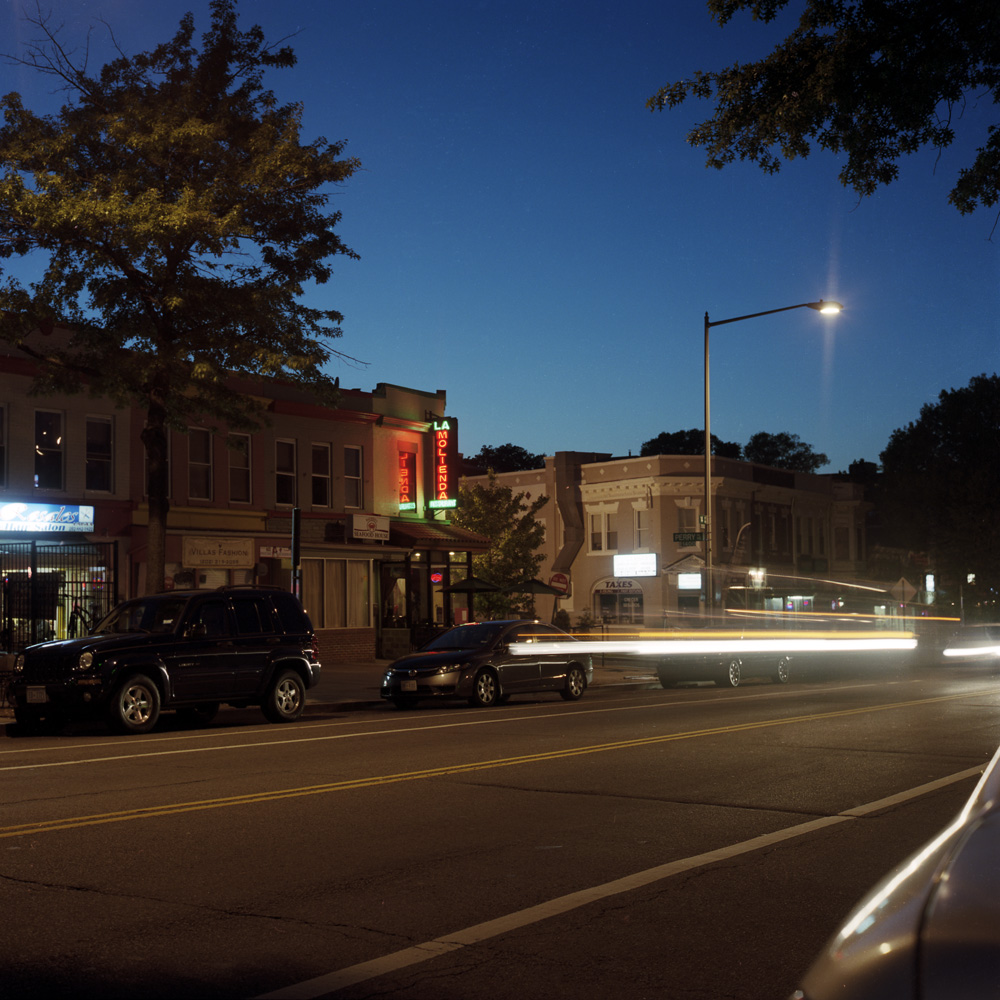
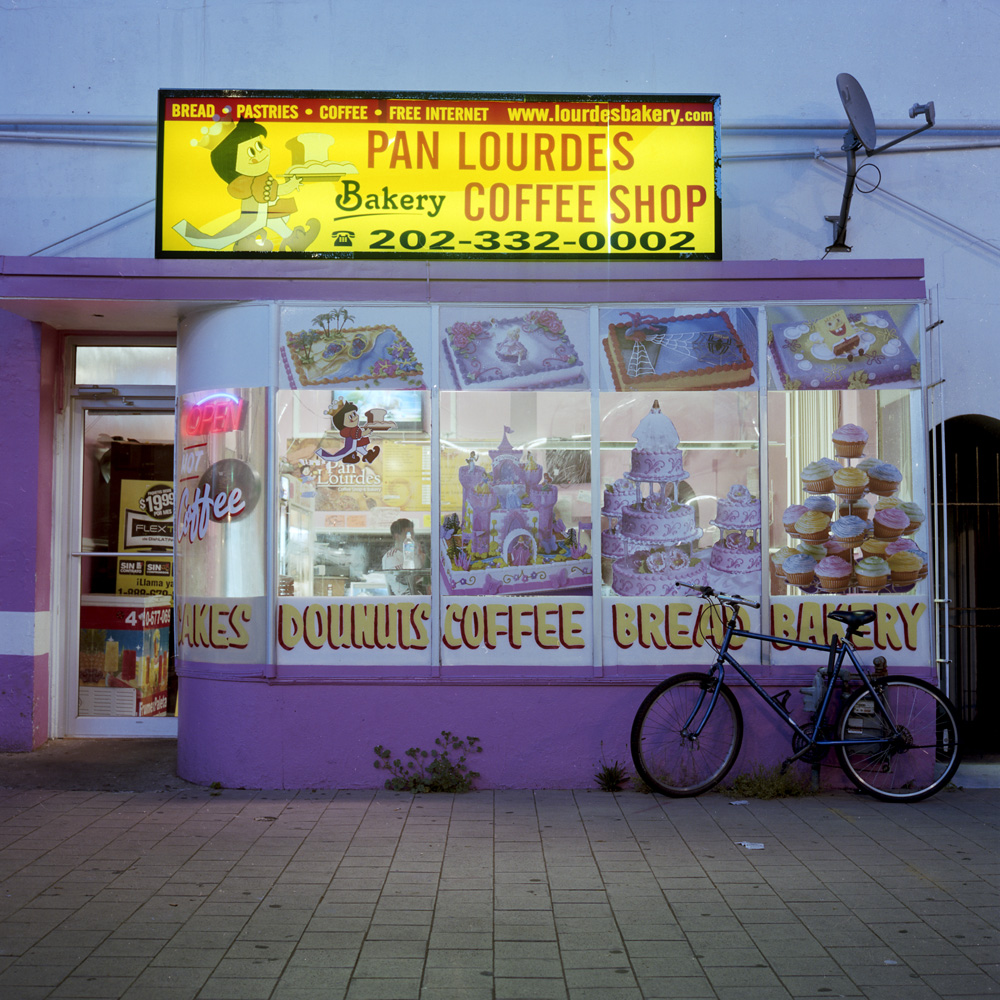
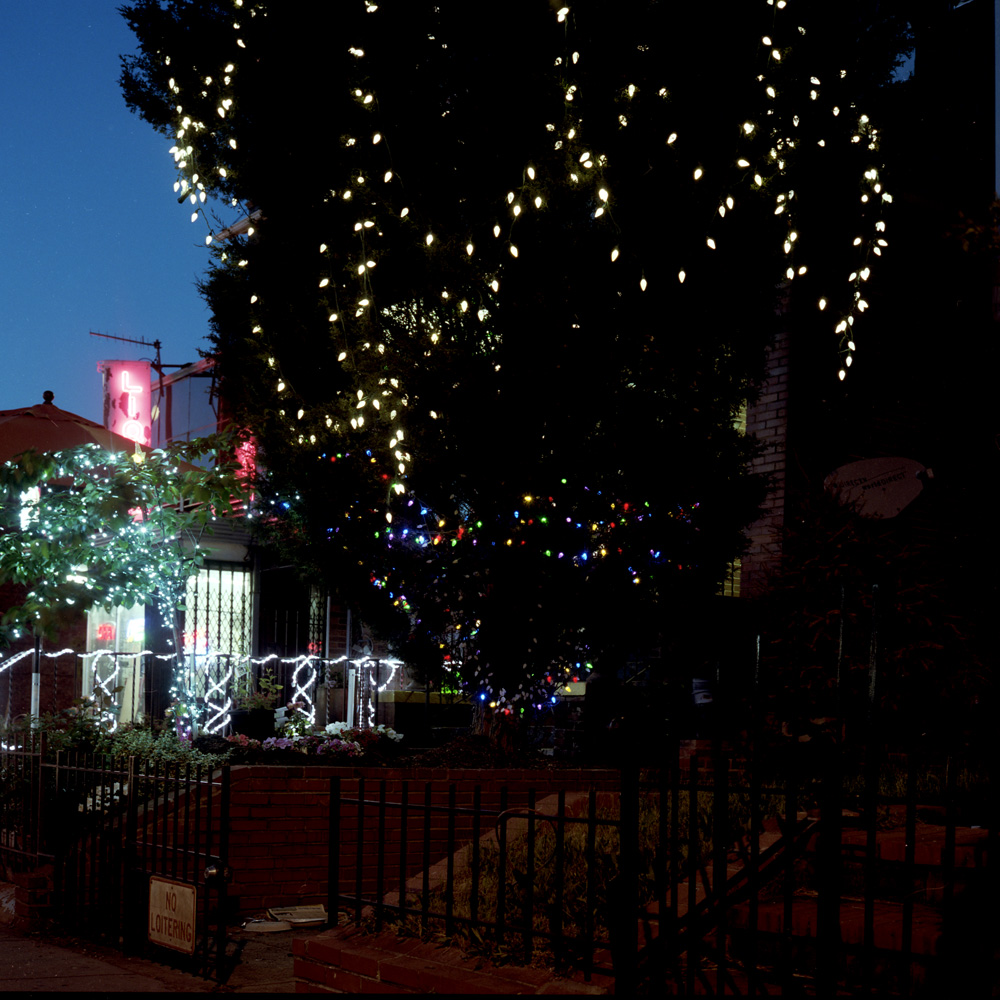
La MoliendaPan Lourdes, in colorTree Lights, 14th StreetGlorias Pupusas
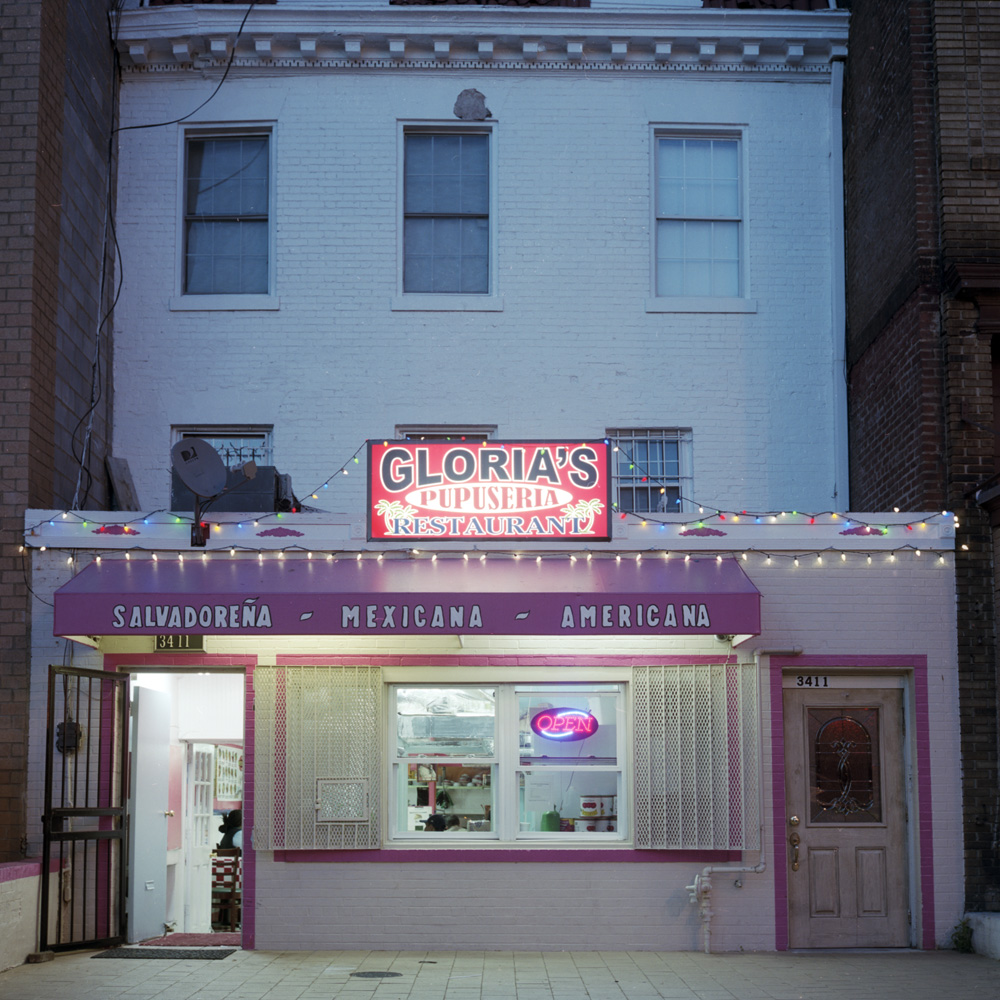
Some twilight photos taken on 14th Street in Columbia Heights. All shots were taken with my Rolleiflex 2.8E on Kodak Portra 160. This time I was using a tripod – the black and white shots were hand-held. While I was out taking these photos, I had someone from Cavalier Liquor come outside and tell me, “you didn’t get permission to take pictures”. He then broke into a smile so I knew he was just teasing. I’ll make a nice print of the picture and bring it to them, one of these days.
I also had someone approach me as to why I was photographing Gloria’s Pupuseria and Pan Lourdes. I explained to the guy I’m a photographer and I take pictures of things I find interesting. He explained his interest in why I was taking pictures with a throwaway line about 9/11 and can’t be too careful these days. As a Pentagon attack survivor, and photographer, I find the gratuitous abuse of 9/11 as an excuse for anything and everything intrusive to be highly insulting. If I were scouting potential targets for a terror attack, I sure as shootin’ wouldn’t be using a Rolleiflex on a tripod! I’d be doing what everyone else is doing and using my cellphone, to be as inconspicuous as possible. And I’d not be scouting out a Latino bakery in a transitional neighborhood. Suspicious behavior is not taking photographs – suspicious behavior is leaving a bulky bag unattended in a busy location. Photography is not a crime, and telling people to look out for photographers is up there with the porno scanners at the airport as the worst kind of security theater – it harasses innocent, law-abiding citizens and presents the illusion of “doing something” while not actually addressing real security needs.
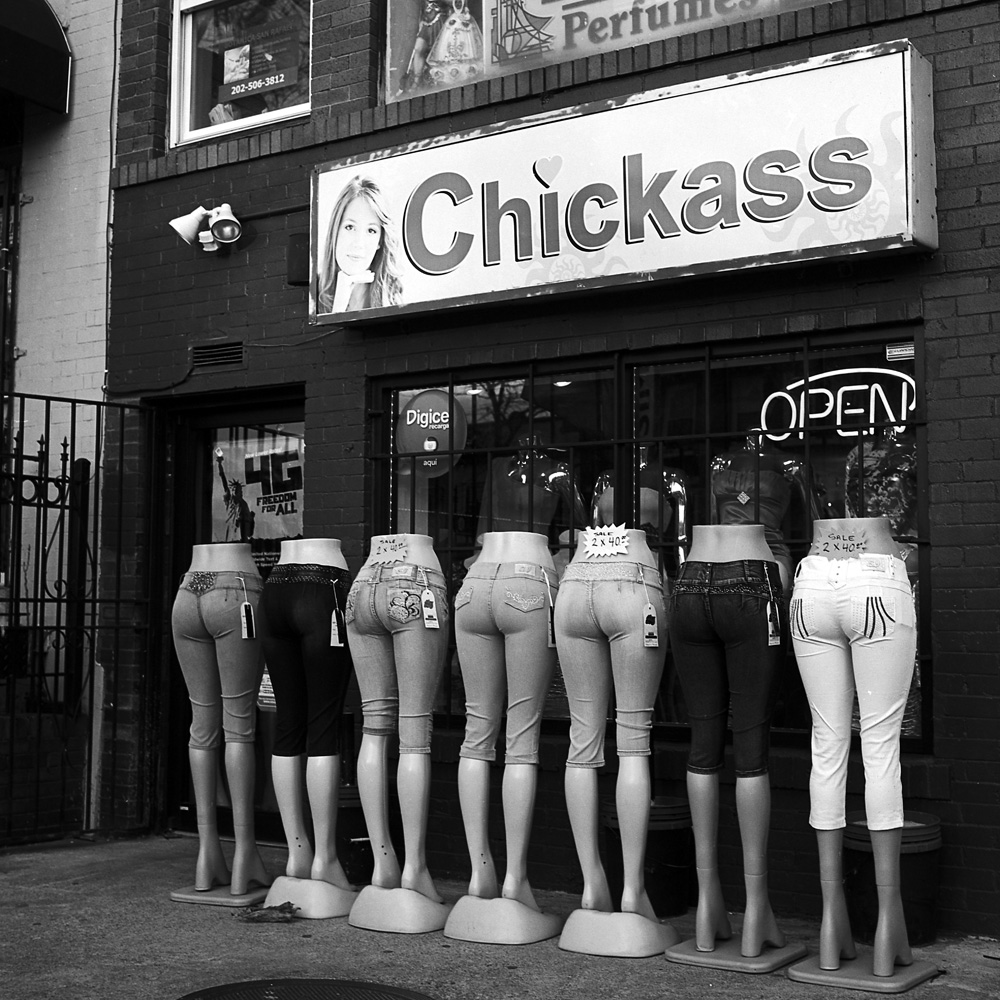
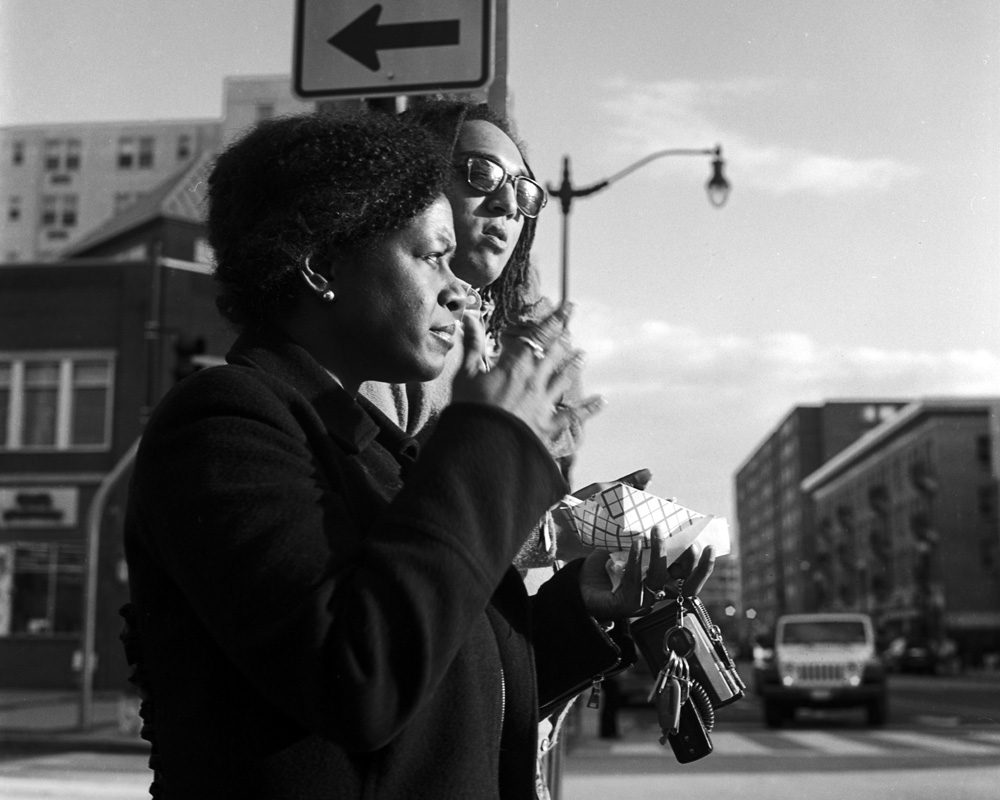
Chickass JeansPan Lourdes, 14th StreetStreet Snack, 14th StreetPhilip Seymour Hoffman and My Shadow
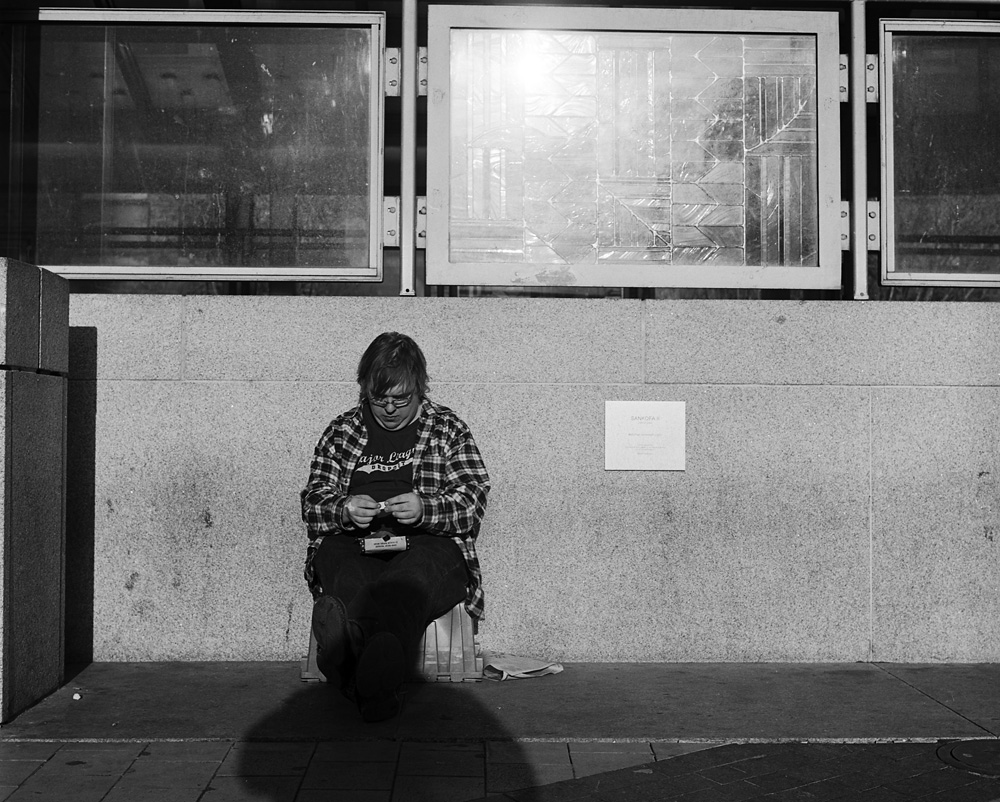
I called this one Philip Seymour Hoffman and my Shadow because the guy sitting against the Metro entrance wall just kinda looks like him, in full-on Method acting mode studying for a role.
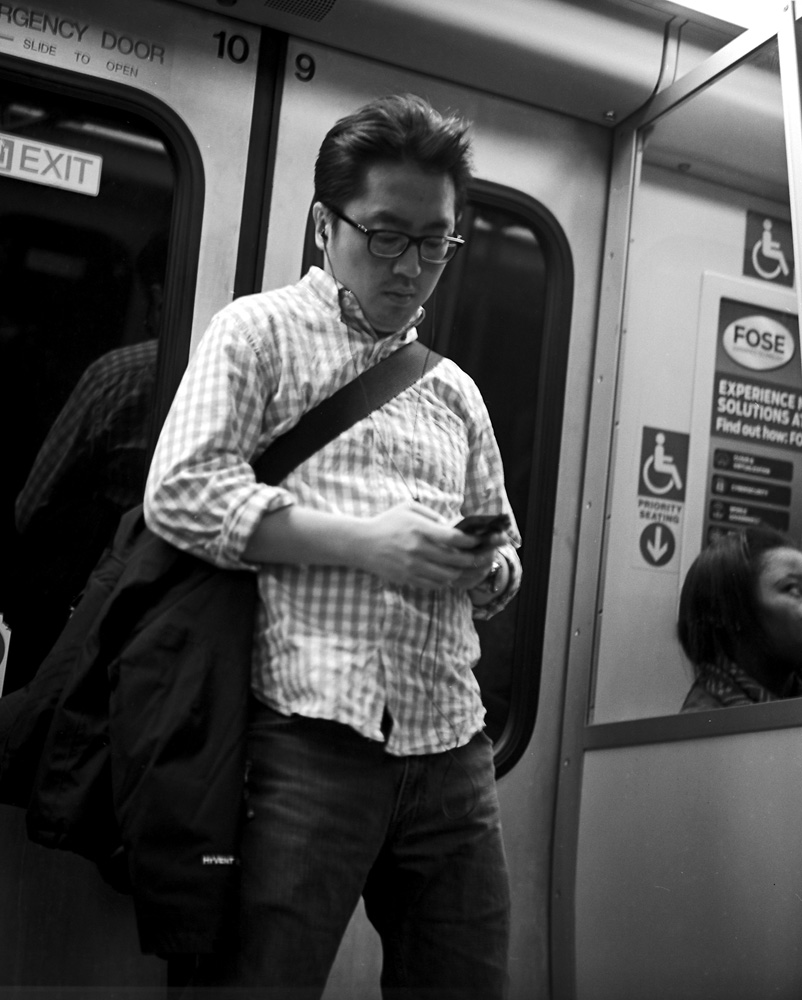
Standing in the DoorwayTogether, Apart
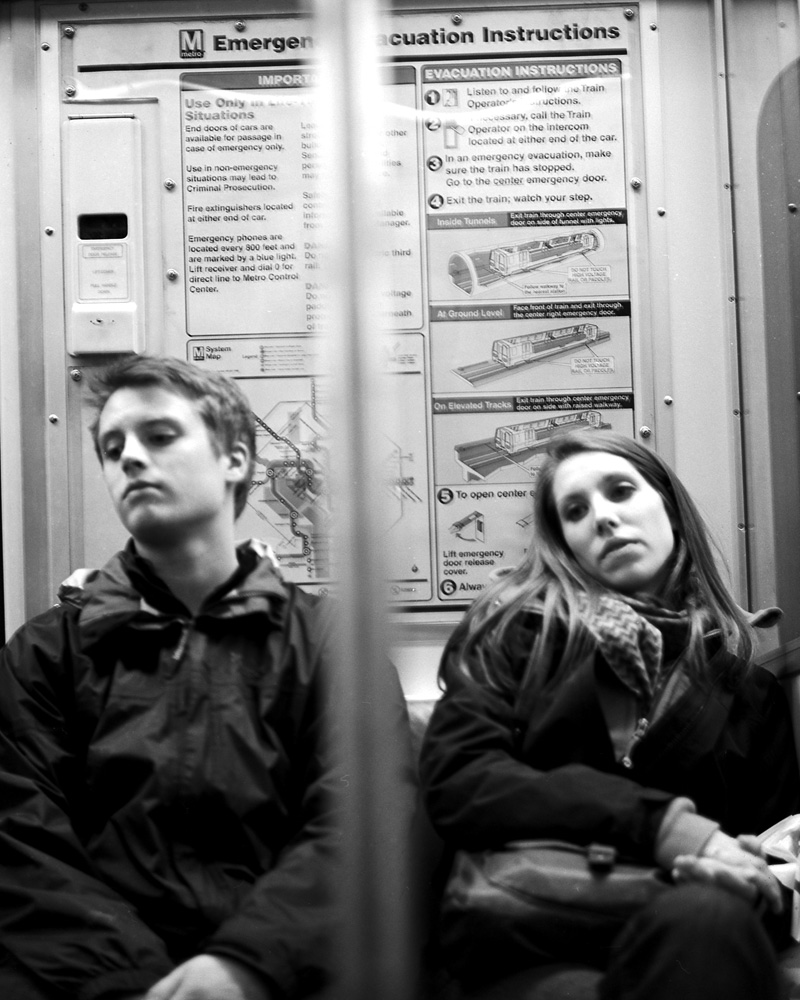
This was taken around 10pm on the subway on my way home from Chinatown. I suspect these two were heading home after dinner and a long day (perhaps week!) at the office.
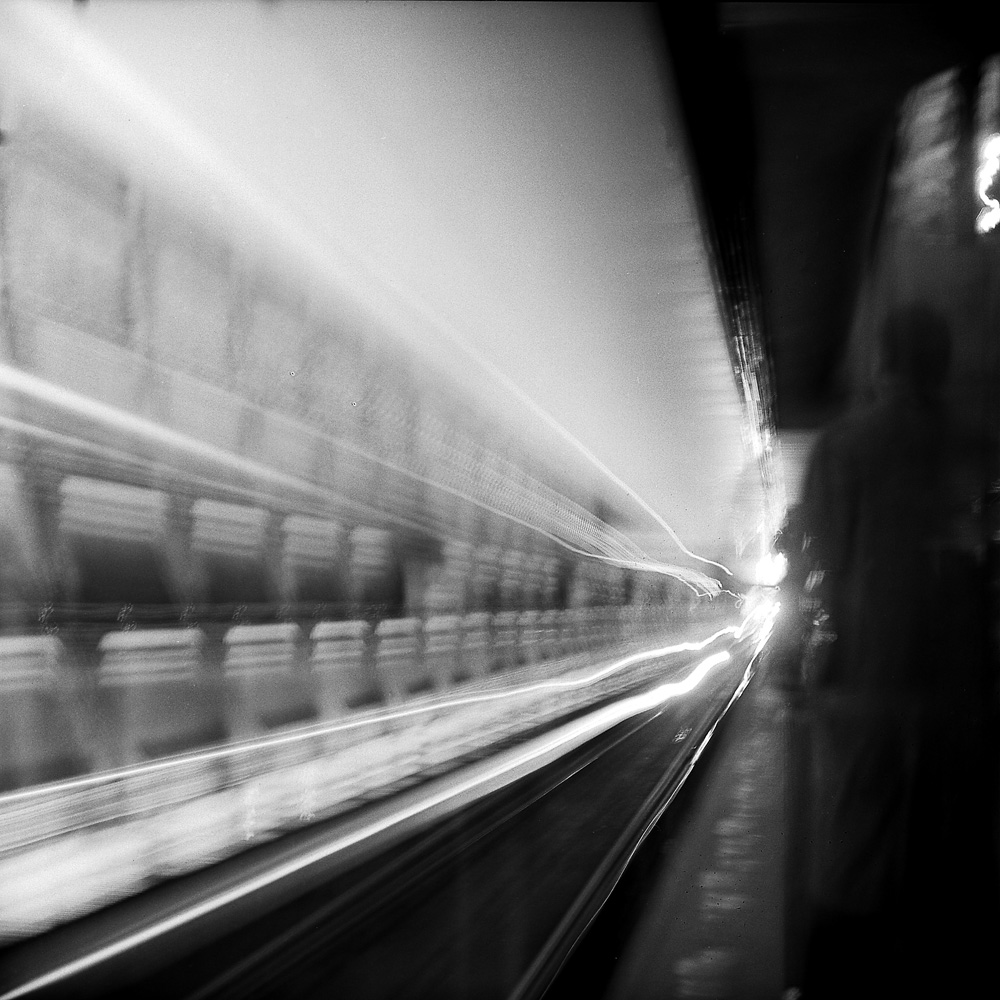
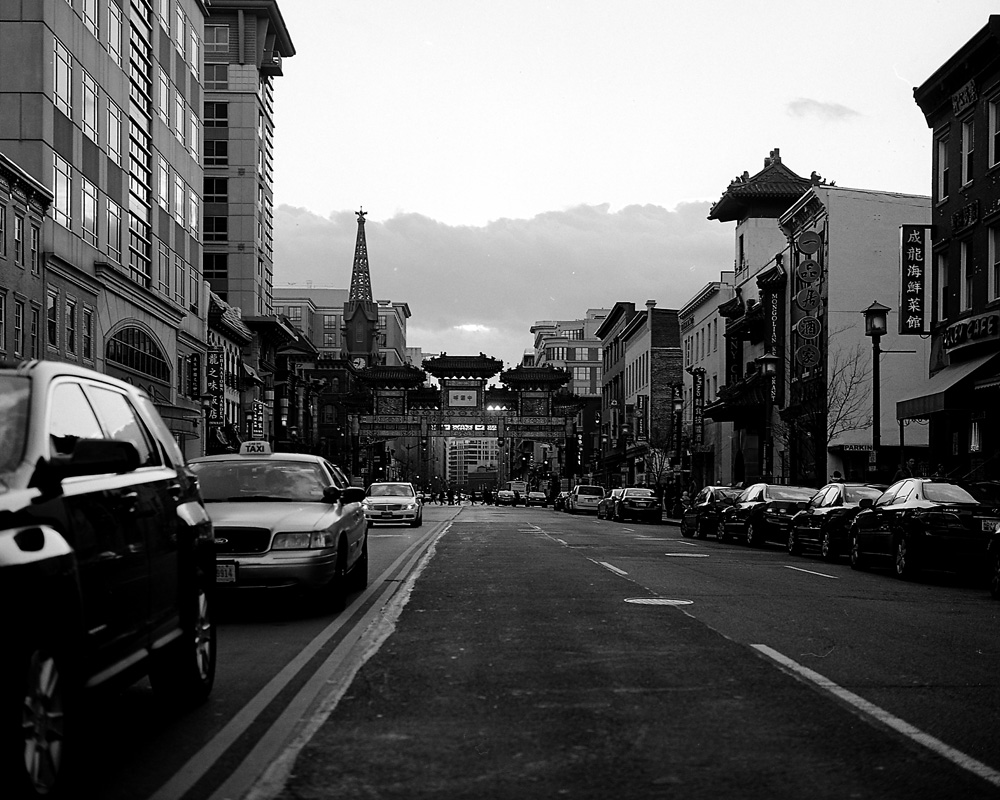
Oncoming MetroChinatown Arch, Sunset
This image has me on the horns of a dilemma- would it have been better in color or as it is in black-and-white? I think it has a certain character in black-and-white that it wouldn’t have in color, but the western sky would definitely look different. Comments?
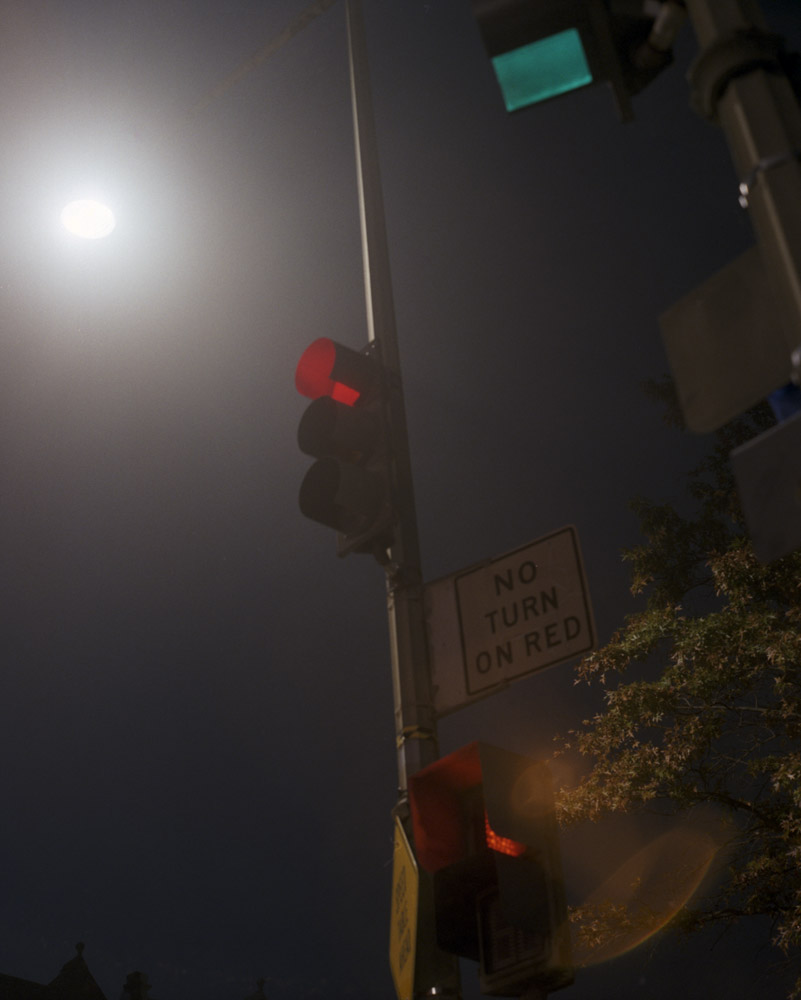
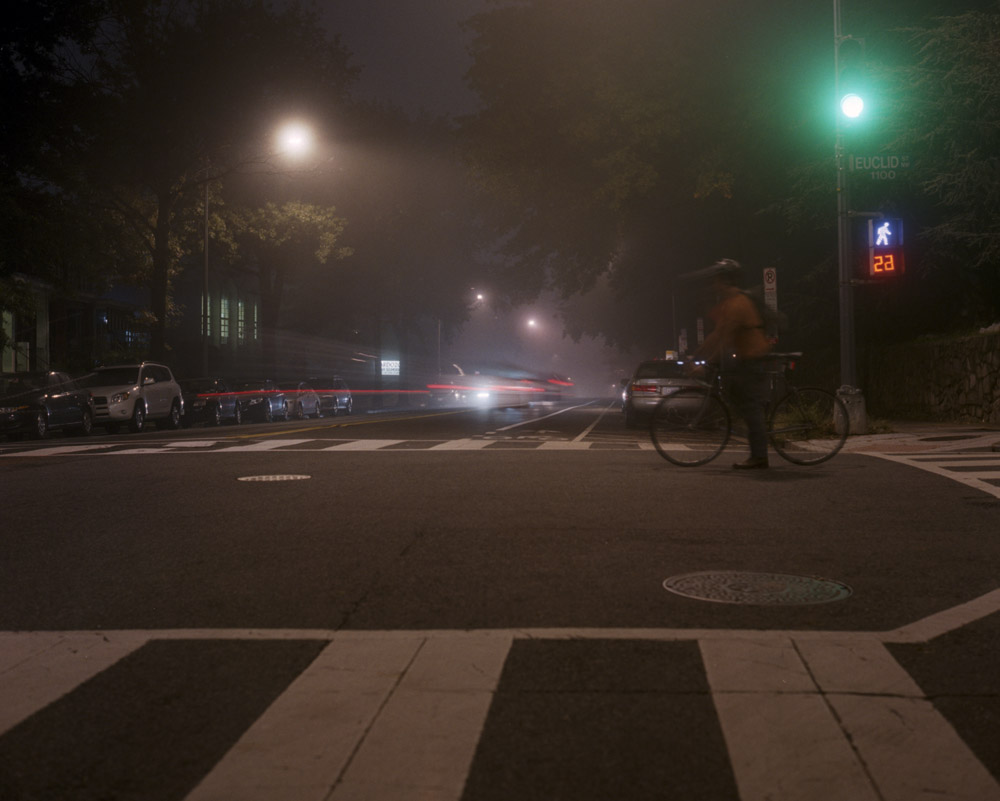
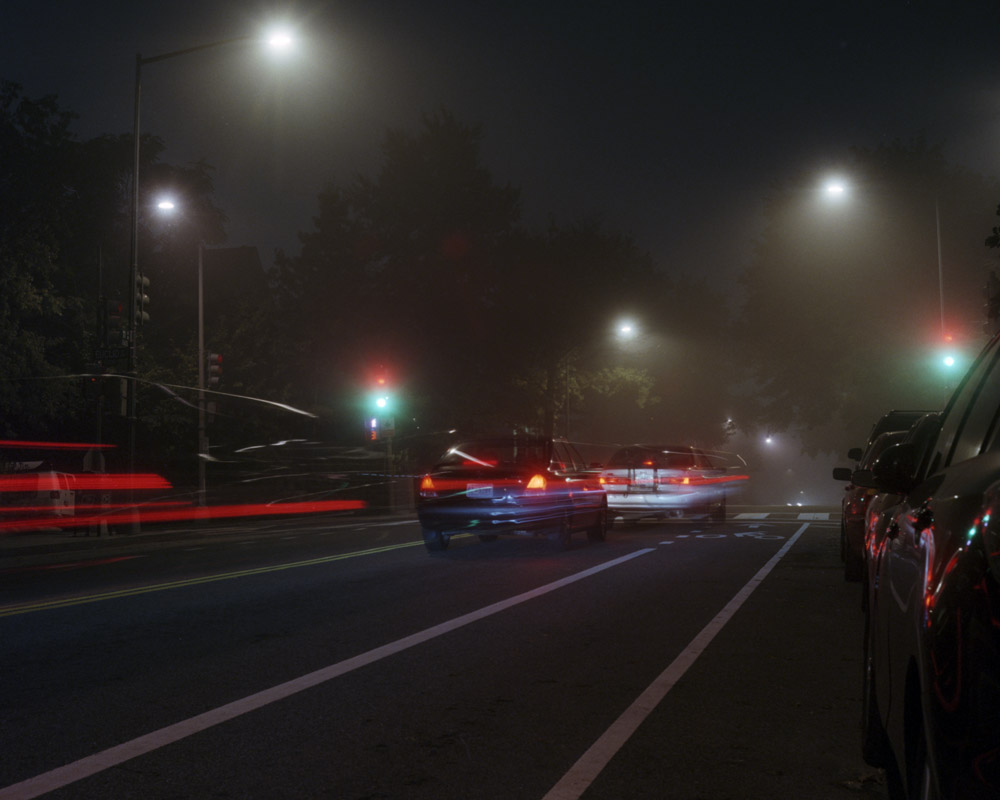
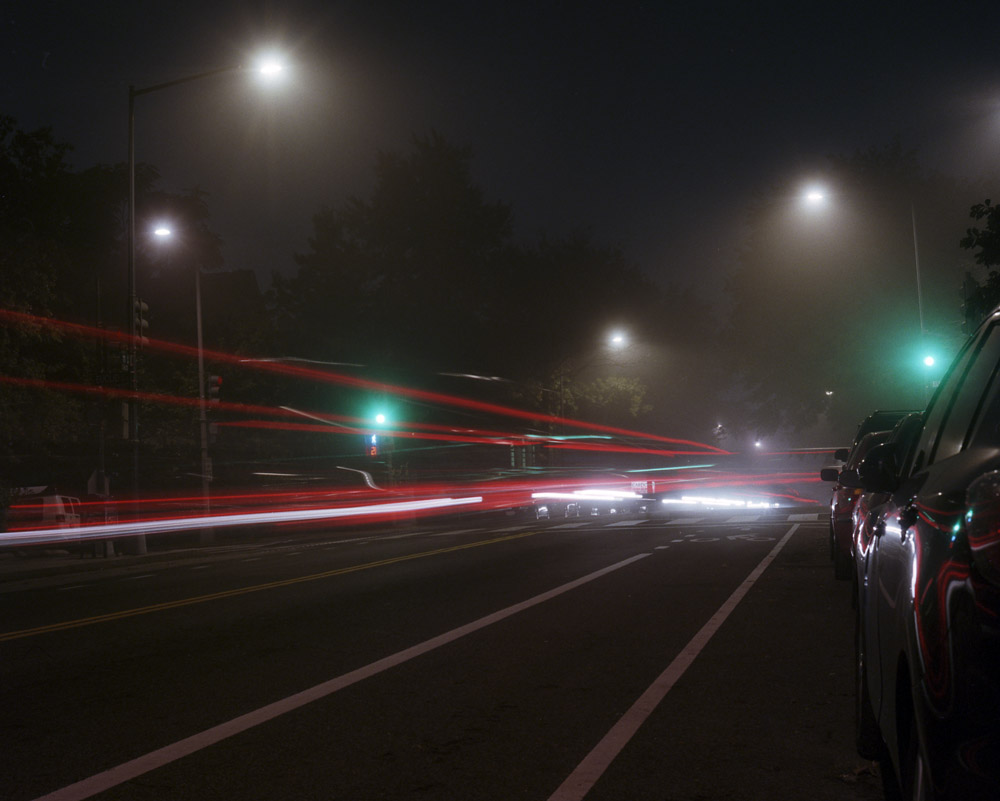
A few nighttime photos in the fog. I think these really captured the atmosphere of the evening. It had been warm in the daytime, then rained, and when the rain stopped, it was already dark, so we ended up with this cool fog. I wanted to capture that feel of the streets at night in the fog, and since I live somewhere very residential, I figured this was a pretty safe place to do it as there wouldn’t be much traffic to worry about if I stepped into the street for a four second exposure. All these were taken with my Rolleiflex, on expired Fuji NPH 400 film. The reason why I’m shooting all this expired film is not that I’ve got some kind of outdated film fetish, or that I’m a cheap-ass bastard and refuse to buy fresh film, but rather I’m just having fun experimenting and I don’t want to use “good” film on experimental stuff if I have some old film that nowadays is for all intents and purposes free but for the processing cost.
But what about the square, you say? Aren’t all Rollei photos square? Well, I do love square photos, and that’s one of the reasons why I love the Rollei so much. But there does come a time when you have to look at the photo and decide if a crop makes the image stronger. In all of these cases, the original square composition had too much something – too much sky, too much foreground, etc. So I cropped for more dynamic compositions that didn’t have so much dead space in them. I think these are much better.
 dcphotoartist