Tag Archives: France

Charles Marville exhibit at the National Gallery of Art

The River Seine by Charles Marville

Charles Marville: Photographer of Paris

Around 1832 Parisian-born Charles-François Bossu (1813–1879) shed his unfortunate last name (bossu means hunchback in French) and adopted the pseudonym Marville. After achieving moderate success as an illustrator of books and magazines, Marville shifted course in 1850 and took up photography, a medium that had been introduced 11 years earlier. His poetic urban views, detailed architectural studies, and picturesque landscapes quickly garnered praise. Although he made photographs throughout France, Germany, and Italy, it was his native city—especially its monuments, churches, bridges, and gardens—that provided the artist with his greatest and most enduring source of inspiration.

By the end of the 1850s, Marville had established a reputation as an accomplished and versatile photographer. From 1862, as official photographer for the city of Paris, he documented aspects of the radical modernization program that had been launched by Emperor Napoleon III and his chief urban planner, Baron Georges-Eugène Haussmann. In this capacity, Marville photographed the city’s oldest quarters, and especially the narrow, winding streets slated for demolition. Even as he recorded the disappearance of Old Paris, Marville turned his camera on the new city that had begun to emerge. Many of his photographs celebrate its glamour and comforts, while other views of the city’s desolate outskirts attest to the unsettling social and physical changes wrought by rapid modernization. Taken as a whole, Marville’s photographs of Paris stand as one of the earliest and most powerful explorations of urban transformation on a grand scale.

By the time of his death, Marville had fallen into relative obscurity, with much of his work stored in municipal or state archives. This exhibition, which marks the bicentennial of Marville’s birth, explores the full trajectory of the artist’s photographic career and brings to light the extraordinary beauty and historical significance of his art.

I went this weekend with my parents to see this exhibit. It is a wonderfully presented exhibition, and proof positive that when the National Gallery tries hard to do a good photography show, they can. The exhibition had special resonance for my father and I as we have just been to Paris, and trod the same streets documented in these photographs.

The exhibition has over 100 prints of Charles Marville’s work on display, ranging from early salt-paper portraits made from calotype negatives (negatives made on paper) to large albumen prints of architectural studies from glass collodion negatives. His architectural works have a significant sociological aspect as they document neighborhoods in transition from medieval warrens of twisted streets and cantering buildings flung up haphazard against one another, populated by the Parisian working class, to the modern, wide boulevarded, sanitized, luxurious Paris created by Baron Haussmann that we think of today.

Among the modernizations he documented were the new gas street lamps being installed, and the public urinals Haussmann designed to improve public sanitation (a major obsession of his). While many of the street lamps were preserved with electrification and can still be seen today, only one of Haussmann’s urnials still stands on Parisian streets.

Marville even includes himself in this transition, as he frequently used himself or an assistant as a stand-in for scale and emotional impact amidst the tumult and construction/destruction he photographed. He even photographed his prospering studio in a location that a scant few years later would also fall victim to Haussmann’s ‘modernizations’.

At the peak of his career he was the official photographer of Paris, but by the time of his death, he had faded into obscurity, his work ending up stored in state and city archives, and not a single obituary was published to mark his passing. He may have died in obscurity, but his work survived and preserved the city in transition, sometimes with his images being the sole record of the city that was.

The exhibit will be traveling to the Metropolitan Museum of Art in New York in January. If you can make it, it will be well worth your while.
Paris in October – Part 20 – Le Marais in Black and White

Le Marais is one of the few neighborhoods in the city center of Paris that retains its medieval core of narrow wandering streets. It is home to a diverse population from Orthodox Jews to gay pubs and nightclubs. It is full of little art galleries, boutiques, shops and restaurants, where cutting-edge cohabits with the ancient.

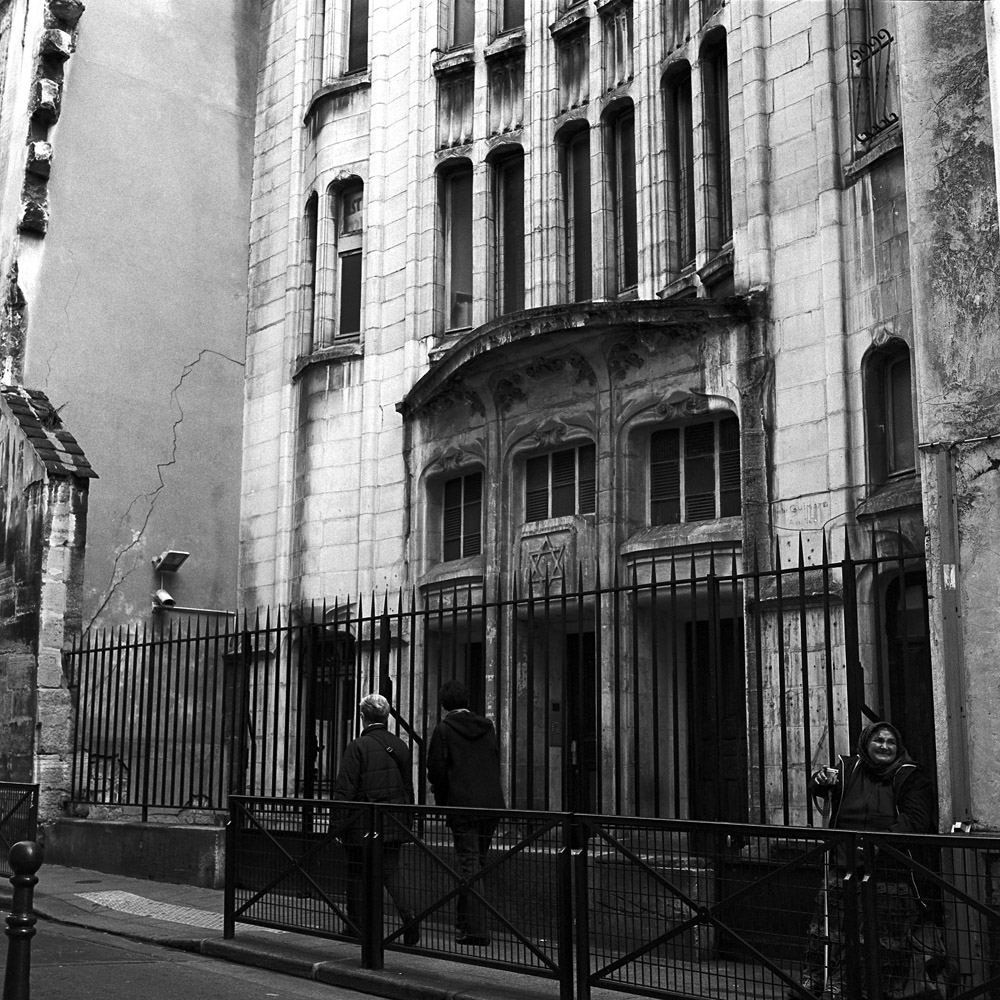
The look of the Orthodox Jewish center appears to be late 19th century/early 20th century Art Nouveau, which surprises a bit that it survived the Nazi occupation.

Orthodox Jewish Center, Le Marais

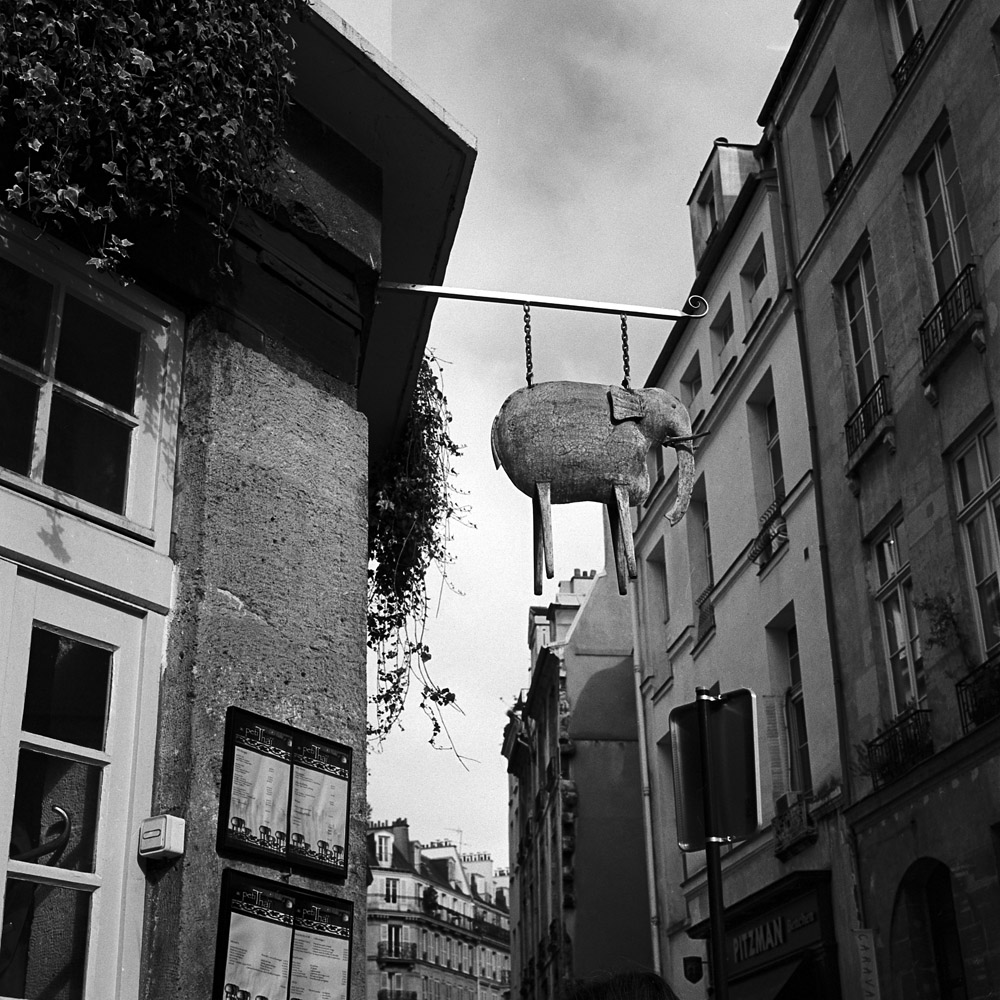
Just across the street and down a half a block is Le Petit Thai restaurant, with its cute elephant sign. I don’t yet know the significance if there is any, to why it seems there are always Thai restaurants in gay neighborhoods.

Le Petit Thai, Le Marais

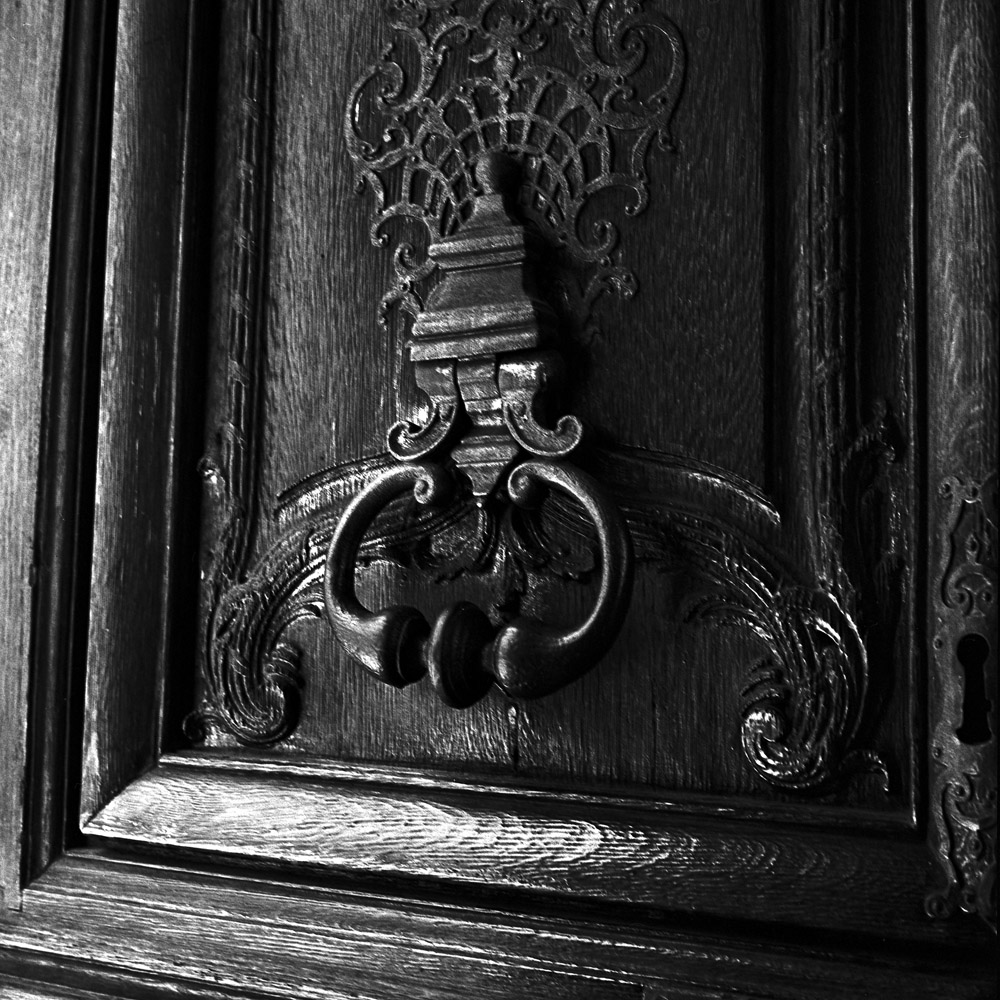
A beautiful wrought-iron door knocker on a weathered wooden door in the Marais:

Door Knocker, Le Marais

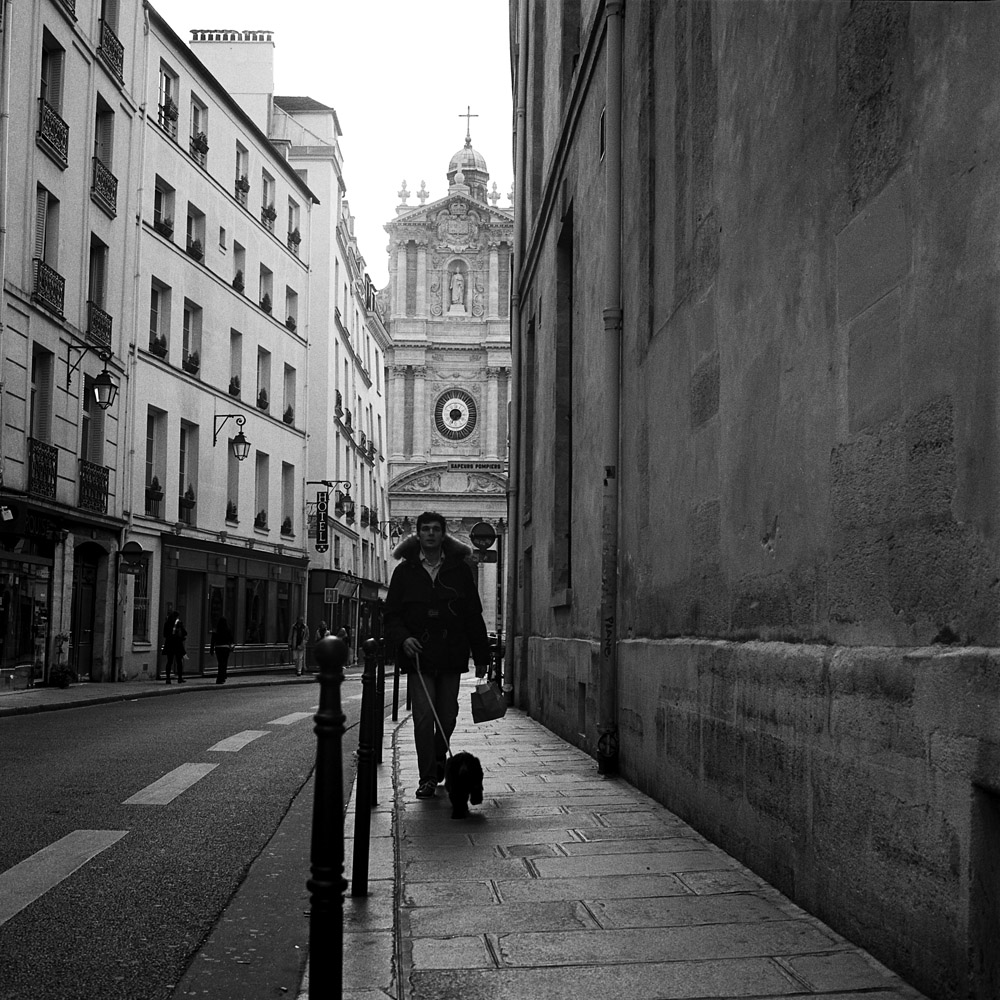
A man out walking his dog on the Rue Sevigne. The church in the background is the Eglise St. Paul-St. Louis, which housed the hearts of Louis XIII and XIV (after they were dead, of course) until the French Revolution. The current structure dates back to the 17th century.

Dog Walker, Rue Sevigne, Le Marais

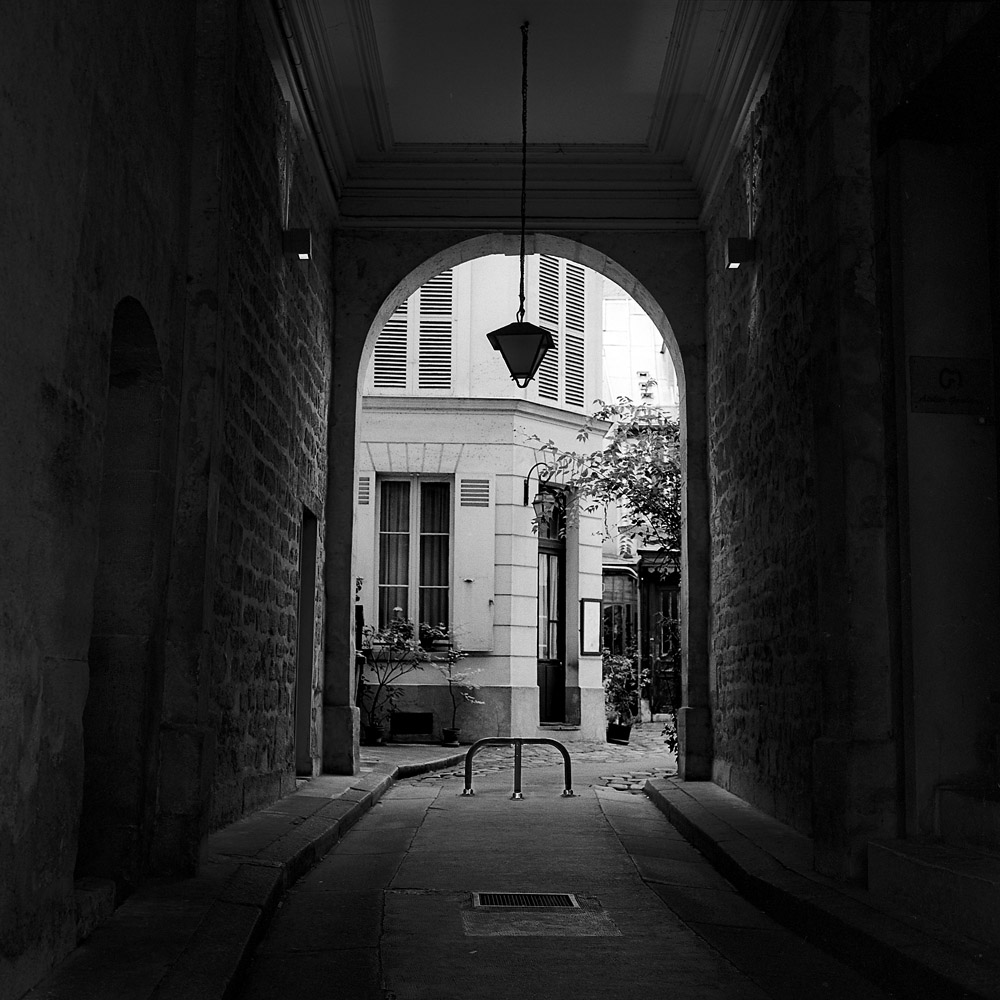
The Marais is perforated with a profusion of residential courtyards which remain invisible to the passer-by unless the massive doors at the street are open. Here is a view into one of these courtyards. They retain a very distinct feel of Old Paris where things are quieter and slower-paced. Entering one feels like stepping back in time, a peaceful oasis utterly cut off from the hustle and bustle of the city outside.

Courtyard Near The Bibliotheque de Paris

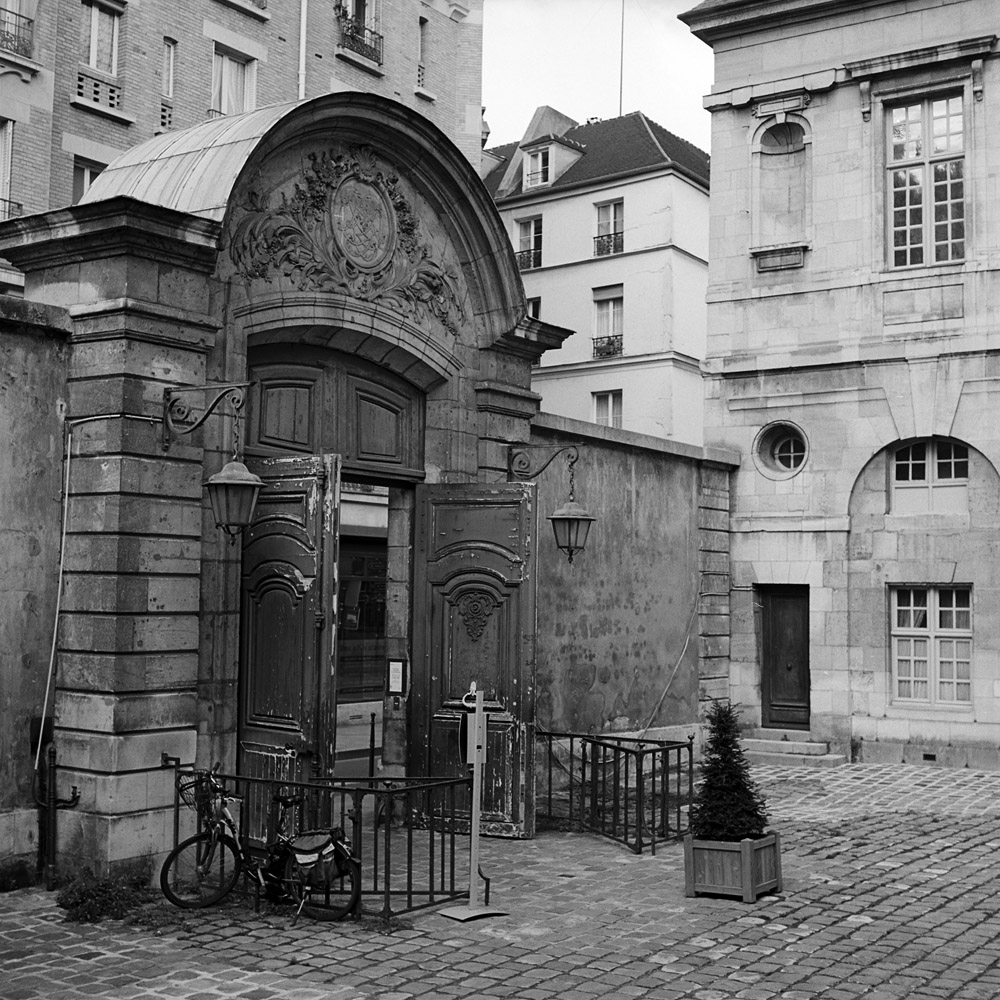
Eugene Atget took many of his most famous images in and around the Marais as the city was being surrendered to Haussmannization during the Second Empire/Third Republic periods. One of his regular subjects was the Bibliotheque de Paris, originally built as a hotel (town-house for a noble family) in the 17th century. Today it houses the city library. This view is of the entrance gates to the courtyard.

Le Porte du La Bibliotheque de Paris

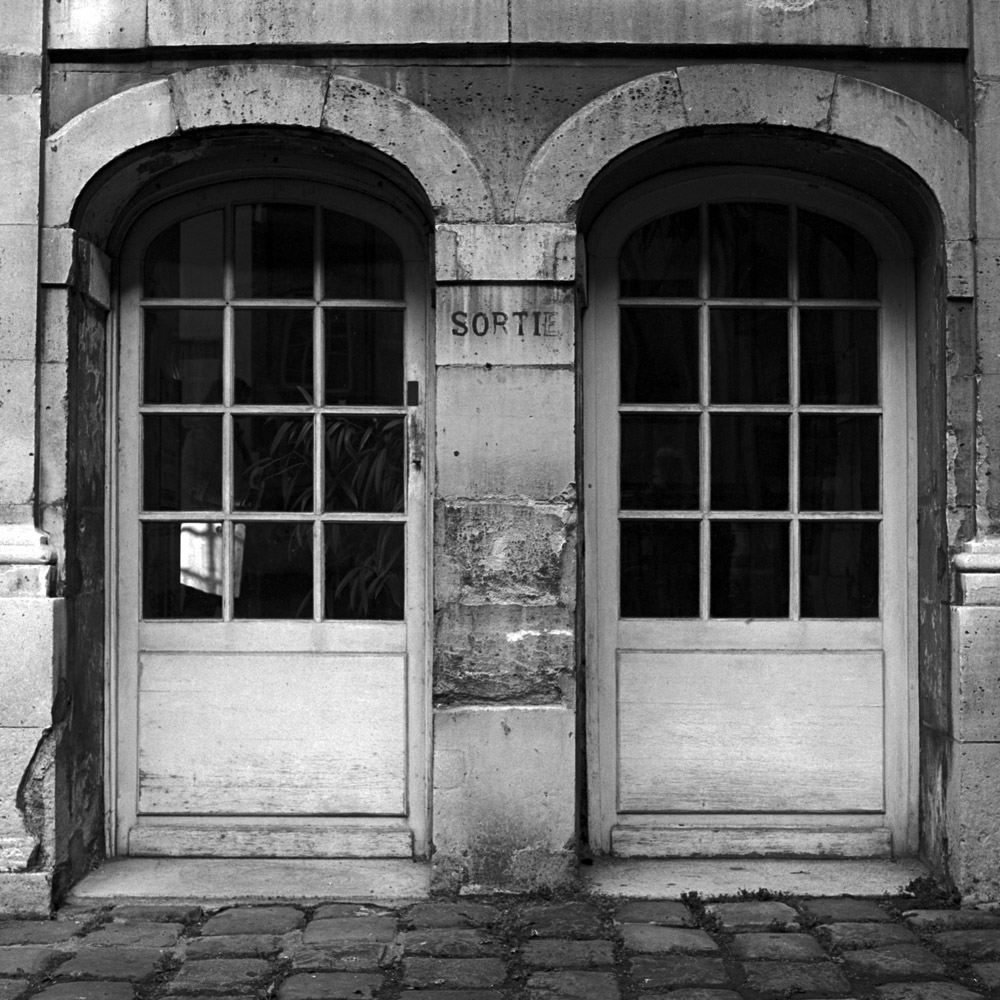
A door into the courtyard, marked Sortie (exit). Not too much exiting going on through this door, though, if the giant potted palm visible in the left-hand window has anything to say about it.

Sortie, Bibliotheque de Paris

All images shot with my Rolleiflex 2.8E, using Kodak Tri-X film.

Paris in October – part 19 – The Eiffel Tower

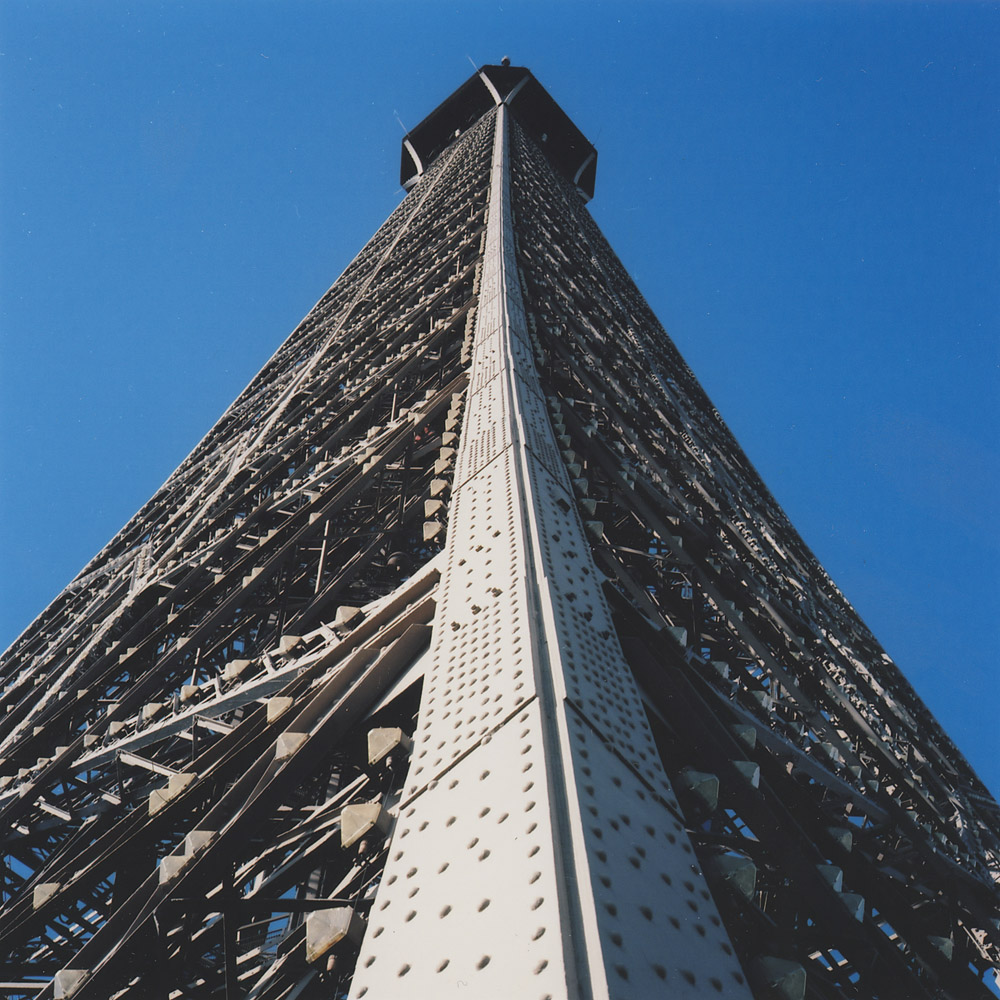
Does the Eiffel Tower really need any text description? The one really cool thing I can think of about it you probably don’t know is that when it was built, it generated polarizing opinions among Parisians – they either loved it or loathed it. One famous French writer was known to detest it as an eyesore, yet he would go there to have lunch every day in the restaurant. When asked why he would do such a thing since he hated it so much, he remarked, “because it is the one place in Paris I can be where I can’t SEE it”. I’ll leave it to you to judge its beauty, but it has endured for over 120 years despite the fact it was only originally intended to last for 20 and has become an internationally recognized and beloved symbol of the city of Paris.

Eiffel Tower Silhouette
Eiffel Tower, Blue Sky

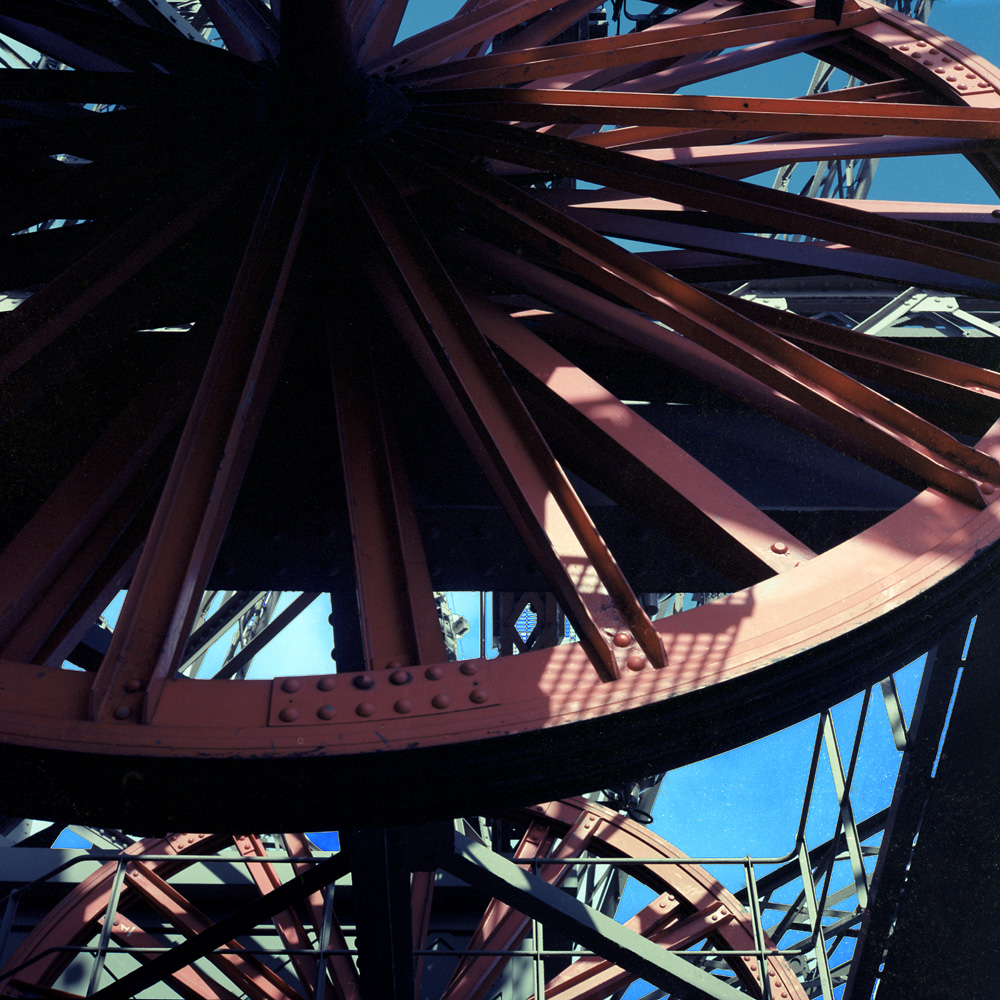
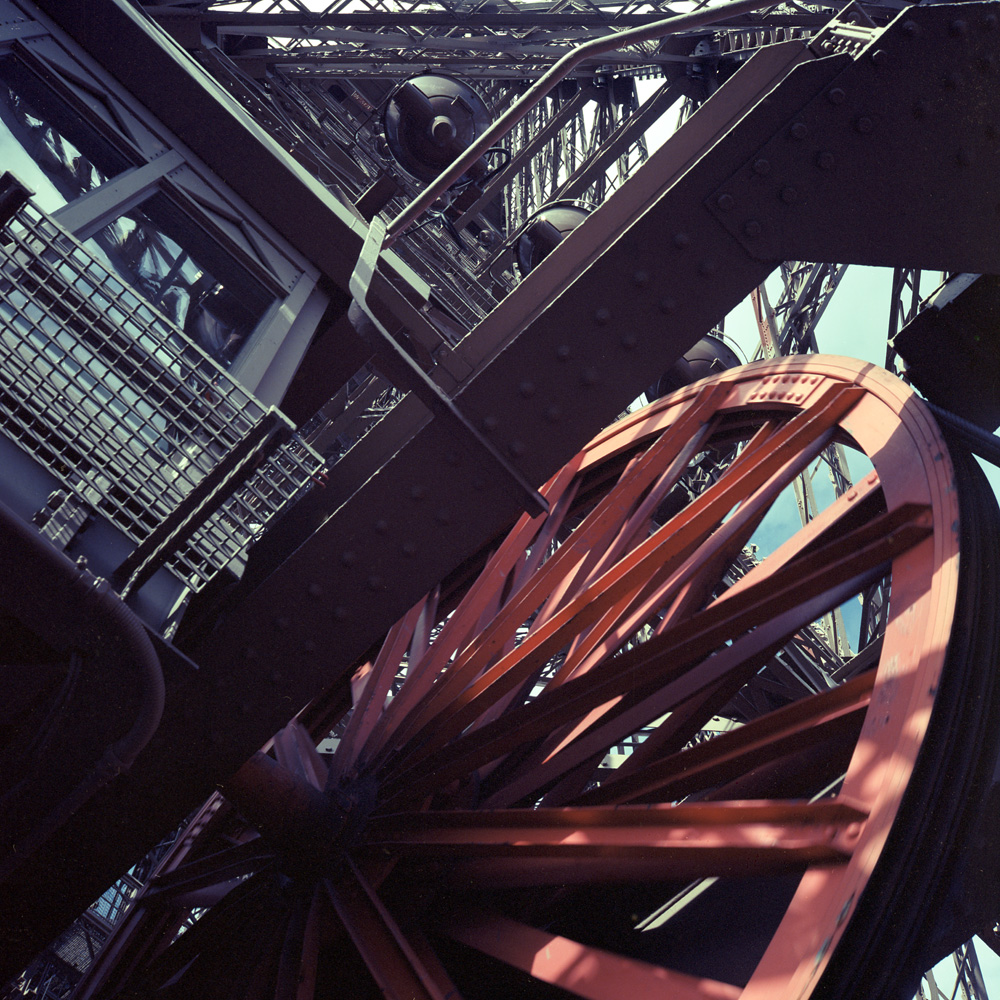
Riding up to the 2nd tier in the elevator, you can see the giant wheels that run the cables to raise and lower the elevators that ride in the leg piers. The elevators themselves are double-deckers, and halfway up the transit from the ground to the second tier, they actually change angle of ascent as the leg angle changes.

Elevator Wheels
Elevator Wheels
Elevator Wheels, Looking Up

The view to the east from the second deck includes the Seine river, the Louvre (just beginning to intrude into the frame at the far right middle ground), and in the distant far left background is the Sacre Coeur church on top of Montmartre.

East View, 2nd Tier
East View, 2nd Tier

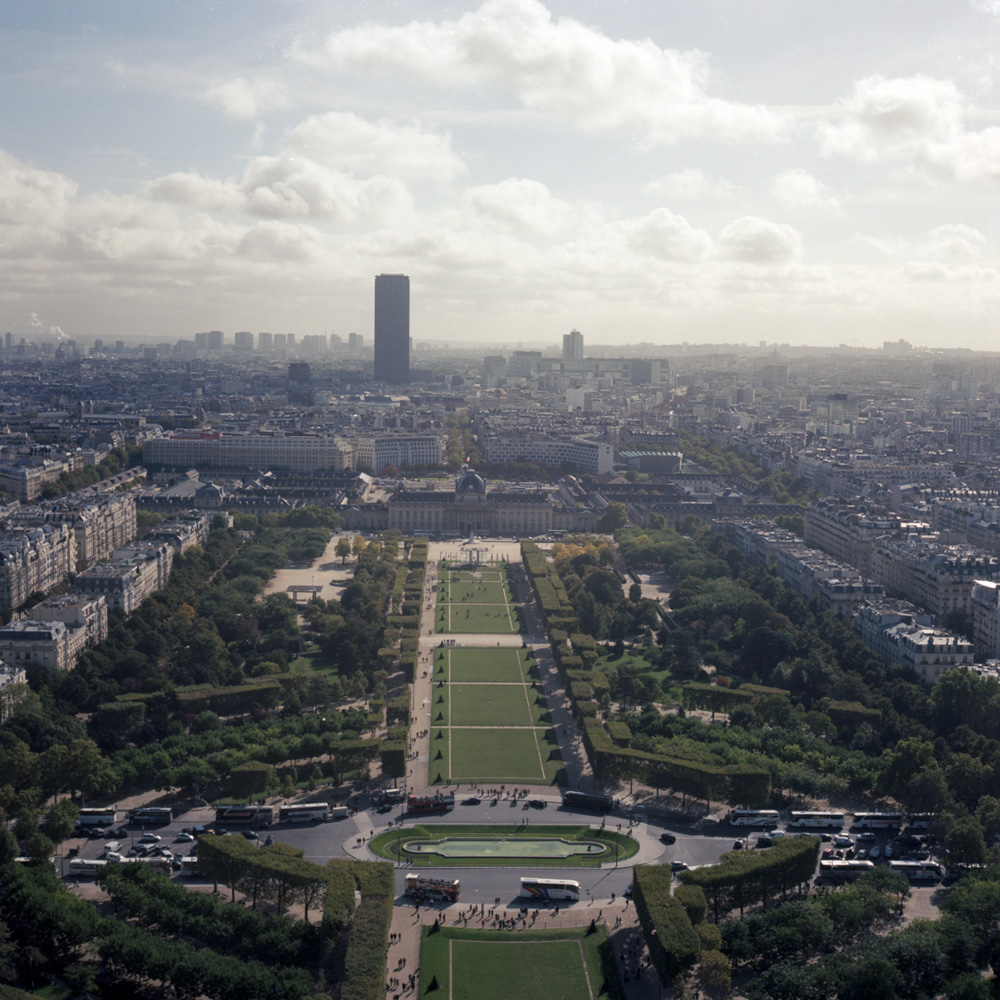
Looking south, the view encompasses the Champ De Mars and the French Military Academy, and in the distant background, the Tour Montparnasse. I did not ascend the Tour Montparnasse even though it has an observation deck some 50 stories up, but I did pass below it through the Gare Montparnasse on my trip to Versailles.

Champ De Mars, 2nd Tier View

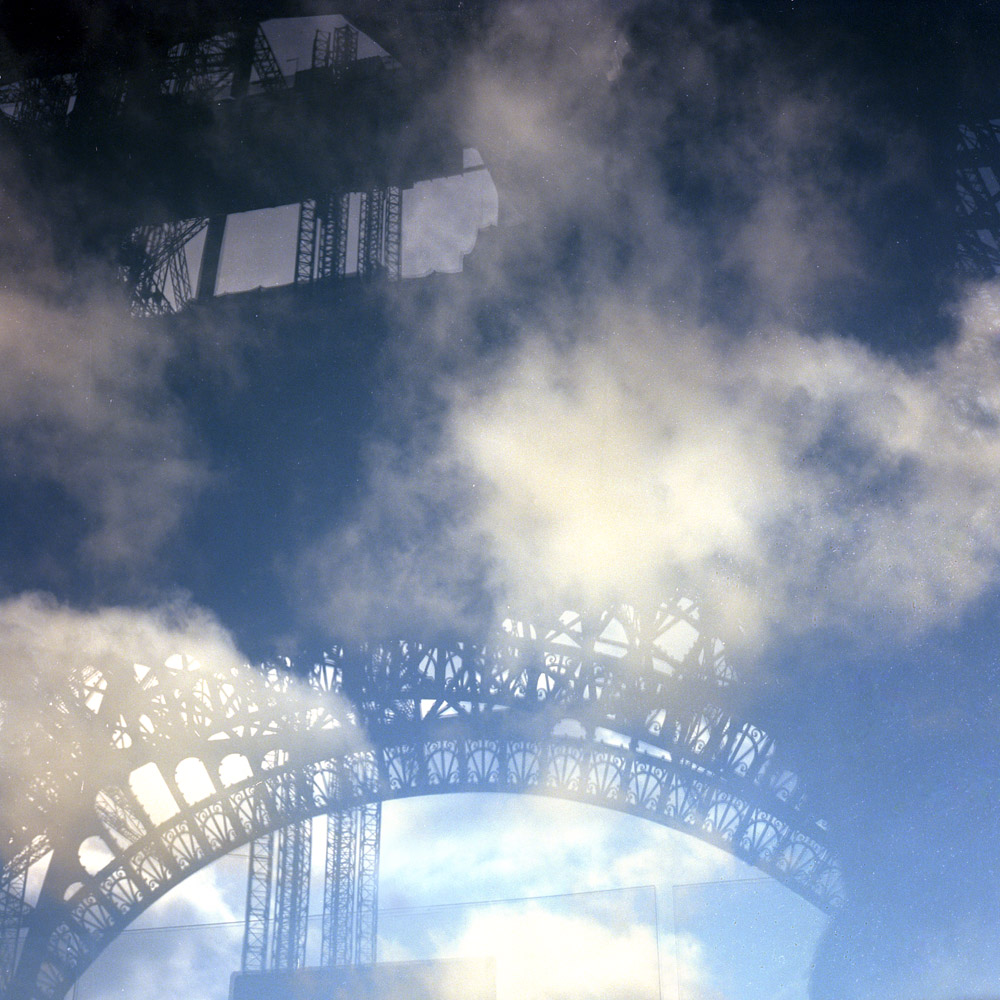
I know I posted this image before as a bit of a one-off, but I’ll re-include it here because it belongs as part of this grouping. While waiting in line for the elevator, I looked at the security glass in the partition that controlled the line and saw the shadow of the tower under the reflection of the clouds on the other side. I had to chance the photo, even though the coating on the safety glass can cause strange color casts in the image. I think it paid off – what do you think?

Eiffel Tower Shadow, Clouds

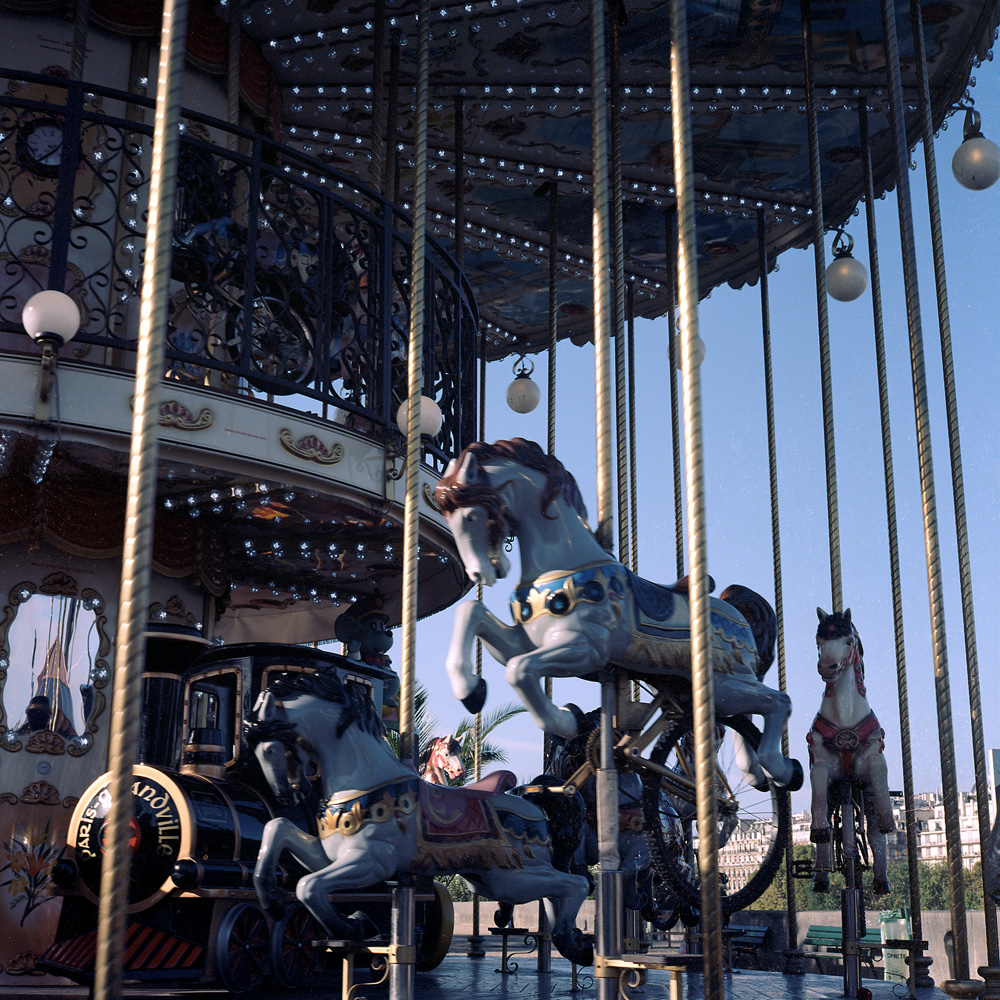
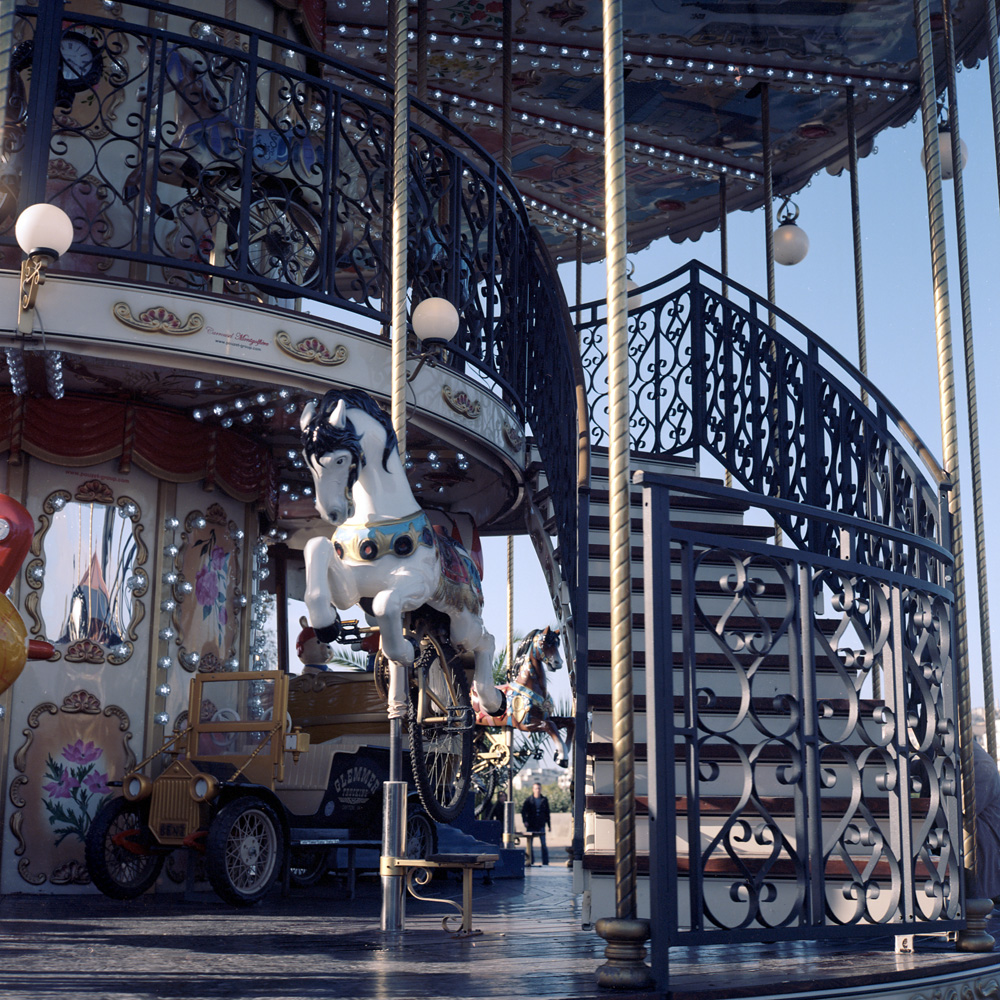
Not really apropos of anything other than geographic proximity: across the street from the Eiffel Tower, at the foot of the bridge that spans the Seine and leads to the old Trocadero Palace, there is a charming double-decker carousel.

Double Deck Carousel

What can I say, I like carousels. We have two very nice ones here in DC – one at Glen Echo where I teach and another one on the National Mall in front of the Smithsonian Castle. I’ve photographed both of them in very different ways- Glen Echo I’ve shot in color numerous times, and the Smithsonian one I’ve shot with my 5×12 in black-and-white and printed in palladium. Some day soon I’ll get up to New York and photograph the one at the foot of the Brooklyn Bridge in Brooklyn. I think I sense a new project coming on!
Paris in October – part 18 – Stained Glass at Ste Chapelle

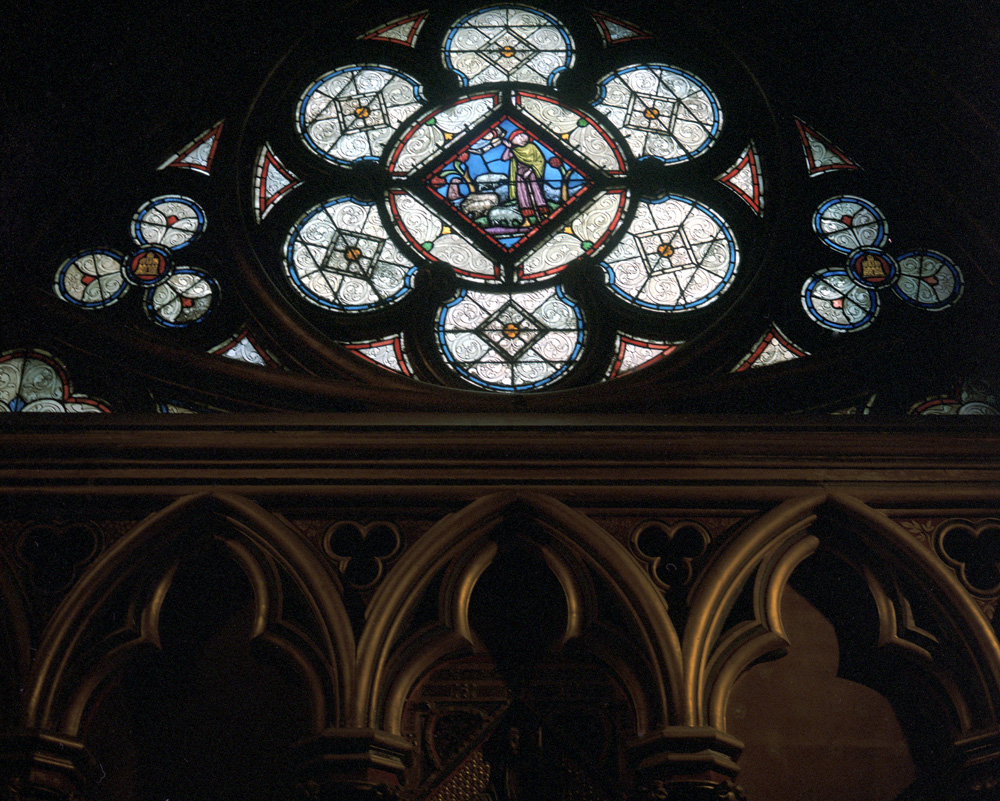
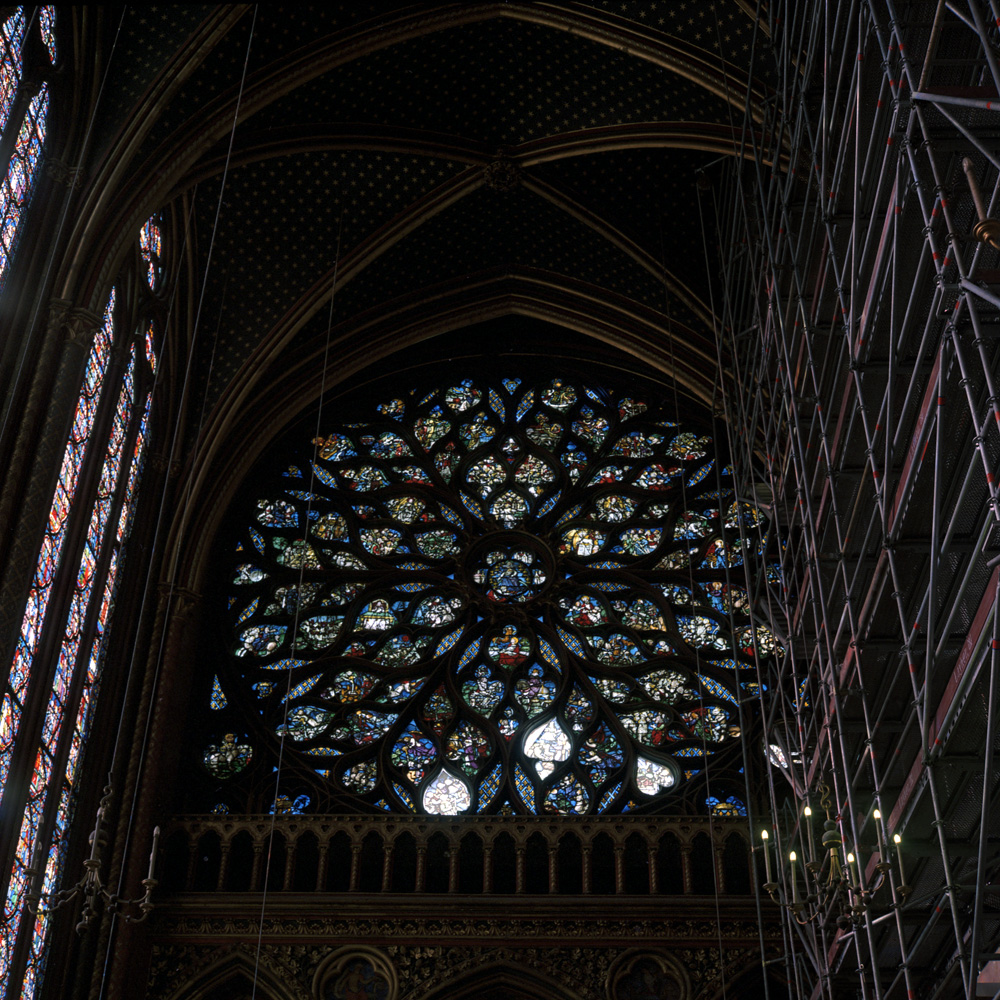
Sainte Chapelle is the royal chapel on the Ile de la Cité built in the 13th century as part of the then-royal palace. It was conceived and designed to house King Louis’ collection of Christian relics, including the purported spear of Longinus and the Crown of Thorns. Over the centuries, especially during the French Revolution, it suffered depredations, including the destruction and/or removal for sale of chunks of its stained-glass windows. In the later 19th century, the windows were restored. Today, a major, 10-year project to clean, stabilize and protect the windows is nearing completion. You can see some of the scaffolding in the chapel in my photos.
Today, you enter the chapel through the lower level, which houses a few video exhibits and the gift shop. Even on the lower level, the stained glass windows are beautiful:

Window, Lower Level, Ste. Chapelle

To enter the main chapel on the second level, you ascend a dark, narrow spiral stair, and then emerge into a room bursting with light and color. Directly above and behind you is the rose window.

Rose Window, Ste. Chapelle

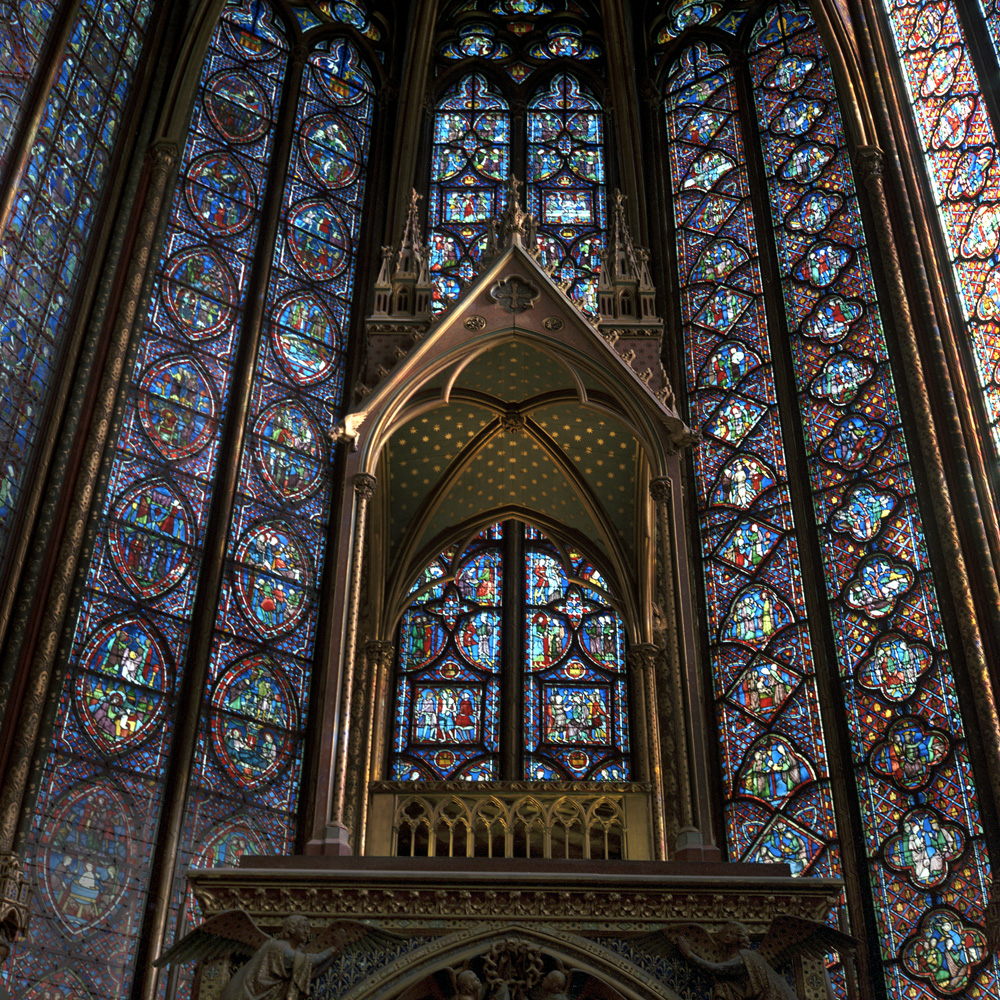
To your front is the main altar:

Altar, Ste. Chapelle

Another view of the windows and vault above the altar:

Windows, Ceiling Vaults, Ste. Chapelle Altar

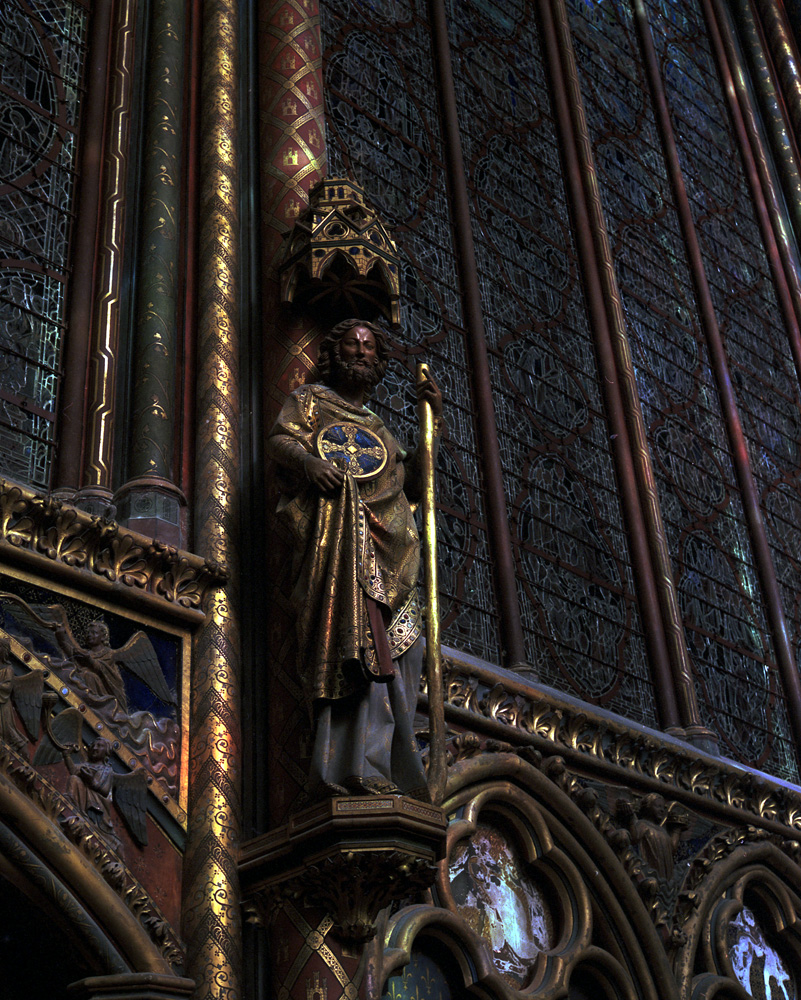
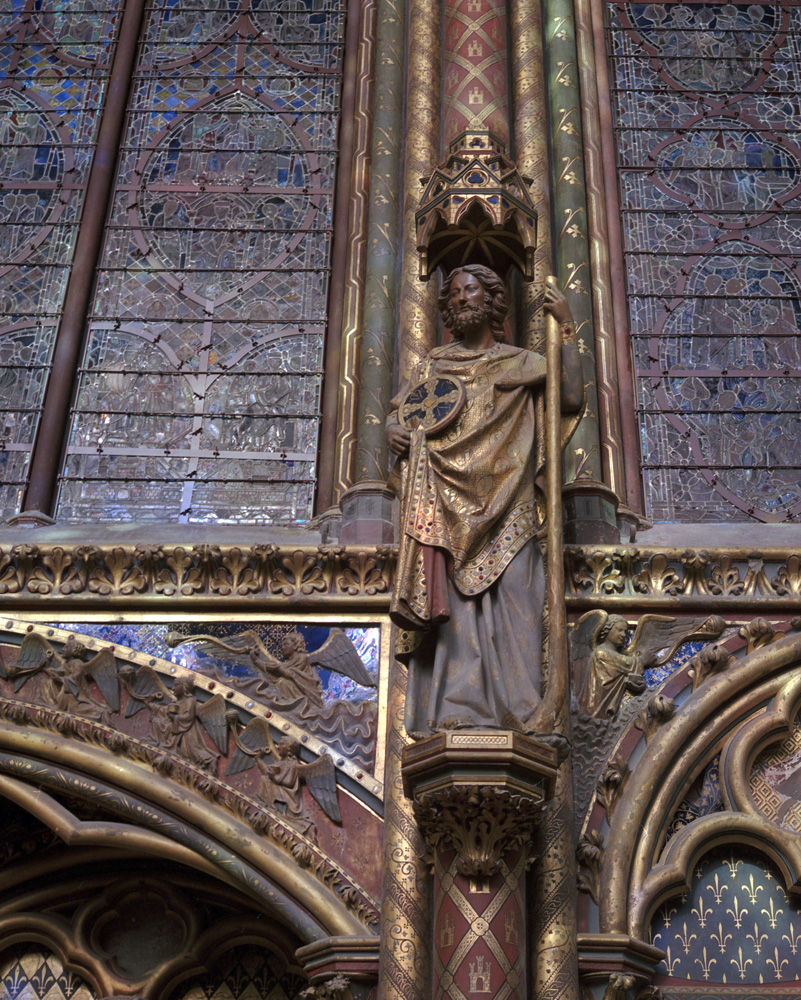
On the side walls there are statues of saints:

Saint Statue, Ste. Chapelle

I realize I’ve got two pictures of the same saint statue. I was trying to capture the different looks of the statue as the light changes when you move around him. Can you imagine the effect of seeing a place like this in the 13th century, when even today to our glitz-and-glamour-jaded points of view it is breathtaking? This would have outshone the contemporary Saint Peter’s in Rome! (today’s Saint Peter’s Basilica of course makes this look paltry, but that is a Renaissance/Baroque confection re-imagined by some of the greatest artists and architects the world has ever seen. This is a late-Medieval Gothic chapel).

Saint Statue, Ste. Chapelle

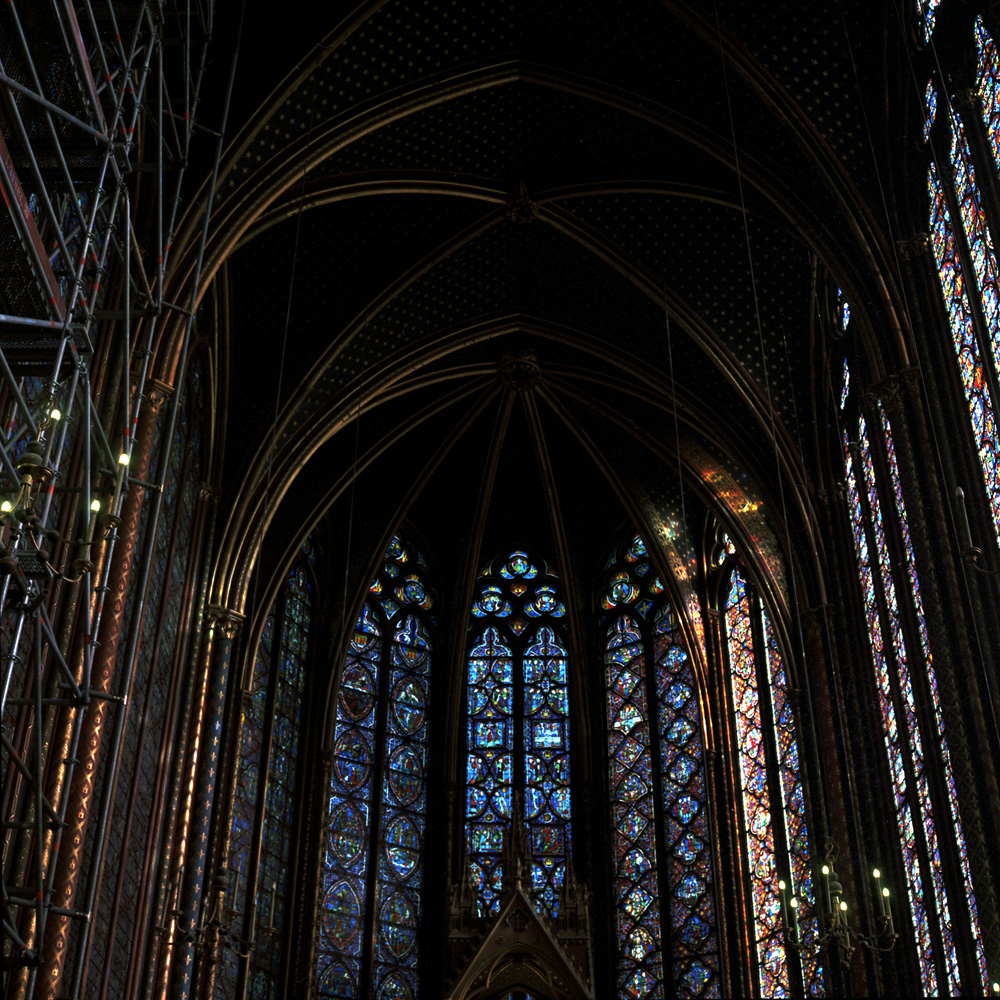
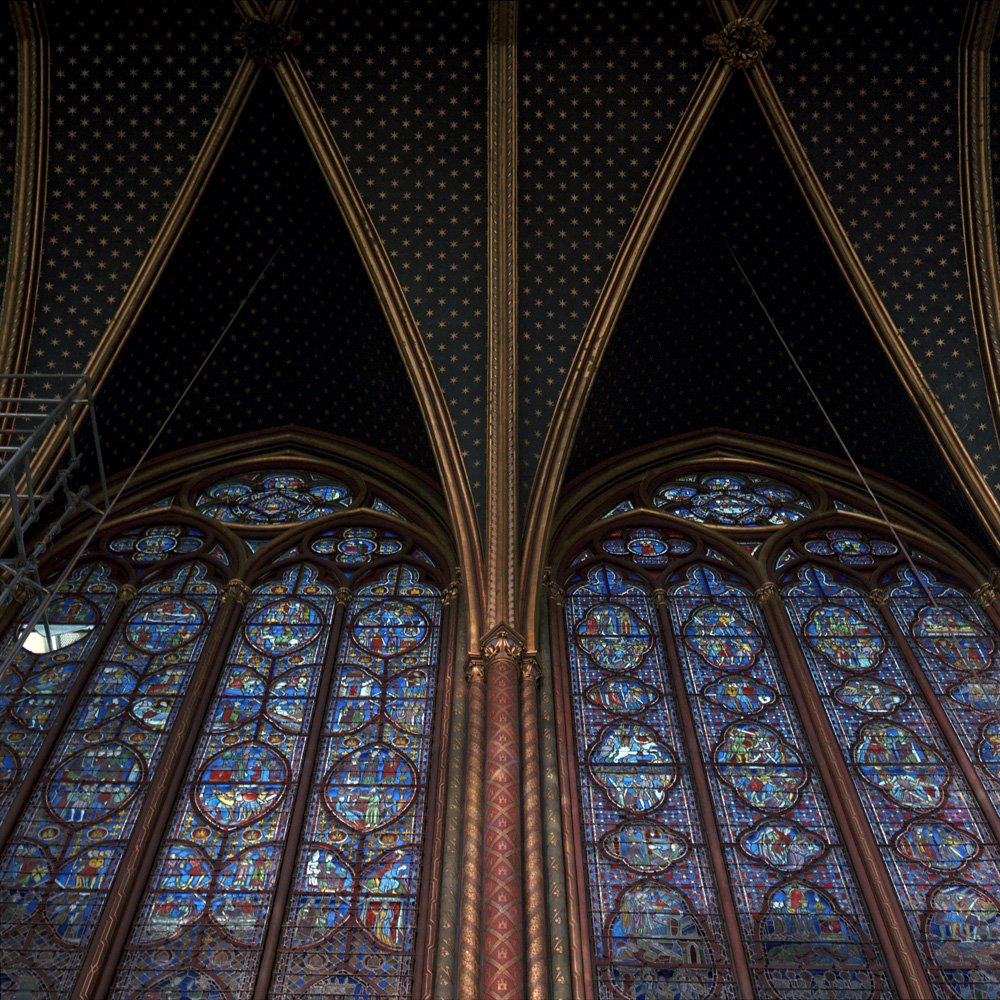
Looking up at the ceiling vaults and the side windows presents this view:

Side Windows, Ste. Chapelle

Again, all these were taken with my trusty Rolleiflex, and hand-held. The film is Kodak Portra 800 – until I tried some of this recent version of Portra 800, I never would have thought an 800 speed film would be this sharp and grainless, or the colors so vivid. In the past, films above 400 speed, even in medium format, had obvious grain and lacked the same contrast, sharpness and vivid color of their slower speed counterparts. Kodak has banished these shortcomings in Portra 800. Even though it’s pricey (about $10/roll), this is one of the reasons I hope Kodak manages to stay in the color film manufacturing business for many years to come.

Paris in October – part 17 – My neighborhood in Paris

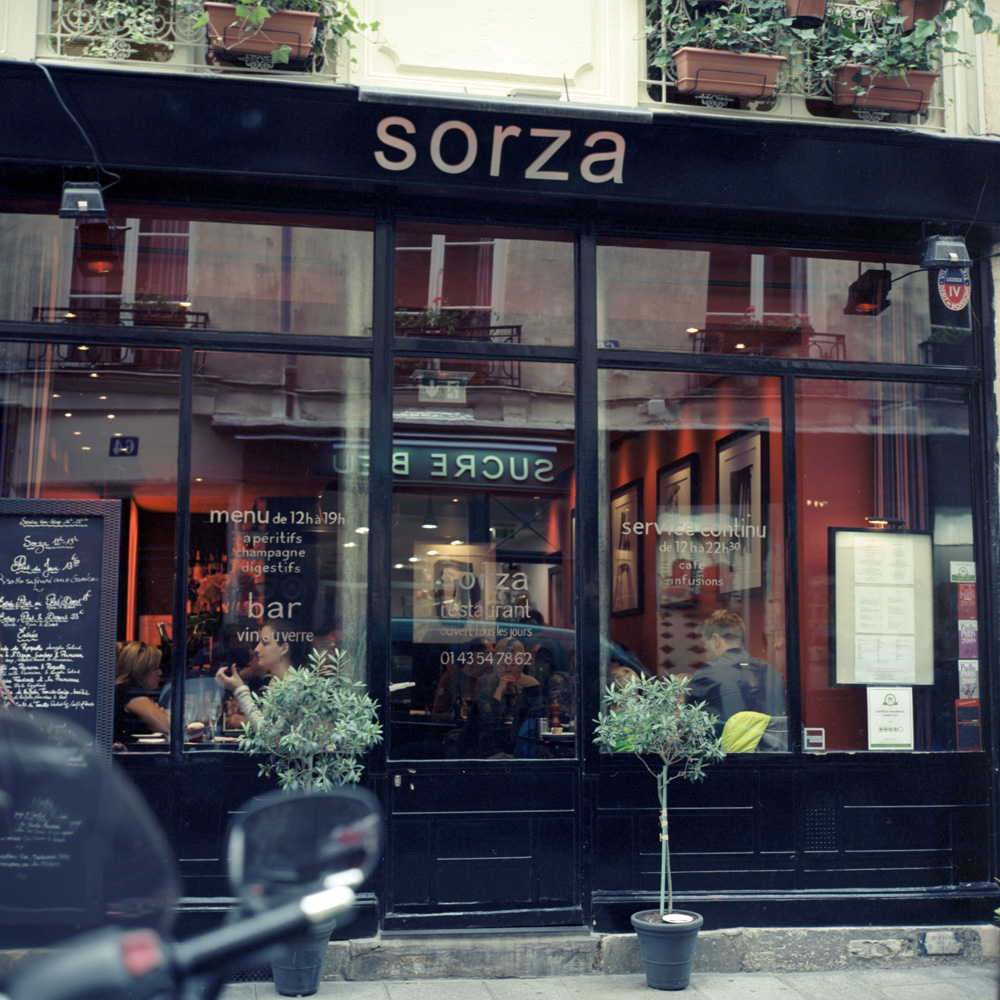
Some street scenes from my neighborhood. In reflection, I wish I had taken an afternoon and just photographed up and down the street. There were so many charming little restaurants and shops along the Rue St. Louis en L’Ile, you could easily make a photo study of just that one street.

Sorza Restaurant, Ile St. Louis

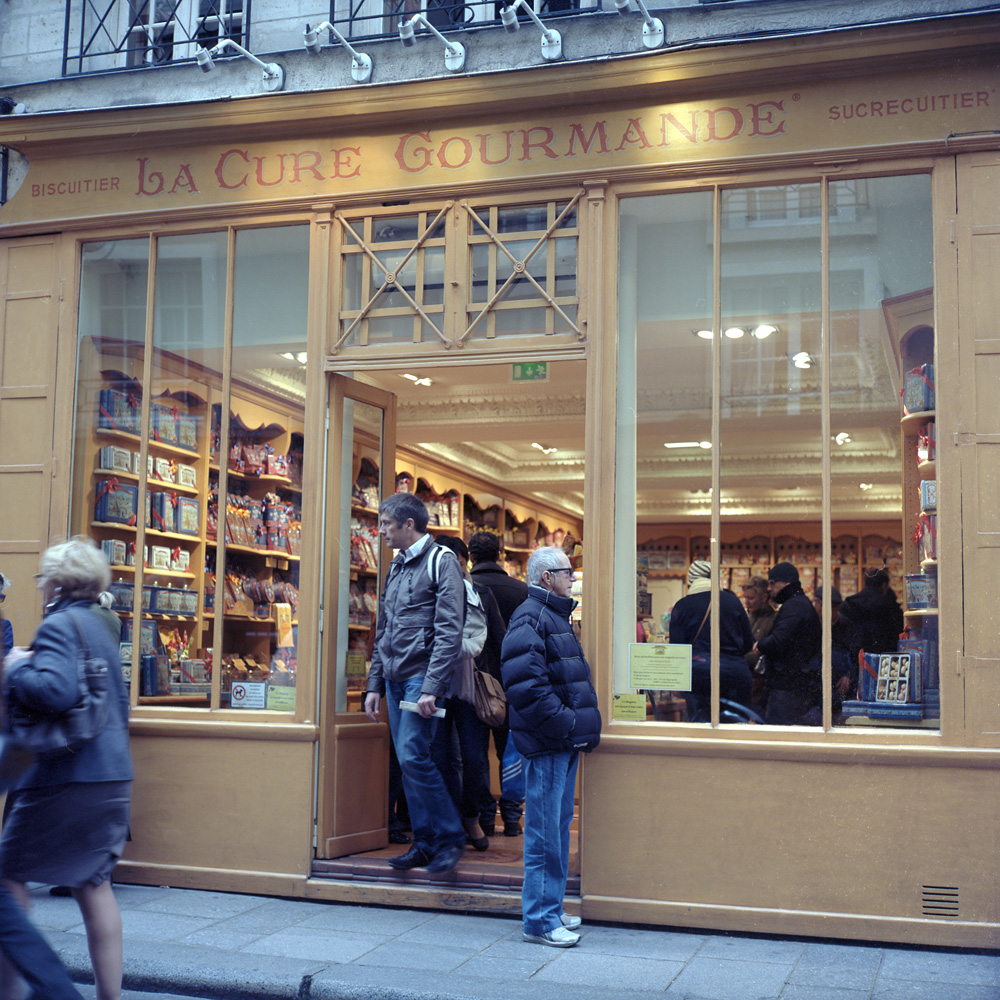
The Cure Gourmande candy shop was ALWAYS busy. Probably as much to do with the bright, cheery interior as it does with the candies and biscuits they sell. Who wouldn’t want to go in and browse, and maybe try a sample or two?

Cure Gorumande sweet shop, Rue St. Louis en L'Ile
Cure Gorumande sweet shop, Rue St. Louis en L’Ile

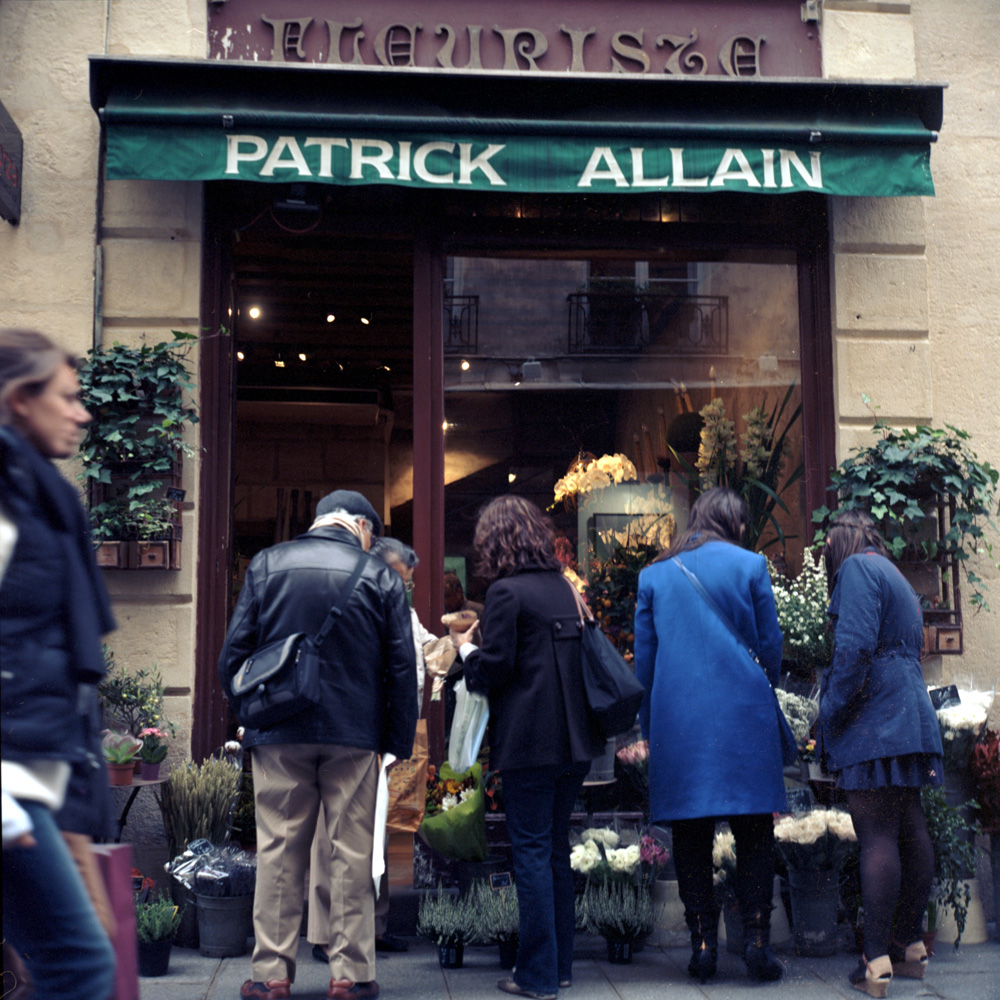
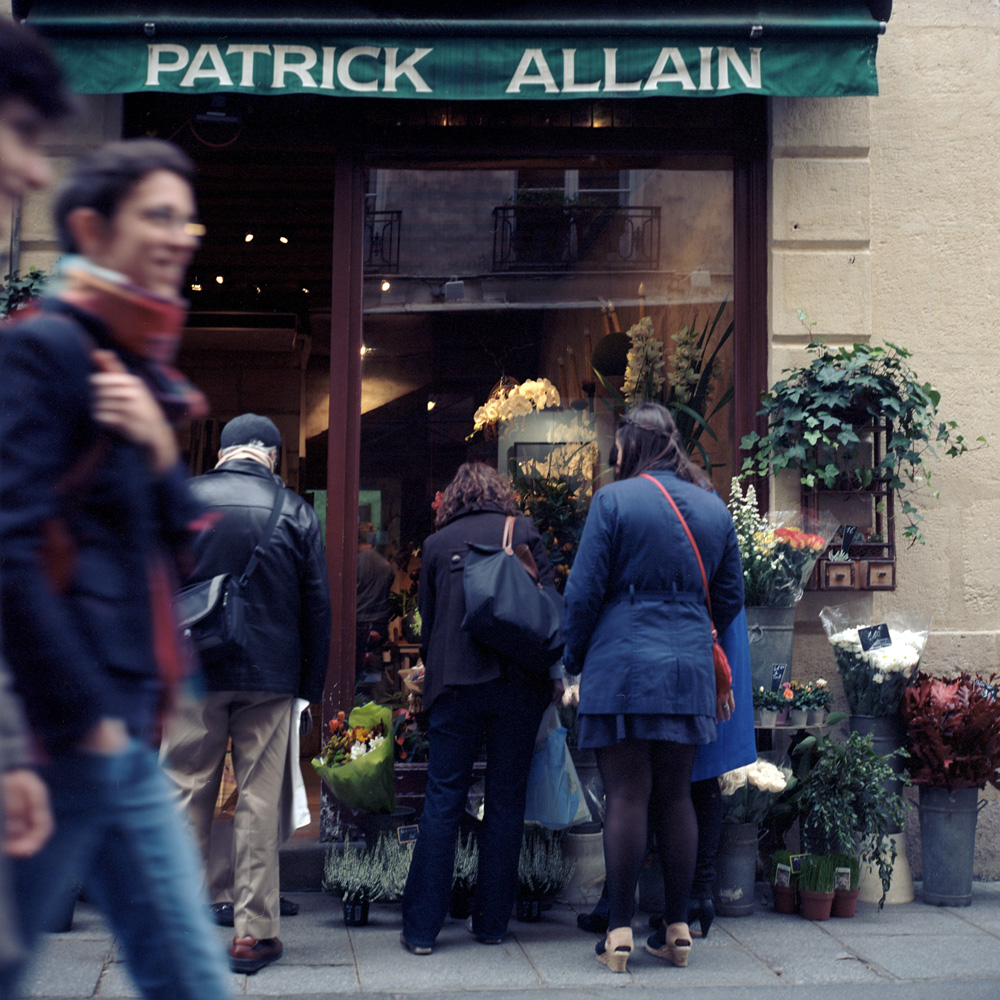
Please give me your feedback on these two – which do you like better? I’m on the fence as to which one works best.

Patrick Allain Florist, Rue St. Louis en L'Ile
Patrick Allain Florist, Rue St. Louis en L’Ile

Patrick Allain Florist

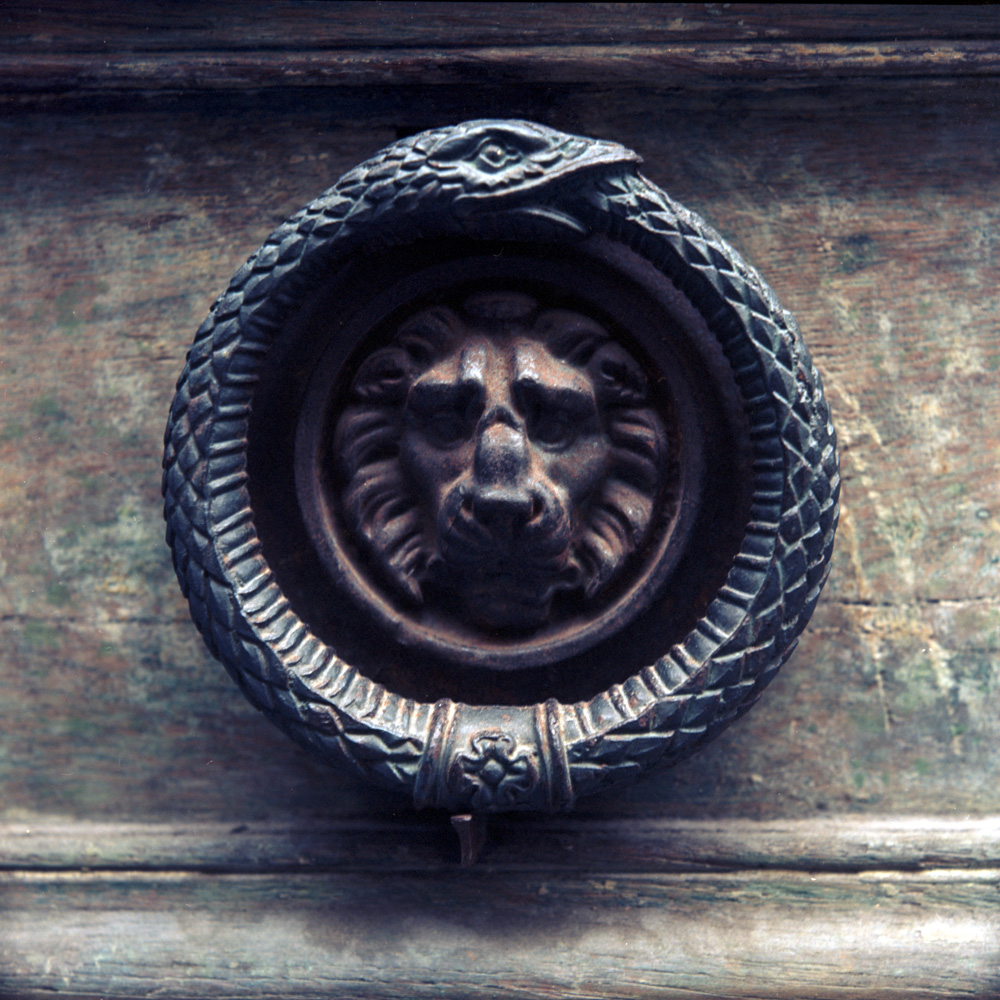
This was one of the few opportunities I had to break out my Rolleinar close-up filter sets and take a picture of something small. Given the size and weight of them, even though I only used them maybe twice on the whole trip, I don’t regret bringing them, especially when you compare them to a dedicated macro lens for an SLR system. I was drawn to the different textures and colors of the wood of the door, the rusty iron of the lion head, and the painted metal of the snake. And believe it or not, this was hand-held!

Door Knocker, Ile St. Louis

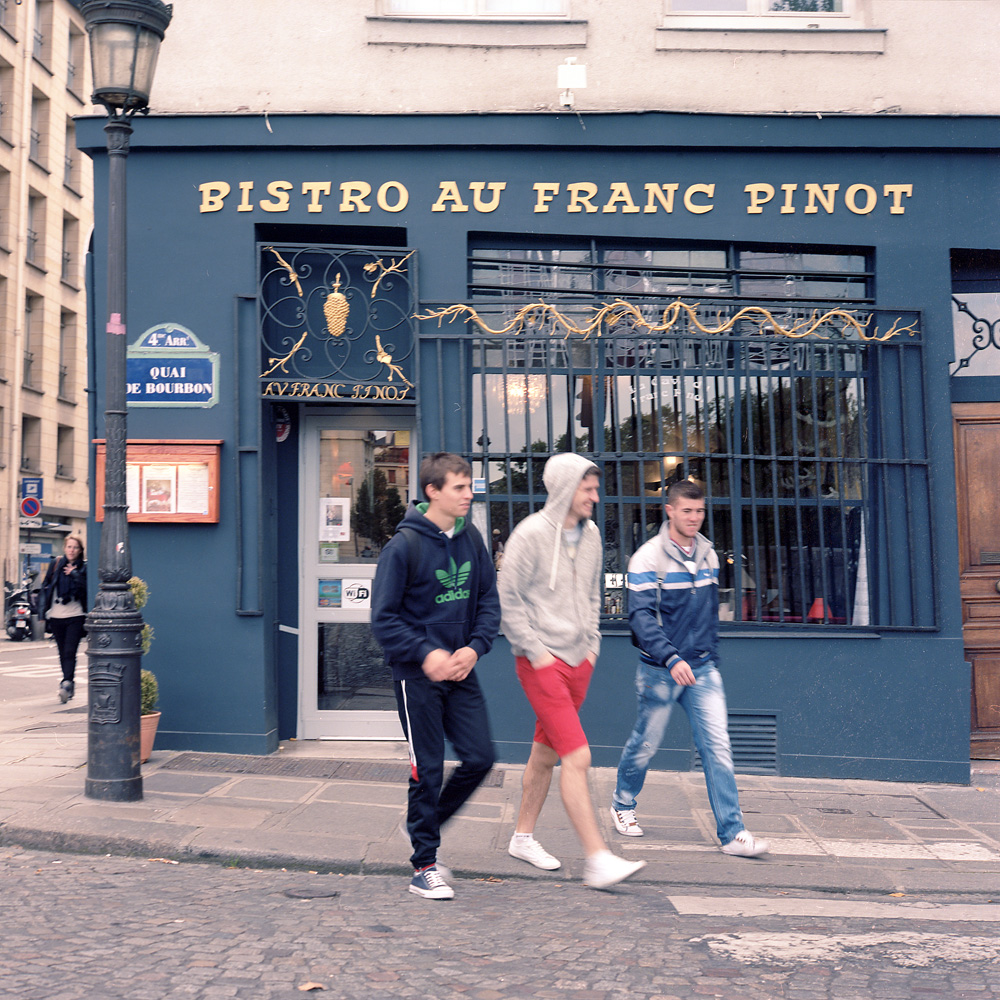
In closing, here’s another restaurant/wine bar in the neighborhood, this one on the Quai de Bourbon, facing the Pont Marie. It really shows the age of the building, as nothing on it is really square or level.

Bistro Au Franc Pinot

Paris in October – part 16 – My home away from Home

Here are some photos I took of the apartment where we stayed. The apartment was at Number 6, Rue St. Louis en L’Ile. This was an outstanding choice of location and of apartment. It had charm, convenience, and comfort. The bedrooms were a touch petite, but it was never a problem. I would stay there again in a heartbeat. Our landlady, Francoise, was super charming and met us the day we arrived with a bottle of wine and a plate of cheeses she bought down the street at the fromagerie.

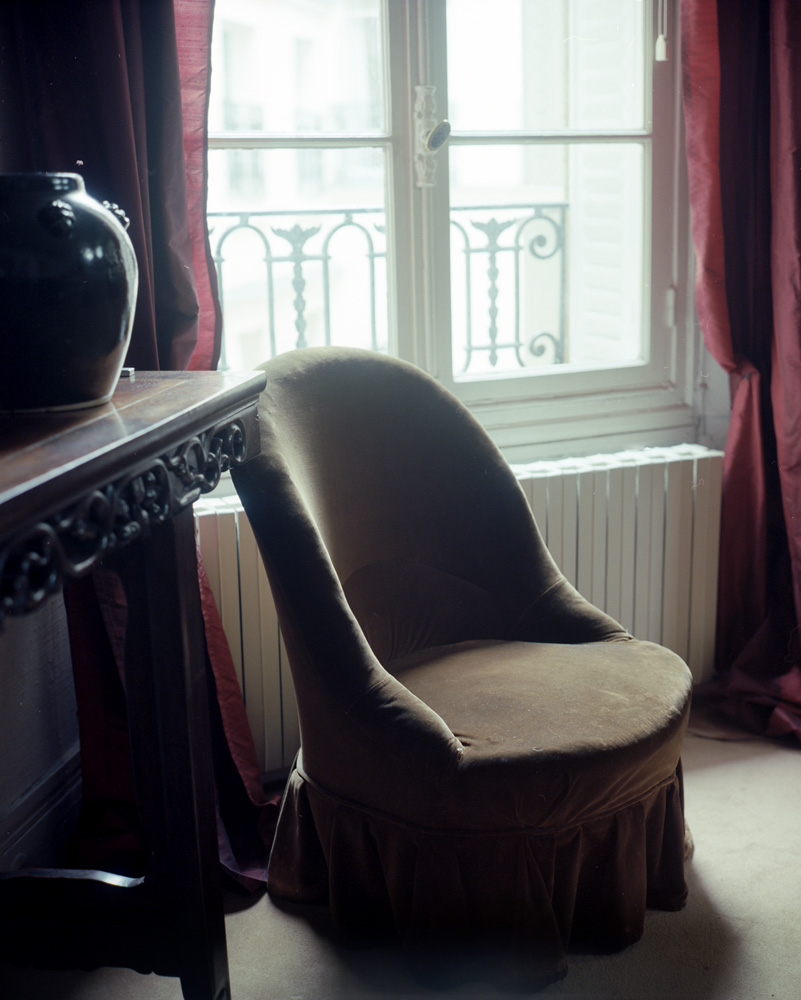
I was utterly charmed by the arrangement of this little velvet-covered chair in the dining room, next to the Chinese style sideboard.

Chair, Dining Room Window

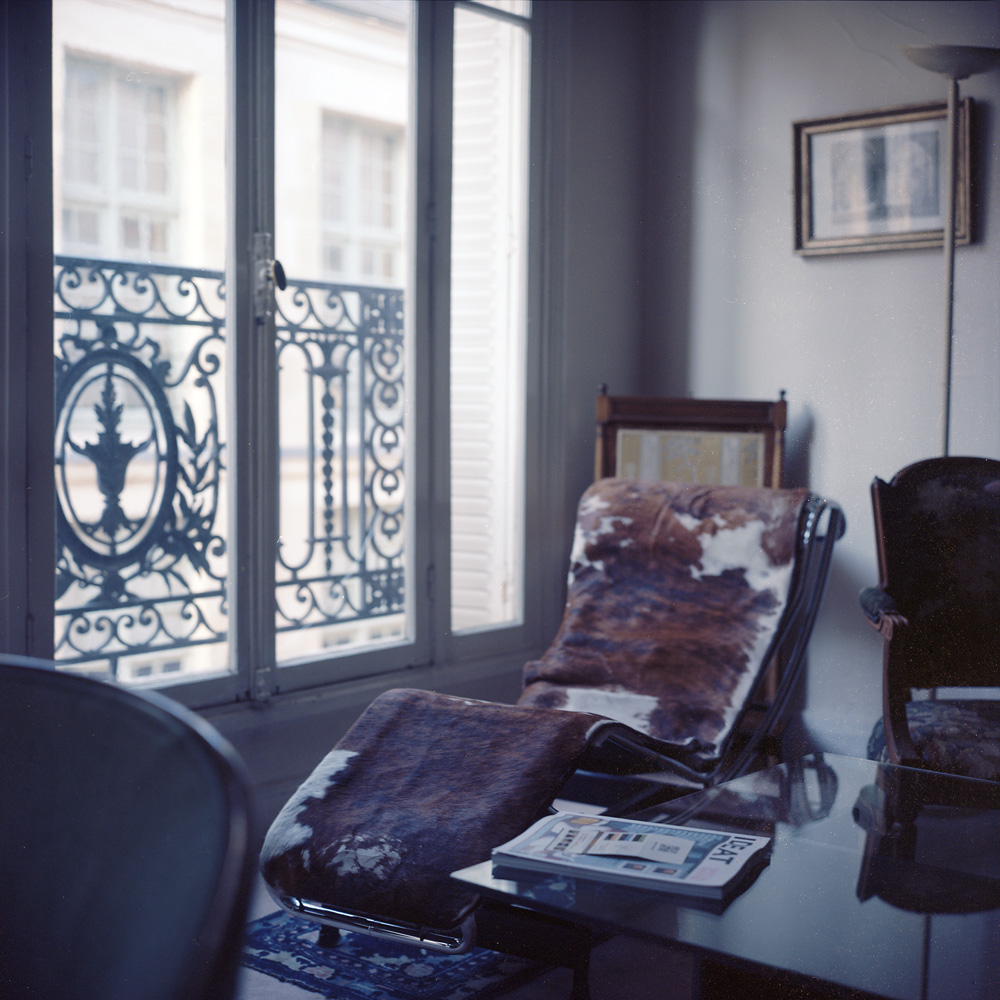
The living room featured a chaise lounge by Le Corbusier. I suspect it is an original, based on the wear on the cowhide cover.

Le Corbusier Chaise, Living Room

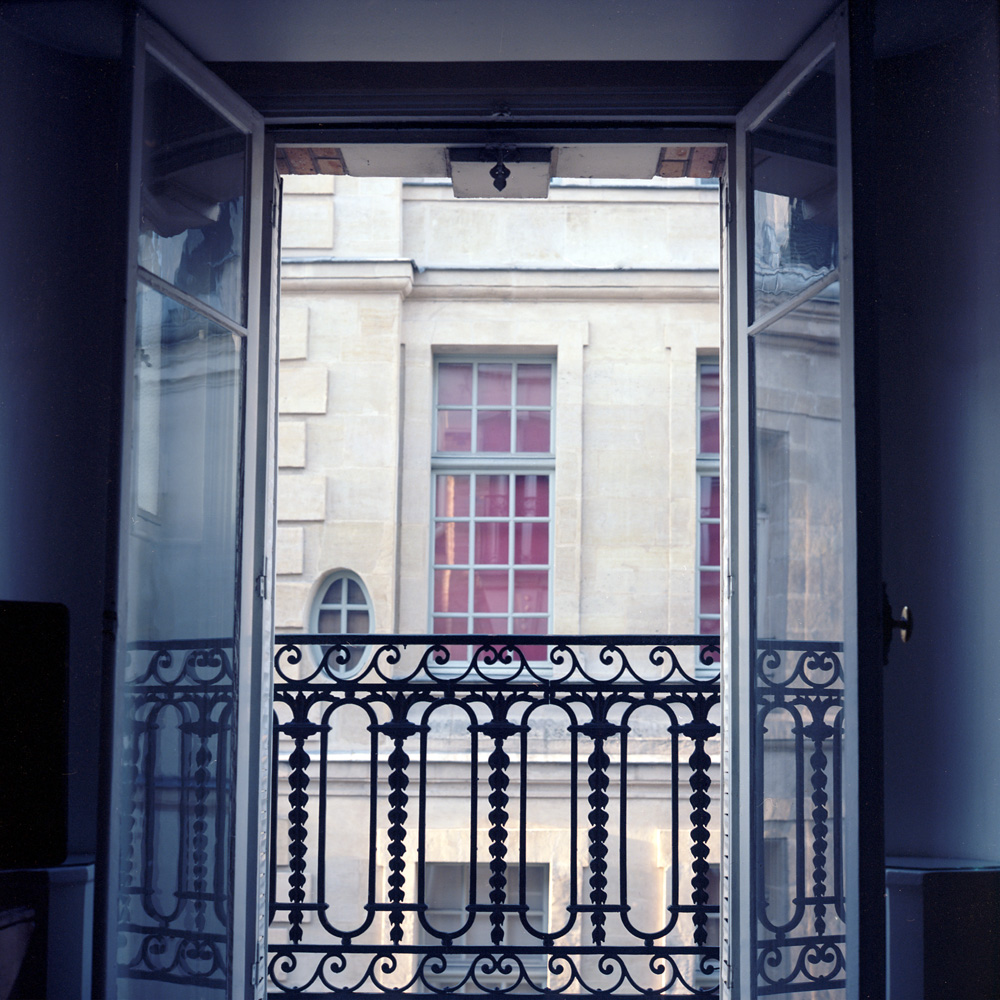
Looking out the living room window, this is the view when you look straight out.

Window, Number 6, Rue St Louis en L'Ile
Window, Number 6, Rue St Louis en L’Ile

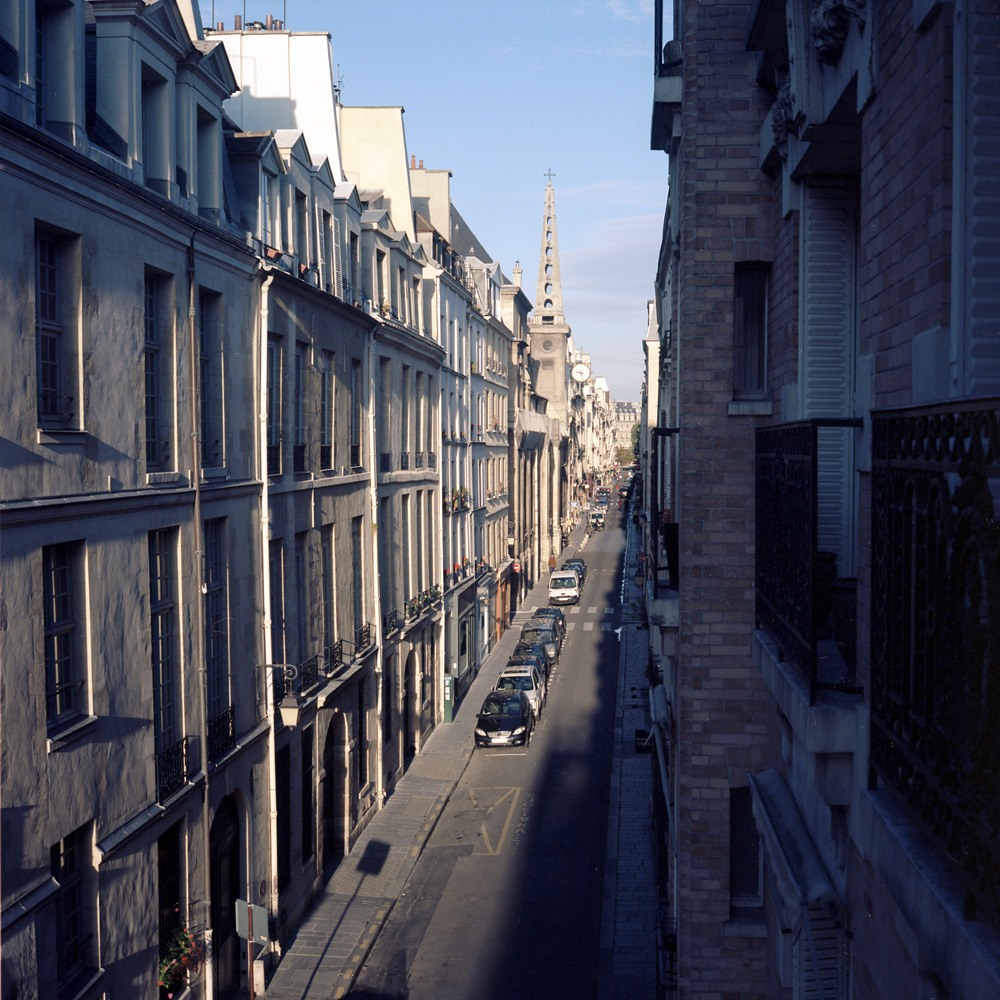
Looking up the street on a sunny day:

Rue St. Louis in the Sun

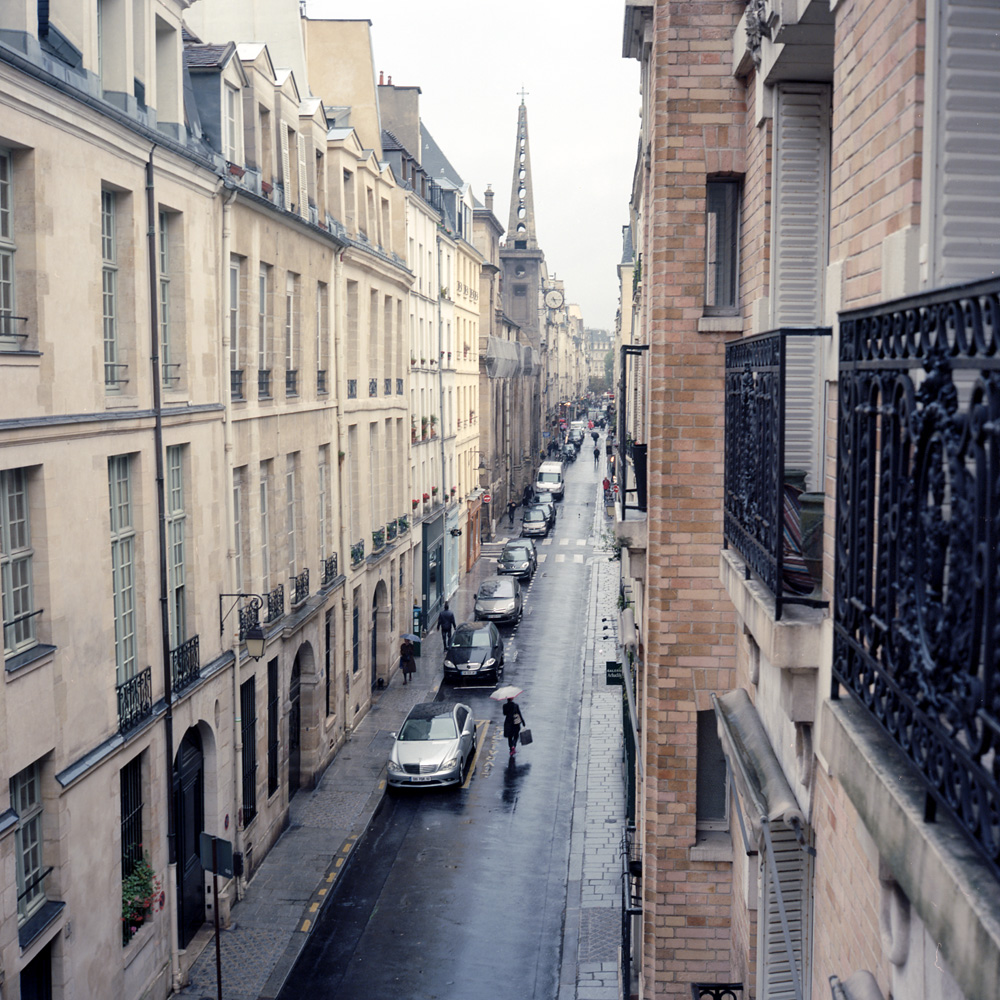
And on a rainy day:

Rue St. Louis in the Rain

The Rue St. Louis is very busy with pedestrians all day, although it may not look as such down at my end of the street. A block further up is where the shops, art galleries, restaurants and food sellers begin.

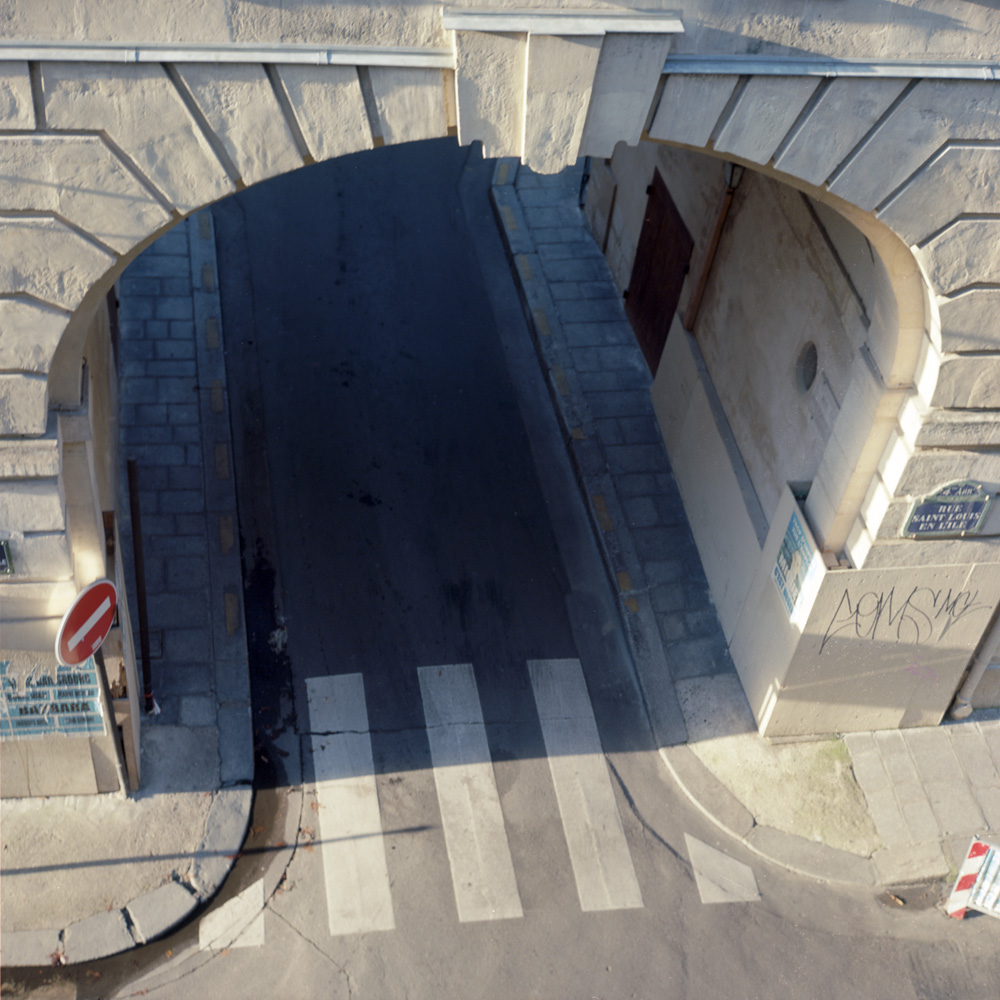
This archway was directly across the street from our apartment, where the Rue St. Louis took a right turn to go out to the quay.

Archway, Rue St. Louis

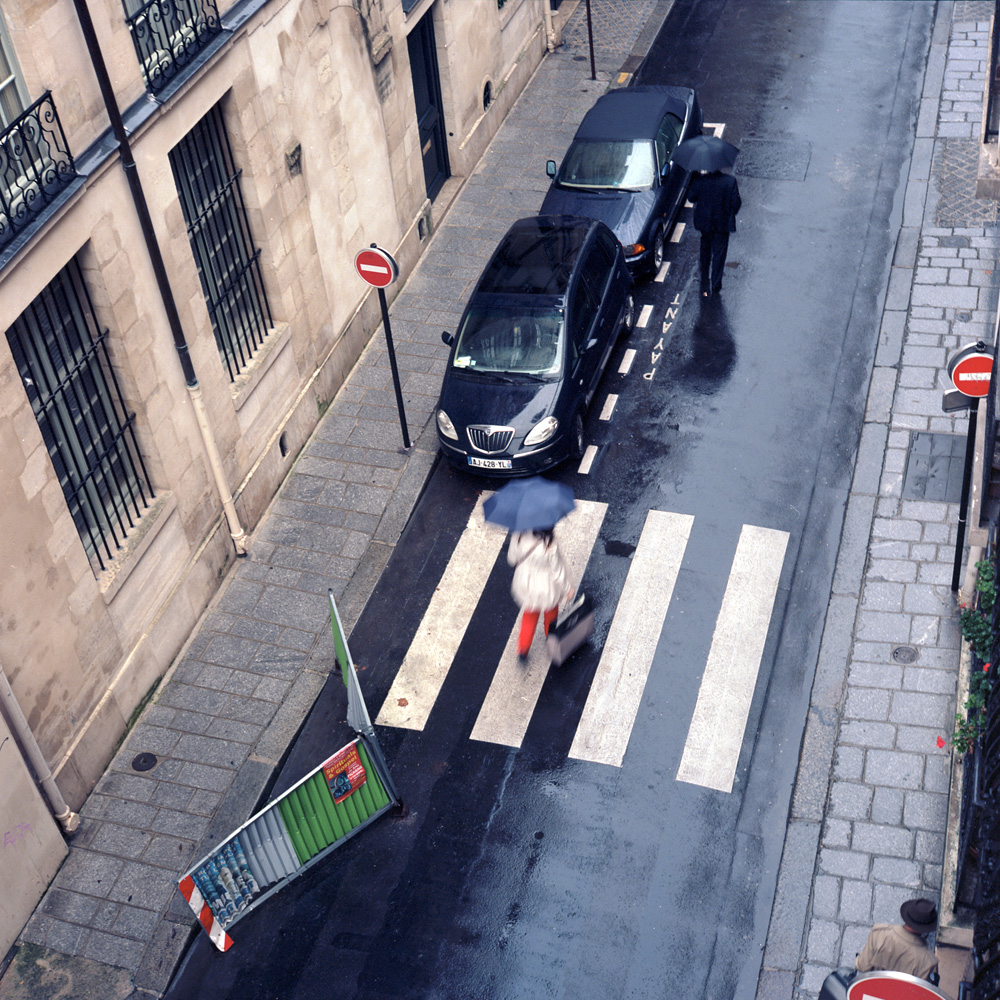
Even though it was raining, I stepped out on the balcony and looked down, to see this scene of the woman with red pants crossing the street:

Woman Crossing Rue St. Louis in the Rain

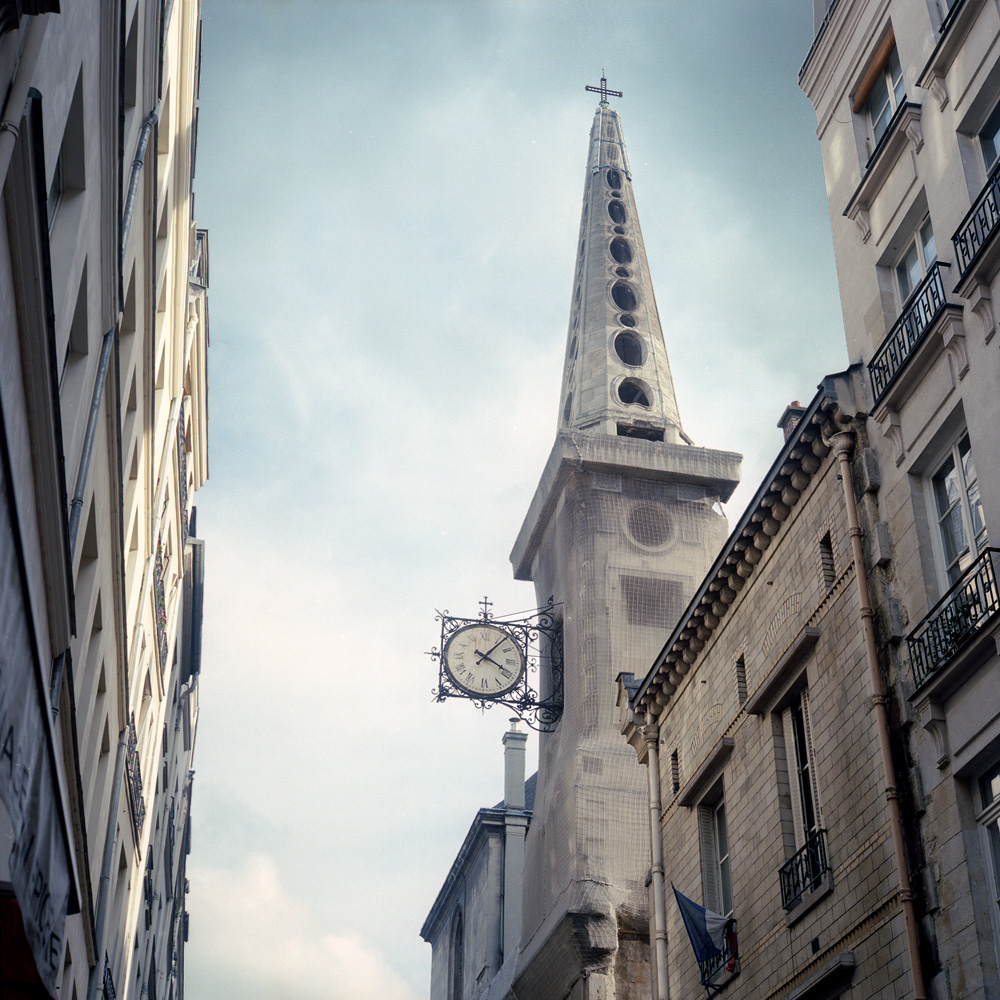
Here is the Eglise St. Louis en L’Ile with its clock, up close, which you can see in the background of the sunny and rainy shots of the Rue St. Louis:

Eglise St Louis En L'Ile
Eglise St Louis En L’Ile

The église St. Louis has a gorgeous baroque interior replete with dark wood paneling, stained glass, and surprisingly enough magnificent altarpieces that somehow managed to survive the upheaval of the French Revolution. They regularly have concerts there as well as services, and it is well worth popping in if you’re passing by.

October in Paris – part 15 – A few more night photos

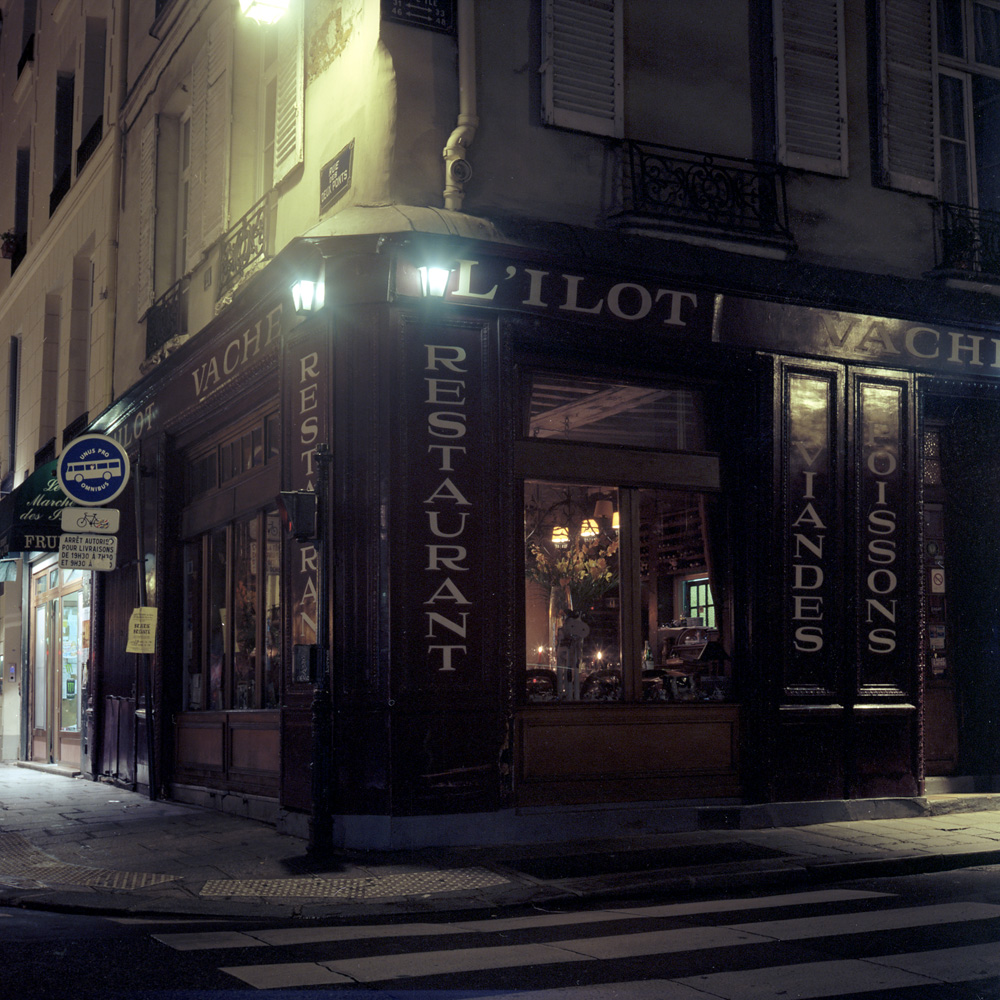
The Ilot Vache restaurant is on the corner of the Rue St.Louis en l’Ile and the Rue des Deux Ponts, which more or less bisects the Ile St. Louis into east and west halves. The Ile St. Louis was once actually two separate islands, one of which was the Ilot Vache (little cow island) because it was used as pastureland for Parisian cows. With the rapid growth of the city’s population in the 15th century, there was such a demand for more prime real estate that the two islands were merged into one and developed as residential space. Thus the name of the restaurant. The Rue des Deux Ponts roughly demarcates where the two islands were split. My dad and I ate dinner at L’Ilot Vache one night, and the food was quite good, even if the dining room was a bit crowded.

L'Ilot Vache Restaurant
L’Ilot Vache Restaurant

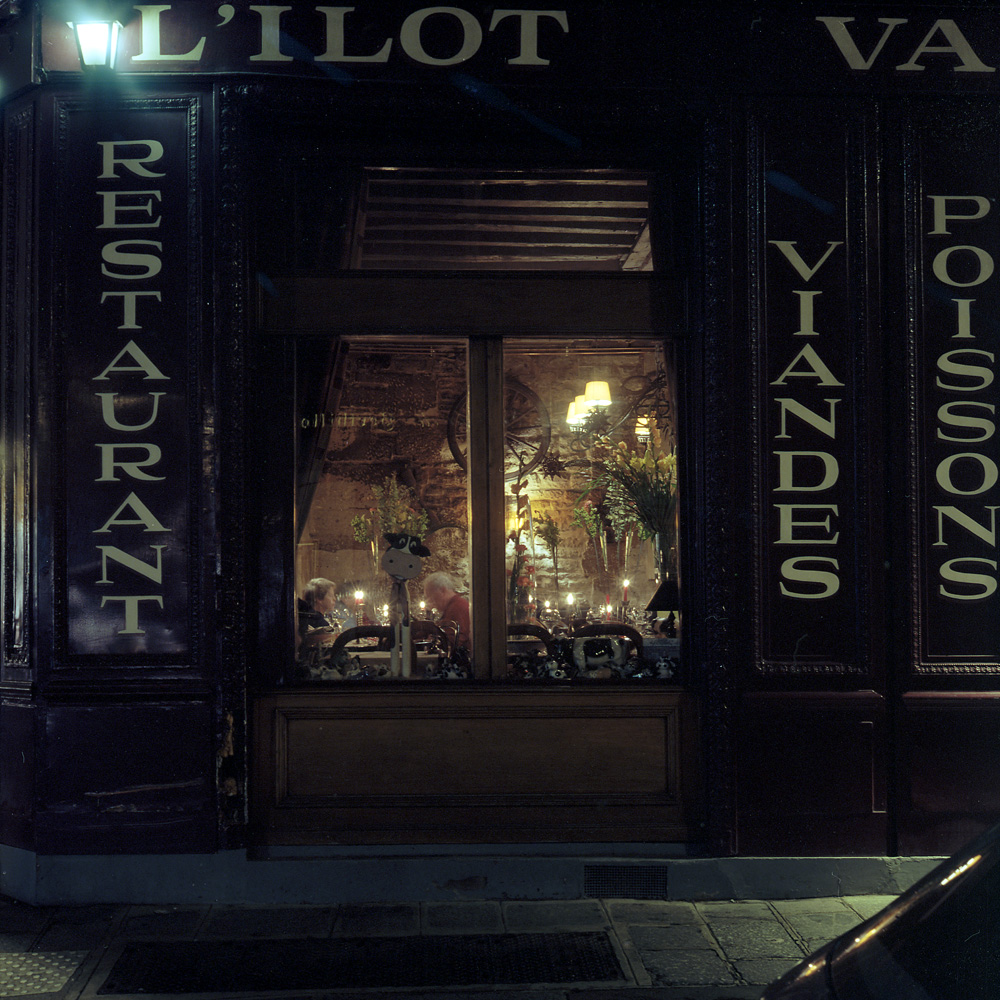
I managed to catch a pair of diners in the window of the restaurant.

Diners, L'Ilot Vache, Night
Diners, L’Ilot Vache, Night

This is one case where I broke my normal rule of shooting night photos with Portra 160 – these two were done on Ektar 100. I suspect that I had just a couple frames left on the roll of Ektar that was loaded in the camera when I set out to do my night shots, so I finished them off and then switched over to Portra for the rest of the evening.

October in Paris – part 14 – Paris by Night

Ok, it’s far from a comprehensive survey of the city by night, but whaddya want, I only had a single night for night shooting, so I confined myself to where I could walk to from my apartment.

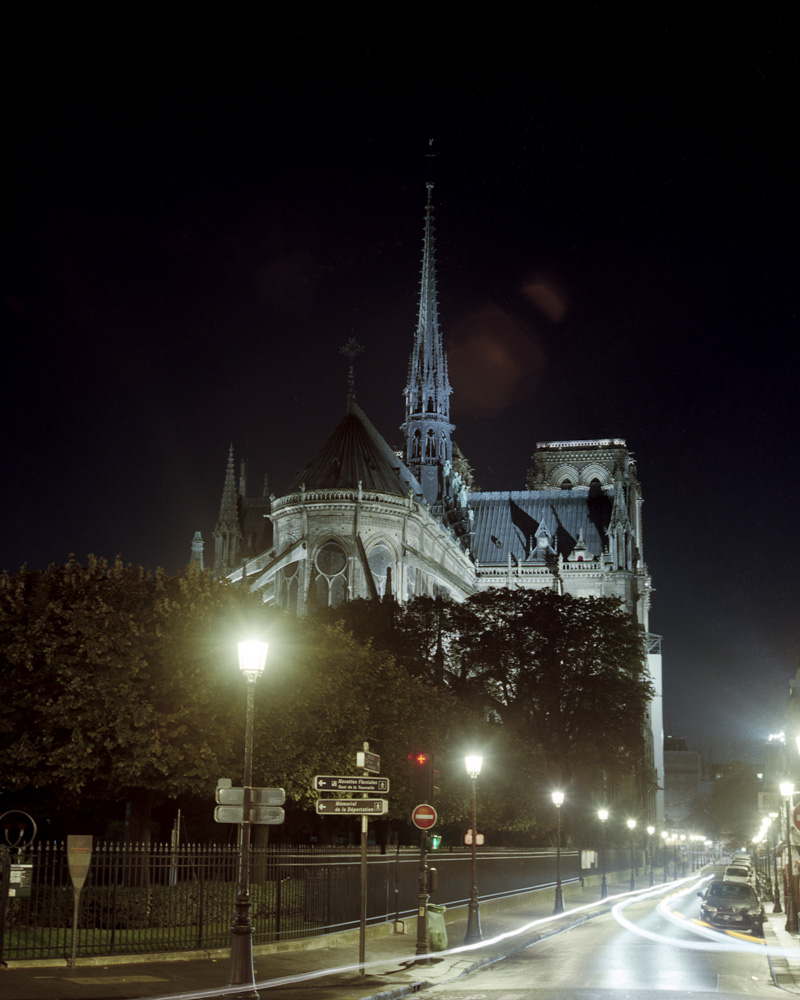
One of the great things about where we (my father and I) stayed was the fact we were in walking distance of just about everything, from the subway to all the historical buildings and neighborhoods. Notre Dame was a stone’s throw away, across the bridge. Here is the rear view from the approach I took over the Pont St. Louis.

Notre Dame, Rear View, Night

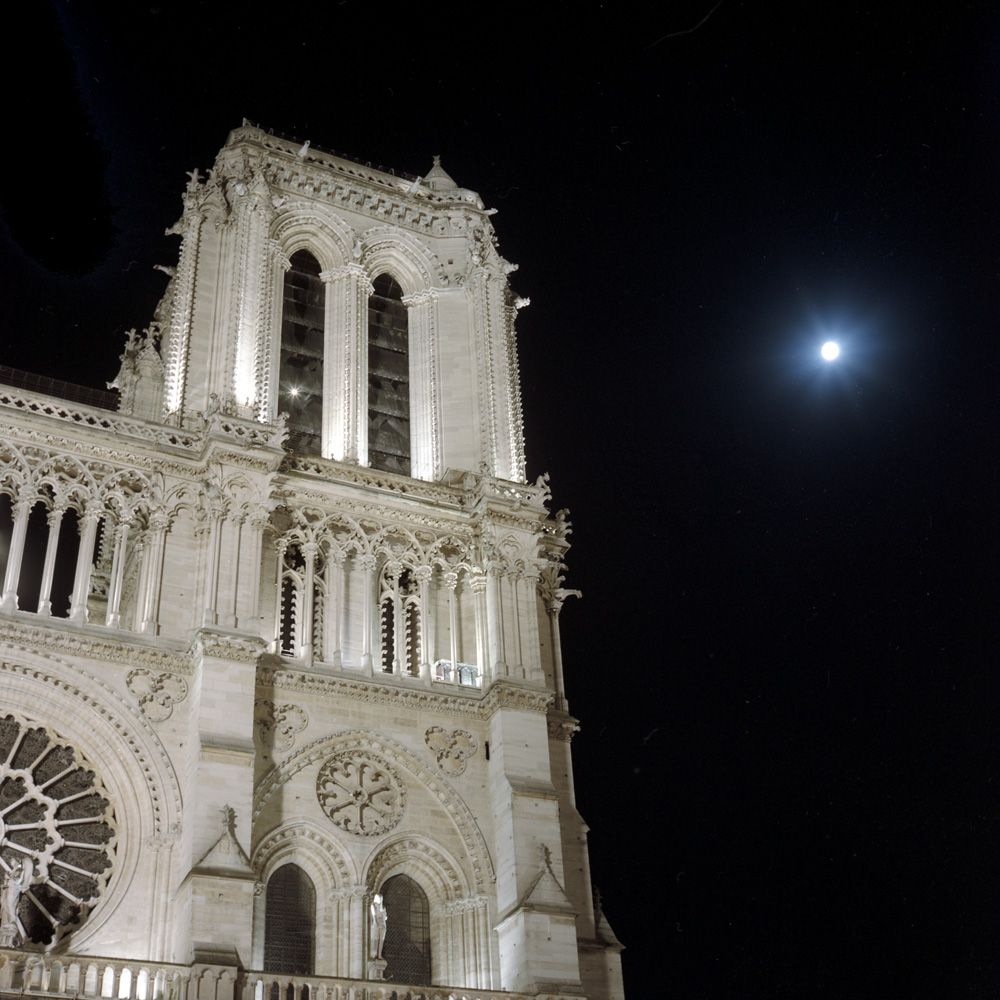
The front facade is fully illuminated at night, and they have built a set of large risers in the plaza in front that if nothing else serve as a great camera platform for photographing the towers. The night I was out shooting was the night of the full moon, so I got lucky and was able to get this shot of the tower and the moon.

Notre Dame, Tower, Full Moon

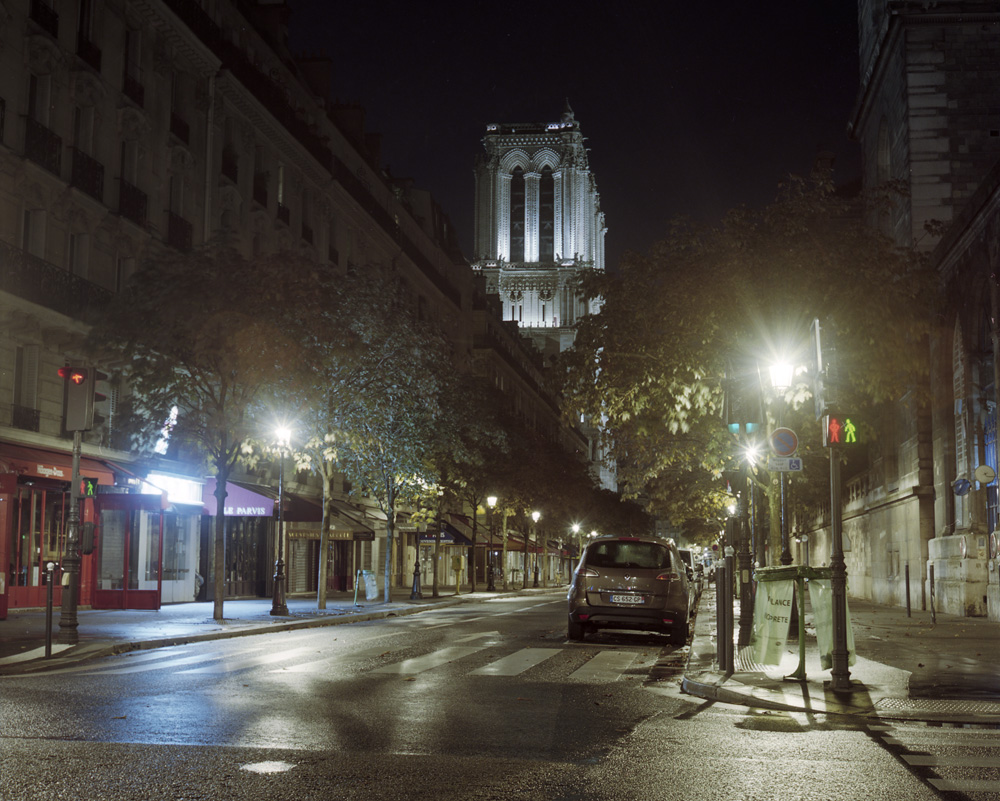
Another view of the towers, from a side street. It had been raining that evening, so the streets were wet giving them that Hollywood movie look.

Notre Dame, Side Street, Night

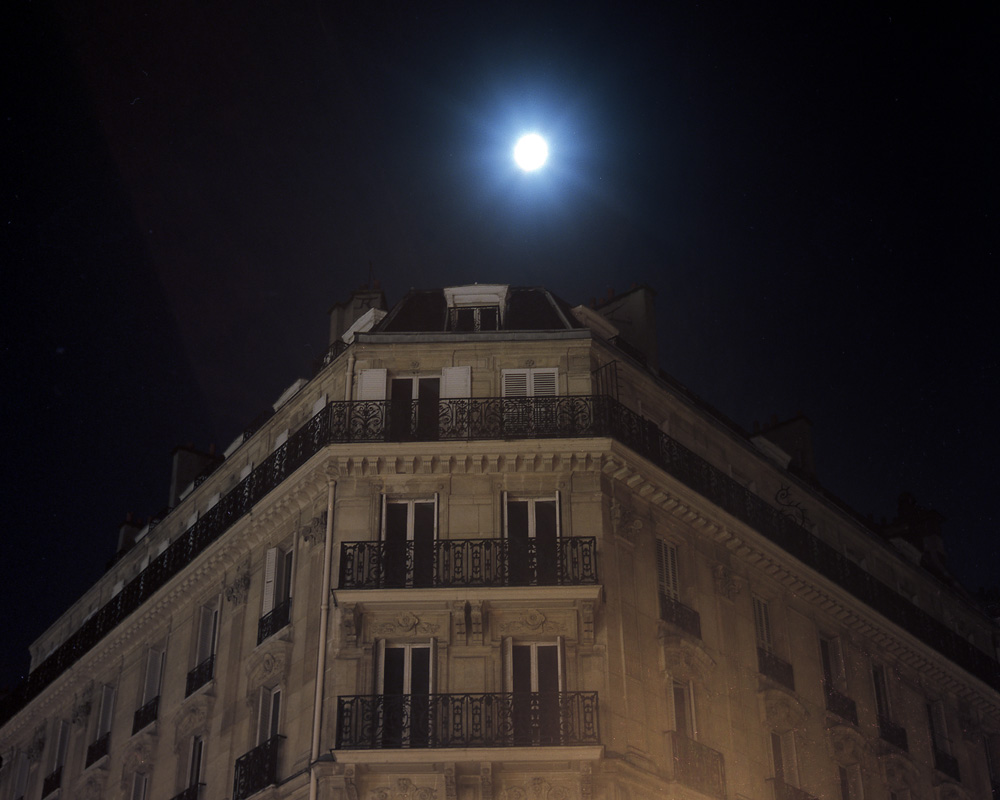
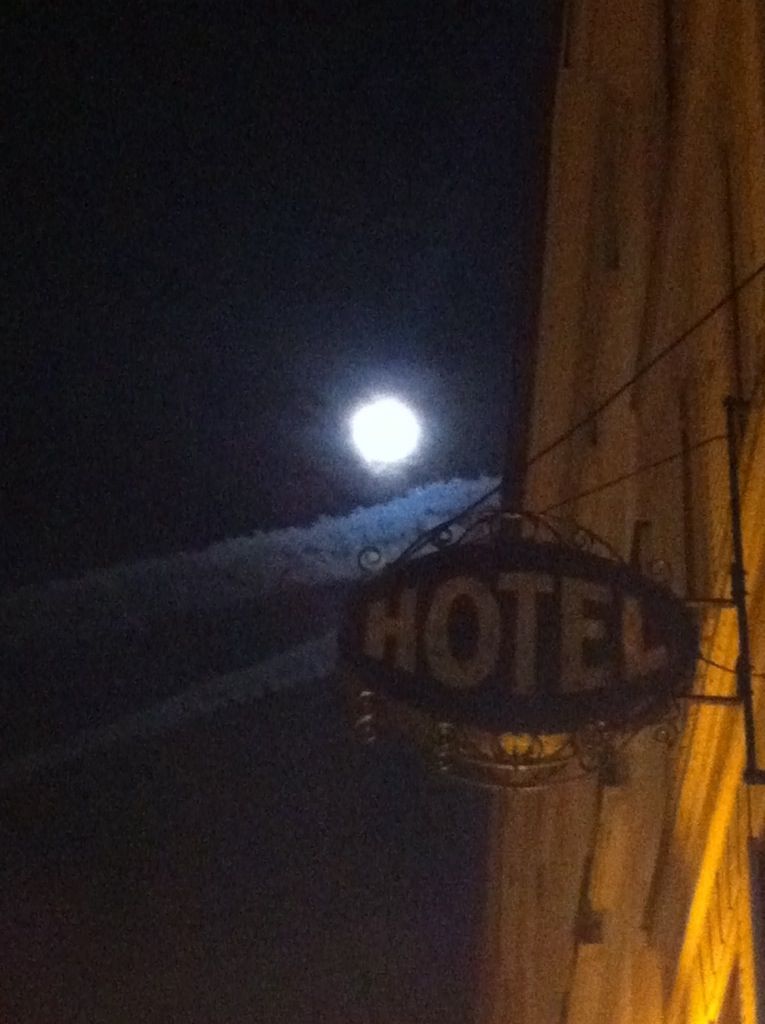
Another shot of the full moon, over a grand Hotel (Hotel in the Parisian sense of grand city residence/townhouse as opposed to place-where-you-rent-a-room-by-the-night) on the Ile de la Cite.

Full Moon Over Hotel, Ile de la Cite

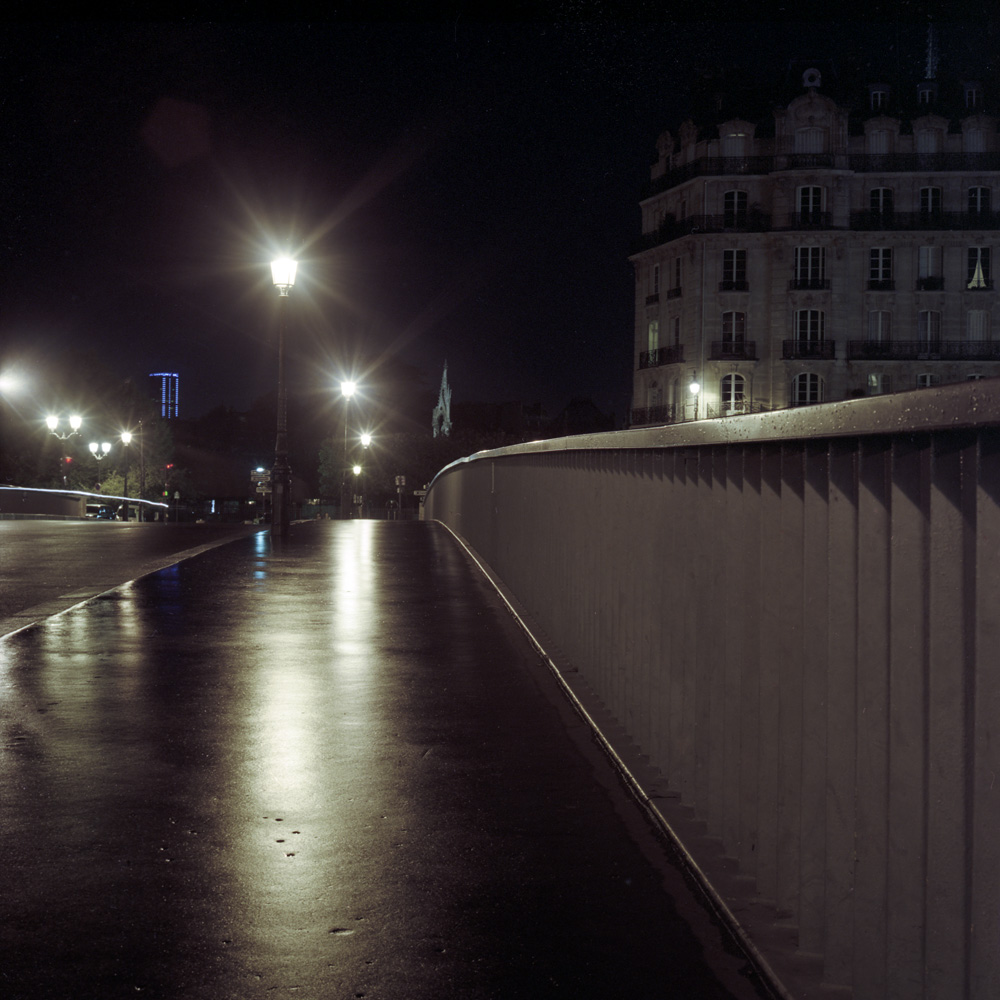
The Pont St. Louis, slick with rain. This is the bridge that connects the Ile St. Louis with the Ile de la Cite.

Pont St. Louis, Night

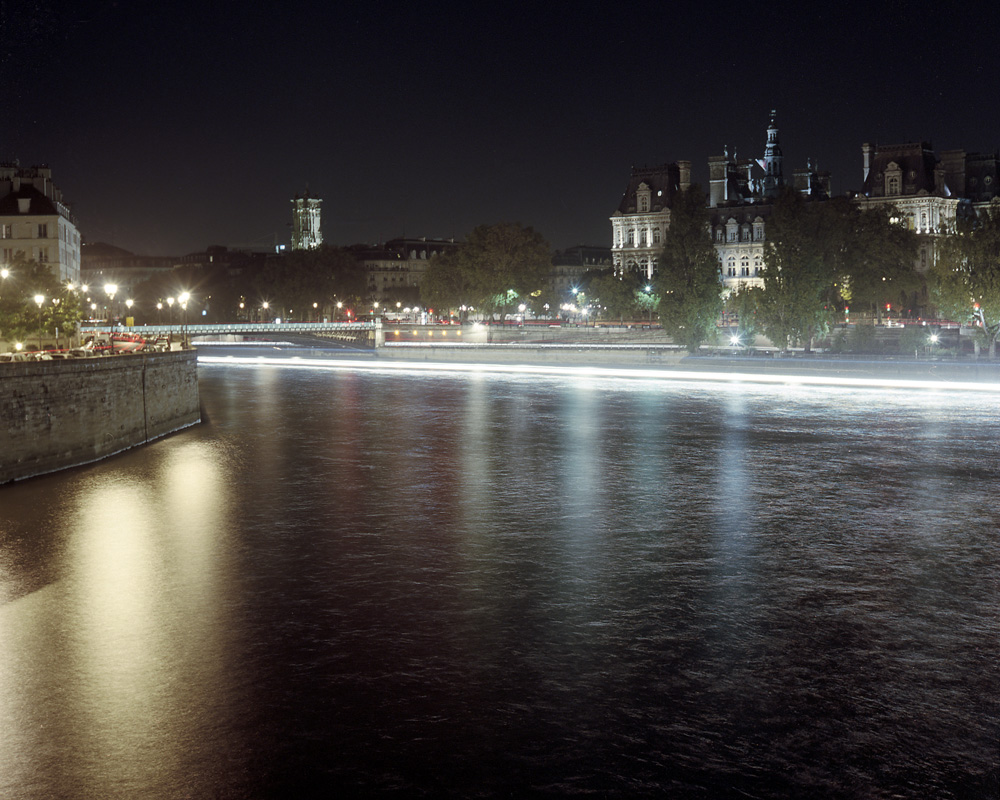
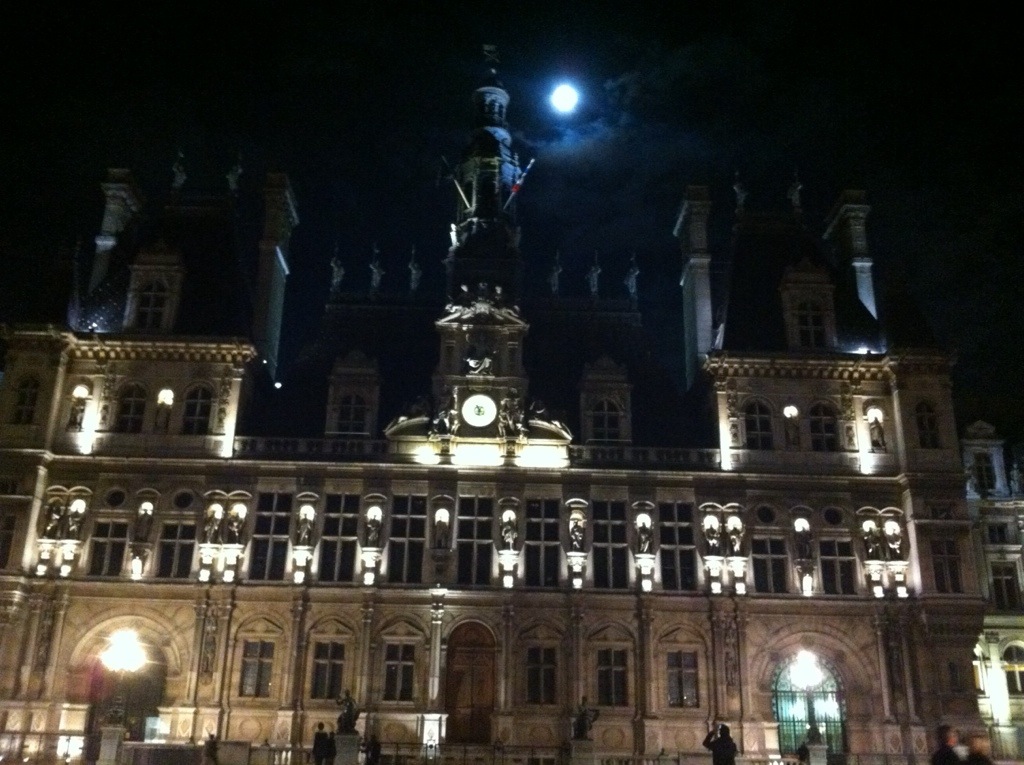
A view of the Hotel de Ville (Paris’ City Hall) from across the Seine. The white line at the river level is created by the lights of a passing river tour boat that has flood lights on the roof to illuminate the buildings on the quays as it passes. I don’t envy the people whose apartments face the river because of that, even if the boat tours do stop sometime between 9 and 10 pm.

Hotel de Ville, Seine, Night

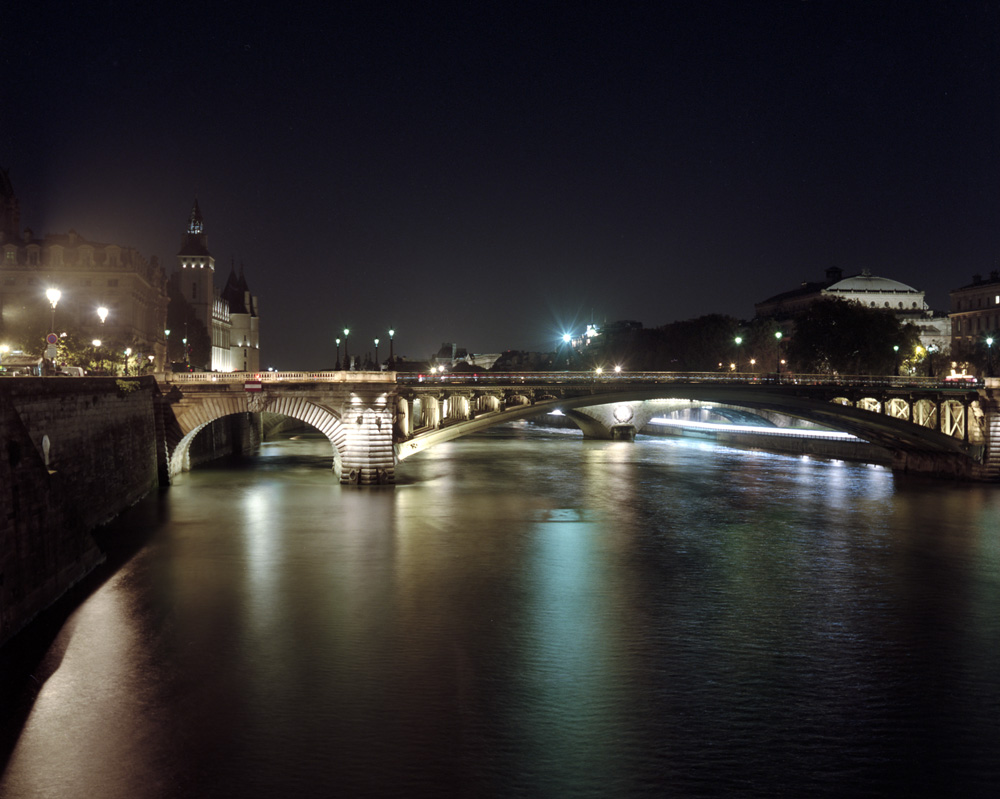
Another view of the bridges across the Seine. In the background on the left you can see a rather castle-like building which is La Monnaie, the old French Mint where they used to make coins.

Seine Bridges, La Monnaie, Night

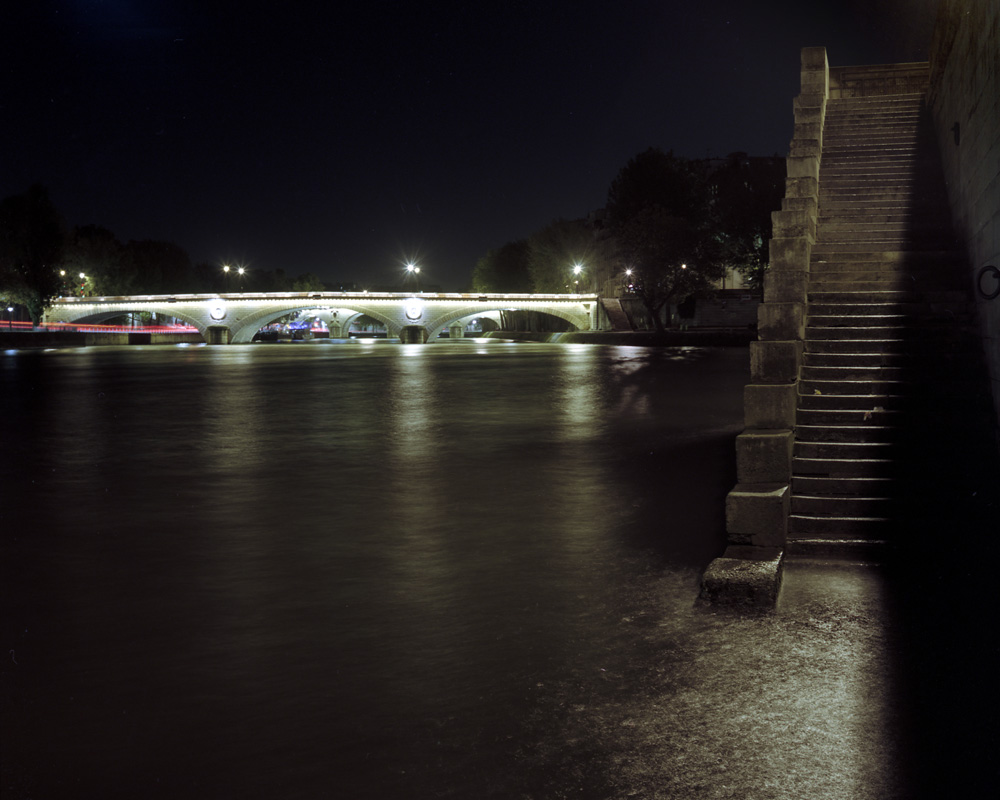
The last bridge of today’s program is the Pont Louis Phillippe, which connects the end of the Ile St. Louis to the north bank of the Seine. The bridge I used every day to get to and from the subway was the Pont Marie, which abuts the middle of the Ile St. Louis. I wanted to get a view of the bridges from water level, so I went down a set of steps on the quayside of the Ile de la Cite and set up my tripod at the very bottom – you can see from the facing set of steps they descend all the way into the water (I did not test how far down they go, as I had no desire to get wet, especially at this time of year).

Pont Louis Phillippe, Steps, Night

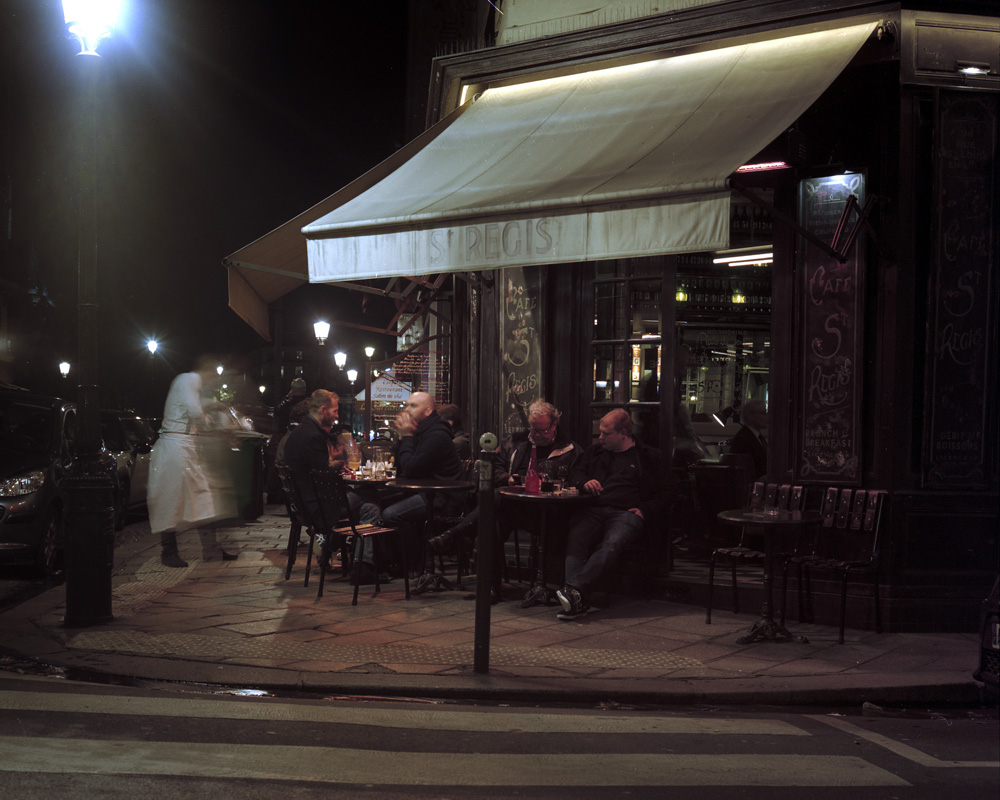
The St. Regis cafe has a view of the Pont St. Louis. Notre Dame itself is hidden by the buildings across the bridge. On my excursion, I saw people sitting outside the cafe all evening – I returned home at nearly midnight and there were people still outside the cafe as it was closing up.

St. Regis Cafe, Night

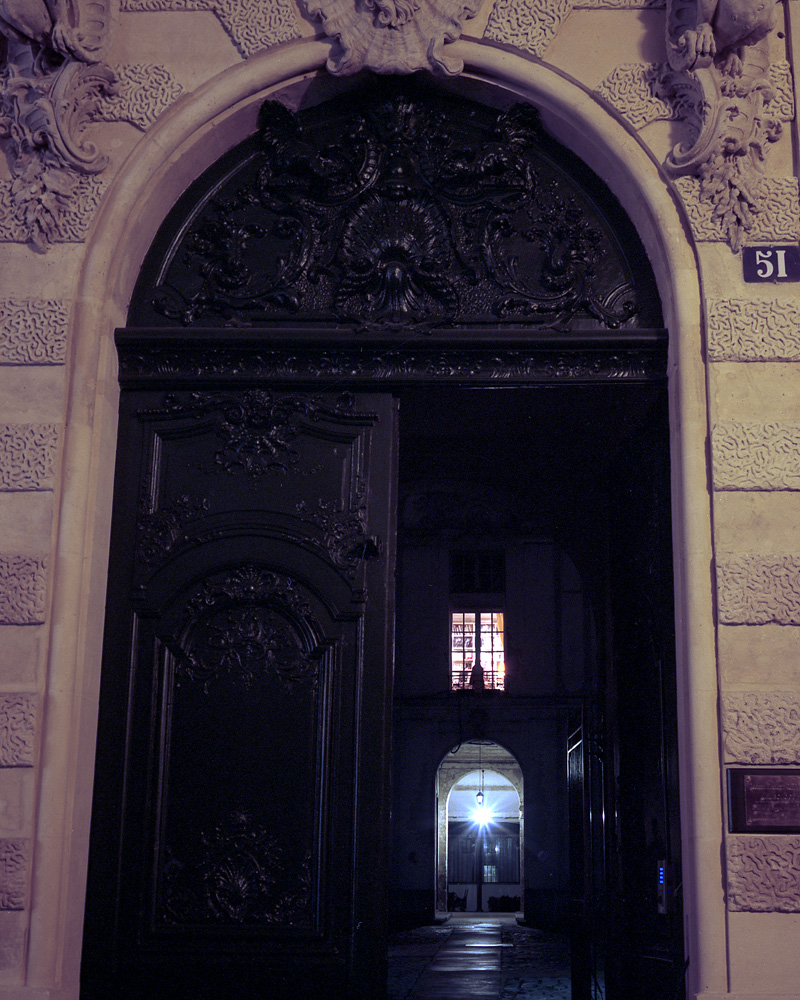
Here’s a look into the courtyard of one of the hotels on the Rue St. Louis en l’Ile, at number 51. I looked through the doorway, which had always been closed when I walked by in the daytime, and saw the light on in the library window on the second floor, and I just had to take that picture. I love libraries (I’m sitting in one as I type this, my modest personal library of 2000 or so books), so seeing in to one had a rather Proustian effect on me.

Hotel Courtyard, 51 Rue St. Louis en L'Ile, Night
Hotel Courtyard, 51 Rue St. Louis en L’Ile, Night

I shot all these on Kodak Portra 160 because I like how it responds to nighttime color better than Ektar. It has a less contrasty look which is good for night because night scenes are inherently contrastier than daytime scenes, and it handles overexposure better than Ektar.

Paris in October – part 13 – Chalon-sur-Saone in Black and White – Shops

Here are businesses and storefronts in Chalon-sur-Saone.

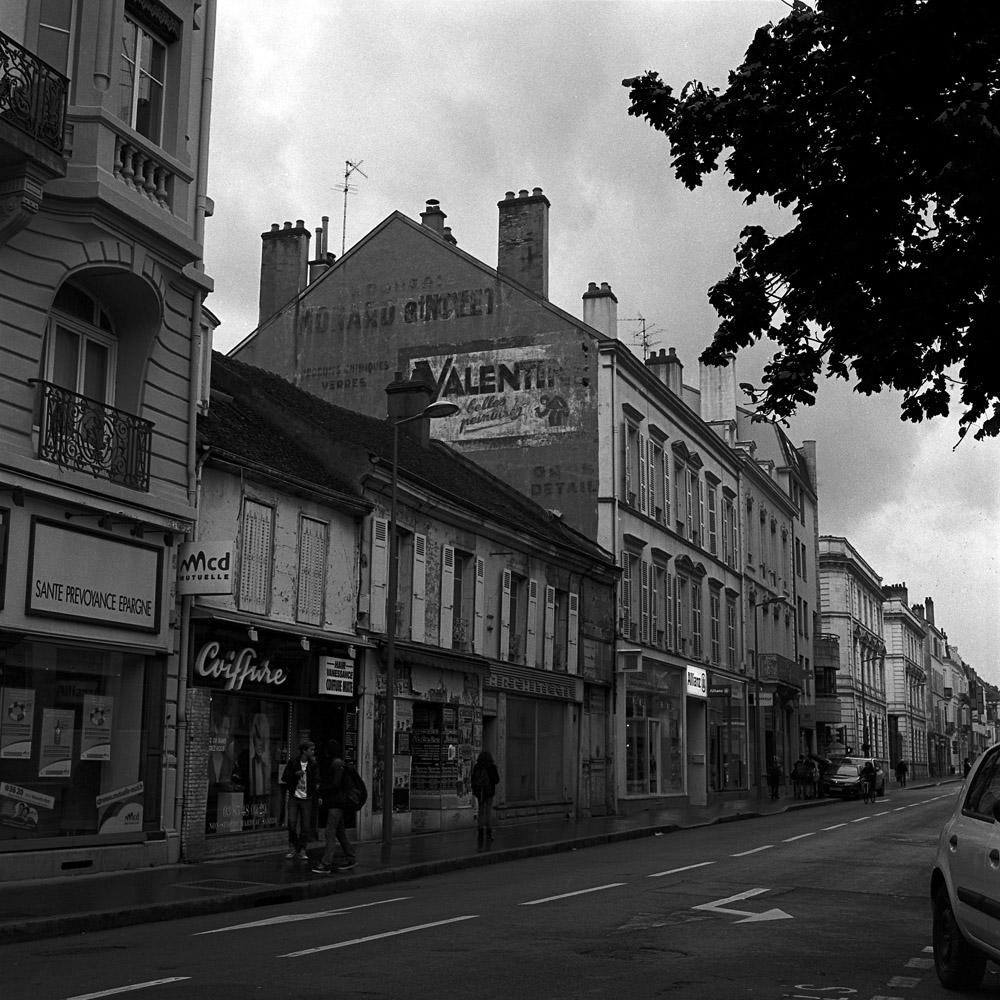
The old advertisement still visible on the wall of the building is on a street leading away from the old (2nd-16th Century) core of the town. Just around the corner is a McDonalds, with view camera designs etched in the windows. Even if the rest of the world doesn’t know it, the Chalonnais certainly remember what portion of their heritage is related to photography.

Old Advertisements, Chalon

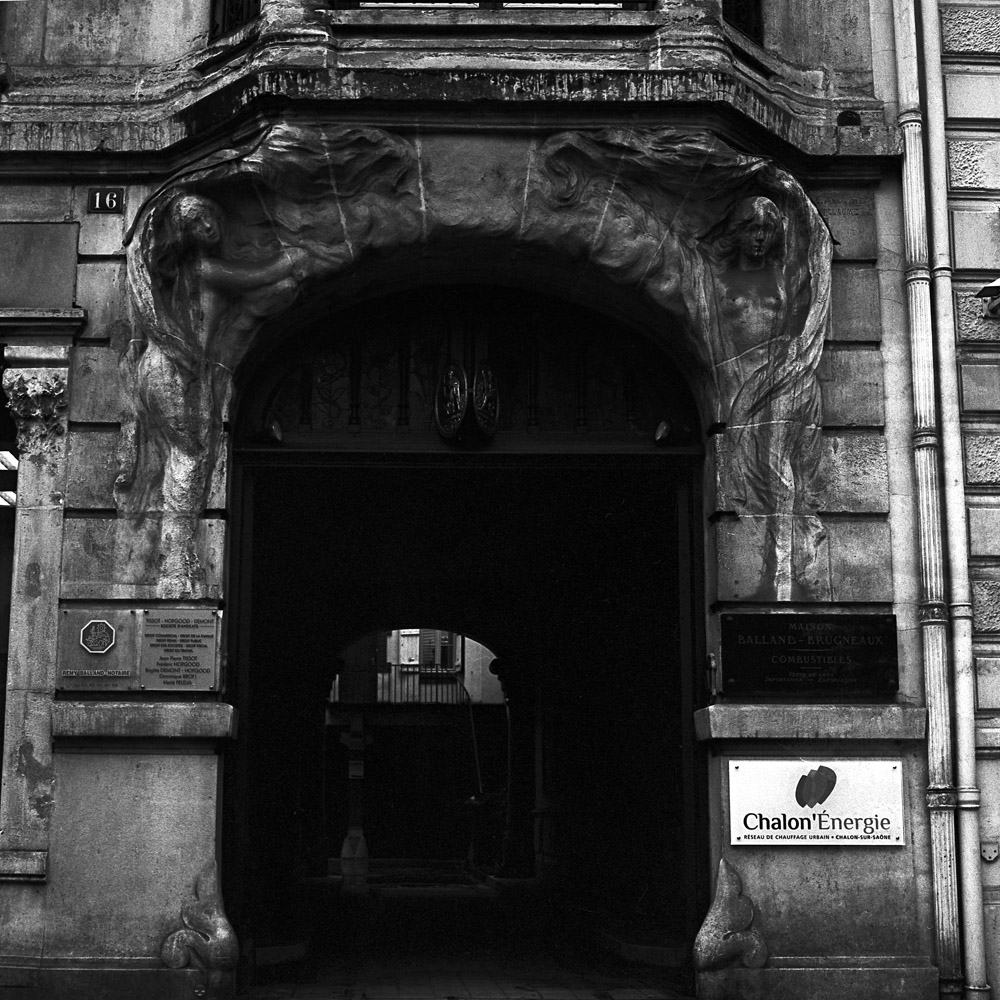
After spending ten days in Barcelona a few years ago, I became highly attuned to Art Nouveau architecture. Although Chalon is not particularly close to Barcelona (or Paris or any other major center for European architecture in the 19th century) the facade of this building is a particularly striking example of Noucentisme.

16 Blvd de la Republique, Chalon

Walking the streets of Chalon, you can tell that the town has had better days, but it is by no means a dying town, as can be seen from the businesses on the streets of the city center.

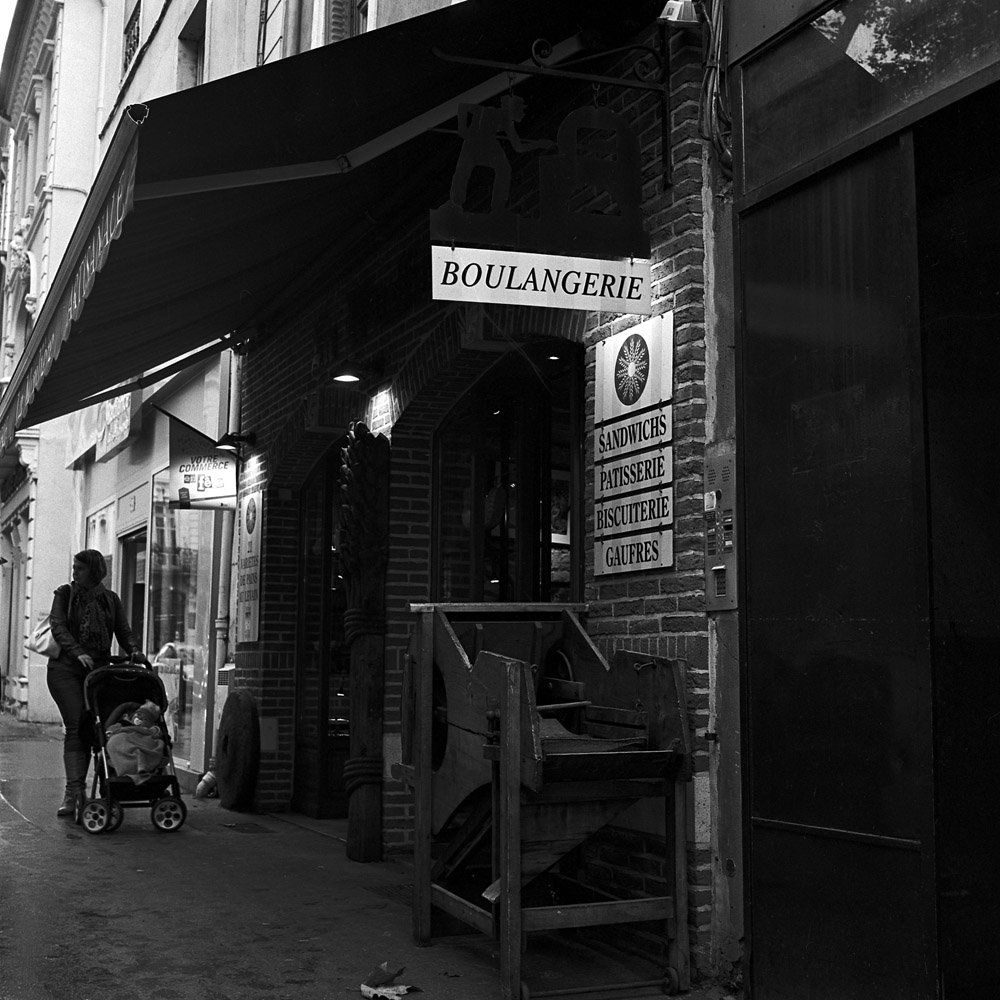
This boulangerie (bakery) was always busy whenever I walked past.

Boulangerie, Chalon
Boulangerie, Chalon

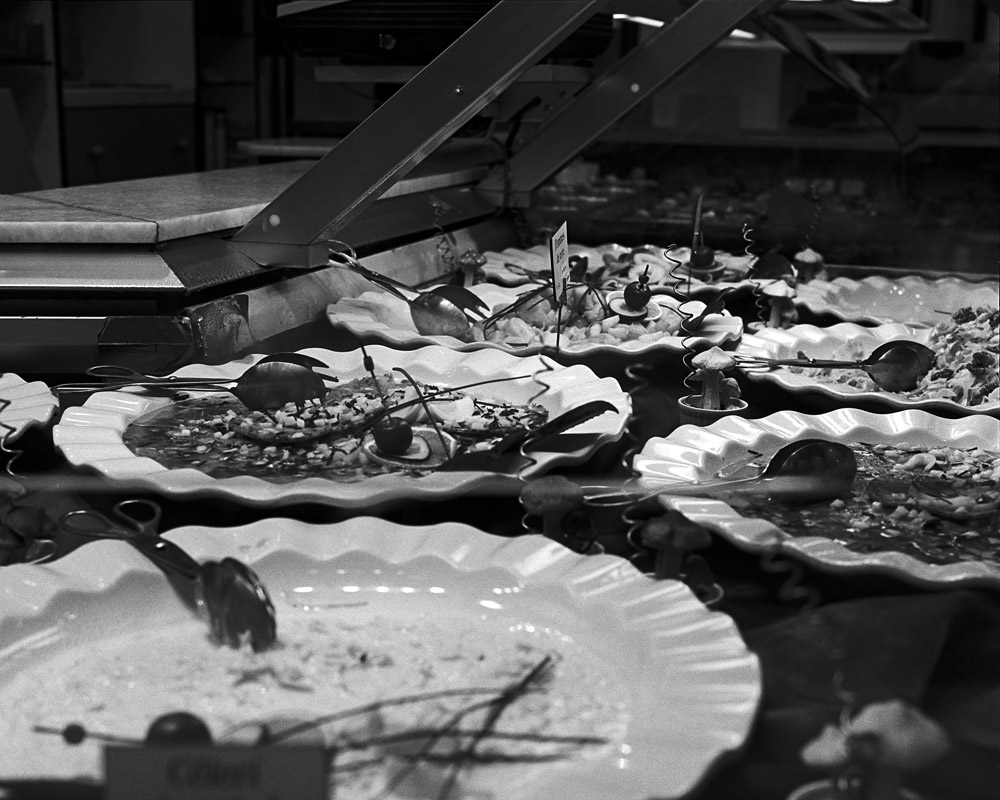
This fishmongers’ had particularly appealing plates of fresh seafood in their display cases.

Poissonierre, Chalon

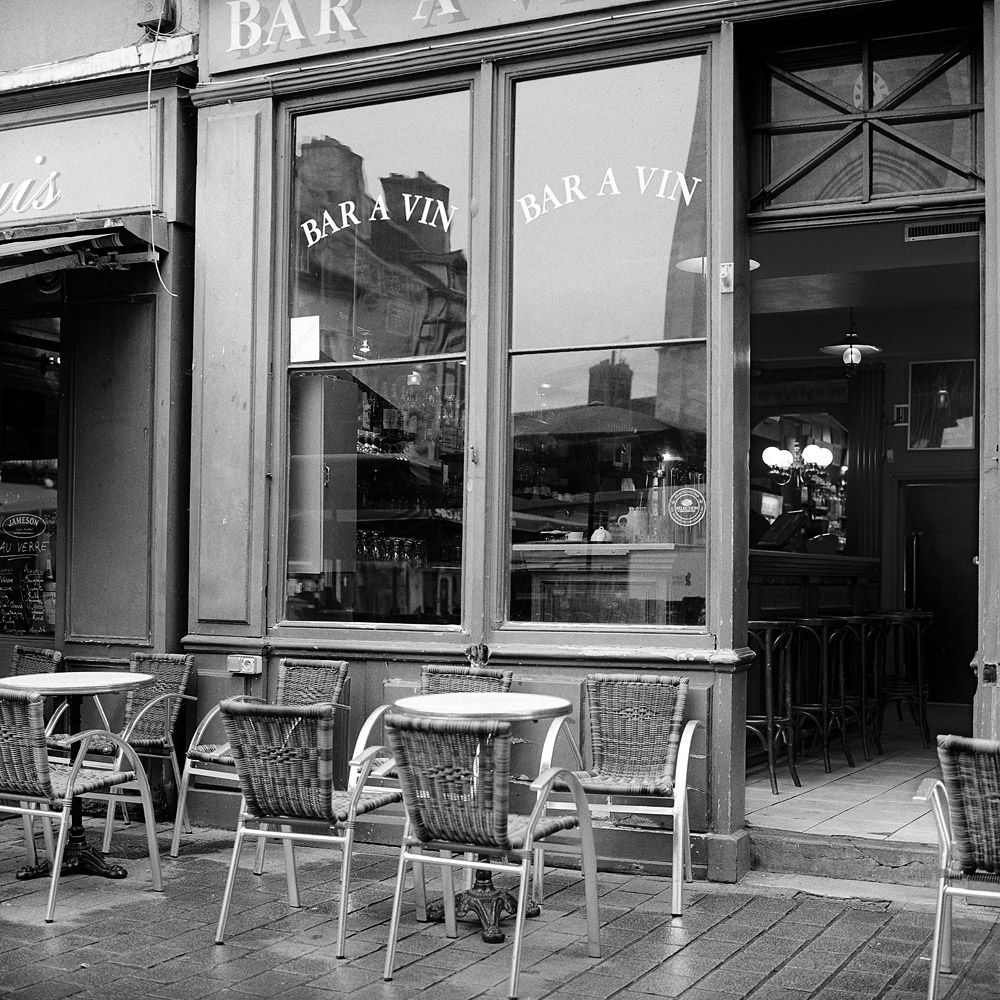
The Bar A Vin is located on the main square across from the cathedral. If things look particularly quiet, bear in mind I was there on a weekday, in the middle of the afternoon between lunch and dinner, and it was raining.

Bar A Vin, Chalon
Bar A Vin, Chalon

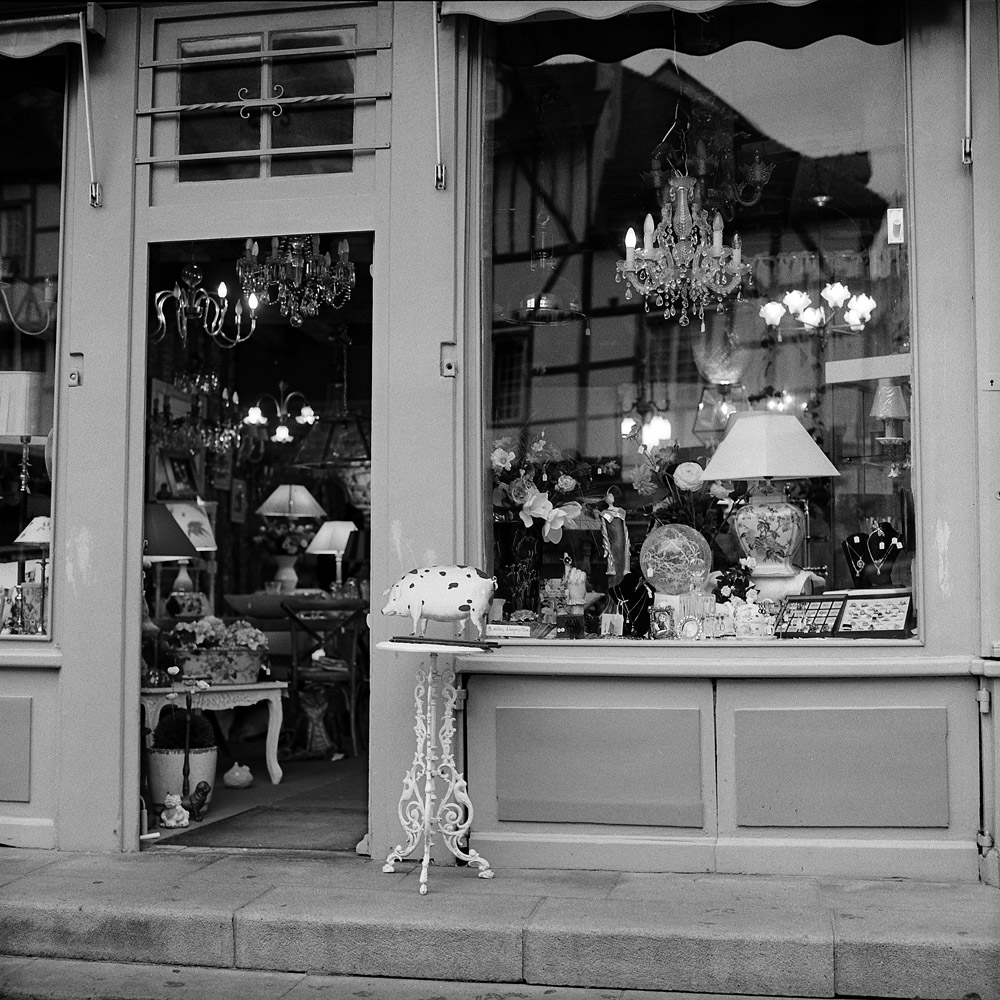
The lamp store was on another corner of the square and had the cutest little pig sign out front. The glow from all the lamps inside was enough to make it easy to balance the exposure between inside and outside.

Lamp Store, Chalon
Lamp Store, Chalon

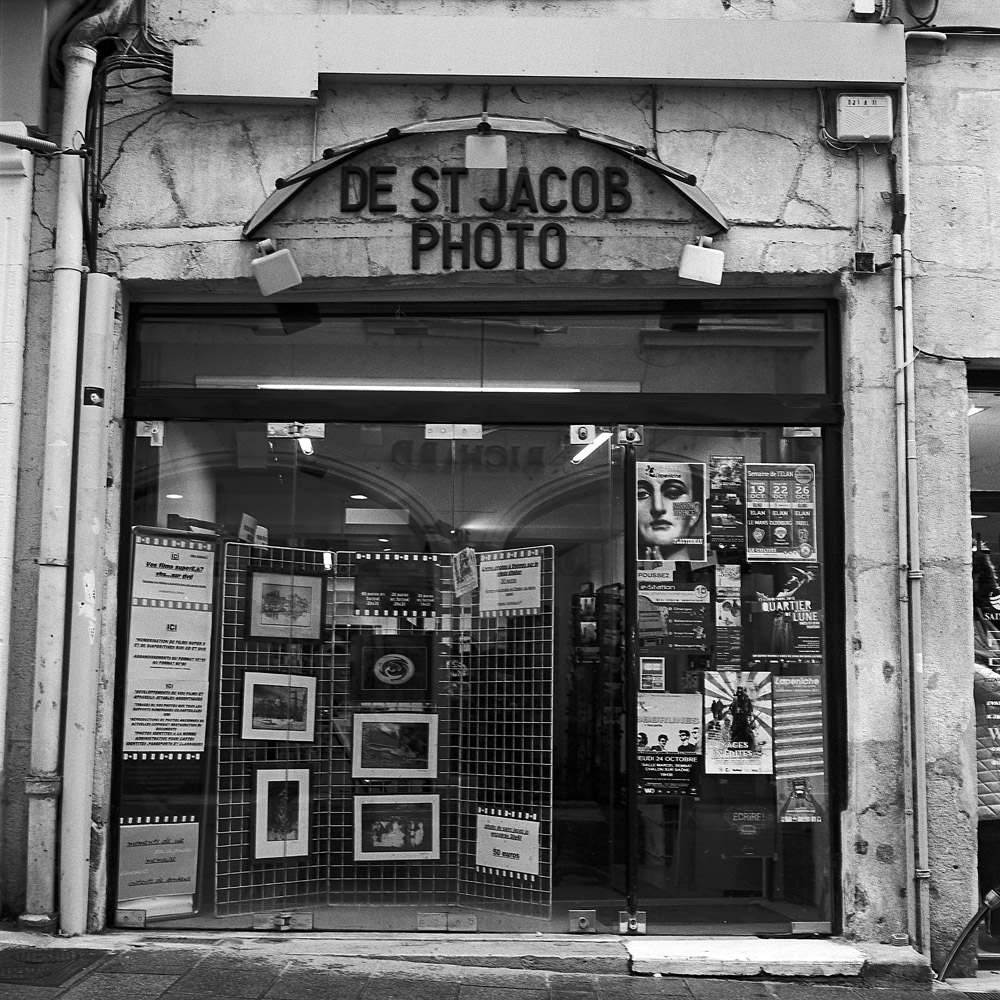
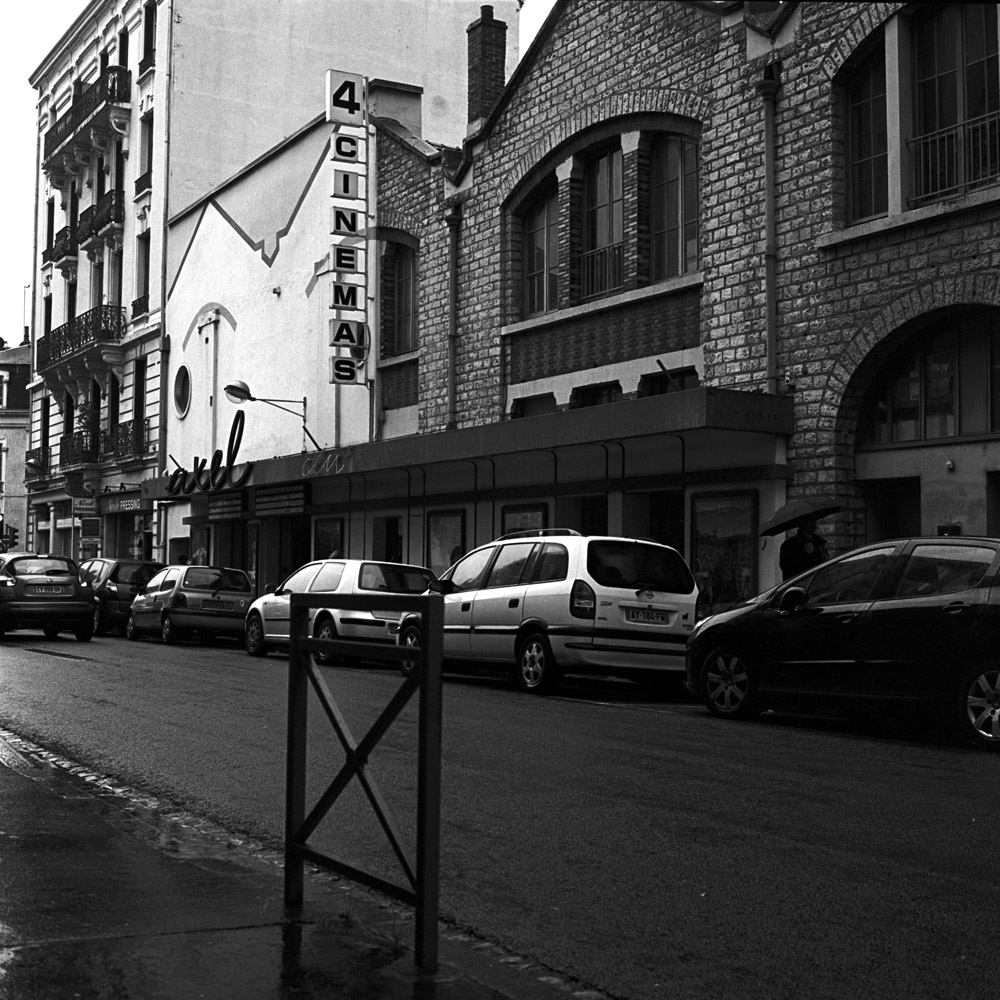
What photo essay about Chalon-sur-Saone could be complete without photos of things related to photography? Here is a photo studio in the center of the medieval district, and the 4-screen movie theater.

De St Jacob Photo, Chalon
Cinema, Chalon
Cinema, Chalon

Paris in October – part 12 – The Full Moon

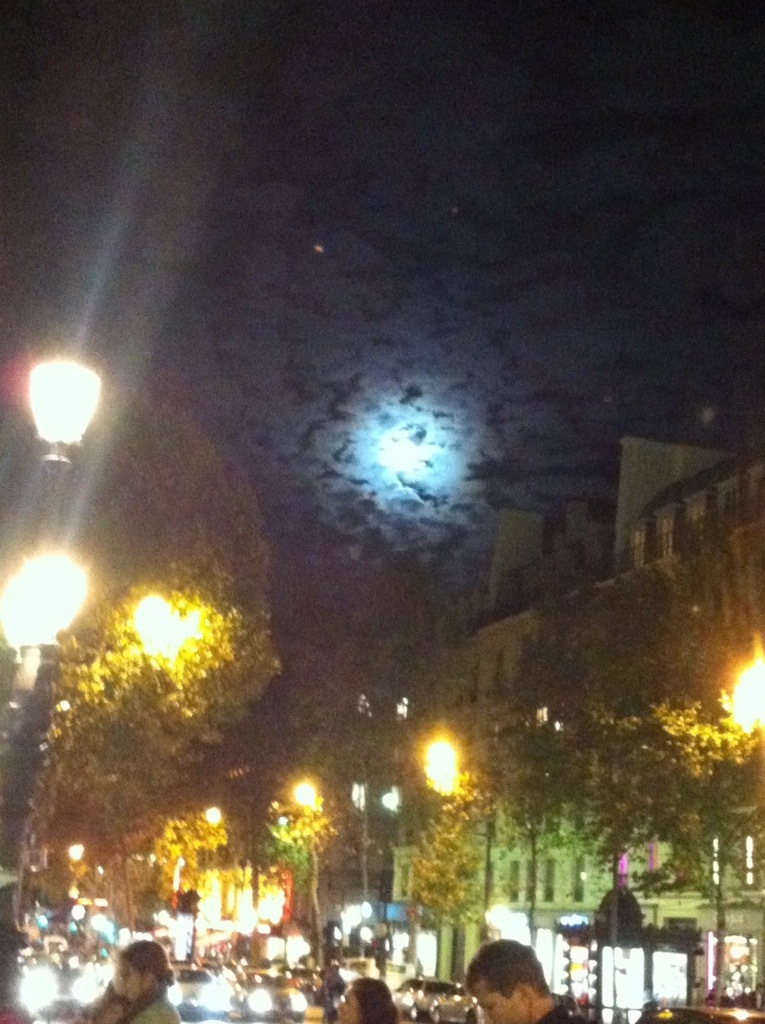
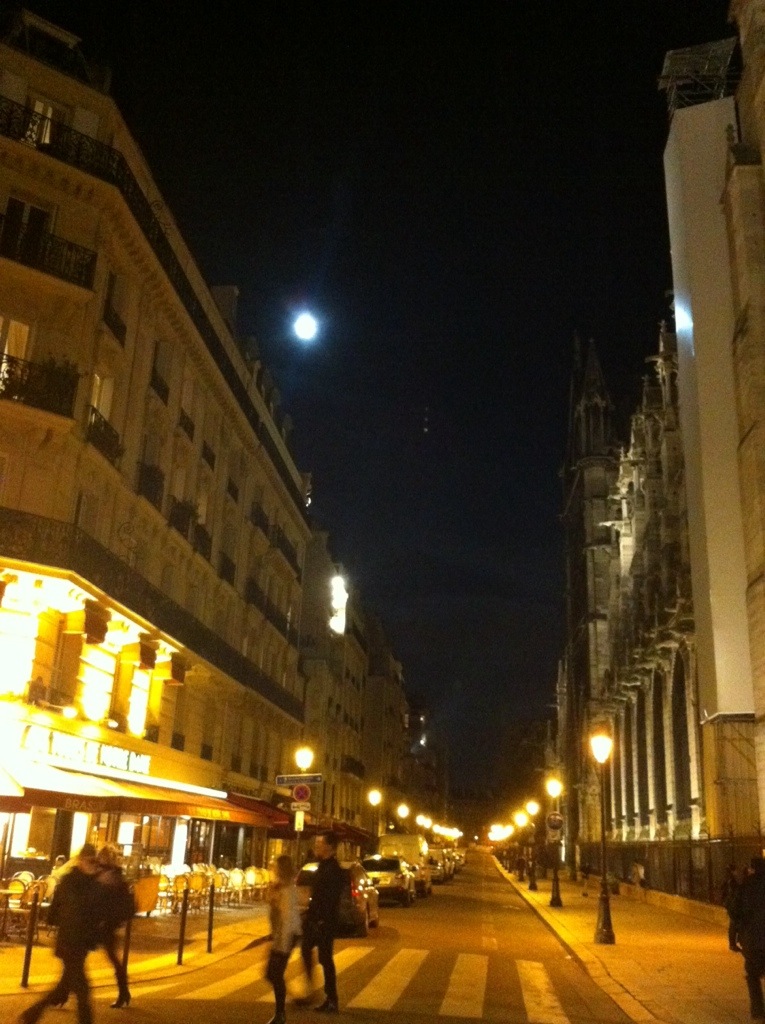
A few shots of the streets of Paris by the light of the full moon.

Off the Place de L’Opera:
20131114-202902.jpg

20131114-203014.jpg
The Hotel de Ville (City Hall):

20131114-203041.jpg
On the Ile St. Louis:

20131114-203103.jpg