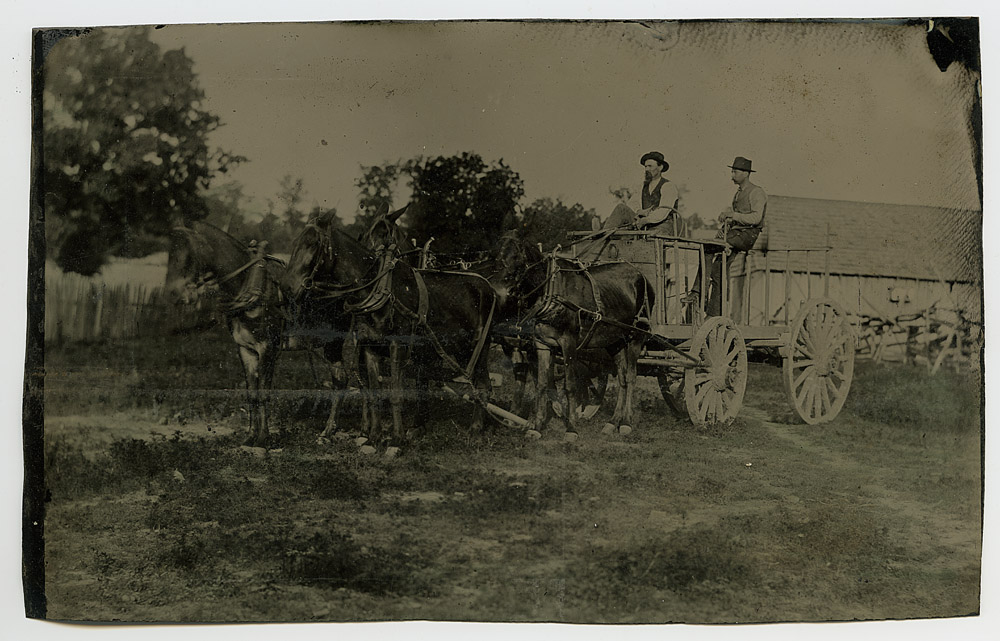
I fell off the wagon again, as it were, with this image of a team of horses pulling a wagon. Dates and location unknown, but it’s a pretty big tintype – approximately 5″x7″. I’m assuming it’s an American image, but the wagon doesn’t look like a type I’m used to seeing in early American images. But I’m no wagon expert – anyone who knows more about this stuff, could they be English?
Horse Team and Wagon, anonymous, date unknown (2nd half 19th century)
As an ardent bibliophile, I felt compelled to share this. Physical books are a sacred thing, yes even trashy paperback romance novels (well, maybe not romance novels… but you get the point). Books need to physically exist. Books need to be handled, read and loved. Go love a book today!
If you’ve been following my blog for a little while, you probably saw the post about my friend Nick Dong’s art installation at the Renwick Gallery (the Smithsonian Museum of American Arts and Crafts). At that shoot, Nick shot a quickie video of the piece using his point-n-shoot camera. The video quality was somewhat disappointing. He’ll be back in town tomorrow for the exhibit opening, and I’ll be going over to the gallery after hours to shoot video, which I hope to post here when I have it edited. Nick’s need for a video of the installation, plus several personal projects I have in mind (some instructional videos on platinum printing, a Kickstarter funding request, and some artist interviews at Glen Echo Photoworks).
I’m still learning my way around the camcorder – a Canon Vixia HF G10. The touch-screen controls are fairly intuitive, and they get easier the more you play with it and start learning the control layout, but certain things being buried in touch-screen menus is frustrating to someone coming from analog still photography where all the controls are exposed all the time as knobs, buttons or dials. At least this one does have a nice fat manual-focus control ring right around the lens, making it easy to pull focus, and the zoom speed is easy to manage as well. You can vary the zoom speed from almost-imperceptible to WHAM! in a fluid manner instead of having just two or three zoom speeds.
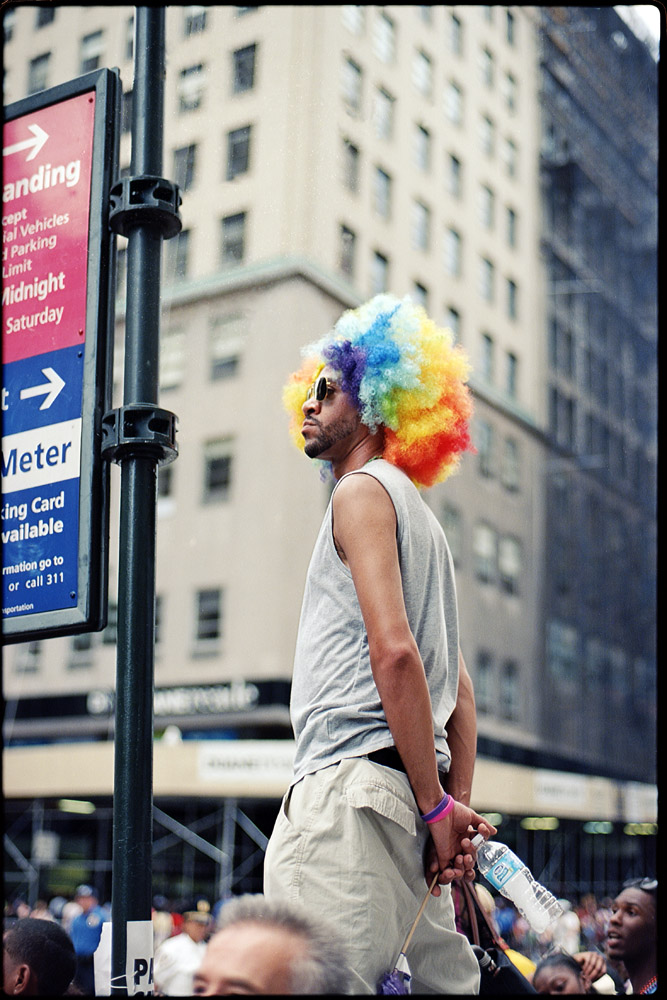
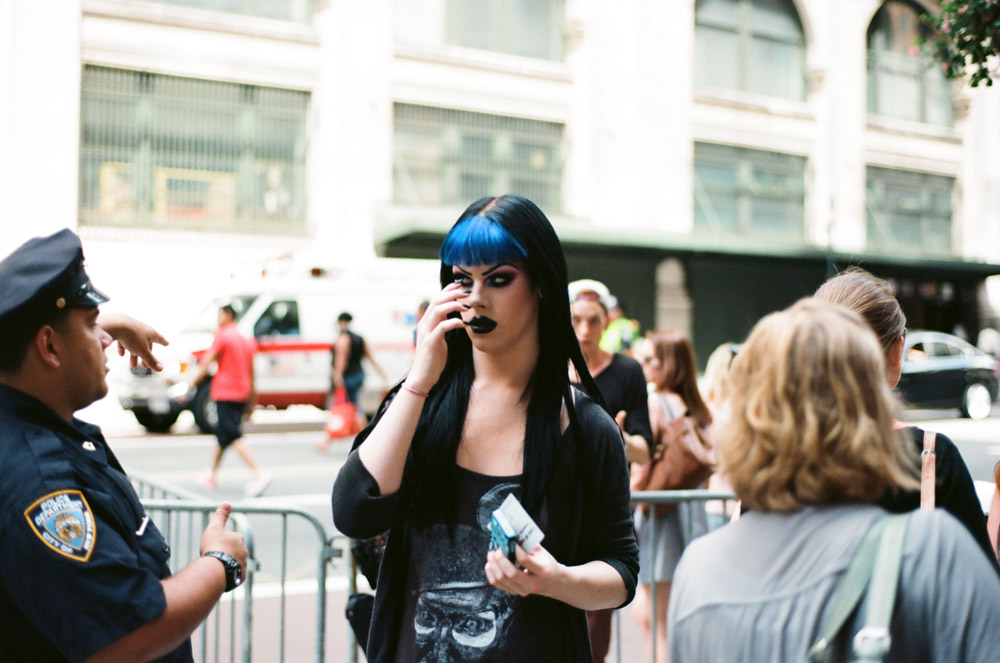
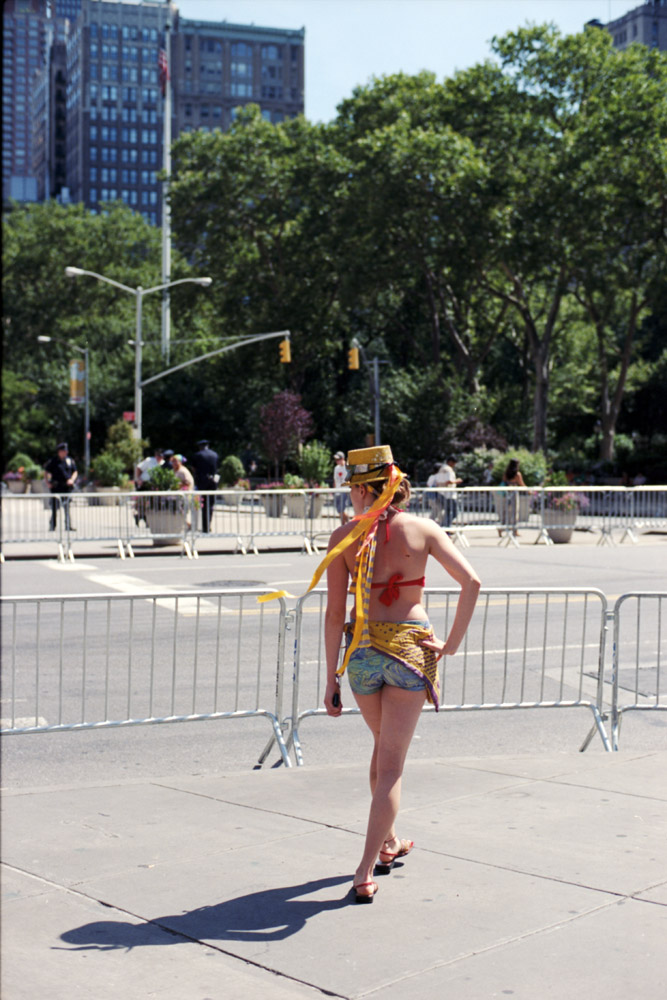
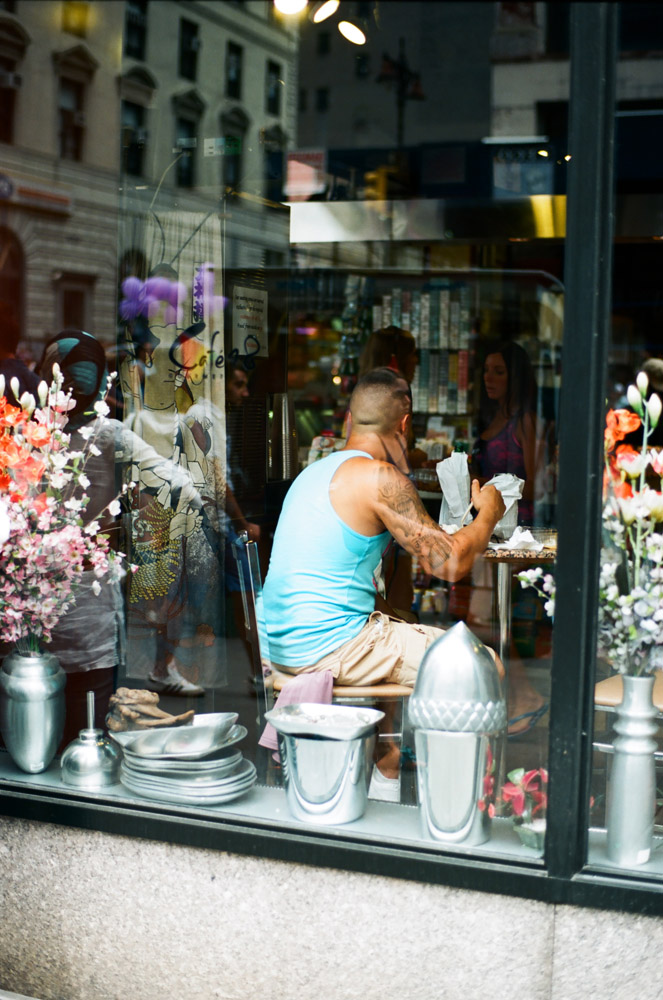
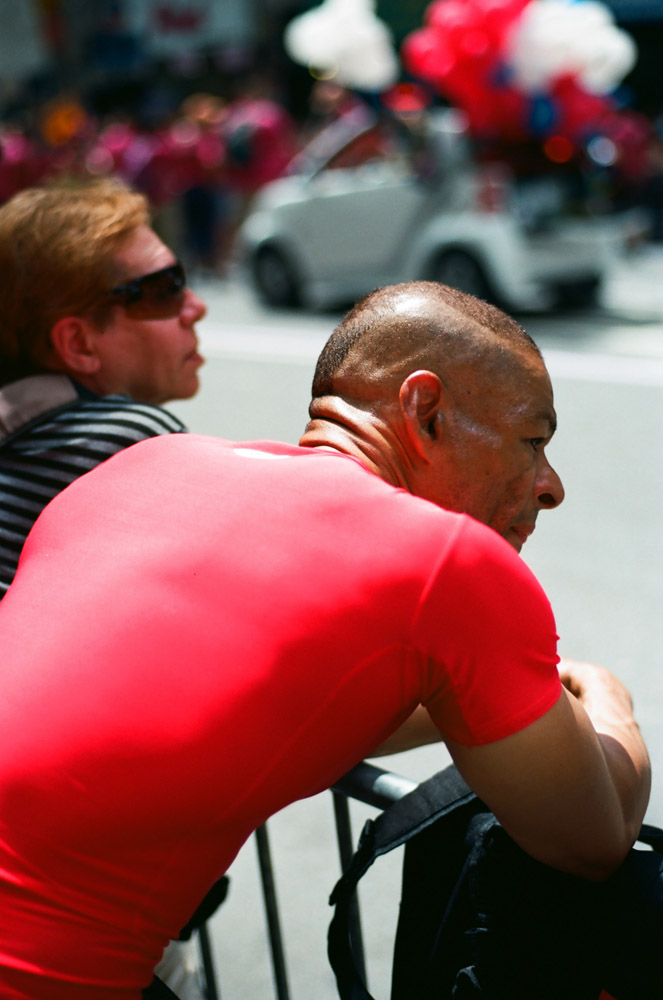
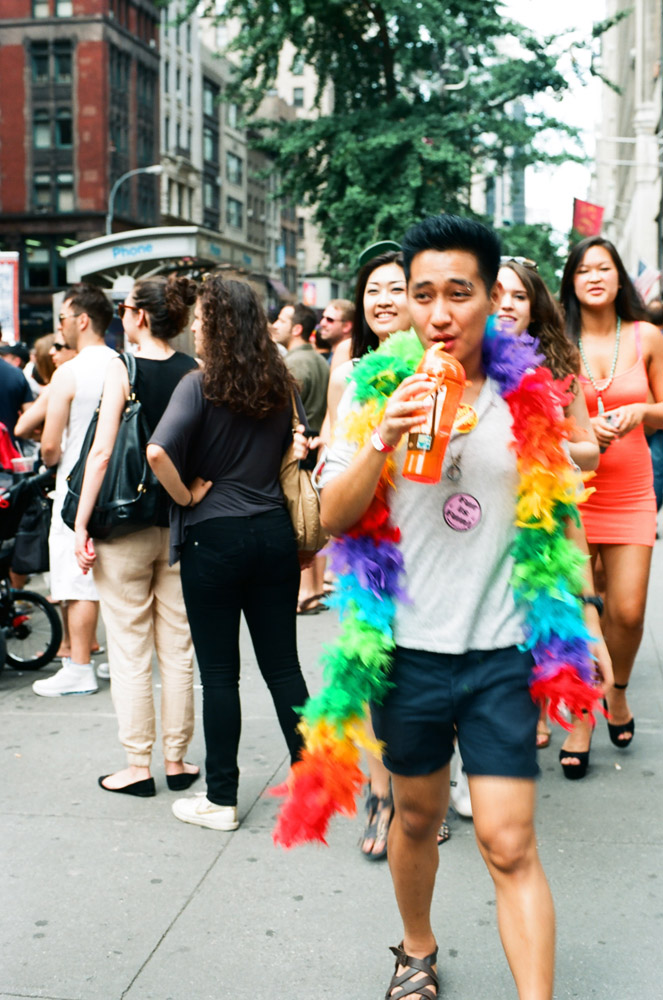
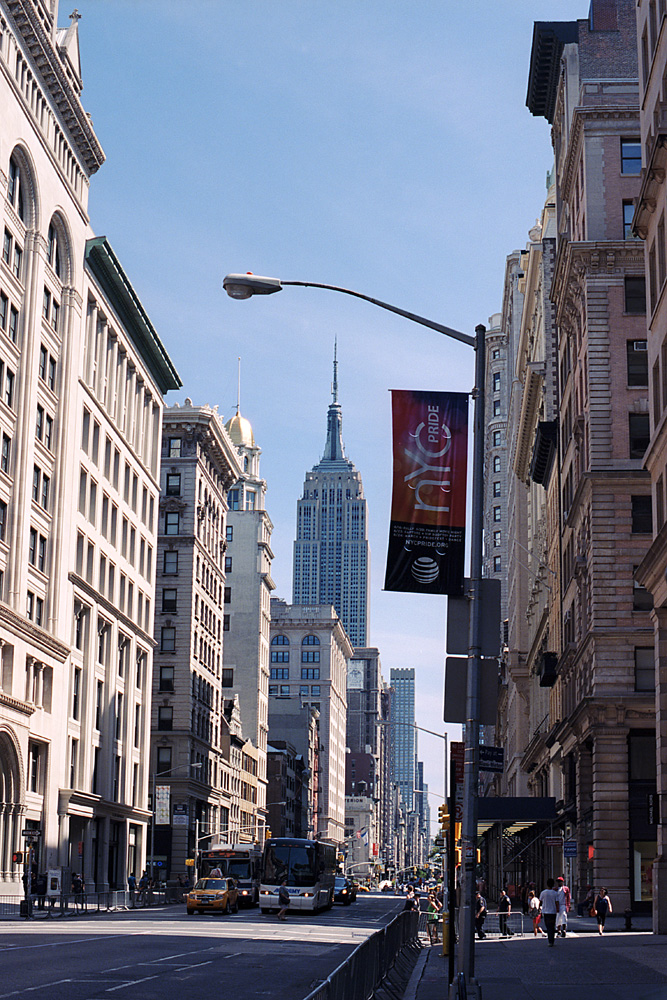
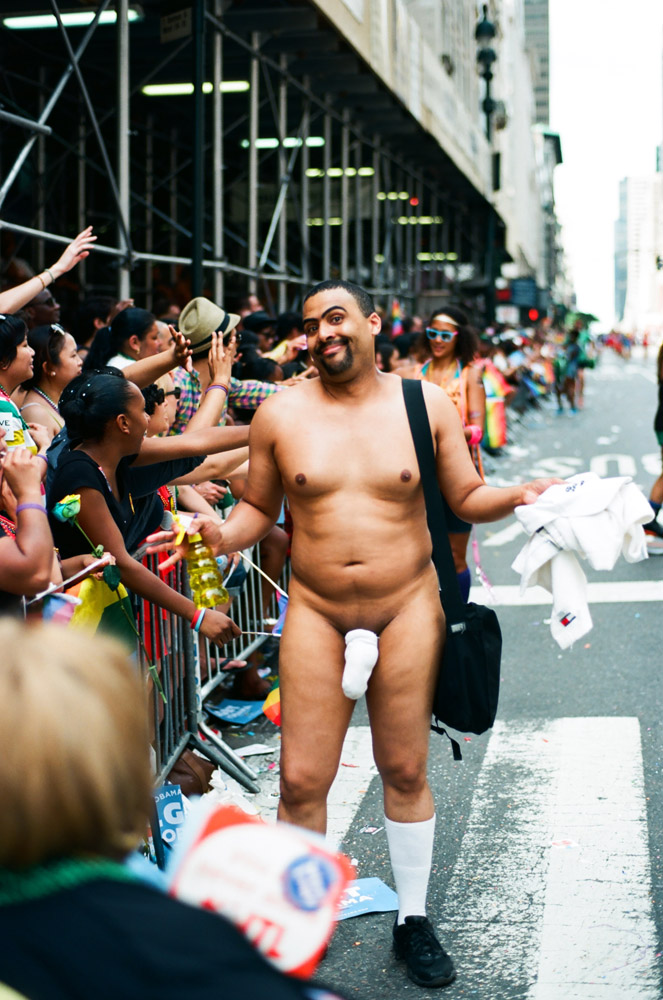
I’m really remiss in posting these, as it’s been three weeks almost since NY Pride. I didn’t post much because I really didn’t shoot much, and only took a cursory glance at the parade because I was tired and ready to go home, what with the bone chip in my right ankle acting up. But here’s a few goodies to sate someone’s curiosity. Unlike DC Pride, I shot these on film (I wanna say Kodak Ektar 100) with my new-to-me Contax RTS III and the 50mm f1.4 Planar lens. It’s not a bad combo for ‘street’ shooting, especially at an event where everyone is some kind of exhibitionist and WANTS to be seen/photographed.
Wearing your Pride, NY Pride 2012Could it be… Elvira?Girl with a fancy hat, NY Pride 2012Through the Cafe Window, NY Pride 2012Red Shirt, NY Pride 2012Asian guy with rainbow boa, NY Pride 2012Empire State Pride, NY 2012
Talk about exhibitionists… someone who really doesn’t care 🙂
The “dick-tater”, NY Pride 2012
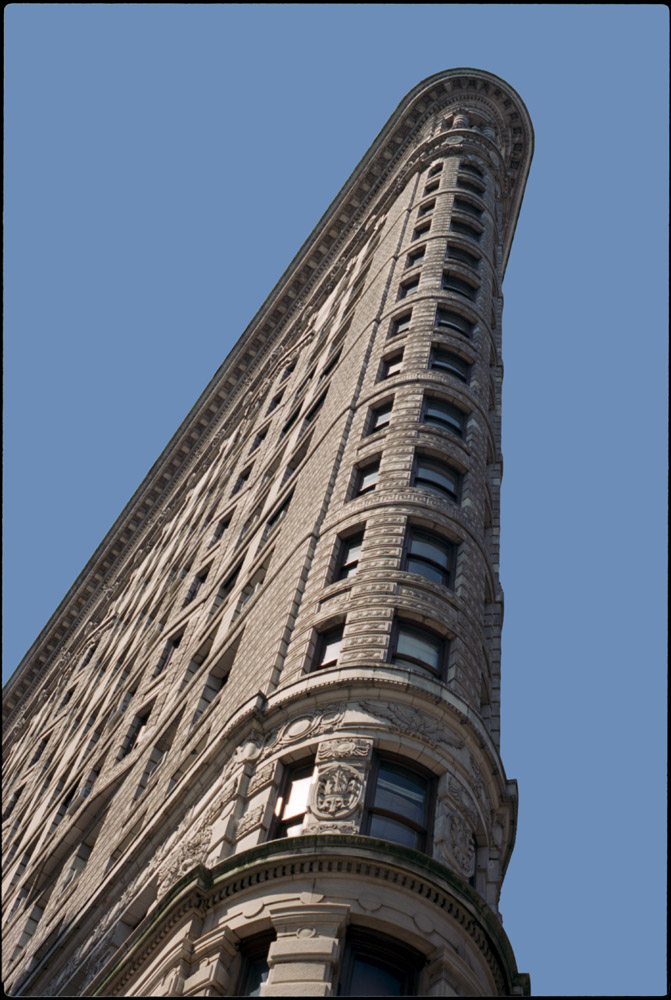
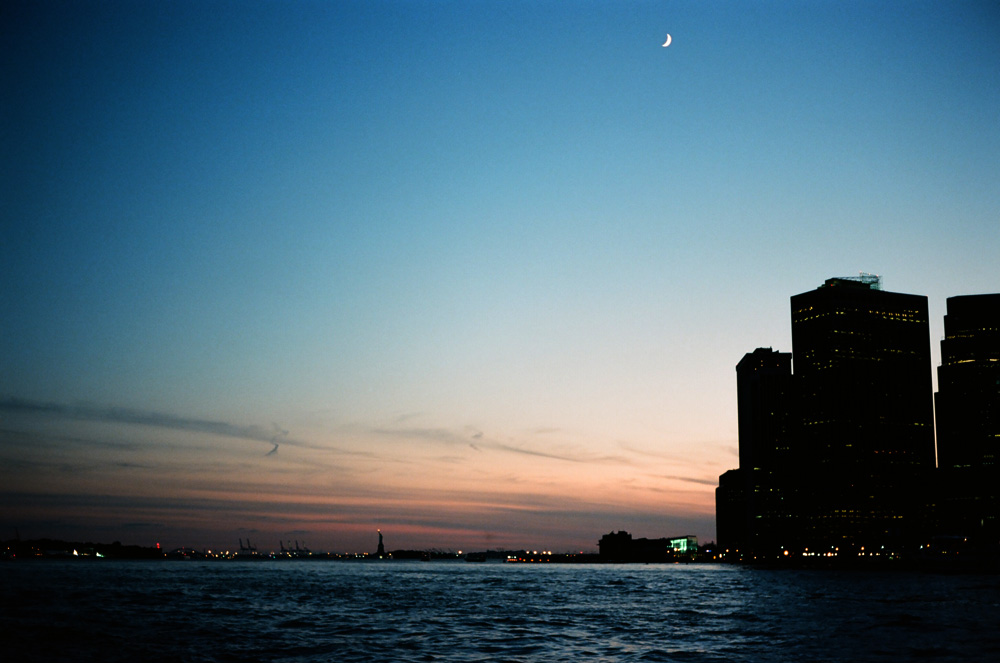
And a couple of generic New York photos, to help clean your brain after seeing that last one…
The Flatiron BuildingNY Harbor – Brooklyn View, with Moon and Statue of Liberty
Back in June, I was up in New York for a quick getaway. While there, I bought a Contax RTS III camera and 50mm lens. I bought the camera for two reasons: a, because I always wanted one and it was a sweetheart of a deal, and b, because I had a project in mind to use it for. I was cleaning out the film fridge in the basement and discovered I had a half-dozen rolls of Kodak b/w Infrared film sitting there. I always liked that film and what it could do, so I thought I’d shoot my remaining stock of it. Turns out, the old HIE was so old that even though it had been refrigerated, it still had horrible base fog. To boot, the older rolls in the batch also had an emulsion coating problem for which the Kodak HIE was infamous – there were pinholes in the emulsion which would lead to black spots in the image. Back in the day, this was an unforgivable flaw as it was really hard to work around when enlarging. Today, not so bad if you scan your film and can fix it in Photoshop, a pixel at a time if need be. So now it’s not unforgivable, just really annoying. Between the two problems, I decided to forego the Kodak, but I still had the jones on for doing some infrared again.
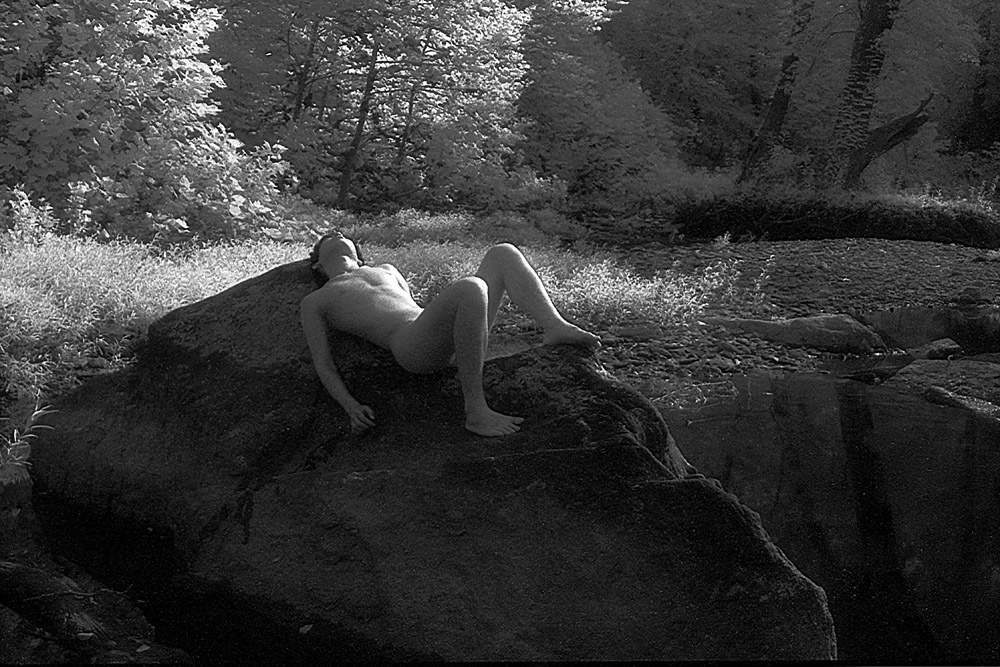
Efke, an eastern european film manufacturer, still produces an infrared film, with much finer grain than the Kodak had. The downside is that this film is EXTREMELY slow – box speed without a filter is ISO 100. Manual exposure calculation after factoring in the filter puts it around ISO 1. Yes, that’s right. ISO 1. So you should base your exposures on 1 second at f16 in full sunlight. I decided I’d give it a try anyway. Efke makes two versions of their infrared film – 820c and 820c Aura. Allegedly the Aura version has no anti-halation coating so you in theory get the infrared “glow”. I don’t know if there really is a difference in the final results, but I shot this on Aura just in case. To gain maximum infrared effect with this film, I used a Hoya RM72 filter, which is a very deep red filter, almost opaque, and it blocks most of the visible light from recording on film. The results were hit and miss – I chanced it and let the camera meter through the filter, so sometimes I got useable exposures, and sometimes I got bubkes. Here are the best two from the shoot.
Eliot K, Rock, Potomac RiverEliot K, Reclining, Potomac River
I want to give a big thanks to my model, who goes by Eliot K as his professional name on Model Mayhem. He was a real trooper, getting up at 7 AM to get out along the Potomac and shoot while the air was relatively cool (under 90 degrees – this was a real scorcher of a heat wave, with the actual air temperature reaching 98-100 and the heat index putting it up over 102-104 for the high) and the light was rich in infrared. He had the great idea to pack along a cooler with ice and bottled water for us, and it was a life-saver. He also had no problem at least attempting whatever pose I tried to put him in, and never fussed about getting in the river or standing in a bunch of plants, so long as there was no poison ivy (and I know what poison ivy looks like, so that was an easy one to solve).
For those who aren’t familiar with infrared photography, what we’re talking about here is not thermal photography like the night-vision stuff you see in TV and movies. This is photography that is still based on reflected LIGHT – not heat. Infrared photography works with the near-infrared portion of the visible light spectrum, just beyond what your eye can see. You need a specialized red filter to record only the near-infrared portion of the spectrum being reflected by your subject. Otherwise, you’ve just bought some really expensive but otherwise unremarkable black-and-white film. You CAN duplicate this with digital today, but the downside is that in order to do so, you have to permanently alter your camera to shoot infrared, at which point it becomes a dedicated IR camera.
I’m always tickled to death to see where in the world people have been reading my blog from. Here’s the latest stats. They’re fun to ponder – what do some of them mean? Myanmar has more visits than Japan? I now have a visitor from Albania, and two from Nepal. I’m slowly coloring in the world on the world map, which is very cool. I’m only missing a couple of Balkan countries (Bosnia and Macedonia) and Baltics (Estonia and Latvia I believe) to complete all of Europe. China is the big mystery to me – am I blogging about something that either is of no interest at all to the Chinese, or more likely, am I blogging about something that runs afoul of Chinese web filters? Or most likely, my blog doesn’t translate well into Chinese so nobody reads it there. I’m not surprised by Khazakhstan or Mongolia not having anyone reading my blog – there’s very little internet penetration into those two countries to begin with.
In addition to getting some Chinese readers, I’d really love to have someone in Svalbard read my blog – I think that would be super cool as it’s one of the least well known countries. Svalbard, New Guinea, Greenland, the Falkland islands, and Bolivia and Paraguay. So if you know someone in one of those places, or traveling to them, and who actually would be interested in this, please pass along the blog!
Here’s another CDV from the Alexander Gardner studio. It’s a card-size copy of an architectural rendering of St. Paul’s Church here in Washington DC. The Architect is Emlen T. Littell, 111 Broadway, New York. I’ve done a little digging and can’t find a current St. Paul’s church that looks like this – there are a number of St. Paul’s churches in the DC area, but the ones I could find in the most probable parts of town for the time period don’t look anything like this, nor do they mention the architect – and several of them do mention the architect who designed their building.
Emlen Littell was a prominent ecclesiastical architect in the 2nd half of the 19th century, working mostly in New York and Philadelphia. He became president of the American Institute of Architects. One of his most famous designs is the Church of the Incarnation in New York City, which had many famous parishioners including Admiral David Farragut and Eleanor Roosevelt. FDR’s mother’s funeral was held there as well. It has windows designed by Louis Comfort Tiffany among other well-known Victorian artists.
Architectural rendering, St. Paul’s Church, Washington DC by Alexander Gardner
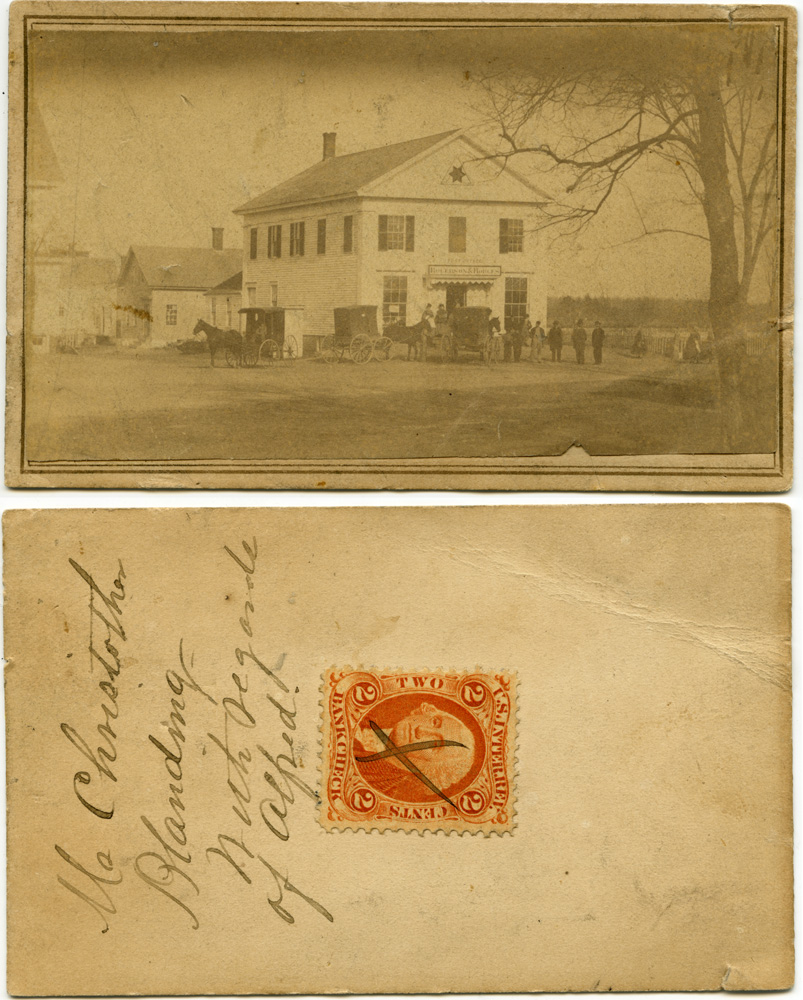
Here’s a charming little anonymous CDV of Rugerson & Hodges’ General Store and Post Office. No location given – maybe Pennsylvania or somewhere in New England? If anyone out there in internet land has any idea of the location, feedback would be much appreciated.
Just a silly quick note to say thank you to all my visitors from all around the world. As of this writing, I have 15,678 unique visitors. I actually thought I’d have a little more time to plan out this post, but y’all have been some busy people Sunday and yesterday. 910 of you stopped by yesterday alone, shattering my previous all-time high. But gosh, y’all are quiet 🙂 if you see something you like, please say something! I LOVE feedback, and I’ll even take constructive criticism. And once again, thank you for visiting!
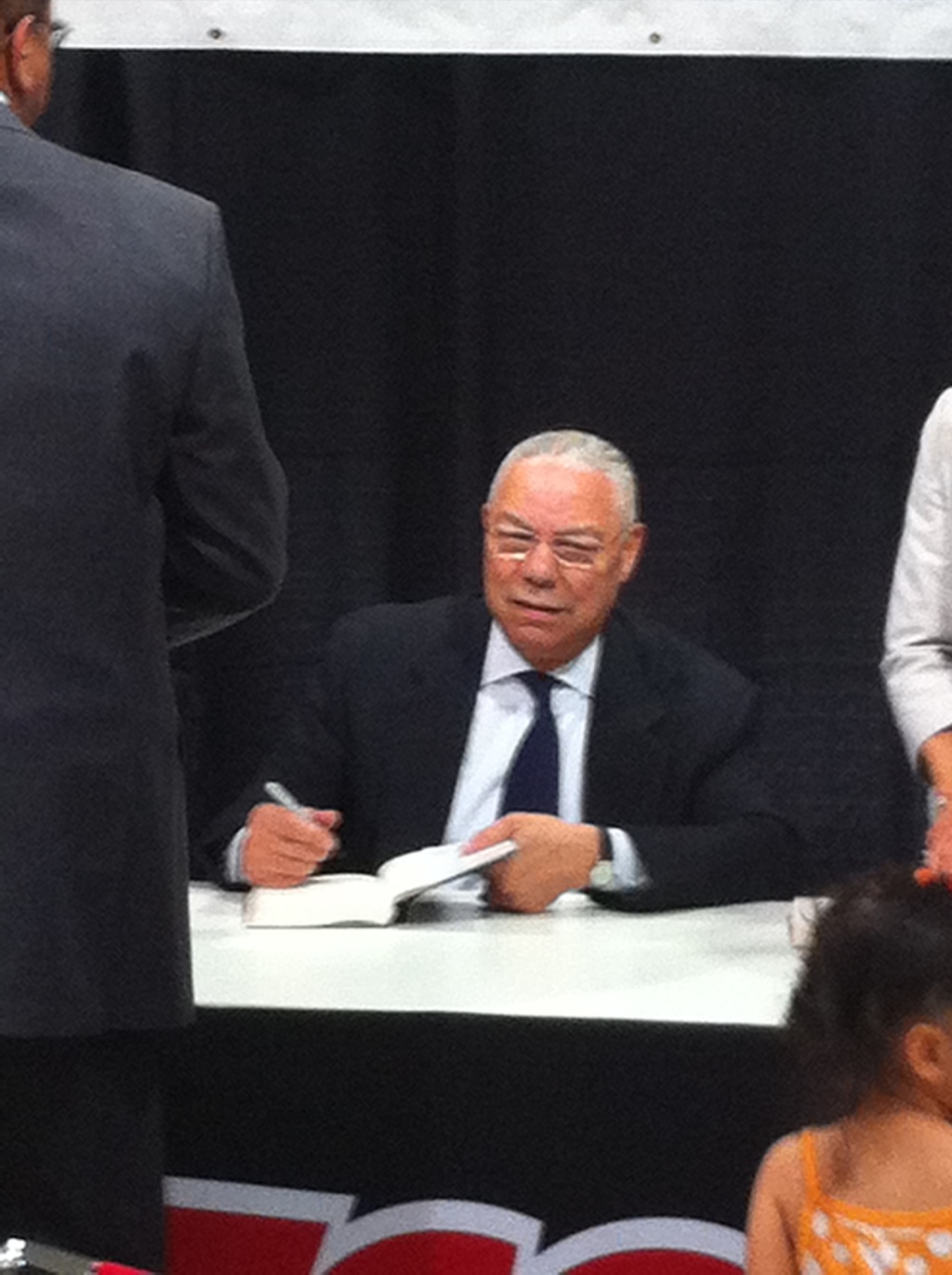
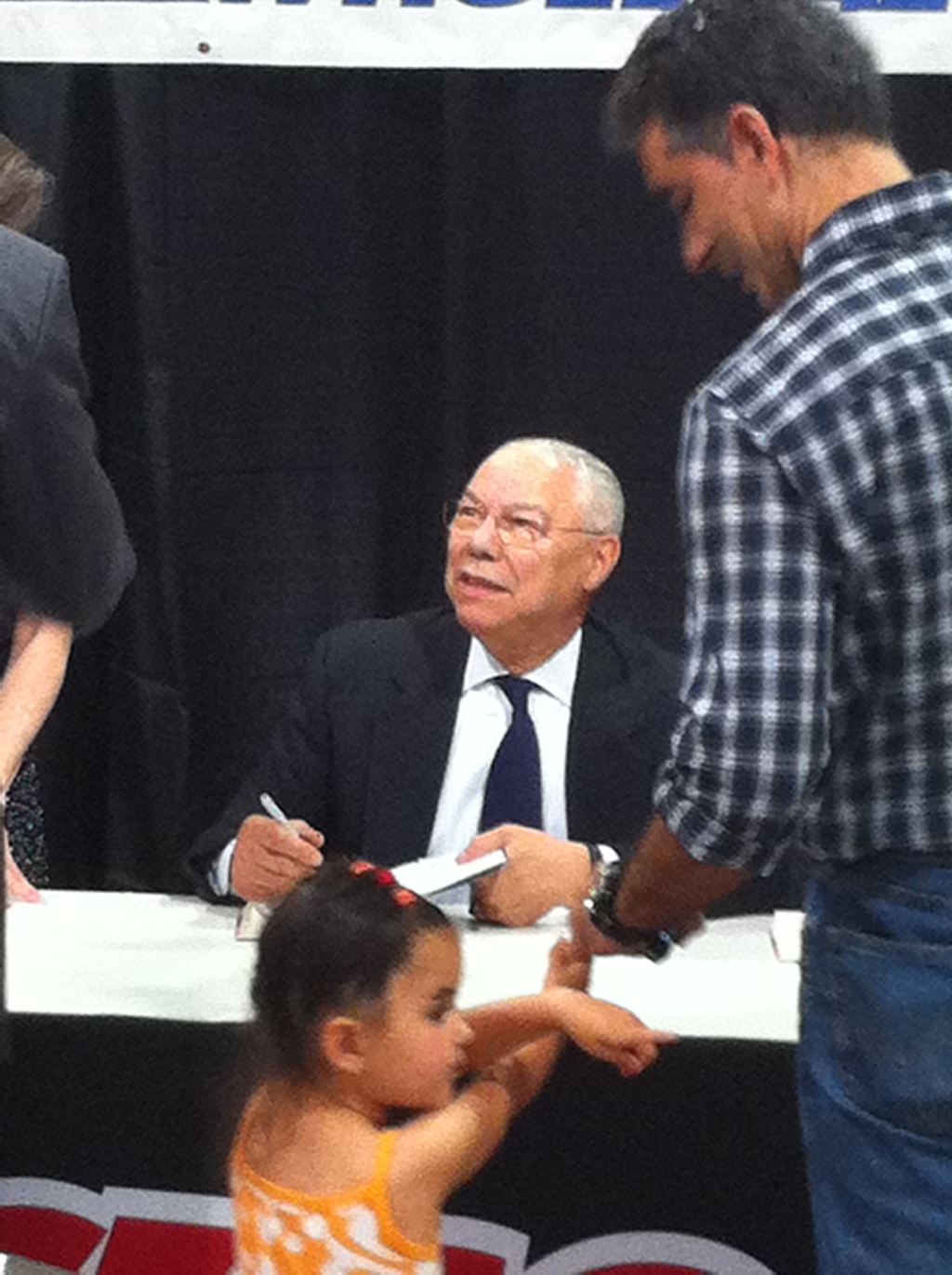
Here I was, just minding my own business doing a little shopping for me and the cats, when what do I see but the retired general and former Secretary of State, Colin Powell, signing copies of his new book.

 United States
 United Kingdom
 Canada
 Australia
 Spain
Spain France
 Italy
Italy Germany
 Mexico
 Brazil
 Belgium
 Netherlands
 India
India Thailand
 Philippines
 Sweden
 Poland
 Russian Federation
 Austria
 New Zealand
 Hungary
 Cambodia
 Myanmar
 Colombia
 Slovenia
 Ireland
 Argentina
 Hong Kong
 Singapore
 Romania
 Malaysia
 Indonesia
 Viet Nam
 Denmark
 Japan
Japan Sudan
Sudan Lithuania
 Greece
 Portugal
 Switzerland
 Czech Republic
 Iceland
 Republic of Korea
 Ukraine
 South Africa
 Luxembourg
 Pakistan
 Belarus
 United Arab Emirates
 Qatar
Qatar Israel
 Ecuador
 Moldova
 Saudi Arabia
 Taiwan
 Bulgaria
 Turkey
 Slovakia
 Serbia
 Finland
 Venezuela
 Norway
 Nigeria
 Syrian Arab Republic
 Panama
 Peru
Peru Morocco
 Malta
Malta Azerbaijan
 Puerto Rico
 Nepal
Nepal Dominican Republic
 Uruguay
 Chile
Chile Egypt
Egypt Bangladesh
 Albania
 Cyprus
 Iraq
Iraq Gabon
Gabon Trinidad and Tobago
 Algeria
 Sri Lanka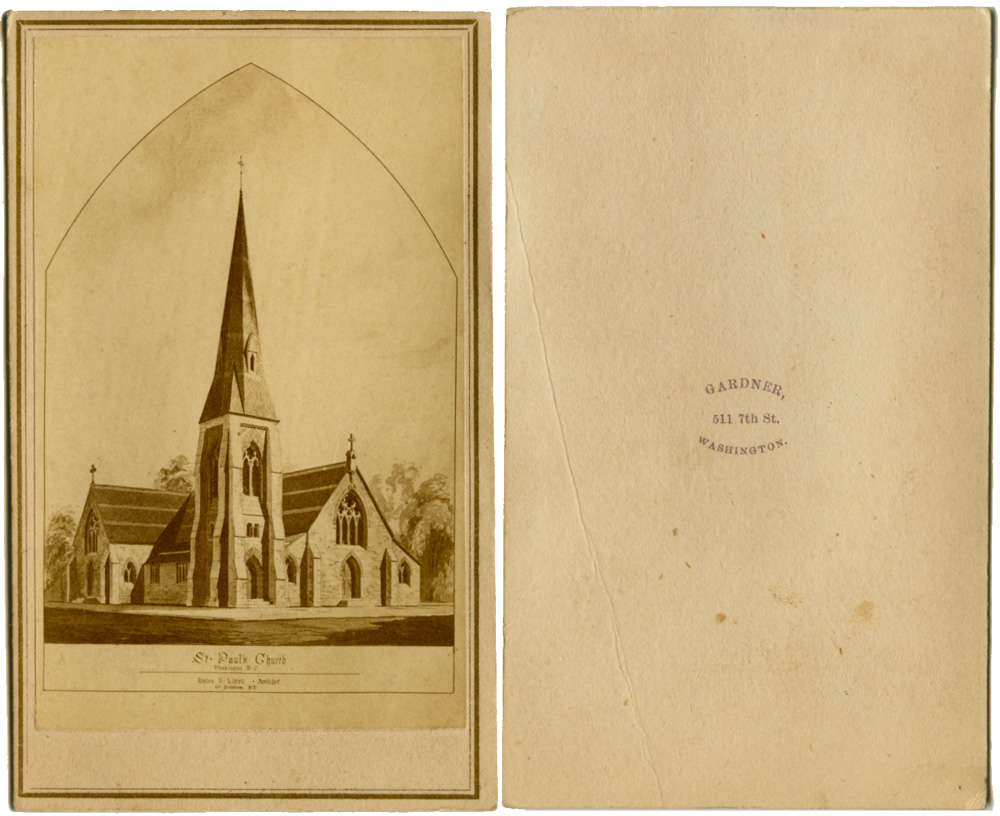

 dcphotoartist