Category Archives: About Art

Photographic Vision, or: Re-seeing the same things

Many photographers complain about “I don’t have anything to photograph where I live… there’s nothing interesting, blah blah blah… I get tired of seeing the same things over and over again”. If you’re getting tired of seeing the same things over again, then you’re not looking right. Not only are you not paying attention to what’s around you, but you’re failing to observe change in your environment and to record that change, which is one of the greatest functions a photographer can fulfill.

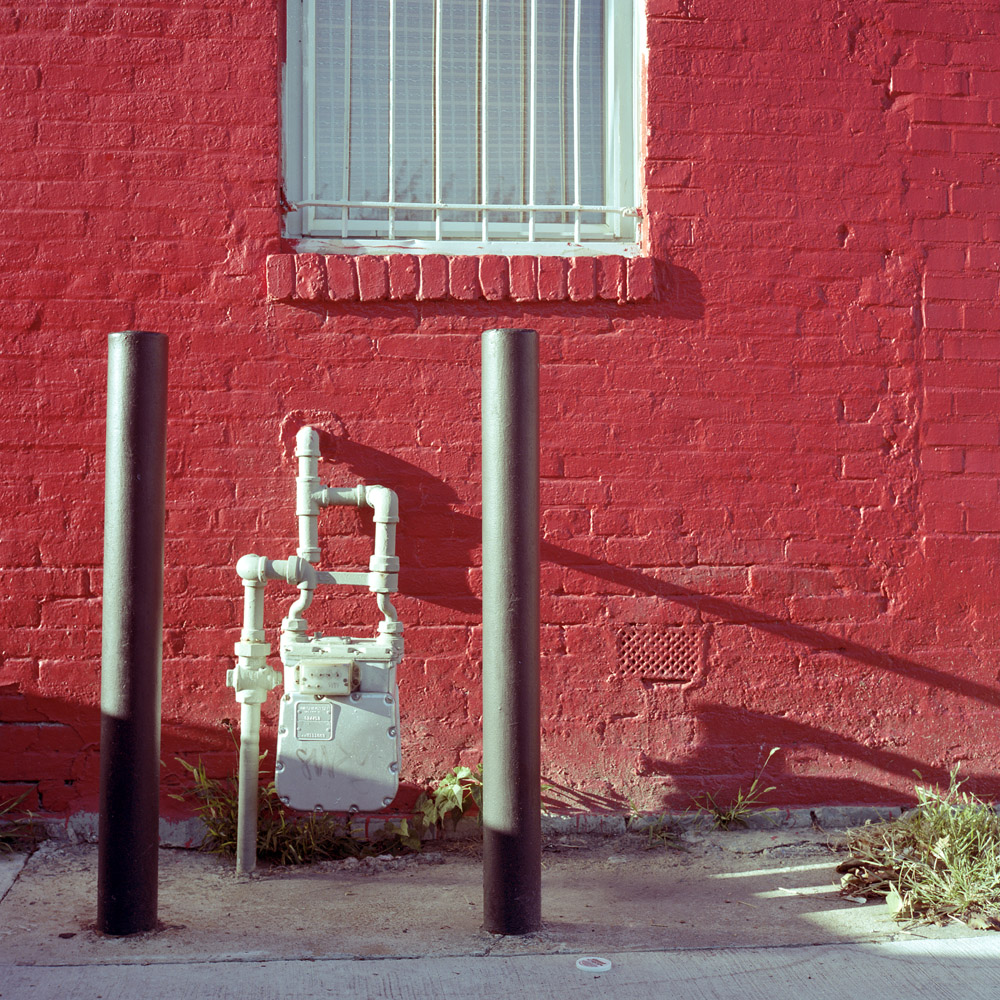
Case in point: two images of the same house, taken about two years apart. The first image is the earlier one. I was foremost interested in the gas meter as an organic pattern against the rigid geometry of the red brick and the white window at the time I took this one. The window and the gas meter were each singular objects set off against the dark, weathered red of the wall. At a bright and cloudless sunset, the meter casts a long shadow, further repeating its organic pattern.

Gas Meter, Red Wall, V Street

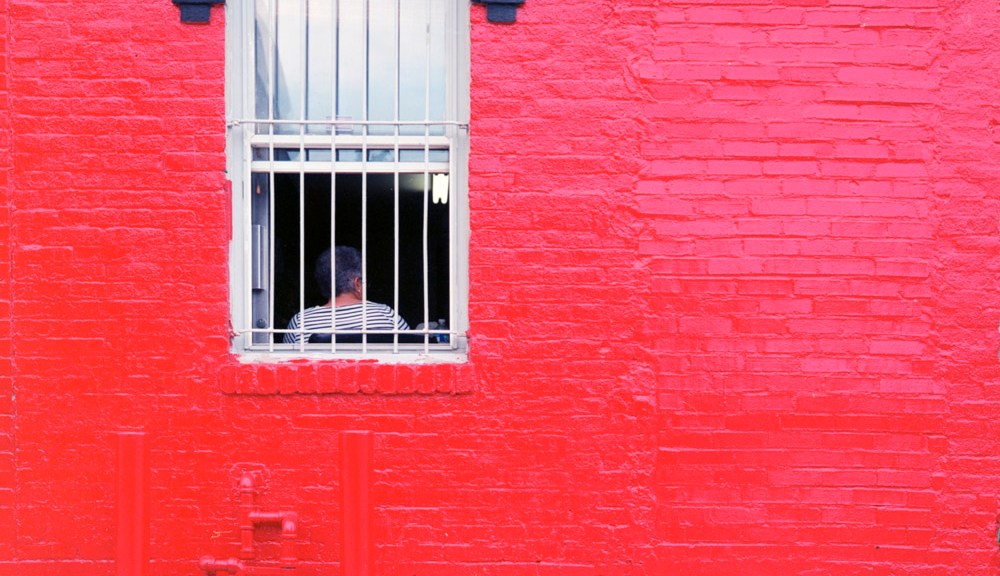
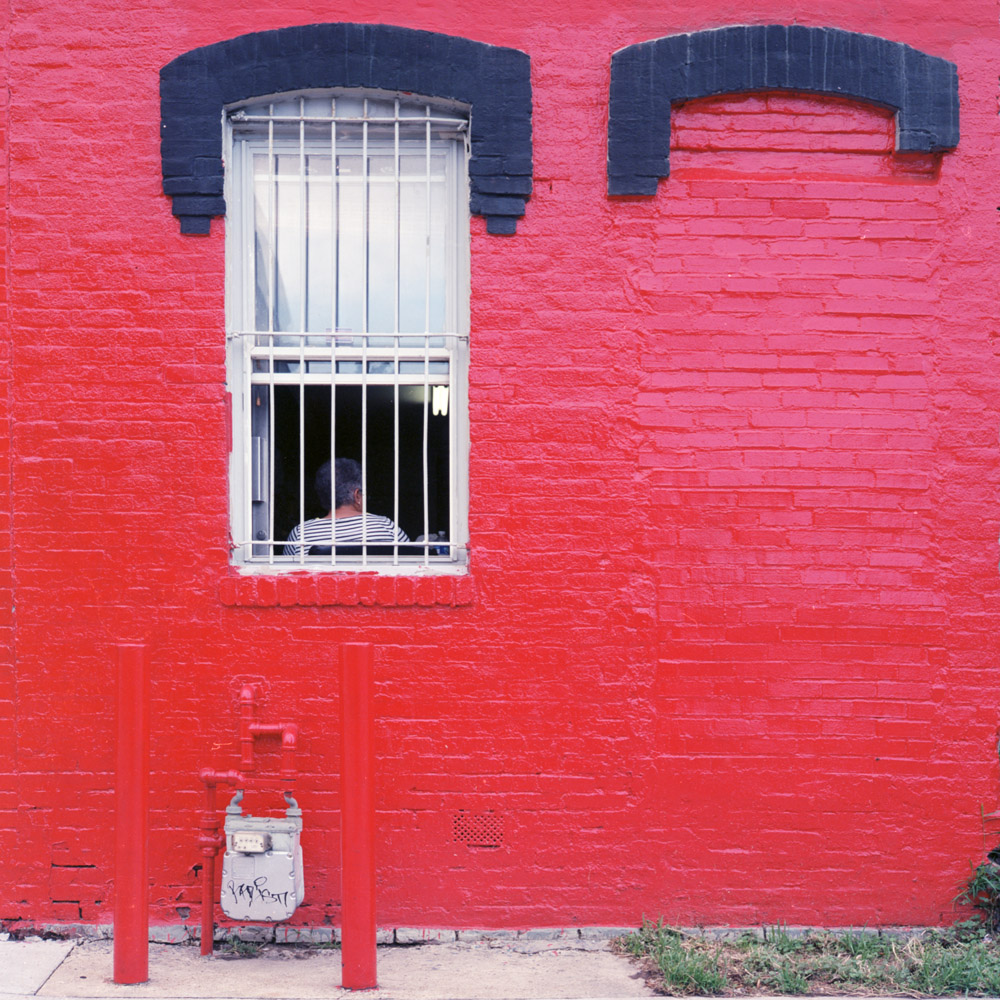
Returning two years later, the house has been re-painted, this time in BRIGHT red, along with the gas meter plumbing and the bollards protecting it. Instead of looking at singular items tightly framed, this time I pulled back a bit and gave the scene a narrative – there’s a person visible inside the bars of the one window, the other window closed. The lighting is flat from an overcast sky, pushing the drama of the scene into the deeply saturated colors and the enigma of the house – who is that person inside? how did they get in there when there is no visible door? Why is the one window bricked up but the other one open?

Red Wall, Window
Red Wall, Window

By re-visiting the same subjects, we not only learn to see them, but to see them differently instead of as static, unchanging objects. It also helps with story-telling and narrative development. Being able to tell a story with an image is one of the key differentiators between a factual record (“on this date, this building/car/person/plant/animal looked like this”) and an artistic output (“why does this look the way it does? Who is that? Why are they there? Why are they doing what they are doing?”). I think that we should all strive for that artistic output and not just factual recording (not that there is no value in recording of facts – we need facts recorded!).

This is one aspect of photography that I would hope to help inspire my students toward, as an educator. But it’s also the hardest thing to teach – photographic vision is something that has to happen, organically, natively, within the individual photographer. The best you can hope for is to provide exercises to stimulate them in the direction of building their vision, and to provide constructive critical feedback to focus that energy.

From the vaults – San Francisco Nudes (NSFW)

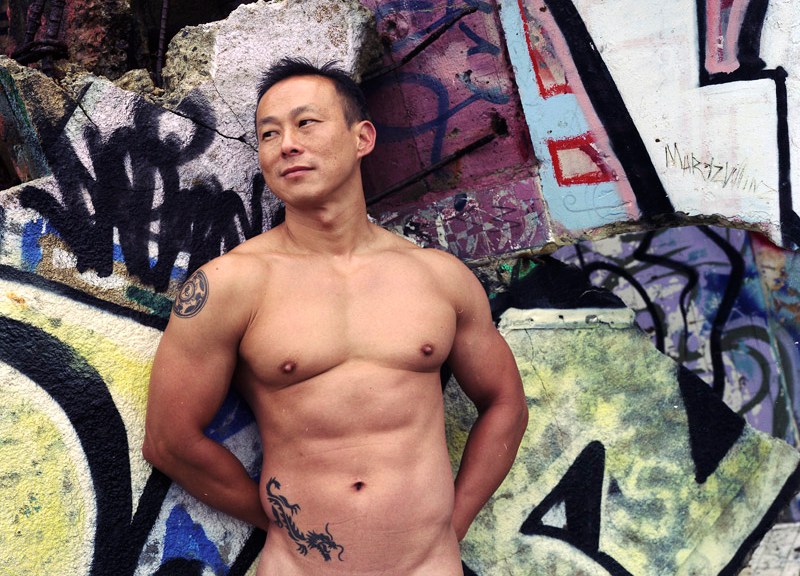
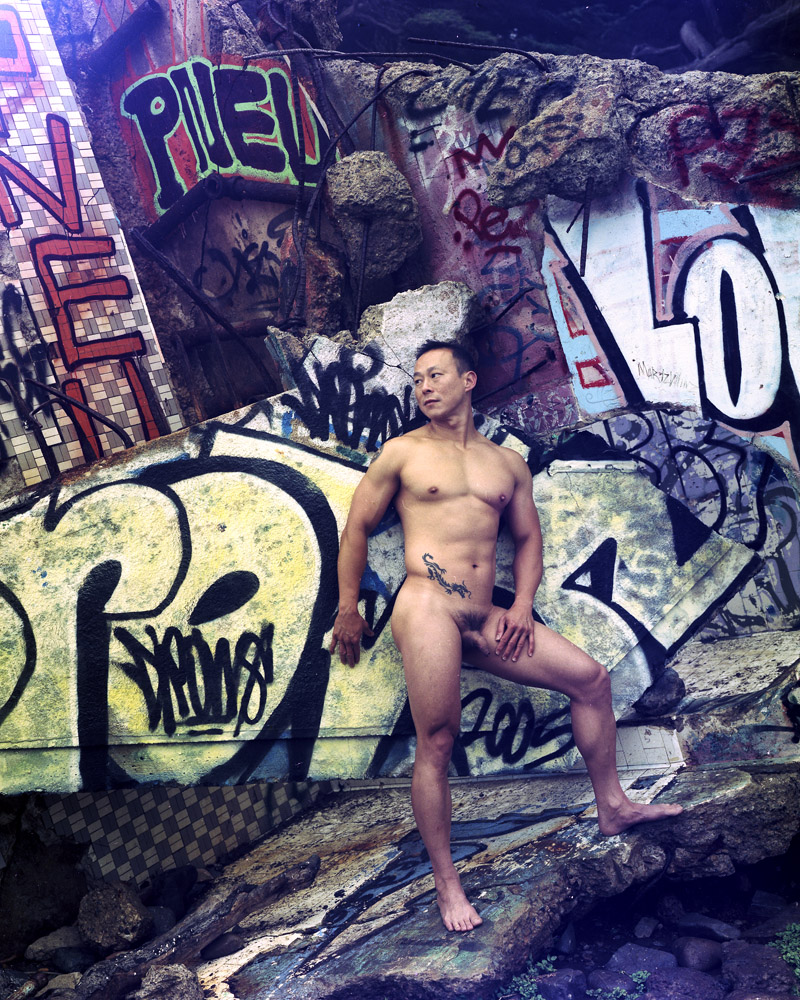
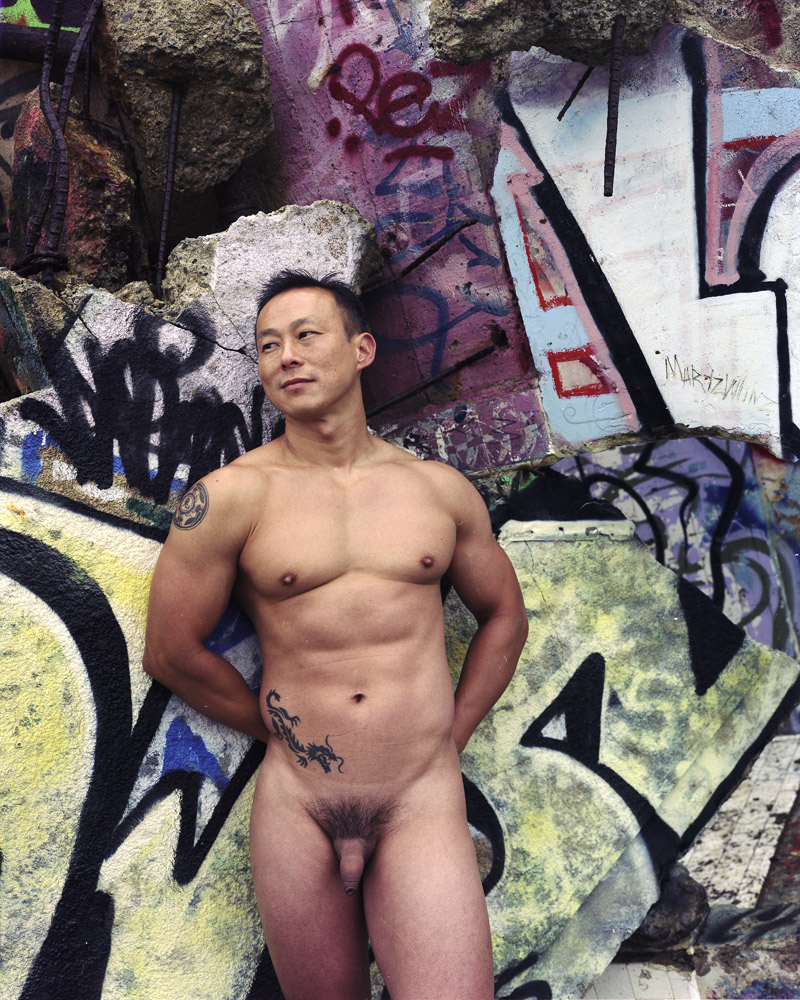
I’ve been doing a lot of housecleaning. I’m preparing what used to be my old office (the computer is now in the library, aka the second bedroom) to become the “camera room”. I have all the shelves I need, I just have to clear out some more stuff and get rid of the old computer desk I used in that room. In the process of cleaning it up, I found a whole bunch of old negatives that I hadn’t done much with. I had tried scanning some of these in the past, and had issues, but I think that was as much my old scanner and my old scanning software that couldn’t handle them as well. These two images were some of the rare color nudes I’ve done. I’m not entirely sure why I don’t do more color nudes – I think there’s a mental association with color nude work and shall we say “non-artistic” photography. I think it’s much harder to do a good color nude because it becomes so hyper-realistic that we start to look at the model not as a model, but more as a portrait, and as such we start personifying the models rather than seeing them as abstract everymen and everywomen.

These shots can’t be duplicated – the graffiti-covered structure (which used to be part of a military guardhouse overlooking the entrance to San Francisco Bay) has since completely collapsed into the sea and/or was removed by the Army and/or Golden Gate Natural Recreation Area rangers for being tragically unsafe. Quel dommage – it made for a really cool backdrop. These are two survivors from that excursion, and proof that checked-baggage x-ray scanners are indeed hazardous to film (thus the difficulty with scanning and color-correcting them).

K.T., Graffiti Wall, Full Length

K.T. was a great model to work with. You can’t see it from these shots but we were out photographing in full-on San Francisco Golden Gate fog. Which is COLD. And WET. But he bravely got out there on the crumbling concrete in the sand and the wind and the fog with nothing but his birthday suit and posed. I think we worked for about 2 hours. Yes, he did have a bathrobe to slip in and out of between shots, I’m not that cruel. I’m going to try and coax him into posing again for me a good 10+ years on from when these were taken.

K.T., Graffiti Wall
K.T., Graffiti Wall

I’ll be following these up with a batch of black-and-whites I did with the same model at the same location. One of the great things about San Francisco is that public attitudes toward things like (respectful) nudity are so relaxed. Although the location looks very isolated, we were just perhaps 60 feet down a cliff from a well-traveled footpath, inside the city of San Francisco proper. I was shooting on this same beach another time, that day being a rare sunny day in SF, and my model was standing next to a rock in the surf, naked as the day he was born. Out from between two sheltering rocks comes a rather grungy looking tennis ball, hotly pursued by a Golden Retriever. Who is shortly followed by its owner. We don’t have any time at all to react, and my model has no way to cover up. The dog’s owner pauses for a second, surveys what we’re doing, says, “nice day for it!”, smiles and walks on after the dog.

Response from the Toronto Public Library!

I have my blog cross-post on Twitter and Facebook. This is the power of the internet – you get seen in places that twenty years ago, heck, even ten years ago, you never would have. The post I made about the Fort York branch of the Toronto Public library was found on Twitter by someone who worked there, and who re-tweeted the post with a very kind and appreciative comment. Before Twitter, what would the odds be that you take a picture of a building in a foreign country, and someone who works there would see the picture and acknowledge it? I think I owe them a print.

Toronto – 231 Fort York Boulevard

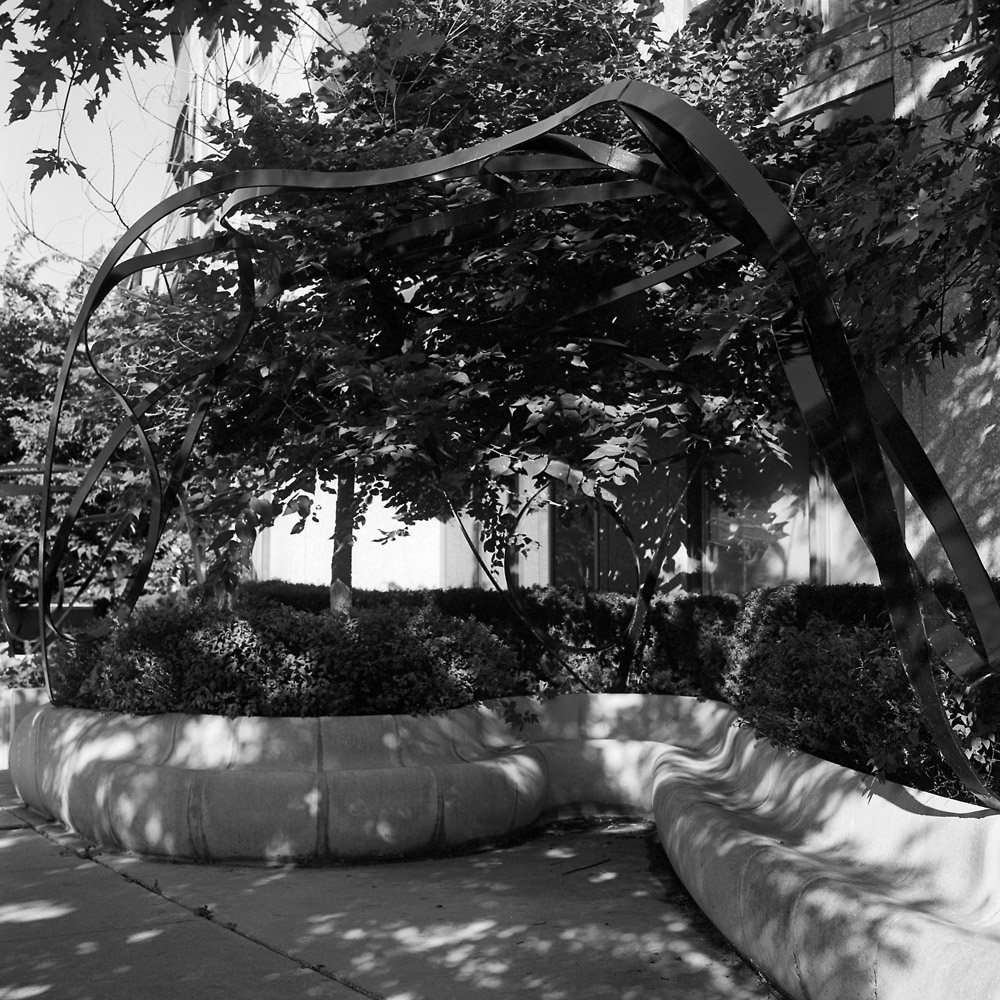
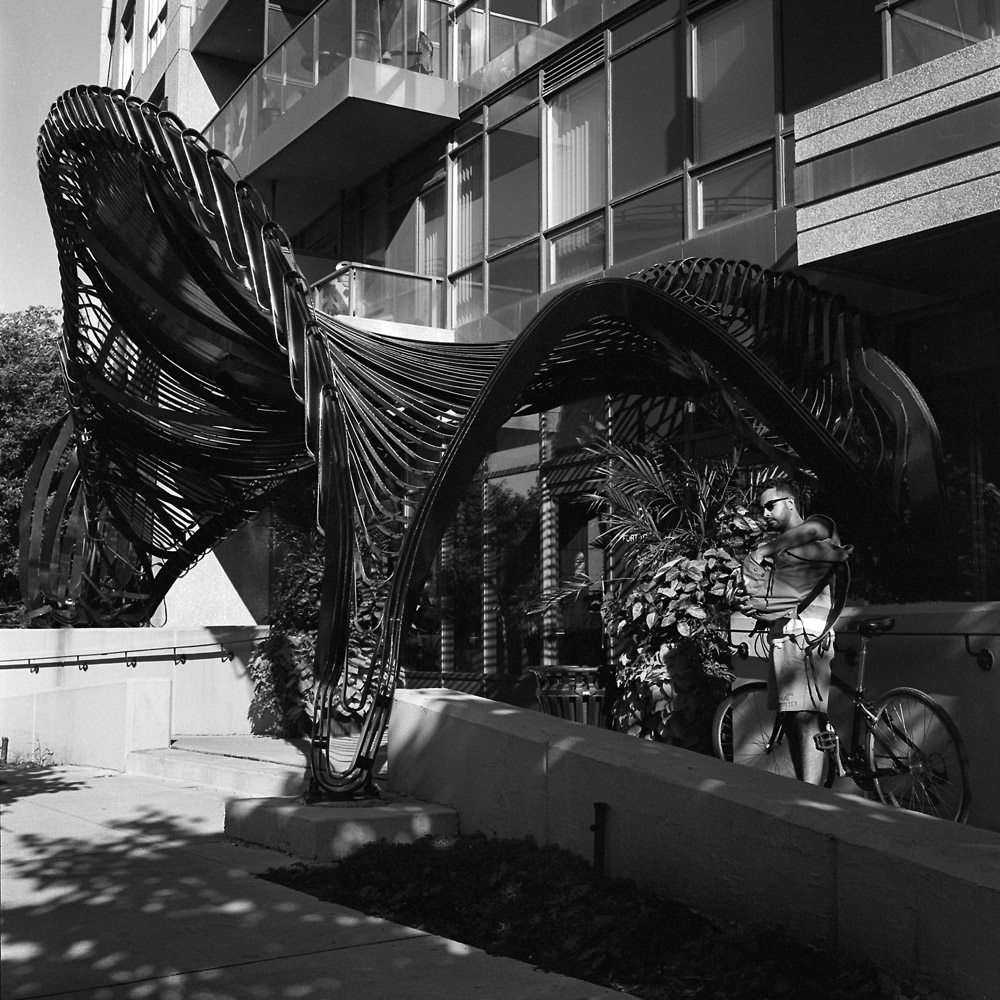
The building I stayed in at 231 Fort York Boulevard is a thoroughly modern 28-story high rise, composed of glass and steel. At street level, however, the architects softened the impact with a still thoroughly modern, but decidedly more organic, approach. Twisting ribbons of blackened steel, undulating concrete, and dense vegetation combine to give it an almost Antoni Gaudi feel.

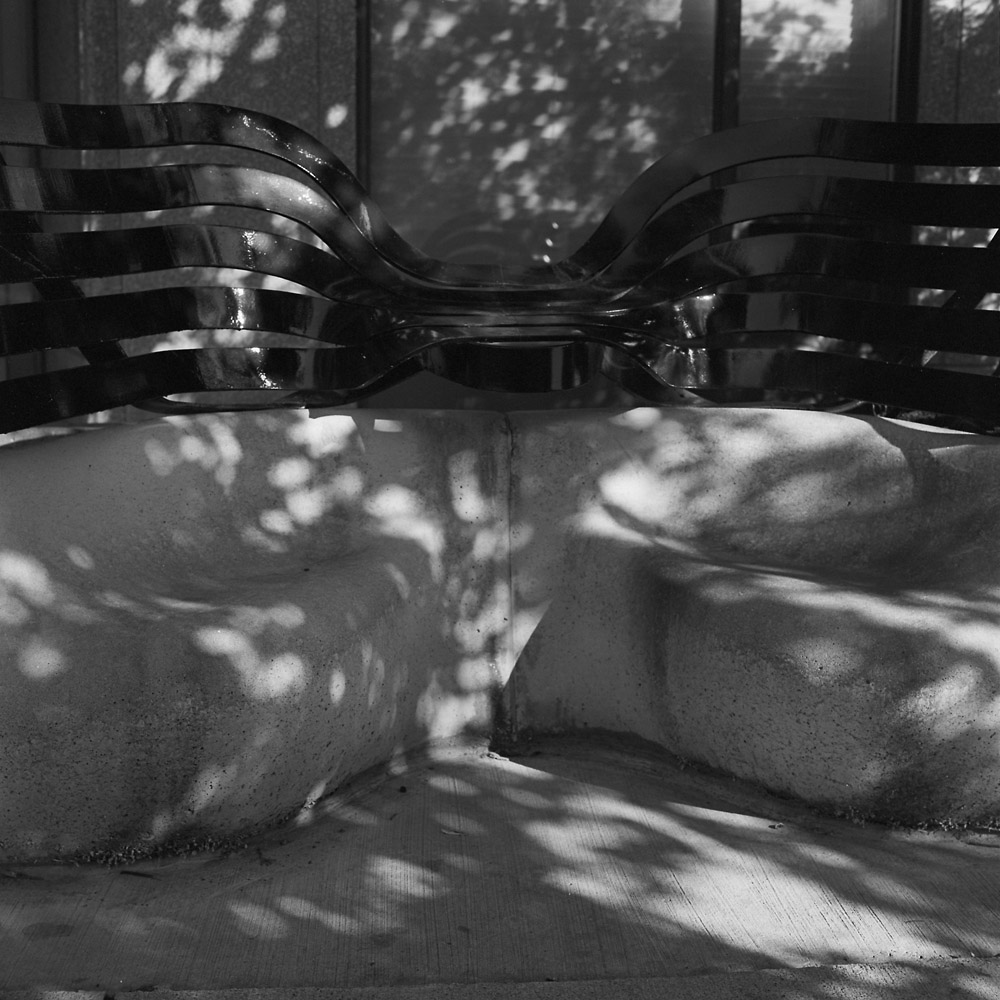
A loveseat style bench, formed out of an undulation in the concrete:

Bench
Bench

A canopy formed out of steel ribbons and the branches of trees shade another larger seating area:

Arbor
Arbor

The building entrance is a riot of steel ribbons, twisted into organic shapes that bring to mind ocean waves and seashells:

Entrance
Entrance

As an architectural critic, I question the use of these shapes because they really don’t relate to the building at all – they’re found only on the street side, and only at street level. The courtyard entrance where vehicle drop-off and pickup occurs has nothing at all like this, and nowhere else at any higher level is this style repeated. None of the upper balconies have ribbon-like railings, just typical glass and steel flat planes.

As a pedestrian, though, I’m quite pleased that it exists – it certainly makes the sidewalk level more interesting and in the summertime, more pleasant!

Toronto Public Art – Full Circle, by Peter Von Tiesenhausen

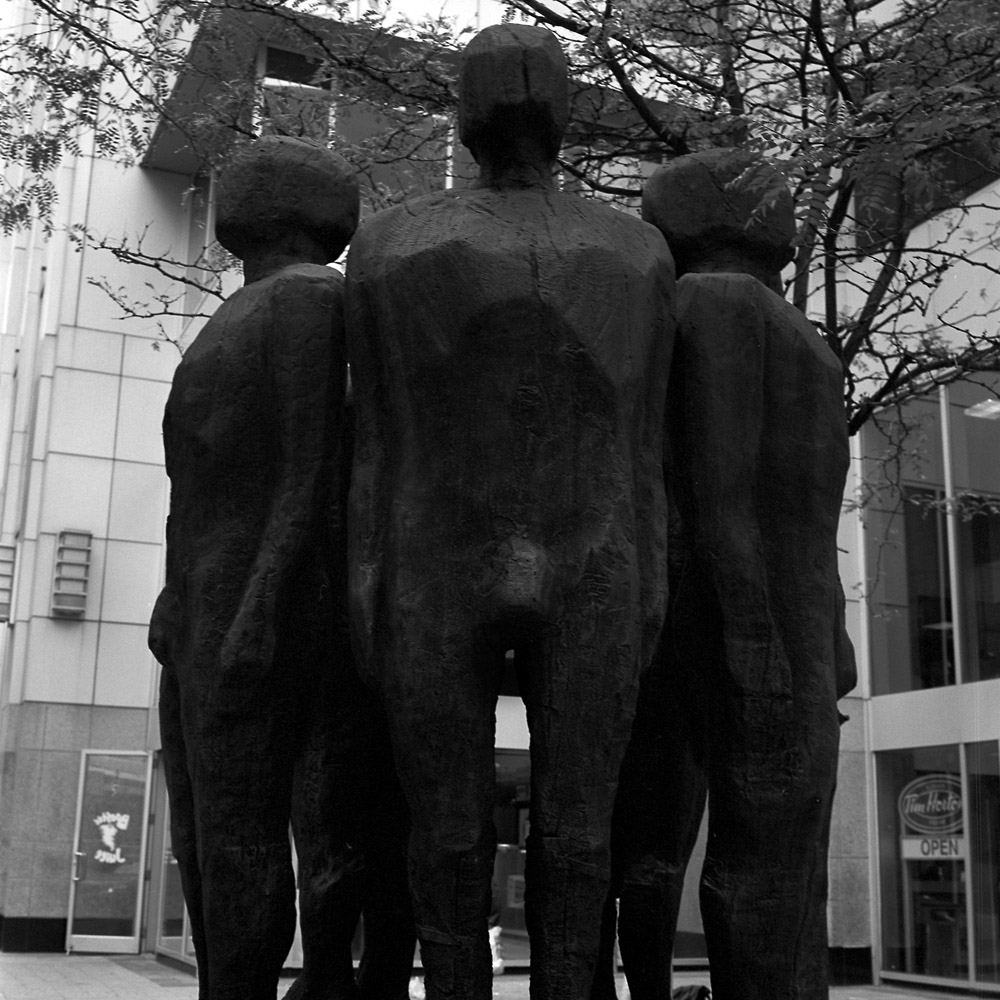
This statue has an interesting story – it has literally, as part of its creation process, completed a circuit of the periphery of Canada, thus the title. The original was a wood carving of five male figures, which was then charred in a fire, and then cast in iron. The iron casting was then loaded in the back of the artist’s own pickup truck and driven across the open plains of Canada. It took a trip across the Arctic Circle on a ship, and made landfall again before being brought to Toronto, where it now stands. In all, it was a five year, 35,000 kilometer journey. The pedestal is designed to be a bench to invite people to stop and sit.

Full Circle, by Peter Von Tiesenhausen

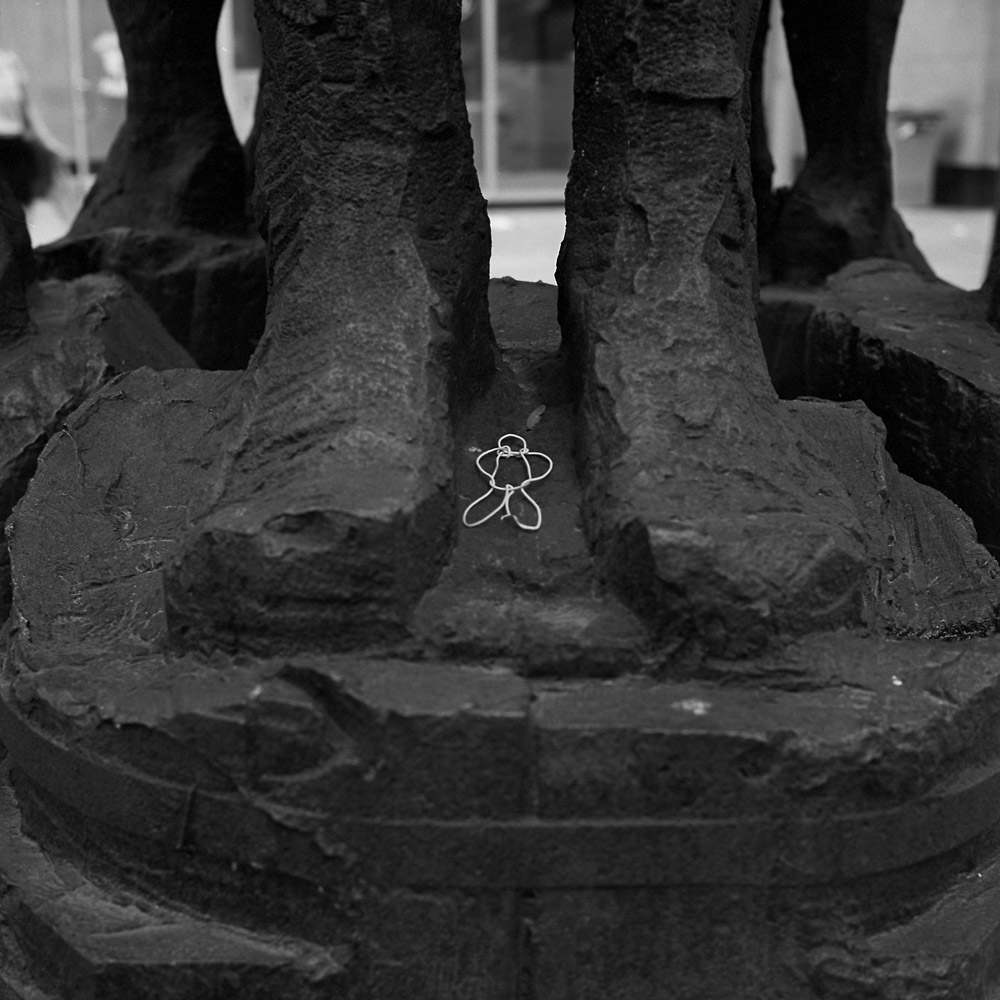
The statue inspired someone to leave this little wire figure token between the feet of one of the figures. When I saw the statue originally, I thought it was some kind of war memorial, which may have also been what went through the mind of the person who left the figurine.

Statue with Token
Statue with Token

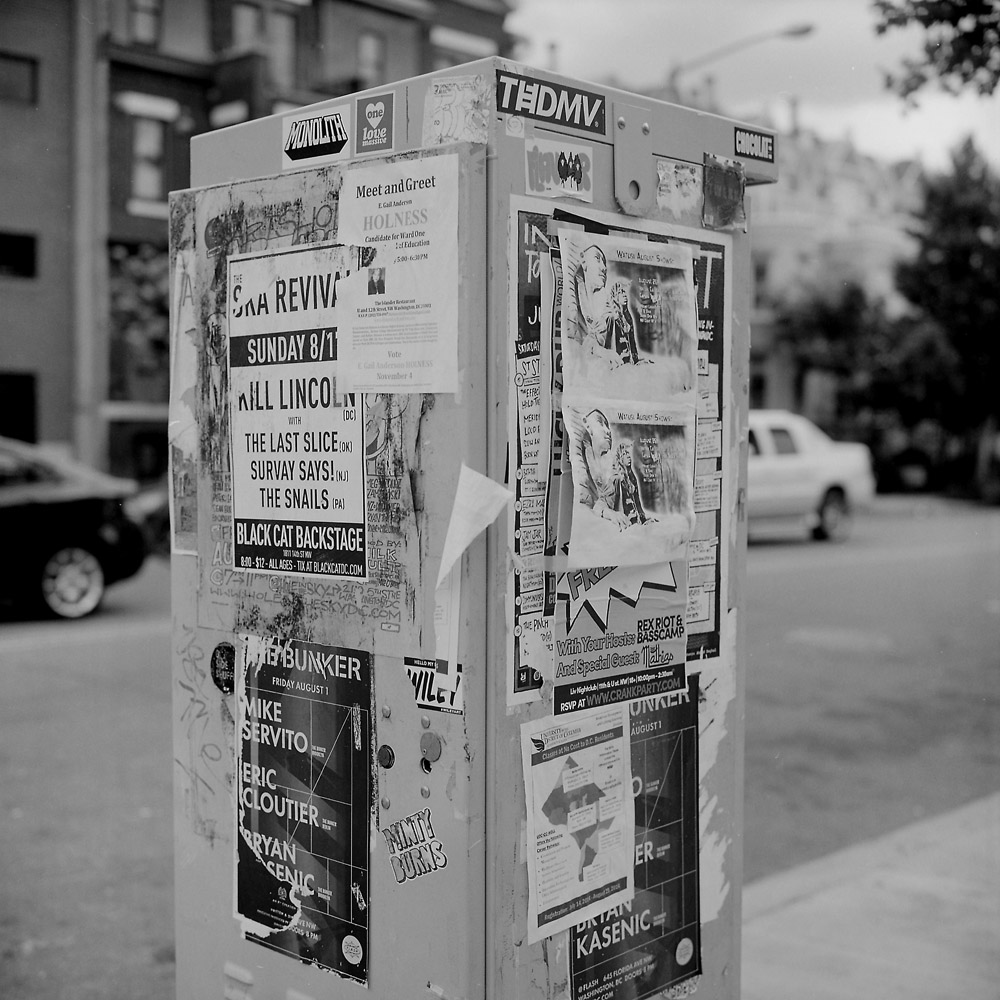
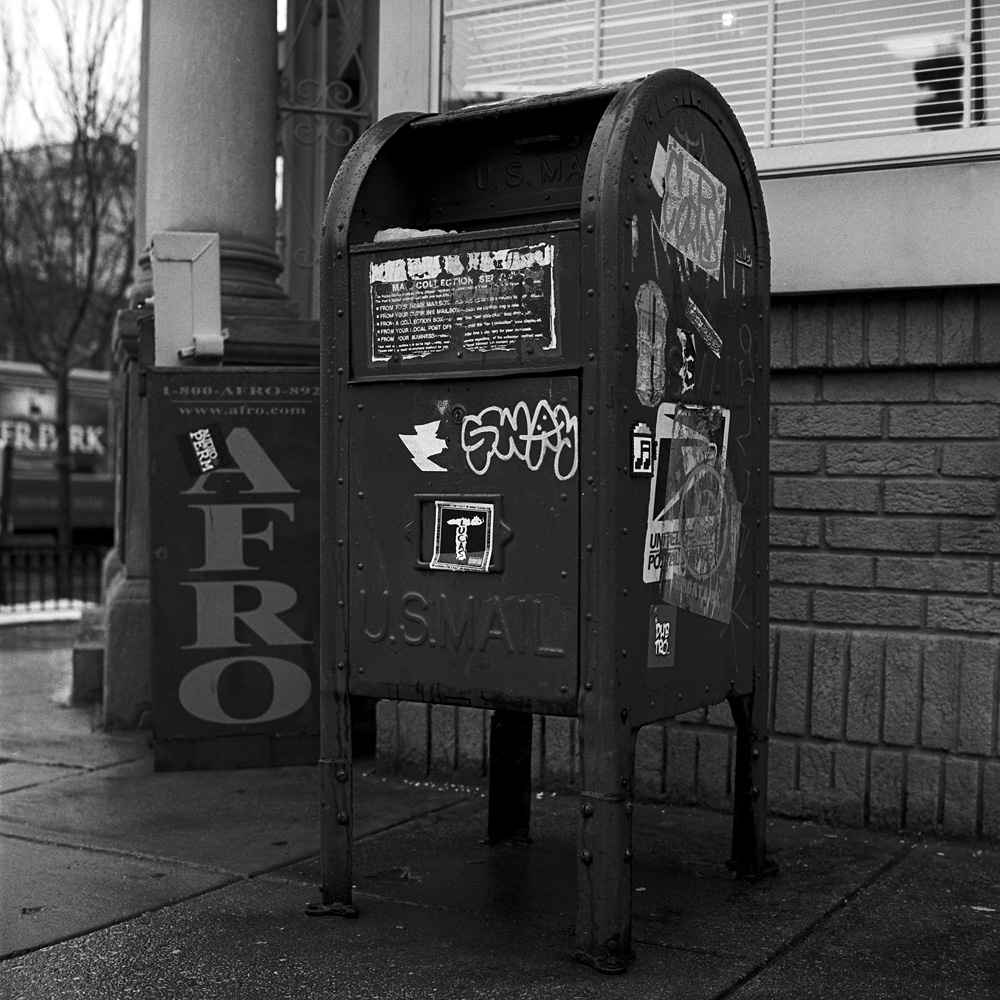
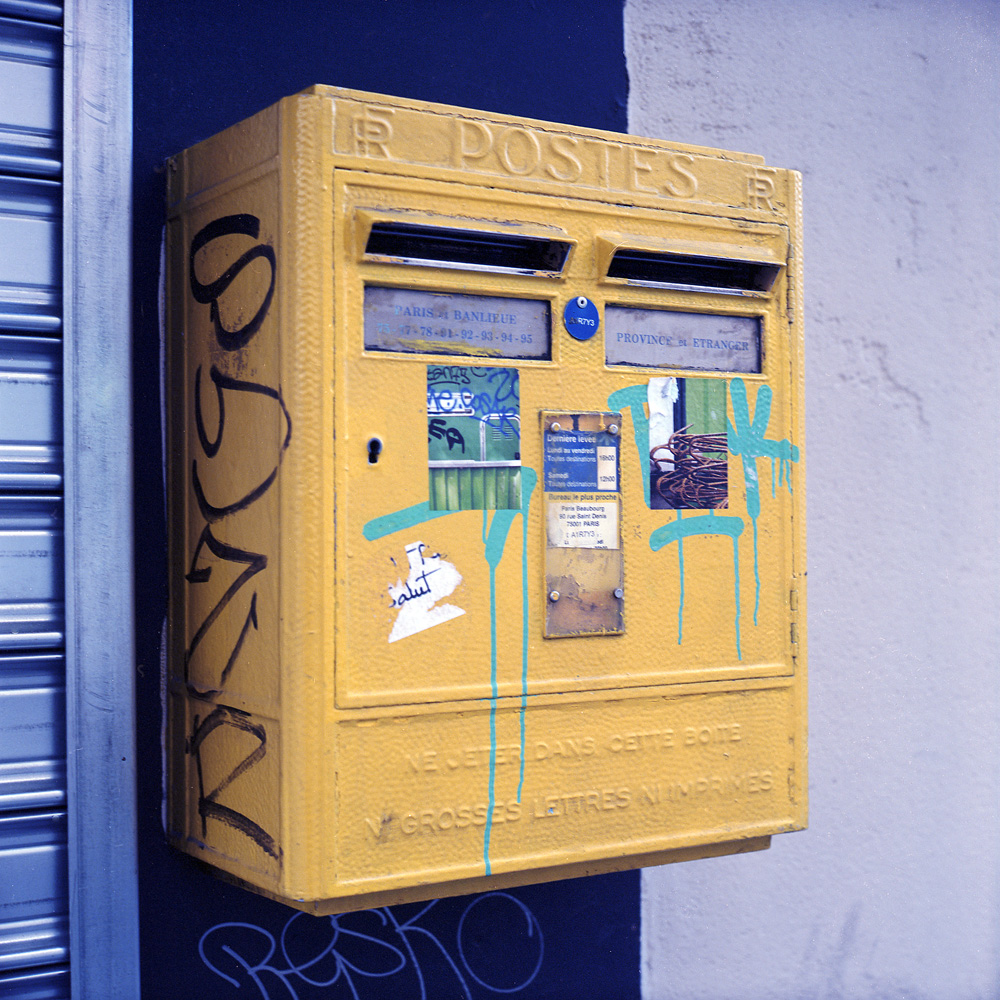
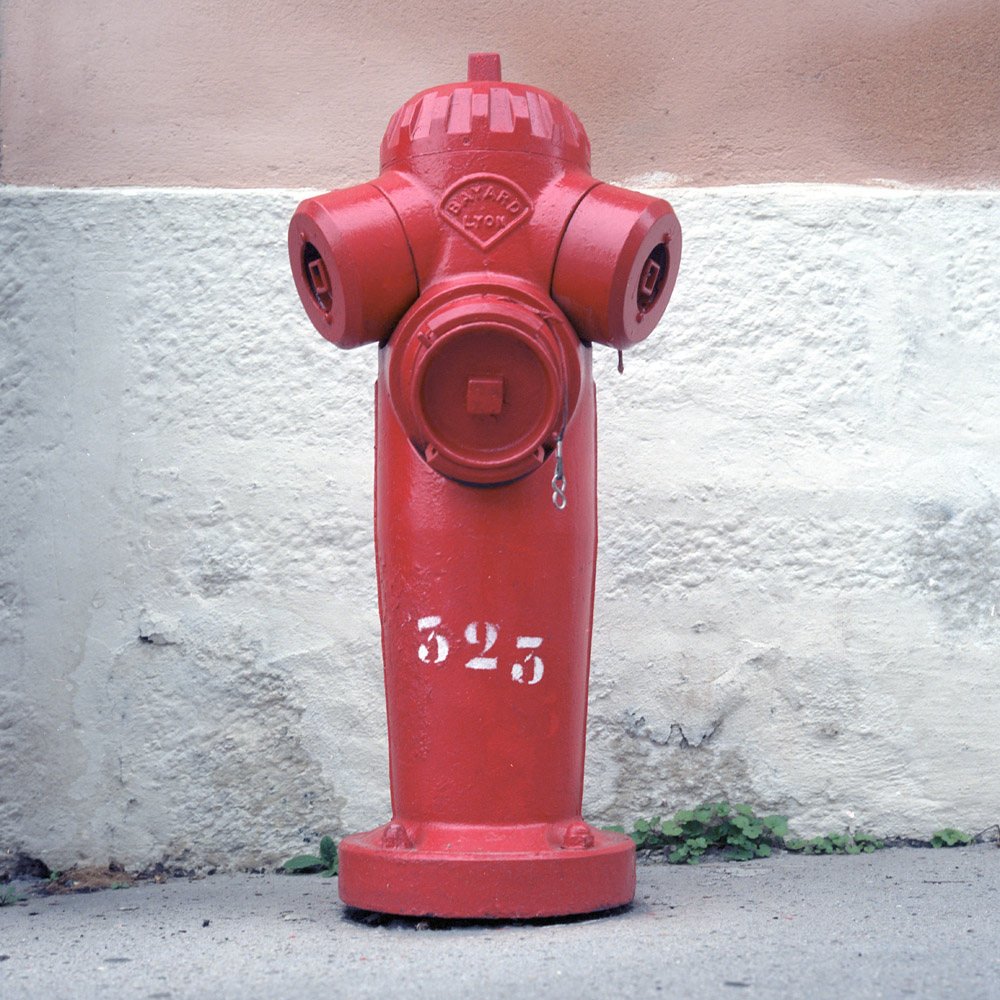
Portraits of Ordinary Objects

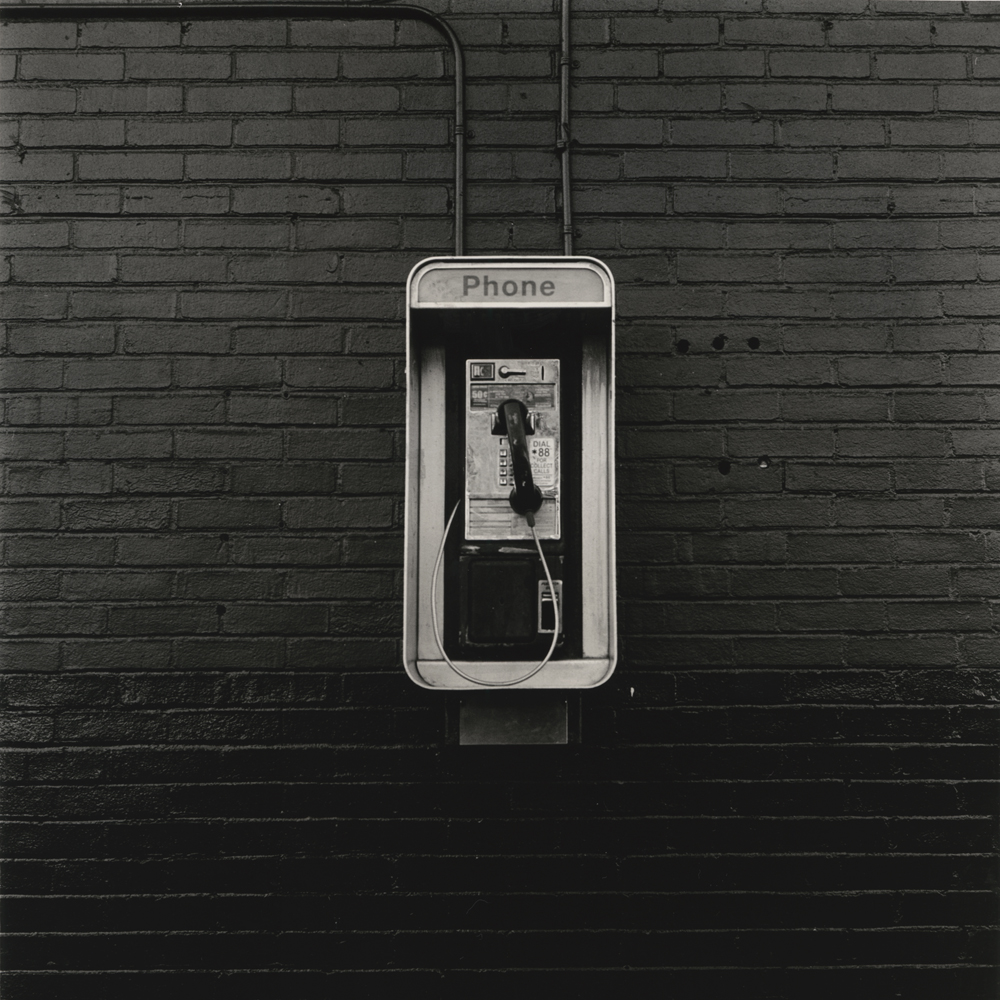
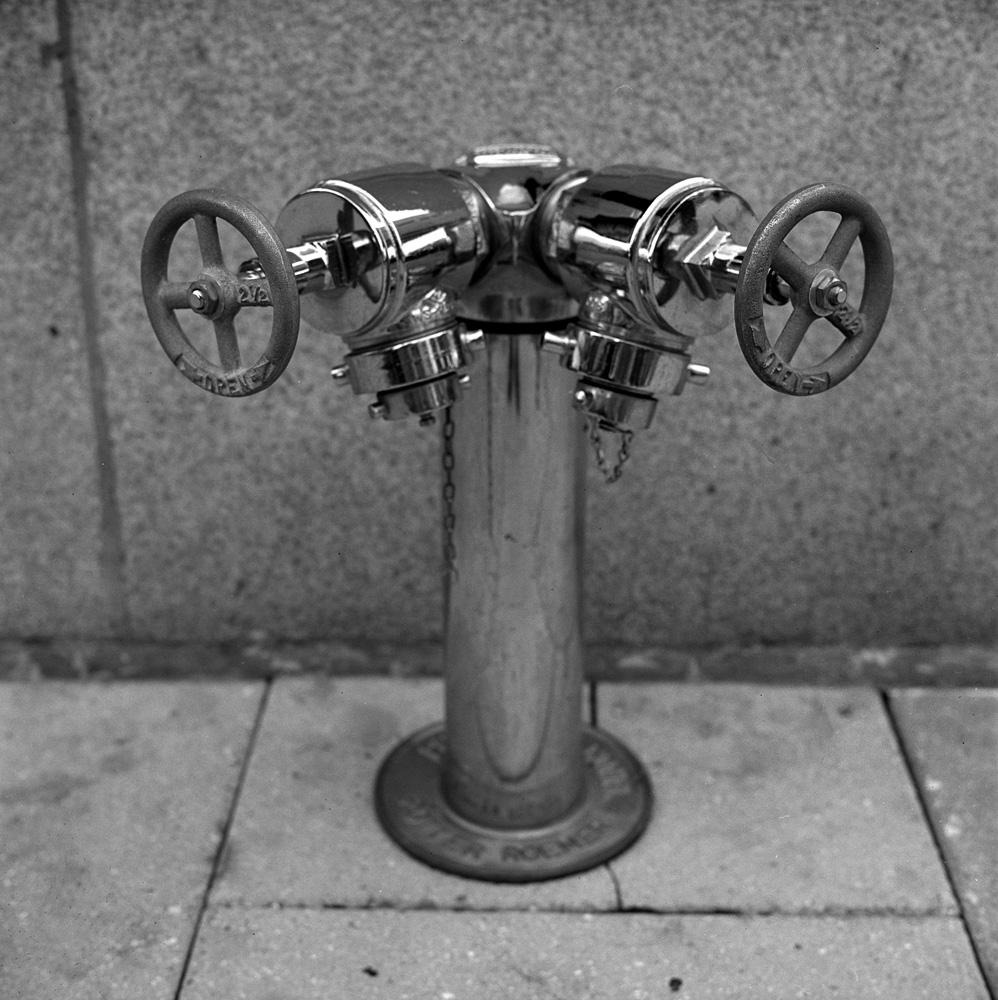
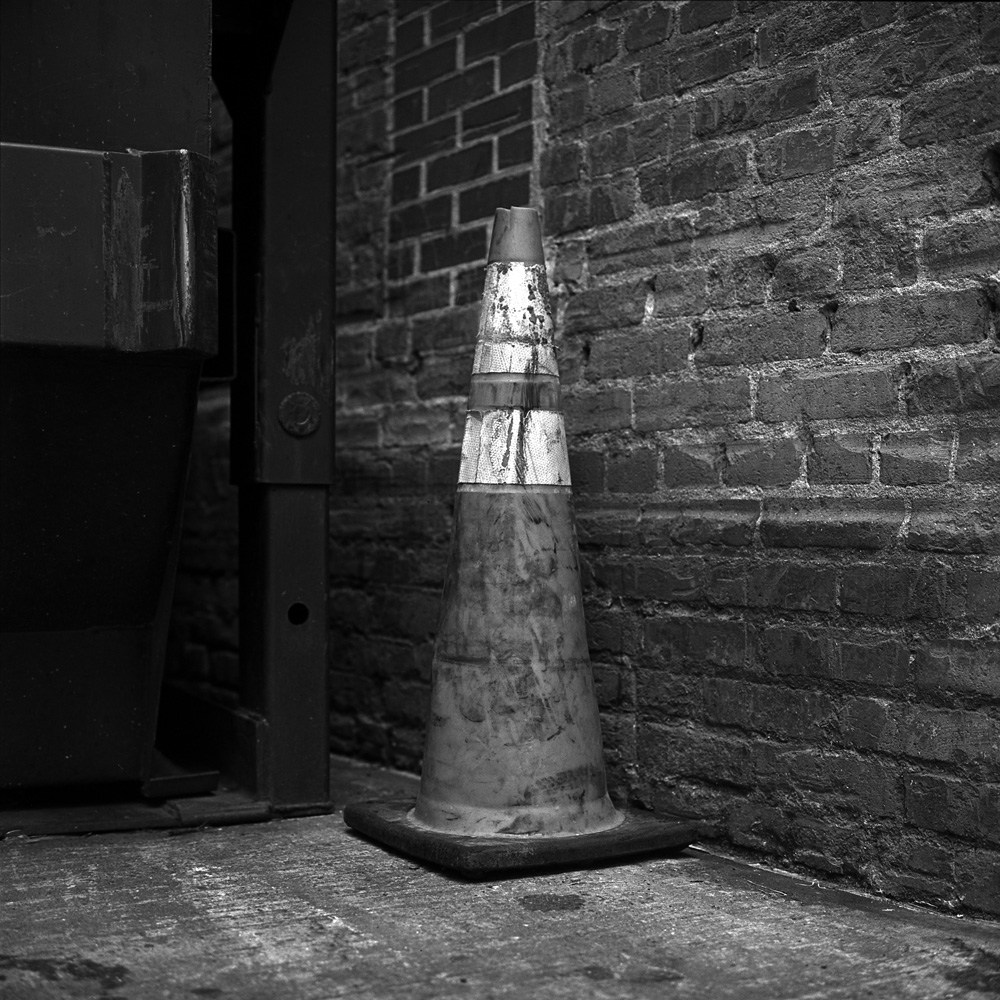
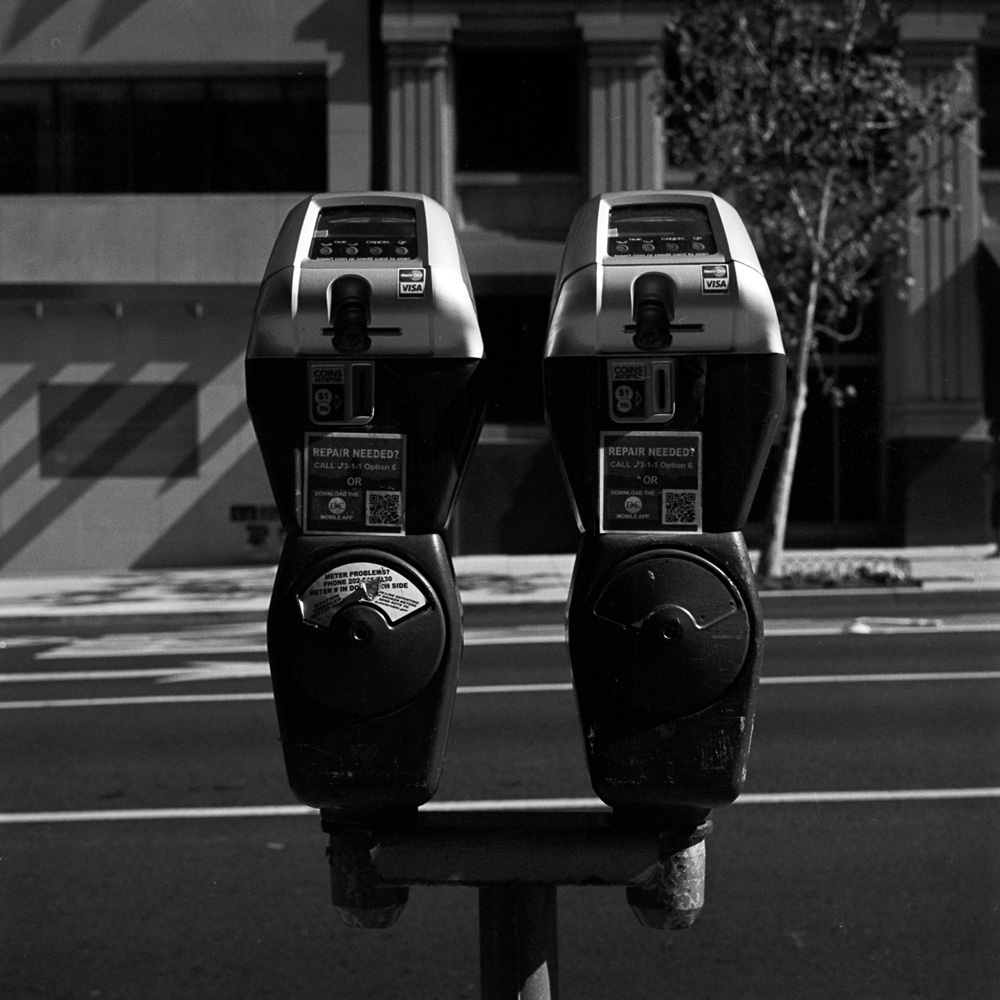
I was out doing some more street shooting in my neighborhood and found a couple more “ordinary objects” that cried out for portraits. I’ve included some of my past ones here to provide some context for the project idea.

Triple Meter, 14th Street
Electrical Box, 13th & U Streets
Mailbox
Mailbox
Yellow Postbox, Paris
Hydrant, Chalon
Hydrant, Chalon
Everyday Objects - Payphone
Everyday Objects – Payphone
Siamese Spigot
Siamese Spigot
Traffic Cone
Traffic Cone
Twin Parking Meters
Twin Parking Meters
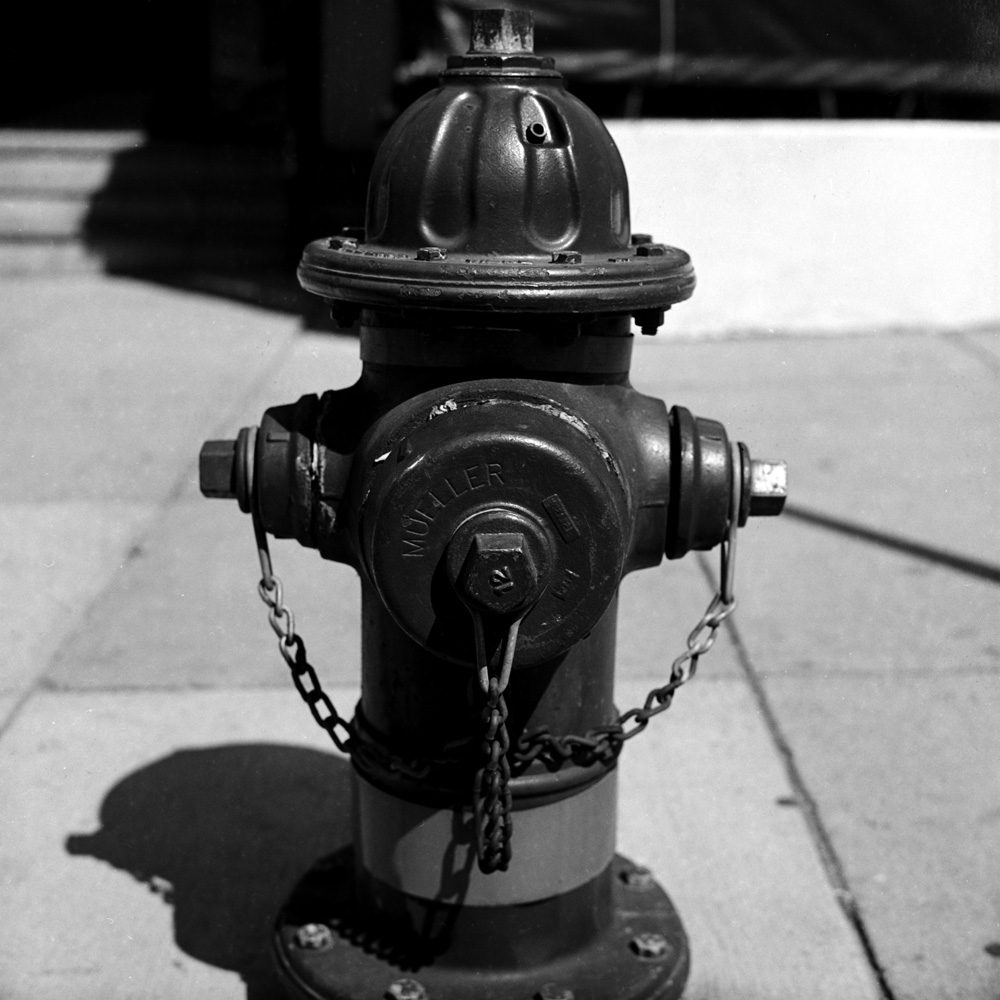
Mueller Hydrant, K Street, DC

These were shot on a mix of films – the black and white are either Kodak Tri-X or Ilford FP4+, and the color shots were taken with Kodak Ektar 100, all using my Rolleiflex 2.8E.

Upcoming Course – The Narrative and the Male Figure

An introductory video discussion about my upcoming class at Glen Echo Photoworks. The course runs on Fridays, from September 19 to November 7, from 7-10pm. The concept of the course is to introduce students to the use of the human figure in narrative photography – telling a story with pictures whether it is a single image, a diptych or triptych, or a series. We will cover the historical use of male figures in narrative photography, from Hippolyte Bayard’s nude self-portrait as a drowned man in protest of having withheld his announcement of the photographic process he invented so that Daguerre could go first (and get all the credit and financial rewards that came from being first) to modern photographers like John Dugdale, Arthur Tress, and Duane Michals. We will also look at the use of the male figure in relation to questions of gender, sexuality, and identity. To register for the course, click here – The Narrative and the Male Figure

Upcoming classes at Glen Echo Photoworks, Glen Echo, Maryland

I’m offering three classes coming up this fall/winter at Glen Echo Photoworks, a center for creative photography and photographic education at Glen Echo Park in Glen Echo, Maryland, just outside Washington DC.

The Male Figure in Narrative Photography 9/19 – 11/7/2014 Fridays, 7-10pm

Go beyond standard figure studies. Research historical context and learn to use the male nude form to tell a story in a series or just a single frame through posing, lighting, using props and capturing emotions. What is “narrative photography”? Narrative tells a story either in a series, or a single image. From the earliest days, photographers have been using the male figure to tell a story in their work, be it as a stand-in for himself (Hippolyte Bayard) to express his response to criticism, to confronting eroticism and gender confusion in the world of Latin American bullfighting (Reuven Afanador) or a tool to process inner personal anxieties (Connie Imboden). This course will examine the use of the male nude in narrative photography. We will use examples from historical and contemporary photographers as a background to inform and inspire our own work. Students will be encouraged to create both single image and serial narratives to take their work beyond mere figure studies. We will also discuss issues relating to gender and sexuality with regards to the use of the male nude. We will cover understanding of the male form, posing, basic lighting, the use of props, and basic nude model etiquette. Students will be expected to know how to use their cameras, light meters, and how to process and present their own images. Weekly research topics will be assigned. There will be three shoots with one or more models, plus classroom instruction and discussion sessions. $350, plus $150 model fee.

Introduction to Platinum/Palladium Printing – 11/8 – 11/9/2014 (Saturday/Sunday, 10am-4pm, two day intensive weekend workshop)

Platinum/Palladium is one of the most beautiful alternative processes. This course demystifies the process and teaches how to make good negatives, select papers, coat emulsions, and process prints for archival stability. $350, plus $100 materials fee, payable to the instructor.

One Camera, One Lens – Learning to See 1/15 – 3/7/2015 (Thursday 7-10pm)

Too often our gear keeps us from making better pictures. Photographers often fall into the trap of thinking that more gear is the solution to every problem, when in fact it can be a crutch or a burden. This course teaches how to simplify and focus our creative vision so the camera gets out of the way and becomes a tool not an obstacle. Students will use a camera of their choosing, and a single lens. They will select a project in the first class and follow through on that project, presenting images for critique each week. Students choosing to work with wet darkroom techniques will be expected to know how to process and print their own film; students working digitally are expected to have a working knowledge of their camera and digital image processing tools of their choosing. No changing lenses allowed! $350

The courses will be posted soon to the website, but in the meantime if you want to find out more about Photoworks, please check out their website and their Facebook page-

http://glenechophotoworks.org

https://www.facebook.com/glenechophotoworks

Photoworks is one of the few facilities with regularly scheduled open darkroom times, and at $8/hr for wet darkroom (bring your paper, we provide the rest!), it’s hard to beat!
From a Series on Identity and Commodification

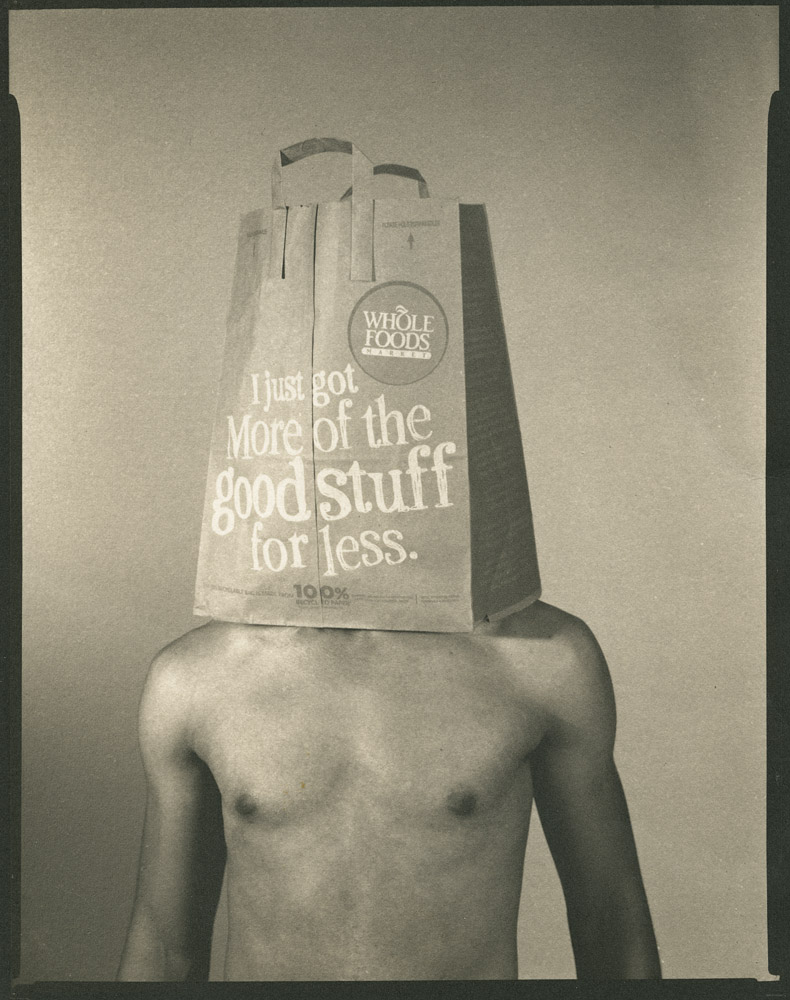
More of the Good Stuff

A long time ago I started working on a series about how we commodify people and their identities. I was playing around with advertising slogans on grocery bags and how those slogans can be used to replace food with people (not in a cannibalistic sense but as something to be looked at as a consumable or a flavor-du-jour). I’ll pick it up again when I get the chance and see if I can do more with it. Let me know what you think of the idea and the execution in this image.

The original is a whole-plate (6.5 by 8.5 inch) hand-coated palladium print on Bergger COT320 100% cotton rag heavy-weight paper.

Photography Books – a partial listing

I know folks have asked me about this before, so I thought I’d compile the list of photography books I’ve collected. This is a comprehensive but not complete listing of the photographic monographs and/or compilations in my library. I know I’m missing the vintage Ansel Adams guide to Yosemite that he produced for the Sierra Club back in the 1950s or 60s from this list, but I can’t lay my hands on it at the moment, so it’s missing.  Any exhibition catalogs listed here are listed here because they are catalogs from exhibits I did not see in person, and there are probably a half-dozen others just floating around the house and/or the library.

Title Artist/Author Publisher Publication Date Notes
4 A M Adu Formosa Books 2000
Olympic Portraits Annie Liebowitz Bullfinch 1996
(Don’t) Call Me Shirley Brett M. Cochrane Knopf Australia 1995
Burma: Something Went Wrong Chan Chao Nazareli Press 2000
The Great Wall of China Chen Changfen Yale University Press 2007
Beauty of Darkness Connie Imboden Custom & Limited Editions 1999 1st Edition
The Raw Seduction of Flesh Connie Imboden Silver Arts 1999 softcover, Signed
Piercing Illusions Connie Imboden Foto Book Press 2001 softcover, Signed
Beijing Spring David and Peter Turnley Stewart, Tabori and Chang 1989
All My Lies Are True David Carol Kabloona Press 2009 Signed, personalized to me
Edward Curtis – The Master Prints Edward Curtis Arena Editions 2001 Hardcover
Edward Steichen – The Early Years Edward Steichen Princeton University Press 1999
Edward Weston: The Form of the Nude Edward Weston Phaidon Press 2005
Margarethe Mather and Edward Weston: A Passionate Collaboration Edward Weston, Margarethe Mather W.W. Norton 2001
Suffering The Ideal F. Holland Day Twin Palms 1995 Hardcover, 1st Edition, Limited Edition
F. Holland Day F. Holland Day Van Gogh Museum 2001 Exhibition Catalog
Faces of the Eastern Shore Frank Van Riper Qesada House 1992 Softcover, signed, personalized to me
The Photographs of Frederick H. Evans Frederick Evans Getty 2010 Exhibition Catalog
Foro Italico George Mott Powerhouse Books 2003 1st Edition, slipcovered
Inside Life Greg Gorman Rizzoli 1997 1st Edition, Signed, Slipcovered with signed print
As I See It Greg Gorman Powerhouse Books 2000 1st Edition, signed
Natural Fashion: Tribal Decoration from Africa Hans Silvester Thames & Hudson 2008
Kazu Herb Ritts Parco 1995 1st Edition
Tuscany: Inside the Light Joel Meyerowitz Main Street 2003
Manzanar: Photographs by Ansel Adams John Armor, Peter Wright Times Books 1988
Lengthening Shadows Before Nightfall John Dugdale Twin Palms 1995 Signed, personalized to me, dated 2006
Life’s Evening Hour John Dugdale August Press 2000 Hardcover, Limited Edition
Picturing Men – A Century of Male Relationships in Everyday American Photography John Ibson Smithsonian 2002
The Luminous Years Karl Bissinger Abrams 2003
Passage to Angkor Kenro Izu Friends Without Borders 2005 1st Edition, signed
Homo Sum Konrad Helbig 6×6.com 2010 Not dated – guessing at publication date
Skin Laurent Elie Badessi Edition Stemmle 2000
Red Color News Soldier Li Zhensheng Phaidon Press 2003
Panoramas of the Far East Lois Conner Smithsonian 1993
Photography’s Antiquarian Avant-Garde: The New Wave in Old Processes Lyle Rexer Abrams 2002
American Photographs: The First Century Merry A. Foresta Smithsonian 1996
At First Sight: Photography and the Smithsonian Merry A. Foresta, Jenna K. Foley Smithsonian 2003
The Pre-Raphaelite Camera Michael Bartram Little, Brown & Company 1985
Eye Mind Spirit – the Enduring Legacy of Minor White Minor White Howard Greenberg Gallery 2008
Face to Face: The Art of Portrait Photography Paul Ardenne Flammarion 2004
Collaboration: The Photographs of Paul Cadmus Paul Cadmus Twelvetrees Press 1992 1st Edition, Limited Edition
Physique: Classic Photographs of Naked Athletes Peter Kuhnst Thames & Hudson 2004
Man to Man: A History of Gay Photography Pierre Borhan Vendome Press 2007
The Hyena & Other Men Pieter Hugo Prestel 2007
Shooting Soldiers – Civil War Medical Photographs by R.B. Bontecou R.B. Bontecou Burns Archive Press 2011
Torero Reuven Afanador Edition Stemmle 2001 1st Edition
Sombra Reuven Afanador Merrell 2004 1st Edition
Mil Besos Reuven Afanador Rizzoli 2009 1st Edition
Cuba in the 1850s Through the Lens of Charles DeForest Fredricks Robert M. Levine University of South Florida Press 1990
Robert Mapplethorpe and the Classical Tradition Robert Mapplethorpe Guggenheim Museum 2004 Exhibition Catalog
Hymn to the Earth Ron Rosenstock Silver Strand Press 2003 Signed, Numbered Edition # 597
Maryland’s Civil War Photographs: The Sesquicentennial Collection Ross Kelbaugh Maryland Historical Society 2012 Signed, Numbered Edition # 130, personalized to me
America and the Tintype Steven Kasher ICP/Steidl 2008
Spirit Capture: Photographs from the National Museum of The American Indian Tim Johnson Smithsonian 1998
In Defense of Beauty Tom Bianchi Crown Publishers 1995
Tseng Kwong-Chi Tseng Kwong-Chi Paul Kasmin Gallery 2008
Taormina Wilhelm Von Gloeden Twelvetrees Press 1986