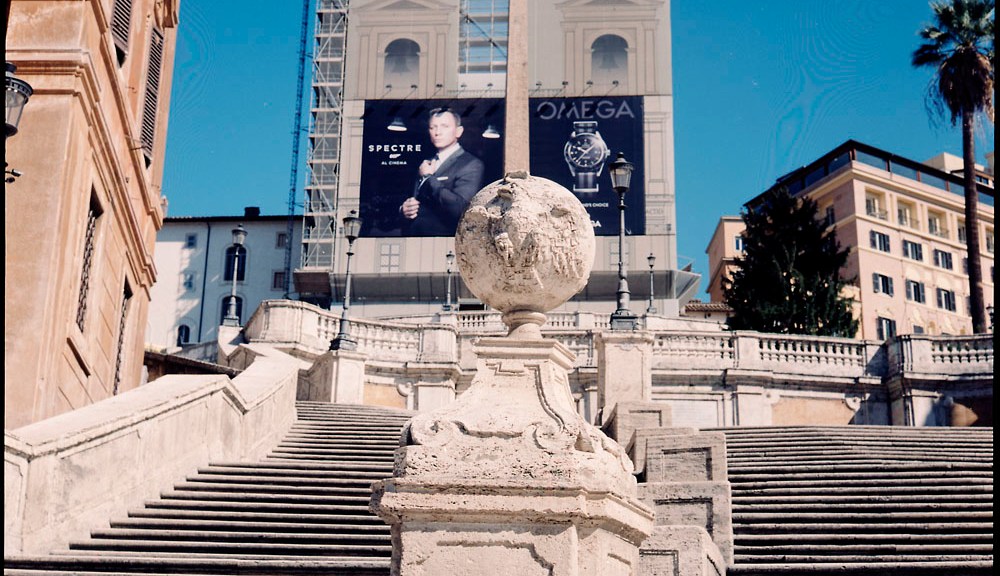
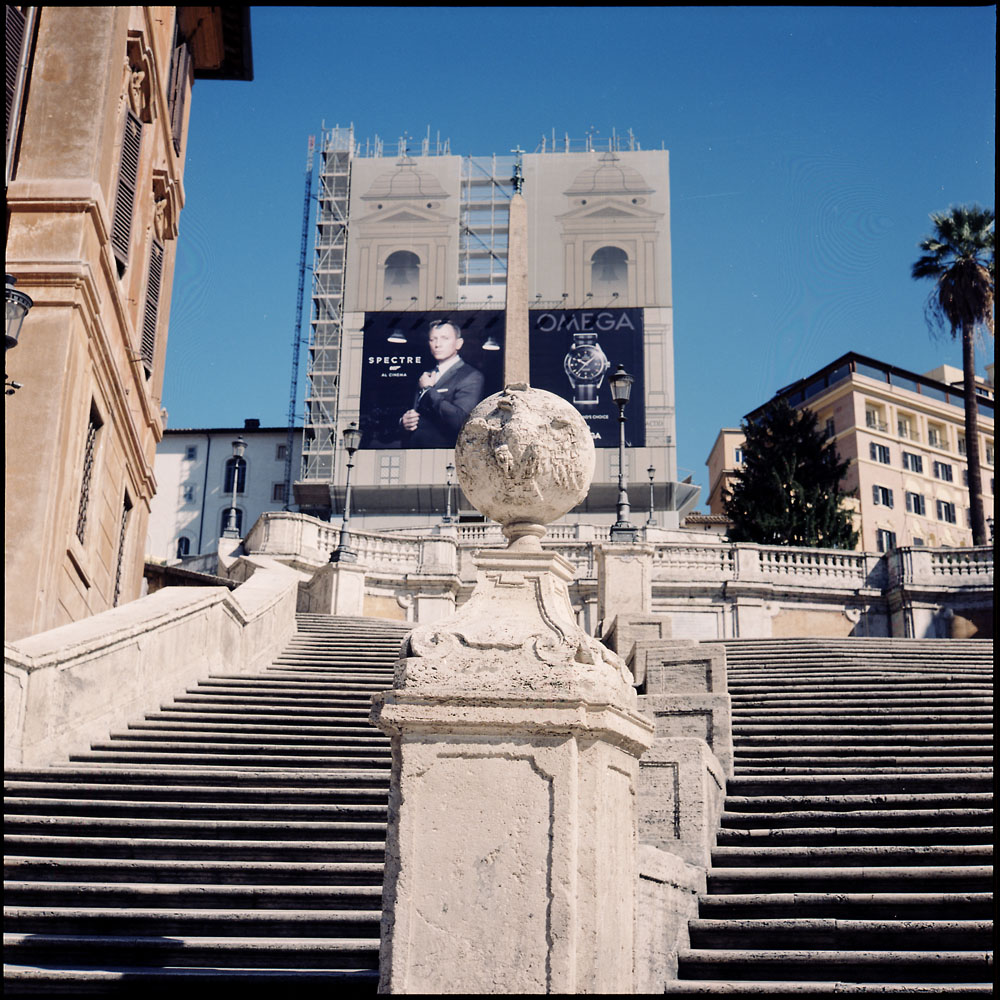
At this moment in time, the Spanish Steps are closed, yes CLOSED, fenced off with chain link fencing, due to an ongoing restoration project. So this shot, taken by poking the lens of my camera through the fence, is something otherwise virtually impossible without photographic trickery. Pretty much 24 hours a day, 7 days a week, 365 days a year, the Spanish Steps are crowded with tourists and the steps themselves are nigh-well invisible. The downside is all those tourists coming to see the Spanish Steps were displaced off the steps and back into the street below, completely over-running the fountain at their foot. So an otherwise lovely fountain was unphotographable.
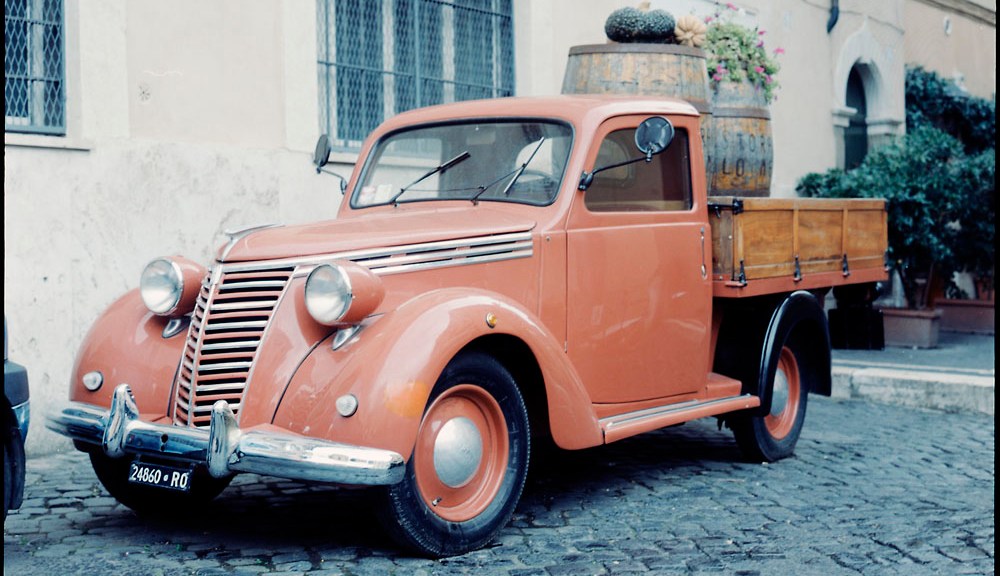
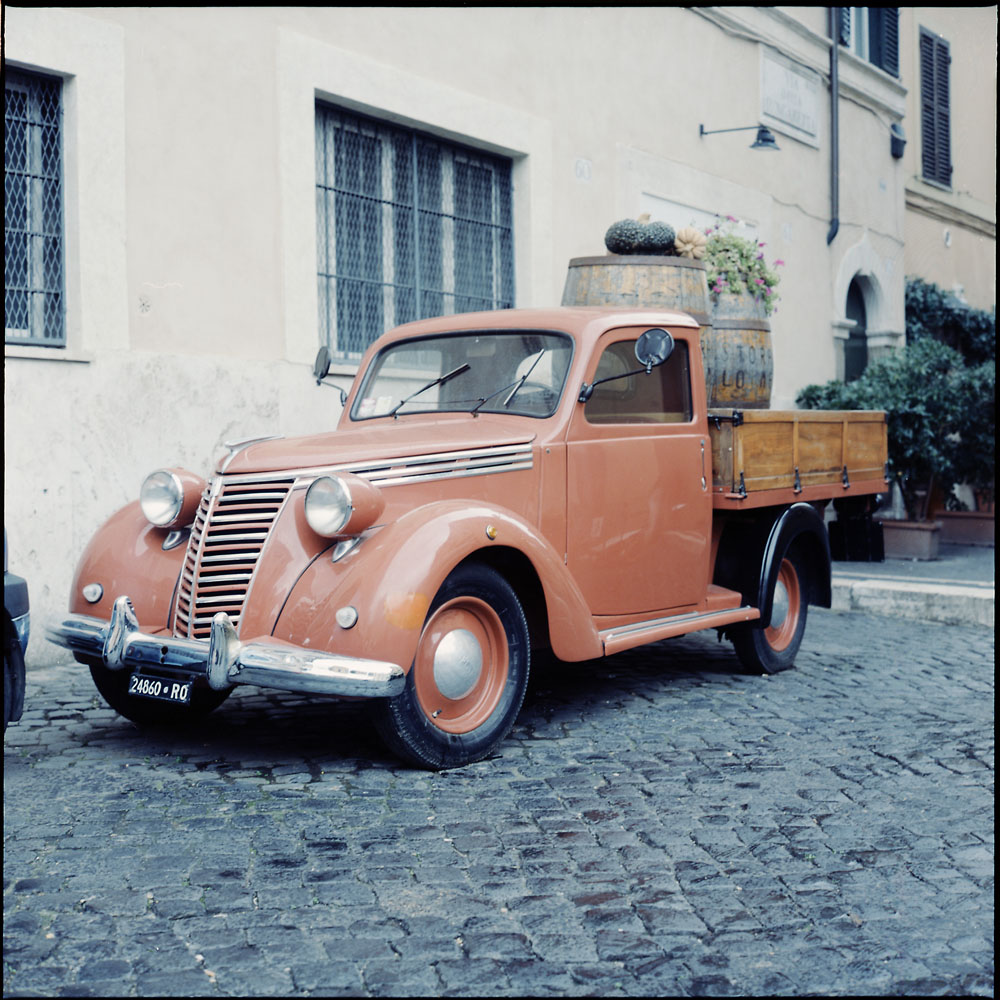
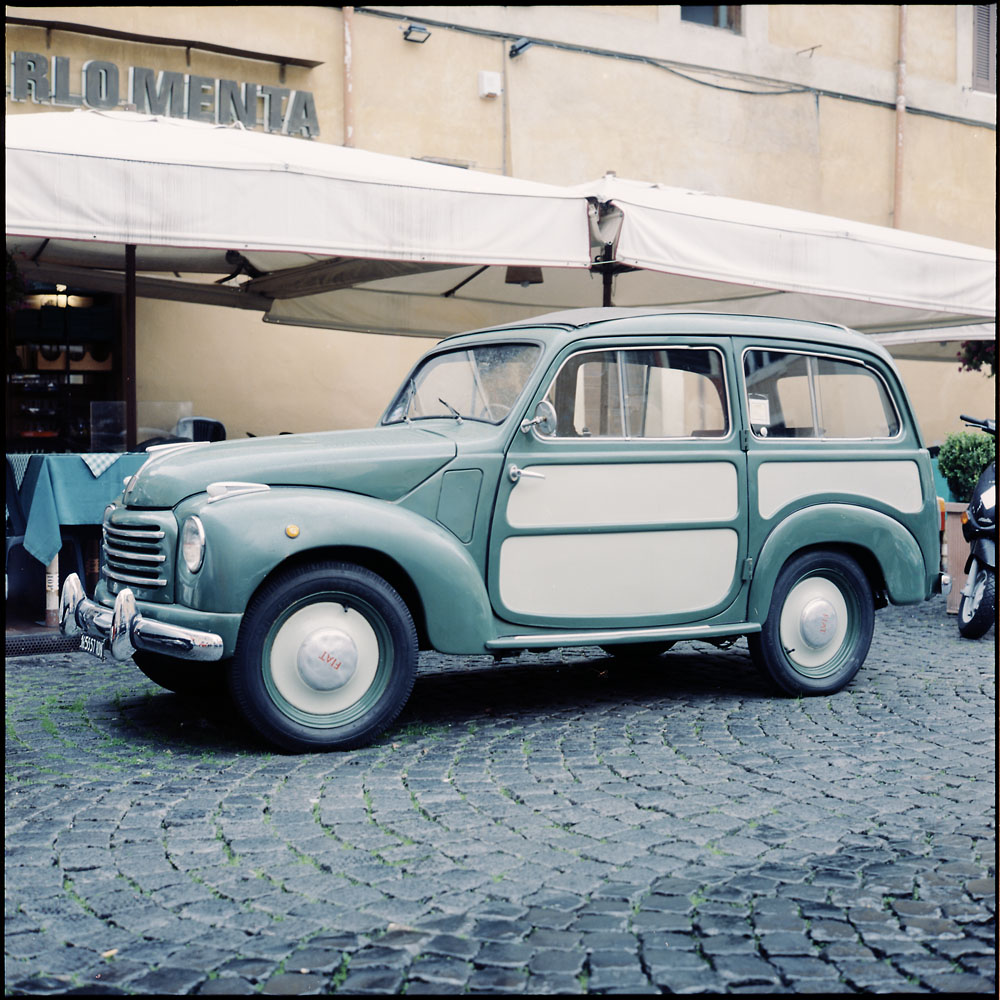
I love old cars. When I was in high school, I drove a 1962 Nash Metropolitan aka a bathtub on wheels, aka the car that floats (but it doesn’t- it’s not an Amphicar, which did float and drive in water- the Met just looks buoyant). I loved that car despite all its flaws and shortcomings. So I get a visceral reaction when I run across antique cars. These two were outside a restaurant in my neighborhood (which I did not have a chance to try).
Advertising Truck, Trastevere
Both were being used to advertise the restaurant. I don’t think the truck got driven around much if at all, what with the barrels in the bed with the restaurant name branded into them, and the pumpkins and gourds on top. The FIAT wagon, though, certainly looked like it could be used. I passed them on two different days and on both days neither vehicle appeared to have moved any.
Fiat Wagon, Trastevere
The FIAT wagon looks like the kind of car I’d enjoy having, though – folding canvas top, cute 1950s design, compact enough to be useable in the city, but enough space to haul stuff around. And it would definitely make all the right noises and have that old car smell. You know, a touch of motor oil and unburnt gasoline, combined with the funk of aging upholstery. Terrible cologne idea, but inside an old car? Magic.
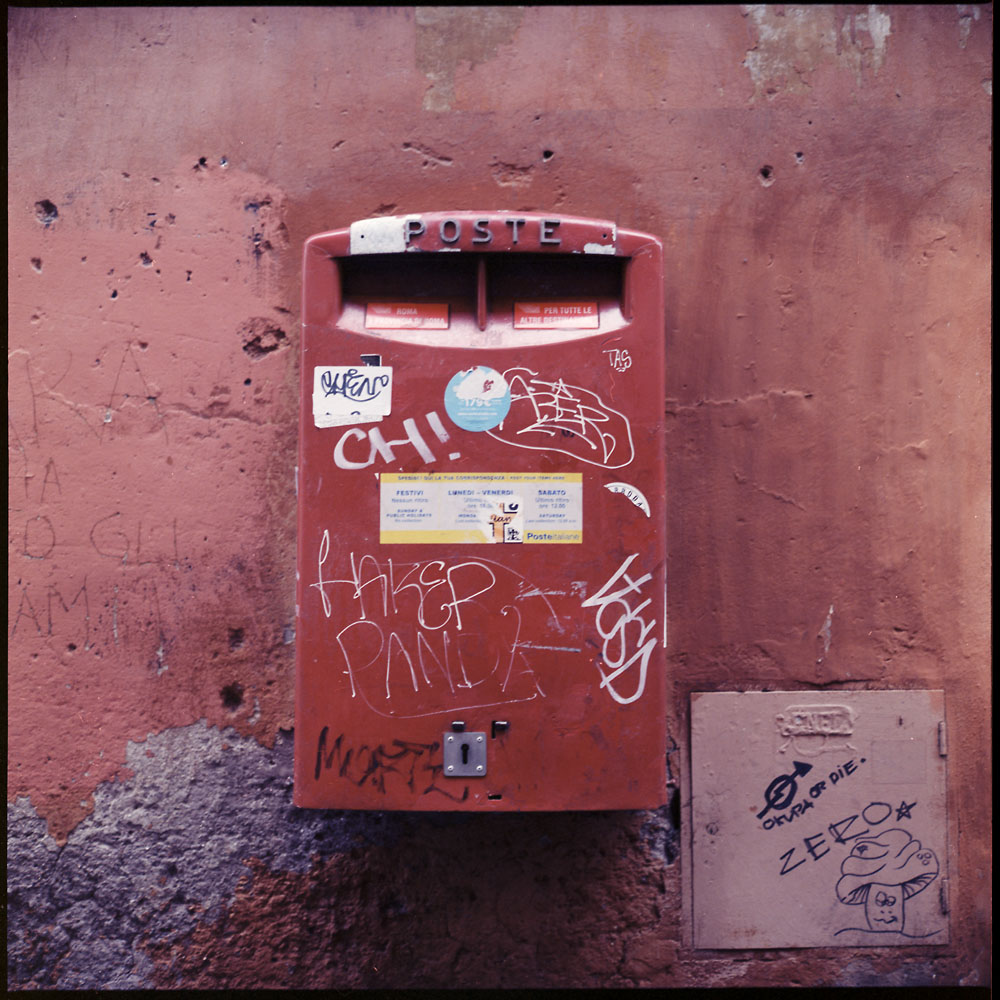
Rome is a city known for many things – fine food, ancient architecture, more churches than you can shake a stick at, and among other things, graffiti. This poor mailbox has been heartily defaced – scribbled on, stickered, and overall abused. Yet it still soldiers on in its duty, collecting the mail. Here is my portrait of the mailbox to elevate it into the pantheon of my Ordinary Objects series:
Mailbox, Trastevere, Rome
Something I found fascinating was the degree to which English has penetrated into Italian life. In the big cities, almost everyone speaks it to some degree or other. Signage in museums is in Italian and English – no French, no German, no Spanish, no anything else. Just English and Italian. Even the graffiti is often in English, like the little mushroom to the right of the mailbox here, and some obscenities on a wall outside the Garbatella Metro station (forthcoming in a future post). I don’t know what quite to make of it – while it makes life easier for me as a visitor who is not proficient in Italian (I can fake it ’til I make it based on my fluency in Spanish), I do worry about global homogenization.
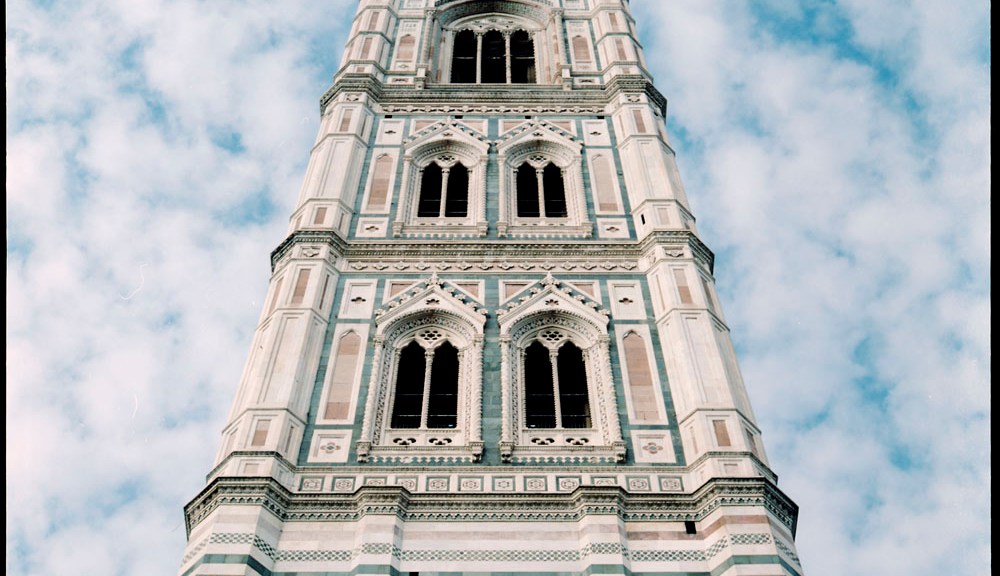
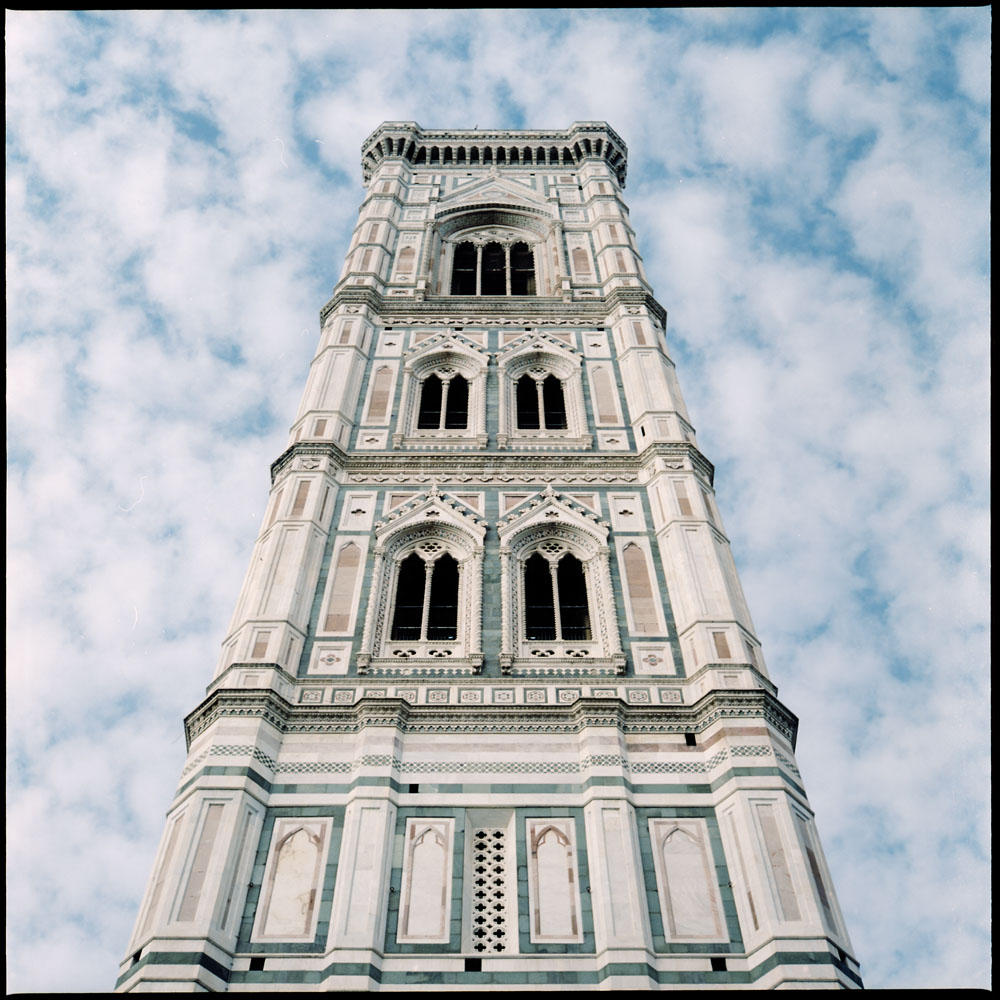
The bell tower, or campanile, of the Duomo in Florence. It is referred to as Giotto’s Campanile because it was designed by the famous painter Giotto, who had become the second Master of Works at the Cathedral after a 30 year gap following the death of his predecessor.
Campanile di Giotto, Florence
He created the polychrome marble scheme for the tower to match that which had already been designed for the cathedral itself, and saw the completion of the first floor of the tower before his own death in 1337. Today, the bell tower is as much a symbol of Florence as the dome of the cathedral or the Palazzo Vecchio.
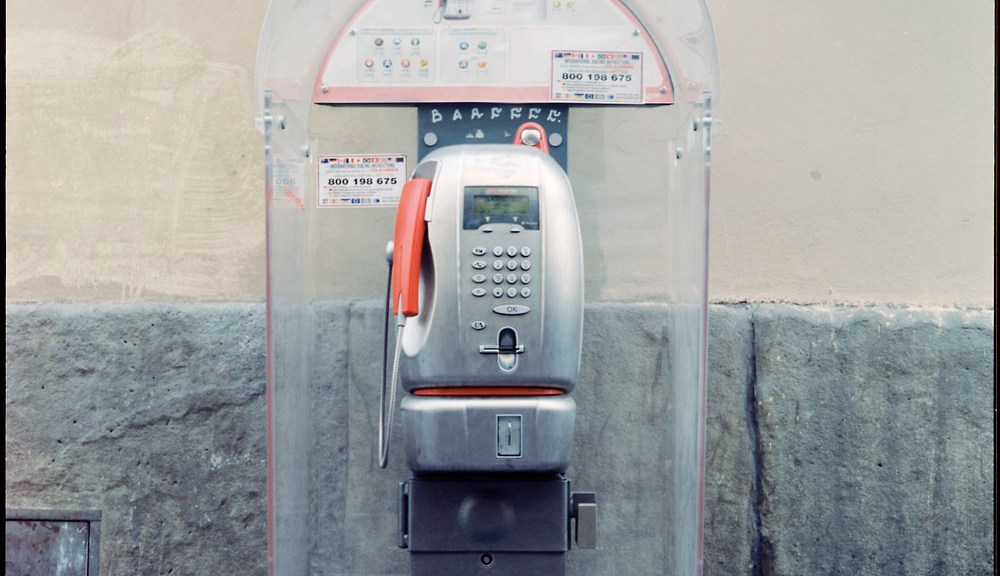
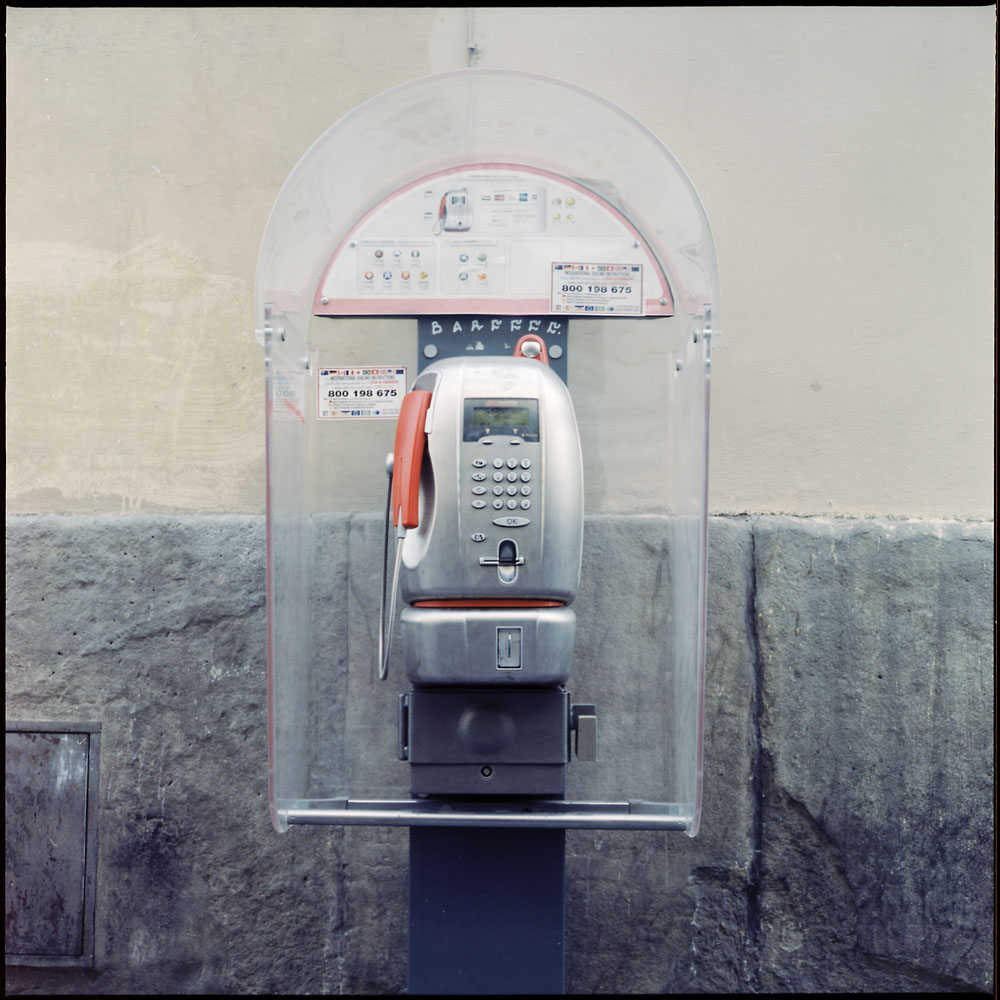
Another in my Portraits of Ordinary Objects series.
Payphone, Florence
I’ve been working on this series for a while now, photographing common things we see every day and take for granted. I keep on doing this around the world, photographing pay phones, mail boxes, trash cans, fire hydrants, all the little things that populate the overlooked corners of our daily lives. The interesting thing about them is that despite cultural differences (mailboxes in France are yellow, in the US they’re red and blue) they’re pretty much instantly recognizable across all cultures. You don’t have to be a Spaniard to recognize a Spanish mail box, pay phone, or trash receptacle.
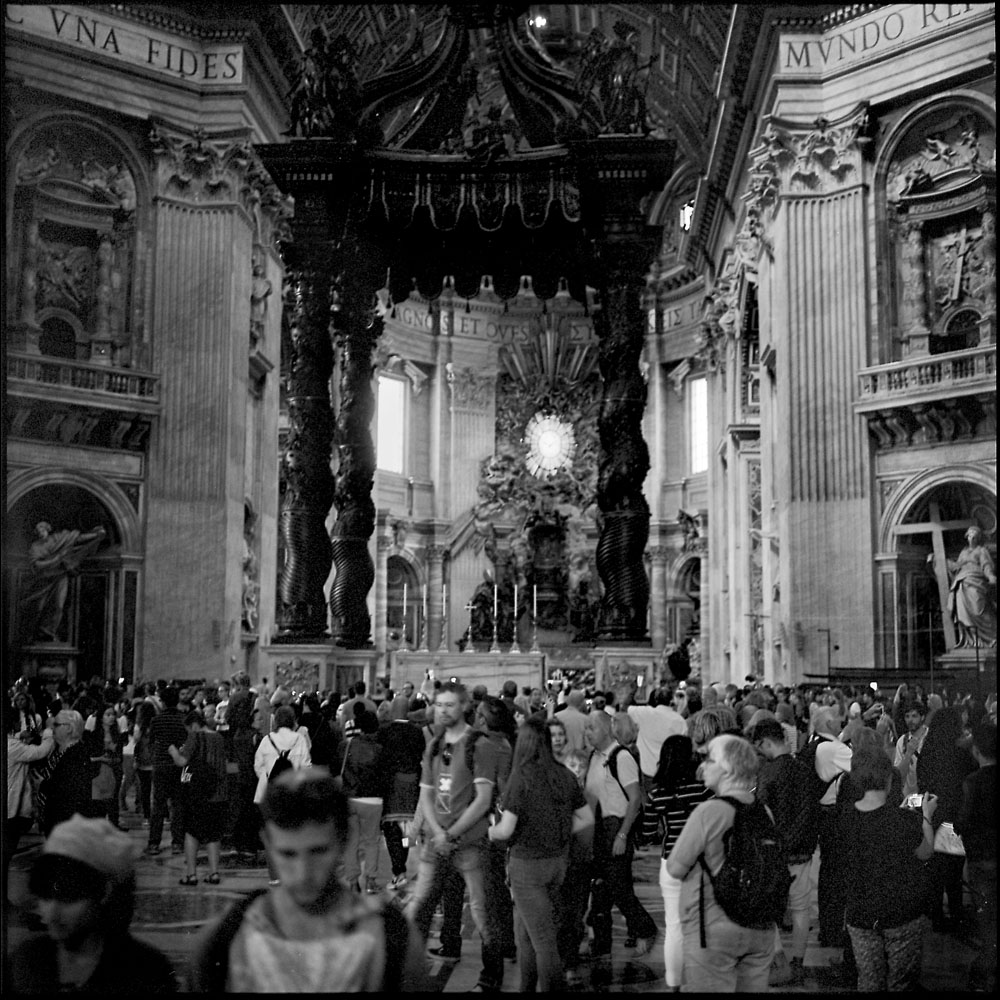
It’s so easy to be overwhelmed by St. Peter’s – the space is so vast, even when full of tourists it doesn’t shrink down.
The baldacchino over the high altar at St. Peter’s is one of the more recognizable objects. Cast from bronze allegedly taken from the roof of the Pantheon, it was designed by Bernini (remember the staircase from earlier?) and marks not only the center of the crossing under the dome, but the grave of St. Peter. While one of its alleged functions is to provide a bit of human scale to the vast space of the basilica, it is so massive that it only compresses the space if there are no people around to provide comparison.
Baldacchino
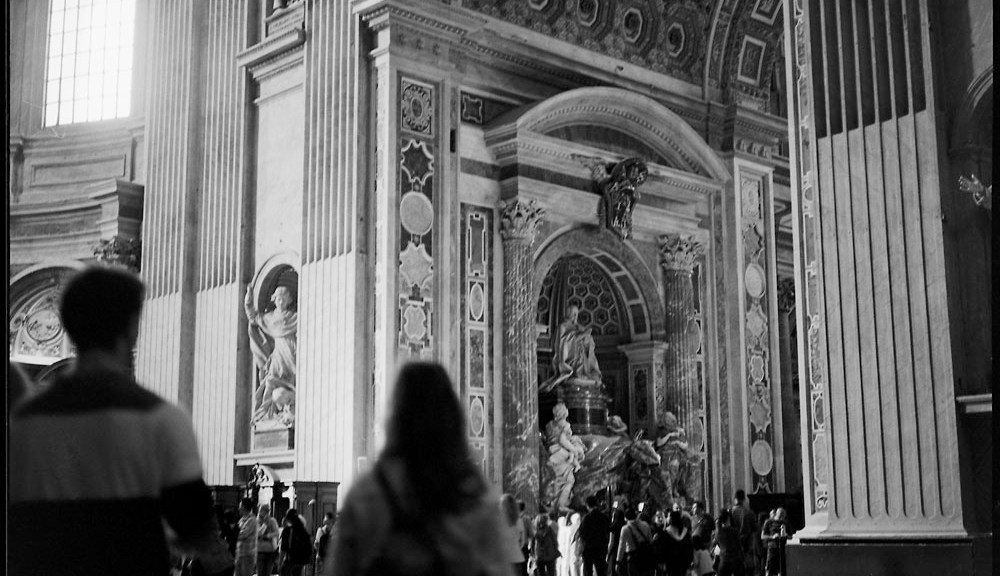
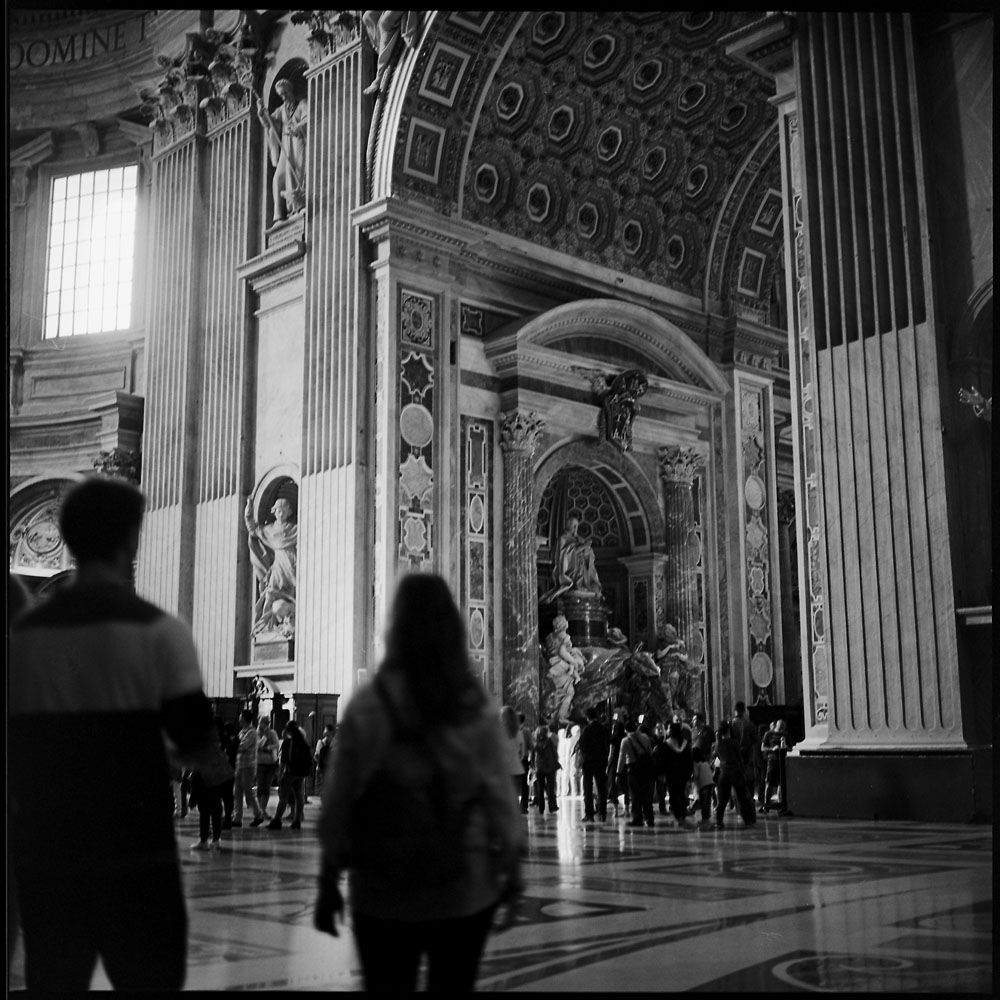
This view into the transept from the crossing with the people in the foreground I think really helps give you a sense of scale for the place.
Crossing the Nave, St. Peter’s
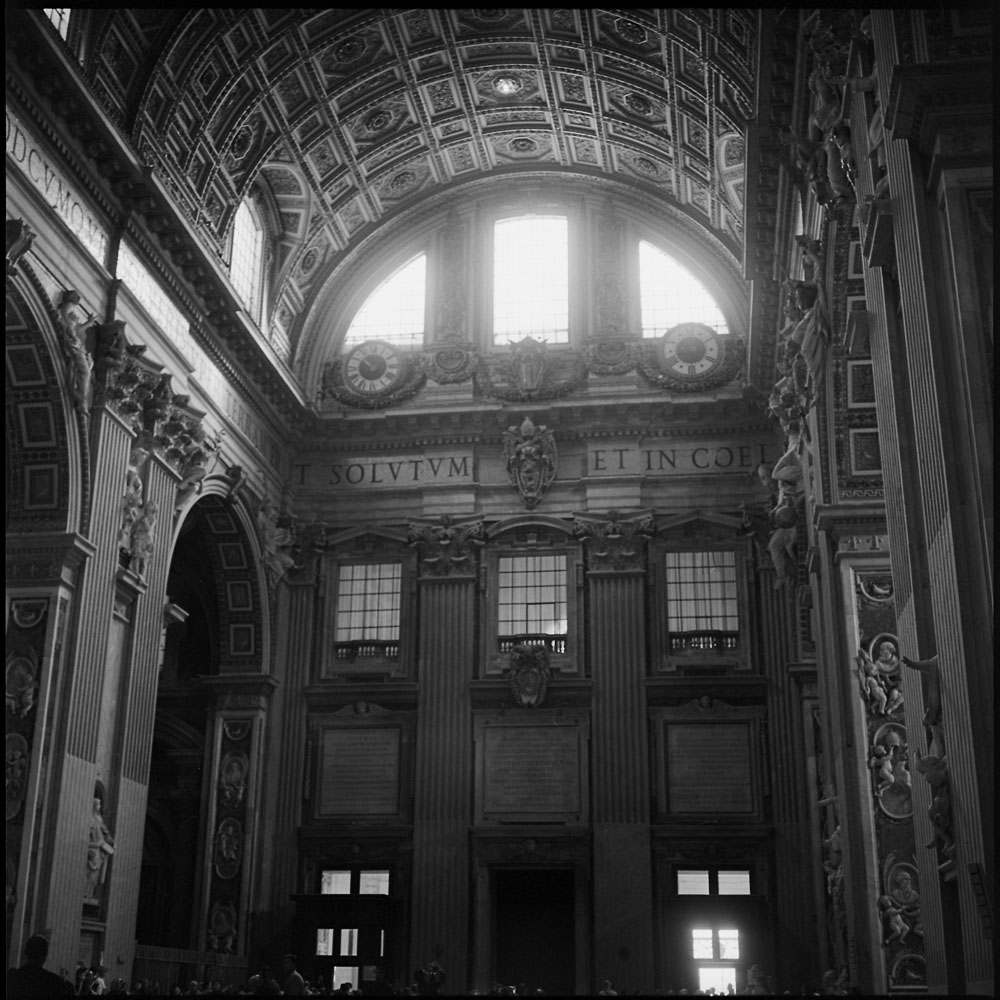
This is a view of the entrance with its two clocks, as seen from the mid-nave.
St. Peter’s Entrance, Clocks
On a separate but related note, it’s interesting how we refer to Rome and the Vatican interchangeably when we speak of the seat of the Catholic Church, when in fact they are two distinct entities. This was not always true, of course- especially during the Renaissance through the early 19th century, it was literal truth to say that Rome was the papal seat. Now, of course, the Vatican is in fact not only a separate city within the city of Rome, but in fact a separate nation, complete with its own passports. The Vatican is in fact the world’s smallest country.
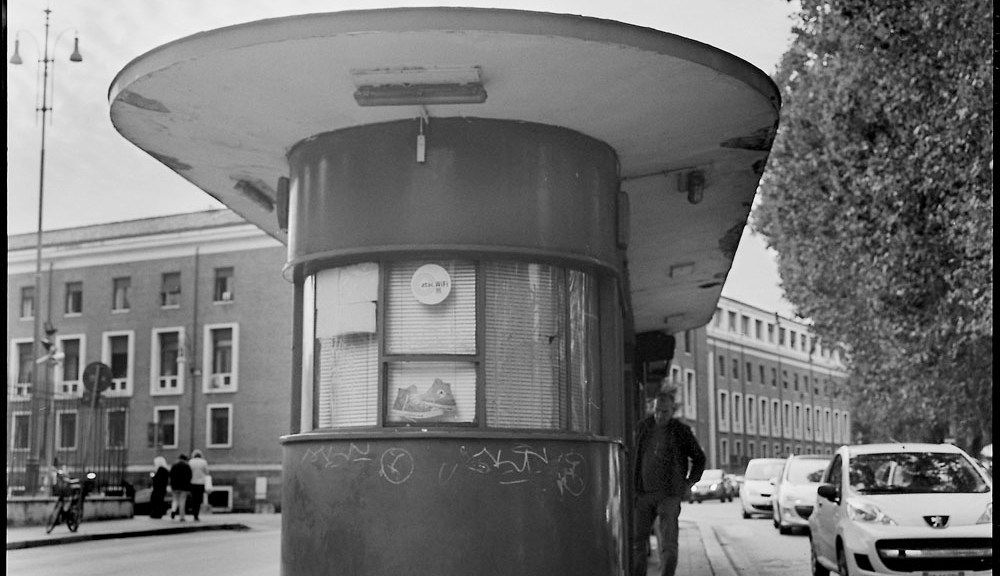
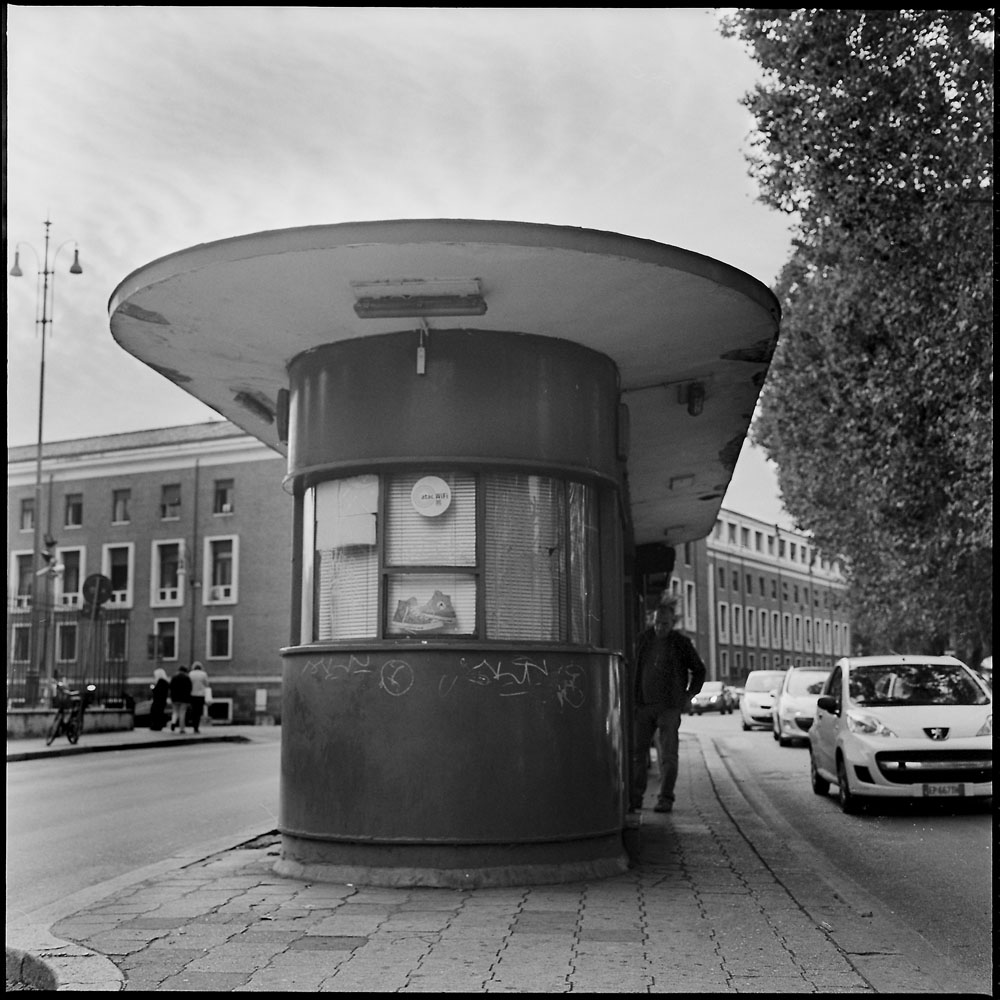
This is where I went to catch a bus to go to the Vatican Museum on my first day in Rome. It’s a vintage bus shelter, hard to date, but I’d guess post-war, maybe as late as 1950s. What you can’t see in the picture is that in the middle of the structure is a news-stand. Today it’s not so bad, but I wouldn’t want to have had to work there even as recently as the 1980s when diesel exhaust was much heavier than it is now.
Vintage Bus Shelter, Rome
That’s actually a sense-memory I kind of miss – you knew you were in Europe when you smelled the diesel exhaust everywhere. That and certain kinds of tobacco. It’s still a noxious odor, but the emotional context of it is so positive. I suppose geologists feel that way when they smell sulphur or biologists with methane.
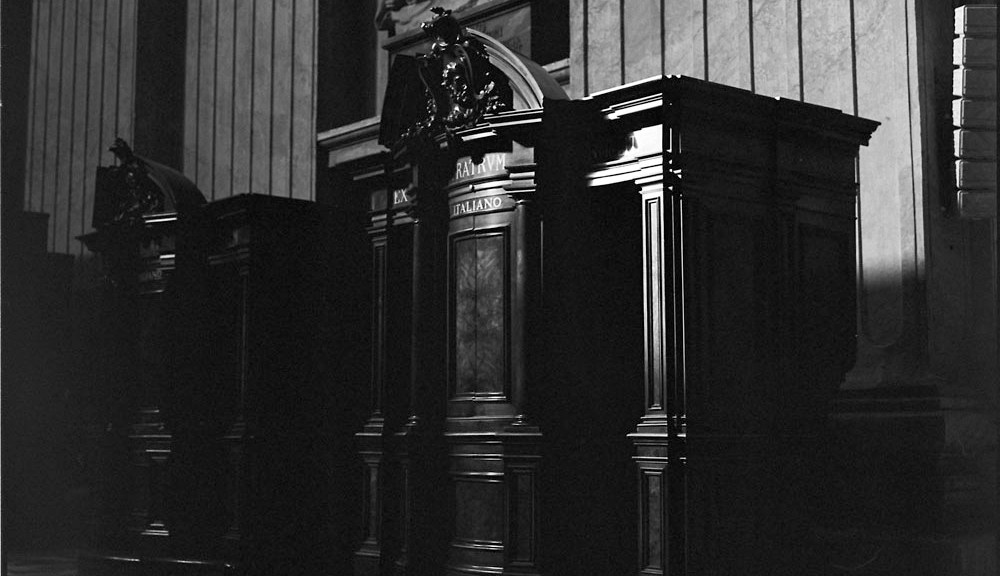
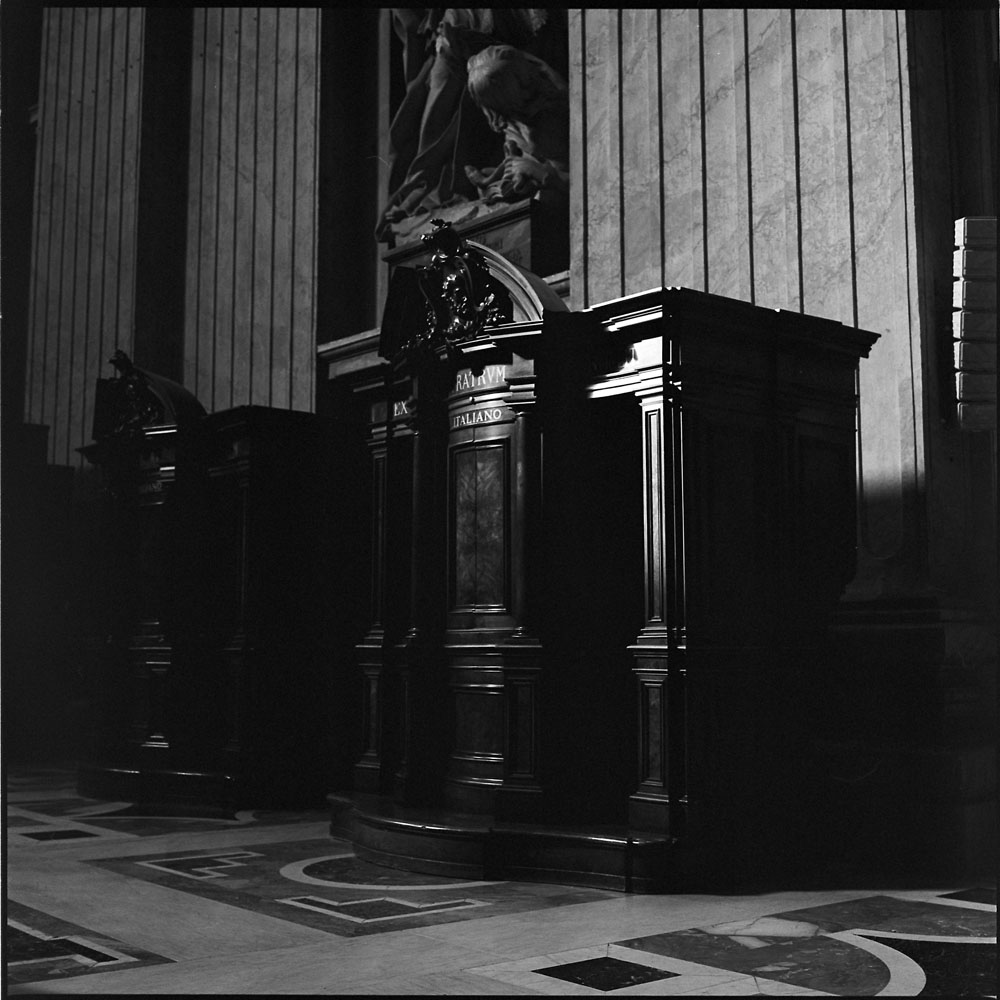
While exploring St. Peter’s basilica, I saw this amazing light falling on the confessional booths, which were in themselves magnificent pieces of furniture. Something about them feels a little ominous, though, don’t you think? Or perhaps a touch funerary.
Confessionals, St. Peters
Even though I’m not myself Catholic, I don’t know that I’d want to give confession in that confessional booth- it would feel a little bit too direct.
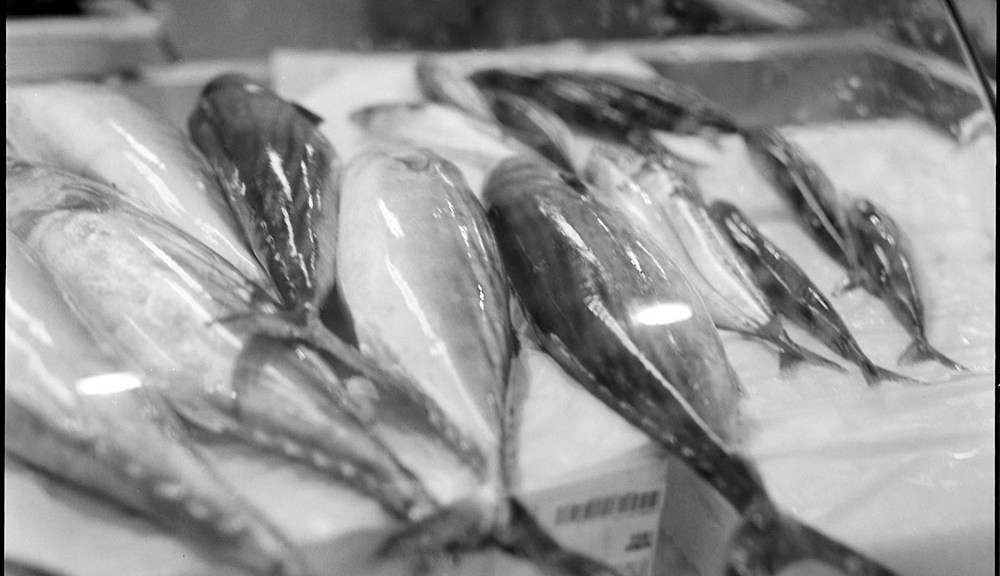
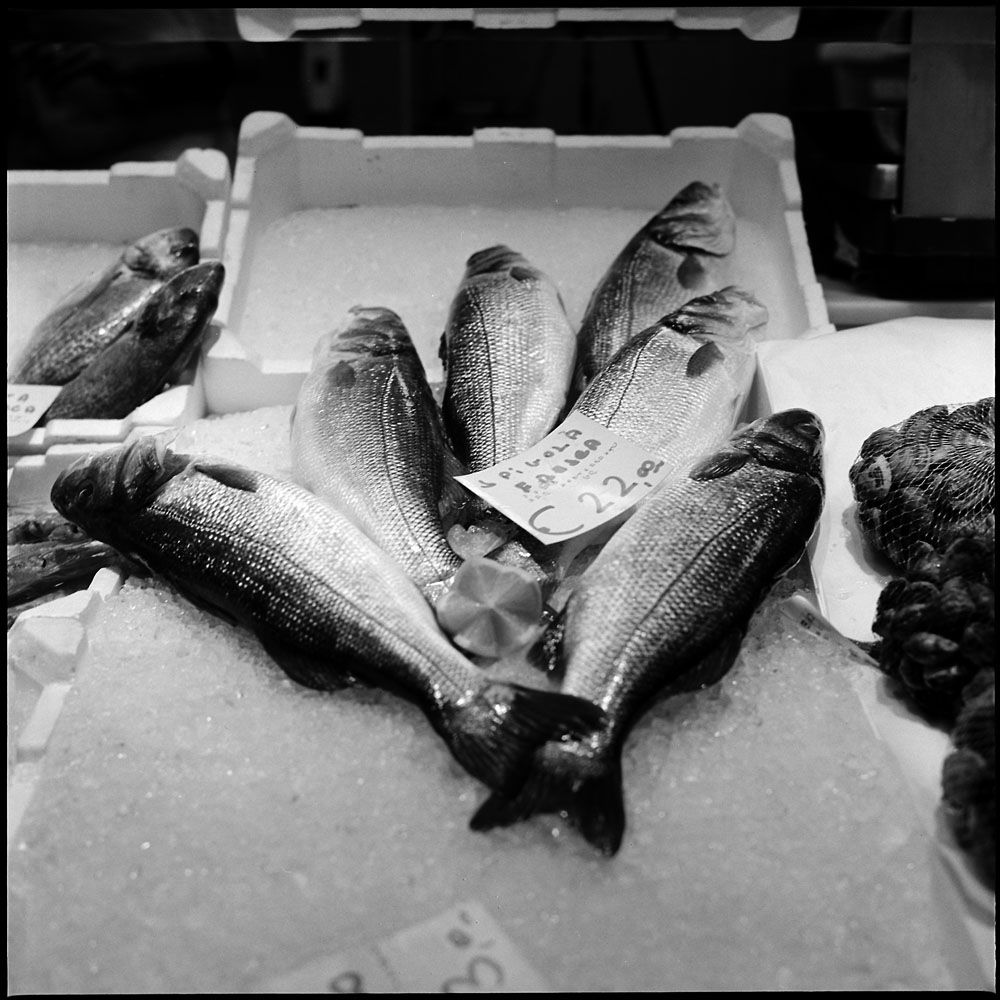
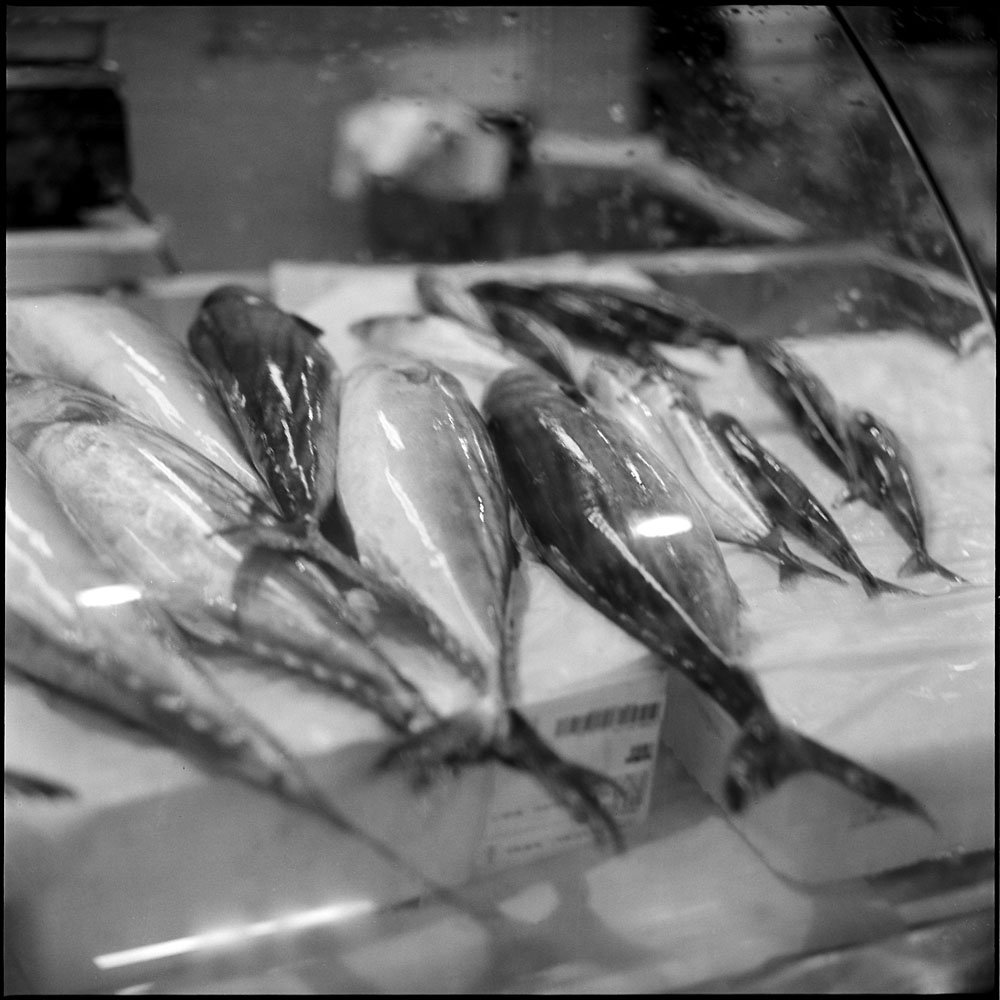
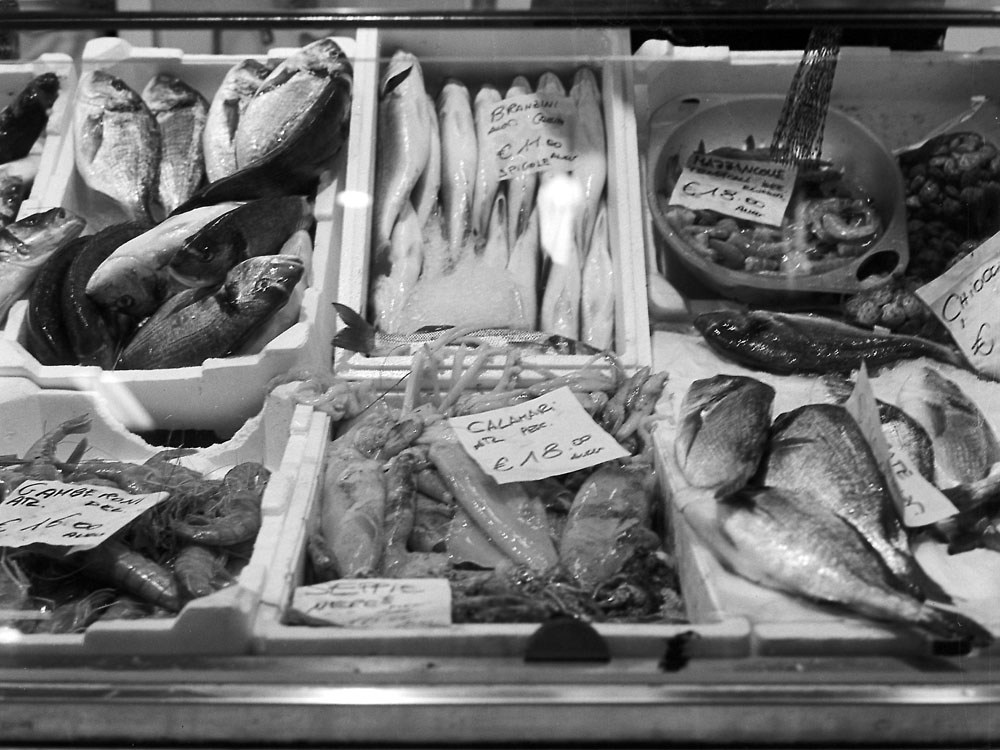
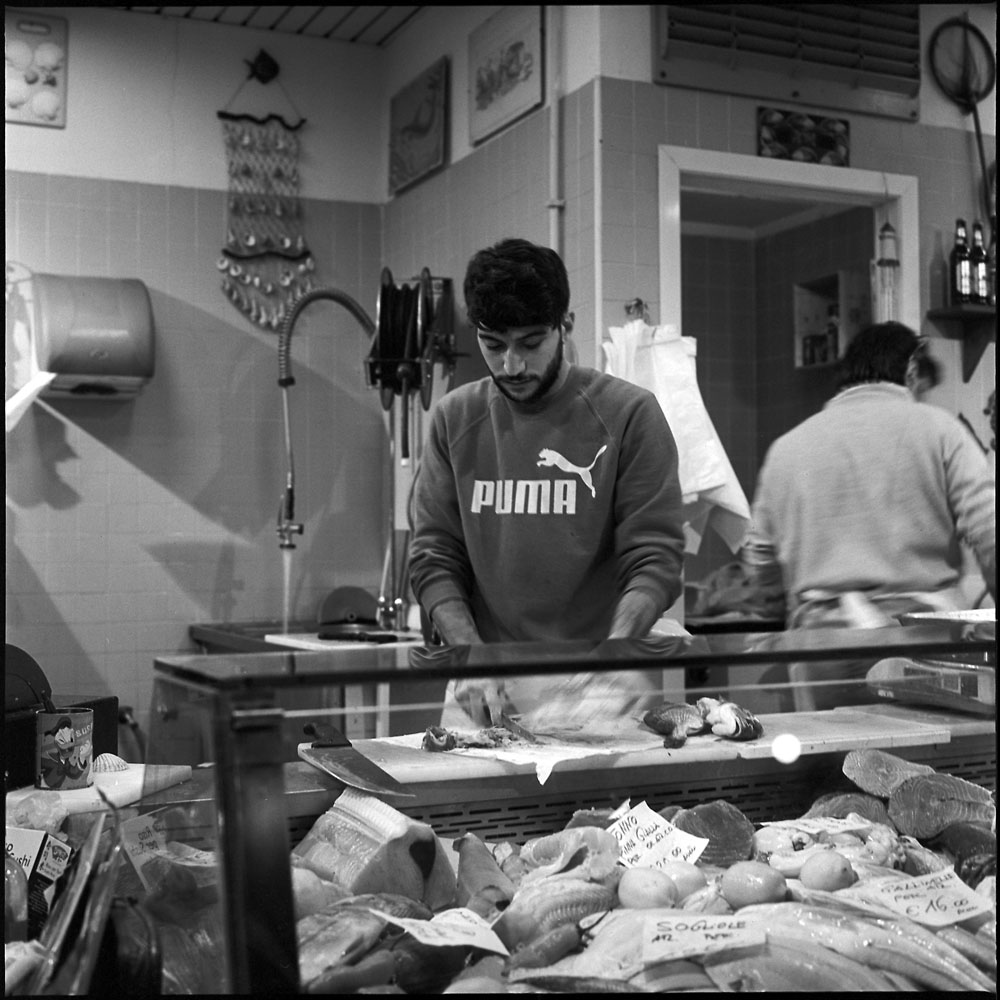
There’s something about fish in the market that makes them look especially good in black and white, don’t you think? It’s funny that most of the fish we eat are shades of black and silver and white – there are really only a couple fish that are colorful that we eat (red snapper, bluefish, Yellow Mackerel), the rest are enjoyed as visual treats when snorkeling, diving or in an aquarium.
Fish, Mercato CentraleFish, Mercato CentraleFish, Mercato CentraleFishmonger, Mercato Centrale
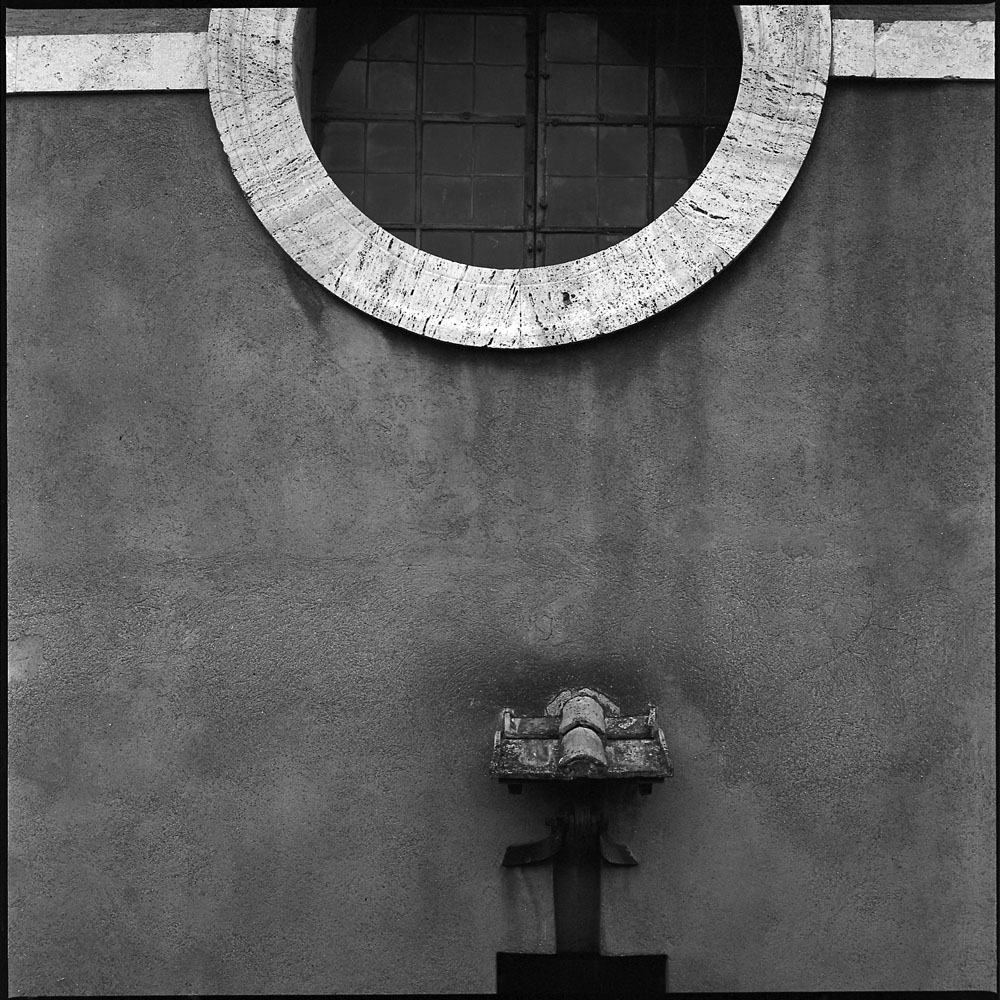
I found this composition while walking the ramparts and courtyards of the Castel Sant’Angelo, which is a very easy place to get lost in if you’re not paying attention. There are so many levels and layers, both physically and historically. The building was built originally as the funerary monument for the Roman emperor Hadrian. Later it was converted into a fortress for the protection and safety of the Pope. A residential suite complete with reception rooms and treasury (three massive barred iron chests with multiple locks, each of which only one person had the key to, so it would require all the key holders to open each chest) and balconies with sweeping panoramic views of the city were put on the upper tier, and the burial chamber of the emperor Hadrian was converted into a dungeon where prisoners could be thrown to wither and die in darkness and misery.
 dcphotoartist