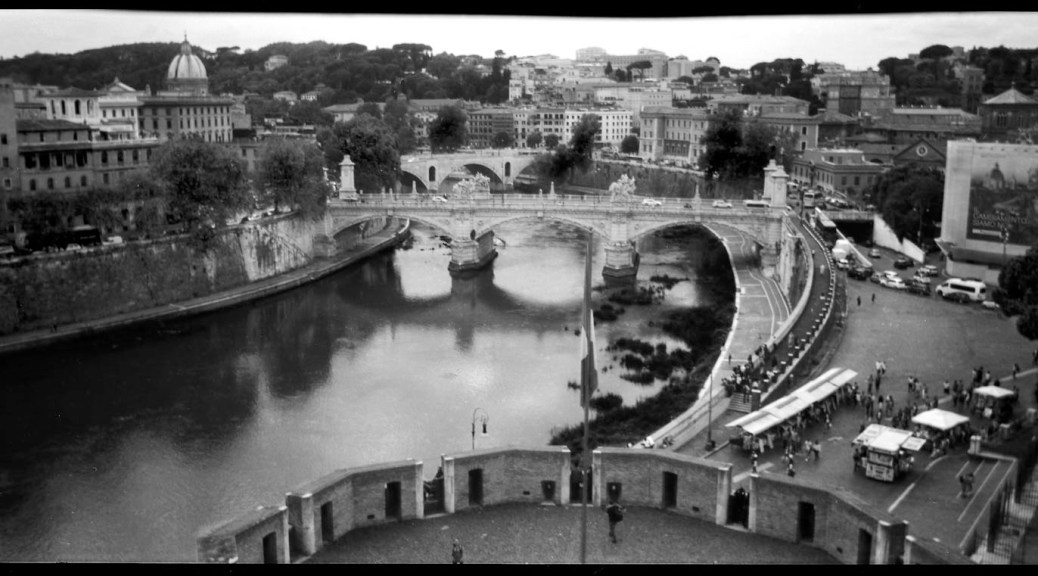
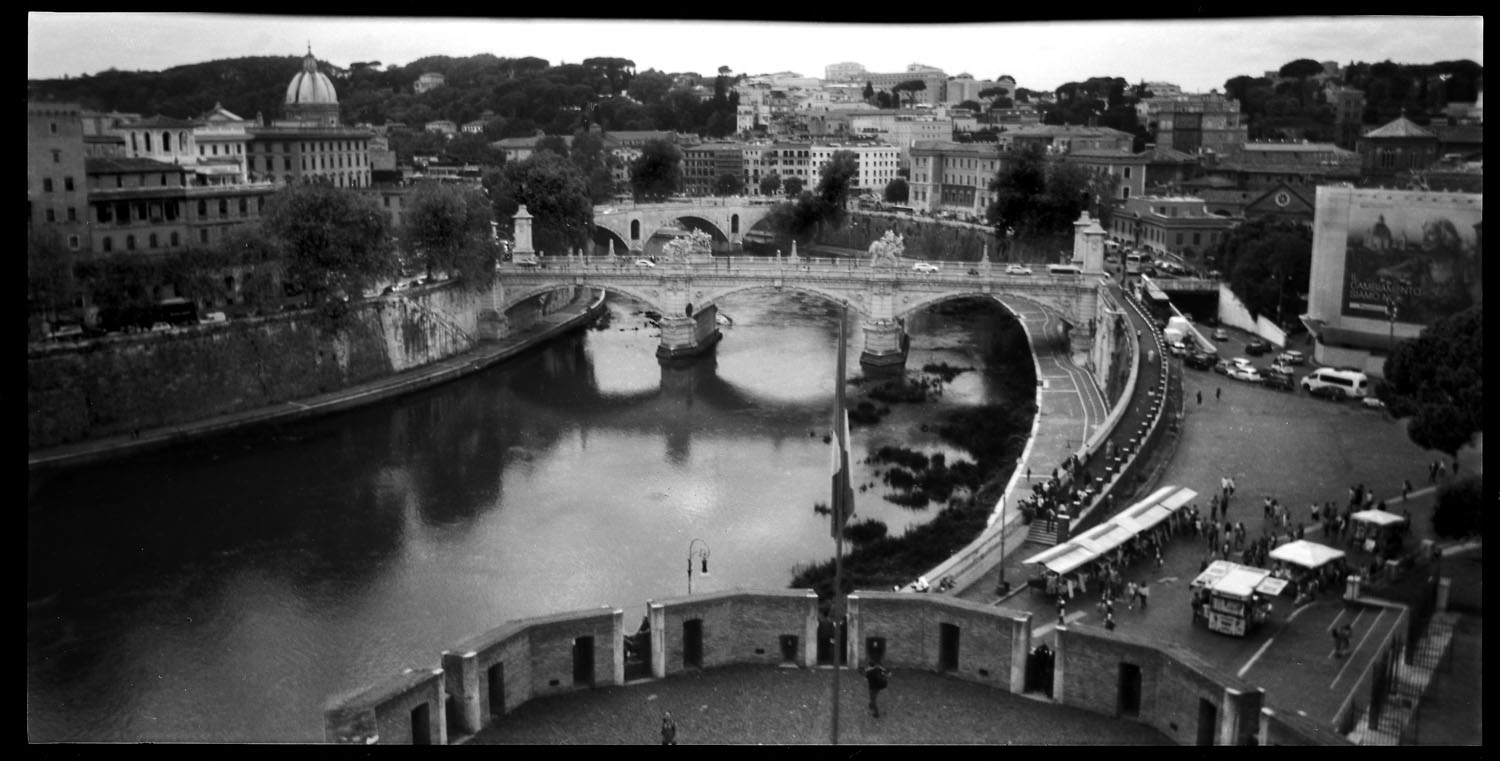
This is a panorama I took of the bend in the Tiber river just in front of the Castel Sant’Angelo, from the castle’s ramparts. St. Peter’s is to the right, out of view. If you look at the bridge in the background, you can see the keyhole arches in the supporting piers which are there to help the bridge not get washed away in time of flooding. There are a number of bridges across the Tiber with this feature, including the famous “Ponte Rotto” (Broken Bridge), which you’ll see in some other shots I’ll post later.
This was taken with my Belair X6-12 camera. As you can see, it’s a pretty soft lens, combined with what was probably a pretty slow shutter speed (1/30th, 1/15th? with this camera, who knows- it sets it automatically for you and doesn’t tell you what it used). But it has a look to it, and the negative isn’t unusable.
What trip to Florence would be complete without a visit to the Accademia to see David?
My first visit to Florence, I actually did NOT get to see David as I only had about 2 1/2 days, and back then unless you booked a tour group, the only way in was to get in the 2-3 hour line. Now, Florence the city offers a three-day, all-you-can-museum pass called the Firenze Card. It’s a bit pricey, but in my estimation well worth the 72 Euros because you can just wave it at the door and walk right in to the Uffizi, the Accademia, the Bargello and any of the other major public museums in the city. If you can make it in to say four museums in the three days, it’s more than paid for itself.
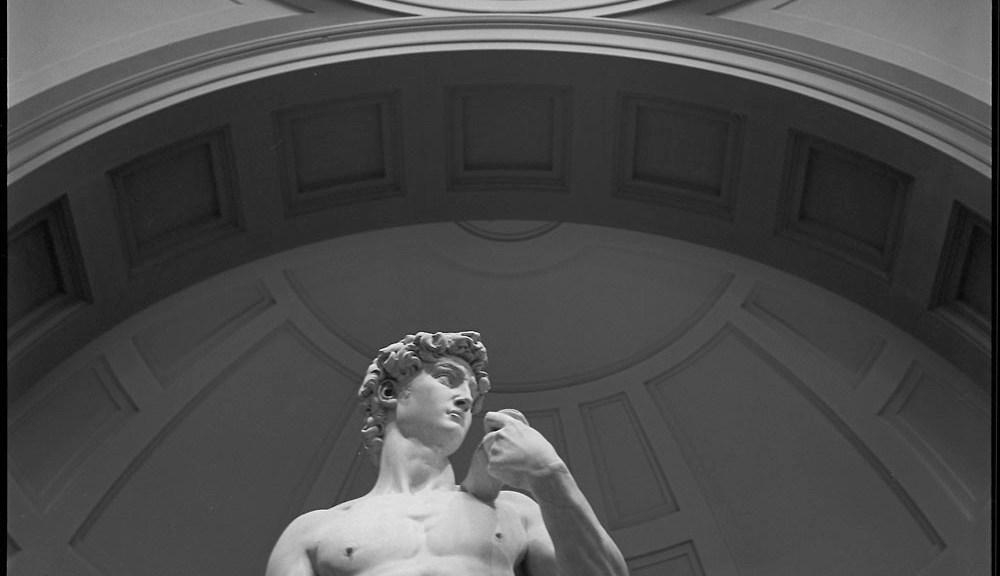
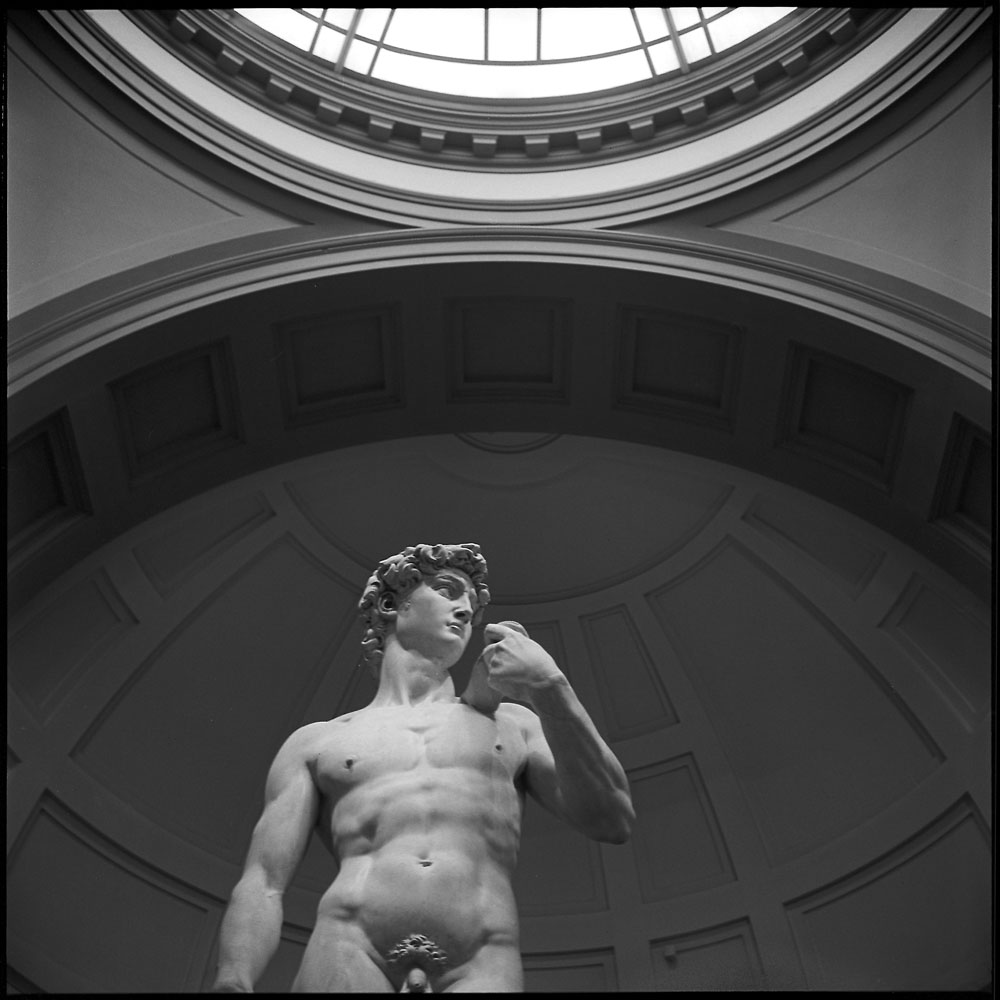
Back to the David – I had seen the copy that was made in the 19th century and placed in front of the Signoria on my previous visit, and I thought it was a good enough copy that I didn’t need to see the original. Having been now to see the original, I can say I was totally wrong. The public copy is an excellent copy, but it’s still just a high-end Xerox of Michelangelo’s. I tried with this composition to photograph it in a slightly less cliche fashion by including the architecture of the room.
David
There’s so much going on with this statue and its history. It was originally intended to stand on a pedestal on the outside of the Duomo along with a dozen or so other similar sculptures. The David was the only one of the group ever made, and it never was placed in its originally intended location. David came to symbolize the Florentine Republic, and as such, by the time he was finished, he was placed outside the Palazzo Vecchio in the Piazza della Signoria to remind Florentines of their independent status. The original statue stood outside in the rain and the wind and the sun and the snow for four centuries before being moved to the Accademia. In the 20th century, he was “restored” once, very poorly, and a second time, recently, with a far more gentle method. As a result of the cleanings, the exposure, and the hammer attack he was subjected to, there remains no actual surface which would have been touched by the hand of Michelangelo. In spite of this, the statue remains transcendent.
There’s a terrific book about the David, From Marble to Flesh: a Biography of Michelangelo’s David, by A. Victor Coonin. My only association with the book aside from having read it is that I was a Kickstarter backer of the original publication. If you look in the credits you’ll find my name. Regardless, the book tells the complete life story of David from his beginnings as a sculpture to be carved by someone else, Michelangelo taking over the task, his completion, public placement, life, moving from the Piazza to the Accademia (which took almost as long to accomplish in the late 1800s as it did to move from Michelangelo’s studio to the Piazza some four hundred years earlier), through to the cultural importance of David as a symbol in 21st century life.
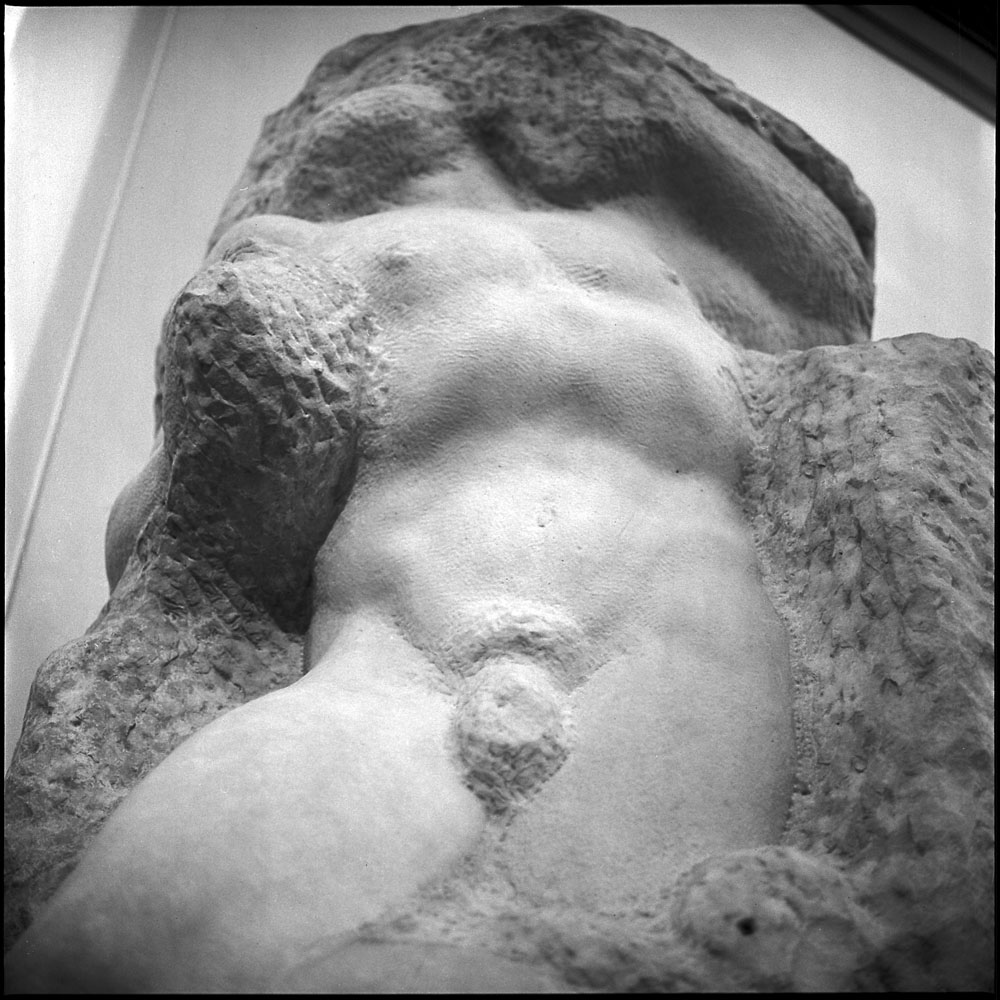
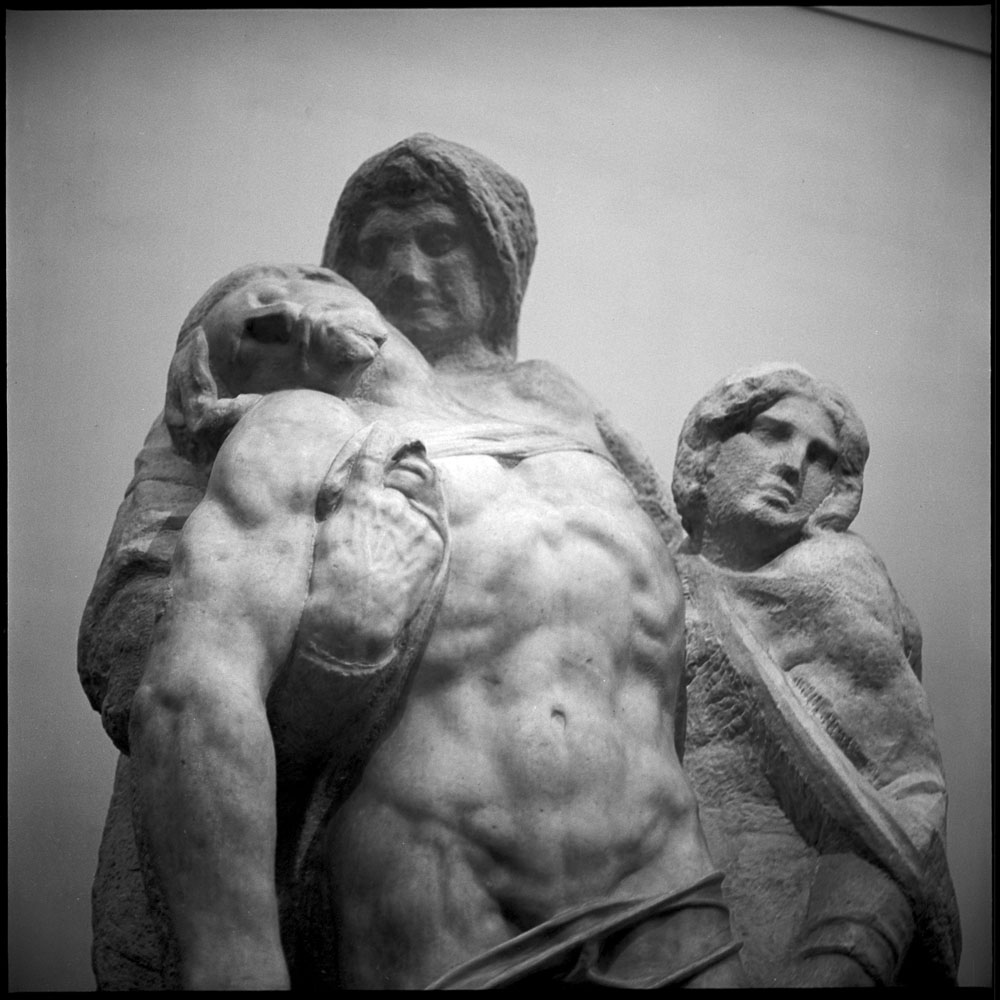
I had mentioned in an earlier post about Michelangelo and the “Unfinished” sculptures. Here are some of the pieces in the Accademia’s main hall.
Unfinished Sculpture
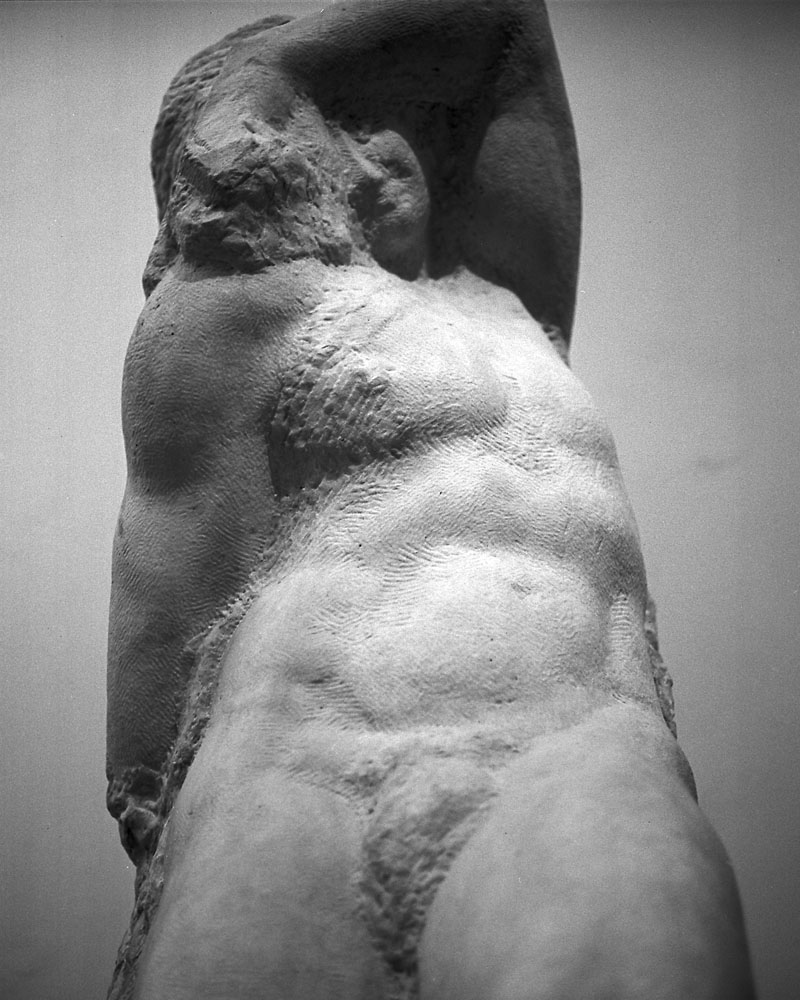
If you look carefully at them, it’s hard to truly call them unfinished – there is a certain deliberateness about what is carved finely and what is left rough.
Unfinished Sculpture
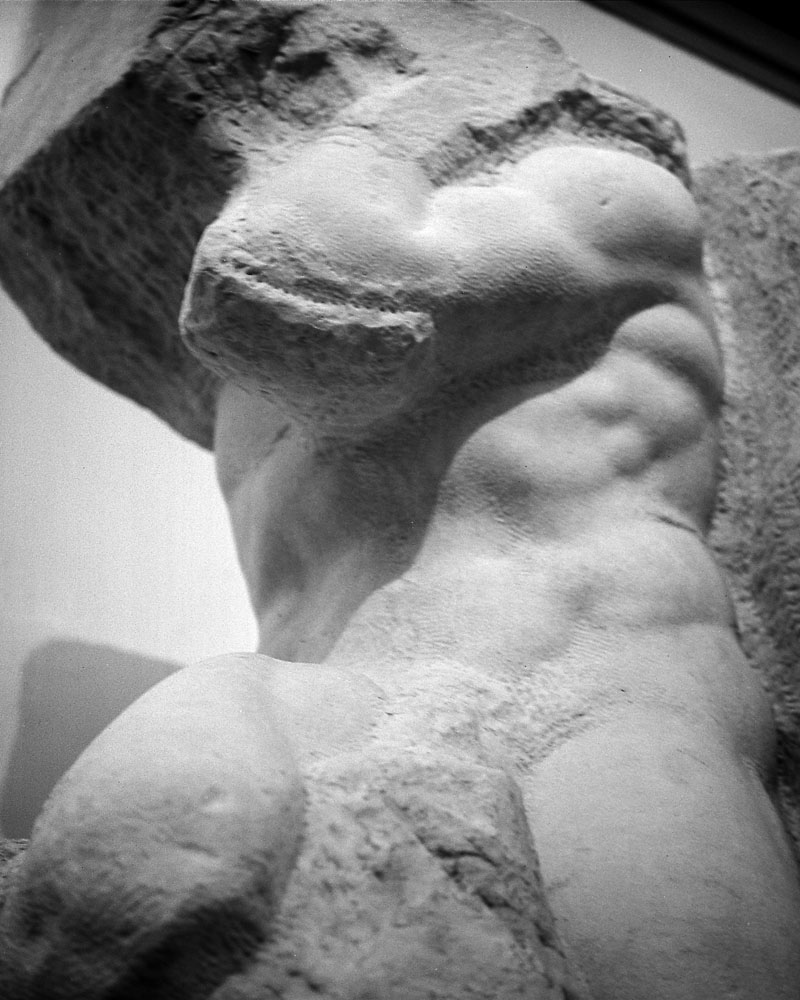
The coarse textures blend very naturally with the revealed forms. To my eyes, and from my (granted rather limited) experience of stone carving, this kind of texture and modeling is something done very intentionally.
Unfinished Sculpture
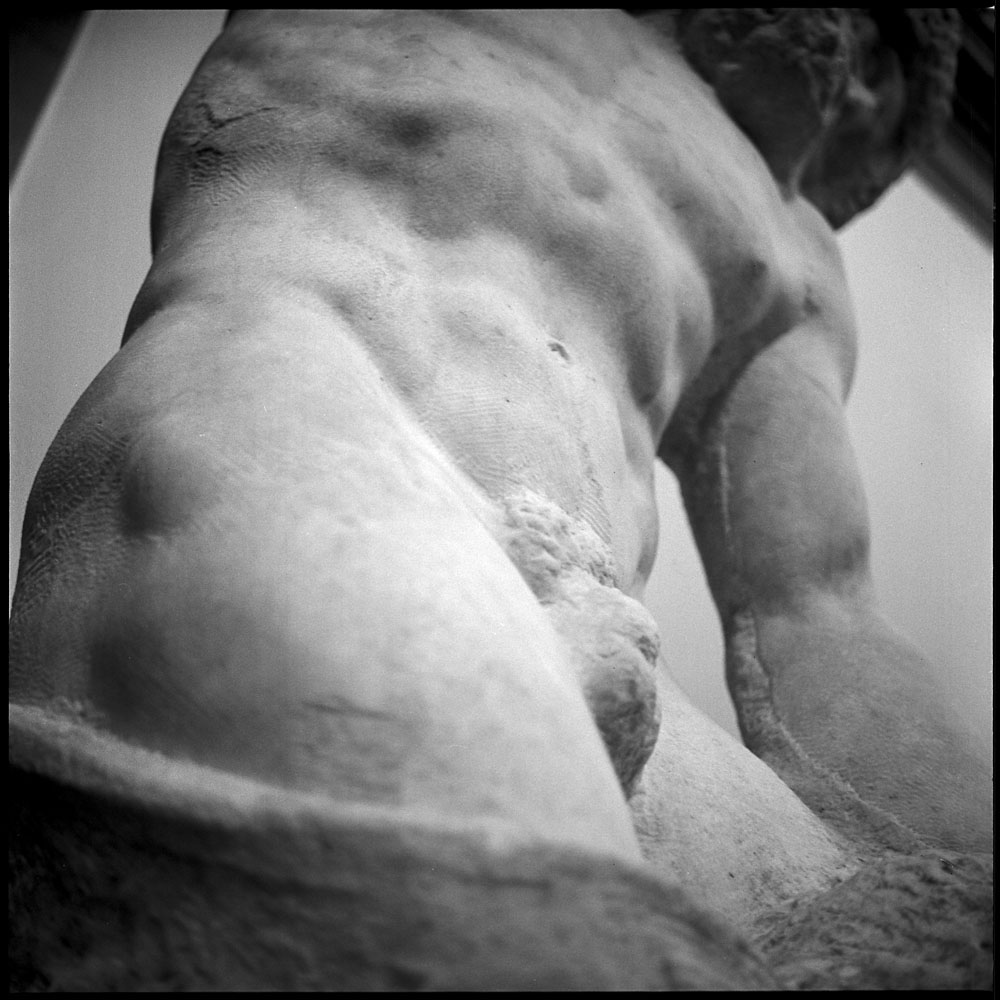
While there are certainly areas that are unrefined, the transitions are fascinating and at the very least provide an insight into the working technique of a genius master sculptor, and given how far ahead he was in so many other aspects of his art, it is entirely possible for him to have been five centuries ahead of his time in his thinking, much the way Caravaggio’s paintings were.
Unfinished Sculpture
And I couldn’t let the opportunity pass without remarking on something that virtually everyone who’s ever looked at a Michelangelo painting or sculpture of a woman has noticed- his women are really just men with boobs and long hair. The hand of Mary that’s supporting a very robust looking Jesus in this “unfinished” Pieta is one of the manliest hands I’ve ever seen on a woman.
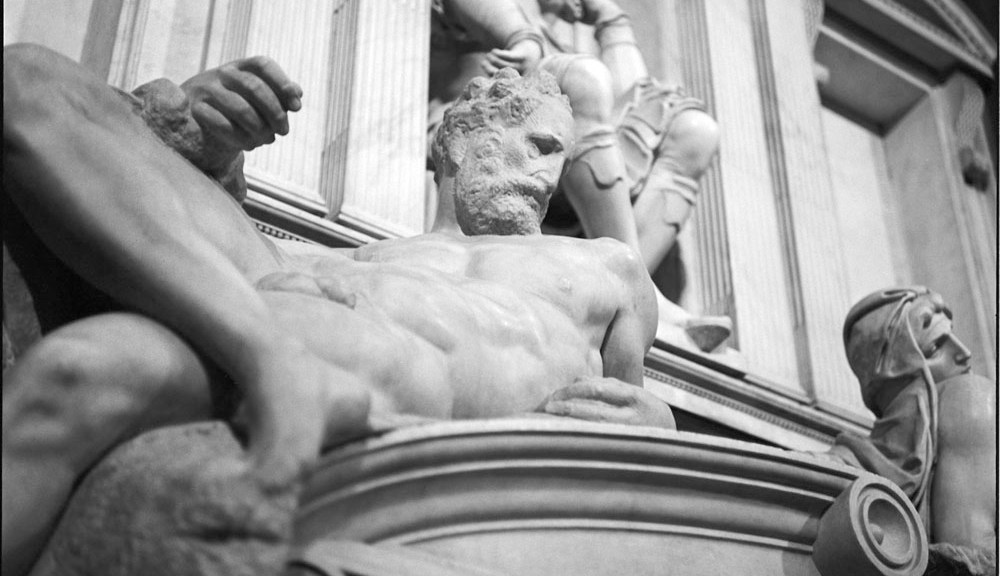
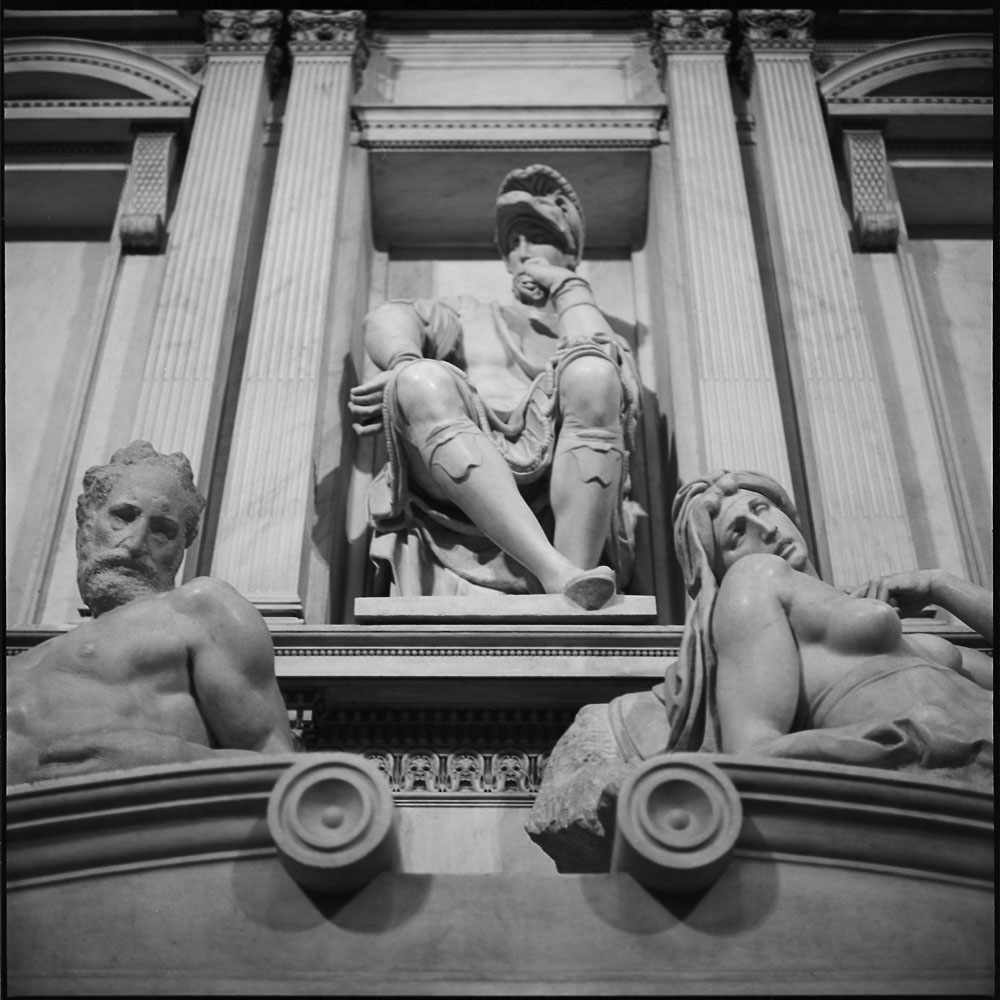
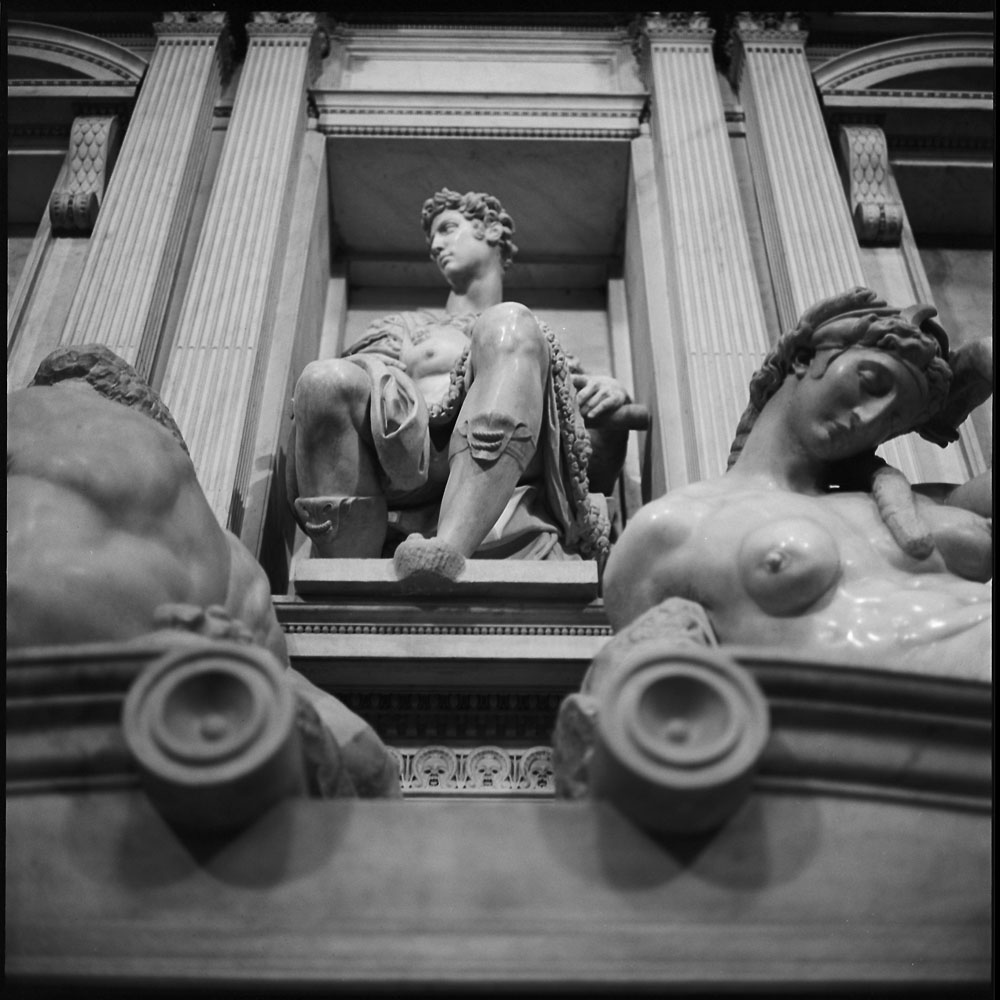
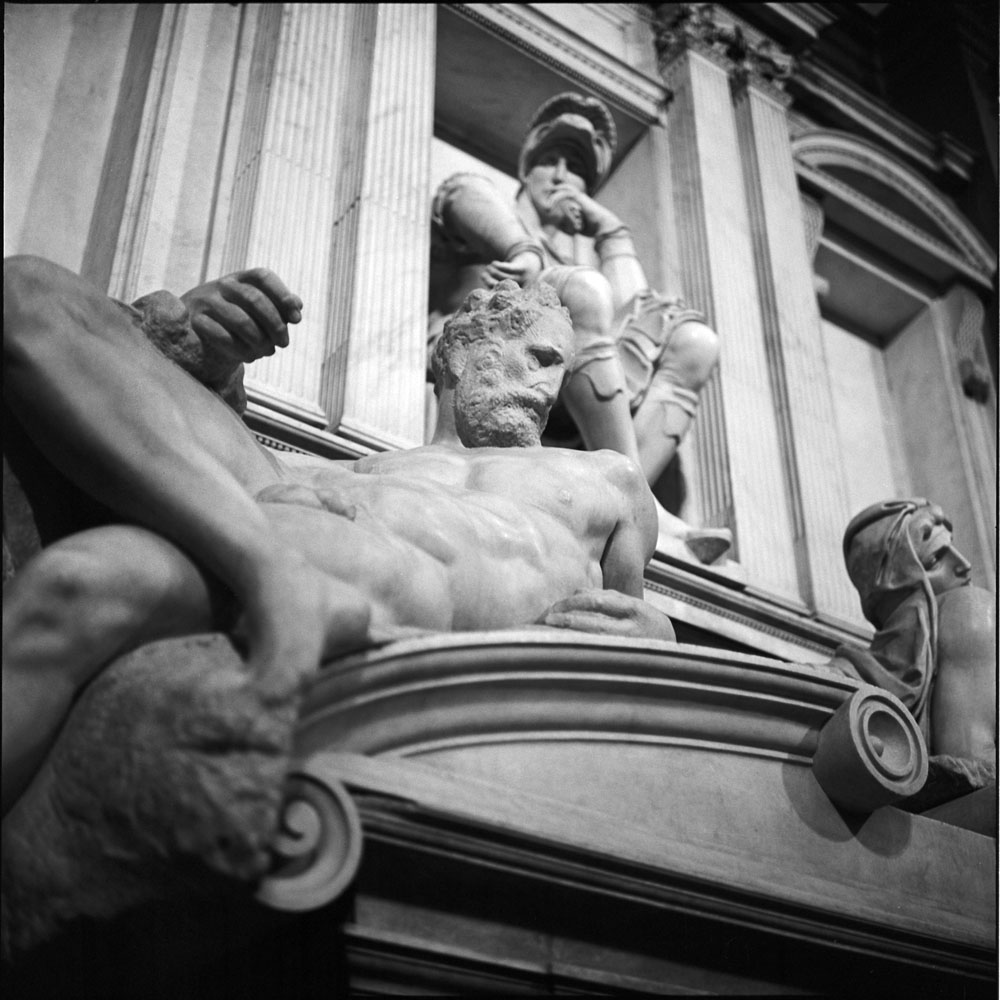
As promised in the previous post of the ceiling of the Sagrestia Nuova (also a Michelangelo design), here are the Michelangelo sculptures decorating the tombs of Lorenzo di Piero de Medici and Giuliano di Lorenzo de Medici. The great irony of this is that the greatest tombs in the Medici crypt go to the lesser members of the family – all the famous Medicis (Lorenzo Il Magnifico, Cosimo I, Guiliano, etc) are buried in the awe-inspiring-but-somber-and-over-the-top Medici Chapel, a giant domed octagonal chamber lined with dark marble mosaics and sarcophagi, or in the crypt below it.
Lorenzo di Piero de Medici, with Dusk and DawnGiuliano di Lorenzo with Day and NightDusk, Medici Tomb
The male figures of the tomb decorations both appear to be “unfinished”. While Michelangelo did leave Florence for Rome permanently before the sculptural figures were installed and all the tomb decorations complete, there is a debate in the art historical world about how “unfinished” they actually are, thus my use of quotation marks on the word unfinished. Michelangelo left behind enough sculptural works in rough form that some say he was really bad at completing projects, whereas others will argue that they are as finished as he intended them to be. Certainly his reputation as one of the greatest stone carvers ever to live has not been diminished by his “unfinished” pieces.
You can see more of his “unfinished” pieces at the Louvre in Paris and at the Accademia in Florence (the pieces at the Accademia are forthcoming in another blog post).
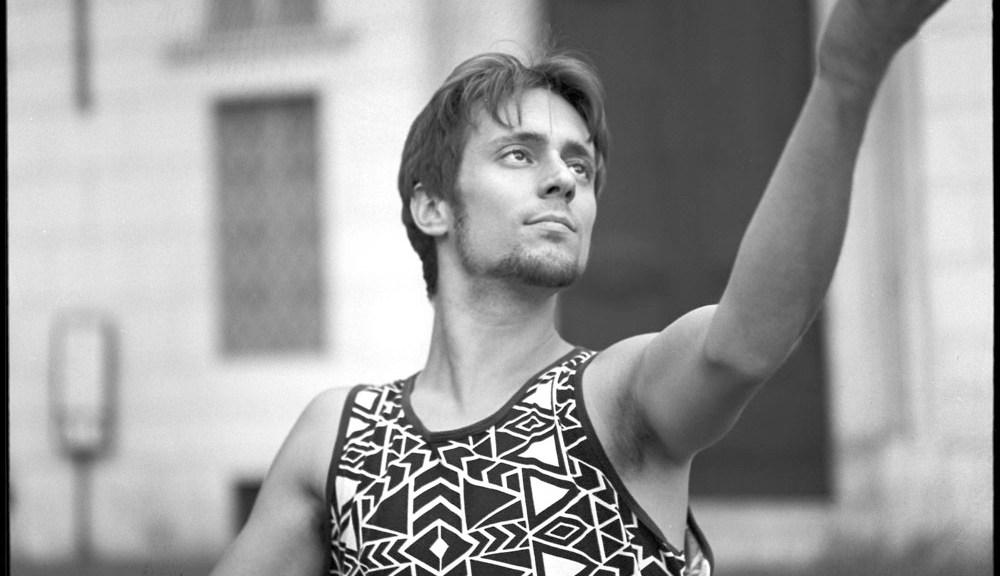
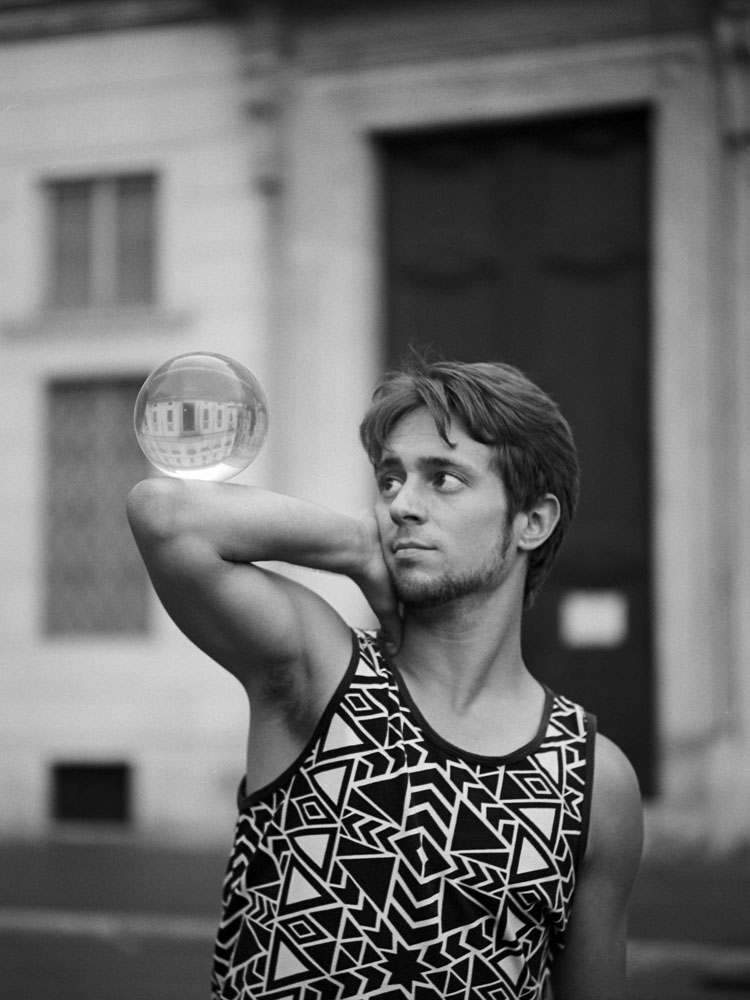
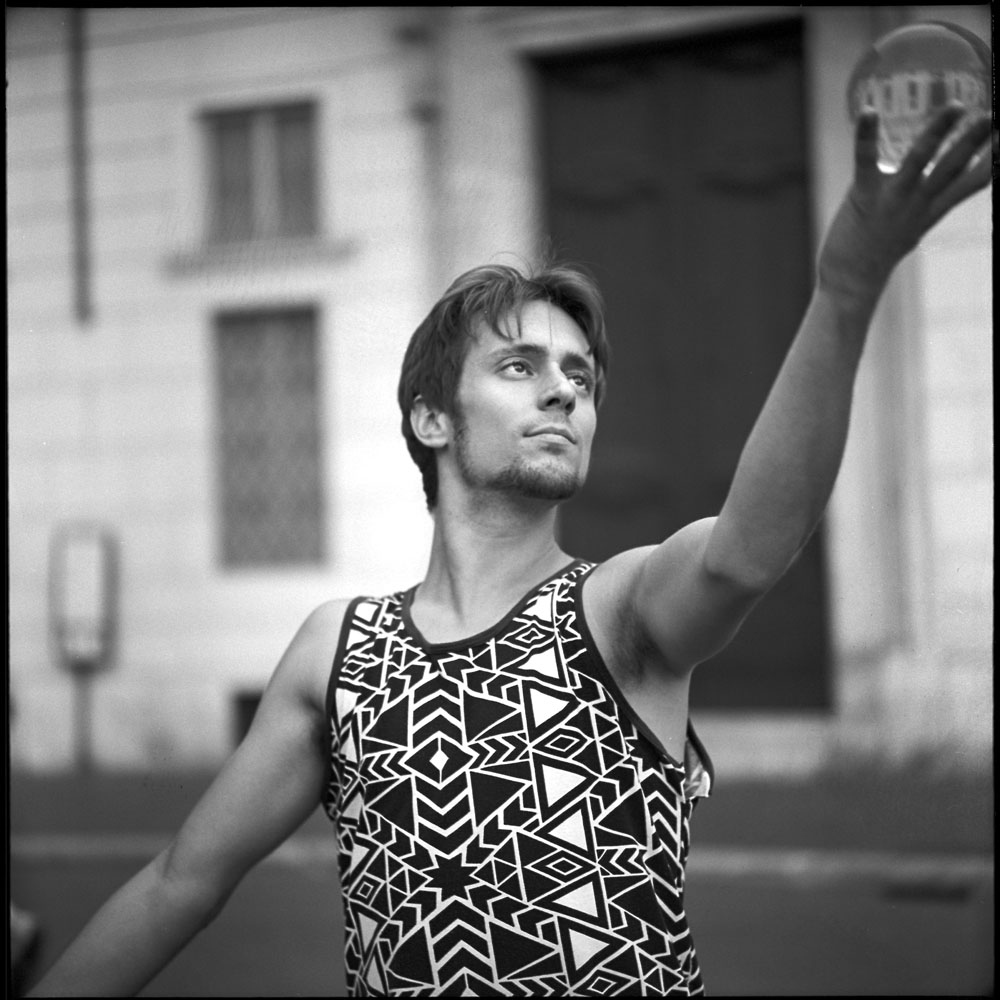
This is something I’m working on doing more of- photographing people in the wild, so to speak. I do well in the studio, where people are expecting you to take their picture, and for that matter have given you some measure of control over the experience. But “street” photography, photographing people out and about doing things where they’re not expecting to be photographed, well, that’s an entirely different animal. I find it easier to photograph people who are performing or in some other way putting themselves out there to be observed. If nothing else it’s good practice for more elusive subjects.
Juggler, Piazza Navona
This young man was out on the Piazza Navona, juggling this glass sphere. He had a sign up with his busking bowl that described it as a particular kind of juggling – I forget the term, but he would roll the glass sphere up and down his arms, across his neck behind and over his head. Here he has the sphere on his elbow, then at the end of his fingers.
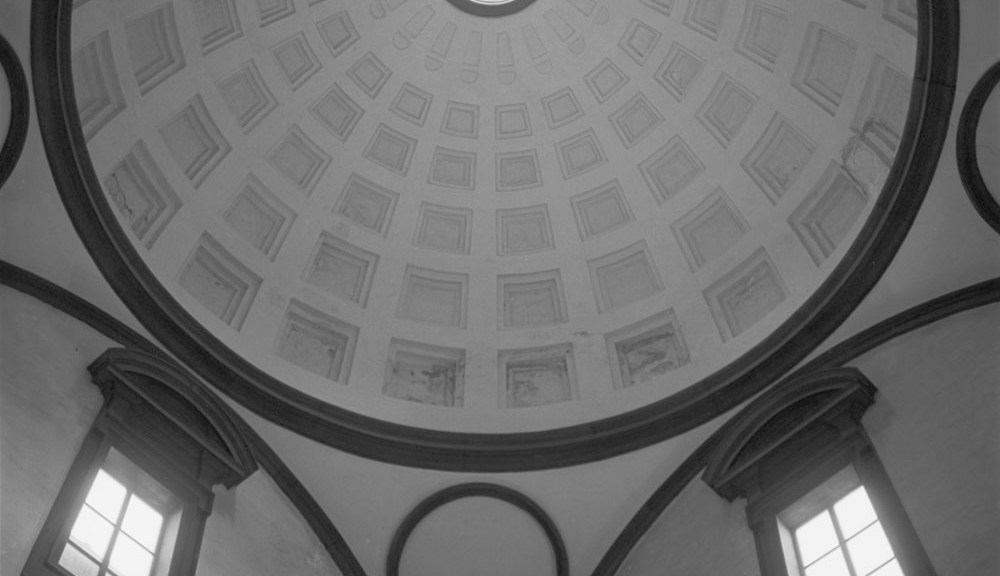
As part of my Michelangelo pilgrimage (the secondary pilgrimage, with the Caravaggio quest being the first one), I wanted to see the Medici chapel with the famous tomb sculptures by Michelangelo. Photos of those sculptures are forthcoming, but first I wanted to lead off with this architectural view of the ceiling.
Dome, Medici Chapel, San Lorenzo
I wasn’t even thinking about it when composing the shot, but in looking at it afterward, there are all these repetitions of threes in the scene – three windows in the lantern, three circles, the lantern and the windows together forming not only a trio of light sources but a visual triangle, and so on.
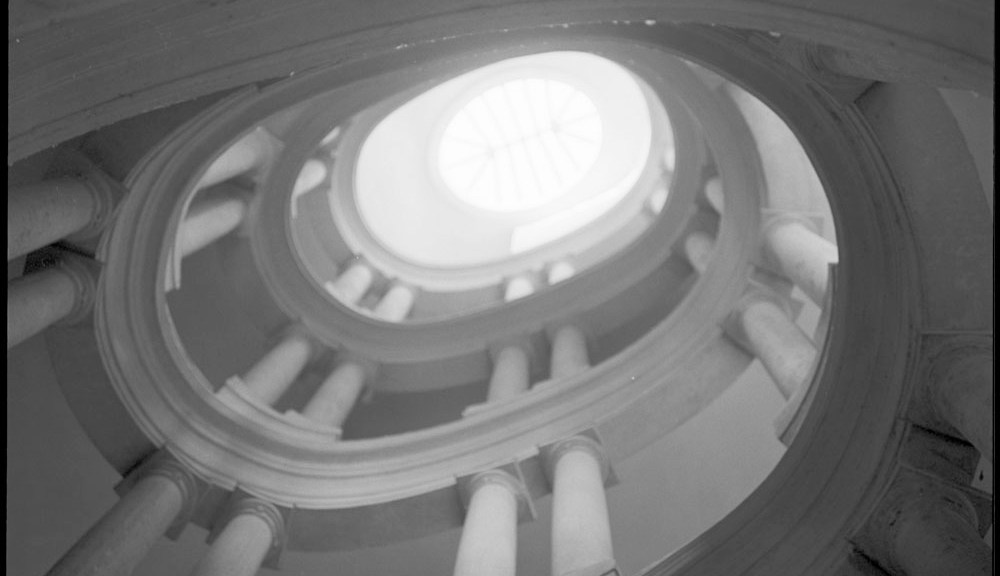
In 1625, then-Cardinal Barberini acquired a property from the Sforza family in Rome that had a vineyard and ‘palazzetto’. It was on this property he decided to build the Palazzo Barberini. He would go on to become Pope Urban VIII. He hired the famous architect Carlo Maderno to design and build his palace. Along with Maderno was his nephew, Francesco Borromini, who would go on to become one of the best known Baroque architects in Rome. He is largely responsible for the design of the facade, as well as the grand salon, and perhaps most famous of his creations at the palace, the oval staircase.
Borromini Staircase, Palazzo Barberini
Partway through construction, his uncle Carlo Maderno passed away. Completion of the project was then tasked to a new young upstart architect better known at the time as a sculptor, Gian Lorenzo Bernini. Bernini would design a second staircase for the palace, this time a square. The two, Borromini and Bernini would remain professional rivals until Borromini’s suicide in 1667.
Bernini Staircase, Palazzo Barberini
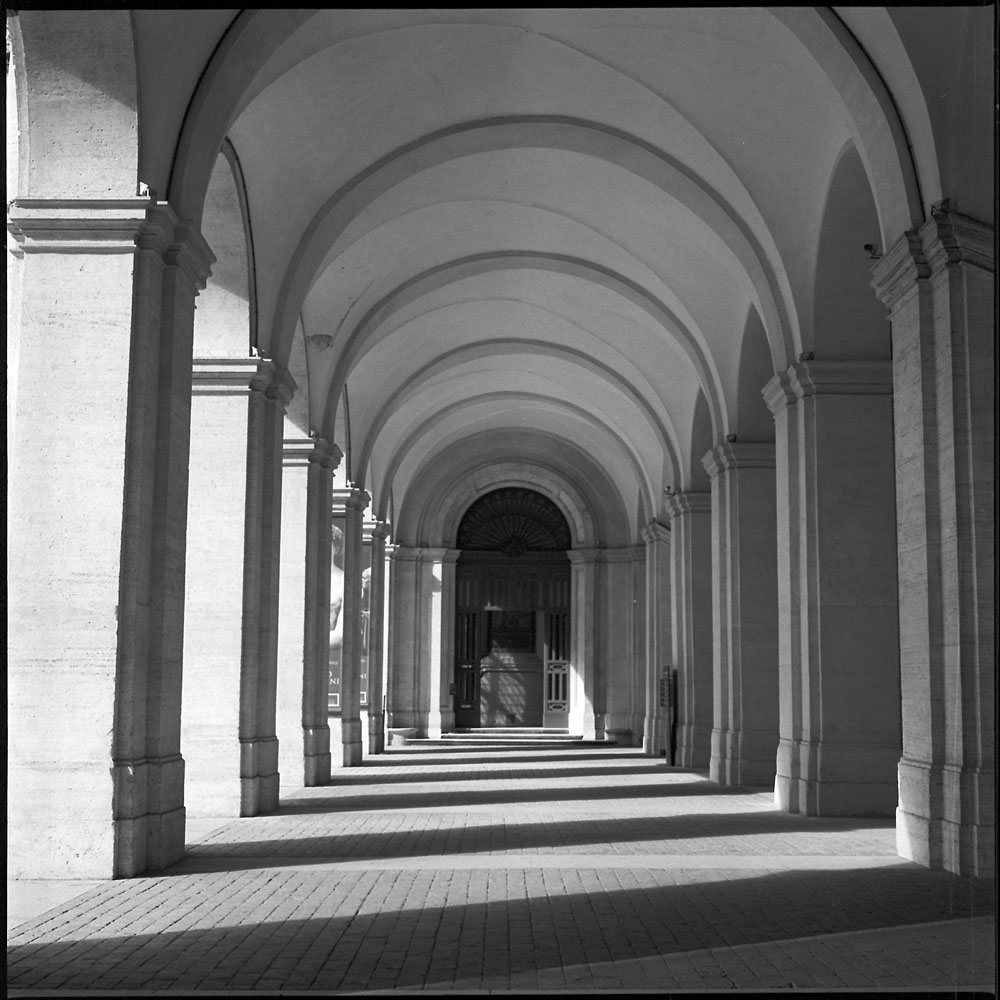
At the ground level, an arcade connects the two staircases. This shot was taken from the entrance to the Borromini staircase, looking down the arcade to the Bernini staircase entrance.
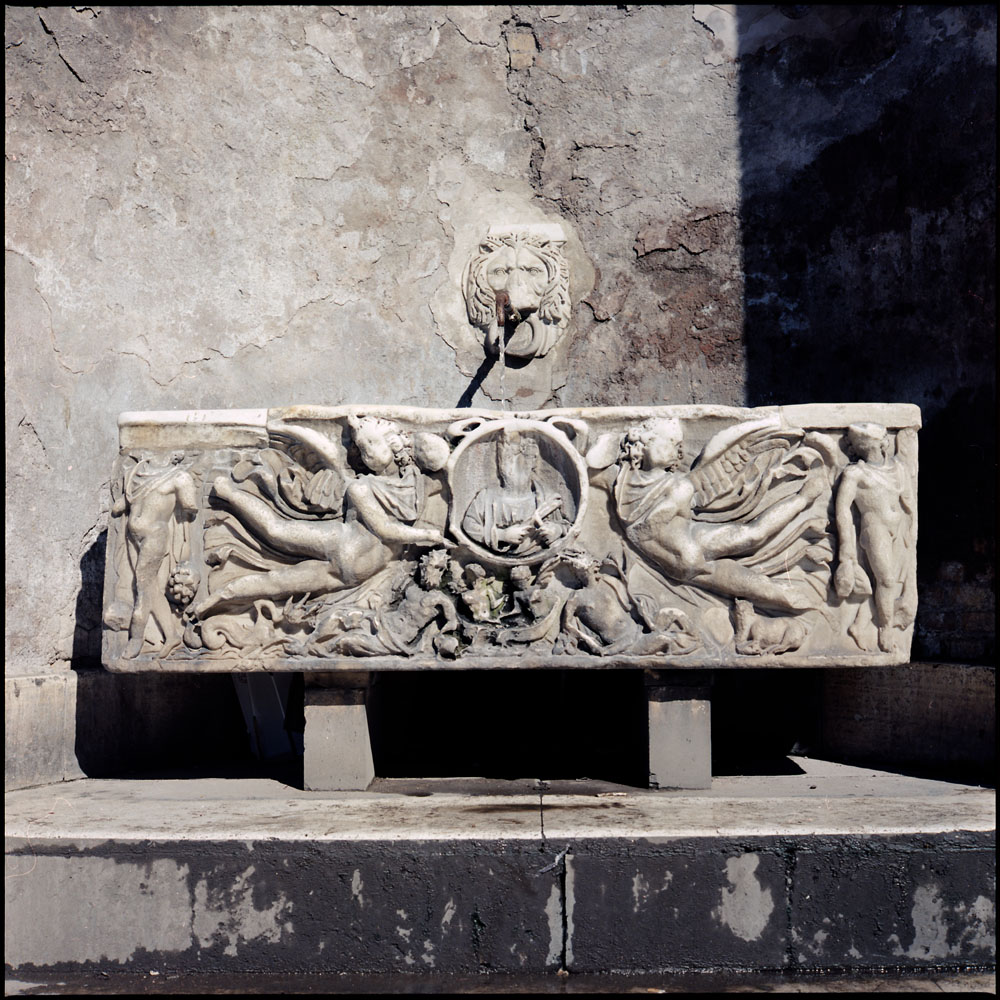
When I get finished processing all 79 rolls of film from this trip, I’ll have more of these to add, but until then, here’s a selection of public fountains. The Italians certainly love their water features and drinking fountains.
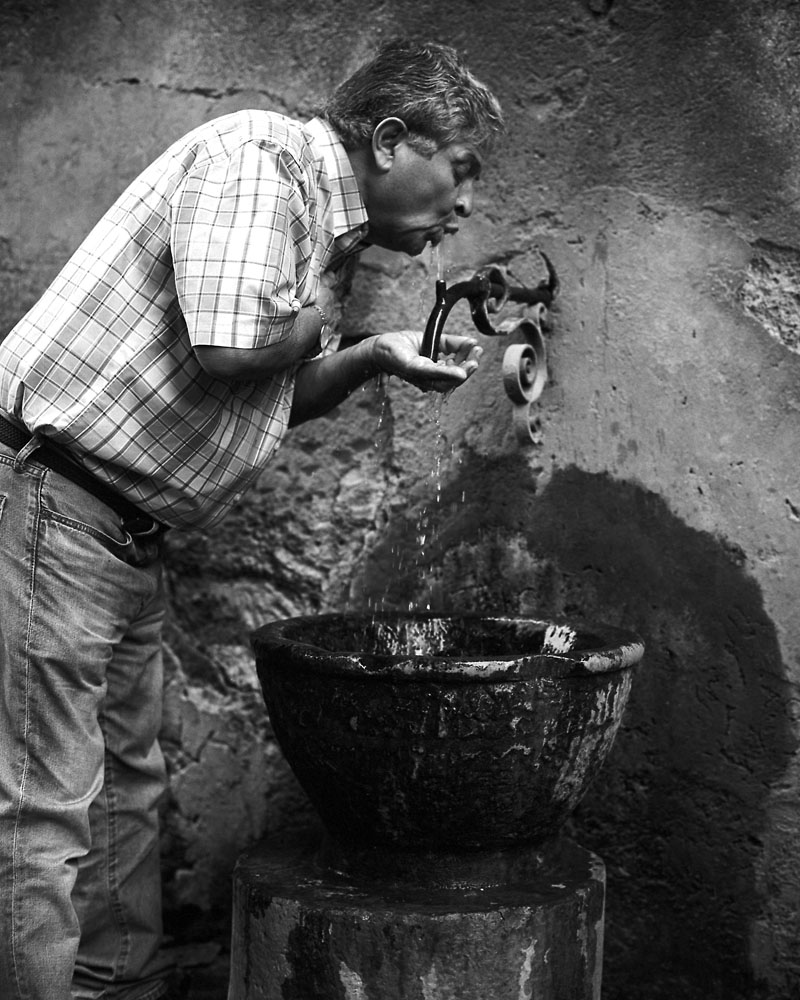
I’m certain I mentioned this before about the ancient fountain at the Colosseum, how you plug the bottom to get water to come out a hole in the top of the pipe so you don’t have to bend over to drink.
Ancient Fountain, Colosseum
Well, here you can see that in action, at a similar fountain in the Castel Sant’Angelo:
Drinking Fountain, Castel Sant’Angelo, Rome
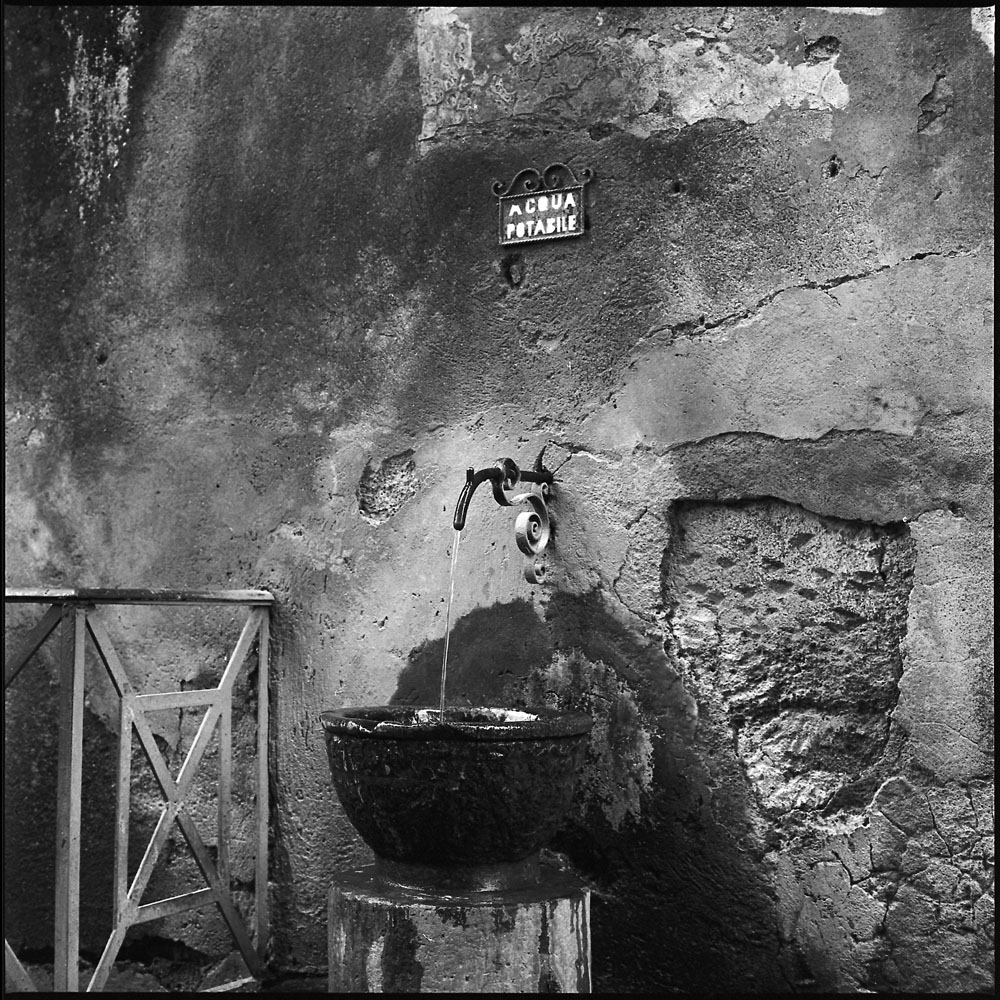
And a full view of the fountain:
Acqua Potabile, Castel Sant’Angelo, Rome
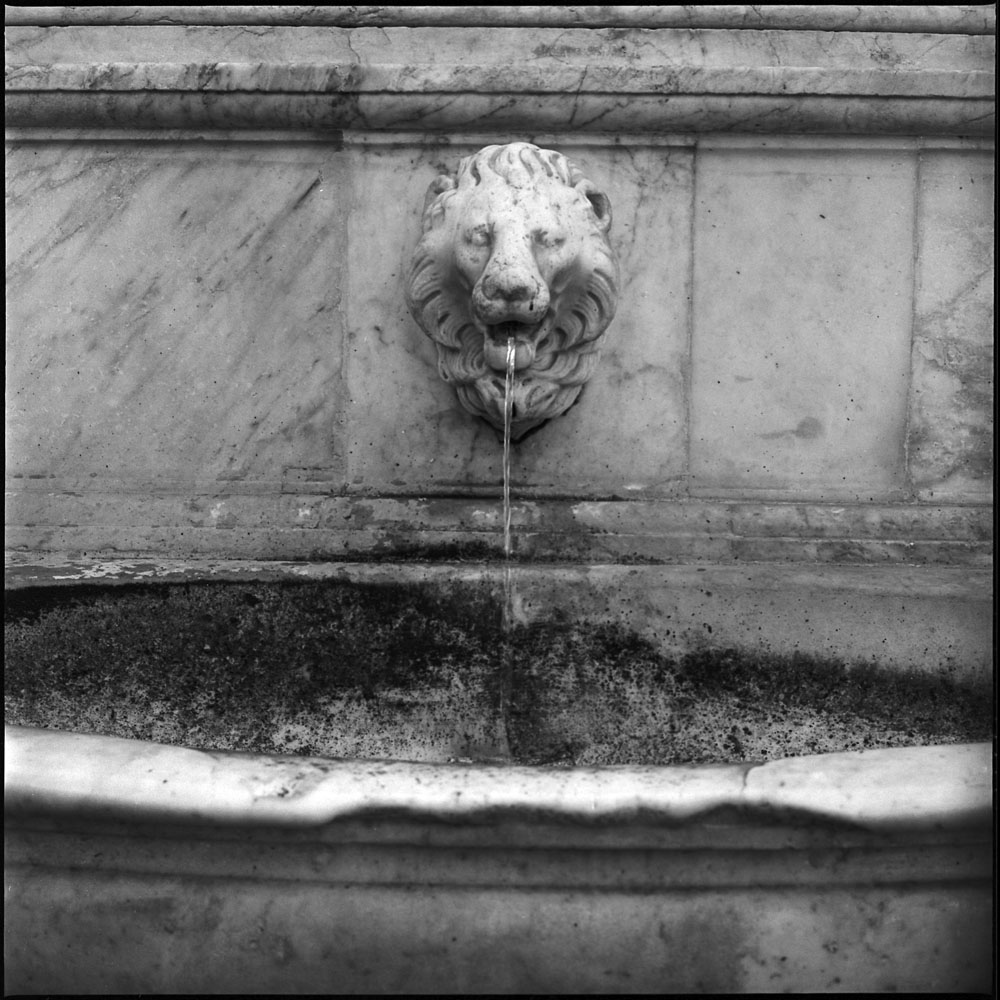
Here’s a little fountain in the piazza in front of San Lorenzo in Florence:
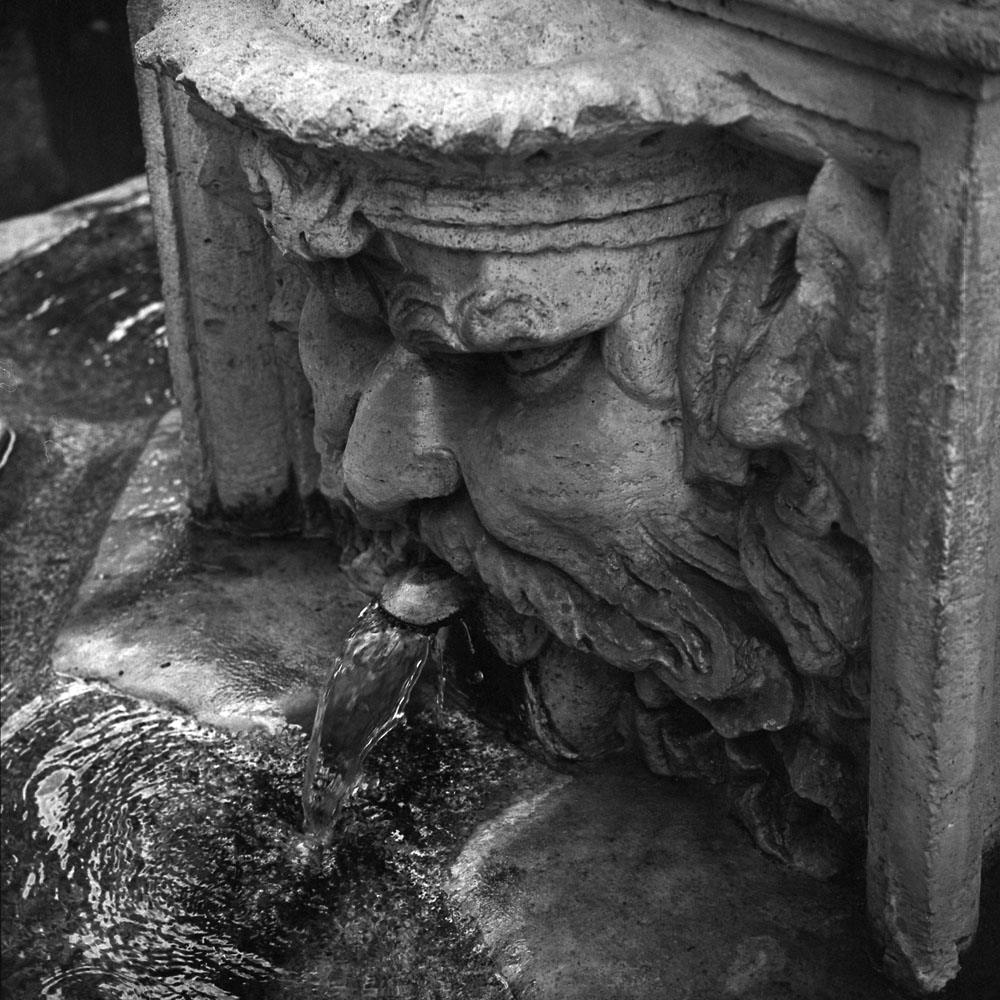
Lion Head Fountain, San Lorenzo, Florence
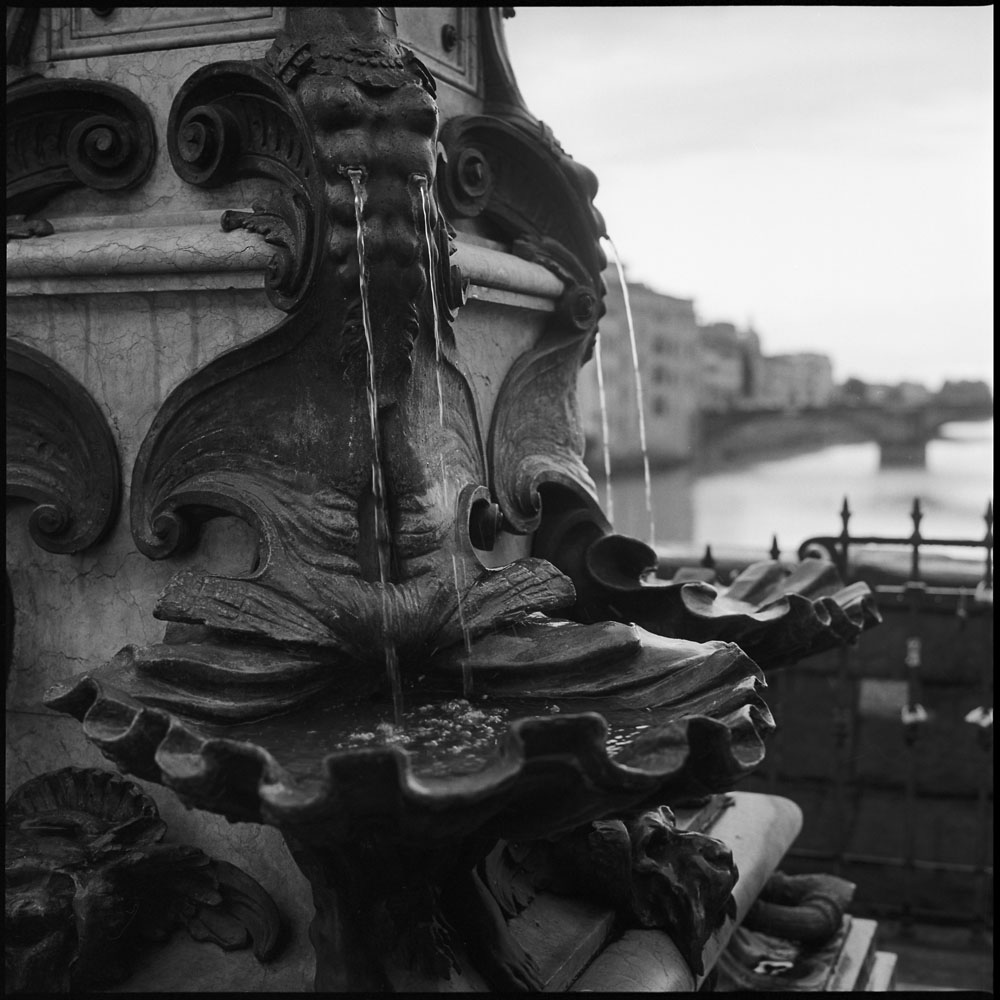
The Cellini fountain and memorial on the Ponte Vecchio. The interesting thing about it is that the fountain and memorial are 19th century, and their placement on the Ponte Vecchio is a little disingenuous.The bridge today is occupied by goldsmiths and jewelers, true, but in Cellini’s day, the Ponte Vecchio was home to butchers. Other than picking up his Saturday prosciutto, he didn’t spend time on the bridge. The modern day jewelers are just claiming inspiration from him.
Cellini Fountain, Ponte Vecchio, Florence
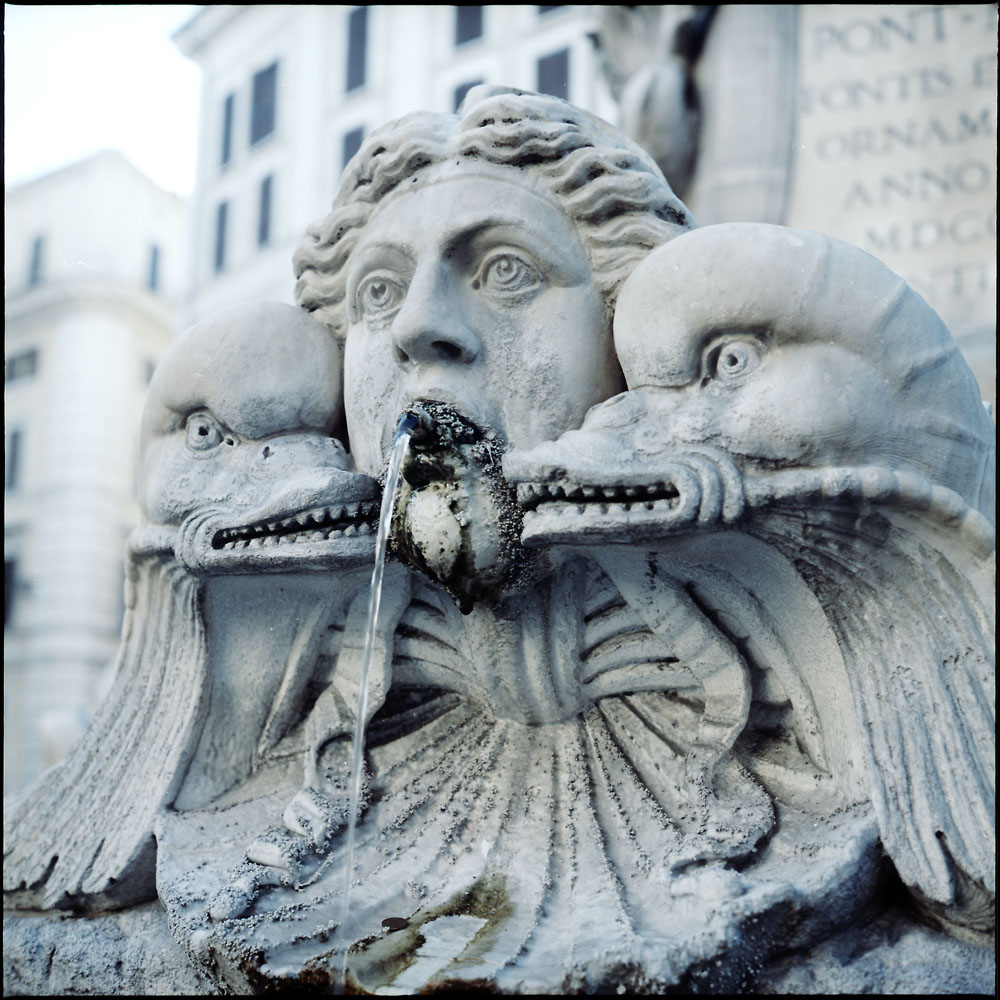
A fountain at the Pantheon, under the obelisk in the plaza in front:
Fountain, Pantheon
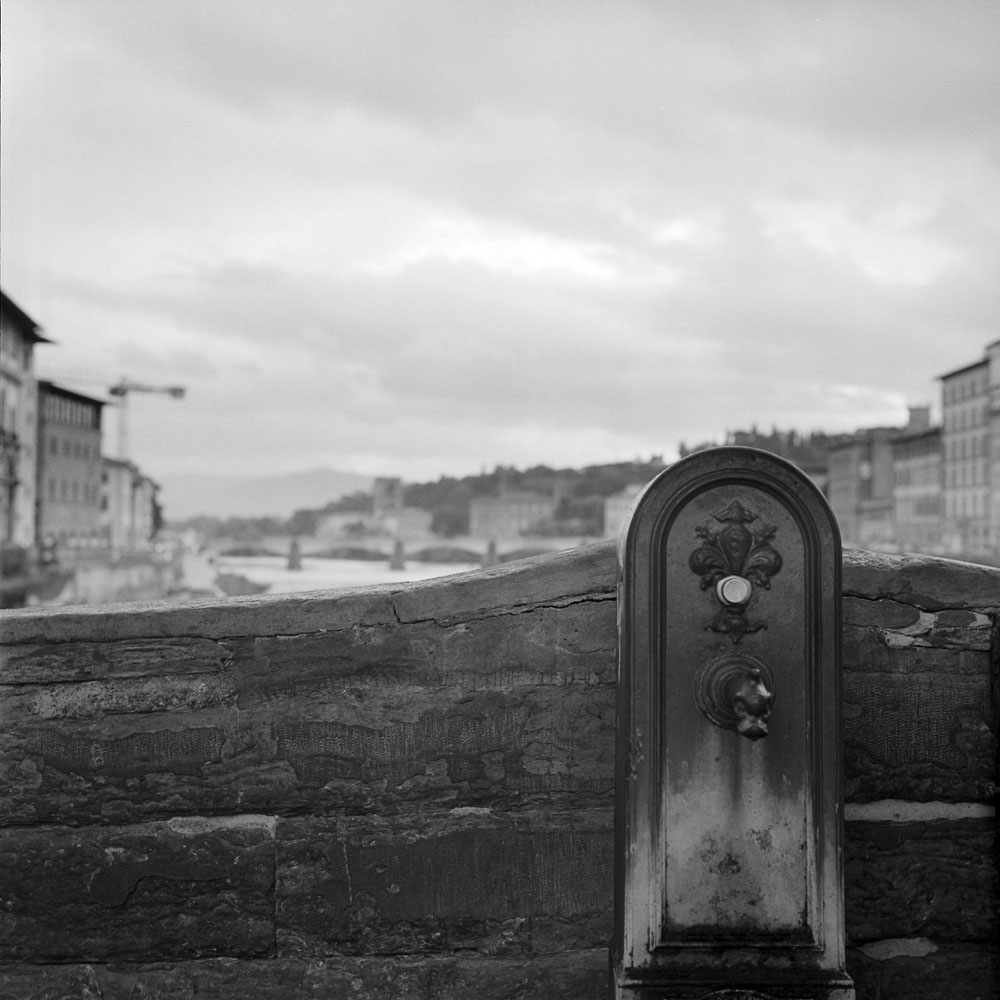
Another public drinking fountain, on the Ponte Vecchio, in Florence. This one is actually a drinking fountain, whereas the Cellini monument is purely decorative.
Drinking Fountain, Ponte Vecchio, Florence
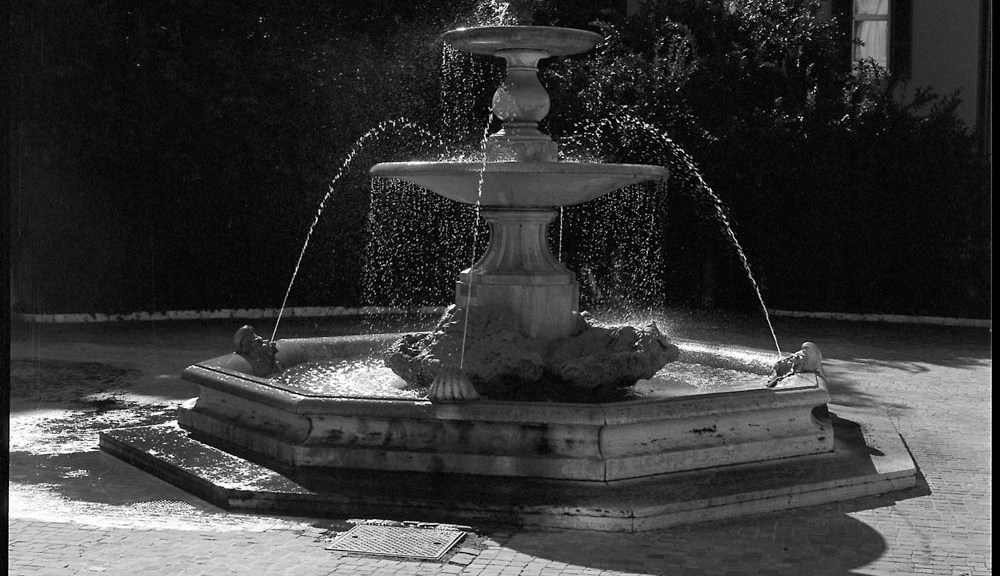
The fountain in the forecourt to the Palazzo Barberini, backlit by the afternoon sun:
Fountain, Palazzo Barberini
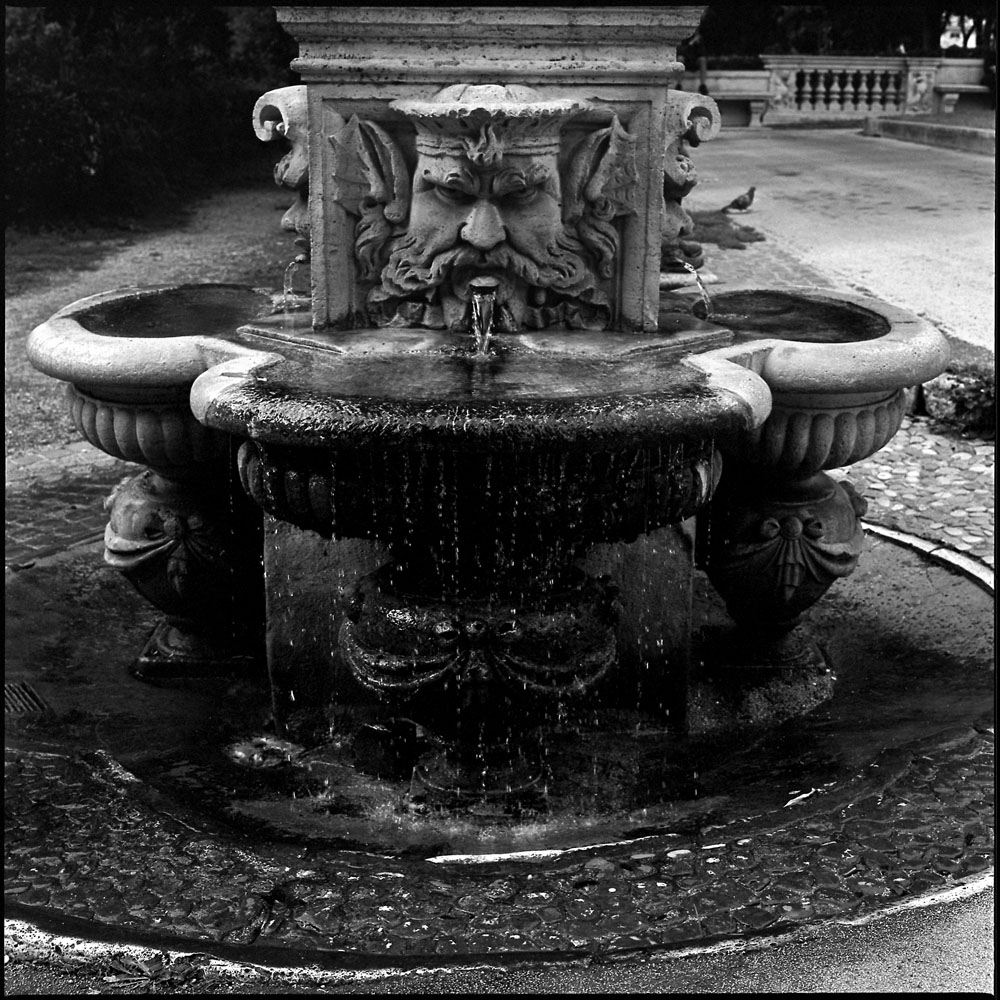
A fountain in the Villa Borghese park, directly in front of the Palazzo Borghese:
Fountain, Villa Borghese, Rome
A closeup detail of the Villa Borghese fountain:
Fountain, Villa Borghese Park, Rome
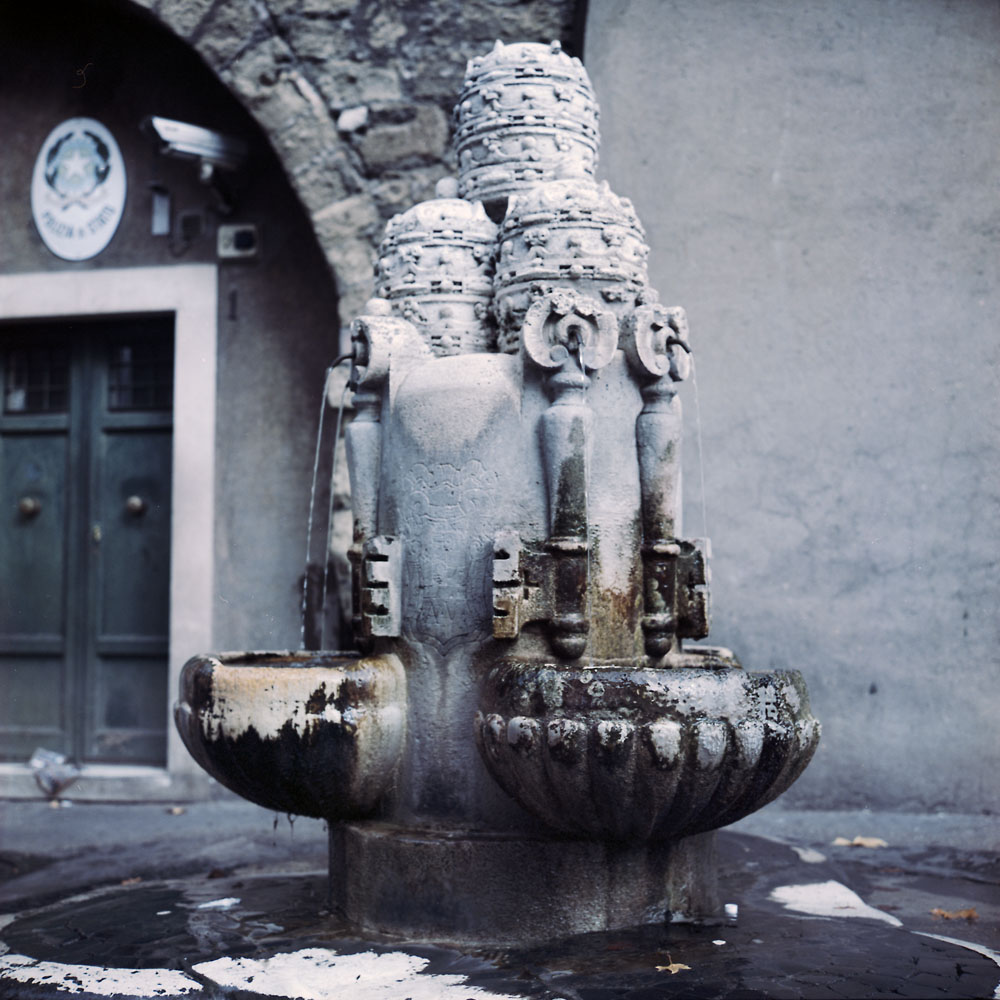
A fountain outside the Vatican, with the water spigots emerging from the heads of Papal keys, crowned by a quartet of Papal tiaras:
Papal Tiara and Keys Fountain, Vatican
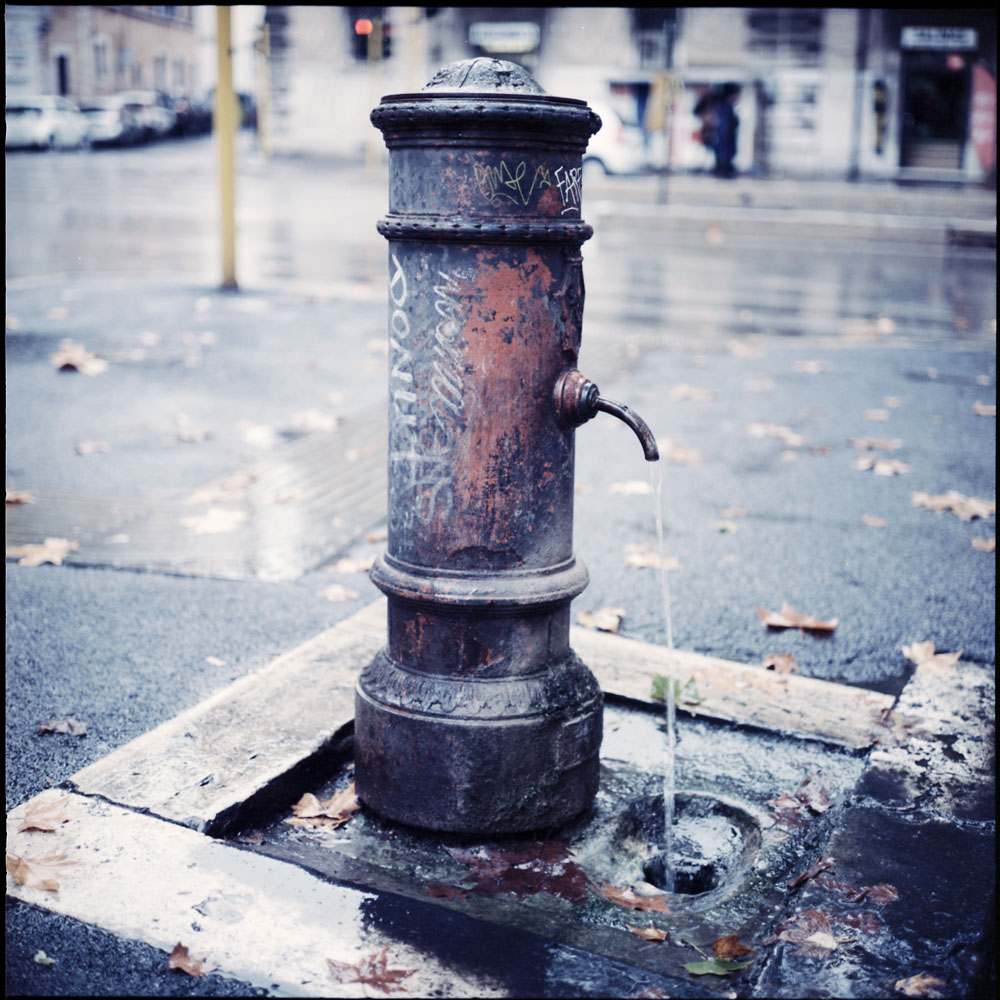
A garden-variety public drinking fountain in Trastevere, the neighborhood where I lived in Rome:
Water Fountain, Trastevere, Rome
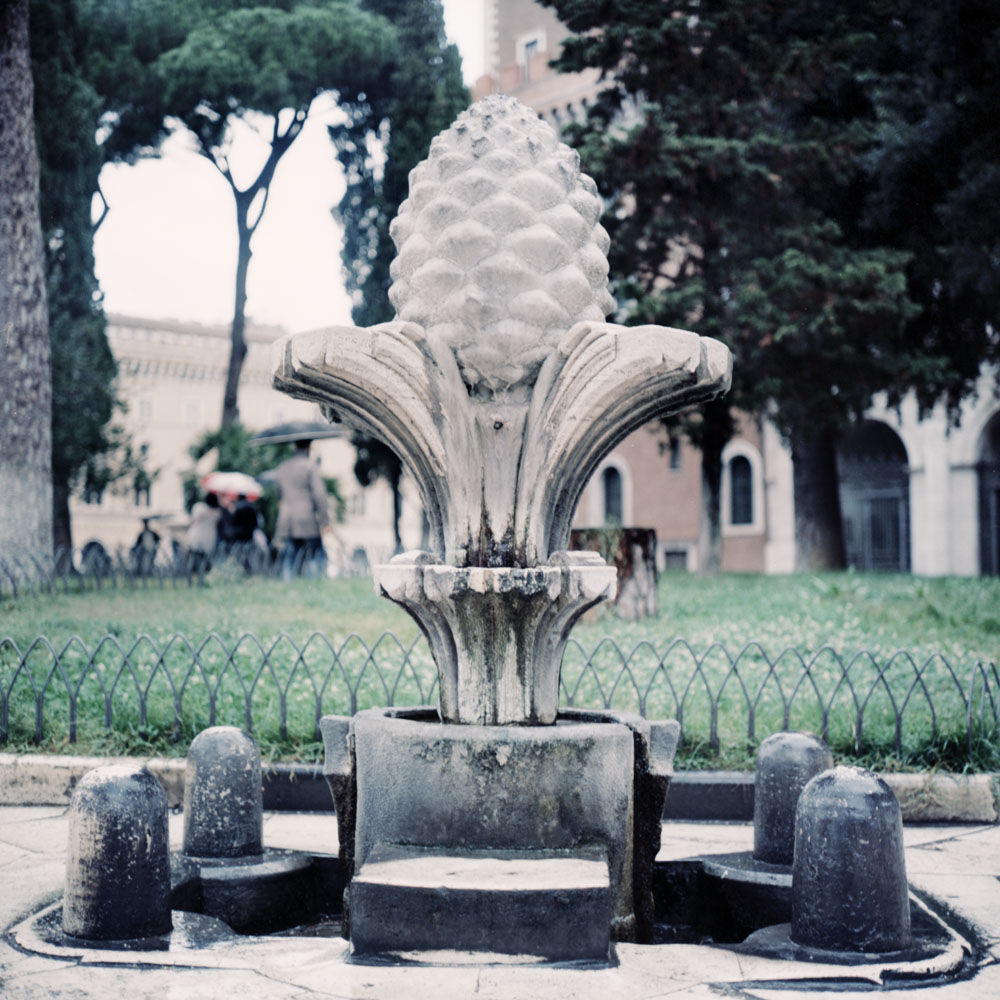
A fountain crowned with a pinecone finial in the Piazza Venezia, especially appropriate decoration as it sits beneath a canopy of the famous pines of Rome.
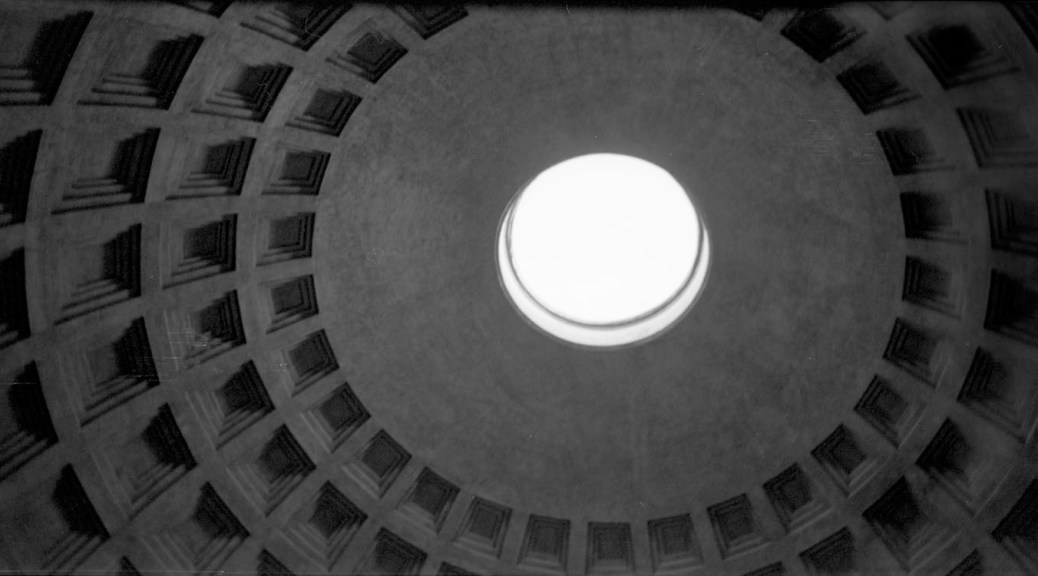
Here’s a shot I took of the oculus of the Pantheon with my Belair X6-12. The camera has its issues, one of which is the relatively low contrast from its plastic lenses. Most of the time. Here’s a circumstance where it works to my advantage- the interior of the Pantheon is so dark, and the main light source being the oculus, it’s very contrasty. The flat lens on the Belair helps bring out shadow detail where there wouldn’t be as much.
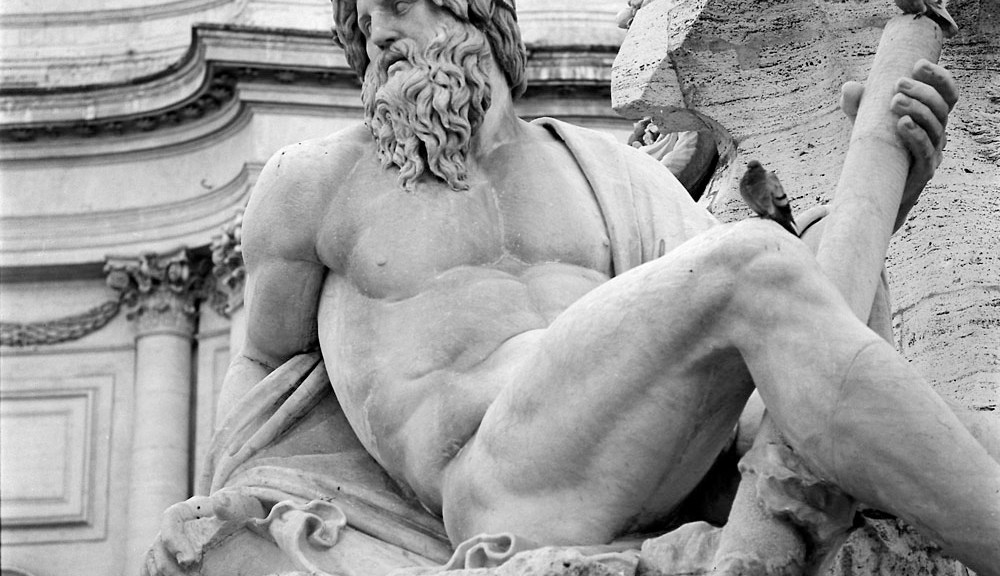
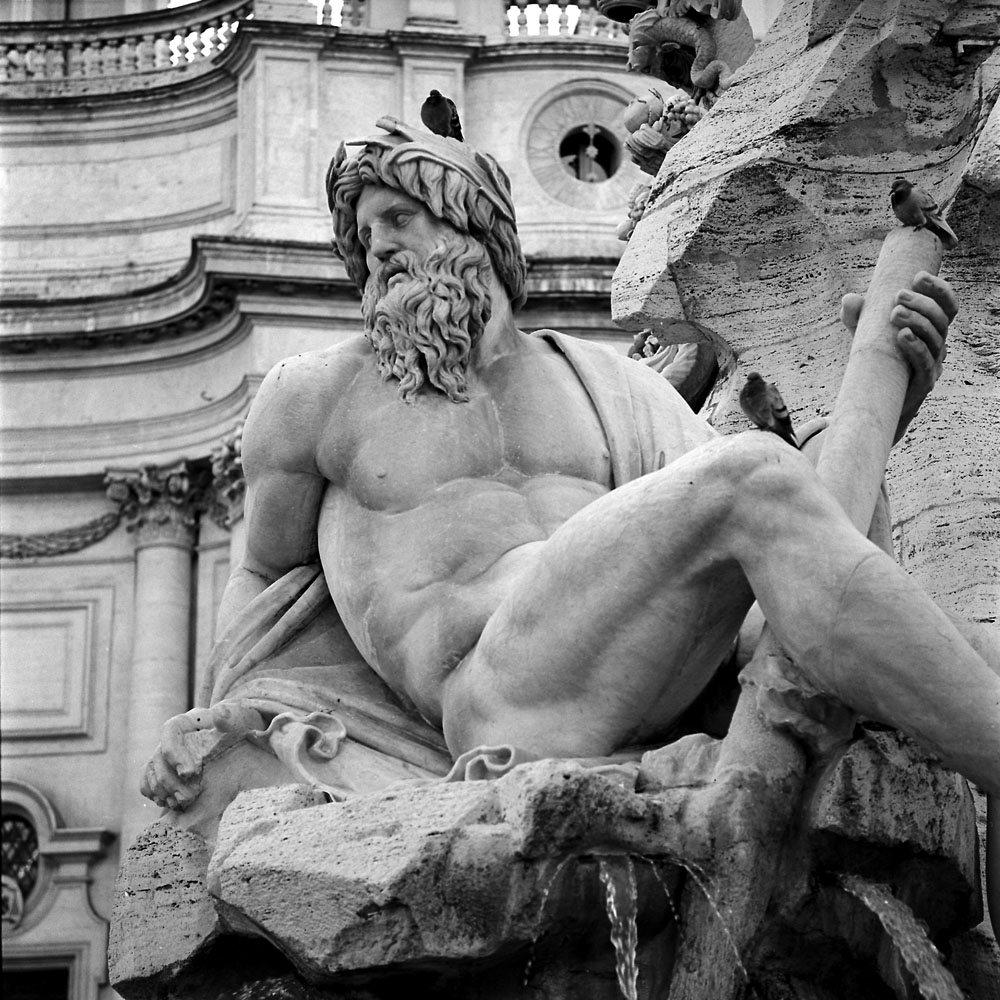
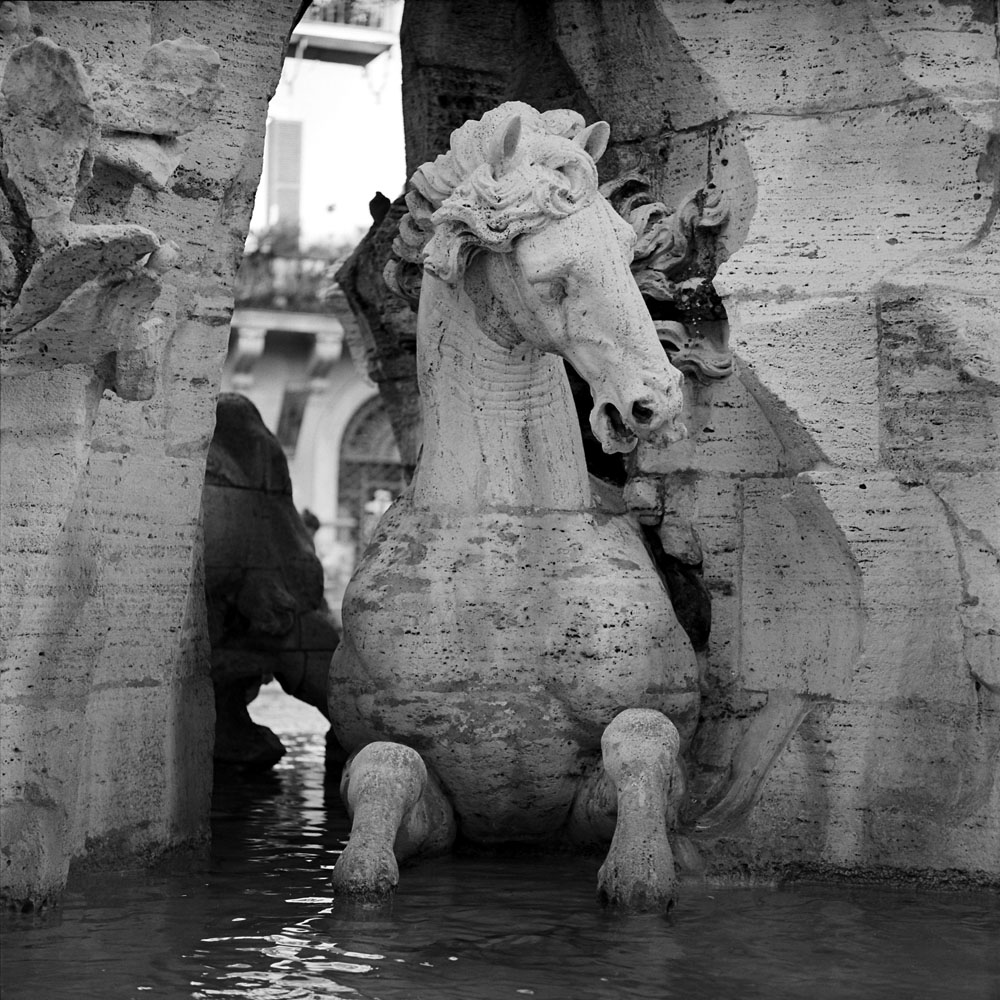
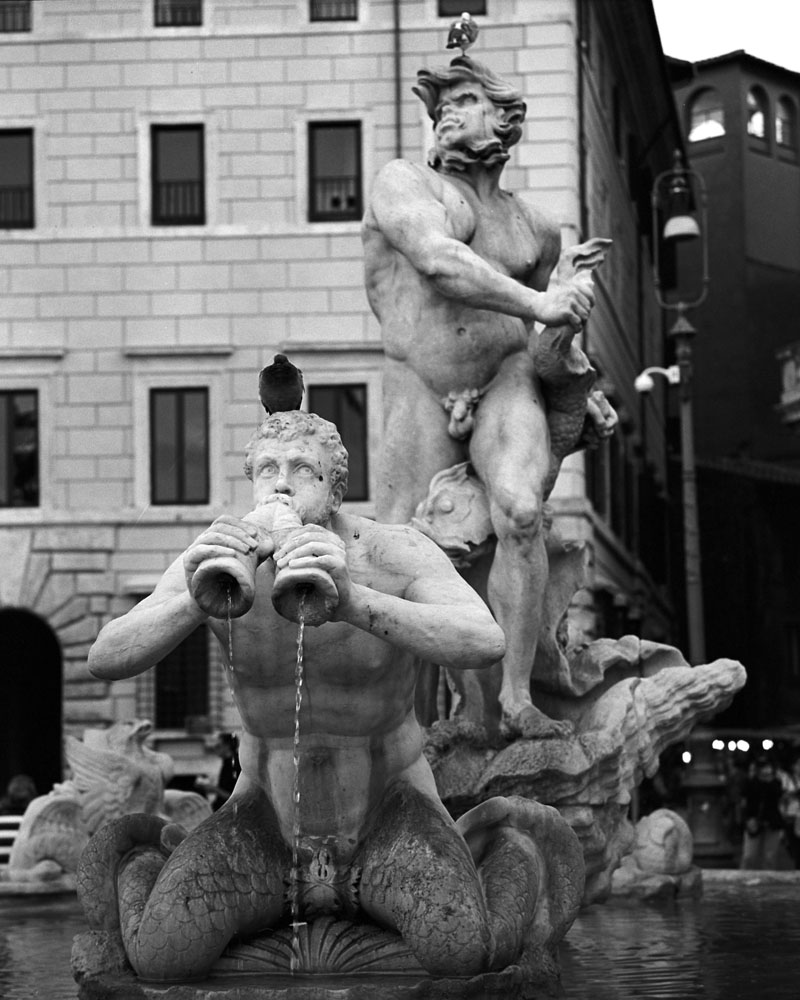
Here are a few shots of the fountains in the Piazza Navona. I chose to photograph details rather than try to take in the whole fountain because there were just too many people in, on, and around the fountains.
River God, Four Rivers Fountain, Piazza NavonaHorse, Four Rivers Fountain, Piazza NavonaTrumpeting Merman, Fountain, Piazza Navona
The piazza is pure chaos – think Times Square but shorter, with much better decoration. There are performers on the piazza doing everything from live music to juggling acts to “living statues” – there was a fake Fakir made to look like he was floating in mid-air, supported by nothing more than an off-center cardboard mailing tube. The fountains, though, are the real stars of the place. They moderate the heat in summer, and provide stunning visual delights in all four seasons. I know it seldom snows in Rome, but I’d love to see them blanketed with a layer of white.






 dcphotoartist