Category Archives: Antique Processes

Katherine Thayer memorial exhibit and call for entries

Lightbox Gallery call for entries – Katherine Thayer memorial Gum Bichromate show

Regular readers of my blog will probably remember the notice I posted last year about Katherine Thayer’s passing. Katherine was a tremendous gum bichromate printer and an extremely generous teacher of the process. Lightbox gallery in Astoria, Oregon is organizing a commemorative exhibit and has put out a call for entries for the show (link above).

To reprint the notice on the LightBox web page,

LIGHTBOX PHOTOGRAPHIC GALLERY CALL FOR ENTRIES
Two Friends Who Never Met

An Exhibit of Gum Bichromate Prints
In Memory and in Honor of Katharine Thayer
featuring the work of Katharine Thayer and Diana Bloomfield

with a juried exhibit of Gum Bichromate Prints
Juror – Diana Bloomfield
Diana’s bio

We welcome you to share in the beauty of the hand-made print, and specifically, the gum bichromate print,
with a juried exhibit as part of this memoriam for Katherine.
This exhibit serves to illuminate Katharine’s artistry— her admiration for, dedication to, and mastery of gum printing.
This exhibit also celebrates her legacy and her years-long friendship with Diana.

I had a mental picture of the kind of photograph I wanted to make. I had never seen any photographs like them, but I was determined to find a way to make them, these pictures I saw in my head. Their colors were soft and relatively unsaturated, but with a kind of glow about them . . . I set out first to teach myself to print in gum, then to adapt the method to produce the kinds of pictures I wanted to make, and have been making them ever since – Katharine Thayer – katharinethayer.com

Katherine Thayer was a long-time resident of Oregon and a masterful gum bichromate printer. She was also a generous teacher to those who struggled to learn this ultimately rewarding, yet often challenging, 19th century printing process. In Katharine’s words, “learning gum printing involves some trial and error, and there’s no short cut to mastery; a person successful in mastering the process will have some staying power and possess a sense of humor and some tolerance for failure.”
Katharine was also a decades-long member of “The List” , an Alternative Process listserv— a free and open online discussion list related to all things ‘alternative’ in the photographic printing world. For Katharine, of course, this meant gum printing. Currently, over 600 people world-wide are members of this List, and this is where Diana Bloomfield, a native North Carolinian, photographer and printer, first met Katharine. In the middle of teaching herself to make gum prints, Diana gleaned invaluable bits of information from those on the List, but she learned the most from Katharine and from her website (KatharineThayer.com). In the midst of all the questions, and in-between Katharine’s tireless mentoring, the two became good friends. They corresponded via email almost daily, and they were once in a group pinhole exhibit together in the Seattle area. Diana was also in a group exhibit at LightBox, where Katharine was a frequent visitor. Still, they never met.
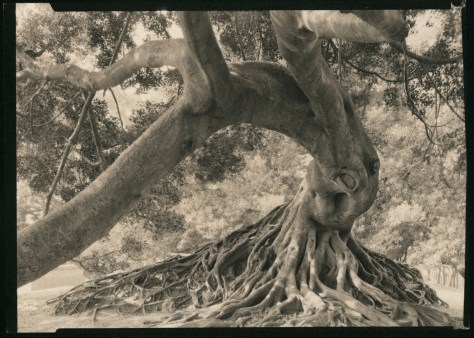
Selected Finalist in the Rangefinder Alternative/B&W Competition – Ficus, Recoleta

FicusRecoletaPD57

The judging is done, and my Ficus, Recoleta has been selected as one of the finalists in the Rangefinder Alernative Process competition. I’ll find out how well it does when the April issue of Rangefinder is published. The print is still available if anyone is interested.

My entry in the Rangefinder Alternative/B&W Competition – Ficus, Recoleta

FicusRecoletaPD57

Please vote for my entry in the Rangefinder Alternative/B&W Competition People’s Choice awards! This is my (in)famous Ficus, Recoleta shot that I took in Buenos Aires. The tree is outside Recoleta cemetery in a little park, and the tree roots themselves that you can see are over 6′ (2m) tall, to give you a sense of scale for the tree. The print is a 5×7 palladium print on heavy weight paper. And it is for sale should anyone be interested! The prints are available in an edition of 10, starting at $250. Please click on the image to go to the competition web page to vote! And while you’re there, browse around and see all the other incredible work submitted.

It Pays To Research BEFORE You Post, or, Daguerreotype Conservation, Part Two

http://britishphotohistory.ning.com/profiles/blogs/nano-scientists-attempt-to-save-disintegrating-artworks?xg_source=activity

Quoted in full:

The recent article in the Scientific American magazine paints a picture of doom and destruction for daguerreian art pieces. Of course this is disconcerting for collectors and institutions that have significant investment in these beautiful objects. The author implies that degradation surrounding some Southworth and Hawes daguerreotypes in the Young America exhibition can be applied to all daguerreotypes when he writes “The vanishing images suggested that any daguerreotype could spontaneously crumble.” This sky-is-falling statement in my opinion does not represent the majority of daguerreotypes.
Lets review this issue.
Approximately 160 Southworth and Hawes daguerreotypes were exhibited over two years at three institutions. Five plates changed significantly with an obscuring white haze, and supposedly 25 plates changed slightly. The majority of the plates did not change at all.
From personal experience I can tell you that I have 19th century daguerreotypes as well as my own daguerreotypes that have been on continuous display on my studio for 10+ years with no sign of change. This is my argument against the claim that daguerreotypes are light sensitive.
What every collector or institution must know is Southworth and Hawes plates have a very unique storage history contrary to the norm. The great majority of S&H images that remain were plates retained by the studio stored completely unsealed in plate boxes. They were sold in this condition through Holman’s bookshop in the 1930’s. and early 40’s. As they migrated to private collectors and institutions they were sealed using what were thought of at the time to be proper conservation materials. A typical preservation package used by the George Eastman House from the mid-1970’s to 1999 consisted of 4-ply buffered board with a paper binding tape, and a buffered die cut paper mat separating the plate from the glass. The buffering agent is 3% calcium carbonate to provide an alkali reserve of ph 8.5.
A significant case in point. In 1999, a trove of Southworth and Hawes daguerreotypes were discovered in the garage of David Feigenbaum after his death. A team of conservation professionals from the George Eastman House were asked to prepare the plates for auction at Sotheby’s. Over 200 plates were housed in the materials described above. A collector who purchased a Southworth and Hawes daguerreotype from the David Feigenbaum sale brought it to me to replace the conservation housing with an 19th century brass mat, preserver and case. I retained the die-cut buffered mat and backing board. Soon after, I made a daguerreotype that I felt wasn’t good enough to frame in my own passe-partout housing design, but I wanted to preserve it as I had made it in collaboration with my friend Irv Pobboravsky. I placed the daguerreotype behind glass using the die-cut mat I retained from the Feigenbaum sale held together with spring clips and placed it in a zip-lock back. It was stored in the dark for approximately four years. It now has a very definite obscuring white haze adjacent to the mat. While this is not a scientific experiment, it does provide a significant observation and cause to question if the housing materials are contributing to the deterioration of the plates.
I have experienced the “white haze” phenomena on other of my contemporary images as well as on 19th century images that have been in contact with buffered board. What is good for the conservation of paper, ie alkaline buffering, is not necessarily good for daguerreotypes.
In reviewing the conservation efforts for the Young America Exhibition I learned that plates were not removed from their buffered mat board and die cut preservation packages. These were placed intact into extremely well sealed secondary housings incorporating shallow copper pans to act as pollutant scavengers. A complete overview of the conservation for this exhibition can be found here.
http://notesonphotographs.org/images/1/1e/Young_America_design_for_…
If the buffered materials are a co-factor in the formation of “white-haze” deterioration it would explain why even with the best intentioned conservation, some plates still changed during exhibition. A questionable environment was enclosed within a stable one.
This remains to be explored and I hope to soon analyze the plate and mat from my example. I present this scenario as a possible alternative and/or co-factor to the silver-chloride scenario presented in the Scientific American article.
In closing, I would say that daguerreotypes are among the most stable of photographic objects providing the housings are intact to prevent atmospheric pollutants from reacting with the silver surface and that the housings themselves are not contributing to the problem. The nature of the mechanism of deterioration particular to a small percentage of Southworth and Hawes daguerreotypes is not yet fully understood. The findings reported in the Scientific American article should not prevent us from exhibiting, collecting or enjoying these amazing photographs. It is prudent, as has been shown by the Young America exhibition, to accurately document any daguerreotype intended for exhibition and carefully monitor it at regular intervals to note any changes.
sincerely,
Mike Robinson
Daguerreian Artist
President of the Daguerreian Society

This certainly adds a new wrinkle to the previous Scientific American article. It also goes to show that just because an article comes from a reputable source does not necessarily mean it is accurate. My bad. This bears further following, and I will post updates as I find them. That said, I would still be careful in exhibiting Dags to prevent unnecessary degradation.

Daguerreotype Preservation issue

More student work from Advanced Topics in Platinum/Palladium

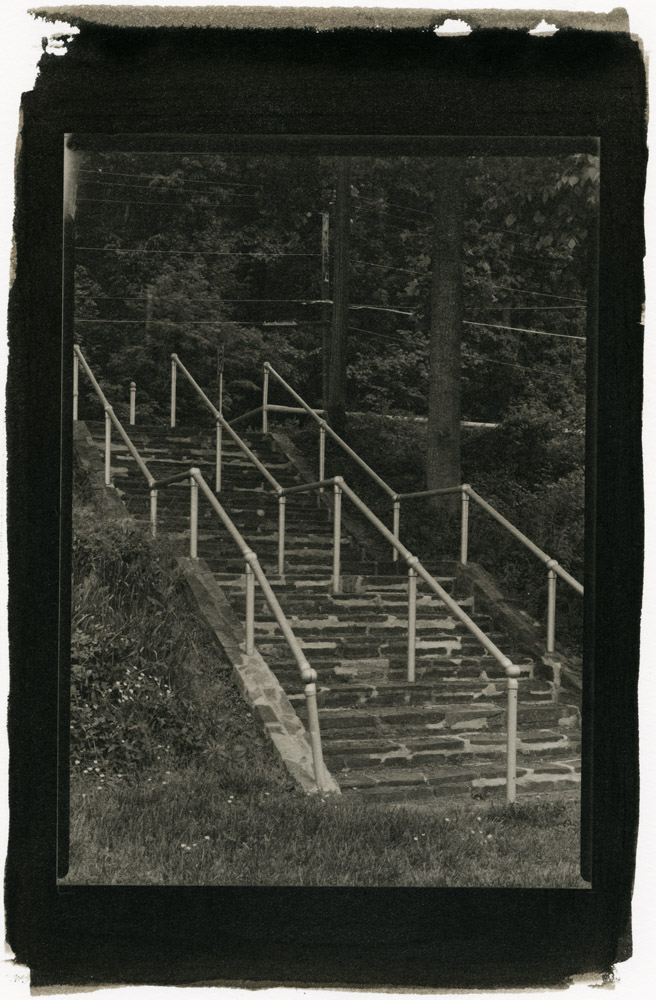
Trolley Stairs, Glen Echo Park

This is a blended platinum/palladium print (60% platinum, 40% palladium) print, on Bergger COT320 paper. This was by a student from my Intro class, but I reprinted it for this session (the student left the negative behind after the Intro class, and I happened to really like the shot anyway). This one was coated using a glass rod as opposed to a brush, to demonstrate the difference in the coating technique, and the final appearance of the print.

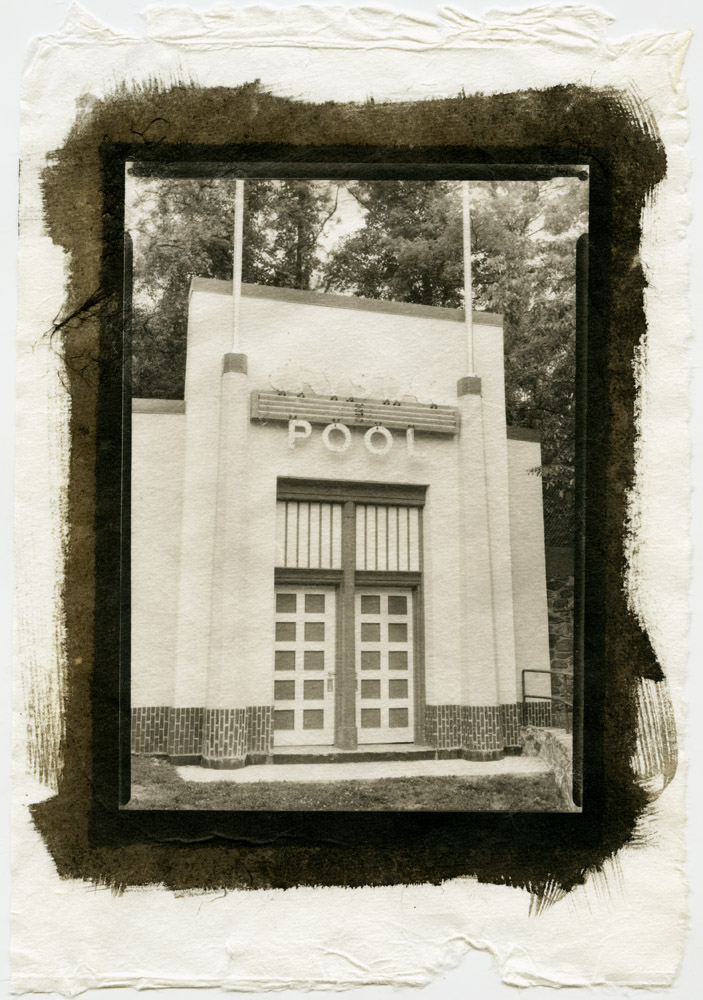
Crystal Pool, by Patrick Brown

This is a palladium print on light Kozo paper, by Patrick Brown, one of my students in Advanced Topics. He was also in my Intro class. It’s so nice to get follow-on students so you can see their progress!

Kozo paper is a Japanese paper made from tree bark, and it is surprisingly strong for as delicate as it is – this is perhaps a 90 lb paper. It does have a tendency to dissolve in aqueous solutions, but if properly masked when developing, the image area can be preserved, even if the edges do get fringed a bit. This is a perfect example. I included the paper margins to show more clearly what the paper texture looks like.

We had some challenges this class session – the original idea was to try out some different paper types, and I had obtained a sampler of several kinds. We started the morning with Stonehenge, which was supposed to be a good paper, but something was dramatically wrong with the batch we got, as we were making 30 minute exposures and still coming up weak and flat. After this is over, I’ll get a little more for myself and try pre-acidifying it to see if that helps, but no mention of acidification was made in the sample kit and I couldn’t find any reference to acidifying it online. Fortunately we didn’t waste too much time before figuring out it was the paper at fault and not the chemistry, and life moved on.

Student work – from my Advanced Platinum Printing course

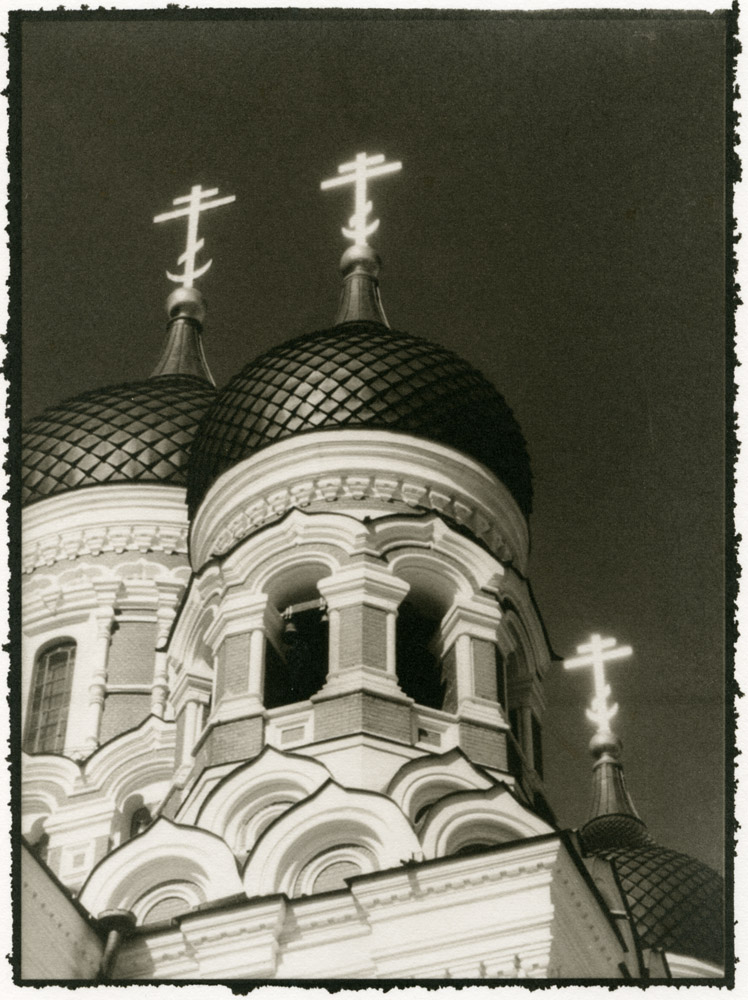
Just wanted to post a print made by one of my students, from my Advanced Topics in Platinum/Palladium printing. The advanced topics class covers contrast control techniques, working with different papers, making digital negatives, and gum-over-platinum prints. This was made from a digital negative we created in class from a medium-resolution JPEG! I’m impressed. Patrick will have a print to be proud of as a result of this class.

Orthodox Cathedral, by Patrick Brown

By the way, I will be re-running my Intro to Platinum/Palladium course at Photoworks, October 20-21. If you are interested, please sign up now, while there’s still room!

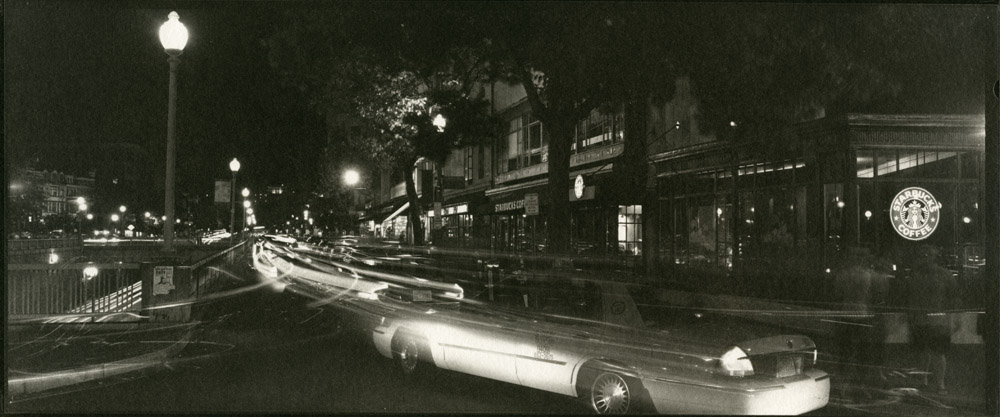
Dupont Taxi, Palladium

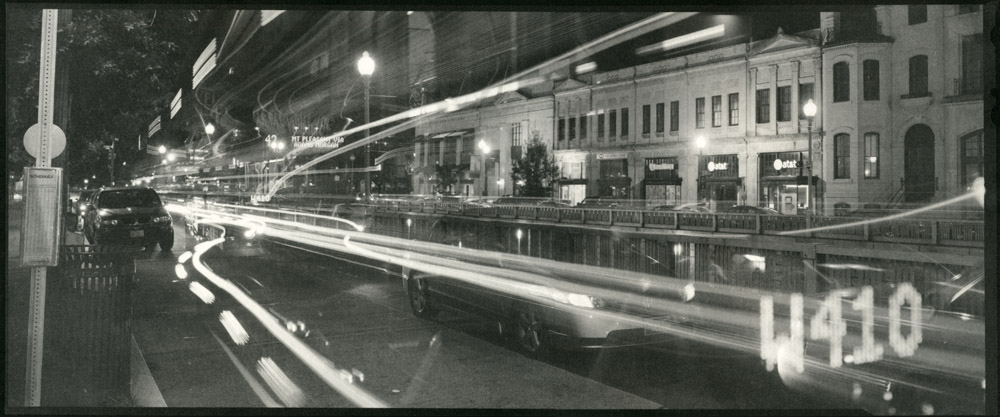
Taxi, Northbound on Connecticut at Dupont Circle, Night

Another image in that nighttime series. Palladium print, Bergger COT320 paper.

Variations on a theme – Palladium versus Ziatype

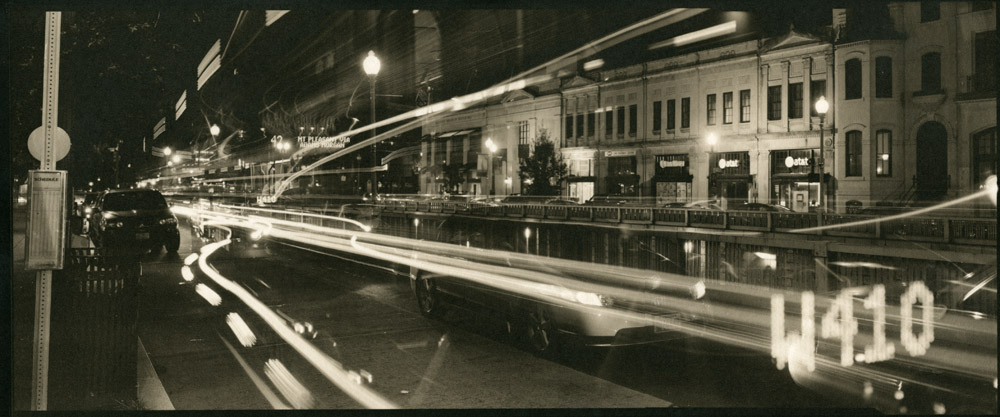
Dupont Circle bus stop, Palladium over Fumed Silica

Here’s another of my 5×12 panoramics of Dupont Circle here in Washington DC. This was several exposures on the same negative, yielding an approximate minute and thirty seconds or thereabouts. We were printing from this negative in my Advanced Topics in Platinum/Palladium Printing class out at Photoworks Glen Echo this past weekend. The print I scanned for this image was printed on Bergger COT320 pre-treated with fumed silica. The fumed silica yields a definite boost in dmax.

The next print is of the same negative, but printed as a Ziatype. Ziatypes are a variation on palladium, but they use either Lithium Palladium or Cesium Palladium and Ammonium Ferric Oxalate instead, which yields a neutral-to-cool tone image more like platinum in color, and they are a printing-out process developed in water as opposed to a develop-out process that requires Potassium Oxalate or Ammonium Citrate as a developer.

The distinction between printing-out and developing-out, in addition to the chemistry variations, is the fact that a printing-out print’s final exposure is judged by visual inspection – what you see when you pull the print from the contact frame is pretty much what you’re going to get when it is washed, cleared, and dried, but a developing-out print will have some kind of ghost image that is anywhere from almost imperceptible to a partial rendition of the final image prior to development. Neither one is better than the other, except that the Ziatype is easier for beginners until they gain confidence in their coating and printing skills. Ziatypes also have a wide range of contrast controls that will also affect image color in addition to contrast.

Dupont Circle bus stop, Ziatype

Upcoming Fall Classes at Glen Echo Photoworks

I’m teaching more classes at Glen Echo Photoworks this fall and winter. I’ll be offering Advanced Topics in Platinum/Palladium, Intro to Platinum/Palladium, and a lecture/presentation on Identifying and Collecting Antique Photos.

Advanced Topics in Platinum/Palladium runs September 15-October 6 (Saturdays 9am-4pm), and covers advanced contrast control techniques, paper choices, troubleshooting techniques, and gum-over platinum. Although I did not have making digitally enlarged negatives in the original curriculum design, I’m going to make it an option at student’s request.

Intro to Platinum/Palladium will be held the weekend of October 20-21 from 9am-4pm each day. Topics covered include history, technical basics (chemistry, equipment, paper), major process controls (negatives, exposure, processing) and fine controls (contrast, process variations).

On the evening of Wednesday, November 17 from 7-9 pm, I’ll be teaching a mini-workshop on Identifying and Collecting Antique Photographs. The course will be a mini-photo history class from the Daguerreotype to silver-gelatin and color, and will be illustrated with examples from my personal collection. Which, if you’ve been following my blog for any length of time, you know is pretty cool.

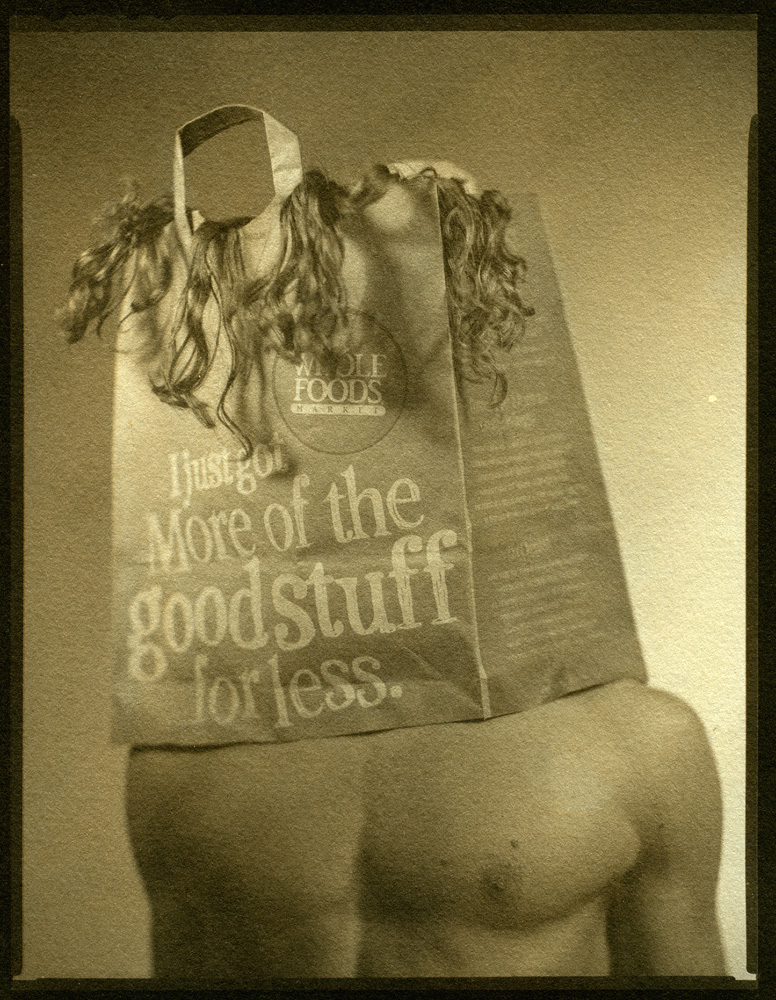
Gum over Ziatype
Advanced Pt/Pd Topics
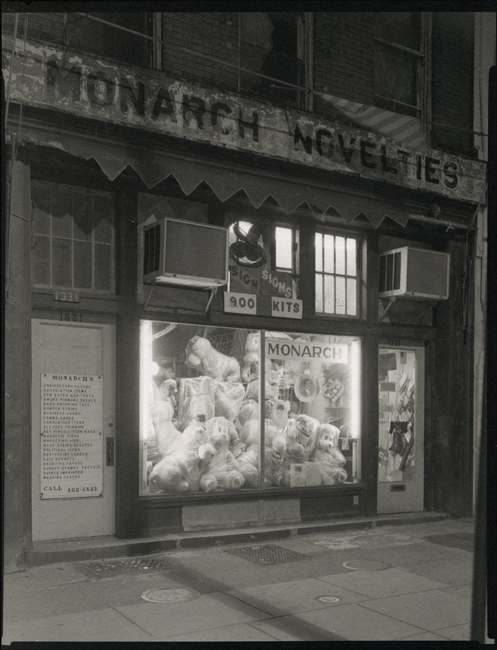
Monarch Novelties, 14th Street (palladium print) – Intro to Pt/Pd
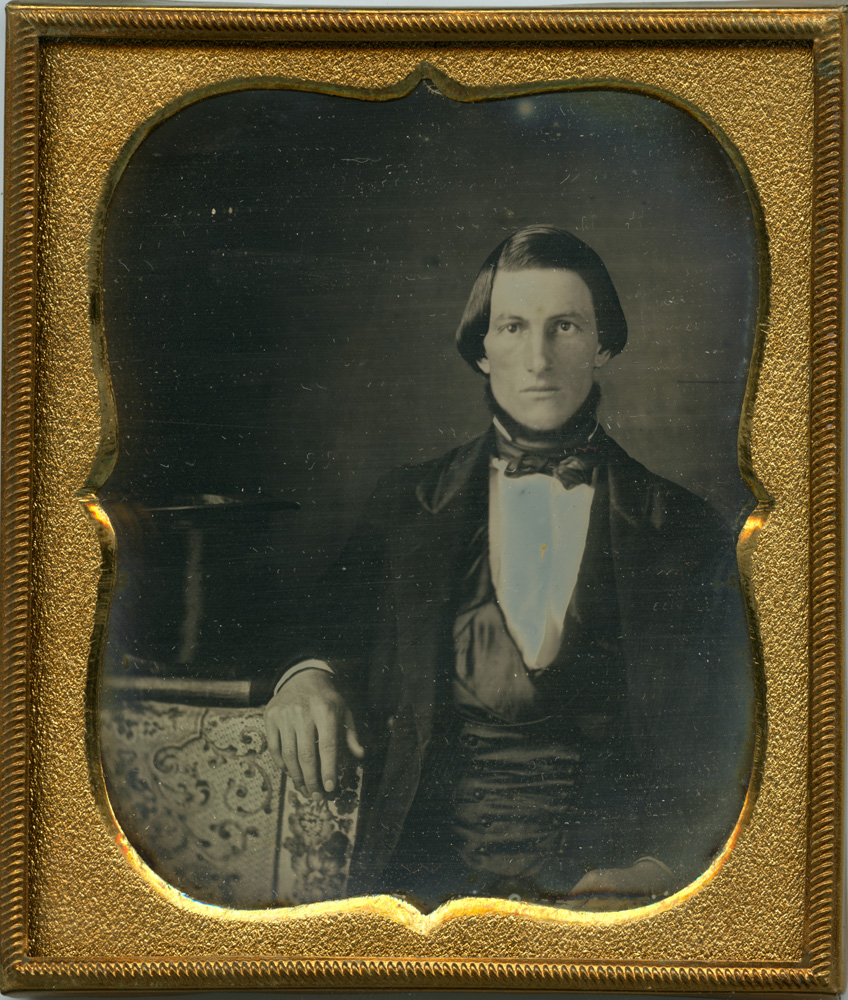
Gentleman With Top Hat, dated October 15, 1849
Gentleman With Top Hat, 10/15/1849 – Intro to Collecting