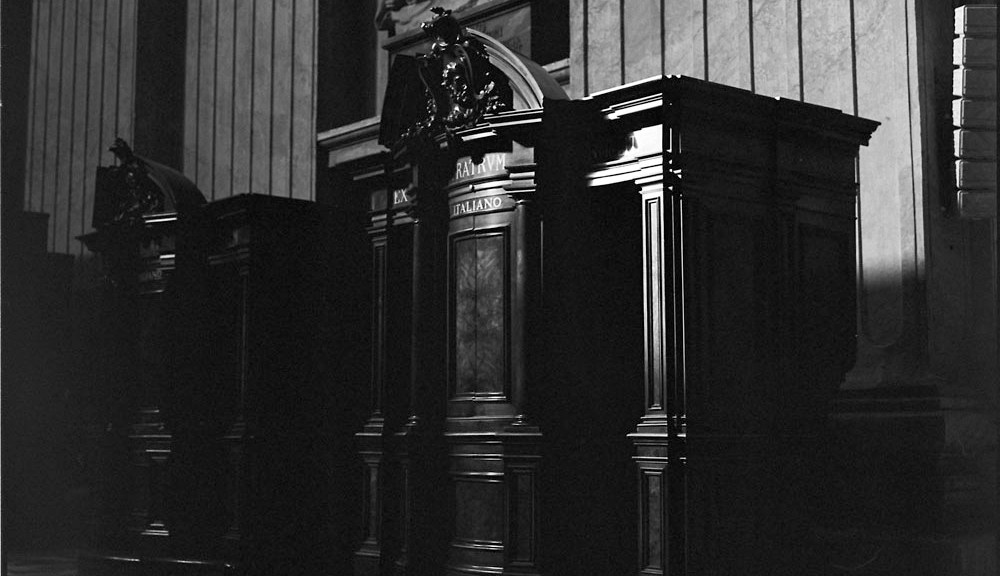
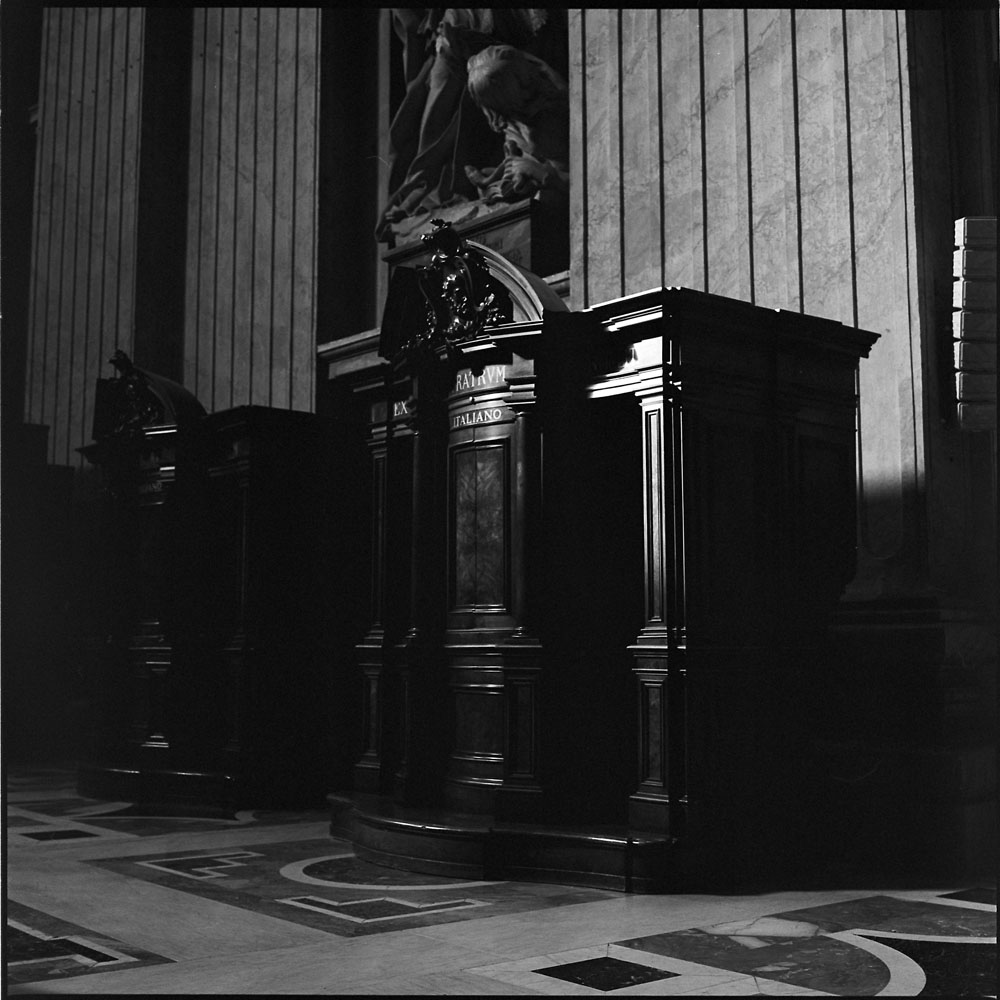
While exploring St. Peter’s basilica, I saw this amazing light falling on the confessional booths, which were in themselves magnificent pieces of furniture. Something about them feels a little ominous, though, don’t you think? Or perhaps a touch funerary.
Confessionals, St. Peters
Even though I’m not myself Catholic, I don’t know that I’d want to give confession in that confessional booth- it would feel a little bit too direct.
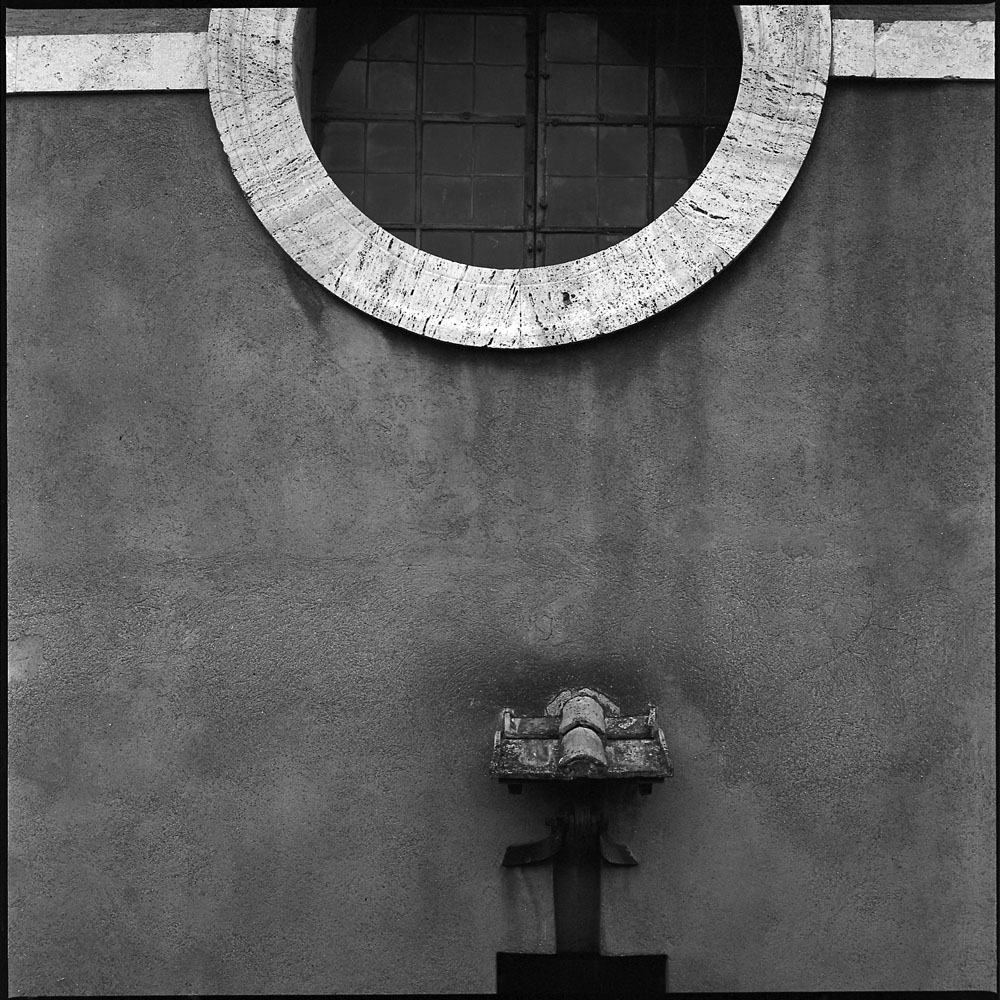
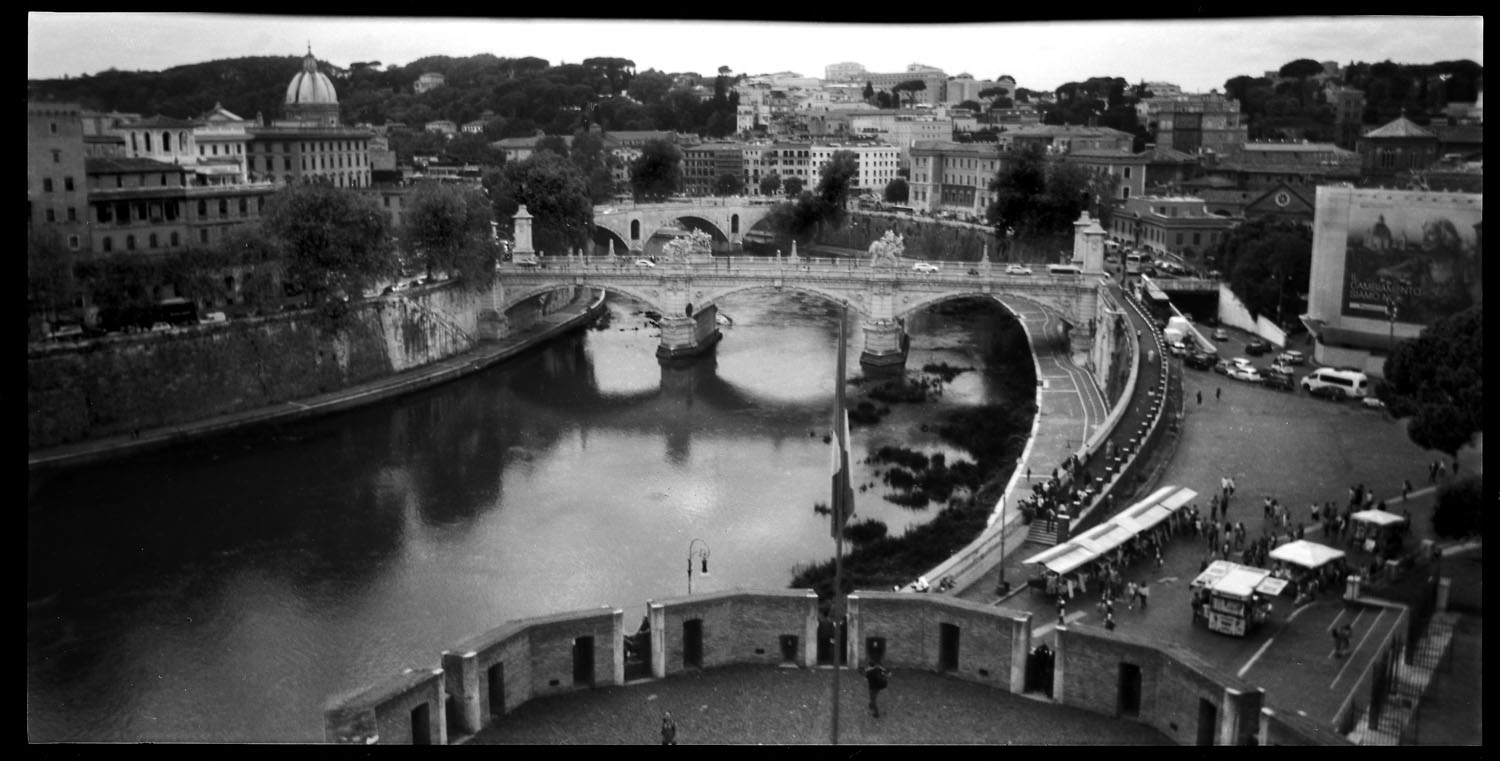
I found this composition while walking the ramparts and courtyards of the Castel Sant’Angelo, which is a very easy place to get lost in if you’re not paying attention. There are so many levels and layers, both physically and historically. The building was built originally as the funerary monument for the Roman emperor Hadrian. Later it was converted into a fortress for the protection and safety of the Pope. A residential suite complete with reception rooms and treasury (three massive barred iron chests with multiple locks, each of which only one person had the key to, so it would require all the key holders to open each chest) and balconies with sweeping panoramic views of the city were put on the upper tier, and the burial chamber of the emperor Hadrian was converted into a dungeon where prisoners could be thrown to wither and die in darkness and misery.
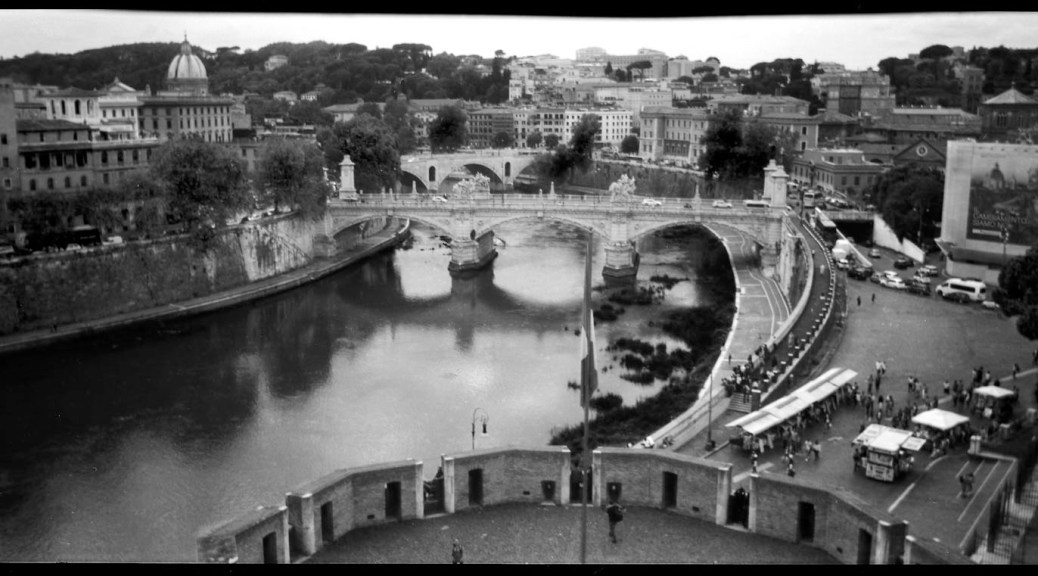
This is a panorama I took of the bend in the Tiber river just in front of the Castel Sant’Angelo, from the castle’s ramparts. St. Peter’s is to the right, out of view. If you look at the bridge in the background, you can see the keyhole arches in the supporting piers which are there to help the bridge not get washed away in time of flooding. There are a number of bridges across the Tiber with this feature, including the famous “Ponte Rotto” (Broken Bridge), which you’ll see in some other shots I’ll post later.
This was taken with my Belair X6-12 camera. As you can see, it’s a pretty soft lens, combined with what was probably a pretty slow shutter speed (1/30th, 1/15th? with this camera, who knows- it sets it automatically for you and doesn’t tell you what it used). But it has a look to it, and the negative isn’t unusable.
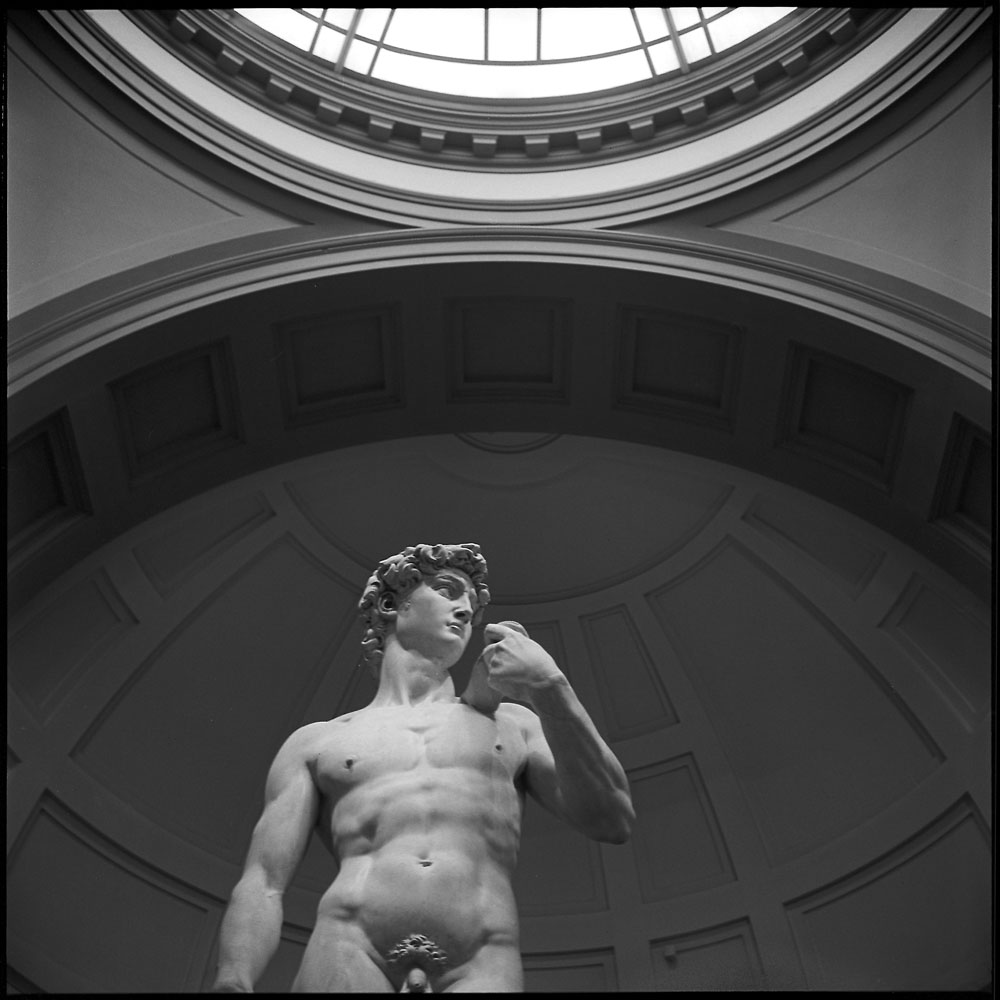
What trip to Florence would be complete without a visit to the Accademia to see David?
My first visit to Florence, I actually did NOT get to see David as I only had about 2 1/2 days, and back then unless you booked a tour group, the only way in was to get in the 2-3 hour line. Now, Florence the city offers a three-day, all-you-can-museum pass called the Firenze Card. It’s a bit pricey, but in my estimation well worth the 72 Euros because you can just wave it at the door and walk right in to the Uffizi, the Accademia, the Bargello and any of the other major public museums in the city. If you can make it in to say four museums in the three days, it’s more than paid for itself.
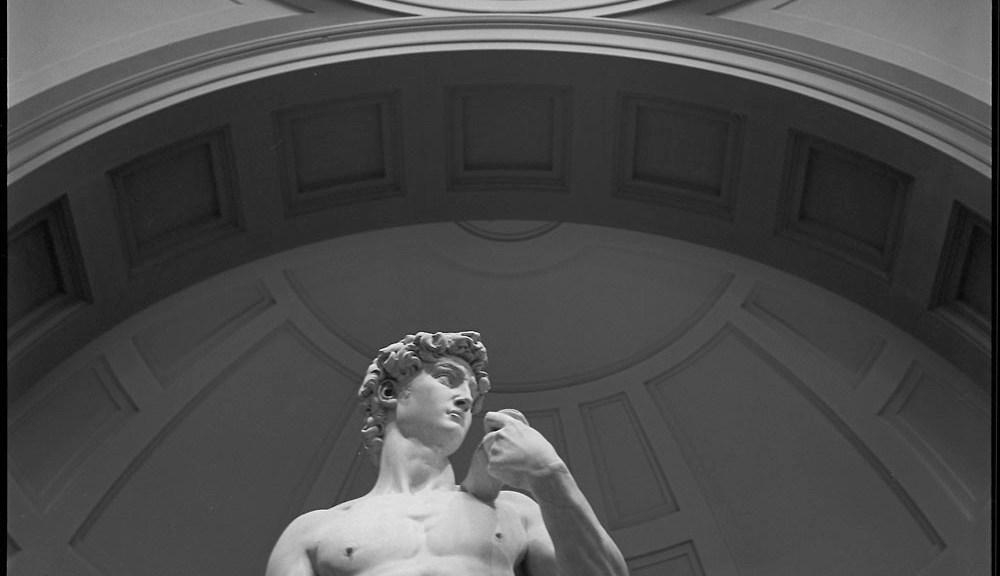
Back to the David – I had seen the copy that was made in the 19th century and placed in front of the Signoria on my previous visit, and I thought it was a good enough copy that I didn’t need to see the original. Having been now to see the original, I can say I was totally wrong. The public copy is an excellent copy, but it’s still just a high-end Xerox of Michelangelo’s. I tried with this composition to photograph it in a slightly less cliche fashion by including the architecture of the room.
David
There’s so much going on with this statue and its history. It was originally intended to stand on a pedestal on the outside of the Duomo along with a dozen or so other similar sculptures. The David was the only one of the group ever made, and it never was placed in its originally intended location. David came to symbolize the Florentine Republic, and as such, by the time he was finished, he was placed outside the Palazzo Vecchio in the Piazza della Signoria to remind Florentines of their independent status. The original statue stood outside in the rain and the wind and the sun and the snow for four centuries before being moved to the Accademia. In the 20th century, he was “restored” once, very poorly, and a second time, recently, with a far more gentle method. As a result of the cleanings, the exposure, and the hammer attack he was subjected to, there remains no actual surface which would have been touched by the hand of Michelangelo. In spite of this, the statue remains transcendent.
There’s a terrific book about the David, From Marble to Flesh: a Biography of Michelangelo’s David, by A. Victor Coonin. My only association with the book aside from having read it is that I was a Kickstarter backer of the original publication. If you look in the credits you’ll find my name. Regardless, the book tells the complete life story of David from his beginnings as a sculpture to be carved by someone else, Michelangelo taking over the task, his completion, public placement, life, moving from the Piazza to the Accademia (which took almost as long to accomplish in the late 1800s as it did to move from Michelangelo’s studio to the Piazza some four hundred years earlier), through to the cultural importance of David as a symbol in 21st century life.
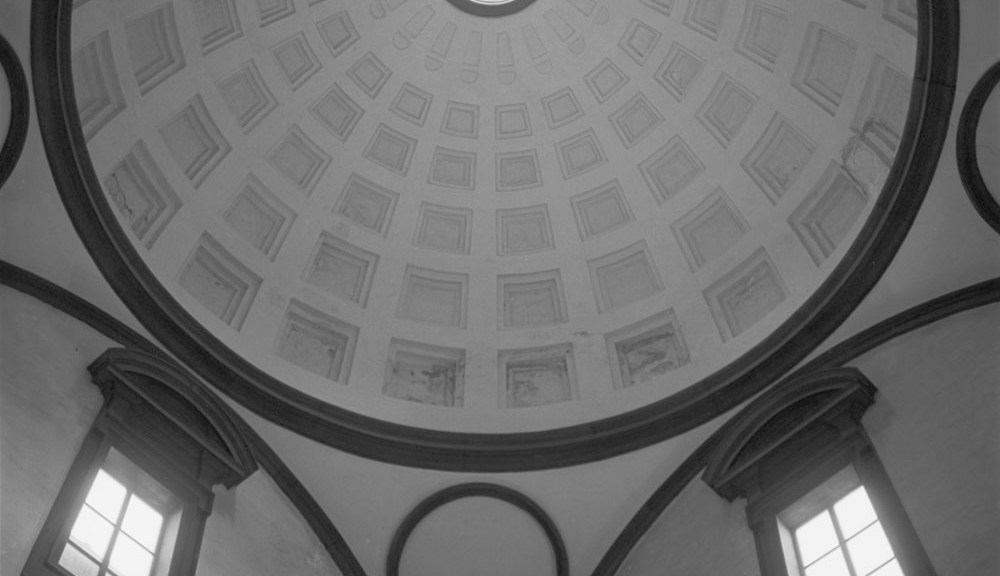
As part of my Michelangelo pilgrimage (the secondary pilgrimage, with the Caravaggio quest being the first one), I wanted to see the Medici chapel with the famous tomb sculptures by Michelangelo. Photos of those sculptures are forthcoming, but first I wanted to lead off with this architectural view of the ceiling.
Dome, Medici Chapel, San Lorenzo
I wasn’t even thinking about it when composing the shot, but in looking at it afterward, there are all these repetitions of threes in the scene – three windows in the lantern, three circles, the lantern and the windows together forming not only a trio of light sources but a visual triangle, and so on.
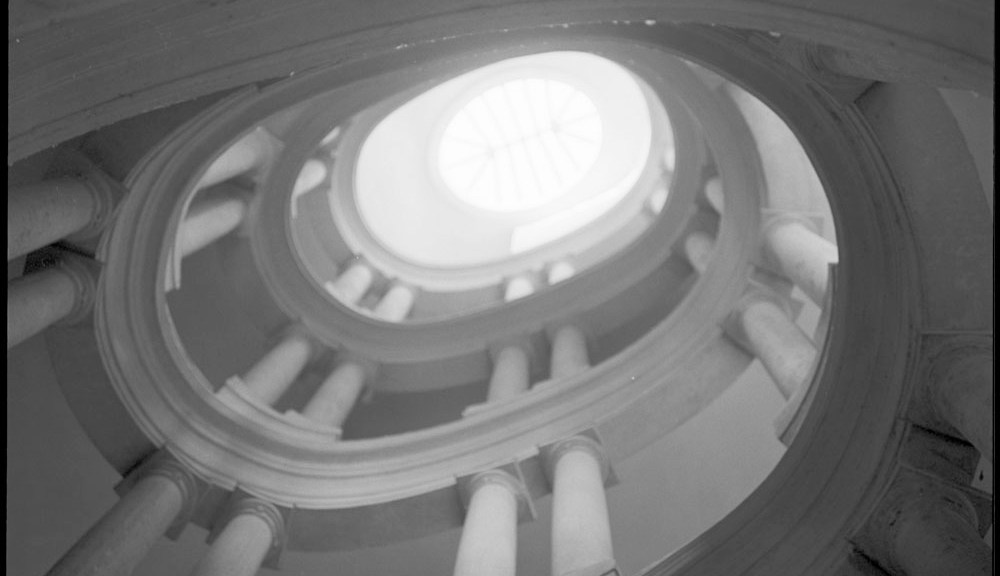
In 1625, then-Cardinal Barberini acquired a property from the Sforza family in Rome that had a vineyard and ‘palazzetto’. It was on this property he decided to build the Palazzo Barberini. He would go on to become Pope Urban VIII. He hired the famous architect Carlo Maderno to design and build his palace. Along with Maderno was his nephew, Francesco Borromini, who would go on to become one of the best known Baroque architects in Rome. He is largely responsible for the design of the facade, as well as the grand salon, and perhaps most famous of his creations at the palace, the oval staircase.
Borromini Staircase, Palazzo Barberini
Partway through construction, his uncle Carlo Maderno passed away. Completion of the project was then tasked to a new young upstart architect better known at the time as a sculptor, Gian Lorenzo Bernini. Bernini would design a second staircase for the palace, this time a square. The two, Borromini and Bernini would remain professional rivals until Borromini’s suicide in 1667.
Bernini Staircase, Palazzo Barberini
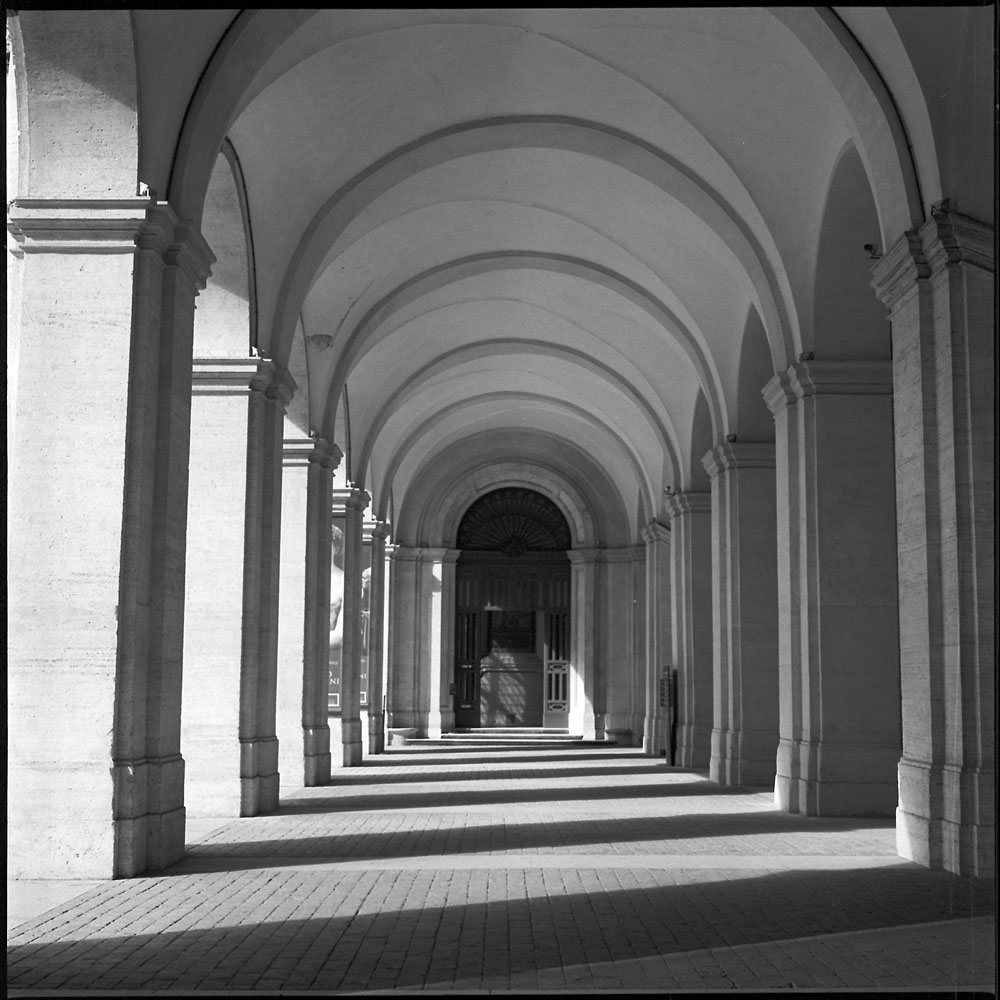
At the ground level, an arcade connects the two staircases. This shot was taken from the entrance to the Borromini staircase, looking down the arcade to the Bernini staircase entrance.
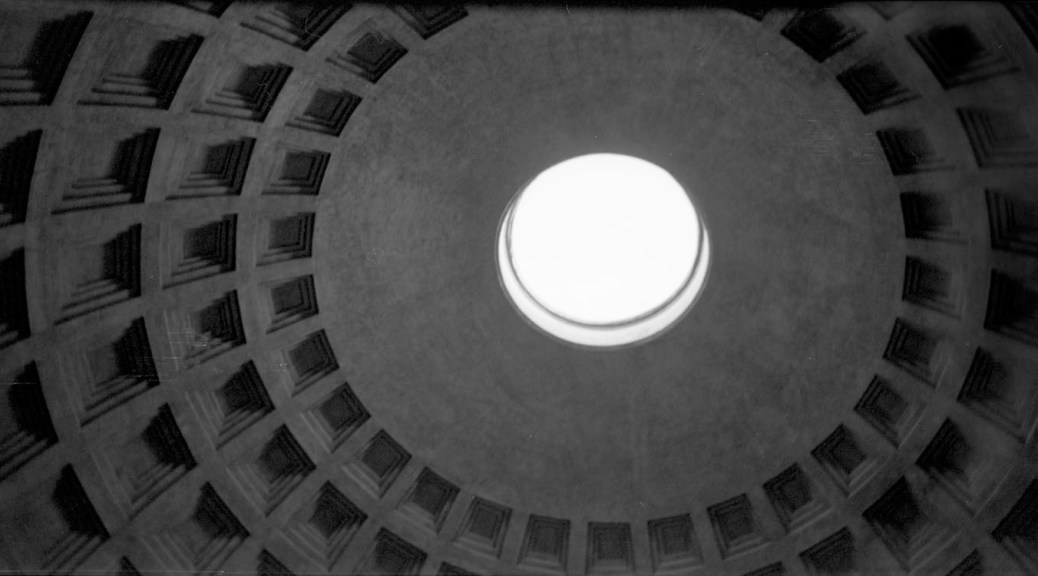
Here’s a shot I took of the oculus of the Pantheon with my Belair X6-12. The camera has its issues, one of which is the relatively low contrast from its plastic lenses. Most of the time. Here’s a circumstance where it works to my advantage- the interior of the Pantheon is so dark, and the main light source being the oculus, it’s very contrasty. The flat lens on the Belair helps bring out shadow detail where there wouldn’t be as much.
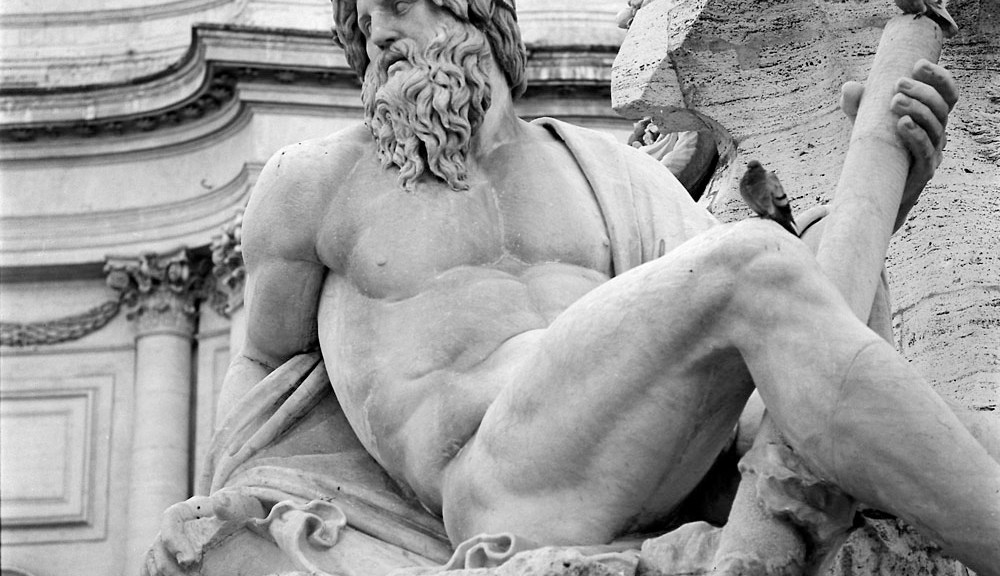
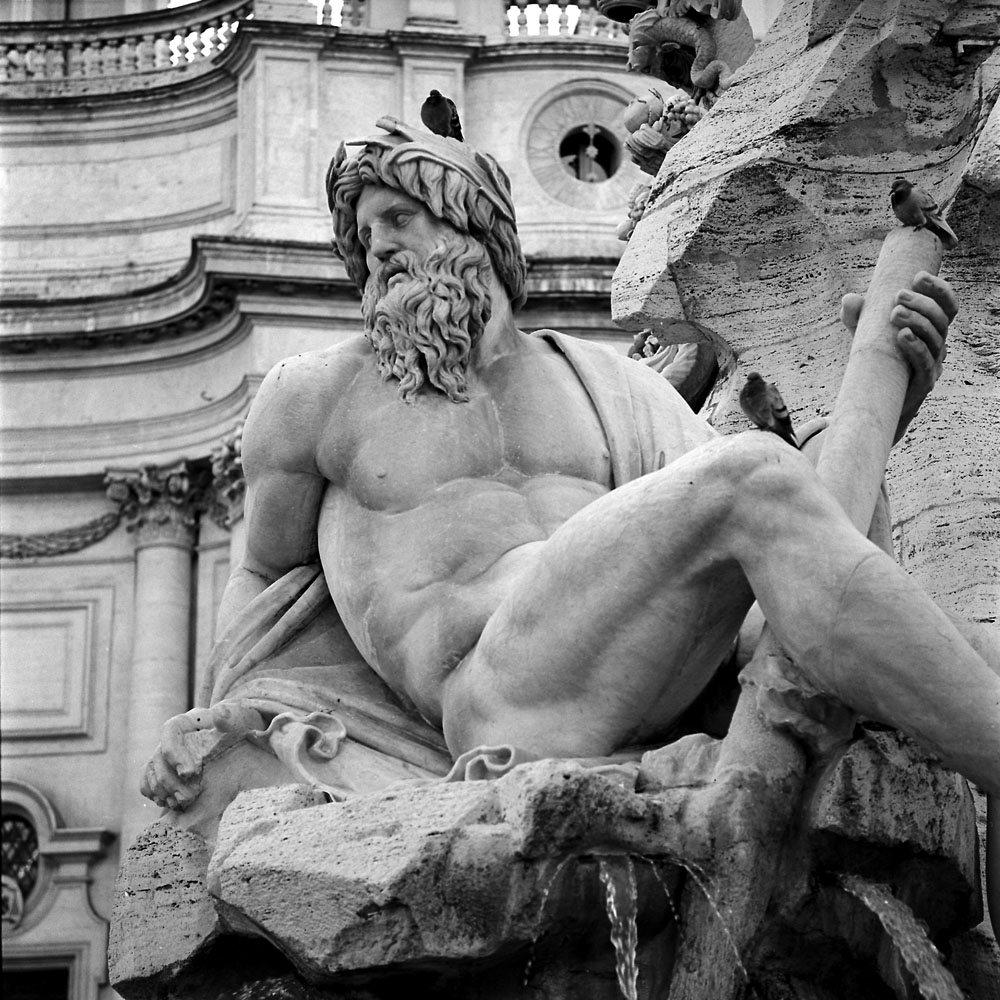
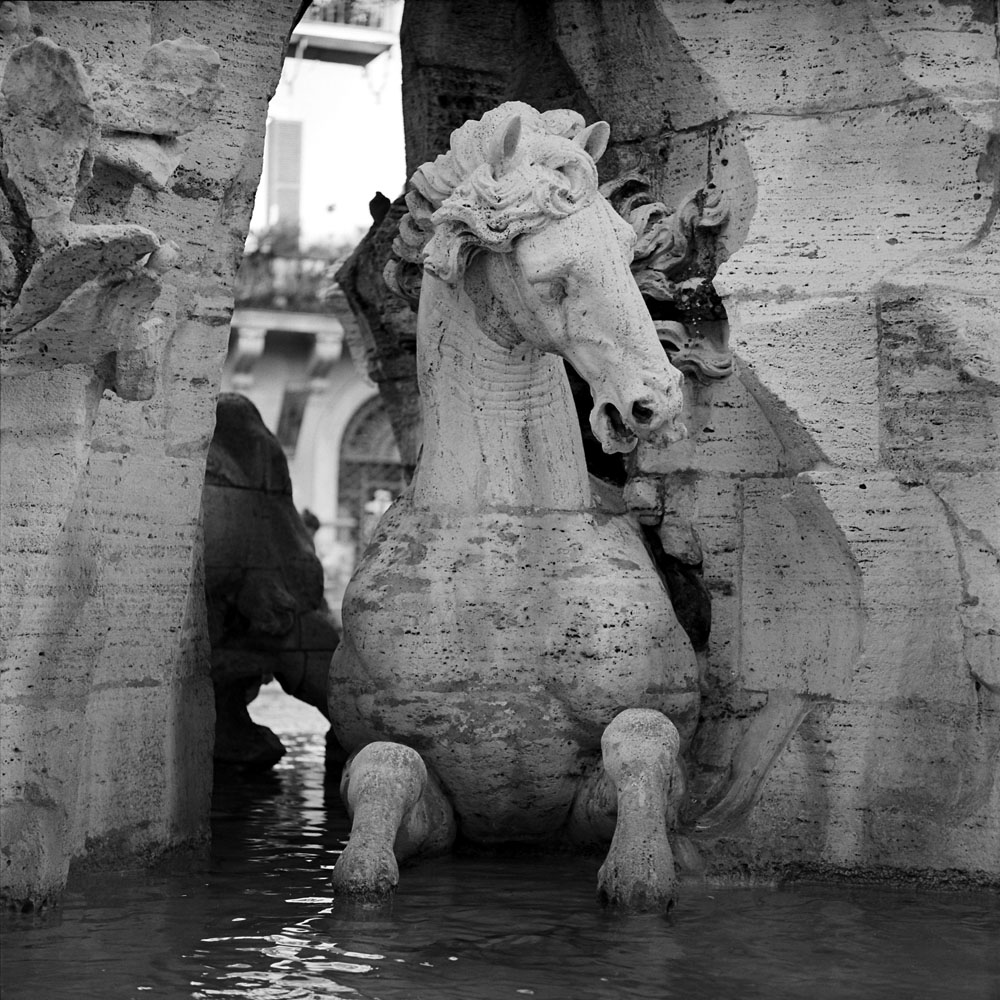
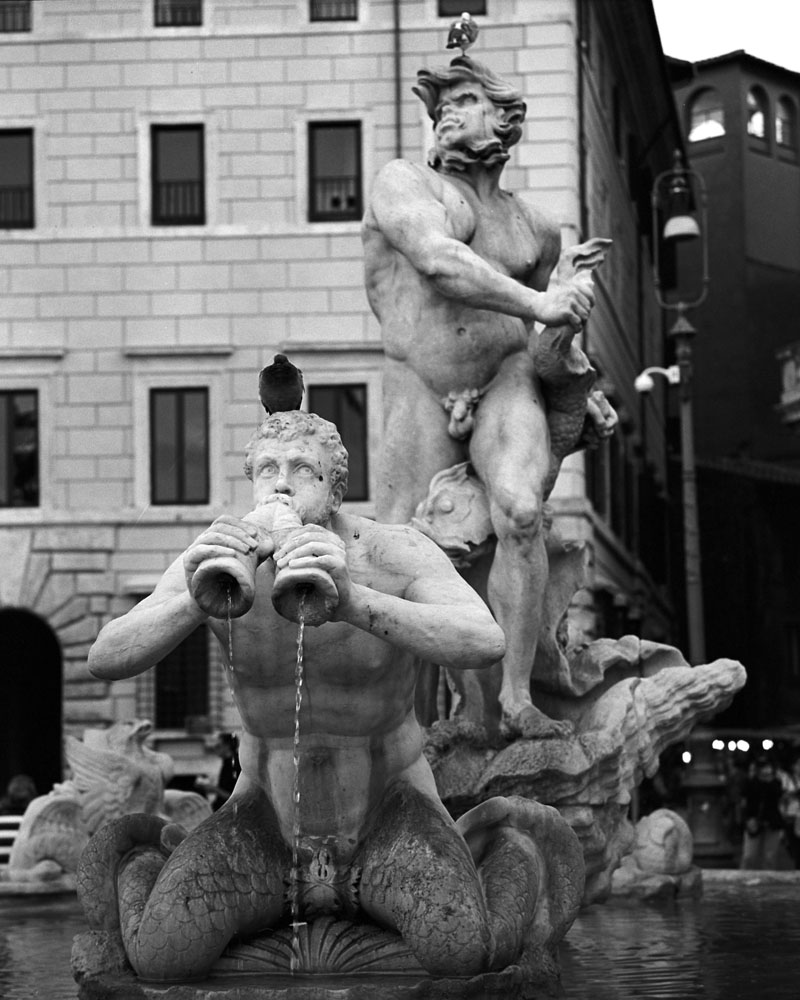
Here are a few shots of the fountains in the Piazza Navona. I chose to photograph details rather than try to take in the whole fountain because there were just too many people in, on, and around the fountains.
River God, Four Rivers Fountain, Piazza NavonaHorse, Four Rivers Fountain, Piazza NavonaTrumpeting Merman, Fountain, Piazza Navona
The piazza is pure chaos – think Times Square but shorter, with much better decoration. There are performers on the piazza doing everything from live music to juggling acts to “living statues” – there was a fake Fakir made to look like he was floating in mid-air, supported by nothing more than an off-center cardboard mailing tube. The fountains, though, are the real stars of the place. They moderate the heat in summer, and provide stunning visual delights in all four seasons. I know it seldom snows in Rome, but I’d love to see them blanketed with a layer of white.
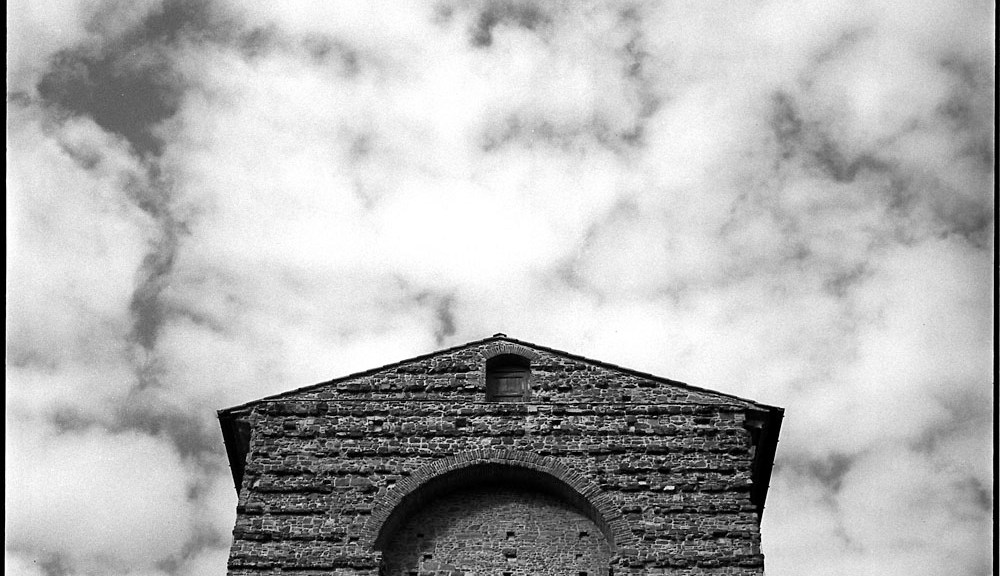
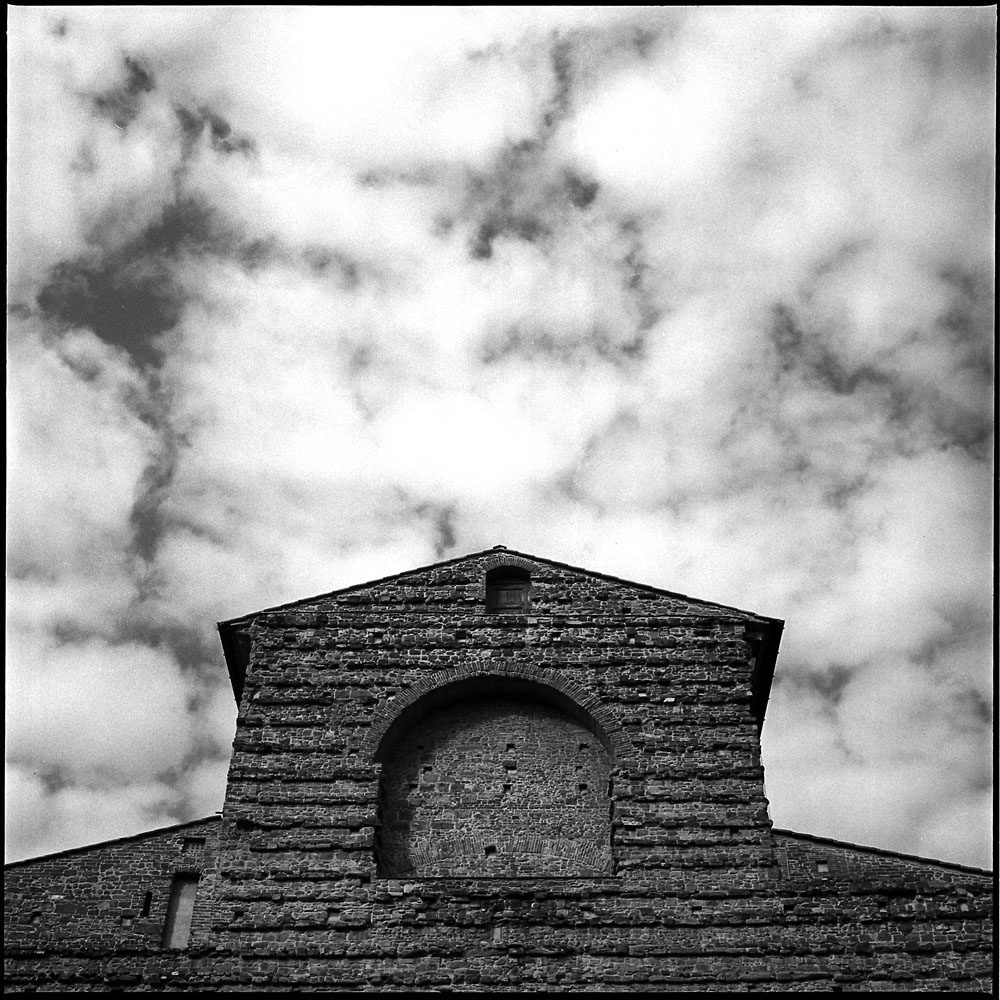
My take on the facade of San Lorenzo, the Medici family parish church and originally the primary cathedral for the city of Florence.
San Lorenzo Facade, Clouds, Florence
The facade is one of the most famous unfinished structures in Italy. The church was designed by Brunelleschi, but he died before it was completed. The Medici family, who were financing the construction of the church, commissioned Michelangelo to design a new facade. He built a scale model, but the design was never executed. In 2009, a CGI model of his design was projected on the existing facade for a period of time to gauge reaction to completing the facade, but nothing more has come of it. While the Michelangelo design is quite beautiful, the current facade has sat as-is for over 500 years, so I think it would be a sacrilege to both the existing building and the Michelangelo design to build it now.




 dcphotoartist