Here are a few more individual photos of the Palazzo Pitti.
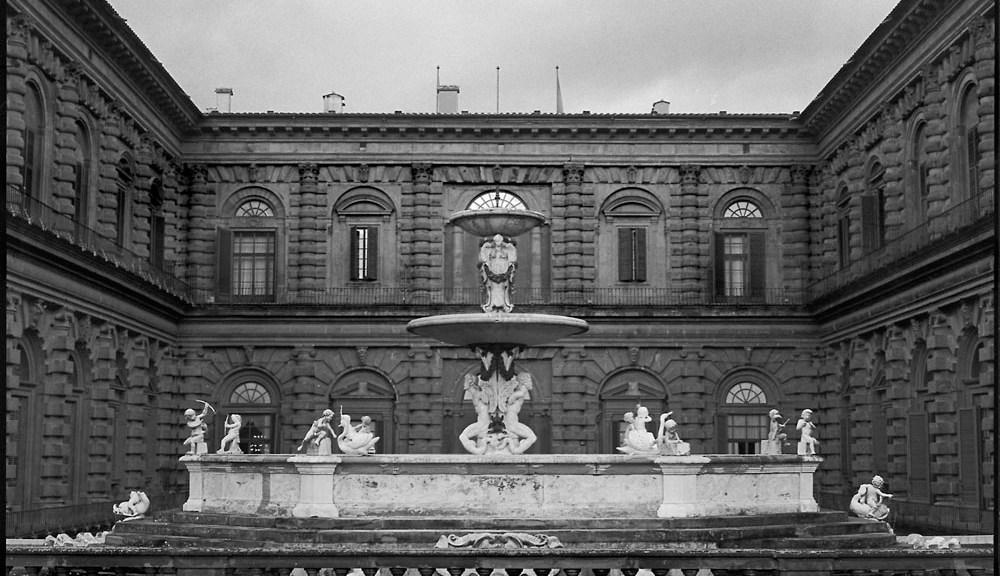
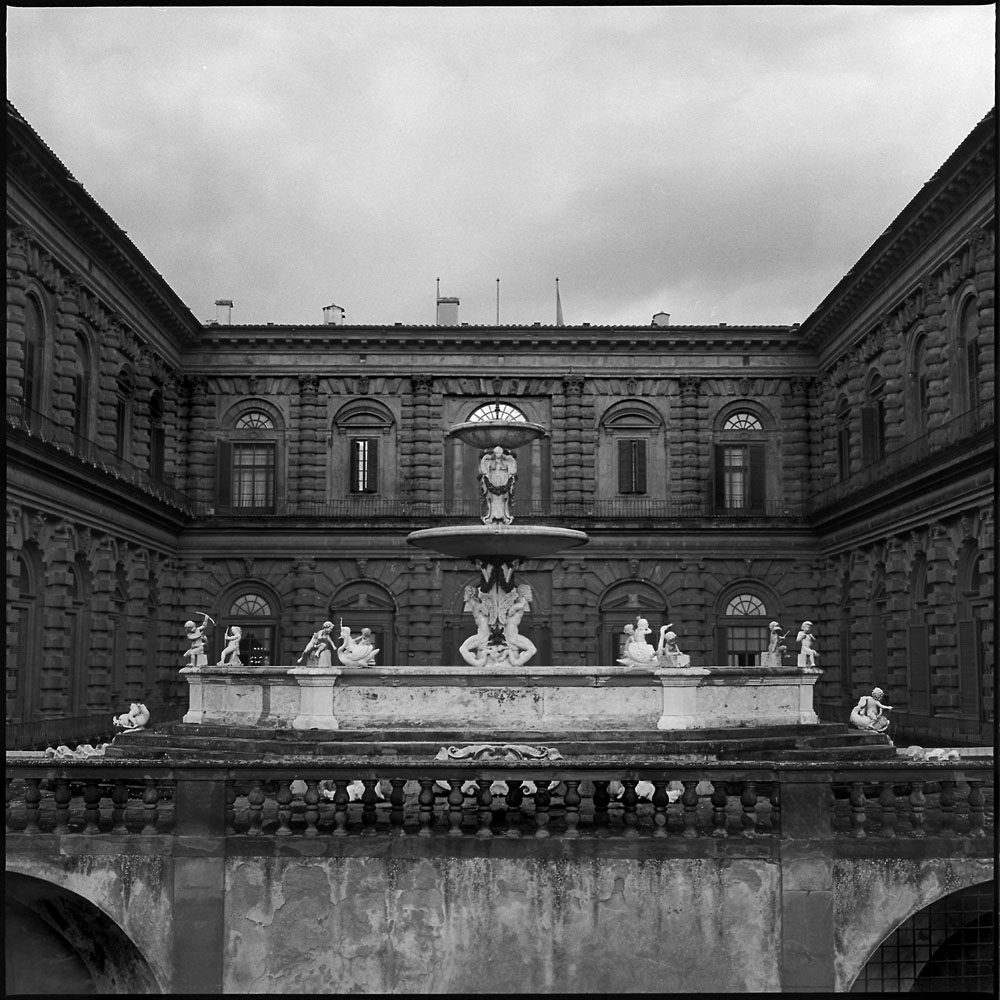
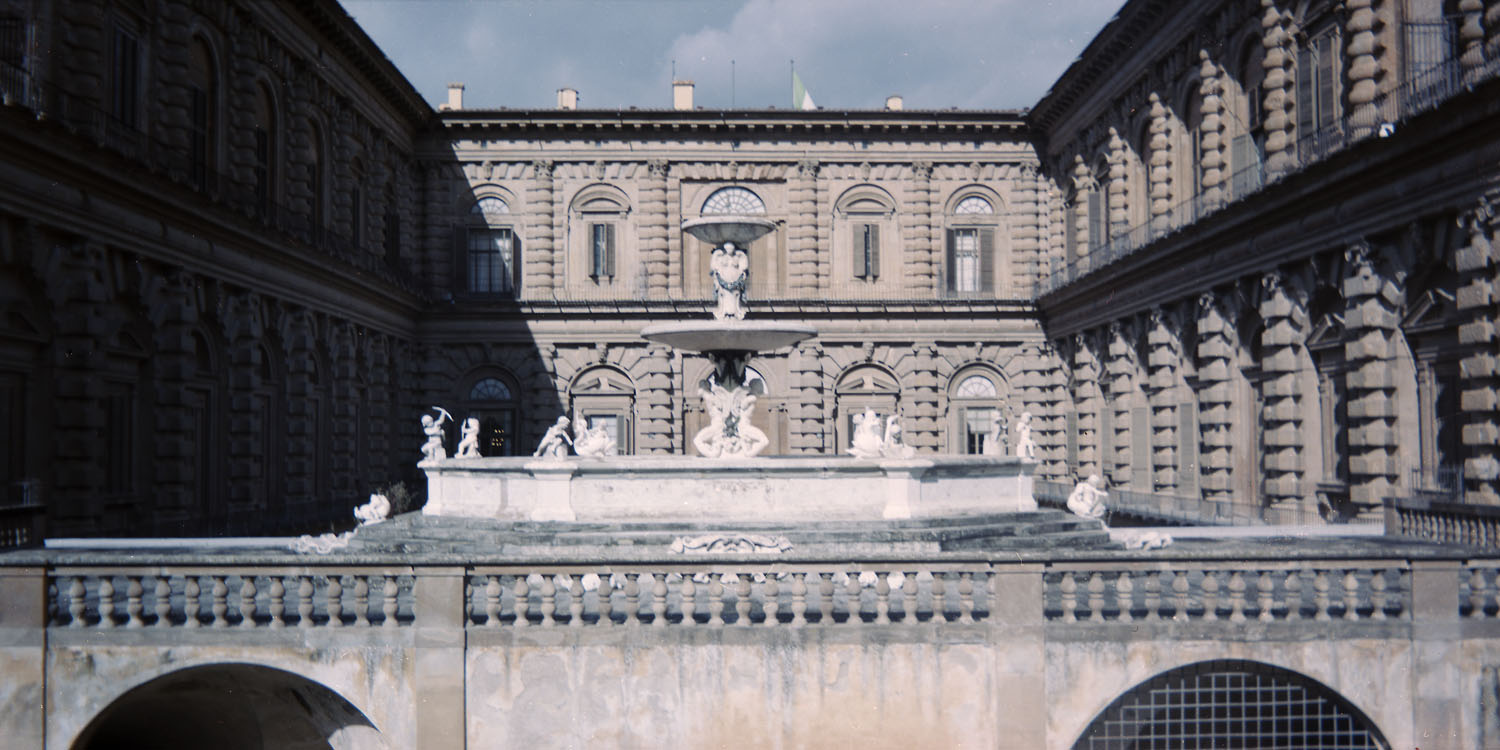
The first one is another version of the rear view of the Palazzo, from the Boboli Gardens. There’s a vast difference in quality between this one and the one I took with the Belair X6-12. The Belair has its charms, but I still prefer the sharpness and contrast of the Rollei version.
Fountain, Palazzo Pitti
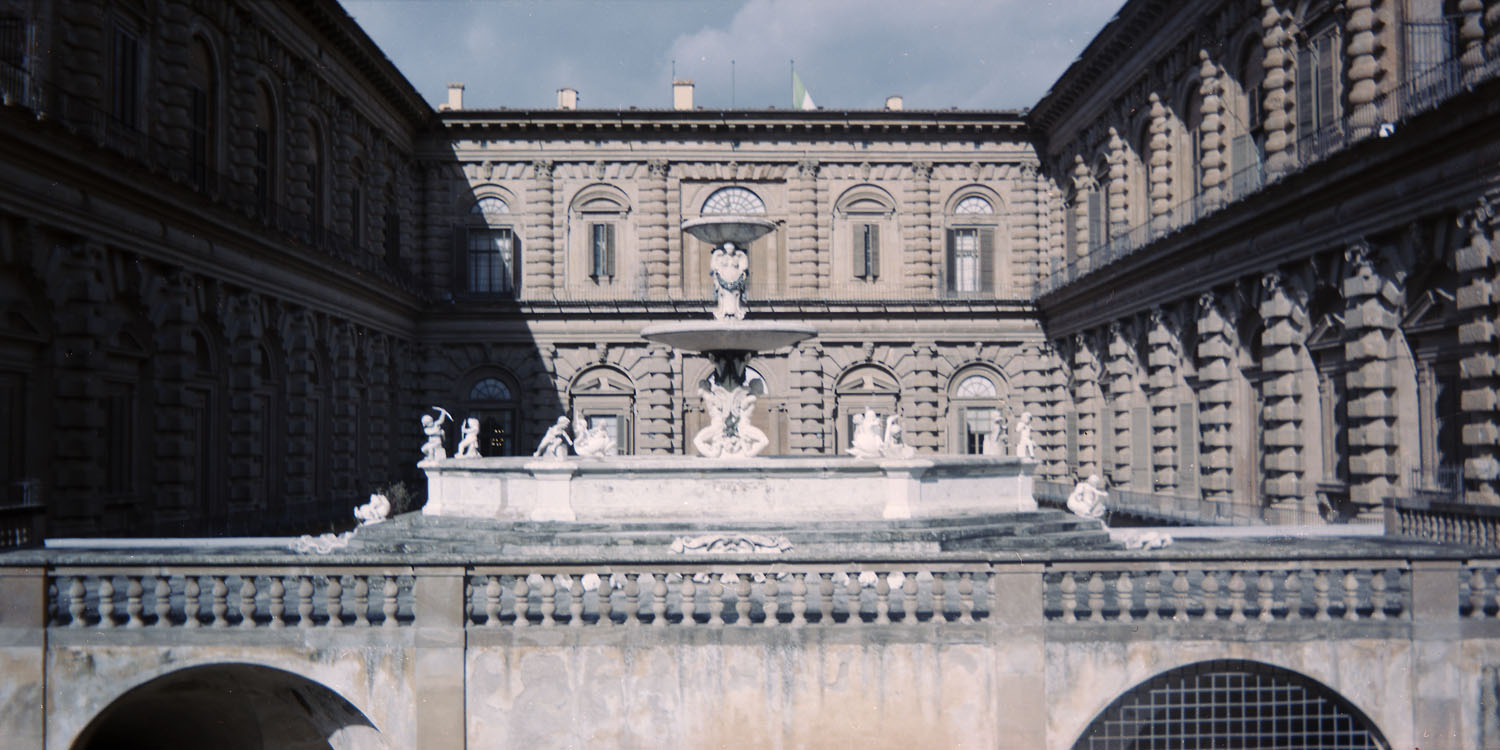
Here is the panoramic version from the Belair for direct comparison.
Pitti Palace, from the Boboli Gardens
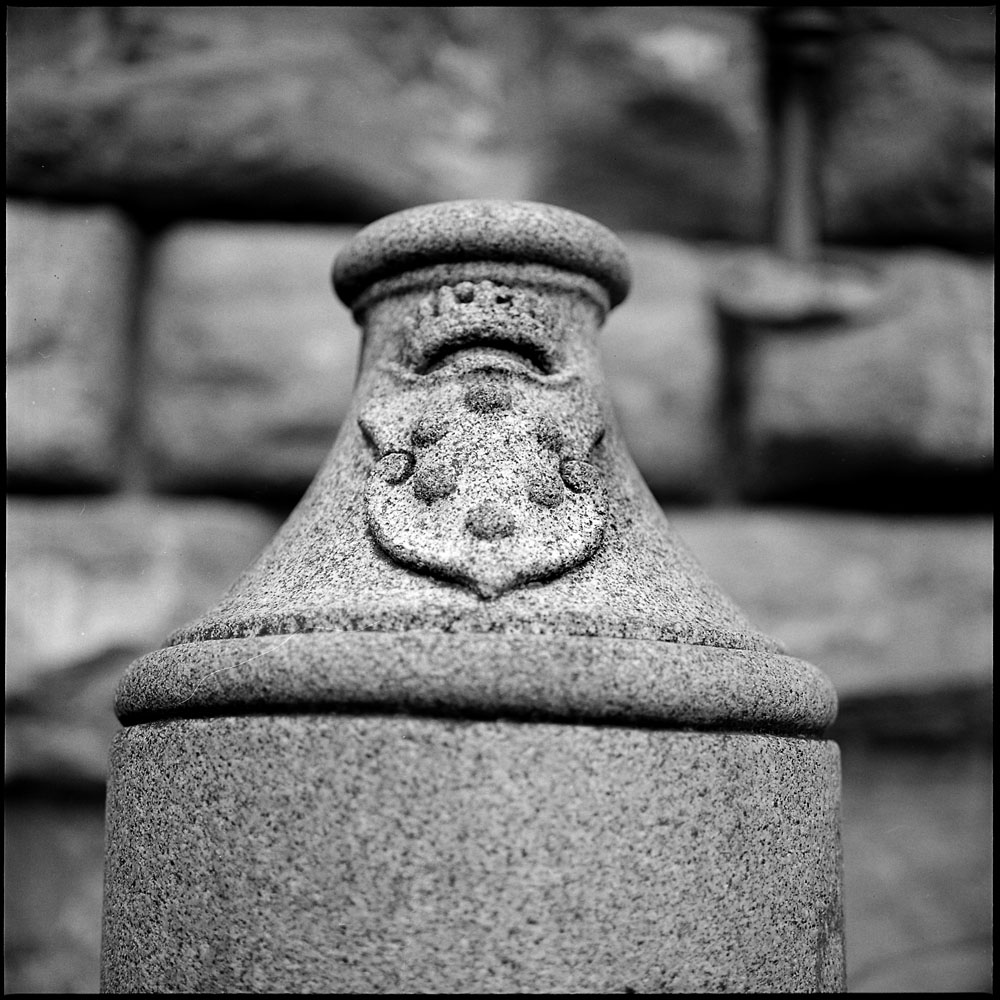
Out front of the palace there are these massive granite bollards, carved with the Medici coat of arms. While they’re kinda-sorta the equivalent of a traffic cone, they don’t really qualify for my “portraits of ordinary objects” series, do you think?
Granite Bollard, Medici Coat of Arms, Palazzo Pitti
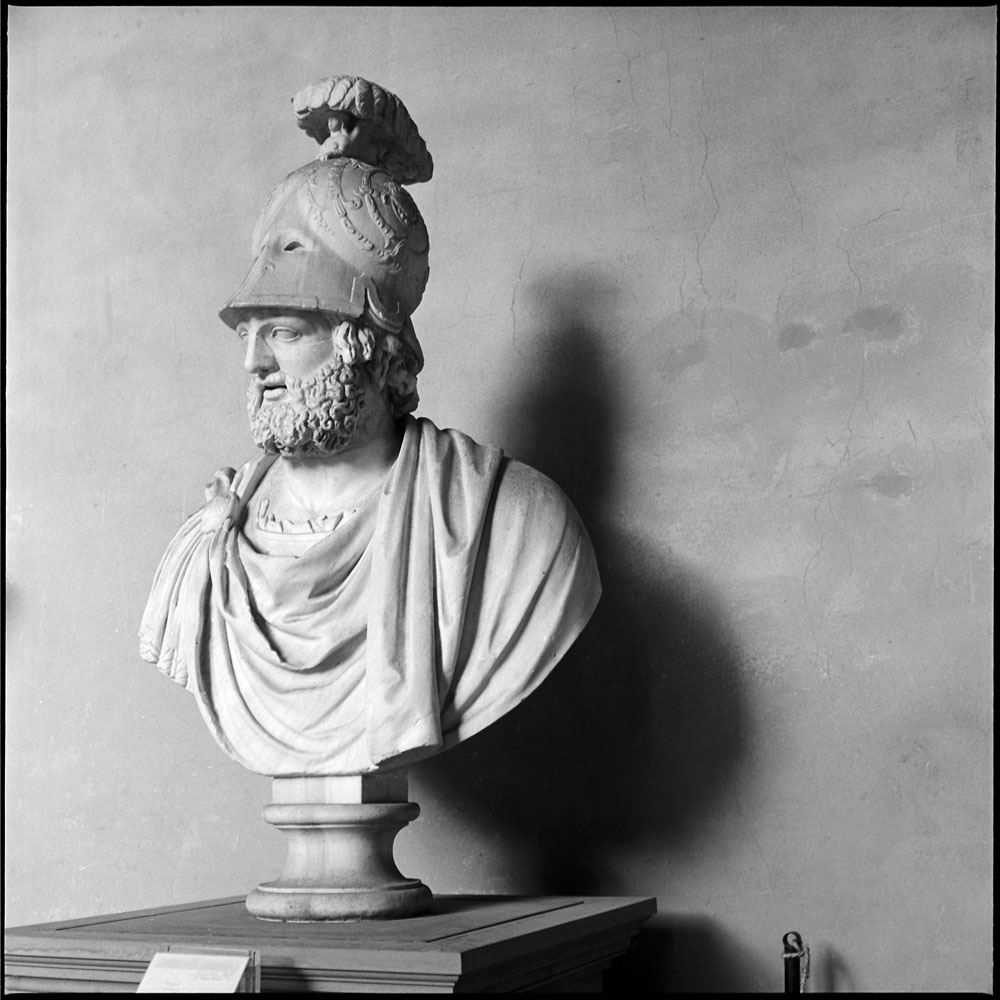
A marble bust of a man in a stylized Greek helmet. This would be a 16th or 17th century piece, so the ancient Greek style helmet would have been done to make him appear heroic and classical, an idealized noble warrior type.
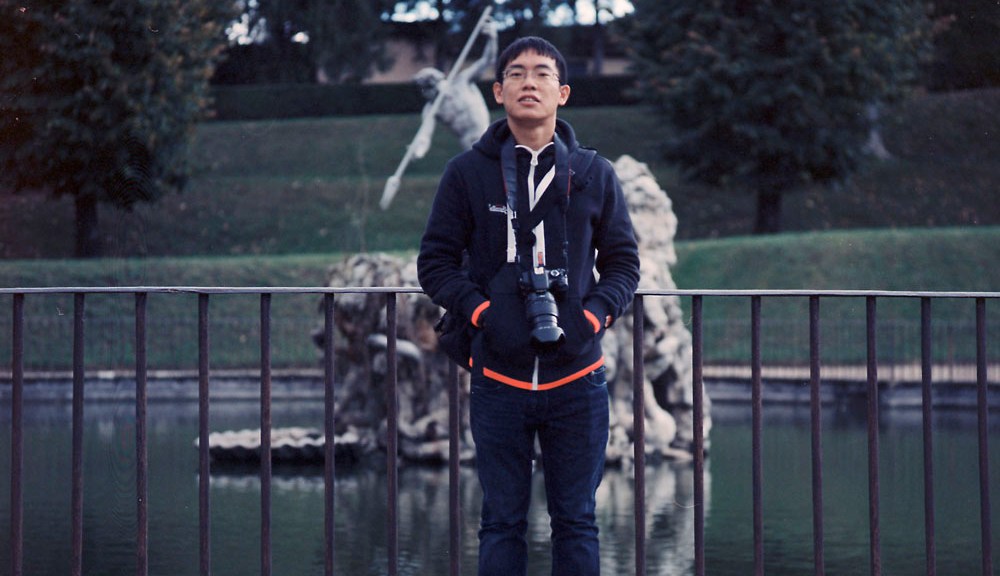
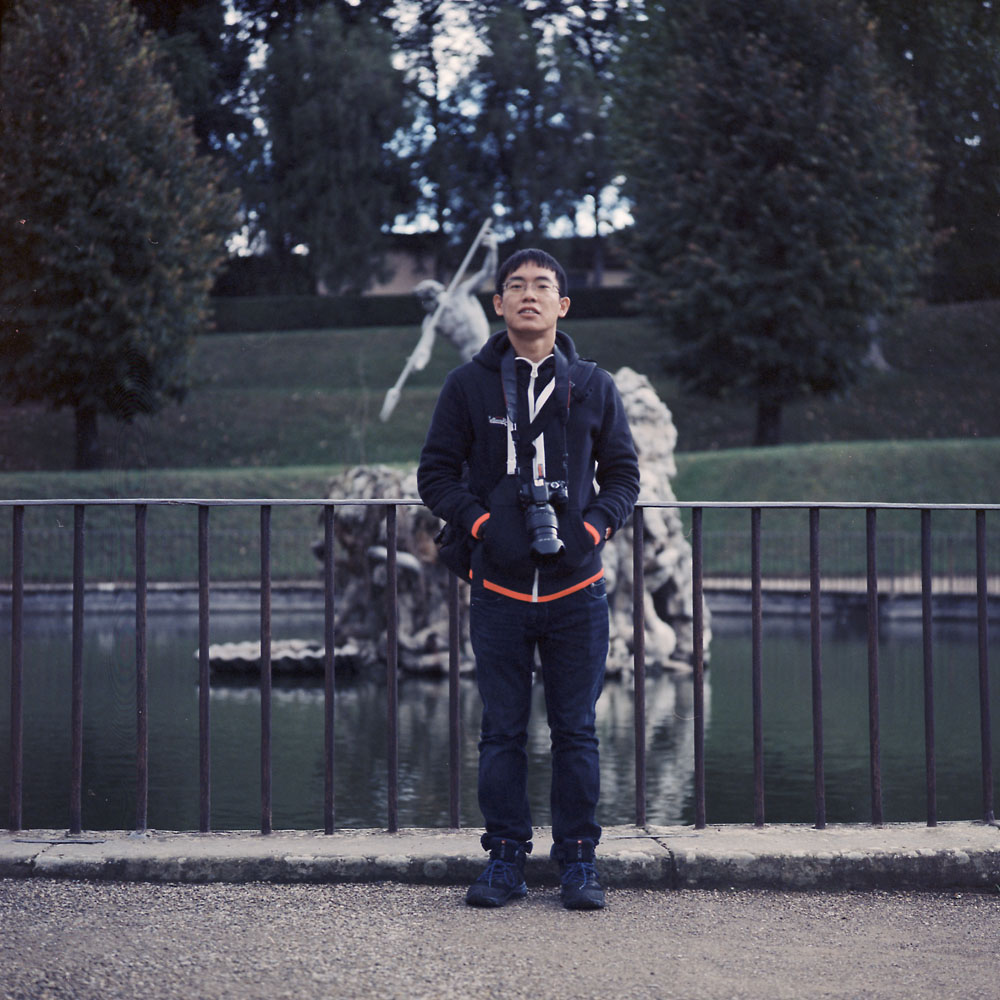
TC is a friend I’ve known for gosh, probably 10 years now. When we met he was a grad student working on his PhD at MIT. He’s now a full-fledged Doctor in Physical Chemistry, and working in Zurich. When I told him I was coming to Florence, he offered to pop down and hang out for a day or two. He was a real godsend, as I was still in the throes of a really bad allergy attack triggered by down pillows on the bed of my apartment in Rome, and he stopped at a pharmacy and got me some European Benadryl.
TC in the Boboli Gardens
We went to the Uffizi the first day I was in Florence, then grabbed dinner at a restaurant he found on Yelp. The food was quite good, but what shocked me was the size of the portions. I was used to these small portion sizes per course that I had been getting in Rome, so I had a pasta course, a salad, and an entree. The pasta wasn’t too much bigger than I was expecting, but the salad was entree- sized! I had only had maybe 1/3 of the salad when the waitress stopped by and asked about it. I told her it was very good but just too big. She offered to cancel my entree, which I was glad to accept. Half and hour later, we’re sitting chatting and the entree arrives after all!
The next day, we met up again and walked over to the Palazzo Pitti via the Ponte Vecchio. The Palazzo Pitti is gargantuan – it was the Medici family’s main residence in the 16th and 17th centuries, and everything about it was designed to overawe. The Vasari corridor connects it with the Uffizi over the Ponte Vecchio to provide a secure passage should the Medicis need to escape an angry mob, or just not want to mingle with the hoi polloi on their way to and from their private box seats at the Santa Felicita church.
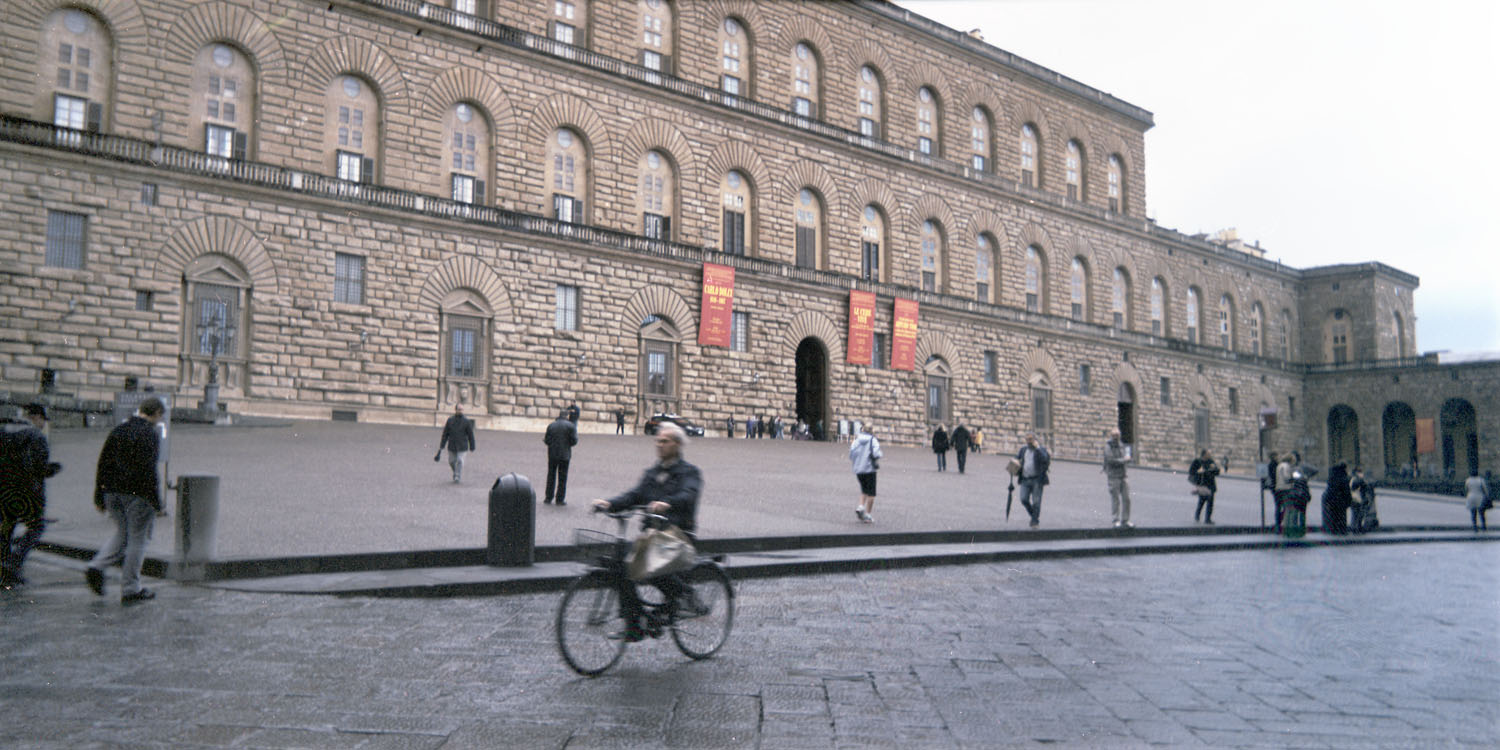
Cyclist, Palazzo Pitti
The Boboli Gardens back onto the Palazzo Pitti. They were once the private playground of the Medici family, but now are open to the public. This is the garden facade of the Palazzo Pitti.
Pitti Palace, from the Boboli Gardens
After touring through the Pitti and hiking up and down the Boboli gardens (which are on the face of a fairly steep hill), TC and I grabbed lunch at a little cafe across from the Palazzo Pitti’s main entrance. I had my first ever cappuccino there. I’m now a devotee, provided there’s enough sugar.
So thank you, TC, for the Benadryl, the companionship, and for the swiss chocolates – they were delicious!
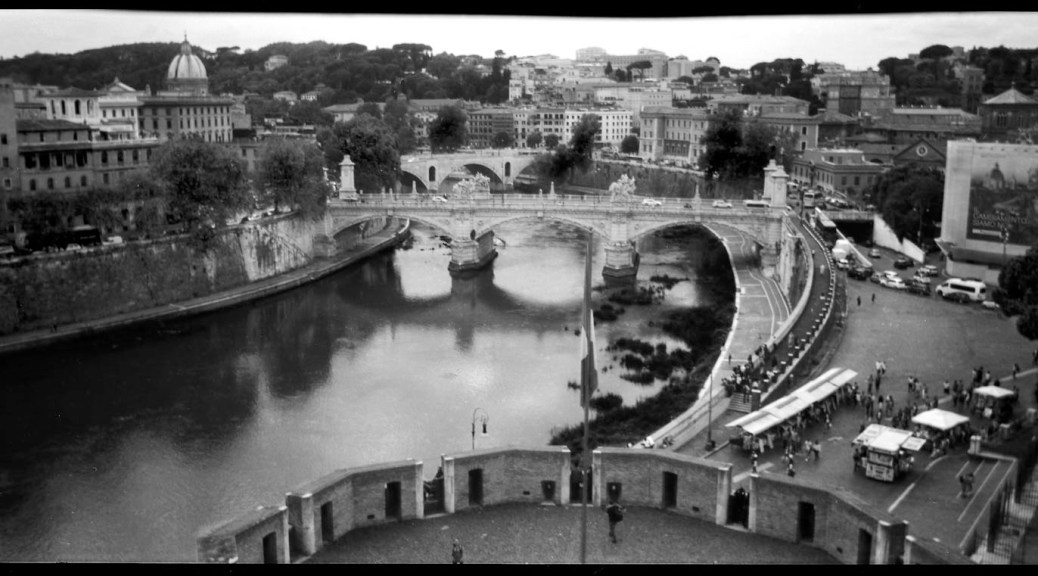
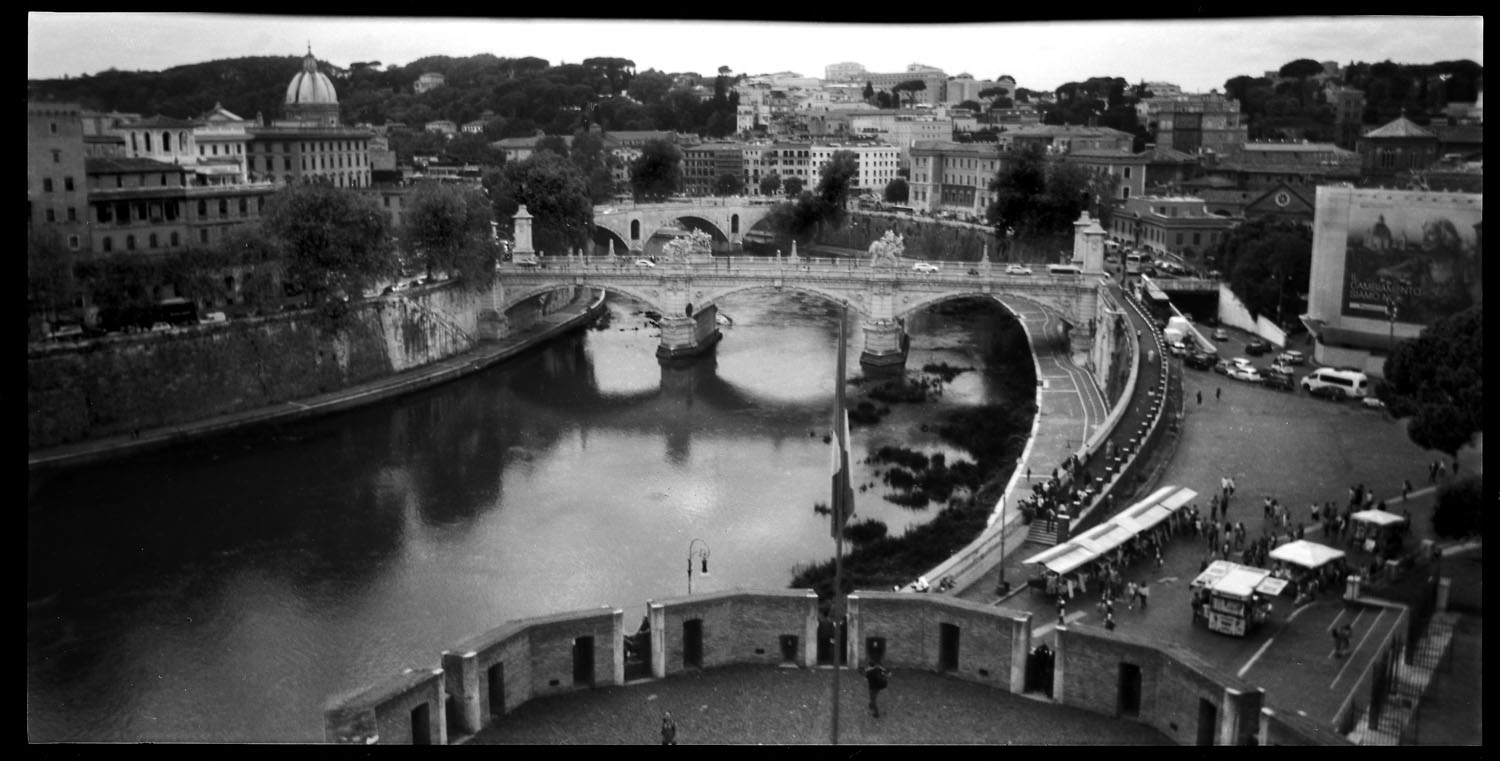
This is a panorama I took of the bend in the Tiber river just in front of the Castel Sant’Angelo, from the castle’s ramparts. St. Peter’s is to the right, out of view. If you look at the bridge in the background, you can see the keyhole arches in the supporting piers which are there to help the bridge not get washed away in time of flooding. There are a number of bridges across the Tiber with this feature, including the famous “Ponte Rotto” (Broken Bridge), which you’ll see in some other shots I’ll post later.
This was taken with my Belair X6-12 camera. As you can see, it’s a pretty soft lens, combined with what was probably a pretty slow shutter speed (1/30th, 1/15th? with this camera, who knows- it sets it automatically for you and doesn’t tell you what it used). But it has a look to it, and the negative isn’t unusable.
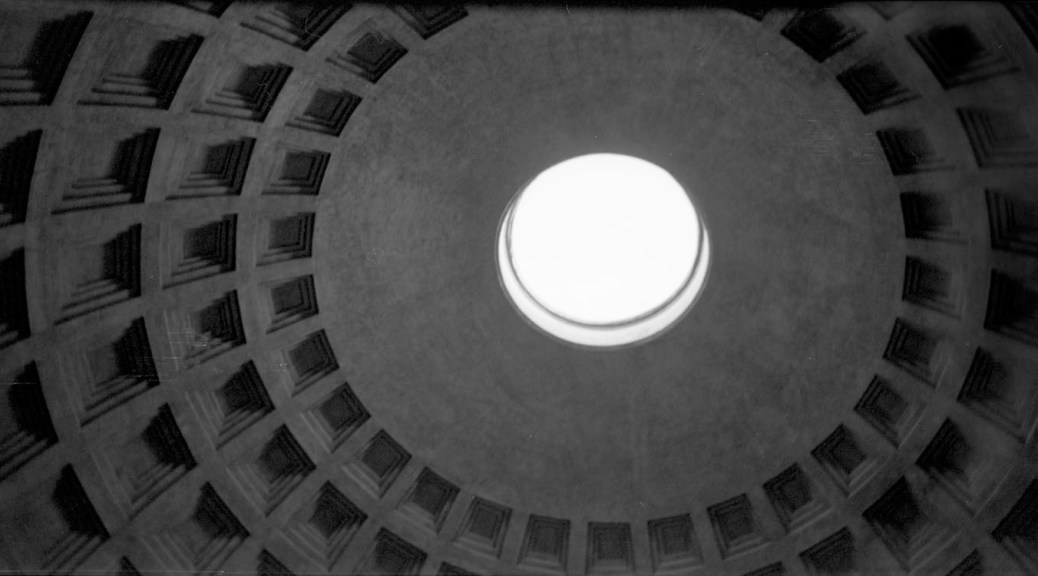
Here’s a shot I took of the oculus of the Pantheon with my Belair X6-12. The camera has its issues, one of which is the relatively low contrast from its plastic lenses. Most of the time. Here’s a circumstance where it works to my advantage- the interior of the Pantheon is so dark, and the main light source being the oculus, it’s very contrasty. The flat lens on the Belair helps bring out shadow detail where there wouldn’t be as much.
Here begins my Italian saga. I got back less than a week ago from my Italian excursion, having spent 12 days in Florence and Rome. I posted an odd and end from my phone while on the road, but now that I’m home I’m working my way through the 79 (yes, 79!) rolls of film I shot. I’ve got 16 processed so far, and will try to develop some more after work during the week so I don’t have to totally binge on the weekends.
If you’ve been following the blog, shortly before I went away I got a Lomo Belair X/6-12 panoramic camera. I posted a few shots I took with the 58mm super-wide lens, and that lens is, well, marginal at best. Very soft, very low-contrast, and horrendous barrel distortion. Not the kind of lens I would want to shoot a lot of architecture with, and that’s what I’d be shooting a lot of in Italy. I brought it with me just in case, but kept the 90mm lens on the camera and ended up shooting exclusively with that.
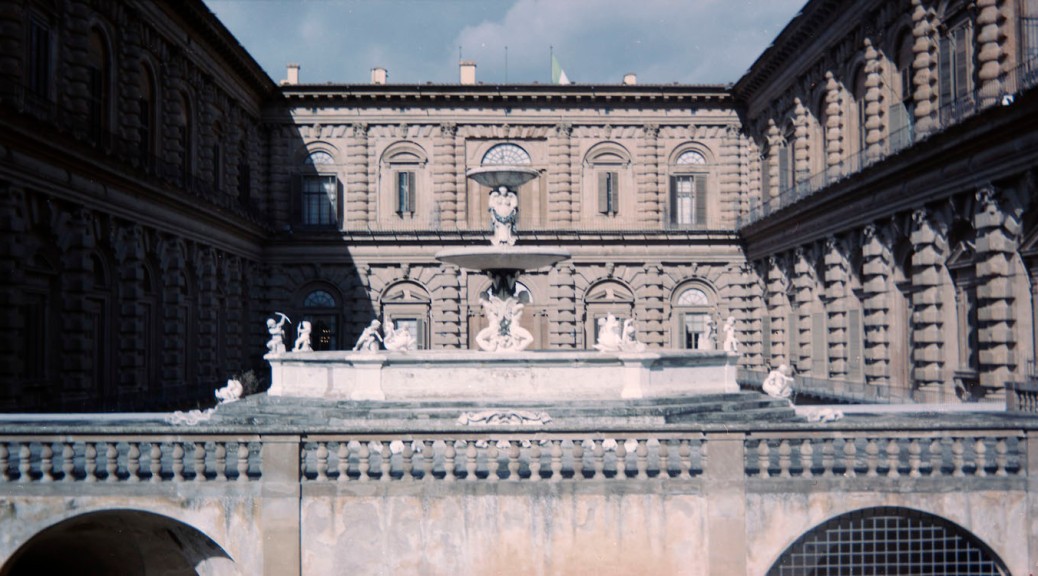
This is the courtyard of the Palazzo Pitti, as seen from the Boboli gardens behind it. As you can see from this shot, the 90 is sharper than the 58, but still not up to the standards of a glass lens (the 58 and the 90 are both plastic).
Pitti Palace
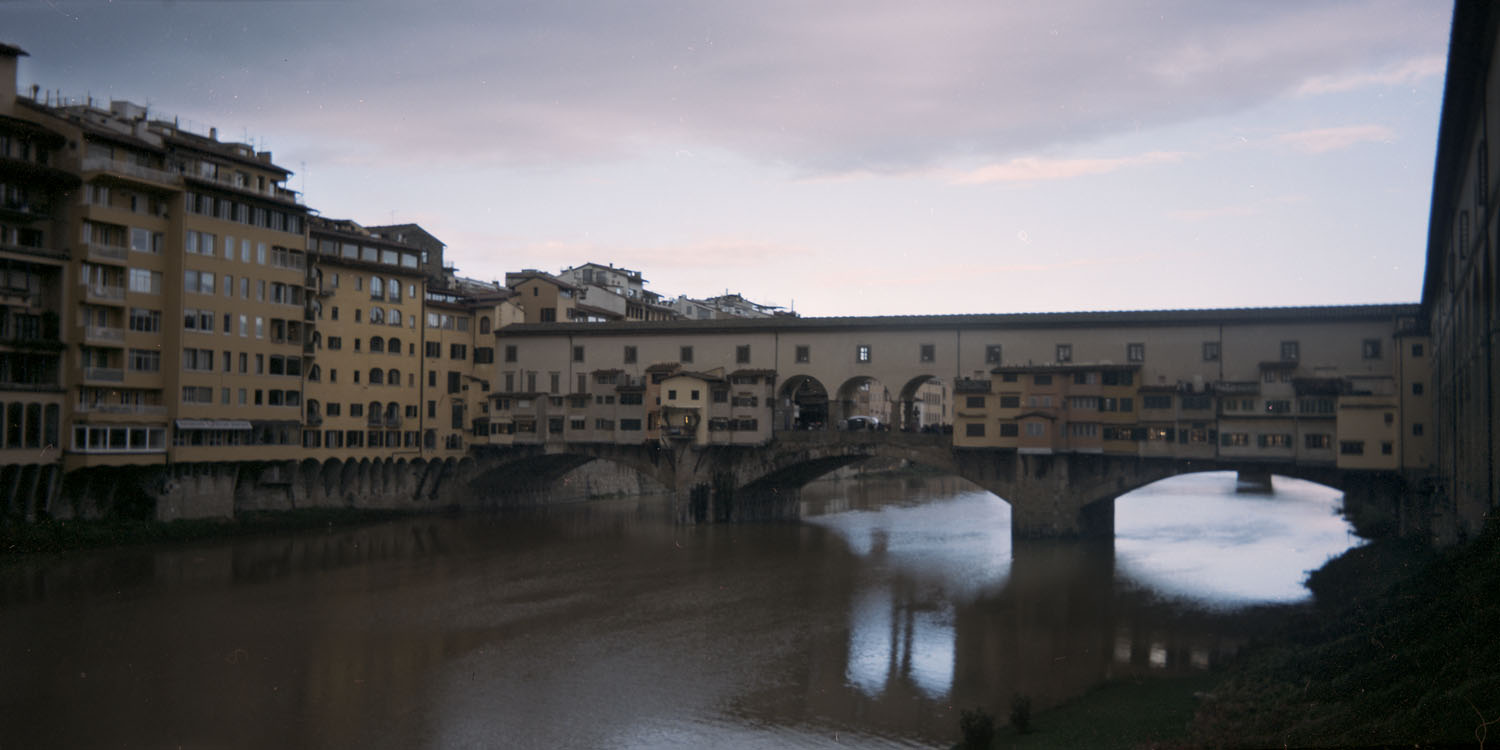
The 90 is better, but better is a relative term. Certainly, I wouldn’t have been able to take these shots without the camera, and I genuinely like them, but they’re not what I normally think of when I think of my style of photograph. If I’m going to stick with the camera, it’ll be a mental adjustment to apply the tool to tasks appropriate to it. It’s very good at transforming the time of day of a shot- while this is titled “Ponte Vecchio Evening”, it was actually shot around 10AM.
Ponte Vecchio Evening
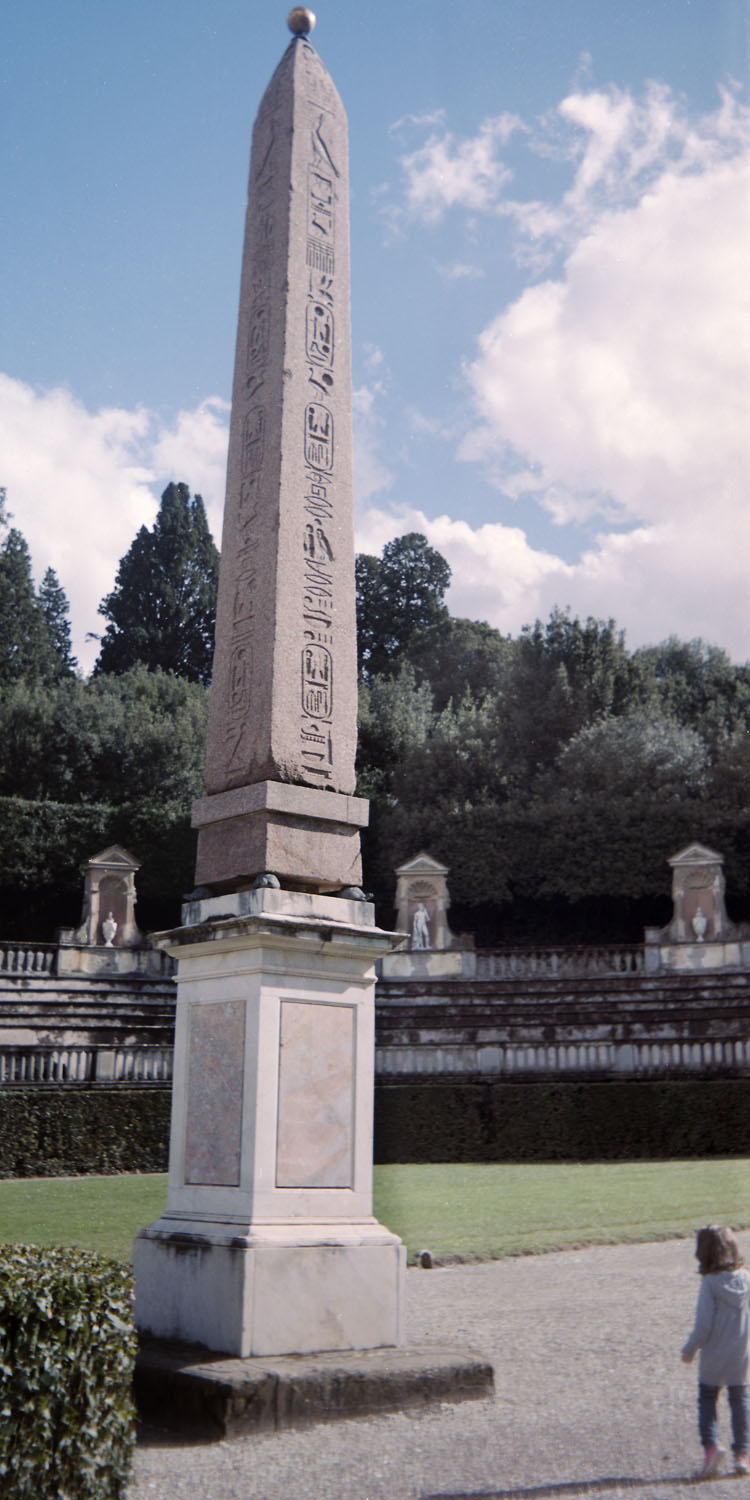
This has also been a lesson for me in making peace with cropping. I’ve been for the most part a full-frame kind of guy – I try to compose to the edges of my frame so everything shows the way I want it to and I don’t need to crop. But sometimes, the best of intentions when composing in the heat of the action don’t always work, and you learn to crop after the fact. This shot, for example. In the original full frame, the obelisk was dead center in the frame. I think at the time I pushed the shutter button I thought the little girl was out of the picture, but there she was. On the left, the edge of the fountain in front of the obelisk was intruding into the scene. Looking at the image actually captured, all the action in the scene included the little girl playing off against the obelisk, and the edge of the fountain was a real distraction. Cropping to get rid of the fountain completely changed the dynamic and makes the image go from being a record shot to something actually interesting.
Obelisk Boboli Gardens
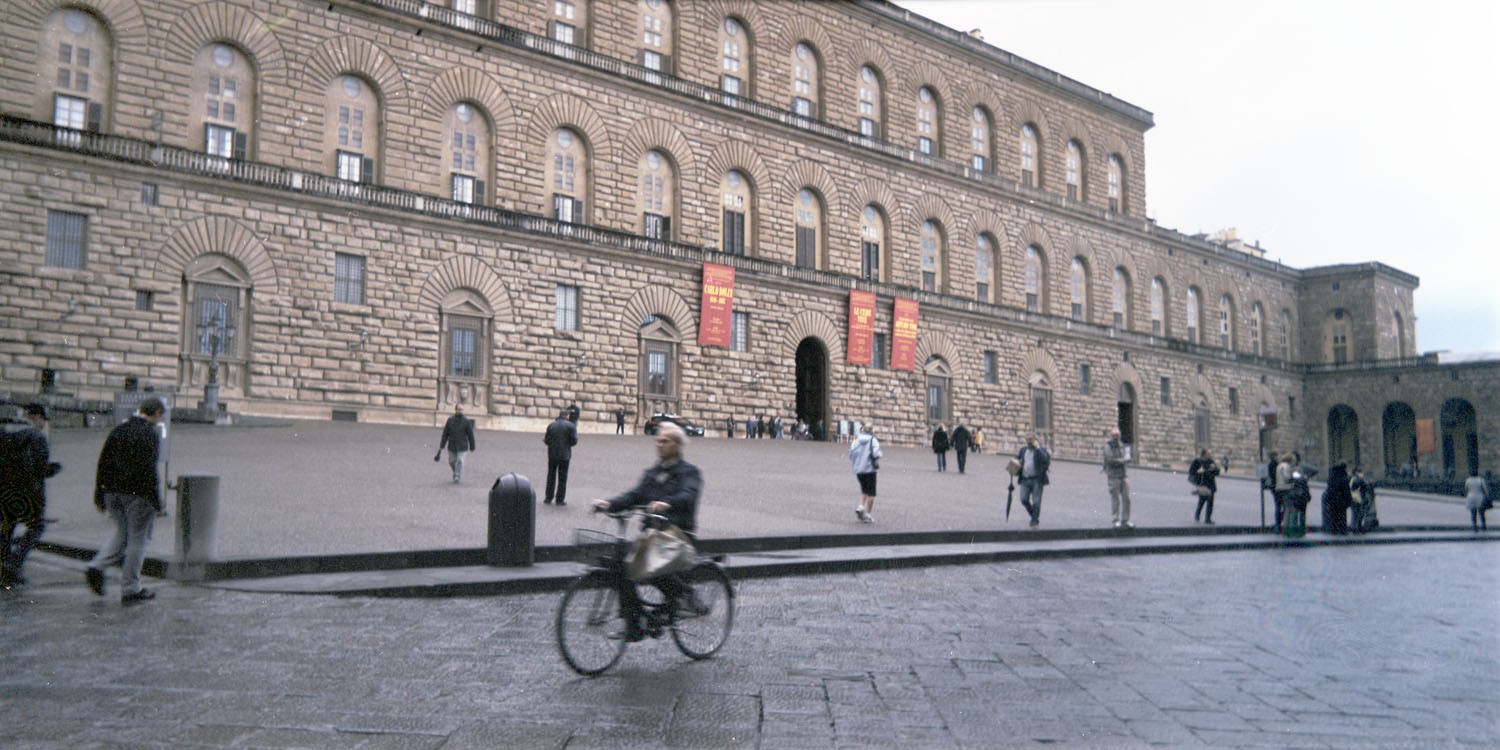
This is the facade of the Palazzo Pitti, originally home to the Medici family, later a residence for Napoleon Bonaparte, then the administrative center of the Italian government for the first few years after unification, and now an art museum. The shutter has a maximum speed of 1/125th of a second, which is fairly slow all things considered. I don’t know how fast an exposure this was – the camera doesn’t tell you what speed it is using – so I’m guessing somewhere in the 1/60th range given the amount of movement in the cyclist. That’s another thing you have to make peace with with this camera – unpredictability. I don’t know that I’m there yet. I’ve got about 12 more rolls of film from this camera to process in my black-and-white film, so we’ll see how I feel after getting through those.
Cyclist, Pitti Palace
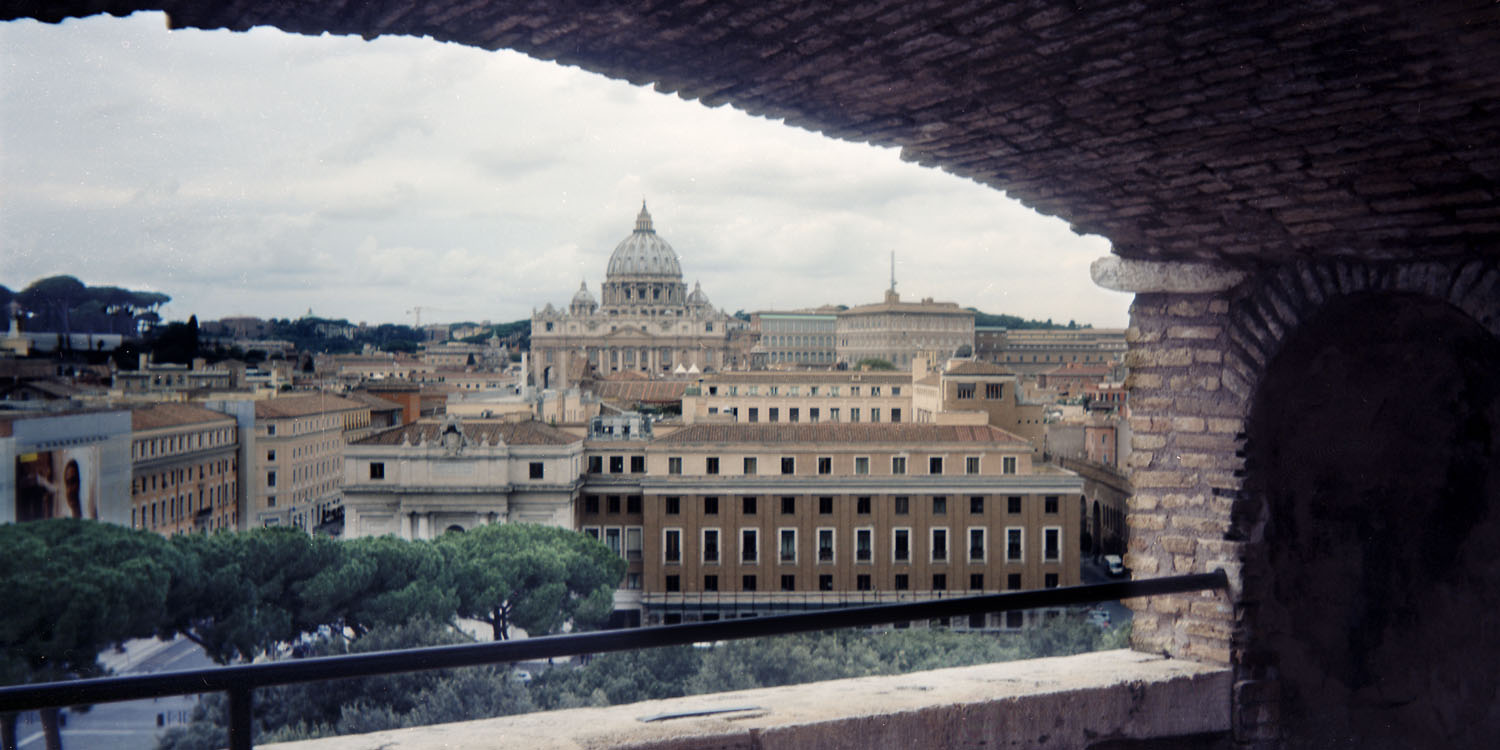
Sometimes the panoramic composition works phenomenally, like this one of St. Peter’s Basilica as seen from inside an arch on the Castel Sant’Angelo.
St. Peters From Castel SantAngelo
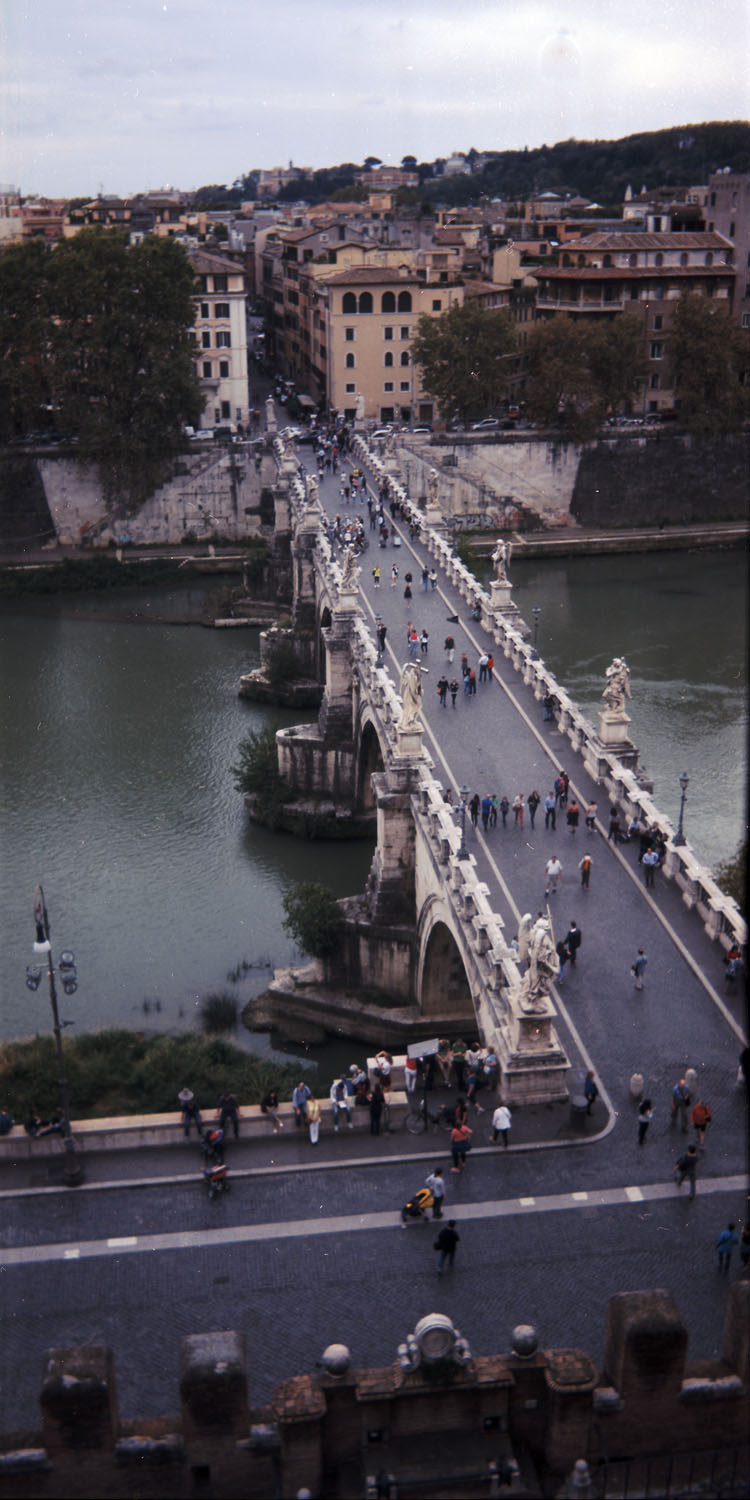
Other times, the panorama gives you compositional challenges that provide serendipitous solutions to themselves, like shooting the bridge in front of the Castel Sant’Angelo. The landscape around the bridge provides an S shape through the composition that leads your eye around and through the entire scene, not just pulling you from lower right to upper left and shooing you out of the frame at the end.
Bridge From Castel SantAngelo
Another argument in favor of cropping – the original of this included the heads of the patrons of the Castel Sant’Angelo cafe (yes, they have a cafe in the battlements of the Castel Sant’Angelo, which began life almost 2000 years ago as the burial monument to the Roman Emperor Hadrian).
I recently acquired a Lomo Belair X 6-12 City Slicker model. It comes with a 58mm and a 90mm lens and the matching viewfinders. The camera is a weird beast, sort of a neither-fish-nor-fowl thing, in that it has multiple film formats (it has masks for 6×6, 6×9 and 6×12 frames), interchangeable lenses (58 and 90mm plastic lenses, and an optional accessory 112mm all glass lens), auto-exposure in aperture-preferred mode, and a hot-shoe flash. However, it is manual film advance completely separate from shutter cocking, there are only two apertures on each lens (f8 and f16), the only sort-of control you have over the shutter is to set the film speed and/or set it to B for long-time exposures), the shutter has a maximum speed of 1/125th of a second, and focusing is zone focusing with indicator marks on the lens for infinity, 3 meters, 1.5 meters, and 1 meter. Oh, and there’s no cable release provision so you have to be extra careful when using B that you don’t shake the camera. The 58mm lens, especially at the 6×12 configuration, is very lo-fi and has gobs of obvious barrel distortion. However, where else are you going to find a 6×12 panoramic camera with a 58mm lens on it with auto-exposure for $250? Your next cheapest option is to put a 6×12 back on a press camera, which is going to run you at least a cool grand to put together. Even a 6×12 back on the new-but-still-effectively-vaporware Travelwide, plus a 65mm lens will run you a good $700-800.
I put a couple rolls through it to test it out last week and weekend. It is wicked wide with the 58, and sharp enough in the center. My example tends to run a bit to the overexposure side, which I think accentuates some of the weaker characteristics of the lens (like the low contrast from the plastic optics), although I’d rather have it overexpose than underexpose. One thing I haven’t figured out yet is if any of the lenses including the glass lens will accept filters. I’d love to try out the camera with a roll of Infrared and see what it does. It could be a great combination, or it could suck dirty dog toes. This spring, I’ll give it a try and find out.
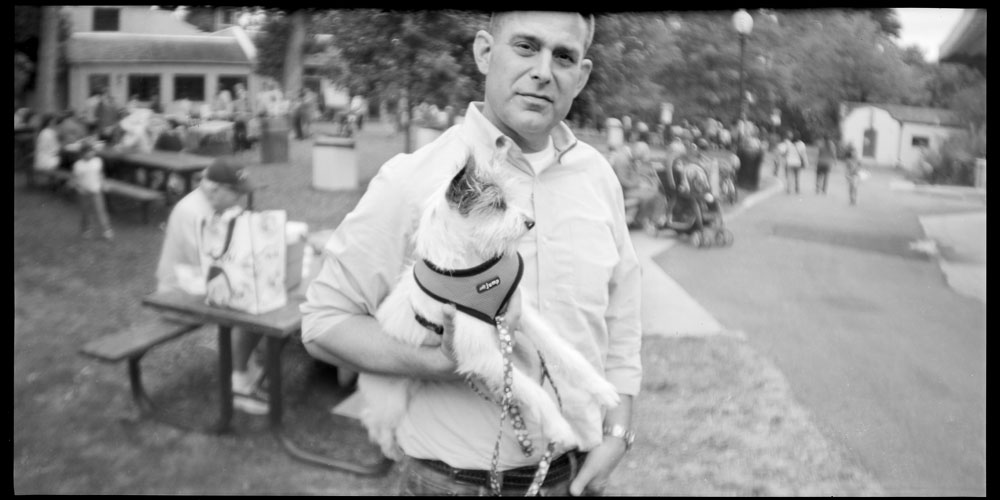
This shot is of my student Todd Walderman from my Intro to Platinum/Palladium Printing class, and his new puppy, Cookie.
Todd with Cookie
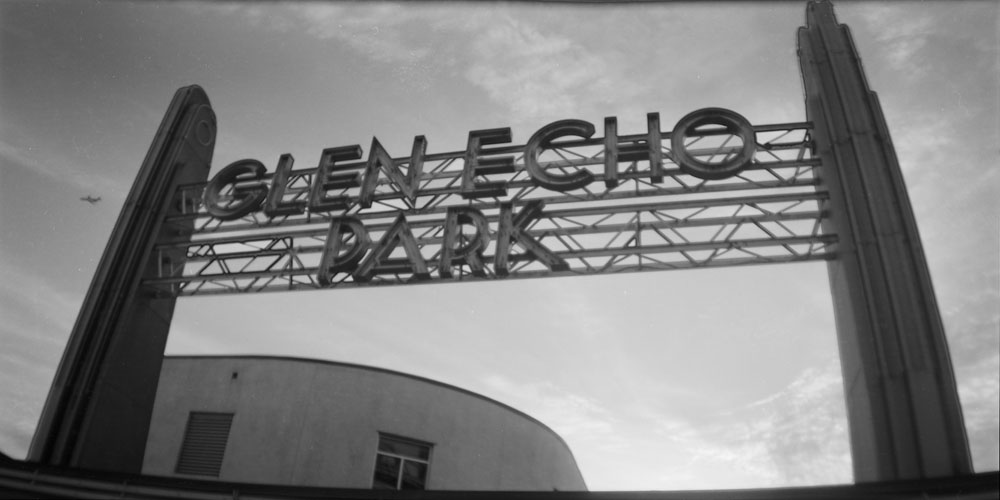
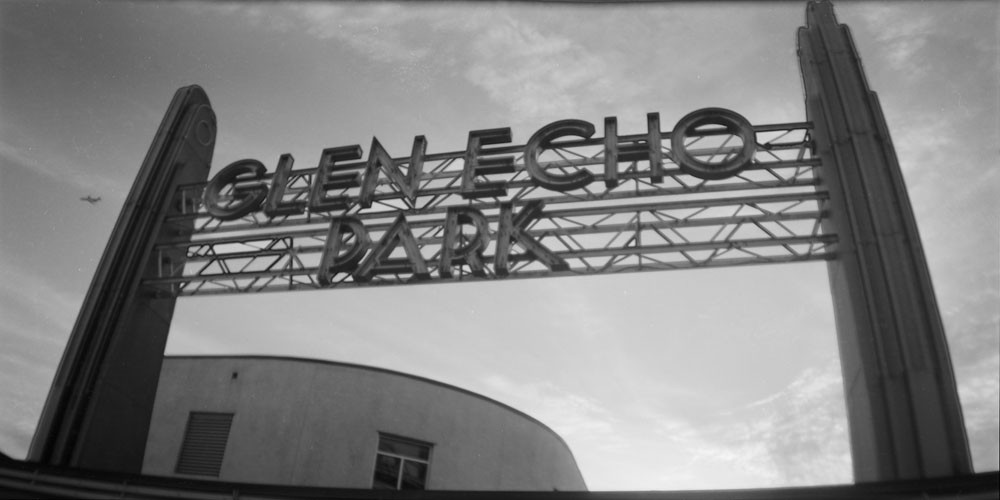
The Glen Echo Park sign, backlit at evening time. This shot as much as anything shows the amount of barrel distortion the 50mm lens has. Used appropriately it can really add to an image. But don’t use it to take pictures of things that need to be plumb and square, because they’ll look terrible. Knowing when to use it and when not is an art form in itself.
Glen Echo Park Sign
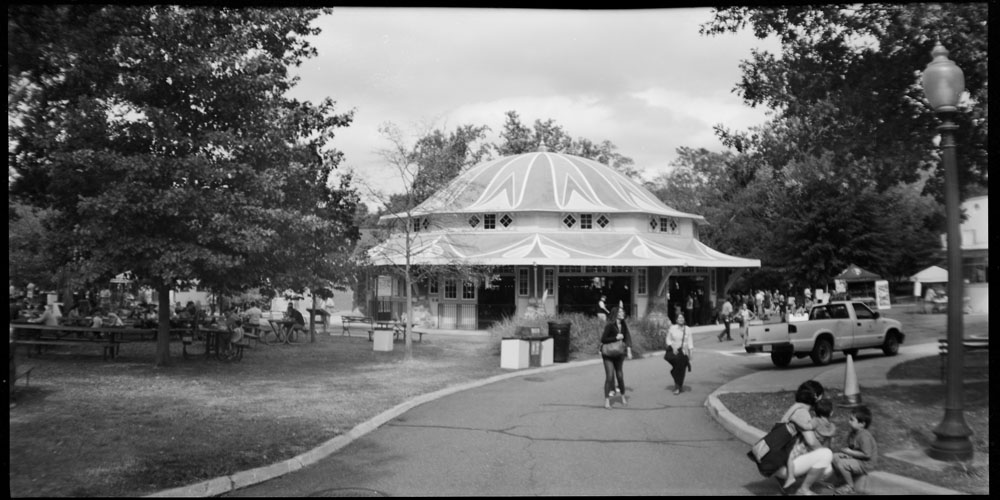
The Glen Echo carousel.
Glen Echo Carousel
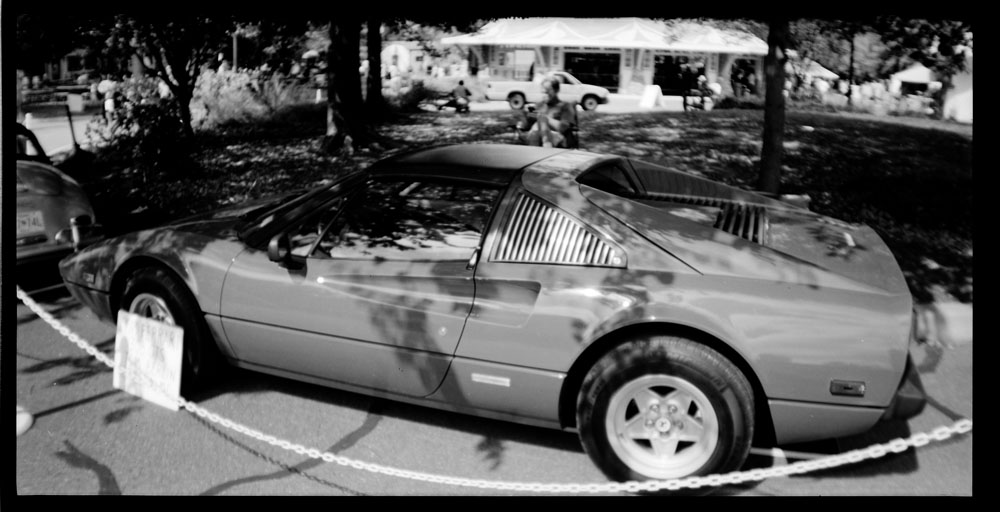
That weekend, they were having an end-of-summer-season festival at Glen Echo, which included a mini antique car show and the final running of the carousel for the year. Among the honored guests was this vintage Ferrari:
1979 Ferrari 308
In keeping with the spirit, sort-of anyway, of the whole Lomography lo-fi movement, I was running 10+ year out-of-date Ilford FP4+ through the camera. I don’t think it really made a difference, though, as you’ve seen shots I’ve taken this year using the exact same film through my Rollei, and if I hadn’t told you it was 10 years out of date you’d never know.
As you’ve seen, I’ve been playing around lately with the panoramic head for my Rolleiflex, trying out some two and three frame panoramas. With each additional frame in the panorama, it gets harder to stitch together and keep aligned, and to match exposure. Not to mention the people who get caught at the periphery of a frame and then move so they’re missing a limb or something in the second frame.
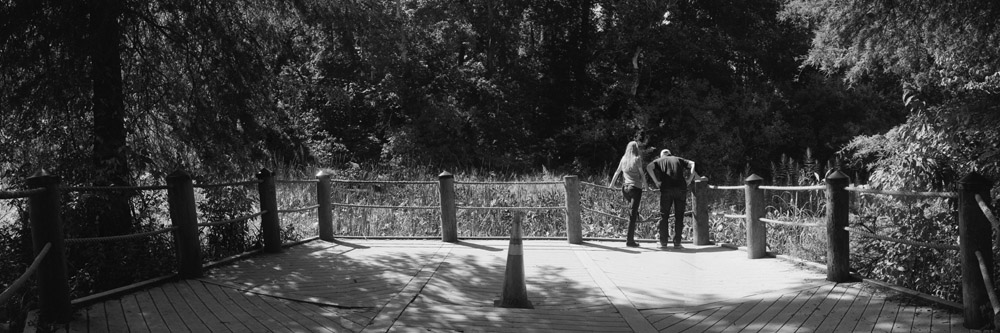
I can’t explain what my fascination with traffic cones is, but this one, marking out the collapsed section of the middle of the observation deck, was just so perfectly positioned that it needed to be photographed, both as a single frame and as a panorama. This couple strolled in to the scene as I was shooting, and I decided that they added an interesting dimensional element to the scene, so I kept photographing while they were there instead of waiting for them to leave.
Marsh Overlook
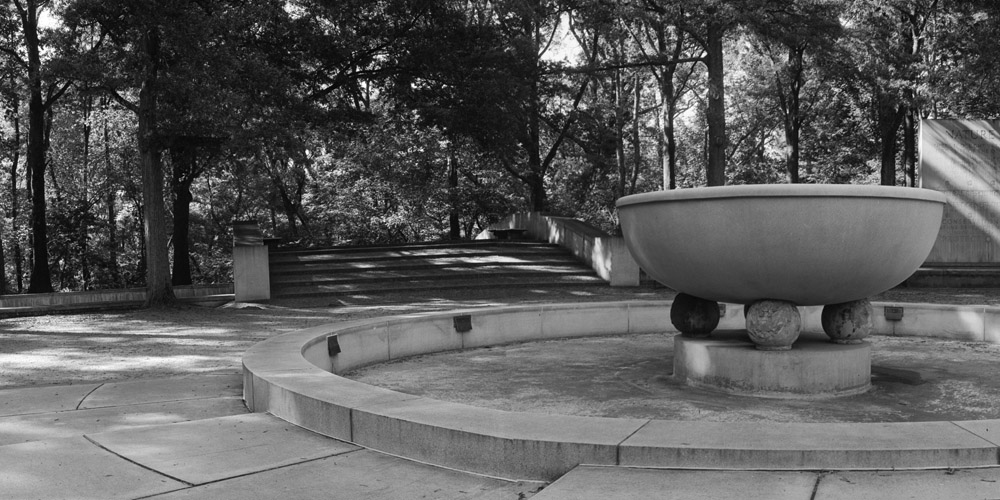
This is one scene where a three-frame panorama just doesn’t quite fit. I think the imbalance of the fountain basin makes it more interesting than having everything balanced and proportionate. What do you think? Do you like the way the imbalance pulls your eye back and forth across the frame from lower left to upper right? Does that feel natural or uncomfortable to you?
Fountain
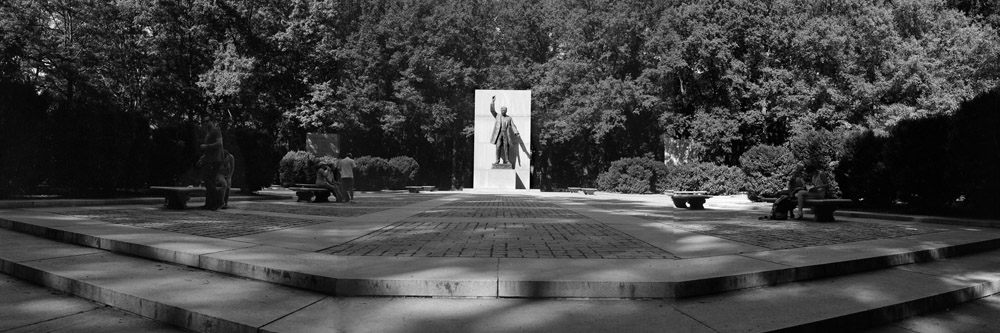
I’m getting in more practice with including people in scenes. My instinct is, for some reason, to photograph places without people in them. But now that I’m getting better at doing it, it’s starting to feel more appropriate to include them. It certainly humanizes the place, and helps give it a sense of purpose and utility, like this is somewhere that people actually want to go and do things, and not some empty monument to a long-dead dictator who, like Ozymandias, has no meaning to the people of today beyond his statue and inscription.
Teddy Roosevelt Monument
I didn’t photograph the inscriptions on the marble slabs around the periphery of the Roosevelt monument because I think that A: those kinds of photos make for very boring photos, and B: the rendering of those quotes into two dimensions grossly undercuts the meaning of the quotes and the experience of reading them in-situ. I would strongly suggest, though, that anyone interested check out The Theodore Roosevelt Center website for the full extent of the quotes. They are profound meditations on the nature of man and his environment, politics, and government every bit as appropriate and relevant today as they were when Teddy was president at the dawn of the 20th century.
Ok- here are some twosies I did, still with the Rollei and the panorama adapter.
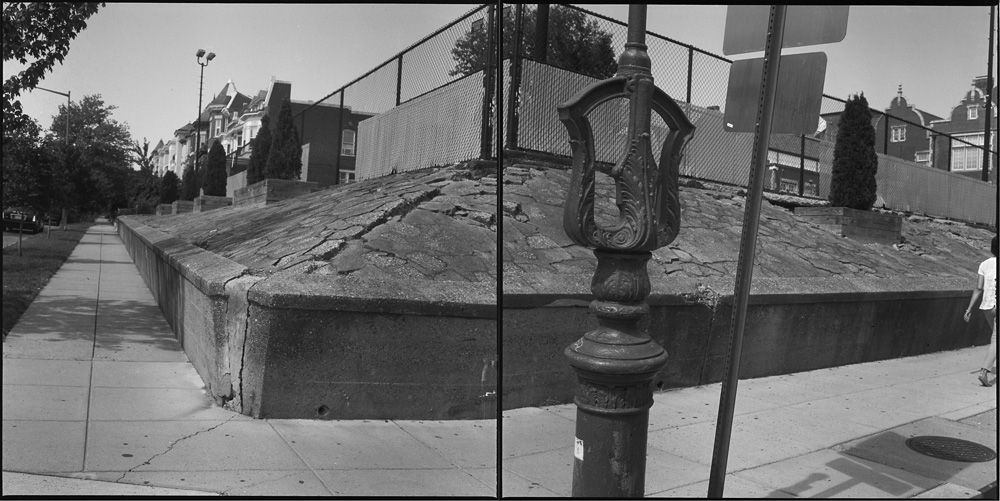
The first one is a shot of a street corner with the skeletal remains of a police call box from the first decade or so of the 20th century. The building behind it is now a charter school. I’ve often thought of how to photograph the wall around the playground fence behind the school. This is the first shot I’ve done that really does it justice.
Police Call Box
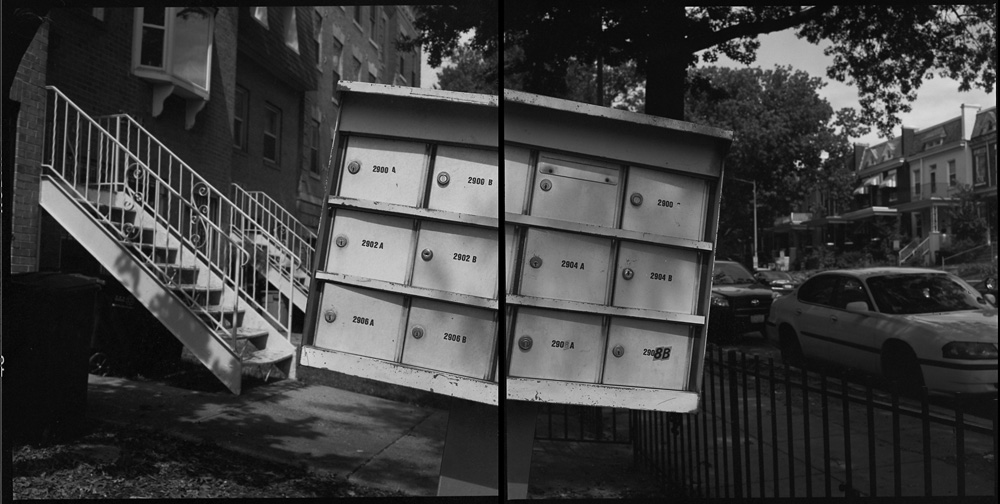
I came upon this mailbox leaning at its crazy angle and decided it would make a good subject for a diptych that emphasized and even exaggerated the tilt of the mailbox. What is it with me and mailboxes?
Mailbox Diptych
Both of these scenes are in my neighborhood – I walk past them regularly on my way to run errands or get some dinner. I’m really starting to appreciate the advice of Edward Weston, “There’s no good photos to be made more than 50 feet from the car”, although I’m expanding the perimeter and rephrasing it a little: “There are plenty of good photos to be had within a mile of your house”.
I’ve got this really cool little toy that goes with my Rolleiflex – a panoramic head adapter. It’s basically a little plate with a disc in it divided into twelve segments, and an integrated bubble level. The plate goes between the Rolleiflex and the tripod head. The disc has a locking mechanism and click stops that allow it to be rotated a fixed number of degrees, corresponding to 1/12th of a circle (30 degrees) which is also more or less the field of view of the lens on the Rolleiflex. This would allow you to photograph a 360 degree panorama on a single roll of 120 film.
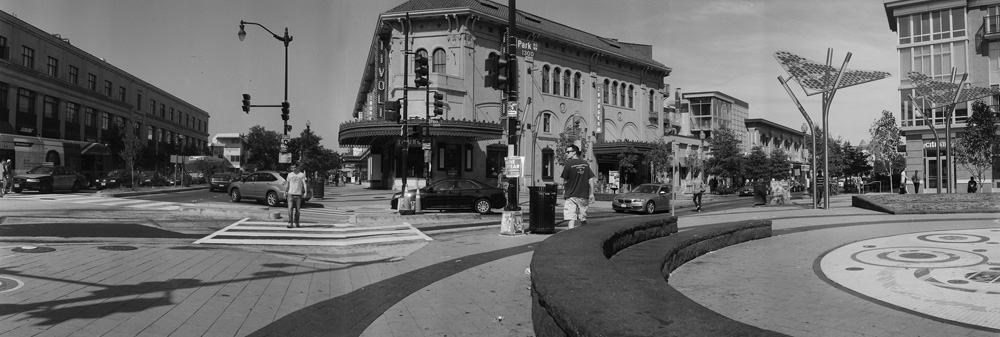
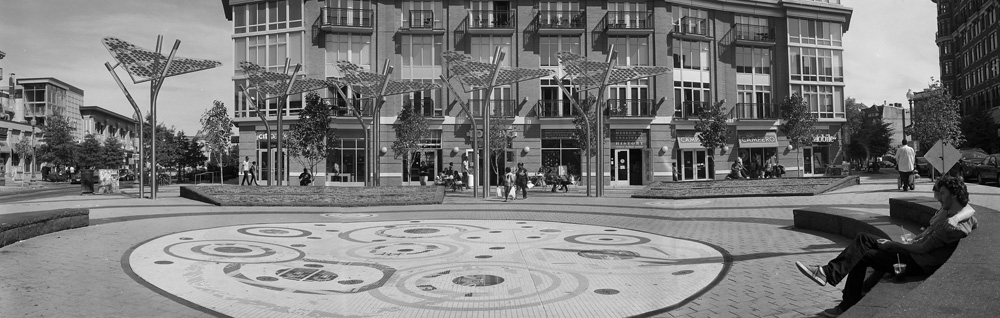
A 360 degree panorama is a bit much, and pretty tough to pull off. I’ve been playing with doing two-frame and three-frame panoramas, which seem plenty wide already. Here is one I took this afternoon at the little plaza in front of the Tivoli Theater in Columbia Heights.
Tivoli Theater
It does a pretty good job of matching up the frames, with just a few degrees of overlap, enough to make the blending and alignment relatively easy. If you’re paying attention you can see the seams where some things just don’t match up angle-wise, and where the car gets cut off between exposures.
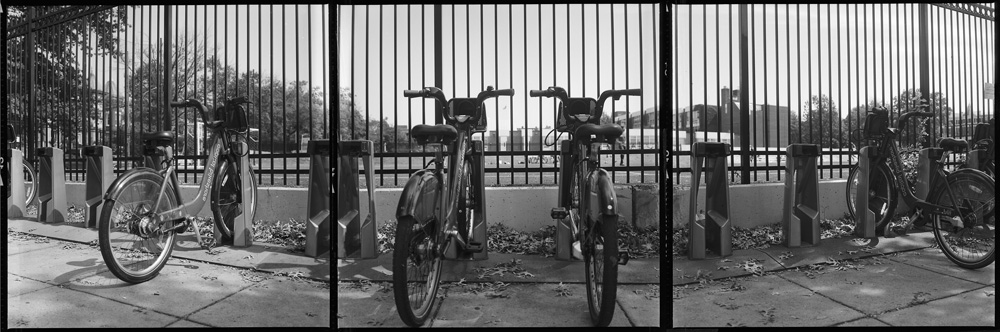
This one I composed a little differently – in selecting what to include, I left a little bit of film border in between each frame because I think it compliments the overall image – the black borders echo nicely the black bars of the fence in front of the bikes. Although I have two bikes in the center frame, and one each in the left and right frames, each frame does feel distinctly different.
Bikeshare Panorama
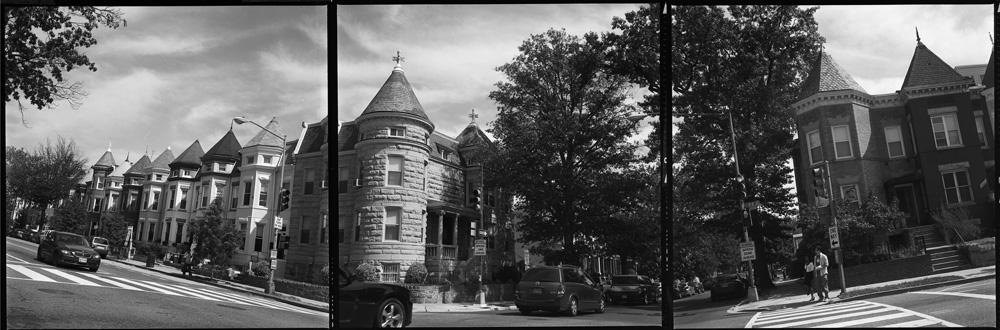
I decided to get a little playful and have fun with the crazy angles you can get from a panorama when you aren’t level to the horizon. I wanted all of the conical roof of the turret on the house on the corner in the picture, so I tilted the camera up (the other option would have been to go home and bring a step-ladder, and raise the tripod to its maximum height, and even then I might not have gotten the shot I was looking for).
11th Street
And last but not least, back to the fully merged panorama. This one I didn’t get the horizon quite as straight as I should have, and so the outside images were a little crooked, and the center one was definitely not level, so I had to play with how I aligned them and cropped them to make it look relatively normal. I like the look of this one despite its flaws.

 dcphotoartist