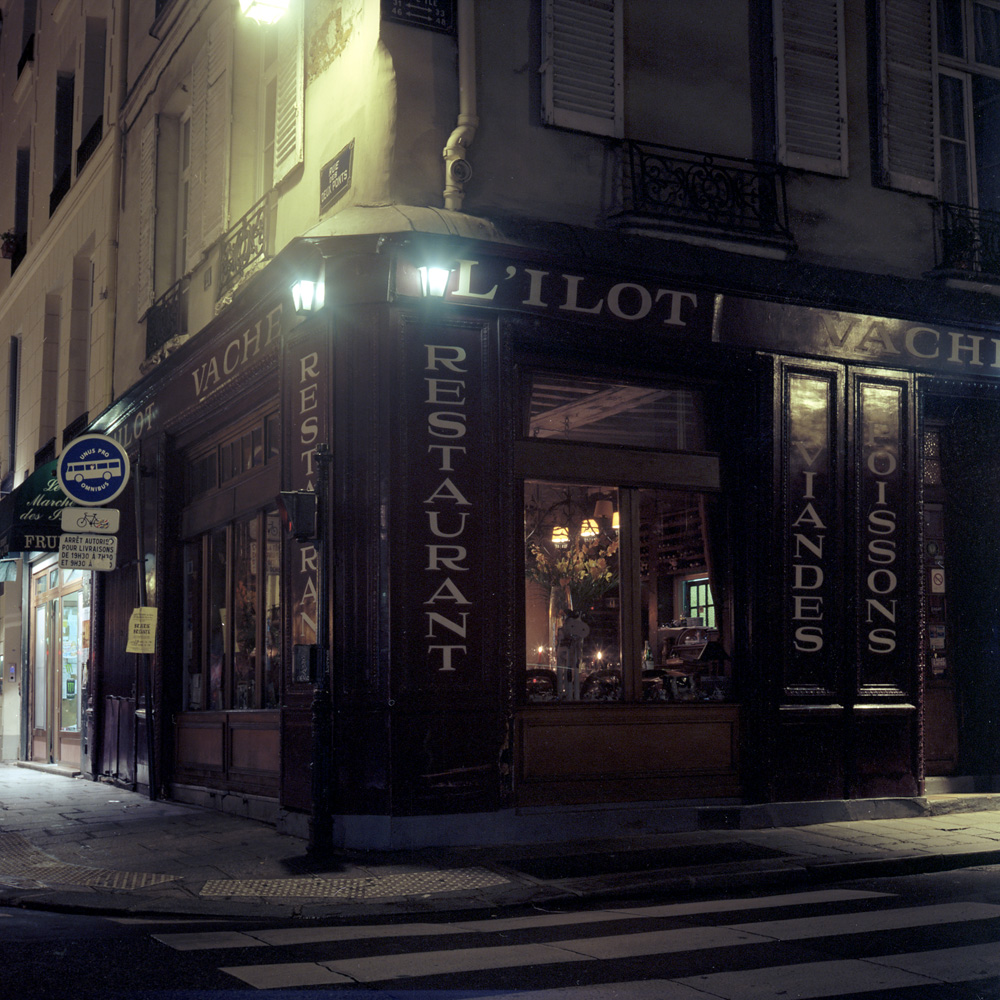
The Ilot Vache restaurant is on the corner of the Rue St.Louis en l’Ile and the Rue des Deux Ponts, which more or less bisects the Ile St. Louis into east and west halves. The Ile St. Louis was once actually two separate islands, one of which was the Ilot Vache (little cow island) because it was used as pastureland for Parisian cows. With the rapid growth of the city’s population in the 15th century, there was such a demand for more prime real estate that the two islands were merged into one and developed as residential space. Thus the name of the restaurant. The Rue des Deux Ponts roughly demarcates where the two islands were split. My dad and I ate dinner at L’Ilot Vache one night, and the food was quite good, even if the dining room was a bit crowded.
L’Ilot Vache Restaurant
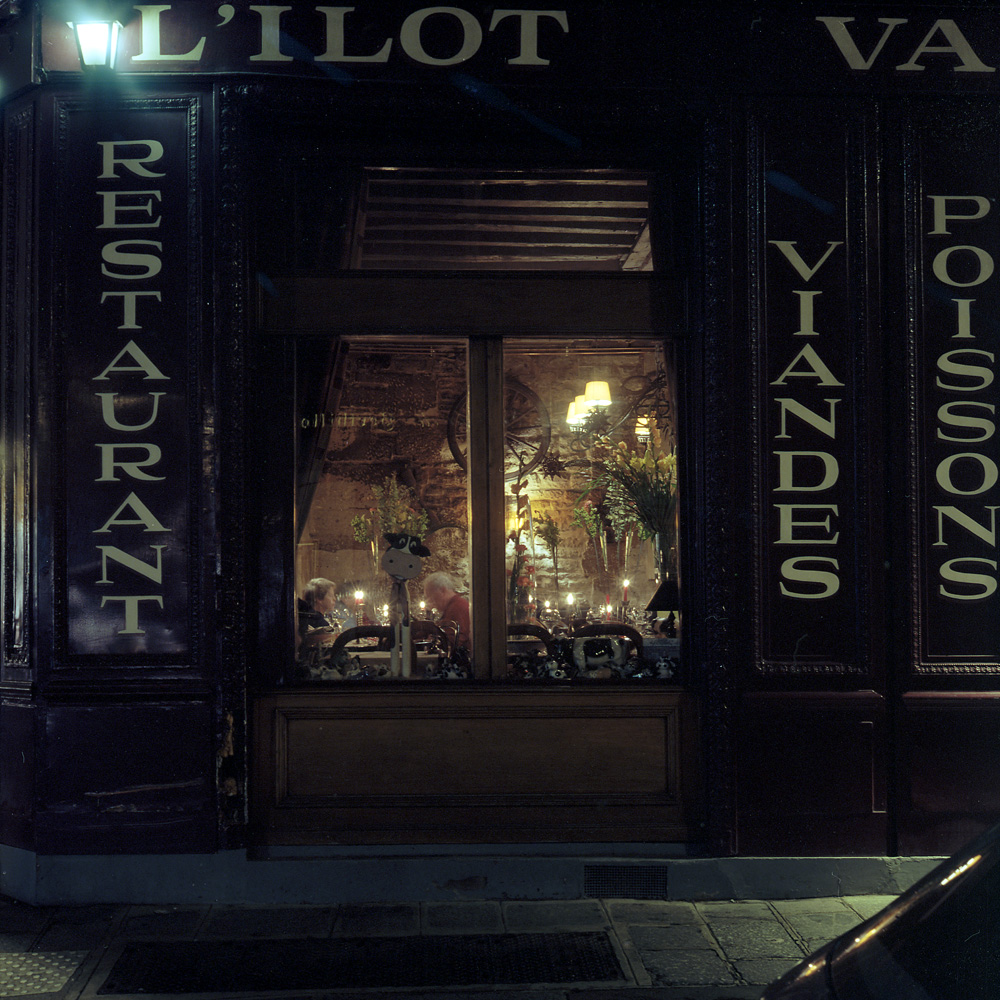
I managed to catch a pair of diners in the window of the restaurant.
Diners, L’Ilot Vache, Night
This is one case where I broke my normal rule of shooting night photos with Portra 160 – these two were done on Ektar 100. I suspect that I had just a couple frames left on the roll of Ektar that was loaded in the camera when I set out to do my night shots, so I finished them off and then switched over to Portra for the rest of the evening.
Ok, it’s far from a comprehensive survey of the city by night, but whaddya want, I only had a single night for night shooting, so I confined myself to where I could walk to from my apartment.
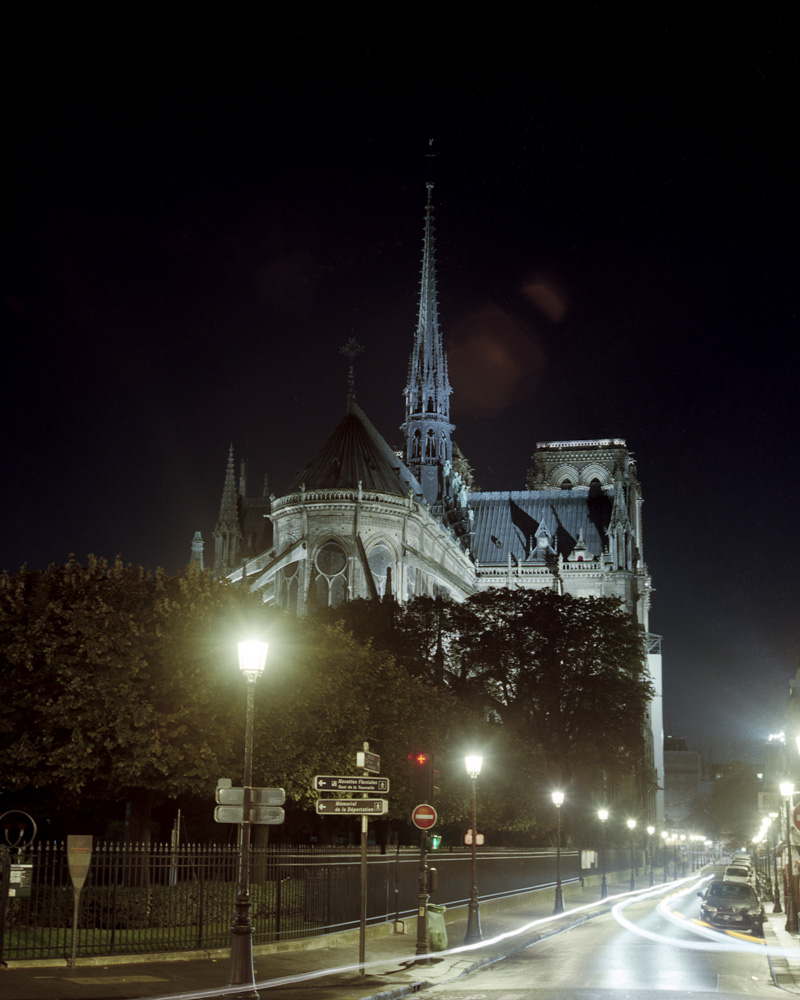
One of the great things about where we (my father and I) stayed was the fact we were in walking distance of just about everything, from the subway to all the historical buildings and neighborhoods. Notre Dame was a stone’s throw away, across the bridge. Here is the rear view from the approach I took over the Pont St. Louis.
Notre Dame, Rear View, Night
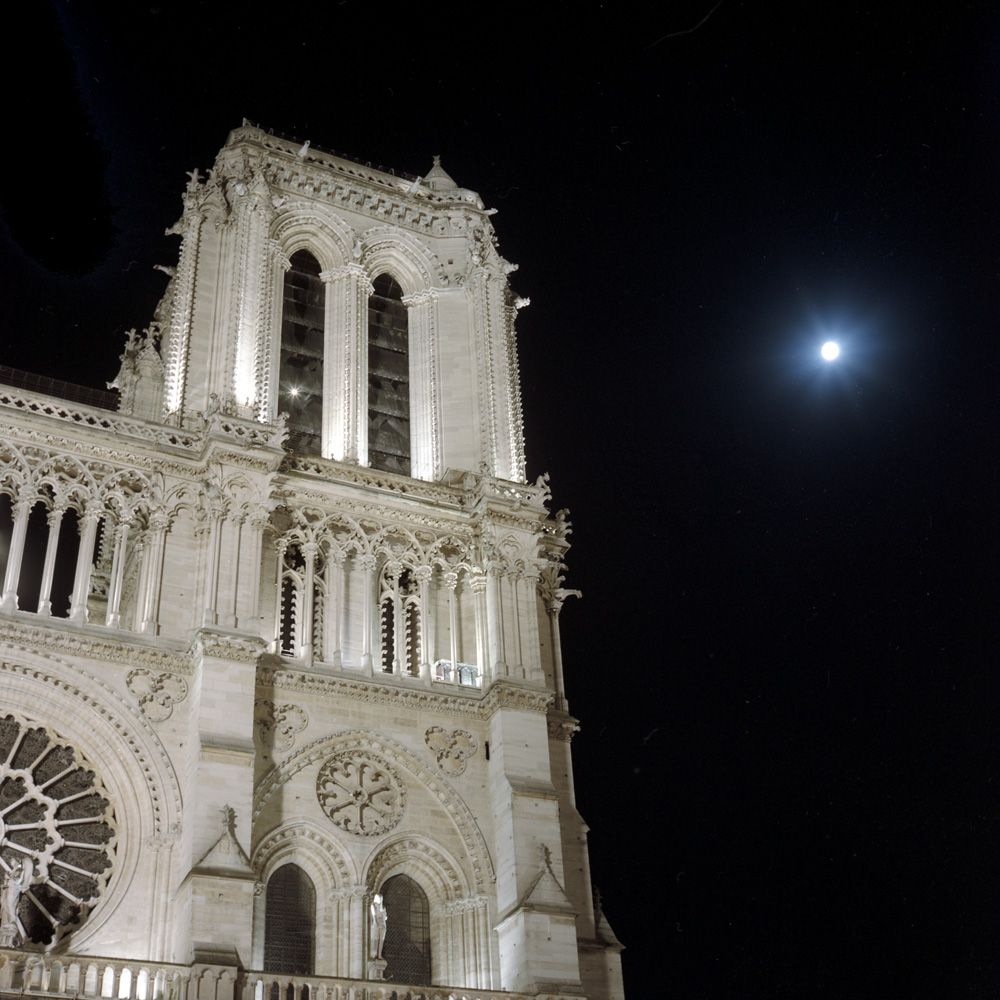
The front facade is fully illuminated at night, and they have built a set of large risers in the plaza in front that if nothing else serve as a great camera platform for photographing the towers. The night I was out shooting was the night of the full moon, so I got lucky and was able to get this shot of the tower and the moon.
Notre Dame, Tower, Full Moon
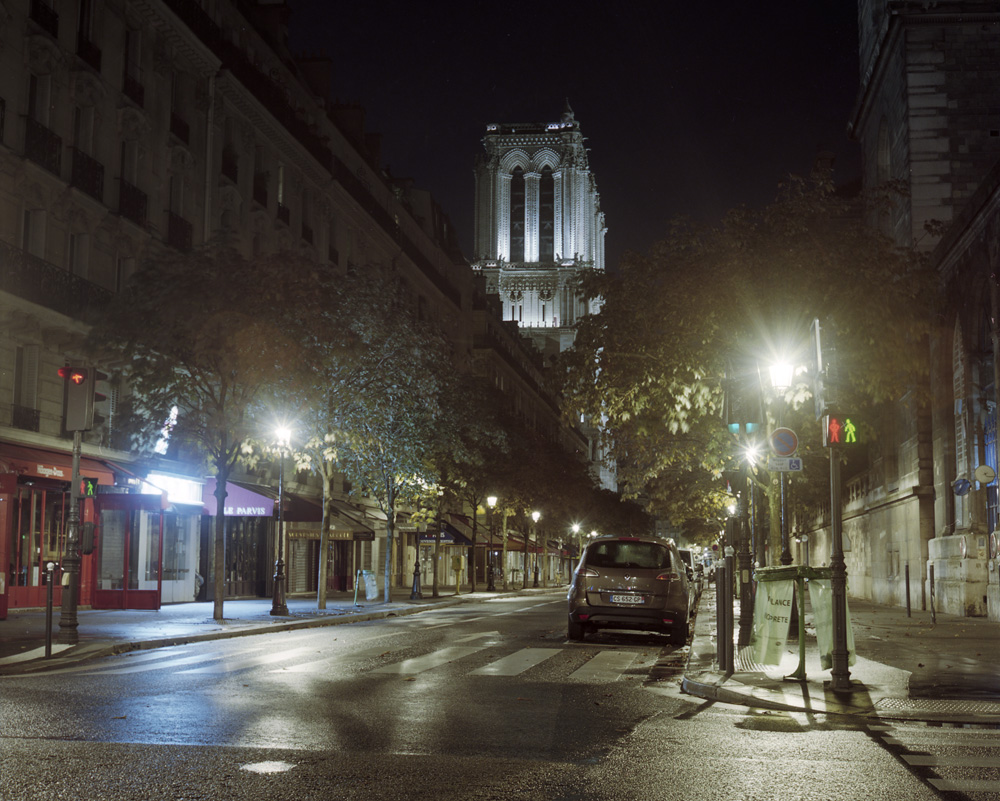
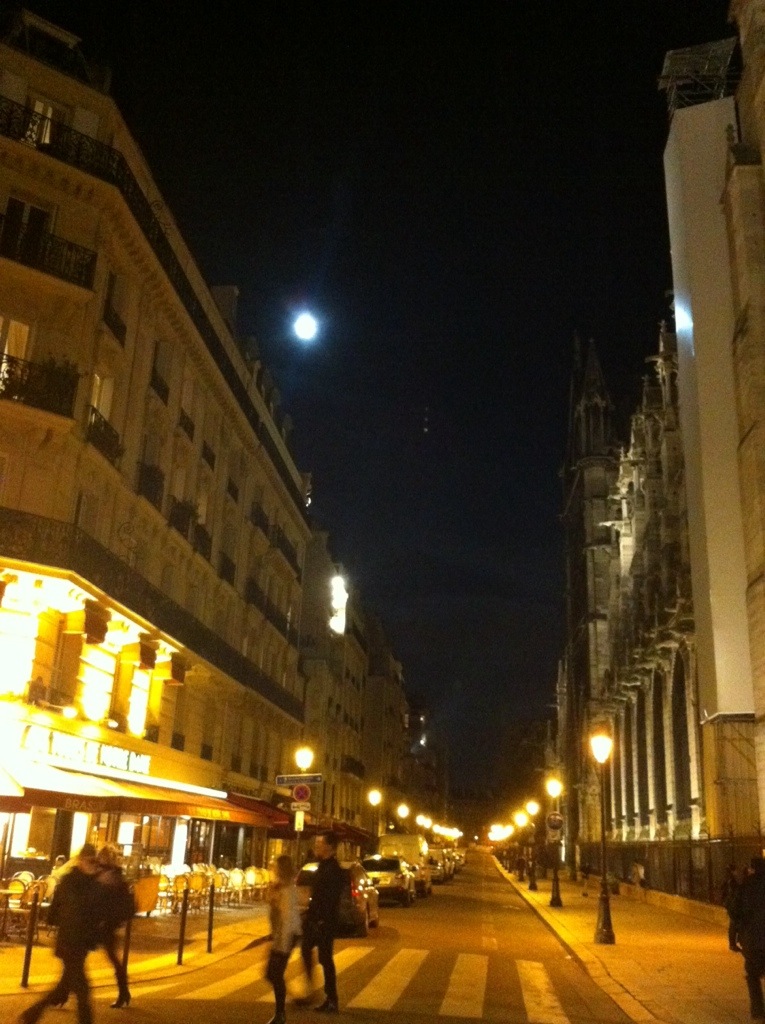
Another view of the towers, from a side street. It had been raining that evening, so the streets were wet giving them that Hollywood movie look.
Notre Dame, Side Street, Night
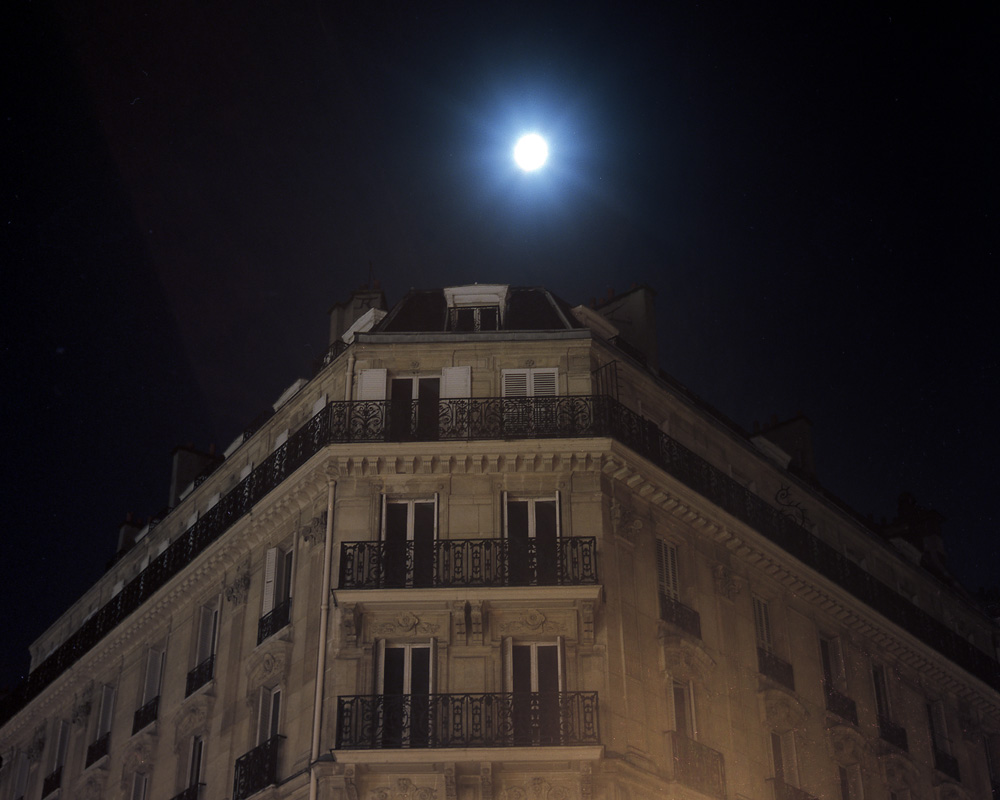
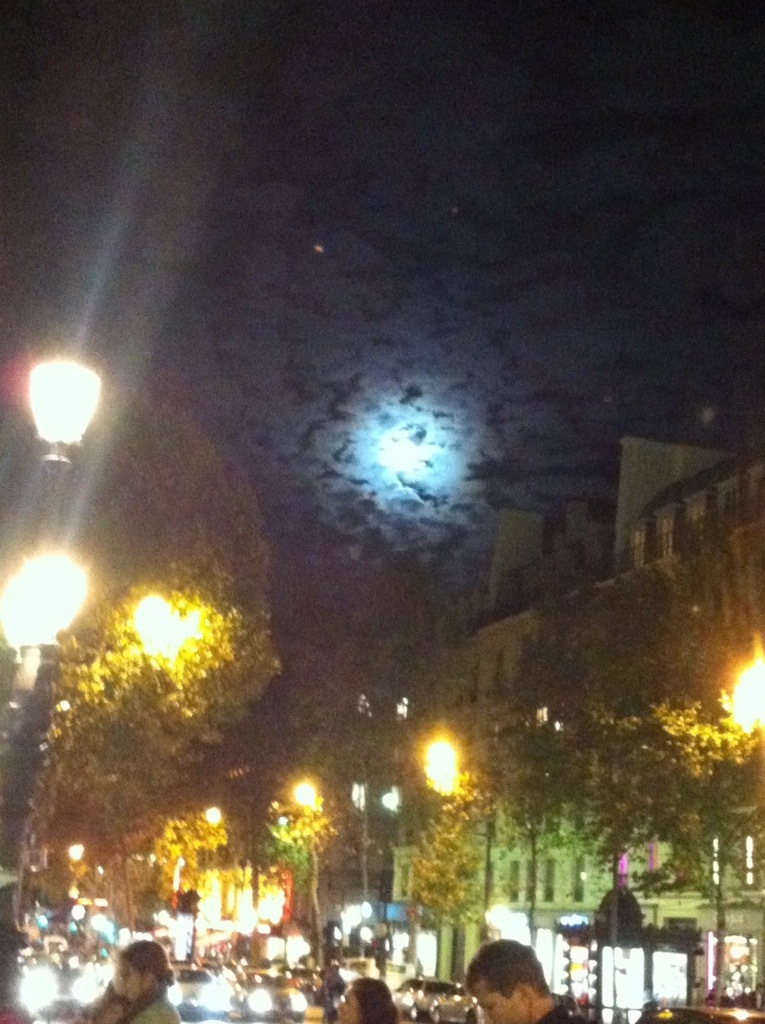
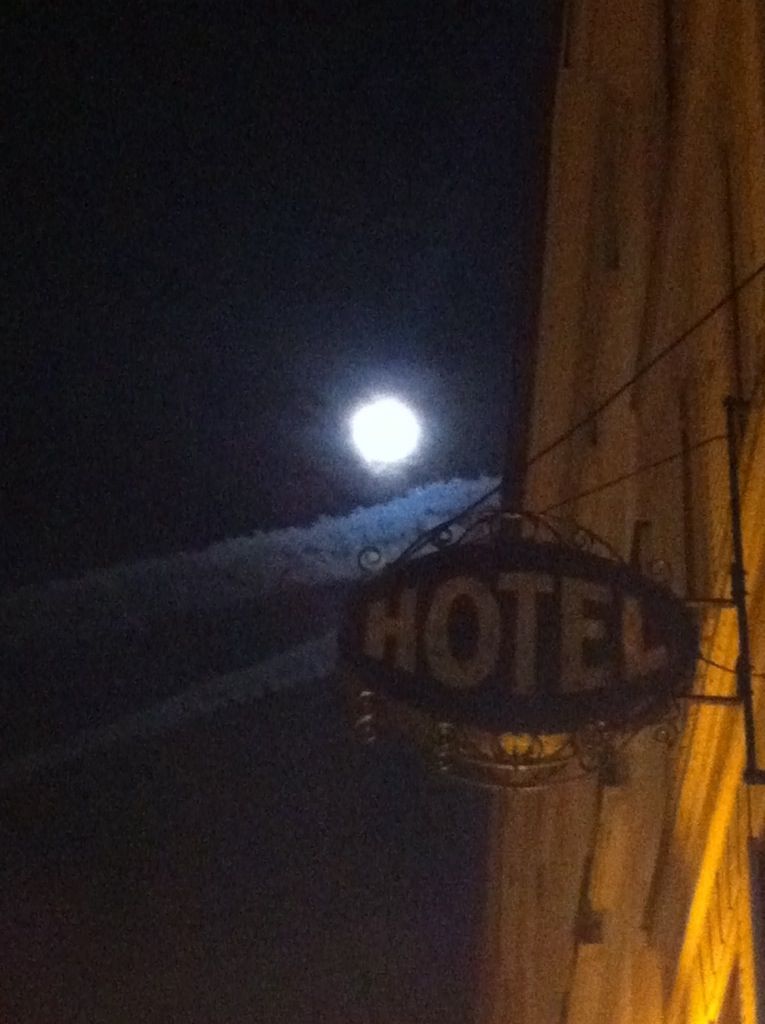
Another shot of the full moon, over a grand Hotel (Hotel in the Parisian sense of grand city residence/townhouse as opposed to place-where-you-rent-a-room-by-the-night) on the Ile de la Cite.
Full Moon Over Hotel, Ile de la Cite
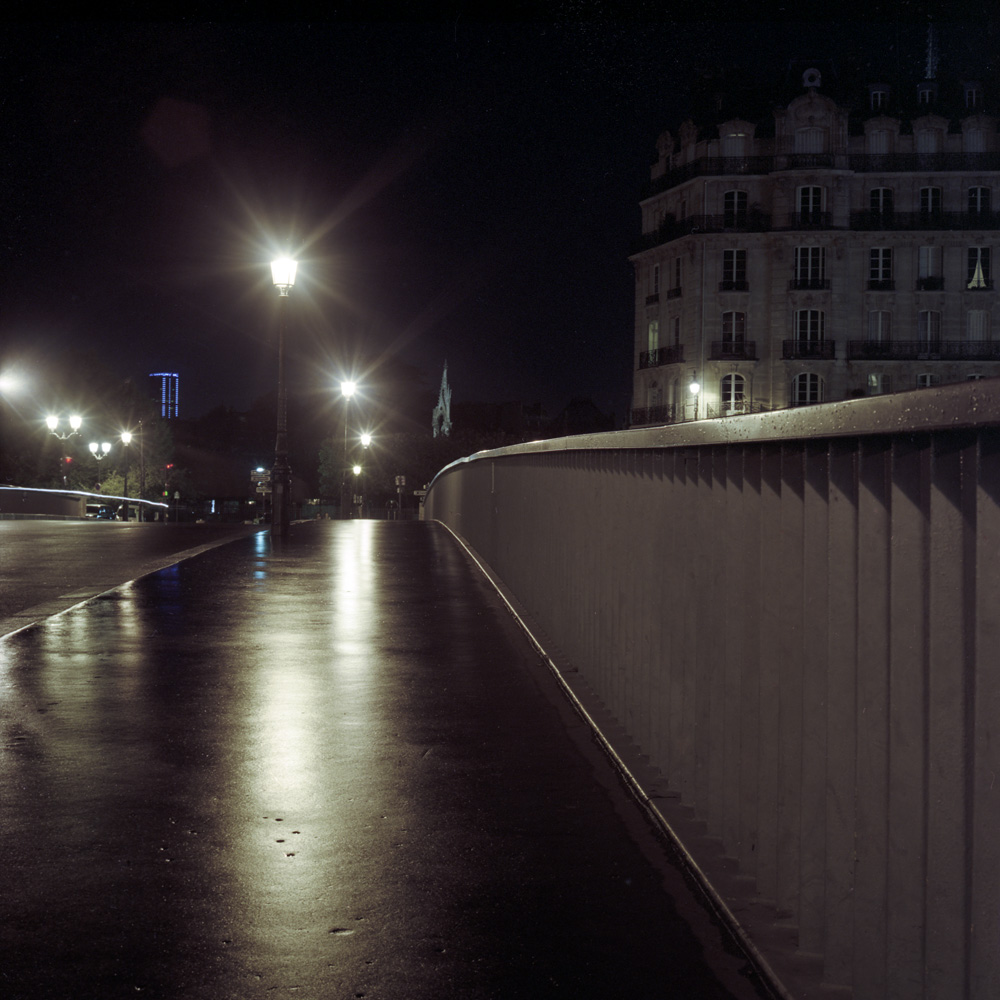
The Pont St. Louis, slick with rain. This is the bridge that connects the Ile St. Louis with the Ile de la Cite.
Pont St. Louis, Night
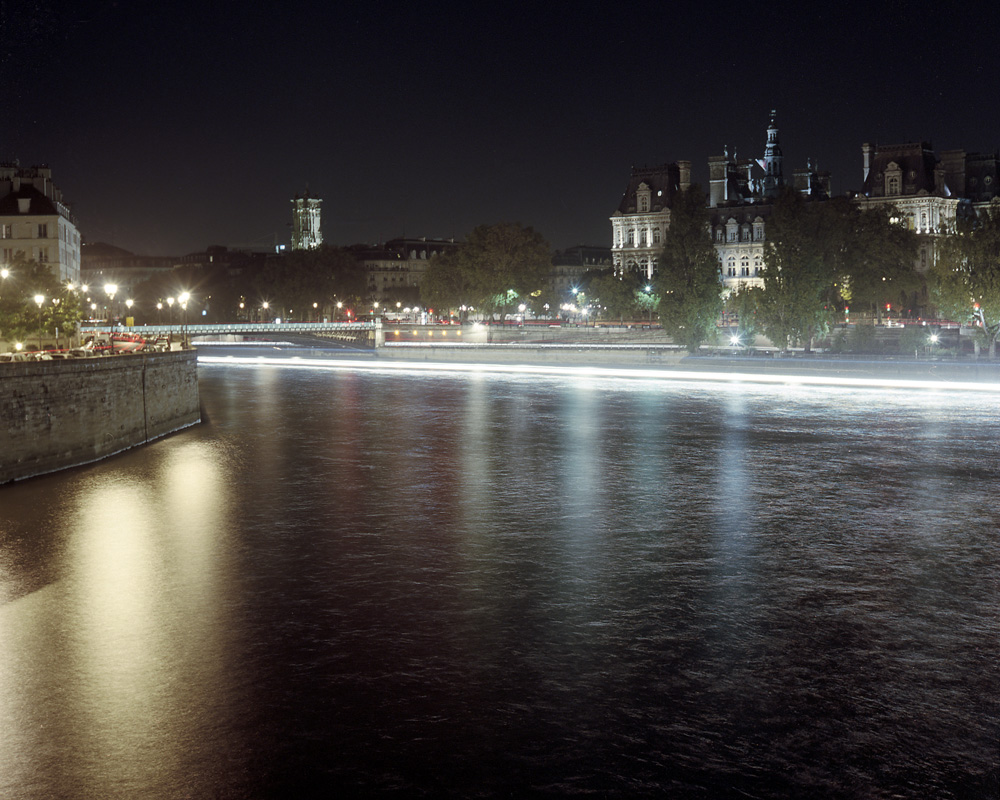
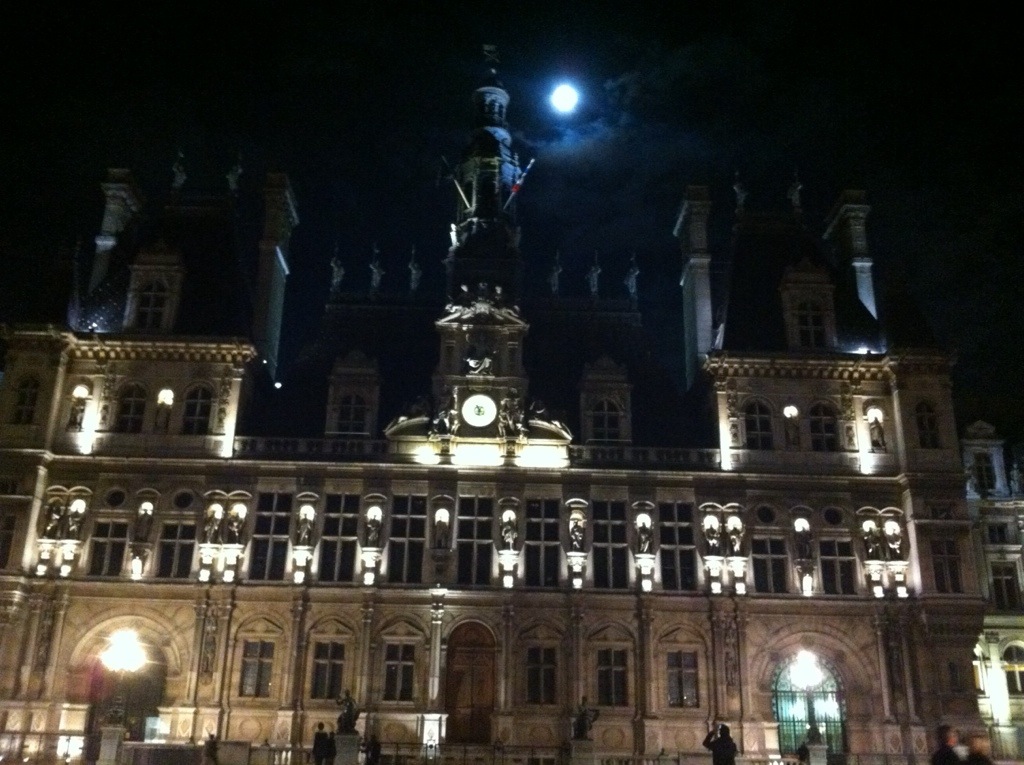
A view of the Hotel de Ville (Paris’ City Hall) from across the Seine. The white line at the river level is created by the lights of a passing river tour boat that has flood lights on the roof to illuminate the buildings on the quays as it passes. I don’t envy the people whose apartments face the river because of that, even if the boat tours do stop sometime between 9 and 10 pm.
Hotel de Ville, Seine, Night
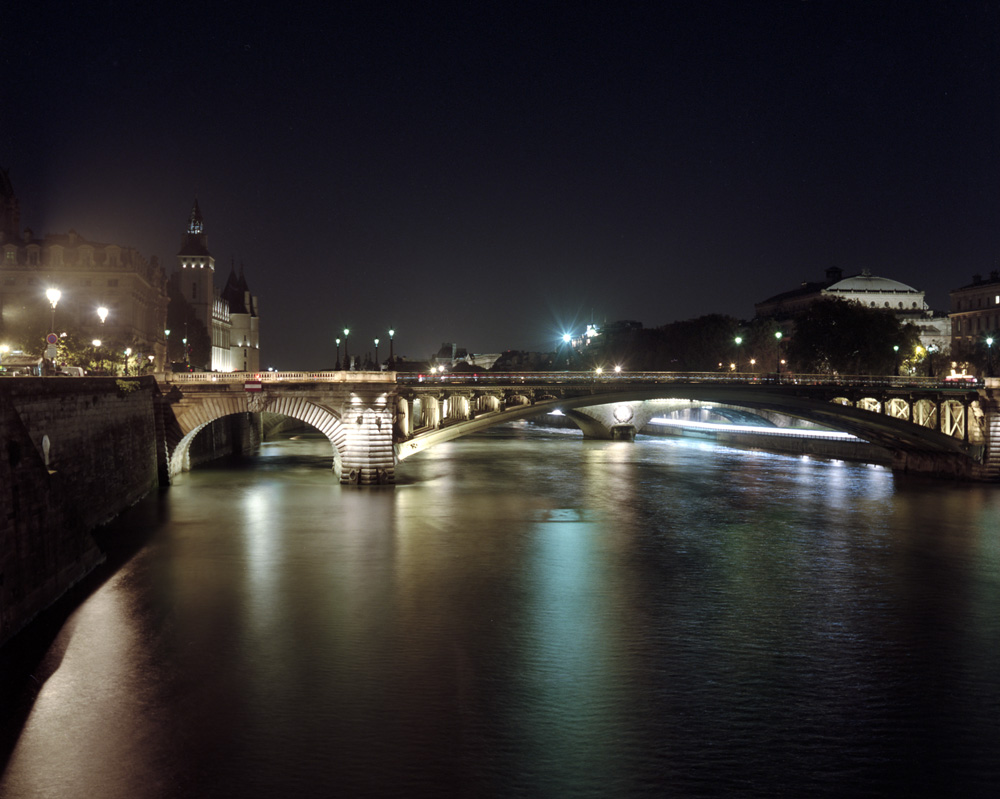
Another view of the bridges across the Seine. In the background on the left you can see a rather castle-like building which is La Monnaie, the old French Mint where they used to make coins.
Seine Bridges, La Monnaie, Night
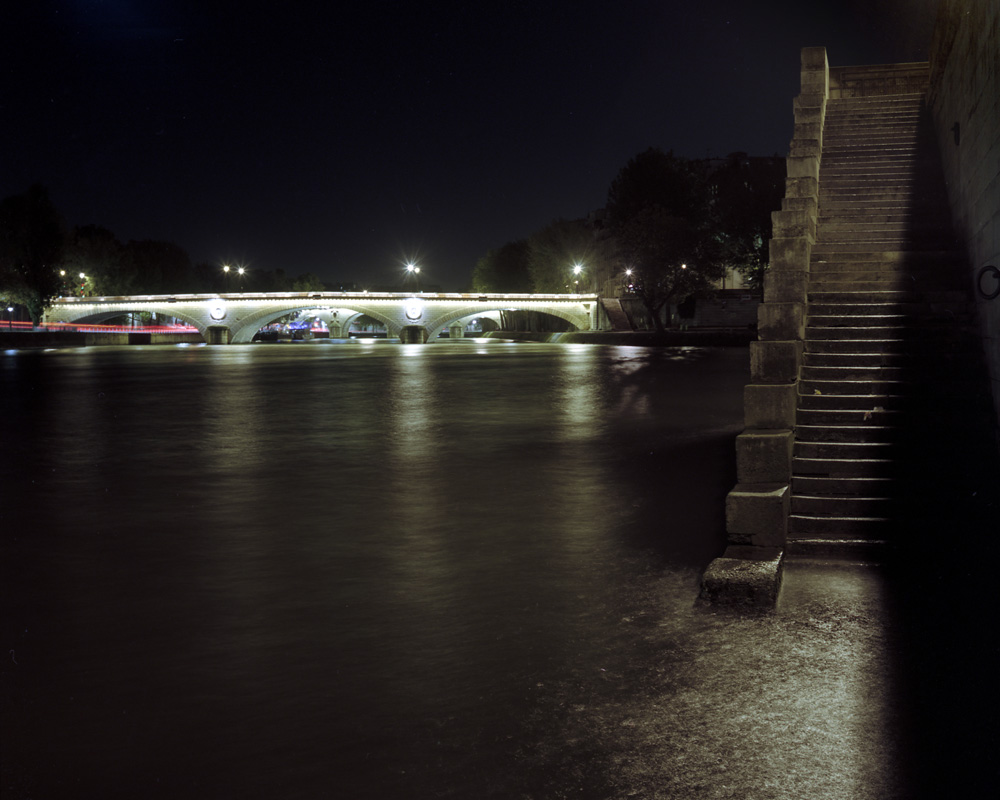
The last bridge of today’s program is the Pont Louis Phillippe, which connects the end of the Ile St. Louis to the north bank of the Seine. The bridge I used every day to get to and from the subway was the Pont Marie, which abuts the middle of the Ile St. Louis. I wanted to get a view of the bridges from water level, so I went down a set of steps on the quayside of the Ile de la Cite and set up my tripod at the very bottom – you can see from the facing set of steps they descend all the way into the water (I did not test how far down they go, as I had no desire to get wet, especially at this time of year).
Pont Louis Phillippe, Steps, Night
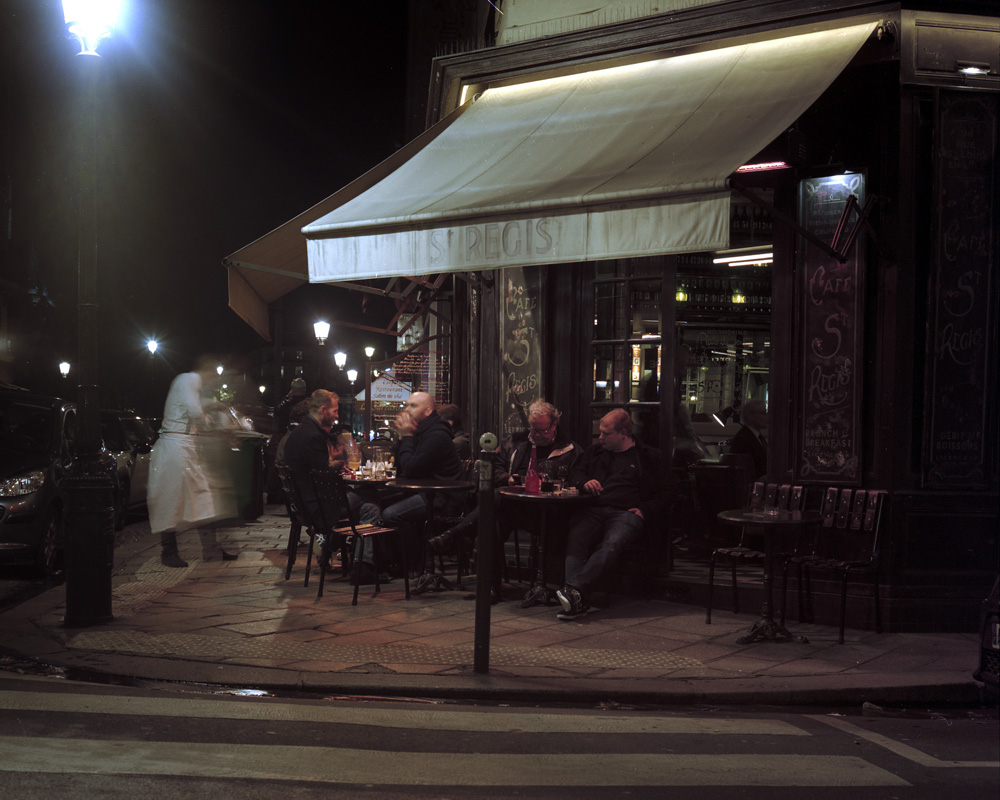
The St. Regis cafe has a view of the Pont St. Louis. Notre Dame itself is hidden by the buildings across the bridge. On my excursion, I saw people sitting outside the cafe all evening – I returned home at nearly midnight and there were people still outside the cafe as it was closing up.
St. Regis Cafe, Night
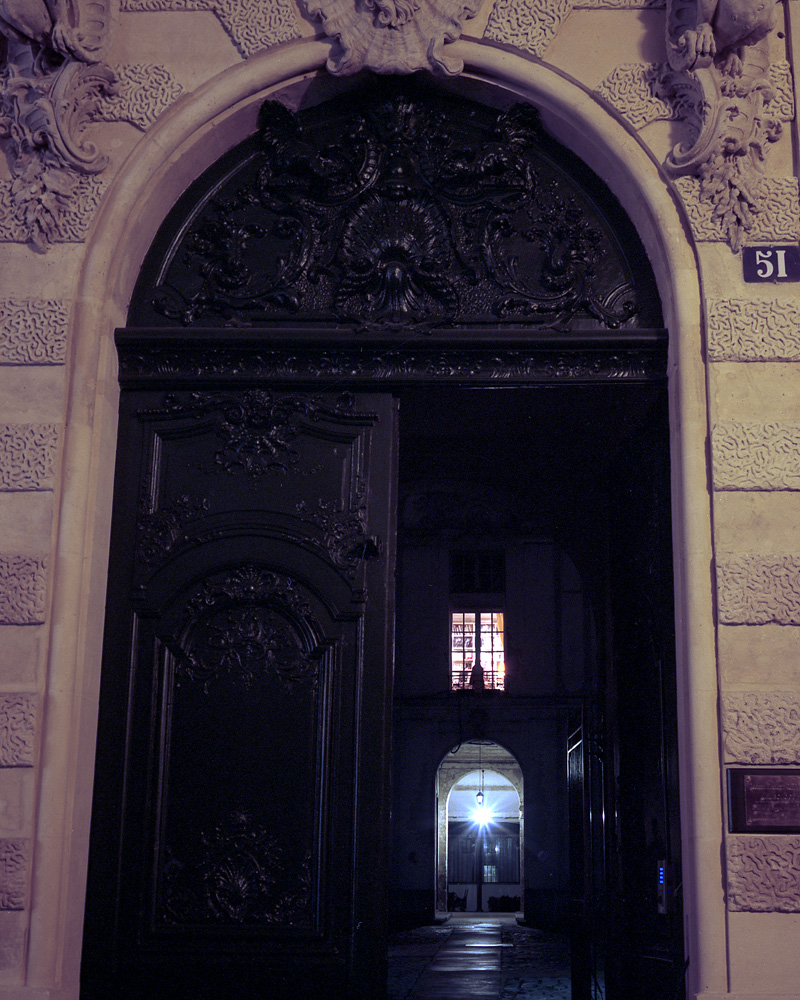
Here’s a look into the courtyard of one of the hotels on the Rue St. Louis en l’Ile, at number 51. I looked through the doorway, which had always been closed when I walked by in the daytime, and saw the light on in the library window on the second floor, and I just had to take that picture. I love libraries (I’m sitting in one as I type this, my modest personal library of 2000 or so books), so seeing in to one had a rather Proustian effect on me.
Hotel Courtyard, 51 Rue St. Louis en L’Ile, Night
I shot all these on Kodak Portra 160 because I like how it responds to nighttime color better than Ektar. It has a less contrasty look which is good for night because night scenes are inherently contrastier than daytime scenes, and it handles overexposure better than Ektar.
Here’s a selection of some photographs and photographers that I wouldn’t mind to have in my collection, or that I didn’t know or just caught my attention in the Paris Photo 2013 along with some of the classics and masters. Some were quite interesting as single photographs, others as installations of series of photographs.
Nobuyoshi Araki, had an installation with 162 photographs, right in front of the works by Eikoh Hosoe that I wrote already about in the previous post.
Richard Learoyd, 2 wonderful portraits of Agnes, makes her enchanted human character in her fragility, as if warmed by the tones.
Yes, Vee Speers caught my attention with her technique of hand colouring over photographs. A series that she did some years ago and now picked up to paint: Bulletproof. You can see more of her work in the previous post as well.
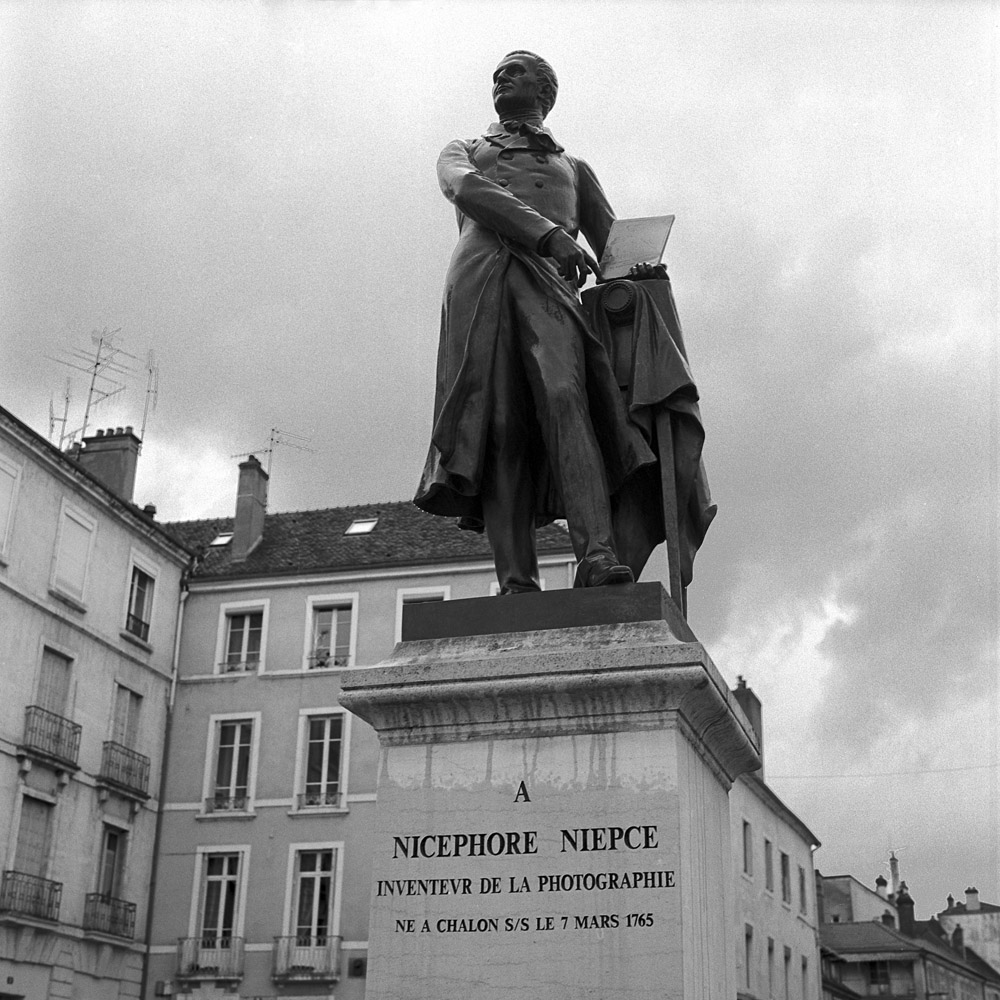
Here are a few more photos from Chalon-sur-Saone. The Niepce monument is the marker of the reason I took the trip in the first place – to visit the birthplace of photography. Nicephore Niepce invented the first successful photographic process, Heliography, in the mid 1820s. One reason most people haven’t heard of it and have never seen a photograph made by this process is that due to the extreme insensitivity to light of the chemicals, a single exposure required HOURS to record an image which ruled it out for photographing any non-static subject, like people, animals, or even plants, and it made photographing buildings difficult as well. In the early 1830s up until his death in 1833, he collaborated with Louis Daguerre, the net result of which was the publication of the Daguerreotype process in 1839.
Niepce Monument, Chalon
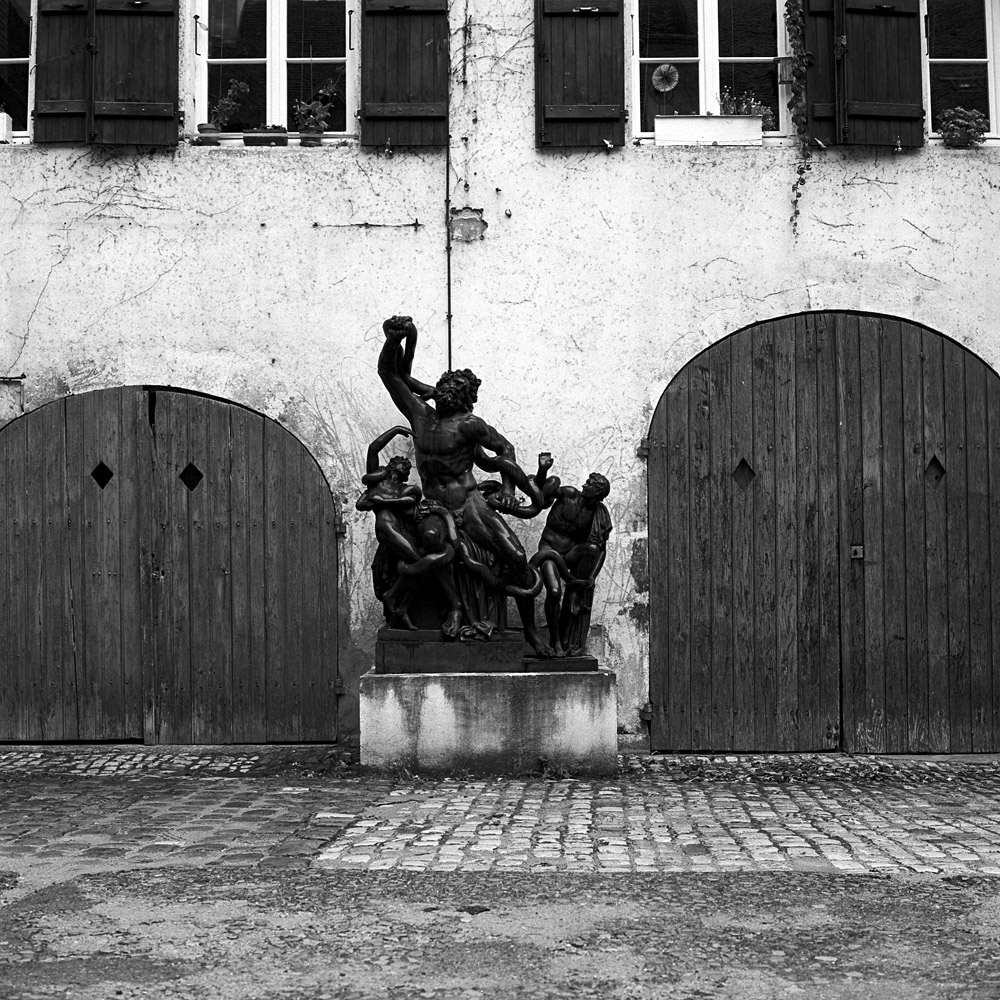
This statue of Laocoon, an ancient Greek mythological figure of a priest who warned the Trojans against admitting the wooden horse into the city, and was punished by he and his sons being devoured by sea serpents (for various reasons by various deities, depending on which version of his story you read). He’s also credited with the phrase “beware of Greeks, bearing gifts”. It’s a bit of odd statuary to find in a random courtyard around the corner from the Niepce Museum in Chalon, but there it is.
Laocoon, Courtyard, Chalon
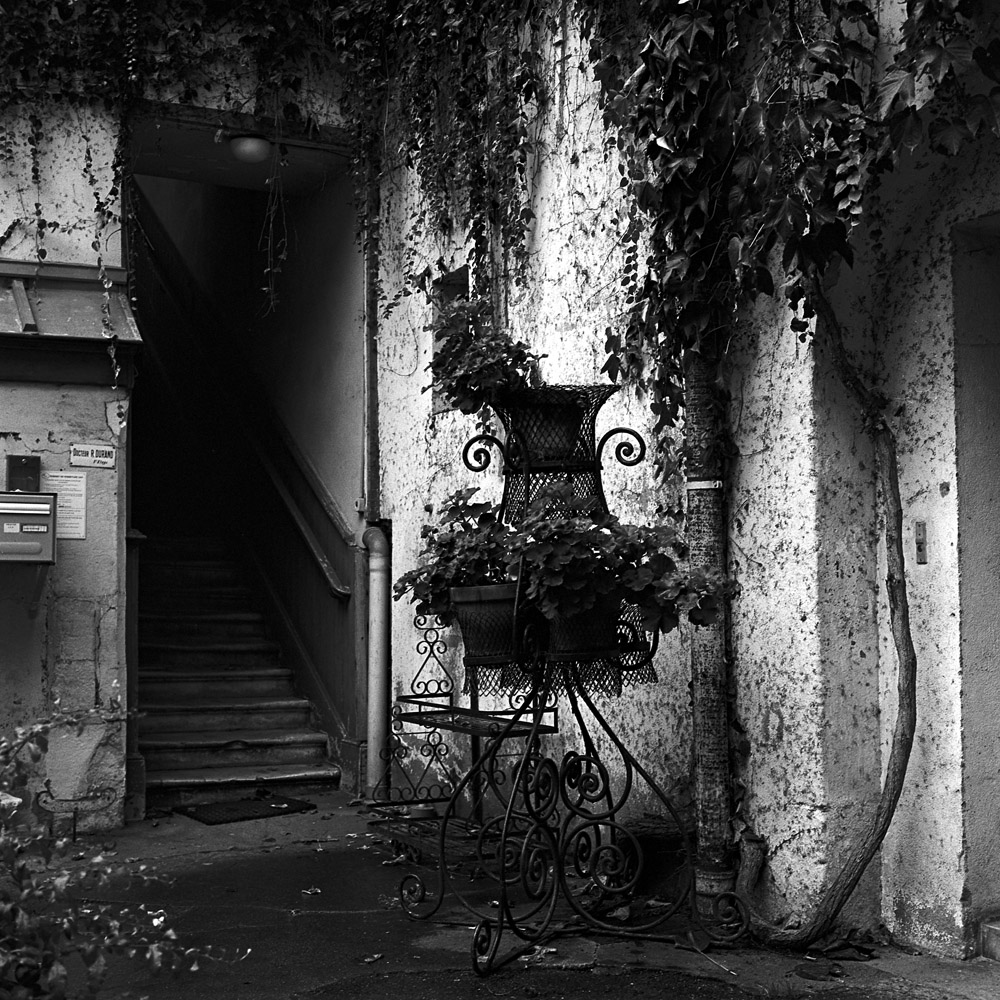
In the same courtyard as the Laocoon statue, there was this iron plant stand in front of the stairs to a second-floor doctor’s office.
Stairs, Planter, Courtyard, Chalon
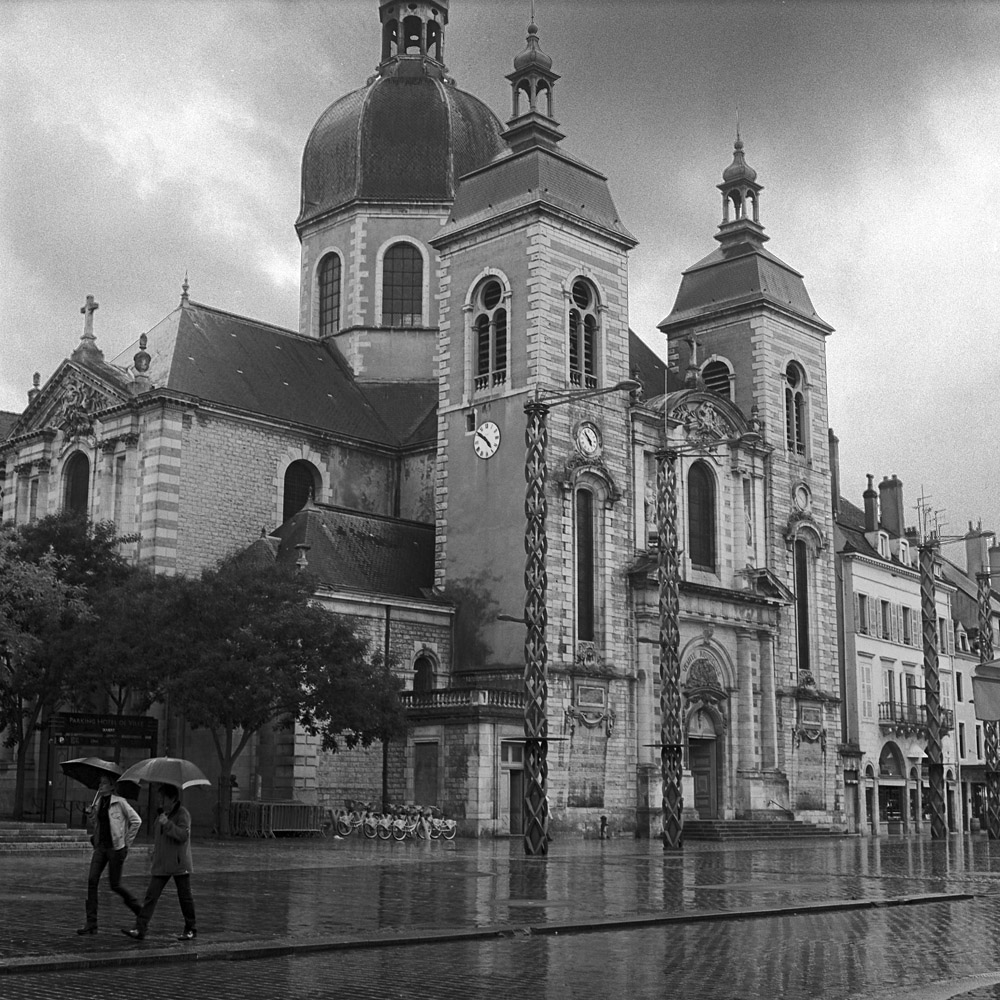
This is the basilica in Chalon. In significant architectural contrast to the old cathedral (which has parts dating back to the 7th century, and abuts the Roman walls of the town), this is clearly a 17th century structure. I peeked inside and the stained glass is very modern, like the lower windows at Notre Dame, but even more drab – greens and yellows and clear glass, and in desperate need of a cleaning from the outside. The light fixtures on the plaza are quite new and part of an effort to reinvigorate the downtown area. If you look carefully at them, at around the 12 foot mark, you’ll see metal disks protruding that serve as anti-climbing devices.
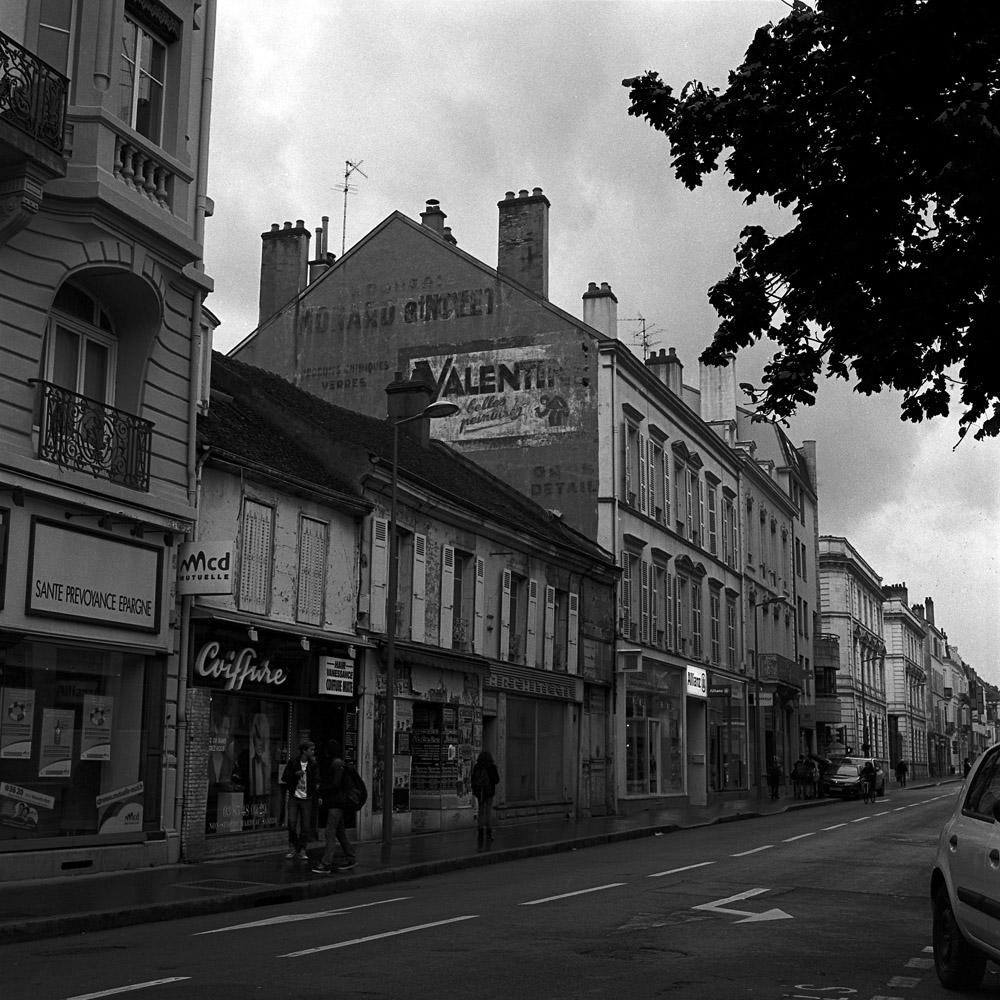
Here are businesses and storefronts in Chalon-sur-Saone.
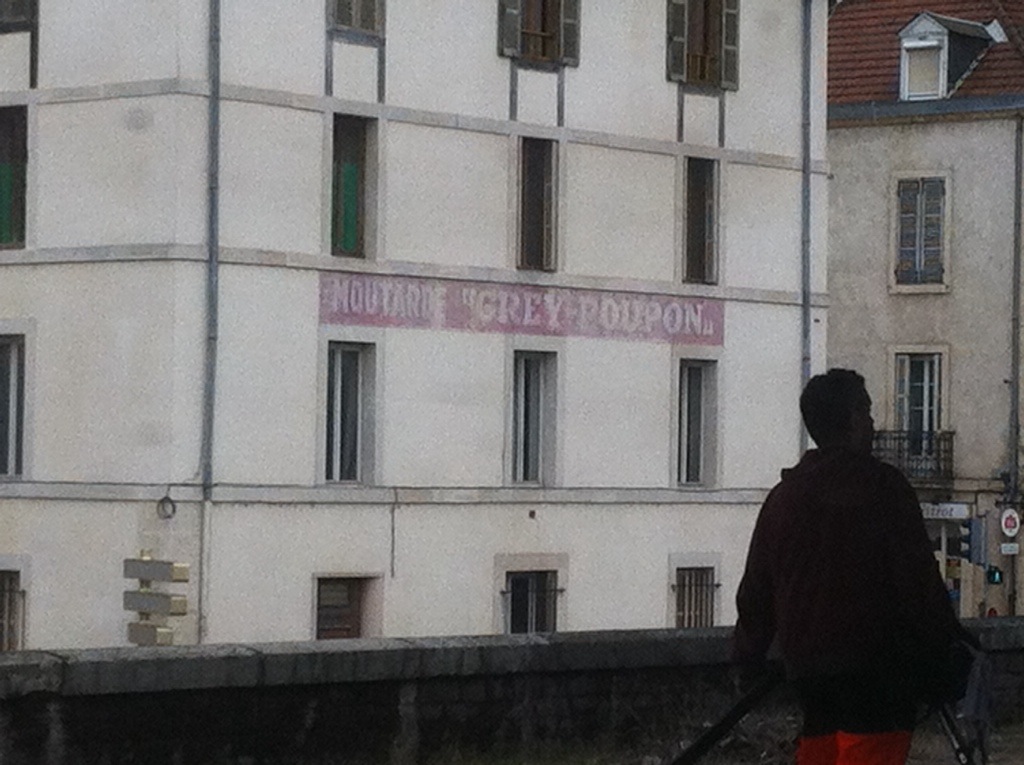
The old advertisement still visible on the wall of the building is on a street leading away from the old (2nd-16th Century) core of the town. Just around the corner is a McDonalds, with view camera designs etched in the windows. Even if the rest of the world doesn’t know it, the Chalonnais certainly remember what portion of their heritage is related to photography.
Old Advertisements, Chalon
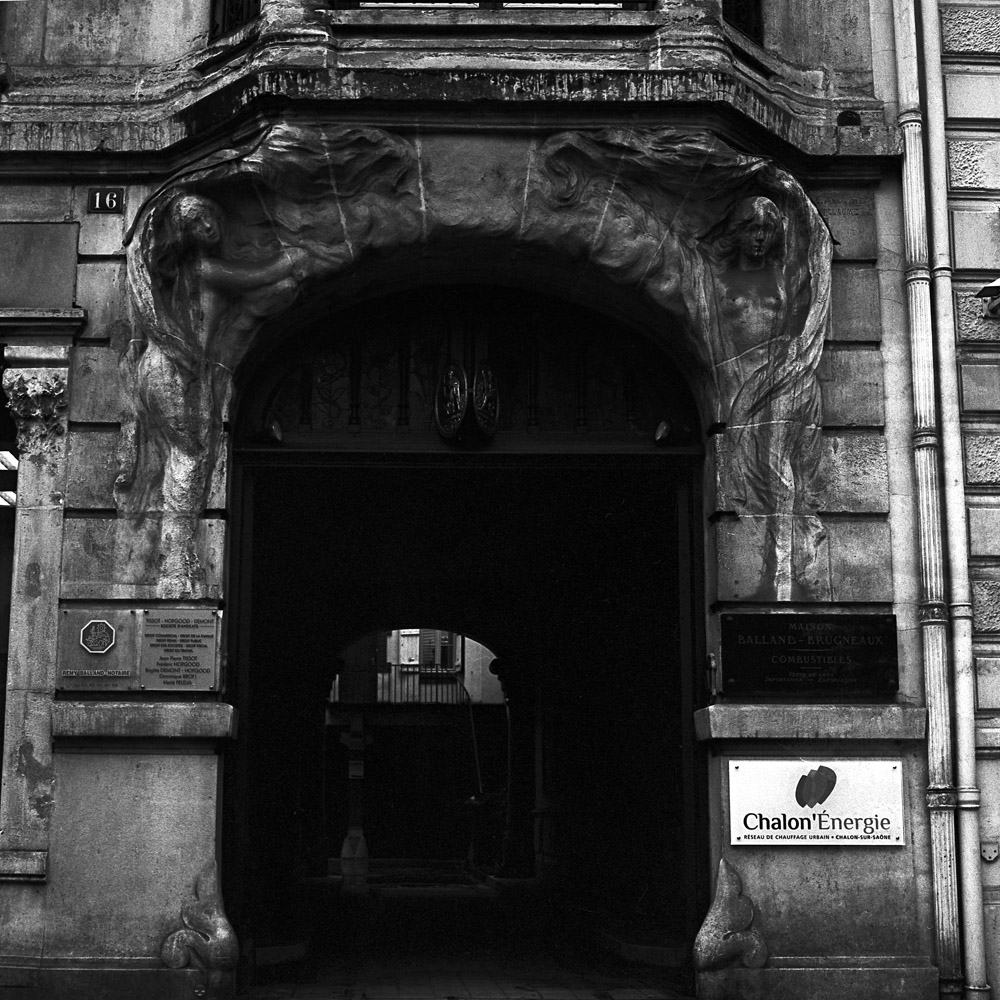
After spending ten days in Barcelona a few years ago, I became highly attuned to Art Nouveau architecture. Although Chalon is not particularly close to Barcelona (or Paris or any other major center for European architecture in the 19th century) the facade of this building is a particularly striking example of Noucentisme.
16 Blvd de la Republique, Chalon
Walking the streets of Chalon, you can tell that the town has had better days, but it is by no means a dying town, as can be seen from the businesses on the streets of the city center.
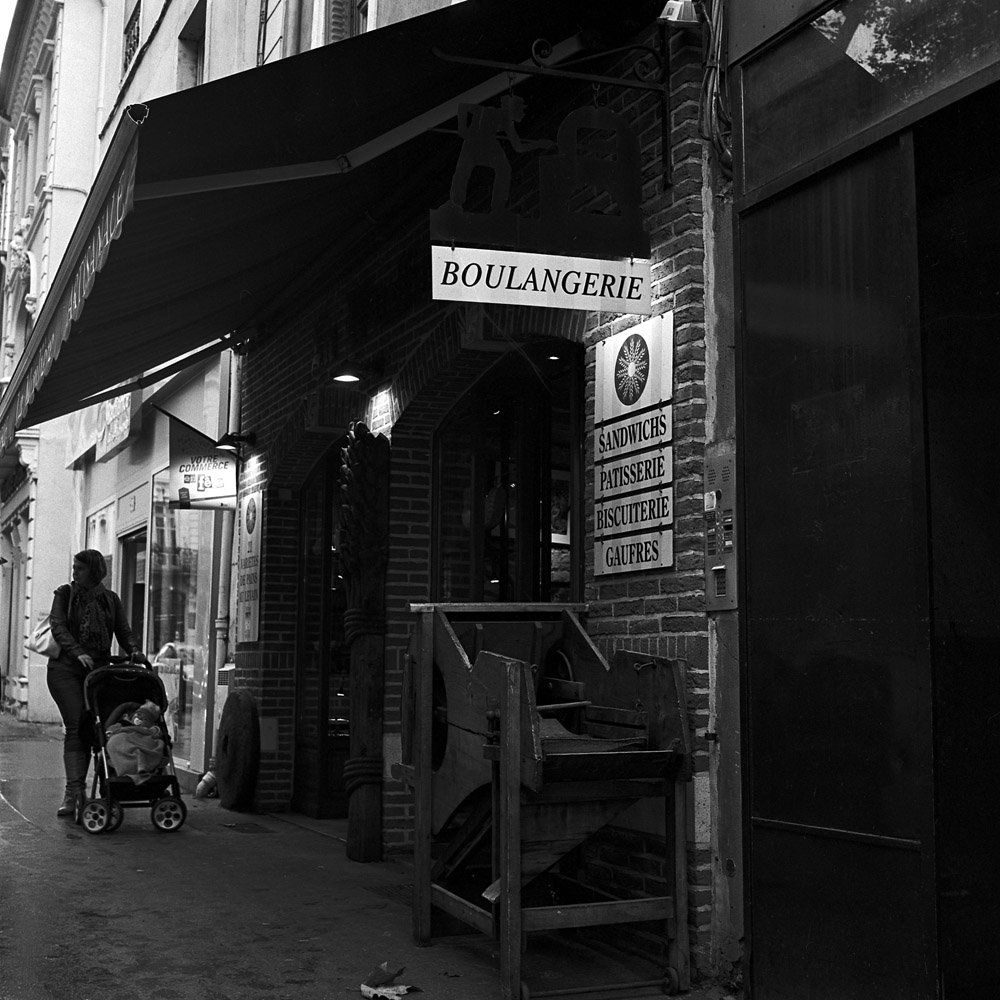
This boulangerie (bakery) was always busy whenever I walked past.
Boulangerie, Chalon
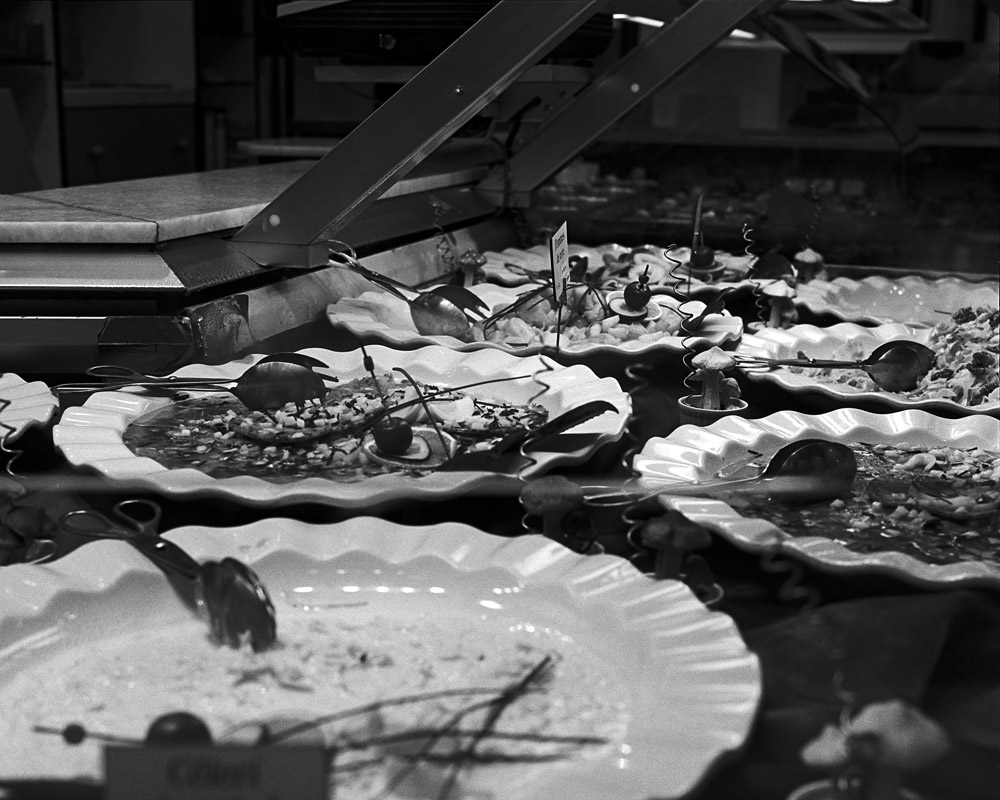
This fishmongers’ had particularly appealing plates of fresh seafood in their display cases.
Poissonierre, Chalon
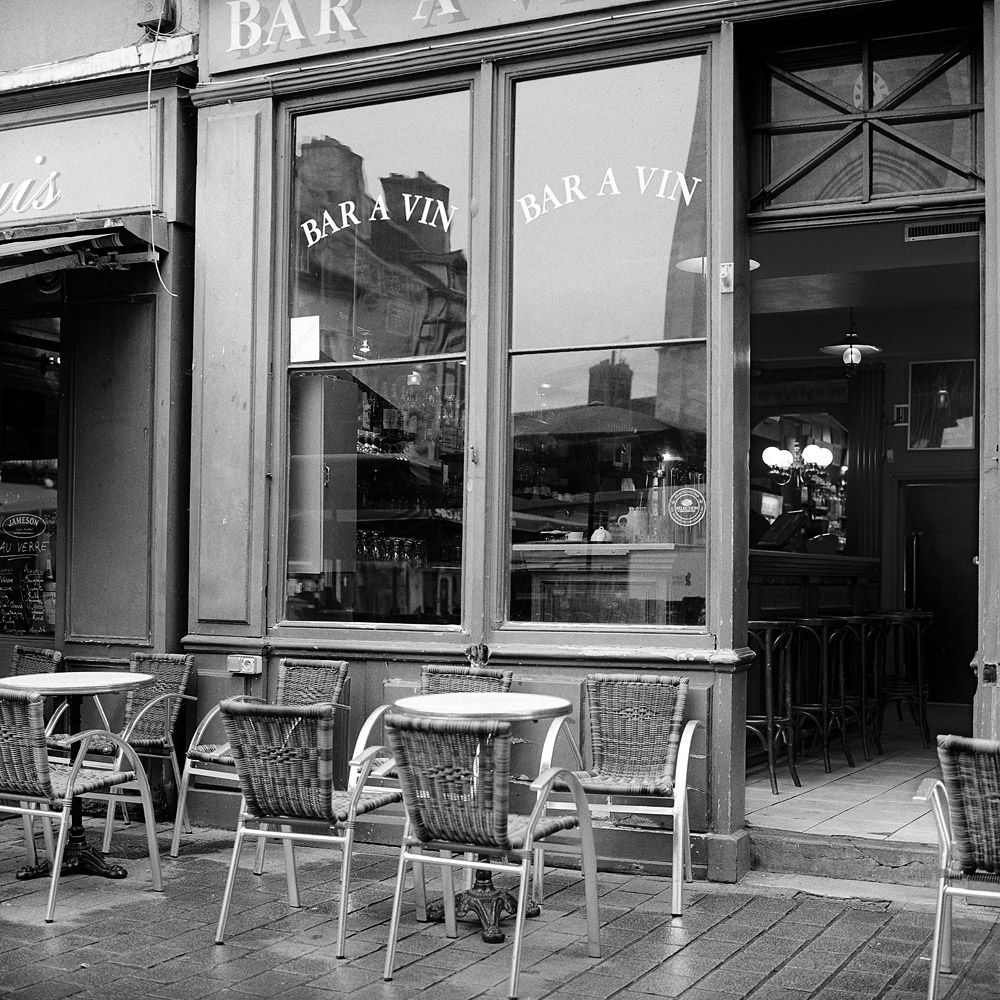
The Bar A Vin is located on the main square across from the cathedral. If things look particularly quiet, bear in mind I was there on a weekday, in the middle of the afternoon between lunch and dinner, and it was raining.
Bar A Vin, Chalon
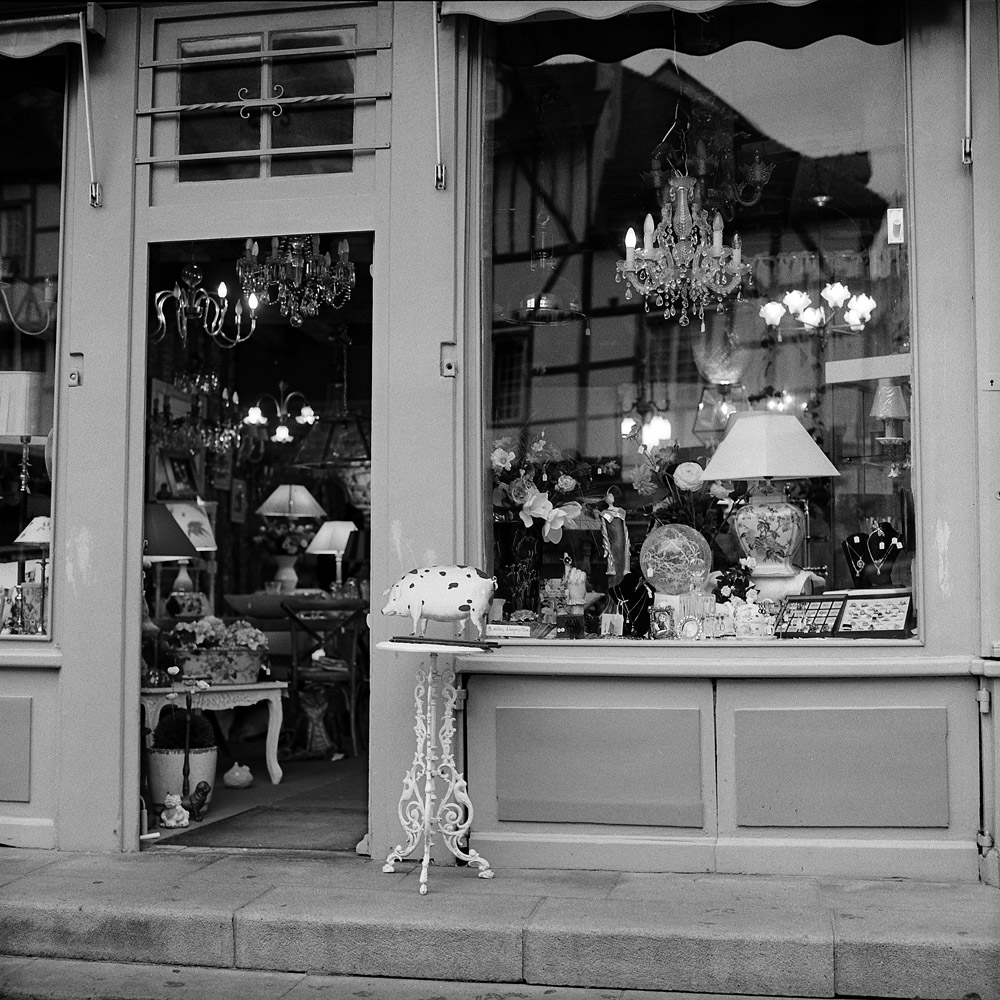
The lamp store was on another corner of the square and had the cutest little pig sign out front. The glow from all the lamps inside was enough to make it easy to balance the exposure between inside and outside.
Lamp Store, Chalon
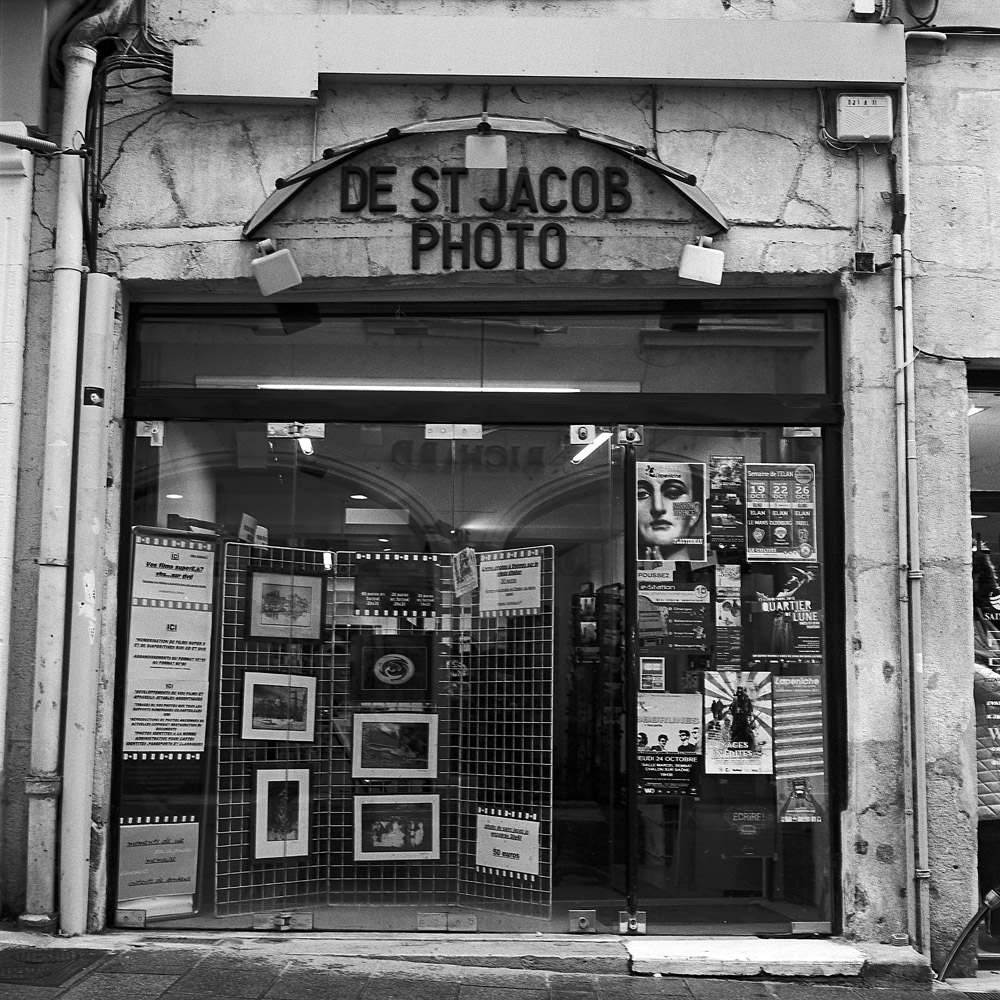
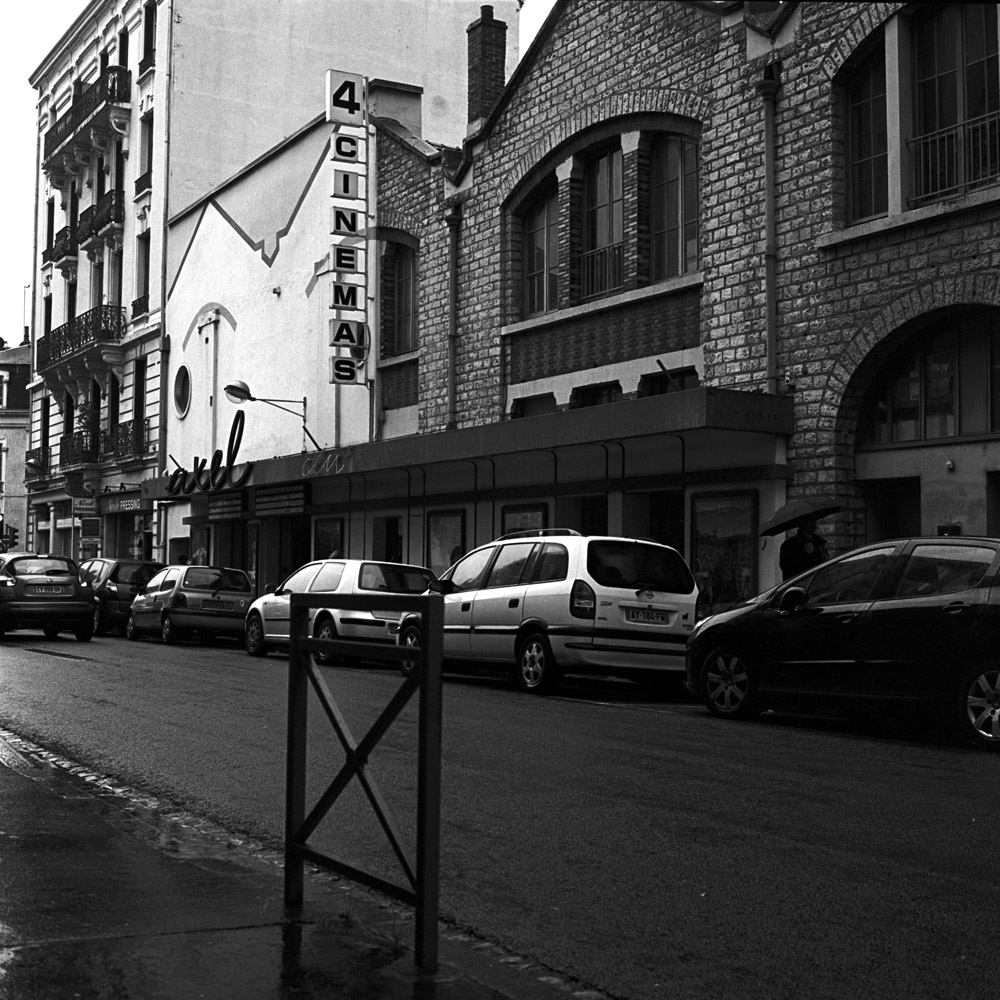
What photo essay about Chalon-sur-Saone could be complete without photos of things related to photography? Here is a photo studio in the center of the medieval district, and the 4-screen movie theater.
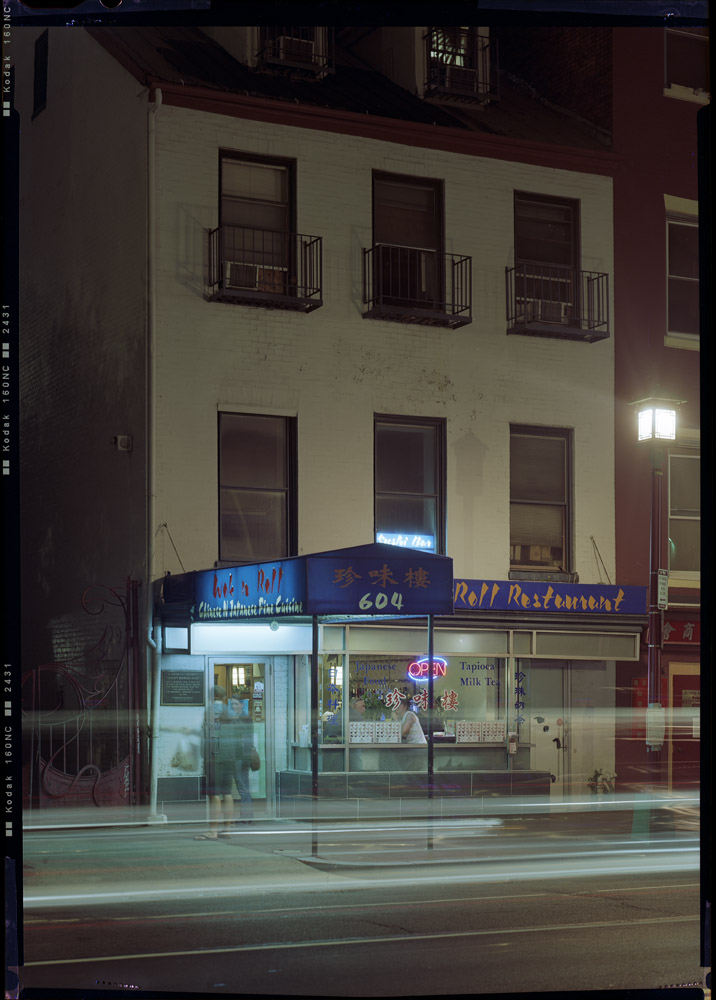
I submitted a photo to a call for entries from the Eastern Sierra Center for Photography the other day, and the photo was accepted! It’s even #1 in the series. The photo is one I took a while back of the Surratt house in Washington DC. The theme of the photos was “Motels”, based on a quote by William Borroughs –
“Motel, motel, motel, broken neon arabesque, loneliness moans across the continent like fog horns over still oily water of oily rivers.”
The motel connection in my image is a little tenuous, but Mrs. Surratt took in boarders to her home to help pay the bills before she was hanged for her alleged role in the Lincoln assassination (she was the first woman ever executed in the United States for a crime she may have only ever been tangentially involved in). I also felt the mood of the scene put into image the words in the Burroughs quote.
There was a requirement that the image be made with a large format camera (one of the primary missions of the Eastern Sierra Center for Photography is the promulgation of large format photography).
Secession Sushi – The Wok ‘n Roll in the Surratt House
The photo was shot on Kodak Portra 160 with a Canham 5×7 wood field camera using a Kodak Commercial Ektar 12″ lens.
Please go visit the Eastern Sierra Center’s website and read about their very worthwhile mission – supporting the continued use of view cameras for contemporary (and future – they have a program to expose kids to view cameras!) photography.
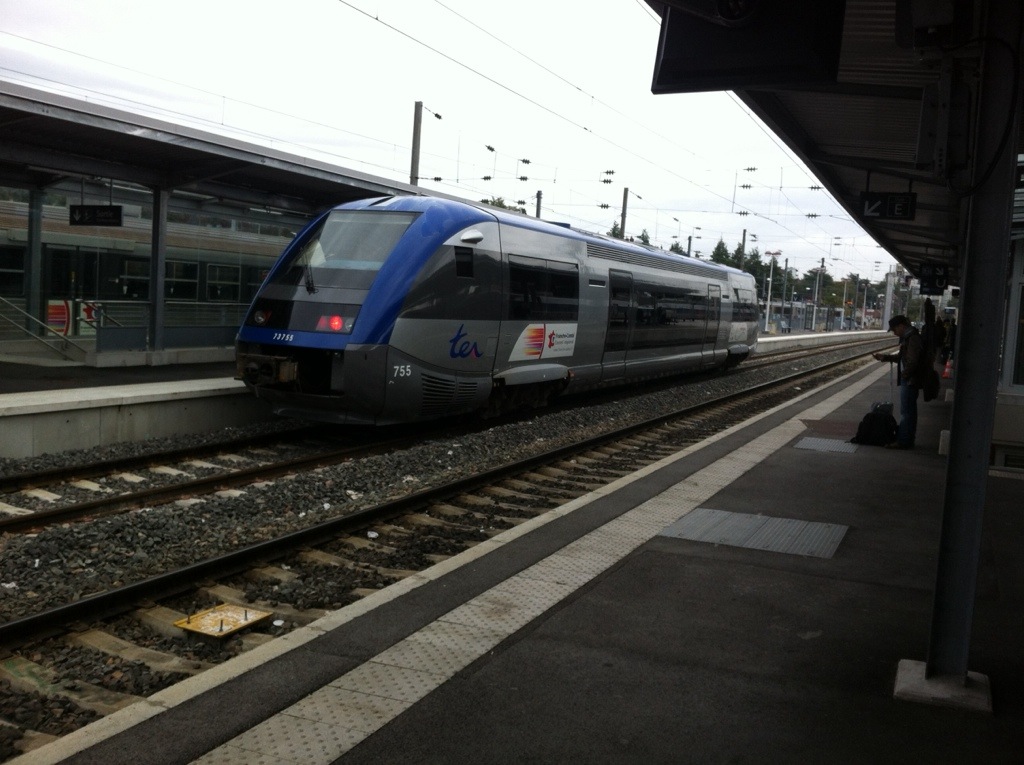
Some more transportation photos. In France, they have the national rail network, which has two grades of TGV-class trains: the long-distance, high speed trains (the one that goes from Paris to Marseilles in 3 hours) and the not-so-fast trains that stop more places. They also have regional trains that connect the smaller cities and larger towns, and then around Paris there are the RER trains that run on a separate set of tracks from the Metro, but it interfaces with and extends the Metro network.
You’ve already seen my TGV photos. Here is one of the regional trains at the station in Chalon, on the Burgundy province network.
Wouldn’t it be cool to commute on a train like that every day?
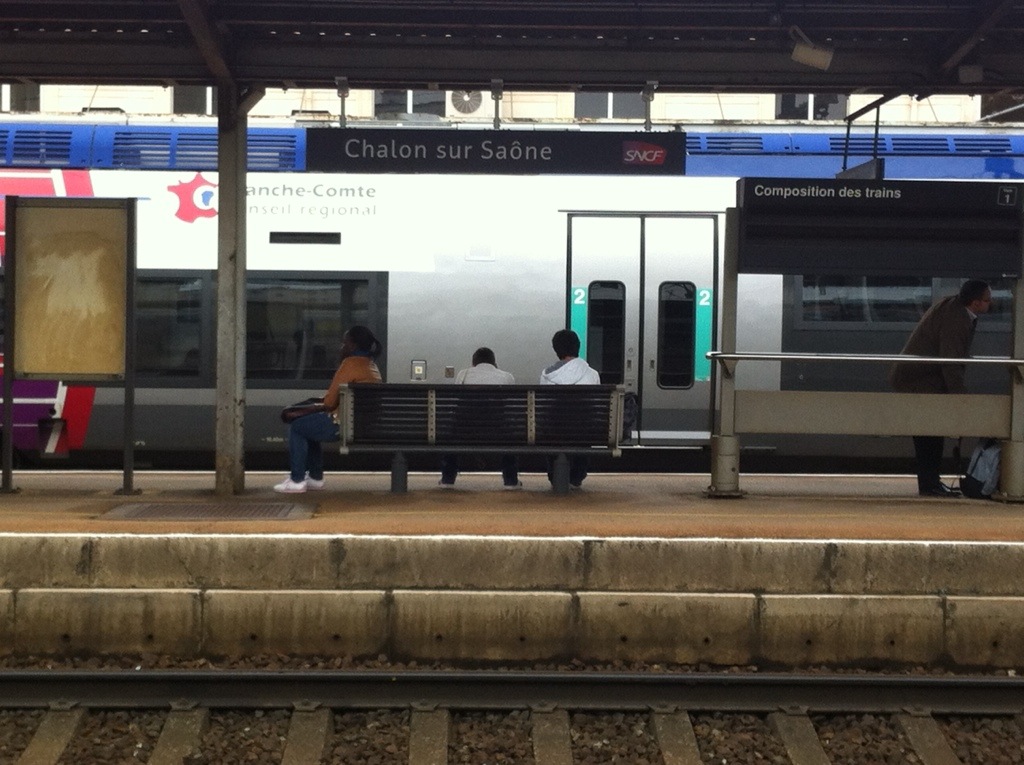
Here’s another view of that train, from the platform at Chalon. You can see the name of the station on the sign under the awning over the platform.
Although not specifically depicting trains, I had to include this shot here, as it was in plain view from the platform of the Dijon rail station. If you watched tv in the US between the 1970s to 1990s, this will probably tickle your funny bone.
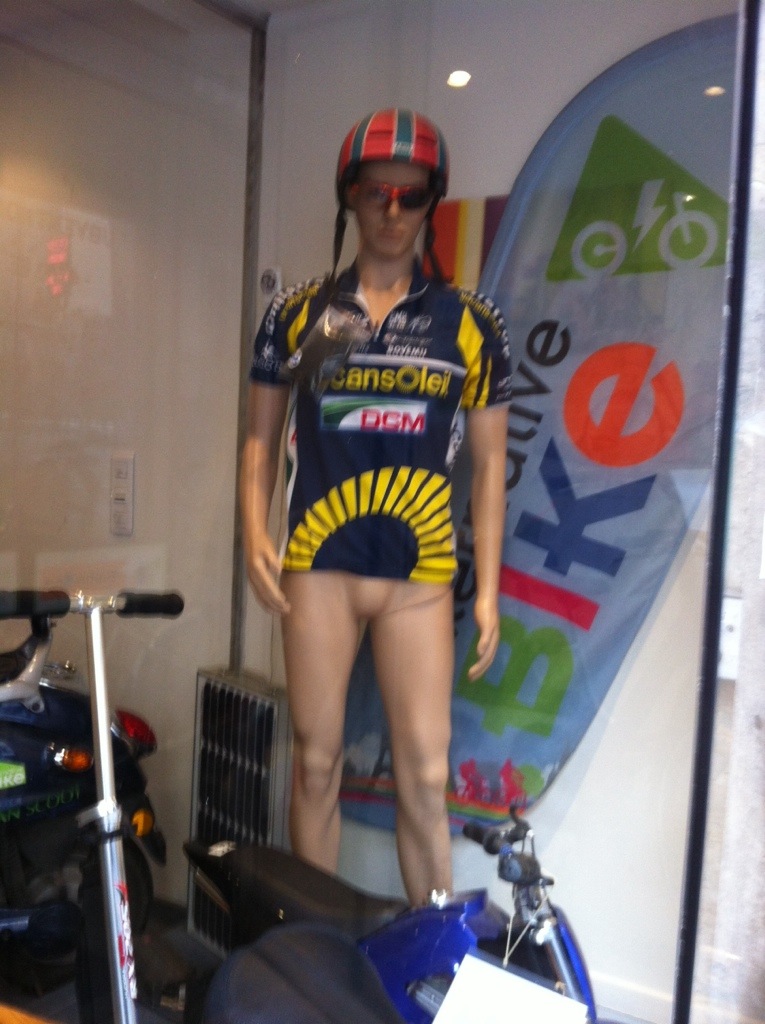
Finally, two more transportation images that have nothing whatsoever to do with trains, but instead are bicycle related. France is bike-infatuated, after all it is the home of the Tour De France. Will this be the new look on next year’s Tour?
Some would say cycling shorts can’t go away fast enough as a fashion piece; I think they should stay, as they prevent both chafing and blindness.
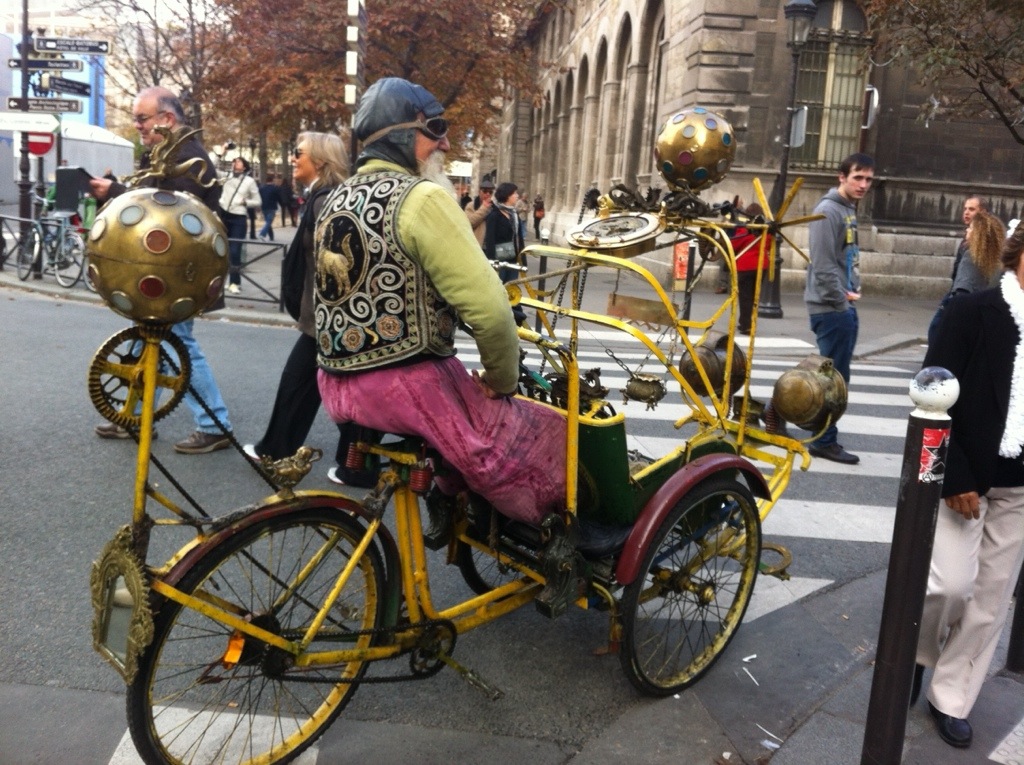
A very different take on bike-based transportation is this, spotted at the plaza in front of Notre Dame:
A very different, less aerodynamic sense of fashion dominates this cyclists ensemble. Equal risk of putting out someone’s eye, but from a totally different cause.
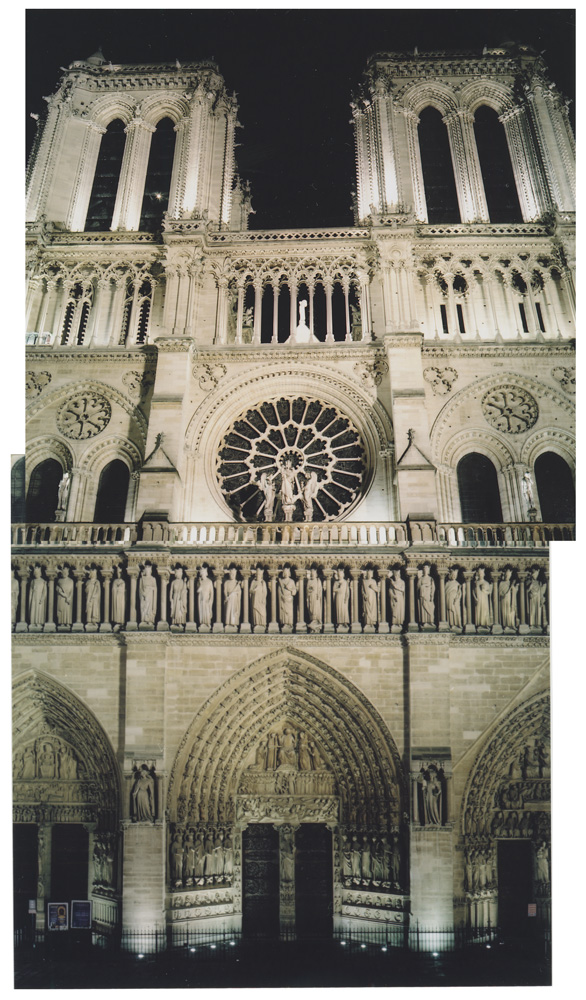
There is now a viewing platform in the square in front of Notre Dame which makes for a great venue to watch the fire spinners and other street performers, and a nice vantage point to view the facade, but it does present an unique challenge for photographing the entire building – you can’t get far enough back to get the whole facade including the towers in one frame without using an extreme wide-angle lens and introducing lots of distortion. So second-best option was this – shoot in two frames and line them up. It ALMOST worked, but you still get some keystoning from having to shoot up to get the towers.

 dcphotoartist