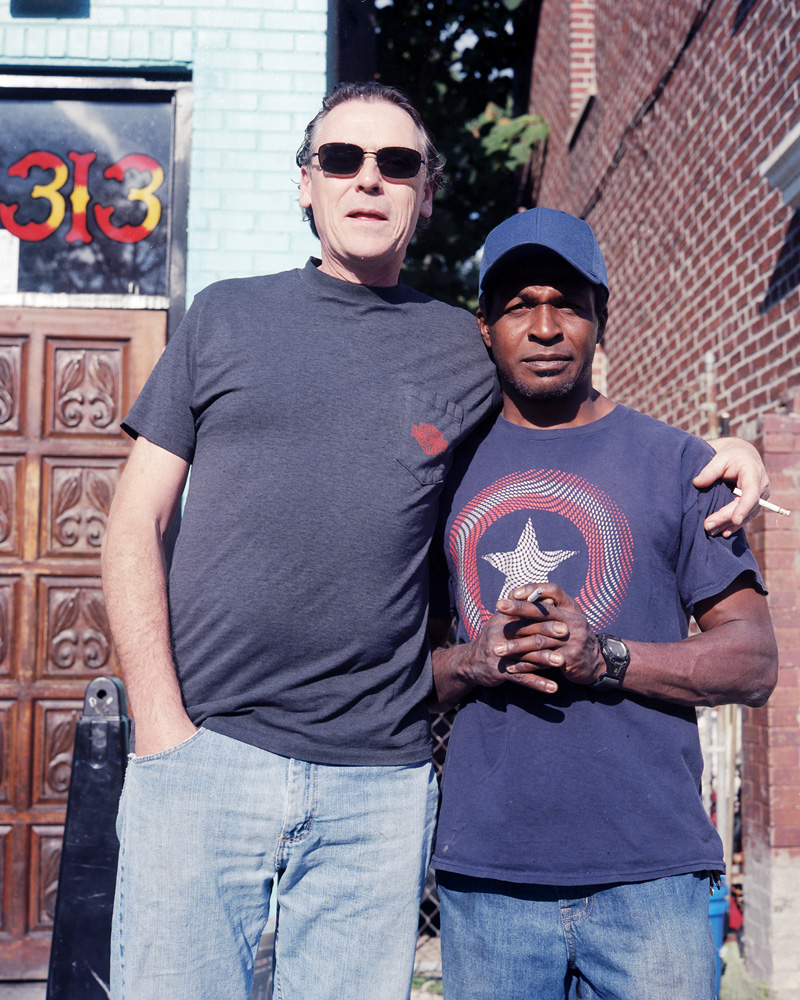
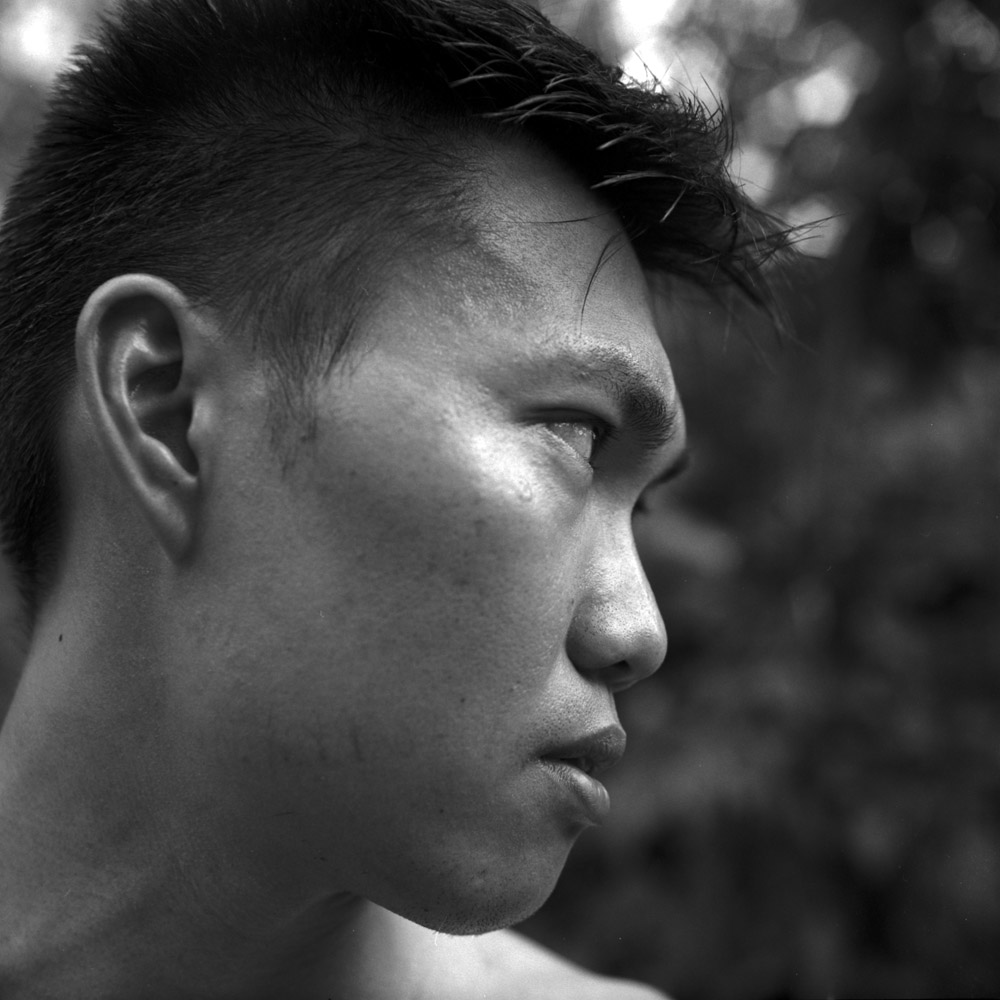
Truth be told, I’m a bit of an anxious street photographer: I’m not terribly good at asking total strangers to pose for me. So I’m getting started as an exercise by setting a new rule: if you see me out and ask me about my Rollei, you have to pose for me. We’ve already broken the ice by talking about the camera, so now we’re not total strangers anymore. This is the very first in that series. These two guys saw me out with the camera, and started asking about it. They even asked me to photograph them, which made it easier. The black guy was interesting; even though he was smoking, he asked if he should get rid of his cigarette for the photo. I told him to keep it.
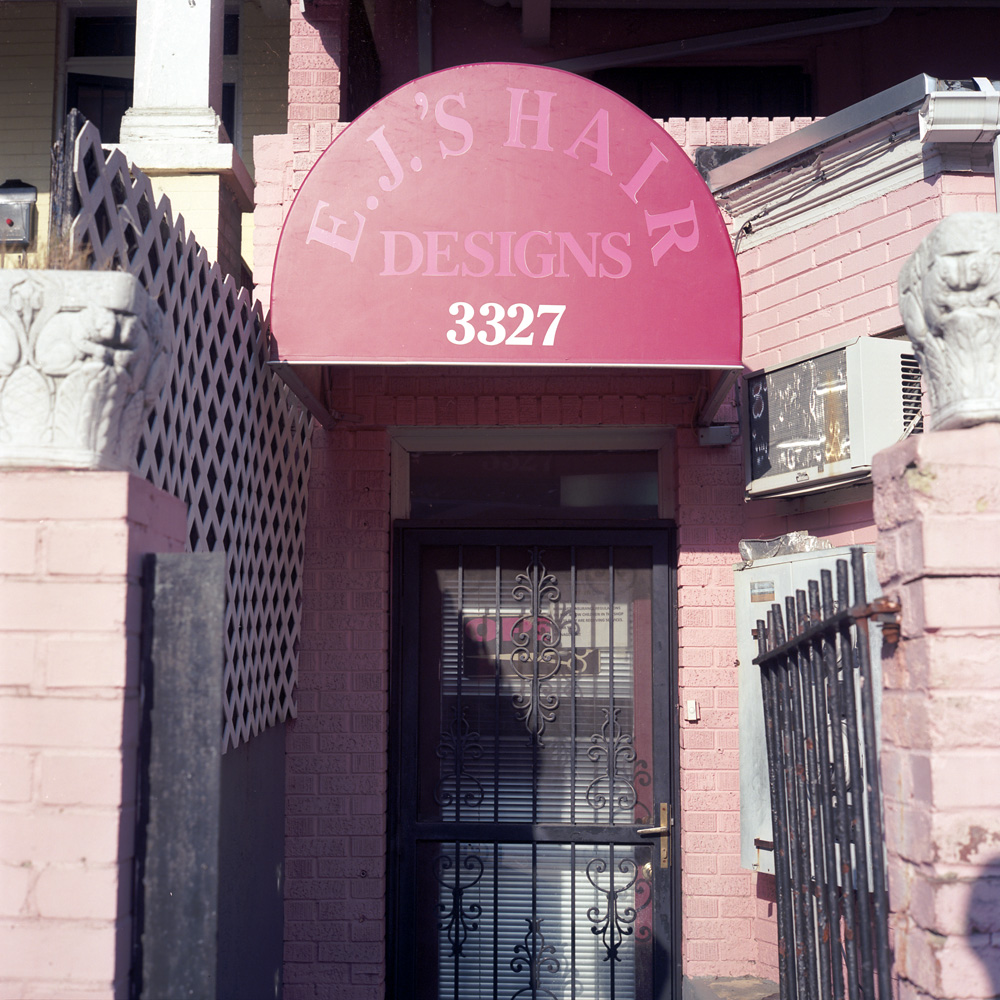
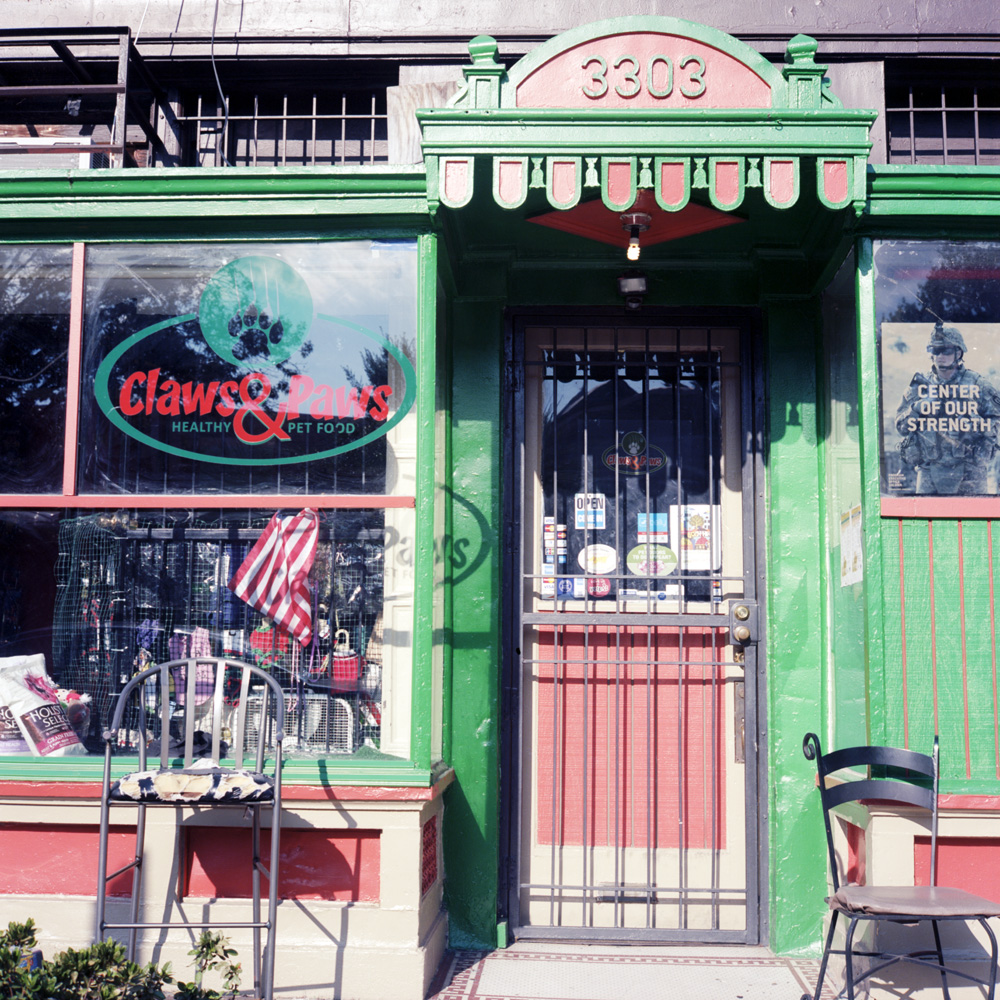
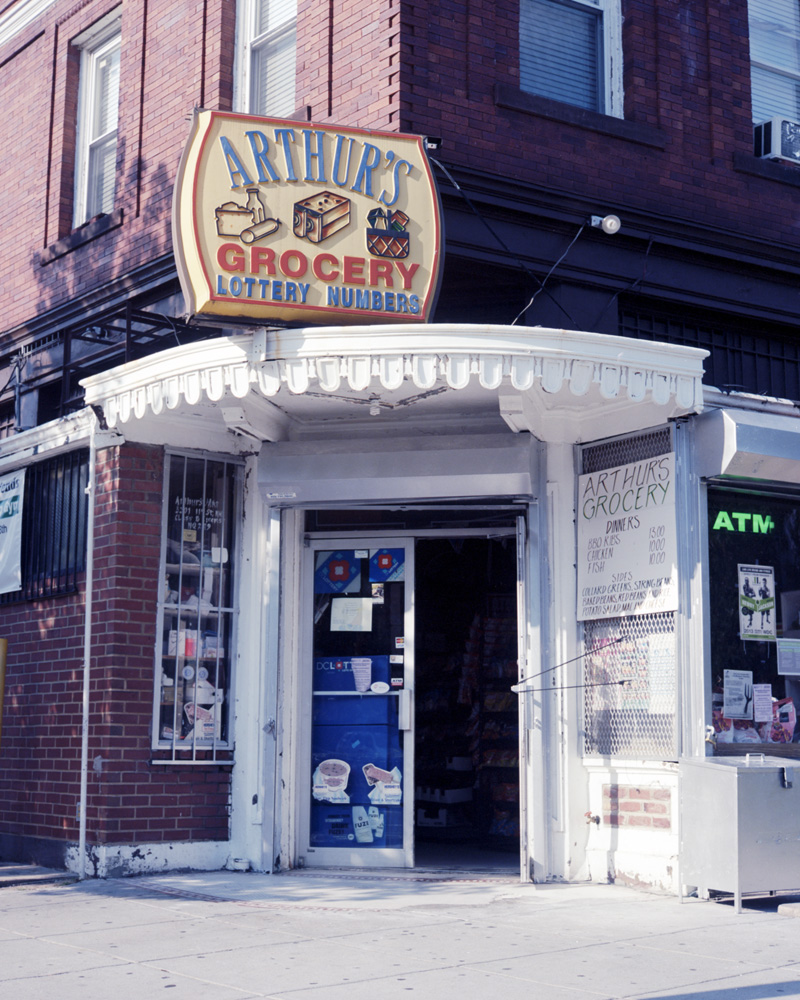
Just four random shots from around the neighborhood. These first three are small local businesses managing to hang on in the face of growing gentrification.
EJ’s Hair Designs
I don’t know what’s going on with EJ’s. Every time I walk past (which may be heavily influenced by when I’m going by – weekday evenings and/or weekends) it appears closed. I know the sign says “open” in the door, but you tell me what closed miniblinds means… I love the sign on the door (which is probably too small to read in the JPEG version of this shot): “We love children. However, insurance regulations do not allow children in the shop unless they are receiving services. Thank you, The Management”.
Claws N’ PawsArthur’s Grocery
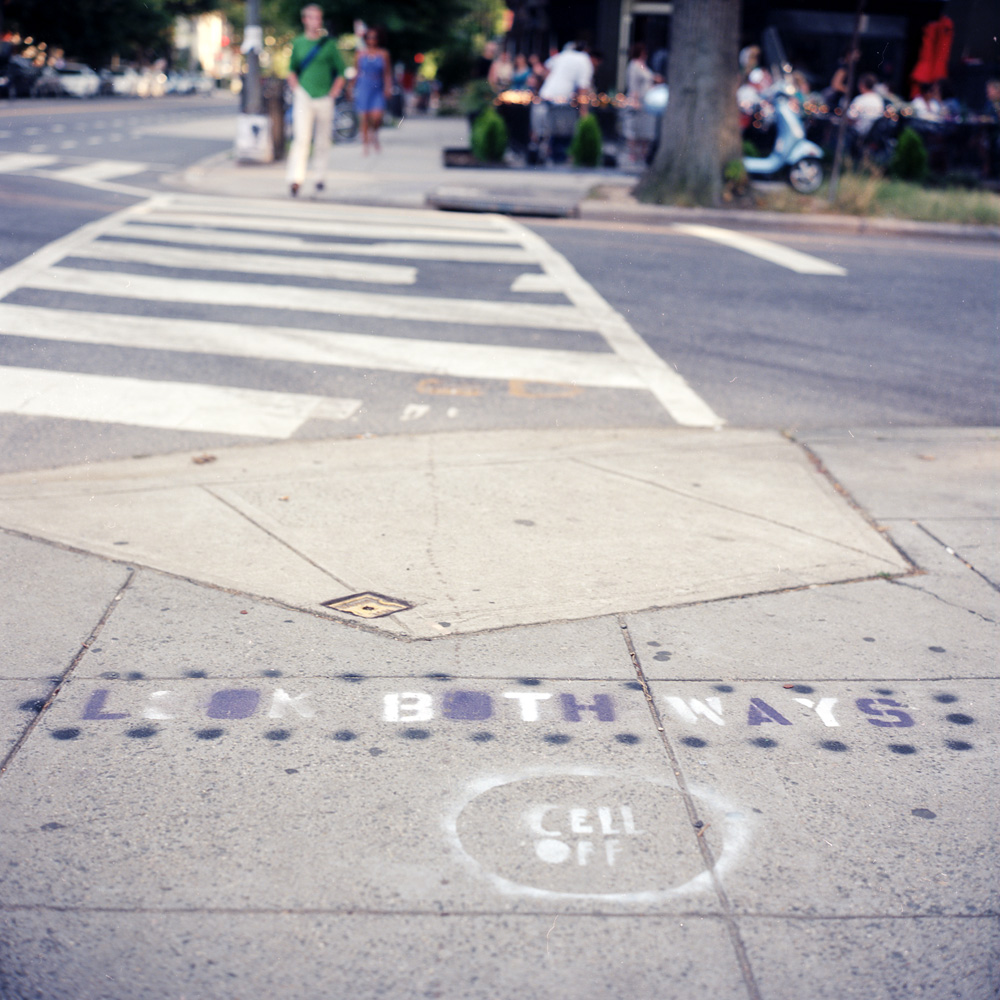
A sign of the times. General hipsterization plus the general trend of people being so absorbed by their mobile devices that they do stupid stuff like walk into traffic has inspired these signs spray-painted at the crosswalks of a number of intersections in the Upper 11th Trend Strip (don’t know what else to call it- North-East Columbia Heights Business District? NoECoHiBD? …that stretch of 11th where all the new restaurants have proliferated amidst old-time bodegas and coin laundries? How about just Hipster Velcro? (can’t call it a hipster magnet because that would imply something about hipsters that’s just not true. Velcro sounds about right because it sticks well to things like scruffy beards and ironic flannel). Of course, it NEEDS to be painted on the sidewalk, for it to stand a chance of registering with the phone-focused.
Here are two images of the same scene, one in color, one in black and white. I’m sharing them together to demonstrate how the change from one to the other totally changes the way we feel about the image.
First, the black and white:
Black Boy, Garuda, B/W
Notice the visual emphasis – how the tones draw your eye to specific parts of the scene. What do you find yourself looking at, and relating to? What compels you? What emotions does this evoke?
Now the color:
Black Boy, Garuda, Color
This has a very different balance. The colors change the emotional timbre of the image, as well as the focus point for the viewer, even though both photos were taken from essentially the same vantage point. I think it’s fair to say that in the black and white version, your eye and attention keep coming back to the boy. The image has a more stark, somber feel to it whereas the color image is much more lively, and balanced – it’s easier to view both sides equally. To be entirely fair, some of the impact of the black and white version is due to the way in which it was exposed and processed. This version is fairly high contrast, which makes the dark areas very rich and the whites very pure white. Were it done differently, there would be a greater balance between the boy and the garuda in terms of tones, and it would have a different resonance.
For wont of anything better to do on Sunday afternoon, I went out for a stroll in the 90+ degree heat (what was I thinking!!!) with the Rolleis for company. I wanted to do a little film and development test to see how well my results would come out. I’d say I nailed it based on these shots. The film I was testing is Ilford PanF, a very slow, fine-grained emulsion. The film speed Ilford recommends for this film is ISO 50. Quite a few folks I know recommend giving it a more generous exposure and rating it at EI 12. I shot some before at EI 25 and got good but not knock-your-socks-off results, so I thought I’d try the 12 and see what difference it makes. I took a risk and changed two variables at once – film speed and development technique. Normally I use Rodinal at a 1:50 dilution and develop for 14 minutes, agitating the chemistry for five seconds out of every 30 seconds. This time, I used Pyrocat HD for my developer, gave it twice the normal dilution (I usually use it diluted 1:1:100, but this time I used 1:1:200) for 45 minutes, with 5 seconds of agitation every 15 minutes.
This development technique is known as semi-stand development. Semi-stand uses highly dilute developers for greatly extended periods of time, with minimal agitation. What this does is it allows micro-contrast areas to form on the film where byproducts of the development process accumulate on the edges of light and shadow. These byproducts serve as a mask and lead to a boost in contrast at that edge, increasing the appearance of sharpness. If you look at the emulsion side of a negative that was developed using semi-stand, stand, or extreme minimal agitation technique (variations on a theme), the emulsion will actually appear in relief as if it had been etched.
This technique is also useful for managing high contrast situations because it allows for greater adjustment of the length of development to manage highlights. When you develop a roll of film, the shadow areas develop first, and once they have reached their maximum recorded density, they stop. Highlights will continue to develop long after the shadows have finished. This is one of the primary means for controlling contrast in an image- if the highlights are known to be too bright before developing the film, you can simply reduce total development time to keep the highlights from becoming unprintable.
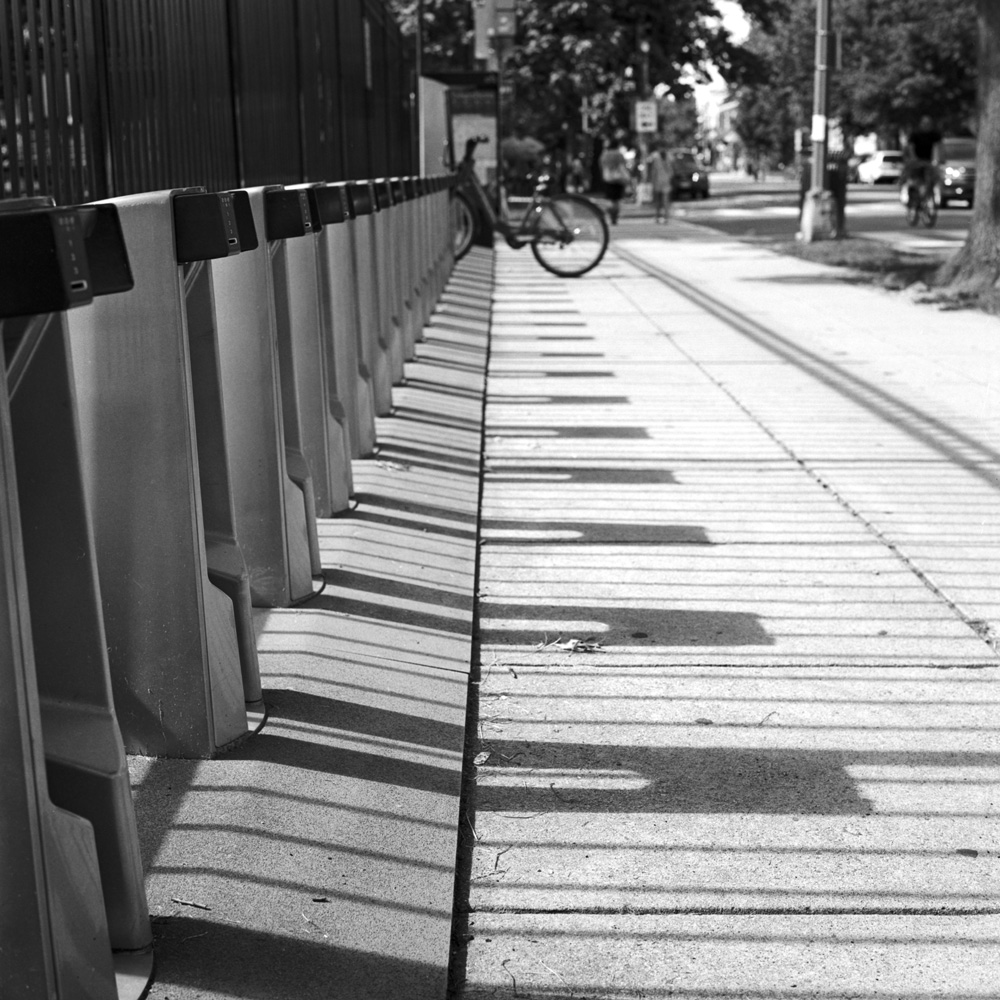
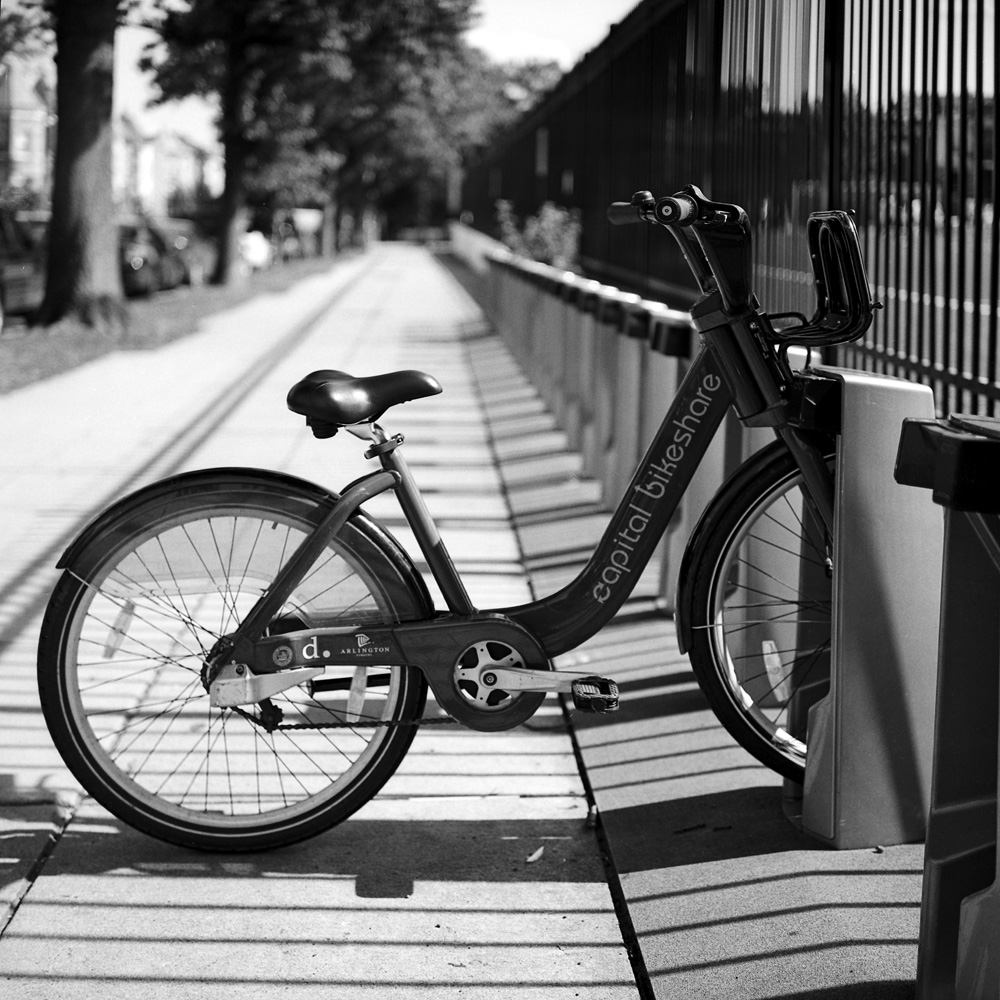
Bike Rack, 11th St. NorthboundBike Share Rack, 11th Street
These first two images are of the Capitol Bikeshare rental rack near my house. I’ve photographed the Bikeshare racks before, with full racks of bikes, to capture the receding perspective of the bike wheels. This time, I shot the bike rack with only one bike in it, to work with the late afternoon shadows created by the rack itself, and also to demonstrate the popularity of the Bikeshare, at least in my neighborhood. As you can see, on a Sunday afternoon, with the heat rising to over 90 degrees F, all but one of the bikes from this rack are in use.
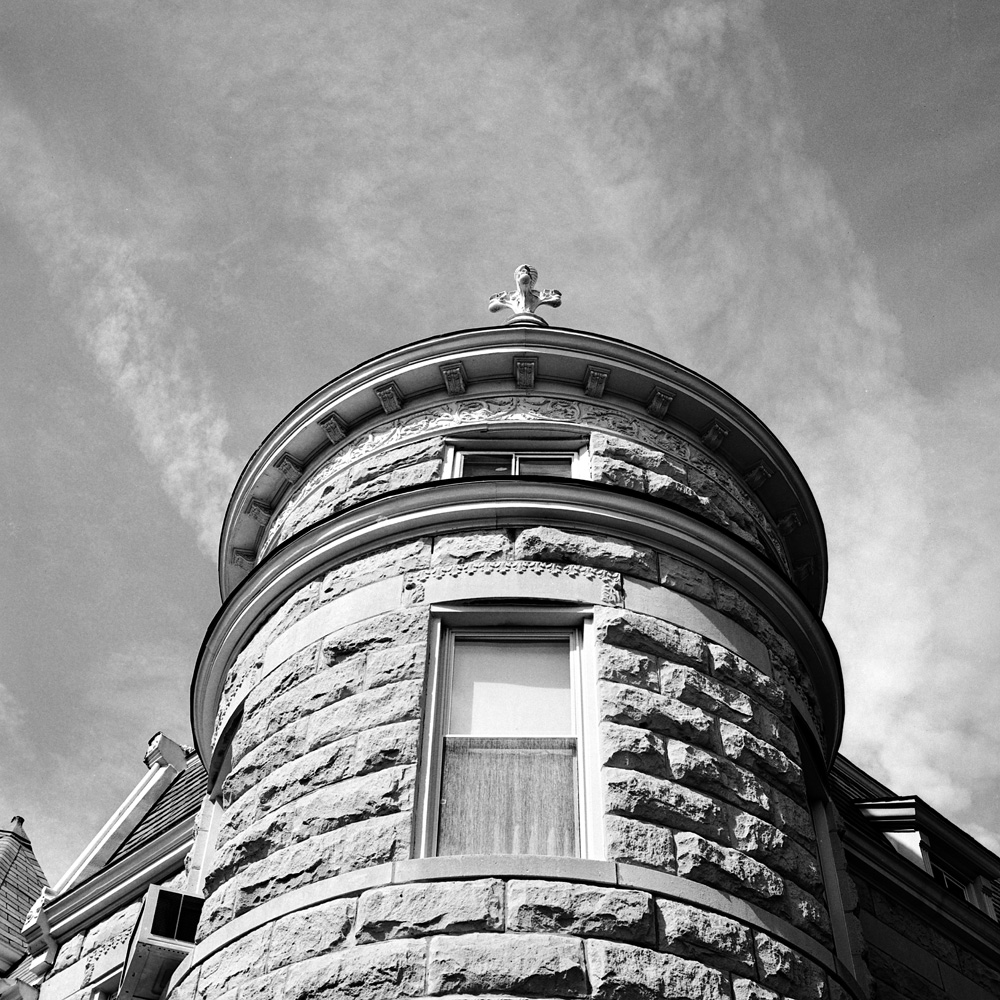
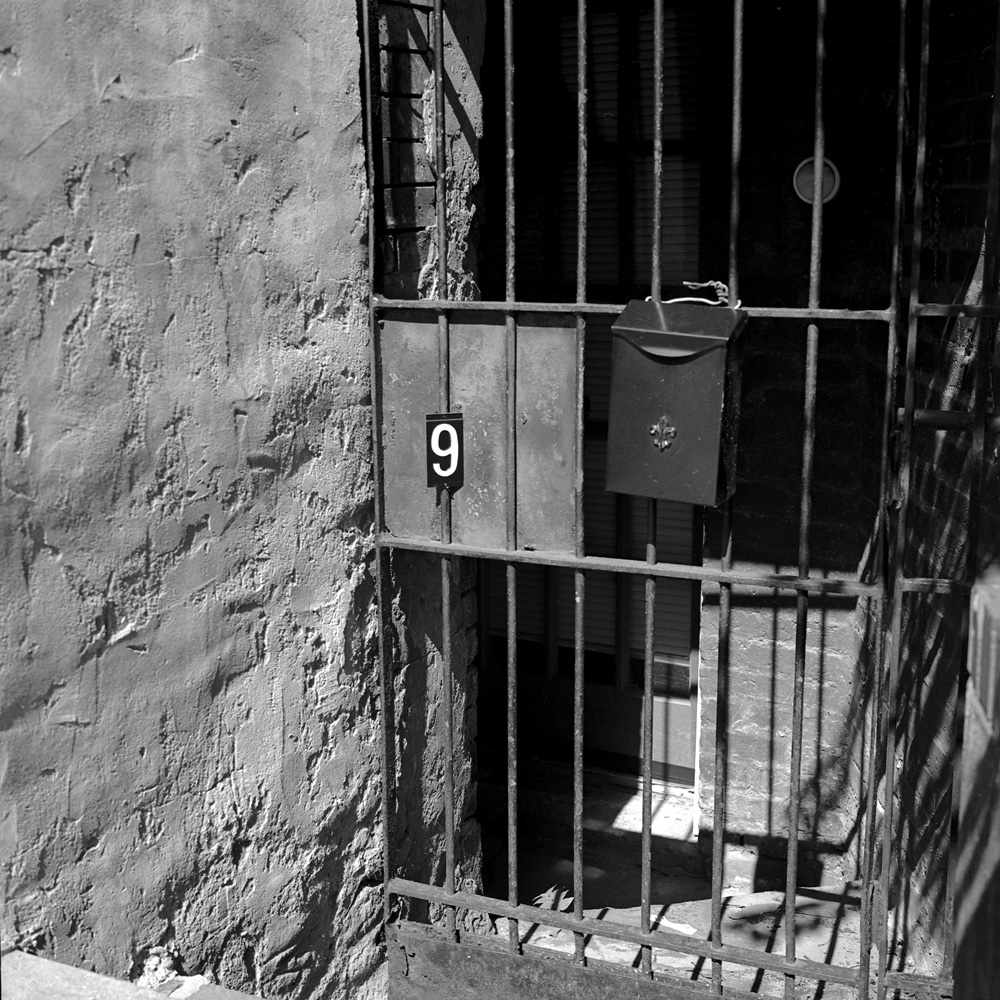
Stone Turret, 11th StreetNumber 9, Basement Door
Very much in the same stretch of 11th Street as the bike rack is where these two scenes can be found. The stone house is a bit of a neighborhood landmark – there are maybe half a dozen or less in the neighborhood with similar facades, and the rest (hundreds of houses) are varying types of brick or stucco over brick. The basement door photo was taken as part of this exercise, not only because I like wrought iron, but because the scene had extremes of contrast that I wanted to see if I could tame with the semi-stand development.
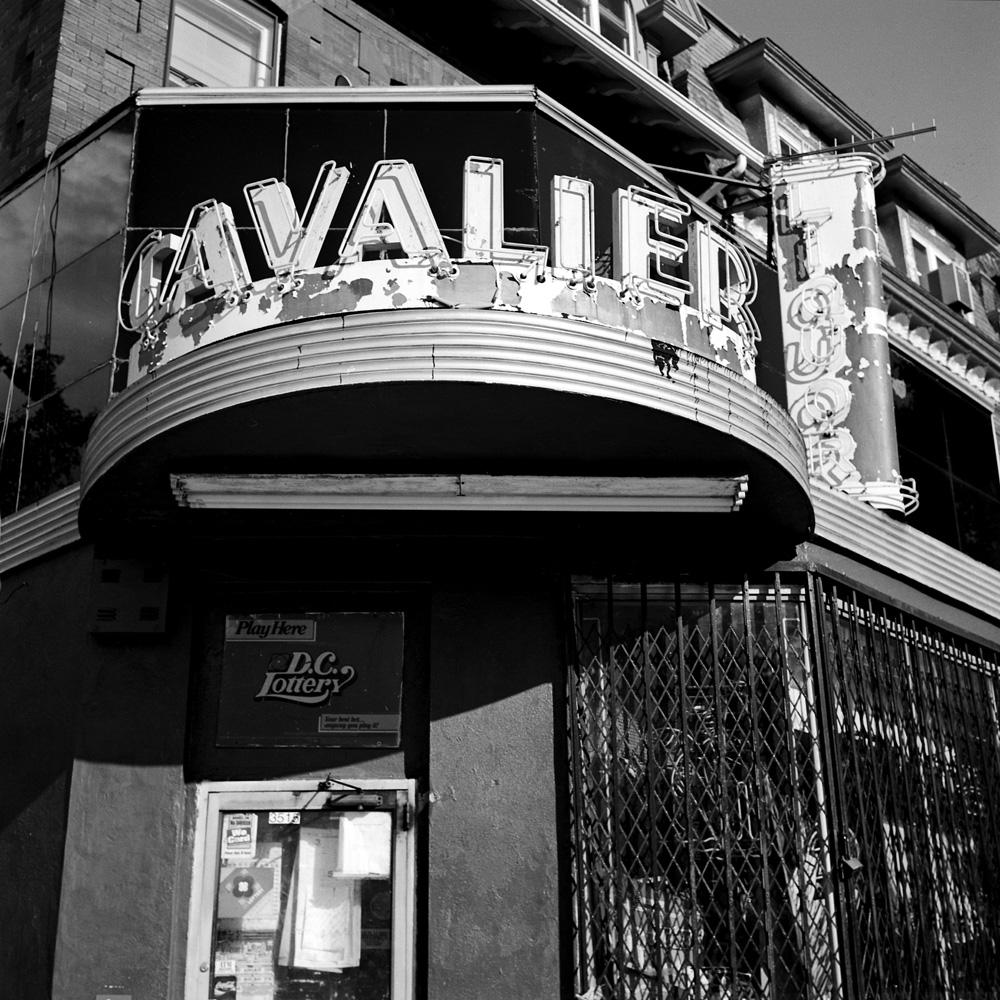
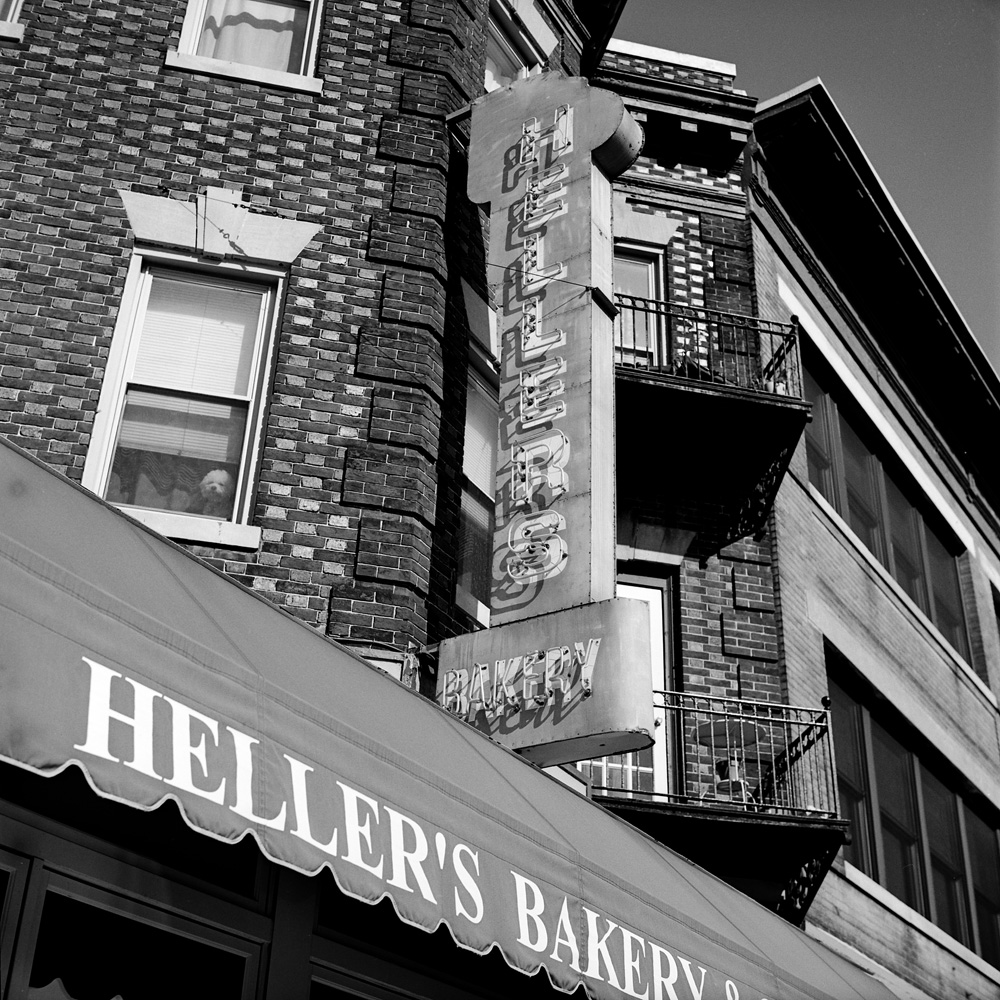
Cavalier Liquor Sunday AfternoonHellers Bakery
These two photos are of neighborhood icons – you’ve seen my color photo of Cavalier Liquor at night before. It has been the subject of many a photograph by fans of urban texture, neon, and Deco architecture. Hellers Bakery has been in their current location for many many years, and if you saw the movie “State of Play” starring Russell Crowe as Cal McAffery, a hard-luck, hard-boiled reporter who uncovers a Washington conspiracy, you’ll recognize their neon sign from below his apartment window. I’m very annoyed with Hellers that they don’t illuminate their sign very often, so it makes it very hard to get a good photo of it after dark!
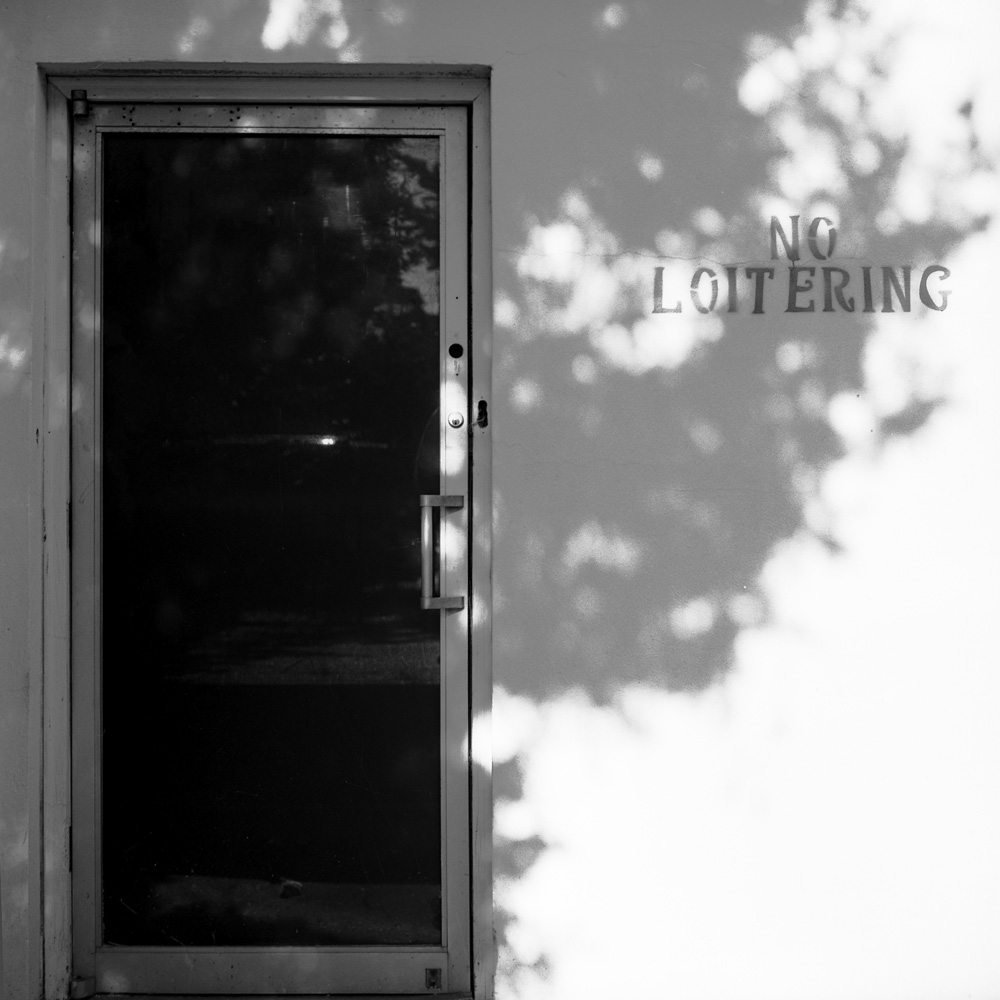
And last but not least, an appropriate sign to end the post with:
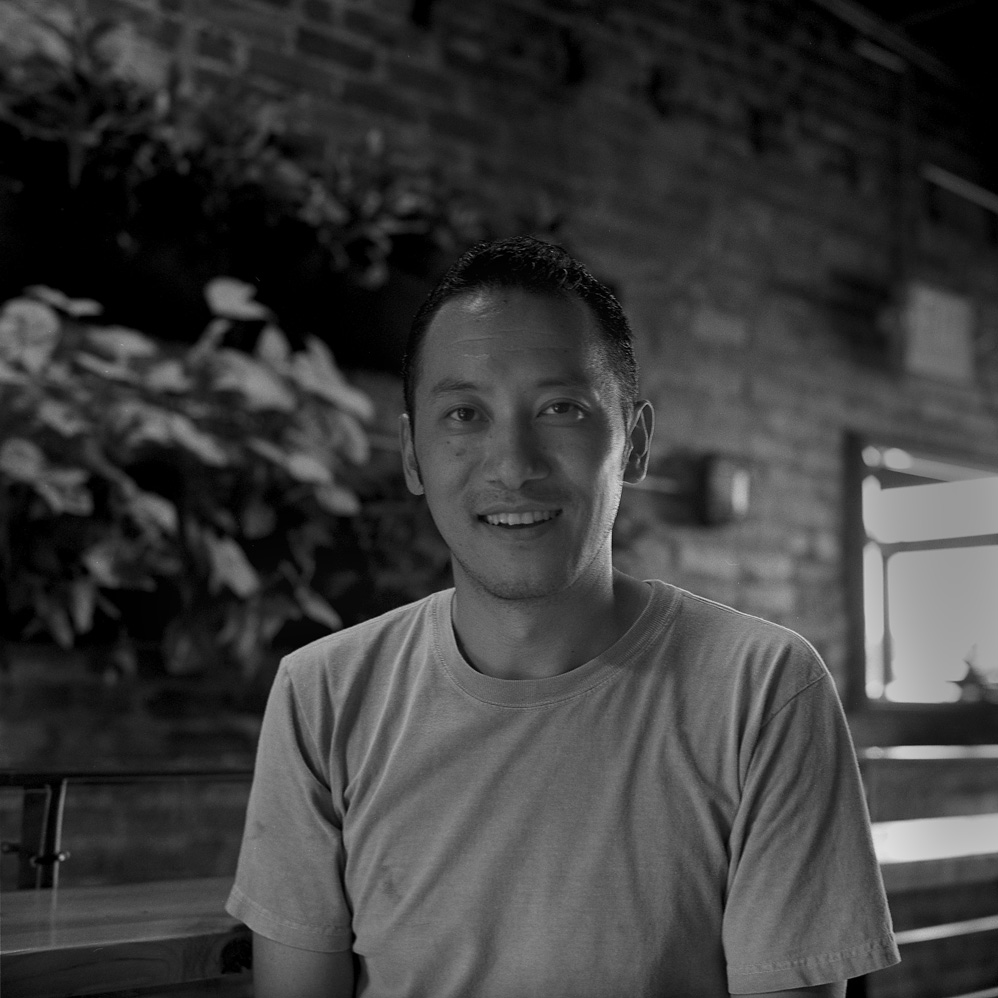
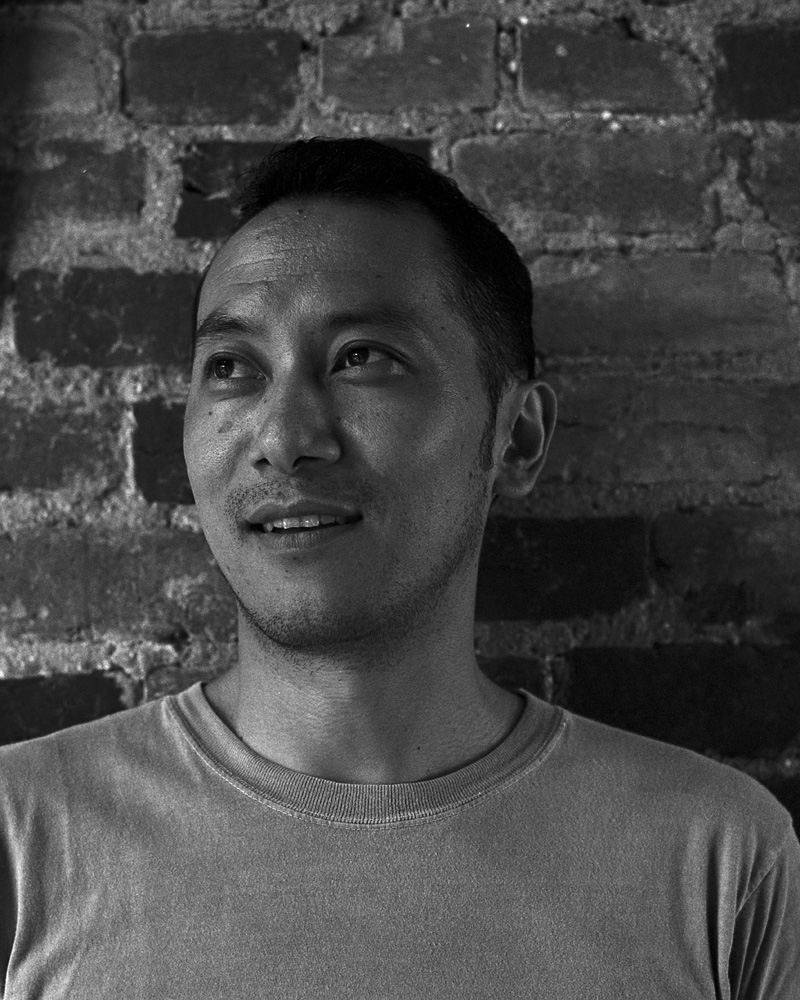
Here are two portraits I took of my friend Wanchuk, who is co-owner with Sam Huang (photo posted previously) of Mad Momos Restaurant & Beer Deck. I’ve known Wanchuk for nearly a decade. He’s from Sikkim, which is now a province of India in the Himalayas between Nepal and Bhutan, but used to be an independent kingdom with close ties to Bhutan.
Wanchuk T., at Mad MomosWanchuk T., Close-up
We met through a common love of photography – at the time he was still in post-college bum-around-the-world mode, and wanted advice on how to take better pictures in the places he was going. Now he’s running a restaurant and giving me a show of my photos. The exhibit will open on August 2nd and run through the end of October. Details about the opening reception will be posted separately.
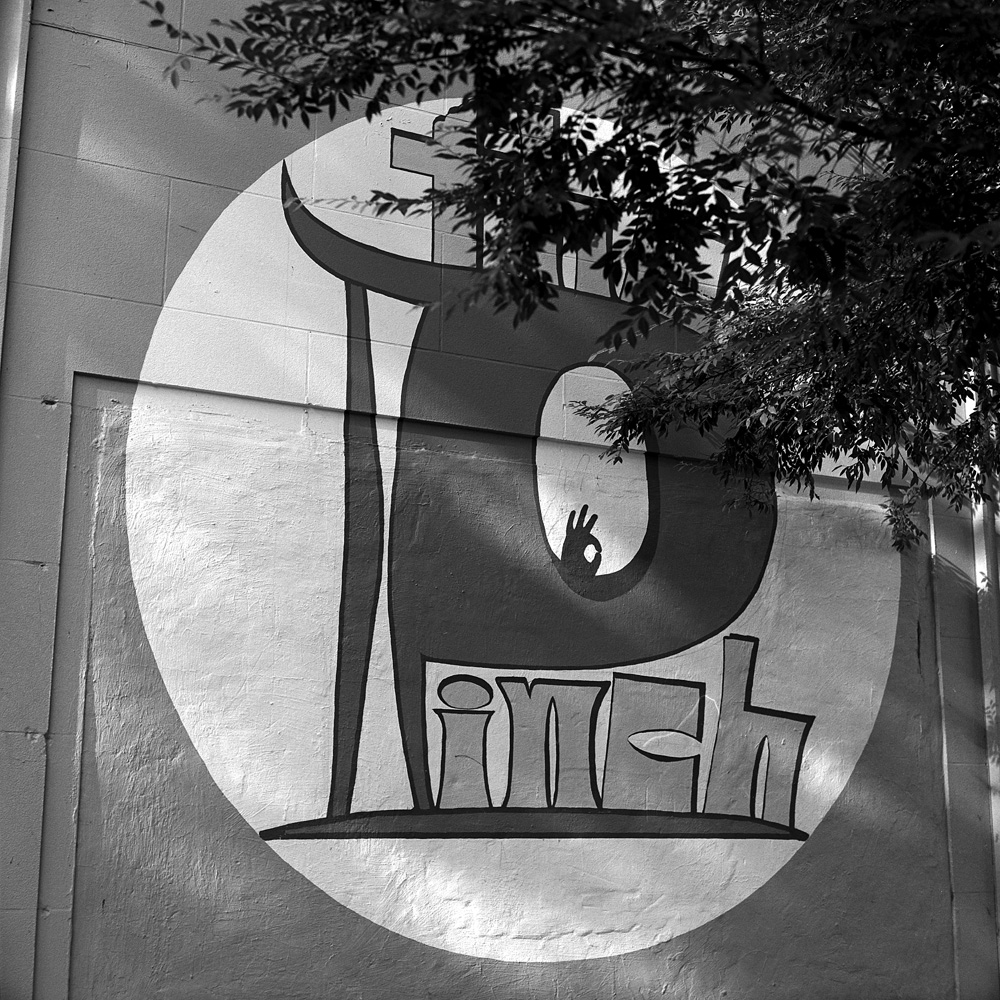
I took those photos of him after we finished a meeting about the exhibit, then went for a 15 minute walkabout in the neighborhood around the restaurant to see what I could find. There’s an old bar/club across the street called “The Pinch” – I so want to photograph the front door because it has cool architectural detailing and some nifty graffiti, but from the looks of the folks hanging out by the front door, I may have to come back and shoot that early in the morning when they’re closed -their patrons may not take too kindly to being photographed.
Here’s their logo on the wall facing the side street – it has a very 70’s look to it, but the paint seems very recent.
The Pinch
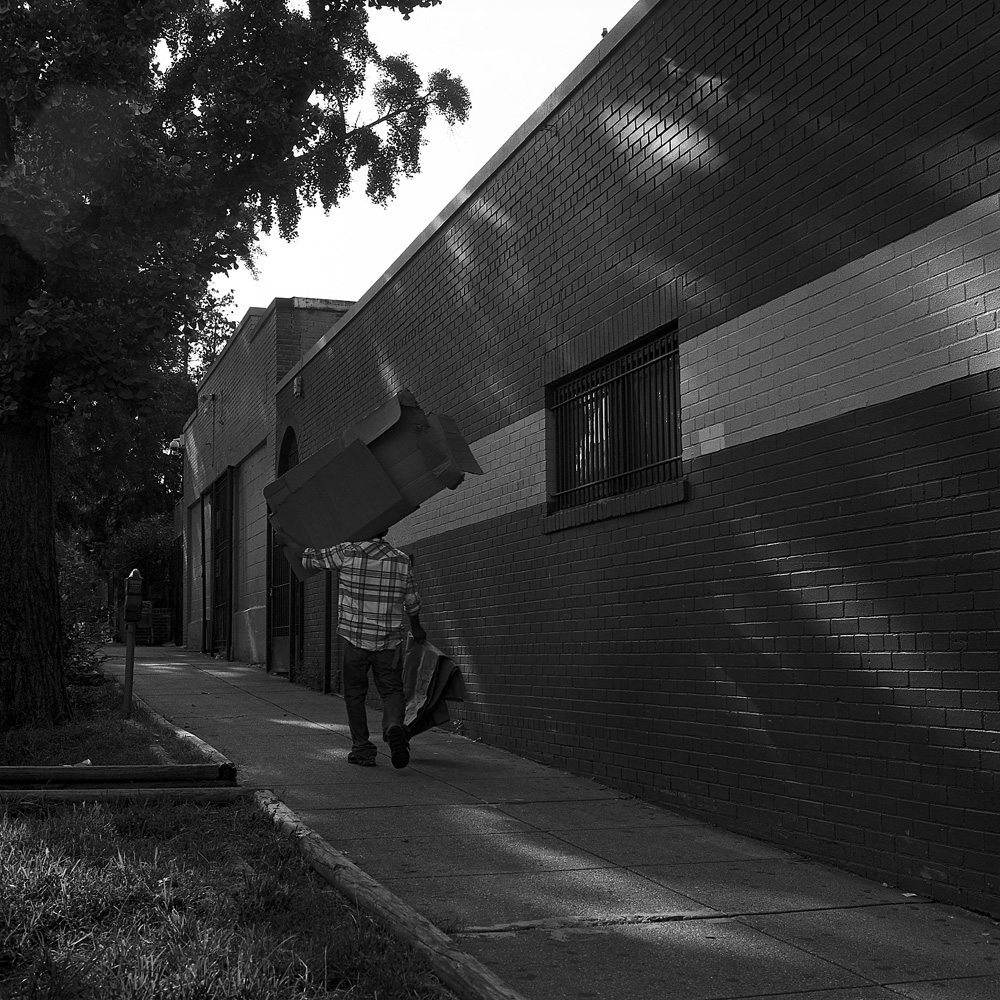
Pivoting to the left of the Pinch logo, I saw this lovely vanishing-point perspective of the building walls, dappled in evening sunlight. As I was composing the shot, this man hauling a gigantic cardboard box over his shoulder walked into the frame. Taking advantage of the serendipitous perspective-giving presence of the man, I waited until he was about 2/3 of the way in the frame before shooting.
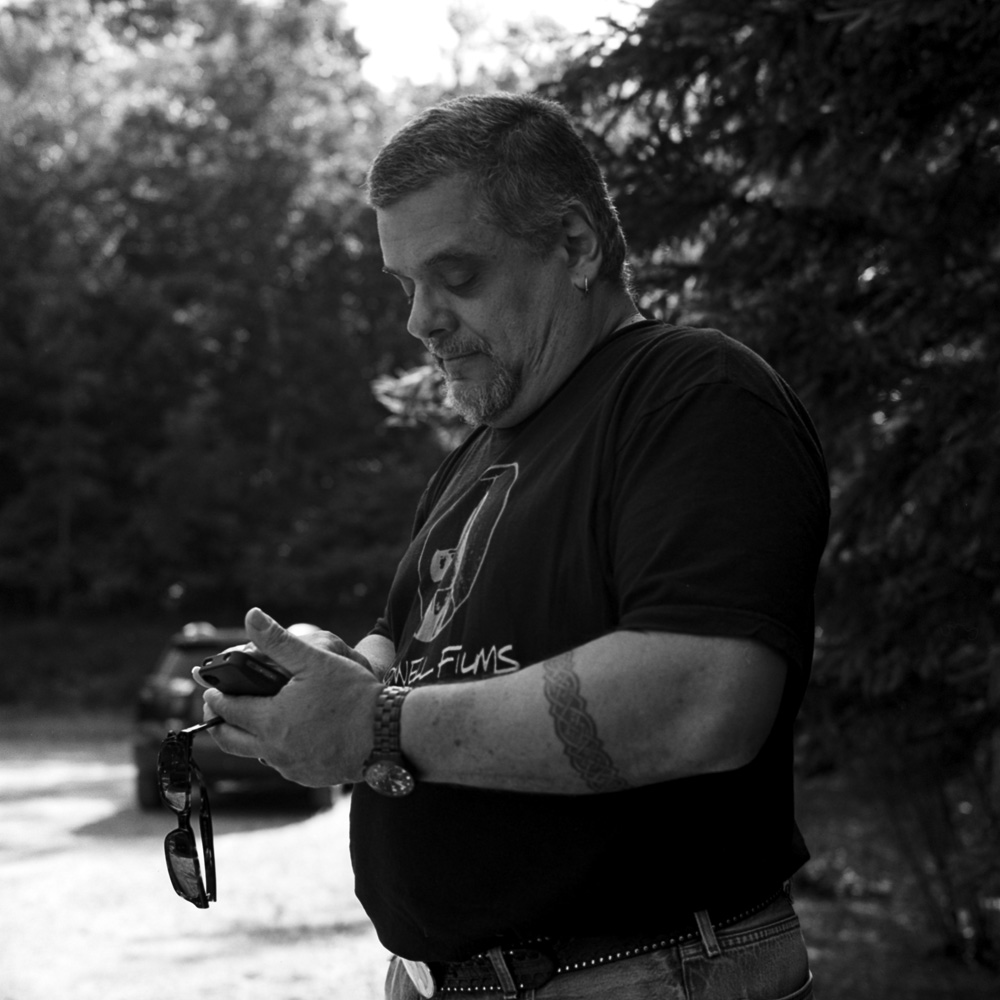
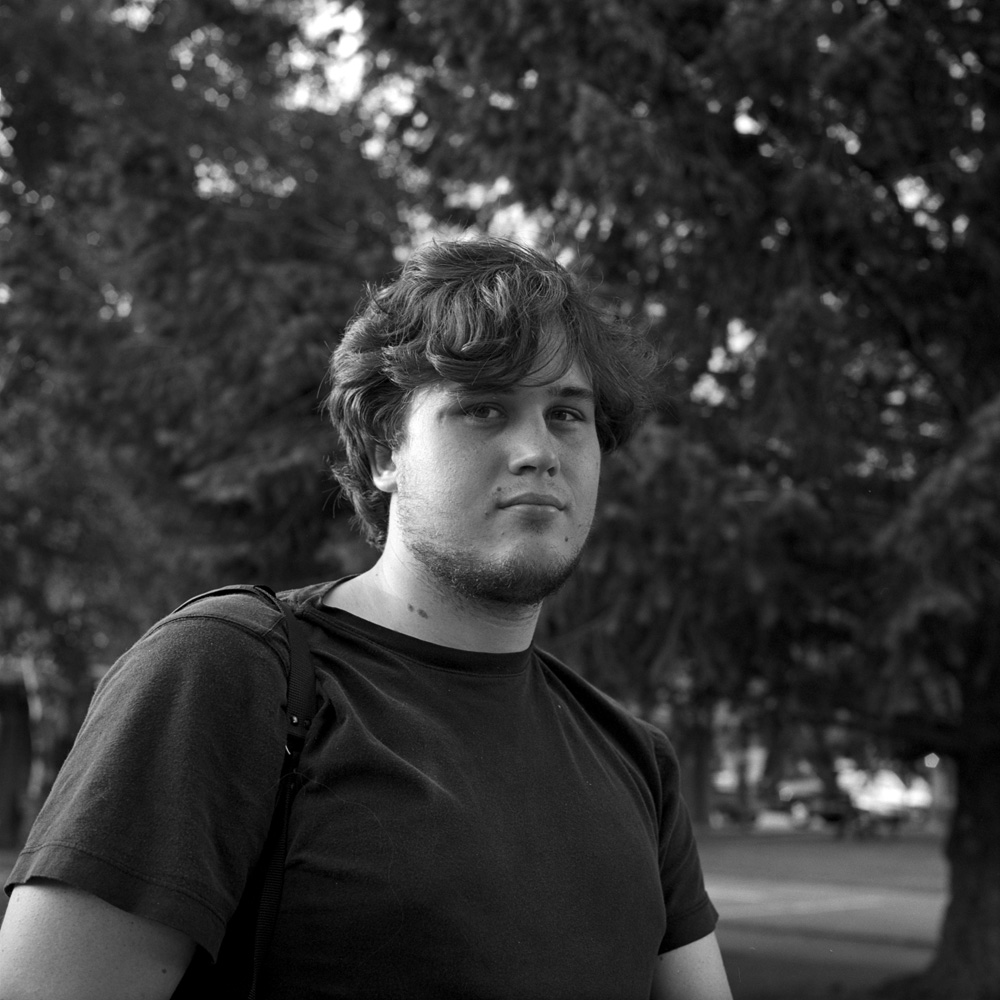
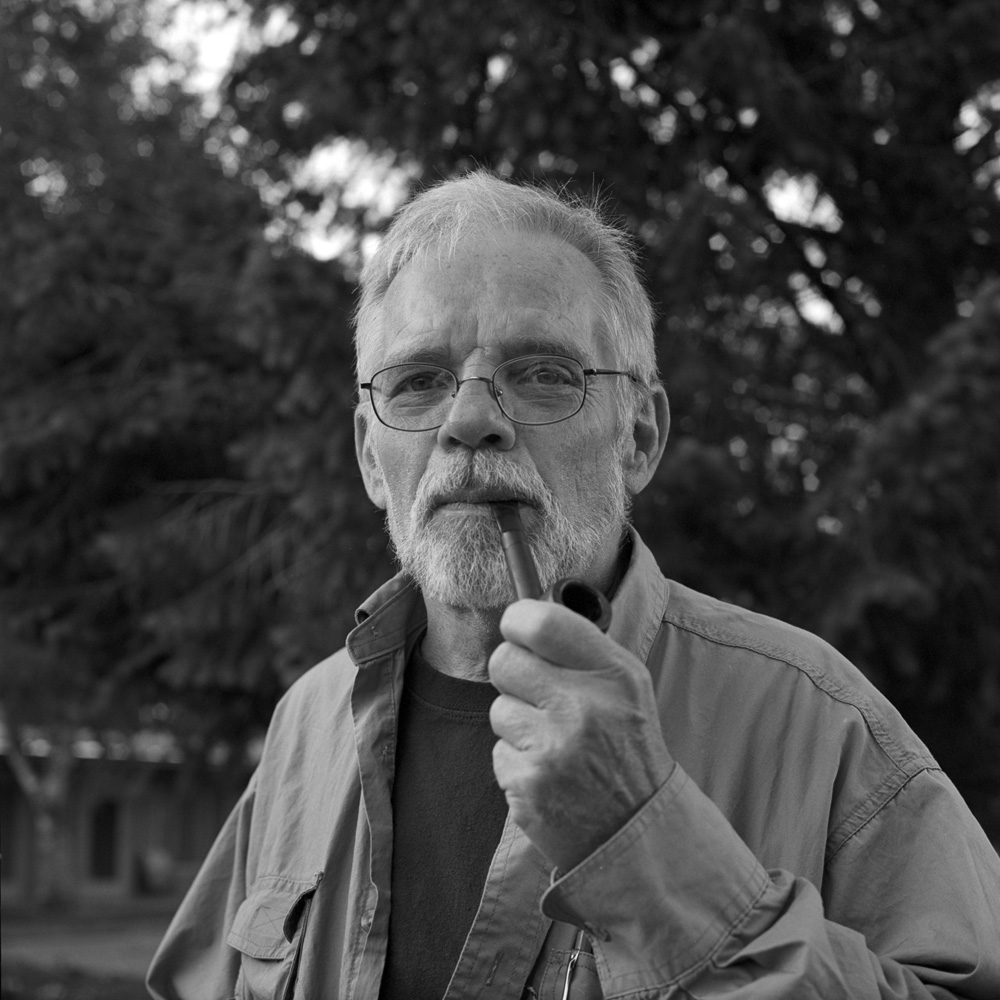
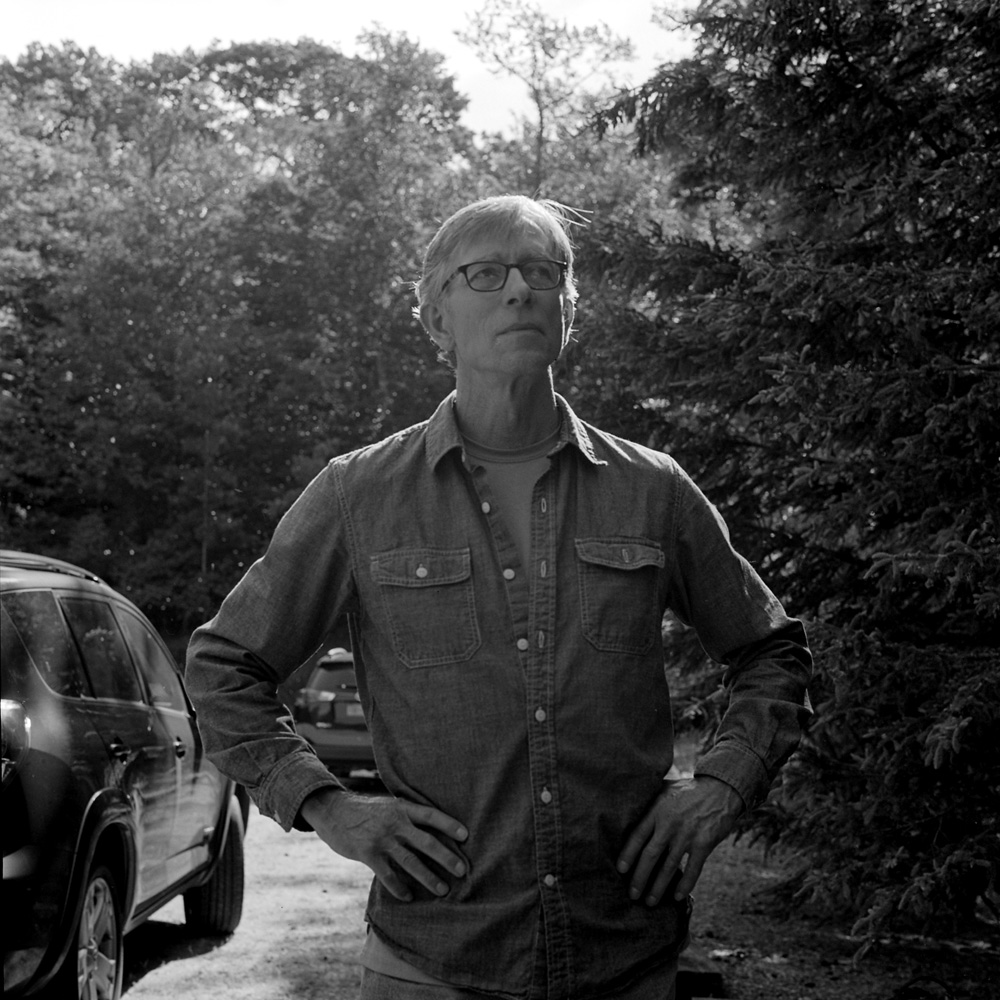
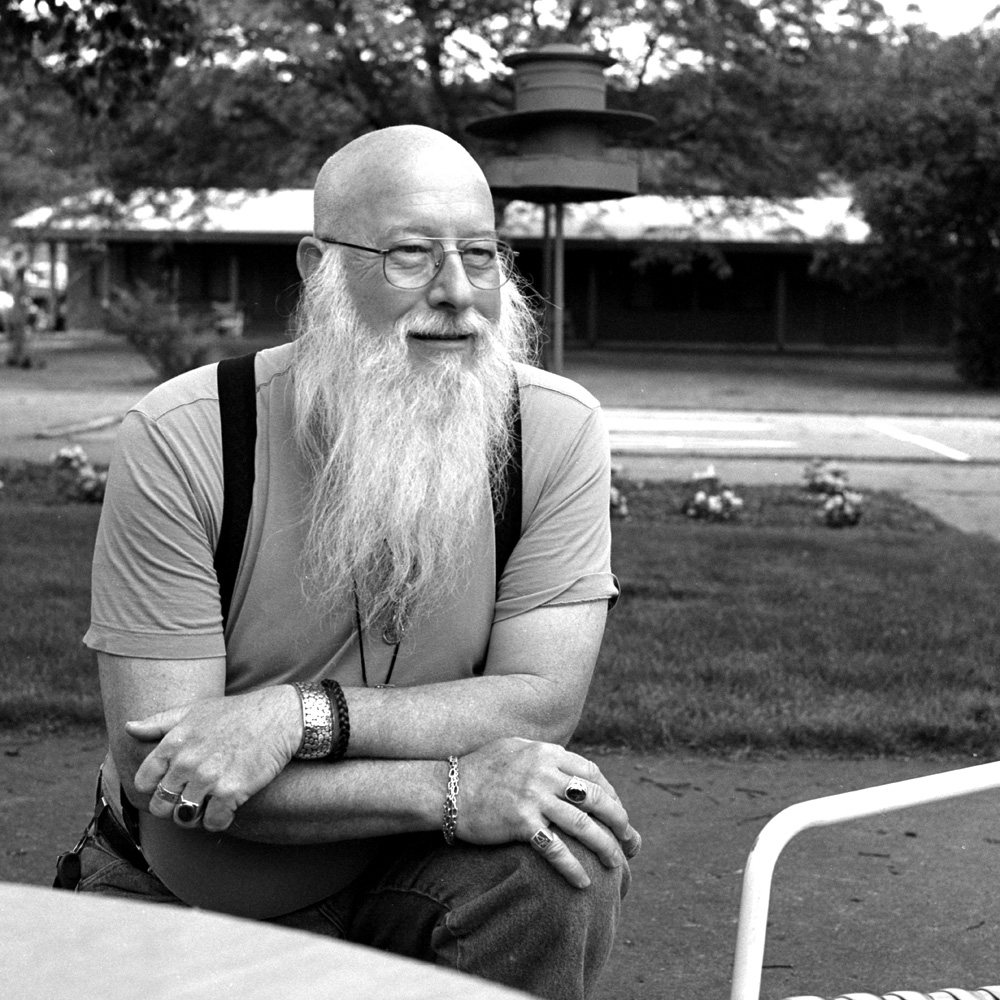
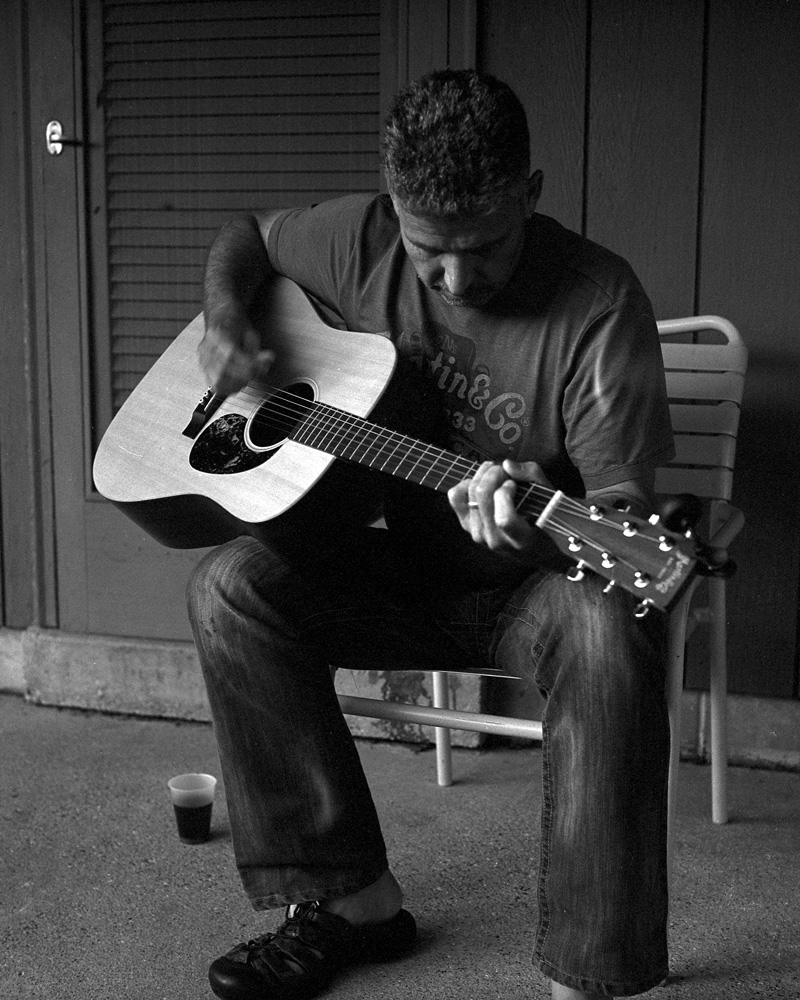
Well, no particular order other than I bracketed the series with folks not looking directly at the camera. I’m including these shots for sentimental reasons more than for the quality of the portraits.
All shots taken with my Rolleiflex 2.8E, on Ilford Delta 400 developed in Pyrocat HD. That Rollei is a fantastic portrait camera, considering it has a fixed “normal” lens on it, isn’t it?
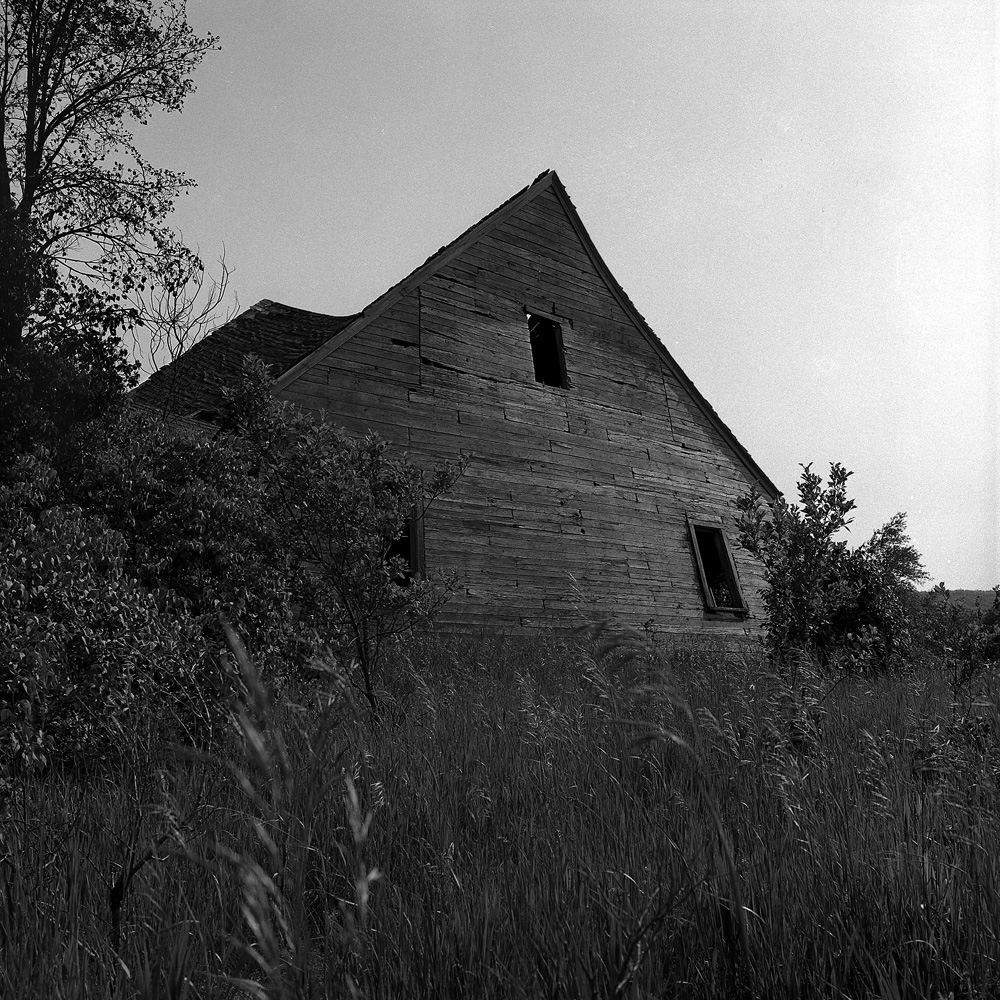
Although these houses are familiar to Photostock participants from years past, I figure most of my readers have never seen them. The first building is across the intersection from Moose Jaw Junction, a roadside restaurant and bar near Larks Lake. The property is for sale, should anyone want a total tear-down.
The Slumping House, End View, Moose Jaw Junction
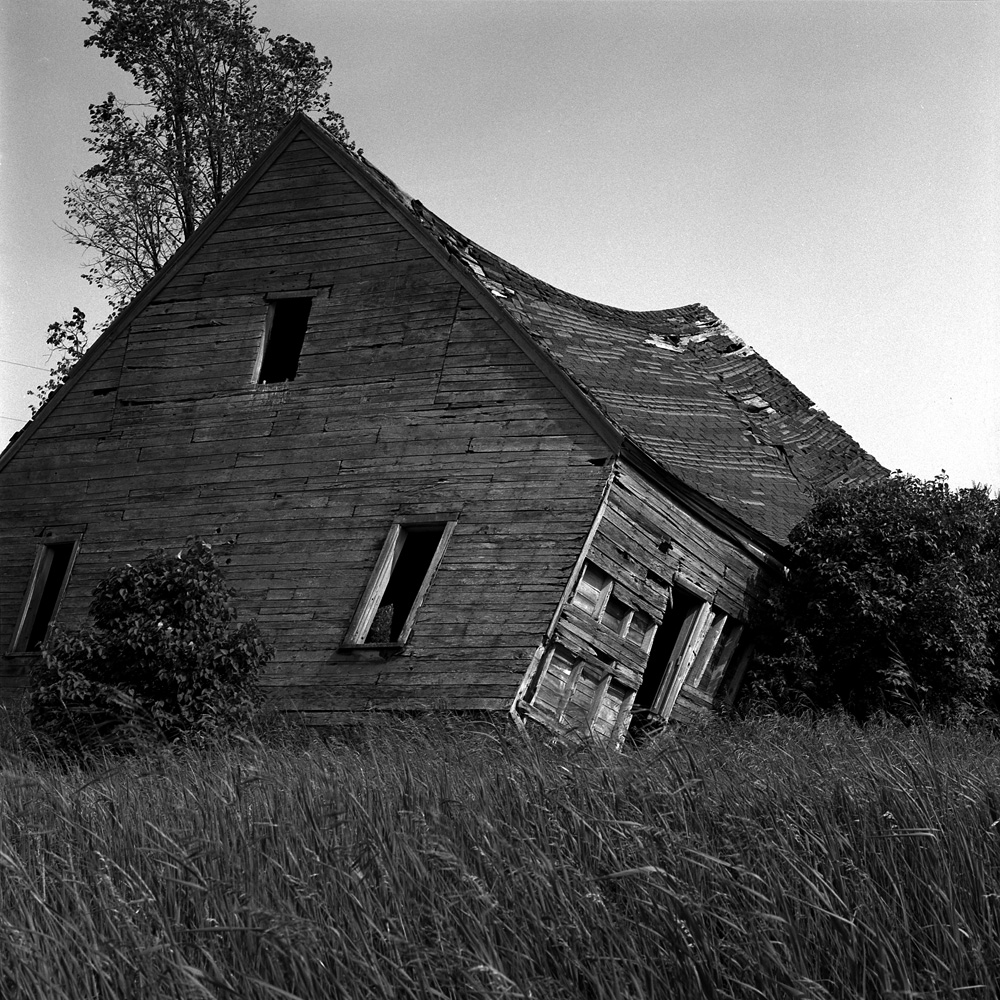
A different view of the building:
The Slumping House, Moose Jaw Junction
This house is/was a little cabin across the street from the St. Ignatius church in Good Hart, Michigan. Pictures of the church and its cemetery will be forthcoming in another post. From what I hear tell from past Photostockers, the cabin used to be far more intact than it is now and they have watched it deteriorate into this condition over the last half-dozen years.
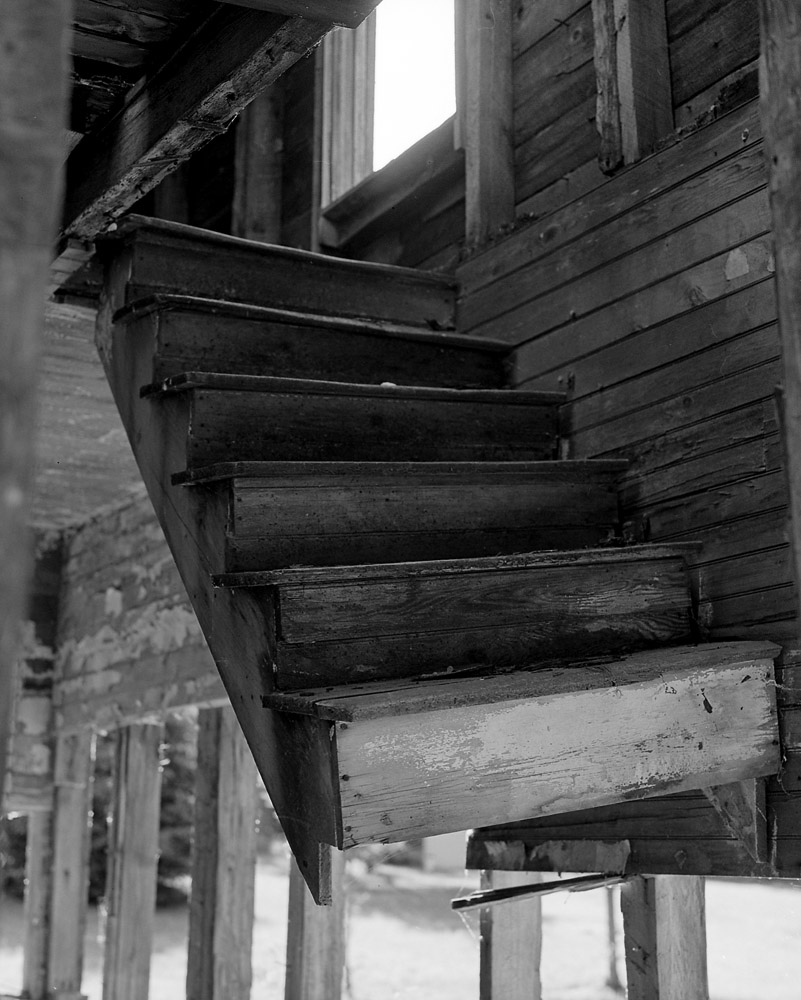
One wall of the house is essentially gone, and you can look inside the structure through it. I would NOT attempt to enter, as there is a considerable debris field on the floor of the lower level, making for a prime residential facility for wildlife of the four-legged and no-legged varieties. You can see the remnant of the staircase through the opening in the wall, though. The texture of the wood and the coloring of it reminded me a bit of Bodie, the California gold-mining ghost town in the Eastern Sierra.
Hanging Stairs, Good Hart
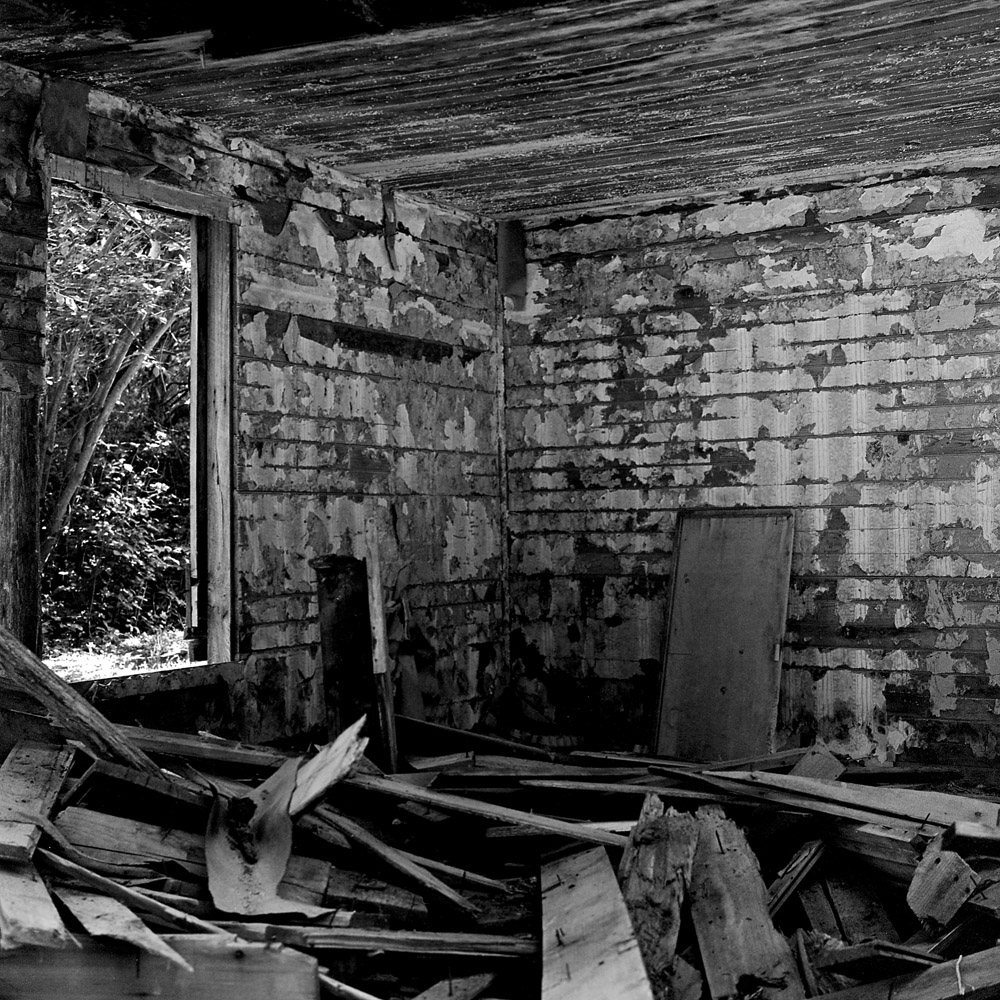
This is a view of the debris field and the remaining structural walls of the house. Amazing how the light level balanced between inside and outside- no HDR or even burning/dodging required to preserve interior and exterior detail alike through the window frame.
House Interior, Good Hart
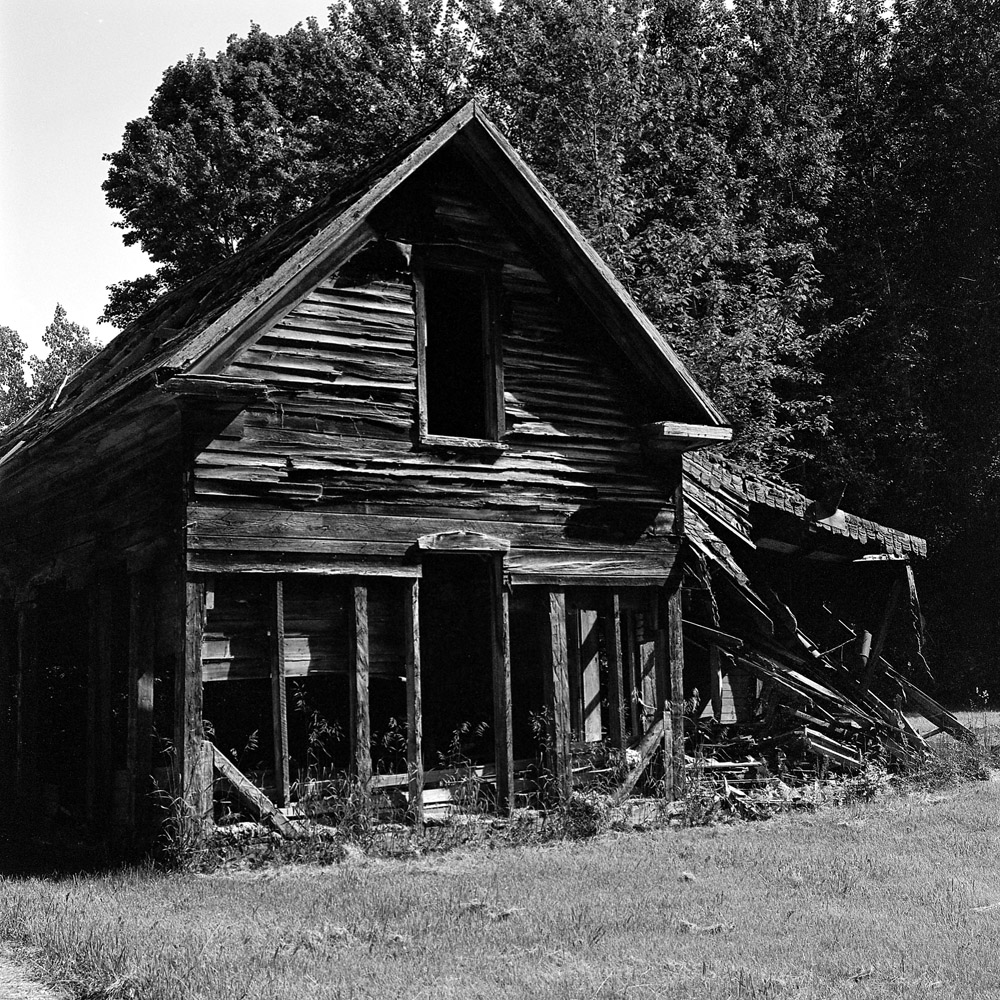
Here is a view of the end of the house, showing the whole of the structure.
Collapsing House, Good Hart
All shots taken with my Rolleiflex 2.8E on Ilford Delta 400, developed in Pyrocat HD developer at 1:1:100 dilution.
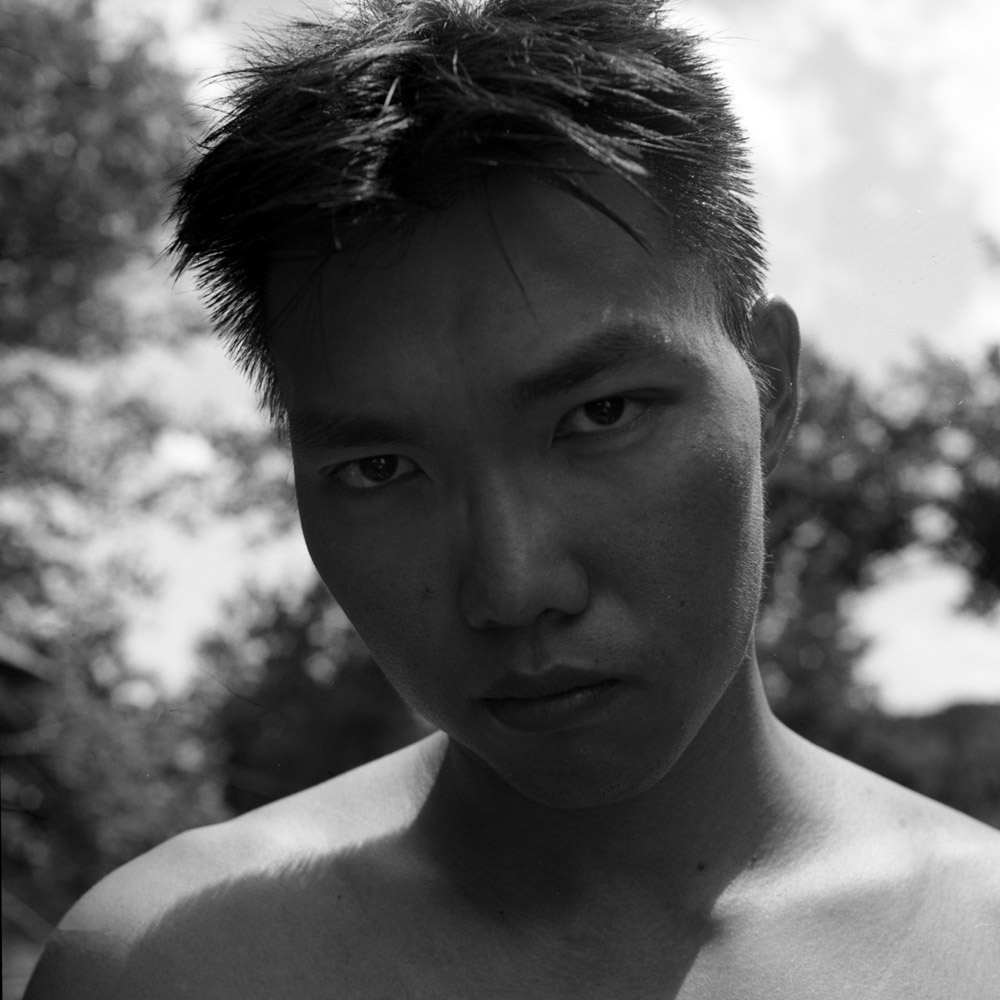
I was determined to avoid crowds and public gatherings on July 4th. Post 9/11 I get nervous in large crowds, especially when ingress and egress are difficult, and when large numbers of them are drunk. Not that my PTSD* gets triggered and I feel like the walls are closing in or anything (although I did get near-panic at Obama’s first inauguration- that was just WAY too many people and it was hard to move- even if something rather pedestrian happened like someone fell and got hurt, or a bottle of carbonated beverage froze and burst and people panicked THINKING it was a gunshot, you could have gotten trampled to death in the stampede!). Anyway, back to the real story – so I wanted to avoid the National Mall, because it’s just a filthy zoo of humanity on the 4th, so I called up a friend who had expressed an interest in posing for me, and we went out along the Potomac to some spots I know that are fairly private and make for good shooting. These are the first few images from the shoot (we’re still negotiating the use of the rest of them).
Chern K – Profile
These first two portraits I particularly like. The profile shot was taken with a Rolleinar close-up adapter on my Rolleiflex. The Rolleiflex by itself has a minimum focus distance of 3 feet, which is fine for general subjects, but for flowers, bugs, macro photography in general, and even tight portraits, 3 feet is not close enough. So Rollei in their infinite wisdom invented the Rolleinar close-up filter sets. They come in four strengths – 1,2,3 and 4. The 4 is extremely rare and you almost never see one on the market in any size. The #1 cuts the minimum focus down to 1.5 feet, the #2, to .75 feet, and so on. I have a #1 and a #2. At some point I MAY get a #3. Some people complain that the Rolleinars add too much “distortion” to portraits and as such are bad for doing them. I say shots like this disagree with that notion. If you need more proof, check out the work of Richard Avedon, as well as my friend Sanders McNew (the book cover for “Triptych: Sixteen Months” looks like a good example).
Chern K – Backlit Portrait
The backlit portrait was shot normally, no close-up filter required. I was figuring out the exposure for this shot and used my meter in incident reading mode. I had a brief doubt when taking the shot because the meter was suggesting only 1 stop different from what would have used for a non-backlit subject, but I went ahead and used the setting anyway. My doubts were renewed when I looked at the raw negative – reading a negative is a skill any serious film photographer should develop, and I’m pretty good at it now, having looked at literally thousands of negatives I’ve produced over the years, but I’m still, always, getting better at it. This was a case in point.
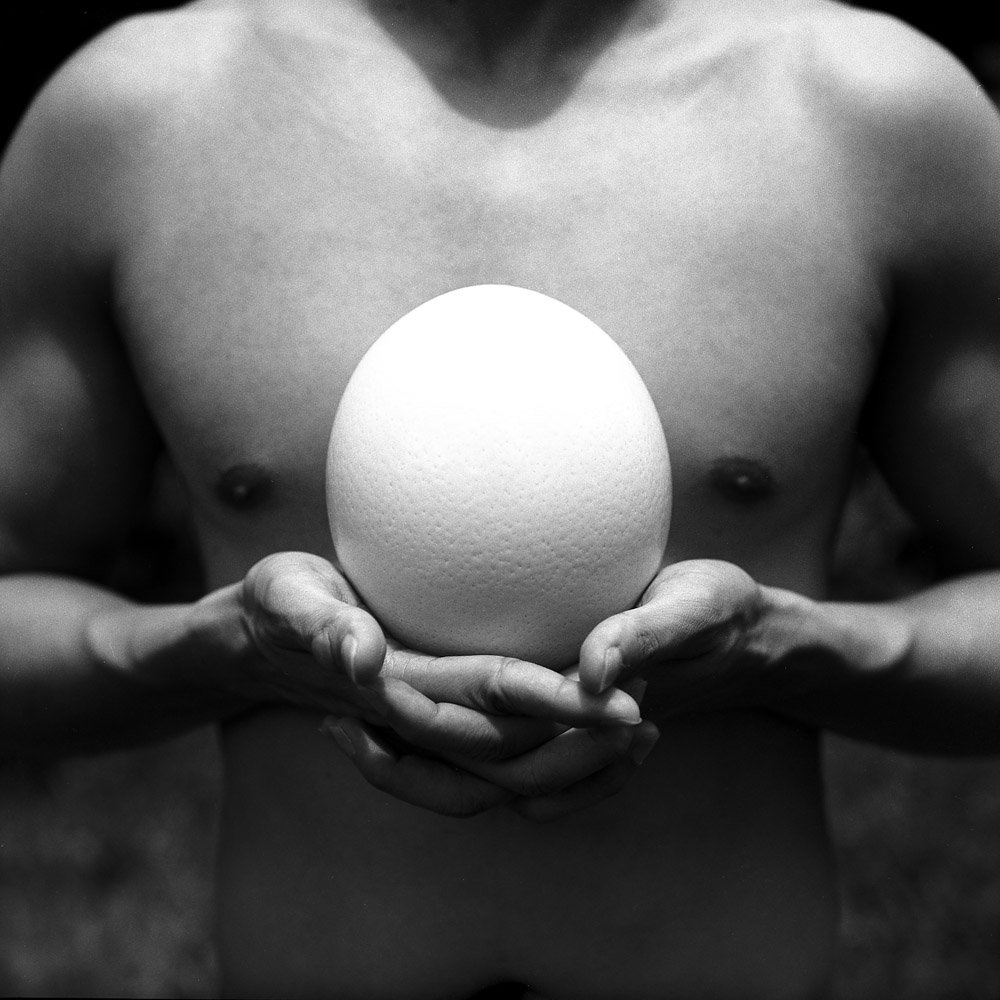
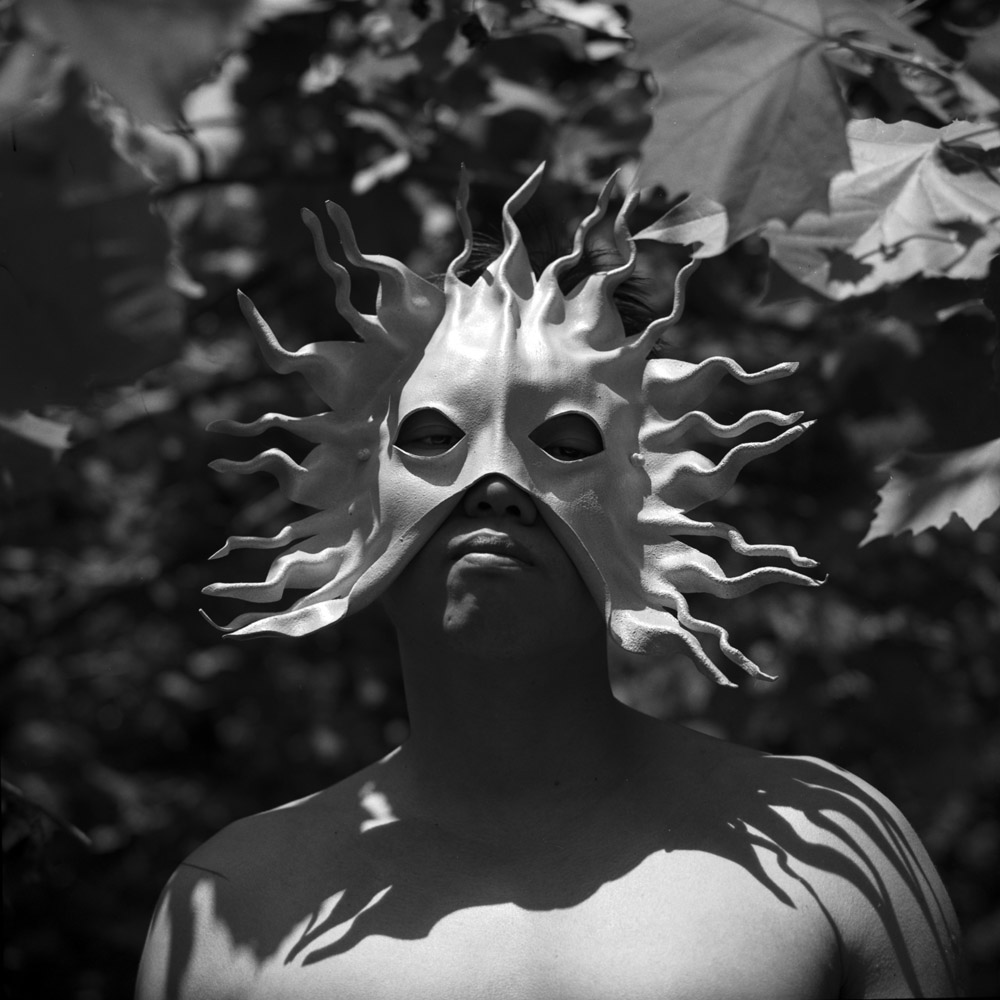
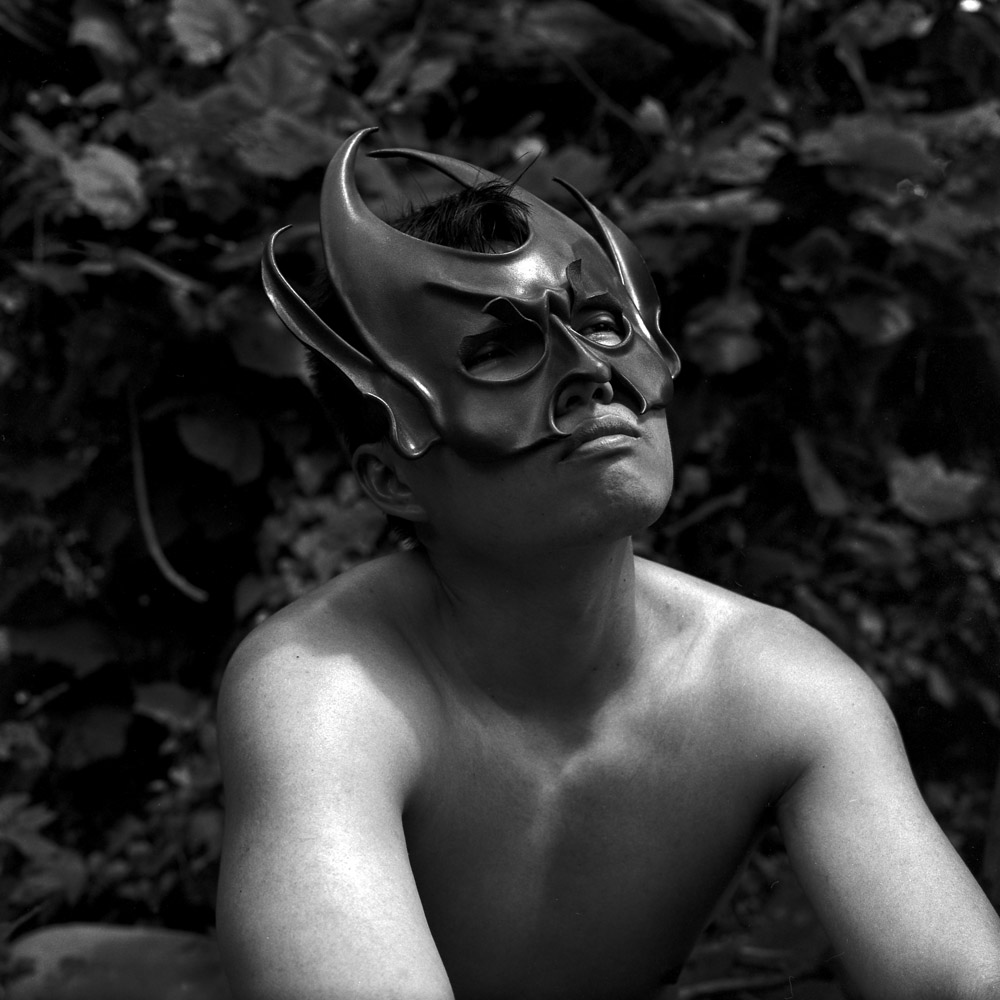
Then we got into playing with props, specifically, an ostrich egg and some leather masks I got at the Maryland Renaissance Festival.
Chern K – Ostrich Egg
I’ve been carrying around this ostrich egg shell for a while – I got it as a prop to use for another shot in my Tarot Cards: Re-imagined series. But getting the model who is supposed to use it to show up and sit for me has been a challenge, so it has been lingering, unloved, in my prop bag for some time. Well, it earned its keep with this shot. This is just a straight scan of the negative, so I’m still playing around with how to render the ostrich egg better – I want to preserve detail in the shell without it looking gray, or getting too blown out. Just as I got the shot composed, clouds kept drifting in and out of the sun’s path, changing the nature of the shot. I watched and noticed that the blown-out brilliant highlight caused by the direct sun on the shell’s smooth surface was greatly reduced by the cloud cover. By the time I got the meter reading for the cloud-diffused light, though, the clouds had moved on and it was back to full sun. So a waiting game ensued. I took this shot with partial, thin cloud diffusion because it was getting too hot for either of us to keep standing there waiting for a big cloud to drift back over again!
Chern K – The Sun Peeks OutChern K -Devil Mask
Here are the mask shots. Not much to say about these really – they’re fairly self-explanatory with the masks doing the talking. The masks were also bought for use in the Tarot Cards: Re-imagined series, and this is giving me new impetus to take up the series again and try to finish the Major Arcana.
I shot these all with Ilford PanF because it is such a slow film, and I wanted to try and shoot a lot of these wide open to get the blown-out, swirly background the lens is capable of producing. On the Rollei this can be a challenge with faster films because the fastest shutter speed is 1/500th of a second, which still isn’t fast enough in bright daylight to let me shoot the way I was looking to if I used even FP4+.
I don’t know if it was because I had been bottling up my human figure creative juices for so long, or the fact that I had a good model who understood how to pose and move, or having the right tool in my hands for the job, or what, but I got a crazy amount of successful images from this shoot- fully 24 out of 36 were ones I wanted to work with. That’s an amazing hit ratio, especially when you consider that of the 12 I didn’t pick, probably 1/2 were variations on a theme of ones I DID pick. So an 80% +/- hit rate? WOW.
* I was working in the Pentagon on 9/11, when the plane hit. Low-flying aircraft still make me jittery, but 12 years on, that’s about it. I have it pretty good all things considered.
This is an exploration of twilight into dusk in and around the 14th Street and U Street corridors in Northwest Washington DC. All these shots were taken in the same evening, and are within walking distance of one another (although in the name of time efficiency I drove from one area to the other so I wouldn’t lose the last light in the sky).
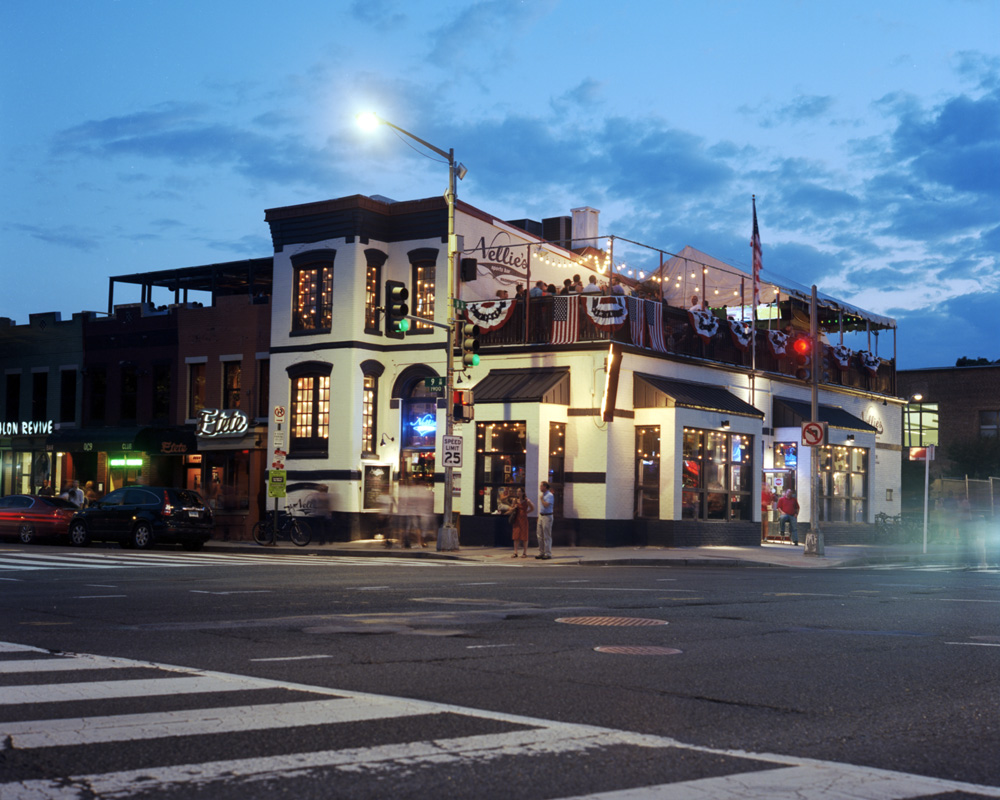
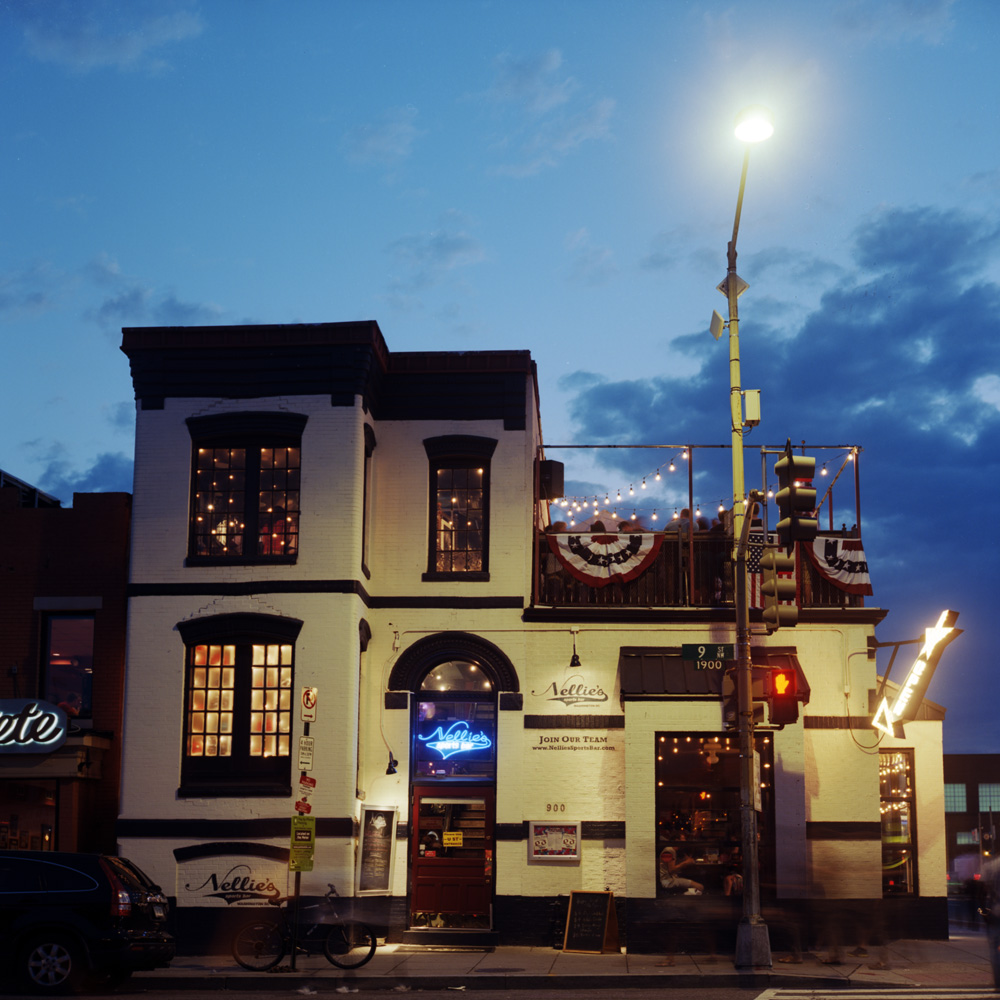
Nellies is a gay sports bar (betcha never thought you’d hear THAT particular combination!) at the corner of 9th and U Street and Florida Avenue (U Street turns into Florida Avenue at 9th). I’ve driven by hundreds of times and always thought about photographing their lights, specifically the “OPEN” arrow on the corner. The night I started this project, I decided to shoot the building from two different angles, one to capture the general ambiance of the intersection, the other to specifically address the OPEN sign.
Nellies Sports Bar, From Florida AvenueNellies Sports Bar, From 9th Street
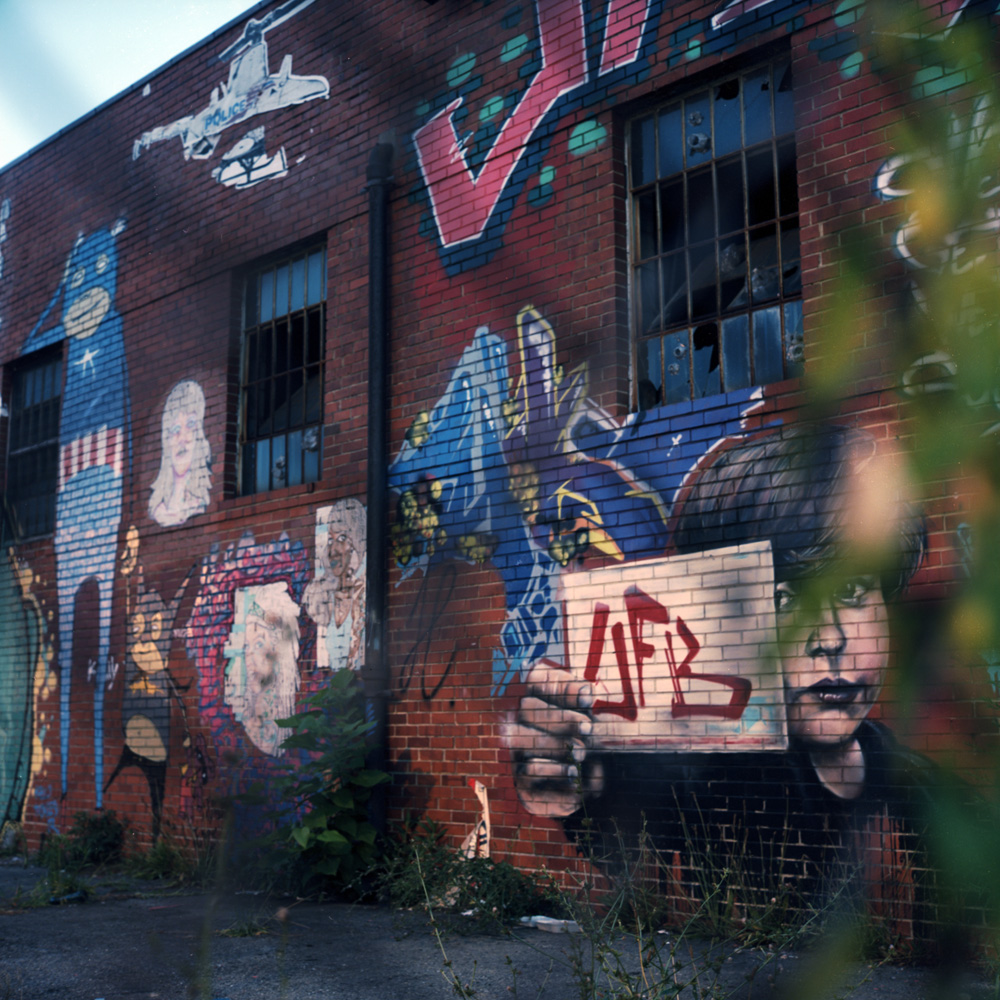
Around the corner from Nellies is this abandoned warehouse which has some really wild and cool and somewhat disturbing graffiti on it. I shot some of this graffiti through the chain link fence around the side lot. The disturbing piece I intentionally cropped out of the shot, as it is the nude lower half of a female body that appears to have been severed from its torso.
Graffiti, Chain Link Fence, Twilight
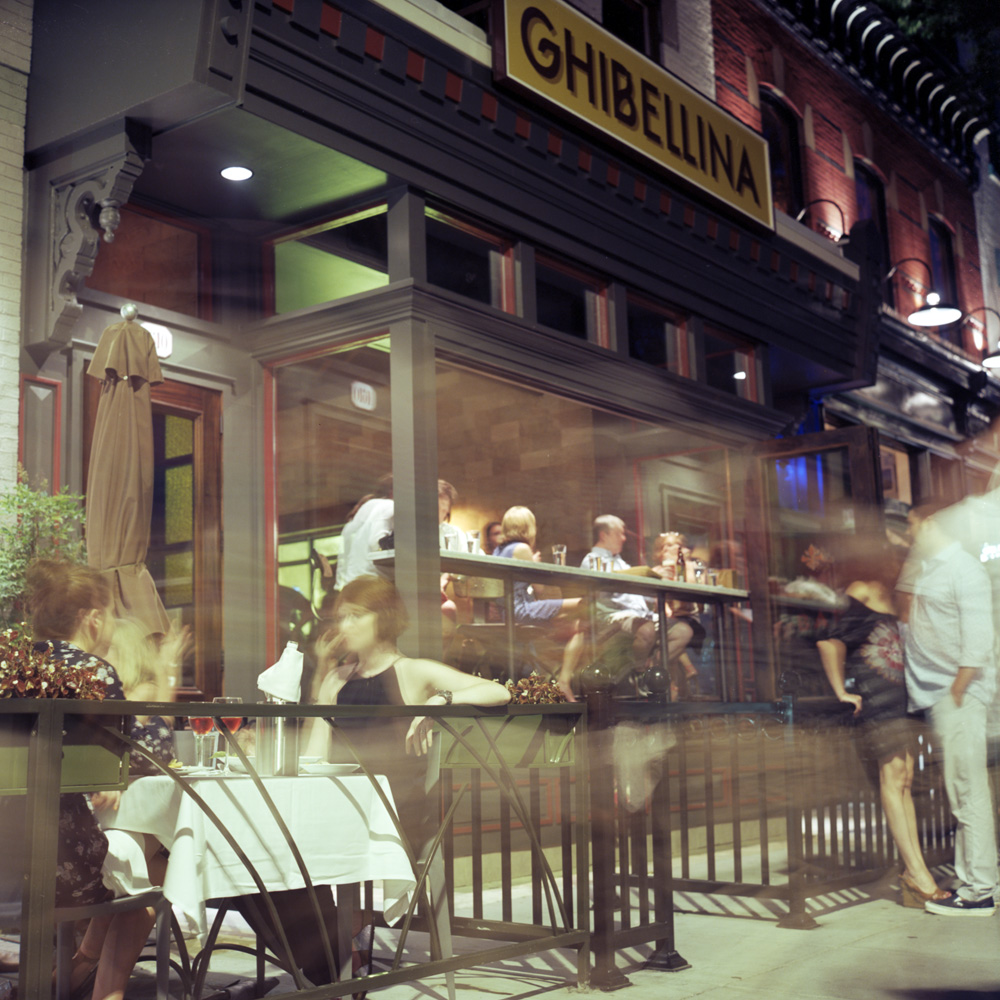
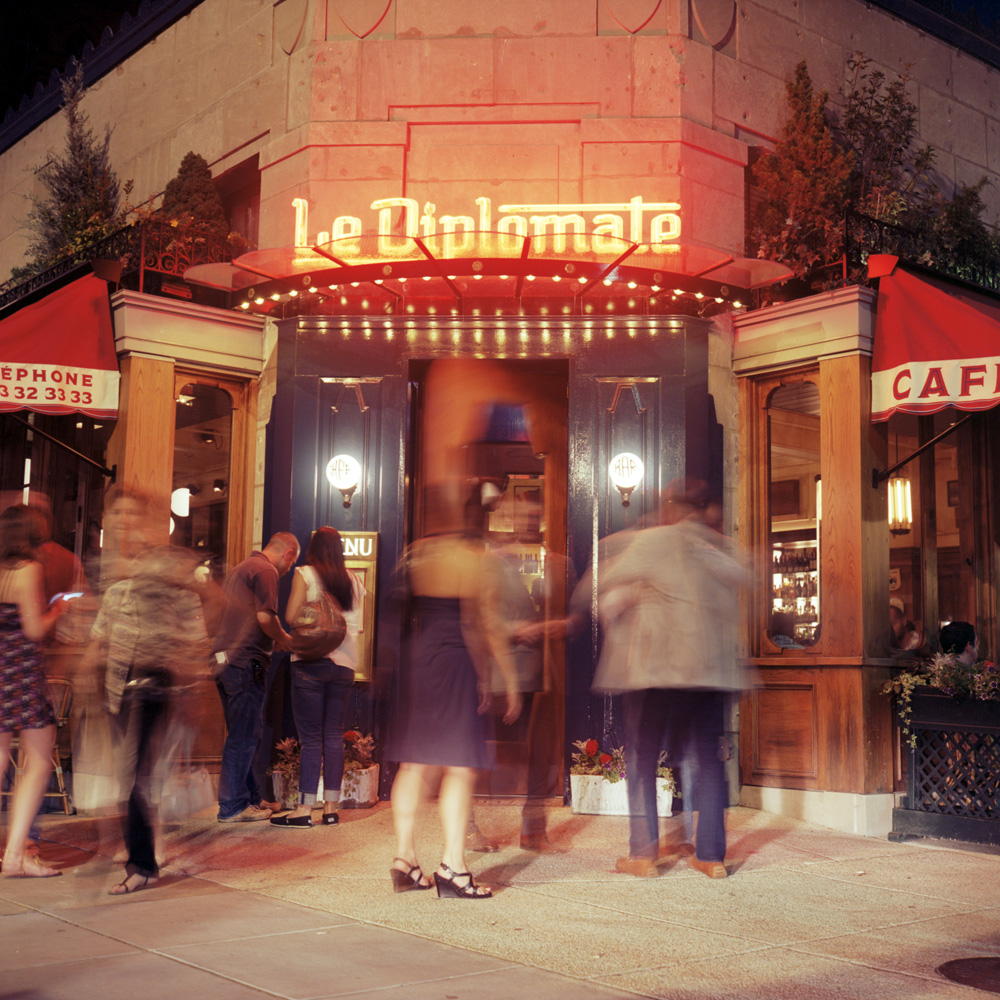
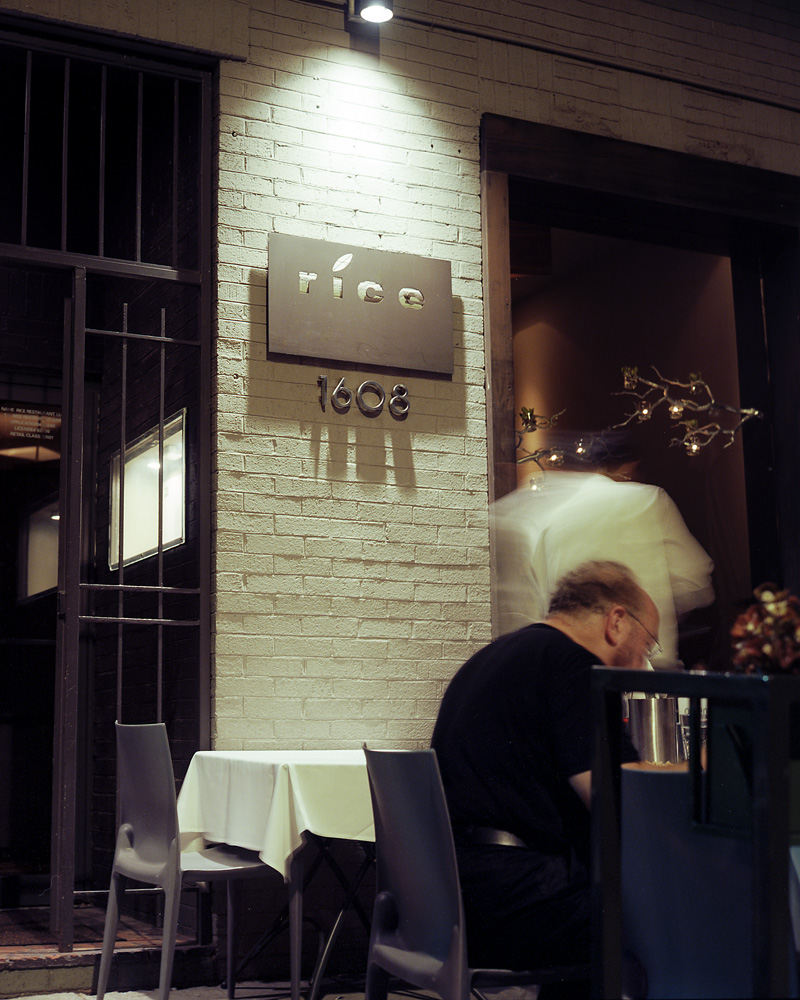
Over on 14th Street, we have had an explosion of new restaurants in the last five years, with a huge spate in the last year alone. Rice Restuarant is arguably the best Thai restaurant in DC, and certainly the most innovative. A good friend of mine opened it gosh, maybe ten years ago, virtually pioneering the restaurant boom in the neighborhood. Now next door to Rice is Ghibellina, an Italian joint that opened this year, and next door to that is Pearl Dive, an oyster bar, which opened perhaps 2 years ago. Le Diplomate is a French bistro across the street in what was originally a car dealership in the 1920s, then became a laundromat. Le Diplomate also opened earlier this year.
GhibellinaLe DiplomateRice Restaurant
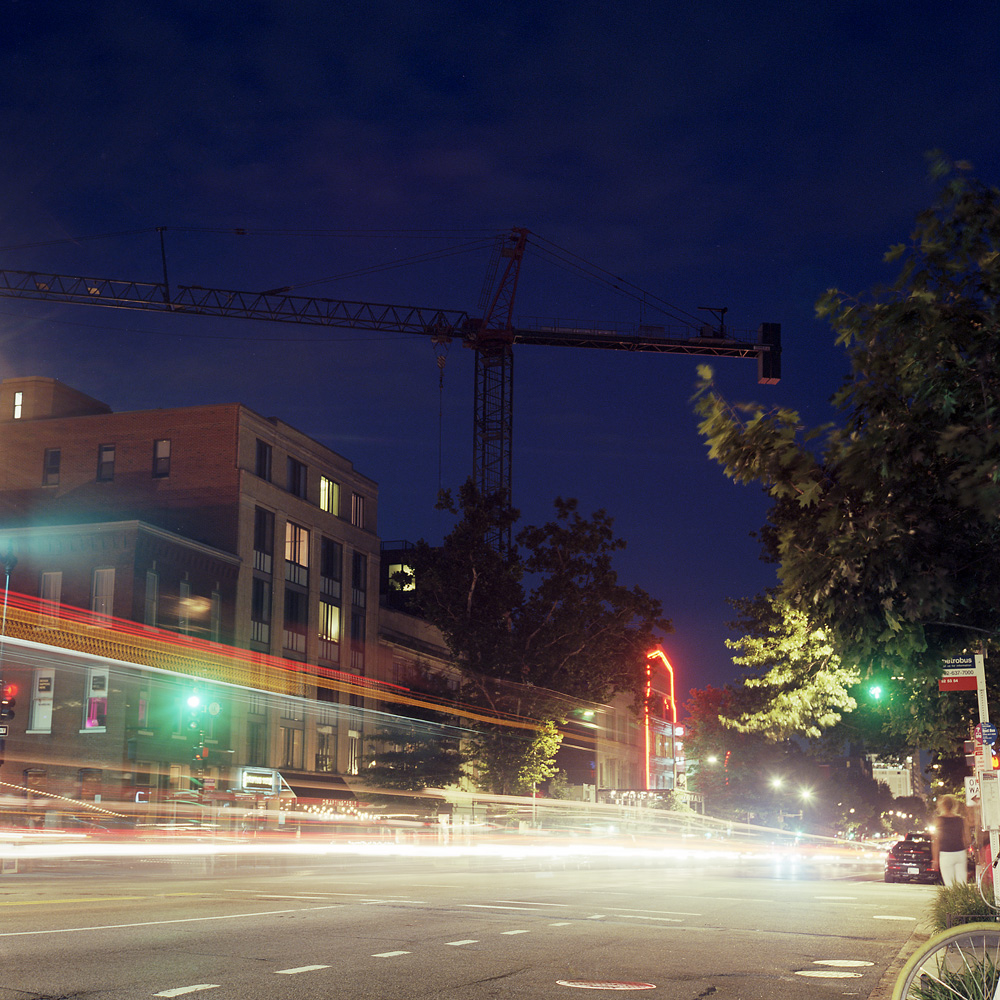
At the intersection of 14th and Q Streets, I pointed my camera south on 14th to try and capture the energy of the neighborhood, through the traffic, the lights, the construction boom represented by the crane, and the people on the sidewalks.
Crane, 14th Street, Twilight
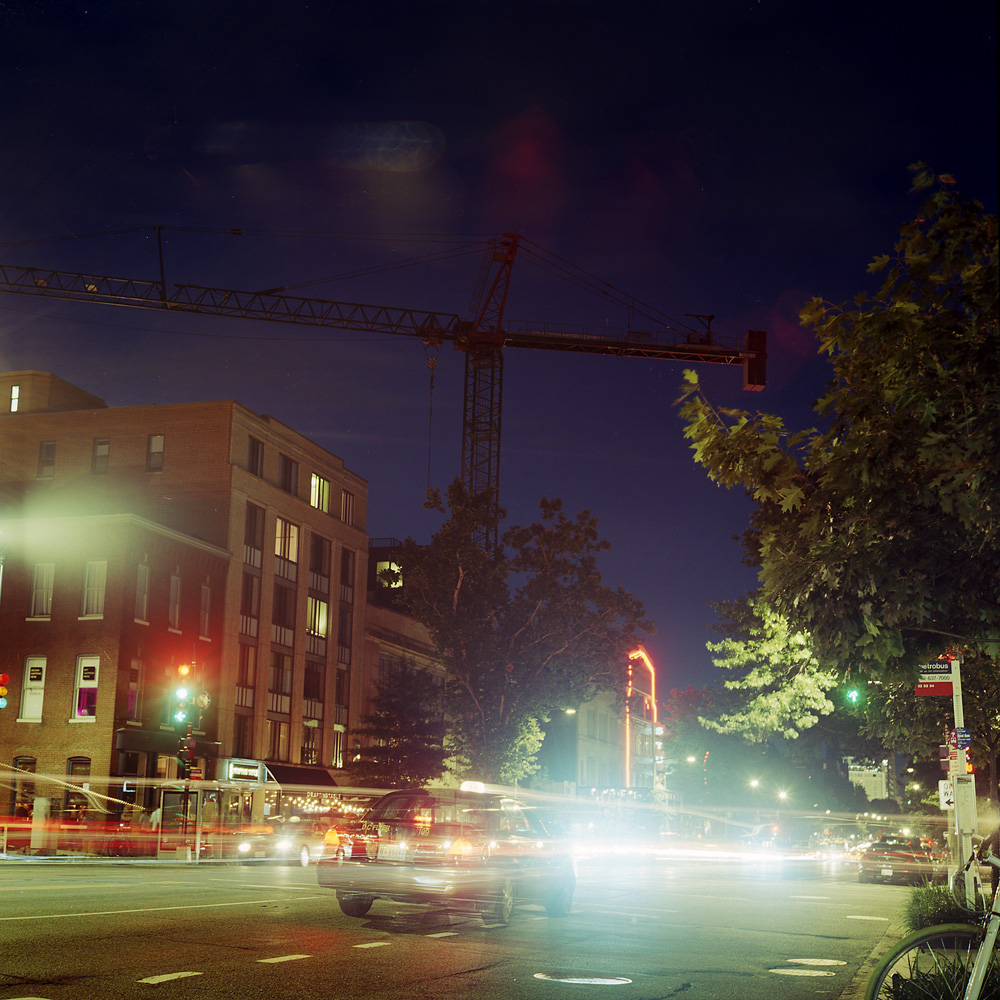
Here is a second version of the shot, a longer exposure, that captures the car sitting at the traffic light, then traffic taking off when the light changed. The funky stuff in the sky is a combination of reflections of the tail-lights and head-lights of the cars reflecting off the clouds and lens flare caused by the lights directly shining into the lens.
Crane, Traffic, 14th Street, Dusk
I’m not sure if I like this one well enough to keep it or if some other night I go back and try to re-shoot it. Feedback welcomed. All shots, as is becoming normal to say now, were taken with my Rolleiflex 2.8E, on Kodak Ektar 100 film. This was in part an experiment to see how well Ektar would fare against Portra 160 as a low-light film. I’ve loved Portra as a low-light film for its ability to handle mixed lighting conditions. I’d say this put to rest any thoughts of Ektar 100 being inferior- it does look different, to be sure, but I’d say it did a pretty darned good job. I think I might even prefer it in some cases.
Here are a few shots from my visit to the 2013 Smithsonian Folklife Festival. The Folklife Festival is held every year on the National Mall, and it is a celebration of cultures and traditions from around the world. This year’s featured country is Hungary, and the overall theme is “One World, Many Voices”. There are representatives of many indigenous cultures around the world from Hawaiian Islanders to Penobscot Indians to Quechua speakers from Bolivia and Peru to Tuvan people from Siberia. The “many voices” part has to do with showcasing efforts to preserve vanishing languages and cultures. Go to the Smithsonian Folklife Festival Official Page to learn more about the events and programs for this year’s festival.
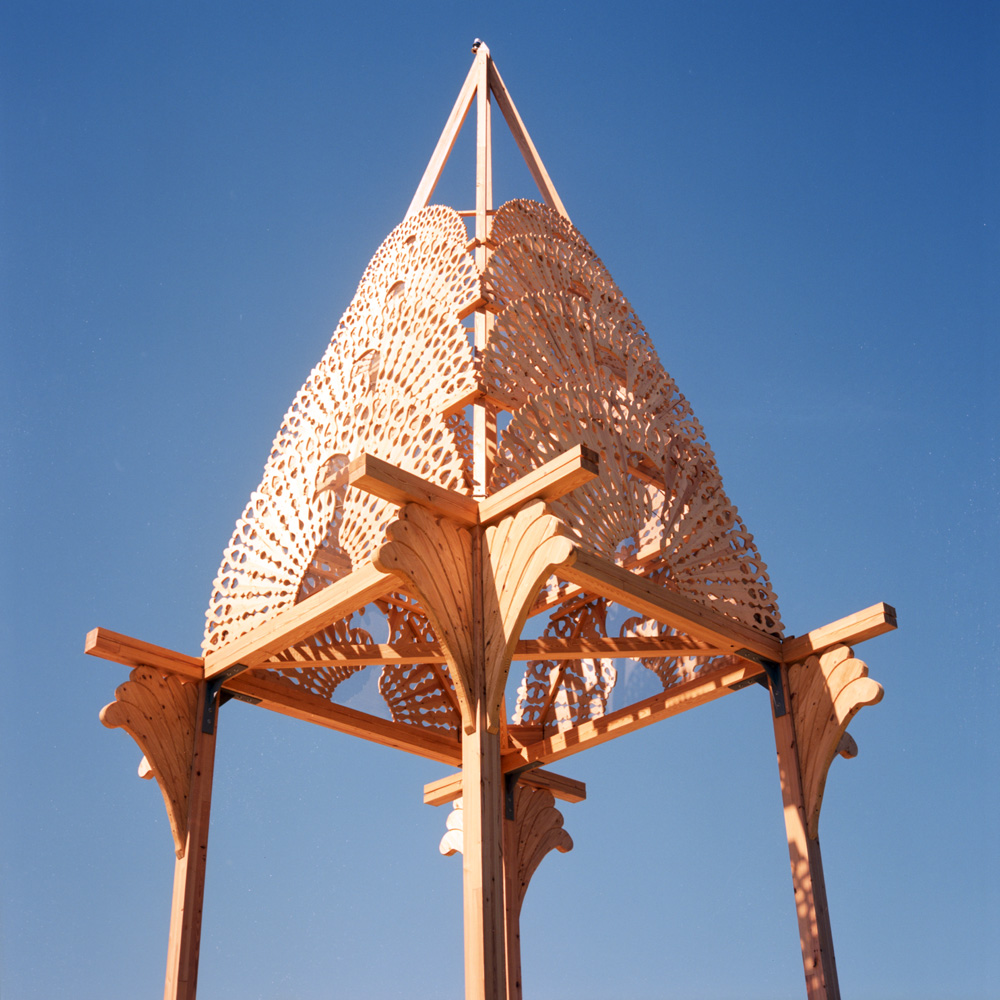
This pavilion is part of the Hungarian exhibit – playing on traditional Hungarian crafts like lace-making and using the forms and styles in a wooden structure.
Hungarian Pavilion
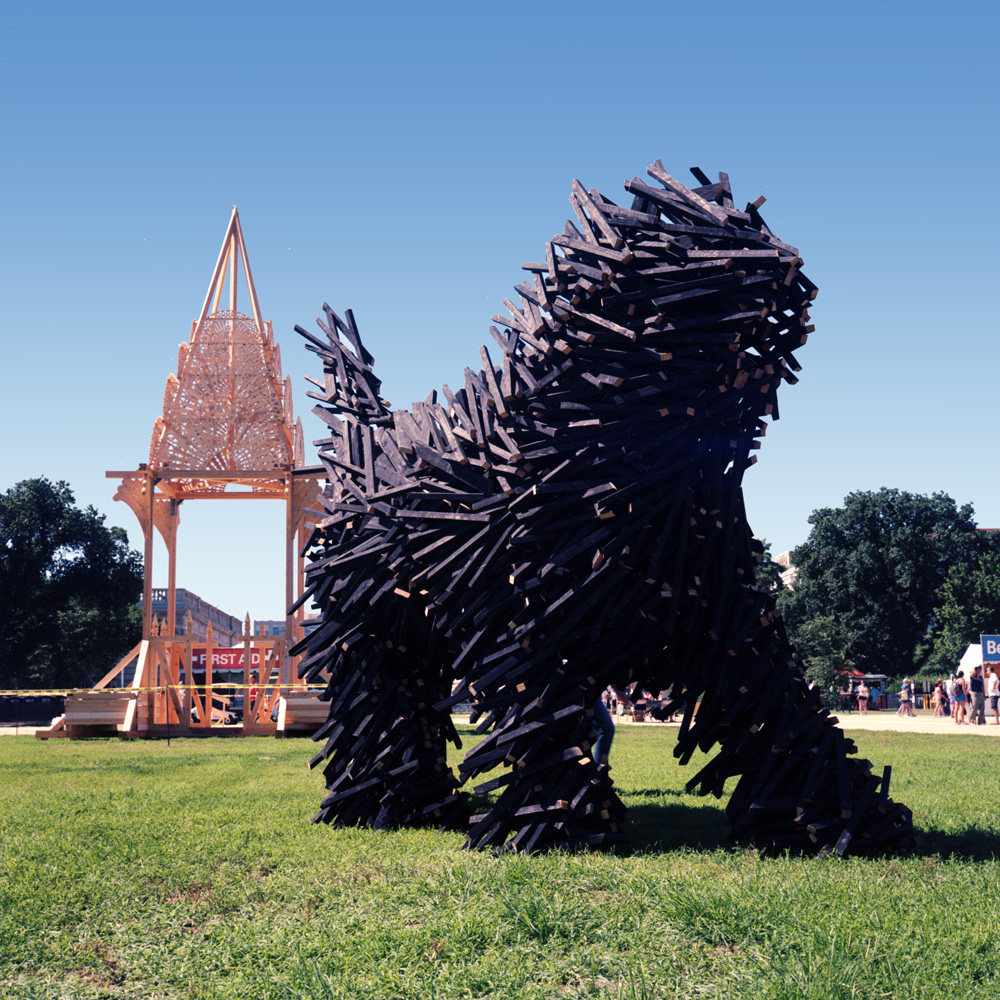
And here is a sculpture of a Puli shepherd dog, rendered in blackened wood. Pulis are similar to Komondor sheep herding dogs except they are black, not white. They used to get shorn along with the sheep they guarded, but now are left to grow their coats out as a fashion statement, to the impairment of the dog’s mobility.
Kuvacs Sculpture
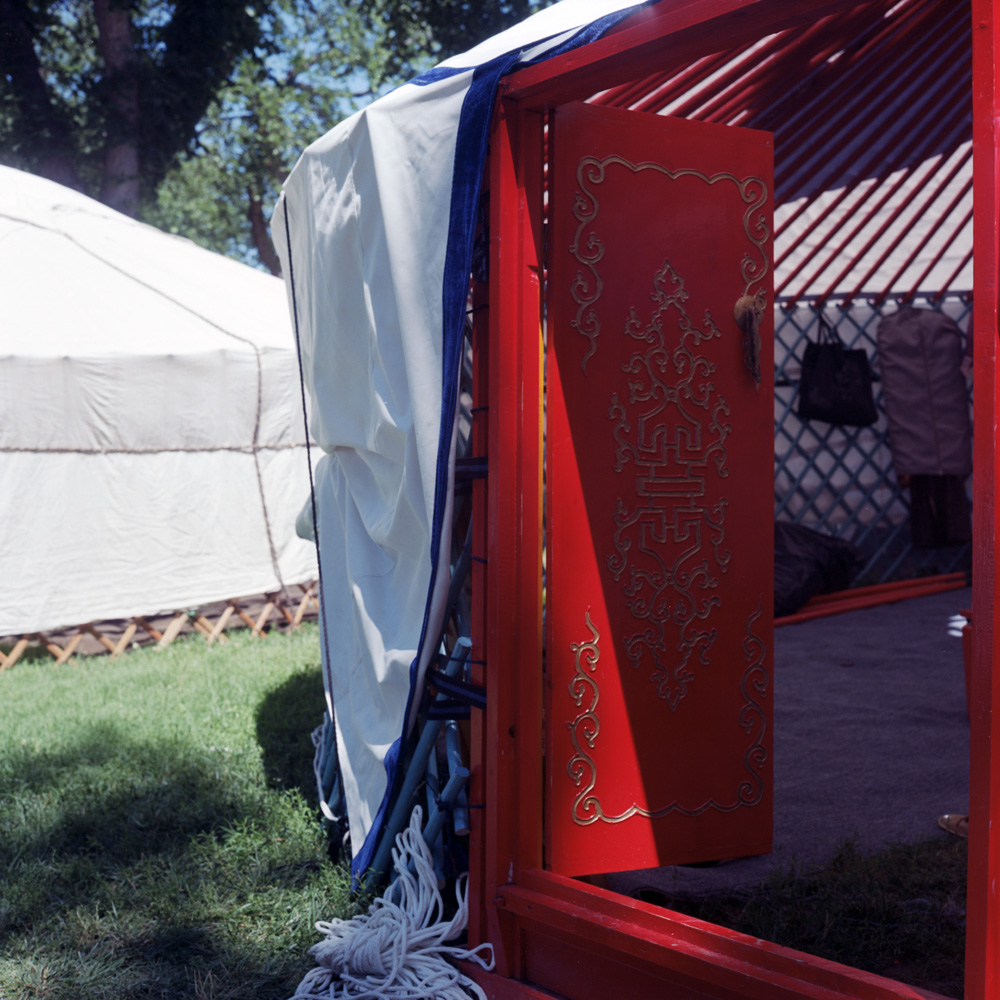
The door of a Yurt, representing the various nomadic peoples of Siberia who are sharing their culture this year at the Folklife Festival. Yurts are traditional nomadic home structures – they are portable like tents, with canvas or fabric tops and latticework side walls.
Yurt Door
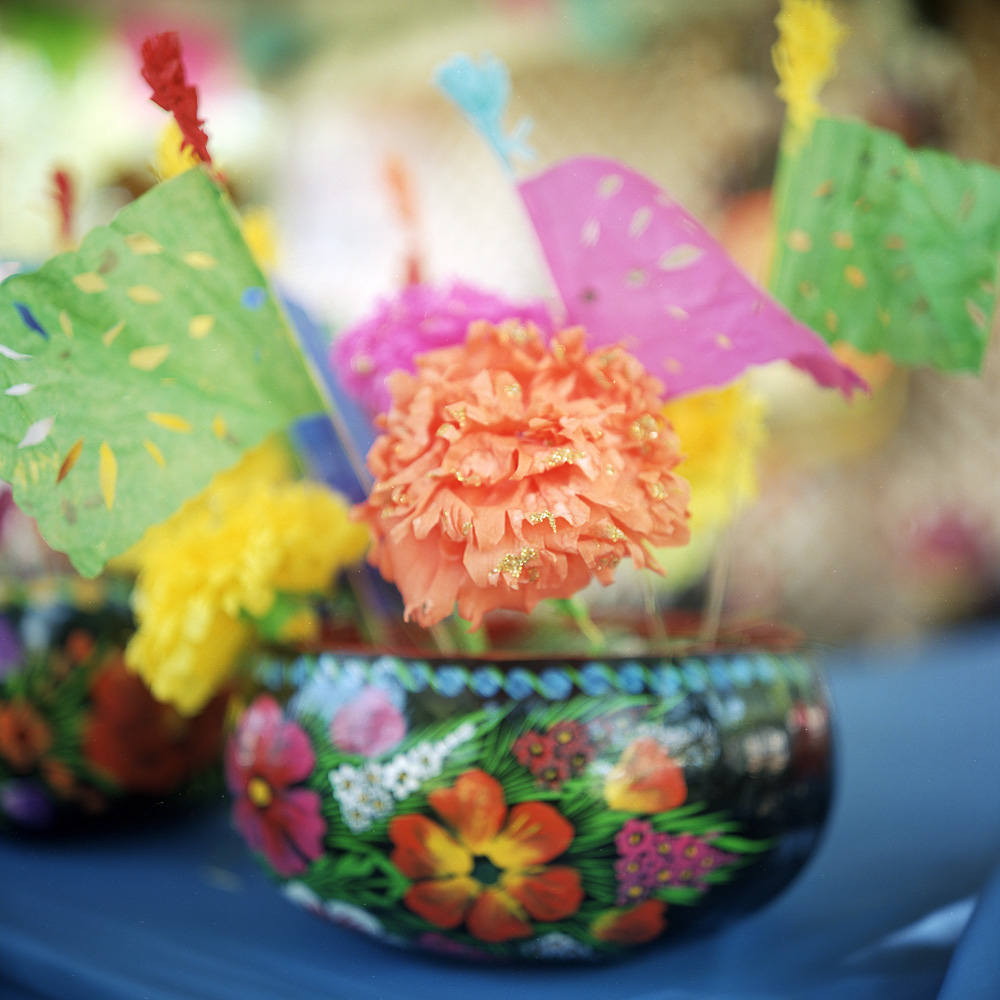
Paper flowers in the Mexican pavilion:
Paper Flowers, Mexican Pavilion
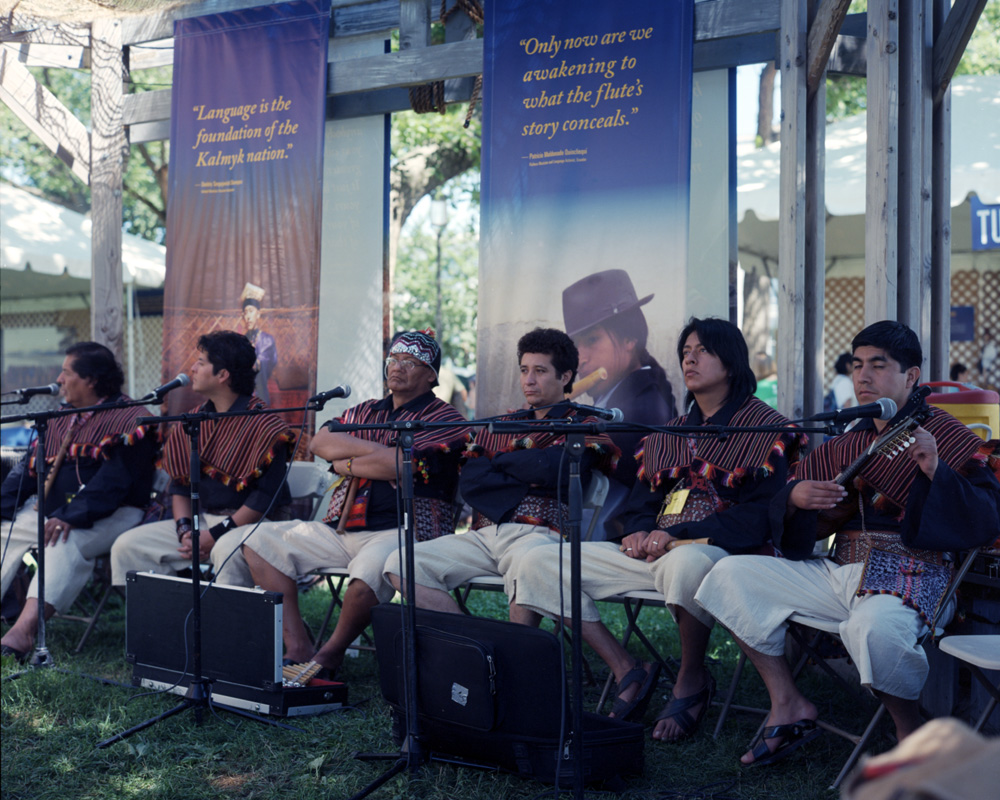
Quechua musicians, getting ready to perform a traditional Quechua song, talking about the meaning of their indigenous language and the importance of preserving the language, to pass on the connection to their cultural traditions of respect for the environment.
Qechua Musicians
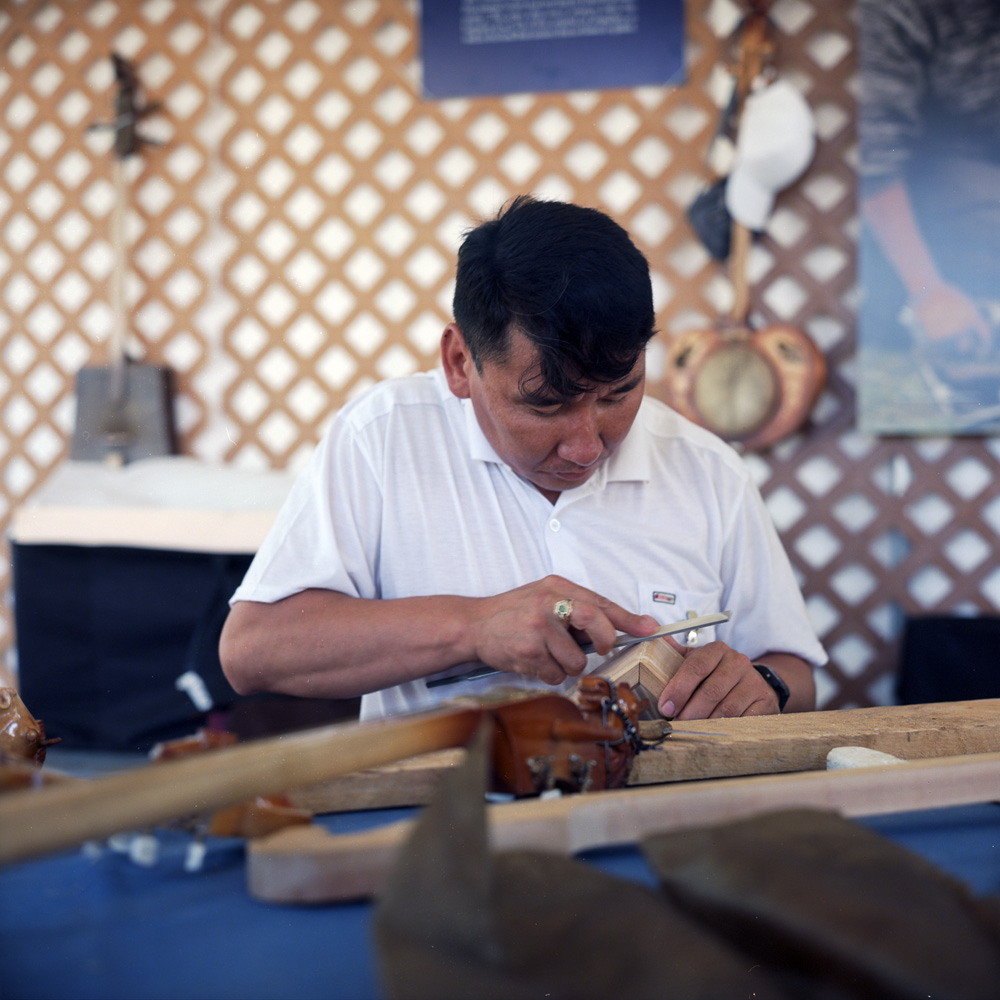
A Tuvan instrument maker, carving the body of a lute:
Tuvan Instrument Maker
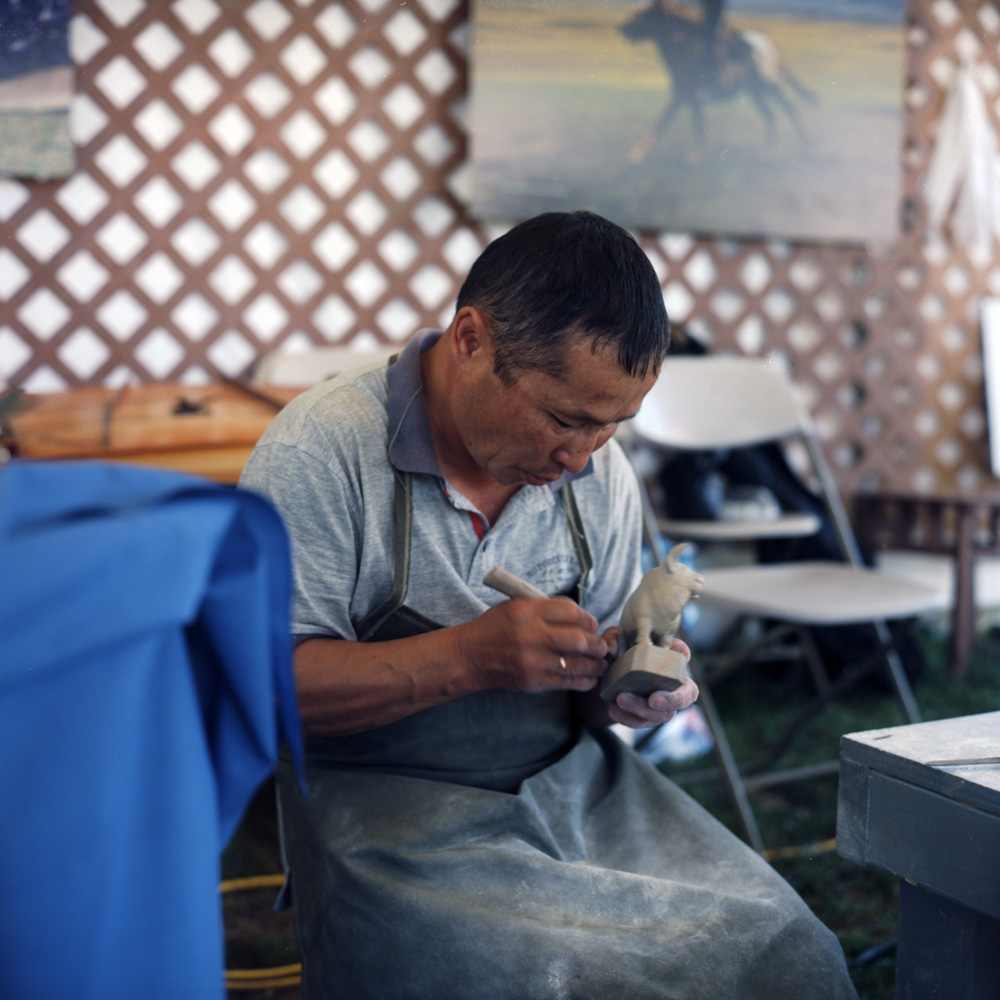
A Tuvan stone-carver, demonstrating hand-carving techniques, making a bull out of soapstone:
Tuvan Stone-carver
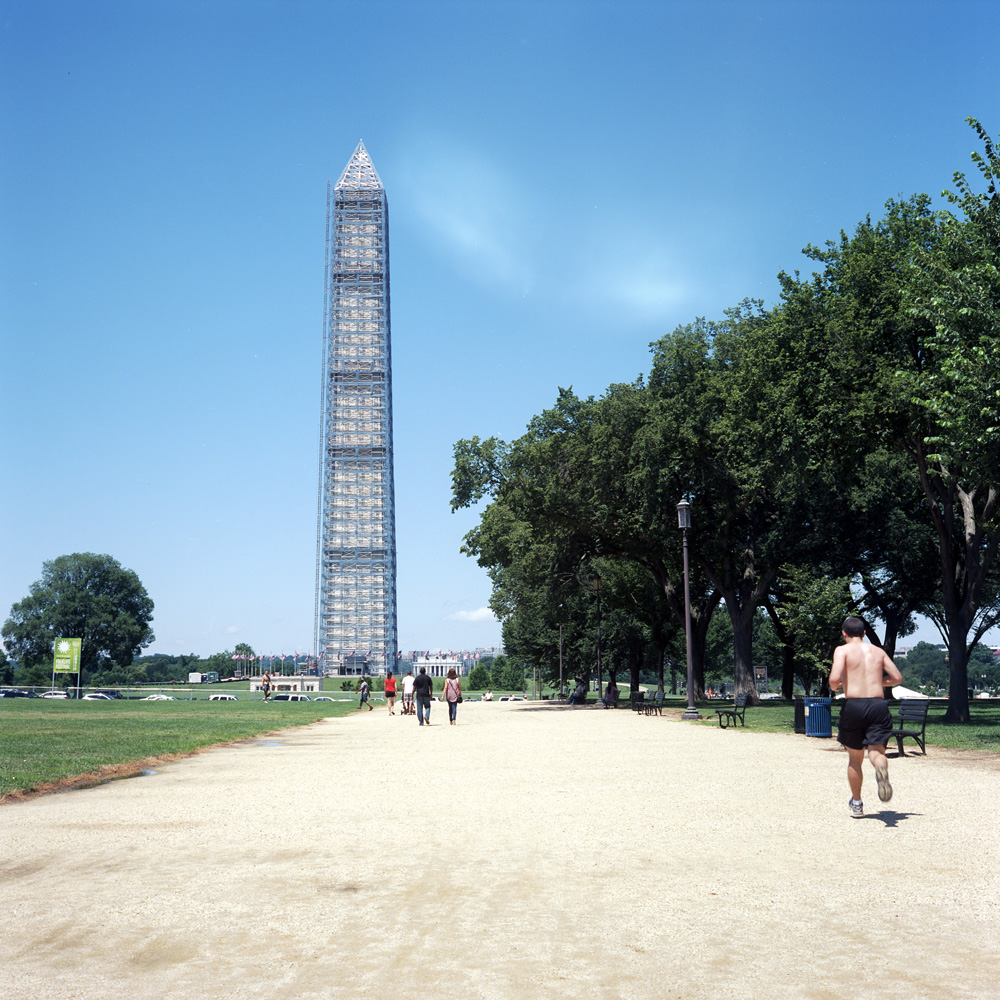
These last three shots are not specifically of the Folklife Festival, but are representative of the location and the spirit of the day. The weather was quite hot, but at least we had a relatively dry day with periodic breezes (Washington DC, particularly the area of the Mall, was built on a swamp, and big chunks of the Mall area, especially west from the Washington Monument, are actually landfill. Which is why the Washington Monument is sinking very slowly. So summertime in DC can be particularly miserable – almost New Orleans-esque in its heat and humidity).
Washington Monument
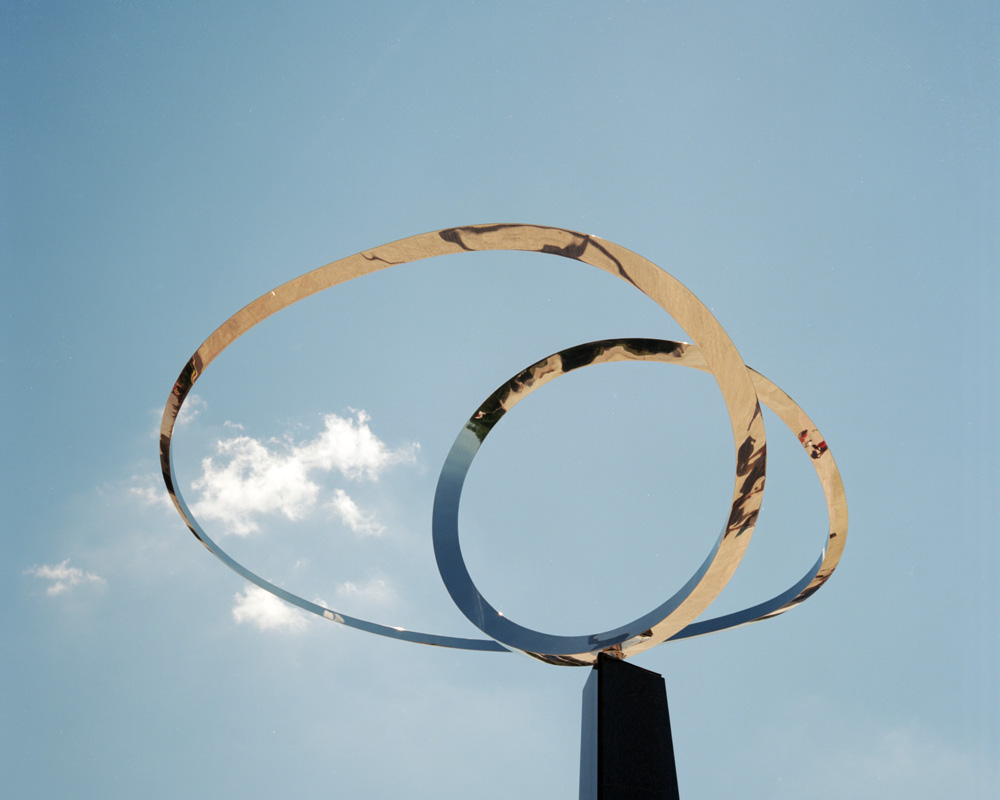
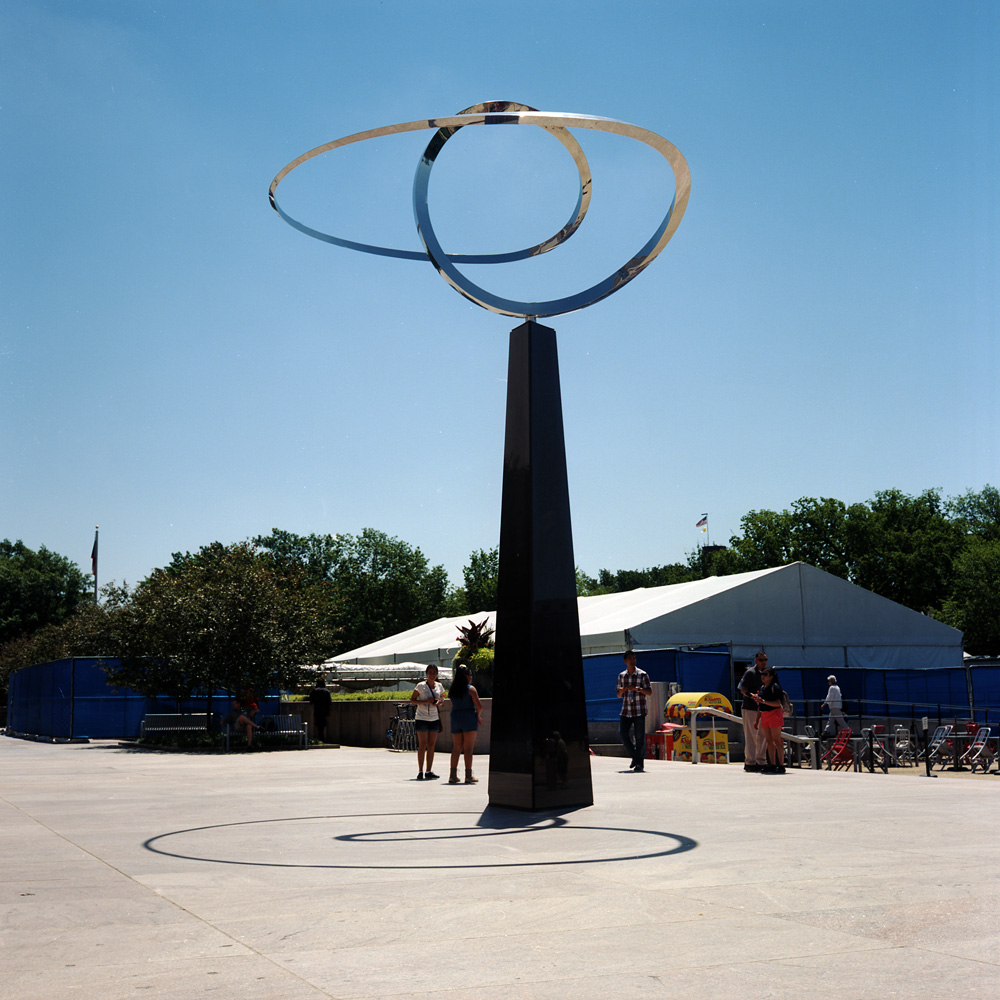
The sculpture is outside the American History Museum, which caps one end of the Folklife Festival and plays host to the temporary festival gift shop.
Sculpture, Cloud, American History Museum
It was tough waiting for people to NOT be walking through the shadow of the sculpture on the pavement. I’ll have to come back and shoot this again in the wintertime when it casts a longer shadow and there are fewer people out on the plaza so I can catch it as more of an abstract piece.
Sculpture, Shadow, American History Museum
All shots were taken with my Rolleiflex 2.8E, on Kodak Ektar 100 film.


 dcphotoartist