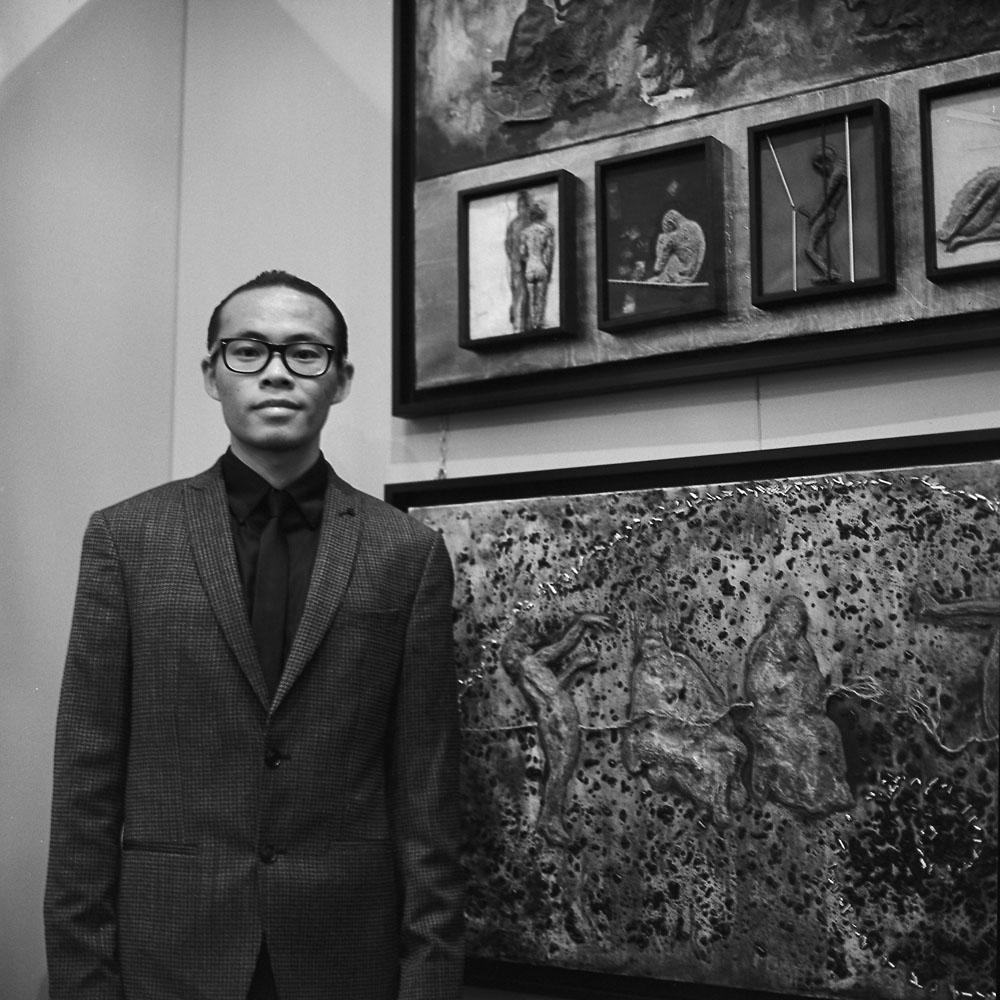
By pure fortunate happenstance, I was in Florence for the opening of the Biennale, an every-two-years art exhibition featuring contemporary artists across all media. Photographers, painters, sculptors working in ceramics, glass, wood, and bronze, video artists and installation artists were all represented. As I was there on opening day, some of the works were still being installed, and many of the artists were present. I got a chance to meet two of them- Xu Lishou and Amir Jabbari.
Xu Lishou
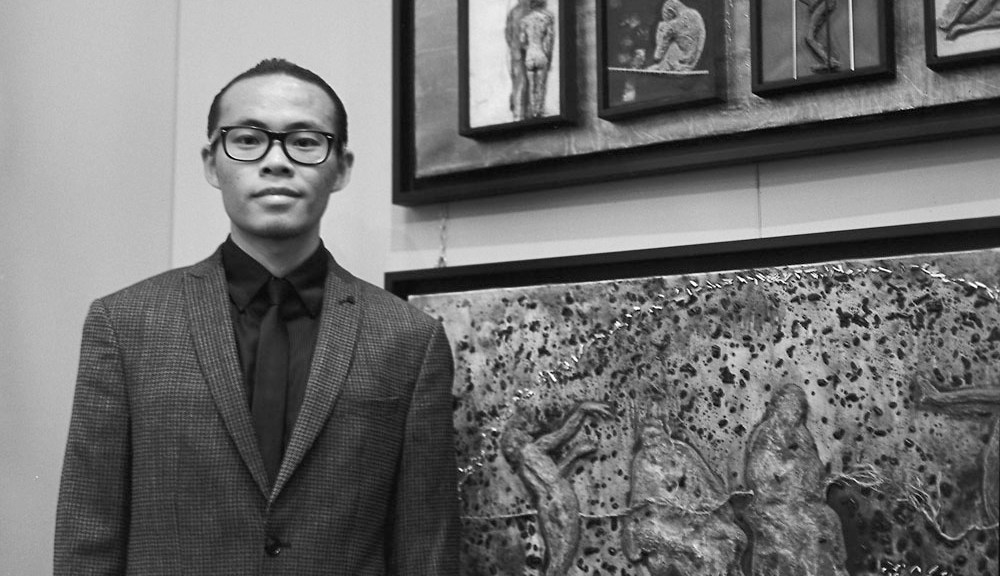
Xu Lishou is a painter from Taiyuan, currently residing in Italy. His work features traditional Chinese themes but painted in a very modern style, using mixed media such as paper pulp and rope to provide high-relief texture. We spoke a little through a friend of his who translated.
Amir Jabbari
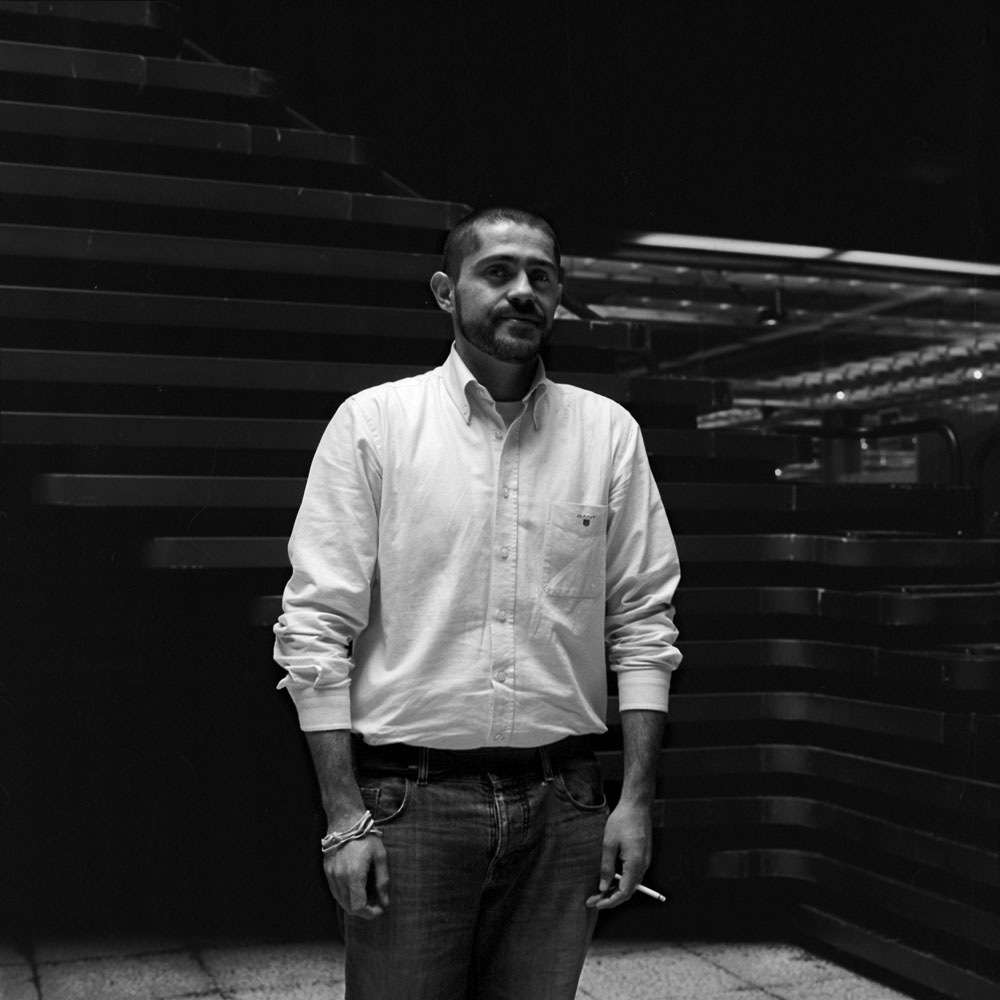
I met Amir in the light well of the exhibition hall (the hall is mostly underground, inside the Fortezza Basso, a Medici-era military fortification which still has use today as a base). I had stepped in to photograph the stairways, and he was smoking a cigarette. He is a video artist from Tehran. I did not get to see his video, alas, as it was one of a group of videos on continuous loop in the video exhibition room, and I was feeling under the weather and couldn’t wait for it to come back up.
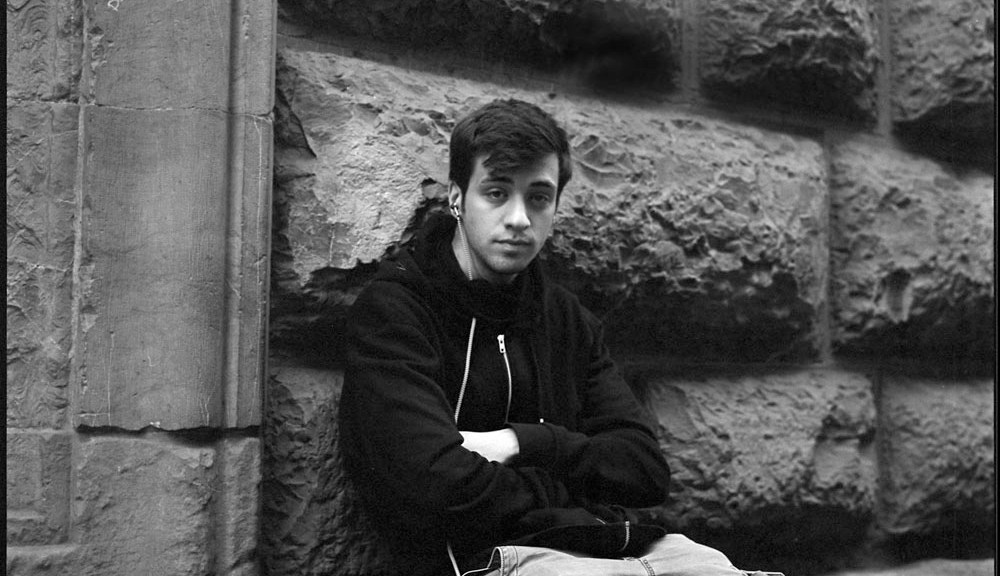
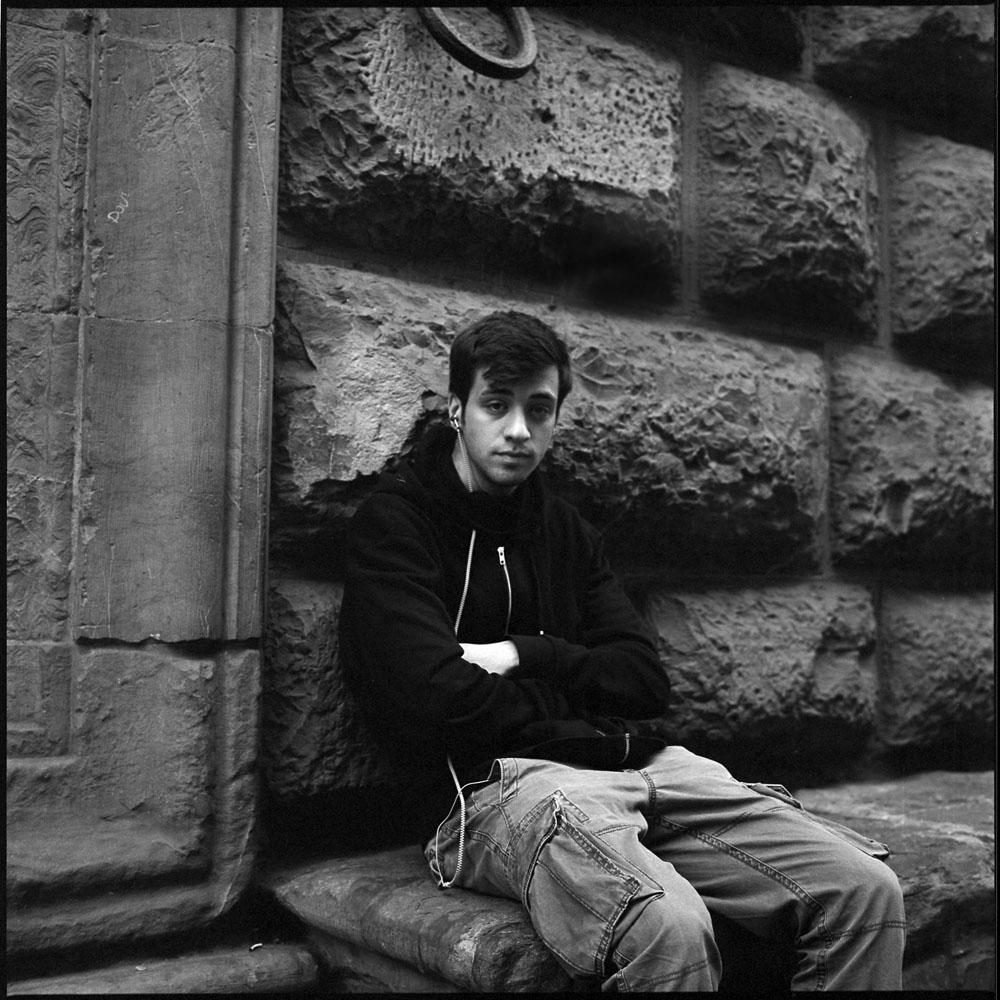
I saw this young man sitting on the bench around the Palazzo Medici-Riccardi. I don’t know what he was waiting for – might have been a bus, or a group of students visiting the Palazzo. Regardless, his pose cried out to make his portrait.
Now THERE’S a phrase you wouldn’t normally expect to read, with the possible exception of the “Local Crime” section of the Washington Post. But it’s true. The Kennedy Center, like so many other cultural institutions, is having a hard time attracting young audiences. In a bid to outreach, they set up a skate park on the front terrace and invited local skateboarders to come and perform, and tossed in a stage for live bands.
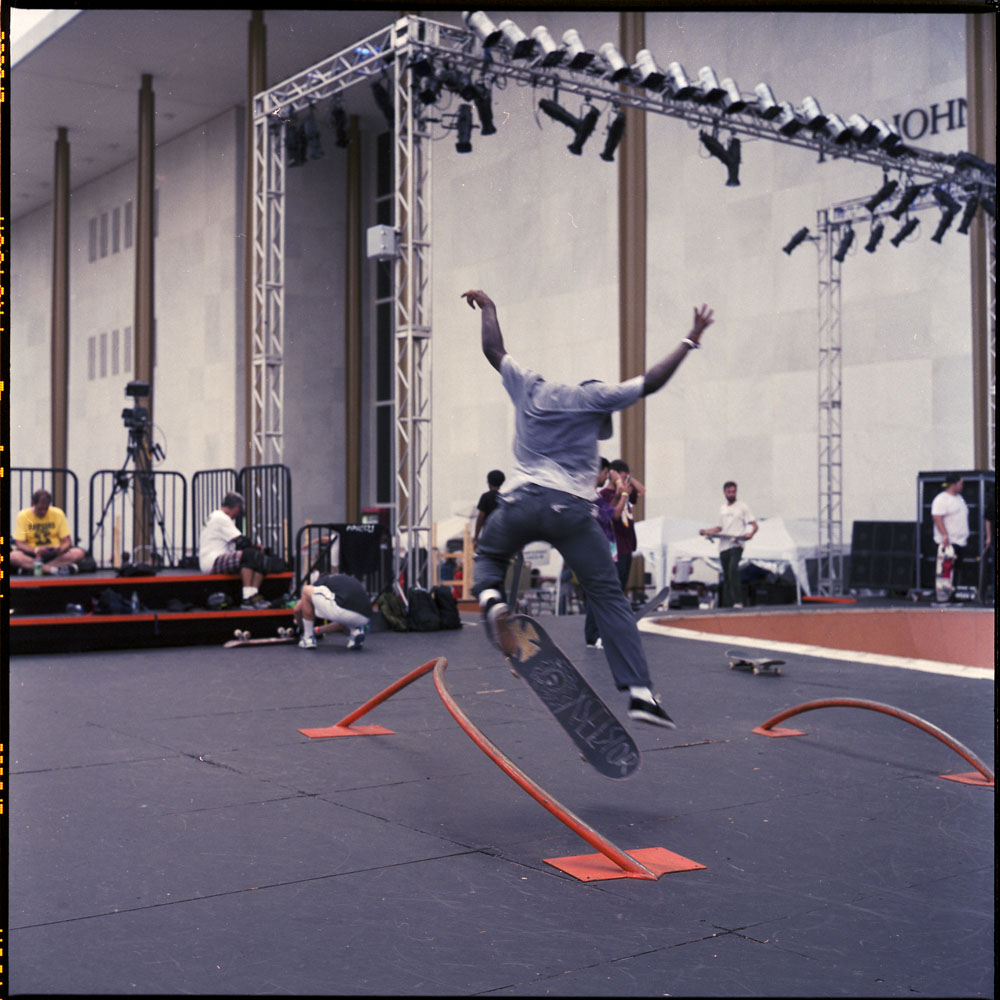
Flying Boarder, Kennedy Center
This was one instance (of many) where having my Rolleiflex was a huge advantage. It gave me an entree to talk to the skaters and ask for portraits. Everyone loved the camera and if I asked, they posed willingly. On the few action shots I took, it also helped by having no mirror blackout at the moment of exposure, so I could see exactly when I was pressing the shutter button, like in this shot above.
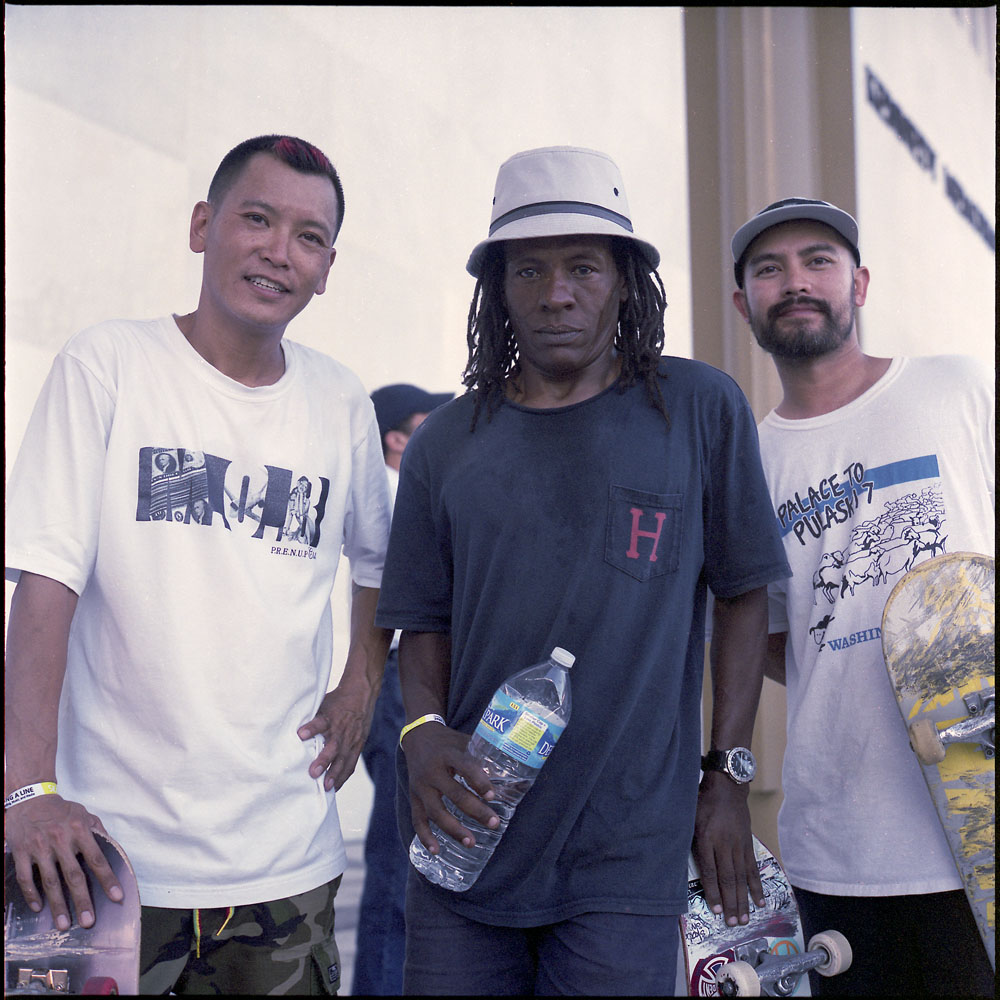
Skate Trio, Kennedy Center
I initially approached the asian skater about taking his picture. He pulled in his friends and all of them posed together. I was surprised at how willing they were to pose, as I mostly shoot candid street photos and people don’t always appreciate that. I don’t know what it was about that day but everyone was just so natural in their posing, it all worked out so well and I didn’t have to direct anyone.
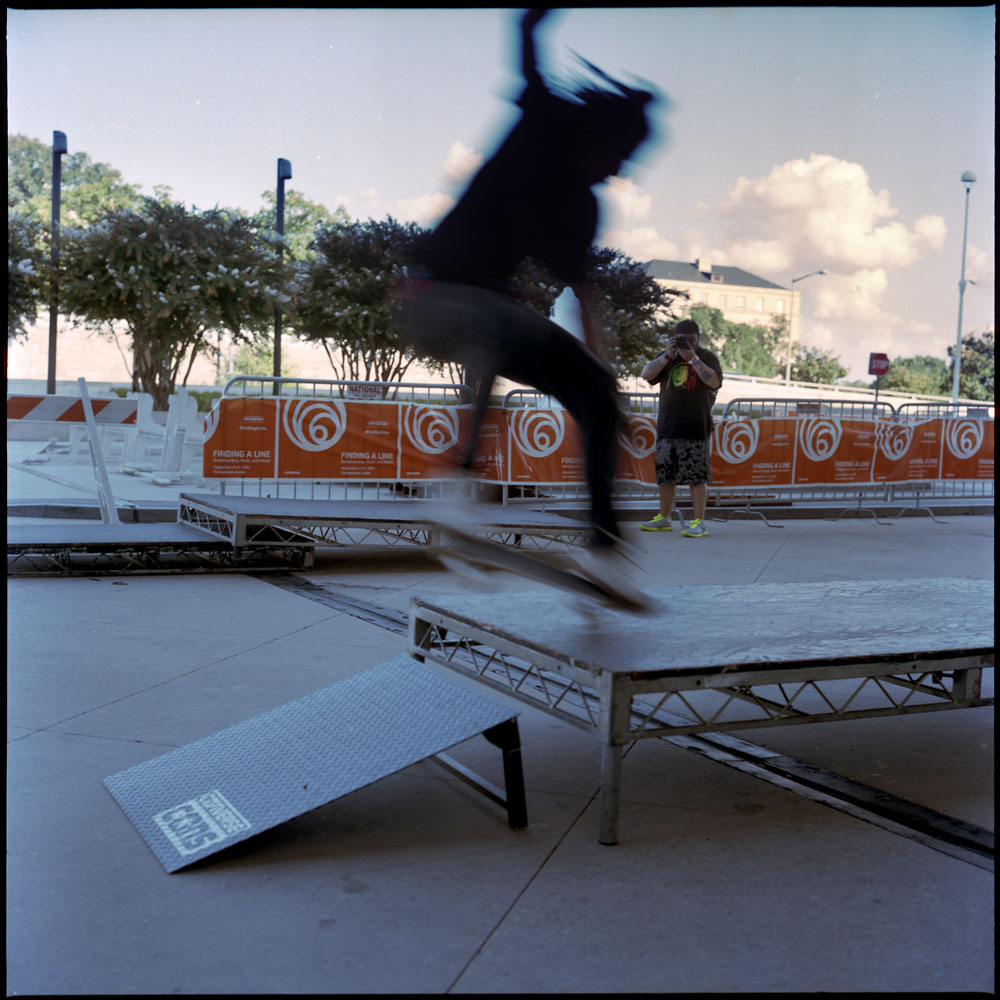
Flying Skater, Kennedy Center
This was a fun shot to take, as I was anticipating this kind of motion blur, but couldn’t know what exactly to expect because the eye doesn’t see motion blur at 1/30th of a second. But I knew I got the skateboarder in the right place.
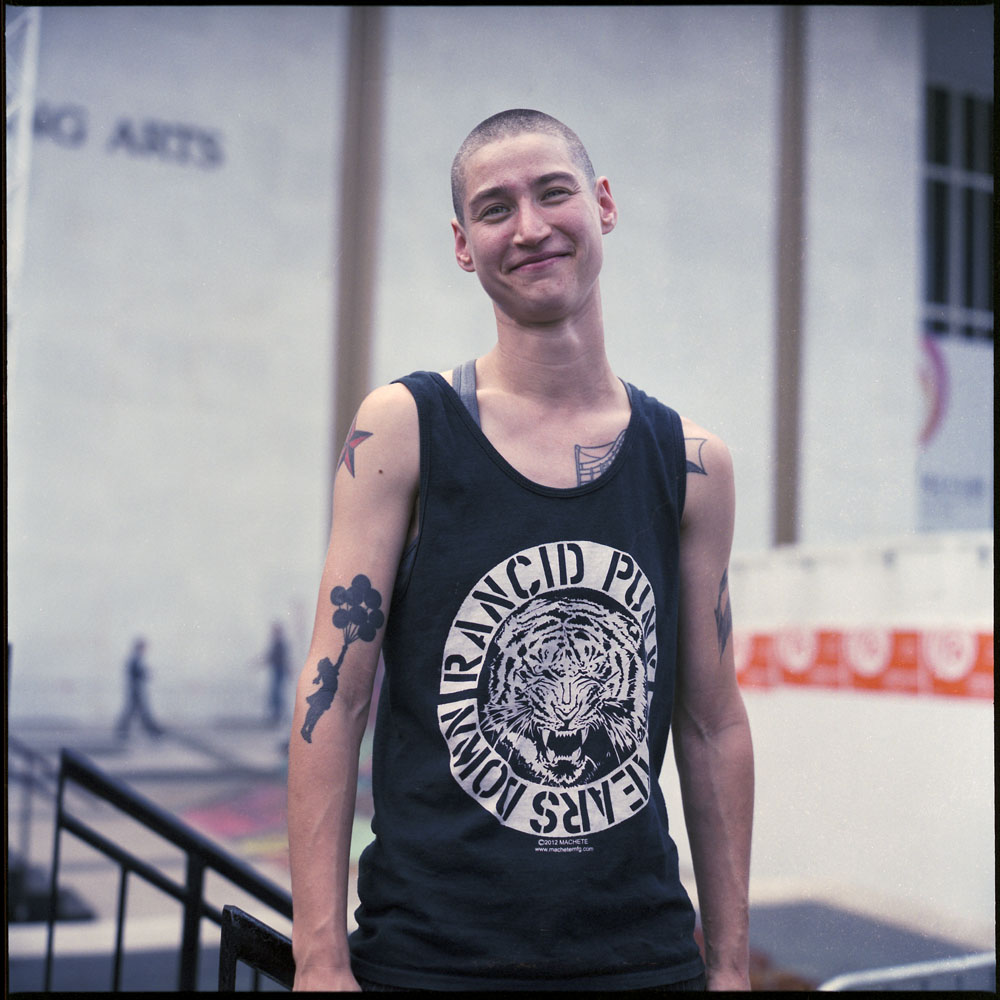
Skateboard Punk Girl, Kennedy Center
This girl was working the lights at the event. She saw my camera and asked about it, so we chatted for a couple of minutes about the event, the folks skating, and the weather (it was scorching hot that day, and inside the light tent had to be even hotter). I asked for her picture and she immediately said yes, and even suggested the backdrop instead of inside the lighting tent.
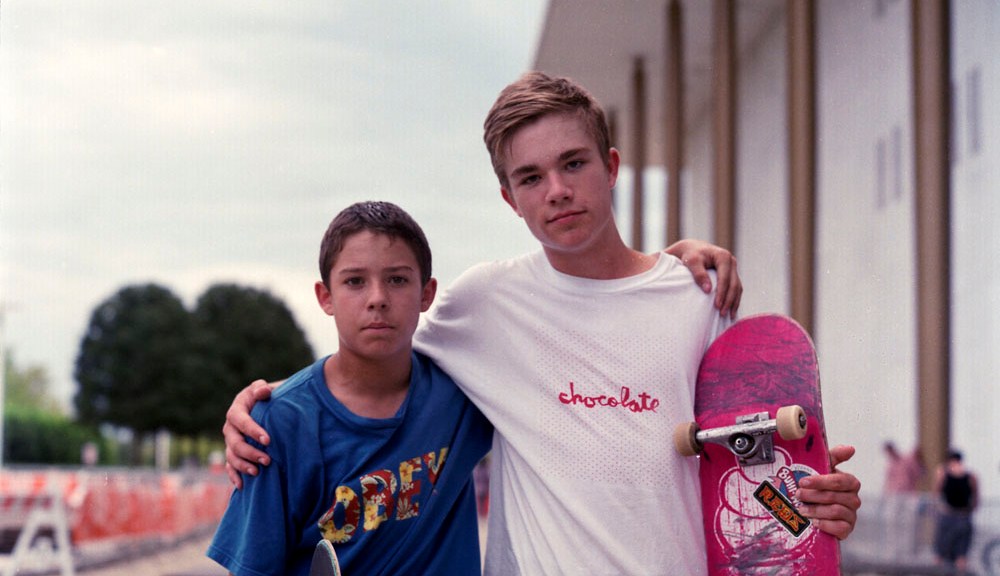
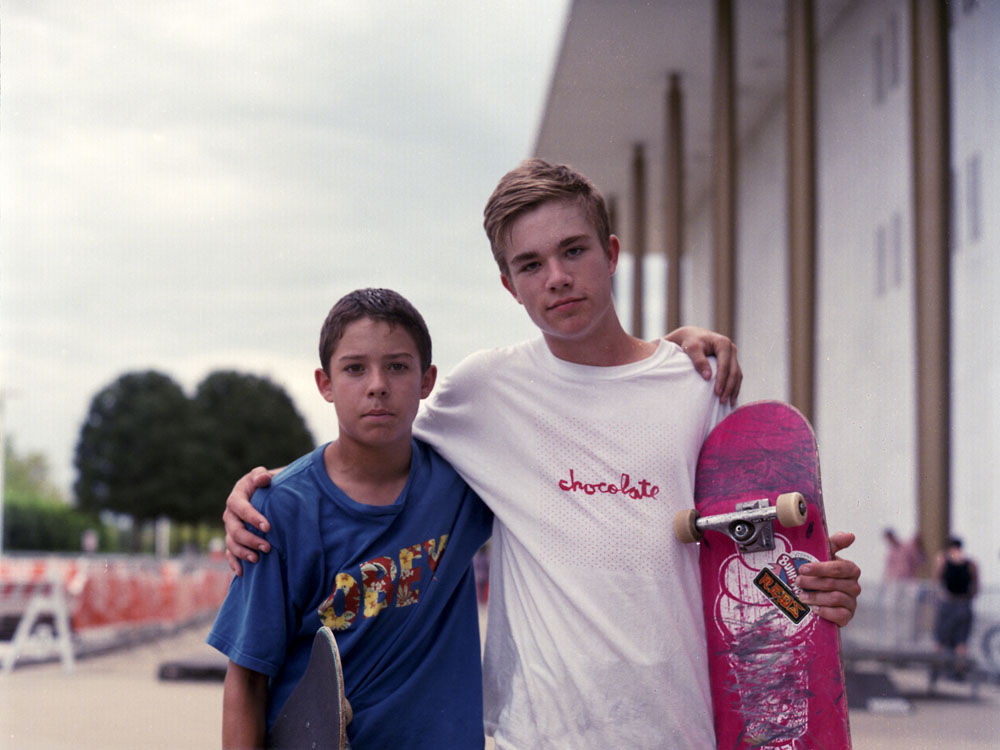
Skate Buddies, Kennedy Center
The kid in the white shirt saw my Rollei, and asked some questions about it, and was very excited by it. Again, I asked for a photo before he started his next run, and he pulled his buddy over, they wrapped their arms around each other, and posed. All on their own, no direction from me. I was very chuffed to see how the shot turned out, as I was shooting on the run as it were – one of the docents for the event had earlier shooed me off from the spot where I was standing to take the picture because it was in the path of potentially out-of-control skateboards.
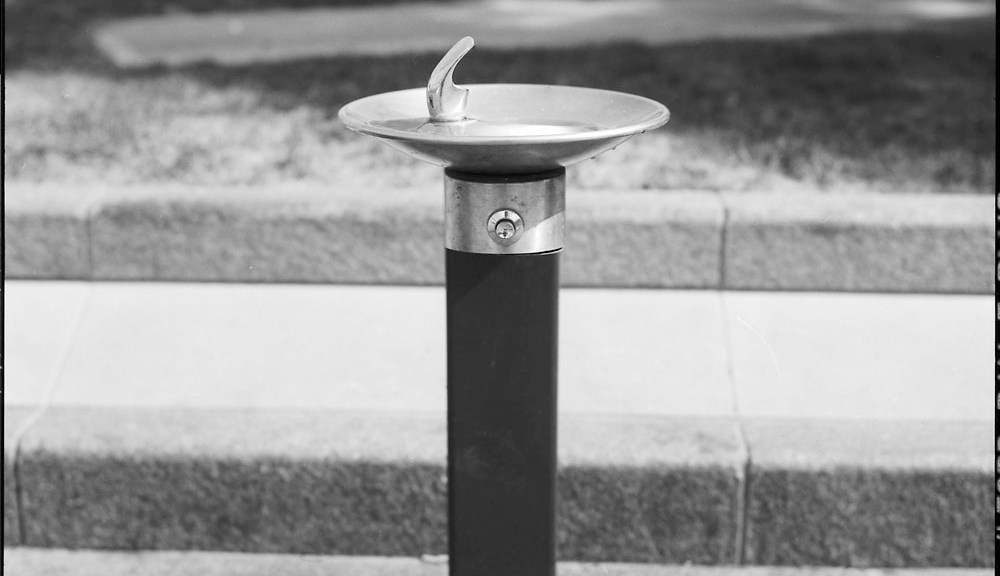
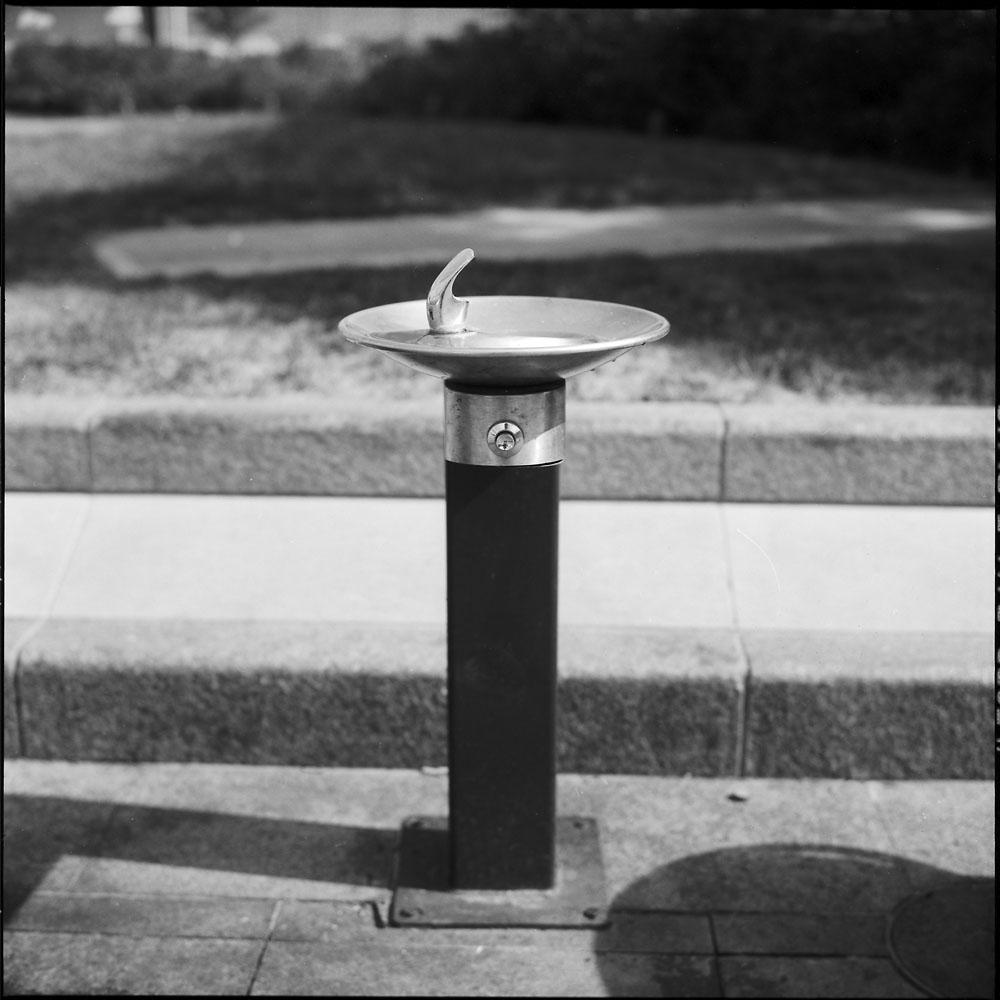
Public drinking fountains are becoming rare creatures. Even rarer are ones that work. They’re kind of like frogs – their disappearance heralds a collapse of public infrastructure the way frogs disappearing are a sign of ecological collapse. When we are no longer willing to provide safe, clean, free drinking water to the public, I think it says something about us as a society, and it’s not complimentary.
Water Fountain, U Street
To get photo-geeky for a moment, this was shot with my usual Rolleiflex 2.8E, and to ensure I was getting the extremely narrow depth-of-field I wanted, I used Ilford PanF film, which is a very slow ISO 50, and rated it at ISO 25 for good measure. I like PanF for the extremely fine grain it provides, and it allows me to use large apertures in bright daylight, however it does get very contrasty, more than I normally would like, so processing it is tricky to keep the contrast under control.
I was out on a photo-walk after work the other evening and wandered through Georgetown with the Rolleiflexes. I walked down under the Whitehurst and through the riverfront park. If you pass beyond the end of the park, you go under Key Bridge and come to the boat houses. Across the street from the boathouses where you can rent canoes, kayaks and stand-ups to take out on the river, there are stairs that take you up to the level of the C&O Canal. There’s the remains of the Alexandria Aqueduct Bridge that crossed the Potomac just past the Potomac Boat Club building. The Aqueduct Bridge was originally built in the 1860s to carry canal boats from the C&O Canal to the Alexandria Canal. Later it was improved by adding a road bridge and a deck for electric trolley cars. It was demolished in the 1930s to make way for Key Bridge (which was so named to honor Francis Scott Key, the author of the US National Anthem, whose house was demolished to make room for the bridge). The Alexandria Aqueduct Bridge piers are a popular spot for young people to hang out, especially in the summer time.
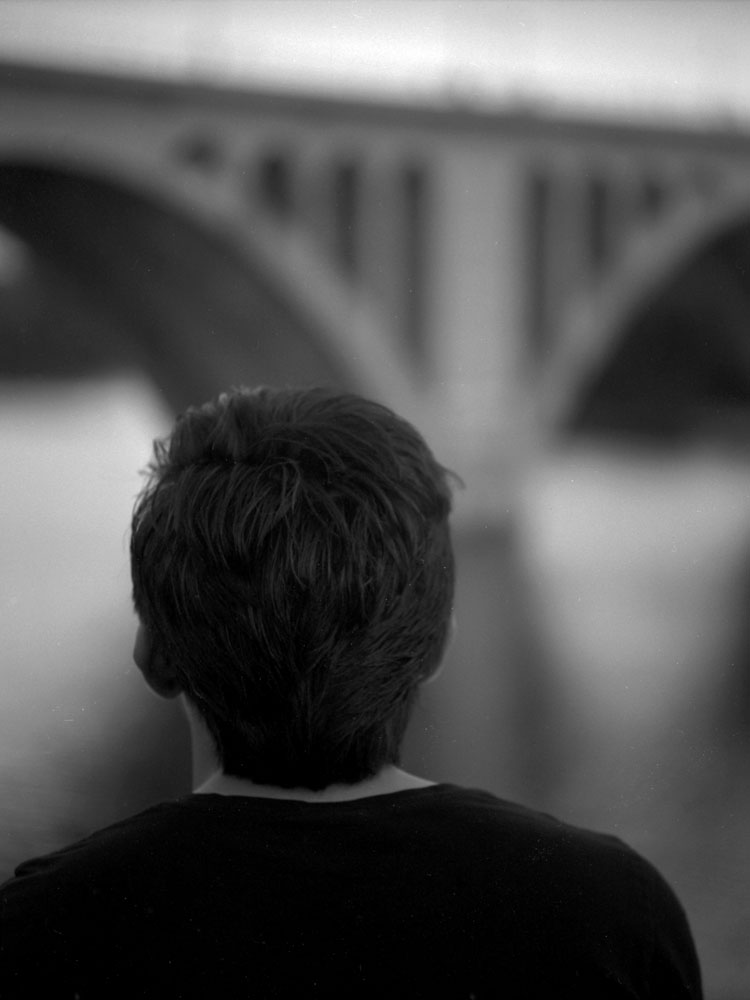
The Boy Who Dreams of a Bridge
I went out to the end of the pier with the thought of getting a shot of the west-facing side of Key Bridge while it was still illuminated by the setting sun. A bunch of teenagers were hanging out there. Another woman photographer who was there coincidentally at the same time and I were both out on the end of the pier, shooting the bridge and the riverscape. One of the teens asked what we were doing. The woman ignored him, but I told him I was taking pictures of the bridge, and whatever else struck my fancy. He returned his attention to his friends and the scene in front of them. Looking down, I saw this scene through the viewfinder of my camera and quickly composed the shot. While I’m not normally a big gear geek (at least in my writings- I hope!), this is one case where I will geek out on my hardware and talk a bit about the choices I made.
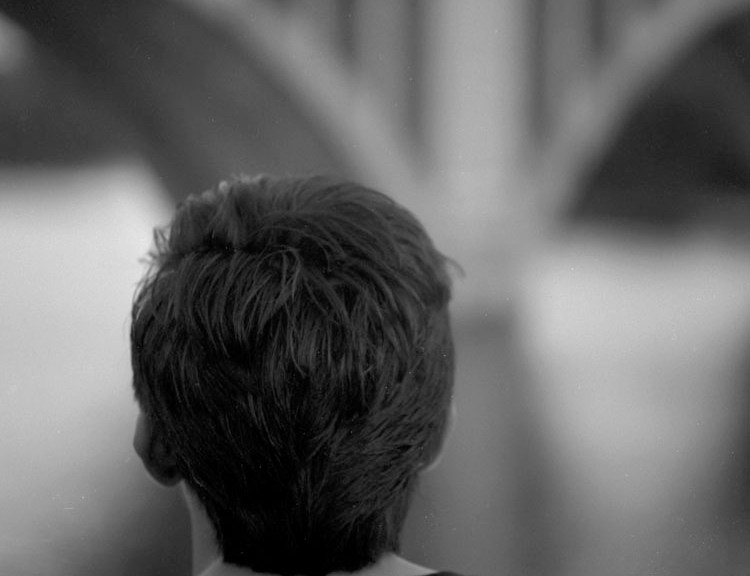
I had been wanting for a long time to capture scenes like this – something suggestive, a little mysterious, a little ethereal, where the viewer can insert themselves into the scene. I haven’t always been successful, at least not to the degree I was looking for, and hadn’t really hit upon the right combination of toys and technique to make it happen. Well, I’ve obviously found it. The camera is my Tele-Rolleiflex, coupled with the Rolleinar 0.35 close-up attachment. For whatever reason when they made the original Tele-Rolleiflex, Rollei limited the minimum focus distance to roughly 8 feet (2.5 meters). By itself, this makes the Tele-Rollei rather limited in usefulness especially as a portrait camera. To compensate for this, Rollei made available the 0.35 and 0.70 Rolleinar close-up attachments. Since one of my ambitions for the Tele was doing portraits, I felt it was incumbent upon me to acquire at least the 0.35, which I have, and used on this shoot. The net effect of the Tele plus the Rolleinar is seen here, and in the next image. They give an extremely soft, dreamy look to the out-of-focus background areas.
Being able to create that extremely shallow depth-of-field combined with the extremely soft out-of-focus area throws the “3-D” effect into high relief, and lends itself when used appropriately to creating fantastical scenes like the one above where the bridge in the background, while very distinct, is sufficiently soft and far-away-looking that it could be real or it could be a dream – which it is remains for the viewer to decide. Thus the title of the image.
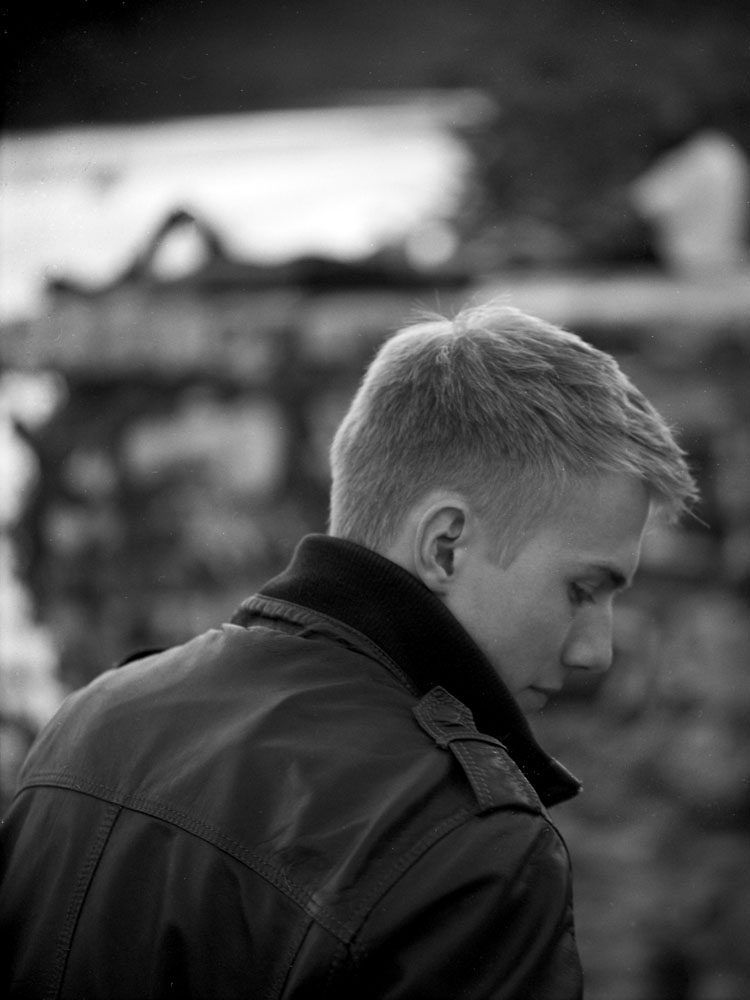
Blond Boy, Georgetown
At the same place and same time, I turned around to look up the river and saw a trio of very blond, very Germanic-looking young folks (Georgetown University students? Youth tourists?) sitting on the edge of the stone walkway. This boy turned sideways to look at the girl beside him and was momentarily caught with soft, subtle backlighting. If you look carefully you can make out some more kids lounging on the opposite side of the old canal bed. It’s a very romantic, mysterious, suggestive composition – what is he looking at out of the frame? Where is he? Why is he there?
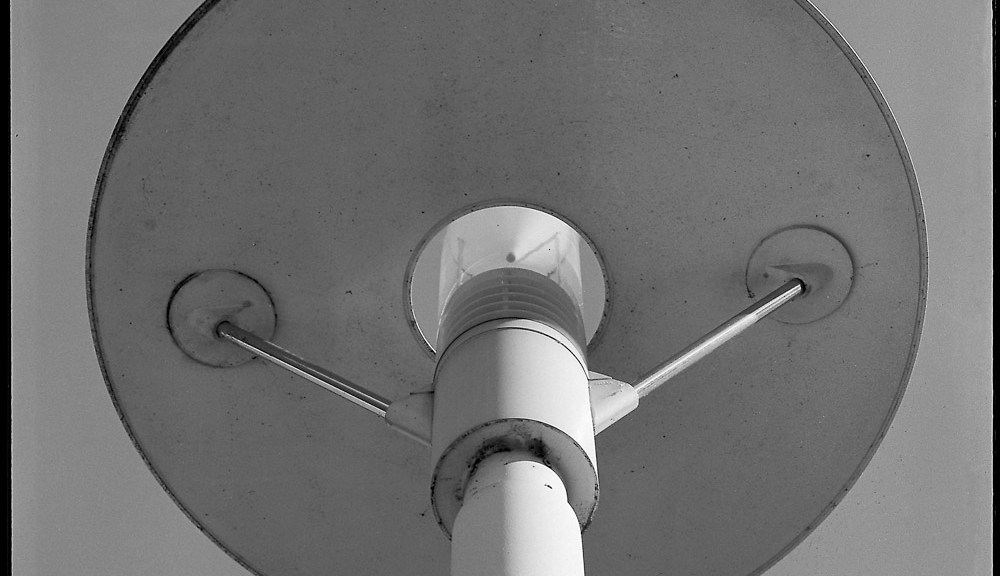
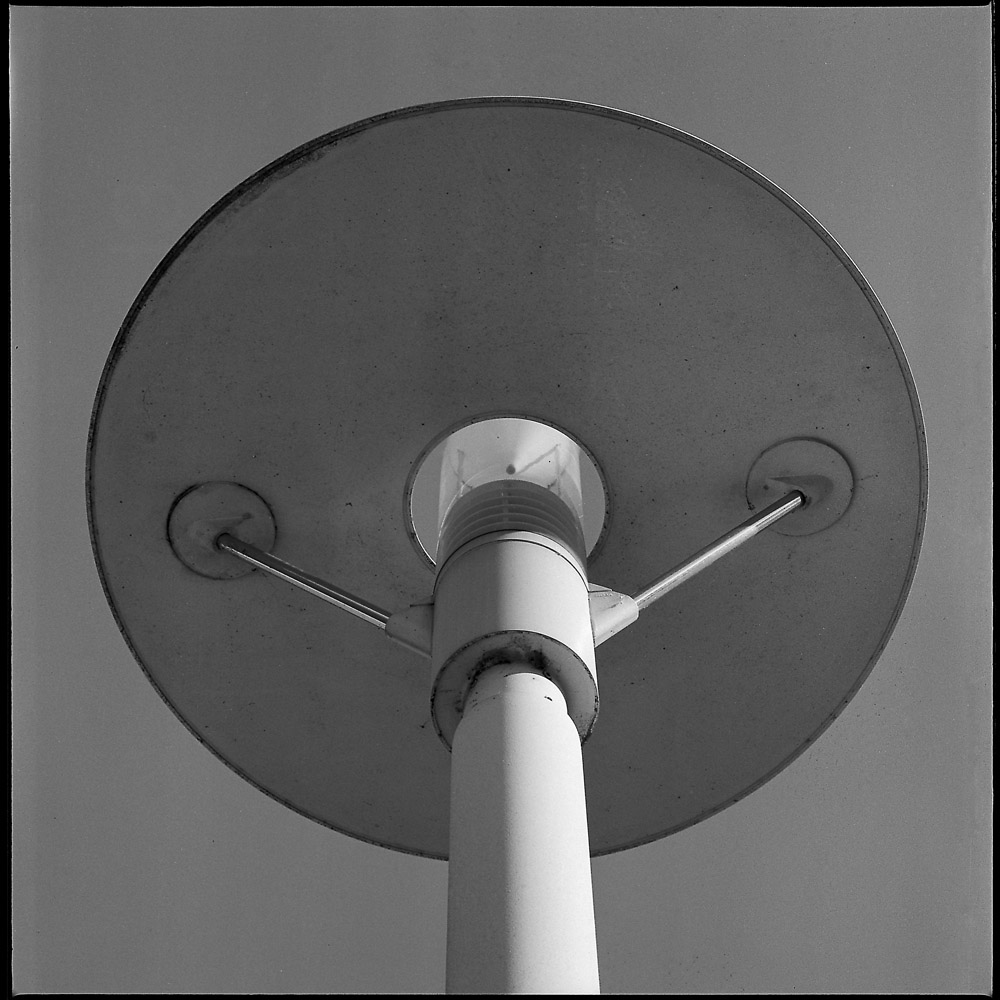
Yet more in my series of everyday objects. This time, it’s a lamppost, a safety cone (I’m not calling it a traffic cone because in this context, it’s being used to warn pedestrians of an uneven paver), parking meters again, and a police call box. You may have wondered at seeing some of my images with a black border and others without. I generally try to compose full-frame, and I like including the black border to show that. I also feel that in some cases, the black border helps define the image especially if the background is predominantly bright. I don’t ever add one to make it look as if what you see is full frame if in fact it is cropped, or to make you think it was made in a different format than presented. The images I post online for the most part are scanned from the negative, and given the nature of film, sometimes the backing paper leaks light along the edge, or other things happen during processing that require me to crop a little. Sometimes, I have to crop a lot because the composition just wasn’t right in the full square of the 120 image size. In those cases, I leave the edges alone and don’t put a black border on.
Twin MetersSafety ConePolice Call BoxLamppost, Kennedy Center
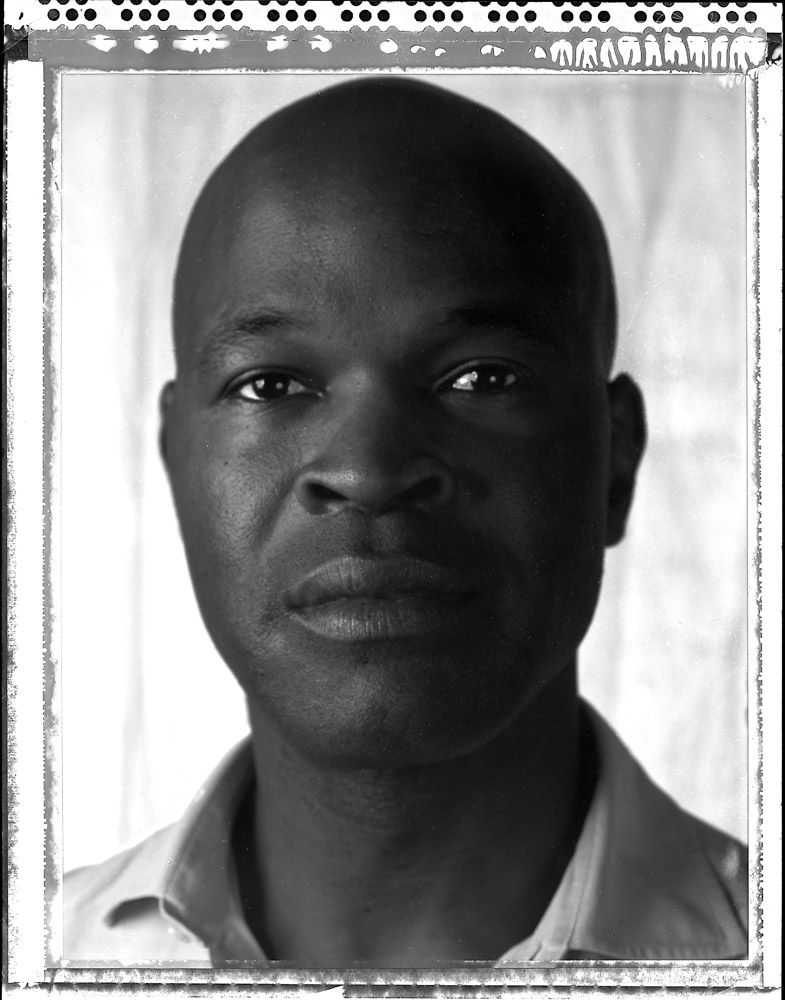
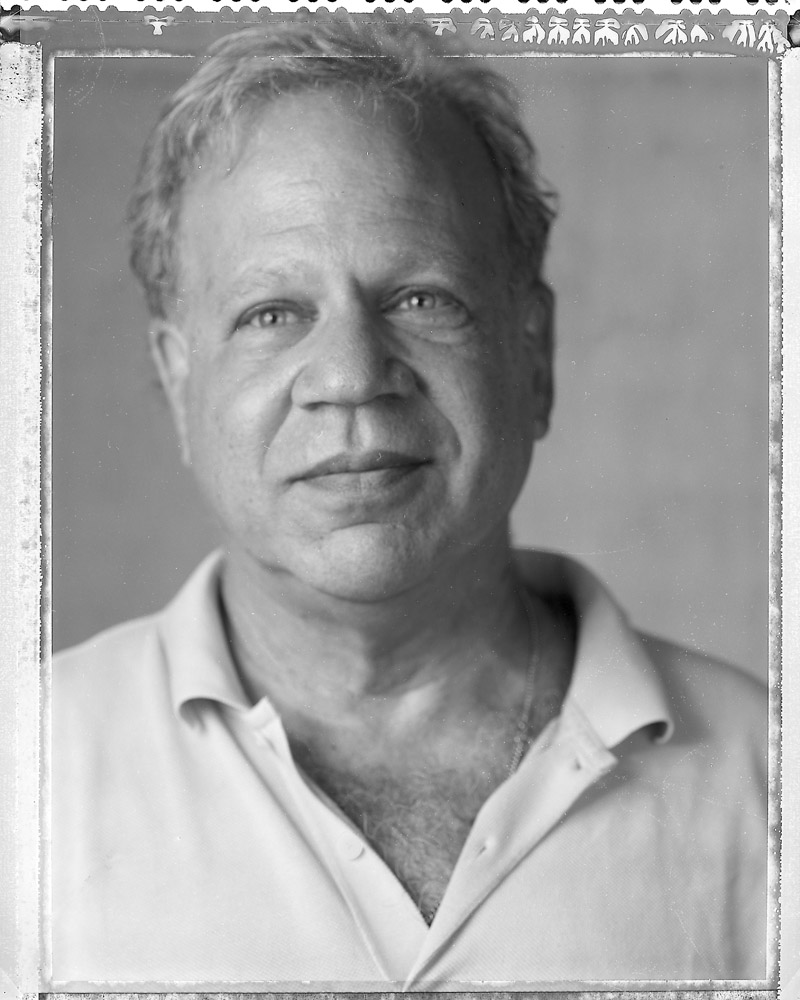
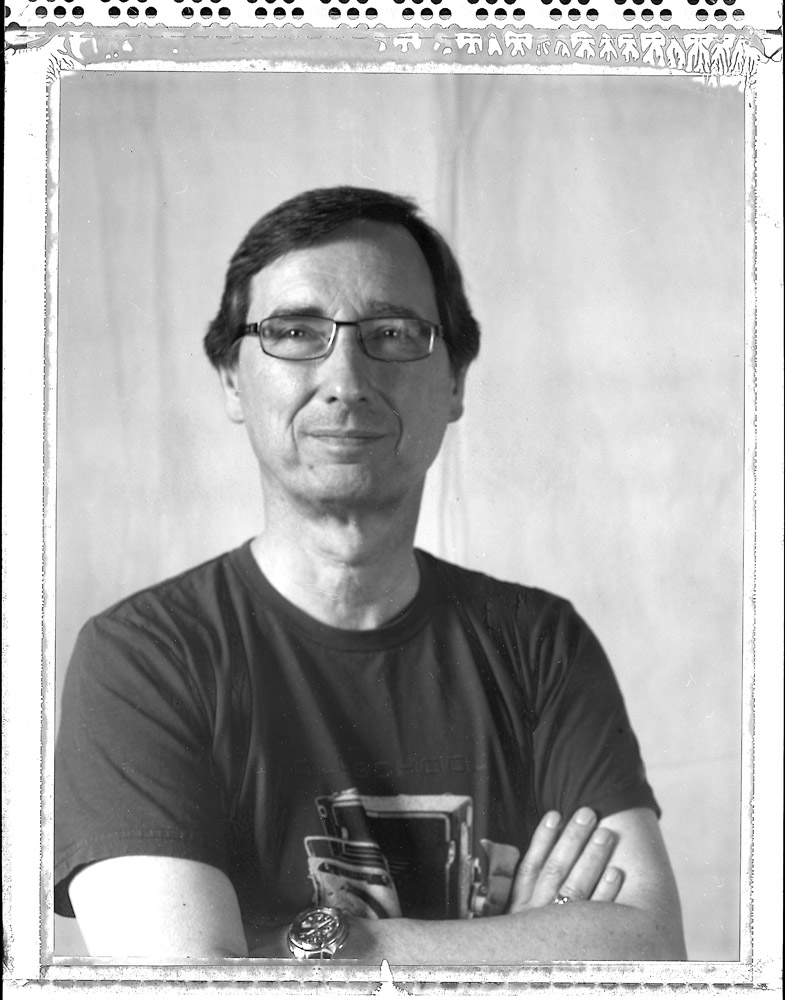
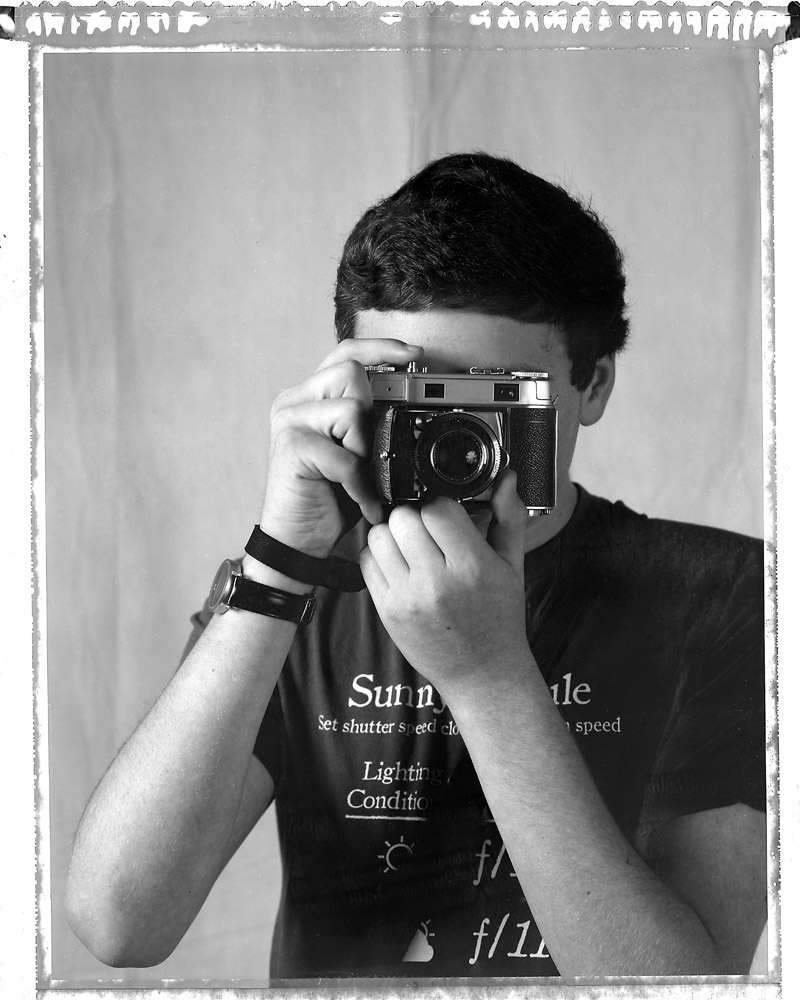
This weekend was the next-to-last session of the Intro to Large Format Photography class I’m teaching at Glen Echo. As a treat, I broke out some of the last remaining sheets of Polaroid Type 55 I have in my personal stash. We had a lot of fun setting up portraits and posing for each other. One of my students even brought along his 6×17 panoramic camera and took a couple frames of all of us in the studio together – a couple were serious, and one was very silly (I gave someone next to me bunny-ears).
Sean L.
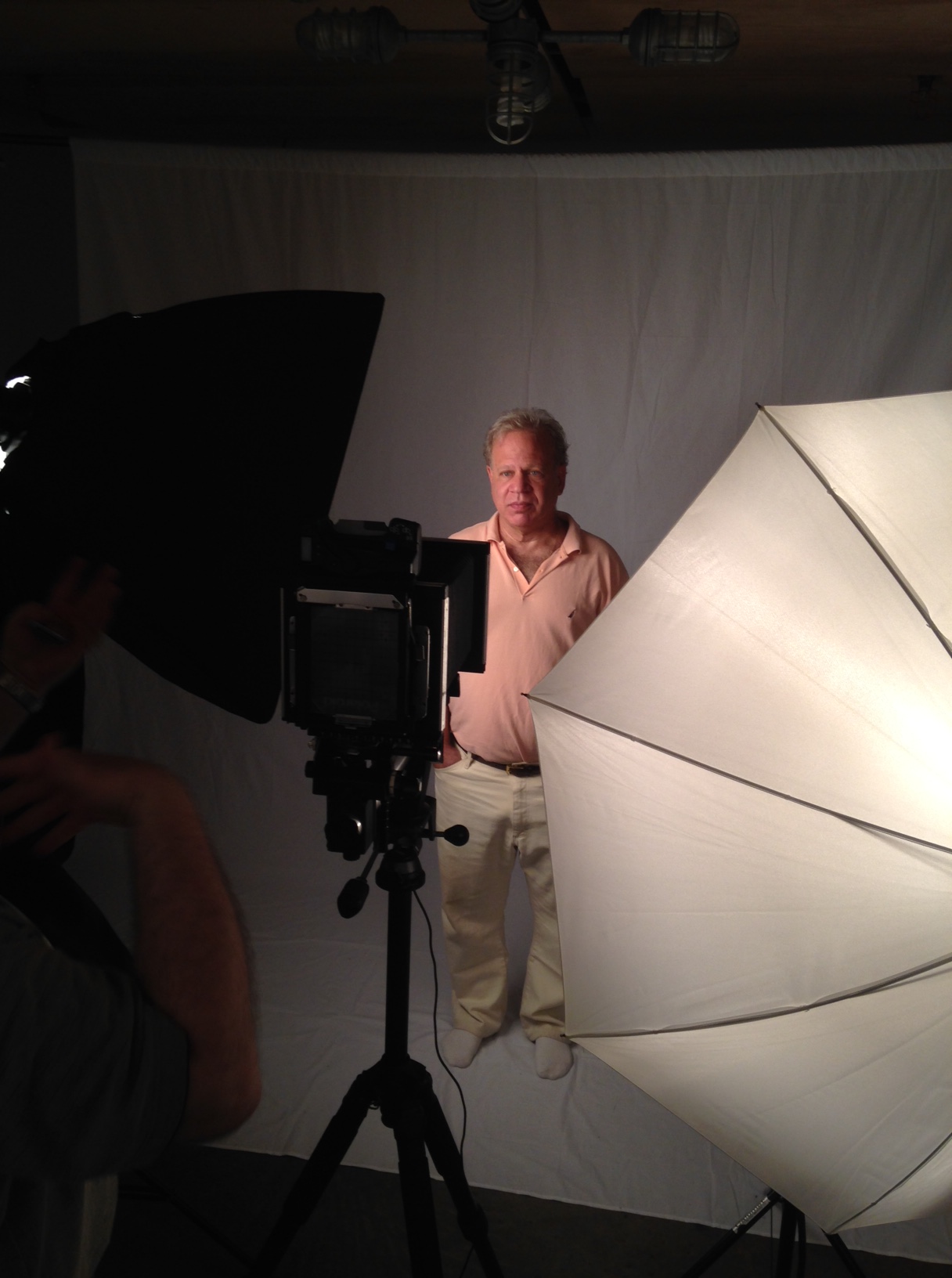
We covered the fundamentals of not only how to use a view camera for portraiture (movements – not many – focusing, bellows extension factor, lens selection) but also basic studio lighting. Given that we were limited on time and had lesson objectives to cover, I dictated the lighting setup with just a main and a fill, driven off my Calumet Elite 2400 W/S unit. It’s a lot of power for just 4×5, but I wanted to give people a real studio experience (that and the moonlights I would have used that are at the school are at the moment buried in the storage closet under dozens of boxes from the exhibits currently hanging in the gallery space).
Dean M.
We rigged a softbox on the main light and an umbrella on the fill. The softbox was camera left, and the fill was beside the camera. I used a 240mm Docter Optics f9 Apo-Germinar as my lens because the focal length is a nice one for studio portraiture (not too long, but not too wide either), it’s mounted on a lens board to fit my Sinar (some of my other portrait lenses are on different lens boards), and the shutter has good working flash sync (some of my other portrait lenses are in archaic shutters that don’t have reliable flash syncs – and yes, I’ve had them overhauled but they still don’t work 100% of the time). f9 is a bit dim for a traditional portrait lens, but I think this one produced outstanding results (further confirmation that that lens was a phenomenal buy and well worth every penny).
Anthony R.
Polaroid Type 55, for those who are unfamiliar, was an instant film that produced both a positive print and a re-useable negative. Artists have loved the negatives not only for the incredibly fine grain and sharp detail, but for the artifacts at the edges that the Polaroid process produced. It hasn’t been made since 2008, so any Type 55 anyone is using is old stock. There is hope on the horizon for a replacement as a group called “New55” is creating their own improved version. One of the challenges of the original Polaroid Type 55 was that the negative film and the print were not equally sensitive, so you had to decide if you wanted a good print or a good negative – a good print gave you an underexposed negative and a good negative gave you a washed-out print. New55 will have one advantage over the old stuff – the instant print and the negative will be speed-matched so you won’t have to expose for either a good print or a good negative.
Ari G.
I can tell from the negatives that my Type 55, which outdated in 2006, is starting to get a little long in the tooth, as they have begun to lose some contrast. I’ve tweaked it a fair bit in Photoshop to get these negative scans to look good. I’ll try printing them in the darkroom and see what I can do with them – they may print much better than they scan.
Glen Echo Intern
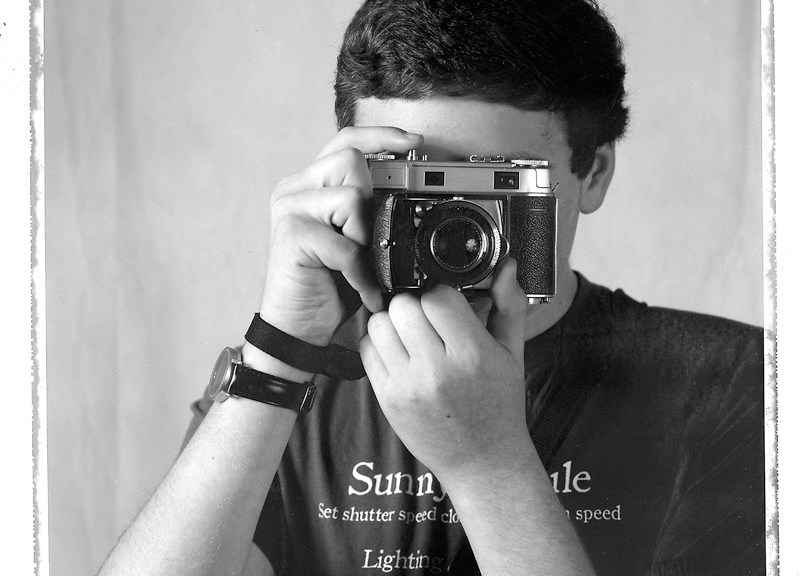
Here are some behind-the-scenes shots, taken by one of my students.
Here’s another photo of Ed Bearss I took on the Ball’s Bluff tour, as he’s describing the battle in front of the sign at the park entrance, armed with one of his US Marine Corps- themed swagger sticks.
Ed At Balls Bluff
He’s always carrying one to point and gesture with while he talks, for emphasis.
One of the great privileges of living in Washington DC is access to cultural institutions. As part of the Smithsonian Resident Associates program, I get to take part in lectures and tours on art, politics, and history. As you can tell from my blog postings about my antique image collecting, I’m a big Civil War history fan. The Smithsonian Resident Associates program offers a wonderful series of lecture tours on the Civil War, the best of which are led by the inimitable Ed Bearss. Ed is a national treasure – he’s a combat-wounded WW II veteran, Chief Historian Emeritus of the US Park Service, responsible for raising and restoring the Union ironclad ship on display at Vicksburg, Mississippi (which he’ll say was a study in how NOT to raise a sunken ironclad), brilliant raconteur, and at 91, still leading tours 200+ days a year. And even at 91, he’s the first one off the bus and leading the charge across the field, the entire day. If you’re a Civil War fan, you probably know who Ed is – he’s one of the historians on-camera in Ken Burns’ The Civil War, and was a regular on History Channel’s “Civil War Diaries”.
Ed Bearss
This is a somewhat rare image of him on tour, as he’s got his eyes open. Often when he’s narrating the events of a battle, he’ll close his eyes. It’s not because of a vision problem – when asked, he explained that “it helps me picture the story in my head”. I feel so privileged to get to walk battlefields with Ed and listen to him tell the stories of the events as only he can, with his unique cadence and stentorian voice.
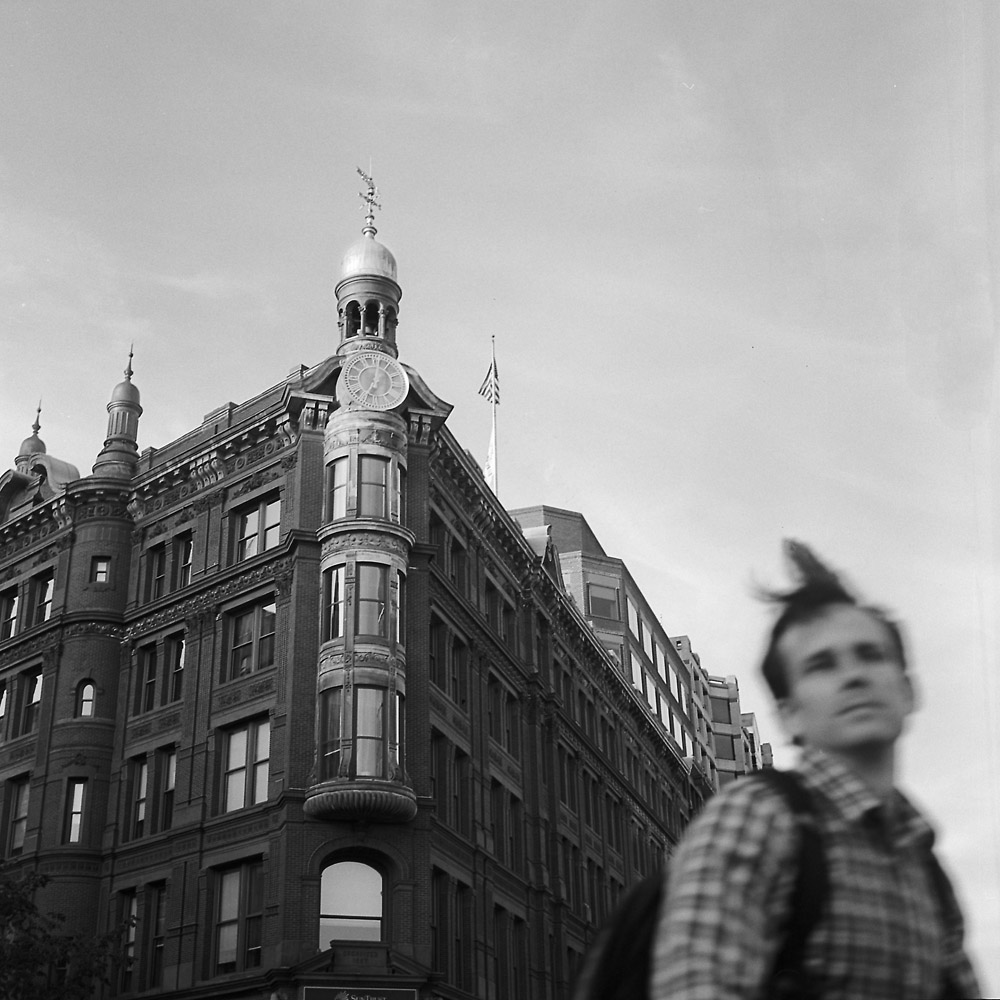
While this shot is at least as much about the SunTrust Bank building in the background, I love how the cyclist passing through the shot turned out – he’s obviously in motion, with a lock of hair blown up and back as he moves. The blurred face makes it somewhat anonymous, an everyman on his way somewhere quickly, turning his head just long enough to look back at the camera looking at him. Actually kind of a rarity these days.
Cyclist, SunTrust Building
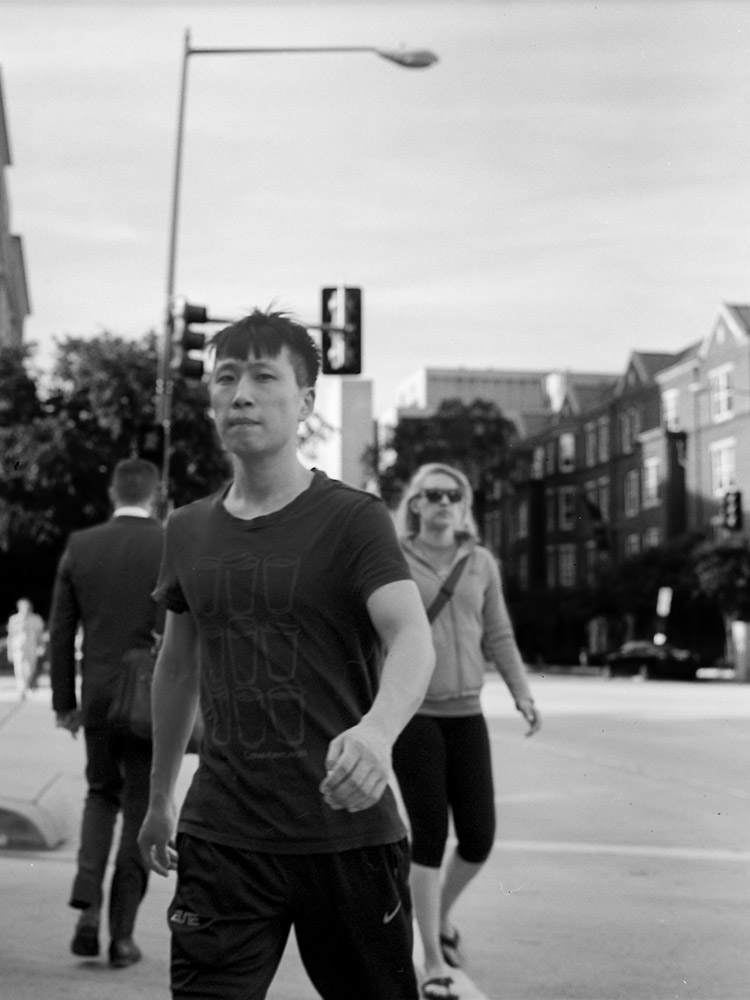
I liked the graphic design of his t-shirt so I set up my camera before he started crossing the street and waited until he was in “the zone” to snap the picture. He’s not tack-sharp because we were both moving at the time, but I think the slight softness of him and the people around him give a sense of movement as well as depth.
Nine Cups T-shirt
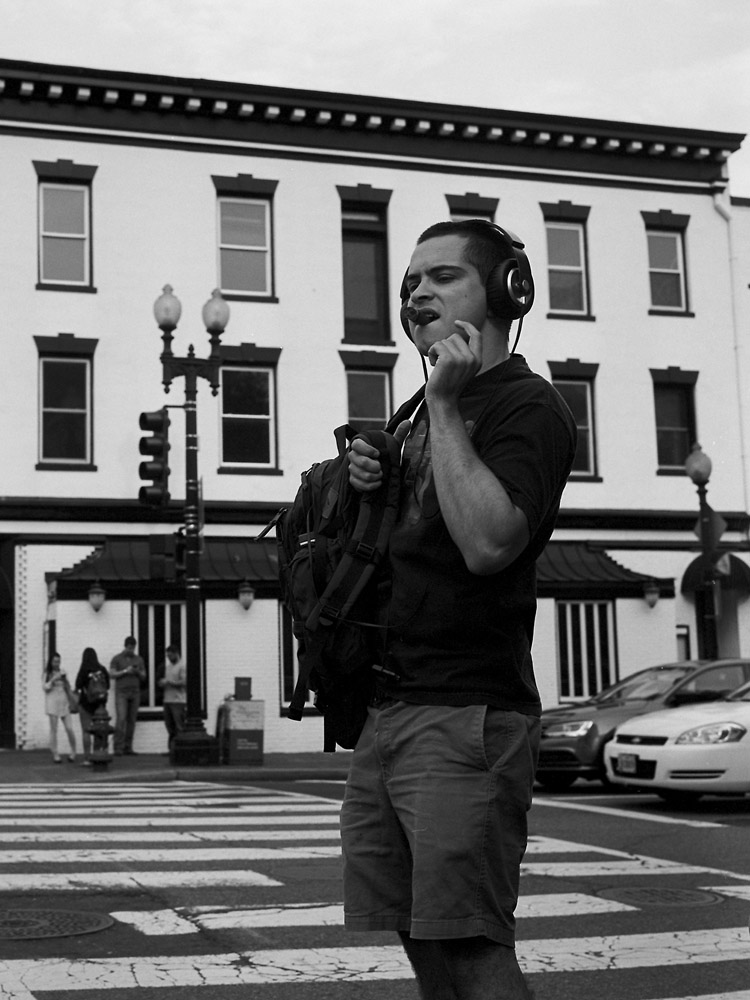
When I saw this character I had to photograph him – giant headphones combined with the fat stogie? How could you NOT?





 dcphotoartist